1

Note to Email subscribers

Those who subscribe via email, the prior service, bloglet, appears to be dead. I have now switched to feedblitz. If you have already subscribed you need not do anything you have been automatically switched. However, if you would like to subscribe it is on the left side of the page.


The Meshumad Hazzan

As some of you know I have an interest in meshumdim and their wide affect on modern day Judaism. Thus, Yehoshua Mondshine’s latest installment in his series on corrupted stories is especially good. Some may recall our earlier post on Mondshine’s earlier piece about the “classic” ba’al teshuva story and its root in a Shai Agnon story, I think this one is equally as good.

This story is a Habad story and it basically goes like this. There was a Hazzan in Habad known as Reb Yechiel the Meshumad. His story was that as a young boy his entire village was wiped out by a progrom. The Poritz kept him as his own son and did not tell him that he was Jewish. The boy had no idea who his true ancestors were. As the boy grew up it became appearent he had a talent for music and was sent to a music school. At school some kids taunt him for being Jewish (there are slightly different variations here) and he has no idea why. He goes back to his “father” and he is then told what happened and eventually hooks up with Habad and becomes the Hazzan.

This entire story is not in the least bit true. First, they have letters from the Hazzan Yechiel to his (real Jewish) father. Second, in those letters he discusses his lineage so he was well aware where he came from. Third, he was never a meshumad. Instead, it seems he was the meshulach for Yeshivat Tomkhei Torah. It seems that meshulach and meshumad are close enough that people got them mixed up!? However, once the meshulach became a meshumad it was only a small leap to create an entire legend surrounding his childhood.

The full article is available here.

Additionally, it seems the niggun which the story revolves around – the one for hu’ ‘elokanu in the mussaf of Shabbat is based upon a non-Jewish one.


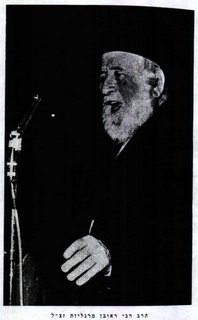
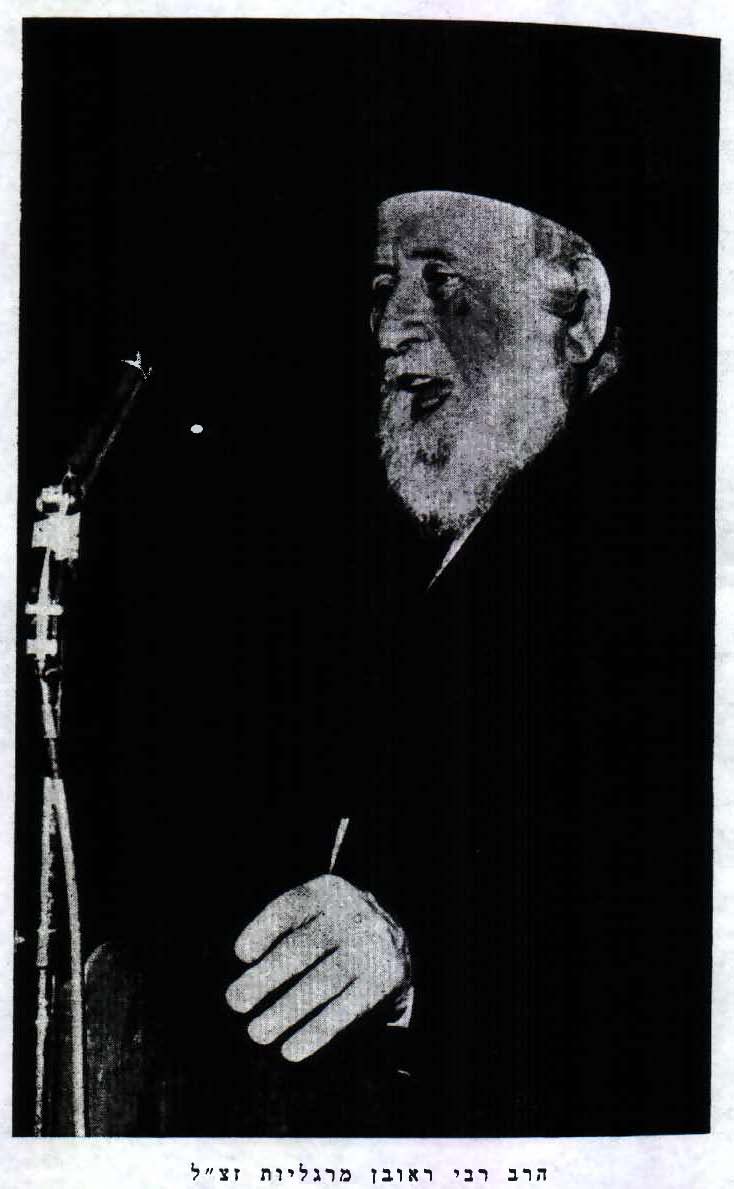
R. Reuven Margulies II

I have already discussed the most recent book of R. Margulies and provided a bibliography of his works, I now want to turn to a brief biography of him.

R. Margulies was born in 1889 and was known, from the time of his youth, as extremly erudite. Although he recieved ordination, he did not become a Rabbi and instead opened a bookstore in Lemberg. It is said that although his store was always full of talmidi hakhmim it was unclear if he actually sold anything. During his time in Lemberg he began publishing his own books. Many of his early books focus on hassidim. One of his early works, a biography on R. Hayyim ben Attar (Ohr haHayyim haKodesh) included comments by R. Dan Polonski, the author of the Kli Hemdah. In 1935 R. Margulies moved to Israel and became the librarian at the Rambam Library in Tel Aviv.

After moving to Israel he produced some of his most well known works. He began to focus on the Zohar literature and produced a fully annotated version of the Zohar, Zohar Hadash, Tikkunei Zohar and the Bahir. Additionally, during this time, he was involved in a controversy with Gershon Scholem over the R. Jacob Emden/R. Jonathan Eybeshuetz controversy. R. Margulies produced a pamphlet defending R. Eybeshuetz and in response Scholem produced his own disagreeing with R. Marguleis’s conclusions.

R. Margulies also produced an annotated Shulhan Orach, Nefesh Hayiah which he lists, in his typical encyclopedic manner, other books which deal with the same issues. It was this book that some in the comments to a previous post have raised questions about plagerism. The source for this accuasation comes for R. Wolf Leiter. He cites to sixty-one examples from R. Margulies’s book Nefesh Hayiah where R. Leiter notes others have said the same thing prior to R. Margulies. In fact, R. Leiter says these are just the tip of the iceberg. He says “there are hundreds of other examples which I have written on the side of my copy, there is no end I have only provided some examples.” R. Leiter’s examples include citations to articles and other books.

It is important to note, however, that R. Margulies wrote this during World War I. R. Margulies himself notes that this was written during a particular trying time “I remember the long winter nights when I was closed up, alone, lacking everything . . . I wrote and studied from the light of the oven fire, laying upon the floor.” Thus, it is a possiblity that during this time he neglected to look up everything and produced much from memory. In turn, the result may have been to include what he had seen before without attribution.

Additionally, some accuse him of plagerizing from R. Yosef Engel and R. Engel’s comments to the Zohar. I have never seen this in print (aside from the comment).

That being said, to accuse R. Margulies of not being extremely well read and very, very, erudite is wrong. If one looks to R. Yosef HaKohen Schwartz, who himself was one of the biggest bikeim of his day. He corresponded with R. Margulies and among other notes that R. Margulies’s “praises are known to all” that he is “an amazingly sharp mind.” Furhter, if one looks at his bibliography in three parts in the journal Areshet is very apparent R. Margulies’s breath of knowledge. Finally, as evidenced by the bibliography below, R. Margulies produced many, many books and if in one or two he may have been sloppy in attribution it is equally clear that the vast majority of his works he was not.

R. Margulies passed away in 1971.

Sources: Sefer Margolios, ed. Dr. Y. Refael; R. Z.W. Leiter, Tzion l’Nefesh Hayyiah no. 109; R. Y. Schwartz, Ginzei Yosef.



R. Reuven Margulies I

First, I want to post a bibliography of R. Margulies’s works and then I shall discuss some biogrpahical details in the next post. This bibliography is not a scientific one in that I do not attempt to list every edition. Rather, I am listing just the works and some bibliogrpahical information as I see fit. Most of this information comes from Naftali Ben Menachem’s bibliogprahy of R. Margulies’s books which was printed in Sefer Margolious.

1) Toldot Adam (Lemberg 1912) on R. Shmuel Edels
2) Kav Besamim (Lemberg 1913) 102 notes on Tosefot
3) Drush l’yom ‘alot ‘al kesi moshlim ‘adonanu haKeiser Karal haRishon (Lemberg 1918)
4) Kavi Ohr (Lemberg, 1921) laws pertianing to Israel as well as articles on history, including yesod hamishna among others
5) Yesod HaMishna V’Arikachto (Lemberg, 1933) on the creation of the Mishna
6) Sefer Hassidim with his notes (multiple printings)
7) Tolodot Rabenu Hayyim ben Atar (Lemberg, 1925), biography on the Ohr Hayyim includes the notes of R. Meir Dan Plotzki (Kli Hemdah)
8) Ohr Meir (Lemberg, 1926), biography of R. Meir from Perlmishiya
9) Margenuta d’Reb Meir (Lemberg, 1926), sayings of the above R. Meir
10) Shealot u’Teshuvot min HaShamyim, R. Margulies’s extensive notes on the teshuvot as well as a comprehensive introduction discussing Torah lo’ Bashmyim and other related topics (multiple printings)
11) Yalkut Margolious ([Lemberg], 1927), derashot of R. Margulies
12) Imrei Kodesh haShalem (Lemberg, 1928)
13) Vikuach Rabbanu Yehiel m’Paris (Lemberg, 1928), with biography of R. Yehiel
14) Shemot v’Kinuim B’Talmud, discussing names in the Talmud, including when two names started, (multiple printings)
15) Helulua d’Tzadika (Lemberg 1929), lifespan and death dates of Tzadikim
16) Vikuach HaRamban (Lemberg, 1928)
17) Yalkut Peninim (Lemberg, 1929), derashot
18) Butzna d’Nehora HaShalem (Lemberg, 1930), about R. Barukh of Metzerich
19) Gevurot Ari (Lemberg, 1930), biography of R. Leib Srhson
20) Toldot Rabbenu Avrohom Mimoni, biography of Rambam’s son, (multiple printings)
21) Rishimah (Lemberg, 193-) list of books in his bookstore
22) Mekor Barukh (Lemberg, 1931), biography of R. Barukh of Metzerich and other historical documents
23) Shem Olam, to reveal the anonymous people in hazal (multiple printings)
24) HaModiah journal
25) Nefesh Hayyia, on Shulchan Orakh multiple printings
26) Hagadah shel Pesach (Tel Aviv, 1937)
27) Shichot Chakhamim
28) Mekor haBerakha discussing blessing and why and when before one does something (recently reprinted)
29) Zohar with his extensive notes (multiple printings)
30) Sibah hisnaguto discussing R. Emden/R. Eybeschitz controversy (very controversial Scholem wrote a pamphelet against this) Tel Aviv 1941
31) Reb Saul Levin M’Ziaf haSefer Besamim Rosh, in Aresehet 1944
32) Malechi Elyon on angels in Hazel (multiple printings)
33) Ollalot various articles (multiple printings)
34) Tikunei Zohar notes, multiple printings
35) Sefer haBahir same as above
36) Zohar Hadash same
37) L’Toldot Anshei Shem b’Lvov, Jerusalem 1952
38) Milchmot HaShem (R. Avrohom ben HaRambam) (including the biography on him) (multiple printings)
39) haRambam v’Hazohar now reprinted in Penini Margolios
40) Sha’ari Zohar collecting relvant passages from the Zohar to Hazal (multiple printings)
41) Margolios HaYam on Sanhedrin (multiple printings)
42) Divrarim b’Itam dershot
43) L’Heker haMisparam beTalmud, Sinai 44
44) Tzioyunim Bibliographim a comprehensive biobibliography in Areshet 1-2,4
45) Tziyunim l’Ha’arot l’Seder haDorot, Sinai 46
46) HaMikrah v’Hamesorah multiple printings
47) Mekharim b’Darkei haTalmud v’Hidosov multiple printings


“New” R. Reuven Margoliyot Book

Mossad HaRav Kook has published Peninem u-Margoliyot which is a collection of articles by R. Reuven Margoliyot. These articles originally appeared in the journal Sinai and are now republished in a single volume. It seems that the impetus to collect and publish these was not so that people could have access to them (although perhaps this played a small role). Instead, Mossad HaRav Kook was forced, as it was, to publish these.
In the last few years, in honor of someone’s child’s wedding, someone published some of R. Margoliyot’s articles and books, including the articles which appeared in Sinai. Now, this seems to have upset Mossad HaRav Kook as they note in the introduction where they explain these articles are not that well known “with the exception of one publisher in America, who stole, without first obtaining permission, and Jews will not have a stumbling block in their homes.” While it may be the case that many are unaware of the journal Sinai or where to find R. Margoliyot’s writings it seems that Mossad HaRav Kook who had these for years, some for 30 years, they would have been content to let them langiush had it not been for this violation of copyright.

In fact, Mossad HaRav Kook has only published those articles which appeared in Sinai, they did not, as the American publisher did, republish other works (long out of copyright) of R. Margoliyot. The American publications include Toledot Ohr Hayyim haKadosh and Toledot Maharsha. The latter was originally published in Lemberg in 1932 it contains a portrait of the Maharsah (R. Shmuel Edels) as well as a discussion by R. Margoliyot of other Rabbis who had their portraits done (the picture of him in the chair is from the 1814 Vienna edition of the Maharsha and the frontal picture is from R. Margulies’s book).

The articles in these books include among others: Ha-Rambam v’HaZohar, Defusi haShulhan Arukh, Defusi haShulahan Ohrah haRishonim, Zionunei HaPesukim b’Talmud u-Midrashim, and Toledot Rebbi Yehuda HaNassi.

I purchased both the American and the Mossad HaRav Kook versions at Beigeleisen Books.


Eruv Controversy and Website

There is an excellent site discussing various issues with eruvin, many of them contemporary (especially in light of the seforim which have been published on the topic in the last couple of years, many dealing with the Brooklyn controversy). Today, he has the second part of his series on the St. Louis eruv controversy which includes a rather fascinating discussion regarding two seforim printed at the turn of the 20th century.

Both of those seforim are available online, if one is interested in reading further.