1

Listing of New Seforim

What follows is a list of new seforim I have recently purchased; for prior lists see the “New Books Lists” on the sidebar.

1. Indices To The Emden-Eybeschuetz Controversy Literature by Gershom G. Scholem. As the title implies, this is an index, divided by person, book, and geographic place. Additional, many of the abbreviations used (R. Emden constantly uses abbreviations, many obscure) are explained. This index was culled from Scholem’s index cards where he kept these records. The editors have done nothing to update them nor have they attempted to ensure consistency. So, in essence they had these cards typeset and published.

But, as part of this publication Hebrew University has scanned all of the books and manuscripts covered by this index and put them on a CD. This is especially important, as many of these are very rare and hard to come by. This CD is supposed to be available directly from Magnes Press, however, I could find no other information on this on their website.

2. On the topic of Scholem there is a fairly recent book, Pithe ‘Olam which is a critical edition of R. Solomon ben Samuel’s work by that name. This is a work of kabbalah. However, perhaps the most interesting piece of this book in not the manuscript but what the editor, Rafeal Kohen, has appended to it. R. Kohen has included his own polemic against modern kabbalah scholars. He accuses them, among other things, to have stymied the publication of numerous manuscripts to benefit their own careers, racism against those not in academia, as well as plain sloppy scholarship. He backs some of these claims up with concrete examples. In particular he savages Paul Fenton’s edition of R. Yosef b. Avrohom’s Sheroshi HaKabbalah with numerous examples of errors and mistakes. R. Kohen, also goes University by University and points out who he has issues with. R. Kohen is particular of appending each of the names of the people he discusses with the ignominious abbreviation meaning שם רשעים ירקב ימח שמו וזכרון תימקן ותשחקן עצמות אוסר לעסוק בקבורתו or שר”י יש”ו תו”ע אל”ב at every single mention of their names. He covers Hebrew University, Bar Ilan, Sorbonne, and the Schechter Institute. It makes for some entertaining, if over the top, reading.

3. Journal Mayni HaYeshua from Biala Hassidim contains a 23 page article against Eliach’s Sefer HaGaon.

4. Ziv haSemot or What’s in a Name. This book on everything having to do with names and naming is perhaps the 4th book on this extremely important, life or death topic which has come out in the past few years. This one is in both Hebrew and English. Curiously, although there is a chapter on using a name that a wicked person had such as Yismael. The author does not cite to or quote the Shu’t Besamim Rosh on the topic. Whose pronouncement has broad implications for naming. He says even if a evil person happen to have the name, if it is a nice name then you can use it.

I purchased these at Biegeleisen in Boropark.


Seforim For Sale

R. Landy of the Lower East Side has purchased a significant library and is now selling them. Unfortunately, I have yet to see these in person, however, from what has been related to me via telephone, he has some terrific books. If one wants to go, they should first call him at 917 676 0762. He is located at 264 east broadway C104.


R. Shabbtai the Bassist, the First Hebrew Bibliographer

The JNUL has just put up the first Hebrew bibliography, Siftei Yeshenim. This work is written by R. Shabbtai Bass. R. Shabbtai is perhaps most well known for his commentary on Rashi ‘al haTorah titled Siftei Hakhamim.

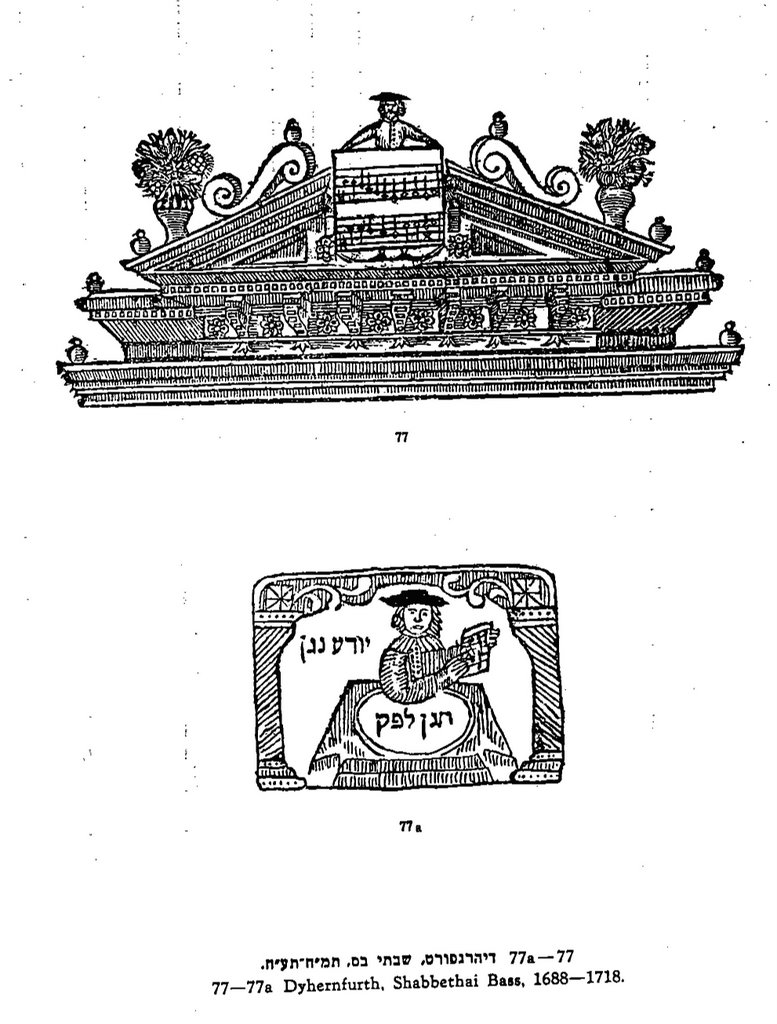
R. Shabbtai was born in 1641 in Kalisz, Poland. When he was 14, both his parents were killed in a pogrom by the Cossacks. R. Shabbtai went to Prague. It was in Prague where he would gain his last name and begin his career as a printer. In Prague he began taking music lessons and became a bassist for the Altneushul. He, in all likelihood participated in that shul’s choir which would weekly welcome in the Shabbat with musical accompaniment. [Later on, this music would become central to the debate of allowing for an organ in the Shul as well as playing music in any religious services]. R. Shabbtai took his musical calling seriously and the printers mark he used had musical elements to them. [The two relevant ones are reproduced on the side]. Additionally, he became known as alternatively, R. Shabbtai the Bassist Singer or just R. Shabbtai the Bassist. Aside from gaining an interest in music as well as his general Torah education, he also studied Latin while in Prague.

From Prague, R. Shabbtai, went west, eventually ending up in Amsterdam. It was during these travels he visited numerous libraries and began compiling his bibliography. [Although he did begin the project in Prague, it seems to have really taken off after he left.] In 1680, he published the bibliography in Amsterdam and titled it Siftei Yeshenim the lips of the sleeping ones. This title is appropriate for many reasons. First, it comes from Shir haShirim which has the highest density of book titles, and thus, I think is appropriate for a book listing books. Second, as R. Shabbtai points out in his introduction where he offers ten reasons for bibliography, just reciting the names of books the ignorant can earn a similar reward to those who actually study them. R. Shabbtai based this upon R. Isaiah Horowitz (Shelah).

This work lists about 2,200 titles. Of these, 825 were manuscripts. R. Shabbtai provides an index by category at the beginning of the book. Although the bulk of the lists are books by Jewish authors, he also included about 150 Judaica works by non-Jewish writers.

The work was “updated” in 1806 by Uri Zvi Rubenstein, however, he “demonstrated weak bibliographical abilities and his effort is to be considered a step backwards in the history of Jewish Bibliography.” (Brisman at 13).

After spending about 5 years in Amsterdam, R. Shabbtai he moved to Dyhernfurth and opened his own press. He began to print works of Polish Rabbis and printed some of the seminal works on Halakha. He printed R. Shmuel b. Uri Shraga’s commentary on Even Ezer, the Bet Shmuel as well as R. Avrohom Abeli’s commentary, Mogen Avrohom.
While he was in Dyhernfurth, he hoped to reprint his Siftei Hakhamim which had been printed in Amsterdam in 1680. He had made extensive corrections and additions which he hoped to include. During the interim, he found out that the publisher in Amsterdam was also readying a reprint and had secured the normal copyright harems. Thus, R. Shabbtai was forced to buy out the Amsterdam printer so he could reprint he own book! This is of particular interest in one’s understanding of copyright under Jewish law. It would seem from this case that the author does not automatically hold a copyright to his own works. Instead, copyright is dependent upon who has a money interest. Unfortunately, none of the many articles or books on Jewish law and copyright cite or discuss this case.

R. Shabbtai’s commentary on Rashi has been reprinted many, many times, and now is standard fare even with Humashim which contain no other commentaries other than Rashi and Onkelos. However, this commentary is typically an abriged version – Ikar Siftei Hakhamim. This abrigment was done by the famed Romm Press in Vilna in the 1872 edition of their Torah Elokim. Although we don’t know for certain who did the abrigment as the title page just allows “two talmdei hakamim” were the ones who did this. It is assumed these would have been editors at the Romm Press. At that time R. Mordechi Plungin was the editor at the press. He was involved with the printing of many “classics” such as the Eiyn Yakkov and the Shulkhan Orakh. In this last book, although he always remain anonymous and never takes any credit for anything he does, he included in Yoreh Deah a few comments under the title Miluim. Now, some don’t like R. Plungin (he was a maskil) most notably the father of the Hazon Ish. Thus, in the Tal-man edition of the Shulkahn Orakh his comments were excised.

So, if one follows that opinion, one should view as important and sensitive task as abriging a commentary with some skepticism. Perhaps, as the editors remained anonymous this hasn’t been noticed – yet. Or, the two talmdei hakamim were not R. Plugin. Be it as it may, R. Shabbtai, the bassist, printer, bibliographer, has left an indelible mark across numerous disciplines.

Sources. For biographical sources, you can look at any one of these as they all just regurgitate what the others prior to them do without adding much, if anything. EJ vol. 4 col. 313. Friedberg, B. History of Jewish Typography of Amsterdam et. al., Antwerp, 1937, 53-64; Y. Rafel, Sinai vol. 8 and 9 reprinted in his Rishonim v’Achronim; and the JE here. See also on R. Shabbtai and Jewish bibliograpy in general S. Brisman, “A History and Guide to Judaic Bibliography.” It is worth reading Zinberg’s nice biography of R. Bass in The History of Jewish Literature, vol. 6, pp. 150-52.

For his printers marks, see Ya’ari, Printers marks. On his Siftei Hakhamim see the new bibliography on Rashi commentary, P. Krieger, Parshan-Data, p. 41-46.

Finally, there is a discussion regarding the first edition of Siftei Yeshanim and why in some edition a Siddur is apended to it. For this, see H. Liberman, Ohel Rochel vol. 1 p. 370-71.


Hebrew Printing in America 1735-1926 – Review II

The post below is a continuation from this prior post.

America posed some unique questions regarding marriage and divorce laws. In the early period of American Jewish history, many people were not erudite. In an apparent effort to help with this deficiency, in 1901, R. Dov Baer Abramowitz published his Sefer Ketubah. This book contains tear out, pro forma ketubot. Thus, the Rabbi could just rip one out whenever he needed to. (No. 588). Another work which dealt with marriage issues is a small pamphlet published in 1909. This dealt with the question of a man who was induced to marry a woman who was “mentally unbalanced.” The husband was allowed to marry a second wife via a heter me’ah rabbanim (the consent of one hundred rabbis). Typically, these 100 must come from different countries, however, here, for the first time, R. Rosenfeld, the author, “explained that it could be issued by American rabbis alone because ‘at one time [the United States] were separate countries. And even today each state is, to a certain extent, [a] separate [entity].'” (No. 1144).

While on the one hand there were many in America that were in the Jewish sense, illiterate, there were also those on the opposite end of the spectrum as it was, who published scholarly works. Dr. Louis Ginzberg, published in 1909 Seriedi HaYerushalmi min HaGeizah asher b’Mitzrayim. This book contained, as the title indicates, fragments from the Cairo Genizah which enabled Ginzberg to offer correction to the standard edition of the Jerusalem Talmud. It seems that this was deemed so important even outside the U.S. As “Ginzburg’s research was included – without attribution – in the Vilna 1922 edition of the Yerushalmi” (No. 606).

This copyright infringement was actually a two way street. In 1919, The Union of Orthodox Rabbis of the United States and Canada published, for the first time in America the complete Talmud. While this signaled a new era in the Jewish learning in the US, it seems that the publishers did not secure all necessary rights before embarking on this printing. Specifically, this edition is a photo-reproduction of the Romm, Vilna edition of the Talmud. This did not go unnoticed. “Moses Rosenberg wrote to R. Hayyim Ozer Grodzinski of Vilna on behalf of the Romm publishing house. He accused Agudath Harabbonim of reproducing the Romm edition without permission and requested that Agudath Harabbonim be summoned to a rabbinical court.” (No. 635). This letter is reproduced at the end of volume II of the work. (p. 1181). The end of the second volume contains many historical letters from Yosef Goldman’s collection. Additionally, there are photographs and autographs of some famous American Rabbis as well in this last section.

On the theme of lack of religious observance, there is no lack of books dealing with this. Moses Weinberger’s book, which Sarna translated into English, “People Walk on their Heads” is but one example. R. Elijah Kochin, Sefer Aderet Eliyahu (Pittsburgh, 1917) where he complains “the city of Pittsburgh is still hefker [anarchic] and it lacks everything necessary for the highest level of observance.” He decried the “accepted evil custom in this land which says that he who lies the most by bluffing, as it is called, is to be praised.” (No. 784).

Already in 1872, Nahum Streisand who I have no idea if any relation to the now woman singer Barbara, which would be rather ironic in light of the fact this book “contains an analysis of the rabbinic debate over the prohibition for a man to hear a woman singing. Streisand had originally sent its contents to Henry Vidaver after the latter issued a ruling permitting women to sing in the choir of his congregation, Bnai Jeshurun.” (No. 1091).

Other issues which came up include metzizha b’peh and whether one can use a sponge. See nos. 1117. In 1915 a book on circumcision was published which, in part dealt with metzizah b’peh by the milah board. This board was “recognized by the New York City Commissioner of Health . . . [who said] the educational value of such work as the Milah Board has done in this matter is of the greatest help to the City, and particularly to our department.” (No. 1158).

Another issue was the use of wine during Prohibition. Dr. Louis Ginzburg published a responsa which argued that grape juice was sufficient for ritual that would otherwise require wine. He did this as “during the era of Prohibition, the government granted special licenses allowing the sale for sacramental purposes. Some Jews abused these licenses.” Ginzburg, wanted to void the use of wine, thus obviating the need for such licenses. This responsa “elicited enough interest in the secular world to merit a press conference and coverage in a major newspaper [i.e. the New York Times].” (no. 1177).

This was not the only work influenced by Prohibition. Isidore Koplowitz published “Midrashic Exegetics on Wine and Strong Drink.” He endeavored to prove “that the Hebrew prophets and a host of Talmudic Rabbins, were outspoken in the great cause of prohibition.” No. 1179.

To be continued. . .


New Book Lists

There are two new list of out-of-print seforim available. The first, is via email, you can request the list from sba-at-sba2.com. The second is mainly a list of German imprints (it includes a couple of books Solomon Schechter owned) and can be viewed here. Additionally, Kestenbaum recently had their latest auction, unfortunately their catalog is no longer available online, but if you previously downloaded the catalog you can see the price results here.


Hebrew Printing in America 1735-1926 – Review I

There is a new work in Jewish bibliography focusing on American Jews. This work “Hebrew Printing in America 1735-1926: A History and Annotated Bibliography” by Yosef Goldman. (It can be obtained by contacting Y. Goldman at ygbooks -at- yahoo.com). As the subtitle states, is much more than a bibliography. This work, is at the very least the starting point for any research on American Jewery, and can be viewed as a history of American Jewry.

The book includes a listing of all the books published in American under the covered time relating to Jewish topics. So we have books done by non-Jews, apostates, and, of course, Jews. It includes Rabbinics, Drama, Fiction, Missionary and Humor to name but a few topics. Each entry aside from listing the publication data also includes a short biography on the author, as well as a description of the contents of the book, especially highlighting interesting tidbits. Each book is cross referenced and sources are provided. The sources include references for further reading as well as where the person’s portrait can be found.

The bibliography for this book is in itself a wonderful reference for American Jewish history. The books are divided by topic which enables the reader to see the growth or trends in a particular area.

I wanted to highlight some of the more interesting entries to enable people to see the comprehensiveness of this work; as well as to discuss American Jewish history.

As Goldman notes, America provided a unique home for the translation. Although, in other places in the world, whenever either the Talmud or the Torah was translated this was generally accompanied by controversy. In America that was never the case. Books were almost immediately published in English without anyone raising an eyebrow. This is evident throughout the subjects. Whether it be in Torah or Prayer or law. It is almost as if America was made for Artscroll and the like. There is but one exception is the book (no. 612) Ohel Sara 1902 which discusses laws for women. The author, Abraham Ever Hischowitz states in the preface “in 1902 when I considered the publication of this first edition of this work, I found great difficulty in obtaining a written statement admitting the advisability of putting this book on the market. The objection being of course, the Law concerning Niddah.” It seems that including in English the laws relating to menstruation were possibly problematic, although the author was able to overcome it and publish this work. However, as is noted, “there was apparently still some opposition as late as 1912, since some copies of the second edition were printed without the section on menstruation.”

The first section is the Liturgy section. No. 41, the First Reform Siddur in America, 1855, by Dr. Leo Merzbacher. Apparently, aside from this siddur, he also received ordination (semikah) from R. Moses Schreiber of Pressburg (Hatam Sofer) the leading adversary to the Reform movement. In 1860, in light of the differences in the highest governmental position, between the US and other countries, a siddur is published which alters the traditional prayer for the government from הנותן תשועה to רבון כל העולמים this was done so “whereas הנותן תשועה refers to a monarch, רבון כל עולמים refers to the president, vice president, governor, lieutenant-governor, mayor, city council, and the residents of New York City.” Additionally, a copy of the page with the new prayer is provided. (no. 46). On the issue of the prayer for the government, in 1912, one Siddur the prayer for the government included a prayer for the Supreme Court as well. (No. 114).

We have Marcus Jastrow’s Siddur which “creatively modified the classical contours of the Siddur . . . and added many new prayers.” (no. 58). As well as his edition of the Haggadah which changed ha lahma anya from the traditional words to “whoever is now a slave, next year he should be free.”

The Siddur l’Bet Sefer u’Lam which was designed for “school children and the general public.” The author, R. Joseph Magil, sarcastically states “Don’t purchase this prayer book if the extra five cents that this one costs is worth more to you than the tens and hundreds of dollars you spend on tuition for your children.” (No. 97)

N’gintoh Baruch Schorr, which contains songs by the noted hazzan Baruch Schorr from Lemberg. In the biographical portion of the entry we learn that Schorr “was a pious Jew.” And that he immigrated to the US after “his Yiddish opera Samson was performed . . . he appeared on stage with the main actress following a performance, he was censured by his congregation and suspended from his position for four weeks. Insulted, he immigrated to America.” Five years later his congregation was able to convince him to return. (No. 98).

There is what appears to be an error in this section. In one entry (no. 70) the note states “the text is identical to the regular evening liturgy, the only change being the insertion of the two sentances into the Kaddish prayer (יהי שם …and עזרי מעם) there is no precedent for adding these two sentances.” This is incorrect. Many siddurim, including many of the German Rite, include these sentences in the kaddish.

For the Bible Studies entry, we have a very timely one. R. Hayyim Hirschensohn published a book on Jewish chronology to “to prove that historians erred in their chronologies.” This book in turn, engendered “a libelous criticism” “to which R. Hirschensohn answered” in another book Anah Kesil (Answer the Fool). However, as is almost always the case “the author testified that the criticism was good for sales.” (No. 208).

Beginning in 1912 R. Moses Alberts began an English dictionary on Old French terms used in the commentary of Rashi. Unfortunately only volumes on Genesis and Exodus appeared. Nos. 212, 218).

In 1908, Judah D. Eisenstein published a broadside (one of the few single page broadsides included in the bibliography. The majority of broadsides are multi paged ones, thus making it more apparent how they qualified as a books rather than ephemera) for advertising his encyclopedia Otzar Yisrael. This included a portrait of the Vilna Gaon, which was included in the Otzar Yisrael. However, although this is “identified . . . ‘as a copy form a picture in the house of Samuel Wilner of New York’ a direct descendant of the Vilna Gaon. This picture does not appear in the collection of Vilna Gaon portraits in Vinograd.” (No. 231).

Ephraim Deinard, who was the first to catalog American prints and was a real character, when he produced a catalog of Judge Mayer Sulzberger included some nasty comments about Solomon Schechter. Specifically, he accused Schechter of” being ignorant in matters of Hebrew paleography . . . and was ‘irrelevant, since he does not know how to distinguish between old mss. [manuscripts].'” Sulzberger did not want this printed and told Dienard to remove that leaf. So Dienard did so . . . for the copies he gave Sulzberger. (No. 255).

On Hebrew Grammer no. 283 is of Abraham Kohn’s “Hebrew Reader and Grammar.” Kohn was “a radical maskil. . . . He and his youngest son died from poisoning in 1848. Two Orthodox Jews were arrested and charged with murder, but they were released after one year due to lack of evidence.” [For more on this see Hirschowitz’s book on the Mahritz Hiyot p. 103-05 and the sources cited therein as well as Zinberg (English translation) vol. 8 103-09.]

In 1915 Reuben Grossman’s book “MePri Ollel” (From the mouths of the Youth) which as its title implies was written by a young boy. Grossman was 10 years old at the time! He was the youngest Hebrew author in America. He published (with the help of his father) other books as well. (No. 352). There is also a picture of the ten year old with white shoes and a bow tie.

One book listed and explained the acronyms of 129 from 1080-1880. (No. 517). Another did a play on the Talmud (Kiddushin 49b) and stated “ten measures of telegraph and electrical lines descended to the world – nine for America and one for the rest of the world. . . ten measures of rest and enjoyment the Sabbath and holidays descended to the world- one for America and nine for the rest of the world.” (no. 518)

“In 1909, [R. Ezekiel Preisser] attempted to establish a daf yomi program whereby the study of the Talmud could be completed every seven years.” This was 15 years before such a program was established under R. Shapiro. (no. 734).

To be continued…