1

Jews, Beards and Portraits

“If men be judged wise by their beards and their girth, Then goats would be the wisest creatures on Earth.”

With the High Holidays approaching one of the more interesting attributes which takes a more prominent position is that of shaving or facial hair. Of course, prior to any Shabbat or Yom Tov, one is supposed to shave and take a haircut. Yet, for the High Holidays, there is a special emphasis on facial hair. One of the attributes that the Hazan should have is a beard. Although a beard is not the only qualification for the Hazan, nor is it the dispositive one, it is still mentioned. The importance of the beard is mentioned in the Hazan’s prayer prior to the Mussaf prayers. In that prayer, he lists some of his possible faults including his lack of a full beard (זקן מגודל). [As an aside, this prayer is public and a general one listing in a general manner the various shortcomings everyone really has, Artscroll has that one should say silently some of the faults which seems to belie the fact that every hazzan says this thus removing any individual stigma. Yet, were I pray most years, the Hazzan goes one step further and says half if not more silently. I don’t know if this is due to his immense piety or in fact all those things are applicable to him or perhaps he doesn’t think any of those are applicable and is really just skipping them.]

While the Torah prohibits shaving one’s face with a razor, according to most, one can still remove facial hair. There is a long and tortuous debate about what exactly one can use to remove facial hair, however, putting that aside, it is assumed that there are permissible methods of removal. Now, aside from the straight halakhic (Jewish Law) debate there is another issue that is implicated in removing one’s beard – kabbalah. Some hold that although one is not prohibited from shaving according to a strict reading of the law, one must still be cogent of the kabbalah, which they argue, prohibits any trimming or shaving of the beard.

While some claim kabbalah prohibits shaving, there are others who question this. This debate while ostensibly centered around the interpretation of kabbalah texts, instead revolves around the practice of a single person, R. Menachem Azariah of Fano (Rama m’Fano).

The Rama m’Fano was considered one of the greatest kabbalisits of his generation. He authored many important works on kabbalah and was considered, among many, the heir for Lurianic kabbalah. Thus, his practices regarding shaving can shed light on whether kabbalah really advocates for a beard or if one can still conform with kabbalah and be clean shaven.

R. Shabbtai Baer (d. 1674) in his Be’er Esek was asked whether kabbalah mandates that one keep a beard. He replied by first discussing all the relevant texts and in the end makes the argument that perhaps in the Diaspora kabbalah doesn’t mandate growing a beard. He then gets to the crux of what would become the debate for the next 300 years – the practice of the Rama m’Fano. R. Baer states that he attempted to find out exactly what the practice of the Rama m’Fano was in this area. He learnt that every Friday, the Rama m’Fano would trim his beard or shave his beard “as is the custom in Italy.” And in fact, his students, including R. Baer’s father in law, followed in the practice of their teacher and also shaved. As R. Baer correctly points out, someone of the stature of the Rama m’Fano, obviously is extremely telling for whether kabbalah mandates keeping a beard. From his evidence, R. Baer concludes that kabbalah can not mandate keeping a beard.

Yet, R. Baer’s testimony regarding the Rama m’Fano did not go unchallenged. R. Yosef Ergas, in his Divrei Yosef claims R. Baer got it wrong. Specifically, R. Ergas investigated the practice of the Rama m’Fano as well. R. Ergas came to contrary conclusion than that of R. Baer – the Rama m’Fano had a full beard and he never shaved. R. Ergas’s evidence is based upon a portrait of the Rama m’Fano. In this portrait the Rama m’Fano has a full beard.

This debate continued on to the 19th century with R. Moshe Sofer (Hatam Sofer) and R. Eliezer Shapiro (Munkatcher Rebbe). R. Sofer was asked the very same question as R. Baer was, whether one shouldn’t shave based upon kabbalah. After first professing that “we do not follow kabbalah” and that “he does not occupy himself with that which is hidden” he then goes on to discuss the Rama m’Fano. He uses, as did R. Baer, the Rama m’Fano to demonstrate that kabbalah does not mandate a full beard. Instead, R. Sofer points out that based upon testimony the Rama m’Fano did not keep a beard.

R. Shapiro in his Minhat Eliazer takes strong issue with R. Sofer. He notes that R. Sofer’s evidence must be based upon the Be’er Esek and R. Shapiro argues that R. Ergas’s portrait of the Rama m’Fano has settled this issue and R. Shapiro alleges that had R. Sofer been aware of R. Ergas’s evidence R. Sofer would never have said what he did.

So, in the end, it seems in part this hinges on the portrait of the Rama m’Fano. Well in 1904 in a biography on the Rama m’Fano, the author included a portrait of the Rama m’Fano. In this portrait it is clear as day the Rama m’Fano has a full beard. In fact the author of the biography, devotes a chapter to the beard of the Rama m’Fano. He claims, however, with his publication of the portrait this issue is truly settled. What the author neglects to mention is how in the world do we actually know this in fact is the portrait of the Rama m’Fano. Although the author does provide how he obtained the portrait, no where on the portriat does it actually state this is the picture of the Rama m’Fano. Now, if you will recall, even R. Joseph Ergas testimony regarding the portrait was rather late – close to 125 years after the Rama m’Fano died. R. Baer, in fact, was actually much closer, at least in time, to the Rama m’Fano, and had his father in law who studied under the Rama m’Fano personally to talk to. Thus, it would appear that although the author with the publication of this portrait deemed this issue settled, in fact it is far from settled.

This was not the only (possibly) erroneous portrait to be brought into the debate about beards. The famous portrait of Maimonides was also discussed in the beard context. There are those who claim based upon their reading of Maimonides that using scissors on the beard is prohibited. The question then becomes, the portrait of Maimonides clearly shows a trim beard. The issue with this line of inquiry is that the portrait doesn’t necessarily depict Maimonides at all. This portrait was first published in 1744 and was allegedly based upon a medallion – a medallion which was never produced or seen by anyone other than the one who published it. You can see this portrait as well as the page from the book it originally from here (scroll down half way).

Finally, it is worth noting that Jews, even important Rabbis were far from universal in their facial hair. R. David Nieto is a good example. In this portrait, he has a wig and is sporting a stilleto beard which one assumes was the style of the times. R. Joseph Baer Solovetchik during the 1950s had a goatee.

Sources: Shu’t Be’er Esek no. 70; Shu’t Divrei Yosef, no. 28, Shu’t Hatam Sofer, Orah Hayyim no. 159; Shu’t Minhat Eliezer, vol. 2 no. 48; see also, Elliot Horowitz, “The Early Eighteenth Century Confronts the Beard: Kabbalah and Jewish Self-Fashioning,” Jewish History 8 (1994):95-115; and by Horowitz as well, “On the Significance of the Beard in Jewish Communities in the East and in Europe in the Middle Ages and Early Modern Times,” Pe’amim (1994):124-148 [in Hebrew].

There is much more on this topic, however, I can’t right now provide a complete bibliography.


Controversial Book on the Development of the Siddur

In the Jewish liturgy there is a fundamental question dealing with the composition of the Hebrew found therein. There are two major types of Hebrew – Rabbinic and Biblical. The question becomes which should one be using when praying. This at first blush may appear to be of minor significance, however, most controversies regarding various words throughout the prayer book can be traced to this one point. This issue of which Hebrew to follow was brought to head in the 18th century. During this period there were a few books published dealing with the proper nusach (composition of the prayers). Some of these works advocated for various changes in the prayer book based upon the authors understanding of which Hebrew to follow when praying. This in turned provoked a fairly large controversy which can be felt today by anyone sensitive to the nusach of the prayers.

Today, although most may be unaware, many changes effected during the above referenced time period are still to be found in almost all the standard prayer books. This is so, as Wolf Heidenheim in his prayer book, which became the standard for most which followed him, relied and incorporated numerous changes based upon these 18th century works. Heidenheim’s book became, in part, the standard after he was able to secure an approbation from one of the most traditional Orthodox rabbis of the day – R. Moshe Sofer (Hatam Sofer). R. Sofer, whose well known statement “anything new is prohibited” was either unaware of the “newness” of Heidenheim’s work or perhaps agreed with his alterations, ensured Heidenheim’s work would become the exemplar for all subsequent prayer books.

One of the more interesting books to come out of this period has recently been reprinted. This book, Yashresh Ya’akov, was originally published around 1768 and, according to the title page, was authored by R. Ya’akov Babini. The work is supposedly based upon a question which R. Babini was asked. Specifically, someone wrote that he entertained an Italian guest. This guest when it came time to say birkat hamazon (grace after meals) said the prayer with numerous changes from the standard format. The host wrote to R. Babini to ask whether these changes were in fact correct. All of these changes are more or less based upon the notion that one should follow the Biblical Hebrew as opposed to the Rabbinic Hebrew. R. Babini defends the guest’s alteration and demonstrates that in each instance the changes were correct.

That is the basic background on the book. Yet, there are numerous other important facts that are not necessarily apparent from just a casual read of the book. First, as I mentioned, taking a position that Biblical Hebrew is the correct Hebrew and thus one should alter the standard was highly controversial. In an effort to avoid controversy the true author of the book – not R. Babini – hid his name. The true author is really R. Ya’akov Bassan.[1] R. Bassan gave an approbation to this work although he did not use his own name as the author. Instead, R. Bassan picked someone who had less than a stellar reputation – R. Babini. R. Babini in 1759 published a book under his own name titled Zikhron Yerushalayim which listed various holy places in Israel as well as where certain Rabbis are buried in Israel. R. Babini, neglected to mention in this publication that this work had already been published in 1643 under the very similar title Zikhron B’Yerushalayim, which contains, with minor changes, the very same text R. Babini offered as his own. Thus, looking for a patsy, R. Bassan picked someone who already did not have such a great reputation. R. Bassan although unwilling to offer his name to his own publication decided to instead offer his approbation to his own work.

Aside from hiding the authorship, the place of publication was also altered. The title page reads Nürnberg as the place of publication. This is incorrect, in actually this was published in Altona. The date on the title page reads 1768, however, the date on the approbation reads 1769 thus making the date offered an impossibility. All of these “hints” should lead an observant reader to realize something funny is going on here – namely nothing is what it appears. These types of hints to the ultimate author were actually somewhat commonplace during this period. Most famously, R. Y. Satnow would publish books not under his own name, instead either in the approbation or the title page he would offer hints that only an astute reader would notice demonstrating that R. Satnow was in fact the true author.[2]

As R. Bassan correctly surmised, his work was in fact controversial. R. Binyamin Espinoza wrote a work directed at disproving the underlying premise of R. Bassan’s that one should stick with the standard liturgy and not change it to conform with Biblical Hebrew. R. Espinoza, originally from Tunisia was unsuccessful in publishing his rebuttal and it remained in manuscript, although its existence was known to many. R. Espinoza pulls no punches and takes R. Bassan to task in very sharp terms for his advocating these changes. As mentioned above this was to no avail as either surreptitiously or knowingly many of the changes and other similar ones have in fact become standard today.

Recently both the Yashresh Ya’akov and R. Espinoza’s work Yesod HaKium have been republished together. This edition which includes an extensive introduction which contains all the history above and more is excellent. Obviously, for understanding the development of the liturgy of the prayer book this is extremely important. Also those interested in bibliographical quirks will also enjoy these books. The book is available from Beigeleisen books (718-436-1165) who has informed me he has recently received a new shipment of these as the prior one had been sold out. This new edition was edited by Rabbis Moshe Didi and David Satbon from Kiryat Sefer, Israel (ת.ד 525 and 154 respectively).

For more on these books see here.

Sources:
[1] This understanding that R. Ya’akov Basson is the actual author runs counter to many earlier assertions that the author was R. Avrohom Basson. In the new edition of this work, however, they demonstrate the problems with associating R. Avrohom and instead argue that in fact it is R. Ya’akov.

[2] Satnow was not the only one; according to some, R. Saul Berlin, in the Besamim Rosh, offered similar hints to his authorship of this controversial work.


Where are the Temple Vessels?

It seems that among many, it is assumed the temple vessels (klei haMikdash) are housed in the Vatican.

In 2004, Rabbis Amar and Metzger asked the Pope to return the temple vessels. Earlier, Shimon Shetreet, the minster of religion, also asked the Pope to return these, and, according to Shetreet’s account, told the Pope he was unwelcome in Israel until he did so. But, it seems that although these people were willing to issue demands about these vessels, they did not do any research prior to establish whether in all likelyhood the vessels are actually in the vatican.

Josephus records that various vessels, clothing and materials were taken by Titus and brought back to Rome. These were eventually housed in the Temple of Peace. In all likeyhood, this is were various Tanaim saw some of the vessels. Most notably, the headplate (tzit) as well as the curtain (perochet) was seen in Rome in about the second century CE. Additionally, famously, the Menorah and the Table from the Temple is recorded (a point to which we will return in a bit) on the Arch of Titus.

So, up to around the second century we have some evidence of the location of the vessels, but what happened after that? To simplfy Roman history, Roman was sacked and its treasures were taken. It seems that the Vandals or Gizrac took the various treasures, including the “treasures that Titus took.” According to one account these were sent back to Jerusalem to a Church (not longer extant and its location unclear) or they were plundered by someone else. Yet, it would appear this has ignored and instead been assumed that if the vessels were in Rome at some point they would remain there for close to 2,000 years. Additionally, if one assumes that these vessels remained in Rome, why is that they were never displayed? One cannot claim out of fear that Jews would claim them as there own. Jews, for much of the period under discussion were in no position to make such a claim.

Now to return to the Arch of Titus. In truth, it is far from clear that the Menorah depicted on the Arch is actually that which was in the Temple. The most basic problem is the base. The base as depicted is hexagonal, while according to Rambam and Rashi, the base rested upon three legs. Additionally, the base contains depictions of a sea dragon which would more or less run afoul of the commandment not to have idols. Although for this last issue, the Tosefta in Avodah Zara does allow for smooth (no scales?) sea dragons, it still seems a bit strange to have this in the Temple, in the Holy section.

To answer the first problem R. Herzog, the former Chief Rabbi of Israel, offered that the legs broke during transport and the Romans replaced it with this base. (This is somewhat questionable as this type of base does not seem to be common even among Roman vessels of the time). Or, some claim this was a Hellenstic change done to the Menorah or the legs are really there and the “base” merely surrounds the legs. Be it as it may, what results is that this is less than conclusive and perhaps not even a Jewish invention.

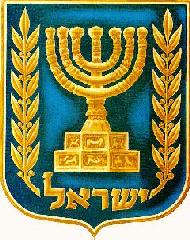
This leads us to another issue, the State of Israel. The State of Israel adopted as its emblem the Menorah as it appears on the Arch of Titus. This very Menorah with the sea dragons and the “wrong” base. Rabbi Herzog aside from his comments above, questioned the use by the State for this very reason. He said, that they should use a three legged Menorah instead. What is curious is that the State actually slightly altered the original version. Originally, it was as it more or less appeared on the Arch. Subsequently, the dragons or animals on the base were changed from facing each other to their current position which makes them look more like jumping gazelles than sea dragons. Perhaps, this was to accommodate the religous sensiblities of those like R. Herzog.

Sources: Hans Lewy, Olmot Nifgashim, 255-58; A. Berliner, Divrei Yemi HaYehudim B’Rome, vol. 1 107-110; Josephus, Wars of the Jews 6,8,3 (357); id. 7,5 (148-152); id. (158-161); the best work on the Arch is Yarden, “Spoils of Jerusalem on the Arch of Titus.” Yarden attempts to reconstruct the Arch to its original state and discusses all the various issues with it, including the change in the State of Israel emblem. What is surprising is that Prof. Daniel Sperber’s article on this topic fails to use Yarden, leading to a few errors in Sperber’s article. Sperber’s article can be found in Minhagei Yisrael vol. 5 171-212. See also, the fairly recent work on the history of the entire temple destruction Elef Dor by Y. Horowitz vol. 1 380-397 where he discusses some more stories of others who assumed the vatican still houses the temple vessels. See Sefer haYovel l’Kovod Shmuel Mirsky 220-21 for R. Herzog’s position.


Bedatz Bans HaGaon

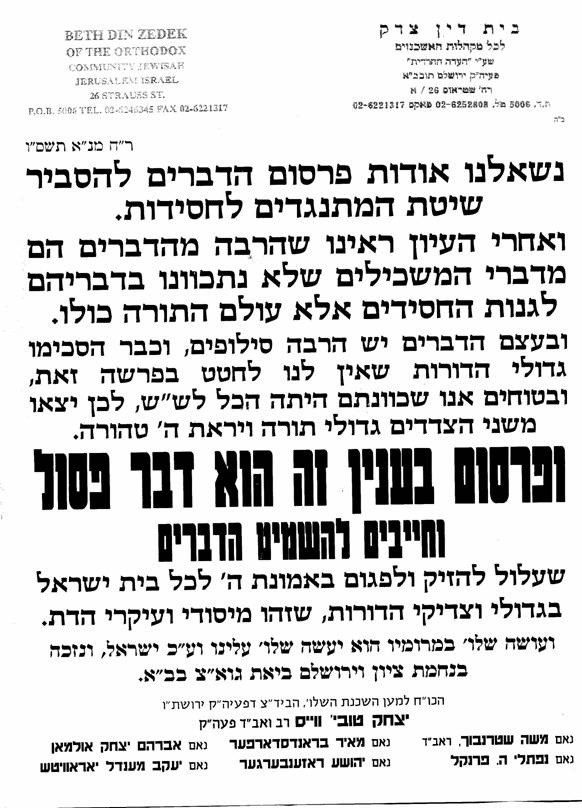
As discussed previously, there are some, mainly Hassidim, who had strong objections to R. Eliach’s biography HaGaon. Now it appears that Bedatz of Jerusalem has also issued a ban on the work (thanks to all those who sent this to me). The ban is reproduced on the side. The ban itself contains some interesting language. Specifically, the ban claims that the sources relied upon by Eliach were “maskilik.” You will recall that all Eliach did was reproduce many of the herems and the like from the non-Hassidim at the time. Now, it is correct that most of those polemics were collected by Wilensky in his Hassidim u’Mitnagdim, but the actual texts are those of some of the greatest Rabbis (not maskilim) of that time period.
Additionally, far from advancing haskalah (enlightenment) R. Eliach repudiates it. Many academics claim that the Gra was the precursor to modernity as the Gra advocates for studying secular subjects (among other things). Eliach, however, devotes an entire chapter demonstrating the Gra was against the haskalah. Eliach also includes additional material on this topic in other places as well. In doing so, he demonstrates that far from accepting maskilik or hasklah literature he actually accepts as true many anti-maskilik assertions. One example is particuarly telling. R. Eliach accepts that the Noda B’Yehuda banned R. Naftali Hertz Wessely. The source for this is an article which appeared in the Journal Kovetz Bet Ahron v’Yisrael by R. Y.A. Heschel. R. Heschel’s article is full of errors and wild assumptions. Most notably, R. Heschel assumes that the ban in question is from the Noda B’Yehuda solely because it was found in a stack of papers also from the Noda B’Yehuda. There is no other cooberating evidence. Instead, this is an unsigned letter that contains no other internal or external indica of reliablity. R. Eliach, however, in his attempt to prove the vehemence as well as the universiality of condemnation of the haskalah accepts this as true. Thus, it is somewhat difficult to understand how R. Eliach could be accused of accepting and advancing maskilik ideas and positions.

Finally, it is rather unclear why in August of 2006 the Bedatz is banning a book published in 2002. It was not as if this book was “under the radar.” Instead, immediatly with its publication there were other bans, articles and condemnations of the book. Further, R. Eliach secured the approbation of R. Chaim Kanievsky and was featured in Dei’ah veDibur the Haredi newspaper. While this wouldn’t be the first controversy between Beni Brak and Jerusalem, (famously the controversy over using the Ben Asher Nach was essentially between the two communities) it is a bit strange in its timing.


A Flat or Round Earth and the Zohar

The Babylonian Talmud (“BT”) clearly held the Earth was flat. R. Azariah de Rossi, in his Me’or Enayim devotes more or less a chapter to understanding the view of the BT on this issue.

De Rossi explains that there a various passages in the BT which assume a flat earth. For instance, De Rossi quotes the BT Baba Basra “the world is like an exadera [three sides are closed] and the north side is open. When the sun reaches the nothwestern side, it bends back and goes above the sky.” De Rossi explains that “anybody who understands this passage correctly realizes that . . . the sun’s circuit is not from above to below . . . and they agree that the nightly darkness is not caused by the sun being at that time below the horizon . . . this is all calcluated on the basis that the earth is flat and that the heavens only cover it like a roof of the exadera.”

De Rossi after noting that this opinion is pervasive in the BT, it is based upon the understanding of some at the time the BT was complied. He explains, however, that if “the sages of blessed memory who believed that the world was flat . . . been informed of what has become known in our times, namely, how the Spaniards . . . discovered the New World in the Northern Hemisphere where the inhabitants have their rest opposite the place where we put our feet. And the same is true of the place under the equator and also beyond it to the south above and below. With one voice [the sages] would have acknowledged that the earth was spherical.”

This last line, of course, was in part why De’ Rossi was controversial. By claiming Hazal based some of their statements upon the science of the day and that had they been exposed to what we now know would have changed their minds was, and continues to be a touchy subject.

But to return to our topic at hand – the flat earth – De Rossi points out that although the BT held the earth was flat not everyone at the time agreed. Specifically, he notes that the Jerusalem Talmud as well as Berashis Rabba seem to imply the earth is round. Additionally, the Zohar states the earth is round. It is this last source, however, which is somewhat problematic. Assuming the BT held the earth was flat and that appears to have been the prevailing attitude, why then would the Zohar disagree. R. Jacob Emden used this passage in the Zohar as one of the many which points to a later dating of when the Zohar was written. R. Emden states succinctly “this opinion is not one shared by Hazal and instead comes from later science.” Thus, according to R. Emden, the fact the Zohar assumes the earth is round lends itself to the notion it could not have been written (at least this part) by R. Shimon bar Yochi.

R. Emden’s challenge of the Zohar was not left unrebutted. R. Moshe Kunits in his Ben Yochi which is devoted to rebutting R. Emden, attacks this statement of R. Emden. Although he attempts to refute R. Emden, one who is aware of the above discussion, realizes how hollow R. Kunits’ argument is. R. Kunits agrees that the BT assumes a flat earth, but then he cites the two sources which do go with the round earth -Jerusalem Talmud and Berashis Rabba. In essence, Kunits is merely regurgitating De Rossi’s sources. In fact, he cites De Rossi as being one who demonstrates that Hazal held the earth was in fact round. Of course, De Rossi’s only sources were the Zohar and the others cited by Kunits. Thus, in the end, Kunits’ arguments are circular. This fallacy is noted by R. Shlomo Yehudah Rappoport in his book to rebut Kunits – Nahlat Yehuda.

Finally, it appears that the idea of a flat earth persisted until at least the 18th century (and if the recently published book, Afeki Mayim, is an indication even until the 21st century). The person in the 18th century to follow this view is a rather surprising one in light of how knowledgable he supposedly was in secular wisdom (at least according to some). The Vilna Gaon is recorded as stating the earth must be flat in order to properly understand the verse in Job (38:13) “that it might take hold of the ends of the earth.”

Sources: De’ Rossi, Meor Einayim (ed. Weinberg) Imrei Binah, Section 1 chap. 11. Zohar, Vaikra, 10a; R. Jacob Emden, Mitpahat Sefarim; R. Shlomo Yehudah Rappoport, Nahlat Yehuda (Lemberg, 1873); R. Kunits, Ben Yochi. On the Vilna Gaon, see R. Y. Engel, Gilyoni HaShas, Shabbat, 74a and R. Reuven Margulies, Nitzozi Ohr on the Zohar cited above.


17th of Tamuz and Edgar Allan Poe

The Mishna in Tannit records that 5 bad events occured on the 17th of Tamuz, one being the cessation of the daily sacrifice, the tamid. However, the Bavli does not as it does for the other four events, tell the story of what happened. Only in the Yerushalmi does the complete story appear.

There, in the Yerushalmi, the Talmud records that the Jews were obtaining the necessary animals for their offerings by paying the Romans. Everyday they would lower down a basket full of coins, and in its stead, the Romans would return the animal. As Jerusalem was under siege, this whole process took place from a distance. One day, the 17th of Tamuz, however, after the Jews gave the requisite money, instead of the correct animals the Romans replaced them with pigs. Thus, the Jews were unable to bring the tamid and the sacrifice stopped from that time on.

As mentioned, this story only appears in the Yerushalmi and not the Bavli. Further, Josephus does not record it either. Although these works do not record it, Edgar Allan Poe does. Specifically, he has a story titled “A Tale of Jerusalem” which, more or less, is this story repackaged. You can read the whole story here. But, basically, it describes the two priest whose job it was to lower the baskets of gold. Poe ends with the pigs being raised instead.

Not only does Poe use this somewhat obscure story, he even injects some detail that one would need to be versed in the orignal story to fully appreciate. The priest in question are who belonged to the sect called “The Dashers (that little knot of saints whose manner of dashing and lacerating the feet against the pavement was long a thorn and a reproach to less zealous devotees–a stumbling-block to less gifted perambulators).” This is a play on the talmudic description of the priests – that they are quick – kohanim zerizim hem.

Poe assumes familiarity with the Hebrew alphabet to a degree that one would know the letter yud is the smallest. As he says “thou canst not point me out a Philistine–no, not one–from Aleph to Tau–from the wilderness to the battlements–who seemeth any bigger than the letter Jod!”

The question is where in the world did Poe get this. Now, it seems Poe got this from another novel from “1828, Zillah, a Tale of Jerusalem, by Horace Smith (1777-1849). Poe incorporated whole phrases and sentences from Smith’s story: “Poe’s story is more than a parody; it is literally a collage of snatches of the Smith novel, cut out and pasted together in a new order.” That being said, it seems that Poe was still more familar with this story than Zillah and we are left to wonder did Poe study Talmud? He wouldn’t be the first famous American author to do so. Thomas Jefferson had a copy of a volume or two of the Bavli. Although, here, it would appear Poe one upped Jefferson by being a baki in Yerushalmi as well.