1

Kitzur Shelah, Sabbatianism, and the Importance of Owning Old Books

R. Jacob Emden, in his Torat haKenot claims a well known and fairly popular book is written by a Sabbatian (a follower of the false-Messiah Sabbatai Zevi). This book, Kitzur Shelah, authored by R. Yehiel Michel Epstein, which although its title implies is merely an abridged version of the Shelah (Sheni Luchot HaBrit) by R. Isaiah Horowitz, is much more than that. While the Kitzur Shelah does include some content from the larger Shelah it also includes much else which appears no where in the Shelah. Perhaps the most well-known custom to come out of the Kitzur Shelah is the custom to recite a verse which beginning and end letters of the verse correspond to the first and last letters of ones name. (Although this does have another source as well, the Kitzur Shelah is the first to include actual verses and it is those verses which appear in the siddurim.)

R. Emden claims that R. Epstein makes a reference to Sabbatai Zevi in the Introduction to the Kitzur Shelah. R. Emden’s exact language is “גם רמז על הצוא”ה בהקדמת קשל”ה” [R. Emden uses צואה (excrement) to refer to Sabbatai Zevi in that the numerical value of צואה is the same as צבי]. The Introduction is in fact but a single paragraph and at first glance it would seem to imply that the author was not a follower of Sabbatai Zevi. This is so, as the author expresses his hope that the publication of this book will be a merit for the coming of the Messiah. Such a line implies that the Messiah has not in fact come, which is counter to the idea of Sabbatai Zevi already coming and being the true Messiah.

But, with this, we need to start on our journey through multiple editions of the Kitzur Shelah. Although you will find it nowhere on the title pages of any of the editions, in fact there are at least four different editions of this work. (There was what is known as a מהדורה בתרא of the Kitzur Shelah, however, for our purposes that is irrelevant.) That is, there are at least four distinct versions.

First we need to understand where it is explicit in the Introduction that the author is a follower of Sabbatai Zevi, and for that we must turn to the early editions. In the early editions the very line which discusses the hope for the Messiah appears as follows, ” ויזכו על ידי הספר הזה לראות משי”ח האמ”תי וגם יזכו אל ימו”ת משי”ח.” If you note, you can see that four words contain quotation marks. These marks are the key to understanding R. Emden’s claim. These marks, generally, have two purposes one to signify the use of an abbreviation and the second to indicate that aside from the plain meaning of the word, one should also use the gematria – numerical value of the word. This device is extremely common on title pages of books where verses are used to indicate the date of publication. The words which the printers wish to use have the marks.

In this instance, it is the same. That is, the value of the four words or more specifically, the two sets of two words, are equal to 814 (משי”ח האמ”תי = 814 and ימו”ת משי”ח = 814). Sabbatai Zevi is also equivalent to 814 (שבתי צבי = 814). Thus, the “true Messiah” the author is referencing is in fact Sabbatai Zevi.

Now, in the later editions, these quotation marks were removed. Thus, there is no longer a signal to the reader to use the value of the words. But, it seems the removal was insufficient for some. In at least one edition (Frankfurt am Main, 1745) the entire Introduction was removed.

So we now have three different versions, the early ones with the quotation marks, the later with those removed and the final without the Introduction. In 1998 the Kitzur Shelah was reprinted with some additional notes and nikkud. In this edition it seems it was no longer good enough to just leave out the quotation marks, instead, the text itself was altered. In place of the line we have been discussing in this edition the line reads “ויזכו על ידי הספר הזה לראות ביאת משיח צדקנו.” I have been unable to locate this language in any edition I have checked, thus leading one to believe this change was deliberate to “address” the claim of R. Jacob Emden.

Thus, this is an example of why it pays to own (or at least have access) to multiple editions and that although subtle a minor change can have a major effect. All three versions appear on the side for the reader to see for themselves. The top is a copy of the Amsterdam 1724 edition (which is the same as it appears in the first edition). The second is a photo-mechanical reproduction of the Lember 1862 edition. And the final one is from the 1998 edition. You can click on the picture for a larger version.

Sources: Shnayer Z. Leiman “ספרים החשודים בשתאות: רשימתו של הגאון יעב”ץ זצ”ל” in ספר הזכרון לרבי משה ליפשיץ זצ”ל pp.885-894 esp. n. 12. On the topic of Sabbatianism in books see Naor, Post Sabbatian Sabbatianism



Chofetz Hayyim His Death, the New York Times and Research Tools

I have gotten multiple emails (and now S. has posted it on English Hebraica) in the past couple of days regarding an obituary which appeared in the New York Times for the Chofetz Hayyim. The email explains that after hearing someone mentioning the Times covered the Chofetz Hayyim’s death the person couldn’t believe it and decided to investigate the matter. He then went to the New York Public Library and poured over microfiche to finally locate the story on the Chofetz Hayyim’s death. The story, which did indeed appear in the Times, is merely a republication of a Jewish Telegraphic Association article.

There are two points I would like to mention about this whole email and story surrounding it. First, I am at a loss to understand why this person had to go the New York Public Library. While I am all for libraries, for this research he could have done it from the comfort of his home in under 5 seconds. All he had to do was go the New York Times website and search using the words Chofetz Chaim. He would have found the article he located as well as another one, this second one actually written by the Times describing the memorial services held in Brooklyn. This second article discusses the various eulogies held at Tifereth Israel and had Rabbis Simha Solovetchick, Israel Dushowitz and M. Somanowits in attendance and participating in various degrees. Anyone who has a Times Select subscription (if you subscribe it is free) can download the articles.

Second, according to both articles the Chofetz Hayyim was 105 years old when he died. His actual age, however, is in dispute. Some place him at a mere 94 when he died. R. Nathan Kamenetsky, in his Making of a Godol, attempts to prove how old the Chofetz Hayyim actually was. He does so in a rather ingenious manner. First, he attempts to figure out how old the Chofetz Hayyim was when his father father died during the cholera epidemic. Also, at age 70 there was a birthday celebration that R. Kahanneman (Ponivezher Rav) attended in Radin. R. Kahanneman was in Radin in 1909 thus putting the Chofetz Hayyim’s birthday in 1839. Finally, R. Kamenetsky points to the recently published request of the Chofetz Hayyim’s to emigrate to Israel and the birth dates used there. In the end, R. Kamenetsky concludes that in fact the Chofetz Hayyim was a spring chicken of 94 when he died. (See Making of a Godol, pp. 1106-1108).

It is also worth mentioning that America was not the only other country (outside of Radin or Europe) where there were eulogies for the Chofetz Hayyim. R. Elchonon Wasserman was in England when the Chofetz Hayyim died and participated in a service for the Chofetz Hayyim where Rabbi I. J. Unterman gave a eulogy. London Jewish Chronicle, October 6, 1933, p. 8. (Thanks to Menachem of AJHistory fame.)


The RCA “Edition” (Or Lack Thereof) Siddur

When a Yom Tov falls out on Shabbat, we add additions to the standard Yom Tov shemonei esrei that relate to Shabbat. One of these additions is found in the V’haseanu והשיאנו blessing, where we add “elokenu v’lokei avosanu retzah bemunchatanu (אלקנו ולאקי אבותנו רצה במנוחתנו).” There is very little question about this addition is Shacharit.[1] The more complex question is the Mussaf. The reason for the complexity is that in the Shaharit there is no place where the formula of elokenu v’lokei avosanu appears, so one is forced to add the entire addition. But, in Mussaf there is an elokenu v’lokei avosanu, that is, right after one says the various verses relating to the offering of the day appears “elokenu v’lokei avosanu melk rachamun rachem alenu … (אלקנו ולאקי אבותנו מלך רחמן רחם עלינו)”. Because there already the alokenu v’lokei avosunu, thereby God’s name is already mentioned, R. Yitzhak Isaac Tyrnau (end of the 14th century) in his book on Minhagim (page 56 Makhon Yerushalayim edition) says to just add here the words, retzeh bmunuchatanu here. By placing this addition here one avoids mentioning God’s name later on. But the R. Mordecai Jaffe (1530-1612), in his Levush (Orach Hayyim no. 488), argues and says that just as in Shacarit one mentions this addition later on right next to “kadeshanu” therefore it is not proper to mention it here after the passages of the offerings as there is no mention of kadeshanu. Additionally, R. Jaffe argues we should be consistent between Mussaf, Shacharit, and Mincha/Ma’ariv. Just as in those prayers, this addition appears in v’haseanu so we should do the same for Mussaf. Therefore, according to the Levush, one has to say the entire formulation later on, including the elokenu v’lokei avosanu, a repetition of God’s name, because though God’s name appears earlier it is just not the right place to add this.[2]

What emerges from this is that there are two distinct customs, either one adds just the words “retzah bemunuchatun” right after the verses for the offerings and does not add anything later on, as that would defeat the whole purpose – avoiding repeating God’s name. Or one does not add anything different after the recitation of the offerings, instead just as in the Morning Prayer, one adds the entire formula at the end of the blessing. Both of these customs have support in older siddurim. What has NO support and makes no sense is what appears in the Artscroll siddurim. In the Artscroll siddurim, BOTH additions appear.[3] That is, Artscroll advocates saying both the retzah bemuchutanu after the offerings and including the entire formulation later on. It would appear that they are unconcerned with the unnecessary repetition of God’s name or custom. It seems that in an effort to conform to all the customs, they have conformed to none. What is rather bizarre, is that in the first edition of the Artscroll Siddur, only the second appears, it seems they altered it to include both?!

But, to be fair to Artscroll there is perhaps a bigger problem. Artscroll, while they print some nice books, are not a Rabbinic organization. The RCA (Rabbinical Council of America), as the name implies, is a Rabbinic organization. One assumes a Rabbinic organization would be tasked with getting something like this correct. Historically, the RCA did get it right. The original RCA commissioned siddur is edited by R. David de Sola Pool. In this siddur they only have the second mention (like the Levush). But, now the RCA has moved to a new siddur. This – the RCA edition of the Artscroll siddur – contains both (incorrect) mentions. In the introduction, the (then) president of the RCA states that part of the reason the RCA commissed a siddur at all was due to the many errors which had crept into the siddur. But, with this edition that does nothing other than slapping on an introduction by then-RCA president R. Saul Berman and adding the teffilah l’medinah, is the type that the RCA was claiming it was fixing.

Sources:

[1] Though there is some controversy about this, that is, R. Jacob Emden says that the elokenu v’lokei avosnu should always be recited even when it is not Shabbat. He claims that these words were bracketed by mistake and in early siddurim they are not bracketed. I have found that in the Prague, 1516 Siddur they are not bracketed. See Siddur R. Shabbetai Sofer, vol. 1, appendix. On the other extreme the Vilna Gaon who says that one never recites these words even when it is Shabbat.

[2] The Eliyahu Rabbah defends R. Tirna from the Levush and also asserts that all the older siddurim follow R. Tyrnau. In truth, the old siddurim are split between these two customs; see Additions to Siddur R. Shabbetai Sofer for page 522.

[3] In the new Artscroll Hebrew-only siddurim they say “Yesh Mosifim” (there are those that add) by the first one, i.e. the one following the recitation of the offerings. But they still fail to recognize that those Yesh Mosifim also don’t add the later one.


Artscroll = Pornography?!

I recently received a sample of the new Artscroll work “A Daily Dose of Torah.” This work, which is more or less a modern-day Hok l’Yisrael, parcels out 18 minute learning sections covering Gemara, Siddur, Mussur, etc. But setting aside the content, in the introduction there is a very curious quote.

In the introduction the editors thank Reb Sheah Brander for his “graphics genius.” They explain “As someone once said in a different context, ‘I can’t put it into words, but I know it when I see it.'” They then apply the quote as “It is hard to define good taste and graphics beauty in words, but when one sees Reb Sheah’s work, one knows it.”

Now, the quote they have “I can’t put it into words, but I know it when I see it” doesn’t actually appear anywhere exactly as that. It is obvious, however, this quote is most likely taken from a well known Supreme Court concurrence authored by Justice Potter Stewart. The case, Jacobellis v. Ohio, 378 U.S. 184 (1964), is about whether a movie was pornographic, or more correctly obscene. Justice Stewart said that although it was difficult to define or articulate what exactly fit the definition of pornography “I know it when I see it.” (Id. at 197.)

So, they are absolutely correct that “someone once said in a different context” but I am unsure if they knew exactly what context that was.


Tussle Over Horowitz’s Book

As I mentioned before, Elliott Horowitz wrote an excellent book on Purim and its connection with violence. But, as some are wont to do, instead of reading a book objectively they come into a book with all sorts of preconceived notions. This was typified by Hillel Halkin’s review of Horowitz’s book. In the June 2006 issue of Commentary Magazine, Halkin reviewed Horowitz’s book. I did not bother to mention this, solely because it was painfully obvious Halkin did not read the first half of the book, or chose to ignore it (as Horowitz points out in his response), and that Halkin was only interested in finding fault. Halkin takes issue with the very notion that Jews could be violent and thus can not believe (or address) most of Horwitz’s points. In fact, much of Horowitz’s thesis had already been published years ago in his articles on the topics. (Perhaps Halkin doesn’t read academic journals? Although he feels it fine to review an academic work).

Well in the October 2006 issue of Commentary Magazine, Elliott Horowitz responses as does Halkin. Halkin’s response, however, is so juvenile and void of content, he does more to undermine his position than anything Horowitz could have done. Halkin to buttress his position resorts to name calling and a general ad hominem attack. So, for example, Halkin starts by noting

As I stated in my review, Elliot Horowitz wrote an interesting but not entirely honest book. How he has written an uninteresting and thoroughly dishonest letter.

Setting aside Halkin’s vitriolics, Horowitz, as he is wont to do, uses the terrific image of the Godfather movies to prove his point. He notes that there is a distinction between the Godfather and Bonnie and Clyde, one which just has violence and the other which explores it. Horowitz, thus illuminates his purpose of exploring the sources and theological underpinnings of his thesis. [Now, there are not that many Jewish academics who cite to movies (or as he does in another of his articles compares the imagery in a haggadah to Bugs Bunny) so this somewhat is refreshing.] Halkin, of course, fails to note this (apparently he is not one for subtleties) and instead turns the movie quote into a childish retort of

If Horowitz wanted to write a Jewish version of The Godfather . . . he should have done a movie script.

Additionally, Halkin fails to address most of Horowitz’s most salient points. So, Halkin still ignores the entire first half of Howowitz’s book and fails to explain the rampent use of the term Amalek to this day. It is disappointing that Commentary publishes such drivel, but does demonstrate that one should not judge a book by its cover nor a review (or reviewer) by its inclusion in Commentary.

You can read the full exchange here for yourself until the end of October 2006.


R. Akiva Yosef Schlesinger, Tikkat Shofar on Shabbat & plagiarism (of course)

Menachem Mendel has a very good post discussing the issues and the history regarding the propriety of blowing the shofar on Rosh HaShana when it falls on Shabbat. A central figure in this discussion is R. Akiva Yosef Schlesinger. R. Schlesinger is perhaps best known for his book Lev haIvri a commentary on the last will and testament of the Hatam Sofer. In this book, which perhaps can be used to trace much of Haredi ideology today, the bulk is devoted to putting down the “reformers.” He discusses Mendelssohn’s Biur, speaking in the vernacular and a host of other issues. There is no doubt he held what many would consider extremists views. R. Schlesinger has a less well known side – his love of Israel and dislike or almost vehement hatred of inertia.

R. Schlesinger who was born and raised in Hungry emigrated to Israel. When he got to Israel, at the time, most people were supported by the various kollelim. These kollelim would be set up by country, Hungarian Kollel etc. (the American Kollel was controversial). These kollelim in turn wielded tremendous power – they had the money. R. Schlesinger took a very dim view of these kollelim. First, he felt the money was not given out based upon need and merit, rather it was given based upon status and connections. Additionally, this system only ensured that people would never actually try and make money themselves. To be clear, these kollelim did not only support people learning full time, rather, almost everyone was supported by them.

R. Schlesinger came out strongly against the kollelim and decided to set up his own system. This system he outlined his book Kollel HaIvirim. First, he explains his system would be democratic. He explains that the Torah requires one to follow the majority. This is so, even when a Godol or the like holds different views. He proves this by pointing to the system of the Sanhedrin. There, they did not just go with greatest Rabbi on the Sanhedrin, rather, they started polling the views of the lowest one. (p. 7).

According to R. Schlesinger’s system the Kollel or Board would be in charge of almost everything. They would oversee the education of the children. He advocated for marriage at 18 and then a 3 year period to devote to study. However, R. Schlesinger notes, not too many people are successful at just studying Torah full time, therefore, the Kollel should see who is not or who does not have an interest and they should learn a proper profession. This study should not be half hazard. Instead, they should study from a expert and devote a significant amount of time to this endeavor. He includes agriculture among these professions. (p. 9-10)

R. Schlesinger did not shy away from accountability. Even today many religious organizations do not have open books. R. Schlesinger, however, advocated for a yearly accounting which would be sent to all where they could view all the expenses and the accounting of the Kollel. (p.11).

He also seems to have taken what today would be considered a religious Zionist view of the then current status of Israel. Although at the time, Israel was under the rule of the Turkish government, due to the fact, they were fairly benevolent he understood that it was already then – long before the founding of the State of Israel – the messianic era. Specifically, he points to the Talmudic passage which explains the only change during the messianic era will be the removal of government oppression (אין בין עולם הזה לימות המשיח אלא שעבוד מלכיות בלבד). (p. 19) Additionally, he chides his former countrymen on their aversion to move to Israel. He says R. Isaiah Horowitz in the 16th century moved to Israel although it took a year to do. Today, he says, it is easy. The government gives anyone who wants a pass and it on the fast ships and rail it takes a mere 10 days. (p. 16).

Although it was fairly safe, R. Schlesinger was aware there still should be a security force. Thus, he advocated for a month long rotation for everyone. These watchers would serve for a month and then others would take their place. He says they should do so even on Shabbat. (p. 26b).

He wanted everyone to have a flag. There would be a general Kollel haIvrim flag with white, green, purple and turquoise. Then each shevet would have their own as well. (p. 27).

All of these plans met with serious resentment from the established Kollelim. They viewed him as undermining their system and way of life. So, as anyone who wants to get someone in trouble does – they searched his books to find something they could ban. Sure enough, they were successful. In his book Bet Yosef Hadash, which is on the Bet Yosef, he discusses a terrible problem and attempts to find a satisfactory answer. In Russia at the time there was forced conscription for a 25 year period. This was a Jewish death sentence – some people, were taken as young as 8. So, some would flee Russia and move to Israel to avoid this. At times, their wives refused to come. R. Schlesinger, therefore, discusses the possibility of getting around the Herem of Rabbenu Gershon on two wives. R. Schlesinger’s enemies, however, accused him of doing away with and not respecting the Herem.

They consigned his books to the fire and put a ban on them.

In the end, however, his students (and he had many) were successful in setting up the city of Petach Tikvah (see here for more). They wanted R. Schlesinger to join them, and he did. He purchased land, but to honor his father in law, purchased it in his father in laws name.

Unfortunately, this had terrible ramifications. When R. Schlesinger returned to Hungary to gain support for his movement, his enemies went to his father in law. His father in law was old and could not take this. His father in law signed over the land he owned in Petach Tikvah, the land which was the culmination of R. Schlesinger’s dream to his enemies, the Hungarian Kollel. R. Schlesinger then attempted to get it back. He did win some court victories. His opponents, however, used his own means against him. They ignored the pronouncements of the Bet Din, knowing that R. Schlesinger would never go to a non-Jewish court.

It seems that not only was R. Schlesinger a tragic figure, but other things he touched as well. Shmuel Weingarten was an avid Zionist. He published, among other things, a book demonstrating the collection of anti-Zionist letters in Dovev Siftei Yeshanim were forgeries. At the end of his life he obtained letters sent to R. Schlesinger’s group (although they don’t mention it, Weingarten shows they in fact were)and published them in a volume titled B’Shevach Yishuv Ha’aretz. These letters were from many Rabbis, some who were not that well known. Weingarten, as he notes, had to spend considerable effort tracking down and providing biographical information about these persons. He also transcribed the letters. He, unfortunately, did not live to see this book published.

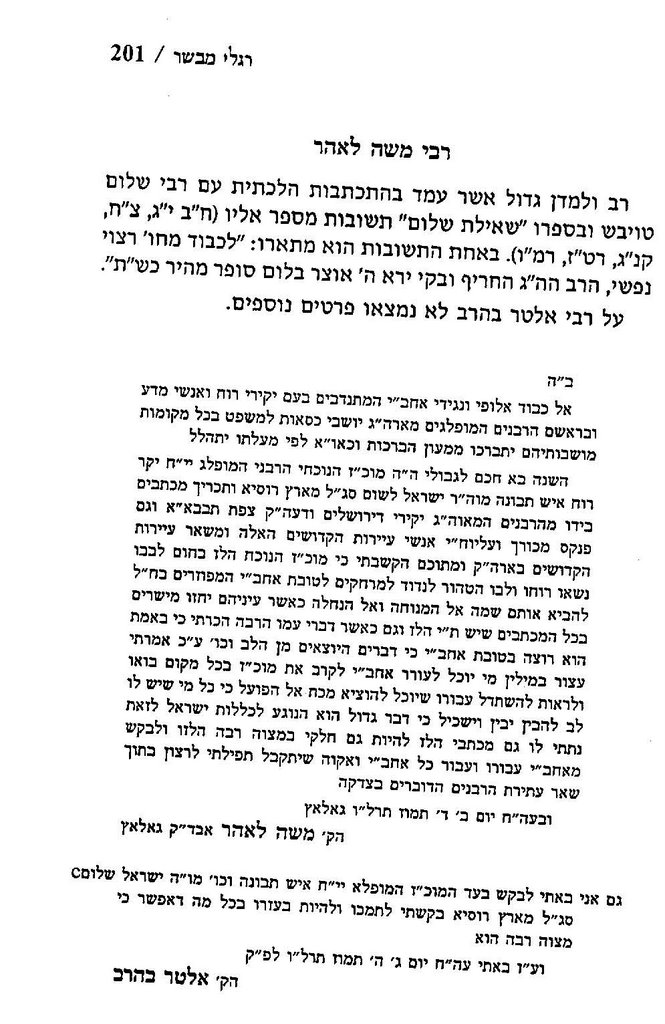
In 1999/2000 some in Beni Brak B. Margolius (most likely a woman due to the lack of first name), published a book, Ragli Mevasar. This book is divided into three parts. The first two are biographies of R. Schlesinger and his father in law. The last part are the very same letters originally published by Weingarten. Additionally, they include the very same biographies that Weingarten did. There is absolutely no attribution at all! I have included a page from each were the reader can see how they are the same. The top page is from Weingarten and the bottom from Ragli Mevasar. None of the library catalogs I have seen note that this is plagiarized.