1

Shnayer Leiman on “A Puzzling Passage in a Book Intended for Jewish Children”

A Puzzling Passage in a Book Intended for Jewish Children, with a Tentative Bibliography of ספרי קודש that Treat the Mitzvah of Answering “Amen”
Shnayer Leiman


In 2004, an anonymous book entitled Serenade the King appeared in print.[1] Addressed primarily to a young audience, it is an anthology of inspirational stories that focus on one teaching only: the importance of answering “Amen.” The stories are accompanied by photographs of the great Jewish sages mentioned in them, and by short inserts, mostly quotations from famous rabbis emphasizing the significance of answering “Amen.” Letters of approbation (in Hebrew) from distinguished rabbis appear at the beginning of the book, encouraging prospective buyers to acquire the book.

On p. 240, the following short insert appears:

Failure to Answer Amen Desecrates Hashem’s Name

Failure to respond Amen to a beracha that one hears is equivalent to actually cursing Hashem, and the punishment for one who is guilty of this sin is equal to the punishment that one who curses Hashem receives.

There is no greater desecration of Hashem’s Name than the desecration caused by not answering Amen to a beracha, particularly if the beracha was recited in public. In fact, if it was recited before ten men, the hearer is obligated to sacrifice his life rather than not answer Amen!

Whereas Serenade the King prints mostly inspiring stories, here we have a halakhic ruling — and an astounding one at that. Ordinarily, there are only three instances where a Jew is obligated to lay down his life (i.e., allow himself to be killed) rather than commit a violation of Jewish law. These are: idolatry, murder, and sexual immorality. Thus, if a Jew is ordered to kill an innocent person, or be killed, he must refuse the order and allow himself to be killed, if no other options present themselves. The above rule applies primarily when the violation of Jewish law is in the private domain. But if the violation takes place in the public domain, i.e., in the presence of ten or more Jews, then one needs to examine the motivation of the person issuing the illegal order. If the purpose is to force the Jew to abandon his faith, then the Jew must be prepared to lay down his life rather than violate any mitzvah of the Torah. If the purpose is for the personal pleasure of the person issuing the illegal order, then the Jew is obligated to violate the law and stay alive, except in the cases of idolatry, murder, and sexual immorality. In a period of general persecution of the Jews, one is obligated to lay down his life even if ordered to violate a mere customary practice of the Jews. Even in those instances where a Jew is obligated halakhically to violate the law and stay alive, there are some halakhic authorities who rule otherwise. They allow a Jew the option to lay down his life (rather than violate a Jewish law and remain alive) in instances other than the three exceptions listed above. All halakhic authorities agree, however, that the Jew — in those instances — is not obligated to lay down his life. Thus, a Jew who is ordered at gun-point to eat non-kosher food or be killed, must violate Jewish law and remain alive (according to some halakhic authorities), or may refuse to do so and die (according to other halakhic authorities), but he is not obligated to refuse to eat the non-kosher food. In instances where the Jew is ordered by the enemy to take no action (e.g., not to recite the obligatory prayers or not to wear tefillin), the obligation to lay down one’s life is virtually non-existent.

Thus, R. Moshe Isserles rules:[2]

The rules apply only if they order him to violate a negative commandment. But if they issue a decree against observing a positive commandment, he need not observe it and be killed. But if the circumstances require it, and he wishes to observe it — knowing that he will be killed — it is permissible for him to do so.

Similarly, R. Mordechai Jaffe rules:[3]

All the above applies only when they order him to violate a negative commandment, so that when he violates it he must engage in an act that violates the Torah. But if they decreed in a persecution that one may not fulfill a positive commandment, one is not obligated to fulfill it and be killed. This is because complying with the decree does not require an act of violation of the Torah; one can simply cease and desist and comply with the decree. Moreover, the enemy can force him to violate the law against his will, by either imprisoning him so that he will be unable to perform any of the commandments, or by depriving him of his tzitzit or tefillin so that the specific mitzvah cannot be performed. Therefore, let it go unperformed and let him not be killed. Nonetheless, even in this case, if he chooses to be stringent and to observe the commandment — even though he knows that he will be killed — he may do so. He is not considered as one who brings injury upon himself, for this too is an act of piety and fear of G-d, and a sanctification of G-d’s Name.

In the light of the above, it is astonishing indeed that Serenade the King rules that it is obligatory to lay down one’s life when ordered not to answer “Amen” to a blessing recited before ten men. At best, it may be permissible to lay down one’s life in such a case; it is certainly not obligatory according to the Shulhan Arukh.[4]

To the best of our knowledge, no such ruling appears in the Babylonian or Jerusalem Talmud, or in any of the halakhic codes, whether Rif, Rambam, Tur, or Shulhan Arukh. Indeed, the ruling appears to contradict the Shulhan Arukh, i.e. the R. Moshe Isserles passage cited above. So we were curious as to the source of this ruling in Serenade the King. One did not have to look very far. At the bottom of the insert, the source is clearly given as: Keser Melucha, page 284. It turns out that Serenade the King is simply an English version of an earlier work in Hebrew entitled שירו למלך, Jerusalem, 2002, also addressed primarily to a young audience.[5] The anonymous author of both books, apparently a reputable rabbinic scholar in Jerusalem, drew most of his material from an earlier work of his entitled כתר מלוכה, Jerusalem, 2000.[6] It is a comprehensive anthology in Hebrew of talmudic, midrashic, medieval, and modern sources relating to the mitzvah of answering “Amen” — and it is addressed to adults. [There is a rich literature, especially in Hebrew, on this topic. Since we have not seen a bibliographical listing of such books, we have appended to this essay a tentative bibliography of books in Hebrew that treat the mitzvah of answering “Amen.”]

Turning to page 284 of כתר מלוכה, one discovers that the source of the insert is: מנח”א י”א ב. Since neither Serenade the King nor כתר מלוכה contain bibliographies or lists of abbreviations, some readers will experience difficulty deciphering the abbreviation.

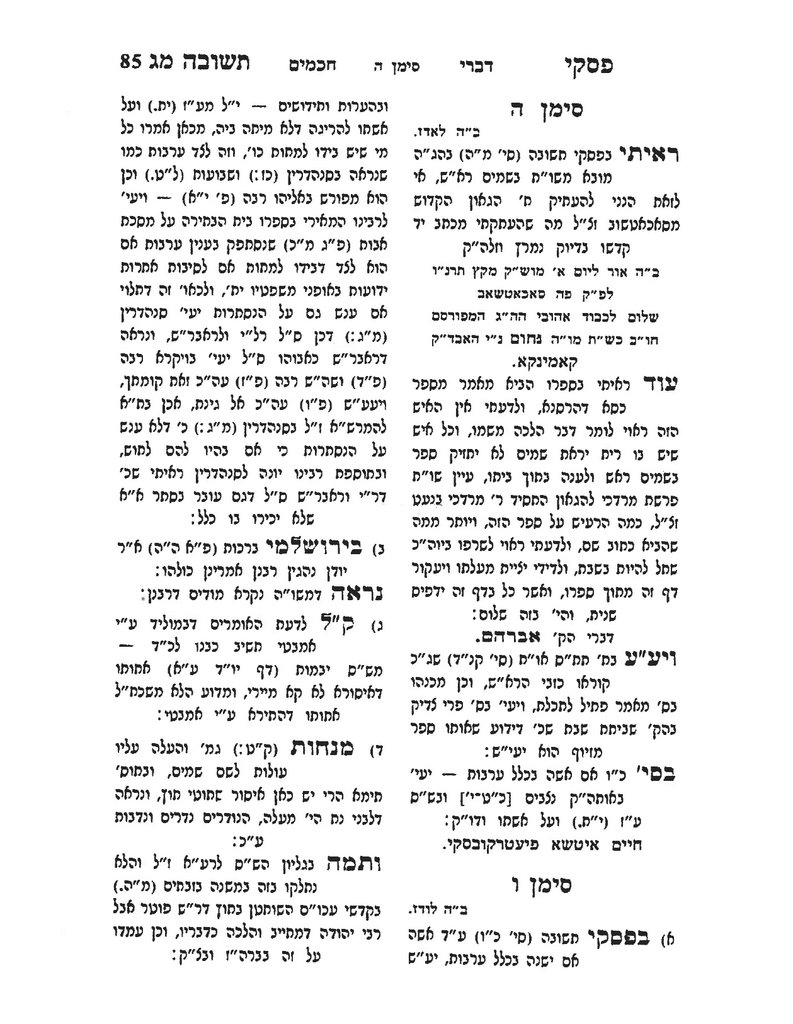
Amateurs attempting to decipher the abbreviation will doubtless suggest that it stands for מנחת אלעזר, the classic collection of responsa by the late Munkatcher Rebbe, Rabbi Hayyim Eleazar Shapira (d. 1937). But the responsa in that collection are always referred to by volume and by the number of the responsum (e,g., IV:19), never by page number (e.g., 11b). More importantly, our passage does not occur on p. 11b (or anywhere else) in any of the printed volumes of מנחת אלעזר.

While leafing through the pages of כתר מלוכה, it became apparent to me that מנח”א (cited throughout the volume) was itself an anthology of sources on the significance of answering “Amen.” It was a simple matter to peruse the titles of all previous anthologies on the significance of answering “Amen,” and to see which one had a title that matched the abbreviation in כתר מלוכה. The only volume to do so was R. Yehudah Leib Rogalin’s מנחיל אמונה, Poltava, 1913.[7] And sure enough on p. 11b, there appears the full text of the passage summarized in כתר מלוכה.

The passage reads:

וכמו ששכרו של העונה אמן כמה דאצטריך אין ערך ושיעור וכמובא במדרשי חז”ל, כמו כן להיפוך חלילה עונש של האינו עונה אמן, וכמובא גם כן שבאמת הוא ניאוץ וחירוף וגידוף כלפי מעלה, אלא שזה בשב ואל תעשה, אבל עונשו שוה למגדף בפועל שזה בזיון למלך הכבוד דמי שלא חש לכבד את המלך בעת שנותנין לו כבוד הוא בזיון גדול אין דגמתו, ואינו דומה מי שאינו נותן כבוד למלך למבזה ברכת המלך, וברבים הוא חילול שם שמים בפרהסיא, ובעשרה מישראל מחוייב למסור נפשו על זה מקל וחומר, שאם הוא מחוייב למסור נפשו לקדש שם שמים בפרהסיא, כל שכן שמחוייב למסור נפשו שלא לחללו, ואין לך חילול שם שמים גדול מזה שלא חש לאמן ברכותיו של המברכו וגורם שברכת המברך יהיה חלילה כברכת שוא, עיין מכילתא (משפטים ס’ כ”ג) משום ר’ אלעזר וכו’. ומכאן אזהרה למי שרואה את חבירו שאינו עונה אמן אחר השליח ציבור שמחוייב לגעור בו בנזיפה יהיה מי שיהיה, דבמקום שיש חילול השם אין חולקין כבוד.

The claim, while certainly interesting, will hardly persuade most halakhists.[8] In any event, this is surely a matter for Gedolei Ha-Poskim to decide, and not the authors of treatises on the importance of answering “Amen.” One wonders whether such a halakhic decision — of life and death import — should appear in a children’s book. Heaven forbid that a child be put to the test, and instead of consulting a posek, he will rely on the ruling of Serenade the King that “the hearer is obligated to sacrifice his life rather than not answer Amen.” One wonders whether the rabbis who wrote letters of approbation for Serenade the King also gave their approval to this ruling. If not, perhaps we need to rethink what a letter of approbation really means.

Notes:

1] Serenade the King, Jerusalem: Vehagisa, 2004. The book’s spine bears the imprint of Feldheim’s Books.

2] Shulhan Arukh: Yoreh De’ah 157:1.

3] Levush Ateret Zahav 157:1.

4] For possible support for the halakhic ruling in Serenade the King, see the sources cited in R. Hayyyim Yosef David Azulai, Birkei Yosef, Yoreh De’ah 157, paragraph 2, ד”ה הגהה

5] See שירו למלך, Jerusalem: Vehagisa, 2002.

6] כתר מלוכה, Jerusalem: Makhon Mayim Hayyim, 2000. An earlier and much abridged preliminary version of כתר מלוכה appeared in print with no place and no date on the title pages. It appears to have been published in Jerusalem, circa 1998.

7] The volume was published without הסכמות. On Rogalin, an accomplished rabbinic scholar who served as rabbi of Alexandrovsk in the Yekaterinoslav province from circa 1888 until 1913, see S.N. Gottlieb, אהלי שם, Pinsk, 1912, p. 9.

8] It will not persuade most halakhists for a variety of reasons, including the fact that the קל וחומר suffers from a serious פירכא. Indeed, a person may be obligated to lay down his life rather than actively commit a violation of Jewish law (under the right set of circumstances, as outlined above). But this cannot obligate a person to lay down his life rather than passively violate a Jewish law – by not answering “Amen.” Moreover, the halakhic source (Mekhilta to Exodus 23:1; ed. Horovitz-Rabin, p. 322) cited by Rabbi Rogalin does not treat the issue of laying down one’s life at all.

A claim similar to that of Rabbi Rogalin appears in a much earlier work: R. Moshe Kahana, דרך משה, Amsterdam, 1699. I am indebted to R. Eliezer Brodt for calling this claim to my attention (via Dan Rabinowitz). On p. 41 (of the Jerusalem, 1983 edition of דרך משה), the text reads:

על כן כל איש מישראל ששומע הברכה מישראל מחוייב לענות אמן אפילו שומע מאשה או מקטן, ואם שומע ואינו עונה חייב מיתה. וסימן אמ”ן נוטריקון א’ני מ’וסר נ’פשי, שכל אחד מישראל מחוייב למסור נפשו על עניית אמן

No halakhic source is cited for this פסק הלכה, (that not answering “Amen” is a capital offense; and that a person must lay down his life for the sake of answering “Amen”), either from the Talmud, Rishonim, or Aharonim. And while a famous story about R. Mordechai Jaffe, author of the לבושים, suggests that not answering “Amen” under normal circumstances is a capital offense (בדיני שמים), it does not suggest that a person must lay down his life if forced not to answer “Amen” (see דרך משה, loc. cit.; cf. R. Mordechai Jaffe, לבוש החור, Jerusalem, 2000, vol. 2, pp. 579-580).

Bibliography:

The tentative bibliography that follows lists ספרי קדש that treat the mitzvah of answering “Amen.” The list does not include books that treat a variety of mitzvot, including the mitzvah of answering “Amen.” Thus, for example, the list does not include R. Aharon Avraham b. R. Barukh Ha-Levi, אגרת הטעמים (Mantua, 1582), even though pp. 12b-15a of that treatise treat the mitzvah of answering “Amen.” For similar reasons, we have not listed R. Aharon Roth, שומר אמונים (Jerusalem, 1942), though see item 8 on the list. Books in foreign languages are not listed, though many exist. R. Menahem Nahum Bochner’s ספר עניית אמן (Tchernovitz, 1913) is also omitted from the list; it does not treat the mitzvah of answering “Amen.” The list certainly needs to be expanded. I’ve included only the titles of books I have held in my hand.

רשימת ספרים העוסקים במצוות עניית אמן

1] ואמרו אמן, לר’ יהושע אלטר ווילדמאן, ב’ כרכים, ירושלים, תרפ”ז-תרפ”ט

2] ונאמר אמן: יצחק לשוח, לר’ שלום יודא גראס, ברוקלין, תשמ”א

3] חוברת לימוד בנושא מעלת עניית אמן יהא שמיה רבא, בלי שם מחבר, ב’ כרכים, ירושלים, תש”ס-תשס”ב

4] חובת עניית אמן, לר’ הלל דוד ליטוואק, ברוקלין, תשנ”ט

5] כתר מלוכה, בלי שם מחבר, ירושלים, בלי שנת דפוס (לפני שנת תש”ס), והיא הוצאה ראשונה וצנומה של ספר כתר מלוכה דלהלן

6] כתר מלוכה, בלי שם מחבר, ירושלים, תש”ס

7] לקוטי תורת אמן, לר’ נחום זק”ש, ווילנא, תרס”ז

8] מאמר פתחו שערים מספר שומר אמונים, לר’ אהרן ראטה, בית שמש, תשנ”ה

9] מדריך לעניית אמן, לר’ שלום יודא גראס, ברוקלין, תשמ”א

10] מנחיל אמונה, לר’ יהודה ליב ראגאלין, פאלטאווא, תרע”ג

11] נוטרי אמן, לר’ אברהם קסלר, ב’ כרכים, בני ברק, תש”ס-תשס”ד

12] עניית אמן כהלכתה, לר’ ישכר דוב רומפלער, מאנסי, תש”ס

13] קובץ ונאמר אמן, בלי שם מחבר, בת-ים, תשס”ד

14] קונטרס הבו לה’ כבוד: התעוררות וסיפורים…בעניני…עניית אמן, בלי שם מחבר, ירושלים, תשנ”ג

15] קונטרס מהלכות עניית אמן, לר’ אברהם דוד בלאך, ווילנא, תרס”ט. נלוה לספרו ציצית הכנף, ווילנא, תרס”ט

16] קונטרס עניית אמן כהלכתה, לר’ שלום יודא גראס, ברוקלין, תש”ם

17] קונטרס שומר אמונים, בלי שם מחבר, ברוקלין, תשי”ג

18] שומר אמונים, לר’ אליהו וויגאדזקי, פיעטרקוב, תרס”ו

19] שירו למלך, בלי שם מחבר, ירושלים, תשס”ב

20] תשובת נפש תיקון אמן תשובת תענית, בלי שם מחבר, לובלין, תל”ז


Another Case of Historical Censorship at Volozhin or Simply Poor Research?

One of the more important sources for the history relating to the famed Volozhin Yeshiva is Moshe Shmuel v’Doro, by R. Moshe Shmuel Shapiro (Shmukler), which is is full of important material on this yeshiva and the related personalities. R. Schapiro also published a monograph on the founder of the Yeshiva, R. Chaim of Volozhin. This work, Toldot Rabbenu Chaim Volozhin, was first published in 1909 in Vilna, republished a year later in Vilna and then published twice in Israel, once in Bnei Brak in 1957 and once in Jerusalem in 1968. Recently, in 2000, Toldot Rabbenu Chaim Volozhin, was republished by R. Schapiro’s descendants.

In the 2000 edition of Toldot Rabbenu Chaim Volozhin, R. Schapiro’s descendants include a brief introduction about the history of the book, yet they were unaware of some key facts. First, they claim the book was only published twice, when in fact it was published four times. Additionally, then erroneously note that their edition is the third when in fact it is the fifth. Finally, they claim the first edition was the 1910 edition, when in fact the first edition appeared in 1909.

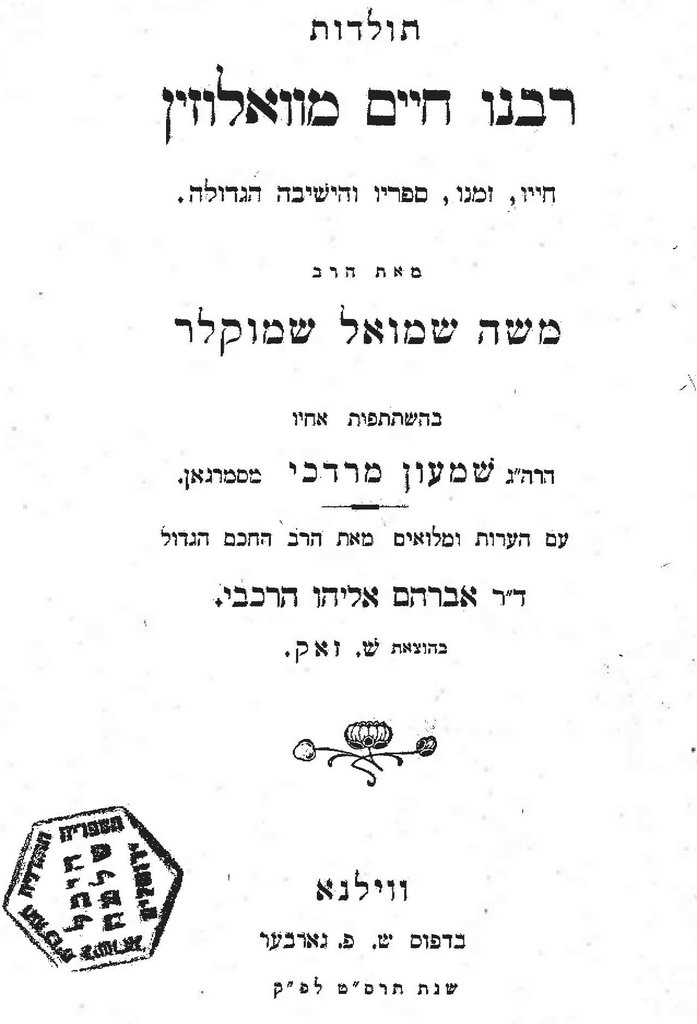
In addition to these three inaccuracies and omissions, there is a much more glaring one; not bibliographical in the abstract, but related to the content of the book – they have left out something which appeared in the earlier editions. In the first (1909) edition, a letter from R. Dr. Abraham Eliyahu Harkavy (1839-1919), a former student at the yeshiva in Volozhin, appears which contains both his warm approval of the book as well as a few comments on the book. Further, the fact Harkavy’s letter was included was no small thing as this was noted on the title page of the book. Specifically, the title page states the book includes:

עם הערות ומלואים מאת הרב החכם הגדול
ד”ר אברהם אליהו הרכבי

In the 1909 edition of Toldot Rabbenu Chaim Volozhin, Harkavy’s letter and notes were included by R. Moshe Schapiro. In the current reprint, the time that the fifth edition of Toldot Rabbenu Chaim Volozhin, published in 2000, by Schapiro’s grandchildren, Harkavy’s letter and notes are mysteriously missing. Perhaps this letter was removed intentionally as Harkavy was a maskil (intellectual) and later the head librarian at the Imperial Library in St. Petersburg.

It is possible these are missing due to a corrupted reprint the current publishers are relying upon. But, even if that would be the case, it does not absolve them of getting the first (or their “first” edition – the 1910 edition). Moreover, the title page they include does not give the current editions date, instead, the date and thus the reference is to the Vilna 1910 edition. Thus, giving the appearance they are merely reproducing the 1910 edition which is incorrect.

As an interesting aside, in 1999 the Artscroll publishing house released the first of two volumes of Shenot Dor v’Dor (the second was published in 2004) by Reuven Dessler, of a collection of priceless letters from important rabbinical personalities culled from the invaluable manuscript collection of the Dessler family, wherein an entire section (in vol. 1) is devoted to correspondence between Harkavy and some of the greatest rabbis of his time, many of them his colleagues and teachers at the yeshiva in Volozhin, including R. Naftali Zvi Yehudah Berlin (Netziv) and R. Chaim Soloveitchik.

Appendix:
Title page of Toldot Rabbenu Chaim Volozhin (1909)


Dr. Leiman’s Post – Two Cases of Non-Jews with Rabbinic Ordination

What follows is an article by Dr. Shnayer Leiman, who I trust is well-known to the readers of this blog. But for the benefit of those who are unfamiliar, Shnayer Leiman is a noted talmid hakham, a professor of Bible and Jewish History and a renowned bibliophile. He has been kind enough to provide the first of (hopefully) many short articles on bibliographical topics of interest. As I am the one who posted this, any typographical errors are my fault alone.

–Dan Rabinowitz
Two Cases of Non-Jews with Rabbinic Ordination:
One Real and One Imaginary
Shnayer Leiman

1. Oluf Gerhard Tychsen (1734-1815) was a distinguished Christian Hebraist.[1] A confirmed Lutheran, he devoted his life to Oriental studies, where aside from seminal contributions to Hebrew, Arabic, and Syriac studies, he also made a significant contribution to the decipherment of cuneiform. In 1752, while a student at the Christian Academy in Altona, he also attended the lectures of R. Jonathan Eibeschuetz. From 1755 on, he perused Oriental studies at the University of Jena and then at the University of Halle. In 1759-1760, he served as a missionary to the Jews — with little success — travelling through much of Denmark and Germany. He was thrown out of Altona when he attempted to deliver a conversionary sermon in its main Synagogue. Toward the end of 1760 he was appointed Professor of Oriental Languages at the newly established University of Bützov in Mecklenburg. He later served as Chief Librarian and Museum Director at Rostock. He was a prolific author who published some 40 volumes of scholarly studies during his academic career.

While little honor came his way from the Jewish community in Altona, a rabbi in Kirchheim in Hesse would award Tychsen with rabbinic ordination! Before we present the text of the rabbinic ordination, a word needs to be said about the rabbi and about rabbinic ordination. The rabbi’s name was R. Moshe b. R. Zvi Hirsch Lifshuetz and he served as Dayyan of the Jewish community of Kirchheim in Hesse. Alas, nothing else seems to be known about him.[2] In eighteenth century Germany, two types of rabbinic ordination were prevalent.[3] The higher level of rabbinic ordination bestowed the title of “Morenu” on the recipient. It was usually awarded to a rabbinic candidate who devoted full time to his Torah studies even after marriage, and was intent on serving professionally as a rabbi and rosh yeshivah. The lower level of rabbinic ordination bestowed the title “Haver” on the recipient. It was usually awarded to an accomplished talmudic student when he was about to marry and begin his professional career outside the rabbinate. The rabbinic ordination awarded to Tychsen resembles the lower level of rabbinic ordination. As the text itself makes clear, it was an honorary rabbinic ordination. The text reads as follows:[4]

ויעבור טיכזן מארץ מרחק נדוד מביתו וילך מחיל אל חיל ומישיבה לישיבה למד ויצק מים על ידי גאוני עמו רבים עוסק במלאכת שמים בפלפול ובסברה ה”ה הבחור נחמד המופלא כמ’ אלוף גירהרט טיכזן מהאלזטיין וגם פה עבר עלי הבחור הלז כאשר ראיתיהו שמחתי ואע”ג שאינו בעו”ה נמול רק היה כשותה מים מבארות עמוקות חכמת חז”ל וכמצות ה’ ואהבת לרעך כמוך שמתי על לב לעטרהו ולכבדהו ולסמכהו בסמיכת חכמים שזו תורה וזו שכרה מן השמים להיות קרוא בשם

החבר ר’ טיכזן

לכל דבר שבקדושה ונוצר תאנה יאכל פריו פרי קודש הילולים’ להיות בידו לתפארת ולכבוד התורה ולומדים ולמען שלא תהא האמת נעדרת חקקתי רשמתי וכתבתי דברי בעופרת לכבוד ולתפארת להיות חקוק על לבו ובידו לאות ולמשמרת.

כ”ד המדבר על כבוד התלמידים היום א’ כ”ו למב”י תקי”ט לפ”ק לסדר אלה הדברים אשר דבר.

משה ב”הרב מהור”ר מצבי הירש ליפשיץ יצ”ו מצפה בקרתא קדישא קורך-היים במדינת העסן יע”א

Tychsen traveled a great distance from his home, going from strength to strength, studying at one yeshivah then another, serving the great Gaonim of his people, engaged in the work of the Lord, in pilpul and logical discourse. He is the delightful young lad, the excellent Oluf Gerhard Tychsen of Holstein. He passed through my community as well. When I saw him I rejoiced. Despite the fact that due to our sins he is uncircumcised, he drank from the waters of the deep wells the wisdom of our Sages of blessed memory. And as required by G-d’s commandment: Love your neighbor as yourself, I resolved to crown him and honor him and bestow upon him rabbinic ordination, for such is the Torah and such is its reward from heaven that he be called by the title

The “Haver” R. Tychsen

for all sacred purposes. He who tends the fig tree will enjoy its fruit, an offering of praise, all to his glory and honor, and for the honor of the Torah and those who study it. So that the truth not be withheld, I have recorded this in ink, for honor and glory, to be engraved on the tablet of his heart, and to hold in his hand as a permanent sign.

These are the words of the one who speaks in honor of the students, today, the first day of the week, 26 days in the counting of the Omer, in the year 519 not counting thousands, the parashah of “These are the words that [Moses] spoke,”[5]

Moses the son of Rabbi Zvi Hirsch Lifshuetz, may his Rock and Redeemer watch over him, the rabbinic judge[6] in the holy community of Kirchheim”[7] in Hesse, may He protect it.

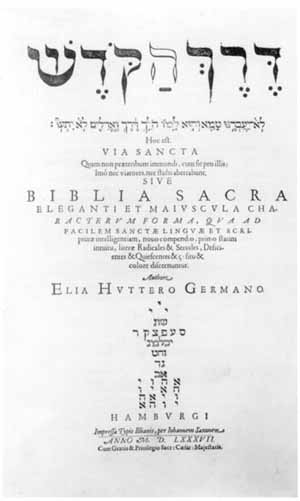
2. Elias Hutter (circa 1553-1609), a pious Christian, studied Oriental languages at the University of Jena and was appointed Professor of Hebrew at the University of Leipzig.[8] His fame rests not so much on his scholarly research as it does on his career as an editor and publisher. He published a series of polyglot editions of the Bible, as well as editions of the Hebrew Bible alone. He is perhaps most famous for his Hamburg, 1587 edition of the Hebrew Bible.[9] Usually bound in one thick folio volume, it is distinguished by the large font he used for the Hebrew letters. Moreover, he printed the root letters of every Hebrew word in the Bible in thick, heavily inked font. In contrast, he printed the non-root letters (such as “vav” copula “and”; or “vav” consecutive, which changes the tense of the verb) in a hollowed-out outline form. Thus, he introduced a major educational tool where a simple glance at the printed biblical text enabled the reader to recognize the root letters of any Hebrew word.

One of the many great Gaonim who lived in the eighteenth century was R. Joseph Teomim (1727-1792) Chief Rabbi of Frankfort on the Oder.[10] His classic commentary on Shulhan Arukh, Orah Hayyim and Yoreh De’ah, the פרי מגדים, is frequently reprinted. In the first edition of the פרי מגדים on Orah Hayyim (Frankfort on the Oder, 1787), R. Joseph Teomim prefaced his commentary with six “letters.” The “letters” were actually an encyclopedic introduction to Jewish law, thought, and practice. Some of the “letters” address such matters as the ideal curriculum for a young Jewish student, and even present lists of which books need to be read and mastered. The “letters” were not always included in the later editions of the פרי מגדים. When Makhon Yerushalayim — a distinguished publishing house for rabbinic literature — undertook to reissue the Shulhan Arukh in a massive, comprehensive, and majestic new edition, it made sure to include the six “letters.”[11] Moreover, as the editors put it: “We have re-edited the letters in clear print, with proper paragraphing and punctuation. We also added notes and references in order to render it easier for the reader to wade his way through these sometimes complex materials.”[12]

In the sixth “letter” (on p. 339 of the Makhon Yerushalayim edition), R. Joseph Teomim notes that the first book that needs to be studied by a Jewish child is the Hebrew Bible in its entirety. He then lists a series of biblical commentaries and tools that are essential for the proper study of תנ”ך. He adds:

גם תנ”ך עם אותיות חלולים, השורש בדיו, והשימושים והחסרים לבינים, טובים מאוד לנער בבחורתו ללמוד מהם

“A young student will gain much by studying from the Tanakh with the hollowed-out letters, i.e., with the root letters inked-in and with the prefixes and suffixes and the vowel letters hollowed-out.”

Since most readers would have no idea which edition of the Hebrew Bible was intended by R. Joseph Teomim, or where to look for it, the editors of Makhon Yerushalayim wisely and correctly indicate in a footnote that the reference is to the Hutter Bible. Alas, they also bestowed a posthumous rabbinic ordination on Elias Hutter, calling him:

הר”ר ע. הוטר

“The Rabbi, Rabbeinu [or: Reb] E. Hutter”

This, of course, is the imaginary case of bestowal of rabbinic ordination on a non-Jew.[13]

Footnotes:

1] See, e.g., Biographisch-Bibliographisches Kirchenlexicon, Hamm, 1997, vol. 12, columns 761-766.

2] It is tempting to identify him with R. Moshe b. R. Zvi Hirsch Lifschuetz of Mannheim (Germany) and Modena (Italy), a supporter of R. Jonathan Eibeschuetz. See לוחת עדות, Altona, 1755, pp. 20b-21b. But R. Jacob Emden assures us that the latter Rabbi Lifschuetz was no longer among the living in 1759. See his ויקם עדות ביעקב, Altona, 1755-1756, p. 85a.

3] In general, see M. Breuer, “הסמיכה האשכנזית” in ציון 33) 1968), pp. 15-46.

4] The text is drawn from L. Donath, Geschichte der Juden in Mecklenburg, Leipzig, 1874, pp. 326-327.

5] The date is problematic. In 1759, the 26th day of the Omer (= 11 Iyyar) fell on a Tuesday (May 8), not on a Sunday. Also, the parashah was פרשת אמור, not פרשת דברים. The latter objection is easily met. The author of the rabbinic ordination was simply introducing his signature with an appropriate biblical flourish: These are the words that Moses [the son of Rabbi Zvi Hirsch Lifschuetz] spoke. Regarding the former objection, one suspects that the typesetter of the Donath volume misread a “ג” for an א.

6] Almost certainly the printed Hebrew text needs to be emended and read: מ”צ פה = מורה צדק פה, and we have translated accordingly.

7] Kirchheim here is perhaps to be identified with the town of Kirchhain in Hesse. On the history of the Jewish community in Kirchhain, see K. Schubert, Juden in Kirchhain, Wiesbaden, 1987.

8] See, e.g., Biographisch-Bibliographisches Kirchenlexicon, Hamm, 1990, vol. 2, columns 1226-1227.

9] See H.C. Zafren, “Elias Hutter’s Hebrew Bibles” in The Joshua Bloch Memorial Volume, New York, 1960, pp. 29-39.

10] See the entry in Encyclopaedia Judaica, Jerusalem, 1971, vol. 15, columns 1011-1012.

11] Shulhan Arukh Ha-Shalem: Orah Hayyim, Jerusalem, 1994, vol. 1, pp. 319-343.

12] Op. cit., p. 320.

13] Turning non-Jews into rabbis (without prior conversion) is not unprecedented in Jewish literature. Apparently, J. D. Eisenstein, in his אוצר ישראל, included a non-Jew on a list of talmudic rabbis who worked for a living. See R. Abraham Isaac Ha-Kohen Kook’s critique of Eisenstein in אגרות הראיה, Jerusalem, 1962, vol. 1, pp. 161-162.

Appendix:
Title Page of 1587 Hutter Bible


Akedah, Art, and Illustrations in Hebrew Books

The Akedah (binding of Isaac) is a very popular theme in the arts. It appears in music, most recently (from a decidedly Christian perspective), the critically acclaimed indie musician Sufjan Steven’s who has the song Abraham (on his Seven Swans CD). In the visual arts, numerous representations of the Akedah can be found, from Rembrandt to Chagall. Some of the earliest Jewish art also contains the Akedah. In both the Dura_Europos Synagogue and the Beth-Alpha Synagogue there are depictions of the Akedah. This trend was continued in Hebrew manuscripts throughout the Middle Ages. In Hebrew books, however, there is a dearth of illustrations generally. At most in Haggadot or on title pages, at times, there are minor illustrations. But, there is a notable exception.

In 1685, the work Pachad Yitzhak was published in Amsterdam. This book, written by Rabbi Dr. Isaac Vita (or Hayyim) Cantarini (see note 1), is about the attack on the Jewish ghetto of Padua in 1684. Preceding the title page there is an elaborate illustration of the Akedah. The simple reason for the inclusion of this is due to Cantarini’s first name Isaac and thus an allusion to his name. But, as we will see, there is more to this illustration.

In his later work Et Kets, also published in Amsterdam in 1710 he includes another depiction of the Akedah. This work is devoted to figuring out when the Messiah will come, (he thinks in 1740), a much more upbeat topic than his prior work. As you can see both illustrations, it bears discussing them in some detail.

The illustrations are most likely done by two different artists. This is so, as there are slight distinctions between the two. For instance, in the earlier one, Abraham has a full beard, while in the later one he only has a mustache. The ram in the first has straight horns, while in the second has circular ones. These distinctions, however, are not as meaningful as others.

The overall depictions are of two different time periods. In the first, the illustrations depicts Abraham just as he was about to slaughter Isaac and the angel calling out to stop him. But, in the second the illustration is of Abraham going after the ram and not Isaac. The signifcance of this is tied to the actual books. In Pachad Yitzhak the book discusses a terrific threat to the Jews and their salvation. Thus, the illustration is of the same – the terrific threat to Isaac and the salvation. The second work, Et Kets, is a much more positive book. This work has none of the fear of the prior instead, is fully devoted to Messiah and thus the illustration is only of the ram and its sacrifice.

Further, there are different Hebrew words which appear on both the illustrations. On the first the word ערכה (prepared or set up) appears across Abraham’s chest. This word expresses Abraham’s readiness to sacrifice Isaac. It would seem, similarly, the Jews of Padua were willing to sacrifice themselves for God. But the word ערכה only means to prepare and not to actually sacrifice. Thus, Isaac was only prepared but not sacrificed and so too the Jews of Padua were placed in danger but ultimately redeemed.

In Et Kets, the words ירא יראה appear. These words are a reference to what Abraham called the place where the Akedah took place. Importantly, Abraham uttered these words after the entire episode. These were words of jubilation on both him passing his test and Isaac’s redemption. Again, these words fit well with the content of Et Kets.

These allusions are unsurprising knowing the style of R. Dr. Cantarini. His books are written rather cryptically, with many many allusions to Biblical and other themes throughout.

Now, a word or two about the author. R. Dr. Isaac Cantarini lived in Padua. He came from a family of cantors or hazzanim. Thus, his name was בן חזן (ben hazzan – son of a hazzan) or in Italian Cantarini which has the same meaning. He received his medical degree from the University of Padua on the 11th of February 1664. He was a prominent Rabbi and the head of the Yeshiva in Padua. Among his students was R. Moshe Hayyim Luzzato (Ramchal). The Ramchal wrote a dirge on R. Dr. Cantarini’s death. R. Dr. Cantarini was a very popular speaker. One Shabbat, there were so many non-Jews in attendance, the Jews were forced to sit in the woman’s section. He authored repsonsa and appears in some of the contemporary responsas of his contemporaries. One work he appears in is R. Isaac Lamporti’s encyclopedia Pachad Yitzhak. Sharing the same first name and titling their books the same caused at least the Jewish Agency to conflate the two and erroneously claim about R. Dr. Cantarini that he “Published Pahad Yizhak (Fear of Isaac), a rabbinical encyclopedia which also described the attacks on the Padua community the year before.”

In his medical practice he was highly respected by both Jews and non-Jews. He left in manuscript some of his medical writings.

Note 1. At the end of his life the name Rafael was added, see Shmuel David Luzzato, Otzar Nechmad III p. 147.

Sources: Mordecai Ghirondi, Toldot Gedoli Yisrael, p. 143 no. 154; Joseph Gutmann, The Sacrifice of Isaac in Medieval Jewish Art, in Artibus et Historiae, Vol. 8 no. 16 (1987), pp. 67-89; Simon Ginzburg, The Life and Works of Moses Hayyim Luzzatto, index under Cantarini; S.D. Luzzato, Otzar Nechmad, III pp. 128-149; also the Jewish Encyclopedia has an entry (better than EJ) here.


New Hard Drive

With modern day technology it is now possible to store tremendous amounts of information on hard drives. In the Jewish arena some have begun harnessing this power by placing thousands of seforim on a single hard drive. While there are others, which I hope to discuss at a later date, there is a new such hard drive. This hard drive contains 11,000 seforim and journals. These are searchable to an extent, as I will explain below. This hard drive contains the contents of Copy Corner, which for many years was the place to get reprints of rare and obscure (although important) seforim. Perhaps the greatest feature of the hard drive is the price, while other such hard drives cost in excess of $1,000, this one is $300. The $300 price is really just the cost associated with the drive, and making it searchable.

The hard drive was put together by the person who started HebrewBooks.org, Chaim Rosenberg, which originally was devoted to American seforim and since has moved to encompass a significant amount of other seforim – as the drive is a testament to. Aside from the Copy Corner collection, the drive is heavy in She’elot u’Teshuvot as well as commentaries on the Shulchan Orach, haggadot, and journals. Every book is fully printable and viewable.

Additionally, aside from just viewing a random book, you can also execute searches on all the books. The search process is actually two-step. First you search for a term and it pulls up all the books which contain the term you are looking for, then you search the book, as you would any PDF document for the specific page your term appears. The more expensive hard drives the search function is more streamlined, however, one pays for that ease.

I have been using this for a couple of weeks now, and I am very pleased with the drive. While, it does not encompass everything, that is not it’s mission – yet. The hope is to constantly offer upgrades, again for cost, which will add more content. The viewer actually provides a link for feedback. Further, this hard drive does not require that you install anything on your computer rather it runs fully from the hard drive. This is rather convenient if you use it with more than one computer.

In the end, anyone looking for a fairly low cost method of obtaining a significant reference library this can not be beat. It is available from hebrewbooks.org or emailing directly to oldhebrewbooks -at- aol.com. In New York – Biegelisen, Eichlers, Tuvia’s all have it as does Judaica Plaza in Lakewood.


Ghosts, Demons, Golems and their Halachik Status

One explicit mention of a ghost appears in the Talmud Ketubot 103a. The Talmud records that every week Rebbi used to return to his house after he died. The Talmud, however, does not record what Rebbi used to do when he came back. The Sefer Hassidim states that Rebbi was different than other dead people in that he was considered almost fully alive. Rebbi, according to the Sefer Hassidim, would make Kiddush for his family.[1]

A much later instance of an interaction with a ghost is found in R. Pinchas Katzenellenbogen’s (1691-1765/1767) Yesh M’Nechalin. R. Katzenellenbogen happened across a man who had the last two of his fingers bent back and connected to his palm. R. Katzenellenbogen inquired whether the man was born that way. The man explained that he was not and instead this happened when he had attended a fair. There were hundreds of people in a large room preparing for the next day’s events. Suddenly, the door of the room opened on its own. Standing at the doorway was a women dressed in tachrichim (death clothes). One person, screamed that it was his dead mother. Someone got up and slammed the door shut only to have the door open by itself again with the woman standing there. This man then went and pushed the “ghost” and from that day on his fingers were permanently connected to his palm.

Continuing on the theme of dead or other beings which interact with those still alive, we come to a rather strange question which has occupied the minds of many people for the last 800 years. The question is what is the status of someone who has intercourse with a demon? The first to mention this question is R. Isaac of Vienna (1200-1270) in his work Or Zarua. He states that intercourse with a demon is halackically meaningless. He cites a midrash which has a hassid (pious one) who was seduced by a demoness on Yom Kippur. Afterwards he felt very bad about this, but Elijah the Prophet visited him and asked him why he was sad. After the hassid explained what happened Elijah said don’t worry it was only a demon. The Or Zarua therefore says as Elijah appeared to him and he told him it was ok, intercourse with a demon is not a problem.

Now, the Or Zarua was not addressed at an actual question, however, R. Meir of Lublin (1558-1616) was asked about an “actual” case where a woman had intercourse with a demon and thus could she remain married to her husband. Although R. Meir was unaware of the Or Zarua he independentally came to the same conclusion – she was still permitted to remain married as intercourse with a demon has no effect. Least one say this is all in the realm of theory or not followed, the Beit Shmuel the classic commentary on Shulhan Orach Even haEzer quotes this law of R. Meir of Lublin (Even haEzer 6:17).

The question of intercourse with a demon seems to have come up without respect to the local or time period. R. Hayyim Yosef David Azulai (Hida) discusses “groups of women who go out to the forest” and conduct rituals with music and it seems they were visited or engaged in intercourse with demons. The Hida follows the ruling of R. Meir of Lublin and permits these women.

In Hungary in the 19th century there was a celebrated case where a woman became pregnant while her husband was away and she claimed the “father” was a demon. It appears the child was not deemed a mamzer (bastard) and the woman was allowed to remain married.

Now, there were some who questioned this whole line of reasoning and said that if one engages in intercourse with what appears to be human even if they are a demon it is of no moment. Thus, a married woman would be prohibited to remain married. The first to come to this conclusion was R. Yitzhak Binyamin Lipman (17th century) in his Nahlat Binyamim. Additionally, R. Yosef Zechariah Stern says if one follows the above rulings, what is stopping anyone who commits adultery to just claim it was a demon.

Moving on from demons, we now go to beings created via the Sefer Yetzirah. The Sefer Yetzirah (Book of Creation) is a work which allows via manipulation of various names of God to create things. Many have dealt with the halakhic status of such creations. For instance, R. Meir Leibush (1809-1879) in his work the Malbim says the reason Abraham was able to give the angels milk and meat together was Abraham did not give them meat from a born cow. Rather, the Malbim points to the verse which says “the calf which he [Abraham] made.” Malbim explains the words “he made” are literal, i.e. Abraham created the calf via the Sefer Yetzirah and thus was able to feed them both this meat and milk at the same time.

R. Isaiah Horowitz in his work Sheni Luchot HaBrit (Shelah) similarly understands the controversy between the brothers and Joseph. Specifically, Joseph, according to some Midrashic sources three negative things about the brothers – they at ever min ha-hai, they engaged in intercourse with Canaanite females and they embarrassed the children of the servants. The Shelah explains all three were based upon the Sefer Yetzirah. He explains that the Sefer Yetzirah was written by Abraham and passed on to Isaac and then to Jacob. The brothers, however, felt the sons of the servants were not worthy of such an important work (thus speaking ill or embarrassing them). Additionally, the brothers acted on the book and created animals which they ate from before killing them as there was no need being they were created via the Sefer Yetzirah. Further “it is possible that the tribes [the brothers] had created a woman” and it was these things Joseph saw and misunderstood to be regular beings. Again, according to the Shelah, intercourse or otherwise with beings from other worlds pose no halakhic issues. It is not surprising the Shelah took this position as the Shelah’s teacher was R. Meir of Lublin the one who permitted the woman who had intercourse with a demon to remain married.[2]

Perhaps the brothers were not the only ones to make women for this purpose, it is recorded (albeit much later) that R. Solomon Ibn Gabriol (1021-1058) created a woman to “serve” him. But, when the authorities found out he was forced to show it was merely wood and not a person.[3]

At the end of the forgery Niflot HaMaharal (the most comprehensive source for the false legend the Maharal of Prague created a golem) there is a discussion of various aspects of a golem. For instance, whether a golem would create impurity after it was “killed” (it would not) and the like. In regards to intercourse they state that “a golem can not reproduce nor does it have desires for the opposite sex.” It would seem that in the Paul Wegner 1920 silent movie classic “Der Golem” he disagreed with that premise. Part of the plot line is the Golem falling in love with the Maharal’s daughter; the nobleman’s son also does and she in fact runs off with him only to have the Golem rescue her. (It seems the Simpsons also follows with a similar plot line.)

As a final note, it is worthwhile mentioning that going the route of trying to connect with the other world does have it perils. R. Yaakov Ettlinger, in his Binyan Tzion describes a case where a woman met a man who told her he was Elijah the prophet and through their union the Messiah would be produced. The woman believed him, only to find out after the fact the person was con man. R. Ettlinger deals with whether in such a case she can remain married to her husband. So, ultimately one should make certain they verify the credentials of any demon, golem or ghost prior to engaging in any questionable acts.

Sources: Yesh M’Nechalin, 267-68; Hannah Sprecher, “Diabolus Ex-Machina: An Unusual Case of Yuhasin” in Jewish Law Association Studies VIII: The Jerusalem Conference Volume, 183-204; J.H. Chajes, Between Worlds: Dybbuks, Exorcists, and Early Modern Judaism (who although discusses the topic of intercourse with a demon appears to have been unaware of Sprecher’s article which contains many more sources than Chajes cites or discusses); Moshe Idel, Golem, esp. pp. 213-241 (which was reprinted almost in its entirety in a Torah u-Madda Journal 9 (2000) article by Dr. John Loike available here (PDF); R. Yudel Rosenberg, Niflot HaMahral (Pitrokav, 1909), pp. 71-74; R. Yaakov Ettlinger, Binyan Tzion, no. 164; Shnayer Z. Leiman, “The Adventure of the Maharal of Prague in London; R. Yudl Rosenberg and the Golem of Prague,” Tradition 36:1 (2002): 26-58; see also the account in Kav Ha-Yashar from R. Moshe Koidonover, translated by Zinberg, A History of Jewish Literature, vol. 6, pp. 161-63.

[1] See the discussion in the R. Reuven Margulies edition how he could have been motzei them if he was dead. Sefer Hassidim, no. 1129.

[2] Interestingly, Idel in his book Golem, appears to have been unaware of the connection between the Shelah and R. Meir of Lublin.

[3] In the halakhic realm, most are already familiar with the well-known question first posed by R. Tzvi Ashkenazi and elaborated on by his son R. Ya’akov Emden, whether a golem could be counted for a minyan (quorum).