1

Pini Dunner – Handbill Defending the Use of the Corfu Etrogim

Pini Dunner B.A (Hons), formerly rabbi of London's Saatchi Synagogue, is an avid collector of polemical and controversial Hebraica, with a very large, diverse private collection of such material. Many items in his collection are unknown and unrecorded, and relate to long forgotten, obscure controversies.
This is Pini Dunner's third post at the Seforim blog. His first post, "Mercaz Agudat Ha-Rabbanim Be-Lita, Kovno, 1931," is available here; his second post, "Unknown Picture of the late Lubavitcher Rebbe, c.1930s," is available here.
For background on the controversy over Corfu etrogim, see Yosef Salomon, "The Controversies Regarding the Corfu and Eretz Yisrael Etrogim 1875-1891," Zion 65.1 (2000): 75-106; Yosef Salomon, "The Controversy Regarding the Corfu Etrogim and its Historical Significance," AJS Review 25 (2000-2001): 1-25; Yitzhak Refael, "Corfu Etrogim and Eretz Yisrael Etrogim," Sheragi 2 (1985), 84-90; Dan Porat, "The Controversy over Israeli Etrogim from 1875-1889," (MA thesis, Hebrew University of Jerusalem, 1993); H. Hamel, "R. Yosef Zehariah Stern's Position in the Corfu Etrogim Controversy," in Sefer Refael (Jerusalem, 2000), 242-251. For a brief discussion about the broadsides authored by R. Gershon Henoch Leiner and his son R. Mordechai Joseph Eliezer Leiner of Izbica-Radzin that were posted throughout Poland, see Pearl Preschel, "The Jews of Corfu," (PhD dissertation, New York University, 1984), 111-112, 113-114, 159.
Regarding the Russian text at the bottom of the broadside, the following is a translation that was obligatory to appear on all non-Russian books:
Condemnation by M.I.Leiner of those rabbis, which, as the revenge for the dwellers of the Greek islands for the disturbances on the island of Corfu, prohibited the paradise apples originating from those islands for using them in the religious ceremony of the holiday of Sukkot.
Included is a protest letter by the rabbi of Corfu about the matter.
—————————
Permitted by the censorship, Warsaw, 15 July 1891 — printing of M.I. Galter Nalevki [St.] 23.for post
Handbill Defending the Use of the Corfu Etrogim authored by R. Mordechai Joseph Eliezer Leiner of Izbica-Radzin  published in Izbica, July 1891
This broadside contains a vigourous and impassioned defence of the practice of using etrogim from Corfu in preference to those from Eretz Yisrael. For centuries the most prized etrogim used by Jews of all communities were those grown in Corfu, and the etrog industry on the island was a mainstay of the local economy. It was said that the etrogim grown in Corfu traced their origins to those used during the second temple period, and were therefore of the most reliable pedigree. The untainted pedigree of an etrog is of primary importance, and as a result Corfu etrogim were highly sought after, making them expensive. Furthermore, the owners of the orchards – many of them non-Jews – fiercely guarded their monopolies, and were extremely careful that their etrogim were of unimpeachable pedigree.
This broadside was issued as a result of the drift away from using etrogim grown on the island of Corfu in the late nineteenth century. Initially this began with a ban on their use that was issued c.1875 and that had its roots in the growing suspicion that Corfu etrogim were no longer reliable in their pedigree and that growers had secretly begun grafting them with other citrus fruits to boost the numbers of fruit that were fit for use, and in addition would be outstanding in their appearance, boosting their value.
Then in 1891, the year of this broadside, the ban against Corfu etrogim was strengthened as a result of the terrible anti-semitism on the island that had led to a vicious blood libel. Jewish communities formerly loyal to Corfu etrogim switched their allegiances to the ever expanding etrogim market of Eretz Yisrael and it was this that R. Leiner was trying to prevent. R. Leiner (1877-1929) was the scion of the Izbica/Radzyn dynasty and in this broadside he quotes his recently departed father, R. Gershon Henoch (1839-1891), the famous 'Baal ha-Techeilet', as saying that there were no better and more kosher etrogim than those that grew in Corfu. He added that those grown in Eretz Yisrael were probably unfit for use and, furthermore, the excuse that they provided income for poor farmers there was utterly inappropriate in light of their unfitness. He added that the chief rabbi of Corfu, R. Elisha mi-Pano, had written to him to say that the ban effected against Corfu etrogim (the annual market for etrogim was of major economic significance to the small island) as a result of the blood libel was making matters worse for the Jews of Corfu.
Despite attemps by R. Leiner and other advocates of Corfu etrogim, the Corfu etrog business went into terminal decline. By the early twentieth century the rival industry in Eretz Yisrael had grabbed the overwhelming majority of the etrogim market, and with the upheaval of the two world wars, and following the creation of the State of Israel, Corfu etrogim disappeared completely from the scene.
Recently, I understand, there has been some effort to revive the fortunes of the Corfu etrog. It would seem that an emissary of R. David Twersky of New Square annually acquires etrogim from Corfu for R. Twersky to use on sukkot. No doubt this action is motivated by R. Twersky's well-known desire to strictly follow the customs of his illustrious forebears who, in the years when the etrogim controversy raged, were devotees of Corfu etrogim over their Eretz Yisrael counterparts. Nevertheless, as any etrog grower will tell you, once an etrog orchard has been abandoned, any fruit that emerge from it in the years that follow, especially if many years pass, no longer have a chezkat kashrut, and more than likely they are murkavim. It would be interesting to know if R. Twersky makes a bracha on these questionable etrogim, or if he first uses an etrog of reliable pedigree and then switches to the murkav simply for sentimental purposes.  


Eliezer Kallir – Updated

Eliezer Kallir, is considered one of the greatest paytanim. He authored some of the most well known piyyutim including those said for geshem and tal, as well as many others (although most of his piyyutim that were included in the Rosh haShana and Yom Kippur prayers are no longer said by most). While his literary output is well-known, “[b]iographical facts about Kallir are shrouded in mystery.” E.J. (new ed.) vol. 11, p. 743. There are many theories about who R. Kallir was and I would like to touch on some of these in this post. (Also see below for a bibliography on R. Eliezer Kallir – provided by a kind reader of the blog.)

R. Shmuel David Luzzato (Shadal) in his Mevo l’Machzor Beni Roma, discusses Kallir and the history of piyyutim at length.[1] “If you will ask who authored the first piyyut and who followed them, I will answer that the first is Yanni or Yinai, and the second is R. Eliezer Berebi Kalir. The product of both is apparent to all in the Haggadah as the piyyut “Az Rov Nissim” is from Yanni . . . and the piyyut “Ometz Gevoroteha” is from R. Eliezer berbi Kallir . . .” Interestingly, “regarding Yanni a nasty rumor has been spread (Zunz found it in a manuscript commentary to the Mahzor), however, anyone who hears it will laugh, . . . [and the rumor is] that Yanni became jealous of his student R. Eliezer and [Yanni] put a scorpion in [Eliezer Kallir’s] shoe and the scorpion killed Kallir.” Shadal, however, dismisses this rumor in light of the fact that Yanni’s piyyutim are still said, especially the one mentioned above during Pesach. Shadal argues that if Yanni was a murderer then there is no way Yanni’s piyyutim would be so popular. Additionally, Rabbenu Gershom mentions Yanni and uses honorific terms, something Rabbenu Gershom would not have done if the rumor is true.

Shadal then turns to the details of R. Eliezer Kallir’s biography. “In many places R. Eliezer signs his name as ‘R. Eliezer beribi Kallir from Kiryat Sefer.’ Many of the early ones believed that this indicated Kallir was from the biblical town of Kiryat Sefer, and many thought that Kallir was a tanna, either R. Eliezer the son of Simon … or R. Eliezer ben Arakh, both of these opinions are recorded in the Sefer HaYuchsin.” Shadal, however shows that it is highly unlikely that R. Eliezer Kallir was a tanna or that he was from the biblical town of Kiryat Sefer. Instead, Shadal quotes the opinion of R. Moshe Landau (grandson of the Noda Be-Yehuda) in his commentary to the Arukh, Maarkhe Lashon. [2]According to Landau Kallir is a reference to the Sardinian city Cagliari. Shadal disagrees with Landau. In the end, after citing other opinions, including identifying Kallir with an Italian city, Pumadisa in Babylon, and Sippara also in Babylon, and to those it should be added, Bari, Ostia, “Civitas Portas, the former port of Rome (Derenbourg); Constantinople; Civita di Penna in the Abruzzi; . . . Normandy, Speyer in Germany . . . Lettere in Souther Italy, . . . Antioch and Hama in Syria . . . Kallirrhoe in Palestine . .. [and finally] Tiberias.” E.J. p. 744. As should be apparent, there is no consensus on where Kallir was from.

Turning to his name – Kallir – the starting place is R. Nathan and his Arukh. He explains that Kallir, means cake (indeed in Greek kalura means cake). And, Kallir was called “cake” because “he ate a cake that had written on a kemiah (amulet) and, as a result, he became smart.” Arukh erekh klr. The idea to feed children cake with inscriptions is a well documented one. R. Eliezer from Worms, the author of the Rokekh records the custom to feed children cakes with the verses from Isaiah 50:4, id.50:5, and Ezekiel 3:3. The children would eat these when they were indoctrinated into Torah study on Shavout. [3]Of course, as noted above, some view the name Kallir as an indication of where Kallir was from. Indeed, many, including Shadal did not swallow (if I may) the Arukh’s interpretation of Kallir.

Again, as we have seen there is a bit of debate when it comes to Kallir, one of the more interesting debates regards which piyyutim can be attributed to him. While in many Kallir provides his name in an acrostic, according to R. Shelomo Yehuda Rapoport (Shir) one can also attribute those piyyutim that there is a gematria that equals some permutation of Kallir’s name. That is, Kallir sometimes signed his name Eliezer haKallir, Eliezer beribi Kallir, Eliezer Kallir me-Kiryat Sefer, and a combination of any of these. Thus, according to Shir, if in the first line equaled any of these Kallir was the author.

R. Efraim Mehlsack, however, took issue with Shir’s use of gematria. Specifically, Mehlsack wrote Sefer ha-Ravyah, Ofen, 1837, against Shir. Mehlsack was a prolific author, he supposedly authored some 72 seforim, but the only published sefer was this one. But before we get into the details regarding Mehlsack we need to discuss his critique of Shir. Mehlsack went to town on Shir and showed that using the gematria for the first line of a book, Mehlsack could make Kallir the author of just about every important Jewish book. Mehlsack goes through Tanakh and uses the first verse of each book to equal some form of Kallir’s name. For example, the first verse in Berashit equals 913 which equals “meni ha-katan Eliezer Kallir.” The first verse in Joshua equals 1041 which equals “ha-katon Eliezer beribi Kallir.” Mehlsack doesn’t stop with Tanakh, he then moves to Mishna noting that the first mishna in Berkhot is 2362 which equals “ani Eliezer berbi Ya’akov ha-Kallir mi-Kiryat Sefer yezkeh be-tov amen.” As a final shot at Shir, Mehlsack has the gematria of I am Shelmo Yehuda Rapoport = 1164 to Eliezer beRebi Yaakov Kallir =1164. Indeed, Mehlsack was not content to provide some 40 odd examples, he had even more and as a result of already printing the pages, the Sefer Ravyah is an interesting bibliographical oddity in that these gematrias appear on page 18 and then continue. Well Mehlsack includes an alternative page 18 in the back which has more examples of these gematrias. Thus, the book goes until page 32 and then there is another page 18. Both versions appear below.

Turning now to Mehlsack. As I mentioned Mehlsack supposedly authored 72 books. We know of 34 titles from that list.[4] Although most of those works have been lost, there are a few, around five, that are available in manuscript. In Boaz Hass’s recent book on the history of the Zohar, he mentions Mehlsack’s translation of the Zohar (Scholem also discusses this work). One of the works lost, is a work permitting one to travel via train on Shabbat. The introduction of this work has been published (in part) and appears below. Additionally, Sefer Ravyah was not Mehlsack’s only attack on Rapoport, Mehlsack attacked Rapoport in a few of his works, and some of his critiques were published in Bikkurei Ha-Ittim.

Returning to Kallir, it goes without saying that Kallir’s piyyutim were controversial. Most famously, the Ibn Ezra complained about them and offered that one should refrain from saying Kallir’s piyyutim. Ibn Ezra’s critique is discussed by R. Eliezer Fleckels, who defends Kallir, and Heidenheim thought it important enough to include this lengthy responsum in Heidenheim’s edition of the Machzor.[For more on the Ibn Ezra see צבי מלאכי “אברהם אבן-עזרא נגד אלעזר הקליר – ביקורת בראי הדורות” פלס (תשם) 273-296)

Bibliography on R. Eliezer Kallir (provided by a kind reader of the blog.)אלבוגן, התפלה בישראל בהתפתחותה ההסטורית, 233 – 239יוסף זליגר, “לתולדות הפיוט והפיטנים (ר’ אלעזר קליר)”, כתבי הרב דר יוסף זליגר, לאה זליגר מו”ל, ירושלים תרצ, צז – קבשלמה דוד לוצאטו, אגרות שדל א, 464 ואילך—, הליכות קדם, גבריאל פאלק, אמסטרדם תרז, מחלקה שניה, 56 – 64.צבי מלאכי, “הפייטן אלעזר הקליר – לחקר שמו ומקומו”, באורח מדע: פרקים בתרבות ישראל מוגים לאהרן מירסקי במלאות לו שבעים שנה, צבי מלאכי, מכון הברמן למחקרי ספרות, לוד תשמו, 539 – 543אהרן מרקוס, ברזילי: מסה בתולדות הלשון העברית, ירושלים: מוסד הרב קוק תשמג, 346עזרא פליישר, תרביץ נ, 282 – 302 —, “לפתרון שאלת זמנו ומקום פעילותו של ר’ אלעזר בירבי קיליר”, תרביץ נד ג, ניסן – סיון תשמה, 383 – 427שלמה יהודה ראפאפארט, תולדות גדולי ישראל, 24 – 55יעקב שור, ספר העתים, 364 – 365 בנועם שיח: פרקים מתולדות ספרותנו, מכון הברמן למחקרי ספרות, לוד תשמג, 114 – 156 המעין טז א, תשרי תשלו, 3 – 14. המשך: ב, טבת תשלו, 32 – 52.

[1] Mevo leMachzor Beni Roma, Habermann ed. Jerusalem[2] For more on this commentary see S. Brisman, History & Guide to Judaic Dictionaries & Concordances, KTAV Publishing House, Inc. 2000, pp. 19-20.[3] For more on this custom see Assaf, Mekorot le-Tolodot ha-Hinukh be-Yisrael, Jerusalem 2002, pp. 80-1 n.9 and the sources cited therein. See also, E. Kanarfogel, Peering through the Lattices, Wayne State University Press, Detroit, 2000 pp. 140-41 and the notes therein (discussing the ceremony generally); id.p. 237 n.47 (discussing some of the halakhik issues with this custom including the “issue” of “excret[ing] these verses”)[4] See G. Kressel, “Kitvei Mehlsack,” Kiryat Sefer 17, pp. 87-96.


Post on my sefer

Announcing The Publication of Eliezer Brodt's Bein Kesah L'Asurby Eliezer Brodt This post is not a review of a sefer as one can not review ones own sefer. Rather it is a simple announcement and book description. Last year I posted a chapter from my sefer about the minhaghim of Rosh Hasnaha. I was hoping to complete that work this year but as the material grew I realized that would not be possible. Around Pesach time I decided that I would take some of the parts about aseret yemei teshuvah and print it as its own pamphlet. The pamphlet grew into its own 286 page sefer. The name of the sefer is Bein Kesah L'asur. The central topics of the sefer revolve around the chumras (stringency) that people practice during aseret yemei teshuvah.The sefer begins with a chapter to explain why we observe these chumras even though right afterwards we revert back to our old ways. This follows with a chapter about the special power of Teffilah during this period. In the next chapter I trace at length the source of the minhag to take on chumros during this period starting with the Yerushalmi and up until recent literature showing how this minhag developed over time. Throughout I discuss many topics that were inter related to this Yerushalmi such as baking challos for shabbos that it should be specifically Pas yisroel, the minhag of people of Tzefas to eat chulin B'taharah, going to the Mikvah erev Yom Tov especially Rosh Hashana and Yom Kippur, and if there was Efar Parah Adumah after the destruction of the Bes Hamikdash. Besides this I deal with other topics such as the time period one has to observe these chumros. After which I have a few chapters disusing at length the actual chumras that people did, such as washing hands before eating vegetables, giving tzedakah in asret yemei teshuvah, checking ones tzizits before putting it on, sleeping during the day and on shabbos. There are some interesting appendixes in these chapters such as where the source for sleeping on Shabbos is considered oneg shabbos, wearing teffilin the whole day or at least during mincha. The last two chapters are about chumras in general (the pros and cons), and about the famous Asrah Mili Dechasdusad'Rav (the 10 pious practices of Rav) – in particular "Rav Lo soch Sicha Bitalha Miyomov" (Rav never spoke unnecessary words his whole life). I conclude the sefer with a chapter about the sefer Simachat Ha-nefesh which I used many times through out this work. I included an index of some 40 entries of some obscure seforim and topics that I discuss in the footnotes.  The sefer is available in Girsa, Otzar haseforim, next to the Mir and Shankies. It is en-route (arriving right after Rosh ha-Shana) to Biegeleisen and Judaica plaza. For all information about this sefer including donations for this one or the upcoming volume contact me at eliezerbrodt-at-gmail.com What follows is a sample chapter based on one of the most famous things everyone learns about in school about asret yemei teshuvah that if you do teshuvah each day of the week has power to fix all of those days of that year. החומרות בעשרת ימי תשובה ככפרה על ימות השנהא. אלולא דמסתפינא הייתי אומר, שהסיבה שישראל קדושים לאחוז בחומרות יתירות בעשרת ימי תשובה היא משום היסוד המפורסם על שמו של האריז"ל:אמר לי הרב משה גאלאנטי, ששמע ממורי ז"ל: שאם האדם יתענה בשבעת ימים שבין ראש השנה ליום הכפורים ויעשה בהם תשובה גמורה, כל יום מהם מכפר על כל העונות שחטא כל ימיו, ביום שכיוצא בו… ואם התענה ועשה תשובה בכל שבעת הימים ההם, יתכפרו לו כל עונותיו שעשה כל ימיו[1].ומשום כך נהגו בחומרות יתירות בימים אלו, כדי שיעלה להם שעשאום בכל ימות השנה. ואכן ראיתי שהדברים נתבארו בכתבי ר' דוד מנובורודוק (רוסיה הלבנה, תקכה-תקצג), בעל 'גליא מסכת': ועוד ראיתי, שענין הזה שאמרו דורשי רשומות, דכל יום מימי עשרת ימי תשובה עומד ומעותד שיהיה ניתקן בו כל מה אשר עיות, חס וחלילה, בכל יומו מימות השנה. ויש לזה סמיכות בירושלמי… דרבי חייא רבה מפקיד לרב: אי אתה יכול למיכל כולה שתא חולין בטהרה – אכול, ואם לאו – תהא אכיל שבעה יומין מן שתא. וכתב ראבי"ה: קבלתי, שאלו שבעה ימים בין ראש-השנה ליום כיפור… אם כן נראה, שבחר שבעה ימים מעשרת ימי תשובה כדי שכל יום ויום, הן יום ראשון או יום שני וכן כולם, יתקן כנגדו מכל ימות השנה[2]. ב. רעיון זה שר' דוד מנובורודוק הביאו בשם "דורשי רשומות" הוא באמת מתורת האריז"ל, וכאמור. ונוסיף בכך דברים. ר' רפאל עמנואל חי ריקי (תמז-תקג), מגדולי מקובלי איטליה שגם שהה בצפת ובירושלים מספר שנים, כותב בשנת תפב בספרו משנת חסידים: "ובעשרת ימי תשובה… המתענה בהם ועושה תשובה גמורה, מוחלין לו בכל יום מימי השבוע שבעשרת ימי תשובה מה שחטא ביום ההוא לעולם"[3]. כמו חיבורים אחרים, גם משנת חסידים הינו סיכום מתורתו של האר"י כפי שקיבלו המחבר מתלמידי תלמידיו בארץ-ישראל ובאיטליה, ולפיכך אנו מוצאים את הרעיון המדובר גם בכתבים אחרים שאספו לקרבם מתורת האר"י. ר' מאיר פופרש כותב: "מי שיחזור בתשובה גמורה ויתענה בשבעת ימי התשובה, נמחלו לו כל עונותיו. דהיינו, אם חל ביום ראשון משבעת ימי התשובה ביום א דשבת – מתכפרים לו כל עונותיו שחטא ביום א דשבת… וכן כולם. זה וודאי בלי ספק"[4]. הדברים הובאו גם במקורות מאוחרים יותר, ולא תמיד בשמו של האריז"ל. כך כותב הגר"א (ליטא, תפ-תקנח) בלשונו התמציתית: "…ולכן המעשים הנאותים הנפעלים בימים אלו [=בעשרת ימי תשובה], חשובים ככל השנה"[5]. אחריו כותב תלמיד-תלמידו, ר' יצחק אייזיק חבר (ליטא, תקמט-תריג): "לכן בימים המקודשים האלו… מחויב כל איש… לטהר עצמו מכל חטא ואשמה על-ידי תשובה גמורה… בימים אלו [ש]הם כלל כל ימות השנה, וכמו שכתב האריז"ל, שבשבעת הימים – כל יום ויום נתקן בו מה שפגם באותו יום מכל ימות השנה…"[6]. גם באחד מספריו של ר' יוסף תאומים (פולין ואשכנז, תפז-תקנב), בעל 'פרי מגדים', נאמר: "כי יקר הזמן מאד מאד, על כן ימהר יחיש מעשיו לתקן את כל אשר עיות בכל השנה. כי בעשרת ימי תשובה, בכל יום יתקן מה שפגם בכל השנה באותו יום"[7].וכך אצל עוד רבים מרבותינו האחרונים[8].   ג. אמנם ראוי לציין שהיסוד המובא על-שם האריז"ל מצוי, ברמיזה, באחד מספרי בן-דורו המבוגר, ר' משה קורדובירו (הרמ"ק; שאלוניקי-צפת, רפב-של)! וזה לשונו: עשרת ימי תשובה… ועשרה ימים אלו הם עשרה ימים שבהם עשר ספירות ודאי. ואולם מלת 'תשובה' נודע פירושה: תשובת הדברים אל שרשם… וכפי פעולת האדם בימים ההם כן יפגום בימים או ישלימם במעשיו הטובים… [ו]נתן הקב"ה לישראל עשרה ימים אלו, שהם של תשובה, שמתגלה המקור, שהיא הבינה, על הימים – שהם העניפים, להמשיך להם שפע רב, ולתקן על ידי התשובה כל פגם שפגם בימים הנזכרים שחלפו[9].אך הפלא הוא, שהמקור הראשון המזכיר ענין זה בשם האריז"ל הוא ר' משה גלנטי[10], שרבותיו המובהקים היו: ר' יוסף קארו (בתורת הנגלה) והרמ"ק (בתורת הנסתר)![11]. על פרט נוסף ראוי להתעכב מעט. במובאות הראשונות שמשם האריז"ל הודגש, ששבעת ימים אלו מתקנים את כל ימות השנה רק "אם האדם יתענה" בהם "ויעשה בהם תשובה גמורה"[12]. ואילו מתורתו של הרמ"ק אנו שומעים ש"ישלימם במעשיו הטובים" בלבד, וניתן להבינם כמחייבים רק את התשובה ולא גם את התענית. ולמרות כל זאת, רוב המקורות המאוחרים המביאים יסוד זה בשם האריז"ל[13], ואף-על-פי-כן אינם מציינים שיש להתענות, אלא רק מחייבים את התשובה! ד. היה שמצא את שורש יסודו של האר"י בתורת הנגלה, וזולתו מצאה בתורת הנסתר. הראשון הוא ר' יחזקאל לנדא (פראג, תעד-תקנג), בעל 'שו"ת נודע ביהודה', המוצא לכך סמך מהמסופר בתלמוד בבלי (חגיגה ה סע"ב):רב אידי, אבוה דרבי יעקב בר אידי, הוה רגיל דהוה אזיל תלתא ירחי באורחא וחד יומא בבי רב. והוו קרו ליה רבנן: 'בר בי רב דחד יומא'. חלש דעתיה… נפק רבי יוחנן לבי מדרשא ודרש: "ואותי יום יום ידרשון ודעת דרכי יחפצון" (ישעיה נח ב), וכי ביום דורשין אותו ובלילה אין דורשין אותו? אלא לומר לך: כל העוסק בתורה אפילו יום אחד בשנה – מעלה עליו הכתוב כאילו עסק כל השנה כולה…מסיק מכך ר' יחזקאל לנדא: "הרי מפורש בגמרא, שיום אחד יוכל לתקן כל השנה. ואם כן יפה כתב האר"י, שיוכל לתקן בימים הקדושים הללו מעשה כל ימות השנה"[14].מאידך, ר' רפאל כ"ץ (המבורג, תפג-תקסד) מוצא סמך לדברי האריז"ל בנאמר בספר הזוהר[15]:בכל יומא ויומא כרוזא נפיק וקרי ולית מאן דישגח. דתניא: אינון יומין דבר-נש כד אתברי בההוא יומא דנפק לעלמא, כלהו קיימין בקיומייהו ואזלין וטאסין בעלמא נחתין ואזהרן לבר-נש כל יומא ויומא בלחודוי. וכד ההוא יומא אתי ואזהר ליה ובר נש עביד בההוא יומא חובא קמי מאריה, ההוא יומא סליק בכסופא ואסהיד סהדותא וקאים בלחודוי לבר. ותאנא בתר דקאים בלחודוי, יתיב עד דבר-נש עביד מניה תשובה. זכה – תב ההוא יומא לאתריה; לא זכה – ההוא יומא נחית ואשתתף בההוא רוחא דלבר ותב לביתיה ואתתקן בדיוקניה דההוא בר-נש ממש… בין כך ובין כך, אתפקדן אינון יומין וחסרים ולא עאלין במניינא דאינון דאשתארו. ווי לההוא בר-נש דגרע יומוי קמי מלכא קדישא ולא שביק לעילא יומין לאתעטרא בהו בההוא עלמא – – -מסיים ר' רפאל הכהן ואומר: "והנה, כתבו בעלי מוסר, שסגולת הימים האלו [=עשרת ימי תשובה], שאם שב לפניו ברוך הוא, מוחלין לו כל מה שחטא באותו יום בשבוע כל ימות השנה. נמצא על ידי מה ששב בימים הקדושים האלו, גורם שחוזרים הימים שחטא בהן במנין הימים, כמבואר בזוהר. ועל ידי זה נכון הוא לקרוא לאותן הימים 'ימי תשובה', כי על ידי ימים האלו משיבין לו הימים שנאבדו ממנו בחטאתו בהן"[16].  ה. יסודו של האריז"ל, ששבעת הימים מעשרת ימי תשובה מתקנים את היום השבועי שכנגדו, שימשו שורש ועיקר גדול; ממנו נוספו כמה הנהגות טובות ואף נתבארו על-ידו כמה מהִלכות ימים אלו.1. ביטול השינה ב'שבת תשובה'. המחבר האנונימי של ספר חמדת ימים הבין מיסוד זה, שבשבת החל בעשרת ימי תשובה ('שבת תשובה') אין לקיים בו את מצוות 'שינה בשבת תענוג': בשם הרב ז"ל, כי כל יום מעשרת ימי תשובה, מה שיעשה האדם בתשובה בהם – מתכפר מה שפגם באותו יום כל ימות השנה. וכן על זה הדרך בכל עשרת הימים. והאיש השלם עם השם, צריך לתת אל לבו אם פגם באיזו משבתות השנה בשיחת חולין ודברים בטלים או כעס… צריך… בשבת זו לתקן את אשר עוותו, להיות תמיד … ולמעט בדיבורו. ואף שאמרו דורשי רשומות: שינה בשבת תענוג. לאו משנת חסידים היא לשבת זו, שבת תשובה, כי לא אמרו זה רק לשאר שבתות… כי גדול הוא לפני אבינו שבשמים לתקן בו כל שבתות השנה[17]. הדברים האחרונים יומתקו בצירוף דברי ר' צבי הירש הורוויץ (פפד"מ, תקו-תקעז) על חובת האדם לפשפש במעשיו בשבת תשובה דווקא: "וידוע מה שכתבו בספרי מוסר, שבכל יום ויום מימי השבוע יראה לפשפש במעשיו של כל השנה מה שפגם באותו יום. אשר לדעתי, נכון מה שמכנים העולם בפרטות יום השבת יותר משאר הימים לקרותו בשם 'שבת תשובה', מפני שבשבת מחויבים לפשפש במעשיו ולתקן מה שפגם בחילול שבתות של כל השנה, ואין לך שום עבירה שבעולם שיהא נכלל בה הרבה עבירות כמו ענין שבת, שיש בה ל"ט אבות מלאכות, ולכל אחד כמה תולדות וכמה איסורי דרבנן…"[18].2. היתר התענית ביו"ט שני וב'שבת שובה'. באמצעות יסוד זה יש המיישב את תמיהת הרא"ש על היתר התענית ביום שני דראש-השנה וב'שבת שובה'. רב נטרונאי גאון סובר, שביום-טוב ראשון דראש-השנה אסור להתענות, כי הוא מדאורייתא, אבל ביום-טוב שני של ראש-השנה וכן בשבת שלאחריו – מותר, "משום דעשרה ימים אינון משונין מכל ימות השנה, לפיכך נהגו רבותינו לישב בהן בתענית בין בחול בין בשבת"[19]. הגיב על כך הרא"ש: "ודבריו תמוהין, שאסר להתענות ביום-טוב ראשון של ראש-השנה והתיר להתענות בשבת!"[20].אמנם אחרי שנודע לנו מיסודו של האריז"ל לא רואה ר' יחזקאל לנדא (פראג, תעד-תקנג), בעל 'שו"ת נודע ביהודה', כל קושי בשיטת רב נטרונאי גאון: כתבו בשם האר"י ז"ל, דבכל יום בין ראש-השנה ליום-כיפורים צריך האדם לתקן אותו היום של כל השנה. דהיינו, ביום ראשון צריך לשוב אל ה' על כל מה שחטא תמיד ביום הראשון, וכן ביום השני… ואם לא עשה כן ועבר יום אחד משבעת ימים אלו, הרי זה מתחייב בנפשו, והוא מעות לא יכול לתקן עוד. אמור מעתה, יום ראשון של ראש-השנה יהיה אותו גם אחר ראש-השנה, [אם כן] למה לו להתענות ולחלל את יום-טוב דאורייתא חינם? דרך משל, אם חל ראש-השנה ביום השני, יהיה יום השני אחר בין ראש-השנה ליום-כיפורים… אם כן, יום ראשון [שהוא] דאורייתא, אין צריך להתענות חינם. אבל שבת שבתוך הימים, שבין ראש-השנה ליום-כיפורים, דאי אפשר לתקן עוד, התיר להתענות – להציל ממות נפשו. וזה אשר דקדק רב נטרונאי [לומר]: 'דעשרת ימים אינון משונין מכל ימות השנה'. רצונו לומר, בהם צריכין אנו לתקן כל הימים מימות השנה, ולפיכך נהגו רבותינו לישב בהן בתעניות בין בחול ובין בשבת"[21].3. ריבוי צדקה בעשרת ימי תשובה. את המנהג שהביא הרמב"ם: "נהגו כל בית ישראל להרבות בצדקה… מראש-השנה ועד יום-הכפורים יתר מכל השנה"[22], ביאר ר' נסים אברהם אשכנזי על-פי יסודו של האריז"ל:דכוונת הזקנים הללו לקבל מכל איש ואיש שהיה נותן להם מפרי צדקתם [רק] בין ראש-השנה ליום-הכפורים[23], דבאלו הימים היה התועלת וזכות גדול מאוד, מה-שאין-כן בשאר הימים… והיינו טעמא דצריך להרבות בצדקה בימים ההם יותר מכל השנה הוא משום, דהשב בעשרת ימי תשובה – כל יום מכפר על כל הימים שכמותו. כלומר, עשה תשובה ביום ראשון דשבוע של עשרת ימי תשובה – מכפרת על כל יום ראשון שבשבוע שכל ימי חייו… ולכן, כדי לזכותם בזכות גדול, היו מקבלים הזקנים הללו מבין ריש שתא… משום דגדולה תשובה של אלו הימים שכל יום ויום מכפר… מה-שאין-כן שאר הימים, דאין-הכי-נמי דזכות הוא להם, מכל מקום אינו כל-כך זכות ותועלת לאדם כעשרת הימים האלו שבין ראש-השנה ליום-הכיפורים[24].4. ריבוי דרשות בעשרת ימי תשובה. על-פי יסוד זה מסביר ר' שלמה קלוגר, מדוע נהגו ישראל קדושים להרבות בדרשות בימים אלו. שבנוסף לטעם הפשוט – לעורר את לב השומעים לאביהם שבשמים, הוא רואה בכך גם תיקון פגמי הדרשות של כל ימות השנה:והנה יש לומר תועלת הדרוש בימים הללו. כיון שימים הללו כל אחד מתקן יומו של כל השנה, דתקנו ימים כנגד ימים. ולכך… אולי הוי חטא בידינו בדרשות של כל השנה, הן המגיד הן השומע, ויתוקן בדרשה זו, לתקן דרשות כל השנה[25]. 5. מעלת התשובה בימים אלו. ר' שמואל גינצלר (הונגריה, תקצה-תרעא) מבאר מדוע האדם השב מחטאיו בעשרת ימי תשובה, תשובתו "מתקבלת היא מיד"[26]. כי קיימא לן, שהשב על חטאו באותו היום שחטא – תשובתו מקבלת מיד ואינו צריך לארבעת חילוקי הכפרה[27]. אם כן, "הוא הדין אם אפילו לא עשה התשובה ביומא ממש, רק בעשרת ימי תשובה שב, [כי משום] שכל יום ויום מעשרת ימי תשובה הרי הוא מתקן בתשובתו היום ההוא של כל השנה, [לפיכך] התשובה ההיא שעשה בעשרת ימי תשובה – הרי הוא גם כן כאילו עשה תשובה באותו יום ממש שחטא בו, שאז אין צריך לארבעה חלוקי כפרה". ומשום כך השב בעשרת ימי תשובה – תשובתו מתקבלת מיד, שאינו צריך לארבעת חילוקי כפרה[28].6. האכילה בערב יום-הכיפורים ב'מורא שמים'. בספרו עבודת הקודש כותב החיד"א: "בערב יום הכיפורים, גם [כ]שיאכל ממצותו – מורא שמים יהיה חופף עליו"[29]. וביאר דבריו ר' יהושע קפלן מוולאז'ין:פירוש, שיאכל על טהרת הקודש בכוונה שיוכל מזה לעבוד ה' יתברך… ואם זה בשאר ימות השנה, כל-שכן בערב יום-כיפורים שהוא יום אחד מעשרה ימי התשובה, וידוע מה דאיתא בשם האר"י ז"ל, שבכל יום ויום מעשרת ימי תשובה מתקן בכל מה שחטא בכל השנה ביום ההוא לעולם, אם כן במה שאוכל בכוונה הנ"ל, מתקן בזה האכילה במה שפגם בכל השנה באותו היום ובאיזה אכילה שלא כהוגן, ובפרט באיזה דבר איסור, חס וחלילה, על כן מה מאד ראוי להתאמץ בזה בכל יום של עשרת ימי תשובה[30]. כיוצא בזה כותב גם ר' שלמה קלוגר: "כיון שימים הללו כל אחד מתקן יומו של כל השנה, דתקנו ימים כנגד ימים. ולכך הוי מצות אכילה בערב יום כיפור, לתקן אכילת כל השנה…"[31]ו. שמענו עד עתה על יסודו של האריז"ל, שכבר רמזו הרמ"ק ושורש לו בתלמוד בבלי ובספר הזוהר, שכל יום משבעת הימים שבעשרת ימי תשובה מתקנים את היום השבועי שכנגדם. אולם כדרכה של תורה, גם יסוד זה זכה לפיתוח והרחבה. ר' ישעיה הורוויץ, בעל 'שני לוחות הברית' (שבמקום אחר מביא לשיטת הרמ"ק![32]), כותב, שכל יום מחודש אלול מכפר על פגמי השנה החולפת! וזה לשונו: "אלול, חודש זה מוכן לתשובה. ומסתברא, מאחר שהוא החודש האחרון מהשנה לעשות בו תשובה, על כל מה שפגם בכל השנה"[33].     

[1]שער הכוונות, דרושי ראש השנה, הקדמה.[2] ר' דוד מנובורודוק, גליא מסכת, ב, חלק הדרשות, ד"צ: ירושלים תשכט, דף יט ע"ד ואילך.בהמשך הוא מבאר, שלדבריו מובן מדוע רב חייא הזהיר רק על שבעה ימים מתוך עשרת ימי תשובה ולא על עשרה ימים: "ובזה ניחא דנקט ירושלמי 'שבעה יומי', וקשה, דהא עשרת ימי תשובה – עשרה יומי אינון, אלא על-כרחך דלא צריכי אלא להיות שמור יום כנגד יומו של כל השנה". [3] ר' רפאל עמנואל חי ריקי, משנת חסידים, ח"ג, מסכת ימי תשובה, אות ג, ד"צ: ירושלים תשמב, דף קמב ע"ב.קביעת שנת תפב כתאריך כתיבת החיבור, הוא לנאמר בשער המהדורה הראשונה (משנת חסידים, אמשטרדם תפז): "…שחברתי אני… עמנואל חי בלא"א אברהם ריקי תנצב"ה בעיר ליוורנו בשנת ד"ל לימי שני חיי, הוא שנת ה'כ'ו'נ'ו'ת' ליצירה". חישוב הגימטריא מעלה שכוונתו לשנת תפב[4] אור צדיקים, ענין עשרת ימי תשובה, סי' לו, סעיף א, תל-אביב תשכ, עמ' לז.[5] הגר"א, אדרת אליהו, בראשית א יד.[6] ר' יצחק אייזיק חבר, שיח יצחק, דרוש תוכחת מוסר, אות כו, ירושלים תשס, עמ' נה טו"ב. למקור זה הפנני ידידי הרב פרופ' י"ש שפיגל, ויישר כוחו.[7] ספר המגיד, ג, לונדון תשנ, עמ' קיט.[8] אציין ככל אשר מצאתי: ר' יהונתן אייבשיץ, יערות דבש, ח"א, דרוש א, דף ה ע"א; שם, דרוש ה, דף מה ע"א; ר' ידידיה טיאה ווייל, לבושי בדים, ירושלים תשמח, עמ' קפה; ר' דוד זכות ממודינא, זכר דוד, מאמר שלישי, פרק סח, ירושלים תשסא, עמ' תצא-תצב; ר' יהודה עלי, קמח סלת, הלכות עשרת ימי תשובה, סעיף ה, ירושלים תשסה, עמ' תד; ר' אורי מסטרילסק, פתורא דאבא (מנהגי האריז"ל), ירושלים תרסה, דף מא ע"ב; ר' אלכסנדר זיסקינד מהורודנא, יסוד ושורש העבודה, שער האיתון (אחד עשר), פרק חמישי, ירושלים תשכה, עמ' שי; ר' דוב בער קאראסיק, פתחי עולם ומטעמי השלחן, סי' תרג, סעיף א; ר' אברהם שלום חמוי (ארם-צובה, נפטר תרס), מחזור בית דין, ירושלים תשמו, דף קעג ע"ב, סעיף א; ר' יוסף כנאפו, זך ונקי, פרק יט, ירושלים תשסה, עמ' קנט ואילך; ר' משולם פינקלשטיין, אלף המגן, סי' תרג, ס"ק ו; רי"ח סופר, כף החיים, או"ח, סי' תקסב, ס"ק יד; ר' ישראל מאיר הכהן, משנה ברורה, סי' תרג, ס"ק ב; נ' סטפנסקי, ועלהו לא יבול, א, ירושלים תשסה, עמ' ריב-ריג (בשם ר' שלמה זלמן אויערבאך); הרב עובדיה יוסף, חזון עובדיה על ימים נוראים, ירושלים תשסה, עמ' רט, הערה יב.[9] ר' משה קורדובירו, זבחי שלמים, הקדמה, ירושלים תרמג, דף ב ע"ב. משם העתיקו ר' ישעיה הלוי הורוויץ (שני לוחות הברית, מסכת ראש השנה, אור תורה, סי' כג, דף נח ע"א), וממנו לספרו של ר' דוד זכות ממודינא (זכר דוד, מאמר שלישי, פרק סח, ירושלים תשסא, עמ' תפט).[10] עי' לעיל, ליד הערה 1.[11] ראה: מ' בניהו, יוסף בחירי, ירושלים תשנא, עמ' רצח-שה, ובמיוחד בעמ' שב-שג; הנ"ל, תולדות האר"י, ירושלים תשכז, עמ' 113.[12] כך הביא ר' חיים ויטאל בשם ר' משה גלנטי ששמע מהאריז"ל. ראה לעיל, הערה 1. וכך במקורות יותר מאוחרים, כמו: משנת חסידים ואור צדיקים. עי' לעיל בסמוך.וזו אכן שיטת האריז"ל, שיש להתענות בעשרת ימי תשובה. ראה מה שהביא ר' דוד זכות ממודינא (זכר דוד, מאמר שלישי, פרק סח, ירושלים תשסא, עמ' תצא) מספר כתב-יד לר' חיים ויטאל. ובחיבורי עורו ישנים משנתכם, המצוי בעריכה סופית, הארכנו בזה טובא. [13] ראה הנסמן לעיל, הערה 8.[14]דרשות הצל"ח, דרוש יט, ביתר עילת תשסב, עמ' קלג.כיון לכך מדיליה ר' דוד מנובורודוק, שם (לעיל, הערה 2): "ואפשר לסמוך לזה האמור בפרק קמא דחגיגה, על קרא ד'אותי יום יום ידרשון', דהעוסק יום אחד בשנה בתורה ומעשים טובים מעלה עליו כאילו עסק כל השנה כולו. ולכן כל ימי השבוע מעלה יומו ומתקן נגד מה שעיות בכולהו". [15] זוהר, ח"א, דף רכד ע"א.[16] מרפא לשון, עמוד יום הדין, ירושלים תשסה, עמ' שב-שג. הועתקו דבריו אצל ר' אהרן קוטלר בספרו משנת ר' אהרן, ב, ירושלים תשמח, עמ' רכא. גם ר' שמואל גינצלער (הונגריה, תקצה-תרעא) הבין שיסודו של האריז"ל הוא בזוהר הנ"ל. ראה בספרו: משיב נפש, ברוקלין תשסה [נדפס לראשונה בסיגט תרעב], עמ' תצב.יתכן גם, שהאריז"ל הושפע גם משיטת ר' יוסף גיקאטיליה וספר הזוהר שהתפילות שבכוונה הנאמרות בעשרת ימי תשובה מעלים ומתקנים את כל התפילות הפסולות של ימות השנה (בענין זה, ראה להלן, פרק…). אלא שהאריז"ל הרחיב את הרעיון לכל החטאים, שאת כולם ניתן לתקן בעשרת ימי תשובה. ועיין בזה. [17] חמדת ימים, ימים נוראים, פרק ו ('שבת תשובה'), דף סב ע"א. וראה דבריו שם, דף מו ע"ב.[18] לחמי תודה, ברוקלין תשיז, דף נו ע"ב, דף עו ע"ב. בספר זה נזכר יסודו של האריז"ל פעמים נוספות, בסגנונות ואופנים שונים, ראה: שם, דף עו ע"ב, דף צג ע"ב, דף קי ע"א, דף קכט ע"א, דף קע ע"א.[19] כך הובא בטור, או"ח, סי' תקצז. וראה: י' ברודי (מהדיר), תשובות רב נטרונאי גאון, או"ח, סי' קפב, ובהערות, וש"נ המקבילות.[20] רא"ש, ראש השנה, פרק ד, סי' יד. הובאו דבריו אצל בנו: טור, שם.[21] דברי ר' יחזקאל לנדא הובאו אצל תלמידו ר' אלעזר פלקלס (פראג, תקיד-תקפו), בספרו שו"ת תשובה מאהבה, ח"ב, סי' תקצז, פראג תקעה, דף לח ע"ג. וכך גם כותב בשמו ר' ישעיהו ווינר, בגדי ישע, או"ח, סי' תקצז, ס"ק ו. וגם כאן זכה ר' דוד מנובורודוק לכוון לדעת קודמיו, ראה בספרו גליא מסכת, ב, חלק הדרשות, ד"צ: ירושלים תשכט, דף יט ע"ד.[22] רמב"ם, הלכות תשובה, פ"ג ה"ד.[23] כוונתו למסופר בירושלמי, פאה פ"ח ה"ח: "אמר רבי חייא בר אדא: אית הוו סבין ביומינו, מן דהוה יהבין לון מבין ריש שתא לצומא רבא הוון נסבין, מן בתר כן – לא הוון נסבין; אמרי, רשותא גבן".[24] נחמד למראה, פאה פ"ח ה"ח, שאלוניקי תקצב, דף מ סע"ג-ע"ד. בגוף הנושא שיש להרבות בצדקה בעשרת ימי תשובה, הארכתי להלן, פרק…[25] קהלת יעקב, ירושלים תשסב, דף טז. וראה עוד: שם, דף שעט.[26] רמב"ם, הלכות תשובה, פ"ב ה"ו: "אף-על-פי שהתשובה והצעקה יפה לעולם, בעשרה הימים שבין ראש-השנה ויום-הכפורים היא יפה ביותר ומתקבלת היא מיד…"[27] מבוארים ביומא פו ע"א (מובא בדילוגים שלא נסמנו): "שאל רבי מתיא בן חרש את רבי אלעזר בן עזריה ברומי: שמעת ארבעה חלוקי כפרה שהיה רבי ישמעאל דורש? אמר: שלשה הן, ותשובה עם כל אחד ואחד. עבר על עשה ושב – אינו זז משם עד שמוחלין לו; עבר על לא תעשה ועשה תשובה – תשובה תולה, ויום הכפורים מכפר; עבר על כריתות ומיתות בית דין ועשה תשובה – תשובה ויום הכפורים תולין, ויסורין ממרקין; אבל מי שיש חילול השם בידו – אין לו כח בתשובה לתלות, ולא ביום הכפורים לכפר, ולא ביסורין למרק. אלא כולן תולין, ומיתה ממרקת".[28] ר' שמואל גינצלר, משיב נפש, ברוקלין תשסה [נדפס לראשונה בסיגט תרעב], עמ' תצג.וקדם אותו ר' משה סופר, ה'חתם סופר' (פפא"מ ופרשבורג, תקכג-תר): "…קיימא לן, שאינו יכול לתקן מעוות יום זה – בחבירו. [כמו,] אם לא בירך היום, אי אפשר לברך מחר בשביל היום… והטעם, משום שכל יום יש לו אור מיוחד למעלה בשמים ממעל, והוא מבקש ברכותיו ותקנותיו. ואם-כן ממילא, הדין בחטא, שפגם באותו יום, צריך לשוב באותו יום ממש; ולכן צדיקים שבים בכל לילה. מכל מקום, ברב חסד השם עלינו, כי ימי תשובה, שבעה ימים שבין ראש-השנה ויום-כפור, שכל יום כלול מכל ימות השנה. הא כיצד? שבת של ימי התשובה, כלול משבתות של כל ימות השנה, ויכול לתקן כל אשר פגם בשבת; ראשון בשבת כלול מכל [ימי] ראשון בשבת של כל השנה כולה; וכן כולם" (דרשות חתם סופר, ח"ב, ירושלים תשמט, עמ' מ טו"ב. למקור זה הפנני ידידי הרב פרופ' י"ש שפיגל, ויישר כוחו). [29] עבודת הקודש, מורה באצבע, סי' ט, אות רסט, ירושלים תשמ, עמ' מט.[30] פירוש שערי הקודש, שם, הערה יח.[31] ראה לעיל, הערה 25.[32] עי' לעיל, הערה 9.[33] שני לוחות הברית, מסכת ראש השנה, נר מצוה, סי' א, דף נג ע"א.


Repackaged Rulings: The Responsa of R. Elyashiv

Repackaged Rulings: The Responsa of R. Elyashiv by: Yitzhak of בין דין לדין
 Wolf2191 recently wrote: N.B. I believe I noticed that some of the pesakim that R' Elyashiv issued when he was part of the Beis Din Ha-Gadol together with Chacham Ovadiah and Harav Kappach were republished in a kovetz under R' Elyashiv's name only, but I would need to check again.]

The קובץ תשובות

Three volumes of Rav Elyashiv's responsa have been published in Yerushalayim under the title קובץ תשובות, the first in 5760, and the latter two in 5763. None contain any preface, introduction or critical apparatus, except for the following brief prefatory paragraph, which appears verbatim in all three volumes: קובץ זה נאסף ונלקט מספרים קובצים וכו'. וזאת למודעי כי ברוב התשובות לא היה גוף כתה"י לנגד עינינו, וסמכנו על הנדפס ויש מהם שבאו בחסר ושינויי לשון, כך שאין מקום כלל לקבוע דבר מהם. התשובות נלקטו ונסדרו ע"ד בלבד ואם שגינו אתנו תלין משוגתנו, ואנו תפלה להשי"ת שלא יצא דבר תקלה ח"ו מתח"י. The title pages state merely that these responsa have been נאספו נלקטו וקובצו מספרים וקובצים תורניים No editors are named, and copyright is claimed anonymously, although a mailing address is given.A striking difference between the three volumes is in the sourcing of the individual responsa. The table of contents of the first volume contains sources for all the responsa, that of the second leaves many unsourced, particularly in the Even Ha'Ezer and Hoshen Mishpat sections, and that of the third dispenses entirely with sources.Why does the second volume omit some sources? Rav Dovid Soloveitchik used to say (and probably still does) "We may only ask 'what does it say', not 'why'", so let us rephrase the question; which sources does the second volume omit? The crucial clue is in the fact that the table of contents of the first volume mysteriously gives the sources for many of the responsa as 'פ"ד', whereas that of the second volume contains no such references. 'פ"ד' clearly stands for פסק דין, or perhaps more precisely, פסקי דין, and indeed, most of the unsourced responsa in the second volume seem to be excerpts of rulings originally published in the פסקי-דין של בתי הדין הרבניים האיזוריים בישראל, which explains their concentration in the aforementioned sections.I have hunted down the sources for a half dozen responsa from the beginning of the Hoshen Mishpat section of the second volume of the קובץ תשובות:

קובץ תשובות פסקי דין
p. 310 Vol. 5, p. 322
p. 314 Vol. 4, p. 225
p. 321 Vol. 3, p. 289
p. 327 Vol. 5, p. 3
p. 342 Vol. 1, p. 108
p. 351 Vol. 3, p. 170

The remainder are left as an exercise for the reader.Of the six cases listed above, five were apparently decided unanimously, and the published opinions are recorded simply as the courts' rulings. The third case in the above list yielded a split decision; one opinion appears over the names of R. Elyashiv and a colleague, and another opinion over the name of the third member of the panel. The קובץ תשובות' inclusion of these opinions implies that they have been authored by Rav Elyashiv himself, although the careful reader will notice that the editors do not explicitly attribute them to him; his signature is not appended, as it is to many of the responsa in the work.

The פסקי דין

We have mentioned the פסקי דין; a few words about this invaluable work are in order. At more than eight thousand pages in more than twenty volumes, it is the largest, and unquestionably the most important, published collection of casefiles in the areas of Hoshen Mishpat and Even Ha'Ezer. The decisions are lengthy and intricately argued, and they include copious citations of earlier literature as well as much important original analysis. Many of the בתי הדין הרבניים are represented, as are many of the most eminent Talmidei Hachamim and experts on Hoshen Mishpat and Even Ha'Ezer of the latter half of the twentieth century. Here is a list of some of the best known of these scholars:

Current Status and Availability

According to the Hebrew University catalog entries (See the Main Catalog entries (not JNUL) here and here) twenty two volumes of rulings have been published to date, plus three index volumes. I believe that the cost of the print version is exorbitant, but the wonderful people at HebrewBooks.org have made most of the volumes available for free download, in PDF format; search for פסקי דין. They apparently have the same material that my local library has, nineteen volumes of rulings plus index volumes. [My library has one index volume, covering volumes one through fifteen, they have two, covering volumes one through five and six through ten, and the Hebrew University collections have all three.] They seem to have duplicate copies of volumes eleven through eighteen, and the publication dates of their first series, titled אוסף פסקי דין, are all given as תש"י, which is obviously incorrect (this is the date of the appearance of the first volume, as we shall presently see), but this is mere carping; their making (most of) the work available for free online is a great boon for anyone interested in Hoshen Mishpat and Even Ha'Ezer.

Present At the Creation

Wolf2191 has shown me Dr. Zerah Warhaftig's personal account of the founding and subsequent evolution of the project: An important innovation in the history of the responsa literature was inaugurated in Israel with the decision to publish the rulings of the Rabbinical High Court of Appeal and those of the district rabbinical courts. The rulings are published together with the arguments on which they are based, as presented in court. Indeed, I myself proposed the publication project, and was charged with its implementation, a responsibility I viewed as a great privelege and sacred trust. Previously, the Rabbinical High Court of Appeal followed the traditional system of issuing brief rulings while at the same time compiling a full account of the halakhic deliberation on the case in pamphlet form for circulation among judges. Deliberation and discussion are an essential part of the legal process, allowing the individual judges an opportunity to convince their colleagues of the validity of their arguments, so that a decision can be reached. The pamphlets were intended to facilitate this process, rather than explain the rulings to the litigants involved, so that they could understand why they had won, or lost, their cases. There was no appeal against a ruling of the Rabbinical High Court, nor were there establishe procedures for appealing the rulings of district rabbinical courts. (Interestingly, these pamphlets often served as the basis for volumes of responsa published by their authors years later.) The idea of publishing, in an organized fashion, both the courts' rulings and their grounds, and that of appending abstracts of the laws cited in the rulings, as is customary in law reports, to allow for ease of reference and study, was thus entirely new. Accordingly, the Chief Rabbinate, which had to approve the proposal, had to be convinced of its merits. This entailed some negotiation, in which, as head of the Ministry of Justice's Research Institute for Jewish Law, I was much involved. In due course an agreement in principle was reached between myself and the Chief Rabbinate. After some administrative changes were carried out, the first collection of rulings of the Chief Rabbinate's Rabbinical High Court of Appeal was finally published in 1950. Assisted by S. B. Feldman, S. Z. Cahana and P. Galevsky, I served as editor. In the foreword to the volume, I wrote: The selection of the rulings herein published was guided by the desire to accurately portray the workings of the court. Most of the rulings relate to family law and public endowments; the others are devoted to monetary matters. The opinions of the judges, with a few exceptions, are not published as written, but have been abstracted by the editors from the contents of the pamphlets appended to the case files. This volume thus does not constitute a formal record and the editors assume full responsibility for the adaptation and wording of the judicial opinions. … It was found that publication encouraged rabbinical courts judges to communicate their opinions in a clear and orderly manner comprehensible to those unschooled in Jewish law, whether jurists or members of the public. Over time, rulings of the Rabbinical High Court of Appeal and the district rabbinical courts began to be handed down in a form that allowed them to be published as written, with no editing. Accordingly, it was decided to publish the rulings of the district rabbinical courts, and later, those of the Rabbinical High Court of Appeal, on a monthly basis. … In addition to the inaugural volume of rulings of the Rabbinical High Court of Appeal, eleven volumes of rulings of Israel's rabbinical courts had been published by 1960. These well indexed volumes alone contain a wealth of decisions on questions of family and monetary law and on matters of vital public interest. [Warhaftig, Zerah "Precedent In Jewish Law." in Authority, Process and Method: Studies in Jewish Law Ed. Hanina Ben-Menahem and Neil S. Hecht. Harvard Academic Publishers. 12-16]So in addition to Wolf2191's point about the republication of the panels' rulings as specifically Rav Elyashiv's, Warhaftig tells us that the rulings in the first volume of the פסקי דין (at least one of which is included in the קובץ תשובות, as above) are actually abstracts written by the editors, and not the original opinions penned by the Dayyanim in the first place! 


Shnayer Leiman: Notes on Rabbinic Epitaphs I

Notes on Rabbinic Epitaphs: I
by Shnayer Leiman

The newly recovered tombstone of R. Yosef Trani (1568-1639), the Maharit, among the greatest of the early aharonim,[1] is a truly remarkable event. The discoverer, the noted bibliophile and book dealer R. Shlomo Epstein, had searched all the Jewish cemeteries in Istanbul (formerly: Constantinople), but could not locate the Maharit’s grave. On a recent visit to Safed, where he went to pray at the tomb of R, Moshe Alshekh (circa 1520-1593), he noticed nearby a fragmented, barely legible tombstone (see figure 1). As he began to decipher the text, he realized that it was the tombstone of none other than the Maharit. In fact, the Maharit died and was buried in Constantinople, but his sons later transferred his remains to Safed (as he had requested) so that he could be interred near his father, R. Moshe Trani (1500-1580), the Mabit.[2]


There is much to learn from tombstone inscriptions. Often they are the only source of precise information about an ancestor or about a gadol be-yisrael. Sadly, tombstones are often neglected, lost, or destroyed. Despite all the claims otherwise, we do not know where Rashi (d. 1105), Ibn Ezra (d. 1164), R. Eleazar b. Yehudah of Worms, author of Sefer Rokeah (d. circa 1230), or Don Isaac Abarbanel (d. 1508) are buried.[3] Moreover, no one took the trouble to copy their tombstone inscriptions – and they can no longer be recovered. In a much later period, the tombstone of R. Aryeh Leib b. Asher Gunzberg (d. 1785), noted author of the Sha’agat Aryeh, was destroyed.[4] Again, no one took the trouble to copy his tombstone inscription before it was destroyed – and it can no longer be recovered. Similarly, Sarah Schenierer’s (see figure 2)[5] headstone in Plaszow (a suburb of Krakow), erected in 1935 and destroyed by Nazi orders in 1942, was neither photographed nor copied during the seven years it stood undisturbed. When the stone was reset in 2003 (see figure 3), a newly invented text, based in part on eye-witness testimony, had to be prepared for it. We need to learn from these instances that it is crucial that we preserve Jewish cemeteries the world over, to the best of our ability. Moreover, tombstone inscriptions in particular need to be photographed while still legible, and – at least in the case of gedolei yisrael – restored or redone so that visitors can read and be inspired by what was said about those gedolei yisrael. When tombstones are restored, the original text is always preferable to a newly invented text. 

In my travels, I often photograph rabbinic epitaphs, and present some samples in this posting.

I. R. Akiva Eger (d. 1837).

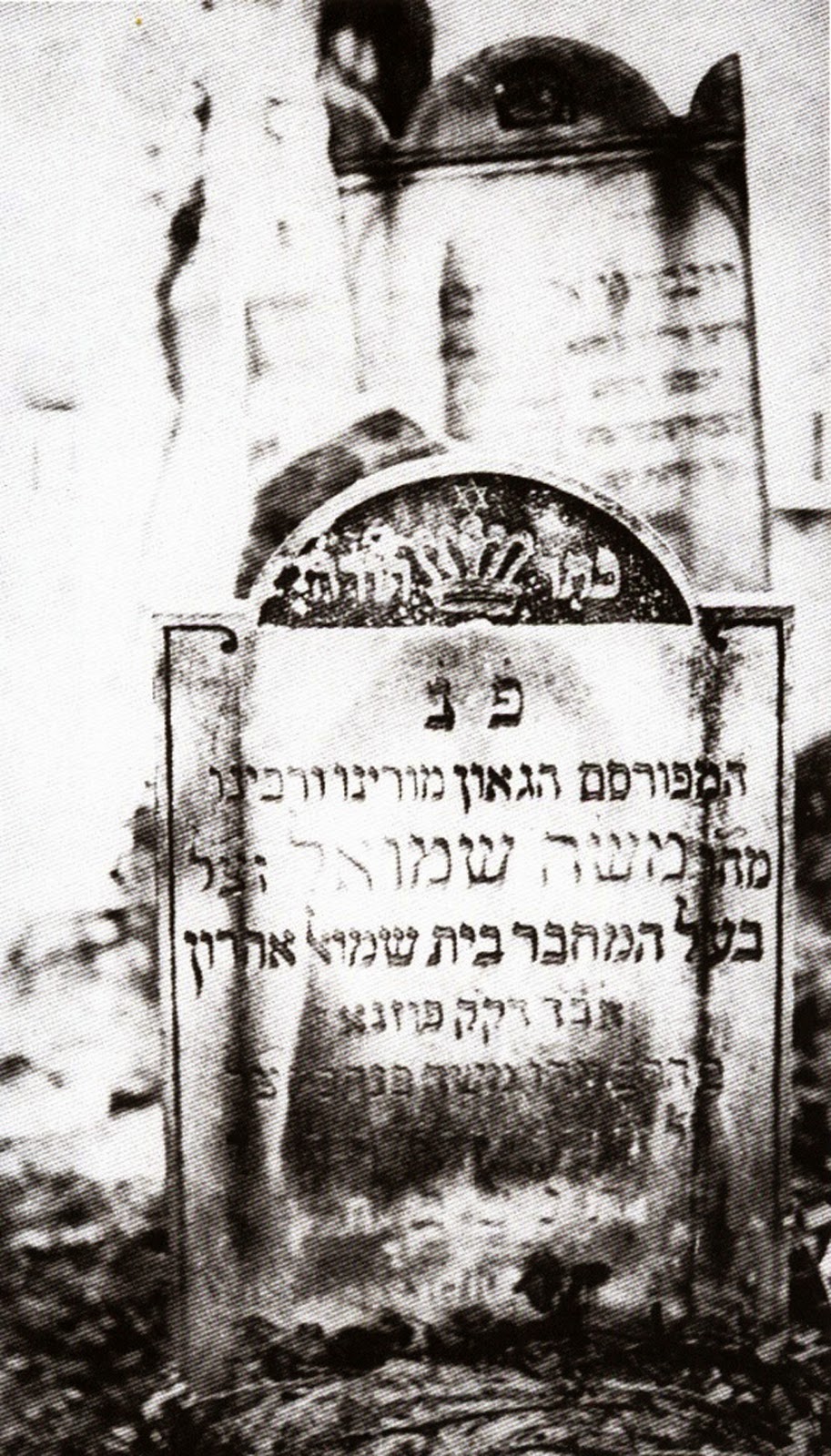
There is no need to rehearse here biographical information about R. Akiva Eger.[6] Sadly, his grave in Poznan (formerly: Posen), which was still standing before World War II (see figure 4),[7] was destroyed by the Nazis. 

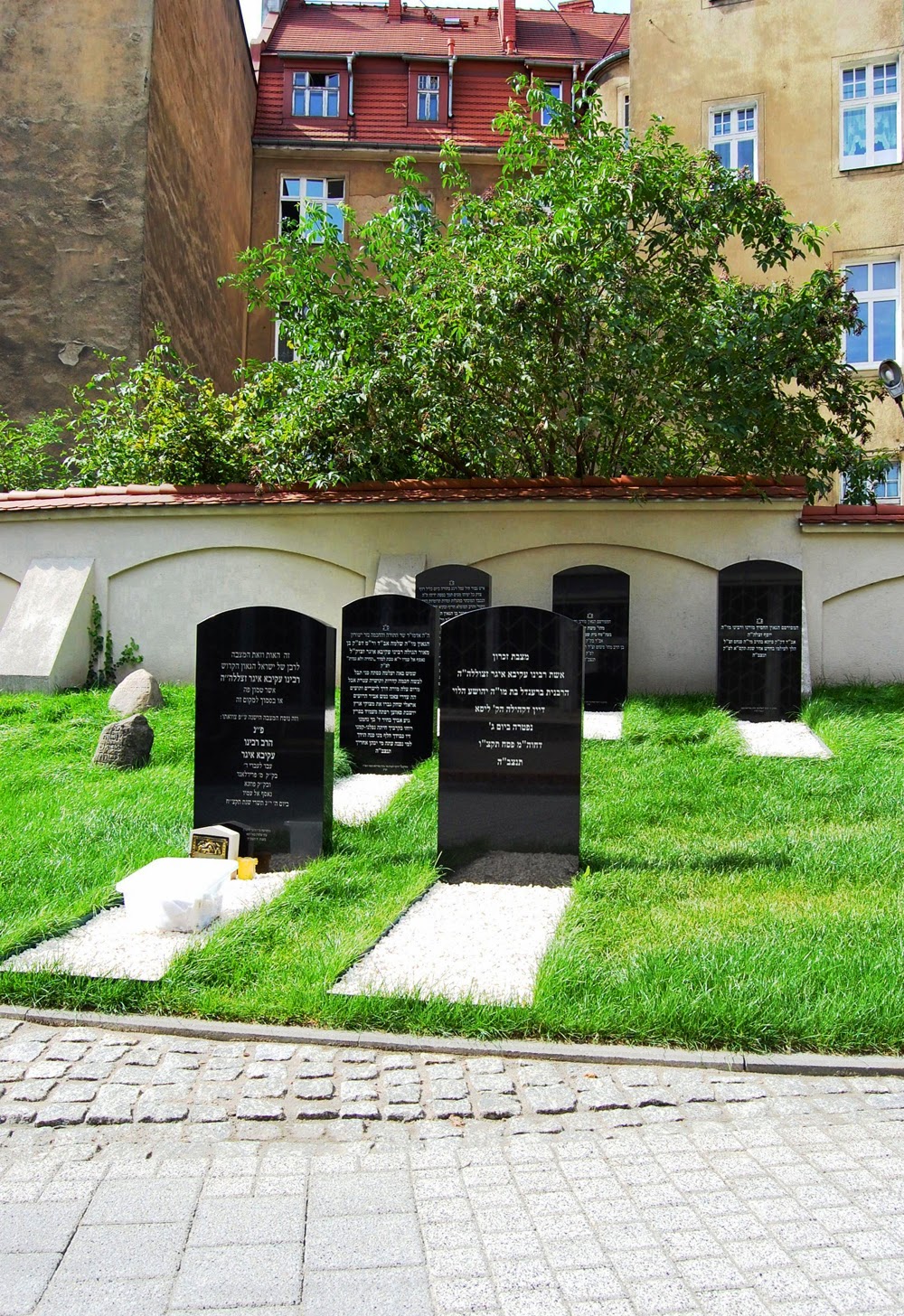
Tombstones from the Jewish cemetery were used to pave roads, and the nineteenth century Jewish cemetery itself – it opened in 1804 – was incorporated into Poznan’s Trade Fair grounds after the war.[8] Ultimately, a housing project and shopping center were built on the grounds of the Jewish cemetery, today at ul. Glogowska corner ul. Sniadeckich. Fortunately, the rabbinic section of the cemetery served as a parking lot (rather than as the foundation of an apartment house), and it was possible to transform the lot into a grassy knoll and to set new tombstones over the old graves (see figure 5). 

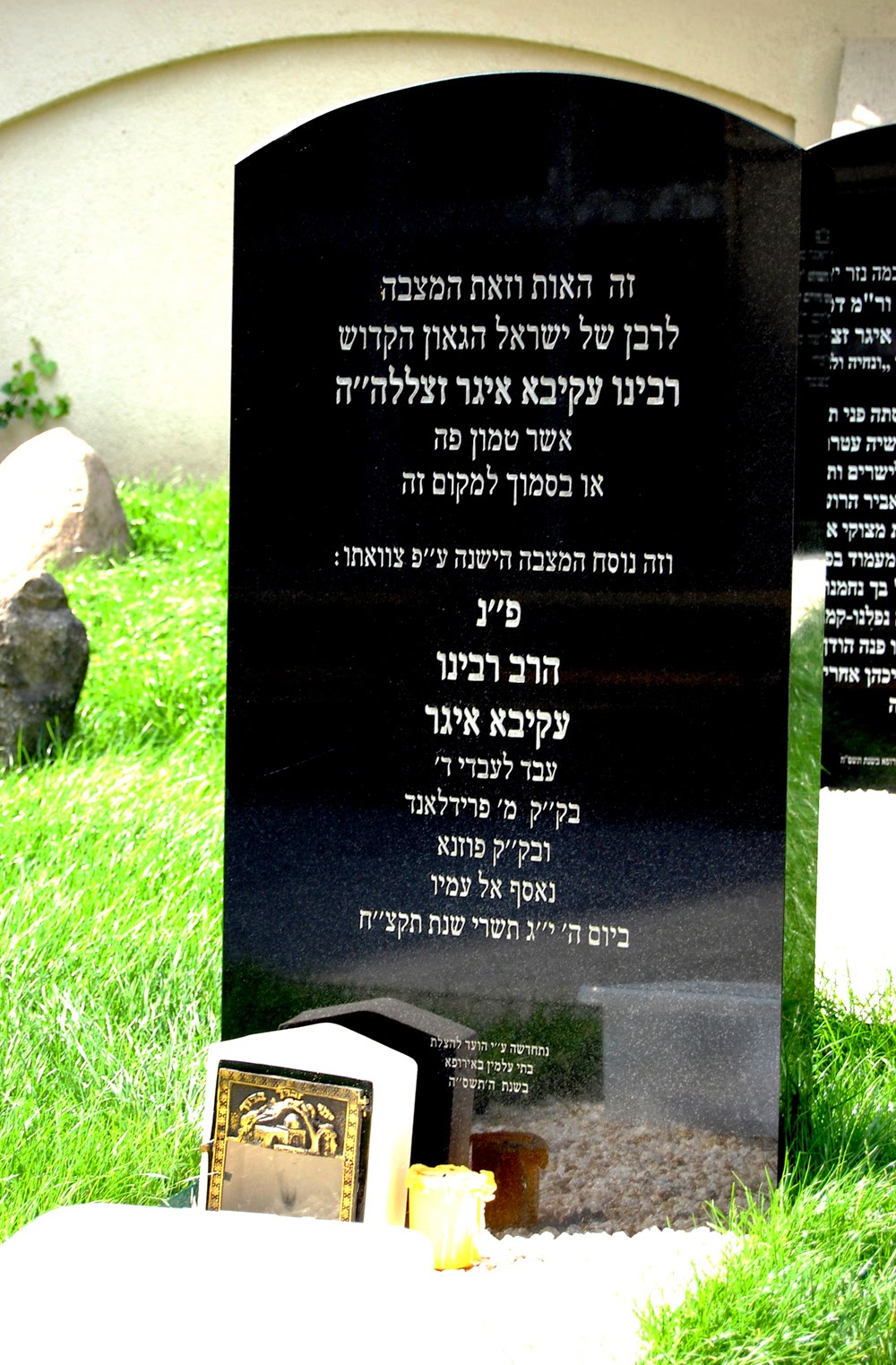
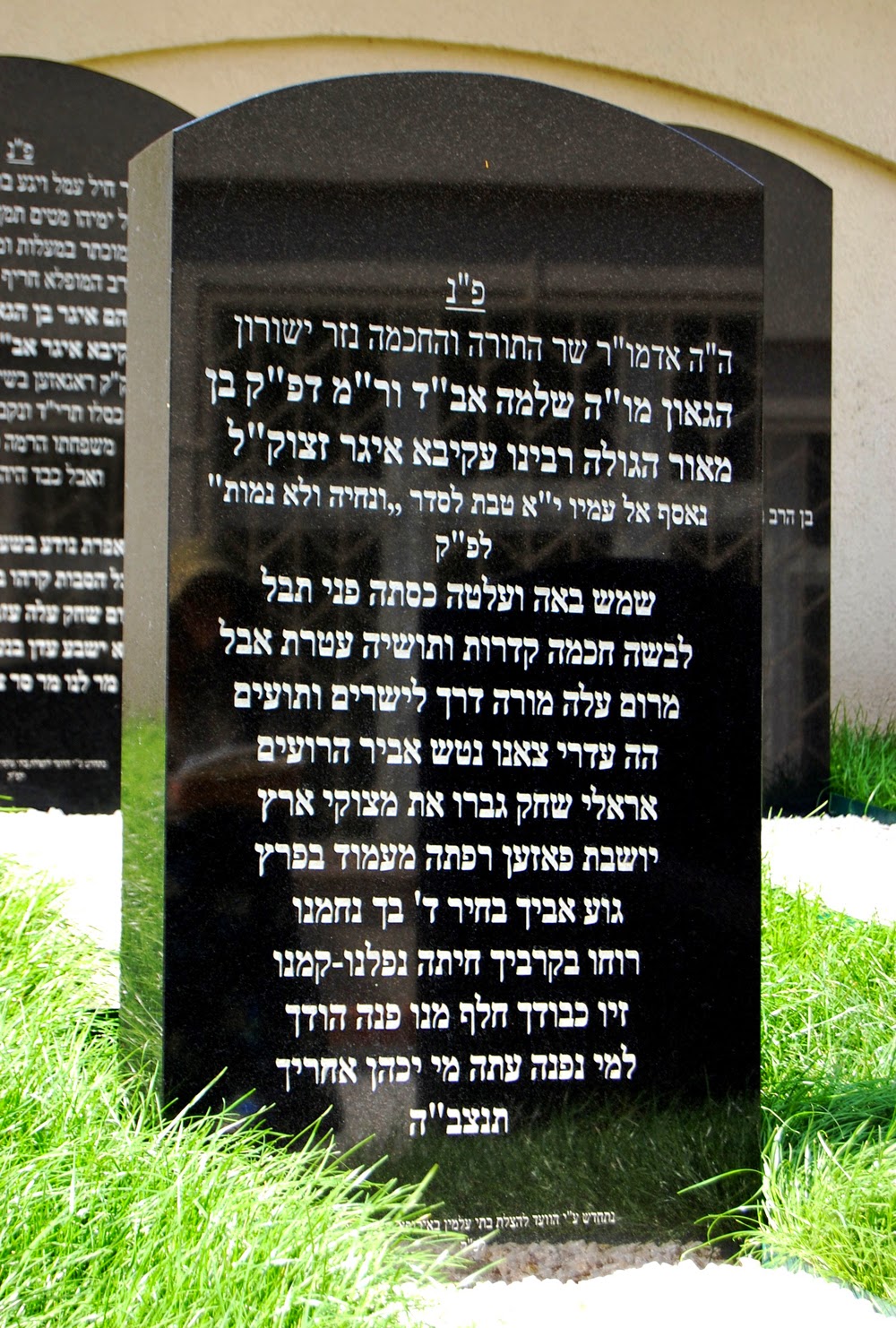
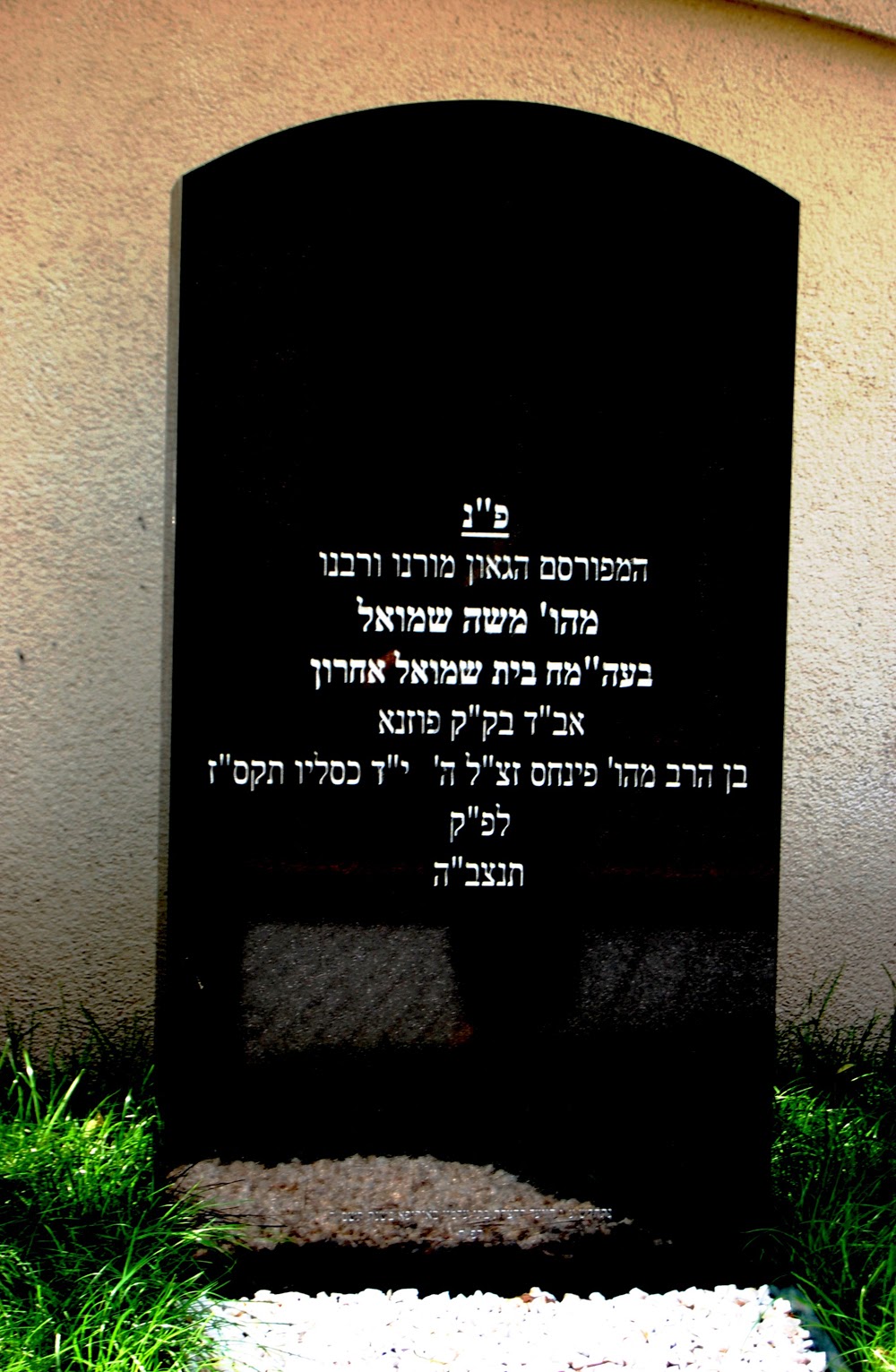
At best, the tombstones are approximately over the gravesites they describe. Even so, it is a great kiddush ha-Shem that this sacred site has been restored. The graves restored include R. Akiva Eger (see figure 6), his second wife Breindel (d. 1836), his son and successor R. Shlomo Eger (d. 1852; see figure 7), and his son R. Avraham Eger (d. 1854). Also restored were the graves of two predecessors of R. Akiva Eger as Chief Rabbi of Posen: R. Yosef b. Pinhas of Posen (son-in-law of R. Yehezkel Landau Prague; see figure 8), d. 1801, and R. Moshe Shmuel, author of בית שמואל אחרון, d. 1806 (see figures 9 and 10 for the original and the restored tombstone inscriptions).[9]

We would be remiss if we didn’t mention that R. Akiva Eger’s likeness is on permanent display in Poznan’s Town Hall (see figure 11). The excerpt in figure 11 is part of a larger mural painted by Julius Knorr (1810-1860) and entitled Marktplatz in Posen. The painting was done during the lifetime of R. Akiva Eger and was first displayed in 1838. R. Akiva Eger can be seen at the bottom right, walking with cane in hand and accompanied by the two other members of his rabbinic court.[10]

II. R. David Hoffmann (d. 1921).

The recent announcement that R. David Hoffmann’s פירוש על ספר שמות (based upon his lecture notes in German) is about to be published by Mosad Harav Kook has brought great joy to biblical and rabbinical scholars alike.[11] Yet another sefer by the Master! It matters not that more than a century has passed since he first taught Exodus at the Hildesheimer Rabbinical Seminary. Of course modern Bible scholarship has changed drastically in the interim. R. David Hoffmann’s commentary will not reflect modern archaelogical advance, will not grapple with the textual readings of the Dead Sea Scrolls, and will not deal with the latest philological discoveries of Semitic linguistics. But those who have read his commentaries on Genesis, Leviticus, and Deuteronomy, and learned from them, will know that regarding R. David Hoffmann “כל מקום שאתה מוצא דבריו עשה אזנך כאפרכסת.”[12] Master of the Oral Law, he of course read the Torah through rabbinic lenses. At the same time, he listened to dissenting voices, weighed all the evidence, and never disparaged others even as he dismissed their arguments. He always judged judiciously and graciously. And even when one disagrees with him, one always gains insight from his comments.

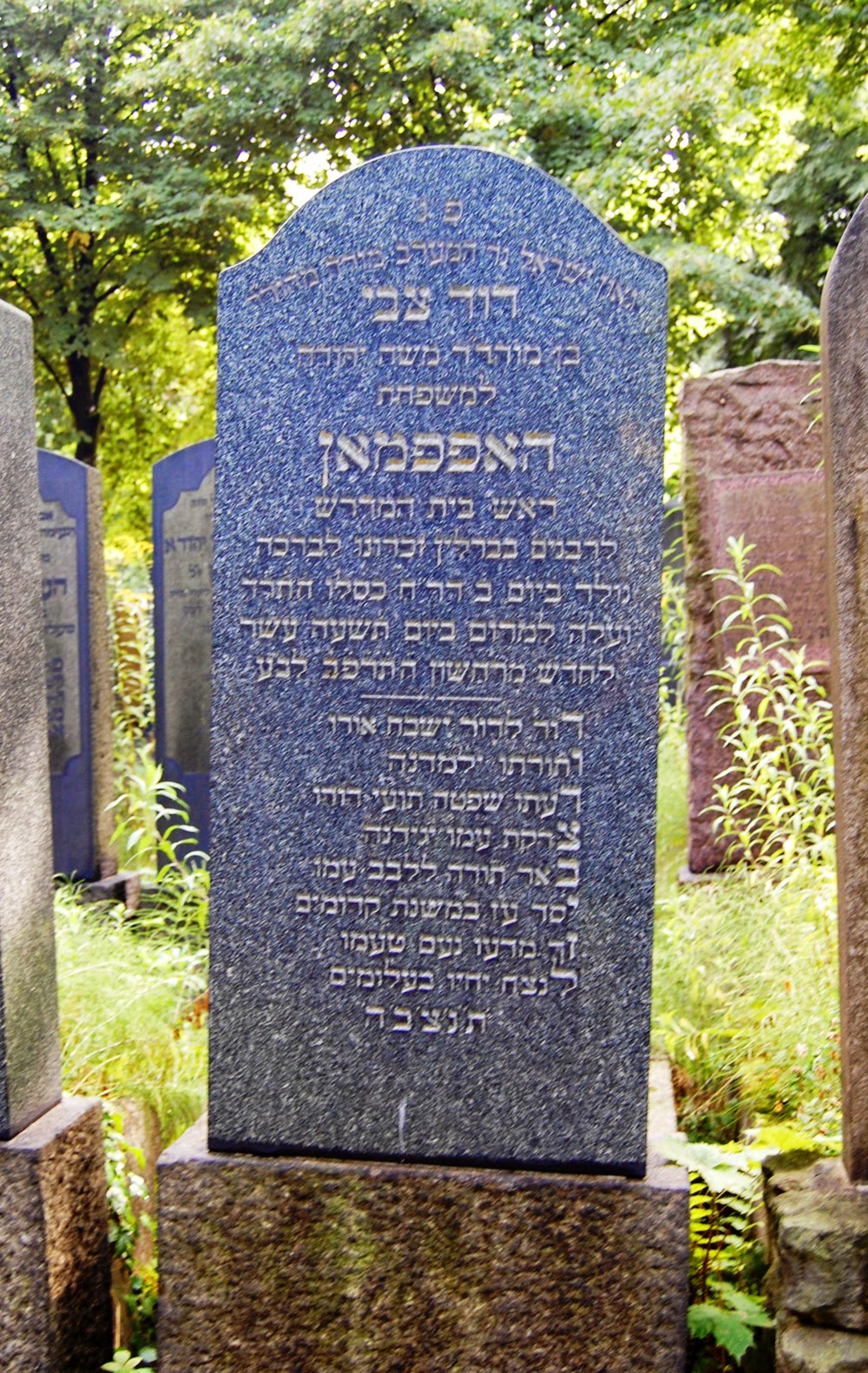
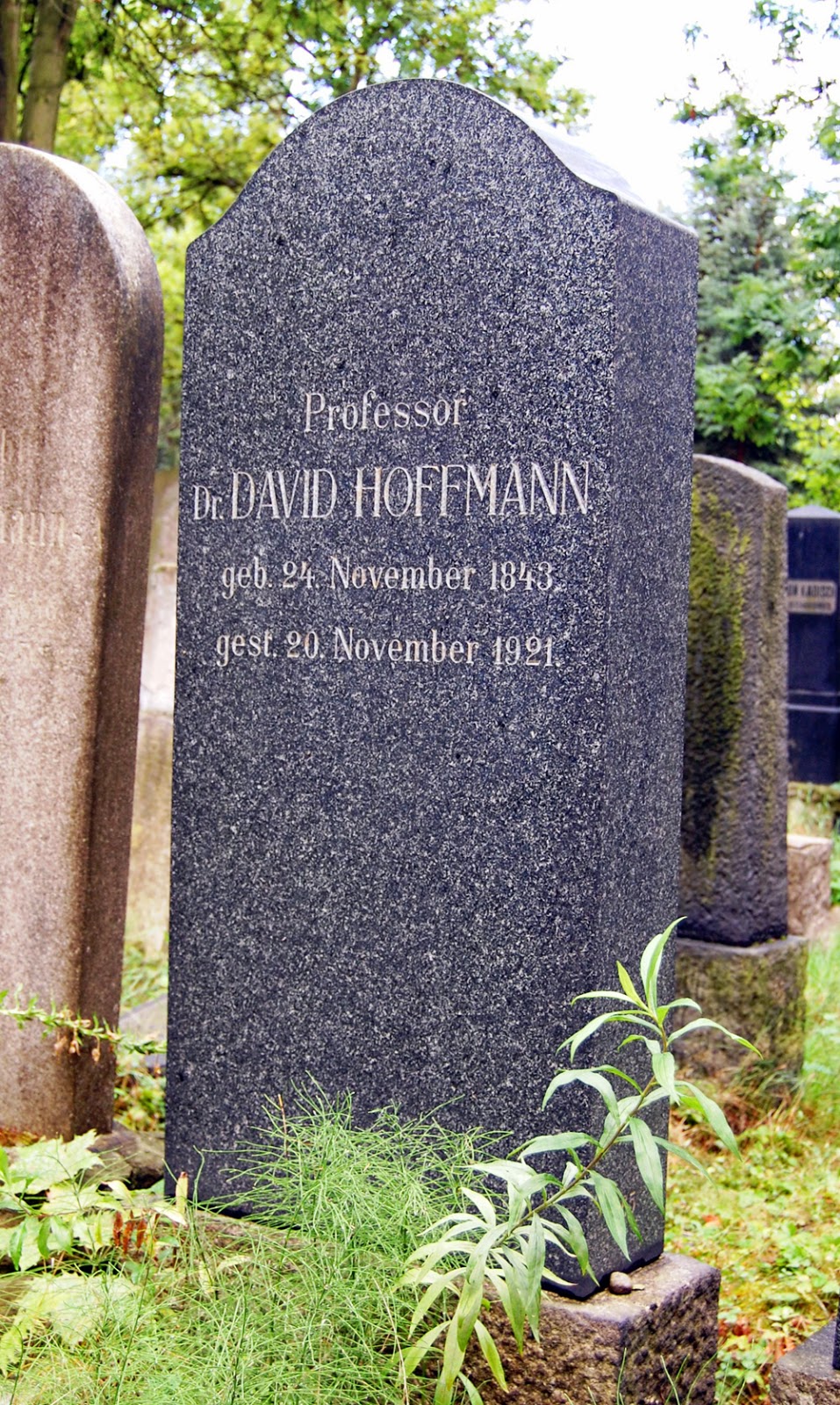
It is sad that this seminal figure, Rector and Rosh Yeshiva, Bible scholar and Posek, Literary Critic of the Mishnah and Restorer of Lost Tannaitic Midrashim, Defender of the Faith and Public Servant, has never been the subject of an intellectual biography worthy of the name.[13] Here we publish, apparently for the first time, his epitaph. R. David Hoffmann is buried in the Adass Jisroel cemetery in the Weissensee section of Berlin.

Obverse (see figure 12):

פ”נ
[גאון ישראל נר המערב מורה מהור”ר [14
דוד צבי
בן מוה”ר ר’ משה יהודה
למשפחת
האפפמאן
ראש בית המדרש
לרבנים בברלין זכרונו לברכה
נולד ביום ב’ דר”ח כסלו התר”ד
ועלה למרום ביום תשעה עשר
לחדש מרחשון ה’ תרפ”ב לב”ע
—————-
דור לדור ישבח אורו
ותורתו ילמדנה
דעתו שפטה תועי דורו
צדקת עמו יגידנה
באר תורה ללבב עמו
יסד עז במשנת קדומים
זך מדעו נעם טעמו
לנצח יחיו בעלומים
תנצב”ה
 

Reverse (see figure 14):

Professor
Dr. DAVID HOFFMANN
geb. 24. November 1843.
gest. 20. November 1921.

[1] According to R. Avraham Yeshayahu Karelitz (d. 1953), “גדול האחרונים הוא המהרי”ט.” See Z. Yabrov, מעשה איש, Bnei Brak, 2001, vol. 4, p. 90.
[2] See E. Zalman, “המהרי”ט קבור בצפת,” Qulmos 65 (2008), pp. 18-21. The photograph in figure 1 is taken from the Zalman essay.
[3] In the case of R. Eleazar b. Yehudah of Worms, he was certainly buried in the Worms Jewish cemetery, standing to this very day. The portion of the cemetery he was buried in was appropriated by the non-Jewish authorities. See R. Juspa Shammes, מעשה נסים, Amsterdam, 1696, p. 20.
[4] See N. Netter, “Les Anciens Cimetieres Israelites de Metz,” REJ 51(1905-6), pp. 280-281. Cf. S. Schwarzfuchs, (תנאי הרבנות של השאגת אריה בק”ק מיץ”,מוריה 15(1986″, pp. 81-90.
[5] The only extant authentic photograph of Sara Schenierer, which scholars in Israel and the United States have kept under wraps for years, was recently published in T. Lesniak, J. M. Malecki, J. Purchla, and A.B. Skotnicki, eds., Swiat przed katastrofa:Zydzi krakowscy w wudziestoleciu miedzywojennym (A World Before a Catastrophe: Krakow’s Jews Between the Wars), Krakow, 2007, p. 128 – and is reproduced here.
[6] See, e.g., Y. Strasser and A. Perl, eds., מאורן של ישראל: רבינו עקיבא איגר, New York, 1990, 2 vols. Cf. J.H. Sinason, The Gaon of Posen: A Portrait of Rabbi Akiva Guens-Eger , Jerusalem, 1991.
[7] Figure 4 is taken from T. Sztyma-Knasiecka, Miedzy tradycja a nowoczesnoscia: Zydi poznanscy w XIX i XX wieku, Poznan, 2006, p. 23.
[8] See Z. Pakula, , The Jews of Poznan, London, 2003, pp. 1-21 and 109. Cf. anonymous, “Jewish Poznan,” Poznan in Your Pocket, July-October 2008, p. 6.
[9] The photograph of the original tombstone inscription is taken from Sztyma-Knasiecka, p. 22.
[10] See Sinason, pp. 100-103; cf. Sztyma-Knasiecka, p. 13.
[11] See A. Wasserteil’s introduction to R. David Hoffmann, (שיעבוד בני ישראל במצרים, המעין 48(2008, number 3, p. 25.
[12] R. David Hoffmann used to apply this Talmudic phrase to the רש”ש, but it surely applies to Hoffmann as well. See his שו”ת מלמד להועיל, Frankfurt, 1932, vol. 3, §71. Cf. R. M. Roth, מבשר עזרא, Jerusalem, 1968, p. 167.
[13] Useful information can be gleaned from the following:
H.J. Bechtoldt, “David Hoffmann,” in his Die jüdische Bibelkritik im 19. Jahrhundert, Stuttgart, 1995, pp. 363-438; D. Ellenson and R. Jacobs, “Scholarship and Faith: David Hoffmann and his Relationship to Wissenschaft des Judentums,” Modern Judaism 8(1988), n.1, pp. 26-70; L. Ginzberg, Students Scholars and Saints, Philadelphia, 1928, pp. 252-262; L. Jung, The Path of a Pioneer, London, 1980, pp. 20-27; J. Marmorstein, “David Hoffmann, Defender of the Faith,” Tradition 8(1966), n.4, pp. 91-101; A. Marx, Essays in Jewish Biography, Philadelphia, 1947, pp. 185-222; Idem, Studies in Jewish History, New York, 1944, pp. 369-376; M. B. Shapiro, “Rabbi David Zevi Hoffmann on Torah and Wissenschaft,” Torah U-Madda Journal 6(1995-6), pp. 129-137; C. Tchernowitz, מסכת זכרונות, New York, 1945, pp. 244-264; and Y. Wolfsberg-Aviad, “David Hoffmann,” in L. Jung, ed., Guardians of Our Heritage, New York, 1958, pp. 363-419 (cf. Wolfsberg-Aviad’s דיוקנאות, Jerusalem, 1962, pp. 57-66). Much more bibliography can be added; the items listed here are intended to get the interested reader started.
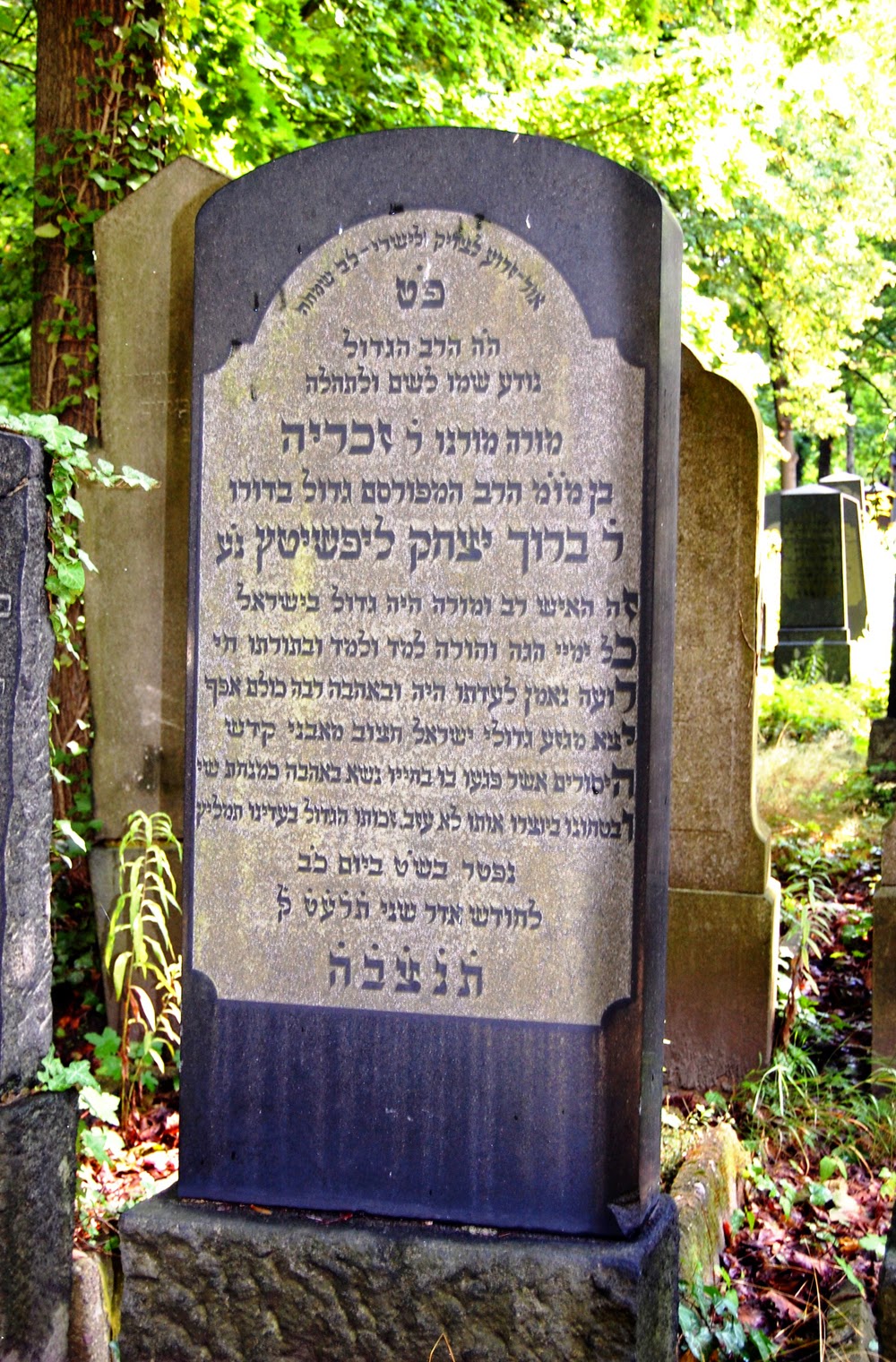
[14] For the honorific title מורה מורנו, see figure 13, also from the Adass Jisroel cemetery. Cf. the very interesting responsum in שו”ת מהרש”ם 2:56.


Tevie Kagan: The Enigmatic R. David Lida

The Enigmatic R. David Lida
by Tevie Kagan
Tevie Kagan works in the Seforim industry.  This is his first post for the TraditionOnline Seforim blog.
Part I: R. David of Lida and Plagiarism
R. David ben Aryeh Leib of Lida (c.1650-1696) is a fascinating and enigmatic figure. He was the rabbi of multiple communities over the course of his lifetime including Lida, Ostrog, Mainz, and the Ashkenazic community in Amsterdam. He was forced to leave Amsterdam under a cloud of alleged plagiarism and possible Sabbatean beliefs; though he was acquitted of these charges by the council of the four lands (Va’ad Arba Ha-Aratzot), he never recovered from the various accusations. He is not a well-known individual today, yet many of his works survive and are still available in print. This post (the first of two) will present a detailed account of his life and will attempt to see if both the accusations of plagiarism and heretical beliefs have merit.
R. (David) Lida was born in Zwollen, Lithuania into a prominent rabbinical family. His uncle was R. Moshe Rivkes, author of the Be’er Ha-Golah. Other family members that Lida cites within his works include R. Yeshaya Horowitz, author of the Shnei Luchos Habris (Shelah), R. Yosef of Pozna, R. Naftali Hertz of Lemberg, and R. Yaakov Cohen of Frankfurt. He was married to Miriam the daughter of R. Wolf Yuspef of Lvov (Lemberg) and had two sons, Nathan and Pesachya, and two daughters. One of the daughters was married to R. Yerucham b. Menachem, who helped prepare Shomer Shabbos (one of Lida’s early works) for printing, and the other was married to R. Abraham b. Aaron, who helped with the printing of Shomer Shabbos in Amsterdam. In his work Ir David, Lida testifies[1] that his primary teacher was R. Joshua Hoeschel b. Jacob of Cracow (c.1595-1663), who was one of preeminent rabbis of the time.[2]
From 1671 until 1677, R. David was rabbi in Lida. He then served as a rabbi in Ostrog and Mainz, replacing R. Samuel David b Chanoch of Lublin, the author of Divrei Shmuel who had passed away. In 1681, Lida left Mainz and became a rabbi in Amsterdam. After being forced out of Amsterdam, Lida appealed to the council of the four lands. By doing so he succeeded in getting himself reinstated in Amsterdam. However, his position was untenable, so he reached a financial agreement and moved to Lvov, where he lived until his death in 1696.[3]

The following is a list of Lida’s works (with the topic covered in parentheses):
¨ Beer Esek – Frankfurt on the Oder/Lublin, 1684 (apologetic)
¨ Beer Mayim Chaim- lost, never printed (on Code of law)
¨ Chalkei Avanim– Fuerth, 1693 (on Rashi’s commentary on bible) reprinted in Yad Kol Bo under the title Migdol Dovid
¨ Divrei David– Lublin, 1671 (ethics)
¨ Dovev Sifsei Yesheinim- lost, never printed (mishnah)
¨ Ir David– Amsterdam, 1683 (incomplete), 1719 (complete) (Homiletics)
¨ Ir Miklat – Dyhernfurth, 1690 (613 commandments)
¨ Migdol David –Amsterdam,1680 (Ruth)
¨ Pitschei She’arim – Pirush Tefilos- partially printed in Yad Kol Bo (prayer)
¨ Shalsheles Zahav
¨ Shir Hillulim– Amsterdam, 1680 (poem in honor of dedication of a new Torah)
¨ Shomer Shabbos – Amsterdam, 1687 printed with Tikkunei Shabbos, reprinted in Yad Kol Bo, and reprinted separately in Zolkolov, 1804 (laws of Sabbath)
¨ Sod Hashem Sharbit Hazahav– Amsterdam, 1680 (on circumcision)
¨ Tapuchei Zahav kitzur reishis chochma – Fuerth, 1693
¨ Yad Kol Bo- Amsterdam/Frankfurt on the Oder, 1727(Collection)
While in Amsterdam (about 1694), Lida was accused of libel, plagiarism and Sabbatean leanings. Since many of the documents surrounding both controversies no longer exist, we can only attempt to recreate what happened.
Lida is Accused of Libel

R. Yaakov Sasportas (c.1610-1698) has a series of responsa[4] that refer to the libel case. One of the prominent members of the Sephardic congregation, R. Nissan ben Judah Leib, the brother in law of R. Isaac Benjamin Wolf ben Eliezer Ashkenazi (Chief Rabbi in Berlin and the author of the Nachlas Binyomin (Amsterdam, 1682)), claimed that on a trip to Wessel R. Nissan had found defamatory letters about himself and R. Isaac Benjamin Wolf, which R. Nissan alleged were written by Lida. Lida denied having written these letters. R. Nissan submitted copies of the letters to the Sephardic court, presided over by R Yitzchak Abuhav, R Yaakov Sasportas and R Shmuel Deozida. The court requested the original letters, and when they could not be produced, the court decreed that Lida did not write the letters and that he was an upstanding rabbi of the community. The court also demanded that R. Nissan apologize, which he did. Subsequently the Sephardic court sent a letter to both R Wolf Lippman and the Council of the Four Lands requesting they revoke all bans against Lida and to forgive both themselves and Lida. This letter included the signatures of many prominent rabbis of the time, though many of these rabbis may have been influenced by Lida’s famous brother-in-law, Yitzchak b. Abraham of Posnan, who was the first signature on the list.
Additionally, Lida himself wrote a work entitled Beer Esek,[5] in which he attempts to clear his name.The work begins with an introductory homily, after which Lida then proceeds to defend himself from the charges of plagiarism. Lida’s letter ends off with letters and signatures of approbation..
Charges of Plagiarism

Charges of plagiarism hounded Lida regarding many of his works. The first work that this charge was leveled at was Divrei David (Lublin, 1671), an ethical treatise broken up into seven parts, corresponding to the days of the week. On the title page of this work, Lida states that it is culled from the words of Rishonim upon which he added his own additions. The bibliographer, Joseph Zedner (1804-71), in his Catalogue of the Hebrew Books in the Library of the British Museum (London, 1867), was the first to note that the text of the Divrei David is identical to a part of the text of the Sefer Yirah published by Aryeh Judah Loeb ben Aryeh Priluck.
The work itself contains information that is inconsistent with Lida’s biography. For example, the author talks about trips to Israel (nos. 6, 77, and 85), serving as rabbi in Israel (no. 46), and refers to a work that he wrote called Zer Zahav on the Bible (no.72). At the time Divrei David was published Lida was 21 and, as far as we know, never visited Israel, as he never mentions it anywhere else in any of his works. Even more puzzling is that he never authored a work on the Bible called Zer Zahav! Interestingly, Gershom Scholem argues that whoever the author of Divrei David was the author had Sabbatean leanings as there is a possible Shabbati Zevi reference in the beginning of the section on Shabbos.[6] Was this work stolen from a previous work? It would appear so; but, in defense of Lida, he admits that he culled his work from other sources. Nevertheless, this would not account for his borrowing of accounts of positions, travels or works written.
The Sefer Yirah was first published from manuscript in 1724 (Lida had published Divrei David in 1671). The publisher of the Sefer Yirah, Priluck, clearly states on the title page that he found a manuscript and had no idea as to whom was its author. Priluck adds statements and revises the original work where he saw fit. One example is in the “morning half” of the “first day,” where he adds (in the fifth section) that he already printed a prayer book which was grammatically correct. Most of the other additions are merely clarifications of the earlier work [for example, in the “night section” of the first day he clarifies that the Shema referred to is the one said in bed before sleep (Kriat Shema al Ha’Mita)]. Within the section of the fourth day Lida mentions (part 77) that he was in Jerusalem, and he concludes that one should cover their head with a hat when saying grace (birkat ha’mazon); yet this last item is not found in the Priluck version of Sefer Yirah. In total, there are about twenty slight differences, but most are stylistic, with Priluck changing particular words and verses. The Sefer Yirah concludes with a statement that this is where the manuscript ends and that he does not want to add from other sources. The Warsaw edition of 1873 of the Divrei David adds an entire section of good traits (minhagim tovim). Interestingly the most recent reprinting (Brooklyn, 2006 by R. N.M., German) adds 2 more pages of character traits not found in the Warsaw edition. This would not be the only work that would come under suspicion that Lida wrote.
Lida’s most famous work that is under the suspicion of plagiarism is his Migdol David, published in 1680 while Lida was still rabbi in Mainz. The work was published with 17 approbations (haskamot). While some of the approbations do not mention the work Migdol David specifically, by reading them one gets the idea that many felt it was an original work. In his Beer Esek, Lida alludes to R. Nisan’s claim that accused Lida of stealing the work (R. Nisan did so by saying that Lida “wears the talis of another”). Many believe that this work was really a copy of R. Hayim Ben Abraham Ha-Kohen’s (c.1585-1655) [7]Toras Chessed. For instance, R. Hayyim Yosef David Azulai, ,writes “truthfully [Migdol David] is the work of R. Hayim Kohen, author of the Tur Barekes…” (Shem ha-Gedolim, Marekhet Seforim, s.v. Migdol David). ,Azulai also cites the Yaavetz (R. Yaakov Emden) and his charge in Toras Hakanaos (see below). The Menachem Tziyon attempts to clear Lida’s name by showing that many great rabbis attested to his kabalistic knowledge, but ultimately he too leans towards the plagiarism charge. [8]

The Yaavetz, in his Toras Hakanaos, lists a group of works that he charged with having Sabbatean leanings and allusions. He includes Lida’s work, not as a potential Sabbatean work,[9] but rather as a plagiarized one, and, more specifically, to support his claim that Lida’s character was suspect, and even possibly Sabbatean. Sabbateans were known to have “double natures,” one being outwardly righteous, while the inner being corrupt and immoral (more about this to come in part 2 of this post, R. David of Lida and Sabbatianism). The Yaavetz shows that Lida took the work but left an allusion to Hayim Kohen’s name in the introduction, which states, “ממקור מיים בריכה העליונה כה”נא רב”א” Lida’s choice of words is suspect, as Lida was neither a Kohen nor named Hayim.
More recently, Marvin Heller[10] has argued that a parable in the introduction to Lida’s work alludes to the fact that it is not an original work. The allegory (from the Zohar) regards a rooster who finds a pearl while searching for food. Startled by the pearl’s beauty, the rooster recoils and wonders what caused the pearl to be hidden. A man, seeing the rooster recoil, stops to see what caused the reaction; when he sees the pearl, he proceeds to give it to the king. As a result, the king honors the rooster. Lida writes: “So to I found in this scroll blossoms and fruit which give forth a brightness, delightful to the sight and desirable to the eye, ‘its fruit is good for food’ (Genesis 2:9)…when this distinguished book comes to the hand of one who appreciates its value … and also who publishes it will be remembered for good before the King, King of the universe” (emphasis added). This choice of language seems to be referring to a publisher not an author. In Lida’s Ir Miklat, in the glosses where Lida mentions “my book Migdol David,”[11] Azulai (in his comments) interjects: “He printed it.” Eisner seeks to defend Lida, even though he had never seen a copy of the rare Migdol David. Eisner argues that since all the charges were found to be groundless in the first case against Lida, so too the plagiarism charges must be false. He attempts to buttress this by showing that Lida had a reputation for being a Kabbalist. In 1681, the notorious anti-Semite Johann Andreas Eisenmenger (ca.1654-1704) visited Amsterdam and wrote about meeting Lida in his Entdecktes Judentum (Frankfurt am Main, 1700). He speaks of Lida and how he was a great scholar and Kabbalist. Interestingly, towards the end of the introduction of Ir David, Lida states that he hopes that this work will be printed without the mistakes and errors that the printers added to his work Migdol David, which he was unable to fix. Is Lida attempting to lay the groundwork for the argument that any troubling pieces within Migdol David are not his, but rather the work of the printers?
Slightly more telling about both of the works that are suspected of being stolen is that Lida references them in his other works very infrequently. In contrast, Ir David is referenced quite frequently within his other writings. When themes or interpretations are referenced in Chalkei Avanim that are supposedly printed in Lida’s other works (specifically Migdol David) he does not give the work’s name, but just the statement “and it is understood.”[12]

Even after his death Lida’s works have encountered problems. His son Pesachya printed a collected volume of his works entitled Yad Kol Bo (Amsterdam 1727) in which was included a work on Psalms called Assarah Hillulim. According to Brill, this was actually written by the Calvinist-Hebraist, Heinrich Jacob van Bashuysen (1679-1750) and published in Sefer Tehilim im Pirush ha-Katzar, Hanau, 1712.[13]
[1] Ir David, First Sermon
[2] See Dembitzer Kelilas Yofi Krakow:1893 pg59a-59b
[3] For the date of Lida’s death, see Solomon Buber, Anshei Shem (Krakow, 1895), where he recreates the correct date based on approbations Lida had given, which are marked after the date on his tombstone.
[4] Ohel Yaakov 75-76
[5] Reprinted in Abraham Eisner, Toledot Hagaon R. David Lida (Breslau,1938) and in Aaron Freimann, Sefer Hayovel for Nahum Sokolow (Warsaw, 1904)
[6] See Warsaw edition that actually puts Lida as author and includes that he wrote Zer Zahav and Bris Yitzchok, which Lida did not.
[7] See Encyclopedia Judaica entry where Scholem states that Lidas plagiarism was well known in Kabalistic circles before H.J.D. Azulai made it public. Scholem offers no source or examples for this statement. Also interesting to note is that whatever Azulai’s thoughts on Lida’s character may have been, he still wrote glosses to Lida’s work Ir Miklat.
[8] See also Ohr Hayim (Hayim Michael), where he unequivocally states that it is a stolen work from R. Hayim Kohen.
[9] Yehuda Liebes, in “Sefer Tzadik Yesod Olam- Mythos Shabetai” (reprinted in On Sabbateanism and its Kabbalah: Collected Essays (Jerusalem, 1995), pg. 303-304, note 22) shows that even Migdol David is not free of possible Sabbatean leanings. These could not have come from R Hayim Kohen as he died before Sabbateanism grew to the movement that it later became.
[10] Marvin J. Heller, David Ben Aryeh Leib of Lida and his Migdol David: Accusations of Plagiarism in Eighteenth Century Amsterdam, Shofar (Jan. 1, 2001) (translation of text is his).
[11] Commandment 190
[12] For examples see Brooklyn edition 2006-pg. 5, fn 1; pg. 8, fn 8.
[13] For more on Bashuysen, see Encyclopaedia Judaica under his name entry. Eisner strongly disagrees and says that it clearly is not a Christian work, and that it includes many ideas from Lidas other works.