R. Flensberg, Donkeys, Antelopes and Frogs
R. Flensberg , Donkeys, Antelopes and Frogs
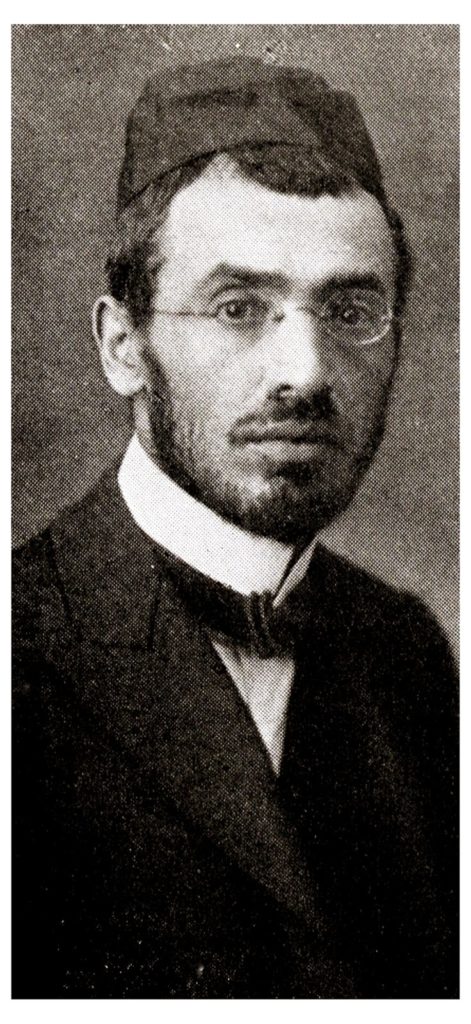
Recently, a book, Aggadata de-Ve Rav, Machon Limud Aggadah, Ashdod, 2010, pp. 50, 176, 56, collecting various works attempting to explain the difficult and, on their face, rather odd stories (aggadot) that appear in Baba Batra (73a-74) many of which involve odd animals do odd things. In addition to these passages, there is another odd passage in Bechorot (7b) which also involves an animal, a donkey also engaging in odd behavior. This passage was too was also the subject of many works attempting to explain it. This new book reprints four of the many works attempting to decipher the stories in Baba Batra, R. Elyakim Getz, Redfunei be-Tapuchim, R. Zev Wolfe Boskowitz, Le-Binyamin Amar, R. Eliyahu Guttmacher, Tzafnat Panach, and the fourth is Aggadot Soferim, which a collection of materials on the topic from Ritva, Gra, and R. Efrayim Lunschutz (author of Kli Yakar, among other works). While three editions of Redfunei be-Tapuchim are available on Hebrewbooks (here, here and here) Le-Binyamin Amar and Tzafnat Panach are not. The book also provides biographical details about these authors (56 pp.). Additionally, a list of others books devoted to the Baba Batra stories which are not reprinted herein are included. The list provides over 25 such works devoted to the stories in Baba Batra. Regarding the donkey of Bechorot there are almost as many books on that topic. We have found 23 such works. One of those discussing the donkey of Berchorot is an important, little-known and recently reprinted book on that topic. Specifically, R. Hayyim Yirmiyahu Flensberg’s Nezer ha-Nitzhon, Vilna, 1883 (reprinted Machon Mishnas Rabbi Aaron, Israel, 2001).* Amongst the many who praised Flensberg’s book, was his teacher, the Netziv. And, it was not only the Netziv, but Flensberg received a request from his alma mater, Volozhin, that his book was so popular could he please send ten additional copies. Thus, in light of this book discussing, what is arguable similar aggadot, we provide background on this little-known Lithuanian rabbi, his works and children.

Flensberg was born in 1842. And, as many great rabbis, there are both miraculous stories told of his conception and birth as well as how bright he was. Indeed, it is said that he knew 300 pages of Talmud, with Tosefot, at his bar-mitzvah. While those stories are not unusual, what is unusual was the bar-mitzvah gift he received from his rebbi, R. Ya’akov Tuvia Goldberg, a copy of Avraham Mapu‘s Ahavat Tzion, perhaps the first Hebrew novel. As his rebbi saw that Flensberg expressed an interest in studying Hebrew, his rebbi decided this book would be appropriate. Apparently, this gift was so important, that in the biography of Flensberg, written by his son Yitzhak Yeshayahu Flensberg, some seventy years later, records this. It is worth noting that, although this biography appears at the beginning of the second volume of Flensberg’s Torah commentary which was reprinted in 2000 by the Lakewood publisher, Machon Mishnas Rabbi Aaron, this fact remains in this edition.
It should also be noted that, while on its face, it is questionable how much one can read into a single bar-mitzvah gift, Shaul Stampfer views this gift as highly significant. Stampfer writes, that although the policy of the Volozhin rabbinic administration was to prohibit haskalah literature, Flensberg is used as an example to prove that “not all the students viewed reading haskalah literature as conflicting with torah study.” Shaul Stampfer, The Lithuanian Yeshiva, Jerusalem, 2005, 171. Stampfer cites the story of the bar-mitzvah gift and notes that although Flensberg received this gift “he still went to study in Volozhin.” Id. at 172. Indeed, it is even more questionable to use the bar-mitzvah gift to understand the Volozhin students’ views on haskalah literature when one considers the timing. Flensberg didn’t go to Volozhin immediately after his bar-mitzvah, rather it would be over a year and a half before he went to Volozhin. [1] During that time, Flensberg stopped studying with R. Goldberg, the bar-mitzvah gift, giver and began studying with R. Leib Charif (eventual Chief-Rabbi of Tytvenai and Rietavas Lithuania). (Also relevant for our purposes is that R. Leib authored a book on the donkey Gemara in
Bechorot called Eizot Yehoshua.) Thus, there are two significant factors that may sever any ties between Flensberg’s bar-mitzvah gift and his ultimate decision to go to Volozhin.
In all events, Flensberg thrived at Volozhin. He studied in the Netziv’s group and was close to the Netziv. Additionally, he was selected for the highly prestigious position at the Volozhin Yeshiva as the Purim Rav of Volozhin. His appointment to this position took place sometime before he left Volozhin in 1859, making this the earliest, and perhaps one of the only, recorded mention of this custom from Volozhin.[2] In fact, there are those who doubt the existence of the custom of Purim Rav at Volozhin.[3] This appears to undermine that position. Additionally, the description of the Purim Rav position is of interest. According to Flensberg, the position was fairly innocuous. For the two days of Purim, the Netziv would cede his position to the best student. The student would wear the Netziv’s hat and use the Netziv’s walking stick. All the students would give the Purim Rav great deference. They would also pepper him with questions both about Purim and more comical questions. The Purim Rav would answer in the Purim spirit. Nowhere is there any mention of lack of respect or, seemingly anything that is objectionable.
After leaving Volozhin, he married Itta, whose father was R. Mendel Katz, who would eventually become a rabbi in Radin. After his marriage he went to study in a bet midrash in Kovno. Although some refer to this place as “the Kovno Kollel,” it cannot be referring to the famous Kovno Kollel as that did not begin until 1877 long after R. Flensberg left Kovno and entered the rabbinate. During his time in Kovno Flensberg became friendly with R. Yitzhak Elchonon Spektor. After leaving Kovno in 1869 to his first rabbinic position, and, in 1889, after a few other employment changes, Flensberg ended up in Shaki as the chief rabbi.
Flensberg found the rabbinate a good fit and focused on derash and philosophy. But, before publishing any of his books, he penned a number of important articles in various newspapers including Ha-Levonon, Ha-Melitz, and Ha-Maggid. In general, he took a rather novel views towards newspapers. At the time, many viewed newspapers as a threat to Orthodox Judaism as it exposed people to different views that they otherwise wouldn’t be exposed to. Thus, many took the position that reading a newspaper was prohibited. Flensberg, however, recognized that merely ignoring the problem is ineffective. Instead, he proposed that the Orthodox start their own newspaper so that their views will be available to all. This view echos that of R. Yaakov Ettlinger, who started the Orthodox journal Shomer Tzion ha-Ne’eman. (And, it appears, the same debate is happening, again, today with regard to the internet and related technologies.) In addition, Flensberg also penned a series titled Moreh Neukei ha-Zeman he-Hadash, which some view an indirect attack against Nachman Krochmal‘s similarly titled work. Flensberg wrote this essay during a time that he was suffering from headache and prohibited from Torah study. Thus, turned his focused to producing essays for newspapers.
After his wife died in 1882, he published his first work, Nezer ha-Nitzhon. As mentioned above, this book contains a lengthy explanation of the talmudic story regarding the famous donkey. Additionally, he includes two derashot at the end. In the introduction, he credits his wife for the publication and explains that this book is in her memory. In 1897, he published his next books, She’alot Hayyim, Divrei Yirmiyahu in Vilna. The first titled portion is comprised of responsa and the second titled portion is comprised of dershot. The second part also contains a lengthy introduction regarding Flensberg’s view on derush, and a eulogy for R. Yitzhak Elchonon Spektor and the Godol of Minsk.
It appears that not everyone, including those who normally are very well-read, were familiar with R. Flensberg’s works. Katzman explains that R. Zevin, in Ishim ve-Shetot (p. 71), confuses R. Hayyim Flensberg with another R. Hayyim – R. Hayyim Soloveitchik. The statement R. Zevin attributes to a child R. Hayyim Soloveitchik, and which R. Zevin himself doubts it comports with what we know about R. Hayyim Soloveitchik’s manner of deciding law, actually appears in R. Hayyim Flensberg’s She’alot Hayyim, no. 14.[4]
In 1905,[5] he published his commentary on Hasdai Cerscas’ Ohr Adonay.[6] This is one of the very few commentaries on this very difficult work. Flensberg prefaces the book with an in-depth introduction regarding the work and its author. R. Yehiel Yaakov Weinberg wrote a glowing review of the book. Weinberg expressed surprise that no one else, with one exception, had seen fit to review such a worthy book. Weinberg notes that to write such a commentary requires not only “an ish ma’adai” but also one must be a “rav ve-goan talmudi.”[7] Flensberg includes a few pages of comments on Moreh Nevukim at the end of the book, and there are two letters one from Abraham Harkavey and the other from R. Dr. Abraham Berliner, at times, taking issue with some of Flensberg’s conclusions. This was intended to be the first part of two of Flensberg’s commentary on Crescas. According to Flensberg’s son, in 1909 the second portion was published but languished at the printer. And, after World War I broke out in 1914, the Flensberg’s were under the impression all the copies were lost. In 1925, they learned that Ester Rubinstein, Flensberg’s daughter, had saved the plates as well as other manuscripts. It is unclear if the second portion was ever actually reprinted. The JNUL appears to only have a few leaves from the second volume.
In 1910, Flensberg published his commentary on Shir ha-Shirim, Merkevot Ami. And, that same year, he also published his first volume of commentary on the Torah, Divrei Yirmiyahu, covering Genesis.
In 1914, Flensberg died, his full epitaph is included in his son’s biography which appeared in the second volume of Flensberg’s Torah commentary which was published posthumously in 1927. This version of the epitaph is the only complete one as the one on his headstone accidentally left out a line “for some [unnamed] reason.”
He was survived by his son, Yitzhak Yishayahu, and his daughter, [Haaya] Ester Rubinstein. Yitzhak Yishayhu lived in Pilwishki the town where R. Yehiel Yaakov Weinberg served as Rabbi. When Weinberg describes the learned people in Pilwishki, one of the ones he singles out is Yitzhak Yishayahu.[8] Flensberg’s daughter, however, was more well-known than his son. She married Yitzhak Rubinstein, who subsequently became Chief Rabbi of Vilna – the first in over 200 years – and she was heavily involved in Vilna community affairs and was an ardent Zionist. This is in contrast to her father who compared Zionists to “the Berlin group . . . of maskilim.”[9] She was also very learned and R. Weinberg provides that when her father couldn’t remember a source, he would ask Ester who could always provide it.
Ester was also involved in woman’s issues. She started a girls school in Vilna and wrote why woman’s suffrage is allowed under Jewish law.[10]
Ester died young, at age 43, in 1924. A Sefer Zikhron was published in her honor and, among others, R. Weinberg wrote a beautiful article describing Ester in the most honorific terms. An English translation was published by Dr. Leiman. Additionally, a memorial service was held in the Great Synagogue of Vilna, according to Leiman, “this was the only woman ever accorded this honor.”
Yitzhak, after Ester died, was involved in a bitter fight for the Vilna rabbinate that pitted him against R. Hayyim Ozer Grodzenski, and the Mizrachi versus the Agudah. In the end, Rubinstein was elected by a majority of the vote. This was viewed as untenable, and the chief rabbi position was split between the halakhic and administrative, giving both Rubinstein and Grodzenski positions.[11] This controversy was memorialized by Chaim Grade in his Rabbis and Wives, where he “resurrects” the dead Ester and imagines her as the driving force in her husband’s push for the Rabbinate. This part is untrue. However, Grade’s story of how Rubinstein was almost shouted down during his first speech (and his supporters forcibly ejected the shouters) after his election is true.


Two Broadsides Attacking Rubinstein and Urging Voters to Pick Number 18, R. Hayyim Ozer’s Number
These may have been penned by the Hazon Ish as he was heavily involved in the campaign to elect Grodzenski.
From a private collection.
Yitzhak would leave Europe to the United States to teach in Yeshiva University in 1941. On May 23, 1944, the day Belkin is inaugurated president of Yeshiva University, Rubinstein received an honorary doctorate of divinity from Yeshiva University. See also, N.Y. Times, May 23, 1944 p. 21. Rubinstein died on Oct. 30, 1945 [23 Marchesvan 5706] and is buried in Mt. Carmel cemetery in Queens.
In conclusion, R. Flensberg’s books from the one, Nezer ha-Nizhon, on the odd donkey passage to his more run of the mill responsa to his philosophy and derush are all of interest. Additionally, his children were no slouches either.
Notes
[1] Katzman asserts that Flensberg didn’t go to Volozhin until he was 16 or 17, which makes any connection between a bar-mitzvah gift and Flensberg’s entrance into Volozhin even more tenuous. See Eliezer Katzman, “A Biography of the Rav from Shaki – The Goan Rabbi Hayyim Yirmiyahu Flensberg ZT”L,” in Hayyim Yirmiayahu Flensberg, She’elot Haayim, Machon Mishnas Rabbi Aaron, Israel, 2001, 1. Katzman, however, provides no citation in support of his dates. We rely upon Flensberg’s son’s biography for our chronology. See Yitzhak Flensberg, “In Place of an Introduction,” in Hayyim Yirmiyahu Flensberg, Divrei Yermiyahu al ha-Torah, Vilna, 1927, vol. 2, V-VI.
[2] This has been noted by Katzman, “Biography” p. 2 n.2. It is odd that in Stampfer’s discussion of the Purim Rav in Volozhin, he fails to note Flensberg’s importance in establishing the existence of this custom even though the source is the same biography that contains the bar-mitzvah gift story. Cf. The Lithuanian Yeshiva at 165-68. Indeed, it is on the very next page after the bar-mitzvah gift. See “In Place of an Introduction” at VI.
[3] See this excellent article by Yehoshua Mondshein which demonstrates that the most well-known story regarding the institution of Purim Rav is likely more legend than fact. Additionally, Mondshein collects those who doubt the existence of the Purim Rav custom. But see Stampfer, at 168 where he provides that the Purim Rav custom was abolished at Volozhin because of the Netziv’s second marriage after his first wife died. At the time of the marriage the Netziv was in his sixties, and his new wife was in her twenties.
(The exact age difference is unclear, Stampfer’s source, Meir Berlin, Rabban shel Yisrael, pp. 124-31 states that the Netziv was 50 and that there was “only” a thirty year age difference and not forty.) She was a divorcee who had divorced her first husband because she felt he wasn’t a world class “lamdan.” And, she was extremely protective of her husband’s honor. It appears that she or the Netziv or both became the butt of jokes and she insisted that the Purim Rav custom end. Based upon her insistence, the custom died. For additional sources regarding the Purim Rav, see Mondshein’s article cited above and Eliezer’s post in note 23. See also R. Nosson Kamenetsky, Making of a Godol, Jerusalem, 2002, vol. 2, p. 1062 regarding Netziv and Purim Rav.
[4] See Katzman, “Biography” at 3 regarding Flensberg’s plea for an Orthodox newspaper and id. at 5 regarding R. Zevin. Regarding R. Ettlinger’s journal see Judith Bleich, Jacob Ettlinger his Life & Works, unpublished doctoral dissertation, NYU, 1974, 291-321.
[5] It should be noted that there is some confusion regarding the publication date. According to the title page that appears on the soft outer cover, the book was published in Elul 5,667 [Sept./Oct. 1906], according to the two virtually similar title pages that follow the soft cover, the book was published in 5665 [1904/1905]. In Weinberg’s review, he first refers to a 1901 publishing date which appears to be a typographical error and then, later, mentions that he was writing his review over four years after Flensberg’s commentary was published. Weinberg’s review was written in 1912 and if he was being exact, that would give it a publication date of 1908. We have used the 1905 date as it is the date given by Flensberg’s son in his biography. It is clear, that whichever year it was published, Flensberg’s commentary was not composed that year as Flensberg had been working on this commentary for some twenty years. See “In Place of an Introduction” at VII-VIII.
[6] Regarding the propriety of using of god’s name in titles see R. Hezkiyah Medini, Be’ari ba-Sadeh in his Sedei Hemed. Medeni was forced to defend the title of his magnum opus, Sedei Hemed, even though he didn’t use god’s name, only a word, that in this context refers to god only if read incorrectly. See also Ya’akov Shmuel Spegiel, Amudim be-Toldot Sefer ha-Ivri: Ketivah ve-Hatakah, Bar Ilan Univ. Ramat Gan, 2007, pp. 608-10; R. Moshe Hagiz, Halachot Ketanot, Jerusalem, 1981, no. 314 (sedi).
[7] The review originally appeared in Ha-Ivri, Jan. 26, 1912, p. 47 and is reprinted in Collected Writings of Rabbi Yehiel Yaakov Weinberg, Marc B. Shapiro, ed., vol. II, Scranton, 2003, 115-18.
[8] See Yehiel Yaakov Weinberg, “Introduction,” in R. Abraham Abba Resnick, Keli She’aret, Netanya, 1957 reprinted in Shapiro, Collected Writings, vol. II, pp. 388-402. For an overview of Weinberg’s time in Pilwishki see Marc B. Shapiro, Between the Yeshiva World & Modern Orthodoxy, Littman Library, 1999, 18-50.
[9] Kaztman, “Biography” at 3.
[10] See Leiman, n. 4.
[11] See Gershon Bacon, “Rubinstein vs. Grodzinski: The Dispute Over the Vilnius Rabbinate and the Religious Realignment of Vilnius Jewry. 1928-1932,” in The Goan of Vilnius and the Annals of Jewish Culture, Izraelis Lempertas, ed., Vilnius Univ., 1998, 295-304; see also the end of Menachem’s very comprehensive post, for additional sources regarding the election.
*
In 2001, Machon Mishnas Rabbi Aaron republished all of R. Flensberg’s works with the exception of R. Flensberg’s commentary on Crescas.
Review: Or Hayyim Commentary
ביקורת ספרים: אור החיים על חומש בראשית – הוצאת מוסד הרב קוק[1]מאת: רב צעיר
ביריד הוצאת מוסד הרב קוק בחודש ניסן האחרון ראיתי שיצא לאור חומש עם פירוש אור החיים בצורה ערוכה ומהודרת. עד לחודש ניסן יצא לאור הפירוש לחומשים בראשית, שמות, ויקרא. מכיוון שתכננתי להתחיל ללמוד את פירוש אור החיים לקראת תחילת ספר בראשית השנה, החלטתי לרכוש את הספרים מתוך תקווה שעד ליריד בניסן הבא יצאו שני החלקים האחרונים (שמאז יצאו לאור, ונעיר עליהם בקצרה בהמשך).פירוש אור החיים בהוצאה זו הוגה והוכן לדפוס על פי דפוס ראשון בתוספת הערות ביאורים ומראי מקומות על ידי הרב ישראל יוסף פרידמן (כך נכתב בעמוד השער). מלבד המהדיר, הרב ישראל יוסף פרידמן, חתומים בשמם על כרכים אלו כצוות העורכים: הרב שמואל נחום הלחמי, הרב מרדכי ליב קצנלנבוגן, הרב אליעזר טורק והרב נתן לויפר. כשרכשתי את הספר, לא בדקתי תחילה שאכן מדובר בספר איכותי כי סמכתי על הוצאת מוסד הרב קוק ועל עורכיו שהוציאו בעבר ספרים איכותיים מאד בתחום הפרשנות כמו חומש “תורת חיים”, הגדת תורת חיים, מגילת אסתר תורת חיים, פרקי אבות “משנת ראובן” ועוד, שאני מאד נהנה מהם. כך, חשבתי שמן הסתם גם כאן מדובר בהוצאה איכותית. הנחתי שהמטרה של מהדורה בתוספת הערות וביאורים הוא להסביר ללומד יותר טוב את כוונתו של האור החיים בפירושיו. לצערי, התבדיתי. במקום לקבל פירוש מדויק ופשוט לדברי האוה”ח המתבסס על דבריו, בספר זה ניתן למצוא דרשנות ופירושים שאינם קשורים לדבריו של האור החיים. ניתן מספר דוגמאות. שתי הדוגמאות הראשונות הן של טעויות ממש וחוסר הבנה מוחלט של דברי האור החיים. הדוגמא הראשונה היא אולי הדוגמא הבוטה ביותר שנתקלתי בה והיא מופיעה בפרשת תולדות. שם כותב האור החיים (בראשית כה ל):”על כן קרא שמו אדום” פירוש הוא עשו קרא שמו אדום, והטעם לא לצד שקרא שם האדום האדום שני פעמים, אלא לצד שהיה הולך למות ובו החיה נפשו קרא שמו אדום בשמו ועשו בדיק בשמא היה כאומרו “הכי קרא שמו יעקב ויעקבני זה פעמיים”.המהדיר כאן יצא מגדרו וחידש דבר שלא מופיע בשום מקום:ר”ל עשו קרא לנזיד ‘אדום’ על שמו כי לשון נופל על לשון הוא… ועי’ דעת זקנים לבעלי התוס’ שהקשו וכי בשביל הלעטה של מעט עדשים יקראו שמו אדום… ולדברי רבינו לא דבאמת כינו לעשו בשם אדום עוד קודם אכילת הנזיד, ועשו הוא הקורא לנזיד עדשים בשם אדום על שמו, ובזה יתיישב גם מה שאמר הכתוב ‘על כן קרא שמו אדום’ ולא אמרו ‘קראו’ לשון רבים [דאז הכוונה שקראו כן לעשו]. מלבד הטעות המוחלטת בהבנת דברי אור-החיים, כאילו שאור-החיים הבין ש”על כן קרא שמו אדום” פירושו שעשו קרא לנזיד אֶדום, המהדיר לא שם ליבו להסביר, עפ”י שיטתו, מדוע שהתורה תספר לנו איך קראו לנזיד? האם זו קושיא פחותה מזו של בעלי התוספות? הדוגמא הבאה היא גם כן חוסר הבנה מוחלט של דברי האור החיים. את הפסוק “יוסף היה רועה את אחיו בצאן” (בראשית לז ב) מפרש האור החיים:אכן כוונת הכתוב היא על זה הדרך ‘היה רועה את אחיו’ בעניין הצאן, פירוש בדרך אכילת הצאן. ברור מהמשך דברי האור החיים שהכוונה היא שיוסף היה משגיח על אחיו בעניין הדרך שבו הם היו אוכלים צאן – שהוא חשד בהם על אבר מן החי, שכן כך כותב האור החיים רק מספר שורות לאחר מכן:וממוצא דבר אתה למד מאומרו ‘רועה את אחיו’ בדין הצאן, הא למדת שנחשדו אצלו בפרט זהאך למהדיר היתה כאן הברקה של ממש:בדרך אכילת צאן- אפשר כוונתו על דרך שאמרו במדרש [ילקוט שמעוני תהלים רמז תתכג]: “ויבחר בדוד עבדו ויקחהו ממכלאות צאן. רבי יהושע הכהן בשם רבי חנינא בר יצחק מהו ממכלאות צאן שהיה דוד כולא אלו מפני אלו מוציא הגדיים ומאכילן ראשי עשבים, מוציא את התישים ומאכילן אמצען של עשבים, מוציא את הזקנות ומאכילן עיקרן של עשבים”. וזה יורה על הכשרתו למלכות כמו שאמרו (שם) על דוד שאמר הקב”ה “הואיל ויודע לרעות את הצאן יבא וירעה צאני”. כלומר, המהדיר הבין שהאור החיים כתב שיוסף היה משגיח בעניין הרגלי האכילה של הצאן. זה בודאי לא מה שהתכוון האור-החיים.עוד דוגמא למה שבעיני היא טעות בהבנה מופיעה בפרשת בראשית (בראשית ב ג), שם כותב האור החיים:”ויברך אלקים וגו'” – צריך לדעת מה היא הברכה… והנכון במשמעות הכתוב הוא כי להיות שהעולם הזה צריך הוא לשפע המקיים והיא בחינת האכילה והשתיה וצורכי האדם, וכולן מושגים על ידי טורח ויגיעה הגשמית וחולין היא, וה’ כשרצה לקדש יום השביעי קדם וברכו שלא יחסר בו דבר, הגם שאין טובת העולם השפל מושגת מהפרישות והקדושה אלא מעסק חול, אף על פי כן ברכו שלא יחסר טוב, ועוד לו שהוא יתר על שאר הימים לחם משנה שלש סעודות ותענוגים יתירים, וזו היא ברכתו והוא דבר הפך הסדר.כלומר, מכיוון שהשבת היא “שבת לה'” היינו מצפים שיידרש מן האדם להינזר מכל הנאות העולם הזה הגשמיות שהם ענייני חול, ויעסוק רק בעניינים רוחניים – כמין יום כיפור של פעם בשבוע. אך במקום זאת אנו מוצאים שדווקא בשבת האדם יותר נהנה מענייני העולם הזה מאשר בימות השבוע – הוא אוכל שלש סעודות במקום רק שתיים, הוא אוכל לחם משנה, ישן יותר וכד’. זהו הברכה שברך אלקים את היום השביעי – על אף שזה יום שאנו פורשים מעסקי החול, יום השבת לא רק שאיננו חסר בהנאות הגשמיות אלא יש בו יותר הנאות גשמיות מיום רגיל. על המילים האחרונות “והוא דבר הפך הסדר” מעיר המהדיר:כי הסדר הטבעי הוא שאם אינו מתעסק במלאכתו ביום השבת יהיה חסר ויפסיד מממונו חלק השביעי בכל שבוע, ואעפי”כ נתברך יום השביעי שלא יהיה חסר מאומה, ויותר מכך שמרבים בו בתענוגים וכמ”ש חז”ל ‘לוו עלי ואני פורע’.אך האמת היא שהאור החיים סך הכל מתמודד עם השאלה הפרשנית מדוע נכתב “ויברך… את יום השביעי ויקדש אותו” – לכאורה היה נכון יותר לומר שמברכים את היום לאחר שהוא כבר קדוש, כלומר “ויקדש… את יום השביעי ויברך אותו”. “היפך הסדר” הוא שהקב”ה קודם ברך ואחר כך קידש את יום השביעי. עוד מקום שהמהדיר טעה בו, לדעתי, זה בתחילת פרשת וישלח. שם כותב האור החיים: “ויירא יעקב מאד ויצר לו” פירוש נכנס בגדר להרוג או ליהרג, לזה כנגד ‘ליהרג’ ירא מאד, וכנגד ‘להרוג’ וייצר לו, ולזה לא אמר הכתוב ‘מאד’ אחר ‘וייצר’.עוד ירצה כי לצד שהודיעוהו כי עשו מערים להראות אחוה והוא שונא, ירא יעקב שלא להכין עצמו למלחמה שמא עשו יהרגהו ואין בידו של יעקב כלי קרב, והכין עצמו בכלי קרב “ויצר לו”, כי אפשר שלא יעשה עשו רע, וכשיראהו מוכן בכלי קרב יאמר עשו הלא יעקב הוא דורש רעה ובזה יחדש שנאתו, ולזה נתחכם “ויחץ וגו'” פירוש חיצה העם, חצי העם מראים פני אהבה וחיבה כאח לאחיו וחצי מחנהו מוכן ומזויין. כך מסביר המהדיר את החלק הראשון של דברי האור-החיים:”לא אמר הכתוב מאד אחר וייצר” וכמו שאמרו חז”ל “בתורתו של רבי מאיר מצאו כתוב והנה טוב מאד והנה טוב מות” כי לצדיקים טוב הוא המות שהם מזומנים לקבל שכרם, אך מכל מקום היה יעקב ירא כי חשש שנתמעטו זכויותיו בשביל הנסים שנעשו לו, וכמו שאמר “קטנתי מכל החסדים”, וכמו שפירש רש”י שם, אבל היה מיצר על שיהרג עשו, וכמש”כ רש”י שהיה מיצר שמא יהרג ושמא יהרוג הוא את עשו. זאת, כאשר ברור שכוונת האור החיים לומר שליהרג יעקב פחד “מאד” ולהרוג הוא לא פחד “מאד” וחס ושלום לומר “כי לצדיקים טוב הוא המות”. על חלקו השני של דברי אוה”ח המהדיר כותב כך:ויצר לו – יו”ד שויצ”ר דגושה כאילו נכתב וייצר וכמש”כ רבינו, וזה על דרך מה שנאמר לעיל “וייצר ה”א את האדם” ואמרו חז”ל “וייצר שתי יצירות” אף כאן שני צרות היו לו אם עשו בא להלחם עמו הרי אין לו כלי קרב, ואם יכין כלי קרב והוא בא לשלום תתעורר אצלו השנאה בראותו יעקב מכין עצמו למלחמה. זאת, כאשר דברי האור החיים מסובים על הכפל של “וירא” ו”ויצר” – ולא על הדגש ביו”ד של “ויצר” כמובן (ובודאי שאין שום קשר ל”וייצר ה’ אלקים את האדם”). עוד דוגמא מהסגנון הזה ניתן להביא מתחילת פרשת נח (בראשית ו’ ט’), שם דן האור החיים בשאלת החזרה על המילה “נח” בפסוק “אלה תולדות נח, נח איש צדיק”. האור החיים מסביר כך:עוד יתבאר כל הכתוב על זה הדרך, “אלה תולדות נח וגו'”, פירוש אלה סדר תולדותיו מה שהוליד מהטובות באמצעותו, אחד ‘נח’, והוא על דרך אומרם ז”ל: ‘…ריש לקיש אמר: קודם נח היו המים עולים ומציפין אותם מקבריהן כיון שבא נח ננוחו וכו” ע”כ. זה הוא שמונה בסדר תולדותיו באומרו פעם שנית ‘נח’.כלומר האור החיים מפרש את הפסוק כך: “אלה תולדות נח: [א.] נח – שהאנשים נינוחו. [ב.] איש. [ג.] צדיק. [ד] תמים. וכו'”. וכאן מסביר האור החיים מה פירוש ש’נח’ הוא מעשה טוב שעשה נח. ואיך הבין המהדיר? כך:”מה שהוליד מהטובות באמצעותו” פי’ מה שחידש נח טובה לבאי עולם באומרו פעם שנית ‘נח’, כי תיבת ‘נח’ הראשונה תורה על המנוחה שאלו שמתו והיו בקבריהן נינוחו.כמובן שהאור החיים למד שנינוחו ממילת ‘נח’ השניה, ולא הראשונה. פירוש דברי האוה”ח “מה שהוליד הטובות באמצעותו” זה פשוט הסבר למילים “אלה תולדות נח” שעיקר תולדותיהם של צדיקים מעשים טובים, והפירוט מה הם המעשים הטובים הוא: נח, איש, צדיק, תמים וכו’ כפי שהסברנו לעיל, ודבריו של המהדיר הם מוטעים לחלוטין. לעומת מקומות שבהם המהדיר טעה באופן מוחלט בהבנה, פעמים שסתם מדובר בספקולציות חסרות כל בסיס וחסרות כל קשר לדברי האור החיים. לדוגמא, האור החיים מסביר את הפסוק “המלוך תמלוך עלינו אם משול תמשול בנו” (בראשית לז ח) באופן הבא:טעם כפל “המלוך” “אם משול” להיות כי יש בפירוש החלום שני דרכים, האחד מלכות ממש, והשני ממשלה. והנה המלכות היא בגדר ספק בפתרון אבל הממשלה בגדר מוחלט… ולזה תרגם אונקלוס במלכות-את מדמי, ובממשלה-את סביר. המהדיר מנסה להסביר מה ההבדל בין מלכות לבין ממשלה:בקול אליהו כתב בשם הגר”א מוילנא וכ”ה באבן עזרא שמלך הוא מי שהעם ממליך אותו מרצונו, ומושל הוא זה מי שמושל מעצמו בכח, ואפשר שלזה נתכוין רבינו בדרך הראשונה שהוא מלכות ממש דהיינו שהעם ממנים אותו, ודבר זה הוא בגדר ספק כי לפי שנאתם אותו ודאי לא ימליכוהו מרצונם, והדרך השני הוא החלטיי-ודאי כי זאת הדרך היחידה שיטיל ממשלתו עליהם בכח הזרוע. בהמשך מביא המהדיר גם את דעת הרמב”ן ש”המלוכה והממשלה שניהם ענין אחד, רק שהממשלה דרגה נמוכה מהמלוכה”. אעפ”כ הוא ממשיך להסביר את דברי האור-החיים בדרך הגר”א והאבן-עזרא שהוא הביא בתחילה, בדבריו בהסבר הראיה מתרגום אונקלוס:במלכות את מדמי- ‘מדמי’ פירושו מדמה בנפשו. ועל המלכות שהיא ספק אמרו לו שהוא מדמה בנפשו, כי ודאי אין הדבר יתכן, שהם ימנוהו למלך עליהם מרצונם. ובממשלה את סביר- ‘סביר’ פירושו שכך אתה סבור ומוחלט הדבר בדעתך שתהיה למושל עלינו. יש להדגיש שבשום מקום באור החיים אין ראיה או סיבה להסביר כך את דעתו על החלוקה בין מלוכה לממשלה, ודווקא מזה שהוא כתב “מלכות ממש” משמע שהוא סובר כרמב”ן ש”המלוכה והממשלה שניהם ענין אחד, רק שהממשלה דרגה נמוכה מהמלוכה”. דוגמא נוספת מעניין זה מופיעה בתחילת פרשת לך-לך (בראשית י”ב א’), שם שואל האור החיים אודות:שדיבר אליו ה’ קודם הראות לו מה שלא עשה כן בכל הנבראיםאת דבר השאלה הסביר המהדיר באופן פשוט מאד:שלא נאמר ‘וירא אליו’ אלא לקמן פסוק ז’ [וירא ה’ אל אברם ויאמר וכו’].לענ”ד השאלה יותר מורכבת מזה, והיא נובעת מתוך השוואה למשה, גדעון ושמואל שהיתה אליהם התגלות בפעם הראשונה שה’ דבר אליהם וכאן אין שום התגלות כזאת. אך אני מוכן לקבל, במקרה הזה, את הסברו של המהדיר כהסבר לגיטימי. האור החיים עונה על השאלה כך:להיות שהוא [-אברהם] עליו השלום נשתדל בהכרת בוראו מה שלא עשה אדם זולתו, ובן חמש שנים הכיר את בוראו מעצמו בהתחכמותו, לזה לא הוצרך להגלות אליו אלא אמר אליו דברותיו וכבר הוכר אצלו המדבר. כדי להסביר את דברי האור החיים, המהדיר ראה צורך להביא את דברי חז”ל:”נשתדל בהכרת בוראו” כמשאחז”ל (בראשית רבה לט א) ‘לפי שהיה אבינו אברהם אומר תאמר שהעולם הזה בלא מנהיג, הציץ עליו הקב”ה ואמר לו אני הוא בעל העולם’. “בהתחכמותו” …ששאל ‘וכי יש בירה בלא מנהיג’.אבל משום מה המהדיר בחר להוסיף עוד משפט. על סוף דברי האור החיים “לזה לא הוצרך להגלות אליו”, כותב המהדיר:ובאמת במדרש אמרו שנגלה אליו ואמר לו ‘אני בעל הבירה’. מה ראה המהדיר לכתוב משפט זה? מה הוא רצה ללמד בזה? לי אין תשובה. הדוגמא האחרונה מהסגנון הזה שבחרתי להביא הוא מדברי האור החיים על הפסוק “ויאמר ה’ לא ידון רוחי באדם לעולם” (בראשית ו’ ג’), שם כותב האור החיים:ומשחרב המעון נסתם חזון ונשארה בחינת רוח הקודש, וכשנסתתמו עיני ישראל אין אתנו משיג ריח הקודש ואין צריך לומר רוח הקודש, וזו היא צרת בית ישראל שאין למעלה ממנה הצמאים להריח ריח אבינו שבשמים ותחי רוחינו. כאן מעיר המהדיר כך:עי’ שו”ת דברי חיים לגה”ק ר’ חיים מצאנז (ח”ב יו”ד סי’ רה) שאלה אודות אחד שפגע בכבוד רבינו האוה”ח הקדוש ואמר שלא עשה ספרו ברוח הקודש, ומסיים שם את תשובתו שודאי רבינו אוה”ח הק’ חיבר את ספרו ברוח הקודש, ולפי”ז מ”ש כאן הוא רק מחמת ענתנותו (- כך במקור). קשה לומר שזה פשט דברי האור החיים, וקשה עוד יותר לומר שניתן לפרש כך את דבריו כאן. אמנם, בודאי שיש מקום להזכיר את דבריו של הדברי-חיים, אך התוספת של המהדיר על דבריו רק גורע. בהקדמה לספר, המהדיר בחר שלא לכתוב שום דבר על תולדותיו של רבי חיים בן עטר, בעל האור החיים (מלבד זה שהוא יליד מרוקו). כמו כן, הוא גם לא מצא לנכון לכתוב משהו על שיטת פרשנותו, מלבד פיסקה אחת:חיבור ה”אור החיים” על התורה אינו ספר דרושי, עיקרו הוא ביאור על התורה בדרך הפשט, חדירה לעומק השיתין של פשטי הכתובים, עמידה על קוצו של יוד בביאורי הכתובים ובלשונות השונים שהתורה נוקטת בהם, אף סדרי הכתובים גם הם מוצאים את ביטויים בהבנתו החודרת של רבינו, כשהוא חוקר ודורש למשמעותן של המאורעות וסדרי הכתובים ותוך כדי דבריו אנו מוצאים בהם פירושים מחודשים וביאורים מתוקים מדבש לאמיתה של תורה.לא נכתב שום מילה על הזמן בו נכתב הספר, על האופן בו נכתב הספר או שום דבר אחר בסגנון זה. המהדיר גם לא שטח בפני הלומד באילו ספרים הוא נעזר במהלך עבודתו. מוסד הרב קוק הם בעלי הזכויות על חלק גדול מכתביו של הרב ראובן מרגליות ביניהם ספר “נר למאור” ובו ציוני המקורות לפסוקים ולמאמרי חז”ל שבדברי אור החיים וכדרכו בקודש הוא מעיר ומפרש ביטויים קשים בדברי האור החיים (ראוי לציין כאן גם לעובדה שהרב מרגליות גם כתב ספר תולדות האור החיים). את העבודה הרבה שעשה הרב מרגליות בזמנו בעזרת מוחו החריף, היום קל מאד לבצע בעזרת חיפושים פשוטים במחשב, כך שבהחלט ייתכן שהמהדיר לא השתמש בציוני המקורות שכתב הרב מרגליות. אך חלק מההערות הקצרות שהעיר הרב מרגליות בתוך דבריו הועתקו כלשונם לתוך דברי המהדיר בתוספת “(נל”מ)” בסופו. אדם שאיננו מכיר את ספרו של הרב מרגליות, נר למאור, אין שום דרך לדעת מה זה נל”מ. יש ספרים נוספים שהמהדיר מפנה אליהם באותו צורה: שפ”ח, ברכ”ש. כמו כן גם כאשר המהדיר מפנה בפירושיו לספרים נוספים בשמם המלא הוא איננו מציין מי מחברם של ספרים אלו, היכן בדיוק (פרק, עמוד) נמצא המידע אליו הוא מפנה, על איזה הוצאה מדובר, וכדומה. דוגמא לכך מופיעה בבראשית פרק מ”א פסוק א’ ד”ה “עד ששלמו” בו מפנה המהדיר “כדאיתא בספר צפנת פענח”, מבלי להזכיר מיהו “צפנת פענח” זה, היכן איתא בספר זה וכדומה. דוגמא נוספת בבראשית פרק ל”ז פסוק ב’ ד”ה “והיכן הם” בו כותב המהדיר “וכן הקשה בסגולת משה” מבלי להזכיר כנ”ל. לאחרונה ראיתי באתר של מוסד הרב קוק שלפני כמה חדשים סיימו להדפיס גם את פירוש האור החיים לחומש במדבר ודברים. מעניין לציין שלפירוש על חומש במדבר התווסף מהדיר נוסף על הרב פרידמן, ובחומש דברים המהדיר הוחלף לחלוטין. אין לי דרך לדעת אם שינויים אלו התרחשו בעקבות טיב העבודה שהודגמה לעיל מחד, או אם שינויים אלו שיפרו במשהו את איכות העבודה על במדבר ודברים מאידך.כך או כך פניתי בשבועות האחרונים למוסד הרב קוק בנוגע לספר זה ושטחתי בפניהם את טענותי על טיבו הירוד של הספר, וביקשתי שיחזירו לי את כספי שהוצאתי בטעות מתוך מחשבה שמדובר בספר איכותי ויורידו את הספר כליל מהמדפים למען שמם הטוב. נעניתי על ידי יו”ר הנהלת מוסד הרב קוק, הרב יהודה רפאל, באופן הבא: פירוש “אור החיים” בהוצאתינו התקבל בברכה ובשמחה רבה על שולחנם של גדולי ישראל.מותר לך לחלוק על הערותיו של המהדיר ולפרש את דברי האור החיים בצורה שונה.אין מושג שמקבלים כסף בחזרה מסיבה זו שאינך מרוצה מפירושו של המהדיר.תמיד מפליא אותי איך אנשים מכובדים מוכנים להעליל על גדולי ישראל שהם נותנים את ידם לכל מיני שטויות, תוך שהם מתנסחים באופן שמשתמע כאילו הם מכבדים את אותם גדולי ישראל, אך בפועל הם בעצם מבזים אותם בטענות מסוג זה (עוד דוגמא להתנהגות מסוג זה ראו כאן). מאידך, אם יש מישהו שחושב שהאור החיים הקדוש יכול לכתוב שהתורה מספרת לנו שעשו קרא למרק אדום בשם “אֶדום”, אולי אין מה להתפלא.לסיכום, ממה שהעליתי מלימודי בספר “אור החיים” בהוצאת מוסד הרב קוק עד היום, אינני ממליץ לרכוש סדרת ספרים זו. סדרה זו, המכילה ששה כרכים, בודאי איננה מצדיקה את עצמה. להוצאת מוסד הרב קוק אני ממליץ להוריד סדרה זו מהמדפים ולמסור לתלמיד חכם המבין בפרשנות המקרא בכלל ובפירושי האור החיים בפרט את המלאכה להוציא מחדש את פירוש האור החיים על התורה.
ביריד הוצאת מוסד הרב קוק בחודש ניסן האחרון ראיתי שיצא לאור חומש עם פירוש אור החיים בצורה ערוכה ומהודרת. עד לחודש ניסן יצא לאור הפירוש לחומשים בראשית, שמות, ויקרא. מכיוון שתכננתי להתחיל ללמוד את פירוש אור החיים לקראת תחילת ספר בראשית השנה, החלטתי לרכוש את הספרים מתוך תקווה שעד ליריד בניסן הבא יצאו שני החלקים האחרונים (שמאז יצאו לאור, ונעיר עליהם בקצרה בהמשך).פירוש אור החיים בהוצאה זו הוגה והוכן לדפוס על פי דפוס ראשון בתוספת הערות ביאורים ומראי מקומות על ידי הרב ישראל יוסף פרידמן (כך נכתב בעמוד השער). מלבד המהדיר, הרב ישראל יוסף פרידמן, חתומים בשמם על כרכים אלו כצוות העורכים: הרב שמואל נחום הלחמי, הרב מרדכי ליב קצנלנבוגן, הרב אליעזר טורק והרב נתן לויפר. כשרכשתי את הספר, לא בדקתי תחילה שאכן מדובר בספר איכותי כי סמכתי על הוצאת מוסד הרב קוק ועל עורכיו שהוציאו בעבר ספרים איכותיים מאד בתחום הפרשנות כמו חומש “תורת חיים”, הגדת תורת חיים, מגילת אסתר תורת חיים, פרקי אבות “משנת ראובן” ועוד, שאני מאד נהנה מהם. כך, חשבתי שמן הסתם גם כאן מדובר בהוצאה איכותית. הנחתי שהמטרה של מהדורה בתוספת הערות וביאורים הוא להסביר ללומד יותר טוב את כוונתו של האור החיים בפירושיו. לצערי, התבדיתי. במקום לקבל פירוש מדויק ופשוט לדברי האוה”ח המתבסס על דבריו, בספר זה ניתן למצוא דרשנות ופירושים שאינם קשורים לדבריו של האור החיים. ניתן מספר דוגמאות. שתי הדוגמאות הראשונות הן של טעויות ממש וחוסר הבנה מוחלט של דברי האור החיים. הדוגמא הראשונה היא אולי הדוגמא הבוטה ביותר שנתקלתי בה והיא מופיעה בפרשת תולדות. שם כותב האור החיים (בראשית כה ל):”על כן קרא שמו אדום” פירוש הוא עשו קרא שמו אדום, והטעם לא לצד שקרא שם האדום האדום שני פעמים, אלא לצד שהיה הולך למות ובו החיה נפשו קרא שמו אדום בשמו ועשו בדיק בשמא היה כאומרו “הכי קרא שמו יעקב ויעקבני זה פעמיים”.המהדיר כאן יצא מגדרו וחידש דבר שלא מופיע בשום מקום:ר”ל עשו קרא לנזיד ‘אדום’ על שמו כי לשון נופל על לשון הוא… ועי’ דעת זקנים לבעלי התוס’ שהקשו וכי בשביל הלעטה של מעט עדשים יקראו שמו אדום… ולדברי רבינו לא דבאמת כינו לעשו בשם אדום עוד קודם אכילת הנזיד, ועשו הוא הקורא לנזיד עדשים בשם אדום על שמו, ובזה יתיישב גם מה שאמר הכתוב ‘על כן קרא שמו אדום’ ולא אמרו ‘קראו’ לשון רבים [דאז הכוונה שקראו כן לעשו]. מלבד הטעות המוחלטת בהבנת דברי אור-החיים, כאילו שאור-החיים הבין ש”על כן קרא שמו אדום” פירושו שעשו קרא לנזיד אֶדום, המהדיר לא שם ליבו להסביר, עפ”י שיטתו, מדוע שהתורה תספר לנו איך קראו לנזיד? האם זו קושיא פחותה מזו של בעלי התוספות? הדוגמא הבאה היא גם כן חוסר הבנה מוחלט של דברי האור החיים. את הפסוק “יוסף היה רועה את אחיו בצאן” (בראשית לז ב) מפרש האור החיים:אכן כוונת הכתוב היא על זה הדרך ‘היה רועה את אחיו’ בעניין הצאן, פירוש בדרך אכילת הצאן. ברור מהמשך דברי האור החיים שהכוונה היא שיוסף היה משגיח על אחיו בעניין הדרך שבו הם היו אוכלים צאן – שהוא חשד בהם על אבר מן החי, שכן כך כותב האור החיים רק מספר שורות לאחר מכן:וממוצא דבר אתה למד מאומרו ‘רועה את אחיו’ בדין הצאן, הא למדת שנחשדו אצלו בפרט זהאך למהדיר היתה כאן הברקה של ממש:בדרך אכילת צאן- אפשר כוונתו על דרך שאמרו במדרש [ילקוט שמעוני תהלים רמז תתכג]: “ויבחר בדוד עבדו ויקחהו ממכלאות צאן. רבי יהושע הכהן בשם רבי חנינא בר יצחק מהו ממכלאות צאן שהיה דוד כולא אלו מפני אלו מוציא הגדיים ומאכילן ראשי עשבים, מוציא את התישים ומאכילן אמצען של עשבים, מוציא את הזקנות ומאכילן עיקרן של עשבים”. וזה יורה על הכשרתו למלכות כמו שאמרו (שם) על דוד שאמר הקב”ה “הואיל ויודע לרעות את הצאן יבא וירעה צאני”. כלומר, המהדיר הבין שהאור החיים כתב שיוסף היה משגיח בעניין הרגלי האכילה של הצאן. זה בודאי לא מה שהתכוון האור-החיים.עוד דוגמא למה שבעיני היא טעות בהבנה מופיעה בפרשת בראשית (בראשית ב ג), שם כותב האור החיים:”ויברך אלקים וגו'” – צריך לדעת מה היא הברכה… והנכון במשמעות הכתוב הוא כי להיות שהעולם הזה צריך הוא לשפע המקיים והיא בחינת האכילה והשתיה וצורכי האדם, וכולן מושגים על ידי טורח ויגיעה הגשמית וחולין היא, וה’ כשרצה לקדש יום השביעי קדם וברכו שלא יחסר בו דבר, הגם שאין טובת העולם השפל מושגת מהפרישות והקדושה אלא מעסק חול, אף על פי כן ברכו שלא יחסר טוב, ועוד לו שהוא יתר על שאר הימים לחם משנה שלש סעודות ותענוגים יתירים, וזו היא ברכתו והוא דבר הפך הסדר.כלומר, מכיוון שהשבת היא “שבת לה'” היינו מצפים שיידרש מן האדם להינזר מכל הנאות העולם הזה הגשמיות שהם ענייני חול, ויעסוק רק בעניינים רוחניים – כמין יום כיפור של פעם בשבוע. אך במקום זאת אנו מוצאים שדווקא בשבת האדם יותר נהנה מענייני העולם הזה מאשר בימות השבוע – הוא אוכל שלש סעודות במקום רק שתיים, הוא אוכל לחם משנה, ישן יותר וכד’. זהו הברכה שברך אלקים את היום השביעי – על אף שזה יום שאנו פורשים מעסקי החול, יום השבת לא רק שאיננו חסר בהנאות הגשמיות אלא יש בו יותר הנאות גשמיות מיום רגיל. על המילים האחרונות “והוא דבר הפך הסדר” מעיר המהדיר:כי הסדר הטבעי הוא שאם אינו מתעסק במלאכתו ביום השבת יהיה חסר ויפסיד מממונו חלק השביעי בכל שבוע, ואעפי”כ נתברך יום השביעי שלא יהיה חסר מאומה, ויותר מכך שמרבים בו בתענוגים וכמ”ש חז”ל ‘לוו עלי ואני פורע’.אך האמת היא שהאור החיים סך הכל מתמודד עם השאלה הפרשנית מדוע נכתב “ויברך… את יום השביעי ויקדש אותו” – לכאורה היה נכון יותר לומר שמברכים את היום לאחר שהוא כבר קדוש, כלומר “ויקדש… את יום השביעי ויברך אותו”. “היפך הסדר” הוא שהקב”ה קודם ברך ואחר כך קידש את יום השביעי. עוד מקום שהמהדיר טעה בו, לדעתי, זה בתחילת פרשת וישלח. שם כותב האור החיים: “ויירא יעקב מאד ויצר לו” פירוש נכנס בגדר להרוג או ליהרג, לזה כנגד ‘ליהרג’ ירא מאד, וכנגד ‘להרוג’ וייצר לו, ולזה לא אמר הכתוב ‘מאד’ אחר ‘וייצר’.עוד ירצה כי לצד שהודיעוהו כי עשו מערים להראות אחוה והוא שונא, ירא יעקב שלא להכין עצמו למלחמה שמא עשו יהרגהו ואין בידו של יעקב כלי קרב, והכין עצמו בכלי קרב “ויצר לו”, כי אפשר שלא יעשה עשו רע, וכשיראהו מוכן בכלי קרב יאמר עשו הלא יעקב הוא דורש רעה ובזה יחדש שנאתו, ולזה נתחכם “ויחץ וגו'” פירוש חיצה העם, חצי העם מראים פני אהבה וחיבה כאח לאחיו וחצי מחנהו מוכן ומזויין. כך מסביר המהדיר את החלק הראשון של דברי האור-החיים:”לא אמר הכתוב מאד אחר וייצר” וכמו שאמרו חז”ל “בתורתו של רבי מאיר מצאו כתוב והנה טוב מאד והנה טוב מות” כי לצדיקים טוב הוא המות שהם מזומנים לקבל שכרם, אך מכל מקום היה יעקב ירא כי חשש שנתמעטו זכויותיו בשביל הנסים שנעשו לו, וכמו שאמר “קטנתי מכל החסדים”, וכמו שפירש רש”י שם, אבל היה מיצר על שיהרג עשו, וכמש”כ רש”י שהיה מיצר שמא יהרג ושמא יהרוג הוא את עשו. זאת, כאשר ברור שכוונת האור החיים לומר שליהרג יעקב פחד “מאד” ולהרוג הוא לא פחד “מאד” וחס ושלום לומר “כי לצדיקים טוב הוא המות”. על חלקו השני של דברי אוה”ח המהדיר כותב כך:ויצר לו – יו”ד שויצ”ר דגושה כאילו נכתב וייצר וכמש”כ רבינו, וזה על דרך מה שנאמר לעיל “וייצר ה”א את האדם” ואמרו חז”ל “וייצר שתי יצירות” אף כאן שני צרות היו לו אם עשו בא להלחם עמו הרי אין לו כלי קרב, ואם יכין כלי קרב והוא בא לשלום תתעורר אצלו השנאה בראותו יעקב מכין עצמו למלחמה. זאת, כאשר דברי האור החיים מסובים על הכפל של “וירא” ו”ויצר” – ולא על הדגש ביו”ד של “ויצר” כמובן (ובודאי שאין שום קשר ל”וייצר ה’ אלקים את האדם”). עוד דוגמא מהסגנון הזה ניתן להביא מתחילת פרשת נח (בראשית ו’ ט’), שם דן האור החיים בשאלת החזרה על המילה “נח” בפסוק “אלה תולדות נח, נח איש צדיק”. האור החיים מסביר כך:עוד יתבאר כל הכתוב על זה הדרך, “אלה תולדות נח וגו'”, פירוש אלה סדר תולדותיו מה שהוליד מהטובות באמצעותו, אחד ‘נח’, והוא על דרך אומרם ז”ל: ‘…ריש לקיש אמר: קודם נח היו המים עולים ומציפין אותם מקבריהן כיון שבא נח ננוחו וכו” ע”כ. זה הוא שמונה בסדר תולדותיו באומרו פעם שנית ‘נח’.כלומר האור החיים מפרש את הפסוק כך: “אלה תולדות נח: [א.] נח – שהאנשים נינוחו. [ב.] איש. [ג.] צדיק. [ד] תמים. וכו'”. וכאן מסביר האור החיים מה פירוש ש’נח’ הוא מעשה טוב שעשה נח. ואיך הבין המהדיר? כך:”מה שהוליד מהטובות באמצעותו” פי’ מה שחידש נח טובה לבאי עולם באומרו פעם שנית ‘נח’, כי תיבת ‘נח’ הראשונה תורה על המנוחה שאלו שמתו והיו בקבריהן נינוחו.כמובן שהאור החיים למד שנינוחו ממילת ‘נח’ השניה, ולא הראשונה. פירוש דברי האוה”ח “מה שהוליד הטובות באמצעותו” זה פשוט הסבר למילים “אלה תולדות נח” שעיקר תולדותיהם של צדיקים מעשים טובים, והפירוט מה הם המעשים הטובים הוא: נח, איש, צדיק, תמים וכו’ כפי שהסברנו לעיל, ודבריו של המהדיר הם מוטעים לחלוטין. לעומת מקומות שבהם המהדיר טעה באופן מוחלט בהבנה, פעמים שסתם מדובר בספקולציות חסרות כל בסיס וחסרות כל קשר לדברי האור החיים. לדוגמא, האור החיים מסביר את הפסוק “המלוך תמלוך עלינו אם משול תמשול בנו” (בראשית לז ח) באופן הבא:טעם כפל “המלוך” “אם משול” להיות כי יש בפירוש החלום שני דרכים, האחד מלכות ממש, והשני ממשלה. והנה המלכות היא בגדר ספק בפתרון אבל הממשלה בגדר מוחלט… ולזה תרגם אונקלוס במלכות-את מדמי, ובממשלה-את סביר. המהדיר מנסה להסביר מה ההבדל בין מלכות לבין ממשלה:בקול אליהו כתב בשם הגר”א מוילנא וכ”ה באבן עזרא שמלך הוא מי שהעם ממליך אותו מרצונו, ומושל הוא זה מי שמושל מעצמו בכח, ואפשר שלזה נתכוין רבינו בדרך הראשונה שהוא מלכות ממש דהיינו שהעם ממנים אותו, ודבר זה הוא בגדר ספק כי לפי שנאתם אותו ודאי לא ימליכוהו מרצונם, והדרך השני הוא החלטיי-ודאי כי זאת הדרך היחידה שיטיל ממשלתו עליהם בכח הזרוע. בהמשך מביא המהדיר גם את דעת הרמב”ן ש”המלוכה והממשלה שניהם ענין אחד, רק שהממשלה דרגה נמוכה מהמלוכה”. אעפ”כ הוא ממשיך להסביר את דברי האור-החיים בדרך הגר”א והאבן-עזרא שהוא הביא בתחילה, בדבריו בהסבר הראיה מתרגום אונקלוס:במלכות את מדמי- ‘מדמי’ פירושו מדמה בנפשו. ועל המלכות שהיא ספק אמרו לו שהוא מדמה בנפשו, כי ודאי אין הדבר יתכן, שהם ימנוהו למלך עליהם מרצונם. ובממשלה את סביר- ‘סביר’ פירושו שכך אתה סבור ומוחלט הדבר בדעתך שתהיה למושל עלינו. יש להדגיש שבשום מקום באור החיים אין ראיה או סיבה להסביר כך את דעתו על החלוקה בין מלוכה לממשלה, ודווקא מזה שהוא כתב “מלכות ממש” משמע שהוא סובר כרמב”ן ש”המלוכה והממשלה שניהם ענין אחד, רק שהממשלה דרגה נמוכה מהמלוכה”. דוגמא נוספת מעניין זה מופיעה בתחילת פרשת לך-לך (בראשית י”ב א’), שם שואל האור החיים אודות:שדיבר אליו ה’ קודם הראות לו מה שלא עשה כן בכל הנבראיםאת דבר השאלה הסביר המהדיר באופן פשוט מאד:שלא נאמר ‘וירא אליו’ אלא לקמן פסוק ז’ [וירא ה’ אל אברם ויאמר וכו’].לענ”ד השאלה יותר מורכבת מזה, והיא נובעת מתוך השוואה למשה, גדעון ושמואל שהיתה אליהם התגלות בפעם הראשונה שה’ דבר אליהם וכאן אין שום התגלות כזאת. אך אני מוכן לקבל, במקרה הזה, את הסברו של המהדיר כהסבר לגיטימי. האור החיים עונה על השאלה כך:להיות שהוא [-אברהם] עליו השלום נשתדל בהכרת בוראו מה שלא עשה אדם זולתו, ובן חמש שנים הכיר את בוראו מעצמו בהתחכמותו, לזה לא הוצרך להגלות אליו אלא אמר אליו דברותיו וכבר הוכר אצלו המדבר. כדי להסביר את דברי האור החיים, המהדיר ראה צורך להביא את דברי חז”ל:”נשתדל בהכרת בוראו” כמשאחז”ל (בראשית רבה לט א) ‘לפי שהיה אבינו אברהם אומר תאמר שהעולם הזה בלא מנהיג, הציץ עליו הקב”ה ואמר לו אני הוא בעל העולם’. “בהתחכמותו” …ששאל ‘וכי יש בירה בלא מנהיג’.אבל משום מה המהדיר בחר להוסיף עוד משפט. על סוף דברי האור החיים “לזה לא הוצרך להגלות אליו”, כותב המהדיר:ובאמת במדרש אמרו שנגלה אליו ואמר לו ‘אני בעל הבירה’. מה ראה המהדיר לכתוב משפט זה? מה הוא רצה ללמד בזה? לי אין תשובה. הדוגמא האחרונה מהסגנון הזה שבחרתי להביא הוא מדברי האור החיים על הפסוק “ויאמר ה’ לא ידון רוחי באדם לעולם” (בראשית ו’ ג’), שם כותב האור החיים:ומשחרב המעון נסתם חזון ונשארה בחינת רוח הקודש, וכשנסתתמו עיני ישראל אין אתנו משיג ריח הקודש ואין צריך לומר רוח הקודש, וזו היא צרת בית ישראל שאין למעלה ממנה הצמאים להריח ריח אבינו שבשמים ותחי רוחינו. כאן מעיר המהדיר כך:עי’ שו”ת דברי חיים לגה”ק ר’ חיים מצאנז (ח”ב יו”ד סי’ רה) שאלה אודות אחד שפגע בכבוד רבינו האוה”ח הקדוש ואמר שלא עשה ספרו ברוח הקודש, ומסיים שם את תשובתו שודאי רבינו אוה”ח הק’ חיבר את ספרו ברוח הקודש, ולפי”ז מ”ש כאן הוא רק מחמת ענתנותו (- כך במקור). קשה לומר שזה פשט דברי האור החיים, וקשה עוד יותר לומר שניתן לפרש כך את דבריו כאן. אמנם, בודאי שיש מקום להזכיר את דבריו של הדברי-חיים, אך התוספת של המהדיר על דבריו רק גורע. בהקדמה לספר, המהדיר בחר שלא לכתוב שום דבר על תולדותיו של רבי חיים בן עטר, בעל האור החיים (מלבד זה שהוא יליד מרוקו). כמו כן, הוא גם לא מצא לנכון לכתוב משהו על שיטת פרשנותו, מלבד פיסקה אחת:חיבור ה”אור החיים” על התורה אינו ספר דרושי, עיקרו הוא ביאור על התורה בדרך הפשט, חדירה לעומק השיתין של פשטי הכתובים, עמידה על קוצו של יוד בביאורי הכתובים ובלשונות השונים שהתורה נוקטת בהם, אף סדרי הכתובים גם הם מוצאים את ביטויים בהבנתו החודרת של רבינו, כשהוא חוקר ודורש למשמעותן של המאורעות וסדרי הכתובים ותוך כדי דבריו אנו מוצאים בהם פירושים מחודשים וביאורים מתוקים מדבש לאמיתה של תורה.לא נכתב שום מילה על הזמן בו נכתב הספר, על האופן בו נכתב הספר או שום דבר אחר בסגנון זה. המהדיר גם לא שטח בפני הלומד באילו ספרים הוא נעזר במהלך עבודתו. מוסד הרב קוק הם בעלי הזכויות על חלק גדול מכתביו של הרב ראובן מרגליות ביניהם ספר “נר למאור” ובו ציוני המקורות לפסוקים ולמאמרי חז”ל שבדברי אור החיים וכדרכו בקודש הוא מעיר ומפרש ביטויים קשים בדברי האור החיים (ראוי לציין כאן גם לעובדה שהרב מרגליות גם כתב ספר תולדות האור החיים). את העבודה הרבה שעשה הרב מרגליות בזמנו בעזרת מוחו החריף, היום קל מאד לבצע בעזרת חיפושים פשוטים במחשב, כך שבהחלט ייתכן שהמהדיר לא השתמש בציוני המקורות שכתב הרב מרגליות. אך חלק מההערות הקצרות שהעיר הרב מרגליות בתוך דבריו הועתקו כלשונם לתוך דברי המהדיר בתוספת “(נל”מ)” בסופו. אדם שאיננו מכיר את ספרו של הרב מרגליות, נר למאור, אין שום דרך לדעת מה זה נל”מ. יש ספרים נוספים שהמהדיר מפנה אליהם באותו צורה: שפ”ח, ברכ”ש. כמו כן גם כאשר המהדיר מפנה בפירושיו לספרים נוספים בשמם המלא הוא איננו מציין מי מחברם של ספרים אלו, היכן בדיוק (פרק, עמוד) נמצא המידע אליו הוא מפנה, על איזה הוצאה מדובר, וכדומה. דוגמא לכך מופיעה בבראשית פרק מ”א פסוק א’ ד”ה “עד ששלמו” בו מפנה המהדיר “כדאיתא בספר צפנת פענח”, מבלי להזכיר מיהו “צפנת פענח” זה, היכן איתא בספר זה וכדומה. דוגמא נוספת בבראשית פרק ל”ז פסוק ב’ ד”ה “והיכן הם” בו כותב המהדיר “וכן הקשה בסגולת משה” מבלי להזכיר כנ”ל. לאחרונה ראיתי באתר של מוסד הרב קוק שלפני כמה חדשים סיימו להדפיס גם את פירוש האור החיים לחומש במדבר ודברים. מעניין לציין שלפירוש על חומש במדבר התווסף מהדיר נוסף על הרב פרידמן, ובחומש דברים המהדיר הוחלף לחלוטין. אין לי דרך לדעת אם שינויים אלו התרחשו בעקבות טיב העבודה שהודגמה לעיל מחד, או אם שינויים אלו שיפרו במשהו את איכות העבודה על במדבר ודברים מאידך.כך או כך פניתי בשבועות האחרונים למוסד הרב קוק בנוגע לספר זה ושטחתי בפניהם את טענותי על טיבו הירוד של הספר, וביקשתי שיחזירו לי את כספי שהוצאתי בטעות מתוך מחשבה שמדובר בספר איכותי ויורידו את הספר כליל מהמדפים למען שמם הטוב. נעניתי על ידי יו”ר הנהלת מוסד הרב קוק, הרב יהודה רפאל, באופן הבא: פירוש “אור החיים” בהוצאתינו התקבל בברכה ובשמחה רבה על שולחנם של גדולי ישראל.מותר לך לחלוק על הערותיו של המהדיר ולפרש את דברי האור החיים בצורה שונה.אין מושג שמקבלים כסף בחזרה מסיבה זו שאינך מרוצה מפירושו של המהדיר.תמיד מפליא אותי איך אנשים מכובדים מוכנים להעליל על גדולי ישראל שהם נותנים את ידם לכל מיני שטויות, תוך שהם מתנסחים באופן שמשתמע כאילו הם מכבדים את אותם גדולי ישראל, אך בפועל הם בעצם מבזים אותם בטענות מסוג זה (עוד דוגמא להתנהגות מסוג זה ראו כאן). מאידך, אם יש מישהו שחושב שהאור החיים הקדוש יכול לכתוב שהתורה מספרת לנו שעשו קרא למרק אדום בשם “אֶדום”, אולי אין מה להתפלא.לסיכום, ממה שהעליתי מלימודי בספר “אור החיים” בהוצאת מוסד הרב קוק עד היום, אינני ממליץ לרכוש סדרת ספרים זו. סדרה זו, המכילה ששה כרכים, בודאי איננה מצדיקה את עצמה. להוצאת מוסד הרב קוק אני ממליץ להוריד סדרה זו מהמדפים ולמסור לתלמיד חכם המבין בפרשנות המקרא בכלל ובפירושי האור החיים בפרט את המלאכה להוציא מחדש את פירוש האור החיים על התורה.
[1]ברצוני להודות למו”ח פרופ’ דניאל י. לסקר שעבר על רוב דברי ועזר בהערותיו להכנת המאמר לפרסום.
Woe Is Unto Whom?
Woe Is Unto Whom? Christian Censorship of a Sugya in Berachos 3a
(or What Was Bothering the Censor II)
By: David Zilberberg
I. A Censored Text in Berachos 3a
The Vilna Edition of Berachos 3a states as follows:
אמר רב יצחק בר שמואל משמי’ דרב ג’ משמרות הוי הלילה ועל כל משמר ומשמר יושב הקב”ה ושואג כארי ואומר אוי לבנים שבעונותיהם החרבתי את ביתי ושרפתי את היכלי והגליתים לבין אומות העולם
The identical statement is cited by R. Yose in a Braisa that follows the above-cited section. The Braisa records the story of R. Yose’s visit to a ruin in Jerusalem to pray and his subsequent conversation with Eliyahu HaNavi upon leaving the ruin. At the end of the conversation, Eliyahu haNavi asks R. Yose whether he heard a “kol” in the ruin. R. Yose responds as follows:
ואמרתי לו שמעתי בת קול שמנהמת כיונה ואומרת אוי לבנים שבעונותיהם החרבתי את ביתי ושרפתי את היכלי והגליתים לבין האומות
The meaning of the statement reported by R. Yitzchak bar Shmuel and R. Yose seems straightforward: God is expressing the magnitude of the Jewish people’s loss. And, by attributing this loss to the nation’s own sins and repeating this statement on a regular, thrice-nightly, basis, the statement serves as a constant reminder to the nation that their loss is their own fault.[1] While an element of rebuke is not explicit in the statement, it dwells right beneath the surface.
However, as noted in Dikdukei Soferim, the version of the statement appearing in the Vilna edition is incorrect. The version of the sugya that appears in all extant manuscripts (at least those available on the JNUL online repository),[2] the earliest printings of the Talmud and various Rishonim who cite it, does not include the phrase “לבנים שבעונותיהם”. Thus, in the Munich and the Firenze manuscripts and in citations to the sugya in the Menoras Hamaor (which is cited in the Dikdukei Soferim), and the Kuzari,[3] the statement reads:
אוי לי שהחרבתי את ביתי ושרפתי את היכלי והגליתים לבין אומות העולם
Early Talmud printings (e.g., Soncino, Bomberg), the Rosh, Rav Hai Gaon and Rabbenu Chananel have it slightly differently:
אוי שהחרבתי את ביתי ושרפתי את היכלי והגליתים לבין אומות העולם
The Paris manuscript follows the Munich and Firenze version (“אוי לי שהחרבתי”) in the story of R. Yose and follows the Soncino version (“אוי שהחרבתי”) in the statement of Rav. Similarly, the Tosafist R’ Moshe Taku, in Kesav Tamim, cites both versions.
Either alternative has a profoundly different meaning than the Vilna version.[4] A statement casting blame at the nation for their exile becomes a statement of divine mourning or regret. Dikdukei Soferim explains the change as follows:
ובד׳ בסיליאה (של״ט) שינהו הצענזור וממנו בדפוסים האחרונים
Thus, the original text was changed in the notorious Basel edition of the Talmud at the behest of the Christian censors, and this change was retained in subsequent versions.[5]
Why was this statement censored? What did the censors find objectionable about the original version?
II. Overview of Christian Censorship of the Talmud and the Basel Edition
To answer this question, it would be useful to briefly outline the history of censorship of the Talmud by the Church. According to William Popper’s The Censorship of Hebrew Books, from the time it was first committed to writing until the High Middle Ages, the text of the Talmud survived in manuscript form relatively undisturbed by outside scrutiny. The first significant efforts against the Talmud occurred in 13th Century France. These efforts, spearheaded by Jewish apostates, culminated in the the burning of thousands of volumes of Hebrew books in the 1230s and 1240s. Similar but less extreme efforts were taken against the Talmud in Spain as well.
The Golden Age of Hebrew printing that developed in Italy in the late 15th century was abruptly ended by a “golden age” of censorship. Within years of the invention of the printing press, Italy quickly became the center of Hebrew printing. In 1483, Gershom Soncino set up a printing press, and only a year later published Masekhes Berachos. While this volume was not the first printed Talmud, it established the classic tzuras hadaf that has become synonymous with Talmud study until today. During the first half of the 16th century, other Italian printers published volumes of the Talmud, including Daniel Bomberg, who published multiple editions of the Talmud including at least one complete set. These early printed editions encountered little interference by the Christian authorities. In fact, the Bomberg edition was printed with the permission of Pope Leo X (this is not to say that the printers did not engage in self-censorship).
Starting in the end of 15th century, the Church, concerned about the ease with which the written word could now be disseminated unimpeded throughout the Christian world, began to take measures to regulate the publishing industry. The focus of these efforts was initially on books designed for Christian readers. However, as these measures became stricter, they ultimately focused on Hebrew books. In 1550, the events of 13th Century France began to replay themselves in Italy. Accusations against the Talmud by several apostates led to a renewal of anti-Talmud sentiment and ultimately to decrees directing the burning of the Talmud and prohibitions against possessing it. The Talmud benefitted from a reprieve in 1563, when the Council of Trent modified the ban against the Talmud to allow its printing as long as it was renamed (to Gemara) and the “calumnies and insults to the Christian religion” were removed. However, this limited dispensation was not exploited for many years, most likely because the risk of printing even an expurgated Talmud was deemed too great to justify the financial investment. Finally, in 1578, a printer in Basel, Switzerland decided to print a version of the Talmud that would be acceptable to the Church and hired two well known figures with solid censorship credentials — Marco Marino, the papal inquisitor of Venice, and Pierre Chevallier of Geneva — for the task.[6] The Talmud that produced in Basel was a thoroughly butchered work that was considered an utter abomination by the Jewish community. In the words of R. Rabinowitz in Ma’amar al Hadpasas Hatalmud:
ובמגינת לב ודאבון נפש ראו היהודים את התלמוד אשר הוא חיי רוחם וכל מעיינם בו נתון למרמם ביד הצענזור אשר שם בה שמות ופרעות ולזרה היה הדפוס הוה בעיניהם
Certain words were systematically replaced, sections were removed or changed and “explanatory” notes were added. The entirety of Maseches Avodah Zara was omitted. Most shocking were the notes added to Maseches Bava Metzia. An example is the following amud:

The marginal note in the lower left hand corner is a comment on a derasha regarding the purity of a person upon entry into this world. Although difficult to read in the image posted above, Ma’amar cites the text of the note as follows:
רוצה לומר שהאדם בביאתו לעוה״ז עדיין לא חטא בעצמו ואמנם לפי אמונת הנוצרים הכל נולדים בעון אדם הראשון כדכ‘ ובחטא יחמתני אמי
There you have it – the Christian doctrine of Original Sin on a blatt Gemara.
As unconscionable as these notes are, any harm they did was short term. These changes were both clearly gratuitous and easy enough for printers to spot. Accordingly they were removed (for the most part) in later printings. The changes to the text of the Talmud itself were more pernicious because not only were they harder for printers to identify, printers of the 17th and 18th century were content with sticking with a text that passed muster rather than risking problems with the censors by reverting to the pre-Basel text.
III. Explaining the Work of the Censors
Our original questions remains: what did the censors find objectionable about our sugya?
It should be noted at the outset that it is impossible to determine definitively the reasoning of the censors. The censors left no detailed notes explaining the basis for their decisions. In addition, the censorship of the Basel Talmud, and Hebrew books more generally, was not systematic or consistent. Many have pointed out the almost comical examples of censorship revealing the utter incompetence of certain censors, who for example, indiscriminately replaced certain “buzzwords” such as “גוי” or “אדום” without regard to context. In addition, identical or near identical texts that appeared in multiple places received different treatment by the Basel censors for no apparent reason other then lack of diligence (or perhaps due to the use of two censors).[7] Thus, any attempt to divine why a particular change was made involves a bit of guesswork.
A. Anthropomorphism
Some scholars have suggested that the censors objected to the anthropomorphic nature of the original version’s portrayal of a sorrowful or regretful God, as it were.[8] However, this reason appears to be incomplete. The first Chapter of Berakhos is replete of anthropomorphic statements. God wears Tefillin, God davens and God asks for a blessing from the Kohen Gadol. All of these statements escaped the scrutiny of the censors. Anthropomorphism, it would seem, didn’t always bother them. While it might be argued that expressions of regret or sorrow by God was a form of anthropomorphism more troubling to the censor then other “garden variety” forms of anthropomorphism, I find this reasoning unsatisfactory.[9]
B. Supersessionsism
A hint at what I believe is the true reason for the change in our text is found in a book called Sefer HaZikuk. This book was printed in different versions at various times but its purpose was the same: to provide the censors with Hebrew language guidance (which, because the censors were apostates, for the most part, was the only language they could read) as to what kind of passages were considered contrary to Church doctrine.
A. M. Haberman quotes a number of the guidelines printed in one of the versions of the book.[10] Among these guidelines is:
כל מקום שאומר, שהקב”ה מצטער על אבדן של ישראל, ימחק לגמרי
The censored passage in Berachos 3a fits this guideline precisely.
Note that this book was not used by the censors of the Basel Talmud – it was written after the printing of the Basel Talmud. However, Haberman states that this book was based on the censorship standards used for the Basel Talmud. Accordingly, it provides a strong hint as to the kind of concern this passage likely raised with the Church and why it was changed.
While the Sefer Hazikuk doesn’t answer our original question, it certainly points us in the right direction. Why would an expression of divine “pain” over the Churban be objectionable? The answer would appear to be supersessionism. Supersessionism is (or at least was) a central tenet of Church doctrine. It aims to explain the status of various Divine promises to and covenants with the Jewish people contained in Tanach in light of the New Testament. The basic idea is that these promises were superseded by a new covenant with the followers of the Christian faith because the Jews failed to live up to their obligations. Thus, the destruction of the Temple and the exile and persecution of the Jewish people is a fulfillment of Church teachings.
The notion of Divine lament or pain over these events is therefore a direct affront to this brand of Christian theology – if God “replaced” the Jews due to their failures with a new people and a new covenant why would he lament or feel pain over the rejection of the Jews or the destruction of the Temple that facilitated His relationship with them? Supersessionism not only explains the “offensiveness” of the original text, but the rationale for the revised text as well.[11]
While many cases of censorship merely show the ignorance of the censor, the censorship of the passage before us should actually deepen our understanding of it. What set off alarms in the minds of Medieval Church officials should likewise signal to us that the sugya is not merely a puzzling anthropomorphic statement attributing emotions to God but, but an implicit affirmation of God’s relationship with the Jewish people.[12] In fact, this is the precisely the interpretation offered by R. Avraham Yitzchak HaCohen Kook in his commentary on our sugya in Ayn Ayah:

III. A Note Regarding Recent Talmud Printings
It’s troubling enough that censored passages continued to be retained in nearly all printings of the Talmud over the several hundred years after the Basel Talmud. But what is completely unconscionable is that many of the “Mifuar” reprintings of the Talmud in recent years have retained these passages as well, including certain editions that boast of teams of editors exerting painstaking effort to fix the text. Most puzzling is the English Schottenstein edition of Berachos which not only retains the censored text and fails to note the correct original text, but includes a note providing a commentary on the censored text:
Accordingly, the statement “Woe to the children because of whose sins I destroyed My Temple…” may be meant to convey that since it is only because of our sins that the Temple was destroyed and our people were scattered among the nations, it is only because of our failure to repent them that the Temple continues to lie in ruins and we remain scattered among the nations. God, however, yearns for our repentance and if only we will cry out to Him in anguish and repent over our sins and return to Him, He will surely restore us to our land and rebuild the Holy Temple.
While the notion that we can extract important lessons from texts written by medieval Christian censors is somewhat peculiar, it is ironic that the explanation somehow manages to retain the hopeful message of the original uncensored text. Thankfully, the Hebrew Schottenstein edition, as well as the Oz v’Hadar and Steinsaltz editions, include the original texts in footnotes.
We are blessed to live in a society where we benefit from nearly absolute freedom of religion. All sorts of expression — even the most vile, hateful and offensive sorts – receive broad protection under law. Why do we continue to print and study editions of the Talmud marred by the fingerprints of the 16th Century Catholic Church?
Notes
[1] The statement is echoed a third time later in the sugya but with somewhat different wording. This post does not directly address this statement, although much of what is said here may apply to it.
[2] The JNUL repository shows three manuscripts of the sugya: Munich, Firenze and Paris.
[2] The JNUL repository shows three manuscripts of the sugya: Munich, Firenze and Paris.
[3] Saul Lieberman notes that this version of the text also appears in several anti-Talmud polemical texts by Christians and Karaites. Shki’in at 69-70. Lieberman demonstrates that (contra other scholars) these polemic works are valuable and trustworthy sources of Hebrew texts.
[4] More about the difference between the two alternatives below.
[5] Notably, the Firenze manuscript itself reflects the work of the censor. Here is the relevant portion of our sugya below.

As you can see, a censor sought to remove the text under review and a later scribe apparently sought to reinsert it. According to this, this manuscript was censored in Florence in 1472. See below for another example of the expurgation of the passage:

This is an image of an expurgated version of the first page of Ein Yaakov (renamed “Ein Yisrael” due to the listing of Ein Yaakov on the Index Librorum Prohibitorum) taken from the Printing the Talmud website.
[6] See Stephen G. Burnett, The Regulation of Hebrew Printing in Germany, 1555-1630: Confessional Politics and the Limits of Jewish Toleration (available here) for background regarding the printing of the Basel Talmud.
[7] Although not quite a parallel text, Chagiga 5b includes identical themes to the uncensored version of our sugya, namely, God mourning, as it were, over the persecution of the Jews and nonetheless appears in the Basel edition unscathed.
[8] Popper, Censorship at 59; Nehemia Polen, Modern Judaism, Vol. 7, No. 3 (Oct., 1987), “Divine Weeping: Rabbi Kalonymos Shapiro’s Theology of Catastrophe in the Warsaw Ghetto” at n. 18.
[9] While I am no expert on Christian censorship or Christian theology, I don’t understand why the Catholic Church would find expressions of anthropomorphism a basis for censorship. In fact, the use of the uncensored version of this passage and others like it in anti-Talmud polemical texts discussed by Lieberman would seem inconsistent with this argument. Presumably, these texts sought to ridicule and belittle the Talmud based on the anthropomorphism of the passage. Why would anthropomorphism become a reason for Christians to censor these passages a few centuries later?
[10] A. M. Habermann, The Oral Law During the Manuscript Era and the Publishing Era, available here.
[11] Credit for this insight goes to my clinical psychologist wife Penina whose prowess apparently extends to long dead church officials.
[12] Significantly, the Rosh and Rabenu Chananel, both of whom had the version of the sugya without the word “לי”, interpret the expression of woe as applying to the wicked (i.e., that due to the their misdeeds, God is compelled, as it were, to punish the Jewish nation) rather than God Himself. This less radically anthropomorphic interpretation brings the original version of the text (at least the version that the Rosh and the Rabenu Chananel had) closer in line to the Basel text. One can speculate that this line of interpretation provided a rabbinic basis for retaining the Basel text. However, this understanding cannot explain the version of the sugya in the extant manuscripts, which employ the word “לי”, thereby clearly attributing the expression of woe to God Himself.
It should be noted that Lieberman asserts that the “correct” version of the text includes“לי” based on the prevalence of this version in the manuscripts and in anti-Talmud polemical tracts. He speculates that the removal of the word “לי” is an example of Jewish self-censorship resulting from discomfort with the radical anthropomorphism of the original text. Shki’in at 70.
What Was Bothering the Censor?
WHAT WAS BOTHERING THE CENSOR?
by Eli Genauer
The invention of the printing press in the 15th century was a great boon for Torah study. Manuscripts which had to be laboriously copied one by one could now be set to type and hundreds could be produced at one time. One of the earliest Jewish treasures to be set to print was the Talmud. Scattered volumes of it were printed in the late 15th century and early sixteenth century, but the first complete set was printed from 1519-1523 in Venice by Daniel Bomberg. He followed this with printing two more sets, and was joined by Marco Antonio Justinian who printed a complete set from 1546-1551.
The competition between Justinian and another gentile printer named Bragadini, led to one of them denouncing the other to the Pope for printing items which were against the Church. This led to the public burning of the Talmud throughout most of Italy starting in 1553.[1] The Talmud was listed in the Church’s first Index Librorum Prohibitorum in 1559.

There still was a possibility to print the Talmud but only under the watchful eye of a censor who would excise all offending passages. The consequences of having to deal with censored texts, both from the outside and from self censorship, is one of the tragic outcomes of our Galus.
The first attempt to print the Talmud under the Papal ban was in 1578-1581 in Basel by the printer Ambrosius Froben who was allowed to print the Talmud under the lead censorship of Father Marco Marino.

Regarding the censorship efforts, Marvin J. Heller notes this was the most censored edition ever printed.[2] Stories about the founder of Christianity were deleted, and many references to anything remotely connected to Christianity were changed. When it came to Aggadic material, Raphael Nathan Nata Rabinowitz in מאמר על הדפסת התלמודwrites that regarding material which was either a bit strange or against the Christian concepts of reward and punishment, the censor would print a short explanation about it on the page.[3]
I would like to focus on one piece of the printed Talmud which is Aggadic in nature, the comment that was made on it by one of the classic Jewish Meforshim, and the comment made on that comment by the censor. I am vexed by the following question, “what was bothering the censor?”
The piece in question is in מסכת אבות- פרק ו’-משנה י’
חמשה קנינים קנה לו הקדוש ברוך הוא בעולמו, ואלו הן, תורה קנין אחד, שמים וארץ קנין אחד, אברהם קנין אחד, ישראל קנין אחד, בית המקדש קנין אחד.
תורה מנין, דכתיב (משלי ח), יהוה קנני ראשית דרכו קדם מפעליו מאז.
There is a commentary on Avos in many of the early printed editions of Mishnayos and of the Talmud. This commentary is attributed to the Rambam in the Soncino Napoli edition of the Mishnayos, in the Bomberg editions, in the Basel edition, and in the 1721 Frankfurt edition amongst others. It turns out that the commentary on the sixth chapter of Avos was not written by the Rambam as noted by the Romm 1880 edition of the Talmud, which attributes it to Rashi. [4]
Be that as it may, this Peirush as printed in the Mishnayos by Yehoshua Shlomo Soncino, Napoli 1492, states the following:
תורה קנין אחד מנין דכתיב השם קנני ראשית דרכו שבריאתה קדמה לעולם מפני שכשעלה במחשבה לפניו לבראות עולמו אמר יתקיים בשביל התורה
The creation of the Torah preceded the creation of the world, because when Hashem imagined creating the world, He said that the world should exist because of the Torah
This is what it looks like there: ( from JNUL digitized books )

In the Bomberg Edition of 1521, it looks like this (from JNUL Digitized Books)

In the Basel edition of 1580, (from JNUL)

The censor seems to have a problem with the comment and put in a הג”ה on the side of the text which looks like this: (Also from JNUL)

הדבר הזה קשה מאד לשמוע, וצריך באור להבין מה זאת התורה אשר קדמה לעולם
“This thing is very difficult to understand and needs an explanation what it means when it says that ‘the Torah preceded the world'”
Rabinowitz states that this הג”ה of the censor found its’ way into the Benveniste Amsterdam Shas of 1644-46 , (which I saw recently in the JTS Library) and from there, it was mistakenly included in many editions afterwards.[5]
I have an edition of the Talmud printed in Frankfurt in 1721, which is the model for almost all editions that followed. [6]

In the volume which contains Maseches Avodas Kochavim U’Mazalos, we find Maseches Avos at the very end. Not only is this comment included in it, but it now made its’ way from being on the side of the page, to being right in the text of the Peirush (albeit in parentheses).
Here is what it looked like in 1721:

I saw the censor’s comment in the Sulzbach 1755 edition and the Amsterdam 1763 edition. It appears as late as the Czernowitz edition of 1843, 200 years after being mistakenly included in the Benveniste Amsterdam edition.

By the time we get to the Romm Vilna edition of 1880, thankfully the comment is gone.

The censor does not seem to have a problem with the idea that the world was created in the merit of the Torah, rather that the Torah preceded the creation of the world. Rabinowitz had stated that the censor commented on Aggadic material if it was either strange or against Christianity. The comment of the Peirush did not seem at all strange (especially when compared with other Aggadic statements) so I was curious to find out if there was anything in it that was against Christianity.
Whom to ask? I turned to a real expert, someone who wears a big black Yarmulkah, sports a Rabbinic beard, and learns Mishnayos every morning at 6:30 AM with our neighborhood hematologist/oncologist. His name is Dr. Martin Jaffee, a professor of comparative religion at the University of Washington in Seattle, and until recently, the co-editor of AJS Review. He is so good at explaining Christian theology, that one of his students once remarked to him “I wish my minister were able to explain out beliefs as well as you did”
Here were his comments:
What bothered the censor is the parallel of the primordial Torah and the Primordial Logos (Word)–Gospel of John 1:1–“In the beginning was the Logos, and the Logos was with G-d, and the Logos was G-d.” Your censor was probably upset by the parallel. He probably wasn’t a classicist, though, or he’d have known that this Neo-Platonic idea was all over the Mediterranean and had been for several centuries. In fact, Chazal’s idea of the Torah that precedes Creation is an example of their own exploitation of Neo-Platonism in service of Torah. Surely you know the Medrash about HaKadosh Baruch Hu looking into the Torah for instructions for creating the world, “like an architect consults a plan?
That seemed simple enough. The Christian censor’s comment then made its’ way into many editions of the Talmud, to be perused by many, and discussed by some, without realizing its’ origin. I imagine a scholar in the mid 18th century who acquires a set of the Frankfurt Talmud and studies this expensive edition to his library from cover to come. He learns Maseches Avos which he finds in the back of the volume which contains מסכת עבודת כוכבים ומזלות and is happy to have the Peirush on Perek Vav which is ascribed to the Rambam. He is quite curious about a הג”ה he finds in parentheses within one of the Rambam’s comments. Who wrote this comment and what exactly was his problem? He should only know.
Notes:
[1] I have simplified this quite a bit to what most consider the immediate cause for the burning of the Talmud at that time. For a more complete discussion of this matter, I would suggest reading chapters XI and XII in Marvin J. Heller’s Printing the Talmud: A History of the Earliest Printed Editions of the Talmud (Brooklyn 1992 ).
[2] Id. at p. 255
[3] Maamar alHadpasat ha-Talmud with Additions, ed. A.M. Habermann (Jerusalem 2006) p. 78.
On that same page Rabinowitz writes about the Basel edition: “The Jews looked with broken hearts on what had been done to their Talmud which had been trampled upon by the censor” (my paraphrase).
On that same page Rabinowitz writes about the Basel edition: “The Jews looked with broken hearts on what had been done to their Talmud which had been trampled upon by the censor” (my paraphrase).
[4] In the Vilna Shas, this comment appears at the beginning of Perek Vav of Maseches Avos on Daf 15A. Maseches Avos can be found in the volume that contains Avodah Zarah. I have also seen that this commentary is attributed to the Beis Medrash of Rashi.
[5] Maamar alHadpasat ha-Talmud with Additions, p.78. at the end of footnote 10.
[6] Id. at p. 111
The Letter of the Maharal on the Creation of the Golem
The Letter of the Maharal on the Creation of the Golem: A Modern Forgery
By: Shnayer Leiman
For a related post by Dr. Leiman see “Did a Disciple of the Maharal Create a Golem.”
I. Introduction
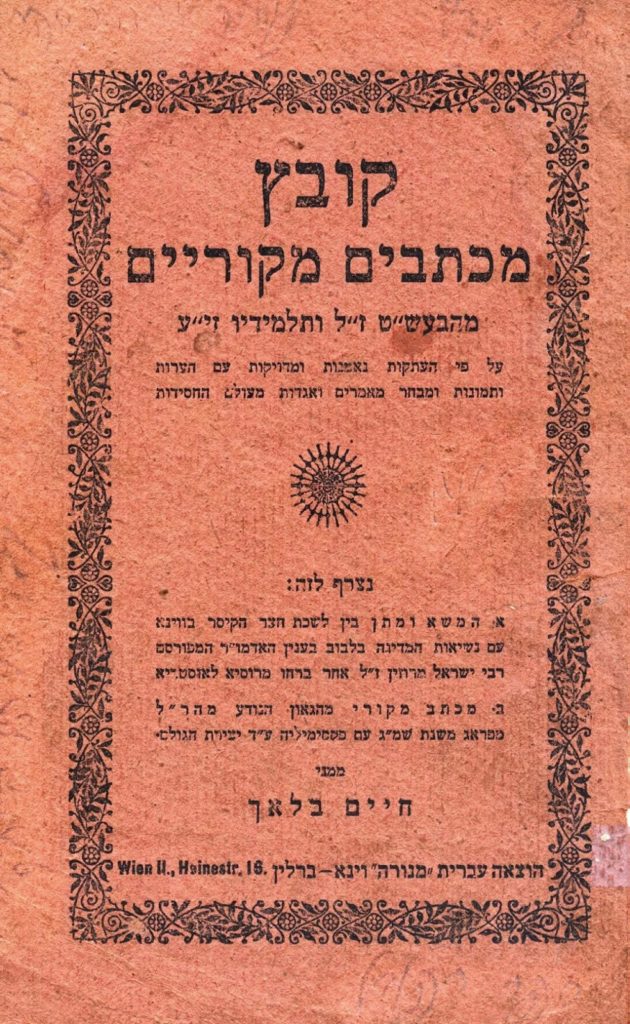
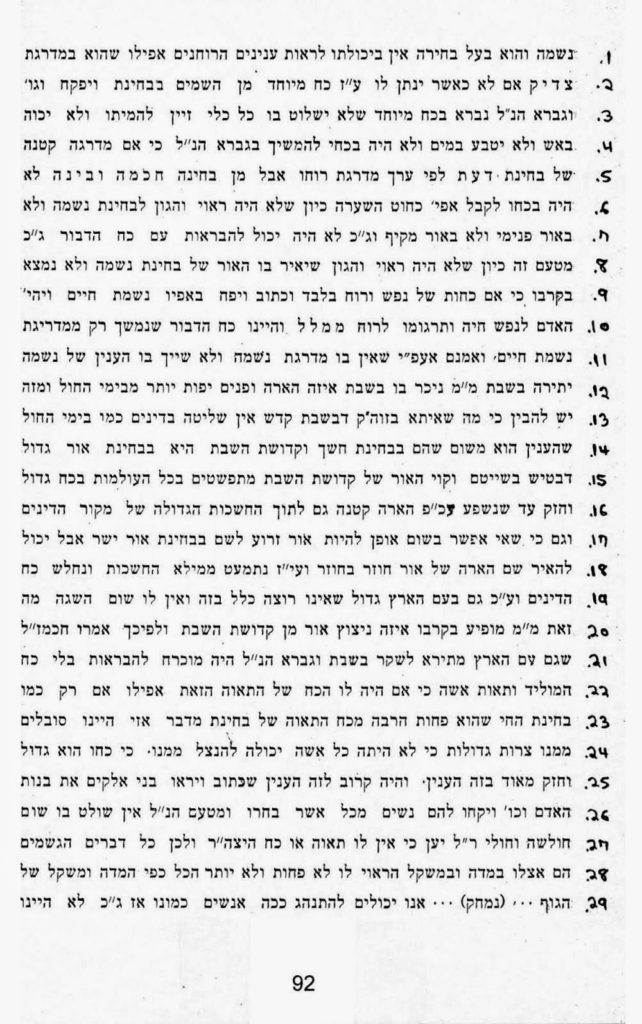
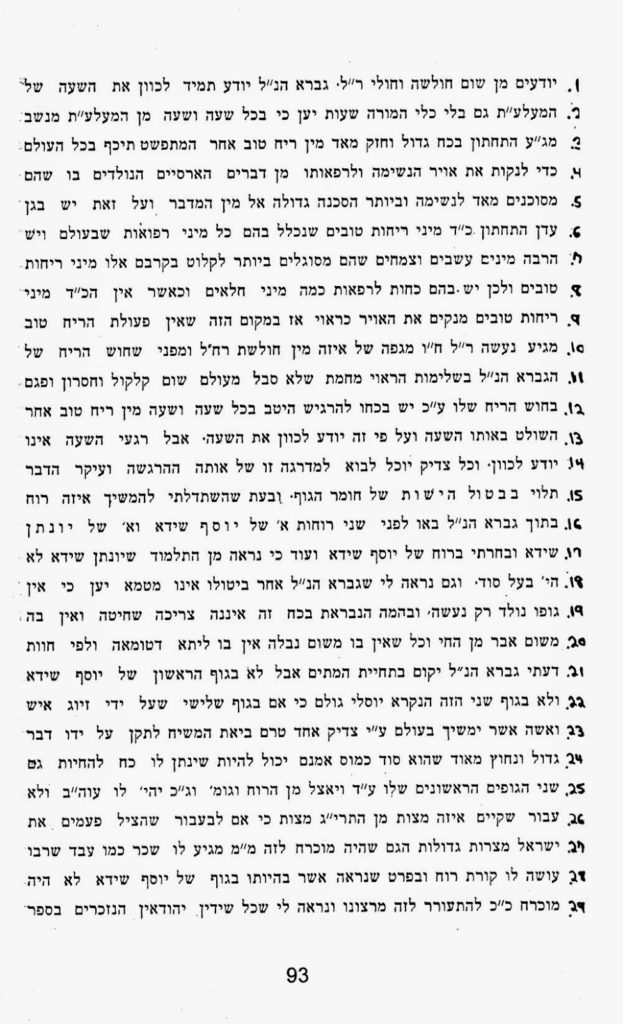
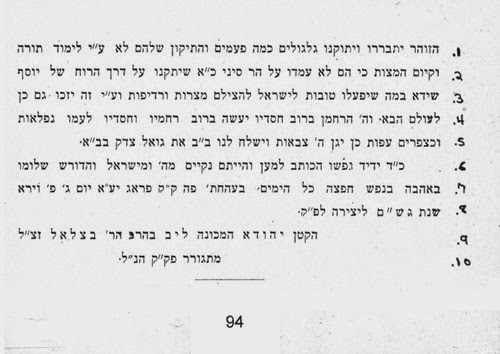
In 1923, Chaim Bloch (1881-1973), noted author and polemicist,1published a letter of the Maharal (d. 1609) that was previously unknown to all of Jewish literature.2 The letter, dated 1582 (or more precisely: Tuesday of parshat va-yera, [5]343), was addressed to R. Jacob Günzberg (d. 1615), Chief Rabbi of Friedberg in Hesse.3 Rich in content, the letter provides a lengthy and detailed account of why it was necessary for the Maharal to create a Golem, how he went about doing it, and the precise spiritual, psychological, and halakhic status of the created Golem. Bloch assured his readers that the letter was published from an original copy in his possession. In order to quell any doubts, he reproduced a facsimile of the Maharal’s autograph, as it appeared on the original letter.4
Bloch did not provide much detail about the letter’s whereabouts for the more than 300 years it apparently had been withdrawn from circulation and unknown. He thanks Rabbi Samuel Neuwirth of Vienna for his efforts in acquiring the letter and handing it over to Bloch for publication. Given that it was published together with a series of hasidic documents (including letters of the Baal Shem Tov), allegedly recovered from East European archives that had been plundered during World War I and its aftermath, the impression one has is that the Maharal letter belonged to these archives as well – though this is never explicitly stated by Bloch.5
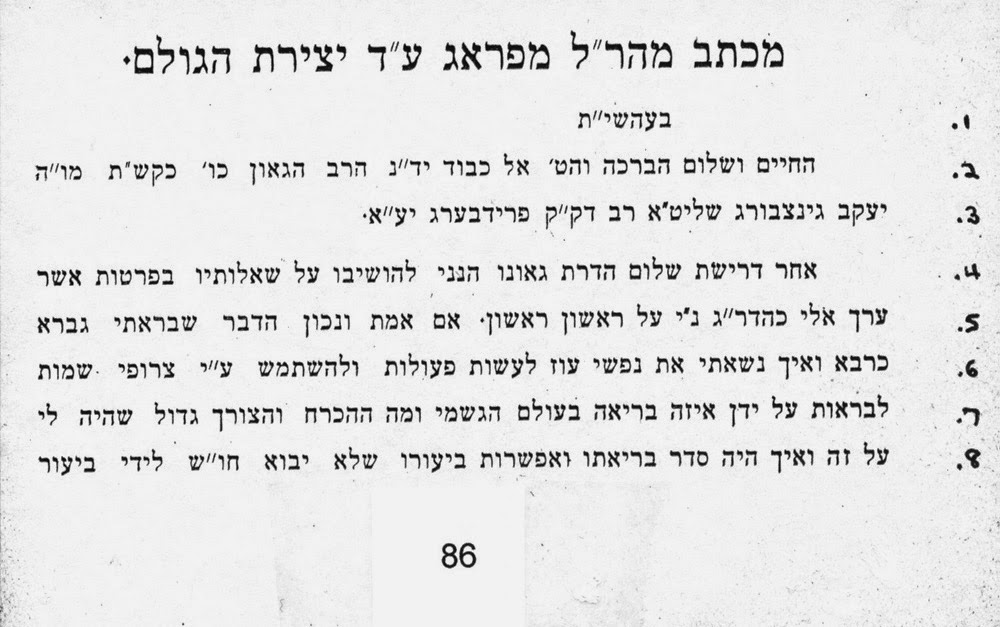
In 1931, R. Yitzchok Eizik Weiss (d. 1944), the Spinka Rebbe,6 published the very same letter of the Maharal (without any mention of the prior Bloch publication) based upon — what he believed to be — an original manuscript in his possession. He appended it to the posthumous publication of his father’s אמרי יוסף על המועדים7 . Although he gave no indication as to when or how the letter came into his hands, two witnesses provide us with some interesting detail.
The first witness, R. Yitzchok Weiss (d. 1942), Chief Rabbi of Kadelburg,8 in his אלף כתב, a book written primarily between 1927 and 1939 but published posthumously in 1997, includes the following entry:
The Gaon and Zaddik of Spinka informed me on Monday of [parshat] Hukkat-Balak, 7 Tammuz, 5682 [= 1922], that a manuscript written by the hand of the Maharal of Prague came into his possession. In it, he responded to R. Jacob Günzberg about the making of the Golem, how and why it was done, and whether the Golem will be included in the resurrection of the dead.9
Thus, we know that the letter reached the Spinka Rebbe no later than the beginning of July in 1922.
The second witness, R. Samuel Weingarten (d. 1987), noted scholar of Hungarian Jewry and religious Zionist,10 reported that he was present at the home of R. Hayyim Eleazar Shapira (d. 1937), the Munkatcher Rebbe, circa 1922-23, when two of the sons of the Spinka Rebbe [R. Yitzchok Eizik Weiss], R. Naftoli and R. Yisrael Hayyim, approached the Munkatcher Rebbe with a query. They carefully removed a manuscript from a large envelope and asked the Rebbe to examine it. It was a handwritten letter signed by the Maharal of Prague and it dealt with the creation of the Golem. They explained that a soldier who had been taken captive at the Russian front during the World War, and who had participated in the looting of government archives during the Russian revolution, had brought the letter to their father and was prepared to sell it to him for a stiff price. Since the Spinka Rebbe was not expert in Hebrew manuscripts, he sought the advice of the Munkatcher Rebbe. The latter examined the manuscript carefully for some fifteen minutes. He then asked that a magnifying glass be brought and he re-examined the manuscript. He concluded that it was worthless; it was a forgery. The sons thanked the rabbi and went on their way with the manuscript.11
In 1969, the very same letter of the Maharal was published once again by R. Zvi Elimelech Kalush of Bnei Brak.12 The title page of the volume assures the reader that the text of the letter was copied from the “original handwritten holy manuscript” penned by the Maharal of Prague himself. Kalush admits that he is simply reprinting the text published by the Spinka Rebbe in his father’s אמרי יוסף. Indeed, Kalush’s text incorporates all the misreadings and printers’ errors of the text as it appeared in the אמרי יוסף and, as often happens when type is reset, adds several new printers’ errors as well.13
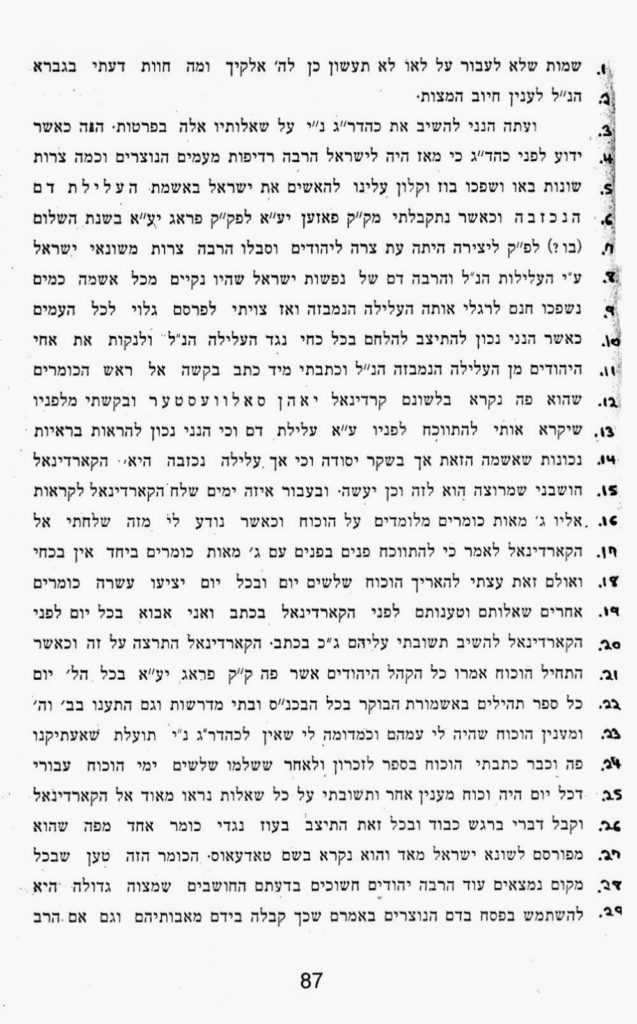
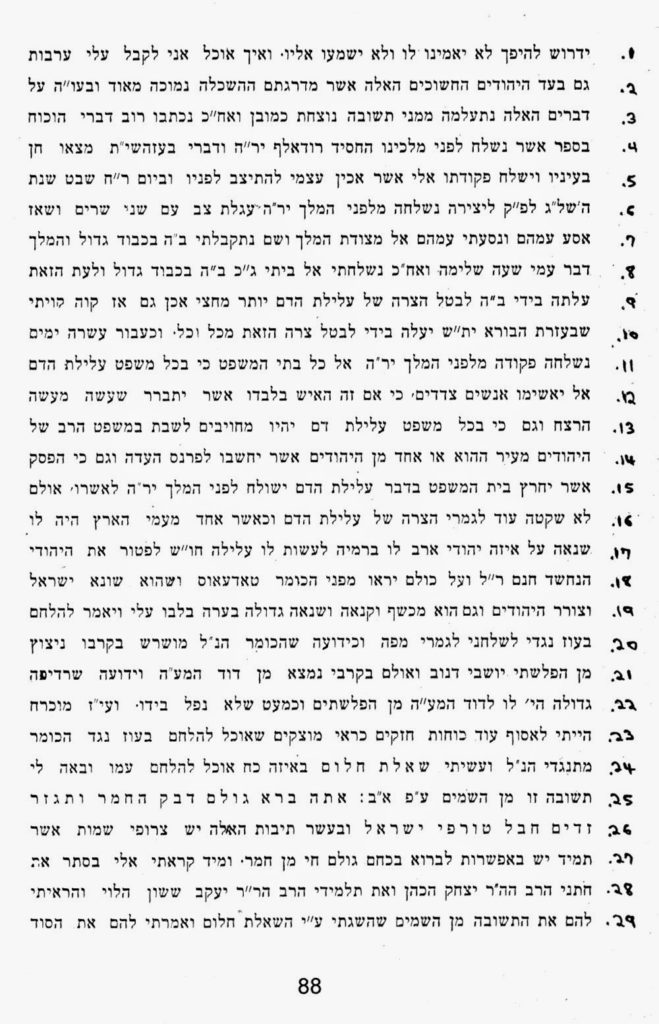
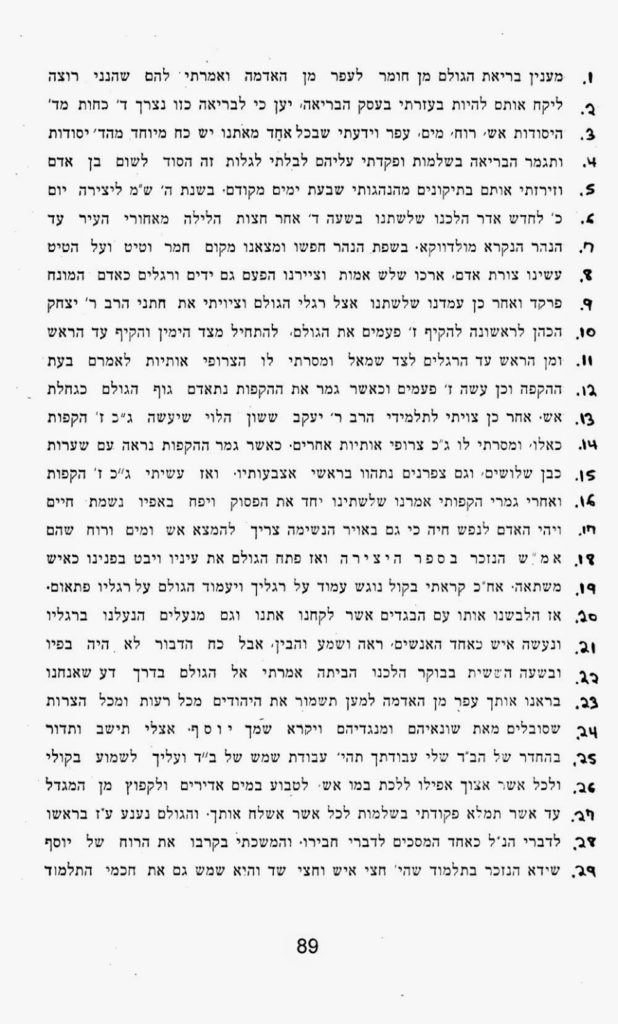
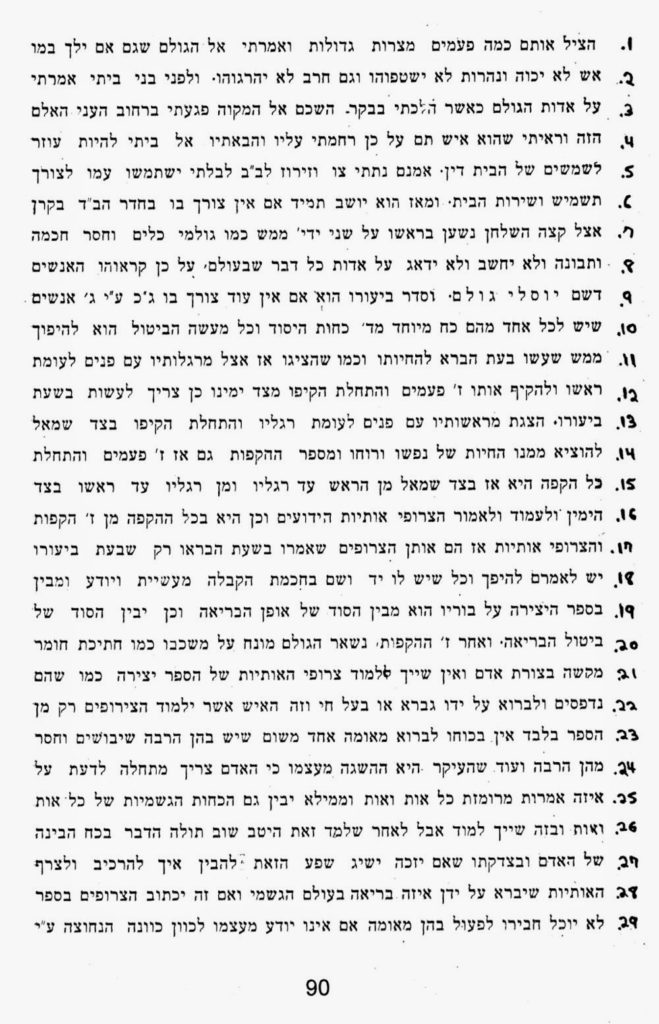
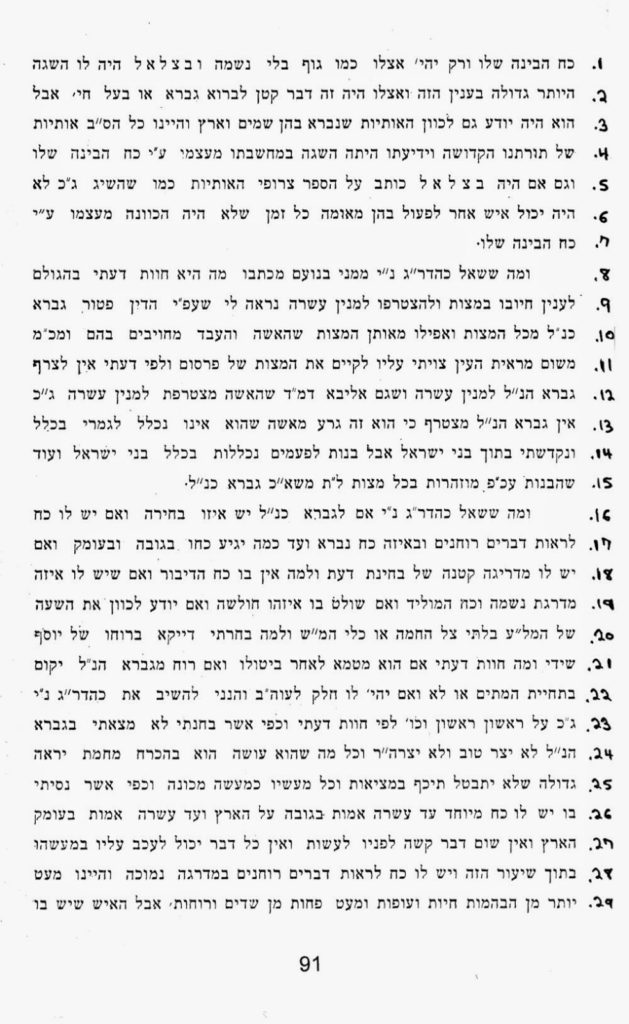
Since the letter is often reprinted and quoted as an authentic letter of the Maharal, it is probably useful to list some of the reasons that led the Munkatcher Rebbe and others14 to declare that it is a forgery. In order to facilitate discussion of the evidence, the full text of the letter is printed below, with each line identified by number.
II. Letter of the Maharal15
III. Evidence of Forgery16
p. 86, l. 2: ושלום The 1931 edition reads correctly: והשלום. As an epistolary formula, the phrase חיים שלום וברכה (and its variations) does not appear in Jewish literature prior to the eighteenth century.
אל כבוד יד”נ As an epistolary formula, the phrase אל כבוד יד”נ does not occur in Jewish literature prior to the eighteenth century.
כקש”ת This abbreviation for כבוד קדושת שם תפארתו first appears in Jewish literature in the eighteenth century.
p. 87, l. 6: בשנת השלום (בו?) לפ”ק The 1931 edition reads correctly: בשנת ה’ של”ב לפ”ג. Thus, according to the Letter, Maharal was appointed Rabbi of Prague in 1572. According to the historical sources, the Maharal was appointed Rosh Yeshiva of Prague in 1573. His appointment as Rabbi of Prague came many years later.
p. 87, l. 8: The Maharal is depicted throughout the letter as devoting all his energies to countering the blood libel in Prague. There is no historical evidence – Jewish or Christian – of a charge of blood libel in Prague during the lifetime of the Maharal.
p. 87, l. 12: Cardinal Johann Sylvester is described here as the leading Christian authority in Prague. No cardinal by that name served in Prague or, for that matter, anywhere else in Christian Europe. For a list of the cardinals who functioned in Prague, see Hierarchia Catholica Medii Aevi 3(1920), pp. 297-354; 4(1935), p. 288; and 5(1952), p. 323; and cf. A. Frind, Die Geschichte der Bischoefe und Erzbischoefe von Prag, Prague, 1873, pp. 178-249.
p. 87, l. 27: An anti-Semitic priest and rogue in sixteenth century Prague by the name of Thaddeus is unknown to all of Jewish and Christian literature prior to the twentieth century.
p. 87, l. 28: יהודים חשוכים בדעתם, used here in the sense of “unenlightened Jews,” is a usage found only in modern Hebrew literature.
p. 88, l. 4: Rudolph II is described here as serving as King of Bohemia in 1572-3. In fact, Maximilian II served as King of Bohemia and Holy Roman Emperor in 1572-3. It is surprising that the Maharal confused these two kings with each other.
p. 88, l. 6: The Maharal reports that he was summoned for an audience with King Rudolph in 1573. Aside from the fact that Rudolph was not in office at the time, the Maharal met with Rudolph only once – in 1592. See the testimony of the Maharal’s disciple, R. David Gans, צמח דוד, ed. M. Breuer, Jerusalem, 1983, p. 145. Since this letter was allegedly written and sent to R. Jacob Günzberg in 1583, the confusion here is astonishing.
p. 89, l. 7: מולדווקא refers to the Moldau River, today the Vltava River. It is surprising that the Maharal was unaware of the correct spelling for this river in Hebrew – an essential ingredient for the writing of legally valid divorce documents. In the commentaries to the standard editions of the שלחן ערוך it is always spelled מולטא17. It is even more surprising that the Maharal was unaware of the fact that the Moldau flows through the center of the city of Prague, and not on the “outskirts of the city” (see line 6).
p. 90, I. 21-22: Maharal here refers to the permutations and combinations of the Hebrew letters that enable one to create a Golem, as they appear in the printed editions of Sefer Yetzirah. Alas, no such permutations and combinations appeared in any of the printed editions of Sefer Yetzirah until 1883 (פירוש הר”א גרמיזא על ספר יצירה, Przemysl, 1883).18
p. 91, l. 20: כלי המ”ש = כלי המורה שעות, a watch or clock. This term first entered Hebrew in the nineteenth century.
p. 91, l. 25: מכונה in the sense of “machine” entered Hebrew in the modern period.
p. 94, l. 9: The signature reads: Judah, dubbed Leib, son of R. Bezalel. In fact, the Maharal never signed his name in this manner. See A. Gottesdiener, המהר”ל מפראג: חייו תקופתו ותורתו, Jerusalem, 1976, pp. 19 and 29.
IV. Comments
We have hardly exhausted the evidence – historical and linguistic – that can be adduced in order to prove that Bloch’s Letter of the Maharal is a forgery. The cumulative evidence is sufficiently overwhelming that there is really no point in adducing more of the same. Suffice to say that anyone familiar with the syntax and vocabulary of the authentic, published writings of the Maharal will recognize instantly that the Letter of the Maharal is a crude forgery. What remains to be investigated is the identity of the forger. Who forged the letter of the Maharal? When was it forged? Why was it forged? While we cannot provide answers to these questions (due to our ignorance), the following comments may prove useful for others who wish to do so.
1. Much of the material in the Letter of the Maharal was borrowed directly from R. Yudel Rosenberg’s נפלאות מהר”ל, Piotrkow, 1909.19 Clearly, the Letter of the Maharal is dependent upon נפלאות מהר”ל. It is unclear whether both documents came from the same hand, or whether the Letter of Maharal was an independent work. Either way, the Letter of the Maharal may have been a forgery done in order to “prove” the authenticity of נפלאות מהר”ל by providing the original manuscript of the Letter, together with the signature of the Maharal. It would have been much too cumbersome to provide a forged manuscript of the entire text of Rosenberg’s נפלאות מהר”ל 20.
2. It is noteworthy that the Letter of the Maharal was not included in, or even mentioned by, Chaim Bloch in his reworking and expansion of R. Yudel Rosenberg’s נפלאות מהר”ל18 This suggests that the Letter first reached Bloch sometime after 1919, i.e. after he had published his final version of the Golem stories.
3. I am not aware of any evidence that either suggests or proves that Bloch – despite his predilection for forgery21 – forged the Letter of the Maharal. It is perhaps more likely that the forger of the Kherson Geniza (see note 5) was responsible for the forged Letter of the Maharal.
One matter, however, deserves further attention. Bloch, after all, published a facsimile of the Maharal’s signature. Precisely for that reason the publishers of the later editions, misled by the signature, stress the fact that the Letter of the Maharal was written בכתב יד קדשו. In 2009, the four hundredth yahrzeit of the Maharal was commemorated throughout the world. Those commemorations have yielded a remarkable volume, recently published in Prague. Entitled Path of Life: Rabbi Judah Loew ben Bezalel, the opening pages include a genuine facsimile of the Maharal’s signature.22
Here is the Maharal’s signature as published by Bloch:
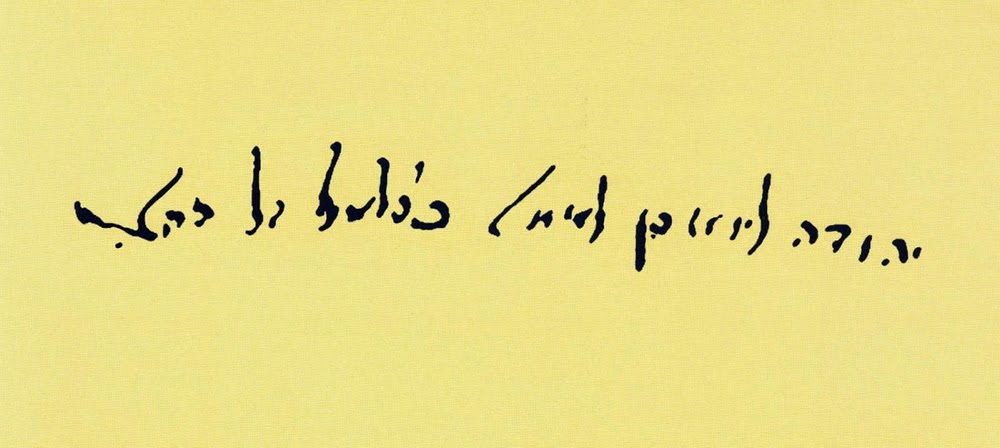
Here is the Maharal’s signature in the recently published Path of Life:23

Quod erat demonstrandum!
In sum, the Letter of the Maharal is a modern forgery. It should not and cannot be cited as evidence relating to the Maharal, the Golem, or any of the events that occurred in the sixteenth century. It is a twentieth century document that was probably forged sometime between 1909 and 1922. At best, it sheds light (or: darkness) on what Jewish forgers were thinking and doing during the first quarter of the twentieth century.
NOTES
1 See the entries on Bloch in G. Bader, מדינה וחכמיה, Vienna-New York, 1934, p. 40; I. Landman, ed., Universal Jewish Encyclopedia, New York, 1940, vol. 2, p. 396; and M. Wunder, מאורי גליציה, Jerusalem, 1978, vol. 1, cols. 502-506 (and vol. 6, col. 213). It is unconscionable that no entry on Bloch appears in either edition of the Encyclopaedia Judaica. Bloch was a prolific author and an astute polemicist who contributed significantly to a variety of Jewish topics, including folklore, apologetics, and anti-Zionist sentiment. A biography and intellectual history of Bloch remains a scholarly desideratum.
2 קובץ מכתבים מקוריים מהבעש”ט ותלמידיו זי”ע, Vienna, 1923, pp. 86-94.
3 On R. Jacob Günzberg, see D. Maggid, תולדות משפחות גינצבורג, St. Petersburg, 1899, pp. 12-13. It is unclear when Günzberg was appointed Rabbi of Friedberg. R. Man Todros Spira served as Rabbi of Friedberg until circa 1582. He was succeeded by R. Samuel b. Eliezer, who was succeeded by Günzberg. See A. Kober, “Documents Selected From the Pinkas of Friedberg, a Former City in Western Germany,” PAAJR 17(1947), pp. 28-29.
4 See below for the facsimile of the signature. In fairness to Bloch, it should be noted that he equivocated somewhat as to whether the document was an original or a copy. On the title page of the volume, and under the facsimile of the signature itself, he clearly implied that the letter and the signature were originals, not copies. Toward the end of the Introduction to the volume, however, Bloch describes the manuscript as ancient, difficult to read, and “ascribed to the Maharal.” Indeed, he invites his scholarly audience to determine whether or not the autograph is authentic.
5 The hasidic documents allegedly recovered from East European archives are known in scholarly circles as the Kherson Geniza. The Kherson Geniza has generated a rich literature, too cumbersome to be listed here. Some of the more important discussions are: D.Z. Hilman, אגרות בעל התניא ובני דורו, Jerusalem, 1953, pp. 240-272; Y. Raphael, “גניזת חרסון,” Sinai 81(1977), pp. 129-150; B. Schwartz, “די כערסאנער גניזה,” Der Yid , November 2 – December 28, 1984; A. Rapoport-Albert, “Hagiography with Footnotes,” History and Theory 27(1988), pp. 119-159; H. Liberman, “הוי גוי חוטא,” in ספר הזכרון לרבי משה ליפשיץ, New York, 1996, pp. 139-140; and M. Rosman, Founder of Hasidism, Berkeley, 1996, pp. 123-125.
6 See Tzvi M. Rabinowicz, Encyclopedia of Hasidism, Northvale, 1996, pp. 534-535.
7 אמרי יוסף על המועדים, חלק ב׳, Vranov, 1931 (reissued: New York, 1969 and 1990).
8 Kadelburg, also known as Karlburg, Oroszvar, and Rusovce, was some 11 kilometers southeast of Pressburg (= Bratislava). On Weiss, see Y.Y. Cohen, חכמי הונגריה, Jerusalem, 1997, pp. 460-461.
9 אלף כתב, Bnei Brak, 1997, vol. 2, p. 47.
10 See the entry on him in אנציקלופדיה של הציונות הדתית, Jerusalem, 2000, vol. 6, columns 391-393.
11 Samuel Weingarten, “האדמו”ר ממונקטש רבי חיים אלעזר שפירא: בעל תחושה בקרתית” Shanah be-Shanah, 1980, pp. 447-449.
12 שלוש קדושות, Bnei Brak, 1969, pp. 127-135.
13 See, e.g., the last line of the letter, where Kalush (p. 135) mistakenly reads מתפורר, whereas Bloch and the Spinka Rebbe read correctly מתגורר.
14 See below, note 16.
15 The text is taken from קובץ מכתבים מקוריים, pp. 86-94.
16 The evidence of forgery is culled from G. Scholem’s review of Bloch’s קובץ מכתבים מקוריים in Kiyrat Sefer 1 (1924-5), pp. 104-106; the Munkatcher Rebbe’s comments as recorded by Weingarten (see above, note 11); and my own reading of the text.
17 See also R. Ephraim Zalman Margolioth, טיב גיטין, Lemberg, 1859, p. 52a, section on the spellings of towns and rivers.
18 For the correct year of publication of R. Eleazar of Worms commentary on Sefer Yetzirah, see S. Ashkenazi’s note in Tzefunot 1(1989), n. 4, p. 122.
19 נפלאות מהר”ל, ascribed to Maharal’s son-in-law, is itself a literary hoax. See S.Z. Leiman, “The Adventure of the Maharal of Prague in London,” Judaic Studies 3(2004), pp. 1-43.
20 Chaim Bloch, Der Prager Golem: von seiner Geburt bis zu seinem Tod, Vienna, 1919. An English version, The Golem: Legends of the Ghetto of Prague, Vienna, 1925, became a best seller, and is often reprinted. Bloch’s version of the Golem stories first appeared in serial form in 1917 in the Viennese periodical Oesterreichen Wochenschrift. For a comparative study of the Bloch and Rosenberg versions of the Golem stories, see A. L. Goldsmith, The Golem Remembered, 1909-1080, Detroit, 1981, pp. 51-72. Unfortunately, much of Goldsmith’s analysis is flawed due to the fact that he read Bloch and Rosenberg in translation, rather than consulting the original texts.
21 See S. Weingarten, מכתבים מזוייפים נגד הציונות, Jerusalem, 1981. Cf. G. Elkoshi, “ספיחי פולמוס,” Moznayim 42(1976), pp. 212-215.
22 A. Putik, ed., Path of Life: Rabbi Judah Loew ben Bezalel, Prague, 2009. The signature, recorded in 1597, appears on the frontispiece and at p. 37. Cf. pp. 73-74.
23 The ז”ל ה”ה at the end of the signature stands for: זכרונו לחיי העולם הבא . Cf. the Maharal’s signatures with the very same endings in his הסכמה to R. Samuel b. Joseph’s לחם רב, Prague, 1609 (reissued: Jerusalem, 2003), p. 5, and in the document cited by Gottesdiener, op. cit., p. 29.