1

אדם דואג על אבוד דמיו / ואינו דואג על אִבוד ימיו

In the prior post, Yitzhak discussed a phrase and its origins. We now present, a chapter from R. S. Askenazi unpublished works, related to the same topic. As mentioned before we are working on printing his writings. At this point three volumes are completely ready to print (with a few more on the way). While they still require financial assistance to see the light of day we are very close, only 5K is necessary. With the help of many people, including some generous readers of the Seforim blog, we have gotten pretty far in this long journey. If anyone could help in any way possible it would be greatly appreciated. Thanks in advance. For any information or questions about this project contact me at EliezerBrodt@gmail.com
אדם דואג על אבוד דמיו / ואינו דואג על אִבוד ימיו
הפרקים
א. מקורות ראשונים
ב. בדורות הבאים
ג. באור הפתגם
ד. ‘מדרש פליאה’
ה. השמוש בפתגם בחיי הקהלה
ו. יחוס מוטעה
ז. מקור הרעיון בראשונים
ח. רעיונות דומים
ט. פתגמים-אחים ופתגמים-יריבים
י. ‘…מתאוננים, שאין להם במה לחיות…’
א. מקורות ראשונים
כתב ר’ שלמה בלוך, בספר החיים, ח”ד, פרק ב: אמרי אינשי. אדם דואג על איבוד דמיו / ואינו דואג על איבוד ימיו. דמיו אינם עוזרים / וימיו אינם חוזרים[1].
ר’ שלמה בלוך לא חִבר את ספר החיים, אלא הוציאו בתרגום אשכנזי בשנת תרח בהנובר (ואח”כ במהדורות רבות) [על-פי מהדורת יחזקיהו רפוס (פפד”מ תקצה), בתוספת תפלות חדשות ותרגום ליהודית-אשכנזית, באותיות צו”ר]. מחברו של הספר הוא ר’ “שמעון בר’ ישראל יהודה, הנקרא בפי כל: שמעון פראנקפורטער“. ונדפס לראשונה ע”י בן המחבר (ר’ משה) בשנת תסג באמשטרדם. המשל נמצא שם, בדף י ע”א.
בהמשך מוסיף ר’ שלמה בלוך שיר החתום בשמו (שלמה): ואמר המשורר: שוכני תבל רודפי הבל / לשוא עמלו כל חייהם / מיום היותם סבלותם / הגם צדה לא עשו במותם.
אולם באמת, המשורר הוא ר’ משה ן’ חביב, והשיר נדפס בספרו דרכי נועם. אלא שמישהו שיבש את שתי השורות האחרונות, כדי שיצא האקרוסטיכון שלמה (עי’ אוצר השירה והפיוט, ש 636). הנוסח המקורי הוא: ובסכלותם עד יום מותם / גם צדה לא עשו להם.
פתגם מחורז זה מופיע, בשנוים, גם בספר מראה המוסר, מאת זעליגמאן אולמא, הנקרא גם צוכט שפיגל (אוביבאך תעו, דף ח ע”א; אוריינט, 1846, עמ’ 606): אנוש קובל על איבוד דמיו / ואינו קובל על איבוד ימיו. והוא יכול להחזיר דמים / ולא יוכל להשיב הימים.
בהמשך בא התרגום ליהודית-אשכנזית: איי דוא פר גענקליכי נערישי וועלט / דאז מענכר קלאגט איבר זיין פאר לארן געלט / אונ’ ניט איבר זייני טעג דיא אים אנטרינן / דז ער דאך פר לארן געלט קאן ווידר גיווינן / אבר נאך דען פר לארן טעג ברעך דיר ניט דיין זין / זיא ווידר צו בקומן דען הין אישׂט הין (מראה המוסר, שם).
בריל (יארביכר, IX, עמ’ 52) מביא את הפתגם מתוך כתב-יד מהמאה הטז, ושם נוסח החרוז השני: והלא אפשר להחזיר דמיו / ולא אפשר להחזיר ימיו.
נוסח דומה הביא ברוך גלזמן: אדם דואג על איבוד דמיו / ואינו דואג על איבוד ימיו. דמיו הולכים וחוזרים / ימיו הולכים ואינם חוזרים (טויטנטאנץ, באָדן [רבעון, בעריכת נ”ב מינקאוו], כרך ג, חוברת 4-3 [ניו-יורק 1937-1936], עמ’ 33).
וקדם לכולם ר’ שאול בר’ דוד, ר”י ור”מ ממדינת רוסיא, בספרו חנוכת הבית (פראג שעו, דף ט סע”ד): … מאהבת הכסף יכסוף שיגיע לתקופת הימים, ושתכלה השנה, כדי שיקרבו הימים שימצא בהם חפץ. נמצא רוצה שיתקצרו ימיו ושניו. ועליו נאמר ושנות רשעים תקצרנה [משלי י כז]. וכמו שאמר החכם: אדם קובל על איבוד דמיו / ואינו קובל על אבוד ימיו …
אמנם כותבי המודיע לא ידעו, כנראה, על מקורות אלו, ולפיכך יחסו את פתגמנו לר’ ישראל מסלנט! (ראה להלן, פרק ט).
ב. בדורות הבאים
הפתגם נשתגר בפי הבריות ונזכר בכמה וכמה חבורים. נצין אחדים מהם:
כתב ר’ אלעזר קליר, בספרו חות יאיר חדש, פראג תקנב, דף כא ע”ד: ובילדותי אמרתי, שזה פי’ החידה: אדם דואג על איבוד דמיו / ואינו דואג על איבוד ימיו; דמיו אינם עוזרים / וימיו אינם חוזרים – – –
וכתב ר’ יחזקאל לנדא [תעד-תקנג], בספרו דרושי הצל”ח (דרוש א, ליום א דסליחות, סי’ כג, ווארשא תרמד [! צ”ל: תרמו], דף ה ע”א): אבל הרשעים, חייהם אינם חיים, ואין לימים שלהם שום מציאות. ועליהם נאמר: ימי קלו מני ארג [איוב ז ו]. כי אין להם שום משקל משום זכות, ואדם דואג על איבוד דמיו ואינו דואג על איבוד ימיו – – –
ור’ נתן מברסלב כותב בספרו לקוטי הלכות (הלכות מגילה, הלכה ו, סעיף יח): עיקר אבידת הימים … ע”י תאות ממון … וכמורגל לשון זה בספרי מוסר: אדם דואג על איבוד דמיו / ואינו דואג על איבוד ימיו.
ובפירוש קול יהודא[2] על ספר מבחר הפנינים, שער היאוש, ווילנא תרלה: ואדם דואג על איבוד דמיו / ואינו דואג על איבוד ימיו. כי דמיו אינם עוזרים / וימיו אינם חוזרים. כמבואר בספרי מוסר.
לבסוף כדאי לרשום כאן את השיר הנפוץ בין אחינו מבני עדות המזרח: בן-אדם! למה תדאג על הדמים / ולא תדאג על הימים. הדמים אינם עוזרים / והימים אינם חוזרים. רדוף אחר התורה והמצוות, אשר הם לעד קימים[3].
זכות גדולה עמדה לפתגמנו, שהולחנו לו כמה מנגינות, בהן היו שרים אותו בעלי המוסר.
כך מספר אברהם יצחק קריב (ליטא מכורתי, חיפה תשכ, עמ’ 28) על ‘בעלי המוסר’ שנפוצו בליטא: הליטאי… אין הוא להוט ‘לבלות’ את הזמן. אלא אדרבא, צר לו על הזמן שמתבלה. אדם דואג על איבוד דמיו ואינו דואג על איבוד ימיו – היו שרים בעלי המוסר ומושכים במלות החרוז ובנגינתן העצובה בשביל למצות את חשבון הנפש שבהן.
והרי כמה מובאות אצל בני הדורות האחרונים:
טוביה פסח שפירא [תרה-תרפד], משל הקדמוני, “מאסף משלי עם המסורים ושגורים בפי העם”, פילדלפיה תרפה, לב, 5, מביא את הפתגם כולו: אדם דואג על איבוד דמיו / ואינו דואג על איבוד ימיו. ימיו אינם חוזרים / ודמיו אינם עוזרים.
ואִלו שלמה יצחק שיינפלד [תרכא-תשג], מסתפק בחציו הראשון בלבד: כמה נאמנים הם דברי המשורר: אדם דואג על איבוד דמיו / ואינו דואג על איבוד ימיו (ציונים בדרך החיים, ח”א, שיקאגא תרפב, סוף עמ’ 228).
וכך גם בספרם של ביאליק-רבניצקי, ובספרו של עקיבא גולנפול[4].
חציו הראשון של הפתגם (בלבד), בנסוח שונה, אנו מוצאים באוספו הלועזי של פלנטויט, תלמידו של ר’ יהודה אריה ממודינה, שנדפס בשנת 1645 [תה], מס’ 1786, ומשם הוכנס לאוצר המשלים והפתגמים של ישראל דודזון, ירושלים תשכז, מס’ 1453: שוטה מתאבל על איבוד דמיו / ולא ישית לבו על אבידת ימיו.
נִסוח זה נמצא במשלי שבעים חכמים, סי’ סה[5]. ואין ספק, שמכאן לקחו פלאנטאוויט!
השוה גם נִסוחו של אפרים דוֹמוֹרצקי: מתאונן אויל על אזלת כספו, ועל חלוף ימיו לא ידאג (משלי אגור, ורשה תרמא, יט י).
וראה גם: מלון אידי-עברי מלא. נקבצו ובאו בו כל המלים, הניבים, הפתגמים והיינו דאמרי אינשי, שיש להם מהלכים בשפתנו המדוברת. כולם מתורגמים בשפת עברית צחה ורעננה, מאת אבק [=אליעזר ברזניאק]. פריס, תרצט-תשא, דף 203 ע”א: א מענש זארגט זיך ווען ער ווערט אָן געלט, און ניט ווען ער ווערט אָן יאהרען. אדם דואג על אבדן דמיו / ואינו דואג על אבדן ימיו.
ונִסוח קצר: פארלארענע יארן איז ערגער ווי פארלארענע געלט (יידישע שפראך, II [1942], עמ’ 29, מס’ 68).
ג. באור הפתגם
כמה באורים ופירושים נאמרו לפתגם זה.
כתב ר’ אלעזר קליר, בספרו חות יאיר חדש, פראג תקנב, דף כא ע”ד – כב ע”א: ובילדותי אמרתי, שזה פי’ החידה: אדם דואג על איבוד דמיו / ואינו דואג על איבוד ימיו; דמיו אינם עוזרים / וימיו אינם חוזרים … כשאדם דואג על איבוד דמיו, ואינו רואה הסיבה לדאוג על מה שאיבד ימיו … אשר זו הסיבה שממונו אבד, אז, דמיו מה שאיבד אינם עוזרים לו, כי ימיו אינם חוזרים למקומם, מאחר שלא שב בתשובה. משא”כ אם לא היה דואג על איבוד הדמים, רק על הסיבה, היו לו דמים הללו לעזר, שהיו ימיו חוזרים. הני ימים, דדחפי לבר, היו חוזרים ע”י תשובתו. כמאמר הזוהר [בפרשת ויחי, דף רכא ע”ב – רכד ע”א, שהובא לעיל, דף כא ע”ג-ע”ד][5א].
והביא דבריו ר’ מרדכי ראטהשטיין, בפירושו שערי פרנסה טובה, על ספר תהלים, מ’-סיגעט תרמט[6].
באור נוסף לפתגם הציע עקיבא גולנפול, בספרו לקסיקון הפולקלור העברי, והובאו דבריו להלן (פרק ו).
וראה עוד בפרק הבא.
ד. ‘מדרש פליאה’
הפתגם התגלגל והפך למדרש פליאה!
כך מספר ר’ חיים בנימין ליפקין, בספרו חבל בנימין (יוהניסבורג תרצד, עמ’ 154-153), בשם זקנו ר’ יצחק ליפקין.
כאשר בא אדמו”ר הצדיק מהר”ש שניאורסאן הרבי מליבאוויץ זצק”ל לוויטעבסק לחתונת בנו ר’ מנדל עם בתו של הגביר ר’ יוסף פאפיערין, נכדתו של הגאון מלבי”ם זצ”ל, וגם הוא בא לחתונת נכדתו. וכאשר ישבו אצל החתן בעת ‘קבלת פנים’ כמנהג, אמר ר’ יוסף הנ”ל: עתה יושבים פה שני גדולי ישראל, ואשר זכיתי להיות בחברתם, אבקש אתכם לבאר לי מדרש פליאה אחד אשר לא אוכל להבין (הרב ר’ יוסף היה ג”כ למדן מופלג). על פסוק וילכו שניהם יחדיו [בראשית כב ח] אומר מדרש פליאה ישן: הה”ד הלוך ילך ובכה [תהלים קכו ו]. אדם דואג על איבוד דמיו / ואינו דואג על איבוד ימיו.
ויען המהר”ש ויאמר. כי הסבא של הכלה הוא זקן ממנו, וראוי לו הכבוד שנשמע ממנו קודם את חות דעתו בזה. ויקם הגאון [מלבי”ם] ויפרש את המדרש בפלפול נאה, כדרכו. ועתה נשמע, אמר ר’ יוסף, מאבי החתן את ביאורו.
ויען המהר”ש ויאמר: המדרש יבואר ע”פ הגמ’ זבחים, שאם נפסל הדם של הקרבן, נשפך לאמה[7]. ולכן כאשר שמע יצחק מאביו לעולה בני, חרד ואמר בלבו: שמא אבא לא יוכל לכבוש את רחמיו מעל בן יחידו, ודעתו לא תהיה צלולה ומיושבת עליו, ועלול לטעות ויפסול את הדם, וילך הדם לאיבוד. וזהו פי’ המדרש פליאה, ההד”כ הלוך ילך ובכה, כלומר, יצחק הולך ובכה. וזהו אדם דואג על איבוד דמיו, דואג שהדם שלו יאבד, ואינו דואג מה שיאבד ימיו, כלומר חייו.
וכאשר סיים את דבריו קם הגאון המלבי”ם ז”ל מעל כסאו ואמר: אין זה כי אם ברוח הקודש, שבו פירש המחותן את המדרש פליאה. והוא ביאור נפלא מאד, וגם פשוט כל כך.
בעל הטורים האלה שמע בעצמו מאחד ששמע זה מפי הגאונים הנ”ל, כאשר היה לומד בוויטעבסק בישיבת זקינו הגאון ר’ יצחק ליפקין זצ”ל.
ע”כ ספורו של ר’ חיים בנימין ליפקין.
באור זה למדרש הפליאה, בשם המלבי”ם, נזכר גם במטעמי יצחק, שכתב ר’ יצחק מרדכי פאדוואה לספר אילנא דחיי, המקבץ מתורתו של ר’ מנחם מענדיל מרימנאוו, ונדפס בשנת תרסח בפיעטרקוב. וזה לשונו (פרשת וירא, דף ט ע”ב, הערה ד): שמעתי. שהק’ מהרא”י מסאדיגורי זצ”ל שאל להרה”ג המלבים זצ”ל, שיפרש לו דברי הילקוט [!] דכתיב ביה בזה הלשון: בשעה שעקד אברהם אבינו ע”ה את יצחק בנו, בכה בכייה גדולה, ואמר: הנני דואג על איבוד דמיו ואיני דואג על איבוד ימיו. והשיב לו הגאון ז”ל: דהנה יש פלוגתא אם נתערבו שני מיני דמים, על איזה מהן יזה. ודעת החכמים, שישפוך. והנה, גם יצחק אבינו ע”ה היה בכור ועולה, וא”כ הוי כנתערב שני מיני דמים, דלדעת החכמים ישפוך, וא”כ לא יעלה העולה לרצון לפניו ית’. וזהו שאמר אברהם אבינו ע”ה: הנני דואג על איבוד דמיו, היינו שצריך לשפוך הדמים שלו וילך לאבדון, ואיני דואג על איבוד ימיו, היינו שעל הימים שלו לא היה חס, כיון דהוא ציווי השי”ת, אך ע”ז היה מצטער, כיון דלא יעלה לרצון לפניו ית’.
עכ”ל רי”מ פאדוואה בשם המלבי”ם. אך הוא עצמו מסים בנימת בקורת: ואינני מקבל אחריותו עלי, כי מי יודע אולי הוא מאמר בדוי. אך יען שהוא דבר נכון, כ'[תבתיו].
ה. השמוש בפתגם בחיי הקהלה
פתגם זה התפרסם בצבור גם בזכות המנהג שרווח בקהלות מזרח אירופה לכתבו על ‘עמוד’ התפלה של שליח הצבור[8]. גם ה’מעוררים’ את הצבור משנתו, לתפלת הבוקר או לאמירת ה’סליחות’ בימי הרחמים, היו משלבים את האמרה לנוסח קריאתם.
כך מספר אפרתי (ח”ד, עמ’ 40): … דאס הייזעריקע באסאווע קול פון בערל דעם שמש, א ייד א ניינציקער […] דאס וועקט ער צו סליחות […] איי, שטייט אויף, איי, שטייט אויף, איי, שטייט אויף, צו עבודת הבורא! אדם דואג על איבוד דמיו / ואינו דואג על איבוד ימיו. דמיו אינם עוזרים / וימיו אינם חוזרים. שטייט גיך אויף צו סליחות! (א מענטש זארגט זיך ווען ער פטרט זיין געלט, און קימערט זיך גארנישט וואס ער פטרט זיינע יארן. זיין געלט קען במילא גארנישט העלפן, אבער די יארן קערן זיך שוין מער קיין מאל נישט אום אויף צוריק).
וכעין זה מספר גם יהושע בר-יוסף (בסמטאות ירושלים, ירושלים תשא, עמ’ 39): קול המעורר (בלילות): עצל, עצל, עד מתי תשכב? הוי רץ כצבי וגבור כארי לעשות רצון אביך שבשמים! אדם דואג לאבוד דמיו / ואינו דואג לאבוד ימיו; דמיו – אינם עוזרין / ימיו – אינם חוזרין.
ו. יחוס מוטעה
לאחר שנתפרסם הפתגם, יצאו חוקרי פתגמים לברר את מקורו. וכשלא מצאוהו, החליטו ליחס לפתגם מקורות מפורסמים, שמעולם לא הופיע בהם הפתגם.
ישראל חיים טביוב כותב: חרוזים מוסריים שגורים, ונתפרסמו ע”י הספר הפופולארי מענה לשון[9]. עכ”ל. אך כבר העיד ר’ יהודה ליב זלוטניק [אבידע], שבדק ולא מצא![10]. ואִלו ביאליק-רבניצקי מביאים בספרם רק את החרוז הראשון (אדם דואג על אבוד דמיו / ואינו דואג על אבוד ימיו) ומצינים מקורו: בחינת עולם[11]. ומהם שאבו אחרים. כך מאיר וכסמן (משלי ישראל, ירושלים תרצג, סי’ 108) מביא את שני החרוזים בשם “בחינת עולם לר’ ידעיה הפניני“. ואחריו הובא באנציקלופדיה למימרות ישראל ואומות העולם (מאת אדיר כהן, כרך ב, תל-אביב תשיח, דף 354 ע”ב, סי’ 7369), בשם בחינת עולם: אדם דואג על איבוד דמיו / ואינו דואג על איבוד ימיו; דמיו חוזרים / וימיו אינם חוזרים.
גם עקיבא גולנפול, בספרו לקסיקון הפולקלור העברי (קאונס-נויורק תרצז, עמ’ 34, סימן 169), מביא את חלקו הראשון של הפתגם ומיחסו לאבן-עזרא!: אדם דואג לאבידת ימיו, ואינו דואג לאיבוד ימיו.
ובהערה: אבידת ימים במשמע כשהימים אובדים וחולפים מאליהם, איבוד ימים – כשהאדם מאבד אותם בידיו, במעשיו המקולקלים […][12]. וזוהי נוסחא אחת בין שאר הפתגמים בענין הדאגה, המתיחסים לאבן עזרא, כעין אדם דואג לאיבוד דמיו / ואינו דואג לאיבוד ימיו. עכ”ל.
ואני לא ידעתי מי הם המיחסים פתגם זה לאבן-עזרא.
בהמשך מביא גולנפול את הפתגם בתרגום לאידיש: דער מענטש דאגהט וועגן זיינע טעג וואס ווערן פארלארן (פון זיך אליין), און ער דאגהט ניט וועגן די טעג וואס ער ברענגט אום (מיט די אייגענע הענד).
ז. מקור הרעיון בראשונים
המקור לרעיון השואת הממון לחיים לענין הדאגה עליהם ואי-שובם, כבר נפתח בדברי הראשונים.
ר’ אברהם אבן חסדאי [סוף האלף החמישי], כותב ב’הקדמת המעתיק’ לספר בן המלך והנזיר שתרגם מערבית: אבדה האמונה ונכרתה מפיהם / ולא נשאר מעשה אבותיהם בידיהם / יבלו בהבל ימיהם / ועינם תחוס על כליהם. / ובזה הוכיחו החכמים הראשונים תלמידיהם, / ואמרו להם: מי יתן וישוו חייכם / כשוה כסף אחד בעיניכם. כי תחמלו מאד על הוצאתן לשם ולתהלה, / ולא תחמלו על מספר ימי חייכם לבטלה[13].
וכתב ר’ מנחם המאירי [ה’ט-עה]: כמאמר חכמי המוסר, שאמר אחד מהם לתלמידיו: מי יתן והיו חייכם יקרים בעיניכם שוה כסף אחד. וכאשר היה בעיניהם כמתעתע, ביאר להם חידתו ואמר: כי תחמלו על כסף אחד שלא להוציאו לבטלה, ולא תחושו על הוציאכם רוב ימיכם לבטלה ובישיבת קרנות וברחובות (פירוש המאירי למשלי, ב ד).
וכבר כתב כזאת בספרו חבור התשובה שכתב ב”ילדותו”: ומה נכבד מאמר חכמי המוסר … אמר אחד מהם לתלמידיו: מי יתן והיו חייכם בעיניכם כשוה כסף אחד אשר תחמלו על הוצאתו לבטלה ותתנדבו בפיזור ימיכם לבטלה, עם דעתכם היות הזמן נשמט מבין ידיכם (חבור התשובה, מאמר ב [משיב נפש], פרק ט, ירושלים תשלו, עמ’ 421)[14].
ח. רעיונות דומים
האזהרה להקפיד על הזמן לא פחות משמקפידים על הממון, מצויה בדורות הבאים בנסוחים שונים.
כן כותב ר’ יהודה ליב מרגליות [תקז-תקעא]: אמר אחד מהחכמים: לא נברא הכילי, אלא שילמד התלמיד-חכם ממנו, להזהר, שלא יוציא רגע אחד מן היום בבטלה – כמו שהכילי מדקדק שלא להוציא בחינם אפילו פרוטה אחת (טל אורות, שער ט, ענף ה, פרעסבורג תרג, דף סג ע”א).
והוא אשר אמר החכם הרומאי לוציוס אנאוס סנקא: אין איש דואג להיטיב ערך החיים, כי אם להאריך אותם; בעוד אשר יכול אדם להגיע לתקון ארחות חייו, אבל לא להאריך את המדה שנקצבה להם (מכתבי מוסר, כב, עמ’ 52).
עִבוד ‘מודרני’ לדברי האחרון מציע רשבא”ש: פליאה! אדם דואג לחיים ארוכים, ואינו דואג לחיים יפים. בעת שבידו לחיות יפה, ואין בידו להאריך ימיו (שמואל הורביץ [רשבאש], פתגמים, אפיגרמים ומחשבות, ניו-יורק 1953 [תשיג], ראש עמ’ 15).
אותו חכם רומאי, סנקה, כותב במכתב קודם: הכל, חביבי, הוא קנין אחרים, רק הזמן – שלנו הוא. את הקנין היחיד הזה הבורח ומשתמט מידינו נתן לנו הטבע במתנה, וכל מי שרוצה בא ותוקף אותו מאתנו. וכה רבה סכלות בני אדם, עד שאם לקחו הדבר היותר קטן ונבזה, ואשר אפשר להחזירו על נקלה, הם מודים בזה שצריך הדבר להזקף על חשבונם, אבל אם זמן לקח אדם מאת חבירו, איננו רואה את עצמו כבעל-חוב – אף על פי שלקח את הדבר היחיד שלא יוכל להחזירו, גם אם יכיר טובה על מה שקבל (מכתבי מוסר, א, עמ’ 1).
ט. פתגמים-אחים ופתגמים-יריבים
והרי צורות חדשות של פתגמים שנוצרו מהפתגם שלפנינו.
בני אדם על הכסף יחמולו / למען לא לריק ייגעו יעמולו; ועל הזמן לא תחוס עין / יכלה בהבל ותוהו ילך ואין! (מרדכי ויסמן-חיות [מו”ח], דברי חכמים וחידותם, וינה 1892 [תרנב], ח”ג, עמ’ 23)[15].
על כל פרוטה מפרוטותיו / מרבה אדם לחוס; אך אלפים משעותיו / יוציא ברוב בזבוז (חנניה רַיכמן, פתגמים ומכתמים, תל-אביב תשכא, עמ’ 210).
אל תמכור עתך בלי הון, כי לא תקנהו בכל מחיר (יצחק הלוי סַטַנוֹב, משלי אסף, ח”א, ברלין תקמט, יד, כב). ובבאור: הוכח יוכיח, שכל שלם באדם לא יוציא את עתו לבטלה בלי מקנה מה מני השלמיות, כי לא תקנה הזמן בכל הון יקר.
אולם, מנוגד לפתגמנו, הוא הפתגם העממי הגורס: זמן שווה כסף! ואכן בתוספת לגליון המודיע (ד בתשרי תשנה, עמוד ל) בחרו להקבילו-ניגודית לפתגם אדם דואג לאיבוד דמיו / ואינו דואג לאיבוד ימיו. וכה הם כותבים:
מה שוה יותר? העולם אומר: זמן שוה כסף – הכסף הוא דבר היקר ביותר, ולכן כדאי להשקיע זמן כדי להרויח כסף.
אנו אומרים: כסף שוה זמן – הדבר היקר ביותר הוא זמן. בתנאי שמנצלים אותו לתורה ולמעשים טובים. לעתים כדאי להשקיע כסף בשביל לחסוך בזמן ולנצלו כראוי!
ואמר ר’ ישראל מסלנט: אדם דואג לאיבוד דמיו / ואינו דואג לאיבוד ימיו; דמיו אינם עוזרים / ימיו אינם חוזרים!
י. ‘…מתאוננים, שאין להם במה לחיות…’
אמנם מהאִמרה שלפנינו נוצרה אִמרה נוספת המיוחסת לר’ משה סופר, בעל חתם סופר.
כן כותב מרדכי ליפסאן, בספרו די וועלט דערציילט, ניו-יורק תרפט, סימן 834: דער חתם סופר פלעגט זאגן: מענטשן טוען זיך כמה מאל בקלאגן, זיי האבן נישט מיט וואס צו לעבן. כ’האב נאך אבער קיינמאל נישט געהערט, א מענטש זאל זיך באקלאגן, אז ער האט נישט מיט וואס צו שטארבן.
ובעברית: רבי משה סופר, בעל חתם סופר, היה אומר: שמעתי כמה בני-אדם מתאוננים, שאין להם במה לחיות. מעולם לא שמעתי אדם מתאונן, שאין לו במה למות… (מרדכי ליפסון, מדור דור, כרך א, תל-אביב 1929 [תרפט], סוף עמ’ 243, סימן 667)[16].
[עתה יצא ספר גן יוסף, לר’ יוסף פאצאנאווסקי, בני ברק תשנח, ובסימן תקפד (לאבות ד טז): עולם הזה דומה לפרוזדור. חתם סופר, זי”ע, אמר, שאנשים קלאגין זיך, שאין להם עם מה לחיות, אבל עוד לא שמעתי, שאיש יתלונן על עצמו, שאין לו עם מה למות.]
היו מי שיחסו את הדברים לאישים אחרים.
אלתר דרויאנוב מיחסם לר’ לוי יצחק מברדיטשוב: רבי לוי יצחק היה אומר: הבריות קובלים שאין להם במה לחיות, ואני תמה אם יש להם במה למות (ספר הבדיחה והחדוד, סי’ 2415).
ויש שיחסום לר’ הילל ליכטנשטיין מקולומיי, אך הוא עצמו מיחסם לר’ שמואל מבראד!
זה לשון ספר בית הילל, טירנויא תשא, עמ’ נג: והיה רגיל [ר’ הילל ליכטנשטיין מקולומיי] לומר לאנשים שבאו בקובלנא ואמרו: רבי! איך האב ניכט מיט וואס צו לעבען. השיב להם: האט איהר מיט וואס צו שטערבען?.
וקדם לו ד’ מלר, בספרו בשורות טובות, כולל “שיחות וסיפורים, הוא קובץ כמה סיפורים ותורות יקרים וטובים… מפיהם ומכתיבת יד קדשם”, חלק שיחות וסיפורים, בילגורייא תרפז, עמ’ [19]: הה”צ [ר’ שמואל מבראד] ז”ל, אמר: ישנם אנשים צועקים ובוכים שאין להם במה לחיות, ואני צועק ובוכה, שאין לי במה למות.
אולם ר’ הילל עצמו מביא, ששמע “בשם קדוש עליון ר’ שמואל מבראד ז”ל”, שהיה אומר: דיע וועלט שרייט אונד וויינט: זייא האבען ניכט מיט וואס צו לעבען; איך אבער שריי אונד וויין: איך האב ניכט מיט וואס צו שטארבען [העולם צועק ובוכה: אין להם במה לחיות; ואלו אני צועק ובוכה: אין לי במה למות!] (ספר משכיל אל דל, חלק רביעי… חברתי… אני הק’ הילל ל”ש… לעמבערג תרלא, הקדמה, עמ’ [3], בהערה).
והובאו הדברים בספר ילקוט דוד … בדרושי אגדה … חברתי … דוד המכונה טעבל יפה, מגיד בבית המדרש אהבת תורה, פ”ק קראקא, קראקא תרנו, דף י ע”ב: ובספר משכיל אל דל, חלק רביעי, מביא בההקדמה דברי קדוש ד’, הצדיק ר’ שמואל מבראד זצ”ל, בעל המחבר ספר קטן הכמות ורב האכות[!], תורת האדם שמו, אשר היה מרגלא בפומיה לומר בזה הלשון: הרבה בני אדם צועקים ובוכים שאין להם במה לחיות, ואני צועק ובוכה שאין לי במה למות.
אחרים מיחסים את האִמרה לר’ איצעלע פטרבורגר[17] או לר’ ישראל סלנטר ששמעה מידידו[18], ויש אומרים אותה בשמו של ר’ ישראל מאיר הכהן, החפץ חיים[19].
שמואל הורביץ [רשבאש] מספר את הדברים על ‘רבי’ סתם: חסיד התאונן לפני רבו, שאין לו במה לחיות, ורבו התאונן בתשובתו, שאין לו במה למות (פתגמים, אפיגרמים ומחשבות, ניו-יורק 1953 [תשיג], עמ’ 19)[20].
השוה גם: ישראל שטנדל, מעבר לחלוני, תל-אביב תשכ, עמ’ 97: הצרה היא, לא רק זה שלא למדנו לחיות, גרוע מזה: לא למדנו למות.
1 מלשון השער: “ספר החיים, … בו מפורש היטב כל דיני שמחות … בכל עסקי המתי[ם] בתכריכהון ובקבורת’ ובטהרתם במים. ומה שיתפלל החולה והגוסס … ומה שיתפללו וילמדו בעבורו … וכל התפלות ותחנות… בבית החיים על קברי אבות”, חובר בידי ר’ שמעון פרנקפורטר ב”ר ישראל יהודה, והדפיסו באמשטרדם תסג.
2 זה לשון השער במהדורה הראשונה: ספר מבחר הפנינים … עם פירוש מספיק שמו קול יהודא אשר חברתי … יהודא ליב [שפירא] בא”א מו”ה יעקב זללה”ה חופ”ק אופינא במדינת זאמוט …, ווילנא תרלה. ואולם שתים-עשרה שנה לאחר מכן (בשנת תרמז) נדפס אותו הפירוש באמשטרדם, בשם קול אריה! (זה לשון השער: ספר מבחר הפנינים … עם פירוש מספיק, שמו קול ארי’, אשר חברתי הצעיר ארי’ ליב שפירא בא”א מוה’ יעקב זללה”ה המתגורר כעת באמשטרדם, ולפנים רב בק”ב [בקניגסברג] לבני רו”פ [רוסיה ופולין] …).
3 ישמח ישראל, ירושלים [תרלה], פתיחות, סי’ ו; הוצאה שניה, ירושלים תרסא, סי’ א [דף יא ע”ב]; נותן זמירות, הוצאת אברהם שאלתיאל, חמ”ד תרלט, עמ’ 80; חמ”ד תרפג, עמ’ 98; יגל יעקב, ירושלים תרמה, פתיחות, סי’ ו; קול זמרה, הוצאת יהודה קסטל, ירושלים תרסא, סי’ ו [דף ג ע”ב]; שיר ושבחה, ירושלים תרסה; ניו-יורק 1919, דף 27 ע”ב; הוצאת רפאל חיים הכהן, מהדורה שניה, ירושלים תרפא, דף לא ע”א, סי’ כו.
4 עי’ להלן, פרק ו.
5 בדפוס מנטובה: סי’ סו.
בשנת תרמב נדפס בורשה ספר ארץ חמדה על חמשה חומשי תורה. כולל שלשה ספרים: א) … דרשות על סדר פרשיות התורה בדרך פרד”ס … מאת … הרב … מאיר ליבוש מלבי”ם זצ”ל … נעתקו מכי”ק … ב) ספר חות יאיר, מהגאון מו’ אלעזר קאליר … ג) דרשות … מספר כתונת פסים, שחבר הרב … יוסף בהרבמשה – – –
שלושת הספרים נדפסו ב’תערובת’ בסדר הפרשיות, ובראשי כל הדפים באה הכותרת ארץ חמדה. הספר חזר ונדפס כמה פעמים [בד”ס].
דברי חות יאיר הנ”ל נדפסו בהפטרת פרשת מטות, דף כא ע”ג-ע”ד, אך מכיון שבראש הדף נדפסה הכותרת ארץ חמדה, הרי הקורא הממוצא מיחסם למלבי”ם! ולא יעלה על דעתו לחפש ולבדוק למעלה (בדף יט ראש ע”ג) ולמצוא שם את האותיות הזעירות: מספר חות יאיר!
וכדי להסיר מכשול מדרכו של המעין בספר, מצאתי לנכון להעיר על כך.
6 ספר תהלים… עם… פי’ ע”ד דרוש ומוסר השכל… ויקרא שמו בישראל שערי פרנסה טובה … ממני … מרדכי ראטהשטיין בן … מו”ה יעקב זאב, מ’-סיגעט … בשנת בונה ירושלם [תרמט], צ יב:
למנות ימינו כן הודע ונביא לבב חכמה. אפשר לרמז… עפ”י הזוה”ק, ויחי [רכד ע”א. עי’ שם!], וז”ל: ויקרבו ימי ישראל למות … דתניא. אינון יומין דבר נש כד אתבריאו, בהאי יומא דנפיק לעלמא, כולהו קיימי בקיומייהו, ואזלין וטאסין בעלמא … זכה, תב האי יומא לאתרא … הה”ד ויקרבו ימי ישראל למות, כלהו בשלימותא …
והנה בדברי הזוה”ק הנ”ל פירש בספר הקדוש חות יאיר [חדש] את החידה: אדם דואג על איבוד דמיו / ואינו דואג על איבוד ימיו; דמיו אינם עוזרים / וימיו אינם חוזרים.
ההוא אמר, משום דהקב”ה מעניש האדם מקודם בהפסד ממון, דאין בעל הרחמים פוגע בנפשות תחלה, כדי שיקח אדם מוסר לנפשו על מה עשה ד’ ככה, ומענישו באיזה פסידא, והוא חוזר בתשובה. משא”כ רוב המון עם, שרואים שיש להם איזה הפסד, המה דואגים, המה רק דואגים על ההפסד, ואינם רואים כלל על הסיבה. ובהיות כן, הקב”ה מענישו יותר ויותר. ואם היה חכם […] והיה מרגיש תיכף בהפסד ממונו, שבסיבת חטאיו בא לו זה […] היה חוזר בתשובה, והיתה אבידה זו לטובתו, והיו חוזרים ימיו החסרים למקומם, כמאמר הזוה”ק הנ”ל.
וזה פירוש החידה: כשאדם דואג על איבוד דמיו, ואינו רואה הסיבה שממונו אבד, אז דמיו, מה שאיבד, אינם עוזרים לו, כי ימיו אינם חוזרים למקומם, מאחר שלא שב בתשובה. משא”כ אם לא היה דואג על איבוד הדמים, רק על הסיבה, היו לו דמים שאבד לעזר, שעשה תשובה בעבורם, והיו ימיו חוזרין ע”י תשובתו, כמאמר הזוה”ק הנ”ל. ע”כ תוכן דבריו הקדושים.
7 משנה, זבחים ח ז: נתערב בדם פסולין – ישפך לאמה.
8 עי’ מה שכתב זלוטניק (הובא להלן, הערה 10).
9 אוצר המשלים והפתגמים, מהדורה שניה: ברלין תרפב, סי’ 23.
10 כן הוא כותב בספרו מדרש המליצה העברית, אמרי חכמה ואמרי אנשי, ירושלים תרצח, עמ’ 16: אדם דואג באיבוד [או: על איבוד] דמיו – ואינו דואג באיבוד ימיו; דמיו אינם עוזרים / ימיו אינם חוזרים. חרוזים אלו היו רגילים לכתוב על ה’עמוד’ [התיבה] שבבתי כנסיות ובתי מדרשות. באורח מישור מביא את זה בין המאמרים שלא נמצא להם מקור. אמנם טביוב כותב, שחרוזים אלו נתפרסמו ע”י הספר הפופולארי מענה לשון. אבל במענה לשון שתחת ידי (שנת תפג) לא ראיתים ולא מצאתים. עכ”ל זלוטניק.
11 ספר המשלים והפתגמים, מלוקטים מתוך המקרא, התלמוד והמדרשים והספרות שלאחריהם, סדורים, מנוקדים ומבוארים על-ידי י”ח רבניצקי וח”נ ביאליק, ברלין תרפד, חלק ג: מזמן שלאחר התלמוד, סימן א (עמ’ 161).
12 אמנם כבר הובא לעיל נוסחו של פלאנטאוויט (שמקורו במשלי שבעים חכמים): שוטה מתאבל על איבוד דמיו / ולא ישית לבו על אבידת ימיו, הסותר “פירושו” של גולנפול!
13 כבר הראה ישעיה ברגר (הדואר, תרצו, גליון יג) על דברים אלו כמקור רעיוני למכתם שבספר מראה המוסר (הובא לעיל, בראש המאמר). והביא את דבריו יהודה ליב זלוטניק [אבידע], שם, עמ’ 16.
14 הערת המהדיר (ר’ אברהם סופר): לא מצאתי.
15 על-פי כתובות נג ע”ב: לא שדי אינש זוזי בכדי; בבא בתרא סד ע”ב: אין אדם רוצה שיטול מעות ויפרח באויר.
16 מכאן נטל יחזקאל שרגא ברנדסדורפר והכניס לספרו אוצר פתגמים ושיחות (“לקט מעשיות של רבנים ואדמו”רים”), ירושלים תשלג, עמ’ 43.
17 מ’ גערץ, מוסרניקעס, ריגע 1936 [תרצו], עמ’ 23: מיט וואס לעבט מען? (האט געפרעגט דער קרעמער ר’ יוזיל יוסף הורוויץ). און איך פרעג – האט ר’ איצעלע פטרבורגר רחמנותדיק אנגעקוקט זיין נייעם באקאנטן – מיט וואס שטארבט מען? איר פארשטייט, מיט וואס שטארבט מען?!
18 כך מספר דוד זריצקי, גשר צר, בני-ברק תשכט, עמ’ 29: (ר’ יוסף שואל את ר’ ישראל סלנט🙂 ובמה אחיה אני? אם אתמסר כליל לעולם?. (ור’ ישראל עונהו:) … שמעתי מפי ידיד: אדם דואג במה יחיה, ובמה ימות, כבר יש לו? וכי כמה חייו של אדם – כהרף עין, ואִלו המיתה היא עולמית… מה שוה יותר?
19 בספר חפץ חיים על התורה… שנאמרו מפי … מרן ר’ ישראל מאיר הכהן … נערך ונסדר ע”י הרב שמואל גרינימן, בני ברק תשיד, פרשת בלק, עמ’ ריג, במעשי למלך: ופעם אמר [החפץ חיים] בצחות לשונו, על מה שהעולם דואג ומיצר על מצב הפרנסה: עס איז שווער צו לעבען, ניטא מיט וואס צו לעבען. ואני שואל אותם – און צו שטארבען איז דא מיט וואס?
והוסיף ר”ש גרינימן: לכל זמן אמר החכם מכל אדם – עת ללדת ועת למות. לא אמר עת לחיות, כי החיים כה קצרים, השנים חולפות ועוברות כ”כ מהר, עד שלא נשאר זמן-לחיות…
ובספר חיי המוסר, מאמרים ופתגמים מרבותינו חכמי המוסר, נערך וי”ל ע”י חבר תלמידי ישיבת בית יוסף באוסטרובצה, אוסטרובצה תרצו, עמ’ קיז, סי’ צז, בשם ה’חפץ חיים’: העולם דואגים שאין להם במה לחיות, ומדוע אינם דואגים שאין להם במה למות.
וכך מסופר על ר’ קלונימוס קלמן פרבר (נפ’ תשנז), תלמידו של החפץ חיים: מרגלא בפומיה בשם ה’חפץ חיים’: העולם דואג במה לחיות, ואני שואל: ובמה למות יש? (אברהם אליעזר סופר, מליצי יושר, ירושלים תשסג, עמ’ 523, בשם מאיר עיני ישראל, עמ’ 167).
20 וכן כתב ר’ חיים מאיר ברוין (תולדות חיים, ליום ז’ באדר, קונטרס אבל אם, סי’ כב, ירושלים תשכג, דף רכב ע”ב): אבל הצדיקים להיפך, המה דואגים תמיד עבור מיתתם ושיצטרכו ליתן דין וחשבון, וצדיק אחד בהתנצלותו אמר: העולם כולו מודאגים שאין להם במה לחיות, ואני דואג שאין לי במה למות – – –


“Whence Worry?” – On the Murky Trail Of An Aphorism

by Yitzhak, of בין דין לדין

[I am greatly indebted to Wolf2191 and Mississippi Fred MacDowell for reading an earlier draft of this essay and for providing numerous valuable references.] This past Rosh Ha’Shanah, my friend A.F. showed me a collection of various homilies of the Rav related to the days of Awe, “prepared, translated and edited by B. David Schreiber”. While browsing through them, I noticed the following passage:

Every Jew must also ensure the continuity of future generations

(45) There is another dimension to the equation between man and tree, כי האדם עץ השדה. In addition to roots, a tree also has נוף, branches which form a panoramic vista. Chazal debate if אילן בתר עיקרו או בתר נופו, whether the roots of a tree are more important than its expanse. A tree must have both roots and branches in order to exist and flourish. Likewise, it is insufficient for man to be merely involved in the past; he must also identify with the future. The roots are bound to the tree’s past; the flowers and branches relate to its future. Likewise, the bris yisroel comprises both past and future. Nowadays, Jews are concerned with the bris of the past, but in the days of antiquity, in the time of Avraham and Moshe, they were concerned with the future. את אשר ישנו פה ואת אשר איננו פה עמנו היום. Moshe was very troubled and wanted to ensure the continuity of the Jewish religion. Through אדם עץ השדה, man is bound to the past, nonetheless, he must anticipate the future and take all actions necessary to ensure that continuity. The past requires a future, and the future requires a past. Had Jews not identified with both the past and the future, the Jewish people could not have survived.

People often say incorrectly and sarcastically,

,העבר אין, העתיד עדיין, ההווה כהרף אין, אם כן דאגה מניין,

The past is remote, the future has not yet occurred, the present is fleeting, why, then, should one be concerned?

Yahadus disagrees. Yahadus proposes:

העבר יש, והעתיד יש, וההווה גשר המקשר את העבר ואת העתיד. אם כן, יש לדאוג.

The past exists. The future exists. The present is the bridge between the past and the future. Therefore, one should be concerned.i

The first time I ever heard this “incorrect, sarcastic” aphorism was a decade or two ago, as a catchy hit song composed by Yossi Green and sung by Mordechai ben David (a contemporary cover of the song at a wedding). In an interview with the Israeli magazine בקהלה, Green discusses the provenance of the lyrics and his composition of the song:

“הקריטריון שלי”, מספק יוסי גרין את הנוסחה, “אינו אם השיר יהיה קצבי או רגוע. הניגון צריך להיות מיוחד וחייב להיות בו חידוש מוזיקלי או קונספטואלי. זה המוטיב המאפיין כל שיר שלי. אתן לך דוגמא. כשהלחנתי את ‘דאגה מניין’, זה היה בתקופה שבה רווח בכל מקום המשפט ‘דונט וורי, בי הפי’ (אל תדאג, היה שמח). לאברמ’ל פריד הלחנתי באותה עת את ‘נישט געדאגהט יידן’ ולמרדכי בן דוד את ‘דאגה מניין’. זה היה בלתי שגרתי בעליל, משהו שכולם דיברו עליו”.

על ‘דאגה מניין’ יש לו גם סיפור, אחד מני רבים. “זאת באמת שאלה טובה, איך הגעתי למילים הללו”, הוא אומר כשאני תוהה על כך באוזניו. “אמי הייתה מאושפזת במצב לא טוב. רציתי להשמיע באוזניה דברים שייתנו מרגוע לנפשה. עיינתי בספרים הקדושים ומצאתי באבן עזרא את המילים הללו, שהן מילים נפלאות והקראתי לה מתוכן. הדברים נסכו בה עידוד רב.

“כשבאתי הביתה, קראתי למרדכי בן דוד לביתי ואמרתי לו, יש לי מילים נפלאות לשיר. כשהשמעתי לו את המילים, הוא אמר לי, אני לא מאמין. איפה מצאת מילים כאלו. הוא תמיד קורא לי, ‘הנה יוסף בעל החלומות’. גם הפעם השתמש בביטוי הזה באומרו, מאיפה אתה מוצא את המילים הללו. כך הולחן השיר”.

Green’s attribution of the aphorism to Ibn Ezra is a common error; while there are, indeed, many relatively recent works that do so (one of which Green probably encountered), none provide a source, and it is fairly certain that this is a misattribution. Wolf2191 points out another apparent misattribution; Rav Baruch Epstein ascribes authorship to Shelah, but unfortunately provides no source:

ולפעמים כשהיה אבי זקני רואה איש שקוע בצער ודאגה, היה משתדל לפזר מעליו ענני העצבות ולהשיב רוחו ולהרגיע נפשו, והטעים לו דברי נחומים ותקוה, ובתוכם זכר את דברי השל”ה שכתב בענין מניעת הדאגה בכלל, כזה:

העבר אין והעתיד עדיין וההוה כהרף עין ואם כן הדאגה מנין

והכוונה, כי אחרי אשר הזמן העבר כבר איננו, ואם כן איננו בדאגה עוד, והעתיד – איש לא ידענו, ועל כן אינו צריך להיות בדאגה עליו, וההוה ימשך כהרף עין, ומה ערכו ושויו של זמן קצר כזה כי נדאג עליו ..ii

As Wolf2191 notes, not only is our aphorism not to be found in Shelah, but on the contrary, Shelah is quite in favor of worrying:

גם יהיה דאגה בלבו. הנה צער ויגון שייך על העבר, שיצטער ויהגה על העבר דהיינו מה שעשה. ודאגה על העתיד, ידאג ויפחד מעונש עוונותיו, כי יש עוונות שהתשובה תולה כפרתן ויסורין ממרקין, כמו שנאמר (תהלים לח:יט) ,כי עוני אגיד אדאג מחטאתי’.

ועוד שנית, ידאג ויפחד תמיד אולי הוא מקצר בחובת התשובה, בצער ובמרירות ובצום ובכי. וגם כי הרבה צער והרבה בכי, יזחיל ויירא, אולי לעומת זה הרבה אשמה ולא השלים חקו, ויבונן בגודל עבודת הבורא על יצוריו, וכי אין קץ לרעת הממרה את פיו. כל אשר יוסיף בעבודת ד’ ובדרכי התשובה, הלא מצער אצלו ויהיה למעוט בעיניו.iii

The aphorism is found, though, in a work by a contemporary of Shelah, whom the latter esteemed – the יוסף אומץ (Frankfurt 5483) of Rav Yosef Yuspa Nördlinger, chief דיין of Frankfurt , who mentions and explains a version of the “מליצה”, but gives no hint of its provenance:

ואכתוב עוד צרי ליגון מחלת לב תוחלת ממושכה על ידי מיעוט הבטחון והיא מליצה, לחזק לב האדם שיבטח בלב שלם באלקיו ולא יצטער כלל על מה שישיגהו בעניני העולם הזה וזאת היא המליצה:

אנוש מה תדאג ותעיין, העבר אין והעתיד עדיין, וההוה כהרף אין, אם כן דאגה מניין.

וזה פירוש המליצה: העבר אין ולמה תצטער עלין הלא מה שעבר עבר ולא תוכל לשנות מה שכבר נעשה, והעתיד עדיין רצוני לומר עדיין עתיד לבא ולמה תצטער עליו והלא ישועת ד’ כהרף עין, גם אפשר שתצטער על עולם שאינו שלך כי שמא קודם באו עת הדאגה שעתה מצטער עליה יקחך ד’ לעולמך, וההוה כהרף עין רצוני לומר ההוה אין זמנו אלא כרגע ואם כן למה תצטער על דבר שאינו אלא כרגע ורצוני לומר אף אם זמן צערך ויגונך ארוך הלא כל רגע ורגע זמן בפני עצמו ואפשר שאחרי כלות הרגע ישתנה ענינו כמו שפירשתי העתיד עדיין.

אתה בן אדם כתוב זאת המליצה על לוח לבך ואז תפיק דאגותיך.iv

[From the Jewish Encyclopedia:

Hahn was the author of “Yosif Omeẓ,” which was published at Frankfort-on-the-Main in 1723 by Moses Reiss Darum, son-in-law of Joseph ben Moses Kosman. This interesting work treats of liturgical questions, of the most important moments of religious life, of education, charity, morality, the Christian holidays, and the civil calendar. It is written in a popular style; and short remarks show the author to have been a master of the Halakah. As such he was acknowledged by his contemporaries Isaiah Horowitz, author of “Shene Luḥot ha-Berit,” and Joel Särkes, author of “Bayit Ḥadash.” He expresses rational views in regard to pedagogics. He recommends adherence to the old rule given in Prov. xxii. 6, “Train up a child according to its way” (A. V. “in the way he should go”), and that the scope, method, and subject of instruction be adapted to the capacity of the child: it should not be compelled to learn what is beyond its comprehension. If not fit for the study of the Talmud, it should receive thorough instruction in the Bible, which is plain and wins the heart for the fear of God. In this work Hahn also tells of the troubles that befell the Frankfort Jews before and during the persecutions caused by Vincent , of their expulsion in 1614, and of their readmission in 1616.]

The יוסף אומץ was brought to my attention by Wolf2191, who also notes that the work הדרת אליהו‎ (Prague 5545) attributes it to “the early ones” and an anonymous “sage”:

והואיל דאתא לידן דברי הרב בעל עקרים הנ”ל … אזכור מה שפרשתי בזה בס”ד דברי התנא במס’ (אבות פרק א’) וז”ל

הוא היה אומר אם אין אני לי מי לי וכו’ ואם לא עכשיו אימתי.

… ועתה לא באתי אלא לפרש הסיפא דאמר ואם לא עכשיו אימתי. אשר בזה נפלא ממני פירושו שעל איזה זמן אמר התנא בלשון עכשיו כאלו הזכיר קודם לזה איזה זמן מוגבל.

אמנם על פי דברי הרב בעל עקרים הנ”ל דיבר התנא דברי תוכחת מוסר. ונפרש תחילה דברי הרב הנ”ל שאמר לעיל וז”ל

ואולם העתה עצמו אינו זמן על דרך האמת וכו’

רצונו בזה כי אין עת בעולם אשר יאמר עליו כי הוא זה עתה או יעלה במחשבה שהזמן זה הוא עתה. כי טרם יכלה מחשבת מלת עתה ממחשבתך אף שהוא זמן קצר מאוד מאוד. עם כל זה כבר עבר וחלף הזמן המעט הזה ונעשה ממנו עבר ואין זמן בעולם נמצא אשר תהיה וחל עליו זמן עתה אף במחשבה ופשיטא שלא יכלכלו הדבור לומר עתה כי טרם יפתח פיו לומר מלת עתה כבר עבר זמנו ובטל מחשבתו ונעשה עבר. ואם כן אין זמן עתה בעולם כי אם העבר והעתיד נפגשים זה בזה תמיד ואין תווך מבדיל בינותם.

וכבר ידוע מה שהביאו הקדמונים ז”ל. אמר החכם

העבר אין והעתיד עדיין אם כן דאגה מניין.

אך פן יאמר האומר אמת דעל זמן העבר אין לי שום דאגה ועל העתיד גם כן לא אדאג כמאמר החכם אל תצר צרות מחר. אך עכשיו הנה רע ומר לי. לזה בא התנא ואמר ואם לא עכשיו כלומר אם אין עכשיו בעולם נמצא על איזה זמן תדאג וק”ל:v

Returning to Yossi Green – he was actually apparently not the first to turn the aphorism into a song; it is claimed that it used to be sung in the great Yeshivah of Novardok:

סיפר הרב שנשאל מהו המקור של המאמר שהיו שרים בנובהרדוק “העבר אין והעתיד עדיין וההוה כהרף אין ודאגה מנין”, ופלוני אמר שהוא ב”אבן עזרא”, ולא מצאתיו אבל מקור המאמר נמצא בספר “פלא יועץ” (אות “דאגה”).vi

The ‘Rav’ (Rav Chaim Kanievsky) refers us to the celebrated nineteenth century moralistic treatise פלא יועץ, by the Bosnian-Bulgarian Rav Eliezer Papo:

כתיב (משלי יב:כה) דאגה בלב איש ישחנה. ופרשו רבותינו ז”ל (יומא עה.) יסיחנה מדעתו, אי נמי ישיחנה לאחרים.

ותרויהו איתנהו, שבתחלה ישתדל להסיחה מדעתו במחשבות טהורות וטענות מספיקות שיש ויש כדי לדחות הדאגה,

ואם לא יכול ישיחנה לאחרים, דהינו תלמידי-חכמים ואנשי מדע שידעו לתקנו בעצה טובה וידברו לו דברים המבטלים הדאגה ומישבים את הלב, כי כבר אמר החכם (מראה מוסר, ה) העבר אין, העתיד עדין, דאגה מנין, קום שתה יין. שאם הדבר כבר עבר מה יועיל בדאגה, האם יוכל להשיבו, ולא די לו רעת הרעה שארע לו אלא שיוסיף רעת הדאגה וחיי צער יחיה יסיחנה מדעתו. ואם הוא דבר שעתיד להיות, אם יש תקנה יעשה התקנה, ואם לא יש תקנה מה יועיל בדאגה, יבטח בשם ד’ וישען באלקיו זה כלל גדול להסיר הדאגה:vii

[The referral of the sufferer of depression to “men of science who will know how to repair him with good counsel and will speak to him words that will nullify the worry and settle his heart” is a remarkably modern-sounding endorsement of therapy.] While the earlier editions of the work, from its first publication in 1824 and on, that I have checked provide no source for the “sage’s” statement, a recent edition (Yerushalayim 5767) refers us to something called מראה המוסר. As described in בית עקד ספרים:

מראה מוסר, דער צוכט שפיגל, איין געטליך אונ’ וועלטליך ספר, שפריך ווערטר פאן אונזרע חכמים, מה”ר זליגמן אולמא מגינצבורג

A mere decade ago, I might have given up here, since I do not have ready access to a good library, but today, thanks to the incredible work of those behind HebrewBooks.org, the work is easily available with the proverbial click of a mouse. While the work is now rather obscure, it was apparently quite popular in its day, going through four printings in the seventeenth and eighteenth centuries. It is an alphabetical collection of miscellaneous aphorisms, moralisms and other quotable passages, in Hebrew and Aramaic, with Yiddish explanations, many from the Talmud, but many of much murkier provenance, our aphorism obviously among the latter.viii HebrewBooks has the third edition (Ovibach 5476):

אנוש אח קין. מה תדאג ותעיין.

בהפקד קנין. ורוב ענין

במשקל ובמנין. הכל הבל ורעיון.

העבר אין. והעתיד עדין.

וההוה כהרף עין. אם כן דאגה מנין:ix

Anyone can use HebrewBooks, but it takes Mississippi Fred MacDowell to point out that the other three editions (in addition to the Ovibach one) are available from the Jiddische Drucke collection at the Universitätsbibliothek Frankfurt a.M.:

The claim that this is the (direct) source of the פלא יועץ is problematic, though, in light of the differences between the versions: R. Papo omits the phrase “וההוה כהרף עין”, and adds the phrase “קום שתה יין”. In any event, here the trail goes cold; while מה”ר זליגמן אולמא מגינצבורג is clearly not the originator of these verses, I have been unable to trace them back any further, and so I pass the baton to the erudite readership of the Seforim blog: where and when does this aphorism originate?

iנוראות הרב, חלק חמשה עשר, דרשות על ברכות מלכיות, זכרונות ושופרות, קדושת יום הכיפורים, והגיונו של אדם, נערך, תורגם והוגה על ידי ב. דוד שרייבער, עמוד 97
iiמקור ברוך חלק ראשון פרק ג’ “החיים והלשון” סעיף ה’ עמודים שפט.-:‏
iiiשני לוחות הברית, מסכת יומא פרק נר מצוה, אות ס”ט
ivיוסף אומץ (פ”פ דמיין תפ”ג) עמוד קסח: – קשר
vהדרת אליהו חלק ראשון דרוש שני סימן ה’ עמודים לד:-לה. ד”ה ונשובה – קשר, קשר
viדרך שיחה עמוד ז.
viiפלא יועץ ערך דאגה
viiiContrary to the citation in the פלא יועץ, it actually appears under the letter א and not ה, as it is part of a larger poem beginning with the word אנוש.
ixמראה המוסר (אוביבאך תע”ו), אות א’ עמוד ה. – קשר
xבית עקד ספרים gives 374, but the title page explicitly states 438, as per the Universitätsbibliothek catolog.
xiבית עקד ספרים has 493; the Universitätsbibliothek gives “ca. 1750”.


A Picture is Worth a Thousand Questions

          A PICTURE IS WORTH A THOUSAND QUESTIONS
By Eli Genauer
Authors note: I would like to thank Dr. Peggy Pearlstein and Sharon Horowitz of the Library of Congress for their help in allowing me to assemble the various printed editions of the Talmud that I used in this article
Amongst all the difficult tractates of the Talmud, Eruvin stands head and shoulders above most. The Gemara tries to describe in words what would normally take a picture to understand. Thankfully, our printed editions of Eruvin contain many diagrams, in the body of the text, in Rashi and in Tosafot. These diagrams help us make sense of what is going on. Truthfully, I don’t know how one could learn this Gemara without the diagrams.

I would like to analyze one such diagram and trace its history in the printed editions of Eruvin. At the end of my analysis, I will leave the reader with a few questions to ponder.
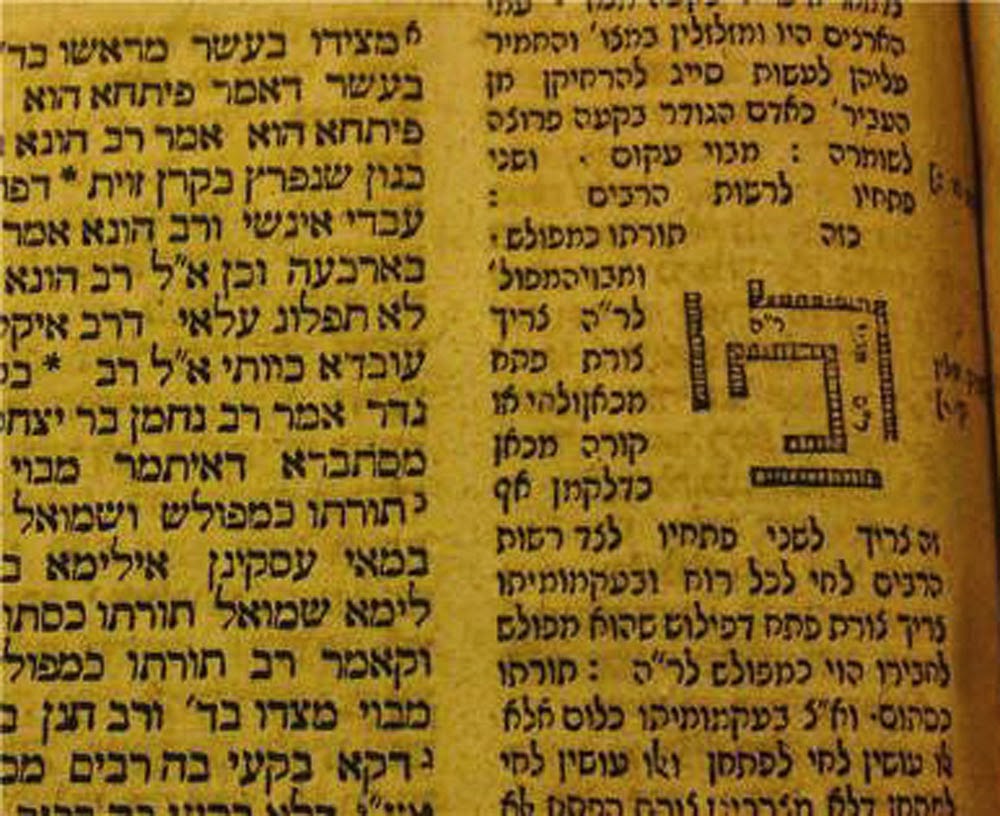
The Talmud Bavli, Eruvin, 6A, discusses the case of the מבוי עקום, literally a bent alley.[1] This is a mavoy (alley) shaped like an “L” that opens to the Reshut ha-Rabim at both ends. Indeed, both Rav and Shmuel agree that this mavoy is open on both ends to the  Reshut ha-Rabim, but, they disagree on its halachic treatment. As I mentioned, the word ‘akum literally means “bent”. But, how do we know it is actually an “L” shaped mavoy? Probably from this picture which we find in the classic Vilna Shas.
It shows an “L” shaped mavoy with the notation that this mavoy opens up to the Reshut ha-Rabim at each end. Rashi does not say that it is an “L” shaped mavoy, only “מבוי עקום ושני פתחיו לרשות הרבים – a mavoy ‘akum is one that has both of its openings facing the Reshut ha-Rabim. Rashi does, however, add a critical word which adds to our understanding of the term, and that is the word “ka-zeh” (like this, or in this context, as described below). Underneath the word ka-zeh, in the Vilna edition, is the diagram with the “L” shaped mavoy, and now we know how Rashi explains this term in the Gemara. Of course, this assumes that the diagram, as it appears in the Vilna edition, is what Rashi provided.  Thus, in order to ascertain if the “L” shaped diagram is really what Rashi intended, we need to examine earlier editions to assure ourselves that this diagram is the correct one. 
Let us now turn to the history of the printed editions of the Talmud and, specifically, the various versions of this Rashi in different editions. I first looked at the second Bomberg edition printed in Venice in 1528.[2] Marvin Heller states that the Bomberg editions were, to some extent, based on the previous editions of Gershom Soncino.[3] However, where Soncino editions did contain diagrams, the Bomberg editions did not.[4] Dr. Edward Fram writes that “A blank space was left on the page suitable for adding a woodcut, but, whether for financial or technical reasons, the diagrams were not included until later printings”.[5]  It wasn’t until Yissochar Berman Segal’s Frankfurt on Oder edition of 1697-1699, almost 200 years later, that diagrams were included in a printed edition.
Therefore, as we would now expect, the 1528 Venice edition looks like this.

The text in Rashi reads מבוי עקום ושני פתחיו לרשות הרבים כזה. The words are perfectly clear, but without a diagram to indicate what the word ka-zeh meant, a student might be a bit lost.

At least the reader would know that there was supposed to be a diagram there, and he might look somewhere else (perhaps in an old Rashi manuscript) to find it.
Such is not the case for our next example, which was printed in Cracow in 1619. This was a smaller version of the Talmud and included only the text of the Gemara and the Rashi. It was printed for students for use in various Yeshivos.[6] Here is how our passage looks there.


If you look at the 7th line on the picture shown, you will see it says מבוי עקום ושני פתחיו לר”ה כזה, but there is no space left to indicate a diagram was supposed to go there. One wonders what went through the mind of a young Yeshiva student when he studied this line. It is perhaps no wonder that Marvin Heller quotes R. Raphael N.N. Rabinowitz comment regarding this edition of Eruvin that “the tractate is almost impossible to learn from, and is, therefore, worthless.”[7]
Next we will go to the Benveniste edition, printed in Amsterdam in 1644. Similarly, this edition does not contain diagrams, as we can see from a copy that I possess.


However, as noted above, there were some editions that had the blank spaces filled in by artists or through the addition of woodcuts. Such is an edition housed in the Library of Congress, where the page in question looks like this.

The words inside the diagram are smudged, but at least it is somewhat clear that the alley in question is “L” shaped.[8]

Let us finally get to the first edition that had diagrams included, that of Frankfurt on Oder of 1697. After almost 200 years of no printed diagrams, just empty spaces, this is what we see.


It is safe to say that the editors belonged to the minimalist group of diagram makers. We can see the “L” shape, but no indication of where the reshut ha-rabim begins. You will also notice that the word מכאן  is spelled incorrectly as מיכן, in the text of the Rashi.[9] Not an auspicious start for diagrams in the printed Talmud.
From then on, the diagrams get a little better and begin to look quite a bit like the definitive diagram in the Vilna Shas. Here are a few examples.

AMSTERDAM, 1743


DYHERNFURTH 1816
My personal favorite is from Frankfurt on Oder of 1734. I think the picture tells the story best (even better than the Vilna Shas) because of the position of the words “reshut ha-rabim“. (ר”ה as abbreviated)

This edition, correctly shows the reshut ha-rabim beginining only where the alley ends.
As I mentioned before, the  Soncino editions contained the diagrams that were missing in the Bomberg editions. (See note [4] below). Clearly, these came from manuscripts which were used to prepare the Soncino editions. It was easy for a scribe who was copying a manuscript to insert a diagram where indicated, as everything was being done by hand. We might also assume that the copyists were artistic in nature and that drawing a diagram came easily to them.
I am left with just a few questions.
1. Who drew the first diagram? Was it Rashi himself? Are there manuscripts that provide evidence that Rashi did or did not execute the diagrams that appear in today’s editions of the Talmud?
2. Did Rashi even write the word “ka-zeh” in his Peirush?
3. Once the original manuscript of Rashi was copied and re-copied, did the diagrams change? I can imagine that a copyist wanted to strictly maintain Rashi’s words, but I wonder if one of them thought that their version of a diagram might be better understood? This would cause later versions to be changed forever.
We know that a picture is worth a thousand words. We are also taught that in studying Gemara, every word is precious. It is therefore very important that the diagrams that we have be accurate, so that the thousand words they tell us will also be accurate.
NOTES

[1]  The online Milon gives the following meaning to the word “‘akum” – curved; bent; inclined. Jastrow renders our particular passage as “a winding alley.” Clearly, a picture would be helpful here to indicate what the Gemara was talking about.
[2]  Maamar ‘al hadpasat ha-Talmud with Additions, ed. A.M. Habermann, Mossad ha-Rav Kook, Jerusalem: 2006,  p. 73 n.1. Rabinowitz states that although it is unclear to him the exact date of the printing of all the volumes of this edition, he had a copy of Eruvin that provided it was printed in [5]288 (1527/8). This is the same year indicated in the copy in the Library of Congress.
[3]  Marvin J. Heller’s Printing the Talmud: A History of the Earliest Printed Editions of the Talmud, Brooklyn, NY: 1992,  p. 145.
[4]  Here is an image of the Soncino, Pesaro 1511 Eruvin 6A which shows a diagram of the “L’ shaped alley (from JNUL online digitized collection). Marvin Heller has a picture of the front page of this Tractate in his above cited book (p. 110) and he identifies it as Pesaro 1511.
[5] Edward Fram, “In the Margins of the Text, Changes in the Page of the Talmud,” in Printing the Talmud: From Bomberg to Scottenstein, ed. Sharon Lieberman Mintz et.al., Yeshiva Univ. Museum, New York: 2005, p. 91, n.4. 
[6] Heller id. at p. 38.
[7] Id. p. 388. According to Heller, Rabinowitz made his comment because of the inferior paper and letters of this edition. But, I imagine that he was also bothered by instances such as this.
[8] Here is a picture of a different page of Eruvin from the same copy with diagrams drawn in by ink. Although he was living in Amsterdam at this time, I do not think it was Rembrandt who drew these.

[9] It was spelled that way in the Pesaro 1511 edition also. I assume that the Vilna Shas version is correct.


New Writings from R Kook Part 1 by Marc B. Shapiro

New Writings from R Kook and Assorted Comments, part 1
by Marc B. Shapiro
20 Marheshvan,[1] 5771
I now want to return to R. Kook and discuss some of his writings that have recently appeared. This is the first of what will be a five part post. It will be followed by at least one other multi-part post also dealing with R. Kook’s new writings.
For those who have never read R. Kook and don’t understand why there is such excitement every time a new collection is published, I suggest you do the following: Take one of the volumes and sit with it for an hour, just going through it, page after page. Odds are that you will be hooked. The originality that you find, and the power of his writing, is just breathtaking. It is impossible not to sense the power of his spirit, and it draws you in.
Books will be written on R. Kook, focusing on the insights found in the recently published volumes. They will analyze what is original in these works and the evolution of his thought. My purpose is more limited as I just want to call attention to some passages that caught my attention and which I think are significant, not just in the context of R. Kook’s writings, but also for anyone interested in Jewish thought.
In 2006 R Kook’s Kevatzim mi-Ketav Yad Kodsho appeared, and we can thank Boaz Ofen for this. Included in this volume is what is referred to as the last notebook from Bausk, which was where R. Kook served as rabbi from 1901 until his aliyah in 1904. On pp. 66-67 we find what I think is R. Kook’s first discussion of evolution. Unlike his other writings, here R. Kook mentions that he is relying on Maimonides on how to deal to deal with it. He mentions that Maimonides assumes the eternity of the world when he seeks to prove the existence, unity, and incorporeality of God. Maimonides adopts this model so that his proof will be acceptable to everyone. R. Kook states that this is also how we should deal with the issue of evolution. In other words, even if we don’t accept it, we should, for the sake of argument, assume that evolution is correct and explain the Torah based upon this. This will mean that even people who accept evolution will see the truth of Torah. By rejecting evolution, and declaring that it is in opposition to the Torah, right from the start you are stating that Judaism has no place for those people who accept one of the major conclusions of modern science. It is noteworthy that this text does not have any of R. Kook’s later thought, which speaks of the theory of evolution as being in accord with kabbalistic truth.

Another early statement of his with regard to evolution is found in Shemonah Kevatzim 1:594. Here he says that it is very praiseworthy to attempt to reconcile the Creation story with the latest scientific discoveries. He says that there is no objection to explaining the Creation, described as six days in the Bible, to mean a much longer period. He also states that we can speak of an era of millions of years from the creation of man until he came to the realization that he is separate from the animals. This in turn led to the beginning of family life, in other words, “civilization”.
What R. Kook is saying is that the entire story of the creation of Adam and Eve is not to be viewed as historical. Rather, it is a tale that puts in simple form a long development of man’s intellectual and spiritual nature.[2] He doesn’t see this development as random, for he says that at the end of the long period it was a vision, or perhaps we should call it an epiphany, that offered man the perception that it was time to establish family life. It is, I think, obvious that the אדם referred to by R. Kook as beginning civilized life is not an actual historical man (i.e., Adam), but rather humanity as a whole.[3]

אין מעצור לפרש פרשת אלה תולדות השמים והארץ, שהיא מקפלת בקרבה עולמים של שנות מליונים, עד שבא אדם לידי קצת הכרה שהוא נבדל כבר מכל בעלי החיים, ועל ידי איזה חזיון נדמה לו שצריך הוא לקבע חיי משפחה בקביעות ואצילות רוח.
R. Kook also explains that the deep sleep God placed Adam in (Gen. 2:21) can be understood as representing the length of time it took for humanity to come to the awareness of the idea of “bone of my bones and flesh of my flesh”. In other words, R. Kook sees the opening chapters of Genesis as representing a long period of development of the most important ideas of civilization, that of the dignity of man and the importance of family and the bond of marriage. Nothing here is as it appears, and literalism is out of the question.
We find in R. Kook’s most recently published book, Li-Nevokhei ha-Dor, more passages that relate to what I have been discussing.[4] This is an early work which was being prepared for publication and was released on the internet against the wishes of the editor. It has now been widely distributed and there is no reason not to cite it. R. Kook saw this book as a modern day Guide for the Perplexed, so obviously there is a great deal we can learn from it. Shortly after the work was “released,” another edition of the book was published by the folks at Merkaz ha-Rav. They called it Pinkesei ha-Reiyah, vol. 2, and like everything else produced by these people, it is heavily censored.[5] (Parts of Pinkesei ha-Reiyah have been included in the new Humash ha-Reiyah that was just published. Here is a sample.

Although it would have been better had the editors used Li-Nevokhei ha-Dor, this new Humash is still a wonderful book to take to shul. You can find out more about it here.)

Li-Nevokhei ha-Dor begins (ch. 2) by arguing that it is the “obligation of the true sages of the generation” to follow in the path of the medieval greats who were always concerned about those suffering religious confusion. While the contemporary spiritual leaders must respond to the concerns of modern Jews, R. Kook points out that since the issues confronting people today are so different than those of the medieval period, the works of the rishonim are of only limited value in confronting the current problems.

In ch. 3 R. Kook states that the medieval approach of trying to “prove” religion will not work in our day, and that in place of this, religious leaders should stress justice and righteousness, i.e., the humane values of Judaism.[6] He recognizes that the real problem for modern Jews is not the scientific or philosophical challenges to Torah, but the ethical ones, and that Torah scholars must explain those concepts that appear to stand in contradiction to modern ethical values. He sees this task as just like what the medievals did in dealing with the physical descriptions of God in the Bible, which contradicted the philosophical notion that God has no form. These sages showed the way out of this problem and in the end the truth of the Torah was understood. R. Kook says that contemporary sages must do the same thing with regard to ethical challenges. If not, people will reject the Torah because they view its message as contradicting what they know to be ethical, that which R. Kook refers to as “the laws of natural morality” (חקי המוסר הטבעיים).
With this in mind, let me quote an amazing passage of R. Kook that I have referred to before. It appears in Shemonah Kevatzim 1:75 and the translation is by David Guttmann.[7]

Yir’at Shamayim—fear of heaven—may not supplant the natural sense of morality of a person, for in that case it is not a pure Yir’at Shamayim. The signpost for a pure Yir’at Shamayim is when the natural sense of morality (המוסר הטבעי) that is extant in the straightforward nature of man is improved and elevated by it more than it would have been without it. But if one were to imagine a kind of Yir’at Shamayim that without its input, life would tend to do well and bring to fruition things that benefit the community and the individual, and furthermore, under its influence less of those things would come to fruition, such a Yir’at Shamayim is wrong.

The upshot of this passage is that some (much?) of what passes for piety today is really nothing more than a corrupted religiosity.

This natural morality that R. Kook spoke of was not only in nature, but also in people. This led R. Kook to a unique understanding of the relationship between scholars and masses. Anyone who has studied in a yeshiva knows that it inculcates a certain amount of condescension for the masses. For what could the masses, the typical am ha-aretz, possibly have to offer the scholar? Yet R. Kook saw matters differently, and recognized that there was an element of natural Jewish morality in the masses that was no longer to be found among the scholars, and the scholars ignored this to their own detriment. And let us not forget that the masses that R. Kook was referring to were not like many of our masses who go to day school, yeshiva in Israel, and attend daf yomi before going to work. The East European Jewish masses never opened a Talmud after leaving heder. They were pious and recited Psalms and came to a shiur in Ein Yaakov or Mishnayot, but without having studied in yeshiva, and lacking an Artscroll, the Talmud was closed to them. Incidentally, the rabbis had no problem with this arrangement, unlike today when Talmud study has become a mass movement.

Had the masses in R. Kook’s day had any serious learning, then he couldn’t have said what he did, because his point is precisely that learning “spoils” some of the Jew’s natural morality. Here are R. Kook’s words in Shemonah Kevatzim 1:463:

האנשים הטבעיים שאינם מלומדים, יש להם יתרון בהרבה דברים על המלומדים, בזה שלא נתטשטש אצלם השכל הטבעי והמוסר העצמי על ידי השגיאות העולות מהלימודים, ועל ידי חלישות הכחות וההתקצפות הבאה על ידי העול הלימודי.
This is a an anti-intellectual passage, in which we see R. Kook favoring the natural morality and religiosity of the simple Jew over that of his learned co-religionist. (It was precisely this sort of sentiment that was expressed by Haym Soloveitchik at the end of “Rupture and Reconstruction.”) Can anyone be surprised that this passage was not published by R. Zvi Yehudah? He recognized all too well the implications of these words, which I am only touching on here.

R. Kook continues by saying that the masses need the guidance of the learned ones when it comes to the halakhic details of life. That we can understand, since the masses can’t be expected to know, say, the details of hilkhot Shabbat. But in a passage quite subversive to the intellectual elite’s self-image, R. Kook adds that the learned ones also have a lot to learn from the masses. In fact, if you compare what each side takes from the other, I don’t think there is any question that what the masses give the learned is more substantial than the reverse.
והמלומדים צריכים תמיד לסגל לעצמם כפי האפשרי להם את הכשרון הטבעי של עמי הארץ, בין בהשקפת החיים, בין בהכרת המוסר מצד טעביותו, ואז יתעלו הם בפיתוח שכלם יותר ויותר
In ch. 4 of Li-Nevokhei ha-Dor, R. Kook comes to evolution and here he speaks of the billions of years of history identified by modern science. He says that this is a problem for the קטני דעה who think that evolution is a rejection of God, but those who hold such a position are making a great error. The true believer will be led to even greater wonder at the ways of God when he sees how long it has taken for species to evolve. As for the Creation story, R. Kook begins ch. 5 by telling us that it is not to be understood literally, as Maimonides had already taught. Knowing that some might nevertheless be tied to a literal reading of the opening chapters of Genesis, R. Kook insists that this is not one of the principles of the Torah. (Until a few years ago this was not a principle in the haredi mind either.)
In ch. 5 we see R. Kook’s preference for the evolutionary scheme over the traditional story of creation at one time, and he sees this understanding as bringing us closer to God. Just as we are amazed by the growth of a baby inside the womb, so too we will be in awe at the development of the physical world. He is absolutely clear that the creation story is not a scientific description but is directed towards a moral end:
ויסוד הדבר, שלא דברה תורה כי אם במה שנוגע לכדור ארצינו, וגם זה רק לפי התוכן שיובן הצד המוסרי שנוגע להישרת דרכי האדם הליכותיו החיצוניות ורגשותיו הפנימיים יפה יפה
This is a strong rejection of the neo-fundamentalist hermeneutical acrobatics of people like Gerald Schroeder (and to a lesser extent Nathan Aviezer).[8] They start with the assumption that the Torah’s Creation story is indeed describing scientific reality, yet until they explained it, no one in history had understood the meaning of the verses. From R. Kook’s perspective, this is a great misinterpretation of what the Creation story is telling us. As for the “young earthers’” objection (which I admit to having never understood) that Shabbat depends on seven 24 hour days of creation, R. Kook disposes of that without much ado:
אין כל מניעה בזה לא מצד הכתובים, ולא מצד חובת קדושת השבת שמכוונת כפי הציור הפנימי של האדם
He continues by saying that other parts of the Creation story can also be explained in a non-literal fashion:
ואפילו אם נפרש עוד יותר על פי משל את הסידור של בריאת האדם, שימתו בגן עדן, קריאת השמות, בנין הצלע, אין דבר מתנגד ליסודי התורה . . . ואין קפידא אם נצייר הנחש כולו ציורי, וכן עץ הדעת על התגלות הנטיה לצאת ממצב המנוחה והתמימיות העדינה
Crucial for R. Kook’s understanding is that that there came a point in human development when man was able to recognize the Divine. Only then could he be described as created in the image of God.
Even before the recent publications, these thoughts of R. Kook were not unknown. Here is what he writes in Iggerot ha-Reiyah, no. 134:
אין לנו שום נפ”מ אם באמת היה בעולם המציאות תור של זהב [=גן עדן], שהתענג אז האדם על רב טובה גשמית ורוחנית, או שהוחלה המציאות שבפועל מלמטה למעלה מתחתית מדרגת ההויה עד רומה, וכך היא הולכת ומתעלה
The last part of this quotation refers to the evolutionary understanding, in that existence works its way “from the bottom up”.
Returning to Li-Nevokhei ha-Dor, ch. 5, as an example of how the allegory works, R. Kook refers to Eve being taken from Adam’s rib, which cannot be understood literally if we are dealing with an evolutionary scheme. He sees this as a vision, designed to show that family life can only succeed if both husband and wife join together. The wife cannot be a helpmate alone, but has to be joined with her husband. A surface read of this passage might lead one to think that according to R. Kook this “vision” was an actual event that occurred with the historical “first man”, which would means that this first man had a relationship with God. Yet from Shemonah Kevatzim 1:594, which is a parallel passage to the one in Li-Nevokhei ha-Dor, we see that this is not the case.
להשוות סיפור מעשה בראשית עם החקירות האחרונות הוא דבר נכבד. אין מעצור לפרש פרשת אלה תולדות השמים והארץ, שהיא מקפלת בקרבה עולמים של שנות מליונים, עד שבא אדם לידי קצת הכרה שהוא נבדל כבר מכל בעלי החיים, ועל ידי איזה חזיון נדמה לו שצריך הוא לקבע חיי משפחה בקביעות ואצילות רוח, על ידי יחוד אשה שתתקשר אליו יותר מאביו ואמו, בעלי המשפחה הטבעיים. התרדמה תוכל להיות חזיונית, וגם היא תקפל איזה תקופה, עד בישול הרעיון של עצם מעצמי ובשר מבשרי. והודיע הכתוב שקדושת המשפחה קדם להבושה הנימוסית בזמן, וכן במעלה, שאחר ההתעוררות מהתרדמה הוחלט דבר זאת הפעם, ומכל מקום היו שניהם ערומים ולא יתבוששו.
According to R. Kook’s portrayal of humanity’s development in the direction of a stable family unit, there is only one word to describe the story told in Gen. 2, and that is “myth.” While in the popular mind myth often is identical with fairy tale, this is not how scholars understand myths. For them, myths communicate cosmic truths in non-historical story form, and they are not synonymous with legends. My dictionary explains myth as “a usually traditional story of ostensibly historical events that serves to unfold part of the world view of a people or explain a practice, belief, or natural phenomenon.” This explanation is a perfect description of what R. Kook writes in the passage just quoted from Shemonah Kevatzim.
The problem is, where do you draw the line? Is it only the stories at the beginning of Genesis that can be interpreted in a non-historical fashion, or has the door been opened to other sections of the Torah as well? R. Kook already confronted this issue in one of his classic letters to his student, Moshe Seidel (Iggerot ha-Re’iyah, vol. 2, no. 478), whom he had encouraged to study Semitic languages.[9] R. Kook admitted that there was no clear dividing line, but that the Jewish people as a whole would come to a proper insight.
ואם אין כל יחיד יכול להציב גבול מדויק בין מה שהוא בדרך משל בתורה ובין מה שהוא ממשי – בא החוש הבהיר של האומה בכללה ומוצא לו את נתיבותיו לא בראיות בודדות כי אם בטביעות עין כללית.
Following this, R. Kook raises the issue of what to do if it can be proven that the Torah’s description of matters is not entirely accurate. Often when R. Kook spoke about these matters, he was referring to the Torah’s description of creation vs. what science tells us. Yet I don’t think that this is what he is referring to in this letter. To begin with, he doesn’t speak about issues of science here. He is talking generally about matters described in the Torah that conflict with research (hakirah). These would also include historical descriptions found in the Torah. We must remember that the letter is to Seidel, who was involved in academic Bible study and was struggling with this. I think it is pretty clear that his concern was not with science and creation but with the larger issue of what the Torah recorded vs. what the critical scholars were saying. (Unfortunately, I am informed that Seidel’s letter to R. Kook, which R. Kook is in turn responding to, is not found in the R. Kook archive.)
R. Kook tells Seidel that even if the Torah’s descriptions (“the commonly accepted description”) are not accurate, there must be an important and sacred purpose for these matters to have been presented in this way, rather than being described in an exact fashion. In order to show that this is a proper approach, R. Kook brings two amazing parallels. The first one is the law of yefat toar. In my earlier post dealing with developing morality, available here, I quoted R. Kook’s other recently published comments about yefat toar. Here is making a different point. He refers to the Talmud in Kiddushin 21b which states that this entire law is a concession to human passions, but it is not proper. The proper thing would be for a Jewish soldier never to do this, but since in the real world this sort of thing will happen, the Torah provides a context for it to be done in a more civilized manner.[10] The parallel R. Kook sees is that just like the morality described in the law of yefat toar is not perfect, but rather a concession to human weakness, so too descriptions of various things in the Torah need not be “perfect”, that is, historically accurate. There are times when for its own purposes the Torah needs to describe matters in ways that will accomplish certain goals, even if the descriptions are not “true,” i.e., historically true.
The next parallel he offers is Ex. 18:19, which describes Mt. Sinai at the time of the Revelation and states that “its smoke ascended like the smoke of the lime pit.” Rashi, based on the Mekhilta, comments that this reference to the smoke being like a lime pit was “to explain to the ear that which it can understand (לשבר את האזן).” In other words, it wasn’t really like a lime pit but this description is used to accomplish a larger goal. R. Kook develops this concept, and refers to this Rashi. Here is the passage in full:
ואם נמצא בתורה כמה דברים, שחושבים אחרים שהם לפי המפורסם מאז, שאינו מתאים עם החקירה של עכשו, הלא אין אנו יודעים כלל אם יש אמת מוחלטת בחקירה הזמנית, ואם יש בה אמת, ודאי יש גם מטרה חשובה וקדושה שלצרכה הוצרכו הדברים לבא בתיאור המפורסם ולא המדויק, כמו שהוא פשוט במושגים הרוחנים ובכמה יסודי מעשה, ש”דבר תורה כנגד יצה”ר” או “לשבר את האזן.”
Elsewhere, in Eder ha-Yekar, pp. 37-38, R. Kook explains that the Torah can describe events in a way not in accord with the astronomical or geological (i.e., historical) truth. This is done in order for the Torah to accomplish its goal, which is not focused on such matters but rather on
ידיעת האלהות והמוסר וענפיהם בחיים ובפועל, בחיי הפרט, האומה והעולם
In words very similar to those in his letter to Seidel, R. Kook writes there:
כבר מפורסם למדי שהנבואה לוקחת את המשלים להדרכה האנושית, לפי המפורסם אז בלשון בני אדם באותו זמן, לסבר את האוזן מה שהיא יכולה לשמוע בהוה, “ועת ומשפט ידע לב חכם”, וכדעת הרמב”ם וביאור הרש”ט במורה נבוכים סוף פרק ז’ משלישי, ופשטם של דברי הירושלמי שלהי תענית לענין קלקול חשבונות של תשעה בתמוז.
What R. Kook is saying here is that prophecy uses what is “widely accepted”, even if mistaken, as well as the forms of speech current among contemporary listeners.[11] With this conception, one can’t be disturbed if the Torah or other prophets describe matters not in accord with the facts as we know them today, because the immediate audience of the prophet did think that these were the facts. So, for example, the Torah does not describe a universe billions of years old because that was not part of the mental conception of the ancient Israelites. What is new in this passage is R. Kook’s reference to Maimonides and Shem Tov’s commentary.
He doesn’t explain what he has in mind when he refers to Maimonides, but by examining Shem Tov’s commentary to Guide 3:7, which R. Kook also refers to, all is revealed. Here Shem Tov is discussing Maimonides’ view of Ezekiel and a scientific error the prophet made. Shem Tov concludes his discussion with the following revealing words:
ידבר הנביא בענינים העיוניים במשפט החכם ולא ידבר בהם כמו נביא אם שאמרם הנביא
What this means is that when the prophet is speaking about philosophical or scientific matters, he is speaking from his own wisdom, not prophetic insight. Shem Tov’s point is that the prophet will assimilate his prophetic message to his own words, and the latter, based as they are on his own life experience and knowledge, could also contain error.
This is all based on what Maimonides himself writes in Guide 2:8. Here he explains that there is a dispute if the heavenly spheres emit sounds. The Sages believe they do, and Aristotle rejects this. Maimonides adopts Aristotle’s view and explains that the Sages were mistaken. In Guide 3:3 Maimonides identifies the wheels (ofanim) in Ezekiel’s vision with the spheres, and if you examine Ezekiel 1:24 and 10:5 you find that the prophet describes the wheels (=spheres) as producing sounds. The upshot of this is that according to Maimonides Ezekiel’s prophecy incorporated a mistaken scientific view, a view which he points out was later shared by the Sages of Israel. This explanation of Maimonides, quoted from Narboni, is recorded by Shem Tov in his commentary to Guide 3:7.[12] As mentioned, this is what R. Kook refers the reader to.
Ralbag, commentary to Gen. 15:4 and to Job, end of ch. 39, also refers to Maimonides’ view that the prophets could be in error about scientific matters. He refers in particular to Ezekiel’s scientific error, and expresses his agreement with Maimonides’ position. In his commentary to Job he explains:
ספר זה עם ספורו שאר הדברים הנעלמים להיות זה נעלם לאיוב כי בנבואה יבואו כמו אלו הענינים לפי המקבל . . . שכבר יגיע לנביא דבר כוזב בעת הנבואה, במה שאין לו מצד שהוא נביא מצד הדעות אשר לו בענינים ההם.
In other words, prophetic books might record mistaken ideas because that is what the prophet thought. Ralbag gives another example of this. In Gen. 15 Abraham was told to look at the sky and just as he could not count the stars of heaven so too his children will be so numerous. According to Ralbag, this is an example of a prophet receiving false information in accord with his mistaken conception. Since Abraham falsely believed that there are many stars, his prophecy contained this false conception, while in reality according to Ralbag there are actually a limited number of stars.
Ralbag further explains his view of the stars in Milhamot ha-Shem 5:1:52, which has not yet been published and is quoted from manuscript in the Birkat Moshe edition of Ralbag on Genesis, pp. 222-223. Here Ralbag rejects the view of those who thought that there were many unseen stars and asserts that the only stars are those that can be seen. (Maimonides, Guide 1:31, states that the number of the stars is unknown.) He mentions that others had assumed that there were unseen stars because otherwise the prophecy of Abraham would not make sense. If you look up at the stars there aren’t so many of them, and therefore, what type of promise is it that Abraham’s descendants will be as many as the stars?
Unlike in his commentary to Genesis, here Ralbag does not claim that Abraham’s prophecy was incorrect when it came to the number of stars. Instead, he states that the meaning of the verse is not that Abraham’s descendants will be so many that they can’t be counted. Rather, just like it is difficult to count the stars, so too it will be difficult to count the descendants of Abraham because they will be so many. His proof for this contention is Moses’ words to Israel, Deut 1:10: “The Lord your God hath multiplied you, and, behold, ye are this day as the stars of heaven for multitude.” Moses says this even though he had already counted the Children of Israel. Yet because they were so many that it was difficult to count them, he refers to them as “the stars of heaven”. According to Ralbag, this proves that the comparison with the stars does not mean “too many to count”, but only “difficult to count”.
Ralbag also cites a talmudic passage (Berakhot 32b) which speaks of an enormous number of stars (three hundred and sixty five thousand myriads). This contradicts his own view that the number of stars are quite limited. Yet Ralbag is not troubled and declares, in words that would get him banned today:
שבכמו אלו הדברים לא נרחיק שיהיו לקצת חכמינו אז דעות בלתי צודקות, כמו שיזכרו שחכמי ישראל היו אומרים שהגלגל קבוע ומזלות חוזרים ומה שדומה לזה.
In his commentary to Genesis 15:4 he writes:
לא יחוייב שיהיו אצל הנביא כל הדעות האמיתיות בענין סודות המציאות
Obviously, if you are prepared to say that great prophets such as Abraham and Ezekiel were wrong in scientific matters, it is only natural to assume the same thing when it comes to the Sages.
Of course, we know today how wrong Ralbag was. In fact, it is only in modern times that one can really appreciate Abraham’s prophecy. Later, in Gen. 22:17, he is told that his descendants will be as numerous as the sand and as the stars in the heaven. Centuries ago I think many people must have wondered about this verse. They could understand the promise that his descendants would be like the sand since the sand is so numerous it can’t be counted. Yet how is this comparable to the stars, since anyone can look up at the sky and see that there aren’t that many stars at all? Thus, pre-modern man should have been troubled since the two parts of the verse don’t correspond, even though they are supposed to. It is only with the invention of telescopes that people could see that the two parts of this verse, the sand and the stars, are really saying the same thing. Scientists now believe that the amount of stars runs into the sextillions and that there are more stars than grains of sand on the earth!

Returning to R. Kook’s letter to Seidel, he also refers to the end of Taanit in the Jerusalem Talmud. What is this about? According to Jeremiah 39:2 the Jerusalem city walls were breached on the ninth day of Tamuz. Yet JTaanit 4:5 states that this occurred on the seventeenth of Tamuz. How to make sense of this contradiction? The Jerusalem Talmud answers as follows:
קלקול חשבונות יש כאן

Korban Edah explains:
מרוב הצרות טעו בחשבונות ולא רצה המקרא לשנות ממה שסמכו הם לומר כביכול אנכי עמו בצרה
In other words, the book of Jeremiah records mistaken information, but that is because it chooses to reflect the mistaken view of the people, rather than record the accurate facts. As the final words of Korban Edah explain, there are more important considerations for the prophet than to be accurate in such matters. R. Kook sees the lesson of this talmudic passage as applicable to elsewhere in the Bible, namely, that absolute accuracy in its descriptions (both scientific and historical) is not vital and can therefore be sacrificed in order to inculcate the Bible’s higher truths. R. Kook does not tell us how far to take this principle, and no doubt he himself was not sure.[13] The only thing he could say was that these matters would be settled by, as mentioned already, החוש הבהיר של האומה
Another example of a biblical book containing incorrect information is found in Nehemiah 7:7, as explained by the medieval commentary attributed to Rashi. After noting that the numbers given in Nehemiah ch. 7 are not always the same as those mentioned in the book of Ezra, “Rashi” states:
ולא דקדק המקרא בחשבונות כל כך אבל הכלל שוה . . . ועל זה הכלל סמך כותב הספר ולא דקדק בחשבון הפרטיות כל כך.
What this means is that the author of the book of Nehemiah was not careful in the details he recorded, as long as the big picture—in this case, the total number of people—was correct. How many other places in the Bible can we apply this insight to?
The fourteenth-century R. Eleazar Ashkenazi ben Nathan ha-Bavli has an even more radical approach, as he believes that there are inaccuracies in the Torah itself.[14] It is true that at times he is quite conservative. For example, he rejects Ibn Ezra’s assumption that there are post-Mosaic elements verses in the Pentateuch.[15] He also strongly rejects the aggadah that the Land of Israel was not included in the Flood,[16] because the verse tells us that all life on earth was destroyed: ואין לחוש על דבר משמכחיש גופי התורה
Yet his more “liberal” side is seen many other places. For example, he assumes that the extremely long lifespans found at the beginning of Genesis are not to be taken literally (p. 29).
וימי חייהם אז היו כימי חיי אנשי דורנו לא פחות ולא יותר כי לא היו אז מזהירים כשמש ולא חזקים כנחושה, אבל היו מבשר ודם ומזרע אשה ומדם נדותה ככל אשר אנחנו עושים פה היום
If people never lived so long, why were these number included in the Torah? R. Eleazar claims that Maimonides’ approach is to regard the lengthy lifespans as simple figures of speech, not meant to be taken literally any more than the statement that the Land of Israel was flowing with milk and honey or that the cities in Canaan were “fortified up to Heaven” (Deut. 1:28).[17]

He also offers another explanation for the lengthy lifespans, namely, that the Torah recorded what the popular belief was, no matter how exaggerated, and Moses was not concerned about these sorts of things. In other words, just like today people say that the Torah is not interested in a scientific presentation of how the world was created, R. Eleazar’s position is that the Torah is not interested in a historically accurate presentation. In his mind, this has nothing to do with the Torah’s goals, and therefore there was no reason for the Torah not to present matters as they were believed at the time, even if these perceptions were inaccurate. The important thing, he says, is that the people would know that from the creation of the world until Israel stood at Sinai was close to three thousand years. This would help solidify belief in creation. The records of lifespans are just a means to illustrate this information.[18] He adds that when it came to events closer to Moses’ time, Moses was careful in preserving a more accurate accounting, while leaving the stories of the distant past cloaked in legend.
There are other ways rationalists have dealt with the lengthy lifespans. For example, R. Nissim of Marseilles regards these years not as indicating an individual life, but rather the “lifespan” of the way of life (i.e., laws, customs) instituted by the figure in question, or the time until another one like him arose. He also assumes that when the Torah says that someone bore a son, it doesn’t have to mean a literal son. Here is what he writes in Maaseh Nissim, p. 274:
יש מי שפירש שהכונה בחיים ההם קיום נמוסיו והנהגותיו הזמן [בזמן] הנזכר, בין בחייו בין אחר מותו. כי אלו, אפשר שהיו אנשי שם, מחקים חוקים ונימוסים, ומנהגים במידותיהם, גם במאכלם ומשתיהם ובמלבושיהם, ואחר הזמן ההוא אפשר שנשתכח הכל ובחרו דרך אחרת. או תאמר, שלא קם כמוהו עד זה הסך מן השנים במעלת ידיעת ההנהגה לבני דורו. ובזמן ההוא קם כמוהו במעלה, נמשך לדעתו וכונתו, ונחה רוחו עליו כאשר נחה רוח אליהו על אלישע. ואם לא ראה הראשון זה שקם אחריו ולא היה בזמנו, אפשר למד מספריו או התבונן בדבריו המקובלים, ועל זה כתוב: “ויולד” שהוליד בדמותו במעלה, כאלו הוא הוליד האיש ההוא מאשר הוא בעל הדעת ההוא שלמדוהו.
In support of this approach, he refers to Va-Yikra Rabbah 21:9 which cites an opinion that Scripture intimated to Aaron that he would live 410 years. Although the Torah tells us that he only lived to 123 (Num. 33:39), the Midrash says that the righteous High Priests in the First Temple are called by Aaron’s name. In other words, they represent the spirit of Aaron, so in that sense it can be said that he lived so many hundreds of years. So too, R. Nissim thinks, when Scripture speaks of other people living so many hundreds of years it is to be understood in this fashion.
Another approach was suggested by R. Moses Ibn Tibbon, who is quoted by R. Levi ben Hayyim.[19] According to Ibn Tibbon, the years given for people’s lives are actually the years of the dynasties they established.[20] (His other suggestion is the same as that of R. Nissim, mentioned above.):
והחכם ר’ משה פירש, כי כל אחד מאלו היה מלך או הניח נימוס, וכל זמן התמדת מלכותו ומלכות זרעו, או כל ימי המשכות נימוסו, קרא דור אחד, כאלו היה המלך או מניח הנימוס חי, וטעם “ויולד בנים ובנות” כי לאורך הזמן רבו ועצמו בני מלכותו או אנשי דתו, ושלחו קצתם אל ארץ אחרת.
R. Levi ben Hayyim offers basically the same approach (p. 326):
ונראה לי כי הדורות הנזכרים היו ראשי אבות, וזרע כל אחד נקרא בשמו כפי מספר השנים ההם. כי כל אחד, כמו שנאמר, הוליד בנים ובנות, כמו שנראה היום, עד שנשקע השם מהדורות הבאים אחריו, וקח מאתו זרע איש אחד מפורסם, וקראו בני זרעו ומשפחתו על שמו זמן מה, וכן התמיד עד שנתחדש דור אחר, נקרא [!] בניו ובני בניו על שמו [צ”ל שם] חדש. והורה ספור הדורות ההם מאדם ועד זמן משה על חדוש העולם.
To be continued
* * *
The new semester of Torah in Motion has just begun. The first figure I am dealing with is R. Elijah Benamozegh. You can sign up to participate in the classes here.
You can also sign up for the classes of Moshe Shoshan, Abe Katz, R. Daniel Feldman, and William Gewirtz. Dr. Gewirtz, who has published on the Seforim blog, will be giving three FREE special classes dealing with various aspects of time in Jewish law. This is a topic that few have been able to master and the classes promise to be a treat.
Even if you can’t watch the classes live, videos and audio are sent to you so that you can watch or listen at your convenience.

Also from Torah in Motion, information will soon be coming about the July trip to Central Europe that I will be leading.
[1] For the proper explanation of the etymology of Marheshvan, see Ari Zivotfsky’s article in Jewish Action, Fall 2000, available here. See also Abraham Epstein, Mi-Kadmoniyot ha-Yehudim (Vienna, 1887), pp. 23ff. Zivotofsky does not offer any sources for the mistaken etymology that Heshvan is bitter (mar) because it has no holidays in it. I don’t know the first appearance of this notion, but it already is found in R. David Meldola, Moed David (Amsterdam, 1740), p. 64a.
[2] Among rishonim, Ibn Caspi had already stated that Adam was not the first man. See Matzref ha-Kesef, pp. 16-17 (contained in Mishneh Kesef, vol. 2). In order to understand what Ibn Caspi is saying in this passage, one needs to be attuned to his elusive style. See also his commentary to Guide 1:14, where he understands Maimonides to be saying that the Adam of Genesis is really referring to Moses.
[3] Rishonim already proposed that the word האדם in Gen. ch. 2 refers to humanity, rather than an individual person. See e.g., Ibn Ezra to Gen. 2:8, who states that this interpretation is a secret, i.e., not designed for the masses. See also his commentary to Ex. 3:15. R. David Kimhi also felt that this “truth” should be kept from the masses, who should instead be taught a different “truth”, namely, the Adam and Eve story in a literal fashion. See his esoteric commentary to Genesis, printed in Louis Finkelstein, ed., The Commentary of David Kimhi on Isaiah (New York, 1926), p. LIV:

עתה אשוב לפרש הנסתר אשר מפסוק וייצר ה’ א-להים את האדם (בראשית ב, ז) עד זה ספר תולדות אדם (בראשית ה, א) ותחלה אומר כי האדם הנזכר מפסוק זה עד זה ספר תולדות אדם הנגלה הוא על אדם הראשון והנסתר הוא על שם המין ושניהם אמת אך הנגלה הוא להמון והנסתר הוא ליחידים שהם סגולת ההמון.

Here is how he understands the Garden of Eden (ibid.):

עדן הוא משל לשכל הפועל הוא העדן האמתי הרוחני והא-ל נטע בו גן מקדם בראש בריותיו כשברא השכלים הנבדלים.
[4] You can find the book here
[5] See Eitam Henkin’s post here. For another post by Henkin on this book, see here. English readers are probably unaware of Henkin, the son of R. Yehudah Herzl Henkin. In the last few years he has really created a reputation for himself as he has authored a number of important articles which show an incredible amount of knowledge on the history of Torah Judaism in modern times. He has also written a sefer, soon to be published, which deals with the halakhot of bugs in food. Unlike the rage today, he rejects the extreme positions, one of which is that due to bug infestation, strawberries are no longer permitted to be eaten. See e.g., here. Henkin’s book will carry the following haskamah of R. Meir Mazuz.

[6] R. Jehiel Jacob Weinberg would later argue against trying to “prove” Judaism in the medieval fashion. In the post-Hume and post-Kantian world I thought that this was pretty much agreed upon by everyone. How wrong I was can be attested to all who attended my lecture on Maimonides at the 2008 New York Limmud conference and recall the dispute that took place afterwards. An individual who is involved in kiruv adamantly insisted that the major doctrines of Judaism can be proven to the same degree of certainty as a mathematical proof, and that these truths can thus be proven to non-Jews (who if they don’t accept the proofs are being intellectually dishonest). In this conception, there is no longer room for “belief” or “faith”; since the religion has been “proven” we can only speak of “knowledge”. The notion that Judaism could not be proven in this fashion was, I think, regarded by him as akin to heresy. I have had a lot of contact with “kiruv professionals” and had never come across such an approach. Yes, I know that people speak about the Kuzari proof for the giving of the Torah. However, I always understood this to be more in the way of a strong argument rather that an absolute proof, with the upshot of the latter being that one who denies the proof is regarded as intellectually dishonest or as a slave to his passions. I also know R. Elchanan Wasserman’s strong argument in favor of the viewpoint expressed by my interlocutor (see Kovetz Ma’amarim ve-Iggerot, pp. 1ff.), but before then had never actually found anyone who advocated this position, lock, stock and barrel. So the question to my learned readers is, is there a kiruv “school” today which does outreach based on the “Judaism can be proven” perspective?
[7] See here.
[8] In his latest book, God According to God, Schroeder—who according to his website teaches at Aish ha-Torah— “goes off the haredi reservation” in a much more serious way than Slifkin. Here is how his website describes the book: “In God According to God, Schroeder presents a compelling case for the true God, a dynamic God who is still learning how to relate to creation.” See here. I daresay that one would be hard-pressed to find even a Modern Orthodox rabbi who would not regard this view of an imperfect God as a heretical position.

In a future installment I will deal with Aviezer who unlike Schroeder, has real Judaic learning. Unfortunately, despite his scientific expertise, Schroeder makes numerous errors when he deals with the Jewish side of things. From what I see on the internet, it appears that a majority of his readers are non-Jewish, so these errors will not be noticed by them. Yet they are bound to be annoying to educated Jewish readers. Let me give just a few examples from his new book, God According to God.

P. 11: “The Hebrew word for ‘slave’ is ‘worker’ with all the connotations that differentiate the modern concept of slave from that of a worker.” He then apologetically describes the laws of slavery without distinguishing between the Hebrew slave and the Canaanite slave, and apparently without realizing that the latter was indeed a real slave. See Shulhan Arukh, Yoreh Deah 158:1, where R. Moses Isserles writes:


מותר היה לנסות רפואה בעבד כנעני אם תועיל
P. 11: “Returning an escaped slave to the master was absolutely forbidden (Deut. 23:15-16).” Yet we are not Karaites and a glance at Rashi will show that this is not as “liberal” a law as he makes it out to be.

P. 22: [T]he ancient biblical commentators, those whose writings predate by many centuries the discoveries of modern science (writers of the Talmud, ca. 400; Rashi, ca. 1090; Maimonides, ca. 1190; Nahmanides, ca. 1250), learned from the detailed wording of Genesis that the universe is young and old simultaneously. These ancient commentators actually discuss what science has only recently discovered, that the flow of time is flexible.”

P. 23: “Moses Maimondes refers to a madah teva, the science of nature.”

P. 195: “The [biblical] Hebrew word le’olam has three root meanings: “forever,” “hidden” and “in the universe”.

Nothing I have said should be taken to imply that Schroeder does not have what to offer. However, before he publishes anything it should be reviewed by a Torah scholar, much as I would expect a talmid chacham writing on science to have his writing reviewed by a professional scientist.
[9] See Iggerot la-Re’iyah, vol. 1, no. 108. Seidel would later teach at Yeshiva College where some of the Roshei Yeshiva were upset with his views. See Ari Shvat, “Hahlatato shel ha-Rav Kook le-Tzamtzem et Hazono le-Limud Mehkari-Madai bi-Yeshivat Merkaz ha-Rav,” Talelei Orot 15 (2009), pp. 149-174.
[10] In a recent issue of Iturei Yerushalayim (Sivan 5769, pp. 9-10), R. Shlomo Aviner responds to a soldier who in all seriousness wanted to apply the law of yefat toar today with regard to Palestinian women. The soldier had in mind the understanding that rape of a yefat toar is permitted during battle.
Complete details can be found in the Encyclopedia Talmudit entry for yefat toar. There is a lot in this entry which will distress any reader, and according to the Sages, that is the way people should feel, for the entire law was a concession to human weakness. That is, it was a necessary evil, not something that people should strive for or feel proud of. This is how the entry in the Encylopedia Talmudit begins:

היוצא למלחמה וראה בשביה אשה נכרית וחשק בה, מותר לו לבא עליה – על כרחה.

In other words, it is permitted to rape a captive woman, and it was based on this understanding that R. Aviner was asked the question. Yet it is probably also the case that this view is not held by all. I say this since the Encyclopedia Talmudit entry itself records that there are those who require the woman to be converted before sex, and there are also those who state that the woman cannot be converted against her will. Although I haven’t compared all the positions, it is likely that there is some overlap here, i.e., authorities who require the woman to be converted and also hold that the conversion has to be an act of her free will.

Yet it is also the case that plenty of authorities do permit rape of a yefat toar (including a married woman), either on the battlefield or later. In his commentary to Gen. 34:1, Nahmanides writes:

כל ביאה באונסה תקרא ענוי, וכן לא תתעמר בה תחת אשר עניתה.

I have no doubt that today, when everyone would be horrified by this behavior, and it is forbidden in all civilized societies (and even uncivilized ones), such an action would not be permitted even as a concession to human weakness. I can’t imagine that anyone in our day would condone rape, no matter what the circumstances, and certainly no one would defend the following opinion quoted in the Encyclopedia Talmudit:

היתה השבויה קטנה, כתבו אחרונים שביאה ראשונה – לסוברים שהיא לפני גירות – מותרת אף בקטנותה.

From R. Aviner’s reply we see that he doesn’t believe that the yefat toar law has any applicability today:

בוודאי שאין דין יפת תואר נוהג בימינו, ואני תמה על השאלה הזאת שהנך שואל למעשה, שכידוע לא דיברה תורה אלא כנגד יצר הרע, והרי אדם צריך להלחם ביצר הרע ולא לחפש היתרים ליצר הרע. וכבר כתב רבי יהודה החסיד בספר חסידים [סי’ שעח] שיש דברים שהתורה התירה אבל אם יעשה אותם האדם הוא יבוא לדין עליהם שהרי התורה רק התירה בגלל יצר הרע. ואם אדם נותן שחרור ליצר הרע, הוא ייתן את הדין . . . לגופו של עניין, כל הדין הזה הוא בשביה, ולא שאדם ילך לבתים של אויבים ויעשה שם נבלות, והרי נשים אינן שבויות צה”ל, וגם אם יש שבויה, בוודא שצה”ל לא ירשה כזו נבלה . . . בסיכום, זה לא שייך כלל וכלל. הרחק ממחשבות אלו, אלא אדרבה למד הרבה בספר מסילת ישרים.

In this, R. Aviner is following the approach of R. Kook who speaks of the need to rise above the law of yefat toar. In my previous post dealing with developing morality, referred to in the text, I quoted R. Kook as follows:

כל לב יבין על נקלה כי רק לאומה שלא באה לתכלית חינוך האנושי, או יחידים מהם, יהיה הכרח לדבר כנגד יצר הרע ע”י לקיחת יפת תואר בשביה באופן המדובר. ומזה נלמד שכשם שעלינו להתרומם מדין יפת תואר, כן נזכה להתרומם מעיקר החינוך של מלחמת רשות.

Note that R. Kook speaks of תכלית חינוך האנושי and not Torah education.

We have recently seen the publication of Torat ha-Melekh (which I will discuss in a future installment of this post). When I told a friend about the question of the soldier to R. Aviner, he commented, only half-jokingly, that we will probably soon see a book on how Israeli soldiers can institute the law of yefat toar in modern times.

Finally, I would be remiss in not mentioning that R. Meir Simhah of Dvinsk basically turns the entire law of yefat toar into something completely theoretical, much like ben sorer u-moreh. I say this because R. Meir Simhah assumes that the law is not applicable in a war where the enemy could be holding Jewish prisoners, which in the real world is always the case. Here are his words in Meshekh Hokhmah, Deut. 21:10:

נראה דהוא תנאי בהיתר יפת תואר, שדוקא אם ה’ נותן האויב ביד ישראל. אבל כדרך המלחמות שאלו שובים מהם, והאויב שובה מהם, והדרך כשעושים שלום או בתוך המלחמה, מחליפים שבויים שאינם ניאותים עוד למלחמה. אם כן יתכן כי עבור היפת תואר שמגיירה ונושאה לאשה בעל כרחה, יעכבו ישראל חשוב ונכבד, על זה לא הותר היפת תואר.

[11] The exact same point is made by the Gaon R. Shlomo Fisher, Beit Yishai (Jerusalem, 2004), p. 361:
. . . העיקר גדול שהשרישו לנו הקדמונים שדברה תורה כלשון בני אדם. והכונה היא לאותו לשון שדברו בו בני אדם באותו הדור שבו נאמרו הדברים.

Fisher uses this insight to explain Zechariah 4:10: שבעת אלה עיני ה’ המה משוטטים בכל הארץ

According to Fisher—and this is an incredible insight for a traditional interpreter (although it is already noted in the International Critical Commentary)— this verse alludes to the שבעה כוכבי לכת. These are the seven heavenly bodies identified already by ancient Babylonian astronomers: Mercury, Venus, Mars, Jupiter, Saturn, moon, and sun. Yet with the invention of the telescope we now know that there are more planets, meaning that Zechariah’s prophecy was based on a scientific error. But as Fisher explains, this is not a problem because as mentioned, prophecy is given in accord with the knowledge of the generation. Fisher adds that prophecy is also given in accord with the knowledge of the prophet, which in this case as with Ezekiel was based on a scientific error.
כי הנבואה תבא לו לנביא לפי תמונת העולם שבלבו

As an aside, I wonder why no one has tried to put Fisher’s book under a ban. While Slifkin stated that the Sages didn’t know everything about science, Fisher goes further and says that even the prophets didn’t know it all. He adopts the same approach to explain why classic Kabbalistic texts are based on outmoded scientific assumptions:

שחכמת הקבלה מיוסדת על תמונת העולם וחוקי הטבע שלפי חכמי יון, כגון, מציאות הגלגלים, ז’ כוכבי לכת, וד’ יסודות, וחומר וצורה. וההנחה שכל דבר נמשך למקורו.

Since I deal with R. Eleazar Ashkenazi ben Nathan ha-Bavli in this post, it is worth calling attention to his original understanding of the word שבועה. He sees it as related to the word seven, meaning that one who breaks an oath sins against God who controls the seven heavenly spheres. See Tzafnat Paneah, ed. Rappaport (Johannesburg, 1965), p. 69 (I think he means the seven spheres each of which contains a heavenly body, as opposed to the eighth sphere which contains the so-called כוכבי שבת, or fixed stars):

כי שם נשבעו בשבועת האלה. כי מי שיעבור על הברית ירבצו בו אלות מכח השבעה הגלגלים וזה סוד שם שבועה כי חלל שם ה’ המנהיג השבעה הגלגלים.
[12] Fisher, Beit Yishai, p. 361, accepts this interpretation of Maimonides. Ibn Caspi, Commentary to Guide 2:8, does not believe that Ezekiel’s actual prophecy could contain error. Rather, the error came during a dream of Ezekiel, not an actual prophecy. He also distinguishes between Sages who can err, as they are using their wisdom, and prophets who during actual prophecy do not err. However, when they are not prophesying they are susceptible to error like anyone else.
[13] Shalom Carmy took note of R. Kook’s comments and raised the following questions, without offering any answers:
It seems obvious that Rabbi Kook doesn’t advocate wholesale rejection of biblical statements. To do so would render Tanakh useless as a source of history. Under what circumstances would he countenance “deconstruction” of the text? Only where biblical texts contradict each other or rabbinic statements? Whenever the text appears to contradict well-attested Near Eastern documents? When the exact historicity is immaterial in the judgment of the exegete, to the import of the text? When the exegete detects rhetorical elements in the biblical text itself that point toward such interpretation?
See “A Room With a View, but a Room of Our Own,” in idem, ed., Modern Scholarship in the Study of Torah (Northvale, 1996), pp. 23-24.
[14] As Epstein, Mi-Kadmoniyot ha-Yehudim, pp. 125ff., has shown, Abarbanel used R. Eleazar’s commentary, even though he does not mention him by name (a characteristic that Abarbanel shows at other times as well).
[15] Tzafnat Paneah, p. 46.
[16] Ibid., p. 36. I think one can call this a conservative position with regard to biblical interpretation, but the language he uses to reject the aggadic view, הבל הוא, is quite provocative.
[17] In Guide 2:47 Maimonides says that the people mentioned in the Bible who lived so long were exceptional in this respect, either because of their diet, mode of living, or due to a miracle. R. Eleazar obviously does not see this as reflecting Maimonides’ true view.
[18] He writes (p. 30):

ואל תתמה על זה ואל יקל בעיניך זאת התחבולה הנכבדת שנתכוון אליה כדי לאמץ האמנת החדוש . . . ולזה הוצרך ע”ה לספר לנו חשבון השנים שעברו מזמן חדוש העולם עד זמננו, וזה היה עיקר גדול וצורך נפלא.
[19] Livyat Hen, ed. Kreisel (Beer Sheva, 2004), pp. 324ff. Here is the place to congratulate Howard Kreisel on the publication of the two volumes of Livyat Hen as well as R. Nissim of Marseilles’ Maaseh Nissim. As long as people study Jewish philosophy, they will use these editions. R. Joseph Kafih spent the last night of his life studying Ma’aseh Nissim. See Avivit Levi, Holekh Tamim (n.p., 2003), p. 226.
[20] R. Eleazar Ashkenazi, Tzafnat Paneah, p. 29, cites this approach in the name of Ibn Ezra, but he does not tell us where it is to be found in Ibn Ezra’s Torah commentary or other works.
אבל המשמע מדברי החכם ראב”ע ז”ל שהזקנים היו ראשי האבות לא שחיו המה כל כך.


Upcoming Kestenbaum Auction

Next week, Oct. 27, Kestenbaum & Co. is having an auction, and the catalog is availalbe online. Obviously, there are many items worth highlighting but I want to focus upon one general topic and select those lots that are relevant. The focus of this post is on translations and the vernacular.
Lot 7 is the first book using Hebrew fonts to teach Hebrew to an American audience. This book, Grammar of the Hebrew Tongue, written by Judah Monis, was a convert to Christianity from Judaism. Monis, was required to convert in order to obtain an instructorship at Harvard as a Jew could not be an instructor. Additional information on this book and Monis can be found here (as well as, of course, in the auction catalog).
Lot 12 brings us another American translation, this one Lesser’s translation of the bible into English for an American audience. Lesser’s other major work, an English translation of the siddur can be found at lot 23.
The Spanish translation of R. David Nieto’s Mateh Dan, Kuzari Helek Sheni can be found at lot 39. Nieto, who is well-known for being the Rabbi of the London Spanish and Portuguese community, and for being especially dapper, sporting Van Dyke beard and a wig, all the rage at the time leads us to our next piece of English Judaica and translations, an English Machzor (lot 42) published in London, 1807, that also includes the frontispiece portrait of Chief Rabbi Solomon Hirschell (see this nice write up on him). Another lot, 43, also of British origin is Netivot Olam by the missionary Rev. Alexander McCaul, and is the subject of an article by Dr. S.Z. Leiman (and this nice post as well).
As we have previously discussed books given as wedding favors, lot 76, is such an item “an adroit parody” on the occasion of the wedding of R. Dr. Raphael Breuer.
Returning to translation. One of the most famous translations and translators is Moses Mendelssohn and lot 223 combines both translations and Mendelssohn. This time it is not one of Mendelssohn’s own translations but a siddur edited by Yitzhak Satanow and includes a German translation. This particular item may have been Mendelssohn’s own personal copy and contains the initials M.M.D. on the spine – Moses Mendelssohn of Dessau. Indeed, in the subscriber list that appears at the beginning of the volume, Mendelssohn is indicated as purchasing 6 copies.
Another translation connected to Mendelssohn is the German translation of the Mishna which in turn was praised by Mendelssohn and that compliment is repaid by the translator who praises Mendelssohn with “from Moses to Moses there are none like Moses.” (Lot 236).
Continuing with the first Hebrew translation of Shakespeare, lot 267. The work in the translation department is the admittedly only loosely connected to the translation theme, the first edition of Spinoza’s Opera Posthuma, lot 278.
Finally, we get to the highlight of the auction, four leaves of a Guadalajara Talmud, 1480-82, lot 279. As everyone is aware, the Spanish imprints are exceedingly rare and auctioning even four leaves is a rare event. For more on this lot, see the excellent description in the catalog.


Shaul Magid – ‘Uman, Uman Rosh ha-Shana’: R. Nahman’s Grave as Erez Yisrael

“‘Uman, Uman Rosh ha-Shana’: R. Nahman’s Grave as Erez Yisrael” Shaul Magid Indiana University/Bloomington Professor Shaul Magid is the Jay and Jeannie Schottenstein Chair of Jewish Studies at Indiana University. This text below was originally a talk delivered in Winnipeg, Canada, in commemoration of the 200th yahrzeit of R. Nahman of Bratslav. A revised and expanded version will hopefully be included in Interpreting Hasidism: Essays in Hasidic Textuality from The Baal Shem Tov to the Present. Special thanks to the editors (and readers) of the Seforim blog for their gracious consideration of this essay. His published volumes include Hasidism on the Margin: Reconciliation, Antinomianism, and Messianism in Izbica/Radzin Hasidism (Madison: University of Wisconsin Press, 2003), From Metaphysics to Midrash: Myth, History, and the Interpretation of Scripture in Lurianic Kabbala (Bloomington: Indiana University Press, 2008), and a volume tentatively entitled Interpreting Hasidism: Essays in Hasidic Textuality from The Baal Shem Tov to the Present.

There is a Talmudic adage that teaches: “evil-doers are dead even when they are alive; righteous individuals are alive even when they are dead.” Setting aside the obvious metaphoric intent of this comment, in the case of Rabbi Nahman of Bratslav who left this world on the intermediate days of Sukkot 200 years ago, this teaching has a more literal flavor. Nahman was one the few zaddikim who meticulously planned his death – suffering for years with tuberculosis – advising his disciples how to behave after his passing and urging them that if they visit his grave he will “pull them up from the netherworld by their sidelocks.” Almost immediately after his untimely death at the age of 39 and burial in Uman in the Ukraine, his gravesite became a place of pilgrimage for Bratslaver Hasidim, often under harsh weather conditions, vehement and often violent harassment by other Hasidic sects, and later harsher political realities. There were times when there was barely a minyan at his gravesite on Rosh ha-Shana, the most auspicious days of pilgrimage. Today there are close to 20,000 souls, religious, secular, men, women and children who flock to Uman on Rosh ha-Shana to pray at the grave of this enigmatic Hasidic master. The Ukrainian government recently refurbished an old military airstrip in Uman to accommodate the jumbo jets that arrive from Israel, Europe, and the US, and the city magistrate built hotels to accommodate pilgrims just for this two-day festival. Tonight I want to explore this seemingly odd phenomenon of Nahman’s grave, paying close attention to the strange but not unprecedented notion that this gravesite is considered, for Bratslaver Hasidim, not only a holy place but “Erez Yisrael.” Grave veneration and its significance in the larger schema of devotional life is shared by many religious traditions including Judaism. The Torah, beginning with the descriptions and the importance of the gravesites of the biblical characters in Genesis, culminating with the ambivalence about knowing the site of Moses’ grave at the end of Deuteronomy, emphasizes the sanctity of the grave as sacred space. The importance of the gravesite was not adopted by post-biblical Judaism as merely a theoretical notion but had practical implications as well. Rabbinic tradition understood the graveyard as a place of meeting between the living and the dead, thus serving as a place imbued with a highly charged spiritual energy where penitential prayers could more easily be efficacious. The rabbis believed both in the sacredness of the place (i.e., the graveyard) coupled with the more general notion (not limited to the space of the graveyard) that the righteous in heaven could serve as intermediaries and petition the celestial court for mercy. Maimonides codifies as law that if one wishes to ask forgiveness before Yom Kippur from someone who has died he or she should visit their grave and ask forgiveness there. The medieval kabbalistic tradition, from the Zohar through Lurianic Kabbalah in the sixteenth century, developed this rabbinic notion of the graveyard as a highly charged spiritual place to a holy site for pilgrimage, whereby the journey to the grave of the righteous was viewed as a holy ascent (e.g. Zohar). The graves of the righteous became the place where one could actually absorb the spiritual energy of the departed Zaddik by means of prostrating oneself on the grave. The Lurianic contribution to the development of this idea suggests that the grave of the righteous is a place of transparency between this world and the next whereby the living are transformed and purified by embodying the souls of the dead through bodily prostration on the grave. The earlier rabbinic and zoharic notion that the grave is the place where the dead interact with the living and prayers are more readily heard via the mediation of the parted one becomes, for Luria, something far more profound. The grave becomes the place where the worshipper is purified through contact with the dead/living Zaddik and transformed by embodying the soul of the Zaddik which hovers above the grave itself, freed from its corporeality of the physical body. This phenomenon of “soul hovering” is limited to the righteous ones who, having achieved otherworldliness in this life, are able to maintain a connection to this world after death. (This may be his reading of the talmudic passage cited above that the righteous are alive even after death.) The transparency model of the grave initially suggested by the rabbis becomes, for Luria, the place where the dead, as it were, embody the living and thus purify the living soul from sin and impurity. The pilgrimage model of the Zohar coupled with the transformative model in Luria serve as the foundation for R. Nahman of Bratslav’s theory of his grave as the transparent creative center, the place which holds the power of creation and the place from which redemption will ensue. Although grave veneration had already taken on a devotional component in the Zohar and more prominently in Luria’s re-construction of Judaism, the Bratslav tradition is unique in that its entire Hasidic ideology is centered around the grave of their venerated master Nahman of Bratslav. Although this idea only bears fruit in post-Nahman Bratslav literature, beginning with the first Rosh Ha-Shana after his death, it’s importance begins years before, soon after Nahman’s return from his journey to Erez Yisrael in 1798-99. It was only then that he began to speak simultaneously about his impending death and the importance of visiting his grave, all within the larger schema of the transformative experience of his journey to the Holy Land. His death, place of burial and the unique character of his grave become increasingly prominent in his teachings as his tuberculosis worsened and his death drew near. One familiar with zoharic literature will immediately notice that Nahman’s pre-occupation with the importance of his own death reflects the discourse of the Idrot, the opaque yet highly influential sections of the Zohar which focus on R. Shimon bar Yohai’s death at the hands of the Romans. It is somewhat surprising that post-Nahman Bratslav literature never makes mention of this highly charged and seemingly obvious connection. Perhaps it is due in part to the Bratslav position, inspired by Nahman himself, that he is an unprecedented figure in Jewish history, one who owes allegiance to no one. This is exhibited by the almost complete absence of any reference in his collected teachings, Likkutei MoHaRan, to any other Hasidic master, including his great-grandfather, the Baal Shem Tov. In any event, the connection between Nahman’s pre-occupation with his death and the discourse of the death of R. Shimon bar Yohai in the Zohar should not be underestimated precisely because the messianic impulse of the Zohar (Idrot), a phenomenon already documented by Yehudah Liebes, is alive in Nahman’s discussion as well. It is therefore curious that Liebes who does draw our attention to the messianic underpinnings of Nahman’s Tikkun Ha-Kelali (the Ten Psalms Nahman directed his students to recite daily as a tikun for sin) and its connection to Sabbateanism, never develops the extent to which the recitation of the prescribed Psalms which comprise Tikkun Ha-Kelali are meant to be recited at Nahman’s grave as part of the ritual of purification in conjunction with visiting his burial place (known as his “zion”). In my view this is of utmost importance in the Bratslav tradition precisely because Nahman’s grave represents a manifestation of the Holy Land, a place even more transparent than the land itself, which is quite peculiar and serves as a the basis of his messianic vision. My claim here is that Nahman’s grave as the centerpiece of the Bratslaver’s devotion life and Erez Yisrael as the center of Nahman’s spiritual life are inextricably intertwined. Although the correlation between his trip to Erez Yisrael in his development as a Zaddik has received close scholarly attention – a more nuanced understanding of Nahman’s relationship to Erez Yisrael, his vocation as an unprecedented Zaddik coupled with his messianic strivings, cannot be achieved without understanding the significance of his grave in his own mind as well as in the larger trajectory of Bratslav Hasidism. In fact, it is my belief that the significance of his grave as Erez Yisrael serves as the cornerstone of his entire ideational edifice and contribution to Jewish thought. As I mentioned above, earlier kabbalistic sources (rooted in more opaque rabbinic comments on the matter) present the grave as the transparent space between this world and the next, the place where one can embody the soul of the dead precisely because the soul is no longer confined by the physicality of the body. Nahman universalizes this idea by suggesting that the grave of the Zaddik as a transparent place also holds the potential to draw unmitigated mercy into the world, thus bridging the distance between exile and redemption. This is based on his utilization of the kabbalistic mapping of the emanation of divine effluence into the world as it relates to the death of a righteousness individual. His assumption is that death is the liberation from the confines of the Intellect or worldliness, and entry into the realm of Pure Spirit. Yet the deaths of all individuals are not identical. It is only the Zaddik who can draw this realm of Pure Spirit into the world, because the Zaddik, by means of what he has achieved in this world, easily traverses between this world and the next, even during his life. The transparency of the gravesite of the Zaddik is already forged by the devotion of the Zaddik during his life. Although others may benefit from the glory of the next world, their knowledge of and communication with this world ceases once they pass through the opaque and final barrier of death. But Nahman maintained that life and death for the Zaddik are not mutually exclusive categories. This attitude is exhibited in Nahman’s sarcastic remarks about the simpletons who he witnessed visiting the graves of their ancestors in Uman, crying and begging for mercy as if their ancestors could hear them. Only the Zaddik can hear prayer from the world beyond, Nahman comments, because the Zaddik has achieved the next world while still alive in this world. Hence, he describes his journey from life to death as “going from one room to the next.” This transparent space which is embodied in the grave of the Zaddik is also the creation point, the place where the finite and the infinite meet. (Likkutei MoHaRan 48). He develops this midrashic idea by taking the infinite-finite modality of creation and presenting it within the framework of creation and redemption. The sacredness of space, which is determined by its transparency, is simultaneously the place of creation and redemption because it is the place where Wisdom (Hokhma) is overcome by the higher dimension of Spirit (Keter), a movement whereby the finite is overcome by the infinite. This movement is only achieved and maintained by the true Zaddik (only Nahman!) who embodies this pure spirit during his lifetime. Nahman claimed to have achieved this state of purity as the result of his trip to Erez Yisrael in 1798. Thus, upon his return from Erez Yisrael he describes his experience as one of achieving “expanded consciousness’ (mohin d’gadlut), which is defined sometimes as “utter simplicity” (p’shitut) and complete loss (read: overcoming) of knowledge. This dimension of “not-knowing” always holds a higher and more refined status than “knowing” in Nahman’s highly anti-rationalist orientation. This new level of consciousness achieved during his brief but cathartic encounter with the Holy Land resulted in his utter abandonment of anything he had taught prior to his trip, which he determined was the product of Hokhma, or knowledge, as opposed to Keter, or Pure Spirit. Most of his teachings collected in Likkutei MoHaRan were delivered in the decade after his return from Erez Yisrael in 1799 until his death in 1810 (he remarked to his disciple R. Nathan that all his teaching from before his journey to the Holy land are null and void). The elevation of the Intellect to Spirit, which is nothing less than the overcoming of humanness and exile, was thus achieved by Nahman, in his own estimation, during the last decade of his life. This transformative experience is not attained merely by his presence in the Land, although the physical Land does play a central role. (e.g. Shivhei Ha-Ran where he stresses the literalness what he means by the Holy Land, “the houses” etc.). Such an achievement is the result, rather, of absorbing the Land (not merely encountering it), of becoming a human embodiment of Erez Yisrael thus enabling him to transport its sanctity beyond its physical boarders. This transference of sanctity from the Land to an individual is only true of the Zaddik who, as a pure vessel, can receive, be transformed and integrate that sanctity into his life. Much has been made of Nahman’s distinction between the physical Land of Israel and the “aspect” (behina) of Erez Yisrael, a spiritualized idea which may be related to but not identical with the Land itself. Discussions by Martin Buber and Eliezer Schweid about Nahman as a proto-Zionist rest on these slippery distinctions in his writings. I would suggest that these two formulations in Nahman’s writings are hinged together by means of the Zaddik in general and the Zaddik’s grave in particular. That is, the aspect of Erez Yisrael (behinat Erez Yisrael) arises when the Zaddik visits the physical Land, absorbs it, and transports its spiritual essence outside its borders. His teaching becomes the transmission of Keter (Spirit) rather than Hokhma (Knowledge), the result of his embodiment of Pure Spirit drawn from the Holy Land thus overcoming the more human and exilic dimension of Hokhma. However, this “new” Torah (his teachings after he returns from Erez Yisrael), which for Nahman is the true Torat Erez Yisrael – an idea originating in rabbinic literature but completely transformed in Nahman’s imagination, uprooted from any territorial limitations – is a necessary but not sufficient condition to complete the (redemptive) process from Erez Yisrael to behinat Erez Yisrael. His torah only prepares his listeners for what is to come. The completion of this transformative messianic process occurs via the death and burial of the unique Zaddik in the earth of Huz l’Aretz and the encounter of his disciples with the grave whereby they too absorb elements of this sanctity. His death and burial sanctifies the land outside of Erez Yisrael, widening the boarders of sanctity from the sacred place of Erez Yisrael to the new transparent place, which is the grave of the Zaddik. The spiritualization of the land (behinat Erez Yisrael) carries messianic implications which lie at the heart of Nahman’s discussion about his grave, accompanied by the liturgical formula of the Ten Psalms (Tikkun Ha-Kelali) which were initially given to be recited at his gravesite. (Liebes) There is an important distinction implicit in Nahman’s teaching between the Land itself and the aspect of the Land (behinat Erez Yisrael) which arises via the Zaddik’s interaction with it. When the true Zaddik visits Erez Yisrael, absorbs it and gives rise to the spiritualized aspect of Erez Yisrael (behinat Erez Yisrael) activating a spatial transparency, which the Land itself cannot produce without the aid of the Zaddik’s visit. In some sense, his visit to Erez Yisrael and his subsequent return to Huz l’Aretz (a component of great significance which we will see below) transforms not only the Diaspora, via his grave, but transforms the Land itself by released the spiritualized energy contained within it. The Land itself is thus brought to life, as it were, by the Zaddik’s visit, and it is the Zaddik who takes the sanctity of the Land beyond its borders. The notion that in the messianic era the entire world will become Erez Yisrael has precedent in medieval kabbalistic literature (e.g. Avraham bar Hiyya’s Megilat ha-Megaleh). Another important component in his journey to Erez Yisrael and subsequent return to the Ukraine is his acquisition of “Torat Erez Yisrael” which serves as the arc between his visit to the Land and his subsequent death and burial. In various places Nahman is said to have made the provocative statement that he had achieved Torat Avot, (lit. the Torah of the Patriarchs) a curious term which he never explains. Various accounts reflecting his new achievement resulting from his trip, one of which takes place on a Turkish warship just before Passover on which he and a disciple were traveling from Acre to Turkey. Being erev Pesah, Nahman was unsure whether they would reach port in time for the holiday and thus unsure whether they would be able to fulfill the mitzvah of eating matza. Nahman asserted that he was now (in the wake of his trip to Erez Yisrael), if necessary, able to fulfill mitzvot in a purely spiritual manner, that is, without physically performing the mitzvah itself. Although we are told they did arrive in time for the festival, this assertion may illuminate his opaque statements about achieving Torat Avot. Commenting on the talmudic claim that the Patriarch’s fulfilled the entire Torah, even erev tavshilin, a rabbinic decree utilizing a legalistic loophole permitting one to cook on Yom Tov for the upcoming Shabbat, many Hasidic texts speak of the a spiritualized Torah before Sinai whereby the biblical characters in Genesis (specifically Abraham) were able to fulfill the entire Torah because they were evolved enough to intuit divine will without the commandments. It is my feeling that this was the ideational foundation of Nahman’s statement on the Turkish warship mentioned above. His assertion about Torat Avot is a formulation of his more developed notion of Torat Erez Yisrael. He held that his becoming Erez Yisrael via his journey resulted in the acquisition of Torat Erez Yisrael which is the pre-Sinaitic Pure Spirit of Torat Avot, an embodiment of the sephirah Keter. The fact that (1) the Patriarchs largely dwelled in Erez Yisrael, (2) revelation was in Huz l’Arez, resulting in the suggestive dichotomy between Sinai and Zion, and (3) Moshe, the arbiter of Torah, never entered the Land of Israel, all play an important role in Nahman’s imaginative thinking. Torat Moshe or revelation as the Torah of Hokhma verses Torat Elohim, or Torat Erez Yisrael, which is the Torah of Spirit, is an idea implicit in R. Nahman’s discourse developed in a different manner by his great grandfather the Baal Shem Tov and later in Polish Hasidism, which was significantly influenced by Nahman’s Likkutei MoHaRan. His suggestion that his encounter with Erez Yisrael unlocked the spiritualized Torat Avot, which itself may be yet another layer of his more ambiguous behinat Erez Yisrael, is an idea which had far reaching influence. We find similar ideas in Zionist thinkers such as Abraham Isaac Ha-Kohen Kook and Aaron David Gordon, both of whom were influenced by the teachings of Nahman. Yet I maintain that these readers of Nahman mis-read his idea of Erez Yisrael precisely because they are not cognizant of the fact that this “new” component of sanctity whereby the Zaddik becomes the Land, necessitates returning to Huz l’Aretz to complete the messianic process. Hence his journey home, his subsequent teaching and his death and burial all congeal to push the impending messianic era toward fruition. Nahman’s view of himself as the true Zaddik, one who has no authoritative spiritual lineage precisely because he is sui generis, lies at the foundation of his thought. This claim was not only true of how he viewed himself vis-à-vis his contemporaries but more importantly his position as a figure in widest span of Jewish history. His uniqueness becomes manifest through his unprecedented journey to the Holy Land, a trip which he held introduced a new dimension into the exilic world. What I am about to suggest has no source in Bratslav literature and thus may be construed as speculative or, at best, midrashic in nature. However, it illuminates the extent to which his grave became the centerpiece of his entire life, the culmination of his journey, and the prism through which his messianic vocation must be seen. Nahman makes various comments throughout his writings about what he determined as his spiritual lineage, beginning with Moses, R. Shimon bar Yohai, R. Isaac Luria ending with his grandfather, the Baal Shem Tov. Yet Nahman maintains in subtle and not-so-subtle ways that he transcends them all, including Moses. Moses’ grave is unknown and will remain so. R. Shimon bar Yohai and Luria’s graves are both in Erez Yisrael. The grave of the Baal Shem Tov is in Hutz l’Aretz and, as opposed to Moses’ grave, became a shrine which Nahman visited many times in his youth. Although the graves of these masters were held in high esteem by Jewish pilgrims, according to the Bratslav tradition, none contained the sanctity and redemptive quality of Nahman’s grave in Uman. The reason for this, I believe, lies in Nahman’s journey to Erez Yisrael, the completion of which was his return and subsequent death in Huz l’Aretz. Moshe is born and dies in Huz l’Aretz, never entering the Land. R. Shimon bar Yohai resides in Erez Yisrael his entire life and is buried there. Luria is born in Erez Yisrael, spends most of his life in Egypt and returns to Erez Yisrael where he dies and is buried in 1570. The Baal Shem Tov is born in Hutz l’Aretz and attempts unsuccessfully to reach Erez Yisrael, dying in Mezybuzh. Of the four, only R. Nahman is raised in Hutz l’Aretz, reaches Erez Yisrael and successfully returns to Hutz l’Atretz to spread Torat Erez Yisrael and is subsequently buried in Uman. This cycle of immigration and emigration (aliya and yerida) is the focal point of Nahman’s life and, in my mind, is the foundation of his messianism. His journey is reminiscent of Rabbi Akiba’s to Pardes, to experience the sanctity of God’s glory and emerge unscathed. In Nahman’s mind, however, his return carries far greater weight. Whereas we are not told of any significant change in R. Akiba’s torah after his ascent into Pardes, Nahman’s journey resulted in the acquisition of Torat Erez Yisrael, an apprehension of the pre-Sinaitic Torat Avot, the rise of the spiritualized nature of Erez Yisrael s behinat Erez Yisrael and began the widening of the boarders of Erez Yisrael in the sanctification of his burial place in Uman. In the Bratslav tradition, conventional notions of grave veneration have been transformed, making the grave the transparent place where new light brightens the world, new Torah descends from behind the curtain of Sinai and the Zaddik as axis mundi absorbs and transforms the sanctity of the Land. In sum, I would suggest that the Bratslav pilgrimage tradition has at least three components that are unique to the phenomena of religious pilgrimage in general. First, the devotee’s pilgrimage to Nahman’s grave is predicated on Nahman’s own pilgrimage to Erez Yisrael. That is, one could ask, given Nahman’s insinuation that his trip gave rise to the importance of visiting his grave, why isn’t a trip to Erez Yisrael proper preferred to a pilgrimage to his grave. A preliminary answer may be that Nahman held that one who is not a Zaddik cannot achieve in Erez Yisrael what he achieved. A true journey to Erez Yisrael, one which could in some sense replicate Nahman’s journey, can only be accomplished by visiting the Erez Yisrael of his grave, the source of behinat Erez Yisrael. In fact, Nahman was adamant about not being buried in Erez Yisrael, fearing that his disciples wouldn’t visit his grave and thus the efficacy of his journey and return would be for naught. For him, the pilgrimage to his grave in Hutz L’Aretz is more important than the pilgrimage to the Land itself. His journey to the Land, resulting in his absorption and embodiment of Erez Yisrael, had at least two consequences that make his grave more prominent than the Land itself. First, it widened the boundaries of the Holy Land, a redemptive sign born out of previous kabbalistic literature that the messianic age will result in widening the boundaries of Erez Yisrael. Second, it activated the source of the sanctity of Erez Yisrael, behinat Erez Yisrael, a spiritualization of the Land which enabled the Land itself to fulfill its holy destiny. Finally, his grave became a representation of his messianic vocation. As both Art Green and Yehudah Liebes have noted, Nahman’s messianic vision was not centered on being the Messiah but, closer to the model of R. Shimon bar Yohai in the Zohar (Idrot), as forging the path toward revealing the Messiah. Just as the Zohar was viewed as the doctrine that unlocked the esoteric nature of Torah, Nahman’s grave was envisioned by him and then his disciples as unlocking the esoteric power of Erez Yisrael. Finally, his journey and subsequent teaching enabled the Land to speak, as it were, as his teachings reflected the true Torat Erez Yisrael, the Torah rooted in the Pure Spirit of Keter which is revives the pre-Sinai Torah of the Patriarchs. It may seem odd today that thousands of Bratslaver Hasidim leave their families behind and travel from Israel to the small city of Uman in the Ukraine to celebrate Rosh Ha-Shana. One would think Israel and not the Diaspora should be the spiritual destination of Jews during this time of year. But when asked about his impending trip from Israel to Uman for Rosh ha-Shana, the Jerusalemite Bratslav manhig Schmuel Shapiro obliquely responded, “From Erez Yisrael to Erez Yisrael.” I have tried here to shed some light on those five words.