1

The Meaning of the Name “Maccabee”

The Meaning of the Name “Maccabee”[1]

Mitchell First

     In a previous post at the Seforim blog, Dan Rabinowitz dealt with the topic of the origin of the name “Maccabee,” and made many interesting points,[2] although he did not adequately address the issues. My intention in this essay is to offer a more thorough discussion. The name מכבי/מקבי is not found in classical Tannaitic or Amoraic literature.[3] But this is not surprising. The name was originally an additional name for Judah only and there are no references to Judah in classical Tannaitic or Amoraic literature.[4] The earliest sources that include the name in some form are works preserved by the Church: I Maccabees and II Maccabees. (These are not the original titles of these works.) I Maccabees was originally written in Hebrew,[5] but what has survived is only a Greek translation from the Hebrew (and ancient translations made from this Greek translation). II Maccabees, an entirely different work, was written in Greek. In the early Church, I and II Maccabees were considered part of the Bible.[6] I Maccabees (2:2-5) tells us that Mattathias (=Matityahu) had five sons, and that each had another name. For Joudas (=Judah), the name was Makkabaios (Gr: Μακκαβαîος.)[7] The additional names were probably given to the sons to help distinguish them from others with the same name.[8] In I Maccabees, Makkabaios is used for Judah six times. In II Maccabees, it is used for him twenty-three times.[9] To determine whether the earliest spelling of the name in Hebrew was with a כ or a ק, one must guess from the double kappa in Makkabaios what the original Hebrew letter (or letters) would have been. Fortunately, this is not hard.

Although there are exceptions, there is a general pattern in the Greek translation of the Bible of transliterating כ with chi (χ), and ק with kappa (k).[10] Usually ק is transliterated with one kappa, but sometimes two kappas are used.[11] A transliteration of כ with two kappas is very rare.[12] These same patterns hold true in I and II Maccabees. For example, if we focus on I Maccabees,[13] and look at the Greek transliteration of names, places, and months whose Hebrew spelling is known from the Bible, we find: -transliterated with χ are: כלב, זכריה, מכמש, כתים, and כסלו; -transliterated with one kappa are: יעקב, עקרבים, תקוע ,אשקלון, קדש, and קרנים; -transliterated with two kappas are: [14]עקרון and [15]הקוץ. At no time in I Maccabees is כ transliterated with kappa.[16] Thus, the spelling of Makkabaios with two kappas points strongly to a ק in the original Hebrew or Aramaic,[17] and does not mandate assuming a קק. Moreover, an original מקקב would be extremely unlikely. Hebrew and Aramaic words do not ordinarily have 4 letter roots. If we make the alternative assumption that the initial mem was not a part of the root, this does not help either. There is no root קקב in either Hebrew or Aramaic.[18] The double kappa just confirms our supposition that the original reading was ק, and not כ.[19] Based on this spelling, it seems reasonable to agree with the oft-proposed suggestion that the name is related to the Hebrew and Aramaic words מקבת and מקבא, which mean hammer.[20] As to why Judah was called by this name, one view is that the name alludes to his physical strength or military prowess.[21] But a מקבת/מקבא is not a military weapon; it is a worker’s tool.[22] Therefore, it has been suggested alternatively that the name reflects that Judah’s head or body in some way had the physical appearance of a hammer.[23] Interestingly, the Mishnah at Bekhorot 7:1 lists one of the categories of disqualifed priests as המקבן, and the term is explained in the Talmud as meaning one whose head resembles a מקבא.[24] Naming men according to physical characteristics was common in the ancient world.[25] Is it possible that Makkabaios and the other four names were Greek names?[26] The additional names for the other sons were: Gaddi (Γαδδι), Thassi (Θασσι), Auaran (Αυαραν) and Apphous (Απφους).[27] Perhaps it would have been beneficial for a Jew even as early as the age of Mattathias to have had an additional name in the Greek language. It is seen from the reference to Antigonus at M. Avot 1:3 that a “traditional” Jew circa 200 BCE could have borne a Greek name. (In the period after Judah, we know of many prominent Jews who had both a Hebrew/Aramaic name and a Greek name.[28] For example, Simon’s son John was also called Hyrcanus,[29] John’s son Judah was also called Aristobulus,[30] John’s son Yannai was also called Alexander,[31] and Yannai’s wife Shelomtziyon was also called Alexandra.[32]) But the letters μ,κ,β or μ,κ,κ,β, with any combination of vowels in between them, do not seem to correspond to any known word in ancient Greek.[33] Moreover, the two kappas also suggest that the name is not Greek. Two consecutive kappas are not typical in a Greek word.[34]

Finally, there are no non-Jewish figures from this period or any earlier period with a name like Makkabaios. This is strong evidence that the name is not a Greek one. However, our task of determining the original spelling and meaning of the additional name of Judah is not that simple. Two further issues present themselves. First, assuming that Makkabaios is a Greek representation of a Hebrew or Aramaic name, we still do not know whether the authors of I and II Maccabees knew how Judah himself, who died in approximately 160 BCE, spelled his name.

I Maccabees, which covers the period 175-134 BCE, was probably composed after the death of John Hyrcanus in 104 BCE, or at least when his reign was well advanced. This is seen from the last two sentences of the work.[35] After describing the murder of Simon and the attempted murder of Simon’s son John, the book closes with the following statement (16:23-24): As for the remainder of the history of John, his wars and his valorous deeds and his wall building and his other accomplishments, all these are recorded in the chronicle of his high priesthood, from the time he succeeded his father as high priest. [36] With regard to II Maccabees, we are told by the unknown author that it is an abridgement of an earlier work by someone named Jason of Cyrene. Cyrene is in Libya, but presumably Jason spent some time in Judea.[37] He is otherwise unknown.[38] The prevailing view is that Jason was a contemporary of Judah.[39] For example, the abridgement ends with a description of a military victory by Judah in 161 BCE, suggesting that the original work ended around this time as well. But it can be argued that the abridger ended his work before Jason did.[40] For example, the abridger writes that Jason narrated the history of Judah “and his brothers” (II Macc. 2:19). Based on this, an argument can be made that Jason’s work continued long after 161 BCE. It has also been argued that Jason wrote his work as a response to I Maccabees.[41] Even if we adopt the prevailing view that Jason was a contemporary of Judah, this does not necessarily mean that Jason knew how Judah himself spelled his name.[42]

The second issue that presents itself arises from the fact that the name is written “Machabaeus” in the Latin translation of I and II Maccabees composed by the church father Jerome (c. 400 CE).[43] There is a question whether this spelling reflects Jerome’s own spelling choice, which was perhaps made after he consulted the original Hebrew of I Maccabees,[44] or whether this was the conventional spelling of the name in the earlier Latin translations made from the Greek, which Jerome simply let stand. If this spelling was Jerome’s own and he made it after consulting with the original Hebrew of I Maccabees,[45] this would strongly suggest that the Hebrew text that he had before him spelled the name with a כ. In his translation of the Bible into Latin, Jerome almost uniformly used “ch” to represent כ.[46] Alternatively, if the “ch” spelling originated in the Latin translations before Jerome, or if it originated with Jerome, but not in consultation with the original Hebrew of I Maccabees, it would seem to be based on a Greek text which spelled the name with chi. This too would seem to reflect an original Hebrew spelling of the name with a כ. Thus, although we saw earlier that the double kappa in the Greek translation of I Maccabees suggests a ק in the original Hebrew, the evidence from Jerome’s Latin translation points in the opposite direction. Perhaps already in an early stage there were two different Hebrew spellings of the name.[47] If the Hebrew name was spelled with a כ, the meaning that suggests itself is “the extinguisher.”[48]

* * * * * * The spelling of Maccabee with a כ that is prevalent in Jewish sources today is not evidence of an original כ spelling. It is only the consequence of the spelling choice made by the author of Yosippon in the 10th century.[49] Yosippon is a historical work of anonymous authorship that was based in large part on a Latin translation of the works of Josephus.[50] Among the other sources that the author of Yosippon had before him was a Latin translation of I and II Maccabees. In the Latin translation of I and II Maccabees that was before him, Judah’s additional name was spelled “Machabaeus.” Based on this, the author of Yosippon decided to spell the name with a כ. He spelled it מכביי.[51] This spelling with a כ influenced the Rishonim thereafter. There never was a group by the name Maccabees in ancient times. How did the references to this non-existent group ever arise and how did the books get their titles? II Maccabees focuses in large part on Judah. Jonathan Goldstein, the author of I and II Maccabees in the Anchor Bible series, explains further:[52] Clement of Alexandria and Origen, the earliest of the Church Fathers to mention the books by name, call them Ta Makkabaïka, “Maccabaean Histories,” from which title persons who spoke loosely probably turned to call all the heroes in the stories “Maccabees.”[53]

The first datable occurrence of such use of “Maccabees” for the heroes is in Tertullian…ca. 195 C.E.[54] Finally, it must be pointed out that מקבי seems to be the original reading in the work now commonly referred to as Megillat Antiochus.[55] But this work is replete with errors: -It associates the name מקבי with Yochanan (John), while according to I and II Maccabees, this name is only associated with Judah. -It describes Yochanan as killing the general Nikanor in a private encounter in the area of the Temple. According to I and II Maccabees, Nikanor was killed by Judah and his forces in a battle that took place outside of Jerusalem. -It describes Judah as being killed before the Temple was retaken and describes Mattathias as stepping in to fight with the other brothers. According to I Maccabees, Mattathias died before the Temple was retaken and Judah led the brothers in battle. II Maccabees does not even mention Mattathias and describes Judah as leading the brothers in battle. -In its dating of the story of Chanukah, it erroneously assumes that the retaking of the Temple coincided with the beginning of Hasmonean rule in Palestine. In actuality, over two decades separated these events. Because of these and other errors, it is hard to treat this work as a reliable historical source on any issue.[56]

* * * * * * Some of the other, more remote, possibilities for the origin of the name are: a derivation from מקוה (hope),[57] from מחבה (one who hides),[58] or from מכאב (one who causes grief).[59] The name has also been interpreted in various ways as an acrostic.[60] Finally, on a lighter note, the suggestions of Franz Delitzsch and Filosseno Luzzatto (son of Samuel David Luzzatto) deserves mention. Delitzsch suggests that the name is a contraction of the exclamation mah ke-avi! (=who is comparable to my father!)[61] Luzzatto observes that there is a Greek term βιαιο-μάχας (biaio-machas) which means “fighting violently.”[62] If one places these words in reverse order, one gets something close to Judah’s additional name![63]

Conclusion

The two kappas in the name in the Greek translation of I Maccabees suggest that the original Hebrew from which this translation was made spelled the name with a ק. That the two kappas stem from an original כ is extremely unlikely. A ק spelling would suggest that the name is related to the Hebrew and Aramaic words מקבת and מקבא, and that the name was assigned to Judah based on either his physical strength/military prowess or based on his physical appearance. But it is also possible that neither the authors of I or II Maccabees nor Jason knew how Judah spelled his own name. Also, the fact that the name is spelled with a “ch” in Jerome’s Latin translation suggests that there may also have been a Hebrew version of I Maccabees that spelled the name with a כ.[64]

[1] I would like to thank Sam Borodach for reviewing the draft. All translations from I and II Maccabees are from the editions of Jonathan A. Goldstein (Anchor Bible, vols. 41 and 41A, 1976 and 1983). All citations to the Encyclopaedia Judaica (EJ) are to the original edition.
[2] Dan Rabinowitz, “The Name Machabee,” the Seforim blog (21 December 2008), available here.
[3] I am not considering Megillat Antiochus (“MA”) to be within “classical rabbinic literature.” I will discuss this unusual work at the end.
[4] Aside from the references in MA, the earliest reference to Judah in rabbinic literature is a reference in an 8th century work, Mishnat R. Eliezer (also known as Midrash Agur). This reference seems to be based on MA. This will be discussed below. Judah is also referred to in two of the three midrashim on Chanukkah published by Adolf Jellinek in the mid-19th century, and republished by Judah David Eisenstein in his Otzar Midrashim (1915). See Eisenstein, pp. 190 and 192. These midrashim are estimated to date to the 10th century. See EJ 11:1511.
[5] There are many factors that point to the fact that the Greek is only a translation. See, e.g., EJ 11:657, and Goldstein, I Maccabees, p. 14. For example, many Hebrew idioms are used. The church father Jerome (fourth cent.) clearly implies that the Greek version of I Maccabees is only a translation. He writes: “I have found the First Book of Maccabees in Hebrew; the Second is a Greek book as can also be proved from considerations of style alone.” Goldstein, I Maccabees, p. 16. An earlier church father Origen (third cent.) mentions an extra-biblical book used by the Jews which is a “Maccabean History which bears the title ‘sarbêthsabanaiel.’ ” Since this title is in Hebrew or Aramaic, this suggests that the book he is referring to, almost certainly I Maccabees, was composed in Hebrew or Aramaic. As to the meaning of this title, see Goldstein, I Maccabees, pp. 16-21 and J. Taanit 4:5 (68d). Jerome is the last individual to refer to the original Hebrew of I Maccabees. Neither I or II Maccabees is referred to or alluded to in either Talmud.
[6] For example, they were included in codices of the Septuagint. Judah and his brothers were seen as heroes by the early church. Centuries later, the Protestant church denied the sanctity of I and II Maccabees and of all the other books known today as the Apocrypha. But the Apocrypha are still part of the canon of the Roman Catholic and Greek Orthodox churches. The Biblical canon may have been considered closed by Jewry even before I Maccabees was composed. See Sid Z. Leiman, The Canonization of Hebrew Scripture (1976), pp. 29-30 and 131-32. Even if the canon was still open (see, e.g., Lawrence H. Schiffman, Reclaiming the Dead Sea Scrolls, 1994, pp. 162-169, and M. Yadayim 3:5 and M. Eduyyot 5:3), a strong argument can be made that I Maccabees was never a candidate for canonization since it did not claim to be a book composed before the period of prophecy ended. II Maccabees would never have been a candidate for canonization since it was composed in Greek.
[7] As is evident from the names Mattathias, Joudas, and Makkabaios, Greek often adds an “s” at the end of foreign names. That is why משה became “Moses” in the Septuagint, and why there is an “s” at the end of the name “Jesus.”
[8] Goldstein, I Maccabees, p. 230.
[9] In II Maccabees, the name is usually used alone, without the name Judah. In I Maccabees, the name is used alone one time. Although the name is spelled with two kappas each time, the “s” at the end is not there each time. In Greek, the ending of the name varies depending on the how the name is being used in the sentence.
[10] The First Book of Maccabees, tr. by Sidney Tedesche, intro. and comm. by Solomon Zeitlin (1950), p. 250, and Samuel Ives Curtiss, Jr., The Name Machabee (1876), p. 8.
[11] See, e.g., the transliteration of the name בקי at Ezra 7:4, and the transliteration of the city עקרון (many times).
[12] Curtiss, who seems to have gone through the Septuagint very carefully, can cite only one such case: תכן at I Ch. 4:32. See Curtiss, p. 9. But even here, there is another reading in which the transliteration is with two chis.
[13] In II Maccabees, the occurrence of names and places whose Hebrew spelling is known from the Bible is very limited. (Unlike I Maccabees, II Maccabees does not provide many geographic details.) In II Maccabees, transliterated with chi are כסלו and מרדכי. Transliterated with kappa are יעקב, חזקיה and קרנים.
[14] I Macc. 10:89.
[15] I Macc. 8:17: “Judah chose Eupolemus son of John of the clan of Hakkoz…” I am making the reasonable assumption that Hakkoz is the same as the priestly clan הקוץ mentioned at I Chr. 24:10. (Although the reading of the majority of Septuagint manuscripts is Ακκως, there is another reading: ακχως.)
[16] This is true in II Maccabees as well. Admittedly, in most of the instances I have listed, the authors of I and II Maccabees were not deciding on their own how to transliterate these names and places, but were following already established conventions.
[17] The name could be an Aramaic one, even assuming that I Maccabees was composed in Hebrew.
[18] Semitic languages (other than Akkadian) do not have roots with identical consonants in the first two positions. Eduard Yechezkel Kutscher, A History of the Hebrew Language (1984, 2d ed.), p. 7.
[19] The Syriac translation of I Maccabees also spells the name with a ק. The Syriac translation of the Bible was generally based on the Greek translation, but it has been argued that sometimes the translators consulted the original Hebrew and that perhaps the Hebrew original was consulted here. See Felix Perles, “The Name ΜΑΚΚΑΒΑΙΟΣ,” JQR 17 (1926-27), pp. 404-405.
[20] See, e.g., Emil Schürer, The History of the Jewish People in the Age of Jesus Christ, revised and edited by Geza Vermes, Fergus Millar, and Matthew Black, vol. 1 (1973), p. 158, Zeitlin, pp. 250-52, Nosson Dovid Rabinowich, Binu Shenot Dor va-Dor (1985), pp. 184-87, and Ernest Klein, A Comprehensive Etymological Dictionary of the Hebrew Language for Readers of English (1987), p. 377. For references to earlier scholars who argued for this approach, see Curtiss, pp. 18-20 and Ralph Marcus, “The Name ΜΑΚΚΑΒΑΙΟΣ” in The Joshua Starr Memorial Volume (1953), p. 62. מקבת is found in the Tanakh at Judges 4:21. (See also Is. 51:1.) It is also found in Tanakh in the plural מקבות, at I Kings 6:7, Jer. 10:4, and Is. 44.12. It is usually viewed as deriving from the root נקב, since it is a tool which is used to penetrate.
[21] There are various ways of understanding the metaphor. Some reasonable suggestions are: 1) he was as strong as a hammer, 2) he dashed the enemy into pieces, and 3) he penetrated the enemies’ forces. As many scholars have noted, another historical figure with such an additional name was Charles Martel, ruler of the Franks in the 8th century. Martel is French for “hammer.” He was given this additional name following his victory over the invading Muslim army at Tours in 732 CE. This victory halted northward Islamic expansion in Western Europe. Judah is described by the name Makkabaois before he battled the forces of Antiochus IV. But this is not a difficulty. According to I Macc. 2:66, he was “a mighty warrior from his youth.”
[22] See M. Kelim 29:5 and 29:7, referring to a מקבת used by stonecutters. See also M. Parah 3:11 and Tosefta Shab. 13:17 (ed. Lieberman). Marcus (p. 63, n. 3) notes that at Ber. 28b, when one of the Sages is called a “strong hammer” (patish ha-chazak), it is the word פטיש, and not מקבת, that is used.
[23] See, e.g., Schurer, vol. 1, p. 158 and Zeitlin, pp. 250-252. Exactly how to understand this is open to interpretation. Was it the shape of his skull that looked like a hammer? something about his face? something about his neck? something about his body? something about the relationship of these objects to one another? For some possible understandings, see Rashi to Bekh. 43b, and the commentaries to M. Bekhorot 7:1 of Rambam and Tiferet Yisrael. It has also been suggested that the reference to a hammer alludes to Judah’s having an occupation as a blacksmith. It has also been observed that מקבא means “nostril” in Syriac and that perhaps Judah possessed uncommon nostrils. Perles, p. 405. Bezalel Bar-Kochva, Judas Maccabaeus (1989), p. 147, attempts to support the view that the name refers to some flaw in Judah’s physical appearance by noting that I and II Maccabees nowhere laud Judah’s physical stature or beauty.
[24] Bekh. 43b. Although the printed edition of the Talmudic passage reads למקבן here (just like the word in the Mishnah), Rashi’s text read למקבא. This would seem to be the correct reading .
[25] See Zeitlin, The Rise and Fall of the Judaean State (1962), vol. 1, p. 96 for some examples. Josephus tells us (Life, para. 3) that one of his ancestors (a contemporary of John Hyrcanus) was called Simon Psellus= Simon, the stammerer.
[26] This suggestion is made at EJ 12:808.
[27] These are the additional names for John, Simon, Eleazar, and Jonathan, respectively. Of the four names above, Gaddi is the easiest to relate to a known Hebrew or Aramaic word. It can be related to the Hebrew and Aramaic word גד, “fortune.” See, e.g., Gen. 30:11. For some attempts to give meaning in Hebrew or Aramaic to the other names, see Goldstein, I Maccabees, p. 231, Rabinowich, p. 186, and Ralph Marcus, Josephus (Loeb Classical Library), vol. VII, pp. 138-39.
[28] For an extensive discussion, see Tal Ilan, “The Greek Names of the Hasmoneans,” JQR 78 (1987), pp. 1-20.
[29] Josephus, Antiquities, XIII, para. 228.
[30] Josephus, Antiquities, XX, para. 240.
[31] Josephus, Antiquities, XIII, para. 320.
[32] Ibid. Perhaps she was given this name after her marriage to Alexander. The Hebrew name of Yannai’s wife was transmitted in rabbinic sources in various forms. See Schurer, vol. 1, p. 229, n. 2 and Ilan, p. 7, n. 28. That the original Hebrew form was שלמציון has now been shown by two Dead Sea texts: 4Q331 and 4Q332. See Discoveries in the Judaean Desert XXXVI (2000), pp. 277 and 283.
[33] I make this statement based on my examination of the following work: An Intermediate Greek-English Lexicon, founded upon the seventh edition of Liddell and Scott’s Greek-English Lexicon (1889). In contrast, many Greek words related to fighting begin with “μαχ.” Also, the Greek word for knife or dagger begins with these letters. (This is mentioned by Rashi at Gen. 49:5, מכרתיהם, citing Midrash Tanchuma.) Even though the letters μ,κ,β or μ,κ,κ,β do not seem to correspond to any known word in ancient Greek, we do find Azariah de Rossi (16th cent.), in his Meor Einayim, Imrei Binah, chap. 21, adopting the suggestion of a 16th century monk that the name is a Greek one and that the meaning is the equivalent of the Italian “paladino” (=hero, champion). Also, R. David Ganz (16th cent.), Tzemach David, p. 69 (ed. Breuer), writes that מכבאי in the Greek language is a gibor and ish milchamah. Of course, it is possible that the names of Judah and of some of the other brothers were Greek and what is recorded in I Maccabees are only shortened forms of names that originally combined two Greek words. Also, if the additional names originated as affectionate nicknames, whether in Greek, or in Hebrew/Aramaic, such names are often substantially altered forms of the original proper name. (In English, note Dick for Richard, Jack for John, and Billy for William.) It has been speculated that “Chashmonai” was the additional name of Mattathias. See Goldstein, I Maccabees, pp. 18-19. (“Chashmonai” seems to have been an alternative way of referring to Mattathias. See, e.g., M. Midot 1:6. But this does not necessarily imply that it was his additional name.) “Chashmonai” sounds like a Hebrew or Aramaic name. See Josh. 15:27, Num. 33:29-30, and Psalms 68:32. (We might expect Josephus to know the origin of the term “Chashmonai,” since he was from this family. But the various statements in Josephus are not consistent. See Goldstein, I Maccabees, p. 19, n. 34.)
[34] Curtiss, pp. 8-9, theorizes that the original Greek spelling was with only one kappa. He writes that letters which are single in earlier Greek manuscripts often end up being doubled in later ones. Curtiss, p. 9, n. 1.
[35] It has been suggested that the last three chapters of I Maccabees were added later, because Josephus never uses them. But the failure of Josephus to use these chapters can be explained in other ways. See, e.g, Marcus, Josephus (Loeb Classical Library), vol. VII, pp. 334-335.
[36] Goldstein, I Maccabees, p. 62. There is another comment which perhaps suggests that the book was composed long after the events described. I Macc. 13:30 reads: “This tomb, which [Simon] erected in Modeϊn, still exists today.” The positive attitude towards the Roman Empire in the book strongly suggests that the book was composed before 63 BCE. See, e.g., I Macc. 8:1: “Judas had heard about the Romans: that they were a great power who welcomed all who wished to join them and established ties of friendship with all who approached them.”
[37] Most likely, he is called Jason “of Cyrene,” i.e., from Cyrene, because he flourished elsewhere (e.g., Judea or Egypt) after having been raised in Cyrene. But Victor Tcherikover, Hellenistic Civilization and the Jews (1959), p. 387, raises another possibility: Jason was a native of Palestine who left after the death of his hero Judah, and found a new homeland in the Jewish community of Cyrene.
[38] It has been suggested that he is to be identified with Jason son of Eleazar who is mentioned in I Macc. 8:17 as having been sent by Judah on a mission to Rome. But this identification is only conjecture.
[39] See Daniel Schwartz, Sefer Makabim ב (2004), p. 19, n. 23. Schwartz agrees with this position. He argues that it is evident from II Maccabees that Jason composed his work before the establishment of the temple of Chonyo in Egypt. This temple was established in 145 BCE at the latest.
[40] The abridger does not state that he ended his work before Jason did. But if the abridger had followed Jason to the end, the abridger would have ended with something like: “Since Jason ended his work at this point, my work, too, is done.” Goldstein, I Maccabees, p. 5. Instead the abridger ends: “Such was the outcome of the affair of Nicanor. From that time on, the city has been held by the Hebrews. Therefore, I myself shall bring my account to a stop at this very point…”
[41] Goldstein, I Maccabees, pp. 62-89 and II Maccabees, pp. 82-83. If this theory would be correct, we cannot view the similar spelling, Makkabaios, as an independent confirmation of this spelling, since perhaps the later work merely adopted the spelling of the former. It has also been theorized that I Maccabees was a response to or a rewriting of Jason’s work.
[42] I am willing to assume that the abridger followed the spelling used by Jason. (It is not known for certain that Jason composed his work in Greek, but this seems very likely. The abridgement begins with an introduction, and the abridger did not say anything here about changing the language of Jason’s work.)
[43] Curtiss, p. 7.
[44] Throughout his Latin translation of the Bible, Jerome seems to have consulted the Hebrew and corrected earlier erroneous transliterations found in the Greek translation. Curtiss, pp. 6 and 31. Jerome was more advanced in Hebrew than of any of the other church fathers.
[45] It is only speculation that Jerome consulted the original Hebrew of I Maccabees here. Even though Jerome refers to this work (see above, n. 5), he may not have had access to it and may not have remembered all of its spellings at the time he composed his Latin translation of I Maccabees. It sounds like he was referring to a work that was rare and not easily accessible.
[46] Curtiss, p. 7. Jerome transliterated ק with “c” or “cc” 188 times. There were only two occasions when Jerome transliterated ק with “ch”. (Curtiss attempts to explain what led Jerome to make exceptions in these instances. See pp. 7 and 32).
[47] Curtiss (pp. 8-9) tries to get around this scenario by postulating that the original Greek text only had one kappa, and that it was only later that the kappa was doubled. An original כ could have been transliterated with one kappa.
[48] See, e.g., Curtiss, pp. 25-29.
[49] David Flusser, Sefer Yosippon, vol. 1, p. 79, note to line 56.
[50] EJ 10:297. The author of Yosippon could not read Greek.
[51] Flusser, vol. 1, pp. 79 and 80. (Flusser writes that this is the reading in the better manuscripts of Yosippon.) This spelling is also found in another work from around this time, a Hebrew translation and adaptation of I Maccabees. This work was perhaps authored by the author of Yosippon. See Flusser, Sefer Yosippon, vol. 2, p. 132. Much later in his work, in a different context, the author of Yosippon calls the group המקווים. Flusser, vol. 1, p. 342.
[52] Goldstein, I Maccabees, pp. 3-4.
[53] A similar development seems to have occurred with the name חשמונאי. One can easily interpret all the references to חשמונאי in Tannaitic and Amoraic literature as references to Mattathias alone. (The only exception being the reference at Meg. 11a, but there are variant readings here.) It is only after the Talmudic period that references to חשמונאים begin to appear. See, e.g., Midrash Eser Galuyot, and Midrash Shocher Tov, chaps. 5 and 93. Jastrow, in his entry חשמונאי, writes that the plural form is found in some editions of BK 82b. But I suspect that the plural form is not the original reading here.
[54] Goldstein, I Maccabees, p. 4, n. 1, also suggests a possible earlier occurrence.
[55] Some manuscripts of MA read מכבי. But the Yemenite manuscripts of MA, which reflect ancient traditions, read מקבי. If we look at the three oldest manuscripts of MA (Turin 111, Huntington 399, and Paris 20, all of which date from around 1300 and none of which are Yemenite manuscripts), two read מקבי and one reads מקוי. See Menachem Tzvi Kadari, “Megillat Antiochus ha-Aramit,” Bar Ilan 1 (1963), p. 93, and Curtiss, pp. 37-41. (There are also a few manuscripts of MA in which the word is omitted.) In the manuscripts of MA, the term מקבי/מכבי is usually followed by words like תקיפין קטלא (=killer of strong men), perhaps implying that that the author of MA viewed this as its definition.
[56] I would not have phrased it in this manner, but the EJ entry “Scroll of Antiochus” (14:1046-47) includes the following statement: “[T]he author was totally ignorant of the historical circumstances at the time of the Maccabees and made no use of any reliable sources on the period.” The first source to mention MA is the Halakhot Gedolot (mid-9th cent., who calls it Megillat Beit Chashmonai) but it is possible that the work was composed as early as the 1st century CE. That it was composed in the Talmudic period or the post-Talmudic period is also possible. The work was probably composed in Palestine, even though it may have been edited in Babylonia. It was originally composed in Aramaic; the widely known Hebrew version (included, for example, in the Siddur Avodat Yisrael, the Siddur Otzar ha-Tefillot, and the Birnbaum Siddur) is only a later translation. For references to sources which refer to MA and to practices of reading it on Chanukkah, see Natan Fried, Al Minhag Kriyat Megillat Antiochus be-Chanukkah, in Daniel Sperber, Minhagey Yisrael, vol. 5, pp. 102-113, and Rabinowich, pp. 138-146. Even though the first source to mention MA is the Halakhot Gedolot (and the import of his statement is unclear), a statement in Mishnat R. Eliezer, an 8th century work, seems to be based on MA. The statement (p. 103, ed. Enelow) refers to four sons of Chashmonai after Judah, the eldest, was killed. These details match the scenario depicted in MA. One of the midrashim on Chanukkah first published by Jellinek (see above, n. 4) is clearly based on MA but the midrashim published by Jellinek are estimated to date to the 10th century. See EJ 11:1511. (The midrash that is based on MA is the one that Eisenstein refers to as Maaseh Chanukkah Nusach ‘ב.)
[57] Marcus, pp. 64-65. His suggestion is that Judah was thought of as living proof that God was Israel’s hope. Marcus makes the interesting argument that if the name was derived from the Hebrew מקבן, the Greek form could have been Μακκβάν. There would have been no reason for the Greek form to have changed the ending, since names can end with “an” in Greek. The additional name of Eleazar was Auaran (Αυαραν). The problem with Marcus’ suggestion is that the Greek letter beta usually corresponds to ב. But Marcus finds some examples of beta being used to transliterate vav. Marcus did not realize it, but he was preceded in his attempted solution by Yosippon. There is one place where the author of Yosippon calls the group המקווים. See Flusser, vol. 1, p. 342.
[58] See Curtiss, p. 13 and Jewish Encyclopedia, “The Maccabees.” Mattathias and his sons had fled and hid in the mountains during the period of persecution by Antiochus IV. But Judah seems to have had this name even before the persecution by Antiochus IV.
[59] See Curtiss, p. 13 and Ezek. 28:24.
[60] See Curtiss, pp. 14-17.
[61] Curtiss, p. 23.
[62] See, e.g., An Intermediate Greek-English Lexicon, p. 150.
[63] Curtiss, p. 14.
[64] I cannot end this study without mentioning that the word “macabre” perhaps has its origin in the name “Maccabee.” See, e.g., Klein, A Comprehensive Etymological Dictionary of the Hebrew Language for Readers of English, p. 377, מקברי.


Blessed art Thou, O Lord, our God, ruler of the universe, for having not made me Rabbi Yitzchak Adlerstein[1]: Traditional Orthodoxy at a Crossroads

By Mrs. Elizabeth Blottstein-Blatt
I am gravely concerned about the future of Jewish Leadership and the survival of traditional Orthodoxy as we know it.

I know it in my bones that the whole community is drifting to the right. Moreover, this rightward drift can hardly be said to produce Jewish leaders of vision and consequence. The rabbis returning from the yeshivas, whether in my native England, or from Eretz Yisrael, or even from those iconic colonies like the Five Towns and Pikesville, seem a rather wobbly basket of eggs.

In my youth, I would ask my grandmother any question about kashrus in the kitchen. She would always answer correctly, though what she knew of the Shulchan Aruch can be summed up by her devotion to using a spotless white tablecloth every Friday night. Yet the same question posed to a kollel chap requires conferral with a maggid shiur who confers with the mashgiach who parlays with the Rosh Yeshiva who makes a call to Israel.[2] Clearly, the spreading of wisdom has lead to epidemic levels of confusion in certain circles.[3] The mesorah is being pummeled from within! I myself am terrified by these yoetzot women, but at least they do not have to go gadding to some indecisive rabbi every time they find a dairy spoon in a meat drawer.

If memory serves the author, there was a time when isolated rabbis could make difficult decisions, but today we have technology. We are drunk with telephones, facsimiles, electronic mail, and so forth, which we use religiously to contact the six or seven gedolim who are permitted to answer questions. Thus everyone else is relieved of any responsibility of having to look up something in the Shulchan Aruch, and is free to tarry long hours studying Tractate Zevachim, eating cholent three nights a week, and waiting for the Mashiach. Glory be the Gan Eden that we live in!

***
In any event, I was recently forwarded a fascinating web article from Cross-Currents, a website whose contributors carry loose and firm associations with the Aguda, Ohr Samayach, the Haredi College for Women and other right-thinking organisations. The article is by a dynamic Los Angeles rabbi, a gevaldeke human being, considering our generation – rachmana liztlan. Astonishingly, this rabbi exhibits extraordinary respect for those with whom he disagrees. Especially the Far Left, which he claims has no “gedolim or stellar halachists,” nor do its members have much “competence with text that comes with many years of serious […] learning.” Correspondingly, these Far Left rabbis must resort to “wide-scale counterfeiting of Torah” to make up for their ignorance. If this is true, I would hardly bother speaking to such people, much less chiding them respectfully. It must be this rabbi’s enduring commitment to tolerance that endows him with such patience and openness to others. Let the Children of Israel learn from his example!

Now to the point, the fine article begins as a sweeping account of the aggressive advances of Far Left- Wing Modern-Orthodox rabbis. From his description, I could hear the clap of cannon blasts and the approaching artillery shells being fired. I could not help but shiver imagining that Gateshead and Ner Yisrael and the Mir were under siege by the International Rabbinic Fellowship, which is really just another name for Yeshivat Chovevei Torah, which are really Rabbi Avi Weiss and his multitudinous fifty graduates and fifty current rabbinic students! The tens of thousands who attend Gateshead and Chofetz Chaim and Ner Yaakov and Yeshiva University are trembling, for these shock troops have “quietly slipped into pulpits around the country” and are representatives of a Judaism that is so “different” that “it can no longer be called Orthodox as the rest of us know it.”

Yet what specific provocation provoked this good minister of the Mosaic faith to finally sound the battle cry and forewarn the “heimishe” community that “partnership minyanim” and “woman’s Tefillah groups” may soon destroy the ehrliche shtieblach of Hancock Park and Monsey? Apparently, there is another “dynamic Los Angeles rabbi, a wonderful human” that has broken all bounds of normative halachah by publicizing that he can no longer recite the morning benediction of shelo asani isha— Blessed art Thou…for having not made me a woman—because it is inherently offensive to women.[4]

How this provocateur extraordinaire—this “wonderful human”—can be described so glowingly when it is later reported “that he mocks […] the previous gadol hador, Rav Moshe Feinstein zt’l” is yet another indication of the good minister’s boundless respect for those with whom he stridently disagrees.

Returning to the matter at hand, it is abundantly self-evident that one cannot overreact to such provocations, and here I quote the good minister again, “hundreds of thousands of our Modern Orthodox brethren” stand “in danger of embracing a treif ideology.” Yet, if so grave is the matter, so black the threat, I must humbly chide the good minister for restraining his rage…for not doing more and speaking louder!

I was particularly astonished that his article contained an almost mythic absence of halachic sources and citations. What good is all the learning of right-thinking rabbis, who are so much more learned than their left-winging brothers (and occasional sisters, as if it needs be said) if they don’t use their vast erudition as an axe to fell these saboteurs of traditional yiddishkeit! For the briefest of moments, there was a reference to R. Samson Raphael Hirsch zt’l and his battle with the 19th century reformers. But this was the equivalent of pulling the pin and pocketing the grenade. Rav Hirsch himself decided to strike Kol Nidre from the Yom Kipper liturgy, as the prayer “was susceptible to misunderstanding” as one scholar put it.[5] Clearly, the saboteurs might make a comparison.

Then there was a shocking reference to the Rambam, with the good minister’s implicit p’sak that those who attempt to change our holy liturgy, may it remain immaculate and pure until the end of days, are not in any way violating the Thirteen Principles of Faith! To quote briefly: “Rambam writes that we have no right to be dismissive of any Jew who accepts the Thirteen Principles of Faith. ‘When a person believes in these principles…he is included in the nation of Israel.’” Such magnanimous tolerance! ….At least those on the Far-Far Left who reject the 13 Principles are not included among body of Israel, may God have compassion upon their souls. (See endnotes.)[6]

Yet mere mention of Maimonides is the intellectual equivalent of a company of airmen parachuting without a chute. Everyone knows that Rambam acted unorthodoxly upon occasion. Did the good minister forget that Rambam omitted the ancient blessing said by a groom over virgin blood from his magnum opus?[7] The arch rationalist clearly thought the benediction was regressive in the extreme. Fortune prick me, but this could be used as a precedent by the Far Left who claim that shelo asani ishah evokes visages of grunting cavemen![8]

In a similar vein, the Rambam offered liturgical latitude to Ovadiah the Convert, as the devout proselyte felt that repeating certain benedictions verbatim would be dishonest![9] And dare we forget how Rambam arose, as if on a whim, and eliminated the silent amidah from the great synagogues of Egypt? Our provocateur extraordinaire eliminated one blessing—half-mumbled in the small hours of the morning while most are mostly asleep—how can we call this ‘dangerous’ when others (following the Rambam) continue to neuter the mussaf service on the Sabbath and Holidays!?[10] The good minister must do better in his combat with the adversarial Far Left!!!

***
Some right-hearted rabbis (not the good minister, but a fellow swimmer or two in Cross-Currents) have erred in the past by making humiliating concessions to liberal sentiment. One duly noted that “interpreted properly,” the blessing of shelo asani ishah yields a meaning that is “loving and sympathetic.”[11] How this is achieved is not stated precisely, though the recipe seems to require a dash of positive attitude and a pinch of fuzzy creativity. My throbbing heart prays earnestly that the heimeshe community may yet evade the seductive embrace of the lovely-jubbly mumbo-jumbo (so endemic on the sing-along Left); but I fear the gates of the faithful are falling!

Still, there are a host of sages who defend the integrity and original intent of the sacred benediction said by men: “Blessed art Thou… for having not made me a woman;” as well as the women’s benediction: “Blessed art Thou…for having made me according to thy will.” A glorious example is Rabbi Jacob ben Asher who well understood the second-class status of the second sex. He suggests that the woman’s prayer is a form of ‘acquiescence to the Almighty’s decree for the evil (of her status)’[12]: ונהגו הנשים לברךשעשאני כרצונו ואפשר שנוהגים כן שהוא כמי שמצדיק עליו הדין על הרעה.

Lest bleeding hearts try to reinterpret Rabbi ben Asher’s words as being “loving and sympathetic,” we ought to cite Rabbi ben Asher’s comment on the Genesis 1.27, where he offers this fascinating novellae: “The mathematical equivalent of the word ‘male’ is ‘blessing,’ while the mathematical equivalent of the word ‘(and) female’ is ‘curse.’” (Hebrew: זכר בגימטריא ברכה. ונקבה בגימטריא קללה )o[13]

Clearly, tradition deems that women have a diminished stature vis-à-vis men.[14] On account of this, the right-thinking rabbis, who represent the sacred platitudes of our great tradition, ought to declare this sentiment without apology or apologetics. But where are these fearless leaders? Do they need permission from three Gedolim—or at very least a conference call with the executive board of the RCA or Agudas Yisrael—before they can fight on behalf of truth?

To be a tad forward, I myself would be happy to oblige, however, women (for their own good) are hardly encouraged to learn such things as gemora and poskim… let alone engage in debates about Da’as Torah! But perhaps I should sigh with relief. For I shall never be criticized for writing a 3600-word polemic without citing a few dozen ma’arei mekomos (scholarly citations), much less a Rashi or two from Bereishis or Tractate Berachot! Fate, thankfully, has absolved me of such responsibility. To which I might add, without meaning any insult: ‘Blessed art Thou, O Lord, our God, ruler of the universe, for having not made me Rabbi Yitzchak Adlerstein.’

[1] I refer the reader to Rabbi Yitzchak Adlerstein’s article, “Modern-Orthodoxy at a Crossroads” of 27 September, 2011 (link).
Additionally, the title refers the reader to Rabbi Dov Fischer’s article, “Who Hast Not Made me a Liberal Rabbi” of 8 August, 2011 (link).
[2]Cf. Soloveitchik, Haym. Rupture and Reconstruction: The Transformation of Contemporary Orthodoxy. Tradition Volume 28:4 (Summer 1994)
[3] It is hardly surprising that the blessing thanking God that ‘one is not an ignoramus’ was, despite its Talmudic prescription, eventually omitted from the liturgy. (Cf. Menachot 43b; Tosefta Berachot 6:18) Though it has been conjectured that the inverse blessing, thanking the Lord for ‘having not been made a scholar,’ was much more prevalent among the masses (amei haaretz), the assertion has yet to find evidentiary support suitable to archeologists. (For the complete tale, see Borges, J.L. in manuscript: La Búsqueda de Geniza Otros El Cairo (The Search for Cairo’s Other Geniza) from Ficciones II. 1957. Located in the Archives of the Biblioteca Nacional de la República Argentina – Buenos Aires. An incomplete edition was once in the custody of the Valmadonna Trust. However, it was exchanged for several damaged Tractates of the “Bomberg Talmud.” The former is rumoured to be held in the basement of a Franciscan monastery in northern France…Basse-Normandie or thereabouts.
[4] Rabbi Yosef Kanefsky (here).
[5] See entrée for Hirsch, Samson Raphael. Encyclopedia Judaica.
[6] See Shapiro, Marc, “The Limits of Orthodox Theology” for a rather long list of Jewish authorities who are sadly no longer among the fold… I would assume the good minister considers Reform and Conservative Jews who reject the Thirteen Principles to be excluded from the nation. Pity.
[7] Chelkat MeChukak. Even HaEzer 63.2 [7]
[8] I must point out that I differ here with the minister’s rather foolish defence of those who claim that man may have descended from apes (link). Obviously, this is wrong, though there may be some truth to the claim that some part of ‘humanity’ descended from demons. (See Guide of the Perplexed I.7, cf. II.30; Eruvin 18b; Bereishit Rabbah 20:28;24:6)
[9] Iggrot ha-Rambam ed. Y. Shilat (333-334)
[10] The Spanish-Portuguese Synagogue is rumoured to practice this neutered Amida, yet I have been unwilling to visit that I.R.F. cabal to attest to the practice. *In order not give ammunition to the adversary, or cite an individual who might be inappropriately hoisted as a Gadol of the Far Left, I have refrained from mentioning the work of Rabbi Dr. Daniel Sperber in the body of my article. See his book: “On Changes in Jewish Liturgy: Options and Limitations.”
[11] R. Dr. Emanuel Feldman. Tradition 29:4 pages 69-74(Summer 1995)
[12] Tur OH 46.4; Similarly, R. David Abudarhim understood the woman’s blessing as a form of tzidduk hadin. See Sperber (above) ch. 4.
[13] Baal HaTurim Gen. 1.27. Oddly, the math for v’nikevah (163) is two less than klalah (165), which lends itself to a number of insights that I have yet to fully explore.
[14] See Beit Yosef’s elucidation of Rashi’s view. On Tur OH 46.4; For further reading, see R. Eliezer Berkovits’ “Jewish Women in Time and Torah.” Chapters 1-2. Ktav, 1990.


The censorship of Rav Kook and other Hebrew books on Hebrew book databases

Today, censorship of Hebrew books takes place on many levels. Although previously the censorship of Hebrew books was driven in large part due to external concerns, today, most of the censorship takes place internally, by Jews for Jews. This censorship is generally driven by the false notion that Orthodox Judaism is and was monolithic. Of course, students of history know that this is entirely false; within the confines of Orthodoxy, there was diversity of opinion and practice (perhaps due to modern day censorship, this diversity has been slowly eroding within the Orthodox community).
It’s worth noting that one of the more insidious examples of censorship is that of the modern Hebrew book databases. Today, there are three distinct databases, although they each borrow from one another.[1] The three are Otzar HaHochma, Otzrot ha-Torah and Hebrewbooks.org. The first two are more explicit about their censorship of some texts. They provide options when purchasing their databases, a scrubbed version and a more complete version. Some refer to the scrubbed version as the “Benei Yeshiva” version. It is unclear why those in Yeshiva, presumably dedicating their time to the study of Jewish literature, became short hand for a database that refuses to allow large portions of Jewish literature to be seen. In all events, these at least clue the buyer or user in on the fact that the databases may be incomplete.

Hebrewbooks, however, is in a different category. Hebrewbooks, which is funded by donations, states that its “goal is to bring to life the many Seforim that were written and unfortunately forgotten, and to make all Torah Publications free and ubiquitous.” (Emphasis added). In truth, not all Torah publications are included in the Hebrewbooks database. This is not a product of happenstance that these authors are left out. To the contrary, in many instances, these works were scanned, uploaded and included in the Hebrewbooks database, only to have them disappear when presumably someone decided that these books should be removed. To be clear – Hebrewbooks will take the time, money and effort to make a Torah publication available online, only to remove it – without ever offering a reason or noting that it has been removed.[2] While Hebrewbooks is a modern day example using modern technology to advance a particular ideology, such ideological censorship, especially regarding R. Kook, has and still takes place.[3]

Regarding censorship, one person who has suffered terribly is R. Kook.[4] And, while one can debate the legacy of his philosophy,[5] it is hard to do so when all vestiges of him are removed. Ironically, some of the censorship of R. Kook is partially cured by Hebrewbooks’ inclusion of many of the originals that include comments or portions from R. Kook that no longer appear in the current editions. [Of course, one hopes that the censor at Hebrewbooks doesn’t read this and “remedy” this.] While R. Kook has been censored in various ways, from not mentioning his name, even when it’s merely a reference to a publishing house bearing his name and is not actually a reference to R. Kook (see here), the most common form of censoring R. Kook is to remove his approbation from works, and there are many, for he was a renowned ga’on in his time. One such work is the excellent and erudite commentary on Torah, Pardes Yosef by R. Yosef Pazanavski. Although Pardes Yosef is described as a Torah commentary, in reality is a veritable encyclopedia of highly interesting Rabbinic miscellany. For comparison, Pardes Yosef is what a Torah commentary would look like if R. Ovadiah Yosef wrote one. It is full of interesting tangents that are treated in an incredibly comprehensive manner. Indeed, many speakers and modern day commentaries appear to be heavily based upon Pardes Yosef even if it’s not always cited.
The first volume, on Bereshit, was first published in Lodz in 1930.[6] This work contains the approbations of many well-known Rabbis, including R. Menachem Mendal of Gur (Gur [Gerrer] Rebbi – Penei Menachem), R. Yosef Hayyim Sonnenfeld, R. Meir Shapira, R. Yisrael Meir ha-Kohen (Hafetz Hayyim). In this instance, unlike the case for many approbations, many of those praising the work actually read it, indeed many include glosses and notes on the text. R. Pazanavski was especially proud of the Gur Rebbi’s approbation as R. Pazanavski was a Gur hassid.[7] Now, not everyone seems to have gotten their approbation back to R. Pazanavski in time to include it at the beginning of volume, instead, R. Pazanavski includes some late-received approbations at the end of the book, one of which is R. Kook’s. R. Pazanavski prefaces R. Kook’s approbation with the following:
From the true Gaon, who is known throughout the world for his wisdom and Torah in both the revealed and hidden Torah, and his many precious works, the glory of our generation, the polymath our leader and Rabbi Avraham Yitzhak ha-Kohen Kook shlit”a. The head of the Rabbanut in Israel and the head of the Bet Din of Jerusalem.
As mentioned above, many of the approbations contain comments on Pardes Yosef, and R. Kook’s is one of these. R. Kook, in attempting to answer a question raised in the work, records an interesting story regarding R. Yehoshua Leib Diskin. R. Kook explains that R. Diskin remained lucid, with all his mental faculties, right up until his death. As proof, R. Kook tells the story of a woman who brought a cloth which had a stain to determine a niddah issue. R. Diskin ruled strictly. The woman was unhappy with the ruling and assumed R. Diskin only ruled that way because he couldn’t really see or understand the issue. So, without telling R. Diskin brought it back to him, but didn’t tell him it was the same as before. R. Diskin looked at it and immediately identified it as the very same cloth and issue as before. Those around him were astounded, how could he possibly know that this nondescript cloth was the same? To which R. Diskin responded that it has such-and-such number of threads. The students then took the cloth apart and sure enough it had exactly the thread-count R. Diskin said.[8]
The Pardes Yosef was and is a fairly popular work and as such has been reprinted multiple times. Indeed, since its publication in 1931, it was published an additional three times in photo-mechanical reproductions. In some of these reproductions, however, R. Kook’s approbation is missing. Instead, there is a blank page where his approbation previously appeared.
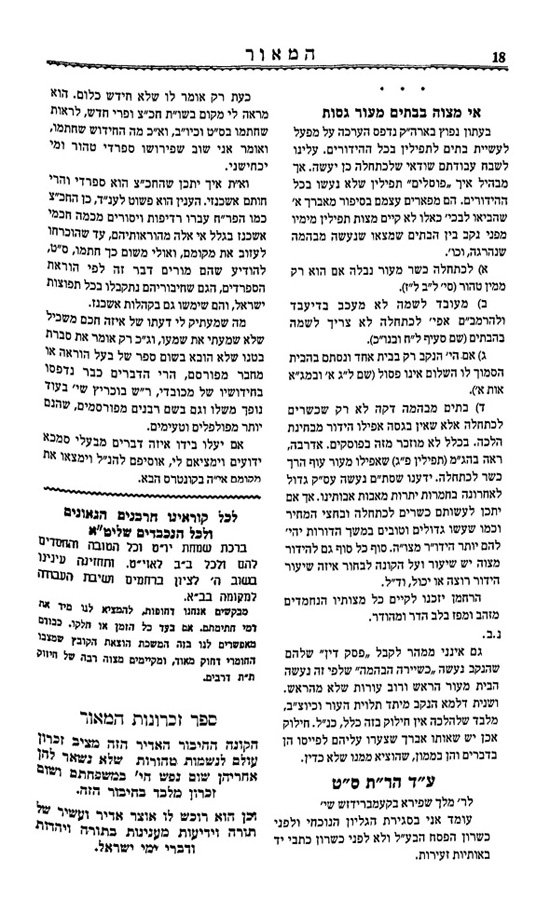
Uncensored:
Censored:
The Pardes Yosef while popular was a difficult work. In part this is due to the overuse of obscure abbreviations.[9] In 1995, a new edition of Pardes Yosef was published, and this edition attempted to make the book more user-friendly by removing the abbreviations, resetting the type and other improvements. This edition was published in Benei Berak, and notably includes R. Kook’s approbation in reset type. But, for this edition, only part of the first volume was published and then no more.
In 1998, a new edition, boasting many of the improvements contained in the 1995 edition began being published again in Benei Berak. Although titled Pardes Yosef ha-Shalem (emphasis added), this edition is incomplete at least regarding R. Kook’s approbation. That approbation is again missing.
Today, Hebrewbooks includes the first edition – the edition that includes R. Kook’s approbation (link). While presumably unintended, Hebrewbooks has followed R. Pazanavski’s wish that his work bear the approbation of R. Kook.
[1] In reality there are many more databases which either include Hebrew books or are devoted to Hebrew books. Generally, these are found on various library’s websites and are limited to the works that the particular library owns and are not intended to be comprehensive. The three databases discussed above intend to include all Hebrew books.
[2] A partial list of Hebrew books which appeared, but were removed from Hebrewbooks.org is:
  • Arnold Ehrlich – Mikra Kifshuta (Berlin 1899)
  • R. Gedaliah Nadel – Betorato shel R. Gedaliah (see Rabbi Natan Slifkin on that here)
  • Moses Mendelssohn – Phaedon (Hebrew)
  • Moses Mendelssohn – Netivot ShalomBamidbar (Vienna 1846) (40004)
  • Moses Mendelssohn – Netivot Shalom Devarim (Vienna 1846) (40005)
  • R. Yom Tov Schwartz – Maaneh Leigrot (which is available elsewhere online here)
  • Joseph Perl – Megaleh Temirin 1819 (43110)
  • A Karaite siddur from 1737 (43124)
  • Naftali Herz Wessely – Olelot Naftali Bereshit 1842 (34363)
  • Naftali Herz Wessely Wessely – Shirei Tiferet 1809 (43205)

The numbers are provided in some cases, where available, showing where they used to be on Hebrewbooks.org. Needless to say, many books remain which would be removed, if the criteria applied to these were able to apply to the many needles in a nearly 50,000 piece-strong haystack.

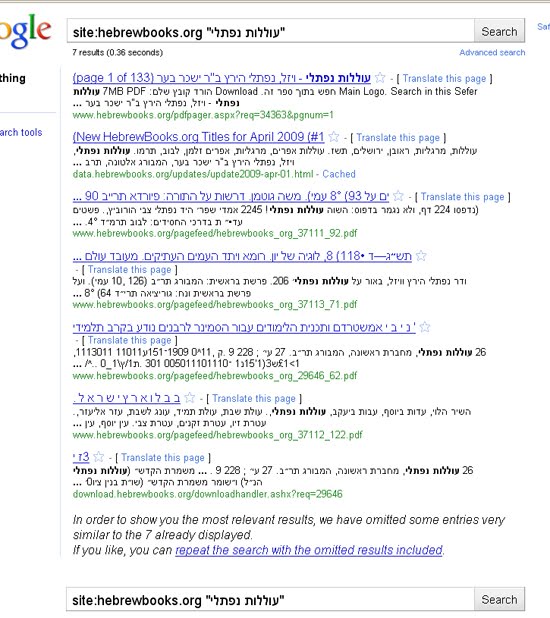
Here is a graphic depicting how one of these books was on Hebrewbooks.org. It is no longer.
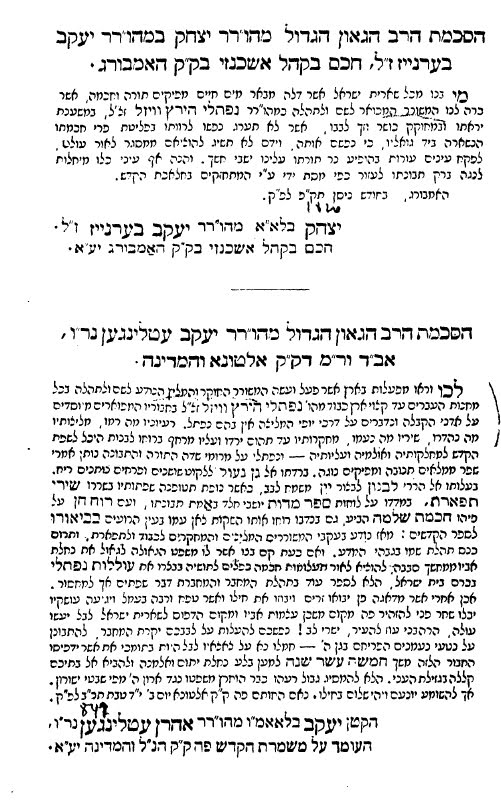
Note that this very book bears approbations from Chacham Isaac Bernays and R. Jacob Ettlinger. For more on Wessely in seforim, see Eliezer Brodt’s post here.

The Otzar Ha-hochma removes books as well, even from it’s standard “non-Benei Torah” version. For example, the periodical Yerushalayim (Zolkiew 1844) was there. Now it is gone.
[3]For other examples of using modern technology and modern methods to promote a traditional (albeit anachronistic) point-of-view, see Yoel Finkelman, Strictly Kosher Reading: Popular Literature and the Condition of Contemporary Orthodoxy, Academic Studies Press: 2011.
[4] For examples of censorship regarding R. Kook see Dr. Meir Raflad “’al Peletat Soforim” Sinai 122 (1998) 229–232; Dr. Meir Raflad “Oy l’Tzadik v’Oy l’Shcheno” Hatzofeh, Sept. 2, 2005.
[5] See, e.g., Gershom Gorenberg, The Unmaking of Israel, HarperCollins Pub., 2011, arguing that the modern-day Israeli settlements and their attendant issues springs from R. Kook’s philosophy.
[6] The title page records the date of publication as the Hebrew year of 5690, (printed in the year “Kechu Sefer Pardes Yosef ha-Zeh”) in reality it wasn’t completed until 5691, as R. Pazanavski signs the final page 13 Tishrei 5691. Ultimately, only three volumes would be published, Berashit, Shemot and Va’yikrah. While R. Pazanavski wrote on all five volumes of the Torah, the remaining manuscript was lost during the Holocaust. The Mandelbaum edition, discussed below, “completes” the remaining volumes in the same style as the first three. Thus, today, Pardes Yosef is available on the entire Torah.
[7] In light of R. Pazanavski’s affilation with Gur and specifically, the then current rebbi, Penei Menachem, it’s unsurprising that R. Pazanavski viewed R. Kook positively. It is well-known that the Penei Menachem had a favorable view of R. Kook. See R. Eliezer Sirkes, Ish ha-Emunah, Yitzhak Alfasi ed., Tel Aviv: 1979, pp. 111, 124, 128, 131. One of the putative goals of the Penei Menachem when he went to Israel was to attempt to reconcile R. Kook and R. Sonnenfeld. Thus, it is especially ironic that, as discussed below, the Mandelbaum edition removes R. Kook’s approbation as Mandelbaum is a Gur hassid.
[8] This story appears to have been related at one of the eulogies after R. Diskin’s death. See Yeshah Orenstein, Ma’amar Shelamut ha-Mitzeyot, in Hiddushei R. Yeshayah Orenstein, Jerusalem: 1972, p. 185. A similar story is told about R. Eliyahu Mizrachi (1450-1526). See R. Abraham Kalphon, Ma’aseh Tzaddim, Assaf Revivi ed., Ashkelon: 2009, p. 160. According to this story the king (presumably it would be the Sultan and not a king as after 1453, Constantinople was ruled by the Ottomans and its leader was a sultan) wanted to show the greatness of R. Mizrachi. To do so, he took a special chair and placed R. Mizrachi upon it and asked him to calculate the distance between him and the sky. R. Mizrachi asked for a pen and paper and, after some calculations, wrote down a number which the king took as proof. Of course, this wasn’t convincing to those around. But what the king then did was some time later the king took out the chair again but this time he ordered a small coin be placed under the chair’s legs, unbeknownst to anyone else. He then had R. Mizrachi come back and the king feigned that he couldn’t recall R. Mizrachi’s prior calculation and asked him to repeat it. This time R. Mizrachi wrote down the same number but said that is now seems that it needs to be reduced by the width of a coin. Like the story with R. Diskin, this demonstrated R. Mizrachi’s amazing estimation ability. Unfortunately, to our knowledge, there are no recorded stories of any famous rabbi winning guess the number of jelly beans in a jar contest.
[9] On the use of obscure abbreviations see Ya’akov Shmuel Speigel, “Ha-Shimush be-Kitzurim ve-Roshei Tevot Shanom Shichim,” Yeshurun 10: 2002, pp. 814-30.


Comments on This and That, part 2

Comments on This and That, part 2
by Marc B. Shapiro

Continued from here.

Barth’s opinion was shared by R. Joseph Hertz, who referred to Song of Songs as a “collection of ancient lyrics of the spring-time and youthful love.”[1] Some might regard this as a radical, even un-Orthodox opinion, but from Avot de-Rabbi Natan 1:4, we see that the early Jewish leaders did not regard the Song of Songs (and Ecclesiastes and Proverbs) as anything special.


Originally, it is said, Proverbs, Song of Songs, and Ecclesiastes were suppressed, for since they were held to be mere parables and not part of the Holy Writings [the religious authorities] arose and suppressed them. [And so they remained] until the men of Hezekiah came and interpreted them.

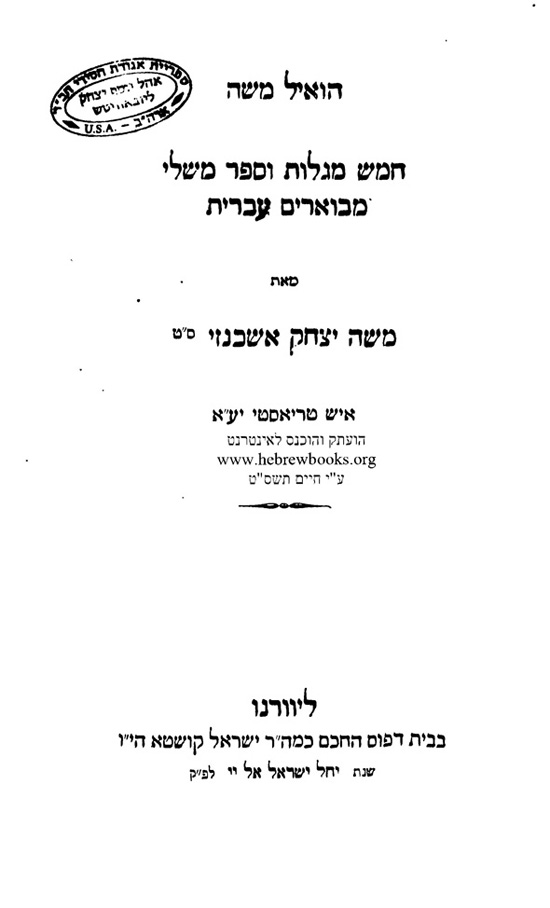
I already quoted a couple of times from R. Moses Isaac Ashkenazi’s Ho’il Moshe, so let me mention that in the introduction to his commentary on Song of Songs, he assumes that the book was indeed sung as part of the wedding celebrations, and as with Barth, he thinks that this was the original purpose of Song of Songs. He also suggests that perhaps שיר השירים אשר לשלמה  does not mean that Solomon wrote it, but that it was written for Solomon. He compares this to Psalm 72:1 which begins לשלמה and means “[A Psalm] for Solomon.” Interestingly, he also thinks that the Shulamite (7:1) is none other than Abishag the Shunamite.[2] Here is the title page of his book.


While Artscroll sees a literal interpretation of Song of Songs as blasphemous, Ashkenazi (together with Breuer and Barth) sees the book as teaching the values that make for a successful marriage. This viewpoint is also expressed in the introduction to the Soncino translation:

The main moral of the Book is that love, besides being the strongest emotion in the human heart, can also be the holiest. God has given the gift of love to sweeten the toil of the laborer, as in the case of Jacob to whom the fourteen years in which he toiled for Rachel appeared but a few days, for the love he had for her (Gen. xxix. 20). Love transfigures and hallows, but it’s a boon that requires zealously to be guarded and sheltered from abuse. This Book pictures love as a reward enjoyed only by the pure and simple, a joy not experienced by the pleasure-seeking monarch and the indolent ladies of the court. It is a joy reserved for the loyal and the constant, and is denied to the sensual and dissolute.

Ashkenazi concludes with these strong words:

גם אם נפרשהו ע”ד הפשט, נוכל ללמוד ממנו דברים נאותים. . . . רק אנשי חונף העושים מעשה זמרי ומבקשים שכר כפנחס יטילו בו דופי, בעוד שהם בשבתם על השולחן בבית חתן וכלה יוציאו מפיהם דברי נבלה המלבינים פני כל אדם ישר השמועה; והלואי ואולי היו משוררים שיר נחמד זה בסעודת חתנים. ויופי הקולות והנגינה ישמחו הלבבות ויגדילו חשק חתן וכלה זה לזה, ויגביהו לבות הבחורים והעלמות ברחשי הכבוד הראוים והנאותים להם.

Finally, let me mention Amos Hakham’s introduction to the Daat Mikra edition of Shir ha-Shirim. While he isn’t sure if the entire book can be traced to wedding feasts, he is certain that this is so for at least one section, namely, the song that ends in 5:1:: “Eat, O friends; drink, yea, drink abundantly, O beloved.” How could this not originate in a wedding feast? As for dance songs, Hakham points to 7:1 as an example: “Return, return, O Shulamite; Return, return, that we may look upon thee.” As with those already cited, Hakham argues that the allegory only adds a deeper level to our understanding, but it in no way discounts the peshat of the verses.[3] This is in direct opposition to Artscroll’s position that “The literal meaning of the words is so far from their meaning that it is false” (Artscroll Pesach Machzor, p. 567).

Hakham also calls attention to Va-Yikra Rabbah 9:6, where R. Yohanan understands Song of Songs on the peshat level to be referring to a real married couple. Based on two verses in Song of Songs, R. Yohanan derives “that a bridegroom should not enter the bridal chamber unless the bride gives him permission.”

Hakham states: “It is unimaginable that prophecy would use matters that are distasteful in themselves as an allegory for holy and pure matters.” Here is how he sums up his main point (pp. 8, 9):

כלומר שאמנם לפי המשמעות המילולית הפשוטה מתוארת בשיר השירים אהבה שבין דוד ורעיה שהם שניהם בשר ודם, אלא שבהיות אהבה זו תמה, זכה, טהורה וקדושה, ראויה היתה שתשמש סמל ודוגמה לאהבה נעלה יותר. . . . טעות ביד מי שחושב, שחז”ל דרשו את שיר השירים על דרך הרמז משום שבפירושו כפשוטו היה נראה בעיניהם כשיר העוסק בענינים שאינם ראויים להכלל בכתבי הקודש. לא כן הדבר. כבר העירו גדולי המפרשים שאין להעלות על הדעת, שהנבואה תקח עניינים מאוסים כשלעצמם כמשל לענינים קדושים וטהורים, אלא ודאי שכמו הנמשל כן גם המשל קודש הוא. ואם מצאנו שהנבואה ממשילה את הברית שבין כנסת ישראל ובין הקב”ה כברית שבין איש ואשתו, משמע שהברית הזאת שבין איש ואישה קדושה היא ונעלה. וכבר אמרו חז”ל: איש ואשה, זכו – שכינה ביניהן.

I would assume that if a Modern Orthodox Machzor for Passover is ever published, that Hakham’s perspective will be the one to be included rather than what we find in Artscroll.

R. Zvi Yehuda has the same perspective, writing that the literal meaning has an independent existence, and “it too is raised to the level of holiness, not just on account of the nimshal, but on its own strength.”[4] He quotes Rashi who in his introduction to Song of Songs stresses that the allegory must be attached to the peshat of the verse:

ואף על פי שדברו הנביאים דבריהם בדוגמא, צריך ליישב הדוגמא על אופניה ועל סדרה.

Yehuda brings a wonderful example of this. Song of Songs 4:1 reads: “Behold, you are fair, my beloved; behold, you are fair; your eyes are [like] doves; from within your kerchief your hair is like a flock of goats that streamed down from Mount Gilead.” Rashi explains the second part of the verse as follows: “This praise is a paradigm of the praise of a woman beloved by her bridegroom. Within your kerchief, your hair is beautiful and glistens with brilliance and whiteness like the hair of white goats descending from the mountains whose hair gleam in the distance.” The biblical text does not give any color to the goats, and Yehuda notes that the standard approach is that the goats are black, so that the hair being praised is also black. Yet Rashi speaks of light hair as being beautiful, and therefore he understands the color of the goats differently. Based on this, Yehuda concludes that “Visions of female beauty, in his [Rashi’s] time and place, influenced his commentary.”

The fact that the mashal needs to reflect reality is seen in another Rashi as well (not cited by Yehuda). Song of Songs 7:5 reads אפך כמגדל הלבנון. Rashi writes: “I cannot explain this [אפך] to mean a nose, either in reference to its simple meaning or in reference to its allegorical meaning, for what praise of beauty is there in a nose that is large and erect as a tower? I say therefore that אפך means a face.”
If the allegory is all that is important, then Rashi would not have a problem. He could translate אפך as nose, which is the literal translation,[5] and offer the allegorical explanation. Yet precisely because it is important that the peshat be coherent, Rashi is forced away from the literal meaning, for what man can praise his bride as being beautiful for having such a nose?[6]

One other interesting point that I learnt from Yehuda’s article is that the rishon, R. Avigdor Kohen Tzedek, gives the following strange explanation for why God’s name doesn’t appear in Song of Songs.[7]

ולא נכתב שם קודש בשיר השירים לפי שנאמר כל הספר בלשון חשק ואהבה ואינ’ דרך כבוד להזכיר השם ב”ה על דבר חשק.

Yehuda also cites the sharp comment of R. Solomon Akriti in R. Joseph Kafih, ed., Hamesh Megilot (Jerusalem, 1962), p. 19:

ואחרי אלה ההערות אינני רואה שיסופק שום משכיל בדברי הספר לחשב בם שהם כפשוטם, ואלו היו כפשוטם לא היו חולי חולין בעולם כמותם, ולא היה נזק גדול לישראל כיום שניתן להם שיר השירים, כי פשוטו יעורר תאוה וביותר תאות המשגל אשר היא המגונה מכלם

Yet after quoting these passages, which Artscroll would be very happy with, Yehuda takes his place with the others I have referred to and insists on the validity, and holiness, of the peshat interpretation (p. 478):

שיר השירים, על כל בחינותיה ורבדי מובניה – ואף לפי פשוטה – היא “קודש קודשים”. האהבה האנושית המתוארת בה – מתרוממת לגובהי קדושה.

He concludes (p. 481) that it is a mistake to think that the Sages explained Song of Songs allegorically because they had a problem with its literal meaning. According to Yehuda, the opposite is the case, and it is precisely because the Sages valued the literal meaning of the book that they explained it allegorically. It is because they saw the human love described in the book as so exalted that they were prepared to also view the book as an allegory for heavenly love.

With reference to Song of Songs, there is another reason why it is important to know the peshat. Maimonides’ Hilkhot Teshuvah 10:3, speaks about the love of God. He compares it to the love of a woman. Just as one who is in love constantly thinks about the woman, so too should be your love for God. He concludes that “The whole book, Song of Songs, is an allegory on this subject.” In other words, only one who understands what human love is all about can move to the next level and achieve love of the Divine. This is elaborated upon by R. Mordechai Gifter in his Hebrew preface to the Artscroll Shir ha-Shirim. One can only wonder why Artscroll did not see fit to translate R. Gifter’s important words into English. R. Gifter even mentions the importance, indeed centrality, of sexual desire. He does so not to speak of its great danger, as is often the case, but to stress how vital the sexual urge is even from a spiritual sense:

וכל זה מבו’ בדבריו של ר’ יצחק דמן עכו ז”ל שהביא בראשית חכמה – בסוף פ”ד משער האהבה – שמי שלא חשק לאשה הוא דומה לחמור ופחות ממנו והטעם כי מהמורגש צריך שיבחין העבודה האלקית.

He also writes:

שכל הלשונות שבמשל הן עצמיים ובשרשם העליון ענינם נשגב למאד, אלא שהענינים הרמים אלה משתלשלים ויורדים מעולם לעולם עד שמגיעים אלינו מצטיירים לנו צורה זו הנאותה לפי מציאות האדם בעולם הזה.

With regard to Artscroll, everyone knows that the “translation” they provide of Song of Songs is allegorical. In the Passover Machzor that is all you get, but in their separate edition of Song of Songs they do provide the literal translation in the commentary, for those who wish to look at it. Artscroll’s approach vis-à-vis the Song of Songs has been the subject of harsh criticism in the Modern Orthodox world, especially from its intellectual elite. In fact, I think when people criticize Artscroll, this is one of the things that is high on the list of what annoys them.

Yet it must also be noted that Artscroll’s method of translation is exactly what the Targum does.(See also R. Nahum Finkelstein’s Yiddish “translation” of Song of Songs [Jerusalem, 1929]) So it is not like Artscroll invented this approach. In addition, there is a responsum of R. Joseph Hayyim in Rav Pealim, vol. 1, Yoreh Deah no. 56, that is relevant. Here he states that a teacher in Baghdad translated the Song of Songs into Arabic, and the children copied this translation. R. Joseph Hayyim opposed this, stating that one should not teach the children and the masses the literal meaning of the words because they are not meant to be understood literally. The literal meaning of the book, he states, is no different than a love song (he adds “has ve-shalom”),[8] and unlike the opinions we have already noted, for R. Joseph Hayyim (as with Artscroll) the literal meaning of the Song of Songs is obscene.[9] The same viewpoint is expressed by the nineteenth-century R. Elijah Schick in his Ein Eliyahu, Yadayim 3:1:

כל הכתובים יש פשטות ג”כ אבל בשיר השירים אין שום פשטות אלא הכל קאי על יראת שמים וקבלת עול מלכות שמים, כי על פי פשט היא דברי חשק וזה אי אפשר לומר וקאי הכל על דביקות בה’.

Today we have an interesting phenomenon. When the Targum was written the vernacular was Aramaic, so the typical Jew would not be able to understand Song of Songs in the original. Only the scholar could understand the actual words, and he would know that they were to be interpreted allegorically. Today, in America, the situation is the same, as the typical Jew also cannot understand the Hebrew. Artscroll’s English “translation” therefore serves the same function as the Targum did centuries ago.

Yet what about Israelis? We now have a situation where “the masses” can understand the Hebrew Bible since Hebrew is their vernacular. This is a completely new phenomenon. How are these masses to be protected from reading the text literally, for as we have seen, Artscroll tells us in the Pesach Machzor that “the literal meaning of the words is so far from their meaning that it is false”? In the Introduction to the Artscroll Shir ha-Shirim, p. lxiv, we are told that when the words שני שדיך, “your bosom” [Artscroll won’t use the word “breasts”] refer to Moses and Aaron, this is not

departing from the simple literal meaning of the phrase in the least. Song of Songs uses words in their ultimate connotations. Just as geshem, rain, means the power of stimulating growth, shodayim, the bosom, refers to the Heavenly power of nourishment. . . . They [Moses and Aaron], Israel’s sources of spiritual nourishment, are not implied allegorically or derived esoterically from the verse; the verse literally means them.

In other words, Shir ha-Shirim (in this instance, at least) is not even speaking about a woman, not even on the level of peshat. I have to admit that all this seems like a lot of double-talk to me. I can understand if you tell me that “breasts”, excuse me, “bosom”, allegorically means “Moses and Aaron.” But when you tell me that even the literal meaning of shodayim is “Moses and Aaron”, that’s when I have difficulty.

(Speaking of haredi circumlocutions, since the Agudah convention is in a few days I can’t resist mention of the following. A letter was sent out to attendees inviting them to a breakfast at which they will be addressed by a psychologist and and rabbi-lawyer. You can see the letter here. Notice that the letter speaks about how “the issue of child abuse has become a major topic in our society and children in our community have been and continue to be at risk.” Of course, child abuse is not the issue at all. We are not being confronted on an almost weekly basis with stories of children in our communities being beaten or anything like that. What we have is child sexual abuse, and yet the author of this letter can’t even bring himself to say the word “sexual.” It’s like we are all in grade school and this word is off-limits.)

One opinion in Shir ha-Shirim Rabbah 1:10 states that Solomon wrote Song of Songs in his youth. This is elaborated upon by R. Hayyim Jeremiah Flensburg, Markevot Ami (Vilna, 1910), p. 6. He explains how Solomon’s words are indeed drawn from the real world he experienced, which once again shows how important the peshat, the literal meaning of the words are:

שאף שהנמשל של שיר השירים הוא קודש קדשים, עכ”ז מתוך המשל שעשה לעטוף בו הנמשל, ניכר שהיה אז ילד, שהוא נשא משלו מחתן וכלה, ומגנים ושושנים יפים, ומכל הדרת האביב, וזמרת צפרים.

R. Yosef Ben Arzah, in his popular Yosef Da’at, Bava Kamma 97, also explains in this fashion.

וידוע, האהבה זמנה בימי הנעורים, משא”כ בימי הזקנה “ותפר האביונה”. וכמו שאמרו ששלמה המלך עליו השלום, בילדותו אמר שיר השירים, שהוא תוקף האהבה.

When Ben Arzah writes that the time of love is the youth, he is clearly referring to sexual love, for he follows this by noting that this is not the case in old age when (quoting Eccl.12:5) “[sexual] desire fails.” In other words, the Midrash means that because Solomon wrote the Song of Songs in his youth, that is why it has sexual imagery, for sexual love is strongest when one is young.[10]

I don’t think anyone is going to suggest that Artscroll produce a Hebrew version of its allegorical translation and that this is what the masses should be looking at during the reading of Song of Songs. But why not? If it is religiously objectionable for English speakers to be exposed to the literal meaning of the words of Song of Songs, then it is just as objectionable (if not more so) for Hebrew speakers to read the actual words and understand them literally.

Despite my facetious comment, no one has ever assumed that the Israeli masses should be told not to look at the actual text of Song of Songs. Rather, they are provided with commentaries that explained what the allegorical meaning of the text is. If it is therefore acceptable for Israelis to first understand the text literally, and then see what the allegorical meaning is, I ask Artscroll, why can’t American Jews be given the same prerogative, namely, to have a literal translation together with a commentary that offers the allegorical interpretation?

Finally, let me mention that for Sefer Hasidim it was important to know what the Song of Songs literally meant, for he declares that all the parts of a woman’s body mentioned in the book are forbidden to be seen. See no. 110: שער באשה ערוה לגלות וכל האמור בשיר השירים כגון בטנך ערימת חטים שוקיו עמודי שש שני שדיך וכו’ וכל שדרך לכסות ערוה לאשה לגלות He repeats this in no. 614 where he also adds the following, which never became normative halakhah: צריך להזהר שלא ישמע קול אשה והוא הדין לאשה שלא תשמע קול איש.

Adopting this position might be a good strategy for those who have been trying unsuccessfully to shut down the Jewish concert scene. They haven’t been able to convince the haredi masses that these are in any way problematic, especially when men and women sit separately. But perhaps the new humra that could achieve their objective is that it is forbidden for women to hear men singing. A few years of indoctrination of this view in the various Bais Yaakovs should be able to convince the younger generation, and would mean the end of the haredi concerts.[11]

* * *

Returning to my post on Adon Olam, the other point dealt with in that post was the meaning of the abbreviation ס”ט. I don’t think anyone who read the post still thinks that it means “Sephardi Tahor.” But in case there are still any doubters, let me offer the following. Here is a page from R. Joseph Shabbetai Farhi’s Tokfo shel Yosef (Livorno, 1846), p. 38b. It contains the end of a letter from none other than Jacob the Patriarch, and you can see clear as day that he also signed himself ס”ט. Now if that isn’t a proof, I don’t know what is. . . .
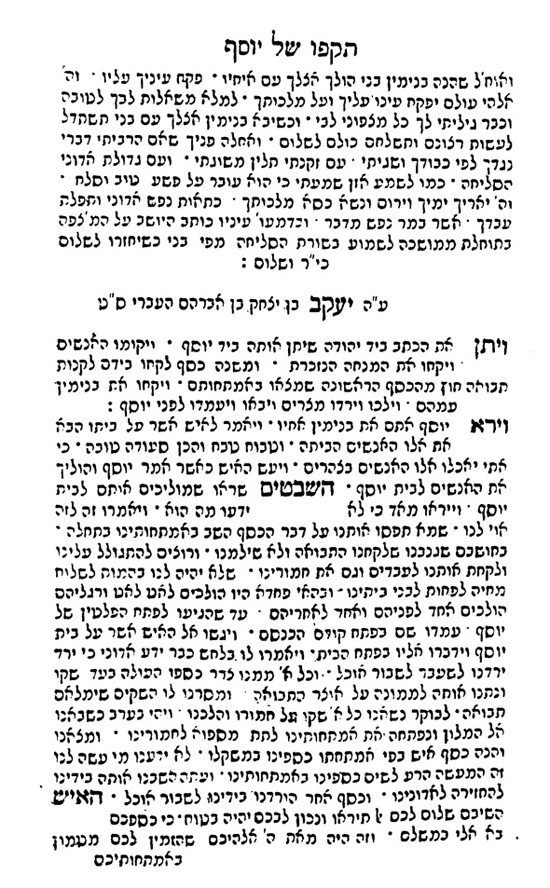

There was, in fact, one person who did refuse to change his mind, even after I presented him with the evidence. I refer to the late R. Meir Amsel, editor of Ha-Maor. Amsel is deserving of his own post, having edited Ha-Maor for over fifty years. If I were to ever write a history of Orthodox Jews in America, this journal would be an important source, together with its competitor, Ha-Pardes, because in these journals one finds most of the important issues that were part of the American Orthodox experience. Ha-Maor was the more extreme of the two journals, and all sorts of polemics were carried in its pages. But it would also contain all sorts of surprises, and Amsel’s viewpoints were not always predictable. Yet as I mentioned, he didn’t accept what I told him, and changing his mind even in the face of evidence to the contrary was not something he was prepared to do.

Imagine my surprise when after sending Amsel a letter on the topic he published his response in his journal (Jan.-Feb., 1993). Here it is.

I sent him a second letter which he published, together with his response, in the March-April 1993 issue. Notice how he subtly mocks me at the beginning of this reply.


I didn’t take offense at the mocking as this was classic Amsel. Few had such a sharp pen as he, and woe to those he turned it against. To give one example of his many polemics, readers of the journal will never forget how he targeted R. Elya Svei. Yet he wouldn’t mention him by name. Instead, and as a way to show how little he thought of Svei, he referred to him as “the melamed in Philadelphia.”[12]

The March-April 1993 issue of Ha-Maor, in which he responded to me, is of broader interest for another reason. It contains his hesped for R. Joseph B. Soloveitchik, who had recently passed away. In this hesped he mentions a few things, among them that the Rav told him that he wasn’t really a Zionist, and that while Yeshivat R. Yitzhak Elhanan was not in accord with his family’s philosophy, nevertheless he taught there as it provided intellectual freedom.

In the next issue (June-July, 1993), Amsel printed a letter he received from R. Norman Lamm, thanking Amsel for what he wrote about the Rav, and also criticizing him for mentioning the point about the Rav not feeling connected to RIETS. Note how Lamm specifically asked Amsel not to publish his letter, and Amsel published it anyway.

Also, look at the first paragraph on p. 35, as it shows how the Hungarian extremist Amsel was happy to point out how Lamm was head and shoulders above those in the Lithuanian yeshiva world. (I wonder, where did Amsel get the crazy figure of eight thousand students, that he mentions in the second paragraph? Even if you include the post-graduate schools you won’t get to that number. Did Amsel even realize that non-Jews attend Yeshiva University’s medical and law schools?)
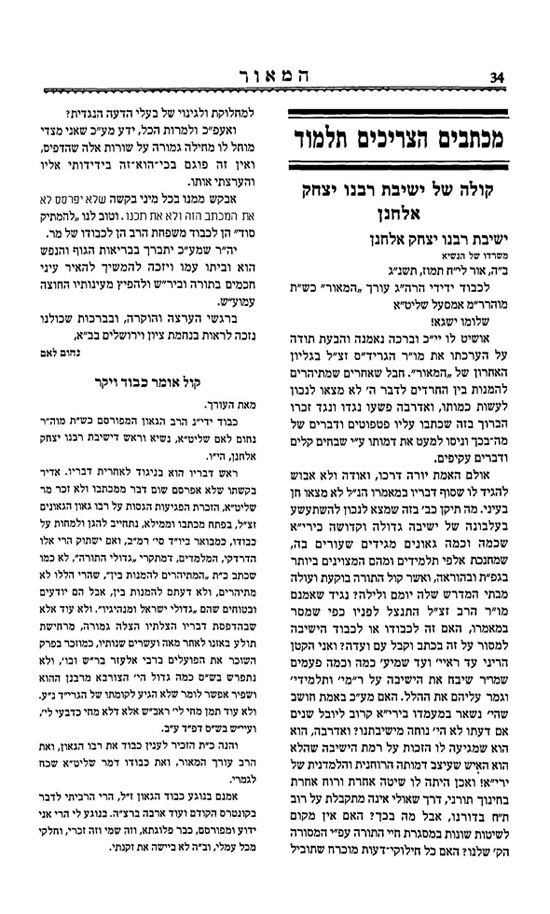
* * *

In my original post on Adon Olam I dealt with Artscroll, so here is as good a time as any for some assorted Artscroll comments.

The custom on Rosh ha-Shanah is to sound additional shofar blasts towards the end of the morning prayers. Most sound these blasts after Musaf of Rosh ha-Shanah, while some sound thirty of them during the silent Amidah. There is no talmudic source for this practice. Why then do we do it? Here is how the Artscroll Machzor explains the matter, citing Eliyahu Kitov’s Sefer ha-Toda’ah as the source:

The source of this custom is the Scriptural narrative of the triumph of Deborah the Prophetess over Sisera, the Canaanite conqueror. In her song of gratitude for the victory, Deborah noted that Sisera’s mother whimpered as she worried over the fate of her dead son. Her friends comforted her that he had surely won a great victory and was apportioning spoils and captive women among his officers and troops (Judges 5:28-30). According to the Midrashic tradition she whimpered and groaned 101 times. Although one cannot help but feel sympathy for a worrying, grieving mother, one must be appalled at the cruelty of a mother who could be calmed by the assurance that her son was busy looting and persecuting innocent victims. The Jewish concept of mercy is diametrically opposed to such barbarism. By sounding the shofar one hundred times, we seek to nullify the forces of cruelty exemplified by Sisera and his mother, and bring God’s compassion upon us. Although she whimpered one time more than a hundred, we do not sound the shofar 101 times, because we, too, feel the pain of a mother who loses a child, even one as loathsome as Sisera.

The first thing to note is that for some reason, the explanation offered by the Taz is ignored. According to the Taz, the reason for the extra blasts is because people might not have properly heard the earlier kolot (Orah Hayyim 596:1). Furthermore, despite what is written, there is no source that speaks of Sisera’s mother whimpering 101 times. What we have is a story in the Arukh s.v. ערב , about Sisera’s mother (אימיה דסיסרא) and her one hundred cries or laments (פועיות This does not mean whimpers! The Arukh cites the story as coming from the Jerusalem Talmud. It is lacking in our versions of the Talmud, but the term “Yerushalmi” was also used for various Midrashim written in the Land of Israel.)

Ashkenazim, therefore, indeed sound the shofar the same amount of times as Sisera’s mother’s cries. Yemenites and Sephardim, on the other hand, blow an extra kol at the end, called Teruah Gedolah,[13] so they actually sound 101 blasts. Many explain that they do this precisely in order to be different than Sisera’s mother.

Here for example is what R. Ovadiah Yosef states, Shiurei Maran ha-Rishon le-Tziyon (Jerusalem, 2008), vol. 1, p. 75:

והנה אם סיסרא פעתה ובכתה מאה בכיות, ואנו תוקעים מאה תקיעות ועוד אחד, כדי לבטל הקטרוגים הנמשכים מהבכיות שלה . . . וזהו “הן אתם מאין ופעלם מאפע.” “מאין” = 101 הן ה100 פעיות של אם סיסרא שבמאה ואחת תקיעות שלנו ה’ מכפר לנו, ומתקנים אנו את הפעיות [“אפע” נוט’ פעיות אם] של אם סיסרא.

The Arukh’s explanation is quoted in a number of medieval sources, Yet what is the logic here? Why would anyone have thought of connecting Sisera’s mother’s cries with how many shofar blasts we sound, as they have nothing to do with each other? Is it really possible that how we blow the shofar has anything to do with what the mother of the wicked Sisera did?

It has been suggested by R. Hayyim Yehudah Ehrenreich[14] and R. Menachem M. Kasher[15] that there is a copyist’s error in the Arukh, and instead of reading it should read אמנו שרה , or something along these lines. This suggestion is made based upon the following passage in Pirkei de-Rabbi Eliezer ch. 32:

When Abraham returned from Mount Moriah in peace, the anger of Samael [Satan] was kindled, for he saw that the desire of his heart to frustrate the offering of our father Abraham had not been realized. What did he do? He went and said to Sarah: “Hast thou not heard what has happened in this world?” She said to him: “No.” He said to her: “Thy husband, Abraham has taken thy son Isaac and slain him and offered him up as a burnt offering upon the altar.” She began to weep and to cry aloud three times corresponding to the three Tekiot, three howlings corresponding to the Teruot. and her soul fled, and she died.

In this text we have a connection made between the cries of Sarah and the blowing of the shofar. Here it states that she cried three times corresponding to the Tekiah and three times corresponding to Teruah. (What we call Shevarim is one possibility for how the Teruah should be sounded.) Alternate versions have Sarah crying aloud six times or ninety times.

We still have the problem: How did the name Sarah become confused with Sisera? It turns out that there is indeed a connection between the mother of Sisera and the shofar. Rosh ha-Shanah 33b states:

The length of the Teruah is equal to the length of three yevavot. But it has been taught that the length of the Teruah is equal to three Shevarim. Abaye said: Here there is really a difference of opinion. It is written, It shall be a day of Teruah unto you [Num. 29:1], and we translate [in Aramaic], a day of yabava, and it is written of the mother of Sisera, Through the window she looked forth [va-teyabav; Judges 5:28]. One authority thought that this means drawing a long sigh, and the other that it means uttering short piercing cries.

We see from here that the Sages, in attempting to figure out how the Teruah should be sounded, looked for evidence in a biblical passage dealing with Sisera’s mother. Since she is thus connected to the Shofar blowing, it is not hard to see how the other passage, which describes how Sarah cried, could have morphed into Sisera’s mother.

The problem with this suggestion, one must acknowledge, is that we have no evidence of a text that has Sarah crying one hundred times. Yet it is certainly possible that this tradition did exist, and is now lost.

Here are some more comments about Artscroll. In the original post I mentioned how in the Artscroll Siddur, p. 870, it mistakenly places R. Elaazar Kalir in the second century. R. Avrohom Lieberman pointed out to me that in the original edition of this Siddur they placed Kalir centuries later. Here is a copy of the page.

The change was obviously made in response to criticism. Yet they should have stuck with the original version, since what appears in the “corrected” edition is mistaken. I assume that Artscroll knows it is mistaken, but leaves it in anyway so as not to antagonize its critics.

Before Lekhah Dodi the Artscroll Siddur writes: “לכה דודי is recited responsively. In most congregations, the chazzan repeats each verse after the congregation. In others the procedure is reversed.” More Artscroll siddurim are sold to Modern Orthodox synagogues than to anywhere else. This is especially the case due to the RCA version of the siddur. So wouldn’t one expect that the instructions would reflect reality? In my entire life I don’t think that I have ever been in a Modern Orthodox synagogue that recites Lekhah Dodi responsively. While in the previous post I wrote how the Artscroll instructions have changed how Modern Orthodox synagogues recite Hallel, as far as I know no synagogue has given up the practice of communal singing for Lekhah Dodi because of this particular instruction. As it stands, this particular instruction is a sign of how little Artscroll respects the customs of the Modern Orthodox world.

Also on Friday night, the Siddur states that each stanza of Shalom Aleikhem is recited three times. Why not mention that there is also a common practice to only recite each stanza one time?

In the Machzor for Sukkot, p. 132, in discussing the different practices when it comes to wearing tefillin on hol ha-moed, it states: “It is not proper for a congregation to follow contradictory customs. Thus, if one whose custom is not to wear tefillin during Chol haMoed prays with a tefillin-wearing minyan, he should don tefillin without a blessing. Conversely, if one whose custom is to wear tefillin prays with a non-tefillin-wearing minyan, he should not wear his tefillin while praying but may don them at home before going to the synagogue.” The source for this ruling is the Mishnah Berurah. Yet with the exception of hasidic synagogues, where I presume everyone does the same thing, this ruling is no longer applicable. In all the synagogues I have ever been in, both Modern Orthodox and non-hasidic haredi, there is no one minhag and everyone does what his family practice is. In other words, the minhag today is for everyone to follow his own personal minhag, and shuls do not have a “custom” in this regard.

Also in the Sukkot Machzor, p. 957 (as well as in the other Machzors), it writes as follows: “It is virtually a universal custom that those whose parents are still living leave the synagogue during Yizkor. This is done to avoid the ‘evil eye,’ i.e., the resentment that might be felt by those without parents toward those whose parents are still living.” Can one conclude from this that Artscroll has a Maimonidean approach to the concept of the “evil eye”?

Quiz

In past posts I have offered a quiz and given out prizes to the ones who answered the questions. People have wondered why I stopped doing this. The answer is simple: I didn’t have anything to give out. But now I have a few items so I can do some more quizzes. For the winner of this one I can give a CD of the music of R. Baruch Myers, rav of Bratislava. Rabbi Myers is a trained classical musician and his music is very different from what you think of when you think hasidic music. Unlike in the past, I will not give the prize to the one who answers the question first. This is unfair as due to the different time zones, some people won’t see the question until it has already been answered. I will give people a couple days and if more than one has answered correctly, I will randomly choose a winner. You will also have to answer two questions, in different genres. Yet even if you only know the answer to one, send it in, for if no one gets both answers, I will give it to a person who got one correct. Send answers to shapirom2 at scranton.edu

Question 1: The word for turkey is תרנגול הדו There is a dagesh in the dalet. Why? Bring a proof for your answer from Berakhot between page 34a and 38a.

Question 2: There is a rabbinic phrase that today is used to praise a Torah scholar, but in talmudic days was used in a negative fashion (at least according to Rashi). What am I referring to?

* * * *

Some people have asked me if I am leading a Jewish history trip to Europe this summer. Actually, I am leading two trips, one to Italy and the other to Central Europe. (The latter is a repeat of the sold-out trip from last summer). Both trips are sponsored by Torah in Motion and details will be available soon.


* * * *

Here is something I think readers will enjoy. It is a picture from Prof. Isadore (Yitzchak) Twersky’s wedding. I thank R. Aharon Rakefet for sharing the picture. According to R. Rakefet, the man second to the left, whose face is obscured by an unknown rabbi, is R. Zev Gold. (R. Rakefet claims that the hair gives it away.) Beginning with Gold, we find Dean Samuel Sar, Isadore Twersky (standing) R. Dovid Lifshitz, R. Eliezer Silver, the Rav, R. Chaim Heller, R. Meshullam Zusia Twersky, Tolner Rebbe of Boston, R. Moshe Zvi Twersky, Tolner Rebbe of Philadelphia.
[1] Authorized Daily Prayer Book, p. 790.

[2] This identification has recently been advocated by Christopher W. Mitchell in his massive work, The Song of Songs (St. Louis, 2003), pp. 130ff.

[3] Medieval commentators, notably Ibn Ezra, put a great deal of effort into explaining the peshat. See also the medieval commentary on Song of Songs written by R. Joseph Ibn Aknin, entitled Hitgalut ha-Sodot ve-Hofa’at ha-Meorot (Jerusalem, 1964). Ibn Aknin provides a three part commentary, with one section focused on peshat, and the other two on derash and sod. From more recent times, see R. Samuel Naftali Hirsch Epstein, Imrei Shefer (Vilna, 1873), and R. Eliyahu Halfon Shir ha-Shirim im Perush Ateret Shlomo (Nof Ayalon, 2003).
[4] “Shir ha-Shirim” Kedushatah shel ha-Megilah u-Farshanutah,” Sinai 100 (1987), p. 475.
[5] Soncino explains: “The comparison is between the well-proportioned nose and the beautiful projecting tower.”
[6] This point was made by R. Isaac Jacob Reines. See R. Judah Leib Maimon, ed., Sefer Rashi (Jerusalem, 1956), vol. 2, pp. 12-13. See also Rashi to Song of Songs 1:2 “Let him kiss me with the kisses of his mouth.” Rashi comments: “In some places they kiss on the back of the hand or on the shoulder, but I desire and wish that he behave toward me as he behaved toward me originally, like a bridegroom with a bride, mouth to mouth.” Artscroll does not mention this Rashi. The Vilna Gaon has an interesting comment on this verse. He notes the plural “kisses,” and explains: כמו שנושק הבעל לחשוקתו א’ על מה שמתחברת עמו והב’ על שאינה מתחברת באחר
[7] Perush Shir ha-Shirim (Jerusalem, 1971), p. 11.
[8] See also Ibn Ezra’s introduction to Song of Songs: וחלילה חלילה להיות שיר השירים בדברי חשק Despite saying this, he still feels it is important to explain the peshat.
[9] See also Rav Pealim, vol. 4, Sod Yesharim no. 11, where R. Joseph Hayyim explains why God’s name does not appear in the Song of Songs.
[10] Since we are speaking of love, I should also mention Elhanan Reiner’s provocative claim, put forward in very stylistic Hebrew, that R. Yair Haim Bachrach’s responsum, Havot Yair, no. 60, is not a real case, but simply a fictional love story that Bacharach inserted into his responsa. See here. For Raphael Binyamin Posen’s response see here, and Reiner responds to Posen here.
[11] Incidentally, the opposition of haredi gedolim to these concerts is often portrayed as if the only issue is tzeniut, and therefore, when men and women sit separately there should be no problem. This is a complete distortion of the issue, for even without tzeniut concerns, the main reason for the opposition, and I know this will be hard for American haredim to stomach, is that the Israeli haredi gedolim are opposed to all musical entertainment, and “fun” in general, when not connected to simchah shel mitzvah, such as Purim, a wedding, etc. Concerts are doubly problematic since these gedolim believe that is forbidden to listen to live music when not connected to a seudat mitzvah. Here is one proclamation that makes this clear (from Hashkafatenu [Bnei Brak, 1985], p. 77).

In R. Yaakov Yisrael Lugasi’s Mar’ot ha-Tzovaot (Jerusalem, 2009), p. 401, he states flatly: “The entire concept of entertainment is pasul. This is a condition of moshav leitzim and throwing off the yoke, and is the culture of the non-Jews and the secularists.” Interestingly, a few pages after this, Lugasi prints the herem against wearing jeans skirts. For those who never saw it, here it is.
[12] It is no secret that R. Svei was a polarizing figure in Orthodoxy, even in haredi circles. This is also seen in the book on R. Ahron Soloveitchik written by his son, R. Yosef. It was uploaded to the internet a few weeks ago and until recently was found here. Since many people downloaded the book when it was up, I think it is worthwhile to make some comments about it. I understand that it is a preliminary version of what will be published in book form. I hope the author takes the necessary time to revise it properly, because as it stands, it is an unfortunate publication. On the positive side, it includes a great deal of Torah from R. Ahron, and shows his strong insistence on honesty when it comes to dealing with non-Jews and the government. There are also wonderful tidbits of historical interest. See p. 5 that R. Baruch Ber Leibowitz used to stand up for R. Ahron when he was a child, since he was, after all, the grandson of the Rebbe (R. Hayyim).

See also p. 404 for the following incredible statement: “Rav Ahron told his son that it is not right to print his brother’s דרשה of יוסף ואחיו about the Mizrachi because his brother regretted saying this דרשה ” This is perhaps the most important derashah the Rav ever delivered and is a basic text of study for religious Zionists. It explains how the Rav could break from his family tradition and become a Zionist. It is also the derashah that R. Shakh attacked, saying that it contained דברים שאסור לשומען וכש”כ להפיצן ברבים (Mikhtavim u-Ma’amarim, vol. 4, no. 320). What are we to make of R. Ahron stating that the Rav regretted this derashah?

Among other passages that caught my eye, see e.g., p. 6, where R. Ahron tells a bubba maisah about a rabbi in Auschwitz who killed some twenty Nazis with a chair. On p. 327 R. Ahron claims that Bible Criticism “paved the road for the Nazi ideology.” On this page he also states that Catholics do not support Bible Criticism. This is incorrect. The Catholic Church accepts Bible Criticism and does not see this as harming the holiness of the Bible. In fact, there are only two religious groups that do not accept the academic approach to the Bible, namely, Christian fundamentalists and (most) Orthodox Jews. (In a future post I will explain why I use the word “most”.

Why do I say that this is an unfortunate publication? Because there is a way to write and a way not to write, and someone who is very upset about how his father was treated is not the best person to review important incidents in his life. I can’t see how anyone could believe that the book brings honor to R. Ahron. I am impressed, however, that despite the harshly polemical tone, the author included documents directed against R. Ahron, as this helps with the historical record.

I have to say that after reading the publication, I think I have a better understanding of why R. Ahron had so many difficulties. In order to be a successful leader, one must, at times, be willing to compromise. One must also recognize when the time for battle is over. R. Ahron was so guided by the truth as he saw it, that he appears to have been unable to do this. For him, it was worth fighting a battle to make a point, even if there was no chance of emerging victorious and it would cost lots of money to do so. (I refer to his attempt to cancel the sale of the Chicago Mizrachi building to Buddhists.)

When publishing the letter of the other faculty members of Hebrew Theological College stating that they do not want R. Ahron in a leadership position, the author would have been wise to explain the different perspectives of the protaganists, rather than heaping abuse on them. The same is true when it comes to how he describes the haredim. There is no question that many of his complaints are justified. This is especially the case when he deals with the support given by the haredi gedolim to Elior Chen, which makes everything else pale in comparison. Yet despite this, the language Soloveichik uses in is really over the top.

I also can’t imagine that the family of the Rav will be happy to see how he too makes appearances in the book. Is it really appropriate to quote the Rav’s harsh comment against a certain Agudah leader? And I have a more fundamental question with regard to this last example. When two people agree to take their dispute to a beit din, not a government beit din but a private beit din, don’t they have an expectation of confidentiality? This is especially the case when one of the disputants is still alive. What gives the author the right to reveal the content of a private dispute brought before a private beit din, even if one of the participants did act in a disgraceful manner?

Apropos of R. Ahron, let me mention two things he told me so as to preserve them for posterity.

1. He stated that because of what R. Moshe Stern wrote about the Rav, one should not quote Stern in halakhic discourse. In truth, as I later learnt, it is not so clear that Stern’s harsh comments (pigul, metuav) are about the Rav. It is possible that he is referring to teaching and study at Yeshiva University. (See David Berger in Tradition 27 [Winter 1993], p. 94.) I will let readers judge for themselves. The text appears in Be’er Moshe, vol. 8, no. 3.
2. R. Ahron told me, halakhah le-ma’aseh, that if you have food in the oven when Shabbat starts, that this food can be returned to the oven on Shabbat morning in order to heat it up. I have heard that the Rav gave the same pesak to NCSY, but I have not confirmed this.

[13] See Shulhan Arukh, Orah Hayyim 596:1; Sefer Zikaron Divrei Shelom Hakhamim (Jerusalem, 2003), p. 264.
[14] Otzar ha-Hayyim, Tevet 5695, pp. 87-88.
[15] Ner Maaravi 2 (1925), pp. 227-228; Divrei Menahem, vol. 4, no. 13.


Comments on This and That, part 1

Comments on This and That, part 1
by Marc B. Shapiro

1. In this post I referred to R. Hayyim Hirschensohn’s Nimukei Rashi, and stated that I thought it was one of his best works. This led to some correspondence with readers regarding the commentary. I have no doubt that I could devote ten posts to Hirschensohn, but then what would happen to everything else I want to discuss? But there are people who want me to call attention to some more interesting comments from Hirschensohn. I know that among them are those who go to hebrewbooks.org and print out some of the sources I refer to and bring them to shul on Shabbat. That is fine, as long as you aren’t looking at it during the rabbi’s sermon. As it is, Hirschensohn writes a good deal about how the rabbis are not given proper respect, and how ignoramuses have all too much power. At least in one respect, however, things have gotten better since Hirschensohn’s day. In Nimukei Rashi, Bereshit, pp. 46a-46b, he speaks about how the people give more respect to the hazzan than to the rabbi. This doesn’t apply anymore because there are hardly any synagogues that still have a hazzan.

In response to requests, let me therefore mention one more very interesting passage in Hirschensohn’s Nimukei Rashi in this post (with more to come in future posts). But my real suggestion is to study it yourself, even though it might make for difficult reading at times. To paraphrase Chazal (Avot 5:22), “no pain, no gain.” Or as R. Tuvia Hanks put it: “It’s supposed to be hard. If it wasn’t hard, everyone would do it. The hard is what makes it great.”[1]

Before quoting the comment in Nimukei Rashi that I have promised, I also want to record one formulation of Hirschensohn that I think it is magnificent. While R. Soloveitchik undoubtedly would disagree with much of what Hirschensohn writes, if he would have heard the following, I know that he would have regarded it wonderful, expressing the essence of what real Torah learning is all about. In his Musagei Shav ve-Emet, Section Penei ha-Hamah, p. 64, Hirschensohn gives his definition of a lamdan. I am sure readers have their own definitions. Some will say that one who knows a few tractates is a lamdan, while other will say that one who gone through the Ketzot ha-Hoshen earns the title. Hirschensohn has his own approach:

אינני קורא למדן (שם זארגני על ת”ח גדול) רק את זה אשר רמב”ם קשה או רש”י סותרות או תוספות מופרך לא מניח לו לישון

When one can honestly say that a difficult Rambam or Rashi keeps you up at night, only then can you be called a lamdan. As I mentioned, this is a formulation that the Rav would have embraced, and he actually lived this way. I heard from Dr. David Fand, a student of the Rav from the 1940s, who studied in Boston’s Yeshivat Heichal Rabbenu Hayyim Halevi, that one night the Rav woke some students up in order to tell them a hiddush.

In Nimukei Rashi, Bereshit, p. 48b, Hirschensohn discusses the comment of Rashi, Gen. 26:8. The verse states that Abimelech looked out his window and saw that Isaac “was amusing himself with Rebekkah.” Upon this verse, Rashi, based on a Midrash, states that Abimelech saw them having marital relations. The question is, of course, obvious. How is this possible that Isaac and Rebekkah would do this in such a way that people could observe him? As Hirschensohn puts it:

ובאמת זה קשה מאד לחשוב כזאת על עולה תמימה כיצחק שיעשה דבר מגונה כזה ונגד היכל מלך

Hirschensohn therefore refuses to take this Midrash literally. He sees it as a mussar derash about how people living among those at a lower moral level can be negatively influenced by them. He offers his own example of this: elderly women in America. (By “elderly”, I think he means women over sixty.) In Europe they used to dress modestly but in America they were negatively influenced to dress in an inappropriate fashion. He continues:

ואינני חושב שחשבו חכמים שבאמת שימש יצחק מטתו ביום לפני חלון פתוח נגד היכל המלך, רק זה אחד מדרכי הדרוש המוסרי לקשור אותו לאיזה צלצול בלשון להפריז הדבר להגדיל את מוסרו.

Hirschensohn’s comment is not surprising. We have come to expect that anytime there is an unusual Midrash, or one that reflects poorly on a biblical figure, that one of the aharonim will argue that it is not meant to be taken literally. This is no different than the attempts to understand various strange Aggadot allegorically.[2] A good rule of thumb is if the Aggadah is strange, then someone will interpret it in a non-literal fashion. I opened up the Artscroll Rashi translation for the verse we are discussing and was therefore not surprised to find the following: “In truth, according to the Zohar, Isaac conducted himself modestly with Rebekkah. Abimelech did not see them in a physical sense; he understood through some astrological means that they were having relations (Maskil LeDavid).”

Regarding the character of Isaac, Hirschensohn writes:

על יצחק אשר ישב ארבעים שנה בלא אשה ולא שם עיניו על בנות הארץ וישב עשרים שנה עם אשתו בלא בנים ולא לקח אשה אחרת עליה אשר לזה הי’ דבר הרגיל מאד בכל איש שם להרבות נשים ופלגשים ושפחות, אות הוא שהי’ מצונן או מצדקתו משל ביצרו, ואיש כזה לא ישמש מטתו נגד חלון פתוח מול היכל מלך.

In dealing with the issue raised, Hirschensohn appears to be correct that there are only two options in describing Isaac. Either that he didn’t have a sexual drive or that he overcame it. Nevertheless, it does strike me as a bit strange to be speaking of the Patriarch in this fashion, although maybe this is just my own prudishness. Here, for example, is what R. Yehiel Michel of Glogau (died 1730) says about this episode with Isaac in his Nezer ha-Kodesh, vol. 3, p. 329a (64:5), a classic commentary on Bereshit Rabbah.

אע”ג דאמר ר”י המשמש מיטתו ביום ה”ז מגונה והיינו כמ”ש המפרשי’ דמיירי אפילו בבית אפל או במאפיל טליתו דאל”ה מה מגונה דקאמר הא אפילו איסורא איכא . . . ולא שרי בכה”ג בת”ח אלא לצורך שעה בראותו שיצר תאותו מתגבר עליו הרבה כדי שלא יבא לידי הוצא’ ש”ז לבטלה או הרהור רע אצ”ל דבאמת הוי נמי כה”ג ביצחק וזה רמז הכתו’ באומרו והיה כי ארכו לו שם הימים כלומר שאירע לו מקר’ כזה להתגבר יצר תאותו ע”י שארכו לו הימ’ שלא נזדווג לאשתו משו’ שמקמי הכי אפילו בצינעא בלילה לא שימש מיטתו פן תתעבר ויתפרסם הדבר לפני אבימלך ועמו אבל אז הי’ צורך שעה לכך ולזה לא נזהר מלשמש אף ביום.

The author might think he is helping Isaac’s reputation with his explanation, but I actually think just the opposite, that what he says reflects negatively on Isaac. Let’s remember who we are speaking about here. We are not talking about some average guy. We are speaking about the Patriarch Isaac, whom many sources portray as the holiest of the Patriarchs. And regarding him R. Yechiel Michel says that it was צורך שעה?! Does he really expect us to believe that it was such an emergency that Isaac couldn’t have waited until the night? With all due respect to the author, who certainly knew who Isaac was, I can’t understand how he could suggest this. Hirschensohn’s description of Isaac is thus much more in line with how the Tradition encourages us to view the Patriarchs. Of course, I understand what is driving R. Yechiel Michel, namely, the reality of Isaac having sexual relations in the daytime. Unless one is prepared to read this in a non-literal fashion, as did Hirschensohn, there is a real problem and I guess the answer he offered was the best one he could come up with.

I am sure most readers are with me in not feeling comfortable engaging in speculation about the sexual life of the Patriarchs, and yet the truth is that we find such speculation among the commentators. Let me give one example. The Torah states (Gen. 29:20): “And Jacob served seven years for Rachel; and they seemed unto him but a few days, for the love he had to her.” R. Hayyim Zev Rosenfeld, in his Sefer ha-Hayyim (London, 1922), p. 22, asks a very good question. If you love someone, and desperately want to be with her, then it is not seven years that will seem like a few days, but precisely the reverse. A few days would seem like seven years. So why does the Torah say that the years went by very quickly for Jacob? According to Rosenfeld, the answer is that Jacob’s love for Rachel had no sexual component.

Rosenfeld brings the following support for his contention. In blessing Reuben, Jacob says (Gen. 49:3): “Reuben, thou art my first-born, my might, and the first-fruits of my strength.” As a number of talmudic and midrashic passages explain, the sperm that impregnated Leah was the first one ever to leave Jacob’s body.[3] Since the Talmud tells us that a woman cannot become pregnant from the first intercourse, [4] how is it that Leah became pregnant? The Maharsha, Yevamot 34b, deals with the problem. In what can only be described as an exercise in original Midrash, Maharsha suggests that since Jacob was able to prevent any seminal emissions for more than eight decades, one can assume that in his first intercourse with Leah he also did not ejaculate (so that the sperm not be wasted). Therefore in truth, Leah did not become pregnant from the first intercourse.

Maharsha’s explanation, which shows how far removed Jacob was from carnal pleasures, is cited by Rosenfeld as support for his assumption that Jacob’s love for Rachel was entirely non-sexual:

שפיר נוכל לומר עליו באהבתו אותה שלא היה כונתו תאות המשגל

And since his love was non-sexual, that is why the long time waiting seemed like a short time.

(As is often the case with biblical commentaries, Rosenfeld’s question is better than his answer. We can all point to plenty of examples of non-sexual love in which a short time seems much longer [e.g., a parent longing for a child]. Just because Jacob’s love was non-sexual, why should that mean that seven years seemed like a few days?)

The Rashi dealing with Abimelech, Isaac, and Rebekkah reminds me of how in high school, when we first learnt Rashi intensively, we would sometimes come across texts which created all sorts of problems, and the teachers often didn’t deal with them properly. Would it have been so hard for the rebbe to acknowledge that yes, he too finds certain Midrashim strange? I specifically remember when we learnt Rashi to Gen. 25:26, which quotes a Midrash that explains why Esau was born first even though Jacob was conceived first. At the time, we were studying biology and knew that the biological description in this Rashi was incorrect. In what was for me a prologue to the Slifkin affair, one of the students raised this point. I also recall how his question was pushed aside, as if it was unimportant.[5] (Later, I was surprised to find that even in the nineteenth century R. Akiva Eger was clueless about the anatomy of pregnant women. Here is what he writes in his comment to Berakhot 63b, quoting a medieval source:

דז’ חדרים יש באשה שלשה מימין ושלשה משמאול ואחד באמצע אם תתעבר מימין יהיו זכרים ובשמאל נקבות ובאמצע טומטום או אנדרוגינוס)

Another Rashi which raised a problem, for me at least, was Gen. 24:2. Commenting on the biblical expression, שים נא ידך תחת ירכי, Rashi quotes the Midrash that Abraham asks Eliezer, in taking his oath, put his hands on Abraham’s circumcision.

לפי שהנשבע צריך שיטול בידו חפץ של מצוה, כגון ספר תורה או תפילין, והמילה היתה מצוה ראשונה לו ובאה לו על ידי צער והיתה חביבה עליו ונטלה

I remember in high school thinking that this was very strange. But I assumed that it was only since I was corrupted by modern values that I found this strange, and that those who had a pure “Torah hashkafah” would not even raise an eyebrow. I was even too embarrassed to ask the rebbe about this Rashi (which comes from Bereshit Rabbah).[6] It was only many years later that I found that the great R. Raphael Berdugo (1747-1821), known as the מלאך among Moroccan Jewry, had the same response as a fourteen-year-old American student. He does not hesitate to tell us that he finds this Midrash quite strange (Mesamhei Lev, ad loc.).

שהמילה אין בגופה קדושה אדרבה הוא מקום הבושת ואיך יקח בידו ערות חבירו ויזכיר שמו ית’ . . . גם אם רבינו הקדוש לא הניח ידו למטה מחגורו ק”ו אברהם אבינו ע”ה, גם מאכילת עץ הדעת יבושו בני אדם זה מזה וזילותא הוא לאדם נכבד שיחזיק אחר במבושיו

What this shows us is that when a rebbe is asked about this Rashi by one of his students, he should not put on an act and make believe that he too doesn’t find it strange. Instead, he should be honest, just like Berdugo, and acknowledge that this is indeed an unusual Midrash. Such an honest approach will earn the respect of the students and come in handy as the class comes to other strange Midrashim.[7]

Rosenfeld, whom we just cited, also deals with this passage and has a very interesting formulation (p. 21):

שים נא ידך תחת ירכי: כאשר רמזתי לעיל שהיה כלי הולדה קדוש בעיניו, אך משה אסר זאת בתורתו להיות קדושים.

In other words, the old way of taking an oath, which was acceptable in Abraham’s day, was later rendered invalid due to the heightened moral standards of the Torah. His comment, that Abraham regarded the genitals as holy, is explained by him as follows (p. 19):

שאצל אברהם היתה המילה תיקון הדת להקדיש כלי הולדה שהוא המקור מכל מין האנושית, ולכוף את תאותיו . . . וגם המילה היא מקור הולדה והשפע בא על ידו

I will return in a future post to discuss Rosenfeld, who was very unconventional and expressed all sorts of provocative notions.[8] He was also unusual among those born in Eastern Europe in that he published many books in English. Here is his picture, which appears in his Sefer ha-Hayyim, showing that despite his unusual ideas he certainly had the rabbinic look.


2. I want to now go back to one of my earliest posts, from four years ago, in which I discussed the meaning of the word olam in the Bible and how the words Adon Olam should be translated. See here.

I received many e-mails after this post, and there were many important comments posted online. I told a number of people that I would try to mention their comments in a post. Although I can’t get to all of them, at least with regard to some, better late than never.

With regard to appearances of the word olam in the Torah where modern scholars say it means eternal (or something along those lines[9]) and traditional interpreters understand it to mean “world”, R. Nathan Kamenetsky called my attention to Gen. 21:33, where it is clear from Onkelos, Rashi, and Ramban that the word means “world.”[10] To this I will add that Maimonides also understands olam in this verse to mean “world”. See Mishneh Torah, Hilkhot Avodah Zarah 1:3 (Simon Glazer, in his translation, mistakenly renders it “Everlasting God” instead of “God of the World”, “God of the Universe” or something like that. Similarly, Eliyahu Touger, in his translation of this halakhah mistakenly renders it “eternal God”.) See also the index to Pines’ translation of the Guide under Gen. 21:33 for instances in the Guide where Maimonides refers to the verse, and also Schwartz’ edition of the Guide 2:13 n. 14. We must also translate Maimonides’ opening words of each of the three sections of the Guide (and elsewhere[11]) בשם ה’ א-ל עולם as “In the Name of the Lord, God of the World.”

As for what the words Adon Olam mean, in a comment to the original post, Kovner clinches the meaning, I think. He called attention to Berakhot 7b: “From the day that the Holy One, blessed be He, created the world (olam) there was no man that called the Holy One, blessed be He, Lord, until Abraham came and called Him Lord (adon).” I had forgotten about this passage, and I think it is obvious that the words Adon Olam are based on this text, meaning that the passage should be translated as “Master of the Universe”, or something along those lines. A very learned reader also pointed out to me that this same point is made by R. Pinchas Zebihi in his Mi-Zahav u-mi-Paz (Jerusalem, 1993), at the end where there is a commentary on Adon Olam. See also the online discussion here.

Responding to Kovner, R. Yitzhak Oratz e-mailed me that Kovner’s very point was approved by the Vilna Gaon and repeated by none other than the Brisker Rav. See Dov Eliach, Sefer ha-Gaon, vol. 1, pp. 425-426, where it states that the Gaon was shown this point in the siddur Magid Tzedek and said that the entire siddur was worthwhile for this one point. Ad kan R. Oratz.[12]

With regard to the word olam, it is true that in rabbinic literature it means “world”, but I would be remiss in not mentioning that the older meaning is found as well. Sometimes, it is unclear which the correct meaning is. For example, Mishnah Yadayim 3:5 reads:

אין כל העולם כולו כדאי כיום שניתן בו שיר השירים לישראל

Soncino translates: “The whole world is not as worthy as the day on which the Song of Songs was given to Israel.” Others translate similarly. Yet A. S. Halkin renders it: “All of time is not as worthy as the day on which the Song of Songs was given to Israel.”[13] Halkin’s opinion is noted in a comprehensive article devoted to the very issue here being discussed.[14] Fuderman and Gruber, the authors of this article, also point to two biblical texts “of Hellenistic date” in which they claim olam means “world.” One of them is Dan. 12:7: .חי העולם They translate this as “the life/vital force of the world,” and note that this usage is found in the Jewish liturgy where it has been transformed into חי העולמים, with the same meaning.

The other example they give is Eccl. 3:11: גם את העולם נתן בלבם. They are not the first to translate olam here as “world.” The old JPS also translated it this way: “He hath set the world in their heart.” But in the Soncino edition, which uses the old JPS, the commentary rejects this translation, commenting that “the only signification” olam has in the Bible is “eternity.” The translation would therefore have to read: “He hath set eternity [i.e., a sense of the future] in their heart.” Soncino’s note might be based on Ibn Ezra’s comment to this verse, where he says flatly that in the Bible the word olam only means “eternity,” not “world.” (He says likewise in his Short Commentary to Exodus 31:17; Commentary to Psalms 66:7, 89:4.) Daat Mikra agrees with Soncino, explaining the verse as follows: את העולם: את השאיפה לחיים עולם ונצחיות ולדעת את הנעלם, מה שהיה לפנים ומה שיהיה לאחור [15]

I will leave the meaning of olam in this verse to the biblical scholars to fight over. But I want to return to the point made by Fuderman and Gruber that Ecclesiastes was composed in the Hellenistic period, many centuries after Solomon. Based on this they don’t see it as at all incongruous that the word olam means “world” in this book because we are dealing with a later development of biblical Hebrew.[16] This relates to another interesting point.

At the beginning of the standard Vilna edition of the Mishnah there is an essay on R. Judah the Prince by R. Moses Kunitz. Here is the first page.

This essay is excerpted from Kunitz’ Beit Rabbi (Vienna 1805), most of which is actually a play in six acts.[17] Kunitz is best known for his Ben Yohai which is a valiant, if unsuccessful, defense of the ancient dating of the Zohar against R. Jacob Emden’s Mitpahat Sefarim. He was a very pious man and in his lifetime was treated with great respect.

In the next issue of Milin Havivin I will have information regarding this, so there is no need to repeat it here. Here is his picture.

Kunitz is also famous as one of the rabbis whose responsum to the early Reformers is printed in Nogah ha-Tzedek. This was from a time when the Reformers made it seem that all they were looking for was a more lenient halakhic approach. They also succeeded in receiving letters from two Italian rabbis. Just as these rabbis were not Reform in any way, neither was Kunitz. Not knowing who the Reformers were, he fell into their trap, which is perhaps the best way to put it. Yet as I mentioned, this didn’t greatly affect his standing in the rabbinic world, because people assumed that his was an innocent error. In fact, in all the polemics against the Reformers, none of the great rabbis of the day even mention Kunitz.[18]

A few years ago a new edition of the classic Vilna Mishnah was reprinted, and lo and behold, Kunitz’ essay is missing. The publisher was obviously told that there was some controversy around Kunitz, and he therefore just cut out the essay. Yet if the publisher wanted to censor, he missed the real thing. (I wouldn’t be surprised if following this post, future printings of the Mishnah also cut out what I will now discuss. That is the reason why I don’t call attention to various “interesting” books that have been put up on hebrewbooks.org [including Karaite literature], at least until they are also on Google books. I know that soon after I discuss them, they will be taken down. As it is, a number of anti-hasidic and Haskalah works have already been removed from the site. Sometimes these books have come down within a day or two of being put up, after someone has informed the site that they put up a “dangerous” volume. So you have to be quick when they post the new books and download anything you think might be removed.)

Immediately following Kunitz’ essay, there is another article on the grammar of Mishnaic Hebrew by Solomon Loewisohn. In the very first note he refers to the book of Ecclesiastes, and concludes his comment with והטעם ידוע למשכילי עם Here is the page.


What he is alluding to in this note is that Ecclesiastes is a late biblical book, and thus could not have been written by Solomon. To show this he points to the word חוץ, which in its usage in Ecclesiastes 2:25 is an Aramaism, and thus post-dates the biblical Hebrew of Solomon’s day.[19] To use an expression of the Sages, we live in an olam hafukh. Kunitz’ essay was thought worthy of censorship, and at the same time this note remains in every printing of the Vilna edition of the Mishnah. Yet as I mentioned above, let’s see how long it is before this note, or even the complete essay, is also removed.

Regarding the book of Ecclesiastes, in Limits, p. 26 n. 140, I referred to a comment of R. Israel Bruna which appears to say that Ecclesiastes was not divinely inspired. R. Yonasan Rosman (one of whose seforim I mentioned in an earlier post) has taken issue with me in this. However, he also points out that this is exactly what Maharsha seems to be saying in his commentary to Shabbat 30b. I also found that R. Zvi Hirsch Chajes, in his note to Berakhot 4a and in Kol Sifrei Maharatz Chajes, vol. 2, p. 927, states explicitly that Ecclesiastes was not divinely inspired. R. Michael Broyde has noted that this is also stated by R. David Ibn Zimra in his responsa, vol. 2, no. 722.[20]

Rosman also points out that Maimonides, Hilkhot She’ar Avot ha-Tum’ot 9:6, states that Ecclesiastes (and Song of Songs) are “words of wisdom”, with the implication that these books are not divinely inspired. This expression, “words of wisdom”, comes from Tosefta Yadayim 2:14, where it is explicitly contrasted with ruah ha-kodesh.

ר’ שמעון בן מנסיא אומר שיר השירים מטמא את הידים מפני שנאמרה ברוח הקדש. קהלת אינה מטמא את הידים מפני שהיא מחכמתו של שלמה.

Based on the passage just mentioned, I initially assumed that Maimonides is indeed saying that Ecclesiastes was not written with divine inspiration. I also found that the important commentator R. Masud Hai Rakah is of this opinion. Yet then there is a problem, because according to the Tosefta, Song of Songs was written with divine inspiration and yet Maimonides also refers to this book as “words of wisdom.” Rakah himself raises this problem and can offer no solution,[21] but it is likely that when Maimonides speaks of these books as being “words of wisdom” it does not mean that they are lacking in divine inspiration. We can see this from Hilkhot Talmud Torah 5:4, where he quotes Song of Songs and writes regarding it אמר שלמה בחכמתו. The same words are found in Hilkhot Yesodei ha-Torah 2:12 and Hilkhot Deot 3:3, 4:15, 19 and in these cases Maimonides is quoting verses from Proverbs. Maimonides believed that both Song of Songs and Proverbs were written with divine inspiration, and yet we see that he uses the term “wisdom” with regard to them. The truth is that this phraseology comes directly from the Talmud,[22] and need not have anything to do with whether the text being described is divinely inspired. This whole problem is dealt with by the brilliant R. Meshulam Roth in an article in Sinai 17 (1945) pp. 267ff. With his typical erudition, Roth shows that Maimonides indeed regarded Ecclesiastes as being divinely inspired and in fact states so explicitly in Guide 2:45. Roth also shows how in a few places he describes Solomon as a prophet.[23]

Many might find this entire discussion strange, for they assume that if a book is in the canon that means it must be regarded as having been divinely inspired. I have found such a conception in many books.[24] Yet it is incorrect, and as Shnayer Leiman has shown, the tanna R. Simeon ben Menasia, while he regarded Ecclesiastes as an uninspired book, also thought that it was canonical. Thus, while he states that Ecclesiastes does not defile the hands, he also expounded a verse from Ecclesiastes.[25]

As far as I know, the Sages never “decided” that Ecclesiastes is a divinely inspired book. It would therefore seem to be entirely acceptable for one to hold the position of R. Simeon ben Menasia, which was shared by Beit Shammai and R. Meir,[26] that the book is not a product of ruah ha-kodesh. Obviously, one who rejects the book, or any other biblical text, claiming that it was a mistake to have been included in the Canon, has to be regarded as a sectarian. However, here too I think that there is more room for personal opinions than people often think. For example, what about someone who accepts Ecclesiastes as part of the Canon but thinks that the Sages were wrong in this decision, and that they should have adopted the view that the ideas of this book are not fit to be included in the Bible? This was Samuel David Luzzatto’s early position, although he later became more sympathetic to Ecclesiastes. Yet despite this negative view, Luzzatto never rejected the canonical status of this book.[27]

Or what if someone thinks that the halakhah should have been decided in accordance with Samuel (as understood by a number of rishonim)[28] that the book of Esther should not have been included in the canon? As long as one accepts the halakhah as recorded by the Sages he is not to be regarded as a Zaken Mamre, which shows that acceptance of the halakhah in practice is what is important, but one doesn’t have to think that the Sages were correct. After all, in the story of the Oven of Akhnai (Bava Metzia 59b), while R. Eliezer was forced to accept R. Joshua’s viewpoint, I don’t think there can be any doubt that R. Eliezer still believed that he was correct. How could he not, when God Himself agreed with him? Yet the most R. Eliezer could hope for was that his decision would be adopted by a future beit din, and maybe only after the arrival of the Messianic era. Let us not forget that the Mishnah in Eduyot 1:5 explicitly tells us that minority opinions are recorded so that a later court can rely on them, meaning that there is no problem for one to argue the case of a rejected opinion, as long as one does not adopt it in practice (i.e., before a later court gives its imprimatur to do so).[29]

All this seem to be no different than someone who, after examining a talmudic dispute, thinks that the weight of the evidence shows that the halakhah should be in accordance with Abaye, and yet the Talmud decides the halakhah in accordance with Rava. Such a person accepts the practical halakhah, and this is no different than someone who thinks that the Shulhan Arukh decided the halakhah improperly, but who nevertheless follows the law as recorded. You can even argue that this is a very high level of commitment, namely, one who thinks the halakhah should be different, but nevertheless sublimates his personal feelings and accepts the law as we have it.[30]

Similarly, the assumptions of academic Talmud study lead, in theory, to the undermining of many talmudic conclusions. But the practitioners of this form of study have always insisted that since they don’t seek to change the accepted halakhic practice, there can be no religious objection to their approach.

The only reason the Song of Songs was included in the Canon is because it was interpreted in an allegorical fashion.[31] Does this mean that one must accept that this was the original meaning of the book? Jacob Barth (1851-1914) certainly didn’t think so. Barth was the son-in-law of R. Esriel Hildesheimer and one of the most brilliant Semitists of his day. In addition to teaching at the University of Berlin, he was also a long-time and revered faculty member at the Rabbinical Seminary of Berlin. Just to give one example of this, in discussing the great achievements of German Orthodoxy, R. Jehiel Jacob Weinberg lists the following four men as examples of what German Orthodoxy can be proud of: Hirsch, Hildesheimer, Hoffmann, and Barth.[32]

Here is a picture of Barth.


Barth argued—and taught his students at the Rabbinical Seminary of Berlin—that the Song of Songs was not originally intended as an allegory, but this was a later interpretation of the Rabbis, and as already mentioned it was precisely this interpretation that enabled the book to be included in the Canon.[33] Barth believed that the Song of Songs was actually a collection of different songs, composed in various periods.[34] They were designed to be sung at a wedding and the days of feasting, and give expression to marital happiness and love which are basic to the Jewish family. According to Barth, just like the Psalms were originally written by the Psalmist with specific circumstances in mind, but their meaning for the Jewish people throughout history is not tied to this original intent, the same can be said for the Song of Songs. What it originally meant is different than what it later came to mean for generations of Jews.[35]


To be continued
* * * *
In my last post, available here, I wrote about the issue of lo tehanem. As far as the Modern Orthodox are concerned, based on the Meiri and others, these laws are no longer regarded as applicable in modern times. (Although as I mentioned, the Centrists are trying to bring them back.) Someone sent me a link to Dov Bear’s post available here. Dov Baer included the following text that recently appeared (and highlighted certain sections).

I have already mentioned the Slifkin controversy in this post, and regarding matters of science and Torah there definitely are differences between the Modern Orthodox and the haredim. However, I think that when it comes to matters like lo tehanem, the divide is much more significant. If the haredi/ hasidic world really accepts the outlook of the page printed above, then its understanding of what “Jewish values” are all about is far removed from that of the Modern Orthodox.[36] We can also see how secure haredi Jews in America must feel in order for them to put this sort of material in the English language, for all to see.

In two posts from now, I will discuss a dispute currently taking place in the hasidic world in America about how to relate to non-Jews. For now I will simply note that a common theme among virtually all who abandon hasidic life, in explaining what they found objectionable in their former lifestyle, is the denigration of “the other” found in the hasidic world. In the forthcoming post, I will deal with a brave voice from that world who is putting forth a different approach.


[1] See here.
[2] Here is what Louis Ginzberg wrote about the unusual aggadot (On Jewish Law and Lore [New York, 1970], p. 77 (I thank Gershon Bacon for reminding me of this passage.) There is a lot one can say about this comment.

With your permission I shall commence my lecture by recounting an incident that happened to me. It is a memory from boyhood, which means the time when I had already been liberated from the hard discipline of the master of the heder, and, though yet a child of nine, had begun to study, in the traditional phrase, “by myself.” I was then studying the tractate Baba Bathra. When I reached the tales of Rabbah bar bar Hannah, doubts began to disturb my mind; my peace was particularly troubled by those geese who were so fat that they had streams of oil flowing from them and by the bird that was so big that the waters of the sea reached only to its ankles and its head split the heavens. My joy was great when I came across a book by one of the “enlightened” of the older generation (if my memory is correct it was the Maphteah by Shatzkes), from which I learned that these geese were neither fat nor thin and that the giant bird possessed neither feet nor wings, but that the whole tale was merely a flight of the imagination, or, as the ancients used to say, it was only a parable—the moral I have forgotten. I was a child then; but when I reached maturity I realized that in truth the geese of Rabbah bar bar Hannah were real geese and the giant bird was literally a bird. When regarded as natural creations of the folk imagination, they lost their strangeness and incomprehensibility. On the contrary, it would be all the more strange if we possessed no such tales; in that case it would be extremely difficult to explain so striking a difference between our people and all others, one involving so great a triumph of reason over imagination that the latter had become completely atrophied.


[3] See Torah Shelemah, Gen. ch. 49, note 47.
[4] Do any of the readers know where the Talmud picked up this piece of folklore? I assume it was a common notion in ancient times. See Bereshit Rabbah 45:5, where the matter is disputed. Noda bi-Yehudah, Even ha-Ezer no. 22, recognizes that there are women who do become pregnant after first intercourse, and therefore claims that the Talmud was only giving a general rule, but there are exceptions. See R. Neriah Gutel, Hishtanut ha-Tevaim (Jerusalem, 1995), pp. 88ff.
[5] I assume that the rebbe’s response was due to the fact that the passage quoted by Rashi is a Midrash. If it was Rashi’s own explanation, I don’t think he would have regarded it as a disrespectful question. In general, and readers can correct me if I am wrong, I don’t think that the opponents of Slifkin assume that together with Hazal the greatest rishonim are also infallible on scientific matters (the one exception perhaps being the Lubavitchers when it comes to the Rambam). When I was in yeshiva I never came across a rebbe who thought that, although I can’t remember anyone actually spending time on one of the rishonim and explaining why what he says is not correct scientifically, or, to take a different issue, that perhaps the rishon’s view of women doesn’t reflect how we currently think. Had they done so, it would have had an enormously positive influence on some of the students who instead came to believe that the Torah was out of date and not relevant to their lives.

To give one example of many, the online elucidation of Tosafot, available here, in discussing Tosafot, Shabbat 65b. s.v. sahada, offers the following preface:

Before we approach this Tosfos we must realize that during the times of the Reeshonim, there were very few if any maps in Europe of any of the areas that are being discussed in the G’moro. All the knowledge that they had about the rivers and places was what they gleaned from the G’moro or Midrosh about these places.

What forces the translator to add this comment is that Tosafot rejects Rashi’s explanation (which I will soon come to) and incorrectly states that all rivers flow from east to west. (Among European rivers, the Danube flows west to east.) It turns out that Rashi’s explanation is also geographically incorrect. Rashi, Shabbat 65b s.v. sahada, writes about the Euphrates: שהוא יורד מארץ ישראל לבבל

In other words, Rashi thought that the Euphrates originated in the Land of Israel, and flowed from there to Babylonia. Yet this is incorrect as the Euphrates is not within the Land of Israel. Artscroll recognizes the problem and states that the Euphrates is on the northern border of “Greater Israel,” i.e., the land promised to Abraham. I believe that this is an apologetic explanation. The Euphrates will only be part of the Land of Israel in messianic days. It was never a part of Israel during the First Temple, or during the Second Temple. Yet Rashi is speaking about the river as actually part of the Land of Israel. See Isaac Samuel Reggio, Ha-Torah ve-ha-Filosofyah (Vienna, 1827), p. 63.

[6] See also the various Midrashim cited in Torah Shelemah, Gen. 47:29, where Jacob is speaking to Joseph and he too says שים נא ידך תחת ירכי.
[7] There are other ways of dealing with the Midrash. See e.g., R. Paragi Alush, Ohev Mishpat (Djerba, 1928), vol. 1, no. 3, that Eliezer only touched the organ from outside of Abraham’s clothes. R. Eliyahu Katz, Amar ve-Amarta (Beer Sheva, 1994), Gen. 24:2, finds the Midrash so strange that he can’t take it literally, and even uses the term has ve-shalom with reference to the literal meaning. He does so even though, as far as I can tell, all the standard commentaries on the Midrash and Rashi do take it literally. Here are his words:

תמוה מאד שהמילה נחשבת כחפץ של מצוה. והרי אין בזה מן הצניעות . . . אך ודאי שאין הכוונה ח”ו כפשוטו, אלא הכוונה שהזכיר את המצוה כמו שאומר שנשבע בשם ה’.

[8] For now, here is one just one example. He assumes that Gen.36:31-43 is post-Mosaic.

ואלה המלכים אשר מלכו בארץ אדום לפני מלוך מלך לבני ישראל: מזה נראה כי זמן רב נכתבה פרשה זו, כי ידע כבר את מלכי ישראל.


[9] See Sacha Stern, Time and Process in Ancient Judaism (Oxford, 2003), pp. 75 n. 43, 109ff.
[10] Mordecai Spitz called my attention to Neh. 9:5, where the traditional commentaries also understand olam to mean world.
[11] See Saul Lieberman, Hilkhot ha-Yerushalmi, p. 5 n. 7.
[12] I should also mention that there is dispute about how the word חבלי should be translated in Adon Olam. According to Salomon Speier the meaning is “my portion” and not “my pain” See his note in Journal of Jewish Studies 4 (1953), pp. 40-41. Zebihi, Mi-Zahav u-mi-Paz, at the end, also argues for this understanding. None of the many translations I have checked agree with this. [S. of On the Main Line calls my attention to David Levi’s London 1794 Rosh Hashanah Machzor, where the passage is translated as “Rock of my portion in time of distress.”]
[13] The meaning of olam in Avot 1:2 – על שלשה דברים העולם עומד – has also been called into question. See Judah Goldin, Studies in Midrash and Related Literature (Philadelphia, 1988), p. 34.
[14] Kirsten A. Fudeman and Mayer I. Gruber, “’Eternal King/ King of the World’: From the Bronze Age to Modern Times” A Study in Lexical Semantics.”REJ 166 (2007), pp. 209-242.
[15] R. Elijah Benamozegh translates Ps. 106:48: ברוך ה’ אלקי ישראל מהעולם ועד העולם as “Blessed is the Lord, God of Israel, From World to World,” and Ps. 145:13 מלכותך מלכות כל עולמים as “Your kingship is a kingship of all worlds.” See Israel and Humanity, trans. Maxwell Luria (New York, 1995), p. 184. I wonder if Benamozegh meant these as scientific translations, or if this is to be regarded as derush.
[16] See also Robert Gordis, Koheleth—The Man and His World (New York, 1968), pp. 231-232.
[17] The version of Kunitz’ essay that appears in the Vilna Mishnayot is not identical to that which appears in Beit Rabbi. In particular, a few footnotes have been added. This is not the only example where the editors of the Vilna Mishnayot (Romm) tampered with texts. See Kalman Kahana, Heker ve-Iyun (Tel Aviv, 1960), vol. 1, p. 134 (called to my attention by Eliezer Brodt).
[18] Anyone who wants to visit Kunitz’ grave can find it in the Kozma cemetery in Budapest. For people looking to visit graves, the most famous in the Kozma cemetery is R. Shimon Oppenheim, and he is easy to find. He is not that well known and yet his grave is visited more than many other gedolim who were of much greater significance. This is because R. Shimon promised, as it states on his tombstone, that whoever comes to his grave and recites the Menuhah Nekhonah, his prayers will be answered. (The E-l Male Rachamim commonly recited is an abridged version of the Menuhah Nekhonah, which is found in the kabbalistic work Maavar Yabok) . Since this is a guarantee from a holy rabbi, it is not surprising that his grave would attract people.

So how to find Kunitz’ grave? Unfortunately, the computer print-out provided by the cemetery directs people to the wrong place. If you are standing at R. Shimon’s grave, the plot to the left is that of R. Israel Wahrmann. He was the first chief rabbi of Pest. His grandson, Mor Wahrmann, was the president of the Jewish community from 1883-1892 and a member of parliament from 1869. He was a proud Jew, no question about it. He once even had a duel with an anti-Semite. Neither was killed, but Wahrmann was sentenced to eight days in prison. See Kinga Frojimovics, et al, Jewish Budapest (Budapest, 1999), pp. 214ff., 260. However, he despised the Orthodox (and they detested him). During the debate in Parliament over the Orthodox request to create separate communities, he stood up and started reading sections of the Shulhan Arukh to show how foolish the Orthodox were. All three of his children ended up converting to Catholicism. See Jewish Budapest, p. 216 and R. Leopold Greenwald, Korot ha-Torah ve-ha-Emunah be-Hungaryah (Budapest, 1921), p. 78, and in Apriyon 2 (1925), p. 130.

Two graves to the right of R. Shimon’s is that of Kunitz. Unlike R. Shimon, no one has yet stepped forward to redo Kunitz’ tombstone, which is in bad condition. In another hundred years it will probably be entirely illegible. However, a good portion of it can still be read. This left me perplexed, as it is not the same inscription as that found in Greenwald’s Mekorot le-Korot Yisrael (Humenne, 1934), p. 27. How to explain this?

[19] See R. Meir Mazuz, Kovetz Ma’amarim (Bnei Brak, 2003), p. 60. There are a number of other unusual words in Ecclesiastes, such as pardes (2:5) and pitgam (8:11; both Persian loanwords), which academic scholars have pointed to to show that the book is post-Solomonic. (Pardes is also found in Song of Songs 4:13.) See Shadal in Otzar Nehmad 3 (1860), p. 19, who discusses this and among other points notes that the words כבר and ענין do not appear in any other biblical book. See also Robert Gordis, “Koheleth: Hebrew or Aramaic?” Journal of Biblical Literature 71 (1952), pp. 93-109. In Amos Hakham’s introduction to the Daat Mikra Shir ha-Shirim, pp. 12-13, he rejects the significance of Persian loanwords in dating the text.

Incidentally, R. Moses Isaac Ashkenazi, Ho’il Moshe: Hamesh Megilot ve-Sefer Mishlei (Livorno, 1880), pp. 80-81, states that you can also find some Aramaic words and expressions in Proverbs, as well as later Hebrew forms, none of which could originate in Solomon’s era. Yet this discovery did not trouble Ashkenazi in the slightest.

אין לתמוה אם נפלו בספר זה כמה תיבות ומליצות מל’ ארמי וגם איזו זרות בדקדוק הלשון כמו פעל נשתוה (סימן כ”ז ט”ו) בנין נתפעל ע”ד נשתנה נתרפא נצטרע ודומיהם בלשון חכמים . . . לפי שמפי שלמה יצאו המשלים בל’ מדויק, רק בעברם מפה אל פה דור אחר דור בעוד שקרבת ארם הכניסה בשפת ב”י [בני ישראל] תיבות ומליצות נכריות, נהיה שבבוא יום ונרשמו על ספר כבר הורגלו לאמרם כמו שנמצאו אצלנו, ואם היו מחליפים בהם דברים היו נגרעים מערכם, כי כן יארע לכל משל מאיזה לשון שיהיה שצריך לאמרו כמו שהוא בפי המון העם ואין לתקן בו או להוסיף עליו או לגרוע ממנו

[20] “Defilement of the Hands, Canonization of the Bible, and the Special Status of Esther, Ecclesiastes, and Song of Songs,” Judaism 44 (Winter 1995), p. 70.


[21] Ma’asah Rakah,ad loc.: לא ידעתי למה קרי שיר השירים דברי חכמה דהלא ברוח הקודש נאמר וקדש קדשים הוא He does not ask this question about Ecclesiastes, which shows that he assumes that according to Maimonides Ecclesiastes is only divrei hokhmah.
[22] See R. Zvi Hirsch Chajes, Kol Sifrei Maharatz Chajes, vol. 1, p. 439; Sid Z. Leiman, The Canonization of Hebrew Scripture (New Haven, 1991), p. 173 n. 317.
[23] For examples from the Talmud where Solomon is described in this fashion, see R. Betzalel Zev Safran, She’elot u-Teshuvot ha-Rabaz, vol. 1, Yoreh Deah no. 64 (in the note). Regarding R. Meshulam Roth, it is unfortunate that almost nothing has been written about him. The Tchebiner Rav is reported to have stated that had R. Meshulam been a member of Agudat Israel, the haredim would have crowned him gadol ha-dor. I hope to discuss him in a future segment of my Torah in Motion classes.
[24] Pretty much everyone also seems also to assume that a divinely inspired book included in the Canon had to be have been written in Hebrew. Yet Ibn Ezra, Job 2:11, thinks that the book of Job is a translation from another language, and that is why it is so difficult to understand.
[25] See Leiman, Canonization, p. 113.
[26] Megillah 7a.
[27] Shadal originally thought that Ecclesiastes taught heretical doctrines and was fraudulently attributed to King Solomon. Along these lines, I should note that there were talmudic sages who thought that Solomon had sinned so grievously that he lost his share in the World to Come. See Saul Lieberman, “Hearot le-Ferek Alef shel Kohelet Rabbah,” in Studies in Mysticism and Religion Presented to Gershom G. Scholem (Jerusalem, 1968), pp. 163ff. If someone today expressed agreement with this rabbinic position, I am certain that he would be roundly condemned.
[28] See Broyde, “Defilement of the Hands,” p. 68.
[29] By the same token, someone I know once commented that while in practice he accepts the halakhah as recorded in the Talmud and Shulhan Arukh, some of these halakhot relating to economic matters derive from a very different circumstance than what we have today. He assumes that a future Sanhedrin will revise some of these halakhot which are economically counterproductive and out of touch with how markets work.
[30] See Seridei Esh, vol. 3 no. 54 where R. Weinberg admits that a halakhah in the Shulhan Arukh causes him anguish.

ואודה על האמת, שאיסור זה גורם לי צער גדול

Weinberg was dealing with whether a woman whose father isn’t Jewish can marry a kohen. He would have liked to permit it, but the Shulhan Arukh ruled otherwise. What made the Shulhan Arukh’s ruling so frustrating to Weinberg is the fact that R. Joseph Karo went against his own principle and ruled in accordance with R. Asher, despite the fact that the Rif and Rambam ruled differently. Furthermore, the Vilna Gaon agreed with the Shulhan Arukh. So in the end, Weinberg felt that he must accept the Shulhan Arukh’s ruling. While Conservative halakhists are able, in cases like this, to fall back on conscience, which can trump even biblical law, Orthodox halakhists cannot do so. They must accept the halakhah even if they think it should have been decided differenttly.

[31] Interestingly, Daniel Boyarin has argued that the earliest rabbinic approach to the book was not allegory. He writes as follows:

According to the earliest strata of Rabbinic hermeneutics, the Song of Songs was not an allegory in the sense of paradigms projected onto the syntagmatic axis or concrete entities and events that signify abstractions. Rather it was an actual love dialogue spoken by God to Israel and Israel to God in concrete historical circumstances, or written by Solomon, as if spoken by Israel and God in those circumstances. . . . If the impulse of Origen is to spiritualize and allegorize physical love quite out of existence in the allegorical reading of the Song, the move of the midrash is to understand the love of God and Israel as an exquisite version of precisely that human erotic love. Reading the Song of Songs as a love dialogue between God and Israel is then no more allegorical than reading it as a love dialogue between King Solomon and the Queen of Sheba. The Song is not connected with an invisible meaning but with the text of the Torah and thus with concrete moments of historical memory.

See Boyarin, “The Eye in the Torah: Ocular Desire in Midrashic Hermeneutic,” Critical Inquiry 16 (1990), pp. 543, 549. See also Gerson D. Cohen, Studies in the Variety of Rabbinic Cultures (Philadelphia, 1991), pp. 3-17.
[32] Li-Frakim (1967 edition), pp. 232-233.
[33] “Hartzaotav shel Yaakov Barth al Sefer Yishayahu ba-Beit Midrash le-Rabanim be-Berlin” in Uriel Simon and Moshe Goshen-Gottstein, eds., Iyunei Mikra u-Farshanut (Ramat Gan, 1980), pp. 83-85. (Regarding the dating of Ecclesiastes, discussed earlier in this post, see ibid. for Barth’s view that Ecclesiastes was written ca. 200 BCE.) I have elsewhere discussed the controversy that broke out when R. Raphael Breuer published a commentary to the Song of Songs that interpreted the book in a literal fashion. See Between the Yeshiva World and Modern Orthodoxy, p. 83, and my article on the Frankfurt rabbinate in Milin Havivin 3 (2007), available here.

This commentary was one of the issues that led people to oppose Breuer inheriting his father’s position as rabbi of the Frankfurt separatist community. I find it hard to understand why this commentary aroused such opposition. After all, why can’t the Song of Songs be understood as describing a loving Jewish marriage? Breuer was not denying the allegorical interpretation, only adding an additional level of meaning.

Incidentally, once when a cantor at a wedding sang some words from Song of Songs as the bride walked around the groom, R. Soloveitchik “was not happy. This, after all, was a passuk [verse] in Shir Hashirim which he felt should not be applied to a man and woman in a literal sense.” See Heshie Billet, “Rav Yosef Dov HaLevi Soloveitchik (The Rov) ZT”L: Role Model Par Excellence,” in Zev Eleff, ed., Mentor of Generations (Jersey City, 2008), p. 152. The same opinion is expressed by R. Yosef Lieberman, Mishnat Yosef, vol. 7, no. 101. See also R. Moshe Feinstein, Iggerot Moshe, Yoreh Deah II, no. 142. In addition, Sanhedrin 101a states הקורא פסוק של שיר השירים ועושה אותו כמין זמר . . . מביא רעה לעולם (Avot de-Rabbi Nathan, ch. 36, states that such a person has no share in the World to Come.) However, Kallah Rabati: Baraita, ch. 1, explains this passage as follows: היכי דמי כמין זמר כגון דזמיר ביה ודעתיה על הרהור See also R. Jacob Emden’s note to Sanhedrin 101a:

הקורא פסוק של שיר השירים ועושה אותו כמין זמר נראה דהיינו שמשתמש בו לעשות ממנו זמר לחשוקה אילת אהבים ולחבר אותו לשיר עגבים

This means that there is no objection to singing a song from Shir ha-Shirim in a “kosher” fashion, such as at a wedding or if sung as praise of God. (Emden’s note was published from manuscript in the Wagschal Talmud, and does not appear in the standard editions. I learnt of this from R. David Teherani, Divrei David, vol. 2, Orah Hayyim no. 37.)

See R. Ovadiah Yosef, Yabia Omer, vol. 3, Orah Hayyim 15:5, that in Egypt the practice was to sing verses from Song of Songs in the synagogue between Passover and Shavuot. He also quotes R. Meir Abulafia, Yad Ramah, Sanhedrin 101a who writes:

ויש לפרש דהני מילי מאן דקרי ליה דרך שחוק אבל מאן דמיכוין לשבוחי ביה לקב”ה דרך ניגון שפיר דמי ומילתא צריכא עיונא

Returning to the Rav, it must be noted that he was opposed to all singing under the chupah. See Daniel Greer, “Ma’aseh Rav – V’dok,” in Eleff, ed., Mentor of Generations, p. 177, that at his wedding Rav stopped the cantor from singing Im Eshkochech Yerushalayim. (Others are opposed to all songs which use biblical verses, whether the words are taken whether the words are taken from Song of Songs or from any other biblical text. The only permission would be at a seudat mitzvah. See R. Ben Zion Abba Shaul, Or le-Tziyon, vol. 2, ch. 14 no. 35.) As for the Song of Songs, the Rav also stated that it is “forbidden” to interpret it literally. He even put this into a halakhic context:

בשיר השירים איכא הלכה שאין בו פשט אלא כפי הבנת הרמז הדרש והסוד. המקרא יוצא מידי פשוטו והדרש הופך להיות הפשט

See Reshimot Shiurim, Bava Kamma, ed. Reichman (New York, 2005), p. 494 (to Bava Kamma 83b). See also R. Hershel Schachter, Nefesh ha-Rav, pp. 289-290.

[34] אפריון and פרדס (3:9, 4:13) are among the late Hebrew words he points to show that some sections of the book were composed in the post-exilic period, many centuries after Solomon. R. Moses Isaac Ashkenazi, introduction to Ho’il Moshe: Hamesh Megilot ve-Sefer Mishlei, rejects the notion that based on a couple of individual words one can establish the book’s date. Yet while Ashkenazi defends the Solomonic authorship of Song of Songs and Proverbs (see above, n. 19), he does not believe that Ecclesiastes was written by Solomon. One of his proofs is from Eccl. 1:16: “Lo, I have gotten great wisdom, more also than all that were before me over Jerusalem.” According to Ashkenazi, since Solomon was only the second king to reign in Jerusalem, he never would have written in this fashion. See also 2:7. 9 where the author writes about how he differs “from all who were before me in Jerusalem.” Again, Jerusalem had not been in Israelite hands for that long so it is hard to see Solomon saying this. Ashkenazi also points to the numerous Aramaic words in the book as showing that it had to have post-dated Solomon.
[35] I found a difficult passage in the Netziv’s commentary on Song of Songs, (Metiv Shir). Commenting on the first verse, he writes:

וכן שיר אחות לנו קטנה נאמר בימי א”א [אברהם אבינו] כמבואר בב”ר פ’ לך, ויבואר במקומו, אבל שלמה אסף השירים ברוה”ק וגם הוסיף הרבה משלו ועשאן שיר נפלא אחד.

The Netziv states that the section of Song of Songs beginning with ch. 8:8 (“We have a little sister . . .”) was written in the days of Abraham. What is his proof? Bereshit Rabbah 39:1 states: “R. Berekhiah commenced: We have a little sister (ahot; Song of Songs 8:8), this refers to Abraham, who united (ihah) the whole world for us.” R. Berekhiah continues to find allusions to Abraham in the next couple of verses as well. In other words, R. Berekhiah offers a nice Midrash about how Song of Songs homiletically refers to Abraham. But how does the Netziv possibly derive from this that the verses were written in the days of Abraham? The very next section in Bereshit Rabbi cites a verse from Ecclesiastes and states: “this refers to Abraham.” Does the Netziv assume that this too was written in the days of Abraham? Midrash is full of this type of homiletic comment, so why here does the Netziv think that we can learn something historical from R. Berekhiah’s statement?

[36] See also my post here.


Change Has Come To Modena

Change Has Come To Modena

By Eli Genauer

I would like to thank S. of “On The Main Line” for his assistance and insightful comments.

The Kitzur Shelah by Rav Yechiel Michel Epstein, was first published in Fürth in 1683.[1] It was not truly an abridgement of the Shnai Luchos HaBris, but rather a Sefer which stood on its own. It was used for many years by people in smaller communities as a guide for what to do at different times of the year.[2] As many know, it is reputedly the source of the actual Pesukim recommended for the custom of saying Pesukim Lishemot Anashim. [3]

I have an old copy of this Sefer (Amsterdam 1707) whose title page looks like this:

In fact, this custom of reciting a Pasuk associated with one’s name is recorded there at the very end.

Chapter 5 of Post Sabbatean Sabbatianism by Rabbi Dr. Bezalel Naor goes into the reasons why Rav Yakov Emden blacklisted this book. It is based on the Hakdamah which uses the expressions Mashiach Ha’Amiti and Y’Mot HaMashiach, which equal 814 and is also the Gematria for Shabbetai Zvi.[4] The copy I have from 1707 comes with the original quotation marks, functioning like italics, on both Mashiach Ha’Amiti and Y’mot Hamashiach. (Starting from the third line from the bottom with the word V’Yizku.)

Detail:

I was looking through the book to find the part that speaks about the Pesukim L’Shemot Anashim and found it at the very end. I was fascinated to see that immediately before the final section, Rabbi Epstein concludes his Sefer with a hope for the coming of Moshiach, and he refers to Moshiach as Nezer Rosheinu ( bottom line below).

I was curious about the words Nezer Rosheinu to describe Moshiach, and suspecting foul play, I did two things. Firstly, I wrote to Dr. Shnayer Leiman and asked him about the Kitzur Shelah and its use of the word Nezer Rosheinu. This is what Dr. Leiman answered (posted with permission).

“Briefly, Kitzur Shelah is a Sabbatian work. It is suffused with Sabbatian material, so one needn’t look for evidence just at the beginning and end. It was already identified as Sabbatian by R. Yehezkel Katznellenbogen in the first quarter of the 18th century. See also Krengil’s שם הגדולים השלם, vol. 2, p. 148, in הגהות עין חנוך, where the work is identified as Sabbatian.

נזר ראשינו (if that is the correct נוסח — one always need to check the first 3 editions; Amsterdam, 1707 is the 4th edition) is surely a reference to Sabbetai Zevi. The latter name in gematria totals 814, a sacred number for Sabbatians. נזר ראשינו adds up to 824. Either the author wrote נזר ראשנו which totals 814, and the printer misspelled it ראשינו; or, the total 824 stands for ה”ה שבתי צבי. Sabbatians regularly wrote ה”ה before his name. It is an abbreviation for המלך המשיח.

What really needs to be noted is that in a recent edition of קיצור של”ה (Ashdod, 1998), the offensive phrase has been censored and replaced.”

It appears then that Kitzur Shelah has Sabbatean allusions right from the Hakdamah ( which anyone can see for themselves by the use of Mashiach Ha’amiti, etc.) to the last lines which use the words Nezer Rosheinu. It is almost as if it is Koheles in reverse where “its beginning is words of Torah and its end is words of Torah” (Shabbat 30b).

I also did a search online putting in the words “Shabbetai Zvi” and “Nezer Rosheinu”. I got one pertinent hit and it brought up an entirely new issue. I found referenced an article from the Israeli publication HaMaayan published by Mossad Yitzchak Breuer in Tammuz of 5743 (1983).

There we find an article by Rav Yosef Yehoshua Apfel (a Dayan in Leeds, and a noted Talmid of the Seridei Eish) on Yom Kippur Kattan, where he writes about the connection between Nezer Rosheinu and Shabbetai Tzvi. Rav Apfel references the famed Siddur Avodas Yisroel printed in 1868 by Dr. Yitzchak (Seligmann) Baer:

and specifically the Piyyut Yom Zeh Yehi Mishkal Kol Chatasai, included in the Yom Kippur Kattan service which appears there.

He writes as follows

Rav Apfel is at first puzzled a bit as to why Modena would write a Piyyut for a Kabbalistic service (“Ha’Inyan Hu K’tzas Muzar”). He then tells us that Dr. Baer changed the last line of the Piyyut by exchanging the phrase “נא א-ל שלח נושא נזר ראשנו” for “נא א-ל שלח נושא הוד ראשנו”. Dr. Baer explains his reasoning for this change: because he wanted to restore the proper meter, and because he wanted to save the Piyyut from having a “Remez Passul.” Rav Apfel understands this to mean a hint of Shabbetai Zvi. Dr. Baer did this even though, as Rav Apfel writes, Rabbi Yehuda Aryeh MiModena could not have been referring to Shabbetai Zvi, because the Piyyut was written around 1614, and Shabbtai Zvi was only born in 1626. Rav Apfel writes that the Nussach of “נא א-ל שלח נושא נזר ראשנו” appears in many Siddurim (בהרבה סדורים). I recently looked at many Siddurim at the Library of Congress and found this to be true, especially in ones published pre-1868.

Rav Yakov Emden, who needed little prompting to find Sabbatean allusions, did not understand this phrase as referring to Moshiach, but rather to the Kohen Gadol. This booklet contains the Yom Kippur Katan service with the commentary of Rav Yakov Emden:

The Peirush of Rav Yaakov Emden on the words “נא א-ל שלח נושא נזר ראשנו” indicates as such. “שלח לנו כהן גדול הנושא הציץ כמו נזר”.

The phrase “נא א-ל שלח נושא נזר ראשנו” is also used in the following book which is generally based on Kisvei Yad of Modena found in the Bodleian Library, although this particular Piyut is not from a Ksav Yad. [5]

(דיואן – יהודה אריה ב”ר יצחק ממודינא, courtesy of Hebrewbooks.org)

In this book, Professor Simon Bernstein takes on the change in phrase matter and writes[6]:

Probably the best proof as to what the original Nusach really was comes from a book named Seder Shomrim LaBoker printed in Cracow in 1626, only 12 years after the Piyyut was probably written.

As you can see, not only is the phrase Nosei Nezer Rosheinu used, the commentary actually explains that it refers to Moshiach and not to the Kohen Gadol (נושא נזר ראשינו הוא משיח שלו נאה נזר עטרה)!

All the many Siddurim that I looked at in the post-1868 period also have the phrase which includes the words Nezer Rosheinu. The new ArtScroll Siddur printed in August of 2010 which includes for the first time the Yom Kippur Kattan service, has the Nussach of Nezer Rosheinu. It seems that in the end, that Nussach won out. The only one I could find who used Hod Rosheinu, following Dr. Baer, was T. Carmi in the Penguin Book of Hebrew Verse (1981):

I am not sure what Dr. Baer’s main reason for changing the Nussach from what seems was the normative one. Could it have mainly been the fixing of the meter and the Shabettai Zvi issue was brought along Agav Urchay?[7] He introduces his comment on his version of the text with the abbreviation כצ”ל . Does this mean that he had a written source for his version? In the introduction to his Siddur, Dr. Baer lists more than 25 post-1650 Siddurim that he consulted in the process of putting together his work. I am curious as to why he did not cite a source for this textual variation. As stated by Rav Apfel and Dr. Bernstein, it is clear that this phrase when written in 1614, did not originally refer to Shabbetai Zvi who didn’t “appear” until a few decades later. Was Dr. Baer reacting to a later development in history and changing the past to reflect the present? We have seen that quite often lately, and example of which was pointed out by Dr Shnayer Leiman above: “What really needs to be noted is that in a recent edition of קיצור של”ה (Ashdod, 1998), the offensive phrase has been censored and replaced”

[1] Encyclopedia Judaica, Keter Publishing House, Jerusalem, 1972. Article entitled “Epstein, Jehiel Michal Ben Abraham Ha-Levi” attributed to Dr. Yehoshua Horowitz
[2] Ibid.
[3] This matter is in contention and is based on the question of when the book was first printed. S. wrote me “When was the Kitzur first published? Like the Encylopedia Judaica, many sources state that the book was first published in 1683, Steinschneider contends that it was published in 1693. He claims that this is what the chronogram on the title page adds up to. Since this is a dispute about a yud, my guess is that he is correct. The first significant bibliographer before him, Julius Fuerst (Bibliotheca Judaica v. 1 pg. 246 under Eppstein) listed the year 1683. However, shortly afterward Steinschneider cataloged the Hebrew books in the Bodleian Library and there he writes that it’s 1693. He not only bases this on the chronogram, but also on the content of the haskamos. Following him is the next significant Jewish bibliographer, Isaac Benjacob, who in his Otzar Ha-seforim (pg. 535) agrees with Steinschneider. Whether or not Benjacob saw the book, I cannot say, but Steinschneider obviously did.

“What makes this interesting is that if this is true, then the Kizur Ha-shelah was actually published three years *after* the Sefer Ben Zion, (which lists actual Pesukim Lishmot Anashim) not seven years before. This would make the Ben Zion the first to list names and pesukim [that we know of so far].”

Be that as it may, here is an excerpt from the page on Names in my Kitzur Shelah (Amsterdam 1707):

[4] What I find fascinating is that the author of the Encyclopedia Judaica article cited above, completely ignores this point. He writes “It is very doubtful that he (Rav Epstein) had any associations with the Sabbatean movement, although he was suspected of it because of the wording of a certain passage in his Siddur”.
[5] Yom Zeh Yehi Mishkal, which is printed on page 199, is not from Modena’s Divan, which evidently didn’t include this pizmon. Rather, the poem was so famous that the editor evidently thought he simply had to include it. He copied it from a Siddur, the 1845 Prague edition of Seder Tefilat Yisrael edited by Wolfgang Wessely.
[6] In the Introduction to the Divan, Bernstein also writes:

[7] S.’s conclusion was that Dr. Baer’s primary concern was grammatical. There were at least two sources prior to him which alluded to a Sabbatean suspicion about Nezer Rosheinu in Yom Zeh Yehi Mishkal (and both of them reject it as absurd). If the concern was primarily about Sabbatianism, why then didn’t he change Nezer to Keter? The answer must be that this change would not fix the problematic meter, but Hod does. Thus under the cover of removing even a “Shemetz” of a doubt, despite it not even being a real issue, he makes the change which soothes his grammarian’s soul.