1

On some new seforim, Copernicus, saying Ledovid , Moses Mendelssohn and other random comments


On some new seforim, Copernicus, saying Ledovid , Moses Mendelssohn and other random comments
By Eliezer Brodt

Here is a list of recent seforim and books I have seen around in the past few months. This is not an attempt to list everything or even close to it; rather it’s just a list of seforim and books on many random topics, which I have seen while shopping for seforim. I enumerated a few titles which I have a Table of Contents for. Please feel free to e-mail me for them.

1.   רשב”ץ על מסכת ברכות, אהבת שלום, עם הערות של ר’ דוד צבי הילמן

In this work they claim to have double checked the manuscript, thereby fixing some mistakes in the earlier edition of Rav Hilman. They included all of Rav Hillman’s notes

2.    חידושי הריטב”א, מהדורא בתרא, על מסכת קידושין מוסד רב קוק
3.   מנחת יהודה פירוש לתורה לר’ יהודה בן אלעזר מבעלי התוסופת, מכתב יד, על ספר בראשית, מוסד רב קוק, מהדיר: פר’ חזוניאל טויטו, מבוא של 176 עמ’ ורכ עמודים טקסט
4.     אבן עזרא, קהלת, מוסד רב קוק
5.    ספר המחלוקות, ספר הפשוטים, ר’ יהושע בועז [בעל ה’שליטי גיבורים’] ג’ חלקים, נדפס לראשונה מכתב יד על הספר ראה כאן
6.    אגרות ותשובות רבינו חיים בן עטר, בעל האור החיים הקדוש מכתב יד, כולל תפילה, ליקוטי
שמועות, תשובות ופסקים, מכתבים, קינות, הספדים, רעה עמודים.

This volume is nicely done, and it contains many new pieces never before printed. One thing that I found strange is when citing the sources for the various pieces, he did not bother to mention that some of them were already printed many years ago by Binyomin Klar in various journals. Later on they were collected in a volume called Rabbi Chaim Ibn Attar, printed by Mossad Rav Kook in 1951. Oddly enough they do quote some of the original places where Klar had printed the pieces first

7.    עטרת ראש לר’ לוי מקאנדי, על מסכת ברכות.
8.   יין ישן בקנקן חדש, על מסכת ברכות, מכון הדרת חן, תתקצב עמודים, אסופות חיבורים עתיקים מגדולי האחרונים שהיהו גנוזים מעיני הלומדים, בעריכה חדשה בתוספות מראה מקומות מפתחות ותולדות, [עשרים ספרים]. בין הספרים, ולא עוד אלא, בכור שור, גפן פוריה, ויאמר שמואל, לווית חן, מלך שלם, מירא דכיא, גנזי יוסף, למנצח דוד, זרע יעקב, ארץ החיים, איי הים, רוב דגן, מעיל שמואל, קהלת יעקב, צרור החיים, לשמוע בלימודים, ברכת דוד, מכתב לחזקיהו, ילקוט הגרשוני.
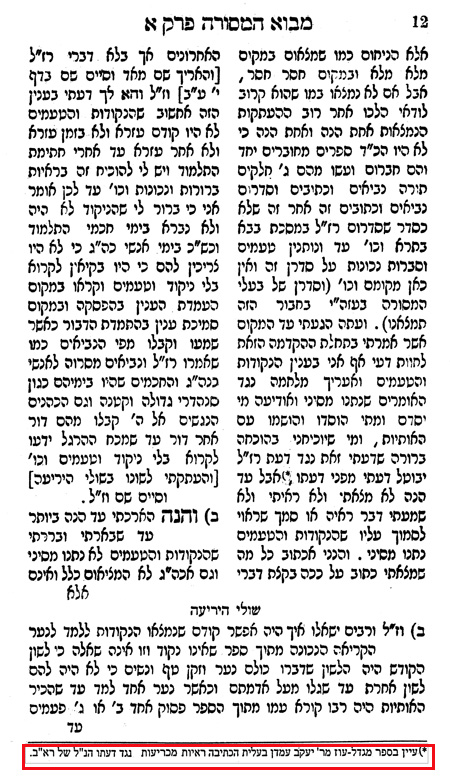
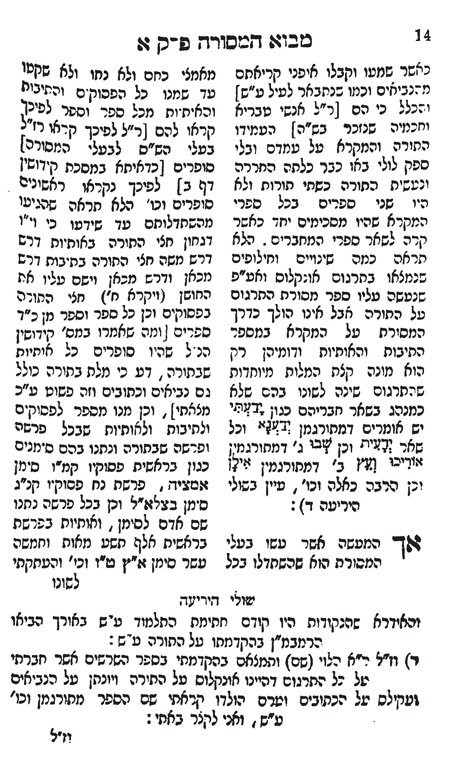
9.     מבוא המסורה, ר’ יוסף קלמן מקאסוויע, נדפס בווארשא תרמ”ט, 112 עמודים.

This work, first printed in 1862 and again in 1889 deals, with the subject of the Masorah by Rabbi Yosef Kalman. One of the points of interest to me about this work is that it received many different haskamot from gedolim of the time. This of interest because the first 15 pages of the work quotes many passages from R. Eliyahu Bachur’s classic work on the subject, including his controversial opinion about the post-Talmudic origin of the nekkudot. Now in the comments on the bottom of the page the author writes that this was already disproven (more on this shortly) but he had no problem to quote this controversial opinion in the main text of the work without arguing on it in the main body or censuring the Tishbi in any form. This is in sharp contrast to the work Nekudot Hakesef printed in 2001.

Now what is interesting is that the person who just printed this new work (someone from Bnei Brak) felt he had to add in one comment to this sefer, so right in the beginning of this long quote from R. Eliyahu Bachur he added in the following:

עיין בספר מגדל עוז מר’ יעקב עמדין בעלית הכתיבה ראיות מכריעות נגד דעת הנ”ל של רא”ב

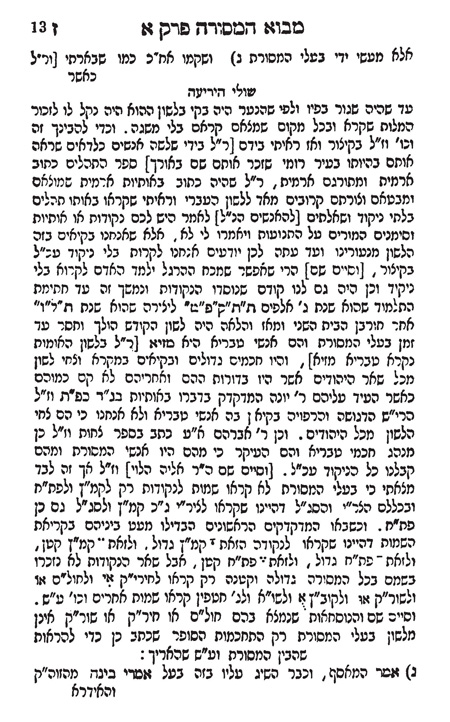
What’s interesting is that on the next page the original author of the sefer writes:

אמר המאסף וכבר השיג עליו בזה בעל אמרי בינה מהזוה”ק והאידרא שהנקודות היו קודם חתימת התלמוד ע”ש באורך הביאו הרמבמ”ן בהקדמתו על התורה ע”ש

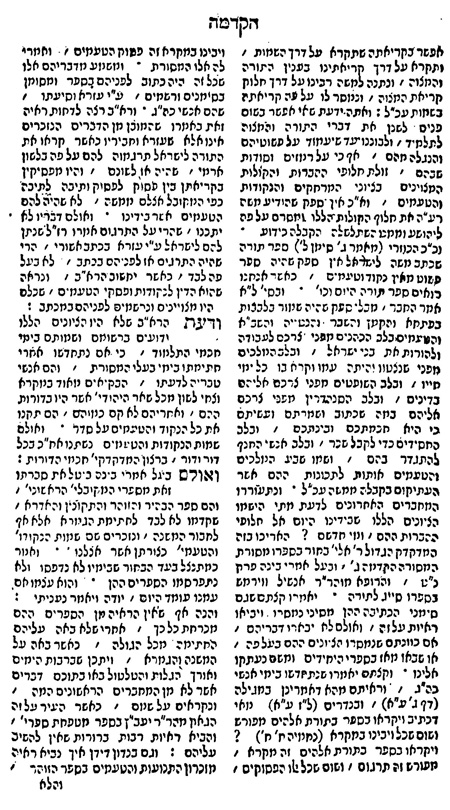
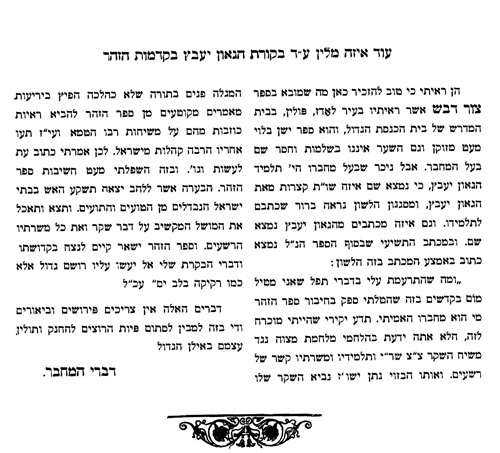
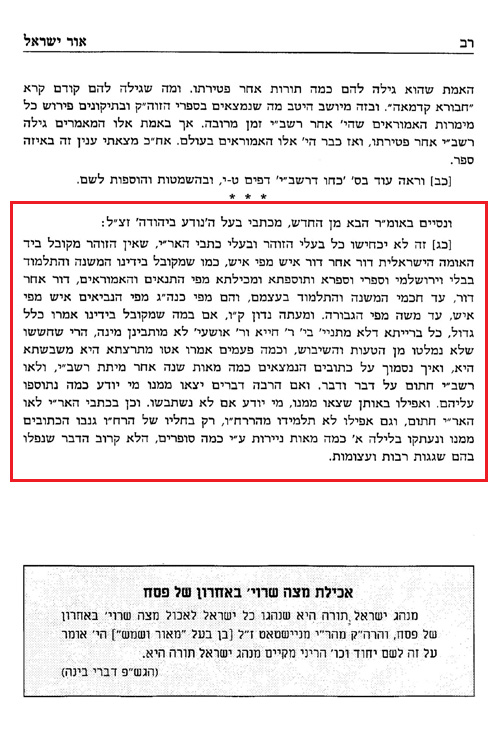
I am positive that the recent printer of this sefer did not realize who this was. The original author of this sefer is quoting the Meor Einayim from Rabbi Azariah Min Hadomim who is quoted by Moses Mendelssohn in the introduction to his Chumash, where Mendelssohn quotes him in regard to the origin of the Nekudot. Possibly we can see from this another piece of evidence that it was not considered so bad to quote from Mendelssohn at that time, and especially how well known Mendelssohn’s introduction was. Apparently the printer did not realize the initials הרמבמ”ן refers to Mendelssohn. For a recent case of someone not realizing what these initials are see he work on the Koheles falsely attributed to the Malbim by Oz Vehadar [See Yeshurun 25 pp. 724-735, (PDF available upon request)]

One more addition to all this, in 1870 Rabbi Yosef Kalman put out another sefer on the subject called Shaar Hamesorah which received haskamot from Litvish Superstars of the time. In the introduction he returns to the subject of the origin of nekkudot and again he quotes the Meor Einayim of Rabbi Azariah, who is quoted by Moses Mendelssohn. However here he makes a strange mistake of thinking that the Rabbi Azariah quoted by Mendelssohn was the Rama Mepano!

Returning to the work Mevo Hamesorah, one last discussion of his worth nothing is about Ibn Ezra and his opinion of the origin of Nekudot (pp. 104-105).
[For more on the subject of Nekudot see Dan Rabinowitz’s excellent article available here; Jordan Penkower, The Dates of Composition of the Zohar and the book Bahir (Heb.) Cherub Press; Rabbi Dovid Rothestein work available here. See also my Likutei Eliezer, pp. 71-72]

10. יד יהודה, ר’ יהודה לנדא, תשובות פסקים וכתבים, מכתב יד, קלו עמודים
11. חמודי דניאל עם פ’ רחבת ידים
12.  חמודי דניאל על הלכות נדה, נדפס לראשונה מכתב יד בתוך ספר מעין בינה על מסכת נדה
13. קשר תורה, [לקשר סוף התורה לתחילתה] נדפס פעם ראשונה ווילנא תרסז, ר’ יצחק מו”צ בעיר ריטווא, 112 עמודים.
14. קול חיים, סדרי לימוד ותפילות להגיע האדם לגיל שבעים שנה ואילך, ר’ חיים פאלאג’י, מכון אהבת שלום
15. הקללה לברכה, הלכות איסור קללה, ר’ מרדכי גרוס, קמה עמודים
16.  מנהג אבותינו בידינו, ר’ גדלי’ אבעלראנדר, ביאורים ובירורים במנהגי ישראל מקורותיהם ושרשי טעמיהם, שבת, נישואין שונות, תסד עמודים, ניתן לקבל תוכן העניינים.

This volume is a collection of Rabbi Oberlander’s articles originally printed in the journals Or Yisroel and Heichel HaBesht as well as other places. These essays are very organized and well written on a wide range of interesting topics, all based on a nice collection of sources. I highly recommend this work. Of course one can always add to such collections of material here but לא המלאכה עליך לגמור .

17. אני לדודי, שיחות מוסר וחיזוק לחודש אלול וימים נוראים, ר’ שריה דבליצקי, קעג עמודים
18. ישא יוסף, אורח חיים חלק ב, ר’ יוסף אפרתי, רכו עמודים
19. הטבילה בהלכה ואגדה, ר’ משה סופר, תסד עמודים
20. ביד נביאך, בעניני הפטרות ונביאים, כולל אסופות תשובות ומאמרים בהלכה ואגדה, פרקי הלכה בעיני הפטרה וכתיבת נביאים, כולל כת”י של האדר”ת  על נביאים וכתובים בשם ‘נביאים טובים’, הלכות הפטרה להגר”ש דבליצקי, וס’ סימנים על עניני הפטרה  ונביאים, תרב עמודים
21. שעות שוות בהלכה, כולל מחקר וסקירה על תולדות הפחתות מדידית הזמן לאורך הדורות, ר’ יצחק זילבער, שצ עמודים
22. שמות בארץ, שמות אנשים, ממשנתו של מרן ר’ חיים קניבסקי, דיני וענייני שמות  אנשים ונשים ובשווי שמות בשידוכין, וקו’ שמות נשים, ר’ צבי יברוב, קלט עמודים
23.  ברכת הלבנה, הלכות ומנהגים, ר’ יוסף אדלר, קב עמודים
24.  בים דרך, מאמרי עולם חלק א, ר’ מיכל זילבר, שסז עמודים
25. גם אני אודך על ענייני ברכת כהנים, ר’ גמליאל רבינוביץ, תרלב עמודים
26. ספר פת שחרית כהלכה, ר’ יששכר דוב הופמן, צו עמודים

This is another work from the author of the now-famous recent work all about sneezing in Jewish law..

27. מאורות הגר”א, חלק ב, ר’ רובין, שפ עמודים
28. ר’ ראובן פרידמן, כי עת לחננה, הליה וישיבה בארץ ישראל, 490 עמודים, מוסד רב קוק
29. ר’ ישראל גארפינקל, כיצד מרקדין, בענין ריקודין של מצוה מצוה טאנץ, רמח עמודים
30. חזון עובדיה, שבת חלק ה, ר’ עובדיה יוסף הל’ צובע, קושר ומתיר, תופר צד ממחק כותב ומוחק, השמעת קול, בונה, אוהל, מתקן מנה, תד עמודים
31.הלכה ברורה חלק יג, ר’ דוד יוסף, סי’ רמב-רנב, תקלו +צ+נד עמודים
32. זהב לבושה, איסור פאה נכרית, הלכה הגות מחשבה, שכד עמודים
33. לוח ההלכות והמנהגים לשנת תשע”ג, 372 עמודים
34. קוטנרס האינטרנט בהלכה, קב עמודים
35. ישועות כהן, ר’ יהושע אדלר, ביאור סוגית קוי התאריך, צג עמודים
36. ספר תהלים עם פירוש מפורש, כולל ביאורים על תרגום כתובים ר’ לייביש דיייטש, תק”ח עמודים
37. שערי חג הסוכות, הלכות סוכה, ד’ מינים הו”ר שמיני עצרת ושמחת תורה, ר’ יהודה טשזנר, תקל עמודים
38. קובץ תשובות חלק ד, ממרן ר’ אלישיב זצוק”ל,  שכט עמודים, כולל מפתחות על לארבע כרכי קובץ תשובות, 73 עמודים
39. הערות במסכת ברכות, מר’ אלישיב זצוק”ל, תקמא עמודים
40.  כתבי הגרי”ש, בהלכה ואגדה, מכתבי יד של ר’ אלישיב זצוק”ל, ימים נוראים וסוכות, קס עמודים
41.  אשרי האיש, פסקי מרן הגרי”ש אלישיב זצוק”ל, יורה דעה, ב’ חלקים נלקט ע”י ר’ יחזקאל פיינהנדלר
42.  רישא דגולתא הספדים על ר’ אלישיב זצ”ל
43. שו”ת פוע”ה מניעת הריון, קובץ שאלות רבני פוע”ה ותשובות של פוסקים, 141 עמודים
44.  באמונה שלימה, ר’ יוסף בלאך, תרם עמודים

This work is written by Rabbi Yosef Bloch, who is a well-known Talmid Chacham from Monsey. In this volume Rabbi Bloch deals with many “hot” issues related to Emunah, bringing many interesting discussions to the table. Just to list a few side points of his: he brings that some say that the Chazon Ish’s work Emunah Ubitachon was never supposed to be printed (pp. 69-70) as the Chazon Ish never wanted it printed. He also deals with a piece that was censored from later versions of the Emunah Ubitachon (p. 39). He brings numerous sources against the Ralbag (pp. 140-141). He has a radical statement about what chazal mean when they say “there is wisdom by the Gentiles” (pp. 301-302):

דכל חכמת הגוים הוא בדברים גשמיים דוקא וכגון מכוניות סעלפאון כלי השחתה למלחמה וכדומה, שם ורק שם יש להם חכמה,… ברוחניות אין להם שום מגע והבנה כלל, ותיקון העולם הוא עצמו איבוד חכמיהם וזה כלל גדול בהבנת ענין חכמת האומות בברזל ובעצים ואבנים ובאלקטריק יודעים קצת, בצומחים יודעים פחות מזה בגופות בעלי חיים יודעים הרבה פחות מזה, בגוף האדם עוד הרבה פחות מזה, בחכמת התכונה השמיימית עוד הרבה פחות בנפשיות האדם
יודעים משהו ממשהו ממש , בחכמה עליונה אפס מוחלט לא כלום!

He has a radical explanation for the famous Gemarah about killing lice on Shabbas (pp. 305-307). Another very interesting discussion of his is about the sugyah of Elu Ve-elu Divrei Elokim Chayim (pp. 308-323).

A few years ago I wrote a few comments (here) about Rabbi Bloch’s work against Copernicus. I recently revisited the topic in the last issue in Hakirah. In this new volume Rabbi Bloch includes his anti-CopernicanEssay but with various updates. If one reads the essay carefully one can see many of these updates he is referring to points in my article. Hopefully in the future I will deal with all the issues he raises but for now I would just like to mention two points at one point he writes (p. 358):

ולא מצאתי אחד מגדולי ישראל מכל הדורות שיחזיקו אפילו במקצת דמקצת כדעת התוכנים ומה שהעידו בשם קדוש ה’ המהרי”ל דיסקין זצוק”ל דהיהו סבר ככה, שקר העידו בו דלא כך היה מעשה אלא שענה שלואל דאין הכרח נכד
התוכנים מלשון הברכה כמדומה ממה שנקראת ברכת החמה אבל מעולם לא יצא מפיו הקדוש דנקט איהו כהתוכנים.

I honestly have no idea what he is talking about but as I brought in my article (p.29) the source says as follows:

“וכן אמר לי ידידי הרב וכו’ ר’ אבנר נ”י בעל המחבר סי’ ציר נאמן, בתורת עדות ששמע מפי רבנו הקדוש רשכבה”ג מהרי”ל דיסקין זצוק”ל שהשיטה החדשה אינה מופרכת. ושאל לו מן הכתוב בקהלת א’ וזרח השמש ובא השמש וכו’ הולך על דרום כו’ וענה לו שהכתוב אמר לפי ראות עיני האדם”.

I also explained there (p. 31) why this sources is very reliable. But what bothered me even more was what he writes there on pg. 359.

 ומה שכמה מהמשגיחים וראשי הישיבות מהדור הקודם נ”ע כתבו דרך אגב בין הדברים בספריהם… כשיטת קופעריקוס, אין מזה שום הוכחה כלל לדעת התורה בענין הזה, דלא באו אותם הגאונים זללה”ה ליקח עמדה בהדיון הזה, דלא היתה זו הסוגיא שלהם ולא ידעו שיש בזה סתירה להשקפת התורה שלא ניסו בכגון אלו ולא עיינו בה, ונסתמכו דכיון דככה אומרים הכל מסתמא הוכיחו התוכנים דהאמת כן הוא, ולא ירדו לסוף דעתם של התוכנים לידע שכוונתם עקירת האמת ואין מדבריהם ז”ל הוכחה של כלום, וכאילו לא אמרו כלום בנידון הזה

Now besides for the haughtiness of this statement the only Rosh HaYeshiva I quoted in my article that wrote an essay very pro Copernicus was Rabbi Yonah Mertzbach someone who had a college degree in these areas so I am not really sure what he is talking about.

One last source related to this topic of Copernicus was brought to my attention in a collection of things by Rabbi Zerach Shapiro who was close with the Chazon Ish (part of this booklet was printed in Yeshurun volume 26) where he asked the Chazon Ish about Copernicus:

בענין מה מסתובב השמש או כדור הארץ, אמר שאין הכרעה בדברי חז”ל.

One last point in regard to Rabbi Bloch’s book is he prints an unprinted essay of his father’s, extremely anti Zionistic and the Mizrachi from 1943 (p. 115-116). I think the reason why he is printed this letter here, while it may otherwise seem out of place, is rather simple. In the same issue of the Hakirah where my essay about Copernicus appeared he saw another article froms Elazar Muskin, When Unity Reigned Yom ha’azmaut 1954 which deals with Rabbi Bloch positive attitude to Yom ha’azmaut.

קבצים
1  המעין גליון 203, ניתן לקבל תוכן העניינים
2. אור ישראל גליון סה, שפג עמודים, ניתן לקבל תוכן העניינים
3.  היכל הבעל שם טוב, גליון לד, קצב עמודים
4.  מוריה גליון שעג-שעד
5.  ארזים, גליון א, גנוזות וחידושי תורה, מכון שובי נפשי, תקפח עמודים [כולל רס עמודים של כת”י על ענינים שונים]
6.    קובץ בית אהרן וישראל גליון קסב, ניתן לקבל תוכן העניינים.
This issue includes another attack on Rabbi Dovid Kamentsky (PDF available upon request].

7.  עץ חיים גליון יח, ניתן לקבל תוכן העניינים
8.   ישורון חלק כז,  תתקמ”ב עמודים, ניתן לקבל תוכן העניינים

One piece worth mentioning in this issue is the complete manuscript of the Meishiv Nefesh printed for the first time, edited by Rabbi Yehudah Hershkowitz (59 pp).

מחקר ועניינים שונים
1.  גאון ההוראה אחרי 50 שנה:  היסטוריה, הגות, ריאליה; קובץ מחקרים בעקבות יום העיון במכללת אפרתה על הרב צבי פסח פראנק / עורך – ישראל רוזנסון, קע עמודים, מכללת אפרתה.
2.  המסע האחרון, מאתיים שנה למסעו בעל התניא בעיצומה של מלחמת נפוליאון תקע”ב-תשע”ב, [לאור מסמכים ותעודות, חדשים גם ישנים, וגם סיפורים ושמועות דרושים ומאמרים], יהושע מונדשיין, 378 עמודים.
3.  נתיבי מאיר, אסופות מאמרים, מאיר רפלד, 456 עמודים ]ניתן לקבל תוכן העניינים]

This is a beautiful collection of Dr. Rafeld’s articles on a very wide range of topics. Some of the articles relate to Rishonim on Chumash and many others relate to the world of minhag and Tefilah. There is also a nice collection of important articles related to the Maharshal and his generation (one of Rafeld’s specialties). All these articles show a great breadth and depth in each of their perspective subjects.
4.  הרב פנחס הירשפרונג, מעמק הבכא הנאצי, זכורנות של פליט, 215 עמודים
5.  ר’ יחזקאל סופר, במאי קמיפלגי, הפולמוס המשיחי בתנועת חב”ד, 408 עמודים
6.  הלבוש היהודי באירופה במהלך הדורות, הלכה, מנהגים, גזירות מאבקים, תקנות, מנחם מקובר, ניתן לקבל תוכן העניינים.
7. אביר הרועים, קורות העתים הנהגתו ומשנתו של ר’ עובדיה יוסף, משנת תרפ”א-תשי”א,יעקב ששון, 320 עמודים
8.  רבן של ישראל, מראות קודש ממרן פוסק הדור הגרי”ש אלישיב זצוק”ל, 219 עמודים
9.  יש”א שלום, הערכתו של הגרי”ש אלישיב זצ”ל כלפי מרן הראי”ה קוק זצ”ל, 58 עמודים
10.  הדף היומי, ר’ דוד מנדלבוים
11.  רועה ישראל, על ר’ ישראל יעקב פישר, חלק ב
12. יהדות התורה והמדינה, ר’ אוריאל צימר, בירור רעיוני קצר בשאלת היחס לציונות ולמידנה עם קצת פרקי היסטוריה מן העבר הקרוב, 47 עמודים,
13.  מפיהם אני חיים, ר’ משה קנר, מאמרים על תלמוד בבלי וירושלמי, רב האי גאון, רבינו גרשום, רש”י בעל התוספות, מהר”ם מרוטנבורג וגדולי ספרד, 375 עמודים.
14.   משונצינו ועד וילנא, תולדות הדפסת התלמוד, ר’ יעקב לופיר, 310 עמודים,

I hope to review this book at length here shortly.

15.   משה אידל, שלמויות בולעות קבלה ופרשנות, ידיעות ספרים, 695 עמודים
16.   רשימת הפירסומים, יוסף דן, תשי”ח-תשע”ב, 205 עמודים
17.   יעקב לאטס, פנקס קהילות רומא, שע”ה-תנ”ה, כולל מבוא והערות, מכון יצחק בן צבי, 409 עמודים
18.   משנת ארץ ישראל, שמואל, זאב, וחנה ספראי, מסכת פאה
19.    משנת ארץ ישראל, שמואל, זאב, וחנה ספראי, מסכת כלאים

After recently completing Seder Moed they are now almost finished with Seder Zerayim.

20.  צדיק יסוד עולם, השליחות הסודית והחוויה המיסטית של הרב קוק, סמדר שרלו, 444 עמודים, אונברסיטה בר אילן
21.  דעת גליון 73
22.  מקראות גדולות – `הכתר`-שמות א`-מהדורה מוקטנת
23.  משה פלאי, עטרה ליושנה, המאבק ליצירת יהדות ההשכלה, 501 עמודים, קיבוץ המאוחד
24.  ללמוד את שפת המולדת, מאמריו של י”ל גורדון בשנים 1881-1882, [מאמרי ביקרות על ספרים ועוד], מוסד ביאליק, ספריית דורות, 367 עמודים
25.  כִּתַאבּ אַלנֻּתַף: פירושו הדקדוקי של ר’ יהודה חיוג’ לספרי נביאים בעיבוד עלי בן סלימן מאת אהרן ממן ואפרים בן-פורת, אקדמיה ללשון העברית
26.   פרקי עיון בעברית החדשה ובעשייה בה מאת משה בר-אשר, אקדמיה ללשון העברית  
27.  מקורות ומסורות, סדר ניזקין, דוד הלבני, מגנס
28.  ההלכה: הקשרים רעיוניים ואידאולוגיים גלויים וסמויים, מגנס
29.  סידור תפילות בלאדינו, סלוניקי, המאה השש עשרה, מכון יצחק בן צבי
30.  רעואל וחבריו פרשנים יהודיים מביזנטיון מסביבות המאה העשירית לספירה, גרשון ברין, אוניברסיטת תל-אביב
31.    רבי חיים בן עטר ופירושו אור החיים על התורה, אלעזר טויטו, 291 עמודים, מכללת אורות ישראל
32.  מחשבת ישראל ואמונת ישראל, בעריכת דניאל לסקר, אוניברסיטת בן גוריון, 293 עמודים בעברית, 186 עמודים באנגליש, ניתן לקבל תוכן העניינים.

This volume has many interesting articles. Worth mentioning is Marc Shapiro’s Is there a Pesak for Jewish Thought and  David Shatz ‘s article Nothing but the truth? Modern Orthodoxy and the Polemical uses of History. In the first footnote Shatz mentions Marc Shapiro’s posts on the Seforim Blog. Much can be added to this essay but of note is footnote 28 where he writes:

To be clear, academics, I find, generally shun blogs that are aimed at a popular audience because the comments are often, if not generally, uninformed (and nasty). A few academics do read such blogs, but do not look at the comments. One result of academics largely staying out of blog discussions is that non-experts become viewed as experts. Even when academics join the discussion, the democratic atmosphere of the blog world allows non-experts to think of themselves as experts and therefore as equals of the academicians. Some laypersons, though, as I said earlier, are indeed experts in certain areas of history.

33. חקרי קבלה ותפילה, משה חלמיש, אוניברסיטת בן גוריון, 458 עמודים ניתן לקבל תוכן העניינים

This work is a collection of twenty five articles by Professor Hallamish about tefilah and kabbalah. Some of these articles appeared in print in various journals, festschrifts and memorial volumes, others are supposed to appear soon, and some were written specially for this volume. They all share the common denominator that they are based on research of an incredible amount of manuscripts and rare volumes. I have no idea how he had patience to open up that many books! Based on these discoveries Hallamish shows the influence of Kabbalah on tefilah. One can also find wealth of information on nussach of Tefilah in these volumes. There is a lot to comment on different points on this volume.

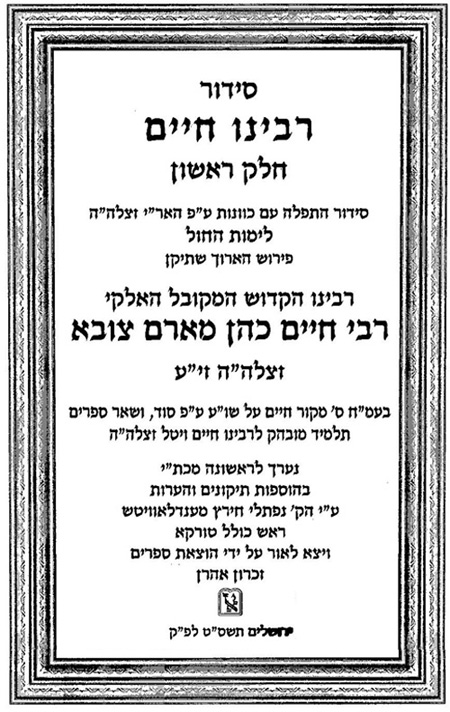
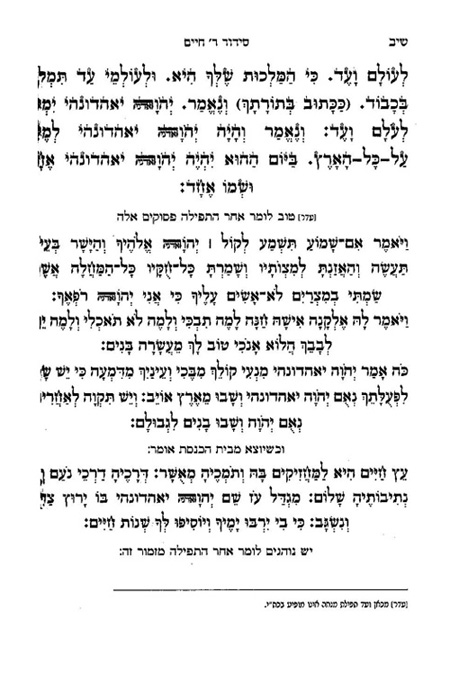
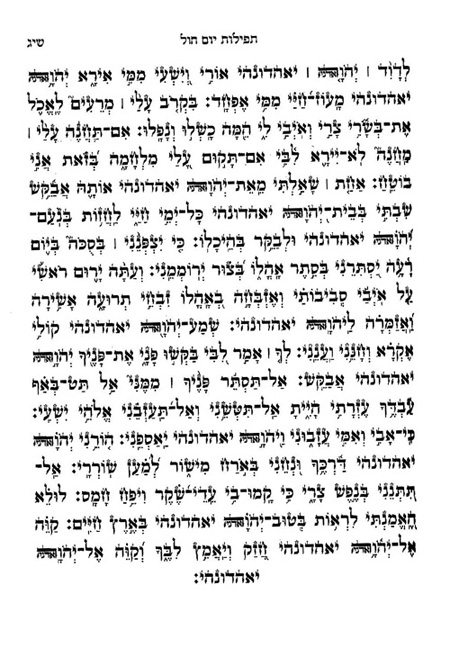
Just to make one small comment as it relates to Elul and a subject I have written about. In chapter thirteen he deals with sources for the custom of saying Ledovid in Elul. He brings early sources for saying it all year around. He quotes the Siddur Shaarei Rachamim which brings this custom to say Ledovid. Now the importance of this find is that this siddur is based on R.Chaim Hacohen who was a Talmid of Rabbi Chaim Vital. If this source is reliable then we have an earlier source for this custom. The first person (not noted by Hallamish) to point to this siddur for an early source for saying Ledovid in Elul was Rabbi Yakov Rokeach in his work Shaarei Tefilah, first printed in 1870. Now it’s well known that the editor of this siddur, Chaim Abadi, added in lots from the Chemdas Yamim and other sources so it’s not so simple if one can consider this siddur a reliable source. However, recently Rabbi Goldhaber checked up the many manuscripts of the actual siddur of R. Chaim Hacohen and found that the custom of saying Ledovid does not appear anywhere in it. Recently part of this siddur was printed by Mechon Zichron Aharon and the custom of Ledovid does appear inside this siddur. So based on this new printed siddur Hallamish has a very early source for saying Ledovid.

First of all what is clear is this is not a source to say Ledovid specifically during Elul but rather an early source to say Ledovid the whole year around. Earlier in this siddur where R. Chaim Hacohen has various chapters of Tehilim to be said on special days he does not include Ledovid to be said during Elul. However at the end of davening Ledovid appears in this new siddur. But more importantly one has to be careful to read the fine print on the page as above where it is printed to say Ledovid in small print the editor adds in that saying Ledovid here does not appear in the original manuscript! Now all this is rather strange; why did he bother adding this in? This is not the place for it as it should be earlier in the siddur with the other chapters said on special days. Even more interesting is that the editor of this siddur says that they decided that four of the manuscripts are authentic but all others have parts added in so they are not going to print all added in pieces  so the question is why did they choose to add in Ledovid
and add nothing else in this printed version.

A few months back I mentioned that the new work by David Assaf Hazitz Unifgah appeared in print. I noted that a complete bibliography of the sources that were used for writing this book was printed in the recent volume of Mechkarei Yerushalayim 23 (2011) pp. 407-481. This was not included in this new work. Recently this bibliography appeared on line here.

English 

1. The Tent of Avraham, Gleanings from the David Cardozo Academy, edited by Nathan Cardozo, Urim Press. 232 pp.
2. Inside Stam, A complete buyers Guide, Rabbi Reuvain Mendlowitz, Israel bookshop, 440 pp.
3.Edward Fram, A Window on Their World: The Court Diaries of Rabbi Hayyim Gundersheim Frankfurt am Main, 1773-1794, Wayne State Univ Press, 653 pps.


What’s Wrong With Wealth and Honor?

What’s Wrong With Wealth and Honor? 
by Eli Genauer
                                                                    
Below, we will present some timely notes regarding an English/Hebrew Machzor for Rosh Hashana which was printed in England in 1807.  We will touch upon a variety of issues, and thus first present general backgrounds regarding Hebrew printing in London, the prayer for the state, and Kol Nidrei.  
Hebrew Typography in London  
The earliest use of Hebrew typography in England is sometime in the middle to the late 1520s.  Of course, at that time, Jews were banned from England and the earliest works containing Hebrew type in England were produced for non-Jews.  
The prize of first was thought to go to Thomas Wakefield’s publication of his address regarding “Three Languages” – Hebrew, Arabic and Chaldean (Oratio de laudibus et utilitate trium linguarum [link]). The type, as you can see, was quite primitive.
This lecture was given in 1524, and as the book itself is undated, it was assumed that the lecture was published soon after it was given.  Thus, many dated it to 1524/25.  Wakefield, a noted Hebraist, actually spends the majority of the book discussing Hebrew and the other two languages get short shrift.[1]   
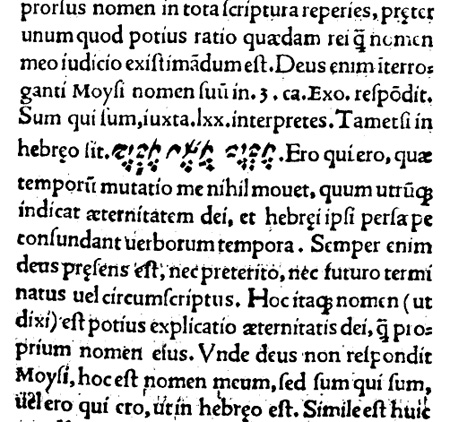
Recently, however, the dating of this work has been challenged and been shown to likely incorrect.  The author, in the self-described “Holmesian manner,”[2]   highlights the various persons Wakefield claims to have tutored in Hebrew and the honorifics used to describe those persons.[3] Based upon some of the descriptions, it seems likely that Wakefield’s work was not published prior to 1527 and most likely in 1528.   [4] This conclusion, coupled with the dating of another work by a different author, unseats Wakefield’s book claim to first.  Instead, Richard Pace’s Praefatio in Ecclesisten, printed in August 1527, is the most likely candidate for the first use of Hebrew typography in England.[5] Here is a sample:
It took nearly two hundred years after the appearance of Hebrew typography for the first Hebrew book published for a Jewish audience in England.  The controversy surrounding R. David Nieto’s remarks and their affinity or lack thereof to Spinoza would produce the first printed Jewish Hebrew book in England.  The first was a very small one, only a few pages, of a responsum written by R. Tzvi Ashkenzi, in R. Nieto’s defense, and published in 1705. It included both Spanish as well as Hebrew (available here).[6]   For more on R. Nieto and this controversy, see the Seforim Blog’s earlier post here
The Prayer for the Welfare of the State
The prayer for the welfare of the king or ruler is ancient.  Many point to the statements of Ezra as well as the passage in Avot as early sources for the prayer.  A variety of rationales are offered for this obligation.  For example, Rabbenu Yonah interprets the need for these prayers as indicative of a Universalist worldview, which requires all humans to display empathy for one another.  In order to effectuate that goal, Jews therefore pray for not only the Jewish leaders but also the secular one.  R. Azariah di Rossi, claims that the prayer carries a pacifist message as he emphasizes the lack of allegiance to a specific ruler or country and thereby transforms the prayer into one arguing for peace among all nations. 
The earliest extant prayers are from the Geniza, and can be dated to between 1127 and 1131.  The prayer is for the “Fatimid caliph al-Amir bi-ahkam Allah who ruled Egypt and its regions during the years 1101-1131.” See S.D. Goitein, “Prayers from the Geniza for Fatimid Caliphs, the Head of the Jerusalem Yeshiva, the Jewish Community and the Local Congregation,” in Sheldon R. Brunswick, ed., Studies in Judaica, Karaitica and Islamica: Presented to Leon Nemoy on His Eightieth Birthday (Ramat-Gan: Bar-Ilan University Press, 1982), 47-57.[7]   In this instance, the prayer includes not only a prayer for the secular ruler, but also a prayer for the local Rosh HaYeshiva.  Additionally, it blesses all of the Rosh HaYeshiva’s deceased predecessors, providing a nice genealogy. Goiten posits that these prayers may have been written in response to specific historical events and may not be indicative of the general practice in 12th century Egypt.  See id. at ___. 
The earliest sources, however, do not include the modern formulation of HaNoten Teshua.  Instead, early on there was a lack of conformity regarding this prayer.  Kol Bo records the custom but indicates that each community had its own practices.  But, none used the HaNoten Teshua formulation.  The first extant example of HaNoten Teshua is found in a Spanish manuscript dated between 1479-92.[8]   Ironically, this example was prepared for King Ferdiand V, who, in 1492, issued the expulsion order.  
It appears that with the expulsion and dispersion of the Spainish Jews, the HaNoten Teshua was disseminated throughout the Jewish world.  Indeed, the inclusion of this prayer in Yemenite rites, appears to undermine a major thesis of the noted Yemenite scholar, R. Yosef Kapach.  He asserts that the rite presents a pristine rite, unchanged over hundreds of years.  But, as the Yememite rite includes HaNoten Teshua, which is from the 15th century, indicates that the Yemenite rite is less pristine than Kapach would have it. [9]  
The prayer is also linked to the readmission of Jews into England.  Menasseh ben Israel in his plea  for readmission of the Jews to England (link) provides the full text – in English – of the HaNoten to demonstrate the Jews’ loyalty to their rulers.[10]
A English Hebrew Machzor Printed in London
The Jewish Encyclopedia notes “In 1794 David Levi published an English version of the services for New-Year, the Day of Atonement, and the feasts of Tabernacles and Pentecost, and thirteen years later gave a new version of the whole Mahzor. This second edition was “revised and corrected” by Isaac Levi, described as a “teacher of the Hebrew Language.”
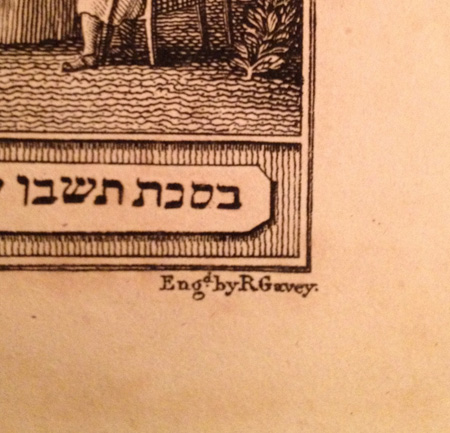
The Machzor features a frontispiece with various engravings of the Jewish holidays. The engraving for Shavuos features Moshe Rabbeinu dressed in a manner probably unknown 3,000 years ago, and holding the Aseres HaDibros with the numerical sequence from left to right. Yom Kippur correctly shows two identically sized “Se’irim” as per our tradition.
If you look closely at the name of the engraver, you will see that it was done by an R. Gavey.
I tried to find out more about R. Gavey and finally came upon a website which dealt with his family. I sent an email to the address listed and waited and waited. Two years later, I received the following response from a fellow in Australia:

“Robert Gavey b.1775 London was my 4xGreat Grandfather. He is listed as an engraver. Both his father and grandfather were watch makers.  Robert Gavey’s daughter Harriot Angelina Gavey  married my 3x Great Grandfather whose son James Fletcher  emigrated to Australia 1852. The Fletchers were originally Huguenot silkweavers with the surname Fruchard and I believe the Gavey’s would have been Huguenots also.” 

It turns out that Robert Gavey’s Australian descendent had a copy of his certificate of indenture as an engraver to a goldsmith named William Norris. Robert was 15 years old at the time (1790) and his period of indenture lasted for seven years. He promised not get married during that time period or play cards or dice. He also was forbidden to frequent taverns or playhouses or engage in any act which would cause his master a loss of money. (Click to see a large, high-resolution image.)


The certificate of indenture was signed in May of 1790 which was noted as the thirtieth year of the reign of George III who is described as the king of Great Britain, France, and Ireland.
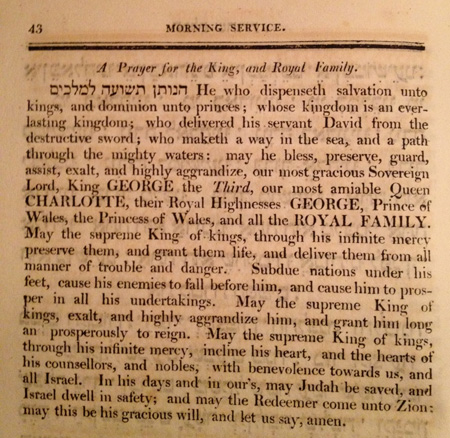
Speaking of George III, he received much better treatment in this Machzor than in our American Declaration of Independence. On our side of the pond, we know George III as a man who “ has plundered our seas, ravaged our Coasts, burnt our towns, and destroyed the lives of our people.” As part of the agreement by Cromwell to allow Jews back into England, the Jews promised to always pray for the welfare of the ruler. Accordingly, this Machzor blesses King George in this manner:

This is not the only edition that continued to praise the monarch.  Isaac Lesser, published the first complete machzor in the United States in 1837-38, for the Spanish and Portuguese rites with an English translation.  Lesser’s translation relies heavily upon that of David Levi’s translation.[11]   In an attempt to sell his machzor in both the United States as well in other English-speaking locals, he includes two version of the prayer, one asked that God “bless, preserve, guard, assist, exalt, and raise unto a high eminence, our lord the king.”  The other, replaced this phrase with the request that God “bless, preserve, guard, and assist the constituted officers of the government.”[12]  

The person who finally brought the prayer for the government more in keeping with American democratic values was Max Lilienthal (1814-1882).[13]   While some had been willing to change the prayer, they did so only in the vernacular but retained the Hebrew HaNoten Teshua.  Lilienthal, however, totally reworked the prayer, altering its tone and focus.  Lilienthal removes all mention of kings, focuses on the country more than its rulers, and seeks to bestow God’s blessing, not on the ruler but on all the inhabitants of the land.  This version was included in Henry Franks’s Teffilot Yisrael, a siddur containing the Orthodox liturgy. This siddur was first published in 1848, and reissued in more than 30 editions.  As Sarna notes, the acceptance of the prayer is somewhat ironic in that Lilienthal, later became part of the American Reform movement, was the author of a prayer that became the standard even in Orthodox siddurim.[14]  Id. at 436.

Aside from changing the text of the prayer to fit American sensibilities, how the prayer was recited was also changed.   Congregation Shearith Israel, in New York, after the revolutionary war, “ceased to rise for Hanoten Teshu’ah. According to an oral tradition preserved by H.P. Solomon, ‘the custom of sitting during this prayer was introduced to symbolize the American Revolution’s abolition of subservience.’”[15]

The United States was not the only country to undergo significant changes to its governmental structure.  France, in 1787, abolished (temporarily) the monarchy.   After which the prayer for the welfare of the government was radically changed.  Instead of praying for the benefit of kings and rulers, the French prayer focuses upon the Republic and its people.  All the biblical verses included bless the people and not the king.   [16] The prayer begins “Look down from your holy place on our land, the French Republic, and bless our nation, the French people, Amen.”

Other changes to the prayer, due to time and place, were common. For example, during the height of the Sabbati Zevi messianic frenzy, two versions of the prayer were produced, not asking to bless the secular ruler, but, instead, blessed Shabbati Zevi.

Today, the most significant change to this prayer has been the new prayer on behalf of the State of Israel.  The authorship of the prayer as well as its use is subject to controversy.[17]

In the most recent “Prayer For the State” news, French President François Hollande, specifically invoked this prayer when discussing French Jews’ relationship to the state.  He included in his remarks, translated in NYRB, commemorating the round-up of Jews at the Vélodrome d’Hiver: “Every Saturday morning, in every French synagogue, at the end of the service, the prayer of France’s Jews rings out, the prayer they utter for the homeland they love and want to serve. ‘May France live in happiness and prosperity. May unity and harmony make her strong and great. May she enjoy lasting peace and preserve her spirit of nobility among the nations.'” 

Kol Nidrei 
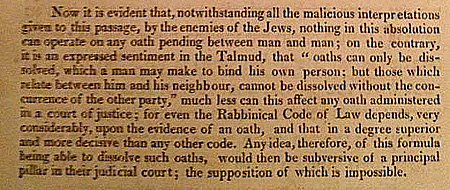
The Yom Kippur volume of this set contains a detailed “apology”for the Kol Nidre prayer. The Jews endeavored to incorporate themselves into general society and felt the need to emphasize that their word was binding on them. Kol Nidre was seen as indicating otherwise, so an explanation of the prayer was seen as necessary, both for Jew and Gentile. (See Y. Goldhaver, Minhagei Kehilot, Jerusalem: 2005, pp. 209-19 on the history of Kol Nidre and the controversy.) It concludes as follows.

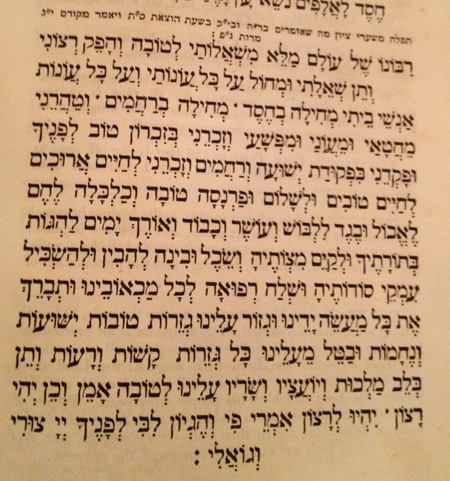
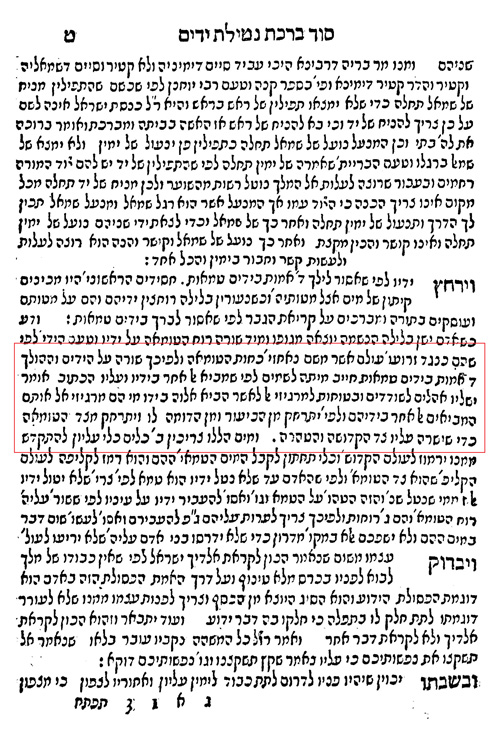
Finally, I would like to focus on the special prayer said during the Yamim Noraim when the Torah is taken from the Aron Kodesh. It first appeared in the Siddur Shaarey Tzion of Rabbi Nathan Hanover and begins with the words “Ribbono Shel Olam”.

In it we ask Hashem to remember us for a long and good life, with everything that comes along with that. We include in our request that Hashem should provide us with “Lechem Le’echol, Beged Lil’Bosh, V’Osher V’Chavod”.  Let us see how David Levy translates these words.

As you can see, the request for “wealth and honor” is nowhere to be found in the English translation. I was curious about this and asked Dan Rabinowitz for his opinion. He offered that it is possible that this Machzor was printed at a time when the English community was quite interested in the Hebrew language. Non-Jewish scholars eagerly bought any books printed in Hebrew. As such, it could be that Levy decided to leave out the reference for our desire for wealth and honor because, well, maybe it was a bit too pushy on our part.

I hope all of you are blessed with a Shana Tova, even one that includes within it the promise of wealth and honor.

[1]  See Marvin J. Heller, The Sixteenth Century Hebrew Book, Brill, Leiden:2004, entry for Oratio and pp. 959-60 and the sources cited therein. But see Brad Sabin Hill, Incunabula, Hebraica & Judaica . . .” Ottawa:1981, #52 asserting that 1561 is the earliest introduction of Hebrew typography to England. It is unclear what the basis of that assertion is.

[2] Richard Rex, “Review: Robert Wakefield On Three Languages 1524,” The Journal of Ecclesiastical History 42:1 (Jan. 1991) 159.
[3] Richard Rex, “The Earliest Use of Hebrew in Books Printed in England: Dating Some Works of Richard Pace & Robert Wakefield,” Transactions of the Cambridge Bibliographical Society, Vol. 9, No. 5 (1990), 517-25.
[4] Id. at 517-18.
[5] Id. at
[6] See B. Roth, The Hebrew Printing Press in London, Kiryat Sefer 14 (1937), pp. 97-99.
[7] See also, Fenton,
[8] See Aaron Ahrend, “Prayers for the Welfare of the Monarchy and State,” in Aaron Ahrend, ed., Israel’s Independence Day: Research Studies (Ramat-Gan: Bar-Ilan University Press, 1998), 176-200 (Hebrew). This date is contrary to Schwartz who incorrectly posits that there is no evidence of HaNoten Teshua prior to the 16th century, and none in pre-expulsion Spain. See Barry Schwartz, “Hanoten Teshua: The Origin of the Traditional Jewish Prayer for the Government,” in HUCA, 57, (1986) 113-20. Sarna appears unaware of Ahrend’s article as he continues to assert that HaNoten Teshua was not composed prior to the 16th century. See Jonathan Sarna, “Jewish Prayers for the United States Government: A Study in the Liturgy of Politics and the Politics of Liturgy,” in Ruth Langer & Steven Fine, eds., Liturgy in the Life of the Synagogue: Studies in the History of Jewish Prayer (Winona Lake, Indiana: Eisenbrauns, 2005), 207 & n.9 (link).
[9] See Ahrend, “Prayers for the Welfare,” at 183.
[10] See Menasseh ben Israel, The Humble Address to his Highness the Lord Protector, 1655.
[11] Leeser was not the first American to utilize Levi’s translation. The first Hebrew prayer book published in the United States, The Form of Daily Prayers (Seder Tefilot), New York, 1826, also includes an English translation by Solomon Henry Jackson. Jackson, who emigrated to the United States from London, also relied heavily upon Levi’s translation. Jackson, in the introduction, indicates that HaNoten Teshua was adapted for U.S. audience, in fact, the Hebrew remained the same, only the “translation” was altered. See Sarna, Jewish Prayers, 213.

Additionally, some time in the 1820s, there was an attempt to reprint Levi’s machzor in the United States. A prospectus was issued, but Levi’s machzor was never reprinted in the United States. See Yosef Goldman, Hebrew Printing in America 1735-1926, Brooklyn, NY, 2006, no. 33.
The first appearance of HaNoten Teshua in the United States is found in the first prayer book published in the United States. Isaac Pinto’s holds that honor. In his English only edition whose first volume was published in 1761 with the second volume published in 1766, he includes HaNoten Teshu’ah.
[12] Jonathan Sarna, “Jewish Prayers for the United States Government,” at 215.

[13] See Jonathan Sarna, “A Forgotten 19th-Century Prayer for the United States Government ,” in Hesed ve-Emet, Studies in Honor of Ernest S. Frerichs, ed. Magness & Gitin, Atlanta, Georgia, 1998, 431-40.

[14] Today, however, the most widely used Orthodox siddur in the United States, Artscroll, does not include the prayer in any form in its standard editions. It is unclear why Artscroll omitted this very old prayer.

[15] Sarna, Jewish Prayers, at 210.

[16] Moshe Katon, “An Example of the Revolution in the Hebrew Songs of the French Jews,” Mahut 19 (1997) 37-44, esp. 37-8.

[17] See Aharon Arend, “The Prayer for the Welfare of the Monarchy and Country, in Arend ed., Pirkei Mehkar le-Yom ha-Atzmot, Ramat Gan: 1998, 192-200.


Introduction to The Song of Songs (An Excerpt) by Amos Hakham

Introduction to The Song of Songs (An Excerpt)
by Amos Hakham
Translated by David S. Zinberg

Amos Hakham passed away on August 2, 2012 at the age of 91.  The following is an unofficial translation of an excerpt from the Introduction to his commentary on the Song of Songs, published in 1973 by Mossad Harav Kook, in the Da’at Mikra series of Bible commentaries.  

The selection below is an outstanding example of Hakham’s distinct approach, in both his Introduction and commentary, characterized by uncompromising scholarship coupled with faithfulness to tradition.  Here and in his other writings, he displays a profound mastery of the Bible and the literature of the Sages, a keen eye for subtle literary and linguistic features of the text, a love of Jewish tradition, and a genuine religiosity that is never cloying.  His style is marked by a fluid, graceful clarity.  With courage and sensitivity, Hakham confronts one of the most challenging subjects in traditional biblical exegesis.   

Hakham’s presentation is transparent and honest rather than pedantic.  First, he cites a broad range of general approaches and specific theories, from both traditional and modern sources.  He then carefully and fairly evaluates each view, adds his own observations and, finally, offers a  conclusion.   

Biblical quotations are from the New JPS Version, except for translations inconsistent with Hakham’s understanding of the verse.  The translation of a passage from Maimonides’ Mishneh Torah is from I. Twersky, A Maimonides Reader (New York: Behrman House, 1972).  Where valuable, I have included Hakham’s original Hebrew in square brackets.  Hakham’s footnotes are not included in this translation.    

__________________________________________
The Content and Meaning of the Song of Songs in the Literal Sense
The Song of Songs, in the natural sense of Scripture [peshuto shel mikra], is about a man’s love for his beloved woman [ahavat ha-dod le-ra’eyato], and the woman’s love for him.
The question of continuity and division is critical for understanding the Song of Songs, and there are a variety of views on the subject.  Aggadists tended to interpret its verses independently, each conveying its own idea.  Opposing this method, Rashi wrote in his Introduction: “There are many aggadot on this book . . . but they are inconsistent with the syntax of Scripture and the sequence of the verses.  I have endeavored to follow the natural sense of the verses and to interpret them sequentially . . .”  Indeed, one who studies Rashi’s commentary on the Song of Songs will find that he attempts to interpret the entire book as a single, continuous poem.  For Rashi, the continuity of the Song of Songs lies mainly within its referent [nimshal], which is Israel’s history from its origin to the end of days.  R. Abraham ibn Ezra interpreted the Song of Songs in similar fashion, though Ibn Ezra also tried to find continuity within its literal sense.  In his commentary, the Song of Songs is a chronology of events taking place between two lovers.
A number of modern biblical scholars attempted to follow this approach to its logical conclusion; they maintained that the Song of Songs is a single, continuous poem written in the form of a dramatic dream vision.  But adherents of this view are forced to posit far-fetched interpretations and to take many verses out of context.  Other scholars held that the Song of Songs is an anthology of several poems (excerpts of poems, for the most part) — composed in various periods and provenances — which were compiled haphazardly at a later time.
The most plausible approach, I believe, is as follows:  The Song of Songs is not a continuous chronology of two lovers, and it is certainly not a drama.  But neither is it an anthology of poetic excerpts.  Rather, it is an anthology of complete poems written by a single author on a single subject, following a specific methodology and purpose.  The poems are sometimes brief and simple, sometimes lengthy and complex.  Nevertheless, for the most part they are self-contained units.  In the commentary, I have assigned a unique title to each poem and have also noted its division into sections or stanzas.  Often, the divisions are ambiguous; other commentators have split or combined the poems differently.  But these are merely details which do not undermine the central thesis that the Song of Songs is an anthology of complete poems.
As mentioned, the overall theme of the poems is the love between the dod and his ra’eyah.  However, there are several differing opinions regarding the circumstances in which the poems were composed.  Rashi (in the  Introduction to his commentary) says that the ra’eyah in the Song of Songs is a “widow of the living,” i.e., her husband has abandoned but has not divorced her, and she longs for him in her songs.  He consoles her, promising that he will yet return.  Ibn Ezra reads the Song of Songs as the story of a preadolescent girl, whose beloved is a shepherd, guarding a vineyard.  
Modern biblical scholars have suggested that the poems in this book do not describe events which took place between a particular pair of lovers but, instead, these songs were popular at wedding banquets.  As proof, some point to a statement of the Sages forbidding the use of lyrics from Song of Songs in drinking halls (Sanhedrin 101a; Tosefta Sanhedrin 12:5).  Because the Sages prohibited such a practice, their argument goes, this was in fact the original custom.  It was eventually forbidden, they say, due to deteriorating moral standards and out of fear that it might create an atmosphere of levity leading to the desecration of the sacred.  Among those who maintain that the Song of Songs comprises wedding songs, some suggest that the name “Solomon” — appearing seven times in the book — refers not to King Solomon, but to the groom, who is likened to a king.  In light-hearted humor, he is caricatured as “Solomon.”  Some have claimed that these songs were originally sung at festivals for Israelite girls, such as the dance festival at Shiloh recorded in Judges (21:21), and the festival mentioned at the end of Mishnah Ta’anit (4:8) as well as the Targum to Lamentations, on the phrase “her maidens are unhappy” (1:4).         
The most reasonable approach, I believe, is as follows: Although the Song of Songs does include dance songs (e.g., “Turn back, turn back, O maid of Shulem!” 7:1), one cannot claim that all the poems are dance songs.  It is likely that the poet borrowed phrases from dance songs and embedded them, as necessary, within his poems.  Likewise, some of the poems may have originally been wedding songs — at least one, ending in the words, “Eat, friends, drink deeply, beloved” (5:1), is an obvious example; it is a call to the diners at a wedding banquet to eat and drink — but one cannot generalize this to all the poems.  Most likely, the portraits of the lovers within the Song of Songs depict a variety of circumstances.  In some, the lovers may be formally unconnected; in others, they may be betrothed, at their wedding banquet, or already married.  Also, the notion that every “Solomon” is a metaphor for the groom seems far-fetched.  Sometimes, “Solomon” is simply King Solomon himself.  
The love portrayed in the Song of Songs is untainted and pure.  It is entirely within the bounds of that which is appropriate, permissible, and accepted.  No divine or human obstacle stands in the way of their love.  The ra’eyah brings her dod to her mother’s home; that is, everything is conducted according to custom and convention, and with the family’s approval.  The ra’eyah does have desperate moments.  But although she calls herself “lovesick” (2:5, 5:8), she is referring to an intense longing for her beloved rather than an emotional crisis.  At times, the ra’eyah refuses her dod, and the dod may elude her and disappear, but that does not mean that there was animus between them.  Instead, this dynamic should be understood as “a rejection with the left hand, and an embrace with the right.”  The ra’eyah is treated cruelly by her brothers, but they do not keep her away from her beloved.  They are intent only on increasing their possessions but, in  the end, they relinquish what is hers.
Whether the entire Song of Songs refers to a single pair of lovers, or describes multiple couples, is a significant question.  That is, can all that is said of the dod and the ra’eyah be conflated within the portrait of an individual man or woman?  There do not appear to be substantive contradictions between the different descriptions of the dod and ra’eyah; we may thus assume that the book intends to describe different circumstances or events in the lives of a pair of lovers who actually lived at some point in time.  
I do not mean to suggest that everything recounted in the Song of Songs should be taken as a narrative or that it only describes events that actually took place between two specific individuals.  The very nature of poetry is to portray circumstances more beautifully and more perfectly than they really are.  Here too, the primary goal of the Song of Songs is to present an ideal portrait of the innocent love between a dod and his ra’eyah.  But the descriptions are based on reality.  
The dod portrayed in the Song of Songs is a shepherd.  His sheep are never mentioned explicitly in the poems, but “shepherd” is used several times as his alternate name.  Although there appear to be instances where “shepherd” is used a metaphor for the dod, wandering the hills and tending his gardens like a grazing gazelle, he is initially depicted as a real shepherd, as implied by the verse, “Where do you pasture your sheep?  Where do you rest them at noon?” (1:7).  Possibly, because he would wander the countryside with his sheep, he mentions the names of several places scattered far and wide throughout the land.  It is also possible that because he was a shepherd, he compares his love’s beauty to flocks of goats and ewes.  But there is no hard evidence that compels us to interpret the text this way.  Nevertheless, we may infer from Scripture that he roamed the mountains (“leaping over mountains”; 2:8), which is consistent with shepherding.  The image of the dod is depicted with all the emotion and intensity of one who is “lovesick.”  Scripture suggests that he was tall (“preeminent among ten thousand,” “stately as the cedars”; 5:10,15), that his hair was “curled, and black as a raven” (5:11), his cheeks were ruddy and bearded (“his cheeks are like beds of spices”; 5:13), and he was a swift runner (2:9, 8:14).    
The ra’eyah is also tall, with an upright posture (“Your stately form is like the palm”; 7:8), her hair is black (“Your hair is like a flock of goats”; 4:1), and her complexion is dark as well (“because I am swarthy”; 1:6).  The white of her teeth, which “bear twins” (6:6), stands out against her dark face.  Her movement and her gait are full of grace (“How lovely are your feet in sandals, O daughter of nobles!”; 7:2).
She is called a “daughter of nobles,” and the poems imply that she was from a well-to-do family: She wears costly perfumes, and her brothers offer her a “silver battlement” (8:9).  They own vineyards, but she too has a vineyard of her own.  Her brothers direct her to tend the vineyards, and she also tends to sheep (perhaps at the advice of her dod, so that he might see her more easily: “Go follow the tracks of the sheep, and graze your kids by the tents of the shepherds”; 1:8).  The portrait in the Song of Songs suggests that her brothers treated her heavy handedly, forcing her to work in the vineyards.  She knew her dod previously and, unbeknownst to her brothers, fell in love with him; to them, she was still a child.  After much time elapsed, the brothers were finally inspired to provide for their sister’s upcoming marriage, only to discover that she had already found her intended.                                              
God is never mentioned in the Song of Songs.  This is likely one of the motivations for the Sages’ pronouncement that “every ‘Solomon’ in the Song of Songs is divine” (Shavu’ot 35b).  But the question remains why God is not mentioned explicitly.  Commentators and thinkers have said that the holiness of a text is not determined by tallying its divine names.  Just as there are texts whose sacredness is self-evident even without reference to God, so is the untainted and sacred love depicted in the Song of Songs.  Nevertheless, it seems that the poet deliberately excluded the explicit form of God’s name from the text.  Possibly, because the poems — in their literal sense — were originally meant to be recited as expressions of love between a groom and bride, it was feared that they might not always be recited in purity, and for this reason God’s name was omitted.  It is also possible the omission contains a moral statement, related to Rava’s comment (Mo’ed Katan 18b), that a lover may not solicit divine intervention in the hope of marrying his love.            
It is also worth noting that the dod and ra’eyah are nowhere mentioned by name.  They address each other not by proper name, but by pet name, like dodi, ra’eyati, and many others.  The ra’eyah’s friends are called “Daughters of Jerusalem,” and the dod’s friends are called “companions” [haverim], “friends” [re’im], and “beloved” [dodim].  This is a known biblical feature, in which male or female characters may remain anonymous for the duration of a lengthy and detailed narrative.    

The Song of Songs as a Parable of Divine Love
In the Midrash, the Sages offered many allegorical interpretations of the Song of Songs, taking its earthly love as a parable for the love between God and Israel.  This notion is based on prophecies in which God’s covenant with Israel is symbolized by the marriage covenant between a man and his beloved wife.  The great medieval Jewish exegetes interpreted the Song of Songs within this conceptual framework and objected strenuously to the idea that its meaning is limited to its literal, natural sense of the love between a man and woman.
It is well known that the term “parable” [mashal] in the Bible, as well as in Hebrew generally, has several different meanings.  Many types of parables are found in the Bible (and not all parables are explicitly termed “parables”).  The parable in the Song of Songs is apparently not the type in which the referent displaces the literal sense but, instead, adds a nobler and more sacred meaning to the natural meaning.  That is, although the natural, literal sense refers to the love between a flesh-and-blood dod and ra’eyah, by virtue of the fact that their love is wholesome, innocent, pure, and holy, it is worthy of serving as a representation and a model for a more exalted love.  Support for such an approach can be found in the statements of the Sages and Jewish scholars throughout history.  Indeed, while the Sages of the Midrash interpreted the Song of Songs’ love as that between Israel and God, they also interpreted it naturally, viewing the dod and the ra’eyah as two human beings.  For example, in R. Yohanan’s exegesis of the verse, “I have come to my garden, my own, my bride” (5:1; see the commentary, in the poem’s summary section) [In the summary of that poem, Hakham cites Vayikra Rabba (9:6): “The Torah teaches you proper etiquette: A groom may enter the bridal chamber only after receiving his bride’s consent. First, (the bride) says, ‘Let my beloved come to his garden and enjoy its luscious fruits’ (4:16); and only then (in the next verse, the groom responds), ‘I have come to my garden, my own, my bride’ -dsz].  This is linked to the idea, appearing frequently in the literature of the Sages, that all aspects of marital relations are rooted in holiness and allude to holy matters.  For this reason, the marriage blessings include the following: “The barren will surely rejoice when her children return to her joyfully.  Blessed are you, God, who brings joy to Zion with her children.”  From the formulation of this blessing, we may infer that the joy experienced by every bride and groom represents the joy associated with the redemption and the ingathering of the Diaspora.  There are many kabbalistic teachings which take aspects of marital relations as symbols of lofty matters.      
We should also draw attention to the mistaken notion that the Sages interpreted the Song of Songs allegorically because they considered its natural sense to be unworthy of the Holy Scriptures. It is not so.  Some of the greatest exegetes have noted that one must not even contemplate the idea that a prophetic text would employ something inherently offensive to suggest that which is holy and pure.  Rather, just as the referent is holy, so is the allegory.  The fact that the prophets compare the covenant between God and Israel to the marriage covenant suggests that the latter is sacred and noble.  The Sages have said, “If a married man and woman are worthy, God’s presence dwells with them” (Sotah 17a).
As noted, many exegetes interpreted the Song of Songs allegorically, viewing the ra’eyah as an emblem for Israel and the dod for God.  Thus, the love between the dod and the ra’eyah represents God’s love for his people and Israel’s love for God.  In the Midrash, the Sages followed this exegetical method.  Likewise, the Targum translated the Song of Songs allegorically and ignored its literal sense.  Many such midrashim are embedded in Jewish liturgical poetry [piyyutim].  On Passover, several communities once recited — some still do — piyyutim based entirely on the Song of Songs, from start to finish, on the subject of God’s love for his people and the promised redemption.  Many piyyutim for other occasions include phrases from the Song of Songs; such phrases were a quintessential part of the piyyut vocabulary and, subsequently, entered popular usage.  
The great medieval exegetes such as Rashi, Ibn Ezra, and others, were also of the view that the Song of Songs allegorizes God’s love for his people.  The difference between the approach of Rashi and Ibn Ezra and that of the Midrash is as follows:  The Midrash generally ignores the allegory entirely and exclusively addresses the referent.  The exegetes, on the other hand, also address the literal sense of the allegory.  Furthermore, they attempt to connect adjoining verses and to find context and continuity within the Song of Songs as a whole.  In their view, the Song of Songs includes hints regarding all of Jewish history, from its origins until the end of days.  The hints are not of a general nature; they refer to specific future events.  Thus, for example, Rashi interprets the verse, “Before I knew it, my desire set me mid the chariots of Ammi-nadib” (6:12) as an allusion to the civil war between the Hasmonean brothers John Hycranus and Aristobulus, which led to Israel’s subjugation by Rome.  They saw the Song of Songs as a prophetic or visionary work.  But there are those who do not accept — within the natural sense of the book — interpretations predicting future events.  However, this objection does not undermine the view which sees the love in the Song of Songs as emblematic of God’s love for his people.  
All the midrashim and the exegesis cited above view the ra’eyah as a “collective personification,” representing Israel as a whole.  However, some exegetes emphasize that God’s love applies to each Jew individually and they thus identify the ra’eyah with the devout soul, serving God out of love and longing for Him.  The Bible does contain expressions supporting the notion that the devout’s yearnings for God are represented by human love, e.g.: “We long for the name by which you are called” (Is. 26:8); “My soul thirsts for you, my body yearns for you” (Ps. 63:2); “My soul is attached to you” (Ps. 63:9).  See also Hagigah 15b where the verse “Draw me, let us run after you” (Song 1:4) is said to refer to R. Akiva, who “entered the orchard” of divine wisdom in peace, and left in peace.  Maimonides writes in the Laws Concerning Repentance (10:3):
What is the love of God that is befitting?  It is to love the Eternal with a great and exceeding love, so strong that one’s soul shall be knit up with the love of God, and one should be continually enraptured by it, like a lovesick individual, whose mind is at no time free from his passion for a particular woman, the thought of her filling his heart at all times, even when sitting down or rising up, when he is eating or drinking.  Even more intense should be the love of God in the hearts of those who love Him.  And this love should continually possess them, even as He commanded us in the phrase, “with all your heart and with all your soul” (Deut. 6:5).  This, Solomon expressed allegorically in the sentence, “for I am sick with love” (Song 2:5).  The entire Song of Songs is indeed an allegory descriptive of this love.
See also what Maimonides states in Guide of the Perplexed, Section III, at the end of chapter 51.
Many exegetes followed this approach by interpreting the details of the Song of Songs as allusions to the inner spiritual life of devout lovers of God; their feelings, longings, uncertainties, doubts, failures, and triumphs in attaining their goal, to gaze upon the beauty of the Lord.  A number of them saw allusions to scientific and philosophical subjects — as they understood them — within the detailed descriptions of the book.  Among the adherents of this approach are R. Samuel ben Judah ibn Tibbon (translator of the Guide of the Perplexed), R. Joseph ibn Aknin (a disciple of Maimonides), R. Joseph ibn Kaspi (a commentator on the Bible and on the Guide), and R. Meir Malbim.  R. Abraham ibn Ezra and R. Isaac Arama (author of the Akedat Yitzhak) rejected this type of exegesis.  In their respective Introductions to the Song of Songs, they underscored the obligation to remain completely faithful to the Sages, and they rejected the conception of the Song of Songs as an allegory of anything other than the love between God and his people. Yet it appears that their statements were not directed at Maimonides.  His words stand firm, and we may take the yearnings of love in the Song of Songs as faithful expressions of the worshiper’s yearnings for God.  However, in Maimonides’ view, the allegory applies to the general theme of the book, but we should not attempt to draw  parallels between details of the allegory and details of the referent.       
We must also mention the kabbalistic approach to the Song of Songs.  Generally, “we are not to delve into hidden things”; as R. Isaac Arama writes in the Introduction to his commentary on the Song of Songs, he does not wish to address kabbalistic interpretations.  Still, it was the kabbalists who, in recent times, popularized its study — or, at least, its recitation — among the Jewish populace.  Based on their commentaries, the custom of reciting the Song of Songs before the Service for Welcoming the Sabbath has become widespread.    
In simple terms, the kabbalistic view is essentially this: The love in the Song of Songs represents the longing of creation for its Creator, the longing of worlds detached and distant from their origin to return and reunite with their Maker.  However, for our purposes we must emphasize that for kabbalists, that which takes place in the supernal realms is reflected in (or, casts a shadow upon) the events of our world.  The reflection is revealed in multiple stages and by various means.  Thus, we may conclude, a variety of hermeneutics of the Song of Songs are possible: The literal interpretation, describing the love between a man and woman; the midrashic, referring to God’s love for his people; the hermeneutic which speaks of the devout’s love for God; the mystical interpretation, which is about the love that permeates all of creation.  For kabbalists, each hermeneutic points to the same essential idea, even if revealed in a variety of ways and in different stages.


The Book of Disputes between East and West

The Book of Disputes between East
and West
 
or 
A Treasury of Alternate Customs from the Land of Israel and from Babylon 
Translated and Annotated by Leor Jacobi 
Based primarily on the Margulies Edition
with additions from the Appendices of the Miller and Lewin Editions

Menahem Av, 5772
Jerusalem
After the translation of the text itself, various
additional items are added, some of them never before published. Also included
is a translated summary of major sections of Margaliot’s introduction, along
with comments and updates.
Round brackets reflect text found in only certain
Hebrew manuscripts as indicated by Margulies in his
Hebrew edition
.
Square brackets contain English insertions of this
translator.
1.                   
People of the East sit while reading the Sh’ma. The
residents of the Land of Israel stand.
2.                   
People of the East do not mourn for a baby [who has died]
unless he has reached 30 days [of life]. The residents of the Land of Israel
[mourn] even if he is only a day old. (He is like a fully-grown groom
[=man]) 
3.                   
People of the East will allow a nursing mother to marry within
twenty-four months of the death of her baby. Residents of the Land of Israel
require her to wait twenty-four months, lest she come to kill her son.
4.                   
People of the East redeem the
firstborn with twenty-eight (and a half) royal pieces of silver. Residents of
the Land of Israel use five shekels, which are equivalent to seven (and a
third) royal pieces of silver.
5.     
 People of the East exempt a mourner [from observing laws and
customs of mourning, if the relation expired just] before a festival, even a
moment [before]. Residents of the Land of Israel only exempt a mourner from the
decree of seven days [of mourning] if at least three days have elapsed before
the festival.
6.                   
People of the East forbid a bride
from [having relations with] her husband for the full seven [days] for she is
considered to be a menstruating as a result of the relations. The residents of
the Land of Israel (say) that since his removing of her hymen is painful [it is
an external wound and] she is permitted immediately.
7.                   
The marriage contract of the
People of the East consists of twenty-five pieces of silver (and their dowry).
The residents of the Land of Israel (say) that anyone who [obligates himself]
to less than two hundred for a maiden or one hundred for a widow, is effecting
a promiscuous relationship.
8.                   
People of the East permit [the
use of] an oven (during Passover), based on the source: “[We may] roll the
Passover [lamb] in the oven at sundown.” (Mishnah Shabbat 1:11) Residents of
the Land of Israel (say): “Disregard the Passover [lamb] since it is a
sacrifice, and we [even] desecrate the Sabbath on account of it.”
9.                   
People of the East do not wash [=
ritual immersion] after experiencing a seminal emission or after relations
(since they reason that “we are in an impure land”). Residents of the Land of
Israel (do wash after a seminal emission or relations, and) even on the Day of
Atonement (for they maintain that those who have seen emissions should wash in
secret on the Sabbath and on the Day of Atonement) as a matter of course,
[which they learn] from the example of Rabbi Yosi bar Halafta, who was seen
immersing himself on the Day of Atonement.
10.               
People of the East permit gentile
butter [alternatively: cheese], (saying) that it cannot become impure.
Residents of the Land of Israel forbid it on account of (three things: because
of) milk which was expressed by a gentile (without a Jew observing him, because
of gentile cooking) and because of impure fat (which it might be mixed
with).
11.               
People of the East say that a
menstruating woman may perform all types of household duties except for three
things: mixing drinks, making the bed, and washing his face, hands, and legs.
According to the residents of the land of Israel, she may not touch anything
moist or household utensils. Only reluctantly was she permitted to even nurse
her child.
12.               
People of the East do not say
recite eulogies [alternatively: the prayer “tsidduk ha-din”] in
the presence of the dead (during the in-between days of the festival).
Residents of the Land of Israel do recite these before him.
13.               
People of the East do not rip up
a divorce contract. Residents of the Land of Israel rip it up. [Acc. to Lewin,
this may have originally referred to whether a mourner rips his garment during
the intermediate days of a festival.]
14.               
People of the East have mourners
come to the synagogue each day. Residents of the Land of Israel do not allow
him to enter, with the sole exception of the Sabbath.
15.               
People of the East do not clean
their posteriors with water. Residents of the Land of Israel do cleanse
themselves [with water], (based on the source:) A generation which considers
itself pure … [but has not cleaned itself from its excrement.] (Proverbs
30:12)
16.               
People of the East [permit one
to] weigh meat on intermediate days of the festival. Residents of the Land of
Israel forbid hanging it on a scale, even just to keep it away from rodents,
(based on the source: “One may not operate a scale at all.” – Mishna Beitza 6,
3) 
17.               
People of the East circumcise
[babies] over water and then dab [the water] onto their faces, (from here: “and
I will wash you with water, [rinse your blood off of you, and anoint you with
oil]” – Ezekiel 16:9)  Residents of the
Land of Israel circumcise over dust, from here: “Also, due to the blood of your
covenant have I sent your prisoners free from a pit with no water in it.”
(Zechariah 9:11)
18.               
People of the East (only) check
the lungs. Residents of the Land of Israel (check) eighteen types of disqualifications.
19.               
People of the East only recite a
blessing [= grace
after meals] over [a cup of] diluted wine.
Residents of the Land of Israel (will recite a blessing) when it is fully
potent.
20.               
When thurmusin [beans] and
tree-fruit are served to People of the East simultaneously, they recite the
blessing for fruit of the tree and set aside the beans. Residents of the Land
of Israel recite a blessing on the thurmusin, since everything is
included in “[the fruits of] the earth.” 
21.               
On the Sabbath, people of the
East break bread on two loaves, for they expound: “a double portion of bread”
(Exodous 16:21) [which fell on the Eve of the Sabbath]. Residents of the Land
of Israel break bread exclusively on a single loaf, so that the [lesser] honor
of the Eve of the Sabbath will not intrude upon [the honor of] the Sabbath. 
22.               
People of the East spread their
hands [= recite the priestly blessing] during fasts and on the on the ninth of
Av as part of the evening benedictions. Residents of the Land of Israel only
spread their hands during the morning services, with the sole exception of the
Day of Atonement. 
23.               
People of the East will not
slaughter a newly-born animal until the eighth day. Residents of the Land of
Israel will slaughter even a newborn, for [they maintain that] the prohibition
of the eighth day applies only to sacrifices.
24.               
People of the East do mention the
word mazon [=nourishment] in the blessings of grace after dining.
Residents of the Land of Israel consider mazon to be [the] central
[component of the blessings] (for everything else is peripheral to mazon]. 
25.               
A ring does not sanctify marriage
according to people of the East. Residents of the Land of Israel consider it
[sufficient to] fully sanctify a marriage. 
26.               
People of the East individually
redeem the second tithe and the planting of the fourth year. Residents of the
Land of Israel only redeem them in [the presence of] three [men]. 
27.               
The divorce contracts of people
of the East contain two ten-letter words [‘dytyhwyyyn’ and ‘ditibyyyn’]. Those of the residents of the Land of Israel contain
three ten-letter words [the third is not known].
28.               
People of the East bless the
[bride and] groom with seven blessing. Residents of the Land of Israel recite
three [blessings, which have been forgotten].
29.               
According to people of the East,
the prayer leader recites the priestly blessing (before the congregation) [in
the absence of Kohanim]. Residents of the Land of Israel do not (allow the
prayer leader to recite the priestly blessing, for they expound [from the
verse]: “So they shall put my name” (Numbers 6:27) that it is strictly
forbidden for anyone to “put” the holy name), unless they are Kohanim. 
30.               
People of the East forbid bread
baked by a gentile, but will consume gentile bread if a Jew threw a piece of
wood into the fire. Residents of the Land of Israel forbid it (even with the
wood, for the wood neither forbids nor permits. When are they lenient? In cases
when there is nothing [else] to eat, and already a day or two have passed
without consuming anything. It was thus permitted to revive his soul so that
his soul should be maintained, but only from a [gentile] baker who has never
brought meat into his bakery, even though it considered a [separate] cooked
dish.) 
31.               
People of the East carry coins
from place to place on the Sabbath. Residents of the Land of Israel (say) that
it is forbidden to even touch them. Why? Because all types of work are done
with them.
32.               
People of the East recite: “meqadesh
ha-shabbat,”
[who sanctifies the Sabbath]. Residents of the Land of Israel
recite: “meqadesh Yisrael v’yom ha-shabbat” [who sanctifies Israel and
the Sabbath day].
33.               
Among people of the East, a
disciple does not greet his master with: “shalom”. Among residents of
the Land of Israel a disciple greets his master [by saying]: “shalom
unto you, rabbi.” 
34.               
According to People of the East,
if a yevama [=a woman automatically betrothed to the brother of her
deceased husband] should marry [another man] without halitza [=a legal
procedure which frees her from this betrothal] and her yavam [=the
brother] should return from overseas, he performs the halitza (to her)
and she remains with her (second) husband. Residents of the Land of Israel
remove [=forbid] her from both of them. 
35.               
People of the East exempt a yevama
from halitza [only] once the baby is thirty days old. According to
residents of the Land of Israel, even if only the head and most of the body
emerged alive, and even for only a moment (before the father died), she is
fully exempt from halitza and from yivum [and may remarry
freely], (for they expound: “If he has left seed, she is exempt.”) 
36.               
People of the East turn their
faces (towards the congregation) and their backs towards the aron
[=closet containing the Torah scroll]. Residents of the Land of Israel [are
positioned with] their faces towards the aron.
37.               
According to people of the East,
one [scribe] writes the divorce contract and another signs along with the
writer. Among residents of the Land of Israel, one writes and two [others]
sign.
38.               
People of the East marry the
[bride and] groom on Thursday. Residents of the Land of Israel [marry] on
Wednesday, (according to the law: “a maiden marries on Wednesday.” – Mishnah
Ketubot 1:1)
39.               
People of the East perform labors
on the intermediate days of the festivals. Residents of the Land of Israel do
not do them at all. Rather, they eat and drink and exert their [energies in
learning] Torah, (for the sages have taught that: “it is forbidden to perform
labors on the intermediate days of the festivals.”) 
40.               
People of the East begin [the
initial act of] intercourse with genital insertion in the natural manner.
Residents of the Land of Israel use a finger [to break the hymen and enable
conception through the first act of intercourse. Alternatively, to verify
virginity.] 
41.               
People of the East observe two
festival days. Residents of the Land of Israel observe one, (as per the
commandment of the Torah.) 
42.               
People of the East forbid the
Kohanim from blessing the congregation if they have long, unkempt hair.
[Alternatively: with their heads uncovered]. Among residents of the Land of
Israel Kohanim do () [in fact bless the congregation with long, unkempt hair.] 
43.               
People of the East whisper the
eighteen benedictions while praying. Residents of the Land of Israel [pray] out
loud, in order that people should become familiar with them. 
44.               
People of the East count the Omer
only at night. Residents of the Land of Israel count during the day and at
night. 
45.               
People of the East circumcise
with a razor. Residents of the Land of Israel use a knife. 
46.               
(People of the East mix a remedy
for circumcision from donkey dung and cumin. The residents of the Land of
Israel do not do this.) 
47.               
According to people of the East,
the prayer leader and the congregation read the weekly [Torah] portion [of the
annual cycle] together. Among residents of the Land of Israel, the congregation
reads the weekly portion and the prayer leader [reads] the weekly [triennial]
orders.
48.               
People of the East celebrate Simhat
Torah
[the festival of the completion of the Pentateuch] every year.
Residents of the Land of Israel celebrate it once every three-and-a-half years.
49.               
People of the East bless the
Torah while it is being [re-]inserted [into the Aron]. Residents of the
Land of Israel bless both while it is being inserted and while being removed,
(according to scripture and law, as per the verse: “and upon its opening the
entire nation stood.” – Nehemia 8:5)
50.               
(According to people of the East,
a Kohen may not bless the congregation until he has married. Residents of the
Land of Israel [allow him to] bless even before he has married a woman.)
51.               
People of the East do not carry a
palm branch [when the first day of the festival of Tabernacles falls] on the
Sabbath. Rather they take a myrtle branch. Residents of the Land of Israel
(carry both the palm and the myrtle on the first day of the festival which
falls on the Sabbath, according to the verse:) “And you should take for
yourselves” (Leviticus 23:40) [which is expounded to include:] “on the
Sabbath.” (Bavli Sukkah 43a) 
52.               
(Residents of the Land of Israel
permit the consumption of daytra fats. Residents of Babylon forbid it.) 
53.               
People of the East permit [the
consumption of] broad beans which a gentile has boiled, and also locusts.
Residents of the Land of Israel forbid it, (since they mix their boiled meat
with their boiled fruits [= produce].)
54.               
People of the East do not blow
sirens before the onset of the Sabbath. Residents of the Land of Israel sound
three sirens. 
55.               
According to people of the East,
Kohanim lift their hands [to bless the people] three times on the Day of
Atonement. Residents of the Land of Israel [bless] four times on that day: shaharit,
musaf, minha, and neila.
 
56.               
(*). Residents of Babylon permit
[the consumption of] milk [from a cow] which a gentile has milked, [even]
without a Jew having watched him, provided that there are no unclean animals in
his flock. Residents of the Land of Israel forbid its’ consumption. (This item
is found in only one manuscript. Thus, Margulies doubts whether it is included
in the original collection; however, he maintains that it is historically authentic
and thus included it in the commentary section.)
Margulies’ running commentary has not been translated.
[Translator’s note on additional items:
There are four different types of items and it is
important to distinguish between them.
A. Items which appear in multiple versions of the Geonic
list collections, the main body of the present work.
B. Items which appear to have been added to certain
manuscript versions of the list after its “publication,” during the Geonic
period or shortly thereafter. This includes items 46, 50, and 56, and possibly
others. Since they may actually be remnants of the original list and do appear
in the manuscripts, Margulies and Lewin did include them in attempting to
produce a critical version of this text itself. [Elkin’s 1998 Tarbiz article
hints that the original work may have been smaller than Margulies supposed and
hence more of the text translated above would fall into this category.]
C. Items which are culled from external Geonic literature
and provide direct testimonial evidence for the historical validity of these
distinctions. They could conceivably have been included in the original list,
but for one reason or another were not. This describes Lewin’s additions, and
the first section of Miller’s additions.
D. Items which were deduced from prior Talmudic
literature. Kaftor w’Ferah seems to have pioneered this field, picked up
and extended by Miller and others. It should be noted that these items should
all be evaluated separately, as they do not necessarily constitute testimonial
evidence and rather, in some cases, may be merely theoretical.]
Additional items collected by R. Yoel HaKohen Miller
(1878)
From
Masekhet Sofrim:
56.               
People of the East recite kaddish and borkhu
with ten men. People of the Land of Israel [recite] with seven (10:7)
57.               
 People of the East
respond “Steadfast are you” after the reading of the prophets while sitting.
Residents of the Land of Israel [respond] while standing. (13:10)
58.               
 People of the East
fast before Purim. People of the Land of Israel [fast] after Purim, based on
Nikanor. (17:4, from Tosefta)
59.               
People of the East recite Kedusha each day. People of
the Land of Israel only recite it on the Sabbath and Festival days. (Tosafot
Sanhedrin 37b ad. Loc. Mknp, citing Geonim
Compiled
by Miller from Kaftor w’Ferah of Rabbi Ashtori HaParḥi (Isaac HaKohen ben
Moses, 1280-1366), deduced from talmudic sources:
60.               
People of the East do not ordain judges. People of the Land of
Israel do ordain. (Sanhedrin Chapter 1)
61.               
People of the East conclude [the threefold benediction]: “for
the land and the fruit.” People of the Land of Israel [conclude]: “for the land
and its fruit” (Berakhot, 6th chapter)
62.               
People of the East first plow and then sow seeds. People of
the Land of Israel first sow and then plow. (Sabbath, 7th chapter)
63.               
People of the East do not chase after idol worship [in order
to destroy it]. People of the Land of Israel do chase after it. (Sifre Devarim
Re’eh 61)
64.               
People of the East do not collect fines. People of the Land of
Israel do collect in court. (end of Ketuvot ch. 3…)
65.               
People of the East permit a brown citron [for use among the
four species]. People of the Land of Israel forbid it. (Sukkah, ch. 3)
66.               
People of the East grind with a small mortar on a
festival day. People of the Land of Israel forbid it (Beitza, ch. 1)
67.               
People of the East [formally] begin the meal [and apply its laws]
once the belt has been released. People of the Land of Israel [begin] once the
hands have been washed. (Shabbat, ch. 1)
68.               
People of the East maintain that one who purchases a slave from a
gentile, who does not wish to become circumcised [immediately], may postpone
and continue deliberations up to twelve months. People of the Land of Israel do
not allow any delay lest sanctified food become defiled through contact with
him. (Yevamot 48b)
69.               
People of the East do not transfer bones of the dead from little
caves to small holes in caves [where presumably whole cadavers could not fit,]
in order to bury other dead. People of the Land of Israel do transfer [bones].
(Rav Hai Gaon, as cited by Ramban, in Torat
ha-adam
)
70.               
People of the East first marry and then learn Torah. People of the
Land of Israel learn Torah first and then marry. (Kiddushin 29b)
71.               
People of the East recite nineteen blessings. People of the Land
of Israel recite eighteen blessings. (Rabbenu Yeshaya ha-Zaqen,
RID
, in
his commentary to Ta’anit, cited here)
72.               
People of the East do not mention “dew” during the summer. People
of the Land of Israel do mention it. (PT Ta’anit ch. 1, Berakhot ch. 5)
73.               
People of the East are not concerned with “pairs.” People of the
Land of Israel are concerned. (Pesahim 110) [in all manuscript and printed
versions of the Talmud known to me it appears in reverse and was apparently
copied by mistake here.]
    I would now
like to present some very special additions of Rabbi Benjamin Wolf Singer
(1855-1930). R. Daniel Sperber published a
volume of his hiddushim/novella
. See his biography of the author
here and here. Much more about him later. I hope to devote a future
post to Rabbi Singer and his brother.
      These notes
have never before been published, and were found in the form of his handwritten
notes in the back of his personal copy of Miller’s edition of the work, now
housed in the Bar Ilan University central library. The notes follow the extra
hiluqim of Kaftor v’Ferah, ShIR, and Miller which we have just translated
above. Apparently, they inspired Rabbi Singer to continue their work on the
very same page! His notes look like this:
(Click for large, high-resolution images)
 

What follows is the best I
could do for a transcription. All of the main points are clear, but not all of
the references. Even this I couldn’t have done without a lot of assistance from
my friend R. Yehezkel Druk, who is responsible in no small part for the many
corrections and additions in Moreshet L’Hanhil’s volumes of the new Friedman
Shulhan Arukh.

Hopefully, some of the
readers viewing at home can decipher some more of this. If you can, please
comment! A translation and more follows.
תוספות חלופי מנהגים
של ר’ בנימין זאב זינגער
א. מחלמ”נ [=מחלפי
מנהגים?] דבבבל לא קפדו אטבילת קרי עיין ברכות כ”ב. ובא”י קפדו. ע’ ירושלמי
שם פ”ג ה”ב, תמן נהגין כו’ ע”ש.
ב. בבבל שובתין מתוך
מריעין, שבת לד: מנהג אבותיהן בידיהן. ע”ש.
ג. בבבל קרו הלל בר”ח
ובא”י לא. תענית כח: מנהג אבותיהן בידיהן. ע”ש.
ד. בבבל קרו פרסא עי’
(חולין) פסחים צג: וצ. ולהיפך בא”י קרו רק ד’ מילין. עי’ ירושלמי ברכות פ”א
ה”א ושם נסמן [וירושלמי שבת סוף פרק קמא עד ד’ מיל ועיין יומא כ:] ואותה ?הכחיי?
עצמה דרבי יהודה דאיתא בפסחים פרסא היא בירושלמי במילין. והא דבחולין קכב: עד ד’ מיל
דאמר בשם רבי ינאי ורשל”ק [ריש לקיש] בני ארץ ישראל. ועי’ ברכות טו ע”א [אבל
לאחוריה אפילו מיל אינו חוזר [ומינה] מיל הוא דאינו חוזר הא פחות ממיל חוזר] סוטה
מו: [וכמה א”ר ששת עד פרסה ולא אמרן אלא רבו שאינו מובהק אבל רבו מובהק שלשה
פרסאות] סנה’ ה: [ותניא תלמיד אל יורה הלכה במקום רבו אלא אם כן היה רחוק ממנו שלש
פרסאות כנגד מחנה ישראל] סוכה מד: [אמר אייבו משום רבי אלעזר בר צדוק אל יהלך אדם
בערבי שבתות יותר משלש פרסאות] ושם נראה דראב”ץ [=רבי אלעזר בר צדוק] בבלי
היה מדאמר בלשון פרסי ועי’ תו'[ספתא] ב”ק פ”ח מ”ט [אין פורסין
נשבין ליונין אלא אם כן היה רחוק מן היישוב שלשים ריס]  ל’ ריס (והיינו ד’ פרסי) ועי’ נדה כד: תניא אבא שאול אומר ואי תימא
רבי יוחנן כו’ ורצתי אחריו ג’ פרסאות
ה. לדעת בני א”י
ד’ מפתחות ביד הקב”ו ולדעת הבבלי ג’ עיין ריש תענית ומאיר עיני חכמים דף מב: וכיוצא
בזה ברכו’ ג’ ע”ב רבי אומר ד’ משמרות רבי נתן ג’ ונראה שבא”י קיימו מספר
ד’ ובבל ג’
ו. ירושלמי פ”ק
דראש השנה תמן חשן [תמן חשין לצומא רבה תרין יומין]  ? יומא רבה ב’ יומי’ ועי’ סה”ד [סוף הלכה ד’] שאבוה… בשמת ע”י
זה [פני משה מסכת ראש השנה פרק א: “תמן חשין לצומא רבא תרין יומין. בבבל היו
אנשים שחששו לעשות מספק ב’ ימים יה”כ ולהתענות ואמר להן רב חסדא למה לכם
להכניס עצמיכם למספק הזה שתוכלו להסתכן מחמת כך הלא חזקה היא שאין הב”ד
מתעצלין בו מלשלוח שלוחים להודיע לכל הגולה אם עיברו אלול ואם אין שלוחין באין
תסמכו על הרוב שאין אלול מעובר. ומייתי להאי עובדא דאבוה דר’ שמואל בר רב יצחק
והוא רב יצחק גופיה שחשש ע”ע וצם תרין יומין ואפסק כרוכה ודמיך. כשהפסיק מן
התענית ורצה לכרוך ולאכול נתחלש ונפטר. ועל שהכניס עצמו לסכנה מספק לא הזכירו שמו
להדיא ואמרו אבוה דר’ שמואל בר רב יצחק”.]
ז. ירושלמי ברכות פ”ב
ה”א כך אינון (בבלאי) נהגין גביהון זעירא לא שאל בשלמיה דרבה
ח. עי’ ירושלמי סוכה
פ”ד ה”א ושביעית פ”א ה”ז ועיין שם פ”ד ה”א או’ רבי
יוחנן לרבי חייה בר בא בבלייא תרין מילין סלקון בידיכון מפשיטותא דתעניתא וערובתא
דיומא שביעייא. ורבנן דקיסרין אמרין אף הדא מקזתה ועי’ בבלי סוכה מד. ??
ט. יוסף בבבלי יוסי
בירושלמי עי’ ?יבמות? קג ע”א
7. ברכות פ”ח ה”א
ירו’ אמר אר”י ב”ר נהיגין תמן במקום שאין יין ש”צ עובר לפני התיבה
ואומר ברכה אחת מעין שבע וחותם במקדש ישראל ואת יום השבת. ועי’ ?רא”ש? ?? י”ב
שלא מצאנו כן בבבלי
8. עיין ברכות נ. בבבל
נהגי כרבי ישמעאל ברכו א”ה המבורך – וירושלמי פ”ז דברכות ה”ד [נדצ”ל:
ה”ג] נראה דבא”י כר”ע

9. ירושלמי ברכות פ”ז
ה”ד [נדצ”ל: ה”ג] נראה דבא”י כשקראו כהן במקום לוי לא בירך
שנית ובבבל מברך. עיין שם. תוס’ גיטין נט: [ד”ה כי קאמרינן באותו כהן, והשווה
תוספת לוין סו’ י”ג וי”ד]
10. פסחים
נו: בענין ברוך שכמל”ו [שם כבוד מלכותו לעולם ועד] דבא”י אומרין אותו
בקול רם מפני המינין ובנהרדעא בחשאי שאין שם מינין מב.. לר.. גבי ר’ אבהו ב’. [אולי
הכוונה לצטט ויכוח של מין עם ר’ אבהו.]
Here is a loose translation without the references:
  1. In Babylon they were lax regarding the requirement
    for one who experienced seminal emissions [Ba’al Qeri] to immerse
    himself in a mikva. In the Land of Israel they were stringent.
  2. In Babylonia they commence the Sabbath in the midst
    of the blowing of the shofar teru’ah — They retain their fathers’
    practice. (Sabbath 35b)
  3. In Babylon, they read the hallel on the day of
    the New Moon. In the land of Israel they did not (Ta’anit 28b, “They
    retain their fathers’ practice”).
  4. In Babylon [a large unit of length] is referred to as
    a “parsa.” On the other hand, in the land of Israel, it is referred
    to as “four mil.” [miles]
  5. According to the understanding of the sages of the
    Land of Israel there are four keys in the hands of the holy one, blessed
    be he. According to the understanding of the sages of Babylon, there are
    three.
  6. In Babylon there were sages who fasted two Days of
    Atonement due to uncertainty as to on which day the new month begins.
  7. The Babylonians do not greet [rabbinic authorities],
    so Z’eira [respected their custom and] did not greet Rabbah when he
    visited.
  8. Rabbi Yohanan said to Rav Hiyya bar Bo: “The
    Babylonians have brought two [customs] up with them: full prostration on
    the fast days and the taking of the willow on the seventh day [of Sukkot].
    The Rabbis of Caesarea added bloodletting [to the list] as well.
  9. In the Babylonian Talmud we find: “Yosef.” In
    the Jerusalem Talmud: “Yosi.”
  10. (7) “There, in Babylon, when there is no wine, the
    prayer leader descends to the bima and recites the one blessing in
    place of seven and concludes with meqadesh Israel v’et yom hashabbat.”
    However, in the Babylonian Talmud we do not find this.
  11. (8) In Babylon the custom followed Rabbi Ishmael in
    reciting “borkhu et hashem hamevorakh.” It appears that in the Land
    of Israel they followed Rabbi Akiva [instead].
  12. (9) Is seems that in the Land of Israel, when a Kohen
    was called to the Torah reading in the absence of a Levite, he would not
    recite a second blessing. In Babylon he recites the benediction.
  13. (10) In the Land of Israel they recite “Barukh
    shem kavod malkhuto l’olam va’ed”
    out loud because of the heretics. In
    Nehardea they whisper it since there are no heretics there.
As you can see, the numbering switches from Hebrew to
Latin after tet. This is probably because the tet resembles a
six, so he followed it up with seven. Remember, these were just personal notes,
not intended for publication, obviously. Rabbi Singer’s mind was on more
important things, as the erudition of his notes speaks for itself. Anyway, who was Rabbi Singer? We’ll return to that at the end of
this post. Here in the middle of the work there is a citation apparently to a
Yalkut in Parshat VaYeshev, but I can’t make heads or tails of it.

Appendix to
Lewin’s edition. The articles originally appeared in Sinai 10 and 11.

Like
Zinger, Lewin also noted the additional Hiluqim in Miller’s volume and
decided to add more. Instead of adding exclusively from Talmudic sources, Lewin
leaned more on Geonic sources, of which he was the great master.  Some of these additions are quotations, and
some Lewin formulated himself.
1.                   
After completion [of the section from the public reading], the
reader blesses: “Blessed are you … ruler of the world, rock of ages, righteous
of all generations, the steadfast deity …” Then the congregation promptly
rise and say: “Steadfast are you, he, the Lord, our G-d, and steadfast is your
word. Steadfast, living, and lasting is your name and it’s utterance. Always
will you rule over us forever and ever.” This is one of the disputes between
the sons of the East and the sons of the West, for the sons of the East respond
while sitting whereas the sons of the West [respond] while standing.
2.                   
In Zoan, Egypt, which is called Fustat [today part of old
Cairo], there are two synagogues: one for the people of the Land of Israel, the
al-Shamiyin congregation [=the “Yerushalmi”, this name is
still used today to refer to a Jewish Yemenite branch] (It is named after
Elijah, of blessed memory [?, see below]). The other is the congregation of the
people of Babylon, the al-Iraqiyn congregation. They do not observe the
same customs. (Selections from Yosef Sambari, Seder HaHakhamim, Neubauer
I, p. 118. On page 137 it states that the congregational synagogue then still
in use was built before the destruction of the second temple in Jerusalem.)
One, (the people of the Land of Israel) stands during kedusha, while the
other, (that of the residents of Babylon) sit during kedusha. (Rabbi Avraham
ben HaGra, Maspiq l’ovdei hashem. In
the 1989 edition published by Nissim Dana, page 180,
the opinions appear in
reverse order)
3.                   
It is written in the responsa of the Geonim that the residents
of the Land of Israel recite kedusha only on the Sabbath, since it is written
[in Isaiah 6:2] that the Hayot have six wings. Each wing sings praises
corresponding to the days of the week. When the Sabbath arrives, the Hayot say
to the holy one, blessed be he: “We do not have another wing!” He replies to
them: “I have another wing which sings praises to me, as in (Isaiah 24:16):
“From the end [literally: wing] of the world we have heard song.” (Tosafot
Sanhedrin 37b, ad. loc. Mikanap, Miller 59)
4.                   
We do not recite kadish or borkhu with
any less than ten [men]. Our sages in the west recite it [in the presence] of
[even] seven [men]. They explain themselves according to the verse: “bifroa
p’raot …
” (Judges 5:2) according to the number of words [in the verse = seven.
See also verse 5:9.] Some recite it with even six [men] since [the word] borkhu
is the sixth [word in the verse]. (Some base this opinion on Psalms 68:27,
which contains six words – Avudraham)
5.                   
R.
Joseph said: How fine was the statement which was brought by R. Samuel b. Judah
when he reported that in the West [Israel] they say [in the evening], “Speak
unto the children of Israel and thou shalt say unto them, I am the Lord your
God, True.” (Berakhot 14b, Soncino translation). Still now, several cities [alternatively:
regions] in the Land of Israel observe this custon in the evening. They reason
that shema and v’haya im shamoa, [the first two paragraphs], are
observed both day and night, whereas va’yomer is only observed during
the day [as per Mishna Berakhot 2:2]. (Hilkhot Gedolot 1, Hilkhot Berakhot 2,
p. 37, second Hildesheimer edition)
6.                   
The
sages of the Land of Israel behave as follows: they recite the evening prayers
and later they read the Shema in its proper time. They are not concerned
about connecting [the blessing ending with] geula to the evening
prayers. (Sha’arei Teshuva 76, See Otzar HaGeonim for a list of numerous
rishonim and collections who cite this responsum.)
7.                   
Conserving
a festival which begins after the Sabbath, it is still maintained in the Land
of Israel that a fourth blessing is recited separately… but as for us, Rab
and Samuel instituted for us a precious pearl in Babylon: “Just judgements and
true Torah.” (attributed to Rav Hai Gaon, Otzar HaGeonim Berakhot, Perushim p.
46)
8.                   
On
the final day of the festival miṣwot
u’ḥuqim
and bekhor are read (Megilah 31a, acc. to mss.
Munich and rishonim). Rav Hai Gaon explains this passage as a mnemonic sign: 1.
There are those who read “for this miwa” (Deut. 30:11) and this is
still read in the Land of Israel. 2. There are those who read from “im be’ḥuqotai
until “qomemiut.” (Lev. 26:3-13) 3. There are those who read: “kol
ha’bekhor
” (Deut 15:19). We read “kol ha’bekhor.” (various
sources, Otzar HaGeonim Megillah, p. 62, no. 230)
9.                   
Upon
the conclusion of the Day of Atonement, residents of the Land of Israel blow qashraq
[=tashrat, a serious of various tones]. Residents of Babylon only
sound one plain blow in remembrance of the jubilee. [From here until the end,
Lewin composed most of the statements himself based on the sources he
provides.]
10.               
The
three fast days – Ta’anit Esther – are not observed consecutively, but
rather, separately: Monday, Thursday, and Monday. Our sages in the Land of
Israel were accustomed to fast after the days of Purim, on account of Nicanor
and his company. Also, we delay [unpleasant] payment and do not predicate it.
(Masekhet Sofrim 17)
11.               
Residents
of the Land of Israel would not actually fully prostrate themselves on fast
days. Residents of Babylon would actually fully prostrate themselves.
12.               
Residents
of the Land of Israel did not read Hallel at all on the day of the New
Moon. Residents of Babylon read it while skipping sections [an abbreviated
version].
13.               
Among
residents of the Land of Israel, the first reader from the Torah recites the
beginning blessing, and the last reader recites the final blessing. According
to the residents of Babylonian, each and every reader blesses before and after
the reading, since [members of the congregation may be] coming and going
[during the readings and thus miss one or the other].
14.               
In
the absence of a Levite, residents of the Land of Israel would call a second
Kohen to read from the Torah in his place. Residents of Babylon would call up
the very same Kohen again who just read the first portion.
15.               
Residents
of the Land of Israel permitted writing [Torah] scrolls on the skins of pure
animals even if they were not slaughtered according to specifications of
dietary laws. Residents of Babylon forbade this since they were not
slaughtered.
Translated summary of selected sections of Margaliot’s
introduction
Margulies’ Table of Contents
[The entire Table of Contents of Margulies has been
translated. However, only a summary of chapter 2 and the text of the original
work itself have been translated here.]
Chapter 1
Relations between Babylon and the Land of Israel from the
close of the Talmudic period until the close of the Geonic period
1.                   
The end of the Talmudic Period
2.                   
The Geonic period
3.                   
Attitudes towards divergent
customs until the Geonic period
4.                   
Attitudes of Babylonian Geonim to
the customs of the Land of Israel
Chapter 2
The Book of Disputes between East and West, the nature of
the work and its use by Rabbinic and Karaite Jews.
1.                   
The name of the work
2.                   
The author, his period, and
locale
3.                   
Purpose of the work
4.                   
Characteristics and scope of the
book
5.                   
Language and sources
6.                   
Legal sources and historical
development of the disputes
7.                   
Use of the book by Geonim
8.                   
Use of the book by Rabbinic legal
authorities
9.                   
Use of the book by Karaites
10.               
Scholars who have studied the
work
Chapter 3
Textual sources of
the Book of Disputes, Printed Editions and Manuscripts
1.                   
Text versions, families and
formation
2.                   
The first group
3.                   
The second group
4.                   
The third group
5.                   
This edition’s presentation and
stemmatic diagram of source       relationships
6.                   
The varying order of the disputes
in all of the versions
7.                   
The text
Presentation of the actual text with variant apparatus
Sources, History, and Development of the Disputes
[Systematic Commentary]
Chapter 1 is a general introduction to the context of the
work and is not translated at this time
Chapter 2 Summarized in translation
1.                   
The name of the work
The work appears in numerous manuscript versions and
cited by various Rishonim. Virtually every single one has a different title for
the work – all variations on the same descriptive theme. [Both the variation in
titles and the descriptive nature suggest that the work may have been not only
anonymous, but also untitled. It was simply a list drawn up by a sage, copied
and possibly added to.]
The majority of sources contain a variation of the root ḥlq
in the title, including the
first printed edition
(1616, starts at middle of page)
included at the end of Bava Kamma in Yam shel Shelomo, by the
great Ashkenazi sage Rabbi
Solomon Luria, better known as
Maharshal (1510-1573).

I don’t know who decided to include the work in
Maharshal’s edition, it led some to believe that the Maharshal himself
collected it, a point justly disputed by Rav Avraham ben HaGra [see below].
Margulies is perplexed as to why Miller chose a title
based on the root ḥlp, which only appears in a few secondary sources like
Ravya, Rosh, and Tur.
[Lewin also followed Miller on this point. It seems that
the selection of this root was designed to minimize the controversial nature of
the work. As Lewin stresses in his introduction, this is a work of divergent
customs, not disputes regarding actual Torah law. The reader can evaluate both
titles, which have themselves both been translated here as “alternates”. In
this writer’s opinion, both of the roots may be “alternate” variations of one
original word (probably from the root ḥlq) as the letters peh
and qof are graphically similar. A supporting example of variation
between these very same words is found in The Epistle of Rav Sherira Gaon in
the “French” manuscript branch. See Lewin’s
edition, page 22,
left column, note 19.  There you will find a manuscript with
precisely such an alternate reading.
Also of note is that certain Islamic literature which
records divergent legal opinions is referred to as kḥilaf. See
here
, beginning of intro. On the other hand, an 11th
century Karaite work is entitled Ḥilluq ha-qara’im we-ha-rabbanim]
2. The author, his period, and locale
The author is anonymous, and we have no clue as to his
identity.
The first serious recorded attempt to date the work is by
Rabbi
Abraham ben Elijah of Vilna
, the son of the famous GRA, in
his work Rav
P’alim, p. 126
. He was uncertain as to whether
the work was authored by amoraim or in a later period. [His chief concern here
is disproving the erroneous theory that the Maharshal himself collected
the work from various rabbinic sources.] Miller was able to hone in closer,
from the savoraim at the close of the Talmudic period to the beginning
of the Geonic period. Margulies provides considerable evidence that the work
was composed around the year 700. That is, after the Arab conquest and before Rav Yehudai Gaon.

According to Miller, our author was a native of the Land of Israel and familiar
with Babylonian customs through travel to Babylon. Western Aramaic and Western Hebrew forms abound. In fact, the very
composition in Hebrew suggests composition in the land of Israel, the language
of the “Minor”
Talmudic tractates
produced there during the Geonic
period, as well as Hebrew translations of Eastern Aramaic Babylonian Geonic works themselves. Margulies points out
that since Miller’s publication, new evidence has emerged from the Cairo geniza
which shows that after the Arab conquest, Babylonian Jews migrated to the Land
of Israel and formed their own separate congregations in Tiberias, Ramla, and Mivtzar Dan (Panias-Banias), with the most likely speculative location for our
author being Tiberias, which was a native Torah center that may have already
boasted a Babylonian community during the Talmudic period.
3. Purpose of the work
According to Miller, the work was designed to oppose the
Babylonian side in the dispute between the two great Torah centers. He points
out that many more explanations are offered in support of the
“Yerushalmi” side than the Babylonian. Later, Miller appears to
backtrack and seems to conclude that the work is simply meant to impartially
catalog the various discrepancies.

Margulies accepts the claims regarding the basic “Yerushalmi”
orientation, but understands the purpose more subtly. Rather than taking a
confrontational stance, the work merely seeks to explain and rationalize the
local customs and decisions to the new Babylonian immigrants who were not aware
or respectful of the locals. No attempt is made per se to reject the validity
of the Babylonian customs themselves and at times the author troubles himself
to explain them only.
          4. Characteristics and scope of
the book


The items in the work are haphazardly arranged with only occasional grouping according to topic. It is nowhere near complete
in cataloging all of the items of dispute. According to Miller, the complete
version of the work has not yet been transmitted to us. [This understanding may
underly many efforts to expand on this list, discussed in the Appendix.]
Margulies disagrees, on the basis of the numerous manuscript examples at his
disposal. According to him, the author never meant to compile an exhaustive
list.
          5. Language and sources
It has already been pointed out that the work was
composed in “Yerushalmi” Hebrew. A list of words and phrases is
provided by Margulies along with parallel examples from Talmudic and Geonic
“Yerushalmi” literature. He supposes that many more parallels would
be found in halakhic works from the period and region which are no longer
extant.
[This section is of
considerable philological interest especially regarding Geonic material in
Hebrew which may be of uncertain provenance.]
          6. Legal sources and historical
development of the disputes

          Most of the items can be
documented partially in other Talmudic and Geonic literature. As would be
expected, there is a high level of correspondence between the
“Yerushalmi” side and the Jerusalem Talmud; also, between the
Babylonian side and the Babylonian Talmud.
Most of the items appear to predate the collection and stem from the Talmudic period, many probably earlier, from the  Tannaitic period.
In some cases, a Tannaitic dispute may have been
transmitted unresolved to both regions and eventually decided differently in
each locale in a purely internal manner. Conversely, sometimes entirely
external factors may drive the discrepancies in later periods as well.
Of special interest is following the disputes from the
Geonic period until the end of the period of the Rishomin signified by the publication of the Shulhan Arukh. In
general, the Babylonian side prevailed as their hegemony increased, but in a
number of cases, the position native to the Land of Israel in fact dominated,
especially when it did not contradict any explicit statements in the Babylonian
Talmud. This tradition was especially strong in Tsarfat and Ashkenaz (France
and Germany) as opposed to Sepharad (Spain), which historically remained tied
to the Babylonian Geonim. The influence of the Land of Israel side is
especially noticed in the house of study of the great Rashi and his students (items 2, 3, 6, 7, 10, 13, 14, 18, 19, 25, and more).
The period following the publication of the Shulhan Arukh is not discussed systematically in Margulies’ commentary
since to a large extent geographic boundaries were erased by the free transfer
of books from one region to another and a great amount of cross-fertilization
occurred. Nevertheless, it is noted that a number of disputes remain with us to
this very day between Ashkenazi and Sepharadi communities.
          7. Use of the book by Geonim
In Babylonian Geonic responsa literature, a number of
disputes are addressed, but apparently not through direct exposure to the work.
It is more likely that the inquirers from the Land of Israel or North Africa
might have been motivated in their queries by exposure to concepts from the
work.
However, the later European collections of Geonic material did see fit to
gather material from this work into their nets. The collection known as Sha’are Tsedeq includes no fewer than eleven items culled from the
disputes.
In a few cases, items from the collection are attributed
to Babylonain Geonim themselves, but it is difficult to rely on any of these
attributions and most were clearly added by the later compiler.
          8. Use of the book
by Rabbinic legal authorities

Many of the great authorities were most probably unaware of the work as they
never cite it or it’s contents. Others who do cite it generally cite only
sections known to them through second or third-hand rabbinic sources.

Geographic location was clearly a major factor. In France and Provence use was
much more pronounced than in Spain. The work seems to have reached different
locations at different times. By the 14th century the work seems to
have been lost for the most part, as only citations from by previous
authorities are ever quoted.
One reason for the neglect of this work may have been
it’s brevity. [For example, the usual explanation for the grouping of the
twelve prophets in one scroll, and today in one volume, is so that the small
books would not become lost.] However, a more compelling reason appears to be
the negative impression that the work made on certain authorities, most
notably, Nahmanides, Ramban (Avodah Zara 35b). It was (correctly) perceived
that the work contains material which contradicts the Babylonian Talmud,
already considered supremely authoritative. Methods of study which stressed a
proper historical understanding of all legal points of view would become common
in rabbinic circles well before the modern period, but at the time they were
not yet developed. If an opinion could not be utilized for determining the
halakha, it was not deemed worthy of further inquiry. Nahmanides is the only
early Spanish sage who even mentions the work, so it is not at all surprising
that he considers it outside the pale of legal precedent.

Possibly, the Spanish Sages resisted the work as a result of the utility that
Karaites received from it and quoted from it. They may have suspected the work
of being a Karaite forgery.

In contrast, early Provencal authorities made ample use of the work. They
include: Rabbi Abraham ben Isaac of Narbonne (Eshkol), Rabbi Isaac ben
Abba Mari of Marseilles (Ittur), and Rabbi Abraham ben Nathan of Lunel (Manhig).
The textual versions cited by the Provencal sages are similar to those
found in the Geonic Responsa collections which appear to be most original.

Ashkenazi sages also utilized the work widely, but the stylized textual
citations indicate that they were generally quoting secondary and tertiary
rabbinic sources rather than the work directly. The sages include: Rabbi
Eliezer bar Nathan of Mainz (Ra’avan, Even Ha-Ezer), Ravya, Tosafot, Rabbi
Eliezer of Metz (Yereim), Sha’arei Dura, Machzor Vitry.

From the fourteenth century on mention and discussion of the work seems to
virtually disappear. A most notable exception is Rabbi Ashtori HaParḥi (Isaac
HaKohen ben Moses, 1280-1366) in his Kaftor w-Ferah, who traveled from
France to the Land of Israel, on which his work focuses. He cites the work
according to versions not attested to otherwise among French sages.
[Furthermore, he took an interest in expanding upon the principle of the work
as seen in the additions which Miller culled from it. See below after the main
body of the translation.]

Students of the Maharam of Rottenberg, such as Hagahot Maimoniot, Mordechai,
and Rabbenu Asher ben Yehiel (Rosh) mention the work haphazardly.
Other sages who cite the work include Rikanati, Tashbatz, Agur, Or Zarua, and
Shiltei Giborim. None of the early or later sages undertook an
elucidation of the entire work – they left this important work for us to do!
9. Use of the book by Karaites
Karaites took a much keener interest in the disputes than
Rabbanites. This is not at all surprising. The 
Rabbanites claimed to possess an
authoritative Talmudic tradition handed down from the earlier sages. Every
known dispute amongst the Talmudic sages themselves was utilized in order to
argue against these claims. From Beit Hillel and Beit Shammai to disputes
amongst the Babylonian Geonim themselves, the Karaites seized upon the disputes
between East and West eagerly.

The first Karaite sage to quote the work is Jacob Qirqisani (10th century). Since he cites the work in
an overtly apologetic manner (read: missionary), he was wont to exaggerate and
even forge sections of the work. Thus, it goes without saying that his work
cannot be utilized uncritically. Nevertheless, despite this cautionary note,
his early explanations can at times be very useful in understanding the nature
of the disputes themselves.
He explains his interest in the disputes very clearly.
According to him, the disputes between East and West were more extensive than
the disputes between the 
Rabbanites and the Karaites, but nevertheless, claims
of heresy were never leveled and a spirit of tolerance reigned between the
communities. So too, the Karaites should be accepted by the 
Rabbanites . This
stance led him to exaggerate at times the extent of the disputes which were
considered normative. Thus, even though the majority of the disputes concern
extra-legal customs, he would attempt to thrust them into the body of the legal
arena as exemplars of radical opinions. If at times he may have honestly
misunderstood the disputes, in some of them it appears that he was making a
cynical attempt misrepresent them and create confusion to advance his
rhetorical purposes.

One example which stands out is a dispute which Qirqisani appears to have
invented out of whole cloth, an out and our forgery not attested to in any
other versions of the work:
“People of Babylon do not permit one to betrothe a woman
with [the fruit of] the seventh year. People of the Land of Israel permit this.
Therefore, the betrothals of that year in the Land of Israel are not considered
by the Babylonians to effect marriage, and their children are not valid.”

[According to Mordekhai Akiva Friedman (Madaei HaYahadut 31), a maculation of taba’at
to shevi’it resulting from graphic similarity between the letters tet
and shin led item 25 to be misconstrued by Qirqisani in this manner. If
Lewin did not mention this possibility, at the very least, he noticed the
similarities and listed them together in his collection.]
From Qiqisani’s time on, Karaites have continued to
utilize the work in their own disputations with Rabbanites. As we saw earlier,
this may have led to the work’s falling out of favor among Rabbanites in
regions where Karaites were active.
          10. Scholars who have studied
the work

1.                   
Rabbi Abraham
ben Elijah of Vilna
, the son of the  GRA, in Rav
Pe’alim
2.     Dr. P. P. Frankl in Monatscrifft,
1871 (Heft 8), p. 352-363 (available through compactmemory)
3.                   
R. Yoel HaCohen
Miller, 1878
4.                   
A.
H. Weiss
, Dor
Dor v’Dorshav,
Additions to vol. 3, p.
285-
, 1883
5.                   
Rabbi Gershon Hanoch
Leiner, the Admor of Radzin
,
in his commentary to Orchot Hayyim, mentions that he has composed commentaries
on 50 disputes from the work. This has not been published and according to
Margulies may no longer be extant.
6.                   
R.
Yehudah Meshil HaKohen, Kneset
Hokhmei Israel 1, 60

and 91, 1893
7.                   
R.
Ezra Altshuler, Tosefta, 1899. According to Lewin and
Margulies, he plagiarized Miller (3 above) without mentioning him at all, even
copying his printing errors. Someone should do a study on this work and figure
out if the accusations are justified. Both Eliezer Brodt and I suspect that R.
Ezra did, in fact, add plenty of his own material and didn’t see anything wrong
with copying transcriptions from a previous edition. This version of the Hiluqim
has
been republished

with additional notes from the Aderes.
8.                   
R.
Hayyim Stahon, Eretz Hayyim, 1908
9.                   
R.
Ya’akov Shor, Ner
Ma’aravi  in HaMe’asef, 1910
[for a complete listing of
all issues containing this serial column, see Simha Emanuel’s index, entry 98]. These were
reprinted in כתבי וחדושי הגאון רבי יעקב שור זצ”ל.
10.               
R.
Dr. Benjamin Menashe Lewin, Otzar HaGeonim, [Otzar Hiluf Minhagim, 1942. Lewin’s edition was prepared
more or less simultaneously as Margulies’ edition. Forthcoming from R. Yosaif
Mordechai Dubovick

is a study on the various versions of Lewin’s publication.]
11.               
Dr.
Dov Revel, Horev
1,1
.
12.               
[After
over a Jubilee of reliance on the two critical editions of Marulies and Lewin,
without further critical study, Ze’ev Elkin re-opened the field with his
1997 Tarbiz article focusing on the earliest
manuscripts of the work, which are all of Karaite origin. He questioned several
of Margulies conjectures. Elkin later became a member of the Knesset.
13.               
R.
Dr. Uzi Fuchs, Netuim
2003
. An
examination of the Rothschild manuscript and its role in the development of the
various textual variants.]
Hillel Neuman in Ha-Ma’asim 2011 discusses several items from
this related work in passing. This is a new revised version of his 1987
master’s thesis

(Hebrew University).
Chapter 3          Textual
sources of the Book of Disputes, Printed Editions and Manuscripts
[This technical section has not been translated, except
for the last section, the text itself, found at the beginning of this article.
According to Elkin’s 1997 article the textual analysis may be in need of an
update and revision.]
Now that we are finished duscussing the Hiluqim, we can
return to the question about who Rabbi Benjamin Zev Singer was. Rabbi Singer
published Hamadrich, a Talmudic anthology, in collaboration with his brother, Rabbi Abraham Singer
of Varpalota in 1882 and Das Buch der Jubiläen (Die Leptogenesis) in 1898
as “Wilhelm Singer.” Also, Neue Lehrmethode
für den hebräischen Lese- und Sprachunerricht in der ersten Klas
in 1867, with an additional Hebrew subtitle, אור חדש. This is a slim German Sefer Mesores
for learning the Hebrew alphabet, davvening, handwriting, and selected phrases
in Judeo-German.Singer is identified as a hauptschullehrer, a
schoolteacher.
R. Daniel Sperber published a volume of Rabbi Singer’s
novella/hiddushim on Tractate Shabbat in 1986 and included a biography of him:
That biography is incorporated in a list
of his many unpublished Hebrew works
still in
manuscript which are housed in boxes at Bar Ilan. Apparently University of
Toronto houses manuscripts of his writing in German (maybe Hungarian, too, but
he wrote both of his books in German. I noticed that at least one of the items
Singer listed above (four mil) is apparently given fuller treatment in these
manuscripts. Given the sheer quantity of his output, I suspect that many more
items in the list are as well.
On the title page of the book, Singer lists a couple of
learned review articles in German of the Miller volume.  See it here:

One review appears in Graetz’s Monatsschrift,
1879, pp. 87-91 (Heinrich Graetz took over as editor after Zecharias Frankel);
the other is in Brüll’s Jahrbuecher,
vol. 4, pp. 169-173. (Both are available at www.compactmemory.de.)  A couple of
other articles are listed here as well, after the fact. At the top, the
aforementioned 1871 Monatsschrift article of Dr. P. P. Frankl (listed by
Marguleis), p. 357. At the bottom, an additional Brüll Jahrbuecher article
from the first volume of the series, p. 44, where Talmudic customs of the Galil
and Judah are discussed.

It is quite
interesting to see that the Rabbi Singer brothers, the authors of HaMadrich,
featuring haskamot of R. Yitzchak Elchanan Spector, the Netziv, and (over a
hundred!) gedolim, had an openness to modern scholarship which accommodated
Graetz and even Brüll, a reform rabbi who for a time headed the congregation in
Frankfurt opposite R. Shimshon Raphael Hirsch. This openness is also manifest
in the very existence of R. Singer’s volume on the book of Jubilees, Seforim
Hitzoni’im
.
Another point worth
mentioning is that HaMadrich is essentially a collection of chapters to
be learned by beginning and intermediate students all in one volume with an
eclectic running commentary. That work was briefly touched on in
this forum
previously, but it would be more
interesting to explore in greater detail exactly how eclectic it was once we
have a clearer picture of the depth of lomdus and of academic scholarship
displayed by the authors of this first “Artscroll.”
This “openness” of the Singer brothers did not appeal to
everyone. R.
Yehoshua Monsdhein’s article on HaMadrich
details the controversy surrounding the work. It is difficult
to piece together exactly to what extent the opposition was to any change
whatsoever in the education process, and to what extent it was towards
entrusting the enlightened Singer brothers to this task.
If it can be compared
were these haskamot procured (many of them probably after the controversy
already developed!) any more successful than the ones in Rabinowitz’s Dikdukei
Sofrim?
How many lomdim actually learned with HaMadrich? It was only
reprinted once and then again twenty years ago.
Back to the Hiluqim notes, It seems to me
that except for the first Monatsschrift 
review, the additional three references were added in pencil by
another hand, perhaps R. Singer’s brother R. Abraham, who worked closely with
him on HaMadrich.  But probably
not the other way around. I consulted with R.
Yechiel Goldhaber
– he thinks that these notes are
in the same style as the published hiddushim on Shabbat, and that seems quite
reasonable.
Thanks to Lucia
Raspe
for deciphering these journal references, and to Sara
Zfatman
for the assist.
Translator’s
note: Thanks to Avi Kessner for suggesting and sponsoring this project, also
for proofreading and valuable comments. I am indebted to Sander Kolatch and the
Kolatch Foundation for general assistance during the year. Eliezer Brodt
provided several useful references, without which this post would have been
much poorer. The Guetta, Jacobi, and Peled families who continue with their
unfailing support, especially my wife Dana, who makes it all possible. This translation
is dedicated to my father, Nathan ben Tzipporah, in the hope that he should
enjoy a complete and speedy recovery.


Concerning the Zohar and Other Matters

Concerning the Zohar and Other Matters
Marc B. Shapiro
1. In the last issue of Milin Havivin I published an article dealing with the Zohar and the supposed obligation to accept that it was written by R. Shimon ben Yohai. You can see it here. In the article I mentioned authorities who pointed to passages that in their minds were certainly post-Rashbi interpolations.[1] At the end of the article I also published a letter from R. Isaac Herzog in which he briefly deals with the issue of non-literal interpretation of the Torah. We see that he was uncertain as to what the boundaries are in this matter, and thought that this was an issue that needed to be worked out. That is, he did not believe that the last word on this issue had been stated.
Subsequent to publication I found some more interesting material and I also received a number of emails making various points, so now is as good a time as ever to return to the topic.
First, let me mention what David Farkas wrote to me in an email. In the article I cited Bruriah Hutner-David who brings the following proof that R. Zvi Hirsch Chajes rejected the traditional authorship of the Zohar: In order to show that the Targum to Ecclesiastes should be dated to the geonic period, Chajes notes that while the angel Raziel is mentioned in this Targum, he is not mentioned in talmudic literature. Hutner-David notes that Raziel is mentioned in the Zohar, a fact that Chajes was presumably aware of, meaning that he was hinting that the Zohar is also a late work.
Chaim Landerer called my attention to the fact that in a talmudic era Aramaic incantation bowl the name Raziel does appear, and I cited this to show that Chajes was incorrect in his assumption that the name Raziel post-dates the rabbinic period. However, Farkas has correctly noted that the name Raziel in the bowl refers to God, while Chajes was specifically referring to Raziel as a name of an angel. In other words, there is no refutation of Chajes. Yet I still think that Chajes assumed that the name Raziel itself was post-talmudic. Once we see that the name existed in the rabbinic period, even if so far the only evidence of its use is for God, it is certainly possible that it was also used for angels as well. If that is the case, there is no evidence that the use of the word Raziel as an angel’s name points to a post-rabbinic date.
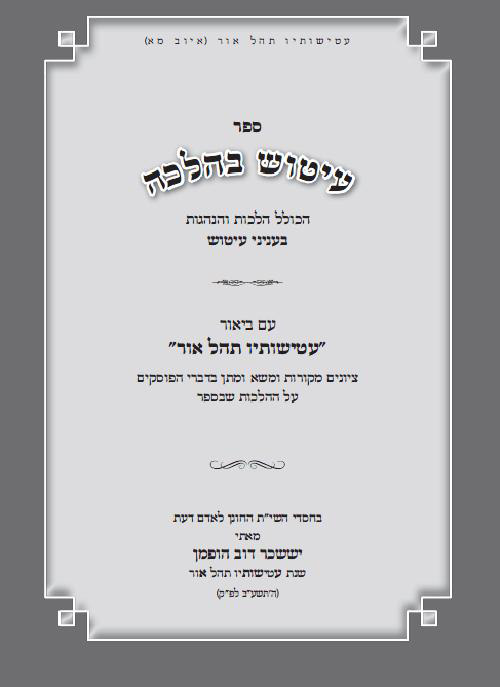
I also found that Saul Berlin notes, in the introduction to his Kasa de-Harsana (his commentary to Besamim Rosh), that unlike all other ancient Jewish books, the Zohar has an introduction. Because of this, he writes that when it comes to the authorship of the Zohar he inclines to the view of his great-uncle, R. Jacob Emden.
A few years ago the outstanding scholar, R. Yaakov Yisrael Stoll, published the anonymous Sefer Kushyot. Here are pages 123-124.

I ask readers to look at note 887. He discusses a mistake made by many in assuming that an expression is a biblical verse. He then notes that the Zohar also makes the same mistake, and refers to other such mistakes made by בעל הזוהר. He doesn’t say so explicitly, but I think the way he formulates the note lets the reader, who is attuned to these things, know that in his mind בעל הזוהר is not R. Shimon ben Yohai.

Someone called my attention to this video

I have no idea who the speaker is, and if he has ever even read a page of the Zohar, but he does seem very sure of himself. I have no objection to discussing the authorship of the Zohar and the ideas found there, or Kabbalah as a whole. However, I would think that a little humility is called for when discussing a discipline that was a basic part of the religious worldview of so many central figures. Do the names Nahmanides, R. Joseph Karo, or the Vilna Gaon mean anything to this speaker?
In my article, I cited all sorts of texts by Orthodox figures dealing with the authorship of the Zohar. Yet I overlooked the following by R. Joseph Hertz.
The question of the authorship of the Zohar, like that of Sefer Yetzirah, is one of the cruces of Jewish literature. The authorship by Simeon ben Yochai, or by his immediate disciples, though this is still an article of faith with millions of Jews in Eastern Europe, has from internal evidence long proved to be untenable. The Zohar explains Spanish words, contains quotations from Gabirol, and mentions the Crusades.[2]
As noted, in my article cited a number of sources that point to additions to the Zohar. Rabbi Akiva Males commented to me that I neglected to mention R. Isaac Haver, Magen ve-Tzinah, ch. 21. This book was written in response to R. Leon Modena’s Ari Nohem, a work aimed at disproving the antiquity of the Zohar. Unless one’s head is totally in the sand, it is impossible to deny that there are passages in the Zohar that post-date the tannaitic era. For Modena, this was proof that the Zohar could not have been written by Rabbi Shimon ben Yohai. Haver, who wants to hold onto the ancient dating, adopts the only path open to him, arguing that there are indeed many post-tannaitic additions, but the core of the book is ancient.
ובאמת ספר הזוהר נכתב כמה דורות אחר רשב”י מה שנכתב ונתקבל משמו ומשאר חבריו ותלמידו שהיו בימיו, וגם זה נעשה בו הוספות רבות עד מאוד מן אחרוני האחרונים אחר שבאו בכתב וניתנו להעתיק ושלטו בו ידי רבים כל אחד מה שנראה בדעתו ומה שנתחדש לו וכתב בגליון על ספר הזוה”ק מן הצד ואח”ז בא ריעהו מעתיק מן המעתיק ומצא בגליון דברים רבים ובמעט התבוננות חשב שזה היה חסרון בגוף ספר והכניסם בפנים.
Haver points out that is how we can explain the obviously late passages, where we see that the Zohar includes material that comes from Rashi and R. Tam. Among kabbalists, it was not unheard of to say that Rashi actually knew the Zohar and was influenced by it.[3] But Haver will have none of this and recognizes that the influence is in the reverse direction, i.e., Rashi influencing the Zohar. He states that anyone who understands the Zohar will recognize these additions.
What does Haver mean when he mentions that there is material from R. Tam in the Zohar? I am aware of one obvious example. It says in Kiddushin 30b that “one should always divide his years into three: [devoting] a third to Mikra, a third to Mishnah, and a third to Talmud.” R. Tam explains why the practice in his day was not in accord with what the Talmud states, an explanation that became very influential and served as a justification for the widespread ignoring of the study of Tanakh in the Ashkenazic world[4]
בלולה במקרא ובמשנה וכו’: פירש רבינו תם דבתלמוד שלנו אנו פוטרין עצמנו ממה שאמרו חכמים לעולם ישלש אדם שנותיו שליש במקרא שליש במשנה שליש בתלמוד.
What he says is that since the Talmud itself contains Bible and Mishnah, there is no need to divide one’s time among the three categories. Rather, by studying Talmud one combines all three areas. I always found this a difficult explanation, for if the Talmud agreed with this perspective, it would have said so, instead of stating that one is to divide one’s time. The intention of the talmudic instruction in Kiddushin was that people become well acquainted with all three subjects, and if they only devote themselves to Talmud, there is a great deal of Bible and Mishnah[5] they will never encounter. (According to Maimonides, Hilkhot Talmud Torah 1:12, once one is already a scholar, he does not need to divide his time between the three areas, but can focus almost entirely on Talmud.)
Despite what R. Tam says, R. Samson Raphael Hirsch claims that it was due to a misunderstanding of this opinion that people were led to stop studying Tanakh.[6] Not mentioned by Hirsch is that even before R. Tam some scholars ignored Tanakh. There were even talmudic Sages who were not expert in Bible. Bava Kamma 54b-55a states:
R. Hanina b. Agil asked R. Hiyya b. Abba: Why in the first Decalogue is there no mention of wellbeing [טוב], whereas in the second Decalogue there is a mention of wellbeing?[7] He replied: While you are asking me why wellbeing is mentioned there, ask me whether wellbeing is in fact mentioned or not, as I do not know whether wellbeing is mentioned there or not.
Tosafot, Bava Batra 113a, s.v. travayhu, cites this text to support its contention about the amoraim: .פעמים  היו שלא היו בקיאין בפסוקין After referring to this strange passage in Tosafot (concerning which there is an entire literature), R. Moses Salmon sarcastically declares[8]: ועל זה סומכים הלומדים עמי הארץ וד”ל
Unlike Salmon, R. Samuel Strashun, in his note to Bava Batra 8a, defended those talmudists who were deficient in knowledge of Bible.
משמע דאפשר שיהיו בעלי משנה או בעלי גמרא ולא בעלי מקרא . . . ודלא כאותן ששופכין בוז על מקצת גדולי זמנינו בש”ס ופוסקים ואין להם יד כ”כ במקרא.
So returning to my question, what does Haver mean when he says that there is material from R. Tam in the Zohar? Well it turns out that R. Tam’s explanation, which we have just been discussing, is also found in the Zohar Hadash (ed. Margaliyot), Tikunim p. 107b:
תקינו רבנן לשלש שנותינו במקרא בתלמוד . . . ואוקמוה דמאן דמתעסק (במשנה) [בתלמוד] כאלו התעסק בכלא בגין דאיהי בלילא במקרא במשנה בתלמוד.
There is no question that this passage is adopted from R. Tam, who lived a millennium after R. Shimon ben Yohai.
Incidentally, regarding R. Tam’s view, here is a page of an article by R. Yehudah Aryeh Schwartz that appeared in the Agudah journal Kol ha-Torah, Adar 5765 [2005], p. 102 (second pagination).

The following page comes from R. Yehiel Michel Stern’s Ha-Torah ha-Temimah on the Book of Joshua, p. 84 no. 3, which appeared in 2009.

As you can see, Stern’s comment is lifted word for word from Schwartz’s article. I am not sure what to make of this. That is, are dealing with a simple plagiarism? Perhaps one of the readers has some insight. (Stern may be the world’s most prolific writer of Torah publications.)

In my article I referred to passages in the Zohar which traditional authorities had claimed were really later interpolations. There are examples of the opposite phenomenon as well, namely, attributing things to the Zohar that are not found there. The most famous instance of this that I know of is found in the Bah, Orah Hayyim 4 (and quoted from there in Be’er Heitev, Orah Hayyim 1:2) that upon waking up if you walk four amot without washing your hands you are subject to the death penalty![9]  This Zoharic text is quoted in the name of the work Tola’at Yaakov, authored by R. Meir Ibn Gabai (1480-ca. 1543). The passage is cited over and over again by aharonim in trying to show the importance of the morning washing. Yalkut Meam Loez, Deut. 4:9, doesn’t even mention the Zohar, stating simply:
ואמרו חז”ל כל המהלך ד’ אמות בלי נטילת ידים חייב מיתה
A few scholars actually point out that this passage is not to be found in the Zohar.[10] One of those who realized this is R. Eleazar Fleckeles, Teshuvah me-Ahavah, vol. 1 no. 14, whom we will come back to later in this post. He writes that he looked in the Zohar and didn’t find the passage referred to. With reference to the Tola’at Yaakov, whom he (falsely) thinks cited the Zohar (since that is what it says in the Bah), Fleckeles writes:
ושארי לי’ מארי’ שעשה רוב ישראל לחייבי מיתות
Because very few of the aharonim actually had the sefer Tola’at Yaakov (which is itself a little strange as the book was printed a number of times), they were unable to see that the Tola’at Yaakov never quotes the Zohar!  Here is p. 9a from the Cracow 1581 edition.

If you look in the second paragraph you will see that Ibn Gabai does state that one who doesn’t wash his hands is חייב מיתה, but he doesn’t attribute this to the Zohar. How he derives this idea is worthy of investigation at a different time. For now, it is important to just note that what we have here is an independent idea of a sixteenth-century Kabbalist which for some reason was misquoted by the Bah as if Ibn Gabai was citing the Zohar. This misquotation was to be repeated again and again, down to the present day.

The supposed Zohar text has led to additional stringencies. For example, the hasidic master R. Meshulam Zusha of Anapole stated that that one should not even to put one’s legs on the ground before washing one’s hands.[11]

Here is an interesting story that relates to the false Zohar quotation: A very learned and rich student came to study with R. Simhah Bunim of Peshischa.[12] The problem was that this young man was a bit of an independent thinker, and the Kotzker, who was also there, didn’t think that the young man belonged with them. The story explains how the Kotzker was able to convince the young man to leave. What was it about this man that turned the Kotzker against him? We are told the following:
הוא הגיה בזוה”ק שכתב “ההולך ד’ אמות בלי נטילת ידים חייב מיתה”, והוא הגיה: “והוא שהרג את הנפש”, וזה נגד חז”ל.
So here we have a story of an emendation of a non-existent Zoharic text. And even if we assume that the man was emending the text as it appears in the Bah, we see from the story that the Kotzker thought that the quote was authentic.

I wasn’t sure what to make of this passage. I therefore consulted a learned friend who said that the problem was that the young man who emended the text to read והוא שהרג את הנפש was making a joke at the expense of the (supposed) Zoharic passage. He was saying that you are only deserving of the death penalty if you kill someone while walking the four amot. I then sent him a page from R. Zvi Yavrov, Ma’aseh Ish, vol. 4, p. 113, where it appears that the Hazon Ish took the emendation-explanation just mentioned as an authentic understanding of the passage. The text in Yavrov reads as follows:

על מה שהביא ה”באר היטב” (או”ח סימן א’ סק”ב) שההולך ד’ אמות בלי נטילת ידים שחרית חייב מיתה, אמר רבינו להגאון ר’ שמריהו גריינימן זצ”ל, שמישהו כתב בגליון הספר “והוא שהרג את הנפש” (מבנו הג”ר ברוך שליט”א).

My friend replied by referring me to a discussion on Hyde Park here where the text from Yavrov is also mentioned. One of the commenters there claims that the Hazon Ish was also joking in his remark, and the one who heard this (who was hardly a tyro), or the person who passed on the information to Yavrov, didn’t realize that it was a joke. The commenter also assumes that despite what appears in the Bah and Be’er Heitev, the Hazon Ish would have known that that it wasn’t an authentic quote from the Zohar. I find this very unlikely, as the Hazon Ish is not known to have been an expert in the Zohar, and what reason would there be for him to doubt that which is quoted in numerous earlier sources? 

The one point that the commenter has going for him is that he is correct that there are many examples in this book, and others like it, from which we see that the author does not know how to distinguish between what should and should not be included in a book. The commenter gives an example to illustrate this. In vol. 5, p. 141, Yavrov gives us the following important information about the Hazon Ish, recorded by one of his students: They never saw the Hazon Ish picking his nose! I kid you not.

העיד אחד מגדולי תלמידי רבינו: מעולם לא ראו את הרבי עם אצבע באף (מהרב מרדכי ויספיש)

Regarding this issue, R. Eliezer Melamed – who really is a great halakhic scholar – writes that picking one’s nose in public is forbidden.[13]

ויש מעשים שכשאדם עושה אותם בסתר, אין בכך פגם, אבל בפני אנשים אחרים הם נחשבים למגעילים ואסורים משום ‘בל תשקצו’ ומשום המצוות שבין אדם לחבירו. למשל, המחטט באף או מגרד פצעונים שבפניו, עובר באיסורים אלו. וכן אמרו חכמים (חגיגה ה, א): “כִּי אֶת כָּל מַעֲשֶׂה הָאֱלוֹהִים יָבִא בְמִשְׁפָּט עַל כָּל נֶעְלָם. אמר רב: זה ההורג כינה בפני חבירו ונמאס בה. ושמואל אמר: זה הרק (היורק) בפני חבירו ונמאס בה”. ובמיוחד בעת שאוכלים, צריך להיזהר בכך יותר, כי מעשים מאוסים, וכן דיבורים מגעילים, מבטלים את התיאבון ומעוררים בחילה בקרב הסועדים.
Getting back to the supposed Zoharic passage, R. Yitzhak Abadi discusses this in Or Yitzhak, vol. 1, no. 1. He begins his responsum by pointing out that despite the fact that the Mishnah Berurah records how one is not to walk four amot before washing one’s hands, R. Aaron Kotler did not concern himself with this. Abadi then explains that the words of the Zohar are not intended for everyone,[14] and none of the rishonim write that it is forbidden to walk four amot before washing. He concludes by stating that he is inclined to rule – ולולי דמסתפינא הייתי אומר להלכה למעשה – that the entire practice of negel vasser is no longer relevant to us because ruah ra’ah is no longer a concern.[15] Here again we see that the author of a responsum assumes that the issue he is discussing, of not walking four amot before hand washing, is based on the Zohar, when in fact the Zohar doesn’t mention this at all.

Finally, I must mention that R. Hayyim Joseph David Azulai, Birkei Yosef, Orah Hayyim 1:1, recognizes that there is nothing in the Zohar about being subject to the death penalty for walking four amot. However, he notes that both he and his forefather, R. Abraham Azulai, saw an alternate version which indeed states that one who walks four amot אתחייב מיתא לשמיא. Based on this alternate text, the Hida declares that the Tola’at Yaakov is correct in how he quoted the Zohar, and the criticism of him for the inaccurate quotation is therefore misplaced. Even the Hida didn’t have access to the Tola’at Yaakov, and based on the Bah assumed that the Tola’at Yaakov quoted the Zohar and must indeed have had the alternate text. Yet as we have already seen, the Tola’at Yaakov does not quote the Zohar, and there is no actual alternate version of the text such as quoted by the Hida.

What happened was that someone saw the Bah quoting the Tola’at Yaakov as quoting the Zohar that one who walks four amot is subject to the death penalty. Not finding this passage in the Zohar, this individual inserted it into his text of the Zohar in the section that deals with hand washing in the morning (Zohar, vol. 1 p. 10b). I don’t think this was intended as a forgery. Rather, whoever put it in assumed that it was an authentic Zoharic teaching, found in an alternate text, and he was inserting it where it should be. He thought that it was an authentic Zoharic teaching because the Tola’at Yaakov had testified to it. But as we have already seen, Tola’at Yaakov said nothing of the sort. This alternate girsa can therefore be traced back to the Bah’s misquotation of the Tola’at Yaakov.

How can we explain the Bah? I think the answer is simple. When the Bah cited the Tola’at Yaakov he did not have the book in front of him, and was relying on his memory, the sort of mistake that is found among all of our great sages. That is how this error crept in which has had a great influence on Jewish religious texts and practice for hundreds of years, and yet it all goes back to a simple mistaken quotation.

Returning to my article on the Zohar, Rabbi Akiva Males called my attention to the following paragraphs that appear in an essay by R. Aryeh Kaplan.[16] It would be great if a reader has examined the manuscript and can testify to the accuracy of what Kaplan reported.

Rabbi Yitzchok deMin Acco is known for a number of things. Most questions regarding the authenticity of the Zohar were raised by him, since he investigated its authorship. He was a personal friend of Rabbi Moshe de Leon, who published the Zohar. When questions came up regarding the Zohar’s authenticity, he was the one who investigated, going to the home town of Rabbi Moshe de Leon. The whole story is cited in Sefer HaYuchasin, who abruptly breaks off the story just before Rabbi Yitzchok reaches his final conclusion. Most historians maintain that we do not know Rabbi Yitzchok’s final opinion – but they are wrong.

Around three years ago, someone came to me and asked me to translate parts of a manuscript of Rabbi Yitzchok deMin Acco, known as Otzar HaChaim. There is only one complete copy of this manuscript in the world, and this is in the Guenzberg Collection in the Lenin Library in Moscow. This person got me a complete photocopy of the manuscript and asked me to translate certain sections. I stated that the only condition I would translate the manuscript is if I get to keep the copy. This is how I got my hands on this very rare and important manuscript.

Of course, like every other sefer in my house, it had to be read. It took a while to decipher the handwriting, since it is an ancient script. One of the first things I discovered was that it was written some 20 years after Rabbi Yitzchok investigated the Zohar. He openly, and clearly and unambiguously states that the Zohar was written by Rabbi Shimon bar Yochai. This is something not known to historians, and this is the first time I am discussing it in a public forum. But the fact is that the one person who is historically known to have investigated the authenticity of the Zohar at the time it was first published, unambiguously came to the conclusion that it was an ancient work written by Rabbi Shimon bar Yochai.
Leaving aside for now the important information recorded by Kaplan, there is a good deal that can be said about R. Moses de Leon and the creation of the Zohar, and it is questionable if one can even speak of a single author. One essential point that must be recognized by all who investigate this matter is that De Leon himself was involved in other forgeries, in particular forgeries of geonic responsa.[17] As such, he obviously is not the most reliable source when he announces to the world that he is in possession of a text of mystical lore dating from the tannaitic period.

Regarding the Zohar and forgery, I think readers will also find the following interesting.  (Many already know some of the story, but it is worth repeating for those who don’t.) In the journal Or Torah, Tevet 5772, p. 362, a reader, whose knowledge of Jewish bibliography is not that great, had a question. He saw the following page in R. Yudel Rosenberg’s Hebrew translation of the Zohar to Va-Yikra.


This is important information, as Emden confesses that his attack against the Zohar was only designed to pull the wool out from under the Sabbatians, whose ideology was linked to the Zohar. The man who wrote to Or Torah, not knowing anything about Rosenberg, asked for help from the readers. He tried to locate the book Tzur Devash quoted by Rosenberg, but was unable.

In Or Torah, Adar 5772, pp. 555-557, two individuals let the first writer in on the “not-so-secret” that there is no book Tzur Devash, and that Rosenberg had a long history of making up texts; see here. This is so even though Rosenberg was a respected rabbi and posek. Here, incidentally, is the picture of Rosenberg that appears at the beginning of his Zohar translation.

With some of Rosenberg’s “forgeries”, it seems that what he was doing was creating a form of literature, and anyone who takes the story literally has only himself to blame (much like anyone who thinks that Animal Farm is really about animals has no one to complain to but himself). At times, Rosenberg would even hint to the reader what he was doing, as in Hoshen ha-Mishpat shel ha-Kohen ha-Gadol, where in the preface he mentions that part of the story also appeared in a work of Arthur Conan Doyle. If any reader would have taken the time to find out who this was, he would have realized that we are dealing with a fictional account. At other times, however, Rosenberg offers no such hint, at least none that I am aware of, and what we have appears to be a simple forgery. That would seem to be the case here, with the phony letter from Emden.

The second correspondent in Or Torah also calls attention to R. Yaakov Hayyim Sofer’s discussion in Etz Hayyim 7 (5769), pp. 267-268. While for a long time everyone has known that the Emden letter was a forgery, Sofer identifies another forgery. Rosenberg’s translation (second edition) vol. 1, contains a letter of approbation from R. Hayyim Hezekiah Medini, the Sedei Hemed.[18] Sofer claims, and I think he is correct, that this approbation is a forgery. His prime proof is that in the approbation Medini refers to the Hida as האזולאי. There are many hundreds, if not thousands, of references to the Hida in Medini’s work, and not once does he refer to the Hida as האזולאי, which is a form only used by Ashkenazic rabbis. What Sofer didn’t realize, and further supports his point, is that Rosenberg himself, in his introduction, p. 5a, refers to Hida as האזולאי.

In Or Torah, Iyar 5772, p. 744, another writer called attention to Sedei Hemed, Peat ha-Sadeh, kelalim, mah’arekhet bet, no. 47, where Medini states that it is disrespectful to use this sort of language, referring specifically to the expression האלגאזי.[19] This is another proof, if any was needed, that Medini would never have referred to the Hida as האזולאי. Let me also add that the way Medini (=Rosenberg) concludes the forged haskamah is not like any of his other letters, which are included in Iggerot Sedei Hemed (Bnei Brak, 2006). In the authentic letters, before his name Medini always adds הצב”י or הצעיר , which he does not do in the forged haskamah.. In his authentic letters, he also never closes them by adding to his name רב ומו”ץ בעיר הקדש חברון. Therefore, there can be no doubt that the letter of approbation sent by Medini to Rosenberg is simply another one of the latter’s forgeries.

Now let us turn to the incredible recent publication of a derashah by R. Yehezkel Landau, the Noda bi-Yehudah.[20] But before doing so, it is necessary to say a few words about R. Eleazar Fleckeles, the outstanding student of the Noda bi-Yehudah. (Fleckeles’ grave, entirely ignored by tourists, stands right near that of his teacher.) Ever since the publication over two hundred years ago of the strong comments of Fleckeles downplaying the authority of the Zohar, people have wondered where this came from. It just seemed strange that an 18th-19th century traditional Torah scholar would express himself this way. We now have the answer. Fleckeles was following in his teacher’s footsteps. Thanks to the publication of the Noda bi-Yehudah’s derashah by Michael Silber and Maoz Kahana, a derashah that had previously only appeared in a censored form, we now know that that the Noda bi-Yehudah had a skeptical view of the Zohar, at least in the form that it has come down to us. The issue that the Noda bi-Yehudah was concerned with was the same thing that bothered Emden and Fleckeles, namely, distinguishing the authentic ancient Jewish mysticism from the many later additions that found their way into the Zohar.

What caused the Noda bi-Yehudah in his later years to adopt a skeptical position, one so much at odds with his earlier outlook, is of course worthy of investigation and something for the scholars to fight over (and they already have!).

Regarding Fleckeles, his negative comments about the Zohar that appear in Teshuvah me-Ahavah are well known and have often been cited. In my article I also referred to Fleckeles’ citation of Wessely who quoted R. Jonathan Eibschuetz as supposedly stating that one need not believe in Kabbalah. (Needless to say, it is very difficult to believe that Eibschuetz could have ever expressed himself this way.) In preparing for my Torah in Motion talks on R. Moses Kunitz,[21] I found another relevant text from Fleckeles that as far as I know has gone unnoticed among those who have discussed the matter. It appears in Kunitz’s responsa Ha-Metzaref,[22] which happens to be one of the strangest responsa works ever published. It is also noteworthy in that it contains something extremely rare, namely, a responsum from R. Nathan Adler, the Hatam Sofer’s teacher. Knowing that some people might doubt that the teshuvah could really have been authored by R. Nathan, he also included a letter from the Hatam Sofer testifying to the responsum’s authenticity. 

In Ha-Metzaref, vol. 1 no. 11, Fleckeles again focuses on additions to the Zohar that are not part of the authentic work, but here he adds a new point which is important for an accurate description of Fleckeles’ position. He says that if a Zoharic text is quoted by R. Isaac Luria, R. Moses Cordovero, or R. Menahem Azariah of Fano then you can assume that it is part of the original Zohar, authored by R. Shimon ben Yohai.

One final comment regarding the Noda bi-Yehudah’s derashah: Yehoshua Mondshine somehow got hold of it before it was published by Silber and Kahana. Here is the relevant page, from Or Yisrael, Nisan 5766, p. 202.

Notice how Mondshine doesn’t reveal where this text comes from, something not expected from a careful scholar. Since this is such an amazing passage, and Mondshine’s article was the first time it appeared in print, you can be sure that loads of people must have turned to Mondshine asking him for its source. Presumably, when he was given the text he gave his word not to reveal its source. He might not have even known the source, and was only given the small passage.

2. Due to correspondence with a couple of people, I realized that I forgot to include something about the word מחיה in my last post. So here it is now.

In the Amidah we say מחיה מתים אתה. There is a tzeirei under the yod meaning that this is not a verb. Artscroll correctly translates “Resuscitator of the dead.” Sacks,[23] on the other hand, gives the mistaken translation “You give life to the dead”. The next line reads

מכלכל חיים בחסד, מחיה מתים ברחמים רבים

Is מחיה in this verse a verb? Ifמכלכל  is translated as a verb, then מחיה will also have to be translated this way. The Tehilat ha-Shem siddur has a segol under the yod of מחיה, and with this vocalization it is correct to translate it as a verb. However, for siddurim with a tzeirei the only accurate translation is a noun. Metsudah, which we have seen is consistent in this matter, translates: “Sustainer of the living with Kindliness, Resurrector of the dead with great mercy.” Both Artscroll and Sacks, however, translate מחיה as a verb which is incorrect. But why is it incorrect? It is only incorrect because of the vocalization (tzeirei), but I think that in the sentence מחיה is indeed a verb. This means that it is the vocalization that is incorrect, and that instead of a tzeirei under the yod, there should be a segol, as in the Tehilat ha-Shem siddur[24]. So my recommendation to Artscroll and Sacks would not be to change the translation, but only to change the vocalization.

After reading my last post, Ben Katz sent me an example where of all the translations, only Artscroll gets it right. The last lines of Adon Olam read:
בידו אפקיד רוחי בעת אישן ואעירה
ועם רוחי גויתי ה’ לי ולא אירא

Sacks translates as follows (and Metsudah is similar):

Into His hand my soul I place,
when I awake and when I sleep.
God[25] is with me, I shall not fear;
Body and soul from harm will He keep.
What this means is that God has my soul at all times, when I am awake and when I sleep, and  that that is why I have no fear.

Artscroll translates as follows:

            Into His hand I shall entrust my spirit
            When I go to sleep – and I shall awaken!
            With my spirit shall my body remain.
            Hashem is with me, I shall not fear.
Before getting to what I think is the significant  part of the translation, let us look at the last line: ועם רוחי גויתי, ה’ לי ולא אירא. In his translation, Sacks has turned the order of the sentence around. That is OK as it was done so that the rhyme works (and Sacks deserves enormous credit for having most of the song rhyme in English). The real problem is Sacks’ rendering of the words  ועם רוחי גויתי. There is no way this can be translated as “Body and soul from harm will He keep.” The words imply nothing about keeping from harm. The typical translation sees ועם as referring to God, meaning that God is with my soul and body and therefore I will have no fear.

However, Artscroll gets it right, I think, by translating these words literally: “With my spirit shall my body remain.” To see how Artscroll gets to this translation, we have to look at the previous verse, and that is where we see Artscroll’s brilliance. בידו אפקיד רוחי בעת אישן ואעירה. The other translations understand this to mean that I place my spirit (or soul) in God’s hands when I sleep and when I am awake. The problem with this rendering is that if my spirit is always in God’s hands, then what sense does it make to say that I place it there? If it is always there, during the day and at night, there is nothing for me to place.

Artscroll translates: “Into His hand I shall entrust my spirit when I go to sleep – and I shall awaken!” This is an allusion to the famous Midrash that we are all taught in school, that when you go to sleep your spirit returns to God, and is given back to you in the morning.[26] This isn’t just some random Midrash, but is derived from Psalm 31:6, which states: בידך אפקיד רוחי.[27] In other words, the Midrash is commenting on the exact words used by Adon Olam. This shows that Artscroll’s translation has indeed beautifully captured the correct meaning.

We now can properly understand the next verse. Since my spirit has returned and joined with my body, I know that God is with me and I shall not fear.

3. There is a relatively new publication for all who are interested in Jewish intellectual life. I refer to the Jewish Review of Books, expertly edited by Abraham Socher. Modeled after the New York Review of Books, each issue is full of great material. In the latest issue I published a translation of part of an essay by R. Jehiel Jacob Weinberg on Berdyczewski. Only subscribers can access the essay, but everyone can see the artwork that went along with it. See here. (Due to copyright restrictions, I can’t reproduce the artwork in the post.)

If you examine the picture of Weinberg produced by the artist, you will see that it was modeled after this picture that appears in my book on Weinberg, and also on the front cover of the soft-cover edition.


The original photograph was part of a faculty picture taken when Weinberg taught at the University of Giessen. However, the artistic reproduction adds something that is not found in the original, something that the artist assumed no rabbi should be without; see here.

4. Those outside of the United States who want to post (or read) comments, please access the Seforim Blog site by going to http://seforim.blogspot.com/ncr.  Only by doing this will you be taken to the main site (and not have a country code in the URL). Readers outside the United States do not have access to the comments posted in the U.S. We don’t know why this is, or how to fix it yet, but the above instruction fixes the matter.

* * * *
Quiz

I have an extra copy of one of the volumes of R. Hayyim Hirschensohn’s commentary on Rashi. The person who answers the following question will receive it. Send answers to me at shapirom2 at scranton.edu

1. Tell me the only place in the Shulhan Arukh where R. Joseph Karo mentions a kabbalistic concept? I am referring to an actual concept e.g., Adam Kadmon, Ein Sof, etc.

2. If more than one person answers the above question correctly, the one who answers the following (not related to seforim) will win: Which is the only United States embassy that has a kosher kitchen?

If no one can answer question no. 2, I will do a lottery with the names of those who answer no. 1 correctly.

[1] R. Moshe Zuriel kindly sent me the following additional sources that should be added to my list.

[א] ספר “אור החמה”, ביאור בשלשה כרכים על הזוהר, נלקט ע”י הרב אברהם אזולאי, מביא דברי ר’ אברהם גלאנטי שם על זהר ח”א קסח, והוא בנדפס דף קנט ע”א ראש טור שמאל, “הם דברי מחבר הספר בימי הגאונים או חכמים אחרים שחברו כל המימרות יחד שכתב ר’ אבא, שהיה סופר של רשב”י והם חלקום לפרשיות כל פסוק בפרשה שלו, והם אמרו משלהם”.
[ב] בפירוש ר’ יוסף חיים מבבל (בן איש חי) בשם “בניהו” (דף ד ע”ב בנדפס) פירוש על תיקוני זהר, בתחילת ההקדמה לתקו”ז (ב ע”ב) מזכיר “ועל האי ציפור רמיזו רבנן בהגדה דבתרא דרבה בר בר חנה” כותב הרב: “נראה פשוט בספר בתקונים הראשון אשר הועתק מכתיבת יד חכמי הזוהר כך כתוב ‘קא רמיזו רבנן’ וכו’ אך חכם אחרון שראה דבר זה כתוב בגמרא דבתרא במאמרי רבב”ח הוסיף על הגליון תיבות אלו בהגדה דבתרא דרבב”ח וכו’ ואחר כמה שנים המדפיסים הכניסו בפנים מה שראו כתוב בגליון. ועל חינם הגאון יעב”ץ הרעיש העולם לערער בדבר זה וכיוצא בו”.
[ג] אדמו”ר ר’ יצחק אייזיק קומרנא בספרו “נתיב מצותיך” שביל התורה אלף, מהד’ שנת תש”ל עמ’ קא  כתב: “ור’ אבא היה כותב כל מה ששמע, הן ממנו הן מהחברים וכו’ בסוף ימי רבנן סבוראי תחילת הגאונים היה איש קדוש אאחד שהיה בו נשמת משה רבנו ממש וכו’ וכו’ והוא חיבר ספר רעיא מהימנא וקרא לזוהר חיבורא קדמאה”.
[ד] ר’ צבי אלימלך (מחבר בני יששכר) בספרו “הגהות מהרצ”א” (נמצא בתוכנת אוצר החכמה) על פרשת בא לח ע”א (בנדפס בספר שם דף קכו) כותב: “לפי גירסא הזו ע”כ [על כרחך] צ”ל דהזהר נתחבר בג”ע [בגן עדן] בזמן הגאונים, דהרי רב חסדא אמורא היה בזמן האמוראים” עכ”ל.
[ה] הרב אברהם יצחק קוק, מאמרי הראי”ה, עמ’ 519: מתוך מכתב להרב קאפח: “אפילו אם נשתלשלו דורות רבים והיו בהם הוספות והערות מחכמים שונים, ואם אפילו נתערבו בהם איזה דברים שראויים לביקורת, כמו שעשה הגאון יעב”ץ במטפחתו, אין העיקר בטל בכך”.
[2] Sermons, Addresses and Studies, vol. 3 p. 308. I learnt of this passage from Ben Elton, Britain’s Chief Rabbis and the Religious Character of Anglo-Jewry, 1880-1970, p. 176.
[3] See Studies in Maimonides and his Interpreters, p. 89 n. 376, where I mention that R. Abraham ben ha-Gra, who (for his time) had a critical sense, was among those who thought that Rashi knew the Zohar.
[4] Tosafot, Sanhedrin 24a s.v. belulah. The uncensored text, found in the Venice edition, reads בתלמוד, but the Vilna edition has בש”ס.
[5] Since the Daf Yomi siyum is just about upon us as I write these words, let me add the following: While I don’t think that R. Joseph B. Soloveitchik can be called an opponent of Daf Yomi, I was present at a shiur in the summer of 1985 where he expressed his dismay that due to the growing popularity of Daf Yomi, people were no longer studying all six orders of the Mishnah, much of which has no Talmud and is thus not included in the Daf Yomi cycle. (Due to how the Talmud was printed, Kinnim and Middot are the only tractates of Mishnah included in Daf Yomi. )
[6] Nineteen Letters, Letter Eighteen.
[7] See Deut. 5:15: כבד את אביך ואת אמך כאשר צוה ה’ אלקיך למען יאריכן ימיך ולמען ייטב לך על האדמה אשר ה’ אלקיך נתן לך
R. Samuel Schonblum offers an explanation of the talmudic passage that many will no doubt claim attributes a heretical assumption to one of the Sages. See his edition of R. Isaac Ibn Latif, Rav Pealim (Lemberg, 1885), p. 54:
כפי השקפה הראשונה נוכל לומר כי השנוים שבדברות האחרונות משה אמרן מדעת עצמו כמ”ש הראב”ע ז”ל כמוסיף וגורע ואפשר לומר כי לא נאמר טוב בסיני כלל ע”כ כאשר שאל לו מ”מ [מפני מה] בראשונות לא נאמר טוב ובאחרונות נאמר טוב השיב לו שאלני אם נאמר טוב אם לאו, שאפשר שגם באחרונות לא נאמר טוב כך משה הוסיף או גורע עד שבא לר’ תנחום בר חנילאי ואמר לו כי באמת נאמרו כך בסיני ע”י משה וזה שלא נכתבו על הלוחות הראשונות יען כי היו עתידין להשתבר ע”כ לא נאמר ע”י הדיבור הנעלם רק ע”י משה, ה’ יראני מתורתו נפלאות.
In Limits of Orthodox Theology, I did not discuss the commentary of Ibn Ezra (Ex 20:1) referred to by Schonblum. That is because I assumed that he agreed with the standard medieval view that even though Moses may have written things on his own accord, when these texts were later included as part of the Torah given to the Children of Israel, this was done at God’s direction and that is what sanctified the text. I am no longer convinced of this. All Ibn Ezra says in his commentary to Ex. 20:1 is that minor variations in wording are due to Moses changing God’s original words. Nowhere in his commentary does Ibn Ezra state that Moses’ changes were ever given divine sanction.
[8] Netiv Shalom (Budapest, 1898), p. 33.
[9] I wonder if this exaggeration is related to the seeming exaggerations found in Sotah 4b regarding those who are not careful with netilat yadayim:  כל האוכל לחם בלא נטילת ידים כאילו בא על אשה זונה . . . כל המזלזל בנטילת ידים נעקר מן העולם  See also Yalkut Shimoni, Ki Tisa, no. 386:  כל האוכל בלא נטילת ידים כבא על אשת איש (I say “seeming” exaggerations, because maybe these are not exaggerations. See the story with R. Akiva in Eruvin 21b.) Why were the Sages so strident in this matter? After citing the two rabbinic passages just mentioned, R. Zvi Hirsch Chajes points to an anti-Christian motivation. See Kol Sifrei Maharatz Chajes, p. 1003:
והטעם שהחמירו חז”ל בזה, דענין נטילת ידים הוא הענין הראשון אשר זלזל בו המחוקק לנוצרים, כמבואר בספריהם דשאלו אותו מדוע תלמידיו אוכלים בלי נטילת ידים והשיב מה שיצא מן הפה הוא טמא ומה שהולך לפה הוא טהור, ומפני זה למען לא יהיה לנו השתוות עמהם, החמירו בנטילת ידים, דהמזלזל בזה הוי כמודה להם.
See R. Mordechai Fogelman, Beit Mordechai, part 2, no. 15:2 (p. 224), who uses the Christian angle to explain another talmudic passage dealing with washing of hands. (Those who have read R. Israel Meir Lau’s wonderful autobiography will recognize Fogelman’s name.) See also Abraham Buechler, Am ha-Aretz ha-Gellili, ch. 4.
[10] See e.g., R. Pinchas of Koretz, Imrei Pinhas ha-Shalem (Bnei Brak, 2003), p. 209:
מה שכתב הבאר היטב (או”ח א, ס”ק ב) בשם תולעת יעקב בשם הזוהר, ההולך ארבע אמות בלי נטילת ידים חייב מיתה, הקפיד מאד הרב ז”ל על זה, שאינו בזוהר כלל, וגם במגן אברהם (או”ח ד, א) ובתולעת יעקב עצמו לא כתב בשם הזוהר רק דעת עצמו.
[11] See R. Zvi Elimelech of Dinov, Igra de-Firka, no. 9.
[12] See Menachem Yehudah Baum, Ha-Rabbi Rabbi Bunim mi-Peshischa (Bnei Brak, 1997), vol. 1, p. 212.
[13] See here.

See also R. Shmuel Eliyahu’s responsum on the topic here, R. Yaakov Peretz, Emet le-Yaakov (Jerusalem, 1979), p. 29, and R. Moshe Zuriel, Tziyon be-Mishpat Tipadeh (Bnei Brak, 2007), pp. 107-108. The section in Zuriel’s book is entitled
                               
 בענין הנוהג הנפסד של חיטוט באף ובאוזן, בעת לימוד תורה והתפילה
There might even be enough material for a booklet dealing with the halakhot related to picking one’s nose. I know some of you are laughing right now, but I am entirely serious. See also R. Israel Pesah Feinhandler, Avnei Yoshpeh, vol. 5, Orah Hayyim no. 71, who discusses if it is permissible to pick one’s nose on Shabbat.

See also R. Ovadiah Yosef, Yabia Omer, vol. 5, Orah Hayyim no. 30:

ואתה תחזה שע”פ האמור יש להעיר עמ”ש הגאון מהר”ח פלאג’י בס’ רוח חיים (סי’ שכא סק”ב וסי’ שמ סק”א), ובס’ כף החיים (סי’ ל אות קה), שיש להזהיר לאלה שמקנחים צואת החוטם (ובפרט כשהיא יבשה), שתולשים עי”ז כמה שערות, ואע”ג דדבר שאינו מתכוין מותר, היכא דפסיק רישיה יש להחמיר

There is also the issue of phlegm and hatzitzah that has been dealt with by many. It is interesting that halakhic sources regard putting one’s finger in one’s ear the same way as in one’s nose (e.g., in discussing if you have to wash your hands after this), while contemporary mores sees the latter as being in much poorer taste.

While on the topic of unusual halakhic subjects, let me call attention to a new book by the young scholar R. Yissachar Hoffman, from whom I have learnt a great deal. It focuses on sneezing. In his approbation, R. Gavriel Zinner writes: ראינו חשיבות התורה שיכולים מכל ענין לעשות ספר שלם

Here is the title page.

[14] I heard from a former student of the Lakewood yeshiva that someone once challenged one of R. Abadi’s pesakim by pointing out that the Mishnah Berurah stated that a “ba’al nefesh” should be stringent in the matter. Abadi replied that in the entire yeshiva, of which he was the official posek, maybe there were four people who would fall into the category of what the Mishnah Berurah designates a “ba’al nefesh”.

[15] I asked R. Yehudah Herzl Henkin the following question: Would you have any hesitation telling someone who didn’t believe in demons that it’s OK to only wash one time in the morning, in accordance with the Rambam’s opinion?
He replied:
“I don’t think ruach ra’ah has any operative role nowadays, either, but I hesitate to encourage the abandonment of accepted practices particularly when they are innocuous (as opposed, say, to doing kaparot with a live chicken). There is something to be said for doing what klal Yisrael does even if one doesn’t believe in the activity. That being said, yes, certainly, if the person is bothered about it to that extent, tell him to follow the Rambam.”
Another posek wrote to me: “These are in my view simply matters of minhag yisrael, and not subject to psak in the classical sense of the word. There are questions of minhag ha’avot and the like – but in the end, I do not sense that one would be sinning if one washed only once.”
[16] “The Age of the Universe:  A Torah True Perspective,” pp. 17-18, available here.
[17] See Elliot R. Wolfson, “Hai Gaon’s Letter and Commentary on Aleynu: Further Evidence of Moses de León’s Pseudepigraphic Activity,” JQR 81 (1991), pp. 365-409; and the sources cited by Shmuel Glick, Eshnav le-Sifrut ha-Teshuvot (New York, 2012), pp. 237-238. Meir Bar-Ilan sugests that the Zohar is the first example of what would later become a common practice: the creation of a forgery by attributing one’s own work to an ancient manuscript. In earlier times, pseudepigraphical works made no such claims. See “Niflaot Rabbi Yehudah Yudel Rosenberg,” Alei Sefer 19 (2001), available here
[18] Sofer didn’t realize that the Medini approbation is also found in the first edition, published in 1906.
[19] Medini also says that he will not mention the name of the rabbi who used this expression. Regarding whom he had in mind, see R. Yaakov Hayyim Sofer in Moriah, Av 5769, pp. 143-144. Despite Medini’s feeling, the expression האלגאזי does appear in numerous rabbinic texts.
[20] All bibliographical information for sources cited in this paragraph is found in my article.
[21] Torah in Motion how has a great deal. For only $10.99 you can get a silver membership (good for one month) that allows unlimited access to recorded lectures. See here.
[22] Some have mistakenly transliterated the title as Ha-Matzref. On the title page itself it is spelled in Latin letters Hamzaref; see here.
[23] Regarding the Sacks siddur, I recommend that all listen to the wonderful dialogue between Rabbi Sacks and Leon Wieseltier available here.

I have to say, however, that I was surprised to hear Sacks say at minute 49: “There is no doubt that the actual construction of the Temple was an extraordinarily disastrous moment for the Jewish people.” He then discusses how Solomon, in order to build the Temple, used force labor and thus “turned Israel into Egypt.” What surprises me is that I know of no other Orthodox thinker who sees the building of the Temple as a negative development in Jewish history. Nor, for that matter, have I ever seen an Orthodox thinker read the Bible as criticizing Solomon for this endeavor. If the construction of the Temple was such a negative event, then why on Tisha be-Av are we supposed to mourn its absence?
[24] On my recent trip to Italy, I learnt that the Italian nusah also always puts a segol under the yod of מחיה.
[25] Sacks does not consistently translate ה’ as “Lord”. Metsudah actually translates it as “A-donay”, which I have never seen before.
[26] This is also the meaning of the blessing המחזיר נשמות לפגרים מתים . A similar concept is found among Christians. I am sure many are aware of the Christian prayer recited by children
Now I lay me down to sleep,
I pray the Lord my soul to keep,
If I shall die before I wake,
I pray the Lord my soul to take. Amen.
[27] Midrash Tehillim (ed. Buber), 252::
זהו שאמר הכתוב: ‘בידך אפקיד רוחי’ . . . וכשהוא ישן הוא יגע, ומשלים [ומשליש?] נפשו ונפקדת ביד הקב”ה, ולשחרית היא חוזרת לגופו בריאה חדשה, שנאמר ‘חדשים לבקרים רבה אמונתך’.
See also Devarim Rabbah 5:14
והן ישנים וכל הנפשות עולות אצלו, מנין, שנאמר ‘אשר בידו נפש כל כי’, ובבקר הוא מחזיר לכאו”א נשמתו, מנין, שנאמר ‘נותן נשמה לעם עליה’.
Bereshit Rabbah 78:1 (parallel text in Eikhah Rabbah 3:21) states:
על שאתה מחדשנו בכל בקר ובקר אנו יודעין שאמונתך רבה להחיות לנו את המתים.
See also Tosafot, Berakhot 12a s.v. le-hagid.


Emek ha-Netziv : The Manuscript

Emek ha-Netziv : The Manuscript
by Gil S. Perl

Rabbi Dr. Gil S. Perl is dean of the Margolin Hebrew Academy/Feinstone Yeshiva of the South in Memphis. The following selection comes from his new book, The Pillar of Volozhin: Rabbi Naftali Zvi Yehuda Berlin and the World of Nineteenth-Century Lithuanian Torah Scholarship.


The manuscript of ‘Emek ha-Netziv remains in the possession of the Shapira family and there are no additional extant copies. The family are prominent members of a staunchly traditionalist Ḥaredi community in the Geulah neighborhood of Jerusalem. Members of this community generally oppose sustained contact with Western culture and its representative institutions, including universities of any type. The Shapira family seems to harbor additional skepticism toward those researching Netziv , due to the fact that his relative openness to certain aspects of non-traditional culture has made him a controversial figure in some ultra-Orthodox communities.[1]These facts, combined with the sheer value of their manuscript collection,[2] make the family understandably guarded about allowing access to thematerials they possess. However, with the assistance of Rabbi Zevulun Charlop, Dean of the Rabbi Isaac Elchanan Theological Seminary in New York City and a cousin of the Shapira family,[3] I was able to secure brief and accompanied access to the manuscript from which ‘Emek ha-Netziv was taken.[4]

The manuscript is handwritten in three volumes, corresponding to the three volumes of the printed text. The first two volumes were bound, but the binding has completely deteriorated and sections of each volume easily separate from one another. The third volume seems never to have been bound. The pages of all three volumes are severely frayed at the edges.

As suspected, the manuscript contains a core text with countless interlinear and marginal additions as well as words and entire lines that have been crossed out:


.

It is important to note that the brackets and parenthesis which appear throughout the printed text do not correspond to these additions. Rather, they correspond to places in which Netziv placed parenthesis or brackets around his own words both in the core text and in the additions. The additions and the notes he appended to the end of the manuscript (referred to by the Netziv as hashmatot )[5] were incorporated without indication into the printed text.


The script of the core text through the first two volumes and half of the third is a fairly consistent narrowly-spaced brown cursive[6] written with a fairly wide-tipped pen. In the second half of the third volume the script of the core text changes to a blacker, wider-spaced cursive seemingly done with a thinner-tipped pen. The script of the later marginal additions varies.

The notes which appear scattered throughout the printed text (referred to by the Netziv as hagahot) were written at the same time as the core text,[7] as evidenced by the identical script used and the intentional indentations left in the text of the core commentary in order to create space for the hagahot. The hagahotalso contain marginal additions. A typical page in the manuscript containing hagahot, then, is represented in the following diagram:

The reference to the newly printed book ‛Emek Halakhah mentioned above appears as an interlinear addition to the core text, thus implying that for that particular section of the commentary on Naso, the core text was written prior to 1845 and the addition was included after 1845. The references to Reb ‘Iẓele are also found in the core text with the word “she-yiḥyeh,” which dates those passages of the core text to the years prior to 1849 as well.[8]

The orderly progression of chapters in the core text, which begin at varying places on the physical page of the manuscript, indicates that Netziv wrote down his comments in this manuscript in proper sequence, following the order of Sifre. [9]That is, one can safely assume that in this particular copy of the manuscript, the core text of Netziv’s comments on Parashat Bamidbar were committed to writing before those of Parashat Naso, and his comments on pesikta’ aleph were committed to writing prior to those of pesikta’ bet.[10] If the core text of the manuscript was written sequentially, and the core text of EH Naso 49 (I:181) was necessarily written prior to the publication of Zev Wolf ben Yehudah Ha-Levi’s 1845 publication of ‘Emek Halakhah, one can deduce that, at the very least, the entire core text until that point was also committed to writing prior to 1845. Likewise, from the appearance of the word “she-yiḥyeh” in the core text of Be-ha‛alotekha andShelaḥ[11] one can assume that the text up to that point was written prior to Reb ’Iẓele’s death in 1849. If we then add that the handwriting remains rather constant in the core text until the second half of the third volume, we have reason to believe that all of the core text until that shift in appearance was committed to writing prior to 1849.

Thus, one can safely conclude that a good portion of the printed edition of‘Emek ha-Netziv was indeed written while Netziv was a young man in his twenties and thirties. As such, the general character and main attributes of the work must be seen as a product of the cultural and intellectual atmosphere of Lithuanian Jewish society in the 1830s and 1840s. At the same time, given the large number of later additions and the lack of any demarcation in the printed text, one can not firmly ascribe a date to any specific passage found in it, with the exception of those which contain explicit or implicit references to the time of composition.

Censorship

The process of preparing ‘Emek ha-Netziv  for publication was painstakingly performed by the Shapira family over the course of many years, and thus the printed text seems to be relatively free of printing errors. However, there are two hints in the printed text which suggest the possibility of editorial censorship.

As noted above, Netziv’s relative openness to sources of information beyond the pale of the current traditionalist canon is a character trait which is at odds with the values of the contemporary ultra-Orthodox community. As we will describe at length in the pages that follow, Emek ha-Netziv  is filled with citations and references to such sources of information. On two such occasions the reference found in the printed text appears to be intentionally altered so as to prevent proper identification of the source. In his comments on ‘Ekev, Netziv writes that for further study one should consult the book called “thirty-two Middot of [sic] in Vilna.”[12] In all probability Netziv is referring to the book published in 1822 called Netivot Olam: Beraita de-32 Middot with the commentary of Ẓvi Hirsch Katzenellenbogen. Katzenellenbogen is known to have been a member of Vilna’s more “enlightened” circles.[13] As such, the possibility exists that the publisher intentionally left out Katzenellenbogen’s name. This prospect is bolstered by the fact that the manuscript contains a name in the standard acronymic form where the printed edition has a blank space. When I asked to look at this reference in the manuscript, it was reviewed by two members of the Shapira family and I was denied permission to look at it. Nonetheless, I did manage to see what seemed like a legible acronym ending in the letter qof.[14] Although it is possible that the editor could not discern the letters of the acronym, if such had been the case one would expect a bracketed editorial note, such as those which appear on several occasions in the printed text where the manuscript is illegible due to stains or frayed edges.[15]

The second possible instance of editorial censorship concerns a passage in Netziv’s commentary on Shoftim which refers the reader to “hakdamat ḥumash besau[16] ve-‘tav’’alef’.[17] The most common referent for the initials tav”alef in the context of Torah commentary is Targum Onkelos, the ancient Aramaic translation of the Bible. However, if the bet of the word “besau” is replaced with adaled so as to read “desau” we might suggest that the tav”alef stands for targum Ashkenaz, German translation, rather than Targum Onkelos. As such, the citation would be of the well-known introduction to Moses Mendelssohn’s Torah commentary, which was printed in Dessau and contains a German translation of the biblical text. The fact that the subject matter under discussion in this passage of Netziv’s commentary correlates to subject matter discussed by Mendelssohn in the introduction to his Bible commentary supports the latter suggestion.

We might raise the question, then, as to whether the printed text was intentionally manipulated so as to prevent easy identification of Mendelssohn’s work or whether the daled of Dessau was simply mistaken as a bet by the printsetter.[18]The fact that this particular citation was underlined in pink pencil in the manuscript bolsters the suspicion that the publishers of ‘Emek ha-Netziv were sensitive to the potential controversy the citation of Mendelssohn might have caused in the ultra-Orthodox community and that they therefore intentionally altered the printed text.[19]

Both of the above instances of possible censorship beg the question as to why the references were included altogether if the printers wished them to remain unidentified. Furthermore, as will be discussed below, the printed text of ‘Emek ha-Netziv contains references to numerous other works that lie well beyond the traditional contemporary ultra-Orthodox canon which were not censored. As such, the evidence for editorial censorship cannot be considered conclusive. Nonetheless, these two passages do raise the possibility that other parts of the text were more cleverly censored or that other citations were completely deleted.
The End of ‘Emek ha-Netziv
The end of Netziv’s commentary on Sifre, as it appears in the printed edition of ‘Emek ha-Netziv , is also an issue of concern to the critical reader. The commentary in both the printed edition and the manuscript comes to an abrupt halt halfway through the parashah of Ki Teẓeh[20] and well before the end of the text of Sifre itself. One is therefore led to question whether Netziv truly ended his commentary there, or whether there was more to the commentary that does not appear in the printed text.

Several factors indicate that Netziv’s commentary did, in fact, extend beyondpiska’ 27 of Parashat Ki Teẓeh.[21] To begin, Netziv starts his commentary at the beginning of Sifre with an introductory double couplet, and thus one would expect a similar poetic composition at the end of the work, but none appears in the printed text or in the manuscript. Furthermore, a statement of completion marks the close of each parashah throughout the text, but none appears at the end of Parashat Ki Teẓeh. Likewise, the completion of the Book of Numbers is marked by two rhyming stanzas of nine lines each,[22] while Deuteronomy, and the commentary as a whole, has no formal conclusion at all.

One must entertain the possibility that the abrupt ending of the work suggests not that the final portion of the commentary is missing from the printed text but that Netziv never completed the commentary. This theory might be supported by the fact that the statements of conclusion which follow everyparashah are in poetic form in the first two volumes, whereas in the third volume, which consists of the Book of Deuteronomy, the statements consist of nothing more than “Piska’ 8 is complete and [so too] the entire portion of ve-’Etḥ anan.”[23] One might interpret this phenomenon as suggesting that the final touches, such as the transformation of abrupt closing statements into clever couplets, were never applied to the third volume of the work.

Such a conclusion seems unlikely, however, when one considers the numerous revisions and recensions to which Netziv subjected the rest of the commentary. One generally does not spend the time editing, expanding, and re-copying a work that one has yet to complete. Furthermore, in his introduction toHa‘amek She’elah Netziv regrets that he has not yet brought his commentary onSifre to press, but he makes no mention of not having completed writing the text. Similarly, in a comment found in his Harḥev Davar, published along with his Ha‛amek Davar in 1878, Netziv writes that while he has not elaborated on a particular point in this work, he will do so at length when God grants him the merit of “publishing the commentary on Sifre.[24] Here too, Netziv does not ask for God’s help in finishing the work, but in bringing it to press. Likewise, Avraham Yiẓḥak Kook, one of the outstanding students of Netziv , publically called upon his teacher to publish his Sifrecommentary in a footnote to a biographical article on Netziv published in 1888.[25]He too seems to suggest that the work was complete.

The physical form of the third volume of the manuscript makes the possibility of missing material rather plausible as well. The printed text contains commentary to every piska’ in Sifre up until piska’ 27 of Parashat Ki Teẓeh.[26] There is no commentary on piska’ot 27-54, but the text resumes with brief comments on piska’54[27] and then ends completely. In the manuscript, piska’ 27 ends at the bottom of a page, which raises the possibility that further commentary followed on subsequent pages which are now lost. The brief comments to piska’ 54 appear on the reverse side of comments labeled as hashmatot; therefore, they may well represent hashmatot to a core commentary, now lost, on the end of Deuteronomy.[28] When one considers the fact that, unlike the first two volumes, the third volume of the manuscript is not bound and does not appear to ever have been bound, the notion that pages from the end of the commentary were lost must be seriously considered.[29]
Conclusions
The conclusion one must draw from the above investigation of the text of‘Emek ha-Netziv is that a historical analysis of the content found in the printed text must be made with caution. The possibility of the text being incomplete must always be considered both in regard to possible editorial censorship and in regard to the possibility that the text originally contained additional chapters that are currently lost. Whereas the core text of the commentary prior to Shelaḥ [30] can be rather definitively dated prior to 1849, the printed text makes no distinction between the core text and later additions. As such, with the exception of a few passages which include embedded historical evidence, no single passage in the printed text can conclusively be dated to the 1830s or 1840s. Nonetheless, there is sufficient evidence, both in Netziv’s own testimony with which this chapter began and in the clues offered by the text and corroborated by the manuscript, to conclude that the bulk of the commentary does indeed reflect a project with which Netziv was engrossed in his early years. Thus, trends which can be identified throughout the printed text and which comprise its general character must indeed be seen as reflective of the intellectual currents of Lithuanian Jewish culture in the 1830s and 1840s.
[1] In recent years, certain circles in the ultra-Orthodox community recommended that Moshe Dombey and N.T. Erline’s adaptation of Barukh Ha-Levi Epstein’s Mekor Barukh, entitled My Uncle the Neẓiv (Brooklyn, N.Y.: Mesorah Publications, 1988), not be read due to its portrayal of Neẓiv as one who did not share all of the values of the contemporary ultra-Orthodox community. See Jacob J. Schacter, “Haskalah, Secular Studies, and the Close of the Yeshiva in Volozhin in 1892,” Torah u-Madda Journal 1 (1989): 76-133; Don Seeman, “The Silence of Rayna Batya: Torah, Suffering, and Rabbi Barukh Epstein’s Wisdom of Women’,” Torah u-Madda Journal 6 (1995-1996): 91-128; Don Seeman and Rebecca Kobrin, “’Like One of the Whole Men’: Learning, Gender and Autobiography in R. Barukh Epstein’s Mekor Barukh,”Nashim 2 (1999): 52-94; Brenda Bacon, “Reflections on the Suffering of Rayna Batya and the Success of the Daughters of Zelophehad,” Nashim 3 (2000): 249-256; Dan Rabinowitz, “Rayna Batya and Other Learned Women: A Reevaluation of Rabbi Barukh Halevi Epstein’s Sources,” Tradition 35: 1 (Summer 2001): 55-69. This position toward Neẓiv, however, was already espoused a century earlier when a series of articles appeared in the Galician newspaper Maḥzike Ha-Da’at (volumes 16, 17, and 18) warning traditionalist Jews to stay away from Netziv’s Bible commentary,Ha‛amek Davar, due to its modern stance toward the authority of the Talmudic Sages. A similar sentiment is reflected in the fact that many ultra-Orthodox houses of study have refused, and continue to refuse, to include Ha‛amek Davar in their libraries.
[2] A value which stands in stark contrast to the overwhelming poverty of most of Geulah’s inhabitants.
[3] See Neil Rosenstein, The Unbroken Chain. (New York: CIS Publishers, 1990) 433-440.
[4] My examination of the manuscript took place in July of 2004 with the assistance of a Summer Travel Grant awarded by the Center for Jewish Studies at Harvard University.
[5] The hashmatot probably represent additions to the text which Neẓiv could not fit in the margins of the page of the core text due to lack of space.
[6] The letters are in cursive form, but Neẓiv generally did not attach his letters to each other. The brown color was probably black when originally applied but has lost its vibrance with the passage of time.
[7] The hagahot seem to have been intended as tangential footnotes to the main commentary in a manner similar to the way in which Netziv’s Harḥev Davar was intended to supplement his Ha‛amek Davar on the Bible. This format was typical of Lithuanian Torah commentary, for reasons which will be explained in Chapter Three below.
[8] I had hoped to demarcate the beginning and end of each addition in my own printed text along with a description of the script used in each addition. The Shapira family, however, was not willing to grant me the sustained access to the manuscript required for such an endeavor.
[9] If it had not been written in order, one would expect to find empty spaces on the bottom of a page where a particular chapter or section ended and new sections beginning on the top of new pages. Instead the end of each section in the manuscript is followed immediately by the beginning of the next section, indicating that they were written sequentially.
[10] There is reason to believe that this manuscript itself is a later recension of an earlier edition. The family showed me what they said were the few extant leaves of an earlier version of the commentary written by Neẓiv which predates the manuscript used for the printed text, but I was not allowed to study them at length. As such, the above analysis does not suggest that Neẓiv actually composed his commentary according to the sequence of the Sifre text, but simply that the transcription of the core text of the commentary into the manuscript at hand was done in sequential order.
[11] See note 14 above.
[12] EH ‘Ekev 4 (III: 52).
[13] See Chapter Two below.
[14] My access to the manuscript was always limited to sitting next to a member of the Shapira family, who would turn to the page I wished to check and look at the specific textual anomaly before deciding whether to let me look as well. In this case I was able to peer over his shoulder and attempt to decipher the acronym. The exact answer this member of the Shapira family gave me was, “Suffice it to say, it is not a siman in Shulḥan Arukh.”
[15] E.g., EH Naso 42 (I: 162); EH Naso 44 (I: 173); EH Matot 1 (II: 279); EHMatot ‛Ekev (III: 45); EH Re’eh 9 (III: 92).
[16] Bet-ayyin-sameh-vav.
[17] EH Shoftim 16 (III: 189).
[18] In cursive Hebrew writing the bet and daled look quite similar.
[19] A glaring example of this type of censorship recently appeared in a photo-offset of the 1926 Frankfurt edition of David Ẓvi Hoffmann’s responsa, Melamed le-Ho‛il, published by the Lebovitz-Kest foundation. In Responsa #56 in the original printing (II: 50), Hoffmann gives his approval, in exigent cases, for an Orthodox Jew to swear before a civil court without a head covering. In the context of his piece, Hoffmann also attests to the fact that Samson Raphael Hirsch instructed the students in the Frankfurt Orthodox school which he founded to cover their heads only for Judaic studies and allowed them to remain bare-headed for their secular studies. The recent photo-offset contains an introduction by a grandson of Hoffmann, David Ẓvi ben Natan Naftali Hoffmann, which gives the reader the impression that the grandson belongs to the ultra-Orthodox community of Jerusalem. Responsa #56, however, permits a practice clearly anathema to that community. Hence, when one turns to page fifty in the off-set, in place of what was earlier Responsa #56, one finds a blank space. I thank Rabbi Moshe Schapiro, librarian at the Mendel Gottesman Library of Yeshiva University, for bringing this example to my attention.
[20] EH Teẓeh (III: 296).
[21] Note that the piska‘ot of Neẓiv do not correspond to those of the Sifre text with which the commentary is printed. In the text of Sifre the last piska’ for which there is continuous commentary is 43, and it then resumes in 54. See Chapter 5.
[22] EH Mas‛ai (II: 334).
[23] EH Ve-’Etḥanan (III: 43).
[24] HrD Num. 6: 19.
[25] Avraham Yizhak Kook, “Rosh Yeshivat Eẓ Ḥayyim,” Kenesset Yisrael, ed. S.J Finn (Warsaw, 1888), 138-147. Also in Ma’amarei HaRe’iyah (Jerusalem, 1984), 123-126.
[26] EH Teẓeh (III: 296). Piska’ot here are according to Netziv’s division. For more on Netziv’s method of dividing piska’ot see Chapter Three below.
[27] EH Teẓeh (III: 299). In the absence of Netziv’s commentary, piska’ot here refer to the division found in the standard Sulzbach edition.
[28] When I asked the Shapira family about the strange ending of work, they too suggested that there might have been more that was lost. When I asked them who had possession of the manuscript prior to them, they declined to give me any names and replied instead, “Suffice it say, it has been handed down, son after son.”
[29] The existence of commentary on the latter parts of Deuteronomy could have been conclusively proven had Neẓiv included a reference to it in his other writings. I have found no such reference, but no conclusions can be drawn from silence.
[30] EH Shelaḥ 1 (II: 10)