1

Blazing Critics

Recently, the question of how critical a reviewer should be was raised by Pete Wells’ review of Guy Fieri’s Times Square restaurant.  In that review, Wells eviscerates everything about the restaurant.  For example, he asks Mr. Fieri: 
“Hey, did you try that blue drink, the one that glows like nuclear waste? The watermelon margarita? Any idea why it tastes like some combination of radiator fluid and formaldehyde?” 
Needless to say, Mr. Fieri was not pleased and he fired back, alleging that Wells had ulterior motives.  The internets were sent a twitter about the “feud” and this ultimately led to a piece by the Times Public Editor defending the snarky review – or the “all guns blazing” review.  In her defense, rather than just offer that Mr. Wells, as a critic, had a duty to candidly review Mr. Fieri’s resturant, the editor helpfully collected other such examples of “classic” all-guns blazing reviews.  
We discuss one one, well known, Jewish example here
But, perhaps the most well known example of a candid review is that of Professor H. Soloveitchik’s review of Peter J. Haas in AJS, 24:2 (1999) 343-57 ($).  Indeed, Soloveitchik’s review was referenced in the movie Footnote, where a doctoral student is the stand in for Haas and is berated with a version of  “[o]ur author is apparently unaware of the writings of Yitzhak Baer, Salo Baron, Eliezer Bashan, H.H. Ben-Sasson, Menahem Ben-Sasson, Reuven Bonfil, and Mordechai Bruer, to mention only historians whose names begin with B.”  344.  
Soloveitchik has another recent “all guns blazing” review worth mentioning.  This one, published in the Jewish Review of Books, where he reviews ($) Tayla Fishman’s award winning, People of the Book.  To be fair, it appears that Soloveitchik long ago apprised Fishman of his views and warned her that he would review her book and air his views to the world.  Soloveitchik explains that he is “thanked for reading a draft of one chapter.”  But, he continues that based upon that reading he “strongly urged Dr. Fishman” that she should “not publish and further informed her that as her writing would mislead English-speaking readers, most of whom know nothing about rabbinics” and thus he “would feel obligated to review the book.”  The substance of the review argues that Fishman displays not even a basic familiarity with the Tosefot, the focus of her book.  Obviously, the whole review is worth reading, but Soloveitchik’s opinion is readily gleaned by his explanation as to the futility in even attempting to reconstruct where Fishman’s  misunderstandings lead her astray.  After spending much time on this endeavor he had the epiphany that she was not just misunderstanding the texts because “misunderstanding requires partial understanding.” Consequently, he offers, “if this fractional comprehension is lacking, there are no parameters limiting the interpretation; the meaning of the source will then be whatever the writer wishes it to mean, or, absent this bias, whatever comes to mind.”     


Rashbam the Talmudist, Reconsidered

Rashbam the Talmudist, Reconsidered
by David S. Farkas*
Abstract
Rashbam (Rabbi Samuel ben Meir of Troyes) is known today primarily for his Biblical commentary, which is often seen as a forerunner to modern academic study of the Bible. Rashbam’s Talmudic commentary, by contrast, is often dismissed as merely a more “prolix” version of his grandfather Rashi, devoid of the critical methods that make his Biblical commentary unique.  While a proper study of Rashbam’s Talmudic exegesis has yet to be written, this exploratory essay seeks to demonstrate that many of the hallmarks of modern academic study are all featured regularly in Rashbam’s Talmudic commentary.  Several examples are cited for each of a wide variety of academic fundamentals, including Rashbam’s awareness of the development of the Talmudic text; appreciation of general Talmudic methodology; distinctions made between the stama d’gmara editors and the actual statements of chazal they edit; and the Rashbam’s preference for critical editions of the Talmud.
Likewise, examples are shown highlighting Rashbam’s use of field research, and his aversion to wild or exaggerated statements of
fact.  In brief, the essay takes some initial steps towards dispelling the prevailing notion of a “split personality” Rashbam when it comes to his commentaries to the Torah and the Talmud, and seeks to show the uniformity and consistency shown throughout his entire corpus.
*Mr. Farkas, an attorney practicing as in-house labor counsel for FirstEnergy Corporation, received his rabbinic ordination from Ner Israel Rabbinical College in 1999. He lives with his family in Cleveland, Ohio.
Rashbam the Talmudist, Reconsidered
David S. Farkas
Professors of academic Talmud are not known for their practical social experiments, but here’s one that would be interesting to try:
Take two men, each unknown to each other, and each reasonably knowledgeable in both traditional learning and modern methods of study. Put each of them in separate rooms, one with a Rabbinic Bible (Mikraos Gedolos) on the complete Torah, and one with the tractates of Bava Basra and Pesachim of a standard edition of the Babylonian Talmud.  Tell each individual he can take as long as he needs to study the commentary of Rashbam upon each [perhaps this is why the experiment remains only a hypothetical] and report back when he’s done. When the subjects return, ask each of them independently: Is Rashbam a traditional commentator, or is he a modern academic? As a corollary, the professor should ask his students a follow-up question: What do you think the two subjects will answer?
No hard data exists for a definitive answer, but I suspect most students would answer that subject #1, holding the Bible, would think Rashbam an academic, while subject #2, with the Talmud, would think him a traditional commentator.  However, and paradoxically, I also think the subjects themselves, having just studied the material in isolation, would both provide the identical answer, and would find the Rashbam thoroughly modern in both.
To be sure, the question in the experiment above is somewhat misleading, as obviously Rashbam was a traditionalist through and through, and no one would ever seriously claim otherwise. Rabbi Samuel ben Meir of Troyes (c. 1085-1158), the grandson of Rashi, was clearly well grounded in the learning of his times and fellow Ballei Tosafos. But his commentary to the Torah has long stood out for its eye-opening and often daring interpretations of scripture.  Rashbam does not hesitate to state what he believes to be the straightforward meaning of the verse, the peshat, even when it conflicts with the opinion of chazal before him.  In this way Rashbam is often seen as something of a forerunner to academic students of the Torah, who use modern methods of study to arrive at what they believe to be the original meaning of the text.[1]
Despite this, Rashbam’s commentary to the Talmud is often entirely ignored by academics, not to say disdained. In her book concerning Rashbam’s commentary to Job, Sara Japhet notes that a proper study of the characteristics of Rashbam’s Talmudic exegesis has yet to be written.[2] In its entry on Rashbam, the Jewish Encyclopedia devotes considerable space towards analyzing his biblical commentary, but dispenses with his Talmudic commentary with little more than a single sentence, and that only to dismiss it as “much weaker than Rashi.”[3]  And in his review of Elazar Touitou’s Rashbam Scholarship in Perpetual Motion, Mordechai Cohen concludes with three suggestions to augment existing scholarship on Rashbam, one of which urges a greater focus upon Rashbam’s biblical commentaries beyond the Pentateuch.[4] Nowhere, however, is any suggestion made to consider Rashbam’s Talmudic output.
This neglect shows no sign of change anytime soon.  Typical are the comments of one knowledgeable blogger, who writes, concerning a major conference organized by Bar Ilan University in 2011 devoted to the study of Rashbam:
 “It amazes me, the amount of attention that scholars of medieval biblical exegesis lavish on a fairly limited corpus. I must admit that it also frustrates me that despite all this enthusiasm for studying Rashbam’s biblical exegesis, his Talmudic commentaries and, to an even greater degree, his Halakhic writings have received virtually no attention whatsoever.”[5]
Indeed, the conference referenced by the writer focused exclusively on Rashbam as a pashtan on Torah and Kesuvim – with not a single session devoted to his writings on shas.
We do not have Rashbam’s commentary to shas. Although there is evidence that he wrote much more, we are left essentially with his commentary to most of Bava Basra (“BB”) and the last chapter of Pesachim.[6]  Still, this amounts to nearly 370 pages of commentary, more than enough to get a firm sense of his methods. “Prolix” is a word often used to describe his Talmudic commentary. “Peshat”, however, is not. This seems strange. Why would one man’s commentary be so markedly different from one arena to the next? If Rashbam’s commentary displays all the signs of modern methods of study in his commentary to the Torah, why, then, does his commentary to the Talmud seem so devoid of the same?
The purpose of this brief essay is to show that, contrary to the common misconception, Rashbam’s Talmudic commentary displays precisely the same hallmarks of intellectual honesty and modern methods as he displays in his work on the Torah. Below I cite concrete examples to prove the point.  However, there needs to be a framework for this type of study. Nearly every single Tosafos in shas probes into the text, yet few would mistake their methods for that of a modern critical approach.  What, then, are the hallmarks of the modern method in which we can test the hypothesis we began with?
There is certainly no definitive answer to this question. One writer identifies no less than six different aspects of what he calls the “scientific-academic” approach to the Talmud, and in passing notes that “the approaches termed “academic” or “scientific” today are actually closer to the approaches of classical Talmudic scholars than those in use by traditional religious institutions today.”[7]  Many others have written about the academic study of the Talmud without any attempt to reduce the approach down to a specific list of methods.[8]  Accordingly, with no pretenses to believing the following to be exhaustive, this author will follow in the footsteps of at least one of his forebears in identifying the following six prerequisites necessary for a proper academic approach to the study of Talmud:[9]
1)    An understanding of how the Talmudic text developed over time; a recognition of the layers within each sugya and how the existence of such layers can help us better understand the text;
2)    A recognition of the stama d’gmara; an appreciation of the fact that the anonymous editors of the Talmud sometimes paraphrased or
otherwise edited the actual statements of the tannaim and amoraim;
3)   An attempt to use the best critical editions available;
4)   A feeling for the overall methodology of the Talmud as an organic whole, to aid with understanding the immediate text at hand;
5)   A general sense of rationalism, or an aversion to wild or exaggerated notions;
6)   A willingness to use field research beyond the bare text to clarify the meaning of difficult or obscure terminology.
No doubt others could add or subtract from this list, or refine it in some other way.  However, the foregoing represents at least a decent summary of some of the more fundamental elements of a modern critical approach to the study of Talmud.  And with that in mind, let us see if these methods are employed by Rashbam in his commentary to Bava Basra and Pesachim.[10]
*   *
*
Development of the Text
In the following examples Rashbam demonstrates a keen understanding of how the development of the Talmud affects the understanding of the passage in front of him.
1)   אמר רבא א”ר נחמן מחאה בפני שנים ואין ואין צריך לומר כתובו מודעא בפני שנים ואין צריך לומר כתובו הודאה בפני שנים וצריך לומר כתובו קנין בפני שנים ואינו צריך לומר כתובו וקיום שטרות בשלשה
ואין צריך לומר כתובו. שטר מודעא כללא דמילתא כל מידי דזכות הוא לו אין העדים צריכין ליטול הימנו רשות והא דלא כייל ותני להו ולימא מחאה ומודעא וקנין בפני ב’ ואין צריך לומר כתובו היינו משום דרבא קאמר להו משמיה דר”נ ולאו בחד יומא שמעינהו אלא כל מילתא שמעה באפי נפשיה והדר חברינהו רבא כחדא כסדר כמו ששמען .  . . .
2)   וכדרבא דאמר רבא כל האומר אי אפשי בתקנת חכמים כגון זאת שומעין לו מאי כגון זאת כדרב הונא אמר רב דאמר רב הונא אמר רב יכולה אשה שתאמר לבעלה איני ניזונת ואיניA עושה
מאי כגון זאת. באיזו תקנת חכמים היו מדברים בבהמ”ד שעליה אמר רבא כל האומר אי אפשי בתקנת חכמים כגון זאת התקנה שאנו מדברים בה שומעין לו:
3)    תנן התם אמר רבן שמעון בן גמליאל לא היו ימים טובים לישראל כחמשה עשר באב וכיום הכפורים שבהן בנות ירושלים יוצאות בכלי לבן שאולין שלא לבייש את מי שאין לו בשלמא יום הכפורים יום סליחה ומחילה יום שנתנו בו לוחות אחרונות אלא חמשה עשר באב מאי היא אמר רב יהודה אמר שמואל יום שהותרו שבטים לבא זה בזה מאי דרוש זה הדבר דבר זה לא יהא נוהג אלא בדור זה רבה בר בר חנה אמר רבי יוחנן יום שהותר שבט בנימן לבא בקהל דכתיב ואיש ישראל נשבע במצפה לאמר איש ממנו לא יתן בתו לבנימן לאשה מאי דרוש ממנו ולא מבנינו רב דימי בר יוסף אמר רב נחמן יום שכלו בו מתי מדבר דאמר מר עד שלא כלו מתי מדבר לא היה דיבור עם משה שנאמר ויהי כאשר תמו כל אנשי המלחמה למות מקרב העם וסמיך ליה וידבר ה’ אלי לאמר אלי היה הדיבור עולא אמר יום שביטל בו הושע בן אלה פרדסאות שהושיב ירבעם על הדרכים שלא יעלו ישראל לרגל רב מתנה אמר יום שנתנו הרוגי ביתר לקבורה דאמר רב מתנה אותו היום שנתנו הרוגי ביתר לקבורה תקנו ביבנה הטוב והמטיב הטוב שלא הסריחו והמטיב שנתנו לקבורה רבה ורב יוסף דאמרי תרוייהו יום שפוסקין בו מלכרות עצים למערכה
יום שהותר שבט בנימן. כל הנך אמוראי לא פליגי אלא מר גמיר האי מרביה ומר גמיר האי מרביה
In the first example (BB 40a), Rava records a series of halachic rulings he heard in the name of Rav Nachman, concerning the amount
of witnesses various transactions had to be conducted in front of, and which transactions, if they were to be recorded, required explicit verbal instructions from the parties. Rashbam wonders why all the like instructions were not presented as one simple rule, rather than stating each separately.  He explains that what appears to be one statement in the name of Rav Nachman, actually took place over many separate occasions. Rav Nachman, at various times, taught about the various types of transactions, and Rava himself wove them together into a single statement.  Thus, while it might appear verbose in our text, Rava would have misquoted his teacher were he to have quoted him as though Rav Nachman had given a general rule. Instead, Rashbam explains, Rava quoted him accurately, one statement at a time.
In the second example (BB 49b), Rava pronounced a ruling that when one declines a rabbinic ordinance designed as an aid, “in such a situation” we accept his decision. The Gemara asks what exactly “such a situation” is.  Rashbam clarifies that Rava issues his ruling in the context of a live discussion in the beis midrash.  Thus, he explains, what the Gemara really wants to know is, “what subject were they studying that day, when Rava made his pronouncement?” In so stating, Rashbam demonstrates an awareness that the give-and-take on any page of the Talmud did not take place in a vacuum (as we read it today), but rather, in the context of a lively study hall.  This awareness leads to a clearer understanding of the text.
In the third example (BB 121a), we read a long series of explanations from amoraim, explaining why the 15th day of Av is considered a day of celebration. On the surface of the cold page of the Talmud it appears to be a great debate.  Rashbam explains that it is no debate;
rather, each amora is merely registering what he heard from his teacher in an isolated setting. In other words, the amoraim might indeed differ in their explanations, but it was not in the context of an actual argument.  The difference is significant, because an actual debate implies that one does not agree with the reason advanced by the other.  As Rashbam explains it, there is reason to suspect that the amoraim would have disagreed with the other explanations.  They may well have agreed with these other explanations, they simply never heard them offered.
Here, then, are several examples where Rashbam shows a keen understanding of the development and background of the Talmudic passage. These examples, and others like it provide vivid illustrations of how knowing the background of a Talmudic passage gives one a clearer picture of the text being studied.[11]
Editors (Stama D’Gemara) of the Text
In recent years an approach to the study of Talmud known as Revadim (“layers”) has gained some degree of traction.  The approach seeks to uncover the various historical layers, or strata, often present in the Talmud, as a means to achieving clarity. In the following two, Rashbam provides us with the kernel of this idea, by showing the importance of knowing when an amora or tanna is speaking, and when the
anonymous editors of the Gemara are speaking.  It is not often easy to pick up where the one ends and the other begins.
4)     איתמר רב הונא אמר רב הלכה הלכה כדברי חכמים ורב ירמיה בר אבא אמר שמואל הלכה כרבי עקיבא אמר ליה רב ירמיה בר אבא לרב הונא והא זמנין סגיאין אמריתה קמיה דרב הלכתא כרבי עקיבא ולא אמר לי ולא מידי א”ל היכי תניתה א”ל איפכא תנינא משום הכי לא אמר לך ולא מידי
אמר ליה איפכא. לר’ עקיבא בעין רעה ולרבנן בעין יפה וגמרא הוא דקמפרש דאיפכא הוה תני רב ירמיה ומיהו איהו לא אמר לרב הונא לשון זה איפכא תנינא שאם היה יודע שאין רב הונא שונה כמותו לא היה לו לתמוה דהיינו הך דבין לרב הונא בין לרב ירמיה הלכתא דבעין רעה מוכר
 (5
    אמר רב הלכה כדייני גולה אמרו ליה רב כהנא ורב אסי לרב הדר ביה מר משמעתיה אמר להו מסתברא אמרי כדרב יוס 
כדרב יוסף. גמרא הוא שקיצר דברי רב אבל רב לא הזכיר רב יוסף שהרי קדם לו רב הרבה דורות
Example # 4 (BB 65a) is cited by Professor Ta-Shma, in his survey of the literary history of European and North African Talmudic commentary, as a “particularly interesting” example of Rashbam’s focus on Talmudic methodology.[12]  The passage concerns a debate between R. Akiva and the Sages over an easement in a particular piece of property, and whether or not it is automatically included in a bill of sale. Rav Huna said in the name of Rav that the halacha follows the Sages, rather than R. Akiva. Rav Yirmiyahu then told Rav Huna that he often said “the opposite” to Rav, and wondered why Rav never said anything to him.
 Rashbam explains that Rav Yirmiyahu himself did not actually use the words “the opposite”, because it would then have been obvious to him why Rav never said anything.  Rather, says Rashbam, when the discussion between the two men occurred, Rav Yirmiyahu actually detailed how he had heard the halacha reported.  The report was – as the stama d’gemara tells us in a paraphrase – the opposite of how Rav himself reported the halacha. In other words, the discussion between Rav Yirmiyahu and Rav Huna never transpired in the way one would think from reading the text of the Gemara alone.
In the fifth example (BB 51a) the Gemara discusses whether one can obtain adverse possession (chazaka) in the property of a married woman. Rav held one could not, while the “Judges of the Exile” [Shmuel and Karna] held one could. When two of his students later heard a contrary ruling from Rav and asked about it, Rav said he was referring to the case mentioned by Rav Yosef.  Rashbam explains that Rav could not possibly have mentioned Rav Yosef by name, since the latter lived several generations later. Rather, he continues, the stama d’gemara is abridging Rav’s statement. In actuality, Rav proceeded to describe a case similar to a case described earlier by Rav Yosef, in which case Rav would agree that one could have chazaka.  In this way, the text of the Gemara makes perfect sense.
Here, then, are two examples where Rashbam demonstrates how knowing when the first person is speaking, and when the editor
is speaking, helps us with our grasp of the Gemara.
Use of Critical Editions
Although “critical editions” as we know them did not exist in his time, Rashbam’s frequent citations to the “precise editions” or his usage of comparative texts is based upon the very same principles of scholarship used in preparing today’s critical editions.  In a famous statement, Rashbam’s brother Rabbeinu Tam remarked that for every statement amended by Rashi, his brother Shmuel, basing himself upon older texts, would amend twenty.[13]  The following are some examples.
6)                      וכדברי ר”ע בית רובע מאי לאו דזבין ליה סאה לא דזבין ליה חצי סאה
ה”ג וכדברי ר”ע בית רובע מאי לאו דזבין ליה סאה לא דזבין ליה חצי סאה. והכי קפריך מאי לאו דזבין ליה סאה ואפ”ה לא אמרי’ נותן חצי רובע לכל חצי סאה דהוי מחילה אלא כיון דהוי ליה בין כל המותרות שיעור גנה הדרי כרב הונא חצי רובע הוי מחילה לחצי סאה כי היכי דרובע הוי מחילה לסאה ומשני דזבין ליה חצי סאה הלכך חצי רובע הוי מחילה וטפי מחצי רובע יעשה חשבון רובע דהוי שיעור גנה יחזיר כן נראה בעיני ועיקר וכן מצאתי כתוב בספרים מדויקים
7)        אמר רבא בלע מצה יצא בלע מרור לא יצא בלע מצה ומרור ידי מצה יצא ידי מרור לא יצא כרכן בסיב ובלען אף ידי מצה נמי לא יצא
בלע מרור לא יצא. דבעינן טעם מרור וליכא דמשום הכי קפיד רחמנא למרר את פיו של אוכל זכר לוימררו את חייהם (שם א) כך מצאתי כתוב בכל הספרים ובפי’ ר”ח ורבינו פי’ בלע מרור יצא א”א שלא יהא בו טעם מרור בלע מצה ומרור יחד ולא אכל עדיין לא מזה ולא מזה ידי מצה יצא ידי מרור לא יצא הואיל ולא לעסו ואכל מצה עמו אין לו שום טעם ולפי הכתוב בספרים צריך לפרש בלע מצה ומרור ידי מצה מיהו יצא דלא תימא אף ידי מצה לא יצא דאיכא תרתי לריעותא שלא טעם טעם מצה וגם לא נגע בגרונו שהמרור חוצץ בינתיים
In these two examples (BB 104b) and (Pesachim 115b) Rashbam shows how he uses the best available texts.  In the first example Rashbam recites the explanations of the text, stating that it (the explanation) is based upon what he found in the most “precise” texts. Similarly, in the second example he gives an explanation from what he found in “all the books”, implying that he used more than one edition in preparing his commentaries.
These examples can also be multiplied, see Pesachim 108b (Ketani Mihas) and BB 85b (bein pesak) (in some editions) for similar usages. On other occasions Rashbam tells us he consulted “older texts” (e.g., BB 87a and 87b.)   In general, Rashbam frequently employs language telling us how the proper text should read.  As noted by R. Ephraim Urbach, “Rashbam devoted great attention to clarifying the Talmudic text.”[14]
Talmudic Methodology
In his Biblical commentary, Rashbam devoted great attention to uncovering the conventions and methodology of scripture.[15]  In the following examples, we shall see that Rashbam devoted no less attention to the general principles and postulates used by the Talmud.
8)     איידי דתנא רישא כו’. לא גרסינן ושיבוש הוא ויש מפרשים דאשובר קאי ולמימרא דאיהי יהבה השכר ולא הבעל ואיידי דתנא רישא בדידיה משום גט שהבעל נותן שכר תנא נמי בדידיה גבי שובר ולאו דוקא ואין זה שיטת גמרא למיתניה בדידיה שיקרא משום רישא
9)     יתיב רב אידי בר אבין קמיה דרב חסדא ויתיב רב חסדא וקאמר משמיה דרב הונא הא דאמרת שינוי מקום צריך לברך לא שנו אלא מבית לבית אבל ממקום למקום לא א”ל רב אידי בר אבין הכי תנינא לי’ במתניתא דבי רב הינק ואמרי ליה במתניתא דבי בר הינק כוותיך ואלא רב הונא מתניתא קמ”ל רב הונא מתניתא לא שמיע ליה ותו יתיב רב חסדא וקאמר משמיה דנפשיה הא דאמרת שינוי מקום צריך לברך לא אמרן אלא בדברים שאין טעונין ברכה לאחריהן במקומן אבל דברים הטעונין ברכה לאחריהן במקומן אין צריך לברך מאי טעמא לקיבעא קמא הדר
ה”ג במתני’ דבי רב הינק כוותיך ותו יתיב רב חסדא וקאמר משמיה דנפשיה ולא גרסי’ מתני’ אתא לאשמועי’ ושיבוש גמור היא שכן הוא שיטת הגמרא להשמיענו האמורא דבר המפורש בברייתא דזימנין שאין הכל בקיאין בברייתא וגם האמורא עצמו זימנין דלא ידע לה לההיא ברייתא עד דמייתי ליה סייעתא מיני’ ולפי שראו דיתיב רב חסדא וקאמר משמיה דנפשיה וטעו לומר מכלל שחזר בו ממה שאמר למעלה משמיה דרב הונא והגיהו בספרים קושיא זו ואינה אלא שני דברים אמר רב חסדא בההיא ברייתא חדא משמיה דרב הונא וחדא משמיה דנפשיה
In example #8, cited above with no Talmudic text, Rashbam tell us (BB 168a) that a certain proposed text should be deleted or otherwise not included in the Talmudic passage.  The particulars need not concern us, but Rashbam dispenses with the proposed text by calling it mistaken, and observing that is not the method of the Talmud to teach us a mistaken ruling, simply in order to bring us to a different conclusion.
In example #9 (Pesachim 101b), Rashbam employs nearly identical language, again in deleting the existing text, which had questioned why an amora (Rav Chisda, in this case) would teach us a halacha if it was already known from an earlier baraisa.  Rashbam rejects the text, explaining that it is indeed the way of the Talmud for an amora to teach us something, even thought that “something” might be found explicitly in an earlier baraisa, because not all amoraim were familiar with all the baraisos.  In the particular case in front of us, Rashbam proceeds to explain, someone had thought to amend the text because Rav Chisda appeared to be retracting from a statement he made earlier.  Rashbam explains that there was no retraction, and it was a mistake to amend the text.
Thus, here again are two examples where Rashbam’s knowledge of what Talmudic methodology consists of, and what it does not consist of, not only clarifies the meaning of the Talmudic passage, but actually helps us with establishing the correct text itself. Other examples are adduced by Professor Ta-Shma.[16]  In this regard, Rashbam was simply employing the same methods and methodology he had already established in his Biblical commentary.
Aversion to Exaggeration
As it is important for students of any discipline to separate fact from fiction, it is likewise important to distinguish the literal from the exaggerated. Understanding the difference, Rashbam demonstrates, can bring meaning to otherwise incomprehensible Talmudic passages.
10)      א”ר לוי משאוי שלש מאות פרדות לבנות היו מפתחות בית גנזיו של קרח וכולהו אקלידי וקליפי דגלדא
משוי שלש מאות. לאו דוקא וכן כל שלש מאות שבש”ס
11)      אמר רב זביד האי יומא קמא דריש שתא אי חמים כולה שתא חמימא אי קריר כולה שתא קרירא
כולה שתא חמימא. כלומר רוב השנה
12)      ארבעה דברים צוה רבינו הקדוש את בניו אל תדור בשכנציב משום דליצני הוו ומשכו לך בליצנותא ואל תשב על מטת ארמית איכא דאמרי דלא תיגני בלא קרית שמע ואיכא דאמרי דלא תינסב גיורתא ואיכא דאמרי ארמאית ממש ומשום מעשה דרב פפא ואל תבריח עצמך מן המכס דילמא משכחו לך ושקלי מנך כל דאית לך ואל תעמוד בפני השור בשעה שעולה מן האגם מפני שהשטן מרקד בין קרניו
שהשטן מרקד. לאו דווקא אלא משוגע כדמפרש לקמן
In example #10 (Pesachim 119a) R. Levi informs us it took three hundred mules to carry the keys of Korach’s treasure houses. Rashbam, in a typically understated way, tells us the number 300 is an exaggerated number, “and so too are all uses of the number 300 in shas”.  Presumably Rashbam would say the same of other such common numbers in shas, such as 400 or 13. They are mere exaggerations, and not to be taken literally.[17]
In example #11 (Bava Basra 147a), R. Zvid posits a sort of “Groundhog Day” rule for predicting the weather: If the first day of the New Year is warm, all the rest of year will be warm. If it is cold, all the rest of year will be cold. Rashbam is sensitive to the overstatement, and explains that “all” merely means “most”, thus removing the hyperbole from R. Zvid’s statement.
In example #12, Rabbeinu Hakodesh [R. Yehuda Ha-Nasi] gave four bits of advice to his children.  The fourth directive is to avoid standing in the path of an ox when it comes out of the swamp, because at that time “the accuser (satan) is to be found between its horns.”  Here again, Rashbam informs us that the statement is not intended to be literal, and merely means that an ox at that time will be found in a state of agitation.
Thus, in these cases and others like it, the Rashbam displays a marked tendency towards the rationalist point of view, and away from
the hyperbolic or exaggerated.
In one important way, however, the sense of rationalism found within Rashbam’s commentary must be qualified, and that is when it comes to matter of halacha.  In his commentary to the Torah, Rashbam focused simply on explaining the meaning of the text, with no attempt to grapple with or address the halacha.  Thus, Rashbam felt no constraints in explaining the plain meaning of the verse as he saw it.  In his Talmudic commentary, however, Rashbam has an entirely different goal. This does not mean Rashbam was a “halachically
responsive, but anti-peshat Talmudic exegete”, as one notable authority has argued.[18]  Rather, it simply means Rashbam allowed himself more freedom in his works on the Torah than he did on shas. To refer to Rashbam as “anti-peshat”, seems to this writer an unfair characterization of Rashbam’s Talmudic commentary.
Field Research
A charming old tale, whose origins are lost in time, speaks of a heated debate among scholars debating the number of teeth in a horse’s mouth. After many days and nights of arguing, a novel solution is proposed: head to the nearest stable and count! The outrageous proposal is met with frowns and disgust, and thus the scholars are doomed to continue the debate forever more.
The moral, of course, is that “book-learning” alone is insufficient; it must be accompanied by actual field research into the realia of the subjects being studied.  In our times, this issue has often been characterized as the debate over knowing what Rashi wore as opposed to what he said.[19]  The truth is that both are important, as demonstrated by Rashbam in the following examples.
13)       אמר רב יהודה אחד אומר אכלה חטים ואחד אומר אכלה שעורים הרי זו חזקה מתקיף לה ר”נ אלא מעתה אחד אומר אכלה ראשונה שלישית וחמישית ואחד אומר אכלה שניה רביעית וששית הכי נמי דהויא חזקה
מתקיף לה ר”נ אלא מעתה כו’. ר”נ לא היה יודע טעמו של רב יהודה המפורש לפנינו דבין חטין ושעורין טעו אינשי אלא ס”ל דהא דקאמר רב יהודה אחד אומר אכלה חטין ואחד אומר אכלה שעורין כו’ לאו באותן ג’ שנים דקמסהיד האי מסהיד האי דא”כ עדות מוכחשת היא ותיבטל אלא ס”ל לר”נ דה”ק רב יהודה אחד אומר אכלה חטין ג’ שנים כפי מנהג עובדי אדמה ואחד אומר אכלה שעורים שלש שנים כפי מנהג עובדי אדמה והיינו שש שנים בדילוג ושאלתי לעובדי האדמה ואמרו לי שלעולם כך הוא המנהג שנה אחת חטין ושנה אחת שעורין כן כל הימים ואינה צריכה שביתה כלום ה”ז חזקה שהרי אין מכחישים זה את זה כלל וממ”נ כל אחד מעיד שאכלה שני חזקה והלכך הויא חזקה דדמיא להא דר’ יהושע בן קרחה דאמרי’ בפירקין לעיל (דף לב.) אין עדותם מצטרפת עד שיראו שניהם כאחד ר’ יהושע בן קרחה אומר אפי’ בזה אחר זה וטעמא דר’ יהושע מפורש בסנהדרין בפ’ זה בורר דאע”ג דאמנה דקמסהיד האי לא מסהיד האי מיהו תרוייהו אמנה קמסהדי והכא נמי תרוייהו אחזקה קמסהדי
14)     אמרו עליו על רבי עקיבא שהיה מחלק קליות ואגוזין לתינוקות בערב פסח כדי שלא ישנו וישאלו
קליות. קלי מחטים ישנים דחדש אסור עדיין בלילה הראשון של פסח ומקומות יש בספרד שמייבשין חטים ישנים במחבת על גבי האור ואוכלין אותם עם אגוזים בקינוח סעודה מפי רבינו שמואל החסיד
In example #13 (BB 56b), the issue at hand concerns adverse possession. If one witness sees the occupier taking wheat, and the other says he observed him taking barley, this is sufficient to take possession. R. Nachman demurred, observing that were this to be the case, if one witness observed the occupier taking crops in the first, third, and firth years, while another witness reported it in the second, fourth, and sixth years, it would also be sufficient.  In explaining why this troubled R. Nachman, Rashbam asserts that the passage is dealing with the method of crop farming.  In passing, Rashbam tells us “I asked the farmers, and they told me this was their custom, to plant wheat one year, and barley the next year, without any need to leave the ground fallow.”  The Rashbam thus approached the experts – farmers, in this case – to know their precise methods, so that it would help him understand the sugya.
In the 14th and final example (Pesachim 109a), Rashbam wishes to explain the word “keliyos”, which are to be distributed to children on Passover eve, as a mean to keep the children up.  Rashbam explains (citing another source) that such “keliyos” are actually made from the old grain (yoshon), and reports that there are places in Spain where such “Keliyos” are eaten regularly as a sort of dessert.
Thus, in these examples we see how Rashbam would cite others or speak to others to ascertain technical terms or practices.  Rashbam would not hesitate to use field research or go “outside the page”, if it helped him understand the text.
*
*   *
      We have shown, I hope, that the impression some have of a Rashbam whose greatness shines through only in his Biblical works is profoundly mistaken. The examples above show the Rashbam using the full range of modern research tools to examine the Talmudic text in front of him.  Far from using dual approaches to the Torah and the Talmud, Rashbam employs a single, unified method throughout his
commentary.
 Though unquestionably lengthier than that of his illustrious grandfather, Rashbam’s Talmudic commentary displays all the hallmarks of intellectual rigor that have endeared him to so many moderns.  If the academic community, or indeed, anyone wishes to see a complete picture of the man and his methods, it would do well to look again, for the first time, at Rashbam’s commentary to shas.


[1] See, e.g., Oxford Dictionary of the Jewish Religion (Oxford University Press, 2011) “Since its emergence in the Middle Ages, Peshat has remained an important focus of Jewish Bible Study (and in modern times has been viewed as a forerunner of the historical critical method) (etc.)” (Entry on Peshat); Cf. also the remarks of Professor Martin Lockshin upon the publication of his two-volume edition of Rashbam’s commentary to the Torah, referring to Rashbam as the most prominent among the Northern French scholars whose style “closely resembles the work of modern academic Bible scholars today.” (Cited in York University YFile, 9/11/09.)
[2] Sara Japhet, The Commentary of Rabbi Shmuel ben Meir (Rashbam) on the Book of Job (Jerusalem, Magnes Press, 2000) p 9-10, cited by Mayer Gruber, Rashi’s Commentary to Psalms, (JPS, 2004) at 43.
[3] Entry on Samuel ben Meir (Rashbam). The entry found in Encyclopedia Judaica (Jerusalem 1972) is no different substantially.
[4] Rashbam Scholarship in Perpetual Motion (Mordechai Cohen) JQR 98:3 Summer 2008, 388-408.
[5] http://manuscriptboy.blogspot.com/2011/05/peering-through-conferenceshttpwwwblogg.html.
[6] Ephraim Urbach, Ballei Ha-Tosafot, Volume I, p.53. As Urbach explains, two different editions of Rashbam’s commentary on Bava Basra exist. In this essay I have used the (lengthier) edition found in the standard volumes of the Vilna shas.
[7]Pinchas Hayman, Implications of Academic Approaches to the Study of the Babylonian Talmud for the Beliefs and Religious Attitudes of the Student, printed in Abiding Challenges: Research Perspectives on Jewish Education (Freund Publishing House, Bar Ilan University 1999) pp 375 ff.  See also the (negative) review of Dr. Hayman’s article by Rabbi Gil Student on the popular Torah Musings (formerly Hirhurim) website, May 24, 2004.
[8] Shamma Friedman, Five Sugyot From the Babylonia Talmud: The Society for the Interpretation of the Talmud (Jerusalem 2002) English Introduction; idem, “The Talmud Today” appearing in Jewish Book Annual, www.atranet.co.il/sf.talmud_today.pdf.
and the extensive bibliography and websites listed therein.
[9] Some (but not all) of these points overlap with the six points listed by Hayman, supra.
[10] Of note, in Rashi’s Methodology in his Exegesis of the Babylonian Talmud (Jerusalem, Magnes Press 1980), the late Dr. Yona Frankel writes only that Rashbam “occasionally followed the approach of Rashi in Bava Basra, and occasionally did not follow him.” (p. 201.) It is beyond the scope of this exploratory essay to examine the influences upon Rashbam’s Talmudic commentary, and the ways in which he contributed to the Tosafos (“Tosafos shelanu”) that appear in standard texts of the Talmud. The academic nature of Rashbam’s Talmudic commentary is evident there as well. (See e.g., Zevachim 102b s.v. Parich, where Rashbam deduces from the unusual language of R. Achai that the passage must date from Geonic times.) However, our limited inquiry must be limited to an examination of Rashbam’s sustained running commentary, rather than selected statements as they appear in Tosafos.
[11] See also Rashbam to BB 141a (D’tanya) for a similar example.
[12] Yisrael Ta-Shma, Ha-Safrut Ha-Parshanit La-Talmud (Jerusalem 1999) at 63. Ta-Shma devotes several pages to Rashbam’s commentary, but not specifically to the more academic features of it.
[13] Sefer Hayashar, Introduction (Zhitomir 1869)
[14] Ballei Ha-Tosafot,supra, at 47.
[15] See The Torah Commentary of Rabbi Samuel Ben Meir (1982, unpublished doctoral dissertation for Harvard University) by מורי Rabbi Moshe Berger, at 77. (“A major characteristic of both Rashi and Rashbam’s Torah exegesis is their search for darkei hamikraot . . . . Indeed, it is probably this element more than any other that has won for these exegetes the admiration of modern scholars . . . (etc.)”
[16]Ta-Shma, supra, citing Rashbam to BB 39a amar rava; 43a yihu; 51a kidirav Yosef, and several others.
[17] See Rashi to Shabbos 119a s.v. treisar, stating the number 13 is an exaggerated number. (תריסר עיליתי דדינרי. עליות מלאות דינרי זהב וגוזמא בעלמא הוא כלומר הון עתק מאד כך פירש רבינו הלוי וכן בכל מקום כגון תליסר גמלי ספיקי טריפתא (חולין דף צה:) וכן תליסר טבחי דלעיל)
[18] David Weiss Halivni, Peshat and Derash: Plain and Applied Meaning in Rabbinic Exegesis (Oxford University Press 1991) at 170
[19] See Shamma Friedman, Five Sugyot, supra.


Wine Strength and Dilution

Wine Strength and Dilution
by Isaiah Cox
June 2009

Isaiah Cox trained as an historian at Princeton, and conducted postgraduate work in medieval history at King’s College London. He is also a technologist, with over 50 patents pending or issued to date. iwcox@alumni.princeton.edu

There is a common understanding among rabbonim that wines in the time of the Gemara were stronger than they are today.[1] This is inferred because we know from the Gemara that wine was customarily diluted by at least three-to-one, and as much as six-to-one, without compromising its essence as kosher wine, suitable for hagafen.  While repeated by numerous sources and rabbonim, the earliest suggestion that wines were stronger appears to be Rashi himself.[2]
[3]
In the Torah, wine is mentioned many times, though there is no mention of diluting it. The only clear reference to diluted wine in ancient Jewish sources is negative: “Your silver has become dross, your wine mixed with water.”[4] In ancient Israel, wine was preferred without water.[5]  Hashem would provide “a feast of fats, and feast of lees — rich fats and concentrated lees,”[6] ‘lees’ being shmarim, the sediment
from fermentation. Lees are the most flavorful and strong part of the wine, particularly sweet and alcoholic – more like a fortified port than a regular wine.[7]
Yet if we jump forward to the time of the Mishna and Gemara: wine was considered undrinkable unless water was added?!
In Rashi’s world, wine was drunk neat, and he concludes that wine must have been stronger in the past. We could work with this thesis, except that there is a glaring inconsistency: the Rambam a scant hundred years later shared the opinion of the Rishonim: we require wine for the Arba Kosot to be diluted “in order that the drinking of the wine should be pleasant, all according to the wine and the taste of the consumer.”[8][9] We need not believe that wine was stronger both during the time of the Gemara, and in Rambam’s day — but not for Rashi sandwiched between them.  Indeed, Rambam seems to put his finger on the nub of the issue: the preferences of the consumer.[10]
Today we drink liquors that are far more powerful than wine (distillation as we know it was not known in Europe or the Mediterranean until centuries after the Rambam): cask strength whiskies can be watered down by 4:1 and achieve the same alcoholic concentration as wine – but we like strong whiskies. Wine itself can be distilled into grappa, and we enjoy that drink without adding water. Given sweet and potent liqueurs like Drambuie, it seems quite logical that if wine could be made more alcoholic, we would enjoy it that way as well.
While the Mishnah and Gemara are clear that wine should be drunk diluted, the opinion that wine was too strong to drink came from later
commentators, writing hundreds of years later. In the Gemara itself, Rav Oshaya says that the reason to dilute wine is because a mitzvah must be done in the choicest manner.[11] Indeed, the Gemara itself seems to allow that undiluted wines were drinkable – it was just
not considered civilized behavior. A ben sorer umoreh, a rebellious son, is one who drinks wine — wine which is insufficiently diluted, as gluttons drink.[12] In other words, undiluted wine was drinkable, but it was not the civilized thing to do.
A review of the history of civilizations reveals the origin of the preference for diluting wine: Greek culture. The first mention of diluted wine in Jewish texts is found in the apocrypha: about 124 BCE, “It is harmful to drink wine alone, or again, to drink water alone, while wine mixed
with water is sweet and delicious and enhances one’s enjoyment,”[13] The source, it is critical to point out, was written in Greek, outside the land of Israel.
Greek culture and practices started being influential in the Mediterranean in the final two centuries BCE, and by the time of the Gemara, had become the dominant traditions for all “civilized” people in the known world. When the Mishna was written, for example, all educated Romans spoke Greek, and Latin had become the language of the lower classes. Greek customs were the customs of all civilized people.
And Greeks loved to dilute their wine. Earlier in the latter part of the second century Clement of Alexandria stated:
It is best for the wine to be mixed with as much water as possible. . . . For both are works of God, and the mixing of the two, both of water and wine produces health, because life is composed of a necessary element and a useful element. To the necessary element, the water, which is in the greatest quantity, there is to be mixed in some of the useful element.[14]
Today, wine is not diluted; the very thought of it is repulsive to oenophiles. But just as in Isaiah’s day diluted wine was considered poor (and concentrated dregs were considered choice), the Greeks only liked their wine watered down.[15] We have hundreds of references to diluting wine in ancient Greece through the late Roman period – ancient Greeks diluted wine that Israelites preferred straight. In Greece, wine was always diluted with water before drinking in a vase called “kratiras,” derived from the Greek word krasis, meaning the mixture of wine and water.[16]   As early as the 10th Century BCE (the same time as Isaiah), Greek hip flasks had built-in spoons for measuring the dilution. [17]  Homer, from the 8th or 9th Century BCE, mentions a ratio of 20 to 1, twenty parts water to one part wine. But while their ratios varied, the Greeks most assuredly did not drink their wine straight.[18]  To Greeks, ratios of just 1 to 1 was called “strong wine.” Drinking wine unmixed, on the other hand, was looked upon as a “Scythian” or barbarian custom. This snobbery was not based solely on rumor; Diodorus Siculus, a Greek (Sicilian) historian and contemporary of Julius Caeser, is among the many Greeks who explained that exports of wine to places like Gaul were strong in part because the inhabitants of that region, like Rashi a millennium later, liked to drink the wine undiluted. This fact leads us to an inescapable conclusion: there is no evidence that Greek wine was any stronger than that of ancient Israel, Rome, Egypt, or anywhere else. Greeks and Romans liked their wine with water. Ancient Jews and Gauls liked the very same wine straight up.[19]  We know that it was the same wine, because wine was one of the most important trade products of the ancient world, traveling long distances from vineyard to market. A major trade route went from Egypt through ancient Israel to both northern and eastern climes.[20] Patrick McGovern, a senior research scientist at the University of Pennsylvania, and one of the world’s leading ancient wine experts, believes wine-making became established in Egypt due to “early Bronze Age trade between Egypt and Palestine, encompassing modern Israel, the West Bank and Gaza, and Jordan.”[21]
[22]
By the time of the Gemara, Hellenistic cultural preferences had become so common that nobody even thought of them as “Greek” anymore; civilized people acted in this way. Rambam would no more have thought having water with wine to be a specifically Greek custom than we would consider wearing a shirt with a collar to be the contamination of our Judaism by medieval English affectations.
Another possible reason why certain peoples preferred their wine watered down[23] is that ancient wine was more likely to cause a hangover. The key triggers for a hangover are identified as follows:
1. A bad harvest. If you are drinking wine that comes from a country where a small change in the climate can make a big difference to the quality of wine (France, Germany, New Zealand), then in a bad season the wine contains many more substances that cause hangovers.
2. Drinking it too young. Almost all red wines and Chardonnay are matured in oak barrels so that they will keep and improve. If you drink this wine younger than three years there will be a higher level of nasties that can cause hangovers. If left to mature these nasties change to neutral substances and don’t cause hangovers. As a rule of thumb, wine stored in oak barrels for six months should be acceptable to drink within the first year. If the wine is stored for twelve months or more in oak barrels, it should then be aged at least four years. Some winemakers have been known to add oak chips directly into the wine to enhance flavors (especially in a weak vintage and especially in cheaper wines); this can take years to become neutral.[24]
In other words, in the ancient world, with less precise agriculture, and minimal control over fermentation – and the common consumption of young wine that was not kept in barrels, the wine was surely “stronger” in the sense that the after-effects were far more potent, meriting dilution.
We can also explain the Rashi/Rambam difference of opinion using cultural norms. Greek culture, which dominated the Mediterranen  and Babylonia for hundreds of years, ceased to be dominant in Gaul and elsewhere in Northern Europe after the decline of the Roman Empire. But in the Mediterranean, region, Greek and Roman customs remained dominant in non-Muslim circles for far longer. Rashi was in France, where the natives had never preferred their wine diluted. The Rambam was in Alexandria, where wine, made anywhere in the Mediterranean region (including Israel) had been drunk with water for a thousand years.


Part II
A Brief History of Wine Technology and Dilution
Wine is one of mankind’s oldest inventions; the archaeological record shows wine dating back to at least 3000 BCE, and the Torah describes Noach consciously and deliberately planting a vineyard and getting inebriated. But technology has changed a great deal since then, not always for the better. For starters, wine was always basically made the same way: crush the grapes and let them ferment. Grapes are a wondrous food, in that they collect, on their outer skins, the agents for their own fermentation. Yeast, of various kinds, settle on the exterior skin, and as soon as the skin is broken (when the grape is crushed), the yeasts mix and start to react with the sweet juice inside.
The problem is that there are thousands of different yeasts, and while some of them make fine wine, many others will make an alcoholic beverage that tastes awful.[25] Additionally, there are many bacteria that also feast on grape juice, producing a wide range of compounds that affect the taste of the finished product.
The end result, in classic wine making, was that the product was highly unpredictable. Today, sulfites (sulphur dioxide compounds) are added as the grapes are crushed, killing the native yeast and bacteria that otherwise would have fermented in an unpredictable way. Then the winemaker adds the yeast combinations of his choice, yielding a predictable, and enjoyable product. Today, virtually every wine made in the world includes added sulfites for this very reason. Adding sulfites prior to fermentation was NOT employed in the ancient world, and was only pioneered two centuries ago. There is no mention of killing the native yeast in the Gemara or in the Torah, nor of adding sulfites.
With the advent of Pasteur  in the 19th century, and a new understanding of the fermentation process and of yeasts, the process of winemaking turned from an art to a cookbook science. Wines steadily improved as winemakers learned to add sulfites and custom yeasts, leading to today’s fine wines.
Ancient
Israel and Egypt
Ancient
Greece and Early Rome
Late
Roman – medieval
Europe,
16th Century onward
Europe
19th century to present
Controlled
fermentation
Poorly understood. Unstable results.[26]
Though when wine was boiled before fermentation, it allowed for a more
controlled product.[27]
Poorly understood, with unstable results. Salt-water was often added to the must to
control fermentation.[28]
Wine cellars were sometimes fumigated prior to crushing the grapes.[29]
Grape Juice was known, and could be made to keep.[30]
Poorly understood, with unstable results. Salt-water was often added to the must to control fermentation.[31]
Wine cellars were sometimes fumigated prior to crushing the grapes.[32]
Sulfides became known, and then consciously applied.
Controlled
environments became the norm.
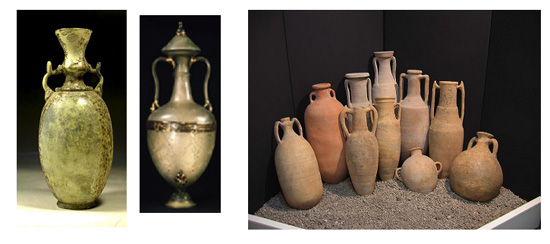
Storage of wine was another matter. The ancient world was better at preserving wine after it was made. In the ancient world (from Egypt through Greece and early Rome), wine was kept in amphorae.
Amphorae are earthenware vessels, typically with a small mouth on top. The amphorae were sealed with clay, wax, cork or gypsum. The
insides of the amphorae, if made of clay, were sealed with pitch, to make them airtight. It was well understood that if air got in, the wine would turn bad, and eventually to vinegar. Some amphorae were even made of glass, and then carefully sealed with gypsum, specifically to preserve the wine.


Wine Strength and Dilution
With proper amphorae, if the wine was good when it went into the vessel, it was quite likely to be good when it was retrieved, even if it was years later. The Egyptians and Greeks and Romans had vintage wines – wines that they could pull out of the cellar decades after it had been made.


But amphorae represented the pinnacle of wine storage, unmatched until the glass bottle was invented in the 19th century.
Around the time of the destruction of the Second Beis Hamikdash, the technology shifted. Barrels became prevalent[33], and remained the standard until the advent of the glass bottle in the 19th century. Barrels are made of wood, and they breathe. Without proper sealing, wine that is uncovered, untopped or unprotected by insufficient sulfur dioxide has a much shorter shelf life. Once a wine goes still (stops fermenting), it’s critical to protect it.[34]
Ancient
Israel and Egypt
Ancient
Greece and Early Rome
Late
Roman – medieval
Europe,
16th Century onward
Europe
19th century to present
Storage
Sometimes sealed amphorae; sometimes poor ones.[35]
Amphorae with good seals.[36]
Sulfur candles were sometimes used. Romans and Greeks continued to add salt
water when the wine was sealed – as well as boiling and using pitch.[37]
Sealed wine is valued.[38]
Even so, amphorae fell out of use, and were replaced with wooden barrels,
which breathe.  But  Gemara forbids sulphur in korbanos.[39]
Wooden
barrels continue.
Wine bottles are used. For the first time since the time of the Beis Hamikdash,
wine can be safely stored for a long time.
Predictability proved to be another major problem for winemakers, especially in the ancient world.
Ancient
Israel and Egypt
Ancient
Greece and Early Rome
Late
Roman – medieval
Europe,
16th Century onward
Europe
19th century to present
Predictability
of product
If the wine was good when sealed, predictability was excellent.
But sulfides were not understood well enough to make the raw product consistently drinkable.
Unpredictable.
Very much a “buyer beware” market, with no warranty, and a belief in mazal to
keep wine good.[40]
Slightly more predictable, as sulfides were sometimes used.
Very good. Storage was good, in barrels.
Excellent. Advances in understanding the role of yeast and bacteria, and the addition of
selected wine yeasts means that wine is highly predictable.
Marcus Porcius Cato (234-150 B.C.), refers to some of the problems related to the preservation of fermented wine. In Cato alludes to such problems when he speaks of the terms “for the sale of wine in jars.” One of the conditions was that “only wine which is neither sour nor musty will be sold. Within three days it shall be tasted subject to the decision of an honest man, and if the purchaser fails to have this done, it
will be considered tasted; but any delay in the tasting caused by the owner will add as many days to the time allowed the purchaser.”[41] Pliny, for example, frankly acknowledges  that “it is a peculiarity of wine among liquids to go moldy or else to turn into vinegar; and whole volumes of instructions how to remedy this have been published.”[42]
Sulfites, which are used now for fermentation and also for stored wine, were in occasional (if not consistent) use in the ancient world as well. The Gemara speaks of “sulfurating baskets,” for example.[43] It is well-documented that by 100 B.C.E. Roman winemakers often burned
sulfur wicks inside their barrels to help prevent the wine from spoiling.[44] They also sealed barrels and amphorae with sulfur compounds, with the same goal. The practise was not universal, and it was not well understood, so results varied widely. Freshly pressed grape juice has a tendency to spoil due to contamination from bacteria and wild yeasts present on the grape skins. Not only does sulfur dioxide inhibit the growth of molds and bacteria, but it also stops oxidation (browning) and preserves the wine’s natural flavor.[45] From the Romans until the 16th Century, wine preservation in the barrel was not reliably achieved; throughout the medieval and early modern period all wine was drunk young, usually within a year of the vintage.[46]… wines kept in barrels generally lasted only a year before becoming unpalatable.
In the 16th century, Dutch traders found that only wine treated with sulfur could survive the long sea voyages without it turning to vinegar. [47] 15th  century German wine laws restored the Roman practise, with the decree that sulfur candles be burned inside barrels before filling them with wine, and by the 18th century sulfur candles were regularly used to sterilize barrels in Bordeaux. The sulfur dioxide left on the container would dissolve into the wine, becoming the preservative we call sulfites. Even then, they were clever enough to realize that the sulfur addition improved wine quality.[48]
Ancient
Israel and Egypt
Ancient
Greece and Early Rome
Late
Roman – medieval
Europe,
16th Century onward
Europe
19th century to present
Shelf
life
Boiled wine lasted a long time, making storage and exports less risky, at the cost
of reduced quality.[49]
Variable, but could be excellent. Vintage wines existed, and old wines were prized.[50]
There were no corks, so wine did not breathe in storage.[51]
By the time of the Gemara, wine only 3 years old was considered very old.   Wine aged very poorly. And the Romans
abandoned the use of sulfites in wine storage.[52]
Shelf life is somewhat longer, as sulfides are rediscovered.  Bottles were introduced in the late 17th
century. Corks also come into use.
Vintage wines once again exist. Corks allow for wine to age in a bottle – the
tradeoff is that shelf life is more limited than in the ancient world.[53]
In the ancient world, wine flavorings appear to be as old as wine itself! The oldest archaeological record of wine-making shows that figs
were used in the wine as well – as we have said, wine made without benefit of sulfites, will be unpredictable at best; fig juice would sweeten the wine and make it more palatable.[54] But with all the added flavorings in the world, the process itself often led to some pretty unattractive results.
The impregnation with resin has been still preserved, with the result of making some modern Greek wines unpalatable save to the modern Greeks themselves. … Ancient wines were also exposed in smoky garrets until reduced to a thick syrup, when they had to be strained before they were drunk. Habit only it seems could have endeared these pickled and pitched and smoked wines to the Greek and Roman palates, as it has endeared to some of our own caviare and putrescent game.[55]
When Hecamede prepares a drink for Nestor, she sprinkles her cup of Pramnian wine with grated cheese, perhaps a sort of Gruyere, and flour.[56] The most popular of these compound beverages was the  (mulsum), or honey wine, said by Pliny (xiv. 4) to have been invented by Aristaeus.
Ancient
Israel and Egypt
Ancient
Greece and Early Rome
Late
Roman – medieval
Europe,
16th Century onward
Europe
19th century to present
Flavorings
Highly variable, and usually added.[57][58]
Added in copious quantities and varieties, almost surely to cover odd tastes and oxidation caused by poor manufacture and storage techniques.[59]
Cornels, figs, medlars, roses, cumin, asparagus, parsley, radishes, laurels,
absinthium, junipers, cassia, peppers, cinnamon, and saffron, with many other particulars, were also used for flavouring wines.[60]
Greeks added grated goat’s milk cheese and white barley before consumption of wine.[61]
Discriminating Romans even kept flavor packets with them when they traveled, so they could flavour wines they were served in taverns along the way.
Became less common, as it is acknowledged that flavorings were to cover failings in
the wine.
Post fermentation,
flavorings are almost never used.
Wine from a bottle is consistently more pure in the modern age than it
ever was before.
Virtually unheard of; to add a flavour to wine would be considered a gross insult to
the winemaker, and the noble grape itself.
Trade also changed greatly over time.  The ancient Mediterranean was a hotbed of trade, and wine was also shipped overland. Many wine presses and storage cisterns have been found from Mount Hermon to the Negev. Inscriptions and seals of wine jars illustrate that wine was a commercial commodity being shipped in goatskin or jugs from ports such as Dor, Ashkelon and Joppa (Jaffa). The vineyards of Galilee and Judea were mentioned then; wines with names like Sharon, Carmel and from places like Gaza, Ashkelon and Lod were famous.[62] Wine was a major export from ancient Israel.
This situation was mirrored in Greece and Rome. Wine was traded throughout the Mediterranean (it was as easy to ship wine 100 miles by
ship as it was to haul it 1 mile across land). But Roman wines were popular, and were shipped overland to Gaul and elsewhere.
In the later Roman period, the spread of winemaking inland (away from the convenient Mediterranean) meant that wines were rarely shipped far. The wine trade remained for the benefit of the very wealthy for over a thousand years, only resuming in the 16th and 17th centuries. And today, of course, the wine trade is ubiquitous, with wines available from around the world.
Grape juice was almost always fermented; before Pasteur, avoiding the fermentation of wine was not well understood, and any grape juice
that is not sulfated will ferment if yeast is added to it. Still, the concept of grape juice was understood before wine – the butler squeezed grapes directly in Pharoah’s cup, after all.  And the Gemara calls it “new wine.”[63] It certainly could be drunk then, though it was far from achieving its full potency.
Ancient
Israel and Egypt
Ancient
Greece through medieval
Europe,
16th Century onward
Europe
19th century to present
Cultural
consumption
In Israel, wine was drunk straight.  Drunkenness was discouraged; self control
praised.
Drunkenness was http://seforim.blogspot.com/2012/10/wine-strength-and-dilution.html#_ftn64″ name=”_ftnref64″ title=””>[64]
wine was consumed in large quantities.
Dilution is seen as a way to cheat the consumer; common in lower class taverns.
Social drinking is praised; wine is drunk to achieve the same buzz the Greeks
praised.
It is evident that wine was seen in ancient times as a medicine (and as a solvent for medicines) and of course as a beverage. Yet as a beverage it was always thought of as a mixed drink. Plutarch (Symposiacs III, ix), for instance, states. “We call a mixture ‘wine,’ although the larger of
the component parts is water.” The ratio of water might vary, but only barbarians drank it unmixed, and a mixture of wine and water of equal parts was seen as “strong drink” and frowned upon. The term “wine” or  oinos in the ancient world, then, did not mean wine as we understand it today but wine mixed with water. Usually a writer simply referred to the mixture of water and wine as “wine.” To indicate that the beverage was not a mixture of water and wine he would say “unmixed (akratesteron) wine.”[65]
There is some question whether or not what “wine” and “strong drink” Leviticus 10:8, 9, Deuteronomy 14:26; 29:6; Judges 13:4, 7, 14; First Samuel 1:15: Proverbs 20:1; 31:4,6: Isaiah 5:11, 22; 28:7; 29:9; 56:12; and Micah 2:11. “Strong drink” is most likely another fermented product – beer. Beer can be made from any grain, and would be contrasted with wine most obviously because it was substantially less expensive  (typically 1/5th the cost, in ancient Egypt) while still offering about the same alcohol content.[66]  (Yeast works the same way in both).
Ancient
Israel and Egypt
Ancient
Greece through medieval
Europe,
16th Century onward
Europe
19th century to present
Watered
down
Isaiah refers to watered wine perjoratively.
Greeks watered down wine, as they preferred to drink large quantities. They knew of
people who drank undiluted wine, but considered it a barbaric practise.. Wine was customarily diluted with water in a
three-to-one ratio of water to wine during Talmudic times.[67]
Still even the famously strong Falernian wines were sometimes drunk straight.[68]
Wine is not diluted, at least not in better establishments
Consumer never drinks wine known to be diluted.
Why did people water down wine? One possibility, given in Section I is that certain wines were more likely to cause a hangover. [69] The more commonly suggested solution than the presence of hangover-inducing components, is that wine served as a disinfectant for water that itself might be unsafe.
Today, we know this is true. Drinking wine makes our water safer to drink, and it also helps sanitize the food we eat at meals when we
drink wine. Living typhoid and other microbes have been shown to die quickly when exposed to wine. [70] Research shows that wine (as well as grape juice)[71], are highly effective against foodborne pathogens[72] while not significantly weakening “good” probiotic bacteria.[73]
In one study, it was shown that wine that was diluted to 40% was still effective against foodborne pathogens, and drier wines were much better at killing dangerous bacteria.
The ancients believed that wine was good for one’s health[74], even if they didn’t have the faintest idea why this was so. Microbes were only discovered in the 19th century, and ancient medicine was in many respects indistinguishable from witchcraft.  Still, it seems hard to deny that Romans and Greeks at least grasped some of the medicinal value of the grape; wines were a common ingredient in many Roman medicines.[75] And given the antibacterial powers of wine, it is obvious that a patient who drank diluted wine instead of water would be helping his body by not adding dangerous microbes when the body was already weakened by something else.
Still, the evidence remains anecdotal. The Torah does not mention wine as having medicinal benefits, though the New Testament does suggest wine as a cure for poor digestion[76] – entirely consistent with what we know about wine’s antibacterial properties. And as noted by the Jewish Encyclopedia, the Gemara reflects many of Galen’s positions on the health-giving qualities of wine:
Wine taken in moderation was considered a healthful stimulant, possessing many curative elements. The Jewish sages were wont to say, “Wine is the greatest of all medicines; where wine is lacking, there drugs are necessary” (B. B. 58b).  …  R. Papa thought that when one could substitute beer for wine, it should be done for the sake of economy. But his view is opposed on the ground that the preservation of one’s health is paramount to considerations of economy (Shab. 140b). Three things, wine, white bread, and fat meat, reduce the feces, lend erectness to one’s bearing, and strengthen the sight. Very old wine benefits the whole body (Pes. 42b). Ordinary wine is harmful to the intestines, but old wine is beneficial (Ber. 51a). Rabbi was cured of a severe disorder of the bowels by drinking apple-wine seventy years old, a Gentile having stored away 300 casks of it (‘Ab. Zarah 40b). “The good things of Egypt” (Gen. xlv. 23) which Joseph sent to his father are supposed by R. Eleazar to have included “old wine,” which satisfies the elderly person (Meg. 16b).   Until the age of forty liberal eating is beneficial; but after forty it is better to drink more and eat less (Shab. 152a). R. Papa said wine is more nourishing when taken in large mouthfuls. Raba advised students who were provided with little wine to take it in liberal drafts (Suk. 49b) in order to secure the greatest possible benefit from it. Wine gives an appetite, cheers the body, and satisfies the stomach (Ber. 35b).[77]
Others have made the bolder argument  — that the core purpose of dilution was to purify water for drinking.[78]
The ancients began by adding wine to water (to decontaminate it) and finished by adding water to wine (so that they didn’t get too drunk too quickly). A letter, written in brownish ink on a pottery shard dating from the seventh century BC, instructs Eliashiv, the Judaean commander of the Arad fortress in southern Israel, to supply his Greek mercenaries with flour, oil and wine.
The [Israel Museum in Jerusalem] exhibition’s curator, Michal Dayagi-Mendels, explains that the oil and flour were for making bread; the wine was not for keeping them happy, but for purifying brackish water. To prove her point, she displays a collection of tenth-century BC hip flasks, with built-in spoons for measuring the dosage.[79]
While the archaeological record is strong in this respect, the lack of textual support, in this author’s opinion, means that there is more evidence that wine was diluted for cultural reasons than because there was a conscious understanding that wine made water safe to drink.
Ancient
Israel and Egypt
Ancient
Greece and Early Rome
Late
Roman – medieval
Europe
19th century to present
Used for health reasons
No direct evidence
Mainstay for medicine; perceived as valuable to health
With safer water, wine not as important.
Recently, wine is prized for its resveratrol for health and longevity, instead of anti-microbial properties as previously.
[1] “Up to and including the time of the Gemara, wines were so strong that they could not be drunk without dilution…. Nowadays, our wines are not so strong, and we no longer dilute them.” Rabbi Avraham Rosenthal (link), “During the time of the Talmud, wine was very concentrated, and was normally diluted with water before drinking. “Rav Ezra Bick (link), “In Talmudic times, wine was sold in a strong, undiluted form, which only attained optimal drinking taste after being diluted with water.” Rabbi Yonason Sacks,  (link), “Records indicate that the alcohol content of wine in the ancient days was very high. Therefore, it was a common practice to dilute the wine with water in order to make it drinkable.” (link), “In ancient times, wines were powerfully strong and adding water to dilute their taste and power was common. … Pure wine, undiluted with water, is highly concentrated and difficult to drink. Rabbi Gershon Tennenbaum, (link), “In the days of the Talmud the wine was so strong and concentrated that without dilution it was not drinkable.” Zvi Akiva Fleisher, (link), “During the time of the Talmud, wine was very concentrated, and was normally diluted with water before drinking.” Rav Yair Kahn, (link), “Our wines, which are considerably weaker than those used in the days of Chazal, are better if they are not diluted.” (link)
[2] Rashi on Berachos 50b
[3] Wine naturally ferments to no more than 16% alcohol (typically 12-14%) before the alcohol kills the yeast off. Alcohol boils away at a lower temperature than water, so boiling wine does not concentrate it. And without the technology of distillation (which was not known in the ancient world), the only practical method that might have concentrated the alcohol in a wine would be to add plaster of paris; water would be absorbed, and the alcohol would be concentrated. But we have no evidence that this was done; it would have been far more than a mere flavoring. (see)
[4] Isaiah 1:22
[5] Spices and flavorings, on the other hand, were considered fit for guests and offerings: Proverbs 9:2,5 and Isaiah 65:11 both refer to wine which is “mem-samech-ches”, meaning that it has been spiced and is ready to serve. This is the best of wine, though as warned in Proverbs 23:30, such wine has dangerous side effects. This is entirely consistent with what we know of wine flavorings in the ancient world (see Part II): spices made wine more palatable, so it could more easily be consumed to excess.
[6] Isaiah 25:6
[7] Dr. Uprichard adds: Fermentation is the conversion of complex sugars, via glucose and pyruvic acid into ethanol and CO2. Natural yeasts die when the alcohol content of their culture medium (i.e. the liquid that is being produced for human consumption) exceeds a certain limit. Limit varies depending on the yeast and other factors, but is generally somewhere between 12-15% alcohol by volume. For wine to be stronger, it has to be fortified. Fortification is a process in which spirit is added to the wine. There are many fortified wines made around the world. However there are only two basic ways of fortification:
1: The Sherry Method – the must, which is a mixture of juice, pulp, skins and seeds, is fermented out, leaving a dry wine. The spirit is then added. Consequently all sherry method wines are dry to begin with. If the final style of wine is other than dry, sweetening is added prior to bottling. Sherry was invented in the 8th Century, CE.
2: The Port Method – the must is only partly fermented, and the process is stopped by the addition of sufficient spirit to prevent the yeast working. ie the alcohol content is raised to a level which kills the yeasts and leaves much of the sugar unfermented. Consequently port-method wines are generally sweet. Adding sugar will feed the process but only until the yeasts (which are effectively the enzymes in the reaction) are used up (or in this case killed off). The Rambam, who diluted wine, did NOT consider fortified wine to be suitable for Kiddush; his wine was unfortified, and undistilled, and therefore could not exceed 15-16% alcohol.
[8] Hilchot Chametz UMatzah 7:9
[9] Rambam considered young new wine (presumably only lightly fermented) to be distinctly unhealthy (see).
[10] It is clear that personal and cultural preferences remain very important when talking about whether to use wine or grape juice for Kiddush or the Arba Kossos. Rav Soloveitichik writes that if one does not enjoy wine, he should use grape juice for the Arba Kosot, as that will be a pleasant drink according to his taste.
[11] Berachos, 50b
[12] Sanhedrin 70a. The Greeks had the same standard: to drink wine diluted 1:1 was repudiated as disgraceful (see).
[13] II Maccabees 15:39
[14] Instructor II, ii, 23.3—24.1
[15] Athenaeus quotes Mnesitheus of Athens: “The gods has revealed wine to mortals, to be the greatest blessing for those who use it aright, but for those who use it without measure, the reverse. For it gives food to them that take it and strength in mind and body. In medicine it is most beneficial; it can be mixed with liquid and drugs and it brings aid to the wounded. In daily intercourse, to those who mix and drink it moderately, it gives good cheer; but if you overstep the bounds, it brings violence. Mix it half and half, and you get madness; unmixed, bodily collapse.” [Odyssey IX, 232.]
[18] Pliny (Natural History XIV, vi, 54) mentions a ratio of eight parts water to one part wine. In one ancient work, Athenaeus’s The Learned Banquet, written around A.D.  200, we find in Book Ten a collection of statements from earlier writers about drinking practices. A quotation from a play by Aristophanes reads: “‘Here, drink this also, mingled three and two.’ Demus. ‘Zeus! But it’s sweet and bears the three parts well!’”
[19] http://www.mmdtkw.org/VRomanWine.html.  Why did the Greeks enjoy diluted wine, and the Jews of ancient Israel preferred it straight?  We cannot be certain of the answer, but it is clear that the Greeks praised drinking very large quantities; it was a feature of every meal, which regularly lasted for hours. For them, wine was a necessity, and the culture rotated around its unrestrained consumption – the Greeks drank by the gallon. Undiluted wine, however, cannot be drunk by the gallon. Greeks liked to get drunk, but they wanted it to take time. Ceremonious, sociable consumption of wine was the core communal act of the Greek aristocratic system. [http://tinyurl.com/cmlsbu].
By contrast, in the Torah wine is consistently praised – in moderation. Drunkenness is never a virtue in Judaism, and the shucking off of self control and loss of inhibitions that was part and parcel of Dionysian rites is considered unacceptable to G-d fearing Jews. So wine, in full strength, was praised and consumed, but consumption for its own sake was not encouraged.
[20] Hundreds of clay jars of wine (with a total volume of some 4,500 liters (118.78 gallons) were buried with one of the first Egyptian kings, Scorpion I (about 3150 B.C.E.). Analysis of the clay shows that the jars were made in the modern Israel-Palestine region. http://www.answers.com/topic/wine-in-the-ancient-world
[22] Had there been any significant qualitative difference between wine grown in one place as opposed to another, it would be apparent by the archaeological and written records we have; the ancient Greeks, for example, spent a lot of ink writing about wine, with no mention that any wine was significantly stronger than any other.
[23] Proposed by Brian Foont
[25] As written about a modern wine that is made without sulfides: “we had an organic, ‘no sulfite added’ chardonnay on the menu. It was an amazing wine to behold. That is when it wasn’t brown and vaguely reminiscent of sewage, which was about one out of every four bottles.” http://winekulers.com/11_1_08.htm . See http://en.wikipedia.org/wiki/Yeast#Wine for more information about the process in general. Ancient wineries, lacking modern sanitation, would have had a much lower “success” rate.
[26] Egyptian wines cannot have been very stable because the grapes were picked and crushed in August, then were slowly crushed and pressed and then rapidly fermented, all in the summer heat. http://www.answers.com/topic/wine-in-the-ancient-world
[27] http://tinyurl.com/dl5ypr . Though according to oeniphiles, boiling the wine at any time destroys the flavor. Boiled wine was not allowed as a korban, though it would have led to a more predictable (if mediocre) product. Terumos 11:1 – Rabbi Yehuda, in a minority opinion, considers boiled wine to be superior.
[28] “Some people—and indeed almost all the Greeks—preserve must with salt or sea-water.” Columella, On Agriculture 12.25.1. Columella recommended the addition of one pint of salt water for six gallons of wine.
[30] Fresh must, when boiled, could have been stored in amphorae and kept sweet, and this could be the boiled wine mentioned in the Gemara. Certainly we don’t need to speculate in the case of the Romans, as http://www.biblicalperspectives.com/books/wine_in_the_bible/3.html writes: Columella gives us an informative description of how they did it: “That must may remain always as sweet as though it were fresh, do as follows. Before the grape-skins are put under the press, take from the vat some of the freshest possible must and put it in a new wine-jar; then daub it over and cover it carefully with pitch, that thus no water may be able to get in. Then sink the whole flagon in a pool of cold, fresh water so that no part of it is above the surface. Then after forty days take it out of the water. The must will then keep sweet for as much as a year.”  [Columella, On Agriculture 12, 37, 1]… This method of preserving grape juice must have been in use long before the time of Pliny and Columella, because Cato (234-149 B.C.) mentions it two centuries before them: “If you wish to keep grape juice through the whole year, put the grape juice in an amphora, seal the stopper with pitch, and sink in the pond. Take it out after thirty days; it will remain sweet the whole year.” [Marcus Cato, On Agriculture 120, 1.]
[31] “Some people—and indeed almost all the Greeks—preserve must with salt or sea-water.” Columella, On Agriculture 12.25.1.
[33] Barrels have many advantages: they are less expensive and less prone to breakage; they stack and roll, and generally allow for easier transportation. The downside of a shortened shelf life for the wine was apparently considered an acceptable price to pay for these advantages.
[35] In Egypt, the clay jars were slightly porous (unless they were coated with resin or oil), which would have led to a degree of oxidation. There was no premium on aging wine here, and there are records of wine going bad after twelve to eighteen months. http://www.answers.com/topic/wine-in-the-ancient-world
[36] Jeremiah 48:11, Moab is compared to a container of fine wine that is not disturbed: “therefore its taste has stayed in it, and its scent was not diminished.” Unsealed wine in the ancient world was known to lose its essence.
[38] The foster-mother of Abaye is authority for the statement that a six-measure cask properly sealed is worth more than an eight-measure cask that is not sealed (B. ‑3. 12a)
[39] John Kitto’s Cyclopedia of Biblical Literature says: “When the Mishna forbids smoked wines from being used in offerings (Manachoth,
viii. 6, et comment.), it has chiefly reference to the Roman practice of fumigating them with sulphur, the vapor of which absorbed the oxygen, and thus arrested the fermentation. The Jews carefully eschewed the wines and vinegar of the Gentiles.” But presumably smoked wines were acceptable for consumption, even if not for offerings?
[40] Rab said that for three days after purchase the seller is responsible if the wine turns sour; but after that his responsibility ceases. R. Samuel declared that responsibility falls upon the purchaser immediately upon the delivery of the wine, the rule being “Wine rests on the owner’s shoulders.” R. ‑Hiyya b. Joseph said, “Wine must share the owner’s luck” (B. B. 96a, b, 98a). If one sells a cellarful of wine, the purchaser must accept ten casks of sour wine in every hundred (Tosef., B. B. vi. 6).
[41] On Agriculture, Chapter 148. http://penelope.uchicago.edu/Thayer/E/Roman/Texts/Cato/De_Agricultura/J*.html .  Cato shares the opinion of Rav: “For three days after purchase the seller is responsible if the wine turns sour; but after that his responsibility ceases.” B. B. 96a.
[43] Berachos 27b, line 14.
[46] Wine and the Vine: An Historical Geography of Viticulture and the Wine Trade Tim Unwin
[47] http://search.japantimes.co.jp/cgi-bin/fg20040813wc.html . Even snakes could recognize the dropoff in quality– only boiled wine, if it
were left uncovered, could be drunk the next morning (Avodah Zarah 30a).
[49] Yerushalmi, on Terumos 11:1 notes that cooked wine is inferior in quality to uncooked wine, but is superior in the sense that it lasts longer.
[50] “The good things of Egypt” (Gen. xlv. 23) which Joseph sent to his father are supposed by R. Eleazar to have included “old wine,” which satisfies the elderly person (Meg. 16b). At the great banquet given by King Ahasuerus the wine put before each guest was from the province whence he came and of thevintage of the year of his birth (Meg. 12a). In Rome, wines were preferred to  aged anywhere from 10 to 25 years. In fact, the Emperor Caligula was once presented with a 160 year old vintage that was considered a supreme treat. http://penelope.uchicago.edu/~grout/encyclopaedia_romana/wine/wine.html
[51] Vintage wines of the ancient world were lost when sealed amphorae were replaced with wooden barrels at the end of the second century, AD (Techernia, 1986), and their reappearance had to await the development in the 17th century of glass bottles stoppered with cork. From “Wine and the Vine: An Historical Geography of Viticulture and Wine Trade”
[52] If William Younger is to be believed, the Romans had entirely abandoned sulfites by the end of their millenium of winemaking. http://www.winecrimes.com/winecrimes/
[53] Singer, Holmyard, Hall et cie “History of Technology”
[55] http://chestofbooks.com/food/beverages/Drinks-Of-The-World/Roman-Wines.html
[57] To prevent wine from becoming acid, moldy, or bad-smelling a host of preservatives were used such as salt, sea-water, liquid or solid pitch, boiled-down must, marble dust, lime, sulphur fumes or crushed iris.
[58] The aroma, taste and texture of Egyptian wines are lost to us, but in any case the wine was often flavored with herbs and spices before being consumed. [http://www.answers.com/topic/wine-in-the-ancient-world]
[59] (1) “alun‑mit,” made of old wine, with a mixture of very clear water and balsam; used especially after bathing (Tosef., Dem. i. 24; ‘Ab. Zarah 30a); (2) “‑3afrisin” (caper-wine, or, according to Rashi, Cyprus wine), an ingredient of the sacred incense (Ker. 6a); (3) “yen ‑ìimmu‑3in” (raisin-wine); (4) “inomilin,” wine mixed with honey and pepper (Shab. xx. 2; ‘Ab. Zarah l.c.); (5) “ilyoston”, a sweet wine (“vinum dulce”) from grapes dried in the sun for three days, and then gathered and trodden in the midday heat (Men. viii. 6; B. B. 97b); (6) “me’ushshan,” from the juice of smoked or fumigated sweet grapes (Men. l.c.); not fit for libation; (7) “enogeron,” a sauce of oil and garum to which wine was added; (8) “api‑3‑mewizin,” a wine emetic, taken before a meal (Shab. 12a); (9) “‑3undi‑mon” (“conditum”), a spiced wine (‘Ab. Zarah ii. 3); (10) “pesinti‑mon” (“absinthiatum”), a bitter wine (Yer. ‘Ab. Zarah ii. 3);
[63] Rabbi Hanina B. Kahana answers the question: “How long is it called new wine?” by saying, “As long as it is in the first stage of fermentation . . . and how long is this first stage? Three days.” Sanhedrin 70a.
[64] The Greeks were aware of the results of excessive consumption of wine, and it was recommended that wine be diluted with water in order to avoid this. It was also seen as socially stigmatizing to drink undiluted wine, and this was often seen as “a habit confined to barbarians”. The Romans were also well aware of the results of drunkenness, and Pliny’s famous comment “in vino verias” is not to be a disinterested observation, but a chastisement of those who “do not keep to themselves words that will come back to them through a slit in their throat.” [http://www.mta.ca/faculty/humanities/classics/Course_Materials/CLAS3051/Food/Wine.html]
[66] Beer is typically less alcoholic than wine; typical brewing yeast cannot survive at alcohol concentrations above 12% by volume. http://en.wikipedia.org/wiki/Beer Wine can run to 15-16%.
[67] R. Eliezer says “boreh pri hagefen” is pronounced only when the wine has been properly mixed with water.
[68] Catullus wrote: Postumia more tipsy than the tipsy grape. But water, begone, away with you, water, destruction of wine, and take up abode with scrupulous folk. This is the pure Thyonian god. [http://ammonastery.wordpress.com/2008/03/16/wine-le-vin/ ] . Falernian wines were as strong as fifteen or sixteen percent alcohol. http://penelope.uchicago.edu/~grout/encyclopaedia_romana/wine/wine.html
[69] Proposed by Brian Foont
[70] http://tinyurl.com/cnzwes [The Origins and Ancient History of Wine By Patrick McGovern, Stuart James Fleming, Solomon H. Katz]
[71] Grape juice and wine are much more beneficial to health than beer with the same alcohol content – other properties of the grape, even before fermentation, are good for people. This means that diluted grape juice (and boiled grape juice or wine) also had health benefits even without alcohol.
[72] such as Helicobacter pylori, Listeria monocytogenes, Escherichia coli O157:H7, Salmonella Typhimurium and Shigella boydii,
[74] A passage in the Hippocratic writings from the section “regimen in Health” draws upon this basic assumption: “Laymen…should in winter…drink as little as possible; drink should be wine as undiluted as possible…when spring comes, increase drink and make it very diluted…in summer…the drink diluted and copious.” [http://www.mta.ca/faculty/humanities/classics/Course_Materials/CLAS3051/Food/Wine.html – Hippocrates dates from 400 BCE] Drugs such as horehound, squills, wormwood, and myrtle-berries, were introduced to wine to produce hygienic effects.
[75] http://en.wikipedia.org/wiki/Ancient_Rome_and_wine The Romans believed that wine had both healing and destructive powers. It could heal the mind from depression, memory loss and grief as well as the body from various ailments-including bloating, constipation, diarrhea, gout, halitosis, snakebites, tapeworms, urinary problems and vertigo. Cato wrote extensively on the medical uses of wine, including espousing a recipe for creating wine that could aid as laxative by using grapes whose vines were treated to a mixture of ashes, manure and hellebore. He wrote that the flowers of certain plants like juniper and myrtle could be soaked in wine to help with snakebites and gout. Cato believed that a mixture of old wine and juniper, boiled in a lead pot could aid in urinary issues and that mixing wines with very acidic pomegranates would cure tapeworms.[23]
The 2nd century AD Greco-Roman physician Galen provides several details about how wine was used medicinally in later Roman times. In Pergamon, Galen was responsible for the diet and care of the gladiator. He made liberal use of wine in his practice and boasted that not a single gladiator died in his care. For wounds, he would bath them in wine as an antiseptic. He would also use wine as analgesic for surgery. When Galen became the physician of Emperor Marcus Aurelius, he worked on developed pharmaceutical drugs and concoctions made from wine known as theriacs. The abilities of the these theriacs developed superstitious beliefs that lasted till the 18th century and revolved around their “miraculous” ability to protect against poisons and cure everything from the plague to mouth sores. In his work De Antidotis, Galen notes the trend of Roman tastes from thick, sweet wines to lighter, dry wines that were easier to digest.[14]
[76] Paul commands Timothy to use alcohol with his water due to his frequent illness (1 Timothy 5:23). Evidently Timothy had been drinking only water, and that was causing sickness.
[78] Inhibitory activity of diluted wine on bacterial growth: the secret of water purification in antiquity, International Journal of Antimicrobial Agents, Volume 26, Issue 4, Pages 338-340 P.Dolara, S.Arrigucci, M.Cassetta, S.Fallani, A.Novelli


A selection from Strictly Kosher Reading by Yoel Finkelman

The Seforim Blog is happy to present this selection from Yoel Finkelman’s recent book, Strictly Kosher Reading: Popular Literature and the Condition of Contemporary Orthodoxy.

Coalescence
The first function of Haredi popular literature involves the “coalescence” of the Jewish and the non-Jewish. In defining coalescence, Sylvia Barack Fishman distinguishes it from two other common ways of describing relationships between Judaism and general culture. First, “compartmentalization” involves a situation in which the Jewish tradition holds sway in its own spheres, such as the synagogue or Shabbat table, while non-Jewish culture dominates in other areas of life, such as the workplace or the theater. Despite its conceptual clarity, Fishman claims that “compartmentalization” does not accurately describe actual American Jewish practice, since contemporary American Jews are too Americanized and America is too welcoming of Judaism for such neat divisions to have much explanatory power. Second, “adaptation” involves a situation in which the Jewish and the non-Jewish exist side by side. Tension between the two remains, and the individual or community “privileges one or the other as the situation seems to demand.”[1] Adaptation, she explains, “implies a continuing awareness of difference” between Jewish and general values and an attempt to negotiate these differences.
Yet, claims Fishman, many American Jews have lost an awareness of differences between Jewish and American values.
During the process of coalescence… the ‘texts’ of two cultures, American and Jewish, are accessed simultaneously…. These values seem to coalesce or merge, and the resulting merged message or texts are perceived not as being American and Jewish values side by side, but as being a unified text, which is identified as authoritative Judaism…. Many American Jews – including some who are very knowledgeable and actively involved in Jewish life – no longer separate or are even conscious of the separation between the origins of these two texts.[2]
Haredi popular literature, like much of Haredi popular culture, seamlessly merges aspects of the Jewish tradition with contemporary American cultural norms and styles. In coalescence, normative Judaism becomes a hybrid or syncretic combination of the Jewish and the American, the traditional and the modern, the past and the present. For example, Haredi music takes its lyrics from traditional Jewish texts, but its musical style imitates contemporary pop music.[3] Haredi self-help books, as we shall discuss, present contemporary values of individualism, personal happiness, self-expression, and (according to some critics) self-absorption as Jewish values, supposedly in the self-improvement tradition of musar.[4] Haredi novels borrow literary genres and formulas from the general best-sellers and fill them with Haredi characters and values. [5]
Given Haredi commitment to isolationism and rejection of non-Haredi culture, Haredi coalescence seems surprising. Still, Haredi Jews are genuinely acculturated, and the same cultural forces that make a genre or idea popular among the general public make it popular among Haredi Jews as well. Community members may prefer a Haredi version of a literary genre, such that it will more precisely match their values and style. In addition, imitating the most contemporary styles helps make the tradition seem sophisticated and up-to-date. This allows Haredi Judaism to respond to modernity and its perceived anti-Orthodox biases on modernity’s own terms.[6]
Take the example of Yaakov Levinson’s book, The Jewish Guide to Natural Nutrition. According to Levinson, there are “Jewish roots to natural nutrition.” Holistic health and natural foods are presented as traditional Jewish values. Levinson works to “combine a system for healthy living and eating with a strong connection to our important Jewish heritage.” He rhetorically grounds his work in traditional Judaism, explaining that “Rambam’s [Maimonides’] medical writings contain the Jewish roots of today’s system of natural nutrition. Our modern approach is basically an extension of his main principles and teachings.” [7]
Yet, the author says little about Maimonides’ specific nutritional advice or his medieval biology, and Levinson quotes from Maimonides’ medical writings only very rarely. Instead, Levinson focuses on contemporary scientific concepts such as cholesterol, vitamins, and the USDA food pyramid. Maimonides does not serve as an authority on the workings of the body. Rather, he is an authoritative precedent for the borrowing of contemporary medical advice. Levinson is, to a great degree, aware of and articulate about the fact that the medical and nutritional advice he suggests does not come from Torah, but from modern science. He dances a cautious dance between the new and the old, the modern and the traditional. Maimonides’ “medical writings were based on Jewish Talmudic sources as well as on secular, non-Jewish teachings.”[8] In other words, Levinson argues that it is authentically and traditionally Jewish for today’s Haredi Jews to self-consciously adapt contemporary scientific theories, just as Maimonides did in his day. Maimonides is important to Levinson not as a source of information about eating and health, but as a figure whose very name and reputation can help make the book seem authentically Jewish and grounded in the tradition, even if the book’s content is not actually derived from his writings.
The dust jacket of The Jewish Guide to Natural Nutrition clearly articulates coalescence. The author’s biography on the dust jacket celebrates his extensive Torah studies as well as his accomplishments in the field of medicine. Photographs visually reinforce this. The front cover shows a professional studio photograph of a bearded man – presumably the author – carrying a large, attractive basket of fresh green apples and dressed in a clean white lab coat. The apples signify the value of natural and healthy eating, while the lab coat symbolizes the scientific validity and authority of the book’s nutritional suggestions. The back cover includes a parallel photo of the same man dressed in Hasidic garb carrying a stack of Maimonides’ halakhic writings. Science and Jewish religion, including both its mystical-Hasidic and its rationalistic-legal-Maimonidean strands, are not only compatible with one another, but mutually enforcing. The authority of science is backed, symbolically and visually, by Torah, and Torah leads to an appreciation of contemporary nutritional science. Not accidentally, the book opens with three almost identical approbations: two by well-known yeshiva deans and one by a professor at a Jerusalem medical school. The approbation from the medical doctor praises coalescence, in that the book “melds an expert’s view of nutrition and disease with its special implication and application to religious Jewish tradition.”[9]
Levinson’s coalescence goes further. He not only provides standard American nutritional advice for Haredi readers, but also claims that following that advice is fundamentally a spiritual experience and religious obligation. Here Levinson goes beyond his Maimonidean precedent. For Maimonides, maintaining one’s health is a means to an end, a requirement so that illness or weakness would not distract the
individual from the higher values of study and religious self-development. “It is impossible to understand or know anything of the knowledge of the Creator when one is ill. Therefore a person must distance himself from things which damage the body and a person should become accustomed to things which make one healthy.” For Levinson, in contrast, health is not merely a means toward a higher end; rather, there is an inherent “spirituality in eating.”[10] Combining kabbalistic language and basic biology of the digestive system, Levinson explains that healthy eating exemplifies a central religious goal of separating the “good” from the “evil” in creation. The “nutrients” are good and therefore associated with the holy “sparks” of the Kabbalah, while the “waste” is the evil, associated with the evil kabbalistic “husks.” “The separation of nutrients from waste in the act of eating has its spiritual counterpart in the extraction of the sparks of holiness which are contained in food. And is not the physical and spiritual separation of good from evil the very meaning of human existence?”[11]
Levinson also hints that the foods people eat and how they eat them are not value free, but exemplify their cultural identity. “Foods are much more than just a collection of nutrients; they are a wealth of influences and connotations…. The various religions use foods to connote their special approach to life.” Levinson’s health advice exemplifies this point, perhaps more clearly than he intended. While he intends to underscore the inherent spirituality, according to Judaism, in eating, he also implies that eating like an American means having absorbed American mores and sensibilities. He advocates a “healthier, lighter style of eating,” which became a virtual American infatuation in the nutrition discourse of late twentieth and early twenty-first centuries (even as Americans grew fatter).[12] Levinson’s concern with calorie counting, weight-loss, and balanced consumption of nutrients reflects the biological knowledge and cultural aesthetics of contemporary America, a community of plenty with an almost infinite variety of foods to choose from, with a deep concern with the long-term health impact of overeating, and an aesthetic that celebrates thinness. For almost all of human history, the central culinary dilemma facing humans involved procuring enough food to fend off starvation or at least chronic hunger. In contrast, Levinson and his American Haredi readership share with other middle-class Americans a challenge of negotiating an almost unlimited quantity and variety of food.[13] The late twentieth-century American infatuation with light, healthy eating, which Levinson exemplifies, supports values that Haredim and the general population share and which are reflected in their culinary culture and popular literature. Levinson’s book suggests that religious people, even those profoundly committed to a given canon, read and interpret their scripture and tradition not only in their own terms, but “in order to make sense of their lived experiences.”[14]
That Haredi Jews share a culinary culture with their neighbors, and that they follow the best medical and health advice available, are relatively unproblematic notions from a Haredi perspective. After all, the Jewish tradition for the most part supports the idea that Jews should seek quality medical treatment,[15] and Maimonides indeed advocated learning from the best available science. However, other examples of coalescence raise significant ideological and religious challenges.
For example, Haredi popular literature, like its devout Christian counterparts, adopts the modern notion of the “companionate marriage.” Here the coalescence appears in a matter of profound ideological and religious significance, since, as Helen Hardcare explains about Protestant Fundamentalists, the family is a “primary unit for ritual observance as well as an influential site of religious education and the transmission of religious knowledge from one generation to the next.”[16] Or, as one Haredi author puts it, “The Jewish family [is] a vital force in insuring our people’s continued existence.”[17] Popular Haredi works identify the Torah’s “timeless formula for marriage,” and contrast that with the “non-Jewish system” that is “floundering in its own confusion” and therefore “has nothing to offer the Jew.”[18] Yet, a brief historical comparison reveals how acculturated Haredi families have become, and how the Haredi popular literature coalesces by presenting the modern, monogamous, suburban nuclear family as part and parcel of the tradition.
Both the contemporary Haredi family and the pre-modern Ashkanazic one share a commitment to strict monogamy, as opposed to the polygamy of ancient Judaism and at least some of historical Sephardic culture. Yet, in pre-modern Ashkenaz, parents contracted marriages for their children, often with the help of professional matchmakers. When choosing a partner for their child, parents paid less attention to emotional or romantic compatibility and more to finding a spouse who could offer the greatest socio-economic advantage. Often, marriages were arranged, if not always consummated, when the children were in their mid-teens. This marriage was more of an economic agreement than a romantic one, certainly at the outset. The couple might continue to live with the bride’s family for some time, until they became financially and socially independent. In this constellation, “personal compatibility not to speak of romantic attachment [between the couple] were not taken into account at all.” [19] On occasion, feelings of love and mutual attraction would push a young couple to choose one another as marriage partners, but rabbis and community members saw this as a rebellion against communal values rather than a fulfillment of them.[20]
Today, Haredi couples, usually in their early 20s, care deeply about emotional compatibility and therefore search for marriage partners through dating. This period of courtship allows the young couple to determine if they are emotionally compatible and romantically suited. Under these circumstances, when courtship and emotional compatibility have become central to Haredi images of marriage, Haredi authors write dating guidebooks for such young people, providing “guidelines for dating and courtship,” so that the dating couple can most effectively determine if they share the same values, if they have the same expectations from married life, and if their “personalities” will enable “the couple to get along with each other.”[21]
Furthermore, for medieval Ashkenazic Jews the home was a center of economic life, because merchandise and services were produced in the home for the use of its residents as well as for trade with others. Women, though also mothers, played central roles in the medieval Jewish marketplace, at a time and place when parenthood was not considered a full-time endeavor and where raising children was perceived as requiring less moment-to-moment vigilance than it does today.
For contemporary Haredi rhetoric, in contrast, the “Jewish home” rather than being a locus of economic production, serves as a “haven in a heartless world,” a domestic shelter from the dangers of the marketplace and the outside culture.[22] It is a modern, middle-class, child-centered, nuclear family. In these families, rearing offspring, who require full-time attention and continuous nurturing, requires parents primarily and educators secondarily to be sensitive, vigilant, and loving toward children more or less on a constant basis. Women are, therefore, encouraged by Haredi literature to dedicate themselves first and foremost to being mothers and wives, and to go to work only if the family’s financial situation requires it.[23]
As numerous historians of both the Jewish and non-Jewish family have noted, these modern family patterns, in broad terms, developed with the rise of the middle class, under conditions of urbanization and industrialization.[24] In their popular literature, acculturated contemporary Haredim describe, analyze, and celebrate this modern family. In particular, Haredi popular literature celebrates one particular aspect of this modern family: what historians and sociologists have come to refer to as the “companionate marriage.” In this modern family, marriage ought to lead to self-fulfillment, happiness, and the satisfaction of the psychological need for friendship and emotional closeness.
The ideal of companionate marriage came to dominate discussions of marriage in twentieth-century America…. It elevated anticipation of achieving emotional, sexual, and interpersonal fulfillment in marriage. The goal of marriage was no longer financial security or a nice home but emotional and sexual fulfillment and compatibility. Though marriages were not expected to be conflict and tension free, it was hoped that disagreements could be overcome if husbands and wives talked about their feelings, recognized the existence of conflicts, and worked out their problems through close “communication.”[25]
The norm of the companionate marriage has penetrated Haredi circles, and Haredi books which guide couples to achieving that kind of relationship serve as prime examples of coalescence. For medieval Ashkenazic Jews, there was “an absence of any philosophy promising happiness in marriage.”[26] Today’s Haredi books on marriage view happiness and self-fulfillment as the central goals of married life. These works focus particularly on communication skills between couples, in order to assure that the couple will remain emotionally responsive to one another. “A healthy relationship is built on clear and honest communication. Listening, understanding and conversing all contribute to the empathy so vital to a marriage.”[27] Furthermore, “Marriage… creates the possibility of the closest emotional relationship that can exist between living beings, the love between husband and wife.” “Happiness in marriage” can be achieved by “building trust,… maintaining affection,… [and] creating intimacy.” Ultimately, “Marriage is a primary catalyst for the development of each partner’s individual potential to the utmost.”[28]
The adoption of the model of the companionate marriage relates closely to another very popular genre of Haredi popular literature, namely the parenting guide. Here, too, coalescence prevails, with these parenting guides presenting images of child rearing as part and parcel of the Jewish tradition. And here too the coalescence appears in discussions of central religious values: how to raise children to become Torah-observant and God-fearing Jews. Hence, one might expect a greater reliance on traditional sources and a more suspicious stance toward contemporary norms. Still, Haredi parenting guides, even those that claim to reject so-called “modern” approaches to parenting, adopt the strategy of coalescence and share much of their style and content with their non-Haredi counterparts.
Lawrence Kelemen’s parenting guide, To Kindle a Soul, for example, claims in the subtitle to contain “ancient wisdom.” “At the foot of a mountain in the Sinai desert, the Creator of the universe directly revealed His profound wisdom to approximately three million people…. Those present received… a comprehensive guide for raising great human beings.” The book attempts to describe “this ancient, Torah approach to education” which is “more comprehensive and effective… than any of the schools of child psychology I studied at university.” Kelemen describes the “significant” differences between these supposedly “ancient traditions” and the practices of contemporary parents.[29]
Yet Kelemen’s parenting approach fits neatly within late twentieth-century American parenting discourse, and it differs significantly from that of pre-modern Jewish sources. Kelemen combines an American religious-right critique of supposedly decadent American family life with a child-centered parenting approach advocated by endless American mass-market parenting guides in the 1990s. Criticism of American materialism and permissiveness; advocacy of limiting the mother’s time at work; polemics against spanking; emphasis on good nutrition, proper sleep time, and bedtime routine; concerns about the adverse impact of television viewing; claims to provide a “system” for raising moral children; and advocacy of “quality-time” for empathy and close communication between parents and children, all characterized American experts’ suggestions to worried middle-class parents at the end of the twentieth century. Even Kelemen’s claim that his approach derives from the Bible follows the pattern of American religious parenting guides. Indeed, the book’s unstated assumptions – that parenting is a full-time endeavor, and that parents should actively monitor their children’s moment-by-moment lives – typify experts’ advice and popular assumptions in America during the so-called “century of the child.” [30]
Not only does Kelemen’s approach match that of contemporary parenting experts, but it differs from traditional Jewish sources on the topic. While a complete history of Jewish approaches to children and family has yet to be written, it is enough in this context to note that traditional Jewish literature speaks of childhood and parenting in spotty and unsystematic ways, scattered in works focused on other topics.[31] This reflects a historical past in which families were considerably less child-centered than they are today, and parents learned how to parent more by imitation, instinct, face-to-face conversation, and osmosis than from the written word of experts. Pre-modern Jews did not write parenting manuals since they assumed that knowing how to parent was an intuitive or natural thing.[32]
Take the example of Kelemen’s approach to corporal punishment and spanking. This is a particularly important example because traditional sources do say quite a bit on the topic, and what do they say clashes rather dramatically with the approach of contemporary Haredi parenting literature. Kelemen polemicizes against corporal punishment of children, and even harsh verbal reprimands. Instead – reflecting both contemporary notions of individual autonomy and the voluntary nature of modern religious commitments, which make it difficult to coerce people into religious conformity – he insists that parents should calmly explain to their children what is proper and improper. Parents should then serve as living role models of the proper, hoping thereby to help children come to their own appreciation of and identification with the parents’ values. While Kelemen advocates setting clear and consistent boundaries on children’s behavior, he claims that enforcing those boundaries with violence and verbal harshness undermines the child’s respect for the parents and prevents children from being receptive to higher values. “Yelling and hitting usually flips [sic] children out of the learning mode… which is characterized by a relaxed and happy state that facilitates accepting the educator’s values… and into the obedience mode… which is characterized by a nervous, distrusting or rebellious state.” Spanking is part of an “authoritarian” approach typical of “dictatorships,” which leads to uninspired obedience in which youth do not come to identify with the values of the parents. Ultimately, “harshness” leads to “rebellion.” Kelemen also argues for the importance of parental affection. “Affection is more than just attention. Attention just requires being responsive to a child’s needs. Affection is the next step. It is warm and it is the most powerful medium we possess for communicating love.” Kelemen teaches that, “If we want to produce people with integrity, internally driven by a specific value system, we must utilize gentle means.”[33]
This advice stands in stark contrast to traditional Jewish sources on child rearing, which explain that spanking does not promote rebellion but prevents it. In a typical passage, the ancient Jewish text, Midrash Rabbah, quoting the book of Proverbs, relates that, “‘He who spares his rod hates his child.’ This teaches that preventing physical punishment (mardut) leads [the child] to bad culture.”[34] R. David Altschuler, the seventeenth century Galician author of the Biblical commentary Metzudat David, goes further in commenting on the same verse: “Do not refrain from making [your son] suffer even if you see that this is not effective, because there is hope that much reproof will be effective.”[35] Sources, particularly from early-modern Ashkenazi culture but from other contexts as well, openly polemicize against fatherly affection. For example, R. Alexander Ziskind of Grodno, the eighteenth century mystic, explained that, “Even though I had many sons, I never kissed even one of them, and never held them in my arms, and never spoke with them of frivolous things, God forbid.”[36] The seventeenth century rabbi, Yeshayahu Horowitz (the Shlah), states: “If the father rebukes his son early in his life with the staff… and uses fear while he is young… then he [the son] will be accustomed to fear his father always.… If in childhood the father displays great affection… then later when he matures he will not listen.… Mothers are… not to spare the rod but to strike their sons even if they scream.… Women who are compassionate with their children… murder them.”[37]
In the next chapter we will examine the complex ways in which Kelemen defends the idea that his approach derives from the ancient tradition. Here it is enough to note the way in which his book reflects the strategy of coalescence: identifying contemporary American values as being authentically Jewish. To Kindle a Soul, like other contemporary Haredi books on parenting, shares more with contemporary American mass-market parenting guides than it does with pre-modern Jewish sources on parenting. However, a close examination of other aspects of these works on families reveals that coalescence is not the whole story. Haredi works may borrow the companionate marriage and child-centered parenting from contemporary culture, but they borrow selectively. This leads to a second function of Haredi popular literature in mediating the tension between isolation and acculturation: filtering.
[1] Ibid.
[2] Ibid.
[3] Haym Soloveitchik, “Rupture and Reconstruction,” 75.
For internal Haredi discussion regarding this issue, see Mordechai Schiller,
“Chasidus in Song – Not for the Record,” The Jewish Observer
10:8 (March, 1975), 21; Breindy Leizerson, “Set the Record Straight,”
The Jewish Observer 20:4 (May, 1987), 40-41; Dovid Sears, “Who Took
the ‘Jewish’ Out of Jewish Music?,” The Jewish Observer 29:10
(January, 1997), 12-16; Yosef C. Golding, “How to Get the Entire Jewish Music
World Angry at Me… Or a Parent’s Guide to What Your Children Listen To,” The
Jewish Observer
40:4 (May, 2007), 36-37.
[4] Stolow, Orthodox by Design, 132-142; Andrew R.
Heinze, “The Americanization of ‘Mussar’: Abraham Twerski’s Twelve Steps,” Judaism
48:4 (1999), 450-469. On the self-absorption of this therapeutic self-help
literature, see Wendy Kaminer, I’m Dysfunctional, You’re Dysfunctional: The
Recovery Movement and Other Self-Help Fashions
(New York: Vintage Books,
1993).
[5] See below and Yoel Finkelman, “Medium and Message in
Contemporary Haredi Adventure Fiction,” The Torah U-Madda Journal 13 (2005), 50-87.
[6] The academic literature has focused on this trend
primarily regarding the development of Orthodox historiography. See below,
Chapter Four, n. 4.
[7] Yaakov Levinson, The Jewish Guide to Natural
Nutrition
(Jerusalem and New York: Feldheim, 1995), 4-5. Much of the
following analysis could be duplicated for the issue of The Jewish Observer
entitled “A Healthy and Productive Life as a Torah Jew,” 40:8 (November, 2007)
and for David J. Zulberg, The Life-Transforming Diet: Based on the Health
and Psychological Principles of Maimonides and Other Classical Sources

(Jerusalem and New York: Feldheim, 2007).
[8] Levinson, Natural Nutrition, 5. Zulberg, The
Life-Transforming Diet
, quotes more extensively from selected passages from
Maimonides’ medical writings, those in line with contemporary sensibilities.
[9] Unpaginated approbation of Prof. Leon Epstein.
[10] Maimonides, Mishneh Torah, Hilkhot De’ot,
4:1; Levinson, Natural Nutrition, 128.
[11] Levinson, Natural Nutrition, 136.
[12] Ibid., 4. Maimonides did advocate eating until not
fully satiated, though Levinson’s language, as noted, derives from modern, not
Maimonidean categories. See Maimonides, Mishneh Torah, Hilkhot De’ot,
4:2.
[13] Harvey Levenstein, Paradoxes of Plenty: A Social
History of Eating in Modern America
(New York and Oxford: Oxford University
Press, 1993), Chap. 16. For further reflections on the contemporary Orthodox
diet, see Brill, “Judaism in Culture,” 3 and Stolow, “Aesthetics/Ascetics:
Visual Piety and Pleasure in a Stricly Kosher Cookbook,” Postscripts 2:1
(2006), 5-28 (some of which also appears in his Orthodox by Design).
Levinson does not put as much emphasis as American general culture on the
aesthetic aspects of weight loss, perhaps because he does not perceive looking
attractive as a religious goal. In this, Zulberg’s The Life-Transforming
Diet
comes closer to the general American concern with body-image and
aesthetics.
[14] Molly Worthen, “Housewives of God,” The New York
Times Magazine
, November 12, 2010, available here  viewed November, 2010.
[15] See, for example, Shulhan ‘Arukh, Yoreh
De’ah
, 336:1. The ambivalence about seeking doctors, on the theory that divine
providence governs illness and heath, was generally of theoretical import only,
and usually did not have practical implications. See the commentary of the Taz,
ibid.
[16] Helen Hardcare, “The Impact of Fundamentalism on
Women, the Family, and Interpersonal Relations,” in Fundamentalisms and
Society
, Eds. Martin E. Marty and R. Scott Appleby (Chicago and London:
University of Chicago Press, 1993), 129. On similar Christian conflation of
modern notions of marriage with traditional ones, see James Davison Hunter, Evangelicalism:
The Coming Generation
(Chicago and London: University of Chicago Press,
1987), 76-93.
[17] Avraham Pam and Tzvi Baruch Hollander, “The Jewish
Family – In Its Glory and in Crisis,” The Jewish Observer 29:4 (May,
1996), 6.
[18] Yirmiyohu Abramov and Tehilla Abramov, Two Halves of
a Whole: Torah Guidelines for Marriage
(Southfield, MI: Targum/Feldheim,
1994), 158.
[19] Jacob Katz, Tradition and Crisis: Jewish Society
at the End of the Middle Ages
(New York: Schocken, 1971), 141-142.
Unfortunately, a systematic history of the Jewish family has yet to be written.
But see, Elisheva Baumgarten, Mothers and Children: Jewish Family Life in
Medieval Europe
(Princeton: Princeton University Press, 2004); ChaeRan
Freeze, Jewish Marriage and Divorce in Imperial Russia (Hanover, NH:
Brandies University Press, 2004); David Kraemer, Ed., The Jewish Family:
Metaphor and Memory
(New York and Oxford: Oxford University Press, 1989);
Avraham Grossman, Pious and Rebellious: Jewish Women in Medieval Europe,
Trans. Jonathan Chipman (Waltham, MA: Brandeis University Press, 2004), Chaps.
2-4.
[20] David Biale, Eros and the Jews (New York:
Basic Books, 1992), Chap. 3.
[21] Meir Winkler, Bayis Ne’eman b’Yisrael: Practical
Steps to Success in Marriage
(Jerusalem and New York: Feldheim, 1988), 53,
57.
[22] The expression comes from Christopher Lasch, Haven
in a Heartless World: The Family Besieged
(New York: Basic Books, 1977).
[23] Ironically, in the early modern period, the Haskalah,
rather than the tradition, called for marriages based on love and compatibility
rather than socio-economic advantage, and called to protect women from the
marketplace by carving out for them a domestic role in which they could spend
more of their time and energy on child-rearing. The central Jewish polemic
against marriage as a financial arrangement and against women’s role in the
workplace came from Haredi popular literature’s rhetorical enemies, the maskilim.
See Biale, Eros and the Jews, 159-161.
[24] Lawrence Stone, The Family, Sex, and Marriage in
England 1500-1800
(New York: Harper and Row, 1977); Steven Mintz and Susan
Kellogg, Domestic Revolutions: A Social History of American Family Life
(New York: Free Press, 1988).
[25] Mintz and Kellogg, Domestic Revoluations, 115,
describing the particular model of companionate marriage advocated by early
twentieth century progressives in America. Also see 186. Haredim, like these
progressives, advocate “divorce by mutual consent… on the grounds of incompatibility,”
at least as an unfortunate consequence of the failure of the companionate
marriage (ibid.). Yet, Haredim are less likely than these progressive to
support free use of contraception and open sex-education. Haredim also remain
attached to Victorian sensibilities that distinguish between the
feminine/domestic/secure sphere and the masculine/public/dangerous sphere, a
distinction against which progressives polemicized.
[26] Katz, Tradition and Crisis, 141-142.
[27] Abramov and Abramov, Two Halves, 65.
[28] Aharon Feldman, The River, the Kettle and the
Bird: A Torah Guide to Successful Marriage
(Israel: CSB Publications,
1987), 11; Radcliff, Aizer K’negdo: The Jewish Woman’s Guide to Happiness in
Marriage
(Southfield, MI: Targum/Feldheim, 1988), 11. Abramov and Abramov, Two
Halves
, 19. Also see Malka Kaganoff, Dear Kallah: A Practical Guide for
the New Bride
(Jerusalem and New York: Feldheim, 1993); Winkler, Bayis
Ne’eman
.
[29] Lawrence Kelemen, To Kindle a Soul: Ancient Wisdom
for Modern Parents and Teachers
(Southfield, MI: Targum Press and Leviathan
Press, 2001), 19-21. Some of Kelemen’s formulations, as well as one of the
book’s central metaphors – that parenting consists of “building” and “planting”
– come from the parenting guide of the twentieth-century Israeli Haredi rabbi,
Shlomo Wolbe, which Kelemen had been involved in translating into English.
Wolbe’s ideas themselves are influenced by modern psychological and cultural
categories, though the influence of modern psychology on contemporary
musaristis like Wolbe has yet to be studied, to the best of my knowledge. See
R. Shlomo Wolbe, Zeri’ah U’Vinyan BeHinnukh (Jerusalem: Feldheim, 1995),
23-24, and his Planting and Building: Raising a Jewish Child, Trans.
Leib [Lawrence] Kelmen (Jerusalem and New York: Feldheim, 2000).
[30] See Peter N. Stearns, Anxious Parents: A History
of Modern Childrearing in America
(New York and London: New York University
Press, 2003), and Ann Hulbert, Raising America: Experts, Parents, and a
Century of Advice About Children
(New York: Vintage Books, 2003), Chap. 11.
[31] On the difficulties in determining ancient Jewish
attitudes toward child rearing, see David Kraemer, “Images of Childhood and
Adolescence in Talmudic Literature,” in his Ed., The Jewish Family,
65-68.
[32] Baumgarten, Mothers and Children, 155.
[33] Kelemen, To Kindle a Soul, 129-152. Quotes
from 109, 130, 132-133.
[34] Shemot Rabbah, 1 s.v. Ve’eleh Shemot,
quoting Proverbs 13:24
[35] Also see B.T. Makkot, 8a, Bava Batra 21a;
Midrash Tehillim, Buber, 6; Midrash Tenaim, Devarim 25:3;
Rashi on Mishlei 13:24 and on 19:18; Rambam, Mishneh Torah, Hilkhot
Talmud Torah
, 2:2; Shulhan ‘Arukh, Yoreh De’ah, 240:20 and
Rama, 245:10; Sefer Hasidim, 302, cited in Baumgarten, Mothers and
Children
, 162; R. Yeshayahu Horowitz, Shenei Luhot HaBerit
(Jerusalem: n.p., 1975), Letter Daled, paragraph 23-32; The Gaon of Vilna, Even
Shelemah
(n.p.: n.d., n.d.), 6:4. When Shulhan ‘Arukh, Yoreh
De’ah
, 240:20 insists that one not beat his older children (according to
Rama, 22-24 years old), this is not due to any opposition to corporal
punishment per se, but, following his source (BT Mo’ed Qatan 17a),
because the son might retaliate and violate the more serious prohibition of
injuring one’s parent.
[36] R. Alexander Ziskind of Horodno in his ethical will,
quoted in Simhah Asaf, Meqorot LeToldot HaHinnukh BeYisrael (New York
and Jerusalem: Jewish Theological Seminary, 2002), Vol. 1, 688. Also see
Yitzchak ben Eliakim, author of Sefer Lev Tov (published in Prague in
1620), who insists that parents “not reveal their love [of their children] in
their presence because then the children would not fear them and would not obey
them.” Cited in Gerson David Hundert, “Jewish Children and Childhood
in Early Modern East Central Europe,” in Kraemer, Ed. The Jewish Family,
82. Also see the related sources quoted in Hundert, 83, and Ephraim Kanarfogel,
“Attitudes Toward Childhood in Medieval Jewish Society,” in Approaches
to Judaism in Medieval Times
, Ed. David R. Blumenthal (Chico, CA: Scholars
Press, 1985), Vol. 2, 1-34.
[37] Horowitz, Shnei Luhot HaBerit, Letter Daled,
para. 23-25.


Comments

You may have noticed that commenting temporarily was suspended. We are pleased to announce that they comments have been backed up and restored and commenting is now possible once again. Thank you for your patience.


Who is Buried in the Vilna Gaon’s Tomb? A Contribution Toward the Identification of the Authentic Grave of the Vilna Gaon

Who is Buried in the Vilna Gaon’s Tomb?
A Contribution Toward the Identification of the Authentic Grave of the Vilna Gaon
by 
Shnayer Leiman
1. Prologue
           This essay attempts to identify the authentic grave of the Vilna Gaon (d. 1797).1 As will become apparent, it surely is not the grave that Jewish pilgrims are shown today when they visit Vilna. We shall attempt to identify his authentic grave by applying the biblical rule: על פי שני עדים יקום דבר “a matter is established by the testimony of two witnesses.” We shall cite two different kinds of witnesses. One witness will represent primarily  תורה שבכתב, i.e., literary evidence. The other witness will represent primarily תורה שבעל פה  , i.e., oral history.
2. Introduction
            Three Jewish cemeteries have served the Vilna Jewish community throughout its long history. The first Jewish cemetery, often called by its Yiddish name der alter feld (Hebrew: בית עולם הישן), was north of the early modern Jewish Ghetto of Vilna, and just north of the Vilia River (today called the Neris) in the town of Shnipishok. It served as the main Jewish cemetery until 1830, when, due to lack of space, it was closed by the municipal authorities. The following photograph, taken in 1912, presents an aerial view of the first Jewish cemetery, looking north from Castle Hill in the old city. One can see the Neris River flowing south of the cemetery; portions of the fence surrounding the cemetery; and the house of the Jewish caretaker of the cemetery near the north-western entrance to the cemetery. (Each of the following images may be enlarged and viewed in higher resolution by clicking on them.)
            Such famous rabbis as R. Moshe Rivkes (d. 1671), author of באר הגולה, and R. Avraham Danzig (d. 1820), author of  חיי אדם, were buried in der alter feld. See the following photograph for the grave of the חיי אדם in the old cemetery.
            The second Jewish cemetery, in use from 1831 until 1941, was east of Vilna proper, on a mountain overlooking the nearby neighborhood called Zaretcha. Here were buried famous Maskilim such as Adam Ha-Kohen Lebensohn (d. 1878), and famous rabbinic scholars such as R. Shmuel Strashun (d. 1872), R. Avraham Avele Pasvaler (d. 1836), R. Shlomo Ha-Kohen  (d. 1906), and R. Hayyim Ozer Grodzenski (d. 1940). With 70,000 graves in place in 1940, the second cemetery ran out of space, and a third Jewish cemetery was acquired and dedicated by the Vilna Jewish community shortly before the outbreak of World War II. It lies north-west of central Vilna, in Saltonishkiu in the Sheshkines region, and is still in use today by the Jewish community in Vilna.
            The Vilna Gaon, who died in 1797, was, of course, buried in the first Jewish cemetery. That cemetery was destroyed in the Stalinist period circa 1950, but just before it was destroyed we are informed by the sources that the Gaon was moved, perhaps temporarily to the second cemetery,2 but certainly to the third cemetery, where he rests today.
            Let us enter the third cemetery and stand before the Ohel ha-Gra.
            It is a modest and narrow Ohel. When one enters the Ohel, one sees seven graves laid out from left to right, with five tombstones embedded in the wall at the heads of the graves.
            The tour guides inform the visitors that the Gaon is buried in the fourth grave from the left. Indeed, directly above his grave, embedded in the wall, is a tombstone that clearly identifies the grave as that of the Gaon. One wonders who else is buried in the Ohel. The narrow confines of the Ohel, and the poor lighting in the Ohel, make it almost impossible to read the tombstones. One American publication identifies the others as R. Shlomo Zalman, the father of the Gra (d. 1758); R. Avraham, the son of the Gra (d. 1809); R. Yehoshua Heschel, Chief Rabbi of Vilna (d. 1749); R. Shmuel b. Avigdor, last Chief Rabbi of Vilna (d.1793); R. Avraham Danzig, author of חיי אדם; and Avraham b. Avraham, the legendary Ger Zedek of Vilna.  Another American publication presents a different list that includes R. Moshe Rivkes, author of the באר הגולה , and Traina, the mother of the Gaon. In Israel, several published lists know for a fact that R. Shmuel Strashun was moved together with the Gaon, and now rests in the new Ohel. All these accounts are imaginary.3
            When one reads the accounts of the reinterment of the Gaon, and of those buried in his Ohel today, it becomes apparent than more than bodies were moved. Wherever possible, the original tombstones were moved together with the dead and then reset at the head of the graves. All one has to do is read the tombstone inscriptions in order to identify who was moved. Reading from left to right, buried in the Ohel ha-Gra are:
1. R. Zvi Hirsch Pesseles (d. 1817). A relative of the Gaon, whose grandfather, R. Eliyah Pesseles (d. 1771), helped finance the Gaon’s study activity.
2. R. Yissachar Baer b. R. Shlomo Zalman (d. 1807). A younger brother of the Gaon, he was a master of rabbinic literature who was also adept in the exact sciences.
3. R. Noah Mindes Lipshutz (d. 1797). Distinguished Kabbalist, he was the author of  פרפראות לחכמה and נפלאות חדשות. He married Minda (hence: Mindes), the daughter of R. Eliyahu Pesseles, mentioned above (grave 1). A close associate of the Gaon during his lifetime, he and the Gaon share a single tombstone in death.
4. The Gaon.
5. Minda Lipshutz (date of death unknown).  She was the daughter of R. Eliyah Pesseles and the wife of  R. Noah Mindes Lipshutz.
6. Devorah Pesseles (date of death unknown). She was the wife of R. Dov Baer Pesseles, a son of R. Eliyahu Pesseles, and the mother of R. Zvi Hirsch Pesseles (grave 1).
            The seventh grave is unmarked, that is, it is without a tombstone. The tour guides will tell you that it contains the ashes of Avraham b. Avraham, the legendary Ger Zedek of Vilna.4
            A pattern emerges. Clearly, the original plot in the Shnipishok cemetery belonged to the Pesseles family, one of the wealthiest and most distinguished in Vilna. The Gaon found his resting place here due to the generosity of his relatives and friends in the Pesseles family. More importantly, when a hard decision had to be made in 1950 or so regarding who should be moved from the old cemetery in Shnipishok, it was not the greatest rabbis who were moved and reinterred. It was neither R. Moshe Rivkes, nor R. Yehoshua Heschel, nor R. Shmuel b. Avigdor, nor R. Avraham Danzig, nor R. Shmuel Strashun. Nor was it the Gaon’s father, mother, or son. It was the Gaon and the persons to his immediate right and left; the Gaon saved not only himself, but also those buried in proximity to him.
3. The Problem
            While the identification seems reasonable, the ordering of the graves is problematic. Anyone familiar with traditional Jewish cemeteries will know that some keep men and women separate, while others are mixed. Clearly, the old Jewish cemetery in Shnipishok was mixed. But even when mixed, husbands and wives tended to be buried next to each other. So too mothers and sons. Yet in the Ohel ha-Gra, R. Zvi Hirsch Pesseles is buried at the extreme left, whereas his mother Devora is buried at the extreme right. Neither is buried next to his or her spouse. Even more puzzling is the fact that the Gaon rests in between Rabbi Noah Mindes Lipshutz and his wife Minda Lipshutz. Now it may be that Rabbi and Mrs. Lipshutz were not on speaking terms, but this was hardly the way to decide where the Gaon should be buried.
 
            The problem assumes prodigious proportions when we examine Israel Klausner’s קורות בית-העולמין הישן בוילנה, published in Vilna in 1935. Klausner visited the Shnipishok Jewish cemetery, recorded some of the tombstone inscriptions of its most famous rabbis and, more importantly, drew a precise map of the location of each grave. It is important to note his orientation, as he drew the map. Klausner stood at the northern entrance to the Jewish cemetery, looking southward toward the Vilia River. See the depiction of the Ohel ha-Gra in Klausner’s map.
            The graves in the Ohel ha-Gra, from left to right, are numbered 20-27. Some of those numbers represent two graves of persons buried immediately next to each other. Klausner, in his narrative, identifies the occupants of graves 20-27 as follows:
20. a)  ר’ שלמה זלמן אבי הגר”א
       b)               ר’ אליהו שתדלן
21. a)                ר’ יהודה ב”ר אליעזר (יסו”ד)
       b) חיה אשת ר’ יהודה ב”ר אליעזר (יסו”ד)
22.          ר’ צבי הירש פעסעלעס
23.               דבורה פעסעלעס
24.             מינדה פעסעלעס ליפשיץ
25. a)         ר’ נח מינדעס ליפשיץ
       b)            הגר”א
26.            ר’ ישכר בער אחי הגר”א
27.        ר’ יהושע העשיל ב”ר שאול
            This, then, is a complete list of all those who were buried in the original Ohel ha-Gra in the old Jewish cemetery. That Klausner has the order perfectly right can be seen from the following photograph.
            Notice the inscription פ”נ הגאון רבינו אליהו in the center of the photograph, near the roof-top of the Ohel. Turning to the extreme left of the Ohel, where the roof slopes down almost to the ground, one can see two grave markers above a single tombstone.
            When enlarged, the inscriptions above the tombstone clearly read (from left to right): פ”נ אבי הגר”א and   ר’ אליהו שתדלן, exactly in the order recorded by Klausner (see above, grave number 20).  When we compare Klausner’s list with the present occupants of the Ohel ha-Gra, it becomes clear that those who moved the Gra from the first to the third cemetery, moved the graves numbered 22-26, a total of six persons altogether, from the original Ohel ha-Gra. The seventh grave, unmarked, remains unidentified and could have come from any part of the old cemetery, and not necessarily from the Ohel ha-Gra.
            When we enter the Ohel ha-Gra today, we need to bear in mind that we are entering from the south and looking north. We see the mirror image of what Klausner depicted on his map. Thus the expected order today should be:
            The expected order solves all our problems. On the extreme right, Devorah and her son R. Zvi Hirsch are buried next to each other. In the center, R. Noah and his wife Minda are buried next to each other. And the Gra is second from the left. It is the actual order that creates our problem. Devorah and R. Zvi Hirsch are separated; neither is buried next to his or her spouse. The Gra is buried in between R. Noah Lipshutz and his wife Minda. אין זה אומר אלא דרשני.
            One more piece of evidence needs to be introduced before we attempt to solve the problem. Israel Cohen, British Zionist and world traveler, visited Vilna twice before World War II. Regarding the Shnipishok cemetery, he records the following: Most famous of all is the tomb of the Gaon Elijah, who lies in the company of a few other pietists on a spot covered by a modest mausoleum which is entered by an iron-barred door.
The tombstones, with long eulogistic epitaphs, are not enclosed within the mausoleum, but stand at the back of it, in close juxtaposition and closely protected by a thick growth of shrubs and bushes.
Israel Cohen, Vilna (Philadelphia, 1943), pp. 415-416. Cf. his Travels in Jewry (New York, 1953), pp. 149-150.
4. The Solution
            It seems obvious that those who moved the Gaon to the new Jewish cemetery made one slight adjustment relating to the ordering of the graves. They moved R. Zvi Hirsch from the extreme right to the extreme left. We will never know with certainty why they did so. What was gained, perhaps, is that now all the males were together on the left, and all the females were together on the right. By moving R. Zvi Hirsch to the extreme left, the Gra was now the third grave from the left. But the actual order today appears to have the Gra as the fourth grave from the left, and buried in between R. Noah and his wife Minda.
            We need to remember that in the old Jewish cemetery the tombstones were outside the Ohel ha-Gra, each tombstone opposite the remains of the person it described, with text of the tombstone facing in a northerly direction. Indeed, every tombstone in the old Jewish cemetery was placed opposite the remains of the person it described, with the text of the tombstone facing in a northerly direction.
            We also need to remember that the Gra and R. Noah shared one tombstone.5
            The Gra’s epitaph was on the right side of the tombstone; R. Noah’s epitaph was on the left side of the tombstone. This was in perfect order, since inside the Ohel, the Gra was to the left of R. Noah, and R. Noah was to the left of, and next to, his wife Minda. In the new Jewish cemetery, the six graves were laid out exactly as in the old cemetery, with the exception of R. Zvi Hirsch as indicated. But it was decided to place the original tombstones inside the Ohel, at the head of each of the graves. Instead of facing in a northerly direction, with texts that could be read only by standing outside the Ohel, the tombstones, now reversed, faced in a southerly direction, with texts that could be read only when standing inside the Ohel. Doubtless, this was done in order to protect the historic tombstones from exposure to the elements, from deterioration, and from vandalism. Also, the tombstones now immediately identified who was buried in each grave. Unfortunately, when the single tombstone shared by the Gra and R. Noah was reversed and set up inside the Ohel, it automatically (and wrongly) identified the third grave from the left as R. Noah, and the fourth grave from the left as the Gra, and caused a split between R. Noah and his wife. In fact, the Gra is the third grave from the left, and R. Noah is the fourth grave from the left – and R. Noah is properly buried next to his wife Minda. In other words, all Jews who visit the grave of the Gra today, pray, and leave qvitlach, at the wrong grave (i.e., at the grave of R. Noah Mindes Lipshutz).
            The above solution was based upon an examination of the literary evidence, and upon an examination of photographs preserved mostly in books. I call this עד אחד  (one witness), that is, the testimony of תורה שבכתב  (i.e., the literary evidence). But a matter established by only one witness is precarious at best.6 Intuitively I was persuaded by the one witness, but hesitated to put the solution in print until more evidence was forthcoming. Fortunately, a surprise second witness has come forward בבחינת תורה שבעל פה  (i.e., oral history). Rabbi Yitzhak Zilber (d. 2003) was a courageous Jew who lived most of his life under Soviet repression between the years 1917 and 1972, before ultimately settling  in Israel. He published a riveting autobiography in Russian in 2003. It has since been translated into Hebrew and English. In his autobiography, Zilber describes how in 1970, under Communist rule, he visited the Ohel ha-Gra in Vilna. The Jew who took him to the Ohel had participated in the transfer of the Gra from the first Jewish cemetery in Shnipishok to the third Jewish cemetery in Saltonishkiu. As they stood before the Gaon’s grave, the Jew turned to Zilber and said:7
            Remember the following forever: the Gaon’s tombstone is above the
           fourth grave from the left, but the Gaon’s body is in the third grave [from
           the left].
על פי שני עדים יקום דבר!  “A matter is established by the testimony of two witnesses.”
NOTES
1
  This essay should not be confused with an earlier essay of mine with a similar title, “Who is Buried in the Vilna Gaon’s Tomb? A Mysterious Tale with Seven Plots,” Jewish Action, Winter 1998, pp. 36-41. The primary focus of the earlier essay was on the identification of the six persons buried together with the Vilna Gaon in his mausoleum (the Ohel Ha-Gra). The primary focus of this essay is on the identification of the  grave of the Vilna Gaon himself. A version of this essay was read at a conference in honor of Professor Daniel Sperber, held at Bar-Ilan University on June 13, 2011. It is presented here in honor of the Vilna Gaon’s  215th yahrzeit on 19 Tishre, 5773.
2
  The claim that the Vilna Gaon was moved temporarily from the first to the second Jewish cemetery appears, among many other places,
in Y. Alfasi, ed., וילנא ירושלים דליטא חרבה (Tel-Aviv, 1993), p. 9; Y. Epstein, “,דער יידישער בית-עולם אין ווילנע”   ירושלים דליטא, October-November 1996, pp. 5-6; and N.N. Shneidman, Jerusalem of Lithuania (Oakville, Ontario, 1998), p. 161. An examination of eye-witness accounts of the reburial of the Gaon, and of much other evidence, yields the ineluctable conclusion that the Gaon was moved only once, directly from the first to the third Jewish cemetery.
3
  See the references cited in the Jewish Action essay (above, note 1).
4
  So reads the Hebrew sign above the entrance to the Ohel Ha-Gra. But the Ohel Ha-Gra was constructed over a three-year period between 1956 and 1958. I cannot say with certainty when the sign first went up, but logic dictates it did not go up before there was an Ohel. In all the early photographs of the Ohel I have seen, there was no sign at all. It surely wasn’t there during the period of Soviet domination of Lithuania, which means it first when up sometime after 1991. As such, it is hardly evidence for who is buried in the Ohel Ha-Gra. More importantly, one of the participants in the reinterment of the Vilna Gaon testified that he and his colleagues wanted to move the remains of Avraham ben Avraham, the Ger Zedek of Vilna, but could not locate his ashes in the old Jewish cemetery. See R.Yitzchak Zilber, To Remain a Jew (Jerusalem, 2010), pp. 389-390.
5
  For side by side transcriptions of the epitaphs on their tombstone, in clear Hebrew font, see R. Noah Mindes Lipshutz, פרפראות לחכמה (Brooklyn, 1995), p. 17.
6
  I was plagued by the remote possibility that the movers, precisely because the shared tombstone required the Gaon to be to the right of R. Noah, switched the remains of the Gaon and R. Noah, and deliberately buried the Gaon in between Minda and R. Noah. (I considered this a remote possibility, because it is highly unlikely that any rabbi would allow such tampering with who was buried to the immediate left and right of the Gaon. As is well known, R. Hayyim Zvi Shifrin [d. 1952] presided over the reinterment of the Gaon. See R. Yaakov Shifrin, קול יעקב [Jerusalem, 1981], pp. 26-30.) If so, all the tombstones are accurately positioned in the Ohel Ha-Gra, even today. Cf. my deliberations in American Jewish Monitor , October 24, 2003, p. 18.
7
  R. Yitzchak Zilber, op. cit. (above, note 4), p. 389.