Using a Colophon to Find a Shidduch: on Ella the Zetser.

Using a Colophon to Find a Shidduch

by Eli Genauer

There has been much talk lately about the so called Shidduch crisis. Various initiatives have been proposed to address this problem, all of which are well meaning and well thought out. Many might be surprised to learn that an interesting approach was suggested by a 12 year old girl in the town of Frankfurt on Oder way back in 1699. This approach was based on a Pasuk in Yirmiyahu which deals with Messianic times.

We are all familiar with the 31st chapter of Yirmayahu. The first 19 pesukim of this Perek comprise the Haftorah of the second day of Rosh Hashana. The Navi begins, “Koh Amar Hashem, Matzah Chain BaMidbar”. The Haftorah proceeds to lay out a vision of Hashem’s love for the Jewish people and its eventual return to Tziyon, a fitting theme for a day in which we ask Hashem to grant us a good year. The stirring Pasuk of “HaVain Yakir Li Ephraim” concludes the Haftorah, but the Perek continues with Yirmiyahu’s vision of Yemos HaMoshiach.Yirmiyahu speaks of the Jewish people in Galus and after having been there for so long, they return to Hashem. Pasuk 21 states the following:

כא עַד-מָתַי תִּתְחַמָּקִין, הַבַּת הַשּׁוֹבֵבָה: כִּי-בָרָא יְהוָה חֲדָשָׁה בָּאָרֶץ, נְקֵבָה תְּסוֹבֵב גָּבֶר

How long will you hide, O backsliding daughter? For the Lord has created something new on the earth, a woman shall go after a man.

According to the Radak, the Navi is imploring the people to travel on a straight path and to return to Hashem. This will be a time when, as it were, the Bas HaShoveiva, the backsliding daughter, will be the one who seeks out a husband, in this case Hashem. The Navi says that this is something that is radical, but certainly required at that time.

We fast forward a bit to 1696 and we meet an amazing nine year old girl, born in Amsterdam, but now living in Dessau, Germany. Her name is Elle and she is the daughter of a man named Moshe ben Avraham Avinu. Moshe worked for years setting type and printing important Jewish books in various places in northern Europe, the last of which he did under very trying circumstances in Halle.(1) Moshe employed his children to help him in the arduous task of typesetting. We know a bit about his daughter Elle from some crumbs that she left us as she signed her name to the books she helped bring to print. She and her brother worked on setting type of the Siddur Drash Moshe printed in Dessau in 1696. After recording that the book was set to type by Yisroel ben Moshe, someone wrote a poem which tells us that a nine year old girl named Elle (עלה) helped Yisroel in this project:(This scan and those following are all courtesy of the JTS Library)
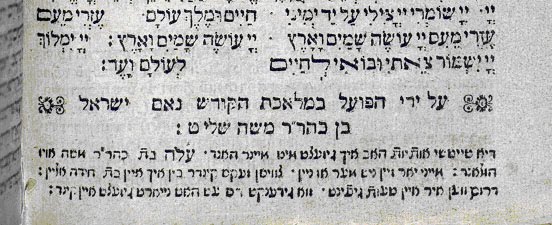
The Yiddish letters I set with my own hand
I am Elle, the daughter of Moses from Holland
a mere nine years old
the sole girl among six children
So when an error you should find
Remember, this was set by one who is but a child (2)

Did she compose the poem herself, or was it composed by her father or brother? Remarkably, we find another case not soon thereafter, of a nine year old setting type, and there we do know whether he could read or not. Nicholas Basbanes, in his book “A Gentle Madness”, records the following:

“Born in poverty, Isaiah Thomas came to know the touch and smell of ink on paper when he was only a child. Only nine years old in 1758….young Thomas was already completing his apprenticeship in the dingy Boston shop of Zechariah Fowle…When he later became the most successful printer and publisher in the United States-Benjamin Franklin dubbed him the Baskerville of America- Isaiah Thomas enjoyed telling friends that he knew how to set type before he was able to read.”(3)

Whether or not she could read at age nine, we do know that this little girl was able to recognize the Judeo Yiddish letters of a manuscript and set to type similar letters from which to print a book. Perhaps she had the potential to become as successful as Isaiah Thomas but for her gender and religion.

We meet Elle again in 1699, this time as a typesetter working on the famous Berman Shas of Frankfurt on Oder. This printed edition of the Talmud ( 1697-1699) was financed by the wealthy court Jew, Yissachar Berman Segal of Halberstadt who gave away half the 5,000 copies printed to needy scholars throughout Europe.(4)The Berman Shas is one of the most respected early printed editions of the Talmud because it contained many additional commentaries which became standard in following editions. It was the first edition since that of Gershom Soncino in the early 16th century to contain most of the diagrams we are familiar in Seder Zeraim, and Masechtos Eiruvin and Sukah. (5) It was also the first to contain Charamos from various Rabbanim prohibiting others in that general area from printing the Talmud for an extended period of time.(6) The following Cherem, recorded in Maseches Brachos, was written by Rav Dovid Oppenheim who lived at that time in Nikolsburg and later became chief Rabbi of Prague:At the end of Maseches Nidah printed in 1699, Elle signs her work a bit more boldly, and leaves us wondering what was going through her mind when she set the letters for the colophon.
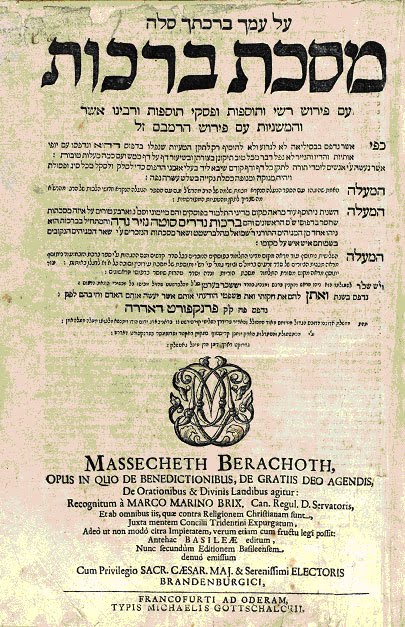
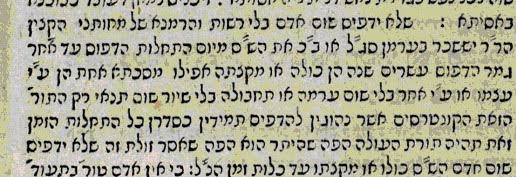

“ By the hand of the faithful typesetter in this holy work, Yisroel the son of Reb Moshe. And by the hand of his maiden sister Elle, daughter of Rav Moshe, in the year “N’Kaivah T’Soivev Gaver” ( “a woman shall go after a man”.)

When you add up the letters which are set in large type, you come up with the year 459 according to the Peret Koton ( the abbreviated era ). This is the year 5459 (1699). What intrigues even the casual observer is why she, or her older brother Yisroel chose to record the year 5459 using that unusual Pasuk? One could argue that the Pasuk is tangentially related to some of the topics covered in Maseches Niddah, but there are many other Pesukim which deal more directly with the subject matter that could have been formatted to equal 459.(7) I think it is more logical to relate the Pasuk to the girl typesetter, who we are informed, is still unmarried. In Messianic times, it will be the Kallah, Am Yisroel, who seeks out its Chasan, Hashem. Perhaps Elle thought her circumstances and position necessitated a similar approach to finding a suitable Chasan. We hear the last from her in the next year having worked on a Machzor with her brother Yisroel.(8) We hope that after that, this extraordinary girl found an appropriate Shidduch. We wish the same for all those seeking the wonderful rewards that marriage has to offer.

(1) Marvin J Heller, “Studies in the Making of the Early Hebrew Book”, Boston 2008 pps. 218-228. The entire chapter on Moses ben Avraham Avinu makes for some fascinating reading. I am indebted, as are we all, to Marvin Heller for his research into this field of study.
(2) Ibid: p.222
(3) Nicholas Basbanes, ‘A Gentle Madness” New York, 1995 pps144-145
(4) R.N.N. Rabinowitz “Ma’amar Al Hadfasas HaTalmud”, A.M. Haberman edition, Mosad HaRav Kook 2006, page 96 footnote 1.
(5) Ibid. p. 98
(6) Ibid p.100
(7) Two examples of a more fitting Pasuk to denote the year of publication for Tractate Niddah are:

“B’Mai Nidah Yischatah” which was used in Frankfurt A/M edition of 1720, and

“V’Safrah Lah Shiva Yomim, V’Achar Ti’Taher” which was used in the Dyhernfurth edition of 1816-21 ( although the highlighted letters actually add up to (5)773)

(8) Heller, page 223


Modesty and Piety: Improving on the Past

Modesty and Piety: Improving on the Past
by: Michael K. Silber
The Hebrew University of Jerusalem
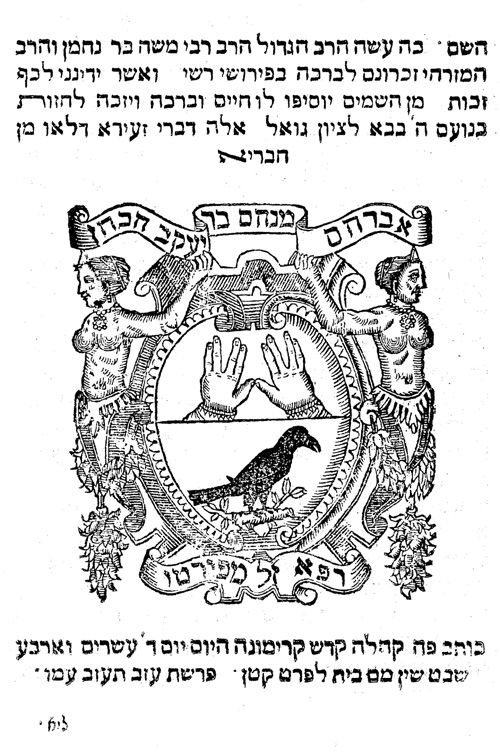
The well known “coat of arms” of the priestly Rapaport family first appeared as a colophon at the end of Avraham Menachem Rapa of Porto’s Mincha Belulah (Verona, 1594), fol. 207b, readily at HebrewBooks.org (here). Instead of a motto, a banner proclaimed the author’s name above and below the shield which featured a pair of hands raised in priestly benediction in the upper half, while below was depicted a crow (Rabe in German) on a branch, a reference to the author’s family name. The shield is flanked by two heraldic supporters, and this is what interests us here.
The supporters feature two female torsos rampant facing away from the shield. They are nude from the waist up.

It was by no means rare to encounter nude women in Hebrew books between the sixteenth and the early eighteenth centuries, even prominently displayed on the covers (Adam accompanied at times by a buxom Eve is a ready example). But no doubt such nudity proves unsettling to the Orthodox public nowadays.
Benjamin Shlomo Hamburger’s recently published magisterial three volume history, Ha-Yeshiva ha-Rama bi-Fiorda (Bnei Brak, 5770) is a rich, learned study by one who has dedicated many scholarly books to the heritage of German Jewry. The volumes are noteworthy also for their rich illustrations, but one in particular catches the eye.
A chapter dedicated to Baruch Kahana Rapaport who served for many years as rabbi of Fürth (1711-1746), reproduces, as many a study on the Rapaports, the “coat of arms” from Mincha Belulah (volume 1, page 390).  
But the supporters here have been modestly transgendered and piously rendered with beards! 

Several studies by Jacob J. Schacter and others have noted the tendency to “verbessern” the past in Orthodox historiography. This then is a modest (but not very pious) contribution to the topic from the perspective of visual evidence of the past.
Addendum:
Dan Rabinowitz
the Seforim blog
It is indeed import to note as Dr. Michael K. Silber has, that we have yet another example of doctoring history to conform with today’s anachronistic views.  But, we should note that this is not the first time the Rapoport coat of arms has undergone a change.  Before turning to this early example, we need to a make a few points.
As Dr. Silber notes, this coat of arms appears at the end of the first edition of Mincha Belulah, Verona, 1594. Rapoport created this herald and the herald contains allusions to his name – Rapoport.  Hida, R. Hayyim Yosef David Azulai, no Reform rabbi, includes an entry on Rapoport in Hida’s Shem HaGedolim (Machret Seforim, Mem, sub. Mincha Belula).  Importantly, although the herald appears at the back of Mincha Belulah, Hida calls attention to this herald. Hida notes that “Rapoport” is spelled differently on the herald than on the title page.  But, no where does Hida question the inclusion of the bare-breasted women on this rabbinic herald. Moreover, Hida doesn’t alert that reader that if one looks up the herald there are these “offensive” images.  Hida’s silence is remarkable but only if one ignores the prevalence of such imagery in Hebrew books.  That is, Mincha Belula is not the only work to include such imagery.  For example, as we have previously discussed, other works include similar imagery (see herehere, here, here, for examples of nudes, and here for examples of mythological images).
We also note that this was not the first time the herald from the Mincha Belulah has been modified. In the 1989 Beni Brak reprint of Mincha Belulah, the images are also altered.  While they haven’t been turned into men, the women are more modestly clothed.  The image below is taken from this edition.


Illustrated Title Pages in Upcoming Auction Catalog

This Thursday, Kestenbaum & Co. is having an auction.  The catalog is available online and the viewing takes place this week.  For those interested in some highlights, the website provides those.  But, I wanted to highlight a theme that hasn’t been noted.  First, a quick background regarding Hebrew book auctions.  [Note, this is not a comprehensive attempt.] There are five auction houses that concentrate on Hebrew books, Kestenbaum, Judica Jerusalem, Asufa, Baronovitch, and, a recent entry, Kedem.  While all five concentrate on Hebrew books, they are all unique in many ways.  First, the catalog.  With the exception of Judaica Jerusalem, all offer their catalogs online.  Additionally, they also offer them in hard copy format through subscriptions.  Kestenbaum and Baronovitch are American auction houses, while the others are Israeli.  Of the two American, Kestenbaum has auctions more frequently.  Both American typically have two to three hundred lots, while the Israeli ones have as many as 800.  The Israeli ones provide illustrations for every lot and descriptions in Hebrew and English (although, at times, the English translations can be very poor).  Kestenbaum doesn’t have illustrations for every lot.  Which gets us to our hidden theme.  In the lots that provide photos of the title pages, many title pages carry a mythological or Christian theme.  Of course, we are not suggesting that these were selected because of this theme, instead, we are merely pointing it out. 
Mythological Title Pages
The first illustration is for lot # 4, Mirkeveth ha-Mishna Abrabanel’s commentary to Devarim. This edition of Sabbioneta, 1551 (the first Hebrew book published there), carries the illustration of Mars and Minerva.

This is not the only time this title page appears. Indeed, in this auction catalog’s illustrations it appears on three other illustrated books.  See lots 171, 191 and 217.  That is, these other books share the same title illustration.  Marvin Heller, in his article discussing this title page explains that, as one probably surmised, this title page with its mythical theme, first appeared in non-Jewish books. Beginning in 1523 this title page was employed in a variety of non-Jewish books.  It would be our book, Mirkeveth ha-Mishna, that would be the first Hebrew book to re-use this title page.  Heller, traces the subsequent history in his article for those looking for more information on this title page. Marvin Heller, “Mars & Minerva on the Hebrew Title Page,” in Papers of the Bibliographical Society of America, 98:3 (Sept. 2004). 

The second illustration related to mythological theme is that of lot # 221, Pirkei Rebi Eliezer, Sabbionetta, 1567.  This title page shows Hercules striking Hydra the multi-headed snake (the illustration seems very similar to that of Antonio del Pollaiolo’s “Hercules and the Hydra.”). 
We now turn to the Christian title page.  This one is from lot #129, Haggadah shel Pesach, Amsterdam, 1712.  The title page, at the top, depicts Moshe at the burning bush.  This Haggadah, which is known as the Second Amsterdam Hagaddah due to it being the second edition of the Haggadah to carry copperplate engravings rather than wood.  These engravings were done by a convert, Abraham ben Jacob (whose name was removed from the title page in this edition). Ben Jacob used a well known Christian engravers illustrations as models for the Haggadah illustrations.  So, Moshe at the burning bush illustrations is almost the same, with the exception that the triangle surrounding God’s name (depicting the Trinity) is removed in the haggadah.  Both appear below.

Yerushalmi, in Haggadah and History, shows other examples of borrowing in this Haggadah. 
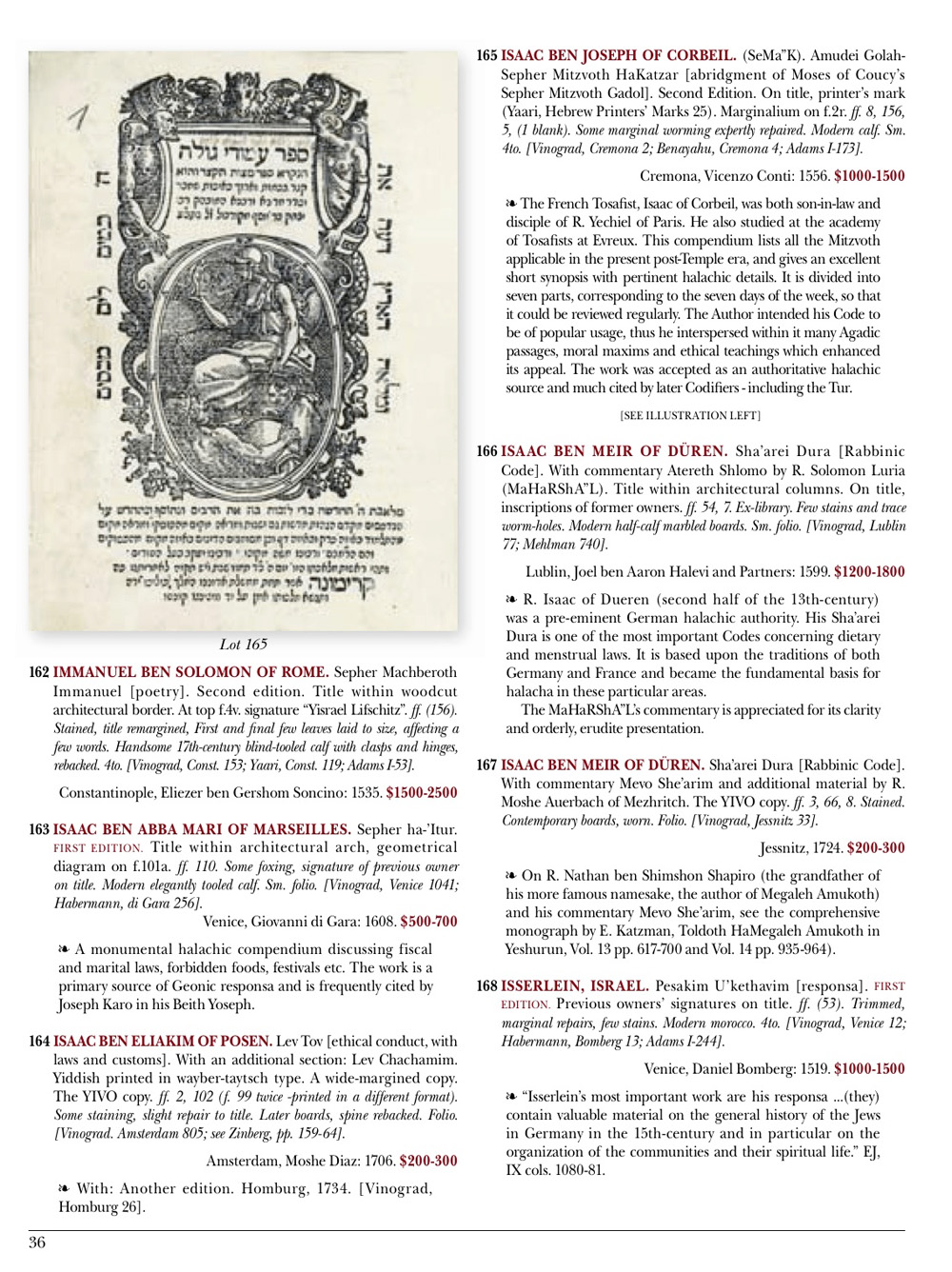
It is worth noting a few more benign title page illustrations that appear in this catalog.  The first is that of lot #165, Amudei Golah, Cremona, 1556 that shows in the center a medallion personifying Cremona, while in the “upper section is the head of a winged horse, with a bare-breasted woman to the right and a man to the left.” Marvin Heller, The Sixteenth Century Hebrew Book, p. 417.

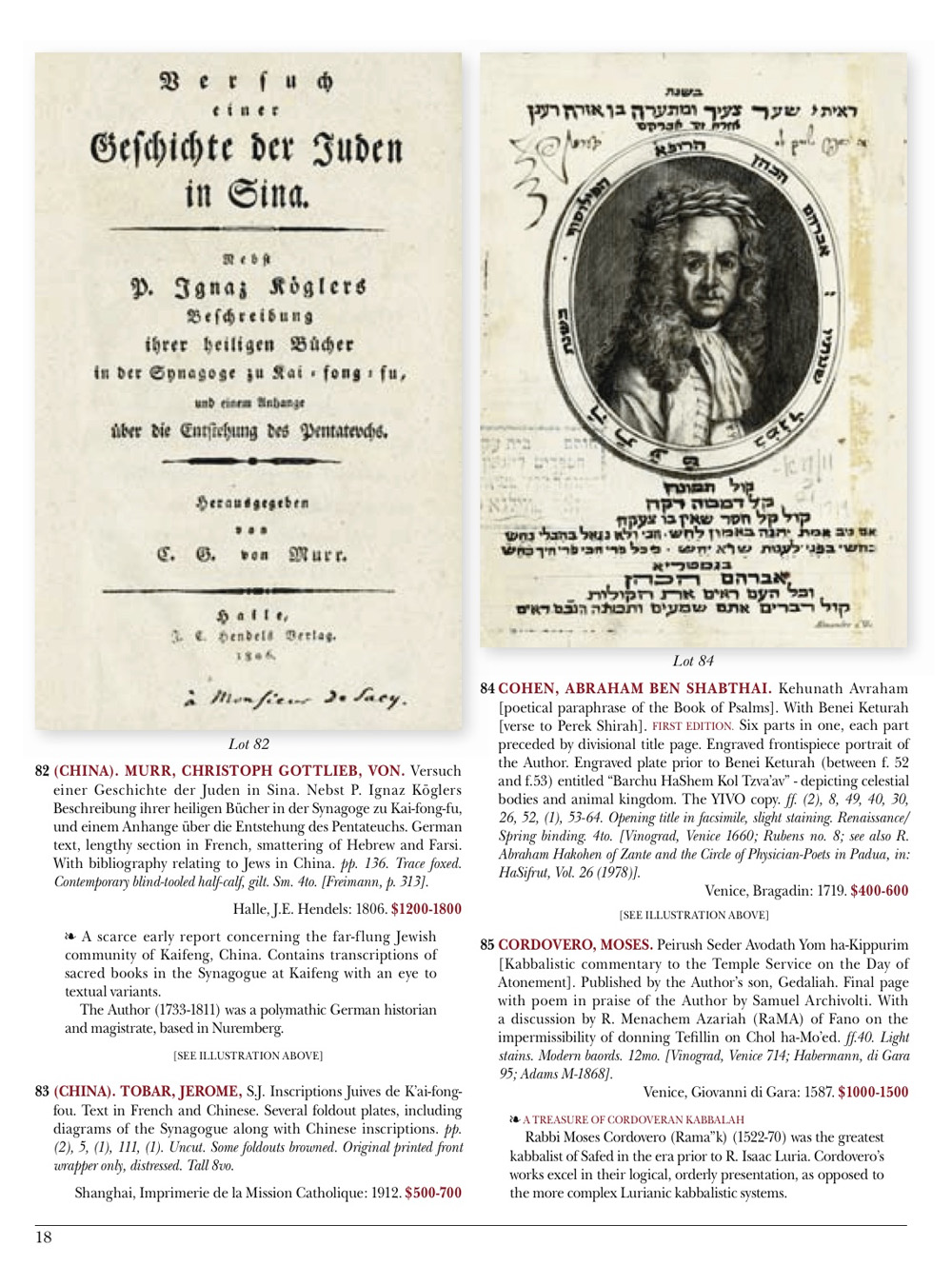
Finally, we get to the last book we shall discuss, one of the earliest to include a portrait of the author on the frontispiece, lot 84, Kehunat Avraham, Venice, 1719.  Additionally, one can see that he is wearing a wig, not all that uncommon amongst the Rabbinic sect for the period of time it was universially fashionable. For example, R. David Neito is shown with a wig, as are others.  One well known example of one who skipped the wig was R. Yehudah Areyeh Modena, who appears in his portrait completely bald. 


A Conspiracy Theory To Explain A Racy Title Page

We have discussed on multiple occasions the use of illustration of nudes to adorn the title pages of Hebrew books. It appears, again as we have seen before, that even though the appearance of such illustrations are really unremarkable, some will go to great lengths to either expunge or, in this case, explain away the appearance of such illustrations. In the April, 2008, Jerusalem Judaica auction catalog (provided below) they have a rather rare work of R. Yitzhak Hiyut (c. 1538- c.1610). [For biographical information on R. Yitzhak see Yaakov Elbaum, Pituchut Ve-HaSegirut, Jerusalem, 1990, p. 23 n.36.] This small book, some 18 pages, is comprised of R. Hiyut’s sermon he gave on the first day of Passover in 1589. The editors of the catalog attempt to deal with the two nudes depicting Adam and Eve [the illustration of Eve is very similar to the one of Eve that appears in the Levush and the Prague Haggadah ] that appear on the title page. They explain

“that this ‘Sermon’ was [perhaps] printed on the intermediate days of Passover by gentile print workers. They allowed themselves to place immodest engravings on the title page. The print owner did not supervise their work on these intermediate days of the holiday. They chose the images of Adam and Eve with the apple of the evil inclination in their hands.”

Thus, according to the catalog editors, the appearance of these illustration is due is basically an error, or if you wish, a rather interesting conspiracy theory.

Now, obviously, it is impossible to prove the negative, that is we have no way of saying 100% the above scenario did not happen, but I think at the very least we can show it is unlikely. First, perhaps the most straightforward item is that we have seen such illustration are not an anomaly – I have provided below one such illustration that appears on the title page of the 1577 edition of the Shulchan Orach.

Second, we are aware of cases of printing that did take place on either Shabbat or Yom Tov. The eminent bibliophile, Abraham Yaari, provides a list of such books. See A. Yaari, Mehkerei Sefer, Jerusalem, 1958, pp. 170-78. The method he employees in deciding which books were published on Shabbat or Yom Tov, is not conjecture. Instead, when a book was published when Jews were unable to oversee the printing, there was a much bigger problem than the title page illustration. When non-Jews printed without the aid of Jews, as one would imagine, the book was then subject to many typographical errors as the non-Jews, for the most part, could not read or understand Hebrew. Thus, typically, there would be a disclaimer somewhere in the book stating that there maybe such errors due to lack of Jewish supervision. In the case of this book of Derashot, there is no such disclaimer.

Finally, the entire assumption is highly questionable. That is, according to some one is allowed to print books on the intermediate days of a holiday. Famously, R. Yosef Karo’s maggid explicitly tells R. Karo that he must write down what the maggid tells him even on the intermediate days. (For other illustration and a discussion of the above, in Hebrew, see here.)

Shulchan Orach, 1577 edition


Stolen Title Pages: The Case of An Unknown Contemporary Plagiarist

“Stolen Title Pages”:
The Case of An Unknown Contemporary Plagiarist*

The title of this post – “Stolen Title Pages” – is not mine, instead, I have borrowed it from Chaim Lieberman.[1] I have used this title because there are many forms of plagiarism – some, totally innocent – others involving lack of citation, borrowing a sentence here or there, but the plagiarism under discussion in this post is much worse than all of the above.[2] The plagiarism discussed in this post is limited to just changing the title page – that is, the entire book is the same with the only alteration being the name of the author and, at times, the title of the book. For example, if I republished Shakespeare’s Romeo and Juliet but instead of putting Shakespeare’s name I substituted mine.

The kabbalistic work on the holidays of the year, by R. Yitzhak Isaac ben Yoel HaKohen, Brit Kehunat Olam, was recently republished. This work was first published in 1796 in Lvov, and has been reprinted many times since then. In the introduction of this new edition, the publishers list the various printings of this work. But, they neglected to mention one reprint of this work. One can’t really fault them as this reprint was not published under the name Brit Kehunat Olam, nor did R. Yitzhak Isaac’s name appear anywhere in this reprint. Instead, although the book is word for word the same as Brit Kehunat Olam, a totally different title and a totally different author is given. As we shall see this is not the only time this person has taken someone else book for his own. This reprint which was done sometime around 2000 is instead titled Pardes haMo’adim ‘al Moadi Yisrael. The author is הצב”ר which, according to the many approbations he has received, is an abbreviation of R. Tzyion ben Ratson Lahat.

The Pardes haMo’adim contains approbations from R. Shimon Sherabi, the Rabbis of Kiryat Melachi – R. Hayyim Pinto and R. Yisrael Areyeh Gerstenkorn, R. Meshumar Tzubri, and R. Yisrael Sherabi. Some of these praise Lahat for his erudition in writing this work, others note his “great fear of sin,” but none of these haskamot note that every word in this book is plagiarized.

For purposes of accuracy, I must note, that Lahat did alter one thing aside from the title page. Perhaps in an effort to avoid detection he shifted the sections around. So, one can’t take page one and match it up, instead, you just need to find the section. This is not as hard as it would seem as Lahat used the same chapter headings as the original. So, for instance, the scan below you have the chapter titled מאמר מצות משוחים בשמן from both works. The newer type (on the right), without the commentary of the Sha’ar Shimon, is Lahat’s edition while the other (on the left) is the original.

Lest one think it is just that section or just the Brit Kehunat Olam that Lahat copied, I have provided another section – מאמר סכת שלם. Again you can see it is copied word for word. But, I also want to point out it is not just the Brit Kehunat Olam he copied but the commentary, Shem miShimon by R. Shimon Englander as well. As one can see, the notes on the bottom provide citations as well as further elucidations of the Brit Kehunat Olam. Although Lahat did not use footnotes – he used endnotes – they are the same as well.

I have provided below the pages from both Brit Kehunat Olam (on the left) which includes the Shem miShimon at the bottom. The other pages (to the right and bottom) are Lahat’s page from this section and the final page is Lahat’s notes which match up perfectly with the Shem miShimon.

As I mentioned above this is not the first time Lahat has stolen a prior work and substituted his name for that of the author. Instead, I have found at least two other times, where he did the same thing. In fact, one of the approbations for Pardes haMo’adim actually makes mention of this prior plagiarized work. This other work is Lahat’s book Minhagei haAriza”l. This work was published sometime after 1996. It contains four parts. Again, הצב”ר appears on the title page and all the approbations are written to R. Tzyion ben Ratson Lahat (as an aside his last name may actually be רווה [Ravah] as he dedicates this book to his brother Naftali bar Ratson Ravah). This work, with one slight change which I will discuss in a moment, is word for word from the book Minhagei haArizal haNikrah Petura d’Abba by R. Uri ben Asher Strizinitzer [3] first published in Jerusalem 1905.

This work takes fifth and the sixth sha’ar from R. Chaim Vital’s Shemonah She’arim which contain the bulk of the customs of R. Yitzhak Luria(Ari”ZaL). R. Strizinitzer, then includes his commentary, titled Beni Abba, which explains and offers sources for the customs of R. Yitzhak Luria. This work contains the approbation of R. Shalom Mordechi haKohen (the Braziner Rebbi). When he originally published this work, R. Strizinitzer did so anonymously. When he published a similar work Me’ori Tzion he revealed himself based upon an acrostic on the title page. The Meori Tzion was the fourth and final part of R. Strizinitzer’s work on the customs of R. Yitzhak Luria – as we shall see this was also copied. So R. Strizinitzer has three titles – Petura d’Abba, Beni Abba, and Meori Tzyion. The Petura d’Abba contains the portion from Shemonah She’arim and Beni Abba is Strizinitzer’s notes.

Now, we go to sometime after 1996, and a new book, again re-typeset, comes out with the title Minhagei HaAri”Zal with the three works Darkei Tzyion, Sha’ari Tzyion, and Me’ori Tzyion with הצב”ר’s name as the author.

The only thing Lahat did, however, was alter the titles of the first two sections, he didn’t even bother moving things around to avoid detection. In Lahat’s edition the Darkei Tzyion contains the portion from Shemonah She’arim and Sha’ari Tzyion contains the notes. Below, I have provided two pages, one from each book, to demonstrate the plagiarism.

In fact, in Strizinitzer’s book at the end he has “השמטות” – things he left out. Lahat, also has at the end things he left out – and coincidentally, they are the same as well. There is one other small change aside from the title page, and that is in the introduction. In Strizinitzer’s introduction at the end he explains why he decided to title his books as he did. Now, Lahat’s titles are different, so Lahat (left) removed that one line from the original introduction (right). The relevant passages are below.

Now, we return to the third title – Me’ori Tzyion, which Strizinitzer published separately in 1911,[4] and Lahat has included in this book. For this one, Lahat couldn’t be bothered with coming up with a new title so he uses the same title – perhaps to finally be able to say he really did copy everything perfectly. Both pages are below (Lahat, left; original, right).

Finally, we get to the at least the third example of Lahat’s stolen title pages. In this case it was fairly easy to locate the original. Lahat titled this work Pirush ‘al Birkat Kohanim, which as the title implies is a commentary and discussion about Birkat Kohanim. But, Lahat was kind and at the top of each page he has כה תברכו. This title כה תברכו is the same as a book published in 1881 in Solenika by R. Chaim Hemzi. And, it turns out not only is the title the same but the content is as well.


Lahat is by no means the first to merely switch the title pages – as I noted at the beginning of this post, Lieberman has examples of this phenomenon and there are other articles which discuss other instances of plagiarism as well.[5] What is perhaps unique about Lahat is that he seems to have done it more than once, in fact, I can not say for sure the rest of Lahat’s 13 (!) other books [6] are not merely copies as well. Additionally, many have assumed that in the digital age, when from the comfort of one’s home they can call up the card catalogs of almost every major library in the world and thousands books are available online or on one of hard drives – some of which are even searchable, this would have been detected. In fact not a single catalog entry in any library notes that these are copied – even when Lahat did not change the title of the book.

Further, aside from the approbation to Lahat’s Pardes haMo’adim, in his Minhagei haAriZal, Lahat includes approbations from his other works. Some of these are leading Rabbis who also have failed to detect their approbations are on stolen works. These Rabbis include (aside from those already mentioned above): R. Ovadia Yosef, R. Mayer Getz, R. Shalom Messas, R. Yosef Tzubeyri, and R. Tzion Tzubeyri.

Perhaps, now, this can be corrected and Lahat will cease stealing the works of others.

* Prior to posting I have attempted to locate Lahat without success. His books generally provide none of the standard information such as publisher/printer or any contact information.

Notes:
[1] Chaim Lieberman, Ohel Roch”el, vol. 1 (New York, 1980), 477-480, 529-531.

[2] There are no lack of examples, both real and imagined in this category. For one example of lack of proper citation, see R. Natan Neta Leiter, Tzyion l’Nefesh Hayyai (Jerusalem, 1964), no. 109.

[3] His surname comes from a town outside of Lvov.

[4] In some reprints of Strizinitzer’s Minhagi AriZal, Me’ori Tzyion is included.

[5] See Lieberman supra n. 1. Lieberman notes [p. 477] the case of Hemdat Tzvi, where the original was printed in 1876 and the stolen version with the same title was printed in 1879. However, he leaves out one worthwhile point. Although in the stolen version he knew enough to remove the original authors name, apparently he didn’t even read through the whole book as on p. 72b, the original author quotes his grandfather by name, and this same passage appears in the stolen version. Further, on p. 87, the original author includes a teshuva which he signs by name. In the stolen version it appears without change signed by the original author!). See also Kitvei Pinchas Turburg, ed. A. R. Malachi, 24-36; C. Leshem, Shabbat u’Mo’adi Yisrael (Tel Aviv, 1969), 379-409; Y. Sternhill, Kochavi Yitzhak (Brooklyn, 1969), Introductions to volumes I & II; Marc B. Shapiro, Saul Lieberman and the Orthodox (Scranton, 2006), 5 n. 9, discussing the example of Rabbi Nosson Dovid Rabinowich which was also discussed in a previous post at the Seforim blog; Shraga Abramson, “Chasad b’Ameirat Daver shelo b’Shem ‘Omro,” Sinai 112 (Nissan-Iyyar 1993): 1-24; Alei Sefer 16 (1990): 177-79; Moriah 83-84 (Adar I,1978) 79-80; A. Perls, “Das Plagium,” in Monatsschrift für Geschichte und Wissenschaft des Judentums / MGWJ 28 (1879): 305-322; R. Margolis, Shem Olam, Jerusalem, 1989, introduction.

Regarding the halakhic permissibility of plagiarism, see Nahum Visfish, Mishnat Zechuot haYotser (Jerusalem, 2002), esp. 95-115; Nahum Rakover, Zechut haYotsrim beMekorot haYehudim (Jerusalem, 1991), 17-72, a portion of which appeared as “Plagiarism of Torah Teachings,” Areshet 6 (1980): 222-226; and idem., “Plagiarism and the Obligation to Cite Sources: Aspects of Copyright Law in the Halakhah,” Dinei Yisrael 6 (1975): 93-120;

[6] There is one book which is particularly suspect, as Lahat’s book is titled מאיר לארץ and it is kabbalistic interpretations on ברכת המזון and there is another book with the same name on the same topic. Thus far, however, I have been unable to secure a copy to compare the two.


To Adolf, from Cecil

To Adolf, from Cecil

by Menachem Butler

During a Sunday afternoon trip to Biegeleisen in Boro Park, I came across 650-page collection of rare letters from the personal collection of R. David Solomon Sassoon (of Jerusalem, Israel) that has just been published in Israel,[1] I hope to discuss this new publication in some detail in the following weeks, however, I did want to first make mention of the 1941 biography of the Sassoon family, written by British scholar and Oxford-trained historian Prof. Cecil Roth.

In the short official obituary for Dr. Cecil Roth in the London Jewish Chronicle following his passing in Jerusalem in June 1970, there is a short and peculiar reference to Roth’s study of the famed Sassoon merchant family. The brief mention within the obituary refers not to the contents of his “comprehensive history” of the renown Bombay-born and London-based Jewish family, [2] where he dispels the notion that the Sassoon family were simply to be considered “the Rothschilds of the East,”[3] but rather to his unfathomable inscription of the work to Adolf Hitler.[4]

The following is Cecil Roth’s inscription to The Sassoon Family:[5]


To Adolf Hitler
Fuehrer of the German Reich

For two reasons I desire to inscribe your name at the beginning of this book. The first is, that I consider its topic to be a useful object-lesson to the unfortunate people whom you have misled into thinking themselves a pure and superior “race” (whatever that may mean). The most rudimentary political commonsense should make it obvious that the absorption of gifted foreign families cannot be other than an advantage for a civilized state. England and English life have in particular been enriched for centuries past by receiving fresh elements from other sources, and there can surely be no reason to regret a liberality that has endowed her with soldiers, philanthropists and poets such as the Sassoon family and many life it have produced. Germany under you guidance has deliberately set herself on the path not merely of self-destruction (which while her present temper lasts would be a peculiar book to humanity at large) but of self-dementation.

In the second place, I am happy to have this opportunity to express once again, as publicly as I may, my profound execration and abhorrence, not merely as a Jew and an Englishman but as a human being, of you, your ideals, your ideas, your methods and all that you stand for. Should God punish the sins of the world by allowing you a momentary victory, I trust that this declaration will bring upon me the honour of the most drastic attention of your nauseous tools, for life in such circumstances would not be worth the having.

Cecil Roth

Sources:
[1] Nahalat Avot: Teshuvot, Michtavim, Tefillot, Minhagim (Yad Samuel Franco, 2007); published on the occasion of Chanah Sassoon’s recent wedding to R. Yehuda Michel Nissel.
[2] In 1968, a later work on the Sassoon family [Stanley Jackson, The Sassoons (London, 1968)] appeared and “superseded” the earlier work by Roth, as the author of this later work “had a clear advantage” as he had access to the personal papers of many Sassoon family members. See London Jewish Chronicle (May 3, 1968), 25. Notwithstanding this criticism, it was already noted in a 1941 review of Roth’s book that he had “not been granted access to ‘family’ records… [and] gathered a vast amount of authentic information, including many delightful stories, that has enabled him to present a comprehensive history of the Sassoon clan with his customary literary skill and thoroughness.” See London Jewish Chronicle(May 30, 1941), 22.
[3] For early uses of this phrase, see, for example, London Jewish Chronicle (April 19, 1907), 21; ibid, (March 22, 1912), 16.
[4] “Obituary: Dr. Cecil Roth,” London Jewish Chronicle (June 26, 1970), 38.
[5] The dedication appears in Cecil Roth, The Sassoon Family (London, 1941) and I thank Joshua Lovinger for kindly directing me towards this fascinating and little-known source.