Keter Shem Tov: A Study in the Entitling of Books, Here Limited to One Title Only

Keter Shem Tov: A Study in the Entitling of Books, Here Limited to One Title Only[1]

by Marvin J. Heller

Entitling, naming books is, a fascinating subject. Why did the author call his book what he/she did? Why that name and not another? Hebrew books frequently have names resounding in meaning, but providing little insight into the contents of the book. This article explores the subject, focusing on one title only, Keter Shem Tov. That book-name is taken from a verse “the crown of a good name (Keter Shem Tov) excels them all (Avot 4:13). The article describes the varied books with that title, unrelated by author or subject, and why the author/publisher selected that title for the book.

  1. Simeon said: there are three crowns: the crown of Torah, the crown of priesthood, and the crown of royalty; but the crown of a good name (emphasis added, Keter Shem Tov) excels them all (Avot 4:13).

“As a pearl atop a crown (keter), so are his good deeds fitting” (Israel Lipschutz, Zera Yisrael, Avot 4:13).

Entitling, naming books, remains, is, a fascinating subject. Why did the author call his book what he/she did? Why that name and not another? Hebrew books since the Middle-Ages often have names resounding in meaning, but providing little insight into the contents of the book. A reader looking at the title of a book in another language, more often than not, is immediately aware of the book’s subject matter. This is not the case for many Hebrew titles, the name having been selected by the author for any one of a number of reasons, least of all the book’s subject matter, but rather the intention is/was to give the book “the crown of a good name (Keter Shem Tov).”

Book titles have been addressed in both books and articles. Menahem Mendel Slatkine wrote a two volume work, Shemot ha-Sefarim ha-Ivrim: Lefi Sugehem ha-Shonim, Tikhunatam u-Te’udatam (Neuchâtel-Tel Aviv, 1950-54) on book names; it has been the subject of encyclopedia articles in both The Jewish Encyclopedia and the Encyclopedia Judaica; and such authors as Abraham Berliner, Joshua Bloch, and Solomon Schechter have written articles on book titles, all this apart from this subject being mentioned in passing in numerous other works. I too have addressed the subject, first in “Adderet Eliyahu; A Study in the Titling of Hebrew Books,” describing about thirty books with that single title, two only related to each other, and in “What’s in a name? An example of the Titling of Hebrew Books,” describing varied books taken from a single verse “Your neck is like the tower of David built with turrets, on which hang one thousand bucklers, all of them shields of mighty men (Song of Songs 4:4).[2]

What then is the justification for yet another article on the same subject? It is, as suggested above, the allure of how authors of varied unrelated works came to entitle their books, reflective of their intellectual or emotive processes or objectives. The title selected here, Keter Shem Tov, unlike Adderet Eliyahu, is not the title of as large a number of books, but the titles here are certainly as varied as those in the previous articles. Indeed, the works so entitled are sufficiently different, again providing insight into authors’ thoughts and, perhaps, an article of interest to the reader. We will not attempt to second guess or analyze an author’s motives, all of whom intended their book to have the crown of a good name (Keter Shem Tov), but rather we will let the authors speak for themselves when describing their books

In several instances, books are so entitled as to reflect the author’s name, Shem Tov. The use of a line from Avot, to reiterate the injunctions noted previously (“Adderet”), rather than directly using the author’s name, is to avoid violating R. Judah ben Samuel he-Hasid of Regensburg’s (c.1150-1217) proscription to not do so, so as to not benefit from this world, thereby decreasing one’s portion in the world to come, or to not reduce their offspring and the good name of their progeny in this world.[3] The Roke’ah (R. Eleazar ben Judah of Worms, c. 1165–c. 1238), however states at the beginning of the introduction to his Roke’ah, that everyone should inscribe his name in his book, as we find in the Tanna de-Vei Eliyahu.[4] Indeed, the Sefer ha-Roke’ah, is so entitled because the numerical value of the family name, Roke’ah (רקח=308), equals his personal name, Eleazar (אלעזר=308). It is, therefore, permissible to allude to the author’s name, for example, a Shem Tov using the title Keter Shem Tov, a quotation from Avot. Indeed, a substantial number of the books described here refer to the author’s name.

Our selection encompasses homilies on the Torah, Kabbalah on the Tetragrammaton, halakhah and minhagim (customs), the sayings of the Ba’al Shem Tov, in praise of Sir Moses Montefiore, a letter on behalf of the Jewish community in Tiberias, and a highly unusual work on the Dead Sea scrolls. Finally, this article is a vignette, no more no less, an insight into and, in a manner of speaking, a photograph of one manner of how Hebrew books are named.

Several caveats. First, our Keter Shem Tovs are organized within subject categories, beginning with 1) discourses, both literal and kabbalistic on the Torah, followed by 2) halakhah and minhag (custom), 3) biographical and related anecdotal works, 4) miscellanea, all ordered chronologically within category, and concluding with 5) a brief summary. Secondly, our approach will be somewhat expansive, the various Keter Shem Tovs giving us entry into related aspects of Hebrew printing and Jewish history. Lastly, while the number of works entitled Keter Shem Tov is not large, that notwithstanding, our examples are an overview and not meant to be all inclusive or comprehensive but intended as an interesting insight into an aspect of Hebrew book practice.

I Discourses, Literal and Kabbalistic on the Torah

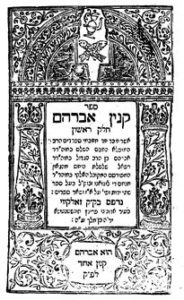
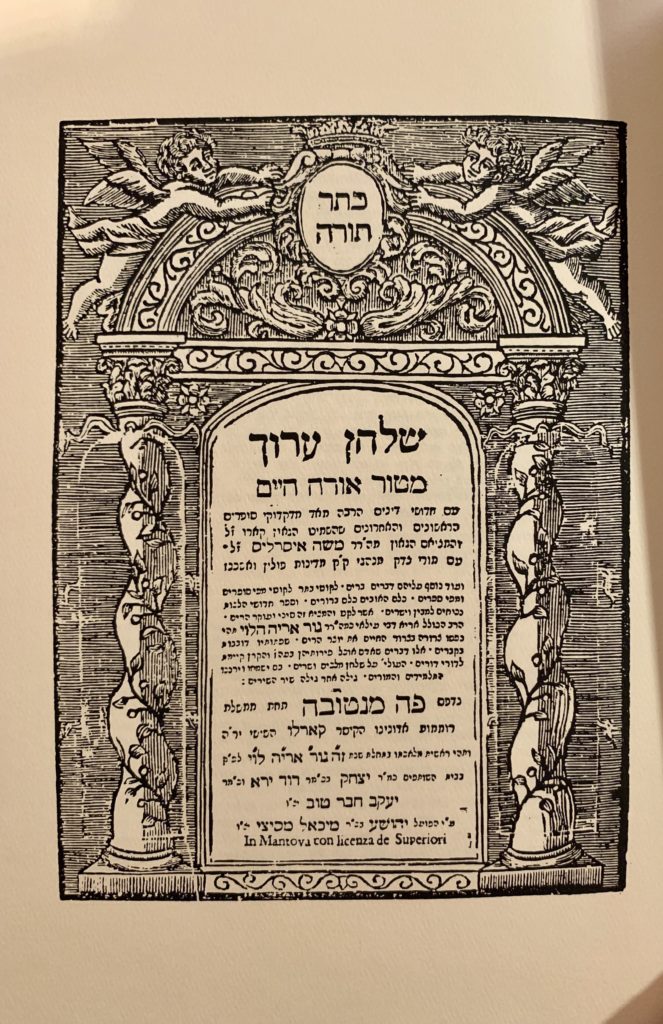
Keter Shem Tov, R. Shem Tov ben Jacob Melamed, Venice, 1596: Our first Keter Shem Tov is a commentary on the Torah by R. Shem Tov ben Jacob Melamed. It was printed in Venice (1596, 20: 136, 16 ff.) at the press of Matteo Zanetti. This Zanetti, a member of the famous Venetian printing family of that name, established his print-shop on the Calle de Dogan, publishing seven books from 1593 to 1596. Among his titles, in addition to Shem Tov Melamed’s Keter Shem Tov, are R. Nathan Nata Spira’s (Shapira) Be’urim, R. Bezalel Ashkenazi’s responsa, and R. Solomon le-Bet ha-Levi’s Divrei Shelomo.

The title page has the decorative frame employed by Zanetti on several of his books with a smaller frame in the center about the text. The title-page states that,
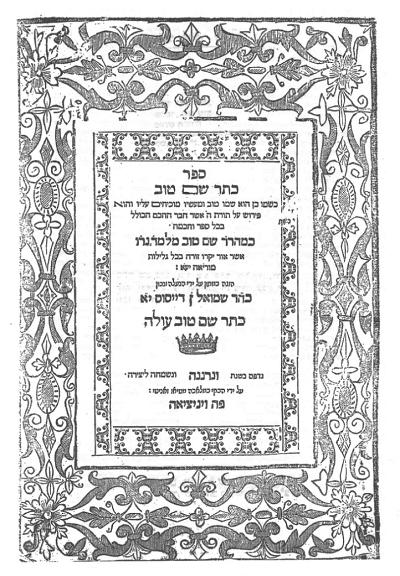
Keter Shem Tov

As is its name so is his name good and his deeds confirm it of him. It is a commentary on the Torah of HaShem written by the sage, the complete, in every book and wisdom.

Shem Tov Melamed

Whose precious light shines throughout [may

God shield him].

Edited patiently by the lofty and exalted

Samuel ibn Dysoss [may God watch over him]

Keter Shem Tov excels

Printed in the year, “that we may rejoice ונרננה (5356=1596) and be glad [all our days]” (Psalms 90:14) from the creation.


The introduction, from a student of the author, R. Samuel ben Solomon Segelmassi follows (2a), then a page of verse from the editor Samuel ibn Dysoss, the text (3a-136a), his apologia (136b), indexes (1a-16a), errata (16a), and the colophon (16b), which states that it was completed, “on the very day that Moses went up to the firmament (6 Sivan) and the Egyptians drowned in the sea (21 Nissan), in the year, “Then he saw it, and declare it ויספרה (5356=1596) (Job 28:27), from the creation.” It is unclear why there are two apparently contradictory completion dates. The text is in two columns in rabbinic type, excepting headings and initial words.

In the introduction Samuel ben Solomon writes that one who knows matters in truth and faithfully,

“shall come back with shouts of joy” (Psalms 126:6), “to perceive the words of understanding” (Proverbs 1:2) and this is the first intent of every man who presumes in his heart (Esther 7:5) to write “goodly words” (Genesis 49:21) in a book to leave after him a blessing. . . . It is a commentary on the holy Torah, “high and lofty” (Isaiah 6:1, 57:15), on each and every parshah . . .

The introduction continues that it contains derashot (discourses) according to the literal meaning, casuistic (pilpul), and very sharp. In the following paragraph we are informed that not everything that was said on every parshah was printed because of financial restraints. In the apologia ibn Dysoss adds a familiar plaint for the period, type set late erev Shabbat could not be properly corrected. Moreover, the compositors, not Jewish and not fully familiar with Hebrew and Hebrew letters, did that which was right in their eyes, and for which he should not be held responsible.

That the title clearly alludes to the author’s name, R. Shem Tov ben Jacob Melamed, is further suggested by the last line of verse at the end of the introduction, which states that “you will find that the crown of a good name (KETER SHEM TOV) excels them all. This is, as noted above, that authors’ names were frequently employed in book-titles, but, in keeping with the injunction of R. Judah he-Hasid, indirectly, here by referencing a quote from Avot.

Shem Tov Melamed was also the author of Ma’amar Mordekhai (Constantinople, 1585), a commentary on Megillat Esther, printed by Joseph Jabez. Melamed is described on the title of this work as a physician.

Keter Shem Tov, Amsterdam, R. Abraham ben Alexander (Axelrad) of Cologne, c. 1810-16: A kabbalistic Keter Shem Tov on the Tetragrammaton by R. Abraham ben Alexander (Axelrad) of Cologne (13th century). In Judaism the Tetragrammaton, the four letter divine name, is not directly expressed but instead referred to with a euphemistic name for God. The title-page describes this Keter Shem Tov as,
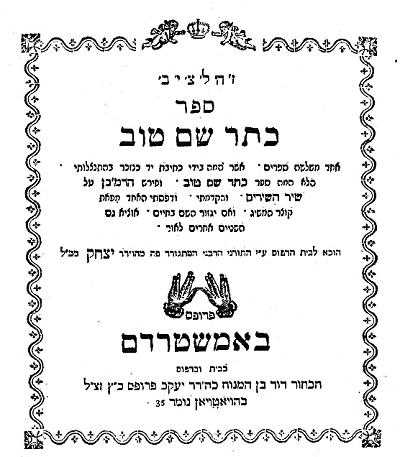
זהלציב [This is the gate of the Lord: the righteous shall enter through it] (Psalms 118:20)

Sefer

Keter Shem Tov

One of three books in my hand in manuscript, as described in my apologia. They are Keter Shem Tov and the commentary of the Ramban (R. Moses ben Nahman, Nachmanides, 1194–1270) on Shir ha-Shirim (Song of Songs). I have first printed one book only due to limited means. If the Lord will so decree I will publish the other two books. . . .


Although the title-page refers to three books two only are mentioned. The third work, noted in the editor’s apologia, is a commentary on the Merkavah of Ezekiel. Keter Shem Tov is not dated, so that various bibliographic sources date it as 1810 or 1816. The title-page is embellished by the Proops’ family press-mark, consisting of the kohen’s spread hands at the time he pronounces the priestly blessing. This edition of Keter Shem Tov (80: 5, 7 ff.) was printed in Amsterdam by David ben Jacob Proops. The Proops’ press, founded by Solomon Proops in 1704, was the longest lasting and most productive of the Hebrew printing-houses in Europe in the eighteenth century; it would continue to print Hebrew books until the mid-nineteenth century when, in 1869, the widow of David Proops sold the press to the Levissons, who printed until 1917.

Abraham, a student of R. Eleazar ben Judah of Worms (c. 1176–1238, Roke’ah), traveled through Spain between approximately 1260 and 1275, where he reportedly studied with R. Solomon ben Adret (Rashba, 1235–1310), the latter praising Abraham’s oratorical skills. Keter Shem Tov, as noted above, deals with the Tetragrammaton and also the Sefirot, addressing sacred names, using gematriot and synthesizing the mysticism of the Ashkenaz pietists (Hasidim) and Sephardic Kabbalistic methodologies.[5] Here too the reason for the title is not explicitly stated but, given the subject matter, is obvious.

This is not the first printing of Abraham ben Alexander’s Keter Shem Tov. It appeared earlier, included in a collection entitled Likkutim me-Rav Hai Gaon (Warsaw, 1798), under the title Ma’amar Peloni Almoni (ff. 26-32a). It has since been reprinted several times, often among collections of other works.

Ma’or va-Shemesh, R. Shem Tov ben Abraham ibn Gaon, Livorno, 1839: The next Keter Shem Tov, by R. Shem Tov ben Abraham ibn Gaon, is also a kabbalistic discourse on the Torah, this part of a larger multi-volume work entitled Ma’or va-Shemesh (Livorno, 1839, 80: [3], 3-11, [1], 128 ff.) printed by Eliezer Menahem Ottolenghi. The inclusion of Ma’or va-Shemesh represents a more expansive view of works entitled Keter Shem Tov as it is an independent work included in a larger collection of dissertations. The author (compiler) of Ma’or va-Shemesh, R. Judah ben Abraham Coriat (d. 1787) of Tetuán, was a scion of a distinguished Moroccan family.

  1. Shem Tov ibn Gaon (c. 1287-c. 340) was born in Soria, Spain and went up to Eretz Israel in 1312, settling in Safed where he wrote most of his books. He was a student of R. Solomon ben Adret (Rashba, 1235–1310) and R. Isaac ben Todros (13th cent.). Best known of ibn Gaon’s titles is Migdal Oz, on Maimonides’ Mishneh Torah as well as several works in manuscript. Keter Shem Tov, his first book, was reportedly written in Spain, while Rashba was still alive.[6]

The title-page of Ma’or va-Shemesh has a frame comprised of verses, all from Psalm 119:
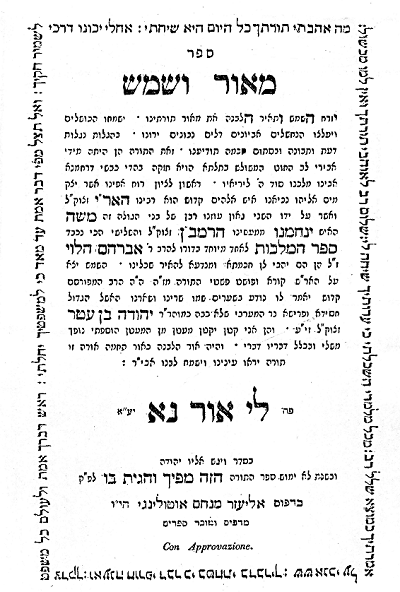
“O how I love your Torah! It is my meditation all the day” (Psalms 97);

“O that my ways were directed to keep your statutes!) (5);

“The sum of your word is truth; and every one of your righteous judgments endures for ever” (160);

“So shall I have an answer for him who insults me; for I trust in your word” (42);

“So shall I have an answer for him who insults me; for I trust in your word” (162);

“I have more understanding than all my teachers; for your testimonies are my meditation” (99); “Great peace have those who love your Torah; and nothing can make them stumble” (165).


An additional verse is employed for the date, “This Book of the Torah shall not depart from your mouth; but you shall meditate on it הזה מפיך והגית בו (599 = 1839)” (Joshua 1:8). The title too is from Psalms, “The day is yours, the night also is yours; you have prepared the light and the sun (Ma’or va-Shemesh)” (Psalms 74:16).

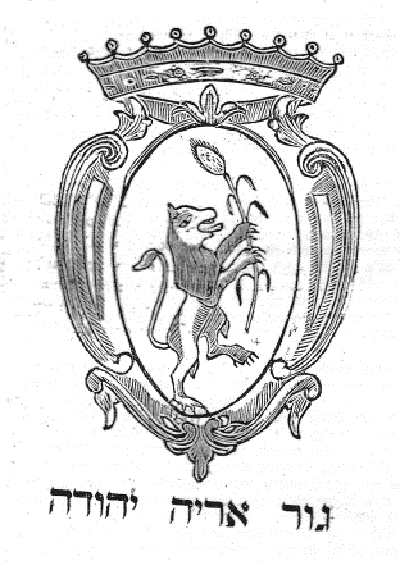
The text of the title-page notes several of the authors whose kabbalistic works comprise Ma’or va-Shemesh, notably the Ari ha-Kadosh (R. Isaac Luria, 1534 – July 25, 1572), R. Moses ben Nahman (Ramban), Sefer ha-Malkut, and R. Judah ben Attar, Coriat’s maternal grandfather. The verso of the title-page has a pressmark, a lion rampant holding thistle under crown and below it the phrase Gur Aryeh Yehudah. This device was used previously in Livorno by Eliezer Saadun. When employed by Ottolenghi the lion has been turned to face right, it having previously faced left.[7]


There are introductions from R. Elijah Benamozegh and Abraham ben Judah Coriat, the former comprised of five paragraphs, each beginning with the word Kol and concluding with Judah, the latter’s introduction comprised of eight paragraphs, each beginning with Ben and concluding with Av. The text is comprised of several kabbalistic works, among them Shem Tov ben Abraham ibn Gaon’s Keter Shem Tov (ff. 25-54a), here not explicitly stated but rather entitled Perush Sodot ha-Torah. Shem Tov was a kabbalist, who studied with the Rashba and R. Isaac ben Todros. He was greatly influenced by the Ramban (R. Moses ben Nachman), reflected in his Keter Shem Tov, which is a kabbalistic super-commentary on Ramban’s Torah commentary. Here too, the title comes from the author’s name, Shem Tov.

A small portion of ibn Gaon’s Keter Shem Tov was printed previously (ff. 41b-44a), in R. Jehiel ben Israel Luria Ashkenazi’s Heikhal ha-Shem (Venice, 1601), on the ten Sefirot, Likkutei Kabbalah Kadmonim.
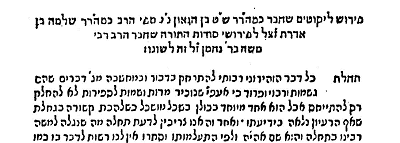


This much expanded version of Keter Shem Tov is based on an 1810 manuscript prepared by R. Elijah Lombroso.

II Halakhah and Minhag

Keter Shem Tov, R. Shem Tov ben Isaac Gaguine, Kaidan, Lithuania, 1934: An encyclopedic work on the varied customs and liturgy of eastern and western Sephardim and Ashkenazim by R. Shem Tov Gaguine (Gaguin, 1884-1953). Gaguine, scion of a famous Moroccan Rabbinical dynasty which emigrated to Palestine from Spain, was a great-grandson of R. Hayyim Gaguin the first Hakham Bashi of Eretz Israel in the Ottoman Empire and a great-great grandson of the kabbalist Sar Shalom Sharabi. Gaguine, who received semicha (ordination) from R. Hayyim Berlin, served as a dayyan in Cairo, rabbi and dayyan in Manchester, England, Rosh Yeshivah of Judith Montefiore Theological College, Ramsgate, and, from 1935, as head of Sephardi Medrash Heshaim in London.[8]
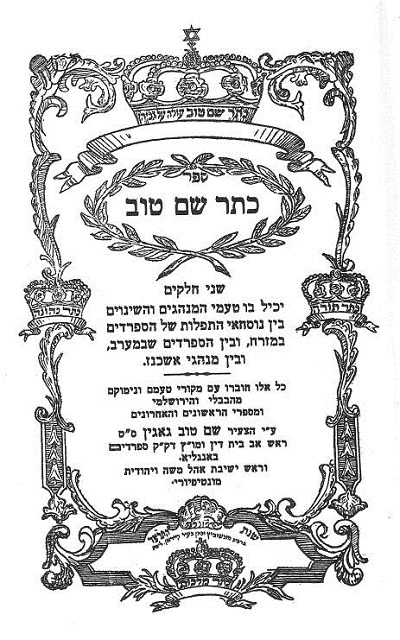


This Keter Shem Tov is comprised of seven volumes, the first two published in 1934, and the last four published posthumously by his son Dr. Maurice Gaguine. The complete work has been republished several times.

As noted above, Keter Shem Tov is a comprehensive work describing the liturgy and customs of eastern and western Sephardim and of Ashkenazim, accompanied by detailed footnotes from the Babylonian and Jerusalem Talmuds and later halakhic authorities. Although most of the entries explain more familiar customs, many are unusual. Example of the latter are:

The custom in [Eretz Israel and Syria, Turkey and Morocco] when the father, grandfather, father-in-law, one’s rabbi, or elder brother has an Aliyah, to stand on one’s feet until he returns to his place, and to go to them, kiss their hand and receive a blessing (I:213).

An unusual custom of the Sephardim in the city of Algiers is the phrase “marror zeh (this marror)” is said three times and then thrown to the ground, and afterwards picked up and returned to the ka’arah (Seder plate).[9]

Why is the marror called hasa or hazeret (lettuce or horse raddish)?

The Ashkenaz custom is to take, in place of hazeret a type of dry radish called in their language hrain, which is as sharp as mustard and does not have a bitter taste. The Sephardic custom is specifically hazeret. . . . (III: 158-59).

Keter Shem Tov, R. Avishai Taharani, Jerusalem, 2000: Another work on halakhah and customs, this most specific, described on the title-page as “a treasure of all the halakhot and personal customs concerning naming sons and daughters” by R. Avishai Taharani. The title-page continues that in it are explained the basic guidelines for giving names “by whose observance man shall live” (Leviticus 18:5, Ezekiel 20:11, 13, 21). Also addressed are the names that one should refrain from using.

In the introduction (pp. 1-23) to this two volume work, Taharani informs that he has so entitled the book, based on the injunction of the Roke’ah (above), as well as several other works. He has done so, however, with gematriot (numerical equivalencies) for “Avishai Taharani ben my lord and father Isaac אבישי טהרני בן לאדוני ואבי יצחק (977) which corresponds to Keter Shem Tov כתר שם טוב (977).” The text is wide ranging, comprehensive, and accompanied by detailed footnotes. Several examples of the more unusual entries in the text are:

If a father errs and calls his son or daughter with two names, forgetting that the additional name was given to another child, there are those who say that until thirty days he may change the name (I:118).

Some say that if one has a child from an unmarried woman, the child should be called with a name that predates [the time of the] Patriarch Abraham or with a name that is not customary, for example, Dan, so that he will be judged according to his problem. There are places that it is customary to give these names to those who are kosher and Heaven forfend one should come to question those who are kosher (I: 237-38).

Some say that one should not call [a child] with one of the names that predates the Patriarch Abraham, for example: Adam, Noah, and all who call by a name that predates the Patriarch Abraham is not in the category of one who “labors in the Torah, and does not give pleasure to his Creator” (cf. Berakhot 17a). (I:397-400).

It is permissible to shorten a name, whether for a son or a daughter, as long as that name is used only casually, and it is best to use the full name at least once a day in order that the short form dies not become customary (II:110-13).

In a lengthy footnote to the third entry concerning names that predate the Patriarch Abraham a source for the entry is given, ha-Mabit (R. Moses ben Joseph of Trani, 1500 – 1580). It is followed by a number of contrary sources by other prominent rabbis, and then a lengthy discussion. That this Keter Shem Tov has proven to be a relatively popular work is evident from the publication of two additional editions, the last in 2007.

Keter Shem Tov, Kollel Keter Shem Tov, Kiryat Bialik, 2002: Collection of discourses and responsa on Shulhan Arukh Hoshen Mishpat by rabbis from the Kollel Keter Shem Tov in Kiryat Bialik, located in the vicinity of Haifa. There is an introduction from R. Mahluf Aminadav Krispin, Chief Rabbi of Kiryat Bialik, followed by the text, comprised of nineteen articles, including one by the Rosh Yeshiva R. Solomon Shalosh. Examples of the articles are 5) “on the prohibition turning to secular courts” by R. Efied Hagibi, member of the Kollel; 6) finding a relative or one who is unfit among the judges by R. David Alharar, member of the Kollel; 9) witnesses who have fulfilled their charge” by R. Evied Elul, member of the Kollel; 11) “the obligation of rent after divorce, the portion in the residence” by R. Abraham Atlas, av bet din, Haifa; 14) “acquisition through forgiveness (relinquishment) by R. Solomon Shalaoh; and 19) “the wages of a worker and contractor who did not provide the agreed upon benefit” by R. Abraham Atlas.

The title-page numbers the volume as no. one, but it is not known whether additional volumes were published.

III Biographical and Related Anecdotal Works

Keter Shem Tov, R. Aharon ben Zevi ha-Kohen of Apta, Zolkiew, 1794/95: The most popular of our Keter Shem Tovs, based on the printed editions, is the collection of tales and stories of the remarkable and astounding deeds of the Ba’al Shem Tov (R. Israel ben Eliezer, Besht, c. 1700–1760), founder of the Hasidic movement, as well as his recorded sayings, assembled from the works of his disciples. This collection of tales and sayings was assembled by R. Aaron ben Zevi Hirsch ha-Kohen of Opatow (Apta).
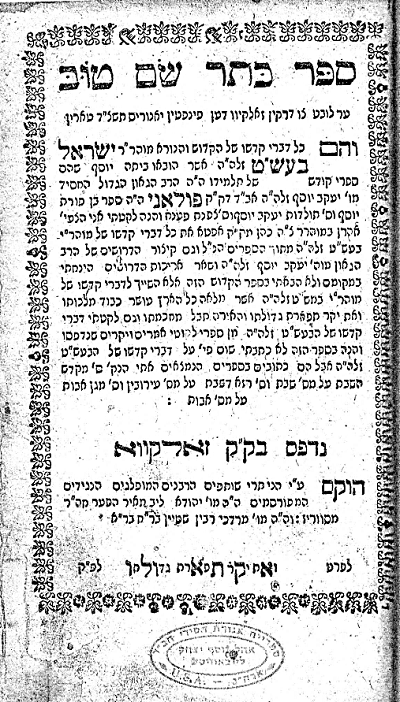
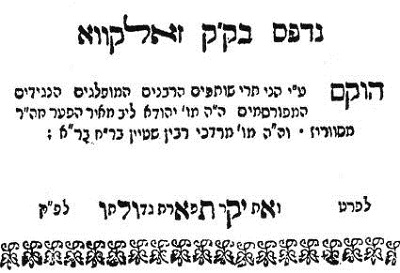


The book is in two parts, each with its own title-page but identical text, except that the first title-page is dated with a chronogram, the second title-page, printed a year later, is dated in a straightforward manner, תקנ”ה (555 = 1795). Perhaps the reason that the second title-page is so dated is that the first title-page exists in two forms, the rare first title-page, is dated “and the glory of his splendid majesty ואת יקר תפארת גדולתו (544 = 1784)” (Esther 1:4), which is incorrect, the book having been printed a decade later. The error was likely quickly caught, for the corrected and much better known title-page has the same chronogram, now reading ואת יקר תפארת גדולתו, the yod in the second word enlarged and emphasized, for a correct total of 554 (1794).[10] The variants are recorded separately in several bibliographic works.[11]

The title-page informs that that much of the contents are from the works of R. Jacob Joseph ben Zevi ha-Kohen av bet din of Polonnoye (d. c. 1782), the Ba’al Shem Tov’s leading disciple, that is, Toledot Ya’akov Yosef, Ben Porat Yosef, and Zafenat Pa’ne’ah, as well as discourses, also from other works. Among these latter sources are Likkutei Amorim and the sayings of the Ba’al Shem Tov, all collected by R. Aaron ben Zevi Hirsch ha-Kohen of Opatow (Apta).

In addition to the variations to the first title-page, the second title-page also exists in two formats, with, unlike the first title-page, some textual variations. Within the text of the book, despite Aaron ben Zevi Hirsch ha-Kohen’s comments that he has assembled the Ba’al Shem Tov’s words from the above mentioned titles, he did not, in fact, merely transcribe them in toto, nor did he distinguish which were the words of the Ba’al Shem Tov and those of Jacob Joseph.[12]

Keter Shem Tov has an approbation from R. Menachem Mendel of Liska, followed by the famed Iggeret Hakodesh, a letter from the Ba’al Shem Tov to his brother, dated Rosh Ha-Shanah, 1747, in which he relates that his soul ascended to heaven where he met with the Messiah, and then the text. This Keter Shem Tov, as noted above, has proven to be an enduring and popular work; it was printed soon after in Korezec (1797), Lemberg (1809) and several times afterwards there, in numerous other locations, and continues to be republished to the present.

Keter Shem Tov, Abraham Menahem Mendel Mohr, Lvov (Lemberg), 1847: Sir Moses Montefiore (1784–1885) was one of, if not the most prominent member of English Jewry in the nineteenth century. Cecil Roth described him as “the most notable Jew, and indeed one of the most notable Englishmen, of the 19th century by virtue of his outstanding philanthropic work extending over a period of three-quarters of a century, into his venerable old age.”13 Montefiore traveled to the Middle East during the Damascus Affair, to Russia, Morocco, and Rumania on behalf of persecuted Jewry, as well as providing leadership and support of Jewry at home and in Eretz Israel. His indefatigable efforts on behalf of world Jewry are recorded and acknowledged in books, articles, and newspapers, several works entitled Keter Shem Tov.

The first Keter Shem Tov praising Sir Moses Montefiore is by Abraham Menahem Mendel Mohr (1815–1868), a scholarly maskil, author of a number of Hebrew and Yiddish books. The title-page states that it is,
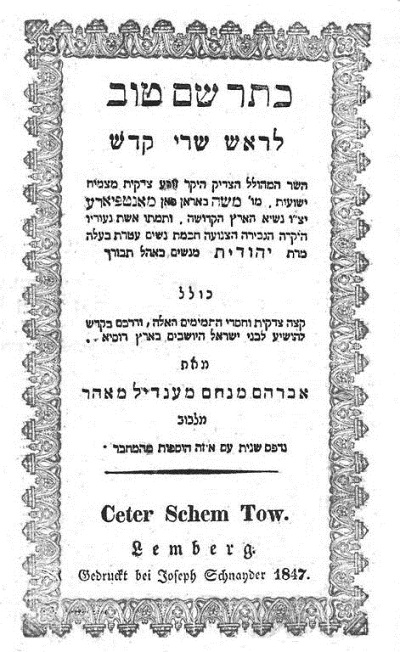
Keter Shem Tov

For the chief, holy prince

The praiseworthy, the righteous, the dear, who sows righteousness and brings forth salvation. Our teacher, Moses Baron from Montefiore [May his Rock and Redeemer protect him], prince of the holy land. And the pure wife of his youth, the honorable lady, the modest, the wisdom of women “is a crown to her husband” (Proverbs 12:4), the lady Judith “blessed shall she be above women in the tent” (Judges 5:24). . . .

The title-page continues that the text includes some of the righteousness and perfect kindness on behalf of the Jews in Russia. A small book, (80: 16 pp.: Joseph Schnander), the text begins with verse, with the header “from Moses to Moses there was none like Moses” normally referring to Maimonides but here applied to Montefiore. The verse beginning,

“Moses ben Amram brought Israel out from the burdens of Egypt

and Moses Montefiore redeemed them from death to life.

Moses ben Amram “struck the rock, so that the waters gushed out” (Psalms 78:20)

and Moses Montefiore softened the heart of stone with “words of lips” (cf. II Kings 18:20, Isaiah 36:5). . . .


The volume concludes with a letter of appreciation from Sir Moses Montefiore.

A Ladino (Judeo-Spanish) version of Mohr’s Keter Shem Tov was printed in Salonika (1850, 80: 48, 53-80 ff.) together with two other works, Tiferet Yisrael on the Rothschilds, and Ma’aseh Eretz Israel on Eretz Israel from the destruction of the Temple to the nineteenth century. Among the many other works either praising or including a section on Montefiore are Kol Kitvei Rabbi Ya’akov Saphir ha-Levi (Jerusalem, 1934), the writings of R. Jacob Saphir (1822–1886), an emissary of the Jewish community in Jerusalem and the author of Even Saphir on the Jewish communities in such varied places as Yemen, Egypt, India, and India that he visited. In Kol Kisvei is a section entitled Keter Shem Tov Kenaf Renanim Sir Moses Monrefiore, accompanied by a cameo of Montefiore.
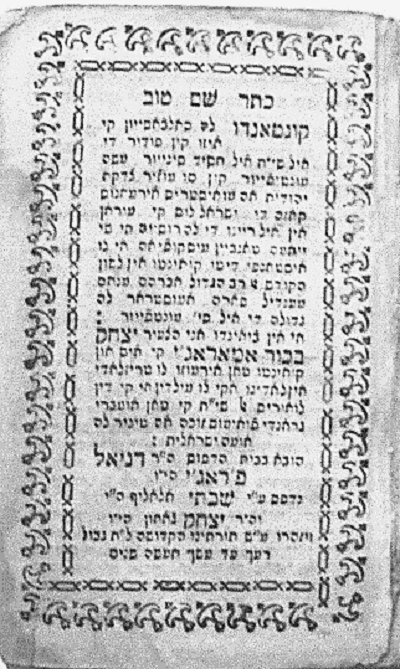


Yet another Keter Shem Tov about Montefiore was published by Hayyim Guedalla (London, 1884). The Hebrew title-page is followed by an English title-page that states,

The Crown of A Good Name

a brief account

of a few of the

Doings, Preachings, and Compositions

On

Sir Moses Montifieore’s Natal Day,

November 8th, 1883,

on which he was favored with a succession of telegraphic

Congratulations from the QUEEN OF ENGLAND and many

Eminent People of all Creeds.

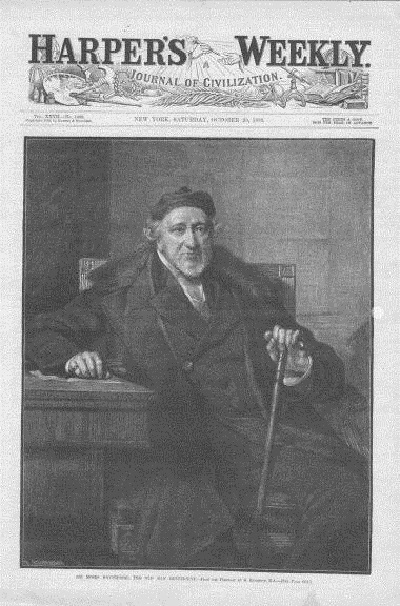
Below is the quote from Pirke Avot. The text includes congratulatory letters from the Queen, the Duke of Edinburgh, many others, and special services in both Hebrew and English. In addition, many other publications relate to Moses Montefiore, among them, albeit this not directly pertinent to the article but of interest as a further example of how widespread the high esteem in which the venerable Sir Moses Montefiore was held, is the title page of the October 20. 1883 Harper’s Weekly Journal of Civilization (New York), with a full cover portrait of Montefiore.


Keter Shem Tov (Ehrenkranz des guten Rufes), R. Josef Natonek, Budapest, 1880: German Keter Shem Tov by Josef Natonek in honor of Rabbi Dr. Moritz Landsberg (1824-80), son of R. Elias Landsberg (1800-79). Except for a Hebrew header the title page is entirely in German, as is the text (32 pp.), with only occasional Hebrew.
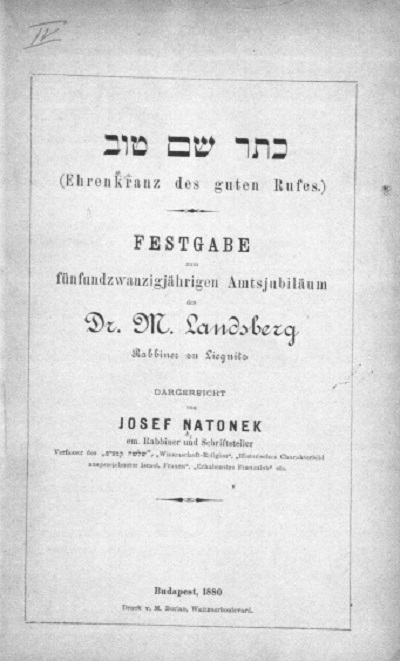


The title, Ehrenkranz des guten Rufes, is our “crown of a good name,” a Festgabe zum fünfundzwanzigjährigen Amtsjubilaeum des Dr. M. Landsberg, Rabbiner zu Liegnitz dargereicht von Rabbiner Josef Natonek em Rabbiner und Schriftsteller verfasser, that is a festive volume presented to Landsberger on the twenty-fifth jubilee of his service as rabbi in Liegnitz, by R. Josef Natonek (1813-92), a rabbi and author. Landsberg, doctor of philosophy educated in Berlin, became, in 1854, the rabbi of Legnica. Born in Rawicz, He served as rabbi for twenty-five years until his death in Liegnitz (Legnica, Silesia).[14] Landsburg was also the author of a number of studies on the history of medicine, particularly in ancient times, published for the most part in the journal Juno, published by von Henschel.[15]

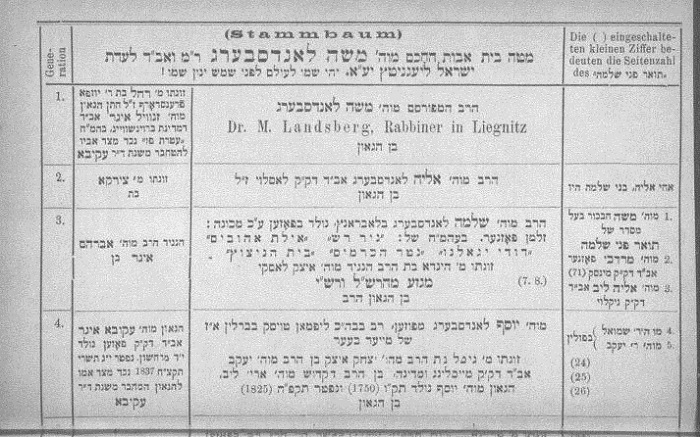
At the end of the volume is a two page Stammbaum (family tree) of the Landsberg family.


IV Miscellanea

Keter Shem Tov, R. Solomon Zalman ben Zevi Hirsch ha-Kohen, Livorno, c. 1789: Our next Keter Shem Tov is a quarto sized page printed in Livorno in c. 1789 for the Hassidic Tiberius Kollel Ashkenazim. It informs that R. Solomon Zalman ben Zevi Hirsch ha-Kohen (d. 1799) is an emissary of the Merciful One and of us (the Ashkenaz Hasidic community of Tiberias). The letter is signed by twenty-one rabbis.[16]
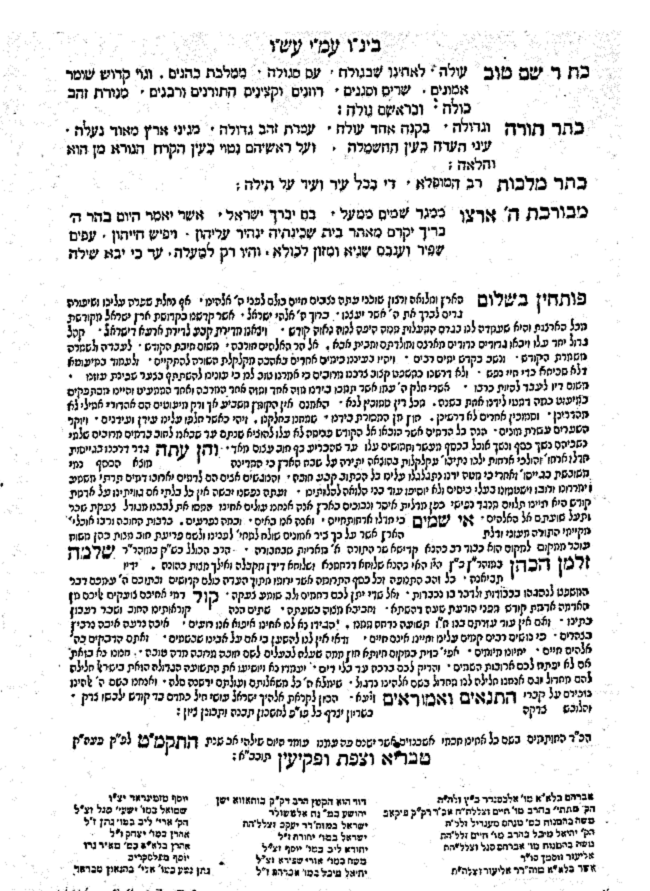


The letter begins with a reference to Keter Shem Tov followed by a list of honorifics “but the crown of a good name (Keter Shem Tov) excels them all. To our brothers in the exile, a treasured people, ‘a kingdom of priests and a holy nation’ (Exodus 19:6), keepers of the faith, princes and chieftains, princes and leaders, ‘a lampstand all of gold’ (Zechariah 4:2) Torah scholars and rabbis.”

It informs about their joy in the merit to live in Eretz Israel. Until now they had relied upon support from the country from which they had come; but now, however, due to war between Russia and the Ottoman Empire, they could no longer depend on that funding, so that they are now turning to Jews in other lands for support. Indeed, in describing the situation the letter notes the dire financial situation and that the land “‘is infested with bandits’ (Yevamot 115a, 122a) ‘the task masters hurried them’ (Exodus 5:13), they ‘lie in wait for blood’ (Micah 7:2). . . . ‘But now our soul is dried away; there is nothing at all (Numbers 11:6)’”

Solomon Zalman had traveled twice previously as an emissary to Russia (1779-81/1784-85), but this was his first trip to Western Europe. Avraham Yaari relates that Solomon Zalman’s undertaking was not without objection. The Sephardic community protested that the Hasidic community, which had previously received support from Eastern Europe, a venue now closed to them, was, by sending an emissary to Western Europe, entering into the domain of the general Tiberias community. The dispute was resolved several years later when joint representatives of both communities went to Eastern Europe.[17]

The letter begins with that part of the phrase from Avot referring to Keter Shem Tov intimating that a way one obtains the “crown of a good name (Keter Shem Tov)” is through good deeds and charity, which, as noted above, is “As a pearl atop a crown (keter), so are his good deeds fitting,” certainly appropriate for an appeal for the destitute community in Israel, the subject of the our Keter Shem Tov.

Keter Shem Tov, Shani Tzoref, Ian Young, Editors; Piscataway, NJ, 2013: A highly unusual Keter Shem Tov, this the proceedings of a conference on the Dead Sea scrolls held in memory of the late emeritus professor Alan David Crown in late 2011 at the University of Sydney, Mandelbaum House. This volume is part of a series entitled Perspectives on Hebrew Scriptures and its Contexts published by Gorgias Press, which describes itself as “an independent academic publisher of books and journals covering several areas related to religious studies, the world of ancient western Asia, classics, and Middle Eastern studies.” Among their subject matter is Ancient Near East, Arabic and Islam, Archaeology, Bible, Classics, Early Christianity, Judaism, Linguistics, Syriac, and Ugaritic.

Professor Alan David Crown (1932-2010) in whose memory this book was published, was Professor in Semitic Studies at the University of Sydney, and a renowned scholar and author. As noted on a website referring to him the title relates to the name Crown (Keter), for “He may have inherited the name Crown from his parents, but he earned the title ‘CROWN’ – the Crown of Torah, through his own merit, his sharp intellect and his deep respect for scholarship.”[18] The editors are Dr. Shani Tzoref, Ph.D., Skirball Department of Hebrew and Judaic Studies, New York University and currently a Qumran Institute Fellow, Seminar für Altes Testament, Georg-August-Universität Göttingen, and Dr. Ian Young, Associate Professor, Chair of Department at the University of Sydney, Australia, teaching Classical Hebrew and Biblical Studies.

This edition of Perspectives on Hebrew Scriptures and its Contexts 20: Keter Shem Tov (x, 400 pp.) is comprised of sixteen articles on various subjects in the field of Qumran studies (Dead Sea scrolls) from scholars in the field. The articles encompass the development and phases of Qumran scholarship; textual transmission of the Hebrew Bible, including Samaritan texts and Masada Biblical Scrolls; reception of Scripture in the Dead Sea Scrolls; community and the Dead Sea Scrolls; and eschatology and sexuality in the So-Called Sectarian Documents from Qumran; and the Temple and the Dead Sea Scrolls.

V Summary
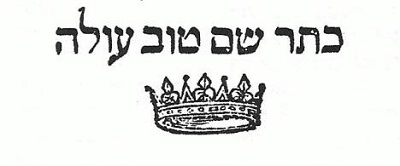


This concludes our survey of books with the title Keter Shem Tov. As noted above, the article is vignettes of books so entitled. There is no single pattern in the use of the title, it being applied to a wide variety of books. There are discourses on the Torah, both literal and kabbalistic, works on Jewish law and customs, biographic or anecdotal, and several miscellaneous works, among them an appeal for support of Jewish communities in the Holy Land and on the Dead Sea scrolls. The title Keter Shem Tov has been chosen because it refers to an author’s name, for example, R. Shem Tov Melamed, R. Shem Tov ibn Gaon, and R. Shem Tov Gaguine; bibliographical works such as those referring to the Ba’al Shem Tov, Sir Moses Montefiore, and Rabbi Dr. Moritz Landsberg; and more diverse works, such as one being the novellae of a Kollel, the Dead Sea scrolls, and even topically related as in R. Avishai Taharani’s Keter Shem Tov, which actually deals with laws and customs applicable to names.

We began by noting that the title of Hebrew books, unlike books in other languages, may have “been selected by the author for any one of a number of reasons, least of all the book’s subject matter; rather the intention is/was to give the book ‘the crown of a good name (Keter Shem Tov)’.” Indeed, not one book in this article, with the possible exception of Taharani’s Keter Shem Tov, indicates its subject matter by the title. What each of these examples do have in common, is the intent to associate the name of the author, subject, or even organization with the Mishnah in Pirke Avot, which states,

  1. Simeon said: there are three crowns: the crown of Torah, the crown of priesthood, and the crown of royalty; but the crown of a good name (emphasis added, Keter Shem Tov) excels them all (Avot 4:13).

[1] I would like to thank Eli Genauer for reading the article and his comments and my son-in-law, R. Moshe Tepfer, for his assistance and research in the National Library of Israel, including getting the 1789 Livorno illustration from
[2] Marvin J. Heller, “Adderet Eliyahu; A Study in the Titling of Hebrew Books,” in Studies in the Making of the Early Hebrew Book (Brill, Leiden/Boston, 2008), pp. 72-91; idem. “What’s in a name? An example of the Titling of Hebrew Books,” in Further Studies in the Making of the Early Hebrew Book (Brill, Leiden/Boston, 2013) pp. 371-94.
[3] Judah he-Hasid, Sefer Hasidim (Jerusalem, 1973), ed. Re’uven Margaliot, pp. 210-11, n. 367 [Hebrew].
[4] Eleazar ben Judah, Sefer Roke’ah ha-Gadol (Jerusalem, 1967), ed. Barukh Shimon Shneurson, p. 1 [Hebrew].
[5] Gershom Scholem, Kabbalah (New York, 1974), p. 51.
[6] Shimon Vanunu, Encyclopedia Arzei ha-Levanon. Encyclopedia le-Toldot Geonei ve-Hakhmei Yahadut Sefarad ve-ha-Mizrah IV (Jerusalem, 2006), pp. 2152 [Hebrew].
[7] Avraham Yaari, Diglei ha-Madpisim ha-Ivriyyim (Jerusalem, 1943, reprint Westmead, 1971), pp. 96, 174 no. 160, [Hebrew].
[8] Shimon Vanunu, Encyclopedia Arzei ha-Levanon. Encyclopedia le-Toldot Geonei ve-Hakhmei Yahadut Sefarad ve-ha-Mizrah IV (Jerusalem, 2006), pp. 2155-56 [Hebrew].
[9] In contrast, the Mishnah Berurah (477:1:5) quotes the Shelah ha-Kodesh who states that ” have seen people of status who kiss the matzah and the marror . . . all to cherish the mitzvah.”
[10] Such errors and their corrections are known as stop-press corrections. Sheets were proof read while the press-run was under way; while it certainly was preferable to correct the sheets before the run began, reading also took place while the run was under way. When the corrector would find an error he would stop the run, remove the forme, quickly correct the error, and resume printing. Unless substantial, stop-press corrections did not necessitate disposing of the previous sheet – four pages in a folio, more so in a smaller format – but rather both the altered states and the originals are used. In such a case, there will be variant copies of the book, consisting of sheets printed from forms in both the earlier and later states, as is the case here.
[11] The copy with the misdated title-page in the Chabad-Lubavitch Library is attractively bound in a soft brown leather, the cover stamped כתר שם טוב ב”ק אדמו”ר שליט”א, that is, it was in the private library of the Lubavitcher Rebbe, R. Menachem Mendel Schneeersohn (1902–94). The reading room librarian, R. Zalman Levine, informs me that to his knowledge this is the only book so bound, and that it “was given to the rebbe with this binding.
[12] Keter Shem Tov (Brooklyn, 1972), p. v [Hebrew].
[13] Cecil Roth, “Moses Montefiore, 1784-1885,” in Essays and Portraits in Anglo-Jewish History (Philadelphia, 1962), p. 262.+
[14] As an aside, Jewish settlement in Lieignitz can be traced to the Middle Ages, interrupted by pogroms, the first in 1447 due to a dispute between Elżbieta, Duchess of Legnica with Jewish bankers, who demanded that she return a loan. Liegnitz is best remembered for a battle that took place there in 1241, when a Polish-German Army lead by Duke Henry II of Silesia engaged invading Mongol near the town. The Mongols were victorious, collecting nine sacks of ears from their fallen enemies, all of whom perished.
[15] Klatzkin, Jacob and Ismar Elbogen, editors, Enyclopaedia Judaica: Das Judentum in Geschichte und Gegenwart 10 (Berlin, 1928-34), p. 619.
[16] The signatories are R. Abraham ben Alexander Katz of Kalisk; R. Matthias ben Hayyim; R. Moses ben Menahem Mendel; R. Jehiel Michal ben Hayyim; R. Moses ben Abraham Segal; R. Eliezer Sussman; R. Asher ben Eliezer; R. David he is the Katan, rav of Bohava Yeshain; R. Joshua ben Noah Altshuler; R. Israel ben Jacob; R. Israel ben Judah; R. Judah Leib ben Joseph; R. Moses ben Uri Shapira; R. Jehiel Michal ben Abraham; R. Joseph of Zimigrad; R. Samuel ben Isaiah Segal; R. Aryeh Leib ben Nathan; R. Aaron ben Isaac; R. Aaron ben Meir; R. Joseph of Poloskov; and R. Nathan Nata ben Eli of Brod.
[17] Avraham Yaari, Sheluhei Eretz Yisrael II (Jerusalem, 1951, reprint Jerusalem, 1997), pp. 619-28 [Hebrew].
[18] http://learning.mandelbaum.usyd.edu.au/about-us/alan-crown/

The Fish Motif on Early Hebrew Title-Pages and as Pressmarks

The Fish Motif on Early Hebrew Title-Pages and as Pressmarks

by Marvin J. Heller

            Fish are a symbol replete with meaning, among them, in Judaism, representing fertility and good luck, albeit that fish are not an image that, for most, quickly comes to mind when considering Jewish iconography. Created on the fifth day of creation, fish symbolize fruitfulness, and, as Dr. Joseph Lowin informs, the month of Adar on the Hebrew calendar (February-March, Pisces) is considered “a lucky month for the Jews (mazal dagim).” He adds that in Eastern Europe people named sons Fishl as a symbol of luck, and that in the Bible, the father of Joshua is named fish, that is, Nun, which is fish in Aramaic.[1] Similarly, Ellen Frankel and Betsy Platkin Teutsch note the allusion to fertility and blessing, the former that when Jacob blesses Ephraim and Manasseh, Joseph’s sons, he says “May they multiply abundantly ve-yidgu, like fish) in the midst of the earth” (Genesis 48:16) and the latter to the Leviathan, the great sea monster the Jews will feast upon in the messianic age.[2]

Other biblical references to fish include Dagon, the fish-god of the Philistines, also worshipped elsewhere in the Middle East, mentioned several times in the Bible (Joshua15:41, 19:27; Judges 16:23; I Samuel 5:2–7; and I Chronicles 10:10).  A fish also appears in the biblical story of Jonah, a large fish (dag gadol), not the popular whale that swallowed the prophet.

            Not only Jewish sources and printers used devices that were fish related. The Medjed fish, a species of elephant fish, a medium-sized freshwater fish with a long downturned snout, abundant in the Nile, was worshipped at Oxyrhynchus in ancient Egypt and appears in Egyptian art. Fish are a not infrequent image on medieval coat of arms. Indeed, there are as many as 181 shields of salmon alone in heraldry.[3] The most well-known printer device with a fish is the anchor and dolphin of Aldus Manutius (1449-1515), albeit not strictly speaking a fish, as a dolphin is actually an aquatic marine mammal. Among the most novel of the marine pressmarks is that of the Liege printer J. M. Hovii, active during the latter half of the seventeenth century, whose mark consisted of a mermaid enwrapped about a tree with a skull at the foot of the tree.[4]

            This article is the most recent in a series describing printer’s devices and motifs appearing on the title-pages and with the colophons of early Hebrew printed books.[5] The use of the fish images described here are varied, comprised of pressmarks and full page frames which include representations of marine life. The discussion of the images and the presses are for the sixteenth into the eighteenth century. Although a number and variety of presses that that utilized marks with fish are addressed in this article they are examples only and not necessarily complete. Furthermore, the entries are expansive, that is, printers’ marks are not described in isolation but with discussions of the presses that employed them and examples of the books on which they appeared. Entries are in chronological.[6]

            As noted above, the month of Adar is, if not exactly, coterminous with the astrological sign of Pisces. That sign is represented by a pair of fish swimming in opposite directions, as fish swimming against the stream represents the powerful Pisces potential. They can be ‘sharks’ – charismatic, strong leaders with vision and clarity about leadership that can guide an entire nation, like Moses, who was also a Pisces. But those Pisces who prefer to go with the flow can be weak people who get carried away easily and are prone to addictive patterns of behavior.

Pisces is known for the holiday of Purim. According to the sages, it will be the only holiday to continue to be celebrated throughout the world after the Messiah comes. “When Adar begins, joy enters,” as the famous Hebraic phrase goes. It is a month of happiness, miracles and wonders. It affords us the ability to achieve mind over matter, to overcome our doubts, and connect to the Light.[7]

            Another compatible view of Adar and fish states that “The astral sign of Adar is the fish (Pisces). Fish are very fertile, and for that reason are seen as a sign of blessing and fruitfulness. The Hebrew word for blessing is bracha, from the root letters betreish, kaff. In Jewish numerology (gematria), the letter bet has a value of 2, reish is 200 and kaff is 20. Each of these is the first plural in their number unit. What this tells us is that the Jewish concept of ‘blessing’is intertwined with fertility, represented by the fish of Adar.”[8]

            Our first example of a pressmark with a fish is the most unusual in the article, the only device in which the fish is not only completely inconsistent with the above description but is the least prominent representation of a fish of all the pressmarks in the article. Among the earliest printers to make utilize of the fish in a pressmark is Joseph ben Jacob Shalit in Sabbioneta. Although the Sabbioneta press is commonly associated with Tobias ben Eliezer Foa, it was Shalit who appears to initially have been the motivating force behind the press and, with other partners, the provider of necessary financial support. Tobias Foa is credited with providing only the physical quarters, Duke Vespasian Gonzaga’s patronage, and limited financial assistance. Also associated with the press were Cornelius Adelkind, Vincenzo Conti, and R. Joshua Boaz Baruch, all prominent names in mid-sixteenth century Hebrew printing in Italy.

The first title printed at the press was Don Isaac ben Judah Abrabanel’s (1437-1508) Mirkevet ha‑Mishneh (1551), a commentary on Deuteronomy. Abrabanel began work on Mirkevet ha‑Mishneh when still in Lisbon, unlike the remainder of his commentary on the Torah which was written much later. Its completion was postponed, however, due to his responsibilities at the Portuguese court. The incomplete manuscript of Mirkevet ha-Mishneh was lost when Abrabanel was forced to flee Portugal in 1483. However, on his later peregrinations after the expulsion of the Jews from Spain Abrabanel came to the island of Corfu in 1493, where he serendipitously (miraculously) found a copy of the manuscript. Leaving aside other work he turned to completing this commentary, but after the departure of French troops from Naples, Abrabanel went to Monopoli (Apulia), where Mirkevet ha-Mishneh was finally completed in the first part of 1496.

The title page, dated 5311 Rosh Hodesh Sivan (Wednesday, May 16, 1551) is comprised of an architectural border with standing representations of the mythological Mars and Minerva. This border was first employed by Francesco Minizio Calvo in Rome in 1523 and as late as 1540 in Milan. This is its earliest appearance in a Hebrew book. It would be often reused and copied, appearing on the title pages of books printed as far apart as Salonika and Cracow.[9]

On the final unfoliated leaf are two devices, on the right that of Foa, a palm tree with a lion rampant on each side and affixed to the tree a Magen David, about it the verse, “The righteous flourish like the palm tree” (Psalms 92:13), all within a circle, and to the sides the letters ט and פ for Tobias Foa. On the left is Shalit’s device, a peacock standing on three rocks, facing left, with a fish in its beak within a cartouche, although Avraham Yaari, after describing the peacock with a fish, adds, in parenthesis, (or a worm?). The letters יביש about this device stand for Joseph ben Jacob Shalit. Also printed by the press that year was R. Isaac ben Moses Arama’s (c. 1420–1494) Ḥazut Kashah, on the relationship of philosophy and religion. It too has the Mars and Minerva title-page, but here the last leaf is foliated and has one pressmark only, the peacock with fish of Shalit.[10] Parenthetically, Arama too was a refugee from Spain.

Fig. 1 pressmarks of Joseph Shalit (left) and Tobias Foa (right)

The peacock with fish pressmark was reused by Shalit in Mantua at the press of Venturin Rufinelli with the colophon of several works, for example the late 10th century ethical work based on animal tales, translated from the encyclopedic Arabic Rasa`il ikhwan as-safa` wa khillan al-wafa` (Epistles of the Brethren of Purity and Loyal Friends) into Hebrew by Kalonymus ben Kalonymus (c. 1286-c. 1328) as Iggeret Ba’alei Hayyim (1557). The original is comprised of 52 eclectic volumes (pamphlets) on philosophy, religion, mathematics, logic, and music. The portion from which Iggeret Ba’alei Hayyim is taken appears at the end of the 25th book. The original was prepared by the Brethren of Purity, a secret Arab confraternity which flourished in Basra, Iraq in the second half of the tenth century. The tales themselves have an Indian origin. Four other varied works of note with the peacock with fish pressmark are R. Saadiah ben Joseph Gaon’s (882-942) Sefer ha-Tehiyyah ve-Sefer ha-Pedut (1556) on resurrection; R. Abraham ben Samuel ha-Levi ibn Hasdai’s (13th century) Ben ha-Melekh ve-ha-Nazir (1557), also based on an Indian romance and here derived from the Arabic; Berechiah ben Natronai ha-Nakdan’s (12th-13th century) Mishlei Shu’alim (1557-58) popular collection of fables, and a Haggadah with the Mars and Minerva title-page (1568).

The Shalit pressmark also appears on the title-page of several books printed in Venice at the press of Giovanni di Gara, without mention of Shalit, so that Yaari suggests he was not involved with the books but it was used simply as an ornament. Among the titles with this pressmark are R. David Kimhi’s (Radak, c. 1160-c.1235) commentary on Psalms (1566), R. Moses ben Baruch Almosnino’s (c.1515 – c.1580) Me’ammez Ko’ah (1587-88), R. Samuel ben Abraham Laniado’s (d. 1605) Keli Hemdah (1596), each with a biblical verse about the frame, and R. Aaron ibn Hayyim of Fez’s  (1545–1632) Lev Aharon (1608), this last without the biblical verses about the cartouche. The Shalit pressmark appears in various places in the books, after the introduction, by the colophon, least often on the title-page. Yaari notes that the Shalit device was also employed by Georgi di Cavilli in an Ashkenaz rite Mahzor (1568).[11]

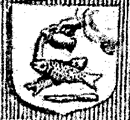
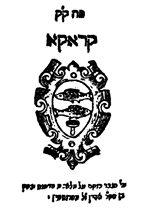
Leaving Italy, for now, and Shalit, we turn to Cracow where Isaac ben Aaron Prostitz, who together with his sons after him, printed Hebrew books for fifty years, beginning in 1569. In 1578, Prostitz printed at least three large format attractive tractates from the Talmud, Avodah ZarahKetubbot, and Rosh Ha-Shanah, the last extant in a ten folio unicum fragment in the library of the Jewish Theological Seminary. Moritz Steinschneider writes that Avodah Zarah was printed “si revera Supplementi tantum instar ad ed. Basil,” and “seu castrata . . .Cracoviae vero supplementi instar excusus,” that is, to compensate for its omission of the entire tractate from the much censored Basle Talmud.[12] Another feature of this tractate is that it is the first employ by Prostitz of the shield with two fish facing in opposite directions, the upper facing left, the lower facing right, above a printer’s inker, as his device.

Prostitz’s apparent next use of this device, this the first noted in bibliographic sources, is a Mahzor (1584) printed with the support of four partners, and reused frequently afterwards on such varied titles as Josippon (1589) at the end of the book, Avot with the commentary Derekh Hayyim by R. Judah Loew ben Bezalel (Maharal of Prague, c. 1525-16) after the introduction (1589), R. Moses ben Jacob Cordovero’s (Ramak, 1522-1570) Pardes Rimmonim (1591), between the books introductions, R. Bahya ben Joseph ibn Paquda’s (late 11th century) Hovot ha-Levavot, after the translator’s preface (1593) and R. Naphtali Hirsch ben Asher Altschuler’s (16th-17th cent.) Ayyalah Sheluha c. 1595. Pardes Rimmonim was actually printed in Cracow/Nowy Dwor, the change in location due to a serious outbreak of plague in Cracow, Prostitz and his family forced to flee to Nowy Dwor with the press’ typographical equipment. Pardes Rimmonim was completed in that location, the only Hebrew book printed in that Nowy Dwor.[13]

Fig. 2 Pressmark of Isaac Prostitz

Yaari questions Prostitz’s use of this pressmark. While the employ of the printer’s tool is clear, that is not the case for the fish. He suggests that it might be a propitious sign for the partners in the printing of the Mahzor in 1584, which Prostitz continued to use afterwards. This is unlikely, however, for, as we have noted, this device had been employed previously in 1578 on tractate Avodah Zarah. Another possibility is that the fish alludes to the month (Adar) in which Proztitz was born, but he then inquires why the pressmark was not used previously on all the books printed by the press. Yaari notes Steinschneider’s suggestion that the fish represented Prostitz’s entreaty for children, as his sons were borne at an old age. Here to, however, he observes that Prostitz’s four sons were born earlier, being mentioned in the colophon to Toledot Yitzhak in 1593. Another suggestion is that the fish allude to the name of R. Naphtali Hirsch ben Asher Altschuler who was known by all as Hirsch mokhir seforim (bookseller) in Lublin and for whom Prostitz printed books, for example Hovot ha-Levavot, the fish alluding to the name Naphtali, for the portion of the tribe Naphtali included the Kinneret Sea, in which fish were plentiful, but Yaari concludes this is only speculative.[14] I would question why, even if this is true for R. Altschuler, what does this have to do with Prostitiz and why he should have adopted this fish image for his pressmark?

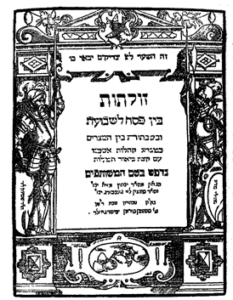
A short lived press existed in Thannhausen, Bavaria, near Augsburg, a zoltot (supplementary festival prayers for the period between Passover and Shavu’ot) and a Mahzor (c. 1594) for the entire year according to the Ashkenaz rite were printed in the last decade of the sixteenth century. The press was a furtive effort to print Hebrew books by R. Isaac Mazia, whose name, it has been suggested, is an abbreviation for mi-zera Yehudim anusim, that is, he was of Marrano origin, or that he had served as rabbi in several communities in southern Germany, together with R. Simeon ben Judah ha-Levi of Guenzburg (Simon zur Gemze) of Frankfurt, who arranged with the Munich printer Adam Berg, to issue those works. When printing the mahzor the printers, concerned about the Christian response to sensitive passages and accusations of blasphemy, left blanks to be filled in by the purchasers.

After an examination of the still incomplete mahzorim by the censor at the University of Ingolstadt the press run of 1,500 copies was destroyed; only five copies are known to be extant today. In August, 1597, Mazia was fined 200 florin and released, while Berg, as late as 1604, was still attempting to have his impounded press returned. All of this occurred despite the fact that the authorities concurred that the mahzorim had been approved for publication by the imperial authorities in Prague. Nevertheless, the printers had neither received nor sought permission from the local authorities in Burgau to print. Moreover, as the books were for export they gave the impression that printing was done with the permission of those authorities.

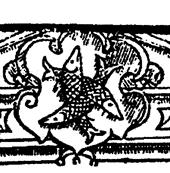
 Fig. 3b Zoltot


Fig. 3a Zoltot Extract

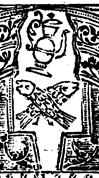
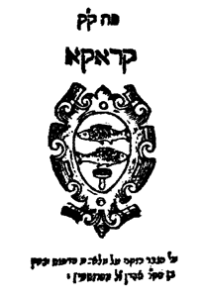
Both titles have a like frame comprised of an ornamental border with three entwined fish at the top (the signet of Mazia), at the sides are armed men in armor each with a shield, the right shield engraved with the name R. [Isaac] Mazia, the left with the name R. Simeon Levi. At the bottom is a laver pouring water on two hands, representative of the [Simeon] Levi. Isaac Yudlov informs that the fish here represent Isaac Mazia; this appearance of three fish as a printer’s mark is apparently unique. [15]

Not long afterwards we find the fish image employed in Lublin at the press of Zevi bar Abraham Kalonymous Jaffe. Lublin has a long and proud history as a Hebrew printing center, beginning with the press established by the family of Hayyim Shahor (Schwarz), that is, his son Isaac and his son-in-law Joseph ben Yakar. This press, through descendants and collateral members, would be active for almost a hundred and fifty years. The presses’ began publishing in 1551, with a folio Polish rite mahzor for the entire year, continuing until 1646 when a fire forced the press to close; printing resumed in 1648 when tah-ve-tat (gezerot Polania, the Chmielnicki massacres of 1648-49), broke out. That and the 1655-60 Swedish Muscovy wars, combined with others conflicts besetting the area made it impossible for Jaffe to continue and he had to close the press. Printing did resume when Solomon Zalman Jaffe ben Jacob Kalmankes of Turobin, encouraged and supported by his father, reestablished a Hebrew press. He printed 30 books until 1685 and the entire Jaffe family is credited with as many as 180 Hebrew titles.

Fig. 4 Pressmark of Zevi Jaffe

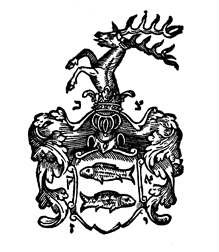
A device employed by Zevi Jaffe, found on the title page of tractates in the large folio edition of the Babylonian Talmud published from 1617-1639, and after the introduction to R. Joel Sirkes’ (Bah, 1561–1640), Meishiv Nefesh, and possibly other works is a deer with raised forelegs, above a crown atop a shield with two fish, the upper facing left and the lower facing representative of the fact that he was a Levi, often accompanied by two fish, here too indicating that he was born in the month of Adar.

Among the many prominent printers of Hebrew books in Amsterdam is Uri Phoebus ben Aaron Witmund ha-Levi. He had previously worked for Immanuel Benveniste; in 1658, Uri Phoebus established his own print-shop. He would print about one hundred titles, from 1658 to 1689, the period he was active in Amsterdam, generally traditional works for the Jewish community, encompassing Bibles, prayer-books, halakhic works, haggadotaggadot, and historical treatises (Yosippon). Prostitz’s first pressmark, employed in 1569 on the title-page of R. Naphtali Hertz ben Menahem of Lemberg’s Perush le-Midrash Humash Megillot Rabbah and intermittently afterwards was a stag within a cartouche. Subsequently, Uri Phoebus employed as his device a hand pouring water from a laver, representative of the fact that he was a Levi, often accompanied by two fish, here too indicating that he was born in the month of Adar.

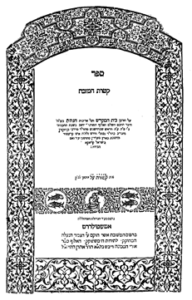
The first usage by Uri Phoebus of this device was in 1660 on the title-page of Ketoret ha-Mizbe’ah, R. Mordecai ben Naphtali Hirsch of Kremsier’s (d. 1670) work on the aggadic portions of tractate Berakhot dealing with the destruction of the Temple and the length of the exile. The title-page of this folio book has an arabesque frame and across the lower half of the page is Uri Phoebus’s fish mark. That device would be frequently used as a decorative ornament in many of the books that Uri Phoebus printed, placed in various locations, after introductions or the colophons.

Fig. 5a Ketoret ha-Mizbe’ah

Fig. 5b Ketoret ha-Mizbe’ah Extract

Examples of the fish woodcut appears in other works, but not necessarily on the title-page, for example, in R. Hayyim ben Benjamin Ze’ev Bochner’s Or Hadash (c. 1671-75), on the laws of benedictions in a concise and abridged form, the title page of Or Hadash has an architectural frame headed by an eagle but no fish, that device being but one of several tail-pieces.

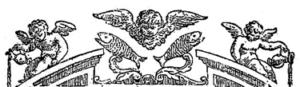
In 1662 Uri Phoebus printed an illustrated Haggadah accompanied by the commentary of R. Joseph Shalit ben Jacob Ashkenazi of Padua entitled Nimukei Yosef. The title-page of this quarto Haggadah has an architectural frame with two robed men at the sides, above winged cherubim and between them two fish with the winged head of a cherub. At the bottom are two vignettes; on the left the punishment of Shehem for the rape of Dinah and on the right the tribe of Levi killing the worshipers of the golden calf. In 1667-68, Uri Phoebus printed, also with this title-page, Nahalat Shivah (below and extract to right), R. Samuel ben David Moses ha-Levi’s (c.1625–1681) work on legal documents, particularly relating to divorce and civil matters. Nahalat Shivah has the same title-page as the Haggadah, here dated, “The Messiah ben David is coming משיח בן דוד בא (427 = 1667),” reflecting the referring to the false messiah Shabbetai Zevi. This title-page and fish crest (below) would be reused by Uri Phoebus for many years and elsewhere besides Amsterdam.

Fig. 6a Nahalat Shivah

Fig.6 Nahalat Shivah Extract

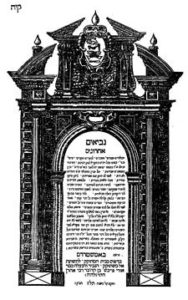
Other title-pages employed by Uri Phoebus, with different architectural frames but with a like laver and fish image include such varied works as R. Jonah ben Isaac Teomim (d. 1669) of Prague’s Kikayon di-Yonah (1669-70), novellae on tractates of the Babylonian Talmud and, attributed to R. David ben Aryeh Leib of Lida (c. 1650-96) Migdal David (1680), both with the Benveniste frame; and R. Isaac Benjamin Wolf ben Eliezer Lipman (d. c. 1698), rabbi of Landsberg, Germany’s Nahalat Binyamin (1682), the first part of a commentary on the taryag [613] mitzvot and R. Shabbetai ben Meir Ha-Kohen’s (Shakh, 1621–1662) Siftei Kohen, a commentary and halakhic novellae on Shulhan Arukh Hoshen Mishpat these with a frame with rectangular shapes, all with the fish and lave at the apex.[16]  The title-page of Siftei Kohen, the first part of a commentary on the taryag [613] mitzvot dates the beginning of the work to 21 Tammuz, days of the Messiah ימי המשיח (423 = Thursday, July 26, 1663). The colophon dates completion of the work to Monday, 21 Heshvan, in the days of the Messiah בימי   המשיח (425 = November 9, 1664, actually a Sunday), both dates (Messiah) a possible allusion to Shabbbtai Zevi.[17]

Among the more elaborate title-pages is that of the first complete translation of the Bible (1676-78) into Yiddish by R. Jekuthiel ben Isaac Blitz, a rabbi from Witmund, Germany and corrector at the press of Uri Phoebus. This edition was the subject of a serious controversy with the Amsterdam printer Joseph Athias, who published an almost simultaneous and related Yiddish edition by Joseph Witzenhausen printed (Amsterdam, 1679-87).

Fig. 7a Bible – Engraved Front-piece

Fig. 7b Later Prophets

Figs. 7c, 7d Extracts

The Bible has an engraved front-piece title-page with depictions of Moses and Aaron, Mount Sinai at the top, and in the lower right hand corner a coronet and below it the raised hands of the Kohen giving a benediction. In the lower left hand corner is a fish and laver image, here the two fish are crisscrossed. The engraved title page is incorrectly dated תזל כטל (439 = 1679), whereas the like title-pages for each of the biblical divisions are correctly dated  תלז(437 = 1677), such as Later Prophets, below. The text has a separate but like title-page for Former Prophets, Later Prophets, and Writings. Note that in the otherwise like depictions of the fish and laver the position of the laver and water is reversed.

In 1689, Uri Phoebus ceased printing in Amsterdam, in order to relocate to Poland. Faced with competition from the large number of Hebrew printers in Amsterdam, Uri Phoebus felt that he would be more successful in Poland, located closer to its large Jewish population, a major market for the Hebrew printing-houses of Amsterdam. He established the first Hebrew press in Zolkiew in 1691, bringing his typographical material with him. Uri Phoebus’ descendants continued to operate Hebrew printing-presses in Poland into the twentieth century.

One of, if not the first book printed by Uri Phoebus in Zolkiew is R. Mordecai ben Moses Katz of Prostitz’s Derekh Yam ha-Talmud (1692) a super-commentary on the Hiddushei Halakhot of R. Samuel Eliezer ben Judah ha-Levi Edels (Maharsha). The title-page of this small work (40: 8ff.), much worn, appears to be the Benveniste frame, but at the apex is the same fish image as at the apex of Siftei Kohen. Among the decorative material, after the introduction and after the colophon is Uri Phoebus’ four fish mark, one on each side facing a laver from which water is being poured.

Among the other works published by Uri Phoebus in Zolkiew with the Nahalat Shivah title page reproduced above, is R. Jekuthiel ben Solomon Zalman ha-Levi Suesskind’s Dat Yekuthiel (1696,), a concise (80: 16 ff.) versified enumeration of the taryag mitzvoth (613 commandments). After the approbations to Dat Yekuthiel, there are thirteen, is the press mark comprised of four fish and laver. The title-page informs that the manuscript was found by Jekuthiel’s son Jonah of Kalish in his father’s bag, and arranged and brought to press by his grandson Menahem Feibush.

After the approbations is a letter from Jekuthiel to his son Eliezer. Jekuthiel, who was incarcerated at the time, in which he writes from his dark cell of his painful existence, where he had “wormwood, and gall to drink” (cf. Jeremiah 9:14) until “‘My soul is weary of my life’ (Job 10:1) ‘and my soul became impatient’ (Zechariah 11:8) to die in this way with this ‘light bread’ (Numbers 21:5) that I eat, absorbed in all my limbs, ‘the bread of adversity, and the water of affliction’” (Isaiah 30:20). Jekuthiel continues, describing his hardships, and then writes, “I will pay my vows to the Lord” (Psalms 116:14, 18) and that he took “of that which came to my hand a (new) offering” (cf. Genesis 32:14) on the taryag mitzvot. He thought to write on them in verse, “parallel, one with the other” (Exodus 26:17, 36:22), in single stanzas to the end, in the order of the Torah with references to the Hamishah Homshei Torah in the margins. Jekuthiel tells his son to take this as his blessing, which will be for a remembrance for both of them.

Uri Phoebus passed away in c. 1705.[18] He was succeeded in Zolkiew by his son Hayyim David, who had assisted his father at the press. Unfortunately, Hayyim David died shortly after his father, leaving the print-shop, in turn, to his sons, Aaron and Gershon. Uri Phoebus’ descendants continued to operate Hebrew printing-presses in Poland into the twentieth century. Aaron and Gershon did not use the ornamental material brought by Uri Phoebus to Zolkiew, instead preparing new frames that also reflected that they were Levi’im, and employed on such small format books as R. Raphael Lonzano’s Kinyan Avraham (1723) and R. Meir ben Levi’s Likkutei Shoshanim (1727). This ornate frame continued to be used by their descendants, among them Judah Solomon Yarsh Rappaport in Lvov on a Shir ha-Shirim with the commentary Magishi Minhah (1817) in Lvov.[19]

Fig. 8a Kinyan Avraham

Fig. 8b Kinyan Avraham Extract

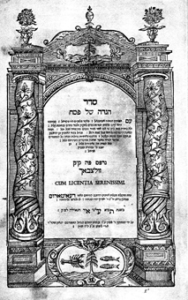
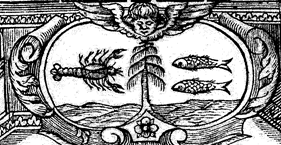
            Turning to, Germany, we find two fish, here facing in the same direction, on a title-page with an architectural pillared title-page, and at the bottom a palm tree, about it on the left a crab facing right and on the right two fish, both facing left, the former the sign of Tammuz (Cancer, scorpio), and, as already well noted, the latter the sign of Adar. The two zodiacal emblems may have had a personal significance, but, as Yosef Hayyim Yerushalmi observes describing a slightly later usage “the significance of this combination is difficult to ascertain.[20]

First employed in Fuerth by Joseph ben Solomon Zalman Schneur and his sons from 1691 through 1698, beginning with Torat Kohanim, and other folio volumes, primarily from the Shulhan Arukh, a like frame was subsequently used by Aaron ben Uri Lippman Frankel beginning with a Haggadah, in Sulzbach (below). Aaron was active in Sulzbach from the mid-1690’s until he passed away in 1720 at the age of seventy-five, first utilizing the fish image on a Mahzor printed in 1699 and afterwards in his folio imprints. Among those titles is a Haggadah (1711) with an attractive engraved copperplate front-piece (but without fish) followed by the second architectural pillared title-page described above. The architectural title-page was subsequently reused in Feurth by Hayyim ben Zevi Hirsch, who is credited with printing as many as 164 titles in that location, among the works with this frame and fish mark are several Haggadot (1746, 1752, and 1756).[21]

Fig. 9a Aaron ben Uri Lippman Frankel

Fig. 9b Aaron ben Uri Lippman Frankel Extract

The site of yet another press that employed fish on the title-page, here apparently once only, was in Wandsbeck, a borough in north-west Hamburg in Schleswig-Holstein. The first printed books in Wandsbeck are dated to the late sixteenth and early seventeenth centuries, beginning with the Astronomiae instauratae Mechanica of Tycho Brahe (1546-1601), the famous Danish astronomer, published in 1598 by the printer Phillip van Ohr. Hebrew printing in Wandsbeck is a later occurrence, beginning approximately a century after its non-Jewish counterparts. It flourished for a brief period, primarily, albeit not solely, at the press of Israel ben Abraham.[22] The Thesaurus of the Hebrew Book enumerates forty-four titles from 1688 through 1744, several of which, including the titles previous to Israel’s sojourn in Wandsbeck, are listed as doubtful and includes duplicates as well.[23]

Israel ben Abraham was a proselyte who, reputedly, had previously been a Catholic priest. After his conversion Israel eschewed the sobriquets common among converts such as Avinu or the Ger (convert). Israel converted to Judaism in Amsterdam, where he wrote a Yiddish-Hebrew grammar Mafte’ach Leshon ha-Kodesh (Amsterdam, 1713). In 1716, after leaving Amsterdam, Israel ben Abraham acquired the typographical equipment belonging to Moses Benjamin Wulff, the court Jew in Dessau, and printed in Koethen, Jessnitz, and then in Wandsbeck from 1726-33, returning, after a brief retirement, to Jessnitz in 1739, printing a small number of titles to 1744.

Fig. 10a Selihot with ma’ariv be-zemanah

Fig. 10b Selihot with ma’ariv be-zemanah Extract

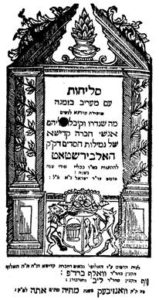
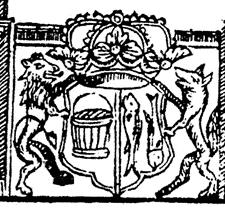
Selihot with ma’ariv be-zemanah (evening prayers in its time) is one of if not the first dated book attributed to Israel ben Abraham in Wandsbeck; it is a small octavo book (80: 7, 9, [4], 10-13, 13-23, [3] ff.). Its distinct title-page states that it is a Selihot with ma’ariv be-zemanah and that it contains matter pertaining to women; it informs that it was printed “as vowed and accepted upon themselves by the men of the hevra kaddisha (burial society) of the gemilut hasadim (charitable association) of HALBERSTADT,” and that it was “brought to press by the heads, the officers of the hevra kaddisha, R. Wulff and the noble R. Leib Warburg.” The title-page is dated in the year “You resuscitate the dead מחיה מתים אתה (469 = 1709),” a misdate, as noted by Moritz Steinschneider, who rejects the 1709 date (non admittunt; recusus ergo . . .) and dates it to 1730?[24]  At the bottom of the title-page are images of a lion at the left supporting a signet enclosing a pail, at the right a wolf supporting on the right side of the signet, two vertical fish, facing in different directions. The symbolism of these images is not clear, although it might be related to Wulff and Warburg, prominent contemporary family names.

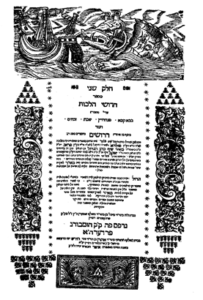
The most dramatic, eye catching title-page with a fish motif was printed in Bad Homburg vor der Höhe at the press of Aaron ben Zevi Hirsch of Dessau. This Homburg is the district town of the Hochtaunuskreis, Hesse, Germany, on the southern slope of the Taunus, bordering, among others, Frankfurt am Main and Oberursel.[25] The title-page appears on successive editions of R. Meir ben Jacob ha-Kohen Schiff’s (Maharam Schiff, 1605-41, var. 1608-44) Hiddushei Halakhot, novellae on tractates of the Talmud, printed in Homburg in 1737, 1741, and 1747. Maharam Schiff, scion of a distinguished rabbinic family, a prodigy, was appointed rabbi of the important city of Fulda at the age of 17, where he was also served as a Rosh Yeshivah. There is a tradition that he was appointed rabbi of Prague in 1641, but if, as his grandson, who brought his works to press, reports, that he lived only 36 years, Maharam Schiff must have passed away immediately after his appointment. Maharam Schiff’s novellae are highly regarded and are reprinted in standard editions of the Talmud.[26]

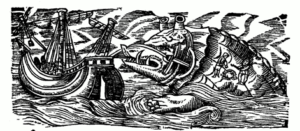
The title-page has a four part frame, the top image of a fish (sea creature) attacking a ship and within the fish two men, apparently roasting a small fish (?). Below the fish (sea creature) appears to be the face of a man. On the other editions the other portions of the frame are varied. A. M. Habermann, in his work on Hebrew title-pages describes the top portion of the frame as mythological.[27]

Fig. 11 1741, Hiddushei Halakhot

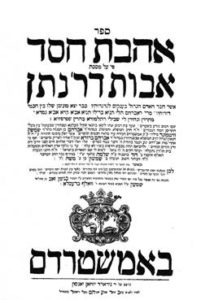
Returning to Amsterdam, an edition of Avot de-Rabbi Nathan with the commentary Ahavat Hesed (1777) by R. Abraham ben Samuel Witmond (1696-1773), also the author of novellae on the Pentateuch and Babylonian Talmud (1734). Avot de-Rabbi Nathan is one of the minor tractates, fourteen (fifteen, depending upon the enumeration) minor non-canonical tractates of the Talmud today appended to Seder Nezikin. It is an ethical work, considered a supplement to or a further development of Avot but with much aggadic material not related to the Mishnah, suggestive of an aggadic midrash. Ahavat Hesed was published posthumously by Witmond’s son-in-law and grandson at the press of Gerard Johann Janson. The header and place of publication on the title-page are printed in an oversized font in red letters. At the bottom of the page is a pressmark

Fig. 12a Ahavat Hesed

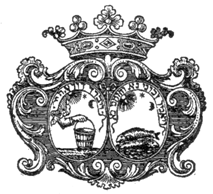
Fig. 12b Ahavat Hesed Extract

At the bottom of the title-page is a shield with topped by a coronet and within it on the right are two fish facing in opposite directions, above them the sun, moon, and a star, and above them the phrase “and (Samson) said, [O Lord God,] remember me, I pray you, and strengthen me” (Judges 16:28); on the left a hand holding a pail above water, again above the sun, moon, and a star, and above the phrase “And David blessed the Lord” (I Chronicles 29:10). Yaari informs that the two phrases, allude to Witmond’s son-in-law, R. David, son of the late Solomon Bloch, together with the author’s grandson, Samson ben Moses, who brought the book to press. Furthermore, the fish refer to Samson ben Moses, born in the month of Adar, the sign of which is a fish, and the pail refers to his son-in-law David, born in the month of Shevat, that month’s sign being a pail.[28]

            The fish image, replete with its symbolism of fertility and good fortune, continued to be used in Jewish imagery and pressmarks. Indeed, shortly after its appearance on Ahavat Hesed it was again employed, if only occasionally, on the title-page of works from another Amsterdam printer, this into the nineteenth century. The usage over centuries depicted here attest to the popularity and power of the fish image, persisting to the present.

[1] Joseph Lowin, “Hebrew Root Word [D-Y-G]” Jewish Heritage on Line Magazine, http://www.jhom.com/topics/fish/lowin.html.
[2] Ellen Frankel and Betsy Platkin Teutsch, The Encyclopedia of Jewish Symbols) Northvale, London, 1995), p. 55.
[3] https://commons.wikimedia.org/wiki/Category:Salmons_in_heraldry
[4] W. Roberts, Printers’ Marks. A Chapter in the History of Typography, (London, 1893), pp. 201-02.
[5] Previous articles in this series are “Mirror-image Monograms as Printers’ Devices on the Title Pages of Hebrew Books Printed in the Seventeenth and Eighteenth Centuries,” Printing History 40 (Rochester, N. Y., 2000), pp. 2-11, reprinted in Studies in the Making of the Early Hebrew Book (Brill, Leiden/Boston, 2008), pp. 33-43; “The Cover Design, ‘The Printer’s Mark of Marc Antonio Giustiniani and the Printing Houses that Utilized It,’” Library Quarterly, 71:3 (Chicago, July, 2001), pp. 383-89, reprinted in Studies, pp. 44-53; “Mars and Minerva on the Hebrew Title Page,” The Papers of the Bibliographical Society of America 98:3 (New York, N. Y., 2004), pp. 269-92, reprinted in Studies, pp. 1-17; “The Bear Motif on Eighteenth Century Hebrew Books” The Papers of the Bibliographical Society of America 102:3 (New York, N. Y., 2008), pp. 341-61, reprinted in Further Studies in the Making of the Early Hebrew Book (Brill, Leiden/Boston, 2013), pp. 57-76; “Akedat Yitzhak (the Binding of Isaac) on the Title-Pages of Early Hebrew Books,” in Further Studies, pp. 35-56; “The Eagle Motif on 16th and 17th Century Hebrew Books,” Printing History, NS 17 (Syracuse, 2015), pp. 16-40; “The Lion Motif on Early Hebrew Title-Pages and Pressmarks,” (Printing History, NS 22, (Syracuse, 2015), pp. 53-71.
[6] Among the primary sources for this article are my The Sixteenth Century Hebrew Book: An Abridged Thesaurus (Brill, Leiden, 2004) and my The Seventeenth Century Hebrew Book: An Abridged Thesaurus. Brill, Leiden/Boston, 2011, and Avraham Yaari, Hebrew Printers’ Marks From the Beginning of Hebrew Printing to the End of the 19th Century, (Jerusalem, 1943), Hebrew with English introduction.
[7] Kabbalah Centre, https://livingwisdom.kabbalah.com/pisces-adar.
[8] Aish.com, http://www.aish.com/h/pur/b/The_Choice_of_Adar.html.
[9] Concerning the widespread use of this frame see my “Mars and Minerva on the Hebrew Title Page,” noted above.
[10] Yaari, Hebrew Printers’ Marks, pp. 12, 132 no. 19.
[11] Yaari, p. 132.
[12] Moritz Steinschneider, Catalogus Liborium Hebraeorum in Bibliotheca Bodleiana (Berlin, 1852-60), col. 220 n. 1407, col. 228 n. 1427.
[13] Nowy Dwor, Polish for ‘new manor’, is the prefix of several locations with that title. Another Nowy Dwor, Nowy Dwor Mazowiecki, was home to a Hebrew press in the late eighteenth – early nineteenth centuries, printing a significant number of Hebrew titles from 1781 through 1818.
[14] Yaari, pp. 26, 139 no. 42.
[15] A. M. Haberman, Title Pages of Hebrew Books (Safed, 1969), pp.m 48,129 no. 34; Isaac Yudlov, Hebrew Printers’ Marks: Fifty-Four Emblems and Marks if Hebrew Printers and Authors (Jeruslaem, 2001), pp. 36-40 [Hebrew]. He also informs that three small fish are the mark of the Gronim family of Prague in the sixteenth century, appearing on their headstones.
[16] Concerning Lida and Migdal David see my“David ben Aryeh Leib of Lida and his Migdal David: Accusations of Plagiarism in Eighteenth Century Amsterdam,” Shofar 19:2 (West Lafayette, Ind., 2001), pp. 117-28, reprinted in Studies in the Making of the Early Hebrew Book, pp. 191-205.
[17] Another work refering to Shabbetai Zevi noted by Ch. B. Friedberg, History of Hebrew Typography of the following Cities in Europe: Amsterdam, Antwerp, Avignon, Basle, Carlsruhe, Cleve, Coethen, Constance, Dessau, Deyhernfurt, Halle, Isny, Jessnitz, Leyden, London, Metz, Strasbourg, Thiengen, Vienna, Zurich. From its beginning in the year 1516 (Antwerp, 1937), p. 29 [Hebrew] published by Uri Phoebus is Tikkun Keria with a depiction of Shabbetai Zevi “sitting upon a throne, high and lifted up” (Isaiah 6:1).
[18] Ch. B. Friedberg, History of Hebrew Typography in Poland from the beginning of the year 1534, and its development up to our days . . . Second Edition, Enlarged, improved and revised from the sources (Tel Aviv, 1950), p. 64 [Hebrew] and Yaari, p. 158, date Uri Phoebus death to 1705. L. Fuks and R. G. In contrast, Fuks-Mansfeld, Hebrew Typography in the Northern Netherlands 1585 – 1815, II (Leiden, 1984), p. 242, writes that although Uri Phoebus was very productive in Zolkiew, he returned to Amsterdam in 1705, where, in 1710, he wrote “a short history of the first settlement of the Sephardic Jews in Amsterdam,” and where he died on 23 Shevat 5475 (17 January, 1715).
[19] Yaari, p. 158.
[20] Yosef Hayyim Yerushalmi, Haggadah and History, A Panorama in Facsimiles of Five Centuries of the Printed Haggadah from the Collections of Harvard University  and the Jewish Theological Society of America, (Philadelphia, 1976), plates 64, 65.
[21] Yeshayahu Vinograd, Thesaurus of the Hebrew Book. Listing of Books Printed in Hebrew Letters Since the Beginning of Printing circa 1469 through 1863 I (Jerusalem, 1993-95), I, p. 450 [Hebrew]; Yaari, pp. 51, 152-52 no, 82; Yudlov, pp. 59-61
[22] Concerning Hebrew printing in Wandsbeck see Marvin J. Heller, “Israel ben Abraham, his Hebrew Printing-Press in Wandsbeck, and the Books he Published,” Further Studies in the Making of the Early Hebrew Book (Brill, Leiden/Boston, 2013), pp. 169-93.
[23] Vinograd, II, pp. 168-69.
[24] Steinschneider, cols. 2792-93 no. 7517, 446-47 no. 2939.
[25] Concerning Hebrew printing in Homburg see my “Early Hebrew Printing in Bad Homburg vor der Höhe,” in progress.
[26] Itzhak Alfassi, “Schiff, Meir ben Jacob Ha-Kohen,” Encyclopaedia Judaica, (Detroit, 2007) vol. 18, p. 131; Mordechai Margalioth, ed. Encyclopedia of Great Men in Israel IV (Tel Aviv, 1986), col. 1028-29 [Hebrew].
[27] A. M. Habermann, Title Pages of Hebrew Books (Tel Aviv, 1969), pp. 104, 134 no. 88 [Hebrew].
[28] Marvin J. Heller, Printing the Talmud: A History of the Printed Editions of the Talmud from the mid-17th Century to the end of the 18th Century and the Presses that published them (Brill: forthcoming); Yaari, Hebrew Printers’ Marks, pp. 89, 169-70 no. 145.


A Short Note Regarding an Illustrated Title Page and A Possible Unicum

A Short Note Regarding an Illustrated Title Page and A Possible Unicum


There are a series of books, Seder ha-haʻarakhah ve-haHanhagah, that record the tax law and taxes paid by the Mantuan community and were published in Mantua. [1] The taxes were calculated by communally elected assessment formulators.  The taxes were used to support the entire communal infrastructure, including the administration of communal organizations and funds for the poor.  As today, each person would provide an accounting of their funds reducing their taxable income based upon recognized deductions and certain exempted property. The formulators were wholly responsible for the determination of the specific levied taxes and could reject suspect ax filings and impose fines.

The first edition was published in 1651 and each edition covers three years, of which the National Library has 17 editions. The British Library holds 12, seven that are not in the National Library’s collection. Vinograd lists 22 editions, six in neither library. [2] (A full bibliography appears below)

There is, however, at least one edition in the series that was not published in Mantua, the most logical location, but in Venice by Bragadin in 1711.  The likely reason for the change in venue is that from 1707-1712, there were no books printed in Mantua. [3] Nonetheless, these records were so important that the community went to Venice to publish the records.


Steinschneider, based upon Wolf’s bibliography, does identify this edition of the work. [4] But the book is not extant in the Bodleian Library.[5]  Nonetheless, no modern bibliography, e.g. Vinograd or Friedberg, records the Venice edition nor does the National Library or any other library I can identify (based on a search of WorldCat) own a copy of the book.  There is one copy, however, in the Gross Family Collection in Tel Aviv, and is possibly a unicum – the only extant copy.  Although as Judge Meyer Sulzberger, himself an avid book collector, noted that caution is necessary when identifying a unica, because “that the great weakness about a unicum is that presently one or two other people are found to have the book, and instead of contently agreeing that each of them has a unicum, each feels the value of his possession has been materially impaired.”  To this we can add that without concrete evidence of the book’s singularity, there may be private collections or public ones whose holdings are insufficiently cataloged to make a confident identification regarding the rarity of any book.  Indeed, Sulzberger provides many examples of books thought to unica, only to be identified as “merely” rare.[6]

I should also note that the Venice copy has a nice title page with Moses and Aaron. (For a discussion of depictions of Moses and Aaron on Hebrew title pages see our earlier post here.)   A very similar title page appears on a later book printed in Mantua, 1720, Mishlei ve-Eiov, although in this instance it is David and Solomon who flank the title.

Additionally, the depiction of the Moses, Aaron, Solomon and David are similar to the ones that appear – Rambam, Rashi, R Yosef Karo, Rama, and the author – on the Gur Areyeh, a commentary on Shulkhan Orakh, Mantua, 1722.

There are two editions of this book printed within a year of one another.  The second printing lacks the images entirely and the first they only appear in Orakh Hayyim, and, although not noted in bibliographies or articles regarding the book, in at least one example the title pictorial title pages also appears in Yoreh Deah.

The remaining three (or two) volumes do not contain the images.  This led some to speculate that the images were deliberately removed, and that page was ripped out at the behest of the Mantua rabbinate and a variety of theories are offered, ranging from concern over reproducing human image to the inclusion of the author among such a distinguished group was egotistical, that the Rambam lack ed peyot, or that the portraits are just not flattering. [7]


But, both the claim of censorship and the rationale are unsupported.  Most extant copies include that page and there are many earlier examples of books containing human images including of biblical figures, many without peyot, or not dressed in flattering clothing.  There is no independent evidence to suggest anything other than a benign reason, perhaps the woodcuts wore out.  This aligns with the fact that the printer was known for crude lettering so much so that it nearly lost its ability to print at all and only survived because another party stepped in. Thus it is unlikely the lack of the portraits in the later volumes is an instance of censorship.[8]


* The identification of the Gross edition as a unicum is only preliminary and still a work in progress.  The author encourages anyone with additional information regarding this edition to comment or send an email to seforimblog@gmail.com

[1] See Shlomo Simonshon, Tolodot ha-Yehudim be-Duhosot Mantua, vol. 1 (Jerusalem, 1963), 274-86; see also Marvin J. Heller, The Seventeenth Century Hebrew Book: An Abridged Thesaurus, vol. 2 (Leiden: Brill, 2011), 957.

[2] For the NLI listing see here;   Diana Rowland Smith, Second Supplementary Catalog of Hebrew Books in the British Library 1893-1960, vol. 2 (London:  British Library, 1994), 599; Joseph Zedner, Catloglouge of the Hebrew Books in the Library of the British Museum (London, 1867), 510 recording Mantua 1759; Yeshayahu Vinograd, Otsar ha-Sefer ha-Ivri (Jerusalem:  Machon Lebibliograhia Memuhshevet, 1994).

[3] See Ch. B. Freidberg, Tolodot ha-Defus ha-Ivri be-Italia:  Be-Midenot Italiah, Aspnyah-Portugal, ve-Turgemah she-Melfenim (Tel Aviv:  Bar-Yeda, 1956), 20.  Friedberg does not explain the cause of the stoppage.

[4] Moritz Steinschneider, Catalogus Librorum Hebraeorum in Bibliotheca Bodleiana (Berollini:  Ad. Friedlander, 1852-1860) columns 625-66; Johann Christoph Wolf, Bibliothecae Hebraeae, vol. 3 (Hamburg:  Christoph Felgineri Viduam, 1827), 1207-08 (Steinschneider’s citation to Wolf should be corrected to read vol. 3 and not vol. 2).

[5] See A.E. Cowley, A Concise Catalogue of the Hebrew Printed Books in the Bodleian Library (Oxford:  Clarendon Press, 1929), 410 (listing only Mantua).

[6] Meyer Sulzberger, “Books and Bookmen,” Menorah XXXVI (Jan. 1904), 38-40. For other Hebrew unica see Marvin J. Heller, “Unicum, Fragments, and Other Hebrew Book Rarities,” Judaica Librarianship 18 (2014), 130-53.

[7] See Shmuel Weiner, Daat Kedoshim:  Pesak Herem:  Mazkeret Rabanei Italiah (Petroberg: Berman Press, 1897), 38**; Aviad Cohen, “Diuknot Hakhamim:  Bein Halkha le-Maashe,” Mahnayim 10 (1995). See Mifal ha-Bibliographia ha-Ivrei entry Gur Areyeh .

One scholar viewed the selection of personages to grace the title page as an indication of their imporatance.  Specifically the inclusion of the Mahril was used to demonstrate his unique contribution to the formation of the Shulchan Orakh.  See Yisrael Peles, Mevo ve-Hosafot le-Sefer Mahril (Jerusalem:  Machon Yerushalim, 2016), 258. (Thanks to Eliezer Brodt for providing this source).

[8] Friedberg, Tolodot ha-Defus ha-Ivri, 20-21. For another example of spurious reasons for a change to the title page, see Dan Rabinowitz, “Sheti ha-Girsot shel Shu”t ha-Bakh, Mahadurot Frankfort TN”Z:  Totsot shel Shikul Tsniut, Sha’arim be Shut ha-Bach,” Alei Sefer  21(2010), 99-112.


Bibliography of Seder ha-Ha’arakhah


Mantua, 1651(BL)

Mantua, 1656 (NLI)

Mantua, 1670 (V)

Mantua, 1675 (BL)

Mantua, 1679 (NLI)

Mantua, 1682 (V)

Mantua, 1685 (V)

Venice, 1711 (Gross)

Venice, 1714 (Wolf)

Venice, 1717 (Wolf)

Mantua, 1722 (BL)

Mantua, 1722 (BL) (& a variant)

Mantua, 1726 (NLI)

Mantua, 1729 (V)

Mantua, 1732 (NLI)

Mantua, 1735 (NLI)

Mantua 1737 (BL)

Mantua, 1739 (NLI)

Mantua, 1743 (BL)

Mantua, 1747 (NLI)

Mantua, 1750 (NLI)

Mantua, 1753 (NLI)

Mantua, 1756 (NLI)

Mantua, 1759 (NLI)

Mantua, 1773 (BL)

Mantua, 1777 (NLI)

Mantua, 1780 (NLI)
Mantua, 1783 (V)

Mantua, 1786 (NLI)

Mantua, 1789 (NLI)

Mantua, 1793 (V)

Mantua, 1795 (NLI)

Mantua, 1798 (NLI)


Who can discern his errors? Misdates, Errors, Deceptions, and other Variations in and about Hebrew Books, Intentional and Otherwise: Revisited

Who can discern his errors?
Misdates, Errors, Deceptions, and other Variations in and about Hebrew Books, Intentional and
Otherwise: Revisited[1]
by Marvin J. Heller

Marvin J. Heller is the award winning author of books and articles on early Hebrew printing and bibliography. Among
his books are the Printing the Talmud series, The Sixteenth and Seventeenth Century Hebrew Book(s): An Abridged Thesaurus, and collections of articles.

R. Eleazar once entered a privy, and a Persian [Roman] came and thrust him away. R. Eleazar got up and went out, and a serpent came and tore out the other’s gut. R. Eleazar applied to him the verse, “Therefore will I give a man (אָדָם adam) for thee (Isaiah 43:4).” Read not adam [a man] but אֱדֹם edom [an Edomite = a Roman] corrected by the censor to “but a Persian.” (Berakhot 62b)
 “R. Eleazar said: Any man who has no wife is no proper man; for it is said, Male and female created He them and called their
name Adam” corrected by the censor to “any Jew who is unmarried” (Yevamot 63a).[2]
Sensitivity to the contents of Jewish texts by non-Jews, and apostates in their employ, was a feature of Jewish life at various periods, one particularly notable and noxious time being in the sixteenth century when, during the counter-Reformation, the Church undertook to censor and correct those Hebrew books that were not placed on the index and banned in their entirety. In the first example, the understanding based on the reading of adam אָדָם as edom אֱדֹם (Rome) is completely lost by the substitution of Persian for Edom. In the second example “Any man who has no wife is no proper man” was deeply offensive to a Church that required an unmarried and celibate clergy. In both instances the text was altered to adhere to the Church’s sensibilities despite the fact that not only was the original intent lost but that, particularly in the first case, it ceased to be meaningful.
            Books, and even more so Hebrew books, often underwent modifications, textual changes, due to the vicissitudes and complexities of the Jewish condition, frequently involuntary. The subject of “Misdates, Errors, Deceptions, and other Variations in and about Hebrew Books, Intentional and Otherwise,” addresses textual changes, as well as other errors, intentional and unintentional, that may be found in Hebrew books. Addressed previously in Hakirah, this is a companion article, providing additional examples of book errors, variations, and discrepancies. As noted previously, errors “come in many shapes and forms. Some are significant, others are of little consequence; most are unintentional, others are purposeful. When found, errors may be corrected, left unchanged, or found in both corrected and uncorrected forms. . . . Other errors are not to be found in the book per se but rather in our understanding of the book. This article is concerned with errors in and about Hebrew books only. It is not intended to be and certainly is not comprehensive, but rather explores the variety of errors, some of consequence, most less so, providing several interesting examples for the reader’s edification and perhaps enjoyment.”[3]
Among the errors discussed in this article are 1) those dealing with the expurgation of the Talmud; 2) expurgation of other Hebrew works; 3) internal censorship, that is, of Hebrew books by Jews; 4) accusations of plagiarism and forgery; 5) misidentification of the place of printing; 6) confusion due to mispronunciations.
I
            Returning to the beginning of the article, the Talmud, initially banned in 1553 and placed on the Index librorum prohibitorum in 1559, was subsequently permitted by the Council of Trent in 1564, but only under restrictive and onerous conditions. Reprinted in greatly censored form, the introductory quote refers to modifications in the Basle Talmud (1578-81). A condition of the Basle Talmud was that the name “Talmud” be prohibited. Heinrich Graetz explains the Pope’s and Council’s considerations in forbidding the name.
the Council only approved the list of forbidden books previously made out in the
papal office, the opinion of the pope and those who surrounded him served as
a  guide in the treatment of Jewish writings. The decision of this point was left to the pope, who afterwards issued
a bull to the effect that the Talmud was indeed accursed – like Reuchlin’s ‘Augenspiegel
and Kabbalistic writings’ – but that it would be allowed to appear if the name
Talmud were omitted, and if before its publication the passages inimical to
Christianity were excised, that is to say, if it were submitted to censorship
(March 24th, 1564). Strange, indeed, that the pope should have allowed the
thing, and forbidden its name! He was afraid of public opinion, which would
have considered the contradiction too great between one pope, who had sought
out and burnt the Talmud, and the next, who was allowing it to go untouched. At
all events there was now a prospect that this written memorial, so
indispensable to all Jews, would once more be permitted to see the light,
although in a maimed condition.[4]
            Among the most egregious examples of censorship of the Talmud is Bava Kamma 38a. That amud (page) of the Talmud, dealing with financial relations between Jews and non-Jews, was expurgated, almost in its entirety. Prior to the much censored Basle Talmud (1578-1581) the text was completely printed, for example, in the 1519/20-23 Venice edition of the Talmud published by Daniel Bomberg. After the censored Basle Talmud was published, initially, rather than contract the text, large blank spaces were left, clearly indicating that text had been expurgated.
            Abraham Karp notes that in some editions of the Talmud “many expurgated passages are restored, and where deletions are retained, blank spaces are left to indicate the omission to the reader and, no doubt, to permit him to fill in by pen what they dared not to print.”[5] An example of the blank spaces can be seen from the Frankfurt an der Oder Talmud 1697-99, printed by Michael Gottschalk. Such omissions are to be found in almost all seventeenth and early eighteenth editions of the Talmud, a notable exception being the Benveniste edition (Amsterdam, 1644-47).[[6]  Rabbinovitch too notes that blank spaces were left for expurgated text, those omissions being consistent with the Basle Talmud. He adds, however, that this policy was followed until the 1835 Vilna Talmud. At that time government officials prohibited the practice so that the omissions would not be so obvious.[7]  In fact, text was consolidated much earlier, as evidenced, by the illustrations of Bava Kama 38a from the 1734‑39 Frankfurt an der Oder Talmud. This expurgated material is restored in current editions of the Talmud.

Frankfurt an der Oder – 1697-99

Frankfurt an der Oder – 1734-39

Another example of interest, one that has not fared as well, the text not yet restored in most editions of the Talmud, is to be found in Shabbat 104b and Sanhedrin 67a. The reference there is to Ben Satda, beginning, in the latter tractate “and so they did to Ben Satda
in Lod, and hung him on erev Pesah. Ben Satda? He was the son (ben) of Padera . . .”[8] Popper notes that Gershom Soncino, when publishing “a few of the Talmudic tracts at Soncino during the last decade of the fifteenth century, he took care not to restore any of the objectionable words in the MSS. from which he printed.”[9] Here too the text is complete in the Bomberg Talmud. Two subsequent exceptions in later editions of Sanhedrin where the Ben Satda entries do appear are in the Talmud printed by Immanuel Benveniste and in the edition of Sanhedrin printed in Sulzbach in or about 1696.

Sanhedrin 67a, Benveniste Talmud
However, in two complete editions of the Talmud (1755-63, 1766-70) printed in Sulzbach, the Ben Satda entries are omitted, as is the case of most modern editions of the Talmud.[10]
II
            The Talmud isn’t the only work to have been censored. Amnon Raz-Krakotzkin provides several examples of text in books
that were modified due to the censor’s ministrations. Among them is R. Abraham ben Jacob Saba’s (d. c. 1508) Zeror ha-Mor, a commentary on the Pentateuch based on kabbalistic and midrashic sources.[11] On the passage “They would slaughter to demons without power, gods whom they knew not, newcomers recently arrived, whom your ancestors did not dread” (Deuteronomy 32:17), referring to “Christians in general and priests in particular as ‘demons’ (shadim): ‘For as the nations of the world, all their abominations and vanities come from the power of demons, hence, the monks would shave the hair of their heads  and leave some at the top of the head as a stain.’” This passage continues, referring to bishops and popes, concluding that their entire heads are shaved like a marble with only a bit of hair about their ears, so that they have the appearance of demons, hairless, and like demons, provide no blessings, are like a fruitless tree, and “thus, it is fitting that they bear no sons of daughters.” Raz-Krakotzkin informs that this passage appeared in the first two editions of Zeror ha-Mor printed by Bomberg, and the Giustiniani edition (1545) but was already expurgated by the Cavalli edition (1566), a blank space in place of the text. That space subsequently disappeared and, although a Cracow edition based on the Bomberg Zeror ha-Mor restored the text it remains missing from most later editions.[12] Raz-Krakotzkin continues, citing additional examples.
            Early halakhic works were also subject to the ministrations of the censor.[13] Among them are such works as R. Samson ben Zadok’s (thirteenth century) Sefer Tashbez (Cremona, 1556). Samson was a student of R. Meir of Rothenburg (Maharam, c. 1220-1293). When the latter was imprisoned in the tower of Ensisheim, Samson visited him regularly, serving as his attendant and carefully recording in Tashbez Maharam’s teachings, customs, and daily rituals, as well as what he heard and observed, from the time Meir rose in the morning until he retired at night, on weekdays, Sabbaths, and festivals. Although a relatively small work (80: [6], 55 leaves), it consists of 590 entries beginning with Sabbath night (1-17), Sabbath day (18-98), followed by festivals, Sefer Torah, priestly benedictions, prayer, slumber, talis and tefillin, benedictions, issur ve-heter (dietary laws), redemption of the first born, hallah, vows, marriage and divorce, monetary laws, and piety. Expurgation by the censor of Tashbez was done sloppily, for terms such as meshumad and goy, normally excised, remain, but with a disclaimer near the end that they refer to idol worshipers only.[14]
III
Not all errors are due to the ministrations of the censor. Jews, too, at times, have taken their turns at modifying the text of books.
            A recent and perhaps quite surprising example of internal censorship is to be found in R. Solomon Ganzfried’s (1804–1886) Kizzur Shulḥan Arukh. First printed in 1864, that work an abridgement of the Shulhan Arukh for the average person, went through fourteen editions in the author’s lifetime, and numerous editions since then, as well as translations into many languages and has been the subject of glosses.[15] Marc B. Shapiro informs that in the Lublin (1904) edition of the Kizzur Shulḥan Arukh and several other editions the entry (201:4) that “apostates, informers, and heretics –for all these the rules of an onan and of mourners should not be observed. Their brothers and other next of kin should dress in white, eat, drink, and rejoice that enemies of the Almighty have perished,” the words “apostates, informers, and heretics” have been removed. In the Vilna edition (1915) the entire paragraph is removed and the sections renumbered from seven to six. In the Mossad Harav Kook vocalized edition a new halakhah was substituted, but that has since been corrected to reflect the original text. The reason, according to Shapiro, is that with the expansion of Jewish education to include girls, it was felt that schoolchildren, with assimilated relatives, would see this as referring to family members.[16] Several recent editions of the Kizzur Shulḥan Arukh that were examined, in both Hebrew and English, have the original text.
            R. Abraham Isaac Kook (1865–1935), chief rabbi of Jerusalem and first Ashkenazic chief rabbi in Israel (then Palestine),
was a profound, influential, and mystical thinker. Highly regarded by his contemporaries, his strongly Zionist views also resulted in some opposition, but even most of his contemporaries who disagreed with him held him in high regard. Shapiro notes that with time, Kook’s reputation changed. Despite the fact that such pre-eminent rabbis as R. Solomon Zalman Auerbach (1910-95) and R. Joseph Shalom Elyashiv (1910-2012) were unwavering in their high regard of Kook, strong anti-Kook sentiment developed later in religious anti-Zionist circles. Shapiro notes that “Kook has been the victim of more censorship and simple omission of fact for the sake of haredi ideology than any other figure. When books are reprinted by haredi and anti-Zionist publishers Kook’s approbations (hascomas) are routinely omitted.” One of several examples of this modified opinion Shapiro cites is a lengthy eulogy delivered by R. Isaac Kossowsky (1877-1951) praising Kook. When the eulogy was reprinted in She’elot Yitzhak, a collection of Kossowsky’s writings, the name of the subject of the eulogy, Rav Kook, was omitted. In the reprint of She’elot Yitzhak the eulogy is deleted in its entirety.[17]
            Shapiro’s observation about Rav Kook’s approbations is confirmed in several books. R. Eliezer Mansour Settehon’s (Sutton, 1860-1937) Notzar Adam: Hosafah Notzar Adam (Tiberius, 1930), discourses on spiritual development, has approbations from R. Abraham Abukzer, R. Moses Kliers, and R. Jacob Hai Zerihan, and R. Abraham Isaac ha-Kohen Kook. In a description of Notzar Adam in in Aleppo, City of Scholars (Brooklyn, 2005), Kook’s name, Kook’s name is omitted from a list of the book’s approbations.[18]

In a variation of this, two internet sites that reproduce the full text of Hebrew books both include Rav Isaac
Hutner’s (1906-80) Torat ha-Nazir (Kovno, 1932). This, the first edition, has three approbations; a full page hascoma from R. Hayyim Ozer Grodzinski (1863–1940), and the following page two approbations, side by side, from R. Abraham Duber Kahana (1870–1943) and Rav Kook. The first internet site, with more than 53,000 books for free download, follows R. Grodzinski’s approbation with a blank page and then the text. The second, a subscription site with more than 76,000 scanned books, goes directly from R. Grodzinski’s hascoma to the text, dispensing with the blank page, also not reproducing the second page of approbations. It is not clear whether the copies scanned were faulty, the scanning incomplete, or the omission intentional. Nevertheless, to conclude this section on a positive note, surprisingly, given the omission of Rav Kook’s approbation in both scans of Torat ha-Nazir, both sites list and provide an extensive number of Rav Kook’s works.

IV
Accusations of plagiarism accompany the publication of two works by and/or attributed to R. Nathan Nata ben Samson Spira (Shapira, d. 1577). Spira, born to a distinguished family that was, according to the Ba’al Shem Tov, one of the three pure families throughout the generations in Israel (the others being Margulies and Horowitz), served as rabbi in Grodno (Horodno) until 1572, when he accepted a position in Posnan. His grandson was R. Nathan Nata ben Solomon Spira (Megalleh Amukkot, c. 1585-1633). Among Nathan Nata Spira’s works is Imrei Shefer (20: [1], 260 ff.), a super-commentary on Rashi and R. Elijah Mizrahi (c. 1450–1526). The book was brought to press by Spira’s son R. Isaac Spira (d. 1623), Rosh Yeshiva in Kovno and afterwards in Cracow. Work on Imrei Shefer began in Cracow in 1591 but before printing was finished Isaac Spira accepted a position in Lublin where publication was completed at the press of Kalonymus ben Mordecai Jaffe (1597).[19]
The title-pages states that Spira, “gives goodly words (Imrei Shefer)’ (Genesis 49:21) and he gives, ‘seed to the sower, and bread לזורע ולחם (357=1597) to the eater’ (Isaiah 55:10) of Torah.” In the introduction, Isaac informs that the work is entitled Imrei Shefer from the verse, “he gives goodly words” (and the word “he gives הנתן” in the Torah is without a vav), implying the name of the author [Nathan נתן] and Shefer שפר is language of Spira שפירא the family name of the author. Isaac then addresses the existence of an unauthorized and fraudulent edition ascribed to his father, printed in Venice (Be’urim, 1593),
found and brought out by men who lack the yoke of the kingdom of heaven. A work discovered, who knows the identity of the author, perhaps a boy wrote it and wanted to credit it to an authoritative source אילן גדול), [my father my lord]. God forbid that his holy mouth should bring forth words that have no substance, vain, worthless, and empty, a forgery, “[And, behold], it was all grown over with thorns, and nettles had covered it over” (Proverbs 24:31).
Isaac Spira took his complaint to the Va’ad Arba’ah Artzot (Council of the Four Lands), requesting they prohibit the distribution of the Be’urim in Poland. The response of the Va’ad is printed at the end of the introduction,
It has been declared, by consent of the rabbis, and the [communal] leaders of these lands,
that these books shall neither be sold nor introduced into [any Jewish] home in
any of these lands. Those who have [already] purchased them shall receive their
money back and not keep [such] an evil thing in their home.
What was and who wrote the Be’urim, the reputedly plagiarized copy of R. Nathan Nata ben Samson Spira’s Imrei Shefer? The title-page of the Be’urim (40: 180 ff.), printed in Venice in 1593 “for Bragadin Giustiniani by the partners Matteo Zanetti and Komin Parezino at the press of Matteo Zanetti,” states that it was written by ha-Rav, the renowned, the gaon, R. Nathan from Grodno in the year, “For you shall go out with joy בשמחה (353=1593), and be led forth with peace” (Isaiah 55:12). Be’urim does not have an introduction nor a colophon that provides any additional information.
Isaac Spira’s accusation that the Be’urim is a forgery, not to be ascribed to his father, but rather was written by an unknown young man who then attributed it to Spira, is confirmed by R. Issachar Baer Eylenburg (1550-1623), who writes in his responsa, Be’er Sheva (Venice, 1614) and also in his commentary on Rashi, Zeidah La-Derekh (Prague, 1623) that it is obvious that the Be’urim were not the work of the holy Spira, but rather of an erring student “who hung (attributed it) to himself, hanging it on a large tree” (cf. Pesahim 112a).[20]
Among the distinguished sages of medieval Sepharad is Rabbenu Bahya ben Asher ben Hlava (c. 1255-1340). Best known for his popular, multi-faceted, and much reprinted Torah commentary, written in 1291 and first published in Naples (1491),  Rabbenu Bahya was also the author of Kad ha-Kemaḥ (Constantinople, 1515) and Shulḥan shel Arba (Mantua, 1514). The former, Kad ha-Kemaḥ, is comprised of sixty discourses on varied subjects, among them festivals, prayer, faith, and charity, all infused with ethical content. Among the numerous editions of Kad ha-Kemaḥ is a scholarly edition entitled Kitvei Rabbenu Baḥya (Jerusalem, 1970) edited and with annotations by R. Hayyim Dov Chavel (1906–1982).
Among the essays in Kad ha-Kemaḥ is one entitled Kippurim, on Yom Kippur. Part of that discourse includes a commentary on the book of Jonah, read on Yom Kippur. Chavel, in the introduction to his annotations on Rabbenu Bahya’s commentary on Jonah, suggests that Rabbenu Bahya took his commentary from R. Abraham ben Ḥayya’s (d. c. 1136) Hegyon ha-Nefesh, first published by E. Freimann (Leipzig,
1860). Abraham ben Ḥayya, a resident of Barcelona, was a philosopher, mathematician, and astronomer, reflected in his several works, including translations from the Arabic. Hegyon ha-Nefesh “deals with creation, repentance, good and evil, and the saintly life. The emphasis is ethical, the approach is generally homiletical – based on the exposition of biblical passages – and it may have been designed for reading during the Ten Days of Penitence.”[21] Kitvei Rabbenu Baḥya and Hegyon ha-Nefesh are sufficiently alike to support Chavel’s contention that
Rabbenu utilized the Sefer Hegyon ha-Nefesh (or Sefer ha-Mussar) of the earlier sage R. Abraham ben Ḥayya ha-Nasi, known as ṣāḥib-al-shurṭa . . . In it is found this commentary on the book of Jonah. This was already noted by the author of Zaphat ha-Shemen – the usage by Rabbenu of this book is comparable to his use of other works: according to his needs. The reason that he does not mention it in his commentary is, perhaps, because the books of R. Abraham ha-Nasi were well known, and the leading sages, such as the Rambam, Ramban and other leading rabbis utilized it, comparable to “Joshua was sitting and delivering his discourse without mentioning names, and all knew that it was the Torah of Moses” (Yevamot 96b).[22].
We leave accusations of plagiarism and turn to forgery, a well-known case involving a person of repute, Saul Hirsch (Hirschel)
Berlin’s (1740-94) Besamim Rosh.[23] Berlin was a person of great promise; the son of R. Hirschel Levin (Ẓevi Hirsch, 1721–1800), chief rabbi of Berlin, ordained at the age of twenty and in 1768 av bet din in Frankfurt an der Oder. At some point Berlin became disillusioned with what he believed to be antiquated rabbinical authority. He gave up his official rabbinic position in Frankfurt, removing to Berlin. There Berlin was an associate of Moses Mendelssohn (1729–1786), providing, in 1778, an approbation for Mendelssohn’s Be’ur (Berlin, 1783) and was a supporter of the enlightenment figure Naphtali Herz Wessely (1725–1805), writing an anonymous pamphlet in defense of  Wessely’s
Divrei Shalom ve-Emet (Berlin, 1782) entitled Ketav Yosher (1794).[24]
An earlier forgery of Berlin, described by Dan Rabinowitz, this under the pseudonym of Ovadiah bar Barukh Ish Polanya, was Berlin’s Mitzpeh Yokteil (1789), a vicious attack on R. Raphael Kohen, rabbi of the three communities, Altona-Hamburg-Wansbeck, who had opposed Mendelssohn’s Be’ur, and on Kohen’s Torat Yekuteil (Amsterdam, 1772) on Yoreh Deah. The Communities’ beit din placed Ovadiah, the presumed author, under a ban. The ban’s proponents approached R. Tzevi Hirsch, the chief rabbi of Berlin and Saul Berlin’s father, seeking his signature on the ban.[25] It appears that Tzvi Hirsch initially concurred with the ban, but, as he was close to deciding in favor of signing the ban, someone whispered in his ear the verse “woe is me, my master, it is borrowed שאול” (II Kings 6:5), – which he understood to be a play on שאול (borrowed), referring to his son, Saul, the true author of Mitzpeh Yokteil.[26]
 

Turning to Besamim Rosh Saul Berlin’s infamous forgery, it claims to be the responsa of R. Asher ben Jehiel (Rosh, c. 1250–1327), among the most preeminent of medieval sages of European Jewry. The title-page describes it as the responsa Besamim Rosh, 392 responsa from books from the Rosh and other rishonim (early rabbinic sages) compiled by R. Isaac di Molina and with annotations Kasa de-Harshana by the young Saul ben R. Ẓevi Hirsch, av bet din, here (Berlin).[27] It is dated “and will keep you in all places where you goושמרתיך בכל אשר תלך   553 = 1793)” (Genesis 28:15), note Asher אשר in the date. In Besamim Rosh Berlin, having become an adherent of the haskalah, presents ideas inconsistent with and at variance with traditional halakhic positions. Among the novel responsa are removing the prohibition on suicide due to the difficult conditions of Jewish life; permitting shaving on Hol ha-Mo’ed; requiring a shohet to test the sharpness of his knife on his tongue; saying a blessing over non-kosher food; disregarding commandments that are upsetting; not taking Megillat Esther seriously; and that Jews beliefs can change. An example of the responsa, albeit a brief one and without Berlin’s Kasa de-Harshana, is the much quoted responsum concerning “legumes, rice, and millet which some Ashkenazic rabbis prohibit and is the practice in some communities. . .” (105b: no. 138): The responsum states:

This is very strange, for the Talmud permits it and no bet din is known to have made such an enactment. It is not for us to inquire why such an enactment was made and why it was followed by some. Possibly because of the exiles and the confused גירושים והבלבוחים, weighed down in poverty . . . and also due to the small community of Karaites in their midst who were also exiled. . . . unable to distinguish between bread and bread and all leavening from which it is possible to make flour and bread. But, God forbid, that we freely prohibit that which is permitted, and all the more because of the poor and needy, who lack sufficient meat and bread all the days of the festival. . . . “who eat [but] a litra of vegetables for at a meal” (Sanhedrin 94b). Also “a leap year is not intercalated in the year following a Sabbatical year for this reason.” All the more (kal ve-homer) to prohibit most types of food to the poor and needy on festivals and the overly strict (mahmerin) will have to answer on the day of judgement.
            How has Besamim Rosh been received? Soon after its publication R. Wolf Landsberg, in Ze’ev Yitrof (Frankfurt an der Oder, 1793), stated that Besamim Rosh was a forgery, and R. Mordecai Benet (1753-1829) wrote to Berlin’s father, that Besamim Rosh was “from head to foot only wounds and grievous abscesses from sinful, vile men.”[28] R. Hayyim Joseph David Azulai (Hida, 1724–1806) in his Shem ha-Gedolim, one of several works in which he mentions Besamim Rosh, states “I have heard ‘a voice of a great rushing’ (Ezekiel 3:12) that there are in this book strange things. . . . Therefore the reader should not rely on it.”[29] The Hatam Sofer (R. Moses Sofer, 1762–1839), based on the responsum on suicide, also concluded that Besamim Rosh was a forgery.[30] Among the varied modern authorities who quote Besamim Rosh, albeit critically, are R. Solomon Joseph Zevin (1885–1978) and R. Ovadia Yosef (1920-13) the latter writing an approbation for the 1984 edition of Besamim Rosh.[31]
How influential was Besamim Rosh? Fishman writes that “Besamim Rosh is of itself cast as a work of rabbinic literature, a Trojan horse of sorts, capable of injecting reformist viewpoints directly into the camp of halakhic discourse. Indeed, the sheer frequency with which Besamim Rosh has been cited in subsequent halakhic writings [documented by Samet] raises the question of whether the work may not have been effective in introducing unconventional perspectives into rabbinic thought.”[32] Similarly, Shmuel Feiner notes that “Some scholars
regard Besamim Rosh as the beginning of the reform of Judaism.”[33] Finally, knowledge that Besamim Rosh was a forgery was so widespread, that it is even so described in a book dealers catalogue, that of Jakob Ginzburg, in Listing of Rare and Valuable Books (Minsk, 1914), stating “565 Besamin Rosh attributed to the Rosh, poor condition Berlin, 1792, 50 1.”
V
Of less consequence is a common error, if it may be so described, that is, the misleading identification of the place of printing on the title-pages of late seventeenth through the early nineteenth century books. Amsterdam, from the early seventeenth century, was the foremost center of Hebrew printing in Europe. Its reputation was such that printers in other lands, often with the only the most tenuous, if any, connections with Amsterdam, attempted to associate their imprints with that city. In a wide variety of locations the actual place of printing is minimized; what is enlarged is that the letters are באותיות אמשטרדם Amsterdam letters. Mozes Heiman Gans describes this practice,
Amsterdam may have had an embarrassing lack of rabbinical training facilities, but thanks to the Hebrew printing works it nevertheless had a great name in the world of Jewish scholarship. Moreover, the haskamot (certificate of fitness) was also sought by Jewish printers abroad, and so highly-prized were books ‘printed in Amsterdam’ or ‘be-Amsterdam’ that cunning rivals invented the phrase ‘printed ke-Amsterdam’, i.e. in the manner of Amsterdam, hoping to deceive the readers by relying on the similarity of the Hebrew k and b.[34]
            An early example of this practice is in Dessau, where the court Jew, Moses Benjamin Wulff, established a Hebrew press in Anhalt-Dessau.[35] Approval for the press was given on December 14, 1695 by Princess Henriette Catherine of Orange, Prince Leopold I’s mother, acting as regent in her son’s frequent absences in the service of the Prussian army. The first books were published in 1696, among them R. Jacob ben Joseph Reischer’s (Jacob Backofen, c. 1670–1733) Hok Ya’akov and Solet le-Minhah ve-Shemen le-Minhah, and the following year R. Shabbetai ben Meir ha-Kohen’s (Shakh, 1621–1662) Gevurat Anashim, each with a title-page, with a pillared frame topped by an obelisk and the statement,
Printed here [in the holy congregation of] Dessau with AMSTERDAM letters
Under the rule of her ladyship, the praiseworthy and pious Duchess, of distinguished birth HENRIETTE CATHERINE [May her majesty be exalted]
Another notable instance are the title-pages of R. Judah Leib ben Enoch Zundel’s (1645–1705) Hinnukh Beit Yehudah (Frankfurt am Main, 1708), a collection of one hundred forty-five responsa, among them several by the author. Zundel (1645–1705), who succeeded his father as rabbi of the district of Swabia in 1675, subsequently relocated to Pfersee, where he remained until his death. Judah Leib was also the author of Reshit Bikkurim (Frankfurt, 1708), homilies by Judah Leib and his father. The sermons in that work are on festivals and Sabbaths based upon R. Joseph Albo and includes excerpts from a commentary on the Bible which Judah Leib had intended publishing.[36]

 The publisher of these books was Johann Koelner, the distinguished Frankfurt am Main printer (1708-27), credited with publishing half of the Hebrew books printed in Frankfurt up to the middle of the nineteenth century as well as a fine edition of the Babylonian Talmud.[37] Koelner began printing with Hinnukh Beit Yehudah; it is unusual in that there are two title-pages for the book, one noting that it was printed in Frankfurt am Main, the other stating that Hinnukh Beit Yehudah was printed, in an enlarged font with, Amsterdam, in a smaller font, letters, and the place of printing, Frankfurt am Main, also set in a smaller font.[38]

Another way of emphasizing Amsterdam fonts rather than the city in which a book was printed is evident from R. Jacob Uri Shraga Feival’s ben Menahem Nachum’s Bet Ya’akov Esh (Frankfurt an der Oder, 1765) on Job. Here, somewhat unusually, even the reference to the source of the fonts is highlighted, saying with Amsterdam letters. The place of printing is given below in abbreviation in a slightly smaller font as printed here פ”פ דאדר (Frankfurt an der Oder).
In addition to several locations in Germany, such as Hamburg and Jessnitz, we also find this practice in such varied locations as in Zolkiew, for example, R. Aaron Moses ben Zevi Hirsch of Lvov (Lemberg) Ohel Moshe (1765) on grammar; in Lvov, on the title-page of R. Jacob ben Baruch of Tyczyn’s (c. 1640-1725) Birkat Yosef (1784) on Shulhan Arukh Hoshen Mishpat; and with a mahzor that states, in large red letters, that it was printed in Slavuta and, in a small font in German only, that is, it was printed (gedrukt) in Lemberg. We also find this done, somewhat far afield, in Livorno; the title-page of Seder Nezikin of the Jerusalem Talmud (1770), printed with a frame that is like but not exact of the Amsterdam edition of Seder Nashim (1754), by Carlo Giorgi, stating “printed here, Livorno, with Amsterdam letters.
            And then there are inadvertent errors, such as misreading a colophon. Popular books, frequently reprinted, go through numerous editions. At times it is difficult to identify early editions and, as might be expected, books are occasionally misidentified, attributed to the wrong press, misdated, and there are instances when editions are recorded that never existed. All of these errors can be found in R. Leon Modena’s (Judah Aryeh, 1571-1648) Sur me-Ra.[39]
Sur me-Ra, a popular and much reprinted tract opposing the snares and consequences of gambling, was written by Modena when, according to his autobiography, he was only twelve or thirteen years old. Paradoxically, Modena would later become a compulsive gambler, even gambling away his daughters’ dowries. Translated into Latin, German, Yiddish, French, and English, Sur me-Ra is not a straightforward denunciation of gambling but rather a dialogue between two friends, one opposed to games of chance, the other a proponent of such games, both positions well argued, accounting for its popularity. It was first published in Venice in the year בשמחה (with joy, [5]355 = 1594/95) by the Venetian press of Giovanni di Gara as an anonymous tract on the evils of gambling, Modena initially choosing to be anonymous. Sur me-Ra was republished, not long afterwards, twice, according to several bibliographic sources, in 1615. One edition, attributed to a Venice press, appears to be dubious, it not being recorded in any library collection and the sources that list it do so without descriptive details.[40]
The two 1615 Prague editions are recorded in a library listing, one published at the press of Moses ben Bezalel Katz, octavo in format, here consisting of ten unfoliated leaves. The second Prague edition, a bi-lingual Hebrew-Latin edition, is not so much dubious as mislabeled, having been printed several decades later and elsewhere. The Katz edition has an introduction from R. Jacob ben Mattias Treves which concludes “And it came to pass, because the midwives feared God, that he made them houses” (Exodus 1:21) at a goodly בשע”ה (375 = 1615) time, “a time to cast להשלי”ך (75 = 1615) away stones” (cf. Ecclesiastes 3:5).
A bi-lingual Hebrew-Latin edition of Sur me-Ra was purportedly printed in Wittenburg in 1665 by Johannis Haken. This edition is physically small, octavo in format, measuring 18 cm.; otherwise it is an expanded edition of Sur me-Ra, being comprised of [134] pp. and ending on quire Q3 followed by several index pages. There is a Latin title-page with a Hebrew heading, giving the place of printing, printer’s name, and date, followed by considerable preliminary matter in Latin. There is a second Hebrew-Latin title page, lacking all of these particulars about the edition and with a somewhat dissimilar briefer Latin text.
This Wittenburg edition of Sur me-Ra has been incorrectly recorded in at least one major library as a second 1615 Prague Hebrew-Latin edition of that work. The reason for the error appears to be twofold. First, the library copy lacks the first descriptive title-page and the second title page, as noted, lacks identifying information. Moreover, the introduction to the Prague edition is included, with its reference to Prague at the beginning and, at the end, two highlighted dates, although the first “at a goodly בשע”ה (375 = 1615) time” is not highlighted here and a close reading indicates that the second date was set improperly, that is, the Prague edition which concludes with the date “a time to cast להשלי”ך (375 = 1615)” here, reading להשלי”ך, the final khaf being emphasized as if to be included in the enumeration of the letters, which likely misled a reader looking at it too casually, as it results in a figure (395) too large for the Prague edition and too small for the Wittenburg edition.[41]
Another edition of Sur me-Ra was printed in Leiden by Johannes Gorgius Nisselius. An orientalist, Nisselius, poor and unable to obtain a post as a teacher, became a printer. The title-page is misdated תנ”ו (456 = 1696) instead of 1656, attributed by L. Fuks and R. G. Fuks‑Mansfeld to Nisselius’ unfamiliarity with Hebrew chronology, and causing Moritz Steinschneider to describe it as an “edition negligenitissime curate (a very slipshod edition).[42]
Three reported bi-lingual editions of Sur me-Ra, Hebrew with Latin translation, quarto format, are recorded in bibliographic sources. The dates given are 1698, 1702, and 1767. These editions are listed, without further details, in Julius Fürst’s Bibliotheca Judaica, Benjacob’s Otzar ha-Sefarim, and Vinograd’s Thesaurus of the Hebrew Book, each likely repeating the entries in the previous earlier work.[43] That three editions of Sur me-Ra were printed in Oxford within this time frame seems highly unlikely, given that from the first Hebrew book reported for Oxford, Maimonides’ commentary on Mishnayot, with Latin, printed in 1655, concluding with a Bible in 1790, only sixteen titles with Hebrew text are reported. One printing of Sur me-Ra seems reasonable, two less so, three unlikely.
VI
            Mispronunciations and misunderstandings are the source of numerous errors, a problem that persists from biblical times, as in the following passage from Judges (12:36)
And the Gileadites took the passages of Jordan before the Ephraimites; and it was so that when those Ephraimites who had escaped said, Let me cross over; that the men of Gilead said to him, Are you an Ephraimite? If he said, No; Then said they to him, Say now Shibboleth; and he said Sibboleth; for he could not pronounce it right. Then they took him, and slew him at the passages of Jordan; and there fell at that time of the Ephraimites forty two thousand.
R. David Cohen observes that not all typesetting errors can be attributed to the compositor selecting the wrong letters. In Kuntres ha-Akov le-Mishor: le-Taken ta’uyot ha-Defus shel ha-Shas Hotsa’at Vilna he observes that there are mistakes that can only be attributed to hearing. Many printers realized that it was possible to save hours of labor by having type set by a pair of workers, one reading to the setter, who either did not hear correctly or misunderstood due to different dialects. Cohen provides several examples from the 1880-86 Vilna Talmud, for example, פסח in place of פתח, and comments that much ink has been has been spent resolving apparent difficulties that are in reality nothing more than printers’ errors. Among the numerous examples are:[44]
Rosh HaShanah 14a: Rashi בקוביא (dice-playing) – a piece of עצם (bone) . . . other reading עצים (wood).
Megillah 14a: Many prophets arose for Israel מי-הוה, (it should say מיהוי) [double the number of [the Israelites]
who came out of Egypt].
Zevahim 48a: Rashi Midrasha – (Leviticus 4) . . . Should say 6.
           
Similarly, R. Menahem Mendel Brachfeld (Brakhfeld, 1917-84), in his two volume work, Yosef Halel, based on the Reggio di Calabria (1475) and other early editions, provides a lengthy listing of emendations to current texts of Rashi. He informs that numerous errors in more recent editions of Rashi are due to errors in transmission, frequently compounded by editors, printers, and the unkind modifications of censors. Indeed, R. Solomon Alkabetz, the grandfather of the eponymous author of Lekhah Dodi, in his edition of Rashi’s Torah commentary (Guadalajara, 1476), admittedly corrected it according to his own reasoning. Furthermore, explanations of Rashi are often based on these faulty editions.[45] At the beginning of each volume are the detailed emendations and at the end a brief summary of the changes, for example:
Leviticus 10: 16) The goat of the sin-offering, the goat of the additional service of the month and the three goats of sin-offering sacrificed on that day, the he-goat, the goat of Nahshon, and the goat of [Rosh Hodesh], etc. According to this version it is not clear what Rashi is suggesting by the he-goat. In the first edition (Reggio di Calabria) and the Alkabetz edition, the text is three goats of sin-offering sacrificed on that day, take a he-goat and the goat of Nahshon, etc. and with this Rashi alludes to the verse at the beginning of the parasha that speaks about the obligatory offerings of the day, writing take “a he-goat.”[46]
Leviticus 26: 21) Sevenfold according to your sins, seven other punishments, etc. Seven שבע is in the feminine,
and others ואחרים is male. In the first edition and in the Alkabetz edition the text is seven other punishments, as the number of your sins חטאתיכם.[47]
Our text
16) the he-goat, the goat of Nahshon,  and
the goat of [Rosh Hodesh].
21) Sevenfold according to your sins, seven other punishments,
Text first edition
16) take a he-goat and the goat (RH) of Nahshon, the goat of Rosh Hodesh.
21) seven other punishments as the number of your sins.[48]

            Another, quite different, inadvertent, error is of interest. In the late seventeenth- early eighteenth century a small number of printers of Hebrew books employed monograms, formed from the Latin initials of the Hebrew printer’s name, as their devices. Several were mirror-image monograms, which can be read directly and in reverse (mirror) image, resulting in more attractive and certainly more complex pressmarks than the simple interlacing of letters; perhaps graphic palindromes.[49] They are, however, often difficult to interpret; the undiscerning reader is often unaware that the mark is a signet rather than an ornamental device.


Gottschalk device correct usage – Frankfort am Main

 Gottschalk device inverted – Zolkiew


The first usage of a monogram in a Hebrew book is that of the Frankfurt-am-Oder printer, Michael Gottschalk, noted above. Over several decades his mirror-image monogram appears in  all of his Talmud editions, in three forms, all consisting of Gottschalk’s initials interwoven in straight and mirror images (MG), that is, it can be read in straight and reverse images. The last of his mirror-image monograms, employed on the title-pages of the Berlin and Frankfurt an der Oder Talmud editions (1715‑22, 1734‑39) is an elongated form of his initials. Gottschalk’s place in Frankfurt was taken by Professor F. Grillo, who, in association with the Berlin printer Aaron ben Moses Rofe of Lissa, completed the third Talmud. The printer’s device on the title pages of this edition is the elongated Gottschalk Mirror-monogram.  It is correctly placed on most tractates but inverted on tractate Niddah.  The error was quickly corrected, for on the title page of Seder Tohorot, printed immediately after and bound with Niddah, the monogram is right side up. We also find the elongated Gottschalk monogram, inverted, employed in Zolkiew on the title-page of  the responsa of R. Saul ben Moses of Lonzo’s Givat Shaul (1774) by David ben Menahem, who, in this instance, likely did not realize that it was comprised of Gottschalk’s initials.[50]
            At the beginning of the article it was stated that “this article is concerned with errors in and about Hebrew books only.” While the following example might tend to belie that statement, that is so only if the reader does not accept that the Bible is a Hebrew book, even if in translation. With that caveat, we bring an interesting and, from the printer’s perspective, an especially unfortunate error. For centuries the King James Bible was the authoritative English translation of the Bible by and for English speaking non-Jews. First published in 1611 by Robert Barker, it was reissued in 1631 by Barker, together with Martin Lucas, then the royal printers in London. This edition of the King James Bible is now best known as the Wicked Bible, but is also referred to as the Adulterous Bible or Sinners’ Bible. The error is in the Ten Commandments, in which the prohibition against adultery (Exodus 20:14; Heb. Bible 20:13) reads “Thou shalt commit adultery,” the “not” having been omitted, thus accounting for this edition of the King James Bible being referred to as the wicked Bible.
King Charles I was made acquainted with the error and the printers were called before the Star Chamber, where, upon the facts being proved, the printers were fined £3,000 about 34,000 pounds today). Subsequently, Barker and Lucas lost their printer’s licenses. The Archbishop of Canterbury, angered by the mistakes in this edition of the Bible, stated:
I knew the tyme
when great care was had about printing, the Bibles especially, good compositors
and the best correctors were gotten being grave and learned men, the paper and
the letter rare, and faire every way of the beste, but now the paper is nought,
the composers boyes, and the correctors unlearned.[51]
Printed in a press run of 1,000 copies, the wicked Bible was subsequently ordered destroyed; a handful of copies only are extant today.[52]
This article began with censorship, primarily of the Talmud and other Hebrew books, followed by internal censorship of Hebrew books, plagiarism and forgery, errors intentional (misleading) and unintentional, of varying levels of consequence. As noted in the previous article, “what they have in common is the consequence of inadvertently or deliberately misleading the reader. This is a subject that fascinates and certainly deserves further study. Nevertheless, even this overview should caution the reader that not everything in print, no matter how innocuous or well received, is necessarily so, for,”
Who can discern his errors? Clean me from hidden faults. Keep back Your servant also from presumptuous sins; let
them not have dominion over me; then shall I be blameless, and innocent of great transgression (Psalms 19:13-14).[53]


[1] I would like to express my appreciation to Eli
Genauer for reading the article and for his many corrections, my son-in-law, R.
Moshe Tepfer at the National Library of Israel, Israel Mizrahi of Mizrahi Book
Store, and R. Yitzhak Wilhelm and R. Zalman Levine, reading room librarians,
Chabad-Lubavitch Library for providing me with facsimiles of the rare books
described in this article.
[2] William
Popper, The Censorship of Hebrew Books (New York, 1899, reprint New
York, 1968), pp. 59, 60.
[3] “Who can
discern his errors? Misdates, Errors, and Deceptions, in and about Hebrew
Books, Intentional and Otherwise” Hakirah: The Flatbush Journal of Jewish
Law and Thought
12 (2011), pp. 269-91, reprinted in Further Studies in the Making of
the Early Hebrew Book
(Brill, Leiden/Boston, 2013), pp. 395-420.
[4] Heinrich
Graetz, History of the Jews IV (Philadelphia, 1956), p. 589.
[5] Abraham J. Karp, From
the Ends of the Earth. Judaic Treasures of the Library of Congress
(Washington,
1991), p. 47.
[6] Despite having a more accurate text than later seventeenth
and eighteenth editions, the Benveniste Talmud is, with exceptions, not always
highly regarded due to its small size. An
interesting early example of this relates to the handsome Lublin Talmud
(1617-39), from the perspective of the seventeenth century. In correspondence
between a representative of Duke Augustus the Young of Braunschweig [1635-66], founder
of the Ducal Library in Wolfenbuettel and R. Jacob ben Abraham Fidanque, author
of a super-commentary on the Abarbanel’s commentary on Nevi’im Rishonim and a dealer,
Fidanque writes “My lord’s letter arrived today, Wednesday, Erev Rosh Hodesh
Tevet, concerning the Lublin edition of the Talmud. I have one to sell, and it
is very fine in its beauty and its paper, in sixteen volumes and new. If my
lord wishes to give me 40R, that is, forty R. I will send it to him immediately
upon receipt of his response. I will sell it for less, but if my lord wants to
purchase an Amsterdam edition I will sell it for 14R. . . .” (K.
Wilkelm, “The Duke and the Talmud” Kiryat Sefer, XII (1936), p. 494
[Hebrew).
[7] Rabbinovicz, p.
100.
[8] Ben Satda, a
surname of Jesus of Nasereth, is, according to Marcus Jastrow, A Dictionary
of the Targumim, the Talmud Babli and Yerushalmi, and the Midrashic Literature

(Brooklyn, N.Y., n. d.), p. 972, probably of Greek origin. The section on Ben
Satda (Sanhedrin 67a) begins “and so they did to Ben Satda in Lod, and
hung him on erev Pesah. Ben Satda? He was the son (ben) of Padera . . .,
Padera being a name given to both the mother and father of Jesus.” As noted
above, neither this or comparable entries appear in many current editions of
the Talmud.
[9] Popper, p. 21.
[10] A somewhat inconsistent exception is
the Soncino translation of the Talmud. In the edition of Sanhedrin
published by the Traditional press (New York, n. d.) the Ben Satda entry is
omitted from both the Hebrew and English text. However, in the Judaic
and Soncino Classic Library (Judaica Press, Brooklyn, NY) edition, translator
David Kantrowitz, the Ben Satda entry is
available in Hebrew but not in English. However, in the Rebecca Bennet
Publications (1959) Soncino edition of Shabbat and the Judaic and
Soncino Classic Library edition of that tractate the Ben Satda text appears in both the Hebrew and in the English
translation, as well as in the Art Scroll Schottenstein edition of Shabbat.
That entry, however, is incomplete, and the Hebrew portion of the Judaic
and Soncino Classic Library edition notes that the censor has removed part of
the text.
[11] Abraham
Saba rewrote Zeror ha-Mor in Portugal from memory, having lost his writings
after the expulsionof the Jews from Spain.. Saba was imprisoned in Portugal for
refusing to accept baptism. Eventually released, he resettled in Morocco. Less
well known is what occurred afterwards. R. Hayyim Joseph David Azulai (Hida,
1724–1806) informs that Saba, after residing in Fez for ten years, traveled to
Verona, Italy. En route, a storm arose. The captain, in despair, requested Saba
pray for the ship’s safety. He agreed, but on the condition that, if he were to
die at sea, the captain should not bury him at sea, but rather take him to a
Jewish community for proper burial. The captain agreed, Abraham Saba’s prayed
and the storm abated. Two days later, on the eve of Yom Kippur, Saba died. The
captain took his body to Verona, where the Jewish community buried him with
great honor. (Hayyim Joseph David Azulai, Shem ha-gedolim ha-shalem with additions by Menachem Mendel Krengel
I (Jerusalem, 1979), pp. 13-14 [Hebrew].
[12] Amnon
Raz-Krakotzkin, The Censor, the Editor, and the Text: the Catholic
Church and the Shaping of the Jewish Canon in the Sixteenth Century
,
translated by Jackie Feldman (Philadelphia: University of Pennsylvania
Press, 2007), pp. 142. My edition of Zeror ha-Mor,
published by Heichel ha-Sefer (Benei Brak,1990) includes this passage.
[13] Among other censored halakhic works are R. Menahem ben Aaron ibn
Zerah’s (c. 1310-1385) Zeidah la-Derekh (Ferrara, 1554). The entry in Zeidah
la-Derekh
on malshinim (slanderers, informers), comprising almost an
entire leaf, was removed and the enumeration of the prayers comprising the Amidah
was correspondingly adjusted when the second edition (Sabbioneta, 1567) was
printed. The expurgated material has not been restored in subsequent editions. Another
contemporary halakhic work that was also censored is R. Isaac ben Joseph
of Corbeil (d. 1280) of the Ba’alei Tosafot’s Amudei Golah (Cremona,
1556), in which objectionable terms, and occasionally entire paragraphs, were
either substituted or suppressed. Concerning Zeidah la-Derekh and Amudei
Golah
see my “Concise and Succinct: Sixteenth Century Editions of Medieval
Halakhic Compendiums,” Hakirah: The Flatbush Journal of Jewish Law and
Thought
15 (2013), pp. 122-24 and 114-16 respectively.
[14] Isaiah
Sonne, “Expurgation of Hebrew Books,” in Hebrew Printng and Bibliography, Editor
Charles Berlin (New York, 1976), p. 231.
[15] Jacob S. Levinger, “Ganzfried, Solomon ben Joseph,” Encyclopaedia
Judaica
. Ed. Michael Berenbaum and Fred Skolnik, 7 (Detroit, 2007),
379-380.
[16] Marc B.
Shapiro, Changing the Immutable: How Orthodox Judaism Rewrites its History
(Oxford, Portland, 2015), p. 85-89.
[17] Shapiro, pp. 142 ff.
[18] David Sutton, Aleppo, City of Scholars
(Brooklyn, 2005), p. 334 no. 539.
[19] 1575, Birkat
ha-Mazon
, Lublin – Birkat ha-Mazon, facsimile reproduction
(Brooklyn, 2000), with introductions by Dovberush Weber and Eliezer Katzman,
pp. 6-23, 1-10 [Hebrew].
[20] Katzman, facsimile, p. 3; Meijer Marcus Roest, Catalogue
der Hebraica und Judaica Rosenthalishen
Bibliotek. Bearbetet von M. Roest,
with Anhang by Leeser Rosenthal (Amsterdam, 1875, reprint Amsterdam,
1966), II p. 42 n. 243  [Hebrew].
[21] Geoffrey Wigoder, “Abraham Bar Ḥiyya,” EJ 1, pp. 292-294.
[22] Hayyim Dov Chavel, “Kitvei Rabbenu Baḥya (Jerusalem, 1970), pp. 213-14 [Hebrew]. These remarks
are preceded by Chavel in the introduction to Kitvei Rabbenu Baḥya (p.
13), where he writes similarly that “the entire commentary on Jonah (in the
essay on Kippurim) is from this author (R. Abraham
ben Ḥayya). It is not clear to me why he concealed his name. Perhaps the reason
is that his books were very well known. . . .”
[23] Besamim
Rosh
was briefly referred to in “Who can discern his errors? . . .” in
footnote (25). It is addressed here in greater detail. Besamim Rosh has
been the subject of considerable interest. A sample biography includes the
following: Raymond Apple, “Saul Berlin (1740-1794) – Heretical Rabbi,”
Proceedings of the Australian Jewish Forum held at Mandelbaum House, University
of Sydney, 8-9 February 2004, Mandelbaum Studies in Judaica 12,
published by Mandelbaum House,
here; Samuel
Joseph Fuenn, Kiryah Ne’emanah (Vilna, 1860). pp. 295-98 [Hebrew];
Reuben Margaliot, “R. Saul Levin Forger of the book ‘Besamim Rosh’,” Areshet,
ed. Isaac Raphael, (1944) pp. 411-418 [Hebrew]; Moses Pelli, The age of
Haskalah, (Lanhan, 2010) pp. 171-89; idem., “Intimations of Religious
Reform in the German Hebrew Haskalah Literature” Jewish Social Studies 32:1
“(Jan. 1970), pp. 3-13); “No Besamim in this Rosh,” On the Main Line May
12, 2007, here; Dan
Rabinowitz, “Besamim Rosh,” The Seforim Blog, October 21, 2005, here;
Moshe Samet, “The Beginnings of Orthodoxy,” Modern Judaism, 8: 3
(1988), pp. 249-269;
[24] Abraham
David, “Berlin, Saul ben Ẓevi Hirsch Levin,” EJ 3, 459-460.
[25] The ban called for Mitzpeh Yokteil to be
burned  and destroyed with “great shame,”
and, in Berlin, it was so burned in the old synagogue courtyard (Israel
Zinberg, A History of Jewish Literature VIII (New York, 1975),
translated by Bernard Martin, p. 195.
[26] Dan
Rabinowitz, “Benefits
of the Internet: Besamim Rosh and its History
,” The Seforim Blog,
April 26, 2010, here.
[27] Talya
Fishman suggests that Berlin selected di Molina because little was known about
him and “it is probably of significance that this halakhist was ridiculed by
the Shulhan arukh’s (sic) author as one who failed to understand
the teachings of his predecessors and who said things of his own opinion, as if
‘prophetically, with no basis in Gemara or poskim [i.e. decisors]’.
Halakhically erudite readers of Besamim Rosh who learned that it was discovered
and compiled by R. Isaac di Molina might not have suspected the volume’s
dubious provenance, but they might well have been negatively prejudiced in
their assessment of its reliability as a legal source.” (Talya Fishman,
“Forging Jewish Memory, Besamim Rosh: and the Invention of
Pre-Emancipation Jewish Culture” in Jewish History and Jewish Memory: Essays
in Honor of Yosef Hayyim Yerushalmi
, ed. Elishiva
Carlebach
, John
M. Efron
, David
N. Myers
, pp. 78). Zinberg (p. 197) suggests that this
di Molina is a fabricated person, noting that the gematria
(numerical value) of di Molina equals di Satanow,
(137), a maskilic collaborator of Berlin.
[28] Zinberg, p. 197.
[29] Azulai, Shem
ha-Gedolim
II, p. 34 no. 127.
[30] Dan Rabinowitz, “Benefits
of the Internet.”
[31] Fishman, p. 75.
[32] Fishman, p. 81.
[33] Shmuel Feiner, The
Jewish Enlightenment
, tr. Chaya Naor (Philadelphia, 2011), p. 336.
[34] Mozes
Heiman Gans, Memorbook. History of Dutch Jewry from the Renaissance to 1940
with 1100 illustrations and text
(Baarn, Netherlands, 1977), p. 140.
[35] Concerning
Moses Benjamin Wulff see Marvin J. Heller, “Moses Benjamin Wulff – Court Jew in
Anhalt-Dessau,” European Judaism 33:2 (London, 2000), pp. 61-71,
reprinted in Studies in
the Making of the Early Hebrew Book
(hereafter Studies, Brill, Leiden/Boston,
2008), pp. 206-17.
[36]  Yehoshua Horowitz, “Judah Leib ben Enoch Zundel,” EJ 11.

[37] Richard Gottheil,
A. Freimann, Joseph Jacobs, M. Seligsohn,
“Frankfort-on-the-Main,” JE.

[38] The left
image is courtesy of Israel Mizrahi, Mizrahi Book Store.
[39] For a more detailed discussion of Leon (Judah Aryeh) Modena and Sur
me-Ra
see my “Sur me-Ra: Leone (Judah Aryeh) Modena’s Popular and
Much Reprinted Treatise Against Gambling” (Gutenberg-Jahrbuch, Mainz,
2015), pp. 105-22).
[40] Isaac Benjacob,
Otzar
ha-Sefarim: Sefer Arukh li-Tekhunat Sifre Yiśraʼel Nidpasim ṿe-Khitve Yad
(Vilna, 1880), p. 419, samekh 314 [Hebrew];
Ch. B. Friedberg, Bet Eked Sefarim, (Israel, n.d.), samekh
331 [Hebrew]; Yeshayahu Vinograd, Thesaurus of the Hebrew Book. Listing of
Books Printed in Hebrew Letters Since the Beginning of Printing circa 1469
through 1863
II (Jerusalem, 1993-95), p. 266 no. 1084 [Hebrew].
[41] The library in question was contacted and has since
modified their catalogue.
[42] L. Fuks
and R. G. Fuks‑Mansfeld, Hebrew Typography in the Northern Netherlands 1585
– 1815
(Leiden, 1984-87), I pp. 47-48 no. 53; Moritz Steinschneider, Catalogus Liborium Hebraeorum in Bibliotheca
Bodleiana
(CB, Berlin, 1852-60), no. 5745 col. 1351:24.
[43] Isaac Benjacob,
Otzar ha-Sefarim, p. 419, samekh
317 [Hebrew]; Julius Fürst, Bibliotheca Judaica: Bibliographisches Handbuch
der Gesammten Jüdischen Literatur . .
.II (1849-63, reprint Hildesheim,
1960), p. 384; Vinograd, Thesaurus of the Hebrew Book. II pp. 14-15 nos.
6, 8, 15.
[44] David
Cohen, Kuntres ha-Akov le-Mishor: le-Taken ta’uyot ha-Defus shel
ha-Shas Hotsa’at Vilna
(Brooklyn, 1983), pp. 4, 18, 22, 40.
[45] Menahem Mendel Brachfeld, Yosef Halel I (Brooklyn,
1987), pp. 8-9.
[46] Brachfeld, II p. 36. An accompanying footnote notes
that this is also the order in the Rome, Soncino, and Zamora editions, as well
as in many manuscripts on parchment.
[47] Brachfeld, II p. 102. The accompanying footnotes
states that this is also the text in the Rome and Zamora editions.
[48] Brachfeld, II, pp. 13, 33.
[49] A
palindrome is a word, line, verse, number, sentence, etc., reading the same backward as forward, for example, Madam, I’m Adam; able was I ere I saw Elba; and mom.
[50] Concerning
the usage mirror-image monograms see Marvin
J. Heller, “Mirror-image Monograms as Printers’ Devices on the Title
Pages of Hebrew Books Printed in the Seventeenth and Eighteenth Centuries,” Printing
History
40 (Rochester, N. Y., 2000), pp. 2-11, reprinted in Studies, pp. 33-43. The
title-page of Givat Shaul, as does other of works printed in various
locations, as noted above, states that it was printed, in Zolkiew, in small
letters, with fonts, again small letters, and then Amsterdam, in a very large
font.
[51] Louis Edward Ingelbart, Press
Freedoms: a Descriptive Calendar of Concepts, Interpretations, Events, and
Courts Actions, from 4000 B.C. to the Present
, (Greenwood Publishing,
1987), p. 40.
[52] A copy was
recently offered for sale for $99,500. here.
Among other errors in early editions of the Bible are the “Cannibal Bible,”
printed at Amsterdam in 1682, with the sentence “If the latter husband ate her
[for hate her], her former husband may not take her again” (Deuteronomy
24:3); a 1702 edition has the Psalmist complaining that “printers [princes]
have persecuted me without a cause” (Psalm 119:161); and  an edition published in Charles I’s reign,
reads “The fool hath said in his heart there is a God” (Psalm 14:1) here.
[53] Having pointed out the errors of others, I thought, in
all fairness, to note some errors in my own work, both those of consequence and
those less so. Those errors, however, in both categories, being too numerous,
might, given the length of this article, prove excessive and tedious for the
reader. They need, therefore, to be saved for a later day, for a possible
future article.


Borders, Breasts, and Bibliography


Borders, Breasts, and Bibliography
By Elliott Horowitz
Dan Rabinowitz has provided us which a characteristically learned pre-Passover post on the Prague 1526 Haggadah, specifically concerning the illustrations on its borders, and from those borders continues on to the always contentious subject of breasts, a bare set (or rather, two bare sets) of which he claims may be found on the title page of that edition. Indeed, on both the right and left borders of the title page may be found rather curious figures with non-human faces but quite human- looking breasts; yet those breasts are not bare, but rather bound in form-fitting corsets from which the nipples peek out. Readers may search on their own, online or elsewhere, for images of such nipple -revealing bodices, which were popular in English masque costumes of the early seventeenth century,[1] but I will provide only a quotation from the celebrated English traveler Fynes Moryson (1566-1630) on the women of late sixteenth-century Venice who “weare gowns, leaving all of the neck and brest bare, and they are closed before with a lace….they show their naked breasts, and likewise their dugges, bound up and swelling with linnen, and all made white by art.”[2]
Here is the title page::

From the breasts on the borders of the Prague Haggadah’s title page Rabinowitz moves on to the less contentious pair to be found in the Haggadah itself, appropriately accompanying the quotation from Ezekiel 16. He charitably notes that “both Charles Wengrov and Elliot[t] Horowitz have pointed to earlier manuscript antecedents of Prague’s usage of such illustrations,” but then takes issue with “Hor[o]witz’s contention that Spanish Jews were less accepting of such displays.” To that end he presents, in living color, two panels from the so-called “Sarajevo Haggadah,” illustrated in fourteenth-century Spain, depicting “a bare-breasted Eve,” and another illustration from the “Golden Haggadah,” – of similar provenance – depicting female bathers in a scene of the finding of Moses.
Yet in all those instances the semi-nude women are shown either in profile with partially covered breasts, or with breasts of rather adolescent dimensions – in contrast to the more amply-bosomed maiden depicted frontally in the Prague Haggadah (and uncensored facsimiles thereof), but not in Rabinowitz’s otherwise amply illustrated post. Moreover, in contrast to the rather demure female figures in the late medieval Spanish haggadot, the “Prague Venus” (as I shall call her) gazes directly at the viewer – in a manner reminiscent of Titian’s “Venus of Urbino,” completed a dozen years after the 1526 Haggadah was published. It may be noted that two bare-breasted mermaids are frontally depicted on a bronze Hannukah lamp from sixteenth-century Italy in the Israel Museum’s Stieglitz collection.[3]
As far as the Prague Haggadah’s date, Rabinowitz (gently) chides me for taking Efrat’s Religious Council to task not only for deleting the semi-nude scene from the 2001 facsimile edition in honor of their settlement’s twentieth anniversary, but for giving the Haggadah’s date as 1527 rather than 1526. Rabinowitz justifies that error by noting that the (uncensored) Berlin facsimile – whose date he gives erroneously as 1925 rather than 1926 – gave the Haggadah’s date as “5287/1527.” This is indeed true of its frontispiece, but in my battered copy of the Berlin facsimile a previous owner helpfully left behind a double-side flyer for the Haggadah which includes the more accurate information: “GEDRUCKT ZU PRAAG, 5287/1526.”

In my modest collection of haggadot the Berlin facsimile of the Prague Haggadah sits next to an octavo-size paperback of that same Haggadah issued in 1965 by Israel’s Ministry of Housing. It’s frontispiece reads:
שי לחג הפסח מוגש ע”י מפעל החסכון לבנין
לחוסכים במפעלי החסכון
Although the date of the Haggadah is there too given erroneously as 1527, Israel’s Mapai-controlled Housing Ministry of 1965 saw no reason to make the same breast-related deletions as Efrat’s Religious Council thirty six years later – or perhaps did not yet have (or afford) the technical ability to do so. The minister of housing before Passover of  that year  was Yosef Almogi, who had  been general secretary of Mapai during the early 1960’s but joined Ben-Gurion’s renegade Rafi party before the November elections of 1965, after which he was  replaced by Levi Eshkol. The copy in my possession previously belonged to David Zakkai (1886-1978), who was briefly general secretary of the Histadrut before David Ben-Gurion assumed that position  in 1921, and after the founding of Davar in 1925 wrote for that newspaper for many years under the pen-name “Z. David.”  He won the Sokolov prize for journalism in 1956. Some three decades later many of the books previously in his possession were being sold off as duplicates by the library of Ben-Gurion University, which was named after yet another Mapai politician –  Zalman Aranne (1899-1970), who had also been general secretary of the party, and later served( twice) as  Israel’s secretary of education and culture.
The old days of Mapai dominance are well behind us, but so are the days when  Israel’s housing ministry could reprint a Haggadah showing bare breasts. As I write, the newly installed minister of housing is  Uri Ariel of the Jewish Home, whose predecessor was a member of Shas. Perhaps the additional funds that are now expected to come Efrat’s way will allow its Religious Council to put out another facsimile edition celebrating yet another expansion of that venerable settlement. My own suggestion is Ze’ev Raban’s illustrated Shir ha-Shirim, also suitable for Passover, but not yet available in a kosher edition. It will certainly keep their censorship committee busy.

[1] See recently Barbara Ravelhofer, The Early Stuart Masque: Dance, Costume, and Music (2009).
[2] F. Moryson, An Itinerary…(1617, reprint 1907-8), recently quoted in M. F. Rosenthal, “Cutting a Good Figure…,” in M. Feldman and B. Gordon eds. The Courtesan’s Arts: Cross-Cultural Perspectives (2006), 61. See there also illus. 2.2.
[3] For reproductions of the image see Chaya Benjamin ed., The Stieglitz Collection: Masterpieces of Jewish Art (1987), 157; Elliott Horowitz, “Families and their Fortunes: The Jews of Early Modern Italy,” in David Biale ed., Cultures of the Jews (2002), 578.  

Appendix by Dan Rabinowitz:

In addition to the censored reproductions discussed in the post and the one provided by Elliott Horowitz, we provide an additional example in this ever growing genre. One of the more well-known series that reproduce facsimile haggadot are those published on behalf of the Diskin Orphan Hospital Ward of Israel. As a fundraiser, they publish and distribute a different reprint of an earlier haggadah both print and manuscript. (See here discussing the Washington Haggadah reprint that led to accusation of heresy ). The first haggadah reprinted in this series is the Prague 1526. But, there are numerous errors and significant omissions in this reproduction. First the title, “The First Known Printed Passover Haggadah by Gershom Kohen Prague 5287/1527.” This edition of the haggadah is not the first known printed haggadah, that is likely circa 1486, by Soncino (see Yerushalmi, Haggadah & History, plates 2-3; Issakson, no. 29), and the first illustrated is the 1512 Latin. In the introduction written by Dr. Aaron Rosmarin, he offers that Prague 1526 is “the oldest printed Hagadah graced with woodcuts.” Again that is wrong. The 1486 haggadah already includes a handful of woodcuts.

Instead, at best, Prague 1526 is the first fully illustrated haggadah for a Jewish audience. The title also contains an error regarding the secular date, giving it at 1527. Rosmarin compounds this error. First he hedges on the secular year, when he explains that this editions was “printed by Gershom ben Shlomoh ha-Kohen and his brother Gronem in Prague 1526/27” but then zeros in on exactly when it “was completed on Sunday, the 26th of the month of Teves, 5287 (in January 1527).” It was December 30, 1526 and not some time in January 1527.

Additionally, regarding the nude image accompanying Ezekiel 16:7 that is omitted in its entirety. Although this omission (as well as a two other seeming non-offensive images) is not noted in the introduction, Rosmarin is careful to explain (without irony) that the 1526 edition contains some minor textual variants and omits the songs Ehad mi Yodeh and Had Gadyah, therefore this facsimile is not being reproduced to be used at the seder as “there are Hagadahs in abundance” for that purpose. Instead, the reason for reproducing Prague 1526 is because “this Hagadah is of great value for its art and uniqueness.”


A Few Comments Regarding The First Woodcut Border Accompanying The Prague 1526 Haggadah

A Few Comments Regarding The First Woodcut Border Accompanying The Prague 1526 Haggadah

The Prague 1526 edition of the Haggadah is one of the most important illustrated haggadot ever published.  It is perhaps the earliest printed illustrated haggadah for a Jewish audience and served as a model for many subsequent illustrated haggadot.[1] The earliest printed haggadah with illustration was published in 1512 in Latin and for a non-Jewish audience. That haggadah contains six woodcuts, and was intended as a response to the infamous anti-Semite Pfefferkorn’s screeds against Judaism.[2]The woodcut accompanying the first page shows three Jews around the seder who have four cups in front of them.  Although the Talmud explicitly states that one is not required to have four distinct cups of wine, presumably the image is a crude method of indicating the four-fold nature of the wine during the seder rather than prescribing custom.

The Prague 1526 edition was published by Gershom and his brother Gronom Katz on Sunday, 26th of Tevet 5287 or December 30, 1526.[3] This detailed publication information does not appear on the title page, rather it appears at the end of the book and is  referred to as a colophon.  The colophon is a manuscript convention that was incorporated into earlier printed books. The Prague 1526 edition does not have a title page at all.  At that time, the usage of the title page was only in its early stages.[4]

  1.          The Earliest Hebrew Title Pages

As with non-Hebrew titles, the title page developed over time, both in terms of content as well as usage.[5]   The first Hebrew title page is that of the Sefer Rokeah published in Fano in 1505.[6] But that title page is really one of the more basic forms of the title page, known as a “label title page” providing only the title and author and no other ornamentation or information.[7] In that same year, an edition of Abarbanel’s Zevah Pesach was published in Constantinople.  This edition was the first to contain a border with the title and author, but no place or date of publication.[8] The first Hebrew book containing all the elements of a traditional title page, border, title, author, place and date is likely the 1511 Pesaro edition of the Talmud published by Soncino.[9]

Traditionally, the Hebrew title page is referred to as a “sha’ar” or gate.  The theory behind this description is that many title page borders are comprised of “gates,” the most common are the pillars that adorn many Hebrew books and are assumed to be those at Saint Peter’s Basillica in Rome.  Their inclusion in Hebrew books is perhaps linked to the (discredited) notion that the Catholic Church maintains certain portions of the Jewish Temple, and these pillars were actually in the Temple.  The first Hebrew book to use an architectural border is Daniel Bomberg’s edition of the Jerusalem Talmud published in 1522.[10]

  1. Illustrations in Hebrew Books

Returning to the Prague 1526 haggadah, as mentioned previously, this edition was copiously illustrated, including the first page of the book. This is not the first example of Hebrew printed illustrations.  The earliest illustration to appear in a Hebrew book is that of a lulav and a handful of other explanatory images accompanying the Rome edition of the Sefer Mitzvot Gedolot dated to before 1480.[11]


The first fully illustrated Hebrew book was published in the incunabula period as well, it is Isaac ben Solomon Ibn Sahula’s Meshal ha-Qadmoni, printed in Italy, circa 1491, by Gershom Soncino.[12]

The border surrounding the first page of the Prague 1526 incorporates both Jewish as well as non-Jewish elements.  First, it is obvious that a Jew had a hand in the border as, in the inset, it displays someone performing bedikat hametz (searching for the bread) where he is using the traditional implements of a candle and chicken feather.  The outside border is less Jewish, and as many have noted, appears to be a copy of Italian/German renaissance borders.  The two most likely candidates for models for Prague are the border first used in the 1518 edition of Sacri Doctoris by Raymond Lulli (available here) or a border first used in 1519 for Paolo Ricci’s, Lepida et litere in Augsburg and reused in an Augsburg 1522 edition of Erasmus, Ad reverendum (available here).  Although we cannot pinpoint exactly which of these, if any, served as a model, what is clear is that among the images included in this border are bare-breasted women.

The use of bare breasted women to illustrate the haggadah is not limited to Prague. Both Charles Wengrov and Elliot Horowitz have pointed to earlier manuscript antecedents for Prague’s usage of such illustrations.[13] Aside from the printed example of the Prague 1526 Haggadah, this convention continued in manuscripts as well illuminated after 1526.  There are at least four such 16th century examples.[14] Additionally, and contrary to Horwitz’s contention that Spanish Jews were less accepting of such displays,[15] the Sarajevo Haggadah, which originated in Spain around 1350, includes two panels of Adam and Eve both depicting a bare-breasted Eve.


Likewise, the Golden Haggadah, 1320 Spanish manuscript includes the same form of illustration of the Adam and Eve scene.  Additionally, the Golden Haggadah includes images of nude bathers when it depicts Miriam standing from afar to see what will become of baby Moses.[16]

III.            Censorship in Modern Reprints of Prague 1526

            These historical antecedents notwithstanding, recent reprints of Prague 1526 have not been as accepting.  This initial border has been altered to airbrush and removes the bare breasts.  In 1989, a facsimile edition of Prague 1526 was published with the commentary of the Prague rabbi, Rabbi Yehuda Loew (Maharal). This border has been “touched up.”

Similarly, in 1998, a colorized facsimile edition of Prague 1526 was published.  Although the publishers took great pains to provide color where before there was black and white, they also altered this border.

Oddly enough, although they found this image offensive, they decided to reproduce it in two other places in this reprint even though this image only appears once in the original. Here is the original:

Not only is the first border altered, but other instances of bare breasts have been removed; most notably the image accompanying the verse from Ezekiel 16:7 “I made you grow like a plant of the field. You grew up and developed and became the most beautiful of jewels. Your breasts were formed and your hair grew, you who were naked and bare.”

(As discussed previously here a later, Venice 1609, edition also altered this page.)  Again in 2001, a facsimile of Prague 1526 “published by the Religious Council of Efrat in honor of the settlement’s twentieth anniversary . . . . two illustrations are surreptitiously deleted: the bare breasted woman” accompanying the verse from Ezekiel.[17] Most recently, in 2009, the airbrushed image of this woman was reproduced in The Schechter Haggadah: art, history; commentary.[18]

[1] There may be an earlier illustrated print haggadah, however, only 12 leaves of this haggadah are extant making it difficult to date (or identify the country of origin).  For a bibliography regarding this fragment haggadah see Y. Yudlov, Otzar haHaggadot, Magnes Press, Jerusalem:1997, entry 9; and most recently, Eva Frojmovic, “From Naples to Constantinople: The Aesop Workshop’s Woodcuts in the Oldest Illustration Printed Haggadah,” in The Library, Sixth Series, Vol. XVIII, No. 2, June:1996, pp. 87-109.

[2]  See R. Cohen, Jewish Icons: Art & Society in Modern Europe, University of California Press, CA:1998, pp. 21-22; see also Y.H. Yerushalmi, Haggadah; History: A Panorama in Facsimile, Philidelphia:1978, plates 6-8.

[3] Aside from the edition discussed herein, there is at least one copy of another haggadah that is also published by Cohen in Prague that same year.  While both versions are substantially similar, some of the images and borders have been changed.  Relevant for our purposes, is that the image accompanying “Sefokh” which is a full
page border with images of bare breasted women, has been replaced with a more innocuous border found elsewhere in the haggadah.  See Yudlov, Otzar, entry 8; A. Ya’ari, Bibliography of the Passover Haggadah,
Bamberg & Wahrman, Jerusalem:1960, entry 7; Rabbi Charles Wengrov, Haggadah & Woodcut: an Introduction to the Passover Haggadah Completed by Gershom Cohen in Prague, Shulsinger Bros., New York:1967, pp. 78-9.

[4] The first Prague imprint to include a separate title page is in a 1526 edition of Yotzrot published by Cohen.  See Wengrov, Haggadah & Woodcut, p. 82 n.238.

[5] Although, with regard to the adoption of the title page, Jews appear to adopt this convention at or near the time as society at large, that was not the case with other literary advances.  While the majority of the western world adopted the codex and discarded the scroll some time in the third century, the first recorded Jewish reference to the codex does not occur until the late
eighth or the early ninth centuries.  See Anthony Grafton, “From Roll to Codex: A Christian Initiative,” in Crossing Borders, Hebrew Manuscripts as a Meeting-place of Cultures, ed. Piet van Boxel & Sabine Arndt, Bodleian Library:2012, pp. 15-20.

[6] A.M. Habermann, Title Pages of Hebrew Books, Museum of Printing Art, Safed:1969, pp. 8-9.

[7] For a discussion of the development of the title page as well as the different types, i.e., label, border, end-title, see M.M. Smith, The Title-Page its early development 1460-1510, The British Library & Oak Knoll Press, London & Deleware:2000.

[8] See M.J. Heller, The Sixteenth Century Hebrew Book: An Abridged Thesaurus, Brill, Leiden & Boston:2004, vol. I, pp. 6-7.

[9] The border used for the Pesaro Talmuds first appeared in Decachordum Christianum (The Christian Ten String Harpsichord) published in Fano, 1507 by Gershom Soncino.  See M.J. Heller, Printing the Talmud, pp. 104-117  Additionally, see Heller’s discussion, id. p. 113, regarding Soncino’s reuse of the Dechachaordum‘s frames.  In reality, although the frames were originally cut for Decachordum, they were first used on Gershom’s edition of Bahya ibn Pakua’s commentary on the Torah, published four months prior to Decachordum.  See M.J. Heller, The Sixteenth Century Hebrew Book: An Abridged Thesaurus, Brill, Leiden & Boston:2004, vol. I, p. 41; Smith, The Title-Page, supra, pp. 47-59 (discussing the use of the blank title page).

[10]  See A.M. Habermann, “The Jewish Art of the Printed Book,” in Jewish Art, An Illustrated History, ed. Cecil Roth [revised ed. by B. Narkiss], New York Graphic Society Ltd., Connecticut:1971, pp. 167-68.  In Habermann’s earlier work, Title Pages of Hebrew Books, p. 9, he erroneously asserts that the earliest works to include architectural title pages were Soncino’s Melitza le-Maskil and Bomberg’s Tanach, both published in 1524/25.

[11]  See Joshua Bloch, “The Library’s Roman Hebrew Incunabula,” in Hebrew Printing & Bibliography, ed. Charles Berlin, New York:1976, p. 140.  For a description of this work see S. Iakerson, Catalogue of Hebrew Incunabula from the Collection of the Library of the Jewish Theological Seminary of America, JTS, New York & Jerusalem:2005, entry 7.

[12] See A.M. Habermann, “The Jewish Art of the Printed Book,” supra, at 169.  Habermann appears to argue that this is first printed Hebrew book containing illustrations, is incorrect. As discussed above, the first was the Rome edition of Sefer Mitzvot Gedolot. He is not alone in this error.  Ursula Schubert makes the same error.  See Ursula Schubert, Jewish Book Art, From the Renaissance until Emancipation, [Hebrew], Kibbutz hami-Uchad, Tel Aviv:1994, p. 27.  Habermann, id., notes that the great Hebrew bibliographer, Mortiz Steinschneider, was tricked with regard to one of the illustrations contained in Meshal
ha-Qadmoni
.  Steinschneider, in a discussion about the alleged Christian origins of these illustrations, called attention to the fact that in one of them contains a monk wearing a crucifix. But, in the interim we have learned “that this last embellishment was a
practical joke played by a Christian scholar. . . [the crucifix] having been added by [a later] hand!”  Regarding the history and origins of the images included in Meshal ha-Qadmoni, see César Merchán-Hamann, “Fables from East to West,” in Crossing Borders, pp. 35-44; Ursula Schubert, Jewish Book Art, pp. 27-8.

[13]  Rabbi Charles Wengrov, Haggadah & Woodcut, p. 47 nn.112-13;Elliot Horowitz, “Between Cleanliness and Godliness,” in Tov Elem: Memory, Community & Gender in Medieval & Early Modern Jewish Societies, ed. E. Baumgarten, et al., Bialik Institute, Jerusalem:2011, *38-*39.

[14] Mendel Metzger, La Haggada Enluminée, E.J. Brill:1973, plate LIV, nos. 303-305; Chantily Haggadah, Musée Condé, Ms.
732, fol. 13, reproduced in Index of Jewish Art, eds. B. Narkiss & G. Sed-Rajna, Jerusalem-Paris:1976, vol. I, card no. 36.

[15] Horowitz, “Between Cleanliness,” at *38, (“One suspects that a Spanish Jew coming to Germany in the early 15th century would have been equally surprised to see an image of a naked woman” in a Hebrew manuscript.).

[16]  The Golden Haggadah, ed. Bezalel Narkiss, Pomegranate Artbooks, California:1997, figs. 17 & 24.

[17]  Id. n.37.  Horowitz only notes the 2001 example of censorship of Prague 1526, and apparently is unaware of the earlier
examples.  Additionally, he chastises the Efrat reproduction for erroneously indicating a 1527 publication date.  Efrat is not only in erring regarding the secular date.  The first facsimile edition (Berlin:1925), which includes a scholarly introduction, full title
is:  “Die Pessach Haggadah Des Gerschom Kohen Gedruckt Zu Prag 5287/1527.” Perhaps one can excuse the error as, in reality, it was completed on the eve of 1527, December 30, 1526.

[18] The Schechter Haggadah: Art, History & Commentary, [illustrations selected and annotated by David Golinkin], Schechter Institute of Jewish Studies, Jerusalem:2009, p. 36, fig. 16.1.