The Gematriya Haggadah

The Gematriya Haggadah
By Eli Genauer
I try to buy a new Haggadah every year to make sure I have something new to say. It is especially important at my stage in life when grandchildren will remind you if you use last year’s Dvar Torah.
This year’s Haggadah was definitely in the category of “מה נשתנה ההגדה הזאת מכל ההגדות”. It’s name is ״כוס ישועות״  and it was printed on the Isle of Djerba, Tunisia in 1947. It’s author was Rabbi David Cohen (also known as רבי דוד כהן אלמג׳רבי) who served as the Rav in the southern Tunisian city of Tataouine (תיטאוין). The text of the Haggadah is translated into Judeo-Arabic and the Halachos and instructions are in that language. Thankfully, the Peirush of Rav Cohen is in Hebrew which allowed me access to his approach to the Haggadah.
We find out a bit about Rav Cohen from the Haskamah given at the beginning of the book by six prominent Rabbis of Djerba. It states as follows:
הרב זצ״ל היה כמעט הראשון בהתישבות אחינו בית ישראל שם מראשיתו בתור שוחט ובודק ומרביץ תורה ושליח צבור,ואחר כך נתמנה לרב ומורה צדק שם.
We learn that he was a pioneer in establishing the Jewish community in Tataouine and served in many capacities there before become the Rav of the town. He authored numerous books, some printed while he was alive, and some, like this Hagaddah, printed after his Petirah in 1934.
The Haggadah was printed by a committee (המשתדלים) in Tataouine who raised money for this purpose. There are over 800 names of families or individuals who contributed to its publication. Included in this are over 100 contributors from Tataouine which gives one some idea of the size of the community.
Most of the contributors included with their names the memory of a deceased relative or a blessing for a hoped for milestone for their children. Some of the blessings were familiar to me and others were a bit different.

For a married child: ויפקדהו בבנים זכרים של קיימא אמן abbreviated as ויפקדהו בבזשק״א

This seemed to reflect a cultural preference for boys and perhaps a high rate of infant mortality.

There were no blessings for someone just to have children.

For boys there were two blessings depending on age:

ויזכה לתורה ולתפילין ולחופה and ויזכה לתפילין ולחופה

For unmarried men the hope was ויזכה לחופה 

For those a bit older (?), it was ויזכה לחופה בקרוב
In his Hakdamah, the author explains why he chose to name his Peirush כוס ישועות. He writes that the Gematriya of כוס ישועות is the same as אני הקטן דוד בן המנוח אבאתו כהן. Sort of.  The total of the latter is nine short but if you add to it the nine words כוס ישועות andאני הקטן דוד בן המנוח אבאתו כהן it comes out the same ( 878 ). One senses that the author is very attuned to Gematriyos and his commentary proves this to be true.
A good example of Rav Cohen’s use of Gematriyos is how he plays with the phrase הא לחמא עניא
He first notes that הא לחמא  has the same numerical value as the word מילה (85) indicating that בזכות המילה יצאו ממצרים.

He then writes that the word עניא has the numerical value of ענוה indicating that דבזכות הענוה יצאו
Getting back to הא לחמא which equals 85, he relates it to the word פה which has the same numerical value. Matzah is לחם עוני which requires us to do the following: שׁצריך פה האדם לענות בליל פסח בהלל והודאה לשמו יתברך שעשׂה עמנו ניסים ונפלאו

Finally, if you take the total of the first letters of הא לחמא עניא די אכלו you get 110 which is the number of years that Yosef lived. This hints at the fact that it was because of the sale of Yosef, the Jews suffered in Egypt.
The city of Tataouine is famous in popular culture because it served as the inspiration for the name of the fictional planet of Tatooine in the Star Wars movie series. Many of the scenes of Luke Skywalker’s home planet in the original movie were shot near Tataouine. I was very glad to meet a real inhabitant of Tataouine, one who has enhanced my Seder experience.


Chapter from Y. S. Spiegel’s Amudim be-Toldot ha-Sefer ha-Ivri (Volume Three)

Yaakov Shmuel Spiegel’s
new book has just appeared, as announced here. It is titled Amudim be-Toldot ha-Sefer
ha-Ivri: Be-Sha’arei ha-Defus. The Seforim Blog is happy to present this selection from pages 84-90.
Those interested in purchasing a copy of the book should contact Eliezer Brodt
at eliezerbrodt@gmail.com
י. חכמים מעודדים כתיבה ופרסום דברי
תורה של צעירים
מן
הראוי לדעת כי היו חכמים שעודדו כתיבה תורנית של תלמידי חכמים צעירים, וראו בכך מנוף
להכשרתם לעתיד. ר’ יונה נבון רבו של החיד”א נהג כן ביחס לתלמידו, ומן הסתם כך
נהגו חכמי ירושלים באותה העת, אף שאין לנו ידיעה מפורטת על כך.[1]
מאוחר
יותר שמענו על נוהג מעין זה גם בג’רבה. ר’ כלפון משה הכהן כתב באחת מתשובותיו את
סדר הלימוד הרצוי כדי לגדל דור של תלמידי חכמים. הוא עמד גם על הדרך שבה ילמד
המורה את תלמידו לכתוב תשובות להלכה, וכך כתב:[2]
ויזרזם
לעיין בדבר ולערוך עלי גליון בכתב ידם נוסח תשובה על זה כפי מה שתקיף ידיעתם מאותם
המקורות, ולהביא איש איש מה שכתב בזה לפניו, ויקח בידו את כל הכתוב מהם, וישאל לכל
אחד מסקנתו בזה טעמו ונימוקו. וכל אחד ישיב לפניו הנראה לו בעל פה. ואח”כ
יראה אם מה שכתוב ממנו מתאים אל מה שאמר בעל פה…
גם
ממקורות נוספים אנו למדים כי בתוניס[3]
ובין חכמי הספרדים בירושלים, היה נהוג שיש ללמד את התלמידים כיצד יש לכתוב תשובות
הלכתיות. אמנם כתיבות אלו היו כתיבות פנימיות, שעברו את הביקורת של הרב. אם הרב
עבר עליהן ומצאן שהן כהלכה, יש להניח שיש אפשרות לפרסמן ברבים.[4]
דברים
בזכות הדפסת חדושי תורה של חכם צעיר שמענו מפי ר’ חיים אלעזר שפירא:[5]
שמעתי בשם גאון מובהק
וצדיק אחד ז”ל, שהיה כמה פעמים נותן הסכמות לתלמיד חכם חריף ובקי צעירי ימים
על חיבוריהם ואמר, אם כי אין החיבור נחוץ להעולם להדפיסו, אך עכ”פ ע”י
זה מלהיב ומרהיב לבבם לשבת ולעסוק בתורה בעיון לחבר החיבורים, כי בדבר שרוצים
לפרסם ולהדפיס לעיני העולם מדקדקים הרבה למצוא דרך סלולה, שלא ישיגו עליו על
חידושיו, וע”י זה מיגעים ומתמידים בתורה ביותר.
נמצא
שההסכמה אינה מאשרת בהכרח שהחידושים ראויים להדפסה. מטרתה העיקרית היא לעודד את התלמידים
שיעסקו בתורה, והמסכים סומך על התלמיד שדבריו ראויים.
על
ר’ אליהו בומבך מסופר כי דרשת הבר מצוה שלו הפליאה מאוד את השומעים, ולכן:[6]
הבחור
אליהו העלה את דרשתו על ספר, ולבקשת רבים חפץ להדפיסו ולהפיצו בישראל להנות בהם בני
אדם, ואסכים מריה על ידיה הוא אביו הגדול שהתייעץ בדבר עם אביו הה”ג[7]
מיאברוב, ונמנו וגמרו להדפיסו כליל בהדרו, למען הלהיב לבבו להוסיף אומץ בשקידה על
דלתי התורה, וגם משום קנאת סופרים תרבה חכמה, להרבות התמדה אצל בני גילו.
יא. יסוד ההיתר לפירסום ספר בגיל צעיר
ראינו אפוא שהיו חכמים שהתנגדו לפרסום ספר בגיל צעיר.
אבל יש הסבורים אחרת, והתירו לעשות זאת כפי שיבואר עתה.
במסכת עבודה זרה דף יט ע”ב נאמר:
אמר
רבי אבא אמר רב הונא אמר רב, מאי דכתיב כי רבים חללים הפילה (משלי ז, כו), זה
תלמיד שלא הגיע להוראה ומורה. ועצומים כל הרוגיה (שם), זה תלמיד שהגיע להוראה
ואינו מורה. ועד כמה, עד מ’ שנין. והא רבא אורי, התם בשוין.
האמור
בסוגיה זו שימש יסוד לקביעת גיל התמנות תלמידים לדיינים, נושא שהיה בו ויכוח גדול
בין מרן ר’ יוסף קארו לבין ר’ משה מטראני (מבי”ט), ונזקקו לו גם חכמי הדור
בתשובותיהם.[8] עמדתו של
ר”י קארו היא:[9]
וכתב
הר”ש בר צמח בסי’ קנ”ח[10]
וכן מנהג פשוט בכל קהלות תוגרמא להעמיד ת”ח בחורים שהגיעו להוראה לדין
ולהורות במקום שיש גדולים מהם בחכמה והם זקנים יותר מארבעים שנה ולא נשמע מעולם
פוצה פה ומצפצף, וכן ראיתי מורי הר”י בירב היה ממנה במקומו פה צפת תוב”ב
דיינים שלא הגיעו למ’ שנה… למדנו כי כל מי שהגיע להוראה בחכמתו אעפ”י שאינו
אלא בן י”ח שנים יורה יורה ידין ידין, וכל המעכב על ידו מעכב אותו מלעשות
מצות עשה מן התורה לדון את חבירו דכתיב בצדק תשפוט עמיתך (ויקרא יט, טו).
לאמור,
ניתן למנות דיינים גם לפני שהגיעו לגיל ארבעים.
הרדב”ז
היה בין אלה שנזקקו לויכוח, ובין שאר דבריו כתב:[11]
אבל
האידנא שכבר יש כמה הלכות פסוקות וכמה ספרים וכמה שאלות לגאונים ז”ל אם הגיע
להוראה יכול שפיר להורות מתוך הספרים אפילו בפחות ממ’, שהרי יכול לעמוד על מה
שכתוב בספרים. וגדולה [מזו] כתוב בהגהה [הגהות מיימוניות הל’ תלמוד תורה פ”ה ה”ב]
שכל פסק שאדם רואה בפירוש בספר מספרי הגאונים יכול להורות אפילו בימי רבו ואפילו
תלמיד גמור, רק לא יורה דבר מלבו ולא יסמוך על ראיותיו ולא ידמה מילתא למילתא
מדברי עצמו ע”כ… ומעשים בכל יום שהבחורים מורים הוראות ואין פוצה פה ומצפצף.
ומיום בואי פה באו אלי כמה קונדרסים מצפת תוב”ב מורים והם בחורים, ומהטעם
שכתבתי.
לאמור,
יש הבדל בין זמן התלמוד שבו הלימוד היה בעל פה, לבין זמן הגאונים ואילך שבו הדברים
נכתבים בספר. כדבריו כתב גם הרשד”ם, שאף הוא נזקק לויכוח. אלו דבריו:[12]
אמנם נראה בעיני דבר ברור, דבזמננו הרשות נתונה על כל פנים
לכל תלמיד חכם שהגיע להוראה אפילו שלא הגיע לשנים, כל עוד שלא יהיה בפני רבו מובהק,
דבזה איני רוצה לסמוך על הטעם הנזכר, כיון דחמיר כל כך דיש בו מיתה, אבל אשארא
סמכינן להורות, כיון שהחבורים הם המורים. וכל זה בתנאי שזה התלמיד בדוק ומנוסה
למעיין ומבין בתלמוד ובספרי הפוסקים והמחברים ז”ל. זה אני אומר כפי האמת ממה
שהורוני מן השמים כפי הדין החתוך, אבל אין ספק שראוי לגדור גדר בזמננו זה כי רבו
בקיעי הזמן, השועלים קטנים מחבלים כרם ה’ צבאות, היו עבדים ליצרם כל ימיהם, ובלא
דעת ותבונה ביד רמה יושבים על כסא ההוראה, ושרים לפי ערכם בחכמת התורה, ושלא היה
להם עסק אחר כל ימיהם הולכים לרגליהם כעבדים. על זאת ישתומם כל חסיד, כי אין ספק
כי בזה יצא משפט מעוקל, ושופט כל הארץ מלכנו יושיענו ויקיים מקרא שכתוב ואשיבה
שופטיך כבראשונה (ישעיהו א, כו) גו’.
לאמור,
רדב”ז ורשד”ם הסכימו אף הם שמותר להורות גם לפני גיל ארבעים אבל נימוקם
שונה מנימוקו של ר’ יוסף קארו, ויש בו חידוש. לאמור, כיום אין האדם מורה הוראה,
אלא הספרים הנמצאים בינינו הם הם המורים. לאמור, המורה מגלה לציבור את הכתוב בספר,
ותו לא. זאת כמובן בתנאי שהוא מבין את הכתוב בספר, וכמו שהדגיש זאת רשד”ם.
ר’
עובדיה הדאיה דן בנושא זה באורך רב, וכדי שלא להאריך אביא מדבריו רק מה שנוגע
לענייני ספרים:[13]
ודע
דמכל האמור תשובה מוצאת למה ששמעתי… ומעיד בגודלו שראה לכמה גאונים שקדמוהו,
שהיו מדקדקים שלא ליתן הסכמתם על ספר שו”ת אם מחברו פחות מארבעים שנה.
באופן
דהנך רואה דאין מקום לכל דברי המפקפקים הנ”ל, והוא הדבר גם על המפקפקים בענין
ההסכמות[14]
ומכל שכן לדברי מהרשד”ם והרדב”ז ודעמייהו דבזה הזמן דרבו ספרי הפוסקים והתשובות
אין התלמיד חכם המורה אלא הספר, דודאי דאין מקום חשש פקפוק בזה. דהרי כל מה שהעלה
על ספר הוא ממה ששאב מדברי הפוסקים ראשונים ואחרונים. וא”כ לא הוא המורה, אלא
הספרים שמהם שאב. וא”כ כל שניכר מספרו שהוא מעיין ומבין בתלמוד ובספרי הפוסקים
והמחברים ובעל סברה, ודאי דיכולים להסכים על ספרו בלי שום פקפוק.
מדבריו
עולה כי מותר להסכים על ספר שו”ת, שמחברו לא הגיע לגיל ארבעים. ההסבר לכך הוא
כפי שכבר ראינו לעיל. לאמור, לא החכם הוא המורה, אלא הספרים הם המורים. כמובן כל
זאת בתנאי שאנו רואים כי המחבר אכן מבין את אשר לפניו.
אלא
שבהמשך התשובה (אות כד) הרב הדאיה מסתייג קצת:
הן
אמת דכבר ראיתי להרב פנים במשפט (למר בריה דהרב פתח הדביר) בסי’ יו”ד שכתב
פקפוק זה בענין ההסכמות מגאוני אשכנז שהביא דברי הגאון מרדכי בכהמר”ר צבי
הירש ז”ל שכתב בהקדמתו לספר עמודי עולם…[15]
האמנם נראה ברור כי כל הגאונים הנ”ל תפסו במושלם להלכה כדעת מור”ם
ז”ל ביו”ד סי’ רמ”ב סל”א שפסק להדיא דאין לאדם להורות עד מ’
שנה אם יש גדול ממנו בעיר אף על פי שאינו רבו, יעו”ש. אמנם אנן בדידן שקבלנו
הוראות מרן ז”ל, ועינינו הרואות דהשמיט דין זה בשלחנו הטהור כאשר עשה
הרמז”ל בחיבורו. וגם ראינו לכל גדולי הפוסקים הנ”ל, ששתו בחלקות בין זמן
התלמוד לזמן הזה, ודאי דאין לנו לחוש לזה. ומכל שכן דיש לומר בשופי, דגם
מור”ם לא דיבר אלא בהוראה שבע”פ ומשום כבוד רב העיר דקשיש מיניה. אך אם
ההוראה היתה בכתב בדרך שו”ת ועינינו הרואות דהיא הוראה נכונה, מה מקום לחשוש
שלא להסכים עליה, ובפרט דספר שו”ת נמסר לרבנים והם כבר יכולים להכריע בדעתם
הרחבה ובבינתם אם לקרב אם לרחק, ואין שום חשש תקלה ח”ו. וכן אתה תחזה להרב
פנים במשפט שם שסיים וז”ל, מיהו חזינן לגאוני רבני ספרד דלא חשו לכך ולא
נמנעו לתת הסכמה לספר פסקים שחיבר אחד שהוא פחות ממ’ שנה. ונראה טעמם שהמרביץ תורה
לא יסמוך לגמרי על ספר אותו הפוסק, אם לא ישא ויתן בענין בכל ספרי הפוסקים והמוסכם
לדעתו מפי סופרים ומפי ספרים יורה ידין עכ”ל. ומכל שכן לפי מה שבא בנותן טעם
הרב ריח שדה ז”ל, שיש מקום לחוש לזה לרפיון התורה, בראותם כי אינם מתחשבים
הרבנים הגדולים לדבריהם, דבודאי דאדרבא דחיובא רמיא על רב העיר לחזק את ידיהם ביתר
שאת, להוסיף אומץ וחוזק בלימודם להגדיל תורה ולהאדירה, ואיתיה בזכייה, שעל ידו
מלאה הארץ דיעה, והתורה רבה בישראל, ומה’ יפיק רצון, ועליו תבא ברכת טוב, אמן.
שומע
אתה מדבריו, כי נכון הוא שהיו רבנים אשכנזיים שמיאנו לתת הסכמה על ספר שמחברו לא
הגיע לגיל ארבעים, וזאת בהסתמך על דברי הרמ”א. אבל חכמי הספרדים אינם פוסקים
כמותו, אלא כמרן בשולחן ערוך שלא הזכיר את המגבלה של גיל ארבעים, ולכן חכמי
הספרדים הסכימו על ספרים שמחברם צעיר.
ברם,
הרב הדאיה מחדש שאפשר שגם הרמ”א יסכים לכך, כיון שהאיסור של גיל ארבעים חל רק על הוראה בעל פה. מה עוד שיש חשיבות לעודד
מחברים צעירים, כדי להגדיל תורה.
בדומה
לכך כתב גם ר’ עובדיה יוסף:[16]
ולפ”ז
כיון שאין לנו הגבלה של ארבעים שנה לענין הוראה, כל שהגיע להוראה, וכדתנן אל תסתכל
בקנקן אלא במה שיש בו [אבות ד, כ]. מעתה גם בחיבורים ופסקים אין לנו להגביל הזמן
שלא להדפיס עד מ’ שנה. ואף על פי שיש לחלק בין הוראה לשעתה ובמקומה, לחיבורים
המתפרסמים בכל תפוצות ישראל להבין ולהורות לשעה ולדורות, מ”מ אין לנו שום
יסוד מוסד לאסור בזה, מאחר שהמחבר הגיע להוראה ע”פ עדות גדולי הדור אשר יתנו
עדיהם ויצדקו. ואף על פי שהרמ”א ביו”ד (סי’ רמב סל”א) כ’ שאין לאדם
להורות עד ארבעים שנה. ע”ש. [וע”ע בתשובת המבי”ט סי’ רפ[17]].
אנן בדידן בתר הוראות מרן אזלינן. ובפרט שהעיד בגדלו שכן המנהג פשוט וברור, ומעשה
רב של רבו הגאון מהר”י בי רב. וכנ”ל. ואף להרמ”א י”ל דשאני
דין מחבר ספר בהלכה להפיצו ברבים, דיהיב דעתיה טפי לעיין היטב בספרי הפוסקים לבל
ימצא שם בדק, ואינו דומה למורה הוראה ומשיב לשואלו דבר בדרך הוראת שעה, שיש מקום
לחוש פן לא יעיין היטב בהלכה וידמה מילתא למילתא, בעוד שרב המרחק ביניהם, ויהי בכזיב
בלדתה אותו.[18]
לאמור,
לדעת חכמי הספרדים, אם ניתן למנות דיין שלא הגיע לגיל ארבעים ודאי שניתן גם לחבר
ספר לפני גיל ארבעים.[19]
אמנם לדעת חכמי האשכנזים, שיש הגבלה של גיל ארבעים למינוי דיינים, יש מקום לטעון
שאולי אין לחבר ספר לפי גיל ארבעים. ברם לדעת ר”ע יוסף, אדם המחבר ספר הרי
חזקה עליו שהוא בודק בעומק את דבריו טרם שיפרסמם. בזה הוא עדיף ממורה הוראה, שצריך
להשיב כמעט באופן מיידי. עדיפות זו של מחבר ספר היא הנותנת לו היתר לפרסם ספר גם
לפני גיל ארבעים.
אלא
שבהמשך הדברים סייג ר”ע יוסף מעט את דבריו:
וא”כ
גם לענין חיבורים ופסקים יש להקל להדפיסם ולהגדיל תורה ולהאדירה, ועל צד היותר טוב
יודיע המחבר בהקדמתו שלא יסמכו על חיבורו לפסוק ממנו למעשה כי אם אחר העיון היטב.
אבל להמנע מלהדפיס מכל וכל, היא חומרא המביאה לידי קולא, שכמה הפליגו חז”ל
בעונש מי שמונע בר (סנהדרין צא סע”ב).
ר”ע
יוסף לא הדגיש בדבריו עד עתה באיזה ספר מדובר, והדעת נותנת שכוונתו היתה לכל ספר
תורני. אכן ביחס לספר הלכתי נוספה עתה הסתייגות מסויימת. לעומתו, ר”ע הדאיה
ציין בדבריו במפורש שהוא מדבר על ספר שו”ת, ואפשר שרק לגביו התיר פרסום בגיל
צעיר. מכל מקום הצעתו של ר”ע יוסף שיש להודיע כי אין לסמוך על החיבור לפסק
הלכה, דומה שהשפיעה על מחברים רבים כפי שנראה בהמשך.
גם
ביחס לאשכנזים הביע ר”ע יוסף בהמשך תשובתו הסתייגות מסויימת:
ומעתה
נראה דעכ”פ לחבר ולהדפיס חיבורים בהלכה בדיני ממונות אף להרמ”א ודעימיה
יש להקל גם בפחות מארבעים שנה. ואף על פי שעדיין יד הדוחה נטויה לומר שבהדפס
חיבורים בהלכה גרע טפי, כי הדבר נשאר לדורות עולם, ויורו המורים שאינם בקיאים
לעמוד על שרש הדברים ועיקרם, ועי”ז רבה המכשלה, מכל מקום כיון שלא כל חכם
מצוי לפסוק דיני ממונות רק הבקיאים בש”ס ופוסקים, וברוח מבינתם יעמדו על דברי
המחבר היכונו דבריו אם לא, ומה גם שכל זה לאחר קבלת ההסכמות מגדולי הדור שיודעים
ומכירים המחבר בחכמתו ויראתו, לכן אין לחוש לזה כלל. ומצוה קעביד להגדיל תורה
ולהאדירה.
בין
חכמי האשכנזים[20] מצאתי
התייחסות לנושא בדברי ר’ יוסף ליברמן, ואביא את מסקנתו:[21]
להדפיס
דברים הנוגעים להלכה יש להמנע עד היותו בגיל מ’ שנה, ואם כתב לפני כן ורוצה
להדפיסם אחרי כן בהיותו כבר בן מ’, צריך לעבור עליהם עוד פעם, דאם לא כן מאי אהני
שמדפיס אח”כ, אדרבא עוד גרע דמטעה הבריות שאינם יודעים שמשנות ילדותו הם. וצעיר
הרוצה להדפיס צריך ת”ח מבוגר בן מ’ לעבור עליהם בעיון. אבל כל זה רק במי
שמעצמו מברר ופוסק הלכה מראיות וסברות שלו, ואין בכלל זה מחברי ליקוטי הלכות מדברי
פוסקים קודמים, כגון ספרי “כהלכתו” של דורינו שאינם אלא מאספים דברי
קודמיהם, באלה אם רבני גאוני הזמן יסכימו שהמחבר הולך ישר וראוי לכך הרי הם מזכי
הרבים.
ר’
נתן גשטטנר סבור אחרת. אלו דבריו:[22]
הרי
חזינן עד כמה חרדו גדולי עולם אלו זכר צדיקים לברכה שלא לפרסם פירות בוסר הנוגעים
להלכה, ומכל שכן ספרי לקוטים של הלכות פסוקות אשר יד הכל ממשמשים בהם ואינם
מיועדים דוקא לתלמידי תכמים היודעים להבחין בין תכלת לקלא אילן, הרי ודאי שאינו
ראוי לעסוק בכאלה אלא לתלמיד חכם מופלג שהורגל לעיון והתעמקות שנים רבות, ואף
שתקנת גאוני פראג[23] נראה שלא
נתפשטה, דהא עינינו הרואות שהרבה גדולים הבאים אחריהם הדפיסו ספריהם בהלכה טרם
שמלאו להם ארבעים לבינה, ואף הגאונים הללו לא תקנו זאת אלא בקהלתם וכמבואר בלשון
הכרוז “ראינו לתקן תיקון בקהלתינו”. אבל עכ”פ ניתן ללמוד מדבריהם
הקדושים כי לאו כל הרוצה ליטול את השם יבוא ויטול, ואין ראוי לעסוק בפרסום הלכות
הנוגעות למעשה אלא לתלמידי חכמים בעלי עיון שדעתם נתיישבה עליהם.
גם
נראה דעיקר הקפידא היתה שלא להדפיס קודם שנת הארבעים בירורים הלכה למעשה, אבל
לענין הדפסת ספר של ביאורי סוגיות ופלפולא דאורייתא, שאינו בא להסיק ולפסוק הלכה,
הנה בזמן הזה של עוקבתא דמשיחא שנתקיים בנו אמרם (סוטה מט:) חכמת סופרים תסרח
ויראי חטא ימאסו והאמת תהא נעדרת… ודאי שחיוב גמור על השרידים אשר ה’ קורא,
תלמידי חכמים צעירים העוסקים בתורת ה’, להפיץ מעייני חכמתם חוצה, ויש בכל ספר
שמחברו הוא ירא שמים ישר הולך משום קידוש שם שמים ברבים, להראות לעיני עם הארץ כי
לא פסקה אהבת התורה מישראל… ואדרבה חשיבות גדולה היא לעורר ולעודד את צעירי הצאן
לחדש חידושין דאורייתא ולכתבם עלי גליון וגם לפרסמם בדפוס, אבל בתנאי שהדברים הם
פרי עיון והעמקה ויגיעה בגופי תורה.
העתקתי
חלק ניכר מדבריו, כדי שהמעיין יראה מה בינו לבין ר”י ליברמן.

[1]       ראה על
כך מ’ בניהו, רבי חיים (לעיל הערה 35), עמ’ יא-יב.
[2]       שו”ת
שואל ונשאל, ח”ה, יו”ד סי’ קיט. הוא חזר על כך במקומות נוספים. ראה
בספרו ברית כהונה, ג’רבה, תש”א, או”ח מערכת ל, אותיות טו (שם גם ציין
למקומות נוספים שבהם חזר על דבריו), טז.
[3]       ראה ר’
מאיר מאזוז (נאמ”ן), דרכי העיון, בני ברק, תשע”ב2, דפים
קנח-קס, ואף שמדובר שם בג’רבא, שלא היה לה כל כך קשר לתוניס, בכל זאת המחבר כתב
בראשית דבריו כי הוא מדגים את דרך “העיון התוניסאי”, וראה גם דבריו בדף
קנח ע”ב ד”ה נעבור.
[4]       הנה
החיד”א בשו”ת חיים שאל ח”א סי’ סג הדפיס תשובה של רבו, ואחריה סי’
סד הדפיס את תשובתו שבה דן בדברי רבו, ולפי מ’ בניהו, רבי חיים (לעיל הערה 35),
עמ’ יא, הערה 24, החיד”א היה אז בן חמש עשרה-עשרים שנה.
[5]       דברי
תורה, ירושלים, תש”מ, ח”ו, אות מה.
[6]       ראה
לעיל הערה 118, בתולדות המחבר (אין ציוני דפים).
[7]       הרב
הגאון, הרב הגדול.
[8]       על
הויכוח ראה מ’ בניהו, ‘האסכולות של המבי”ט ושל מרן רבי יוסף קארו וההתכתשות
ביניהן’, אסופות, ג (תשמ”ט), עמ’ טז-כד, ובספרות שם, וחזר על כך בספרו יוסף
בחירי, ירושלים, תשנ”א, עמ’ מח-נג. באור ישראל סד (תשע”ב), עמ’ לד-לו,
נדפסה תשובתו של ר’ מרדכי הענא מכתב יד בעניין זה.
[9]       שו”ת
אבקת רוכל סי’ רא. תשובה זו אנונימית, אבל כבר קבעו כי היא של ר”י קארו, שהרי
הוא מזכיר בה את ספרו בית יוסף.
[10]     לפנינו
נמצא כן בתשב”ץ, ח”א, סי’ קנט.
[11]     שו”ת
רדב”ז, ח”ו, סי’ ב אלפים קמז.
[12]     שו”ת
רשד”ם, חו”מ, סי’ א, מהד’ ר”ד אביטן, ירושלים, תשס”ח, דף ח
ע”א.
[13]     שו”ת
ישכיל עבדי, ח”ב, חו”מ, סי’ א, אותיות כב, כג.
[14]     כדאי
לציין: הרב הדאיה סבור שההסכמות בדורנו אין להן כל תוקף, כיון שברור שהמסכים לא
עבר על כל הספר אלא המסכימים “סומכים על חזקה על חבר שלא יוציא מתחת ידו דבר
שאינו מתוקן, וגם סומכים על המעיין שבדעתו הרחבה יכול להכריע אם לצדק אם לשבט ולכן
אין שום צורך בהסכמות, ולא נצרכה אלא לברכה”. כך כתב בהסכמתו לספרו של
ר”מ מימון, הלכה למשה, ירושלים, תשי”ח.
[15]     הבאנו את
הדברים לעיל, ראש סעיף ו.
[16]     שו”ת
יביע אומר, ח”ד, חו”מ, סי’ א.
[17]     שורה זו
במקור.
[18]     מליצה על
פי בראשית לח, ה: והיה בכזיב בלדתה אותו. כלומר, המורה הוראה יכול לטעות.
[19]     ר’ אברהם
יקותיאל אוהב ציון, שו”ת יעלת חן, ח”א, ירושלים, תשס”ט, בהקדמה
שערי ח”ן, דף א ע”ב, כתב שאם חיבר את התשובות בהתיעצות עם חבריו, ניתן
לפרסם אותן לפני שהמחבר הגיע לגיל ארבעים.
[20]     על פי מה
שכתב ר’ צבי יברוב, מעשה איש, בני ברק, תשנ”ט, ח”ב, עמ’ ע-עא, עולה כי
החזון איש תמך בהדפסת ספר בגיל צעיר ואילו רז”ר בענגיס התנגד לכך.
[21]     משנת
יוסף, שבעים דרשות ומאמרים, ח”א, ירושלים, תשנ”ח, מאמר ז, עמ’ פז.
[22]     שו”ת
להורות נתן, חי”א, סי’ צג, אותיות ז-ח.
[23]     על תקנה
זו נעמוד לקמן בסעיף יב.


Quiz Runoff

Quiz Runoff
by Marc B. Shapiro

Written on 4 Shevat, 5773, the yahrzeit of R. Jehiel Jacob Weinberg

1. In the last post, as the quiz question, I asked for the name of the first Hebrew book published by a living author. The answer is Nofet Tzufim by R. Judah Messer Leon. As the Wikipedia entry for Messer Leon states, this work “was printed by Abraham Conat of Mantua in 1475-6, the only work by a living author printed in Hebrew in the fifteenth century.”
A number of people got the right answer, and as a few of them told me, and I confirmed for myself, it was not that difficult to find the answer using Google. There is nothing wrong with using Google or any other search tool, and it is my fault for not realizing that the answer could be found so easily.
Some of the material in the Wikipedia entry for Messer Leon comes from the Jewish Encyclopedia, but not the sentence I quoted above. The second part of the sentence is in fact incorrect, as there is at least one other work by a living author printed in Hebrew in the fifteenth century. I refer to the Agur, by R. Jacob ben Judah Landau (died 1493). This work appeared sometime between 1487 and 1492, so Wikipedia tells us, and in this instance Wikipedia’s information comes from the Jewish Encyclopedia. These sources also tell us that “The ‘Agur’ was the first Jewish work to contain a rabbinical approbation, besides being the second Hebrew book printed during the author’s lifetime.”
Why then did a number of those who contacted me think that the Agur was the first book to appear in the author’s lifetime, rather than the second? Perhaps because in the Encyclopaedia Judaica entry “Haskamah”, which is reprinted here, we find the following incorrect statement: “The first haskamah appeared in the 15th century, in the Agur by Jacob Landau (Naples, c. 1490), the first Hebrew book printed during its author’s lifetime.”
Starting now, I will try to make my quiz questions a bit harder (i.e., not so easy to find the answers via Google). Here are the names of those who answered correctly on the last quiz: Shalom Leaf, Alex Heppenheimer, Leor Jacobi, Eric Lawee, Moshe Lapin, Shimon S., Ari Kinsberg, Yonason Rosman, Peretz Mochkin, Yehudah Hausman, Dovid Solomon
Since I can’t reward all of them, there will be a runoff. The following questions are to be answered only by them and only by emailing me the answer. If you can only answer one of the questions please do so.
A. What is the first volume of responsa published in the lifetime of its author?
B. There is a verse in the book of Exodus (hint: we haven’t yet reached it this year) which has a very strange vocalization of a word, found nowhere else in Tanach. (The word itself is also spelled in an unusual fashion, found only one other time in Tanach). The purpose of this vocalization is apparently in order to make a rhyme.[1] What am I referring to?
I had thought to ask: What is the first Hebrew work to use modern punctuation including question marks, but via Google I found the answer in a few seconds. So hopefully the answers to what I have asked are not so easily found.
2. I have a good deal more to say on themes discussed in the last post, which I will get to in future posts. But I have one piece of information that I think is quite significant (a real “chiddush”) and I don’t want to delay passing it on. It turns out that R. Schachter was too quick to add the correction in Nefesh ha-Rav. Here is an email I received by someone who prefers to remain anonymous.
I am not into writing reactions (Israelis call them “talkbacks”) on blogs, since I have not become accustomed to the 21st Century. But I want to give you a bit of information that is relevant to your discussion of Metzitza. I attended Rav Aharon Lichtenstein’s shiurim at Gruss for a number of years, and I clearly remember what he said on the subject during what the guys called “a press conference.” He said very clearly that the Rav was against any Metzitza at all, and he expressed this view explicitly at the brit of one of Rav Aharon’s sons. To me such a view makes lots of sense, if one understands that it is required in the gemara only because it was then thought that the lack of Metzitza was dangerous.(כי לא עביד סכנה הוא (שבת קלג,
3. Many people have mentioned to me the problems with the commenting feature (at least for those using Chrome). When you click on it, you often don’t see the most recent comments. One way to fix this is after you click to see the comments, where it says “Discussion” check “Newest” or “Oldest”, and everything will come up. We will try to come up with a fix for this.

[1] I am referring to the level of peshat, as I realize that all sorts of explanations based on derush, remez, and kabbalah can be offered. 


What’s Wrong With Wealth and Honor?

What’s Wrong With Wealth and Honor? 
by Eli Genauer
                                                                    
Below, we will present some timely notes regarding an English/Hebrew Machzor for Rosh Hashana which was printed in England in 1807.  We will touch upon a variety of issues, and thus first present general backgrounds regarding Hebrew printing in London, the prayer for the state, and Kol Nidrei.  
Hebrew Typography in London  
The earliest use of Hebrew typography in England is sometime in the middle to the late 1520s.  Of course, at that time, Jews were banned from England and the earliest works containing Hebrew type in England were produced for non-Jews.  
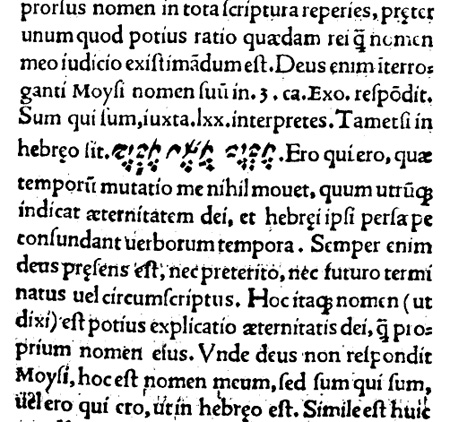
The prize of first was thought to go to Thomas Wakefield’s publication of his address regarding “Three Languages” – Hebrew, Arabic and Chaldean (Oratio de laudibus et utilitate trium linguarum [link]). The type, as you can see, was quite primitive.
This lecture was given in 1524, and as the book itself is undated, it was assumed that the lecture was published soon after it was given.  Thus, many dated it to 1524/25.  Wakefield, a noted Hebraist, actually spends the majority of the book discussing Hebrew and the other two languages get short shrift.[1]   
Recently, however, the dating of this work has been challenged and been shown to likely incorrect.  The author, in the self-described “Holmesian manner,”[2]   highlights the various persons Wakefield claims to have tutored in Hebrew and the honorifics used to describe those persons.[3] Based upon some of the descriptions, it seems likely that Wakefield’s work was not published prior to 1527 and most likely in 1528.   [4] This conclusion, coupled with the dating of another work by a different author, unseats Wakefield’s book claim to first.  Instead, Richard Pace’s Praefatio in Ecclesisten, printed in August 1527, is the most likely candidate for the first use of Hebrew typography in England.[5] Here is a sample:
It took nearly two hundred years after the appearance of Hebrew typography for the first Hebrew book published for a Jewish audience in England.  The controversy surrounding R. David Nieto’s remarks and their affinity or lack thereof to Spinoza would produce the first printed Jewish Hebrew book in England.  The first was a very small one, only a few pages, of a responsum written by R. Tzvi Ashkenzi, in R. Nieto’s defense, and published in 1705. It included both Spanish as well as Hebrew (available here).[6]   For more on R. Nieto and this controversy, see the Seforim Blog’s earlier post here
The Prayer for the Welfare of the State
The prayer for the welfare of the king or ruler is ancient.  Many point to the statements of Ezra as well as the passage in Avot as early sources for the prayer.  A variety of rationales are offered for this obligation.  For example, Rabbenu Yonah interprets the need for these prayers as indicative of a Universalist worldview, which requires all humans to display empathy for one another.  In order to effectuate that goal, Jews therefore pray for not only the Jewish leaders but also the secular one.  R. Azariah di Rossi, claims that the prayer carries a pacifist message as he emphasizes the lack of allegiance to a specific ruler or country and thereby transforms the prayer into one arguing for peace among all nations. 
The earliest extant prayers are from the Geniza, and can be dated to between 1127 and 1131.  The prayer is for the “Fatimid caliph al-Amir bi-ahkam Allah who ruled Egypt and its regions during the years 1101-1131.” See S.D. Goitein, “Prayers from the Geniza for Fatimid Caliphs, the Head of the Jerusalem Yeshiva, the Jewish Community and the Local Congregation,” in Sheldon R. Brunswick, ed., Studies in Judaica, Karaitica and Islamica: Presented to Leon Nemoy on His Eightieth Birthday (Ramat-Gan: Bar-Ilan University Press, 1982), 47-57.[7]   In this instance, the prayer includes not only a prayer for the secular ruler, but also a prayer for the local Rosh HaYeshiva.  Additionally, it blesses all of the Rosh HaYeshiva’s deceased predecessors, providing a nice genealogy. Goiten posits that these prayers may have been written in response to specific historical events and may not be indicative of the general practice in 12th century Egypt.  See id. at ___. 
The earliest sources, however, do not include the modern formulation of HaNoten Teshua.  Instead, early on there was a lack of conformity regarding this prayer.  Kol Bo records the custom but indicates that each community had its own practices.  But, none used the HaNoten Teshua formulation.  The first extant example of HaNoten Teshua is found in a Spanish manuscript dated between 1479-92.[8]   Ironically, this example was prepared for King Ferdiand V, who, in 1492, issued the expulsion order.  
It appears that with the expulsion and dispersion of the Spainish Jews, the HaNoten Teshua was disseminated throughout the Jewish world.  Indeed, the inclusion of this prayer in Yemenite rites, appears to undermine a major thesis of the noted Yemenite scholar, R. Yosef Kapach.  He asserts that the rite presents a pristine rite, unchanged over hundreds of years.  But, as the Yememite rite includes HaNoten Teshua, which is from the 15th century, indicates that the Yemenite rite is less pristine than Kapach would have it. [9]  
The prayer is also linked to the readmission of Jews into England.  Menasseh ben Israel in his plea  for readmission of the Jews to England (link) provides the full text – in English – of the HaNoten to demonstrate the Jews’ loyalty to their rulers.[10]
A English Hebrew Machzor Printed in London
The Jewish Encyclopedia notes “In 1794 David Levi published an English version of the services for New-Year, the Day of Atonement, and the feasts of Tabernacles and Pentecost, and thirteen years later gave a new version of the whole Mahzor. This second edition was “revised and corrected” by Isaac Levi, described as a “teacher of the Hebrew Language.”
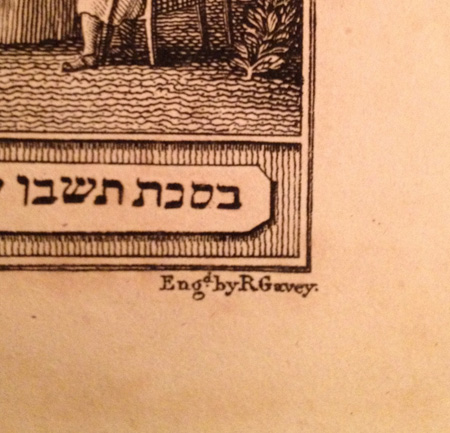
The Machzor features a frontispiece with various engravings of the Jewish holidays. The engraving for Shavuos features Moshe Rabbeinu dressed in a manner probably unknown 3,000 years ago, and holding the Aseres HaDibros with the numerical sequence from left to right. Yom Kippur correctly shows two identically sized “Se’irim” as per our tradition.
If you look closely at the name of the engraver, you will see that it was done by an R. Gavey.
I tried to find out more about R. Gavey and finally came upon a website which dealt with his family. I sent an email to the address listed and waited and waited. Two years later, I received the following response from a fellow in Australia:

“Robert Gavey b.1775 London was my 4xGreat Grandfather. He is listed as an engraver. Both his father and grandfather were watch makers.  Robert Gavey’s daughter Harriot Angelina Gavey  married my 3x Great Grandfather whose son James Fletcher  emigrated to Australia 1852. The Fletchers were originally Huguenot silkweavers with the surname Fruchard and I believe the Gavey’s would have been Huguenots also.” 

It turns out that Robert Gavey’s Australian descendent had a copy of his certificate of indenture as an engraver to a goldsmith named William Norris. Robert was 15 years old at the time (1790) and his period of indenture lasted for seven years. He promised not get married during that time period or play cards or dice. He also was forbidden to frequent taverns or playhouses or engage in any act which would cause his master a loss of money. (Click to see a large, high-resolution image.)


The certificate of indenture was signed in May of 1790 which was noted as the thirtieth year of the reign of George III who is described as the king of Great Britain, France, and Ireland.
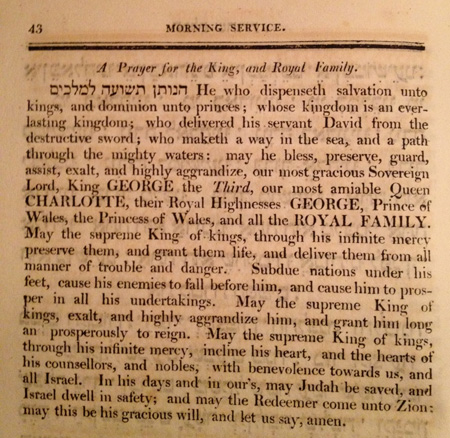
Speaking of George III, he received much better treatment in this Machzor than in our American Declaration of Independence. On our side of the pond, we know George III as a man who “ has plundered our seas, ravaged our Coasts, burnt our towns, and destroyed the lives of our people.” As part of the agreement by Cromwell to allow Jews back into England, the Jews promised to always pray for the welfare of the ruler. Accordingly, this Machzor blesses King George in this manner:

This is not the only edition that continued to praise the monarch.  Isaac Lesser, published the first complete machzor in the United States in 1837-38, for the Spanish and Portuguese rites with an English translation.  Lesser’s translation relies heavily upon that of David Levi’s translation.[11]   In an attempt to sell his machzor in both the United States as well in other English-speaking locals, he includes two version of the prayer, one asked that God “bless, preserve, guard, assist, exalt, and raise unto a high eminence, our lord the king.”  The other, replaced this phrase with the request that God “bless, preserve, guard, and assist the constituted officers of the government.”[12]  

The person who finally brought the prayer for the government more in keeping with American democratic values was Max Lilienthal (1814-1882).[13]   While some had been willing to change the prayer, they did so only in the vernacular but retained the Hebrew HaNoten Teshua.  Lilienthal, however, totally reworked the prayer, altering its tone and focus.  Lilienthal removes all mention of kings, focuses on the country more than its rulers, and seeks to bestow God’s blessing, not on the ruler but on all the inhabitants of the land.  This version was included in Henry Franks’s Teffilot Yisrael, a siddur containing the Orthodox liturgy. This siddur was first published in 1848, and reissued in more than 30 editions.  As Sarna notes, the acceptance of the prayer is somewhat ironic in that Lilienthal, later became part of the American Reform movement, was the author of a prayer that became the standard even in Orthodox siddurim.[14]  Id. at 436.

Aside from changing the text of the prayer to fit American sensibilities, how the prayer was recited was also changed.   Congregation Shearith Israel, in New York, after the revolutionary war, “ceased to rise for Hanoten Teshu’ah. According to an oral tradition preserved by H.P. Solomon, ‘the custom of sitting during this prayer was introduced to symbolize the American Revolution’s abolition of subservience.’”[15]

The United States was not the only country to undergo significant changes to its governmental structure.  France, in 1787, abolished (temporarily) the monarchy.   After which the prayer for the welfare of the government was radically changed.  Instead of praying for the benefit of kings and rulers, the French prayer focuses upon the Republic and its people.  All the biblical verses included bless the people and not the king.   [16] The prayer begins “Look down from your holy place on our land, the French Republic, and bless our nation, the French people, Amen.”

Other changes to the prayer, due to time and place, were common. For example, during the height of the Sabbati Zevi messianic frenzy, two versions of the prayer were produced, not asking to bless the secular ruler, but, instead, blessed Shabbati Zevi.

Today, the most significant change to this prayer has been the new prayer on behalf of the State of Israel.  The authorship of the prayer as well as its use is subject to controversy.[17]

In the most recent “Prayer For the State” news, French President François Hollande, specifically invoked this prayer when discussing French Jews’ relationship to the state.  He included in his remarks, translated in NYRB, commemorating the round-up of Jews at the Vélodrome d’Hiver: “Every Saturday morning, in every French synagogue, at the end of the service, the prayer of France’s Jews rings out, the prayer they utter for the homeland they love and want to serve. ‘May France live in happiness and prosperity. May unity and harmony make her strong and great. May she enjoy lasting peace and preserve her spirit of nobility among the nations.'” 

Kol Nidrei 
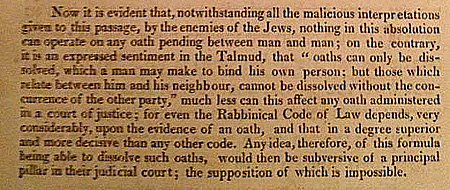
The Yom Kippur volume of this set contains a detailed “apology”for the Kol Nidre prayer. The Jews endeavored to incorporate themselves into general society and felt the need to emphasize that their word was binding on them. Kol Nidre was seen as indicating otherwise, so an explanation of the prayer was seen as necessary, both for Jew and Gentile. (See Y. Goldhaver, Minhagei Kehilot, Jerusalem: 2005, pp. 209-19 on the history of Kol Nidre and the controversy.) It concludes as follows.

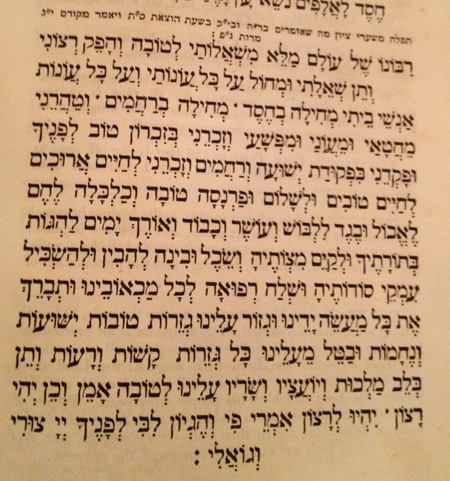
Finally, I would like to focus on the special prayer said during the Yamim Noraim when the Torah is taken from the Aron Kodesh. It first appeared in the Siddur Shaarey Tzion of Rabbi Nathan Hanover and begins with the words “Ribbono Shel Olam”.

In it we ask Hashem to remember us for a long and good life, with everything that comes along with that. We include in our request that Hashem should provide us with “Lechem Le’echol, Beged Lil’Bosh, V’Osher V’Chavod”.  Let us see how David Levy translates these words.

As you can see, the request for “wealth and honor” is nowhere to be found in the English translation. I was curious about this and asked Dan Rabinowitz for his opinion. He offered that it is possible that this Machzor was printed at a time when the English community was quite interested in the Hebrew language. Non-Jewish scholars eagerly bought any books printed in Hebrew. As such, it could be that Levy decided to leave out the reference for our desire for wealth and honor because, well, maybe it was a bit too pushy on our part.

I hope all of you are blessed with a Shana Tova, even one that includes within it the promise of wealth and honor.

[1]  See Marvin J. Heller, The Sixteenth Century Hebrew Book, Brill, Leiden:2004, entry for Oratio and pp. 959-60 and the sources cited therein. But see Brad Sabin Hill, Incunabula, Hebraica & Judaica . . .” Ottawa:1981, #52 asserting that 1561 is the earliest introduction of Hebrew typography to England. It is unclear what the basis of that assertion is.

[2] Richard Rex, “Review: Robert Wakefield On Three Languages 1524,” The Journal of Ecclesiastical History 42:1 (Jan. 1991) 159.
[3] Richard Rex, “The Earliest Use of Hebrew in Books Printed in England: Dating Some Works of Richard Pace & Robert Wakefield,” Transactions of the Cambridge Bibliographical Society, Vol. 9, No. 5 (1990), 517-25.
[4] Id. at 517-18.
[5] Id. at
[6] See B. Roth, The Hebrew Printing Press in London, Kiryat Sefer 14 (1937), pp. 97-99.
[7] See also, Fenton,
[8] See Aaron Ahrend, “Prayers for the Welfare of the Monarchy and State,” in Aaron Ahrend, ed., Israel’s Independence Day: Research Studies (Ramat-Gan: Bar-Ilan University Press, 1998), 176-200 (Hebrew). This date is contrary to Schwartz who incorrectly posits that there is no evidence of HaNoten Teshua prior to the 16th century, and none in pre-expulsion Spain. See Barry Schwartz, “Hanoten Teshua: The Origin of the Traditional Jewish Prayer for the Government,” in HUCA, 57, (1986) 113-20. Sarna appears unaware of Ahrend’s article as he continues to assert that HaNoten Teshua was not composed prior to the 16th century. See Jonathan Sarna, “Jewish Prayers for the United States Government: A Study in the Liturgy of Politics and the Politics of Liturgy,” in Ruth Langer & Steven Fine, eds., Liturgy in the Life of the Synagogue: Studies in the History of Jewish Prayer (Winona Lake, Indiana: Eisenbrauns, 2005), 207 & n.9 (link).
[9] See Ahrend, “Prayers for the Welfare,” at 183.
[10] See Menasseh ben Israel, The Humble Address to his Highness the Lord Protector, 1655.
[11] Leeser was not the first American to utilize Levi’s translation. The first Hebrew prayer book published in the United States, The Form of Daily Prayers (Seder Tefilot), New York, 1826, also includes an English translation by Solomon Henry Jackson. Jackson, who emigrated to the United States from London, also relied heavily upon Levi’s translation. Jackson, in the introduction, indicates that HaNoten Teshua was adapted for U.S. audience, in fact, the Hebrew remained the same, only the “translation” was altered. See Sarna, Jewish Prayers, 213.

Additionally, some time in the 1820s, there was an attempt to reprint Levi’s machzor in the United States. A prospectus was issued, but Levi’s machzor was never reprinted in the United States. See Yosef Goldman, Hebrew Printing in America 1735-1926, Brooklyn, NY, 2006, no. 33.
The first appearance of HaNoten Teshua in the United States is found in the first prayer book published in the United States. Isaac Pinto’s holds that honor. In his English only edition whose first volume was published in 1761 with the second volume published in 1766, he includes HaNoten Teshu’ah.
[12] Jonathan Sarna, “Jewish Prayers for the United States Government,” at 215.

[13] See Jonathan Sarna, “A Forgotten 19th-Century Prayer for the United States Government ,” in Hesed ve-Emet, Studies in Honor of Ernest S. Frerichs, ed. Magness & Gitin, Atlanta, Georgia, 1998, 431-40.

[14] Today, however, the most widely used Orthodox siddur in the United States, Artscroll, does not include the prayer in any form in its standard editions. It is unclear why Artscroll omitted this very old prayer.

[15] Sarna, Jewish Prayers, at 210.

[16] Moshe Katon, “An Example of the Revolution in the Hebrew Songs of the French Jews,” Mahut 19 (1997) 37-44, esp. 37-8.

[17] See Aharon Arend, “The Prayer for the Welfare of the Monarchy and Country, in Arend ed., Pirkei Mehkar le-Yom ha-Atzmot, Ramat Gan: 1998, 192-200.


Using a Colophon to Find a Shidduch: on Ella the Zetser.

Using a Colophon to Find a Shidduch

by Eli Genauer

There has been much talk lately about the so called Shidduch crisis. Various initiatives have been proposed to address this problem, all of which are well meaning and well thought out. Many might be surprised to learn that an interesting approach was suggested by a 12 year old girl in the town of Frankfurt on Oder way back in 1699. This approach was based on a Pasuk in Yirmiyahu which deals with Messianic times.

We are all familiar with the 31st chapter of Yirmayahu. The first 19 pesukim of this Perek comprise the Haftorah of the second day of Rosh Hashana. The Navi begins, “Koh Amar Hashem, Matzah Chain BaMidbar”. The Haftorah proceeds to lay out a vision of Hashem’s love for the Jewish people and its eventual return to Tziyon, a fitting theme for a day in which we ask Hashem to grant us a good year. The stirring Pasuk of “HaVain Yakir Li Ephraim” concludes the Haftorah, but the Perek continues with Yirmiyahu’s vision of Yemos HaMoshiach.Yirmiyahu speaks of the Jewish people in Galus and after having been there for so long, they return to Hashem. Pasuk 21 states the following:

כא עַד-מָתַי תִּתְחַמָּקִין, הַבַּת הַשּׁוֹבֵבָה: כִּי-בָרָא יְהוָה חֲדָשָׁה בָּאָרֶץ, נְקֵבָה תְּסוֹבֵב גָּבֶר

How long will you hide, O backsliding daughter? For the Lord has created something new on the earth, a woman shall go after a man.

According to the Radak, the Navi is imploring the people to travel on a straight path and to return to Hashem. This will be a time when, as it were, the Bas HaShoveiva, the backsliding daughter, will be the one who seeks out a husband, in this case Hashem. The Navi says that this is something that is radical, but certainly required at that time.

We fast forward a bit to 1696 and we meet an amazing nine year old girl, born in Amsterdam, but now living in Dessau, Germany. Her name is Elle and she is the daughter of a man named Moshe ben Avraham Avinu. Moshe worked for years setting type and printing important Jewish books in various places in northern Europe, the last of which he did under very trying circumstances in Halle.(1) Moshe employed his children to help him in the arduous task of typesetting. We know a bit about his daughter Elle from some crumbs that she left us as she signed her name to the books she helped bring to print. She and her brother worked on setting type of the Siddur Drash Moshe printed in Dessau in 1696. After recording that the book was set to type by Yisroel ben Moshe, someone wrote a poem which tells us that a nine year old girl named Elle (עלה) helped Yisroel in this project:(This scan and those following are all courtesy of the JTS Library)

The Yiddish letters I set with my own hand
I am Elle, the daughter of Moses from Holland
a mere nine years old
the sole girl among six children
So when an error you should find
Remember, this was set by one who is but a child (2)

Did she compose the poem herself, or was it composed by her father or brother? Remarkably, we find another case not soon thereafter, of a nine year old setting type, and there we do know whether he could read or not. Nicholas Basbanes, in his book “A Gentle Madness”, records the following:

“Born in poverty, Isaiah Thomas came to know the touch and smell of ink on paper when he was only a child. Only nine years old in 1758….young Thomas was already completing his apprenticeship in the dingy Boston shop of Zechariah Fowle…When he later became the most successful printer and publisher in the United States-Benjamin Franklin dubbed him the Baskerville of America- Isaiah Thomas enjoyed telling friends that he knew how to set type before he was able to read.”(3)

Whether or not she could read at age nine, we do know that this little girl was able to recognize the Judeo Yiddish letters of a manuscript and set to type similar letters from which to print a book. Perhaps she had the potential to become as successful as Isaiah Thomas but for her gender and religion.

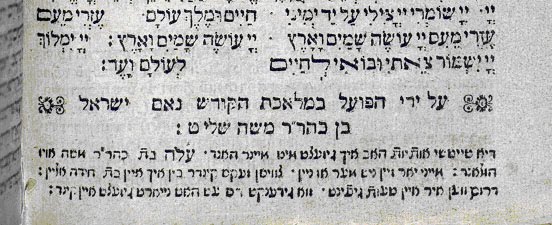
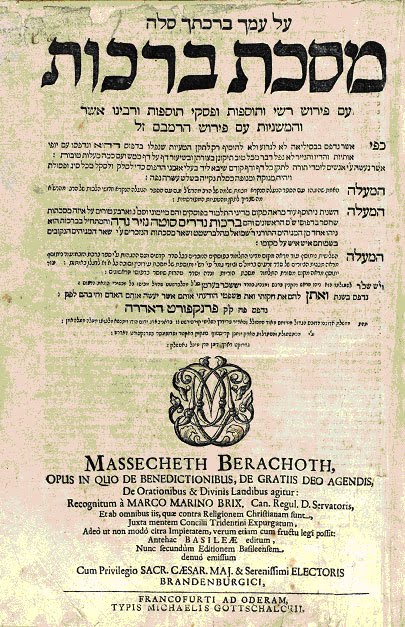
We meet Elle again in 1699, this time as a typesetter working on the famous Berman Shas of Frankfurt on Oder. This printed edition of the Talmud ( 1697-1699) was financed by the wealthy court Jew, Yissachar Berman Segal of Halberstadt who gave away half the 5,000 copies printed to needy scholars throughout Europe.(4)The Berman Shas is one of the most respected early printed editions of the Talmud because it contained many additional commentaries which became standard in following editions. It was the first edition since that of Gershom Soncino in the early 16th century to contain most of the diagrams we are familiar in Seder Zeraim, and Masechtos Eiruvin and Sukah. (5) It was also the first to contain Charamos from various Rabbanim prohibiting others in that general area from printing the Talmud for an extended period of time.(6) The following Cherem, recorded in Maseches Brachos, was written by Rav Dovid Oppenheim who lived at that time in Nikolsburg and later became chief Rabbi of Prague:At the end of Maseches Nidah printed in 1699, Elle signs her work a bit more boldly, and leaves us wondering what was going through her mind when she set the letters for the colophon.

“ By the hand of the faithful typesetter in this holy work, Yisroel the son of Reb Moshe. And by the hand of his maiden sister Elle, daughter of Rav Moshe, in the year “N’Kaivah T’Soivev Gaver” ( “a woman shall go after a man”.)

When you add up the letters which are set in large type, you come up with the year 459 according to the Peret Koton ( the abbreviated era ). This is the year 5459 (1699). What intrigues even the casual observer is why she, or her older brother Yisroel chose to record the year 5459 using that unusual Pasuk? One could argue that the Pasuk is tangentially related to some of the topics covered in Maseches Niddah, but there are many other Pesukim which deal more directly with the subject matter that could have been formatted to equal 459.(7) I think it is more logical to relate the Pasuk to the girl typesetter, who we are informed, is still unmarried. In Messianic times, it will be the Kallah, Am Yisroel, who seeks out its Chasan, Hashem. Perhaps Elle thought her circumstances and position necessitated a similar approach to finding a suitable Chasan. We hear the last from her in the next year having worked on a Machzor with her brother Yisroel.(8) We hope that after that, this extraordinary girl found an appropriate Shidduch. We wish the same for all those seeking the wonderful rewards that marriage has to offer.

(1) Marvin J Heller, “Studies in the Making of the Early Hebrew Book”, Boston 2008 pps. 218-228. The entire chapter on Moses ben Avraham Avinu makes for some fascinating reading. I am indebted, as are we all, to Marvin Heller for his research into this field of study.
(2) Ibid: p.222
(3) Nicholas Basbanes, ‘A Gentle Madness” New York, 1995 pps144-145
(4) R.N.N. Rabinowitz “Ma’amar Al Hadfasas HaTalmud”, A.M. Haberman edition, Mosad HaRav Kook 2006, page 96 footnote 1.
(5) Ibid. p. 98
(6) Ibid p.100
(7) Two examples of a more fitting Pasuk to denote the year of publication for Tractate Niddah are:

“B’Mai Nidah Yischatah” which was used in Frankfurt A/M edition of 1720, and

“V’Safrah Lah Shiva Yomim, V’Achar Ti’Taher” which was used in the Dyhernfurth edition of 1816-21 ( although the highlighted letters actually add up to (5)773)

(8) Heller, page 223


Eliyahu Bachur in Isny

ELIYAHU BACHUR (1469 – 1549) IN ISNY
 by: Dan Yardeni

Dan Yardeni, an engineer by profession (Technion – Israel Institute of Technology, 1963), is entrepreneur specializing in cutting edge materials and materials production processes.

As sideline,  he researches problems in the history of Hebrew books printing and printers. He also contributes articles to the Culture and Literature sections of Haaretz and other Israeli newspapers. This is his first post at the Seforim blog.

A little street in Tel Aviv commemorates the personality of a colorful Jewish culture hero at the time of the Italian Renaissance, known as Eliah Levita by Christians and Eliyahu Bachur by Jews. While he considered himself primarily a linguist, he was also a teacher, translator, writer and editor, debater, poet, singer and humanist with a deep sense of social awareness, which he expressed in sharply worded satires. While all his life he was an observant Jew, he was also a close friend and teacher of the greatest Christian scholars of his day and became a foremost “cultural agent” between Judaism and Christianity.
Eliahu Bachur’s unusual name is due to the fact that he remained a bachelor for a long time, and later adopted the epithet in the sense of Bachur – Chosen (see his preface to Sefer HaBachur, Isny 1542 where he explains the name of the book and comments:  “…. היות שם כינויי משונה ובשם בחור מכונה …. ” ). He was born in southern Germany in 1469 and died and was buried in Venice at the age of 81, a rather advanced age at the time.
Most of his life he lived and worked in Italy. For a brief period of two and a half years, between 1540 and 1542, Eliyahu Bachur moved to the small town of Isny in the picturesque Allgäu region of southern Germany. Isny was at that time a a free self-governing city organized as a republic within the Holy Roman Empire, then under the rule of Charles V. Eliyahu Bachur was invited by the Christian reformer and Hebraist Paulus Fagius to work with him as editor and proofreader in the printing-house, which Fagius had founded in Isny. Despite the burden of his seventy-one years, Eliyahu accepted the invitation, left his home in Venice and crossed the Alps to live in that little town. Why did he do it? The large and world famous printing-house of Daniel Bomberg in Venice, where he had worked as an editor and proofreader for many years, ceased operating at that time and Fagius was offering him a good job and, most important, undertook to print  the books Eliyahu had written.
Eliyahu Bachur describes his journey to Isny at the end of his book ‘Tishbi,’ the first of his books to be published in the new printing-house. (The name of the book alludes to his name, Eliyahu). The book, printed in typical Ashkenazi Hebrew typography, constitutes a kind of dictionary describing 712 roots of Hebrew words. And so he writes in the preface to the book: “… I beg anyone, scholar or student who reads this book and finds a mistake or error, to note that it is the fruit of haste since I was in a hurry to reach this place and when I left my house the book was not yet finished, and as I was en route, crossing lands of raining hills and mountains I stood trembling, weighing matters up in my mind and writing them in my heart, and then, when I reached the inn, I opened my case, took out my notebook and wrote down the things which the Lord had put into my heart.”
We know of sixteen titles (sometimes in 2 editions, with and without Latin translation), which Eliyahu Bachur published in Isny. He may have printed more, of which no copies survived. Most of the time he was the only Jew in  that Christian town which was so devoutly Protestant that it did not allow Catholic Christians to reside within its walls. The contents of his books, and the texts which he wrote and appended to them, are of great interest still today. Most touching is the reflected conflict between his desire to publish the books he had written and the longing for his family and for Venice, the town where he had lived most of his life.
While being a deeply religious and observant Jew, Eliyahu Bachur displayed cultural openness to the Christian world. He did this in spite of the fierce opposition of rabbis, who regarded him with suspicion, as someone who was prepared to venture beyond the self-imposed barriers surrounding the Jewish scholarly community (See his preface to Masoret Ha-Massoret book printed in Venice 1938 and later). He also had the courage and intellectual honesty to admit that he had been helped in translating difficult Greek words to Hebrew by the learned Christian cardinal Egidio Viterbo, to whom he had taught Hebrew during his sojourn in Rome years earlier. He dared to state, in face of virulent opposition from leading orthodox rabbis, that the punctuation of the Hebrew language was a later invention and not as ancient as had been thought until then. In his rhyming introduction to his book ‘Tishbi,’ he challenged those who disagreed with him to react still in his lifetime:
“….. / כי אומנם לא שקר מילי / אם לא איפא מי יכזיבני / מה שגיתי יבין אותי / יכתוב לו ספר איש ריבי / אך יעשה זאת טרם אמות / כי מה אשיב אחרי שכבי / או ימות גם הוא כמוני / או ימתין לי עד שובי / …….”
“…Indeed my words are not a lie / So who will dispute me? / If I erred, please  show me where / And my rival may write his own opinion  / But let him do it before I die / Because once I died how could I reply? / Or possibly he too may meanwhile pass away / Or he might have to wait for my resurrection from the dead….”
Later, in a playful rhymed foreword, combining genuine modesty with an awareness of his own value, he added a well-known fable attributed to Pliny the Elder, which Eliyahu claims to remember from his youth:
“אפתחה במשל פי / אשר שמעתי בימי חרפי / כי היה באחד המקומות / אשר נקבו בשמות / אמן אחד צייר / וצייר צלם איש על נייר / והיה האיש ההוא / תם וישר / יפה תואר ומשוח בששר / וידביקהו על לוח עץ / ועל פתח ביתו היה אותו נועץ / להראות העמים והשרים את יופיו / כי כליל הוא מהדרו  וצבי עדיו / ויהי כאשר כל העם רואים / והנה בתוך הבאים / זקן אחד רצען / על משענתו נשען / וראה והביט גם הוא / אחרי כן פתח את פיהו / ויאמר הנני עומד משתאה / איך הצייר שגה ברואה / הלא תראו כי שרוך הנעל / הפוך למטה למעל / וכשמוע הצייר את זאת / יצא גם הוא לראות / וירא ויניע ראש / והודה ולא בוש / ויאמר צדקת אתה הזקן / אך הלילה המעוות אתקן / וכן תקנהו טרם הלך לישון / ולמחרתו הוציאו כמשפט הראשון / ויבוא הרצען שנית / ויוסף להביט בתבנית / ויאמר לצייר יפה תיקנת ועשית / אבל בדבר אחד שגית / כי רואה אני דבר נבזה / כי הברכיים אינם דומים זה לזה / האחד גדול והאחד קטן / ויאמר לו הצייר לך אל השטן / כי משרוך הנעל ולמעלה/ אין לך בחכמה חלק ונחלה / ויהי הרצען לבושה ולכלימה / ויפן וילך בחימה / וכן יראתי גם אני / שכמקרה הרצען יקרני / בעניין זה החיבור / רעה עלי ידובר / ויאמר אלי מי שהוא / מה לך פה אליהו / כלך למדברך אצל דקדוק ומסורות / אין לך עסק בנסתרות / אל תחמוד כבוד יותר מלימודך / ואל תנבל כסא כבודך / ולכן יראתי לקרב אל המלאכה / פן לא אראה בה סימן ברכה / אך רוחי הציקתני / ואש עצור בעצמותי ושרפתני / וכלכל לא יכולתי / ומאת השם עזר שאלתי / יצרף לי למעשה המחשבה / ויורני בדרך הטובה / כי מכיר אני את מקומי / שיותר מידי נטלתי גדולה  לעצמי / שמלאני לבי לפרש כל השורשים / אשר בשום מקום אינם מפורשים / ואף מאותם המפורשים כבר / אחדש בכל אחד איזה דבר / ורובם מן הגמרא ומדברי רבותינו / כגון בראשית רבא ותנחומא וילמדנו / ואף שבעוונותיי / כבר עברו רוב שנותיי / ולא ראיתי בטובה / בהוויות אביי ורבא / ולחכמים מעט שימשתי / ומשאם ומתנם לא בשתי ביקשתי / מכל מקום לבי לא מנעני / ובאגדות ובמדרשים יגעתי / להוציא מהם דברים חשוקים / ובפרושי ומדרשי הפסוקים / עד שרוב גירסתם היא לי ידועה / וזה יהיה לי לישועה / את הספר הזה לחבר / ולברר וללבן את אשר אדבר / …………/.
The fable tells the story of the famous Greek painter Apelles (a contemporary of Alexander the Great), and a cobbler,. Apelles drew a beautiful young man and pasted the painting on wooden board that he placed at his doorway to impress all passersby. Among them was an old cobbler, leaning on his cane. The cobbler gazed at the painting and commented: “I am surprised how the artist made such a mistake. You see, the shoelace goes upside down”. When the artist heard that, he went out to see, nodded his head and consented: “You are right, old man. But tonight I shall correct the mistake”. And so he did before going to sleep and the next day he hung the painting in place as before. And the old cobbler came again. He looked at the painting and told the artist: “Well done but there is still another mistake: the knees are not alike, one is bigger than the other”. The artist said then commented angrily: Go to hell. From the shoelace upwards you know nothing”. The cobbler was ridiculed by all around and turned away in a rage. And, says Eliahu Bachur, he is afraid that the same will happen to him with this book, the Tishbi”. Somebody will say: “What are you doing here? Go back to Hebrew grammar and Massoret. Don’t deal in what you don’t know and don’t ask to be honored in doing so“. Therefore, he was afraid to undertake that work, in which he might fail. However, he could not restrain himself and asked God for help in showing him the right way. Eliyahu adds that he knows his place and that he may be presumptuous in daring to explain all the Hebrew roots, which are not explained elsewhere, adding that even to those that had been explained, he was still bringing something new from the Gmara and other sources.
Particularly impressive is the friendship and mutual respect that developed between the old Jew and the Christian preacher Paulus Fagius in the course of their work together in Isny, about which Eliyahu writes in the foreword to the book:
“……..ובבואי הנה תהיתי בקנקנו ומצאתיו מלא ישן ולא הוגד לי החצי מחכמתו וידיעתו, ורבים שואבים מי תורתו, ודורש טוב לעמו, נאה דורש ונאה מפרש  ………..ובראותו הספר הזה אשר חיברתי והכיר רוב טובו ותועלתו, נזדרז מאד והעתיק אותו ללשון לאטין אשר קראו קדמונינו לשון רומי וחיבר שתי הלשונות יחד ונשים עיוננו עליו בכל מאמצי כוחנו, הוא מצד אחד ואני מצד אחר. ונקרא איש אל אלוהיו שיצליח את מלאכתנו ………”
“…And when I came hither I wondered about his character, and I found him full of wisdom, and I had not been informed about the breadth of his knowledge, and many come to learn from him, and he performs good deeds, in sickness and in health… And when he saw the book which I had written he recognized its worth, and hastened to translate it into Latin, which was the language of ancient Rome, and together we made connections between the two languages, he on the one hand and I on the other, and each one of us sought guidance and help from his God.” (my emphasis, D.Y.)
Being a devoted Christian Pastor, Fagius didn’t abandon his missionary vision and one of the books he printed in Isny, ‘The Book of Belief’ (Sefer Amana), is unmistakably a missionary tract. The book was published in two versions, Hebrew and Latin. In the introduction to the Hebrew edition Paulus Fagius wrote in Hebrew: “The Book of Belief is a goodly and pleasant book which was written by a wise Israelite a few years ago in order to teach and prove quite clearly that the belief of Messianic in the Lord the father, his son, and the holy spirit, and other things is entire, correct and without doubt…”. We can only imagine how uncomfortable Eliahu Bachur felt in proofreading this book.
Now, as was customary in those days when printers took pride in their work, Paulus Fagius placed a colophon at the end of the books he printed with his printer’s emblem, an elaborate and beautiful woodcut of a tree surrounded by verses, which he regarded as his motto in life. Among them was one verse, which appeared with slight variations in most of the books that were printed at Isny:תקוותי במשיח הנשלח שהוא עתיד לדון חיים ומתים “My hope is in the Messiah who was sent (נשלח) and who will judge the living and dead.”
As stated, ‘The Book of Belief’ appeared in Hebrew, apparently intended for the Jews, and in Latin for the Christians. The Latin version ends with the verse cited above, while at the end of the Hebrew version the printer’s emblem appears with a slight difference, which is not immediately discernible:
תקוותי במשיח הנשלך אשר הוא יבוא לדון את חיים ומתים
 
My hope is in the Messiah who was dismissed (הנשלך) and who will come to judge the living and dead.

There can be no doubt that this is no printer’s error but a subtle message sent by Eliyahu Bachur in his capacity as the book’s proofreader to his Jewish brethren down the ages, saying: “I have not betrayed. You know what I think about this”. I noticed this subtle difference when I examined the books, which are kept in the amazingly well preserved study of Paulus Fagius next to the Church of Saint Nicholas in Isny, where he preached nearly 500 years ago. When I brought it to the attention of the extremely kind priest who escorted me and who now occupies Fagius’s chair, he was very surprised and, I fear, somewhat offended. 
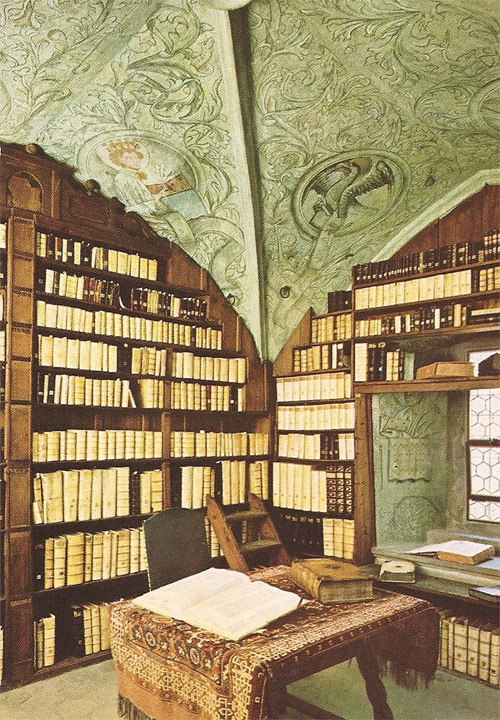
Eliyahu Bachur was attuned to the need to disseminate knowledge not only to the educated Jewish elite but also to the general Jewish community, men and women. Therefore, another book, which Eliyahu Bachur printed in Isny in the year 1541, was ‘Bovo d’Antona’, a popular adventure novel about knights, which he translated into the Judeo-German dialect, Ivri Teitsch (western Yiddish From the introduction he wrote to the book, we learn about the status of women in Jewish society at that time and about their reading habits. In rhymed introduction, he tells all righteous womenאיך אליה לוי דער שרייבר, דינר אלר ורומן וויבר” that there are women who complain that he does not print for them in Ivri Teitsch the books that he has written, and they are right. And since he has written eight or nine books in Hebrew and since he is now rather old, he wishes to publish all these books and poetry in Ivri-Teitsch. The first of which will be the “Bovo Buch,” which he translated from Italian thirty-four years earlier. Since this translation contains words in Italian, he will print a glossary at the end of the book explaining their meaning [and so he did, D.Y.]. Naturally he cannot transmit,the melody by which the book should be read. “איך זינג עש מיט איינם ועלשן גיזנק, קאן ער דרויף מכן איין ביסרן, זא הב ער דאנק” . He himself sings it in the Italian melody but everyone can adapt a better melody to the text, as he wishes. At the end of the book, Eliyahu Bachur adds that he hopes to print more books in Ivri Teitsch, but apparently he did not, or perhaps no copy has reached us. Of the ‘Bovo d’Antona’ book, only a single copy (Unicum) survives, which is preserved in the Zurich Public Library. However, the book was so popular at the time that its name has given rise to the expression that we use still today, “Bobe Meise” in the sense of silly, nonsense tale.
The book ‘Meturgaman’, (“Translator”), which Eliyahu Bachur composed and printed in Isny in 1542, was intended to be a dictionary which “Will explain all words, difficult and easy alike, which appear in the Aramaic translations of the bible and Talmud Yerushalmi”. To the book Eliyahu Bachur added a colophon, which sheds light on a touching side of his personality. In the colophon Eliyahu printed a delicate and sweet love song to his wife whom he had left behind in Venice:
“והנה מאחר שקפצה עלי הזיקנה / ואני  איש זקן וכבד מאד / ומידי יום יום תכהה עיני ונס ליחי / אשוב מצבא העבודה ולא אעבוד עוד / ואלך לי אל ארצי אשר יצאתי משם / היא מדינת וונציה/ ואמות בעירי עם אשתי הזקנה / ולא אניד עוד רגל ממנה / והיא תשת עלי עינה / ורק המוות יפריד ביני ובינה/ ואשב שם כל ימי חיותי/ ואשלים חיבור הספרים אשר החילותי/  אז אומר לאל אשר יצר אותי/  קח נא את חיי כי טוב מותי”.
The song is translated here without modifications or explanations, though the charming wording in Hebrew is lost:
“And since I became old and heavy, and each day my eye sight weakens and my strength is leaving me, I shall retire from work and go back to the homeland that I left, the land of Venice, and die there with my old wife, and I shall never move again from her, and she will keep an eye on me and only death shall part us, and I shall live there the rest of my life and complete the books which I have already started to write. Then I shall ask the Lord who created me: take my life, it is better that I die”.
And in another song below this one, the old scholar summarize his life and work in most touching words:
                           
“הלל אל אל המלך נאמן              אבינו האב הרחמן
שהחייני עד הגעתי                       עתה אל זה היום וזמן
היה איתי עד נטעתי                     זה הנטע נטע נעמן
בו נגלות כל המילות                    העבריות עם תרגומן
גם הוא מורה בגיליון                   איה תחנותן ומקומן
הוא כמליץ שהוא ממליץ              ובטוב מילין הוא מטעימן
ויי שוכן שמים                              וממנו דבר לא נטמן
ידע כי לא עשיתי זאת                 להיות נקרא רב או אמן
כי הנותן לכסיל כבוד                   כצרור אבן תוך ארגמן
לאל בלבד נאה כבוד                   ולזולתו הא ליכא מאן
הן לכבודו ולאהבתו                     בלבד רשמתי רישומן
אנא אלי לי ולאשתי                     החסד גם האמת מן
שהיא לא תהיה אלמנה               ואני לא אהיה אלמן
יחד נמות ובגן עדנות                  תוך חיקה אישן עד לזמן
יבוא הקץ ואזי נקיץ                     ולחיי עד יחד נזדמן
ובכך תמו גם נשלמו                    דברי השירה עד תומן
ואני אליה המחבר                       לפרט זאת השנה סימן

Praise the God, faithful king
Our merciful father

That kept me alive     To this date and time

Be with me till I plant   This pleasant plant
In which all Hebrew words are revealed
With their translation
And also indicate Where they are located,
Explaining them
In plain words.
God in heaven   From him nothing hides
He knows that I did not do that      To be called rabbi or scholar,
Because rendering honor to a fool Is like wrapping stone in expensive textile
Only God deserves honor Nobody else
And to his honor and love      I wrote what I wrote.
Please God, to me and my wife bestow grace and truth
That she will not become a widow   And I shall not become a widower
Together we shall die and in Garden of Eden    In her bosom I shall sleep until
End of time and then we shall awake  And for ever be together
And here ended and completed    This song
I Eliyhau the writer 
In the year …..

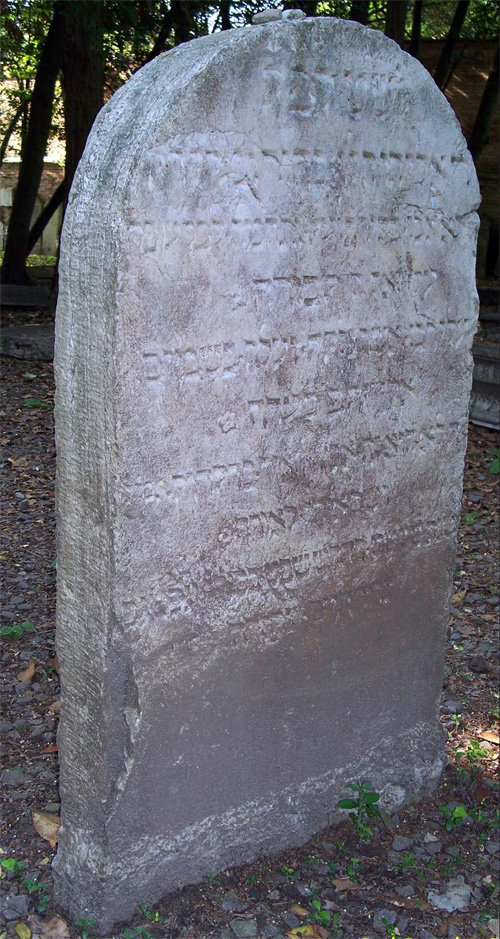
Eliyahu Bachur’s wish was only partly fulfilled. He returned to Venice after the short-lived printing house in Isny closed down, and even though he edited and proofread a few more books for printers who replaced Bomberg’s enterprise, his strength continued to weaken. His long time co-worker in the printing business, Cornelio Adelkind in a letter to the humanist Andrea Masius in 1547 calls Eliyahu איש ערירי (Lonely man) which implies that his wife passed away few years before him. Eliyahu Bachur died in the month of Shevat in the year Shin Tet (1549) and was buried in the old Jewish cemetery in the isle of Lido near Venice. The headstone on his grave is still to be seen. I visited his grave, put a little stone on it and read the engraved epitaph, which includes sophisticated wording and allusions in Hebrew. This and the fact that the epitaph does not refer to the day of his death may suggest that he composed the text himself:
ש”ט לפ”ק
ר’ אליהו הלוי בחור ומדקדק
הלא אבן בקיר תזעק ותהמה לכל עובר
עלי זאת ה-קבורה
עלי רבן-אשר נלקח ועלה בשמיים
אלי-יה ב-סערה
הלא הוא זה אשר האיר בדקדוק אפלתו
ושם אותו לאורה
שנת שט שט בחדש שבט בסופו, ונפשו ב
בצרור חיים צרורה
It was impossible to translate the delicate playing in words that is concealed through the epitaph. The text below is only a shadow of its poetic brilliance.
Shin Tet le Prat Katan
Rabbi Eliyahu Halevi Bachur And Grammarian
A stone from wall will cry and moan to every passer by
On this grave
On rabbi Eliyahu who went to heaven
To God by a storm
He is the one who lightened the darkness of [Hebrew] grammar
And put it to light
Year Shin Tet at the end of the month of Shevat and his soul
In the bonds of life be bound
תנצב”ה