In Praise of Ephemera: A Picture Postcard from Vilna Reveals its Secrets More than One Hundred Years after its Original Publication

In Praise of Ephemera:
A Picture Postcard from Vilna Reveals its Secrets
More than One Hundred Years after its Original Publication*

by Shnayer Leiman

I belong to a small group of inveterate collectors of Jewish ephemera. We collect artifacts that many others consider of little or no significance, such as postage stamps; coins and medallions; old posters, broadsides, and newspaper clippings; outdated New Years cards; wine-stained Passover Haggadot; Jewish ornaments, objects (e.g., Chanukkah dreidels) and artwork of a previous generation; photographs and postcards; and the like. The items we collect – all of Jewish interest – take up much space in our homes; they can also be costly at times. Often, we end up paying much more for an item than it is really worth, especially if it completes a set. Collectors of ephemera suffer from a disease that has no known remedy. The only respite we have from the disease is when we write scholarly essays about what we have collected, for – as I know from experience – it is not possible to write scholarly essays and actively collect ephemera at the same time.

The Picture Postcard.

Several years ago, I acquired the following postcard. It measures 5½ inches by 3½ inches, a standard size for its time. It is a mint copy, meaning that no message was penned on its back and it was never mailed. Thus, I cannot date the postcard by a recorded date or postmark on its reverse side (but see below). We present the obverse and the reverse of the postcard for the benefit of the reader:
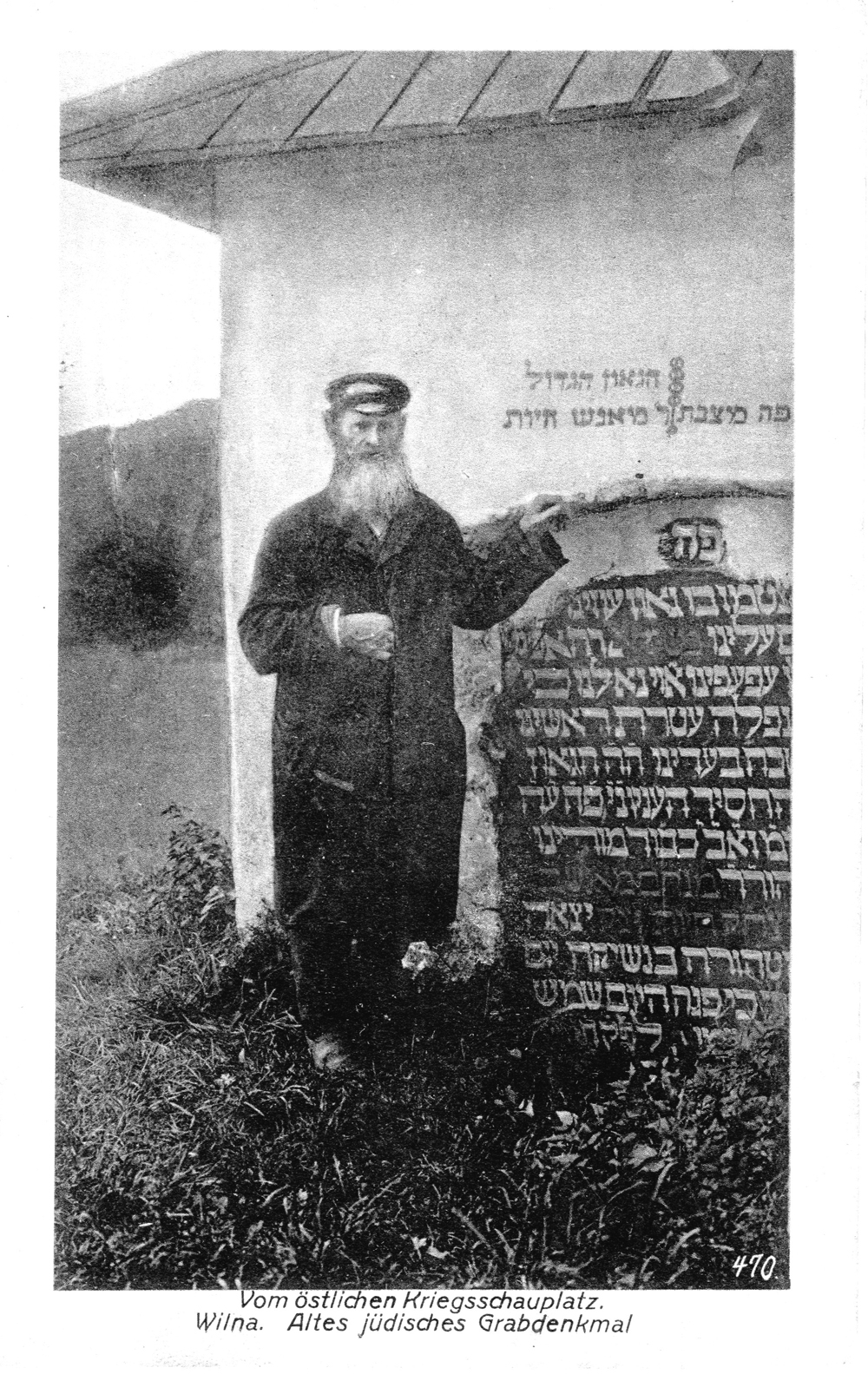
Obverse. The obverse presents a black and white photograph, also standard for its time. It features a tombstone with a Hebrew inscription; a mausoleum behind the tombstone, with a brief Hebrew inscription; and what appears to be a cemetery attendant, with his hand atop the tombstone. Most important, it contains a German heading under the photograph, which reads in translation: “From the Eastern Front of the Theater of War, Wilna, An Old Jewish Tombstone [with Inscription].”

Reverse. The reverse prints the name of the publishing company that produced the postcard: “The Brothers Hochland in Koenigsberg, Prussia.”

Historical Context.

In terms of historical context, the information provided by the postcard (a German heading; Vilna is defined as the eastern front of the theater of war; the postcard was produced in Koenigsberg) can lead to only one conclusion, namely that the postcard was produced on behalf of the German troops that had occupied, and dominated, Vilna during World War I. German troops occupied Vilna on September 18, 1915 and remained in Vilna until the collapse of the Kaiser’s army on the western front, which forced the withdrawal of all German troops in foreign countries at the very end of 1918. Thus, our photograph was taken, and the postcard was produced, during the period just described. Its Sitz im Leben was the need for soldiers to send brief messages back home in an approved format. The ancient sites of the occupied city made for an attractive postcard. (This may have been especially true for Jewish soldiers serving in the German army.)

Due to a wonderful coincidence, a distinguished scholar of Yiddish and a dear colleague, Professor Dovid Katz, recently published a copy of the very same postcard we publish here.[1] Unlike my copy, his copy includes on the reverse side a dated message penned by the German soldier who mailed it, as well as a dated postmark. The message was written on December 3, 1917 and postmarked the next day, on December 4. Thus, we can narrow the timeline somewhat, and suggest that the postcard was almost certainly produced circa 1916 or 1917.

The Old Jewish Cemetery.

The old Jewish cemetery was the first Jewish cemetery established in Vilna. According to Vilna Jewish tradition, it was founded in 1487. Modern scholars, based on extant documentary evidence, date the founding of the cemetery to 1593, but admit that an earlier date cannot be ruled out. The cemetery, still standing today (but denuded of its tombstones), lies just north of the center of the city of Vilna, across the Neris River, in the section of Vilna called Shnipishkes (Yiddish: Shnipishok). It is across the river from, and just opposite, one of Vilna’s most significant landmarks, Castle Hill with its Gediminas Tower. The cemetery was in use from the year it was founded until 1831, when it was officially closed by the municipal authorities. Although burials no longer were possible in the old Jewish cemetery, it became a pilgrimage site, and thousands of Jews visited annually the graves of the righteous heroes and rabbis buried there, especially the graves of the Ger Zedek (Avraham ben Avraham, also known as Graf Potocki, d. 1749), the Gaon of Vilna (R. Eliyahu ben R. Shlomo, d. 1797), and the Hayye Adam (R. Avraham Danzig, d. 1820). Such visits still took place even after World War II.

The cemetery, more or less rectangular in shape, was spread over a narrow portion of a sloped hill, the bottom of the hill almost bordering on the Neris River. The postcard captures the oldest mausoleum and rabbinic grave in the old Jewish cemetery, exactly at the spot where the bottom of the hill almost borders on the Neris River. It was an especially scenic, and historically significant, site in the old Jewish cemetery, and it is no accident that the photographer chose this site for the postcard.

The Tombstone and its Hebrew Inscription.

The tombstone is that of R. Menahem Manes Chajes (1560-1636). He was among the earliest Chief Rabbis of Vilna. Indeed, his grave was the oldest extant dated grave in the Jewish cemetery, when Jewish historians first began to record its epitaphs in the nineteenth century. R. Menahem Manes’ father, R. Yitzchok Chajes (d. 1615), was a prolific author who served as Chief Rabbi of Prague. Like his father, R. Menahem Manes published several rabbinic works in his lifetime, and some of R. Menahem Manes’ unpublished writings are still extant in the Bodleian Library at Oxford University. His epitaph reads:[2]

The Mausoleum and its Hebrew Inscription.

In the old Jewish cemetery, many of the more famous rabbis were buried in mausoleums. All rabbis buried in mausoleums were buried underground. The mausoleum itself served as an honorific place of prayer that a visitor could enter and then pray at the grave of the rabbi of his choice. All tombstones were placed outside the mausoleum, and were affixed to its outside wall, directly opposite the body of the deceased rabbi named on the tombstone (but buried inside the mausoleum). Often, the names of famous rabbis were painted on the outside wall of the mausoleum (much like street signs) identifying who was buried in it. The mausoleums sometimes contained the graves of several famous rabbis. R. Menahem Manes Chajes was buried in the mausoleum that can be seen behind his tombstone. A famous rabbi buried in the same mausoleum was R. Moshe Rivkes (d. 1672), author of באר הגולה on the Shulhan Arukh.[3] The inscription on its wall, and above the tombstone of R. Menahem Manes, reads:

פה מצבת הגאון הגדול ר‘ מאנש חיות

Here is the tombstone of the great Gaon, R. Manes Chajes

The Cemetery Attendant.

What has remained a mystery for more than one hundred years is the identity of the cemetery attendant. We shall attempt to identify him, and to restore him to his proper place in Jewish history.

The reader will wonder how I know that the person in the photograph was a cemetery attendant. Perhaps he was a tourist who just happened to be there on the day the Hochland Brothers Publishing Company arranged for a photograph to be taken for its postcard collection?

Initially, it was simply a hunch, largely due to ephemera, that is, other photos of visitors to the old Jewish cemetery in the interwar period. I have a collection of such photos, and either they feature the tourist (who handed his camera to the tour guide or to the cemetery attendant, and asked that his picture be taken in front of the Vilna Gaon’s tombstone or at the Ger Zedek’s mausoleum), or they feature a cemetery attendant who stands in those places, while the tourist, who knows how to use the camera, takes the photo. The tourists can always be recognized by their garb, which matches nothing worn by anyone else in Vilna. The cemetery attendants, functionaries of a division of the Jewish Kehilla (called Zedakah Gedolah at the time), all wear the same dress, a “Chofetz Chaim” type cap and a long coat, both inevitably dark grey or black. While I am not aware of another old Jewish cemetery photograph featuring the specific cemetery attendant seen in our postcard, his dress is precisely that of all the other cemetery attendants whose photos have been preserved.

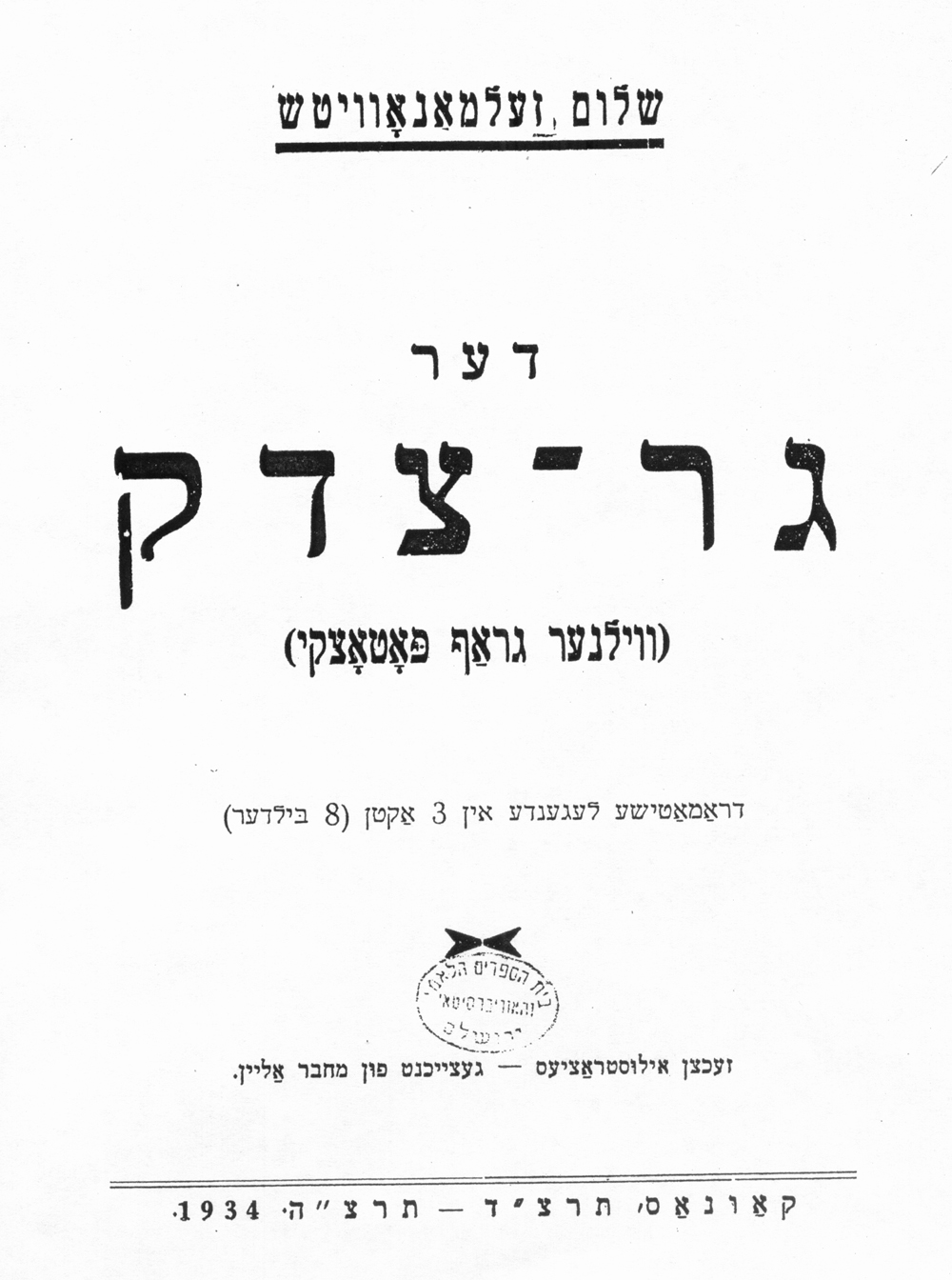
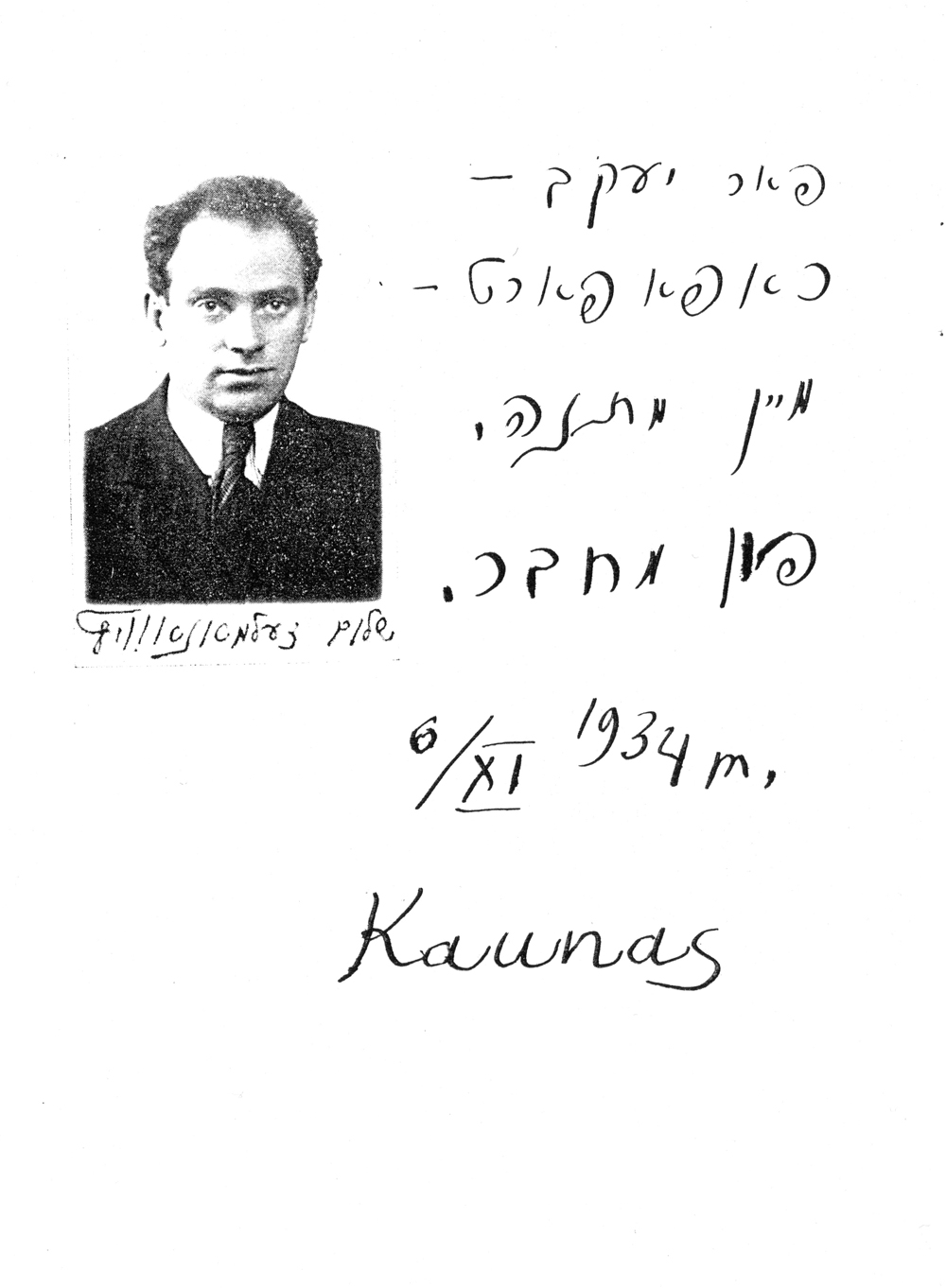
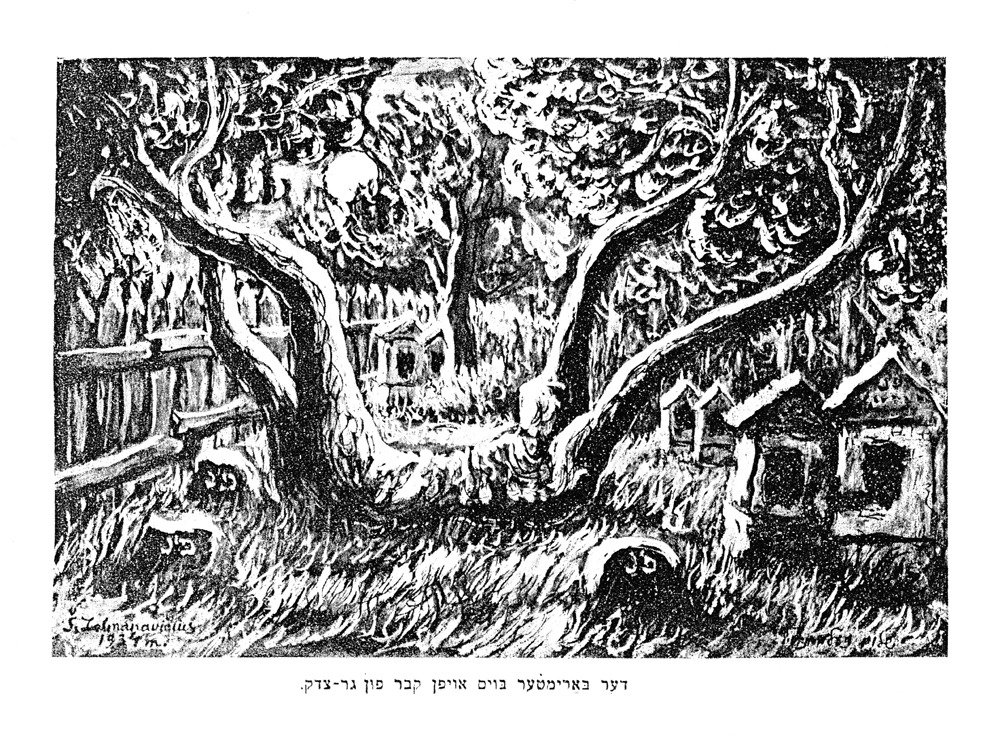
But there is no need for guesswork here. Sholom Zelmanovich, a talented artist and Yiddish playwright, published his דער גרצדקווילנער גראף פאטאצקי  in 1934.[4]

This three-act play commemorates the life and death of the legendary Ger Zedek of Vilna in a new and mystical mode.[5] The volume includes sixteen original drawings by Zelmanovich. Several of the drawings preserve details of Vilna’s old Jewish cemetery with seemingly incredible accuracy. Thus, for example, Zelmanovich depicts the northern entrance gate to the old Jewish cemetery, as well as the nearby Jewish caretaker’s house on the cemetery grounds, even though few photographs are extant that even begin to capture the details of those sites. His depiction of the Ger Zedek’s grave (and the human-like tree that hovered over it) is perfectly located in the south-eastern corner of the old Jewish cemetery, and is surrounded by the wooden fence that existed in that corner prior to 1926. Only someone who spent quality time in Vilna’s old Jewish cemetery could have known exactly where to place the entrance gate, the caretaker’s house, and the Ger Zedek’s grave.
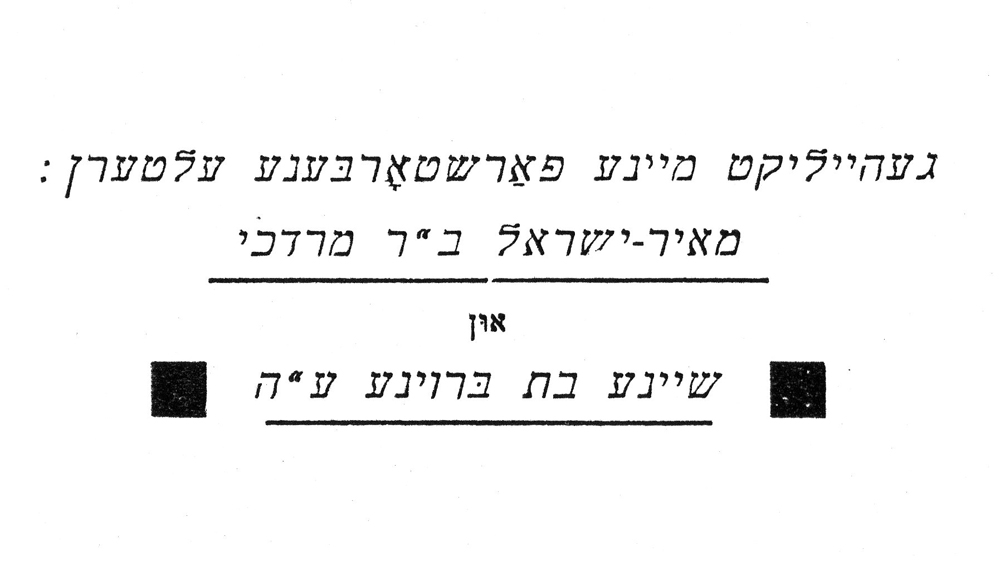
One other matter needs to be noticed. Zelmanovich dedicated the volume in memory of his deceased parents, Meir Yisrael son of Mordechai and Sheyne daughter of Broyne.[6]
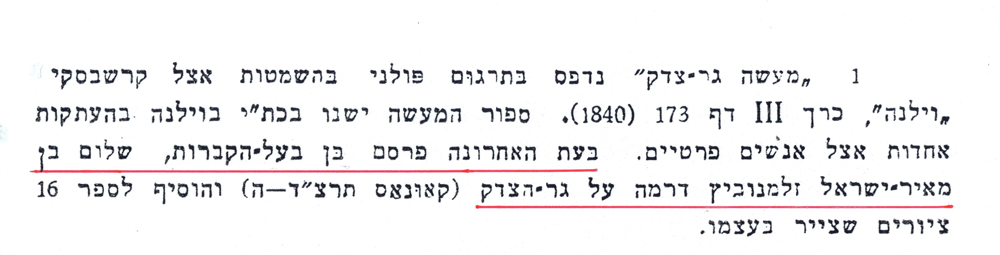
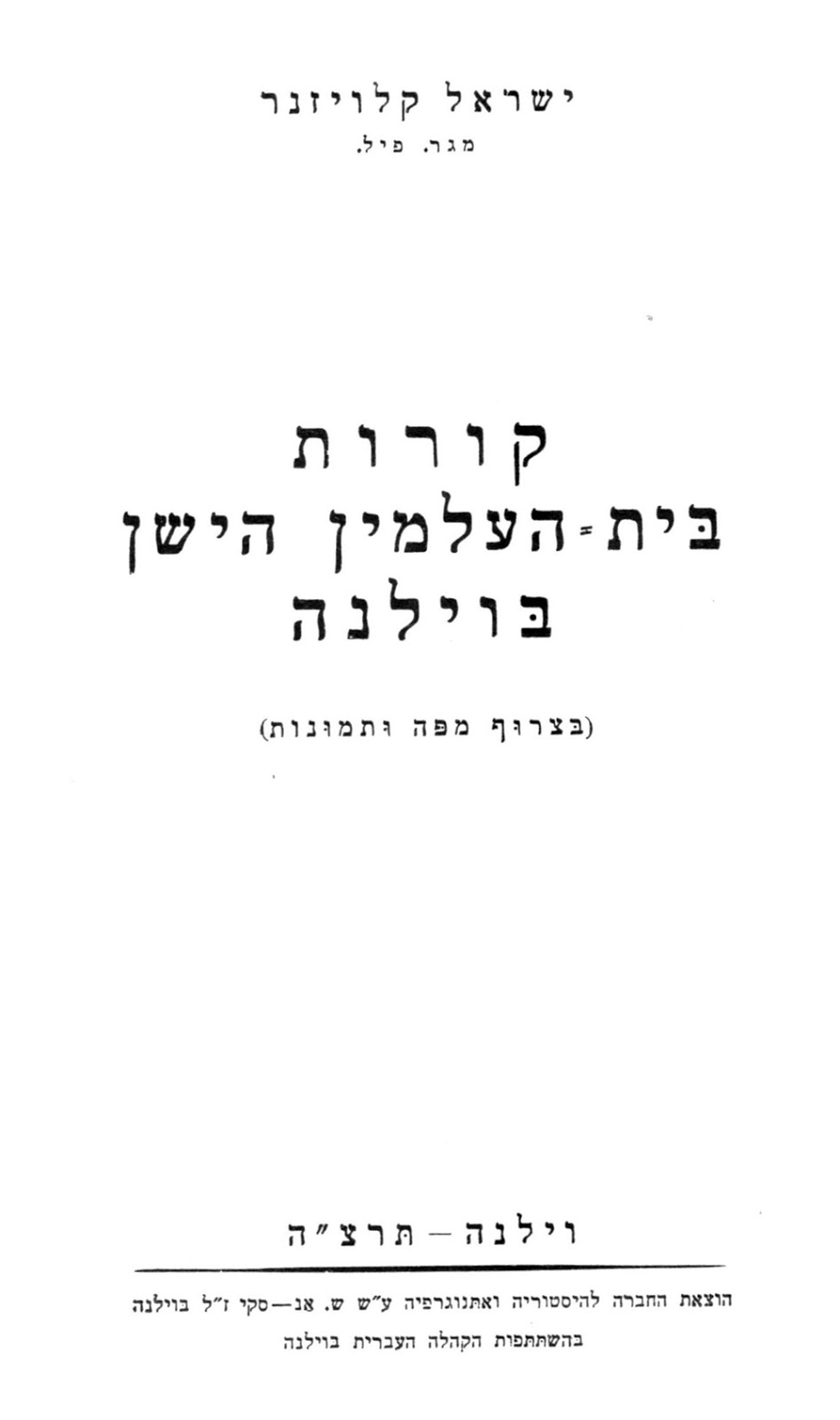
In the summer of 1935, the municipal authorities of Vilna, then under Polish rule, announced their plan to demolish Vilna’s old Jewish cemetery and replace it with a soccer stadium. Vilna – and worldwide – Jewry did not stand idly by. Instead, they engaged in an extensive, and ultimately successful, battle against the municipal authorities. As part of its efforts to win over the municipal authorities, the Vilna Jewish community charged a young Jewish scholar, Israel Klausner,[7] with writing a history of the old Jewish cemetery. It would offer clear documentation and prove beyond doubt that various Polish kings and municipal authorities throughout the centuries had authorized the Jewish community to construct the cemetery and maintain it. The cemetery was legally the property of Vilna’s Jewish community. Klausner’s monograph, entitled קורות בית-העלמין הישן בוילנה (Vilna, 1935), includes a discussion of the Ger Zedek’s grave. In a footnote,[8] Klausner mentions in passing Sholom Zelmanovich’s “recently published drama on the Ger Zedek,” and adds that Zelmanovich was the son of the caretaker of the old Jewish cemetery (Hebrew: בן בעלהקברות ), Meir Yisrael Zelmanovich! The plot thickens.
The full force of the Hebrew term בעלהקברות is not really captured by the English term “caretaker.” There were a variety of cemetery attendants who worked in the old Jewish cemetery in various capacities (such as guiding visitors and leading them to the graves they wished to visit, reciting prayers at the graves, ground-keeping, repairing broken tombstones and re-inking their inscriptions, and guard duty). But one cemetery attendant was in charge of all the other attendants, and as we shall see, he and his family lived in the house on the cemetery grounds. He was called: בעלהקברות, perhaps best rendered as: “Cemetery Keeper” or “Managing Director” of the old Jewish cemetery. We have established that Meir Zelmanovich served in that capacity. But who was he when did he live?

Meir Zelmanovich.

Sadly, almost nothing is known about the life of Meir Zelmanovich. He published no books and wrote no essays. As best I can tell, only one newspaper report mentions his name during his lifetime.[9] The report itself is significant. It records a complaint made by Meir Zelmanovich in 1919 that the Polish legionnaires had desecrated the old Jewish cemetery. But it would be Zelmanovich’s tragic death in 1920 that would perpetuate his memory. Here, we need to provide some historical context. Israel Cohen begins his discussion of the impact of World War I on Vilna, as follows:[10]

Within the small space of eight years, from 1914 to 1922, the Jews of Vilna tasted of the blessings of nine different governments, and suffered from a combination of other evils even more noxious. They became a prey to economic depression, military requisitions, unemployment, famine and disease; thousands of them were subjected to forced labor, imprisonment, plunder and brutal attacks; and physical and material deterioration inevitably engendered a certain degree of social demoralization. All the variegated differences of principle, of religious outlook and sociological doctrine, were now forgotten in the inferno created by the common foe. The long protracted fight for civil and political rights had to yield to the more primitive and desperate struggle for mere existence.

Almost certainly, the greatest concentration of Jewish suffering in this period came in April of 1919, when the Polish legionnaires unleashed a pogrom against Vilna’s Jews. Israel Cohen describes the horrors that followed:[11]

The [Polish] legionnaires[12] defiled and desecrated the [old Jewish] cemetery, smashed the tombstones, and opened the graves (including some of Vilna’s earliest rabbis) in the belief that they would find in them arms and money. Disappointed in their search, the Poles transferred their attentions from the dead to the living and ran amuck in the Jewish quarter. For three days they seized Jews in the streets, dragged them out of their homes, bludgeoned them savagely, and looted their houses and shops. About 80 Jews were shot, mostly in the suburb of Lipuvka, where some were ordered to dig their own graves; others were buried alive, and others were drowned, with their hands tied, in the Vilia [now: Neris] River… All sorts of outrages were committed in those days by the Poles in celebration of their victory. They tied a Jew to a horse and dragged him through the streets for three miles. They took a sadistic delight in cutting off the beards and earlocks of pious Jews. They even arrested, assaulted and humiliated Rabbi Rubinstein and Dr. Shabad. Altogether, thousands of Jews in Vilna, as well as in Lida and Bialystock were imprisoned in various concentration camps where they were ill fed and beaten, and where they suffered from hunger and typhoid. Moreover the total loss due to destruction and pillaging of Jewish people in the pogrom, in Vilna alone, was estimated at about 20 million roubles (about $10,000,000).

Polish rule of Vilna came to an end when the Russians recaptured Vilna on July 14, 1920. Russian rule lasted for six weeks, after which the Russians retreated and left Vilna in the control of the Lithuanians. Lithuanian rule lasted until October 8, 1920, when the Poles once again recaptured Vilna. One can only imagine the fear that gripped the Jewish community in Vilna, when they heard the sounds of the approaching Polish legionnaires. In fact, hundreds (some claim: thousands) of Vilna’s Jews fled on October 8 to Kovno, then part of Independent Lithuania.[13] Indeed, there was what to fear, for the Polish legionnaires were free again to wreak havoc with Jewish lives. And although the severity of the pogrom of 1919 did not repeat itself, the indiscriminate murder, rape, and looting of Jews that took place in Vilna between October 8-10, 1920 was, at least in the eyes of the victims, yet another pogrom.[14] Briefly, eye-witness Yiddish accounts[15] record that at least 6 Jewish men and women were murdered, numerous women were raped, and some 80 Jews were mugged and robbed. No one was brought to justice for committing these crimes! On October 10, 1920 Meir Zelmanovich, Cemetery Keeper of the old Jewish cemetery in Vilna was murdered by the Polish legionnaires. He was 70 years old when he died. The official Jewish record of his death lists his home address as “Derewnicka 3.” This is the address of the house on the grounds of the old Jewish cemetery. It is no wonder that Sholom Zelmanovitch could depict so vividly the northern entrance gate to the cemetery, its nearby caretaker’s house, and the human-like tree hovering over the Ger Zedek’s grave. His childhood playground was the old Jewish cemetery in Vilna.
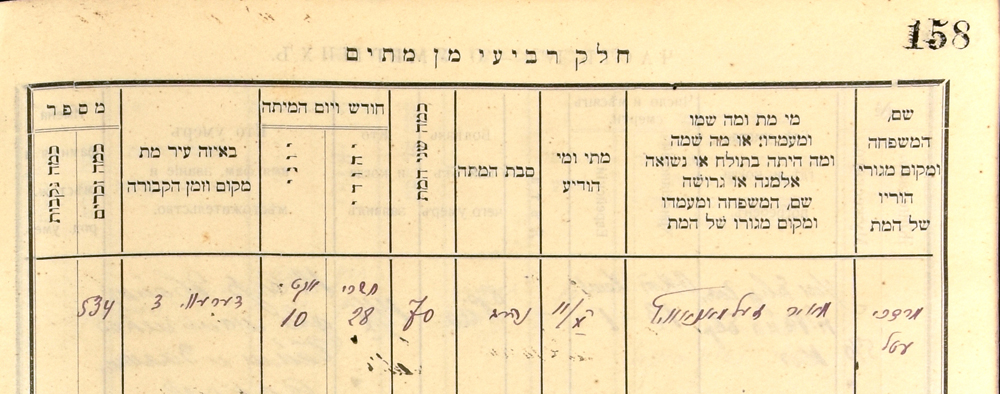
On the picture postcard from 1916-1917, one sees an elderly Jew. One possibility is that it depicts none other than Meir Zelmanovitch, the Cemetery Keeper of the old Jewish cemetery until his death in 1920 at age 70. I suspected that this was the case, but could not prove it until recently — when a small miracle occurred.

Miracles Sometimes Do Occur.

In March of this year, out of the clear blue sky, I was contacted by Laurie Cowan, who introduced herself as a great-granddaughter of Meir Zelmanovich! She basically was interested in any information I could provide about her great-grandfather that she didn’t already know. I was delighted to make her acquaintance, but wondered what led her to me. It turns out that both of us were seeking information about the same person – Meir Zelmanovich – from the Lithuanian State Historical Archives in Vilnius. An alert researcher at the Archives noticed this, and made the “shidduch” between us. I shared with Laurie whatever I knew about her great-grandfather. In turn, I asked her to send me copies of whatever documents she had relating to her great-grandfather. She sent me a scan of the following photograph of her great-grandmother and great-grandfather, Sheyne[16] and Meir Zelmanovich:
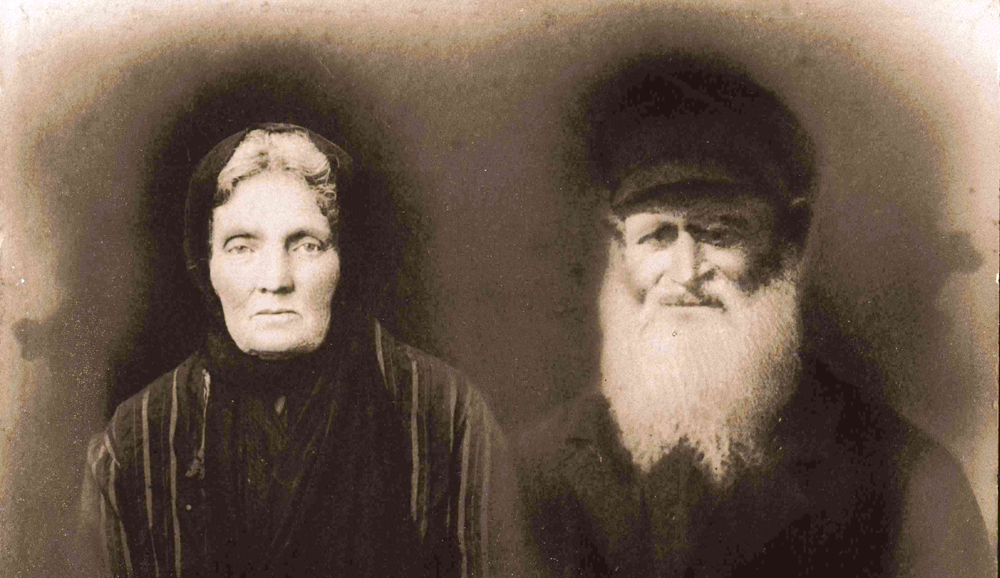
Never has it been so easy to identify an unidentified picture on a one-hundred year old picture postcard! One suspects that the picture postcard company representative, and a photographer, met with the Cemetery Keeper Meir Zelmanovich at the old Jewish cemetery in Shnipishok. He led them to the mausoleum of R. Menahem Manes Chajes, and was asked to pose at the tombstone just outside it. He graciously accepted the invitation. This may well have been the last photo taken of Zelmanovich, and it preserves, together with the photo provided by Laurie Cowan, the likeness of a martyr who fell during the October 1920 mini-pogrom in Vilna.[17]

At least six Jews were murdered between October 8-10 in 1920 in Vilna. They died for one reason only, namely, because they were Jews. Such Jews are regarded as martyrs and their names, at the very least, deserve to be recorded and remembered. Until now, none of the names of the Vilna martyrs of 1920 have been published in any public Jewish record, whether in a contemporary Jewish newspaper, or a Jewish historical essay or book, or an online posting. Having examined the extant records in the Lithuanian State Historical Archives, I have been able to retrieve the 6 names of the Jewish victims who were murdered in Vilna in October of 1920. In each case, the Jewish Kehillah records of Vilna in 1920 state clearly in Hebrew that the cause of death was either נהרג or נהרגה (i.e., murdered). The names are:

1. Shmuel ben Mendel Katz, age 56, died October 9.

2. Etel Natin, age 36, died October 9.

3. Basya Natin, age 32, died October 9.

4. Rokhl Blume Shuster, age 45, died October 9.

5. Meir Zelmanovich, age 70, died October 10.

6. Shlomo Abramovich, age 17, died October 12.[18]

May the memory of these martyrs be forever for a blessing! [19]

NOTES:

עם הספר, the People of the Book the world over, mourn the death of R. Shmuel Ashkenazi in Jerusalem, at the age of 98. He was שר הספר, the consummate master of the Hebrew book. Bibliographer, bibliophile, and book collector, his encyclopedic knowledge of all of Hebrew and Yiddish literature remains unparalleled in our time. His most recent contributions appeared in three massive volumes, replete with some 1,794 pages of immaculate scholarship. He never wasted a word; he wrote with precision and parsimony. Among his many accomplishments, he edited the Kasher Passover Haggadah, one of the most significant scholarly editions of the Passover Haggadah ever published. He was largely responsible for the single most accurate bibliography of Hebrew books ever produced, מפעל הביבליוגרפיה העבריתThe Bibliography of the Hebrew Book 1473-1960. Aside from his scholarly distinction, R. Shmuel Ashkenazi wrote in an elegant Hebrew with its own special charm. Not only did he advance discussion, but he did so in an aesthetically pleasing manner. For those of us who knew him personally, he evinced the same charm in his personal relationships that he did in his writings. He set a standard of excellence that we can only strive to emulate, but never really replicate. יהא זכרו ברוך!

This essay is dedicated to his memory, a token of appreciation for all he has taught me.

[1] Dovid Katz, “World War I Postcard of the Grave of Rabbi Menachem Manes Chayes (1560-1636) in the Old Vilna Jewish Cemetery,” Defending History (11 March 2020), available here) A copy of our postcard can also be seen online at ‘YIVO 1000 Towns’, record ID 10743 (http://yivo1000towns.cjh.org).
[2] For a fuller discussion of R. Menahem Manes Chajes and his epitaph, see S. Leiman, “A Picture and its One Thousand Words: The Old Jewish Cemetery of Vilna Revisited,” The Seforim Blog, January 14, 2016, especially notes 7-11, online here.
[3] Aside from his pivotal commentary on R. Joseph Karo’s Shulhan Arukh, R. Moshe Rivkes was a great-great grandfather of the Vilna Gaon.
[4] Precious little is known about Sholom Zelmanovich (1898-1941). See the brief biographical entry in לעקסיקאן פון דער נייער יידישער ליטעראטור (Martin Press: New York, 1960), vol. 3, column 670, which mistakenly lists him as being born in a town near Kovno, circa 1903. He was born in Vilna in 1898 (JewishGen) and died during one of the first Nazi aktions in the Kovno Ghetto.
[5] In general, see Joseph H. Prouser, Noble Soul: The Life and Legend of the Vilna Ger Tzedek Count Walenty Potocki (Gorgias Press: Piscataway, 2005). Prouser’s excellent monograph is a study of the many literary reworkings of the legends surrounding the Vilna Ger Zedek, with primary focus on 20th century Jewish literary contributions. Strangely, he offers no discussion of Zelmanovich’s contribution.
[6] On the feminine Yiddish name “Broyne,” see Alexander Beider, Dictionary of Ashkenazic Given Names (Avotaynu: Bergenfield, 2001), pp. 484-486.
[7] Klausner (1905-1981) settled in Palestine in 1936 and continued to be a prolific author of studies and books on the history of Vilna’s Jewish community. Aside from several important monographs, like his history of the old Jewish cemetery, he wrote a two-volume history of Jewish Vilna entitled 1939-1881 וילנה ירושלים דליטאדורות האחרונים (Ghetto Fighters’ House: Tel-Aviv, 1983), to which a third volume treating 1495-1881 was added posthumously, based largely on studies previously published by Klausner.
[8] קורות ביתהעלמין הישן בוילנהp. 45, note 1.
[9] See Vytautas Jogela, “The Old Jewish Cemetery in the Nineteenth and Twentieth Centuries,” Lituanus, vol. 61, no. 4 (2015), pp. 81-82.
[10] Israel Cohen, Vilna (Jewish Publication Society: Philadelphia, 1943), pp. 358-359.
[11] Ibid., pp. 378-379.
[12] Cohen regularly spells the word: “legionaries.” For the sake of consistency, I have spelled the word “legionnaires” throughout this essay.
[13] See, e.g., Boaz Wolfson, “מיטלליטע” in פנקס פאר דער געשיכטע פון ווילנע אין די יארן פון מלחמה און אקופאציע (B. Zionson: Vilna, 1922), column 387.
[14] There are probably as many definitions of “pogrom” as there are scholars and politicians. Since it is unclear whether the crimes committed on October 8-10, 1920 were planned and implemented by either a government or a political action committee, and since the duration of the attacks was short and rather swiftly brought under control, historians are reluctant to refer to the events that occurred on October 8-10, 1920 as a pogrom. On the other hand, to label those events a mere “disturbance” does not begin to capture the malevolent intent of the perpetrators directed specifically against Jews, and does not address the intensity of Jewish suffering at the time. For some of the different views regarding the definition of “pogrom,” and how the term has been manipulated by political interests, see Szymon Rudnicki’s forthcoming essay “The Vilna Pogrom of 19-21 April 1919,” to appear in Polin 33 (2020). Professor Rudnicki kindly allowed me to see a pre-publication copy of his lucid and informative essay.
[15] Wolfson, loc. cit. Cf. Jacob Wygodski, אין שטורם (B. Kletzkin: Vilna, 1926), pp. 217-221.
[16] Sheyne Zelmanovich died in Vilna on October 26, 1921, at age 68 (JewishGen). She lived in her home on the old Jewish cemetery grounds until her death. In a personal communication, Laurie Cowan informed me that the Zelmanoviches had 10 children who survived to adulthood. The 6th child, Beirach (popularly called: Berik; and later, Ben), was her grandfather, an older brother of Sholom mentioned above.
[17] The only other extant likeness of Meir Zelmanovich (known to me, and recovered on July 15, 2020) is an undated passport photo (circa 1916) preserved in the Lithuanian State Historical Archives. During the German occupation, all residents of Vilna were required to have – and to carry at all times – a German passport (we would call it: an Identity Card). Meir Zelmanovich’s German passport photo confirms the identity and authenticity of the photos of Zelmanovich published in this essay. All three photos are of one, and the same, person.
[18] One suspects that Abramovich may have been shot or beaten on October 9 and 10, like the others, but did not die from his wounds until the 12th.
[19] This essay could not have been written without the help of Regina Kopilevich, researcher (and tour guide) extraordinaire, who located whatever documents I sought at the Lithuanian State Historical Archives (Lietuvos Valstybes Istorijos Archyvas) in Vilnius. I am indebted to the librarians at the Archives for allowing her and me to examine these and other documents during my visits to Vilnius. Next to Google, JewishGen is a modern Jewish historian’s best friend, and we are grateful to all who contribute to making JewishGen the great historical resource that it is. Matt Jelen’s careful reading of an earlier draft has significantly improved the final version. I alone am responsible for whatever errors appear in this essay.
An enigmatic Pseudo-Shklov edition of Barukh She’amar

An enigmatic Pseudo-Shklov edition of Barukh She’amar[1]

By Marvin J. Heller

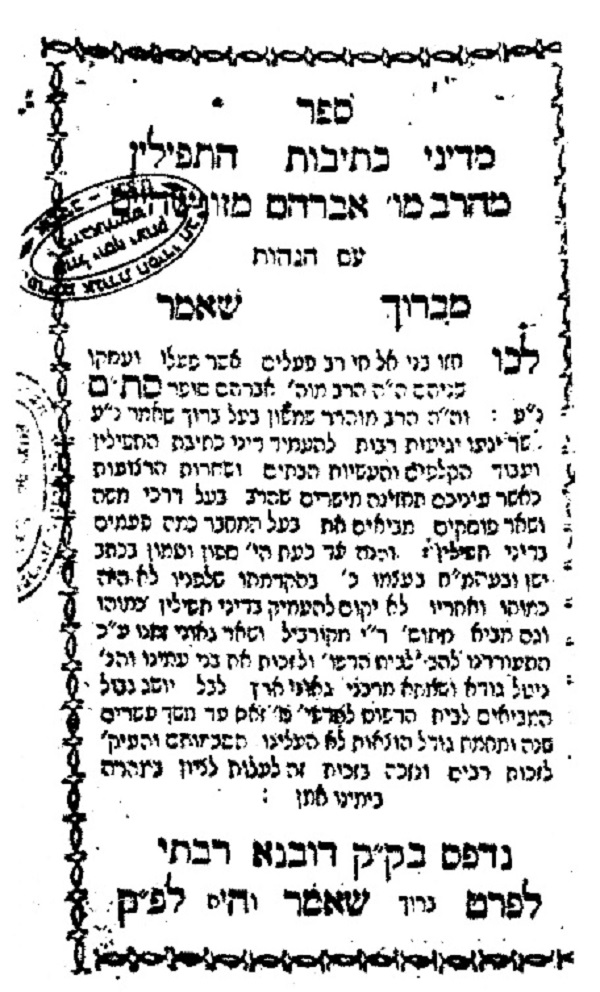
A title-page describing the work as an 1820 Shklov press publication is indicative of an enigmatic pseudo-edition of Baruch She’amar, a halakhot work pertaining to Sefer Torah, tefillin, and mezuzot by R. Simeon bar Eliʻezer (d. c. 1360). The author of Barukh She’amar, R. Simeon bar Eliʻezer (d. c. 1360), was born in Saxony, Germany and died in Eretz Israel. Orphaned at the age of eight, Simeon was adopted and raised by R. Issachar, a scribe who taught Simeon his craftsmanship, at which Shimon developed such expertise that R. Solomon ben Jehiel Luria (Maharshal, c. 1510-1574) referred to Simeon as “the head of all scribes.”[2]

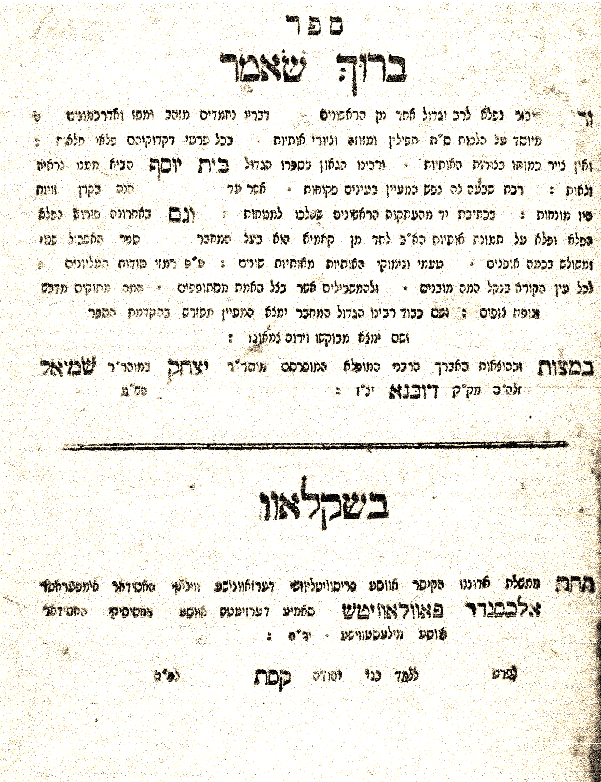
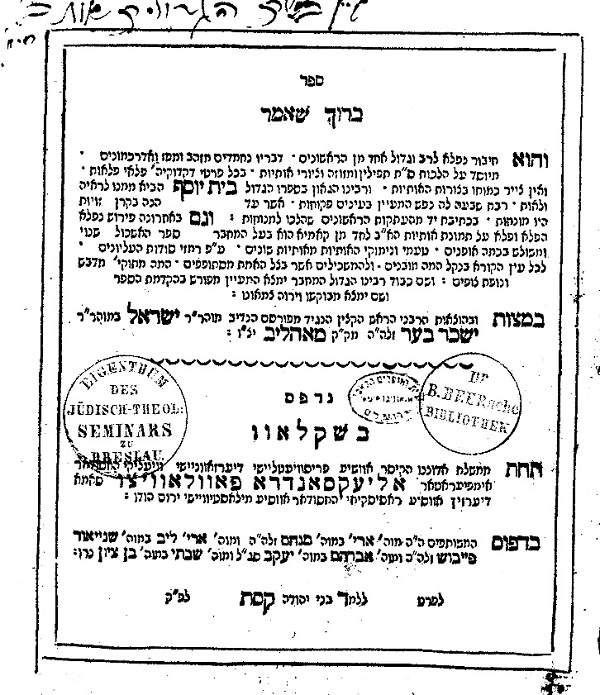
There is confusion as to the actual dates and places of printing of this imprint. The title-page clearly gives Shklov as the place of printing and dates it with the chronogram “[We must] teach the children of Judah the archer’s bow קסת [קשת] ללמד בני יהודה  (580 = 1820)” (II Samuel 1:18). However, to get the date 1820 the shin ש (300) in the verse has been replaced with a sameh ס (60) for the total of 580 = 1820. Nevertheless, bibliographic sources are in agreement that the publication place of the 1820 Barukh She’amar was Minkowce (Minkovtsy), a village in Podolia near Belarus in north-eastern Poland. However, there were earlier editions of Baruch She’amar issued in Dubno in 1796 and again in Shklov in 1804.

The two presses noted in conjunction with the printing of the subject editions of Baruch She-Amar are in Shklov and Minkowce (Minkovtsy). The former location, Shklov, is in the Mogilev region of Belaurus on the Dnieper river, approximately 410 km. from Vilna. It was home to a Jewish community dating to the late seventeenth century. A charter permitting Jewish settlement in Shklov was first received in 1668. Not long after, according to a visiting diplomat in 1699, Jews were “the richest and most influential class of people in the city.” By 1776 the Jewish population of Shkolov was 1,367. Shklov was an intellectual center as well as being an important commercial center in the late seventeenth and eighteenth centuries.[3] Hebrew presses in Shklov date to the late eighteenth century and as many as 226 Hebrew titles are attributed to that location until 1835. Minkowce, in contrast, is in the Kamenets-Podolski district of the Ukraine. A smaller community, its Jewish population in 1765 was 375. A Hebrew press was active there from 1795 to 1812, publishing almost forty titles.[4]


1804, Baruch She’amar, Courtesy of the National Library of Israel


1820, Baruch She’amar, Courtesy of Virtual Judaica

Entries in bibliographic works for Baruch She’amar consistently question the title-page of the 1820 edition’s place of publication when recording this work. Ch. B. Friedberg, in the Bet Eked Sefarim, records several editions of Baruch She’amar, among them [Minkowce 1795], Shklov 1804, and [Minkowce 1820]. In his Hebrew typography in Poland Friedberg records Baruch She’amar under Minkowce, 1796 and 1820 and under Shklov the 1804 edition of that work, dated קסת ללמד בני יהודה (564 = 1804). Vinograd, in the Thesaurus, lists a 1795 edition of Baruch She’amar referencing Friedberg, noting that it is questionable and an 1820 edition in which the title-page states Shklov, and in the entry for that work under the latter location has 1804 and 1820 entries, and for the 1820 edition referring the reader to Minkowce. Apart from these editions there was, as noted above, a prior 1796 Dubno imprint as well as several later editions.[5]

The text and format of the 1804 and 1820 editions are alike, both quartos (40: 32 ff.) and the title-pages of the two editions of Baruch She’amar even employ the same chronogram, modified to reflect the date of publication. Both title-pages credit R. Israel ben Issachar Ber from Ohilov for bringing the book to press, apparently the latter a repetition from the earlier printing. However, the 1804 Baruch She’amar names the printers as Aryeh ben Menahem, Aryeh Leib ben Schneer Feibush, Abraham ben Jacob, and Shabbetai ben Ziyyon as the printers. In contrast, the 1820 edition does not name the printer.

Abraham Yaari has entries for both Shklov and Minkowce in his bibliographical articles on those locations. In his article on Shklov he writes that a partial edition of Baruch She’amar had been printed previously in Dubno in 1796 and this, the 1804 edition, was the first complete printing of that work. He adds that Friedberg’s entries are in error and that the 1820 [Shklov] edition does not exist. Concerning the 1820 Minkowce edition, Yaari informs that there is an approbation from R. Judah Leib ben Zevi ha-Kohen Av Bet Din in Minkowce dated 11 Kislev 1820 (November 29, 1819) who refers to the earlier Minkowce printing and states that it is now being reprinted here, that is, in Minkowce. Yaari again takes issue with Friedberg, concluding “in truth, a complete edition was first printed in Shklov in 1804 (and based on that edition it was printed in Minkowce in 1820). A partial edition was printed in Dubno in 1796 and perhaps this is the reason for the errors.”[6]


1796, Barukh She’amar, Courtesy of the Library of Agudas Chassidei Chabad Ohel Yosef Yitzhak

While Yaari does appear to accurately summarize these editions he does not explain why the title-page of the 1820 Baruch She’amar clearly states Shklov as the place of printing rather than Minkowce. It is well known that in several instances the place of printing and the publication dates were modified to mislead the censor. However, that is not the case with other titles printed in both of our locations and the subject matter of Baruch She’amar on the halakhot pertaining to scribal arts is not one likely to attract the censor’s attention.

The printers of the 1820 edition removed the names of the printers from the 1804 title-page; it seems highly unlikely that they would have omitted correcting the publication place name. Moreover, even if in copying the title-page from the previous edition had been an oversight such an improbable error, if it  had occurred, would certainly have quickly necessitated a stop-press correction. Even if caught later it seems improbable that the publisher would have distributed the work as is. Moreover, it also seems improbable that this copy of the 1804 edition would have been subject to copyright restrictions. There is another important omission from the 1820 edition, that is, the editor, Israel ben Aryeh Leib’s apologia, at the end of the work.

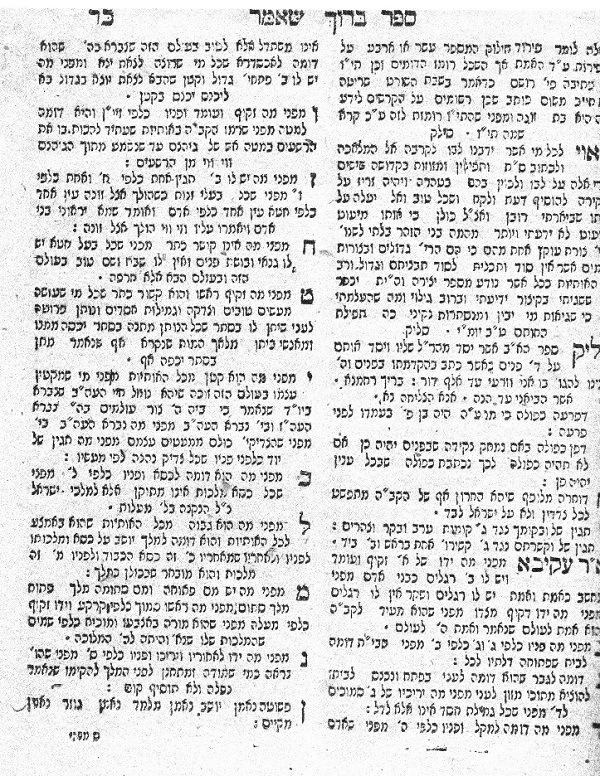
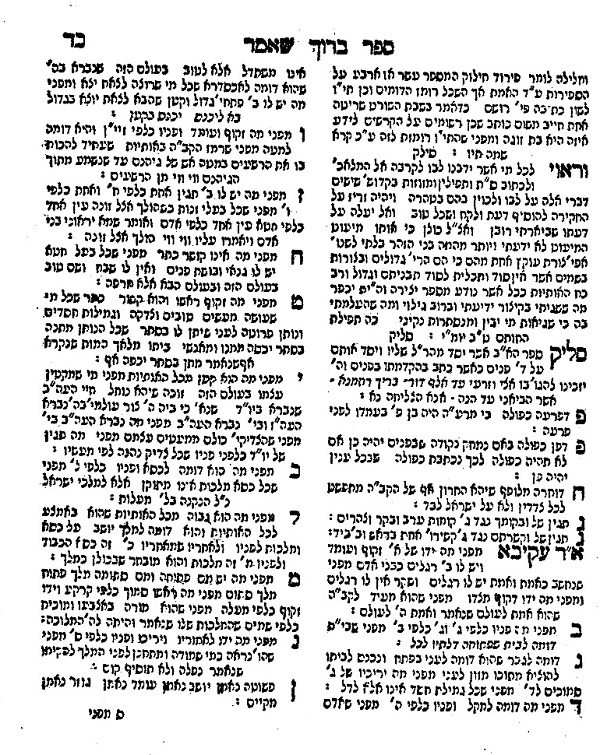
There are, however, in addition to those noted above, significant likenesses between the two works. First, excepting the front matter and apologia, the texts are set, line for line, in an identical manner. Moreover, the fonts appear to be alike. The reader should compare the two like pages below and drew his/her own conclusion. Perchance, the Minkowce printer acquired remaining copies of the 1804 edition, added the new front and back matter and reissued the work. Why did he do so?


1804, Baruch She’amar, Courtesy of the National Library of Israel


1820, Baruch She’amar , Courtesy of Virtual Judaica

Perhaps, and this is highly speculative, he felt that publishing this edition of Baruch She’amar as a pseudo-Shklov publication would give it greater marketability. If so, that should also have been true as well of other Minkowce publications. Or maybe he simply did not want to put his name on someone else’s work. Finally, we are left with the question as to why R. Judah Leib ben Zevi ha-Kohen’s approbation, which helps identify the place of publication, was printed with Baruch She’amar. Possibly including the approbation was important for the reasons that approbations were obtained, and it certainly would have been unconscionable, having gotten the Av Bet Din‘s approbation, to not print it.

We are left with a teku (an unresolved question).

[1] I would like to thank Eli Amsel of Virtual Judaica for bringing the 1820 edition of Baruch She-amar to my attention and Eli Genauer for reading the article and for his corrections.
[2] Hirsch Goldwurm, ed., The Rishonim (Brooklyn, 1982), p. 147.
[3] The Encyclopedia of Jewish life Before and During the Holocaust, editor in chief, Shmuel Spector; consulting editor, Geoffrey Wigoder; foreword by Elie Wiesel II (New York, 2001), III p. 1170; Yeshayahu Vinograd, Thesaurus of the Hebrew Book. Part I Indexes. Books and Authors, Bibles, Prayers and Talmud, Subjects and Printers, Chronology and Languages, Honorees and Institutes. Part II Places of print sorted by Hebrew names of places where printed including author, subject, place, and year printed, name of printer, number of pages and format, with annotations and bibliographical references II (Jerusalem, 193-95), pp. 689-95 [Hebrew].
[4] The Encyclopedia of Jewish II (New York, 2001.). p. 826). Vinograd II pp.457-458.
[5] Ch. B. Friedberg, Bet Eked Sefarim (Tel Aviv, 1951), bet 1431 [Hebrew]; idem. History of Hebrew Typography in Poland from its beginning in the year 1534 and its development to the present. . . . Second Edition, Enlarged, improved and revised from the sources (\(Tel Aviv, 1950), pp. 91,121, 123 [Hebrew]; Yeshayahu Vinograd, Thesaurus of the Hebrew Book. Listing of Books Printed in Hebrew Letters Since the Beginning of Printing circa 1469 through 1863 II (Jerusalem, 1993-95), pp. 457, 458, 692, 694 [Hebrew].
[6] Avraham Yaari, “Hebrew Printing in Minkovtsy,” Kiryat Sefer 19 (1942-43), pp. 274-75 [Hebrew]; idem. “Hebrew Printing in Shklov,” KS 22 (1945-46), pp. 141-42 [Hebrew].


Hebrew printing in Altdorf: A brief Christian-Hebraist Phenomenon

Hebrew printing in Altdorf: A brief Christian-Hebraist Phenomenon

By Marvin J. Heller[1]

Altdorf is remembered in Jewish history, when it is recalled at all, for the small number of Hebrew, Hebrew/Latin books printed there, beginning in the seventeenth century. Our Altdorf (old village), Altdorf bei Nürnberg, Bavaria, is one of several communities so named, others elsewhere in Germany, France, Switzerland, Poland, and even one Altdorf in the United States.[2] Again, our Altdorf, with the name to distinguish it from other Altdorfs, is Altdorf bei Nürnberg, that is, Altdorf near Nuremberg, a small Franconian town in south-eastern Germany, 25 km (15.53 miles) east of Nuremberg, in the district Nürnberger Land.

First mentioned in 1129, Altdorf was conquered by the Free Imperial City of Nuremberg in 1504. In 1578 an academy was founded in the city, becoming a university in 1622, one that lasted until 1809. Its most prominent student was the polymath Gottfried Wilhelm Leibniz (1646–1716), a discoverer of differential and integral calculus. The university is important to us as it was a center of Christian-Hebraism. An instructor in Hebrew at the university was R. Issachar Behr ben Judah Moses Perlhefter, whom we shall meet, albeit briefly, below. Also active in Altdorf was the renowned Christian-Hebraist Johann Christoph Wagenseil, whom we shall also meet, but in much greater detail, further on in the article, as well as his predecessor at the University of Altdorf, Theodor (Theodricus) Hackspan.

Jewish settlement in Altdorf is not recorded, indeed Altdorf apparently had no Jewish community in the seventeenth century, which makes the publication of Hebrew books in Altdorf of unusual interest. In the seventeenth and eighteenth centuries Christian-Hebraists, particularly in Protestant lands, studied and published Hebrew works for their own purposes, primarily philological and biblical titles, and translations of rabbinic works, often theological titles accompanied by glosses contesting the Jewish authors’ positions, all to better understand the sources of Christian theology and refute Jewish understanding of those works. Parenthetically, Christian-Hebraists often relied on both Jewish apostates and knowledgeable Jews for assistance with Hebrew, attempting to convert the latter to their beliefs.[3]

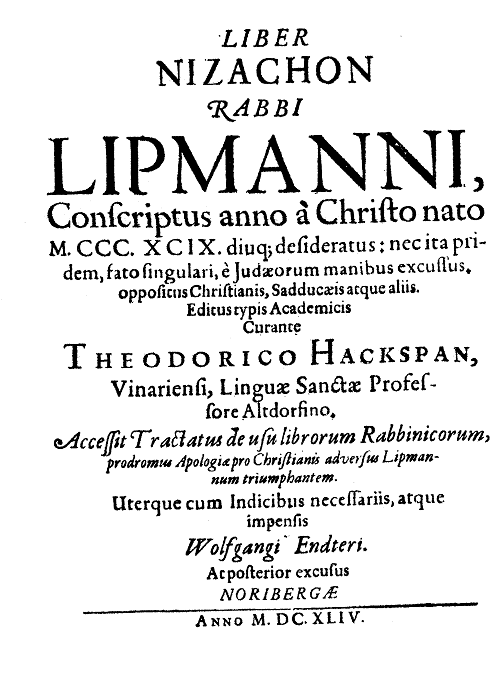
In Altdorf, in contrast, the Jewish related works are often polemics, including works that Jews might circulate in manuscript but were unable to print on their own behalf. The first Hebrew title printed in Altdorf was R. Yom Tov Lipmann Muelhausen’s Sefer Nizzahon (Liber Nizachon Rabbi Lipmanni . . .), published in 1644.[4] It was preceded and followed by Hebrew/Latin works, again, polemics, primarily comprised of the latter rather than the former, published in the seventeenth century, our subject period. Together with those bilingual titles and three works published in the 1760s, only sixteen works are recorded in a Hebrew bibliography for this period in Altdorf.[5]

A different enumeration of the titles printed in Altdorf, by the National Library of Israel, lists thirty-eight titles for Altdorf through 1765, again mainly Latin works with varying amounts of Hebrew, albeit dealing with Hebrew subjects, among them Kabbalah. However, for our period of interest, that is, the seventeenth century, ten titles only are recorded by the NLI. In addition, there are a number of works not in either enumeration, printed in Altdorf, that pertain to our subject, the works of Christian-Hebraists. Altdorf does not merit an entry in Ch. B. Friedberg’s multi-volume History of Hebrew Typography . . . and in terms of Hebrew printing it might be described as a cul-de-sac, its’ publications being of little import or lasting influence in the history of Hebrew typography. Nevertheless, its publications are of interest, being concerned with Jews, Judaism, and the study of Jewish texts by Christian-Hebraists.

This article, bibliographic in nature, is concerned with those seventeenth century titles published by Christian-Hebraists in Altdorf. In addition to the Hebrew titles a small number of the Christian-Hebraists’ Latin works will be noted as examples of their areas of interest and output, beginning with titles by Theodricus Hackspan. This will be followed in greater detail by a discussion of the first printed edition of the Sefer Nizzahon, translations of Mishnayot, and additional titles published by Wagenseil, among them Tela ignea Satanae, his most famous collection of polemic works.

I

Hackspan (1607-59), a noted Lutheran theologian and Orientalist, studied under renowned individuals in those fields, namely Daniel Schwenter (1585-1636) and Georg Calixtus (1586-1656). From 1636 Hackspan was at the University of Altdorf where he held the chair of Hebrew, was the first to publicly teach Oriental languages, and from 1654 was Professor of theology while retaining the chair of Oriental languages. It is said that “his close application to study and to the duties of his professorships so impaired his health that he died in the fifty-second year of his age. Hackspan is said to have been the best scholar of his day in Hebrew, Chaldee, Syriac, and Arabic.”[6] A prolific author, his works include titles printed as early as 1628 through 1633 in Jenae, and, from 1636, in Altdorf, with minimal Hebrew, beginning with Observationes Philologicae Ex Sacro Potissimum Penu Depromtae, with several coauthors. This was followed, in 1637, by a Hackspan title with somewhat more Hebrew De Necessitate Sacrae Philologiae in Theologia, this on comparative theology. Hackman also wrote works not related to Judaism, for example, Fides et leges Mohammaedis exhibitae ex Alkorani manuscripto duplici (1647) dealing with Islam, well beyond the scope of this article.

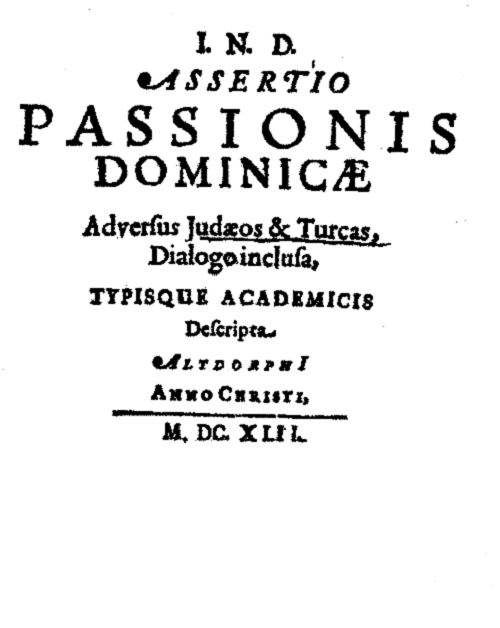
Assertio passionis Dominicae adversus Judaeos & Turcas. The first title in our series published in Altdorf by Theodricus Hackspan is his Assertio passionis Dominicae adversus Judaeos & Turcas (Assertive passion of the Lord against the Jews and the Turks), a small quarto (40: 24 pp.) Latin polemic with varying amounts of Hebrew, published in 1642.


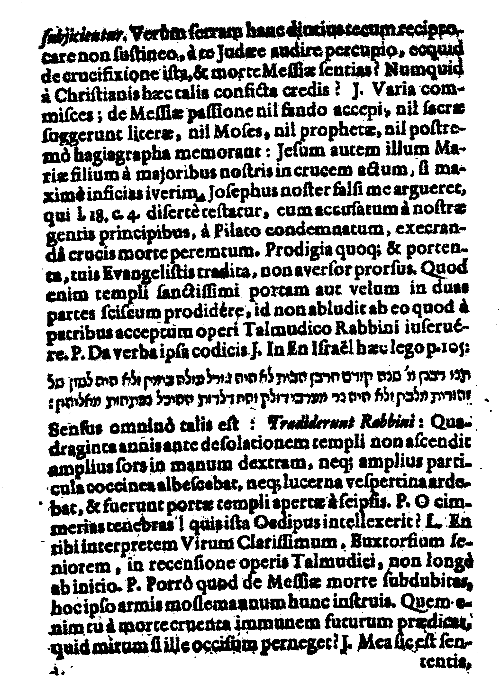
Assertio passionis Dominicae adversus Judaeos & Turcas is primarily in Latin with very limited Hebrew and slightly more Arabic text. Several Hebrew sources are referenced. Among them “שלחן ערוך tractatu ארוך חיים Hilcot תשעה באב ושער תעניות.” There are only two full Hebrew passages, both set in rabbinic letters, as well as several brief lines in square letters. The passages, from Ta’anit 5b-6a and Yoma 39b respectively, with Latin translation and commentary, are:

He replied: Let me tell you a parable – To what may this be compared? To a man who was journeying in the desert; he was hungry, weary and thirsty and he lighted upon a tree the fruits of which were sweet, its shade pleasant, and a stream of water flowing beneath it; he ate of its fruits, drank of the water, and rested under its shade. When he was about to continue his journey, he said: Tree, O Tree, with what shall I bless thee? Shall I say to thee, ‘May thy fruits be sweet’? They are sweet already; that thy shade be pleasant? It is already pleasant; that a stream of water may flow beneath thee? Lo, a stream of water flows already beneath thee; therefore [I say], ‘May it be [God’s] will that all the shoots taken from thee be like unto thee’. So also with you. With what shall I bless you? With [the knowledge of the Torah?] You already possess [knowledge of the Torah]. With riches? You have riches already. With children? You have children already. Hence [I say], ‘May it be [God’s] will that your offspring be like unto you.’

Our Rabbis taught: During the last forty years before the destruction of the Temple the lot [For the Lord] did not come up in the right hand; nor did the crimson-coloured strap become white; nor did the westernmost light shine; and the doors of the Hekal would open by themselves.”[7]

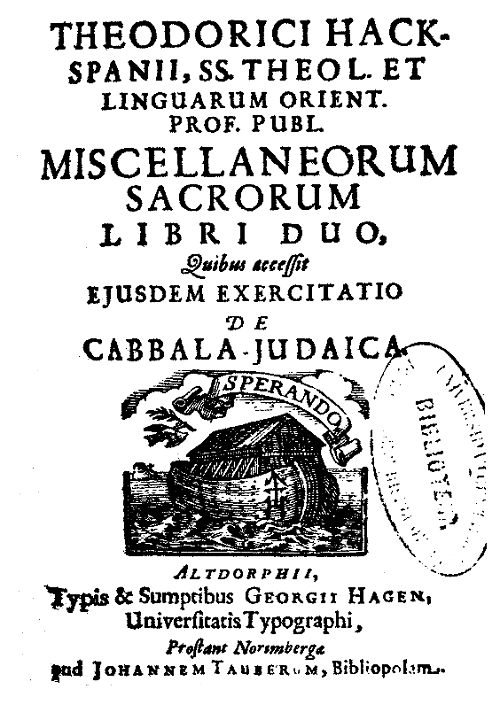
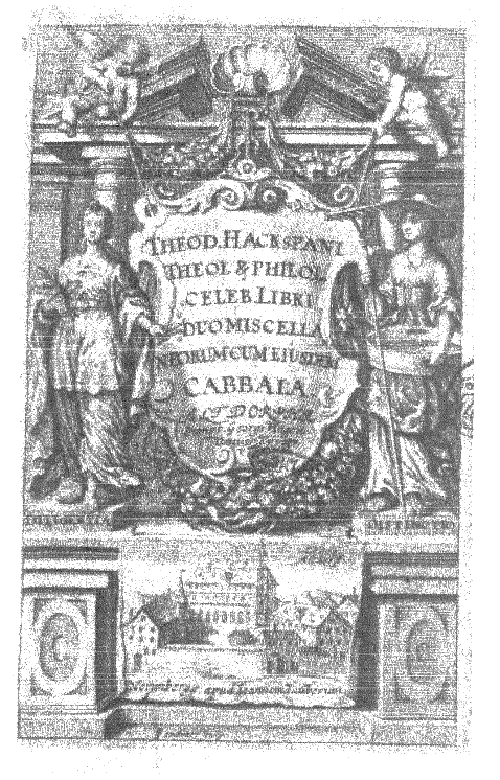
Miscellaneorum Sacrorum libri duo. Another Hackspan title published in Altdorf, this in 1660, is Miscellaneorum Sacrorum libri duo: quibus accessit ejusdem Exercitatio de Cabbala Judaica, a translation of two miscellaneous sacred books (17 cm.: 5, 453, [33] pp.), printed by Georgii Hagen, typos & Sumptibus  Universitatis Typographi together with Johannum Tauberum, Bibliopolam.

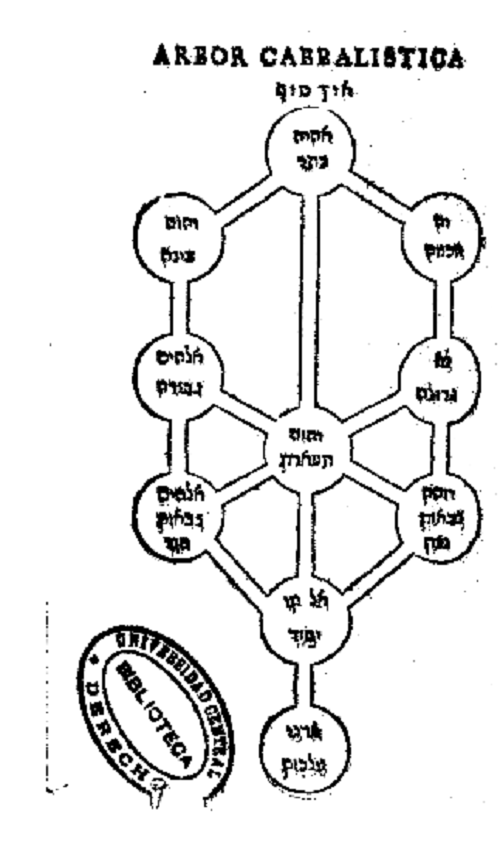
Miscellaneorum Sacrorum libri is a Latin introductory work comprised of introductions to Bible and Kabbalah, the latter section, from pp. 282-453, entitled “Cabbalae Judaicae brevis exposition.”  Miscellaneorum Sacrorum libri duo was has two lead title-pages (above) and, in the Kabbalistic section, a diagram of the tree of life which enumerates and displays the sephirot (emanations).

Here too the text is primarily Latin with varying amounts, but generally brief Hebrew, including quotes from the Talmud and other varied Hebrew sources. For example (p. 417) “CXXXII. Nostra aetate quoque familia in scriptus eorum occurrunt (In our time in the writings of these men, too, was met by the family) Kimchi in Obadiam scripit” followed by seven lines of Hebrew beginning ארץ אדום אינה היום לבני אדום כי האומות נתבלבלו רובם הם בין אמונת בנוצרים . . . (Today the sons of Edom, because the nations were confused, are mostly Christians) . . . . Terra Idumea hodie non est filiorum Edom: nam populi confusi sunt (Edom today is the rule (that is the example) for the people were mixed up.

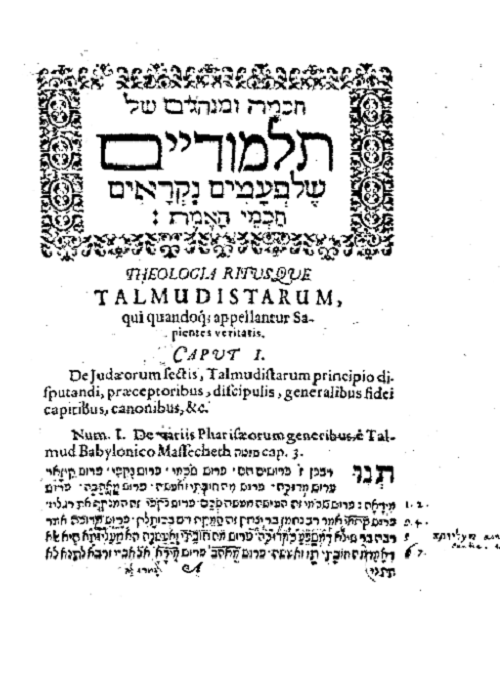
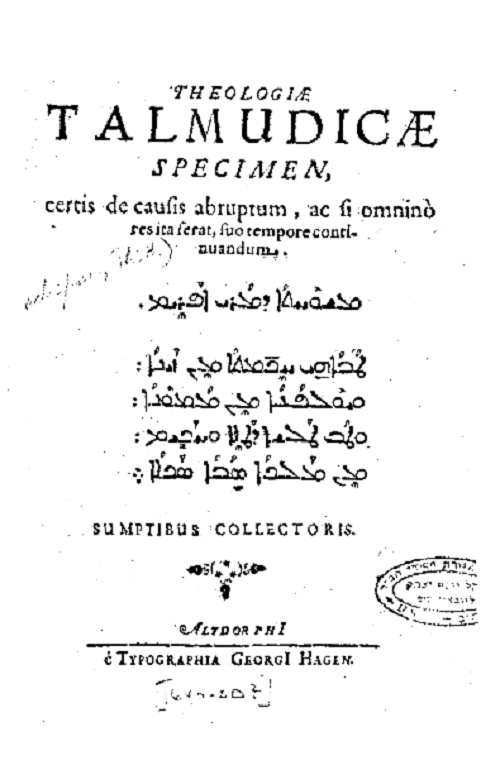
Theologiae talmudicae specimen. Yet another work by Theodricus Hackspan is Theologiae Talmudicae Specimen, certis de causis abruptum: ac si omninò res ita ferat, suo tempore continuandum. Theologiae Talmudicae Specimen (undated, 154 pp.), also printed by Georgii Hagen. The text of Theologiae Talmudicae Specimen is almost entirely in Hebrew, excepting Latin headers and marginal references. Despite the fact that Theologiae Talmudicae Specimen is almost entirely in Hebrew, in contrast to the other Hackspan titles noted here, it is set to read from left to right as if in Roman letters.

II

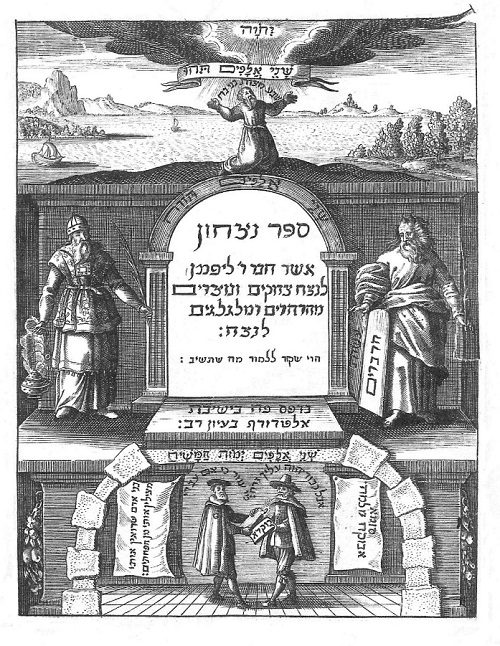
Sefer Nizzahon. The first Jewish title in our series published in Altdorf is R. Yom Tov Lipmann Muelhausen’s (d. 1459) Sefer Nizzahon (1644). This, the first printed edition of Nizzahon, was published in quarto format (40: [14], 512, 24 pp.), It is a polemic defense of Judaism and refutation of Christianity, here with a Latin translation by Theodore Hackspan, It was published so that Christians might be able to attempt to refute its arguments.

Muelhausen was one of the leading rabbinic figures of his time and a dayyan in Prague. His name, Muelhausen, likely derives from an earlier family residence in Muelhausen, Alsace. He studied under R. Meir ben Baruch ha-Levi (c. 1320-1390), Sar Shalom of Neustadt (14th cent.), and R. Samson ben Eleazar. In 1389, Muelhausen was one of a number of Jews incarcerated after an apostate named Peter accused them of defaming Christianity. In addition to his great rabbinic erudition, Muelhausen knew Latin and was familiar with Christian literature, making him a formidable polemicist. He was a prolific writer, his other works are on halakhah, philosophy, aggadah, piyyutim, and Kabbalah. In preparing Nizzahon Muelhausen utilized earlier Jewish polemical works, including an earlier thirteenth century Sefer Nizzahon Yashan (Nizzahon Vetus), with which this work is not to be confused. The effectiveness of Muelhausen’s Nizzahon may be gauged by the appearance of additional Latin editions and bitter attempts at refutations.

In a disputation in which Muelhausen represented the Jews he is reported to have been completely effective in his arguments, with the result that eighty Jews were martyred but Muelhausen miraculously survived.[8] Soon afterwards, in 1390, Muelhausen wrote Sefer Nizzahon for other Jews who had to respond to challenges from Christians. Nizzahon was copied but remained in manuscript until the publication of this edition, as the Church prohibited Jewish possession of a copy.

Christian scholars attempted to print Nizzahon for many years but were unable to obtain a manuscript. In 1644, Theodor Hackspan was successful in getting a copy. He had looked for a Nizzahon for a long time without success until he was informed that a rabbi in the neighboring small city of Schnattach had a copy but would not show it to anyone. Hackspan, together with some friends, paid an unwelcome visit to the rabbi, as if to engage him in a dispute. In the heat of the debate the rabbi took out his hidden manuscript of Nizzahon to look into it. Hackspan immediately seized the book from the rabbi’s hands, ran off with it to his carriage, and returned with it to Altdorf. Then, with a few of his students, they immediately copied the book and soon after printed the editio princeps of Sefer Nizzahon. Ora Limor and Israel Jacob Yuval Shoulson write that Hackspan printed Lippman’s text with care, not making any deliberate changes or alterations. Nevertheless, due to the poor knowledge of Hebrew of his “scribes . . . the book is full of mistakes, especially minor errors.” Meyer Waxman remarks that in his Latin introduction Hackman”attempts to refute Lippman in a dignified manner. Others, however, were not so generous.” [9]


Nizzahon has an engraved Hebrew title page (above) followed by a Latin title page, which begins Liber Nizachon rabbi Lipmanni. . . .[10] Next is a dedication to Dn. Johan-Jodoco from Hackspan, introductions, a table of contents, and the Hebrew text set in a single column in rabbinic letters with marginal biblical references. Nizzahon is divided by the days of the week, further organized by books of the Bible, and subdivided into 354 sections, representative of the lunar year. These sections, not in order in the book, are refutations of Christian arguments (66 sections), explanations of dubious actions by the righteous in the Bible (39), explanations of difficult verses (41), reasons for precepts (34), refutations of the arguments of skeptics (55), against heretics and Karaites (47), and concluding with sixteen Jewish principles (48) to be read on Shabbat. Muelhausen refutes the Christian concepts of the Messiah, Immaculate Conception, and original sin. The Latin portion of the volume, printed in Nuremburg, begins on p. 211 and is paginated from right to left.[11]

Nizzahon was printed by Wolfgang Endter (1593 – 1659), a member of the well-known Nuremberg publishing family. The Hebrew title-pages states that it was printed in Altdorf, the Latin title-page gives Nuremberg at the place of publication. Nizzahon was reprinted in Altdorf in 1681 as part of Wagenseil’s Tela Ignea Satanae (below). The first Jewish edition of Nizzahon was published by Solomon Proops in Amsterdam (1709).

III

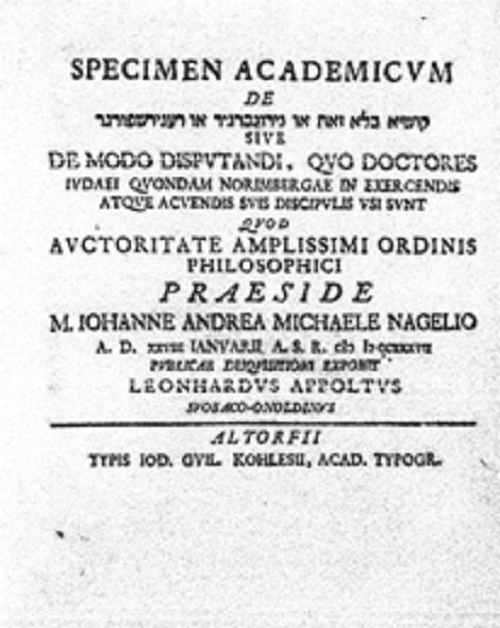
Kushya belo Zot o Niremberger o Regensburger.

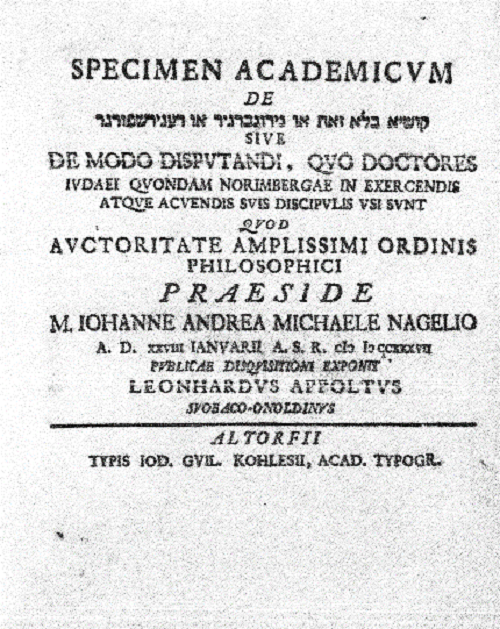
Another work with Hebrew attributed to the Altdorf press was Kushya belo Zot o Nuremberger o Regensburger, a relatively small work (19 cm. 24 pp.), printed in 1670. This very rare work was described in an auction catalogue, the entry stating,

Kushya belo Zot o Niremberger o Regensburger

A composition regarding Talmudic disputation and the ‘chilukim’ method of the Ashkenazim by Leonard Appoltus, supervised by Prof. Johanne Andre Michael Nagelio.

Altorf, [c. 1670].

In Latin with segments in Hebrew.

24 p. 19 cm. Good condition. ‘Blo Zot’, Nirenburger’ and and ‘Regensburger’ are different types of questions that it was usual to ask in the ‘chuilukim’ method.

Very rare. Not in the Jerusalem National Library.

o.b $300     $400/700[12]

From the sale results sheet it appears that this item did not sell.

IV

In 1674 Christoph Wagenseil (1633-1705), professor of Oriental languages at the University of Altdorf from 1667, succeeded Hackspan, becoming the most prominent Christian-Hebraist in Altdorf. Wagenseil, learned his Hebrew from Enoch Levi, a Viennese Jew, and Jewish studies from R. Samuel Issachar Behr ben Judah Moses Eybeschuetz Perlhefter, (d. after 1701), a Prague scholar, kabbalist, and instructor in Hebrew in the University of Altdorf. Perlhefter was the author of Ohel Yissakhar, Ma’aseh Ḥoshen u-Ketoret, and Ba’er Heitev; served as rabbi in Mantua, leaving there over a dispute concerning the pseudo-Messiah Mordecai of Eisenstadt, a follower of Shabbetai Zevi, whom Issachar Behr had initially supported. He subsequently returned to Prague where he held the position of dayyan.

Perlhefter’s wife, Bella, taught Wagenseil’s daughter dancing and music.[13] Elisheva Carlebach elaborates, writing that Wagenseil, as did other Christian-Hebraists, often pressured the Jews who assisted them to convert. In this context, Wagenseil, unable to influence Perlhefter who was residing at the time in Altdorf, turned to Bella, then in Schnattach, inviting her to join his household for a family celebration. Bella responded, in literate Hebrew, that as she had a small child, whom she could not leave, “And if I carry him with me the cold is great, the snow is high, and a tiny child cannot tolerate the cold, for he or she has not been out of the house from the day of his or her birth and is not accustomed to the cold [Mrs. Perlhefter changed genders in mid sentence].” [14]

Wagenseil traveled widely as a youth, serving as a private tutor, and while in North Africa, Wagenseil acquired Hebrew manuscripts. Although “tarred” as an anti-Semite, together with other German Hebraists in the nineteenth century, Wagenseil was an accomplished Hebraist and, despite his opposition to Jewish beliefs, often defended Judaism against its more virulent enemies and their baseless charges. David Malkiel reports that Wagenseil had cordial relations with Jewish contemporaries.[15] Assessments of Wagenseil vary, from Heinrich Graetz, that “he was a good-hearted man, and kindly disposed towards the Jews,” to Frank E. Manuel, for whom he is one of three Christian-Hebraists, with Shickard and Eisenmenger, who “used their learning to cast a glaring light on those texts in the Talmud and later Jewish writings that were either blasphemous or full of hatred for Christians.” Wagenseil confuted Christian charges that the Talmud was blasphemous, senseless and jumbled, arguing that in it were matters of morality, wisdom, and medical advice; he also opposed blood libels. Furthermore, he maintained that Catholic censors had distorted the Talmudic text, particularly of Avodah Zarah.[16]

Wagenseil is credited with assembling the first comprehensive study of Jewish observances and ceremonies by a Christian. Jonathan I. Israel notes that Wagenseil considered much of what he found superstitious and absurd, and that his motivation was to bring Jews to Christianity. Nevertheless, “for all that an unmistakable admiration for Jewish life and Jewish life-style insistently creeps through.” He quotes Wagenseil, who wrote in the forward to the apostate Friedrich Albrecht Christiani’s Der Jüden Glaube und Aberglaube (Leipzig, 1705),

that they show far more care, zeal, and constancy in all this (their religious duties) than Christians do in practicing their true faith, and that, furthermore, they are far less given to vice; rather they possess many beautiful virtues, especially compassion, charity, moderation, chastity, and so forth . . .[17]

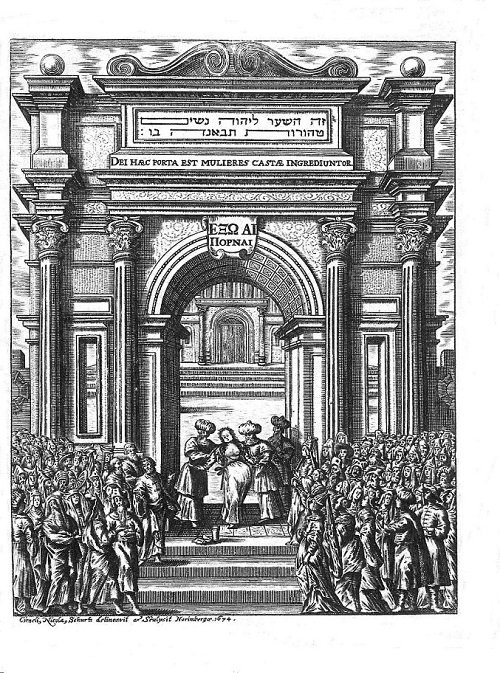
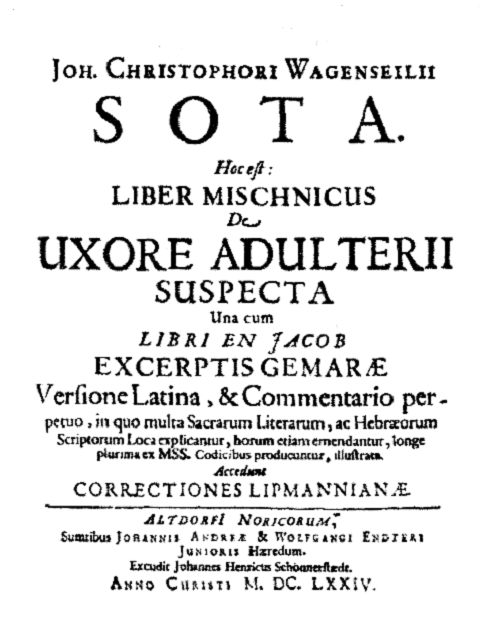
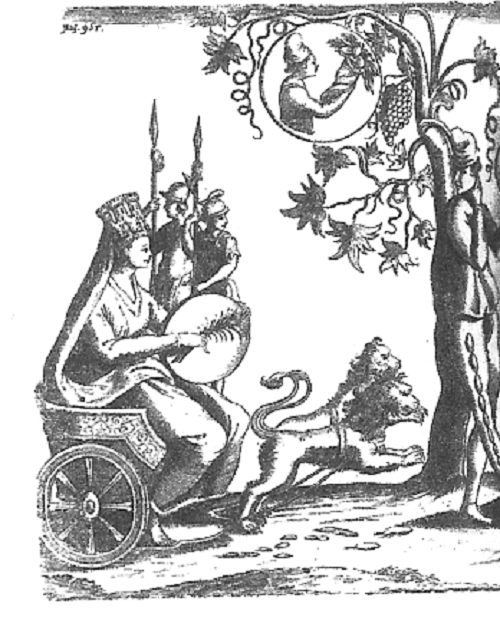
Sotah (the suspected adulterous woman) has numerous illustrations, several being full page, and a detailed attractive copper-plate title page of the Sotah (the wife accused of adultery) being taken by the priests to be tested. The volume opens with a full page depiction of the Sotah being taken to be tested by the priests.

The verso has verses in Latin from Psalms and the Christian Bible. The title page in red and black, begins, Hoc est: liber mischnicus de uxore adulterii suspecta (this book is a work concerning a woman suspected of adulterous behavior). Reading from left to right, the volume begins with considerable prefatory material, including several indices, one in Hebrew, correctiones Lipmannianae (10-81), corrections to Hackman’s edition of the Sefer ha-Nizzahon based on two other manuscripts he was able to obtain, and the text, which has separate pagination.

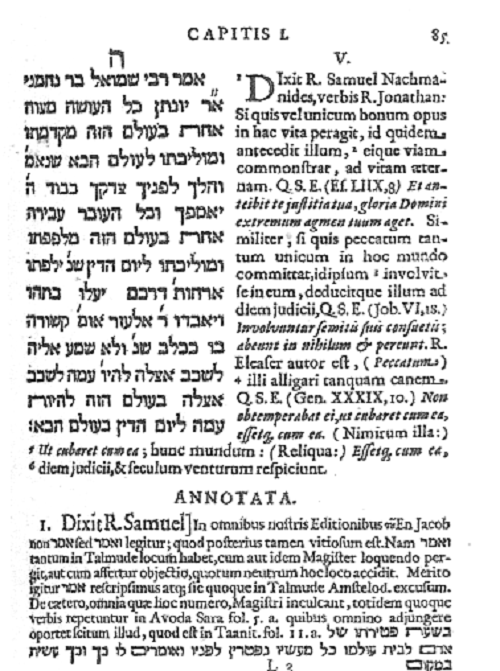
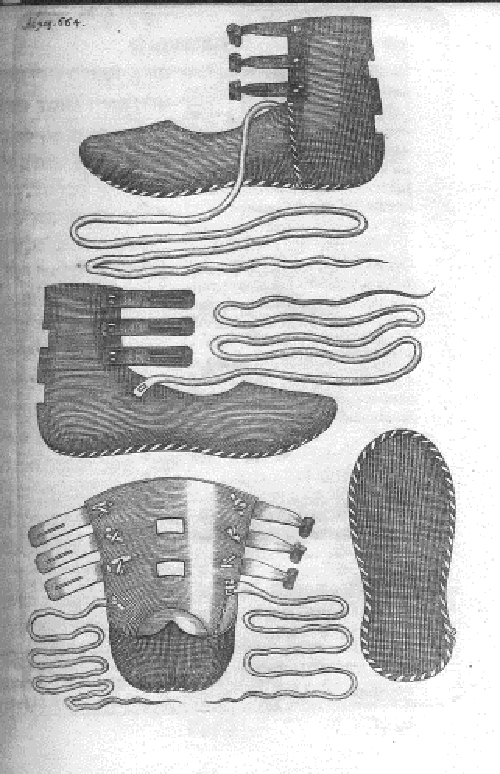
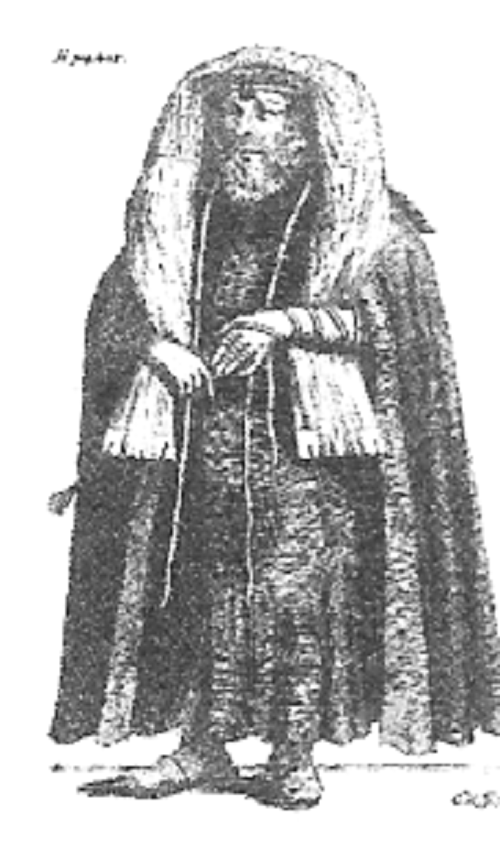
Within the text the Mishnah is always in the left margin in square unvocalized Hebrew, the translation in the right column, accompanied by an extensive Latin commentary with occasional Hebrew, with excerpts from the gemara, including most of the aggadah in the Ein Ya’akov, on this tractate. The volume has numerous illustrations, several being full page. Among them are depictions of the priest wearing talit and tefillin with their straps for the head and arm, magen davids, halizah shoes, coins, and an undressed woman with skull and cross. Negaim was the next tractate translated by Wagenseil, to prove that the Talmud contained valuable and interesting material on medicine.[18]

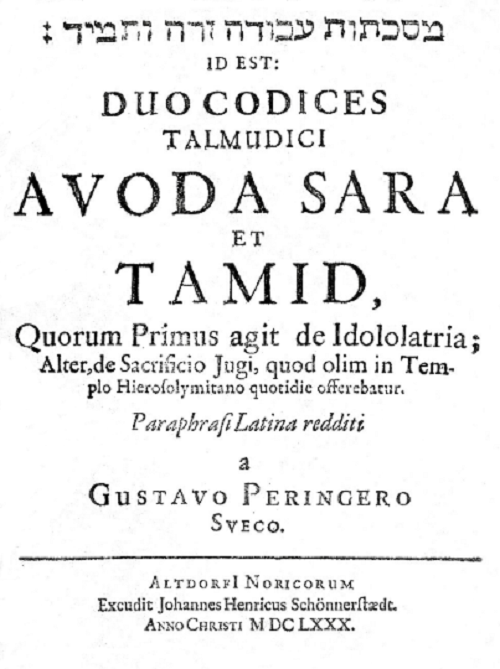
Tractates Avodah Zarah and Tamid. Another translation of Mishnayot tractates, this of Avodah Zarah and Tamid, prepared by the Christian-Hebraist Gustavo Peringero (Gustav von Lilienbad Peringer, 1651-1705), a student of Johann Christoph Wagenseil. Peringero, (1633–1705), was professor of Oriental languages at Upsala (1681- 1695) and afterwards librarian at Stockholm. Charles XI, king of Sweden, who reputedly had an extraordinary interest in Jews and even more so in Karaites, sent Peringero to Poland to learn about the latter and perhaps to attempt to convert the Karaites to Christianity, for, as Graetz notes, they did not have “the accretion of traditions, and were said to bear great resemblance to the Protestants,” nor were they “entangled in the web of the Talmud.” [19]

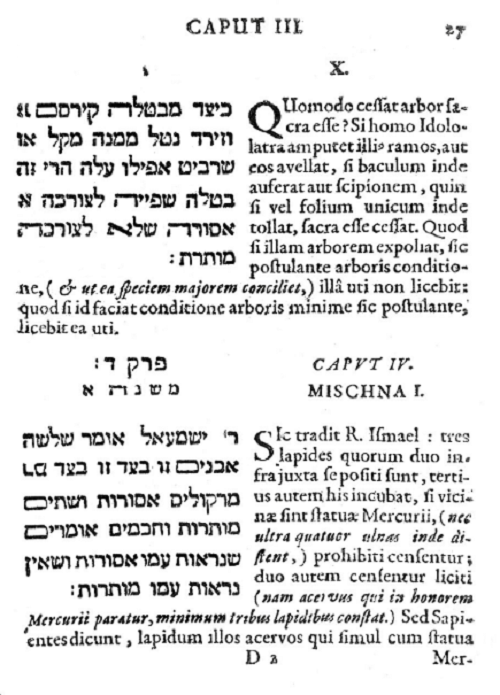
This edition of Mishnayot of tractates Avodah Zarah and Tamid in Hebrew with accompanying Latin translation and annotations by Peringero was published in 1680 by Johannes Henricus Schönnerstadt in a small octavo format (80: [7], 78 pp.).The title page of this volume is, excepting a Hebrew header, entirely in Latin. It states that it is comprised of two codices, primarily about idolatry, and secondly about sacrifices in the time of the Temple. The title page is followed by a dedication to Dominae (Mistress) Ulricae Eleonorae, wife of Charles XI, a preface in Latin with occasional Hebrew, and then the text.

Reading from left to right, the Mishnayot are in the left column, the integrated translation and glosses in the right column. Avodah Zarah concludes on p. 43 and Tamid begins immediately after on the following page. Peringero’s translation of Avodah Zarah was inserted by Wilhem Surenhusius (1666-1729) in his Versio Latina Mischnae (1698-1703). In addition to these tractates, Peringero also translated Abraham Zacuto’s Sefer Yuhasin, portions of Maimonides’ Mishneh Torah (Upsala, 1692), and several other works into Latin. He was also the author of Dissertatio de Tephillin sive Phylacteriis (Upsala, 1690). [20]

In addition to tractates Avodah Zarah and Tamid the printer, Johannes Henricus Schönnerstadt, also published separate editions of Shekalim and Sukkah at this time, also with Latin, but not translated by Peringo.

IV

Returning to Wagenseil, we come to two very different works. The first, although chronologically the later of the two, and not an Altdorf publication, is Belehrung der Judisch-Teutschen Red-und Schreibart (An Instruction Book in the Method of Speaking and Writing Judeo-German, Koenigsberg, 1699). This is, as the title suggests, a Yiddish grammar with a “loose Yiddish version (with German translation) of Hilkhot Derekh Eretz,” a rabbinic work on ethical behavior. Also included is a Yiddish account (with German translation) of the Fettmilch uprising in 1614 in Frankfurt on the Main, as well as selections from tractate Yevamot on levirate marriage as well as the entire tractate Neg’aim on leprosy with notes, this in order to aid in teaching Hebrew.[21]

The second and Wagenseil’s most famous collection of Jewish polemical literature, Tela ignea Satanae, in which Wagenseil, among other subjects, includes his responses to Sefer Ha-Nizzahon. Wagensiel travelled widely, through Spain and into Afric Belehrung e a, to collect these manuscripts.[22]

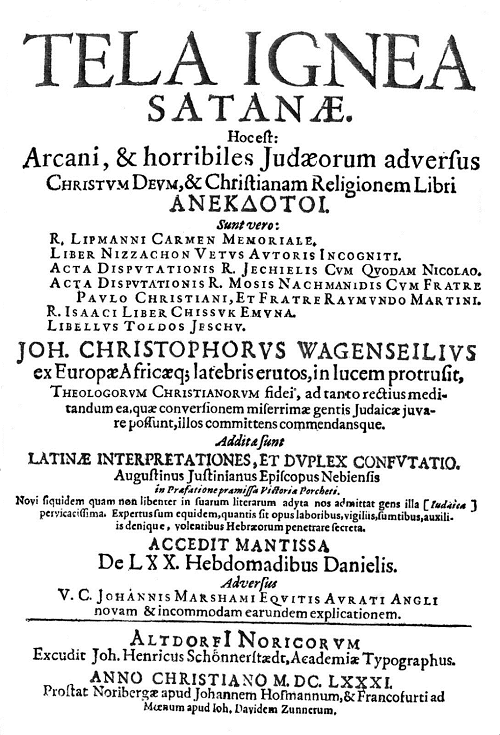
Tela ignea Satanae. Published in 1681 by Wagenseil in quarto format (40: [2], 635, [12]; 60; 260; [2], 100; 45; 480, [1] pp.) Tela ignea Satanae, perhaps Wagenseil’s best known work, is comprised of six polemical anti-Christian works, almost all not previously printed.


The first title page, printed in red and black, has the full title of Tela ignea Satanae. Hoc est: Arcani, et horribles Judaeorum adversus Christum Deum, et Christianam Religionem Libri (Flaming Arrows of Satan; that is, the secret and horrible books of the Jews against God and the Christian religion). After the verse the title-page states,

John Christopher Wagenseil thrusts these forward into the light, bringing them together and entrusting them, dug out from the hiding places of Europe and Africa, to the faith of Christian Theologians, that they may more rightly consider those things, which are able to aid the conversion of that wretched Jewish race. Added are: Latin Interpretations, and Two Confutations. Augustine Justianus Bishop at Nebiensis in the Forward Preface of Victoria Porchetus. I know how unwillingly that most stubborn (Jewish) race admits us into the most secret parts of their literature. I have tried by all means, however great the task, with toil, sleeplessness, expense, with willing helpers finally, to penetrate the secrets of the Hebrews.[23]

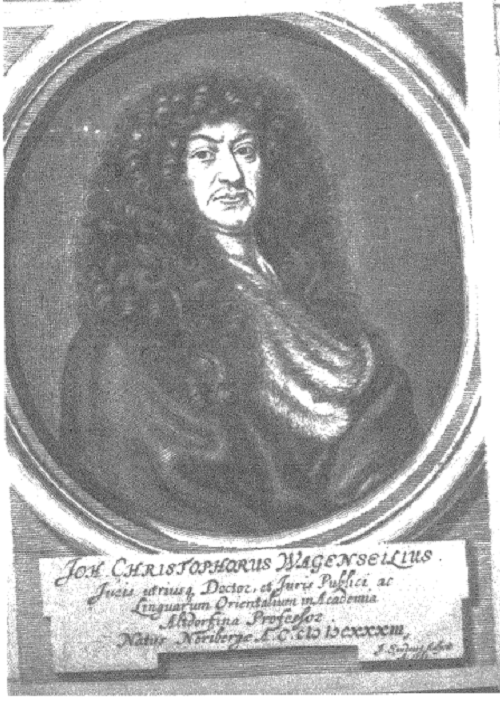
The facing page has a full front-piece portrait of Wagenseil. In two volumes, the work begins with a Latin introduction, followed by the six books, each with its own title page with Hebrew headers and Latin text, a Latin introduction (refutation), and then the text in two columns comprised of facing Hebrew and Latin.

That these books were not previously printed but rather circulated among Jews in manuscript only, or where printed were done so by Christian Hebraists with Latin translation and refutation, is due to their polemic and inflammatory content. As a result, these books today exist with variant texts. Tela ignea Satanae, as noted above, is comprised of six independent books, listed below, several described afterwards in somewhat greater detail:

Nizzahon, Polemic in defense of Judaism by R. Yom Tov Lipmann Muelhausen. Printed previously in Altdorf/Nurenburg, 1644 (see above).

Nizzahon, anonymous polemic in defense of Judaism.

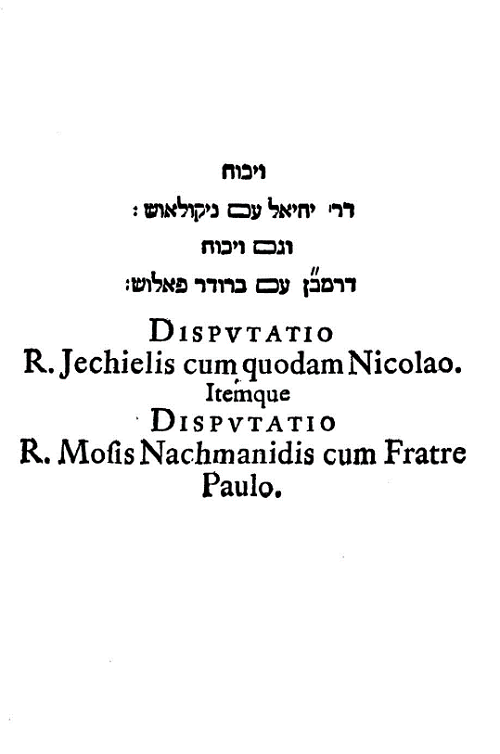
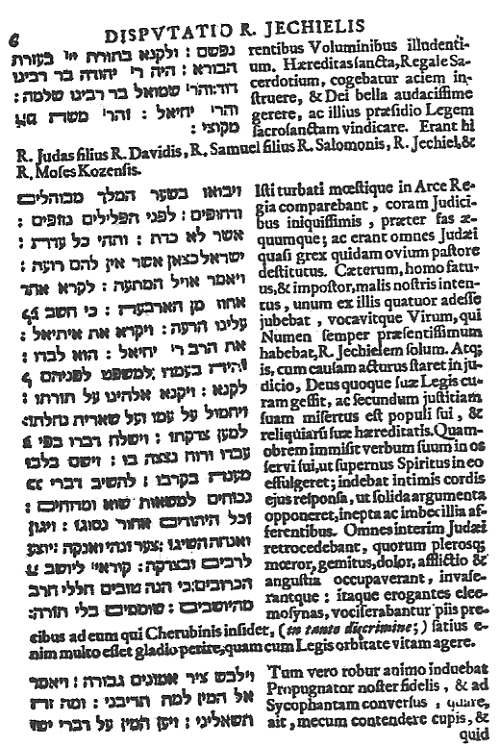
Vikku’ah Rabbenu Yehiel mi-Paris, record of the disputation between R. Jehiel of Paris and Nicholas (dispute over the Talmud in Paris in 1240, below, 1681).

Vikku’ah ha-Ramban im broder Paulus, record of the disputation between the Ramban (Moses ben Nahman, Nahmanides) and the apostate Pablo Christiani in 1263 before King James of Aragon.

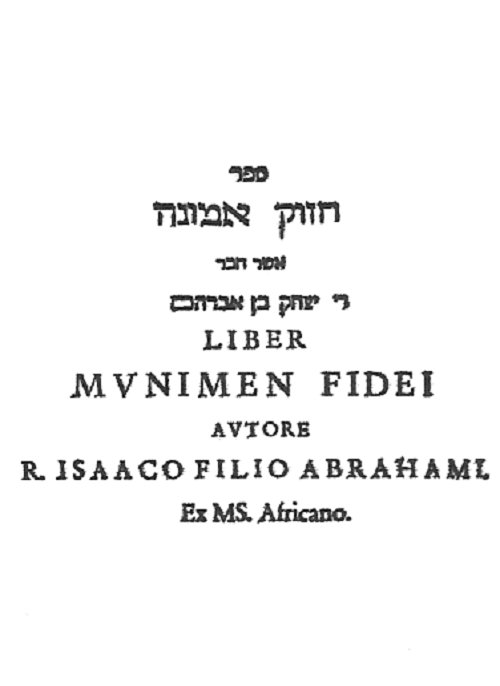
Hizzuk Emunah, anti-Christian polemic by the Karaite scholar, Isaac ben Abraham Troki.

Jeshu, negative and, from a Christian perspective, highly blasphemous account of the life of Jesus.[24] [25]

Vikku’ah Rabbenu Yehiel im Nicholas Jehiel ben Joseph of Paris. This is a record of the disputation held in Paris on Monday, June 25, 1240, attributed to R. Jehiel ben Joseph of Paris. Jehiel, one of the leading Ba’alei Tosafot, was a student of R. Judah ben Isaac (Sir Leon), whom he succeeded as rosh yeshivah in Paris.  Among Jehiel’s students was his son-in-law, R. Isaac of Corbeil (Sefer Mitzvot Katan, Semak). Jehiel was the author of tosafot quoted by many rabbis and included in those tosafot known as our tosafot. He is also frequently referenced in the Torah commentary Da’at Zekenim. Because of his prominence Jehiel was selected as a primary representative of the Jewish community in the disputation over the Talmud resulting from the charges leveled against it by the apostate Nicholas Donin. The record of that disputation, generally known as Vikku’ah Rabbenu Yeh iel mi-Paris, is the third work in Wagenseil’s Tela ignea Satanae (above, 1681).

        The Vikku’ah follows the same pattern as the other works in Tela ignea Satanae, that is, it has a bilingual Hebrew-Latin title page, followed by a Latin preface, and the text in two columns in facing Hebrew and Latin. Donin’s denunciation of the Talmud included thirty‑five charges which primarily stated that Jewish emphasis on the Oral Law was in itself a blasphemy against the holiness of Scriptures recognized by Jew and Christian alike; the Talmud overtly fostered anti‑Christian attitudes and contained blasphemous statements offensive to Christianity; and that it was irrational, and morally and intellectually offensive.


        The trial was presided over by the Queen Mother Blanche, who was in an advanced stage of pregnancy. The judges were high Church dignitaries, such as the Archbishop of Sens, the Bishop of Paris, and the Chaplain to King Louis IX, none of whom knew Hebrew. Jehiel, although the primary Jewish spokesman, was assisted by R. Moses ben Jacob of Coucy (Semag), R. Judah ben David of Melun, and R. Samuel ben Solomon of Chateau‑Thierry (all 13th century). Although Jehiel defended the Talmud, noting inter alia, that Donin was the real heretic, justifiably excommunicated by the Jewish community fifteen years before the debate. His arguments were to no avail, for the matter had been predetermined from the outset. Even before the court’s formal decision was rendered, it had been decided to burn the condemned books. In June, 1242, twenty‑four wagon loads of Hebrew books, containing thousands of volumes, were seized and burned in Paris. Jehiel remained for some time in Paris, teaching students from memory. In 1260, Jehiel went up to Eretz Israel, effectively ending the period of the Ba’alei Tosafot.[26]

Hizzuk Emunah. Anti-Christian polemic by the Karaite scholar, Isaac ben Abraham Troki (c. 1533-c. 1594). Hizzuk Emunah is the fifth work in Wagenseil’s Tela ignea Satanae below, 1681). Troki is known by his birthplace, Troki (Trakai), capital of Lithuania until 1323 and home to the most important Karaite community in Lithuania. He was, from the age of twenty, the secretary-recorder of the Karaite General Assembly which met there in 1553. Author of a work on shehitah and religious poetry, Troki became the foremost Karaite scholar in Eastern Europe, serving as dayyan to both Karaite and rabbinic Jews. He studied Bible and Hebrew studies under the Karaite scholar Zephaniah ben Mordecai, and had Christian teachers for Latin and Polish literature. Engaging in dialogues with Christian clergyman of different persuasions, Troki became fluent in Polish and Latin and familiar with their theology and arguments against Judaism. It was those conversations that prompted Troki to write Hizzuk Emunah. Written in the last year of his life, Hizzuk Emunah was completed by Troki’s student, Joseph ben Mordecai Malinovski.

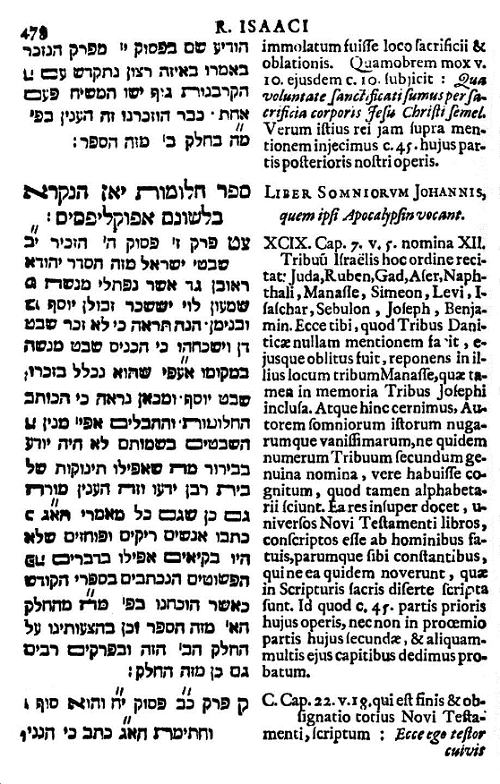
Wagenseil obtained a copy of the manuscript in 1665 on a trip to Ceuta, North Africa. He translated Hizzuk Emunah into Latin, in which form it was widely used not only by Christian missionaries but also by opponents of Christianity, such as atheists, French philosophes, among them Voltaire. Hizzuk Emunah follows the same format as the other polemic works in Tela ignea Satanae, that is, it has its own Hebrew-Latin title page, a Latin introduction, and then the text, in two facing Hebrew and Latin columns. The book, in quarto format, is in two parts comprised of ninety-nine chapters. In the first chapter, Troki begins by questioning the authenticity of the Christian messiah, arguing against his pedigree, acts, the time in which he lived, and the fact that he did not fulfill the promises expected of the Messiah.

As an example of the first argument, Troki writes that he cannot be of Davidic descent due to the concept of virgin birth and that even apart from that, the relationship of Joseph to David is wanting in proof. He also notes contradictions in the Christian Bible on that and other subjects, and compares the Hebrew Bible and Gospels. Most of Troki’s arguments are based on biblical texts, accounting for its effectiveness against Christian arguments. Nevertheless, he also utilizes rabbinic sources, so that Hizzuk Emunah has been accepted by rabbinic authorities, perhaps unique for a Karaite work.[27]

        Hizzuk Emunah is considered one of the most effective polemic works. Although circulated widely in manuscript, Hizzuk Emunah was not printed by and for Jews until the Amsterdam edition of 1705. It has been frequently reprinted, translated into Yiddish (Amsterdam, 1717), English by Moses Mocatta (London, 1851), German (Sohran, 1865), and Spanish as Fortificación de la Fe (1621), extant in manuscript.

Wagenseil would publish several additional Hebrew/Latin collections and works, among them Exercitationes sex varii argumenti (1697); Denunciatio Christiana de Blasphemiis Judæorum in Jesum Christum (1703); and Disputatio Circularis de Judæis (1705) as well as several titles published elsewhere. As might be expected, Wagenseil’s influence in this field was considerable, his students also becoming Christian-Hebraists, for example, Peringer above, and our final Altdorf imprints, the first by a student of Wagenseil.

Jesus in Talmude. Our final works are Jesus in Talmude and Der Jüdische Theriak. The former is  dissertation submitted at the University of Altdorf by Rudolf Martin Meelführer (Rudolfo Martino Meelführero, 1670–1729) in 1699, and described by Peter Schäfer as “the first book solely devoted to Jesus in the Talmudic literature;” the latter a refutation by R. Solomon Ẓevi Hirsch Aufhausen (Openhausen, Ufenhausen, of Aufhausen) in Yiddish of an anti-Jewish work. Meelführer was also a Christian-Hebraist, teaching in Altdorf and afterwards as adjunct in philosophy at Wittenberg. The dissertation is important as it was the first study fully devoted to the subject. Meelführer, in contrast to Wagenseil, was almost immediately forgotten.[28] Here too the work is primarily in Latin, but includes examples of the Talmudic text in Hebrew, from early editions of the Talmud, as the later editions available to Meelführer were censored and omitted many of the passages he refers to. Meelführer appears to primarily rely on secondary sources for Talmudic entries, notably R. Gedaliah ben Joseph ibn Yahya’s (1515-1587), Shalshelet ha-Kabbalah (Venice, 1586).[29] An example of the text brought by Meelführer is Sanhedrin 42a (below), censored from most editions of the Talmud,

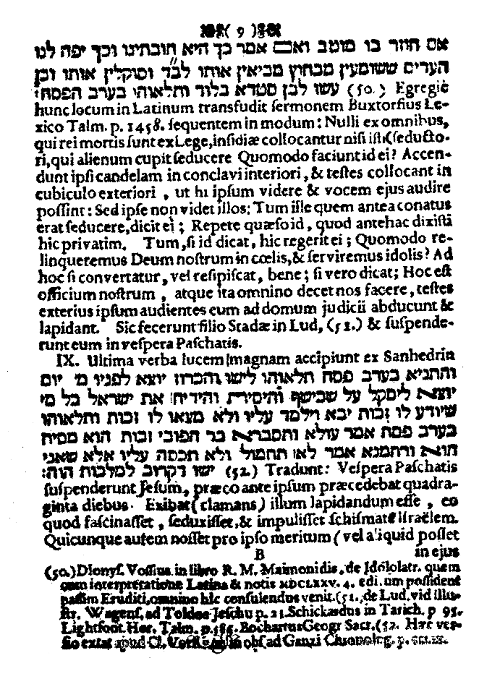
On the eve of the Passover Yeshu was hanged. For forty days before the execution took place, a herald went forth and cried, ‘He is going forth to be stoned because he has practiced sorcery and enticed Israel to apostasy. Anyone who can say anything in his favor, let him come forward and plead on his behalf.’ But since nothing was brought forward in his favor he was hanged on the eve of the Passover! – “Ulla retorted: Do you suppose that he was one for whom a defence could be made? Was he not a Mesith [enticer], concerning whom Scripture says, Neither shalt thou spare, neither shalt thou conceal him? With Yeshu however it was different, for he was connected with the government [or royalty, i.e., influential].

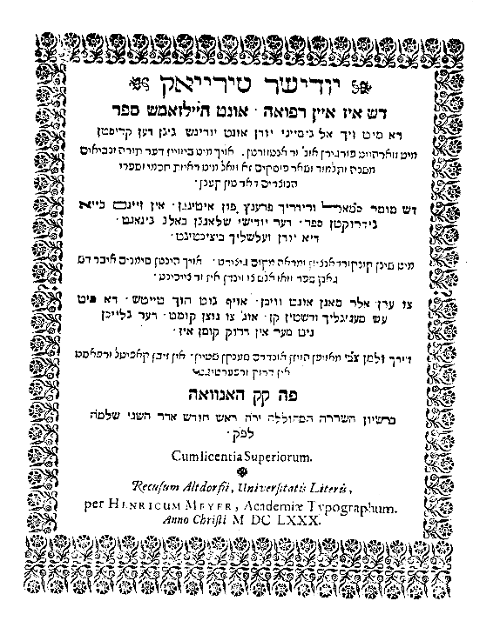
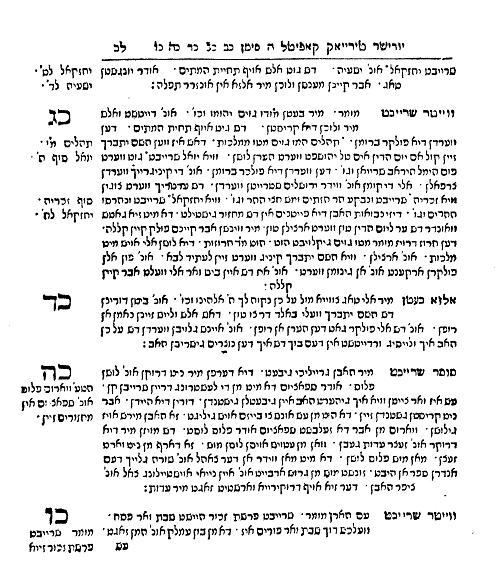
Der Jüdische Theriak (the Jewish Medicine) by Zalman Ẓevi Hirsch Aufhausen is a point by point refutation of Jüdischer Abgestreifter Schlangenbalg (The Jewish Serpent’s Skin Stripped) by the apostate Samuel Friedrich Brenz of Ettingen. Converted to Christianity in 1610, Brenz wrote Jüdischer Abgestreifter Schlangenbalg (Hanau, 1614) in “the thirteenth year after my rebirth.”[30] Der Jüdische Theriak, first printed in Hanau in 1615, was reprinted in in Altdorf in 1680 by Henricum Meyer, Academiae Typographu, as a small quarto (40: 36, [1] ff.), the text in old Yiddish set in Vaybertaytsh, a type generally but not exclusively reserved for Yiddish books, so named because these works were most often read by the less educated and women.[31] Given that it is a Jewish refutation of Christian ant-Jewish polemics its publication in Altdorf was likely done for the same purpose as Nizzahon, so that Christians might be able to attempt to refute its arguments.[32] In Jüdischer Abgestreifter Schlangenbalg Brenz collected all of the accusations made against Jews, accusing them of making derogatory and blasphemous remarks against the founders of Christianity and the Church, fostering animosity, and stating that the Talmud permits Jews to cheat Christians.

Zinberg notes that there is scant information about Aufhausen and what is known is surmised from remarks in Der Jüdische Theriak. Zinberg conjectures that Aufhausen (b. c. 1565-60) was an itinerant who, driven from his home by “evil Jews” travelled widely, broadening his world-view and culture, knowledgeable with German, knew Luther’s translation of the Bible, and was familiar with Flavious Joseph, Buxtorf the Elder, Pica della Mirandola, and Johannes von Reuchlin on the Kabbalah among others. Furthermore, Aufhausen “displays great knowledge of Talmudic literature, and that he wrote elegant Hebrew is attested to by the poem written in the well known azharot-meter on the front page of the Teryak.” Zinberg infers from Aufhausen’s remarks that he was a shohet and mohel (ritual slaughterer and circumciser) but these professions did not provide well for Aufhausen, his wife, and six children “who were not always well fed.”[33]

Morris M. Faierstein writes that Der Jüdische Theriak is unique, it is the only Jewish response in Yiddish to anti-Jewish polemics by Christians and Jewish apostates in early modern Germany and the only such work printed in Germany.[34] Zinberg quotes Aufhausen that Der Jüdische Theriak is an antidote to the venomous bite of the anti-Jewish snake, that is, Brenz’s work. Aufhausen describes Brenz as “a terrible usurer,” and if one added together all the horses on which he loaned money one could put in the filed a regiment of riders, which is what brought him to baptism, noting that the Jews hated him for his ugly deeds pushing him way with both hands.” Brenz is a “frightful ignoramus and a petty, good for nothing creature, his diatribe lacks any system or order.[35] In his introduction, Aufhausen informs how he came to write Der Jüdische Theriak. Benz’s book was

placed before me, and worthy people waved it under my nose. As a result I called the aforementioned apostate a liar, as I continue to do the present. On Monday, the seventh of Ab, he [Benz] he rode up to my door in a violent manner and threatened me and wanted to kill me. He publicly confirmed the wickedness of his book in front of Jews and Christians, said that it was all true and just and wanted to continue persecuting Jews. However, I sanctified the name of God in response to his desecration of God’s name and called him a liar to his face and swore to write a book against his lies . . .[36]

Der Jüdische Theriak is comprised of seven chapters, each addressing a specific group of accusations. Aufhausen cites numerous examples from the Talmud to show that Jews are commanded to show mercy and friendliness to non-Jews, and those few laws that are not friendly are directed against pagans, not Christians.[37] Der Jüdische Theriak is also directed towards women, for, as Carlebach notes, Christian missionaries had introduced Yiddish into their conversion material to make them accessible to women. Aufhausen refutes their claims writing for “common Jews and Jewesses.”[38] In the final chapters of Der Jüdische Theriak Aufhausen includes an appeal for tolerance advocating equal treatment for all, both Jews and Christians,

I have shown above that [tractate] Baba Kamma and [tractate] Avodah Zarah write: “A heathen who studies Torah and studies the law of Moses is as good as the high priest.” Thus anyone who studies the Law and does not ridicule it, he is an honest person and is highly honored. It is the same whether Christian or Jew. . . .

I had this book printed in Yiddish in the Hebrew alphabet so that someone will know how to respond to Christians in conducive circumstances, and also to understand from this and keep in mind what a great sin it is to deceive Christians, with words or deeds.[39]

The study of Jewish texts by Christian-Hebraists proved to be a passing phenomenon. By mid-eighteenth century the interest of Christian-Hebraists in rabbinic literature and studies had diminished.[40] In Altdorf, in contrast to other locations where, as noted above, Hebrew works, primarily philological and biblical titles and translations of rabbinic works, often theological titles accompanied by glosses contesting the Jewish authors’ positions, were studied by Christian-Hebraists for their own purposes to better understand the sources of Christian theology and to refute Jewish understanding of those works, the emphasis of those studies here was primarily for polemic purposes. Wagenseil, although his object was not always antithetical to Jewish texts, is remembered today as being among the leading exponents of the Christian-Hebraist movement. His works, several described here, as well as those of his contemporaries in Altdorf, represent an attempt by Christian-Hebraist scholars to understand and refute Jewish beliefs. Despite being, from several perspectives, among those of history, a failed and futile effort, it represents an interesting intellectual endeavor.

[1] I am indebted to Eli Genauer for reading the text and his comments, several noted below and to R. Jerry Schwarzbard, the Henry R. and Miriam Ripps Schnitzer Librarian for Special Collections for his assistance. Images are courtesy of the Library of Agudas Chassidei Chabad Ohel Yosef; Yitzhak;Bayerische StaatsBibliothek; the Library of Congress; Hathi Trust; Hebrewbooks.org; and R. Eli Amsel, Virtual Judaica.

[2] The other Altdorf’s are, in Germany, Altdorf, Lower Bavaria, Landshut, Bavaria; Altdorf, Böblingen; Altdorf, Esslingen; Altdorf, Rhineland-Palatinate, Südliche Weinstraße; and Weingarten (Württemberg) or Altdorf: in Swiitzerland, Altdorf, Jura or Bassecourt; Altdorf, Schaffhausen; and Altdorf, Uri: in France, Altdorf, Bas-Rhin” in Poland, Stara Wieś, PszczynaStara Wieś; and Silesian Voivodeship; and in the United States, Altdorf, Wisconsin.

[3] An unanticipated result of the Christian-Hebraists’ efforts, suggested by Eli Genauer in a private correspondence, is that readers of the Christian-Hebraists works might possibly have been influenced in another direction, suggesting that “even though the Christian scholars published these books to show the errors of Judaism, there might have been some people who say “‘hey, the Jews have some pretty good points.’”

[4] Aron Freimann, “A Gazetteer of Hebrew Printing” (1946; reprint in Hebrew Printing and Bibliography, New York, 1976), p. 268; Moshe Rosenfeld, Hebrew Printing from its Beginning until 1948. A Gazetteer of Printing, the First Books and Their Dates with Photographed Title-Pages and Bibliographical Notes (Jerusalem, 1992), p. 64 no. 618 [Hebrew].

[5] Yeshayahu Vinograd, Thesaurus of the Hebrew Book. Listing of Books Printed in Hebrew Letters Since the Beginning of Printing circa 1469 through 1863 II (Jerusalem, 1993-95), p. 23 [Hebrew]. Vinograd notes three additional works, a Mishnayot, printed in 1860, Toldot Jeshu, in a collection of Wagenseil’s works (below), and an undated edition of Hochmah u-Minhag shel Talmidim.ge

[6] John McClintock, James Strong “Hackspan, Theodor” Cyclopedia of Biblical, Theological and Ecclesiastical Literature, ttps://www.studylight.org/encyclopedias/tce/h/hackspan-theodor.html. (New York, 1870).

[7] Translations are from The Soncino Talmud, Judaica Press, Inc. (Brooklyn, NY, 1990).

[8] Israel Moses Ta-Shma, “Muelhausen, Yom Tov Lipmann,:EJ 14, pp. 595-59.

[9] Ora Limor and Israel Jacob Yuval “Skepticism and Conversion: Jews, Christians, and Doubters in Sefer Nizzahon,” in Hebraica Veritas?: Christian Hebraists and the Study of Judaism in Early Modern Europe, Allison P. Coudert and Jeffrey S. Shoulson, editors (Philadelphia, 2004), p. 166; Meyer Waxman, A History of Jewish Literature (1933, reprint Cranbury, 1960), II p. 51.

[10] Eli Genauer, in a separate correspondence, brought the following to my attention concerning the text at the bottom of the title-page of Sefer Nizachon.  “I was curious about the script written at the bottom starting with ‘Suma Avuka Zu Lamah’  . . . continuing on to the other side start from top line 7th word…B’Sefer HaNitzachon…I think the author is using this as an example of Jewish title pages and didn’t realize it was printed by a Christian. It is actually a Gemara in Megillah 24b which goes like this

אמר ר’ יוסי: כל ימי הייתי מצטער על מקרא זה (דברים כח, כט) “וְהָיִיתָ מְמַשֵּׁשׁ בַּצָּהֳרַיִם כַּאֲשֶׁר יְמַשֵּׁשׁ הָעִוֵּר בָּאֲפֵלָה”. וכי מה אכפת לֵיה [=לו] לעיוור בין אפלה לאורה? עד שבא מעשה לידי. פעם אחת הייתי מהלך באישון לילה ואפלה וראיתי סומא שהיה מהלך בדרך ואבוקה בידו. אמרתי לו, בני, אבוקה זו למה לך? אמר לי, כל זמן שאבוקה בידִי, בני אדם רואין אותי ומצילין אותי מן הפחתין ומן הקוצין ומן הברקנין.

Fascinating. I’m not sure what they were trying to point out but I wouldn’t be surprised if it had Christian implications.”

The above text (Megillah 24b) states “R. Jose said: I was long perplexed by this verse, And thou shalt grope at noonday as the blind gropeth in darkness.5 Now what difference [I asked] does it make to a blind man whether it is dark or light? [Nor did I find the answer] until the following incident occurred. I was once walking on a pitch black night when I saw a blind man walking in the road with a torch in his hand. I said to him, My son, why do you carry this torch? He replied: As long as I have this torch in my hand, people see me and save me from the holes and the thorns and briars.”

[11] J. Rosenthal, “Anti-Christian Polemics from its Beginnings to the End of the 18th Century,” Areshet II (Jerusalem, 1960), p. 148 no. 70 [Hebrew]; Waxman, pp. 545-51.

[12] Judaica Jerusalem, “Rare Books, Manuscripts, Documents, and Jewish Arts” (Jerusalem, October 14, 1993), no. 4.

[13] Louis Isaac Rabinowitz, “Perlhefter, Issachar Behr ben Judah Moses” Encyclopedia Judaica, edited by Michael Berenbaum and Fred Skolnik, vol. 20. (2007), vol. 15, p. 777. Concerning the personal life of Bella Perlhefter and letters to Wagenseil see Elisheva Carlebach “Introduction to The Letters of Bella Perlhefter,” Early Modern Jewries, I (2004, Wesleyan University, Middletown, CT), pp. 149-57: https://fordham.bepress.com/emw/emw2004/.

[14] Elisheva Carlebach, Divided Souls: Converts from Judaism in Germany, 1500-1750 (New (Haven & London, 2001), pp. 204-05). Carlebach  continues that Wagenseil subsequently invited her again, this time writing to Samuel Issachar Behr, to which she responded that “‘you have further written to me about coming to your place, to teach dance to the only, wonderful daughter of your master the great scholar, whose name escapes me, May God watch over her, it is puzzling to me  that you add, ‘and to teach her to play the zither,’ for you know that from the day of my mother’s death, I took an oath not to play any musical instrument, and now how can I violate my oath? But it is possible that sometime I will come to teach her to dance.”

[15] David Malkiel, “Christian Hebraism in a Contemporary Key: The Search for Hebrew Epitaph Poetry in Seventeenth-Century Italy,” Jewish Quarterly Review 96:1 (Philadelphia, 2006), pp. 126, 136.

[16] Frank E. Manuel, The Broken Staff: Judaism Through Christian Eyes (Cambridge, Mass., 1992), var. cit.

[17] Jonathan I. Israel, European Jewry in the Age of Mercantilism 1550-1750 (Portland, 1998) pp. 189-90.

[18] Elisheva Carlebach, “The Status of the Talmud in Early Modern Europe,” in Printing the Talmud: From Bomberg to Schottenstein, eds. Sharon Liberman Mintz and Gabriel M. Goldstein (New York, 2005), pp. 87-89; Heinrich Graetz, History of the Jews (Philadelphia, 1956), History of the Jews V, pp. 185-87.

[19] Graetz, History of the Jews V, pp. 182-83. Concerning Peringer’s mission, Graetz writes “Whether Peringer even partially fulfilled the wish of his king is not known; probably he altogether failed in his mission.” Moritz Steinschneider, Catalogus Liborium Hebraeorum in Bibliotheca Bodleiana (CB, Berlin, 1852-60), cols. 270 no. 1876.

[20] Graetz, History of the Jews V, pp. 182-83; Steinschneider, CB, col. 270 no. 1876.

[21] Christian Hebraism: The Study of Jewish Culture by Christian Scholars in Medieval and Early Modern Times, (Cambridge, Mass., 1986), p. 40 no. 61.[22] The Jewish Life of Christ being the SEPHER TOLDOTH JESHU, or Book of the Generation of Jesus, translated by G. W. Foote and J. M. Wheeler (2018), p. 6.

[23] “Wagenseil’s Latin Introductory Material to His Tela Ignea Satanae (The Fiery Darts of Satan) Published in 1681,, Translated into English” Translated by Wade Blocker (wblocker@nmol.com) Dates of Translation: 2000-12-21 through 2001-03-09.

[24] Malkiel,, pp. 126, 136; Manuel, The Broken Staff, pp. 76, 150-51.

[25] Toledot Jeshu, for all its condemnation in Christian sources, is also not well received by Jewish chroniclers. Graetz, vol. v pp. 185-86, describes it as an “insipid compilation of the magical miracles of Jesus (Toldoth Jesho) with which a Jew, who had been persecuted by Christians, tried to revenge himself on the founder of Christianity.” Manuel, p. 150, in even stronger language, describes it as “the most scandalous of all” of the works in Tela ignea Satanae, “a scurrilous account . . . a gross parody that outraged Christians.”

[26] J. D. Eisenstein, ed., Otzar Vikkuhim (Israel, 1969), pp. 82-86 [Hebrew Mordechai Margalioth, ed., Encyclopedia of Great Men in Israel III, (Tel Aviv, 1986), cols. 843-85 [Hebrew].

[27] Gershon David Hundert, Yivo Encyclopedia of Jews in Eastern Europe, (New Haven & London, 2008) p. 1906; Isaac ben Abraham Troki, Hizzuk Emunah or Faith Strengthened, translated by Moses Mocatta, introduction by Trude Weiss-Rosmarin (New York, 1970), v-xii.

[28] Peter Schäfer, Jesus in the Talmud (Princeton, 2007), pp. 3-4.

[29] Shalshelet ha-Kabbalah (Chain of Tradition), a popular and much reprinted mixture of history and tales, is a chronicle of Jewish history from the creation to the time of the author. Parenthetically, the work was completed on the day of the bar mitzvah of ibn Yahya’s eldest son, his first born, Joseph, to whom the book is addressed.

[30] Gotthard Deutsch, S. Mannheimer, “Brenz, Samuel Friedrich,” Jewish Encyclopedia, Isadore Singer, ed. V. 3 (New York, 1901-06), p. 370; Carlebach, Divided Souls, p. 90.

[31] The title-page gives the place of printing in Hebrew as Hanau, 1615, based on the Hebrew text, שלמ”ה (375 = 1615) and right below the Hebrew, in Latin letters, is Altdorf MDCLXXX (1680). This title page is than a copy of the original with the place and date of the second edition noted below the Hebrew. Der Jüdische Theriak was translated into Latin by J. Wülder (Wilfer, 1681) and reprinted again in 1737 by Zusssman ben Isaac Roedelsheim who, according to Israel Zinberg, A History of Jewish Literature, translated by Bernard Martin, IV (New York, 1975), p. 165, further Yiddishized the language of the work somewhat, and in places changed purely German wiods into more Yiddish teems.” Der Jüdische Theriak was translated into English by Morris M. Faierstein as Yudisher Theriak: An Early Modern Yiddish Defense of Judaism (Detroit, 2016).

[32] After writing the above my supposition found support in Faierstein’s introduction (p. 27) where he writes “The work would be useful to Christian Hebraists and help them to formulate counter arguments to the Jewish objections raised by Zalman Zevi against the missionary works that were being produced with the intention of convincing Jews to convert to Christianity.”

[33] Zinberg, pp. 165-66.

[34] Faierstein, p. ix- xi.

[35] Zinberg, p. 166, quoting Der Jüdische Theriak.

[36] Faierstein, p. 38.

[37] Waxman, II pp. 557-59; Zinberg, p. 166, quoting Der Jüdische Theriak.

[38] Carlebach, Divided Souls, p. 185.

[39] Faierstein, pp. 140, 144.

[40] Concerning the diminished interest by Christian-Hebraists in rabbinic literature and studies in the eighteenth century see Elisheva Carlebach, “The Status of the Talmud in Early Modern Europe” in Printing the Talmud: From Bomberg to Schottenstein, eds. Sharon Lieberman Mintz and Gabriel M. Goldstein, (New York: Yeshiva Univ. Museum, 2005), pp.85-88 and Jam-Win Wesselius, “The First Talmud Translation into Dutch: Jacob Fundam’s Schatkamer der Talmud (1737),” Studia Rosenthaliana 33:1 (1999), p. 60.


Approbations and Restrictions: Printing the Talmud in Eighteenth Century Amsterdam and Two Frankfurts

Approbations and Restrictions:
Printing the Talmud in Eighteenth Century Amsterdam and Two Frankfurts
by Marvin J. Heller
Approbations designed to protect the investment of printers and their sponsors when publishing a large work such as the Talmud were well intentioned. Unfortunately, the results were counter-productive, resulting in acrimonious disputes between publishers within and between cities. This article discusses the first approbations, issued for the Frankfurt on the Oder Talmud (1697-99), and the resulting dispute with printers in Amsterdam in 1714-17. The background of the presses and the pressmarks utilized by the printers are discussed, giving a fuller picture of the printing of the Talmud in the subject period, as well as addressing antecedent (Benveniste) and subsequent editions.
Approbations for books have multiple purposes, among them commendations, indicating approval or praise for the subject work, confirming that a book’s contents do not contain forbidden or prohibited matter, and to protect a publisher’s investment from competitive editions for a fixed period of time. This article is concerned with the last purpose, here rabbinic approbations (hascoma, pl. hascomot) limiting or preventing rival editions of the Talmud published in the last decade of the seventeenth century into the first half of the eighteenth century.
The restrictive approbations discussed here are unlike those issued previously, such as the first approbations for a Hebrew book, R. Jacob Barukh ben Judah Landau’s (15th cent.) concise halakhic compendium, Sefer Ha-Agur (Naples, 1487), one of seven approbations, that of R. Judah ben Jehiel Rofe (Messer Leone, 15th cent.) stating he has examined ha-Agur, and, “it is a work that gives forth pleasant words. . . . I have, therefore, set my signature unto these nectars of the honeycomb, these words of beauty,” or those in Italy or in Basle, which assured the authorities that nothing untoward or offensive to Christianity was included in the book, or to current approbations, which assure the reader that a work’s contents are in conformity with the community’s religious standards. In contrast, the approbation issued for the Frankfurt on the Oder Berman Talmud, and to subsequent editions, was a license for a fixed number of years, prohibiting other publishers from printing competitive editions that would prevent the printer and his sponsor(s), who would otherwise be reluctant to make the substantial investment required to print such a large multi-volume work as the Talmud, from realizing a return on their investment.
The discord arising from restrictive approbations for printing the Talmud were not the first such disputes. In Amsterdam, disputes between printers arose over editions of the Bible. Johannes Georgius Nisselius and Joseph Athias competed in the mid-seventeenth century over a Sacra Biblia (Hebrew Bible) for the use of students and several years later Athias and Uri Phoebus were involved in controversy over their translations of the Bible into Yiddish, competing for the Jewish market in Poland. Arguing over the right to publish for and sell to that market, they sought to reinforce their positions by seeking approbations from the Polish, as well as the Amsterdam rabbinate.[1] Nevertheless, their competition pales in contrast to the recurring altercations over the right to print the Talmud, which spanned several centuries and much of the European continent.
Raphael Natan Nuta Rabbinovicz writes that the intent in granting this and subsequent approbations was for the good of the community, to insure investors a reasonable return on their investment. The result, however, was that the Talmud was printed only eight times in the century from 1697 to 1797, and the price of a set of the Talmud was dear. Prior to that the Talmud had been printed several times in Italy and Poland within a relatively short period of time, the primary impediment then being the opposition of the Church and local authorities. Rabbinovicz concludes that after 1797 the use of restrictive approbations declined, with the consequence that within four decades, to 1835, the Talmud was printed nine times.[2]
During last decade of the seventeenth century into the first half of the eighteenth century several rival editions of the Talmud appeared, beginning with the Frankfurt on the Oder Talmud (1697-99) followed by two incomplete editions in Amsterdam (1714-17 and 1714), the Frankfurt on the Main Talmud (1720–22), again in Amsterdam (1752–1765), and finally the Sulzbach Red (1755-63) and Black (1766-70). We are concerned with and focus on the early editions, that is, on the dispute between the Frankfurt on the Oder and Amsterdam printers, their dispute resulting from restrictive approbations issued to presses printing the Talmud. This article discusses the background of the Hebrew presses that published these Talmud editions in the seventeenth and eighteenth century; its primary focus, being the disputes resulting from the restrictive approbations.
I Amsterdam – Benveniste Talmud
Amsterdam has a distinguished place in Jewish history. Among the notable features of that city’s Jewish community are its printing-houses, among the foremost in Europe for centuries. Highly regarded, Amsterdam imprints were distributed and sold throughout all of Europe. The preeminence of Amsterdam as a European book center is evident, for it is estimated that the output of the Dutch presses in the seventeenth century exceeded the combined production of all the presses of all other European countries. The number of book-printers totaled 273 at its peak in 1675-99, employing at its height in excess of 30,000 people supported through some facet of the book trade.[3] The important works published by its presses include editions of the Talmud, beginning with the Benveniste Talmud of 1644-47, through the much praised Proops’ Talmud of 1752-65. In addition to complete editions of the Talmud individual treatises, frequently in a smaller format, were also published for students and individuals who did not require or who could not afford a complete Talmud.[4]
The printing of Hebrew books in Amsterdam by Jews begins in 1627, when two printers published books, Manasseh (Menasseh) Ben Israel (1604-57) and Daniel de Fonesca. The former’s press was the first to publish with a Sephardic rite prayer-book, completed on January 1, 1627. Manasseh Ben Israel would achieve acclaim that, together with its founder’s many other achievements, is still recalled today. Manasseh did not publish Talmudic tractates but his press did issue three critical editions of Mishnayot (1632, 1643, and 1646). He also intended to publish an edition of the Talmud but that did not come to pass.
The next printer of Hebrew books of import in Amsterdam was Immanuel (Imanoel) Benveniste. Benveniste is believed to have been among the Jewish refugees from Spain or Portugal, and that he was descended from the illustrious Sephardic family of that name.[5] Beneveniste relocated to Amsterdam because, by the mid-seventeenth century that city offered better opportunities for the distribution of Hebrew books than any city in Italy.[6] Beneveniste was the publisher of the first Amsterdam Talmud, printed from 1644-47. The Benveniste Talmud is in a smaller (c. 260:195 cm.) quarto format than the usual large folio editions.[7]

Fig. 1
Although not subject to restrictive approbations it is included here due to its relevance to the history of the printing the Talmud in Amsterdam and because the title-pages of Benveniste’s publications are distinguished by his escutcheon, an upright lion facing inward towards a tower; a star is above the lion and the tower. The lion is on the viewer’s right, the tower on the left. At least six forms of Benveniste’s device have been identified. In all cases, excepting his Talmudic treatises, Benveniste’s insignia is set in a crest above an architectural frame surrounding the text of the title page. On the title-pages of the Benveniste tractates his mark appears at the bottom of the page in an ornamental shield, with a helmet in the crest (fig. 1). Given the high regard of most Benveniste imprints this device was subsequently used by several printers in Amsterdam, including two of the following subject editions, as well as by other presses in various locations.[8]
This Talmud has been has been praised for restoring expurgated material. Unlike Benveniste’s other publications, however, the Beneveniste Talmud is not highly regarded. Raphael Natan Nuta Rabbinovicz quotes from an approbation given by R. Moses Judah ha-Cohen, Av Bet Din, of the Ashkenazi community in Amsterdam, for the Berman Talmud (Frankfurt on the Oder, 1697-99) which states that Benveniste, due to his concern over expenses, printed a Talmud edition which was, due to its small size, difficult to learn from. Furthermore, Benveniste used letters that were “the smallest of the small and blurred so that the users eyes become heavy and his sight wanders as if from old age.”[9] This notwithstanding, no less a personage than the Vilna Gaon (R. Elijah ben Soloman Zalman, Gr”a, 1720-70) made use of the Benveniste Talmud, Rabbinovicz writing that “he had heard from a great Talmudic scholar who related that he had seen a Talmud from which the Gr”a had learned by R. Judah Bachrach (1775-1846) av bet din Seiny with his (Gr”a’s) handwritten annotations, brief and varied from his printed annotations, and that it was a Benveniste Talmud.”[10]
II – Frankfurt on the Oder – Michael Gottschalk
Printing with Hebrew letters in Frankfurt on the Oder begins when the Christian printers Joachim and Friedreich Hartmann (1594-1631), who, using new Hebrew fonts and vowels cast by Zechariah Crato (?) of Wittenberg, published a Hebrew Bible in 1595-96. While there are references to an even earlier Bible, half a century earlier, that is uncertain. More than a century later, Johann Christoph Beckmann (1641-1711), professor of Greek language history, and theology at the University of Frankfurt on the Oder, operated a printing-press in Frankfurt on the Oder from 1673 to 1717, which he acquired from his brother Friedreich on June 1, 1673 for 400 Thaler; Friedreich, in turn, had purchased the press for a like amount. Beckmann obtained a travel scholarship from the Brandenburg Elector and, during his travels in Europe came to Amsterdam. In 1663, in that city, Beckmann met Jewish students, the renowned R. Jacob Abendana (1630-85), and studied Talmud. In 1666, Beckmann returned to Frankfurt, where he obtained a position at the university (Viadrina), teaching there until his death in 1717 and serving as rector eight times. Because of the admission of Jewish students, the Viadrina became the “Amsterdam of the East,” both Hebrew and oriental studies being of importance.[11]
Beckmann was granted, initially, on May 1, 1675, a license to employ two Jewish workers, under the direct protection of the university, to print a Hebrew Bible, this despite of the protests of Frankfurt city. By 1693, however, Beckmann found that his responsibilities at the university left him with insufficient time to manage the press. Therefore, he contracted with Michael Gottschalk, a local bookbinder and book-dealer to manage the printing-house, transferring all of the typographical equipment and material to Gottschalk. Their arrangement was noted on the title-pages of the books issued by the press, which stated “with the letters of Lord Johann Christoph Beckmann, Doctor and Professor . . . at the press of Michael Gottschalk.” Gottschalk became the moving spirit of the press for almost four decades.
After printing several varied Hebrew titles Gottschalk approached Beckmann, requesting that he obtain permission to reprint the Talmud. Beckmann petitioned Friedreich III, Elector of Brandenburg (1657-1713, reigned 1688-1713, from 1701 King of Prussia), requesting a license to print the Talmud. Friedreich, in turn, sought the counsel of the Berlin professor Dr. Daniel Ernest Jablonski (1660-1741), from 1691, court preacher at Königsberg for the elector of Brandenburg, Friederick III. Jablonski, a Christian German theologian of Czech origin, an orientalist, had been associated with universities in Holland and England, settling in Lissa in 1686, and from there moving to Berlin. In 1700, Jablonski became a member of the Academy of Sciences in Berlin. Jablonski established a Hebrew press in Berlin, publishing a scholarly edition of the Hebrew Bible based on the Leusden edition (Amsterdam, 1667, Atthias) and a translation of Richard Bentley’s A Confutation of Atheism into Latin (Berlin, 1696). Jablonski, was to become personally involved with Hebrew printing in Berlin, and would be participate in the publishing of two later editions of the Talmud.
When a sponsor was sought for the Frankfurt on the Oder Talmud, Beckmann found one in the Court Jew Issachar (Ber Segal) ha-Levi Bermann (1661-1730) of Halberstadt, known as Bermann Halberstadt or, in his commercial dealings with the non-Jewish world, as Behrend Lehmann. It was Bermann who bore the cost of this Talmud, and whose name is associated with it. Selma Stern observes that Bermann was a pious and observant Jew throughout his life. He was held in high regard by his fellow Jews; and was described as “a second Joseph of Egypt” and “the chosen of the Lord, who warns him about the machinations of his enemies and miraculously rescues him when he is in dire straits.” Bermann was known among his people as “the founder of the Klaus in Halberstadt, the publisher of the Talmud, the man who defeated the first Prussian king at chess and who even in the glittering world of the Court never forgot Eternal Truth, corresponded to the ideal which Jews have had of their great men leaders.”[12]
Beckmann and Bermann entered into an agreement to publish the Talmud, Beckmann transferring his rights to Bermann, and the latter accepting responsibility for publishing the entire edition, making an initial payment of three hundred reichsthalers at the time of the agreement.[13] The printer was to be the Christian, Michael Gottschalk. Approximately half of the sets of this Talmud, known as the Berman Talmud, were distributed by Bermann to yeshivot and penurious scholars who could not otherwise have acquired a complete Talmud. Not only did he spend fifty thousand reichthalers of his own money to publish the Talmud, from which he apparently saw no financial gain, distributing copies to Talmudic students, but afterwards granted permission to the Amsterdam and Frankfurt on the Main printers to publish a complete Talmud, this in spite of the fact that he had approbations preventing republication of competitive editions.[14]
Fig. 2
Each volume of this Talmud has two title-pages. The first, a volume header page, has an engraved copper plate title-page (fig. 2) by the craftsman Martin Bernigeroth (1670-1733), Dt. Kupferstecher u. Zeichner (engraver and illustrator).[15] This initial title-page consists of an upright lamb with a pitcher on top of a portico. Below it, on the sides of the page, are Moses to the right and Aaron to the left. Beneath them, similarly situated, are King David with a harp, and King Solomon. Above each figure is that individuals’ name. Avraham Habermann and Avraham Yaari both write that the sheep and laver represent Bermann, who was a Levi. Yaari adds that the sheep further represents Bermann’s “mazel” or constellation, for Bermann was born on the 24th of Nissan (April 23), 1661, the astrological symbol for that month being a sheep.[16]
The second textual tractate title-page follows immediately after the volume title-page. The tractate title-pages are basically copied, with several modifications, from the Benveniste Talmud; but also includes some features characteristic of the Basel Talmud, which is supposed to be the source of this edition. The text concludes in Latin, informing that it is “in accordance with expurgations of the Council of Trent. . . .” and that it was printed in conformity with the Basle edition (1578 – 1581). Between the Hebrew and Latin text is Michael Gottschalk’s printer’s mark (fig. 3), which appears on the title-pages of this Talmud. It is a mirror-image monogram (cipher) of his name, the first usage of such a monogram in a Hebrew book.[17]

Fig. 3
Printed with this Talmud are approbations for the edition. When Johann Christoph Beckmann secured permission in 1695 from the Kaiser, Leopold, and from Friedreich Augustus, Elector of Saxony and King of Poland, to print the Talmud, he was given not only authorization to print the Talmud, but was also granted the sole and exclusive right to do so for twelve years. Leading rabbinic figures, according to Rabbinovicz, issued restrictive approbations, the first instance in which such rabbinic licenses were granted. The rabbis who signed the approbations were R. Naftali ben Isaac ha-Kohen Katz, av bet din (head of the rabbinical court) of Pozna, R. Joseph Samuel of Cracow, av bet din of Frankfurt on the Main, R. David ben Abraham Oppenheim, av bet din of Nikolsburg, and R. Moses Judah ha Kohen and R. Jacob Sasportas of Amsterdam concurred in granting this monopoly, issuing approbations (hascomas) for twenty years.
These approbations were unlike those issued previously in Italy, which assured the authorities that nothing untoward or offensive to them was included in the book, or current approbations, which assure the reader that a work’s contents are in conformity with the community’s religious standards. The approbation issued for this Talmud, and to subsequent editions, was a license for a fixed number of years, prohibiting other publishers from printing competitive editions that would prevent the printer and his sponsor(s), who would otherwise be reluctant to make the substantial investment required to print the Talmud, from realizing a return on their investment.
Oppenheim refers to the burning of the Talmud and other Hebrew books in the Chnielnicki massacres tah ve-tat (1648–49), fires that resulted in the loss of many Hebrew books, resulting in a dire need for Talmudic tractates. Indeed, he writes that the entire Jewish educational system was endangered due to insufficient copies of the Talmud. He praises Lehmann, noting his benevolence in distributing half of the copies to needy students free of charge.[18] Towards the end of his long and flowery approbation Oppenheim forbids the printing of the Talmud by anyone without the permission of Issachar Bermann SG”L, from the day that printing commences until twenty years have elapsed from its completion. This prohibition is “whether for all or for part, even for one tractate only, whether for oneself or for others, and is not to be done by means of guile or ruse.” To enforce his decree R. Oppenheim states that “this decree falls equally upon the purchaser as well as the seller, for that which a rabbinic court declares ownerless is ownerless. Any [such tractate] found in a person’s possession without license, is to be taken forcibly, without payment or deed . . .”[20]
Similarly, R. Joseph Samuel of Cracow begins by praising Berman, noting that all realize that these many days many thought to print the Talmud due to its being unavailable, not to be found, except one to a city and two to a family. He notes, however, that although many wanted to print the Talmud it was to no avail, for it is a large project of much work and difficult to complete, until the Lord aroused the spirit of R. Berman of Halberstadt for the public benefit and the honor of the Torah, to print an entire Talmud on good paper, with fine ink, and diligent workers, well edited. Lest there be many who “bear gall and wormwood” (Deuteronomy 29:17) who also wish to print the Talmud and therefore cause great harm R. Berman’s interests, and “lock the door before him” (cf. Bekhorot 10b) who performs a great mitzvah to benefit the public, for “such is such theTorah, and such is its reward” (Berakhot 21b, Menahot 21b)? He therefore, concurs with the other leading rabbis to decree,
Excommunication and a ban on each and every person who should take it upon himself to print the Talmud in its entirety or in whole or in part without the agreement and knowledge of the noble R. Berman, except for a section needed to learn in yehivot, which is not included in the ban. It is permitted to print only that section and not a complete tractate in order to “magnify the Torah, and make it glorious” (Isaiah 42:21). A blessing should come upon he who hearkens to our words, may blessings of good come upon him and may he receive good from God Who is good. But “he who breaches through a fence, shall be bitten by a serpent” (Avodah Zara 27b) . . . and all the curses written in the Torah shall come upon him. . . .
Even before the privilege for this Talmud had expired the need for a new edition became apparent, numerous appeals being made to Issachar Bermann to republish the Talmud. Gottschalk, who had the rights granted to Beckmann, was also favorable to reprinting the Talmud. The Talmud had sold well and Gottschalk, as a result, had become a wealthy man.[20] Frederick William I of Prussia acceded to their request on May 23, and a new privilege, dated October 13, 1710, was granted to Gottschalk by Joseph I, successor to Leopold, in 1705, to print the Talmud and sell it throughout his domain, albeit with the customary restrictions and with the provision, as with all Hebrew books, that five copies be brought to the Imperial court. Similarly, on January 11, 1711, Frederick Augustus I (Augustus II), Elector of Saxony and King of Poland, also granted such a privilege. Nevertheless, these privileges were not immediately acted upon by Gottschalk and it would be several years before he printed the second of his three editions of the Talmud.[21]
III – Marches and de Palasios and Solomon Proops
Individual tractates were frequently published in Amsterdam, to address the continuing communal need for treatises for study purposes. The printers of these tractates include Moses Mendes Coutinho, Asher Anshel and Issachar Ber, Issac de Cordova, Joseph Dayyan and Moses Frankfurter, the latter two dayyanim (judges) of the Ashkenaz religious court. During the interval between the Benveniste and the Frankfurt on the Oder editions of the Talmud no complete Talmud had been printed. It must have appeared unseemly, however, that in Amsterdam, the center of Hebrew printing, with the greatest number of, and the largest, Hebrew printing-presses, that no Talmud edition had been issued for over six decades.
An attempt to correct this, even if that was not the printers’ primary intent, occurred during the interval between the first and second Frankfurt on the Oder editions of the Talmud. two independent editions of the Talmud were begun in Amsterdam in 1714. The first was published by the partners Samuel ben Solomon Marcheses and Raphael ben Joshua de Palasios, the second by Solomon Proops. Both publishers began to print in 1714; both editions are in attractive large folio format; the title-pages of both Talmuds have, as a printer’s device, copies of the Benveniste escutcheon (figs. 4, 5). Most importantly, neither Talmud edition was completed.
Except for a Sephardic rite prayer-book, printed by Samuel Marcheses at the press of Joseph Athias, neither partner, prominent members of the Amsterdam Sephardic community, had previously published any works. Their motivation in establishing a press was for the specific purpose of printing the Talmud. Furthermore, they intended to do so in such a manner as to produce an especially fine and accurate edition. The workers would not be hurried, so that they could work with care, reducing errors, supervised by R. Moses Frankfurter, who would help establish the correct text.[22] Marcheses and de Palasios did so under the influence of R. Judah Aryeh Loeb ben Joseph Samuel Schotten ha-Kohen (1644-1719), av bet din of Frankfurt on the Main, and his father-in-law R. Samuel Settin of Frankfurt n Main. Judah Aryeh Loeb had previously attempted to have a Talmud printed in Frankfurt in 1710 but, due to the prior approbations granted to the Frankfurt on the Oder Talmud his efforts were to no avail, and he was unable to get authorization from the emperor to print the Talmud. In 1713, Judah Aryeh Loeb explored the possibility of obtaining permission to print in Frankfurt from the Kaiser in Vienna, but did not even receive a response to his inquiries. Judah Aryeh Loeb next turned to Amsterdam where, with the assistance of his father-in-law and the agreement of R. Issachar (Ber Segal) ha-Levi Bermann who had the prior approbation he commenced to print the Talmud.[23] Subsequently Samuel Settin arranged for Samuel Marches and Joshua de Palasios to undertake this venture, arranging for R. Zvi Hirsh of Sharbishin, at the time a resident of Amsterdam, to visit various Jewish communities, seeking subscribers to defray the cost of publication.[24]
Printing began with tractate Berakhot in 1714; the following tractates are recorded by Rabbinovicz as having been printed: 1715 – Shabbat and Seder Zera’im: 1716 – EruvinPesahimHagigahMo’ed KatanYomaShekalimMegillah, and Ketubbot: 1717 – BezahRosh Ha-ShanahSukkahTa’anit, and Yevamot.[25] Printing was discontinued in 1717 due to the approbations issued to the Frankfurt on the Oder printer for the Berman Talmud.
The approbations for this edition appear in tractate Shabbat. They are from R. Solomon ben Jacob Ayllon, R. Gabriel ben Judah Loeb of Cracow, R. Samuel ben Joseph Schotten ha-Kohen, R. Baruch ben Moses Meir Rappaport, R. Ezekiel ben Abraham of the house of Katzenellenbogen, R. Menahem Mendel Ashkenazi, R. Isaac Aaron ben Joseph Israel of Metz, and R. Phineas ben Simeon Wolff Auerbach of Cracow. The approbation of R. Menahem Mendel Ashkenazi, at the time Landesrabbiner in Bamberg and Baiersdorf, subjected anyone who violated the copyright to excommunication, placing a
ban, and anathema, and death on anyone who would reprint the Talmud during twenty years from the completion of this edition without the knowledge or permission of the above [Judah Aryeh Loeb] in any manner, whether in its entirety or in part, even a single tractate, excepting a section needed for learning in the yeshivot according to the requirements of the times, whether by himself or by his agent or his agent’s agent, directly or indirectly, whether a member of his household or not a member of his household . . . and he who heeds our words shall be blessed . . .
Marcheses and de Palasios acknowledge the existence of the prior restrictive approbation for the Berman Talmud on the title-pages of their tractates, which note that most of its benefits can be attributed to the Talmud of R. Issachar Bermann of Halberstadt, and also state
[And even though] most of the qualities to be found in this Talmud were acceded to me by the noble, the eminent, the distinguished R. Issachar Bermann Segal of Halberstadt even though the time restricting publication established by the geonim of the land for the above noble (Berman) for printing his Talmud has not yet elapsed. An palanquin to the above eminent noble for this. Now “My eyes and my heart are always toward the Lord” (cf. Psalms 25:15) . . .

Fig. 4. 1714, Berakhot, Marches and de Palasios 

Fig. 5. 1714, Berakhot, Solomon Proops
In the same year, 1714, that Berakhot was published a second Talmud was begun in Amsterdam. The publisher of that edition was Solomon ben Joseph Proops, then a book dealer, Maecenas to numerous Amsterdam publishers, and the founder of the famous Proops press. He had been a book-dealer and financed and partnered in a number of works published at other presses before establishing his own press in 1704. The printing-house founded by Solomon Proops would become one of the most illustrious in the history of Amsterdam Hebrew printing. It issued, almost simultaneously with the Marches and de Palasios edition, a copy of Berakhot with Seder Zera’im, possibly followed by Bezah.
Proops was unable to continue with his proposed Talmud edition, publishing one (two) volume(s) only. Judah Aryeh Loeb, relying on the approbations given his Talmud prior to the Proops edition, objected to the publication of a rival Talmud, and brought the matter before a rabbinic court. The court’s enjoined Proops from printing additional tractates, and trespassing on Judah Aryeh Loeb’s rights as a printer. To avoid further difficulties of this sort, Marques and de Palasios secured approbations from leading rabbinic authorities for their Talmud, prohibiting other printers from publishing a Talmud.
Rabbinovicz observes that Proop’s defense, that he was unaware that Samuel Marches and Joshua de Palasios were already engaged in the publication of the Talmud, was untenable. Proops had to know that R. Judah Aryeh Loeb was publishing tractates in Amsterdam. Proops might argue that he had begun Berakhot prior to the other press, was unaware of their approbations, and having begun, should be allowed to complete his work.
This was not the last law suit concerning the Talmud that Judah Aryeh Loeb had to contest. Although we can sympathize with Judah Aryeh Leib’s difficulties with Solomon Proops, there is a certain poetic justice to his situation, for just as he protested the Proops Talmud in Amsterdam, so too did he face objections from the Frankfurt on the Oder printer. As noted above, Michael Gottschalk, the Berlin and Frankfurt on the Oder printer, who had printed his first Talmud (1697-99) and would subsequently print two additional two editions of the Talmud (1715-22, 1734-39), brought a suit to force Judah Aryeh Loeb and the partners to cease printing their Talmud. In addition to his prior approbations Gottschalk claimed that he had obtained the sole authorization to print his second Talmud, again for twenty years, from Kaiser Joseph I of Germany in 1710, King Frederick Augusta of Poland and Saxony in 1711, Kaiser Karl VI and King Frederick Wilheim in 1715. Gottschalk filed his complaint in mid-1717.
Rabbinovicz writes that he does not know why Gottschalk waited so long to exercise his rights to stop the printing of this edition. Gottschalk had obtained royal permission, as well as rabbinic approbations, as early as 1715. Instead, he permitted Judah Aryeh Loeb to print a number of tractates over a period of several years before he acted. According to Friedberg, in that year, Samuel Schotten took tractates from the Amsterdam Talmud to the book fair in Lippsia (Leipzig).
There were several book fairs of importance in Germany, among the most important being those of Frankfurt on the Main from as early as 1240 and the Leipzig (Lippsia) fair, which predates it, from 1170. Both locations were centers of the printing industry, Frankfurt midway between north and south, Lippsia in the north. Although Frankfurt initially overshadow Leipzig, it later “was forced to yield to the Saxon city. . . . which became . . . the centre of German book publishing.” Leipzig’s importance can be further credited, “not in its number of presses but in its number of shops, its number of book dealers, and publishing houses.” Furthermore, although many German cities had book fairs, “Leipzig was one of the most important fairs eastern and south Eastern Europe and soon utilized the advantage of her connections for the development of the book trade.”[26] It is not surprising then, that Moses Schotten, the son of Samuel Schotten, attended the book fair.[27]
Returning to Friedberg’s account of events, Moses Schotten attended the Leipzig book fair, bringing samples of the tractates printed in Amsterdam. Gottschalk “waited for him and then ambushed him in secret.” Immediately after Schotten arrived in Leipzig Gottschalk contacted the fair officials, that the tractates brought by Schotten should be confiscated. The fair officials did not act, however, instead awaiting instructions from the prince of the district capital, Dresden, who delayed until the conclusion of the fair. In the interim, Schotten was able to sell the tractates that he had brought without hindrance.
Gottschalk returned home, bitter, and submitted a complaint on January 3, 1716 to the king. In it Gottschalk related what had occurred at the fair and petitioned the king for recourse against those who had trampled “with their feet” on his legal rights. The king responded to affirmatively to Gottschalk on February 12, 1716, prohibiting the sale of the Talmud at the fair by anyone except Gottschalk. Several additional tractates were printed in Amsterdam and Schotten returned, in October 3, 1717, to the fair. Gottschalk, when he became aware of this, informed the officials of their obligations and this occasion all the books (tractates) that Schotten brought with him were seized. Moses Schotten justified his actions, stating that he had come only as an agent of his father, Samuel Schotten, from Frankfurt on the Main. If the fair officials had complaints they should bring them to that city. Although Gottschalk was successful in preventing the sale at the fair and the further publication of tractates from this Talmud in Amsterdam ceased in 1717, his victory was short lived. Soon after Judah Aryeh Loeb was able to resume printing in Frankfurt on the Main, publishing a fine and complete Talmud.[28]
III
Frankfurt on the Main Talmud
Printing was relatively late in coming to Frankfurt on the Main, partly due to its proximity to Mainz, an early center of printing. The first Frankfurt printer was Beatus Murner, who printed nine books in 1511-12. Among those nine titles are the first books printed in Frankfurt with Hebrew letters, a 1512 editions of a Birkat ha-Mazon Benedicite Judeorum’ (Hebrew in woodcut) and Hukat ha-Pesach Ritus et celebrate phase judeorum’ by Beatus Murner’s better known brother, Thomas Murner, a Maronite brother and enemy of Martin Luther.
The printing of a significant number of Hebrew books begins in the last decades of the seventeenth century, in about 1675. Four hundred ninety titles, albeit some questionable, are ascribed to Frankfurt in the hundred-year period from 1640 to 1739.[29] Johann Koelner (1708–28), who published a complete Talmud (1720-22) is credited with more than one hundred titles, although that number includes each of the tractates in his edition of the Talmud.[30] This Talmud was initially the completion of the Talmud begun in Amsterdam in 1714 by R. Judah Aryeh Loeb together with Samuel Marches and Joshua de Palasios interrupted by the suit, based on approbations for his edition, brought by Michael Gottschalk
Judah Aryeh Loeb now attempted, successfully, to complete the Talmud he had begun in Amsterdam in Frankfurt on the Main. Given that Gottschalk, based on the approbations he had received for his second Talmud, was able to prevent publication of Judah Aryeh Loeb’s Talmud in Amsterdam, only three years earlier, how was Judah Aryeh Loeb able to publish a complete Talmud only three years later in Frankfurt? Friedberg writes, tersely, that “the eminent, the prominent R. Samson Wertheimer from Vilna, court Jew of Karl VI, influenced him to give Aryeh Loeb ben Joseph Samuel av bet din Frankfurt on the Main authorization to print a new edition of the Talmud. The sovereign acceded to his request and authorized publication of the Talmud in Frankfurt from 1720.”[31] Rabbinovicz remarks that the interruption in the work on the Amsterdam edition and the ensuing great expense, as well as the bribes in the courts until Aryeh Leib succeeded, left him in reduced financial condition, until Samson Wertheimer, became involved, making it possible to continue and publish this fine edition.[32]

Fig. 6
Approbations were also published with this Talmud, primarily reprints from the Amsterdam edition and with one new approbation, from R. Jacob ben Benjamin Katz (Poppers, Shav Ya’akov) (1719). Another example of the continuity of the two editions is that the volumes issued in both cities are alike, the title pages showing minor textual variations only, such as the new place of publication, and on some but not all of the Frankfurt tractates, the inclusion of accompanying Latin text, confirming that it was printed in accordance with the text of the censor Marco Marino (Basle Talmud, 1578-81) and variations of the printer’s mark. Whereas the treatises printed in Amsterdam have a new woodcut of the Benveniste printer’s mark, the Frankfurt volumes, although retaining the outer crest with helmet, replace the lion and tower with the double headed eagle of the Hapsburgs (fig. 6).
Printing began in Frankfurt on the Main in 1720 with tractate Kiddushin, it having been anticipated that they would be allowed to bring the tractates printed previously in Amsterdam to Frankfurt. However, this was not permitted, so that they began to print the remainder of the Talmud, beginning with Berakhot completing the Talmud until Kiddushin that year, except for Seder Zera’im and tractate Ta’anit which were printed in 1722. Another possibility, suggested by Rabbinovicz, is that they were allowed to publicly sell the tractates printed in Amsterdam in Germany, but the market for the tractates printed in Frankfurt exceeded expectations, so that, to complete sets of the Talmud it was necessary to reprint those tractates printed earlier in Amsterdam.[33]
IV Aftermath
The next controversy over rival editions of the Talmud occurred with the second printing of the Talmud by the Proops’ press in 1752 – 1765. This edition, published by Solomon Proop’s sons, Joseph, Jacob, and Abraham, is a large, very fine folio edition. Publication was interrupted for several reasons, but primarily due to the publication of rival editions of the Talmud in Sulzbach by Meshullam Zalman Frankel and afterwards by his sons, Aaron and Naphtali, that is, the Sulzbach Red (1755-63) and the Sulzbach Black (1766-70). The first Sulzbach Talmud is known as Sulzbach red because the first title-page in the volume was printed with red ink, in contrast to Sulzbach black, in which the first title-page in the volume is printed entirely in black ink. Both the red and the black are smaller folio and not highly regarded.
Resolution of the dispute between the two publishing houses was settled by a rabbinic court that determined, among its findings, that despite Proops’ prior approbations the Sulzbach printer did not have to desist from publishing, for the Sulzbach Talmud was less expensive and therefore available to individuals who could not afford the larger and finer Amsterdam Talmud, the latter marketed to a more affluent market.
One other dispute of significance, that embroiled leading rabbis in Europe, was over the rival editions of the Talmud printed by the Shapira press in Slavuta and the Romm press in Vilna of their respective editions of the Talmud in 1835. Both the Amsterdam-Sulzbach and Slavuta-Vilna disputes are beyond the scope of this article. However, they, as well as the controversy surrounding the Frankfurt on the Oder and Amsterdam editions of the Talmud, the subject of this article, confirm Raphael Natan Nuta Rabbinovicz’s observation as to the negative and disruptive results of restrictive approbations.
Even though the intent in granting approbations was for the good of the community, to insure investors a reasonable return on their investment, the result, as noted above, was detrimental. The Talmud was printed only eight times in the century from 1697 to 1797, and the price of a set of the Talmud was dear. Prior to that the Talmud had been printed several times in Italy and Poland within a relatively short period of time, the primary impediment then being the opposition of the Church and local authorities. After 1797 the use of restrictive approbations declined, with the consequence that within four decades the Talmud was printed nine times, this notwithstanding the Slavuta-Vilna rivalry. Given these controversies and their negative outcomes, perhaps a better course for all would have been to apply Hillel’s admonition in Avot.
Be of the disciples of Aaron, loving peace and pursuing peace.
(Avot 1:12)
[1] L. Fuks and R. G. FuksMansfeld, Hebrew Typography in the Northern Netherlands 1585-1815, (Leiden, 1984-87), I pp. 45-48, II pp. 237-40, 297.
[2] Raphael Natan Nuta Rabbinovicz, Ma’amar al Hadpasat ha-Talmud with Additions, ed. A. M. Habermann pp. 100, 155-56 (Jerusalem, 1952) [Hebrew].
[3] H. I. Bloom, The Economic Activities of the Jews of Amsterdam (Port Washington, 1969), p. 45.
[4] Concerning individual tractates not printed as part of a Talmud in this period see Marvin J. Heller, Printing the Talmud: A History of the Individual Treatises Printed from 1700 to 1750 (Leiden, 1999).
[5] The Benveniste family, distinguished and widespread in Spain and Provence, is mentioned as early as 1079 in documents from Barcelona. After the expulsion of the Jews from Spain in 1492 the family was widely dispersed, but primarily throughout the Ottoman Empire where many eminent rabbis were named Benvensite. (“Benveniste,” Encyclopaedia Judaica. Ed. Michael Berenbaum and Fred Skolnik. 2nd ed. Vol. 3 (Detroit, 2007. 382. Gale Virtual Reference Library. Web. 4 Jan. 2012).
[6] A. M. Habermann, The History of the Hebrew Book. From Marks to Letters; From Scroll to Book (Jerusalem, 1968), p. 155 [Hebrew].
[7] In addition to the well-known commercial edition, there was also a deluxe edition, measuring 310 x 225 mm. This was brought to my attention by of Daniel Kestenbaum of Kestenbaum and Company.
[8] Concerning the widespread use of the Benveniste device see my “The Printer’s Mark of Immanuel Benveniste and its Later Influence,” Studies in Bibliography and Booklore XVIII (Cincinnati, 1993), pp. 3-14, reprinted in Studies in the Making of the Early Hebrew Book (Brill, Leiden/Boston, 2008), pp. 54-71. Parenthetically, among the first to employ the Benveniste escutcheon on a tractate title-page was the press of Asher Anshel ben Eliezer Chazzen and Issachar Ber ben Abraham Eliezer of Minden in their edition of Bava Batra (1702). Their other tractate, Bava Mezia (1699) does not have the Benveniste escutcheon.
[9] Rabbinovicz, pp. 95-6.
[10] Rabbinovicz, p. 129 no. 1. Yaakov Shmuel Spiegel, Amudim be-Toldot ha-Sefer ha-Ivri: Hagahot u-Megihim (Ramat-Gan, 1996), pp. 404-05 [Hebrew] adds that the Vilna Gaon learned from and made annotations on the Berlin – Frankfurt on the Oder Talmud of 1715-23. 
[12] Selma Stern, The Court Jew. A Contribution to the History of Absolutism in Central Europe (Philadelphia, 1950), pp. 55-59.
[13] Friedberg. History of Hebrew Typography of the following Cities in Central Europe: Altona, Augsberg, Berlin, Cologne, Frankfort M., Frankfort O., Fürth, Hamberg, Hanau, Heddernheim, Homberg, Ichenhausen, Neuwied, Wandsbeck, and Wilhermsdorf. Offenbach, Prague, Sulzbach, Thannhausen from its beginning in the year 1513 (Antwerp, 1935), p. 37 [Hebrew].
[14] Manfred R. Lehmann, “Behrend Lehmann: The King of the Court Jews” In: Sages and Saints, ed. Leo Jung (Hoboken, 1987), p. 205; Ya’akov Loyfer, Mi-Shontsino ve-ad Ṿilna (Jerusalem: ha-Modia, 2012), p. 139 [Hebrew].
[15] A highly regarded engraver, Martin Bernigeroth is known to have done as many as 1600 engravings, many portraits. His sons, John Martin (1713-1767) and Johann Benedict (1716-1764), were also worked noted engravers. Concerning the former see, Joseph Strutt, A Biographical Dictionary, containing an historical account of all the engravers, from the earliest period of the art of engraving to the present time, and a short list of their most esteemed works . . . I (London, 1785), p. 88.
[16] Avraham Habermann, Title Pages of Hebrew Books, (Tel Aviv, 1969), pp. 63, 130 no. 47 [Hebrew]; Yaari, Printers’ Marks, pp. 49, 152 no. 78.
[17] Avraham Yaari, Hebrew Printers’ Marks (Jerusalem, 1943), pp. 50, 152 no. 79 [Hebrew]; Marvin J. Heller, “Mirror-image Monograms as Printers’ Devices on the Title Pages of Hebrew Books Printed in the Seventeenth and Eighteenth Centuries,” Printing History 40. Rochester, N. Y., 2000, pp. 2-11, reprinted in Studies, pp. 36-38, 363, figs. 21-23.
[18]  Menahem Schmelzer, “Hebrew Printing and Publishing in Germany, 1650-1750,” in Leo Baeck Institute Year Book XXXIII (London, Jerusalem, New York, 1988), p. 375.
[19] “That which a rabbinic court declares ownerless is ownerless’ is discussed in Yevamot 89b, Gittin 36b and Jerusalem Talmud Shekalim 3a. The source for this concept is Ezra 10:8 “And anyone who will not come within three days, as according to the counsel of the princes and the elders, all his property will be forfeited and he will be separated from the congregation of the captivity.”
[20] Institut für angewandte Geschichte – Gessellschaft und Wissenschaft im Dialog e. V. http://www.juedischesfrankfurtvirtuell.de/en/en_C.php
[21] Friedberg, Central Europe, pp. 40-41; William Popper, The Censorship of Hebrew Books (New York, 1899, reprint New York: Burt Franklin, 1968), pp. 111-12.
[22] Ch. B. Friedberg, History of Hebrew Typography of the following Cities in Europe: Amsterdam, Antwerp, Avignon, Basle, Carlsruhe, Cleve, Coethen, Constance, Dessau, Deyhernfurt, Halle, Isny, Jessnitz, Leyden, London, Metz, Strasbourg, Thiengen, Vienna, Zurich. From its beginning in the year 1516, (Antwerp, 1937), p. 43[Hebrew].
[23] Friedberg, Central Europe, pp 44-45; William Popper, The Censorship of Hebrew Books (New York, 1899, reprint New York: Burt Franklin, 1968), p. 115.
[24] Friedberg, Amsterdam, p. 43.
[25] Rabbinovicz, p. 101.
[26] James Westfall Thompson, The Frankfort Book Fair. The Francofordiense Emporium of Henri Estiene: Edited with Historical Introduction Original Latin Text with English Translation on Opposite Pages and Notes (Chicago, 1911, republished New York, 1968), pp. 10-11, 15, 42.
[27] Jewish attendance at book fairs appears to have been common place. It was at the Frankfurt on the Main book fair in 1577 that Ambrosius Froben met R. Simon Guenzburg (Simon zur Gemze) of Frankfurt, a meeting that eventually culminated in the Basle Talmud (1578-81). Concerning this see my Printing the Talmud: A History of the Earliest Printed Editions of the Talmud (Brooklyn, 1992), p. 244-45.
[28] Friedberg, Central Europe, p. 46.
[29] Yeshayahu Vinograd, Thesaurus of the Hebrew Book. Listing of Books Printed in Hebrew Letters Since the Beginning of Printing circa 1469 through 1863 II (Jerusalem, 1993-95), pp. 579-90 [Hebrew].
[30] Vinograd, I p. 459.
[31] Friedberg, Central Europe, p. 67.
[32] Rabbinovicz, p. 111.
[33] Rabbinovicz, pp. 109-10.


Augsburg and its Printers

Augsburg and its Printers: Printer of the Tur in Ashkenaz: Fragments Censored at the Beinecke’s Augsburg Mahzor
By Chaim Meiselman

Chaim Meiselman catalogs rare books for the Joseph Meyerhoff Collection, originally at Baltimore Hebrew Institute, now at Towson University. He is a bibliophile and intermittently a book dealer. This is his first contribution to the Seforim Blog.

Last summer, I was at Yale University for a conference. Those who have spent time at Yale University will know that their libraries are separated by major subject, and therefore are situated in different buildings. While I was spending a good amount of the time at the Beinecke Rare Book & Manuscript Library for material covering manuscripts, I was able to use downtime for perusing their Rare Book Collection.
This library is a breathtaking edifice erected for books. For those who haven’t had the opportunity to visit it, I highly recommend going, even for a non-research purpose. The reason why I recommend it is because one can see a modern-day example of something which used to be more common during the previous centuries – a temple dedicated to literary craft. As is with many commercial buildings built during the last century, libraries have evolved into storage containers of some kind; this building is built exhibiting manuscripts and books in rich light. Six of the seven stories of volumes are visible from the balcony, where they exhibit items and one can tour the inside.
Here is a picture of the vantage from the inside.
Among their collection of hebrew books is a copy of the very rare imprint of the Machzor ke-seder ha-Ashkenazim, the volume of Machzor printed in Augsburg in 1536 by Haim “ha-mehokek” b. David Shahor (see here). This is a rare and revolutionary title for a number of reasons, some of which I’ll write here.
While I own a facsimile of the Shahor volume, I’ve never before held it in hand. It is about the size of a large size Mechon Yerushalayim Tur, thinner though. The pages were darkened by light exposure but the type was still fresh. More below on his imprint of Tefillos.
The first question (which is relevent to what discovery i will share here) is – who is Haim Shahor. Hayyim b. David Shahor was among the earliest printers of Hebrew books north of the Alps; born in the late 15th century, likely in Ashkenaz, he was involved earlier in Hebrew print than Bomberg and Giustiani, and earlier than Bak, Prosstitz, and Jaffe in ‘Ashkenaz’. He is documented as having printed in tiny hamlets earlier than 1535 – Heddernheim, Oels (Schliesen), yet more famously Augsburg.
Augsburg was where Shahor printed his Siddur, his Machzor, and his Turim. Comparably few copies were created; for every Augsburg volume, Moritz Steinschneider (CLHB) writes “fol. Rara” or “ed. Rara”. Libraries which contain volumes of Hebrew Incunabula often don’t contain a print of Shahor, certainly not an Augsburg volume – they are extremely scarce.
There have been claims that Shahor may have been a Christian printer disguising himself as a Jew. These are very unlikely, and probably aren’t true; in one of the Augsburg printings, a long Tefillah and colophon puts this claim in doubt.
I am pasting copies of the one scanned on Hebrewbooks.org. However, this scan is extremely low resolution, even for HB. If there is a high resolution scan done of the volume, one will be able to see the precise and sharp magnificence of this font, almost like that of Ketav Ashurit. This is an adaptation of the Ashkenazic script from manuscripts centuries older, and it carries that appearance somewhat.

As I see it, it is highly unlikely that this was a Christian family printing – Yosef b. Yakar writes to his brother in law, Ya’akov b. Baruch that he has emended the printing format of the Luach ha-Simanim (in which the Mare’h ha-Mekomot are brief and added are a longer Luach preceding each of the Seder ha-Turim). Many of the examples of the “Luach Gadol” in this Tur no longer exist, making full examples of these even more rare – but they were written in heavy “Rashi script” – and if they aren’t the first tables of contents in printed Hebrew Books, they are almost certainly are the most lengthy and encompassing.
Briefly referenced is a disagreement (regarding this format) with Avraham of Prague, who is a noted editor on the other Augsburg volumes (and selected other Shahor printings).
I will quote a passage from this here: אמנם ראה ידידי … כי לא שמעתי לקולך להדפיס בספר הזה כל אותם ההגהות הארוכים אשר חידש בהם הרב הנ”ל … וכמעט אומר שרוב ההוגותיו “מכלכלים” (מקלקלים) על התלמידים בו … וכן הסכימו עמי. Below, he details exactly what the differences were, and he immediately offers words of thanks for being able to put out this edition, the first Tur to be printed in Ashkenaz, but one which is “without defects”: על כל שבח תהלה והוראה. שהחיינו וקיימנו לזאת השעה. להשלים הטורים ארבעה. אשר אין בו מאומה רעה. It is clear that the novelty of the printed Turim is paramount in the thought of the printers, however what is mentioned and repeated is לחדד התלמידים, כדי שלא יקלקלו התלמידים, and such scripts on the idea of studying the Tur and teaching it to students. This theme isn’t one of Christian influence, especially being that there already was a debate on the proper methods of studying Halacha raging at the time – this language feeds to this writing. Although it was at this time of a smaller scale (because of the not-yet published Bet Yosef and Shulchan Arukh and the later writings on the subject of Rama, Maharal, Maharshal, and R. Yoel Sirkis), the statement completing the enormous printing process was like the one above is directly showing a Rabbinic influence, not a Christian one.
After the letter of Yosef b. Yakar, Shahor writes a “Shevach Tehilla” for finishing the volume. He repeats this theme: בחור תראה | הן תשתאה | ספר נאה | בהדורים |רבה הון מה | לך תתהמה | פן יהיו מה | הד נמכרים … ישמח יסגא | כל בם הוגה | כי ממשגה | הם נשמרים | קונים מהם | יהגו בהם | הם ובניהם | עד דוד דודים | As before, I see it that this is related to the theme of the debate of the proper methods to learn Halacha, and not to neglect the study of Gemara (as it had been in Ashkenaz at the time, according to some accounts.)
Another reason it is highly doubtful that Shahor was a crypto-christian was that his granddaughter married the printer Kalonymus Jaffe, famously as printer (including the printing of the Shas and the Turim) in Lublin. He was the first cousin to R. Mordechai Yaffe, known as the Ba’al ha-Levush; his father Mordechai printed the first copies of the Levushim. This is another hint that Shahor was from a learned Jewish background, not that of a Christian printer. As is documented, from Shahor’s family descended generations of printers in Prague, Krakow, and other centers of printing in Central Europe. See Marvin J. Heller, Studies in the Making of the Early Hebrew Book, pg. 149-151.
In the entry for the Encyclopedia of Hebrew Language and Linguistics (Brill, 2013) title “Hebrew Printing” by Brad Sabin-Hill, it is recorded that Shahor was working among presses owned by Christian humanists; this is likely, in the light of what I will record below.
Leaf 7, the opening leaf of the text of the Tur, is supposedly illustrated by Hans Holbein the Younger (1497-1543), an important late-Renaissance artist originally from Augsburg. I’m not certain where this information is from. Here is the catalog entry from the Selected Catalog of the Valmadonna Trust Selections, which sold at Kestenbaum’s on November 9th.
Back to the Mahzor. Among the differences this Mahzor has with the other editions, one that should be noticeable (as relating to the editor and printer) is the self-censorship of a Piyyut. For the Yom Kippur Piyyutim recited during Shacharit, a Piyyut is supplicated in after אדיר אדירנו. Even though in the Mahzor it is recorded after ובכן יתקדש … ועל מכונך והיכלך, it follows the heading האדיר, and opens another acrostic lines into the Piyyut מי אדיר אפסיך – perhaps this is because of the re-use of the text block for the repeating paragraphs of Rosh Hashanah and Yom Kippur davening.
This is how it appears:
For the Piyyut headed by האדיר, an acrostic begins using Jer. 10:7, מי לא ייראך מלך הגויים, כי לך יאתה: כי בכל-חכמי הגויים ובכל-מלכותם, מאין כמוך. In that Piyyut, there is a portion which was censored in virtually every text. However, the Augsburg Mahzor self-censors three blocks, which would’ve likely been offensive in the eyes of the Church. Although it is possible that he did it out of consideration not to offend the Humanists who had granted him the rights to print (if it is true that this was the case for this printing), it is entirely plausible that he wanted the text to be supplemented by a scribe and didn’t want the internal work of a censor to be involved (both at the time of print and the future viewers).
This is how they look:

Back to the copy at Yale. In the copy I was holding, I saw that it was inscribed with the missing pieces.
There was a scribe who wrote in the margins, crossed through printing mistakes, and marked pieces which would be relevant to a Shaliach Tsibbur. Examples of פזמון, קהל, בניגון, and a type of cantillation abound in the volume by his hand. At the end, he signs his name as ‘Shelomoh b. Ya’akov halevi’ .
The script appears to me to be from the time the volume was printed. It utilizes flourishes and specific criteria of script that I recognize from the hands of (and from the time of) R. Yoel Sirkis, R. David Halevi (Ta”z), and other handwriting of the era.
The themes of the Piyyutim with the inscription additions are now complete, as you can see with my writing below. The paragraphs, especially the second one, are very harsh in their ‘attack’.
First, I will paste photos of the pages:

The writing has faded, and is difficult to make out in some areas. However, I transcribed what was there.

Edited to add: Marc Shapiro pointed out that variants of these paragraphs are in the Goldschmidt Mahzor. I will paste here the my transcription of the written paragraphs in text and Goldschmidt (where he differs strongly) in bold type.

Paragraph one:
הגוים

אפס ותהו נגדך חשובים: בחוניך בדודים לעם לא נחשבים: הגוים גדילים מעשיהו תעתוע והבלים

דבקיך בדולים מסגרי מסגודי לעץ בולים: הגוים הכין פסל מבקשים חרשים: ותיקיך בשהכים והערב [ייחודיך
פורשים: הגוים זהבם לאפדת מסכה מכינים: חרדי דבריך לעבדיך ליראה מוכנים: הגוים]
[שועגים טוענים בכתף יתר כליתם: ידועיך כורעים לך בפיקוק חליותם: הגוים כסף מצפים עץ  מסגריהם]– פסלם
לקחיך בחביון עזך ישימו כסלם: בגוים מכנים קדשתך לעול הזימה: נשואיך משקצים ייחוס ע[רוה]-
וזמה אשת הזמה : הגוים סמל תמונת נאלח מאליהים: עמך מעידים אדנותך אלהי האלהים: הגוים
פגר מובס בחנות פחזות תכליתם צבאך קדוש אתה יושב תהלותם: הגוים קוראים ללא מושיע ומוע—יל
רעך נשענים בך מלמד להועיל : הגוים שקר נכסם לא אמון תמימיך אומן אמונתיך בועד(ם)
ינעמון

ובכן מי לא ייראך מלך הגוים וכו

Paragraph two:

יאתה כי בכל חכמי הגוים הגוים-אמים (זמזומים)
קדר לאדומים. ואדומים
בלעם קלעים גמומים דמומים. הגוים גומר ומגוג אשכנז ורומים. דכאם הכאם זעומים
למוחרמים הגוים הגרים כעורים טורים קטורים לודים ואראמיים. ייכחם וכחם שכחם מתחת רמים. הגוים
זרם נחת מקיצים מזים ושמים. חמסם כרסמם שימם שוממים. הגוים טבח ליתר ראומים. ייסרם
סדם הסירם מהיות אומים. הגוים כפתורים כסלוחים כפלתחים לטושים לאומים . לפתם כפתם
צערם סעורים רעועים. הגוים מבשם ואדבאל משמעים ודומים. נפצם הפילם הפיצם שיתם
הדווחים הדמים. הגוים סבא וחבילה סבתכא ורעמים. ישרם עקרם קרקרם דומים דוויים נמומים. הגוים
פלשת אמון אשור בין אשור לעילמים
צמתם המיתם תנם ייתם למהלומים
—– (לירדם)
קיר ומואב לודים וענמים רטשם נטשם דקים צנומים
שישך ומדי כמים ולב-קמים תעבם העיבם לאין תקומים
זקשם —- לדמים. חכים ששך למדי כיתים ולב רשעים. תבעם תעיבם לאין

מן המים: ובכן מי לא ייראך מלך הגוים…. וכוליה

Paragraph three:
ובכן מי לא יראך מלך הגוים כי לך יאתה
כי ככל חכמי הגוים ובכל מלכותם
מלכותם באבדך עבדי ניטנים פסילי נסכים: תוכן מלכותם תיכון מלכותך מלך מלכי המלכים
מלכותם [בבלעך] בוטחי הבל תעתועים: שמים לארך שבחך יהוי אביעים
מלכותם בצרעך בגדעך מקימי אשירים לחמנים: רומותיך יקראו בגרון המונים המונים
מלכותם בדכאך דורשי קטב תהו ובעלים: קדושה ועוז תיסד כמפי עוללים?
מלכותם בהרסך המתהללים באללילים : צדקתך באיים יגידו באיים אל אלים
מלכותם בווכיך המטהרים והמקדישים: פאר מלוכה ינחלו ככוכבי נטעי כנת קדושים
מלכותם בזעמך שטי כזב פוני אל רהבים: גלו עלוי כבוד שמך יתנו כל באהבים
מלכותם כחסדך בחשפך סוגרי מעשה חדשים: סיפור מעשיך ברינה יפצחו מארישים
מלכותם בטחטאח שועגי טועני עצבים עשוים ברקים ברקים פרקים : וינעם דינו דע יראתך יתממון יתמאלון זורקים
מלכותם בידך כורעי נסבל אשא לעייפה: משתחוים כל בשר לפניך עושה שחר עיפה
מלכותם בכעותך בכלותיך  לנער רשעים מארץ: לכן יכוממו במלכו רשמי —-
ישמחו השמים ותגל הארץ
ובכן מי לא יראך וגומר
I wrote down the notes in my facsimile copy of the Mahzor with a fountain pen using these transcriptions. This part of the Piyyut will survive.

I saw that the Artscroll Mahzor published a heavily censored element of the first paragraph in the back of the book, with the remaining Piyyutim (which avoids translating it into English, although it had been censored far too much to have posed a problem for them.) It appears truncated, because the other paragraphs of the Piyyut are consistently as long as the above quoted. For example, they write for stanza Daled : דבקיך דבוקים באלהים חיים, which poses grammatical and stylistic problems (eg. no other stanza is four words, it should’ve written דבוקיך, etc.) The stanza above reads: הגוים גדילים מעשיהו תעתוע דבקיך בדולים מסגרי לעץ בולים, which follows the ebb-and-flow, הגוים, and מי לא ייראך.
I also saw in the recently printed Mahzor h-Gra the same few stanzas as Artscroll are published, but also with confusions and clearly censored items.
Finally, this Mahzor contains an interesting addition to another Piyyut, that of היום תאמצינו. In this Mahzor, another stanza is added: היום תדרש דם עבדיך השפוך.
I conclude that among the treasures that have been found, that we find (or are waiting to be discovered) the history awaits in the elements that were in the full view of the public (Jewish and Christian alike) and the censored items, which wait to be discovered and to live new life.


The 1526 Prague Haggadah and its Illustrations

The 1526 Prague Haggadah and its Illustrations
By ELIEZER BRODT

This piece was originally printed in Ami Magazine’s Kunteres 9 Nisan 5777 – April 5, 2017

The topic perhaps most written about in Jewish literature is the Haggadah shel Pesach. There are many kinds in many languages and with all kinds of pirushim and pictures. Whatever style one can think of, not one but many Haggados have been written—be it on derush, kabbalah, halachah, mussar or chassidus. There are people who specialize in collecting Haggados, even though they don’t regularly collect sefarim. In every Jewish house today one can find many kinds of Haggados. Over the years, various bibliographers collected and listed the various Haggados. In 1997, Yitzchak Yudolov printed The Haggadah Thesaurus, which contains an extensive bibliography of Haggados from the beginning of printing until 1960. The final number in his bibliography listing is 4,715! Of course, many more have been printed since 1960. New Haggados are printed every single year. Even people who never wrote chiddushim on the Haggadah have had one published under their name based on their collected writings. When one goes to the sefarim store before Pesach, it has become the custom to buy at least one, although it is very easy to become overwhelmed, not knowing which to pick.
The one I would like to focus on in this article was printed in Prague in 1526.[1] The Prague  edition of the Haggadah is considered by experts to be one of the most important illustrated Haggados ever published. It is perhaps the earliest printed[2] illustrated Haggadah for a Jewish audience, and it served as a model for many subsequent illustrated Haggados. Some insist that it is the greatest single Haggadah ever printed. “Certainly it is one of the chief glories in the annals of Hebrew printing as a whole and for that matter in the history of typography in any language.”[3] Printing came to Prague in 1487 (around 40 years after its invention), and the first Hebrew book was printed there in 1518. The Prague 1526 edition was published by the brothers Gershom (Cohen) and Gronom Katz on Sunday, 26 Teves 5287 or December 30, 1526.[4]
This Haggadah contains many of the halachos of the Seder beginning with bedikas chametz, a collection of pirushim on various parts of the Haggadah, and 60 illustrations made from woodcuts. However, we do not know who authored these halachos and divrei Torah (which are full of interesting ideas). The halachos written here are very significant, as they were written and printed before the Shulchan Aruch. The illustrations are also significant, as they had a tremendous impact on the illustrated Haggados printed afterward.
I would like to discuss some of the interesting things we can learn about the Seder and Haggadah via this Haggadah and some of its illustrations.
The first general question is why they chose to illustrate the Haggadah. Who was their intended audience? Various people who studied this Haggadah have debated this issue,[5] but to me it’s pretty clear that it had to do with one of the most important parts of the Seder night—the special audience—the children. This was a tool to help enable us to fulfil the important obligation of v’higadeta l’vincha. Last year, in an article in this magazine, I outlined many customs done during the Seder with the underlying theme to get the children “into” the Seder. One of the best ways to get kids “into” it is via visual aids, showing them pictures or acting out certain things.  Simply reciting the Haggadah and just saying “some Torah” is not as effective. It would seem to me that this was their intention when they illustrated the Haggadah. It could be that some of the pictures were to lighten it up for the adults too, as I will soon explain.
The significance of this point is that Rav Shlomo Zalman Auerbach, zt”l, raises possible issues with looking at illustrated Haggados on Pesach based on the halachos in the Shulchan Aruch (307:15) dealing with reading captions of images on Shabbos.[6]
If we are correct that the purpose is to educate the children, it might be a possible reason to permit looking at these images. To be sure, some of the Haggados with images were printed with the involvement of great gedolim, such as the illustrated 1590 Prague Haggadah, which had a kitzur of the Zevach Pesach of the Abarbanel written by Rav Yitzchak Chayis (1538-1610).
Just to emphasize the significance of visual aids when learning, in a haskamah for a work about shechitah that was written but never printed, the Aderes stresses the benefit of the numerous diagrams and illustrations of animals in the book for the understanding of the various complex halachos of shechitah.[7]
Similarly, Rav Belsky dissected an animal on video to give a visual aid for those learning Maseches Chulin. It is also related that when the Minsker Gadol, Rav Yerucham Perlman, zt”l (1835-1896), first became rav he made it his business to go to the head shochet of the city to learn all the aspects of animals for the laws of treifos and the like. The shochet asked him how he could possibly teach the rav anything. The Minsker Gadol replied, “It’s one thing to learn the halachos in sefarim, but when it comes to psak halachah one needs to know the exact aspects as they are on the actual animal.[8]
Additionally, there is a great benefit for us to analyze the pictures nowadays, as it can give us a glimpse into how they conducted the Seder in those days.
Halachos
One of the first parts of the Seder is the eating of karpas. Nowadays, for the most part, the custom is for the children to say, “We wash our hands, but we don’t say the brachah for this washing.” In the instructions to the Prague Hagadah it says to say the brachah for washing.[9] In fact, there are a number of Rishonim who say that one should say the brachah of al netilas yadayim.
Who pours the wine?
After saying Ha Lachma Anya the cups of wine are refilled. There is a picture of someone refilling the wine with a caption stating that the servant should refill the wine. The Rama in Darchei Moshe says that the person who is conducting the Seder should not fill the cups of wine; rather, someone else should do it for him.[10] This would appear to be an earlier writter source with the same idea.[11] Interestingly enough, the Aruch Hashulchan writes that we do not do this. The leader can pour the wine for himself, and there is no reason that his wife should have to pour for him.[12] Rav Yitzchak Chayis writes in Siach Yitzchak—which is a halachic work about the Seder night first printed in Prague in 1587—that one should train his six or seven-year-old child to do this mitzvah.[13] Perhaps another minhag related to this statement of the Rama is that the one leading the Seder does not get up to wash his hands; rather, the water is brought to him.[14]
Pouring out the wine for the Ten Makkos
 
After saying Ha Lachma Anya the cups of wine are refilled. There is a picture of someone refilling the wine with a caption stating that the servant should refill the wine. The Rama in Darchei Moshe says that the person who is conducting the Seder should not fill the cups of wine; rather, someone else should do it for him.[10] This would appear to be an earlier writter source with the same idea.[11] Interestingly enough, the Aruch Hashulchan writes that we do not do this. The leader can pour the wine for himself, and there is no reason that his wife should have to pour for him.[12] Rav Yitzchak Chayis writes in Siach Yitzchak—which is a halachic work about the Seder night first printed in Prague in 1587—that one should train his six or seven-year-old child to do this mitzvah.[13] Perhaps another minhag related to this statement of the Rama is that the one leading the Seder does not get up to wash his hands; rather, the water is brought to him.[14]
Another minhag found in this Haggadah is the famous custom of dipping the fingers into the wine when saying the Ten Makkos. In this section of the Haggadah there is an illustration of someone dipping his finger into his cup and there is also a caption under the picture stating that some dip with the pinky, followed by a reason for this custom.[15]
The earliest known source for this minhag can be found in a drashah of the Rokei’ach, recently printed from a manuscript by Professor Simcha Emanuel.[16] But this source speaks about dipping the index finger. The Rama also writes to dip the index finger. Interestingly, the Magen Avraham says to dip with the kemitzah, which is the ring finger.
Walking with a sack on the back
There a few places in the Haggadah, such as near the paragraph of B’chol dor vador, where we find an illustration of someone walking with a sack (of matzah) on his back. The source for this can be found in some of the Rishonim and early Acharonim. After mentioning breaking the matzah in their description of Yachatz they add that the leader of the Seder puts it on his shoulders and walks with it for a bit; others do this only later on when they eat the afikoman.[17]
Eliyahu Hanavi coming to the Seder
I traced the sources for this in a previous article in Ami Magazine. When discussing the sources for this, Rabbi Sperber notes[18] that in a few of the illustrated Haggados there are pictures of a man on a donkey near Shefoch Chamascha. In some of them he is being led by someone else; for example, in the Prague Haggadah of 1526.
I also noted that Rabbi Yuzpeh Shamash writes that mazikin run away from any place where Eliyahu’s name is mentioned. He says that because of this some make a picture of Eliyahu and Moshiach for the children, so that the children seeing it will say “Eliyahu,” causing the mazikin to disappear.[19] This could indicate that the illustrations were shown specifically to the children, as I claimed earlier.
Nusach of the Haggadah
The actual nusach of the Haggadah is its own large topic, starting from the Gemara and moving onward to manuscripts and discussions among the poskim. In the beginning of the Haggadah we begin with the famous Aramaic passage of Ha Lachma Anya. Much has been written about different aspects of this passage. One aspect is whether the exact nusach should be Ha Lachma Anya or K’ha Lachma Anya. The Rama quotes Rav Avraham of Prague, who says to specifically say Ha Lachma Anya and not K’ha Lachma Anya. The Maharal says the same. We see that two great sages from the city of Prague paskened that we should say Ha Lachma Anya.
Who was this Rav Avraham of Prague quoted by the Rama?
Rav Dovid Ganz (a talmid of the Maharal) writes in his historical work Tzemach Dovid that he was the rosh yeshivah and av beis din of Prague in the 1520s. He also authored some notes to the Tur, which were printed by Gershom (Cohen) Katz in Prague in 1540.[20] Thus, it is interesting that in the Haggadah the nusach was different from that of the av beis din of the city. Interestingly enough, his sons printed two more Haggados (1556 and 1590) in Prague and there too the nusach is different from that of Rav Avraham. Ultimately, the Magen Avraham concludes that whichever nusach one says is fine.[21]
What to use for maror
Another interesting picture is of the maror. In two places in the Haggadah the illustration used for maror is that of a lettuce—chasah. This is chazeret, which is the first of the five types enumerated in the Mishnah that one can use for maror.
There is a famous teshuvah from the Chacham Tzvi where he writes at length that this is the ideal item to be used for maror, as it’s the first in the list of the Mishnah.[22] We also find that the Netziv wrote a letter to his son, Rabbi Chaim Berlin, urging him to use it for maror instead of sharper vegetables, especially after fasting and drinking wine.[23] There are also numerous earlier illustrated manuscripts that show pictures of lettuce for the maror.[24]
More on maror
Speaking of maror, the inscription next to the picture is of great interest. It says, “There is a custom when saying maror that the man points to his wife, as it says ‘An evil wife is worse than death.’” Much has been written about this illustration. Some have written that it is ridiculous and there cannot be such a custom. On the other hand, Rabbi Wengrov and, more recently, Rabbi Yisroel Peles,[25] have demonstrated that there are pictures of a man pointing to his wife near the paragraph of maror in various illustrated Haggadah manuscripts. It is clear, however, as Rabbi Wengrov writes, that this was done in a joking manner to lighten up the Seder, but it isn’t serious, chas v’shalom. Rabbi Wengrov demonstrates that other pictures found in these Haggados show that the authors had a sense of humor and drew certain illustrations to lighten up the mood.[26]
Explanation via illustration
 
 
Some of the pictures in the Haggadah are to explain a particular passage. One such example is the image of the four sons. The tam is often translated as a derogatory term—the foolish son. However, the caption above the picture says, “Tamim tihyeh im Hashem” – always be complete with Hashem, which means that they understood the tam to be a man of piety.[27]
Omission
At the end of the Haggadah we conclude the Seder with a few songs, such as Echad Mi Yodei’a[28] and Chad Gadya. The authors and earliest sources for reciting them are unknown.[29] Rabbi Shemaryah Adler suggests that Chad Gadya may have been written by Daniel.[30] Rabbi Yedidyah Tiyah Weil writes in Marbeh L’sapeir on the Haggadah that he heard that these two songs were found in a manuscript from the beis midrash of Rav Elazar Rokei’ach. Numerous pirushim have been written about Chad Gadya, based on all the methods of learning Torah.[31] Be that as it may, many have noted that they are not found in this Haggadah. The first time they appear in print are in the Haggadah printed in Prague in 1590.
Another notable omission is the stealing of the afikoman. I wrote in the past in this magazine that one of the earliest sources in print can be found in the Siach Yitzchak, which mentions stealing the afikoman, but not in the same way as we do it nowadays.[32] It would seem that since no mention of it is made in the instructions of the 1526 Haggadah that it was not yet a widespread custom at that time.
Kiddush and Hunting
 

In the beginning of the Haggadah, on the bottom of the page of Kiddush, we find a mysterious picture of someone hunting hares with a horn and dogs. This picture can also be found in a bentcher printed by the Katz brothers in Prague a few years earlier. The question is obvious: What in the world does this have to do with Kiddush, especially as it is not a Jewish hobby? One of the answers suggested is that when Yom Tov occurs on Motzaei Shabbos we use an abbreviation known as Yaknehaz to remember the order in which to say Kiddush and Havdalah. The pronunciation of Yaknehaz is similar to jagen hasen, which is German for hunting hares, so this picture is meant to serve as a reminder of the abbreviation.[33]
Moreon Kiddush
Throughout the Haggadah there are illustrations of people holding cups of wine; sometimes the one holding the cup is dressed like a king. It would appear that this is to reflect the halachah to act like a king on the Seder night as part of the celebration of our freedom.
At other times the image is of an older man holding the cup either in his left hand or in his right. Rabbi Shaul Kook points out that some of the time it’s in the palm of his hand, which is the way it should be held according to various mekubalim, while at other times he holds the cup by its stem. He suggests that near the passage where Rabbi Elazar ben Azaryah says, “I am like someone who is 70 years old,” he is depicted as holding the cup in his left hand while stroking his white beard with the other to show that he’s really not that old.[34] At that point in the Haggadah one would not be holding the cup for the purpose of drinking one of the four kosos and that’s why he’s not holding it in his palm. Whereas in the pictures near where one would hold the cup for drinking he is holding it in the palm of his right hand. However, there is another picture on the page of Kiddush that is similar to the one of Rabbi Elazar holding the cup in his left hand and stroking his beard. Rabbi Kook says that this is because the printer was not educated and, not realizing the reasons for the difference, used the wrong woodcut.[35]
 
The problem with this is that the earliest source we have for holding the cup of wine specifically in the palm of the hand is in the Shalah HaKadosh, which was first printed in 1648—long after this Haggadah was printed.[36] It is, however, very possible that mistakes were made because printing with woodcuts is very difficult and confusing.
Sitting during Kiddush
Other customs that we can possibly learn from the illustration of Kiddush are that the person is both sitting and looking at the cup. These are also mentioned by various poskim in regard to the halachos for how Kiddush should be said.[37] There are other halachos of Kiddush that can perhaps be learned from these illustrations, but one has to be careful as to how much to “read into” them.
[1] On this Haggadah, see A. Yaari, Bibliography Shel Haggadot Pesach, p. 1. Y. Yudolov, Otzar Haggados, p. 2, # 7-8; the introduction to the 1965 reprint of this Haggadah; Yosef Yerushalmi, Haggadah and History, plate 13; Yosef Tabori, Mechkarim B’toldos Halachah (forthcoming), pp. 461-474. See especially the excellent work of Rabbi Charles Wengrov, Haggadah and Woodcut, (1967), which is completely devoted to this Haggadah. Another recent work devoted to this Haggadah was printed this year by R’ Yehoshua Goldberg, Haggadas Prague. Many thanks to my friend Dan Rabinowitz for the discussions about this Haggadah over the past few years. Here are two earlier posts by Dan on manucript Haggados and the 1526 Prague Haggadah: here and here. Thanks also to Mr. Yisroel Israel for his help with the images.
[2] As there are numerous illustrated manuscript haggadas.
[3] Yerushalmi, Haggadah and History, p. 30.
[4] This detailed publication information does not appear on the title page; rather, it appears at the end of the book in what is referred to as the colophon. On the printers see Chaim Friedberg, Toldos Hadefus Haivri, pp. 1-10. On various aspects about printing in these years in Prague, see Hebrew Printing in Bohemia and Moravia (Prague 2012).
[5] Richard Cohen, Jewish Icons, (1998), pp. 94-97; Chone Shmeruk, The Illustrations in Yiddish Books of the Sixteenth and Seventeenth Centuries (Heb. 1986).
[6] Halichos Shlomo (Pesach), pp. 267-268.
[7] Intro to Shu”t Ohel Yosef, 1903.
[8] Hagadol MiMinsk, p.51.
[9] Drashah L’Pesach L’Rabbi Elazar MiVermeiza, p. 96. See: Haggadah Shevivei Eish, p. 152; Y. Tabory, Pesach Dorot, pp. 216-244. See also what I wrote in my work Bein Kesse Le’assor, pp. 148-153.
[10] Darchei Moshe, 486:1.
[11] See also Siach Yitzchak (Brooklyn 2016), p. 241.
[12] Aruch Hashulchan, 473:6.
[13] Siach Yitzchak, p. 239, 252.
[14] Siach Yitzchak, p. 239.
[15] On this minhag see Zvi Ron, Our Own Joy is Lessened and Incomplete; The History of an Interpretation of Sixteen Drops of Wine at the Seder, Hakirah 19 (2015), pp. 237-255. I hope to return to this in the future.
[16] Drashah L’Pesach L’Rabbi Elazar MiVermeiza, p. 51, 101, 127.
[17] Rabbi Wengrov (above note 1), p. 60. See also Hanhagot HaMaharshal, pp. 10-11; Magen Avraham, 473:22; Chidushei Dinim MeiHilchos Pesach, p. 38. See Rabbi Chaim Benveniste, Pesach Me’uvin, 315; Vayageid Moshe, pp. 116-117.
[18] Minhagei Yisroel 4, pp. 168-170.
[19] Minhaghim Dik’hal Vermeiza, p. 86
[20] Tzemach Dovid, p. 139. See also Tzefunot 7 (1990) pp. 22-26.
[21] See also Siddur R’ Shabsei Sofer, 1, p. 5; Rabbi Yosef Zechariah Stern, Zecher Yosef, p. 4. [22] Chacham Tzvi, 119. On using this even though it is not bitter see also Dovid Henshke, Mah Nishtanah (2016), pp. 250-255, 215-220, 224-227, about Maror being bitter.
[23] Meromei Sadeh Pesachim 7b, See also Arthur Schaffer, History of Horseradish as the Bitter Herb of Passover, Gesher 8 (1981) pp. 217-237; Levi Cooper, Bitter Herbs in Hasidic Galicia, JSIJ 12 (2013), pp. 1-40; Z. Amar, Merorim, pp. 67-83. See also Rabbi Yehudah Spitz, Maror Musings, the not so bitter truth about Maror, Ami Magazine (2014), pp. 230-234.
[24] See Rabbi Wengrov (above note 1), p. 54. See also Rabbi Dovid Holtzer, Eitz Chaim 25 (2016), pp. 285-292.
[25] Hamaayan 51 (2011), pp. 11-14.
[26] On this and other pictures related to humor in the Haggadah see Rabbi Wengrov (above note  1),pp. 54-59.
[27] See also Rabbi Wengrov (abovenote 1), pp. 43-44; HaggadasMidrash B’chodesh (2015) of Rav Eliezer Foah (talmid of the Rama MiFano), p.135; R’ Elazer Fleckeles, Maaseh B’Rabbi Elazar, p. 63-64. See also Dovid Henshke, Mah Nishtanah (2016), pp. 358-359.
[28] See Rabbi Toviah Preshel, Kovetz Maamarei Tuviah 2, pp.64-65.
[29] See Chone Shmeruk, “The Earliest Aramaic and Yiddish Version of the Song of the Kid (Khad Gadye),” in The Field of Yiddish, 1 (New York 1954), pp. 214-218; Chone Shmeruk, Safrut Yiddish,pp. 40-42, 57-60; Asufot, 2 (1988), pp. 201-226; Rabbi Yisroel Dandrovitz, Eitz Chaim 23 (2015), pp. 400-416. Shimon Steinmetz discusses the origin of Chad Gadya here.
[30] Minchas Cohen, p. 73. Many thanks to my friend Rabbi Shalom Jacob for sending copies of this extremely rare work.
[31] Marbeh L’Sapeir, p. 140, 151. See also Rabbi Yosef Zechariah Stern in his Haggadah Zecher Yosef (p. 30), who writes that he did not find this piyut printed before the sefer Maasei Hashem. See also the Haggadah Shleimah ad. loc.; Assufot, vol 2 pp. 201-226; Mo’adim L’simcha vol. 5 ch. 11; Y. Tabory, Pesach Doros, pp. 341-342 and the note on pp 379.
[32] Siach Yitzchak, p. 21a. About this gaon see the introduction of Rabbi Adler in his recent edition of Pnei Yitzchak – Apei Ravrevi.
[33] See Rabbi Wengrov (above note 1), pp. 36-37.
[34] See Rabbi Yosef Zechariah Stern, Zecher Yosef, pp. 5a-6a.
[35] See Yeida Haam 2 (1954), p. 148; Iyunim Umechkarim, 1 pp. 81-83.
[36] See also R’vid Hazahav, Vayeishev (Kaf Paroh); Rabbi Mordechai Rosenbalt, Hadras Mordechai, Bereishis, 259. See also Shu”t Beis Yaakov, (1696) 174 who quotes such a custom from the Arizal.
[37] See Rabbi Dovid Deblitsky, Birchos L’rosh Tzaddik, pp. 25-31.