על הספר מגילת פלסתר

 על הספר מגילת פלסתר[1]
מאת
עקביא שמש
א. סקירה קצרה על
הספר
עיקרו של ספר זה הוא
דיון בספר מגילת ספר לר’ יעקב ב”ר צבי עמדין (ריעב”ץ). כידוע ספר מגילת
ספר הוא מעין יומן אישי שנכתב ביד ריעב”ץ, ויש בו תיאורים אישיים, דעותיו של
ריעב”ץ על חכמי דורו, ועוד שפע של פרטים מסוגים שונים. הרב גשטטנר (מכאן
ואילך: הר”ג) מאריך בפרטי פרטים על כל השתלשלות ההדפסה של החיבור החל משנת
תק”ע שבה הודפסו לראשונה רק מספר דפים מהספר בכתב העת המאסף. הוא מציין מספר
ספרים רבניים שהדפיסו את הדפים הללו בספריהם, והלכו שולל אחרי הלשון העמומה של
המאסף, וחשבו כי מדובר בכתב יד קדשו של היעב”ץ. הספר כולו יצא לאור לראשונה בידי
ד’ כהנא, ורשא, תרנ”ז, ואחריו במהדורות נוספות. הר”ג מלמדנו כי בידי
כהנא לא היה כתב היד אלא רק העתקה ממנו, וכי הוא זייף את ההעתקה שנמסרה לו, והכניס
בה משלו. את זיופי כהנא מוכיח הר”ג בהראותו (עמ’ קכב) צילום של כתב היד של
מגילת ספר הנמצא באוקספורד, מול צילום (עמ’ קב) מהוצאת כהנא. הר”ג דן גם בכתב
היד הנמצא באוקספורד ומראה שאין הוא כתב היד המקורי, אלא העתקה. הוא מוכיח שהמעתיק
הוא אליעזר ריסער. הר”ג דן רבות באישיותו של ריסער, כפי שהוא דן רבות גם
באישיותו של כהנא, וקובע ששניהם משכילים, כופרים, מלעיגים על דברי חז”ל, וגם
זייפנים, ועוד כהנה וכהנה. מכאן שגם ריסער חשוד שלא העתיק את כתב היד המקורי
בנאמנות, אלא שתל בו זיופים. לכן עניינים מסויימים במגילת ספר שלדעת הר”ג לא
יתכן להעלות על הדעת שהיעב”ץ יכתבם, כגון עניינים שיש בהם לשון הרע על גדולי
ישראל ועוד, ברור לו להר”ג שריסער זייפם, כדי לנגח את גדולי ישראל.
בשנת תשל”ט נדפס
שוב מגילת ספר ע”י א’ ביק (שאולי), ירושלים, תשל”ט. ביק כתב  במבואו שהוא הדפיס את כל ההשמטות שהשמיט כהנא.[2]
הר”ג יוצא כנגד מהדורה זו משתי סיבות: האחת, ביק הדפיס במבוא גלוי דעת מאת
ר”י מליסא על חשיבות מגילת ספר, והר”ג מראה שיש כאן זיוף, ושמעולם
ר”י מליסא לא כתב כן על מגילת ספר. השנייה, ביק גילה שמעתיק כתב היד הוא
אליעזר קצנלבוגן, שהיה חתנו של ר’ רפאל מהמבורג בעל ושב הכהן. הר”ג טוען שביק
העלים במכוון שאותו אליעזר יצא לתרבות רעה ונהיה לאליעזר ריסער, פוקר ועוכר ישראל.
לדברי הר”ג ביק העלים מידע  זה, כדי
שהקורא התמים יחשוב שמעתיק כתב היד היה משלומי אמוני ישראל, שהרי הוא היה חתנו של בעל
ושב הכהן, ולא היא.
רא”י בומבך
הדפיס שוב את מגילת ספר, ירושלים, תשע”ב. הר”ג מתקיף קשות גם מהדורה זו.
לדבריו, הסיבה לביקורת שיש לו היא משום שרא”י בומבך ידע מערעור הר”ג על
מגילת ספר, ואף ציין אליה במבואו, ובכל זאת בומבך לא התחשב באמור בה.[3] בנוסף לכך יש להר”ג טענות נוספות
כנגד בומבך על זיוף הסכמה למהדורתו, ועוד ועוד.
על יסוד כל מה שכתב
הר”ג על ההדפסות של מגילת ספר, הוא ייחד את פרק י שבספר ל”אזהרת רבותינו
נגד ספרים מגדולים כשה’מוציא לאור’ אינו ירא שמים”. על האמור בפרק זה אפשר לדון
עמו. אבל אמרתי לעצמי זה נושא רחב, וכבר נשאו ונתנו בו כמה מבני דורנו, ובמיוחד נשאו
ונתנו בדברי ר”מ פיינשטיין בתשובתו על פירוש ר’ יהודה חסיד על התורה
שהר”ג נתלה בהם, ולכן איני רואה שיש כאן מקום לעסוק בזה.
עם זאת אעיר באופן
כללי על לשון הר”ג. מצער לראות שהר”ג לא הקפיד על כתיבה נכונה בעברית.[4]
יותר מצער לראות שהר”ג לא הקפיד על שפה נקיה, והוא כותב בשפה בוטה, וגם כנגד
חכמים שאינם קשורים כלל ועיקר לנושא.[5]
ב. על הנספח
הר”ג כתב נספח מיוחד
בסוף הספר (עמ’ שסג-תו), שבו הוא דן בדברים שעברו בין ר’ יוסף קולון (מהרי”ק)
לר’ משה קפסאלי (מכאן ואילך: רמ”ק), על פי הכתוב בשו”ת מהרי”ק (סי’
פג-פז). כשקראתי את הנספח אמרתי שיש להתייחס לדבריו.[6]
הרי בנספח זה קיים הר”ג ביודעין את ‘רבן דקרו רבן דחפו’, ואין מדובר ברבנים
בדורנו או בדורות שקדמו להם, אלא מדובר באחרוני הראשונים. על כן ידע הקורא שמעתה
ואילך דבריי אמורים רק לגבי הנספח.
הר”ג הדפיס את שם
ספרו בצורה הבאה: מגילת פלסתר. הוא מסביר (עמ’ לג) כי רמז בכך שאם נבטל את האותיות
שנדפסו בגופן שונה (אותיות ל, ת), נקבל: מגילת ספר, ורצונו לומר שמגילת ספר הפכה
בידי המוציאים לאור למגילת פלסתר, ועוד הרחיב שם במשמעות שם הספר.
אני הייתי מוסיף ואומר
שאף שהר”ג כיוון בשם הספר רק ביחס לאמור בדבריו על מגילת ספר, עלה בידו לכוון
בשם זה גם לנספח. זאת משום שבנספח של הספר מגלה הר”ג ומוציא לאור פלסתר על
גדולי ישראל, ובכך הפך את הנספח לספחת, וכמו שאבאר.
ג. מטרות הנספח לפי
הר”ג
טרם שנדון בנספח, יש
מקום לשאול מה ראה הר”ג להוסיף חלק זה ובכך הגדיל את הספר בעוד 40 עמודים.
הרי לכאורה אין לנספח שום קשר עם הספר עצמו. הר”ג עצמו כתב בעמ’ תז-תטז:
“סוף דבר, סיכום היוצא מתוכן ספר זה”, והקורא רואה שיש שם סיכום לספר
ללא הנספח. משמע שגם לשיטתו של הר”ג “ספר זה”, אינו כולל את הנספח.
א”כ השאלה היא מה ראה הר”ג לכתוב את הנספח. התשובה היא שלהר”ג יש בכך
שתי מטרות.
מטרה ראשונה.
הר”ג להוט להוכיח את מה שהוכיח עד עכשיו: אין לסמוך על ספרים שפורסמו על ידי
משכילים, שהרי הם זייפנים. לדבריו אף בדברים שעברו בין מהרי”ק לרמ”ק הם
זייפו פרטים מסויימים, מטעם של ‘רדיפת שלום’ או ‘הצלת התורה’ וכדומה (עמ’
שסג-שסד), שלדעת הר”ג טעמים אלו הם רק אחיזת עינים.
מטרה שנייה, הוא רוצה
להראות ש”הפוסק כדעת המיקל (היינו כדעת רמ”ק), בניגוד ל’כללי ההוראה
והכרעה’ הוא ‘עוקר דת'” (עמ’ שסו). יתר על כן, גם אם לפוסק יש “כוונה
טובה כדי להציל היהדות הוא מוחלט[7]
כ’רשע’ ו’עוקר הדת'” (עמ’ שצב).
ובכן כדי לאשר את
טענתו הראשונה הר”ג מנסה להוכיח שהמשכילים סילפו במתכוון את דמותו של רמ”ק
ועשאוהו כגדול הדור כדי להעמידו שוה כשוה מול מהרי”ק. כדי להראות שאכן יש
בדבריהם משום סילוף האמת, לא נמנע הר”ג מלכתוב על רמ”ק כדברים הבאים:
“והנה דרגת גדולתו של הר”ם קפסולי בתורה, עמומה וסתומה, דאין בידינו שום
תשובה או ‘בירור הלכה’ ממנו, מה שיוכיח על ‘גדלות’ מופלגת בתורה, או שהיה בכוחו
למישקל ולמטרי בבירור הלכה כאחד הגדולים”.
ד. דיון בנספח
1. לא ראינו אינה
ראיה
ואתה עומד ומשתומם
למקרא דברים אלו, וכי לא לימדונו רבותינו (ב”מ נט ע”ב) אם תלמידי חכמים
מנצחים זה את זה בהלכה אתם מה טיבכם? אבל הר”ג לשיטתו יאמר  כיון שלא שמענו מרמ”ק דברי הלכה, א”כ
אין דברי חז”ל עומדים כנגדו. אבל נוסיף ונשאל הרי לימדונו רבותינו (זבחים קג
ע”ב) “אין לא ראינו ראיה”. וכי חסרים אנו גדולים שפעלו לפני חמש
מאות ולא נשארה מהם שום תשובה או בירור הלכה? אתמהה.
די לעבור על שם
הגדולים להחיד”א או על קורא הדורות לר”ד קונפורטי ולמצוא רשימה של רבנים
חשובים, בין ראשונים ובין אחרונים, שלא כתבו כלל ועיקר, או שכתבו וכתביהם לא הגיעו
אלינו. אמנם חסד עשה הקב”ה עם דורנו שלא רק ספריות העולם פתוחות לפני כל
דורש, אלא חלק ניכר מאוצרותיהם נמצא באתרי האינטרנט, והרי הכל גלוי.
אגב אורחא נשאל את הר”ג
מאין יש לו העוז לקבוע גדלות של חכמים בתורה על יסוד לא ראינו, ואין הוא חושש
ללשון הרע. הרי הוא עצמו בעמ’ שצ, יצא בטענה זו כנגד אלו הסוברים שמהרי”ק
הוטעה, ויחסו השלילי כלפי רמ”ק נובע מעלילת שקר כפי שייאמר לקמן, למרות שטענת
הסוברים כך היא על יסוד ראינו וראינו. אלא שזו מדה מהלכת בספר, שהר”ג מדבר
גדולות על כל איש מישראל שאינו מתאים לשיטתו.
2. דברי הנודע ביהודה
ומנחת יצחק
אבל טרם שנמשיך, יש
לתמוה על הר”ג שלא הביא לדבריו תנא גדול דמסייעו. הרי הנודע ביהודה
מה”ת, אהע”ז, סי’ קלא, כתב על רמ”ק כדברים האלה: “ולא כמעשה
דמהרי”ק בשורש פ”ד ששם התיר מהר”א קפצולי שהוא היה הדיוט גדול רק
עשה עצמו מורה הוראה בזה”.
ואם תאמר מה נענה אנן
אבתריה, הרי לכאורה הצדק עם הר”ג. התשובה ברורה, והיא מלמדת על הענין
שלפנינו. הנודע ביהודה שידע רק מה שכתוב בשו”ת מהרי”ק, ולא היו לפניו מקורות
אחרים, אנוס היה לכתוב מה שכתב על פי הדבור של מהרי”ק. אבל צא וראה בדברי
שו”ת מנחת יצחק ח”א סי’ צא אות א שכתב: “ומה שהתיר אותה רב ריפורמי
אף אם מתנהג כשורה גרע הרבה מן הר’ משה קפסלי, אף לדעת מהרי”ק בת’ (סי’
קס”ח[8]),
אשר לפי דעתו, החטיא את הרבים וחילל ש”ש, בהתרת יבמה לשוק ואיסור א”א
עיין שם, ועי’ ת’ נו”ב תניינא (סי’ ק”ל[9]),
ועי’ שם הגדולים דהמחבר זקן אהרן יצא לישע רבו הר’ משה קאפסאלי הנ”ל במחלוקת
המהרי”ק עמו, כמבואר שם (מע’ א’ אות קס”ט), וכפי הנראה הנוב”י לא
ראה זאת, מדכ’ שהיה הדיוט גדול”.
רי”י ווייס מלמד
זכות על הנודע ביהודה שכתב את מה שכתב משום שלא ראה את שם הגדולים. וכבר המהרש”ם
בתשובותיו ח”ב סי’ קי”א הזכיר לימוד זכות על יסוד האמור בשם הגדולים, והביאו
הר”ג עצמו בעמ’ שצב.
3. דברי ר’ בנימין
מוטאל בהקדמתו לשו”ת זקן אהרן
בעקבות דברי
רי”י וויס נעתיק אפוא את דברי החיד”א בשם הגדולים, בערך ר’ אליה הלוי
בעל שו”ת זקן אהרן: “והיה תלמיד הרב משה קאפסאלי והוא יצא לישע רבו נגד
מהר”י קולון במחלוקת העצום ורב שהי’ ביניהם כמבואר בשו”ת מהר”י
קולון… כמ”ש הרב בנימן מוטאל בהקדמתו לספר זקן אהרן ושם האריך בשבח הרב”.
דברי החיד”א
מסתמכים על ההקדמה שכתב ר”ב מוטאל לשו”ת זקן אהרן. הבה נעיין בכתוב
באותה הקדמה: “בית ישראל ברכו את ה’ כי נתן לכם את המורה לצדקה רב להושיע הוא
הרב הגדול[10] חותם תבנית…
אשר יצק מים על ידי הרב הנערב השר הגדול כמהרר”מ קפסיאל זלה”ה כאשר העיד
עליו באגרתו והליץ בעדו[11]
בכל מה שהשיג והשיב עליו מהרר”י קולון זלה”ה, והביא תשובות ההשגות שהשיב
מהר”ר משה קפסיאל למהרר”י קולון בביטול כל דבריו בגאוה ובגודל לבב, ורבינו
הרב[12]
משתבח במלוליו ונותן טעם לדבריו ומתגדל ומתנשא לאמר שהוא מקטני תלמידיו”.
ובכן, מדברי ר”ב
מוטאל בקטע זה יש  בידינו שלוש ידיעות:
(א) ר’ אליה הלוי השיב והשיג על דברי מהרי”ק. (ב) רמ”ק עצמו כתב תשובות
והשגות כנגד דברי מהרי”ק. (ג) ר’ אליה הלוי הוא תלמידו של רמ”ק, והוא
משתבח בעובדה זו ובכך שהוא מקטני תלמידיו.
וכי מה יש לומר לאחר
דברים ברורים כאלה? לא רק שרמ”ק היה גדול בתורה, אלא שגם השיב והשיג על דברי
מהרי”ק, ואף העמיד תלמידי חכמים גדולים כמו ר’ אליה הלוי בעל שו”ת זקן
אהרן.
4. דעת הר”ג על
ר’ בנימין מוטאל
אבל הר”ג סבור שדברי
ר”ב מוטאל אין בהם כדי להראות על גדולתו של רמ”ק, וכה כתב (עמ’ שעה):
“דברי חלומות ועזות מן מו”ל זקן אהרן נגד מהרי”ק והפרכת
דבריו”. לאמור, סמי מכאן ר’ בנימין מוטאל, אלא מעתה ואילך הוא נקרא בפי הר”ג
רק בשם “מוציא לאור”. לא רק את תואר הרבנות הסיר הר”ג מעליו, אלא
גם את שמו אין הוא מזכיר יותר. הר”ג נאמן לכלל שקבע, שאם אין לנו תשובות ממנו
ולא בירורים הלכתיים, מן הסתם אין הוא ראוי לבוא בקהל. ואף אם החיד”א כתב על
ר”ב מוטאל:[13] “ושמעתי
שהי’ מדקדק עצום וחיבר כמה ספרים בחכמת הדקדוק”, מן הסתם ספרי דקדוק לאו
ספרים נינהו.
5. דעת הר”ג על
הכתוב בשם הגדולים ותשובתנו על כך
הר”ג הוסיף ונימק
מדוע אין לסמוך על עדותו של ר”ב מוטאל, וכתב שני טעמים לכך שנעמוד עליהם מיד.
אלא שלכאורה כיצד אפשר לומר שאי אפשר לסמוך על עדותו, והרי החיד”א סמך עליו.
גם לכך יש להר”ג תשובה והיא, שלאמתו של דבר החיד”א לא סמך עליו, ואף שלא
כתב כן במפורש הרי שרמז לכך. וכן כתב הר”ג על האמור בשם הגדולים: “הרי
לנו שדלג[14] על דבריו[15]
מש”כ שהר”ם קפסולי עצמו דחה דברי מהרי”ק, ולא הזכיר רק מה שכתב:
שתלמידו [הרב בעל זקן אהרן] השיב עליהם, עיי”ש, ומשמע שלא האמין לו
ע”ז” (עמ’ שעז הערה א). כלומר, לדברי הר”ג החיד”א כתב שבדברי
ר”ב מוטאל נמצאות רק שתי ידיעות, שהן: (א) ר”א הלוי השיב על דברי
מהרי”ק. (ב) ר”א הלוי היה תלמידו של רמ”ק. אבל החיד”א שמיט את
הידיעה השלישית, שהיא: רמ”ק כתב תשובות והשגות כנגד דברי מהרי”ק, כפי
שהראנו לעיל במס’ 3.
אבל נראה שהר”ג לא
צדק בזה, שהרי החיד”א כתב את דבריו בערך ר”א הלוי, ולכן הוא מציין את
שאנו יודעים על ר”א הלוי. ברור שאין כאן המקום לכתוב דברים על רמ”ק,
ולכן השמיט החיד”א את הידיעה השלישית.
והנה עד שהר”ג
נדחק למצוא רמז בשם הגדולים כדי לדעת מה התכוון החיד”א, הרי ראינו לעיל במס’
2, שמהרש”ם, וכן רי”י ווייס בעל מנחת יצחק, סמכו ללא כל פקפוק על שם
הגדולים והבינו דברים כפשוטם, וא”כ אף אנו נלך בעקבותם ונקבל את הבנתם.
6. עוד דיוק בשם
הגדולים
איברא, אם רוצים אנו
לדייק מהכתוב בשם הגדולים, הרי שיש ליתן את הדעת על העובדה שהחיד”א אינו
מזכיר את רמ”ק בספר זה. האם יש בכך ללמדנו על יחסו של החיד”א אל
הרמ”ק? קשה לענות על כך. אמנם יש החושבים שחכם, או ספר, שחיד”א לא
הזכירו הרי שהדבר מלמד על יחסו אליו, אבל נראה לי שהדבר אינו מוכרע. הנה לדוגמה
הבקי הנפלא רי”ח סופר העיר על יחסו של החיד”א לשו”ת באר עשק וכי
דחה את דבריו, ואגב זאת העיר רי”ח סופר שיש לשים לב שספר באר עשק לא נזכר בשם
הגדולים.[16] וסתם רי”ח
סופר ולא פירש מה רצונו לומר בזה, אבל כוונתו ברורה ורצה לרמז שהואיל והחיד”א
לא הזכירו, הדבר מלמד על יחסו השלילי של החיד”א אל הספר. אבל לאידך גיסא, רי”ח
סופר עצמו נשאר בתימה באחד מספריו[17]
הכיצד החיד”א לא הזכיר את ר’ ישמעאל הכהן בעל זרע אמת, שהרי הוא עשה קיצור
מספרו זרע אמת ח”א והזכירו תדיר בספרו מחזיק ברכה. על כן נראה שעדיין לא ירדנו
לסוף דרכו של החיד”א בספרו שם הגדולים, ולעת עתה אין להביא ראיה מחכם שאינו
נזכר בו, בבחינת לא ראינו אינה ראיה.
7. האם לשונו של
ר”ב מוטאל פוגעת בת”ח
עתה נדון בשני הטעמים
שכתב הר”ג המוכיחים שאין לסמוך על עדותו של ר”ב מוטאל. נתחיל מהטעם
השני: “המו”ל זקן אהרן מתחצף נגד גדולי ישראל וצריך בדיקה אחריו”
(עמ’ שעז). לפי הר”ג חוצפתו מתבטאת בכך שהוא “מתאר את רבן של ישראל
המהרי”ק ז”ל, בזלזול ובלעגי שפה, כאילו שדבריו נכתבו ‘בגאוה ובגודל לבב’
[ח”ו]”.
הר”ג הבין
שהביטוי ‘בגאוה ובגודל לבב’ הנמצא בדברי ר”ב מוטאל מתייחס לדברים שכתב
מהרי”ק, ולפיכך הר”ג הוסיף מעצמו בסוגריים מרובעים את הביטוי “[ח”ו]”, כדי לשמור על כבודו של מהרי”ק. אבל הקורא את דברי
ר”ב מוטאל שהבאנו במלואם לעיל במס’ 3, יווכח לראות כי לא כך יש להבין את דבריו.
כוונתו היא כי רמ”ק השיב על דברי מהרי”ק, ודברי רמ”ק הם אלו שנכתבו
‘בגאוה ובגודל לבב’, ונמצא שאין כאן שום זלזול של ר”ב מוטאל בכבודו של
מהרי”ק.
הר”ג ממשיך
וכותב: “ומהלכו המוזר הזה[18]
מבצבץ ויותר וחוזר גם במפתחות (שם, לסי’ קיט) שנערך על ידו, איך שהוא כותב בזלזול
נורא וגס גם על הבנימין זאב…[19]
הדבר מובן לכל בר בי רב, דאין זה משנת חכמים, ולאו אורח ארעא הוא, לצאת בכותבת
הגסה בצורה שפילה כזו, נגד גדולי פוסקים מובהקים כמהרי”ק והבנימין זאב, אשר
חלק גדול מיסוד השו”ע נבנה על הוראתם”.[20]
הר”ג הוסיף לחזק את דבריו באומרו שהבית יוסף הזכיר את מהרי”ק כחמש מאות
פעם, הרמ”א הזכירו יותר ממאתים וחמשים פעם ואת בנימין זאב הזכיר
הרמ”א  כעשרים פעמים.
אבל לא דק פורתא. הרי
ר”ב מוטאל לא כתב כנגד בנימין זאב, אלא הוא רק כתב בקצרה את העולה מדברי ר’
אליה הלוי בשתי תשובותיו שנכתבו כנגד בנימין זאב. אדרבה, לשונו של ר”א הלוי בתשובות
חריפה פי כמה וכמה מונים ממה שכתב ר”ב מוטאל במפתחות.
8. סמכותו של ספר
בנימין זאב
יתר על כן. צא וראה
כי כדי לקטרג על ר”ב מוטאל, קבע הר”ג שבעל ספר בנימין זאב הוא ‘גדולי
פוסקים מובהקים’. ואין אני מעמיד עצמי ח”ו כמעריך את המחבר ר’ בנימין, אלא רק
תוהה על קביעתו הנחרצת של הר”ג ממה שהוא כתב בעצמו, והבאנוהו לעיל במס’ 7. הרי
הוא עצמו דייק שם וכתב שמהרי”ק נזכר הן על ידי הב”י והן על ידי
הרמ”א, ואילו בנימין זאב נזכר רק ברמ”א, הלא דבר הוא? וזאת ללא קשר עם
מספר הפעמים המועט שהוא נזכר על ידי הרמ”א. הדבר מתברר היטב מדברי
החיד”א בתשובותיו יוסף אומץ סי’ יד:[21]
“וספר בנימין זאב כבר נודע שבבית יוסף אינו מזכירו וטעמו ונימוקו עמו”.
ואם לא די בזה הרי ידועים דברי האחרונים שכתבו בחריפות כנגד פסקיו של בנימין זאב,[22]
ולא אביאם כאן. ואף הסוברים שניתן לסמוך עליו, דומה שאין הם מעמידים אותו בדרגה
שהעמידו הר”ג.[23]
9. בספר בנימין זאב
משבח את רמ”ק
עוד אני תוהה על
הר”ג, אם כדבריו שבעל בנימין זאב הוא מ’גדולי פוסקים מובהקים’ מדוע לא העתיק הר”ג
את שכתב בעל בנימין זאב עצמו בתשובותיו ריש סי’ עו על רמ”ק: “הצודק
בתורה ומפואר, הוא השר והטפסר, בכל מדע ובינה יתנשא עץ עושה פרי האשל הגדול הגאון
מהר”ר משה קפשלו יצ”ו אני הצעיר הרשו’ בשולי נשתוונא דא תוהא ומשתומם על
פסק דין האנוסים מענין החליצה שפסק הגאון בתשובה כדלעיל ואני צעיר שבצעירים מבקש
מחילה ממעלת כ”ת”, וכו’. והוא חותם את תשובתו: “זהו מה שראיתי
להשיב על הדין שכתב הגאון מהר”ר משה קפשלי ז”ל לפי מה שנר’ לע”ד
אני הוא העני בנימין בכה”ר מתתיה זלה”ה”. הרי לנו שאחד מ’גדולי
פוסקים מובהקים’ מחשיב את עצמו כ’עני’ לנוכח הגאון רמ”ק.
אמנם הר”ג הכיר
את דברי הבנימין זאב הללו, אלא שהוא התייחס אליהם משום מה מאוחר יותר ורק בהערה בעמ’
תג הערה ט, ולדבריו שם “ומה שהבנימין זאב השיב לו בהכנעה גמורה ולא יצא נגדו
בחרב ובחנית… כנראה דהבנימין זאב אכן היה דר תחת ממשלת אותה המלכות[24]
וע”כ נבצר ממנו לעשות כן”.
10. דברי ר”ג
כנגד דברי ר”ב מוטאל
ועתה לראיה הראשונה
של הר”ג כנגד דברי ר”ב מוטאל. הרי לנו דברי הר”ג (עמ’ שעז):
“איה הפלפולים הגדולים של הר”ם קפסולי מה שמספר עליהם”. כוונתו, הואיל
ואין בידינו תשובותיו של ר”מ קפשאלי כנגד השגותיו של מהרי”ק, הרי מוכח
מכאן לדברי הר”ג שלא היו ולא נבראו. היינו, שוב הולך הר”ג בשיטה לא ראינו
זו ראיה טובה, בניגוד לדברי חז”ל (זבחים קג ע”ב) שקבעו: “אין לא
ראינו ראיה”. לכל היותר יש כאן שאלה שדרוש לענות עליה, אבל עדיין אין כאן
ראיה.
ולא זו בלבד, אלא שלפי
הר”ג (עמ’ שעח): “דברי מו”ל זקן אהרן נפרכים מדברי מהרי”ק
עצמו”. שהרי מהרי”ק עצמו בסי’ פג כתב: “איך שמעיד עליו[25]
שלא ידע לאהדורי כלום לא רק ב’סברא’… אלא דגם ב’בקיאות’ לא היה לו יד ושם”.
ברור להר”ג שיש לסמוך על עדותו של מהרי”ק כיון שהוא לפי הר”ג: “רבן
של ישראל ומי שכל בית ישראל נשען על הוראותיו”. ומנגד אי אפשר לסמוך על עדותו
של ר”ב מוטאל בכל דבריו שכתב להצדיק רמ”ק, וכלשון הר”ג (עמ’
שעט-שפ): “אף לא במש”כ שהזקן אהרן דחה את כל דברי מהרי”ק,
וכש”כ דלא במש”כ שהר”ם קפסולי עצמו השיב על כל טענותיו של
מהרי”ק עליו ודחה אותם. וכנראה דכן מסתבר דמאיזה טעם שאינו ידוע לנו רדף אותו
המו”ל להליץ בעד מהר”ם קפסולי, וע”כ שפך את חמתו בכותבת הגסה על מהרי”ק
והבנימין זאב מפני שחלקו עליו”.
11. דברי חכמים
כדרבונות
והנה יש להבין, האם
באמת יש לתפוש את דברי מהרי”ק כפשוטם? הרי ידוע הוא שכאשר יש דברי ריבות בין
חכמים, הם מבטלים זה את זה, וכדברי חז”ל (קידושין ל ע”ב) “נעשים
כאויבים זה את זה”. פשוט הדבר כביעתא בכותחא שמהרי”ק נקט בדבריו כנגד
רמ”ק לשון גוזמא[26]
ואין ללמוד מכאן דבר. אדרבה, יש לתמוה על הר”ג שסבור שיש להחשיב את דברי
מהרי”ק כעדות ממש. הנה לדוגמא דברי ר”מ שטראשון על דברי ריבות שעברו בין
גדולי ישראל:[27] “וכן היה
דרכם של תקיפי קמאי ללחום מלחמת האמת בכל נפשם, ויהי הנקל בעיניהם לזרוק מרה אף
בגדולי הדור עבור דבר קטן שיצאו מן הנהוג”, והוא מציין שם לכמה ספרים שבהם
הוזכרו דברי ריבות בין גדולי הדור, מבלי להביא את דברי הריב ממש. ובדוגמא הראשונה
ציין למחלוקת שהיתה בין רמ”ק למהרי”ק על פי המוזכר בשו”ת
מהרי”ק. נמצא שפשוט היה לר”מ שטראשון שאין להבין את דברי מהרי”ק
כפשוטם.
12. דיון בדברי
ר”ב מוטאל
ולא זו בלבד אלא שעשה
הר”ג את ר”ב מוטאל כמעיד נגד מהרי”ק. והלא ר”ב מוטאל כתב
שרמ”ק ענה למהרי”ק, ויש לשאול וכי מהרי”ק כתב שרמ”ק לא ענה
לו? הרי אין דבריו של מהרי”ק אלא לשון גוזמא כמו שכתבנו. ואף אם נתפוש את
הלשון כפשוטה, הרי אין לנו בשלימות את כל הדברים שעברו ביניהם, אלא רק מה שכתב
מהרי”ק באותה העת, ומי יתקע לידינו שרמ”ק לא השיב לו מאוחר יותר, ואין
לפנינו אלא רק את דברי מהרי”ק הראשונים. פלא הוא שעל יסוד דיוקי דיוקים שאין
להם הכרח, עושה הר”ג את ר”ב מוטאל כרודף את מהרי”ק. ומה גם שהר”ג
לא מצא סיבה הגיונית לרדיפה זו, והוא עצמו הודה שהטעם לרדיפה זו “אינו ידוע
לנו” (לעיל סוף מס’ 10).
צא וראה באלו דוחקים
נכנס הר”ג כדי לעשות אדם מישראל רודף ומעיד שקר, ללא כל הוכחה הכרחית וללא כל
סיבה הנראית לעין. אתמהה.
13. דיון בעדות
שהובאה בדברי ר”ד קונפורטי
הר”ג התייחס
לעדות נוספת שרמ”ק השיב למהרי”ק ודחה אותה, והבה נבדוק זאת. הר”ג
הביא בעמ’ שעה את דברי ר”ד קונפורטי בקורא הדורות:[28]
“ואמר לי חכם אחד מתושבי קושטנדינא כי הוא ראה בקושטנדינא כתבים אחרים שכתוב
בהם מרורות קשות יותר מן הראשונות שנדפסו שכתבו ב’ הרבנים הנזכרים זה לזה והוא
קראם כלם, ולא נדפסו מפני הכבוד”. לכאורה יש כאן עדות נוספת על עדותו של
ר”א הלוי שהבאנו לעיל, שרמ”ק אכן ענה למהרי”ק. אבל להר”ג יש
תשובה גם על כך, וכתבה כבר בכותרת: “המלצתו המעורפל[29] של ‘קורא הדורות’ על הר”ם
קפסולי”. ואם תשאל מדוע ‘מעורפלת’, יענה לך הר”ג: “דהרי אף אם
נסמוך על מה ששמע מאדם אחד, מ”מ הרי לא נזכר שם רק שתוכן המכתבים היו ‘דברי
מרורות’ [שהתווכחו זע”ז מדוע שביזהו],[30]
אבל אין כאן משמעות שהיה ביניהם ‘פלפולים בד”ת'”.
צא וראה כיצד
הר”ג כאגב אורחא ובמשיכת קולמוס הוריד ממעלתו “חכם אחד” הנזכר אצל
ר”ד קונפורטי, וקראו בשם “אדם אחד”,[31] וברור שעל יסוד זאת קל יותר
להר”ג לומר שספק אם יש לקבל את עדותו. מפליא שר”ד קונפורטי ששמע ממנו,
לא חשדו בעדות שקר, אבל הר”ג שלא דבר עמו ולא ראהו, הפכו ל”ההוא
גברא” וחושדו בעדות שקר. אתמהה.
אבל בכל זאת נראה
שקשה להר”ג לבטל לגמרי את העדות ששמע ר”ד קונפורטי, ולכן כפי שהבאנו את דברי
הר”ג לעיל הוא סבור שאין בעדות זו הוכחה שהיו בין רמ”ק ומהרי”ק
חילופי דברים של דברי תורה, אלא היו ביניהם רק דברים בעלמא. ויש לשאול מנין
להר”ג שלא היו ביניהם דברי תורה על העניין הנדון, שהיו מלווים גם בדברי
מרורות כפי שכתב מהרי”ק בראשונה. ברור שהר”ג לא יקבל זאת, כי אם נאמר
כן, אין זה מתאים לשיטתו, ולכן הוא “יודע בודאות” שלא היו ביניהם דברי
תורה, אלא רק דברי ריבות גרידא. כלומר לדברי הר”ג, באגרות השניות לא רק שרמ”ק
שאינו יודע “לאהדורי סברא” כתב כמובן רק דברי מרורות, אלא גם
מהרי”ק כתב בהן רק דברי מרורות, או דברי הצטדקות על שביזה את רמ”ק, ללא שכתב
דברי תורה כלל ועיקר. האם זה מתיישב על הדעת? נניח שהמהרי”ק צריך להצטדק, האם
לא יעשה זאת על סמך דברי תורה?
14. סיכום ביניים של
האמור עד הנה
אם נסכם את הדברים עד
כאן, עולה כי יש בידינו שלושה[32]
חכמים המעידים על גדלותו של רמ”ק, והרי הם לפי סדר הדורות: בעל בנימין זאב,
ר”ב מוטאל, ר”ד קונפורטי על פי עדות חכם אחד מקושטא.[33]
ראינו שהר”ג יודע להסביר כיצד ניתן להפריך כל אחת מהעדויות הללו. אולם כפי
שהראנו עומד כנגדו הסבר אחד לכל העדויות, דהיינו שהן נכונות כפי שהן וללא פלפולים.
הדבר מזכיר את הדברים המפורסמים בשם ר”ח סולוביצ’יק, שאם יש הסבר משותף ויחיד
לכמה עניינים, ברור שהוא עדיף על הסברים פרטיים לכל עניין ועניין.[34]
גם הר”ג עצמו משתמש בכלל זה (סוף עמ’ תיא, וגם קודם לכן), ואם כן עליו להסכים
עמו גם ביחס לנדון שלפנינו.
15. עדות של ספר
‘ליקוטים שונים’ שרמ”ק השיב לטענות מהרי”ק נדחית על ידי הר”ג
הר”ג יודע גם
יודע שבשנת תרכ”ט נדפס בפדובה ספר בשם ‘ליקוטים שונים מס’ דבי אליהו לא נדפס
עד הנה מלאכת יד הגאון מוהר”ר אליהו קפשאלי’ וכו’, על ידי משה לאטיש איש
ויניציאה. והנה בליקוטים הללו שהדפיס לאטיש מסופר כי המחלוקת בין מהרי”ק לרמ”ק
נגרמה עקב שקרים וסילופים שהפיצו על פסקיו של רמ”ק, וכשהביאום לפני
מהרי”ק ברור שכתב נגדו מרורות. מאוחר יותר כשנודע למהרי”ק על מעשה נבלה
זה, הוא ניחם על דבריו, ולפני פטירתו בקש מבנו ר’ פרץ שיפייס את רמ”ק. גם
גדולי הדור כמהר”י מינץ ור”י מרגלית עמדו לימין רמ”ק, וכתבו כנגד
מהרי”ק.
דברים אלה כתב
הר”ג בספרו בעמ’ שעו, שפ-שפא ועמ’ שפו-שפז. אולם, הואיל והדברים הללו אינם
מתאימים לשיטתו של הר”ג, הרי שהוא שופך מרורות על “המשכיל ליקוטים
שונים” ולדבריו הכל “עדות שקר”,[35]
והוא מאריך בזה (עמ’ שפ-שפט). לאחר מכן דן הר”ג (עמ’ שפט-שצא) את ‘מכון
ירושלים’ ברותחין, הואיל ובמבוא לתשובות מהרי”ק שיצא על ידם, הם קיבלו את
העובדה שמהרי”ק חזר בו, ולדברי הר”ג לא ראו שאלו הם  דברי שקר שכתב משכיל.
16. הר”ג לא
בירר מאומה על המביאים עובדה זו מכתב יד בניגוד לדרכו בספר
כדי להראות כי מדובר
במשכיל שקרן העתיק הר”ג מדברים שכתב משה לאטיש עצמו כהקדמה וגם כפרשנות לקטעים
שהעתיק, ועל פיהם מראה הר”ג כי (עמ’ שפד) “ריח ‘השכלה’ מבצבץ ויוצא מבין
השיטין בדבריו”.[36]
והנה על יסוד הקביעה הזו שלאטיש הוא משכיל, מסיק הר”ג כדבר ברור שאין להאמין
לו גם במה שהעתיק מכתב ידו של ר’ אליהו קפשאלי (עמ’ שפ, שפו), שהרי משכיל חשוד
לזייף. והנה יש לתמוה על הר”ג שבעוד שבספר הקדיש בירורים נרחבים מאוד על
אישיותו של אליעזר ריסער שהעתיק את מגילת ספר, והביא עליו ספרות רחבה ביותר כולל
כתבי המשכילים, ואילו כאן בנספח קבע שמשה לאטיש הוא משכיל בלי לחקור אחריו. האמת
היא שלו היה חוקר יותר היה הר”ג מגלה שמשה לאטיש היה תלמידו של שד”ל,[37]
ומן הסתם לבטח היה מציין זאת כהוכחה ניצחת לדבריו. נראה שבכתיבת הנספח לא הלך
הר”ג בדרך שהלך ביחס למגילת ספר.
אבל גם אם לאטיש הוא
משכיל, מכאן ועד להאשמתו של לאטיש בזיוף הדרך רחוקה. כדי לוודא חשד מסוג זה עלינו
לבדוק את המקורות שעמדו לפני לאטיש. הרי כך נהג הר”ג עצמו ביחס למגילת ספר. הרי
שם חקר הר”ג בכל פינה ופינה, וכאן עמד מלחקור ולפשפש. אילו עשה כן היה רואה
שלאטיש עצמו ציין בהערותיו שכאן[38]
העתיק מספרו של גרץ[39]
ולא מכתב יד. ברי שהר”ג היה שמח מאוד אילו ידע שהמקור לדברי לאטיש הוא גרץ,
שהרי אם לאטיש נחשב כמשכיל בלבד, הרי לפי המקובל בידיו גרץ עולה עליו בהרבה. ברור
שהר”ג היה אומר בודאות גמורה שגרץ זייף גם זייף. יתר על כן, גם גרץ עצמו כתב
במפורש שלא ראה את כתב היד, אלא היתה לפניו העתקה שהעתיק למענו “אוהבי שהלך
לעולמו הר”ר נסים נ”ע מכ”י שהיה אצלו”. לו חקר הר”ג
כדרכו והיה עומד על השושלת הארוכה של המוסרים, היה מחזק את דבריו ואומר שהדבר ברור
ששושלת של שלושה אנשים ששנים מהם משכילים,[40] מעידה על עצמה ומתוכה שהכל זיופים
ושקרים. אבל כפי שנראה בהמשך ההעתקות הן נכונות ואינן זיוף.
17. בניגוד לדרכו
בספר, הר”ג לא טרח לבדוק את כתב היד שבו נאמר שרמ”ק השיב למהרי”ק
עוד יש לתמוה על
הר”ג. הרי ביחס למגילת ספר כתב בעמ’ כג: “אמנם כהיום שהגישה לאותה[41] ה’כתב יד’ היחיד שיש מספר זה[42]
[המונח באקספארד][43] נוחה וקלה
מאוד לכל מאן דבעי [על ידי אמצעים אלקטרוניים]”. היינו, הר”ג טרח ובדק
את כתב היד של מגילת ספר, ולא זו בלבד אלא נתן גם צילומים לפני הקורא (עמ’ קכב,
קלב), כדי שיווכח במו עיניו שנעשו זיופים בהדפסת מגילת ספר. אם כן יש לתמוה מדוע
שינה מדרכו זו ביחס ל’ליקוטים שונים’. הרי גם כתב היד שההעתקה ממנו הביא לאטיש
מדברי גרץ, שהעתיק עבורו ר’ נסים, מונח כיום באוקספורד כפי שנכתוב לקמן, ומדוע הר”ג
לא בדק מה כתוב בו, כפי שבדק את כתב היד של מגילת ספר. האם הוא לא בדקו משום
שלאטיש לא ציין את מקורו המדוייק של כתב היד? זו אינה תשובה, שהרי היה על
הר”ג לטרוח ולבדוק ולהגיע למקומו הנוכחי של כתב היד, ממש כפי שעשה במגילת
ספר. אמנם כאן מלאכת המעקב אחרי גלגוליו של כתב היד עד שהגיע לאוקספורד קשה יותר.
אבל כאמור ביחס למגילת ספר הוא יודע לפשפש בחורים ובסדקים, וכאן משום מה שינה
מדרכו.
אם כן התמיהה גדולה
על הר”ג, נעלם ממנו מי המעתיק מכתב היד, נעלם ממנו היכן כתב היד, וכמובן שאין
צילום ממנו, אבל גלוי לפניו שודאי שיש כאן זיוף. אתמהה.
18. הר”ג לא ידע
כי כתב היד האמור נדפס בדורנו
זאת ועוד. בדורנו
נדפסה מכתב יד תשובתו הארוכה של ר’ אליהו קפשאלי הנקראת ‘נועם חובלים’ כחלק מהספר
‘זאבים טורפים את בנימין’, על ידי החוקר מ’ בניהו, תל אביב, תש”נ. בעמ’
65-63, יש תיאור מפורט של כתב היד,[44] ובניהו גם הוכיח שכתב היד נכתב בידי
תלמידו של ר”א קפשאלי. ואם לא די בזה הרי שר”א קפשאלי עצמו הגיה את כתב
היד. כדי להוכיח זאת נתן בניהו בעמ’ 62 צילום מכתב היד שבו נמצא אישורו של
ר”א קפשאלי וחתימתו שכתב היד הוגה על ידו.
והנה שם בעמ’ 80-71,
נמצא במדוייק ובשלימותו כל הנדפס בספר ליקוטים שונים, ואתה נוכח לראות שכל מה
שהעתיק לאטיש, דהיינו שהעתיק גרץ שקיבל את ההעתקה מר’ נסים, שריר וקיים בכתב היד.
כלומר, מסופר שם להדיא שאכן מהרי”ק חזר בו מטענותיו כלפי רמ”ק ולפני
פטירתו הוא שלח את בנו ר’ פרץ לפייס את רמ”ק. גם שאר הפרטים שכתב לאטיש
בליקוטים שונים כגון הסכמות מהר”י מינץ ור”י מרגלית לפסקי רמ”ק
נמצאים שם.
אבל לשיטתו של
הר”ג מן הסתם הוא יאמר שאין בכך כל פירכא. אמנם אין לומר ח”ו שר”א
קפשאלי הוא משכיל, אבל הר”ג ימצא פתח אחר לבטל עדות זו ויאמר, שברור הוא שר’
אליהו קפשאלי “המציא” את כל הסיפור כדי להצדיק את רמ”ק, שהרי הוא
קרובו.[45]
אלא שפירכא זו אינה
אפשרית במקרה שלפנינו, משום שבעמ’ שפ הודה הר”ג בעצמו שר”א קפשאלי
“היה גדול בתורה, ויש לו פתחון פה בהלכה עם גדולי הפוסקים”. האם ניתן
לומר על גדול בתורה כדברים האלה? אולי הר”ג יאמר שבכל זאת אפשר לא להסתמך על
דברי ר”א קפשאלי במקרה זה, שהרי השו”ע לא נוסד על פי פסקיו.
19. פרטים נוספים על
גדולת רמ”ק על פי הנדפס בדורנו
לא זו בלבד. בדורנו
נדפסו כמה תקנות של רמ”ק, כן נדפסו אגרות שנשלחו אליו, המלמדות על גדלותו
בעיני בני דורו, הקטנים עם הגדולים.[46]
זאת ועוד. ר’ יעקב נפתלי הכהן בספרו הגדול אוצר הגדולים אלופי יעקב, חיפה,
תשכ”ז, חלק ז, עמ’ קלה-קמא, כתב על רמ”ק באורך והביא מקורות נוספים שלא
ציינתי כאן. עולה על כולם החוקר מ’ בניהו שבספרו רבי אליהו קפשאלי איש קנדיאה, תל
אביב, תשמ”ג, עמ’ כו-מא, הביא את כל הידוע על ויכוח זה, וכדרכו ציין לכל
הידוע על רמ”ק ועל גדולתו בעיני חכמי דורו, והאריכות בזה למותר. אבל
הר”ג כנראה שלא הכיר ספרים אלו, וגם לא חקר ובדק יתר על המידה למצוא ספרים
העוסקים בעניינים אלו, או שמא התעלם במכוון מספרים אלו. הרי כפי שכבר נוכחנו לראות
הוא לא ראה לדקדק כל כך בנספח כמו שראה לדקדק במגילת ספר.
20. תשובות והשגות
רמ”ק כנגד מהרי”ק לא נדפסו מפני הכבוד
אמנם לא אעלים עיני, שאכן
יש במעשה רמ”ק ומהרי”ק דברים שצריכים בירור, ועל חלק העיר הר”ג
ובצדק, ועמד עליהם כבר לפניו החוקר בניהו. ניתן לתמצת את השאלות הללו ששאלו שניהם,
בשאלה מרכזית אחת: מדוע לא נדפסו תשובותיו של רמ”ק כנגד מהרי”ק ואלו של
מהרי”ק שוב כנגדו, אם בספר שו”ת מהרי”ק עצמו, ואם בספר בפני עצמו כמו
למשל יחד עם תשובות ר’ אליה הלוי תלמידו של רמ”ק. זו שאלה הדורשת הסבר.
בנוגע לשאלה זו בניהו
סבור שהתשובה הנזכרת בדברי ר”ד קונפורטי, שהבאנו דבריו לעיל (מס’ 13), היא
המתקבלת ביותר על הדעת, ואלו דברי בניהו:[47]
“דומה שמה שנראה לפי שעה קרוב אל האמת הוא, שחכמי קושטא סברו מאי דהוה הוה,
מה שנדפס אין להשיב ואין להוסיף עליו, על אחת כמה וכמה שתשובות אחרונות היו קשות
מן הראשונות, וכי יפים לכך דברי קהלת ‘גם שנאתם גם קנאתם כבר אבדה’ (קהלת ט, ו)”,
ונראים דבריו.
21. סוף דבר
גם אם יש מי שעדיין
יפקפק בתשובת בניהו, ולא נחה דעתו בה, לבטח לא ימצא מנוח בתשובתו של הר”ג
לקושי האמור, שמנוי וגמור עמו שלפנינו אגודה של שקרנים ומסלפים. על אחת כמה וכמה שקשה
לקבל תשובה מסוג זה כאשר יסודותיה רעועים והיא נאמרת ללא בדיקה של המקורות. והקשה
מכל הוא להשלים עם הקלות שבה עושים את חכמי ישראל לעמי הארץ.
יש להדגיש שהדברים
שכתבנו עד הנה התייחסו כאמור לעיל רק לנספח של הספר, וכבר כתבנו לעיל שאין אנו
מחווים דעתנו על שאר חלקי הספר, שבהם ניכר לכל שהמחבר יגע הרבה כדי לברר מקחו של
צדיק הוא היעב”ץ, וממש כמעט שלא הניח זוית ופינה שלא נכנס בה.[48]
[1]     ספר מגילת פלסתר, מאת ר’ אברהם שמואל
יהודה גשטטנר, תשע”ד. בשער כתב המחבר: “אשר בו יבורר בעזהשי”ת שידי
זרים ומשכילים שלטו בספר ‘מגילת ספר’ המיוחס לרבינו הגה”ק יעב”ץ מעמדין
זצ”ל, ועשאוה פלסתר, ואין לה שום סמכות כלל”, ועוד האריך בשער במהות
ספרו. ספר זה הוא מהדורה מורחבת של מהדורה קמא שיצאה לאור בשנת תשס”ט.
[2]     בומבך, בהקדמה למהדורתו הנזכרת
לקמן, טוען שביק עשה במגילת ספר ככל העולה על רוחו, שינה והוסיף מדיליה. הר”ג
אינו מתייחס לנוסח של ביק פרט לנקודה אחת. הוא מאשר שביק הכניס לספר את כל לשונות
הגידופים הנמצאים במגילת ספר ושכהנא השמיטם במהדורתו. אבל הר”ג לא התרעם עליו
בזה, אדרבה לדבריו (עמ’ רסד, הערה ב) בזה עזר ביק להבין שכתב היד של מגילת ספר הוא
מזוייף, שהרי לא יתכן שריעב”ץ יכתוב גידופים כאלה על גדולי ישראל.
[3]     בומבך ציין שם למאמרו של
רמ”מ גולדשטיין בקובץ עץ חיים (באבוב), ח (תשס”ט), עמ’ רלט-רסג. הכלל
העולה ממאמר זה הוא “בוודאי שאין רוח חכמים נוחה מאלו שהדפיסו את הספר… אך
מכל מקום הטוב ממנו נקבל” (עמ’ רמ). ואכן מטרת מאמרו של רמ”מ גולדשטיין,
להראות שיש במגילת ספר הרבה פרטים נכונים, וגם פרטים חדשים חשובים.
[4]     ראה לדוגמה הערות 29, 41. שיבושים דומים לאלו נמצאים בכמות רבה בספר.
[5]     לדוגמה בעלמא. בעמ’ רנד כתב:
“הפוקר אברהם ביק/שאולי, מי ששימש כ’מזכירו’ של ‘קוק'”. והנה לא די
שהסיר את כתר הרבנות מעל הראי”ה קוק, שהוא חזון נפרץ בימינו כידוע, אלא
דקי”ל שבמשנה תורה דרשינן סמוכין (יבמות ד ע”א), ולפי הר”ג ניתן
לומר שב’דברים’, כלומר, בלשון הרע דרשינן סמוכין. ודי בזה.
[6]     מה עוד שלדבריו ביחס למגילת ספר
כבר התייחסו אחרים, ראה לעיל הערה 2.
[7]     כלומר, יש להחליט לגביו, יש
להחשיבו.
[8]     נראה שצ”ל: פג.
[9]     לפנינו הוא בסי’ קלא.
[10]   כוונתו לר’ אליה הלוי.
[11]   כצ”ל.
[12]   כוונתו לר’ אליה הלוי.
[13]   שם הגדולים בערך ר’ אברהם מוטאל,
מערכת א, סי’ עה.
[14]   כלומר, החיד”א בערך ר’ אליה
הלוי שהובא לעיל.
[15]   כלומר, על דבריו של ר”ב
מוטאל.
[16]   ראה רי”ח סופר, כנסת יעקב,
ירושלים, תשמ”ט, עמ’ קמח, אות טו.
[17]   ראה רי”ח סופר, מנוחת שלום,
ירושלים, ח”ו, תשס”ב, עמ’ סב.
[18]   כוונתו, לר”ב מוטאל.
[19]   כאן הוסיף וציין גם לדברי
ר”ב מוטאל במפתחות סי’ קצ”ז, ששם כתב בלשון קשה על הבנימין זאב.
[20]   דוק בדבריו, כי רצה בזה להציל את
עצמו ממה שהוא עצמו כתב לשונות מבזים על רבנים וחכמים. אלא מאי? הרי השו”ע לא
נוסד על פי רבנים אלו, ולכן מותר לכתוב כנגדם. או שרבנים אלו הם ‘מהרסי הדת’ ולכן
מותר לכתוב כנגדם.
[21]   וכן כתב בספרו שם הגדולים בערכו,
מערכת ב, סי’ כג, ושם ציין לספרי הפוסקים שכתבו כנגדו, אלא שהחיד”א לא כתב
במפורש שהם כתבו כנגדו, כנראה מפני כבוד אלקים הסתר דבר, וכפי שמצינו בעוד מקומות
בשם הגדולים.
[22]   די לציין לספר יד מלאכי לר”מ
הכהן, כללי הפוסקים סי’ מג, שציטט מדברי מהרש”ל ועוד, שאין ללכת אחר ספר
בנימין זאב. וראה בהערה לעיל בדברי החיד”א.
[23]   עי’ בספרו של מ’ בניהו, מבוא לספר
בנימין זאב, ירושלים, תשמ”ט, ברוב פרקי הספר, ובמיוחד פרק עשירי.
[24]   כלומר, שהיתה תחת מרותו של של רמ”ק
מטעם המלכות.
[25]   כלומר, על רמ”ק.
[26]   הר”ג עצמו מודה במקצת בעמ’ שצב:
“מיהא ברור שהר”ם קפסולי היה ‘רב’ ו’מורה’ בעיר, ודבריו מובאים בבנימין
זאב וכנ”ל, ובכנה”ג (או”ח סי’ שיא [צ”ל: ש”א. עקביא] הגה”ט),
ומדברי מהרש”ם (ח”ב סי’ קי”א) משמע, שהיה עכ”פ בגדר ‘תלמיד חכם’,
עי”ש”. משמע שגם לשיטתו דהר”ג אפשר שרמ”ק ידע גם לאהדורי
סברא.
[27]   מבחר כתבים, ירושלים, תשכ”ט,
עמ’ קפב.
[28]   מהד’ אהבת שלום, ירושלים,
תשס”ח, עמ’ קה.
[29]   צ”ל: המעורפלת. טעויות בלשון
מסוג זה יש בכמות רבה בספר, ולכן אין כאן טעות דפוס.
[30]   כך במקור.
[31]   יש לציין שלדעת מ’ בניהו בספרו,
רבי אליהו קפשאלי איש קנדיאה, תל אביב, תשמ”ג, עמ’ כז-כח, המעיד בפני
ר”ד קונפורטי, הוא ר”ב מוטאל עצמו שהיה בן זמנו. ברם, אין לו ראיה של
ממש לכך, אלא זו השערתו בלבד. אמנם אילו הכיר הר”ג את דברי בניהו מן הסתם
מאמץ אותם, שהרי לדבריו ר”ב מוטאל הוא רק “מוציא לאור”, וברור
שאינו “חכם אחד”.
[32]   היינו אין אני מקבל את דעתו של
בניהו (לעיל הערה 31) שר”ב מוטאל הוא החכם הנזכר בדברי ר”ד
קונפורטי, ולכן כתבתי שיש לפנינו שלוש עדויות.
[33]   אפשר היה לצרף לכאן את
החיד”א בשם הגדולים, אלא שהוא מסתמך על דברי ר”ב מוטאל ואין כאן עדות
ממש.
[34]   ראה לדוגמה לאחרונה ספר דף על
הדף, לרא”נ קליין, רד”א מנדלבוים, ר”י לפקוביץ, ירושלים,
תשס”ז, על מסכת חגיגה ג ע”ב, דף תסט ע”ב.
[35]   בסוכה כט ע”א איתא:
“ובשביל ארבעה דברים מאורות לוקין על כותבי פלסתר ועל מעידי עדות שקר”
וכו’. ומראה מקום אני לך, והדורש סמוכין ידרוש.
[36]   גם בעמ’ שעה התקיף הר”ג את
דברי הפרשנות של לאטיש: “שצחוק עשה לנו בזה אותו ‘משכיל’ ו’מתחכם’, דמי
ישתכנע מן אמתלא העלוב הזה”.
[37]   כפי שכתב הוא עצמו בסוף ליקוטים
שונים בעמ’ 115.
[38]   אני מדגיש זאת, כיון שלאטיש השתמש
גם בכתב יד של הספר דבי אליהו של ר’ אליהו קפשאלי, אבל עשה כן ביחס לקטעים אחרים
שהדפיס בספרו. אבל את האמור על רמ”ק העתיק מגרץ.
[39]   צ’ גרץ, דברי ימי ישראל, מתורגם
בתוספת הערות ועוד ש”פ רבינוביץ, ח”ו, וורשא, תרנ”ח, עמ’ 435-433.
גרץ האריך שם בבירור האישים הנזכרים ובעוד פרטים. לאטיש לא ראה מהדורה זו, אלא את
המהדורה בגרמנית, אבל אין נפקא מינה לענייננו.
[40]   על ר’ נסים ראה לקמן הערה 44. יתכן שהר”ג היה מחשיבו כמשכיל, אבל נמנעתי מלעשות
כן.
[41]   כבר כתבתי לעיל (הערה 29), על שיבושים בעברית המצויים למכביר בספר.
[42]   הכוונה היא לכתב יד של מגילת ספר.
[43]   הסוגריים מקור, וכן גם בהמשך.
[44]   בעמ’ 63 כתב בניהו כי המעתיק ר’
נסים (לעיל הערה 40), הוא ר’ שלמה נסים שהיה רב באיטליה בערים: סיינא,
גוואסטאלה ומנטובה.
[45]   לענייננו יש לדעת שסבו של ר’
אליהו קפשאלי הוא ר’ דוד קפשאלי, שהיה אחיו של רמ”ק.
[46]   לדוגמה: סיני, א (תרצ”ז),
עמ’ לב-מ, עמ’ קפב-קפג [=ר”ש אסף, מקורות ומחקרים בתולדות ישראל, ירושלים,
תש”ו, עמ’ 212-209]; ה (תרצ”ט-ת”ש), עמ’ קמט-קנח, תפה-תפו. ויש
מקורות נוספים.
[47]   בספרו רבי אליהו וכו’ (לעיל הערה 31), עמ’ מא.
[48]   ועל דבריו ביחס למגילת ספר, כבר
כתבנו לעיל בהערה 3, שכתבו בעניין זה חכמים אחרים.


New book announcement

New book announcement
By Eliezer Brodt
תשובות רבינו אלעזר מורמייזא ה’רוקח’, שיר מחורז בהנהגת התשובה ודרכיה, מנוקד מפורש ומבאור בתוספות מביא עיונים ובירורים ומפתחות, ע”פ כתב יד, מהדיר: ר’ יעקב ישראל סטל, רח עמודים דרשות לימי התשובה, מבית מדרשם של חסידי אשכנז, ע”פ כתב יד, עד עמודים
I am happy to announce two new works by Rishonim from the Beis Medrash of Chasidei Ashkenaz, related to Teshuvah, a subject closely related to the months of Elul and Tishrei. Here is a short description of the work:
 תשובות רבינו אלעזר מוורמייזא, ה’רוקח’.
שיר מקיף וארוך, בעל למעלה משלוש-מאות וחמישים טורים כפולים, המוקדש כולו לביאור דרכי התשובה לחמשה-עשר חטאים שונים, וכשבתוך הדברים משולבים עניינים שונים – הדרכה ומוסר כללית, תיאורי העונשים שבגיהנם, שכרם של הצדיקים בגן העדן וכיוצא בכך.
שיר זה זכה לההדרה מאת הרב יעקב ישראל סטל, הנודע כבר ממהדורותיו לחיבורי רבינו יהודה החסיד ובית מדרשו (כמו: ‘ספר גימטריאות’ לר’ יהודה החסיד, ‘אמרות טהורות חיצוניות ופנימיות’ לר’ יהודה החסיד, ‘סודי חומש ושא”ר’ לתלמידי ר’ יהודה החסיד).
במהדורה זו, נתבאר השיר בפירוש צמוד, ולאחר השיר וביאורו מופיעים ‘עיונים ובירורים’ הנוגעים לשיר, שלא היה ביכולתם להכנס לפירוש הצמוד. את החיבור פותח  מבוא מקיף, המסכם את תפיסת התשובה החסידית-אשכזית, את החיבורים המיוחדים שהקדישו חסידי אשכנז לעניינה של התשובה.
חלקו האחרון של הספר הוקדש לעניינים השייכים לנושאים שנידונו במבוא אך מפאת אורכם לא מצאו בו את מקומם, כמו: פרטים שה’רוקח’ נחלק בהם על רבו המובהק ר’ יהודה החסיד; זיהוי קטע חדש מכת”י מפירוש הרוקח לתפילה, ובמיוחד: מחקר מקיף ורחב המברר כיצד הוטעו חכמים רבים, מהתקופה הקדומה ועד ימינו, לסבור שאחד מחיבורי התשובה של ה’רוקח’ יצא מר’ יהודה החסיד.
דרשות לימי התשובה: מבית מדרשם של חסידי אשכנז
 
חיבור נוסף מאותו בית המדרש – חסידי אשכנז הקדמונים, המחזיק שלוש דרשות שנשא אחד מחסידי אשכנז בימי התשובה.
בכל דרשה נוטל החכם הלא-ידוע פסוק אחד המדבר מעניינה של התשובה, ודורשה בכמה וכמה פנים ואופנים, על-פי השיטות הרווחות בבית המדרש החסידי אשכנזי. ומתוך דבריו והערות המהדיר מתבררים יפה יפה ענייני התשובה ודרכיה, הנהגותיה, סגולות ומעלות התשובה, גנות החטאים ושכר המצוות ועוד נושאים כיוצא בכך.
גם כרך זה פותח במבוא המעמיד את מקומם של הדרשות בעולמה של חסידות אשכנז, מנסה לאתר את מקומו המדוייק בין החוגים השונים שהרכיבו את חסידות אשכנז, ואף מוסיף כמה הערות ביביליוגרפיות מעניינות.
Here is a Table of Contents:


Purchasing information:
For a sample of these works or more information about purchasing this work, feel free to contact me at Eliezerbrodt@gmail.com. The price is $38 (for both volumes) including air mail shipping [to the US, Canada & England]. Copies of these works are available at Biegeleisen.


David Sassoon, Bibliophile Par Excellence

 David Sassoon,
Bibliophile Par Excellence
By Dr. Pearl Herzog
The article below is an annotated version
of an article that appeared in the Inyan Magazine of HaModia, dated July 16,
2014.

Harav Chaim Ozer Grodzinski addressed him as
“Hanaggid” (The Prince).[1] The Michtav MeEliyahu (Rabbi
Eliyahu Dessler) came to his home to privately tutor his only son.[2] Named
after his grandfather, the founder of the Sassoon dynasty, David Sassoon was an
outstanding Talmid Chochom, whose tremendous collection of sefarim and
manuscripts, on which he expended much time and money, has enhanced the study
of every branch of Torah to this day.  

Mumbai (formerly known as Bombay), the primary
port city in India is home to more than twelve million people. The city’s
largest fishing market is located at Sassoon Docks, one of the few docks open
to the public. It was the creation of Albert Sassoon, a member of the dynasty
known as the Rothschild’s of the East. who had built the Docks through land
reclamation (creating land out of the sea).[3] In 1869 when the Suez Canal
opened and merchant ships could travel between Europe and Asia without the need
to circumnavigate around Africa, it was imperative, in Albert Sassoon’s view,
that India have a dock for ships to load and unload goods. The government of
India which was initially against Albert’s plan, eventually realized the docks
cemented the future of India’s largest port and paid him a pretty penny for it
in addition to being eternally grateful.
Albert Sassoon, who was knighted by Queen
Victoria of England, was the son of David Sassoon, the founder of the Sassoon
dynasty who had laid the foundation in India, of a vast mercantile empire with
branches in Shanghai, Hong Kong, Turkey, Japan, Persia, and England, In the
words of a contemporary: “Silver, and gold, silks, gums and spices, opium,
cotton wool and wheat – whatever moved over land and sea felt the hand and bore
the mark of Sassoon and Company.”[4]
David Sassoon would always attribute his great
success to the fact that he would strictly observe the laws of Maaser.  David’s father Saleh Sassoon (mother Amam
Gabbai) was a wealthy businessman, chief treasurer to the pashas (the governors
of Baghdad) from 1781 to 1817 and leader of the city’s Jewish community.
Following increasing persecution of Baghdad’s Jews by Daud Pasha, the family
moved to Mumbai via Persia.
The Sasson family traced its Yichus back
to Shefatyah, the fifth son of Dovid HaMelech. When exiled to Spain the family
called itself Ibn Shoshana (son of a rose) which later became Ibn Sassoon (son
of Happiness).[5]
Magnanimous philanthropists, the family
supported many Torah institutions, built shuls, hospitals, Mikvaos and
helped employ many Jews.
Albert Sassoon was surprised one day when his 34
year old single half-brother Solomon Sassoon, expressed his interest in
marrying Albert’s granddaughter, Pircha (Flora) Gabbai. Solomon had been on a
business trip to China and had stopped for a business meeting at the Bombay
office. It was there he met for the first time his 17 year old great niece, and
was impressed with her knowledge of Hebrew, French, German, English, Hindustani
and Arabic as well as the fact that she had been taught Tanach and Yahadus
in private lessons given to her by Rabbonim.[6]
Albert loved the idea. The shidduch was
arranged and the couple had three children, two daughters Rachel and Mazel Tov
and their middle child, a son, David born to them in 1880. Shlomo and Flora’s
palatial home in Bombay was called Nepean Lodge and had a shul attached to it.
Considered the most Torah minded of the Sassoon brothers, Solomon would recite
all 150 perakim of Sefer Tehillim before leaving for his office every
day. Modest and unassuming, he served as a wonderful influence on his only son.
Young David astonished his parents one day when
at eight years old he traded his toy kite with a young boy for a rare printed
book containing an Arabic translation of the Book of Ruth that was written for
Baghdadi Jews who lived in India.[7] That trade was to be the first item in his
life long pursuit of collecting Jewish books and manuscripts. His interest in
collecting Seforim may have helped soften the pain of losing his father at the
tender age of 14. Solomon David passed away in 1894 leaving a young 35 year old
widow and three children, the youngest of whom was 10.
Because of his delicate health, young David’s
physician recommended that he live away from the city’s heat. Because of this
he spent most of the year at the family villas in Poona or Mahabeshwar,
studying Torah and having private lessons in Persian as well as other secular
subjects from a Munshi.[8]
Instead of being educated at Eton like his
Sassoon cousins, he was sent afterwards to a yeshiva in North London.
Although David learned to use a rifle as a
cadet, his poor health saved him from ever going to battle. Instead the navy
hired him to translate Hebrew and Arabic documents and decode messages
intercepted in the Middle East.
His mother had with her grandfather Albert’s
blessing, taken over her husband’s role in the business in India after he
passed away. But seven years later, when David had reached 21, she decided to
move to London where most of the Sassoon family had relocated.
David had developed into quite a Talmid Chochom
and had inherited his great love of seforim from his great grandfather Farji
Chaim Ben Abdullah Yosef whose large library of Seforim in Basra, Iraq had been
partly destroyed in 1775 by the invading Persians.[9] David decided to devote
his life to collecting Seforim. He explained in his Ohel David, a two volume
catalogue of his Seforim that he printed in 1931 that he assembled a huge
library because he wanted to observe the Mitzvah of writing or acquiring a
Sefer Torah by extending the mitzvah to include all religious literature:
Nevi’im, Kesuvim, Gemarah, etc.

David traveled extensively to Yemen, Germany,
Italy, Syria, China and the Himalayas seeking manuscripts and old Seforim. His
sister Rachel Ezra who by this time lived in Calcutta would alert him about
different valuable manuscripts in India, North Africa and China.[10] He would
also purchase items from the noted bookseller Rabbi David Frankel and from the
famous Orientalist Silvestre de Sacy.

David Sassoon spent ten years negotiating to buy
the Farchi Bible, a fourteenth century beautifully calligraphed and illuminated
Tanach which contained over 1000 pages and more than 350 illustrations. It took
seventeen years for Elisha Crescas of Provence to complete it, which he did in
1383. The name of the Bible is derived from the fact that it once belonged to
the wealthy Syrian Farchi family that had served as bankers and treasury
officials for the Turkish governors. Chaim Farchi, who was involved with Jazzar
Pasha in the defense of Acre against Napoleon in 1799 was the Sefer’s owner.
Almost two decades later, an orphan Muslim that Chaim Farchi helped raise and
get installed as a Turkish leader betrayed his wealthy Jewish benefactor. On
Erev Rosh Chodesh Elul (August, 1817), after having fasted all day, soldiers
suddenly entered his apartment and read him his death-warrant, [Chaim Farchi
was accused among other transgressions of building a shul higher than the
highest Mosque in Acre] and was executed.
The Farchi Bible then came into the possession
of the British Consul in Damascus and was only returned to the family a century
later. Unique about this Bible was that it contained the names of many Biblical
women that are not mentioned in the Torah but in Rabbinic writings such as the
names of the wives of Kayin, Hevel, Shet, Chanoch and Metushelach
etc.[11] It also contains the rules of Vocalization and Masoretic notes from
Ben Asher’s Dikdukei Ha’Teamim. The interesting illustrations which do
not show any human figures include Noah’s ark, the Mishkan and of the
city of Yericho with seven walls.
In 1902, a year after he moved to London with
his mother and sister, Dovid Sassoon purchased in Egypt several manuscripts
that had been discovered in the Cairo Geniza six years earlier. These
included an extremely early fragment of the Rambam’s Mishneh Torah which
contained the Rambam’s own glosses and Rabbi Saadiah Gaon’s Tafsir, a
Judeo-Arabic translation on Chumash Bamidbar.
The late Rabbi Dr. Tzi M. Rabinowicz, son of the
previous Biale Rebbe and author of more than 10 books including the Encyclopedia
of Hassidism
visited the Sassoon 
library in 1966 and contributed an article at that time entitled “The
Sassoon Treasures” to Jewish Life magazine.[12] He stated that when visiting
the library of Rabbi Solomon David Sassoon, (David was no longer alive and the
library seems to have passed on to his son Shlomo) he thought of the pasuk
“Shal Naaleich me’al raglecha …. Put off thy shoes from off thy feet for the
place whereon thou standest is holy ground.” He describes it as the world’s
greatest private collection of priceless Sifrei Torah, incunabula, manuscripts
and unpublished writings that cover a period of nearly a thousand years. He
writes that a student of art can feast his eyes on exquisitely illuminated
manuscripts, Genizah fragments, Machzorim, Haggadoth, Ketuboth and important
documents.
David Sassoon wrote a diary in Hebrew entitled Massaei
Bavel
[13] when he travelled in 1910 with his mother and sister Mazel Tov,
from Bombay to Basra stopping off at Baghdad.
The following is an English translation of an
excerpt of his dairy by Rabbi Aharon Bassous:
Tuesday Sept. 20
At 7:00 am we reached AL
Qurna where the Tigris and Euphrates unite. Tradition has it that the Garden of
Eden was here! We rested for 10 minutes. Continuing on our journey to Baghdad
we passed in the afternoon a building which is traditionally the grave of Ezra
HaSofer or Al Ezair in Arabic.
On the outside the grave
looks like the dome of a mosque and is covered with glazed blue tiles. We went
inside to visit. On entering the town we were in a large chamber leading to the
synagogue and grave. Before entering the building we were told to remove our
shoes. On top of the grave is a large tomb made from wood. Every Jewish visitor
lights a lamp and says: I am lighting this lamp in honor of our master Ezra the
scribe, after which he circles the grave and kisses it. Many give money for
someone to bless them at the grave. Even non-Jews, come there to pray.
Several days earlier he wrote that while in
Basra he was able to purchase some manuscripts but not old ones. One of them
called Megillat Paras was read every year on the 2nd day of Nisan because a of
great miracle that happened at Basra.
A very important acquisition David Sassoon made
in Sept. 1923 was the Diwan of Shmuel HaNagid which Oxford University Press
published with an introduction by Sasson in 1924. The manuscript which Sassoon
acquired in Aleppo (Aram Tzova), was copied in 1584-1585 by an Italian rabbi
Tam Ben Gedaliah ibn Yachya. It contained 1743 poems, of which 1500 were
previously unknown. In the manuscript is a poem about the earthquake and
eclipse of the year 1047 and a eulogy on the death of the Gaon Hai ben David
(939-1038) the last gaon of Pumbeditha.
In Cecil Roth: Historian Without Tears[14]
the late Irene Roth writes about  David
Sasson that he was a noted Hebraist and 
bibliophile and maintained a magnificent library of rare manuscripts
which was always open to her husband, the Oxford Historian. Incidentally Cecil
Roth, in his book “The Sassoon Dynasty,” calls David Sassoon a
scholar and writer of no mean distinction.
David Sasson also authored The History of the
Jews of Baghdad
.[15]
In addition to constantly expanding his library
he would help his mother Flora answer thousands of letters from all over the
world requesting tzedkaka for Hachnasas Kallah, Yeshivos, Pidyon
Shevuyi
m, and other Jewish causes including requests to help print
seforim.[16]
In the sefer Ohr Elchonon its author A
Souraski,[17] writes that Rabbi Chaim Ozer Grodzinski sent a letter to the
Prince (Nagid) David Sassoon that he should organize in London a vaad  devoted 
to the selling of Osiyos for  a
Sefer Torah in commemoration of the late Chafetz Chaim.
David was married to Sarah Selina Prins, the
daughter of Moshe Meir Ben Rabbi Eliezer Lippman Prins, a diamond merchant and
Talmid Chochom from Amsterdam who also owned a magnificent library.
In the Sefer “Parnas LeDoro: Hitkatvut
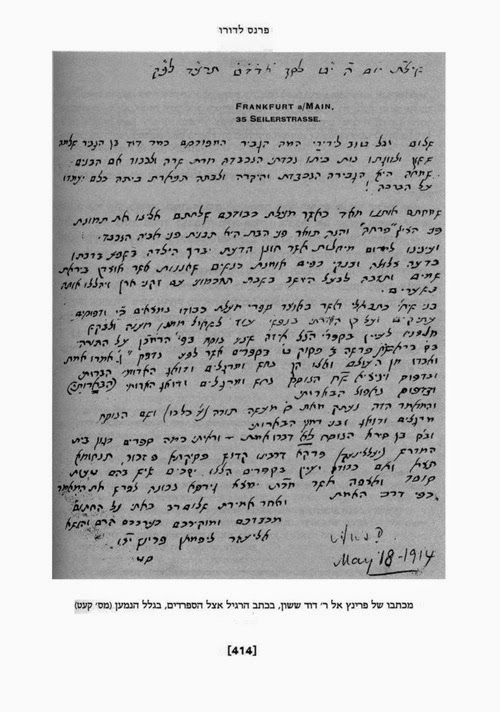
Eliezer Lipman Prinz Im Chachmei Doro
” by Meir Herskovics[18] a letter
by Rabbi Eliezer Prinz to his grandson David Sassoon, the son-in-law of his
eldest son Moshe, he writes that he has difficulty in understanding the
commentary of Ramban on Bereishis 2:9, because when he examined different
girsaos, a word was spelled differently and it is evident that the scribe made
an error. Could David please check his different manuscripts to determine the
correct girsa.

David Sasson was not
only a great Talmid Chochom himself but he hired Rabbi Eliyahu Dessler author
of Michtav Eliyahu to learn with his son Solomon in 1928 at the
suggestion of Dayan Shmuel Yitzchok Hillman. Rabbi Solomon Sassoon, who
continued in his father’s footsteps in collecting seforim, developed into a
great Talmid Chochom who turned down the Israeli government twice when it asked
him to serve as Sephardic Chief Rabbi of Israel.[19]

By the time David Sassoon passed away in 1942 he
had amassed about 1300 items in his library. Sadly the collection has been
dispersed sold at a number of Sotheby auctions, beginning with one in Zurich in
1975. A New York Times article[20] describing the fourth Sassoon manuscript
collection in 1994 states that in the past decade the sales were due to satisfy
the estate’s British tax obligations. Nevertheless, thanks to David Sassoon,
universities and libraries around the world can continue to enhance Jewish
scholarship through the efforts of David Sassoon. Yehi Zichro Mevorach.


Notes:
[1]
Aaron Souraski, Ohr Elchanan
2, p. 74.
[2] Rosenblum, Jonathan, Rabbi Dessler: The
Life and Impact of Rabbi Eliyahu Eliezer Dessler, the Michtav Me’Eliyahu
,
Mesorah Publications,  Artscroll 2000
NY.,  p 144.
[3] Roth, Cecil, The Sassoon Dynasty,
Robert Hale Limited, London, 1941 p. 80.
[4] Jackson, Stanley, The Sassoons, EP
Dutton Inc., NY 1968 p. 30.
[5] Ibid. page 2
[6] Breger, Jennifer, “Flora Sassoon”
entry in Jewish Women’s Archive.
[7] Jackson, p. 104. Also see Introduction to
Sotheby Catalogue “Seventy-Six important Hebrew and Samaritan Manuscripts
from the Library of the late David Solomon Sassoon,” London June 21, 1994
.The latter was the fifth Sotheby sale of manuscripts from the collection of
David Sassoon, the previous sales took place in Zurich 1975 and1978 and in New
York, in 1981 and 1984.
[8] Ibid. Jackson,  p.105.
[9] Rabinowicz, Harry, The Sassoon Treasures,
Jewish Life Jan.-Feb. 1966 p.45.
[10] Jackson, p.158.
[11] David Sassoon, Ohel David, Oxford
University Press, 1932, p. 6.
[12] Shevat-Adar 5726, Jan.-Feb. 1966 issue
pp.42-48.
[13] Information from his travel diary, was
incorporated later in his, A History of the Jews in Baghdad (Letchworth
1949) and this diary was later edited and published in Hebrew by M. Benayahu in
1955, after its author’s death (Massei Bavel, Jerusalem 1955).
[14] Cecil Roth: Historian without Tears
Sepher
, Hermon Press, N.Y., 1982, p. 92
[15] See note 13
[16] See Nachalat Avot: Asufat Genazim MiBeit
Mishpachat Sassoon
, for a treasure trove of letters soliticing Tzedokoh
from many Gedolim. This sefer includes Teshuvot, Michtavim Tefillot and
Minhagim and was published by Yad Samuel Franco, 5767, Machon “Ahavat
Shalom,” Yerushalayim.
[17] p. 74.
[18] pp. 411-415.
[19] Rav Dessler, pp 145-.146.

[20] Dec. 5, 1984, “Sassoon Judaica Sold at
Sotheby’s”.


Emek ha-Netziv : The Manuscript

Emek ha-Netziv : The Manuscript
by Gil S. Perl

Rabbi Dr. Gil S. Perl is dean of the Margolin Hebrew Academy/Feinstone Yeshiva of the South in Memphis. The following selection comes from his new book, The Pillar of Volozhin: Rabbi Naftali Zvi Yehuda Berlin and the World of Nineteenth-Century Lithuanian Torah Scholarship.


The manuscript of ‘Emek ha-Netziv remains in the possession of the Shapira family and there are no additional extant copies. The family are prominent members of a staunchly traditionalist Ḥaredi community in the Geulah neighborhood of Jerusalem. Members of this community generally oppose sustained contact with Western culture and its representative institutions, including universities of any type. The Shapira family seems to harbor additional skepticism toward those researching Netziv , due to the fact that his relative openness to certain aspects of non-traditional culture has made him a controversial figure in some ultra-Orthodox communities.[1]These facts, combined with the sheer value of their manuscript collection,[2] make the family understandably guarded about allowing access to thematerials they possess. However, with the assistance of Rabbi Zevulun Charlop, Dean of the Rabbi Isaac Elchanan Theological Seminary in New York City and a cousin of the Shapira family,[3] I was able to secure brief and accompanied access to the manuscript from which ‘Emek ha-Netziv was taken.[4]

The manuscript is handwritten in three volumes, corresponding to the three volumes of the printed text. The first two volumes were bound, but the binding has completely deteriorated and sections of each volume easily separate from one another. The third volume seems never to have been bound. The pages of all three volumes are severely frayed at the edges.

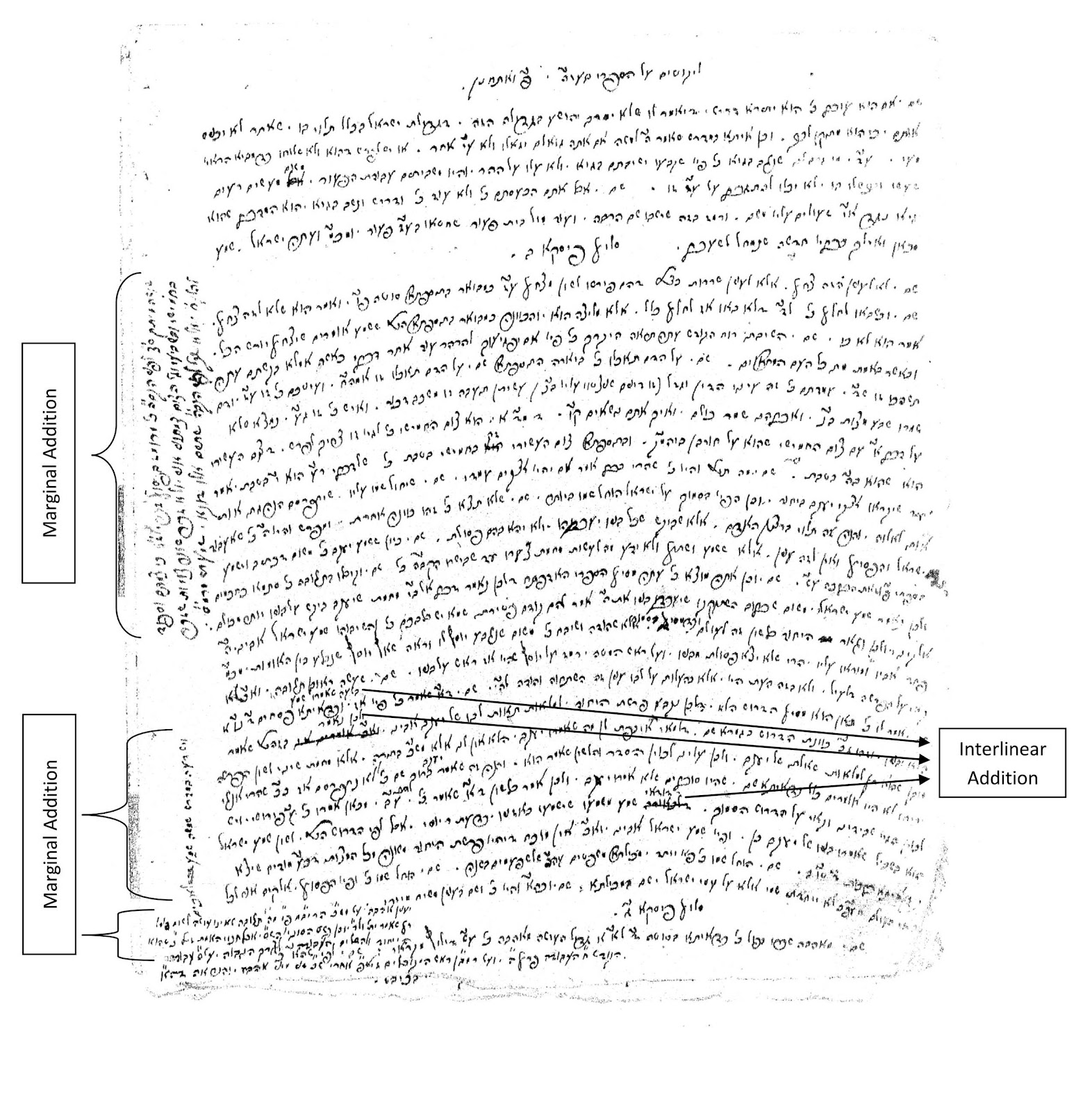
As suspected, the manuscript contains a core text with countless interlinear and marginal additions as well as words and entire lines that have been crossed out:


.

It is important to note that the brackets and parenthesis which appear throughout the printed text do not correspond to these additions. Rather, they correspond to places in which Netziv placed parenthesis or brackets around his own words both in the core text and in the additions. The additions and the notes he appended to the end of the manuscript (referred to by the Netziv as hashmatot )[5] were incorporated without indication into the printed text.


The script of the core text through the first two volumes and half of the third is a fairly consistent narrowly-spaced brown cursive[6] written with a fairly wide-tipped pen. In the second half of the third volume the script of the core text changes to a blacker, wider-spaced cursive seemingly done with a thinner-tipped pen. The script of the later marginal additions varies.

The notes which appear scattered throughout the printed text (referred to by the Netziv as hagahot) were written at the same time as the core text,[7] as evidenced by the identical script used and the intentional indentations left in the text of the core commentary in order to create space for the hagahot. The hagahotalso contain marginal additions. A typical page in the manuscript containing hagahot, then, is represented in the following diagram:

The reference to the newly printed book ‛Emek Halakhah mentioned above appears as an interlinear addition to the core text, thus implying that for that particular section of the commentary on Naso, the core text was written prior to 1845 and the addition was included after 1845. The references to Reb ‘Iẓele are also found in the core text with the word “she-yiḥyeh,” which dates those passages of the core text to the years prior to 1849 as well.[8]

The orderly progression of chapters in the core text, which begin at varying places on the physical page of the manuscript, indicates that Netziv wrote down his comments in this manuscript in proper sequence, following the order of Sifre. [9]That is, one can safely assume that in this particular copy of the manuscript, the core text of Netziv’s comments on Parashat Bamidbar were committed to writing before those of Parashat Naso, and his comments on pesikta’ aleph were committed to writing prior to those of pesikta’ bet.[10] If the core text of the manuscript was written sequentially, and the core text of EH Naso 49 (I:181) was necessarily written prior to the publication of Zev Wolf ben Yehudah Ha-Levi’s 1845 publication of ‘Emek Halakhah, one can deduce that, at the very least, the entire core text until that point was also committed to writing prior to 1845. Likewise, from the appearance of the word “she-yiḥyeh” in the core text of Be-ha‛alotekha andShelaḥ[11] one can assume that the text up to that point was written prior to Reb ’Iẓele’s death in 1849. If we then add that the handwriting remains rather constant in the core text until the second half of the third volume, we have reason to believe that all of the core text until that shift in appearance was committed to writing prior to 1849.

Thus, one can safely conclude that a good portion of the printed edition of‘Emek ha-Netziv was indeed written while Netziv was a young man in his twenties and thirties. As such, the general character and main attributes of the work must be seen as a product of the cultural and intellectual atmosphere of Lithuanian Jewish society in the 1830s and 1840s. At the same time, given the large number of later additions and the lack of any demarcation in the printed text, one can not firmly ascribe a date to any specific passage found in it, with the exception of those which contain explicit or implicit references to the time of composition.

Censorship

The process of preparing ‘Emek ha-Netziv  for publication was painstakingly performed by the Shapira family over the course of many years, and thus the printed text seems to be relatively free of printing errors. However, there are two hints in the printed text which suggest the possibility of editorial censorship.

As noted above, Netziv’s relative openness to sources of information beyond the pale of the current traditionalist canon is a character trait which is at odds with the values of the contemporary ultra-Orthodox community. As we will describe at length in the pages that follow, Emek ha-Netziv  is filled with citations and references to such sources of information. On two such occasions the reference found in the printed text appears to be intentionally altered so as to prevent proper identification of the source. In his comments on ‘Ekev, Netziv writes that for further study one should consult the book called “thirty-two Middot of [sic] in Vilna.”[12] In all probability Netziv is referring to the book published in 1822 called Netivot Olam: Beraita de-32 Middot with the commentary of Ẓvi Hirsch Katzenellenbogen. Katzenellenbogen is known to have been a member of Vilna’s more “enlightened” circles.[13] As such, the possibility exists that the publisher intentionally left out Katzenellenbogen’s name. This prospect is bolstered by the fact that the manuscript contains a name in the standard acronymic form where the printed edition has a blank space. When I asked to look at this reference in the manuscript, it was reviewed by two members of the Shapira family and I was denied permission to look at it. Nonetheless, I did manage to see what seemed like a legible acronym ending in the letter qof.[14] Although it is possible that the editor could not discern the letters of the acronym, if such had been the case one would expect a bracketed editorial note, such as those which appear on several occasions in the printed text where the manuscript is illegible due to stains or frayed edges.[15]

The second possible instance of editorial censorship concerns a passage in Netziv’s commentary on Shoftim which refers the reader to “hakdamat ḥumash besau[16] ve-‘tav’’alef’.[17] The most common referent for the initials tav”alef in the context of Torah commentary is Targum Onkelos, the ancient Aramaic translation of the Bible. However, if the bet of the word “besau” is replaced with adaled so as to read “desau” we might suggest that the tav”alef stands for targum Ashkenaz, German translation, rather than Targum Onkelos. As such, the citation would be of the well-known introduction to Moses Mendelssohn’s Torah commentary, which was printed in Dessau and contains a German translation of the biblical text. The fact that the subject matter under discussion in this passage of Netziv’s commentary correlates to subject matter discussed by Mendelssohn in the introduction to his Bible commentary supports the latter suggestion.

We might raise the question, then, as to whether the printed text was intentionally manipulated so as to prevent easy identification of Mendelssohn’s work or whether the daled of Dessau was simply mistaken as a bet by the printsetter.[18]The fact that this particular citation was underlined in pink pencil in the manuscript bolsters the suspicion that the publishers of ‘Emek ha-Netziv were sensitive to the potential controversy the citation of Mendelssohn might have caused in the ultra-Orthodox community and that they therefore intentionally altered the printed text.[19]

Both of the above instances of possible censorship beg the question as to why the references were included altogether if the printers wished them to remain unidentified. Furthermore, as will be discussed below, the printed text of ‘Emek ha-Netziv contains references to numerous other works that lie well beyond the traditional contemporary ultra-Orthodox canon which were not censored. As such, the evidence for editorial censorship cannot be considered conclusive. Nonetheless, these two passages do raise the possibility that other parts of the text were more cleverly censored or that other citations were completely deleted.
The End of ‘Emek ha-Netziv
The end of Netziv’s commentary on Sifre, as it appears in the printed edition of ‘Emek ha-Netziv , is also an issue of concern to the critical reader. The commentary in both the printed edition and the manuscript comes to an abrupt halt halfway through the parashah of Ki Teẓeh[20] and well before the end of the text of Sifre itself. One is therefore led to question whether Netziv truly ended his commentary there, or whether there was more to the commentary that does not appear in the printed text.

Several factors indicate that Netziv’s commentary did, in fact, extend beyondpiska’ 27 of Parashat Ki Teẓeh.[21] To begin, Netziv starts his commentary at the beginning of Sifre with an introductory double couplet, and thus one would expect a similar poetic composition at the end of the work, but none appears in the printed text or in the manuscript. Furthermore, a statement of completion marks the close of each parashah throughout the text, but none appears at the end of Parashat Ki Teẓeh. Likewise, the completion of the Book of Numbers is marked by two rhyming stanzas of nine lines each,[22] while Deuteronomy, and the commentary as a whole, has no formal conclusion at all.

One must entertain the possibility that the abrupt ending of the work suggests not that the final portion of the commentary is missing from the printed text but that Netziv never completed the commentary. This theory might be supported by the fact that the statements of conclusion which follow everyparashah are in poetic form in the first two volumes, whereas in the third volume, which consists of the Book of Deuteronomy, the statements consist of nothing more than “Piska’ 8 is complete and [so too] the entire portion of ve-’Etḥ anan.”[23] One might interpret this phenomenon as suggesting that the final touches, such as the transformation of abrupt closing statements into clever couplets, were never applied to the third volume of the work.

Such a conclusion seems unlikely, however, when one considers the numerous revisions and recensions to which Netziv subjected the rest of the commentary. One generally does not spend the time editing, expanding, and re-copying a work that one has yet to complete. Furthermore, in his introduction toHa‘amek She’elah Netziv regrets that he has not yet brought his commentary onSifre to press, but he makes no mention of not having completed writing the text. Similarly, in a comment found in his Harḥev Davar, published along with his Ha‛amek Davar in 1878, Netziv writes that while he has not elaborated on a particular point in this work, he will do so at length when God grants him the merit of “publishing the commentary on Sifre.[24] Here too, Netziv does not ask for God’s help in finishing the work, but in bringing it to press. Likewise, Avraham Yiẓḥak Kook, one of the outstanding students of Netziv , publically called upon his teacher to publish his Sifrecommentary in a footnote to a biographical article on Netziv published in 1888.[25]He too seems to suggest that the work was complete.

The physical form of the third volume of the manuscript makes the possibility of missing material rather plausible as well. The printed text contains commentary to every piska’ in Sifre up until piska’ 27 of Parashat Ki Teẓeh.[26] There is no commentary on piska’ot 27-54, but the text resumes with brief comments on piska’54[27] and then ends completely. In the manuscript, piska’ 27 ends at the bottom of a page, which raises the possibility that further commentary followed on subsequent pages which are now lost. The brief comments to piska’ 54 appear on the reverse side of comments labeled as hashmatot; therefore, they may well represent hashmatot to a core commentary, now lost, on the end of Deuteronomy.[28] When one considers the fact that, unlike the first two volumes, the third volume of the manuscript is not bound and does not appear to ever have been bound, the notion that pages from the end of the commentary were lost must be seriously considered.[29]
Conclusions
The conclusion one must draw from the above investigation of the text of‘Emek ha-Netziv is that a historical analysis of the content found in the printed text must be made with caution. The possibility of the text being incomplete must always be considered both in regard to possible editorial censorship and in regard to the possibility that the text originally contained additional chapters that are currently lost. Whereas the core text of the commentary prior to Shelaḥ [30] can be rather definitively dated prior to 1849, the printed text makes no distinction between the core text and later additions. As such, with the exception of a few passages which include embedded historical evidence, no single passage in the printed text can conclusively be dated to the 1830s or 1840s. Nonetheless, there is sufficient evidence, both in Netziv’s own testimony with which this chapter began and in the clues offered by the text and corroborated by the manuscript, to conclude that the bulk of the commentary does indeed reflect a project with which Netziv was engrossed in his early years. Thus, trends which can be identified throughout the printed text and which comprise its general character must indeed be seen as reflective of the intellectual currents of Lithuanian Jewish culture in the 1830s and 1840s.
[1] In recent years, certain circles in the ultra-Orthodox community recommended that Moshe Dombey and N.T. Erline’s adaptation of Barukh Ha-Levi Epstein’s Mekor Barukh, entitled My Uncle the Neẓiv (Brooklyn, N.Y.: Mesorah Publications, 1988), not be read due to its portrayal of Neẓiv as one who did not share all of the values of the contemporary ultra-Orthodox community. See Jacob J. Schacter, “Haskalah, Secular Studies, and the Close of the Yeshiva in Volozhin in 1892,” Torah u-Madda Journal 1 (1989): 76-133; Don Seeman, “The Silence of Rayna Batya: Torah, Suffering, and Rabbi Barukh Epstein’s Wisdom of Women’,” Torah u-Madda Journal 6 (1995-1996): 91-128; Don Seeman and Rebecca Kobrin, “’Like One of the Whole Men’: Learning, Gender and Autobiography in R. Barukh Epstein’s Mekor Barukh,”Nashim 2 (1999): 52-94; Brenda Bacon, “Reflections on the Suffering of Rayna Batya and the Success of the Daughters of Zelophehad,” Nashim 3 (2000): 249-256; Dan Rabinowitz, “Rayna Batya and Other Learned Women: A Reevaluation of Rabbi Barukh Halevi Epstein’s Sources,” Tradition 35: 1 (Summer 2001): 55-69. This position toward Neẓiv, however, was already espoused a century earlier when a series of articles appeared in the Galician newspaper Maḥzike Ha-Da’at (volumes 16, 17, and 18) warning traditionalist Jews to stay away from Netziv’s Bible commentary,Ha‛amek Davar, due to its modern stance toward the authority of the Talmudic Sages. A similar sentiment is reflected in the fact that many ultra-Orthodox houses of study have refused, and continue to refuse, to include Ha‛amek Davar in their libraries.
[2] A value which stands in stark contrast to the overwhelming poverty of most of Geulah’s inhabitants.
[3] See Neil Rosenstein, The Unbroken Chain. (New York: CIS Publishers, 1990) 433-440.
[4] My examination of the manuscript took place in July of 2004 with the assistance of a Summer Travel Grant awarded by the Center for Jewish Studies at Harvard University.
[5] The hashmatot probably represent additions to the text which Neẓiv could not fit in the margins of the page of the core text due to lack of space.
[6] The letters are in cursive form, but Neẓiv generally did not attach his letters to each other. The brown color was probably black when originally applied but has lost its vibrance with the passage of time.
[7] The hagahot seem to have been intended as tangential footnotes to the main commentary in a manner similar to the way in which Netziv’s Harḥev Davar was intended to supplement his Ha‛amek Davar on the Bible. This format was typical of Lithuanian Torah commentary, for reasons which will be explained in Chapter Three below.
[8] I had hoped to demarcate the beginning and end of each addition in my own printed text along with a description of the script used in each addition. The Shapira family, however, was not willing to grant me the sustained access to the manuscript required for such an endeavor.
[9] If it had not been written in order, one would expect to find empty spaces on the bottom of a page where a particular chapter or section ended and new sections beginning on the top of new pages. Instead the end of each section in the manuscript is followed immediately by the beginning of the next section, indicating that they were written sequentially.
[10] There is reason to believe that this manuscript itself is a later recension of an earlier edition. The family showed me what they said were the few extant leaves of an earlier version of the commentary written by Neẓiv which predates the manuscript used for the printed text, but I was not allowed to study them at length. As such, the above analysis does not suggest that Neẓiv actually composed his commentary according to the sequence of the Sifre text, but simply that the transcription of the core text of the commentary into the manuscript at hand was done in sequential order.
[11] See note 14 above.
[12] EH ‘Ekev 4 (III: 52).
[13] See Chapter Two below.
[14] My access to the manuscript was always limited to sitting next to a member of the Shapira family, who would turn to the page I wished to check and look at the specific textual anomaly before deciding whether to let me look as well. In this case I was able to peer over his shoulder and attempt to decipher the acronym. The exact answer this member of the Shapira family gave me was, “Suffice it to say, it is not a siman in Shulḥan Arukh.”
[15] E.g., EH Naso 42 (I: 162); EH Naso 44 (I: 173); EH Matot 1 (II: 279); EHMatot ‛Ekev (III: 45); EH Re’eh 9 (III: 92).
[16] Bet-ayyin-sameh-vav.
[17] EH Shoftim 16 (III: 189).
[18] In cursive Hebrew writing the bet and daled look quite similar.
[19] A glaring example of this type of censorship recently appeared in a photo-offset of the 1926 Frankfurt edition of David Ẓvi Hoffmann’s responsa, Melamed le-Ho‛il, published by the Lebovitz-Kest foundation. In Responsa #56 in the original printing (II: 50), Hoffmann gives his approval, in exigent cases, for an Orthodox Jew to swear before a civil court without a head covering. In the context of his piece, Hoffmann also attests to the fact that Samson Raphael Hirsch instructed the students in the Frankfurt Orthodox school which he founded to cover their heads only for Judaic studies and allowed them to remain bare-headed for their secular studies. The recent photo-offset contains an introduction by a grandson of Hoffmann, David Ẓvi ben Natan Naftali Hoffmann, which gives the reader the impression that the grandson belongs to the ultra-Orthodox community of Jerusalem. Responsa #56, however, permits a practice clearly anathema to that community. Hence, when one turns to page fifty in the off-set, in place of what was earlier Responsa #56, one finds a blank space. I thank Rabbi Moshe Schapiro, librarian at the Mendel Gottesman Library of Yeshiva University, for bringing this example to my attention.
[20] EH Teẓeh (III: 296).
[21] Note that the piska‘ot of Neẓiv do not correspond to those of the Sifre text with which the commentary is printed. In the text of Sifre the last piska’ for which there is continuous commentary is 43, and it then resumes in 54. See Chapter 5.
[22] EH Mas‛ai (II: 334).
[23] EH Ve-’Etḥanan (III: 43).
[24] HrD Num. 6: 19.
[25] Avraham Yizhak Kook, “Rosh Yeshivat Eẓ Ḥayyim,” Kenesset Yisrael, ed. S.J Finn (Warsaw, 1888), 138-147. Also in Ma’amarei HaRe’iyah (Jerusalem, 1984), 123-126.
[26] EH Teẓeh (III: 296). Piska’ot here are according to Netziv’s division. For more on Netziv’s method of dividing piska’ot see Chapter Three below.
[27] EH Teẓeh (III: 299). In the absence of Netziv’s commentary, piska’ot here refer to the division found in the standard Sulzbach edition.
[28] When I asked the Shapira family about the strange ending of work, they too suggested that there might have been more that was lost. When I asked them who had possession of the manuscript prior to them, they declined to give me any names and replied instead, “Suffice it say, it has been handed down, son after son.”
[29] The existence of commentary on the latter parts of Deuteronomy could have been conclusively proven had Neẓiv included a reference to it in his other writings. I have found no such reference, but no conclusions can be drawn from silence.
[30] EH Shelaḥ 1 (II: 10)


Halakhah and Haggadah – Manuscript Illustrations and their Halakhic and Customary Significance

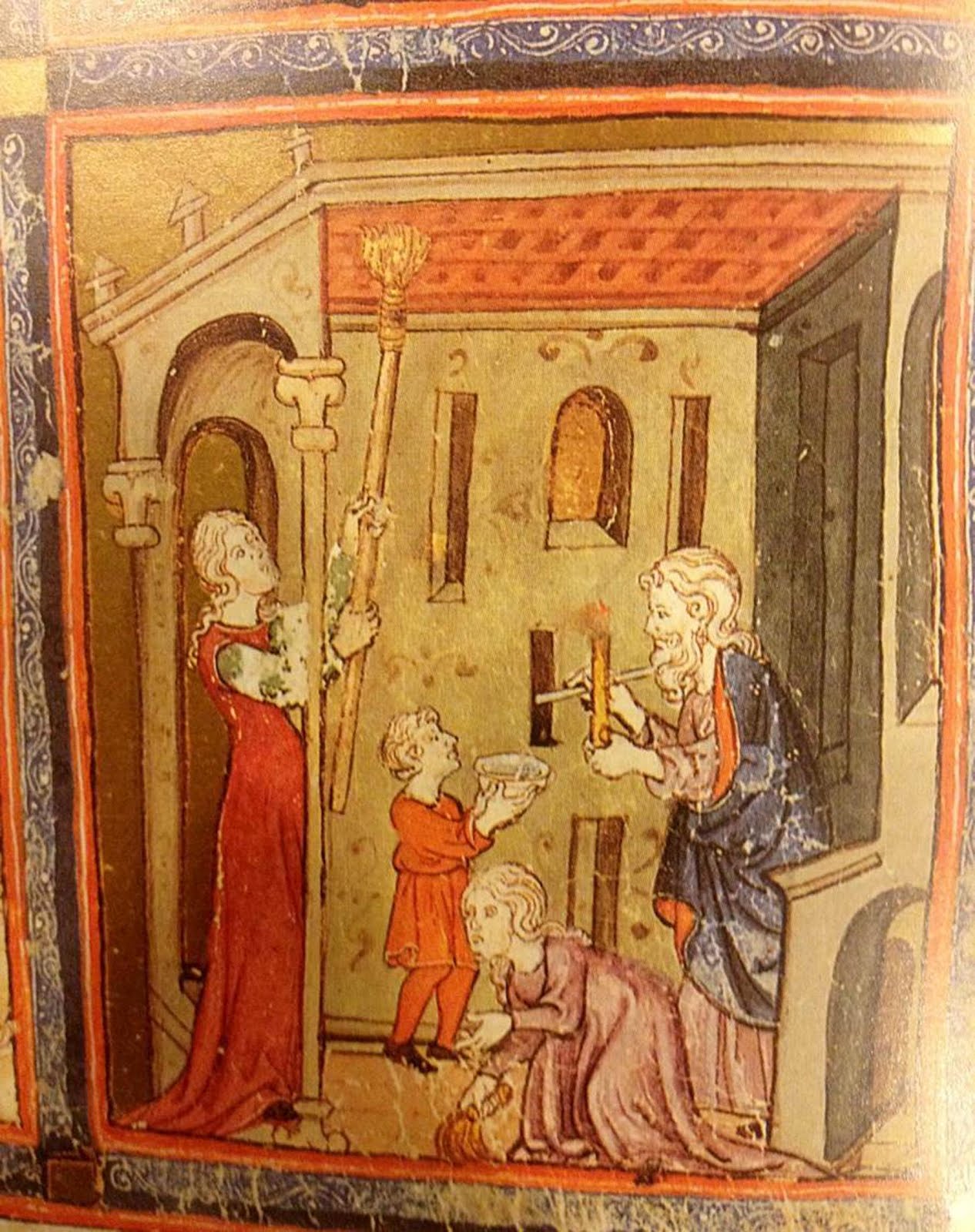
This post is part of a series of posts regarding illustrations adorning manuscript and print Haggadot. Our first post dealt with a new work on the topic and can be viewed here. In this post we will focus upon the some of the Halachik implications of these illustrations. In many Ashkenazic manuscripts, the Passover illustrations begin chronologically earlier than the Seder. Many begin with the preparation of the matzah. For example, in the Second Nuremberg Haggadah[1], (the manuscript is online here) a 15th century Ashkenazic haggadah, contains ten scenes devoted to the matzah process. A similar haggadah, likely illustrated by the same artist, also includes numerous matzah baking scenes. All of these, however, begin with the bringing of the grain to the miller. This is in contrast to today’s practice whereby the matzah producing process begins earlier, with the cutting of the wheat.
(All images may be clicked for larger viewing.)
That is, for many today, matzah shmurah means shmurah (watched) from the time of harvest and not from the time of grinding. But, in reality the reason for the illustrations beginning where these haggadot do, is simply because they reflect the practice in Ashkenaz, based upon the R. Ya’akov ben Asher, the author of the Tur, that only from the time of grinding is it necessary to “watch” the grain. Matzah Shmurah in Ashkenaz in the medieval period meant grain which had been watched from the time of grinding not cutting.[2] Turning to a Sefardic custom, the Barcelona Haggadah, produced after 1350, is the earliest record of the custom to place the Seder Plate on someone’s head during the recitation of Ha Lahma Ania (Ashkenazim remove the plate from the table).Only some three hundred years later is this custom mentioned in printed sources. Additionally, there is a difference between the Sefardic and Ashkenazic haggadot regarding what the Seder Plate actually was, with the Ashkenaz depicting a plate, whereas the Sefardic manuscripts depict a basket.[3]
When it comes to marror and what vegetable that is, we have at least two different types depicted in various manuscripts. In the Brother to the Rylands Haggadah, marror is depicted as an artichoke, as is in the case with the Sarajevo Haggadah.

While in many manuscripts, marror is a leafy vegetable.[4]
Setting aside the issue of what marror is, another custom related to marror can be found in both printed and manuscript haggadot. In the Prague, 1526, the first illustrated printed haggadah, there is a picture of a man pointing at his wife with the legend, “there is a custom that a man points to his wife when mentioning marror based upon the verse Ecclesiastes 7:26 “Now I find woman more bitter than death.”
A.Y. Hyman the scholar of Jewish liturgy was appalled when he came across this. In his autobiography, he claims that there is no basis whatsoever for this “custom.” Hyman is wrong.[5] If you look at the Brother to the Rylands Haggadah you can see that it shows this custom. As does the Washington Haggadah. Likewise, the Rothschild Miscellany shows the same custom.

It’s worth noting that the Rothschild Miscellany shows another custom at the time, mid-14th century, that of mixed dancing.

The mixed dancing is that of couples, husband and wives dancing with each other, and not that of unmarried men and women dancing[6] In Italy, where this manuscript was composed, mixed dancing was apparently common during this period.[7] Returning to the gesturing at one’s wife at marror, in the Hiluq and Biluq Haggadah this custom takes on a somewhat more humorous dialogue with the wife no longer passive but instead returns the compliment. In that haggadah it includes speech balloons and they record the following: The husband states “touching marror I must recall that this one, too is bitter [as gall].” To which the wife replies, “It is you [my husband] is one of the causes of bitterness as well.” After which, we have a play on the 13 attributes of Rabbi Yishmael and the haggadah provides that “the third comes between them [perhaps the marror itself] and makes a stink” – or in Hebrew ve-yavo ha-shlishei ve-yakhriach benehem.[8]


Similarly, in some Ashkenazic haggadot manuscripts, they show the the husband and wife pointing at one another.[9] Finally we get to a halachik error in a manuscript haggadah. The Washington Haggadah was written by a scribe calledJoel ben Simon. This haggadah was first printed as part of the Diskin Orphan House haggadah series in 1965. The Library of Congress didn’t publish its facsimile edition until 1991, and last year another facsimile edition of this haggadah was published as well.[10] Although this haggadah was written close to 300 years prior to Diskin publishing it, until that time a significant scribal error escaped notice. Specifically, in the text for eruv tavshilin rather than just saying “with this eruv I am allowed to cook from Yom Yov for Shabbat,” it continues and says “and on Shabbat for Yom Tov.”


Needless to say this did not escape the eagle eyes of some who feared that someone may use this haggadah (we note that contrary to the other reproductions mentioned, the Diskin version is a poor copy) and inadvertently think it is permissible to cook on Shabbat. So, the ever wise Aggudat ha-Rabbonim took out ads in the Yiddish daily, Der Tag, and the Forward to let its readers know of this error. The publishers took this one step further and mailed out a letter, with the provocative title, “Heresy or Blunder,” after Passover indicating the error and also included a letter from Cecil Roth, who had written about manuscript haggadot.


In his letter he indicates that indeed this was most likely inadvertent and that Joel did not have a different tradition regarding eruv tavshilin. Indeed, we know from Joel’s other manuscripts, where he records the correct blessing, that the Washington Haggadah’s version was simply a scribal error.

This is not the only error related to halakha and haggadah illustrations. R. S.H. Kook, criticizes two aspects of illustrations that appear in the Prague 1526 Haggadah. Both of these issues center around how the wine glass is depicted. Specifically, he takes issue with the fact that in many of the illustrations show the wine glass in the left hand and not the right. Additionally, he complains that the illustration show the holder grasping the glass at the stem and not at with his fingers cupping the bottom of the glass.
Regarding the first issue, that of left handedness, this anomaly may be attributed to the fact that this was the first completely illustrated woodcut haggadah. And, as it was the first, it was not necessarily perfectly executed. But, before we continue we must digress and explain about woodcuts in order to get to the left handedness. A woodcut when inked and put on paper produces a mirror image of whatever the woodcut depicts. Thus, if the woodcut was of a right hand, when pressed on paper would produce a left handed image. Additionally, when copies were made, the copyist were not careful and would reverse the images. That is, they were working off the printed image and would copy it directly rather than accounting for reversing the image to ensure that when it was used it would produce the same and not a mirror image. So, as has been explained, during the early history of woodcuts “copies [of woodcuts] were constantly being made, with or without leave, for copyright hardly existed, and the same printer would often have to replace worn cuts by new blocks in successive editions. It is not always an easy task to distinguish copy from original. Immediately recognizable as from different blocks are subjects which appear in reverse directions, for the copyist who does not take the trouble to reverse his drawing from the original print, will make a block that will print the subject reversed.”[11] We can now explain why the images are left handed, presumably, they were copied and the woodcutter was not careful to reverse the image, thus producing a left handed image. As an aside, another example of copying which reverses the images may be seen when the Prague 1526 Haggadah was itself used as a model for a woodcut. The border surrounding Shefokh was reused in the Levush. As is apparent, the images are that appear on the right in the Prague 1526 Haggadah appear on the left in the Levush. And, those on the left appear on the right.

Regarding the second point, the failure to cup the glass rather than grasp the stem, this can be attributed to an error on R. Kook’s part and not the woodcutter. While today it may be commonplace to cup the glass, this was only popularized by R. Yeshaya Horowitz, in his book, Shnei Luchot ha-Brit, (Shelah). R. Horowitz wasn’t born when the Prague 1526 Haggadah was printed – he lived between 1565-1630. Moreover, his book was published posthumously, in 1648, more than 120 after the Prague 1526 Haggadah was published. Thus, it is unremarkable that the Prague 1526 Haggadah failed to account for a custom that didn’t exist at that time. This is another example of why bibliography is important, for other examples see here. Finally, we conclude this part of the series regarding halachot and Passover in general, and specifically, the notion that on Passover we are stricter than normal. At times it appears that some go overboard with the various humrot on Passover as well as cleaning all sorts of items that seemingly don’t require cleaning. But, from the evidence of manuscript illustrations, this notion of stringency is not a new one. The Golden Haggadah, circa 1320, includes this very nice image of cleaning and searching for leaven. If one looks closely they will note that the woman on the left is apparently sweeping the ceiling! Thus, indicating that perhaps going overboard has been the case for some while. Also of note is that the father is performing bedikat hametz and he is bareheaded (as is the son).[12]
[1] Its title is a reference to the fact that from the mid-nineteenth century until 1957 it was housed in Nuremberg, after which it moved to the Schocken Library, and then to a private collector. The reason it is the the Second, is because Nuremberg also had another manuscript haggadah – now known as the First Nuremberg Haggadah. It too is no longer in Nuremberg. Today it is in the Israel Museum.
[2] See Steven Fine, “The Halakhic Motif in Jewish Iconography: The Matzah-Baking Cycles of the Yahuda and Second Nurnberg Haggadahs,” in A Crown for a King, Gefen, Jerusalem-New York: 2000, pp. 106-07. [3] See Evelyn M. Cohen, “Seder Foods & Customs in Illuminated Medieval Haggadot,” in The Experience of Jewish Liturgy, D.R. Blank ed., Brill, Leiden:2011, 24-25. We note that while this article provides a summary of some of the images and text accompanying medieval haggadot, the article provides little context for various practices. Indeed, the article fails to provide sources which support many of the illustrations and texts and instead merely parrots what the the manuscripts say or depict. [4] On this issue of which vegetable is preferable for marror see Zohar Amar, Merorim, n.p., 2008. [5] His comments appear in the Misrad Hasikon 1965 reprint of the Prague 1526 Haggadah at pp. 14-15. [6] See Therese & Mendel Metzger, Jewish Life in the Middle Ages, Chartwell Books, Inc.:1982, 216-17. [7] See the sources collected by R. Henkin, Shu”t Benei Banim, vol. 1, Jerusalem: 1998, no. 37, esp. section 5 where he discusses Italian sources. Thanks to R. Weinfeld for bring this source to our attention. [8] See Bezalel Narkiss, “Art of the Washington Haggadah,” in The Washington Haggadah, Commentary, M. Weinstein, ed., Washington D.C.: 1991, pp. 73-75, discussing manuscripts that contain the marror/wife images, as well as the source in the following note. [9] See R. Yisrael Mordechi Peles, “Controversies Regarding Customs That Can Be Gleaned from Haggadot,” in HaMaayan, Nissan: 5771 (51,3), pp. 13-14, available here. [10] The 1991 edition was accompanied by a commentary volume. The 2011 edition also includes some articles with the color reproduction of the haggadah. [11] Arthur M. Hind, An Introduction to the History of Woodcut, Boston: 1935, vol. 1, pp. 284-85, quoted in R. Charles Wengrov, Haggadah and Woodcut, New York: 1967, pp. 87-88. In general Wengrov’s book provides a wealth of information regarding the images contained in the Prague 1526 Haggadah.[12] Mendel Metzger, Jewish Life in the Middle Ages, supra, p. 148 discussing generally medieval manuscripts and depictions of headcovering or lack thereof.


The Legend of R. Yehuda Halevi’s Death: Truth or Fiction & the Cairo Genizah

The Legend of R. Yehuda Halevi’s Death: Truth or Fiction & the Cairo Genizahby Eliezer Brodt

A few years ago on the Seforim Blog I dealt with the famous legend of R. Yehuda Halevi’s death (link). More recently in Ami Magazine (# 32) I returned to this legend and related topics. This post contains new information as well as corrections that were not included in those earlier articles.

R. Yehuda Halevi was born in the year 1075 in Toledo, Spain, and died in 1141.[1] He is famous in Jewish history for being a great paytan,[2] authoring hundreds of beautiful piyutim. However, he is even more famous for authoring one of the most important Jewish philosophical works of all time, the Kuzari. This work is written in dialog form between a king and a Jew who is persuaded to convert to Judaism. The Jew defends Yiddishkeit, dealing with many issues of philosophy and various Mitzvos among other topics. This work was written by R. Yehuda in Arabic, but was translated into Hebrew in 1167. It was learned by many throughout the centuries, and numerous works were written to explain it.[3] The Kuzari had a tremendous impact on Jewish thought through the centuries and continues to do so today. In this article, I hope to deal with two legends told about R. Yehuda Halevi: one about how he met an untimely death when he got toEretz Yisroel [4] and the other about him being the father-in-law of Ibn Ezra.

Among the more famous kinos that we recite on Tisha B’Av is Tzion Halo Tishali. This piyut is about the author’s passion to walk on the holy soil of Eretz Yisrael and to pray at the Kevarim. Throughout the Kuzari and in many of his piyutim we find a strong emphasis of his love for Eretz Yisroel[5]. R’ Yosef Dov Soleveitchik, when talking about R’ Yehuda Halevi in his lectures on the Kinos, said “Rabbi Yehuda Halevi adored everything about Eretz Yisroel; he was madly in love with Eretz Yisroel. I have never known anyone so in love with Eretz Yisroel as Rabbi Yehuda Halevi. There were many others who went to Eretz Yisroel, but they did not confess their love for the land in such terms as he did”.[6]

Already in the Machzor from Worms written in 1272 and in the Nuremburg Machzor written in 1331 we find this kinah was said on Tisha Bav. The piyut, however has become famous for a different reason.[7]

In the Artscroll commentary on the Kinos, R. Avraham Chaim Feuer writes:

An ancient manuscript states that R. Yehuda Halevi composed this kina while journeying towards Eretz Yisroel and recited it when he reached Damascus, facing the direction of Zion. Although many historians believe that R. Yehuda Halevi only got as far as Egypt, never even reaching Damascus, tradition has it that he finally reached Jerusalem (circa 1145).[8] There he fell to the ground in a state of ecstasy… As he was embracing the dust near the temple mount, he was trampled and killed by an Arab horseman.[9]

R’ Yosef Dov Soleveitchik, when talking about R’ Yehuda Halevi in his lectures on the kinos, said,

“While we know that he left for Eretz Yisroel, we know nothing about him from the date of his departure from Egypt. A story is told, I do not know if it’s true, that when he arrived in Eretz Yisroel, he fell on the soil… at that very moment a Bedouin on a horse rode over him and killed him. Now they say there is documentary evidence that he died in Egypt on his way to Eretz Yisroel. I do not know about it.”[10]

The story has certainly entered Jewish popular culture. In 1851 Heinrich Heine published his Romanzero, and in the section of ‘Hebrew Melodies’ he writes of “Jehuda ben Halevy’s” death at the hands of an “impious Saracen” horseman:

Calmly flow’d the Rabbi’s life-blood,
Calmly to its termination
Sang he his sweet song.—his dying
Sigh was still—Jerusalem!

In this article I intend to discuss this legend of R. Yehuda Halevi’s death. Did he actually reach Eretz Yisrael? When did he compose the piyut of Zion Haloeh Tishali? Why did he want to go to Eretz Yisroel so badly, considering that it was very dangerous in his time?

By the way of introduction, it is worth noting the words of R’ Elazar Ezkiri in his classic work Sefer Chareidim. He says that everyone is supposed to love Eretz Yisroel and go there… therefore the Amoraim would kiss the ground when they came,[11] and it’s good to recite the piyut Shir Yedidus composed by R’ Yehuda Halevi . . . [12] Apparently Rav Yehuda Halevi is considered a first stop for expressing such affection.

R. Abraham Zacuto (1452-1514) in Sefer Yuchsin (first printed in 1566) writes that “R. Yehuda Halevi was fifty [years old] when he came to Eretz Yisroel and he is buried together with his first cousin, Ibn Ezra.”[13] Later, however, R. Zacuto writes that R. Yehuda Halevi is buried with R. Yehuda bar Ilay in Tzefat.[14] Setting aside the apparent contradiction regarding R. Yehuda Halevi’s burial place, in both of these descriptions R. Yehuda Halevi is depicted as having actually made it to Eretz Yisrael. Notably absent, however, is the legend of an Arab/Bedouin horseman killing him.

The earliest source for the Arab horseman legend only appears in R. Gedaliah Ibn Yachia’sShalsheles Hakabbalah, first published in Venice in 1587, over four hundred years after R. Yehuda Halevi died. He states that he heard this legend from “an old man”.[15] Although theShalsheles Hakabbalah appears to be the source for R. Feuer’s statement above, the Shalsheles Hakabbalah has one addition to the legend — omitted by R. Feuer — that R. Yehuda Halevi recited the kinah of Zion Halo Tishali right before the Arab horseman killed him.[16]
The next time that this legend appeared in print, after its mention in the Shalsheles Hakabbalah, is by R. David Conforte (1618-1678) in his Koreh Hadoros (first printed in Venice, 1746),[17] followed by R. Yechiel Halperin (1660- 1749) in Seder Hadoros (first printed in Karlsruhe, 1769).[18] It was then repeated by R. Wolf Heidenheim in his edition of the Kinos. R. Yehosef Schwartz (1804-1865) in his Tevous Haaretz also brings this legend.[19] By the 19th century, this legend became, perhaps, the most famous story about R. Yehuda Halevi, since not much else was known about him.

Adam Shear called attention to an edition of the Kuzari printed in 1547 which says on the front page:כוזרי חברו בלשון ערבי החכם הגדול אבי כל המשוררים רבי יהודה הלוי הספרדי ז”ל אשר קדש שם שמים בויכוחו הישר הזה… (ראה: ארשת א, עמ’ 67).

This term is usually used for martyrdom. Shear suggests that perhaps it comes from this story, later mentioned by the Shalsheles Hakabbalah,[20] although he concludes that the idea is far-fetched.

In 1840 R. Shmuel David Luzzatto (ShaDaL) in his collection of the Diwan containing the poems of R. Yehuda Halevi, Besulas Bas Yehuda, questions the legend on the grounds that Jerusalem was in the hand of Christians at the time, and Arabs were not allowed in the city. Furthermore, even if there were Arabs around, they would not have done such a brazen act right at the city gate.[21] So Shadal concludes that he died on his way from Egypt, never even reaching Eretz Yisroel.[22] S. Fuenn accepts the conclusion of Shadal.[23] R. Michael Sachs in his work Die religiöse Poesie der Juden in Spanien also accepts Shadal’s conclusion because he notes that while Ibn Ezra refers to him in his work on Chumash he does not mention anything unique about his death,[24] he just says שאלני ר’ יהודה הלוי מנוחתו כבוד.Around the same time R. Matisyahu Strashun reached the same conclusion, perhaps independently. In a letter written in 1841, he questioned the veracity of the legend,[25] alsopointing out that Jerusalem in the times of R. Yehuda Halevi was ruled by Christians and not by Arabs. R. Strashun allows that although it is possible that R. Yehuda Halevi composed Zion Halo Tishali when he got to Jerusalem — not that we know that he did — the part of the story about the Arab killing him is certainly not true. As a general matter, R. Strashun notes that it is well known that the Shalsheles Hakabbalah is an unreliable source.[26]Simon Dubnov suggests that there is a kernel of truth to the story –that some Crusader must have killed a Jew right after he arrived in Eretz Yisroel.[27]Israel Zinberg suggests that, most likely, R. Yehuda Halevi returned home to Spain after visiting Eretz Yisrael, based on the fact that R. Shlomo Parchon, a student of R. Yehuda Halevi who lived in Spain, quotes a statement from R. Yehuda Halevi “after R. Yehuda Halevi was in Egypt”.[28]Specifically, R. Yehuda Halevi had told Parchon that he was doing teshuva and therefore no longer composing.[29] Zinberg therefore argues that this statement to Parchon must have taken place after R. Yehuda Halevi was in Egypt; thus R. Yehuda Halevi must have returned to Spain.[30] David Kaufmann also used R. Shlomo Parchon as a source to deduce how R. Yehuda Halevi died. Kaufmann points out that had R. Yehuda Halevi died in such a spectacular fashion as the legend has it, R. Shlomo Parchon would have been sure to note it. Since R. Parchon makes no note of this extraordinary death, R. Yehuda Halevi must have died a natural death.[31] InAmudei Avodah, Landshuth also questions the legend due to lack of evidence that R. Yehuda Halevi ever made it to Eretz Yisrael.[32]

In regard to the piyut, Zion Haloh Tishali, Leser Landshuth cites different opinions about where it was written: either in Spain, Damascus, or Syria.[33] Yitzhak Baer[34] and David Kaufmann cite a manuscript housed at Oxford which says that R. Yehuda Halevi said this piyut when he got to Yerushalayim.[35]

Earlier I mentioned that the Sefer Yuchasin writes that R. Yehuda Halevi was fifty years old when he came to Eretz Yisrael, and he is buried with his first cousin, Abraham Ibn Ezra. Later he writes that he is buried with R. Yehuda bar Ilay in Tzefas. In the Travels of R. Benyamin of Tudela, written around the year 1170, which is only thirty years after the R. Yehuda Halevi died, R. Benjamin records that he visited the grave of R. Yehuda Halevi in Tiveriah.[36] It’s interesting to note that in the travels of R. Pesachya of Regensburg which were written right after R. Benyamin of Tudela’s (around 1180) there is no mention of the grave of R. Yehuda Halevi.[37]

In the travels of R. Yitzchak ben Alfurah, written around 1441, he also writes that he visited the graves of Ibn Ezra and R. Yehuda Halevi.[38] In a different anonymous list of Kevarim in Eretz Yisroel from the fifteenth century, recently printed from manuscripts from the Ginsburg Collection, it also records that Ibn Ezra and R. Yehuda Halevi are buried next to each other.[39]All of these sources provide strong evidence that R. Yehuda Halevi actually made it to Eretz Yisrael. Nevertheless, an anonymous traveler in 1473[40] and R. Yosef Sofer in 1762 write that they visited the grave of Ibn Ezra but make no mention that R. Yehuda Halevi is buried there as well.[41] In the travels of R. Moshe Yerushalmi from 1769, he writes that he visited the graves of Ibn Ezra and R. Shlomo Ibn Gabirol , but no mention is made of the grave of R. Yehuda Halevi.[42] A manuscript from the author of the Koreh Hadoros, seems to indicate that R. Yehuda Halevi was buried in Jerusalem.[43] It should of course be noted that the location of Ibn Ezra’s death in Eretz Yisroel is itself problematic. Although Sefer Yuchasin brings the opinions that he is buried in Eretz Yisroel, he initially states that he died in Calahorra, Spain. Furthermore, Rabbi Moshe of Taku – an earlier source than Sefer Yuchasinwrites of a legend told to him by Jews of England that Ibn Ezra died there, after encountering a number of sheidimwhich appeared to him as black dogs.

Another piece of evidence can be found inn some early manuscripts, where we find before the kinah the following superscription:

זאת הקינה יסד ר’ יהודה קשטלין לפני הר ציון

But even more than that Rabbi Holzer discovered in a manuscript written before 1300 (which he is preparing for print) , which has the following statement:

יסוד רבינו יהודה הלוי הקשטלין אשר יסדה תחת הר ציון בבואו לירושלים עם המלך מספרד וראה הר ציון שמ(ו)[ם] נשא את קולו ובכה על חורבנו ואמר ציון הלא תשאל

See The Rav Thinking Aloud, p. 222. I would like to thank Zecharia Holzer for bringing this source to my attention. What is important about these sources is that they are before theShalsheles Hakabbalah.

To sum up, there are early sources which imply that R. Yehuda Halevi did indeed arrive in Jerusalem. But with regard to the legend that he was trampled at the gates as soon as he got there, it is much more questionable.
Over one hundred years ago the Cairo Genizah was discovered and collected from an attic of theBen Ezra shul. Due to this incredible find, every area of Jewish literature and history has been greatly enriched.[44] Just to list some of the many areas that were enhanced by this discovery: many works of the Geonim and manuscripts related to the Rambam were found[45] as well aspiyutim of great people. Knowledge of Jewish history, especially from the time period of the Geonim[46] and onwards was greatly improved by this discovery. Additionally, many years after the Cairo Genizah was originally found and its great treasures published, even more discoveries were made based on documents that were supposed to have been discarded since they were thought to have no value. Many of these later discoveries were made by the great Genizah scholar Shlomo D. Goitein. Starting in 1954, Goitein printed his discoveries with his explanations of the material in various journals and then later on, in his classic series A Mediterranean Society which documents in great detail every aspect of Jewish life based on those finds.

One area that benefited greatly from the later discoveries of Goitein was the history of R. Yehuda Halevi. Before this discovery, the biography of R. Yehuda Halevi was written by the early scholars of Jewish history such as Shadal[47], David Kauffman, Chaim Schirmann and many others. Their work was based heavily on the poems of R. Yehuda Halevi, for this was just about the only source. These poems existed in many manuscript collections. For example, R. David Conforte (1618-1678) in his Koreh Hadoros mentions seeing one such collection.[48] Before the aforementioned discoveries, all that was known about R. Yehuda Halevi was that he was a great poet, a medical doctor,[49] and an Askan. He was possibly a talmid of the Rif[50]and was certainly close with the Ri Migash, and may have even been his secretary for a short time.[51]And of course, in addition to his piyutim he was most famous for his important work of Jewish thought, the Kuzari.

However, among the Genizah discards Shlomo D. Goitein found many documents relating to R. Yehuda Halevi, all written around 1130-1141, including many in R. Yehuda Halevi’s own handwriting! Many of these documents can be viewed online today. Starting in 1954, Goitein printed his discoveries with his explanations of the material, in various journals, mostly inTarbitz. Later on, in his classic multi-volume A Mediterranean Society (volume V, pp. 448-468), he included an excellent chapter on R. Yehuda Halevi based on all the material which he had found over the years. Most of his interpretations of the material he discovered have been accepted by Professors C. Schirmann and Ezra Fleischer, renowned experts on Piyut.

In A Mediterranean Society, Goitein writes, “a full publication of all the geniza letters referring to Judah Halevi would fill a book.”[52] Although Goitein never got around to writing that book, in 2001, Professors Moshe Gil and Ezra Fleischer did write such a book. The title of the book isYehuda Halevei U’vnei Chugo, and it is a six hundred and forty page study of all the material from the genizah discovered by Goitein relating to R. Yehuda Halevi. This book includes all the original documents (55!) with notes and an in-depth history of all that can be gleaned from these letters. The discoveries of Goitein, followed by Gil and Fleischer are simply astounding.
For the purposes of this article, we will focus on discoveries related to R. Yehuda Halevi’s journey to Eretz Yisrael[53]. The relevant documents were written by a Cairo business man named Abu Said Halfon who was a very close friend of R. Yehuda Halevi. I should mention at the outset, that we have more in depth information of R. Yehuda Halevi’s last year of his life from these letters than we have of the rest of his life. It is also incredible to see from these letters how popular R. Yehuda Halevi was and how beloved he was by everyone.[54] This was before the Kuzari was widely read and learned, since R. Yehuda Halevi had just completed this work right at that time. A description of him from the letters reads, “God has been beneficent to you and sent you the quintessence and embodiment of our country our refuge and leader the illustrious scholar and unique and perfect devotee rabbi Judah the son of Halevi”.[55]

What follows is a brief time-line of R. Yehuda Halevi’s journey to Eretz Yisrael based on the research of the aforementioned professors.[56] In 1129, when R. Yehuda Halevi was fifty four years old, he decided to make the journey to Eretz Yisrael. In the year 1130, R. Yehuda Halevi began his journey. He intended to travel through Egypt. We don’t know why he didn’t. But we do know that he ended up in North Africa. In North Africa, he became good friends with Ibn Ezra. For some unknown reason, he ended up back in Spain.[57] Not too much information is known about why this journey to Eretz Yisrael did not end up happening. Ten years later, in 1140, R. Yehuda Halevi began the journey again. He ended up in Alexandria on September 8. He had intended to leave from Egypt to Eretz Yisrael immediately, but was delayed. He ended up staying in Cairo until Pesach. After that he returned to Alexandria. A few days before Shavuos of 1141, he boarded the boat, and on Shavuos, he set sail to Eretz Yisrael.[58] A letter written about 6 months later indicates that R. Yehuda Halevi was no longer alive. It seems that he was alive for 2 months in Eretz Yisrael and that he died in either Tammuz or Av.[59] We don’t have any information about his stay in Eretz Yisrael. It would seem that either he got sick or died a natural death. From the documents there is no clear answer as to whether the legend is true or not (except by omission). It’s rather disappointing that with all the manuscripts discovered in the Cairo Geniza that enriched us with an in-depth, heavily detailed history of R. Yehuda Halevi’s last years until he left to Eretz Yisrael, we do not know anything more, but of course the documents could not refer to the unnatural death if that had not happened or been dreamed of yet.

However, there is one letter written three months after the death of R. Yehuda Halevi that does seem to indicate that perhaps the legend is true. The letter reads as follows (the ellipses appear in the original):

ולא נעלם ממנה אודות רבינו יהודה הלוי הצדיק החסיד זק”ל אשר עליו באמת ניבאו נביאי האמת עין לא ראתה, ההיה גבור ביראת אלהים ובתורתו, ומאמרי פעליו מעידים צדקו, באודותיו ירונו כצפורים בעתותן למנוחת עולם הוטע כבוד גן אלהים, וברמה הוא נשא נס גדולותיו והליכות גבורותיו, אשר תרונה ביקרו, והתיקר… וביקרו, ותמונת ה’ הביט… בשדה צען להאירה… זק”ל לא… צור… מחנה שדי… להתנחל לרשת… עזי…וישם… בדמות השכינה ובמראה… בשערי ירושלים

This letter was first printed by Jacob Mann in 1920 but he dismissed the possibility that it was referring to the author of the Kuzari.[60] Goitein highlights the line “ולא נעלם ממנה אודות רבינו יהודה הלוי הצדיק החסיד זק”ל,” which would seem to indicate that his death was not natural (calling him a kadosh is typically reserved for martyrs). Note that the last words, בשערי ירושלים, would seem to support the legend. However, the letter is damaged and hard to read so one cannot say anything conclusively. However Fleischer is willing to use the letter, even with its missing parts, to support the legend. Especially since, he says, the author of the letter used the word קדוש twice in the phrase זק”ל instead of the usual ז”ל. He also has other proofs from a careful reading of the letter. Fleischer concludes from this that the legend about R. Yehuda Halevi’s death is not so far-fetched. In light of this possibility, Fleisher notes, that one should be careful not to make fun of legends.[61] Additionally ,there is also another letter in this collection that refers to R. Yehuda Halevi as a kadosh.[62]

We have shown, in light of the documents discovered in the Cario Genizah that R. Yehuda Halevi did indeed make it to Eretz Yisroel. And it would seem that there is also a good chance that the story that the Shalsheles Hakabbalah brings is true, and that he died a strange death through unnatural causes. The question remains as to why he decided to go to Eretz Yisroel at that time.[63] There were no real communities of any sort there, traveling was dangerous, and he was an older man. It is clear from many of his poems and especially from specific passages that he had a tremendous love for Eretz Yisroel. Professor Elchanan Reiner notes that he was one of the first known people that actually made the dangerous voyage to Eretz Yisroel in the times of the Rishonim. Reiner says that it was due to his strong desire to daven there, especially at various Kevarim.[64] There is strong support for this, especially in his kina Zion Halo Tishali,where he mentions this desire to daven at the kevarim. Ezra Fleischer suggests that R. Yehuda Halevi thought others would follow him to Eretz Yisroel.[65]

Goitein writes: “one might argue that the themes of Israel’s uniqueness, of the holiness of Palestine… are overdone in the Kuzari and in Ha-levi’s poetry. They are but for good reasons. It was a time of extreme urgency. Constant and gruesome warfare was going on in Spain. As Judah Ha-Levi emphasizes in his poems, whenever Christians and Muslims fought each other, the Jews were affected most by the disturbance of peace. The feeling of impotence in the absence of any signs of relief was dangerous forebodings of despair and loss of faith… All in all, the voice of encouragement ringing out from Ha-levi’s poems was stronger than whimpers of despair.”[66]

Rabbi Yehuda Leib Gerst, without seeing what Goitein wrote, suggested that since this was a time that Jews were downhearted, especially about Eretz Yisroel, he wanted to reawaken love for Eretz Yisroel. Even though it was dangerous to go at that time and it seems that many tried to convince him not to go, he still gave up everything: family, friends and a comfortable life style. He writes that even if the story of the Shalsheles Hakabbalah did not happen exactly as he heard it, his trip to Eretz Yisroel still caused a tremendous Kiddush Hashem.[67]

Although R. Yehuda Halevi’s trip did increase the Jewish people’s hope and did increase its emphasis on Eretz Yisrael, it is not clear that this was his own personal intention for going. In one of the letters discovered in the Geniza, it sounds as if he wanted to go quietly. He knew his days were numbered and he wanted to be in Eretz Yisrael alone.[68]

There is one last point worth mentioning: R’ Shlomo Yosef Zevin wrote a beautiful piece that shows that in addition to the Kuzari being a philosophical work, it also has many halachic aspects and was accordingly used by many.[69] One recent example is in the famous controversy between the Chazon Ish and many other gedolim regarding the placement of the International Dateline – specifically regarding which day the bochurim of the Mir yeshiva should celebrate Yom Kippur in Japan. One of the main sources on the topic of the Chazon Ish was the Kuzari.[70]Regarding the halachic aspect of going to Eretz Yisroel, the Kuzari writes that it is a Mitzvah even nowadays, making him one of the earliest sources to say such a thing. Even more importantly, he says one should go even if it’s dangerous.[71] In this light, it is evident why he made this trip: he held that he was halachically obligated to even though it was dangerous![72]

I would like to conclude with one last point that is related to all this. I mentioned earlier that R. Abraham Zacuto in Sefer Yuchasin writes that “R. Yehuda Halevi was fifty [years old] when he came to Eretz Yisroel and he is buried together with his first cousin, Ibn Ezra.[73] Now we know that there was certainly a strong connection between Ibn Ezra and R. Yehuda Halevi. D. Kaufmann gives a listing of the many times which Ibn Ezra quotes R. Yehuda Halevi throughout his works.[74] In addition, there are many other places in his works which clearly indicate that R. Yehuda Halevi had a great influence on his works.

R. Azariah de Rossi, in his Me’or Eynaim, writes that R. Yehuda Halevi was Ibn Ezra’s father-in-law (chapter 42). Koreh hadoros also brings this down. R. Immanuel Aboab in his Bemavak ‘al Erko shel Torah, written in 1615, claims that Ibn Ezra was both R. Yehuda Halevi’s son-in-law as well as a cousin.[75]

The Shalsheles Hakabblah brings a legend which he had heard about how exactly Ibn Ezra became the son-in-law of R Yehuda Halevi.[76] The gist of the story was that R. Yehuda Halevi was working on a poem and he got stuck. He left his notebook open and went away, and when he returned, he found the poem completed. It turned out that Ibn Ezra had completed it, and because of this, R. Yehuda Halevi let him marry his only daughter. There are many versions of this story, but strangely, if this were true, in the many times that Ibn Ezra quotes the Kuzari in his works, he never once refers to him as his father-in-law.[77]

R. Yehuda Al-charizi writes in his Sefer Tachkemoni, (written between 1195-1234) that Ibn Ezra had a son Yitzhak who was also a great poet but he tragically left the proper path, apparently converting to Islam.[78] Some took this as a license and went so far as too say that any of the problematic ideas[79] mentioned in the writings of Ibn Ezra were added in by this son.[80] For many years scholars were searching for more details about this sad saga. Finally they found a collection of Yitzchak’s poems which they hoped would shed some light on the matter, but the owner wanted a ridiculous sum of money for it. It was not purchased, and during the Second World War it was lost. Eventually, the collection was found and printed but it turned out that it did not really shed much light on this story.

However, in the same documents that Goitein found about R. Yehuda Halevi, there were many mentions of Yitzchak Ibn Ezra (some in the documents written by R. Yehuda Halevi himself). Both Goitein and Fleischer concluded that although R. Yehuda Halevi was not the father-in-law of Ibn Ezra, his son Yitzchak did marry R. Yehuda Halevi’s only daughter.[81] They go so far as to show that Yitzchak and his wife, R. Yehuda Halevi’s daughter, were supposed to follow him to Eretz Yisroel eventually. So there was indeed a family connection between Ibn Ezra and R. Yehuda Halevi. There is even a letter with instructions from R. Yehuda Halevi for a Yehuda ibn Ezra which some want to suggest was his grandson, son of Yitzchak![82] In Sefardi communities it is not unique at all to name after a living relative.

In conclusion I have shown based on documents from the Cario Genizah that it is likely that the legend recorded by Shalsheles Hakabbalah regarding R. Yehuda Halevi is true and he did indeed make it to Eretz Yisroel and that he died an unusual death. We also see from these documents that the legend which is brought by many that there was a family connection between R. Yehuda Halevi and Ibn Ezra is also true, as Yitzchak, Ibn Ezra’s wayward son married R. Yehuda Halevi daughter.

I would just like to conclude with a great quote from the Chazon Ish which I think is very appropriate here:

דברי הימים וקורות עולם הם מאלפים הרבה את החכם בדרכו, ועל תולדות העבר ייסד אדני חכמתו. ואמנם בהיות האדם אוהב לחדש ולהרצות לפני הקהל, נצברו הרבה שקרים בספרי התולדות, כי בן אדם אינו שונא את הכזב בטבעו, ורבים האוהבים אותו ומשתעשעים בו שעשועי ידידות, ועל החכם להבר בספורי הסופרים לקבל את האמת ולזרות את הכזבים, וכאן יש כר נרחב אל הדמיון, כי טבע הדמיון למהר ולהתקדם ולהגיד משפט, טרם שהשכל הכין מאזני משפט לשקול בפלס דבר על אפנו, והדמיון חוץ משפטו כרגע, מהו מן האמת ומהו מן הכזב (אמונה ובטחון, פרק א אות ח).

[1] For his basic history see Y. Baer, A History of the Jews in Christian Spain, 1, pp. 66-77;Encyclopedia Judaicia, 11, pp. 492-501; Yehudah Halevi, A. Doron, Ed. 1988 and the sources in note 4. See also S. Werses in B-Orach Maadah, (Aron Mirsky Jubilee volume), pp. 247-86.
[2] See for example what R. Menahem di Lonzano writes:כי היה מנהג ישראל… לשורר לש”י בליל שבת… וחשובי קדמוני המשוררים… ורבי יהודה הלוי… (דרך חיים, דף כג ע”א).
[3] Its influence is the subject of the beautiful book, A. Shear, Kuzari and the Shaping of Jewish Identity, 1167-1900, Cambridge: Cambridge University Press, 2008 (based on his Phd, The Later History of a Medieval Hebrew Book, Studies in the Reception of Judah Halevi’s Sefer Ha Kuzari, University of Pennsylvania, 2003).
[4] For some more information on R’ Yehuda Halevi in relation to this topic: See; D. Kaufmann, Mechkarim Besafrus Haivrit Byemei Habenyim pp. 166-207; C. Schirmann, Toldos Hashirah Haivrit Besefard Hamuslamit, pp. 441-443; M. Ish Sholom, Kivrei Avos, 1948, pp. 190-192;Kovetz R. Yehudah Halevi, 1950, pp. 47-65; Y. Burlu, R’ Yehuda Halevi, 1968; Zev Vilnay,Matzevos Kodesh Beretz Yisroel 2:298-299; E. Reiner revisited this in, Pilgrims and Pilgrimage to Eretz Yisrael (1099-1517),(PhD dissertation, Hebrew University of Jerusalem, 1988), pp. 30-33; T. Ilan, Kivrei Tzadikim, 1997, p. 255; A. Shear, The Later History of a Medieval Hebrew Book, Studies in the Reception of Judah Halevi’s Sefer Ha Kuzari, (PhD dissertation, University of Pennsylvania), 2003, pp. 95, 513-514; Y. Yahalom, Judah Haevi: A life of Poetry, Jerusalem 2008, pp. 7-8; R. Scheindlin, The Song of the Distant Dove: Judah Halevi’s Pilgrimage (Oxford University Press, 2008), pp.150-152, 249-252; Hillel Halkin, Yehuda Halevi (New York: Nextbook/Schocken, 2009), pp. 236-242. See also Lawrence J. Kaplan, The Starling’s Caw’: Judah Halevi as Philosopher, Poet, and Pilgrim, Jewish Quarterly Review 101:1 (Winter 2011): 97-132; David J. Malkiel – Three perspectives on Judah Halevi’s voyage to Palestine, Mediterranean Historical Review, Vol. 25, No. 1, June 2010, 1–15. (Thanks to Menachem Butler for the last two sources).
[5] For more sources on R. Yehuda Halevi and his love of Eretz Yisrael, see: D. Kaufmann, (supranote 4), pp. 193-194; A. Shear, supra, pp. 516-517; C. Schirmann, Letoldos Hashirah Vehadramah Haivrit, vol. one, pp. 319-341; C. Schirmann, Toldos Hashirah Haivrit Besefard Hamuslamit, pp. 466-480. Franz Kobler, A Treasury of Jewish Letters, vol. one, p. 155; Abraham Haberman,Toldos Hashirah Vhapiyut, vol. one, p. 185; R’ Yosef Dov Soleveitchik, Lord is Righteous in All His Ways: Reflections on the Tish’ah Be-Av Kinot,pp. 304-312.
[6] R’ Yosef Dov Soleveitchik, Lord is Righteous in All His Ways: Reflections on the Tish’ah Be-Av Kinot,p. 304.
[7] On this Piyut and how famous it became see A. Doron in B-Orach Maadah, (Aron Mirsky Jubilee volume), 1986, pp. 233-238[=Yehudah Halevi, A. Doron, Ed. 1988, pp. 248-254]; B. Bar Tikvah, Sugot Vesugyot Be-fiyut Hapravencali VeHakatloni, pp. 395-425; I. Davidson, Otzar Ha-shira Ve-hapiyut, 3, pp. 321-322.
[8] Below I demonstrate that this date is incorrect and that the correct death date is 1141.
[9] The Complete tisha B’av Service, 1998, p. 328. See also R. Yakov Weingarten, Kinos Ha-Mifurush, 1988, p. 43, 276; Rabbi Berel Wein, Patterns in Jewish History, 2011, pp. 75-76 (as an aside its worth mentioning that this book is excellent).
[10] The Lord is Righteous in All His Ways: Reflections on the Tish’ah Be-Av Kinot, p. 303. [I would like to thank my friend Rabbi Dov Loketch for bringing this source to my attention]. In the new edition of the Rav’s Kinos this is recorded slightly differently.
[11] See the Gemarah at the end of Kesuvot.
[12] Sefer Chardeim, p. 208. See also his Mili Deshmayhu, pp. 4-5. The truth is the author ofShir Yidddus was not R. Yehuda Halevi, see R. Menachem Krengel in his notes to Shem Hagedolim, p. 35a; I. Davidson, Otzar Ha-shira Ve-hapiyut, 1, p. 348.
[13] p. 217, Filipowski ed.
[14] id., p. 219.
[15] Shalsheles Hakabbalah, p. 92.
[16] Shalsheles Hakabbalah, p. 92.
[17] Koreh Hadoros, p.33. He writes that he heard it from ‘old people’ and then saw it in theShalsheles Hakabbalah.
[18] Seder Hadoros, p. 201
[19] Tevous Haaretz, p.443. Benjamin the Second, in his book, Asia & Africa from 1846-1855, also brings down this story (p.13) but it only appears in the English edition of his work not in the Hebrew.
[20] A. Shear, Kuzari and the Shaping of Jewish Identity, 1167-1900 (Cambridge: Cambridge University Press, 2008, pp.162-163.
[21] Besulas Bas Yehuda, pp. 25-29.
[23] Knesset Yisroel,1, p. 400.

[24] Die religiöse Poesie der Juden in Spanien, Berlin: Veit, 1845, pp. 287-291.

[22] Interestingly enough, David Kaufmann uses other evidence to prove that the poems of R. Yehuda Halevi indicate that Jerusalem was under Christian rule (Mechkarim Besafrus Haivrit Byemei Habenyim p. 194). See also Sefer Yerushalyim 1099-1250; M. Ish Shalom, Betzalon Shel Malchus, p. 234. A.M. Luncz in his edition of Tevous Haaretz, p. 443 also did not believe the story.[25] See my article in Yeshurun 24 (2011), pp. 467-468.[26] Mivchar Kitavim, pp. 215-216. See also Chida, Shem Hagedolim, Vol. 1, p. 2, Vol. 2, p. 24; A. David, Mifal Histographi shel Gedaliah Ibn Yachi, Baal Shalsheles Hakabbalah,(PhD dissertation, Hebrew University Jerusalem, 1976) and E. Yassif in Sippur Ham Haevrei pp. 351-371.[27] Kovetz R. Yehudah Halevi, 1950, p. 29. See also A. Aderet, Itineraries in Yiddish to Eretz Yisroel in the 17th and 18th century, (Heb.), Phd Bar Ilan 2006, p. 236.
[28] Machberes Hauruch p. 5.
[29] Independently, we know that during R. Yehuda Halevi’s stay in Egypt he was a prolifi composer. Perhaps, what is meant by the above story, is that he was going to limit the focus of future compositions, not that he was abandoning composing entirely.
[30] Toldos Safrus Byisroel, vol. 1, p. 115. On this trip to North Africa see Yehudah Halevei U’vnei Chugo, p. 192.
[31] Mechkarim Besafrus Haivrit Byemei Habenyim p. 195.
[32] Amudei Avodah, p.70.
[33] Amudei Avodah, p.76.
[34] Kinos p. 130.
[35] Mechkarim Besafrus Haivrit Byemei Habenyim p. 195. Shadal writes it was written in Spain.
[36] There are actually various readings of these words in the manuscripts, but Adler accepts this as the correct reading See his edition of The Itinerary of Benjamin of Tudela, London 1901, p. 29. R. Scheindlin (note 5), p. 276 disagrees with Adler’s reading.
[37] See Masos Eretz Yisrael, pp. 51-53 and Kovet Al Yad 13:267-269.
[38] Avraham Yari, Masos Eretz Yisrael, p. 110. Also see J. Prawer, Toldos Hayehudim Bemamleches Hazelvonim, p. 150
[39] Kovet Al Yad 14:292.
[40] Masos Eretz Yisroel, p. 113.
[41] Iggrot Eretz Yisroel, p. 301.
[42] Masos Eretz Yisroel, p. 438. I would venture to say the author confused R. Shlomo Ibn Gabriel with R. Yehuda Halevi. Both being famous composers, they are sometimes confused. Furthermore, we have no source that R. Shlomo Ibn Gabriel ever came to Eretz Yisrael (aside from a very late letter written in 1747 printed in Egrot Eretz Yisrael, p. 273). (See also David Kaufmann, p. 205 and Sinai, vol. 28, p. 290). I have written about this elsewhere. See also R. Moshe Riescher, Sharei Yerushlayim. p. 151, 145.
[43] Sinai vol. 28, p. 284.
[44] There are a great many articles on this topic see: R. Brody in B. Richler, Hebrew Manuscripts: A Treasured Legacy, Ofek 1990, pp. 112-133; N. Danzig, A Catalogue of Fragments of Halakha and Midrash from the Cairo Genizah in the Elkan Nathan Adler Collection of the Library of The Jewish Theological Seminary of America (New York, 1997), 3-39 (Hebrew); A. Hoffman and P. Cole, Sacred Trash: The Lost and Found World of the Cairo Geniza (New York: NextBook/Schocken, 2011). See also E. Hurvitz, Catalouge of the Cairo Geniza Fragments in the Westminster College Library, Cambridge, N.Y. 2006
[45] See for example Yehsurun, 23 (2010), pp. 13-34; S. D. Goitein Moses Maimonides, Man of Action – A Revision of the Master’s Biography in Light of the Geniza Documents, Hommage à Georges Vajda: études d’histoire et de pensée juives. Louvain: Peeters 1980, pp. 155-167.
[46] R. Brody, The Geonim of Babylonia and the Shaping of Medieval Jewish Culture (New Haven and London: Yale University Press, 1998)
[47] Shadal first printed a collection of his poems in 1840 but, continued working on it for the many years. Right after he died, in 1864 the Mekizei Nirdamim Publishing House printed as its first work a more complete edition of R. Yehuda Halevi’s poems from Shadal.
[48] p. 32.
[49] D. Kaufmann, (note 5), p. 175; C. Schirmann, Toldos Hashirah Haivrit Besefard Hamuslamit, p. 437; Yehudah Halevei U’vnei Chugo, p. 177.
[50] D. Kaufmann, (note 5), p. 169.
[51] D. Kaufmann, (note 5), p. 170; C. Schirmann, Toldos Hashirah Haivrit Besefard Hamuslamit, p. 435; Yehudah Halevei U’vnei Chugo, p. 59, 122; Y.Ta- Shema, Rebbe Zerachia Halevi, 1992, p. 37.
[52] A Mediterranean Society, p. 462.
[53] There is a lot related to R. Yehuda Halevi in these documents unrelated to this article. Such as an autograph letter where he discusses why he wrote his classic work Kuzari. See Yehudah Halevei U’vnei Chugo, pp.182-184; A Mediterranean Society, p. 456, 465; Mordechai A. Friedman, Judah Ha-Levi on Writing the Kuzari: Responding to a Heretic, in B. Outhwaite and S. Bhayro, eds., ‘From a Sacred Source’: Genizah Studies in Honour of Professor Stefan C. Reif (Leiden 2011), 157-169. (Thanks to Menachem Butler for this last source). Some of the other autograph letters show him dealing with Pidyon Shivuyim. See A Mediterranean Society, p. 462-465; Yehudah Halevei U’vnei Chug, p.178-181. See also Mordechai A. Friedman, “On Judahha-Levi and the Martyrdom of a Head of the Jews: A Letter by Halfon ha-Levi ben Nethanel,” in Y. Tzvi Langermann and Josef Stern, eds., Adaptations and Innovations: Studies on theInteraction between Jewish and Islamic Thought and Literature from the Early Middle Ages to the Late Twentieth Century, Dedicated to Professor Joel L. Kraemer (Leuven: Peeters, 2007), 83-108.
[54] Yehudah Halevei U’vnei Chugo, pp. 202-203. See also R. Yehuda Al-charizi, Sefer Tachomoni, 1952, pp. 46-48
[55] Yehudah Halevei U’vnei Chugo, p. 330. The translation is from S. Goitein, A Mediterranean Society, volume V, p. 289.
[56] See also C. Schirmann, Toldos Hashirah Haivrit Besefard Hamuslamit, pp. 421-480.
[57] This is the trip mentioned above from R. Shlomo Parchon. It is pretty clear that he was good friends with Ibn Ezra even before this.
[58] Yehudah Halevei U’vnei Chugo, p. 483. On the significance of his departure being on Shavuos see Y. Ta-Shema, Halacha, Minhag U-mitzios Be-Ashkenaz 1100-1350, 2000, p. 179; J. Katz, The Shabbes Goy, 1989, pp. 35-48.
[59] Yehudah Halevei U’vnei Chugo, pp. 253-254, 494, 495.
[60] The Jews in Egypt and in Palestine under the Fatmid Caliphs, 1, 1920, pp. 224-225.
[61] Yehudah Halevei U’vnei Chugo, pp. 254-256, 484-490. See also Goitein in Tarbitz, 46:245-250.
[62] Yehudah Halevei U’vnei Chugo, p. 256, 496.The truth is this proof alone is not enough as a friend pointed out to me in Genizah documents we do find זקל and זל for example if one looks in the Shut of R. Avraham ben HaRambam printed by Goitein, in 1937 which is based on documents from the Cario genizah one will see זל, זצל andזקל for זל andזצל see p. 1,4, 7,10,13,26 & many more place. Forזקל see p. 9,104, 161,170. A search on the Princeton Genizah Project shows thatזל and זצל are much more common than זקל but זקל does appear over 36 times.
[63] For other possible explanations why R. Yehuda Halevi wanted to go to Eretz Yisroel see. S. Abramson, Kiryat Sefer, 29 (1953), pp.133-144; David J. Malkiel – Three perspectives on Judah Halevi’s voyage to Palestine, Mediterranean Historical Review, Vol. 25, No. 1, June 2010, 1–15. Also see J. Prawer, Toldos Hayehudim Bemamleches Hazelvonim, pp. 154-156.
[64] Reiner, (note 5).
[65] Pe’amim 68, pp. 4-15.
[66] A Mediterranean Society, volume V, pp. 449-450. On the political situation in the times of the Kuzari, see Y. Baer, Mechkarim, pp. 251-268.
[67] Peletas Beis Yehudah, 1971, pp. 84-88. (I would like to thank my friend Rabbi Eli Meir Cohen for bringing this source to my attention.)
[68] Yehudah Halevei U’vnei Chugo, p. 205.
[69] Le-Or Ha-Halachah, 2004, pp. 358- 377.
[70] Chazon Ish, Kuntres Yud Ches Shoess, p. 186. See also Genazim Ve-shut Chazon Ish, pp. 205-290 just printed this week [make sure to get it while it is still around] See also here for an interesting work on the topic. See B. Brown, Ha-Chazon Ish, 2011, pp. 612-637. See also R Alexander Moshe Lapides, Toras Hagoan Rebbe Alexander Moshe, p. 20, 23; see also R Chaim Zimmerman, Agan Ha-sahar, p. 427. R. Aryeh Rabinowitz, Toras Haolam Ve-Hayehadus, part 4, 29a. [As an aside, on this author see what the Chazon Ish writes:

וראיתי להגאון האדיר ר’ אריה ממינסק בספרו באר היטב… (חזון איש, קדשים ס’ כו אות טז).

The Chazon Ish does not use such language frequently. [Thanks to my Uncle, Rabbi Sholom Spitz for pointing out this source to me].

The truth is this whole issue is not so simple as the Ravad comments on the Baal Ha-Maor:

והריח אשר הריח מן הכוזרי ומחבורי רבי אברהם ב”ר חייא הספרדי כי הם פירשו ההלכות הללו על זה הדרך עצמו והוא מתעטר בעדים שאינם שלו, אין לנו ללמד מדברי מי שאינו מאנשי התלמוד לפי שהם מסבבים פני ההלכה לדבריהם כאשר לא כן. וכבר שמענו כי הנשיא רבי יצחק ב”ר ברוך ז”ל שהיה בקי בזו החכמה והיה בקי בהלכה שבר את הדברים האלה ויישר כחו ששבר… ועם כל זה ואריכות דבריו אין הלכה יוצאה לאור מדבריו, רק ממה שכתב בספר הכוזרי…יוצא לאור לפי הסברא ההיא(כתוב שם, לראב”ד, ראש השנה ה ע”א).

He is complaining that he plagiarized from the Kuzari but we do not pasken like him anyways…and was not a talmudist! The truth is it is possible that the Chazon Ish gave much more weight to Kuzari as he held there is no such thing as being a Baal Aggdah alone. I am referring to the censored passage from the Chazon Ish Emunah U-bitchon where he writes:

אלה שלא זכו לאור הגמ’ בהלכה, המה משוללים גם מאגדה באפיה האמיתי. כי בהיותו חסר לב חכמה, אי אפשר לו לקנות מושגים שמימיים אמיתיים, גם אינו מסוגל ללימודים מישרים. ומה שהזכירו בגמ’ בעלי אגדה – היינו חכמים בהלכה שהוסיפו עיונם גם באגדה, אבל לא יתכן להיות ריק מהלכה ולהיות בעל אגדה. ויתכן אנשים שעסקם בהגיונות בני אדם כעין פילוסופי’ ריקנית, פעם במדות פעם בקורות הדורות ועוד כיוצא בהם, ומשתדלים לקבוע הגות לבם במסגרת התורה, ויתכן שיצליחו למשוך לב השומעים ולהנעים זמירות באזני המקשיבים. ואמנם אלה אין להם חלק בתורה, לא בהלכה ולא באגדה, כי כיסוד ההלכה יסוד האגדה. אין אגדה הגיון לב – האגדה היא חלק התורה שקבלנוה דור אחר דור, אשר מסרה משה ליהושע ויהושע לזקנים וכדתנן באבות. ולהיות בעל אגדה החובה להיות בקי במקרא בתורה בנביאים וכתובים, להיות בקי בכל אגדות שנאמרו בגמ’ בקיאות נאמנה, להיות בקי במדרש בקיאות שנונה ומסודרת, ואחר כך לשאת ולתת בהן בהבנת המסקנות שבהם, וכמו שלא יתכן חכם בהלכה בלא קנין הבקיאות המרובה.

So the Kuzari had to be a star Talmudist too. On this issue see Y.Ta- Shema, Rebbe Zerachia Halevi,1992, p. 4; I. Twersky, Rabbad of Posquieres, p. 266.

On these censored pieces of the Chazon Ish see B. Brown, Ha-Chazon Ish, 2011, pp. 166-167 (and see here). It’s worth mentioning these pieces have been finally printed in an authorized version from the family this week in a work called Genazim Ve-shut Chazon Ish, pp. 106-112.Besides for the Ravad writing against the Kuzari on this topic see also in the sefer Divrei Chachomim on the dateline, p. 27:

וראיתי כי אין ללמוד להלכה מדברי הכוזרי הנ”ל, כי כמו שאין למדין הלכה מן ספרי המקובלים… כן אין למדין הלכה מן ספרי מחקר ודרוש כהכוזרי…
[71] Kuzari, 5:23.
[72] See Y. Zisberg, Medieval Rabbinic Attitudes towards the Land of Israel and the Religious Obligation of its Settelment, (PHd Bar Ilan 2007), pp. 48-57 who has an excellent discussion on this topic.
[73] It is not clear if Ibn Ezra ever even made it to Eretz Yisroel see N. Ben Menachem, Inyani Ibn Ezra, pp. 182-190, 239; Uriel Simon, Transplanting the Wisdom of Spain to Christian Lands: The Failed Efforts of R. Abraham Ibn Ezra, Simon Dubnow Institute Yearbook 8 (2009) 139-189; Zisberg, supra, pp. 58-68. Regarding where he is buried see: M. Ish Sholom, Kivrei Avos, 1948, p.189; Zev Vilnay, Matzevos Kodesh Beretz Yisroel 2:299; T. Ilan, Kivrei Tzadikim, 1997, p. 255.
[74] supra p. 206. See also Yakov Reifman, Iyunim BeMishnat Harav Ibn Ezra, 1962, pp. 95-97, 56; N. Ben Menachem, Inyani Ibn Ezra, pp. 225-233; Y. Ibn Shmuel, Kuzari, pp. 371-372; E. Fleischer, Hashira Haivrit Besefard, 2, pp. 266-267. However see A. Shear, Kuzari and the Shaping of Jewish Identity, 1167-1900 (Cambridge: Cambridge University Press, 2008, p. 23 and his doctorate, The Later History of a Medieval Hebrew Book, Studies in the Reception of Judah Halevi’s Sefer Ha Kuzari, (PhD dissertation, University of Pennsylvania, 2003, pp. 96-97) who concludes that Ibn Ezra did not see the Kuzari’s work.
[75] p. 247.
[76] pp. 92-93.
[77] N. Ben Menachem, Inyanei Ibn Ezra, pp. 233-240, 346-356 collected many version of this Legend. See also: R. Dovid Ganz, Tzemach David, p. 121; R. Yosef Sambori, Divrei Yosef, p. 100;Shut Chavos Yair, siman 248; R’ Yosef Dov Soleveitchik, Lord is Righteous in All His Ways: Reflections on the Tish’ah Be-Av Kinot, p. 304-305; Kovetz R. Yehudah Halevi, 1950, pp. 84-93. See also A. Shear, Kuzari and the Shaping of Jewish Identity, 1167-1900 (Cambridge: Cambridge University Press, 2008. p. 298.

Interestingly enough the Meiri in his Seder Hakablah and the Sha’ari Zion make no mention of this relationship between Ibn Ezra and R. Yehuda Halevi.
[78] Sefer Tachkemoni, 1952, p. 45.
[79] A topic worthy of its own article in the Future B”h.
[80] N. Ben Menachem, Inyani Ibn Ezra, p. 255.
[81] Yehuda Halevei U’vnei Chugo pp. 148-173. Many agree with this suggestion but some still disagree (see ibid, pp. 250-251). See Halkin, (note 5) pp. 330-335. For more on this whole sad affair with the son of Ibn Ezra see E. Fleischer in Toldos Hashirah Haivrit Besefard Hanotzrit, pp. 71-92; E. Fleischer, Hashira Haivrit Besefard, 2, pp.264-270. See also Y. Levine, Avrhom Iban Ezra, 1970, p. 17.
[82] Yehuda Halevei U’vnei Chugo pp. 491-494. See also E. Fleischer, Hashira Haivrit Besefard, 2, pp. 270-273; D. Kaufmann (note two), p. 190, 201.

Interestingly enough the Meiri in his Seder Hakabbalah and the Sha’ari Zion make no mention of this relationship between Ibn Ezra and R. Yehuda Halevi.