The Lost Library, Missing Manuscripts, Saul Lieberman, and More

The Lost Library, Missing Manuscripts, Saul Lieberman, and More
Marc B. Shapiro

When I finished my new post, it ended up being so long that I had to split it into five parts. Here is part 1.

1. All of us are able to benefit from the Seforim Blog because of the efforts of Dan Rabinowitz, who founded the blog almost fifteen years ago. In the early days, there was only a relatively small amount of people who knew about it, and Dan wrote all the posts. I encourage everyone to check out these early posts which are full of fascinating information. Today, the blog has grown very large, and is a major resource for both traditional and academic scholars. Dan has generously allowed people from all walks life to use the Seforim Blog as a place to post their scholarship and ideas.

Dan’s recent wonderful book, The Lost Library: The Legacy of Vilna’s Strashun Library in the Aftermath of the Holocaust, actually began as a Seforim Blog post.

You can learn about the book in Dan’s talk available here. I mention all this now because in the latest Jewish Review of Books there is a great review of The Lost Library by Allan Nadler, who as former research director at YIVO is able to provide his own insights that add to the story Dan tells. You can see the review here.

Since I began by speaking about the nature of the Seforim Blog, it is also worth recalling that things could have developed very differently had Dan not stood strong in his principles that the blog remain a site for “the free and open exchange of ideas and of opinions in the belief that as Jews you have a right to hear and to be heard.”[1] Some readers might recall the following announcement that appeared on the blog on June 24, 2008 (here).

Dear Seforim Blog Readers,

It is with great pleasure that we announce today that Tradition Online (TraditionOnline.org) will be adopting the Seforim blog onto its website.

We believe that the Seforim blog is a premiere source of online Jewish learning, and we hope that our resources and expanding website will help the newly-named Tradition Seforim Blog (TSB) continue to grow. TSB remains easily accessible at its new URL – seforim.TraditionOnline.org, and can also be accessed through Tradition’s website.

Allow me to assure you that the current Seforim editors will continue to exclusively direct the content and direction of the blog, and that TSB will continue to welcome your comments on the site. We salute Dan Rabinowitz for his excellent work, and look forward to helping him bring TSB to greater audiences.

This would have been an excellent partnership as it would have given the Seforim Blog technical assistance, while at the same time brought readers to Tradition’s website which had recently launched. Some commenters on the post expressed doubt that the partnership could last, and it turned out that they were correct. Although the people involved with the Tradition website were gracious, forward thinking, and fully committed that there would be no interference with the content on the Seforim Blog, this sentiment was not shared by some others in the Rabbinical Council of America. Demands were made that the content of posts and readers’ comments be overseen by someone approved by the RCA. In particular, it was my posts that these unnamed people wanted to censor. (Ironically, around this time I was actually invited to give a lecture at an RCA convention.)

To his great credit, Dan immediately made it clear that under no circumstances would the Seforim Blog be put under such censorship control, and it was back to the old website (which itself brought some financial costs). The years since have shown this to be a very good decision as the readership and influence of the Seforim Blog only grew. In retrospect, it should have been obvious to all that a rabbinical organization as large as the RCA, which represents a constituency with sometimes widely divergent views, would not be able to give its imprimatur to a blog whose purpose is to post interesting and occasionally even controversial material, and which refuses to censor comments. This would have made the RCA responsible for every post that went up, which would have put them in an impossible situation. Needless to say, many members of the RCA are themselves avid readers of the blog and they recognize the value of it being independent.

I think the same difficulty was seen with the journal Tradition. It is no accident that shortly after appearing on the scene, Hakirah had become the most popular of the Orthodox journals, entirely overshadowing TraditionHakirah, precisely because it was independent, was not afraid to be cutting edge and take on controversial issues, and thus created excitement and became a must read, while Tradition continued to stagnate.

One major difficulty in keeping the Seforim Blog going is that it costs money. There are also plans to make significant improvements to the site, and improvements obviously cost money Those who enjoy the Seforim Blog, and are able to donate something to keep it going, are encouraged to go here for a Paypal link. Whatever you can give is appreciated and will help the Seforim Blog continue its important work. The site is incorporated as a 501(c) charity and all donations are tax deductible. You will receive documentation of any donation. If everyone reading this now gives a little, it will go a long way.


2. Since in his recent book Dan deals with YIVO and its issue of ownership of books, let me turn to a similar issue, the ownership of manuscripts. In its June 2019 catalog, Kestenbaum offered for sale two letters from R. Jehiel Jacob Weinberg and one letter from R. Hayyim Ozer Grodzinski. For reasons I will soon explain, I almost fell off my seat when I saw these being offered at auction. First, I must note that I know these letters very well. I even published the letter from R. Grodzinski inKitvei ha-Gaon Rabbi Yehiel Yaakov Weinberg, vol. 1, pp. 275-276. The letter was then republished, without acknowledging where it first appeared, inIggerot R. Hayyim Ozer (Bnei Brak, 2000), vol. 1, no. 481.

Here is the original letter from Kestenbaum’s website.

Here is part of the letter as printed in Kitvei R. Weinberg.
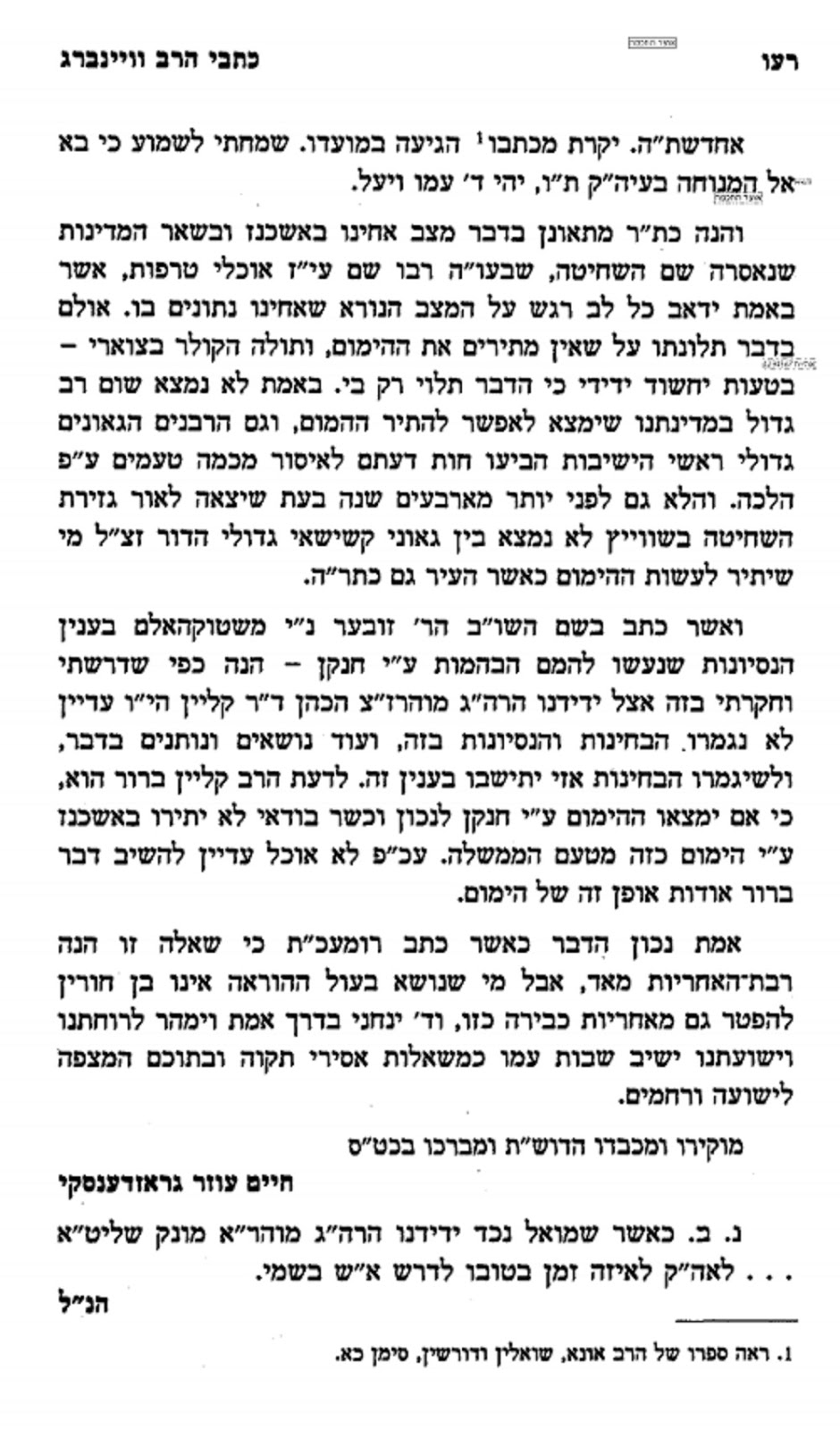
Take a look at the very end of the letter. I couldn’t make out a word, and neither could anyone else I asked, so I inserted three dots. (If anyone can make out the word, please let me know.)

Here is the second page of the letter in Iggerot R. Hayyim Ozer. Take a look at the end.

The first thing they did was good, in that they corrected a typo. מוהר”א should be מוהר”ע and refers to R. Ezra Munk (in Hebrew he went by Azriel). However, they also inserted the word נסע which anyone can see is not correct. They did this even though they did not have a copy of the manuscript. They just assumed it must be the missing word, but how can anyone make a guess like this without actually seeing the manuscript?

As for the letters from R. Weinberg to R. Unna, here is how they are shown on Kestenbaum’s website.
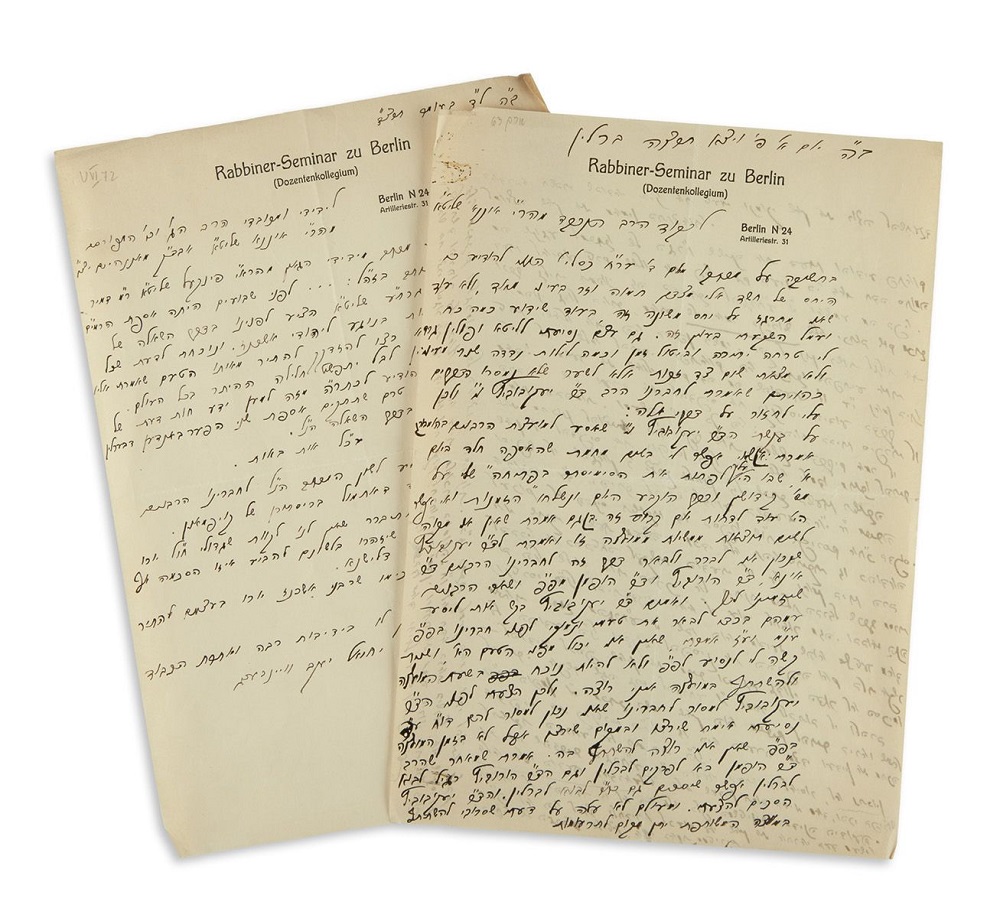
I published one of these letters in the appendix to my dissertation and refer to both of them in Between the Yeshiva World and Modern Orthodoxy, p. 125 n. 69.

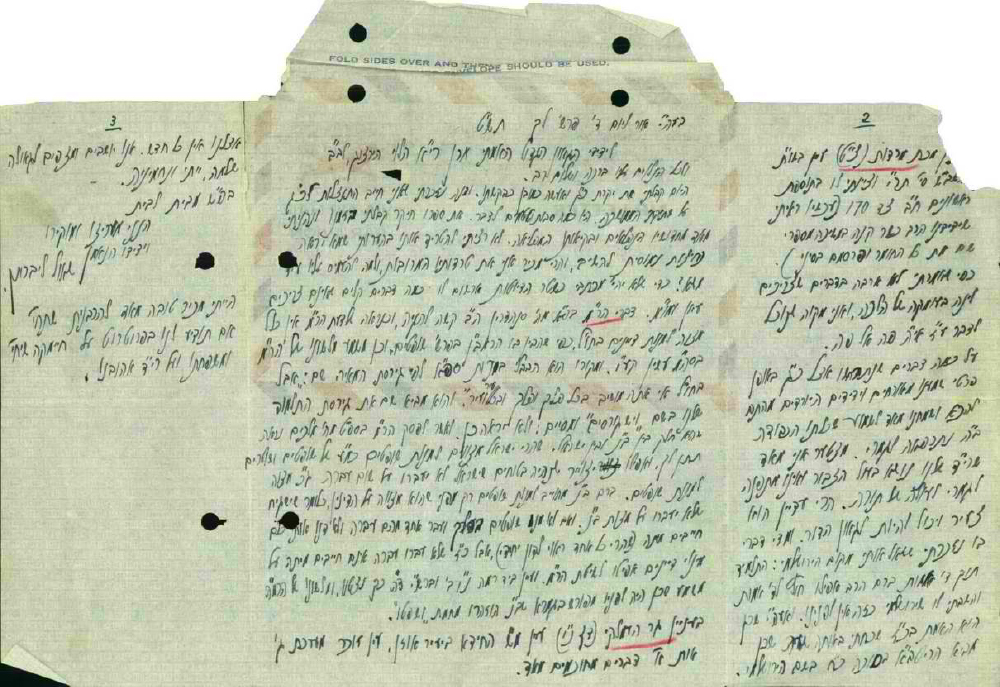
So why did I almost fall off my chair when I saw the three letters (one from R. Grodzinski and two from R. Weinberg) in the Kestenbaum catalog? Because these letters were kept in an archive at Bar-Ilan University. Apparently, the archival material was regarded as belonging to both the Institute for Holocaust Research and the Institute for Diaspora Jewry, as both names were used to designate where it was held. That is why in different publications of mine, when I cite this material, I sometimes refer to it by one name and sometimes the other. It was in this archive that I found the letters, made copies, and then published two of the three (and I have copies of other documents from there as well). If you look at the images of the documents in the upper left-hand corner, you can see the Bar-Ilan manuscript number.

Here is the first page of Kitvei R. Weinberg, vol. 1.

For the appendix, no. 6, I identify the document as coming from the Institute for Diaspora Jewry 102:7/18. Now look at the upper left of R. Grodzinski’s letter. You can clearly see VII 18.

I was disturbed to see items that belonged to Bar-Ilan University being sold. I realized that there are two options. One is that Bar-Ilan itself had arranged for the sale, or had sold the letters to someone who was now reselling them. We have lots of examples of libraries that have sold material in them. However, in this case a sale would be very inappropriate. The Unna family gave the archive of R. Yitzhak Unna to Bar-Ilan with the purpose of preserving it for posterity and allowing researchers to have access to this material. If for some reason Bar-Ilan could not fulfill this task, the only appropriate thing would have been to give it to another archive. To have sold this material would be a complete abandonment of Bar-Ilan’s most basic responsibility as holder of an archive.

The other option is that the material was stolen, and unfortunately, we also have plenty of examples of stolen material ending up at auction.

The first thing I did was contact Bar-Ilan, as I thought that they would be interested in investigating this matter and perhaps stopping the auction until the issue could be sorted out. The response I got was somewhere between apathy and annoyance. They had absolutely no interest in what I was telling them, and even seemed annoyed that I was taking the time to tell them this. The fact that materials that they assumed responsibility for were being sold at auction, and thus not available for scholars to access anymore (as no copies had been made), was of absolutely no interest to them. I was shocked and speechless.

Eventually, I was able to figure out what I think happened. I was told by someone who was involved in one of the institutes that one of the people who worked with the archival materials had taken documents home to help with his research. When he died in 2000 the material was at his home, and it was thought that it was disposed of, no doubt by someone who did not realize what it was or that it belonged to Bar-Ilan. But now we know that it was not disposed of.

It is clear that Kestenbaum, which is known as a scrupulously honest auction house, had no way of knowing that the material it was given belonged to Bar-Ilan (assuming that what I wrote in the previous paragraph is what happened). Before it reached Kestenbaum, it could have gone through a few different hands without anyone realizing this either. Since even after I alerted Bar-Ilan no one there cared about this material, there really wasn’t anything that could be done. The problem, however, as in all such cases, is that material that was designed to be available for scholars to examine has now vanished. Although I haven’t been back to Bar-Ilan for many years, one of the things I was planning to do next time I was there was to return to these archival collections which have much important material and which I haven’t seen in over twenty years.[2] But now neither I nor anyone else will be able to do so.

What motivated me to write about this now is that in April 2020 another “old friend” of mine, a letter from R. Weinberg to R. Unna from the same Unna archive at Bar-Ilan, was offered for sale at a different auction house. You can view it here.

Here is the copy that I made (which also has some of my own handwriting). You can clearly see the Bar-Ilan manuscript number.

After this post was completed, I was alerted to another auction house in London which on May 18, 2020 (today!) is auctioning a letter from R. Weinberg to R. Ben Zion Uziel. You can see it here. After the auction concludes the page might be removed, but you can still see the catalog here, no. 176. This letter was stolen from the Israel State Archives, file number 000i7uz (old number: 887/12-פ). You can see the archive file here. A copy of this letter was made by Professor Amihai Radzyner in 2010, before the archive was digitized. In 2013 he sent a copy to me. Prior to this, I was sent a copy of the letter by someone who purchased it, yet neither of us then knew that it was stolen. Unlike Bar-Ilan University, I am sure that the Israel State Archives will want this letter returned to it after learning about its fate.

3. In my last post here I included a letter from Saul Lieberman to Max Rowe that many people found interesting.[3] I forgot to mention that it was Ariel Fuss who alerted me to the correspondence between Lieberman and Rowe. Although I carefully went through the Lieberman archive years ago in preparing Saul Lieberman and the Orthodox, I did not make copies of all the documents, and I thank Ariel for reminding me of this interesting material. Here are the letters in the archive from Rowe to Lieberman, from which we see not only who received the first Rothschild awards, but that R. Joseph B. Soloveitchik was also consulted in this matter.[4]

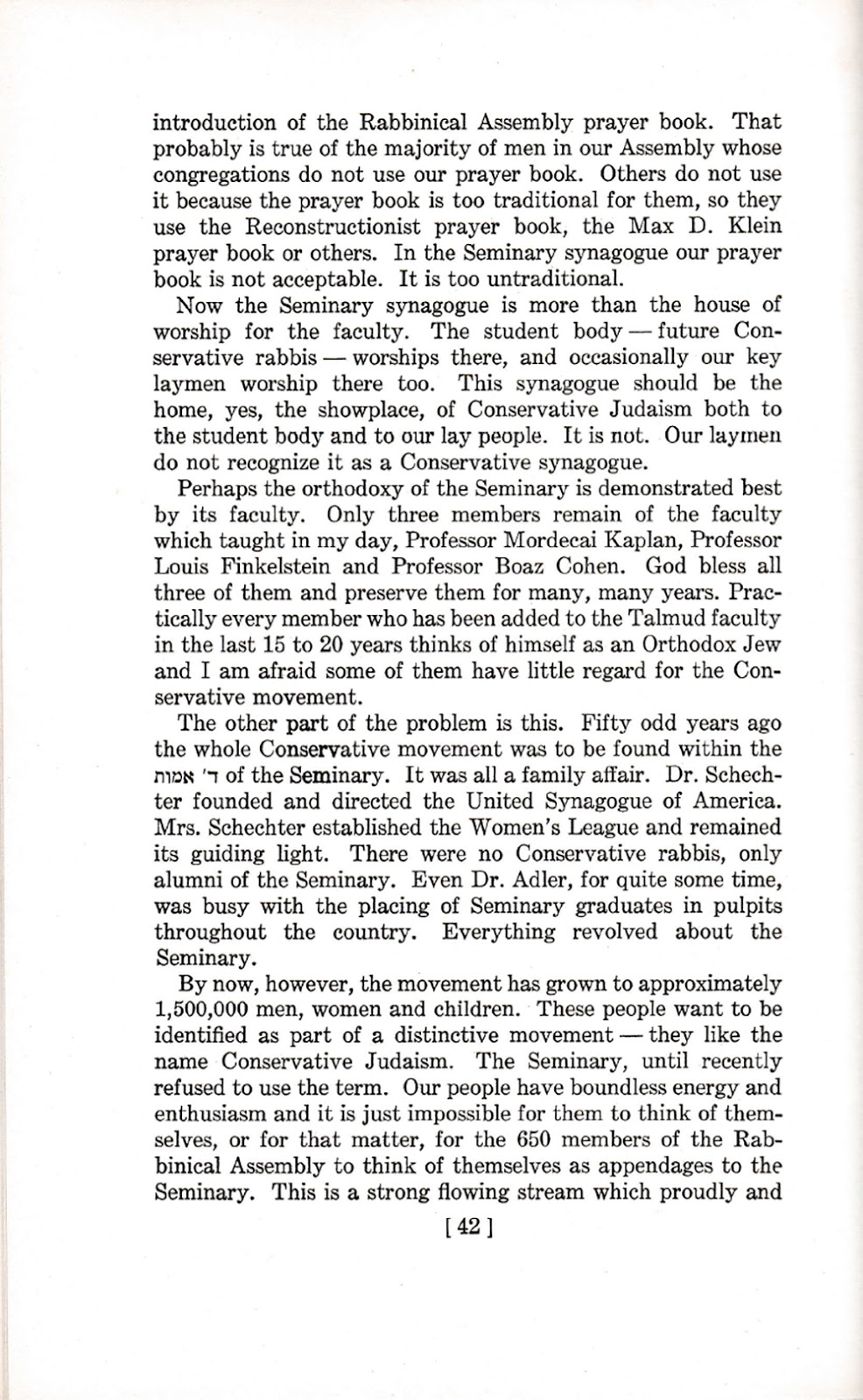
In the last post I also gave a couple of examples where it appears to me that the editors of books did not realize that the Jewish Theological Seminary is not an Orthodox institution. R. Moshe Maimon called my attention to the following example, from Mesorat Moshe, vol. 3, p. 213, no. 81, where we also see confusion about JTS.

The people who put the book together from R. Mordechai Tendler’s notes did not realize that when he asked R. Moshe if it is permitted to send a book to the “library of the Seminary,” that he and R. Moshe were referring to JTS. The editors mistakenly thought, as we can see from the heading, that this referred to “the” Christian seminary (as if there is one such place).

R. Yitzhak Nahman Eshkoli calls attention to what he sees as another mistake made by those who published R. Moshe Feinstein’s works.[5] Here is Iggerot Moshe, Orah Hayyim5, 22:21.

According to the text of R. Moshe’s responsum, animals are muktzeh, even those that children play with. This means that R. Moshe held that pets are also muktzeh. Yet in the small print the editor added that pets are permitted, even though this completely contradicts the first part of the sentence. See also Iggerot Moshe, Orah Hayyim 4, no. 16 (end), where R. Moshe forbids[6] moving a fish tank on Shabbat and Yom Tov: דבע”ח מוקצין.

Here is one more story about the Orthodox response to JTS. It was told by R. Joseph Buxbaum, the director of Machon Yerushalayim:[7] When R. Abraham Sofer came back to Jerusalem after teaching at the Seminary, the Brisker Rav, R. Isaac Zev Soloveitchik, stopped talking to him “in learning”. This upset Sofer and he complained to the Brisker Rav, what is the difference between him and Shraga Abramson. Abramson also taught at the Seminary and yet everyone knew that he was welcome to come speak in learning with the Brisker Rav.

The Brisker Rav replied with a story: The beit din in Vilna ruled that a woman should be divorced without receiving her ketubah because she did not cover her hair and thus had the status of עוברת על דת יהודית. The woman objected that just yesterday the beit din ruled that another woman who also did not cover her hair did not have the status of עוברת על דת יהודית, so what is going on? The dayanim explained to her that the woman from yesterday grew up in Vilna where it is common for married women not to cover their hair, so she is not regarded as עוברת על דת יהודית, but you come from Hungary where the practice is to shave the heads of married women. A Hungarian woman who goes without a head covering[8] is certainly an עוברת על דת יהודית. (The point is clear, but I wonder, in the twentieth century did any non-hasidic Hungarian women shave their heads?)

The Brisker Rav explained to Sofer that when a descendant of the Hatam Sofer teaches for the Conservatives, “he is a ‘sheigetz,’ but Shraga, where does he come from? From Lomza, nu . . . it is not so far away.”[9] His point was that Lithuanian Torah scholars, who are generally more open-minded than Hungarian scholars, have often not seen it as problematic to have relationships with non-Orthodox scholars.[10]

Along these lines, R. Eliezer Brodt called my attention to the fact that, together with numerous great rabbis, Louis Ginzberg was named one of the honorary presidents of the Telz alumni association, something that today appears unimaginable. The following appears in R. Aaron D. Burack, Pirhei Aharon (New York, 1954), vol. 2, p. 278.

In my post here I mentioned how R. Abraham Sofer’s edition of Meiri’s Hibbur ha-Teshuvah is dedicated to Ginzberg. Ovadya Hoffman called my attention to the fact that Sofer also dedicated another work to Ginzberg, this time in his memory. This work is Tractate Shekalim with two medieval commentaries (New York, 1954; the dedication is missing in the Copy Corner printing found on hebrewbooks.org).

Hoffman also informed me that there are three pages of Ginzberg’s notes at the end of the volume.[11] Hoffman also mentioned that there are notes from Lieberman at the end of the Meiri on Niddah.

Finally, regarding Lieberman and the Brisker Rav, it is of note that in Tosefta ki-Feshutah, Pesahim, p. 562, Lieberman writes:

וערבים עלי דברי מרן הגאון הרב ר’ זאב מבריסק

I don’t know of anyone else whom Lieberman refers to as “Maran”.

4. In my last post here I mentioned Samson Bloch’s witticism that מבקר stands for מתכבד בקלון חבירו. Let me now add the following, related to the word קלון, which for reasons of space I could not include in the previous post.

Bereshit Rabbah 18:24 states:

.ודבק באשתו: ר’ אבהו בשם ר’ יוחנן בני נח על הנשואות חייבין, על הארוסות פטורין, ר’ יונה בשם שמואל זונה שהיא עומדת בשוק ובאו עליה שנים הראשון פטור והשני חייב משום בעולת בעל

In this passage, the words I have underlined make perfect sense: “If a harlot was standing in the street.” The Jerusalem Talmud, Kiddushin 1:9, is a parallel passage, but there the text reads: זונה עומדת בחלון, “If a harlot was standing in the window.” What does it mean that the harlot was standing in the window? Korban Edah explains that she was standing in the window waiting for customers, as is the practice of harlots. While this makes sense in modern times, when we know that in some places (like Amsterdam) this is the practice of harlots, is there any evidence that in ancient times harlots would stand in the windows? Perhaps the contrary is true, as R. Shimon Amorai[12]  writes: שסתם זונות הולכות בחוץ. Yet while Korban Edah’s interpretation might seem anachronistic, what else could עומדת בחלון mean?

Jacob Reifman brilliantly suggests that instead of חלון the text should read: זונה עומדת בקלון, and he provides other examples of the use of the word קלון with reference to sexual immorality and prostitution.[13]

In general, Reifman’s writings, widely scattered throughout books and periodicals, should be gathered in one place. Readers will find in them many very insightful comments as well as many far-fetched interpretations.[14] Reifman often focuses on textual criticism but sometimes he offers other interpretations as well. For instance, he discusses Shabbat 55b-56b which gives a number of examples of “Whoever says that Reuben [David, Solomon, etc.] sinned is in error.” Reifman sees it as obvious that these are aggadic statements not meant to be taken literally.[15] He sees their purpose as twofold. The first is to train people to judge others favorably. Maimonides goes so far as to say that when dealing with a righteous person who it seems is doing something wrong, you should judge him favorably even if it is not easy to view matters in this fashion.[16]

The second purpose of the aggadic statements is so that the masses not be led astray by seeing how great people can also fall. The concern is that the masses will say that if these great people sinned, then we who are far below their level should not be too concerned about sinning. Reifman says that although the explanations given in the Talmud to explain the various sins are unconvincing, for the masses and the women it is possible that they would be effective. He refers to Rashi, Shabbat 30b, s.v. mutav, who speaks of aggadic expositions intended for these populations.

לאו מהכא יליף חלול שבת דפיקוח נפש נפקא לן מוחי בהם ולא שימות בהם אלא להטעימן הדבר באגדה המושכת את הלב לפי שהיו באים לשמוע הדרשה נשים ועמי הארץ והיו צריכין הדרשנין למשוך את לבבם

Reifman concludes similarly with regard to the passages he is focused on, which deny that certain great figures committed sins even though the biblical text states that they did:

והמאמרים הנ”ל, הם אפוא מן האגדות שהזמן גרמא והאגדות האלה אינם לא משפטים מקובלים ולא משפטים מושכלים כי אם תחבולות אשר קנו נבוני לב למשוך בהם את ההמון אחרי הטוב ולהרחיקו מן הרע.

It is noteworthy that R. Eliyahu Zini also concludes that the Talmud never intended to say that the biblical figures under discussion did not sin. That is why, R. Zini claims, the Talmud uses the language, “Whoever says [the biblical figure sinned]”, as the issue here is that we are not supposed to publicly mention these matters, and that that is what is problematic.[17]

שאכן יש בעיה, אלא שאסור להעלותה על דל שפתותינו ברבים או בפרהסיא. וכונתם ברורה: המפרסם את הדבר אינו אלא טועה, אף אם הדבר אמת

Before leaving Reifman, let me call attention to another comment of his that appears on the same page in Ha-Magid as the one I just dealt with. He deals with the following statement in Shabbat 119b which explains Psalms 105:15:

אל תגעו במשיחי אלו תנוקות של בית רבן ובנביאי אל תרעו אלו ת”ח

Touch not mine anointed refers to school children; and do my prophets no harm, to disciples of the Sages.”

We can understand why “my prophets” might refer to Torah scholars, but what does “mine anointed” have to with school children? There have been any number of homiletic explanations of this, yet Reifman suggests that the passage has been corrupted and it really should be reversed so that “my prophets” are identified with the school children and “mine anointed” with the Torah scholars. Here is what he says, and I think everyone must acknowledge that it makes great sense:

נ”ל ברור, כי צ”ל להפך: אל תגעו במשיחי אלו ת”ח ובנביאי אל תרעו אלו תנוקות של בית רבן, וכי כנוי משיחי לת”ח הוא ע”ש: דרדוגי דמשחא ארישא דרבנן (כתובות י”ז ב’) וכנוי נביאי לתנוקות של בית רבן הוא ע”ש: א”ר יוחנן מיום שחרב בית המקדש ניטלה נבואה מן הנביאים וניתנה לתינוקות (ב”ב י”ב ב’), וע”ש: ר’ יוחנן בדיק בינוקא (חולין צ”ה ב’) וראה והביטה, כי ר’ יוחנן אשר בדק בינוקא הלך לשיטתו שהנבואה נתנה לתנוקות אחרי חורבן ביה”מ. ועל בדק בינוקא פי’ רש”י: דשייל ליה פסוק לי פסוקיך עכ”ל, והוא מתאים היטב עם אשר אמר ר’ יוחנן: השכים ונפל לו פסוק לתוך פיו הרי זו נבואה קטנה (ברכות נ”ה ב’) , והבן.

I realize that we can’t change the text of the Talmud, but will you ever read the passage again without thinking about Reifman’s suggested emendation? As far as I know, the only commentator to take note of Reifman’s suggestion is R. Reuven Margaliyot, Nitzotzei Or, Shabbat 119b [18] He doesn’t even remember where he saw the suggested emendation, as he writes:

בזכרוני שצ”ל להיפך אל תגעו במשיחי אלו ת”ח כמש”א בכתובות י”ז ב דרדוגי דמשחא ארישא דרבנן, ובנביאי אל תרעו אלו תנוקות של בית רבן דמיום שנחרב ביהמ”ק ניתנה הנבואה לקטנים (בבא בתרא י”ב א)

Much more can be written about Reifman, both with regard to his own writings and also his relationship with the rabbinic world, but this will have to await a future post.[19] Here is his picture.

5. In my last post I wrote:

When it comes to the word דִבׇּה, which means “slander” in biblical Hebrew, it has a very different meaning in medieval texts. “As Jacob Klatzkin [in his Thesaurus] notes, dibbah in medieval Hebrew does not mean ‘slander,’ but rather a false claim, nonsense, or absurdity.” Y. Tzvi Langermann, “Rabbi Yosef Qafih’s Modern Medieval Translation of the Guide,” in Josef Stern, et al., eds., Maimonides’ Guide of the Perplexed in Translation (Chicago, 2019), p. 268.

Although this might seem like a tidbit of pedantry, it actually is much more than this, and many people have been misled because they did not realize what the word דִבׇּה means in medieval texts. For example, the following appears in Maimonides’ Introduction to Helek, in the medieval translation by Solomon ben Joseph found in the back of the Talmud:

ואף על פי שהנראה מקצת דבריהם יש מהם מן הדבה והריחוק מן השכל, עד שאילו סופר על פשוטו לעמי הארץ כל שכן לחכמים היו תמהים בהתבוננם בהם והם אומרים היאך יתכן שיהיה בעולם אדם שיחשוב כזה או שיאמין שהיא אמונה נכונה קל וחומר שייטב בעיניו.

In this passage, Maimonides is describing the first category of those who take aggadot literally. Here is how Fred Rosner translates these words (his translation is from the Hebrew, not from the original Arabic):[20]

And this, in spite of the fact that in their literal sense, some of the words of the Sages would seem to be so slanderous and absurd that if they were related to the uneducated masses in their literal sense—and all the more so to the wise—they would reflect upon them in amazement and exclaim “How is it possible that there exists in the world anyone who would think in this manner or believe that such statements are correct, much less approve of them.”

Clearly, the word “slanderous” makes no sense in this sentence, and that is because when the medieval translation uses the word דִבׇּה it means something else entirely. In his note to the passage, Rosner writes: “Kafah omits the word ‘slanderous.’” This is an incorrect formulation. R. Kafih was translating the commentary anew, so he was not tied to the medieval Hebrew translation. He translates:

ואף על פי שיש בפשטי מקצת דבריהם מן הזרות

Furthermore, R. Kafih actually refers to the medieval translation on p. 136 n. 35 of his edition. In his typical sharp fashion, R. Kafih writes:

בנדפס “מן הדבה” ודבה היא

In his play on words, R. Kafih is saying that the medieval translator engaged in slander by falsely translating the passage as “slanderous.” The only thing that is surprising here is that R. Kafih seems to have also been misled and did not realize that when the translator uses the word דִבׇּה it means “false claim,” “nonsense”, “absurdity,” or a similar word.[21]

In seeking to make sense of the word דִבׇּה and assuming it means slander, the Rambam le-Am, p. 118 n. 12, explains:

הוצאת דיבה על חז”ל, ביחסם להם דברים תפלים שאין להם שחר

These are nice words, but they have nothing to do with what Maimonides said, or for that matter, with what appears in the medieval translation.[22]

The same word דִבׇּה also appears in Maimonides’ Introduction to Helek in his discussion of the second group of people who distort the meaning of Aggadot. In the medieval translation:

והם באים לסכל אותם ולגנותם ומוציאים דבה על מה שאין בו דבה וילעיגו על דברי חכמים לרגעים

Rosner translates: “They eventually call these (rabbinical assertions) foolish, and deprecate them and slander that which should not be slandered. From time to time, they deride the words of the Sages.” Once again, “slander” has nothing to do with what Maimonides wrote. R. Kafih translates:[23]

וחשבו למוזר מה שאינו מוזר

In his note (p. 136 n. 43), he writes:

בנדפס “ומוציאים דבה על מה שאין בו דבה” ואינו נכון

However, the medieval translation makes perfect sense once we understand that when it uses דִבׇּה it does not mean “slander”. Thinking that this is what the word means, it makes sense that R. Kafih would say that it is incorrect.

Yitzhak Shilat translates:[24]

ולגנות מה שאין בו גנאי

In his translation of Guide 1:51, Samuel Ibn Tibbon uses דִבׇּה in the same way:

ולאמתם בצעקות ובהוצאת דבות והרחקות ובפנים רבים מורכבים ממחלוקת נצוח והטעאה

Strangely enough, and presumably because the printers did not know the meaning of דבות in the sentence, most printings (including the standard one with the commentaries)[25] replace ובהוצאת דבות with ובהוצאות רבות, which itself has no meaning.[26]

* * * * * * * * *

[1] For many people in the New York area in the 1980s and 1990s, these words—replacing Jews with “American citizens”— will bring back memories of driving home from work. For those who want to hear this opening line again, listen here. I actually know of one gadol who used to listen to the Bob Grant show at home.
[2] The letter from R. Hayyim Lauer that I published in Milin Havivin 2 (2006), pp. 25-33, also came from the archive we are discussing. You can see it here. R. Lauer discusses whether in contemporary times, in a she’at ha-dehak, a pilegesh can be permitted.

Regarding a pilegesh, R. Jacob Emden, in his recently published Em la-Binah, p. 82, explains in an original fashion that the root of the word is פלג אשה. (As noted in the text, he already mentioned this explanation in Lehem ShamayimParah 1:3; regarding the vocalization of Em la-Binah, see Berakhot 57a).

Em la-Binah, which is a commentary on the entire Torah, is a very significant publication and required reading for anyone with an interest in R. Emden. It is noteworthy that the editor, R. Elimelech Zwiebel, leaves out some harsh comments from R. Emden about earlier commentators (including Ibn Ezra, see p. 98). However, when he does so he indicates this in the text, so when the manuscript from the British Library is eventually put online, readers will be able to find out what was left out. We must all be grateful to Zwiebel that he took this important step, rather than just omitting the “problematic” comments.

On pp. 60-63, Zwiebel cites R. Emden’s famous passage about circumcision that is only found in a few surviving copies of the first printing of Migdal Oz (Altona, 1748). I discuss this passage in Changing the Immutable, p. 204, where, following Scholem and others who have dealt with the matter, I state that R. Emden himself removed this passage. Zwiebel, on the other hand, argues that R. Emden initially did not include the passage in the first printing, but before the printing was complete he added it to some copies. See Yeshurun 32 (2015), pp. 851-852.

In my opinion this is incorrect and makes no sense at all. In what I assume is the self-censored Altona 1748 “edition”, the missing passage is preceded by these words:

ובאמת דבריו הללו מתאימים כו’

The word ‘כו appears on the second line and there is a big space after it, and also a little space before it. Here is what the page looks like as found in Zwiebel’s article.
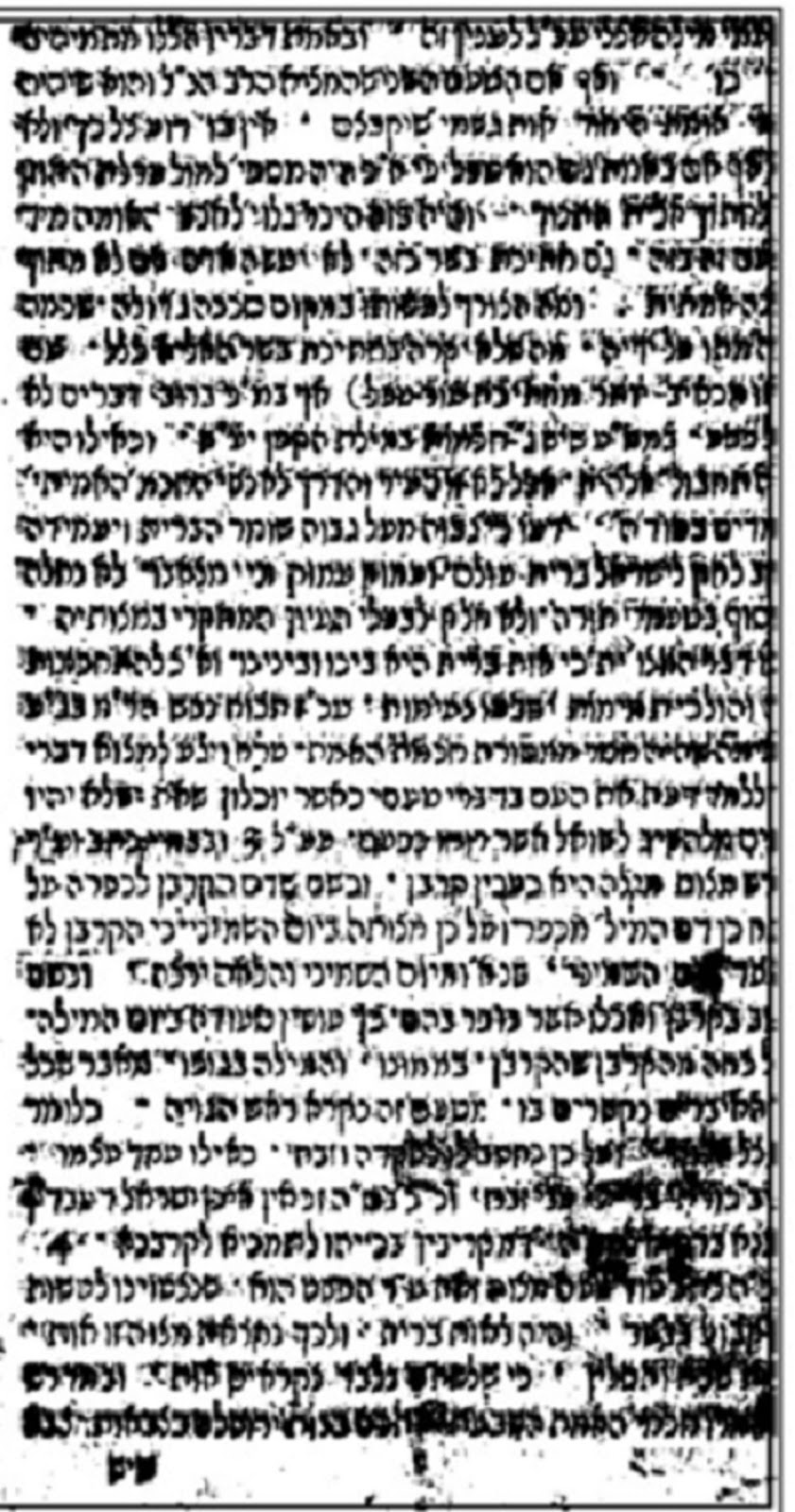
Zwiebel writes that:

מילת כו’ מוכיחה כי כוונתו היתה להרחיב עוד בענין זה

This makes no sense. First of all, no one prints a book intending at the outset to redo the pages (with all the work this entails), and adds ‘כו to let the reader know that a new section is coming. Second, even if this was the case, there would be no need for the spaces before and after ‘כו. Here is what p. 2b in the “uncensored” version looks like.

Look at lines 1 and 2 and compare to the “censored” version shown above. It is obvious that the “uncensored” version is the original text, and the material from line 2 and on was removed by R. Emden.

One final passage which caught my attention is on p. 110 where R. Emden says that despite Proverbs 31:30: “Grace is deceitful and beauty is vain,” women’s beauty is nevertheless important and is something Scripture mentions, and “Jacob our forefather went after his eyes.”

לא לחנם כתב תורה את זאת והדומה לזה שמשתבח הכתוב ביופי נשים, ושיעקב אבינו עליו השלום הלך אחר עינים

What this means is that Jacob saw that Rachel was beautiful, and this is why the Torah writes in Gen. 29:17: “Rachel was of beautiful form and fair to look upon.”

What then are we to make of the verse in Proverbs? R. Emden says that “beauty is vain” only when it comes without fear of Heaven, and that is why this appears in the second half of the verse from Proverbs. Yet when it is combined with fear of Heaven, then beauty is a positive thing. He continues by explaining how one’s outer appearance is connected to one’s inner spirituality. In other words, Rachel’s outer physical beauty was, in Jacob’s eyes, also a sign of her inner spiritual beauty.

אין היופי הבל אלא כשהוא בלי יראת שמים, אבל בודאי שיופי הגשמית הוא צורת אדם [הפנימי] . . . ולכן ודאי הכיר כי הגשמות ציור הרוחנית היא, ואם נמצא אשה בפגם וסרת טעם, דע שלא נזהרו בה כראוי ונתקלקלה בחברה רעה

[3] The website Matzav not only posted the letter together with two paragraphs from my post, but made it seem as if I wrote the piece for Matzav, as there is no mention that it originally appeared on the Seforim Blog. See here. Even after Matzav was told that this is inappropriate and that they should take down the post, nothing was done. I am sure that Matzav’s interest in the letter was because of how Lieberman praised R. Chaim Kanievsky.
[4] Documents provided courtesy of the Saul Lieberman Archives (ARC 76/8) of the Jewish Theological Seminary Library.

In Saul Lieberman and the Orthodox, I published Lieberman’s letter against ordaining women. The last sentence of this letter  reads:

אבל אשה שפסולה לדון, ולא תהא ראויה לכך, אין להסמיך אותה בתואר זה (ואפילו כמליצה בעלמא, עיין בתוספות ע”ז ה ע”א ד”ה אלא) ובל נעשה את עצמנו חוכא ואיטלולא.

While preparing the book, I did not know what the meaning of the reference to Tosafot is. R. Chaim Rapoport explained it to me.

The Tosafot in Avodah Zarah suggest that the figurative expression “ha-eynei ha-anashim ha-heim tenaker” (Numbers 16:14) – clearly a melitzah – would not have been written in relation to people who were physically blind. Lieberman’s claim is that since a woman is not able to be a rabbi in the true, talmudic, sense of the word, therefore the title should not even be applied to her “be-derech melitzah”, hence the reference to the Tosafot.

It is interesting that in R. Herschel Schachter’s article against women rabbis, Hakirah 11 (Spring 2011), pp. 19-23, one of his major sources is “Rabbi Shaul Lieberman”.
[5] Tza’ar Ba’alei Hayyim be-Halakhah ve-Aggadah, p. 514 n. 1171.
[6] R. Menasheh Klein discusses other issues related to an aquarium. See Mishneh Halakhot, vol. 6, no. 216 (called to my attention by R. Aviad Stollman).
[7] It is recorded in R. Eliyahu Soloveitchik’s unpublished memoir, p. 16 (unnumbered).
[8] The same approach, in which the lack of head covering among Lithuanian Jewish women—as opposed to Hungarian women— was not viewed as reflecting negatively on their general religiosity, is seen in the following story recorded by Moshe Potolosky of what the Hazon Ish told his father (Mevakshei Torah 49 [Tamuz 5769]), p. 71, called to my attention by Joel Wolowelsky).

.אמר רבנו לאבי: כשאתה תארח בבית שבו אין האשה נוהגת לכסות את ראשה, אם היא מליטא – יתכן שאף המהדרים והמחמירים ביותר יכולים לסעוד אצלה בלב שקט. אבל אם היא מהונגריה – אסור לטעום מתבשיליה

ומדוע? כי בליטא לא הקפידו רוב הנשים על כסוי ראש (א”ה, בתקופה ההיא בליטא היה פרוץ הדבר) ואף נשים צדקניות רבות מאד הקלו בזה. אבל בהוגנריה, היתה בקהלות האורתודוקסיות הקפדה רבה בענין זה, ובדרך כלל,רק אשה שזלזלה במצוות היתה נמנעת .מלכסות את ראשה, ועל אחת כזו אי אפשר לסמוך בעניני כשרות

Moshe Botchko writes simply (Mikhtavim u-Ma’amarim ha-Rav Botchko, p. 252):

.בליטא לא נהגו נשים דתיות לכסות ראשן אף מחוץ לביתן, חוץ מנשות הרבנים

The following appears in the anonymous Ha-Keter ve-ha-Kavod le-Hai Olamim (Jerusalem, 2017), p. 102:

.והנה האמת היא שאין שום מקום להרגיש, את ההרגשה המוטעת אשר ינסה היצר לטעת בלב חלק מההורים, כאילו הדור הצעיר שחפץ לתקן את הדבר, ולקיים את המצוה הזו כתיקונה, הרי זה – חס ושלום – מחמת מעלתו ויתרונו על הדור הקודם

מחשבה זו אינה נכונה כלל, מפני שהאמת היא שהדור הקודם אינו אשם בזה כלל וכלל, כי התחלת הדבר היה מחמת הקושי הגדול שהיה בחוץ לארץ, בין הגוים, ובהתגברות מחריבי הדת, שעקרו לגמרי את קיום מצות כיסוי הראש, עד שאפילו מבתים של יראים ושלמים בליטא, היו נשותיהם מהלכות בגילוי ראש ממש, וכמו שמפורש בערוך השלחן סימן ע”ה סעיף ז.

Binyamin Zev Jacobson,Divrei Ben Shlomo(Jerusalem, 1957), vol. 1, p. 306, tells the following story:

לפני יותר מחמש ועשרים שנה הייתי בעיר גדולי בלטויה ובקרתי שם את הרב ואשתו כבדה אותי בכוס יין, ואז הייתי מדקדק ולא רציתי לשתות מפני שערה המגולה, והרב גער בי מאוד ואמר לי שרבות מנשי רבני ליטא הולכות כן

(He also records R. Hayyim Ozer Grodzinski’s sharp response when told of what this rabbi said.)

Regarding Hungary, the Orthodox community in Budapest was very strict about the matter of women’s head covering. If a married woman did not cover her hair, her family would not be accepted as a member of this community. See Shmuel Weingarten, “Ha-Shelilah she-be-Shitat ha-Pirud be-Ungaryah,” Areshet (1944), p. 438.
[9] Abramson studied in Lomza but he was actually from Ciechanowiec (near Grodno), the birthplace of R. Jehiel Jacob Weinberg.
[10] See my Saul Lieberman and the Orthodox; Moshe Maimon, “Perek be-Hithavut ha-‘Olam ha-Torah’ be-Artzot ha-Berit le-Ahar ha-Milhamah,” Hakirah 26 (2019), pp. 31-52; and the discussion at the Otzar haHochma forum here. R. Yaakov Hayyim Sofer, Menuhat Shalom, vol. 6, p. 124, in mentioning R. Joseph Zechariah Stern’s citation of “problematic” works, refers to שיטת קצת חכמי ליטא בענין.

It continues to amaze me that, as noted in Saul Lieberman and the Orthodox, p. 31 n. 110, even in a 1935 private letter to R. Shlomo Heiman, R. Hayyim Ozer Grodzinski referred to Louis Ginzberg as ‘הרה”ג מו”ה לוי ד”ר גינזבורג שי. See Iggerot R. Hayyim Ozer, vol. 2, no. 1004. In Saul Lieberman and the Orthodox I included a letter from R. Grodzinski to Ginzberg where understandably he gives Ginzberg the typical fancy titles. This letter was later included in Iggerot R. Hayyim Ozer, vol. 3, no. 276, with no acknowledgment of where the letter first appeared. At the end of the letter there is a name that neither I nor anyone else could make out. I transcribed it as מאיר באראן and then added a question mark. In Iggerot R. Hayyim Ozer they removed the question mark. Uriel Bener called my attention to Shenot Dor va-Dor (Jerusalem, 1999), p. 271, from where we see that the name is מאיר באסין, who happened to be the father-in-law of R. Yisrael Gustman.
[11] Regarding Ginzberg, see also R. Zev Leiter, Mi-Toratan shel Rishonim (Jerusalem, 2000), p. 61, who refers to him as מהר”ל גינצבורג. R. Gedaliah Felder, Yesodei Yeshurun, vol. 3, p. 146 refers to ר”ל גינזבורג. Here is the title page of the 1946 edition of Ma’alot ha-Torah by R. Abraham ben Solomon Zalman, the brother of the Vilna Gaon. R. Nissan Waxman and R. Yehiel Michel Feinstein were willing to collaborate with Ginzberg and to even put his name on the title page.

[12] Ha-Posek, 9 (Tamuz-Av 5708), p. 1529. He offers his own far-fetched interpretation.
[13] Beit Talmud 4 (Vienna, 1883), p. 16, also printed in his Ruah Hadashah (Pressburg, 1885), pp. 2-3. Reifman’s interpretation is cited by R. Azriel Hildesheimer, Hiddushei Rabbi Azriel (Jerusalem, 1992), Kiddushin 9b (p. 316). Without mentioning Reifman, the same emendation is suggested by A. Rosenberg, Al Devar Tikunei Nushaot bi-Yerushalmi (Lodz, 1928), p. 71. In a future post I will discuss who this “A. Rosenberg” was.
[14] R. Meir Mazuz discusses one of Reifman’s comments in my Iggerot Malkhei Rabbanan, p. 314. Those who wish to purchase this volume can do so here. Those in Israel who are interested in the book should contact me directly.
[15] Ha-Magid, May 14, 1873, p. 175. See my Changing the Immutable, p. 5, for many examples of sages who understood David’s sin with Bathsheba literally.

[16] It is fascinating to note that the kabbalist R. Judah Fatiyah was not happy with the talmudic explanation, also found in the Zohar, that Uriah had given a get to Bathsheba. He regarded this as a forced explanation. In his Matok la-Nefesh, pp. 56a-b, he offers an explanation which came to him from someone in a dream, according to which King David voided the marriage of Uriah and Bathsheba. He did this by himself, as he was too embarrassed to involve the Sanhedrin. As the most distinguished member of the Sanhedrin, he had this authority to void a marriage. R. Fatiyah was told in his dream that this explanation had never before been told to anyone else, because the spirit telling him this he was too embarrassed to have shared this information before then.

לבי ולבך ידעי שכל התירוצים הם דוחק ומוכרחין אנן לעייל פילא בקופא דמחטא מפני כבודו של משיח ה’ שהיה יקר בעיני ה’ . . . יש תירוץ רביעי הנגלה אלי בחלום . . . כי ראיתי כאלו אדם שאינו נראה כלל אומר אלי הנה אנן קיימא לן בדיני הקדושין שכל המקדש אדעתא דרבנן איהו מקדש ויכולין רבנן הנמצאים בדור ההוא לעקור ולבטל הקידושין של איזה אדם ותהיה אשתו פנויה למפרע . . . וכשאירע מעשה דבת שבע ראה דוד את עצמו שאינו יכול לכוף את יצרו עמד בינו לבין עצמו בלא צירוף הסנהדרין עמו ובטל את קדושי אוריה ובחר הרע במיעוטו שלא לפגוע באיסור ערוה ח”ו כי היה בוש לבטל את קדושי אוריה בצרוף הסנהדרין עמו שלא לצורך, ויש כח בדוד שהוא לבדו יכול לבטל הקדושין כי הוא היה מופלא שבסנהדרין . . . כל זה נאמר אלי בחלום בקיצור נמרץ כי המדבר אלי היה בוש ונכלם להרחיב הדברים, גם אמר אלי כי מיום שאירע ביטול זה עד היום הזה לא נתגלה עוד ענין זה לשום אדם מעולם לא בהקיץ ולא בחלום כי היה בוש להגיד ענין זה הביטול, ובפי’ הד’ הזה יותרו כל השאלות מעל עבד ה’ ועל משיחו נעים זמירות ישראל.

After citing R. Fatiyah’s statement, R. Ovadiah Yosef writes (Meor YisraelShabbat 56a):

ובמחכ”ת דברי חלומות לא מעלין ולא מורידין ואין ממש בדבריו . . . ואין לנו אלא דברי רבותינו שהם דברי אלקים חיים

Ovadiah was clearly upset that R. Fatiyah, whose expertise was in Kabbalah, chose to weigh in on a halakhic matter and offer the incorrect view that a great Torah scholar can simply invalidate a Jewish marriage without aget. For another response to R. Fatiyah, see R. Nissim Kaduri,Ma’aseh Nissim, p. 12. These sources are cited by R. Meir Mazuz, Bayit Ne’eman 56 (5 Nisan 5777), p. 4 n. 23.

For more dreams of R. Fatiyah, this time with reference to the book Hemdat Yamim, see Avraham Yaari, Ta’alumat Sefer(Jerusalem, 1954), ch. 8.
[17] Etz Erez, vols. 1-2, pp. 287-288 (emphasis in original). Since I have discussed Saul Lieberman in this post, it is worth noting that R. Zini does not regard him positively. This is what he writes in Etz Erez, vol. 4, p. 224.

.וכרגיל בעל תוספתא כפשוטה נהג כאן כחוקרים רבים אחרים, שברמות רוחם מדברים כאלו הם מתנבאים מפי השכינה, וקובעים עמדות ללא כל הוכחה, אפילו לא נתן את דעתו לסתירה הפנימית שבדבריו

Etz Erez, vol. 3, p. 25 n. 10 (emphasis in original):

ובעל תוספתא כפשוטה בלהיטותו לפרש כל דבר עפ”י המידע המדעי, היסטורי או אחר, כמעט כילד קטן שלא החזיק צעצוע מעולם ונותנים לו אחד, לא הבין כלום, לכן כתב (ברכות פ”ד שם) “הלכה זו מתארת את מנהגי הסעודה בזמן העתיק אצל נכבדי העם ונכללו כאן כמה פרטים שאין להוציא מהם מסקנות להלכה, מפני שמקורם נעוץ בנימוסי המקום ולא בהלכה. ובדרך כלל הסדר מתאים למנהגי הרומאים בסעודה וגם של היונים בתקופה המאוחרת, ואין כאן הלכה בסעודה.” הרי הוכחני שיש כאן הלכות ממש, אבל ודאי לא מה שחשב.

Etz Erez, vol. 3, p. 35:

.אינני מסתמך אף פעם על חבור של מי שמיסד את היהדות הקונסרבטיבית בא”י, וכוונתי למחבר התוספתא כפושטא עצמו, אף אם הוא היה בן דוד של ה’חזון איש’

Etz Erez, vol. 1, p. 124 n. 191:

וזה דומה לחוקרי מדעי היהדות הכותבים ‘מהרי”ן אפשטיין’, ‘מהר”ש ליברמן’ וכדו’, תוך נסיון נואש להעביר את הסמכות התורנית לחוקרי האקדמיה, כאילו הם עמדו בראש ישיבות. מדובר במגמה פסולה לחלוטין בעיני איש ירא ה’. חוקר תלמוד, אף אם למדן גדול הוא, איננו איש תורה על תקנו זה, אלא סתם ידען, ולהעניק לו תואר המיועד למשמשים בקודש, היא חילול הקודש וגניבה במחתרת, ורק עם הארץ יעשה זאת.

Hesed Leumim Hatat, pp. 19-20 n. 29:

בתוספתא כפשוטה (עמ’ 756) כתב כל מיני דברי הבל (כמו שהתחיל לעשות מאז מכר נשמתו לקונסרבטיבים) . . . רק מי שאיבד כל תחושת של כבוד האומה הישראלית, עם ה’, מי שאיבד את דרכו האמונית, יכול לומר שלא ברור מהיכן איסור זה. ליברמן בעל הזכרון המופלג, בעל הבקיאות הרחבה מאד, שכל כך שקע במקורות של תושבע”פ אינו זוכר עוד תוכן של פסוקים אלמנטריים ביותר, שכל ילד ידע בע”פ בגלות, ואינו מסוגל להבחין שאין צורך במקור, כיון שתורה מפורשת היא!! . . . ועל חטא זה הוא מוסיף פשע פרשנות עפ”י שיטה ‘דרוויניסטית’ היסטורית מטופשת, פרי עבדות לדעות הנכרים.

Unfortunately, none of R. Zini’s books are on Otzar HaHochma.

[18] Regarding R. Margaliyot, whose writings are of great interest to many, I have recently discovered a few articles of his that are completely unknown and have not been reprinted in the various collections of his writings. I will discuss them in a future post.
[19] See the letters to him from R. Elijah David Rabinowitz-Teomim published in Mikabtze’el 36 (2009), pp. 47ff., ibid. 37 (2011), pp. 75ff. See ibid., p. 76, that when R. Joseph Zechariah Stern published his responsa which were sent to Reifman, he abbreviated his name.
[20] Maimonides’ Commentary on the Mishnah: Tractate Sanhedrin (New York, 1981), p. 141.
[21] If I am correct, this was only an early mistake and R. Kafih must have later realized this. I say this because Al-Harizi used the term in his translation of the Guide a number of times. See Langermann, “Rabbi Yosef Qafih’s Modern Medieval Translation of the Guide,” pp. 168ff.
[22] The same mistake is made by R. Shlomo Aviner in his edition of Hakdamat ha-Rambam le-Perek Helek (n.p., 2013), p. 82.
[23] Just to show you how times change, Rosner translates R. Kafih’s words: וחשבו למוזר מה שאינו מוזר, “and consider queer that which is not queer.” If Rosner were translating this today, instead of “queer” he would use “strange,” as queer has come to mean something entirely different.
[24] Hakdamot ha-Rambam la-Mishnah (Jerusalem, 1992), p. 134.
[25] See Yehudah Ibn Shmuel’s textual note in his edition of Moreh ha-Nevukhim, vol. 2, pp. 27-28 (third pagination).
[26] See also David Kaufmann, Geschichte der Attributenlehre in der Jüdischen Religionsphilosophie des Mittelalters (Gotha, 1877), p. 273 n. 64, for what seems to be an example of replacing דבה with רבה.


A Newly Discovered Work of the Rambam?

A Newly Discovered Work of the Rambam?

By Eli Genauer

I recently purchased a Chumash which was printed in Sulzbach in 1741 by Meshulam Zalman ben Aharon Fraenkel

Marvin Heller succinctly sums up the history of Hebrew printing in Sulzbach as follows:

“This small Bavarian community was for over two centuries the site of Hebrew presses that printed many important titles. Duke Christain-Augustus due to his interest in Kabbalah, permitted the opening of Hebrew print shops in the 1660’s. Sulzbach was subsequently home to Hebrew presses belonging to Isaac Kohen Gersonides, Isaac ben Judah Loeb of Prague, Moses Bloch, and afterwards the Frankel-Arnstein family which printed books there from 1699-1851.”[1]

The bibliographic record at the NLI, most likely copied from the cover page of the book, notes nothing very unusual about it.

http://aleph.nli.org.il:80/F/?func=direct&doc_number=000333882&local_base=MBI01

עם שלשה [פירושים]… רש”י ז”ל, עם רש”י ישן, גם הפירוש רבינו יחזק’ בעל חזקוני, ובעל הטורים [לר’ יעקב ב”ר אשר] וכל הספר תולדת אהרן [מאת ר’ אהרן מפיסארו], וחסירות ויתירות וקרי כתיב… גם הפטורת [!] ופירוש המילות. והוגה בעיון רב…

One line that stands out a bit though, is one which indicates that there is a Peirush Hamilot for the Haftorot

                                                                                     … גם הפטורת [!] ופירוש המילות.

It also notes that there are separate title pages for the Chamaish Megillot and Haftorot

 סד דף, עם שער חלקי: “חמש מגילות… עם פירש רש”י”, וכן ההפטרות לכל השנה.

This bibliographic record comes from The Bibliography of the Hebrew Book (מפעל הביבליוגרפיה העברית)

We are informed on the NLI website that “The recording of the books is done in a scientific manner according to rules set by an editorial staff led by Prof. Gershom Scholem and Prof. Ben – Zion Dinur, and was based on examination of the books themselves. It includes a full description of the contents of the book and accompanying material, as well as all participants in its composition: editors, translators, authors of forewords and introductions, interpreters and illustrators and more.”

https://web.nli.org.il/sites/NLI/English/infochannels/Catalogs/bibliographic-databases/Pages/the-hebrew-book.aspx

It seems though that the bibliographers missed a very unusual and important feature of this Chumash.

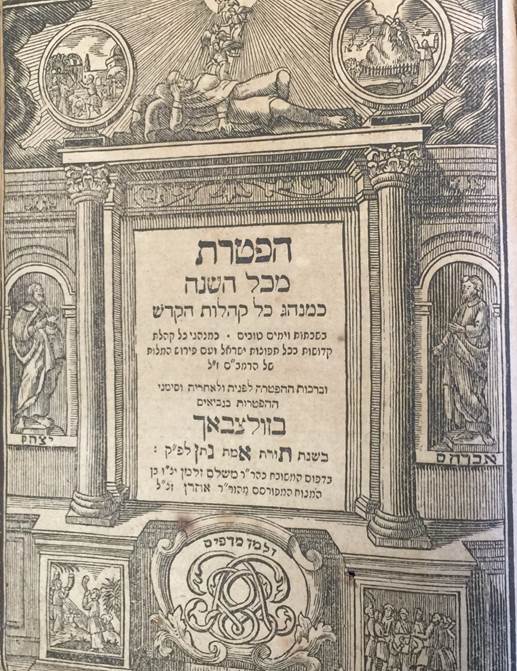
Here is the separate cover page for the section on Haftorot:

This title page contains the following information

”  כמנהגי כל קהלת קדושות…..ועם פירוש המלות של הרמב״ם ז״ל

“According to the customs of all the holy communities…with a “Peirush Ha’Milot” of the Rambam.”

This information is also included in the preface portion of the Chumash section under the title of אמר בעל המדפיס:

“גם ההפטרות ופסקי טעמים מדוקדק…עם פירוש המלות של תורת משה הרמב״ם..”

There seems little doubt that this Peirush Hamilot is being attributed to the Rambam.

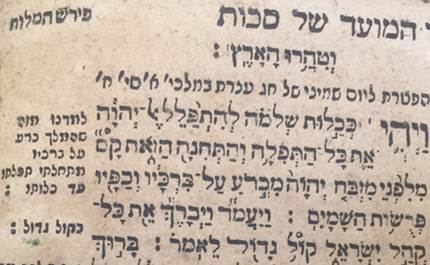
Here is what one page looks like.

An example of a “Peirush Hamilot” would be the words “קול גדול” being interpreted as “בקול גדול”

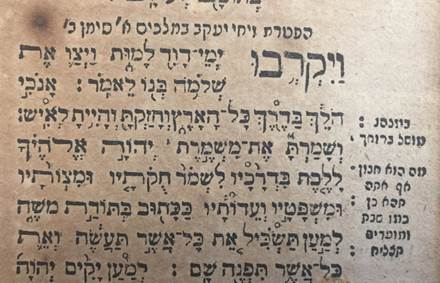
However, this other page evidences differences in methodology in the “Peirush Hamilot”.

“בדרך” is just translated as “במנהג.”

But “והיית לאיש” is expanded upon and explained as “מושל ברוחך”

“בדרכיו” is also very much expanded upon by saying exactly which paths should be followed:  “מה הוא חנון אף אתה תהא כן”.

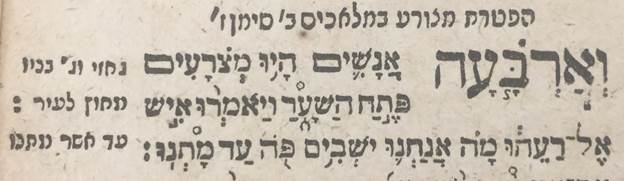
In this section below, we are told that the four Metzoraim are Gechazi and his three sons, a comment mirroring Rashi and Radak:

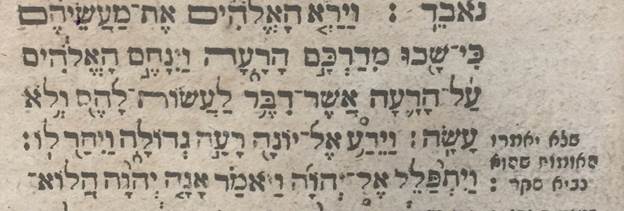
In the story of Yonah, we are told that he was troubled that Hashem had forgiven the people of Ninveh.

The Peirush HaMilot explains that it was because he did not want to be thought of as a false prophet. This is similar to Rashi’s approach:

I had never heard of such a commentary on Navi by the Rambam and was not able to find any reference to it anywhere. I checked with numerous experts in the field and no one else had heard of it either.

Imagine that! A work ascribed to the Rambam showing up in Sulzbach in 1741 and seemingly never to be heard from again. The printer gives us no hint of its origin and treats it as if it were a known work.

There is more, though. There is a fascinating reference to the Sulzbach Chumash of 1741 by none other than Rabbi Reuven Margoliot.[2] In a lengthy discussion of names that are missing from the Rambam’s Hakdamah to Peirush HaMishnayot, Rabbi Margoliot posits there is a portion of this Hakdamah missing from our printed editions and expresses the hope that

                           ״ואולי תוחזר לנו האבדה הגדולה שני פרקים מהקדמת רבינו זו שהושמטו בהעתקות ולא נדפסו״

As a proof that there are missing chapters, he quotes from the Chida who writes:[3]

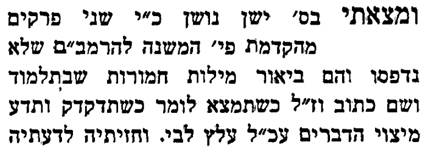
   ״מצאתי בספר ישן נושן כת״י שני פרקים מהקדמת פירוש המשנה להרמב״ם שלא נדפסו, והם ביאור מלות חמורות שבתלמוד״

In a footnote Rabbi Margoliot then makes a connection between the “lost” “ביאור מלות חמורות שבתלמוד” and the פירוש המלות של הרמב״ם ז״ל״” which appears in the Sulzbach Chumash of 1741.

״בחומש דפוס זולצבך תק״א בחלק ההפטרות מכל השנה הנלוה לתורה עם פרש״י וחזקוני הוא רושם שכולל פירוש המלות של הרמב״ם ז״ל״

Finally, by only citing this Chumash as containing the Peirush HaMilot, Rabbi Margoliot seems to be indicating it was the only time it was published. It certainly is a rare find for a Chumash printed in 1741.

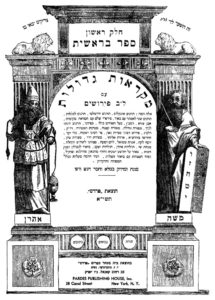
*Seforim Blog editor’s note: The Warsaw 1860 Mikraot Gedolot included this perush hamilot (calling it haftarot im biur hamilot on the title page) but does not give the attribution to the Rambam, or to anyone.  Some of the content are word for word quotations of Rashi in the print editions. Here is the title page (from a 1951 photo offset reprint):


[1] Studies in the Making of the Early Hebrew Book by Marvin J. Heller- Leiden ; Boston : Brill, 2008.- p.40.
[2] Nitsotse or : heʼarot be-Talmud Bavli ṿe-heʻarot be-divre gedole ha-rishonim ṿeha-aḥaronim. Reuven Margoliot. Yerushalyim, Mosad Ha-Rav Kuk, 2002, p.34. The discussion of the missing names starts on page 30. The footnote cited is footnote 29 on page 34. My appreciation goes to a fine young scholar named Yosef, who brought this source to my attention.
[3] Sefer ʻEn zokher, Chaim Joseph David Azulay, Yerushalayim, 1962. p.185 #29


Gems from Rav Herzog’s Archive (Part 2): Sanhedrin, Dateline, the Rav on Kahane, and More

Gems from Rav Herzog’s Archive (Part 2):
Sanhedrin, Dateline, the Rav on Kahane, and More
By Yaacov Sasson
EDIT Please see this post for a crucial correction – it is the conclusion of the Rav’s family that the letter  in the Herzog Archive about Kahane is a forgery.
This post continues from Part 1, here.
V Renewal of Sanhedrin
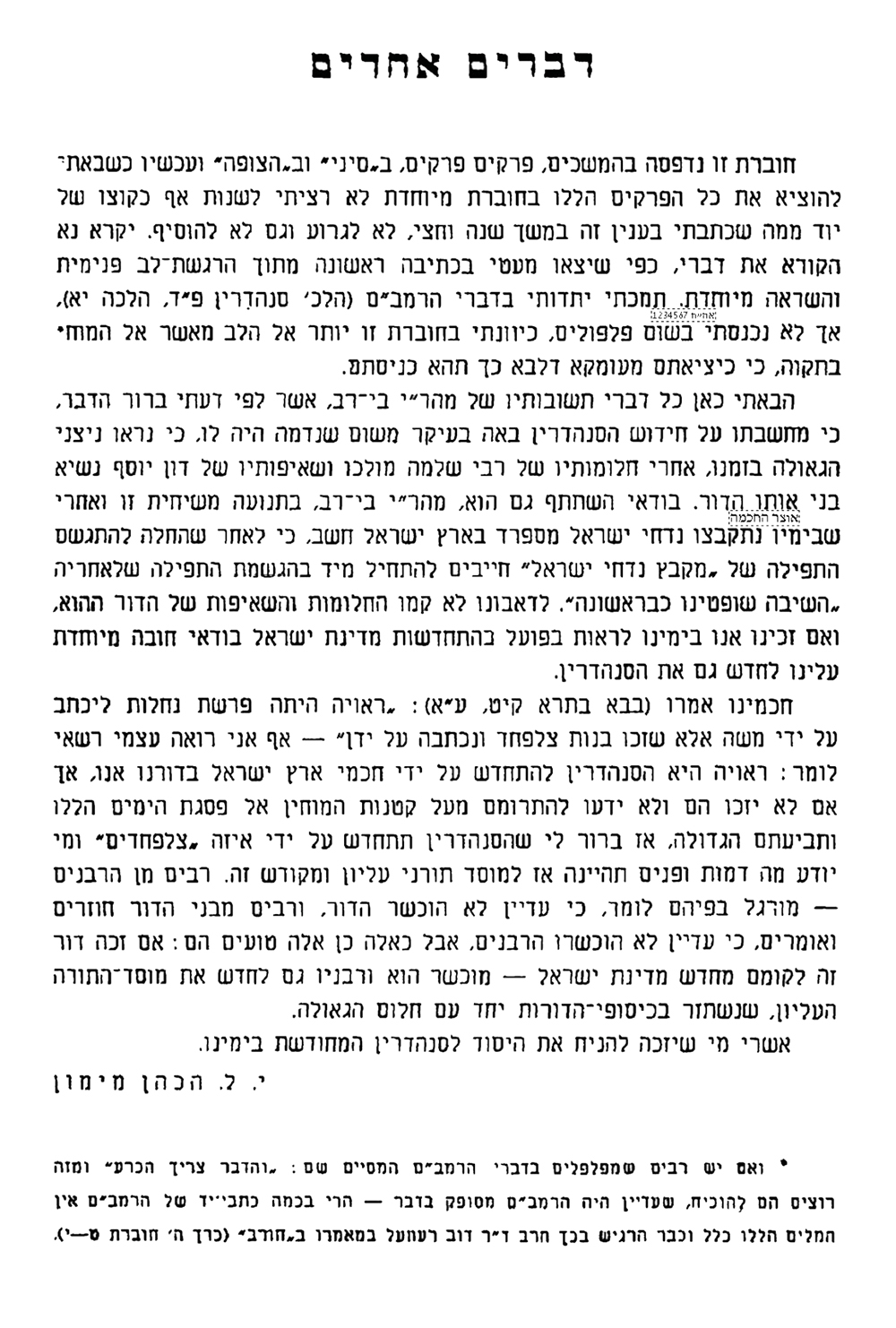
Another important file in Rav Herzog’s archive is his file on the renewal of Semicha and the Sanhedrin.[1] Among other letters, the file contains an unpublished letter from Rav Herzog to R’ Yehuda Leib Maimon regarding the issue. R’ Maimon was a well-known Mizrachi leader, the first Minister of Religion of the State of Israel, and the most vocal advocate of renewing the Sanhedrin. To that end, he wrote a series of articles on the topic in Ha-Tzofeh and Sinai, which he collected into a book in 1950, entitled Chidush Ha-Sanhedrin BeMedinateinu Hamechudeshet. Renewal of Semicha and Sanhedrin was of course not without opponents. Rav Herzog instructs R’ Maimon to proceed slowly and with caution, as there are a number of unresolved issues regarding renewal of Semicha which require great care and deliberation.
There were two main halachic objections to the renewal of Semicha. The first (not mentioned here by Rav Herzog) is based on the language of the Rambam in Sanhedrin 4:11, the very same halacha in which he suggests the possibility of the renewal of Semicha. The Rambam writes there:
נראין לי הדברים שאם הסכימו כל החכמים שבארץ ישראל למנות דיינין ולסמוך אותן הרי אלו סמוכין ויש להן לדון דיני קנסות ויש להן לסמוך לאחרים אם כן למה היו החכמים מצטערין על הסמיכה כדי שלא ייבטלו דיני קנסות מישראל לפי שישראל מפוזרין ואי אפשר שיסכימו כולן ואם היה שם סמוך מפי סמוך אינו צריך דעת כולן אלא דן דיני קנסות לכל שהרי נסמך מפי בית דין והדבר צריך הכרע.
The intention of the Rambam in his concluding words, Ve-hadavar tzarich hechrea, has been the subject of dispute for hundreds of years, going back to the dispute of the Mahari Beirav and the Ralbach, with some authorities believing that the Rambam was mesupak whether Semicha could in fact be renewed. A novel approach to the issue was suggested by Dr. Bernard Revel in an article in Chorev, Volume 5 (1939). Dr. Revel suggested the possibility that the final three words, Ve-hadavar tzarich hechrea, are not be the words of the Rambam himself, but were added later by another person who disagreed with the Rambam’s innovation.[2] Dr. Revel cited statements of other rishonim which he believed supported his theory. R’ Maimon addressed this issue in the introduction to his book, in the footnote, writing that the three words, Ve-hadavar tzarich hechrea, do not appear in “kama kitvei yad” (several manuscripts), thus supporting Dr. Revel’s hypothesis.
 
However, there is no evidence that any such manuscripts actually exist. The Frankel edition of the Rambam does not cite any alternate nusach that excludes these three words. Additionally, Professor Eliav Schochetman[3] wrote nearly 30 years ago that he found no evidence of any such manuscript in the numerous manuscripts that he consulted from across the world.


There are two potential explanations to what happened here. One potential explanation is that R’ Maimon simply lied about the existence of these kitvei yad in order to advance his agenda of renewing the Sanhedrin. Alternatively, Rabbi Eliyahu Krakowski has suggested a limud zchut – perhaps R’ Maimon forgot what Dr. Revel had written and mistakenly believed that Dr. Revel had uncovered manuscripts supporting his thesis[4], or he never saw it himself and was misinformed as to what Dr. Revel wrote, in which case R’ Maimon would be guilty of carelessness rather than dishonesty.
The second major halachic objection to the renewal of Semicha is the issue of the Samuch’s qualifications. The Rambam in Sanhedrin 4:8 writes that a Samuch must be rauy lehorot be-chol hatorah kula, capable of ruling on the entire Torah. Rav Herzog mentions in this letter to R’ Maimon that the Ralbach objected to renewal of Semicha on the grounds that no one is rauy lehorot be-chol hatorah kula. (This was also the position of the Radvaz, in his commentary on Sanhedrin 4:11.) Rav Herzog adds that if he said so in his generation, anan aniyey de-aniyey mah na’ane abatrei? Rav Herzog then makes a somewhat novel suggestion, one with halachic ramifications for the issue of renewal of Semicha. Rav Herzog suggests that rauy lehorot be-chol hatorah kula does not mean that the Samuch must literally know by heart all the relevant halachic sources. A similar approach was also suggested by the Rav[5] and the Steipler.[6] In the language of the Rav, the Samuch need not possess “universal knowledge”, rather a “universal orientation.” While this approach would certainly remove this barrier to renewal of Semicha, Rav Herzog concludes, however, that the matter requires extensive clarification and discussion, and as long as this point has not been clarified, there can be no possibility of renewing the Sanhedrin.


There are a number of talmidei chachamim in the last century who have deemed others to be rauy lehorot be-chol hatorah kula, in contrast to the position of the Ralbach and the RadvazFor example, in his 1935 recommendation letter for the Rav regarding the Chief Rabbinate in Tel Aviv, publicized by Dr. Manfred Lehmann[7], Rav Moshe Soloveichik wrote that the Rav is rauy lehorot veladun be-chol dinei hatorah like the mufla on the Sanhedrin. In Rav Moshe Mordechai, the biography of Rav Moshe Mordechai Shulsinger (page 275), it is related that the Chazon Ish listed to his student Rav Shlomo Cohen (Rav Shulsinger’s father-in-law) the names of 32 Rabbis whom he believed to be rauy lehorot be-chol hatorah kula and worthy of sitting in the Sanhedrin, among them the Chafetz Chaim and Rav Meir Simcha. It would appear that Rav Moshe Soloveichik and the Chazon Ish also assumed the more lenient definition of rauy lehorot be-chol hatorah kula, in line with the position of Rav Herzog, the Rav and the Steipler.
VI Halachic Dateline
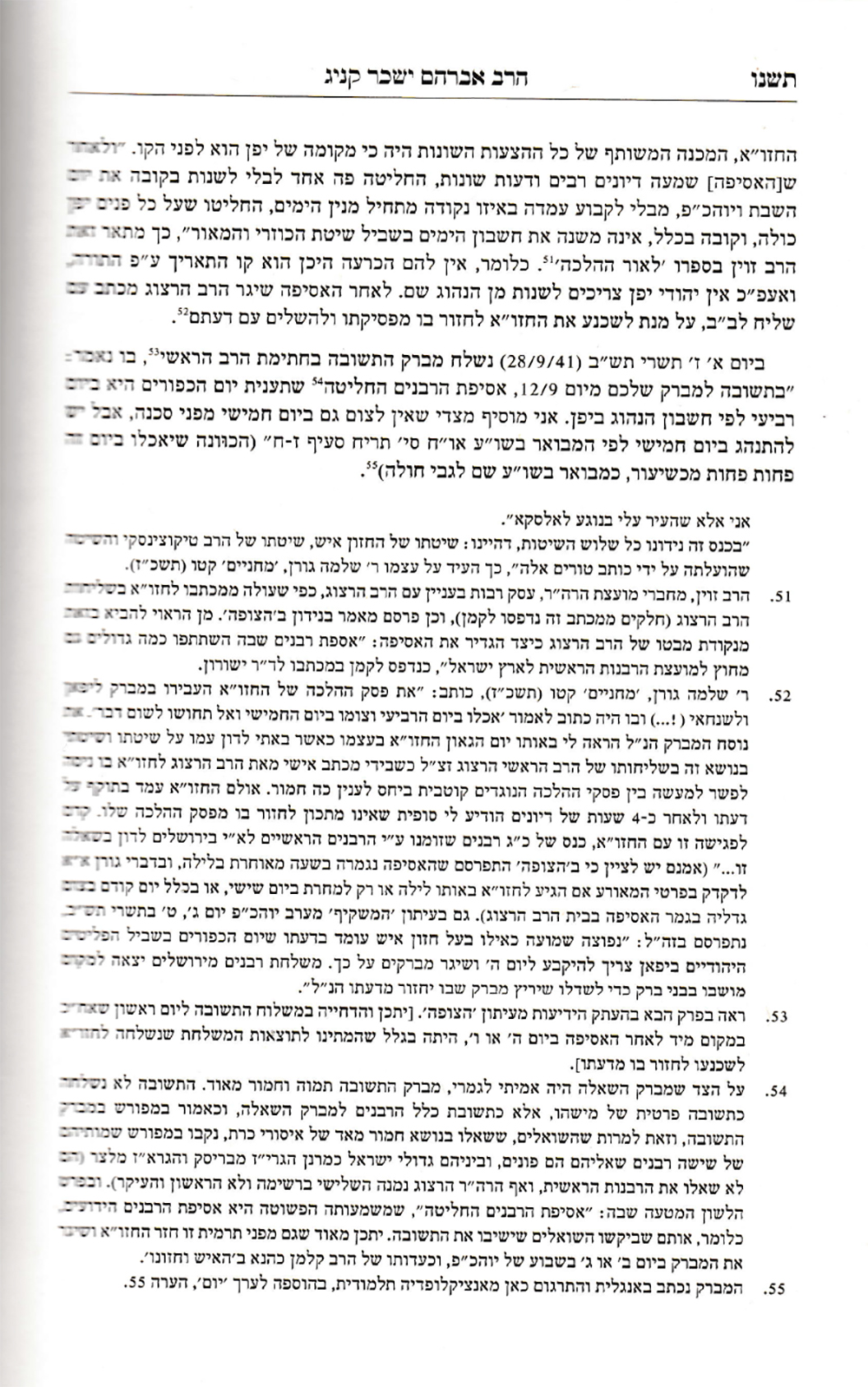
The archive contains an entire file dedicated to the question of the Halachic Dateline.[8] Rav Herzog was of course involved in the Dateline controversy in 1941. At that time, some members of the Mir Yeshiva, among other Jews, were located in Japan for Yom Kippur and they sent a telegram to Rabbis Mishkovsky, Alter, Herzog, Soloveichik, Finkel and Meltzer asking for guidance. Rav Herzog convened a meeting of a number of Rabbis to decide how to proceed, and sent a telegram back to Japan with their instructions. The file contains copies of the telegrams, much of Rav Herzog’s correspondence on the issue, as well as a kuntres on the topic prepared by Rav Tukachinsky that was distributed in advance of the meeting. Most of the significant material in this file has already been published in Kovetz Chitzei Giborim – Pleitat Sofrim Volume 8, in an extensive article by Rav Avraham Yissachar Konig, which was previously reviewed on the Seforim Blog by Dr. Marc Shapiro.[9]
Rav Konig’s most significant contribution is showing that Rav Herzog’s letter as published in Rav Menachem Kasher’s Kav Ha-taarich Ha-yisraeli has been altered from Rav Herzog’s actual letter. Here is Rav Herzog’s letter to Rav Kasher as it appears in the archive:
And this is the letter as printed at the beginning of Rav Kasher’s Kav Ha-taarich Ha-yisraeli:
 
There are three sentences that have been omitted from Rav Herzog’s letter as presented at the beginning of Rav Kasher’s volume. (I would add the following point that Rav Konig failed to mention – Rav Kasher wrote explicitly on page 248 that he presented the letters at the beginning of the volume in full.) The following sentences have been omitted from Rav Herzog’s letter:
הנני להודיע עכשיו שבדיעה זו אני ממשיך ומחזיק היום. אני תפלה שיזכני הקב”ה לעיין בעצם שאלת קו התאריך ולבדוק את כל הדיעות ולהגיע לידי דיעה עצמית. אולם לעת עתה אינני נוקט שום עמדה בהן.
This omission creates the impression that Rav Herzog had a definitive position on the question of the Dateline. However, this is obviously not the case; Rav Herzog never came to any conclusion on the issue of the Dateline, as is clear from the omitted sentences, as well as from a number of other letters in the file. In fact, Rav Konig has shown that in Rav Kasher’s response to this letter, he actually complained to Rav Herzog about these specific sentences for this reason. From Rav Herzog’s original letters, it appears that his position on the question of Japan was one of hanhaga bemakom safek (i.e. instruction on how to act in absence of a clear conclusion on the location of the Dateline) not a definitive hachraa. (Rav Konig elaborates on Rav Herzog’s position at length.) The first sentence above, that Rav Herzog stands by the position of the Rabbinic meeting, in conjunction with Rav Herzog’s statement that he has no definitive opinion on the matter of the Dateline, also implies that the position of the Rabbinic meeting convened by Rav Herzog was also one of hanhaga bemakom safek. (This point is also clear from Rav Herzog’s letter to Dr. Yishurun, also in the file, that the Dateline matter remained unresolved, and the meeting of Rabbis came to no definitive conclusion on the location of the Dateline. They issued their instructions to Japan based on the majority of opinions regarding location of the Dateline, with no consensus on the issue itself.) The altered version of Rav Herzog’s letter creates the false impression that Rav Herzog had a definitive opinion on the Dateline question.
However, I must take issue with one point made by Rav Konig. In his footnote 54, he criticizes Rav Herzog for his language in the telegram sent to Japan. Rav Konig writes that the language of the telegram is misleading, and creates the false impression that the telegram represents the position of the six rabbis (Rabbis Mishkovsky, Alter, Herzog, Soloveichik, Finkel and Meltzer) to whom the telegram from Japan was addressed. This is Rav Konig’s critique, in footnote 54:
Unfortunately, Rav Konig has been misled by an inaccurate translation of Rav Herzog’s telegram. Rav Herzog’s original telegram was written in English, and Rav Konig tells us (footnote 55) that he has relied on the translation to Hebrew as it appears in the Encyclopeida Talmudit, in the addendum to the entry on “Yom”, (coincidentally also in footnote 55.) That translation is taken from Rav Kasher’s Kav Ha-taarich Ha-yisraeli on page 246. This is the telegram sent by Rav Herzog, as it appears in the archive:
An accurate translation to Hebrew would be as follows:
בתשובה למברק שלכם מיום 12.9, אספת רבנים בנשיאותי החליטה שתצומו ליום כיפור ביום רביעי לפי חשבון הנהוג ביפן וכו’
This is the mistranslation in Rav Kasher’s Kav Ha-taarich Ha-yisraeli:
Translated accurately, Rav Herzog’s telegram does not imply that the six Rabbis to whom the question was addressed are providing the answer. The main difference is a subtle, but significant one. Rav Herzog wrote “meeting rabbis my presidency”, which Rav Kasher mistranslated to Asifat Ha-rabbanim, “meeting of the rabbis”, and he neglected to translate “my presidency” at all. As noted by Rav Konig, Asifat Ha-rabbanim (with the hey ha-yedia) implies the known Rabbis, i.e. the Rabbis to whom the question was addressed. Correctly translated, however, Asifat Rabbanim be-nesiuti, “a meeting of Rabbis under my presidency” (without the hey ha-yedia) does not imply that Rabbis Mishkovsky, Alter, Soloveichik, Finkel and Meltzer were involved in the decision. Rav Konig was unfortunately misled by Rav Kasher’s mistranslation, which was also repeated by Encyclopeida Talmudit. The attack on Rav Herzog’s integrity is entirely unwarranted.
There appears to be a second very subtle error in Rav Kasher’s translation. Rav Kasher’s translation states flatly that the Taanit of Yom Kippur is on Wednesday, implying a definitive hachraa. Rav Herzog’s telegram actually says that the decision was that they should fast on Wednesday for Yom Kippur, language which is consistent with a hanhaga bemakom safek. This would also fit with Rav Herzog’s personal addendum, that the Jews in Japan ought to keep Thursday as a fast day as well while eating leshiurim. Given Rav Kasher’s apparently less-than-honest presentation of Rav Herzog’s letter, as noted above, one might surmise that this “error” was also a willfull misrepresentation of the contents of the telegram, intended to advance Rav Kasher’s preferred narrative of a definitive hachraa, in accordance with his own position.
VII Yibum B’zman Hazeh
In addition to the documents related to Rav Herzog’s tenure as Chief Rabbi of Israel, there are also a number of files from his tenure as Chief Rabbi of Ireland. Among his correspondence from his time is Ireland is a fascinating teshuva, written by Rav Kasher in 1936, regarding the issue of Yibum B’zman Hazeh.[10] The background to the question: an Ashkenazi Yavam and Yevama living in Israel want to marry via Yibum, rather than doing Chalitza. Must the beit din protest, or can the beit din allow the Yibum? This teshuva was printed by Rav Kasher in the inaugural volume of Talpiot[11] (1944), and also appears in his Divrei Menachem Volume 1, Teshuva 31. Interestingly, Rav Kasher’s conclusion in the original teshuva differs significantly from the conclusion in the teshuva that he eventually published in Talpiot and Divrei Menachem.
Here is the conclusion of the teshuva as it appears in Rav Herzog’s archive, at the end of page 11 continuing to page 12:


Here is the conclusion of the teshuva as it appears in Divrei Menachem:
 
Originally, Rav Kasher concluded that the beit din should try to convince the couple to do chalitza, but if beit din is unsuccessful, and if the couple is religious, then beit din should teach them to have kavana l’shem mitzvah and need not protest the yibum. The concluding sentences were removed from Rav Kasher’s published teshuva, and the ending simply states that beit din try to convince them to do chalitza. (The teshuva as published is actually quite awkward, as it is clearly building towards the conclusion that they may do yibum, yet ends abruptly without stating this conclusion.) Apparently, Rav Kasher censored his own conclusion. He does stipulate at the end of the original teshuva that he is writing le-halacha ve-lo le-maase until the Gedolei Ha-Rabbanim in Israel agree to permit the yibum. It is possible that Rav Kasher did not receive such approval, and subsequently decided to censor his own conclusion when he published the teshuva.
VIII The Rav on Rabbi Meir Kahane
In addition to the archives of Chief Rabbi Herzog, the archives of his son, President Chaim Herzog, have also been scanned and are available. A very intriguing file in his archive is the file dedicated to Rabbi Meir Kahane.[12] A fascinating document in that file is a letter about Kahane written to Herzog by the Rav in the summer of 1984. The background to the letter: in 1984, Kahane became a member of the Knesset, representing the Kach party. Traditionally, during the process of building a coalition, the president would invite every party to take part in coalition negotiations. Herzog, however, snubbed Kahane and refused to invite him.[13] It was in response to this snub that the Rav wrote the letter below to Herzog, which is surprisingly supportive of Kahane:
 
The Rav starts by mentioning his close relationship with Rav Herzog, and that Chaim Herzog was actually named for his grandfather, the great Rav Chaim Soloveichik of Brisk.[14] The Rav says that he cannot understand how Herzog could invite the representatives of Arafat, but did not invite Kahane. The Rav adds that Kahane is “ktzat talmid chacham” despite his shigonot, and that he is a yarei shamayim who fights for the Torah and kvod shamayim. The Rav says that someone as energetic as Kahane should be moderated and he could contribute.
(Other sources have portrayed the Rav’s view of Kahane far more negatively, claiming that the Rav regarded Kahane’s “selective citation of Jewish sources as a distortion and desecration of Torah.”[15] Additionally, it is related that, at some point in the 1980s[16], the Rav told others that Kahane should not be given a platform to speak at YU.[17] I am not sure how to reconcile this portrayal of the Rav’s view of Kahane with the Rav’s own letter to Herzog that was rather supportive and praising of Kahane.)
The Rav then gives Herzog some gentle mussar for being irreligious and encourages him to keep mitzvot while in public as a Kiddush Hashem. Herzog’s response to the Rav also appears in the same file.
Kahane and Herzog had quite a contentious (non-)relationship, extending far beyond the coalition snub, as is evidenced by the rest of Herzog’s file on Kahane. This is a scathing column that Kahane wrote for the Jewish Press, also found in Herzog’s archive, in which Kahane dubs Herzog “vinegar son of wine”, among other insults:
 
Additionally, Kahane’s Kach party presented Herzog with the inaugural Pras Idud Ha-hitbolelut – “Award for the Encouragement of Assimilation” 5745, as appears below:
 
The above is a sampling of the important and interesting documents contained in the archives. As mentioned, there is certainly much more fascinating material to be found. In the meanwhile, אנו יושבים ומצפים לגאולה שלמה, ייתי ונחמיניה.
[2] http://www.hebrewbooks.org/pdfpager.aspx?req=23218&st=&pgnum=16. See also Rav Chaim David Regensburg’s criticism of this thesis in Kerem Volume 1, pages 93-94 (also reprinted in his Mishmeret Chaim), and the comments of Rav Hershel Schachter brought in Shiurei Ha-rav (Sanhedrin), page 37, footnote 35.
[3] Shenaton Ha-Mishpat Ha-Ivri 14-15, page 235, footnote 77
[4] Dr. Revel did cite statements of other rishonim that he believed supported his view. Perhaps R’ Maimon mistakenly thought that Dr. Revel had supported his view with manuscripts of the Rambam, rather than other rishonim.
[5]  Nefesh Ha-rav page 18 footnote 22 , Shiurei Ha-rav (Sanhedrin) page 27. See also Leaves of Faith (volume 1) pages 121 and 134, where Rav Lichtenstein attributes this approach to Rav Moshe Soloveichik. From the other sources, it would seem that this approach was the Rav’s own. However, the recommendation letter that Rav Moshe wrote might imply that Rav Moshe also followed this approach.
[6] Kitvei Kehillot Yaakov Ha-chadashim, Sanhedrin, page 187.
[7] Sefer Yovel for Rav Yosef Dov Soloveitchik, jointly published by Mosad HaRav Kook and Yeshiva University, at the end of Volume 1 (unpaginated). The transcription, along with an image, is also available here.
Lehmann’s transcription of Rav Moshe’s letter appears to be mostly accurate, with one exception. Towards the end of the letter, Lehmann’s transcription reads as follows:
וגם הם בדור עשירי לעזרא איכא בי’ מכל צד וצד…
This meaningless sentence is obviously an error in transcription. The transcription should read:
וגם הך דדור עשירי לעזרא איכא בי’ מכל צד וצד…
meaning that the Rav has illustrious lineage and zchut avot on both his father’s and mother’s side. (See Brachot 27b for the source of this expression.) It is also clear from Lehmann’s translation that he misunderstood this line entirely and did not realize that it was referring to the Rav and his lineage. See the translation here.
[13] “Rabbi Kahane was the only party leader in the Parliament whom President Herzog refused to see in the consultations that led to the President’s asking Shimon Peres, the Labor Party leader, to form a government.” (New York Times, August 14, 1984)
[14] Herzog himself mentions this in his memoir, Derech Chaim, although it does not appear in the English translation, Living History. Rav Chaim passed away on July 30, 1918, and Herzog was born on September 17, 1918.
[16] The Rav’s last shiur at YU/RIETS was in 1985 (The Rav, Volume 1, page 43), at which point he withdrew from public life due to his illness. Presumably, this incident must have occurred at some point before then.


Gems from Rav Herzog’s Archive (Part 1 of 2): Giyus, Professor Lieberman and More

Gems from Rav Herzog’s Archive (Part 1 of 2):
Giyus, Professor Lieberman and More
By Yaacov Sasson
A tremendous resource that will be of great interest to Seforim Blog’s readers has been made available to the public. The entire archive of the great Rav Yitzchak Eizik Halevi Herzog, Ashkenazi Chief Rabbi of Israel, has been scanned and is now available online.[1] The archive contains hundreds of files on a wide range of topics, including Rav Herzog’s Piskei Halacha and Torah novellae, extensive correspondence on Israeli politics, Rav Herzog’s efforts to save Jews of Europe, and much more. Each file is dedicated to a specific topic, and many of these files contain upwards of a hundred pages of material. In short, the archive is a veritable treasure trove, and will be of great interest to those who are students of Torah, Halacha and Jewish history. Much of Rav Herzog’s Torah has been published in his numerous seforim; however, there is a significant amount of unpublished material in the archive. The purpose of this article is to make readers aware of some of the gems found in the archive, in particular the significant unpublished material. I have only begun to look through the vast amount of material that is available, and I am certain that there is much more to be found. The following are a select number of documents and files that I think will be of interest to the Seforim blog’s readers.
Giyus Bnai Yeshivot
The archive contains an entire file dedicated to the always controversial issue of giyus bnai yeshivot, whether yeshiva students ought to be drafted to the army or exempted from the draft.[2] Within this file, there is an approximately 50-page kuntres written by Rav Herzog in 1948, dedicated to a halachic analysis of the topic. To the best of my knowledge, this very significant kuntres was never published, and it does not appear in any of Rav Herzog’s seforim.[3]
Rav Herzog addresses the issue in an extremely thorough manner, and deals with a wide variety of relevant sources and issues, such as the definition of milchemet mitzvah, and the words of the Rambam at the end of Hilchot Shemita VeYovel, among other issues. For example, on page 27, he discusses the possibility of milchemet mitzvah in the absence of a king, and concludes that milchemet mitzvah is still possible if the community of Jews living in Eretz Yisrael approves of the war. On page 12, Rav Herzog suggests, based on a diyuk, that the Rambam’s words at the end of Hilchot Shemita VeYovel exempting talmidei chachamim from waging war do not apply to a war of ezrat yisrael miyad tzar. (A similar reading of the Rambam was suggested by Rav Aharon Lichtenstein, in “The Ideology of Hesder” (Tradition Fall 1981), and was reprinted in Leaves of Faith Volume 1.) Rav Herzog also makes a fascinating contention (on page 2), that the British were the current-day manifestation of Esav, putting forward their split hoof and hypocritically claiming to seek justice, while quietly attempting to undermine the Jewish cause by supporting their enemies. It is obviously not feasible to summarize a 50 page kuntres in a single blog post; I will simply present Rav Herzog’s main conclusion. Rav Herzog suggests (pages 12 and 34) that yeshiva students should not be subject to giyus malei, full conscription, even during wartime. Rather, they should be subject to giyus chelki, partial conscription of a few hours a week, doing what Rav Herzog terms “hishtatfut” in the war effort, such as local shemira and the like.
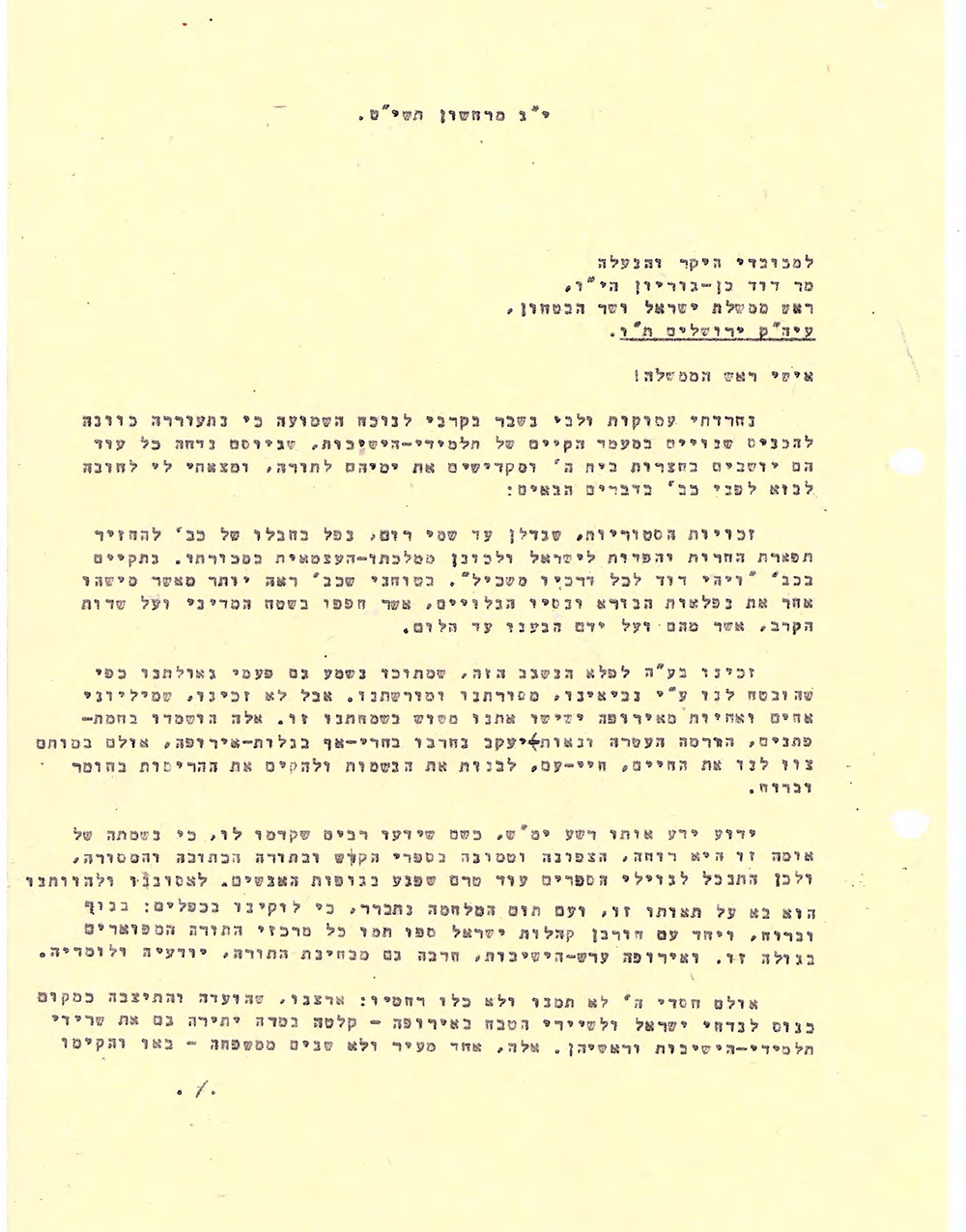
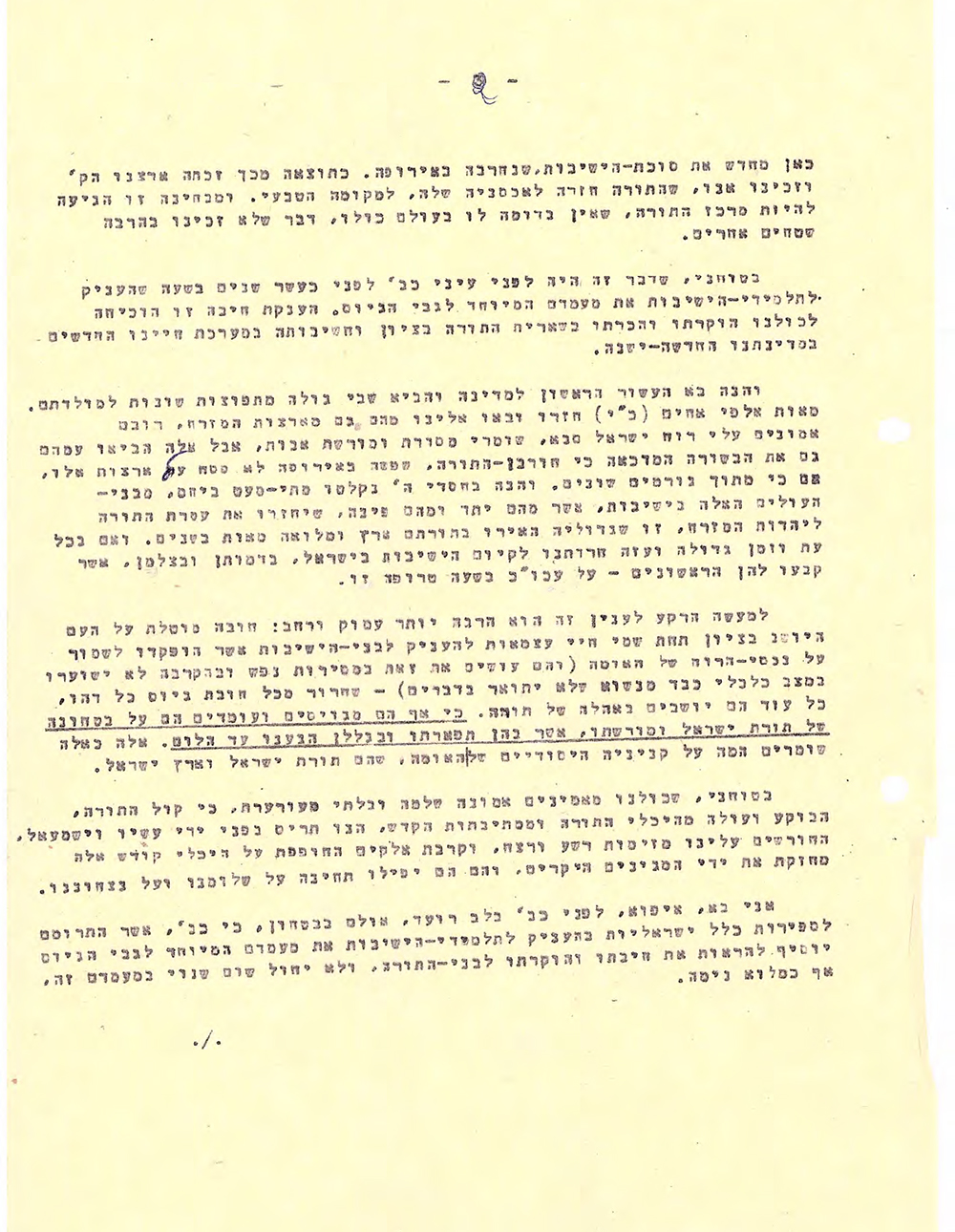
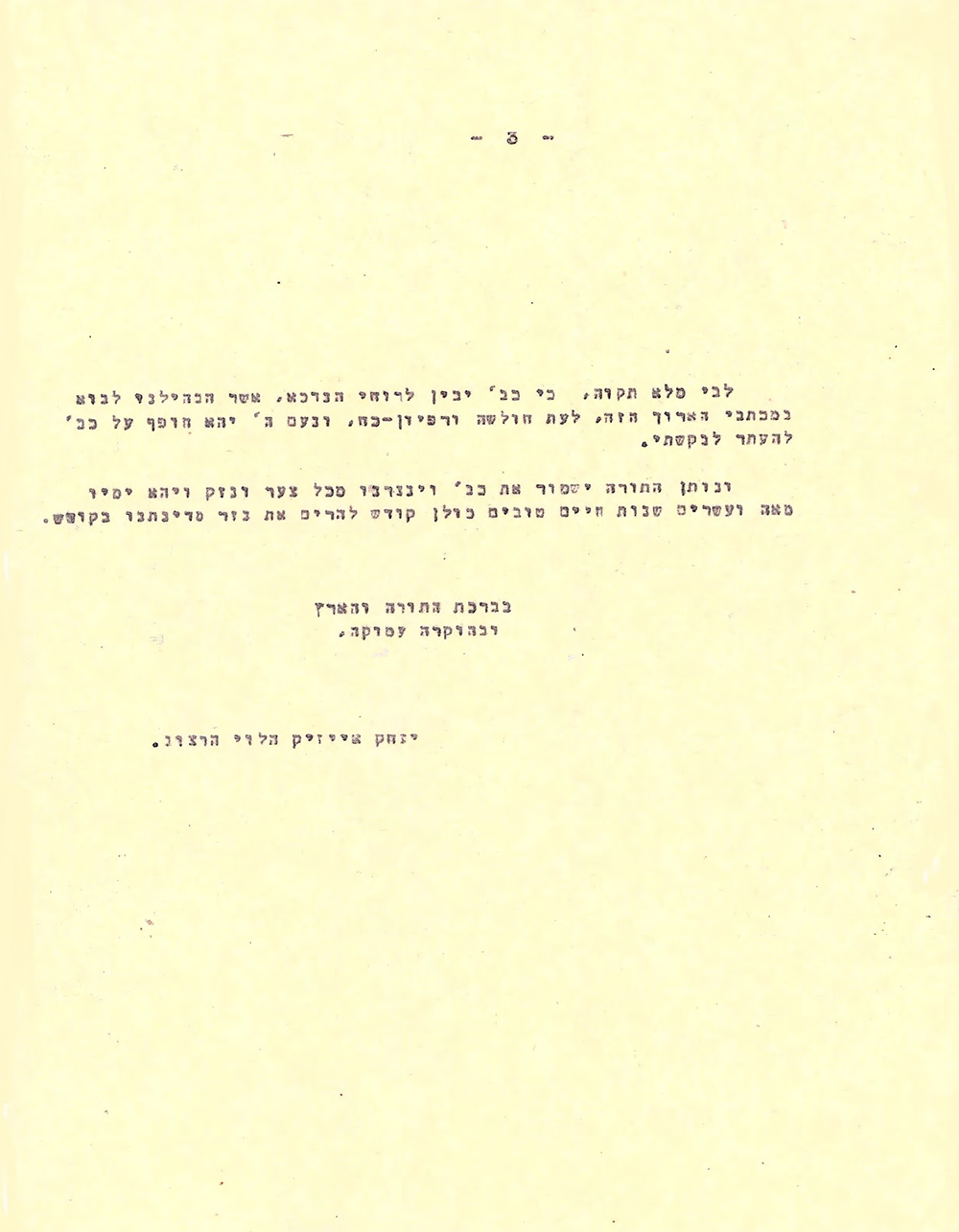
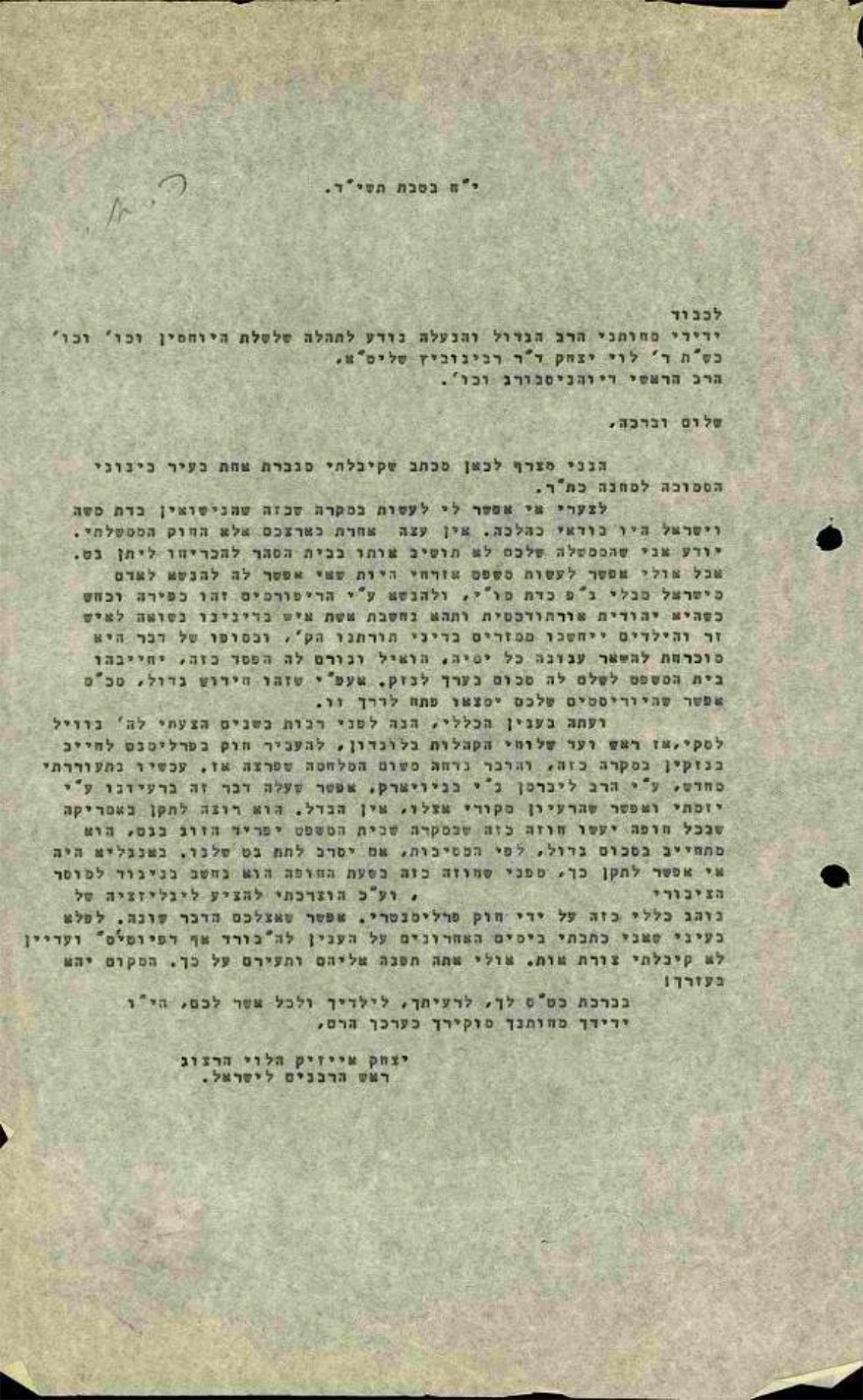
While this was Rav Herzog’s halachic conclusion in the kuntres, when the issue of forced conscription became a potential reality ten years later, Rav Herzog sent a heartfelt letter to Ben-Gurion, pleading for the exemption of bnai yeshivot, since they are already conscripted to the security of Torah and the heritage of Am Yisrael, and their Torah learning is a shield for Am Yisrael. This letter, which is found in the file of Rav Herzog’s correspondence with Ben-Gurion[4], appears below:

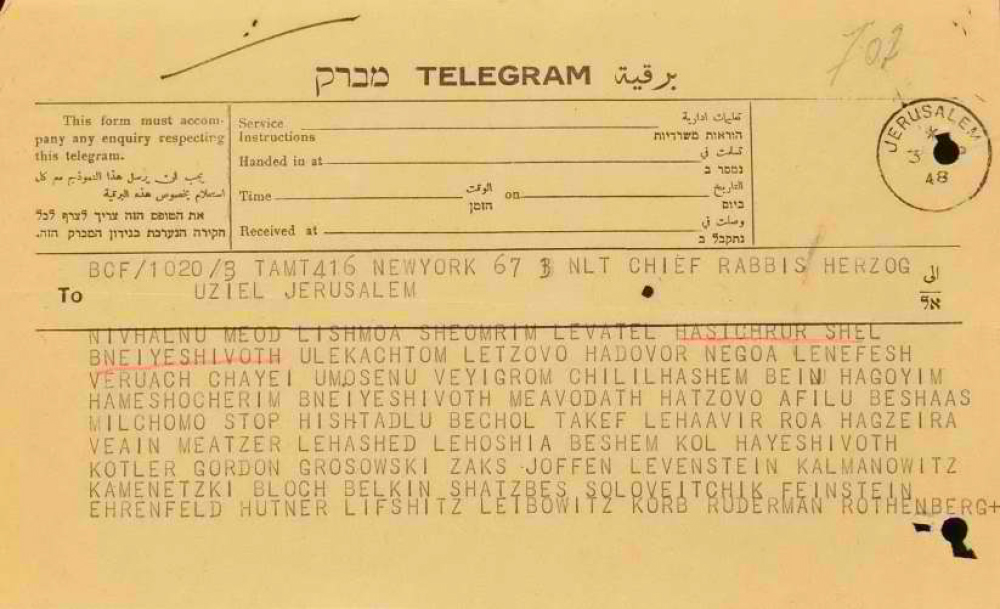
Another noteworthy document in the file on giyus bnai yeshivot is a 1948 telegram from the Roshei Yeshiva of the American yeshivot, expressing their shock at the possibility of giyus bnai yeshivot, and urging Rav Herzog and Rav Uziel to make sure that bnai yeshivot remain exempt from army service. The telegram appears below, as well as my transcription of the telegram into Hebrew:
נבהלנו מאד לשמוע שאומרים לבטל השחרור של בני ישיבות ולקחתם לצבאהדבר נוגע לנפש ורוח חיי אומתנו ויגרום חילול השם בין הגויים המשחררים בני ישיבות מעבודת הצבא אפילו בשעת מלחמההשתדלו בכל תוקף להעביר רוע הגזירהואין מעצר להש[םלהושיעבשם כל הישיבות,

Kotler Gordon Grosowski Zaks Joffen Levenstein Kalmanowitz Kamenetzki Bloch Belkin Shatz[k]es Soloveitchik Feinstein Ehrenfeld Hutner Lifshitz Leibowitz Korb Ruderman Rothenberg[5]
The telegram is especially noteworthy because of the appearance of the names of the Charedi Roshei Yeshiva, such as Rav Aharon Kotler, Rav Reuven Grozovsky, Rav Moshe Feinstein etc. together with the names of the more modern Roshei Yeshiva of RIETS: the Rav, Rav Yosef Dov Soloveichik, and Dr. Samuel Belkin. Such collaboration would seem to be almost impossible in later years.
II Professor Saul Lieberman on Rav Herzog’s Torat Ha-Ohel
Rav Herzog maintained a close relationship with Professor Saul Lieberman, as Dr. Marc Shapiro has mentioned previously on the Seforim blog[6], and noted in his “Saul Lieberman and the Orthodox”, page 22.[7] It should therefore come as no surprise that Rav Herzog’s archive contains correspondence between him and Lieberman. The letter that appears below was sent by Lieberman to Rav Herzog, and contains Lieberman’s haarot on Rav Herzog’s Torat Ha-Ohel, his sefer on the Rambam’s Hilchot Sanhedrin.[8] In this letter, Lieberman first discusses the proper girsaot in the relevant Rambam and the gemara in Makot regarding minuy dayanim. He then addresses Rav Herzog’s question of how it could be possible that bnai noach have a more extensive obligation of dinim than do Yisrael,[9] and Lieberman offers an elegant yeshiva-style distinction between dinei yisrael and dinei bnai noach to answer the problem. (A similar distinction was offered by Rav Aharon Lichtenstein, in Beit Yitzchak 8, page 89, and reprinted in his Minchat Aviv.) He offhandedly mentions that Rav Menachem Kasher had recently “acquired” some of his material, and then bemoans the fact that RY”D is too involved in the ol ha-tzibur and is not dedicating himself sufficiently to his Torah study, although he has the potential to become the Gaon Ha-Dor.
Lieberman’s letter appears below, and a transcription appears in Appendix A.
It is most likely that the RY”D to whom Lieberman referred was Rav Yaakov David Herzog, Rav Herzog’s son, as the context within the letter is dealing with Rav Herzog’s family. Rav Yaakov David had already published a scientific/critical edition of Mishnayot Brachot/Peah/Demai in 1945, at the young age of 24, and Lieberman wrote a Foreword to the volume.[10] Rav Yaakov David Herzog was eventually selected as Chief Rabbi of Great Britain in the 1960s, but declined the post due to his ill health.[11]
I also entertained the possibility that the RY”D to whom Lieberman referred is the Rav, Rav Yosef Dov Soloveichik. While this seems unlikely, it would fit nicely with the comments made by Rabbi Jacob Radin, as quoted by Rav Aaron Rakeffet[12], contrasting the Rav and Lieberman:
You know that I have attended classes in both the Seminary and the Yeshiva. I have studied with Professor Lieberman and the Rav. The Professor lectures a few times a week. He hurriedly finishes and rushes back to his research. Outside of his formal lectures, he is barely available to the students. On the other hand, the Rav is never alone. He has never finished a lecture on time. He always goes overtime. He remains in the classroom afterwards to carry on the Talmudic give and take with the students who cannot part from him. Even when he rises to leave, his disciples surround him and the discussion continues…This is the basic manifest difference between these two prodigious scholars.[13]
On Lieberman’s mention of Rav Kasher, this is the page that Lieberman referenced from Tosefet Rishonim:
And the page from Rav Kasher’s article in Sinai, Volume 18:
A number of the rather obscure sources in Rav Kasher’s lengthy footnote 2 appear to be taken from Lieberman’s Tosefet Rishonim.
III The Lieberman Ketuba
As is well-known, Lieberman introduced a new clause into the ketuba in the early 1950s in order to alleviate the aguna problem. The clause stipulated that the couple recognizes the authority of the beit din of the Rabbinical Assembly, and that upon dissolution of the marriage, the beit din would be empowered to administer penalties as it sees fit. The aim of these penalties would be to pressure the husband to give a get. In a number of letters from the 1950s (in a file regarding Even HaEzer issues[14]), Rav Herzog mentions that he himself came up with such an idea many years earlier when he was still Chief Rabbi of Ireland. He envisioned a separate document which would empower the beit din of London to administer financial penalties on a husband withholding a get. He mentions that he is unsure of Professor Lieberman came up with this idea himself, or if Lieberman actually got the idea from Rav Herzog.

Rabbi Emanuel Rackman wrote that it was widely believed that the Lieberman clause was examined by Rav Herzog, and that he had no objections.[15] This belief is certainly false, as Rav Herzog penned a strong protest to the proposed addition to the ketuba.[16] Rav Herzog’s main protest was due to the authority granted to the Conservative beit din. It is possible that the root of this misconception (that Rav Herzog approved of the Lieberman clause) is the fact that Rav Herzog independently envisioned a similar document or agreement, and that he entertained the possibility that Lieberman actually got the idea from him.
IV The Epstein Proposal
Another fascinating exchange between Rav Herzog and Lieberman is found in Rav Herzog’s file dedicated to Reform[[17] and Conservative Jewry[18], and relates to the Rabbinical Assembly’s 1957 attempt to resuscitate the Epstein proposal. Rabbi Louis Epstein had proposed, in his 1930 book Hatzaa Lemaan Takanat Agunot, that every husband, at the time of marriage, ought to designate his wife as a shliach to deliver her own get, in order to eliminate the aguna problem in the case of a missing husband or a get-refuser. The proposal was never implemented, in large part due to Orthodox opposition. In May of 1957, the Rabbinical Assembly attempted to resuscitate the Epstein Proposal at their Annual Convention at the Concord Hotel in Kiamesha Lake, New York. However, this attempt to revive the Epstein proposal must be viewed in light of the politics within the Conservative movement at that time. The following is an excerpt from the Presidential Report of Rabbi Aaron Blumenthal at the Rabbinical Assembly Convention[19]:

Note in particular Rabbi Blumenthal’s comments that the Seminary is an Orthodox institution, that its synagogue has separate seating and does not use the Rabbinical Assembly siddur, and that practically every faculty member added to the Talmud faculty in the last 15 to 20 years thinks of himself as an Orthodox Jew and has little regard for the Conservative movement. Given that Lieberman was the de-facto Rabbi of this synagogue, and that Lieberman ensured that the synagogue did not use the Rabbinical Assembly siddur, and that the synagogue maintained separate seating until Lieberman’s death[20], it would seem that Rabbi Blumenthal’s words were directed primarily at Lieberman, who arrived at the Seminary some 17 years prior.
It is against this backdrop that the Rabbinical Assembly passed a Resolution that the Rabbinical Assembly Committee on Jewish Law and Standards review the Epstein proposal and submit a plan for its implementation.
The report below from the National Jewish Post and Opinion makes clear that the left wing of Conservative Judaism felt that the Lieberman ketuba did not go far enough in addressing the aguna problem and therefore sought to institute the Epstein proposal. On the other hand, the more traditional wing of Conservative Judaism, led by Rabbi Louis Finkelstein, Chancellor of JTS, wanted the proposal referred to a joint committee made up of JTS faculty and RA members. Rabbi Blumenthal’s complaint about the Orthodox character of the Seminary faculty was not just an observation, but also a charge to the RA regarding the Epstein proposal, that they not allow the Seminary faculty to torpedo the proposal. Rabbi Finkelstein’s group lost the vote 92-88, in what was, in a sense, a repudiation of Lieberman’s Orthodox influence, and a rejection of his ketuba as too Orthodox and not impactful enough.[21] The majority of the RA membership was prepared to head in a more liberal direction.
After the passage of the Rabbinical Assembly resolution, the Agudat HaRabbanim turned to Rav Herzog in the letter below, asking him to intervene and prevent this breach of kedushat hamishpacha beyisrael.[22] (It is not clear to me why they termed the Epstein proposal nisuin al tnay, or conditional marriage, which is a different attempted mechanism to prevent aguna situations.)
In response to the request of Agudat HaRabbanim, Rav Herzog turned to Lieberman in the letter below, asking him to intervene and prevent the implementation of the proposed nisuin al tnay.[23] (Rav Herzog apparently understood the proposal to be literally one of conditional marriage, and thus referred Lieberman to the book Ain Tnay Benisuin, rather than the book LeDor Acharon, mentioned in the Agudat HaRabbanim letter, which deals with the Epstein proposal.)
In response to Rav Herzog’s letter, Lieberman sent Rav Herzog the very fascinating letter below. (A transcription of this letter appears in Appendix B.) Lieberman tells Rav Herzog that the Orthodox Rabbis are simply looking for excuses to make machloket, that Rabbi Finkelstein strongly protested the re-introduction of the Epstein proposal (as we noted was reported in the National Jewish Post), and that the President of the Assembly (Rabbi Blumenthal) also denied the claim of the Agudat HaRabbanim. He then says that the entire purpose of his revised ketuba was to bury the possibility of the Epstein proposal! He also mentions that some Orthodox Rabbis have claimed that any wedding which uses the new ketuba is invalid, and the kiddushin are not tofsin. (I have been unable to find any documented source of a Rabbi who made such a claim. I would be indebted to any of the readers who could provide such a source.) Lieberman concludes by assuring Rav Herzog that he would be the first to protest the implementation of the Epstein proposal, and that such a nevala could never happen while he is at the Seminary.
Rabbi Blumenthal’s denial was in fact reported by the JTA.[24] He said that the Assembly only authorized a committee to re-study the problem.
Some points remain unclear to me, as Rabbi Finkelstein’s group did indeed lose the vote, and the RA did pass a resolution that the Rabbinical Assembly Committee on Jewish Law and Standards submit a plan for the implementation of the Epstein proposal. I find it hard to understand Rabbi Blumenthal’s denial, or how Lieberman could claim that the Orthodox Rabbis were simply seeking machloket, when the RA passed a resolution for implementation (even documented in the RA Proceedings), with the left-wing defeating the traditional wing.
(to be continued)
Appendix A
Letter from Lieberman to Rav Herzog about Torat Ha-Ohel
בע”ה אור ליום ד’ פרש’ לך תש”ט
לידידי הגאון הגדול האמתי מרן רי”א הלוי הירצוג, לב”ב ולכל הנלוים עליו שלום רב.
היום קבלתי את יקרת כ”ג ואעשה כמובן כבקשתו. והנה נזכרתי שאני חייב התנצלות לכ”ג על שתיקתי הממושכה. היו כמה סיבות וטעמים לדבר. את ספרו היקר קבלתי בזמנו ונהניתי מאד מחידושיו הנפלאים ובקיאותו המפליאה. לא רציתי להטריד אותו בהערותי שמא יראה נחיצות נמוסית להשיב, והרי מכיר אני את טרדותיו המרובות, ולמה להעמיס עליו עוד משא? כדי שלא יהי’ מכתבי כשטר הדיוטות ארשום לו כמה דברים קלים שאינם צריכים עיון ומו”מ. דברי הר”מ בפ”א מהל’ סנהדרין ה”ב קשה להגיה, וכנראה שלדעת הר”מ אין כלל מצוה למנות דיינים בחו”ל, כפי שהבין בו הרמב”ן בפרש’ שופטים, וכן משמע מלשונו של הר”מ בסה”מ עשין קע”ו ומקורו הוא הבבלי במכות ספ”א[25] לפי גירסת המאירי שם: “אבל בחו”ל אי אתה מושיב בכל פלך ופלך ובכל עיר ועיר.” והוא מביא שם את גירסת התלמוד שלנו בשם “ויש גורסים” ומסיים: ולא נראה כן. ואשר לפסק הר”מ בספ”ט מה’ מלכים נראה שהוא חלק בין ב”נ ובין ישראל. שהרי ישראל מצווים למנות שופטים כמ”ע של שופטים ושוטרים תתן לך, ואפילו יצוייר שנהיה בטוחים שישראל לא יעברו על שום עברה ג”כ מצוה למנות שופטים. ברם ב”נ מחוייב למנות שופטים רק מפני שהוא מצווה על הדינין, כלומר שישגיח שלא יעברו על מצות ב”נ. ואם לא מנה שופטים בפלך ועבר אחד מהם עברה ולא דנו אותו כלם חייבים מיתה (שהרי כל אחד ראוי לדון יחידי), אבל כ”ז שלא עברו עברה אינם חייבים מיתה על מינוי דיינים אפילו לשיטת הר”מ.[26] ועיין ביד רמה נו ע”ב וברש”י ד”ה כך נצטוו, ומלשונו של הרמ”ה משמע שכן היה לפניו מפורש בגמרא שבני נח הוזהרו מחמת “ושפטו.”
בענין גר העמלקי (דף נ”ו) עיין מ”ש החיד”א ביעיר אוזן, עין זוכר מערכת ג’ אות א’ דברים מחוכמים מאד.
[בעני]ן מכת מרדות (צ”ט) עיין בשו”ת [הר]שב”ש סי’ תר”י וציינתי לו בתוספת ראשונים ח”ב צד 170 (עכשיו ראיתי שידידנו הרב כשר קנה במשיכה מספרי שם את כל החומר ופרסמם בסיני.)
כפי שאמרתי לא ארבה בדברים שצריכים לינה בעומקה של הלכה, ואני מקוה שנוכל לדבר ע”ז אי”ה פה אל פה.
על כמה דברים שנתחדשו אצל כ”ג באופן פרטי שמענו מאורחים וידידים היורדים מהתם להכא ושמחנו מאד לשמוע שכלתו הכבודה ב”ה נתרפאה לגמרי. מצטער אני מאד שרי”ד[27] שלנו נושא בעול הצבור ואינו מתפנה לגמרי לעולה של תורה. הרי עדיין הוא צעיר ויכול להיות לגאון הדור. ומדי דברי בו נזכרתי ששאל אותי מקום הירושלמי: התלמיד תוך ד’ אמות ברם הרב אפילו חוץ לד’ אמות והשבתי לו שירושלמי כזה אין לפנינו. ואעפ”י שכן הוא האמת בכ”ז שכחתי באותה שעה שכן מביא הריטב”א בסוכה כ”ח בשם הירושלמי.
אצלנו אין כל חדש. אנו יושבים ומצפים לגאולה שלמה, ייתי ונחמיניה.
בפ”ש מבית לבית
הנני מעריצו ומוקירו וידידו הנאמן
שאול ליברמן
הייתי מכיר טובה מאד לרבנית שתחי’ אם תודיע לנו בפרוטרוט על חיימקה שיחי’ ומשפחתו ועל רי”ד אהובנו.[28]
Appendix B
Letter from Lieberman to Rav Herzog about the Epstein Proposal
בעה”י יום ה’ פרש’ מטות תשי”ז
לכבוד ידידינו הגאון הגדול האמיתי מרן הרי”א הלוי הירצוג הרב הראשי לא”י ברכה ושלום רב.
יקרת כ”ג מי’ תמוז הועברה אלי לכרם מרתה[29], ומאד מאד התפלאתי שכ”ג האמין לדיבת הרבנים כאן. אמנם בכנסיית הרבנים השמרנים דברו על עיון מחדש בשאלת תנאי בקידושין, אבל ד”ר פינקלשטיין יצא בכל תוקף נגד חידוש העיון. ונשיא הכנסיה הנ”ל הכחיש בעצמו את דיבת הרבנים. אבל הללו מחפשים רק אמתלאות למחלוקת. כל עניין הכתובה היה כדי לקבור לגמרי את שאלת התנאי. הסברתי להם שאם ליחיד אפשר פעם לחשוב ע”ז הרי לרבים אין הדבר בא כלל בחשבון שהתנאי יעשה ע”פ דין, וישתקע הדבר ולא יעלה שוב על הפרק. וכולם הסכימו ל[י]. עכשיו יש מהם שבאים בטענות ואומרים: הרי הרבנים הארתודוכסים טוענין שאף הכתובה נעשתה שלא כדין, ויש מהם (כלומר מהרבנים הארתודוקסים) שאמרו שהמתחתן בכתובה החדשה אין הקידושין תופסין, והאשה מותרת בלי גט (ממש לא יאומן כי יסופר! אבל לצערי נאמרו הדברים), א”כ הרי מוטב לעשות תנאי בקידושין, ולהפטר מכל שאלת העגונה בבת אחת. והנני מבטיח את כב”ג שאין לשמועה שום יסוד, אחרת הייתי אני בין הראשונים למחות, וכל זמן שאני בסמינר לא יתכן שיעשו נבלה כזו.
בפ”ש ובברכה לכל המשפ[חה]
בהערצה ובידידות
שאול [ליברמן]
[1] See here.
[2] See here.
[3] A short one-page summary of the kuntres appears in R’ Zorach Warhaftig’s Chuka Leyisrael, page 236. However, R’ Warhaftig neglects to mention that Rav Herzog advocated only giyus chelki.
[4] See here.
[5] Every name on the telegram is relatively well known, except for Rothenberg. I assume this is Rav Moshe Rothenberg, founder of Yeshivat Chachmei Lublin of Detroit. See Toldot Anshei Shem page 126, here.
[6] See here.
[7] For the following sections related to Lieberman, I made extensive use of Dr. Shapiro’s “Saul Lieberman and the Orthodox.”
[8] See here.
[9] Here in Yeriot Ha-Ohel 1.
[10] See here. Interestingly, Lieberman signed the Foreword as “Saul Lieberman, Dean, Harry Fischel Institute, Jerusalem”, even though Lieberman had been teaching in JTS for five years already. (In the Foreword, he notes that the publication of the volume coincided with Harry Fischel’s 80th birthday, in 1945.) In fact, Lieberman’s name appeared atop the Harry Fischel Institute’s stationery as late as 1949 (can be seen in Rav Herzog’s file on Machon Harry Fischel.) It would appear that Lieberman continued to serve in some capacity as Dean of the Harry Fischel Institute even after he left Israel to come to America. Incredibly, he held one foot in each world simultaneously, as Dean of the Harry Fischel Institute and Professor in JTS, a fact that has heretofore eluded his biographers. My good friend Rabbi Dovid Bashevkin reports in the name of Mr. Carmi Schwartz, Executive Vice President of the Council of Jewish Federations, that Lieberman willed most of his considerable life savings to the Harry Fischel Institute after his death, and not to JTS.
[11] See here.
[12] Mentor of Generations, page 119.
[13] For more on the Rav and Lieberman, see Rav Rakeffet’s “A Note on R. Saul Lieberman and the Rav”, in Tradition, Winter 2007. Also noteworthy is the following story that appears in Rav Hershel Schachter’s Mipninei Ha-rav:
The head of the Seminary who gave the shiur with which the Rav disagreed so vehemently is none other than Lieberman. Warren’s visit to the Seminary was covered on the front page of the New York Times (September 14, 1957.) (For a humorous account of how Lieberman sipped tea through a sugar cube that weekend in the presence of former president Harry Truman, see “The Rabbi as Symbolic Exemplar” by Jack Bloom, page 37.) Here is the New York Times’ account of Lieberman’s shiur:
A similar account of the shiur appears in the Sentinel (September 26, 1957)
Regarding Lieberman’s suggestion that the principle of Ain Adam Meisim Atzmo Rasha is predicated on the presumption of teshuva, there appears to be another difficulty, in addition to that raised by the Rav. The gemara in Makot 13b states:
חייבי מיתות ב”ד אינו בכלל מלקות ארבעים שאם עשו תשובה אין ב”ד של מטה מוחלין להן
The gemara states explicitly that teshuva is not efficacious in absolving a sinner of capital punishment, which would seem to contradict Professor Lieberman’s thesis. My good friend Rabbi Dovid Bashevkin has offered the following original suggestion to resolve the problem. Professor Lieberman might have believed that the gemara in Makot which states that teshuva does not absolve capital punishment is referring to after gmar din, when the sinner has already been tried and sentenced. At that point, teshuva is no longer effectual. However, the principle of Ain Adam Meisim Atzmo Rasha applies before trial and sentencing, and teshuva would absolve a sinner before sentencing. This reading of the gemara in Makot is certainly plausible, although it does run contrary to the reading of the Noda B’Yehuda (Orach Chaim 34, s.v. ela), who assumes that the gemara is referring to before gmar din as well. Additionally, it would seem difficult to assume that a confession is indicative of teshuva if a sinner is aware that he can absolve himself of punishment by simply admitting his guilt in beit din. However, this approach would explain why the Rav raised a difficulty based on the words of the Raavad, and not the gemara in Makot, as the gemara in Makot is not a conclusive proof.
[14] See here.
[15] “Conflict and Consensus in Jewish Political Life”, page 120, also cited in “Saul Lieberman: the Man and his Work”, page 45. My thanks to my good friend Dr. Josh Lovinger for bringing this to my attention.
[16] Techuka leYisrael al pi Torah, volume 3 page 210.
[17] The correspondence in that file also shows the effort that Rav Herzog expended in an attempt to prevent the Reform movement from gaining any foothold whatsoever in Israel.
[18] See here.
[19] Proceedings of the Rabbinical Assembly of America 21, 57th Annual Convention (1957), pages 41-42.
[20] See here.
[21] National Jewish Post and Opinion, June 14, 1957.
[22] See also HapardesTamuz, 1957 for details of the protest arranged by Agudat HaRabbanim.
[23] This letter also appears in “Saul Lieberman and the Orthodox”, Hebrew section, page 6.
[24] See here.
[25] Makot 7a
[26] This would also answer the (similar) question of the Gvurot Ari in Makot 7a, s.v. UveChu”l.
[27] As mentioned, I believe that this refers to Rav Yaakov David Herzog.
[28] Future president of Israel, Chaim Herzog, and Rav Yaakov David Herzog.
[29] Martha’s Vineyard.


Hitzei Giborim, Tzitzit, and R. Meir Mazuz

Hitzei Giborim, Tzitzit, and R. Meir Mazuz
Marc B. Shapiro
1. In 1969 the journal Moriah appeared, published by Makhon Yerushalayim. From its beginning, this journal published manuscript material from geonim, rishonim, and aharonim, together with Torah articles by contemporary scholars. This created a model that was later followed by a number of other journals. It also became a model for how to publish memorial volumes, as these generally also contain a section of material published from manuscript. Together with the interest in manuscripts, there has developed what can only be described as an Orthodox academic approach, and one can often find articles of this sort that meet a very high scholarly standard. A well-known representative of this genre is Yeshurun, a volume that appears twice a year and includes material from manuscript as well as halakhic and scholarly articles. What is most impressive about Yeshurun is not only its massive size, but the fact that the editors can fill it with so much quality material.
A competitor to Yeshurun has recently appeared on the scene and its title is Hitzei Giborim. Its model is exactly what I have described, with a section devoted to publishing material from manuscript, followed by Torah essays and Orthodox academic articles, many of which are really fantastic. The editor of Hitzei Giborim is R. Yaakov Yitzhak Miller, whose own articles show impressive erudition. Volume 9 recently appeared, but since I haven’t yet had a chance to examine it, let me speak about volume 8 which appeared last year. Volume 8 contains 1030 pages which I think makes it the largest volume of its kind. I wonder if the point of having so many pages was precisely in order to exceed even the largest Yeshurun.
Among the articles that I think will be of particular interest to Seforim Blog readers are R. Eliyahu Nahum Waldman’s ninety page study of Maimonides’ responsa to the sages of Lunel, designed to show that R. Kafih was mistaken in thinking that these are forgeries. I only wonder if such an effort was required on R. Waldman’s part, since it is hard to believe that anyone who examines the matter without preconceptions can agree with R. Kafih.[1]
R. Yehoshua Assaf deals with Rashbam’s commentary to the beginning of Genesis, the portion that ArtScroll censored and which I dealt with in prior posts here and here.[2] In this article Assaf cites R. Hillel Novetsky’s important comments here. Novetsky discovered another manuscript that not only contains the words of Rashbam in his commentary to Gen. 1:31, words that ArtScroll censored, but also the continuation of the passage that was missing until now. In fact, ArtScroll should be happy with this discovery as we now see that Rashbam affirmed that even if “day” started in the morning for the first six days of creation, the Shabbat of creation indeed began at sunset on Friday.[3] Unfortunately, I think that even if ten other Torah scholars would write articles along the lines of R. Novetsky’s and R. Assaf’s it won’t have any effect on ArtScroll.
R. Avraham Yissachar Konig’s article on the international dateline and the dispute between the Hazon Ish and other rabbis is full of interesting points and discoveries (including new material from manuscript) that significantly advances our understanding of this episode. Unfortunately, the language Konig uses about certain rabbis, in particular R. Yehiel Michel Tukatzinsky, is completely improper. Just because Konig’s point is to defend the Hazon Ish does not give him the right to belittle people who were greater than he. Interestingly, this article by Konig was removed from the volume when it was placed on Otzar ha-Hokhmah.Here is the table of contents that is also missing the article.

Here is the uncensored table of contents.
Otzar ha-Hokhmah has become the library for so many of us, and it is thus completely unacceptable for books to be altered no matter what the reason. The editor of Hitzei Giborim insisted that the book be shown in its entirety or taken down, and it no longer appears on Otzar ha-Hokhmah.
In Changing the Immutable, pp. 191 n. 16, 224 n. 46, I noted other examples of censorship on Otzar ha-Hokhmah. I found an additional instance in the Otzar ha-Hokhmah version of The Rabbi Leo Jung Jubilee Volume (New York, 1962). Two articles are deleted, and here is how the table of contents appears on Otzar ha-Hokhmah.

Here is the uncensored table of contents.

I understand why Otzar ha-Hokhmah would want to delete an article by Heschel, but what possible reason could there be to delete R. Isidore Epstein’s article? I can only assume that the person responsible for this mistakenly thought that Epstein was not Orthodox.
Here is a page from Otzar ha-Hokhmah’s version of Peninei Rabbenu ha-Avi Ezri, p. 266.

Here is how the uncensored page looks.


Returning to Konig’s article, on p. 770 he prints from manuscript a letter from a Sephardic rabbi to R. Ben Zion Uziel, but the name of the rabbi has been deleted. Konig tells us that he removed the rabbi’s name in order to protect his honor, because his letter shows that had no understanding of the dateline issue. It is indeed true that the rabbi did not understand the matter but that is no reason to delete his name. If we are going to start deleting names of rabbis every time we are convinced that they made a basic error, there would be no end to it. In this case the editor should have insisted that the letter appear in full. After all, everyone makes mistakes and there is no problem is seeing that even a learned rabbi did not understand this complicated issue.
Among the articles in Hitzei Giborim focusing on contemporary issues, R. Eliyahu Levine deals with dina de-malchuta dina. On p. 1012 he notes that the government requires homeowners to keep their property looking nice, and this includes cutting the lawn. R. Levine asks if this is also included in dina de-malchuta dina. He concludes that it is not, and writes the following.
וגם נראה שיסוד חוקים אלו הם מעוגנים בתרבות הגויים, שהעיקר אצלם הוא היופי החיצוני, וכל עמלם ויגיעם הוא ליפות את המראה החיצוני של רכושם, ולכן הם מעונינים שחצירו הפרטית של כל אחד מהם תשלים את מראה המקום כנאה ומטופח, וא”כ דבר זה כלול בדברי הרשב”א והש”ך שחוקים שביסודם הם כשל תוה”ק, אין נוהג בהם דדמ”ד, משום שבשעה שיגיעתו של הגוי היא לצחצח את רכושו, יגיעתו של הישראלי היא להקפיד על דברים אחרים, והמאמץ לעצמו את חוקי וגינוני המלכות, ודאי שמקפיד להיות מתאים להופעת הגוי, ממילא ההרגל בכך מזניח את ההקפדה והטיפוח של הישרליות שבישראל.
גם הרבה מחוקי הבניה והדיור כנראה מקורם בתרבות אמריקאית זו, ומשפחות יהודיות גדולות שעיקר תשוקתם אינה בדוקא בריבוי נכסים, החוקים הנ”ל אינם תואמים להשקפת עולמם, וזוהי עוד סיבה שבמסגרת חוקי הגויים לא נוהג דדמ”ד.
For those who don’t read Hebrew, he claims that zoning laws, and the whole idea of having a beautiful environment, originate in non-Jewish cultural norms, and therefore Jews are not obligated to follow these laws. I guess this means that in a “Jewish” environment, people won’t need to cut their lawns, their property can fall apart etc., since Jews look at what is on the inside and are not concerned with outer appearances. It is no secret that in some segments of the haredi world people assume that zoning laws (and sometimes even fire codes) are not Jewish concepts and thus don’t need to be followed, but to see this sort of approach in print will probably be a surprise for many.[4]
On p. 1121 we find something quite uncommon, an apology that in the previous volume an article appeared that is plagiarized from two other writers. I can’t think of another Torah publication that has ever had such a notice, and it shows both the honesty and the courage of the editor.
Beginning on p. 362, R. Yaakov Yitzhak Miller publishes from manuscript Torah letters concerning shaving one’s beard when the Czarist authority required this. The question that obviously needed to be considered was if this decree was to be regarded as a she’at ha-shemad in which case Jews would be required to martyr themselves rather than obey. Not surprisingly, the rabbis whose letters are published by R. Miller did not go this far. These rabbis are R. Judah Bacharach, R. Jacob Zvi Mecklenburg, and R. Hayyim Wassertzug (also known as R. Hayyim Filipover, from one of the Lithuanian towns he was rabbi in). These letters come from an unpublished volume by R. Wassertzug which hopefully will soon appear in print as it has the potential to be a very significant publication.
Although R. Wassertzug is today unknown, this was not the case in the 19th century, and R. Miller provides a nice introduction which shows some of R. Wassertzug’s originality. In addition to a reputation for being very pious as well as a great scholar, he was also known as a lenient posek who did not feel bound by certain practices which while generally accepted, did not, in his opinion, have a firm halakhic basis. Not surprisingly, this led to conflict with some other rabbis.
Here are two responsa from R. Wassertzug that appeared in Ha-Melitz, 14 Sivan 5629, pp. 225-226. The first permits one to drink non-Jewish milk (especially travelers), and the second permits a married woman to show some of her hair.

Not mentioned by R. Miller is that one of the opponents of R. Wassertzug was R. Isaac Haver. It is reported that he and some other rabbis went to R. Leibel Shapiro, the rav of Kovno, to complain about R. Wassertzug and to gain his support in order to have R. Wassertzug removed from his rabbinic position. Yet they were rebuffed as R. Leibel told them how great R. Wassertzug was and sent them away.[5]
In 2015 R. Mordechai Gifter’s Milei de-Iggerot appeared. This is quite a significant work and anyone interested in the history of American Orthodoxy will want to consult it. On p. 213 he deals with R. Eliezer Berkovits’ liberal halakhic approach. R. Gifter comments that unfortunately R. Berkovits did not follow the path of his teacher, R Jehiel Jacob Weinberg, who was much more conservative in how he approached halakhah.

The person R. Gifter was writing to had asked why R. Gifter was so critical of R. Berkovits’ approach when R. Wassertzug also had a liberal approach. In R. Gifter’s reply he reveals a hitherto unknown piece of information that he received from an elderly Lithuanian rabbi, namely, that one of the responsa of R. Akiva Eger in which there is no addressee given was actually sent to R. Wassertzug. R. Gifter also states that when R. Berkovits reaches R. Wassertzug’s level of piety, then he will be able to forgive him for much of what he has written.
ומה שיביא לי ראי’ מהגאון ר’ חיים פיליפובר זצ”ל, ידע נא ידידי שכשיגיע דר. ברקוביץ לדרגת חסידותו ופרישותו של אותו גאון וצדיק אוכל למחול לו על הרבה מדבריו, אבל באיש של דורנו לא אוכל לתלות דבריו בחסידותו של גאון מדור קדום.
והאמת שמיחס גאוני הדור להגר”ח פיליפובר ז”ל יש לנו ללמוד איך להתיחס לכל דרישה לחלוק על הלכות קבועות אפי’ כשיצאו מפי גאון וצדיק. ועיין תשובת מרן הגרעק”א ז”ל סי’ נ”ה – שקבלתי מפי רב גדול וישיש בליטא שהתשובה מכוונת להגר”ח פיליפובר ז”ל.
Here is the responsum of R. Akiva Eger, vol. 1, no. 55, referred to by R. Gifter.
As you can see, while the addressee is referred to as המופלא, his name and town are not given. R. Eger criticizes R. Wassertzug for his liberal approach in which he disagreed with rishonim and in the case discussed diverged from the Shulhan Arukh. In his conclusion, R. Eger refers to himself as one who is rebuking from hidden love.
While on the topic of criticism of R. Berkovits, here are some other relevant documents that I found in the archive of Chief Rabbi Isaac Nissim at Yad ha-Rav Nissim in Jerusalem. The first is a New York Times article from June 23, 1969. (I have no doubt that the second quote attributed to R. Berkovits in the article – where he mentions reconsidering the “traditional laws” – was taken out of context.)

In response to this story the following two documents were sent out to various Orthodox figures. Since the Hebrew document is not always easy to read, I have provided a transcript and also added paragraph breaks.

בהתרגשות ורגש חרפה קראנו בזמן האחרון בעתון “הניורק טיימס” על דר. אליעזר ברקוביץ, פרופסור בבית מדרש לתורה בשיקגו, שהוא השתתף עם איזה וועידת מתבוללים בקאנאדה: שמתיימרים הם להתחבר שלשת הזרמים של יהדות (אורטודוקס) (קונסורביטיב) (ריפורם). בנאום לפני העתונעיים [!] הגיבו המשתתפים שאין האיסור לאכול חזיר עוד מותאם לנסיבות הזמן: ובשלובי זרע עמהם הגיב דר. ברקוביץ שמצות שמיטה הנוהגת באה”ק היא שערוריה סקנדלית, ולא יתכן שמירת השביעית ב”דת מודרנית”: והיא בכלל יהדות מזוייפת: ולמותר הבהיר דר. ברקוביץ שהוא: “דובר של יהדות אורטודוקסית”, למרות שאין לו שום בסיס להיקרא אורטודוקסי, אחרי שהוא מפורסם כמלעיג עד”ת, שכל דעותיו הן שהאורטודוקסיה “משרשת ומפיגה את היהדות מן ההמונים לרגלי העצמת האיסורים.” והנה אין בעצתו מן החדוש וההפתעה, שכבר שמענוה אצל הקונסוב[ר]טיבים והריפורם כמותו – אמנם איך שהוא מצהיר ומצייר את עצמו בתור חובב ואדוק ביהדות האורטודוקסית הוא תמהון – מאין שאף דר. ברקוביץ שהרומס ברגל גאוה וגסה את עיקרי התורה והמתחבר עם הלצים והמתבוללים יכונה “דובר אורטודוקס”?
ומאידך – הרב אהרן סולביצ’יק, הראש ישיבה של ב”מ לתורה, המראה עצמו כצדיק וחסיד, המחמיר על פרטי התורה – איך הוא לא נרתע ונזדעזע מדברי הפרופסור, ולא שת לבו להסכנה החבויה בתוך הישיבה, דר. אליעזקר ברקוביץ? התירוץ: נחזה לר”א סולביצ’יק בעצמו, שלמשתה השנתי של היוניון אף אורטודוקס קאנג., שהמתחברים ברובם הם קונסורביטיב ומחללי שבת, וכל הגדולי תורה הצהירו בפומבי איסור מוחלט ללכת שמה – ראינו איך שר”א סולביצ’יק הואיל לנסוע להשתתף בועידתם, והם [ושם?] הוא נשא נאום להוכיח בעזרת “פסוקים” שאפשר להתחבר לצורך שעה עם הסטרא דשמאלא! – ומי זה שהיה יכול להעלות על הדעת שהר”מ ר”א סולביצ’יק יואיל להיות מהאורחים נואמים בארגון שכולו טריפה! אמנם היות וקראנו תגובותיו של דר. ברקוביץ הסכמות לנאומי ר”א סולביצ’יק, שמצוה גדולה להתחבר עם הרשעים, מוכרח שבאישורו הבהיר דר. בורקוביץ להעתונעיים, היות ואחרת לא היה מרשה הר”ם להפרופסור להישאר בישיבה, ובפרט בתפקיד מורה דרך על חניכיו בני הישיבה.
כעת לדאבוננו הוסרה [!] הצעיף החופף הדו-פרצוף שלר”א סולביצ’יק, מראה לזולת שהוא צדיק וחסיד, אך אינו מן הנמנע אישורו כ”דובר אורטודוקס” פרופסור המבהיר מינות וכפירה בתורה שבכתב, ובעצמו להתחבר עם המתבוללים, לעומת פסק איסור של כל גדולי התורה.
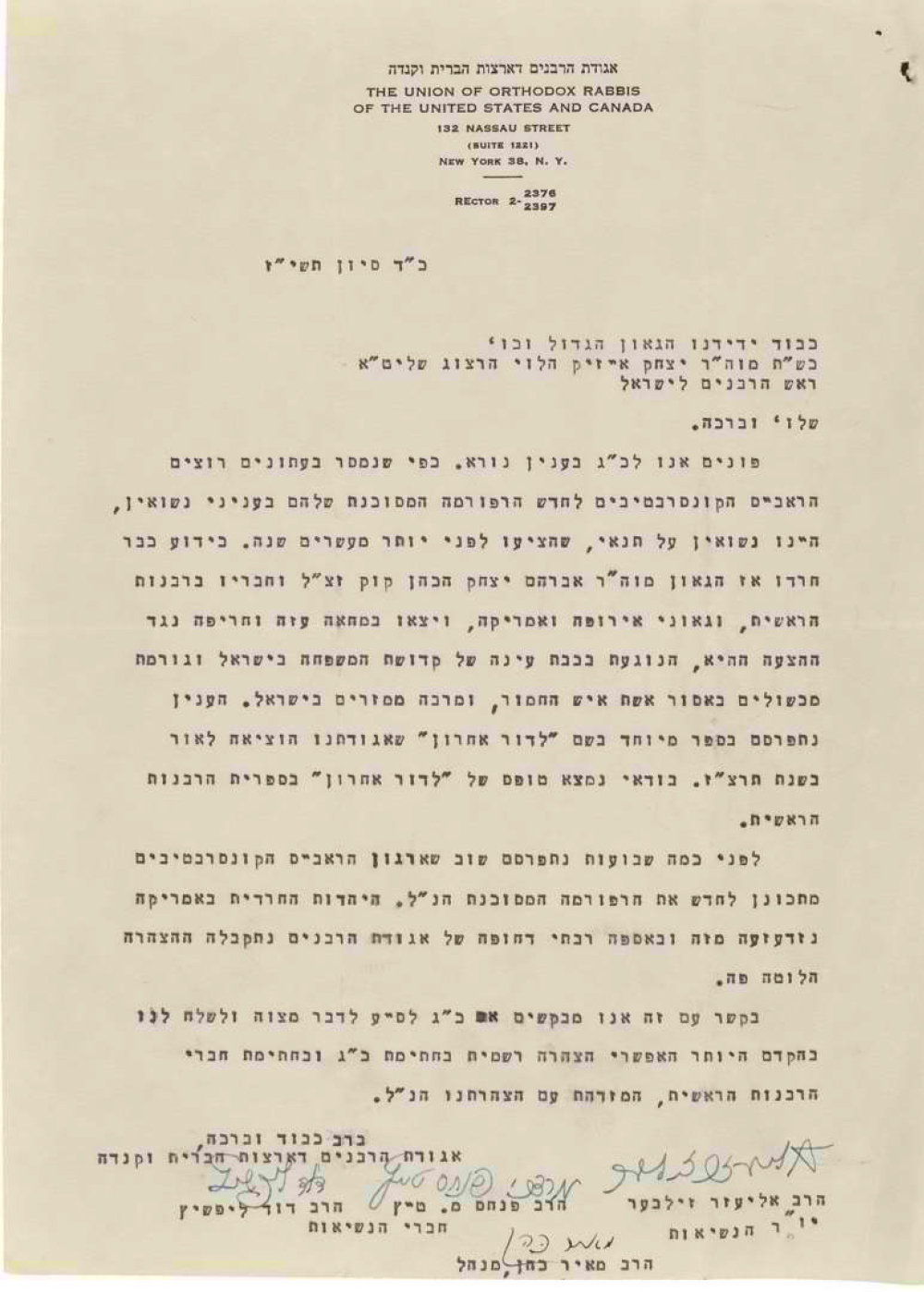
אדישות של הרמי”ם והרבנים בשיקגו להמצב קטסטרופילי הלזה היא כאובה, והחלה לשכנענו ששתיקתם כהודאתם, וכבר הגיע העת שתיפקחנה העינים והוקיע [!] בפרהסיא בעמוד הקלון את מפירי התורה בב”מ לתורה ולמחות בנזיפה לזבובי מות ושפעת דברים של הראש ישיבה המתבטא לתלמידיו דעות [כפרניות?] תחת החפשת צדקות: המחנף רשעים ומכבד פעלי עוול.
In addition to what it is said about R. Berkovits, R. Ahron Soloveichik is also attacked in these documents for not firing R. Berkovits (he actually didn’t have the authority to do so), and for attending an OU convention, an organization that in the 1960s had many mixed seating congregations which are referred to as “Conservative” synagogues. There is nothing about the latter episode in the book about R. Soloveichik, Ha-Rav Aharon Yeled Sha’ashuim (Jerusalem, 2011), published by his son, R. Yosef Soloveichik. In fact, R. Berkovits is only mentioned on two pages in the book. On p. 244, it is pointed out that R. Soloveichik opposed R. Berkovits’ approach, which is described as advocating “that halacha should be allowed to develop freely to accommodate people’s needs.” On p. 243 we see that R. Berkovits joined with other faculty members in opposition to R. Soloveichik being given any administrative power at Hebrew Theological College.[6]
Let me make one final point about all the journals and memorial volumes, Yeshurun, Hitzei Giborim, and the rest. Numerous selections from commentaries on talmudic tractates have appeared in these publications. The problem is that when it comes to talmudic commentaries, all these publications are basically useless. For example, let’s say Moriah published a portion of an anonymous medieval commentary on a few pages of Tractate Nedarim twenty years ago. Only someone who was “in the sugya” would have been able to appreciate what the commentary was saying when it first appeared. Therefore, 99 percent of the readers twenty years ago skipped over it, and they continue to skip over all of the continuously published selections of commentaries that scholars spend so long deciphering and adding learned notes to. Since almost no one reads these published commentaries, I sometimes wonder if it is a waste of the scholars’ time to work on them. If I finally decide to learn Nedarim this year, is there any chance that I will remember that a few pages of a medieval commentary appeared in Moriah over two decades ago.
Fortunately, there is a solution, and that is to follow the approach of Otzar ha-Geonim. The project I have in mind would take a good deal of effort, but it would be very valuable. What we need is for an individual, or group of people, to go through all the various journals, memorial volumes, etc., and pull out all of the commentaries on the different tractates in order create a compendium. It can be called Otzar Mefarshim or something like that, and it would be divided into tractates, just like Otzar ha-Geonim. With such a work, when someone, for example, is studying Nedarim, he will easily find the 3 page section of the anonymous medieval commentary published years ago in Moriah. This is the only way to rescue so many scattered texts from oblivion.
3. In Changing the Immutable and in earlier posts I have discussed how in previous years in some communities wearing a kippah was not standard as it is today. (I think the only exception is the Syrian community.) R. Ovadiah Yosef even says that unlike in previous years, wearing a kippah today is more than just “midat hasidut,” as it has become a sign of a religious Jew, while going bareheaded is a sign of an irreligious Jews.[7]
I was asked if the same point can be made about tzitzit and it indeed can. It is now pretty standard in the Orthodox world for men to wear tzitzit. We even start little boys wearing them in school at age 3. Yet the practice of wearing tzitzit, i.e., a tallit katan,[8] was unknown in talmudic days and is not mentioned by the geonim or Maimonides.[9] It appears to have begun with the Hasidei Ashkenaz,[10] and eventually became a regular practice in the Ashkenazic world.[11] Yet even in the twentieth century throughout the Sephardic world tzitzit were not generally worn. In these places they regarded tzitzit as a holy item, not something to be given to a child who can easily soil his garment. Even among adults, tzitzit were reserved for the especially pious. (I hope to expand on this in the future, where I will provide sources documenting what I have just mentioned.) In the past half century much has changed, and just as the kippah is now a sign of a religious Jew, so too is tzitzit. As R. Meir Mazuz puts it in a recent issue of Bayit Ne’eman, his new weekly “parashah sheet”[12]:
היום זה סימן היכר בין אדם שומר תורה ומצוות לבין מי שלא כזה, ואפילו שמן הדין אפשר להיפטר מטלית קטן . . . מ”מ מצוה מן המובחר שאדם ילבש טלית עם ארבע כנפות כדי לקיים את המצוה.
Interestingly, R. Joel Sirkes writes that while a father is obligated to provide his minor son with tefillin so that he can learn how to use them, he is not obligated to provide his son with tzitzit, “since even he [the father] is not obligated to buy a four cornered garment.”[13] This view is in opposition to the Tur who writes that a father does have to provide his minor son with tzitzit if the latter is of the age to wear it.[14]
Since I just mentioned R. Sirkes, let me share another interesting view of his. Avodah Zarah 70a quotes Rava as saying: רובא גנבי ישראל נינהו. In context, what this almost certainly means is that the majority of the thieves in Pumbeditha were Jewish.[15] Yet R. Sirkes shockingly understands it to mean that most Jews are thieves! It would be shocking enough if he understood it to mean that most thieves are Jewish (and not just most thieves in Pumbeditha), but explaining the passage to mean that most Jews are thieves sounds like something one would find in the writings of an anti-Semite, not in a work authored by one of the outstanding halakhists. It is true that one can find other negative judgments of the Jewish people in rabbinic literature. For example, the Maharal speaks of Israel’s inclination to sin as something unique to them and not found among non-Jews. He writes:[16]
כי ישראל מסוגלים היו לחטא מה שלא תמצא בכל האומות.
Yet this is part of a theoretical discussion, and although Israel has this negative characteristic, the flip side is that Israel is at a much higher spiritual level than the non-Jews. R. Sirkes’ opinion, on the other hand, is about the real world, here and now, and is said in a halakhic context. See Bayit Hadash, Yoreh Deah 2:6 (kuntres aharon):
ולפי עניות דעתי נראה דבכל שאר עבירות יש להחמיר . . . מה שאין כן בגונב דבר מאכל . . . דאפילו במוחזק בכך הרבה פעמים אין לו דין משומד ותדע שהרי אמרו רוב גנבים ישראל ואם כן לא יהיה סתם ישראל כשר לשחיטה אלא בידוע שאינו גנב וזה לא שמענו לעולם.
When we come across strange passages like this, it is often the case that someone will say that the author never wrote it. Rather, it was inserted by an erring student or someone seeking to undermine traditional Judaism. In this case, we get the next best thing, as R. Shabbetai Cohen, ShakhYoreh Deah 2:18, writes that R. Sirkes retracted what he wrote and asked for it to be deleted.
ומה שכתב הב”ח בזה בקונטרס אחרון [ד”ה מומר] כבר צוה הוא ז”ל בעצמו למחקו.
Nevertheless, I wonder if this is actually the case. Is it possible that R. Shabbetai wrote this not because R. Sirkes actually said what he attributes to him, but because R. Shabbetai wanted the embarrassing passage of R Sirkes removed from the public eye? The best way to do this would be to say that R. Sirkes regretted writing it, and this hopefully would lead to it being deleted by future printers.Those who have read Changing the Immutable, especially the last chapter, know that there is plenty of precedent for what I am suggesting. The reason that I think this might be the case is that nowhere else do we have evidence of R. Sirkes saying that what he wrote here should be deleted. Furthermore, in a later work, Sefer Ha-Arokh, Yoreh Deah 2, R. Shabbetai does not mention anything about R. Sirkes giving instructions to delete what he wrote. Rather, R. Shabbetai simply criticizes R. Sirkes for what he regards as his error. If R. Sirkes really said what R. Shabbetai attributes to him in his commentary to the Shulhan Arukh, why doesn’t he mention it in Sefer Ha-Arokh? What sense is there in criticizing R. Sirkes if R. Sirkes himself regretted what he wrote? In Sefer Ha-Arokh R. Shabbetai writes very sharply, accusing R. Sirkes of an error that even an amateur wouldn’t be caught making:

אבל בב”ח (סעיף ו בקונטרס אחרון) כתב דברים בלא טעם ומחלק בין עבירה לעבירה עיין שם ומה שכתב ותדע שאמרו רוב גנבים ישראל וכו’ כאן טעות נזדקר לפניו אפילו בר דבי רב לא יטעו בזה דמה שכתב רוב גנבים ישראל הוא דלא אמרינן דמותר אלא כשיש גנבים בעיר ורוב מהגנבים הם ישראל אבל שיהיה רוב ישראל גנבים חלילה לא תהא כזאת בישראל ועתה ישראל אשר בך אתפאר תקיצנה בבית זה שלא כדעת דברו.
R. Shneur Zalman Hirschowitz also calls attention to what he regards as R. Sirkes’ error. R. Hirschowitz is best known as a student of R. Israel Salanter, and it was he who published R. Salanter’s Even Yisrael, which became a basic text of the Mussar movement.[17] Here is the title page.

R. Hirschowitz’s talmudic notes were included in the Romm Talmud and are now included in the new Talmud editions. His comment about R. Sirkes is found in his note to Hullin 12a:
מצוה לפרסם להסיר חרפה מעל ישראל דהנה אויבי עמינו אומרים כי חז”ל בעצמם העידו עלינו כי רוב גנבי ישראל ומה לה לעיסה שהנחתום מעיד עליה, ובאמת העולם טעה כי חז”ל אמרו זה על כל ישראל אשר בכל כדור הארץ ובכל זמן כי רוב הגנבים ישראל הם, וחלילה לומר זאת וטעות גדולה היא. וכבר טעה בזה אדם גדול הוא ניהו אדונינו רוח אפינו בעל הב”ח זצוק”ל בקונטרס אחרון ליו”ד סי’ א. ולא עוד אלא שנתחלף להב”ח ז”ל במחכ”ת גאון קדשו ועצמותיו הקדושים בין רוב גנבי ישראל ורוב ישראל גנבי . . . וכל הרואה יחרד וישתומם על זה שמשים לכל ישראל בחזקת גנבים . . . אבל לא יאונה לצדיק כל און, כי הב”ח בעצמו צוה בחייו למוחקו כמ”ש הש”ך ביו”ד סי’ ב.
4. Earlier in this post I mentioned R. Meir Mazuz’s parashah sheet, Bayit Ne’eman. You can see recent issues here and you can sign up to receive it here. Each issue is a transcript of his Saturday night shiur, broadcast live all over Israel. Fortunately, the transcript is complete, by which I mean that the people putting it out have not censored it in any way, thus preserving R. Mazuz’s spoken style and his numerous off-hand comments. It is pretty unique which is why I recommend that readers check it out. The people who publish the shiur even claim that it is the most popular shiur in the world, a claim that is supported by a recent media report here that R. Mazuz’s Saturday night shiur has almost twice as many listeners (around 30,000) as R. Yitzhak Yosef’s competing Saturday night shiur.
Readers should be prepared for a good dose of what can only be termed “Sephardic supremacy.” It is with regard to this that I have to correct a point that R. Mazuz has often made, but which is really misleading. R. Mazuz has compared the kelal yisrael sense found in the Sephardic world with the extremism in the Ashkenazic haredi world, an extremism that leads to never-ending disputes and delegitimization of others. It is true that a basic feature of Ashkenazic haredi society is the tendency to delegitimize those who don’t carry the “party line.” This of course does not mean that all haredi individuals have this tendency; however, it is found in haredi society as a whole. In the last decade or so we have seen how, when there are not many opponents outside the haredi world to focus on, the society turns on itself and creates internal battles.
As mentioned, R. Mazuz has contrasted this with the Sephardic approach which has always welcomed people of different outlooks and levels of religiosity, always looking to bring close and not separate one Jew from the other. In contrast to the Ashkenazic world which has used the herem again and again, R. Mazuz states that other than the battle against Spinoza, the Sephardim have never gone for this approach. For R. Mazuz, the upshot of all this is that Sephardic society is a much better reflection of what Judaism and Jewish life are supposed to be.
Before the great split between R. Mazuz and the Shas party, R. Mazuz commented that ש”ס is supposed to stand for שחורה and סרוגה, meaning that the party should include both black kippot and knitted kippot, since the wearers of both were faithful Jews. As many readers know, the head of the Shas Council of Torah Sages, R. Shalom Cohen, instead saw fit to refer to the religious Zionists as Amalek (among other choice comments). This in turn led R. Mazuz to increase his attacks against the leadership of the Shas party which he saw as abandoning the Sephardic tradition and adopting the worst aspects of Ashkenazic haredi culture. Those who follow the Israeli religious scene know that at present there is a battle taking place for leadership of the Sephardic religious world between the two most important Sephardic rabbis. One is R. Yitzhak Yosef, who sees himself as the rightful inheritor of his father’s position and protector of his legacy.[18] The other is R. Mazuz. Among R. Mazuz’s supporters is former chief rabbi R. Shlomo Amar. R. Amar is himself quite popular, but since the passing of R. Ovadiah has subordinated himself to R. Mazuz. Seeing R. Mazuz’s great popularity today, I am proud to recall that the very first English article to deal with him appeared in 2007 on the Seforim Blog here. This post was the first introduction of most readers to R. Mazuz, and since that time I have quoted from his voluminous writings in almost every one of my subsequent posts.
There is a good deal more to discuss regarding the dispute over leadership of the Sephardic world, the strategy of the Yachad party and why it didn’t succeed, and the growing attacks on R. Mazuz from small-minded people who object to his independent mind. (He has even been attacked for quoting poems by Yehudah Alharizi and Hayyim Nachman Bialik in a shiur.) But for now, let me just make a couple of points:
A. Contrary to what R. Mazuz has said, it is not true that the only time Sephardic sages have used the herem is against Spinoza. The scholars of Aleppo, who could be quite extreme, banned the Torah commentary of R. Elijah Benamozegh, a figure whose works are quoted by R. Mazuz.
B. R. Mazuz’s description, while correct in its major points, is offered without any context and therefore leads to a distortion of the historical record. Nothing R. Mazuz describes makes sense without remembering that unlike in the Sephardic world, the Ashkenazic sages were confronted with the Reform movement and later with the East European Haskalah. It is in the context of these battles that the Ashkenazic rabbinic leadership felt forced to resort to bans and other types of exclusionary behavior and language, and this led to the creation of an extremism that is with us until today. Lacking Reform and Haskalah, the Sephardic world could develop in an entirely different fashion, but had the Sephardic world confronted such anti-traditional movements, it is likely that its rabbinic leadership would have reacted exactly as the Ashkenazic rabbis did. In other words, we are dealing with apples and oranges, and it doesn’t make sense to point to characteristics of the Ashkenazic world and contrast them negatively with the Sephardic world without explaining why it is that the Ashkenazic world developed its extremist tendencies.I must, however, point out that R. Mazuz assumes that there is something in the Sephardic spiritual makeup that itself prevents the development of anti-traditional forces. You see this from various comments that he throws out. For example, in a recent shiur, published in Bayit Ne’eman, no. 32 (6 Tishrei 5777), p. 1, in speaking about R. Abraham Ibn Ezra’s piyut Lekha Eli Teshukati, he states: “If only the Ashkenazim had this piyut; I would guarantee them that if they would have recited this piyut, they would not have had maskilim, Reformers, or assimilationists.”

This particular shiur has a number of other interesting points. For example, on p. 2 he discusses the verbal attacks upon haredi soldiers. (So far there have only been verbal attacks, but no one will be surprised when an actual physical attack occurs.) As far as I know, almost none of the Ashkenazic haredi leaders have spoken publicly about this unfortunate development (and if they have, it has not been covered in the Ashkenazic haredi press). The Ashkenazic haredi leadership in both Israel and America has a policy of not criticizing bad behavior on “its side” (unless they are dealing with really bad behavior such as allying with Iran). This is a pattern that has been going on for almost a hundred years. I say this since the leaders of Agudat Israel in Palestine never criticized or took any real action against the extremists who were defaming R. Kook. In fact, when the authentic history of Agudat Israel is written, the question of the culpability of the World Agudat Israel in this entire affair will have to be dealt with, for despite all of its private outrage with what was taking place under the auspices of its branch in Eretz Yisrael, the extremists and their enablers were never distanced from the organization. It seems that it is always much easier to criticize those to your left than to your right.

Thus, had a typical anti-Israel group staged an event in which kids were taught to throw eggs at a car said to be carrying the prime minister of Israel, you can be sure that Agudat Israel would have been at the forefront of attacking this event. So how come when this exact thing happens in the Satmar community there is only silence from the Agudah?

Agudat Israel readily attacks the BDS groups and others who try to delegitimize the State of Israel. Yet how come Satmar can have a rally attacking the State of Israel in a way that gives cover to BDS and all the rest who want to destroy Israel, and we don’t hear a word from the Agudah? If you listen to the propaganda of Satmar, it also gives cover to the anti-Semites, as it uses anti-Semitic imagery in speaking about the all-powerful Zionists who control the media and who through their devious means are able to pull the wool over the world’s eyes.[19] If such imagery is rightfully condemned as anti-Semitic when “outsiders” use it, how is it that Satmar gets a pass when it uses anti-Semitic imagery?

Returning to R. Mazuz’s comments about the haredi soldiers, he says simply: “These soldiers who come to pray are not sinners but are tzadikim! How can we call them sinners? They defend Israel with their bodies!”

3. I am happy to see that a number of new books and articles refer to posts that have appeared on the Seforim Blog. The most recent example of this is that I have know of is Chaim Dalfin’s just-published book, Rav and Rebbe, which deals with the relationship between R. Joseph B. Soloveitchik and the Lubavitcher Rebbe.4. God willing, I will once again be leading Torah in Motion trips to Europe in Summer 2017. You can see the details here.


[1] I say this even though R. Yitzhak Barda, Kinyan Torah (Ashkelon, 2014), vol. 3, p. 87, states that R. Kafih is correct. R. Barda’s volume is itself of interest, as he argues that when it comes to Jewish law, Maimonides’ opinion is absolutely binding, even if the Shulhan Arukh disagrees.
[2] Based on conversations and emails, I think that my posts on ArtScroll’s censorship of Rashbam have had a wider impact than any other posts. In fact, not long ago someone in my town who knew that I wrote a book on censorship shared with me that she had heard that ArtScroll censored Rashbam. This person does not read the Seforim Blog, and indeed had never heard of it. She thus had no idea that her knowledge of ArtScroll censoring Rashbam had its ultimate origin in my posts, which I think shows the great reach of this blog.
[3] This idea was earlier suggested by Aharon Marcus. See the note in his edition of She’elot u-Teshuvot min ha-Shamayim (Tel Aviv, 1979), p. 34. R. Yoel Bin Nun was unaware of R. Novetsky’s discovery and because of this offers a mistaken interpretation of Rashbam. See his recently published Zakhor ve-Shamor (Alon Shvut, 2015), pp. 229ff. (called to my attention by Zachary Grodzinski).
In my post here on Artscroll’s censorship of Rashbam, I cite a number of authorities who claim that before the giving of the Torah night came after day. Subsequently, I found that the Malbim says the same thing and cites an interesting proof for this position. See his commentary to Exodus, chapter 12 note 50:
גם הלילה שאחריו שייך ליום ארבעה עשר, כי קודם מ”ת היה הלילה הולך אחר היום, כמ”ש בארבעה עשר יום לחדש בערב תאכלו מצות.
See also R. Meir Mazuz, Bayit Ne’eman, no. 17 (19 Sivan 5776), p. 3 n. 17; R. Moshe Zuriel, Otzrot Rabbi Shmuel ben Meir (Bnei Brak, 2016), pp. 35ff.
[4] In Israel, the mainstream haredi rabbinic opinion is that one can build illegally and ignore the various zoning laws which are not thought to reflect haredi values. (The mainstream hardali rabbinic opinion is that one can build illegally in Judea and Samaria.) One exception to this generalization is R. Asher Weiss who insists that “the world is not lawless” and even haredim must follow zoning laws. See the discussion of his view, and the opposing views of R. Israel Grossman and R. Shmuel Wosner, in Ron S. Kleinman, “The Halakhic Validity of Israel’s Judicial System among Israeli Ultra-Orthodox Halakhic Decisors,” Review of Rabbinic Judaism 18 (2015), p. 227-259. On pp. 250-251, Kleinman reports on a meeting that R. Weiss had with a group of Israeli lawyers. R. Weiss’s important remarks were later published and Kleinman summarizes as follows:
Rabbi Weiss maintains in the meeting that “it is a great challenge, a great and holy undertaking” for Orthodox Jews to engage in all professions, including the practice of law, despite the fact that practicing as a lawyer raises halakhic questions. In his words, “we need lawyers who are punctilious in their observance of the commandments . . . [as well as] judges who are punctilious in their observance of the commandments and who attempt as far as possible to render judgments according to . . . Jewish law.” These judges are important for ensuring that Israel’s judicial system “is not totally alienated from the spirit of the Torah.” He states that “a[n] [Orthodox] judge [in a civil court of law] provides a vital service to the nation” because there are many matter in which the rabbinical courts are not equipped to rule. Furthermore in his opinion, the prohibition against resorting to Gentile courts applies only to litigants and not to judges or lawyers.
As Kleinman notes, one of the points R. Weiss relied on for this last statement (which I have underlined) is  the fact that the Hazon Ish was friends with Yitzhak Kister who was a judge. (Kister would later be appointed to the Israeli Supreme Court, and is the only such justice who identified with the haredi community.) Yet as far as I know, the sentence that I have underlined is unprecedented among rabbinic decisors, even among the Religious Zionist poskim.
A Hebrew version of Kleinman’s article appears in Tehumin 36 (2016), pp. 346-358. The articles are not identical so anyone interested in the topic is advised to consult both the English and Hebrew versions.
[5] David Matityahu Lippmann, Le-Toledot ha-Yehudim be-Kovna u-Slobodka (Keidan, 1930), pp. 226-227. A different version of the story, with the same conclusion, is told by Hayyim Karlinsky, “Ha-Gaon Rabbi Aryeh Leib Shapiro,” Moriah 76 (Sivan 5744), pp. 95-96. The earliest version of the story, and perhaps the original source, is found in Asher Margulies, “Sheloshah Matmonot Hitmin Yosef,” Ha-Melitz, 25 Tevet 5687, col. 76 (called to my attention by R. Yaakov Yitzhak Miller).
[6] While it could not have been easy for R. Yosef Soloveichik to revisit the painful history he discusses, the documents he reproduces are important for the history of American Orthodoxy. The book I have referred to is not the same thing as the 2016 book on R. Ahron Soloveichk, Yeled Sha’ashuim
[7] Yehaveh Da’at, vol. 4, no. 1 (pp. 7-8). Regarding removing the kippah (but still leaving one’s head covered) before entering the bathroom, the following appears in R. Simhah Rabinowitz, Piskei Teshuvot, Orah Hayyim 21 n. 58.
וכן מובא בשם מוהר”א מבעלזא זי”ע שהיה פושט מעליו המלבוש עליון והכובע והגארטל לפני הכנסו לביהכ”ס, ואא”ז זצ”ל היה מקפיד גם על הכיפה והיה מניח במקומו איזה מטלית על ראשו.
Has anyone else heard of such a practice?
[8] Why isn’t this called טלית קטנה? R. Meir Mazuz explains that in the period of the rishonim, when the expression טלית קטן first began, they were not concerned with the grammatical point that a word ending with ת is feminine. See Bayit Ne’eman 29 (14 Elul 5776), p. 4.
[9] See R. Yitzhak Ratsaby, Olat Yitzhak, vol. 2, no. 11 (p. 28).
[10] See R. Yehiel Goldhaber, Minhagei ha-Kehilot, vol. 1, pp. 93ff.
[11] Here is one source that shows that in 12th century Ashkenaz tzitzit were not generally worn: R. Eliezer ben Nathan of Mainz, Sefer Ra’avan, ed. Deblitzky, vol. 1, no. 40:
שאלני חתני רבי אורי. מצוה חמורה כמו ציצית שהיא שקולה כנגד כל המצות, מאי שנא דמקילין בה רוב ישראל שאין מתעטפין בכל יום. והשבתי לו לפי שאין ציצית חובת גברא. מי כת’ לבוש ציצית, ציצית חובת טלית הוא דכת’ ועשו להם ציצית על כנפי בגדיהם, אם יש לך טלית של ד’ כנפים עשה לו ציצית ואם אין לך טלית אינו חייב בציצית. דומיא דמזוזה ומעקה דאם יש לו בית חייב במזוזה ומעקה ואם אין לו בית אינו חייב.
[12] Bayit Ne’eman 18 (26 Sivan 5776), p. 1.
[13] Bah, Orah Hayyim 17.
[14] Orah Hayyim 17:    קטן היודע להתעטף אביו צריך ליקח לו ציצית לחנכו
[15] See Tosafot, Bava Batra 55b s.v. Rabbi Eliezer, and the discussion in R. Zev Wolf Zicherman, Otzar Pelaot ha-Torah, vol. 3, pp. 759ff. (R. Zicherman refers to the Shakh and R. Hirschowitz that I mention.) See also Beitzah 15a: רוב ליסטים ישראל נינהו. The note in the Soncino Talmud to this passage reads: “The Rabbis were broad-minded enough to realize that in a town containing an overwhelming Jewish population the majority of thieves would be Jewish.”
[16] Netzah Yisrael, ed. Hartman (Jerusalem, 1997), vol. 1, ch. 2, p. 20. For R. Jehiel Jacob Weinberg’s negative comments about the Jewish people, see my Between the Yeshiva World and Modern Orthodoxy, p. 183.
[17] Regarding Hirschowitz, see Hayyim Dov Genachovski, Shneur Zalman Hirschowitz (Jerusalem, 1951).
[18] In this video R. Yosef explains why he has spoken out against R. Mazuz and his followers. I have no doubt that there are also political factors involved. The various “religious” attacks on R. Mazuz, especially during the last Israeli election, remind me of the following memorable passage in Solomon Schechter, Studies in Judaism (Philadelphia, 1896), p. 3: “[U]nfortunately religious struggles are usually conducted on the most irreligious principles.”

[19] This anti-Semitic imagery is already present in R. Joel Teitelbaum, Al ha-Geulah ve-al ha-Temurah, chapters 46, 79.


Everything is Illuminated: Mining the Art of Illustrated Haggadah Manuscripts for Meaning

Everything is Illuminated: Mining the Art of Illustrated Haggadah Manuscripts for Meaning
            We have discussed haggadah illustrations in the past (see the links at the end of this post) and we wanted to expand and update upon that discussion for this year. In this post we focus on Hebrew illuminated haggadah manuscripts, and in the follow-up post will turn our attention to printed illustrated haggadot.
            While there is not as large of a body of Jewish art as that of art in general, historically Jews have appreciated the visual arts early in their evolution into a nation.  Aside from the biblical forms, we have evidence of art dating to the second century of the common era in the well-known frescos at the Dura-Europos synagogue.[1] But, such appreciation was not limited to second century Palestinian Jews, as evidenced from the discussion below, this appreciation continued, almost unabated, until the modern period.  It was not just the artist class or wealthy acculturated Jews that were exposed to and admired this medium.  For example, in the 1560 Mantua haggadah, one of the more important printed illustrated haggadot, the wise son appears to be modeled after Michelangelo’s Jeremiah in the Sistine Chapel (view it here: link). 
            

Lest one think that it is highly unlikely that a 16th century Italian Jew would have even entered the chapel, let alone been familiar with this painting, a contemporaneous account of Jewish art appreciation disabuses those assumptions.  Specifically, Giorgi Vasari, the 16th century artist and art historian, in his Lives of Excellent Painters (first published in 1560), records regarding Michelangelo’s statute of Moses – that is a full statute depicting the human form and was placed in the church of San Pietro in Rome – that “the Jews [go] in crowds, both men and women, every Saturday, like flocks of starlings, to visit and adore the statue.” That is, the Sabbath afternoon activity was to go to church to admire the statute of Moses, that is more famous for having horns than its Jewish visitors.[2]

Hebrew Manuscripts Background  
A brief background regarding Hebrew manuscripts before delving into the illuminated haggadah manuscripts. Details regarding manuscripts, the name of the copyist, the date, and the place where the manuscript was written, were supplied not at the beginning of the book – as is the convention with printed books and title pages –  instead in manuscripts this information is provided at the end. For this reason, the scribe’s note containing the information was called a colophon – from the Greek word kolofon, meaning “summit” or “final point.”[3]
Number of Hebrew mss.

A cautious guess of the number of extant Hebrew manuscripts in existence is between 60,000 -70,000 “but no more than 30-40 thousand of them predate the middle of the sixteenth century.”[4] Of the 2-3 hundred thousand Hebrew manuscripts presumed in existence in Europe at the beginning of the fourteenth century, probably no more than four to five thousand are extant today, possibly even less. “From the tenth century (before which information is very scarce) to 1490 (when the influence of printing books began to be felt)” there are an estimated one million manuscripts, meaning, “that 95 per cent of manuscripts have disappeared.”[5]  In addition, the early printed books – incunabula – had similar survival rates.

            The dearth of manuscripts has left a significant hole in our knowledge of major Jewish texts.  For example, there is only one complete manuscript of the Palestinian Talmud (1289) and two partial manuscripts. The Babylonian Talmud fared slightly better, with one complete manuscript (1342) and 63 partial manuscripts in libraries, with only 14 dating from the 12th & 13th centuries.[6] 
One of the partial TPs is known as the Vatican Codex 133 – and worth mentioning is the Vatican and its role regarding Hebrew manuscripts.  While there is no doubt that the Church had a significant hand in reducing the number of manuscripts – in reality the destruction of Hebrew manuscripts was the work of the Jesuits and not the Roman Catholic Church. Indeed, the Church confiscated and, thus in some instances preserved Hebrew manuscripts.  Consequently, we have a number of important Jewish texts that survive in the Vatican library.  Today, many of these manuscripts have been published.  The incomplete manuscript of the TP is but one example.  Additionally, regarding the use of (rather than just reprinting) the Vatican library, for at least late 19th century, Jews had access to the library.  For example, R. Raphael Nathan Rabinowitz, who authored a monumental work on Talmudic variants provides that “I prayed to God to permit me entrance to the Vatican library to record variant readings” his prayer was answered, and he received permission not only to use it during regular hours but “even on days that it was closed due to Christian holidays, when the library was closed to all, and even more so Jews.”[7] In total he spent close to 9 months in the library. In addition, Rabbi Rabinowitz’s presence and special status at the Vatican library was instrumental for the editing of the Vilna Talmud, where he secured permission for the Romm-employed copyists to work with manuscripts of the commentary of Rabbenu Hananel, even though they arrived in Rome during the summer season when the library was closed.
            Of the estimated one million Hebrew manuscripts from the 10th century until 1490, approximately 5% have survived.  As mentioned, religious persecution was one reason, but the main reasons are (1) deterioration from use, (2) accidents, and (3) reuse.  The first two are self-explanatory, the third requires a bit of explanation.  From the times that manuscripts were written on papyrus, unwanted manuscripts were scraped or washed and then reused.  (This papyrus recycling was not confined to reusing for books, papyrus was used from wrapping mummies, burned for its aroma, and used, according to Apices, to wrap meat for cooking). Similarly, leather and parchment were recycled, in the more egregious examples for shoe leather but in many cases for book bindings.  The latter reuse would be critical to the survival of numerous Hebrew manuscripts which have now been reclaimed from bindings.  It is estimated that there are 85,000 such binding fragments.  “The commonest use of written folios, however, was in bindings, whether for binding strips, end papers, or covers.”[8]   
Illuminated Hebrew Manuscripts

            The “earliest examples of Jewish book illumination are tenth-and eleventh-century Bible codices written in the Orient or Near East.  The illuminations are not figurative but consist of a number of decorative carpet pages adorned with abstract geometric or micrographic designs preceding or following the Biblical text.”[9] While these early illuminated manuscripts did not contain human figures, they did contain the first iterations of something unique to Jewish manuscripts, “one form of manuscript depiction unique to Jewish manuscripts is micrography with the earliest examples of this art may be found in the tenth-century Bibles written in the Orient.”[10]  A beautiful example of this art can be seen in the carpet pages for the Leningrad Codex. 


Similar non-representational geometric art was incorporated into Islamic art to avoid graphic representation.  Consequently, symmetrical forms were created which required advances in math theory to accommodate the ever more complex art.
Hebrew manuscripts did not adopt the Islamic convention – for the most part – and the earliest illustrations of human figures appear in Franco-Ashkenazic manuscripts – bibles – of the thirteenth century.
The earliest extant illustrated haggadah[11] is what is known as the Birds’ Head Haggadah dated to the early 1300s. The moniker “Birds’ Head” comes from the fact that the illustrator used birds heads/griffins in place of human heads. This manuscript is not the only Jewish manuscript to use zoophilic (the combination of man and beast) images. Zoophilic images can be found in a variety of contexts in Jewish manuscripts. For example, in the manuscript known as Tripartite Machzor, men are drawn normally while the women are drawn with animal heads.[12]  The name of this Machzor comes from the random fact that the manuscript was split up into three.  At times manuscripts are titled by location (Leipzig Mahzor), history (tripartite) or owner.  In one example, the “Murphy Haggadah” “ suffered a fate all too common to many Hebrew texts.  Before the Second World War the manuscript belonged to Baron Edmond de Rothschild.  During the war it was stolen and sold to an American, F.T. Murphy, who bequeathed it to Yale University, his alma matter.  For years it was known as the “Murphy Haggadah” until, in 1980, a Yale scholar, Prof. J. Marrow, identified as belonging to the Rothschilds.  The manuscript was returned to the Rothschild family and presented by the Baroness Dorothy to the Jewish National Library.[13]
            When it comes to the Birds’ Head manuscript, a variety of reasons have been offered for its imagery, running the gamut from halachik concerns to the rather incredible notion that the images are actually anti-Semitic with a bird’s beak standing in for the Jewish nose trope and the claim that the ears on the “birds” are reminiscent of pigs’ ears. Generally, those claiming halackhic, or more particular pietistic reasons, do so because they are unable “to conceive of such a bizarre and fanciful treatment of the human image as emerging from anywhere other than the twisted and febrile imagination of religious fanatics.”[14] But, in reality the use of bird’s head in lieu of human “reflects a liberal halakhic position rather than an extreme one.”[15]  The camp of Yehuda ha–Hassid would ban all human, animal and celestial depictions, a more liberal position from this perspective permits animal images.  And, while that position doesn’t explicitly permit a depiction half-animal half-human, the zoophilic images appear to show they were allowed, as the illuminator and owner of the Birds Head Haggadah agreed with that position.
            Aside from halakha, and the meaning or lack thereof behind “birds”, a close examination how the illuminator used this convention yields surprising nuance and commentary.      
While most of the images carry a bird’s head, there are a few exceptions. Most notably, non-Jews, both corporeal and spiritual do not. Instead, non-Jewish humans as well as angels have blank circles instead of faces. But, there is one scene that poses a problem. One illustration shows the Jews fleeing Egypt (all with birds’ heads), being pursued by Pharaoh and his army. Pharaoh and his army are depicted faceless.

  But, unlike the rest of the figures in Pharaoh’s army, two figures appear with birds’ heads. Some write this off to carelessness on the illustrator’s part. Epstein, who credits his (then) ten-year old son for a novel explanation, offers that these two figures are Datan and Aviram, two prominent members of the erev rav, those Jews who elected to remain behind. Indeed, they are brandishing whips indicative of their role as nogsim (Jewish taskmasters, or the precursor to Jewish Sonderkommando). While the illustrator included them with the Egyptians, he still allowed them to remain with their “Jewish” bird’s head.  This is a powerful idea regarding the idea of sin, and specifically, the Jewish view that even when a Jew sins, they still retain their Jewish identity – their “birds head.”   Sin, and including sinners as Jews, are motifs that are highlighted on Pesach with the mention of the wicked son and perhaps is also indicated with this illustration. The illustrator could have left Datan and Aviram out entirely or decided to mark them some other way rather than the Birds’ head. Thus, utilizing this explanation allows for the illustrator to enable a broader discussion about not only the exodus and the Egyptian army’s chase, but expands the discussion to sin, repentance, Jewish identity, inclusiveness and exclusiveness and other related themes.[16]

            Once we have identified the Jews within the haggadah, we need to discuss another nuance in their depiction.  The full dress of the adult male bird is one with a beard and a “Jewish hat,” pieus conutus – a peaked hat, or the Judenhut.  Children and young servants are bareheaded.  But, there are three other instances of bareheadness that are worthy of discussion.  (1) Joseph in Egypt, (2) the Jews in Egypt and (3) Datan and Aviram.  The similarity between all three is that each depicts a distance from god or Jewish identity.  Joseph, unrecognizable to his brothers, a stranger in a strange land, and while inwardly a Jew, externally that was not the case.

            The Jews in Egypt had sunk to the deepest depths on impurity, far from God. Finally, as we discussed previously, Datan and Aviram are also removed from god and the Jewish people.  Again, the illustrator is depicting Jews – they all have the griffin heads – but they are distinct in their interaction with god and the Jewish people.[17]  

Using this interpretation of the griffin images, yields yet another subtle point regarding inclusion, and also injects some humor into the haggadah.  The dayenu panel has splitting of the sea, the manna and the giving of the Torah.  The middle panel is less clear. Some posit that it is the Jews celebrating at the sea, but there is no indication of that because in most manuscripts, that includes Miriam, and the Egyptians drowning, not just five random images.

   
Instead, it appears that the person to the left is speaking (his hand is over his heart a medieval convention to indicate speech), and they are approaching the older figure on the left.  All are griffin headed and Judenhut attired – so Jews and regular ones. Between the splitting of the sea and the manna and quails the Jews complained to Moses.  Its possible that this is what is being depicted here, the complaining Jews, and the illustration serves as a testament to God’s patience and divine plan, the theme of dayenu, that even though we complained and did X, God still brought the manna, quail and Torah.[18] 

            If these are in fact the complainers, we can theorize about another detail of the image.  Above the figure at the left and the right, is faint cursive (enhanced here for visibility as much as possible) that reads: “Dass ist der Meirer (this is Meir) Dass ist der Eisik (this is Issac).”[19]  Thus Meir and Issac are being chided – but not kicked out – for complaining too much (rather than representing an unclear image of the Jews celebrating at the sea or just evidencing poor dancing). 


            Continuing through the dayenu we get to the giving of the Torah, and again, the nuance of the illustrator is apparent

.

            Two tablets were given at Sinai, but the actual Pentateuch is comprised of 5 books.  Thus, to capture that the 5 are a continuity of the two, as they are transmitted down, they transform into five tablets.  What about the ram/lamb at the bottom?  Some have suggested that it is the Golden Calf. But it is unlikely that such a negative incident would be included.  Instead, assuming that continuity or tradition is the theme, this lamb is representative of pesah dorot that is an unbroken tradition back to Sinai and unconnected with the Christian idea of Jesus as a stand in for the lamb.  Immediately prior to dayenu we have the Pesach mitzrayim with the figure’s cloak blowing back due to the haste.

       Thus, the dayenu is bracketed by the historic Pesach and the modern one – all part of the same tradition. [20]  

            It is worth mentioning that the Birds’ Head Haggadah is currently in the news. An item recently appeared about how the heirs of Ludwig Marum and his wife Johanna Benedikt, the owners of the haggadah prior to the Nazi era, are pressing the Israel Museum to recognize their family’s title, and pay them a large sum of money (but only a fraction of its estimated value). The Israel Museum acquired the haggadah for $600 from a German Jewish refugee in 1946.  (link).

            Turning to Spain, one of the most beautiful illuminated haggadot is the “Golden Haggadah.”  Just as the Ashkenazi Bird’s Head has depth to the illustrations, the Golden Haggadah can be mined for similar purpose.  Each folio is comprised of four panels.  And while they appear to simply depict the biblical narrative, they are so much more. 

            In an early panel we have Nimrod throwing Abraham into the fire and later Pharaoh throwing the males in the Nile, both Nimrod and Pharaoh are similarly depicted, on the throne, with a pointed finger indicating their equivalence in denying god. 

            The folio showing the Joseph story has the brothers pointing in the same manner as Pharaoh and Nimrod – the illustrator showing his disdain for the mistreatment and betrayal and equating it with the others.

            But, that is not all.  Counting the panels there are 9 between Nimrod and Joseph and 9 between Joseph and Pharaoh.  Taken together, these illustrations “renders an implicit critique of the attitude of that Jewish history is nothing but an endless stream of persecution of innocent Israel by the bloodthirsty gentiles.  Yes, it is acknowledged, these gentile kinds might behave villainously in their persecution of Jews.  But groundless hatred between brother and brother is on par with such terrible deeds, and sometimes sinat hinam can precipitated treachery as destructive as persecution by inveterate enemies.”[21]

            One other striking feature of the Golden Haggadah is the inclusion of women. There are no fewer than 46 prominent depictions of women in the haggadah.  Indeed, one reading of the exodus scene has a woman with a baby at the forefront leading the Jews out of Egypt behind Moses.

            This may be a reference to the midrash that “in the merit of the righteous women the Jews were redeemed.”[22]  The difference in the exodus scene is particularly striking if one compares it to the Ashkenaz Haggadah – Moses clearly at the front, and the most prominent woman in the back.


Of course, it is completely appropriate for the inclusion of women in the haggadah as women and men are equally obligated to participate in the seder. Another example of the prominence that woman play in the Golden Haggadah iconography is the scene of Miriam singing includes the largest images in the haggadah, the women occupying the full panel.  We don’t know why the illustrator chose to highlight women – was it for a patron or at a specific request.[23] 
The Golden Haggadah is not the only manuscript that includes women in a prominent role in the illustrations.  The Darmstadt Haggadah includes two well-known illuminations that place woman at the center.  The illuminations adoring other Darmstadt serve a different purpose than the Golden or Birds’ Head, they are purely aesthetic.[24]  Thus, the inclusion of women may not be linked to anything in particular.  At the same time, it is important to note that in terms of reception, that is, how the reader viewed it, the focus on women was not cause for consternation. One other note regarding the haggadah, the last panel is a depiction fountain of youth.  Note that men and woman are bathing – nude – together, which seems odd to a modern viewer (and, again, apparently did not to the then contemporary reader).  And, while admittedly not exactly the same, the 14th century R. Samuel ben Baruch of Bamberg (a teacher of R. Meir of Rothenberg) permitted a non-Jewish woman to bath a man so long as it was in public to reduce the likelihood of anything untoward occurring.[25] 

Before we leave the Darmstadt Haggadah, we need to examine the panel facing the Fountain of Youth. This panel depicts a deer hunt.

 As mentioned above, this image is not connected to the text and instead is solely for aesthetic purposes.  The hunting motif is common in many medieval manuscripts, and in some a unicorn is substituted for a deer.  While the unicorn has Christological meaning, on some occasions it also appears in Hebrew manuscripts.[26]

While the use of the hunting scene in the Darmstadt Haggadah was unconnected to the haggadah, in others it was deployed for substantive purpose.[27] [As an aside, it is possible that Jews participated, possibly Rabbenu Tam, in hunting, or at least its falconry form.[28]] As is well-known, the inclusion of the hare hunt is to conjure the Talmudic mnemonic regarding the appropriate sequence over the wine, candle, and the other required blessings, or YaKeNHaZ.  “To Ashkenazic Jews, YaKeNHaZ sounded like the German Jagen-has, ‘hare hunt,’ which thereby came to be illustrated as such in the Haggadah.”[29]

 Generally, Jews seem to have issues with botany.  We struggle to identify which of the handful of fruits and vegetables mention in the Bible and Talmud. But on Passover, the marror an undefined term, proves particularly illusory. Today, there is no consistency regarding what is used for marror with it running the gamut from iceberg lettuce to horseradish root. While we may not be able to identify it with specificity, we know what its supposed to taste like – bitter.  Manuscripts may provide some direction here.  There are two depictions in illuminated haggadot.  One of a leafy green, found in numerous examples, from a fragment from the Cairo Geniza to the Birds’ Head, and that of an artichoke.[30]  If it is a leafy green, it must be a bitter one – and that changes based upon time, place and palate.  For example, 30 years ago romaine lettuce was only the bitter lettuce widely available. But, among lettuces, it is far from bitter, and today, there are a variety of truly bitter lettuces available, arugula, mustard greens, dandelion, mesclun, etc.  Another leafy and very bitter option that is found in illuminated haggadot is the artichoke.  The artichoke is extremely bitter without proper preparation.  Indeed, from just touching the leaves and putting them in your mouth you can taste the bitterness.  The Sarajevo Haggadah and brother to the Rylands both have artichokes.

            The association of the artichoke with Passover is more obvious when one accounts for Italian culinary history.  Specifically, artichokes are associated with Jews and Passover. Carcoifi alla giudia – literally Jewish style artichokes “is among the best known dishes of Roman Jewish cuisine.” Artichokes are a spring thistle and traditionally served at Passover in Italy.  Whether or not from a culinary history this dish sprung from the use of raw artichoke for marror is not known, but we can say with certainty that artichokes have a considerable history when it comes to Passover. 

Horseradish only became popular, in all likelihood, because an early Pesach, would be too soon for any greens and thus they were left with horseradish – which is not bitter at all, instead it is spicy or more particularly hot.  In Galicia in the 19th century the use of horseradish was so ingrained that  permission was even granted and affirmed for people to use less than a kezayit  and still recite the blessing. In light of this, the custom yields the possibility that all sort of other spicy items be used for marror including very hot jalapeño peppers, for example.[31] Since we are discussing herbs, it is also worth noting that recently rulings regarding the use of marijuana and Pesach have been issued both in Israel and the United States (here), for our discussion on marijuana and Pesach please see here.

            One manuscript captures the uncertain identification of marror.  In the Tubingen Haggadah, the place where the illustration for marror is left blank, presumably to permit the owner to fill in what they are accustomed to use.

            Marror is not the only vegetable that is eaten during the seder, another difficult to identify is the karpas.  Today there are a variety of items used, and in reality, any dip-able vegetable will suffice, historically, it seems that lettuce or celery was used. The Birds Head provides that “lattich (lettuce) and eppich (celery) should be used. These are traditional salad foods, which, in the normal course of things, would be dipped or tossed with a dressing.  A dressing can be a simple as vinegar, and indeed, in many medieval haggadot, hometz or vinegar is used to dip.  We can trace the change from the more obviously salad oriented vinegar to saltwater where in the Darmstadt Haggadah, a later hand wrote on top of hometz – mei melekh.  While it appears nearly universal that hometz was used, its disfavor may be connected to a rule unrelated to Passover.  Since the Middle Ages, there is a dispute whether or not vinegar falls under the ambit of stam yenam.  Thus, the change to saltwater may be more of a reflection about views on what constitutes stam yenam and less to do with tears.

            One final food item is the haroset preparation.  Apples are familiar and linked to the midrash regarding birthing under an apple tree, in the Rothschild Machzor and the 2nd Nuremburg haggadah, cinnamon is called for because “it resembles straw.”  It also concludes that “some incorporate clay into the haroset to remind them of the mortar. For those wanting to replicate this addition, edible clay, kaolin, is now easily procured, and there is even a preparation that creates stone-like potatoes, perfect for the seder.
            To be continued… but until then see these posts Halakha & Haggadah, and regarding some illustrations in the iconic Prague 1526 Haggadah, here and also Elliot Horowitz’s discussion.

[1] E.L. Sukenik, The Dura-Europa Synagogue and its Art, Bialik Press, Jerusalem:1947. See also, Gabrielle Sed-Rajna, Jewish Art, transl. Sara Friedman & Mira Reich, Harry N. Abrams, Inc., New York: 1997, 9-13; 20-29;114-39.
[2] Two Prague Haggadahs, Valmadonna Trust Library, Italy:1978, 16 n.16 (the citation should read p. 435, not p. 345)
[3] Binyamin Richler, Hebrew Manuscripts: A Treasured Legacy, Cleveland/Jerusalem: Ofeq Institute, 1990, 20.
[4] Id. at 58.
[5] Colette Sirat, Hebrew Manuscripts of the Middle Ages, ed. & transl. Nicholas de Lange, New York: Cambridge University Press, 2002, 234.
[6] Id. 242-43.
[7] R. N. Rabinowitz, Dikdukei Soferim, Munich: E. Hovner, 1881, vol. 11, Tractate Baba Bathera, 7. 
[8] Sirat, Hebrew Manuscripts, 235-38.
[9] Richler, Hebrew Manuscripts, 45.
[10] Id. 48.
[11] Interestingly, illuminated haggadot did not end with the introduction of printing, there are a number from the 18th century and beyond.
[12] See B. Narkiss, Hebrew Illuminated Manuscripts, Jerusalem: Keter Publishing House, 1969, 106.
[13] Richler, Hebrew Manuscripts, 47.
[14] Marc Michael Epstein, The Medieval Haggadah: Art, Narrative, and Religious Imagination, New Haven & London: Yale University Press, 2011, 50-51. See the other discussions of this book, here.
[15] Id. 51.
[16] Id. 51-53, 71-72.  Much of the discussion regarding this haggadah and the Golden Haggadah is reliant upon Epstein’s thorough analysis of these manuscripts.
[17] Id. 65-68, 71-72.
[18] Id. 87-90.
[19] M. Spitzer & B. Narkiss, “General Description of the Manuscript,” in The Bird’s Head Haggada of the Bezalel National Art Museum in Jerusalem, ed. by M. Spitzer, Tarshish Books: Jerusalem, 1967, 23.
[20] Epstein, The Medieval Haggadah, 90-91.
[21] Id. 162.
[22] Id. 178.
[23] Id. 185-86.
[24] Narkiss, Hebrew Illuminated Manuscripts, 126.
[25] Elliot Horowitz, “Between Cleanliness and Godliness,” in Tov Elem: Memory, Community & Gender in Medieval & Early Modern Jewish Societies, ed. E. Baumgarten, et al., Bialik Institute, Jerusalem:2011, *38-*39.
[26] Piet van Boxel, “The Virgin & the Unicorn: A Christian Symbol in a Hebrew Prayer Manuscript,” in Crossing Borders, Hebrew Manuscripts as a Meeting-place of Cultures, ed. Piet van Boxel & Sabine Arndt, Bodleian Library, University of Oxford:2009, 57-68.
[27] The hare hunt image appears in Seder Zimerot u-Birkat ha-Mazon, Prague 1514, in the Shevuot portion.  Of course, the mnemonic applies to any holiday that potentially falls on a Saturday night.  See B. Roth, “Printed Illustrated Hebrew Haggadot,” Areshet, vol. 3 (1961), 8.  
[28] See Leor Jacobi, “Jewish Hawking in Medieval France: Falconry, Rabbenu Tam, and the Tosefists,” in Oqimta 1 (2013) 421-504, available here.
[29] Y. Yerushalmi, Haggadah & History, The Jewish Publication Society, United States:1997, plate 15.
[30] The various manuscript depictions of marror are collected in Mendel Metzger, La Haggada Enluminee, Brill, Leiden:1973, figs. 242-65.
[31]  Levi Cooper, “Bitter Herb in Hasidic Galicia,” Jewish Studies, an Internet Journal, vol. 12, 2013 (available here).