New Auction House – Genazym

New Auction House – Genazym
by  Dan Rabinowitz, Eliezer Brodt


There is a new auction house, Genazym, that is holding
its inaugural auction next week Monday, December 25th.  The
catalog is available here.  The majority of the material are letters
and other ephemera with a few dozen books. The books include a number with
vellum bindings (71-75).  Appreciation of bindings has been brought to
fore with the recent wider availability of books from the Valmadonna collection
after it was broken up; a collection that was known for its exquisite bindings.[1] 

Books with illustrations form another group, including heretical
images.  The title-page of the first edition of R. Yedidia Shlomo of
Norzi’s commentary on the biblical mesorah, Minhat Shai, Mantua,
1742-44 (76), includes Moses with horns, but more offensive is the depiction
of God with a human face.   The images on the title page are various
biblical vignettes and in the one for the resurrection of the “dry
bones” that appears in Yehkezkel, God is shown as an old man with a white
beard. [2] Another title-page containing non-Jewish imagery is the Smikhat
Hakhamim
, Frankfurt, 1704-06 (87).  Its title page is replete with
mythological (?) or Christian (?) imagery. [3] 

The illustration on the Minchat Shai title page. Note that this is from another copy, not the one on auction.

The kabbalistic work, Raziel haMalach, (77) contains
illustrations of various amulets with various mythical
creatures. [4] Another book with mystical images is the Emek Halakha,
Cracow 1598, (80). Less sensational images, of ships and fauna,
appear in the first Hebrew book to describe America, Iggeret Orkhot
Olam
, Prague 1793, (83). [5] R. Tovia ha-Rofeh’s Ma’ase Tovia,
Venice, 1707, (95) contains an elaborate illustration that compares the human
organs with various parts of a house or building. [6]

Of note for its rarity is (88), a first printing of R’ Moshe Chaim Luzzatto’s Derech Tevunot, Amsterdam 1742. The copy is a miniature, and was owned by the great collector Elkan Nathan Adler.

Among the
most controversial books in the history of Jewish literatures the forged Yerushalmi on Kodshim, (likely) written by
Shlomo Yehudah Friedlander (98).  There are two versions of the book, one
printed on thick paper and, on a second title page, Friedlander is referred to as
a doctor.  The other version is printed on poor paper and lacks the
(presumably bogus) academic credential.  The theory behind
the variants is that one was targeted at academic institutions
and the other at traditional Jews. [7]  Here is what it looked like:

Here are highlights from some of the letters for sale:

– There are some very interesting manuscript letters from the Chasam Sofer (46), R’ Chaim Sanzer (28) and R’ Meir Premishlan (37) .
– Letters from some of previous generations Litvish gedolim, like R’ Meir Simcha of Dvinsk (Meshech Chocham) (4), R’ Chaim Soloveitchik (2), R’ Raphael Shapiro (6), Chafetz Chaim (10), R’ Shimon Shkop (8), R’ Elchanan Wasserman (1), and the Brisker Rav (3). Many of these letters contain important historical information not found in other sources.
– Also of note are important, extremely rare and lengthy documents from the Rogatchover Gaon (5) and R’ Mordechai Gimpel Yaffe (9) related to the shemita and heter mechira controversies. Another letter of note is from the Minchas Elazar (29) in regard to the inheritance of R’ Alfandri.
[1] Portions of the Valmadonna Trust Collection were auctioned at Kestenbaum
& Co. and Sotheby’s. hereherehere. Regarding the source of those books see here.
[2] The title, Minhat Shai, was imposed by the
printer.  Norzi referred to the work as Goder Peretz.  See
Jordan Penkower, “The First Printed Edition of Nozri’s Introduction to Minhat
Shai, Pisa 1819,” Quntres 1:1 (Winter 2009), 9
n2.  The introduction to Minhat Shai was printed
long after the work itself.  See Penkower, idem.  Moses crowned with horns appears in the earliest
depiction of him to adorn a Hebrew book’s title page.  See “Aaron the
Jewish Bishop,” here.
[3] A very similar title-page appears in two other books,
the first edition of the Teshuvot ha-Bah and Beit
Ahron
.  Regarding the usage of these title-pages, see Dan
Rabinowitz, “The Two Versions of the Bach’s Responsa, Frankfurt Edition of
1697,” Alei Sefer 21 (2010) 99-111.
[4] David Hanegbi, “The Printed Hebrew Book as a Talisman
and Ritual Object: A Historical and Bibliographical Study in Sefer Razi’el
ha-Malakh and its Editions,” (Ramat Gan:  MA Thesis, Bar-Ilan
University, 2014).  Regarding the prevalence of mythical creatures in
human society see Kathryn Schulz, “Fantastic Beasts and How to Rank
Them,” New Yorker, Nov. 6, 2017 (here).  
[5] David Ruderman, The World of a
Renaissance Jew:  The Life and Thought of Abraham ben Mordecai
Farissol
 (Cincinati:  Hebrew Union College, 1981). 
[6] The book and specifically the image under discussion
was recently analyzed by Etienne Lepicard, “An Alternative to the Cosmic and
Mechanic Metaphors for the Human Body? The House Illustration in Ma’ashe
Tuviyah 
(1708),” Medical History 52 (2008), 93-105.
[7] For an extensive bibliography of the literature discussing
Friedlander’s edition, see Eliezer Brodt, “Tziyunim u-Meluim le’Mador ‘Netiah
Soferim’
Yeshurun 24 (2011) 454-455.


Interesting Legacy Judaica Auction lots

Legacy Judaica
is holding an auction on June 13, 2017, and we wanted to highlight a few items
of interest (for our previous post regarding the auction house and previous
auctions see here.  There are, of course, some old and rare books
from the 16th and early 17th centuries (lots 1-7), and over
forty manuscripts and a number of letters from rabbinical luminaries, R. Yosef
Dov Solovetchik (Beis ha’Levi) (lot 198), R. Yitzhak Ze’ev Solovetchik (Brisker
Rav) (lot 199), R. Hayim Ozer (lot 172), R. Kook (lot 183), R. Henkin, R.
Yechiel Michel Epstein (Arukh ha-Shulkhan) (lot 168), and the Netziv (lots
161-62), (there is also an amulet (lot 163) from his son, R. Chaim Berlin, that
apparently was written at the Netziv’s direction).
Two
particularly important manuscripts relate to the late 18th century
controversy regarding the nascent Chassidic movement.  One, lot 84, is a copy of the 1796 letter
condemning Chassidim that is signed by the Gaon, among others (this is a transcript
of the letter and does not contain the Gaon’s actual signature).  The second, lot 85, is contains two virulent
letters against Chassidim, both of which have been shown to be forgeries.  The first is written in the name of R. Akiva
Eiger, and the second is attributed to R. Yoel of Amtzislav.  Wilensky analyzed both and concluded that
they are forged.  The document also
includes the (real) transcript of the proclamations of the Bet Din of Shklov
against the Chassidim. Unrelated to the forgery, the various condemnations against
the early Chassidim were the subject of a recent controversy when many of them were
reprinted in a three volume history of the Vilna Gaon, Ha’Gaon.  The book was burnt (with hametz) and subject
to bans, one by the Bedatz Bet Din (see our earlier posts herehere, and  here).
Other items
include, R. Aaron Shmuel Koidonover, Birkat ha’Zev’ah, Amsterdam, 1669
(lot 12).  That book contains a number of
bibliographical items of note. The title page indicates that the book was
printed by two different publishers, the first abandoned because of poor
workmanship. But the identity of the sloppy printer is not provided.  This led to complaints by one of the (then) two
Amsterdam publishers, Uri Phoebus.  He
alleged that many were wrongly assuming him to be the offending publisher.  To address Phoebus, in some number of copies
a page was added that identified the culprit as Joseph Athias, the other
Amsterdam publisher.  There was little
love lost between Athias and Phoebus, and ten years later they famously clashed
over competing luxury editions of Yiddish translations of the Bible.
The title page
of the book itself is elaborately illustrated, and depicts at the top, King
David surrounded by two cherubs, and on the sides of the page, four biblical
scenes with corresponding verses relating to various events in David’s
life.  A similar title page, although
significantly more controversial appears in the Amsterdam 1706, book, Hemdat
Tzvi
.  In that instance, however, the
illustrations were used to broadcast the author, Tzvi Hirsch Chotsh’s affinity
for Shabbatai Tzvi (see Bezalel Naor, Post-Sabbatian Sabbatianism,
80-82).
A book related
to Shabbatai Tzvi appears in lot 16, R. Shmuel Aboab’s D’var Sh’mu’el,
Venice 1702.  This copy contains the
section, Zikharon L’veni Yisra’el, that provides two documents regarding
the Shabbatai Tzvi episode.  Many copies
of this edition lack this section. 
The book, Zeh
Sefer Shevach v’Zimra
, (lot 124) relates to the Napoleonic wars. This book,
printed in 1796, relates that when Fasano, Italy (it is located in the heel of
the boot), was under siege by Napoleon, the Jews were charged as spies on his
behalf.  The Jews holed up in the
synagogue and a mob formed outside.  When
all seemed lost, a French cannon went off and the mob was scared off, saving the
Jews.  This book contains the story and a
poem written in commemoration of the event that was to be said yearly.  Napoleon was a mixed bag for the Jews.  Many welcomed him and saw him as an opportunity
to improve the lives of the Jews (some even considered him a messianic
figure).  R. Shneur-Zalmen of Lyadi, the
founder of the Habad movement, was famously against Napoleon, and explained
that “if Bonaparte wins, the wealth of the Jews will be increased and their
status raised, but they will be distanced in their hearts from their father in
heaven.”  On the other hand – and R.
Shneur-Zalman was writing in the Russian Empire – “if Tsar Alexander wins,
poverty will increase among the Jews, their status will be lower, but they will
be bound and tied in their hearts to their father in heaven.”  
For further
information and for online bidding see http://legacyjudaica.bidspirit.com


Upcoming Auction Review

Upcoming Auction Review:
By Dan Rabinowitz and Eliezer
Brodt
In
recent years a number of auction houses specializing in Hebrew books,
manuscripts and ephemera have opened.  In
some instances, these have displaced and surpassed more well-established houses
and certainly provide more opportunities for the collector. A new house, Legacy Auctions, is holding its first
auction on April 13. One can view their complete catalog here
[There is also a link to a PDF if one scrolls down here.] As we have done in the past, we
wanted to highlight some of the available items.
Lot
23 is R. Samuel David Luzzato’s, (Shadal), the Italian biblical scholar and
relative of R Moses Hayyim Luzzato (Ramchal), translation and commentary to
the Torah, published in 1871-76 (lot 23). While Shadal modeled his edition
based upon Mendelshon’s Pentateuch, unlike Mendelsshon’s version that translates the
Torah in German using Hebrew characters, Shadal’s contains an Italian
translation, in Latin characters.  In
both Mendelsshon and Shadal’s works the accompanying commentary is in
Hebrew.  Ironically, Shadal, in the
introduction takes a much more aggressive stance regarding the ability to
reinterpret biblical texts contrary to established conventions while
Mendelsshon’s introduction defends traditional positions, most notably the
positon that the Zohar dates to the 2nd century and was authored by
R. Shimon bar Yochai.  Mendelsshon’s
version was banned which never occurred with Shadal’s version. Worth mentioning
is that Shadal’s work was just reprinted with much new material from
manuscripts [for a sample email Eliezerbrodt@gmail.com]
Ha-Torah ve-Hochmah
by R. Zechariah Isaiah Jolles
(lot 28) [See here]
is interesting for a number of reasons – it includes a portrait of the author –
and some are discussed in the lot’s descriptions, but others include his work Megilah Nikrat. In an attempt to answer
the “question” why the generic word “megilah” refers to Esther even though there
are other megilot, he posits that the entire story of Esther can be told
using the acrostic of Mem, gimil, lamed,
heh
, and then proceeds to do so. Especially noteworthy is his mentioning of
a custom he attributes to the Gra, a repetition of a “suspect” word in Tanach, le-hasmeid (vev) le-harog in Megilat
Esther.  There are numerous words that we
are unsure of their pronunciation yet, we never repeat them.  Indeed, the custom he records, and its
expanded form of repeating zekher/zekher, is a very late custom
as this book wasn’t published in 1913, and thus evidences the modernish basis of the custom.  
Lot
43-44 are two books regarding the Cleves Get controversy, both of which
belonged to R. Ruderman the late Rosh Yeshiva of Ner Israel. A number of
books in this auction come from his collection, which evidence a very eclectic
scope.  This is somewhat ironic in
light of the alleged tale that at Ner Israel, even the Abrarbanel’s commentary was kept under
lock and key. (Many also bear the stamp of R. Ruderman’s son-in-law, R. Yaakov
Weinberg.)
Returning
to the Get of Cleves controversy.  The
bet din of Cleves accepted a get from
a husband whose sanity was questioned.  A
get requires awareness and insanity
void the get. Another bet din,
Frankfort, however, questioned the validity of that annulment. Because
questioning the ruling of another bet din runs afoul of the accepted ruling of
Rabbenu Tam, this immediately escalated into a major battle with each side
publishing books justifying their respective positions.  The Cleves’ Rabbi, Israel Lipchitz, published
Or Yisrael, defending his position
and his work was subject to censorship – mainly to excise the rulings of others
who agreed with him.  In this particular
copy other passages critical of some rabbis have been crossed out.   And, while the Cleves controversy occurred
in the late 18th century, this issue is far from settled.  Regularly, (indeed, as recently as the past
six months) courts, and sometimes just individuals, attack the divorce ruling
of their sister courts.  Although,
depending upon the circumstances, the original courts, rather than defending
themselves as the Frankfort court did, do not defend or even recant their
original rulings.
Another
work that touches on censorship, although there is nothing controversial in the
book, is R. Hutner’s Torat Ha-Nazir
(lot 49).  This is first edition of the
book, Kovno, 1932, in paperback, and includes the approbation of R. Kook, among
others.  And, like other books containing
his approbation, in reprints of Torat
ha-Nazir
the approbation does not appear. 
Unlike other examples, however, in this instance it was not only R.
Kook’s approbation depending upon which reprint of Torat ha-Nazir, either all the approbations are missing or all the
ones on the page that R. Kook’s appears. For other examples of censorship of R.
Kook, see here.
The
first edition of the Vilna Goan’s commentary on Shulchan Orach Yoreh De’ah (lot 92) is among the many sifrei ha-Gra offered.  The first edition of the Shulchan Orach is
unique not only being the first time his commentary was published but also because
of the format.  Unlike, the Ba’al
haTanya, who successfully began the  publishing of his commentary during his lifetime, the
Gra’s commentary was left to his sons to publish.  By this time, however, the format of the Shulchan Orach had been standardized
with the main body in the middle of the page and, depending upon the volume,
two commentaries on surrounding it with a handful of others filling the
page.  Adding the Gra’s commentary posed
a problem, where on the page should it be? If the regular layout was retained,
the Gra’s commentary would be relegated to the bottom of the page, something
that was unconscionable to some.  Thus,
in this volume, Yoreh Deah, (the
Gra’s commentary to Shulchan Orach
wasn’t published at once, the final volumes on Hoshen Mishpat were not published until 1866), removes the standard
commentaries of the Shach and Taz, and only the Gra’s comments and
that of his ancestor, the Be’ar ha-Goleh
appear.  Apparently the removal of the
standard commentaries led to a minor insurrection and in the middle of the
volume on Even ha-Ezer they were
restored. Consequently, up to siman
25, the format of just the Gra appears and beyond that the regular commentaries
were restored.  Apparently R. Hayim
Volhzhin had to approve of moving the Gra’s comments to “below the fold,” for
this to occur. 
In
the history of the Hebrew book, one of the greatest authors (in terms of his
literary output alone) and bibliographers is R. Hayim Yosef David Azulai,
Hida.  Lot 136, is his commentary on Horayos and some responsum, Sha’ar Yosef.  But this copy was a presentation copy and
contains a dedication from Hida, in his hand, to “the great scholar and friend
R. Shmayah Seryannu.”
One
of the unique representations of Aaron the High Priest appears on the
frontispiece of Ma’aseh Rokeach,
Venice, 1742 (lot 147).  Aaron is
carrying a slaughter knife.  Beyond the
frontispiece, the work itself is important as it contains Rambam’s comments
from manuscript that were recorded by his son, Abraham.
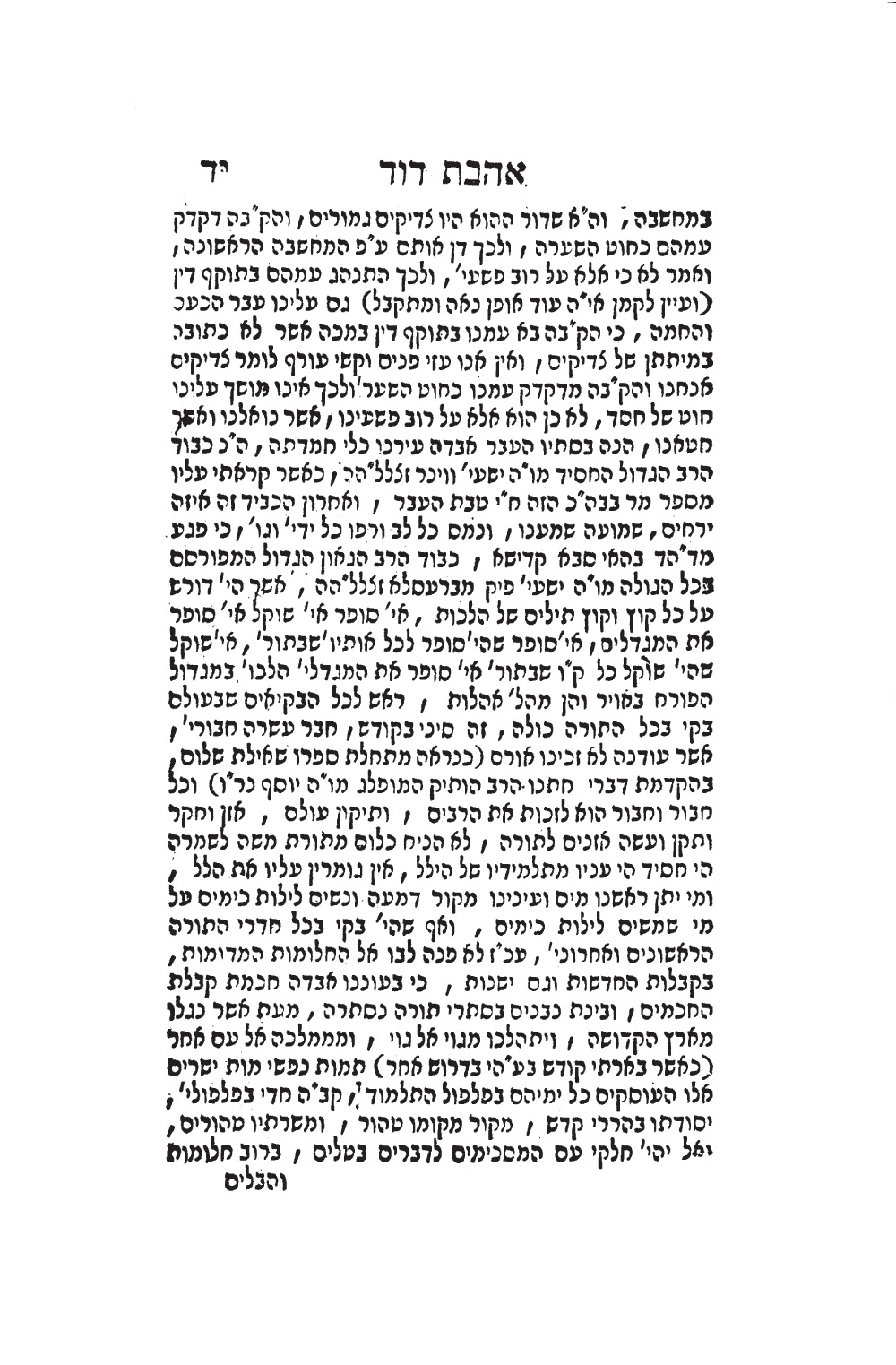
Another unique item
is Ahavat Dovid (lot
18) from R. Eleazar Fleckeles (see here)
which is series of derashot he gave against Shabbatai Tzvi and Jacob
Frank. In general, throughout R. Fleckeles
writings, there are interesting statements about Kabbalah and the Zohar
especially, in this work he prints a letter from R. Naftali Hertz Wessley which
says: 

כי שמעתי מפי הגאון המקובל הגדול שהי’ ידוע הזוהר וכל ספרי
האר”י ז”ל בעל פה הוא הרב ר’ יהונתן אייבשיטץ זצ”ל שהיה
אומר לשומעי דבריו בעיני הקבלה כשראה שהם מפקפקים בהם ואמר אם לא תאמינו אין בכך
כלום כי אין אלו מעיקרי אמונתנו, וכן היה אומר לאלו המביאים הקדמות מדברי קבלה
לישב איזה גמרא או מדרש לא חפצתי בזאת ומה חדוש על פי קבלה תוכל ליישב מה שתרצה
אמור לי הפשט הברור על ידי נגלה ואז אודך וכל זה אמת… 

This letter is
censored out of some of the editions of this work See Marc Shapiro, Changing
the Immutable
, p. 220.
Also worth
mentioning is his description of R. Yeshaya Pick in this work:
 
Some other first editions worth
mentioning are, Minchas Chinuch published anonymously in 1869 (lot 35), and
Nefesh HaChaim, Vilna 1824 (lot 86).
There
are many other noteworthy lots, including one incunabula (lot 17), and many
letters and other ephemera related to important pre-Holocaust Yeshivot,
including the Mir and Telshe and letters from R. Hayyim Heller, R. Kook,
Seridei Eish, R. Mordechai Banet. 
Hopefully this is just the first of many auctions for Legacy.


The Valmadonna Broadside Collection: a Review Essay

The Valmadonna Broadside Collection: Review essay
By Eliezer Brodt and Dan Rabinowitz

The Writing on the Wall: A catalogue of Judaica Broadsides from the Valmadonna Trust Library, edited by Sharon Liberman Mintz, Shaul Seidler-Feller and David Wachtel, London-New York: 2015, 320 pp.

Jews have been collecting books or manuscripts for centuries. A related category that is collected by fewer is ephemera, including broadsides, documents and letters of historical significance. Of late, a few annual auctions have included some of these documents among the other objects to be auctioned. Sadly, after their appearance in the auctions’ catalogs, most of the rare items disappear in to private collections and are invariably almost impossible to track down post-auction. The result is that a valuable amount of historical information is lost to the public. Moreover, to date, there is no database that tracks or records these items.[1]
First, a definition of the type of material – broadsides; they “are all around us whether we recognize them as such or not. Walking down the street… entering the lobby of a public building… we daily even hourly see flyers for event, advertising posters, public announcements and more.” Using “the most expansive conception we can say that the broadside has been with us since antiquity… The public display of information… has been ubiquitous for a very long time.” (p. 6).
In an important and excellent essay on Jewish bibliography written in 1976,[2] Professor Israel Ta-Shema remarks that because broadsides were intended and read by “thousands and potentially hundreds of thousands” they are among the “important sources for both Jewish history and the history of Hebrew printing.”

ענין לעצמו שלא זכה למיטב ידיעתי לשום טיפול עד עצם היום הזה, הוא רישומם הביבליוגרפי של ‘הדפים הבודדים’. לפי הערכות שקולות מגיע מספרם של אלה לאלפים רבים, ואולי עד כדי רבבה, וחשיבותן הן לידיעת תולדות ישראל והן לידיעת קורות הדפוס העברי גדולה ביותר. בדרך כלל קשורים דפים אלה במריבות בין חשובי הקהל ורבניהם, סכסוכי משפחות, בנים נודדים, פולמסים דתיים וכו’. דפים אלה שנתלו או הודבקו על קירות בתי הגיטו או בבתי הכנסת וכד’ אבדו ברובם המכריע, וכל מה שנשתמר מהם הוא בגדר יוצא מן הכלל. ערך ביוחד יש לסוג ספרותי זה ביחס לפולמוסים הפנים-חסידיים והמתגנגדיים. לסוג זה יש לצרף את המודעות והכרזות עד לתקופתנו אנו, כולל כרוזי המחתרות האנטי היטלריסיות בחו”ל והאנטי מנדטריות בארץ ישראל, כרוזי נטורי קרתא וכד’, שהם רבים מאוד. מלבדם נדפסו על דפים בודדים, קמיעות וסגולות, לוחות קיר, דברי פרסומת, הסכמות נפרדות ועוד, ויש ביניהם גם מעשיות עממיות קצרות על דף אחד. [מצוי ורצוי בביבליוגרפיה העברית, יד לקורא טו (תשל”ו), עמ’ 79-7 ].        

History is not the only subject to benefit from broadsides.  The prolific author, R. Eliyahu David Teomim (Aderet), published and annotated a broadside recording the customs of the Great Synagogue of the Austria, whose Rabbis had included R. Shmuel Edels (Maharsha).[3]  
Recently some of collectors of broadsides have begun printing and reproducing these priceless treasures.[4] The Valmadonna Trust Library (see here), still one of the most significant private Hebraica libraries (for an appreciation of the Valmadonna Library, penned by its librarian and published at the Seforim blog in 2009, see here), published a catalog of the broadsides in its collection, The Writing on the Wall: A catalogue of Judaica Broadsides from the Valmadonna Trust Library, edited by Sharon Liberman Mintz, Shaul Seidler-Feller and David Wachtel (see here). In conjunction with the publication of the catalog, the Trust also made available online (here) all of the documents in its collection for further study. The collection is comprised of broadsides from the sixteenth to twentieth centuries and incorporates items from Italy (the library generally focused on Italy and Italian items and broadsides are no exception, with Italian broadsides being the largest of the collection), and elsewhere in Europe, Israel, Yemen, Iraq, Constantinople, India, and even one from America.
The book consists of a few parts. It begins with five scholarly essays on specific subjects by various experts. Following are excellent full-page reproductions of thirty-six highlights from the collection, including a description explaining the significance of the specific document. A full catalog of the collection is included and is divided into six main categories; each category is chronologically ordered. The six categories are: Poems, Prayers, Documents from Within the Jewish Community, Documents from Outside the Jewish Community, Calendars and Education. Each entry includes a description of the item, the title, author place and date of printing, printer, size and language. Some entries include additional bibliographical sources; others provide a small image of the item. Additionally, the non-English broadsides included in the highlight section are translated. The volume concludes with various other useful indexes.
The first introductory essay is an excellent overview of Jewish broadsides by Adam Shear. Shear asks and answers the basic questions that come to mind, such as: “What was the purpose?”, “Who was the audience?”, “Where were they displayed?” and the like, none of which can be answered singularly.  
The second essay is by Elisheva Carlebach and focuses on the Jewish wall calendars in the collection.[5] She explores what can be learned from tracing the cultural history of one of the printers of these calendars through various calendars he printed. Some of these calendars were very sophisticated and it’s unclear who the targeted audience was. Emphasizing calendar broadsides’ unique value, she concludes that “the most ephemeral of forms, broadside calendars preserve a glimpse of the printshop as workspace, the spirit of entrepreneurship and the enduring values of the creators of these humble yet precious objects” (p. 30).
The third essay is written by Ruth Langer and focuses on the Liturgical Broadsides of the collection.  Some are prayers for current events, one of interest (printed on p.33) is for a memorial service for a building that collapsed in Mantua in 1776 where three weddings were taking place simultaneously.[6] Also discussed are the prayers for various civic events (p. 35) and for the various governing powers, a subject which still needs to be explored in depth. Some of these broadsides were clearly displayed in shuls; one includes the language of the prayers, defusing the power of bad dreams and request for substance, that are recited along with Birchat Cohanim (p.15), others include prayer that are recited during Selichot (p.14). One broadside, printed in Izmir in 1890, contains the Vidduy of Yom Kippur, printed with each entry of the Aleph Beis featuring other sins under that letter, very similar to the sheets given out in various shuls today (p.44). Not all were intended for the public display, the following broadside from Venice 1607 (Item # 153) appears to have been hanging in the house, for the owners’ personal use.
The next essay, by Dvora Bregman, focuses on the Hebrew poems in the collection (mostly from Italy). This section also highlights various pieces of historical interest. Reading through it, one is amazed how poems were written for literally every occasion – completion of Mishna, Venice, 1630 (p.55), receiving a medical degree (p.51, there are sixteen examples in the collection), in honor of R. Israel Chazan’s[7] visit to the old Greek synagogue in Corfu in 1853 (item # 134) (see below). Some of the poems were written after the deaths of prominent people such as an Italian elegy for R’ Moshe Zacuto which is reproduced in full and translated from Italian to English. Other elegies include one for R’ Yehudah Aryeh Modena (see below) and for R’ Mordechai Gerondi, the latter written by his friend Shadal (see below). There are also many “wedding riddles” in the collection – providing evidence of another rich and diverse aspect of Jewish life in Italy. 

The next section, originally written in Hebrew by Nachum Rakover and translated into English for this volume by Shaul Seidler-Feller, focuses on the Takanot broadsides found in this collection. Sumptuary edicts, limiting the size of a celebratory affair and the amount of people invited, the amount of food to be served, or the amount of money to be spent on various sorts of occasions were commonplace from the medieval until the modern period.  For example, we note that the Nodeh Beyhehudah and his beis din in Prague issued a list of such Takonot.[8] Rakover is in middle of preparing for publication a thorough study on the subject. In the volume under review, his article deals with the seventeen Italian broadsides related to sumptuary laws in the Valmadonna Collection from 1598-1794. The article is impressive in its sweeping review of the topic and the placement of these items within the larger narrative. What is apparent from the examples in the collection is that sumptuary laws have been persistent. Indeed, recently the cudgel has been taken up anew and a new round of such edicts by numerous rabbis and Hasidic leaders to limit spending has been promulgated. 
                                                  
Exploring the Collection
The introductory essays are only the beginning in what can be uncovered in a collection as rich as this one.  By providing online access, the Trust has insured that can occur.  To begin that exploration, we discuss a few choice examples.
As was recently the case with American Pharaoh, Jewish have been involved in sport, and specifically horse racing.  The collection includes two Italian broadsides discussing the horses and the Jewish sponsorship of a horse race. (Nos. 311 & 328).
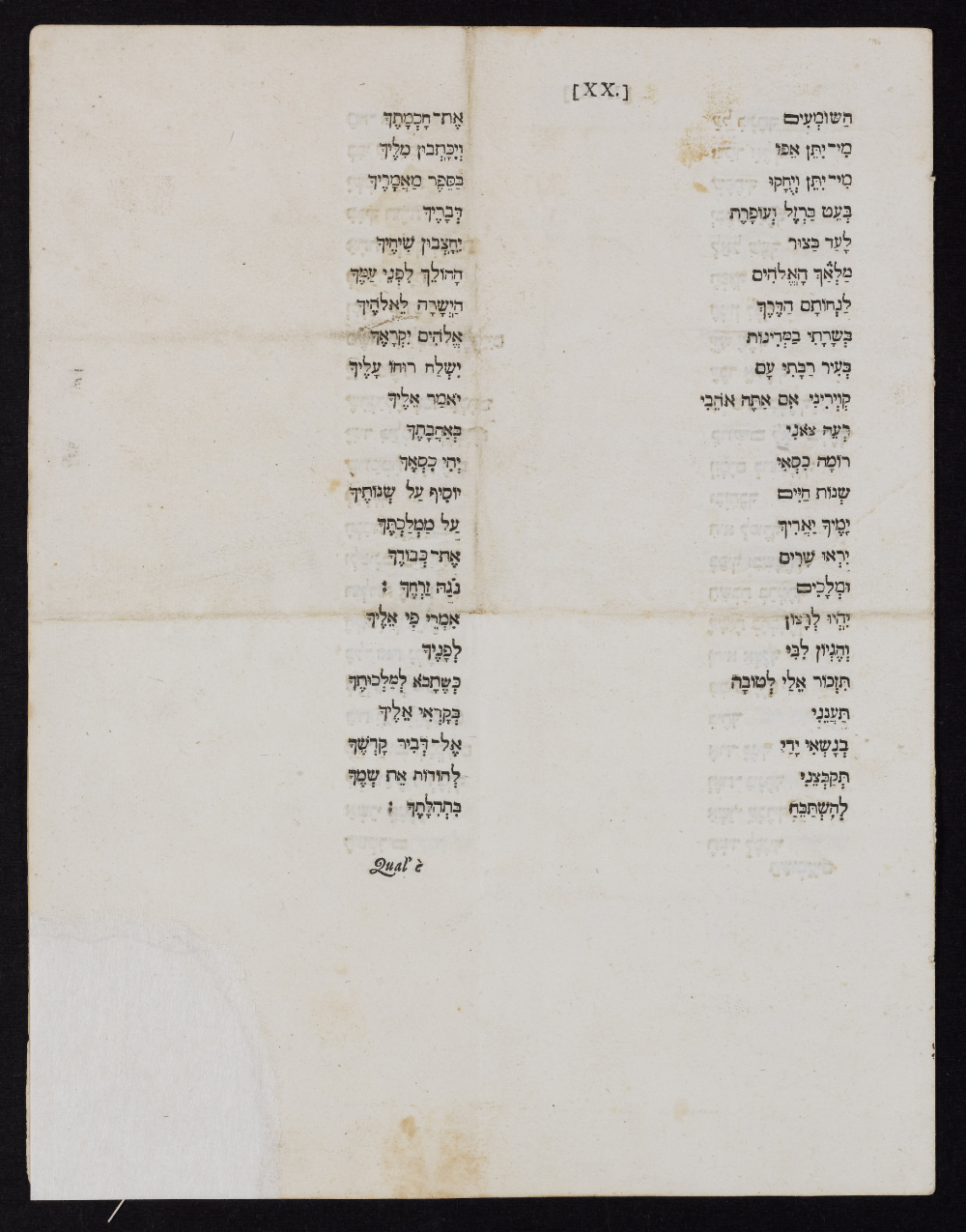
One surprising and lengthy – some ninety lines – ode was composed in Hebrew (ca. 1740) and is a “poem of praise and supplication addressed to Angelo Maria Quirini (1680-1755), an Italian Cardinal.”  This item is “a single bi[-]folio excised from a larger work, most likely a pamphlet,” and is “not a true broadside.” (No. 130). No additional information is provided on this intriguing item.[9]

Friday Night Candle Lighting Prayers

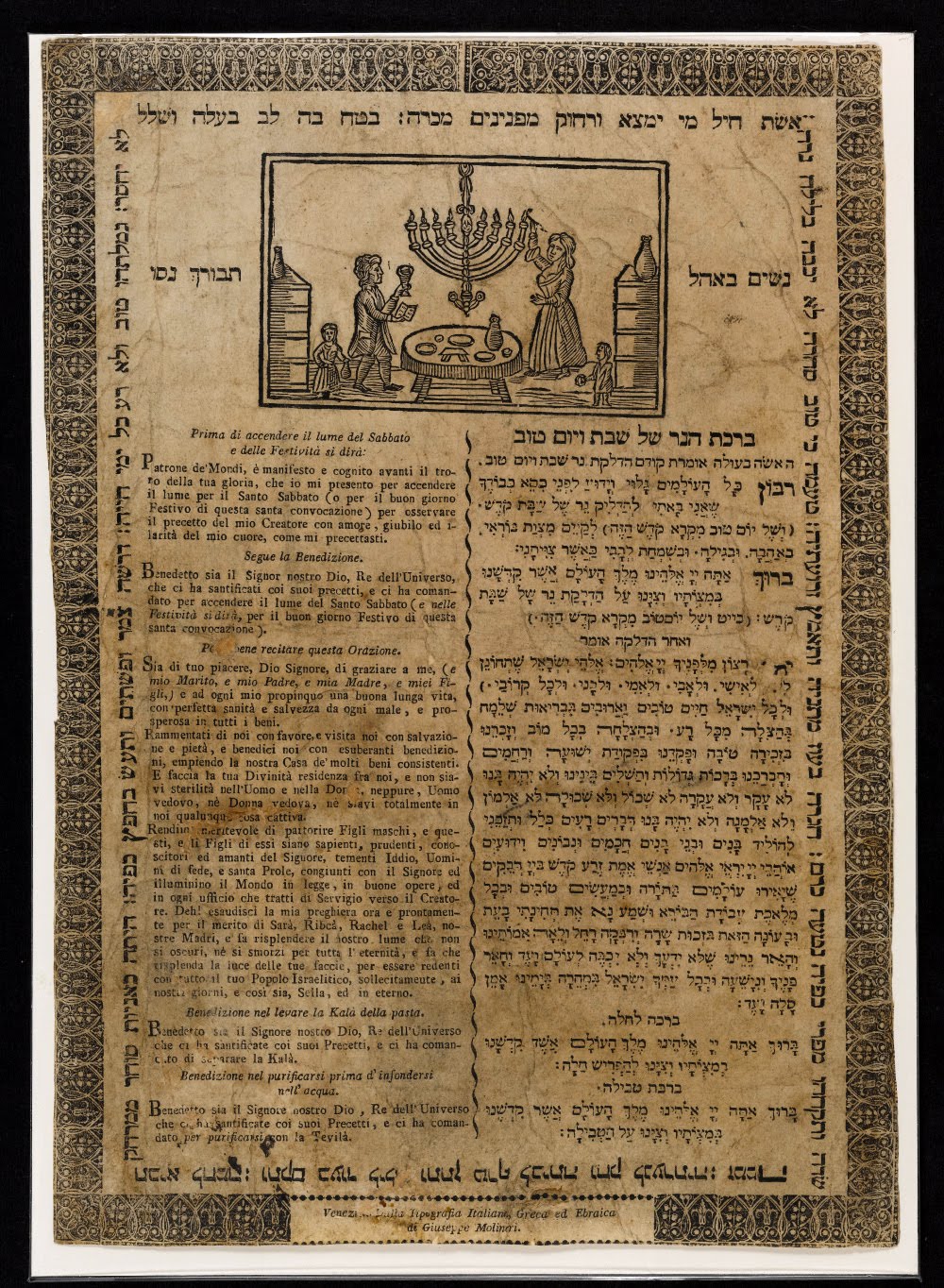
The following broadside from Venice 1835, (reproduced on p. 17), contains the text of the prayers that were customarily recited by women on Friday evening during the candle lighting ceremony.

The illustration depicts a woman lighting eight candles. The Rishonim, including Italian sources, Shibolei Haleket (Siman 59) and Sefer Hatadir (p.196), only require and discuss two candles for Shabbos.[10] The question is when exactly did people start lighting more? The exact time when this began is unknown. However, in the “Shulchan Aruch” from R’ Yehudah Aryeh Modenah (1571-1648) he describes the Italian custom of lighting multiple candles:
והנשים חייבות להדליק בבית נר של שמן ובתוכו לכל הפחות ארבע או שש פתילית להאיר בערב עד עבור חלק גדול מהלילה [עמ’ 54].
Some continued to advance the numbers and in the 19th century, one author records the custom of lighting 31, 45, and 52 candles weekly.
מה מאוד היה מכבד שבת ויום טוב והיה מנהגו להדליק בכל שבת ל”א נרות כמנין אל כי בו שבת אל מכל מלאכתו, ובסוף ימיו מ”ה נרות, ולפני מותו היה מצווה להדליק בשנה ראשונה בחדר שהיה לומד בו נ”ב נרות כל שבת [מה שהעידו על ר’ הירץ אברהם נפתלי שייאר בהקדמת נכד המחבר לפירושו תורי זהב, (על שיר השירים), ירושלים תשס”ג, עמ’ טז].
Corporal Punishment
The following broadside poster for the instruction of children is from Italy 1846 (125):[11]


One striking part of the image is of the teacher hitting children in school. This sort of practice is recorded in a number of Jewish texts.[12]  For example:

A 17th century autobiography recounts that “the new teacher was of an irritable temper… he hit me and put me to shame…”. [Alexander Marx, Studies in Jewish History and Booklore, New York 1944, p. 193].

R’ Yaakov Emden writes in his autobiography:
בשנות הילדות… אזכיר איזה גרגרים, שלשה דברים נוראים שקרו לי בימי ילדותי הרכות. … ומלבד המכות אשר הוכיתי בית מאהבי המלמדים אשר נמסרתי בידיהם ללימוד, היו על פי רוב אכזרים, היכוני בלי חמלה… [מגלת ספר, עמ’ 84].
Saul Berlin writes in his satirical work:
ומתועלת ההכאה עוד, כי הוא צד היתר למלמדים לקבל שכר, כי על הלמוד לבד אסור לקבל שכר, משום קרדום לחתו בו, ואם כן כל מלמד המרבה להכות הרי זה משובח… ועוד רבה התועלת ע”י ההכאה אשר הילדים מכים ולוקים בבית הספר, כי ליראתם את המכות קרבת מוריהם יחפצו וירבו עליהם מוהר ומתן למען חנות אותם, ובהגיע חודש ומועד יפצירו הילדים באבותם לתת להם משאת רב, להביא אל רבם לתתם לו כופר נפשם…”. [כתב יושר, [בתוך: יהודה פרידלנדר, פרקים בסאטירה העברית בשלהי מאה הי”ח בגרמניה, תל אביב תש”ם], עמ’  98].
R’ Yosef Kara writes:
שבהיותי בצוותא חדא אם כבוד ידידי הגאון הצדיק מו”ה שמעון סופר אב”ד דק”ק קראקא… והוא אמר ז”ל כי זה רע חולי שאין חפץ לגדולי לומדי תורה להיות מקרי דרדקי, כי הוא חרפה להם ע”כ מוכרחים אבות הבנים ליתן בניהם הקטנים אל איש אשר לא ידע ספר קרוא מקרא ודקדוק אך ידע להכות הבנים ולזעוק בקול גדול… [קול אמר קרא, פ’ פנחס, עמ’ 20].
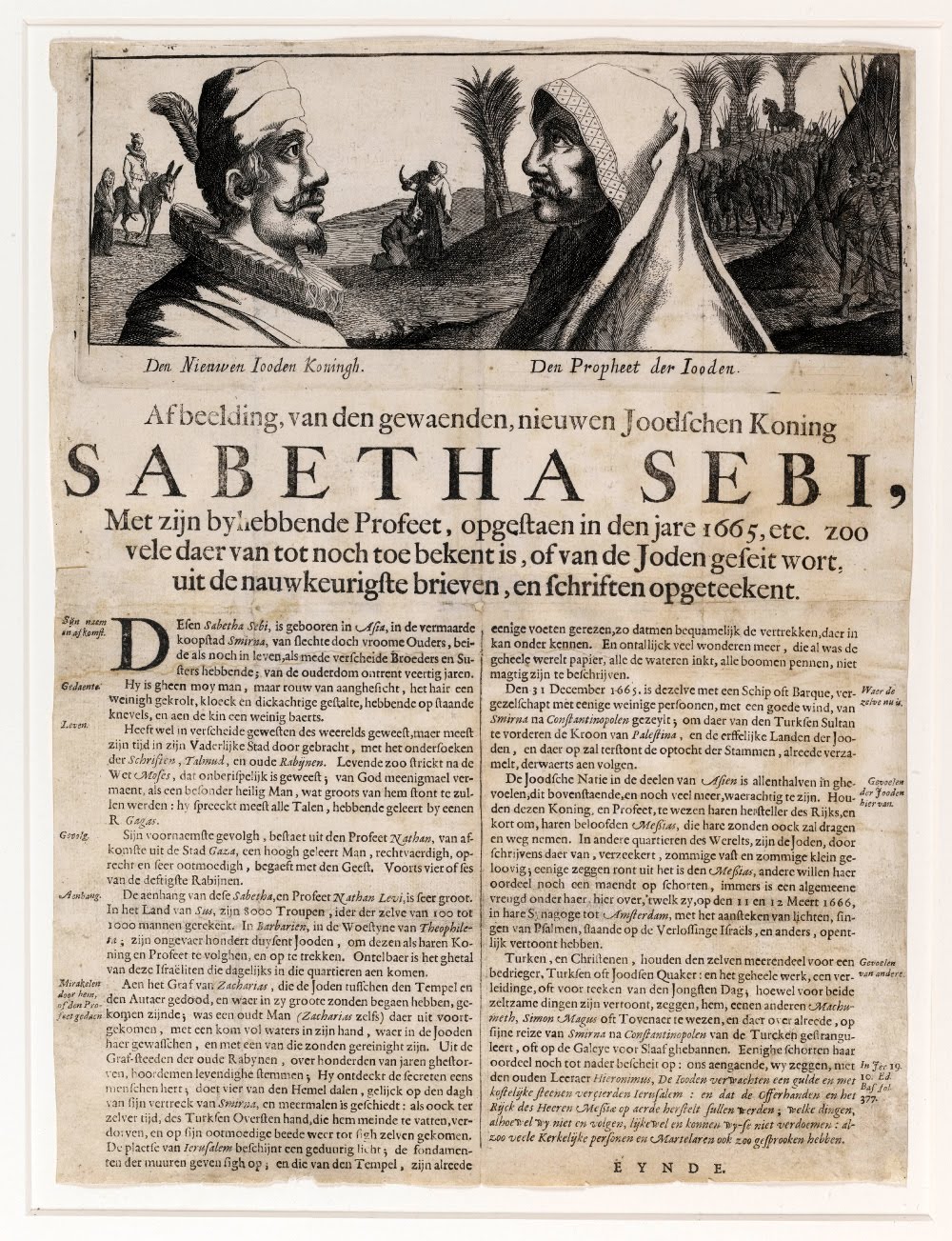
This broadside from Amsterdam 1666 is a little more famous, as it’s a supposed depiction of Shabbetai Tzvi. A complete translation for the Dutch is provided in at the appendix (pp.264-65).

Gershom Scholem writes that this portrait of Tzvi is fictitious – one of a number of imaginary portraits. (Sabbatai Sevi, pp. 190-191, 158). The only picture of Shabbetai Tzvi believed to be authentic (that is, drawn by a witness) is the one found in the beginning of Thomas Coenen’s book Ydele Verwachtinge der Joden, Amsterdam 1669.[13] There might be others as well, but King Jan Casimir ordered all pictures of him to be destroyed (id., p. 597). This one, fortunately, was published.

(This is from Scholem’s personal copy.)

Kabbalistic Tefilos for Rosh Hashanah


This broadside from Mantua 1790, reproduced in the book (p.43), is of interest for several reasons. First, the top part of the broadside has the twenty fourth chapter of Tehilim, said by many Kehilot on Rosh Hashanah as a segulah for Parnasa.[14] In a work written around 1700, recently printed from manuscript, we find the author writes:

אחר ערבית, יש לי תוכחת מגולה ומסותרת אם קצת משכילים, שהנהיגו לקרות בבית הכנסת בציבור אחר עלינו לשבח בלילי ר”ה, מזמור לה’ הארץ ומלואה, ולכוין הנקוד של השם, ככתוב בספר שערי ציון, שהוא מסוגל לפרנסה, שלא יפה הם עושים, כי לא כן צוה הרב המגיד לנו סוד זה, והצנועים נהגו לאמרו בשני הלילות שתי פעמים בכל לילה תכופים זה לזה… והקריאה על שולחנו קודם ברכת מזון… דבר הלמד מענינו, בהצנע לכת עם אלקיך. על כן אמרתי ימים ידברו, להויע ידידי הקורא שדבר בדוק ומנוסה שכל סגולה הנעשית על ידי תפלה בשום כוונה או שם, שאין לך לפרסמו ברבים. ולא לגלותו כי אם לתלמיד הגון ירא חטא ובלחישה, לבל היה מוליך רכיל מגלה סוד, שאז תהיה הפעולה חלושה… [ר’ כליפא בן מלכה, כף נקי, [לוד תשע”ד] עמ’ 167].

The second part of this broadside is also of interest, as it has the tefilos said before, during and after the shofar blowing, including some of the Kabblastic tefilos with names of angels. Of note is what is omitted here, those parts said between the various sets of Shofar blowing, which has been the subject of lots of literature[15], as it includes a very strange phrase, that seemingly evokes Jesus: ישוע שר הפנים””.
Here is an article written on this topic by R’ Shmuel Ashkenazi written in 1944 (!) under one of his pen names:

One more point related to this topic is a case of censorship. R’ Chaim Kraus writes:
 הנה בזכר יהוסף… מתיחס לזה שבדפוסים האחרונים בשו”ת תשובה מאהבה הושמט הענין הנ”ל שכתב בחריפות נגד אמירת היהי רצון שמות המלאכים… [מכלכל חיים בחסד, עמ’ סד].
However, upon checking the sources to see when in the printing of the sefer Teshuvah M’Ahavah this censorship took place, one is hard pressed to find it, as it’s simply not there. The actual issue is a bit different; Kraus misunderstood R’ Yosef Zechariah Stern’s teshuvah.
In an extraordinary teshuvah dealing with these prayers (Zecher Yehosef, Siman 210), R’ Yosef Zechariah Stern mentions a certain case of censorship:
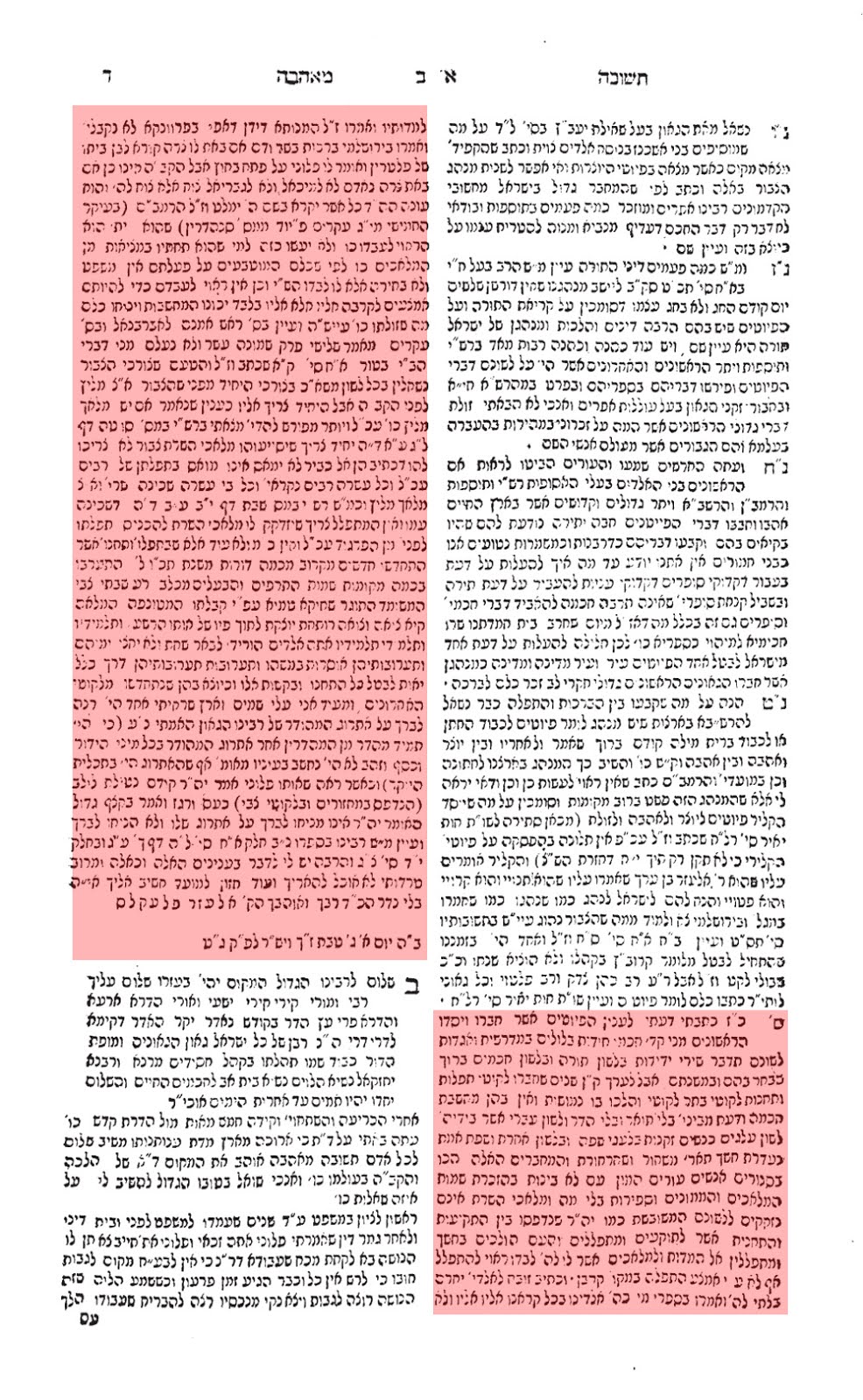
ובתשובה מאהבה ח”א סי’ א שהועתקה תשובתו בדבר הפיוטים ברוב המחזורים.. והמדפיסים להפיס דעת ההמון שהורגלו באמירת היהי רצון שבתקיעות השמיטו מה שהזכיר בסוף התשובה אות ס’ שמרעם בהזכרת שמות המלאכים… וכן השמיטו המדפיסים בהעתקתם מהתשובה מאהבה מה שהעיד מהנודע ביהודה שאחד היה רוצה לברך על אתרוג המהודר שלו וכשראה שאומר היהיה רצון… אמר איני מניחו לברך על אתרוג שלי…
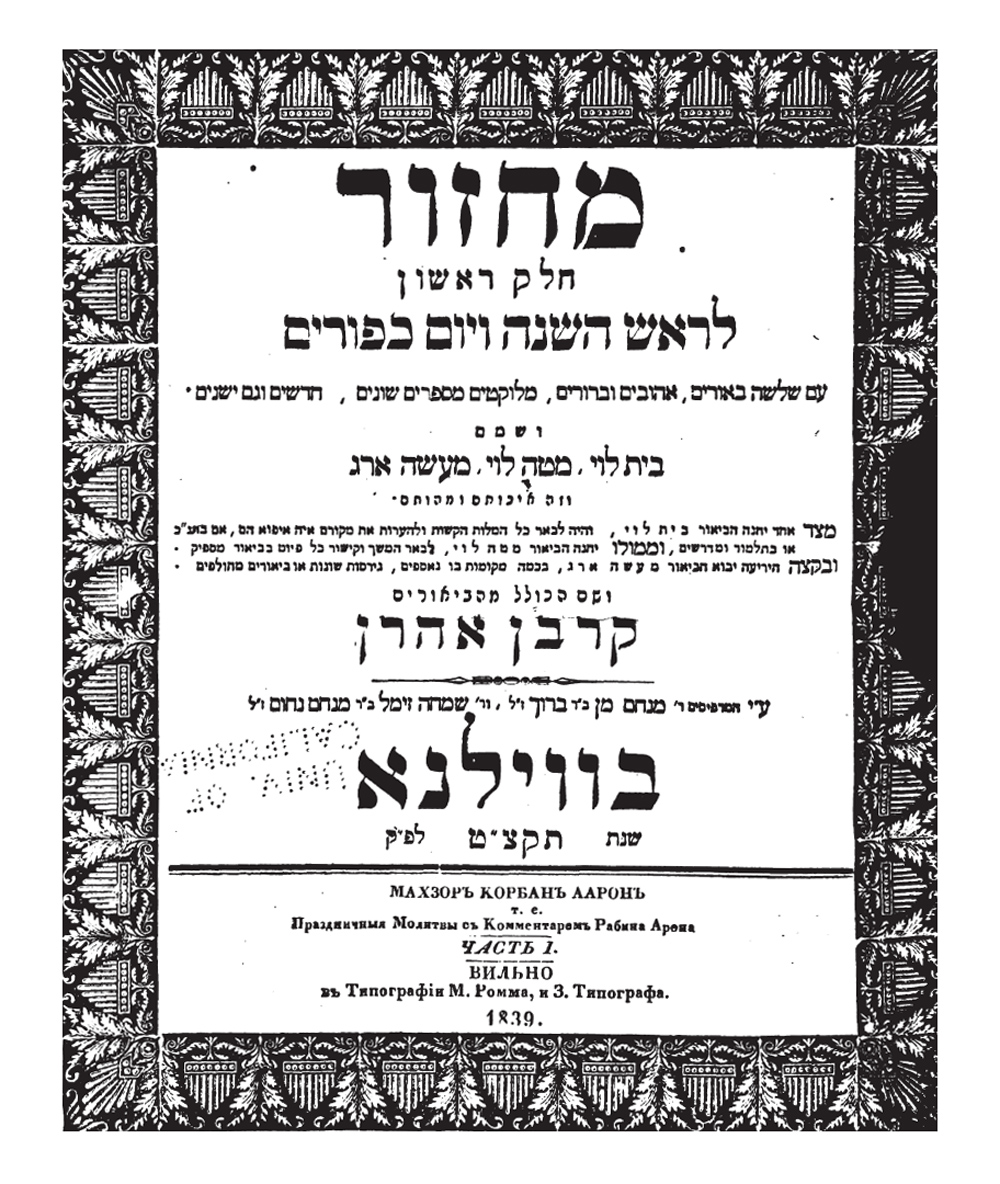
This Teshuvah was printed in various Machzorim at the time and that is where these parts of the teshuva were indeed bowdlerized. See the following images for the pages as they appear in the Korbon Aharon Machazor printed in Vilna in 1839 and compare with the first print of the teshuvah (Prague, 1809).

Amulet Broadsides


This image from Jerusalem 1870 (pp. 130-131) highlights another notable part of this collection – the Amulet section. It contains numerous broadsides against the “evil eye”, aimed at protecting the newborn mother from Lilith and the like (pp. 132-135, 141-143, 194-197). This is yet an additional set of documents which demonstrate how widespread it was for people to use amulets and the fear of the “evil eye” and the like.
There are numerous sources on regarding amulets, some mentioned here.[16] One source, that was only recently published in English, is from a fascinating memoir by Pauline Wengeroff, who writes: “for the same purpose of protecting the newborn, Jews used to affix kabbalistic prayers called shemaus over the head of the new mother, a second page on the door and a third between the cushion of the child.”[17]
Controversy against R’ Shlomo Ganzfried – Author of Kitzur Shulhan Aruch

This document relates to a controversy between R’ Shlomo Ganzfried and the R’ Chaim Halberstamm, the Divrei Chaim. In his work Ohali Shem on Gittin, R’ Ganzfried took issue with some legal rulings of the Divrei Chaim. This erupted into a series of small works from R’ Weber, starting in 1882, defending the honor of the Divrei Chaim. R’ Ganzfried responded to one of them in the back of the 1884 edition of his Kitzur Shulchan Aruch.
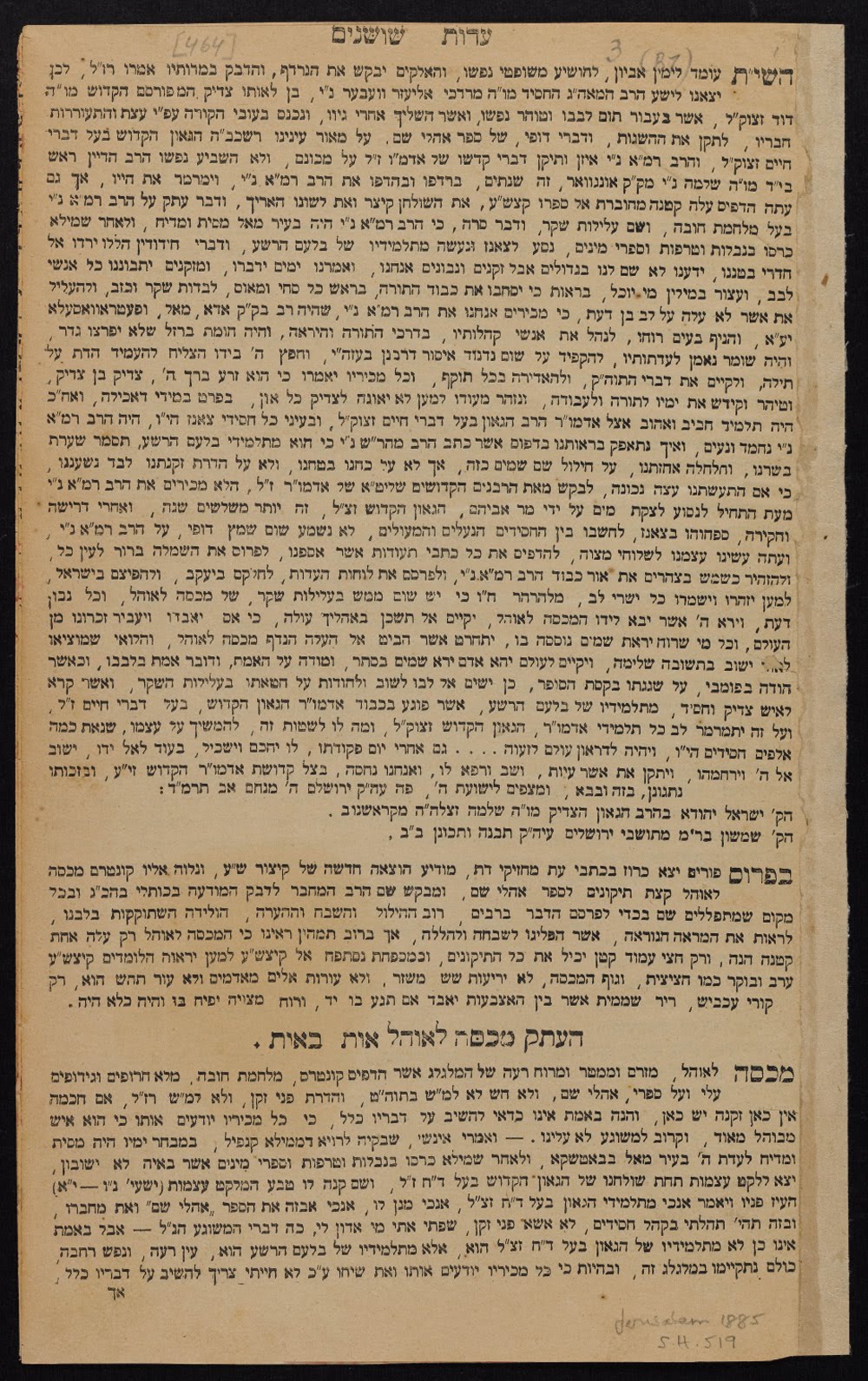
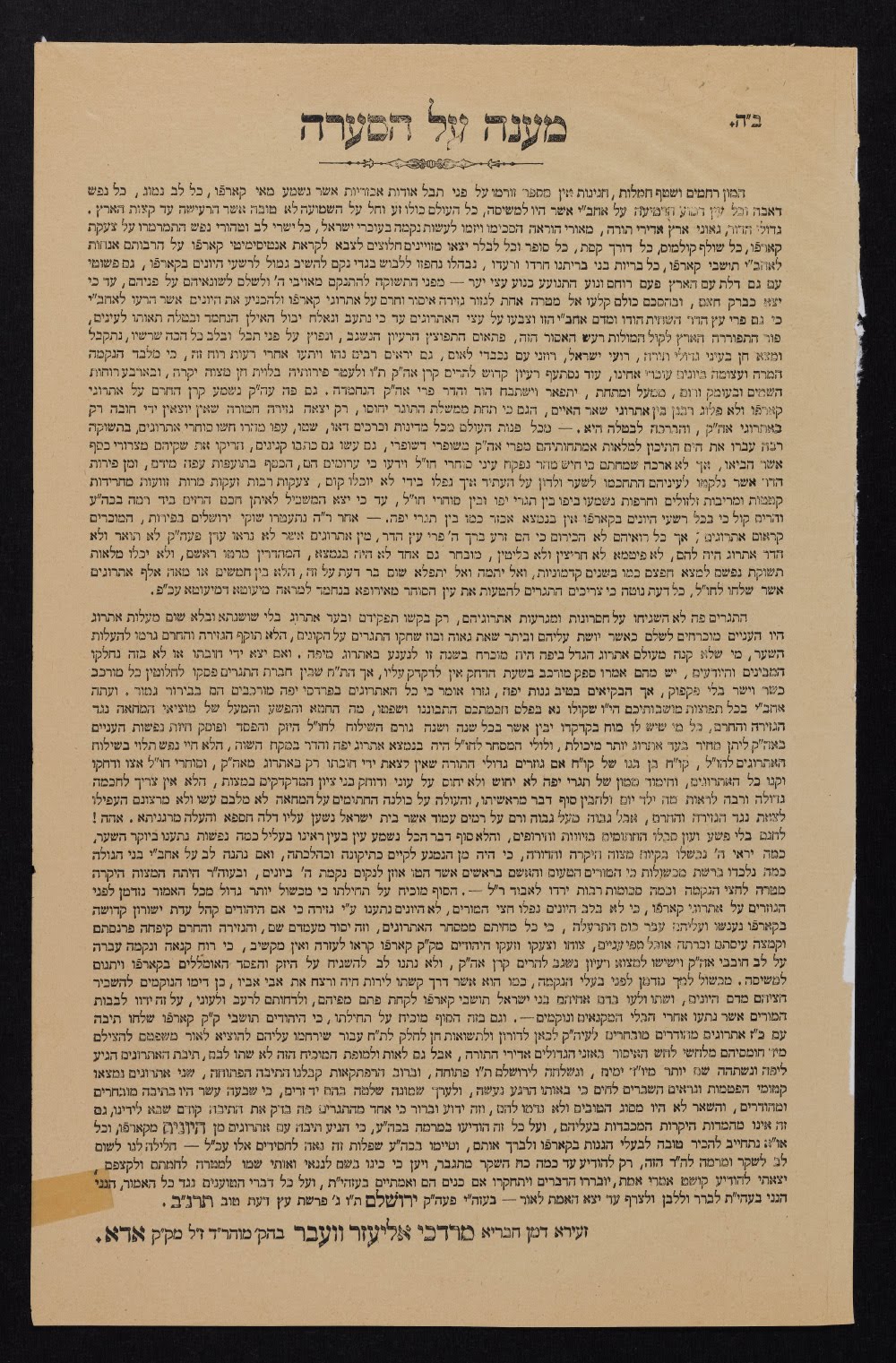
This broadside (above) from R’ Weber against R’ Ganzfried, found in the Valmadonna Collection, is very rare (p. 217 #360).[18] 
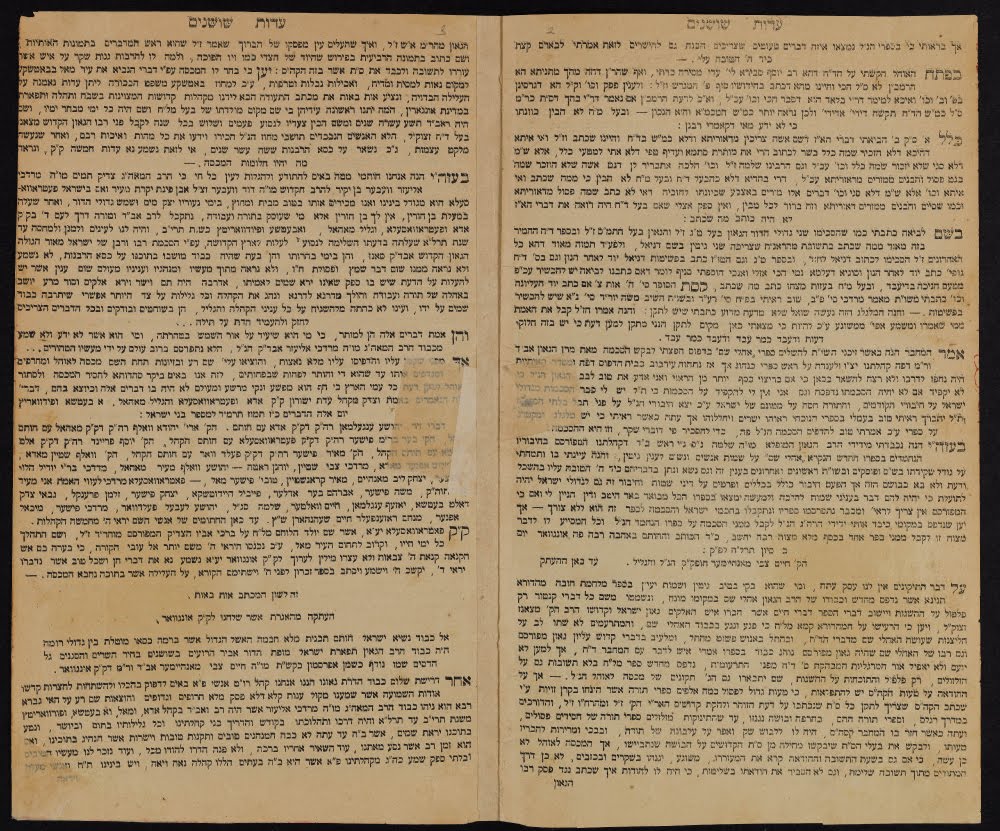
The Valmadonna Collection has another rare broadside from R’ Weber (below), related to the famous controversy of the Corfu Esrogim (p. 219 # 369).[19] This is not included in Naftali Ben Menachem’s otherwise comprehensive article regarding R’ Weber.

Regarding this broadside, it’s worth quoting the great historian[20] and native of the Old Yishuv, Eliezer Malachi:
ור’ מרדכי אליעזר וובר, הרב דאדא, זה האחרון היה אש לוהטת, ובקנאותו לא ידע גבול, עד שבשנת תרנ”א אסרו את אתרוגי קורפו לטובת אתרוגי ארץ ישראל, נלחם הוא להתיר אתרוגי קורפו ולאסור את אתרוגי ארץ ישראל שגדלים בפרדסי המושבות של חובבי ציון [מנגד תראה, עמ’ 225].
The volume is beautifully produced, the reproductions are excellent, and is available in a larger format “coffee table” size. This is a great volume, for collectors of books and history. It is available for purchase here and at the YU Seforim sale here.

[1] The Otzar Ha-Hochma database should be commended for including some auction catalogs in its archive, and even some broadsides, which will provide at least fragmentary information regarding the existence of these invaluable documents.
[2] This essay does not appear in Ta-Shema’s four volume collected writing, it is unclear why it was excluded. 
[3]  For more on this see: Eliezer Brodt, Likutei Eliezer, pp. 11-12.
[4] We discuss two broadsides related to the election of the Vilna chief rabbi between R. Hayyim Ozer and R. Y. Rubenstein (here).The Israel Musuem mounted an exhibit of broadside regarding Haredim.  See Pashkevilim, Wall Announcements and Polemic Posters in the Ultra-Orthodox Street, Israel Museum-Yad Ben Tzvi, Jerusalem: 2005 (Hebrew). This volume contains a number of introductory essays, and germane here, Menachem Friedman’s essay “The Pashqevil (Pasquinade) and Public Wall Poster/Bulletin Board Announcements in  Haredi (Ultra-Orthodox) Society” is especially important, although it is not cited in the Valmadonna volume.
[5] See the lengthier treatment of the topic in her book, Elisheva Carlebach, Jewish Calendar and Culture in Early Modern Europe (Cambridge, Mass.: Belknap Press of Harvard University Press, 2011.
[6]  See also p. 210 # 332.
[7]  On this great person, it is well worth quoting Professor Yaakov Sussman’s assessment in a footnote, in a book-length (175 pp) essay – one of the most important ones written in the past decade on the writing of Torah She-Bal Peh – where writes:

מסה מרשימה ביותר בבקיאותו, בחריפותו, בפלפולו בתקיפותו של המחבר לאורך כמאה עמודים גדושים, שבה סיכם כמעט כל מה שנאמר לפניו בנושא… בתשובה זו מתגלה המחבר כחכם בקי, תמים ובעל חושב ביקורתי כאחת, שכל רז לא אניס ליה, לא בספרות הרבני ולא במחקרי זמנו, והוא מצליח לגייס את ידיעתיו להגצת עמדתו… ואין פלא כלל שתשובה מרשימה זו כבשה במהרה את הלבבות והייתה למילה אחרונה בנושא ודעתו נתקבלה כמעט על כל החוקרים [מחקרי תלמוד, ג, עמ’ 235].
[8]  See Mofas Hador, pp. 37-40. See also Yerushaseinu 5 (2011), pp. 265-299; R’ Betzael Landau (here).
[9] We doubt that the composer was Jewish or the text was intended for a Jewish audience. Instead, similar odes – in Hebrew and the subject is Christian – appear in a number of Latin translations of Hebrew texts. See, for example, Coccejus’ Latin translation and abridgement of tractates Sanhedrin and Makkot, includes Hebrew poems in his own honor and that of his teacher. Duo Tituli Thalmudici Sanhedrin et Maccoth, ed. Joanne [Coccejus], Amsterdam, 1629, unpaginated introduction.
Another notable example of clerical citation is Cardinal Egidius de Viterbo who appears in Elijah Levita’s works.  See Solomon Buber, Tolodot Eliyahu ha-Tishby, Leipzig, 1856, nn. 15-18.
[10]  For more sources on this, see: Rabbi Oberlander, Minhag Avosenu Beyadneu, (Shonot), pp. 11-19; R’ Yechiel Goldhaber, Minhaghei Hakehilot, 1, pp. 174-175; Eliezer Brodt, Yerushaseinu 2 (2008), pp. 203-204; Rabbi Y.M. Dubovick, Minucha Sheleimah (2014), pp.26-27.
[11] The full document is translated in the appendix of the book (pp. 288-290).
[12] For additional sources on this subject, see S. Assaf, Mekorot le-Tolodot ha-Chinuch be-Yisrael, s.v. makot.
[13] Coenen’s book is a very important contemporaneous account of the messianic fervor surrounding Tzvi.  The book was translated from Dutch into Hebrew, Tzepiot Shav shel ha-Yehudim Kefi she-Hetgalu be-Demuto shel Shabbati Tzvi, Merkaz Dinur, Jerusalem, 1998. 
[14]  On this see: R’ Yechiel Goldhaber, Minhaghei Hakehilot, 2, pp. 31-33; Eliezer Brodt, Yerushaseinu 2 (2008), p. 211.
[15]  See R’ Yechiel Goldhaber, Minhaghei Hakehilot, 2, pp.61-65, where he traces how far back the custom of saying these Tefilos can be dated. See also Eliezer Brodt, Yerushaseinu 2 (2008), p. 214. The main work on this subject, collecting vast material, is R’ Chaim Kraus, MiChalkel Chaim Bechesed 2, (1982). See also R’ Zev Rabinowitz, Sharei Toras Bavel, p.12; R’ Chaim Lieberman, Ohel Rochel, 1, pp. 511-515; Y. Leibes, Mechkari Yerushalayim Bimachshevet Yisrael 6 (1986), pp. 171-195.
[16]  See also Eliezer Brodt, Likutei Eliezer, pp. 13-22, 69-72; Jewish Magic through the ages: Angels and Demons, edited by Filip Vukosvoviv, Bible land Museum, Jerusalem 2010.
[17]  Pauline Wengeroff, Memoirs of a Grandmother, 2, 2014, p. 89.
[18] On R’ Ganzfried, see R’ Y. Rubinstein, HaMayan 11:3 (1971), pp. 1-13; ibid. 11:4. pp. 61-78. See also Naftoli Ben Menachem, HaMayan 12 :1 (1972) pp. 39-42.  On this controversy, see R’ Rubenstein, ibid. pp. 10-11. On R’ Weber, see Naftoli Ben Menachem, in: Studies in Jewish bibliography, history, and literature in honor of I. Edward Kiev, Charles Berlin (editor), New York 1971, pp. 13-20. On this broadside, see Shoshanna Halevy, Sifrei Yerushlayim Ha-Rishonim, p. 188. On the other works by R’ Weber related to this issue, see ibid, pp. 156-157, 186-187, 219-220. See also Moshe Carmilly, Sefer VeSayif, pp. 264-265.
For an additional controversy between the Divrei Chaim and R’ Ganzfried see David Assaf, HeTzitz Unifgah, (2012) pp. 362-367.
About R’ Ganzfried and Chasidim, see Heichal HaBesht 3 (2003), pp. 105-117. For more on the Divrei Chaim’s methods of Pesak, see Iris Brown, Rabbi Hayyim Halberstam of Sanz: His Halakhic Ruling in view of his Intellectual world and the challenges of his time, (PHD Bar Ilan University) 2004 (heb.).
[19]  This is the subject of a future article. For now, see R’ Yosef Zechariah Stern, Zecher Yehosef, siman 232.
[20]  About Malachi, see Jacob Kabakoff, “Some Notable Bibliographers I have Known”, Judaica Librarianship, Vol.11 :1-2, (2003), p. 67-75.


Finders Keepers? The Itinerant History of Strashun Library of Vilna, Pt I

Finders Keepers? The Itinerant
History of Strashun Library of Vilna

by Dan Rabinowitz
            Since the 1990s, the issue of reparation of items looted by the Nazis has become a high-profile issue, with numerous successful attempts at reuniting owners with their stolen possessions. The recent movie, Monuments Men, fictionalized the
Allies’ post-war efforts that led to the locating some of these looted treasures. While some of the best-known examples of these recovered treasures are related to art, gold, or Swiss bank accounts, Hebrew books were also part of the Nazi’s appropriation scheme and were included in the items recovered after World War II. Some of the books recovered belonged to a unique institution, the first Jewish public library, and tracing the journey of these books, up to present day, parallels that of its patrons, tortured, uncertain, and yet despite all odds, surviving.
 
Matisyahu Strashun the Library’s Architect and Founder
 
Matisyahu Strashun[1] was born in 1817 in Vilna.  His family was among the Vilna elite.  His father, Samuel Strashun (also known as Rashash), whose notes/annotations – he never published a stand-alone work – to numerous classic rabbinic works, including Midrash Raba, Mishna, and Maimonides’ Mishna Torah, and Talmud Bavli.[2]  In terms of breadth, the latter is most
impressive, as his notes cover nearly every single page[3] of the Talmud Bavli.[4]
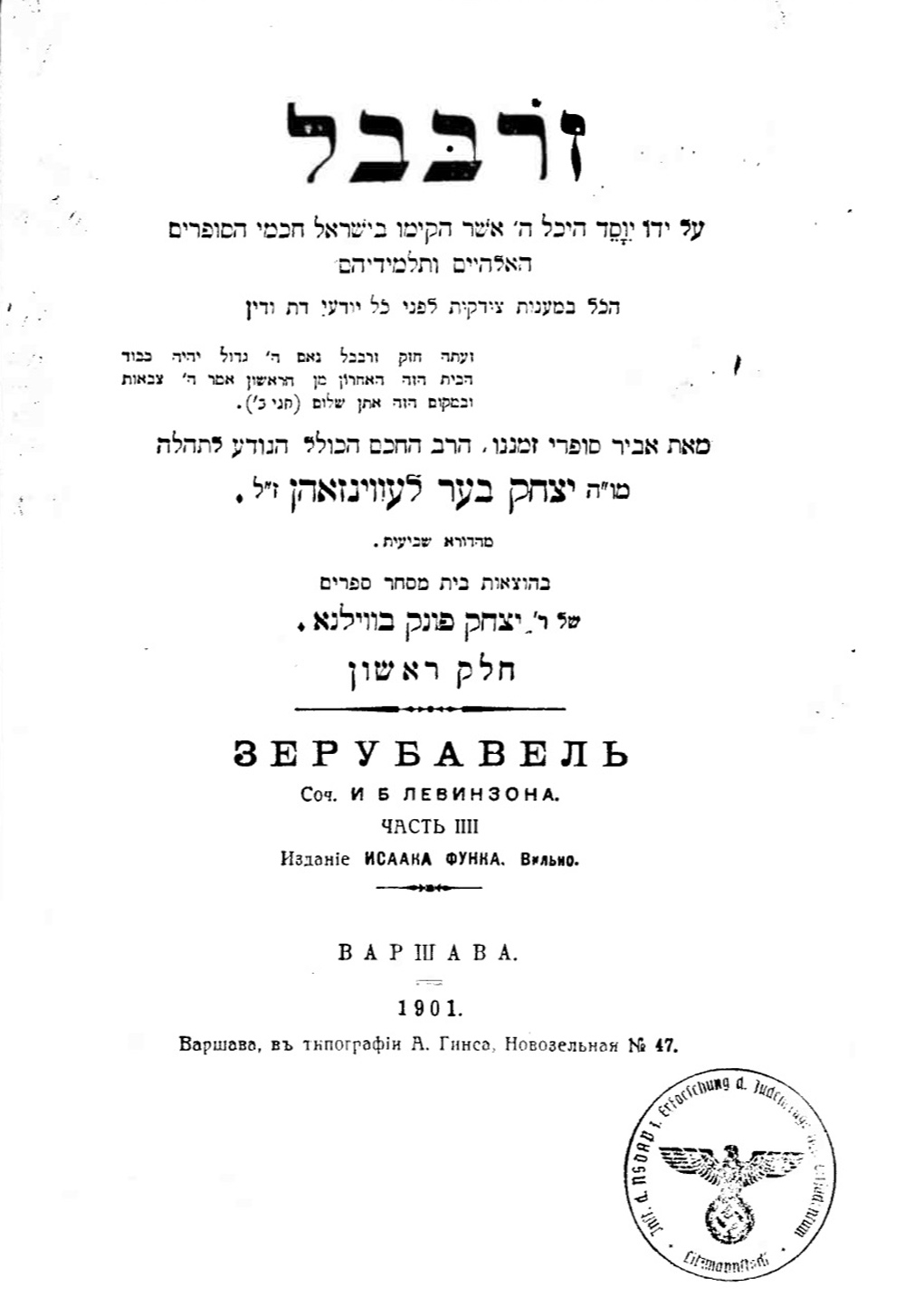
Matisyahu too was a Talmudist, his comments to Baba Batra and Eruvin are incorporated into the Vilna edition of Talmud Bavli, and was proficient in the entire corpus of rabbinic literature.[5] Matisyahu espoused views that were consistent with the haskalah movement.[6] For example, Matisyahu supported Max Lilienthal’s controversial attempt to reform “the Jewish educational system within the Pale Settlement,”[7] and Matisyahu help found and financially supported two schools in Vilna aligned with the haskalah.[8] Matisyahu corresponded with leaders of the haskalah movement, Isaac Ber Levinsohn, among others, and Strashun’s articles appeared in both rabbinic as well as haskalah newspapers and journals.[9] And, his home was a salon of sorts for traditionalists and the maskilim of Vilna.[10]
Strashun was independently wealthy and derived his substantial income from commercial and banking activities rather than rabbinic activities.  Yet he was considered a leader of the Vilna community.  He served on a number of communal institutions including the Vilna Tzedakah Gedolah.  And, at his death, he donated over 50,000 rubles to charity (approximately $1 million today). Leading Eastern European rabbis, R. Yitzhak Elchonon Spector and R. Jacob Joseph (later Chief Rabbi of
New York) among them, eulogized Strashun.[11] Posthumously, a street in Vilna was named after him.[12]
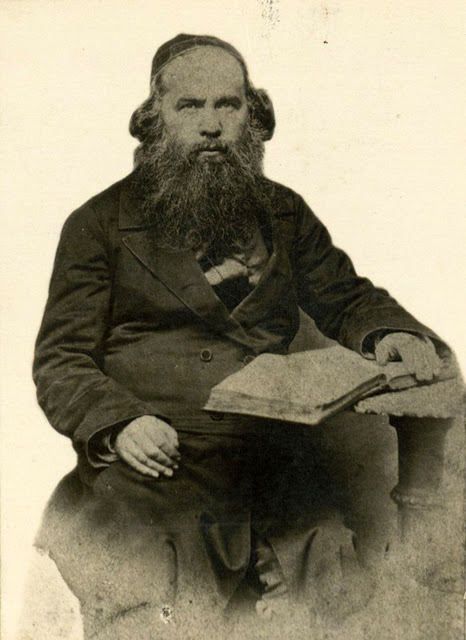
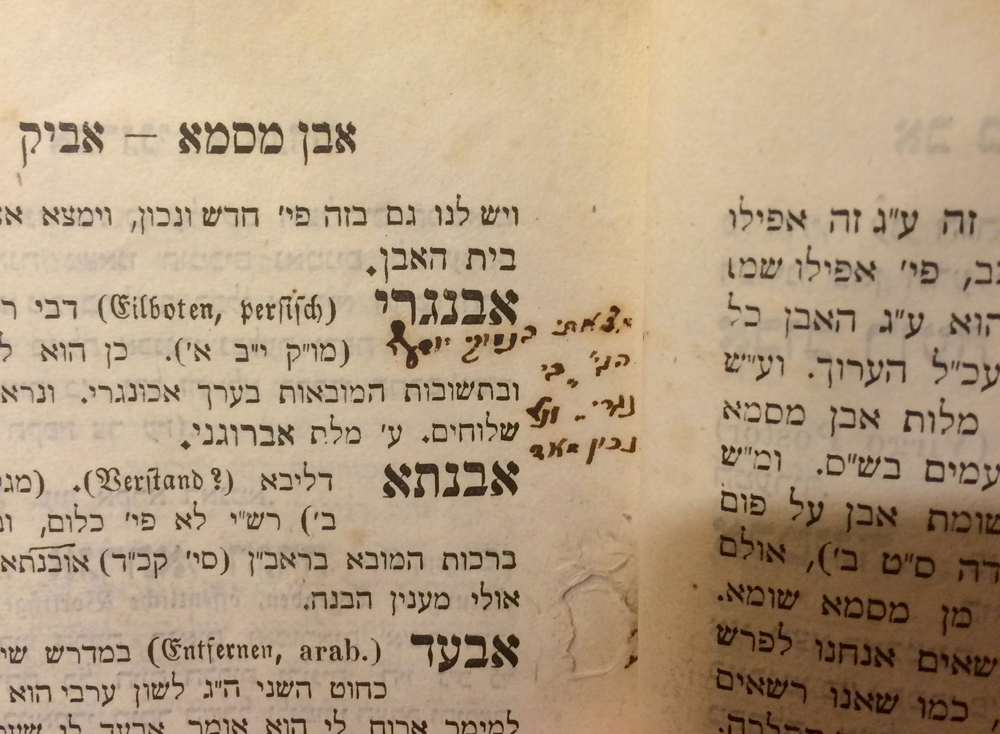
Throughout his life, he was an avid book collector, and, at the time of his death, amassed a collection of over 5,700 books and manuscripts.[13] His collection included incunabula, rare and controversial works (e.g. Me’or Eynaim), and manuscripts – from his father in addition to other authors. As reflected in his outlook during his lifetime, Strashun’s collection included rabbinic and haskalah works and books in non-Hebrew languages.[14]
During Strashun’s lifetime, numerous printing houses and bookstores populated Vilna, providing access to most contemporary books, including in languages other than Hebrew.[15]  But, unfortunately, we do not have much information regarding how and when Strashun amassed his collection that extended well beyond those contemporary books, beyond that when he traveled he took the opportunity to seek out and purchase books. For example, when he took therapeutic trips to the spa he also took that opportunity to seek out and purchasing books.  In addition to Strashun’s spa trips, in 1857 he went on a Rabbinic tour of Eastern Europe and visited R. Shlomo Yehuda Rappaport (Shi”r) in Prague and R. Tzvi Hirsch Chajes.[16] But, R. Rapahel Nathan Rabinowicz, a book dealer and noted book collector, commented after visiting Strashun that while Strashun’s collection was larger than Rabinowicz’s, his collection was richer in rare and older books.[17]


STRASHUN’S COPY OF SHIR’S EREKH MILIM


STRASHUN MARGINALIA TO EREKH MILIM
Creation of the Vilna Jewish Public Library
 
At his death in 1885, Strashun left no direct heirs.  He did, however, provide for the disposition of his library in his will.  In the past, those with large libraries had sold or left it to relatives,[18] Strashun elected a novel approach, rather than an individual or individuals he bequeathed his library to the Vilna Jewish community writ large, with instructions to establish a stand-alone public library.[19] His vision for the library was modeled on “the non-Jewish libraries that he saw [20] in the Diaspora.”[21] To that end, Strashun provided not only the books but also the funds to support the creation and sustainment of the library.[22]  Immediately the impact of this decision was apparent. At his funeral, among other enumerated good deeds and scholarship mentioned was, “the large library he left after death for the benefit of the community,” and which will “provide a
lasting legacy beyond that of any actual blood descendants.”[23]
            The creation of a public library out of Strashun’s personal collection was not a swift one, for seven years following Strashun’s death “the books remained under
lock and key” and were available only to those with special access.[24]  It remained in this state even though there were trustees and enough money to cover its operations.[25] Although the
library did not open to the public, the trustees were not idle during this time; and in 1889, published a complete catalog of Strashun’s collection.  His collection was comprised of 5,753 items, 63 of which contained marginalia in his hand.[26]
The Library is Open to the Public
 
In 1892, the Library was finally opened to the public. At the time, however, it remained in Strashun’s home.[27]  For years
after the library was opened to the public, in legal documents, the listed owner was not the Vilna community but one of the Library’s trustees. Although Strashun’s intent was clear – that the Library belonged to the community and not a trustee or any other individual – the Library’s legal status clouded that directive. In the late 1890s, there was a successful campaign to correct that issue, and the community becomes the sole owner of the Library, fulfilling Strashun’s wishes regarding ownership.[28]
The Library & Its Impact on the Vilna Community
 
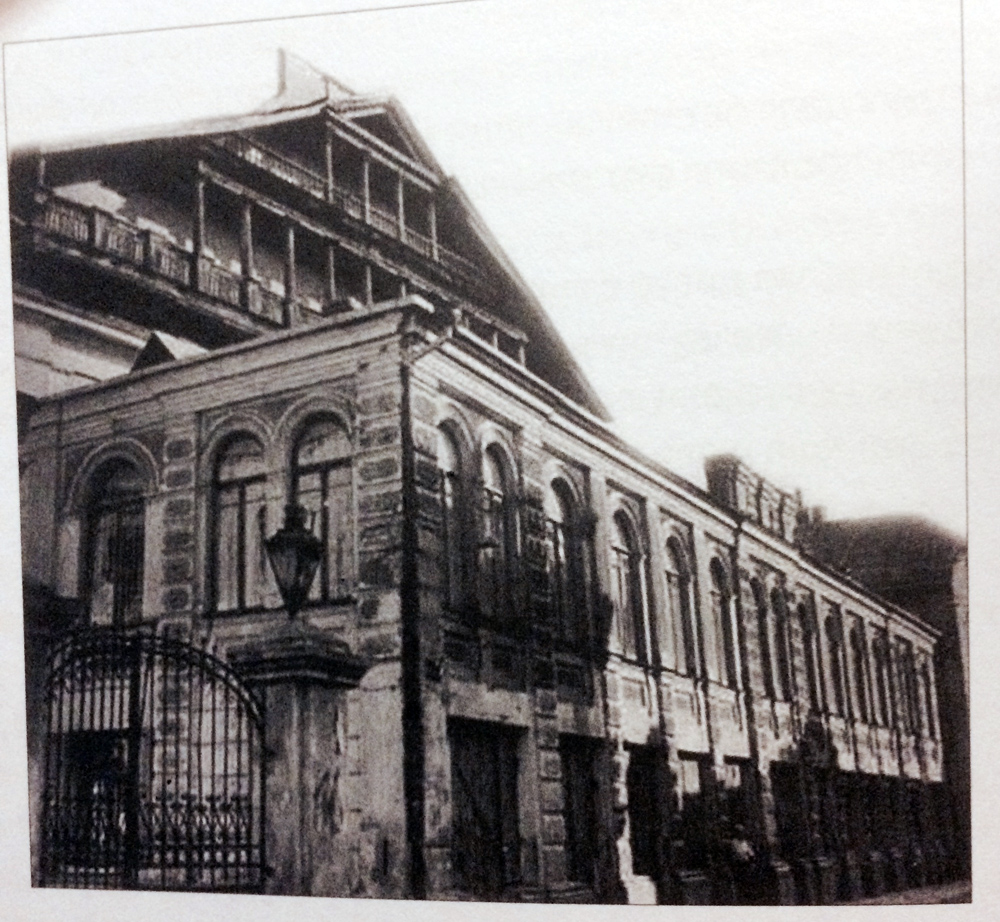
In 1902, the Library finally moved into a building of its own in the courtyard of the Great Synagogue of Vilna.[29]  From this
point forward, the Strashun Library would be one of Vilna’s most important institutions.
            The Strashun Library was a Jewish public institution and, to fulfill the needs of the public, additional steps were required beyond building and maintaining
infrastructure and clarifying ownership.
Specifically, although Strashun’s collection was substantial both in
terms of size and breadth, it was still the product of one man’s idea of a library.  For this reason, Hillel Noach Steinschneider, one of Vilna’s leading scholars and historians, pleaded with the public to donate books and ensure the completeness of the library and fulfill its mission of serving the entire community.  He acknowledged that Strashun amassed a very impressive private collection, but that for a public library his collection alone was insufficient because “it is lacking in books for people” whose interests did not align with Strashun’s.
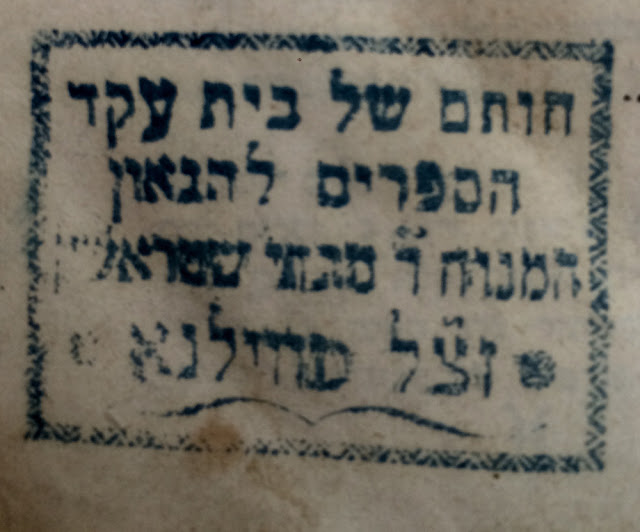
That is, a public library is not only a place open for all but also one that provides value for all.  Consequently, the library’s composition must reflect the entirety of its audience and not a single collector. Apparently, this plea was successful,[30] many Vilna scholars donated their collections to the Library in addition to the general public, and, by the 1930s, the Library had grown to over 35,000 volumes.[31] Additionally, Vilna’s Tzedakah Gedolah organization also provided funds for acquisitions.  Books acquired through those funds contain a special stamp or receipt.
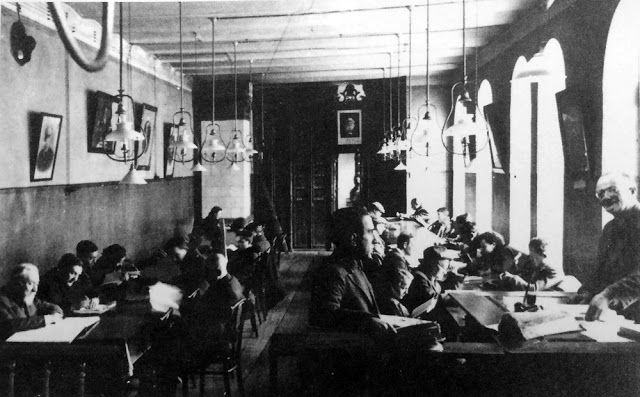
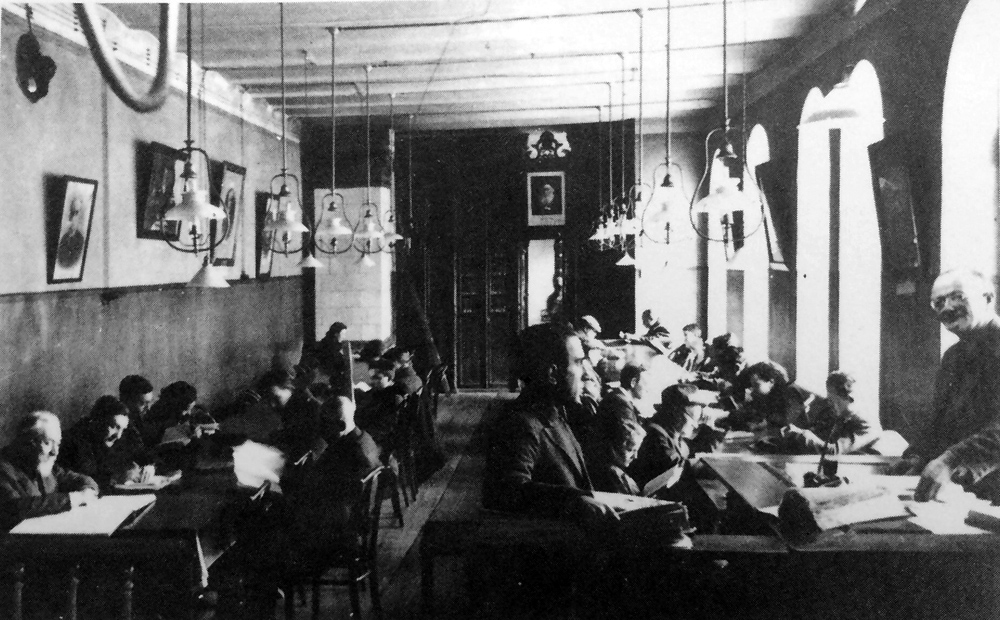
The Library was open seven days a week and became the central meeting location for the residents of Vilna.[32]  The Library’s visitors were representative of Strashun’s commitment to both traditional and modern ideas and ideals.  Patrons included “rabbis and talmudic scholars who were studying responsa and Halakhic
works” and who sat side-by-side with the “younger generation who were reading haskalah works.”[33] When dignitaries came to Vilna, the Strashun library
was a waypoint.[34]
 The intent was to have Herzl be the first visitor to the Library, however, the Russian government prohibited him appearing at the Library.[35]  Other famous Jewish personalities did visit and signed the guest book, known as the Golden Book, including Sholem Yankev Abramovitsh (Mendele Mokher Seforim), and Hayim Nachum Bialik, in addition to more traditionalists, R. David Friedman of Karlin, R. Shlomo Ha-kohen, and the Chafetz Chayim.[36] The Library was not only known for its visiting
Jewish celebrities, but also for its well-regarded holdings.  According to A.J. Heschel, it was the largest public Hebraic library in Eastern Europe reported holding over 40,000 volumes.[37]  On the one hand, the Strashun library was recognized as one of the greatest cultural institutions in Eastern Europe, on the other, like so many public institutions, the Library struggled to raise sufficient funds throughout the early part of the 20th century, consistently hampering its ability to maintain and build its
collections in addition to limiting its public access.[38]  But, it would not be funding that led to its demise but the Nazis and their campaign to appropriate Jewish cultural treasures.
The Nazi’s Looting of the Strashun Library
 
            During World War II, Vilna was occupied and controlled first by the Soviets, then the Lithuanian government, the Soviets again, and finally by the Germans.[39]  While under Lithuanian and Soviet rule, the Library had its share of challenges, but none
of those compared to the Nazi’s systematic campaign to identify, collect, and appropriate important Jewish treasures –specifically books – and, consequently, important libraries. The intent was that these pillaged libraries would supplement the already substantial Judaic holdings of Frankfort City Library.[40]  Immediately after the Nazis occupied Vilna, the Strashun Library as Vilna’s “oldest and perhaps most distinguished” library was identified as a target for this campaign.[41]
            Less than a month after occupying Vilna, the Nazis “enlisted” the Library’s librarian, Chakil Lunski, who had served in that capacity for over forty years, in addition to others, to select, identify and catalog important books including “the incunabula and manuscripts in the Strashun Library” to be sent back to Germany.[42]  Needless to say, Lunski was “distraught” that “he [was] supposed to help remove the treasures from ‘his’ Strashun Library that he protected for 45 years!”[43] Consequently, a number of books from the Strashun Library ended up in Frankfort, Germany.[44]


Post War Efforts to Reclaim Heirless Jewish Property 
 
            The Library’s building did not survive the war, but some of its books did.[45]  After WWII, the Allies recovered thousands of items the German’s looted and collected them at the Offenbach Depot outside of Frankfort.[46]  Much of what was recovered was likely heirless and the Allies faced with the dilemma of restitution. Initially, the Americans took the position that heirless property should return to the country from which it was looted.[47]  This position raised the specter of rare and important Judaica and Hebraica returning to Poland or even Germany.  This outcome was unacceptable to many Jews.[48]  Some elected to influence the fate of looted heirless books through traditional democratic means, others took matters into their own hands.[49]
Free For All? The Disposition of Other Significant European Libraries
 
The Strashun Library was by no means the only library identified at the Offenbach depot.  There were numerous other
libraries, both public and private that ended up at Offenbach, without any clear method of repatriation. This lack of clarity leads to inconsistent results at best.  Indeed, first-hand accounts of post-war Germany confirm the ad-hoc, doubtful legal grounds and sometimes completely lawless reparation regime in the post-war chaos.  In many instances, individuals made many of the decisions regarding disposition with little information and virtually to no oversight.
For example, Solomon B. Freehof, who himself amassed one of the greatest responsa collections in the 20th century, spent time in post-war Germany and encountered heirless property and describes attempts of repatriation. He indicates that
half of the heirless Jewish books recovered by the Allies went to the Jewish National and University Library (“JNUL”) at the Hebrew University (now the National Library of Israel),[50] which was “quite right” because some unnamed person or entity had determined “that clearly the [JNUL] should take the place of the vanished Jewish communities of Europe.”[51]
            Others agreed with Freehof that the natural repository for heirless books of European origin was the JNUL in Jerusalem.  Most notably, Judah Magnes, and the trustees of the JNUL wanted to recover and claim for the JNUL as much heirless Judaica as possible.  The JNUL dispatched Gershom Scholem, the eminent Kabbalah scholar, and bibliophile, to Europe to locate and return heirless property.  He discovered a significant number of important books and manuscripts in the Offenbach Depot
and did everything in his power, including employing very underhanded means, to repatriate items to Hebrew University.[52]
Initially, Scholem had a very difficult time securing authorization to even enter Germany and the Offenbach Depot.[53]  When he was eventually granted permission to view the contents of the Depot, it was with the explicit condition that he
could not remove any items.  But, for Scholem, some items proved too enticing.  Scholem identified a number of rare and important books and manuscripts.  He was concerned that if the disposition of these items were left to the Allied authorities the items would not end up in Jerusalem, but, instead, at the Jewish Theological Seminary, or some other institution, in the United States.  This was unacceptable to Scholem. To facilitate the transfer of these items to the JNUL, Scholem colluded with a Jewish American serviceman to smuggle the works out of Offenbach. Scholem placed the collection into five boxes but did not label
their contents and provided a fake name on the invoice.  The American serviceman personally ensured that the boxes were shipped to Paris, after which they were sent to the JNUL.  Eventually, the Allies found out about the theft, and demanded the return of the five boxes, even lodging a formal diplomatic complaint.  In the end, after much back and forth, the boxes remained at the JNUL.[54]
As germane here, eventually, the boxes’ content were cataloged and it was determined that a third of the works were not heirless – their ownership was clear and restitution was possible.[55]  Nevertheless, the content of the five boxes were incorporated into the JNUL.
Another example of unilateral ostensive benevolent restitution occurred with the “library of the prestigious Klaus synagogue of Mannheim, [that] ended up with U.S. Army Chaplin, Rabbi Henry Tavel.” Who, “on his own authority . . . shipped it to his alma mater, the Hebrew Union College in Cincinnati.”[56]
The Lost & Found: The Strashun Library Post-WWII
 
The determination regarding the disposition of the Strashun library after the Holocaust was no different from other heirless property, ad hoc and questionable.  Lucy Dawidowicz, worked for YIVO before WWII and spent time in Vilna.
After WWII, on behalf of the Jewish Distribution Committee after World War II, she went to the Offenbach Depot to assist with identification of heirless books.  Prior to coming to Offenbach, she had “promised [herself] that [she] would do [her] best to
safeguard the rights of possible owners and heirs.”[57]  And, when she came upon some of the remains of the YIVO collection,[58] she “was in a state of exaltation” and in a letter home wrote that she “had ‘a feeling akin to holiness, that [she] was touching something sacred.’”[59]
Dawidowicz also came upon books that she “could identify came from the Strashun Library.”  Whereupon she recalled “a
strange story” that the head of YIVO, Max Weinreich,[60] had told her “back in 1940.” Weinreich told her that during the brief period of time when the Soviets had returned Vilna to Lithuanian control, YIVO attempted to move its library out of Vilna.[61]  And, that “the trustees of the Strashun Library, also fearing for the sake of their library, asked the Vilna YIVO to ship [the Strashun Library] too.” Unfortunately, the shipment never occurred and both libraries remained in Vilna and ultimately plundered by the Nazis.
While the shipment never occurred, in Dawidowicz’s telling the attempted shipment was an irrevocable act with significant implications regarding the Library’s ownership.  She inferred that the Strashun trustees request to join the YIVO shipment also implicitly ceded ownership of the Strashun Library to YIVO. Thus, there she had no doubt regarding the proper disposition of the Strashun Library. Based entirely upon the “strange story” she heard, and even though according to her retelling the Strashun trustees had only intended YIVO to act as a shipper,[62] Dawidowicz told the Director of the Offenbach Depot that the heirless “remains of the Strashun Library ought to be considered as YIVO property.” She appealed to the Allied authorities and her position carried the day and the remnants of Strashun Library went to YIVO in New York.[63]
In a recent exhibit devoted to YIVO’s Strashun collection, the issue of the Strashun Library’s provenance is not discussed in any detail.  Instead, the book accompanying the exhibit simply states that all the remnants of the Strashun Library “were
rescued from the ruins of Europe and brought back to YIVO in New York in 1947.”[64] YIVO’s library catalog again implies that all the recovered books went to YIVO and links the disposition of the Strashun Library with that of YIVOs, the provenance note explains that “[t]he Strashun Collection, along with the YIVO Vilna collections, were liberated by the American Army, and
re-repatriated to YIVO in New York in April 1947.”[65]
            In reality, not all the remaining Strashun books went to YIVO, nor did everyone agree with the determination that YIVO was the rightful heir of the Strashun Library.
To be continued in Pt. II…


[1] For biographical information and sources see Tzvi Harkavy, Le-Heker Misphahot, (Jerusalem: Hotsa’at ha-Sefarim ha-Erets-Yisre’elit, 1953), 47-48 and n.79.
[2] A complete bibliography of his works, both published and unpublished, appears in Tzvi Harkavy, Le-Heker Misphahot, (Jerusalem: Hotsa’at ha-Sefarim ha-Erets-Yisre’elit, 1953), 45-46. Rashash’s comments on Rambam were printed in
Mekorei Rambam, first published in 1870 in Vilna, and while not a true stand-alone work, Rashash’s comments appear
alone, without the Rambam’s text.  See Mekorei ha-Rambam, Harkavy ed., (Jerusalem, Hatsa’at ha-Sefarim ha-Erets-Yisre’elit, 1957, Im ha-Madurah, and p. 59.
[3] For a list of the handful of pages he omitted, see Rafael Katzenellenbogen, Rash”sh le-Shitato, in Mekori Ha-Rambam Le-Rash”sh, ed. Harkavy, (Jerusalem, 1957), 64.
[4] For general biographical details on the Strashun family, see Frida Shor, From “Likute Shoshanim” to “The Paper Brigade” The Story of the Strashun Library in Vilna, (Tel Aviv: Ariel, 2012), 15-28, and the sources cited therein.  See also Shua Engelman, “Rabbi Samuel Strashun and his Haggahot on the Babylonian Talmud,” (PhD dissertation, Bar-Ilan University, 2009; Hebrew); regarding Samuel’s Talmudic annotations as compared to others, see Yaakov Shmuel Spiegel, Chapters in the History of the Jewish Book, Scholars & their Annotations (Ramat-Gan: Bar Ilan University, 2005), 421-22. Cf. Mordechai Zalkin, “Samuel and Mattiyahu Strashun: Between Tradition and Innovation,” in Mattiyahu Strashun, 1817-1885: Scholar, Leader, and Book Collector, (New York: YIVO Institute, 2001), 6-7.
[5] Moshe Shimon Anktokolski, Evel Kaved, infra n.12, 23.
[6] Mordechai Zalkin, “Samuel and Mattityahu Strashun: Between Tradition and Innovation,” in Yermiyahu Aharon Taub, ed., Mattityahu Strashun, 1817–1885: Scholar, Leader, and Book Collector (New York: YIVO Institute, 2001), 1-27. Samuel has made a very small number of comments that can be read to be consistent with ideas of the haskalah, but these do not approach Matisyahu’s active involvement with the movement, including his very public support of the movement.  Additionally, it is unclear if Samuel’s comments are simply limited to their specific context.
Indeed, the examples Zalkin provides regarding Samuel’s alignment with haskalah do not support Zalkin’s thesis. Id. at 25
n.10. First, Zalkin, cites Strashun’s comment in Gitten 6b, that “we find many amora’im who did not know how to read scripture” as proof of his “unorthodox” views.  But we find a similar statement from the medieval period.  See Tosefot, Bava Batra, 113a.  Zalkin’s second citation is to Rashas’s comments, Rosh ha-Shana 26a, “certain things that were uttered in a particular time and particular place are inserted by editors of the Talmud in their appropriate location in the text.” This misrepresents the Rashash.  Rashash is attempting to answer how the Talmudic sage, Levi, was unaware of an explicit verse as the TB in RH 26a implies.  Rashash explains that although there is no explicit mention of the time or place that this story occurred, Rashash posits that the story in Rosh Hashana occurred at the same time as another story with Levi, Yevamot 105a, where he had a moment of senility.
Rashash is not offering his opinion regarding the redaction of the Talmud, instead he is merely dating the story in Rosh ha-Shana. Finally, it is unclear the relevance of Zalkin’s third example, “you will find many contradictions between different locations is (sic) Rashi’s text.” Locating and alleging contradictions in Rashi is hardly remarkable.
[7] Zalkin, id., at 15.
[8] Shalom Pludermacher, Zikaron le-Hakham: Zeh Sefer Tolodot ha-Rav ha-Go’an, he-Hakham ha-Kollel Rabbi Matitayahu
Strashun Z’L
, in Mattiyahu Strashun, Matat-Ya, Haghot, Hidushim ve-He’arot Me’irot ‘al Midrash Raba Pri Eito Shel Matityahu Strahsun, (Vilna: The Widow and Brothers Romm, 1893), 15.
[9] A partial bibliography of Strashun’s articles appears in his Sefer Matat Yah (Vilna, 1893), 41-74 (Hebrew), available online here.  Reading, and certainly actively participating with, haskalah related newspapers was considered inconsistent with Ultra-Orthodox values and was grounds for expulsion from Volozhin Yeshiva. Shaul Stampfer, The Lithuanian Yeshiva, Revised & Expanded Edition,  (Jerusalem: The Zalman Shazar Center for Jewish History, 2005), 176.
[10] Aviva Astrinsky, “A Brief History of the Strashun Library,” in Yermiyahu Aharon Taub, ed., Mattityahu Strashun, 1817–1885: Scholar, Leader, and Book Collector (New York: YIVO Institute, 2001), i.
[11] Duberosh ben Aleksander Torsh, Me’arat ha-Makhpelah, shnei Hepadim . . ., (Warsaw, 1887), 50.
[12] Moshe Shimon Antokolski, Evel Kaved, (Vilna: be-Defus Avhram Tzvi Katzenellenbogen, 1886), 8; Tzvi Harkavy, Le-Heker Misphahot, supra n.1, 47.  During his lifetime he also donated to public institutions, among them, the yeshivot of Mir and Volozhin.  Id. at 24.
[13] Moshe Shimon Antokolski, Evel Kaved, supra n.12, 11.
[14] Mordechai Zalkin, supra n.6, 17-8.
[15] Hagit Cohen, At the Bookseller’s Shop, The Jewish Book Trade in Eastern Europe at the End of the Nineteenth Century,
(Jerusalem: The Hebrew University Magnes Press, 2006), 48-52.
[16] Shalom Pludermacher, Zikaron le-Hakham, 1893), 17. His meetings are reflected in Strashun’s ownership of their works.
See Likutei Shoshaim, nos. 386,1024,1178, 2522, 3352, 3650, 3781, 4377, 5399, 5592. Regarding other well-known Hebrew book collectors and their collections, see Alexander Marx, “Some Jewish Book Collectors,” in his Studies in Jewish History & Booklore, (New York, 1941), 198-237; Cecil Roth, “Famous Jewish Book Collections & Collectors,” in Essays in Jewish Booklore, (New York: Ktav Publishing House, 1971)330-35.
[17] “A Collection of Letter from Jewish Scholars to ShZH”H,” in Yad ve-Shem, reprinted in Yeshurun.
[18] David Oppenheimer’s library was the first library that was posthumously sold intact – to the Bodleian Library.  See
Alexander Marx, “Some Notes on the History of David Oppenheimer’s Library,” Revue des Études Juives 82 [=Israel Lévi
Festschrift] (1926): 451-460; Charles Duschinsky, “Rabbi David Oppenheimer: Glimpses of His Life and Activity, Derived from His Manuscripts in the Bodleian Library,” Jewish Quarterly Review 20:3 (January 1930): 217-247; Alexander Marx, “The History of David Oppenheimer’s Library,” in Studies in Jewish History and Booklore (New York: Jewish Theological Seminary of America, 1944), 238-255; and more recently in Joshua Teplitsky, “Between Court Jew and Jewish Court: David Oppenheim, The Prague Rabbinate, and Eighteenth-Century Jewish Political Culture (PhD dissertation, New York University, 2012); and Abraham Schischa, “Rabbinic Writings from the Collection of Rabbi David Oppenheim,” Yeshurun 31 (2014): 781-794 (Hebrew).
For other significant personal Hebrew libraries and their purchasing history, see Binyamin Richler, Hebrew Manuscripts: A
Treasured Legacy
(Clevland/Jerusalem: Ofeq Institute, 1990) 66-67.
[19] For earlier examples of private libraries see Nehemya Allony, The Jewish Library in the Middle Ages, Book Lists from the Cairo Genizah (Jerusalem:  Ben-Zvi Institute, 2006); S.D. Goitein, A Mediterranean Society (Berkley: University of California Press, 1967), vol. II, 206, 248; vol. V 3-4, 425.
[20] It is unclear whether Strashun meant this literally because while the 19th century witnessed the modern period of the public library, there were not any public libraries in Eastern Europe during Strashun’s lifetime.
[21] Shor, supra n. 4, at 26.
[22] Sefer Matat Yah, supra n. 9, at 35, listing Strashun’s bequests.
[23] Moshe Shimon Anktokolski, Evel Kaved, supra n.12, 17.
[24] Among those who had access during this time was Ya’akov Wallensky.  During this time, Wallensky was writing his supplement to Piskei Teshuvot on Yoreh De’ahPiskei Teshuvot itself is a collection of obscure and rare works discussing issues
appearing in Yoreh De’ah. Because Wallensky’s materials were even more obscure and rare, the only place he could access these was the Strashun Library. Ya’akov Wallensky, Daltei Teshuva, (Vilna, 1890), Introduction, 5-6, (link).
[25] Shor, supra n. 4, at 29
[26] Cf. Aviva Astrinsky, “A Brief History of the Strashun Library,” in Yermiyahu Aharon Taub, ed., Mattityahu Strashun, 1817–1885: Scholar, Leader, and Book Collector (New York: YIVO Institute, 2001), iii, who provides that his collection was only
comprised of 5,739 items.
[27] Shor, supra n. 4, at 29.  Regarding the conflicting reports of the Library’s locations during this period, see id., n.71.
[28] Shor, supra n.4, 32-3.
[29] While the Library moved to the new building in 1901, and its dedication ceremony occurred on April 14, 1902, it would not be until October 20, 1902, that the Library secured the necessary governmental permits to fully open to the public.  See Shor at 34-35.  The government license is reproduced in Layzer Ran, Jerusalem of Lithuania, vol. 2, (New York: Laureate Press, 1974),
346.
[30] Frida Shor, supra n.4, 51-65,174-87. See Berger, “The Strashun Library in Vilna,” in Zevi Scharfstein, ed., Hebrew Education and Culture in Europe Between the Two World Wars (New York: Ogen Publishing House of Histadrut HaIvrit BeAmerica, 1957), 513 (Hebrew), who discusses the varied subject matter of the Library’s collection.
[31] Id.
[32] According to one account, the Library had over 200 patrons daily, but only 100 seats, forcing people to share chairs and encounter waits of over a half-hour just to enter the Library.  Id. at 513.
[33] Ben Tzion Dinur, “Yerushalim de-Lita,” in Layzer Ran, Jerusalem of Lithuania, vol. 1 (New York: Laureate Press, 1974), XVI; but see the English translation of Dinur’s article that comingles the two groups and has both the Orthodox and younger generation studying “respona or modern Hebrew novels.”  Id. at XX.  It is unclear what accounts for this discrepancy in translation. Lucy S. Dawidwowicz, From That Place And Time, A Memoir 1938-1947, (New York: Bantam Books, 1991), 119, provides a remarkably similar account to Dinur’s (“On any day you could see, seated at the two long tables in the reading room,
venerable long-bearded men, wearing hats, studying Talmudic texts, elbow to elbow with bareheaded young men and even young women, bare-armed sometimes on warm days, studying their texts. The old men would sometimes mutter and grumble about what the world had come to. The young people would titter.”).
For a breakdown of the Library’s readership by type (i.e. students, academics and public intellectuals, workers, etc.), see Berger, supra n. 28, 514-15.
[34] See Shor, supra n. 4, 174, see also the description of David Wolfson’s Vilna visit, Israel Klausner, “The Zionist Movement in
Lithuania,” in Yahdut Lita (Tel Aviv: Am Hasefer Publishers, 1950), 522 (Hebrew). For a photo of one such visit, see Layzer Ran, Jerusalem of Lithuania, vol. 2 (New York: Laureate Press, 1974), 416.
[35] Shor, supra n. 4, 174-75.
[36] Berger, “The Strashun Library in Vilna,” at 519; Shor, MeLekutei, supra n. 4, 169; Khaykl Lunski in Yeshurin’s ‫ווילנע
(New York, 1935 – in Yiddish), p. 286-7
[37] Abraham Joshua Heschel, “Yerushalim de-Lita,” in Ran, Jerusalem, vol. I, XVII; David E. Fishman, The Rise of Modern Yiddish Culture (Pittsburgh, PA, University of Pittsburgh Press, 2005), 143, provides that the holdings of the Strashun Library prior to the Holocaust was comprised of “some forty thousand volumes.”
[38] See Shor, MeLekutei, 38-9; 42 (discussing a 1926 public appeal that the Library undertook where it described its financial condition as “dire and catastrophic”); id. at 43 (“The Strashun Library underwent many difficult financial periods throughout the nineteen years of Polish rule (10/9/1920- 9/19/1939).  But, it continued to major Vilna cultural institution.”).
[39] Shor, MeLekutei, 44-7.
[40] Sem C. Sutter, “The Lost Libraries of Vilna and the Frankfurt Institut zur Erforschung der Judenfrage,” in Lost Libraries, The Destruction of Great Book Collections Since Antiquity, ed. James Raven (New York: Palgrave Macmillan, 2004), 220-22.
[41] Id. at 223 & 224 discussing other Vilna Libraries that were targeted by the Nazis.  See also Dov Schidorsky, Burning Scrolls and Flying Letters (Jerusalem: Magnes Press, 2008), 165-201; David E. Fishman, The Rise of Modern Yiddish Culture (Pittsburgh, PA: University of Pittsburgh Press, 2005), 141-44; Frida Shor, supra n.4, 189-200.
[42] Sem C. Sutter, “The Lost Libraries of Vilna,” supra n.38, 224.
[43] Id. at 226.
[44] Berger, “The Strashun Library of Vilna,” at 517.  The books that were not deemed important we pulped or used as heating fuel. Schidorsky, supra 39, 182. The exact date of when the Strashun Library was transferred to Germany is unclear; however, it was some date after April 1943.  See David E. Fishman, supra n.39,173 n.9. Similarly unclear is the exact number of books that were sent to Frankfort.  Sem C. Sutter, “The Lost Libraries of Vilna,” supra n.38, 228.  But, according to Aviva Astrinsky, “almost all of the Strashun books were crated and shipped by rail to Germany.  Aviva Astrinsky, “Mattitayahu (Mathis) Strashun,” supra n.24, i.
[45] See Ran, Jerusalem, vol II, 522, for a photo of post-war building. For a discussion regarding the numbers of books that survived from the Strashun Library, see Frida Shor, supra n.4, 204-05.
[46]  Dov Schidorsky, supra n.39, 225, listing the countries and libraries who books were deposited at the Offenbach Depot. Sem C. Sutter, “The Lost Libraries of Vilna,” supra n.38, 229-32.
[47] Lisa Moses Leff, The Archive Thief: The Man who Salvaged French Jewish History in the Wake of the Holocaust (United
States:  Oxford University Press, 2015), 121.
[48]  Id. at 124-30, 136-40.
[49]  Id.
[50] Dov Schidorsky, supra n.39, 233, provides the numbers and location of heirless books returned by the Jewish Culture Reconstruction.  For a listing of U.S. institutions that received heirless cultural property from the Offenbach Depot, see Herman
Dicker, Of Learning and Libraries, The Seminary Library at One Hundred, (New York: The Jewish Theological Seminary, 1988), Appendix B. See also F.J. Hoogewoud, The Nazi Looting of Books and its American ‘Antithesis’. Selected Pictures
from the Offenbach Archival Depot’s Photographic History and Its Supplement,” Studia Rosenthaliana 26:1-2 (1992): 158-192; and F.J. Hoogewoud, “Dutch Jewish Ex Libris found among looted books in the Offenbach Archival Depot (1946),” in Chaya Brasz and Yosef Kaplan, eds., Dutch Jews as Perceived by Themselves and by Others (Leiden: Brill, 2001), 247-261.
[51] Solomon B. Freehof, On the Collecting of Jewish Books, (New York, NY: Society of Jewish Bibliophiles, [196-]), 17; regarding the books that Hebrew University received, and its efforts to locate and claim heirless works throughout Europe through its Otzrot Ha-Goleh committee, see Shlomo Shunami, About Libraries and Librarianship, (Jerusalem: Rubin Mass, 1969), 56-65; Zvi  Baras, A Century of Books, The Jewish National & University Library 1892-1992, (Jerusalem: Jewish National & Univ. Library,1992), nos. 94-101; Dov Schidorsky, supra n.39, 212-91.
[52] Dov Schidorsky, supra n. 39, 250-51.
[53] Id. at 248-50.  According to Scholem, Abraham Ya’ari, Scholem’s partner on behalf of Hebrew University and its Goleh ha-Otzrot program, returned to Israel, in part, because of the difficulty in securing the necessary authorizations to enter Germany.
Id. 248; 351.
[54] Id. at 250-51.
[55] Id. at 251 n.51.
[56] See  Druker, Of Learning and Libraries, 58.  Druker, however, concludes that Tavel’s unilateral decision “resulted in
no real harm.”  One wonders if any surviving heirs who had legal claims to the Manheim collection would reach the same conclusion.
[57] Lucy S. Dawidwowicz, From That Place And Time, A Memoir 1938-1947, (New York: Bantam Books,1991), 314-16.
[58] See David E. Fishman, supra n.39, 143-53 174 n.20, discussing the YIVO Library under the Nazis and its ultimate transfer to YIVO in New York.
[59] Id. at 318.
[60] For more information regarding Weinreich and YIVO, see id. at 126-39.
[61] Id.; for a fuller treatment of this attempt see Shor, From ‘“Likute Shoshanim”, 44.
[62] Aside from Dawidowicz’s telling, according to the documents that discuss YIVO’s efforts to save its library and the Strashun and the Lithuanian government’s response throughout this attempt, the Strashun Library is described as a Vilna community
library and not the property of one institution or another.  See Shor, From “Likutei Shoshanim”, at 44.
[63] Her argument has the perverse effect that the trustees attempt to save the library immediately resulted in completely losing control of the library.
[64] Aviva E. Astrinsky, Mattistyahu Strashun 1817-1885, Scholar, Leader, and Book Collector, YIVO, New York: 2001, ii, iv.  But, Astrinsky also indicates that YIVO recovered “a substantial part of the Strashun Library.”  Id. at i.  According to YIVO’s website, however, YIVO only received part of the Strashun Library and the remainder “were transferred to the library of the Hebrew University in Jerusalem. (link).
Similarly, Berger, “The Strashun Library in Vilna,” p. 517 claims that part of the Strashun Library went to YIVO and the other part to Hebrew University.
Beyond these unsupported statements, there is no evidence that any books from the Strashun Library were sent to the JNUL.  While the JNUL’s post-war efforts at obtaining heirless books are well documented, see supra, there is no mention of the Strashun Library.
Similarly, the JNUL catalog does not list any items whose provenance extends to the Strashun Library. It is possible that YIVO and Berger confused the JNUL with the Jerusalem Central Library discussed below.  Or simply conflated the Strashun Library with the numerous other European libraries that the JNUL successfully rescued.
[65] See, e.g., the YIVO catalog entry for Solomon Adret’s Hidushe Nidah leha-Rashba, Altona, [1737].


The Greatest Story in the Annals of Jewish Book Collecting

The Greatest Story in the Annals of Jewish Book Collecting
 By Jeremy Brown

Jeremy Brown is the author of New Heavens and a New Earth; The Jewish Reception of Copernican Thought. He writes on science, medicine and the Talmud at Talmudology.com 

As we approach the end of Masechet Yevamot in the Daf Yomi cycle, it seems appropriate to reflect on a legendary story in the annals of Jewish bibliography. This story involves King Henry VIII, the laws of Yevamot, and the greatest private Jewish library in the world.
About thirty years ago, while a medical student in London, I had the good fortune of visiting the Valmadonna Trust Library, that greatest of private Jewish libraries. (How I got there is another story for another time). And while there, I held the Talmud that certainly once belonged to Westminster Abbey. It may also have been owned by Henry VIII, who had brought a Bomberg Talmud from Venice in order to help him end his marriage to Catherineof Aragon, the first of his many wives. The story of Henry VIII’s purchase of the Bomberg Talmud – the first complete printed Talmud – actually hinges on Yevamot, and whether the rules of levirate marriage, or yibum, applied to him. 
Catherine of Aragon was actually a widow, having first been married to Henry’s younger brother Arthur. About six months after Catherine married Arthur he died childless, and in 1509 his older brother Prince Henry married his widow.  One more thing to know: Catherine claimed that her marriage to Arthur had never been consummated; this is important later in the story. (And here is an interesting historic footnote: it was Catherine’s parents, Ferdinand and Isabella who had expelled the Jews from Spain.)
By 1525, Prince Henry had become King Henry VIII, and has had one daughter with Catherine. He wanted a son, and now wished to marry Ann Boleyn. There was, however, a problem:  what was he to do with Catherine, his existing wife?  Divorce, remember, was tricky for this Catholic King. And here is where the Talmud comes in.  
Henry argued that his marriage to Catherine should be dissolved since it was biblically forbidden for a man to marry his sister-in-law. (Henry claimed years earlier that he could marry her because the marriage to his brother had not been consummated. See, I told you that was important information…)
But as we from Masechet Yevamot, the Bible commands a man to marry his widowed sister-in-law if his brother died without children. Since Arthur died childless, it could be argued that Henry was now fulfilling the biblical requirement of levirate marriage – known as yibum. If that was the case, the marriage was kosher and could not be dissolved
How was this conundrum to be resolved? Let’s have Jack Lunzer, the custodian of the library, tell the story. (You can also see the video here. Sorry about the ads. They are beyond our control.) 
As Lunzer tells us, the Talmud was obtained from Venice to help King Henry VIII find a way to divorce his wife (and former sister-in-law) Catherine, and so be free to marry Ann Boleyn. In fact, it’s a little bit more complicated than that. Behind the scenes were Christian scholars who struggled to reconcile the injunction against a man marrying his sister-in-law found in one part of the Bible, with the command to do so under specific circumstances, found in another. In fact the legality of Henry’s marriage had been in doubt for many years, which is why Henry had obtained the Pope’s special permission to marry.
John Stokesley, who later became Bishop of London, argued that the Pope had no authority to override the word of God that forbade a man from marrying his brother’s wife. As a result the dispensation the Pope had given was meaningless, and Henry’s marriage was null and void. In this way, Henry was free to marry.  But what did Stokesley do with the passages in Deuteronomy that require yibum?  He differentiated between them.  The laws in Leviticus, he claimed, were both the word of God and founded on natural reason. In this way they were moral laws; hence they applied to both Jew and Christian.  In contrast, the laws found in Deuteronomy, were judicial laws, which were ordained by God to govern (and punish) the Jews – and the Jews alone. They were never intended to apply to any other people, and so Henry’s Christian levirate marriage to Catherine was of no legal standing. There was therefore no impediment for Henry to marry Ann. As you can imagine, this rather pleased the king.
It remains unclear whether the Valmadonna Library Bomberg Talmud is indeed the very same one that Henry had imported from Venice. According to Sotheby’s and at least one academic, it actually came from the library of an Oxford professor of Hebrew, who bequeathed it to the Abbey. In any event, a Bomberg Talmud lay undisturbed at Westminster Abbey for the next four hundred years.  How Lunzer obtained it for his library is possibly the greatest story in the annals of Jewish book collecting. In the 1950s there was an exhibition in London to commemorate the readmission of the Jews to England under Cromwell. Lunzer noted that one of the books on display, from the collection of Westminster Abbey, was improperly labeled, and was in fact a volume of a Bomberg Talmud. Lunzer called the Abbey the next day, told them of his discovery, and suggested that he send some workers to clean the rest of the undisturbed volumes.  They discovered a complete Bomberg Talmud in pristine condition, and Lunzer wanted it. But despite years of negotiations with the Abbey, Lunzer’s attempts to buy the Talmud were rebuffed.  
Then in April 1980, Lunzer’s luck changed. He read in a brief newspaper article that the original 1065 Charter of Westminster Abbey had been purchased by an American at auction, but because of its cultural significance the British Government was refusing to grant an export license. Lunzer called the Abbey, was invited for tea, and a gentleman’s agreement was reached. He purchased the Charter from the American, presented it to the Abbey, and at a ceremony in the Jerusalem Chamber of Westminster Abbey the nine volumes of Bomberg’s Babylonian Talmud were presented to the Valmadonna Trust. It’s a glorious story, and it’s so much better when Lunzer himself tells it, as he does here: (You can also see the video here,and end it at 14.35. We continue to apologize for those ads.)

The Valmadonna Trust Library – all of its 13,000 books and manuscripts, including the Westminster Abbey Talmud, is now on sale at Sotheby’s in New York. It can be yours for about $35 million.  But if you buy it, you must agree to two conditions set by Lunzer: that the Library remain whole, and that it be made available to scholars. In that way, just as I once held that magical Talmud, others may continue to do so.