Daf Yomi: Seforim on Masseches Taanis

Daf Yomi: Seforim on Masseches Taanis
By Eliezer Brodt

Daf Yomi just started learning Masseches Taanis this week.  Earlier today I had a conversation with Rabbi Moshe Schwed of All Daf.  The purpose of the conversation was for me to briefly highlight some of the Rishonim and Achronim “out there” on this masechtah, adding some tidbits of interest about them. A nice amount of the conversation was devoted to discussing if Rashi on Taanis is by Rashi or not.

We recorded it and it’s available for viewing here and here.

It’s only a half hour long. Many aspects could have been discussed at greater length but R. Schwed had mercy on potential listeners!

This is an experiment which we are trying on the Seforim Blog and we hope to have other presentations from others over time. Feedback or comments of any sort are appreciated.

This is the fourth such conversation I have had with him of this kind this year (earlier we discussed Yerushalmi Shekalim [here], Yoma [here], and Rosh Hashanah here).


Daf HaYomi: Seforim on Masseches Rosh Hashanah

Daf Yomi: Seforim on Masseches Rosh Hashanah

By Eliezer Brodt

Daf Yomi just started learning Masseches Rosh Hashanah this week. This past Monday evening I had a conversation with Rabbi Moshe Schwed of All Daf.

The purpose of the conversation was to briefly highlight some of the Rishonim and Achronim “out there” on this Messechtah, adding some tidbits of interest about them. We recorded it and it’s available for viewing here or here.

It’s only half an hour long. Many aspects could have been discussed at greater length but R. Schwed had mercy on potential listeners!

This is an experiment which we are trying on the Seforim Blog and we hope to have other presentations from others over time. Feedback or comments of any sort are appreciated.

This is the third such conversation I had with him of this kind this year (earlier we discussed Yerushalmi Shekalim [here] and Masseches Yoma [here]).


Zafenat Pane’ah—A Further Example in the Titling of Hebrew Books

Zafenat Pane’ah—A Further Example in the Titling of Hebrew Books
by Marvin J. Heller[1]

Pharaoh called Joseph’s name Zafenat Pane’ah and he gave him Asenath daughter of Poti-phera, chief of On, for a wife. Thus Joseph emerged over the land of Egypt (Genesis 41:45). Zafenat: Zafenat Pane’ah. This name means decipherer of the cryptic (revealer of secrets). There is nothing similar to pane’ah in Scripture (Rashi).

The titling of Hebrew books is a beguiling subject. It has been addressed in several works and I too have addressed the subject in a number of articles. My articles differ, however, from the other studies which are concerned with the titling of books in an overview or general manner, that is, in the manner in which books are titled.[2]

Hebrew book titles often do not reflect the contents of a book, for as Dr. Joshua Bloch observes, that among the most curious characteristics of Hebrew books is that titles “frequently conceal the contents of important works which might otherwise be consulted in the course of research.” As an example, he quotes “Isaac Samuel Reggio (1784-1855), an eminent Italo-Jewish scholar, in his edition of the Behinot HaDaat (Examination of Religion) by Elijah Del Medigo (1460-1497), significantly observed that the book in addition to its other good qualities carries a title corresponding to its contents – a distinction rare among Hebrew books.”

In contrast, my articles explore the various and multiple uses of single titles, themed book titles, as well as titles from Shir ha-Shirim (Song of Songs).[3] In these cases, as Bloch observed, the subject of the book is not immediately obvious from the book title, indeed it might be considered concealed. This article focuses on a title from a unique biblical verse, employing a name that implies cryptic meaning, making its employ by varied books all the more intriguing.

The books with the cryptic title we are concerned with are entitled Zafenat Pane’ah, from the verse noted above “Pharaoh called Joseph’s name Zafenat Pane’ah.” Sixteen varied books, as well as two books with the expanded title Ẓafenat Pane’aḥ Hadash, are recorded in the Bet Eked Sefarim, a bibliography of titles set in Hebrew letters printed from 1474 through 1950.[4] In addition to the works recorded in the Bet Eked Sefarim there have been several additional printings of books with that title as well as books printed under other titles that are composites of several works, some including parts entitled Ẓafenat Pane’aḥ or with subsections or commentaries so entitled.

The examples of books entitled Ẓafenat Pane’aḥ follows, in chronological order, in two parts. The first part is comprised of expansive descriptions of books with our title, the second is concise descriptions of examples of other works with our subject title. In neither case are the titles to be considered comprehensive but rather an example of the varied and expansive uses made by authors in entitling their books Ẓafenat Pane’aḥ.

I

Abraham Menahem Rapa mi-Porto (Rapaport) Ashkenazi, Sabbioneta , 1555: Our first title, appropriately enough, is a work on cryptography by R. Abraham Menahem ben Jacob ha-Kohen Rapa mi-Porto (Rapaport) Ashkenazi, 1520-c.1594). Abraham Menahem served as rabbi in Verona, as well as heading a famed yeshiva in that location. Prior to accepting his rabbinic position, Abraham Menahem studied secular as well as rabbinic subjects, particularly medicine, and worked as an editor in Hebrew print-shops. His wide scholarship is evident from his other works, particularly his Torah commentary based on Midrashim, Minhah Belulah (Verona, 1594).

1555, Zafenat Pane’ah Abraham Menahem ha-Kohen Rapaport
Courtesy of the Jewish Theological Seminary 

1555, Zafenat Pane’ah
Courtesy of the National Library of Israel

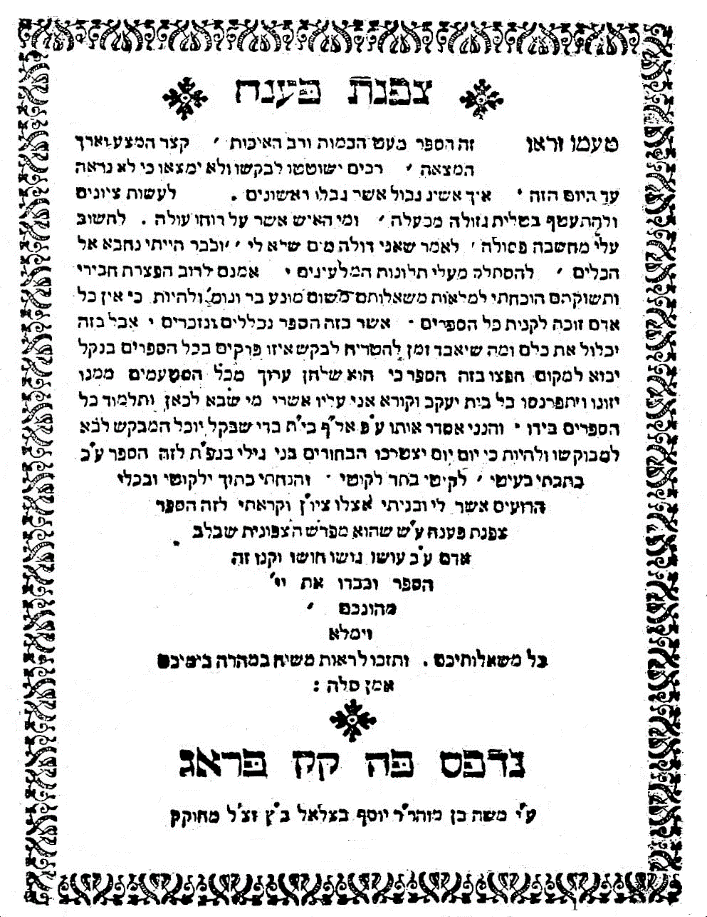
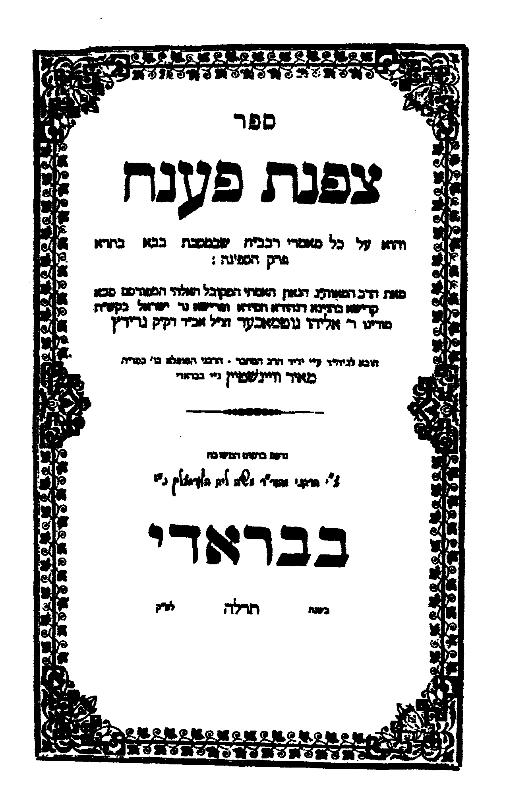
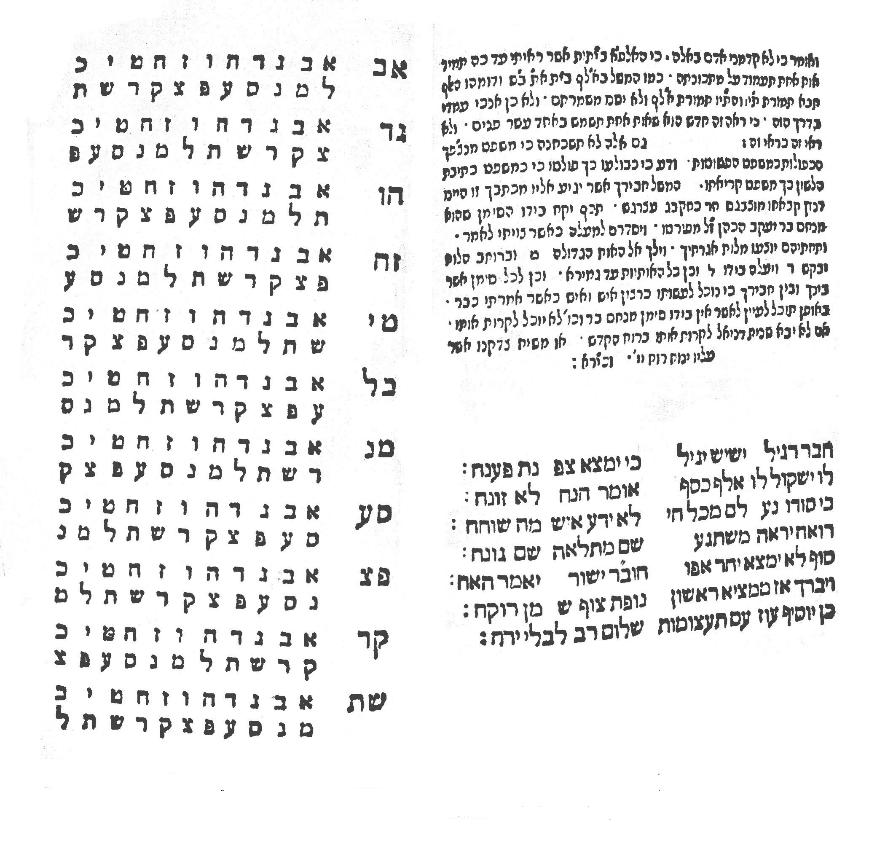
Abraham Menahem spent two years preparing Zafenat Pane’ah. It is a small work, actually a small booklet, described as either a duodecimo (120) or an octavo (80) consisting of [6ff]. In the absence of the place of publication, locations such as Venice (Steinschneider), Ferrara (BenJacob), and Sabbioneta (Sonne) have been suggested. Avraham Yaari, following Sonne, records Zafenat Pane’ah as a Sabbioneta imprint, including it among the books published by the Foa press in that location.[5] The National Library of Israel records Zafenat Pane’ah, giving the location as Sabbioneta but also notes Riva di Trento as a possible place of publication.[6]

The title-page, perchance intentionally cryptic, does not identify the publisher, place of printing, or author, although the latter is evident from the text. Zafenat Pane’ah was, as noted above, published as a small booklet. The text of the title-page, again, lacking the date and place of publication, as well as having no ornamentation, states,

“See, this is new!” (Ecclesiastes 1:10); “In a levelled way” (cf. Jeremiah 18:15); “that they should do according to every man’s pleasure” (Esther 1:8); to write letters to one’s companion as a sealed book that will not be intelligible to those who see it. Even if alien eyes peruse the writing, in this manner it will be a great marvel, that tens of thousands of men all together should write in this way, that one should not understand the thinking of his companion. Even if “all go to one place” (Ecclesiastes 3:20) and hew from one quarry, something impossible to be heard and from intelligence withheld. If not after searching this page, confirming its great benefit as “your eyes uphold righteousness” (cf. Psalms 17:2).

The title-page is followed by Abraham Menahem’s lengthy effusive dedication to his uncle, R. Jacob Mugil, in which he also discusses the need for and value of cryptography, concluding with the date Tuesday, 15 October, 1555, Venice, signed Menahem of Porto. Next is a brief introduction in which the rules of encryption are discussed. He writes that there should be a sign between the writer and the recipient, whether in Hebrew, Ashkenaz, or whichever language the writer chooses, and it does not matter if the signs are numerous or few in number. “‘One who does much sacrifice and one who does less, as long as’ (Berakhot 5a, 17b) he places one letter with another as I will explain.” After some brief instructions on spacing Abraham Menahem signs his name as Menahem ben Jacob ha-Kohen from Porto.

Abraham Menahem’s name follows given in a bold, brief statement referring to the coding of his name, and, also in bold letters, the verse “If you had not plowed with my heifer, you would not have found out my riddle,” (Judges 14:18 ) This is followed by an example, in which Porto’s name appears as Menahem bar Jacob ha-Kohen mi-Porto, followed by the verse. His name is then spelled out over the verse as an encryption example. The text follows, discussing the subject of cryptography.[7]

Abraham Menahem was an eyewitness to the burning of the Talmud in Venice in 1553, which tragic event is reported in the Minhah Belulah, on the phrase “. . . a fiery law unto them,” (Deuteronomy 33:2), where he writes “I fixed these days for myself, for each and every year, for fasting, weeping, and mourning, for this day was as bitter for me as the burning of the House of our God (the Temple).

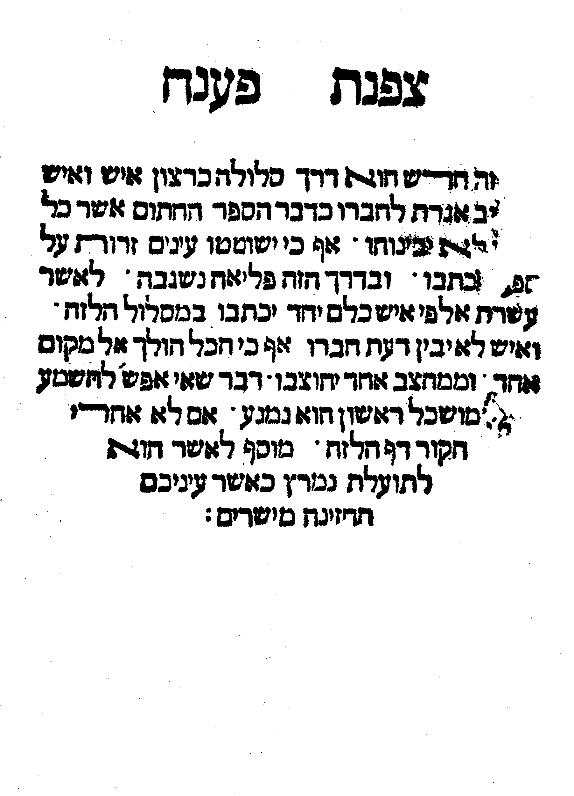
Anonymous, Prague, [1617]: Our second Zafenat Pane’ah, also a small work, is a very different type of book from Abraham Menahem’s Zafenat Pane’ah. This Zafenat Pane’ah is an alphabetical listing of the chapter heads of Mishnayot in the Babylonian Talmud. It was published at the press of Moses ben Joseph Bezalel Katz in Prague ([1617]) as a quarto (40: 4 ff.). Neither the compiler’s name nor the date are given, the latter being an estimate only. The anonymous author provides a detailed title page in lieu of an introduction, writing:


1617, Zafenat Pane’ah, Prague
Courtesy of the Jewish National and University Library

“O taste and see” (Psalms 34:9) this book, small in size but of great value. “The bed is too short” (cf. Isaiah 28:20) the presentation is long. Many run to and fro, seeking but do not find, “for it was not seen to this day” (I Kings 10:12). How do I think to reset that “which the early ones marked out” (cf. Deuteronomy 19:14), to establish markers and to wrap myself in a tallit stolen from its owner. Who is the man who would think so, to think of me an unfit thought, that I draw waters that are not mine, and I had already “hidden myself among the baggage” (I Samuel 10:22) to avoid the complaints of the mockers. However, the majority urgings of my associates and their desire convinced me to fulfill their requests, because “He who withholds grain [the people will curse him]” (Proverbs 11:26). As not everyone is able to acquire every book which is included and mentioned in this work, all is included here, and whatever time would be lost in trying to locate whichever chapter in all of the books, for it is a spread table (shulhan arukh) with all the savory food from which all the house of Jacob will be fed and nurtured. And I say concerning it, “fortunate is he who comes here and has the learning of all his books is in his hand” (cf. Pesahim 50a, Mo’ed Katan 28a, Ketubbot 77b, Bava Batra 10b). . . .

He concludes that that it is Zafenat Pane’ah (revealer of secrets, Genesis 41:45) for it reveals that which is hidden in the hearts of man. One should acquire this book, honor the Lord, and merit to see the coming of the Messiah speedily in our day.

The text follows in three columns in square letters. Each entry is comprised of the initial words of the first Mishnah in a chapter, the chapter umber, and the tractate name, arranged alphabetically by the first word in a Mishnah. At the end of the volume is a brief colophon summarizing the contents.

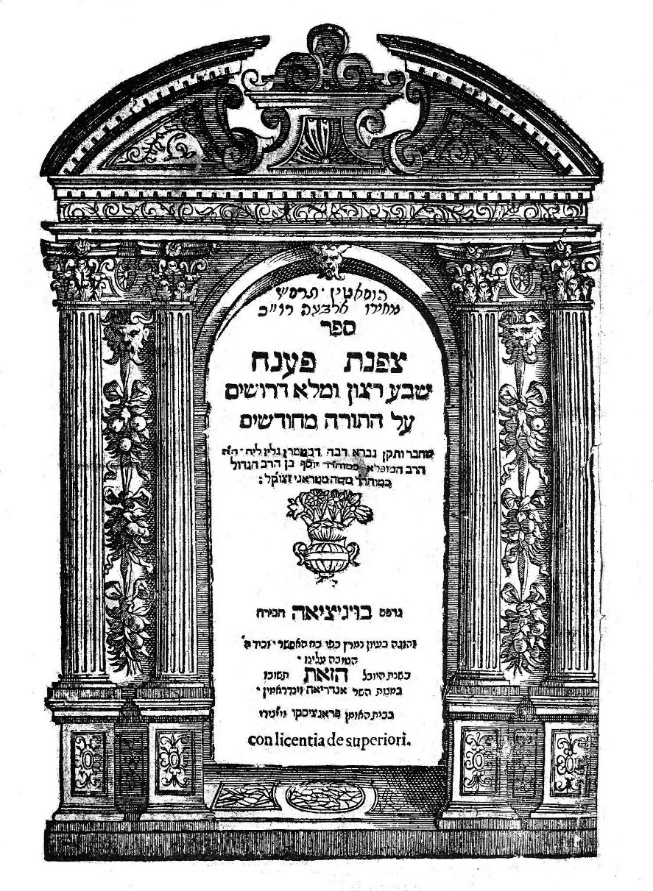
Joseph di Trani’s (Maharit), Venice, 1648: In 1648, the Venentian Vedramin press published a folio (20: [2], 236, 13 ff.) edition of R. Joseph ben Moses di Trani’s (Maharit, 1568–1639) discourses on the weekly Torah portion and festivals, entitled Zafenat Pane’ah. Trani was born in Safed under auspicious signs. On the night that he was born R. Moses Alshekh reputedly saw a great light over his house; his name was selected prior to his birth by R. Moses Cordevoro; his father noted that the year of his birth equaled איש חי (329 = late 1568; a valiant man, II Samuel 23:20), and he received a blessing from R. Joseph Caro prior to the latter’s death. Plague forced him to leave Safed for Egypt, returning, spending some time in Damascus and Jerusalem, but, by 1594 in Safed for an extended period of time where he headed a yeshivah. In 1599, he was sent as an emissary from Safed to Constantinople, and after a second visit, in 1604, heading a yeshivah, and eventually becoming chief rabbi. Among his students were R. Hayyim Benveniste, R. Joshua Benveniste, R. Hayyim Algazi, and R. Solomon ha-Levi.

The title page says that it is Zafenat Pane’ah, “satisfied with favor, and full of” (Deuteronomy 33:23) discourses on the Torah, updated, that were written and corrected by the great man . . . Printed “In the year of this הזאת (5408 = 1648) jubilee you shall return” (Leviticus 25:13).

The title page is followed by two quatrains of verse from the author’s son, R. Moses di Trani, with the heading, “I am the poorest of the poor” (cf. Judges 6:15) “my mouth shall praise you with joyful lips” (Psalms 63:6). Next is Moses’ introduction, the introduction of R. Yom Tov ben Yaish, and verse in praise of the author from his young pupil R. Isaac Alankowa, each paragraph beginning with the word kol (voice), all in a single column in rabbinic letters. At the end of the volume is the introduction of the second editor, R. Jacob ben Moses ha-Levi. The last introduction is printed twice, once with and once without Moses’ name and with variant headings. Zafenat Pane’ah concludes with indexes of verses, Midrashim, and rabbinic sayings. In his introduction Moses begins paragraphs two through nine with the phrase “before the light of the Torah became submerged” due to the destruction of the first Temple; decrees of the wicked Greek kings; destruction of the second Temple; etc. The following ten paragraphs begin “This” is in praise of his father and his work.


1648, Zafenat Pane’ah, Joseph ben Moses di Trani (Maharit), Venice
Courtesy of the Library of Agudas Chassidei Chabad Ohel Yosef Yitzhak

Zafenat Pane’ah is comprised of two to three sermons on each parashah and on festivals. Each homily begins with a quote from a Midrash or equivalent source in square letters, which is then explicated. Sources are given in the margins. The only decorative material is the frame about the heading of the first discourse and a design after the introduction of Jacob ben Moses with his name.

This is the only edition of Zafenat Pane’ah. Other works, excepting di Trani’s responsa and novellae, are no longer extant.

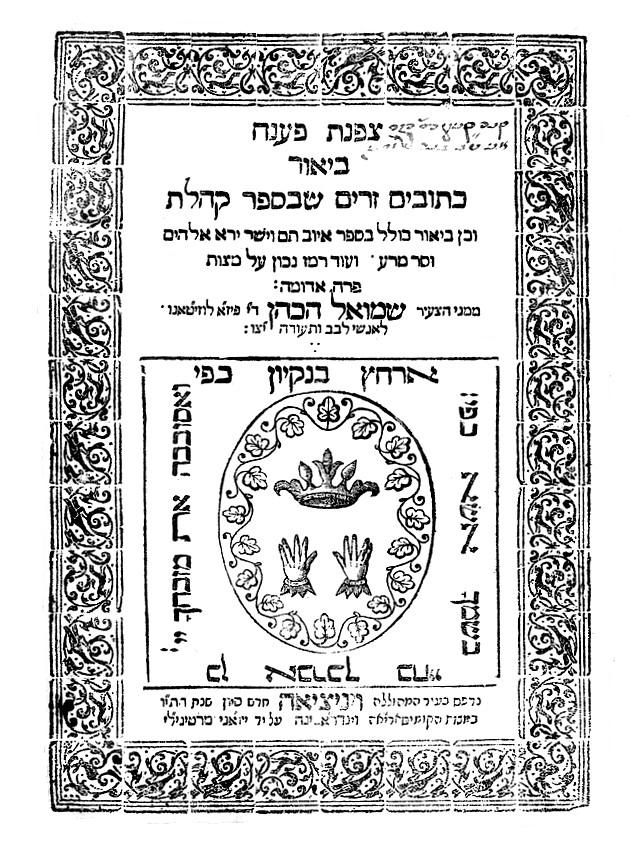
Samuel ha-Kohen di Pisa Lusitano, Venice, 1656: Controversial commentary on the difficult passages in the books of Ecclesiastes and Job by R. Samuel ha-Kohen di Pisa Lusitano (16th-17th cent.). Printed as a quarto (40: [4], 3-33 (should say 31) ff.) in 1656 by the Vendramin press in Venice, this is the only edition of this Zafenat Pa‘ane’ah, the only work of Lusitano, a scholar of Portuguese origin. The title, appropriately, reflects Lusitano’s purpose, to be, appropriately enough for our title, a revealer of secrets (Rashi on Genesis 41:45). Zafenat Pane’ah’s title page states that it is “on the unusual terms in Ecclesiastes and an explanation of Job, ‘a blameless and upright man, one who fears God and turns away from evil’ (Job 1:1, 8, 2:3). Also included are correct allusions on the precept of Parah Adumah (red heifer, Numbers 19:2).”

1656, Zafenat Pa‘ane’ah, Samuel ha-Kohen di Pisa Lusitano, Venice
Courtesy of Virtual Judaica

The title page is dated in the month Sivan in the year 416 (1656). Nevertheless, some bibliographic works, such as the Hebrew Bibliographic Project, based on references in the text, record it as a [1640] imprint. There are several pages of verse (2a-4a) in praise of the book by R. Leone (Judah Aryeh) Modena, R. Jacob ben Moses Levi, יא”ק (R. Joshua Abraham Kalimoni), אמ”ט (I, Moses Treibush of the seed of Jacob), and R. Jacob ben Abraham Shalom, nephew of Lusitano. Next is a warm letter ([4b]-4a) to Lusitano from R. Simhah Luzzatto, who raises the question of whether Job, at the time of his afflictions, denied reincarnation. Lusitano’s brief introduction (4b) follows, in which he notes that it is incumbent upon every Jew to learn Torah and to delve into the books of the Bible. He has turned to the works of “the sage Solomon” in the deep work Ecclesiastes and portions of Job and also to the precept of Parah Adumah. It is not Lusitano’s intent to bring novel interpretations but to elucidate the explanations of the sages.

Zafenat Pane’ah, in a single column in rabbinic letters, is divided into fourteen chapters, one through seven on Ecclesiastes, eight through thirteen on Job, and fourteen on Parah Adumah. Several chapters deal with the Messiah, or other controversial subjects: for example, 2) the time of the Messiah, 3) whether a person born after his coming will die, 4) if after reincarnation the Lord will renew the world in such a manner that they will be angels, 8) whether Job is Job ben Issachar ben Jacob, and 11) allusions to Leviathan on the war of Gog and Megog and whether the Lord revealed to Job his ways, wisdom, and knowledge.

Lusitano’s positions, particularly on reincarnation, incurred opposition from several rabbis. Most notable is R. Samuel Aboab (1610-94), who in his responsa, Devar Shemu’el (Venice, 1702), writes that when he saw the manuscript of Zafenat Pane’ah he was greatly pained and wrote to Lusitano attempting to prevent its publication. Attempting to explain the coming of the Messiah and reincarnation from the verses in Ecclesiastes is like attempting to “make an elephant pass through the eye of a needle” (Berakhot 55b) and attempting to determine these times is in opposition to the Rambam. Worst of all, he endangers the people by confirming that for this generation is written the end of days and Moses’ promise of redemption.

Joseph (Ashkenazi), Frankfurt on the Oder, 1693-94: Zafenat Pane’ah Hadash, homilies on diverse subjects by R. Joseph ben Moses (Ashkenazi), darshan of Przemyslany and rabbi and dayyan in that location (17th cent.) was printed in Frankfurt on the Oder in 1693-94 at the press of Michael Gottschalk as a quarto (40: 60 ff.). Joseph ben Moses was also the author of Keter Torah (Berlin, 1699), and a commentary on the Haggadah included in Haluka de-Rabbanan (Amsterdam, 1695). The title page describes it as:

Discourses, pleasing and delightful, a “work well set” (cf. Isaiah 3:24), a work of great sharpness, “more precious than fine gold” (cf. Isaiah 13:12) and pearls. His Torah was expounded with forty-nine faces, and within each and every entry you will find many views. Written by the great rav, the darshan of Przemyslany, R. Joseph ben Moses, grandson of the gaon R. Abraham Ashkenazi, descended from Rashi, son-in-law of R. Naphtali of Przemyslany, and author of Ketonet Passim.

Beginning of work is dated to Tuesday, the day that it states two times “it was good טוב (15)” (Genesis 1:10, 12) Kislev “And Pharaoh called Joseph’s name Zafenat-Pane’ah (he who explains what is hidden) שם יוסף צפנת פענח (454 = December 5, 1693)” (Genesis 41:45). The colophon (59b) dates completion of the work to Thursday, 2 Shevat, “One law shall be for him who is native born, and for the stranger who sojourns among you תורה אחת יהיה לאזרח ולגר הגר בתוככם (454 = January 28, 1694)” (Exodus 12:49). There is an approbation signed by nine rabbis from the Va’ad Arba Aratzot (1b); Joseph’s introduction (1b-2b), beginning that the Torah is expounded in 49 ways and concluding that the book is named Zafenat Pane’ah for it reveals that which is concealed; the text (3a-59b) in two columns in rabbinic letters; concluding with errata (60a-b) and a list of abbreviations (60b).

Zafenat Pane’ah Hadash is comprised of 60 discourses on diverse subjects, most discourses addressed in several homilies, varying in number from one homily (17 discourses) to sixteen (1) entries and in length from several pages to brief paragraphs The subjects are Adam and Hava, explained in sixteen entries; Patriarchs and Matriarchs; Eretz Israel; first-born; creation; blessing; exile and redemption; robbery; redemption and David (15 Shir ha-Ma’alot); judgment, mercy, and David; hekdesh; confession and repentance; merit and obligation; sin and punishment; tohorah and tuma; Jacob and tribulation; Judah, yibum and halizah; priesthood; honor of Torah and Torah scholars; honor, praise, and rising; learning the written and oral Torahs; Mizraim; Tabernacle and Temple; Moses and Aaron; flood and dispersion; angels; damages, marital property (melog and zon barzel); marriage and divorce; Sodom and Gomorrah; Sanhedrin; witnesses; slaves; Pesah, removal of hamez; Pharaoh and Mizraim; zaddikim; curse and blessing; Korah and his assembly; Cain and Abel and the splitting of the Reed Sea; Kri’at Shema; betrothal; considerable possessions; the wicked; Shabbat; representatives; tribes; oaths; reward and punishment; reward of mitzvah and Torah; resurrection; repentance; and terumot and ma’aserot.

1693-94, Tzofnat Pa’aneah Hadash, Joseph ben Moses of Przemyslany, Frankfurt am Oder
Courtesy of the Society for the Preservation of Hebrew Books

The title-page has an elaborate pillared form comprised of two cherubim at the top blowing horns and at the bottom an eagle with spread wings. Within the wings is a carriage and figures, and in the middle of this scenario is a depiction of the Patriarch Jacob meeting Joseph in Egypt, recalling “And Joseph made ready his chariot, and went up to meet Israel his father, to Goshen, and presented himself to him; and he fell on his neck, and wept on his neck a good while” (Genesis 46:29).[8]

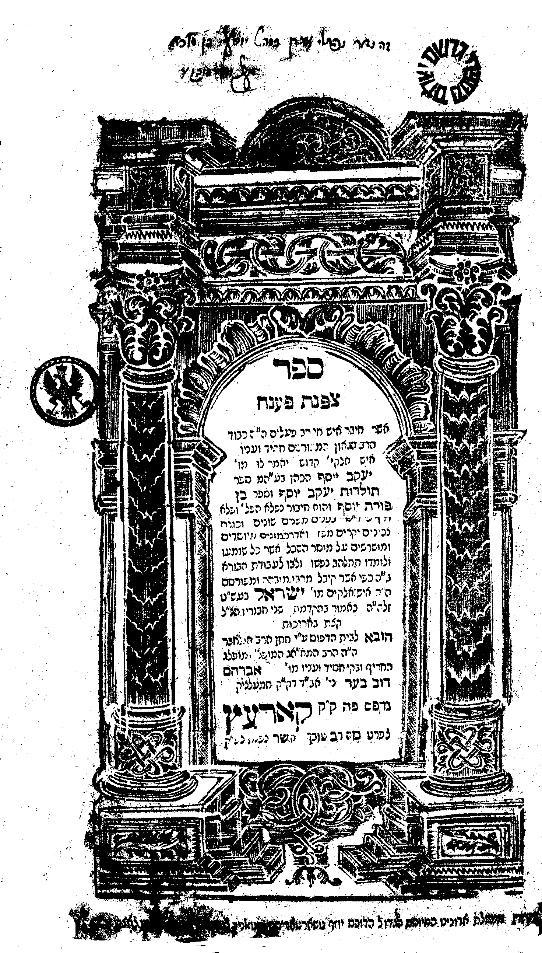
Jacob Joseph ha-Kohen Katz, Koretz, 1782: A commentary on Exodus by R. Jacob Joseph ben Zevi ha-Kohen Katz of Polonnoye (d. c. 1782). Among the foremost disciples of the Baal Shem Tov, Jacob Joseph was a scion of the kabbalists R. Samson ben Pesah of Ostropol (Ostropoler, d. 1648) and R, Joseph Katz (17th century), and of R. Yom Tov Lipman Heller (1579–1654). Jacob Joseph’s most famous work is Toledot Ya’akov Yosef (Korets, 1780), discourses on the weekly Torah readings and the first Hassidic book to be published.[9]

1782, Zafenat Pa‘ane’ah, Jacob Joseph of Polonnoye, Koretz
Courtesy of the National Library of Israel

Jacob Joseph’s Zafenat Pane’ah was printed in Koretz ([1] 35 ff.) at the press of Tsevi Hirsh ben Aryeh Leib Margolis (Margoliot), the first of two of Jacob Joseph’s works printed there at this time. Zafenat Pane’ah was preceded by Ben Porat Yosef (1781), on Genesis. The title-page, dated “How abundant is the good that You have in store [for those who fear You] מה רב טובך אשר צפנת (542 = 1782)” (Psalms 31:20) references Jacob Joseph, noting his Toledot Ya’akov Yosef and refers to the man of God, ISRAEL [Ba’al Shem Tov], informing that it was brought to press by his, Jacob Joseph’s, son-in-law R. Abraham Dov Ber, av bet din Hamaltzik.

The title-page is followed by the introduction which has an interesting and unusual heading, stating that the introduction to this work “has been printed before, twice in two of the author’s books, and is included here so as not to have a blank page. Printed here is an omission from Parasha Ki Sisa (Exodus 30:11-34:35).” It is not only the introductions that are alike, for Ya’aḳov Shemuʼel Shpigel informs that the title-page of Zafenat Pane’ah and Ben Porat Yosef, are also alike. He suggests that Jacob Joseph was not present and it is difficult to know who was responsible for the title-pages. Shpigel does note, however, that the reference to Jacob Joseph’s son-in-law is modified and either he or the printer might be responsible. The reference to the Ba’al Shem Tov is unchanged.[10]

Jedaiah ben Abraham Bedersi (Ha-Penini); Isaac Eisig ben Isaiah Auerbach (Reis) 1797: Classical ethical work, Beḥinat Olam (Examination of the World), by R. Jedaiah ben Abraham Bedersi (Ha-Penini, c. 1280 – c. 1340) with the commentary Zafenat Pane’ah by R. Isaac Eisig ben Isaiah Auerbach (Reis, early 18th century). A popular work, the Bet Eked Sefarim records as many as many as seventy-three printings of Beḥinat Olam, including editions with varied commentaries, three with Zafenat Pane’ah.[11] This printing of Beḥinat Olam, with the commentary Zafenat Pane’ah, was published in Brunn at the press of Joseph Karl Neiman as an octavo (80: 45 ff.). It was preceded by a Sulzbach edition (1744). Parenthetically, Beḥinat Olam was first printed in Mantua in 1478. This is the twenty-fifth edition of that work.

Jedaiah ben Abraham Bedersi (Ha-Penini), was a poet, physician, and philosopher. Among the other works credited to him is Baḳḳashat ha-Memim (The Mem Prayer) composed when he was fifteen. A versified prayer of 1,000 words each of which begins with the letter mem. He also wrote a commentary on the Haggadah, Ohev Nashim (In Defense of Women), Sefer ha-Pardes on such various subjects as isolation, worship, science, and grammar. Beḥinat Olam, Bedersi’s best known work, written after the expulsion of the Jews from France in 1306, is a versified examination, in thirty-seven chapters, of the vicissitudes and vanities of life, with religious and philosophical insights.

This Zafenat Pane’ah is a commentary on Beḥinat Olam by Isaac Eisig ben Isaiah Auerbach. Auerbach was a German grammarian and commentator. He was the author of several books on Hebrew grammar, reputedly motivated by his inability to understand Rashi, causing him to study philology. He eventually wrote Be’er Reḥovot (Sulzbach, 1730), a commentary on the Rashi on the Torah. He was the author of this Zafenat Pane’ah, a Yiddish translation and adaptation of Beḥinat Olam.[12]

1789, Beḥinat Olam with Zafenat Pane’ah, Brunn
Courtesy of the Jewish National and University Library

The title-page is followed by Auerbach’s introduction in which, at both the beginning and the end he describes Zafenat Pane’ah as being an explanation and interpretation (Zafenat Pane’ah). It is followed by the text which is in two columns, the inner columns the text of Beḥinat Olam in square vocalized letters, the outer column Zafenat Pane’ah set in Yiddish in Vaybertaytsh, a type generally but not exclusively reserved for Yiddish books, so named because these works were most often read by the less educated and women.[13]

II

Zafenat Pane’ah, as noted above, is an intriguing title for a book. Based on the rare appearance of the verse “Pharaoh called Joseph’s name Zafenat Pane’ah . . . (decipherer of the cryptic (revealer of secrets), a name that appears once only in the Bible. Zafenat Pane’ah is a name of Egyptian origin, it being the name given by Pharoah to Joseph, albeit one recognizing his rare ability to decipher Pharoah’s dreams. As a title, Zafenat Pane’ah has had an allure for authors. Of the books described above one only deals with cryptography, while several of the first group of books’ authors are named Joseph. Perhaps the allure of the name, Zafenat Pane’ah, decipherer of the cryptic (revealer of secrets) is seen by the authors as being applicable to their works, finding meaning in their interpretations of obscure passages in scriptures and other challenging works.

Our Zafenat Pane’ahs, the subject matter of this article, are early printings. It is important to note that later publications with our title, beyond the scope of this article, while not addressed in any detail, are also of interest. Indeed, note should be taken that several of these later works are, valuable and noteworthy. Below are concise examples of several later works entitled Zafenat Pane’ah

R. Elijah Guttmacher (1795–1874), a student of both Kabbalah and general studies, served as rabbi in Pleschen and Grodzisk Wielkopolski, attracting followers who came to him for amulets, cures, and guidance. He was unusual, in contrast to both Orthodox and assimilationist rabbis, in being a supporter of the Ḥibbat Zion movement. Author of works on Mishnayot and the Talmud, Guttmacher’s titles also include a Zafenat Pane’ah (Brody, 1875, below) “devoted to the tales of Rabbah b. Ḥana as told in Bava Batra.”[14] R. Saul Nathan Nathansohn, in his approbation to this work, writes that Zafenat Pane’ah is so entitled because it is an explanation of the aggadah of Rabbah bar Ḥana which is “obscure and sealed,” all the earlier geonim put their hearts to elucidating it and even the Vilna Gaon wrote a commentary on it.

A sad, tragic Zafenat Pane’ah is the eulogy by R. Asher Nissan ben Judah Leib Levinsohn for his only son, R. Menahem Nahum Nathan. Printed in Vilna (1875), the title-page describes Menahem Nahum Nathan as a gaon, gadol, and sage, and informs that Asher Nissan was the author of such works as Gan Ne’ul, Afikei Yehudah, and Likkutei Shoshanim. In a preface to the reader, Asher Nissan informs that he has entitled the eulogy Zafenat Pane’ah “Because his name is becoming נאה to him and he is becoming to his name, for my son, the gaon.”

Among the later editions of Zafenat Pane’ah are several books entitled Zafenat Pane’ah by the illustrious R. Joseph Rozin (Rosen, Rogachover, 1858–1936). A prolific author, all of his numerous and varied works on the Torah, Talmud, Rambam, and responsa have the title Zafenat Pane’ah.[15]

Our final Zafenat Pane’ah is a commentary on the Torah and festivals by R. Pinchas Shapira ben Shalom, published in Jerusalem (1964). A resident of Kozakonyha, Marmaros from from 1905, he was deported by the Hungarians during World War I to Galicia, settling, in 1918, in Felsovisso. He perished in the Holocaust.[16] His Zafenat Pane’ah was published by his son-in-law, R. Menahem Mendel Taub, the Kaliver rebbe. In the introduction Pinchas Shapira writes that he has entitled this work Zafenat Pane’ah because it alludes to his name and to the names of his father and of his mother. The initial numerical values of Zafenat Pane’ah צפנת פענח are, together with the number of its letters and general number (828 + 8 + 1 = 837), equal to Pinchas פינחס (208) ben במוה”ר (253) Shalom שלום (376 = 837). A second example is Pinchas פינחס ben Hanna Sarah בן חנה שרה (208 + 620 = 828).

III

Our Zafenat Pane’ahs and a [Hadash], noted both in some detail and concisely, encompass such varied subjects as cryptography, an alphabetical listing of Mishnayot chapter heads, biblical interpretations, a eulogy, an ethical work, and other diverse subjects. All reflecting the authors’ concerns with clarifying, making clear, that which is not clear, not immediately obvious without insightful interpretation. What then, could be more appropriate than the title Zafenat Pane’ah, “decipherer of the cryptic (revealer of secrets)”?

1875, Zafenat Pa‘ane’ah, Elijah Guttmacher, Berlin
Courtesy of Ozar ha-Hachms
[1] I would, once again, like to express my appreciation to and thank Eli Genauer for reading the manuscript and his comments.
[2] Among the authors addressing the subject of book titles are Abraham Berliner, “Shemot Seforim Ivrim,” in Ketavim Nivharim II (Jerusalem, 1969), pp. 147-48 [Hebrew]; Joshua Bloch, “Some Odd Titles of Hebrew Books,” Bulletin of the New York Public Library 41:10 (New York, October, 1937, reprinted in Hebrew Printing and Bibliography, New York, 1976), pp. 151-57; Solomon Schechter, “Titles of Jewish Books,” in Studies in Judaism, First Series (1896, reprint Philadelphia, 1938), pp. 270-281; and Menahem Mendel Slatkine, Shemot ha-Sefarim ha-Ivrim: Lefi Sugehem ha-Shonim, Tikhunatam u-Te’udatam (Neuchâtel-Tel Aviv, 1950-54) [Hebrew].
[3] My previous articles on the subject are “Adderet Eliyahu; A Study in the Titling of Hebrew Books,” in Studies in the Making of the Early Hebrew Book. Brill, Leiden/Boston, 2008, pp. 72-91; “What’s in a name? An example of the Titling of Hebrew Books,” in Further Studies, pp. 371-94; “Keter Shem Tov: A Study in the Entitling of Books, Here Limited to One Title Only” in Essays on the Making of the Early Hebrew Book (forthcoming); “Entitling Hebrew Books from Shir ha-Shirim: (Song of Songs)” in Essays; and “For a Remembrance: Books so entitled as a remembrance for the author.” (Hakirah, forthcoming).
[4] Ch. Friedberg, Bet Eked Sefarim, (Israel n.d.), tav379-396 [Hebrew].
[5] Avraham Yaari, “The Printers B’nei Foa,” in Studies in Hebrew Booklore, (Jerusalem, 1958), p. 362 n. 17 [Hebrew].
[6] National Library of Israel system number 990017477400205171.
[7] Marvin J. Heller, “Abraham Menahem ben Jacob ha-Kohen Rapa mi-Porto (Rapaport) Ashkenazi: A Renaissance Rabbi of interest” Seforim.blogspot.com (March 17, 2021).
[8] Concerning the eagle motif on the title-page of Hebrew book see Marvin J. Heller, “The Eagle Motif on 16th and 17th Century Hebrew Books,” Printing History, NS 17 (Syracuse, 2015), pp. 16-40 and in Essays (forthcoming).
[9] Mordechai Margalioth, ed. Encyclopedia of Great Men in Israel 3 (Tel Aviv, 1986), cols., 867-69; [Hebrew]; Tzvi M. Rabinowicz, The Encyclopedia of Hasidism (Northvale, London, 1996, pp. 239-40.
[10] Ya’aḳov Shemuʼel Shpigel, ʿAmudim be-Toldot ha-Sefer ha-Ivri: be_Sha’are ha-Defus (Jerusalem, 2014), pp. 115-16 [Hebrew].
[11] Ch. Friedberg, Bet Eked Sefarim, bet 341.
[12] Yehoshua Horowitz, “Auerbach, Isaac Eisig ben Isaiah,” Encyclopaedia Judaica, vol. 2, pp. 654-655.
[13] Concerning the early use of Vaybertaytsh see Herbert C. Zafren, “Variety in the Typography of Yiddish: 1535-1635,” Hebrew Union College Annual LIII (Cincinnati, 1982), pp. 137-63; idem, “Early Yiddish Typography,” Jewish Book Annual 44 (New York, 1986-87), pp. 106-119. Zafren suggests, in the latter article, that the origin of Vaybertaytsh, which he refers to as Yiddish type, was the Ashkenaz rabbinic fonts, supplanted by the more widespread Sephardic rabbinic type which prevailed in Italy (p. 112)..
G[14] Getzel Kressel, “Guttmacher, Elijah.” Encyclopaedia Judaica, vol. 8, pp. 155-156.
[15] An example of the Rogachover’s acumen can be seen from his exposing the widely accepted bogus edition of Seder Kodashim of the Jerusalem Talmud. The Rogachover, one of the few who questioned the authenticity of the forgery, observed that each Talmudic tractate mentions at least one amora (Talmudic sage) not mentioned elsewhere, whereas in this work there are no amoraic hapax legomena. Concerning the forgery see Marvin J. Heller, “Who can discern his errors? Misdates, Errors, and Deceptions, in and about Hebrew Books, Intentional and Otherwise” Hakirah: The Flatbush Journal of Jewish Law and Thought 12 (2011), pp. 269-91, reprinted in Further Studies in the Making of the Early Hebrew Book, (Leiden/Boston, 2013), pp. 417-20.
[16] Tzvi M. Rabinovicz, The Encyclopedia of Hasidism, (Northvale,1996), p. 450.


Rav Shmuel Ashkenazi: a Hidden Genius

Rav Shmuel Ashkenazi: a Hidden Genius
By Eliezer Brodt

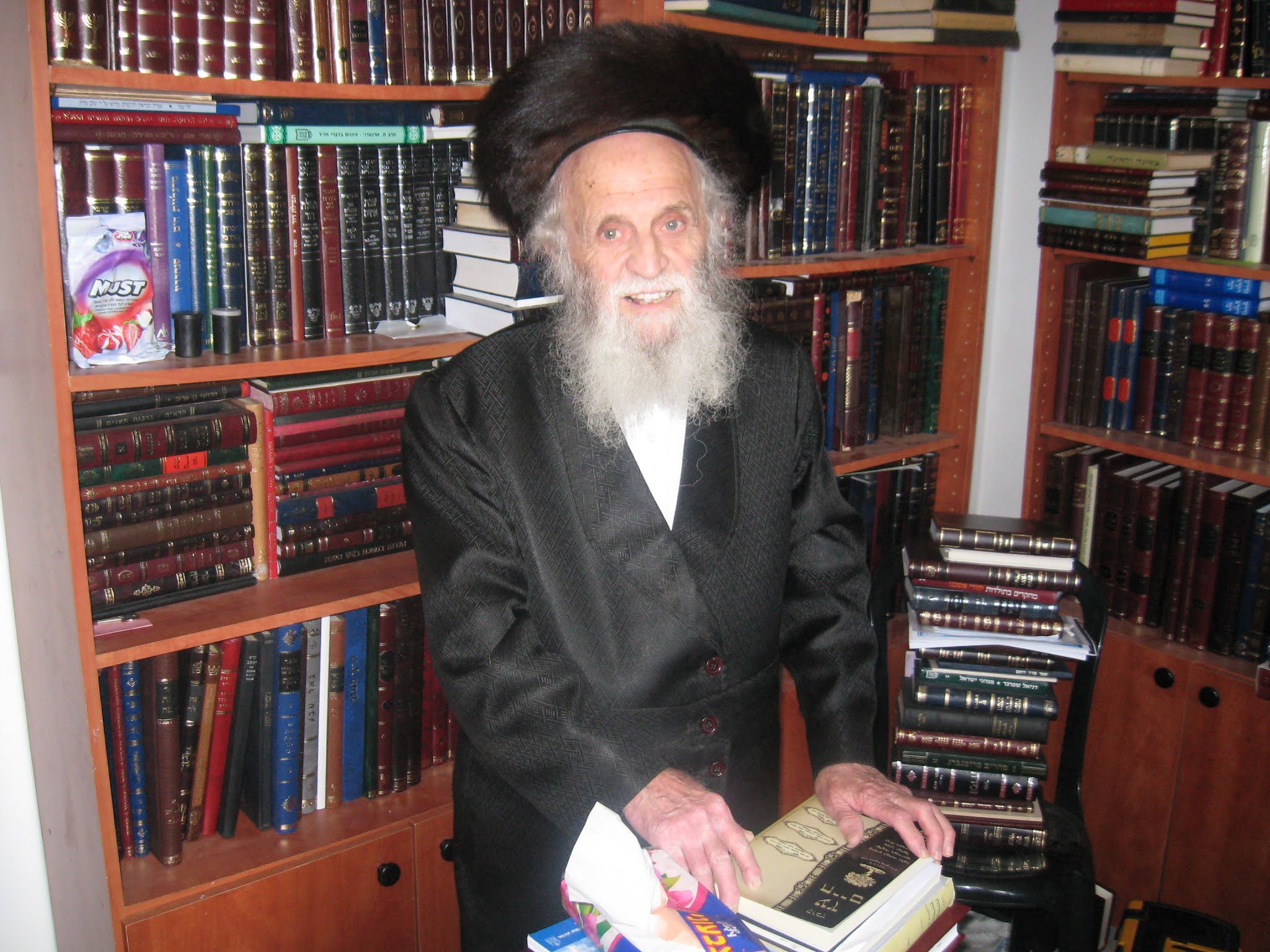
This Monday night is the first yahrzeit marking the passing of a unique Talmid Chacham, R’ Shmuel Ashkenazi of Yerushalayim, at the age of ninety-eight. R’ Shmuel was one of the hidden giants of the seforim world, in both ultra-orthodox and academic circles. I had the Zechus to learn much from him and in this article, I wish to describe this fascinating but hardly known Gaon and what we can learn from his life. An earlier abridged version of this article appeared in the Ami Magazine last year. IY”H in the future I will expand this essay.

One day back in 2000, while learning in the Mir as a Bochur, I was having a conversation with a friend, R’ Yaakov Yisrael Stahl, and R’ Shmuel Ashkenazi’s name came up, R’ Yaakov described him as an extraordinary Talmid Chacham. A little while later, during one of my daily seforim store trips I noticed a recent arrival, a very heavy sefer (844 pp.) with a peculiar title, Alfa Beta Kadmita de-Shmuel Zeira. I opened it up and immediately put two and two together, realizing that the author is the same R’ Shmuel Ashkenazi I just heard about. Upon purchasing it, I could not put it down. Learning through it I was immediately able to tell that my friend had not exaggerated in the slightest way. It appeared that this person knew literally everything about anything connected to Torah.

First Meeting

At the time, I had been working on researching and publishing my first article which dealt with tracing everything about the custom of not sleeping on Rosh Hashanah. One of the earliest sources quoted was in the name of a Yerushalmi which appeared to have been lost at some point. I had been searching all over for any information on this topic, and it was then that I noticed that R’ Ashkenazi was planning on writing about this topic in the next volume of his. I am not sure why but at the time I did not make an effort to speak with him about this. I returned to the US for a few years, and while in the US I drafted a letter to him listing all of my issues on this topic but I never got around to sending it. When I returned to Eretz Yisroel in 2004, one of the first of my planned stops was to visit R’ Shmuel Ashkenazi. Almost immediately upon returning a newly made friend, R’ Duvid Vieder, a Toldos Aharon Chossid who was close to R’ Ashkenazi, brought me into him to visit. From then on, I began to visit him regularly, this custom continued until a few weeks before the 2020 coronavirus lockdowns. At times I visited him once a week for an hour or so, other times once a month, other times I would speak to him on the phone.

I must preface my reminiscences by saying that, sadly, I did not heed the advice of the Chasam Sofer who told his children and talmidim that since he won’t be around forever, they should “chap arein” and listen to his stories. Unfortunately, this is not the first person with whom this has happened to me. I took for granted that Rav Ashkenazi would be around forever, (he did die at the age of 98!) and assumed I would always be able to ask him again for a particular story or an idea that he mentioned.

What was the connection?

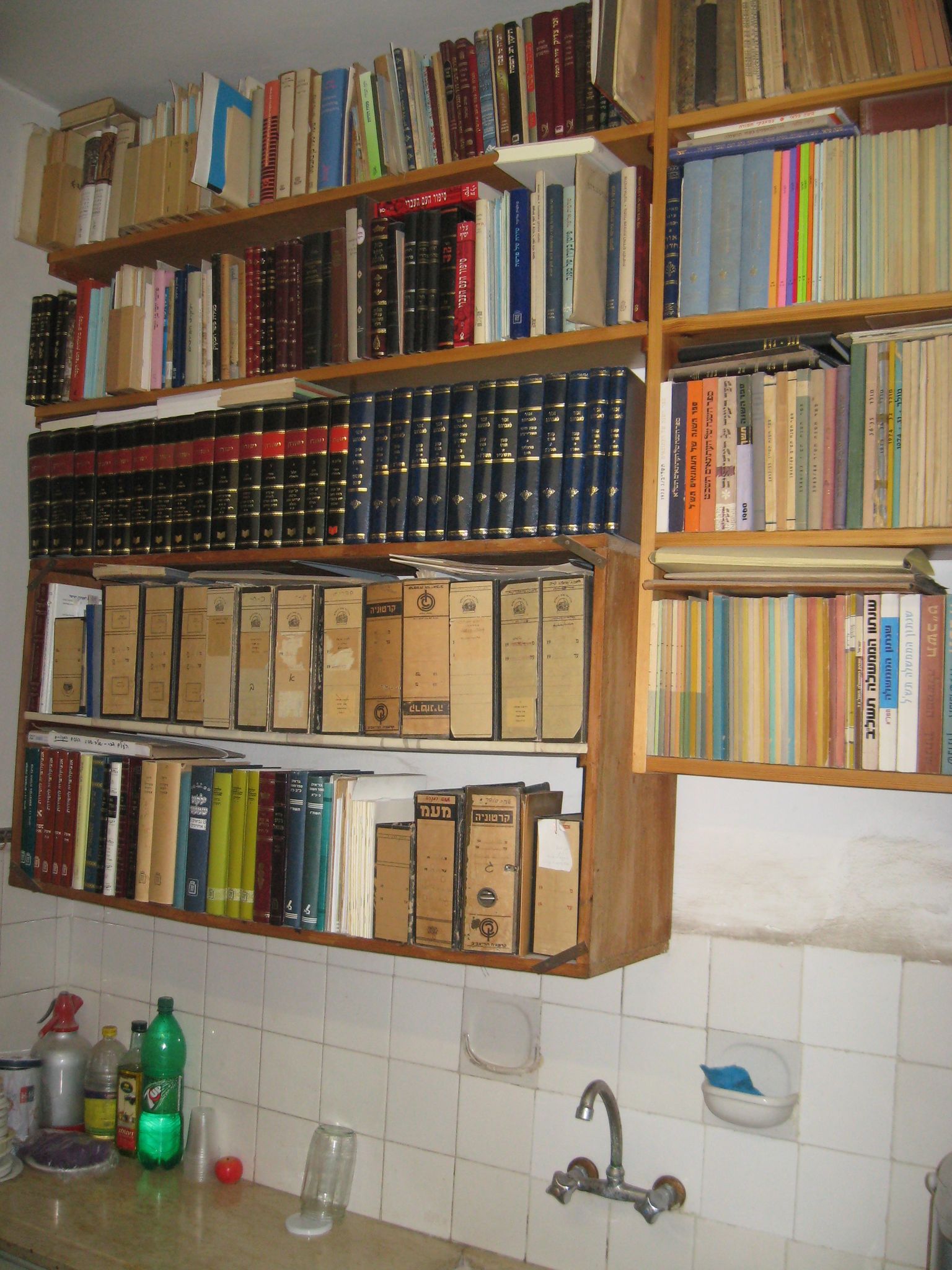
Basically, each visit I would prepare lists of questions to ask him. I would also bring him new seforim or articles (printed out in big letters, to help him read it easier). Sometimes when I would ask him something, he would say he is old and his head does not work, other times it was amazing what he remembered – on the spot. Sometimes he would pull down a file of material stored in – no jokes here – old cornflakes boxes.

I would then scan some of the material. Other times he offhand did not have anything to add on a particular topic but when looking at a particular sefer I would find a note written on the side or in a paper stored in the sefer that would be related to what I was searching. Other times I would find something else which was of great importance. Rarely did I leave his house empty handed. We both shared a love for seforim and information on a wide range of topics.

Love of Seforim

What drew me to him, and particular developed my relationship with him, was our shared love of seforim. I would update him on new seforim. At times he would ask me to purchase it for him or would borrow my copy for a bit. He told me numerous times how he enjoyed visiting and buying seforim from various shops for many years and that he started collecting when he was seven years old! Now he could not go to stores as he was too old; I got to know him when he was over eighty.

When I joined the editorial board of the journal Yeshurun, I would bring him each new volume as it was printed. Each visit he would ask me to check on the shelf where he kept them, to see if he was up to date and if needed, to update him with any missing volumes. A true lover of seforim, his face would lit up at each new volume. I would then point out some of the articles I thought he would enjoy and he would put in markers to read them.

I always wondered if he read the various volumes of Yeshurun I brought him. After he was niftar, while going through his seforim, I found inserted in one rare book a small paper which he wrote: “for more information about this author see the article in Yeshurun”. Then in a different pen he added another cite from another issue from Yeshrun from a few years later.

This small story also demonstrates a bit of his methodology; he would collect all kinds of information and store them at times in a related sefer and would constantly update these notes.

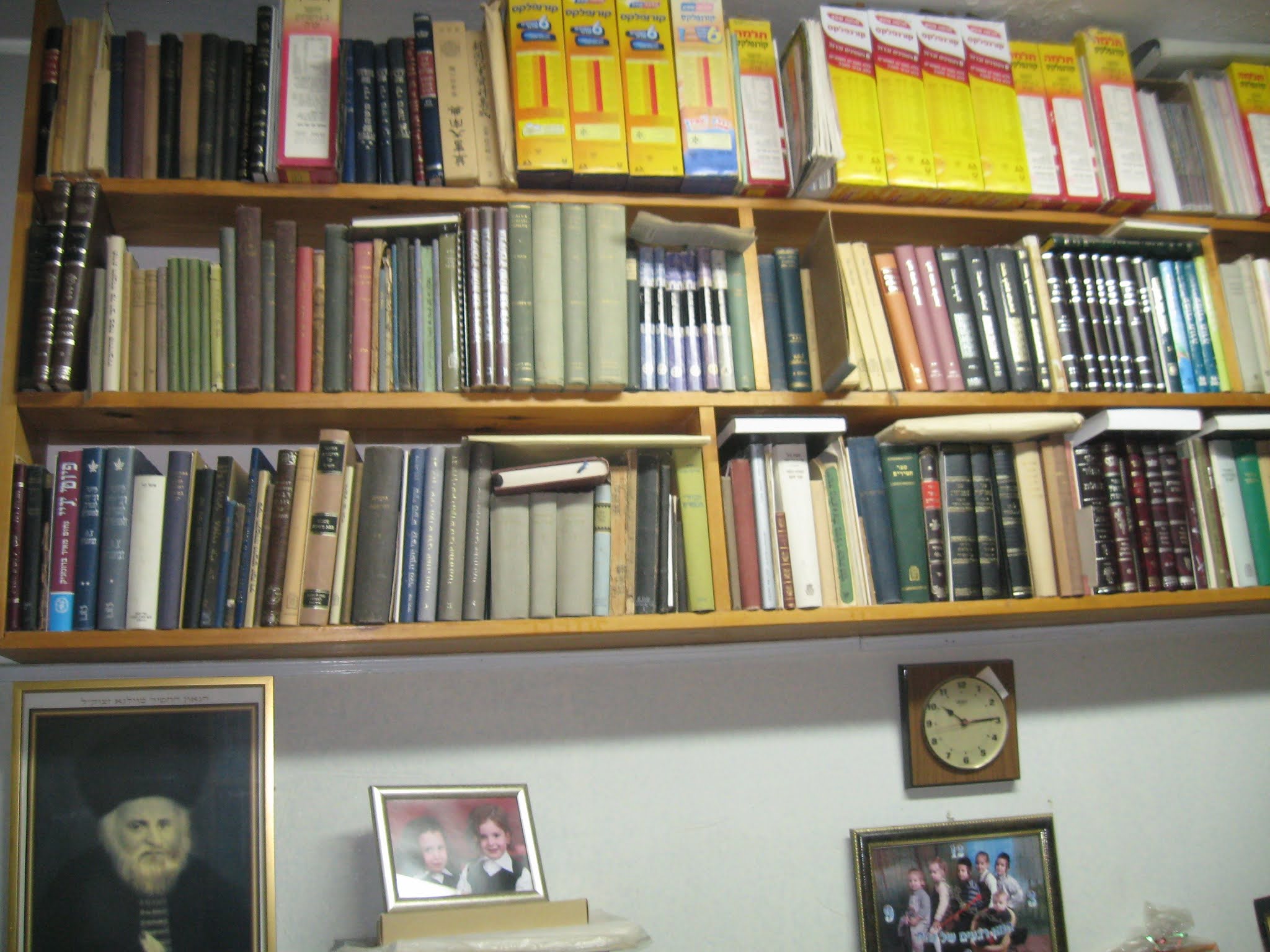
His love for seforim was something unique, the glow on his face when he opened up a new sefer, especially of someone he was into, was simply priceless. He would look carefully at the Shaar and if it was a reprint of an older sefer he would immediately check if they included the front page of the older edition to compare. He had seforim in every space possible in the four rooms of his apartment, including his porch. Many visitors noticed how even his kitchen was lined with seforim!

Dikdueki Sofrim Haskomot

An interesting story happened with me and his library. While working on an article about the Dikdueki Sofrim I was unable to track down some recorded Haskomot that the author R’ R.N.N. Rabinowitz had received for the first edition of his work. I, along with other scholars, had searched numerous copies of the first edition, but with no luck. Late one night, I came to R’ Ashkenazi’s house and mentioned to him my problem. He said “show me the issue inside,” keeping with his custom to take care to always view the source material firsthand (Osiosi Machkemios – a topic he wrote a lot about). I took down his copy of the sefer, and lo and behold it was a first edition with the missing Haskamot! I published these missing Haskamot in my article on the Didukei Sofrim, and attributed this rare and miraculous find to his extraordinary library.

His History:

Where this unique Talmid Chacham came from is simply a mystery. He was born in Yerushalayim and lived in Batei Ungarn. He learned by Rav Yosef Tzvi Dushinsky of the Edah HaChareidis. Originally, his name was Deutsch but, at some point changed it to Ashkenazi. He had four children with his wife who died over forty years ago. Since then, he lived alone in his apartment near some of his children. His son did an excellent job of Kibud Av bringing him food every day and looking on him a few times a day. Yom Tov and Simchos he spent time with his family.

When I and others asked him, who was his Rebbe, he would just smile and say no one in particular. The truth is the Mishnah in Avos states: Knei Lecha Chaver. Aside from the simple peshat, Rashi explains this Mishnah by citing some who say it means via Seforim others commentators explain this as ‘buying a pen’ (see R’ Ashkenazi’s in-depth article on this for sources). R’ Ashkenazi employed all of these methods; his friends and teachers were his seforim and his pen.

R’ Ashkenazi was a short, quiet and unassuming person. Most, having seen him walking on the street, would never believe he was such an erudite Gaon. Many times, R’ Ashkenazi did not express much emotion except to give a pleasant smile and was friendly and polite in conversation. But there were times he got very excited; for example, when he recalled a good story from his younger years or something unique that he discovered years ago. He was very polite and was a real Yekeh; for example as soon as they bentched Rosh Chodesh Kislev his Menorah was already prepared in the window.

R’ Yechiel Goldhaber, a Talmid Chacham and author of numerous articles and seforim had a close relationship with R’ Ashkenazi for many years. He recalled when he was introduced to R’ Ashkenazi for the first time by his father-in-law, he thought to himself who is this simple looking man? He soon learned that this man was a master of all of Torah and swiftly became a close Talmid of his.

Many times, he would tell me he wishes he could come visit my library. In Later years he would spend his Yomim Tovim at his daughter. One Chol Hamoed Succos, when he was over ninety, he made the difficult trek from her house to mine in order to spend time in my library.

He would love to read everything he could get his hands on. I visited him at many different times of day, even late at night and I always found him learning a sefer – even when he was over ninety. He read everything newspapers, books – he was just curious about everything with an incredible thirst for knowledge.

I recall visiting him a few times when he eighty-five and noticed he was learning the Shelah Hakodosh very carefully. I asked him why (of course he had learned through this sefer numerous times before!) and he responded that someone is reprinting the sefer and asked him to go through the sefer and send comments. He therefore sat down to learn the whole sefer, line by line, after which he wrote a ten-page letter with his comments on the sefer.

Over time, I learned again and again that R’ Ashkenazi personally believed his purpose in this world was to help people with the incredible amounts of information that he had gathered over the years of intense learning. This incredible Middah can be seen in this light; he did not feel that he was the “owner” of this extraordinary wealth of information he had collected, and thus gave very willingly without any conditions. He never asked me to cite him when he gave me some rare source even – although I always told him I would; he just was so happy to help someone else.

He would collect and catalog much of what he read. He had all kinds of systems to file the information he had gathered over eighty plus years of learning. When he would read an important article in a magazine or journal, he would cut out the parts and store them in their appropriate place. He gathered information on thousands and thousands of subjects (not an exaggeration in any form) which had some connection to our rich heritage. What’s more astounding is that R’ Ashkenazi never used a computer or the internet; all of his erudition came about simple by learning through thousands of seforim; a great many of them rare or unknown.

Over the years he helped so many people and for many years after he retired, he would visit the National Library of Israel on Tuesdays, where throngs of people would line up in wait to speak with him about all kinds of subjects.

Many years ago, he received a call from a young chassidish Talmid Chacham living in Monsey who was starting to work on publishing a new edition of the classic historical work Seder Hadorot. He started asking him questions about various issues he had. Over many phone-calls R’ Ashkenazi answered many of his difficulties while training him in proper research and writing skills. This year some volumes finally were published (see here). And this was not a onetime occurrence – he helped so many more people. He used to remark to me that when he was younger so many people would come to visit him – until the late hours of the night.

He was an expert in so many different topics, whether it was the standard ones like Tanach, Chazal, Halacha, Minhag or Chassidus or less commonly studied subjects such as Tefilah, Piyut, Dikduk, Kabbalah, Philosophy, Machshavah, History and Bibliography. In all of these areas his expertise was remarkable.

His Uniqueness

A sample of his bekius; one time I noted that the Maharsha often quotes a “Sefer Yoshon Noshon” and asked if we have any idea which sefer this is? He immediately responded that he found it usually refers to R’ Todros Abulafiah’s Otzar Hakavod.

His incredible Bekius was bolstered by an almost photographic memory, as the following story demonstrates. Once someone used the Bar-Ilan Responsa search engine to locate a passage in the Tana DeBei Eliyahu to no avail. He went to ask R’ Ashkenazi who immediately told him where the passage could be found. Checking the Bar-Ilan text, it was discovered that when the sefer was being entered into their database the passage in question had been mistakenly omitted. I first heard this story from someone else, so to make sure it was accurate I asked him about it and he confirmed it. A similar story happened with him and a passage from the Shut Chasam Sofer.

A few years back a friend was working on publishing out an esoteric Rishon on Mesechet Megillah. He thought no one ever heard of this author and randomly mentioned this to R’ Ashkenazi – without batting an eyelash – replied “of course, and one can find material by this author in the work of Rav Shlomoh Alkabetz on Megillas Esther (Manos Halevi). The fellow was stunned in elation; he had just been gifted new and important material for his project.

This remarkable Bekius which even beat out computer search engines, was just one aspect that made him remarkable. He would receive numerous calls and letters from all over the world from people of all walks of life seeking his assistance in tracking down a statement. He had an incredible knowledge of all of Chazal. I do not just mean the “standards”; Bavli, Yerushalmi and Midrash – even all the numerous and very often almost unknown Midrashim printed over the years. He was also expert in what is known as the lost Midrashim. Over the years many Midrashim we had were lost but some traces of them can be found in various Piyutim, cited by Rishonim or in other obscure places. Through his incredible amounts of learning and his phenomenal memory he was able to recall so much in this field.

To illustrate this with some samples. A few years back someone who was editing for publication a never before printed pirush of a Rishon on Avos came across a few statements in the name of Chazal. This person, a Talmid Chacham in his own right and familiar with tracking down such material, could not locate sources for these statements. Immediately he penned a letter to R’ Ashkenazi. A few days after he received a letter from R’ Ashkenazi with various incredible sources for his questions. This was a very common occurrence.

Piyut, Tefilah and language

Earlier, I mentioned his expertise in Piyut, Tefilah and language. A bit of background is needed to explain this. Rabbi Joseph B. Soloveitchik, when describing Rabbi Elazar Hakalir’s greatness, (Koren Mesorat Harav Kinot (pp. 386-388) wrote the following:

The piyutim of Rabbi Elazar HaKalir, including his kinot, serve two purposes. The first is limmud, learning. Every sentence of the piyut quotes m’aamarei Chazal… The second purpose is tokhaha, rebuking the people for their misdeeds and instructing them in the proper way to act. These piyyutim deal with… repentance… acknowledgment of God’s justice. The shali’ah Tzibbur was not merely a chazan…, but was one of the great scholars of the generation who was the principal… moral critic of the people… Rabbi Elazar HaKalir was (also) a master of the Hebrew language and very creative in his use of Hebrew. If not for him, modern Hebrew could not have come into existence. Before HaKalir, the Hebrew language was very rigid. For example, the noun and verbs were fixed in their form… But HaKalir made a critical contribution to the development of the Hebrew language by endowing the language with flexibility… Rabbi Elazar haKalir’s piyutim served two purposes: limmud, study… As for the element of study, one of the dimensions of HaKalir’s piyyutim is that they are compilations of the statements of the sages. Most of us, who are expert in neither Hebrew nor aggadot Hazal, find HaKalir’s corpus of piyutim boring. But it is not boring at all; it is like a gold mine. His piyutim for Yom Tov explain the essence of the Yom Tov. The midrashim concerning Sukkot are replete with information about the sukka, etrog and lulav, and all the explanations in the Midrash, all the ta’amei sukka, the reasons for the sukka, all of the ma’amarei Hazal, are together in the HaKalir’s piyutim for the first day of Sukkot… If one were to study carefully and thoroughly the piyutim of Rabbi Elazar HaKalir for Rosh HaSahana, Yom Kippur, Sukkot, and Pesah, one would find many applicable halakhot and the entire pertinent Midrash, including many midrashim that are unknown to us from any other source.

Rav Ashkenazi was an expert on everything related to Tefilah and Piyut. He somehow read it all and retained it. But in addition, he was able to use his expertise in Chazal and Hebrew language to understand it on a much higher level and as a result was often contacted by the world experts on Tefilah and Piyut for his assistance. These requests came from experts such as Professor Shalom Speigel, Chaim Schirmann, Avraham Haberman, Ezra Fleischer and Daniel Goldschmidt who constantly sought his assistance while working on their Tefilah and Piyut related projects.

In an interview with Ami Magazine printed a few years back, Professor Shulamit Elitzur mentioned:

“there’s another amazing thing I find when doing research. I am constantly coming across midrashim that were lost to the ages… example, everyone knows that Haman was referred to as ‘the Agagi’ because Shaul allowed Agag to live one extra night, which allowed Haman’s ancestor to be born. However, the earliest makor we find in writing in the 16th century; this fact was discovered by Rav Shmuel Ashkenazi of Yerushalayim. But I found a ktav yad of a piyut about Purim that describes this very story and explains how Haman’s ancestor was born, which gives us a source from 1,000 years earlier! And there are many similar examples of lost midrashim being kept alive through unknown piyutim.”

R’ Ashkenazi wrote some articles on Piyut and Tefilah, but we have found much more among his papers and hopefully if I can raise enough funding all his fascinating material on Tefilah will come to light.

When the important Siddur Ezer Eliyahu (sponsored by his late friend Yeshaya Vinograd) was first printed, one can see R’ Ashkenazi’s name in the introduction, thanking him for his assistance (he assisted them for some of the later additions) and his great knowledge in this field.

I mentioned that he had an incredible knowledge of Dikduk and the Hebrew language and used it towards better understanding Piyut and Tefilah. He also authored articles on these subjects and in 1967, when reviewing an important dictionary, wrote a long article demonstrating this very point – and article that garnered much praise. He was very proud of this essay and mentioned it to me many times. A few years ago, I reprinted it with additions he had made in his own copy and a nine-page topical index.

One of the ways he developed this expertise was via learning Tanach so many times. He was an expert in Tanach and all the Rishonic commentaries (including the unknown ones); he even authored a small book of Riddles of Tanach.

He also used his extraordinary skills to become a master editor. However, in addition to the work he was born with an incredible innate sensitivity for text and language which made him one of the best editors out there. For many years he worked at the famous publishing house Mossad HaRav Kook, editing various works. He told me more than once how there was an expert there who would brag (jokingly) that after he read through an article it was impossible to find mistakes. The only person who could still find mistakes was R’ Ashkenazi. He had razor-sharp vision and could immediately spot a mistake.

Many times, I would bring an edited piece of mine to read. As soon as I put it down in front of him, he would take out a red pen and start marking it up and say to me “are you sure it’s been edited?”. He told me he had to mark up everything before he could read it properly, errata were so painful for him to see that it was hard for him to read something on Shabbos! He told me he was punished; when his work Alfa Beta Kadmita de-Shmuel Zeira came out, although he had edited it numerous times, he still found mistakes.

During his learning over the years, he found many people, great Gedolim as well as famous academics, had made mistakes, sometimes quite basic ones. At one point he printed two articles about this. However, he prefaced his articles that his intent was not to mock those who erred but to vividly illustrate that people are human and mistakes will happen. He was a master of humility and never held it over anyone that they did not know what he knew.

He was not only a great expert in all aspects of the Hebrew language but was an expert in Aramaic and Yiddish, both of which he displayed in various publications of his. Related to his expertise in Aramaic, which is very important for learning Gemara, is a very unique essay which he authored related to the Rambam as a translator of the Gemara. One of the world experts in old Yiddish is Professor Chava Turniansky, who has noted on many occasions that one of the people who have always helped her from her days as a student, was R’ Ashkenazi.

Related to this was another talent of his, which at first appears trivial; he was an expert on acronyms. This led to authoring a thesaurus of acronyms together with Dov Yardan, called Otzar Roshei Tevot, with a multitude of obscure and often almost impossible entries. His sensitivity to the text and work in the field of editing drew him to this field. Anyone who learns a lot, especially older material comes across abbreviations, and many times they cause great difficulty in understanding various passages. Abbreviations were employed in writing, sometimes as mnemonic devices and other times simply to save on printing costs. But over time many meanings were forgotten. This work is an extremely useful tool for solving this issue.

Ghostwriting

One day I was in a used bookstore and I noticed a small sefer titled Harif Umishnaso about the Rif. I recalled that this title appeared in the list in beginning of his work, Alfa Beta Kadmita de-Shmuel Zeira which listed out the various works he helped with over the years. I asked R. Ashkenazi if it’s worth buying and what his connection to the book was, as a different name appears on the cover.

R’ Ashkenazi replied “I can tell you it’s an important sefer and worthwhile to buy.” I noticed he was hesitant to continue the conversation. He then said “I will tell you something I did not tell anyone in over forty years – I wrote the whole sefer from beginning to end and it was one of the most important works I ever wrote.” The original plan was to for him to write a series of biographies on various Rishonim – in this book he already references a work on the Ri Migash – but due to a lack of funding this series was discontinued. However, not all of this remained unpenned; he wrote numerous entries in various encyclopedias. It turns out that R’ Ashkenazi had over fifteen different pen names!

I would like to elaborate on this work a bit more and thus cast further light upon R’ Ashkenazi’s uniqueness and greatness. The Rif’s Halachic work is one of the most important sources in Halacha, but what exactly makes it so unique has remained a mystery. R’ Ashkenazi sought to answer this question by collecting and collating all the authentic information we have about the Rif, from the Rif and from other Rishonim. He went through the Rif carefully examining what he did to each Gemara evaluating if remarks or material was added or not and to figure out why, allowing the reader to begin to understand the Rif’s significance. R’ Ashkenazi’s writing methods were honed to precision. He had an uncanny ability to utilize every piece of information without writing an extra letter and assemble it all in perfect order sans speculations commonly found in historical works. At times one does not need grand theories to understand something; just seeing all the known material in proper order helps one understand things. The wealth of material that Rav Ashkenazi commanded in producing this work is outstanding; this book was written in 1967 – long before any of the various search engines used today.

Haggadah Sheleimah

Similar to this is another work by R’ Ashkenazi, Haggadah Sheleimah. I hope to publish an article about this work in the near future, including the numerous additions R’ Ashkenazi found over the years and kept in his files. This work is highly unique for the following reasons. The collected bibliographies by Avraham Ya’ari and Yitzchak Yudlov bear witness to thousands of Haggados written throughout the generations in a multitude of styles, such as Pilpul, Peshat, Kabbalah, Derush and more. However, until 1955 there was no one work on the Haggadah which collected all the sources for each and every Halacha and minhag related to the Seder night. There was no volume which dealt with the various manuscripts of Geonim and Rishonim and at the same time to deal with the exact text of the Haggadah. Haggadah Sheleimah set out to fill those needs, and at the same time offer a running collection of Pirushim culled from over fifty different commentators focusing just on Peshat. In order to produce such an exacting work, it’s not good enough to just be a talented writer, one must also possess a keen understanding of all the material and relay this with incredible clarity. R’ Ashkenazi was such a person; one who sought out the simple Peshat, able to put this myriad of information together in so beautiful a fashion, and with tremendous clarity. His work in Haggadah Sheleimah is so clearly organized and always straight to the point that it is no wonder that to this day Haggadah Sheleimah remains a classic in both the Torah and Academic worlds.

Rav Ashkenazi once explained to me that one has to write precisely and to the point, not lengthily. He said he believed that one of the reasons Rashi’s works survived was due to his concise way it was written, as opposed to various works of Geonim which did not really survive as they were written in a much lengthier format.

Why didn’t he publish his material?

A few years ago, a partial bibliography of his writings was printed in his Alfa Beta Kadmita de-Shmuel Zeira. The listing is close to three hundred articles and seforim that he wrote or assisted in on some level. He started writing under various pen names over eighty years ago. The background to the publication of this volume was, as I mentioned previously, R’ Ashkenazi had been writing and collection information on thousands of topics for over eighty years. Unfortunately, he did not print much of what he gathered. The main reason for this was R. Ashkenazi’s “weakness”; he demanded incredible levels of perfection from himself. Although he strived for great perfection, nonetheless he stressed to me numerous times that he was mistaken in that approach and that I should not follow in his path. In his words it is better I print my work to the best of my current abilities and that worse comes to worse you can always reprint with additions and corrections. Over twenty years ago, R’ Teflinsky somehow convinced R’ Ashkenazi that his material needed to be printed. Together they began compiling some of his material for print, resulting in a volume over eight hundred pages!

After that experience both R’ Ashkenazi and R’ Teflinsky stopped, with no plans of continuing this project. A few years later my good friend, R’ Yaakov Yisrael Stahl and myself were able to convince him to continue. R’ Stahl took upon himself the daunting task to prepare the material for publishing; since, than three more volumes were printed.

Here is a small video clip of R’ Ashkenazi, when we brought him copies of the second and third volumes of his writings, ten years ago.

The topics that these works deal with cover, on some level, virtually everything; sources for expressions and idioms, for minhag, Halacha, the evolution of famous stories, bibliography, corrections of authors’ errors, encyclopedic style information on thousands of topics culled from thousands of seforim – many of them very rare or unknown. (A PDF of the Table of contents of this work is available upon request).

His Letters

Earlier I mentioned the story of someone who wrote him a letter seeking help. This was not a one-time occurrence. He authored well over a thousand such letters in response to such questions. Some requests were for sources to various Halachos or Minhagim, numerous others are various queries related to out rich literature. R’ Ashkenazi always invested his time to answer properly and clearly. Recently, R’ Stahl and I collected these letters for publication and the result is a three-volume set, available for purchase.

Over seventy years ago he purchased a typewriter which he used until his passing.

In an article written by the late Gaon R’ S. Deblitsky, he writes out various proper actions a Rav should “observe.” One of them is to respond to people who write to him, whether the issues are big or small. R’ Ashkenazi was very careful to try to respond promptly. Many people would send him their seforim after they were printed asking him for his comments. He would usually respond with a multi-page letter, beginning by thanking the author for sending it to him, then listing out some criticisms, usually written delicately, while adding all kinds of comments. He always tried to look to say something positive. Some people who heard of him through various channels over the years contacted him before they printed their works. Many times, he would write a collection of comments and corrections to such works. A sample listing of some of those works that benefited from him before going to print include recent editions of: Sefer Zechirah, Kav Hayasher, Sefer Hachayim and many others.

Thanks to the efforts of my special friend Menachem Butler, various academics wrote some praises about the significances of these letters; to partially quote one letter written by the esteemed Professor Shnayer Z. Leiman:

Reb Shmuel was

“bibliographer, bibliophile, and book collector, and his encyclopedic knowledge of all of Hebrew and Yiddish literature remains unparalleled in our time.” His collected writings are an intellectual treasure trove, “covering a wide range of topics in the field of Jewish Studies. Aside from his scholarly distinction, R. Shmuel Ashkenazi wrote in an elegant Hebrew with its own special charm. Not only did he advance discussion, but he did so in an aesthetically pleasing manner. Let it be said openly: this… set will enlighten every reader and will significantly advance scholarship. Anyone concerned with advancing the cause of quality Jewish scholarship will take special delight in the publication of these volumes…During his lifetime [Ashkenazi] corresponded with the greatest Jewish scholars and bibliographers the world over. They wrote to him, for only he could solve the countless historical and literary problems that stumped them…”

Another person to whom Menachem Butler reached out to via his numerous contacts was former editor of Mekizei Nirdamim’s journal Kabez Al Yad, Professor Shulamit Elizur of the Hebrew University of Jerusalem. In her aforementioned interview in Ami Magazine several years ago she said this:

“I am unequal to the task of adequately singing the praises of Rabbi Shmuel Ashkenazi, an erudite bibliophile. His familiarity with rabbinic writings from throughout Jewish history is unparalleled, and he is well-versed in the research literature of academic Jewish studies as well. I first met Rabbi Shmuel Ashkenazi through my teacher, the late Professor Ezra Fleischer. Prof. Fleischer, who was one of the greatest scholars of all time, would often chat with Rabbi Ashkenazi on scholarly topics, and he was careful to send Ashkenazi every article or book he published, knowing that in return he would receive enlightening comments on his work. When I began my own research, Prof. Fleischer instructed me in turn to send my publications to Rabbi Ashkenazi, and I too was privileged to learn a great deal from his comments. It once happened that I was searching for a particular midrashic theme which was alluded to in a liturgical poem (piyut), and although I consulted the leading scholars of Jerusalem who responded that it was a well-known homily, I was unable to locate its specific source. In my hour of need, I turned to Rabbi Ashkenazi, who immediately gave me several references. It emerged that every one of these references post-dated the piyut by almost a thousand years, and that this ancient tradition alluded to in the poem had been transmitted orally for that long period before being committed to writing in the later midrashim. Rabbi Shmuel Ashkenazi’s correspondence is a tremendous resource of Torah and scholarship. Every paragraph encapsulates a great deal in just a few words, and sometimes even with allusions whose explication require deep learning.”

Here is a short letter from Professor Gershom Scholem to R’ Ashkenazi:

Expressions and famous stories

In his writings some of the topics of these are about tracing expressions or the evolution of famous stories. Based on his knowledge, he was able to contribute a lot to these areas even editing some works on these topics.

One such story related to a supposed legend of a portrait of Moshe Rabbeinu which caused a great controversy over a century ago. In 1830, Rav Yisroel Lipschutz started printing his magnum opus, a commentary on the Mishnah titled Tiferes Yisroel. In the section on Maseches Kiddushin first printed in 1843, he brings a story about a king who lived in the time of Moshe, who, after hearing incredible things about this great leader, hired a painter to paint a picture of him so he could have his features analyzed by experts. The people who analyzed the picture reported that the person pictured was evil. The king went in person to visit Moshe Rabbeinu in the midbar and asked him how was it that an analysis of his pictures showed him to be of such wicked character. Moshe told him that the analysis was indeed true; however, after much work, he changed his character and became the great Moshe Rabbeinu.

In 1894 a booklet by the Vilkomir Maggid was printed railing against this story. This booklet presented numerous sources stating that Moshe Rabbeinu was born a kadosh and it was unthinkable to print such a story about him. Indeed, this story was censored out of the 1956 edition of the Tiferes Yisroel. In truth, this ancient legend can be found in various sources and in regard to different luminaries, some claiming it about Aristotle others, Socrates. In fact, R’ Ashkenazi documented it was long used in various Musar and Chasidus sefarim cited as an important lesson that one can change one’s born nature for the good, but not that it actually was true about Moshe Rabbeinu.

Another such story relates to a famous legend about the site where the Beis Hamikdash was built. Told in short, two brothers inherited a field, one brother had a family one did not. At the end of the harvest they divided up the wheat equally. That night the childless brother felt bad for his brother with a large family and said to himself “it’s unfair that while my brother needs more than I, we shared equally”, so he brought over from his pile to his brothers. The other brother thought that since his brother was childless, he should have a larger share of the crop, as consolation, so he added from his share to his brother’s. In the morning each brother realized their piles remained the same and this went on for two more nights. On the third night they met, realized each of their intentions was out of deep consideration for the other and hugged. Numerous people have searched for the early sources for this story. I decided to ask R’ Ashkenazi if he had any material on the subject. He found his file on the story and within was a letter from R’ Yudlov who had been asked by someone in the Education Ministry for the sources on this story. R’ Ashkenazi traced its first appearance in print to 1832 and from there he traced it to other sources.

Bibliography

I would like to conclude with just one more area in which R’ Ashkenazi was truly a legendary master: Bibliography. For many years, R’ Ashkenazi worked in the (now) National Library’s Bibliography of the Jewish Book Project. He also contributed to some of the important bibliographical works and journals written in the past century such as Kiryat Sefer, Otzar Sefer Haivri (Vinegrad) and Sifrei Yerushalyim Harishonim.

A few years back, while working on an article about the origins of eating Hamantaschen (see here), I found an important article from Dov Sadan containing sources on this topic. One of the sources was the interesting, controversial work Machberet Emanuel. I had a nice conversation with R’ Ashkenazi about this work – he had helped Dov Yardan prepare a critical edition of the work and even wrote a long book review on it (which he said he received a lot of Kovod for).

He mentioned two points of interest which will serve as a sample to some of his expertise. One, he noted that Emanuel of Rome wrote a commentary on sefer Mishlei. Interestingly, the preface to the Mishlei commentary sefer is signed Emanuel son of Yaakov, whereas Emanuel’s father’s name was Shlomo. Some have noted that this discrepancy and explained it is a mistake. R’ Ashkenazi suggested this was not a mistake, rather an intentional typo intended by the author to hide his connection to his controversial Machberes Emanuel. The second point he made to me was how the Chida writes in Shem Hagedolim that the best commentary to learn on Mishlei that by Emanuel of Rome. R’ Ashkenazi said he checked into the words of the Chida and he learned through all the works on Mishlei and concluded that the Chida was quite correct. He once had a dream to write a whole work on Mishlei, he even started to pen his comments in a special notebook, but the plans never worked out.

One final last story about R’ Ashkenazi’s bibliographic acumen. In 2009 my special friend Dr. S. Sprecher z”l (about him see this article on the seforim blog here) wished to reprint and distribute a small work called Tshuvah Be’Inyan Kriat HaKetubah, in honor of his son’s upcoming wedding, under that assumption that, just as the title page and the publisher’s introduction indicated, it represented an actual Halakhic Responsum issued in 1835 by the Chief Rabbi of Bialystok, one Rabbi Nechemiah. Sprecher wrote:

However, our close reading of this Tshuvah led us in an entirely different direction. To us, the work’s style manifested clear Maskilic echoes, and its arguments rejecting the binding nature of centuries-old Minhagim were clearly not in accord with 19th–century Halakhic thought. Our reaction was that the work must certainly be pseudepigraphal and could not have arisen from the pen of the Chief Rabbi of Bialystok. In fact, a quick perusal of the reference literature demonstrated that there never was any Chief Rabbi of Bialystok named Nechemiah.

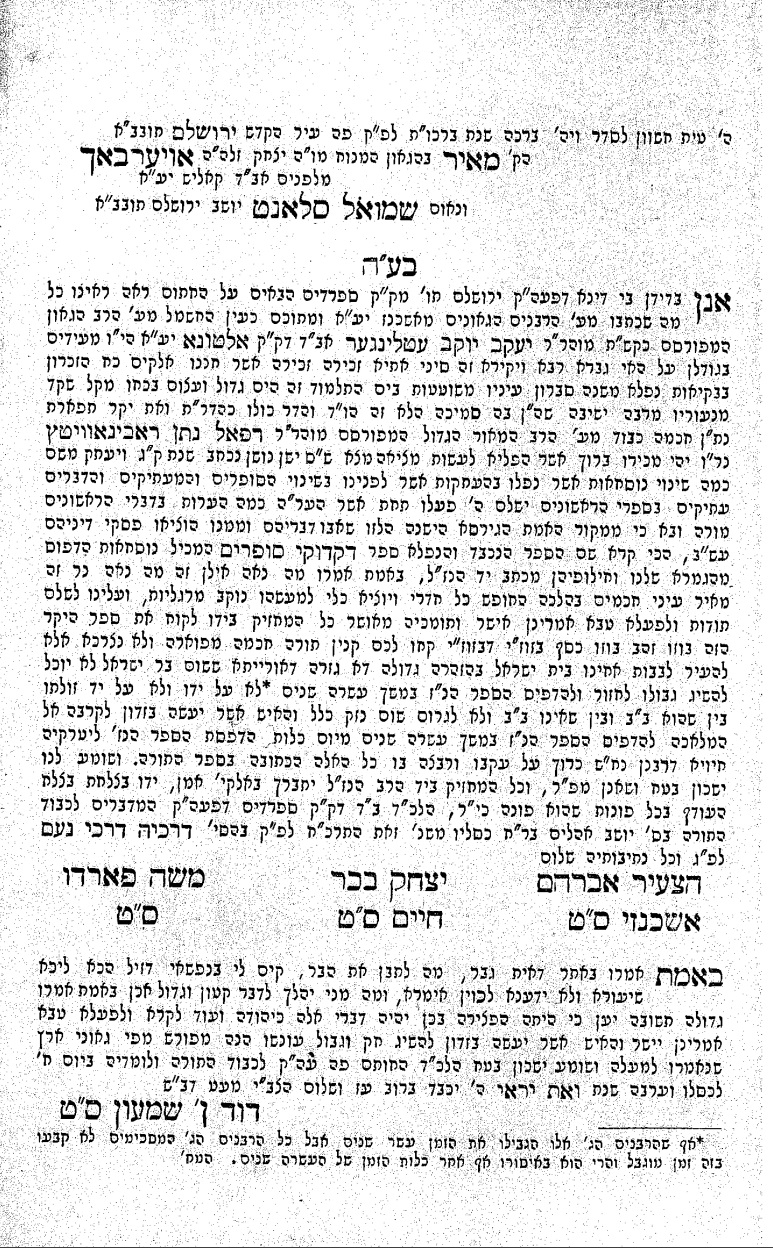
At an impasse, we reached out to Professor Shnayer Z. Leiman, who suggested that the scholar most likely to solve the mystery would be the doyen of Israeli bibliographers, Rabbi Shmuel Ashkenazi. We were rewarded thanks to the tireless efforts of Eliezer Brodt who, on our behalf, pestered the aged Jerusalem sage until he successfully unmasked the name, but not quite the identity, of the author. Rabbi Ashkenazi concluded that the first line of the introductory poem that prefaced the Halakhic query contained the acrostic – “Meir Ish-Shalom”. (His initial contention was that this could not be the noted 19th–century Viennese scholar, Meir Ish-Shalom, because his heretofore known literary output began only some five years later, with his publication of the Sifre in 1864.)

Once Rabbi Ashkenazi had provided the key to the author’s name via the acrostic, it became apparent that all along the title page had been proclaiming that very same message. Let us recall the passage in Bavli Eruvin 13b where it is recorded that the celebrated Tanna, known to us as Rabbi Meir, was actually named Nehorai, according to one opinion; or alternatively, that both Meir and Nehorai were laudatory appellations reflecting his enlightening wisdom, whereas his actual name was Nechemiah. Recall also that the query first originated with Rabbi “Shalom” of Novgorod, and the word “shalom” appears twice more on the title page and is highlighted by the placement of a circle above one of its appearances.

In his copy of this work that Dr Sprecher printed for the Chasunah which I brought him, I found this paper inside:

A few weeks after R’ Ashkenazi’s Petirah the national library held a session devoted to him where Professor Zev Gries, Professor Chava Turniansky and R’ Yechiel Goldhaber spoke about him (here is a link to the whole session). I too had the privilege of being interviewed about him that night (Here is a link to my interview).

Publication of his writings

Last year, immediately after Rabbi Shmuel Ashkenazi was niftar I, along with my special friend Menachem Butler, initiated a campaign to raise funds to publish R. Ashkenazi’s letters via the Seforim blog. Baruch HaShem, and thanks to the help of some readers, enough money was raised to go to print and in the beginning of this past January copies of the book, coming in at over 1,700 pages, (three volumes!) arrived as announced (here). The Letters sold out in a few days. A second edition was printed right before Pesach (see here). Currently copies of the second edition are available for sale.

Future volumes

Already during the Shivah, R’ Stahl began going through the materials of R’ Ashkenazi to sort out what materials are print worthy.

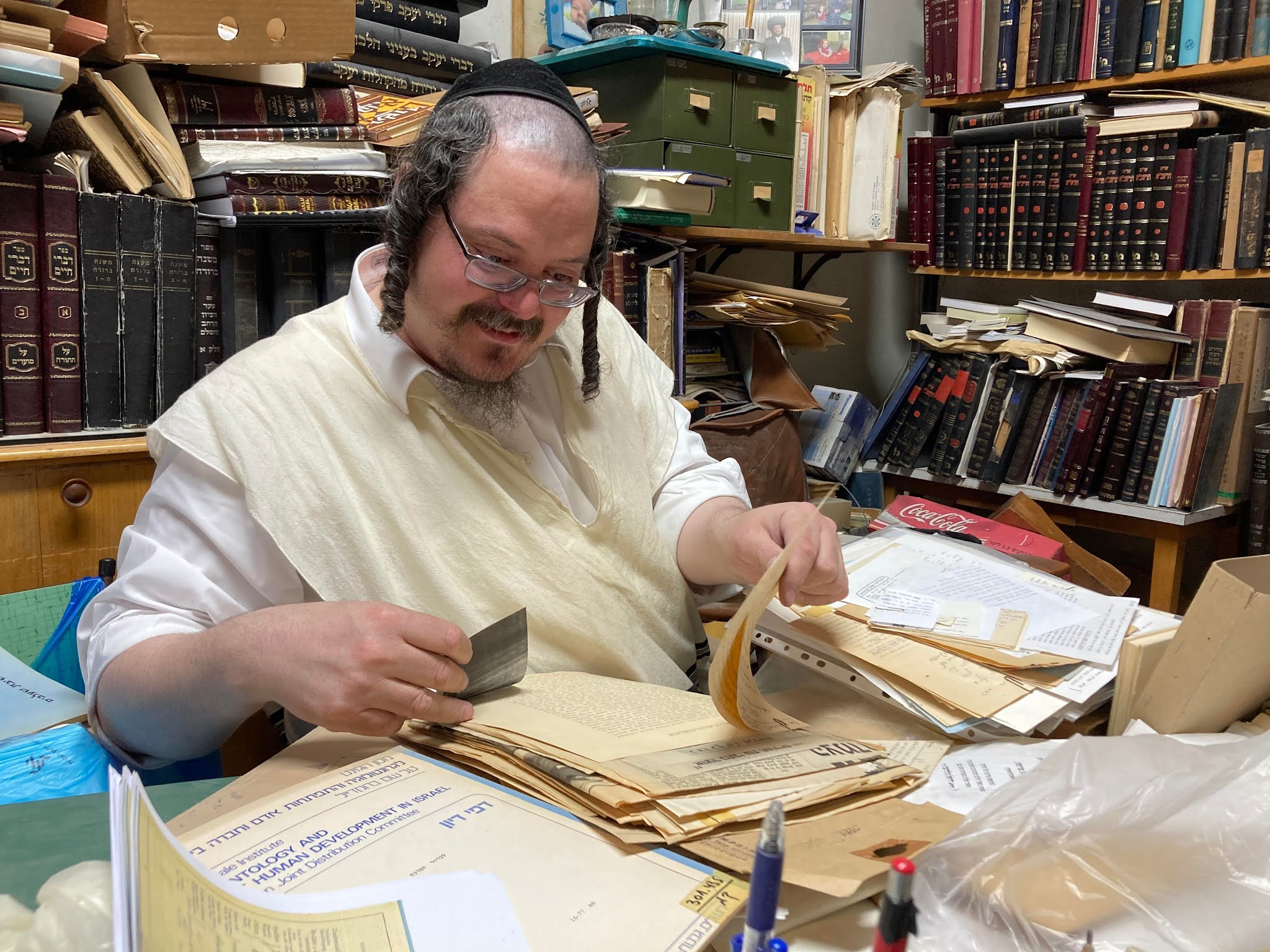
Here is a picture of R’ Stahl taken during one such session which a friend of his humorously put side by side a famous picture of Solomon Schecter when working on Geniza documents.

We never imagined we would find so much print-worthy material that we were not previously aware of; at least eight volumes’ worth of prepared writings which we hope to print. Currently, we are in the process of categorizing the material. Among the topics are: Tefilah, Minhag, articles on Seforim and authors – and much, much more. As we sort and scan R’ Ashkenazi’s legacy, some material is already being sent out to be typed up for publication. Each of the above endeavors comes at a price, and every contribution to the cause helps greatly. IY”H in the near future I will make a more formal announcement with precise details regarding the works slated for print. Anyone wishing to help with funding this project can contact me at Eliezerbrodt@gmail.com


Pandemic Bibliopenia: A Preliminary Report of Disease Eradication

אין חכמת אדם מגעת אלא עד מקום שספריו מגיעין[1]1

ריצחק קנפנטון

(ואין ספריו מגיעין בשעת המגיפה[2])

Pandemic Bibliopenia:[3] A Preliminary Report of Disease Eradication

Rabbi Edward Reichman, MD

The number of seforim written during, about or related to the Covid 19 pandemic continues to grow at breakneck speed.[4] What has largely gone unnoticed among the other unprecedented aspects of this pandemic, is that since the development of the printing press, we have not seen so much quality rabbinic literature produced in the midst of a pandemic.[5] In fact, if anything, a diminution in the quantity and quality of literature was more the norm during previous pandemics. This literature proliferation during Covid 19 heralds in a new age and reflects the eradication of a common condition prevalent in the premodern era- Pandemic Bibliopenia (heretofore, PB).

Few alive today have previously experienced a pandemic of the magnitude of Covid 19. While those Torah scholars and bibliophiles who weathered pandemics of the past would surely have been familiar with PB, possibly even from personal experience, the scholars of today are simply unfamiliar with this condition and have likely never seen a case. Furthermore, we are unlikely to see many cases of PB in the future as well (see “treatment” section below).

Since cases of PB in the present and future are likely to be exceedingly rare, the possibility of misdiagnosis or missed diagnosis is therefore a significant concern. We therefore review this condition and some illustrative cases to record its history for posterity, lest we completely forget this previously incurable disease that afflicted the Jewish community for centuries.

Definition/ Diagnosis

Pandemic

adjective

Associated with a widespread outbreak of a contagious disease.

Bibliopenia

noun

Biblio- relating to a book or books

Penia (suffix)- lack or deficiency

A lack or deficiency of books

Pandemic Bibliopenia (PB) is defined as the lack or deficiency of books available to scholars during times of widespread disease.[6] This often leads to quantitative or qualitative decline in literature produced during times of plague or pandemic.[7]

Etiology

While the Talmud explicitly recommends one to shelter in place during times of plague,[8] the practice evolved from at least the late Middle Ages and onwards to flee the urban areas for more rural, less densely populated locations.[9] Access to rabbinic works was often severely limited, if existent at all, in these remote areas. Production of literature was thus severely hindered or curtailed in areas of disease. Plagues often lasted for many months or longer.

Literary Manifestations

PB appears to be more explicitly manifest in halakhic, specifically responsa, literature, with less impact on other genres, such as poetry,[10] or other forms that do not require or rely heavily on texts. Halakhic writing often requires referencing a wide spectrum of legal writings. Furthermore, due to the often-urgent nature of halakhic queries, the response cannot await the passing of the pandemic. Elective works, however, can simply be delayed until calmer times, when access to libraries, be they private or public, can be restored.

Epidemiology

The impact and prevalence of PB throughout history is difficult to assess,[11] though it has likely been significantly underreported. Cases can only be definitively identified from manuscripts and printed works where PB is explicitly mentioned. One of the primary manifestations of Pandemic Bibliopenia is the unwritten book. How many works were conceived, and perhaps even gestated, though not birthed as a result of PB? As this is manifestly impossible to quantify, as no evidence of such remains, we will thus never know the extent of the bibliographic mortality of PB throughout history.

PB shows no innate predilection for age, gender or geographic location and is associated solely with the presence of pandemics.

Case Studies

There are a number of possible presentations of PB.

Severe Cases of Pandemic Bibliopenia

Below are two clear cases of severe PB.

  1. Rabbi Yom Tov Tzahalon (c. 1559-1638)[12]

Rabbi Yom Tov Tzahalon (known as Maharitz) authored a number of halakhic works in the late sixteenth-early seventeenth centuries and lived in Tzfat for part of that time. There were a number of plagues in Tzfat during this period. In Tzahalon’s responsa we see clear evidence in a number of places of his affliction with Pandemic Bibliopenia.[13]

Siman 8

Due to plague in Tzfat, Tzahalon was forced to flee from mountain to mountain, village to village, and states explicitly that he lacks sufficient access to works of poskim to answer the question properly. He nonetheless offers a limited response to appease the questioner.

Siman 19

Tzahalon again notes his lack of access to rabbinic literature in the midst of plague, including the tractates of the Talmud, with the exception of tractates Bava Kama and Bava Metzia, and a portion of Rambam.

During the writing of the above responsum Tzahalon resided, albeit temporarily, in Kfar Par’am, located to the Northeast of the city. People generally fled to villages on the outskirts of their city of residence.

(the pin represents Par’am)

Siman 44

During the writing of this responsum Tzahalon appears to have returned to wandering between villages and once again laments his inability to provide an in depth and expansive response.

Siman 81

In our final, albeit less explicit, example of PB in Tzahalon’s responsa, written in 1589, Tzahalon bemoans his prolonged exile and the toll it has taken, though does not allow this to prevent him from offering a halakhic analysis of the issue.

We not only have mention of Pandemic Bibliopenia in Tzahalon’s responsa, it also surfaces in his Talmudic commentary.[14] Tzahalon wrote his commentary on the fifth chapter of Bava Metzia, at least partially, while in exile. Parenthetically, this may explain why the only volumes of Talmud he possessed in exile were Bava Kama and Bava Metzia, as he likely packed these specific tractates for his travels anticipating work on his commentary. In the midst of his Talmudic commentary[15] we are introduced to Tzahalon’s personal tragedy while in exile in Kfar Par’am with the following line:

Tzahalon digresses from his commentary to share the details of the tragic death of his infant son.[16] The timing of the death, associated with a delayed burial, precipitated a halakhic question for the author:[17] Here again he reiterates his lack of access to required Talmudic tractates and poskim. He writes of his intent to review and expand his analysis upon his return to the city and to his library after the cessation of the plague.

Of note, while this passage is physically situated in the midst of this Talmudic commentary, it is in essence a halakhic responsum.

  1. Rabbi Hayyim Palachi (1788-1868)[18]

Rabbi Palachi was the Chief Rabbi of Izmir in Turkey. During his lifetime a cholera pandemic affected Turkey. In a number of his works he acknowledges suffering from Pandemic Bibliopenia. An explicit reference is below:

Hikikei Lev, vol 2, H. M., n. 51, p. 164a

Palachi was exiled to the village of Boron on the outskirts of Izmir. While lamenting that there is “no wise man without seforim,” he endeavors to respond to a halakhic question with the resources he has available him in addition to relying on his memory. Below we see the repeated mention of PB throughout multiple works reflecting a most serious case of the condition.[19]

Hikikei Lev, vol 1, E. H., n. 57, p. 114b

Hayyim Biyad n. 79, p. 98a

In a letter to Rabbi Hayyim Yehudah Avraham, published in the latter’s Ahi vaRosh[20] Palachi writes while still in exile in the village of Boron:

Varied Prevalence of PB

In the following case, we see the clear impact of PB on one Torah scholar, while another scholar during the very same pandemic appears to enjoy immunity from the condition.

In perhaps our most poetic example, Rabbi Yehudah Ibn Verga[21] corresponds with Rabbi Yosef Karo, author of the Shulhan Arukh, about a financial matter.[22] After lengthy praise for Rabbi Karo, he launches into a lament about the current state of plague in Tzfat.

Ibn Verga’s invokes the same phrase from Tehillim[23] (nikhsifah vigam kaltah nafshi) as does Tzahalon (Siman 81 above) to express the emotions evoked by the plague. His comment at the end of this passage about his elation upon meeting another person in the midst of the plague will sound familiar to those of us who have weathered complete lockdown during the current pandemic.

The next passage reflects the duration of Ibn Verga’s exile. Ibn Verga remarks that his exile had passed the entire summer, now into the winter, and the plague still lingered. “We have said, it is long due to the sins of the generation.” Ibn Verga and Karo both lived in Tzfat. Ibn Verga had hoped to speak to him directly about this case, face to face, but as the plague dragged on, he had no recourse but to commit his comments to paper.

Ibn Verga concludes that he had wanted to cite a responsum of Rosh in support of his position but was unable to include it due to his affliction with PB.[24] 

In his response, Rav Yosef Karo likewise longs to speak face to face with Ibn Verga:

He concurs that sin has caused them to be in a state of “mistar panim” until the plague passes. Rabbi Karo then proceeds to discuss the halakhic issue and makes no mention of lack of access to literature. He also lived in Tzfat and endured the same plague. In fact, we know Rabbi Karo fled Tzfat during the plague to live in the village of Birya.[25] It is in Birya in 1555 that he completed the first volume of his Shulhan Arukh. While the Shulhan Arukh was only first printed in 1565 in Venice, the colophon of each volume reflects the date and place of its completion.

Colophon at end of the 1565 edition of the first volume of Shulhan Arukh:

By the time he had completed the second volume, Yoreh De’ah, less than one year later, he had already returned to Tzfat, presumably after the cessation of the plague.

Colophon at end of the 1565 edition of the second volume of Shulhan Arukh:

While Rabbi Ibn Verga was clearly a victim of PB, Rabbi Yosef Karo does not appear to have been affected whatsoever. We thus have evidence of the variable prevalence of the condition during the same pandemic.

Mild or Implicit PB

Some cases of Pandemic Bibliopenia are not as explicit or easily diagnosed as those of Rabbis Tzahalon and Ibn Verga. At the same time as the aforementioned were experiencing plague in Northern Israel, Rabbi Moshe Isserles faced advancing disease in Cracow. Rabbi Isserles describes his dire situation in the introduction to his Mehir Yayin, a commentary on Megilat Esther that he wrote for his father-in-law, in lieu of mishloah manot, while in exile in the city of Shidlov.

While Rabbi Isserles does not explicitly refer to Pandemic Bibliopenia, he makes passing references possibly alluding to the condition. For example, he writes:

which means that his intellect still remained, despite his lack of access to an extensive library.

In describing the work, he writes:

Perhaps PB is reflected in his choice of composition, a work relying heavily on his textual analytic skills, and less so on obscure or hard to obtain texts, likely unavailable to him in Shidlov.[26]

Furthermore, his qualifying statement,

might reflect a lack of bibliographical resources. Whether this case meets the diagnostic criteria for PB remains a question.

Differential Diagnosis

Pandemic Bibliopenia may possibly be confused with other forms of Bibliopenia. To be sure, many individuals have lost access to their libraries due to personal tragedies,[27] but here I refer specifically to systemic forms of Bibliopenia that impacted entire communities. In these cases authors were similarly deprived access to rabbinic literature, though for entirely different reasons. One such example will suffice.

The Physician Abraham Portaleone was a prominent figure in Renaissance Italy, treating royalty, authoring several medical works.[28] At the age of 62 he suffered a stroke which prompted a reevaluation of his life. He concluded that his affliction befell him as he had not devoted enough of his life to Torah learning. He undertook to write a work on prayer and the Beit HaMikdash which he dedicated to his children. At the end of chapter thirty-two, which discusses the shulhan in the Temple, we find the following comment.

Portaleone notes that, “Perhaps some place in the Talmud Hazal spoke of this, and I am not aware. As a result of the known deficiency [my emphasis] I have not been able to properly ascertain this.”[29] One might erroneously assume that he is referring to Pandemic Bibliopenia as the etiology for his lack of access to the Talmud. In fact, Portaleone is referring to a variant form of the condition, called Censorship Bibliopenia. A review of the entire work of Portaleone, including his introduction, will clarify any confusion.

In his introduction, Portaleone details the nature of his early education, and recalls how while a student studying Talmud with R’ Yaakov MiPano, the infamous decree led to the Talmud “being consumed by fire before our eyes.” This refers to the burning of the Talmud in Rome in 1553.[30] After the initial burning of the Talmud in Rome, other Italian cities followed suit with their own citywide burnings. Portaleone was witness to one such event. Decades later, as he penned his classic work, Shiltei haGibborim, the Talmud still remained largely unavailable in Italy. Portaleone was forced to use substitute works that alluded to or quoted the Talmud, if available, but sometimes the information was simply not accessible. One such example is his discussion of the Shulhan above.

In one remarkable instance Portaleone reveals his elation at being able to acquire a bona fide Talmudic reference. He writes that after he completed the chapter on the Lishkat haGazit (Chamber of Hewn Stone), God ordained (hikra) that he happen upon a wise man from the city of Tzfat (where the Talmud was available) who had come to Italy to seek financial support for his family. “From his mouth I heard the sugya in the second chapter of Yoma on the laws of the Lishkat haGazit, and I write them here for you (my children) from his mouth…”[31]

In yet another place he excitedly relates of his accessing a small passage from Tractate

Chagigah from a tattered manuscript remnant in the library of a great Torah scholar (Gaon) of Verona.[32] All of these instances are examples of Censorship Bibliopenia.

Treatment

During previous pandemics, in the pre-modern era, PB was considered untreatable. Fortunately, however, it was temporary and ultimately resolved with the cessation of the pandemic. Today, however, the treatment for PB is readily available and inexpensive, though its safety has been called into question. Despite the fact that the understanding of disease transmission has evolved, people still, if feasible, flee their homes in urban areas for less populated locations. As such, they could still be susceptible to PB. However, PB is now completely remediable through internet access to Rabbinic literature.[33] Not only is virtually the totality or rabbinic literature widely and freely available for scholars (rabbis, poskim and laymen) via the internet, facilitating the production of quality work; the publication and dissemination of these works can be accomplished with ease on the internet as well. It is only today, in the midst of the current Covid 19 pandemic, that we are witnessing the eradication of PB. As a result, there have likely been more pages written of rabbinic discourse (both halakhic and aggadic, related to the pandemic or not) during the present pandemic than during all previous pandemics combined.[34]

Conclusion

Pandemic Bibliopenia is an underrecognized phenomenon in Jewish history. In addition to the medical impact of pandemics in the past, our ancestors experienced spiritual and intellectual suffering by being deprived access to the Torah library, our life blood. Today, however, even in the midst of a worldwide pandemic, while libraries have shuttered, and some have fled their homes, there has been little diminution in the access to rabbinic literature. As the world may never again experience Pandemic Bibliopenia and the unique literary impact of plagues and pandemics, it behooves us to recall it in appreciation that despite the many adversities associated with this pandemic, loss of access to our beloved Torah literature is not counted among them. Not only have we eradicated Pandemic Bibliopenia, it appears to have been replaced with a new diagnostic category, Pandemic Polybiblia,[35] though in this case, fortunately, a healthy and desired condition. May we be zokheh to the continuation of Polybiblia without any associated pandemics in the future.

[1] Isaac Canpanton (15th century), Darkei HaGemara. This oft quoted phrase refers specifically to the purchase of one’s own seforim. I take literary license with its use here.
[2] My addendum.
[3] This condition has been variously called epidemic or plague bibliopenia. We use the term pandemic in light of the present Covid 19 pandemic.
[4] See Eliezer Brodt, “Towards a Bibliography of Coronavirus-related Articles and Seforim written in the past month (updated), Black Weddings and others Segulot,” Seforimblog.com (May 4, 2020).
[5] The proliferation of literature specifically related to the pandemic is also noteworthy and unprecedented but is not the focus of this article. On the history of literature written during times of plague, see Abraham Yaari, biOhalei Sefer (Reuven Mass, 5699), 82-90. The other essays in this volume chronicle the impact of various natural occurrences, such as fires, and personal experiences, such as imprisonment, miraculous salvation, or infertility, on the writing of Hebrew books.
[6] The etiology may be related to either closure of public libraries, which is a more widespread form PB, or due to required or elective relocation away from one’s personal library to remote areas devoid or deficient of seforim.
[7] Plague and the migration to the rural areas affected not just the writing, but the printing of Hebrew books as well. See Yaari, op. cit.; Avraham Haberman, Perakim biToldot haMadpisim haIvrim (Reuven Mass: Jerusalem, 5738), 314.
[8] Mishnah Ta’anit 3:4.
[9] See Yaari, Moshe Dovid Chechik and Tamara Morsel Eisenberg, “Plague, Practice and Prescriptive Text: Jewish Traditions on Fleeing Afflicted Cities in Early Modern Ashkenaz,” Journal of Law, Religion and State (2017), 1-27. I thank professor Susan Einbinder for bringing this article to my attention.
[10] For poetry in times of plague, see Susan Einbinder, After the Black Death: Plague and Commemoration Among Iberian Jews (University of Pennsylvania Press: Philadelphia, 2018). idem, “Poetry, Prose and Pestilence: Joseph Concio and Jewish Responses to the 1630 Italian Plague,” in Haviva Yishai, ed., Shirat Dvora: Essays in Honor of Professor Dvora Bregman (Ben-Gurion University: Beer Sheva, 2019), 73-101; idem, “Prayer and Plague: Jewish Plague Liturgy from Medieval and Early Modern Italy,” in Lori Jones and Nükhet Varlik, eds., Death and Disease in the Medieval and Early Modern World: Perspectives from Across the Mediterranean and Beyond (York Medieval Press, 2021), forthcoming.
[11] We do not address here the impact of disease and illness on literary output.
 [12] On Tzahalon, see, Shimon Vanunu, Arzei Halevanon (Jerusalem, 5766), 862-865; Shalom Hillel “Sefer Magen AvotRabbeinu Yom Tov TzahalonMekabtziel 33 (Kislev, 5768), 10. Vanunu lists all the references discussed below.
[13] Here we do not address the substance of the responsa, rather focus on the impact of PB on the author. I mention the responsa in number order, assuming this is chronological.
[14] Tzahalon’s Talmudic commentary was first published by his grandson in Venice, 1693, where it appears after the former’s responsa. A corrected and annotated version of the Talmudic commentary was published by S. Mertzbach in Benei Brak in 5752.
[15] This was written in the manuscript in the middle of his commentary on the fifth chapter of Bava Metzia, but is printed separately as n. 14 as part of his responsa.
[16] His son’s death does not appear to have been plague related, as he recounts that his son was perfectly healthy just prior to his death.
[17] The delayed burial generated a question for Rabbi Tzahalon as to which day was considered his first day of mourning and thus whether he should put on tefillin.
[18] On Palachi, see Shimon Aryeh Leib Eckstein, Toldot haHabif (Halevi’im Press: Jerusalem, 5759). All of the citations mentioned he are referenced on p. 183, n. 17.
[19] See also his Nishmat Kol Hay, vol 2, E. H., siman 3, page 6.
[20] (Izmir, 1840), H. M., n. 14, p. 88b.
[21] This Yehuda Ibn Verga is not to be confused with the Spanish historian and kabbalist of the fifteenth century.
[22] Rabbi Yosef Karo, Avkat Rokhel, 99 and 100.
[23] 84:3.
[24] If I am reading this correctly, it seems that Ibn Verga was still in Tzfat when he wrote this but had sent his library ahead to his location of exile.
[25] See R. Ephraim Greenblatt, “B’Inyan Kiddush Levanah,” Noam 12 (5729), 113. Birya can be seen on the map above, between Tzfat and Par’am.
[26] This work does reference texts from the Talmud and Tanakh as well as the Rambam’s Moreh Nevukhim. These may have been his available texts.
[27] See, for example, Yehuda Rosenthal, “ The History of the Jews in Poland in Light of the Responsa of the Maharam of Lublin,” (Hebrew) Sinai 31:7-12 (NisanElul, 5712), 320 regarding Maharam miLublin and his limited access to his library due to a fire in Cracow.
[28] On Portaleone, see H.A. Savitz, “Abraham Portaleone: Italian Physician, Erudite Scholar and Author, 1542-1612,” Panminerva Medica 8:12 (December, 1966), 493-5; S. Kottek, “Abraham Portaleone: Italian Jewish Physician of the Renaissance Period- His Life and His Will, Reflections on Early Burial,” Koroth 8:7-8 (August 1983), 269-77; idem, “Jews Between Profane and Sacred Science: The Case of Abraham Portaleone,” in J. Helm and A. Winkelmann (eds.), Religious Confessions and the Sciences in the Sixteenth Century (Brill, 2001); A. Berns, The Bible and Natural Philosophy in Renaissance Italy (Cambridge University Press, 2014).
[29] End of Chapter 32.
[30] See Menachem Butler, The Burning of the Talmud in Rome on Rosh Hashanah, 1553 theTalmud.blog (September 28, 2011).
[31] Chapter 23, p. 109.
[32] For discussion of these cases, see Y. Katan and D. Gerber, eds., Shiltei haGibborim (Machon Yerushalayim, 5770), 28-29.
[33] See Jacob J. Schacter, “The Challenges and Blessings of the Internet: Technology from An Historical Perspective,” Jewish Law Association Studies, vol. 29 [The Impact of Technology, Science, and Knowledge] (2020), 5-20. Rabbi Dr. Schacter highlights some striking parallels regarding challenges created by the development of printing and the development of the internet.
[34] I admit being guilty of contributing to this phenomenon.
[35] The diagnostic criteria for this new entity have not yet been adequately formulated and will require a fuller evaluation with the passage of time. A preliminary definition has been proposed: The proliferation of rabbinic works relating to pandemics written in the midst of the pandemic itself.


On the Passing of Yeshayahu Vinograd, the Bibliographer and the Man

On the Passing of Yeshayahu Vinograd, the Bibliographer and the Man

Moshe Dovid Chechik

Yeshayahu Vinograd (1933–2020), the renowned scholar and bibliographer, passed away on Thursday, 7 May 2020. He authored Otzar ha-Sefer ha-‘Ivri (Thesaurus of the Hebrew Book), Otzar Sifrei ha-Gra (Thesaurus of the Books of the Vilna Gaon), and (published) Siddur Ezor Eliyahu. The following reminiscences were written by Moshe Dovid Chechik at the request of the editors of The Seforim Blog, and translated from the Hebrew by Daniel Tabak.

While most frontmatter is forgettable, one of the most amazing prefaces that I will never forget is the one composed by Reb Shaya of blessed memory for his magnum opus, Otzar ha-Sefer ha-‘Ivri (Thesaurus of the Hebrew Book). If there were an anthology of prefaces, an entire section would be dedicated to this one, as it is truly sui generis. Its heading reads “Preface and Acknowledgments,” but only the latter is accurate. Spanning nearly four folio-sized pages is a list of every institution and individual who assisted in the writing of the book. Considering that this was a labor of many years, it was only natural that a goodly number of people would make contributions, and so Reb Shaya, a bibliographer through and through, remembered each and every one of them, dedicating a line or two or three to mark their efforts.

This preface encapsulates some of Reb Shaya’s most beloved attributes. First and foremost, he was a diligent collector of all things. In this introductory frontmatter—as in his writings themselves—he amassed all of the relevant particulars, because the omission of even one would mar the final product. Naturally, this was inextricably bound up with Reb Shaya’s characteristically phenomenal memory, as well as his drive to be as precise as possible—not to over- or understate matters, but to delineate precisely what we know and what we do not. Finally, it reflects his good-heartedness, how he found joy in sharing in the success of others and in sharing of himself with others.

In the preface, Reb Shaya did not forget about himself and so provided us with a rough self-eulogy:

The National and University Library [of Israel] served as my home and as my primary source of information and bibliographical data. […] The catalogue room [today, the computer lab] served as my main office for years, and many visitors to the library considered me staff, addressing their questions and even complaints to me… [points of ellipsis in the original].

These are the wonderful qualities that made Reb Shaya who he was. He could not have been further from the stereotype of the stodgy bibliographer who lives in a world of dry facts.

Reb Shaya’s sarcastic wit was ever-present. Thirteen years ago, a few months after I moved into his neighborhood, I ran into him on his way to the Mahane Yehuda market. At the time, we didn’t know each other. I stopped him with some hesitation and asked him when the new edition of the siddur Ezor Eliyahu would be printed. In response he asked, “Are you Chechik?” I nodded, bewildered, as if I had been caught red-handed. In an undertone I remarked that I really hope he didn’t ask every passerby if they are Chechik. He gave a hearty laugh and quickly reassured me that he bore me no grudge for the critical review I had penned two years earlier on the siddur. Quite the contrary, he added, he thought the criticism was well placed. Faced with his grin and bright eyes, I couldn’t help but believe him. We were friends ever since, and recently he reminded me of our first encounter, making sure I remembered my amusing retort.

R. Shaya’s daily route to and from the market passed under my window, allowing him to grab me for a chat when he liked. And since the stop for the 7 bus to the National Library was located under the window to his office on Bezalel Street opposite Hagidem, it gave me a chance to engage him in conversation. He would beam when reporting on the progress of every edition of the siddur, which he never ceased updating and improving, and he insisted on gifting me a copy of every edition, paying no mind to my protests.

He spoke to everyone as an equal. The age gap of fifty years that separated us never surfaced in our conversations. Neither did the immense store of knowledge he carried around. I was always astounded by his insatiable curiosity for new fields or unfamiliar topics. This was no passing interest, as he always remembered to press me about whether I had looked into something or had found a balm for some burning question of his.

R. Shaya’s trademark was his constant smile. As a neighbor, I can say that I never saw him get angry at anyone.

In recent years, when R. Shaya was already in his eighties, his main efforts were expended on a work that he unfortunately never completed. This was the Otzar ha-Ziyyufim, a compendium intended to document every instance of a Hebrew press mentioning an incorrect imprint—for whatever reason—on a title page. This painstaking work demanded a detective’s perceptive hunch, a historian’s vast knowledge, a bibliophile’s intimate familiarity with countless volumes, and, of course, a taxonomist’s complex classification scheme, which he himself had to devise and define. The illness and passing of his wife brought his work to a full stop, but recently he informed me on several occasions that his work was nearing its conclusion, even if, as we had come to expect, he would find new cases for inclusion on a daily basis. His perfectionism confined his final work to a drawer.

It is difficult to capture R. Shaya’s enormous contribution to the world of Hebrew bibliography, for which we owe him a tremendous debt. Who knows how many hours and days he saved us with the meticulously written and organized Otzar ha-Sefer ha-‘Ivri. More than twenty-five years since its publication, and in spite of the impressive technological advances of recent decades, this colossal work of Reb Shaya the bibliographer has yet to be superseded. But for his colleagues, friends, and loved ones, there is none who can replace R. Shaya the man, with his wonderful personality, good humor, and wit.