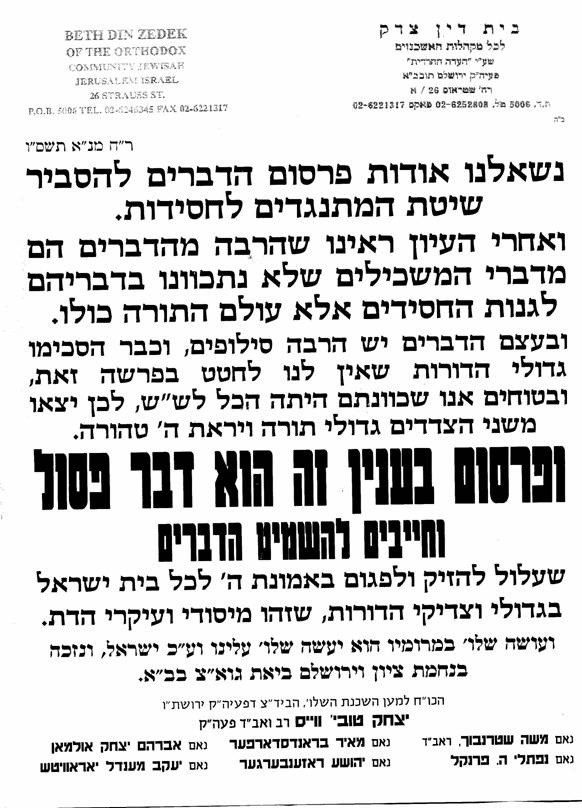
Bedatz Bans HaGaon

As discussed previously, there are some, mainly Hassidim, who had strong objections to R. Eliach’s biography HaGaon. Now it appears that Bedatz of Jerusalem has also issued a ban on the work (thanks to all those who sent this to me). The ban is reproduced on the side. The ban itself contains some interesting language. Specifically, the ban claims that the sources relied upon by Eliach were “maskilik.” You will recall that all Eliach did was reproduce many of the herems and the like from the non-Hassidim at the time. Now, it is correct that most of those polemics were collected by Wilensky in his Hassidim u’Mitnagdim, but the actual texts are those of some of the greatest Rabbis (not maskilim) of that time period.
Additionally, far from advancing haskalah (enlightenment) R. Eliach repudiates it. Many academics claim that the Gra was the precursor to modernity as the Gra advocates for studying secular subjects (among other things). Eliach, however, devotes an entire chapter demonstrating the Gra was against the haskalah. Eliach also includes additional material on this topic in other places as well. In doing so, he demonstrates that far from accepting maskilik or hasklah literature he actually accepts as true many anti-maskilik assertions. One example is particuarly telling. R. Eliach accepts that the Noda B’Yehuda banned R. Naftali Hertz Wessely. The source for this is an article which appeared in the Journal Kovetz Bet Ahron v’Yisrael by R. Y.A. Heschel. R. Heschel’s article is full of errors and wild assumptions. Most notably, R. Heschel assumes that the ban in question is from the Noda B’Yehuda solely because it was found in a stack of papers also from the Noda B’Yehuda. There is no other cooberating evidence. Instead, this is an unsigned letter that contains no other internal or external indica of reliablity. R. Eliach, however, in his attempt to prove the vehemence as well as the universiality of condemnation of the haskalah accepts this as true. Thus, it is somewhat difficult to understand how R. Eliach could be accused of accepting and advancing maskilik ideas and positions.

Finally, it is rather unclear why in August of 2006 the Bedatz is banning a book published in 2002. It was not as if this book was “under the radar.” Instead, immediatly with its publication there were other bans, articles and condemnations of the book. Further, R. Eliach secured the approbation of R. Chaim Kanievsky and was featured in Dei’ah veDibur the Haredi newspaper. While this wouldn’t be the first controversy between Beni Brak and Jerusalem, (famously the controversy over using the Ben Asher Nach was essentially between the two communities) it is a bit strange in its timing.

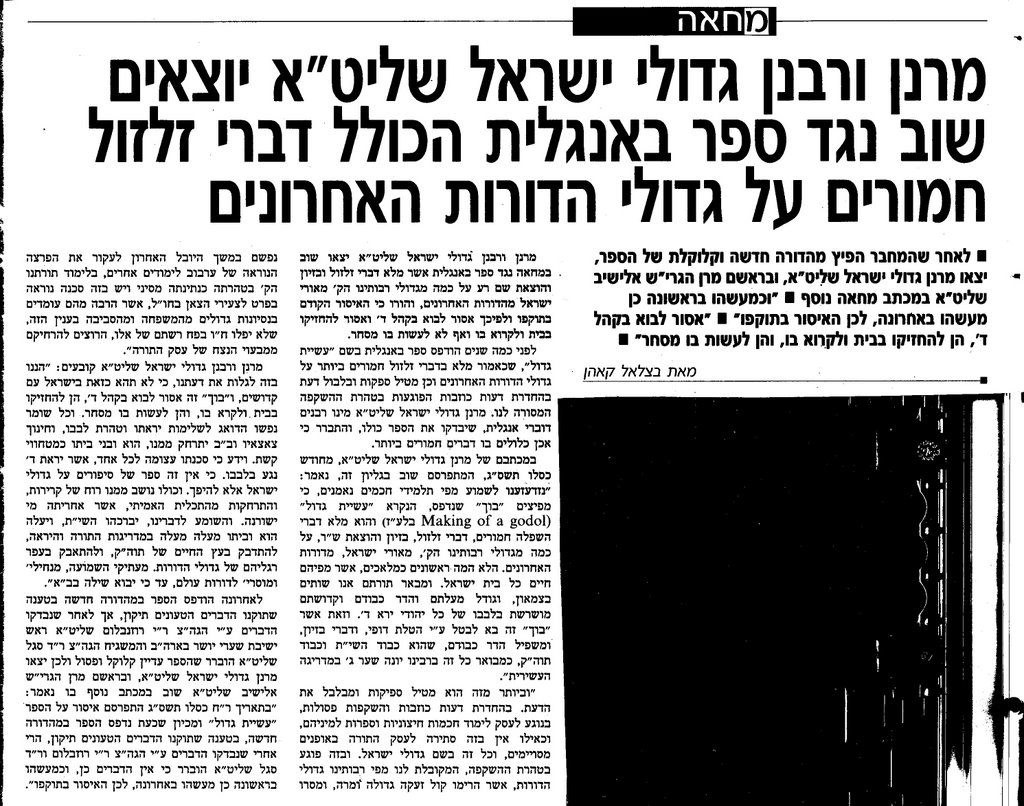
The Ban on the book HaGaon

Now, as the Yiddish newspaper Der Yid has gotten around to commenting on the book HaGaon, I thought it would be worthwhile flesh out the entire controversy surrounding this book. Interestingly, R. Kamentsky in Making of a Godol actually discusses this very topic, although not in the context of HaGaon.

HaGaon written by R. Dov Eliakh in three volumes discusses everything and anything having to do with the Vilna Gaon. Most of the book is not controversial at all, instead, in painstaking detail R. Eliakh chronicles what we know about the Gra and the times he lived in. However, the third volume was the one that many took issue with. That volume, which discusses the controversy between the hassidim and the non-hassdim, also includes most of the primary literature on the topic. That means, R. Eliakh quotes extensively from many of the early anti-hassidic tracts which were published. Some of these contain scathing critiques of the hassidim and accuse them of rather disturbing acts.

However, as many are aware this was not the first time these were published. All of these, and more, have been published by Mordecai Wilensky, in his Hasidim u-Mitnagdim (which is now available again). In fact, much of this has even been translated into English in Elijah Schochet’s The Hasidic Movement and the Vilna Gaon. But, for some who are unaware of these, Eliakh’s book was highly disturbing.

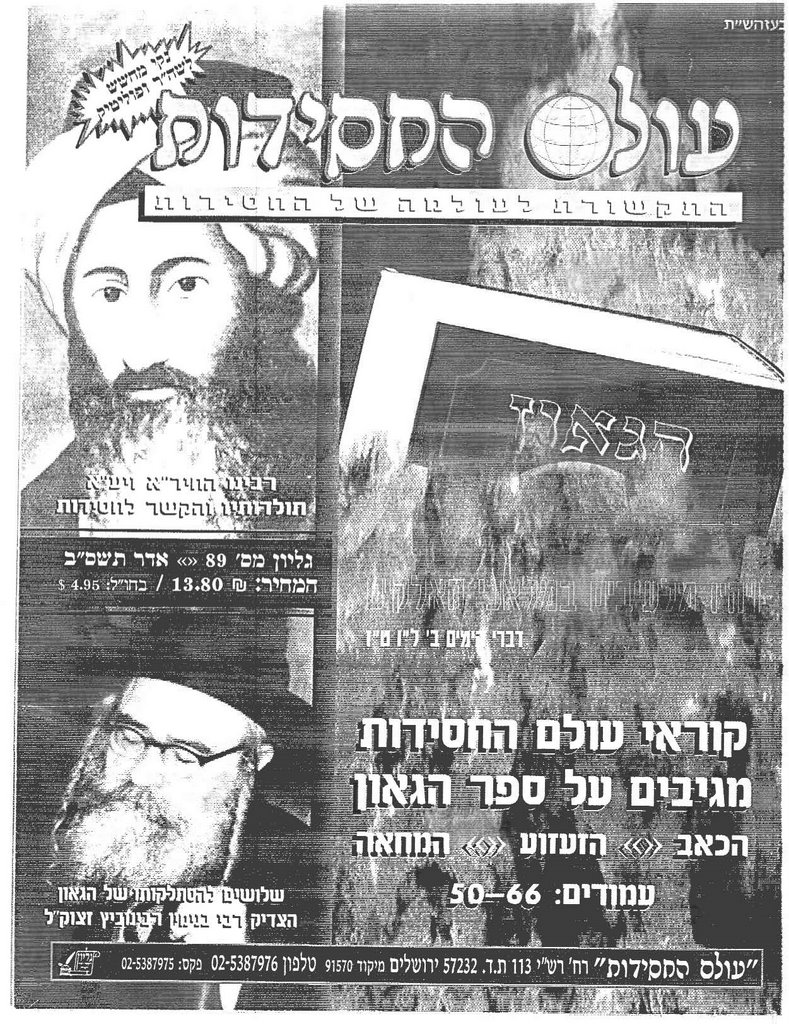
The main complaints came, as is not a surprise, from hasidic circles. For instance, in the magazine Olam haHasidut, has three issues devoted to the book. On the cover of two of those issues, the book HaGoan appears in flames. Needless to say they were not fans of the book. The title reads אוי לדור שכך עלתה בימיו (how unfortunate we are to have this happen in our time). Among the major complaints about the book is that it is “written in the style of the maskilim (enlightenment).” I assume that means that as Eliakh documented everything he wrote that is in the style of the maskilim.

Additionally, they complain that as this controversy is no longer applicable (as the hasidim of today don’t do what they did back then), it serves no purpose in relating this again.

Now, here is where Making of a Godol comes in. R. Nathan Kamenetsky records what his father, R. Yaakov’s opinion on whether to discuss the history of the controversy between the hasidim and the non-hasidim. “My father [R. Yaakov] approved of snubbing of ‘a book on the Goan of Vilna by an outstanding author’ because ‘the author had purposely omitted chapters dealing with the Gaon’s opposition to Hasiduth and that he [R. Yaakov] said, ‘It is prohibited to conceal substantive and important issues such as these. Such distortion is tantamount to falsehood.'” R. Nathan Kamentsky goes on to relate that the book in question was R. Landau’s biography of the Gra and that his father [Rav Yaakov Kamenetsky] actually confronted R. Landau and accused him of “falsifying the image of the Gaon.” See Making of a Godol vol. 1 pp. xxvii (available here).

Consequently, R. Yaakov felt that leaving out such a seminal fact in a biography was equivalent to lying. However, as we see, the publishers of Olam haHassidut appear to disagree. They are not the only ones. R. Yaakov Perlow, the Novominsker Rebbi, wrote a long article where he also takes issue with Eliakh’s book. He also claims that R. Eliakh should have left out the details of the controversy.

It would appear that there is a fundamental controversy as to whether or not one should lie regarding history. In fact, in the journal Ohr Yisrael, there was an article addressing this very point – whether one should lie to tell stories that create yirat shamyim. The author concludes “if the teacher is telling stories which are not true, but is doing so leshem shamyim, so long as he doesn’t make a habit out of it, there is a place to be lenient in this matter, however, one should try to minimize this.”

Interestingly, in the next volume the Admor from Slonim has a stinging rebuttal of the article. He starts by saying, “Our tradition is based upon truth . . . how terrible it is to inject lies into our tradition.” He then explains such a view undermines our entire religion “whomever permits [one to lie] it is as if he is creating uncertainty in the truth of our entire tradition, which is based upon the passing from generation to generation. My teachers have taught that one should only accept truthful stories.”

So it would appear that there is an ongoing controversy, one which implicated the book HaGaon, with some arguing lying or covering up fundamental historical facts, is ok. While others claim this is totally unconscionable.

Sources: Olam haHassidut no. 88, Shevat 2002; 89, Adar 2002; 90, Nissan, 2002. Rabbi H. Oberlander, “HaIm Mutar l’Saper Ma’siyot shaninom amitim kedi l’orrer al yedi zeh l’Torah v’lyerat shaymim, Ohr Yisrael, 29 p. 121-123; R. Avrohom Weinberg (Admor M’Slonim Beni Brak), Letter, Ohr Yisrael, 30, 244. See also, Ari Zivotofsky, Perspectives on Truthfulness in the Jewish Tradition, Judaism 42:3 (Summer, 1993): 267-288. R. Yaakov Perlow, Yeshurun vol. 10 starting on page 831. Der Yid, Talumat Seftei Sheker haDovrot al Tzadik Atik, March 17, 2006. See also here for a discussion of the book. There are others that discuss this as well, and in R. Nathan Kamenetsky’s introduction he quotes them. Further, as a helpful reader/movie buff has noted, I should have included R. Dr. Jacob J. Schacter’s article on this topic available here.


Dei’ah veDibur on the MOAG Ban

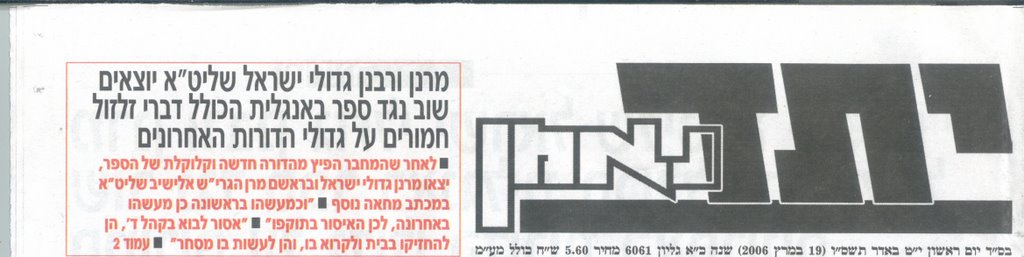
Not that this is surprising, as Dei’ah veDibur is the English version of the Yated Neeman, but they have also posted the article and the new ban from below on their site in English.


Latest MOAG Ban Runs Counter to an Agreement with R. Eliyashiv

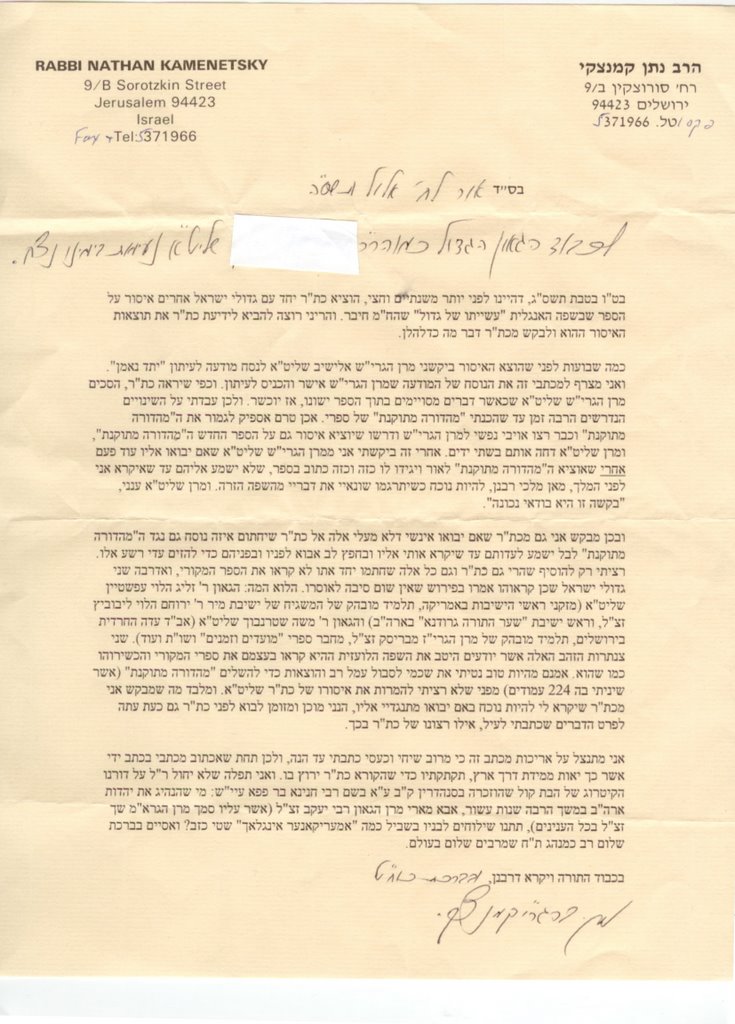
A reader has sent me the following letter from R. Kamenstky discussing the possiblity of a ban on the improved edition of MOAG. The letter says “if people will come to complain to R. Eliasiv about the new edition and say such and such is written there, he will not listen to them until he first calls me, and I will need to present when they translate my book for him.”

Additionally, I have received the following relevant information.

“The letter quotes Rav Elyashiv as saying that the request that the author should be called and given a fair chance to defend himself is just. This was repeated by a number of meetings that the author had with R’ Elyashiv. Before the letter was sent out it was shown to Aryeh Elyashiv – the grandson in charge of all the appointments and present in the room during all meetings to assist his grandfather – and he stated that the quote was correct and it conveys faithfully his grandfather’s say on the matter.

The letter was delivered to the following Rabbis:
Steinman
Sheinberg
Karelitz
Kanyevsky
Markowitz
Auerbach
It was not sent to Rabbi Shapiro because he already apologized for the first time that he signed against the book, and had already said that he will not have anything more to do with this affair. Sure enough he kept his word now and didn’t sign.
R’ Wolbe was omitted because he’s not alive.
R’ Elyashiv didn’t have to receive this letter because he was the subject of the letter.
R’ Lefkowitz was not sent this letter because he was very vicious the time before, and could not be expected to be fair.

The author has made it his habit to daven in the morning in R’ Elyashiv’s minyan from time to time, so that if anything arises he can be informed of immediately.

This last Friday and Sunday he was at the minyan and no one (including Yisroel Elyashiv – another grandson) said anything when asked if everything is fine. It was only after he came home that he found out about the ad and article in Yated Neeman.”


Text of the New Ban on Making of a Godol

A helpful reader has scanned the Yated with the latest ban against Making of a Godol (“MOAG”). It is notable that R. Eliashiv has signed again as have others who were part of the original ban. Also, as you can see this appeared on the top of the front page as well as a separate article. Those who signed claim that this edition of MOAG although ostensibly “fixed” the “problems” it was unsuccessful and they state “the second edition is the same as the first.” Addtionally, the orignal ban is reprinted with a note that it is still in force. You can click on the scans for a larger view. For some of the differences between MOAG I and MOAG II see here, here and here.


Making of a Godol Banned – Again

An astute reader emailed me that it appears the new and improved edition of Making of a Godol has been banned. Although this edition attempted to “fix” some of the “problems” of the first, it appears that it has not satisfied it detractors. See here. I hope to get a copy of the letter referenced in the article, when I do I will post it.