What is Bothering the Aruch Hashulchan? Women Wearing Tefillin

What is Bothering the Aruch
Hashulchan
?
Women Wearing Tefillin
Michael J. Broyde
mbroyde@emory.edu
Please note that this piece isn’t meant to be construed one way or another as the view of the Seforim Blog.
Introduction
In our previous article,[1]
we focused on the view of the Mishnah Berurah concerning women wearing
tefillin.  In this article, we focus on
the Aruch Hashulchan, whose approach is also complex, reflecting the complexity
of the area.
The Aruch Hashulchan (OC 38:6) states:
נשים ועבדים פטורים מתפילין מפני שהיא מצות עשה
שהזמן גרמא דשבת ויו”ט פטור מתפילין ואם רוצין להחמיר על עצמן מוחין בידן ולא
דמי לסוכה ולולב שפטורות ועכ”ז מברכות עליהן דכיון דתפילין צריך זהירות יתירה
מגוף נקי כדאמרינן בשבת [מ”ט.] תפילין צריכין גוף נקי כאלישע בעל כנפים
ובירושלמי ברכות שם אמרו תמן אמרין כל שאינו כאלישע בעל כנפים אל יניח תפילין אך
אנשים שמחויבים בהכרח שיזהרו בהם בשעת ק”ש ותפלה ולכן אין מניחין כל היום
כמ”ש בסי’ הקודם וא”כ נשים שפטורות למה יכניסו עצמן בחשש גדול כזה ואצלן
בשעת ק”ש ותפלה כלאנשים כל היום לפיכך אין מניחין אותן להניח תפילין ואף על
גב דתניא בעירובין [צ”ו.] דמיכל בת שאול היתה מנחת תפילין ולא מיחו בה חכמים
אין למידין מזה דמסתמא ידעו שהיא צדקת גמורה וידעה להזהר וכן עבדים כה”ג
[עמג”א סק”ג וב”י ולפמ”ש א”ש[:
Women and slaves are
exempt from the mitzvah of tefillin since it is a positive commandment
that is time bound since tefillin are not worn on Shabbat and Yom Tov.  If they wish to adopt this as a stringency,
we should protest.  This is not
comparable to sukkah and lulav from which they are exempt, but nonetheless
recite a blessing. This is because tefillin require extra diligence
regarding cleanliness, as it states in Shabbat (49a) that tefillin need
a clean body like Elisha .In the Jerusalem Talmud (Berachot) it says that
anyone who is not clean like Elisha should not wear tefillin.  Even men must be careful [with cleanliness]
when reciting the Shema and Amida which is why they do not wear them all day,
as I noted in the previous paragraph. 
If this is so, then why should women — who are exempt [from the mitzva
of tefillin] — place themselves under this great risk, since for them,
[wearing tefillin] when the Shema and the Amida are recited is comparable to
men [wearing tefillin] the entire day. 
Therefore, we do not permit them to put on tefillin.  Even though it recounts in Eruvin (96a) that
Michal bat Shaul did don tefillin, and the rabbis did not rebuke her, we
should not extrapolate from this, since they knew that she was very righteous
and could be careful.  Slaves are in the
same situation. [See the Magen Avraham 38:3 and the Bet Yosef; according to
what I have written all makes sense.]
There are a few problems with the Aruch
Hashulchan that are immediately clear. Four come to mind as requiring
resolution in order to understand the Aruch HaShulchan:
·       
Why
does he not cite the primary source for the halacha of rebuking women, which is
the Pesikta?
·       
What
are the characteristics of women who can put on tefillin according to
the Aruch Hashulchan or does he mean that Michal bat Shaul is unique?
·       
Can
all slaves put on tefillin?  Can
any?
·       
What
is the problem with the Magen Avraham and the Bet Yosef that he is seeking to
answer?
In short to understand the Aruch Hashulchan’s
approach, one must first comprehend what is bothering him about other
approaches.  In this case, he tells the
reader what is bother him when he notes in his final parenthetical note [[עמג”א סק”ג
וב”י ולפמ”ש א”ש
in which each word is abbreviate, but crucial to understanding, so we spell it
out:
[עיין
מגן אברהם סעיף קטן ג ובית יוסף ולפי מה שכתב אתיא שפיר[:
[See
the Magen Avraham call note 3, and the Bet Yoesef, and according to what I have
written all is 
logical.]
In this note, Aruch Hashulchan is claiming that
neither the Magen Avraham nor the Bet Yosef have properly solved the problem,
and he thus doing so.  This paper is an
explanation of that.
The
Approach of the Bet Yosef:

Bet
Yosef (OC 38) quotes Tosafot, as well as the Pesikta to explain the reasoning
behind Chazal’s recorded disapproval of Michal bat Shaul wearing tefillin.  Bet Yosef states and elaborates:
כתב הכל בו (סי’ כא) בשם הר”ם שאם רצו הנשים
להניח תפילין אין שומעין להן מפני שאינן יודעות לשמור עצמן בנקיות עכ”ל ובספר
ארחות חיים (הל’ תפילין סי’ ג) הקשה עליו מדאמרינן בריש פרק המוצא תפילין (שם)
דמיכל בת כושי (פירוש בת שאול) היתה מנחת תפילין ולא מיחו בה חכמים. ולי נראה שטעם
הר”ם כמו שכתבו התוספות (ד”ה מיכל) דאיתא בפסיקתא (רבתי פרק כב) שמיחו
בה חכמים ופירשו הם דטעמא משום דתפילין צריכין גוף נקי ונשים אינן זריזות ליזהר
והר”מ רצה לחוש לדברי הפסיקתא:
The Kol Bo (21) writes
in the name of the Maharam that if women wish to wear tefillin, we do
not listen to them, since they do not know how to keep themselves clean.  The Orchot Chaim (Tefillin 3) questioned
this based on the Talmud in Eruvin 96a that Michal bat Kushi (daughter of Saul)
did don tefillin and the rabbis did not rebuke her.  To me, it appears that the view of the
Maharam is like that quoted by Tosafot (sv michal) as it appears in the
Pesikta that the Sages did rebuke her. They explained the reason to be that tefillin
need a clean body and women are not careful about such matters.  Maharam was concerned for the view of the
Pesikta.
The Bet Yosef is clear and simple.  He thinks that there is a dispute between
rabbinic sources about whether any women can ever wear tefillin.  The Babylonian Talmud rules that Michal bat
Shaul can wear tefillin, and she is a model for all other women; the
Pesikta states that such is prohibited to all women, even to women like Michal
bat Shaul.  Some, the Bet Yosef claims,
are concerned with the view of the Pesikta, which they think is normative.
Following his rules to resolve disputes, Rabbi
Karo in the Shulchan Aruch rules against the Peskita and like the Bavli, as
such is the resolution favored by Rambam, Rif and Rosh. Rabbi Karo states
simply:
נשים ועבדים פטורים מתפילין, מפני שהוא מצות עשה
שהזמן גרמא.
Women and slaves are
exempt from the mitzvah of tefillin since it is a positive time bound
commandment.
Nothing is codified to discourage this conduct;
only an exemption is noted.  The view of
our Talmud is codified and nothing else is cited.  According to Rabbi Karo, tefillin are like lulav, sukkah
and shofar, which women need not, but may do, and is a mitzvah for them
to do.  The Peskta is rejected.
The Approach of the Magen Avraham
The Rema, however, adds the alternative:
 הגה: ואם הנשים רוצין להחמיר על עצמן, מוחין
בידם.
If the women wish to be
strict for themselves, we protest.
The Rema seems to be adopting the view of the
Pesikta that we ought to protest such conduct, essentially prohibiting it. Much
is unclear about the Rama, including why and does he mean all women (although
logic inclines one to think that he means all women.)
To explain the position of the Rama, Magen
Avraham (38:3) write:
מוחין כו’ – מפני שצריכין גוף נקי ונשים אינם
זריזות להזהר אבל אם היו חייבים לא היו פטורין מה”ט דהוי רמי אנפשייהו
ומזדהרי כנ”ל דלא כע”ת:
We protest: Since they
need a clean body and women are not particularly careful with cleanliness; but
if they were obligated, they would not be exempt for that reason since they
would accept the mitzvah upon themselves and they would thus be
conscientious.  Such appears to me to be
the rule, and not like the Olat Tamid.
The whole thrust of the Magen Avraham is to
explain the view of the Pesikta in contrast to the Bavli.  The Magen Avraham explains that the Pesikta
rules once one is not obligated in donning tefillin, one is not careful
to be clean and only those obligated are considered careful enough to wear tefillin.  The Magen Avraham’s view is simple and
central.  The halacha follows the
Pesikta’s view which is that the Rabbis made a decree that no one may don tefillin
other than those who are obligated.  Even
Michal bat Shaul may not. The Magan Avraham explains the Rama as clearly
residing in the camp which rules that the halacha follows the Pesikta against
the Bavli.  The whole thrust of the
reasoning of the Magen Avraham is to reject the view of the Olat Tamid who
argues that Rama is codifying only the rule that women who are not clean should
be rebuked.[2]
Understanding the Aruch Hashulchan

The Aruch Hashulchan does not adopt either of
these views.  He thinks that the halacha
is balanced between two textual imperatives, and he thinks that neither the
Magen Avraham nor the Bet Yosef has balanced them correctly, since one accepts
that the Bavli is completely correct and one that the Pesikta is the rule.  Not so the Aruch Hashulchan: he accepts the
ruling of the Pesikta as codified by the Rama that one needs to rebuke women
who don tefillin, but he has to harmonize that ruling with the binding
holding of the Babylonia Talmud, which is the center of his (and our) halachic
universe that Michal Bat Shaul was not rebuked.
How does he do that?  The answer is clear.  He
quotes the Rama’s ruling (twice!) that one rebukes women and then he explains
the rule of the Rama consistent with the Talmud.  He never quotes the view of the Pesikta and explains the
halacha exclusively on the basis of the Bavli.
 His logic is simple and it can be laid out in almost mathematical
form.
1.     
We
are very concerned about physical cleanliness and thus no men wear tefillin other
than during morning prayer time when they are obligated to.
2.     
Men
are obligated and women are not.
3.    Thus,
just like we discourage men from wearing tefillin all day long, we
discourage women from wearing tefillin even during prayer, since they
are not obligated.
4.     But
(just like it is not prohibited for a man who is careful to wear his tefillin
all day long[3]), it is not
prohibited for a woman to wear tefillin if she is careful.  Only exceptional and rare women are careful
in that way.
5.     The
Babylonian Talmudic discussion about Michal bat Shaul is not – as the Bet Yosef
claims – about all women, but only about special and unique women.  The Pesikta claim that the Bavli is wrong
even about these special and unique women has to be rejected as the Bavli is
controlling when directly on point. 
But, in all other cases, we follow the Pesikta, since the Bavli can be
read as only speaking about special cases.
Thus, while he quotes the Rama’s view that we
must object to women donning tefillin, he modifies it in his last
sentence of analysis — exactly because it goes quite clearly and directly
against our Talmud (the touchstone of Jewish law).  Aruch Hashulchan wants to make it clear that we do rule exactly
like the Bavli, but as understood though the lenses of the Pesikta.  When the Peskita and the Bavli directly
conflict or seem to conflict, then we have to adopt the rule of Bavli: when
they do not, we adopt an explanation of the Bavli consistent with that of the
Pesikta.  That explanation focuses on
the rule of cleanliness, and rules that people who might be unclean and who are
not obligated ought to be rebuked when they don tefillin.  In short, the Aruch Hashulchan rules that as
a general rule women are rebuked (as the Pesikta states) but exceptional women
are not, as the Bavli rules, but even the Bavli agrees that women generally
should not don tefillin.[4]
The following things are then apparent from the
Aruch Hashulchan.
·      He
rejects the view of the Magen Avraham that all women and slaves are
categorically prohibited from donning tefillin.
·       
The
Aruch Hashulchan does not cite the Pesikta because he thinks that the ultimate
holding of the Pesikta is wrong, in that Michal bat Shaul is allowed to wear
tefillin without rebuke.  But, he does
not reject the rule of rebuke generally, as he is concerned that women will
cavalierly don tefillin when they are not clean, and that should be
discouraged and rebuked.
·       
The
Aruch Hashulchan thinks that, as a matter of theory, a slave and a cheresh
(who are also not obligated in tefillin) are also allowed to wear tefillin
when concerns of cleanliness are not present. 
It is unclear from his formulation if he adopts the view of the Olat
Tamid that all slaves can wear tefillin, or he adopts the view of the
Tosaphot Yerushalayim that only slaves who are rare and special like Tevi are
allowed to wear tefillin.  But, it is
clear from the Aruch Hashulchan’s formulation with regard to a cheresh
that one who is not obligated but clean may wear tefillin.[5]  (For reasons explained in the previous
article on the Mishnah Berurah, in terms of tefillin law, both slaves
and chereshim are harder cases than women.[6])
In Sum: The Aruch HaShulchan preserves the Talmudic
rule of non-rebuke in a subset of case, as that is the rule codified in the
Talmud.  This is consistent with a
proper methodological understanding of the Aruch Hashulchan, who would be very
hesitant to rule like a Pesikta against a clear Bavli.  He argues with the Magen Avraham and those
many others who codify the rule that rebukes even Michal bat Shaul.  So too, he argues with the Bet Yosef who
simply ignores the Pesikta completely. 
The Aruch Hashulchan codifies both rules while giving priority to the
Bavli when the two sources conflict. 
This approach of the Aruch Hashulchan explains
why he is also comfortable arguing with the inclination of the Magen Avraham
that even men should not wear tefillin other than during the times of
prayer.[7]
 Magen Araham is inclined to rule that
once a man has fulfilled the tefillin obligation, he should not put them
on again, since a man who has already donned tefillin is like a woman
who has not, and neither may don again, (based on the rules of the Pesikta).  Aruch Hashulchab rejects the rule of the
Pesikta as applicable to all women, treating it only as good advice and permits
both very pious and unique men and women to violate it when it is clear that
fears about cleanliness do not apply to them. 
Such men he calls יחידי סגולה and such women he calls צדקת גמורה.
There is one important thing still unclear in
the Aruch Hashulchan.  We do not know
who else fits into the Michal bat Shaul rule besides her?  He classifies women who should not be
rebuked under the heading of צדקת גמורה וידעה להזהר which literally means that “she was a
completely righteous woman who knew to be careful [about cleanliness]”[8]
What is clear, however, is a few things.
1.     
The
Aruch HaShulchan rejects without citing[9]
the view of the Olat Tamid 38:3 that the proper classification of women who may
put on tefillin is as elderly, since the Aruch Hashulchan does not
connect cleanliness to menstruation (other than in some factual way, as he does
in OC 88:4).
2.     
Furthermore,
the Aruch Hashulchan does not limit to the rule of Michal bat Shaul to a
functional null set, like other authorities, who nominally rule like the Bavli
in the case of Michal bat Shaul and the Pesikta in all other cases, but insist
that the Michal bat Shaul case is limited to daughters of kings who are also
wives of kings, as the Levush does (OC 17:2) or various kabbalists (cited by
the Klaf Hachaim 38:9) who limit it to women who cannot have children and do
not menstruate.  These halachic
authorities are trying to solve the problem of the Bavli being in conflict with
the Pesikta as limiting the Bavli to a functional null set and the Aruch
Hashulchan will have none of that.  To
the Aruch Hashulchan, Michal bat Shaul is a functional case, as if he just
sought nominal fidelity to the rule of the Bavli, he would have adopted some
other rule that totally minimizes the Bavli.
3.   The
Aruch HaShulchan, like the Mishnah Berurah before him, rejects without citing
the view of the Gra (38:3) who rules that the Bavli and the Pesikta both agree
that women ought to be rebuked for donning tefillin.
4.     
The
Aruch Hashulchan, like the Mishnah Berurah before him, rejects the rule of the
Magen Avraham that all those who are not obligated in tefillin may not
wear them.
Rather, the Aruch Hashulchan codifies two simple
rules: (1) Women generally should not wear tefillin out of concerns of
cleanliness; (2) special women who are righteous and clean may do so.
Of course, to what extent this has practical
halakhic application is for a different discussion.  For example, there might be other rationales outside of tefillin
law prohibiting such conduct,[10]
or one could look to the view of the Magen Avraham and Pri Megadim and object
to women wearing tefilin due simply
to their lack of obligation.  But, the
Aruch Hahsulchan standing alone as a matter of tefillin law does not
flatly prohibit clean righteous women from wearing tefillin.


[2] As the Pre Megadim
notes in his explanation of the Magen Avraham, the Ashel Avraham 3, Magen
Avraham rules that all those exempt may not put on tefillin.  This is in direct contrast with the Olat
Tamid (38:4) who writes:מהא דאמרנן דלא מיחו בה חכמים משמע
דאם האשה זקנה וידעינן בה שיודעת לשמור את עצמה דאין למחות בה ובה”ג מיירי
התם:
Nevertheless, the source
that says the Rabbis did not rebuke Michal does imply that if a woman is
elderly [i.e., post-menopausal] and we know that she is capable of watching
herself [to stay clean], one should not rebuke her.  And it is such a case that the Talmud has in mind there [i.e. in
me shemeto
, where women are said
to be exempt from wearing tefilin, not categorically forbidden
from doing so].
[3] As Aruch Hashulchan OC
37:3 explicitly notes that uniquely rare men (“יחידי
סגולה“) wear tefillin
all day even nowadays.
[4] Much more can be said
about how the Aruch HaShulchan address tensions between the Bavli and other
Talmudic sources, which needs a much longer essay.   See generally
http://www.torahmusings.com/2011/05/the-yerushalmi-as-a-source-of-halacha/.
[5]Aruch  Hashulchan 37:12 states simply:
וחרש ושוטה ודאי דאין ליתן להם תפילין דבודאי לא
יזהרו בקדושתם:
A cheresh and an insane
person should not be given tefillin since certainly they will not be
careful with their holiness.
Implying that such a person who can be
careful is not prohibited.
[6] See the Mishnah Berurah
article cited in note 1.
[7] See Aruch Hashulchan OC
37:3:
ויש שמשמע מדבריהם שמי שירצה עתה להניחם כל היום
בבטחו שלא יפיח ולא יסיח דעת ומ”מ לא יניחם כל היום [עמג”א סק”ב]
ולענ”ד לא נראה כן וכן שמענו שיש יחידי סגולה ומה גם בדורות שלפנינו שהיו
נושאים כל היום ועכשיו נהגו ג”כ היחידים השרידים ללמוד מעט בהם אחר התפלה
There are those who wish
to derive from their words that one who wishes to don tefillin all day, certain
that he will neither pass gas nor lose focus, still should not do so [Magen
Avraham 37:2] and inmy opinion this does not appear correct, and we have heard
that there are unique special people even in the generations before us who
donned tefillin all day, and even now it is the custom of a few to keep them on
a bit after morning prayers.
[8] As I explain above, I
think it roughly correspondent to the way he understands men who can wear tefillin
all day, who he calls יחידי סגולה (unique and
special people) — special cases which actually do exist, but were not common.
[9] Unlike many of his
contemporaries – including the Mishnah Berurah who cites the Olat Tamid more
than 400 times — the Aruch Hashulchan did not cite the Olat Tamid more than 15
times and even then only when he is cited by others (most commonly, the Aliyah
Rabba).  I suspect that the Aruch Hashulchan
did not actually have the Olat Tamid in his library as it was already a rare
work.
[10] See for example, Piskai
Teshuva 38:3 who provide one such reason or the recent teshuva of Rabbi
Hershel Schachter who provides another.


Fixing a Typesetting Error in Order to Understand The View of the Mishnah Berurah on Women Wearing Tefillin

Fixing a Typesetting Error in Order to Understand
The View of the Mishnah Berurah on Women Wearing Tefillin
by Michael J. Broyde
mbroyde@emory.edu

Please note that this piece isn’t meant to be construed one way or another as the view of the Seforim Blog.
While there has been considerable recent discussion regarding women wearing tefillin, I will not review here the general topic but rather focus specifically only the view of the Mishnah Berurah.  I believe the view of the Mishnah Berurah has been widely misunderstood due to two identical typesetting errors in the text, one in the Mishnah Berurah itself and one in the Biur Halacha.  It is not my intent to address the normative halacha in this article.
Background Sources

Rabbi Karo (OC 38:3) states simply:
נשים ועבדים פטורים מתפילין, מפני שהוא מצות עשה שהזמן גרמא.
Women and slaves are exempt from the mitzvah of tefillin since it is a positive time bound commandment.
Rema adds to his exemption, noting:
 הגה: ואם הנשים רוצין להחמיר על עצמן, מוחין בידם.
If women wish to be strict for themselves, we protest.
is adopting the view of Tosafot and the Pesikta Rabati that we ought to protest such conduct, essentially prohibiting it.
But this blanket statement of the Rema does not sit well with some commentators.  The Olat Tamid[1] (38:4) writes:
ואם הנשים רוצין וכו׳: הטעם כתב בכלבו משום שאינו יודעת לשמור את עצמן בנקיות עכ”ל ואני תמה אם כן למאי הצריכו בגמרא פרק מי שמיתו לפרש מפני שהוא מצות עשה שהזמן גרמא הנשים פוטרות מן התפילין ת”ל דאפילו אס רוצים להחמיר אסורין להניח תפילין, שהרי אינן ידעת לשמרם בטהרה! אלא ודאי דליתא להאי טעמא לפי סוגיות הגמרא וכן אמרינן בר”פ המוצא תפילין דמיכל בת כושי היתה מנחת תפילין ולא מיחו בה חכמים אע”ג דבפסיקתא א’ להיפך דמיחו בה חכמים מ”מ אנן אגמרא דידן סמכינן. מיהו יש  לדחות, הא דלא מפרש גמרא הטעם זה משום שרוצה ליתן טעם גם לעבדים דפטורות ואי משום טעם זה לבד היה נראה דעבדים חייבים שהרי בודאי הם יודעים לשמרם בטהרה ולפיכך מפרש מפני שהוא מצות עשה שהזמן גרמא • דמש”ה גם עבדים פטורים מיהא מהא דאמרנן דלא מיחו בה חכמים משמע דאם האשה זקנה וידעינן בה שיודעת לשמור את עצמה דאין למחות בה ובה”ג מיירי התם:
The Kolbo writes that the reason is because women do not know how to guard themselves with cleanliness.  I was amazed at this, as if that is the case, why does the Talmud in chapter me shemeto need to explain that women are exempt from tefillin because it is a time bound positive commandment?  Wouldn’t it be true [according to Kolbo] that [whether they are exempt or not and] even if they wish to be strict on themselves, it is prohibited from them to don tefillin since they do not know how to watch themselves with purity!  Rather, it must be that this reason [i.e., that women may not wear tefillin due to cleanliness issues] is not correct according to the Talmudic text.  So too, it says in the beginning of the chapter Hamotzee tefillin that Michal Bat Shaul donned tefillin and the Rabbis did not rebuke her; even though one Pesikta says the opposite, that they did rebuke her, nonetheless, we follow our Talmudic source.  However, one could rebut the [previous] proof, [because perhaps] our Talmud [in me shemeto] does not give this explanation [cleanliness] since it wants to offer a reason why slaves are also exempt.  And if it were for this reason [cleanliness] alone, it would appear that slaves are obligated in donning tefillin, since they certainly know to keep themselves clean.  Therefore the Talmud explains [that women are exempt from tefillin] because of the principle of time bound positive commandments, since it is for this reason that slaves are also exempt. Nevertheless, the source that says the Rabbis did not rebuke Michal does imply that if a woman is elderly [i.e., post-menopausal] and we know that she is capable of watching herself [to stay clean], one should not rebuke her.  And it is such a case that the Talmud has in mind there [i.e. in me shemeto, where women are said to be exempt from wearing tefillin, not categorically forbidden from doing so]. 
The Magen Avraham does not agree with this Olat Tamid.  Magen Avraham (38:3) states:
מוחין כו’ – מפני שצריכין גוף נקי ונשים אינם זריזות להזהר אבל אם היו חייבים לא היו פטורין מה”ט דהוי רמי אנפשייהו ומזדהרי כנ”ל דלא כע”ת:
We protest: Since they need a clean body and women are not particularly careful with cleanliness; but if they were obligated, they would not be exempt for this reason since they would accept the mitzvah upon themselves and they would thus be conscientious.  Such appears to me to be the rule, and not like the Olat Tamid.
The whole thrust of the Magen Avraham is to reject the approach of the Olat Tamid) who permits women to wear tefillin when they are clean). Magen Avraham accepts that once one is not obligated to wear tefillin, one is not careful to be clean and only those obligated are careful, whereas Olat Tamid thinks cleanliness is unrelated to obligation. [2]
Now consider whether one ought to rebuke a [male] slave who wishes to wear tefillin.  Like a woman, he is not obligated in the mitzvah of tefillin, but yet he seems to have no practical issue with guf naki factually. If he were to don tefillin (which he is not obligated to at all) should we rebuke him?  One could claim that the Rama (and the Taz for that matter) both implicitly agrees that a slave is not rebuked since only women (and not slaves) are mentioned as subject to rebuke. Pre Megadim (Mishbatzot 38:2) [3] disagrees and states:
מוחין. עיין ט”ז. ומ”א [ס”ק] ג’. ומשמע עבדים אין מוחין שיכולין להזהר. וזה אינו, דגם כן אין זהירים דפטורים, וגם גריעי תו מנשים דעד א’ נאמן באיסורים וספרה לה [ויקרא טו, כח]. ועבדים בסתמן לא [נאמנים] עיין ש”ך יו”ד סימן א’ [ס”ק ב]. גם על כרחך פשיטא אין מניחין שלא יעלו אותו ליוחסין וכדומה:

We Object:  See Taz.  See Magen Avraham 3. And this implies that when a slave dons tefillin one does not object, since they can be careful [about cleanliness].  This is wrong, because they are not careful since they are exempt.  Furthermore, slaves are worse than women [in this mitzvah] since “one witness is believed regarding ritual matters” (as it says in Lev 15:28) “she counts” but slaves are not believed; see Shach YD 1:2.  One must also adopt the obvious position that slaves do not wear tefillin [even though they can keep clean] so that we should not mistake them as full Jews.
Pre Megadim makes a few claims here.  While inferring that Rama and Taz hold slaves are not rebuked and may wear tefillin if they wish, Pre Megadim himself holds this is incorrect for several reasons: (1) all those exempt are rebuked according to the Pesikta, since one who is exempt is not as careful to be clean; (2) slaves are deemed less reliable than women in many Jewish law matters; (3) permitting a slave to wear tefillin might mistakenly lead people to believe he is fully Jewish.
Thus, whether we should deem all exempt individuals as being always insufficiently careful about cleanliness, and therefore object to them wearing tefillin, is a dispute between Magen Avraham and Pre Megadim versus Olat Tamid.
The Typographical Error in Mishnah Berurah 38:12
Now, to the heart of this short note: Mishnah Berurah is uncertain about how to resolve the question of whether a slave who dons tefillin ought to be rebuked.  Since this matter is not one that normative halacha needs to resolve (as slaves no longer existed within Jewish life in the time of the Mishnah Berurah) he simply states (38:12):
הנשים – עיין בפמ”ג שה”ה לענין עבדים ועיין בספר תוספות שבת שכתב בהדיא להיפך ועיין בספר תוספות ירושלים:
Women: See Pre Megadim who states the same rule for slaves.  See also Tosafot Shabbat who writes explicitly the opposite and see the work Tosafot Yerushalayim.[4]
Several difficulties present themselves in this simple Mishnah Berurah, but I want to focus on only one: Who is this Tosafot Shabbat that the Mishnah Berurah is quoting and what does he say?  Hebrewbooks.org and Otzar HaChachma data bases list a few books with that title, but none of them seem to deal at all with tefillin. While the Mishnah Berurah does in several other places quote a work by this title, the work that he quotes is always the famous work “Tosafot Shabbat” which deals with Hilchot Shabbat only or (less frequently) the similarly named work which discusses when does Shabbat begin or end?  Furthermore, no discussion of tefillin or slaves is found in those works at all, as far as I can tell.  None of the other works with this title are relevant either, as far as I could tell: none of them had a section dealing tefillin law.
Luckily, someone pointed out to me that his version of the Mishnah Berurah has a footnote by the editors noting that the word תוספות is a mistake in the typesetting of the Mishnah Berurah.  A similar correction is also noted by other new editions of the Mishnah Berurah as well — I found it in Hotzah Chadashah uMetukenet Benai Brak (5767).  These editions argue that this note (12) in the Mishnah Berurah is supposed to read:
הנשים – עיין בפמ”ג שה”ה לענין עבדים ועיין בספר עולת שבת שכתב בהדיא להיפך ועיין בספר תוספות ירושלים:

Women: See Pre Megadim who states the same rule for slaves.  See also Olat Shabbat who writes explicitly the opposite and see the work Tosafot Yerushalayim.
This makes perfect sense and completely solves the mystery.  The typesetter made a mistake that is easy to understand.  Since on the same line of text already contained the words “tosafot” and the work Tosafot Shabbat was widely cited in the previous volume which was printed (volume 3) whoever was typesetting the work made an error and typeset the wrong word.
Olat Shabbat is another name for the work Olat Tamid (quoted above), who quite clearly, as the Mishnah Berurah notes, permits slaves to wear tefillin, since they are observant of the rules of guf naki.  Olat Tamid was the name used for those sections of the book addressing daily halacha (up to chapter 240 in the Shulchan Aruch) and Olat Shabbat is the name of the same work for those remaining sections that deal with Shabbat and Festival law.  Furthermore, the Mishnah Berurah uses both names at various times without following the exact correspondence to whether he is quoting from the part of the work named Olat Tamid or Olat Shabbat.  For example, in Shar Hatziyun 42:23 he quotes the Olat Tamid on a matter related to tefillin law and he calls him the Olat Shabbat.  The work went by two names.
To summarize:  While the Mishnah Berurah in 38:12 quotes a work call Tosafot Shabbat as discussing whether a slave may don tefillin, as far as can be told, no such work exits.  A work named Olat Shabbat does exist which comments on Siman 38 of the Shulchan Aruch and permits a slave to don tefillin.  All of this makes a case so compelling that several new and critical editions of the Mishnah Berurah have noted this must be a typesetting error in the Mishnah Berurah and so have corrected the text accordingly.[5]
What the Mishnah Berurah does not note at all, but is completely clear once you look at the Olat Tamid inside – by now an obscure book that is hard to find, but which is on Hebrewbooks.org and is quoted above – is that for the same reasons that Olat Tamid contends we do not object to a slave wearing tefillin, Olat Tamid also permits a woman who is careful with guf naki (because she is post-menopausal) to wear tefillin.
Furthermore, Mishnah Berurah is fully consistent with the reading of the halacha found in the Olat Tamid when he explains the Rema’s objection to women donning tefillin in his next note, stating simply and directly (38:13) that:
מוחים בידן – מפני שצריכין גוף נקי ונשים אין זריזות להזהר:
We protest: since they need a clean body and women are not particular to be conscientious about being careful [to be clean].
The Mishnah Berurah thus explains why women do not don tefillin by quoting only the rationale that is consistent with the Olat Tamid’s understanding of the Rama, namely: this halacha is fundamentally about cleanliness, and not necessarily obligation (which categorically excludes all women and all slaves, no matter how clean).  Thus, in contrast to Pre Megadim and Magen Avraham, the Mishnah Berurah leaves out the idea that “אבל אם היו חייבים לא היו פטורין מה”ט דהוי רמי אנפשייהו ומזדהרי” (“but if they were obligated, they would not be exempt for reasons of cleanliness”) since that is not consistent with the Olat Tamid, and the Mishnah Berurah holds the Olat Tamid is correct about even a slave.[6] In other words, slaves should be rebuked because they are not meticulously careful to be clean independent of their lack of obligation to put on tefillin.
The Typographical Error in Biur Halacha 39:3

Chapter Thirty Nine of the Shulchan Aruch addresses who can write tefillin, which is a different question than who can don them, although somewhat related.  This is made clear by the comments of the Mishnah Berurah writing in the Biur Halacha in 39:3 which even more forcefully adopts the view of the Olat Shabbat.  The Shulchan Aruch notes that a convert may write tefillin and the Mishnah Berurah continues in the Biur Halacha 39:3 by stating directly:
כשר לכתוב תפילין – כ”ז איירי בגר צדק. ולענין גר תושב הסכימו הפמ”ג ול”ש ומחה”ש [ועוד הרבה] דפסול מטעם דהא אינו בקשירה והשע”ת[7] המציא דבר חדש דאיירי הד”מ דמכשיר בגר תושב דקיבל עליו כל המצות חוץ מאיסור נבילה וא”כ הלא ישנו בקשירה ובאמת נלענ”ד שגם זה אינו דהלא עכ”פ אינו מוזהר על הקשירה ותדע דאטו אם אשה ועבד יקבלו עליהן מצות תפילין יהיו כשרים לכתיבת תפילין ואם תדחה משום דמוחין לנשים על הנחת תפילין וכדלעיל בסימן ל”ח ז”א דכל זה רק מחמת חומרא בעלמא שחוששין להפסיקתא אבל ש”ס דילן סובר דאין מוחין ע”ז וכדאיתא שם בב”י ועוד עבדים יוכיחו דאין מוחין בהן וכמו שכתבתי לעיל במ”ב בשם התו”ש:
A convert may write tefillin: All this is discussing a proper convert, but as to a ger toshav, the Pre Megadim Levushai Serad, and Machatzit Hashekel [as well as many others] all agree may not write tefillin since they are not obligated to don tefillin.  Sharai Teshuva finds another novel matter here when he notes that the Darchai Moshe permits a ger toshav [to write tefillin] since he accepted all the mitzvot other than eating not kosher meat, since he is permitted to don tefillin.  In truth in my opinion even this is not correct, since such a person is also not obligated in donning tefillin.  And you should know that concerning even a woman and a slave who accept upon themselves to the mitzvah to don tefillin could they write tefillin?[8]  And if you push this off, since we rebuke women on donning tefillin as noted in chapter 38, that is wrong, since this pushing off is only a mere stricture grounded in being fearful of the Pesikta, but our Talmud rules that one does not rebuke on this as is noted by the Bet Yosef, and even further, we do not rebuke slaves as I noted in the Mishnah Berurah there in the name of the Tosafot Shabbat.
And of course, as the standard new editions of the Mishnah Berurah now note, there is a typographical error — the last words in the Mishnah Berurah should read Olat Shabbat here also, changing the ת to an ע, making it clear that the Mishnah Berurah has a consistent preference for the approach of the Olat Shabbat-Olat Tamid over the approach of the Magen Avraham and the Pre Megadim, as a better explanation of the Rama.  (The Mishnah Berurah then continues to explain why women and slaves – who can put on tefillin as a matter of tefillin law – still cannot write them.[9])
According to the Mishnah Berurah, the Rama directs rebuke of women in 38:3 for donning tefillin not as a matter of the minimal technical halacha, but only as a chumra bealma since he is of the view that the Pesikta’s formulation is inconsistent with the Bavli and thus not the formal mandatory rule of halacha ever (just like the Olat Tamid notes).[10] Furthermore, the Mishnah Berurah makes it clear here that he is ruling against the Pre Megadim on the matter of rebuking slaves who don tefillin which he left as an open dispute in 38:12.
A Test Case: The Cheresh

Consider a test case: Should we rebuke a cheresh (fully mentally incapacitated man) who wishes to wear tefillin, if he is competent to maintain cleanliness?  This is an excellent test case.  He is Jewish (like a women is), but exempt from all mitzvot, including tefillin, and he lacks the basic credibility that even a Jewish woman has to label food items as prohibited or permissible, so two of the three reasons of the Pre Megadim apply to him, mandating rebuke.  For our present purposes, his “risk profile” vis-à-vis wearing tefillin thus falls in between a slave and a woman: he is riskier than a (post-menopausal) clean woman and less risky than a slave.
Olat Tamid states (37:1) that since a cheresh can maintain cleanliness, he should not be rebuked for donning tefillin.  The Mishnah Berurah (37:12) rules that way and he cites as precedent for this the classical work Baer Hatev, who in turn cites the classical work Olat Tamid![11]
חרש המדבר ואינו שומע או שומע ואינו מדבר חייב להניח תפילין אבל אין שומע ואין מדבר אין מוחין בידו מלהניחם אם רוצה [בה”ט]:
cheresh who speak but cannot hear, or hear but cannot speak is obligated in tefillin, but one who can neither listen nor speak one does not rebuke them when they don tefillin if they wish. [Baer Hatev]
Thus, from the Mishnah Berurah’s ruling regarding a cheresh, we see that he clearly rejects the view that “one is not obligated may not don tefillin since such a person will not be particularly careful to be clean.” Rather, Mishnah Berurah only cites the Pre Megadim’s view about slaves apparently in deference to the Pre Megadim’s other concern: since slaves are not full Jews, permitting them to wear tefillin might confuse others about their personal status as full-fledged Jews.[12]  Otherwise, Mishnah Berurah adopts the Olat Tamid’s explanation of the Rama in this halachic area – i.e. focusing on cleanliness, and not automatically deeming exempt individuals as incapable of maintaining proper cleanliness.
Conclusion

The Mishnah Berurah does not address the question of whether a carefully clean woman who wants to don tefillin may do so. Such a radical break with tradition would never be raised or considered in a completely hypothetical vacuum by the Mishnah Berurah.  The Mishnah Berurah simply never discusses the matter and he is silent.  How should we understand his silence?  Did he think we ought to rebuke such a woman as a matter of tefillin law[13]?
With all of this data in hand – most importantly, the proper text of the Mishnah Berurah – it is reasonable to conclude that the best way of interpreting the Mishnah Berurah is that he does not think that a woman who is sufficiently careful about guf naki[14] needs be rebuked – as a matter of tefillin law – if she does don tefillin.  Proof to this can be found from: (1) his citation of the Olat Tamid in the case of a cheresh and a slave and (2) the Mishnah Berurah’s referral to the view of the Pesikta as a חומרא בעלמא, a mere stricture, [15] and (3) his focus on cleanliness as the reason for rebuke of women, like the Taz and the Olat Tamid.
Further proof of this is the unstated view of the Mishnah Berurah can be found from: (4) the Mishnah Berurah’s rejection of the formulation of the Magen Avraham that all those who are exempt are prohibited as a matter of tefillin law and (5) the Mishnah Berurah’s sub-silento rejection of the Gra’s view that the Pesikta and the normative Bavli both agree that women ought to be rebuked and (6) the Mishnah Berurah’s implicit rejection of the view of the Levush (and others) that while Michal bat Shaul could put on tefillin because she was unique, no one else can.[16]
There is no other viable theory left other than to accept that — to the Mishnah Berurah — the proper way to understand the Rama’s rule that one should rebuke a tefillin donning woman is limited to one who either is not clean, which is the base line view of the Talmud Bavli or, as chumra be’alma, to rebuke any woman who is “not particular to be conscientious about being careful [to be clean]” as he states in 38:13.

Thus, the purpose of this article is to make an intellectually honest point which hopes to contributes to reasoned discussion: those who have acknowledged the view of the Olat Tamid as permitting slaves, clean women and chereshim to don tefillin, and yet dismiss that view as supposedly rejected by all normative poskim, are mistaken, once the correct text of the Mishnah Berurah is established.
To what extent this has any practical halachic application is for a different discussion.  For example, there might very well be other excellent rationales outside of technical tefillin law prohibiting such conduct,[17] or one could look to the view of the Magen Avraham and Pre Megadim and object to women wearing tefillin due simply to their lack of obligation or one could note that even without the rebuke obligation, tefillin are still no better than tzitzit and our rule is that women do not wear them either as a matter of very old custom. None of this practical halacha is the focus of this paper. [18]
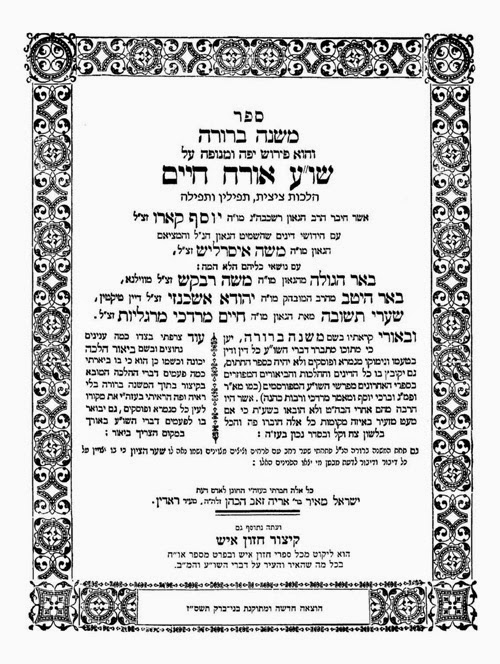
The attached six pages are copies of the front matter and relevant pages from two modern editions of the Mishnah Berurah which note the typographical errors mentioned and correct them.

[1] There are a number of works entitled Olat Tamid in the rabbinic library and this Olat Tamid is the one that the Magen Avraham had which is by Rabbi Shmuel ben Yosef Orgler found at http://hebrewbooks.org/21386 at page 28.
[2] Pre Megadim reinforces this as the correct read of the Magen Avraham in Ashel Avraham 3 where he emphasizes that one who is exempt is not careful.
[3] The Pre Megadim is commenting on the Taz – as he understands the Taz to agree with the Olat Tamid here and to focus only on cleanliness and not level of exemption – and/or is inferring from Rema’s note that we object to women who wish to wear tefillin that Rema would not object to a male slave wearing tefillin.
[4] Tosafot Yerushalayim cited by the Mishnah Berurah is not in chapter 38 of his work (where you would expect it) but in OC Chapter 17.  Tosafot Yerushalayim adopts the reasonable view that only slaves like Tevi of Rabbi Gamliel can don tefillin, as a correspondence to the exceptional case of Michal bat Shaul.  His view is that among people who are not obligated in tefillin, only exceptional individuals are sufficiently careful about cleanliness ought to don.  Tosafot Yerushalyim is itself a fascinating work which attempted to incorporate the view of the Jerusalem Talmud into the normative halacha.
[5] A copy of the page from the Mishnah Berurah Hotzah Chadasha uMetukenet Benai Brak 5767 can be found at the end of this paper with the correction noted on the Hagaot veTekunim 5
[6] See the next section for an explanation,
[7] The corrected text of the Mishnah Berurah notes that this is the Yad Efraim.
[8] Although one could read this as a statement and not a rhetorical question, that would be a mistake as it could create a dispute between this statement and the text of the Shulchan Aruch in OC 39:1.  It would also be inconsistent with other parts of the same Biur Halacha not quoted here.
[9] Who can write tefillin (as opposed to who can don them) is not a topic we focus on now.
[10] This Biur Halacha was pointed out to me by Rabbi Shlomo Brody while he was reviewing a prior draft of this article.
[11] A reader suggested to me that maybe the Mishnah Berurah ruled one should not rebuke a cheresh only because he was aware of the fact that some of his contemporaries considered an intelligent cheresh to be fully obligated in the mitzvah.  I think that is mistaken as the Mishnah Berurah is directly quoting the Baer Hatev who is directly citing the Olat Tamid, who was from the 1600’s and was not speaking about the modern “smart” cheresh. The Mishnah Berurah and Baer Hatev’s source – the Olat Tamid – clearly based this ruling on his view that one who is exempt but clean can wear tefillin.  Moreover, if the Mishnah Berurah were merely showing deference here to the view that a (modern) cheresh is obligated to wear tefillin, then surely he would have strongly urged the cheresh to don tefilin – and not just written that we acquiesce to one who chooses to do so. (Note that Aruch Hashulchan argues in OC 37:4 and objects to a cheresh wearing tefillin, but only because he cannot image such a person being meticulously clean.)
[12] And even that fear is ultimately rejected by the Mishnah Berurah in the Biur Halacha 39:3, as noted above.
[13] What I mean by “tefillin law” is just the halacha of mochen and the like, and not the more general halachic conversation concerning change or minhag or authority, all of which are important, but not part of this article and could form independent grounds for prohibiting (or permitting) this conduct.
[14] Because she is post-menopausal according to the Olat Tamid.
[15] I am uncertain how exactly to translate the term chumra bealma.  In their recent article, Rabbis Dov and Aryeh Frimer translate it as “mere, often unbased, stringency (humra be-alma)” which they note is one of the cases where nachat ruach lenashim does allow such sometimes to be ignored.  See Women, Kri’at haTorah and Aliyyot,” Aryeh A. Frimer and Dov I. Frimer, Tradition, 46:4 (Winter 2013), 67-238 at pages 115 to 117 and particularly note 358.

[16] Reasons five and six are important to digest, in that who the Mishnah Berurah quotes or does not quote is a very telling mark of what he thinks is reasonable.  Here he does not quote Gra’s approach in 38:3 precisely because he has rejected Gra’s approach of harmonizing the Pesikta and the Bavli in 39:3 by calling the Peseikta a chumra be’alma.  So too, he rejects the approach of the Levush and Aruch HaShulchan of limiting the Bavli to the rare and special Michal bat Shaul since the Mishnah Berurah adopts the view of the Olat Tamid and resolves the conflict by insisting that the Pesikta is not the normative halacha.  The view of the Aruch Hashulchan needs its own analysis, which I hope is forthcoming.  For a more general understanding of the Mishnah Berurah, see my forthcoming work (with Rabbi Ira Bedzow) “The Codification of Jewish Law and an Introduction to the Jurisprudence of the Mishna Berura” (Academic Studies Press, 2014).

[17] See for example the modern work Piskai Teshuva 38:3 who gives one such reason and the recent teshuva by Rabbi Hershel Schachter on this matter who gives many such reasons.
[18] Besides these rationales which explain why the Mishnah Berurah simply does not discuss this issue, allow me to speculate in a footnote that perhaps the Mishnah Berurah does not cite the Olat Tamid on the topic of women donning tefillin at all because he rejects in the view of the Olat Tamid that menstruation is a valid concern for guf naki matters and that was the central to the holding of the Olat Tamid.


Partnership Minyanim and More

Partnership Minyanim and More
Marc B. Shapiro

1. A few people have wanted me to comment on the recent debate between Rabbis Barry Freundel and Zev Farber about the so-called Partnership Minyanim in which women lead Kabbalat Shabbat. See here. The issue goes back to R. Freundel’s article in Tradition 44:2 (2011) on the topic. I was planning to respond to this article when it first appeared, and even wrote some pages, but I never completed the piece. Since the issue has once again surfaced, now is a good time to deal with it. Some of what I will say was also stated by an anonymous commenter on the Torah Musings blog, but both R. Zev Farber and Lazer Kaganovitch can testify that I sent them these points before the commenter posted anything, so I see no reason not to record my thoughts. (I should also note that this anonymous commenter, while pointing out errors and misreadings by R. Freundel, did not show proper respect in recording his criticisms.)
In his article, R. Freundel argues against the Partnership Minyanim with an original approach. Rather than summarize his viewpoint in my own words, this quotation sets forth his thesis, which the article attempts to prove:

In those communities which do not employ a Hazan for Kabbalat Shabbat, that lack would indicate that they view this liturgy as neither mandatory nor communal. Nonetheless, putting a woman (and maybe a child) into the role of Hazan would still be problematic. Adding a Hazan makes the prayer mandatory and communal but women and possibly children cannot lead a mandatory communal prayer. As a result, even in a setting that currently has no Hazan, the innovation of using a Hazan who cannot serve as a Hazan for communal prayer creates a halakhic dissonance that is unsustainable.
This is quite an argument and if it could be sustained, then it would be a significant contribution to the debate. However, in my opinion, and the opinion of everyone I know who has examined the issue, R. Freundel’s argument is completely unconvincing. There is simply no way that having a person read a few paragraphs of Psalms or more recent compositions before some other people makes the prayer “mandatory” and “communal.”
Before getting into some particulars of R. Freundel’s piece, let me offer a more general criticism. Reading the article I was troubled by the author’s need to come up with a halakhic argument to forbid that which pretty much everyone can see is not a halakhic matter at all (apart from possible halakhic concerns of tzeniut). Those who are in favor of Partnership Minyanim devote great efforts to show that there is no halakhic objection, and therefore these minyanim should be instituted, and R. Freundel is playing the same game, but from the other side. He feels that he needs to show why Partnership Minyanim are halakhically forbidden, and therefore shouldn’t be instituted.
The truth of the matter is that many of the most important things traditional Jews do and don’t do have nothing to do with halakhah. Something can be a bad idea, even a very bad idea, and deserve to be rejected even if there is no technical halakhic objection to it. As the Steipler wrote (Karyana de-Igarta [2011 ed.], vol. 2 no. 581):

יש כמה דברים שאין בכח החכם להורות איסור אע”פ שבאמת אינו נכון כלל
There are good reasons people can offer in opposition to Partnership Minyanim without falling into the “pan-halakhic” trap that everything you oppose has to be shown to be halakhically improper. Opponents of the Partnership Minyanim should be able to acknowledge that if non-bar mitzvah age boys are permitted to serve as a hazan for pesukei de-zimra or Kabbalat Shabbat then, apart from issues of tzeniut (in which I include kol ishah), there is no “technical” halakhic objection with women doing so as well. But as mentioned already, lack of a prohibition doesn’t necessarily make something a good idea. Plenty of synagogues will not let someone serve as a hazan if he is wearing jeans (or if he is not wearing a jacket or hat), yet this doesn’t mean that we need to find a technical halakhic objection for something which is at essence a matter of synagogue custom and propriety, and therefore does not need to be supported by halakhic sources. By the same token, I think we have reached the point whereby the typical Orthodox rabbi acknowledges (privately, at least) that there is no real halakhic objection to a woman rabbi, while at the same time continuing to oppose the concept (much like many oppose yoatzot halakhah). They oppose it because of how women rabbis will change the structure of traditional Judaism, change it in way they view as negative. This point can be made without using halakhic arguments that after a little investigation people will see don’t carry any weight. This is especially so in the Modern Orthodox world where there are women principals of Jewish day school, women synagogue presidents, women teachers of Talmud, women learning advanced halakhah, and no one bats an eye when a woman speaks in front of men.
For those who oppose things like women leading Kabbalat Shabbat, a weak halakhic argument is worse than no argument at all. The best tactic for the opponents is simply to keep the issue focused on what direction is best for Judaism. It is known that a number of great rabbis refused to provide halakhic reasons for particular decisions they gave, especially when the halakhic justification was weak. They chose this path precisely because they didn’t want these issues to become matters of halakhic debate, as there were other, even more important considerations guiding them. (In a future post I will give examples.) What R. Freundel’s article does is empower the proponents of Partnership Minyanim because they can rightfully say, “If this is the best our opponents can muster in terms of halakhic objections, then there really is no reason to oppose what we are doing.”
Now let’s turn to some particulars, as there are a couple of points in R. Freundel’s article that I would like to comment on. He writes:
The second oft-cited opinion in Rishonim is that of Nahmanides, who argues for obligatory twice a day recitations of the Amidah by women at Shaharit and Minha. The problem is that, despite the fact that the Mishna Berurah quotes this approach in the name of Ramban, I cannot find this opinion anywhere in Nahmanides’ writings. An examination of the section of Shulhan Arukh where Mishna Berurah makes this statement indicates that he is quoting R. Akiva Eiger.
There is a misunderstanding here. Here is the passage from the Mishnah Berurah 106:4 referred to by R. Freundel.

What the Mishnah Berurah is saying is that Nahmanides’ view is that prayer is a rabbinic commandment. The part about Anshei Keneset ha-Gedolah requiring the Amidah to be recited twice a day and that women are also obligated in this is not from Nahmanides. This is the Mishnah Berurah speaking. Contrary to what R. Freundel writes, the Mishnah Berurah is not quoting R. Akiva Eger.
           
In the next paragraph, Freundel writes:
R. Eiger cites Nahmanides from section 89 of Responsa Besamim Rosh. At one time this book was attributed to a variety of important scholars including Ramban, but now it is known to have been written by Isaac Molina in the 16th century. . . . Section 89 of Besamim Rosh tells us that women “in our area” are required to pray twice a day because “they have accepted this practice upon themselves.” This is hardly an indication that all Jewish women are required to recite the formal liturgy at Shaharit and Minha as Mishna Berurah claims.
Here is the responsum from Besamim Rosh.

It never uses the words “in our area”, and furthermore, the responsum is not from Nahmanides. It seems that R. Freundel makes the false assumption that at one time this book was attributed to Ramban because he thinks that R. Akiva Eger is citing a responsum of Ramban in Besamim Rosh. Yet Besamim Rosh was never attributed to Nahmanides nor to Isaac Molina.[1] The latter supposedly gathered the teshuvot (that is what it says on the title page, but this is part of Saul Berlin’s forgery). This means that R. Freundel’s critique of the Mishnah Berurah falls by the wayside, since the responsum in Besamim Rosh has nothing to do with the Ramban and thus nothing to do with the Mishnah Berurah’s point, which is derived from the Ramban. .

Here is the text from R. Akiva Eger.


In his heading he cites Ramban, but that is simply a quote from the Magen Avraham, and has nothing to do with the Besamim Rosh that he cites immediately following this. All R. Akiva Eger is doing by citing Besamim Rosh is providing another relevant text dealing with the issue under consideration, i.e., women and prayer. In R. Akiva Eger’s responsa, vol. 1, no. 9, he cites this same responsum in Besamim Rosh. (R. Akiva Eger thought that Besamim Rosh was an authentic work.[2]) 

However, how did R. Freundel ever assume that Besamim Rosh was citing Nahmanides? He never could have concluded this if he used the Machon Yerushalayim edition, which is the text I just used. He also could not have concluded this if he used one of the older editions of the Shulhan Arukh in which R. Akiva Eger’s note doesn’t even refer to Ramban. See here:

Yet here is the text as it appears in what used to be the standard edition of the Shulhan Arukh. In this edition there is a mistake in R. Akiva Eger’s text and it indeed has him stating that Nahmanides’ view is found in Besamim Rosh.

R. Freundel writes:
While all agree that women do not count towards adding Elokeinu, there is some debate about whether women can count among the three for zimmun. Nonetheless, even for those who say that women do count for the three no one suggests that a woman can lead if there are both men and women present. This is either because women’s obligation is rabbinic while men’s is Biblical or because the formal text of Birkat ha-Mazon contains references to certain mitsvot (e.g., circumcision) which are not applicable to women (emphasis added).
The passage I have underlined is incorrect. Ritva writes as follows[3]:

נשים חייבות בברכת המזון מן התורה, ולפיכך אשה מברכת לאיש על ידי זימון, או אם הוא עם הארץ להוציאו ידי חובתו כדרך שהאיש מוציאו.
See also R. Asher Ben Hayyim, Sefer ha-Pardes, ed. Blau (New York, 1984), pp. 176-177, and also the Hazon Ish, Orah Hayyim 30:8, who mentions that according to one approach in the rishonim גם הנשים רשאות לזמן כה”ג אם אין אנשים בקיאין . 

R. Yitzhak Yosef, Yalkut Yosef, Orah Hayyim 186:5, writes:
אשה שבירכה ברכת המזון ונתכוונה להוציא את האיש ידי חובתו, ושניהם אכלו כדי שביעה, בדיעבד יצא ידי חובה, ואינו צריך לחזור ולברך
A good discussion of the issue is found in R. Yehudah Herzl Henkin, Bnei Vanim, vol. 3, no. 1.[4]
R. Freundel writes:
The presence of a Hazan was essential to Magen Avot becoming a mandatory tefillah be-tsibburMagen Avot became mandatory with a Hazan. . . . If the presence of a Hazan makes a prayer mandatory, then Kabbalat Shabbat, which today has a Hazan in the vast majority of synagogues, is also mandatory.
I think R. Freundel has it all backwards. The presence of a hazan never made Magen Avot mandatory. Rather, when Magen Avot was made mandatory, it was required that there be a hazan. But what does this have to do with Kabbalat Shabbat which was never made mandatory by anyone?
R. Freundel writes:
R. Kook maintained that one who has heard the repetition of the Amidah on Rosh Hodesh thereby fulfilling his tefillah be-tsibbur requirement, but who must repeat his silent Amidah because he forgot Ya’ale ve-Yavo[,] counts among the six to whom four who previously prayed are added for recitation of devarim she-bi-kedushah. His repeat prayer constitutes tefillat rabbim in that venue, which is sufficient to count him in the majority of a tsibbur that has not yet prayed. Tefillat rabbim is, therefore, not a larger form of individual prayer, rather it is a diminished form of tefillah be-tsibbur and therefore, he counts because his is a minor act of communal prayer.
This description is incorrect as R. Kook does not “maintain” that which is being attributed to him. In his responsum, Orah Mishpat, no. 23, R. Kook presents both sides of the matter and concludes וצריך בירור. What this means is that he does not make a final decision. In any event, what does this have to do with someone such as a minor or a woman leading a prayer that is not obligatory?
The larger problem of R. Freundel’s article is that he makes assumptions which are simply not in accord with the practice of Jewish communities. For example, his argument leads to the conclusion that it should be forbidden (not just inappropriate, but forbidden) for someone under bar mitzvah age to lead any part of the service. Yet this is the practice in communities all over the world. Doesn’t every Modern Orthodox synagogue have a child lead Adon Olam? R. Freundel assumes that the only reason this can be permitted is because of hinnukh considerations. That is possible, but it is just as likely permitted precisely because there is no prohibition, and it is a nice thing to do. In other words, there is no default position that it is prohibited, from which one then needs to then find a way to permit.
The Beit Yosef, Orah Hayyim 53, discusses the practice of children leading the congregation in maariv and those who objected. He explains that the practice can be defended since there is no repetition of the Amidah, the hazan is not fulfilling anyone’s obligation for him, and maariv is also reshut. In other words, there are no considerations of hinnukh raised here, and for the Beit Yosef there is no default position that it is prohibited, and certainly no concept of tefillat rabbim, (which is mostly a hiddush of R. Freundel). It seems to be entirely a matter of synagogue etiquette, i.e., kevod ha-tzibbur, and if this can be overcome, then there is no halakhic problem. R. Yitzhak Zilberstein even argues that in an extreme circumstance (the particular case concerned a prison) one need not protest if a non-Jew leads the maariv service![5]
Let me stress that there is nothing wrong with R. Freundel coming up with a hiddush dealing with tefillat rabbim. However, a hiddush such as this cannot be the basis for forbidding a practice such as Partnership Minyanim. To see how far R. Freundel’s model takes him, in response to criticism he even stated that it is forbidden for a woman to recite tefillat ha-derekh on behalf of men and also to lead a communal recitation of Psalms. R. Freundel assumes that this is all tefillat rabbim and therefore forbidden for a woman to lead.
I have no doubt that if you ask the typical posek about a woman reciting tefillat ha-derekh or reading a Psalm before a mixed group of men and women, he will say it should not be done, for reasons of tzeniut or mesorah. But if you ask him if it is forbidden on account of tefillat rabbim, he won’t have a clue what you are talking about. Speaking historically, there is simply no such halakhic framework, and I find it hard to believe that people are going to be convinced that if some men and women sit down to read a few Psalms together (or a liturgical text of more recent vintage) that there is a prohibition for a woman to lead the recitation. (Again, I am not referring to tzeniut issues here.). Let me just remind readers that R. Ovadiah Yosef, relying on numerous rishonim, has ruled that if necessary a woman can read the Purim megillah for men (which might arise if no men know how to read it).[6] If the halakhically obligatory Megillah can be read by women for men, with none of the poskim saying a word about a concept of tefillat rabbim, then why should people accept that there is a prohibition for a woman to lead a group of men and women in recitation of a Psalm? (I realize that one can respond that reading the Megillah is not tefillah, but it would nevertheless be strange to permit a woman to read an entire book of the Bible before a group of men, and at the same time not allow her to read even a few verses from another book, i.e., Psalms.)
There is a good deal more to say about the phenomenon of Partnership Minyanim and the strange way they came about. Before Prof. Daniel Sperber got involved, the basis for them was an article written by an otherwise unknown rabbi in the Edah Journal. I can’t help but wonder about the halakhic methodology of changing traditional Jewish practice simply because a rabbi writes an article with some suggestions. If tomorrow a rabbi, any rabbi, writes an article arguing that in today’s day and age when men and women mix freely, that there is no need for a mehitzah in prayer (after all, it is not mentioned in the Shulhan Arukh), would that then give people carte blanche to remove the mehitzah? Had this not already been an issue between the Orthodox and Conservative, and thus of great symbolic significance, I am sure the mehitzah would already have been removed in liberal Orthodox synagogues. And what about counting women in the minyan? Halakhic arguments can be advanced for this as well. Is the only reason the liberal Orthodox don’t accept R. Ethan Tucker’s and R. Micha’el Rosenberg’s arguments[7] because of their non-affiliation with Orthodoxy? If an Orthodox rabbi had advanced the same argument as them, would it then be OK to move to complete halakhic egalitarianism?[8]
2. In a previous post I wrote about the dispute over whether there is pesak in hashkafah. Only recently did I see the following relevant statement of R. Soloveitchik, The Emergence of Ethical Man, p. 6 (emphasis added).
It is certain that the fathers of the Church and also the Jewish medieval scholars believed that the Bible preached this doctrine [the separateness of man from nature]. Medieval and even modern Jewish moralists have almost canonized this viewpoint and attributed to it apodictic validity. Yet the consensus of many, however great and distinguished, does not prove the truth or falseness of a particular belief.
In my article, I discussed some of the difficulties with the Hatam Sofer’s position that principles of faith can change with time, and are determined in a fashion no different than typical halakhic decisions. I argued that this understanding diverges from that of the rishonim. In R. Dovid Cohen’s recently published Ha-Emunah ha-Ne’emanah (Brooklyn, 2012), p. 41, he appears troubled by the Hatam Sofer’s approach.
                       
וקשה מאד להתאים דברי הח”ס שעיקרי הדת חשובים עיקרים שהכל צריכים להאמינם מפני ההכרעה שאז י”ל שהפורק עול שאינו רוצה לקבל ההכרעה נענש מטעם זה, אבל איך זה שייך לסברת האברבנאל והגרי”ז שמי שאינו מאמין אין לו התפיסה שיוכל להשיג עולם הבא האם ההשגה תלויה בהכרעה או במציאות של האמת והאם שייך לומר שלרב הלל יש חלק בעוה”ב והבא אחריו שסובר כוותיה אין לו חלק לעולם הבא שאינו יכל להשיג. . . . ועיין לקמן בעיקר ז’ שהערתי שמשמע מהאריז”ל ומבעל התניא שהם חולקים על החתם סופר ודו”ק.
What does the last word (abbreviation) mean, as it does not stand for ודוחק קצת, which is how it is usually understood? Furthermore, what are we to do with the expression והדברים ברורים ודו”ק that appears in Maharsha and elsewhere? I remember how in yeshiva we didn’t know what to make of this, since it obviously doesn’t  mean  ודוחק קצת. One rebbe told us that the abbreviation mark is a mistake and it should be read as  ודוק, that is, “examine it carefully” (like ודייק). It is also possible that the abbreviation stands for ודיק וקרא, although this meaning is not mentioned in Otzar Rashei Tevot. R. Meir Mazuz recounts that in Tunis they explained it: ואחר דרישה וחקירה קל. (Otzar Rashei Teivot has ודייק ותמצא קל). See his Lo Tashikh (Bnei Brak, 2005), p. 8 (first numbering). But he assumes that the real meaning is as I mentioned, i.e., ודייק.
Returning to R. Cohen’s book, it really requires a post of its own, as it contains all sorts of interesting things. Here is one example, from p. 127, where he suggests an interpretation of the Twelfth Principle of Maimonides according to which belief in a personal Messiah and other details in the Principle are not really  required beliefs.
וצ”ל שהעיקר הי”ב הוא גאולה באחרית הימים והכופר בזה הוא כופר גמור והפרטים שכתב הרמב”ם שיהיה משיח והוא מיו”ח של שלמה בן דוד אין זה מהעקרים שהכופר בהם אינו נחשב ככופר והוא חידוש עצום.
I only quote this for its novelty, as it is contradicted by Maimonides’ explicit words in the Principle. With reference to the detail of the Messiah’s genealogy, Maimonides states: “Included in this fundamental principle is that there will be no king of Israel except from David and from the seed of Solomon exclusively. Anyone who disputes concerning this family denies God and the words of His prophets.”
On p. 162 R. Cohen states that according to Maimonides even non-Jews are obligated to believe in the Thirteen Principles. He concludes his paragraph with ודו”ק, and again, it does not mean ודוחק קצת.
ועיין סוף פ”ח ממלכים שכתב וז”ל כי [כל] המקבל שבע מצות ונזהר לעשותן הרי זה מחסידי אומות העולם ויש לו חלק לעולם הבא. והוא שיקבל אותן ויעשה אותן מפני שצוה בהן הקב”ה בתורה והודיענו על ידי משה רבינו שבני נח מקודם נצטוו בהן. אבל אם עשאן מפני הכרע הדעת אין זה גר תושב ואינו מחסידי אומות העולם ולא מחכמיהם עכ”ל. ומשמע מכאן שהרמב”ם בא לכלול הגוים שהם חסידי אומות העולם שמאמינים בתורה, אבל אינם מאמינים בי”ג עיקרים שאין להם חלק לעוה”ב . . . הרי מוכח כנ”ל שגוי צריך להאמין בי”ג עקרים ודו”ק
Contrary to R. Cohen, when Maimonides speaks of righteous non-Jews being required to believe in the revelation at Sinai, this has nothing to do with acceptance of the complete Thirteen Principles.
One more point about R. Cohen’s book is that it is obvious that at times he is responding to what I wrote in The Limits of Orthodox Theology (and he also makes use of many of the sources I cite). While I am not mentioned by name (no surprise there) I am apparently included among the משמאילים referred to on p. 5 (see Limits, pp. 7-8).
Finally, let me add more comment about the Thirteen Principles. Just when I was about send in this post, I received the latest issue (Spring 2013) of the journal Conversations, published by Rabbi Marc Angel’s Institute for Jewish Ideas and Ideals. Each issue is a great read as it includes material from both well-known scholars as well as talented newcomers who have a lot to contribute and whose writings have often been real eye-openers for me.
Among the established writers in the new issue is R. Nathan Lopes Cardozo. If there is any contemporary writer in the Orthodox world who reminds me of the early Hasidic masters, the Kotzker, or even R. Jehiel Jacob Weinberg in his private moments,[9] it is R. Lopes Cardozo. Reading him one can sense how difficult it is for R. Lopes Cardozo to live in a world in which spiritual authenticity is in such short supply. As with his similar-minded predecessors, he too must protest, and the real perplexity is why so many others don’t join in this protest. The questions he asks, and what keeps him up at night, are exactly what should be on the mind of all thinking Orthodox Jews, even if one may disagree with the answers he gives.
His latest article, which appears in Conversations, is entitled “Lonely but Not Alone: An Autobiography by a Jew Who Should Never Have Been.” On p. 10 he writes:
It became clear to me that Judaism is based on the need for absolute questioning. I discovered that there are no absolute dogmas in Judaism, at least not in the way they are found within the Catholic Church. Maimonides’ famous Thirteen Principles of Faith, which are sung in nearly every synagogue on Friday nights, were never accepted as the final version of Jewish belief and were in fact heavily attacked and challenged by the greatest rabbinical authorities. Today, I see that Maimonides’ thirteen principles caused major damage to Judaism. It was the famous Professor Leon Roth who once remarked: “For this Hebrew of Hebrews had in many respects a Greek mind and through his sense of logic and his passion for precision, he brought Judaism into a doctrinal crisis, the echoes of which are with us yet” (Judaism, A Portrait, 1960, p. 122). How true! Judaism, while surely consisting of certain beliefs, is open to self-critique, debate, and ongoing discussions that have almost never been resolved. This spoke to my imagination. A religion with no dogmas, always open to new ideas! What could be better than that!

3. In a previous post I called attention to a bizarre segulah from R. Zvi Hirsch Kaidonover which I didn’t translate and which I suggested the police might regard as a form of sexual abuse. The text is as follows:
ועוד סגולה נפלאה לתינוק הנולד שלא יקרה עליו חולי נכפה בר מינן, מיד כשנולד ישימו בפיו ברית קודש של תינוק ויהיה ניצול כל ימיו מחולי נכפה
If you thought that this was strange, I guarantee that you will find the following, which was sent to me by a friend, even stranger.


The text comes from Meir Benayahu, Toldot ha-Ari (Jerusalem, 1967), pp. 224-225, and describes a “cure” recommended by R. Isaac Luria. The passage is too bizarre to translate. If the man who “came to the rescue” was just a man off the street it would be one thing. However, we see that it was none other than R. Moses Galante, a great sixteenth-century Torah scholar of the land of Israel who was given real semikhah by R. Joseph Karo. Even though the pre-modern mind was able to come up with all sorts of strange “cures”,  I would like to believe that the entire story is a fiction. But even if it never happened, the fact that people believed it happened tells us a great deal about their mindset.

On p. 110 n. 4, Benayahu cites the following text from R. Hayyim Vital (and note the shocking passage I have underlined):

בענין לילית ההורגות את הילדים מבן שמונה ימים ללידתם . . . נטיתי אז ושמתי אבר מילת נער קטן בפי הילד תכף כשנולד טרם שיינק . . . ואמנם פעמים אחרות עשיתי כל הנ”ל וגם דברים אחרים, שנבאר עתה, ולא ניזוק. ואלה הם: לשים אבר מילת אבי הנולד עצמו בפי הילד טרם שיינק
On p. 111 he records a story that once when a lion was about to attack R. Hayyim Ben Attar

גילה בריתו ברית קדש, וכשראה אותה האריה ברח מפניו . . . שמעולם לא ראה טפת קרי

All of these texts relate to the power of circumcision, a topic that is relevant to an earlier post here where I discussed the notion that Eliezer took an oath to Abraham by placing his hand on Abraham’s circumsision.

Returning to the first story quoted from Benayahu, there is no doubt that people can believe all sorts of strange things. There is currently a situation in London where a leading rabbi is charged with inappropriate contact with women. This rabbi denies the charges. However, he has admitted, so I am informed, that he did touch women in non-sexual ways, but this was done as part of his “therapy” which he claims was halakhically permitted. Now obviously we can’t have a situation where a male therapist, or  “therapist”, is arm wrestling or massaging his female patients. In fact, after everything we have seen these last few years, I think we can all agree that there can’t be any touching.

Imagine my surprise, therefore, when in the most recent volume of Ma’ayan Omer I came across the following text:


R. Ovadiah gives permission for a kabbalist to touch a woman as part of his kabbalistic healing. R. Ovadiah requires that he wear gloves when touching her, but this is still surprising, as once such a heter is given it is not too difficult to see where this can lead..

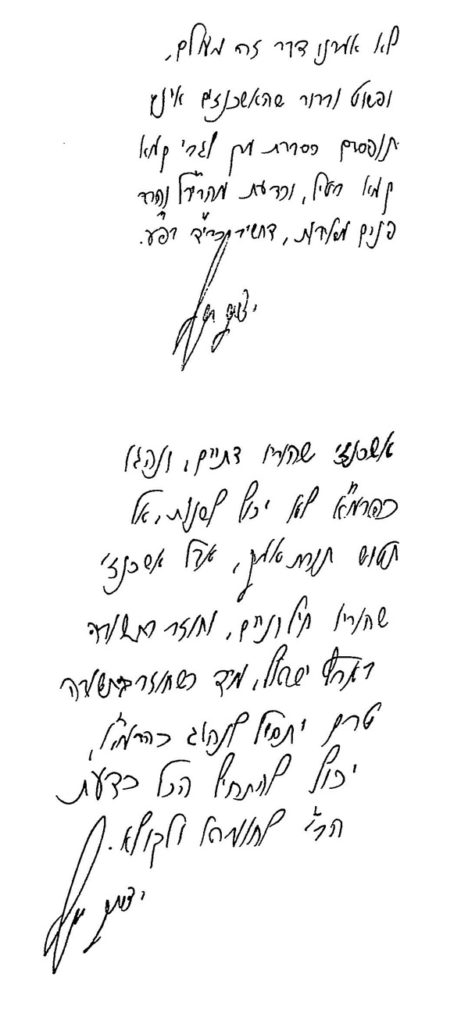
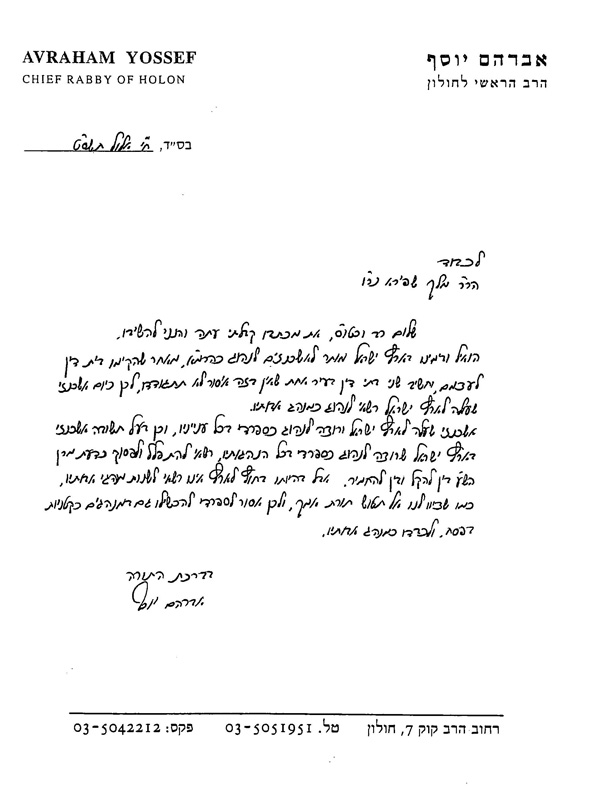
I didn’t know what to make of the words צריכה להתפשט. Does this mean that a woman can remove all her clothes if that’s what the kabbalist needs in order to complete the healing process? (According to news reports, the Breslov figure currently in the news for sexual impropriety operated in this way). I was certain it couldn’t mean this, but then what does it mean? I wrote to R. Avraham Yosef and here is his reply.

Even with R. Avraham’s explanations, both regarding the nature of the pesak and the limited removing of clothes, it is still very difficult to stomach. But I acknowledge that this is only because of my rationalist perspective and my assumption that virtually all of these “kabbalists” are more snake oil salesmen than anything else. (R. Yitzhak Kaduri, a real kabbalist, said that an authentic mekubal does not charge money for helping people, so that immediately knocks out some of the most popular “kabbalists” who make a very good living at their craft.) However, for one who believes that a kabbalist can heal just like a doctor, then all the heterim that apply to a male doctor, including touching a woman while healing her, would also apply to a kabbalist. Skeptical as I am, I wonder why such a powerful kabbalist can’t do his healing without touching the woman.[10]

[1] This information is available simply by googling “Besamim Rosh”, and the first two results are from Seforim Blog posts. The third result is Wikipedia which also states that Besamim Rosh is an eighteenth century forgery.
[2] This can be seen from how he cites the source, and see also his note to Shulhan Arukh, Even ha-Ezer 117, where he is explicit (this source was noted by one of the commenters on Torah Musings).
[3] Hilkhot Berakhot 7:2 (p. 106 in the Mossad ha-Rav Kook edition).
[4] R. Baruch Gigi, one of the roshei yeshiva of Yeshivat Har Etzion, believes that women saying birkat ha-mazon together with their families can be counted towards a mezuman. See Yonatan Gershon, “On Women Joining in a Zimmun,” Meorot 9 (2011), available here. I have yet to see this acted on in practice.
[5] Hashukei Hemed, Berakhot 51b. R. Zilberstein’s books contain some of the strangest cases. I don’t know whether these are actual cases or if people just ask him the strange questions knowing he will respond, or if perhaps even he makes up the questions so that he can then discuss the matter להגדיל תורה ולהאדירה
[6] See Yalkut Yosef, Dinei Keriat ha-Megillah, no. 12.
[7] See here.
[8] David Berger has recently alluded to Partnership Minyanim in his “Texts, Values, and Historical Change: Reflections on the Dynamics of Jewish Law,” in Michael J. Harris, et al., eds., Radical Responsibility: Celebrating the Thought of Chief Rabbi Lord Jonathan Sacks (Jerusalem, 2012). In referring to Haym Soloveitchik’s thesis in “Rupture and Reconstruction,” Berger writes (p. 204): “[S]ome of those who lionize the mimetic society as they savour the anti-haredi uses of Soloveitchik’s analysis are simultaneously impelled by feminist convictions to change generations of synagogue practice on the basis of textual analysis far more tenuous than the considerations that lead the traditionalist Orthodox to their usually more stringent deviations from the practices of the past. Affirmation or rejection of a mimetic ideal can depend very much on whose ox is being gored.”
[9] I think readers will appreciate this letter of R. Jehiel Jacob Weinberg. It first appeared in Mordechai Eliav and Yitzhak Rafael, eds., Sefer Shragai (Jerusalem, 1981), p. 275, and was reprinted in Ba’ayot Aktualiyot le-Or ha-Halakhah (Jerusalem, 1993), pp. 58-59. We are now sixty years after R. Weinberg wrote his letter, and not only have things not gotten better, but they have actually gotten much worse.

[10] In the recently published Mesorat Moshe, p. 612, it records that R. Moshe Feinstein responded as follows, after being told of a dentist who sexually assaulted female patients while they were sedated: אמר רבינו שממש פלא, דהלא זה כנגד החזקה שאומן לא “מרע אומנותו”. I don’t understand R. Moshe’s surprise, as he could say the same thing about teachers or anyone else who engages in this sort of behavior. Since we are dealing with people who are sick, there is no rational calculation for which you can apply the concept of מרע אומנותו. We have already seen numerous people who have destroyed their lives and their families by engaging in the sort of behavior, and taking the sort of risks, that simple self-interest would be enough to deter normal people from. (In a future post I will discuss other passages in Mesorat Moshe.) Also regarding sexual (and physical) abuse, R. Yosef Shalom Elyashiv writes, in discussing whether to inform the authorities (Kovetz Teshuvot, vol. 4, no. 198):
יש גם לשקול בגדר של ההתעוללות, שבהשקפה שלהם היא אחרת לגמרי משלנו
What does this mean? In what way is the religious Jewish approach to this matter superior to that found among non-Jews and non-religious Jews?

And finally, I found what I thought was a strange passage in R. Abraham Bornstein, Avnei Nezer, Even ha-Ezer no. 44. Much like Todd Akin, the Avnei Nezer thought that a woman couldn’t get pregnant through rape (unless . . . actually I would rather not explain it).

ואם היתה אנוסה מתחילה ועד סוף ולא רצתה בו כלל אי אפשר שתתעבר, רק שיש חשש שמא תחילה באונס וסופו ברצון . . . אלא ודאי כמ”ש משום דבאונס מתחלה ועד סוף אי אפשר שתתעבר

I have not found such a notion in any earlier rabbinic source. However, S. of On the Main Line called my attention to Rachel P. Maines, The Technology of Orgasm (Baltimore, 2009), pp. 51-52, from which we see that there was indeed a long-standing view that conception was not possible without female orgasm or at least desire.


Taliban Women and More

Taliban Women and More

Marc B. Shapiro

1. In this post I am going to respond to a number of emails and requests to deal with certain topics. I can’t get to everything I was asked about, and will only touch on some topics, but here is a start.
Let’s begin with the common practice in the Israeli haredi world of ignoring what the Sages tell us in Kiddushin 29a and not teaching young men a trade so that instead they can devote themselves to Torah study.[1] People assume that this is a late twentieth-century phenomenon. While it is true that the numbers of people who currently follow this approach is much larger than ever before in history, it must be noted that even in previous years there were those who acted in the same fashion. We see this from R. Pinhas Horowitz’ strong words against this approach in his Sefer ha-Berit, vol. 2, ma’amar 12, ch. 10.
R. Meir Mazuz has recently suggested that this negative attitude towards work explains a passage in one of the most popular Shabbat zemirot.[2] The following lines appear in Mah Yedidot.

חפציך בו אסורים וגם לחשוב חשבונות, הרהורים מותרים ולשדך הבנות, ותינוק ללמדו ספר למנצח בנגינות
Artscroll, Family Zemiros, translates as follows:

Your mundane affairs are forbidden on it [Shabbat] and also to calculate accounts; Reflections are permitted and to arrange matches for maidens; To arrange for a child to be taught Scripture, to sing a song of praise.

(R. Jonathan Sacks, in his siddur, p. 388, translates the last words similarly: “singing songs of praise.”)
The first thing to note is that the translation is incorrect. The words למנצח בנגינות do not mean “to sing a song of praise”. The word למנצח is not an infinitive (that would be לנצח, patah under the nun). It is a noun with a prefix, and means “to the choirmaster” or something like that. Artscroll, in its Tanach (Ps. 6:1), translates למנצח בנגינות: “For the conductor, with the neginos.” The note tells us that neginos are a type of musical instrument.
I sympathize with Artscroll when confronted with the need to translate the words למנצח בנגינות in the song. It is obvious that the words make no sense. Until then the passage was speaking about what was permitted on the Sabbath and then you have למנצח בנגינות .
This is an old problem and while a couple of forced answers have been suggested, others have argued that what we have here a mistaken reading, and instead of למנצח בנגינות it should read וללמדו אומנות (perhaps even reading אומנות with a final holam in order to make it rhyme). The entire paragraph in Mah Yedidot is derived from Shabbat 150a, and there it states: משדכין על התינוקות ליארס בשבת ועל התינוק ללמדו ספר וללמדו אומנות. After seeing this, can anyone still have a doubt that the standard version is incorrect?

R. Mazuz is apparently unaware that others before him had already suggested that וללמדו אומנות was the original version,[3] but he is the only one to suggest why the text was changed. Although it strikes me as a bit far-fetched, he assumes that when people stopped teaching their sons a trade this verse became problematic, and therefore someone took it upon himself to alter the text.
After criticizing Artscroll’s translation (and in future posts I will have more such examples), let me now mention an instance where of all the translations I have consulted, only Artscroll gets it right.

Every Friday night we say the following (which is based on Isaiah 52:1):
התנערי מעפר קומי לבשי בגדי תפארתך עמי
Sacks translates: “Shake yourself off, arise from the dust! Put on your clothes of glory, My people.” All the translations I have consulted render along these lines. The problem, however, is obvious. If “My people” is being addressed, then why are the verbs and the suffix of תפארתך  feminine?
Artscroll recognized the problem and translates: “Shake off the dust – arise! Don your splendid clothes, My people.” The translation is explained in the note: “Jerusalem – your most splendid garment is Israel. Let the redemption come so that they may inhabit you in holiness once more.” In other words, Jerusalem is being addressed, not the people of Israel. “My people” is therefore identified metaphorically with “your splendid clothes.” The stanza thus needs to be read as a continuation of the prior stanza – מקדש מלך עיר מלוכה – which is also addressed to Jerusalem.
Furthermore, if you look at Isaiah 52:1, upon which the text is based, it reads: לבשי בגדי תפארתך ירושלים עיר הקודש  “Put on your beautiful garments, O Jerusalem, the holy city.” So we see that also in the original verse it is Jerusalem that is being addressed. Artscroll cites this interpretation in the name of Iyun Tefillah (found in Otzar ha-Tefilot) and refers to it as “novel”. This understanding (which is actually the peshat of the words) was also suggested by R. Kook[4] R. Baruch Epstein,[5] and R. David Hadad.[6] 
2. A long time ago I was asked to deal with the so-called Jewish Taliban women, who completely cover their faces when they go out. I know that everyone has downplayed their significance and referred to them as crazy. I think that this is too optimistic an assumption. Although I am not predicting it, I would not be surprised if this turned into a real phenomenon. All these women need is one somewhat respected Torah scholar to support them and they will then become just another faction in extremist Orthodoxy. You will then have groups that don’t allow women to drive (or smoke, or use a cellular phone, etc.), and another group that also requires that they cover their faces when they leave home. The real difference today is that while with the other groups we have men telling women how to behave for reasons of tzeniut, the Taliban group is completely female driven and led.

The truth of the matter is that the Taliban women make a certain amount of sense. They are part of a community that forbids women’s (and even little girl’s) pictures to appear in printed matter because seeing this might arouse sexual thoughts in men.[7] Even though these women never studied Talmud, we know that one doesn’t need to be talmid hakham to derive a basic kal va-homer. Even these uneducated women can conclude that if men’s souls can be destroyed by seeing a picture of a woman or a little girl, how much more so can they be driven to sexual frenzy by seeing a live woman or girl? As such, it makes perfect sense that when they go out on the street they are completely covered and only their husband and children are permitted see their faces.[8] It is their opponents in the haredi word who have to explain why it is permitted to see the faces of real live women but forbidden to see their pictures. It doesn’t make a lot of sense, as the Taliban women have rightly concluded.
I am sure that any rabbinic authorities that come to support the Taliban women will be able to find relevant sources to defend this lifestyle. I know this will surprise readers, especially as many rabbis have declared that the Taliban women are completely distorting Jewish rules of modesty. These rabbis have claimed that unlike Arabs, Jewish women have never dressed this way (unless they were forced to) as the face is not ervah. Therefore, these rabbis have asserted, Jewish tzeniut has never, has ve-shalom, seen it as a value for women to completely cover their faces.

Lines like this are good for applause in a Modern Orthodox (and even a haredi) shul, among people anxious to be reassured that these Taliban women couldn’t possibly have any sources in our tradition for their actions. The truth of the matter is that, whether we like it or not, there are sources that are strong supports for the Taliban women, and there is no reason to deny that they exist.[9] Sotah 10b is clearly praising Tamar when it mentions that she was so modest that she covered her face in her father-in-law’s house. R. Joseph Messas (Mayim Hayyim, vol. 2, Orah Hayyim no. 140) points out that Shabbat 6:6 refers to Arabian Jewish women going out veiled, which means that their entire face was covered except for their eyes. He also points to Shabbat 8:3: כחול כדי לכחול עין אחת, which as explained in the Talmud refers to those women who were so modest that they were completely veiled, with only one eye showing in order for them to see (see Rashi, ad loc. See also Rashi to Isaiah 3:19.) Messas tells us that in his youth he personally saw Jewish women who dressed like this: וכן ראינו בימי נעורנו. R. Meir Mazuz’s mother testified that brides in Djerba would only show one eye, also for reasons of modesty.[10]

Here we have evidence that the Taliban dress was actually a traditional Jewish dress, just the sort of material that can be used to support the new dress code. In fact, one doesn’t even need to look to Morocco or Djerba, or even to talmudic literature, to find sources that women dressed this way. It is found right in the Song of Songs 4:9. This verse states: “Thou has ravished my heart with one of thine eyes.” The Soncino translation explains: “It is customary for an Eastern woman to unveil one of her eyes when addressing someone.” In other words, normally, for reasons of modesty, the woman is entirely covered (although this covering would be see-through so she could walk properly), and only at certain times would she remove it to reveal one eye. I know some people are thinking that this is exactly the sort of explanation you can expect from Soncino, which loves to quote non-Orthodox and even non-Jewish commentators, and if you look at the various traditional commentaries they do indeed provide all sorts of allegorical meanings for this verse. Yet the Jerusalem Talmud, Shabbat 8:3, also understands the verse as giving an example of modest behavior on the part of the woman, that she only uncovers one eye. As explained by Korban ha-Edah:
מביא פסוק זה לראיה שדרך הצנועות לצאת באחת מעיניה מכוסה ואחת מגולה
(Korban ha-Edah and all the other traditional commentaries I have seen assume that the woman always goes with one eye uncovered, while Soncino explains that she only uncovers this one eye on special occasions.)
R. Baruch Epstein takes note of this passage in the Jerusalem Talmud in his commentary to Song of Songs, and adds.
לפנים בעת שהיו נוהגות הנשים ללכת עטופות היו מגלות רק עין אחת כדי לראות מהלכן, ומכאן רמז שמנהג כזה הוא מנהג כשר וצנוע, שהרי כן משבחה הכתוב שלבבתו בעין אחת.
If this practice is, as Epstein says, a מנהג כשר וצנוע, then I don’t think we should be surprised if some circles attempt to bring it back into style.
A few paragraphs above I quoted a responsum of R. Joseph Messas.[11] In this teshuvah he also explains why women can’t be given aliyotAs is well known, in earlier days this was permitted but the Sages later forbid it on account of kevod ha-tzibbur (Megillah 23a). There have been lots of interpretations of what kevod ha-tzibbur means, but Messas has a very original perspective. He claims that the reason women were banned from receiving aliyot is because this would lead to sexual arousal among the male congregants. Messas believes that this came from the actual experience of the Sages, who saw what happened when women received aliyot. He also assumes that these women would have been dressed in a Taliban-like fashion[12]: בהסתר פנים כמנהג נשים קדמוניות. But even such a woman, covered head to toe, still created problems with the sexually fixated men.[13]
ובדורות שאחריהם ראו שיש בזה מחשבת עריות, שהצבור היו שואלים זה לזה, מי זאת עולה . . . ואם היה קולה ערב מוסיף להבעיר אש היצר, ולכן עמדו ובטלו את הדבר.
Knowing how concerned the Sages were about avoiding situations that could lead to sexual thoughts, it makes sense that they would ban the practice if they thought that women’s aliyot would lead in this direction.[14] But Messas now has a problem, because the Talmud doesn’t give this as a reason for abolishing women’s aliyot. Instead, it states that they were abolished because of kevod ha-tzibbur. This leads Messas to offer one of the wonderfully original interpretations that can be found so often in his writings. He claims that because the Sages didn’t want to insult the (male) community by telling them the real reason why they abolished the aliyot, namely, that even during Torah reading men can’t control themselves from sexual thoughts, therefore they invented the concept of kevod ha-tzibbur! However, this is not the real reason, and therefore all attempts to explain the meaning of the term are irrelevant. The real reason is the male sexual desire which as Messas states, is always in need to being fenced in:[15]
וכדי שלא להראות את הצבור שחשדו אותם, תלו הטעם מפני כבוד הציבור, שלא תהא האשה הפטורה מן הדבר מתערבת עם האנשים המחוייבים בו וכן בכל דור היו גודרים גדרים בעריות
Based on this male weakness, Messas claims that the mehitzah has to be built in such a fashion that the men cannot see the women. He even has a most original way to explain to the women why they are placed in what amounts to a completely other room. Rather than being a sign of their insignificance, it is a sign of how important they are. The proof of this importance is that men are constantly drawn to look at them. Therefore, by building a high mehitzah we are able to save the men from themselves.
I haven’t yet mentioned the shawls that some women have started wearing (and which was the practice in the days of the Rambam; see Hilkhot Ishut 13:11) Most shawl-wearers are not so extreme as to completely cover their faces, and because of this the practice has been defended by some fairly mainstream people. According to R. Ovadiah Yosef’s son-in-law, R. Aharon Abutbol, and R. David Benizri, R. Ovadiah sees the practice in a positive light for those women who are able to take it on.[16] Among others who have spoken out in favor of the shawls are R. Yitzhak Ratsaby,[17] R. Avraham Baruch,[18] and R. Mendel Fuchs, a dayan for the Edah Haredit (who refers to the “heilige shawl”).[19] There is even a fairly recent book that discusses the matter in detail. It is Ahoti Kalah, by R. Avraham Arbel. Here is the title page.
Arbel is a great talmid hakham.[20] His book carries haskamot from mainstream figures, including R. Ovadiah, R. Neuwirth, and R. Nebenzahl. In the book, he explains the importance of the shawl, how women are not supposed to leave their home and if they must go out they should appear unattractive so that men are not drawn to them, and how it is absolutely forbidden for women to wear jewelry outside their home. (Recently, Arbel expanded the section of the book dealing with women’s tzeniut into a full-fledged book of its own.)

3. In the last post I quoted R. Kook’s comments about the holiness of the am ha’aretz. This is not a sentiment that has been widely shared among the rabbinic elite, and negative comments about the am ha’aretz abound in rabbinic literature from all eras. Most of these comments appear in non-halakhic contexts, but there are plenty that are found in classic halakhic works. See for example Shulhan Arukh, Yoreh Deah 198:48, where R. Moses Isserles states that if a woman coming home from the mikveh enounters a דבר טמא או גוי , if she is pious she will immerse again. This is obviously not so applicable today, as in any big city in the Diaspora, where people walk to the mikveh, it is impossible not to come across a non-Jew on the way home. The formulation of Rama was made in an era when Jews lived in their own quarters, and at night it wouldn’t be common to come into contact with non-Jews. On this halakhah, the Shakh quotes the Sha’arei Dura who expands the lists of things a woman hopes to avoid on the way home to include an am ha’aretz. (This formulation obviously troubled some, and Pithei Teshuvah quotes the opinion that only an am ha’aretz gamur is meant, i.e., one who doesn’t even recite keriat shema [due to his ignorance]. This definition of an am ha’aretz is found in Berakhot 47b and Sotah 22a. Examination of rabbinic literature shows that the term “am ha’aretz” has a variety of meaning, ranging from a simple ignoramus to one who is actually quite wicked and hates the Sages.)
Speaking of the am ha’aretz, here is something interesting, as it includes both a difficult comment of Rashi (actually, the commentary falsely attributed to Rashi) and what might be is an example of Artscroll purposely omitting mention of it because of how problematic it would be to explain. Nedarim 49a states: “Rav Judah said: The soft part of a pumpkin [should be eaten] with beet; the soft part of linseed is good with kutah. But this may not be told to the am ha’aretz.”
Why don’t we tell this to the am ha’aretz? Artscroll quotes the explanation of the Ran that if the boors knew about this, they would uproot the plants before they could be harvested. Tosafot claims that the ignoramuses won’t believe what we tell them and they will mock the teaching of the Sages. “Rashi” has a completely different explanation. He writes:
משום דדבר מעולה הוא לרפואה ואסור לומר להם שום דבר שיהנו ממנו
What this means is that we don’t let the am ha’aretz know about the medicinal property of this plant. In other words, we don’t want the am ha’aretz, even though he is another Jew, to benefit, and he is thus treated no differently than an idolater. (Tosafot cites this explanation and rejects it.) Even though “Rashi” is referring to a real am ha’aretz, as per the Talmud’s description in Berakhot 47b, it is still quite a shocking explanation. It is true that there is a passage in Pesahim 49b which states: “R. Eleazar said: An am ha’aretz, it is permitted to stab him [even] on the Day of Atonement which falls on the Sabbath . . . R. Samuel b. Nahmani said in R. Johanan’s name: One may tear an am ha’aretz like a fish.” Still, these passages are according to almost everyone not meant to be taken literally,[21] while “Rashi,” on the other hand, means exactly what he says.
[1] Many have discussed why Maimonides doesn’t explicitly record this halakhah in the Mishneh Torah. See the interesting approach of R. Hayyim Eleazar Shapira, Divrei Torah, Eighth Series, no. 18 (p. 974), which can be used to justify the Israeli haredi perspective.
[2] See Or Torah, Heshvan 5772, pp. 169-170. R. Mazuz’s own attitude towards yeshiva students preparing themselves to earn a living is seen in his haskamah to R. Hayyim Amsalem’s Gadol ha-Neheneh mi-Yegio. The book is available here.
Here is R. Mazuz’s haskamah.

Here is the letter of R. Mazuz that appears at the end of the volume.

There are numerous texts I could bring in opposition to the approach of Amsalem and Mazuz (which I believe is also the approach of the Sages). One noteworthy one is found in Ateret Menahem, p. 23a, where R. Menahem Mendel of Rimanov is quoted as follows:

אם א’ אומר לחתנו היושב ולומד תורה בהתמדה שיתחיל לעסוק במו”מ עבור כי איתא [אבות פ”ב מ”ב] יפה ת”ת עם דרך ארץ וכו’, זה הוא מערב רב חו”ש
[3] See e.g., Naftali ben Menahem, Zemirot shel Shabbat (Jerusalem, 1949), p. 134.
[4] See Zev Rabiner, Or Mufla, p. 92.
[5] Barukh She-Amar, p. 238.
[6] See R. Meir Mazuz, Darkhei ha-Iyun, pp. 127ff.
[7] Regarding not seeing women’s pictures, this position can also find sources to support it. R. Joseph Hayyim, Rav Berakhot, ma’arekhet tzadi (p. 137), writes quite strongly against women’s pictures, because men will come to look at them. Here is the page.

[8] For some, it is better if the women basically do not go out of the house at all at all. Such a position is held by R. Hayyim Rabbi, a mainstream Sephardic rabbi (who like all significant Sephardic rabbis, also has a website. See here).
Here is his haskamah to R. Hanan Aflalo’s, Asher Hanan, vol. 3, and see Aflalo’s response that a rabbi has to actually be part of a community and know its situation in order to properly decide matters for it.

While Aflalo’s reply is phrased very respectfully, his feeling that Rabbi is way off base comes through very clearly.

Rabbi’s position about a woman not leaving the house can find support in a variety of traditional texts (not least, the Rambam, Hilkhot Ishut 13:11). What makes it significant is that he offers this advice even today. While it is true that in the Islamic world Jewish women were more accustomed to stay inside than their co-religionists in Europe, we also find European rishonim who see this as something to strive for. See e.g.,, Radak to 2 Samuel 13:2: ודרך הבתולות בישראל להיות צנועות בבית ולא תצאנה החוצה. See also Rashi, Deut. 22:23: פרצה קוראה לגנב הא אלו ישבה בביתה לא אירע לה. For other relevant sources, see R. Mazuz’s comment in R. Raphael Kadir Tzaban, Nefesh Hayah, vol. 2, p. 267.
I was surprised to find that the Moroccan R. Raphael Ankawa, in the twentieth century, ruled that a husband could forbid his wife from leaving the house without his permission. If she didn’t listen, she would lose her ketubah. See Toafot Re’em, no. 3. In a letter of support for Ankawa by R. Shlomo Ibn Danan and R. Mattityahu Serero they go so far as to state that if the woman doesn’t go along with the husband’s command and take an oath binding herself in this matter, the husband can, if he wishes, refuse to divorce her and she will remain an “agunah” her entire life without any financial support from him! He, of course, will be given permission to remarry.
ואם לא ירצה לגרשה תשב עד שתלבין ראשה ונותנין לו רשות לישא אשה אחרת אחר ההתראות הראויות והיא אבדה כתוב’ ואין לה לא מזונות ולא פרנסה ולא שום תנאי מתנאי הכתובה.
(As late as 1965, another Moroccan posek, R. Yedidyah Monsenego, ruled that where the husband had reason to suspect his wife of being unfaithful, he could require her to never leave home without him, even to visit relatives, except when she had to go to work. See Peat ha-Yam, no. 24)
All I can say is that contemporary women should be thankful that the RCA beit din and many of the rabbinic courts in the State of Israel have realized that in modern times men and women must be treated equally in the divorce proceedings, and women can no longer be held prisoner in a dead marriage as was often the case in earlier times. With this in mind, let me remind people that in an earlier post, available here, I wrote as follows:
R. Hayyim Benveniste, Keneset ha-Gedolah, Even ha-Ezer 154, Hagahot Beit Yosef no. 59, in discussing when we can force a husband to give a divorce, writes:
ובעל משפט צדק ח”א סי’ נ”ט כתב דאפי’ רודף אחריה בסכין להכותה אין כופין אותו לגרש ואפי’ לו’ לו שחייב להוציא.
Can anyone imagine a posek, from even the most right-wing community, advocating such a viewpoint? I assume the logic behind this position is that even if the man is running after her with the knife, we don’t assume that he will actually kill her. He must just be doing it to scare her, and that is not enough of a reason to force him to divorce her. And if we are wrong, and he really does kill her? I guess the reply would be that this isn’t anything we could have anticipated even if we saw the knife in his hand, sort of like all those who have let pedophiles run loose in the yeshivot, presumably on the assumption that just because a man abused children in the past, that doesn’t mean that he will continue to do so.
(I will return to the issue of sexual abuse in a future post, because readers might recall that I expressed doubt that any rabbis would ever join the Agudah’s proposed rabbinic panel to determine if an accusation warranted going to the police. See here. The Agudah has just acknowledged that it was impossible to form such a panel precisely because of the legal jeopardy it would place the rabbis in. See here. Since it looks like all the public pressure will lead to clergy being made mandated reporters, it will be interesting to see what the Agudah response will then be. Will they instruct their followers to follow the law or expect them to go to jail in order to avoid mesirah?)
Regarding Aflalo’s point mentioned earlier in this note that a rabbi has to know the situation of a community, I recently found a very interesting comment by R. Levi Yitzhak of Berdichev, Kedushat Levi ha-Shalem (Jerusalem, 1958), Likutim, pp. 316-317. He asks why we say תשבי יתרץ קושיות ואבעיות, that in Messianic days Elijah will answer all problems. Since Moses will be resurrected, and he is the giver of the Torah, why don’t we say that he will provide the answers? R. Levi Yitzhak explains that only one who is living in this world knows what the situation is and how the halakhah should be decided. This is not the case with one who is dead and has lost his worldly connection. This explains why Elijah will provide all the answers, as he never died and was always part of the world. Therefore, unlike Moses, Elijah is the one qualified to decide matters affecting us. The lesson here is obvious, especially for those who think that every issue must be decided in Israel by authorities who really have really no conception of how American Jews live.

[9] I can’t tell you how often I have been with people (usually at Shabbat meals) who go on about how backwards the Muslims are, the proof being how they treat their women. This is usually contrasted to Judaism, which puts women on a pedestal. As an example of this “backwardness” people have pointed out that in Saudi Arabia (which is only one Muslim country, mind you), women are not even permitted to drive. I never have the heart to point out that there are hasidic sects, less than an hour away from where we are, that also don’t allow women to drive.
[10] See Ma’amar Esther, printed together with Va-Ya’an Shmuel (n.p., 2001), vol. 4, p. 19 (third numbering).
[11] Messas’ responsum is analyzed by Avinoam Rosenack, “Dignity of the Congregation” as a Defense Mechanism: A Halakhic Ruling by Rabbi Joseph Messas,” Nashim 13 (2007), pp. 183-206. On p. 201 n. 41, he provides references to scholarly literature that discusses medieval Jewish women’s adoption of Muslim modes of dress.
[12] Contrary to what Messas assumes, as far as I know there is absolutely no evidence that Jewish women generally dressed like this in the Rabbinic period. The fact that the Mishnah specifies the Arabian Jewish women shows that only one specific group dressed this way.
[13] Since he mentions women’s voices, let me return briefly to my second to last post which dealt with kol isha. I neglected to note the pesak of R. Abraham Yaffe-Schlesinger, Be’er Sarim, vol. 2, no. 54, who sees it as obvious that a woman is permitted to sing in front of non-Jews.
In the post, I mentioned three Modern Orthodox high schools that allow young women to sing solos. I was informed that the North Shore Hebrew Academy also has to be added to this list. See here.
My correspondent further wrote: “I wanted to let you know that the son of Rabbi _____ (former president of the RCA [name deleted by MS]) told me that his father used to go to see Broadway shows based on the Psak of the Rav, who felt that if you couldn’t totally make out the face of the female singer it would be permitted.”
One of the commenters on the post called attention to R. Yehudah Herzl Henkin, Bnei Vanim, vol. 4, no. 7. In this responsum, he says a couple of things very relevant to the post. To begin with, he writes that it is permitted to listen to the singing of a single woman if this is something that you are used it, and it will not be sexually arousing.
לע”ד מדינא מותר לשמוע קול שיר של בתולות אם רגיל בקולן שאז שמיעתן זהה לראיית שערן
This is the same viewpoint I quoted from R. Jacob Pardo, who distinguishes between married women, whose singing is always forbidden, and single women whose singing is only forbidden if it is sensual song. Also noteworthy is that R. Henkin rejects the viewpoint found in various aharonim that a post-pubescent female (i.e., niddah) has the same status as a married woman, and her singing is therefore forbidden:
וכיון שנהגו להקל בשערן של בתולות ולא חלקו בין נדות לטהורות הוא הדין בקולן, כל שהוא רגיל בו ואינו מהרהר.
He concludes his responsum by stating that if the song is not sensual, and the woman’s voice is heard on the radio or out of a loudspeaker, since this is not really “her” voice it is permissible to listen. What this apparently means is that any time a woman sings into a microphone, it is permissible to listen to her (assuming her very appearance is not arousing). This basically gets rid of the entire kol isha prohibition in our time (when the songs aren’t sensual), since today every event with a woman singer uses a microphone. Based on R. Henkin’s responsum, all Modern Orthodox high schools could once more return to having young women sing solos (even though I am certain that this is not his intention).. Here is his conclusion (emphasis added):
ולא מפני שאנו מדמים נעשה מעשה להתיר לכתחילה לשמוע קול אשה המזמרת לפננו לבדה, אבל בשירה ברדיו או דרך רמקול וכו’ שעל פי דין אינה קולה ממש ובצירוף עוד טעמים [ראה להלן מאמר כ’] ובתנאי שהשירה אינה של עגבים נראה פשוט להקל.
In Bnei Vanim, vol. 2, p. 211, he quotes his grandfather as even permitting watching a woman sing on the television, because again, the voice is not her actual voice. He also notes that his grandfather later expressed doubt on this point.
שמעתי מפיו הקדוש שקול אשה על הרדיו אינו נקרא קול אשה ומותר לשמעו [בפעם הראשונה ששאלתי אותו על זה אמר בפירוש שגם בטלביזיה אינו נקרא קול אשה ומותר לשמעו, אבל כשחזרתי ושאלתי אותו על זה אחרי זמן לא היה ברור אצלו – ואולי מפני חולשתו]

In vol. 4, p. 30, he refers to a woman singing the national anthem, which based on his argumentation would, I think, be quite easy to permit, even watching on television. As he notes, this is not the sort of song that arouses sexual thoughts:
ורבים מקילים לשמוע קול שיר של אשה ברדיו כשהיא אינה לפניהם, ואינה שרה שירי עגבים אלא שירי מולדת וכיוצא באלה ורחוק שיהרהרו בה ואינו תלוי באם מכירה או לא.
I would also like to share an email I received from Benny Hutman which relates to R. Moshe Feinstein’s opinion. In my post I called attention to a responsum of R. Moshe Feinstein which I claimed cast doubt on R. Mordechai Tendler’s assertion that according to R. Moshe kol isha is entirely situational and depends on whether or not someone is aroused.
Benny writes:

It seems to me that R’ Moshe must hold that the prohibition on Kol Isha depends on whether a person is used to hearing women sing. R’ Moshe holds like the Aruch Hashulchan that nowadays one can say Shema in front of a woman with uncovered hair because the reality is that we are constantly confronted with such hair and therefore it is no longer arousing. For this to make sense we need to understand the Gemara in Berachos when it says “sear b’isha erva” to mean that hair could be ervah, meaning I would have thought that ervah by definition could only refer to parts of her body, ka mashma lan that hair despite not being skin can be ervah. However it won’t actually be ervah unless it is normally covered. Since the language of the Gemara is exactly the same (as is the source) it follows that the gemara means that Kol Isha could be ervah despite not physically being attached to the body at all. However, just as R’Moshe says that our constant exposure to uncovered hair makes sear no longer be ervah, the same logic dictates that if someone has been listening to women sing all his life kol isha will not be ervah. Arguably it can also be situational so that if someone has been going to the opera all his life such singing will not be kol isha, but pop music will be. It seems to me that this heter should apply to almost all Modern Orthodox men. This would explain how Rabbi Tendler could say that R’ Moshe held that the prohibition is situational despite R’ Moshe’s tshuva apparently holding it is forbidden. It depends on who is asking the question and the time, place and manner of the singing.

Finally, R. Hayyim Amsalem, in his recently published Derekh Hayyim, p. 45, states that it is a well known fact that great Torah scholars and chief rabbis have in the past been present at various official events that included women singing, and they did not walk out. As he explains:
הם ידעו לחשב שכר “מצוה” כנגד הפסדה, ושגדול כבוד הבריות שדוחה לא תעשה שבתורה (ברכות דף יט ע”ב), שלא לדבר על העלבת פנים העלולה להגרם, והרי המלבין פני חברו ברבים אין לו חלק לעוה”ב (בבא מציעא דף נט ע”א), יתכן וכשהיו יכולים להשתמט מלהופיע בטקס כזה שידעו מראש שיכלול גם שירת נשים היו נמנעים מלהופיע, אבל היכן שההכרח אלצם להשתתף הרי שמעולם לא נשמע רינון אחריהם על השתתפותם, או על העלבת המעמד ביציאה פומבית.
[14] Rosenack writes (“Dignity”, p. 190): “Messas’s remarks allow the inference that he knew of an ancient tradition—either from the days of his own ancestors, or from the time of the talmudic sages—of women going up to the Torah, before the institution of the [talmudic] prohibition discussed here.” This is incorrect. What Messas is doing in this responsum is describing what he imagines the situation was like in the era that women received aliyot, and why this was later prohibited. There is not even the hint that he knew of any ancient tradition in this regard, and he certainly did not.
In terms of women’s aliyot, in my post here I called attention to R. Samuel Portaleone’s opinion that in theory it is permitted to give a woman an aliyah in a private synagogue. Without knowing of Portaleone’s view, R. Yehuda Herzl Henkin concluded that ”if done without fanfare, an occasional aliyyah by a woman in a private minyan of men held on Shabbat in a home and not in a synagogue sanctuary or hall can perhaps be countenanced or at least overlooked.” “Qeriat Ha-Torah by Women: Where We Stand Today,” Edah Journal 1:2 (5761), p. 6. (Henkin also assumes that women’s aliyot on Simhat Torah are permissible.) There is another source in this regard that has been overlooked by those arguing for women’s aliyot in so-called partnership minyanim (I hate this term!). R. Moses Salmon, Netiv Moshe (Vienna, 1899), p. 24 n. 112, sees no problem with women getting aliyot today. As mentioned already, women are denied aliyot because of kevod ha-tzibur. Yet according to Salmon, since today men who get aliyot no longer read from the Torah, kevod ha-tzibur is no longer a concern. This was all theoretical for Salmon, as no one in his Hungarian town was dreaming of calling women up to the Torah, but from the standpoint of pure halakhah, he saw no objection. He also claims that according to Maimonides, women can be counted in a minyan. See ibid., n. 111. Here is the page from Salmon.
[15] The same approach is adopted by R. Matzliah Mazuz, Ish Matzliah, vol. 1 no. 10. He writes:
לע”ד כבוד ציבור דהתם, אינו כפשוטו, אלא לישנא מעליא, ועיקר הכוונה כאותה ששנינו בסוכה דנ”א תיקון גדול

[16] See here and here.
[17] See here and here. See also his Shulhan Arukh ha-Mekutzar, vol. 6, pp. 246ff., and here for a placard signed by some leading Sephardic rabbis.
[18] See here. He thinks that a woman who refuses to say good morning to her male neighbor is demonstrating proper tzeniut.
[19] See here.
[20] Incidentally, in no. 328:2, he states that there is no longer a problem taking medicine on Shabbat, since people today do not grind their own medicine.

  • [21] See the numerous explanations of these passages in R. Moshe Zuriel, Leket Perushei Aggadah, ad loc. Tosafot, ad loc., quotes one opinion that does take the passage literally, but this opinion assumes that the am ha’aretz spoken of is a violent person suspected of murder


Women and the Recitation of Kaddish by Rahel Berkovits – A Review Essay (Hebrew with English Synopsis) by Yael Levine

Women and the Recitation of Kaddish – A Review Essay

Rahel Berkovits, A Daughter’s Recitation of Mourner’s Kaddish, New York: JOFA 2011, 102 pp.

By Yael Levine

The author holds a Ph.D. from the Talmud department at Bar Ilan University. She is the author of numerous articles related to women in Judaism.
Rahel Berkovits has written a work about the recitation of kaddish by daughters and women generally. The main texts appear in Hebrew alongside an English translation. The publication was issued by JOFA.
The topic itself is of notable interest, and Berkovits attempts to deal with the issues at hand. Her main purpose is to show that the recitation of kaddish by women is permissible, and that this is the opinion of the American rabbis (“Rabbanei Artzot Ha-Brit”).
However, essential problems may be detected with the analysis presented in this work. Even if there is a basis for the opinions permitting women to recite kaddish, the author does not provide an objective discussion of the sources. She shows a clear preference towards those sources which permit women to recite kaddish, and belittles the opposing sources. Berkovits mainly presents those opinions which permit women to recite kaddish, and writes that these opinions are the majority opinion (p. 85). However, this assertion is incorrect. There is a large pool of sources on the topic, to which the author preferred not to relate.
The first and classic responsum on the topic was written by R. Yair Hayyim Bacharach in Havvot Yair. The author based herself on the text in the Bar Ilan responsa project, which contains several corruptions, and didn’t corroborate the text with the book itself. There is an overt mistake concerning her discussion of “Sefer Ha-Hayyim”, and other mistakes are prevalent within the publication. Berkowits failed to list among the early sources two important texts. This work by Berkovits was not worthy of publication in its present state, not even for the use of women. Women also have the right to publish Divrei Torah, but Divrei Torah that are devoid of any error.
מונחת עתה באמתחתנו חוברת המבקשת להציג ולנתח את המקורות העיקריים בנושא אמירת קדיש על ידי הבת והאישה. החיבור נכתב בידי רחל ברקוביץ, שמלמדת במכון פרדס בירושלים. הוא כתוב אנגלית והטכסטים הראשיים מופיעים בעברית לצד תרגום אנגלי. ציטוטים שונים בעברית מופיעים גם במסגרת הערות השוליים, אם כי מרביתם אינם מתורגמים. הפרסום מונה תשעים-ושלושה עמודים ממוספרים, אולם בשל הופעת מקורות רבים בתבנית דו-לשונית, מדובר בכמות מצומצמת יותר של חומר.
החוברת יצאה בהוצאת ארגון הנשים האורתודוקסי-פמיניסטי JOFA בניו יורק. היא התפרסמה תחילה במהדורה ניסויית שהושקה בשלהי הקיץ האחרון, ובמסגרת זו קיימה המחברת סדרת שיעורים המיוסדים על הנכתב בו. מלבד זאת, ארגון JOFA הכשיר נשים אחדות להורות את החומר במוקדים שונים ברחבי ארה”ב.
בחוברת שפרסמה ברקוביץ מצוי ניסיון להתמודד עם הנושא של אמירת קדיש בידי הבת והאישה. וכך נפרסת תחילה שורת מקורות בדבר המנהגים השונים הקשורים באמירת קדיש יתום. לאחר מכן מתקיים דיון במקורות המוקדמים בנושא, החל משו”ת חות יאיר, ולאחריו מובאים מקורות מאת אחרונים מאוחרים יותר. בהמשך נידונים עמדותיהם של פוסקי ארץ ישראל מראשית המאה העשרים ועד לזמננו, והחלק האחרון נדרש לפסיקת רבני ארה”ב במחצית השנייה של המאה העשרים. המגמה והמתכונת המרכזיות הן החתירה להראות שאמירת קדיש בידי נשים מותרת וכי זו היא פסיקת רבני ארה”ב.
לצד העניין המתגלה בנושא גופו, ניכרת בפרסום זה בעייתיות מסוגים שונים, בכלל זה בעניינים מהותיים ועקרוניים. נקודה עקרונית היא שהמקורות המדברים בשבח אמירת קדיש בידי נשים מועמדים במרכז, ומקורות סמכותיים שהם חוליות מרכזיות בשלשלת המקורות מופיעים בהערות שוליים משום שהמחברים הביעו בהם השקפה המתנגדת לאמירת קדיש. המקורות מסוג זה מובאים בגוף החיבור בעיקר כשהם נחוצים להבנת המקורות בשבח אמירת קדיש, כגון שהמקורות המתירים מצטטים אותם, או שמצויה בהם התייחסות לדעות המתירות.
בקטע הבא מחקתי את מספר העמוד, כי הרעיון מבוטא גם בעוד מקומות:
יתרה מכך, ברקוביץ עצמה מציינת כי הדעות המתירות הן בחזקת דעת הרוב (עמ’ 85). ברם, קביעה זו אינה נכונה בעליל. קיים מאגר גדול של מקורות האוסרים אמירת קדיש בידי הבת או האישה, עד לימינו, אולם ברקוביץ כמעט ולא הביאתם וגם הפחיתה מֵעֶרְכָּם. וכך התמונה המצטיירת בלתי מאוזנת, ואינה משקפת את פני הדברים לאשורם. גם אם יש מקום לצדד בעמדה המתירה אמירת קדיש לנשים בזמננו, עדיין קיימת חובה לנהל דיונים נכונים ואמיתיים במקורות, ללא הטייתם וללא משוא פנים.
שו”ת חות יאיר

התשובה הקלאסית בנושא נשים ואמירת קדיש מופיעה בשו”ת חות יאיר לרב יאיר חיים בכרך (שצ”ח-תס”ב; 1638-1702). בתשובה זו נדון מקרה שהתרחש באמשטרדם באדם אשר הורה קודם הסתלקותו כי בתו הקטנה תאמר אחריו קדיש במניין שהיה אמור להתקיים בביתו. רבני הקהילה לא מיחו כנגד אמירת הקדיש בידי הבת. אולם המחבר עצמו הביע את הסתייגותו מנוהג זה. הוא מציין כי אף שאישה מצווה על קידוש ה’ והגם שמצד הסברא קיים מקום לומר שגם הבת גורמת נחת רוח לאביה באמירת קדיש, אם כל אחד יבנה במה לעצמו על פי סברתו יש לחוש להיחלשות כוח המנהגים, ודברי חכמים ייראו כחוכא ואיטלולא. על תשובה זו נסמכו ונסמכים פוסקים מאוחרים יותר בדיוניהם בנושא, הן לקולא והן לחומרה.
והנה, בחיבורה של ברקוביץ מצויה טעות בולטת למדי בנוסח ה”חות יאיר”. חיבור זה התפרסם בשלוש מהדורות, לראשונה בפרנקפורט דמיין בשנת תנ”ט (1699), בשנייה בלמברג תרנ”ו (1896), ובשלישית ברמת גן בשנת תשנ”ז ובמהדורה מעודכנת בשנת תש”ס. נודעים שינויים שונים בין נוסחי המהדורה הראשונה והשנייה, ובמהדורה האחרונה נפתחו ראשי התיבות. ברקוביץ לא ציינה באיזו מבין המהדורות הסתייעה. השינוי המשמעותי בגרסת הטכסט כהבאתה אצל ברקוביץ הוא הנוסח “ומחזי מילי דרבנן כחוכא ואטלול’ ויבואו לגלגל בו”, חלף הגרסה “לזלזל” המצויה בדפוסים. והנה, הגרסה שהביאה ברקוביץ נמצאת בפרויקט השו”ת. עיון ברשימת הספרים שעליה מתבסס מפעל זה מלמד שנעשה שימוש במהדורת למברג. בנוסח התשובה בפרויקט השו”ת קיים שיבוש נוסף בהשוואה למקור; הנוסח בנדפס הנו “שהוא תקחז”ל [=תקנת חז”ל] כנזכר”, והגרסה בפרויקט השו”ת היא “ונזכר” .וישנם שינויים אחדים נוספים. בנוסח התשובה בפרויקט השו”ת מצויים אפוא שיבושים אחדים בהשוואה למקור. ברקוביץ עצמה מביאה חלקים נבחרים מהתשובה בלבד. מחד גיסא, הקטע השני אינו נכלל, אולם הגהת גרסת הטכסט שהיא מביאה מעלה שהיא מיוסדת על למברג ווארשה. אם כן, מתברר שברקוביץ נשענה על גרסת התשובה כהווייתה במאגר הנזכר, ולא ערכה כלל הגהה עם הנוסח המודפס.
אין זה המקום להרחיב את היריעה בדבר מצב הגרסאות במאגרים הממוחשבים השונים. גם אם חלו טעויות אחדות בנוסחי טכסטים שונים בפרויקט השו”ת, עדיין מושתתת על המחבר החובה הגמורה לבדוק את הנוסחאות בספרים גופם. באשר לתקליטור התורני DBS, אפשר להזכיר כי הבעלים מקפידים על זכויות יוצרים, ולאור מדיניותם זו הם עצמם הכניסו במודע טעויות שונות שבאמצעותן יהיה אפשר להכיר שאדם העתיק חלקי יצירות או ספרים שלמים. למיטב ידיעתי אין מדיניות דומה בפרויקט השו”ת, הגם שהמקרה הנוכחי מורה שאם מצויות טעויות כלשהן בנוסחי מקורות, אף בשגגה, צריך למצוא את הדרך להגיה את כלל הטכסטים. אולם בבוא אדם לפרסם ספר, על המחבר רובצת האחריות להגיש חיבור בעל תכנים נכונים, המנוקה מכל טעות, כשם שקיימת חובה הלכתית ומוסרית על מורים ללמד בצורה נכונה ובלא שגיאות. בהנחה שברקוביץ הורתה את התשובה המדוברת בפורומים שונים קודם פרסום החוברת ולאחריו, הרי שנלמדו לכל אורך הדרך דברים שגויים. אין זו הבמה לדון בשימוש שעשו אחרים בנוסח השגוי.
נקודה זו בדבר החובה לאשש גרסאות בתוך הספרים עצמם, איננה דבר חיצוני בלבד, אלא עניין מהותי. גם כשמדובר בפרסום לא מדעי, יש תנאי סף מינימליים. כל עוד אין בירור והעמדה נכונה של גרסאות, אין אפשרות לקיים דיון ראוי בנושא העומד על הפרק, והעדרו של תנאי בסיסי זה מעיב על מהימנות הפרויקט כולו. כמה צדקו גדולי ישראל שהורונו ש”אותיות מחכימות”, כי עיון בספר עצמו הנו הכרח. ענייננו צורם ביותר נוכח העובדה ששתי המהדורות הראשונות של ה”חות יאיר” נגישות, בהיותן מוצבות באתר “היברו בוקס”. אולם המחברת לא טרחה לכל אורך הספר למסור מידע לגבי מהדורות החיבורים שבהם הסתייעה – או לא הסתייעה.
לו היה מדובר במקרה בודד ויחידאי במהלך החיבור, אזי החרשתי. אולם הבעייתיות בהצבת נוסחי המקורות אינה שמורה למקור המרכזי של ה”חות יאיר”, אלא מצויה במקומות נוספים ברחבי החוברת. בנוסף, המחברת נהגה לפתוח בסוגריים את ראשי התיבות המובאים במקורות. בשו”ת חות יאיר מצויה טעות בפתיחת אחד מהם; הצורה “והנלפענ”ד” שמשמעה “והנראה לפי עניות דעתי”, פוענחה אצל ברקוביץ בתור “והנה לפי עניות דעתי”.
מקורות מוקדמים
ברקוביץ מקדישה הערת שוליים בחומר הנוגע לשו”ת חות יאיר להתייחסותו של הרב שמעון פרנקפורט (שצ”ד-תע”ג; 1634-1712) בחיבורו “ספר החיים” לאמירת קדיש בידי הבת, שבו התנגד בנחרצות לתופעה. חיבור זה התפרסם בשנת תס”ג (1703), שנים אחדות לאחר ה”חות יאיר”. ברקוביץ מביאה בין היתר את עמדתו המתנגדת לאמירת קדיש בידי הבת: “כי אין לבת בקדיש לא דין ולא דת ואין זה אלא שטות חסידי’ אף שיש לו לשון למודים כי הוא כחוכה וטלולא” (כך במקור). בהערת שוליים המופיעה מעט קודם לכן, מציינת ברקוביץ חלק מהידרשותו של “בית לחם יהודה”, אחד מנושאי כלי השולחן ערוך, ל”חות יאיר”: “ואין לבת בקדיש לא דין ודת ואין זה אלא שטות, כי הוא כחוכא ואיטלולא”. אולם המעיין ב”בית לחם יהודה” נוכח שדבריו אלה הם ציטוט מ”ספר החיים”, וניכרים שינויי נוסח אחדים בהשוואה למקור. בפתיחת הקטע ב”בית לחם יהודה” נדונו דברי ה”חות יאיר”, אולם בהמשך עבר המחבר לצטט מ”ספר החיים”. מצב עניינים כזה של הנחלת טעויות, שֶׁתֵּאַרְנוּ עד כה את מקצתו, הוא בבחינת בכייה לדורות.
לגופו של עניין, ההתייחסות לאמירת קדיש בידי הבת ב”ספר החיים” היא בעלת חשיבות מרובה משום שהמחבר התגורר באמשטרדם, והיה רבה של “חברה קדישא” בעיר. והרי במקום זה התרחש המעשה המתואר ב”חות יאיר”, שממנו משתמע כי רבני אותה הקהילה לא מיחו בידי הבת. אולם מדברי “ספר החיים” עולה שהיו התנגדויות לאמירת קדיש בידי הבת בתוככי העיר, אף כי אין בידינו האפשרות לקבוע בבטחה שדבריו מתייחסים לאותו המקרה. מכל מקום, אין סייג מפורש המתייחס למניין בבית בלבד, ואפשר שהמחבר נדרש לתופעה הכללית. אין גם להוציא מכלל אפשרות שדבריו נכתבו על רקע היכרותו עם ה”חות יאיר”. השקפה דומה מובעת בחיבור נוסף פרי עטו של הרב שמעון פרנקפורט, ספר יתנו, שרובו ספון בכתב יד. אם כן, הידרשותו של בעל “ספר החיים” היא חוליה חשובה בשלשלת המקורות הקדומים בדבר אמירת קדיש בידי הבת. אין מקומה בהערת שוליים, אלא ראוי היה לכוללה בין המקורות הראשיים ולא לדוחקה לקרן זווית, גם אם הפסיקה אינה עֲרֵבָה.
לאחר הדיון הראשי בשו”ת חות יאיר, ברקוביץ מסתייעת במקורות מוקדמים אחדים נוספים. המקור הבא הנדון בגוף החיבור הוא שו”ת שבות יעקב לרב יעקב ריישר (ת”ך-תצ”ג; 1660-1733), שנדפס בשנת תע”ט (1719). המחבר התיר, במקרה המתייחס לקהילת גריינזך, לבת קטנה בת ארבע לומר קדיש במניין שנערך בבית. לאחר מכן דנה המחברת בשו”ת כנסת יחזקאל לרב יחזקאל קצנלבויגן (תכ”ח או תכ”ט–תק”ט; 1667 או 1668–1749), שראה אור בשנת תצ”ב (1732), ובו מגלה המחבר התנגדות לאמירת קדיש בידי בת קטנה אפילו במניין הנערך בבית. מקור זה הובא משום שהוא מסתמך על דעתו האוסרת של ה”חות יאיר”. במהלך דיונה המחברת מעלה את ההשערה שהמחבר לא ראה את ה”חות יאיר” עצמו, וזאת כדי לומר כי היה פוסק אחרת לו הטיעונים להיתר היו מונחים לנגד עיניו. אולם אין הדברים מוכרחים כלל.
והנה, חיוני להזכיר כי נעדר מחיבורה של ברקוביץ מקור המהווה חוליה חשובה בשלשלת המקורות המוקדמים והמכוננים. הכוונה לקטע ב”נוהג כצאן יוסף” לר’ יוסף יוזפא קאשמן, שיצא לאור בדפוס בשנת תע”ח (1717), המופיע בהלכות אבלות. ר’ יוסף יוזפא פותח את הידרשותו לעניין בכותבו כי בספרו “דבר שמואל” לרב שמואל אבוהב (ש”ע-תנ”ד; 1610-1694) מציין המחבר שאין דעתו נוחה מכך שיתומים קטנים אומרים קדיש וברכו. בהקשר זה מתייחס ר’ יוסף יוזפא לנוהג שהיה מצוי בקהילות אחדות, “באיזו מקומות” כלשונו, לפיו מי שמת בלא בנים, בנותיו הקטנות הולכות לבית הכנסת לומר קדיש. יוער שהמחבר אינו כותב אם הן שהו בעזרת הנשים או הגברים. המחבר מציין בְּקוֹרַת רוח כי מנהג זה לא היה קיים בפרנקפורט דמיין. החשיבות הטמונה בדברי “נוהג כצאן יוסף” היא גם בעובדה שאנו שומעים כי במקומות שונים אמרו בנות קטנות קדיש בבית הכנסת גופו.
ברקוביץ מתייחסת במהלך דבריה לשלושת המקורות הקדומים בנושא אמירת קדיש בידי נשים כשו”ת חות יאיר, שבות יעקב וכנסת יחזקאל (עמ’ 84). אולם קביעה זו אינה למעשה נכונה. לפי שיטתנו יש למנות חמישה מקורות מוקדמים: חות יאיר, שיצא לאור בדפוס בשנת 1699; ספר החיים, שהתפרסם בשנת 1703, וספר יתנו; נוהג כצאן יוסף, שנדפס בשנת 1717; שבות יעקב, שנדפס בשנת 1719; וכנסת יחזקאל, שראה אור בשנת 1732. חשוב גם לאזכר בנוגע למקורות המוקדמים שאין לנו ידיעות בדבר מועדי כתיבתם או התרחשות המאורעות המתוארים בהם, ועלינו להסתמך על תאריכי פרסום החיבורים.
נקודה הראויה לציון קשורה לדבריו של הרב אליעזר זלמן גרייבסקי בחיבורו “קדיש לעלם”, שבו הוא מגלה דעה המתירה לבנות לומר קדיש. המקור הזה זוכה למקום של כבוד בגוף חיבורה של ברקוביץ. אולם נפרסת כאן תמונה חלקית בלבד שכן הרב גרייבסקי עצמו מוסר שהוא הראה את דבריו לרב שלמה אהרן וורטהיימר, רב נודע וחוקר יהדות דגול. הרב וורטהיימר חלק בנקודות מסוימות על הרב גרייבסקי, והלה פרסם את דבריו ב”קדיש לעלם” עצמו. עוד ראוי להעיר כי ברקוביץ מזכירה את המעשה ברבי עקיבא ששימש יסוד לאמירת קדיש יתום ומביאה אחדות מהמקבילות. המעשה הזה זכה למחקרים חשובים, אולם בשנים האחרונים זכה למחקרה החשוב ביותר של פרופ’ רלה קושלבסקי, “התנא והמת הנודד”, ב”אינציקלופדיה של הסיפור החסידי”, מחקר שאינו זוכה להתייחסות. מבין הטעויות הטכניות בספר אפשר להזכיר עוד כי ישנה טעות כתיב בשמה של הרבנית ציפורה הוטנר, שאמרה קדיש על אביה בשעה שאחיה לא היו בביתם, וכן שמו של החוקר טוביה פרשל נכתב באנגלית בצורה שגויה לגמרי.
רבני ארה”ב
כאמור, ברקוביץ מקדישה יחידה להעלאת דעותיהם של רבני ארה”ב כלפי סוגיית אמירת קדיש בידי נשים, דעות המשקפות עמדה מתירה. הרבנים שדעותיהם מוזכרות הם בעיקרם הרב יוסף אליהו הנקין, הרב יהודה הרצל הנקין, הרב יוסף דב סולובייצ’יק, הרב אהרן סולובייצ’יק והרב משה פיינשטיין. בדורנו זוכות הדעות המתירות להבלטה בקרב הציבור האורתודוקסי. גם אם יש מקום לסבור שיש ממש בטיעוני המתירים, המקורות הללו אינם משקפים את התמונה כולה, לא בארה”ב ולא בארץ. הפסיקה המתירה אינה נחלת כלל הרבנים האורתודוקסיים, וכן הציבור החרדי מוסיף בעיקרו לדבוק בגישה האוסרת, אולם פסיקה זו כמעט ולא הובאה אצל ברקוביץ והיא גם זכתה להמעטת ערכה. וכך נוצר הרושם השגוי שהדעות המתירות לנשים לומר קדיש – הן כיום העמדה ההלכתית השלטת.
בהקשר לדעתם של רבני ארה”ב חיוני להעיר נקודות אחדות. הרב יוסף אליהו הנקין כתב תשובה פרטית בנושא הנדון בשנת תש”ז, תשובה שנדפסה בכתביו לראשונה בשנת תשמ”ט. לתשובה זו לא נודעו מהלכים רבים בפועל; היא לא פורסמה בשעתה, והעדות היחידה כמעט לגביה – אפשר שנשתמרה באזכור קצר בשו”ת משנת בנימין. הרב הנקין פרסם בשנת תשכ”ג בכתב העת הפרדס תשובה מנומקת בנושא. היא נדפסה אף היא מחדש בשנת תשמ”ט, אם כי אוזכרה במקורות משניים, בין היתר ב”ספר הקדיש” לרב דוד אסף, שיצא לאור בשנת תשכ”ו. תשובה זו לא הביאה בזמן אמת להתחוללות של שינוי המוני שבעקבותיו נהרו נשים לומר קדיש, אף לא בציבור האורתודוקסי.
המקורות הקשורים לרב יוסף דב סולובייצ’יק הם עדויות שבעל פה משנות השישים ואילך, בעקבות מקרים ספציפיים שעליהם נשאל. הרב התיר לנשים לומר קדיש, בין היתר בעקבות מקרה שראה בווילנה של אמירת קדיש בידי בת, נוהג שהתברר לרב שהיה מנהג המקום. הרב לא ערך בפסיקתו הבחנה בין בת לבין אישה. בתשובה מאת הרב משה פיינשטיין משנת תשמ”ב, שהתפרסמה בשנת תשנ”ו, מוזכרת אגב אורחא העובדה כי באירופה אירע לפרקים שאישה אבלה נכנסה לבית המדרש לומר קדיש. הרב פיינשטיין מתעד נוהג זה, ואינו מגלה כלפיה התנגדות. פרופ’ יהודה אייזנברג ציין שישנן עדויות אחדות בדבר נשים שאמרו קדיש בבית הכנסת של הרב, אם כי לא פֵּרֵט. והנה, אפשר להביא מקור כתוב שאינו כה מוכר, שהתפרסם בשנת תשס”ז בספר “רָחַשׁ לִבִּי” לרב שמואל מנחם סרלואי. המחבר מציין שהרב פרופ’ זאב לב אמר לו שבהזדמנות אחת “הגאון רבי משה פיינשטיין זצ”ל השתיק את הקהל ואמר להם להקשיב ולענות על אמירת קדיש שאמרה בת בעזרת הנשים”. מועד התרחשות המעשה לא נזכר, ולא נאמר אם מדובר בבת קטנה או גדולה.
הנקודה המשמעותית הקשורה לדיוננו היא שגם אם החלו נשמעות דעות מתירות אחדות בקרב רבני ארה”ב, עד אמצע שנות השבעים של המאה העשרים לא הייתה נהירה מצד נשים אורתודוקסיות גופן לומר קדיש, והתופעה היתה מצומצמת בהיקפה. רק עם התגברות גלי הפמיניזם בשנות השבעים, החלו הדעות הללו לצבור תנופה והן מצאו לעצמן עדנה. לחלופין, הן הביאו בעקבותיהן להידרשויות נוספות לנושא; אלה של הרב יהודה הרצל הנקין ושל הרב אהרן סולובייצ’יק, שדעתו המתירה נובעת מפורשות מהחשש להרחקתן של נשים אורתודוקסיות אל עבר הזרמים האחרים. הפמיניזם האורתודוקסי בראשיתו הוא שניכס לעצמו מקורות המתירים לנשים לומר קדיש, ובכלל זה דעותיהם של הרב יוסף אליהו הנקין ושל הרב יוסף דב סולובייצ’יק, שהשפעתן בפועל עד לאותה עת היתה קטנה.
החיבור מאת רחל ברקוביץ על אמירת קדיש בידי נשים לא היה ראוי להתפרסם במצבו הנוכחי, מצב שאינו ראוי אפילו לעיונן של נשים. אולם משפורסם באופן שטעויות יכולות להכות שורשים בציבור המעיין בו, מוטב לגונזו עד שאפשר להוציא מוצר שיהיה קב ונקי. הבעייתיות שהצבעתי עליה מעמידה בסימן שאלה את האפשרות להסתייע בו כמקור אמין ומהימן. גם לנשים יש זכות לפרסם דברי תורה, אולם דברי תורה שאין בהם רבב.
© כל הזכויות שמורות למחברת


Answers to Quiz Questions and Other Comments, part 2

Answers to Quiz Questions and Other Comments, part 2
 
by Marc B. Shapiro
1. In my previous post, in discussing the words in Ecclesiastes 2:8 עשיתי לי שרים ושרות, I referred to the interpretation in Kohelet Rabbati. This very section of Kohelet Rabbati has an amazing comment, which as far as I know was never referred to in the dispute over Sara Hurwitz’ rabbinical ordination. Commenting on the words שדה ושדות, which appear in the same sentence as שרים ושרות, the Midrash states:

שדה ושדות: דיינים זכרים ודיינות נקבות
In other words, Solomon is portrayed as appointing female dayanim! (See also Ruth Rabbah 1:1 where Deborah and Yael are described as judges.[1]) The standard commentaries find this passage very difficult and offer alternative explanations, sometimes in opposition to the plain sense of the words. Etz Yosef suggests that the job of the women was to judge other women. R. David Luria adopts the lav davka approach, and assumes that דיינות must mean policewomen of sorts.
ודיינות נקבות: לאו דווקא דיינות דאשה פסולה לדון. אלא שופטת להשגיח שלא ישלטו [ישלחו?] הנשים בעולתה איש לרעותה את ידה
His position is rejected by R. Abraham Horowitz, Kinyan Torah ba-Halakhah, vol 1, no. 8:3. Rabbi Horowitz, who was a member of the Edah Haredit beit din, assumed that when the Midrash referred to female dayanim, it didn’t mean that they actually took part in beit din proceedings, but it did mean that they decided halakhic matters, and in that sense they are דיינות. Here are his words, which everyone should examine closely.
ובאמת ל”י [לא ידעתי] מה החרדה הזאת דהא הפת”ש בחו”מ סי’ ז’ סק”ה הביא מספר החינוך מצוה קנ”ח דאשה חכמה ראוי’ להורות . . . אפש”ל דיינות שנתמנו [ע”י שלמה] רק לפסוק הוראה ולא לדון. ועימנ”ח סו”מ ע”ח דפשיטא לי’ דנשים מצטרפות לרוב חכמי הדור אם חולקין באיזו דין . . . מכ”ז נראה דאין לזלזל בסמכות אשה כשירה
I requested that readers examine his words, because in the backlash over Hurwitz’ ordination a number of statements were made the upshot of which was that halakhic decision-making is reserved for men. Ironically, this position is given support by at least some of the women serving as yoatzot, for they are careful to stress that while they provide guidance, they don’t, Heaven forbid, actually decide halakhah. When there is a real halakhic question they turn to the experts, that is, the male rabbis. The message of this is, of course, that women, no matter how learned, are disqualified from deciding halakhah.[2]
Returning to Kohelet Rabbati, R. Yisrael Be’eri accepts that the Midrash means what it says when it refers to dayanim, but suggests that Solomon not only had female courts, but also “co-ed” batei din. See Ha-Midrash ka-Halakhah (Nes Tziyonah, 1960), p. 317:
ולולי מסתפינא אמינא שזה היה הרכב זוגי ז”א אותו דין היה מתברר בפני בי”ד רגיל וכן הוסיף שיתברר בפני דיינות נקבות שאולי יש בהן בינה יתירה וגישה מיוחדת ואחר כך שוקלין זה מול זה ואז היה מתברר הדין בדקדוק ושיקול מיוחד וצ”ע.
It is noteworthy that he sees value in having the female dayanim examine the matter, since they can bring a feminine perspective to bear. If I just presented the text without telling you who the author was and when it was written, I am sure people would assume that only a modern feminist type could have penned these words. Yet we see that this is not the case.
R. Hayyim David Halevi also deals with this Midrash (Aseh Lekha Rav, vol. 8, pp. 247-248). He suggests that the Midrash is indeed operating under the assumption that there is no problem with women dayanim. Alternatively, he suggests that Solomon and his council accepted the authority of the women, and therefore this was permissible. In other words, there is only a halakhic problem when a woman is made a dayan against the will of the community, but if she is accepted by them, then she can serve. And how do we determine if the community accepts her as a dayan? Halevi explains:
וקבלה ודאי שמועילה, והכל כשרים לדון בקבלה, וקבלת גדולי הקהל מספיקה ואין צורך שכל העומדים לדין יקבלו עליהם. וכן מצאנו “דיינות נקבות” כלשון המדרש, ואין סתירה להלכה
What this means is that if the leaders of the community accept women dayanim, then this is sufficient. (I am speaking about in matters of Hoshen Mishpat, not dayanim for Even ha-Ezer.) Therefore, if leaders of the OU or the RCA declare that they accept women, that would open the door to appointing a woman as a dayan on the RCA beit din. Halevi refers to acceptance by גדולי הקהל. In the context of the United States, where there are lots of different kehilot, I would assume that this means that if the leaders of any one community, or even of one synagogue, agree to accept a woman as dayan, then this is sufficient.
R. Ben Zion Uziel also claimed that women can serve as dayanim, and the means of achieving this would be through a takanah. He cites meta-halakhic reasons to explain why this is not a good idea, but from a pure halakhic standpoint, he sees it as entirely acceptable.[3]
Leaving aside the issue of serving as a dayan, it is obvious to me that women rabbis are coming to Modern Orthodoxy, even if the powers that be are standing firmly against it. Yet they have already let the genie out of the bottle. By sanctioning advanced Torah study for women, there is no question that the time will come when there will be women scholars of halakhah who are able to decide issues of Jewish law. The notion that a woman who has the knowledge can “poskin” is not really controversial, and has been acknowledged by many haredi writers as well.[4] Very few rabbis are poskim, but every posek is by definition a “rabbi”, whether he, or she, has received ordination or not.[5] So when we have women who are answering difficult questions of Jewish law, they will be “rabbis”,[6] and no declarations by the RCA or the Agudah will be able to change matters. I am not talking about pulpit rabbis, as this position has its own dynamic and for practical reasons may indeed not be suitable for a woman. Yet as we all know, very few rabbis function in a pulpit setting, and much fewer will ever serve as a dayan on a beit din.
The reason why the issue of ordaining women has been so problematic is because the Orthodox community is simply not ready for it. Yet when women will achieve the level of scholarship that I refer to, and are already deciding matters of halakhah, then their “ordination” will not be regarded as at all controversial in the Modern Orthodox world, and will be seen as a natural progression. People will respond to this no differently than how they responded to the creation of advanced Torah institutes for women. [7] Since women were already being taught Talmud, the creation of these institutes was a natural step.
There is one more thing that needs to be added, and that is that we have not reached the point where there are women halakhic authorities.[8] I hope I won’t be accused of bashing women by pointing out the following fact, that as of 2012 not one traditional sefer, in Hebrew, written by a woman has been published. By traditional sefer I mean a halakhic work or a commentary on a talmudic tractate. I am waiting for this day, which I hope won’t be too long in the future. I also hope that a learned woman is currently working on a commentary to a tractate, even if it is one of the easier tractates such as Megillah. The point is that for women to be recognized as talmudic and halakhic authorities they will have to do exactly what the men do, and that is show the world that they are serious talmidot hakhamim. The major way to do this is through publishing. (Publishing has its own significance, even if no one actually reads the book. Let’s be honest, of the many volumes of commentary on talmudic tractates that are published by people in yeshiva and kollel every year, does anyone read them? With so many great works of rishonim and aharonim on the tractates, as well as the writings of contemporary gedolim, the modern commentaries by unknown talmidei hakhamim are understandably not anyone’s focus. Yet they are of great benefit to the author, in developing his ideas and advancing his learning, and that is reason enough for the works to appear.)
I agree that it isn’t “fair” that while men can be given the title “rabbi” simply by learning sections of Yoreh Deah, the women must do a lot more to be accepted. But that is required any time new developments come into place. I have been assured by people in the know that the day is coming when we will have first-rate women halakhists and talmudists. It will be fascinating to see what insights they bring to matters, and if a woman’s perspective affects how halakhah is decided. But we haven’t reached that day yet, and just as importantly, the Orthodox world as a whole is not yet ready for that day, as they have not yet become comfortable with the idea of a woman poseket.
In note 7 I refer to the recent article by Broyde and Brody in Hakirah 11. While they leave open the possibility of a future with women rabbis, R. Hershel Schachter also has a very short article in that issue, and he is completely opposed. What I think is interesting is that the only recent authority he cites in support of his rejection of women rabbis is “Rabbi Shaul Lieberman.” I guess R. Schachter regards Lieberman as one of the gedolei Yisrael.[9]
Regarding R. Schachter’s opposition to women rabbis, there is one other point worth noting. In an earlier post, available here, I wrote as follows:
R. Hayyim Joseph David Azulai has an entry for “rabbanit” in his Shem ha-Gedolim. He lists there a few learned women. When Azulai uses the term rabbanit, it does not mean “rebbetzin” but “female rabbi”. I am sure that there are those who would object to the Hida that these women were never “ordained”. Yet the Hida also includes many others who were not ordained, but I don’t think anyone would take the title of “rabbi” away from them. One such figure is Moses ben Maimon.
My point in this was to show that women have already been given the title approximating that of rabbi by no less than the Hida (obviously in a pre-feminist context).[10] As far as I know, I was the only one to make this point during the hullabaloo a couple of years ago about the ordination of Sara Hurwitz. I was surprised that no one else picked up on this as I happen to think it would give the pro-ordination side a strong piece of ammunition.
My post went up on June 25, 2010, and someone must have mentioned this to R. Schachter because on July 7, 2010 he responded. You can listen to what he says here (beginning at minute 6). He mentions that the Hida’s use of rabbanit was cited in support of women’s ordination, and concludes that nevertheless this proof is “not so conclusive.” [11]
Flora Sassoon (1859-1936) was an extremely learned woman who lived too late to be included by the Hida.[12] In 2007 the Sassoon family published Nahalat Avot, which is a large collection of letters sent to the Sassoons by great Torah figures. Many of the Torah letters in this book were sent to Flora, and she is addressed in a number of them as “rabbanit”. Her husband held no rabbinic office and I think we can therefore conclude that the term “rabbanit” is being used as a title of respect for her knowledge.[13] Another example of this is seen in how she is introduced by R. Joel Herzog, who published a derashah she delivered in his Imrei Yoel, vol. 3, pp. 204-206. (Are there any other examples of a traditional sefer including something written by a woman?) Herzog too uses the term rabbanit as a title of respect.
Finally, with regard to women’s roles, let me call attention to what I think is a little known fact. Liberal Orthodoxy is very interested in finding ways to expand the opportunities for women to be involved in Jewish rituals. This encompasses everything from reading the Torah and leading Kabbalat Shabbat, to reciting sheva berakhot and reading the ketubah at a wedding. I haven’t yet seen any proposals to have a woman serve as a sandak. This would not be a new practice. R. Meir of Rothenburg writes that in his day in “most places” a woman sat in the synagogue and held the baby during circumcision.[14] In other words, this was the mainstream Ashkenazic minhag. R. Meir opposed this practice and made efforts to uproot it. This opposition was successful and is the background of R. Moses Isserles, Shulhan Arukh, Yoreh Deah 265:11, declaring that a woman cannot be a sandak, because it is peritzut.[15] Yet despite Rama’s comment, my experience is that this is the sort of judgment that the liberal Orthodox are quick to revise. Certainly, the Rama would assume that there is more peritzut in having a woman serve as a hazzan than in holding the baby during a circumcision. Yet for some reason, while the latter has become accepted on the left of Orthodoxy, I haven’t heard anyone speak about instituting female sandakot. (If there are places where women are indeed serving as sandakot, please leave a comment.)
2. In an earlier post I discussed how R. Moses Kunitz’s biography of R. Judah the Prince was censored from a recent printing of the classic Vilna Mishnah. I also included a picture of Kunitz. Here is another, completely unknown, picture of Kunitz.
I found it in the Yeshiva University Archives, call no. 1992.008, and I thank the Archives for permission to publish it here.
In the earlier post dealing with Kunitz, I wrote:
Immediately following Kunitz’ essay, there is another article on the grammar of Mishnaic Hebrew by Solomon Loewisohn.[16] In the very first note he refers to the book of Ecclesiastes, and concludes his comment with והטעם ידוע למשכילי עם. What he is alluding to in this note is that Ecclesiastes is a late biblical book, and thus could not have been written by Solomon. To show this he points to the word חוץ, which in its usage in Ecclesiastes 2:25 is an Aramaism, and thus post-dates the biblical Hebrew of Solomon’s day. To use an expression of the Sages, we live in an olam hafukh. Kunitz’ essay was thought worthy of censorship, and at the same time this note remains in every printing of the Vilna edition of the Mishnah. Yet as I mentioned above, let’s see how long it is before this note, or even the complete essay, is also removed.
What I didn’t realize, and I thank an anonymous commenter for pointing out, is that this note has already been tampered with, and in such an ingenious fashion that there is now no need for it to be deleted. Here is how it appears in the Vilna Mishnah.[17]
And here is the page in the 1999 Zekher Hanokh edition of the Mishnah, published by Wagshal (an edition which also deletes Kunitz’ introduction).
Now, instead of והטעם ידוע למשכילי עם, we have והדבר ידוע למשכילי עם. In the original, Loewisohn is telling the reader that the reason why there is an Aramaism in Ecclesiastes is known to the wise (i.e., the book is post-Solomonic), In the Zekher Hanokh edition all he is saying is that the existence of Aramaisms in Ecclesiastes is known to the wise, with no daring implication as to dating.
I also found something else of interest. Here is the last page of Kunitz’ essay on R. Judah the Prince.
Notice how he mentions Mendelssohn, Rabe’s German translation of the Mishnah, and how in his opinion R. Judah would be happy with such a translation.
This all sounds a little too “maskilish,” and here is what same page looks like as it appears on Otzar ha-Hokhmah.
Look at what has been removed. Is there really such an edition with the removed lines, or did Otzar ha-Hokhmah censor the material itself? (I will return to the censorship of Kunitz in the next post, as new information regarding this has recently come to light.)
There are other examples where I think it is Otzar ha-Hokhmah that is responsible for the censorship. Here is the title page of the book Va-Yakem Edut be-Yaakov (Prague, 1594) as it appears on Otzar ha-Hokhmah
Here is the uncensored page, as is found on hebrewbooks.org
Incidentally, the title page of R. Yitzhak Chajes’ Derashah (Prague, 1589) used the exact same model.
Dan already discussed the Chajes title page here and called attention to how an auction catalog ridiculously suggested, without any evidence whatsoever, that the non-Jewish workers of the Jewish publisher put this immodest picture in.
How were the workers able to get away with this? The catalog has the “religiously correct” answer: it was hol ha-moed and the owner was not around! Since a pious Jew would never have anything to do with such a picture, the non-Jewish workers must have used their own money to buy the plates for this engraving. And why would the non-Jewish workers have spent their own money doing something that would anger the owner and get them fired? It must be that they wanted to cause Jews trouble, which is what non-Jews are always interested in. Knowing that when the owner saw what they did he would never agree to sell a book with such a title page, the non-Jewish workers must have taken all the books from the printing press and, at their own expense, sent them out to all the book sellers. All this could happen without the owner being aware because it was hol ha-moed and during this time the owner of the press wouldn’t dream of dropping by his shop (so much did he trust his workers), just like today none of us know any religious Jews who would ever consider going to work on hol ha-moed.
The title page of Va-Yakem Edut be-Yaakov, published in Prague five years after Chajes’ Derashah appeared, shows us that the non-Jewish workers must have once more, on hol ha-moed of course, surreptitiously inserted the same picture as a title page for a different book. I think everyone has to wonder, why didn’t the publisher learn anything from the first time these non-Jewish trouble makers played around with a Jewish printing press?
Another example of censorship on Otzar ha-Hokhmah is seen with the Venice 1574 edition of the Mishneh Torah. Here is the title page.
Here is how the second page looks, from volume 2 (as seen on hebrewbooks.org). The verse along the edges is from Psalm 45:12: “The king shall desire your beauty.”.
This edition was published in four volumes. In the copy on Otzar ha-Hokhmah, three of the four volumes contain the second page. Two of the pictures are significantly whited out, and in the second picture below you can see that they have whited out enough so that the reader will think he is looking at a man.
There are, to be sure, plenty of examples where the pictures appear without any censorship on Otzar ha-Hokhmah (and even with the examples I have given, it is not clear if Otzar ha-Hokhmah is responsible for the censorship or the book came to them this way). Here, for example, is the famous family crest of R. Abraham Menahem Rapa of Porto, which appears at the end of his Minhah Belulah.
S. has already pointed out that this picture was altered in a recent printing of the sefer.[18] Here is what the altered version looks like.
Michael Silber has noted that in Binyamin Shlomo Hamburger’s recent book Ha-Yeshiva be-Fiorda, the women have been turned into men, complete with beards![19]
Here is what the Encyclopaedia Judaica, s.v. Rapoport, writes:
The name Rapa originated in the German Rabe (Rappe in Middle High German), i.e., a raven. In order to distinguish themselves from other members of the Rapa family, the members of this family added the name of the town of Porto, and thus the name Rapoport was formed . . . The family escutcheon of Abraham Rapa of Porto shows a raven surmounted by two hands raised in blessing (indicating the family’s priestly descent).
Regarding the sefer Minhah Belulah, at the beginning of each book of the Pentateuch the following “immodest” picture also appears.
As far as I know, hebrewbooks.org has not censored any of the books that appear on the site. (We have previously discussed books that it refuses to put up.) A few years ago the Reich collection of reprints was added to hebrewbooks.org and these have all sorts of interesting title pages. Here is the title page of R. Samuel ben David Ha-Levi’s Nahalat Shivah.
The year is expressed as משיח בן דוד בא. This adds up to 427 (i.e., 5427), and is an allusion towards Shabbetai Zvi. The year 5427 corresponded to 1666-1667, and the convention normally would be to write 1667 (and this is the date given in the Harvard catalog). However, in this case I assume it is more accurate to give the date as 1666. We know that Shabbetai Zvi converted on September 15, 1666. By 1667 this information would have reached Amsterdam and the title page would no longer refer to him as the Messiah. Therefore, I think we can conclude that the book appeared after Rosh ha-Shanah of 1666, but before January 1, 1667. Nevertheless, it is noteworthy that if you look at the end of the book there is a comment by the typesetter from which we see that, despite the date on the title page, the book was not actually ready for publication until the beginning of 1668. In other words, the title page was not changed in the interim, despite Shabbetai Zvi’s apostasy.
Among the Reich reprints, here is another fascinating title page (actually the first of two title pages in this book). It is from R. Abraham ben Shabbetai’s Kehunat Avraham (Venice 1719).
Here is the author’s picture, that appears on the second page. He clearly is wearing a wig.
3. In the previous post I mentioned something I was told by R. Avraham Yosef, the son of R. Ovadiah. He is the chief rabbi of Holon and while a great talmid hakham, unlike his brothers R. Yitzhak and R. David he has not published very much. Here is his picture.
Like his father, R. Avraham is known for some controversial statements. He has also surprised people with his viewpoints. See here, for example, where he expressed his support for Livni becoming prime minister. I have found that he is very accessible and will answer any letter written to him. Since we are approaching Passover, let me share with readers the following.
From reading the works of R. Ovadiah Yosef,[20] I have always assumed that in his opinion even Ashkenazim living in Israel are obligated to follow R. Joseph Karo. Despite what R. Yitzhak states in his letter published below, I haven’t seen any convincing explanation as to why the Moroccans and the Yemenites should be obligated in this according to R. Ovadiah, but not the Ashkenazim. And yet R. Ovadiah does not say so openly, perhaps to avoid involving himself in controversy. He also doesn’t say that Ashkenazim should keep their practices in the Land of Israel, except for one issue, namely, kitniyot, where he is explicit that Ashkenazim are obligated to follow their tradition.[21] However, based on my assumptions from reading R. Ovadiah, I assumed that the obligation of kitniyot in the Land of Israel only applied to those who identified as Ashkenazim. If, on the other hand, someone wanted to “convert,” as it were, to Sephardi practice, he would no longer be obligated in kitniyot.
To test my theory, I wrote to three of R. Ovadiah’s sons, R. David, R. Yitzhak, and R. Avraham, asking if it was permissible for an Ashkenazi to adopt Sephardi practices in all areas, meaning that he would no longer have to avoid kitniyot. R. David never replied, but I did receive replies from R. Yitzhak and R. Avraham. Readers might recall how R. David and R. Yitzhak differed about what blessing should be recited over Bamba, and each claimed to have the support of their father. In the kitniyot case as well there is a dispute. R. Yitzhak wrote to me that an Ashkenazi, even in Israel, is bound to his communal practices. The only exception is if he is a baal teshuvah., In this case, he hasn’t yet adopted the Ashkenazic practices, and he can therefore “become Sephardi”. Here is R. Yitzhak’s letter (it was one letter, with two signatures).
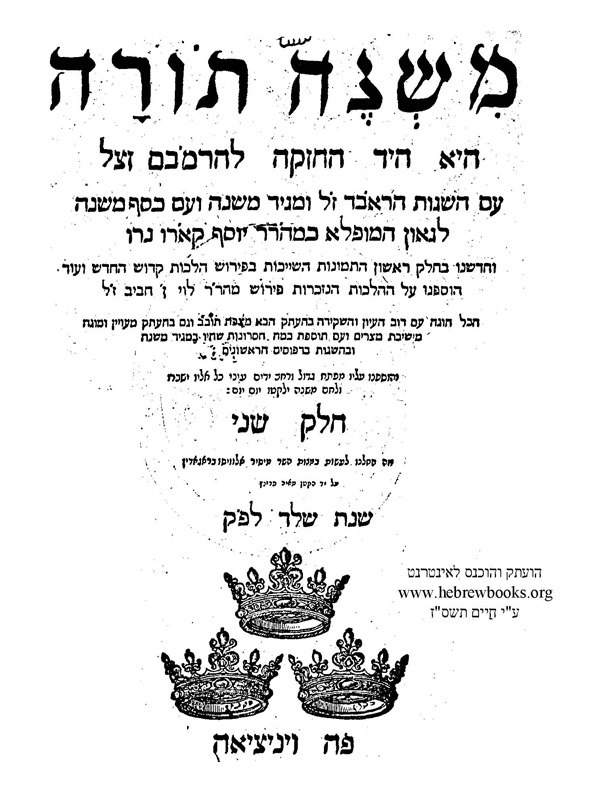
However, R. Avraham has a different perspective, believing that he too is properly representing his father’s outlook (and what he writes is what I also assumed based on my own reading of R. Ovadiah). According to R. Avraham, an Ashkenazi in Israel (and only in Israel) is permitted to become Sephardi, בין לטוב ובין למוטב. Here is R. Avraham’s letter.
4. Rabbi Moshe Shamah’s commentary on the Torah has recently appeared. At over one thousand pages, it is titled Recalling the Covenant: A Contemporary Commentary on the Five Books of the Torah. In a future post I hope to deal in more detail with one of Shamah’s essays, but in the meantime I wanted to let readers know about the book’s appearance. Many volumes of Torah commentary appear each year, usually written in the same style. Shamah’s book is different. The sources used and the questions asked will be eye-opening for many. It is not derush and does not psychoanalyze biblical figures. Rather, Shamah’s book is high level Torah scholarship in the tradition of the great peshat commentators, both medieval and modern,. I also found it interesting that the book contains a blurb from the noted biblical scholar Gary Anderson (as well from Yaakov Elman, Barry Eichler, and Jack Sasson).
Just as I was about to send in this post I also received Rabbi Nathaniel Helfgot’s just published Mikra and Meaning: Studies in Bible and Its Interpretation. This is a collection of essays on different themes in Tanakh and is a good example of the Modern Orthodox revolution in the study of Bible. Just as the Rav commented that that it would be impossible today to (successfully) teach Talmud to students who are secularly educated if not for R. Chaim’s approach, something similar can be said regarding Tanakh. For those with a secular education, who have read great books, it is very difficult to connect to Tanakh without the new approach that has been developed in the last forty years or so. As R. Yoel Bin Nun puts in his preface to Helfgot’s book: “It is impossible to study Tanakh in the land of Israel as if we are still residing in Eastern Europe prior to the Holocaust.”[22]
[1] There are, to be sure, opposing passages. See e.g., Bamidbar Rabbah 10:17, where it records that Manoah stated: והנשים אינם בנות הוראה. This text is cited by a number of halakhists to show that women are not to issue halakhic rulings. Both R. Hayyim Hirschensohn, Malki ba-Kodesh, vol. 4 p. 104 and R. Yissachar Tamar, Alei Tamar, Zeraim, p. 151, reject drawing any conclusions from the passage. Both of them claim that one can’t rely on what Manoah said, as he was an am ha-aretz (see Berakhot 61a: מנוח עם הארץ היה). This is an interesting point, but I wonder if it has any validity. It obviously depends on how one is supposed to read Midrash. On the one hand, Manoah may have been an am ha-aretz, but the sage who put this expression in his mouth was not, and neither was the redactor of the text, so perhaps Manoah’s statement should indeed be seen as a rabbinic position. On the other hand, since it was put in the mouth of an am ha’aretz, perhaps it should be regarded as simply that, namely, an uninformed opinion.
It is interesting that the well-known author, R. Aaron Hyman, responded to Hirschensohn in Malki ba-Kodesh, vol. 6, p. 204. He criticized Hirschensohn for writing as if he believed that because the Midrash quoted a statement of Manoah, that the historical Manoah actually said this:
ומה שמביא חתנו הלשון מבמ”ר נשים אינן בנות הוראה, ורוצה אדוני לתלות יען שמנוח ע”ה הי’ אומר דבר זה, חס מלהזכיר שיאמין כבודו שבאמת מנוח אמר דבר זה, האם אמרו חז”ל מדברי נביאות או בקבלה, הלא אך בדרך דרש אמר הדרשן כן וכן והוא דברי הדרשן הי’ מי שהי’ אבל מדרש הוא ואדם גדול קבצם, וכן ידוע כל השקלא וטריא שהיה בין קרח ומשה בענין טלית שכלה תכלת והאלמנה והכבשה, זהו אך מליצה נשגבה אבל לא שבאמת היה כן.
See Hirschensohn’s reply, ibid., p. 209, that his intent was only that the Midrash, בדרך דרש, attributed words to Manoah.
[2] Another irony is that the halakhic textbook written by the most distinguished of these yoatzot turns out to be more stringent, and requires consultation with rabbis more often, than halakhic texts written by men. See Aviad Stollman’s review of Deena R. Zimmerman’s A Lifetime Companion to the Laws of Jewish Family Life in Meorot 6 (2007), p. 5. I can’t imagine that women think that there is an advantage in having halakhic works written by other women if these works actually reduce female autonomy in intimate hilkhot niddah matters and require more consultation with male rabbis.
With regard to calling the women yoatzot and not poskot, Stollman, p. 8, n. 20, believes that “this is merely a tribute to Orthodox political correctness.” Maybe someone who knows the situation better than I can comment on Stollman’s point. That is, are these women really giving halakhic decisions and merely “covering” themselves by using the politically correct term yoatzot?
Regarding Stollman, I should point out that he is an academic scholar, and in addition to articles has published a critical edition and commentary of Eruvin, ch. 10, Ha-Motze Tefillin (Jerusalem, 2008). He has also published a volume of responsa, Pele Yoetz (Jerusalem, 2011). Responsum no. 45 is, I think, unique in responsa literature. Stollman was asked if it is permitted to create Santa Claus dolls that sing Jingle Bells. He rules that it is permissible. If I’m not mistaken, Stollman is the first one since R. Jehiel Jacob Weinberg to combine academic Talmud study with the writing of halakhic responsa.
Returning to yoatzot, I think many will find interesting that in Yemen and in some of the Sephardic world there was never a concept of asking a rabbi intimate niddah questions. This was because the women were embarrassed to do so, seeing it as “untzniusdik”. I mention this only because I have heard rabbis say that in truth there are no tzeniut issues with this, and women shouldn’t be embarrassed. They make it seem that it is only due to modern values that all of a sudden this sort of thing is uncomfortable for women. This is clearly not the case, as we see from what happened in the Yemenite and some of Sephardic worlds, hardly centers of modernity. (I am only speaking of the historical reality, not the wisdom of the Yemenite and Sephardic approaches, which usually meant that any doubt would be assumed to render the woman impure.) R. Yitzhak Shehebar, the Sephardic rav of Buenos Aires, writes as follows in his Yitzhak Yeranen, no. 95 (quoted in Beit Hillel, Tamuz 5769), p. 120:
ואשר לעניין מראות הדמים לא נהגנו בזה כלל, כי מעולם לא ראיתי להרבנים באר”צ [ארם צובה] שטפלו בזה, אך הנהיגו את הנשים שכל מראה הדומה למראית אדמומית שהוא טמא, זולתי אם יהיה כמראה לבן או ירוק שהוא טוהר.
Regarding Yemen, R. Yitzhak Ratsaby writes (Piskei Maharitz, vol. 3, section Be’erot Yitzhak, pp. 339-340):
אצלנו בק”ק תימן יע”א אין שואלין כלל לחכמים בעניין הכרת מראות הדמים, ובכל ספק הנשים מחזיקות עצמן טמאות ויושבות ז’ נקיים [ואפי’ לבעליהן נמנעות מלהראות כדי שלא יתגנו בעיניהן . . .] וכ”ה גם ברב ק”ק ספרדים יע”א . . . האידנא דהשאלה בדרך כלל היא רק לעיתים רחוקות, עי”ז נשתלשל הדבר שנמנעו מלשאול לגמרי מחמת בושתן היתירה וצניעותן המרובה כנודע
Ratsaby points out that this practice developed even though talmudic literature provides plenty of examples showing that in the days of the tannaim and amoraim the Sages did examine ketamim.
Regarding Yemen, see also R. Nachum Eliezer Rabinovitch, Siah Nahum, no. 60. In this responsum, Rabinovitch supports the institution of yoatzot and suggests that this practice, of turning to women in niddah matters, even existed in tannaitic times: כי לפנות לאשה חכמה אין חשש שמא תתגנה
In a note to this responsum, the editor provides further testimony about Yemen.
שמעתי עדות מחכם נאמן, שהיו מקומות בתימן בהם היו זקנות שהיו מוחזקות כבקיאות בעניני מראות, והנשים היו פונות אליהן, ומעולם לא ערער אדם על כך.
R. Moshe Maimon called my attention to the Meam Loez’s discussion of the laws of niddah, addressed to both men and women, and there is no mention there of bringing anything to the rabbi. This omission was rectified by R. Aryeh Kaplan, who in his translation (vol. 1, p. 136) adds: “When in doubt, a competent rabbi should be consulted.”
[3] Mishpetei Uziel, Hoshen Mishpat, no. 5.
[4] For sources on women deciding halakhic questions, see the three responsa in support of Sara Hurwitz’ being ordained as a “Maharat,” authored by Rabbis Yoel Bin-Nun, Daniel Sperber, and Joshua Maroof, available here.
[5] The Hafetz Hayyim, who was a “rabbi” if there ever was one, only received semikhah when he was 85 years old, and that was to satisfy a bureaucratic requirement. See Moshe Meir Yashar, He-Hafetz Hayyim (Tel Aviv, 1958), vol. 1, p. 19. According to R. Isaac Abarbanel, rabbinic ordination as currently practiced arose due to Christian influence. See Nahalat Avot, beginning of ch. 6:
אחרי בואי באיטאליאה מצאתי שנתפשט המנהג לסמוך אלו לאלו. וראיתי התחלתו בין האשכנזים כלם סומכים ונסמכים ורבנים. לא ידעתי מאין בא להם ההתר הזה אם לא שקנאו מדרכי הגוים העושים דוקטורי ויעשו גם הם.
[6] The title “rabbi” is indeed significant. This can be seen by the fact that when Sara Hurwitz was called Maharat there wasn’t any outcry, but when she was given the title “rabba” that is when the controversy really broke out, even though her job description didn’t change in the slightest. Does this mean that there was no objection to a woman functioning as a rabbi as long as she didn’t have the title? Only after she was renamed “rabba” did the RCA adopt a resolution rejecting the “recognition of women as members of the Orthodox rabbinate, regardless of the title.” Yet despite that resolution, there are synagogues where women are still serving, for all intents and purposes, as members of the rabbinate minus the title.
[7] Similar, though not identical, perspectives have recently been offered by Rabbis Norman Lamm, Michael Broyde and Shlomo Brody. See Broyde and Brody, “Orthodox Women Rabbis? Tentative Thoughts that Distinguish Between the Timely and the Timeless,” Hakirah 11 (Spring 2011), pp. 25-58. None of them reject the notion of Orthodox women rabbis at some time in the future. From speaking to many people, my own sense is that a majority of the Modern Orthodox community supports women rabbis (although not necessarily pulpit rabbis). When I say “support,” I mean if asked the question, the reply will be yes. But at the same time, the overwhelming majority of the Modern Orthodox world doesn’t care about this issue at all, and this includes women also. However, I believe that the minority will continue to push this issue, and when women rabbis become a reality, the Modern Orthodox will not reject these women or the congregations that employ them, as we can already see at present with Rabba Hurwitz and other female synagogue rabbis (in everything but name). I think this will happen before the natural development of female poskot who, as already indicated, will by definition be rabbis even without a formal ordination.
One more point that needs to be mentioned with regard to women rabbis is the issue of economic fairness. There are significant tax savings, due to parsonage, that an ordained clergyman receives from the government. While it is true that R. Michael Broyde has written that even women teaching Torah are eligible for this even under current tax laws (see here) and a prominent New York law has firm also expressed this opinion, many yeshiva day schools, acting under the advice of their accountants, have refused to adopt this policy. Some sort of formal ordination for women would settle the parsonage question, and give a financial boost to many of our underpaid teachers.
[8] There are, however, a number of very good articles on halakhah written by women. See e.g., Devorah Koren’s article in the recently published Milin Havivin 5 (2011), available here.
[9] Regarding Lieberman, I would like to call readers’ attention to what appears in the latest Yeshurun, vol. 25. On p. 21 the following footnote appears:
“How Much Greek in Jewish Palestine לגרסאות ופירוש תיבות אלה, ראה דברי הגר”ש ליברמן “
Here Lieberman is given the title due a gadol be-Yisrael. Perhaps this can be seen as making up for the censorship of references to Lieberman (and Louis Ginzberg) in an article by R. Mordechai Gifter that appeared in an earlier Yeshurun. See Saul Lieberman and the Orthodox, p. 32 n. 117. After my book appeared, I was informed by one of the editors of Yeshurun that the censorship of R. Gifter’s piece was carried out by the one who prepared the article for print, and the editors knew nothing about this and were upset when they learnt what had occurred.
On p. 632 of the new Yeshurun there is a letter from R. David Zvi Hillman to Prof. Shlomo Zalman Havlin in which he states the following: In the early volumes of the Encylopedia Talmudit Lieberman was referred to as ר”ש ליברמן, a point I noted in Saul Lieberman and the Orthodox. Yet American rabbis protested and insisted that he not be mentioned. These rabbis are identified with the Rabbinical Council of America: מהסתדרות הרבנים ר”ל המזרחניקים. In response to this, R. Zevin from that point on only mentioned the name of Lieberman’s books but not Lieberman himself. A Bar Ilan search reveals that vol. 13 is the last volume where ר”ש ליברמן is mentioned. (Vol. 15 was the last volume to appear in R. Zevin’s lifetime. See Zevin, Ishim ve-Shitot [Jerusalem, 2007], p. 40 [first pagination]).
Why would R. Zevin agree to this? The answer is obvious: money. The Mizrachi in America was an important source of funds for the Encyclopedia Talmudit.
[10] The term “rabbanit” was primarily used for the wife of a rabbi. See Robert Bonfil, Rabbis and Jewish Communities in Renaissance Italy, p. 77 n. 186. My point is only that it was also used for scholarly women.
[11] The continuation of the shiur is also of great interest, as he explains that if one ends up in a hotel on Shabbat and sees that the lights in the hall go one every time one leaves one’s room, it is still permissible to walk in the hallway and it is not even regarded as a pesik reisha.
[12] See the biography and picture of her here. For pictures of Flora and her family, see also here.
[13] Rivka bat Meir of Prague (died 1605) was another learned woman who was called “rabbanit”, see Frauke von Rohden, ed. Meneket Rivkah (Philadelphia, 2009), pp. 6-7. Rivka authored the Yiddish mussar work Meineket Rivka, published in Prague, 1609. On the title page she is referred to as הרבנית הדרשנית . (In the Altneuschul memorial book it also says that she preached. See Von Rohden, p. 6) Here is the first page of the book, where she is again referred to as “rabbanit”.
Lest anyone misunderstand, I must stress that Rivka only served as a rabbi and preacher for other women, and was therefore not a prototype for twenty-first century women rabbis. My point in referring to her is to highlight the use of the term “rabbanit” as designating a learned woman.
[14] Teshuvot Pesakim u-Minhagim, vol. 2, ed. Kahana, nos. 155-156.
[15] See Daniel Sperber, Minhagei Yisrael, vol. 1, pp. 65-66.
[16] I originally wrote Levinsohn, and thank a helpful reader for the correction. Loewisohn’s essay originally appeared in his posthumously published Mehkerei Lashon (Vilna, 1849).
[17] Incidentally, the note as it appears in the Vilna Mishnah has also been altered from what appears in the original work. In the original it states אשר אינם על טהרת לשון עבר, and in order that people understand what Loewisohn was saying, these words were altered to read: אשר המה כפי תכונת לשון הארמי
[18] See here.
[19] See here. As one of the commenters pointed out to this post, the women appear to be mermaids. He helpfully provided this link.
[20] For my essay on R. Ovadiah, see here.
[21] See Yabia Omer, vol. 5, Orah Hayyim no. 37, Yehaveh Da’at, vol. 1, no. 9, vol. 5 no. 32.
[22] R. Aharon Lichtenstein also has a preface to the book, where his ambivalence about the new approach comes through very clearly. This short essay deserves its own analysis.