Review of Rabbi Eliezer Berkovits, Jewish Women in Time and Torah

Review of Rabbi Eliezer Berkovits, Jewish Women in Time and Torah

Ross Singer

Ross Singer received rabbinic ordination from Professor Rabbi David Weiss Halivni, Rabbi Shear Yashuv Cohen, and Rabbi David Bigman. He has an MA in Talmud and Rabbinics from the Jewish Theological Seminary and is a graduate of the Mandel Jerusalem Fellows. He has published articles in The Edah Journal, The JOFA Journal, Amudim, Lehrhaus, The Jerusalem Post, and The Times of Israel. He is the translator of Gideon Katz’s In Silence and Out Loud: Yeshayahu Leibowitz in Israeli Context.

Ross served as a rabbi in Vancouver, Canada and Baltimore, MD, and currently resides in Israel where he works as an educator and tour guide.

Rabbi Eliezer Berkovits has long been an outlier in the Orthodox world.[1] Over the past two decades, there has been a concerted effort by admirers of R. Berkovits to revive his thought and put it on the agenda. New commentaries to the Haggadah[2] and Megillat Esther[3] have been culled from the large corpus of R. Berkovits’ writings, a sampling of his important essays has been collected and published,[4] major works have been translated into Hebrew and published by Shalem Press, and new editions of his out of print books have been reissued including the subject of this review, his Jewish Women in Time and Torah.

On the backdrop of this trend to cultivate a reconsideration of R. Berkovits’ thought in the Orthodox community, it is important to note that a feature of R. Berkovits’ work may play a role in its marginalization. In the introduction to his English magnum opus, Not in Heaven, R. Eliezer Berkovits writes:

Finally may I be permitted a personal confession. While all my life I have endeavored to take my stand on the foundations of Halakhic Judaism, as it was handed down to me in my father’s house and as I have acquired it from my studies in Y’shibot and later from my great teacher, Rabbi Yehiel J. Weinberg, ז”ל, at the Hildesheimer Rabbinical Seminary in Berlin, in this my work I was determined to be guided exclusively by the traditional halakhic material as I found it and as I have learned to understand it over the years.[5]

While Rabbi Berkovits describes his return to the classic sources as a departure from the approach that he received from his teachers and based upon his own unique understanding, scholars of R. Berkovits’ work have found other halakhists who lay out kindred theories of halakhah. Some theorize that R. Berkovits may have been influenced by R. Moshe Shmuel Glasner, the father of one of his early teachers, R. Akiva Glasner,[6] and Rabbi Chaim Hirshensohn.[7] Despite his “confession,” R. Berkovits’ approach has powerful antecedents that a reader of Not in Heaven will not encounter there. It is not clear why they go unmentioned and unexplored by R. Berkovits. It is clear that a full appreciation of the place of his approach in the broader canvas of halakhic thought requires some filling in of gaps that his work leaves out.

This is particularly true of R. Berkovits’ final work, Jewish Women in Time and Torah. The recent republication of this volume affords us an opportunity to explore analogs of the book’s central thesis that R. Berkovits leaves unmentioned or underdeveloped, and to note some more recent work that picks up on its themes.

Before engaging in the endeavor to uncover the congruity of R. Berkovits’ thought in this work with the larger tradition, let us appreciate two features of this new edition. Firstly, it includes a moving introduction by R. Berkovits’ granddaughter, R. Rahel Berkovits. Her essay gives some important personal and ideological context. Secondly, this new edition uses footnotes as opposed to endnotes used in the earlier edition making it easier to turn to the various sources quoted by R. Berkovits without losing one’s place in the book.

The most significant contribution of the content of Jewish Women in Time and Torah is R. Berkovits’ distinction between “Torah-taught” and “Torah-tolerated.” This distinction lies at the center of the book’s agenda. R. Berkovits explains that the Torah was given into a particular cultural context and as such, it must take that context into consideration in legislating its norms. The Torah must, in certain cases, compromise its highest ideals for the sake of speaking to a particular generation who in their context are unable to understand and accept the fullest aspirations of the Torah. Using a pragmatic strategy, the Torah guides the community towards ever greater fulfillment of its ideals. In R. Berkovits’ own words:

The goals and the values are these forever. But they are taught and applied with the wisdom of understanding that time-conditioned reality cannot be changed overnight. The method of the Torah is to acknowledge reality, to take human nature into account and apply the eternal word to it so far as is possible, thus to teach values and guide behavior, indicating the goal towards which the guided change has to move.[8]

The Torah tolerates time-conditioned realities and they may seep into its norms, however one must distinguish between the Torah-tolerated and the Torah-taught. R. Berkovits asserts that the disparaging statements about women and halakhic inequalities that one finds in Jewish tradition stem from the ancient context into which Torah was given and in which it developed. Such evaluations of women were Torah-tolerated, however none of them were Torah-taught. While R. Berkovits had advocated for decades for adjustments in halakhah for women’s status, he had justified this approach in the past based on his understanding of halakhah’s prioritization of the ethical. In Jewish Women in Time and Torah, he introduces this historiosophy to his English language readers for the first time.[9] According to his read of the history of halakhah, the time is ripe to rid halakhah of what it had compromised on in the past:

It is our task to eliminate whatever remains from the Torah-tolerated, impersonal phase and to establish woman’s status completely on the Torah-taught and prescribed personal level.[10]

To appreciate the significance of this, it may be helpful to look at a question posed to R. Berkovits by R. Shalom Carmy. In a nuanced review of R. Berkovits’ approach, R. Carmy finds much to appreciate. Nevertheless, he echoes the common critique that R. Berkovits’ approach overreaches. R. Carmy notes R. Berkovits’ exasperation over a statement of the Ramban regarding the case of a woman who claims that her husband is repulsive to her without offering independent evidence. While reinforcing the strength of the position that allows the court to force the husband to divorce his wife, Ramban adds that whoever follows the stricter opinion that the court cannot force the husband “has lost nothing, and may be blessed.” R. Berkovits states that, “one remains astounded at such words. To be ‘strict’ in matters of divorce and overlook the happiness of the woman may often be extreme leniency in the implementation of the not insignificant commandment ‘And you shall love your neighbor as yourself.’” Rabbi Carmy takes issue with Rabbi Berkovits critique of Ramban:

We are obligated, as a simple matter of intellectual integrity and a measure of kevod ha-Torah, to understand why Ramban’s theoretical and practical judgements diverge markedly from ours. Such an exercise will yield a better understanding of Torah and a better self-understanding… Rolling one’s eyes in exasperation with the Ramban is not a philosophy.[11]

Rabbi Carmy’s point is an excellent one. How can R. Berkovits so easily discount the Ramban’s statement? Isn’t it too part of the Torah that must be understood and appreciated? If the priority of the ethical is so fundamental to halakhah, why doesn’t the Ramban recognize that? In Jewish Women in Time and Torah, R. Berkovits provides an answer to these questions. Ramban’s acquiescence to an approach in halakhah that diminishes women’s status before the court is a holdover of a Torah-tolerated approach. In our period such an approach should be left behind as we reassert the Torah-taught.[12]

The implications of R. Berkovits’ historiosophy of halakhah are tremendous and raise many questions. It introduces new dimensions to the subjective element of R. Berkovits’ thought. How is one to distinguish in the corpus of Torah between what is merely Torah-tolerated and what is actually Torah-taught? Where does R. Berkovits get such an idea about halakhic evolution and progression? Is this aspect of his thought also a deviation from the teaching he received from his family and teachers? What precedents exist for approaching Torah and halakhah in this way?

Indeed, it seems that R. Berkovits’ historiosophy of halakhah conflicts with the predominant way that Torah is presented in many orthodox circles. One of the opening statements of Bereishit Rabbah presents a conception of Torah that seems antithetical to R. Berkovits’ approach:

A king of flesh and blood who builds a castle does not do so from his own knowledge, but rather with the knowledge of a craftsman, and a craftsman does not build it from his own knowledge; he has scrolls and books in order to know how to make rooms and doorways. So too God looked into the Torah and created the world…[13]

In this depiction, the Torah precedes the world. The Torah then can be seen as pristine and untouched by human history and culture. In such a depiction, the Torah’s commandments cannot bear the taint of any human foibles. The Torah does not tolerate or compromise with or react to history because the Torah precedes history. In my experience, this is the dominant conception of Torah’s relationship to the world in Orthodox circles.[14]

Is there an alternative competing conception to this one upon which R. Berkovits can find precedent? To ground his position in the classical sources, R. Berkovits first quotes from Rashi’s interpretation of Psalms 29:4. Rashi comments, “At the time of the giving of the Torah, God limited His voice in accordance with the strength of the Israelites to receive.”[15] R. Berkovits elaborates explaining that each person received the Torah “in conformity with his own spiritual and moral capacity.” Building on this, R. Berkovits turns to the Rambam’s famous passage in his Guide for the Perplexed about the origin of the sacrifices:

… the prevailing custom in the world was to sacrifice animals… God’s wisdom counseled Him that to command the Jews to give up all that kind of service and annul it completely would have been something that their hearts could not have accepted… For this reason, God allowed the [generally practiced] sacrificial services to remain but directed them away from those created or imagined powers in which there is no truth, to His own name blessed be He.[16]

While R. Berkovits suffices with this one excerpt, the notion that God’s revelation to Israel took into account particular historical circumstances recurs throughout the Rambam’s writings. In a number of places in the Guide, Rambam explains that the Torah’s commandments and teachings are responses to and polemics against the practices and beliefs that had become prevalent among ancient idolators. For example, this is how he explains the reason for the Korban Pesach:

Scripture tells us, according to the version of Onkelos, that the Egyptians worshiped Aries, and therefore abstained from killing sheep, and held shepherds in contempt… For this reason those sects abstained from eating goats’ flesh. …This is [also] the reason why we were commanded to kill a lamb on Passover, and to sprinkle the blood thereof outside on the gates. We had to free ourselves of evil doctrines and to proclaim the opposite, viz., that the very act which was then considered as being the cause of death would be the cause of deliverance from death.[17]

This approach is not limited to the Guide. In his earlier popular works Rambam makes similar suggestions. In the Sefer HaMitzvot (Negative Commandments #43) Rambam already explained that the Torah’s prohibition of shaving off the corners of one’s head is in response to the practice of ancient idolatrous priests shaving that part of their hair. He repeats this explanation in the Mishneh Torah (Hilkhot Avodah Zarah 12:1). The reason for the prohibition of mixing wool and linen together in garments is explained in the Sefer HaMitzvot (Negative Commandments #42) in the same way. In his Letter on Astrology, Rambam again articulates the broad use he makes of the approach:

I also have read in all matters concerning all of idolatry…I have read it and have understood its subject matter and have plumbed the depth of its thought. From those books it became clear to me what the reason is for all the commandments that everyone comes to think of as having no reason at all, other than the decree of Scripture.[18]

Given the claim that the Guide was written as an apologetic work to draw in those who had been lured away from traditional Judaism and therefore might include rhetorical passages that do not represent the most authentic positions of Rambam, these examples[19] are significant.

Another iteration of Rambam’s assertion that the Torah takes into account the exigencies of history found outside of the Guide is found in his Epistle on the Resurrection of the Dead.[20] After reaffirming his earlier pronouncements that the resurrection of the dead is a fundamental Jewish principle, Rambam addresses the absence of any explicit indication of the resurrection of the dead in the Pentateuch. He explains that the notion of the resurrection of the dead was so foreign and difficult to accept in the culture of Moses’ time, that were it to be mentioned, it would have made the acceptance of all the Torah’s other truths and instructions unthinkable. Therefore, God withheld the truth of the resurrection at that time in order to inculcate other more fundamental notions of prophecy and creation. Only after prophecy and creation were well established beliefs did God see fit to reveal the notion of resurrection and therefore we only find resurrection mentioned explicitly in later books of the Bible. Rambam explains that just as the Israelites were led out of Egypt in a circuitous route to avoid the land of the Philistines, “lest the people change their minds when they see war and return to Egypt (Exodus 13:17),” so too the revelation of the resurrection took a circuitous route lest the people reject the Torah. The metaphor of the circuitous path of the exodus is also employed by the Rambam in the Guide to explain his approach to the sacrifices in the passage mentioned above. The impact of the exigencies of human history not only shape the path of the Exodus and the establishment of the sacrificial rites, they also determine that certain information must be omitted from the content of the Torah.

In perhaps the most subtle but also the most profound example of this phenomenon, Rambam seems to hint that the very revelation of the whole of the Torah was a reaction to a particular historical moment. In chapter one of the Mishneh Torah’s Laws of Idolatry, Rambam recounts how all of the progress in creating a monotheistic community was nearly undone during the many years that the Israelites lived in Egypt.

When the Jews extended their stay in Egypt, however, they learned from the [Egyptians’] deeds and began worshiping the stars as they did, with the exception of the tribe of Levi, who clung to the mitzvot of the patriarchs – the tribe of Levi never served false gods. Within a short time, the fundamental principle that Abraham had planted would have been uprooted, and the descendants of Jacob would have returned to the errors of the world and their crookedness.

Seemingly in response to this deterioration, God

brought forth Moses, our teacher, the master of all prophets, and sent him. Once Moses, our teacher began to prophesize, and God chose Israel as His inheritance, He crowned them with mitzvot and informed them of the path to serve Him, and the law prescribed for idol worship and all those who stray after it.

In the Rambam’s retelling it sounds as if the superior level of prophesy bestowed upon Moses and the giving of the mitzvot of the Torah are prompted by a crisis in history – the potential loss of the monotheistic tradition that Abraham founded. As Rabbi Nahum Eliezer Rabinovitch puts it in his commentary to this passage:

We find that Moses’ mission and the transmission of Torah and mitzvot guaranteed that the root that Abraham planted was not uprooted and would never be uprooted.[21]

Rav Shagar suggests that this first chapter of the laws of idolatry should be seen as just one example of a larger phenomenon in the Mishneh Torah:

In my opinion, one should explain the Rambam’s effort in the Mishneh Torah in his historical introductions to various halakhot, like his introduction to the laws of marriage for example, in this way (a historical understanding). The Rambam, in opposition to most of the Torah’s interpreters today, did not hide his conception of the Torah as constructed by history (among other factors) and as adapted to changing human consciousness.[22]

Deeply embedded in Rambam’s thought, and throughout his writings we find that the Torah was shaped by the exigencies of history.

Perhaps the greatest rabbinic figure since Rambam to articulate a similar approach to the impact of history on the formulation of the Torah was Rabbi Abraham Isaac HaCohen Kook. In a letter to the orthodox academic biblical scholar, Moses Seidel, R. Kook writes:

If we find in the Torah certain things which seem to be based on widely accepted ideas of the distant past, but are incompatible with the scientific knowledge of today, we cannot be sure if our current research has produced absolute truth. Even if current understandings are true, there certainly could have been an important and sacred reason for which these matters needed to be explained according to the popular notions of ancient times and not scientifically precise ones. This approach is taken for granted by certain spiritual notions and fundamentals of understanding scriptural narrative like, “the Torah addressed humanity’s evil inclination,” or “[The Torah is formulated] in order to explain in a way that it is intelligible to the [human] ear”, and these instances testify to beloved enduring Divine wisdom.[23]

In another letter to Seidel, Rav Kook writes:

Life must be understood through two parameters, how it is and how it should be… The Divine exalted Torah is that very beloved instrument that cultivates and directs life towards the state that it should be. However, you must be careful not to think that these two parameters have no relationship or connection to each other, for they are related matters just like the changing horizons that one who travels a long journey encounters.[24]

These two letters together produce an approach that is basically the same as R. Berkovits’ – the Torah takes into account “the popular notions of ancient time” even if they are not “precise”, and seeks to move life from “how it is” towards “how it should be” incrementally like “changing horizons.” These ideas find a later iteration in the posthumously published L’nevuchei Hador.

A similar notion can be found in R. Kook’s essay “Fragments of Light.” There he writes:

The long road of development, after man’s fall, also needs physical exertion, which will at times require a meat diet, which is a tax for passage to a more enlightened epoch, from which animals are not exempt…

This is the advantage of the moral sense when it is linked to its divine source. It knows the proper timing for each objective, and it will sometimes suppress its flow in order to gather up its strength for future epochs, something that the impatient kind of morality that is detached from its source would be unable to tolerate. When the animal lust for meat became overpowering, if the flesh of all living beings had been forbidden, then the moral destructiveness, which will always appear at such times, would not have differentiated between man and animal, beast and fowl and every creeping thing on the earth. The knife, the axe, the guillotine, the electric current would have felled them all alike in order to satisfy the vulgar craving of so-called cultured humanity.[25]

These and similar ideas on the consumption of meat in another essay were culled together by R. Kook’s student R. David Cohen into an essay entitled “A Vision of Vegetarianism and Peace.” In R. Berkovits’ terminology, R. Kook is suggesting that the eating of meat is Torah-tolerated but not Torah-taught. Though he never quotes from R. Kook, their approaches clearly share a similar understanding of the necessity for Torah to compromise its highest aspirations in the face of the exigencies of history.

And yet, even as we have seen that R. Kook and the Rambam both teach that the Torah includes elements that are the product of historical circumstances, one could still challenge the notion that this should have any practical ramifications. The same Rambam who in the Guide presents the sacrificial system as a compromise with historical exigencies, in the Mishneh Torah brings all of the details of the halakhah of animal sacrifice. As Rabbi Ira Bedzow articulates it:

Nevertheless, the obligation of sacrifices was never abrogated completely in favor of prayer. In his Book of the Commandments, Maimonides enumerates prayer as the fulfillment of the specific commandment of worshiping God. Yet he also enumerates each commandment of the sacrificial rite even though they could have been included in the general category since they are considered only a way-station on the path to proper worship. Their enumeration shows that as specific commandments, the performance of sacrifices is eternally valid, as is the rest of the Torah.[26]

We could also note that R. Kook was insistent that for his time it was inappropriate to implement the Torah taught vegetarianism. He explicitly discouraged his son from refraining from eating meat.[27] R. Kook was concerned that the time was not yet ripe and the consequences of implementing the Torah’s ideals could backfire. Moreover, even though R. Kook was very unconventional as a thinker, his practical halakhic decisions were often very conservative.

R. Kook’s and Rambam’s reticence to diverge from the Torah-tolerated halakhah towards what they believed was a more ideal Torah teaching is an important point to consider. However, most of what Rabbi Berkovits advocates for in this book is not analogous to the abolition of sacrifice or the wholesale prohibition on consuming meat. In most cases, Rabbi Berkovits is suggesting the adoption of one strain of the halakhah embedded in the Talmudic and post-Talmudic authorities over other strains. For instance, his proposals of women reading Megillat Esther for the community, making Kiddush in their homes, counting for the three that make up the Zimmun and leading the zimmun, all are based on classical sources.

And still, even regarding relatively minor adjustments, how can one be sufficiently confident that one strain is merely tolerated while the other is Torah-taught? Could both be Torah-taught and part of Rabbinic pluralism – a pluralism that R. Berkovits embraces in other contexts?[28] R. Berkovits insists that in these cases one position is a holdover with less legitimacy and the other is an ideal whose time has come. R. Berkovits traces a line from negative statements about women in ancient Greek culture and presumes that parallel statements in the Rabbinic literature must derive from this foreign source. R. Berkovits seems to presume that this is self-evident and does not feel a need to demonstrate causation. One wonders if there is a possibility of a more objective way of separating the “Torah-taught” from the “Torah-tolerated.”

At just about the same time that R. Berkovits was writing up these ideas,[29] R. Nahum Eliezer Rabinovitch was sharing very similar thoughts:

The system of Torah and commandments is two-fold. On the one hand, it conveys concepts, instills eternal values, and directs people to the service of God at the highest levels and to the formation of a society worthy to be the bearer of God’s presence. On the other hand, it encompasses legislation and commands to combat the forces of evil and destruction that erupt within the individual’s soul and the nations’s spirit and to ensure that the necessary conditions for spiritual development are satisfied to the greatest possible extent, given each generation’s situation and the social, economic, and cultural circumstances prevalent at any given time and place. For the first objective, the Torah places before us lofty goals that challenge and motivate the generations, for even the noblest of people cannot attain them in full. At the same time it establishes, for the second objective, criteria for conduct that people can, as a practical matter, accept minimum standards that must be met to avoid endangering the survival of the individual and the society in which he is placed and giving up all hope of spiritual uplift.

R. Rabinovitch and R. Berkovits are laying out very similar ideas to each other at the same time without mentioning each other.

Like R. Berkovits, R. Rabinovitch asserts that halakhah indeed should respond and has responded to progress in history that allows for the raising of “minimum standards” towards “service of God at the highest levels.” He writes:

In the time of the rishonim, R. Gershom, Beacon of the Diaspora, saw that his generation was ready for a ban on divorce without the wife’s consent and for eliminating polygamy, at least within the communities of Western Europe. By now, his enactments have spread through all Israel. Certainly the Sages instituted such enactments – yet they did not draw them out of thin air, but advanced the values already determined by Scripture. In the biblical era, however, the time was not yet ripe, and people were not yet ready for the full realization of that vision. Only over time, as a result of training in the life of Torah, were people’s hearts made ready and did it become possible to draw closer to the goal established by the Torah.[30]

R. Rabinovitch sees in takanat Rabbeinu Gershom an example of the Torah-taught replacing the Torah-tolerated. He powerfully grounds his claim that monogamy is an ideal of the Torah and that polygamy is a compromise with reality, He allows the Torah to present its ideal in its own terms: “Therefore a man shall leave his father and his mother and cleave to his wife and they will become as one flesh” (Genesis 2:24). “I am my beloved’s and my beloved is mine” (Song of Songs 6:2).

It is worthwhile noting some differences between R. Rabinovitch’s presentation and R. Berkovits. R. Rabinovitch’s seems to have a higher threshold for determining the Torah-taught.[31] He is less willing to intuit the Torah’s higher ideals and so all of his examples rely on broad constitutive statements. He also is much less programmatic and ambitious than R. Berkovits. R. Rabinovitch makes the case that this is how Torah works but he does little to lay out what our next steps should be. For those who are convinced of the basic theory of Torah-taught vs. Torah-tolerated, the continuum between the more programmatic and intuitive R. Berkovits and the more conservative modest R. Rabinovitch might provide margins to the discussion of how far one can or should go with this approach.

Before closing, we should note some very recent movement towards these ideas in another realm. While, for R. Rabinovitch, R. Berkovits, and R. Kook, these ideas primarily address ethical qualms that we might have over the discrepancy between our senses of morality and the tradition’s prescriptions, they have also been used recently to address issues arising from the discipline of Biblical Criticism.

In two recently published books, the ideas explored above are brought to shed light on Biblical criticism. R. Joshua Berman’s Ani Maamin and Yeshivat Maale Gilboa’s Gishat HaTemurot seek to address the discrepancies and contradictions in the Torah that scholars of the Documentary Hypothesis make so much of. Both of these books suggest that understanding the Torah’s relationship to historical developments and culture explains these discrepancies in ways that can be harmonized with reverence for the divinity of the text.

R. Berman titles the opening chapter of his book, “The Rabbinic Mandate to Understand the Torah in Ancient Near Eastern Context.” He justifies his approach by quoting the passages from The Guide mentioned above, the Letter on Astrology, Ralbag, and Rav Kook. R. Yehuda Gilad in his article in Gishat HaTemurot brings together Rambam’s passage about sacrifice in The Guide, Rav Kook’s Letter #89, and the Vision of Vegetarianism and Peace and offers an overarching analysis of the ramifications of this approach.

From all this we can see that R. Berkovits’ thesis in Jewish Women in Time and Torah is deeply grounded in the broad oeuvre of Rambam’s writings, and it reverberates with seminal passages in the writings of R. Abraham Isaac HaCohen Kook. It was paralleled by the work of his younger contemporary R. Rabinovitch, and its methodology has been used in two important books to address the challenges of Bible criticism. Perhaps what might seem at first glance to run afoul of common attitudes towards the sanctity of the Torah’s text, should be considered a legitimate and well-trodden path of engaging with the Torah by some of our greatest lights. If so, this can open an exciting and vital debate about the potential ramifications for the proper adjudication of halakhah in our moment in history. The republication of Jewish Women in Time and Torah is an excellent springboard for this debate.

* * * * * * *

Notes

[1] His approach has been disparagingly associated with Conservative Judaism. See R. Chaim Twerski, Academic Journal of Hebrew Theological College 1:2 (April 2003), in the letters section page 101. His yirat shamayim has been called into question. See Allan Nadler, “Eliezer Berkovits’ Not in Heaven,” Tradition 21:3, (Fall 1984), p. 97. While his own teacher, Rabbi Yechiel Ya’akov Weinberg, wrote a glowing approbation of R Berkovits’ work Tnai Bernesuin UVaGet (For an analysis of the controversy around this letter, see Marc B. Shapiro, Between the Yeshiva World and Modern Orthodoxy, (1999), pp. 191-192, footnote 83), in private correspondence, Rabbi Weinberg wrote that an article of R. Berkovits’ “contains harmful ideas that cannot be accepted” (Shapiro, “Rabbi Jehiel Jacob Weinberg on the Limits of Halakhic Development” The Edah Journal 2:2 Tammuz 5762, p. 2). To be sure, in that same letter, R. Weinberg ultimately comes to the general defense of his devoted student, but the statement that R. Berkovits had gone too far in this particular article is telling. When publishing an article by R. Berkovits in 1965, Tradition felt the need to include the following disclaimer: “Although most of our Editorial Board disagree with the views expressed in this essay, Tradition is happy to provide a forum for the provocative ideas presented by Dr. Eliezer Berkovits (‘Orthodox Judaism in a World of Revolutionary Transformations’ (Berkovits 1965).” Gil Graff cites a letter where R. Berkovits himself felt he hadn’t found a place where he felt comfortable in American Jewish life (Gil Graff “Halakhah as Torat Hayyim, Journal of Modern Jewish Studies, April 16, 2019, p. 7).

[2] Reuven Mohl (ed.), Faith and Freedom Passover Haggadah with Commentary from the Writings of Rabbi Eliezer Berkovits, (2019).

[3] Reuven Mohl (ed.), Faith Fulfilled: Megillat Esther and the Ma’ariv Evening Service for Purim with Commentary from the Writings of Rabbi Eliezer Berkovits, (2022).

[4] David Hazony (ed.), Essential Essays on Judaism, (2002).

[5] Eliezer Berkovits, Not in Heaven, (1983) p. 2.

[6] Dr. David Hazony, Prof. Marc Shapiro and Rabbi Nathan Lopes Cordozo have all made this speculation. R. Cardozo writes, “Rabbi Berkovits received his rabbinical training (and semicha – rabbinic ordination) from Rabbi Akiva Glasner (1885-1956), who took over as Chief Rabbi of Klausenburg when his father, Rabbi Moshe Shmuel Glasner (1856-1924) left for Israel. The latter – a staggering, daring figure in the world of Halacha – authored Dor Revi’i, one of the most remarkable works ever written, suggesting an entirely different approach to Jewish Law. The elder Rabbi Glasner had a major influence on Rabbi Berkovits’s halachic thinking and approach” (R. Cardozo, “Faith and Freedom – a book review,” Times of Israel, March 27, 2019 https://blogs.timesofisrael.com/faith-and-freedom-a-book-review/). David Hazony writes, “Yet he had other teachers, as well, whose influence was no less evident than Weinberg’s, even if he does not tell us as much explicitly. Of these, probably the most decisive was Rabbi Akiva Glasner, under whom he studied and received rabbinic ordination during his years in Pressburg, and who officiated at Berkovits’ wedding—a traditional symbol of reverence and, presumably, influence. And though Glasner himself left little record of his views regarding the subjects Berkovits wrote about, we do know that he shared a close affinity with his father, Rabbi Moshe Shmuel Glasner, even succeeding him as chief rabbi of Klausenberg. The elder Glasner was renowned for two controversial beliefs in his time—beliefs that find powerful expression in Berkovits’ writings, and which do not have seemed to be emphasized in those of Weinberg, and which, knowing what we know about how rabbinic dynasties tend to function, are likely to have infused Akiva Glasner’s teachings as well and reached Berkovits through him” (Hazony, Human Responsibility in the Thought of Eliezer Berkovits – Thesis submitted to the Senate of the Hebrew University, July, 2011, p. 31). Professor Shapiro is much more reserved writing that, “Presumably, some of the elder Glasner’s ideas were carried forward by his son, although it is impossible to say if this influenced Berkovits, since he never mentions Glasner in his writings” (Shapiro, “Rabbi Eliezer Berkovits’s Halakic Vision for the Modern Age,” Shofar 31:4, p. 16). R. Glasner may have had explicit influence or subconscious influence on R. Berkovits or perhaps he had no influence at all. Whatever the case may be, R. Berkovits’ approach does have a powerful important antecedent.

[7] See Hazony, Human Responsibility in the Thought of Eliezer Berkovits – Thesis submitted to the Senate of the Hebrew University, July, 2011, pp. 35-36. See also R. Jonathan Sacks, Arguments for the Sake of Heaven, (1995), pp. 196, where R. Sacks puts R. Hirschensohn and R. Berkovits in the same ideological camp.

[8] P. 47.

[9] This idea appears in Hebrew in a less developed form in Berkovits’ article מעמד האישה ביהדות – הבט הלכתי-חברתי that appears in דב רפל (עורך) הפנינה: ספר זכרון לפנינה רפל which was published in 5749 (1988-89) – a year or so before the publication of Jewish Women in Time and Torah.
This article introduces a new element into Rabbi Berkovits’ historiosophy of halakhah. In Not in Heaven, he writes that, “halakha is the application of the Torah to life. But since there is no such thing as life in general, since it is always a certain form of life at a specific time in history, in a specific situation, Torah application means application to a specific time in a specific situation” (pp. 1-2). In his article “The Role of Halakhah,” he writes that “the concrete historical situation is forever changing. Halakhah therefore, as the application of Torah in a given situation, will forever uncover new levels of Torah-depth and Torah-meaning and thus make new facets of Judaism visible… authentic Jewry represents a single application of Torah to a specific constellation of conditions in which Jews find themselves at one time in their history (Berkovits, “Authentic Judaism and Halakhah,” Judaism 19 (1): 66–76). However, In Jewish Women in Time and Torah he goes a step further. It is not just that the adjudication of halakhah’s ideals must be applied and adapted to particular circumstances. Here he is saying that halakhah at times compromises on its ideals during historical periods in which its ideals are unachievable.

[10] Berkovits, Jewish Women in Time and Torah p. 71.

[11] R. Shalom Carmy, “Eliezer Berkovits’s Challenge to Contemporary Orthodoxy, The Torah u-Madda Journal (12/2004), p. 198.

[12] Reading R. Berkovits’ complaints about the agunah issue in his early work highlights the new dimension that the Torah-taught vs. Torah-tolerated conception brings to R. Berkovits thought. In “The Role of Halakhah,” p. 74, he writes, “It has, however, become more serious in our times than it has been even before, First of all, the problem has been psychologically aggravated. Conditions have changed, movies have changed, the position of women in society has changed. People are no longer willing to put up with the problem as they might have done in earlier times. The unresolved status of the problem drives numerous people away from Halakhic Judaism. Often the woman is penalized because of the attitude of the husband. He may refuse to give a get out of spite or because, exploiting the situation, he makes monetary demands on his wife or on her family in return for a religious divorce… The problem of the agunah is a critical problem of Jewish ethics. It challenges the entire concept of derakheha darkhei noam, that the ways of the Torah are ways of pleasantness. It is unquestionably a grave injustice to the woman. Its consequences often lead to self-defeating futility, for in the majority of such problematic cases the parties accept the civil divorces as final and remarry without the benefit of a get.” Modern women’s feelings, injustice, social mores, the fact that there will be remarriages anyway etc. are the issues that R. Berkovits raises here. However, the crisis is not described as the result of an anachronistic compromise. After reading Jewish Women in Time and Torah, the absence of the Torah-taught/Torah-tolerated distinction in this exhaustive diatribe is glaring.

[13] Genesis Rabbah 1:1.

[14] To be sure, R. Berkovits might interpret this passage as referring only to the Torah-taught elements of Torah. However, the passage does not hint at any such distinction and it is my sense that it is not commonly taken that way.

[15] Jewish Women p. 45.

[16] Guide for the Perplexed 3:32 quoted on p. 46 of Jewish Women.

[17] Guide for the Perplexed 3:45. Other examples can be found in this chapter and in 3:30; 3:37; 3:39; 3:46; 3:49 as well.

[18] Twersky, ed. A Maimonides Reader, pp. 465-66.

[19] For some others, see Sefer HaMitzvot Negative commandment #45 and Hilkhot Avodah Zarah 12:7.

[20] See Abraham Halkin (translator), Epistles of Maimonides: Crisis and Leadership (1985), pp. 229-230.

[21] Rabbi Nahum Eliezer Rabinovitch, Yad Peshuta, Hilkhot Avodah Zarah ch. 1 Hebrew:

נמצא שעל ידי שליחותו של משה רבינו ומתן תורה ומצוות הובטח שאותו עיקר ששתלו אברהם לא נעקר ולא ייעקר לעולם

[22] Rabbi Shimon Gershon Rosenberg, Kelim Shvurim (Heb.) 5764, p. 34, n. 18.

[23] Iggrot HaRaya #473, p. 119.

[24] Iggrot HaRa’yah, #89, pp. 94-95.

[25] Translation taken from Ben Zion Bokser, Abraham Isaac Kook, (1978) pp. 318-319.

[26] Ira Bedzow, Halakhic Man Authentic Jew (2009), p. 177.

[27] Iggrot HaRa’yah #802.

[28] Not in Heaven, pp. 50-53.

[29] R. Nahum Eliezer Rabinovitch first lays out the ideas mentioned below in an essay in Maaliyot (a publication of Yeshivat Birkat Moshe) in 1988. R. Berkovits presents these ideas in the same year. See footnote 9 above. Rabbi Rabinovitch’s essay was expanded and republished in a collection of his essays entitled Darkah shel Torah that was published in 1998. The portions quoted here are taken from Joel Linsider’s translation of the expanded essay that appeared in The Edah Journal 3:1 Tevet 5763.

[30] R. Nahum Eliezer Rabinovitch, “The Way of Torah,” The Edah Journal 3:1 Tevet 5763, p. 8.

[31] R. Berkovits’ claim of a Torah ideal of an equality of the sexes might find an anchor in R. Yehuda Herzl Henkin’s essay “Equality Lost.” See R. Y.H. Henkin, Equality Lost.


Between Authority and Inquiry: Beyond the Masthead of the Beys Yaakov Journal, 1923-1980 – Part 1

Between Authority and Inquiry:

Beyond the Masthead of the Beys Yaakov Journal, 1923-1980 – Part 1

by Dan Rabinowitz

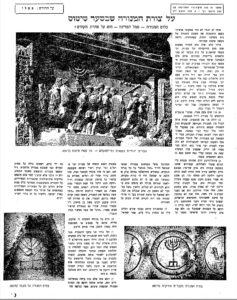
In December 1961, the Israeli edition of Beys Yaakov, the educational journal of the Agudath Israel–affiliated school system, published an article that sits uneasily with standard accounts of Agudath Israel’s twentieth-century intellectual posture.[1] Issue 6 of its second year reprinted in full a study on the archaeological and halakhic problems surrounding the base of the Temple menorah.[2] The identity of the author is therefore institutionally consequential. Rabbi Dr. Yitzhak Isaac Halevi Herzog served as the Ashkenazi Chief Rabbi of Israel at the head of a state-established rabbinate whose claim to centralized religious authority Agudath Israel did not recognize, locating binding rabbinic authority instead in its own Moetset Gedolei HaTorah.[3] The unabridged publication of his work in an Agudah-affiliated journal thus draws attention to the editorial criteria and intellectual assumptions operative within Beys Yaakov. This decision was not anomalous. From its founding in interwar Poland through its postwar continuation in Israel, Beys Yaakov repeatedly engaged materials, methods, and voices that lay beyond the formal boundaries of Agudath Israel’s institutional authority.[4] The journal maintained clear Orthodox commitments, but it did not construe those commitments as requiring insulation from external scholarship or the suppression of internal disagreement.

Examining Beys Yaakov between 1923 and 1980 permits a reconstruction of an Orthodox public discourse that does not conform to models centered on withdrawal or uniform ideological consolidation.[5] Across decades and editorial regimes, the journal published women’s reflective writing, printed criticism of decisions taken by Agudath Israel’s own rabbinic leadership, and, in later years, employed scholarly analysis to interrogate elements of the modern State of Israel’s symbolic repertoire.[6] These practices were not episodic but structural, pointing to a sustained editorial orientation in which intellectual engagement operated as a constitutive element of Orthodox self-definition rather than as a deviation from it. While recent scholarship has rightly emphasized Agudath Israel’s institutional boundary maintenance and political separatism, as well as the culturally mediating role of the Beys Yaakov movement, attention to the Beys Yaakov Journal redirects analysis from ideology and leadership to editorial practice as a central site of Orthodox intellectual life.[7]

Polish Origins: Sara Schenirer and the Educational Crisis

Before World War I, Orthodox Jewish girls in much of Eastern Europe received little formal Jewish schooling.[8] Although rabbinic attitudes toward women’s Torah study had varied across periods and locales, prevailing practice in Polish Orthodox communities restricted instruction largely to domestic settings and to the transmission of basic laws, customs, and religious dispositions.[9]At the same time, access to secular schooling expanded steadily and was widely taken up. Girls often acquired fluency in Polish language and culture while lacking the textual and conceptual resources necessary to interpret or articulate their own religious tradition. By the interwar period, this asymmetry contributed to significant patterns of religious disengagement among Orthodox young women. Sara Schenirer understood this constellation of pressures from personal experience.

Born in 1883 into a Hasidic family in Kraków, Schenirer was exposed to modern culture while remaining committed to religious life. She concluded that Orthodox women required systematic Jewish education not as enrichment but as a condition of religious continuity. In her view, inherited modes of informal instruction no longer sufficed in a social environment shaped by compulsory schooling, expanding public culture, and women’s economic participation. Early efforts to address the problem through youth circles and informal study groups proved inadequate. In 1917, Schenirer therefore turned to formal education, beginning with a small class for girls in her apartment. The initiative expanded rapidly. By 1923, the Agudath Israel movement formally adopted the schools, recognizing both the scale of the educational crisis and the effectiveness of Schenirer’s response. What began as a local experiment thus became an institutional project with transnational reach.[10]

Orthodox anxieties surrounding girls’ education crystallized around the erosion of communal control over women’s intellectual trajectories, particularly with respect to access to higher education. The emergence of Beys Yaakov must therefore be understood not only as an educational response to religious disengagement, but also as part of a broader effort to redirect female intellectual aspiration into institutionally supervised and religiously authorized forms.[11]

From the outset, the Beys Yaakov system was conceived not merely as a network of schools but as a cultural intervention. It aimed to reshape how Orthodox girls understood their position within Jewish life, public society, and the transmission of religious knowledge. This ambition required not only curricula and classrooms but also a medium capable of addressing students beyond the school setting and articulating a shared intellectual and moral framework. That medium soon took the form of a journal.

Friedenson and the Power of Print

Eliezer Gershon Friedenson understood that the success of the Beys Yaakov project depended not only on the establishment of schools but on the creation of a discursive environment capable of sustaining religious commitment amid rapid social change. From his first encounter with Sara Schenirer in 1923, Friedenson recognized that girls’ education required a medium that could operate beyond the classroom, address readers as reflective subjects, and articulate a shared intellectual vocabulary for Orthodox womanhood. The Beys Yaakov Journal, first published in June 1923, was conceived to meet precisely this need.[12] Recent scholarship has emphasized that the institutionalization of Beys Yaakov under Agudath Israel after 1923 marked a decisive transformation of the movement.[13] This period coincided with the professionalization and rapid expansion of the school network under the direction of Dr. Leo (Samuel) Deutschländer, whose training and pedagogical outlook drew on German Neo-Orthodox models that emphasized professional instruction, curricular coherence, and engagement with general culture. It also marked the movement’s absorption into Agudath Israel’s organizational framework, without full capitulation to its separatist educational norms.[14] Friedenson’s journal should be understood as part of this same process. It functioned as a centralizing instrument that helped standardize pedagogical assumptions, circulate ideological norms, and integrate disparate local initiatives into a coherent movement culture.[15]

Beys Yaakov, Issue 1, 1923

The Beys Yaakov journal’s masthead articulated its mission succinctly: an Orthodox periodical devoted to religious thought among Jewish women and girls and to the question of girls’ education in the spirit of Torah and tradition. Its choice of Yiddish situated the journal within established Orthodox linguistic practice while also enabling broad accessibility across regional and social boundaries.[16] At the same time, its format, regular publication schedule, and thematic range reflected contemporary print culture rather than traditional rabbinic genres. Schenirer herself repeatedly underscored the journal’s importance, urging that it circulate “in every corner in which a heart beats,” a formulation that framed readership not as passive consumption but as emotional and moral participation in a shared undertaking. Naomi Seidman has characterized Beys Yaakov as a “revolution in the name of tradition,” in which innovation was articulated as preservation rather than rupture.[17] The journal exemplified this logic. While anchored in Orthodox commitments, it systematically adopted literary and discursive forms – essays, poetry, autobiographical reflection, and historical narrative – that had little precedent in traditional frameworks of women’s religious instruction. These genres did not function merely as stylistic embellishments or pedagogical supplements; they reconfigured the educational encounter itself. By foregrounding narrative voice, affective experience, and historical self-placement, the journal addressed its readers as reflective subjects whose relationship to Jewish tradition was neither automatic nor self-evident, but required deliberate cultivation. In this way, Beys Yaakov treated Orthodox girls not simply as future wives and mothers charged with transmission, but as moral and intellectual agents whose commitment depended on sustained engagement, interpretation, and identification with the tradition they were being asked to inhabit.

From its earliest issues, the journal’s contents extended well beyond internal school news or institutional announcements, indicating that it was not conceived merely as an administrative organ of the school system. It published essays on Jewish women in history, profiles of literary and cultural figures, poetry, and original creative writing, genres that invited readers to situate themselves within broader historical and cultural narratives. Sara Schenirer’s own Torah commentaries appeared regularly and were incorporated into classroom instruction, further collapsing the distinction between pedagogical text and public religious discourse. In this way, the journal functioned simultaneously as a curricular supplement and an autonomous intellectual forum, shaping religious sensibility less through formal instruction or prescriptive norms than through sustained exposure, interpretive engagement, and processes of identification.

The journal’s use of literary, historical, and reflective genres was not an idiosyncratic editorial choice but emerged from the ideological landscape in which Beys Yaakov took shape. Interwar Orthodoxy in Poland was marked by unresolved tensions between Neo-Orthodox educational models, particularly Torah im derekh erets, and increasingly separatist ultra-Orthodox positions that emphasized cultural insulation. The Beys Yaakov movement developed at the intersection of these currents, selectively appropriating Neo-Orthodox pedagogical forms while operating under the institutional aegis of Agudath Israel.[18] Although the school system ultimately aligned with Agudath Israel’s organizational framework, the journal retained elements of this hybrid inheritance. Its openness to cultural reference, historical inquiry, and literary expression parallels developments in other Orthodox women’s initiatives, most notably the Lithuanian Bet Jakob, which likewise employed periodicals to cultivate modern Orthodox female subjectivity within a religious framework rather than to enforce ideological retrenchment.

Friedenson’s achievement lay not simply in founding a journal, but in identifying print culture as a form of religious infrastructure capable of sustaining Orthodox life under modern conditions. The Beys Yaakov Journal did not merely disseminate information about the movement; it produced a shared intellectual space in which Orthodox women encountered tradition as an object of study, interpretation, and appropriation rather than as an unexamined inheritance. By habituating readers to engagement through narrative, reflection, and cultural reference, the journal established patterns of reading and response that later enabled it, under different editors and in changing historical contexts, to address contested questions, incorporate external scholarship, and even publish internal critique without relinquishing institutional loyalty or doctrinal commitment.

Surveying the Inner Lives of Orthodox Girls

One of the most consequential features of the Beys Yaakov journal was its adoption of empirical and introspective methods to inform educational practice. In 1926, for example, the editors published an “urgent appeal” arguing that effective religious education required systematic knowledge of students’ personalities, aspirations, and emotional lives.[19] Rather than relying on teacher reports or ideological presuppositions, the journal solicited responses directly from its readership and published them verbatim, deferring editorial interpretation to subsequent issues.

First Survey, Beys Yaakov, 1926

The 1926 survey posed five questions:

  1. What does the child want to be when they grow up?
  2. Whom does the child love more, their father or their mother?
  3. Which subjects does the child most enjoy studying (for example, languages or history)?
  4. What does the child most enjoy reading?
  5. In which language does the child prefer to read?

These questions reflect a distinct set of pedagogical assumptions. They treated future orientation, emotional preference, and cultural consumption as legitimate objects of educational inquiry rather than as private or extraneous matters. The first question acknowledged that girls might imagine futures extending beyond domestic roles. The second redirected attention from normative family hierarchy to affective relationships. The remaining questions presupposed familiarity with secular subjects, varied reading practices, and multilingual environments, thereby situating Orthodox girls within the broader cultural landscape of interwar Poland rather than insulating them from it.

A second survey, published in 1931, expanded both the scope and the stakes of this inquiry.[20] It asked whether girls were satisfied with their education; what professions they hoped to pursue; whether they anticipated wage labor or exclusive domestic responsibility; how they related to nonreligious Jews, including within ideologically divided families; and whom they regarded as confidants, parents or peers. Additional questions addressed leisure practices and aesthetic interests, including music, art, and dance. Taken together, these questions treated social integration, emotional authority, and cultural participation as variables relevant to religious education.

Second Survey, Beys Yaakov, 1932

Respondents were permitted to answer under their own names or under pseudonyms. The journal printed their responses in full,[21] without prior selection or accompanying commentary. The range of answers was wide. Some affirmed conventional expectations, while others articulated positions that departed from them. One respondent endorsed women’s economic independence, arguing that “a woman must be concerned with her own destiny exactly as a man is.”[22] Others reported greater trust in peers than in parents, explaining that “parents today don’t understand their children.”[23] Several described attending concerts or cultivating artistic interests. The editor praised the responses as evidence of the respondents’ intelligence and noted that some articulated “brilliant ideas.” The editor explicitly rejected claims made in “a long letter” asserting that polls were meaningless and that social questions should not be discussed publicly. By contrast, the editor’s only regret was the limited number of responses received.[24]

First Responses, Beys Yaakov, Issue 81

Second Responses & Editor’s Note, Beys Yaakov, Issue 83

This procedure marked a significant departure from prevailing Orthodox educational discourse. Female students were addressed not as objects of instruction but as sources of knowledge about their own religious and social experience. Their voices were presented without mediation by teachers, administrators, or male authorities. The journal thus treated subjective experience as data relevant to institutional decision-making. Even in secular Yiddish educational and research circles, which acknowledged the importance of understanding Jewish youth, gender was rarely treated as an analytic category, and women’s experiences were largely subsumed under male norms.[25] While comparable survey-based approaches to women’s lives would later become common in mid-twentieth-century social research, Beys Yaakov employed them within an Orthodox framework decades earlier, integrating empirical attention to women’s inner lives into a religious educational project rather than positioning such inquiry in opposition to it.

Challenging Authority: The Palestine Certificate Controversy

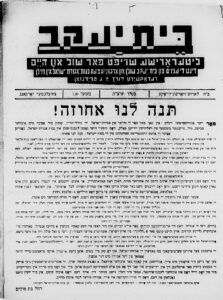
The journal’s willingness to engage contested questions extended beyond pedagogy to matters of institutional authority. This is evident in its response to the distribution of immigration certificates to Palestine in 1934. When Agudath Israel secured a limited allotment of certificates and allocated them exclusively to men, the Beys Yaakov journal devoted its front page to a critical response under the headline drawn from the biblical verse “Tenu La’anu Achuzah!” (“Grant Us Our Rightful Portion!”; Num. 27:4).[26]

“Give Us our Portion,” Beys Yaakov, 1934

The significance of this intervention lies not only in its substance but in its institutional setting. The Beys Yaakov schools operated under Agudath Israel’s auspices, and the movement’s leadership exercised formal control over the journal’s publisher. Publishing a front-page critique of a policy associated with the Gerrer Rebbe, one of the central rabbinic authorities within Agudath Israel, placed the journal in direct tension with the leadership structures on which it depended. This episode contrasts sharply with the centralized and crisis-driven leadership culture described by Yossef Fund in his study of Agudath Israel during the Holocaust years.[27]

The article, signed by Rochel Bas Tovim, likely a pseudonym,[28] did not frame its claims in the language of contemporary feminist movements, which it explicitly rejected as incompatible with Judaism. Instead, it grounded its argument in canonical sources, invoking the biblical daughters of Tzelofchad, who appealed for inheritance rights within the framework of Torah law. The author contended that women’s exclusion from the allocation of certificates represented not a preservation of tradition but a departure from it, insofar as it denied women claims recognized within the scriptural tradition itself. The critique thus operated on two levels. Substantively, it challenged a concrete policy decision with immediate consequences for women’s lives. Formally, it modeled a mode of argument in which institutional authority could be questioned through textual reasoning rather than ideological opposition. The article neither denied rabbinic authority nor asserted autonomous rights external to halakhic discourse. Its challenge was internal, drawing on shared sources and categories to dispute the manner in which authority had been exercised.

This episode illustrates the journal’s broader editorial posture. It did not treat institutional loyalty as incompatible with critique, nor did it equate obedience with silence. By providing space for a reasoned challenge to Agudath Israel’s own leadership, framed entirely within traditional discourse, the Beys Yaakov Journal demonstrated that boundary crossing could occur not only in relation to secular culture or academic knowledge but also within Orthodoxy’s own structures of authority.

Israeli Resurrection: Moshe Prager and Postwar Transformation

The destruction of the Polish Beys Yaakov system during the Holocaust brought the journal’s original trajectory to an end. Eliezer Gershon Friedenson was murdered, and the institutional network that had sustained the movement in Eastern Europe ceased to exist. When the Beys Yaakov journal reappeared in Israel after the war, it did so under markedly different conditions and new editorial leadership. The journal was revived by Moshe Prager, a journalist and historian whose work focused on Orthodox life during the Shoah and its aftermath.[29] Under Prager’s editorship, Beys Yaakov retained its formal affiliation with the movement while undergoing a redefinition of scope and audience. It no longer addressed girls and women exclusively. Men increasingly appeared among both contributors and intended readers, and the range of subjects expanded to include Holocaust memory, Orthodox historiography, and contemporary Israeli society. These shifts reflected both the altered demographic realities of postwar Orthodoxy and Prager’s own intellectual preoccupations.

At the same time, the journal’s engagement with sources and methods beyond Agudath Israel’s institutional boundaries became more explicit and systematic. Issues from this period regularly included discussions of secular scholarship, historical research, archaeology, and European culture. Such materials were not presented as authoritative in themselves but were framed through editorial commentary that situated them in relation to Orthodox commitments. The result was neither rejection nor uncritical adoption, but sustained engagement shaped by religious criteria. A review of surviving issues from Prager’s tenure indicates that this orientation was not confined to isolated contributions; rather, it structured the journal’s content across genres, including essays, book reviews, historical reflections, and responses to contemporary events. The editorial stance was consistent: readers were introduced to ideas and figures beyond the Agudah orbit, while the journal retained control over framing and evaluation.

Under Prager’s leadership, Beys Yaakov was thus transformed from a movement-centered educational periodical into a broader Orthodox intellectual forum, without severing its institutional ties or abandoning its religious orientation. Although the postwar journal differed markedly from its Polish predecessor in subject matter and audience, it continued to operate according to an editorial logic already present in the interwar period: engagement with the surrounding intellectual world as a component of Orthodox self-understanding rather than as a concession to external authority.

Art, Archaeology, and Cultural Engagement

The journal’s engagement with material beyond conventional religious genres extended to the domain of visual art, where aesthetic production was treated as a legitimate object of religious interpretation rather than as a neutral cultural sphere. In 1969, Beys Yaakov devoted an entire issue to Rembrandt on the three-hundredth anniversary of his death, placing one of his paintings on the cover and asserting the Jewish identity of the figure depicted.[30] The editor described Rembrandt as among the hasidei ummot ha-olam and argued that his work captured the tzurah ha-Yehudit (Jewish character).[31] This framing did not present Rembrandt as a canonical figure of European high culture to be admired at a distance, nor as an external influence to be resisted. Rather, the journal appropriated his work into a Jewish interpretive framework, reading it as part of a historical and religious conversation to which Orthodox readers could lay claim. In doing so, Beys Yaakov treated visual art not as a threat to religious integrity but as a site in which meaning could be evaluated, contested, and re-situated within Jewish historical consciousness.

Rembrandt Issue, Beys Yaakov, 117

Archaeology received similar treatment. In a public exchange with Yigael Yadin, Prager engaged archaeological scholarship directly, acknowledging findings that reinforced halakhic continuity while contesting Yadin’s symbolic and practical interpretation of Masada, particularly where it entailed the desacralization of the site and the normalization of Sabbath violation.[32] These responses neither rejected archaeological inquiry nor deferred to it as an independent authority. Instead, archaeological evidence was incorporated selectively and evaluated in relation to textual tradition and halakhic categories.

Such treatments assumed an audience capable of engaging visual and historical material critically rather than passively. Cultural artifacts and scholarly claims were presented as objects of analysis and judgment, not as threats requiring avoidance. In this respect, the journal extended to art and archaeology the same editorial logic evident elsewhere: engagement framed by religious criteria, with interpretive authority retained by the journal rather than ceded to external disciplines.

The Herzog Article in Context

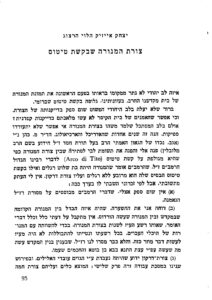
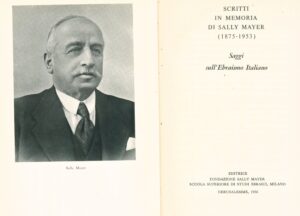
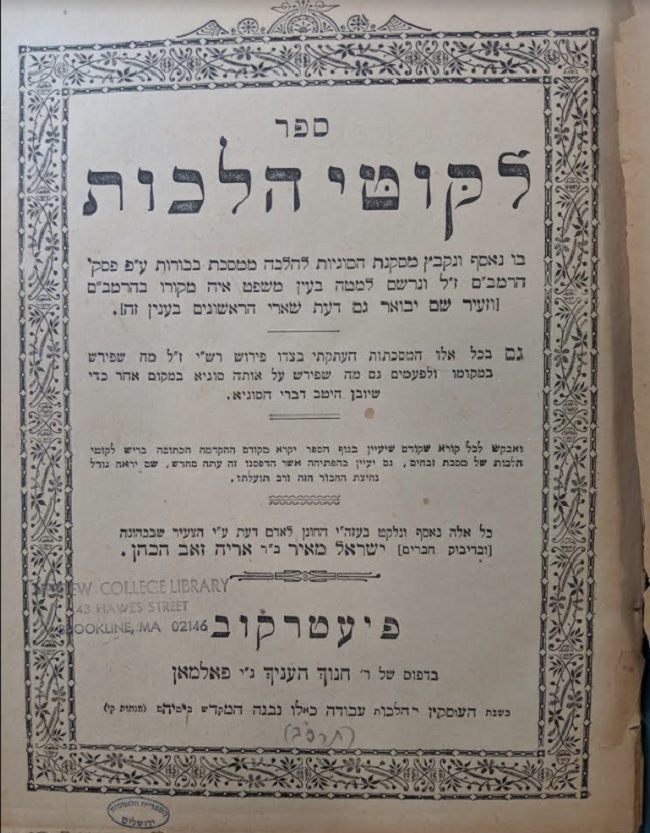
Read against the journal’s established editorial practice, the 1961 publication of Chief Rabbi Dr. Yitzhak Isaac Halevi Herzog’s article on the Temple menorah appears not as an exception but as a coherent extension of its editorial logic.[33] Herzog’s training combined advanced rabbinic learning with formal academic methods, a mode of scholarship that Beys Yaakov had repeatedly presented to its readership as an object of analysis rather than emulation. The article was neither commissioned for the journal nor modified to conform to its institutional priorities. It was reproduced in full from an academic festschrift honoring Sally Mayer, an Italian Jewish communal leader, philanthropist, and Zionist activist rather than a rabbinic authority. The volume focused on Italian Jewish history and culture and brought together contributors from across denominational lines in recognition of civic and intellectual contribution rather than religious office.

R. Herzog, Menorah, Beys Yaakov, 19, 1960

The subject of Herzog’s study further clarifies its original placement. The menorah depicted on the Arch of Titus in Rome occupies a central position in the historical memory of Roman and Italian Jewry, standing at the intersection of archaeological evidence, rabbinic tradition, and the symbolic legacy of exile. Herzog addressed this object through close comparison of textual and material sources, treating their divergence as a problem for interpretation rather than as grounds for dismissal. Such an approach aligns with the commemorative orientation of the Mayer volume, which foregrounded Jewish cultural and historical life beyond rabbinic authority structures. By reprinting the article without alteration and preserving its original scholarly context, the Beys Yaakov Journal framed academic Jewish scholarship as a legitimate object of Orthodox engagement while retaining control over its evaluation.

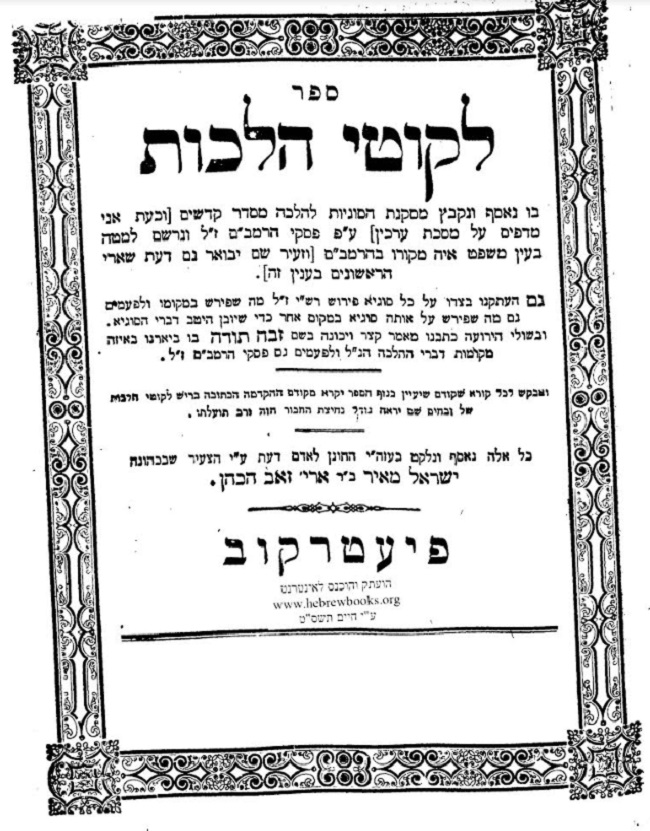
R. Herzog Original Article

Title Page, Scritti in Memoria Di Sally Mayer

Prager’s editorial handling of the article maintained its scholarly form without incorporating it into the journal’s institutional voice. The text was reproduced in full, without excerpting or interpretive gloss, and its original scholarly setting was left intact rather than explicitly affirmed or disavowed. In this way, academic Jewish scholarship was presented as material available for Orthodox consideration, while the institutional and ideological frameworks in which it had been produced were neither adopted nor contested.

Herzog’s study addressed a problem long recognized in both rabbinic and scholarly literature: the divergence between classical rabbinic descriptions of the Temple menorah and its representation on the Arch of Titus. The Roman relief depicts the menorah resting on a solid, multi-sided base adorned with ornamental motifs, whereas rabbinic sources describe a three-legged stand and explicitly exclude foreign imagery. Herzog did not resolve this discrepancy by dismissing the archaeological evidence as polemical, nor by subordinating it automatically to textual tradition. Instead, he treated the divergence itself as the object of analysis, placing halakhic sources and material evidence into direct comparison in order to account for their coexistence while preserving the distinct authority of each. This approach neither insulated tradition from external evidence nor deferred to archaeological reconstruction as determinative.

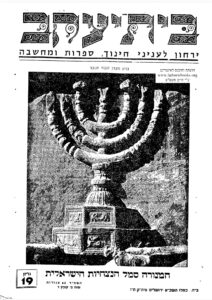
The article’s presentation was shaped as much by editorial framing as by its scholarly argument. The cover reproduced the menorah from the Arch of Titus beneath the caption “The Menorah, a Symbol of Jewish Eternity,” and the editors appended a subtitle that posed a pointed question: “Is the menorah, the symbol of the state, sacred?” These visual and textual elements placed Herzog’s study within a contemporary Israeli symbolic register, directing readers to consider its implications for modern political and religious meaning rather than treating it solely as a technical or antiquarian inquiry.

Cover, Beys Yaakov, 19, 1960

By 1961, the State of Israel had adopted the Arch of Titus menorah as its official emblem, reappropriating a Roman triumphal image associated with destruction and exile as a marker of national sovereignty. As Steven Fine has shown, this choice reflected a form of civic symbolism that drew on ancient material culture to construct a shared national iconography while bracketing explicit theological commitments.[34] By foregrounding Herzog’s study under the subtitle “Is the menorah, the symbol of the state, sacred?”, the Beys Yaakov Journal explicitly juxtaposed this civic appropriation with rabbinic conceptions of the Temple menorah. What might otherwise have remained a discussion of archaeological form and halakhic sources was thereby reframed as an inquiry into the religious status of a state symbol. In doing so, the journal subjected Israel’s central emblem to halakhic and historical evaluation, engaging civil iconography as an object of scrutiny rather than affirmation and declining to concede interpretive authority over Jewish symbols to the secular state.[35]

The journal further marked institutional boundaries through its use of honorifics. Chief Rabbi Herzog, who died in 1959, was designated ז״ל (zikhrono livrakha), the conventional formula for the deceased, rather than זצ״ל (zekher tzaddik livrakha), which in Orthodox usage signals recognized rabbinic authority. This choice acknowledged Herzog’s scholarly standing while withholding the modes of recognition through which the journal conferred religious authority, thereby separating the act of reprinting his article from any affirmation of the Chief Rabbinate he represented.[36]

Considered together, the visual reproduction of the Arch of Titus menorah, the explicit questioning of state symbolism, and the calibrated use of honorific language make visible the journal’s editorial procedure. Beys Yaakov crossed cultural and institutional boundaries while retaining control over framing and evaluation. Attention to such devices is therefore necessary for understanding how the journal accommodated intellectual engagement without erasing its own institutional distinctions.


Conclusion

The history of the Beys Yaakov journal complicates historiographical models that describe twentieth-century Orthodoxy primarily in terms of withdrawal, boundary consolidation, or epistemic closure. Without minimizing Orthodox resistance to secularization or the expansion of separatist institutions, this study has identified a parallel mode of Orthodox self-articulation in which engagement with external knowledge, cultural forms, and even rival institutions functioned as a means of maintaining religious authority rather than undermining it. The journal did not treat engagement as a value in itself or as a concession to modernity, but as a regulated practice embedded within Orthodox commitments. Attention to editorial procedure, rather than ideological declaration alone, makes visible how Orthodoxy could preserve institutional coherence while remaining responsive to changing social and cultural conditions.

Across its Polish and Israeli phases, Beys Yaakov operated according to a consistent editorial logic that cut across differences of context, audience, and leadership. In interwar Poland, the journal treated the subjective experiences of Orthodox girls as legitimate sources of knowledge, employing surveys and verbatim publication to inform educational practice and to recalibrate assumptions about women’s religious lives. It provided space for critique of Agudath Israel’s own leadership while grounding dissent in canonical texts and shared interpretive categories. In postwar Israel, the journal incorporated academic scholarship, archaeology, European art, and historiography into its pages, neither excluding these domains nor conceding interpretive authority to them. The unabridged publication of Herzog’s study of the Temple menorah – framed through visual cues, honorific distinctions, and explicit questioning of state symbolism – represents the most explicit articulation of this approach: engagement that expanded the scope of inquiry while retaining Orthodox criteria of judgment.

These practices do not support an interpretation of Beys Yaakov as a covertly liberal or proto-modernizing institution. The journal consistently reaffirmed halakhic authority, institutional loyalty, and skepticism toward secular ideologies and state claims to religious legitimacy. Its significance lies instead in the forms of engagement it authorized: empirical attention to women’s lives, critique conducted within Orthodox institutional structures, and sustained interaction with scholarly and cultural materials under religious supervision. In this respect, the journal’s trajectory parallels patterns identified by Ada Gebel in her study of Agudath-affiliated workers’ institutions, even as it complicates the political narrative of Orthodox separatism emphasized by Daniel Mahla. More broadly, the case of Beys Yaakov underscores the importance of women’s education as a site of Orthodox intellectual experimentation. Positioned outside the structures of male rabbinic authority yet committed to religious continuity, the movement developed pedagogical and editorial practices unavailable within yeshiva contexts. Taken together, these findings call for a more differentiated account of Orthodox intellectual history – one attentive to genre, audience, and institutional location, and resistant to reducing diverse Orthodox responses to modernity to a single trajectory. Rather than asking whether Orthodoxy engaged modernity, the evidence points to a more precise question: under what institutional conditions, and through which mediating forms, was engagement understood as a means of sustaining tradition?

* I would like to thank Menachem Butler for his editorial assistance and plethora of sources.

  1. See, inter alia, Daniel Mahla, Orthodox Judaism and the Politics of Religion: From Prewar Europe to the State of Israel (Cambridge: Cambridge University Press, 2020), esp. chapters 1-3; and Yossef Fund, A Movement in Ruins: Agudat Israel’s Leadership Confronting the Holocaust (Jerusalem: Magnes Press, 2008; Hebrew). For a contrasting emphasis on cultural mediation within the Beys Yaakov movement, see Naomi Seidman, Sarah Schenirer and the Bais Yaakov Movement: A Revolution in the Name of Tradition (London: Littman Library, 2019).
    For prior analyses of the Journal, see Joanna Lisek, “Orthodox Yiddishism in Beys Yakov Magazine in the Context of Religious Jewish Feminism in Poland,” in Andrzej Katny, Izabela Olszewska, Aleksandra Twardowska, eds., Ashkenazim and Sephardim: A European Perspective (Frankfurt am Main: Peter Lang, 2013), 127-154; Abraham Atkin, “The Beth Jacob Movement in Poland (1917-1939),” (PhD Dissertation, Yeshiva University, 1959), esp. 99-111; Seidman, Sarah Schenirer, passim.
    Nearly all extant issues of the Beys Yaakov Journal are accessible in digital reproduction. Issues published in interwar Poland are available through The Beys Yaakov Project at the University of Toronto, while postwar Israeli issues are available via Hebrewbooks.org. The availability of these materials in searchable digital format has enabled systematic analysis across decades of publication, including comparison of editorial practices, thematic emphases, and modes of engagement under differing institutional and historical conditions. On behalf of the readers of the Seforim blog, the author gratefully acknowledges the individuals and institutions whose efforts made these digital resources possible.
  2. Yitzhak Isaac Halevi Herzog, “On the Form of the Menorah on the Arch of Titus: Is the Menorah, the Symbol of the State, Sacred?” Beys Yaakov, vol. 2, no. 6 (December 1961): 3 (Hebrew), reprinted from Yitzhak Isaac Halevi Herzog, “The Menorah of the Arch of Titus,” in Umberto Nahon, ed., Scritti in memoria di Sally Mayer (Jerusalem: Sally Mayer Foundation, 1956), 95-98 (Hebrew).
  3. On Herzog’s conception of the Chief Rabbinate as a centralized locus of religious and legal authority, and on the principled rejection of this claim by non-Zionist Orthodoxy, see Alexander Kaye, “Modernizing the Chief Rabbinate,” in The Invention of Jewish Theocracy: The Struggle for Legal Authority in Modern Israel (Oxford: Oxford University Press, 2020), 99-121, 205-211, who shows that Agudath Israel consistently refused to recognize the Chief Rabbinate – both in Mandatory Palestine and after 1948 – as a legitimate arbiter of binding rabbinic authority, maintaining instead that such authority resided in independent rabbinic councils, above all its own Moetset Gedolei HaTorah. For the broader political and institutional consequences of this stance within early Israeli Orthodoxy, see also Daniel Mahla, “Emerging Israeli Milieus,” in Orthodox Judaism and the Politics of Religion: From Prewar Europe to the State of Israel (Cambridge: Cambridge University Press, 2020), 159-185, 252-259.
  4. For the interwar journal’s scope and editorial practices, see Seidman, Sarah Schenirer, esp. chap. 5.
  5. For historiographical models emphasizing Orthodox withdrawal, ideological consolidation, and boundary hardening in the modern period, see Jacob Katz, Tradition and Crisis: Jewish Society at the End of the Middle Ages, trans. Bernard Dov Cooperman (New York: NYU Press, 1993); Aviezer Ravitzky, Messianism, Zionism, and Jewish Religious Radicalism, trans. Michael Swirsky and Jonathan Chipman (Chicago: University of Chicago Press, 1996), esp. chaps. 1-2; and Daniel Mahla, Orthodox Judaism and the Politics of Religion: From Prewar Europe to the State of Israel (Cambridge: Cambridge University Press, 2020).
  6. On women’s reflective writing and surveys, see below, “Surveying the Inner Lives of Orthodox Girls”; on critique of Agudath Israel’s leadership, see below, “Challenging Authority: The Palestine Certificate Controversy”; on engagement with state symbolism and scholarship, see below, “The Herzog Article in Context.”
  7. On Agudath Israel’s political separatism and institutional boundary maintenance, see Mahla, Orthodox Judaism and the Politics of Religion. On the Beys Yaakov movement as a site of cultural mediation within Orthodoxy, see Seidman, Sarah Schenirer. For contrasting evidence of flexibility within Agudath-affiliated institutions, see Ada Gebel, The Agudat Yisrael Workers Movement in Eretz Israel, 1933-1939 (Jerusalem: Yad Izhak Ben-Zvi, 2017; Hebrew).
  8. Shaul Stampfer emphasizes the distinction between formal schooling and overall levels of education, cautioning against equating the relative absence of institutional frameworks for girls with intellectual illiteracy or lack of religious knowledge. See Shaul Stampfer, “Gender Differentiation and the Education of Jewish Women,” in Families, Rabbis and Education: Traditional Jewish Society in Nineteenth-Century Eastern Europe (Oxford: Littman Library, 2014), 167-190. On the persistence of the stereotype of female educational deprivation and its historiographical consequences, see also Iris Parush, Reading Jewish Women: Marginality and Modernization in Nineteenth-Century Eastern European Jewish Society (Waltham, MA: Brandeis University Press, 2004).
  9. On the history of the controversy over girls’ education, see Rachel Manekin, “Something Totally New: The Development of the Idea of Religious Education for Girls in the Modern Period,” Massekhet, vol. 2 (2004): 63-85 (Hebrew), available here; Rachel Manekin, “Torah Education for Girls in the Interwar Bais Yaakov School System: A Re-Examination,” Zion, vol. 88, no. 2 (2023): 219-262 (Hebrew), available here; and see also Rachel Manekin and Charles (Bezalel) Manekin, “The Hafetz Hayyim’s Statement on Teaching Torah to Girls in Likutei Halakhot: Literary and Historical Context,” The Seforim Blog (27 May 2020), available here.
  10. For a recent biography, see Naomi Seidman, Sarah Schenirer and the Bais Yaakov Movement: A Revolution in the Name of Tradition (London: Littman Library, 2019).
  11. Rachel Manekin, “From Anna Kluger to Sarah Schenirer: Women’s Education in Kraków and Its Discontents,” Jewish History, vol. 33, no. 1-2 (March 2020): 29-59, available here; and see also Rachel Manekin, “The Cracow Bais Yaakov Teachers’ Seminary and Sarah Schenirer: A View from a Seminarian’s Diary,” Jewish Quarterly Review, vol. 112, no. 3 (Summer 2022): 546-588, available here.
  12. Friedenson self-published a single preliminary issue in June 1923, which included contributions by Sara Schenirer and Yehudah Leib Orlean; see Abraham Atkin, “The Beth Jacob Movement in Poland (1917-1939),” (PhD Dissertation, Yeshiva University, 1959), 100; Joanna Lisek, “Orthodox Yiddishism in Beys Yakov Magazine in the Context of Religious Jewish Feminism in Poland,” 133. The journal’s official publication, however, began with the issue of Tishrei 5684 (September 1923); see Seidman, Sarah Schenirer, 111.
  13. See Seidman, Sarah Schenirer, 111-112; Mahla, Orthodox Judaism and the Politics of Religion.
  14. On the post-1923 institutional consolidation of Beys Yaakov under Agudath Israel, the central role of professional educators such as Leo (Samuel) Deutschländer, and the movement’s mediation between German Neo-Orthodox pedagogical models and the separatist educational norms of East European ultra-Orthodoxy, see Iris Brown (Hoizman), “At the Centre of Two Revolutions: Beit Ya’akov in Poland between Neo-Orthodoxy and Ultra-Orthodoxy,” in François Guesnet, et al., eds., Jewish Religious Life in Poland since 1750 [=Polin, vol. 33] (London: Littman Library, 2021), 339-369, available here.
  15. See Seidman, Sarah Schenirer, 112-204.
  16. See Joanna Lisek, “Orthodox Yiddishism in Beys Yakov Magazine in the Context of Religious Jewish Feminism in Poland,” 147-152; and Naomi Seidman, Sarah Schenirer, 181-185. From issue 3 through 1929, the journal included a Polish-language supplement titled Wschód, which was later discontinued. On the factors contributing to the supplement’s demise, see Lisek, “Orthodox Yiddishism,” 133-134. A single additional Polish-language supplement appeared in 1936, devoted to combating rising antisemitism and addressing prevailing anti-Jewish stereotypes; see ibid., 134.
  17. For an extended analysis of the use of modern print culture, literary genres, and affective address in the formation of Orthodox female subjectivity within the Beys Yaakov movement, see Naomi Seidman, Sarah Schenirer and the Bais Yaakov Movement: A Revolution in the Name of Tradition (London: Littman Library, 2019). Seidman analyzes journals, letters, autobiographical writing, and didactic essays as media that positioned girls and women as interpretive and ethical agents, capable of reflection, identification, and disciplined self-understanding. A central element of her argument is that Beys Yaakov articulated pedagogical and institutional change through idioms of continuity, presenting new educational forms and media practices as legitimate extensions of inherited religious norms rather than as departures from them. This analytic framework is essential for understanding how the movement integrated print, emotional discourse, and modes of self-articulation into an Orthodox educational setting.
  18. On the educational and ideological legacies of Torah im derekh erets within Polish Orthodox women’s education, and the selective adaptation of Neo-Orthodox pedagogical forms within Agudath Israel-affiliated institutions, see Iris Brown (Hoizman), “At the Centre of Two Revolutions: Beit Ya’akov in Poland between Neo-Orthodoxy and Ultra-Orthodoxy,” in François Guesnet, et al., eds., Jewish Religious Life in Poland since 1750 [=Polin, vol. 33] (London: Littman Library, 2021), 339-369, available here. On the role of journals and print culture in shaping Orthodox female identity, aspirations, and religious agency within Lithuanian Bet Jakob, see Tzipora Weinberg, “Toward a Modern Conception of Orthodox Womanhood: The Case of Lithuanian Bet Jakob,” in Marcin Wodziński, Shaul Stampfer, and Lara Lempertienė, eds., Jewish Religious Life in Lithuania in the 18th-20th Centuries (Leiden: Brill, 2025), 146-174.
  19. Beys Yaakov, no. 3 (June 1926): 84-85 (Yiddish), available here. Seideman incorrectly references this issue as appearing in 1924. Seidman, Sarah Schenirer, 122 and “Bibliography,” 409.
  20. Beys Yaakov, no. 77 (October 1931): 1 (Yiddish), available here. Despite the 1926 survey, Journal refers to the 1931 as the first. Seidman, Sarah Schenirer, 122.
  21. Beys Yaakov, no. 81 (January 1932): 16-17 (Yiddish), available here; and Beys Yaakov, no. 83 (March 1932): 13 (Yiddish), available here.
  22. Beys Yaakov, no. 83 (March 1932): 13 (Yiddish), available here.
  23. Beys Yaakov, no. 81 (January 1932): 17 (Yiddish), available here.
  24. Beys Yaakov, no. 83 (March 1932): 13 (Yiddish), available here.
  25. See Gershon Bacon, “Woman? Youth? Jew? – The Search for Identity of Jewish Young Women in Interwar Poland,” in Judith Tydor Baumel and Tova Cohen, eds., Gender, Place and Memory in the Modern Jewish Experience (London: Vallentine Mitchell, 2003), 3-28, esp. 4, available here; Gershon Bacon, “The Missing 52 Percent: Research on Jewish Women in Interwar Poland and Its Implications for Holocaust Studies,” in Dalia Ofer and Lenore J. Weitzman, eds., Women in the Holocaust (New Haven: Yale University Press, 1999), 55-67, available here. As Bacon demonstrates, even pioneering secular Yiddish research initiatives, including the YIVO youth autobiography collections and Max Weinreich’s sociological studies, recognized the importance of understanding Jewish youth while largely treating male experience as normative and leaving women’s voices analytically unthematized. Women appear in these corpora primarily as raw material rather than as a category of inquiry in their own right. Against this backdrop, the Beys Yaakov journal’s solicitation and verbatim publication of girls’ self-reports represents an unusual case in which women’s subjective experience was not merely documented but operationalized within an institutional educational framework.
  26. Beys Yaakov, no. 120 (November 1934): 1 (Yiddish), available here. See Seidman, Sarah Schenirer, 177-179.
  27. Yossef Fund, A Movement in Ruins: Agudat Israel’s Leadership Confronting the Holocaust (Jerusalem: Magnes Press, 2008; Hebrew).
  28. See Seidman, Sarah Schenirer, 178n90.
  29. Moshe Prager was a leading Orthodox journalist and historian whose work focused on the destruction of European Orthodoxy during the Shoah and the religious meaning of catastrophe in its aftermath. His writing combined documentary impulse with commemorative and theological reflection. For a collection of essays and memorial writings on the destruction of Polish Jewry and the spiritual legacy of Hasidic and yeshiva worlds, see Moshe Prager, Min ha-Meitzar Karati (Jerusalem: Mosad ha-Rav Kook, 1959; Hebrew), especially the introductory essays on Orthodox Holocaust memory; and for a selection in English translation in Moshe Prager, Sparks of Glory (Jerusalem, 1974), 210-213; and for his role on the Orthodox press in interwar Poland, see Moshe Prager, “When Hasidism of Ger Became Newsmen,” in Lucy S. Dawidowicz, ed., The Golden Tradition: Jewish Life and Thought in Eastern Europe (New York: Holt, Rinehart and Winston, 1967), 210-213, and for an account of Prager’s journalistic career and editorial leadership, see Tovia Preschel, “Profile of Moshe Prager,” The Jewish Press (21 April 1972): 41, translated and reprinted in Tovia Preschel, Ma’amarei Tovia, vol. 8 (Jerusalem: Mosad ha-Rav Kook, 2025), 528-530.
  30. Beys Yaakov, no. 117 (January 1969; Hebrew), available here.
  31. “Editor’s Note,” Beys Yaakov, no. 117 (January 1969): 2 (Hebrew). One article in the same issue concludes with a poem explicitly praising Rembrandt for capturing the depth and inwardness of the Jewish gaze (ibid., 17). This mode of Jewish cultural appropriation of Rembrandt belongs to a longer interpretive genealogy, ranging from nineteenth-century apologetic readings to late-twentieth- and twenty-first-century art-historical and museological reassessments. For recent synthetic treatments, see Mirjam Knotter and Gary Schwartz, eds., Rembrandt Seen Through Jewish Eyes: The Artist’s Meaning to Jews from His Time to Ours (Amsterdam: Amsterdam University Press, 2024); and the earlier demythologizing intervention in Mirjam Alexander-Knotter, Jasper Hillegers, and Edward van Voolen, The Jewish Rembrandt: The Myth Unravelled (Amsterdam: Jewish Historical Museum, 2006).An illuminating intermediate case appears in the work of the sculptor and novelist Avram Melnikoff (1892-1960), a former Jewish Legion officer and later a London-based portrait sculptor, whose writings offer a rare glimpse into an early Zionist-spiritual reception of Rembrandt. In a 1935 essay published in The London Jewish Chronicle following the death of Rabbi Abraham Isaac Kook, Melnikoff recounts a conversation that took place during Rav Kook’s wartime exile in London during World War I. The exchange was prompted by Melnikoff’s professional unease with the biblical prohibition against “graven images,” which he understood as having profoundly shaped the historical limits and possibilities of Jewish art. Melnikoff thus approached Rav Kook with a halakhic query as to whether rabbinic tradition permitted, under any conditions, the practice of sculpture by Jews. Rav Kook replied by citing a rabbinic principle according to which image-making is permitted when the work is deliberately imperfect or maimed. Melnikoff responded with irony, remarking that his own sculpture must therefore be kosher precisely because it fell so far short of perfection, a comment that, he recalls, elicited Rav Kook’s warm laughter. It is at this point that Melnikoff introduces Rembrandt. Rav Kook told him:

    “When I lived in London I used to visit the National Gallery, and my favourite pictures were those of Rembrandt. I really think that Rembrandt was a tzaddik. Do you know that when I first saw Rembrandt’s works, they reminded me of the legend about the creation of light? We are told that when God created light, it was so strong and pellucid that one could see from one end of the world to the other, but God was afraid that the wicked might abuse it. What did He do? He reserved that light for the righteous when the Messiah should come. But now and then there are great men who are blessed and privileged to see it. I think that Rembrandt was one of them, and the light in his pictures is the very light that was originally created by God Almighty.”

    This intuitive and homiletic reading of Rav Kook’s attitude toward art was subsequently taken up and given systematic halakhic and philosophical form by Rabbi David Avraham Spektor (1955-2013), a Dutch-born rabbi educated at Yeshivat Merkaz Harav and among the first religious-Zionist thinkers to treat art as a sustained field of halakhic inquiry. In Art in the Teachings of Rav Kook (Jerusalem: Ministry of Education, Culture and Sport, Religious Education Administration, 2001; Hebrew), Spektor reconstructs Rav Kook’s scattered remarks on art, aesthetics, creativity, and imagination across responsa, letters, notebooks, and published essays, arguing that Rav Kook understood artistic creation as a legitimate and even necessary expression of the divine image in humanity, so long as it remained oriented toward spiritual elevation rather than aesthetic autonomy for its own sake. He further shows that Rav Kook did not regard art merely as a tolerated concession to modernity, but as a domain through which latent spiritual forces within the nation could be revealed and disciplined. This interpretive framework was later translated into practical halakhic categories in Rabbi David Avraham Spektor, Shuʾt Omanut: Responsa and Abridged Halakhic Rulings in the Fields of Art, Graphic Design, and Computers (Jerusalem: Erez, 2003; Hebrew), which addresses concrete questions concerning sculpture, figurative representation, theater, visual media, and digital technologies. Taken together, Rabbi Spektor’s works mark a decisive shift from Rav Kook’s lyrical and metaphysical idiom to a jurisprudential effort to normalize artistic production within halakhic discourse. For further discussion, see Dan Rabinowitz and Menachem Butler, “The Halakhic Status of Illustrated Sifrei Kodesh: History, Practice, and Methodology,” forthcoming at The Seforim Blog.

  32. See Moshe Prager, “What Is Masada: An Archaeological Site or a Symbol for the Jewish Tradition?” Beys Yaakov, no. 135-136 (February 1971): 7-10 (Hebrew), available here, a published open letter addressed to Prof. Yigael Yadin responding to his archaeological and public policies regarding Masada, including the operation of the cable car on Shabbat. Prager accepts the evidentiary value of Yadin’s archaeological discoveries – especially where they corroborate halakhic continuity – while rejecting the transformation of Masada into a desacralized national monument detached from religious norms. See also Haim Zalman Dimitrovsky, “Masada,” Conservative Judaism, vol. 22, no. 2 (Winter 1968): 36-47, available here; and Nachman Ben Yehuda, The Masada Myth: Collective Memory and Mythmaking in Israel (Madison: University of Wisconsin Press, 1995).
  33. Yitzhak Isaac Halevi Herzog, “On the Form of the Menorah on the Arch of Titus: Is the Menorah, the Symbol of the State, Sacred?” Beys Yaakov, vol. 2, no. 6 (December 1961): 3 (Hebrew), reprinted from Yitzhak Isaac Halevi Herzog, “The Menorah of the Arch of Titus,” in Umberto Nahon, ed., Scritti in memoria di Sally Mayer (Jerusalem: Sally Mayer Foundation, 1956), 95-98 (Hebrew).
  34. On the emergence of the menorah as a central Zionist visual symbol, see Alec Mishory, Lo and Behold: Zionist Icons and Visual Symbols in Israeli Culture (Tel Aviv: Am Oved, 2000), 138-164 (Hebrew); and on the deliberations surrounding the adoption of the Arch of Titus menorah for the state emblem, see Alec Mishory, “The Menorah and the Olive Branches: The Design Process of the National Emblem of the State of Israel,” in Yael Israeli, ed., In the Light of the Menorah: Story of a Symbol (Jerusalem: The Israel Museum, 1999), 16-23; and, more recently, for a longue-durée analysis of the menorah’s transformation from Temple object to Roman trophy to modern Israeli national symbol, see Steven Fine, The Menorah: From the Bible to Modern Israel (Cambridge, MA: Harvard University Press, 2016).
  35. On the adoption of the Arch of Titus menorah as the emblem of the State of Israel and its role in the construction of Israeli civil iconography, see Steven Fine, “Creating a National Symbol,” in The Menorah: From the Bible to Modern Israel (Cambridge, MA: Harvard University Press, 2016), 134-162, 242, who situates the choice of the Arch menorah within a broader process of state formation, in which ancient material culture was redeployed to produce a shared civic symbol that could command wide consensus while bracketing explicit theological claims. He also documents contemporary aesthetic, cultural, and rabbinic objections to the emblem, including Herzog’s sustained critique of the menorah’s base and iconography, and analyzes the menorah’s function as a state symbol that invokes Jewish tradition while re-signifying it in secular-national terms.
  36. On the Chief Rabbinate as a contested locus of religious authority, and on Agudath Israel’s principled refusal to recognize its claims to centralized rabbinic legitimacy, see Alexander Kaye, “Modernizing the Chief Rabbinate,” in The Invention of Jewish Theocracy: The Struggle for Legal Authority in Modern Israel (Oxford: Oxford University Press, 2020), 99-121, 205-211. As Kaye shows, Agudath Israel consistently treated the Chief Rabbinate not merely as a rival institution but as an illegitimate reconfiguration of rabbinic authority grounded in state power rather than communal consent or halakhic hierarchy. The journal’s calibrated use of honorifics should be read against this background, as a micro-level editorial practice that registers non-recognition of the Rabbinate’s authority without polemical confrontation


R. Shlomo Yosef Zevin and Yeshiva Students being Drafted to the Army, views of women, and more

Shlomo Yosef Zevin and Yeshiva Students being Drafted to the Army, Views of Women, and More

Marc B. Shapiro

1. In an earlier post I wrote about R. Shlomo Yosef Zevin and the famous essay about how yeshiva students need to serve in the army, an essay which is widely attributed to him. See here. In the post I cited important information uncovered by David Eisen that complicates the issue (as we see the Zevin family itself is of two minds on the matter), and we were left with no absolute proof that R. Zevin wrote the essay. I encourage all readers interested in the topic to read the six emails from Eisen quoted in my post, as they became the primary source material for all who wish to explore this matter.

One of the points that Eisen’s sources disagree about is when the essay was attributed to R. Zevin. R. Nachum Zevin, R. Zevin’s grandson, claims that it was only attributed to him after R. Zevin’s passing in 1978, but R. Menachem Hacohen states that already in the early 1970s he had seen the essay and it was believed that R. Zevin wrote it. As Eisen reports, one of the chief librarians at the National Library told him that he believes that already in the 1960s the essay was attributed to R. Zevin.

I am now able to put the matter to rest and establish beyond any doubt that R. Zevin is indeed the author of the essay. One of R. Zevin’s close friends was the author R. Zvi Harkavy, who served as an army chaplain. Harkavy regarded R. Zevin as his teacher, referring to him as מו”ר. In 1959 it was announced that Harkavy would publish a bibliography of all of R. Zevin’s writings, which were estimated to be over 1000 items, including material written under a pseudonym.[1] As far as I can tell, this never appeared. In Harkavy’s Ma’amrei Tzvi, p. 26, he includes a 1969 letter he received from R. Zevin is which Harkavy is addressed as ידידי הדגול. I mention all this only to show that when Harkavy speaks about R. Zevin you rely on what he says.

It has often been said that the identification of R. Zevin with the essay on yeshiva students and the army was only made years after its 1948 appearance, and this casts doubt on it having been being written by R. Zevin. I can now say that this is incorrect. In 1951 (Iyar 5711) Harkavy published an article in the Jerusalem Torah periodical Ha-Hed, which was a journal that R. Zevin himself often published in. (Unfortunately, very few issues from this periodical can be found on Otzar haChochma.) In Harkavy’s article he identifies R. Zevin as the author of the essay. Not only was Harkavy, because of his close friendship with R. Zevin, in a position to know that he wrote it, but R. Zevin never denied authorship in subsequent issues of Ha-Hed.

This shows without any doubt that R. Zevin is the author of the essay, and from this point on no one—including members of the family—should deny his authorship. Here is Harkavy’s article.

R. Nochum Shmaryohu Zajac called my attention to the recently published memorial volume for R. Yehoshua Mondshine,Sefer, Sofer, ve-Sipur. On p. 327 R. Mondshine wonders why R. Zevin—whom he seems to believe was indeed the author of the essay—would have felt it necessary to keep his authorship secret. R. David Zvi Hillman suggests that R. Zevin felt that if it was known that he wrote it, he would not have been welcome at the Brisker Rav’s home. He adds that it could have also created problems with the Habad synagogue he attended, as well as with his good friend R. Yehezkel Abramsky.

In going through the various issues of Ha-Hed, I discovered a picture of great interest in the Shevat 5711 issue.

On the right is Leah Seliger. She was a learned woman who edited the collected writings of her late husband, R. Joseph Seliger, 

Kitvei Ha-Rav Dr. Yosef Seliger (Jerusalem, 1930). The woman in the middle is R. Kook’s wife, Raize Rivka. Until recently I knew of only one other published picture of her, and this appears at the beginning of Pinchas Grayevski, Benot Tziyon vi-Yerushalayim, vol. 7 (Jerusalem, 1929; I think Dr. Yehudah Mirsky called my attention to this picture). The woman on the left is Miriam Berlin, the widow of R. Naftali Zvi Judah Berlin. I do not know of any other published pictures of her.

Shimon Steinmetz called my attention to this additional picture of R. Kook’s wife that can be found here.

2. In my post here I discussed these words from Exodus 15:16:

בִּגְדֹל זְרוֹעֲךָ יִדְּמוּ כָּאָבֶן

However, I neglected to mention one additional point. How come there is a dagesh in the כ when according to the grammatical rules it should not be there? R. Aaron of Lunel in his Orhot Hayyim offers an explanation. He states that if there was a dagesh people would read the last two words as יִדְּמוּךׇ אָבֶן, “stones are similar to you,” which is not a respectful thing to say to God.[2]

3. In my last post here I discussed the Hazon Ish’s opinion on the dispute between Maimonides and Rabad about an unwitting heretic, and the Hazon Ish’s assumption that Maimonides actually agreed with Rabad in this matter. It must be clarified that the Hazon Ish is not certain about his suggestion that there was no disagreement between Maimonides and Rabad when it came to someone who was completely “innocent” in his heresy. The Hazon Ish4. A couple of years ago in my post here I mentioned that in part two of the post I would have an excursus on the nature of women. For some reason I forgot to include this excursus in all the subsequent posts, so here it is.[4]

On the matter of the creation of women, and whether they are created “better” or “worse” than men, Shaul Regev calls attention to a strange comment by R. Jacob Matalon, Toldot Yaakov (Salonika, 1597), p. 7d (printed together with his She’erit Yaakov).[5] There are many comments in rabbinic texts that have a negative view of women, and most of these comments are based on a belief that women are inherently inferior to men. Yet not many texts are as explicit as R. Matalon in regarding women as almost a different species, standing between apes and men.

ובין החי למדבר הקוף ובין הקוף םמדבר [צ”ל למדבר] ומשכיל הם הנשים והאנדרוגינוס

Women obviously speak, so מדבר must mean speak with intelligence.

A passage similar to what R. Matalon says, but without mention of an ape, is found in Gersonides’ comment to Genesis ch. 3 (p. 110 in the Ma’aliyot edition).

והנה קראה האדם שם אשתו ‘חוה’, כאשר השיג בחולשת שכלה, רוצה לומר שלא עלתה מדרגתה על שאר הבעלי חיים עילוי רב, ואם היא בעלת שכל, כי רוב השתמשותה אמנם הוכן לה בדברים הגופיים, לחולשת שכלה ולהיותה לעבודת האדם. ולזה הוא רחוק שיגיע לה שלמות השכל, אלא שעל כל פנים היא יותר נכבדת מהם, וכולם הם לעבודתה

Gersonides is known for his negative view of women, and this reputation comes from passages like this. Here Gersonides states that women are on a higher level than animals, but not by much. Furthermore, just like the animals are at the service of women, so women’s role is to serve men. In discussing this passage, Menachem Kellner writes: “Gersonides apparently found Darwin’s missing link: woman!”[6]

For another explanation which Modern Orthodox women will probably regard as insulting, but more traditional women will probably see as a compliment, see R. Meir Mazuz, Bayit Ne’eman, no. 52 (parashat Terumah 5777), p. 1, who quotes R. Nissim Gaon as follows: The verse in Proverbs 1:8 states: אל תטוש תורת אמך – “Forsake not the teaching of thy mother”. Yet since women don’t have Torah knowledge, תורת אמך cannot mean this. Rather, it means the special holiday foods that the mother makes.

Readers can correct me if I’m wrong, but I do not believe that R. Mazuz’s understanding is correct, and I think R. Mazuz was citing R. Nissim from memory. That is, R. Nissim’s comment has nothing to do with women lacking Torah knowledge and identifying their cooking as תורת אמך. Rather, he cites the verse simply as a general statement about the importance of tradition. Here is the passage of R. Nissim Gaon as cited by R. Maimon the father of Maimonides.[7]

וכתב רבינו נסים במגילת סתרים כי כל מנהגי האומה באלו המנהגות כמו זה. והראש בראש השנה, החלב בפורים ובמוצאי פסח, והפולים ביום הושענא רבה. ואותם המנהגות אין לנו לבזותם ומי שהנהיגם זריז ומשתדל הוא כי הם מעיקרים נעשים ולא יבוזו במנהגי האומה וכבר אמר הנביא ע”ה ואל תטוש תורת אמך, דת אומתך אל תעזוב

Regarding the role and responsibilities of women, R. Mazuz has another interesting comment.[8] As part of his argument that women are not obligated in hearing parashat Zakhor, he says that this commandment is connected to the commandment of destroying Amalek, and women are not able to do this. How do we know that women cannot destroy Amalek and therefore are not commanded in it? “Because if she sees blood and even if she sees a mouse she becomes afraid, so how could she kill Amalek?” While many will not appreciate what they see as R. Mazuz’s flippant tone (which is obviously a joke, as he is well aware that there are women soldiers and doctors), do even feminists wish to claim that killing comes as easy to women as to men? Do they really want to be “equal” with men in this matter? I, for one, have always assumed that if women were running the world, there would be many fewer wars, as only someone who is blind to reality cannot see that men are naturally more inclined to violence than women.

Here is another interesting point relevant to the subject of women: Rashi, Menahot 43b s.v. היינו, in explaining the talmudic passage dealing with the blessings that a man recites in the morning, states that a woman is to regarded as a maidservant to her husband (i.e., to do his wishes), much like a slave is to his master: דאשה נמי שפחה לבעלה כעבד לרבו

Rashi’s comment is not surprising and has often been quoted. Indeed, although it will trouble modern readers, lots of similar comments can be found in rishonim and aharonim.[9] Furthermore, in at least three places the Talmud refers to a wife with the term shifhah.[10] Yet for a reason I can’t explain, R. Moshe Feinstein was very troubled by this comment of Rashi, and this led him to write something quite problematic.[11] See Dibrot Moshe, Gittin p. 511 (also in Iggerot Moshe, vol. 9, Orah Hayyim no. 2):

ולולי דמסתפינא הייתי אומר שצריך למחקו דח”ו לרש”י לומר דברי הבל כזה, דמן התורה הא ליכא שום שעבוד על האשה לבעלה חוץ מתשמיש ולענין תשמיש הוא משועבד לה יותר דהא עליו איכא גם איסור לאו . . . ואינה מחוייבת לעשות רק עניני הבית ולא עבודת שדה ומעט עשיה בצמר שהיא מלאכה קלה ממלאכות שדרכן של בנות העיר בזה

R. Moshe states that in no way can a woman be generally regarded as under her husband’s authority as only in a few areas does she have obligations to him (much like he has to her). He continues to expound on the way a husband is obligated to treat his wife in order to show that she is far removed from being a maidservant.[12] This is all true, and it would be easy to quote authorities who write similarly. Yet they did not see this as in any way contradicting Rashi’s statement. Understandably, some have expressed great surprise upon seeing how R. Moshe refers Rashi’s comment as הבל (as they do not accept R. Moshe’s point that Rashi could never have said דאשה נמי שפחה לבעלה כעבד לרבו).

R. Shlomo Aharon Gans goes so far as to say that if thegadol ha-dorhad not been the one to say this, it would be forbidden to write such a thing. He adds the following, bringing support for the notion expressed in Rashi that a wife is like a maidservant (not that she is a maidservant, but she is like one)[13]:

ולא הבנתי דהא הויא קנין כספו, ועי’ תורא”ש קידושין ה’ דהוא מושל עליה ומשעובדת לו וכדכתיב והוא ימשל בך, וא”כ מאי קשיא ליה כ”כ בדברי רש”י אלו

This conception, that a wife is like a maidservant, was actually criticized by R. Hayyim Hirschensohn who called attention to the “barbaric” way Jews treated their wives in the small towns of Galicia, where the wives did not even eat at the same table with their husbands.[14]

וה’ יסלח לו כי ההרגל הרע של בני מדינתו להתגאה על נשותיהן אשר לוקחים אותן רק לרקחות וטבחות ואין מסיבות בשלחן עם בעליהן וחושבים אותם כחמת כו’ [מ”ש: ראה שבת קנב ע”א] ואלמלי עלמא צריכי להו היו בעי רחמי דלבטלי מן העולם ח”ו, ההרגל הפראי הזה אשר בעירות הקטנות בגאליציא ובקצת ערי פולין גרם להרב הנז’ לבלי להרגיש את העלבון אשר עלב לבנות האבות והאמהות אשר קמו גם הן לאם לבנות את בית ישראל

As a curiosity, it is worth noting the opinion of R. Menasheh Klein that a husband should not help his wife with household tasks such as cleaning the dishes, as that is “women’s work”, while the husband works outside the home. (And what about when the wife also works outside the home?) Instead, the husband should use that time for learning Torah and other spiritual pursuits.[15]

כי לכן נתן לו הקב”ה אשה לאדם שיהי’ לו לעזר שתעשה לו צרכי הבית והוא יהיה פנוי בזמן שיש לו ללמוד תורה ולעבודת השם ולא לכבס ולהדיח הכלים אחרי האכילה ולסדר את המטות החיוב על הבעל לפרנס את אשתו ובניו ושאר הזמן כל רגע ורגע ינצל ללימוד התורה ולעבודת השי”ת שמו. ובעונ”ה נשתנה הוסת שהבעלי בתים הצעירים נעשים בעלת בתים מבשלים ומדיחים הכלים והולכים לחניות לקנות צרכי הבית איינקויפען בלע”ז בקיצור עושים כל מלאכת הנשים והנשים עושים מלאכת האנשים

I can only imagine what the reaction of a newlywed wife would be if her husband would tell her that no, he has no plans to help clean the table and do the dishes because that is women’s work.

Related to this is the following story told by R. Yosef Wineberg, the grandson of the Slonimer Rebbe. It is obviously designed to make the “Litvish” look bad.[16]

A newly married Litvishe couple was once sitting together. The wife asked her husband to please make her a cup of tea. He immediately jumps up, puts on his hat and jacket and walks out the door. About an hour later, the husband returns home, removes his hat and jacket and makes her a cup of tea. Puzzled by his strange behavior, she asks for an explanation.

He explains: when you first asked me to make you a cup of tea, I was upset. I am a Talmid Chacham, a scholar, and you are meant to “serve” me, not the opposite. Not wishing to get into an argument, I went to my Rav to ask him what I should do.

The Rav explained to me that “ishto k’gufo”, that the Halacha considers us like one person. Therefore, making tea for you is identical to making tea for me. As I feel no compunctions with serving myself, I returned home to fulfill your request.

In order to show that the husband is the boss of the household, R. David Kimhi states that while the husband calls his wife by her name, the wife does not call her husband by his name, but by some title which shows his superior status.[17]

כי האיש הוא הקורא לאשתו בשמה ולא האשה לאישה, אלא דרך כבוד בלשון אדנות קוראה לו ולא בשמו, כי כל מי שיש לו מעלה אל אחר אין ראוי לאשר למטה ממנו לקרוא אותו בשמו, כמו אביו או רבו או אדניו . . . וכן האשה לבעלה כי אדניה הוא כמו שאמר: והוא ימשוך בך

One of the proofs he offers for this idea is that in Genesis 17:17 Abraham refers to Sarah by her name, but in Genesis 18:13 Sarah refers to Abraham as “my lord” (אדני). Another proof he mentions is that when God changes the names of Abraham and Sarah he says to Abraham (Gen. 17:15): “Thou shalt not call her name Sarai.” From this we see that Abraham called his wife by her name. However, when Abraham’s name was changed the Torah states (Gen. 17:5): “Neither shall thy name any more be called Abram.” Sarah was not told this, Radak states, as she didn’t refer to her husband by his name. This was rather a general statement, that among those people who call Abraham by his name, they no longer would do so.

Although Radak states that a husband calls his wife by her name, we know that this was not always the case. Thus, we are told that R. Jacob Moellin in speaking to his wife would not call her by her name. When he referred to her in conversation with others, he would call her mein hausfrau (my housewife).[18] The text that records this information notes that already in the Talmud, Shabbat 118b, we find that R. Yose referred to his wife as “my house,” and I think most assume that this was done as a term of respect.[19] The text further notes that the general practice was that both husband and wife did not refer to each other by their first name. Such a practice was also found in the Sephardic world.[20] What this shows us is that contrary to what Radak records, the practice need not have anything to do with the husband being regarded as “superior” to his wife.

With all the discussions in rabbinic literature that show the essential differences between men and woman, let me mention another curiosity that, if you want to be cute, you can say that in one place the Talmud actually refers to women as men. I have in mind Zevahim 67b which, in discussing the burnt offerings brought by two women after childbirth, states:

חטאת לזו ועולה לזו עשה שתיהן למעלה . . . אימור דא”ר יהושע בחד גברא בתרי גברי מי אמר

In this passage, the word גברי, which means “men”, refers to the case of the two women (although the principle enunciated applies to all people).[21]

While on the male-female topic, let me mention something else that is relevant. We all know that the name Avi (short for Avraham) is quite popular. Yet how many know that this is already a biblical name, but used for a woman (2 Kings 18:2)?

I want to return to the notion already mentioned in this note, and found in a number of earlier works, that an ape stands between animals and humans. The Sefat Emet, Genesis 18:1, expands on this as follows:

ובין חי למדבר קוף. ואנו נאמר כי אחר מדבר אדם, שעל זה נאמר “אדם” אתם קרוין אדם ולא האומות. וישמעאל הוא הממוצע לכן נקרא פרא אדם, ולכן יד כל בו וידו בכל, כי על ידו יש התקשרות בין מדריגות מדבר למדריגת אדם

When he writes כי אחר מדבר אדם it means that after the level of מדבר, which means “humanity”, there is the level of אדם, which is the level of the Jewish people. He then adds that the Arabs stand between מדבר and אדם which is why they are called פרא אדם. Often פרא אדם is used to show that the Arabs are on a lower level than other nations. However, here we see that the Arabs are on a higher level, and closer to the Jews than the other nations, as among the nations of the world only the Arabs are also called אדם—no doubt because of their monotheism, see Yevamot 61a—even if this word is placed together with the negative term פרא.

The Sefat Emet’s comment is derived from the Zohar,[22] which explains פרא אדם as meaning one who possesses the “beginnings of אדם”. The Zohar also places the descendants of Ishmael on a higher level than the other nations because they are circumcised. Circumcision was widely practiced even in pagan Arabia, so the reference to circumcision alone would not be enough to date this passage of the Zohar to the post-Islamic period.

R. Jacob Emden, however, cites a different passage in the Zohar that assumes the existence of the Islamic world, meaning that it could not have been written by R. Shimon ben Yohai.[23] He writes:

הנה לפניך שבימי בעל ספר הזוהר כבר היתה אמונת מחמד הישמעאלי בעולם (שנתחדשה בימי אמוראים האחרונים על”ב) כי קודם זמן זה היו כל הישמעאלים עובדי אלילים גמורים, ככל יתר גוי הארצות.

R. Emden also cites another Zoharic passage that assumes Islamic rule in the Land of Israel. He comments:[24]

הרי כי בימי בעל ספר הזוהר היתה אומת ישמעאל שולטת בארץ הקדושה, ודבר ידוע הוא ומפורסם, שלא הגיעו הישמעאלים לממשלה כללית עד שנת שע”ד לאלף החמישי . . . נמצא עכ”פ יותר מחמש מאות שנה אחר רשב”י חובר ספר הזוהר, ואולי מאוחר עוד הרבה מזה, ואיך אפשר להסכים זה עם שמות האומרים אותם הדברים, והמה חבריו או תלמידיו של רשב”י, לפי המובן בלשונו של בעל ספר הזוהר, הלא זה כדבר שאין לו שחר

He cites a third such example and writes:[25]

מלכות ישמעאל לא נתפרסמה ולא נתפשטה בימי תנאים ואמוראים. כי היו אז ממלכה שפלה קטנה וירודה

Returning to the matter of how women have been viewed, R. Joseph Solomon Delmedigo mentions that jokers—ליצני הדור—come up with all sorts of gematrias. When it comes to women not all of them are negative. For example, the gematria of אשה is דבש, and אשה יפה = שמחה גדולה. However he also cites a gematria which is not very complimentary to women. זכר=ברכה and נקיבה=בקללה. R. Delmedigo sees this as a big joke, but it is actually mentioned by R. Hayyim the brother of the Maharal in his Iggeret ha-Tiyul, section ז, and it is also found in Ba’al ha-Turim, Gen. 1:27 (with some differences as to which letters are actually included in the gematria).

In 1807 R. Jacob Samson Shabbetai Senigallia[26] published his talmudic commentary Shabbat shel Mi. Here is the title page of the Livorno first edition. (It has been reprinted a number of times).

Here is what appears in the book on p. 89b. He is trying to explain why chapters 5 and 6 in tractate Shabbat are next to each other. Chapter 5 begins במה בהמה and chapter 6 begins במה אשה, and according to R. Senigallia this is because “birds of a feather flock together.”

If he was trying to make a joke, I can understand what he wrote. But who ever heard of making a joke in the middle of a talmudic commentary? Presumably, he was being serious, which leaves us with a very offensive comment.

There is, to be sure, humor in the Talmud, but I don’t know of any examples in talmudic commentaries. Yeshayahu Leibowitz quipped that the Sages must have had a good sense of humor, since they included the following text in the Talmud [27]: תלמידי חכמים מרבים שלום בעולם. In all seriousness, however, there are indeed humorous passages in the Talmud, as pointed out by R. Moses Salmon.[28] Here is one example he gives (Bava Batra 14a):

The Rabbis said to R. Hamnuna: R. Ammi wrote four hundred scrolls of the Law. He said to them: Perhaps he copied out the verse תורה צוה לנו משה

R. Salmon claims that anyone with a bit of sense can see that R. Hamnuna’s reply is a wisecrack made in response to the obvious exaggeration about R. Ammi.

Nehemiah Samuel Libowitz states that even in the Zohar we have passages that show a humorous side.[29] One of the many examples he points to is Zohar, Bereshit, p. 27a:

וימררו את חייהם בעבודה קשה בקושיא. בחומר קל וחומר. ובלבנים בלבון הלכתא. ובכל עבודה בשדה דא ברייתא. את כל עבודתם וגו’ דא משנה

I have no idea what to make of the following comment from R. Oury Cherki, dealing with humor, which does not sound like something that would be said by a leading kiruv figure (De’ah Tzelula: Olam ve-Adam be-Mishnat ha-Rav Kook [Jerusalem, 2015], p. 246). Rather, it sounds like something one of the maskilim of old would say.

התורה שבעל-פה אינה מובנה ללא שותפות רוח האומה. לכן כשלומדים הלכה רצוי להצטייד בחוש הומור, שכן לפעמים הדברים נראים משונים למדי. למשל, הכנת כוס תה בשבת. התלמוד אומר שאסור לשפוך מים קרים לתוך החמים אבל מים חמים לתוך הקרים מותר, כי יש כלל ש”תתאה גבר”, התחתון גובר. כששופכים מים חמים לתוך הקרים המים הקרים מתחממים ומתבשלים מה שאין כן ההפך – המים החמים מתקררים. יש כאן בהחלט סוג של הומור

I also found the following interesting comment by Moshe Meisels, the editor of Ha-Doar, in a letter to Chaim Bloch.[30] He suggests that the talmudic prohibition against a non-Jew observing the Sabbath is an example of rabbinic wit, and is not to be understood literally.

ואגב, לא אהא בבחינת מורה הלכה לפני רבו אם אינני מתאפק מלהביא מעין חידוש שנתחדש לי הקטן באחד המאמרים התמוהים בתלמוד מן הסוג הנ”ל, והוא אמרם: עכו”ם ששבת חייב מיתה, שנאמר יום ולילה לא ישבותו וכו’. ואין צורך להרבות דברים על הזרות שבדבר: מה איכפת למי אם שבת או לא שבת, ומה היא הראיה מאותו פסוק, המוסב על קיץ וחורף וכו’, ומה ענינו לכאן ולעכו”ם דוקא? ונראה לי שכל המאמר בא בדרך חידוד, וזה מובנו: עכו”ם ששבת מן הדין שיהא חייב מיתה בדיניהם. מדוע? ישראל שלא שבת חייב מיתה, משום שעל א-לוהיו נאמר וישבות ביום השביעי וכו’, אבל עובד כוכבים ומזלות, שעליהם נאמר יום ולילה לא ישבותו, מן הדין שעובדיהם יהיו חייבים מיתה אם שינו מדרך אלהיהם ושבתו

On the matter of non-Jews observing the Sabbath, R. Yaakov Koppel Schwartz makes a fascinating suggestion, which he acknowledges has no support in the rishonim and therefore he has doubts whether it is correct.[31] The prohibition against labor on the Sabbath is in remembrance of the fact that we were slaves and God redeemed us. Therefore, it is understandable why non-Jews are forbidden to commemorate the Sabbath by abstaining from work, as this has no connection to them. However, there is another reason given for the Sabbath and that is so that we remember the creation of the world. Non-Jews are also supposed to acknowledge this and therefore there should be nothing wrong with non-Jews having some sort of celebration in honor of the Sabbath.

אבל הכיבוד והקידוש של יום השבת, שהוא משום אמונת חידוש העולם, שייך שגם הגויים יהיו בהם ואינם מנועים מלכבד ולענג את השבת

If we follow R. Schwartz’s approach, this is something that could be suggested for Noahides whose “religion” is lacking any rituals, which for most people is an essential component of their religion.

* * * * * * * *

[1] Ha-Tzofeh, June 16, 1959, p. 2.

[2] Orhot Hayyim, Or Etzion ed. (Merkaz Shapira, 2017), p. 106, quoted by R. Joseph Karo, Beit Yosef, Orah Hayyim 51 (end). Regarding negative expressions directed against God, there is an interesting passage in R. Yedidiah Solomon Raphael Norzi, Minhat Shai, Deut. 8:3. To understand it one must know that the old French word “fi” expressed disdain or disgust. See here. The issue Norzi discusses is that the verse reads:

‘כִּי עַל-כָּל-מוֹצָא פִי-ה

Norzi cites a view that in this case there should be a dagesh in the word פי even though that is not in accord with the general rule, because without the dagesh, reading it as “fi” would be disrespectful to God:

כי לשון גנאי הוא בלשון צרפת וחלילה לשם יתברך

Norzi completely rejects this and states that the rules of biblical grammar are not to be changed because of how words sound in languages other than Hebrew (and there are indeed examples where biblical Hebrew words sound like profanity in other languages).

ואין לנו לחוש ללשון צרפת שאין מבטלין דרכי לשון הקדש מפני שאר לשונות

See also Samuel David Luzzatto, Prolegomena to a Grammar of the Hebrew Language, trans. Aaron D. Rubin (Piscataway, N.J., 2005), pp. 133-134.

Regarding the pronunciation of פ, R. Meir Mazuz points out that the Vilna Gaon, Commentary to Tikunei Zohar, section 19, p. 38d (p. 166 in R. Zuriel’s edition), mistakenly believed that Sephardim pronounce פ with and without a dagesh the same way (just as they pronounce ת with and without a dagesh the same way). R. Mazuz notes that the Vilna Gaon’s point is repeated by R. Baruch Epstein, Mekor Barukh, vol. 1, p. 397b (without mentioning the Gaon). See Mazuz, Bayit Ne’eman (Humash), vol. 1, p. 13 (first pagination).

[3] Hazon Ish, Yoreh Deah 62:21.

[4] In my earlier post I cited R. Samson Raphael Hirsch as adopting the notion that women are created on a higher spiritual level than men. I neglected to note that Shaye J. D. Cohen earlier discussed Hirsch’s approach. See Cohen, Why Aren’t Jewish Women Circumcised (Berkeley, 2005), pp. 165ff.

[5] “Eshet Hayil: Kavim li-Demutah u-le-Ma’amadah shel ha-Ishah be-Hagut ha-Yehudit ha-Shesh Esreh,” in Ephraim Hazan and Shmuel Refael, eds. Mahbarot li-Yehudit (Ramat-Gan, 2012), p. 286.

[6] Torah in The Observatory (Boston, 2010), p. 287. I earlier discussed Ralbag here.

[7] See R. Yaakov Moshe Toledano, Sarid u-Falit (Tel Aviv, [1945]), p. 8.

[8] Bayit Ne’eman no. 153 (parashat Vayikra 5779), p. 2.

[9] See e.g., R. Israel Ibn Al Nakawa, Menorat ha-Maor, ed. Enelow, vol. 4, pp. 32-33, who instructs a wife as follows (using the word שפחה that so troubled R. Moshe):

ועושה צרכיו בעצמה ולא על ידי אחרים. ואפי’ היו לה כמה עבדים וכמה שפחות, תעמוד היא ותשרתנו, ותקראנו אדוני . . .ויהיו עיניה תלויין לו, כעיני שפחה אל יד גבירתה

For a translation of this passage, see here. Maimonides, Mishneh Torah, Hilkhot Ishut 15:20, says that a wife should regard her husband כמו שר או מלך.

Radak, Gen. 3:16, writes:

והוא ימשול בך: לצוות עליך מה שירצה כאדון על עבד

Ramban, Gen. 3:16, explains that as a result of Eve’s sin, the relationship of man and woman was changed. From that point on:

 והוא יחזיק בה כשפחה ואין המנהג להיות העבד משתוקק לקנות אדון לעצמו אבל יברח ממנו ברצונו

R. Bahya ben Asher, Gen. 3:16, writes:

ואל אישך תשוקתך: שאע”פ שהאשה משועבדת ברשות הבעל ומנהג העבד לברוח מן האדון כדי שלא ישתעבד, גזר בזאת שתהיה משתוקקת לבעל ושתרצה להשתעבד לו בהפך מן המנהג

See also R. Chaim Rapoport’s letter in my Iggerot Malkhei Rabbanan, p. 172.

R. Avraham Blumenkrantz, Gefen Poriah, p. 352, quotes approvingly another rabbi who states as follows (emphasis added):

Her tears are ever ready to flow at the most miniscule suggestion of being dealt with as a maidservant. She will concede you the service of והוא ימשל בך. She will consent to call you בעלי, but don’t accent the דגש in the בית too heavily. She must constantly be reassured that there is honor and dignity in her subservience. Honor her more than you honor yourself. She must be compensated for her subjugation, and be made to feel that she has a genuine share in the dignity of the throne.

Do haredi women really feel that they are subservient or subjugated? Do haredi men feel this way about their wives? Hasn’t haredi society accepted the notion of separate but equal when it comes to men and women?

[10] Sanhedrin 39a, Yevamot 113a, Nedarim 38b.

[11] As is well known, and I have written about previously, R. Moshe often rejected the authenticity of texts that he found problematic. Another example of this with regard to Rashi on the Talmud is found in Iggerot Moshe, Even ha-Ezer, vol. 4, no. 64:1. Here R. Moshe says to delete words in Rashi even though, as he notes, these words are found in “Rashi” on the Rif and in R. Nissim. See the strong responses to R. Moshe quoted in R. Yonason Rosman, Petihat ha-Iggerot, pp. 605-606. One of these responses is from R. Menasheh Klein in his notes to R. Eyal Shraga, Minhat Ish, vol. 1, pp. 302-303. R. Klein writes:

וח”ו ואטו עד כמה נילך ונמחוק בדברי רבותינו ז”ל שנאמרו ברוה”ק, ולולי דמספינא הייתי אומר דאיזה תלמיד טועה כתבו, אבל פשוט דדברי רש”י נכונים וליכא כאן טעות כלל

When R. Klein suggests—לולי דמספינא—that a “mistaken student” is responsible for the problematic passage in Iggerot Moshe, he does not mean it seriously. This is just his respectful way of saying that R. Moshe’s position is completely without basis. He uses the same language in Mishneh Halakhot, vol. 12, Yoreh Deah no. 214. There he responds to R. Moshe’s statement that he doesn’t know who R. Menahem Tziyoni is, but since he quotes a heretical—in R. Moshe’s opinion—passage from R. Judah he-Hasid’s commentary on the Torah, therefore R. Tziyoni’s work must be banned together with R. Judah he-Hasid’s commentary.

[12] R. Moshe also famously states that women do not have any less holiness than men. See Iggerot MosheOrah Hayyim vol. 4, no. 49 (p. 81). See also the new Mesorat Moshe, vol. 4, p. 476. This position is at odds with many earlier writers who saw men as holier because they are commanded in more mitzvot. This is also Maimonides’ position in his commentary to Horayot 3:7. See R. Chaim Rapoport’s discussion in Kovetz Hearot u-Veurim, no. 908 (2006), pp. 138ff. Yet see R. Dov Halbertal, Erekh ha-Hayyim be-Halakhah (Jerusalem, 2004), vol. 2, p. 399, who has a different approach and makes the point that just because a Kohen and Levi are to be saved before an Israel, no one would say that the Kohen and Levi have more holiness. See also R. Yitzhak Barda, Yitzhak Yeranen, vol. 11, p. 249, that women are holier than men. He offers an original explanation of this notion.

שהאשה שהקב”ה הפריש ממנו, מהצלע שלו, הוא מופרש, וממילא כל מופרש קדוש, ואז האשה יותר קדושה מהאיש. ובזה מובן למה האיש מקדש את האשה, לא אומר לה הרי את אשתי, או כל סממן לשון של נישואין, חברה או שותפה וכו’, זולתי: הרי את מקודשת לי! לפי שהקב”ה קבע כל מופרש קדוש

[13] Kinyan Shlomo, Yevamot, p. 89. See also R. Natan Einfeld, Minhat Natan: Kiddushin, pp. 139-140, who cites other sources in rejecting R. Moshe’s point.

[14] Malki ba-Kodesh, vol. 4, p. 50a. See R. Menasheh Klein, Mishneh Halakhot, vol. 12, no. 351, for a defense of the practice of husbands and wives eating separately.

[15] Mishneh Halakhot, vol. 7 no. 155 (called to my attention by R. Aviad Stollman).

[16] The story is recorded by R. Chaim Dalfin, Faces and Places Boro Park (Brooklyn, 2017), p. 149.

[17] Commentary to Gen. 17:15. See the rejection of Radak’s opinion in R. Betzalel Stern, Be-Tzel ha-Hokhmah, vol. 1, no. 70.

[18] Maharil, Likutim (p. 610 in the Makhon Yerushalayim edition).

[19] On the other hand, R. Meir Schiff (Maharam Schiff), Gittin 52a, explains that R. Yose referred to his wife this way because she was a bad wife: אשה רעה. Yet the proof he brings for this is actually from a different R. Yose. See R. Judah Leib Maimon, ed., Sefer ha-Gra, vol. 1, p. 110 in the note. Regarding “bad wives”, R. Elazar of Worms is quoted as follows in R. Alexander Suslin, Sefer ha-Agudah, ed. Brizel, Yevamot, no. 78 (p. 41):

מי שיש לו אשה רעה יסבול יקבל ברצון ויקבל בשמחה ולא יראה פני גהינם

What does R. Elazar mean that if you suffer under a bad wife you will not see gehinnom? R. Moses Guedemann explains that with a bad wife you already saw gehinnom in your lifetime, so there is no need to see if after death. See Ha-Torah ve-ha-Hayyim, trans. Friedberg (Warsaw, 1897), vol. 1, p. 194:

כי פני הגיהנם כבר ראה בחייו

Regarding “good wives” see R. Shlomo Hoss, Kerem Shlomo, no. 43, who writes:

אין לך כשרה בנשים אלא אשה שעושה רצון בעלה: אהע”ז ס”ס ס”ט (אך אשת חיל כזאת מי ימצא)

R. Solomon Zvi Schueck was shocked at R. Hoss’ final comment, that one cannot find a wife who does the wishes of her husband. R. Schueck writes that based on this passage he assumed that R. Hoss must not have had a good wife.

נראה לי שהי’ לו אשה רעה, וממנה דן על כל הנשים שבישראל

See She’elot u-Teshuvot Rashban, Even ha-Ezer, no. 99 (p. 88b). He further tells us that he asked one of R. Hoss’ students who confirmed that this was indeed the case.

[20] See Tuvia Preschel, Ma’amrei Tuvyah, vol. 5, p. 142.

[21] See Or Torah, Shevat 5780, p. 460.

[22] Exodus 86a, 87a.

[23] Mitpahat Sefarim, ch. 4 (at the beginning; p. 20 in the Jerusalem 1995 edition). In R. Reuven Rapoport’s edition of Mitpahat Sefarim, with his commentary Itur Soferim, p. 13, R. Rapoport sees it as obvious that this passage in the Zohar is a later interpolation much like there are Savoraic additions in the Talmud.

[24] Mitpahat Sefarim, ch. 4 (p. 27 in the Jerusalem 1995 edition).

[25] Mitpahat Sefarim, ch. 4 (p. 54 in the Jerusalem 1995 edition). Regarding the larger issue that R. Emden points to, see Ronald C. Kiener, “The Image of Islam in the Zohar,” Jerusalem Studies in Jewish Thought 8 (1989), pp. 43-65.

[26] See the recent discussion of R. Senigallia by R. Moshe Maimon in the Seforim Blog here.

[27] Sihot al Pirkei Ta’amei ha-Mitzvot (Jerusalem, 2003), p. 289.

[28] Netiv Moshe (Vienna, 1897), pp. 45-46.

[29] “Halatzot ve-Divrei Bikoret be-Sefer ha-Zohar,” Ha-Tzofeh le-Hokhmat Yisrael 11 (1927), pp. 33-45. For more on humor in the Talmud, see Yehoshua Ovsay, Ma’amarim u-Reshimot (New York, 1946), ch. 1; Meyer Heller, “Humor in the Talmud” (unpublished masters dissertation, Hebrew Union College, 1950), available here; R. Mordechai Hacohen, “Humor, Satirah, u-Vedihah be-Fi Hazal,” Mahanayim 67 (5722), pp. 8-19; and Ezra Brand’s post here. From Brand I learned that David Lifshitz wrote an entire doctorate on the subject. See also my posts here and here where I discuss Siftei Hakhamim’s comment that Moses thought God was joking with him, and how this has been censored in a recent edition. See also J. Chotzner, Hebrew Humor and Other Essays (London, 1905); Nehemiah Samuel Libowitz, Ha-Shomea Yitzhak (New York, 1907).

[30] See here (Chaim Bloch Collection, Leo Baeck Institute, 7155-7156, 1/13).

[31] Likutei Diburim, vol. 4, pp. 24-25.


The Hafetz Hayyim’s Statement on Teaching Torah to Girls in Likutei Halakhot: Literary and Historical Context

The Ḥafetz Ḥayyim’s Statement on Teaching Torah to Girls in Likutei Halakhot: Literary and Historical Context

Rachel Manekin and Charles (Bezalel) Manekin

Rachel Manekin is Associate Professor of Jewish Studies at the University of Maryland.

Charles (Bezalel) Manekin is Professor of Philosophy at the University of Maryland.

The authors live in Jerusalem, Israel.

Dedicated to the memory of our mothers, Matel Becher ע”ה and Dorothy Manekin ע”ה

R. Israel Meir ha-Kohen Kagan’s statement in his Likutei Halakhot that it is “now” a “great mitzvah” to teach Torah to girls, has attracted a great amount of attention in recent years.[1] Benjamin Brown, dating the statement to 1911, suggests that it was instrumental in the founding of the first Bait Yaakov school in 1917 by Sarah Schenirer in Kraków.[2] Haym Soloveitchik, dating the text to 1918, views it as R. Kagan’s (late) perception of the erosion of the mimetic society in the wake of World War I.[3]

We show below that the statement was published some time in תרפ”ב (last third of 1921, first two thirds of 1922), after R. Kagan, known after his book as the Ḥafetz Ḥayyim, returned to Radin (Raduń), then Poland, on 25 Sivan [=July 1], 1921. The Ḥafetz Ḥayyim had spent the previous six years in Russia at a time of revolution, civil war, and the beginnings of communist policy toward Jewish religious institutions.[4] The timing of the statement on Torah education for women is significant. Several months before his arrival in Radin, a gymnasium (high school) for Orthodox girls had been established in Telz, with the direct involvement of the rosh yeshiva, R. Yosef Leib Bloch, his son, and his son-in-law.[5] Girls were taught there ḥumash and nevi’im. A primary school for girls was also established there. This was the latest in a series of Orthodox initiatives for the formal Torah education of women in Lithuania. In Kovno, a Jewish realgymnasium for Orthodox boys and girls had been established already in 1915 through the efforts of the Neo-Orthodox R. Dr. Leopold Rosenak, a brother-in-law of Emanuel Carlebach, and Joseph Carlebach, Emanuel’s brother. These initiatives were introduced as responses to the requirement of mandatory primary education, first by the German military occupying Lithuanian and later by the government of independent Lithuania. Also, in Kovno, at the initiative of Ze‘irei Yisrael, which was composed of representatives of Agudat Yisrael and the Mizrahi, the Yavne Central School System was founded in 1920; in its first year, forty schools were founded; some included girls.[6] In Kraków, then in Habsburg Galicia, Sarah Schenirer founded her afternoon supplementary school in 1917 with the blessing of the Belzer rebbe; several other schools followed in 1921 and 1922. In Warsaw, formerly in Congress Poland, R. Emmanuel Carlebach founded the Chavatzelet Orthodox women’s gymnasium in the same year, with the blessing of the Gerer rebbe. Chavatzelet taught girls ḥumash and nevi’im in the Hirschian spirit of Torah ‘im derech ’ereẓ.[7] In the 1930s the school was attended also by Hasidic girls, including the Gerer rebbe’s granddaughter.[8]

Moreover, in late January, 1922, the year in which the Ḥafetz Ḥayyim’s statement was published, the assembly of the Agudat ha-Rabbanim of Poland issued a series of calls upon its members that included the following:

11. To educate the daughters in the spirit of yiddishkeit and to learn with them from their early childhood some words of Torah and musar, and commensurate with their age to continue to learn with them their obligations in such a manner that when they reach the age of marriage, they will easily accept the obligations pertaining to the purity of the daughters of Israel. And the members are obliged to establish in their towns for this purpose a special school for the young women.[9]

As we shall see below, the resolution that called upon all communal rabbis in Poland to establish schools for women followed an impassioned speech on the challenges facing Torah education in Poland by the Galician rabbi, R. Meir (Maharam) Shapira, then the Rav of Galina, and shortly to become one of Agudat Yisrael’s representatives to the Polish Sejm and the Rosh Yeshiva of Yeshivat Ḥakhmei Lublin.

In light of the above, the Ḥafetz Ḥayyim’s statement on teaching Torah to Jewish daughters should be read as a hekhsher of formal Jewish education for women after and while schools for Orthodox girls were established in Poland and especially in Lithuania. All the aforementioned schools had strong connections with Agudat Yisrael operatives in their various locales. As is well known, the Ḥafetz Ḥayyim was a major rabbinical authority for the Agudah; several months after his return to Poland (which now incorporated parts of Lithuania), he and R. Ḥayyim Ozer Grodzinsky of Vilna, called for the strengthening of the Lithuanian Agudah.[10] He was most likely informed about these schools, certainly the women’s gymnasium in Telz, upon his return to Radin, if not earlier.

In any event, the 1924 decision to have Keren ha-Torah, the education fund of Agudat Yisrael, support a network of Jewish schools for girls was sanctioned by the Ḥafetz Ḥayyim’s aforementioned statement, according to Dr. Leo Deutschländer, the head of Keren ha-Torah, and subsequently one of the administrators of the Bait Yaakov seminary in Krakow.[11]

It is important to emphasize that the educational policies of all Orthodox schools in Poland-Lithuania were subject to rabbinical authority, and that no pedagogical steps were taken without consultation with, and approval, by rabbinical leaders.[12]

Part One. The Literary Context of the Ḥafetz Ḥayyim’s Statement on Women’s Education

The Ḥafetz Ḥayyim’s comment does not appear as a formal response to a halakhic question of the permissibility of teaching Torah to women. Rather it appears as a footnote to the halakha that women should not be taught written Torah ab initio cited in his Likutei Halakhot on Sotah. Likutei Halakhot is a condensation of the halakhic sections of the Gemarah in the manner of R. Isaac Alfasi’s Halakhot Gedolot. Initially a project to provide students with a halakhic digest to sugyot having to do with kodeshim, the study of which the Ḥafetz Ḥayyim considered to be unduly neglected and of capital importance,[13] the project was ultimately expanded to provide a halakhic digest of all sugyot on which there was no Rif or Rosh (R. Asher b. Yehiel). Unlike the Rif, the Ḥafetz Ḥayyim’s’s aim was not to decide the halakha, but rather to provide student with an abridged description of the development of the halakha through the Rambam.[14] The Ḥafetz Ḥayyim believed that by reading halakhic condensations of the Rif with Rashi, and Likutei Halakhot with Rashi, the students would be able to master the fundamental halakhot of the Talmud – something that he felt could not be easily accomplished by reading the Mishneh Torah with its commentaries.[15] In later years he recommended such a program of study for those who lacked the time for in-depth study of the Gemarah.[16]

Before we analyze the footnote, we need to justify dating Likutei Halakhot on Sotah to תרפ”ב. Unfortunately, determining the publication history of Likutei Halakhot is complicated. The work was published serially, beginning with Zevaḥim, in 1899/1900,[17] in the form of kuntresim, which could be bound and published as seen fit by the Ḥafetz Ḥayyim; the published volumes did not carry a separate title page from the individual kuntresim comprising them. The title pages of the kuntresim often do not mention all the titles of the individual tractates contained therein, and, like many Torah publications, their dates of publication on the title page have to be derived from gematriyot of rabbinic statements in which certain letters are in bold typeface. Sometimes tractates that were published earlier were republished with the same title page. The individual tractates themselves have their own pagination. An edition of the entire work was published by the Ḥafetz Ḥayyim’s son-in-law, R. Menaḥem Mendel Yosef Zaks, in Brooklyn in 1960, and in Jerusalem 10 years later. The edition contains, dispersed throughout the work, some of the original title pages, but not always with their original dates. The order of the tractates in the R. Zaks edition is also not always according to the order of publication; sugyot from the same tracate that appeared in different kuntresim are placed together.

As noted above, two dates for Likutei Halakhot on Sota appear in the secondary literature, 1911 and 1918. We have found no textual basis for either date. The 1911 date appears in M. Gellis’s bibliography of the Ḥafetz Ḥayyim’s writings without explanation.[18] We do not know what is the source for the 1918 date.[19]

The volume of Likutei Halakhot including Sotah that we inspected in the National Library of Israel binds three kuntresim together. The first consists of Bekhorot and Keritot, printed by H. H. Fohlman, the second consists of Arakhin, Nazir, and Sotah, with only Arakhin mentioned on the title page, without a date; the third consists of Niddah, printed by M. Cederbaum, undated. Of these tractates, only Sotah and Niddah appear for the first time. (Niddah also appears published with its own title page by Cederbaum in תרפ”ג.) The date on the cover page, תרפ”ב was added in pencil, perhaps by a library cataloger or book seller, after calculating the gematriya; the volume, belonged formerly to the Boston Hebrew College library.


The תרפ”ב date is derived from the gematria of the emphasized letters: The saying (העוסקין בהלכות עבודה כאלו נבנה המקדש בימיהם (מנחות קי totals 682 ( 25 + 49 + 107 + 56 + 87+ 63 + 295), i.e., תרפ”ב.

As noted, the separate cover page for Arakhin (including Sotah and Nazir) is undated:


The Ḥafetz Ḥayyim, who was in charge of the printing and distribution of his books, advises on the title page of Likutei Halakhot on Bekhorot not only to read the Introductions, but also to look at the Preface (הפתיחה) “which we have now newly printed” (אשר הדפסנו זה עתה מחדש). The phrase “which we have now newly printed” is ambiguous; it can mean that the Preface is being reprinted or printed for the first time. Although the natural reading today would be the former, we found the Preface printed only in Likutei Halakhot on Sanhedrin, which we date to late תרפ”ב. And on the title page of Niddah, published by Cederbaum in תרפ”ג, we find a reference to the Preface אשר נקוה שנדפיסה בקרוב (“which we hope to print soon.”) This sort of discrepancy should not worry us, especially since Likutei Halakhot on Sanhedrin was printed by Fohlman and on Niddah by Cederbaum.

The Preface, published for the first time in תרפ”ב enables us to provide a clear terminus a quo for the publication of Likutei Halakhot on Sotah. In the middle of the first paragraph, the Ḥafetz Ḥayyim lists the tractates already completed (parentheses in the text below appear originally in the kuntresim as square brackets; the square brackets here are our own):

Barukh Ha-Shem, we have collected, according to our meager opinion, the words of the Rambam that he codified from the sugyot on thirteen tractates that pertain to matters of kodeshim, namely, Zevaḥim, Menaḥot, Tamid, Pesaḥim (from Tamid ha-Nishḥat to ‘Arvei Pesaḥim), Hagigah, Yoma, Tamid, Temurah, Keritot, Bekhorot [the three final chapters), ‘Arakhim, Me‘ilah, and Nazir (the later also has many things that are relevant to kodeshim), and likewise the first two chapters of Shavuot […] and now, only a few tractates are missing from the Shas, may God grant that over time some Jews will be found to complete the entire Shas […].[20]

And in the second paragraph he writes:

I wrote all this [i.e., the Preface until the present point] more than ten years ago. We have experienced many wanderings because of the war. Barukh Ha-Shem, who has kept us alive and did not allow our feet to falter. And now that I have come from the diaspora to my home, Ha-Shem, yitborakh, has helped me in his abundant kindness and goodness for the merit of Israel to complete Likutei Halakhot on the other tractates of the Shas that do not have the commentaries of the Rif and the Rosh. (And these are: Rosh Hashanah, Makkot, Horayot, Sotah, and Niddah […]).[21]

The second paragraph of the Preface attests to a time gap in both the composition of the Preface and in the publication of the tractates. The first paragraph of the Preface was written more than ten years earlier, i.e., no later than late 1910 or 1911. At that time the Ḥafetz Ḥayyim had completed, but not published, all the tractates mentioned in the first part of the Preface. Again, he did not publish the Preface itself until late 1921 or 1922. So although there is no date on Likutei Halakhot of Sotah itself, we can infer that it was published in תרפ”ב. As for the date of actual composition, we have no evidence in the Preface or anywhere else to suggest that it was written much earlier. Given that Niddah appears separately in תרפ”ג, the kuntres containing Sotah may have appeared late in תרפ”ב, after the aforementioned assembly of the Agudat Rabbanim in Warsaw. The Ḥafetz Ḥayyim would go on to complete other tractates and finish the work in 1925.

In short, the publication of Likutei Halakhot on Sotah is to be dated to late 1921 or the first two-thirds of 1922 (תרפ”ב) and not to 1911 or 1918,[22] according to the date of the aforementioned volume, and no earlier than Summer 1921, the date of the Ḥafetz Ḥayyim’s return to Radin, according to the Preface.

Part II. The Historical Context of the Footnotes on Jewish Education in Likutei Halakhot on Sotah

The Ḥafetz Ḥayyim was 83 years old when he declared it to be a great mitzvah to educate women in various Torah matters. To understand both the context and content of the statement, we first present the text and the two relevant footnotes. The main text of Likutei Halakhot on Sotah 11a (p, 21) may be translated as follows:

Rabbi Eliezer says, “Whoever teaches his daughter Torah teachers her tiflut.” You thought [actual] tiflut? Rather [it is] as if he teaches her tiflut. R. Abbahu says, “What is R. Eliezer’s reason? It is written, ‘I, wisdom, dwell with cunning,’** When wisdom enters a person, cunning enters with it.” And how do the Rabbis understand “I, wisdom”? The verse is needed for [the interpretation] of R. Yossi b. Rabbi Haninah, for R. Yossi b. R”H says, “The words of Torah stand permanently only for the person who makes himself naked for them, as it is written, ‘I, wisdom, dwell with nakedness.” In any event, the reasoning of R. Eliezer is not thereby rejected, and the halakha is according to his statement. [Later] rabbis said that “Torah” here refers davka to the Oral Torah. But even though the Written Torah should not be taught to one’s daughter ab initio,*** [teaching her Written Law] is not as if one teachers her tiflut. And women are obligated to learn from the Oral Torah the laws that pertain to them.[23]

(The asterisks refer to footnotes on this passage. Footnotes are rare in Likutei Halakhot, and rarer still are footnotes that refer to contemporary issues.)

Let us begin with the note preceded by three asterisks, on the prohibition of teaching the written Torah to women ab initio (based on M.T. Hilkhot Talmud Torah 2:13):

It seems that all this [the admonition not to teach written Torah ab initio to women] applies to previous times, when everyone dwelled in the place of his fathers, and the paternal tradition was very strong for each person to behave in the way that his fathers had tread, as the verse says, “Ask your father and he will tell you”. [Then] we could say that [a woman] should not learn Torah but should rely for her conduct on her upright fathers. But now, on account of our many sins, the paternal tradition has weakened considerably, and it is common that one does not dwell in one’s fathers’ location at all, and, particularly for those [women] who have accustomed themselves to learn to write and speak the languages of the nations, it is certainly a great mitzvah to teach them ḥumash, and also nevi’im and ketuvim, and the musar lessons of Ḥazal, such as tractate Avot, and Menorat ha-Ma’or, and the like, in order that our holy faith be confirmed for them. For otherwise, they are liable to stray completely from the way of the Lord, and to transgress all the foundations of the religion, God forbid.[24]

The Ḥafetz Ḥayyim holds that the admonition not to teach women written Torah ab initio pertained to the past, when a woman could rely for her conduct on the example of her fathers. But today, we find a weakening of paternal tradition and the dislocation of the Orthodox from their paternal homes, which requires educating women, especially those women who are accustomed to learn the language of the gentiles; without Torah education, such women are likely to stray from the true path and to become heretics. What historical reality does this reflect?

As is well known, the use of legal literature as a source of history, even literature that purports to refer to historical events, is not unproblematic. On the one hand the geographical dislocation of Polish Jews because of the war indeed meant that many parents and children were no longer in the town and villages that had anchored their faith and practices for generation.[25] On the other hand, it would be wrong to infer from the Ḥafetz Ḥayyim’s remarks that in his view, pre-war Poland reflected a golden age of Jewish observance. Throughout much of his life he had railed against the weakening of observance among the Orthodox, and many of his published works tried to strengthen observance through teaching both the halakha and its centrality in the life of the Jew – and the penalties for its non-observance.

For example, the Ḥafetz Ḥayyim was well aware that for decades there had been a weakening of traditional observance among women from some Orthodox homes. His son, R. Aryeh Leib Kagan, relates that when he came of marriageable age in the early 1880s, his father would not consider a match for him with a young woman from an Orthodox family who had attended a gymnasium (high school), or even an elementary school; such women and their families, even though they were Orthodox, were suspect in his eyes. In one case, the Ḥafetz Ḥayyim ultimately forbade his son to accept an offer of the substantial financial assistance by a wealthy prospective father-in-law; it turned out that the prospective bride’s sister had been sent by her father to learn at a gymnasium in Grodno, where she had fallen in love with a gentile officer whom she had met (“presumably at the theater”), converted, and died in childbirth at the age of 15.[26]

In his 1905 handbook on family purity laws, Taharat Yisrael, the Ḥafetz Ḥayyim attributes the decline of some women observing the mitzvah of mikveh to the shame they feel, not because of any foolish modesty (which is the case with some other women), but because they have been educated to look down at the laws of Torah. These women feel shame because

they have been raised in their free-thinking ways from their youth, when they attended schools, and became “wiser in their own eyes” than their predecessors, to the extent that they feel shame in observing the laws of the Torah according to the law of Moses and Israel, and particularly in a matter they consider to be beyond the boundaries of modesty.[27]

The Ḥafetz Ḥayyim responds to such women’s contempt of the Torah by providing well-worn arguments for its superiority and perfection. His defense is part of the larger project of the book, written both in Hebrew and Yiddish, to educate men and women in the importance of observing family purity laws. Urging Jews to observe Torah and mitzvot, and educating them for that purpose, is the leitmotiv that runs throughout the Ḥafetz Ḥayyim’s writings. Even his Likutei Halakhot on Kodeshim, though ultimately intended as an educational tool for learning Torah, was written as practical halakhic guide for the messianic age that Ḥafetz Ḥayyim thought imminent.[28]

This emphasis on deepening Torah observance in all sectors of the Orthodox community led him to publish a kuntres directed to women, Geder Olam, in 1889, on the importance of covering their hair. The kuntres was published in Hebrew and in Yiddish, and it includes at the end a basic halakhic guide to the laws of Niddah.[29] The halakhic guide was reprinted by the Ḥafetz Ḥayyim in two other works: his book addressed to Jews migrating to places like America and South Africa, Nidhei Yisrael (1895), and his aforementioned book on family purity laws, Taharat Yisrael (1905); The Yiddish translation appears in all three works, which indicates that these sections were intended also for women to read.[30] Indeed, the Ḥafetz Ḥayyim urges women who are literate to teach the book to women who are not, and to learn the Maayan Tahor of R. Moshe Teitelbaum of Ujhely (the Yismah Moshe) (reprinted many times in the Korban Minḥah siddur for women). The Ḥafetz Ḥayyim writes, “We have written only the legal principles that are most common, that all women are obligated to learn abundantly, and to become expert in them, so they not stumble because of them.”[31] This is a clear call for women to learn halakha, albeit in a rudimentary fashion, from books written for them.

From the above we see how important it was for the Ḥafetz Ḥayyim to write educational materials for women on family purity and female modesty. This in itself was a novelty; we are not aware of such materials being written in Lithuania at the time by Orthodox talmidei ḥakhamim of the Ḥafetz Ḥayyim’s stature. Contrast, for example, the words of the Ḥafetz Ḥayyim’s contemporary, Rabbi Yehiel Mikhel Epstein, in Arukh ha-Shulḥan, Yoreh Deah 246:19:

Ours has never been the custom to teach [women] from a book, and we never heard of that custom. Rather every woman teaches the relevant laws to her daughter and daughter-in-law. Recently, laws pertaining to women have been published in the vernacular for women who can read from them. Our women are fervent (zerizot); in every doubtful matter they ask [a rabbi] and don’t decide for themselves in the smallest matter.[32]

To what recently-published laws pertaining to women was R. Epstein referring? Arukh ha-Shulḥan, Yoreh Deah was composed in the years, 1887-1894;[33] the early editions of Geder Olam were 1889, 1893, and 1894. In the latter, the Ḥafetz Ḥayyim admonishes women who need to ask a halakhic question not to ask another women, but only a moreh hora’ah, “and for G-d’s sake, a woman should not dare to decide the law!”[34] It is very likely that R. Epstein was referring to this when he wrote, “Our women are eager; in every doubtful matter they ask [a rabbi] and don’t decide for themselves in the smallest matter.” Here we have two conflicting views on the education of women in practical halakha: R. Epstein sees no need to compose halakhic guidelines in Yiddish for women, since the women with whom he is familiar have learnt the material from their mothers or mothers-in-law and know when to ask questions. The Ḥafetz Ḥayyim, observing women who are lax about observance, writes a halakhic/hashkafic manual in Hebrew and Yiddish that urges them (and their husbands) to study these guidelines diligently and to teach them to other women.

The importance of educating women in their religious duties, especially in the realm of family purity, remained with the Ḥafetz Ḥayyim for the rest of his life. As is well-known, he traveled to Vilna when he was old and frail to deliver a lecture in Yiddish at the central Synagogue on the importance of observing the mitzvah of mikveh in front of an audience of hundreds of women, with men listening in from the women’s gallery.[35]

To be sure, publishing educational materials on family purity for women is not the same as advocating Torah education for girls, but then, again, the situation in 1905 for Polish and Lithuanian Orthodox Jewry was not the same as in 1922. Orthodox Jewry in the Second Polish Republic was under severe stress. Dislocation and pressures – economic, ideological, and governmental — had accelerated the defection of Jews from the tradition; the dire situation provided an opportunity for conservatives to respond positively to new Orthodox initiatives to stem the tide. In particular, Orthodox Jewish education was at a crisis point, even more so for boys than for girls, which explains in part why much more attention was paid by Orthodox politicians and rabbis to the challenges facing the ḥadarim, than to the education of women, since, as we noted above, the compulsory education of law of 1919, which was in the early stages of implementation, required all Polish boys and girls to attend government certified schools. Agudat Yisrael negotiated repeatedly with the Polish authorities to have the ḥadarim certified, which meant that they needed to include subjects mandated by the Polish ministry of education; otherwise, even more ḥadarim would close. The negotiations with the government concerned how many hours of secular subjects would be taught, and what were those subjects to contain.[36] Formal Torah education for girls was already well underway, partly as a response to mandatory education, the general trend in female education, and the prevalence of alternatives to the ḥeder that attracted Orthodox parents, partly as a response to the weakening of observance among the Orthodox.

When the Ḥafetz Ḥayyim returned to Radin in 1921, he was faced not only with the fait accompli of formal Jewish education for women in Telz, Kovno, and elsewhere, but with the threat to both boys and girls posed by the implementation of universal compulsory education by the State. Unlike in Russia and Lithuania, compulsory education for Jewish girls had been the norm in Galicia, the part of Poland that had belonged to the Austrian Empire until the end of the First World War. Galician Jewish Orthodox girls, bereft of formal Jewish education, had attended Polish private and public schools for decades with disastrous consequences; the same now happened elsewhere in Poland. When, in his footnote, the Ḥafetz Ḥayyim refers to “those [women] who have accustomed themselves to learn to write and speak the languages of the nations” he was, whether aware of it or not, referring to all Jewish girls in the Second Polish Republic, since, as Polish citizens even the strictest Hasidim were required to send their daughters to government certified schools. And unlike the case of their brothers, no Orthodox politicians negotiated with the government to exempt girls from these schools. School attendance for Hasidic girls was a well-entrenched tradition, even among the daughters of the zealots.

It is not surprising that the rabbi who raised the issue of women’s education at the assembly of the Polish Agudat ha-Rabbanim in 1922, Maharam Shapira, hailed from Galicia, where the situation had been bleak for decades. In his survey of the state of Orthodox Jewish education, he first turns to the challenges facing the ḥeder from the mandatory education law, on the one hand, and the attacks from the [Jewish] leftists (smoliyim) on the other. If the Polish government wished to spread general education among the people, it should take into consideration the most necessary requirements of the [Jewish] nation, which is the ḥeder. And if the Orthodox try to accommodate the government’s demands, it can only be in such a way that will not destroy the ḥeder. Most importantly, Orthodox boys need to be exempt from the obligation to attend general schools. And since the ḥadarim will now have to limit somewhat their hours for Jewish subjects, it is important that they be subject to universal standards, and that the instruction be overseen by experts and pedagogues. The Maharam Shapira then turned to the question of the education of girls:

We speak a great deal about the education of girls, which is a very painful subject for us. Our situation has become so bad because we have only taken a little interest in the subject for many years. At the same time as we devoted much of our thought, and always concerned ourselves, whether a lot or a little, with the education of boys, we continued to apply to the girls, “Kol kevudah bat melekh pnimah” as in earlier times, when a Jewish daughter did not come into contact and connections with the marketplace and the public sphere, and with the currents of the time that mostly oppose Yahadut. Then we did not need to give her an antidote and a powerful and effective counterforce against them. (“Whoever teaches his daughter Torah is as if he teaches her tiflut. (Sotah 20a).” Only men had in particular to learn Torah, for they needed the antidote – the countercurrent that repels foreign currents. But the daughter and the Jewish woman sat at home, where only that environment acted educationally upon them, and developed them and made them into true Jewish women and fit Jewish daughters.) We thus did not pay attention that the girls, unarmed and lacking any concept pertaining to Torah and Yahadut, have been taken outside from us into cultures and currents. They have become so educated and raised in the lap of foreign culture and anti-Jewish ways that every “common wind” and light attempt to ensnare their spirits, to penetrate into their souls, to poison and uproot them from their place, have wielded their evil ways upon them.

And we are faced with another grave question, which is strongly related with the education of the daughters, and this is the purity of the daughters of Israel….[37]

The Maharam Shapira diagnoses the illness but does not prescribe the remedy, anyway, not in the written version of his address. But as we saw above, the Assembly subsequently called for the establishment of Jewish schools for girls (supplementary to the general schools which they would attend). Connecting the crisis in the observance of the family purity laws with girl’s lack of education meant that rabbis like the Maraham Shapira understood that female observance of Jewish law could not be taken for granted. The Maharam Shapira also called for the production of Jewish youth literature, including textbooks, for the youth that would be free of all defect, and that would educate them in the spirit of faith and religion. This call was also ratified by the Assembly.

The question of the creation of textbooks that would be appropriate for use in ḥadarim seems to be alluded to in the earlier note in Likkutei Halakhot on Sotah on R. Abbahu’s explanation to R. Eliezer’s prohibition that “once wisdom enters into an individual, cunning enters with it.” The Ḥafetz Ḥayyim writes:

According to this, one should be even more careful not to teach boys and girls flippant writings and romances, which consume their heart and soul. One who reads them regularly is in the category of one who reads external books, who was treated with great severity by our sages, as is in the beginning of Helek (Sanhedrin 90). It makes no difference wheteher they are published in the Holy Tongue or the vernacular. See S. A. Orah Ḥayyim.307:16, and in the Mishnah Berurah ad loc.[38]

While attention in recent years has been focused on the footnote on Torah education for women, the Ḥafetz Ḥayyim’s previous footnote on the education of boys and girls appears to have been entirely neglected. Why would a halakhic authority like the Ḥafetz Ḥayyim be concerned with teaching Orthodox Jewish boys and girls “flippant writings and romances”, i.e., literature written by Poles or by Jewish maskilim? Yet his concern makes sense in the context of the new Polish government’s requirement that general studies be included within the curriculum of the ḥadarim, and also in the context of Orthodox parents sending their children to non-Orthodox Jewish schools, like the Tarbut and Yiddishist schools. Even though the Ḥafetz Ḥayyim acquiesced to the limited introduction of secular subjects in the ḥadarim, we see from this note and the passage below that he insisted that only appropriate books be read by children. That was also the line taken by Agudat Yisrael in its attempts to control the growing popular youth literature, both in lending libraries youth, and in curricular materials for the ḥadarim and the Bais Yaakov schools under its auspices.[39]

In short, underlying both footnotes referring to contemporary matters in the Likutei Halakhot on Sotah are not the challenges of “modernity” in general, but rather the specific challenges facing the Polish Orthodox leadership in the interwar period brought about by the weakening of traditional authority, geographical dislocation, the introduction of universal primary education in the Second Polish Republic, and the attraction of Bundism, Zionism, and Socialism to the youth. Although the weakening of traditional authority, and the phenomena of Orthodox women attending Polish schools predated by decades World War I, the situation after the war threatened the very future of Torah Judaism in the eyes of the Orthodox establishment.

Part III. Other Statements of the Ḥafetz Ḥayyim on Torah Education for Women

In the waning years of his life, the Ḥafetz Ḥayyim returned several times to the question of Torah education for girls. Thus we read in his 1930 “Admonition to Kelal Yisrael”:

There is another principle that every talmid hakham in every town needs to enact, namely, to see to it that there is a kosher ḥeder in which our little sons (and also our little daughters) will be provided a kosher education in the way of the Torah, and not in schools that are full of heresy and sectarianism, which are completely bereft of teaching our holy Torah….

[One should accustom his son to learn the the aggadot of the Talmud…]. But even more one should distance his son from schools in which heresy and sectarianism is taught, where instead of the holy ḥumash, they make up books in which are found only stories of the ḥumash that they have copied without any sense of our Holy Torah – and that’s Torah in its entirety for them And all the laws and mitzvot like in Vayikra and Devarim they denigrate and do not copy. A father must be exceedingly careful not to allow his son to go to such schools where he destroys them with his own hands (and likewise he should be careful to educate his daughters in the way of Torah).[40]

And in a public appeal for the strengthening of religion that that he published in Sivan, 1931:

First of all, we must become fortified with all our strength in the education of boys and girls, to establish for them ḥadarim and kosher schools according to the law of our Holy Torah, not to deviate to the right or the left, or to forego anything of our Holy Torah, and not to allow them to attend such schools as are full of heresy and sectarianism, God save us….”[41]

We have found no mention of the importance of educating girls in the Ḥafetz Ḥayyim’s numerous writings devoted to education before World War I: educating women to observe and appreciate family purity, yes, but not teaching Torah to girls. This changed after the Ḥafetz Ḥayyim’s return to Radin in 1921. Already in 1922 there is abundant reason to believe that the Ḥafetz Ḥayyim’s foonote in Likutei Halakhot on Sota referred to formal Jewish education for girls, which was already well underway. As we noted above, his position was used to justify the establishment of schools for girls by the Agudah’s Keren ha-Torah in 1925. From the 1930s he made his position explicit: teaching Torah to Jewish daughters includes establishing “kosher schools” for them.

So it is hardly surprising that in 1933, when attempts to open a Bait Yaakov school in Fristik (Frysztak), Poland, were met with opposition by the local rabbi, R. Menachem Mendel Halberstam, the Ḥafetz Ḥayyim signed a public approbation of Beit Yaakov in order to convince Jewish parents from the town to send their daughters to the school:

B”H 23 Shevat, Tarzag [= Feb. 19, 1933]

To the worthy lovers and esteemers of Torah, the Godfearing people of Fristik, may the Rock guard them,

When I heard that Godfearing people had devoted themselves to establish in the towns a Beit Yaakov school, in which is taught Torah, the fear of Heaven, morals, and manners, which is Torah for the girls of our Jewish brethren, I addressed their fine action [saying] “May the Lord strengthen them and establish the work of their hands!” For [that action] is a greatly needed matter in these day, when the current of heresy, God save us, reigns in all its force, and all sorts of freethinkers lie in wait to ensnare the souls of our Jewish brethren. Whoever’s heart has been touched with the fear of God is obligated to send his daughter to learn in this school. And there is no room for concern in this day and age for all the apprehensions and doubts arising from the prohibition of teaching one’s daughter Torah. This is not the place to elaborate.

For our generation is not as the earlier ones, for in previous generations each Jewish house had a paternal and maternal tradition to walk in the way of Torah and religion, to read Zeenah u’Reenah every Shabbat. But this is not the case, due to our many sins, in our generation. Therefore we must strive to increase schools such as these and to save everything that we possibly are capable of saving.[42]

The appeal seems to have worked because there was still a Beit Yaakov in Fristik in 1935, according to the list of schools provided by Deutschländer.

* * *

We conclude with a final comment: Some have inferred from the Ḥafetz Ḥayyim’s footnote in Likutei Halakhot and the appeal on behalf of Bais Yaakov schools that in his eyes formal education for girls should be considered “bediavad”, i.e., that in an ideal Jewish world, girls would not need to be taught Torah outside the home. If that is true, then the bediavad status of women’s education is somewhat akin to the bediavad status of the compilation of the Mishnah: in a world without the persecution and dispersion of the Jewish people, Rabbi Judah ha-Nasi would not have had to compile the Mishnah and thereby transgress the prohibition of committing Oral Torah to writing.[43] But the Torah, which is eternal, is adapted by the Torah sages in each generation to the world in which God-fearing Jews live. Formal Torah education for girls became for the Ḥafetz Ḥayyim “in this day and age” a “mitzvah gedolah,” in other words, lekhatkhilah, and his statements on the subject reflect that.

On the other hand, to say that it is a mitzvah gedolah to teach Torah and yirat shamayim to women is not to say that the Ḥafetz Ḥayyim wished to extend the commandment of Talmud Torah to include women.[44] That conflates the commandment of Talmud Torah, which applies only to Jewish men, with the obligation of teaching yiddishkeit to Jewish women through teaching them, inter alia, selections from Tanakh. While the Ḥafetz Ḥayyim emphasizes the former repeatedly and at great length in his writings and public activity, he barely mentions the latter. One need only compare his brief mention of teaching girls “ḥumash, nevi’im, ketuvim” in his footnote in Likutei Halakhot with his frequent statements about the necessity of teaching ḥeder boys ḥumash with Rashi “without skipping anything.” Even after his return to Radin, his public activities on behalf of women’s observance focused mainly on family purity, modesty, shabbat, and kashrut – not girls’ education.

Still, it is no wonder that the conservative Ḥafetz Ḥayyim, who had written numerous tracts to strengthen the observance and piety of Jewish baalei ha-batim and their families, embraced in later years the formal Jewish education of girls. Decades earlier he had called upon literate women to teach their illiterate sisters family purity laws from a book. He was not concerned with expanding the study of Torah among women, as much as expanding its observance and taking its message to their hearts. The Torah these girls were to be taught was a combination of Torah, the fear of heaven, morals, and manners. His goals were similar to that of Bais Yaakov movement, which was not to teach Torah to the daughters of Israel as an intellectual activity, or to make them life-long learners of Torah, but to form their character as religiously observant Orthodox Jewish women.[45]

Notes:

[1] Likute Halakhot on Sotah, 11ab (pp. 21-2). Unless otherwise stated, we have consulted the 1969-1970 edition of R. Menahem Mendel Yosef Zaks (Jerusalem, 1969-1970). This appears to be a reprint of the edition published in Brooklyn 10 years earlier.
[2] “This leniency enabled the opening of the first school of Beit Yaakov.” See Benjamin Brown, “The Baal ha-Bayit: R. Yisrael Meir ha-Cohen, the Ḥafetz Ḥayyim,” in Benjamin Brown and Nissim Leon, ed., Ha-Gedolim’: Ishim she-‘izvu et pene ha-Yahudut ha-haredit be-Yisrael. ed. (Jerusalem: Magnes, 2017), 106-151, esp. 133 (Hebrew)
[3] See Haym Soloveitchik, “Rupture and Reconstruction: The Transformation of Contemporary Orthodoxy,” Tradition, vol. 28, no. 4 (Summer 1994): 106-107 note 6.
[4] M. Yashar, Dos leben un shafn fun Ḥofets Ḥayyim (New York, 137), II, 377, 381.
[5] This is inferred from the celebration in Purim of 1931 of the school’s tenth anniversary.
[6] Yizhak Rafael Ha-Levi Etzion (Holzberg), “The Yavneh Educational System in Lithuania,” in Yahadut Lita (Tel-Aviv, 1972), II, 160-163
[7] According to one graduate of the school, “Chavatzelet’s general studies program was of a high caliber. It was headed by a non-religious woman and the teachers were either gentiles or secular Jews, since it was very difficult for a religious Jew to obtain the degree needed to teach secular studies. The religious studies, however, was not so successful […] The religious studies principal was the only religious faculty member – a Yekke (a German Jew). Under his influence Chavatzelet was conducted in the German manner of Torah im Derech Eretz. He taught us Chumash, Navi, history, and basic Hebrew grammar […] At any rate, the Torah portion of our education took only an hour of the day. The other six hours were devoted to secular studies.” Gutta Sternbuch and David Kranzler, Gutta: Memories of a Vanished World (Jerusalem and New York: Feldheim, 2005), 19-20.
[8] Ibid., pp. 17, 21.
[9] יא) לחנך את הבנות ברוח היהדות וללמוד עמהן מראשית ילדותן מעט מעט דת ומוסר, וכפי רבות שנותיהן כן יוסיפו ללמוד עמהן היובים שעליהן באופן כשיגיעו לפרק נישואין יקבלו בנקל החיובים השייכם לטהרת בנות ישראל, והחברים מחויבים להשתדל שיתיסד בעירם בית ספר מיוחד לזה בעד הנערות. Peratei-kol me-ha-ve‘idah ha-rishonah shel agudat ha-rabbanim be-Folin (Warsaw, January 23-25), published at the end of Kovetz Derushim, Ḥelek Rishon, Kera Sheni, ed. M. Warszawiak and Y. M. Sagaloṿits (Piotrkow, 1924), f. 9b.
[10] Mikhtavim u-maamarim mi-Maran Rabenu ba‘al ha-Ḥafetz Ḥayyim, Ḥelek Bet, ed. Z. H. Zaks (Kol Kitvei ha-Ḥafetz Ḥayyim [Jerusalem, 1990], IV, pp. 83-34)
[11] Leo Deutschländer, ed., Beth Jakob: 1928, 1929 (Frankfurt a. M.: Hermon, 1929), p. 7. Deutschländer cites the footnote and refers to it as a pesak din in Keren ha-Torah’s report on the state of Jewish education delivered at the Second World Assembly (ha-Knesiyal ha-Gedola) of Agudat Yisrael (Vienna, Elul,1929), 44-45. (The full report is available at https://hebrewbooks.org/36599.)
[12] In The Rebellion of the Daughters: Jewish Women Runaways in Habsburg Galicia (Princeton UP, forthcoming), p. 204, Rachel Manekin discusses a 1923 letter from Sarah Schenirer, in which she reveals that she consulted with the Belzer rebbe over whether the girls in her school could stage her play, Judith. Although the rebbe forbade staging it as “uqqat ha-goy,” she expressed the hope that it could be performed as a declamation. From this one may infer that the Belzer rebbe was the school’s rabbinic authority until it came under the auspices of the Keren Ha-Torah of Agudat Yisrael in 1924-1925.
[13] See, for example, the letters in Mikhtavim u-ma’amarim, Ḥelek Bet, 24-39 (Kol Kitvei ha-Ḥafetz Ḥayyim, IV, 24-39), and the kuntres, Torah Or at the end of Kol Kitvei ha-Ḥafetz Ḥayyim, II.
[14] See Likutei Halakhot, Second Introduction, f. 6a-b.
[15] Ibid., f. 7a
[16] Likutei Amarim, ch. 7, pp. 10-12, esp. p. 11 (Kol Kitvei ha-Ḥafetz Ḥayyim III).
[17] The Bar Ilan University Library web catalogue lists a copy of Likutei Halakhot on Zevaḥim with prenumerants, bound with the gemarrah of Zevaḥim, that dates from 1891/2. See R. Aryeh Leib ha-Kohen’s account of the delays in publishing Likutei Halakhot in his biography of his father, Mikhtevei ha-Rav ha-Ḥafetz Ḥayyim, ed. Aryeh Leib ha-Kohen, p. 51, in Kol Kitvei ha-Ḥafetz Ḥayyim, III. R. Aryeh Leib saw his father’s decision to write on Kodeshim, in part, as a reaction to the wave of migration to Eretz Yisrael from Eastern Europe following the expulsion of Jews from Moscow in 1890-1891, and the sense of messianic expectation; see ibid., pp. 38-39.
[18] M. Gellis, Kitvei ha-Ḥafetz Ḥayyim…reshimah bibliografit (Jerusalem, 1984), p. 56. Brown (see n. 2 above) relies on Gellis.
[19] The date also appears in Shoshana P. Zolty, And All Your Children Shall Be Learned: Women and the Study of Torah in Jewish Law and History (Northvale, N.J: J. Aronson, 1993), p. 67, n. 34 (The place of publication is given as “St. Petersburg” rather than Piotrków.) An edition of Likutei Halakhot, Part Two, of R. Natan Sternhartz, was published in Warsaw in 1918-1919; perhaps this explains the confusion
[20] ובה על י״ג מסכתות ששייכים לעניני קדשים והם זבחים ומנחות ותמיד ופסחיס (מפרק תמיד הנשחט עד ערבי פסחים) וחגיגה ויומא ותמיד ותמורה וכריתות ובכורות (שלשה פרקים אחרונים), וערכים ומעילה ונזיר (שגם היא יש בה הדבה ענינים ששייכים לקדשים) וכן שני פרקים הראשונים ממסכת שבועות על כל אלו לקטנו בעניות דעתנו מדברי הרמב״ם מה שהעתיק מהסוגיות לדינא […].וכעת אין חסר מן השס רק איזה מסכתות יתן ד׳ שבמשך הזמן ימצאו בישראל משליטים לכל הש״ס […]
[21] והנה כל זה כתבתי יותר מעשרה שנים ועבר עלינו נדודים הרבה מפני המלחמות וב״ה ששם נפשינו בחיים ולא נתן למוט רגלינו. וכעת שבאתי מן הגולה בשלום לביתי עזרני הש״י ברוב חסדו וטובו בזכות כלל ישראל להשלים הליקוטי הלכות גם על יתר מסכתות של הש״ס שאין עליהם רי״ף ורא״ש (ואלו הן ראש השנה וסנהדרין ומכות והוריות וסוטה ונדה […]) ]. The Ḥafetz Ḥayyim mentions that there are other tractates on which there are no Rif and Rosh, and he suggests that others may come to complete his work. In fact, he himself completed the work and revised the Preface in 1926; the revised Preface was published posthumously as chapter seven (“A Worthy Article on the Study of the Holy Torah”) in Likutei Amarim, pp. 10-12 (In Kol Kitvei ha-Ḥafetz Ḥayyim, III.)
[22] Although Deutschländer writes in his 1929 historical account of Bait Yaakov schools that their legal sanction had been provided “decades ago” (vor Jahrzenten) by the Ḥafetz Ḥayyim in Likutei Halakhot on Sota, he may have been unaware of the publication history of Likutei Halakhot. In any event, he does not repeat the claim in his more detailed Hebrew report, published in the same year. For references see n. 8 above.
[23] ראליעזר אומר כל המלמד את בתו תורה מלמדה תפלות. תיפלות סד אלא כאילו מלמדה תפלותאר אבהו מאי טעמא דרבי אליעזר דכתיב אני חכמה שכנתי ערמה מכיון שנכנסה חכמה באדם נכנסה עמו**) ערמומית. ורבנן האי אני חכמה מאי עבדי ליה מיבעי ליה לכדריוסי ברבי חנינא דאמר רבי יוסי ברח אין דת מתקיימין אלא במי שמעמיד עצמו ערום עליהן שנאמר אני חכמה שכנתי ערמה וממ לדינא אין נדחה מפני זה סברת ראליעזר ונקטינן כן להלכה. וכתבו רבוותא דהיינו דווקא תורה שבעפ אבל תורה שבכתב אף שאין ללמדה ***) לכתחילה ממ המלמדה אינו כמלמדה תפלות וגם מתורה שבעפ הדינים השייכים לאשה מחוייבת ללמוד.
[24] **ונראה דכל זה דווקא בזמנים שלפנינו, שכל אחד היה דר במקום אבותיו, וקבלת האבות היה חזק מאוד אצל כל אחד ואחד, להתנהג בדרך שדרכו אבותיו, וכמאמר הכתוב שאל אביך ויגדך‘; בזה היינו יכולים לומר שלא תלמוד תורה, ותסמוך בהנהגה על אבותיה הישרים. אבל כעת בעוונותינו הרבים, שקבלת האבות נתרופף מאוד מאוד, וגם מצוי שאינו דר במקום אבותיו כלל, ובפרט אותן שמרגילין עצמן ללמוד כתב ולשון העמים, בוודאי מצווה רבה ללמדם חומש וגם נביאים וכתובים ומוסרי חזל, כגון מסכת אבות וספר מנורת המאור וכדומה, כדי שיתאמת אצלם עניין אמונתנו הקדושה; דאי לאו הכי עלול שיסורו לגמרי מדרך ד‘, ויעברו על כל יסודי הדת חו
[25] According to Leo Deutschländer’s report of Keren ha-Torah at the Second Kenesiya Gedolah in Vienna in 1929, between 40 and 50 thousand children had been taken from their parents during the war and its aftermath, and these children had grown up without Torah, ethics, education, and faith. See Ha-Kenesiyah ha-Gedolah ha-Sheniyah shel Agudat Yisrael, ed. Shabbetai Sheinfeld (Vienna, 1929), p. 29. The situation among Polish Orthodox youth led Agudat Yisrael to establish, for the first time in Poland, organizations for the purpose of strengthening the faith and commitment of the younger generation. See Gershon C. Bacon, The Politics of Tradition: Agudat Israel in Poland, 1916-1939 (Jerusalem: Magnes, 1996), 181-141.
[26] Mikhtevei ha-Rav ha-Ḥafetz Ḥayyim, pp. 20-22, in Kol Kitvei ha-Ḥafetz Ḥayyim, III.
[27] Taharat Yisrael, ch. 8, pp. 10-11, esp. 10, in Kol Kitvei ha-Ḥafetz Ḥayyim, III.
[28] See Mikhtevei ha-Rav ha-Ḥafetz Ḥayyim, pp. 53-54, in Kol Kitvei ha-Ḥafetz Ḥayyim, III.
[29] This guide is attributed in the early editions of Geder Olam to a יצחק ברז, who says that they are based on the tract, Dinei Niddah, by Shlomo Zalman Lifschutz, the authors of the Ḥemdat Shelomo on the Shulhan Arukh. יצחק ברז is likely the Ḥafetz Ḥayyim’s close associate in Warsaw, R. Isaac b. Zeev (“Itche”) Grodzienski. According to R. Aryeh Leib Kagan, R. Grodzienski translated Geder Olam into Yiddish in a second printing, in 1890, which explains why the name Isaac is on the title page. However, the first 1889 edition also has both Yiddish and Hebrew and more to the point, subsequent editions remove all mention of Isaac. Since the the Yiddish appears in two other books by the Ḥafetz Ḥayyim printed under his own name, one assumes that the Yiddish translation, too, was the work of the Ḥafetz Ḥayyim, perhaps in partnership with R. Grozdienski
[30] The reference to the Dinei Niddah of the Ḥemdat Shelomo is omitted in these works. The Yiddish is absent from R. Zaks’ edition, which also omits the chapter on family purity in Geder Olam. It was not unusual for the Ḥafetz Ḥayyim to reuse parts of his kuntresim.
[31] Geder Olam (Warsaw 1889), f. 19 ,p. 37.
[32] Arukh ha-Shulhan (Jerusalem, 1969), VI, f.18, p. 35.
[33] Eitam Henkin, “The Books of the Arukh ha-Shulhan – The Order of Their Composition and Their Publication,” Ḥitzei Giborim –Pleitat Soferim, vol. 7 (2014): 515-536, esp. 516 (Hebrew), available online here (https://tinyurl.com/y8t7a7ncThis).
[34] Ed. 1895, 15a, p. 29
[35] For the Yiddish address, with Hebrew translation, see Kol Kitvei ha-Hafetz Ḥayyim III, 171-174.
[36] For an account of these negotiations, and the “quiet revolution” in Orthodox education, see Bacon, The Politics of Tradition, pp. 147-177.
[37]מדברים אנו הרבה עד חנוך הבנות, שהוא אצלנו שאלה מכאבת מאד. מצב הענין הזה רע אצלנו כל כך משום שאך מעט מזעיר התענינו בו שנים הרבה, בה בשעה שעל אודות חנוך הבנים הרבינו לחשוב מחשבות ולהתעניין בו תמיד ברב או במעט, השארנו הבנות על חשבון כל כבודה בת מלך פנימה“, כבשנים קדמוניות, בשעה שבת ישראל לא באה כל כך ביחס וקשור עם השוק ורשותהרבים, עם זרמי העת המתנגדים לרוב להיהדות ולא היינו צריכים גכ לתת לה איזו תבלין וכחמנגד חזק נגדם. (‘כל המלמד את בתו תורה כאילו למדה תפלותתורה היו צריכים ללמוד ביחוד רק הגברים, שהיו נחוצים להם תבלין, זרםמנגד ודוחה לזרמים הזרים, אולם הבת והאשה הישראלית ישבו להן בביתן, במקום שרק הסביבה פעלה עליהן פעולה חנוכית ופתחה ועשתה אותן לבנות ישראל כשרות ויהודיות אמתיות). לא שמנו אפוא את לבנו לזה, כי גם הבנות מוצאות לחוץ, ברשות הרביות וזרמים זרים המזורה לרגליהן, בהיותן אימזוינות, בלי היות להן כל מושג בתורה ובהיהדות, נתחנכו ונתגדלו בחיק תרבות זרה, ודרכים אייהודיים, וכל רוח מצויוכל נסיון קל לצודד נפשותיהן ולחדור לתוך נשמותיהן ולהרעיל ולעקרן ממקומן – פעלו עליהן את פעולתם הרעהץ עומדות לפנינו עוד שאלה חמורהת הקשורה בקשר אמיץ עם חנוך הבנות והיא טהרת בנות ישראל.
[38] **) הערה ולפז כש שיש ליזהר מללמד להנערים והנערות כתבי לצון ובדברי חשק שזהו ממש מכלה לבן ונפשן והמרגיל עצמו בזה הוא בכלל הקורא בספרים החצונים שהחמירו החכמים מאוד בזה כדאיתא בריש פרק חלק (סנהדרין דף צ) ואין נמ אם הם נדפסות בלשהק או בלשון לעז ועיין בשוע אוח בסימן שז סטז ובמב שם.
[39] The Maharam Shapira, in the aforementioned address to the Polish Agudat ha-Rabbanim, also remarks on creating appropriate literature for Jewish youth.
[40] עוד ישנו עיקר גדול שעל כל התח שבכל עיר לתקן והוא לראות שיהבעירו חדר כשר שבו יתחנ כובנינו הקטנים (וגם הבנות הקטהות שלנו) בחינוך כשר בדרך התורה ולר בבתי ספר כאלו המלאים כפירה ומינות שאין בהם שום זכר ללמוד תורהקאבל ביותר צריך להרחיק את בנו מבתי ספר כאלו שלומדים שם כפירה מינות, שבמקום החומש הקדוש המציאו ספרים כאילו שבהם נמצאו רק סיפורי החומש שהעתיקו אותם בלי שום טעם וריח של תורהק, וזה להם כל הצורה כולה. וכל דיני התורה והמצוה כמו ספר ויקרא וספר דברים בזו להם ולא העתיקם כללומאד מאד יזהר האב, מלהניח את בניו ללכת לבתי ספר כאלה שהוא מאבד בידים את בניו (והה גם בנותיו יזהר לחנכן בדרך התורה) Mikhtavim u-ma’amarim, Ḥelek Bet, pp. 56-57 (Kol Kitvei ha-Ḥafetz Ḥayyim, IV). For the Ḥafetz Ḥayyim’s attack on the “methods” pedagogy of the non-Orthodox Hebrew schools, see Ḥomat ha-Dat, pp. 20, 52-55 (Kol Kitvei ha-Ḥafetz Ḥayyim, II), and his 1927 appeal against teaching the Bible in this fashion in Mikhtevei ha-Rav ha-Ḥafetz Ḥayyim, pp. 24-26 (Kol Kitvei ha-Ḥafetz Ḥayyim, III)
[41]ראשית הדבר,עלינו להתחזק בכל כחנו בענין חנוך הבנים והבנות,ליסד עבורם חדרים ובתי ספר כשרים כדין תורהק, שלא להטות ימין ושמאל ושלא לוותר על שום דבר מתורהק ולא להניחם ללמוד בבתי ספר כאלו, מלאים כפירה ומינות, רל…. “Appeal for the Strengthening of Religion,” in Mikhtevei ha-Rav ha-Ḥafetz Ḥayyim, p. 99 (Kol Kitvei ha-Ḥafetz Ḥayyim, III).
[42] בה, יום כג לחודש שבט תרצג אל כבוד האלופים הנכבדים חובבי ומוקירי תורה החרדים לדבר האשר בעיר פריסטיק ני. כאשר שמעתי שהתנדבו אנשים יראים וחרדים לדבר דליסד בערים ביס בית יעקבללמוד בו תורה וירש מידות ודרך ארץ זו תורה לילדות אחינו בני ישראל. אמרתי לפעלם הטוב יישר דחילם ומעשה ידיהם יכונן כי ענין גדול ונחוץ הוא בימינו אלה. אשר זרם הכפירה רל שורר בכל תקפו והחפשים מכל המינים אורבים וצודים לנפשות אחבי וכל מי שנגעה יראת דבלבבו המצוה ליתן את בתו ללמוד בביס זה וכל החששות והפקפוקים מאיסור ללמד את בתו תורה אין שום מיחוש לזה בימינו אלה. ואין כאן המקום לבאר באריכות. כי לא כדורות הראשונים דורותינו אשר בדורות הקודמים היה לכל בית ישראל מסורת אבות ואמהות לילך בדרך התורה והדת ולקרות בספר צאינה וראינהבכל שבת קודש מה שאין כן בעוונותינו הרבים בדורותינו אלה. ועל כן בכל עוז רוחנו ונפשנו עלינו להשתדל להרבות בתי ספר כאלו ולהציל כל מה שבידינו ואפשרותנו להציל. הכותב למען כבוד התורה והדת ישראל מאיר הכהן, in Mikhtavim u-ma’amarim, Ḥelek Bet, pp. 24-39 (Kol Kitvei ha-Ḥafetz Ḥayyim, IV).
[43] See Mishneh Torah, Introduction. Although Rambam does not say explicitly that the compilation of the Mishnah was a violation of the prohibition of writing Oral Torah down, he suggests that the compilation was a novelty required by the travails of the time. For a look at this question see Michael Wygoda, “‘You Are Not Permitted to Write Down Oral Statements,’ On the Development of a Forgotten Halakha,” Dimuy 26 (1996): 48-63 (Hebrew).
[44] Cf. Benjamin Brown, “The Value of Torah Learning in the Ḥafetz Ḥayyim’s Writings and His Ruling on Women’s Torah Learning,” Diné Yisrael, vol. 24 (2007): 79-118, esp. 116-11
[45] For this see Manekin, The Rebellion of the Daughters, 182-235.


The Ze’enah –Re’enah and its Author

The
Ze’enah –Re’enah
and its Author
Morris
M. Faierstein, Ph.D.
It has traditionally assumed that Rabbi Jacob ben Isaac of Yanova was the author of the Ze’enah U-Re’enah. Every edition of the Ze’enah U-Re’enah lists him as the author on the title page. Recently, this assumption has been questioned and the suggestion made that there may have been another author of this seminal work in addition to Rabbi Jacob ben Isaac. This article will consider two aspects of the Ze’enah U-Re’enah and its author. First, the two-author theory and its evidence. Second, who was the author of a section of the Ze’enah U-Re’enah entitled “Hurban ha Bayit [Destruction of the Temple]”, which is found immediately following the commentary on Lamentations?
1. The two-author theory.
The second volume of the earliest extant edition of the Ze’enah U-Re’enah (Basel/Hanau, 1622) begins with the following statement:
“The five Megillot and the Haftarot. In addition, Hurban ha-Bayit [Destruction of the Temple] in Yiddish which was weighed and researched by the noble and pious Rabbi Jacob, the son of Rabbi Isaac, of blessed memory, from the family of Rabbino, who erected his tent and dwells in the holy community of Janova. He is the man who has already authored the five books of the Torah in Yiddish with nice midrashim and innovative interpretations.”
The same or similar statement can be found in all subsequent editions of the Ze’enah U-Re’enah. Rabbi Jacob ben Isaac was also the author of several other books, published both during his lifetime and posthumously by family members. A statement of his authorship of the Ze’enah U-Re’enah is also found in these books.[1] The first one to question the authorship of the whole Ze’enah U-Re’enah by Rabbi Jacob ben Isaac, was Simon Neuberg in his book, Pragmatische Aspekte der jiddischen Sprachgeschichte am Beispiel der Zenerene.[2] More recently, Jacob Elbaum and Chava Turniansky have reiterated
Neuberg’s argument and supported it.[3] The Elbaum/Turniansky article provides a clear summary of Neuberg’s argument. It would be helpful to begin with this summary:
In a meticulously systematic analysis of the language of the Tsene-rene Simon Neuberg has demonstrated that the vocabulary of each of the three sections (Torah, Megillot, haftarot)  differs clearly from that of the of the two, a phenomenon that becomes particularly prominent in the section khurbn in loshn ashkenaz, which, together with Ruth, differs in its linguistic features most conspicuously from that of the other four Megillot in the Tsene-rene.[4] The conclusions of the linguistic analysis seem to indicate clearly that Rabbi Jacob, the author of the first volume of the Tsene-rene (on the Torah), was not the author of the various components of the second volume of this book (Megillot and Haftarot).
The discussion of the questions about the integration of the two volumes into one opus is beyond the framework  of this article.[5] It is, however, relevant that an earlier printed Yiddish booklet on the destruction of the Temple has been inserted directly after the Yiddish translation and explanation of Lamentations. The difference between the Tsene-rene’s treatment of Lamentations and that of the other four Megillot leads to the
conclusion that whoever included the booklet in the second volume of the Tsene-rene wished to differentiate Lamentations from the other Megillot. Since the khurbn booklet consisted of midrashim, the preceding rendition of Lamentations required no more than a Yiddish translation and explanation of the text, as has been done in
the section of the Haftarot. Indeed, there is a great similarity between the manner of rendition of the haftarot and the methods used in the rendition of Lamentations.[6]
Neuberg bases his conclusions on the basis of his study of the vocabulary of the various sections of the Ze’enah U-Re’enah and the variations that he has found. This mode of philological analysis is ancient, going back to Alexandrian studies of Homer and revived in the study of the Biblical text in the Early Modern and Modern periods. The starting point of this mode of analysis is the concept that a certain text is considered to be a unitary product of one author, whether Homer or Moses, and the scholar endeavors to show that in fact there is more than one hand discernable in the production of the final product. The most famous example of this type of analysis is the “Documentary Hypothesis” relating to the Five Books of Moses. The fatal flaw in Neuberg’s analysis is that he assumes this unitary authorship, that Rabbi Jacob ben Isaac was the author in the way one thinks of someone being the author of a novel or a monograph, the intellectual product of one mind and one style. In fact, the Ze’enah U-Re’enah is a very different sort of work, one composed of passages from a wide variety of texts of different periods and styles that were collected, reworked, paraphrased and abbreviated by Rabbi Jacob to form a bricolage, an anthological commentary based on a diversity of sources.
As an integral part of my English translation of the Ze’enah U-Re’enah[7] I have endeavored to document the sources that Rabbi Jacob utilized and show how he built his commentary.[8] My conclusion is that Rabbi Jacob built his text from the whole panoply of Talmudic, Midrashic, and medieval and early modern Biblical commentaries. He even cites the Torah commentary Keli Yakar (Lublin, 1602) of Rabbi Ephraim Lunshits of Prague, which was most likely published while he was at
work on the Ze’enah U-Re’enah.
Rabbi Jacob had no specific model that he followed, but rather was guided by the commentaries that were available for a particular text. To
take the most obvious example, the number and type of commentaries
available for the Humash
is dramatically greater than what is available for the Megillot,
which is greater than what is available for the Haftarot.
As a result, the Humash
commentary is richer, has greater depth and is more extensive than
the other sections. Even within the Humash
commentaries, it is a well-known phenomenon that the quantity of
comments on Genesis and Exodus is much greater than those on
Leviticus, Numbers and Exodus. This pattern follows through from
Midrash and through all post Talmudic commentaries, from the earliest
medieval commentaries to those being written in the present. This is
also reflected in the allocation of space in the Ze’enah
U-Re’enah
. For example, the number of
pages devoted to Genesis is double the number of pages devoted to
Deuteronomy. It is a reflection of the available resources and not a
deliberate decision by Rabbi Jacob to privilege one part of the Torah
over another.
The
differing level of resources is much greater when one goes from the
Torah to the Prophets and Writings. In the Jewish tradition in
contrast to the Christian tradition, the Torah (Humash)
has been the center of study and interest, while the rest of the
Bible plays a secondary role. This is particularly true in the
Ashkenazi tradition and is evidenced by the paucity of commentaries
on the Prophets and Writings. The great exception is Rashi, whose
commentary encompasses the whole Bible and much of the Talmud. Thus,
we find that Rabbi Jacob has more than a dozen commentaries that he
regularly quotes and cites, not to mention the whole of Midrashic
literature that is largely focused on the Humash
and in the case of Midrash Rabbah,
also includes the Megillot.
The Talmud is also a rich source of comments and stories that are
interspersed in the Torah commentary. In contrast, when one comes to
the Haftarot,
the only commentaries that he relies on regularly are Rashi and Rabbi
David Kimchi.[9] Rabbi Jacob tries to leaven the commentary on the Haftarot
by adding to the end of most of the Haftarot,
a group of three stories taken from the medieval anthology, Yalkut
Shimoni
. It is noteworthy that this
group of stories is quoted in the same sequence that they are found
in the Yalkut Shimoni.
Rabbi
Jacob does not have a fixed form or pattern in his commentary. Each
verse or part of a verse is approached on its own merits. He appears
to have examined the universe of comments on that passage and then he
chooses those things that appeal to him. The range can be anything
from one sentence to several paragraphs, from one commentator to a
medley of several comments that expand on each other or they might
offer conflicting perspectives. Sometimes he ends a commentary with
the phrase, “from here we can learn”, which is a sign that he is
adding his own insights. In addition to the commentaries, or
occasionally in place of a commentary, he might cite a Talmudic or
midrashic passage. Not only do his sources vary widely, but his mode
of citation also varies. Sometimes he translates the Hebrew original,
more or less precisely. Other times, he might paraphrase a text or
summarize an argument from a source. It is also worth noting that he
does not comment on every verse. This too follows the pattern of the
commentaries that he relies upon, in that they also do not feel the
need to comment on every verse. The same applies to the Megillot
and Haftarot,
with the proviso that the universe of sources is smaller and
therefore the variations in form and style will not be as dramatic.
In
summary, any literary analysis of the Ze’enah
U-Re’enah
must take into account the
nature of the sources that underlie the text, how the author utilizes
the sources and the methods of composition. Without a thorough
knowledge of rabbinic literature in the broadest sense and the
ability to deal with these texts, both in the Hebrew/Aramaic original
languages and a solid ability to understand the Yiddish text of the
Ze’enah U-Re’enah, it
would be impossible to make any judgments about this work that have
merit and should be taken seriously.
Another
argument raised by Neuberg is the fact that the Basel/Hanau, 1622
edition of the Ze’enah U-Re’enah was
published in two volumes, with the Torah in one volume and Megillot
and Haftarot
in the second volume. He ascribes great significance to this fact but
does not provide any evidence to support his argument that there is
significance to this fact beyond the things that have already been
discussed. Since this was the first extant edition, we cannot learn
anything from the three preceding editions that have not survived. We
can only look at subsequent editions and see if this pattern is
repeated. The next edition of the Ze’enah
U-Re’enah
was published in Amsterdam,
1648. Rabbi Jacob’s son wrote in the Introduction of his edition of
his father’s small book Sefer Shoresh
Yaakov
that he was publishing this book
to raise funds to enable the publication of a new edition of his
father’s Ze’enah U-Re’enah.[10] The Amsterdam edition retained the same
format as the 1622 edition. That is, the Torah came first, followed
by the Megillot,
and ending with the Haftarot.
The one important change was that the work was published in one
volume and in a folio format. The first edition to break this pattern
was the Amsterdam, 1711 edition, which placed the Haftarot
for the Torah portions immediately behind the respective Torah
portion, in the same way that one would find it in a printed Hebrew
Humash.
This was probably the reason for the change and nothing more
significant. All subsequent editions followed the model of the 1711
edition. In addition, all editions of the Ze’enah
U-Re’enah
beginning with the
Amsterdam, 1648 were published in one volume.[11] The Basel/Hanau, 1622 edition is the only one that was published in
two volumes. It is most likely that the two volumes had simple
internal reasons related to practical aspects of the printing
process. Without additional evidence it would be inappropriate to
make assumptions about this fact.
2.
The authorship of Hurban ha-Bayit.
 
Immediately after the commentary on
Lamentations in the Ze’enah U-Re’enah
there is a separate section entitled, “Hurban
ha-Bayit
[Destruction of the Temple].” An examination of this section shows
that it is a Yiddish translation/paraphrase of a famous passage from
the Talmud about the causes of the destruction of the Second Temple,
found in tractate B. Gittin
55b-58a. After the passage from Gittin
until the end of this text there is a combination of passages taken
from Yalkut Shimoni,
Lamentations, Remez
995 and 996, and selections from Lamentations
Rabbah,
Petihtah
24.
In
1979, Sara Zfatman published an article about a pamphlet by an
anonymous author that was published in Cracow, before 1595.[12] The text of this pamphlet is identical to the “Hurban
ha-Bayit
[Destruction of the Temple]” material in the Ze’enah
U-Re’enah.
[13] Two pamphlets containing this material were reprinted in the
nineteenth and twentieth century[14] and it was even translated into German.[15] It is likely that they were extracts from the Ze’enah
U-Re’enah
, and not from the Cracow
pamphlet.

The
question that concerns us is the authorship of this pamphlet and the
section in the Ze’enah U-Re’enah.
The similarity of both versions of the text is strong evidence that
one person is the author of both. The title page of the second volume
of the Basel/Hanau, 1622 begins with the following statement. “The
five Megillot
and the Haftarot.
In addition, the destruction of Jerusalem in Yiddish which was
weighed and researched by the noble and pious Rabbi Jacob, the son of
Rabbi Isaac, of blessed memory.” Having argued that there is one
author of the whole Ze’enah U-Re’enah,
Rabbi Jacob ben Isaac, it naturally follows Rabbi Jacob ben Isaac is
also the author of this pamphlet and the text in the Ze’enah
U-Re’enah.
 
It
is not hard to understand why Rabbi Jacob might have felt the need to
create a supplement for Lamentations, where there is no similar need
or the other Megillot.
Tisha B’Av
when Lamentations is read in the synagogue became the date to
commemorate and mourn a variety of destruction and catastrophes in
Jewish history. The text of Lamentations is so specific to the
situation of the First Temple that over the centuries a whole
literature developed to supplement the Book of Lamentations and
better express the emotions engendered by later events being
commemorated and mourned. I would suggest that Rabbi Jacob first
wrote this pamphlet as an additional text for Tisha
B’Av
observances and later
incorporated it into the Ze’enah
U-Re’enah.
The sparse nature of his
commentary on Lamentations points to this. There is virtually no
effort to add commentary. Aside from a few references to Rashi, the
commentary on Lamentations is no more than translations or
paraphrases of the Biblical text.
[1]
Melitz Yosher
(Lublin, 1622; Amsterdam, 1688); Sefer
ha-Magid
(Lublin,
1623-1627); Sefer
Shoresh Ya’akov
(Cracow, 1640). The relationship of Rabbi Jacob ben Isaac to Sefer
ha-Magid
is
complicated. See, R. Hayyim Lieberman, “Concerning the Sefer
ha-Magid
and its
Author [Yiddish].” In idem. Ohel
RH”L.
3 vols.
(n.p.: Brooklyn, 1984), 2: 231-248. A Hebrew version of the article
is found in idem. 3: 365-382. The article was originally published
in Yidishe Shprakh,
vol. 26 (1966): 33-38.
[2]
Neuberg,
Simon. Pragmatische
Aspekte der jiddischen Sprachgeschichte am Beispiel der Zenerene.

Buske: Hamburg, 1999, 109-115.
[3]
Elbaum,
Jacob. and Turniansky, Chava. “The Destruction of the Temple: A
Yiddish Booklet for the Ninth of Av.” In Midrash
Unbound, Transformations and Innovations
.
Ed. Michael
Fishbane and Joanna Weinberg. Oxford: Littman Library, 2013,
424-427.
[4]
See Neuberg,
Pragmatische
Aspekte
,
109-115.
[5]
At this point there is a lengthy footnote about the significance of
the title pages of the two volumes and the fact that there are two
volumes. I will address the issues raised here in my response.
[6] Elbaum
and Turniansky, “The Destruction of the Temple,” 425.
[7] Faierstein, Morris M. Ed. Ze’enah
U-Re’enah: A Critical Translation into English
.
2 Vols. Berlin: De Gruyter, 2017 (Studia Judaica, 96).
[8] The Index of Sources in my translation is a vivid example of the
wide variety of sources found in the Ze’enah
U-Re’enah
.
[9] Rabbi David Kimchi was a member of the medieval Spanish school of
Biblical commentary that emphasized grammar and logic rather than
the more midrashic and mystical approach of many of the Ashkenazi
commentaries. It is noteworthy that neither Kimchi nor the other
great Spanish commentator Rabbi Abraham Ibn Ezra are mentioned in
the Torah commentary. It is only in the Prophets where Kimchi is
consulted, because the number of commentaries is limited.
[10] Sefer Shoresh
Yaakov
, Cracow,
1640, Introduction.
[11] A complete bibliography of Ze’enah
U-Re’enah

editions can be found in Morris
M. Faierstein, “The
Ze’enah U-Re’enah
:
A Preliminary Bibliography”, Revue
des etudes juives
,
172, 3-4 (2013), 397-427.
[12] On this pamphlet and its history see, Sara Zfatman, “The
Destruction of the Temple, Cracow, before 1595 – An Additional
Yiddish Text from the Sixteenth Century [Hebrew],” Kiryat
Sefer
54 (1979):
201-202.
[13] Zfatman, “The Destruction of the Temple,” 201 n. 5.
[14] The nineteenth century edition was published in Johnnisburg
(Prussia), 1862. See,
Faierstein, “The
Ze’enah U-Re’enah
:
A Preliminary Bibliography,” 411 no. 121. The twentieth century
edition was Brooklyn, 2007. See, idem. 422, no. 240.
[15] The German translation is, Die
Zerstörung Jerusalems: aus dem Buche Zeena u’reena. Deutsch von
Alexander Eliasberg

(Berlin: F. Gurlitt, 1921). See, Faierstein, “The
Ze’enah U-Re’enah
:
A Preliminary Bibliography,” 424 no. 264.


New Book Announcement – נשמת הבית

New Book Announcement
נשמת הבית, שאלות שנשאלו ליועצות ההלכה של מדרשת נשמת בנושאי היריון, לידה, הנקה ואמצעי מניעה בליווי הדרכה מעשית והסברים ונספחים רפואיים, 367 עמודים
Nishmat Habayit is a collection of 63 she’elot uteshuvot on Pregnancy, Birth, Nursing, and Contraceptives. Each question has a short answer, as a yoetzet halacha would addresses the woman with the question, followed by a more extensive halachic discussion. The questions were selected from among tens of thousands in Nishmat’s Taharat Hamishpacha database. The responses were authored by a team of yoatzot halacha, under the supervision of Rabbi Yehuda Henkin and Rabbi Yaakov Varhaftig; and edited by Rabbi Yehuda and Chana Henkin. The book includes medical appendices, helpful even to poskim. The responses display sensitivity to women, coupled with complete faithfulness to halacha. The book carries haskamot of recognized poskim in Israel. The book was published by Maggid Press and is available here. Sample chapters are available upon request [Eliezerbrodt@gmail.com ]
Here is the title page, table of contents, and haskamot.