Saul Lieberman and his Ketubah, Driving on Shabbat, an Unusual Marriage Practice, Girls born on Friday, and More

Saul Lieberman and his Ketubah, Driving on Shabbat, an Unusual Marriage Practice, Girls born on Friday, and More

Marc B. Shapiro

For a long time, I have had an interest in Saul Lieberman. It has been almost twenty years since my book Saul Lieberman and the Orthodox appeared.[1] I have also dealt with Lieberman in many Seforim Blog posts. A few years ago, I did a series of eighteen classes on Lieberman on Torah in Motion. You can watch the classes on Youtube here or listen to the podcasts here. A letter from Lieberman that has recently come into my hands allows me to turn to Lieberman again. Yet before doing so, I must note at the same time that I was researching, writing, and teaching about Lieberman, Aviad Hacohen also published a number of works on Lieberman. His latest is a lengthy article on Lieberman and the Lithuanian Torah world that appeared in the recently published Rabbi David Golinkin Jubilee volume titled Shir ha-Ma’alot Le-David. It can be read here. In his article, Hacohen includes this nice photograph of Lieberman speaking with R. Aharon Lichtenstein.

We can also look forward to Hacohen’s forthcoming volume of Lieberman’s letters which will be vital for any future scholarship on Lieberman.

While Lieberman was always careful not to do anything that would be at odds with the Orthodox rabbis, there was one exception to this, and that was his ketubah. In order to help solve the Agunah problem, Lieberman proposed including in the ketubah a clause that the husband and wife authorize the beit din to award compensation if either party refuses to come to the beit din to halakhically end the marriage. For those married under Conservative auspices, the beit din mentioned in the ketubah would be the newly formed beit din of the Rabbinical Assembly and the Jewish Theological Seminary.[2]

A lengthy letter from Lieberman to R. Isaac Herzog, dated November 22, 1954, was recently placed at auction, available here. I thank a student who purchased the letter and sent it to me, enabling me to see page 4 which is missing from the auction site. After this post appears, I will present the letter to a suitable archive for safekeeping. This letter is of great significance, as Lieberman explains what motivated him to develop his addition to the traditional ketubah. We are also given insight into how he viewed the Orthodox and Conservative rabbis. Those who wish can see the complete letter in one PDF here.

In the letter, Lieberman begins by saying that he had not written to R. Herzog—who was a very close friend[3]—because he did not want to create difficulties for R. Herzog by bringing him into the controversy swirling around his proposed ketubah. He explains that certain non-Orthodox rabbis had begun to perform marriages for women who were only divorced civilly. This led people to think that the obligation of a get was not a serious matter. Lieberman notes that in circumstances where the husband does not want to give a get, it is usually possible to convince him to do so. The problem is that these “menuvalim” demand so much money to issue the get, that the women are unable to pay this: ואין מי שיתבע את עלבון העלובות

Lieberman then turns to what in his time was a well-known agunah case. I do not wish to go into details but only mention that the woman involved was the famous Trude Weiss-Rosmarin, who after her experience became a critic of the Orthodox approach in Jewish marriage and divorce law. In Lawrence Grossman’s great new book, Living in Both Worlds: Modern Orthodox Judaism in the United States, 1945-2025, p. 204, he writes that Weiss-Rosmarin was “perhaps the first woman from an Orthodox background to publicly demand the wholesale revision of the system [of Jewish divorce law].” In Weiss-Rosmarin’s 1953 article, “Wanted: Equality for Jewish Women,”[4] and in her later article “The Agony of the Agunah,”[5] she called for batei din to assume the authority of issuing divorces instead of husbands. She further claimed that “Jewish law is male-made and inevitably the male prerogatives are protected at the expense of the rights of women. While Jewish law is chivalrous in certain areas, ‘chivalry’ is not enough for the modern woman.”[6] Because of her strong stand in the matter of agunah, Weiss-Rosmarin has even been called the “the first feminist Jew and the first Jewish feminist.”[7] You can read about her here.

Lieberman says that when he saw how the rabbis did not do anything to help Weiss-Rosmarin, that he came to the conclusion that he must do something. His answer to the agunah problem was his ketubah. If the beit din orders payments based on the ketubah, he believed that this would be upheld by the secular court. Lieberman states that originally he wanted the beit din that would be in charge of this to have: רבנים יראי שמים ובקיאים בדיני גיטין וקדושין. He even reveals that R. Abraham Price of Toronto agreed to serve on this beit din, which means that R. Price accepted the halakhic legitimacy of Lieberman’s ketubah. However, the Rabbinical Council of America threatened to put the Orthodox rabbis in herem if they joined Lieberman’s proposed beit din.[8] Lieberman adds that since the RCA did not allow for Orthodox rabbis to join this beit din, there was no longer any possibility that the beit din would be able to write gittin. Rather, its only role would be to compel the man who refused to give a get to do so. He tells R. Herzog that he reformulated the ketubah, so that any recognized beit din can compel the man to issue a divorce and also require monetary payments.

Lieberman adds that the Orthodox assertion that Conservative rabbis wish to involve themselve in matters of gittin is laughable. It is of interest how Lieberman distinguishes between Orthodox and Conservative rabbis, something that only comes across in the Hebrew words he uses for “rabbi”:

כל הצעקה של הרבנים שהרבייס הקונסרבטיביים רוצים להכנס לענייני גיטין היא מצחיקה

Lieberman continues that the Conservative rabbis have no need for the income they could get from doing gittin, and they can make more money from other things. They have not gotten involved in kashrut, which is less complicated than gittin and has much more money in it. Lieberman adds that the fact that the Conservative rabbis accepted his proposal is a very positive thing, since if any of them now perform a wedding before the woman has received a get, they will be expelled from the Rabbinical Assembly. All Conservative rabbis are therefore forced to explain to their communities that civil divorce is meaningless and the woman is still regarded as married.

Lieberman then tells about the “young rabbis” who were in an uproar about his proposal. By this he means the rabbis of the Rabbinical Council of America. He says that they were claiming that it is forbidden to alter any of the formulations used in the ketubah, and that this is based on the fact that it is also forbidden to alter the text of a get from what the Sages have decreed.[9] Lieberman notes that he did not pay them any mind, and was happy to let them show their ignorance in public. He adds that the RCA rabbis have now begun screaming that the beit din of the Conservative rabbis has permitted kohanim to marry divorced women and to drive to synagogue on Shabbat.[10] Lieberman says that this is completely false. To begin with, they do not have a beit din. What this apparently means is that the Conservative movement does not have a national beit din that could issue rulings for the movement. Lieberman adds that a number of Conservative rabbis, mostly his students, demanded that any rabbi who performs a wedding between a kohen and a divorced woman, or permits his congregants to drive on Shabbat, should be expelled from the Rabbinical Assembly. Yet at the convention of the Rabbinical Assembly this proposal was rejected.

Already in 1952 the Committee on Jewish Law and Standards permitted Conservative rabbis to perform weddings between kohanim and divorced women.[11] As for driving on Shabbat, the famous responsum that permitted driving to synagogue, and only to synagogue, on Shabbat, was authored by Rabbis Morris Adler, Jacob Agus, and Theodore Friedman. It was reprinted in Mordecai Waxman, ed., Tradition and Change: The Development of Conservative Judaism (New York, 1958). Here is part of the preface to the responsum from which you see background:

The responsum printed below is the collective effort of three men who prepared it for the approval of the Law Committee of the Rabbinical Assembly. It secured the support of a majority of the Law Committee and it was subsequently presented at a convention of the Rabbinical Assembly (1950). However, in conformity with the policy of the Assembly not to give approval to legal provisions which have not been unanimously approved by the Law Committee, it was not voted upon. It thus remains as the opinion of a group of men, but has no official status.[12]

Although the responsum did not have official status as a ruling of the Conservative Movement, because of the support it received on the Committee on Jewish Law and Standards—the new name of the Law Committee beginning in 1948—it was regarded by the Conservative Movement as a halakhically acceptable option.[13] The way the Committee worked is that “a unanimous opinion is recorded as such and becomes binding upon every member of the Rabbinical Assembly. Where there is a difference of opinion, the opinion which dissents from the majority becomes a minority opinion, and the minority opinion also may be followed by the members of the Rabbinical Assembly.”[14]

In a 2023 article that appeared on the Rabbinical Assembly website here, it states that the responsum “was approved by the Law Committee,” which must mean “approved” as an acceptable option.

The halakhic position advocated by Adler, Agus, and Friedman is summed up in this paragraph from the responsum:

Refraining from the use of a motor vehicle is an important aid in the maintenance of the Sabbath spirit of repose. Such restraint aids, moreover, in keeping the members of the family together on the Sabbath. However, where a family resides beyond reasonable walking distance from the synagogue, the use of a motor vehicle for the purpose of synagogue attendance shall in no wise be construed as a violation of the Sabbath but, on the contrary, such attendance shall be deemed an expression of loyalty to our faith.[15]

Since we are dealing with a halakhic teshuvah, they also had to come up with a way to permit driving to synagogue that could be in line with halakhic sources. The way they did this was by asserting that driving a car is only a rabbinic prohibition. When it comes to the electricity that the car uses, that was not a difficult point to argue, but how could they assert that combustion of gasoline to produce power is also only a rabbinic prohibition? Their solution is to claim that burning is only a Torah-prohibited act when used for the purposes that the Sages recorded, such as cooking, heating, or lighting. “Burning for the sake of power was not included in this list” (p. 369). They also claim that any heat produced by the car’s combustion of gas is not intended or desired so it is a pesik reisha de-lo niha leh “which is permitted by the latest authorities” (p. 369). For good measure they add that the combustion is a melakhah she-einah tzerichah le-gufah according to the opinion of Tosafot, since the combustion is not for the purpose of burning but in order to cause the car to move.

After concluding that driving a car on Shabbat is only a rabbinic prohibition, they then claim that rabbinic prohibitions can be set aside when they prevent the fulfillment of a mitzvah, in this case the mitzvah being attendance at synagogue which is “indispensable to the preservation of the religious life of American Jewry.”[16] It is important to remember that the permission to drive on Shabbat was only for the purpose of attending synagogue. In 1961 Friedman clarified that the permission to drive on Shabbat was only intended to apply to the synagogue one normally attends, not to allow people to drive to a bar mitzvah at another synagogue. This outlook was affirmed in a statement adopted by the Committee on Jewish Law and Standards.[17]

It continues to amaze me that the majority of the Committee on Jewish Law and Standards, and no doubt the overwhelming majority of all Conservative rabbis, supported the Adler, Agus, and Friedman responsum. In the responsum it states: “To continue unmodified the traditional interdiction of riding on the Sabbath is tantamount to rendering attendance at the synagogue on the Sabbath physically impossible for an increasing number of our people.” This was always a foolish argument. In the 1950s there were plenty of Orthodox synagogues that had members who drove to synagogue on Shabbat. There were even Orthodox synagogues that left the parking lot open. But they never officially said that this was permissible. They just looked the other way, and many of the children of those who drove to synagogue became completely observant. In fact, over time, a number of those who drove to an Orthodox synagogue also became observant, precisely because they were never told that it was OK to drive on Shabbat and instead were given a religious goal—Shabbat observance—to strive for. This is the exact model today of Chabad synagogues.

In Rabbi Robert Gordis’ dissenting opinion from the majority of the Committee on Jewish Law and Standards, he wrote: “All experience teaches that the task of winning back the erring and the estranged, heartrendingly difficult as it is, is more often successfully achieved by traditional religion than by its non-traditional forms.”[18] Gordis also states: “To modify Jewish law in order to bring it into conformity with their [Sabbath violators’] way of life is tantamount to amending the Constitution of the United States so as to harmonize it with the viewpoint of an anarchist. . . . Had there been a large number of Elisha ben Abuyas or general Sabbath violators in their day, the Rabbis would not have consulted them as to how Sabbath observance should be conceived of.”[19]

Why couldn’t the Conservative movement simply ignore the fact that people in the synagogue had driven there on Shabbat instead of seeking to offer halakhic justification? Were they afraid that if congregants felt that the rabbi viewed them as sinning by driving to synagogue, that the congregants would be inclined to join a Reform temple where they wouldn’t be judged? Did they really think that people would stop coming to synagogue if they did not permit driving on Shabbat? The authors of the responsum were certainly aware that the people who drove to synagogue on Shabbat did not restrict themselves to only driving there, but they also drove throughout the Sabbath to wherever they wanted to go. So, what in the end did they think would be accomplished by this responsum? How did they not see that once the permission was granted, that even rabbis and cantors would avail themselves of it rather than moving within walking distance of their synagogues?[20] In 2003 Rabbi Ismar Schorsch, chancellor of the Jewish Theological Seminary, said that the decision to allow driving to the synagogue on Shabbat was a mistake,[21] but by this time, there were hardly any Conservative rabbis in the United States who would agree with him.[22]

Returning to Lieberman’s letter, he notes that “the rabbi from Boston,” by which he means R. Joseph B. Soloveitchik, also attacked him—without mentioning Lieberman by name—regarding the proposed addition to the ketubah. This is interesting, as I am unaware of any public communication from the Rav in which he attacked Lieberman. However, in 1954 R. Emanuel Rackman, working “with the direction of” R. Soloveitchik, expressed opposition to the Lieberman Ketubah. Rackman would later claim that the Rav’s opposition was “mild” and that the Rav admitted that he would have been able to work out a mutually satisfactory version of the ketubah with Lieberman.[23] Also of note is that in 1959, R. Norman Lamm published a critique of the Lieberman Ketubah.[24] Knowing Lamm’s connection to R. Soloveitchik, it is hard to believe that he would have published this article without the Rav’s approval. It is noteworthy that at this point in the letter Lieberman also refers negatively to musmakhim of RIETS as רבייס.

Lieberman continues that he would never change a text established by the Sages, but there is no problem changing the ketubah’s language. He cites R. Simeon ben Zemah Duran that one is even allowed “to lie” in the ketubah (the quotation marks are found in the letter). The case of R. Duran is about a young woman who was not a virgin but they wrote “virgin” in the ketubah, and R. Duran says that there is no problem in doing this.[25][26]

Lieberman adds that the Rabbinical Council of America has an ally in their opposition to Lieberman’s ketubah, namely, Professor Mordechai Kaplan, who viewed Lieberman as more dangerous than all the Orthodox rabbis.

Lieberman concludes the main part of the letter that he is prepared to accept the ruling of a beit din in Israel. His condition is that the beit din be composed of R. Herzog, R. Isaac Zev Soloveitchik (the Brisker Rav), and a third rabbi that they would agree on. If they rule that his ketubah is forbidden, he will abandon it. Since the ketubah he prepared was for the Conservative movement, it mentioned that the parties have to come to the Conservative beit din. However, Lieberman says that one can insert the name of any beit din in the ketubah, “as longs as it is a beit din that does not accept bribery.”

The remainder of the letter contains comments on a Torah article of R. Herzog.

It is noteworthy that R. Herzog dealt with the Lieberman ketubah at a meeting of the Moetzet ha-Rabbanut ha-Rashit on March 10, 1955.[29]

In attendance at the meeting, representing the Rabbinical Council of America, were Rabbis David Hollander and Herschel Schacter. At the meeting, R. Herzog said that although Lieberman is a great Torah scholar, he is not a gadol ba-Torah that we are all obligated to listen to. He adds that he does not see Lieberman’s addition to the ketubah as halakhically problematic. However, he has strongly protested the notion that a Conservative beit din will have any involvement in this matter. In 1953 R. Herzog wrote to British Chief Rabbi Israel Brodie and mentioned that years before he had already suggested a proposal similar to that of Lieberman.

See also this 1953 letter to South Africa Chief Rabbi Louis I. Rabinowitz where he repeats what he told R. Brodie.

We see from both these letters that R. Herzog had no objection to Lieberman’s ketubah and even wondered if Lieberman’s proposal based on his own prior suggestion.[30]

Great Torah scholar that he was, the ability to stand up to voices on his right was not one of R. Herzog’s strengths. As such, it was not long before he was dragged into a strong condemnation of the Lieberman Ketubah. Here is how Amihai Radzyner sums up what happened:

It appears that Rabbi Herzog was not at all sure that the new clause in the ketubah posed a halakhic problem (unlike the Conservative rabbinical court issue) and therefore decided that the Rabbinate would discuss the matter further and consider issuing an official protest. Later, Rabbi Herzog formulated a relatively moderate objection, in which he expressed doubt regarding the halakhic claim that the new clause would inevitably lead to coerced (and thus invalid) divorce (גט מעושה). Herzog drafted a statement to this effect, which he sent to members of the Chief Rabbinate Council. The moderate nature of the statement did not please Rabbi Reuven Katz, who insisted that would “assist criminals, God forbid.” He demanded a stronger wording that would express solid opposition to this “serious matter.” His demands seem to have been heeded: the Rabbinate ultimately would issue a statement in which Rabbi Herzog would warn congregations in the U.S. of the grave danger posed by the Conservative ketubah, in accordance with the wishes of the American Orthodox leadership. This statement – an appeal to rabbis of the United States signed by Israel’s two Chief Rabbis – refers to the Conservative ketubah as the “defiant ketubah” (כתובה חוצפנית) and states that the amendment will not solve the problem of “chained women,” and also warns that the new language, in conjunction with the new rabbinical court, could lead to a rift within the Jewish people.[31]

Here is the statement of the Chief Rabbinate, which includes the attack on the Lieberman ketubah, that Radzyner refers to.

It would be great to see how R. Herzog explained to his good friend Lieberman why he was forced to issue the condemnation, complete with its derogatory description of the Lieberman Ketubah. Unfortunately, no such letter exists in the archive, but Lieberman well understood the pressures R. Herzog was under.

Here are some additional points relevant to my Saul Lieberman and the Orthodox.

1. Mesorat Moshe, vol. 3, p. 389: Someone asked R. Moshe Feinstein if you can rely on Lieberman’s Tosefta. R. Moshe replied that Lieberman is a religious Jew so there is no fear that he would alter the text of the Tosefta.

2. In September 2025 Legacy Judaica, see here, put this letter up for auction from R. Chaim Kanievsky.

He replies that there is no prohibition to use the works of Lieberman. Asked about purchasing works published by JTS, he replies that he does not know. See here where I published the letter from Lieberman recommending that R. Kanievsky receive the Rothschild Prize, and see also here.

See also R. Meir Mazuz, Makor Ne’eman, vol. 3, no. 1337, who permits use of Tosefta ki-Feshutah.

3. See Ha-Ma’yan64 (Tamuz 5784), p. 119 n. 27, that R. Amos Tabanchik reports that R. Elazer Shakh gave R. Noah Shimanovitz a copy of Tosefta ki-Feshutah as a present. Also of note is that the ArtScroll English translation of Mishnah, Kilayim 8:4 cites Tosefta ki-Feshutah.

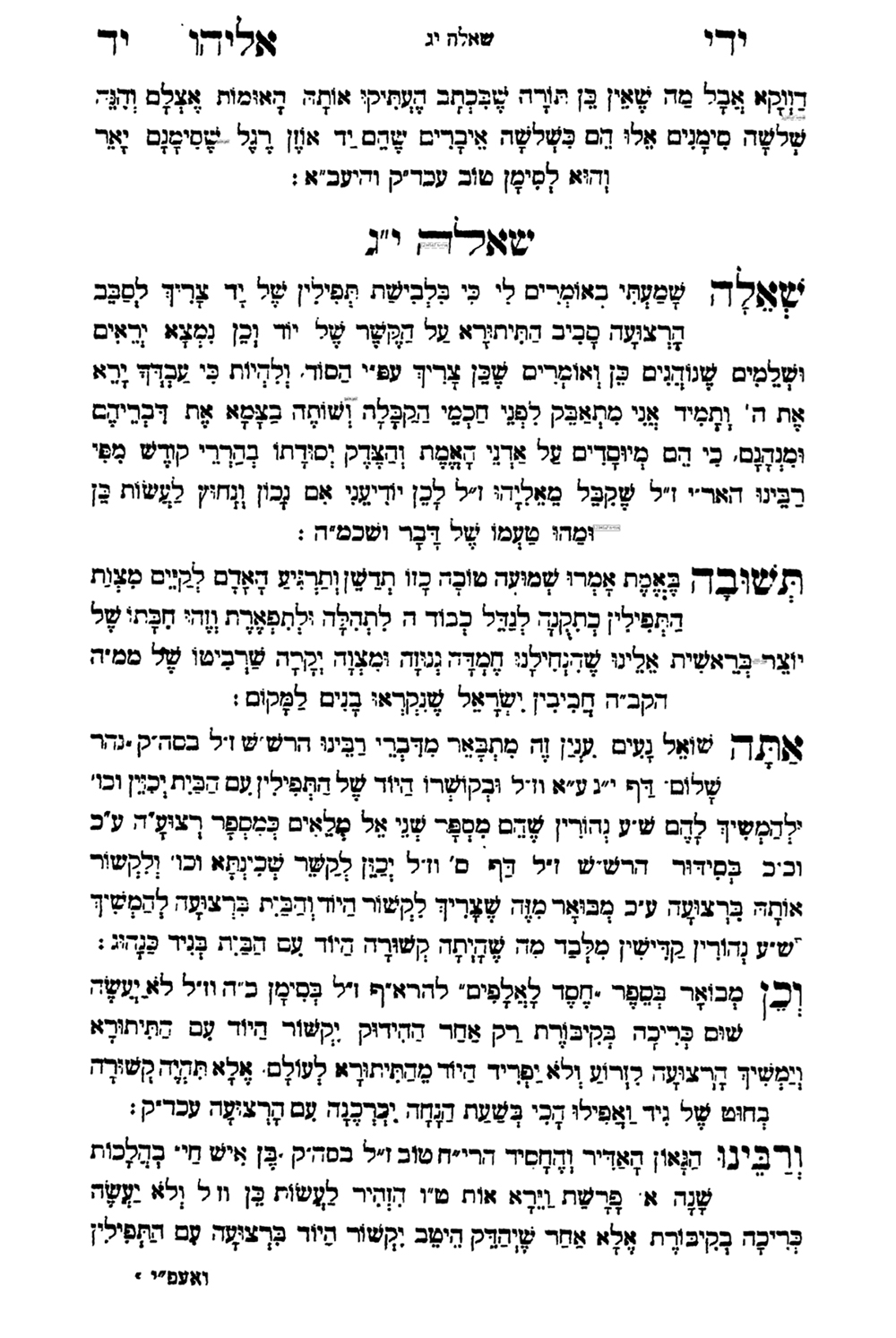
4. In Saul Lieberman and the Orthodox, I mentioned that R. Shemaya Grunbaum, a Satmar hasid, published a letter from Lieberman in his book,Siyata di-Shemaya al Masekhet Shabbat (Jerusalem, 1970), pp. 159-160. He does not refer to Lieberman by name, but as “hakham ehad”. However, Lieberman’s identity is only slightly veiled, as R. Grunbaum leaves in the letter’s reference to Ha-Yerushalmi ki-Feshuto. He obviously intended that those “in the know” would recognize with whom he was corresponding.

After R. Grunbaum’s book appeared, he sent it to Lieberman and asked Lieberman to send him his recently published Sifrei Zuta/Talmudah shel Kesarin. R. Grunbaum also apologized that due to reasons beyond his control, he could not mention Lieberman by name and thus referred to him as “hakham ehad”.[32]

5. In Ha-Mashbir5 (2025), I published a few letters from Lieberman to Heschel. See here. In one of the letters, Lieberman offers some notes to Heschel’s Torah min ha-Shamayim. Here is Heschel’s reply to Lieberman’s letter.[33]

6. I am writing this right before Thanksgiving, so it reminded me that it is reported that Lieberman did not saytahanunon Thanksgiving. Shearith Israel in Manhattan also does not say tahanun on Thanksgiving. In fact, they say a partial Hallel, from הללו את ה’ כל גוים until the final הודו לה’ כי טוב.[34]

7. David Sarna reports that Lieberman did not accept the Manhattan eruv and that he would not allow a bat mitzvah girl to address the congregation at the JTS synagogue.[35]

* * * * * * * *

I want to call Seforim Blog readers’ attention to the wonderful Youtube channel of Kerem: Bein Torah le-Hokhmah here. The main feature is R. Yonason Marton’s daily daf yomi and other shiurim. While his shiurim are in Yiddish, the summaries available in the show notes on Youtube are in Hebrew. R. Marton’s shiurim are a unique combination of traditional lomdus and academic scholarship. In addition, Kerem has hosted numerous academic scholars whose videos are also on the Youtube channel. Kerem is a unique institution led by special people, and I wish it much success as it continues to grow.

Appendix

We routinely use the word “virgin” in the ketubah, together with the applicable monetary amount, unless the woman has been previously married. We even do so if the couple is living together. As mentioned, this is allowed because as long as the future husband knows the truth, it does not matter what is written in the ketubah. That this is the law has been affirmed in modern times by R. Moshe Feinstein[36] and many others. In fact, this is so well established that I think it is a “known truth” that before marriage the husband needs to know if his future wife is a virgin, and that the ketubah is invalid if he gets married without knowing the truth. Indeed, how could it be any different, as we see from Ketubot 11b that if the man marries a woman thinking she is a virgin and she is not, that it is a mekah taut?

It will therefore come as a surprise for many that this view is not accepted by all. For instance, R. Shalom Mordechai Schwadron[37] deals with a case of an orphan woman who not only was not a virgin, but who had a child out of wedlock. She later got engaged to a man who did not know about her past. R. Schwadron ruled that in the interests of peace they could write “virgin” in the ketubah and keep the husband in the dark. As for the incorrect monetary amount, R. Schwadron has a few suggestions on how to deal with this as well, including having the woman sign a document foregoing the extra ketubah money due a virgin. This document would have to be kept with the beit din as the husband would not be aware of it.

I think people will also be surprised by the following, not merely the ruling of R. Joseph Hayyim but the entire situation he describes, as it is so foreign from our experience. I apologize if what follows is a little too explicit, but everything comes directly from Rav Pealim, vol. 1, Even ha-Ezer, no. 2.[38] R. Joseph Hayyim describes the following case. A man betrothed a woman on the assumption that she was a virgin. At the time, her father, mother and all her relatives “knew” that she was a virgin. However, between the betrothal and the marriage her parents learned that she had been intimate a few times with another man.

The practice in Baghdad was that on the night of the wedding, after the bride and groom went into their room, female relatives of the bride and groom would sit outside the door. In addition, a few male relatives and friends of the groom would also be there. They were all waiting to see the dam betulim. After the husband finished his marital duty, he would get dressed, open the door, and leave.[39] The women would then come in to see the dam betulim. If they saw it, they would make the loud celebratory sound we have all heard from women from Arab countries, which is called zaghrouta. If they did not see the dam betulim, that meant the groom did not do his job properly, and he would come back to try again.[40]

In the particular case of the responsum, the parents of the woman came up with a trick to spare her embarrassment: The bride put blood on the sheet, but it was not her blood. However, someone who was close to the family of the bride knew the truth and was worried that the marriage was not halakhically binding. After all, the man married her under false pretenses as he thought she was a virgin, and so it was written in the ketubah.

R. Joseph Hayyim replies that the marriage is binding and the husband should not be told that he was fooled, as this will lead to great shame for the bride and her family. As for the matter of the ketubah, R. Joseph Hayyim says that the bride and her relatives must be told that in the event of her being able to collect the ketubah money, she can only claim that which a non-virgin is entitled to.

Both R. Schwadron and R. Joseph Hayyim are cited by R. Netanel Meoded in his own responsum where he concludes that one should not inform a man that the woman he is marrying, whom he thinks is a virgin, was sexually active before their engagement. See Mizrah Shemesh, vol. 2, no. 31.

R. Joel Roth, writing from a Conservative perspective, argues for removing the word betulta from the ketubah. See Roth, Hakol Kol Yaakov, ed. David Golinkin (Jerusalem, 2023), pp. 361ff.

Let me now turn to another strange thing. In previous centuries there was a belief among some that a girl who was born on Friday did not have betulim. Quite apart from the absurdity of the belief, the halakhic problem it would create is obvious, since as R. Abraham Zvi Klein notes, it would mean that with any woman whose birthday is unknown, there would be no ta’anat betulim because perhaps she was born on Friday. To this I would add, since there is no mention of this “medical” point in the Talmud or rishonim, it is shocking that anyone took it seriously. In R. Eliyahu Bar Shalom’s standard work, Mishpat ha-Ketubah,[42] he feels it necessary to write:

גם לנולדת ביום ששי יש כתובת בתולה ככל שאר הנישאות, אף שיש שמועה שאין לה בתולים

What is the origin of this belief? The first reference I found is in R. Isaac Lampronte of Ferrara’s (1679-1756) halakhic encyclopedia Pahad Yitzhak. R. Lampronte was also a doctor, so his recording of this medical legend is itself noteworthy.

In Pahad Yitzhak, s.v. na’arah, R. Lampronte mentions that in Italy the practice is that if a girl is born on Friday this fact is recorded, precisely in order to deal with the halakhic issue already mentioned. That is, if the husband will later assert that there was no dam betulim, this would not be regarded as a valid claim. R. Lampronte states that despite the Italian practice, he did not find any mention of the unique nature of girls born on Friday either in the Talmud or poskim, and that there is also no mention of it in scientific or medical works. He therefore claims that the assumption that girls born on Friday lack betulim should not be relied upon, as on the contrary, sometimes girls born on Friday indeed have belutim.

R. Hayyim Joseph David Azulai, who lived in Italy, also mentions the belief that girls born on Friday lack betulim. He says that he was told about this from distinguished people in Italy and Amsterdam. He also cites from the then unpublished section of Pahad Yitzhak just mentioned. As with R. Lampronte, R. Azulai is surprised by this biological assumption, because if it is true, the Sages would have mentioned something about it.[43]

Many people have cited the Pahad Yitzhak and Hida, however, the story does not end there. There was another great rabbi in Italy, R. Daniel Tierni of Florence (died 1814), author of the commentary on the Shulhan ArukhIkarei ha-Dat (הד”ט – playing on the abbreviation of his name). In his commentary to Yoreh Deah 21:10, he tells us that he saw additions that R. Lampronte made to the Pahad Yitzhak. These additions have not appeared in print, so we must be grateful for what R. Tierni preserved. Here R. Lampronte states that the entire matter is a complete falsehood, sheker gamur.[44] Yet R. Tierni adds that everywhere in Italy where he has lived, they are careful to record in the communal record whenever a baby girl is born on Friday to avoid problems when she later gets married. He notes that the non-Jews also do this. As for why there are girls born on Friday who have betulim, he explains this through astrology, and suggests that it depends when on Friday they are born, since only certain hours on Friday are under the rule of Venus.

As late as 1902, R. Isaac Raphael Ashkenazi (1826-1908), the rav of Ancona, writes that the practice of his city is to record the girls who are born on Friday, and he thinks this is what other communities should do as well.[45]

Riddles

It has been a long time since I included a riddle, and I now have a bunch of books that I can give away to those who get the right answers. If you have the answers, email them to me at shapirom2 at scranton.edu

1. Where do we find that Shammai not only disagrees with Beit Shammai, but also agrees with Beit Hillel?

2. In the days of the tannaim a certain item was unquestionablymuktzeh. However, in the post-talmudic period, some hold that this item is no longermuktzeh. What item am I referring to? Provide the actual source in the Talmud and later authorities to justify your answer.

I asked ChatGPT this question but the answer it provided was phony, complete with a non-existent citation from R. Moshe Isserles. I am sure ChatGPT will provide other answers, and perhaps one of them might be correct

* * * * * *

[1] This book began as an invited lecture in memory of Lieberman sponsored the Union of Traditional Judaism. One of the organizers of the event was Rabbi Ronald Price. I mention this because R. Price is the author of the newly published book, Divrei Halev: Thoughts of Rabbi Professor David Weiss Halivni on the Weekly Torah Portion. Here is part of the book’s description on Amazon:

Divrei Halev is the result of a multi-year collaboration between Rabbi Ronald D. Price and his teacher, the world-renowned Talmudic scholar Rabbi Professor David Weiss Halivni, of blessed memory. Nearly every week from 2008 to 2012, Rav Halivni shared a thought with Rabbi Price on the weekly Torah portion, which the student faithfully recorded. Divrei Halev includes over two hundred brief divrei Torah spread across all fifty-four parashiyot.

I was one of those privileged to write a blurb for the book, together with Professors Gershon Bacon Reuven Kimelman, David Novak, and Dr. Elana Stein Hain. In the interests of space, my blurb was edited, so here is a good opportunity to record my unabridged blurb.

Rabbi Halivni’s greatest contribution was of course his groundbreaking talmudic scholarship. Yet anyone who had the pleasure of davening with Rabbi Halivni on Shabbat, as I did in the late 1990s and early 2000s, saw a different side of him, that of a rav of a kehillah, a spiritual leader, whose spoken word on Shabbat was able to both enlighten and inspire. Those of us who were able to experience this, and those who never had the opportunity, owe a great debt to Rabbi Ronald Price for bringing the words of our teacher to life.

Regarding Halivni, see also what I wrote here.

Let me now share another story about Halivni. On Erev Pesah 2001 or 2002 I was walking to shul on the Upper West Side and I saw Halivni coming down the street. I asked what brought him to my neighborhood, as I knew he did not live in the area. He told me that he wanted to find a minyan that said Hallel after maariv. I took him to Ohab Zedek and was told that they do not say maariv. We started out in search of another shul and came upon the Chabad minyan on the Upper West Side, where we davened. I remember being very impressed by two things at this minyan. First, that the Chabad rabbi and at least a couple of other Chabad attendees knew who Halivni was. Second, how they treated him with the greatest respect.

[2] Subsequent to publication of my Saul Lieberman and the Orthodox, Monique Susskind Goldberg discussed Lieberman’s Ketubah in id. and Diana Villa, Za’akat Dalot: Pitronot Hilkhati’yim le-Be’ayat ha-Agunot bi-Zemanenu (Jerusalem, 2006), pp. 104ff. On p. 112, she also discusses a proposed adjustment to the ketubah by R. She’ar Yashuv Cohen.

Whether the Lieberman Ketubah could be civilly enforced was at the center of the famous 1980s N.Y. case, Avitzur vs. Avitzur. See here and here. Contrary to all the naysayers, the court upheld the legitimacy of the Lieberman Ketubah from the standpoint of American law. The National Jewish Commission on Law and Public Affairs, an Orthodox organization, got involved with the case together with the Jewish Theological Seminary to support the plaintiff whose husband had refused to appear before the beth din of JTS and the Rabbinical Assembly in order to give her a get. Nathan Lewin told me that R. Moshe Sherer, the head of Agudat Israel, asked Lewin to become involved with the case. Even though it did not focus on the Orthodox community, Sherer—and the Agudah rabbinic leadership he must have consulted—thought it was important that the principle that the government could, in certain circumstances, require people to go to beit din be upheld.

[3] According to Chaim Herzog, Lieberman was his parents’ closest friend. See Elijah J. Schochet and Solomon Spiro, Saul Lieberman: The Man and His Work (New York, 2005), p. 53. On this page, Schochet and Spiro write that “Lieberman enjoyed the respect of R. Yosef Shalom Eliashiv, the av beit din of Jerusalem.” If one consults the source they offer for this sentence, Yitzhak Raphael’s eulogy for Lieberman in Sinai 93 (Nisan-Iyar 5783), p. 91, one finds that Raphael’s actually refers to R. Elyashiv’s grandfather, the kabbalist R. Solomon Elyashiv.

[4] Congress Weekly, Aug. 17, 1953, cited in Regina Stein, “The Boundaries of Gender: The Role of Gender Issues in Forming American Jewish Denominational Identity, 1913-1963” (unpublished doctoral dissertation, Jewish Theological Seminary, 1998), p. 319.

[5] Conservative Judaism 20 (Fall 1965), pp. 51-54.

[6] Stein, “The Boundaries of Gender, p. 320.

[7] See Naomi Salfati, “On Feminist Judaism, Jewish Feminism and the Advancement of Women’s Roles in Jewish Tradition” (unpublished master’s dissertation, Hebrew University, 2014), p. 16, available here. Salfati discusses Weiss-Rosmarin’s article, “The Unfreedom of Jewish Women,” which also deals with the “unfairness of Jewish marriage laws to divorced and abandoned women.”

Weiss-Rosmarin is also known for her book Judaism and Christianity The Differences. In Alan Brill’s newly published A Jewish Trinity: Contemporary Christian Theology through Jewish Eyes, Weiss-Rosmarin’s approach, which is the “standard” view Jews are taught, is specifically rejected throughout the book. In the very first paragraph of A Jewish Trinity, Brill writes: “For many Jews and Christians, Weiss-Rosmarin’s basic unbridgeable theological divide between the religions remains a truism. This book rejects Weiss-Rosmarin’s simple zero-sum declaration by asking whether the Jewish theological vision and the Christian theological vision are fundamentally irreconcilable, or can the positions be conceptually bridged.”

[8] In a December 3, 1954, statement, the RCA and the Rabbinical Alliance of America condemned the Lieberman ketubah, stating that it had “the gravest implications to the sanctity of Jewish family life and represents the most disastrous disavowal of the principles of Jewish law.” See Benjamin Steiner’s important article, “The Lieberman Clause Revisited,” American Jewish Archives 69 (2017), p. 54.

[9] For criticism of the Lieberman Ketubah from another angle, see R. Eliezer Waldenberg, Tzitz Eliezer, vol. 5, pp. 23ff., vol. 21, no. 62. See also R. Joseph Elijah Henkin, “Tikun o Harisah,” Ha-Pardes, Shevat 5755, pp. 20-22. R. Isaac Herzog responded to this article, see Tehukah le-Yisrael al Pi ha-Torah, vol. 3, pp. 208-209.

At a 1953 gathering of Conservative rabbis and JTS faculty, Lieberman discussed his proposal, which he referred to as a takkanah. He said as follows, clearly exasperated with the American Orthodox rabbinate.

I saw that some of you were accused of being frightened by the Orthodox rabbis. I want to tell you that I am not frightened by them at all.

I want, therefore, to give you a point of information. In truth, they were frightened, and I want you to know why they were frightened. They weren’t afraid that the בית דין would issue some תקנות. No, not at all. They were afraid that the בית דין will issue תקנות in accordance with the law.

As a matter of fact, one of the very important members of the Orthodox rabbis said so in so many words: If this בית דין of the Rabbinical Assembly will issue a תקנה, that will be תקנתו קלקתו. It will be a great misfortune because they will get authority and that is the reason why they oppose this. Many of them think that that בית דין will begin to move in this line, the movement can become strong and it will affect them.

Now about this תקנה. I would like to tell you that this תקנה has nothing to do with the בית דין that will be established—and I hope it will be established soon; but this I would like to see you adopt immediately because it has a tremendous practical value.

David Golinkin ed., Proceedings of the Committee on Jewish Law and Standards of the Conservative Movement 1927-1970 (Jerusalem, 1997), vol. 2, pp. 810-811.

[10] These two points are mentioned by Rabbi Hollander at the meeting with the Moetzet Ha-Rabbanut ha-Rashit. See below. Hollander refers to Conservative rabbis permitting these matters, not a Conservative beit din.

[11] See here. The basis for the Committee on Jewish Law and Standard’s ruling was the responsum of Rabbis Ben Zion Bokser and Theodore Friedman published in Proceedings of the Committee on Jewish Law and Standards of the Conservative Movement 1927-1970, vol. 3, pp. 1459-1462.

[12] Waxman, Tradition and Change, p. 351.

[13] Regarding the change of name from Law Committee to Committee on Jewish Law and Standards, see here.

It is of interest that in 1992 the Conservative movement in Israel, known as Masorti, issued a ruling forbidding travel to synagogue by car on Shabbat in Israel. See here. See also Rabbi David Golinkin’s responsum on this matter here.

[14] Formulation of Rabbi Aaron Blumenthal in Proceedings of the Committee on Jewish Law and Standards of the Conservative Movement 1927-1970, vol. 3, p. 1464.

[15] Waxman, Tradition and Change, p. 361.

[16] Waxman, Tradition and Change, p. 370.

[17] Proceedings of the Committee on Jewish Law and Standards of the Conservative Movement 1927-1970, vol. 3, pp. 1186-1188.

[18] Waxman, Tradition and Change, p. 390.

[19] Waxman, Tradition and Change, p. 390. See also ibid., pp. 392ff. for Rabbi Ben Zion Bokser’s rejection of the permission to drive on Shabbat

[20] For the recent debate of the Committee on Jewish Law and Standards regarding use of an electric car on Shabbat, see here. In this article, Rabbi Danny Nevins is quoted: “Those who accept the 1950 CJLS minority position permitting people to drive to synagogue in a gas-powered car would be justified extending this permission to electric cars.” Yet as mentioned above, the 1950 CJLS position permitting people to drive to synagogue on Shabbat was the majority position, not the minority.

[21] See here.

[22] Regarding driving to synagogue on Shabbat, I think many will be surprised by some of the lenient views that have been expressed. Following this paragraph is a responsum from Kollel Eretz Hemdah’s Be-Mareh ha-Bazak, vol. 3, no. 38, in which they rule that it is permitted for a non-Jew to drive a Jew to synagogue on Shabbat if this is vital to keep the person connected to Judaism. They also state that this should not be done every week. According to what is stated at the beginning of the volume, all responsa published in the book were approved by R. Shaul Yisraeli.

R. J. Simcha Cohen suggested that for people who could not walk to synagogue in Century Village in West Palm Beach, that they could get on the bus that transports people along set routes within the community’s confines. This would only apply if the driver was not Jewish. See Cohen,Shabbat: The Right Way(Jerusalem, 2009), pp 181ff. He also includes R. Moshe Dovid Tendler’s letter opposing this leniency. R. Tendler writes: “The heter would destroy the sanctity of the Shabbos. It would be extended to other ‘good deeds’ like visiting parents, hospital patients, attending rallies and even earning money on Shabbos to pay yeshiva tuition.” R. Yosef Carmell, the head of Eretz Hemdah, also replied, and he followed the approach already approved by R. Yisraeli.

If the bus is clearly labeled as a ‘Shabbat bus,’ is announced as appropriate only for those too weak to walk on their own, and even then only to be used for transportation to and from shul, it could be positive, provided that someone familiar with the community feels it would be necessary. (One must, of course, verify that only non-Jewish drivers are used.) However, we would recommend monitoring public impression (not only before implementation but also after) so as to gauge whether people view this as either a religious farce or a sweeping abrogation of hilchot Shabbat (in which case the service should be discontinued).

We would also like to suggest the aforementioned ruling of Rav Yisrael, zt”l (Be-mareh ha-bazak IIII:38) of having the Shabbat bus run only occasionally (or perhaps alternate weeks, etc.) so as to stress that we are dealing with a she’at ha-dechak.

R. Carmell understood R. Cohen to be referring to a special Shabbat bus run by the Jewish community. But what he was referring to was the already existing bus that transports people, free of charge, to different places within Century Village.

Significantly, when asked by the community of Century Village, Boca Raton, R. Hershel Schachter gave his permission for people who can’t easily walk to take the communal bus to synagogue. See here.

See also R. Schachter, Nefesh ha-Rav, p. 233, that R. Soloveitchik opposed having a “Shabbat bus”. The Rav noted that although this could be justified halakhically, since driving to synagogue on Shabbat had become a symbol of the Reform and Conservative movements, this means that even driving to synagogue in a halakhically permissible manner is now forbidden.

R. Ben Zion Uziel earlier gave permission for Jews to use public transportation to go to synagogue, but only in a place where the majority of riders are non-Jewish. SeeMishpetei Uziel, vol. 1,Orah Hayyim, no. 9, Mahadura Tinyana, vol. 1, Orah Hayyim, no. 32.

At the end of his book, R. Cohen offers a different suggestion, namely, a rickshaw attached to a bicycle. He writes:

Accordingly, a rickshaw bicycle driven by a non-Jew would also not be prohibited because of the concern that he might repair the bicycle on Shabbat, since a Gentile may repair anything he wishes on Shabbat. . . Using all the methods mentioned above, one could arrange, well within the bounds of Halacha, for a bicycle rickshaw to transport Jews who are unable to walk to and from the synagogue on Shabbat. This would involve no Biblical violations at all.

In Hakirah 37 (2025), Avi Kadish published a memoir which describes how he became religious. He reports that R. Moshe Feinstein permitted him to ride to synagogue on Shabbat in the car driven by his father. This only happened twice, as Kadish’s father realized that his son was uncomfortable using the car. From then on, every Shabbat they walked the two hours fifteen minutes each way to synagogue. What makes R. Feinstein’s ruling so interesting, is that Kadish was over bar mitzvah age. (Kadish notes that R. Avraham Pam had also given such a ruling with regard to a katan.) Kadish publishes the following comment from R. Shabbetai Rapoport:

I see no halakhic novelty here. If your father was going to shul anyway, why should there be any reason to forbid you to go with him? Rav Moshe’s opinion was that there is no difference between partnership with a Sabbath violator and partnership with a gentile. The ḥumra that a passenger in a car causes more fuel to be burned is mentioned in his writing, but only as a ḥumra. Therefore, this ruling fits his halakhic methodology quite well. The [real] novelty is that he did not fear any criticism that might have arisen, and this is indeed characteristic and correct [of Rav Moshe].

I don’t understand R. Rapoport’s point. The novelty is that Kadish was receiving benefit from a melakhah done on Shabbat by a Jew.

R. Shlomo Zalman Auerbach has an interesting pesak in Minhat Shlomo, Orah Hayyim, no. 3 (end). He rules that one who accepts Shabbat early is able to be driven by a non-Jew, and in a “tzorekh gadol” can also be driven by a Jew. He says that there is no ziluta de-Shabbat involved.

הואיל וליכא בכה”ג זילותא דשבתא שהרי אצל כולם עדיין הוא חול

R. Yitzhak Yosef states that for someone who drives to synagogue on Shabbat, it is better that he arrange to be taken by a non-Jew, unless this will lead to communal problems (e.g., others who are currently walking to synagogue might now feel that it is OK to have a non-Jew take them). Thus, he requires a local rav who knows the situation to make such a decision. SeeYalkut Yosef, Hilkhot Shabbat, vol. 5, p. 61.

Regarding using an autonomous taxi on Shabbat, see R. Eitan Kupietzky in Ha-Ma’yan, Tevet 5784, pp. 35-42. According to R. Aharon Goldberg, R. Shlomo Zalman Auerbach’s grandson, R. Auerbach had no objection to use of a car on Shabbat if there are no halakhic violations with this car, and that this could actually enhance Shabbat observance. In response to the objection that use of such a car would destroy Shabbat as we know it, a concern that was at the center of the Hazon Ish’s approach to use of electricity on Shabbat, he replied:

ההלכה היא לא איך שנראה לנו, אלא אם זה מותר אז מותר!

See Aryeh Edrei and Amir Mashiah, “Arba Amot shel Halakhah: Ha-Rav Shlomo Zalman Auerbach,” in Binyamin Brown and Nissim Leon, eds. Ha-Gedolim (Jerusalem, 2017), pp. 720-721. Along these lines, a new pesak has recently appeared from R. Menachem Perl, the head of the Tzomet Institute. According to him, one can make use of an iRobot vacuum on Shabbat as long as it is activated before Shabbat. See here.

Because the world is changing so much when it comes to technology, I think that due to pressing circumstances the future will bring a number of lenient rulings regarding Shabbat. For example, the day is not far off when in major cities one will not be able to enter an apartment building, or even a private apartment in such a building, without using an electronic keypad or key card. It is hard to imagine that poskim will rule that Jews are not allowed to live in these buildings, as that would mean the end of Orthodox communities in many places.

[23] Stein, “The Boundaries of Gender,” pp. 331, 338.

[24] Norman Lamm, “Recent Additions to the Ketubah,” Tradition 2 (Fall, 1959), pp. 93-118.

[25] The case R. Duran discusses is of a girl who might not have even been twelve years old. She was kidnapped by non-Jews and brought to Tunis where she was redeemed (“bought”) by a Jewish man who proceeded to have sex with her. Another man then removed her from Tunis—he must have paid the first man—to bring her to her father. On the way he married her, and that is when the ketubah was written stating that the young woman was a virgin. By this time, she was checked by women and showed signs of physical maturity, and the halakhic significance of this is discussed by R. Duran. The fact that the girl was raped by her first “redeemer” is not even discussed as it is not relevant to the halakhic issue R. Duran focuses on.

In general, when one sees responsa that refer to sexual relations with young girls, one need not assume that we are dealing with a case of rape, as it is possible that the husband was also very young. See e.g., Teshuvot Hakhmei Tzarfat ve-Lotir, no. 14:

בועל בעילת מצוה ופורש בתנוקת מפני צחצוחי זיבה

See also ibid., no. 52.

[26] See Appendix.

[27] See Saul Lieberman and the Orthodox, p. 20, where I discuss Lieberman’s relationship with Kaplan, and that it seems that after the Agudas ha-Rabbonim put Kaplan in herem, Lieberman observed the herem. See also my earlier post here. See also here where I discuss the burning of Kaplan’s siddur and show that contrary to what has often been said, this was not sanctioned by Agudas ha-Rabbonim.

[28] Regarding Lieberman and the Brisker Rav, see the passage from R. Mordechai Elefant’s memoir I posted here.

[29] Israel State Archives, Chief Rabbinate files, 15796/2-גל, new file locator: 000ier0.

[30] The letters to Brodie and Rabinowitz are found in Israel State Archives, Herzog files 4255/11-פ, new file locator: 000bvq8. There is another letter to Brodie in Herzog, Tehukah, vol. 3, pp. 201-202. See also Herzog, Tehukah, vol. 3, p. 201, from a 1954 letter to Haim Cohn, where he again mentions Lieberman’s ketubah with reference to his own suggestion. This last reference and the manuscript letter to Brodie published here are mentioned in Amihai Radzyner, “Reform or Necessary Change: The Attempt to Translate the Ketubah into Hebrew and the Reactions to It,” Hebrew Union College Annual 93 (2022), p. 176 n. 111. However, he does not mention R. Herzog’s letter to Rabinowitz.

[31] Radzyner, “Reform or Necessary Change,” p. 176.

[32] This letter is found in the Saul Lieberman Archives, Arc. 76/6, Library of the Jewish Theological Seminary of America. I thank the Library for permission to publish this letter as well as the letter from Heschel to Lieberman below.

[33] This letter is found in the Saul Lieberman Archives, Arc. 76/6, Library of the Jewish Theological Seminary of America.

[34] This was confirmed by Zachary Edinger, Ritual Director at Shearith Israel.

[35] Sarna, Growing up Conservadox, pp. 30, 32.

[36] Iggerot Moshe, Orah Hayyim, vol. 4, no. 118.

[37] Teshuvot Maharsham, vol. 7, no. 152.

[38] In some communities there was even a practice after the wedding night of a public recitation of a blessing known as birkat betulim. Maimonides, however, saw this as a disgraceful breach of modesty as well as a berakhah le-vatalah. See Ezra Brand’s post here.

[39] He would leave and not return to her, because the practice in Baghdad was that husband and wife did not sleep alone in the same room until after she had gone to the mikveh. This was also the practice in Djerba (it no longer is), and there is a source for this in the rishonim. See R. Meir Mazuz, Asaf ha-Mazkir, pp. 299-300.

Regarding the Baghdad practice described by R. Joseph Hayyim, see Ketubot 12a:

In Judea, at first they would appoint for them two groomsmen [shushvinin], one for him and one for her, in order to examine the groom and the bride at the time of their entry into the wedding canopy [and thereafter, to ensure that neither would engage in deception with regard to the presence or absence of blood from the rupture of the hymen]. . . . In Judea, at first the groomsmen would sleep in the house in which the groom and bride sleep, [in order to examine the sheet on which the marriage was consummated immediately following intercourse].

[40] See Tosafot, Kiddushin 12b. s.v. mishum, that according to R. Tam, this custom is to be regarded as peritzut.

דהיינו פריצותא לפי שצריך או עדי ביאה או עדי יחוד ודבר מכוער שמעמיד עדים על כך

[41] See Roth, Hakol Kol Yaakov, ed. David Golinkin (Jerusalem, 2023), pp. 361ff.

[42] Vol. 3, p. 124.

[43] Ayin Zokher, ma’arekhet bet, no. 3.

[44] See, similarly, R. Joshua Solomon Ardit, Hina ve-Hisda, vol. 1, p. 164a. I saw this reference in Zev Wolf Zicherman, Otzar Pelaot ha-Torah, vol. 3, p. 926.

[45] Va-Ya’an Yitzhak, Even ha-Ezer, no. 8.


Eruv Tavshilin: A Scribal Error or Deliberate Reformation?

Eruv Tavshilin:  A Scribal Error or Deliberate Reformation?

by: Dan Rabinowitz

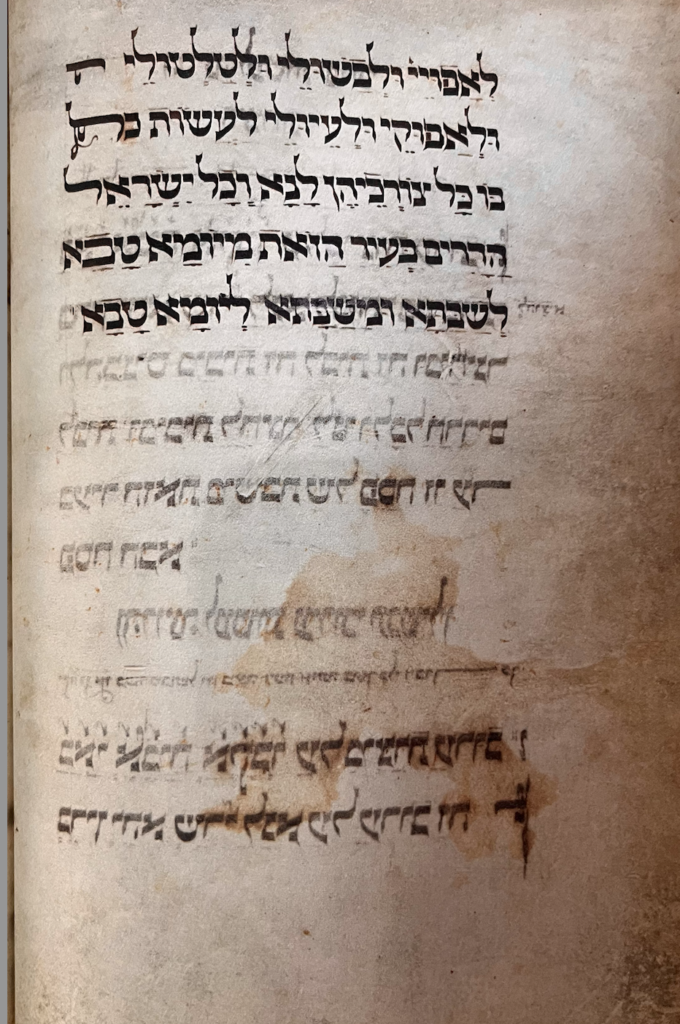
The Washington Haggadah was written by the scribe Joel ben Simon, and is currently housed at the Library of Congress in Washington, D.C., and is available online in a beautiful digital copy. Joel produced the Haggadah in the late 15th century. As so much of the core Hebraica collection at the Library of Congress, the manuscript was sold by Efraim Deinard to the Library probably around 1916. (Deinard was one of the most interesting bookmen in the early 20th century, and we will return to him and his biography in the near future).

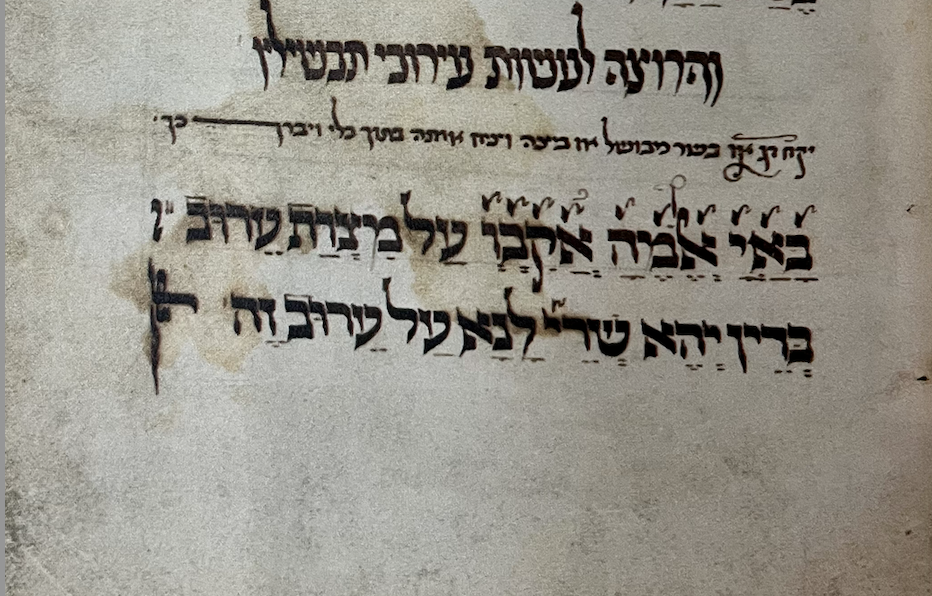
In 1965, this haggadah was first printed as part of the Diskin Orphan House Haggadah series. The Library of Congress didn’t publish its facsimile edition until 1991, and last year another facsimile edition of this haggadah was published. Although this haggadah was written close to 300 years before Diskin published it, a significant scribal error escaped notice until that time. Specifically, in the text for eruv tavshilin rather than just saying “with this eruv I am allowed to cook from Yom Yov for Shabbat,” it continues and says “and on Shabbat for Yom Tov.” Eruv tavshilin is designed to permit cooking on the holiday for Shabbat. Of course, cooking is always prohibited on Shabbat, whether or not it follows a holiday. The Washington Haggadah seems to permit what is otherwise prohibited.

This did not escape the eagle eyes of some. They feared that someone might use this haggadah (we note that contrary to the other reproductions mentioned, the Diskin version is a poor copy) and inadvertently think it is permissible to cook on Shabbat. The Agudath Harabbonim took out ads in the Yiddish daily, Der Tag, and the Forward to let its readers know of this error.

The publishers countered the Agudath’s claim and mailed out a letter, with the provocative title, “Heresy or Blunder,” after Passover indicating the error and included a letter from Cecil Roth, who had written about manuscript haggadot.

In his letter, he indicates that, indeed this was most likely unintentional and that Joel did not have a different tradition regarding eruv tavshilin. Indeed, we know from Joel’s other manuscripts, where he records the correct blessing, that the Washington 

Haggadah’s version was simply a scribal error.


NOTE: In 1991, the Library of Congress (where the manuscript resides) published an (expensive) facsimile edition of Washington Haggadah. Myron Weinstein, ed. The Washington Haggadah: A Facsimile Edition of an Illuminated Fifteenth-Century Hebrew Manuscript at the Library of Congress Signed by Joel ben Simeon (Washington, D.C., Library of Congress, 1991). In that volume, the text of the eruv tavshilin is discussed by Mordechai Glatzer, “The Ashkenazi and Italian Haggadah and the Haggadot of Joel ben Simon,” 157. The Washington Haggadah was recently republished in a much more affordable format and includes articles by David Stern and one, if not the foremost expert on illustrations in Haggadot, Katrin Kogman-Appel see here for her Academia page). The Washington Haggadah: Copied and Illustrated by Joel ben Simeon (Cambridge: Harvard University Press, 2011). See here for a video presentation by Kogman-Appel and Stern delivered at the Library of Congress.


Depression Angles

Depression Angles
By William Gewirtz

Introduction:

Depression angles measure the level of darkness or illumination prior to sunrise and, in a parallel fashion, after sunset.

There are two halakhic disagreements that might appear to relate to the use of depression angles. First, there is a long-standing argument about what defines the transition from one day to the next and what is (merely) an indicator that the transition has occurred. Some consider the appearance of three stars as the basis of a definition, while others assume that darkness is defining, with the appearance of three stars merely being an indicator that a specific level of darkness has already occurred. However, this dispute is not consequential to the use of depression angles. Even though depression angles relate directly to (the level of) darkness, since darkness levels and the appearance of stars occur approximately simultaneous, the argument is primarily of theoretical interest. As a result, the disagreement does not influence the use or the operation of depression angles.[1]

Second, a present disagreement is particularly consequential. Do we adopt fixed zemanim, e.g. 42 or 72 minutes after sunset or one hour before sunrise, or variable zemanim that change based both on location and day of the year? In Talmudic literature, physical events like the first appearance of light across the eastern sky, the ability to differentiate between blue and white, the sky’s apex and the eastern horizon appearing equally dark, the appearance of 3 medium stars, etc. all describe events whose occurrence vary at different locations and during different days of the year; they cannot be specified by a single fixed interval. As a result, I have a strong preference for variable versus fixed zemanim.[2] In spite of this being a still active dispute, I will assume that the argument is settled, and will not address the issue further in this paper. Clearly, depression angles are (largely) irrelevant to those who determine zemanim using fixed intervals. Therefore, this paper provides an explanation focused on depression angles themselves, as a methodology to formalize the use of variable zemanim. In what follows, I will explain the use of depression angles, the scientific method that has emerged over the last 150 years that makes use primarily[3] of both latitude and season / date to calculate various zemanim.

How this disagreement between using fixed versus variable zemanim developed would require its own detailed historical study, which I believe has not yet been attempted. Absent such a study, three factors appear to have had some bearing on the issue.

First, from the 12th through the 18th century, most observant Jews followed what is referred to as the opinion of Rabbeinu Tam, which equated the length of the intervals

  • between sunset and the end of Shabbat and
  • between alot hashaḥar and sunrise.

Because the length of the interval between sunset and the end of Shabbat was never lengthened, logic dictated that the (assumedly) equal interval between alot hashaḥar and sunrise be left invariant as well.[4]

Second, Pesaḥim 94a was (surprisingly)[5] read as implying that the time to walk a four milin interval applied year-round.

Third, in his forceful rejection of the opinion of Rabbeinu Tam, the Vilna Gaon proposed both seasonal and latitude-based variation with respect to both the intervals between sunset and the end of Shabbat and between alot hashaḥar and sunrise. While his view gained broad acceptance with respect to the end of Shabbat, its implications for variation based on both latitude and the time of the year with respect to alot hashaḥar, were (and still are) often ignored.

Without further attention to detailed halakhic issues, we will concentrate on the functional aspects of depression angles, (without requiring familiarity with spherical trigonometry on which they are formally based.) But first, we begin with a brief summary of some fundamental elements in the area of zemanim, which will help anchor the discussion.

Zemanim:

Two areas dominate the study of zemanim:

  • First, how is the length of the 12 halakhic hours of every daytime period, which begins at alot hashaḥar, to be calculated given variation in the length of the daytime period during the different times of the year? Do we calculate from the daytime period’s halakhic beginning at alot hashaḥar or from the point of sunrise?
  • Second, how do we determine the precise delimiters of a day of the week,[6] which almost all agree concludes approximately at the end of the of the bein ha-shemashot period in the evening?[7]

Avoiding the many disagreements in the halakhot of zemanim, we will assume without loss of generality that:

  • The amount of time by which alot hashaḥar precedes sunrise, in the Middle East and around the spring and fall equinox when both the daytime and nighttime periods are equal, is 72 minutes.[8]
  • The transition point between the days of the week and most critically, the end of Shabbat follows the opinion of the geonim (as opposed to Rabbeinu Tam.)[9]

Addressing primarily only alot hashaḥar and the end of Shabbat is sufficient to illustrate how depression angles can be used in halakha. In many communities, the methods used to determine the end of Shabbat versus alot hashaḥar are different and demonstrate concretely the issue that we will address. In those communities, alot hashaḥar is always a fixed 72 minutes before sunrise and the calculation of alot hashaḥar in those communities does not involve use of depression angles. On the other hand, the number of minutes after sunset at which 3 stars appear or a requisite level of darkness has been achieved varies considerably depending on where you are and the time of the year as well. As a result, very often the end of Shabbat is (either explicitly or implicitly) calculated using depression angles or a near equivalent.

Clocks:

Before addressing depression angles some background on the introduction of clocks into the halakhic literature is required. Beginning at the turn of the 16th century, about two centuries after the first introduction of mechanical clocks in Europe, clocks were first mentioned in the halakhic literature; at that time, knowledge of the impacts of latitude and season was still non-existent. Throughout the entire period of the rishonim, time intervals were typically referred to not by the number of minutes on a clock, but primarily as estimated intervals. Clocks added a mechanism that allowed various opinions previously specified in terms like the time required to do X, to be translated into a precise, easily specified interval of time.

Clocks began to proliferate almost 200 years before the first recorded reference to either the impacts of latitude or season appear in the halakhic literature. Those impacts were included by R. Avraham Pimential in his comprehensive sefer on zemanim, Minhat Kohen, written during the 17th century.[10]

The first mention of a clock in the halakhic literature was by R. Yosef ben Moshe, a student of R. Yisroel Isserlein, in Leket Yosher appearing around the turn of the 16th century;[11] it appeared more than a century earlier than Minhat Kohen. During the 14th through 16th century clock making accelerated, well before the nature of variances between zemanim at different locations and during different times of the year were appreciated.

Unfortunately, the precision that clocks provided may have resulted in their increased prominence at the expense of observation. Precision and accuracy are often confused. Clocks provide precision for measurements that may or may not be accurate halakhically. If someone tells you that Shabbat ends at a specific time, that assertion may be very precise but totally inaccurate. Clocks also provided a level of precision that may have been overly seductive. What is yet more disconcerting, clocks allowed pesak to be rendered independent of observation. With an assumed reduced reliance on observation, it is likely that critical halakhic definitions became more subject to disagreement. Examples abound in the halakhic literature:

  1. distinguishing between levels of darkness,
  2. differentiating between medium and small stars, or
  3. establishing the amount of illumination necessary to recognize a friend after dawn

are three clear examples. In each of those three cases, posekim’s opinions often varied significantly and/or recommended caution based on a level of acknowledged doubt.

In the 19th century, as personal timepieces proliferated and greater uniformity between clocks in different locations became necessary with the growth of the railroads, time took on a yet greater role, something we note but do not address further.

Variation by the time of the year and location/latitude:

In the entire period of the rishonim, instead of time-based measures, most mitzvot dependent on zemanim were performed based on the observation of natural events. The effects of latitude and the time of the year were incorporated implicitly by the use of observation. The occurrence of darkness or the appearance of stars varied naturally between locations regulated by a yet unknown science. How zemanim differed at different locations was largely immaterial; as far as I know, prior to the 17th century there is no discussion in the halakhic literature comparing zemanim at different locations.

After a significant interval where clocks proliferated, depression angles first appeared in the halakhic literature at the end of the 19th century. A depression angle[12] measures how far below the horizon the sun appears at a specific moment, providing an accurate measurement of the level of illumination; a larger angle indicates that the sun is further below the horizon with less discernable light coming from the sun. If a depression angle of X degrees occurs at 4:40AM in London and 5:10AM in New York on the same or different days, then one can be certain that the amount of light from the sun is the same at those two times.

If alot ha-shaḥar is defined by the degree of illumination from the sun, to determine alot ha-shaḥar across different latitudes and times of the year, one can[13] utilize depression angles. The first step is to establish the number of degrees below the horizon the sun is located 72 minutes before sunrise in the Middle East around the spring / fall equinox. The second step is to use that same number of degrees to determine alot ha-shaḥar elsewhere and during other times of the year. The 72-minute interval commonly accepted for alot ha-shaḥar corresponds to the sun being approximately 16 degrees below the horizon.

In Israel around the spring / fall equinox, scientists consider the sun to provide no measurable light until approximately 80 minutes before sunrise corresponding to a depression angle of approximately 18 degrees.[14] As the halakhah often disregards miniscule, non-visible quantities, this provides observational support for the standard pesak tacitly assumed that alot ha-shaḥar precedes sunrise by 72 minutes.

From everything I can determine, depression angles capture the halakhic notion of the degree of darkness and light accurately; no alternative for “measuring” ḥashekhah or alot ha-shaḥar has ever been formulated, nor has anyone ever proposed any problem that depression angles might create. Depression angles naturally adjust zemanim based on latitude and the time of the year. Clearly, we may not need such precision; observation was adequate for generations. Nonetheless, a depression angle is to darkness / illumination what a watch is to time.

A small depression angle corresponds to a significant amount of illumination coming from the sun even though the sun is below the horizon. After sunset the level of illumination decreases in a mirror image to the way the level of illumination increases as we approach sunrise. At a depression angle of around 5 – 6 degrees, the halakhic end of a day as specified in the Talmud occurs;[15] at a depression angle of around 11 – 12 degrees we arrive at the point of misheyakir. In between, at a depression angle of 8.5 degrees, Shabbat, as typically practiced currently, concludes. Translating a zeman into a depression angle is neither always straightforward nor undisputed. For certain zemanim, alot hashaḥar for example, the basis is clear: the level of illumination at the beginning of the daytime period, in the Middle East around the spring or fall equinox corresponding to an average time to walk 4 milim. To determine the transition point between days of the week and the end of Shabbat according to the geonim, both biblically and in practice incorporating various ḥumrot, is more complex. Fortunately, following R. Yeḥial Miḥal Tukatzinsky’s calendar for Jerusalem, the practiced end of Shabbat is almost universally accepted by those who rely on depression angles to equate to an angle of 8.5 degrees. Very few posekim following the geonim are more stringent; the practice of the overwhelming majority of 19th century posekim for whom we have calendars (from which depression angle equivalents can be inferred) were more lenient. However, the earlier point of ḥashekha or 3 medium stars, absent any ḥumrot, is still disputed.[16]

Given the earth’s circular shape, tilt, and rotation, computing depression angles involves spherical trigonometry, which is fortunately not needed for purposes of this paper. Similarly, albeit without the precision, Ḥazal used terms like mi-she-yakkir, hikhsif ha-elyon, the appearance of small/medium stars, etc. all of which relate to the degree of darkness or equivalently the amount of residual illumination from the sun. As noted in the introduction, there is a long-standing halakhic dispute pitting the primacy of darkness against the appearance of stars; which is defining, and which is just a useful indicator? I am strongly biased in the direction of darkness as defining; darkness was already recognized as causing the visibility of stars in geonic times. Since the level of darkness and the appearance of stars are strongly correlated, the dispute, as noted in the introduction, is not consequential to this short paper.[17]

Latitude, the time of the year and depression angles:

For any halakhik zeman, besides the level of darkness specified by a depression angle by which it is defined, two additional variables – the location’s latitude and the date of the year – must also be provided to calculate the time at which that halakhik zeman occurs. The intuition is important. To determine the time (after sunset or before sunrise) at which a level of darkness is achieved, we must know

  1. where you are, defined only by your distance from the equator,
  2. where the sun is, which can be calculated knowing the exact time of the year, and
  3. the level of darkness required.

The former two inputs are just unarguable facts; the latter requires a halakhic determination.

Those mathematically inclined, should think of this as a function of three variables: 1) latitude, 2) date, and 3) darkness level, where those inputs generate a number, the value of the function. That number equals the length of time before or after sunrise or sunset, respectively, at that latitude, on that day, when the degree of illumination expressed by that depression angle is achieved.

Both the latitude and the date play a critical role. However, until latitudes exceed 40 degrees, the seasonal variation for alot hashaḥar is less than about 20 minutes. For ease of explanation, the impact of the date, i.e. the seasonal variation, will be covered separately in the next section. To better understand the impact of latitude, the following discussion focuses on an arbitrary but specific day. The critical inputs in addition to that one day selected are 1) the latitude of the location and 3) the desired level of darkness, specified by a depression angle. I can input, for example, 1) latitude: 30 degrees and 3) the degree of darkness associated with a depression angle of 10 degrees.

For that specific day, given the latitude and a specified depression angle, the function calculates how many minutes before sunrise or after sunset the degree of darkness associated with that depression angle is achieved.[18] If you go further away from the equator, getting dark takes longer. What takes 42 minutes in Jerusalem takes approximately 50 minutes in New York. But things are a bit harder. Mathematicians will describe the result as non-linear, something that equates to “it is not simple.” For a depression angle of 8.5 degrees, it takes 8 minutes longer to reach that level of darkness in New York, situated about 9 degrees further from the equator than Jerusalem. If things were simple, i.e. linear, you might guess that it takes about 8 minutes more for every 9 degrees further from the equator that you are located. If you go 18 degrees further north of Jerusalem, you might expect having to wait (only) another 8 minutes, 16 minutes longer after sunset than the time it took to reach that level of darkness in Jerusalem. However, when we go 18 degrees further north of Jerusalem to Prague, an equivalent level of darkness is achieved 26, and not (a linear) 16 minutes, later.

Prague is further south than the locations of most European Jews who lived in Poland and Russia, about 48 to 56 degrees north latitude where change based on latitude accelerated. Additionally, depression angles have a second complicating factor. Instead of varying latitude, let us hold latitude fixed at say 50 degrees, the latitude again of Prague. Compare, for example, the number of minutes after sunset that it takes to reach a depression angle of 8.5 versus 16 degrees, the latter number being less than twice the former. On a day in early May those times for Prague are 58 and 130 minutes respectively, the latter being more than twice the former; a second non-linearity.

As both latitudes and desired level of darkness change, either very careful observation or scientific knowledge is required. It is not all that surprising that such precision was not always exhibited in the halakhic literature. Note that at latitudes further from the equator and at greater levels of darkness, the degree of seasonal variation increases as well, as we will see in the next section.

Dealing with seasonality

Posekim deal appropriately with seasonality in one of two fundamentally different ways:

  1. Some use a simple upper bound for a zeman where use of a such a number does not create significant inconvenience. Some treat R. Moshe Feinstein’s 50-minute zeman for the conclusion of Shabbat in the New York area that way.
  2. Alternatively, a posek can use depression angles; R. Yisroel Belsky adjusted R. Feinstein’s 50-minute zeman using depression angles to vary the conclusion of Shabbat between 40 and 50 minutes after sunset during different times of the year.[19]

To begin with, it is important to recognize that the magnitude of seasonal variation increases (non-linearly) both for:

  1. Locations further from the equator (thus greater variation in Montreal than Miami.)
  2. Greater degrees of darkness (thus greater variation in misheyakir than in the end of Shabbat.) (The average depression angle for misheyakir is approximately 3 degrees greater than the currently prevalent depression angle used to compute the end-time for Shabbat.)

For example, the seasonal variation for the end of Shabbat in Jerusalem is only 6 minutes, from about 36 minutes after sunset near the spring or fall equinox to about 42 minutes after sunset near the summer solstice. On the other hand, the variation in alot hashaḥar in Lithuania is “infinite.” Alot hashaḥar is 102 minutes before sunrise at the spring equinox, 120 minutes before sunrise at the winter solstice, and set to halakhic midnight during periods of the summer. In periods during the summer, the requisite level of darkness equating to a depression angle of 16 degrees does not occur; it never gets that dark during the night, something the Gaon observed.[20] Said differently, illumination from the sun never diminishes to that level either in the evening or equivalently in the morning. The extent to which this was neither recognized by posekim prior to the Gaon nor followed even after the times of the Gaon would require its own (lengthy) essay to illustrate.

The impact on the point of misheyakir provides another interesting topic for study. Pesakim from the Middle East tend to have an earlier point of misheyakir, often equating to a depression angle of between 13 and 11.5 degrees; pesakim from European posekim tend to use 11.5 degrees or less.[21] It suffices to say, posekim from northern Europe need to be read with care in discussions of this issue. Their views on alot hashaḥar and misheyakir are obviously linked; a delayed point of alot hashaḥar would likely delay the point of misheyakir as well.

Those following the 72-minute approach of Rabbeinu Tam should behave equivalently with respect to the end of Shabbat and alot hashaḥar, a practice rarely observed. It is alleged that R. Chaim of Brisk made havdalah Sunday morning, recognizing that Shabbat ends at (halakhic) midnight, coincident with alot hashaḥar and after the time he had already gone to bed. Such practice was rare. Interestingly, in Vilna, using a depression angle of 8.5 degrees to compute the end of Shabbat, a prevalent practice today, even the approach of the Gaon requires waiting 95 minutes after sunset to end Shabbat during the weeks around the summer solstice.

Unfortunately, many incorrect alternatives remain prevalent. Depression angles confirm that the shortest intervals occur in the spring or fall close to either equinox. The longest intervals occur around the summer solstice. Surprisingly to many, the interval around the winter solstice is longer than the interval in the spring or fall, but shorter than the interval in the summer. Because this was not properly understood, an error, going back to R. Pimential[22] persists until today.

While acknowledging that intervals vary by the time of year, in place of depression angles the error links variation in the interval with variation in the length of the period between sunrise and sunset. With this mistaken approach the summer interval is lengthened as it should be, but the variation is calculated imprecisely. In the winter the interval is shortened as opposed to lengthened, a very consequential error.

Interestingly and for reasons I can only suspect, posekim advised against using the implied wintertime reduction in time when it creates a leniency; perhaps the observed result did not conform to expectations or, as some might suggest, their counsel is another example of siyattah di-Shemayah.

A large and well entrenched group chooses not to make any seasonal adjustment. If done to promote simplification, as noted, that is a reasonable approach where implemented with care, (particularly for the end-time for days of the week at latitudes under 45 degrees.)

Often the implementation is entirely indefensible (most often for alot hashaḥar,) very often in combination with an equally poor approach to latitude, and often challenged by careful) observation. The clearest and most prevalent example is given by those who insist that alot hashaḥar is always 72 minutes before sunrise. Using this approach, one can easily end up with misheyakir visibly occurring before alot hashaḥar, a halakhic absurdity of the first order.

Conclusions:

The use of depression angles allows the determination of various zemanim without the need for observation. Given that the observation of various zemanim has become less widely understood and potentionally subject as well to various human frailties, it is likely that depression angles should become (yet more) widely accepted.[23]

[1]
In fact, on some calendars that clearly use depression angles to determine various zemanim, to avoid controversy the time given is stated in terms of the appearance of stars.

[2] A defense of fixed intervals practiced by a considerable number of posekim is provided by Rabbi Yisroel Reisman in his lecture (available on CD) “A Dawn’s Early Light, October 13, 2007.

[3] Other factors like elevation, temperature, humidity level, etc. have relatively minor impact and are not addressed. The halakhic significance of elevation is widely disputed.

[4] To the contrary, in the 17th century, R. Avraham Pimential, in the 19th century both R. Yaacov Loberbaum and R. Moshe Sofer and R. Moshe Feinstein in the 20th century reduced Rabbeinu Tam’s interval between sunset and the end of Shabbat to approximately 50 minutes, a complex topic not pursued further.

[5] This is rather ironic given that many rishonim remarked that the 12-hour day assumed by the gemara occurs only around the spring and fall equinox.

[6] Ironically, in both Hebrew and English, the words yom and day denote both the daytime period and the day of the week.

[7] According to the vast majority of rishonim, the day ends when bein ha-shemashot ends or at most 2 minutes later.

[8] 90 and on rare occasions 120 minutes are two alternatives to 72 minutes.

[9] As is often practiced in the New York area, it is approximately 45 versus 72 minutes after sunset.

[10] R. Pimential was acknowledged as an expert in zemanim by R. Avraham Gombiner, the author of Magen Avraham. Minḥat Kohen was carefully organized and argued; unfortunately, including two significant errors, which haunt us to this very day. Given his halakhic mastery and his unique role in introducing the important notions of latitude and season, his errors are inconsequential compared to his brilliantly organized analysis. In an odd but regrettable way, the persistence of his errors is testament to his monumental impact.

[11] Attempts to understand the use of a clock in those centuries is complex; unlike current clocks, many had astronomical significance linking clock time and real events like sunset, dusk, or midday.

[12] Depression angles were first discussed by R. Dovid Tzvi Hoffman; they were prominently used and advocated by R. Yechial Michel Tukitzinsky. Depression angles were popularized by R. Tukitzinsky in his work Bein HaShemashot and by Prof. Leo Levi in his book Halakhic Times (Jerusalem, 1967). In recent times, most online internet sites that provide zemanim (as well as many printed calendars) use this methodology extensively, albeit disguised on occasion. Among contemporaries, many posekim including R. Belsky and R. Willig and most seforim on zemanim use depression angles extensively.

[13] Even before one reaches the Arctic and Antarctic circles, particularly as one moves more than 60 degrees from the equator, many halakhot must be carefully examined.

[14] There is an interesting comment by R. Hoffman, Melamaid Le-hoil 30, like that of R. Pimential, relating the comment of R. Yehudah that oveyo shel rakiya are 1/10th of the day to 18 degrees being 1/10th of the 180-degree daytime movement of the sun.

[15] That point is relevant according to many posekim to determine the time at which to terminate a rabbinic fast.

[16] Remember that we benefit from a significant amount of artificial illumination at night, something that grew at various rates in many places. In areas where artificial illumination is entirely absent, the above depression angles will appear more reasonable.

[17] In my mind, the following represent the strongest arguments in favor of darkness:

  1. Early tannaic literature speaks almost exclusively of darkness.
  2. Darkness causes the appearance of stars that are present but not visible during the daytime period.
  3. The sugyah about Teveryah and Tzipporri (Shabbat 117a) strongly implies darkness as defining. (I found a visit to Tzipporri extremely helpful in understanding why the sugyah did not choose an elevated location closer than Tzipporri, over thirty miles from Teveryah.)

One side benefit of relying on darkness is that unlike counting the number of stars, measuring the darkness of the eastern horizon versus the top of the sky is less subject to light pollution.

Nonetheless, absent light pollution, by about 30 minutes after sunset in Israel there is little practical difference. Given the larger number of posekim promoting stars as defining, including the Gaon of Vilna, it is hard to be obstinate in maintaining an unrestrained bias for darkness as defining.

[18] With respect to depression angles one will often hear / read the sun appears, as opposed to is, X degrees below the horizon to incorporate accurately the critical importance of the position, i.e. latitude, of the observer. An observer at different latitudes will perceive the sun differently based on both 1) their distance from the equator and 2) whether they and the sun on the same or opposite sides of the equator.

[19] This is strongly implied in his approbation for the website www.myzemanim.com.

[20] See the Gaon’s lengthy comment on O.H. 459.

[21] See the various pesakim quoted in R. Benish, HaZemanim BeHalakha chapter 23.

[22] Without a wintertime observation R. Pimentel (incorrectly) assumed the period was 1/15th of the daytime (sunrise to sunset) period assuming a linear relationship that conformed to his two points of observation at the spring equinox and summer solstice.

[23] This paper is meant to explain the use of depression angles; even for those who completely follow what was presented, halakhic conclusions can be drawn only at the reader’s peril.


Pets on Shabbat, Rabbi Morenu, and Epidemics

Pets on Shabbat, Rabbi Morenu, and Epidemics

Marc B. Shapiro

1. In my last post here I wrote as follows:

R. Yitzhak Nahman Eshkoli calls attention to what he sees as another mistake made by those who published R. Moshe Feinstein’s works.[1] Here is Iggerot Moshe,Orah Hayyim 5, 22:21.

According to the text of R. Moshe’s responsum, animals are muktzeh, even those that children play with. This means that R. Moshe held that pets are also muktzeh. Yet in the small print the editor added that pets are permitted, even though this completely contradicts the first part of the sentence. See also Iggerot Moshe, Orah Hayyim 4, no. 16 (end), where R. Moshe forbids moving a fish tank on Shabbat and Yom Tov: דבע”ח מוקצין.

If you search online you will find a number of people who deal with R. Moshe’s view of pets on Shabbat. R. Chaim Jachter, referring only to Iggerot Moshe, Orah Hayyim 4, no. 16, states that R. Moshe held that pets are muktzeh. See here. Rabbi Dov Lev writes:

See Orach Chaim 308:39 that all animals are considered muktzeh. However, see Shu”t Igros Moshe (Orach Chaim 5:22:21) that rules that designated pets are exceptional and are not muktzeh. On the other hand, Rabbi Y. P. Bodner writes (Halachos of Muktzeh, Feldheim, p. 118) that he heard from Rabbi Feinstein that pets are indeed muktzeh. This is supported by Rabbi Feinstein’s responsum (#24) at the end of the book as well as by Shu”t Igros Moshe (Orach Chaim 4:16).

There are two interesting things here. The first is that R. Lev cites the most recent responsum in Iggerot Moshe that pets are not muktzeh without taking note of what many have seen as a contradiction between what R. Moshe wrote and the small print added by the editors. Also of significance is that R. Pinchas Bodner, who wrote a book on muktzeh and consulted with R. Moshe, claims that R. Moshe told him that pets are muktzeh. See also R. Natan Slifkin, Man and Beast: Our Relationships with Animals in Jewish Law and Thought, p. 237 n. 1.

R. Yonason Rosman, Petihat ha-Iggerot, p. 314, quotes R. Moshe Kaufman, a son-in-law of R. Mordechai Tendler, that after R Moshe gave his stringent answer to R. Bodner, he then reconsidered and came to a lenient opinion. R. Kaufman adds that  R. Moshe permitted his son-in-law, R. Moshe Tendler, to handle his cat on Shabbat.

R. Doniel Yehuda Neustadt, The Daily Halacha Discussion, p. 115, n. 108, writes that “there are conflicting sources regarding Harav M. Feinstein’s opinion on this subject.”

R. Anthony Manning writes:

In the 8th volume of Iggrot Moshe (published posthumously) (O.C. 5:22:21) Rav Moshe again rules that animals are muktza. However Rav Moshe’s grandson, R. Mordechai Tendler, adds afterwards – (אלא א”כ הם מיוחדים לשעשועים (פעטס. It is not clear if Rav Moshe agreed with this addition. Rabbi Pinchas Bodner writes (Halachos of Muktza p. 119 footnote 6) that he heard directly from Rav Moshe that pets are muktza.

R. Zvi Ryzman was also troubled by the apparent contradiction inIggerot Moshe,Orah Hayyim 5, 22:21. He wrote to R. Shabbetai Rapoport, as it was R. Rapoport and R. Mordechai Tendler who were the editors of this posthumous Iggerot Moshe volume and the ones responsible for the small print. Ryzman published his correspondence with R. Rapoport in Moriah 36 (Nisan 5778), pp. 358-359.[2]


I think that for most people R. Rapoport’s letter will settle the matter that R. Moshe did not regard pets as muktzeh. It would thus be permissible to handle your own cat that lives in your home, but not to do so with a stray cat or with an animal on a farm, as they are not pets. While we must be grateful to R. Rapoport for explaining matters, there is no question that this should have been properly explained in Iggerot Moshe, as the poor editing job there has created an enormous amount of confusion.[3]

Ryzman provides a number of sources in traditional texts that express a negative view of having dogs as pets. Chronologically, the first on his list is R. Jacob Emden in She’elat Ya’avetz, vol. 1, no. 17.[4] It is worth noting that R. Emden also discusses this matter in Birat Migdal Oz (Warsaw, 1912), p. 127a (5:16):

.ולגדל לשחוק בהן אית ביה איסור מוסיף אחד אנשים ואחד נשים ביחוד אותן המשתעשעים ומגעגעים בכלבים חלקים מעשה עכו”ם הוא ר”ל

R. Emden had another issue with dogs, in that he tells us that one of the leading members of the Ashkenazic community of Amsterdam named his dog after R. Emden’s father, as a way of showing how he despised him. This matter greatly upset R. Emden, and all he can write is:[5]

‘שהיה מגדל כלב וקורא לו שם כו
‘הוא גידל כלב וקרא שמו כו

We thus don’t know what exactly he called the dog. Azriel Shohet writes that he called it “Hakham Zvi,”[6] but that is not in the text, and he could have just as easily called the dog simply “Zvi” or some other form of the name.

Regarding dogs, the Shulhan Arukh, Even ha-Ezer 22:18, states:

אלמנה אסורה לגדל כלב מפני החשד

“A widow is forbidden to raise a dog, because of suspicion [people will suspect her of bestiality].”

As far as I can tell, there is agreement among the aharonim that this law also applies to a divorced woman, but there is no consensus about a single woman. There also seems to be agreement that there is no problem with a female dog.

Despite the fact that this halakhah is found in the Shulhan Arukh, there is no question that it is ignored in the Modern Orthodox world, either because people don’t know about it or because they find it far-fetched or even offensive. The Taz, Even ha-Ezer 22:10, brings a limud zekhut for ignoring this law from Tosafot, Bava Metzia 71a, s.v. lo, who understood the matter as being in the realm of humra, but that there is no actual prohibition as Jews are not suspected of bestiality:

לא תרבי כלבא: משום לזות שפתים בעלמא לפי שהולך אחריה שלא נחשדו ישראל על הזכור ועל הבהמה וגם אין אסור להתייחד

(The Taz’s words should be examined in the Machon Yerushalayim or Rosh Pinah editions which are corrected based on manuscripts.)

R. Isaac Lampronte (1679-1756) testifies that in eighteenth-century Italy theShulhan Arukh‘s ruling was ignored and the rabbis did not protest.[7]

אלמנה לא תגדל כלב בתוך ביתה . . . והאידנא לא ראיתי מוחים באלמנה מלגדל כלב אולי דעתה לא נחשדו ישראל על כך

In general, dogs don’t come out looking too well in rabbinic literature, something which must be distressing for all of us dog lovers. In a future post I will give examples of what I am talking about. However, there are a few positive things said about dogs as well. For example, Yalkut Shimoni, Shemot ch. 11 (no. 187), tells us that the dogs were rewarded for not whetting their tongues against the Israelites (Ex. 11:7):

שזכו לעבד עורות מצואתן לכתוב בהן ספר תורה תפילין ומזוזות

In this same section of Yalkut Shimoni there is the following passage about dogs, but I don’t think you can regard it as saying anything positive about them:

כת’ לכלב תשליכון אותו (שמות כב, ל) ללמדך שהכלב מכובד מן הגוי שהרי טריפה לכלב ונבילה לגוי

Let me make one final point about dogs. In Louis Jacob’s autobiography, Helping With Inquiries, pp. 54-55, he writes:

Before leaving my account of the Gateshead Kolel, I feel it would be incomplete unless I said something more about Rabbi Dessler, one of the most remarkable men I have ever met. Until he became the spiritual guide of the Ponievezh Yeshivah in B’nai B’rak, near Tel Aviv, Rabbi Dessler was the moving spirit behind the Kolel and his wise counsel was sought by its members even when he had moved to Israel. He was physically small and had a full but neatly trimmed beard until he went to Ponievezh, when he allowed it to grow long. He had studied in his youth at the famed Musar School in Kelm, presided over by the foremost disciple of Reb Israel Salanter, R. Simhah Züssel. He married the daughter of Reb Nahum Zeev, son of Reb Simhah Züssel. Reb Nahum Zeev was also an outstanding Musar teacher. He earned his living as a merchant in Koenigsberg, where he dressed and conducted his life in Western style. His wife and daughters dressed in the latest fashion. He even had a dog. Rabbi Dessler told us of the occasion when a Polish rabbi, in Koenigsberg to consult a physician, was invited by Reb Nahum Zeev to be a guest in his home. Witnessing the Western style in which the home was conducted, the rabbi was careful to eat very little, suspecting that the food was not completely kosher. Late at night, the Polish rabbi was awakened from his sleep by the sound of bitter weeping from a nearby room. Thinking someone needed help, the rabbi went on tiptoe to the room from which the sobs were coming only to hear the “Westernised gentleman” sobbing his heart out as he chanted the verse from Ecclesiastes: “Vanity of vanity; all is vanity.” Needless to say, after this experience, the rabbi had no further qualms about eating at Reb Nahum Zeev’s table.[8]

I cite this passage because it reports that that R. Ziv had a dog, and this information must have come from R. Dessler.

R. Ziv was a very great man and there is a lot more that can be said about him. R. Jehiel Jacob Weinberg reports that when he lived in Germany, not only did he dress in a modern fashion, but he also trimmed his beard and shook the hands of women. R. Yosef Yozel Horowitz of Novardok was very upset about these things and asked the young R. Weinberg, at this time serving as a rabbi in Pilwishki, to rebuke R. Ziv. R. Ziv told R. Weinberg, “What does he want from a Jew in Germany? I am just a simple Jew and I do not wish to cause ahillul ha-Shem. I behave like the other German Orthodox Jews.”[9] R. Weinberg added that all of R. Ziv’s actions were infused with Mussar ideals, and when he had a question, he traveled to the Hafetz Hayyim to consult with him.[10]

2. In my last post here I gave an example where the people who put together Mesorat Moshe from R. Mordechai Tendler’s notes did not understand what was being discussed. Here is another example from Mesorat Moshe, vol. 3, p. 343, no. 1.

It begins by saying that R. Moshe Feinstein receive a letter from רב מורינו. The editor explains that this refers to Jacob Rosenheim. When I read this I immediately knew it was a mistake. This volume of Mesorat Moshe covers Tevet 5735-Tevet 5736, and Rosenheim died ten years prior to this, in 1965.

Leaving this aside, the editors were led to think that the story concerned Rosenheim as he was given the honorary title “Morenu ha-Rav” by the Agudat Israel organization.[11] Yet even if he was alive at the time of the story, no one would have referred to him as “Rabbi Morenu.” In fact, he was not a rabbi even though subsequent to his death and continuing until now he is constantly given this title,[12] much like today every askan or writer associated with the Agudah is referred to as “Rabbi”. (R. Jehiel Jacob Weinberg commented that for the Agudah every rabbi who joins them is treated like a great gaon,[13] to which we can add that every askan is treated like a rabbi. For the haredi critics of the Agudah, it is not only that the askanim are treated like rabbis, but that they are often treated like gedolim. A recurring theme in haredi criticism of the Agudah, since the beginning and continuing until today, is that many of the important decisions taken by Agudat Israel in the past century were made by the askanim without consultation with the Torah leaders who are supposed to be in charge.[14])

Although I knew that Mesorat Moshe could not be referring to Rosenheim, I had no idea who רב מורינו was, and assumed that there was some problem in the transcription. It never occurred to me that מורינו here was actually a name. I have to thank R. Mordechai Berger who pointed out to me that the letter is referring to R. Zev Moreno (Morejno in Polish), who served as rabbi in Lodz until 1973 when he came to New York. R. Moreno has a Wikipedia page devoted to him here.

Even after leaving Lodz, R. Moreno continued to be regarded as the chief rabbi not only of this city but of the entire country of Poland. R. Moshe Feinstein even ruled that in all matters dealing with religious life in Poland, such as appointing rabbis or shochetim, R. Morenu had to give his approval. See here and here. When R. Menahem Joskowitz arrived in Warsaw in 1989 and started functioning as the Chief Rabbi of Poland, this caused a big dispute with R. Morenu who travelled to Warsaw to confront the new rabbi. See here.

R. Morenu was clearly somewhat of a character, as only such a person would have written letters to President Ephraim Katzir, Prime Minister Menachem Begin, and Foreign Minister Moshe Dayan with the following “genius” suggestions, in which great rabbis are placed in the highest political offices as figureheads, while the politicians do all the real work: The president of the State of Israel should be the Satmar Rebbe, three vice presidents (a position that Israel does not even have) should be R. Moshe Feinstein, the Gerrer Rebbe, and the Lubavitcher Rebbe, who will serve together with Katzir. R. Zvi Yehudah Kook should be appointed prime minister, while the real work of the prime minister’s office should be conducted by Begin. The foreign minister should be R. Yosef Shalom Elyashiv while Dayan carries out the actual duties of the foreign ministry. You can read all about his political suggestionshere.

R. Berger also called my attention to another source relevant to my last post where I discussed R. Abraham Sofer. In 2018 Minhagei Yeshivat Torah va-Da’at (Torah Vodaath)[15] was published. On p. 23 n. 45, the following story about Sofer appears. Particularly interesting is the report that the Satmar Rebbe told the young man who refused to allow Sofer to get an Aliyah and publicly embarrassed him to ask Sofer for forgiveness.

פעם נכנס לישיבת ביהמ”ד עליון תלמיד חכם נכבד נכד החת”ס, אשר מחמת דוחק הפרנסה עבד במוסד של קאנסרבטיבים. כאשר כבדו הגבאי בעליה, קפץ אחד מתלמידי הישיבה ועלה במקומו לס”ת, והוכיח את החכם הנכבד האיך יכול הוא לעבוד אצל פוקרים בעוד שסבו נלחם במסי”נ נגד הניאולוגים, וביישו ברבים עד שההוא יצא מביהמ”ד מבוייש. כאשר סיפרו זאת להרב ראובן גרוזובסקי זצ”ל, אמר שהוא בבחינת הלכה ואין מורין כן, וכשסיפור זה הגיע לאזניו של האדמו”ר מסאטמאר זצ”ל הגיב שהבחור עשה כהוגן, אך משום כבודו של החת”ס שהוא זקנו של הלה .הורה לבקש ממנו מחילה.

3. Since so many have recently discussed rabbinic responses to epidemics, let me add the following. In years past there were two understandings of how diseases were spread. One is known as the Miasma Theory, and I can do no better than to quote the opening lines of the Wikipedia entry on the topic: “The miasma theory (also called the miasmatic theory) is an obsolete medical theory that held diseases—such as cholera, chlamydia, or the Black Death—were caused by a miasma (μίασμα, ancient Greek: ‘pollution’), a noxious form of ‘bad air’, also known as night air. The theory held that the origin of epidemics was due to a miasma, emanating from rotting organic matter.”

The other theory is Germ Theory, which in non-scientific language must be regarded as a fact. Germ theory explains the spread of disease as coming about through the spread of living organisms. Until the second half of the nineteenth century, both the Miasma Theory and Germ Theory (in earlier versions) found supporters in the scientific community.

In an article published in 1851,[16] Joseph Loewy claims that the amora Samuel accepted the Miasma Theory. He calls attention to Bava Metzia 107b: “And the Lord shall take away from thee all sickness (Deut. 7:15). . . . Samuel said: This refers to the wind. Samuel follows his views, for he said: All [illness] is caused by the wind.”

Loewy also cites Ta’anit 21b:

Once Samuel was informed that pestilence was raging amongst the inhabitants of Be Hozae, and he ordained a fast. The people said to him: surely [Be Hozae] is a long distance away from here. He replied: Would then a crossing prevent it from spreading?

4. In my last post I discussed letters from R. Hayyim Ozer Grodzinski and R. Jehiel Jacob Weinberg to R. Isaac Unna that were sold by two auction houses. I mentioned how these letters came from the Unna archive at Bar Ilan University which had disappeared. A third auction house has also gotten into the act, and on June 30, 2020 the following letter from R. Grodzinksi to R. Unna is being auctioned. See here.

I refer to this letter in Between the Yeshiva World and Modern Orthodoxy, p. 126 n. 69.

Obviously, the person who acquired the Unna archive has decided to unload it, and as mentioned in my last post, Bar-Ilan University could not care less that documents that it agreed to watch over are now being sold at public auctions. In the previous post I showed how the Bar-Ilan manuscript numbers are clearly visible on the letters that were sold. Take a look at the letter above from R. Hayyim Ozer to R. Unna. There is no manuscript number visible. Yet this is how the letter really looks (ignore my handwriting at the top of the page).

The manuscript number appears right above the name “Grodzienski,” but has been removed from the image used by the auction house (yet presumably is still found on the actual letter).

Excursus

The general practice is to transliterate יעבץ in שאילת יעבץ as Ya’avetz. Yet in I Chron. 4:9-10, the Bible mentions a righteous man named יעְבּץ, and his name is spelled with a sheva under the ע and a dagesh in the ב. When speaking of R. Jacob Emden, יעבץ stands for יעקב בן צבי. Yet in the introduction to שאילת יעבץ, R. Emden tells us that the title also alludes to the righteous man named יעבץ in I Chron. 4:9-10, as both of their births came with pain. On the title page of his responsa, in giving the publication date, R. Emden also cites I Chron. 4:10 with the name of יעבץ.

I assume, therefore, that R. Emden intended us to pronounce the word in the title as Ya’betz. This is also grammatically correct, as there is a sheva under the ע. Regarding the title, also note that the word is written as יעבץ and not יעב”ץ.

In the introduction to שאילת יעבץ, R. Emden mentions that the mother of Othniel ben Kenaz named him Ya’betz because of her painful childbirth. It is true, as Jacob J. Schacter points out, that there is nothing in Chronicles “to support Emden’s assertion that Yavez and Athniel were the same person.” See Schacter, “Rabbi Jacob Emden: Life and Major Works” (unpublished doctoral dissertation, Harvard University, 1988), p. 70 n. 18. However, when R. Emden writes

קראתי בשם ספרי זה שאילת יעבץ, נסמך הכתוב בד”ה שאמו של עתניאל בן קנז קראתו יעבץ לאמר כי ילדה בעוצב

he has in mind Temurah 16a: “A tanna taught: Othniel is the same as Ya’betz. . . . He was called Othniel because God answered him, and Ya’betz because he counselled and fostered Torah in Israel.”

In I Chron. 2:55 it mentions “the families of scribes that dwelt at יעבץ.” Does this city have anything to do with the person Ya’betz mentioned in I Chron. 4:9-10? We have no evidence, but Radak, I Chron. 2:55, suggests that perhaps Ya’betz built the city and it was named after him. Rashi, ibid., connects יעבץ with the city אבץ in Josh. 19:10.

There is another noteworthy point about the name יעבץ. We find the following in Derekh Eretz Zuta, ch. 1:

ט’ נכנסו בחייהם בג”ע ואלו הן חנוך בן ירד ואליהו ומשיח ואליעזר עבד אברהם וחירם מלך צור ועבד מלך הכושי ויעבץ בנו של רבי יהודה הנשיא ובתיה בת פרעה וסרח בת אשר ויש אומרים אף ר’ יהושע בן לוי

This is a list of those who entered Paradise during their lifetimes. A few of the names are not what we would expect and need to be explained. There is also a textual issue, as another version has R. Joshua ben Levi replacing Hiram of Tyre rather than being added. Why Hiram should be on the list in the first place is something I can take up on another occasion. For now, I just want to note that the son of R. Judah ha-Nasi (other versions read בן בנו) was also named Ya’betz, and that he is reported to have entered Paradise alive.

There is another version that lists Ya’betz separately from the son of R. Judah ha-Nasi. See R. Matityahu Strashun, Mivhar Ketavim, pp. 90-91. Alfa Beita de-Ben Sira (Warsaw, 1927), p. 23, has both עבדו של רבי יהודה and Ya’betz.

The Jerusalem Talmud, Hagigah 2:1, refers to an amora named Ya’betz. For a list of post-talmudic figures named יעבץ, see R. Zev Aharon Teller in Beit Va’ad le-Hakhamim (Tishrei 5769), p. 504 n. 88. See also Asher Weiser, “Ya’betz,” Sinai 78 (1975), pp. 6-8. Masoretic scholars know of Ya’betz ben Shlomo. See e.g., Shlomo Zalman Havlin, Masoret Torah she-Be’al Peh (Jerusalem, 2012), p. 611.

For others who referred to themselves as יעבץ, including Judah Leib Gordon, see Saul Chajes, Otzar Beduyei ha-Shem (Vienna, 1933), pp. 162-163.

A very important figure called יעבץ is R. Emden’s contemporary, R. Jacob Ibn Tzur (Abensur; 1673-1753) of Fez, author of the responsa work Mishpat u-Tzedakah be-Ya’akov. For generations, all Moroccan Jews knew R. Ibn Tzur, who was also a poet, yet he is pretty much unknown in the Ashkenazic world. Menachem Elon recalls how he learned about R. Ibn Tzur. He was doing research on a topic and יעבץ was mentioned, but he could see that it did not refer to R. Emden. He investigated the matter and learned that there was another great halakhic authority who also is known as יעבץ. He writes:

גאון מופלג זה, שיותר ויותר התודעתי לתורתו ולאישיותו, היה זמן ניכר בבחינת נעלם בעולם התורה והישיבות הגדולות שבפולין, ליטא ואשכנז, וכמעט לא היה ידוע בין החוקרים, ומאד חוששני שכך הוא הדבר, עד עיצומם של ימים אלה

See Elon, “Yihudah shel Halakhah ve-Hevrah be-Yahadut Tzafon Afrika mi-le-Ahar Gerush Sefarad ve-Ad Yamenu,” in Moshe Bar-Yuda, ed., Halakhah u-Fetihut: Hakhmei Morocco ke-Foskim le-Dorenu (Tel Aviv, 1985), p. 24.

After R. Emden, the most famous יעבץ is R. Joseph Jabez of Spain, author of Or ha-Hayyim among other works. His name is often written as Yavetz or even Yaavetz, but I don’t know how he himself pronounced the first three letters. The one thing I can say is that he did not pronounce the final letter of his name as “tz”, as that is an Ashkenazic (inauthentic) pronunciation which never would have been heard in Spain and won’t even be heard today among Sephardim who have had a traditional Sephardic upbringing. See R. Benzion Cohen, Sefat Emet (Jerusalem, 1997), pp. 114ff. This explains why, for instance, in Hebrew Barcelona is written as ברצלונה and Safed is written as צפת.

With regard to צפת, the modern pronunciation is Tzefat. However, R. Meir Mazuz notes that the correct pronunciation is indeed Safed (using “s” for צ and the accent on the first syllable), and this is in line with the Arabic pronunciation. See his introduction to R. Hayyim Joseph David Azulai, He’lem Davar (Bnei Brak, 2006), p. 27. See also R. Jacob Saphir, Even Sapir (Lyck, 1866), p. 1a. In previous generations, this is how the Sephardim in Eretz Yisrael would pronounce it. See R. Elijah Hazan, Ta’alumot Lev, vol. 3, no. 19 (p. 38b). In the page on Otzar HaChochma the vowels are not clear, but you can see them clearly here.

R. Ovadiah Bartenura, in a letter sent from Eretz Yisrael, refers to the city as ספיתה. It should be vocalized as סׇפֵיתׇה as this is how the locals pronounced it, non-Jews and Jews alike. See Avraham Yaari, Iggerot Eretz Yisrael(Ramat-Gan, n.d.), p. 151.

It is true that there is a city צְפֵת (Tzefat) mentioned in Judges 1:17, yet this is a city in the south and has nothing to do with the northern city of Safed we all know so well. צְפֵת is never again mentioned in the Bible, which is understandable as Judges 1:17 tells us that the city was destroyed and its name was changed to Hormah.

As for the original pronunciation of צפת, R. Mazuz does not note that R. Elazar Kalir indeed pronounced the name of the city as Tzefat. Look at the first two lines below, which come from Kalir’s kinah איכה ישבה חבצלת השרון (from the Goldschmidt edition of Kinot, p. 50).

As you can see, the final word צפת can only be read as צְפַת. It thus seems that the pronunciation as Safed only dates from the medieval period. See Encyclopaedia Judaica, s.v Safed: “Between the talmudic period and the Crusades the history of Safed is not known. The town reappears in 1140 under the name Saphet.”

* * * * * *

[1] Tza’ar Ba’alei Hayyim be-Halakhah ve-Aggadah, p. 514 n. 1171
[2] This was called to my attention by Yonatan Emett. R. Rapoport mistakenly refers to R. Shimon Eider as the recipient of R. Moshe’s responsum instead of R. Pinchas Bodner. He also refers to R. Eider as shlita, even though he passed away in 2007.
[3] From the various quotations, you can see that there are different ways people have transliterated the first word of R. Moshe’s responsa, אגרות. There is a dagesh in the gimel perhaps because of a nun that dropped off. Regarding the word, see R. Solomon Judah Rapoport, Toldot Rabbenu Natan Ish Romi (Warsaw, 1913), p. 24; R. Matityahu Strashun, Mivhar Ketavim (Jerusalem, 1969), p. 82 n. 9.
[4] See Excursus regarding the word יעבץ.
[5] Megilat Sefer, ed. Bombach (Jerusalem, 2012), pp. 41, 64.
[6] Im Hilufei Tekufot (Jerusalem, 1960), p. 104.
[7] Pahad Yitzhak, s.v. almanah.
[8] The same story, with slight variations, is found in Kitvei ha-Saba ve-Talmidav mi-Kelm, vol. 2, p. 649.
[9] That German Orthodox Jews shook hands with women is mentioned by R. Solomon Carlebach, who states that he also does so if the woman puts her hand out and to not shake it would embarrass her. See Meir Hildesheimer, et al., eds. Le-David Tzvi (Berlin, 1914), p. 218 (Hebrew section).
[10] From an unpublished letter of R. Weinberg.
[11] At the beginning of the Hebrew section of the Festschrift fuer Jacob Rosenheim (Frankfurt, 1931), the Agudah declaration is printed.

[12] For R. Zvi Yehudah Kook, the “original sin,” as it were, of Agudat Israel is precisely that it was founded by a layperson (Rosenheim), and R. Zvi Yehudah contrasts this to Mizrachi which was founded by a great Torah scholar, R. Isaac Jacob Reines. See Be-Ma’arakhah ha-Tziburit (Jerusalem, 1986), p. 76. In his eulogy for Rosenheim, R. Jehiel Jacob Weinberg, Li-Frakim (2016 edition), p.  607, also refers to him as the founder of Agudat Israel. Yet it is more correct to say that Rosenheim was the major force in the founding of Agudat Israel, as he cannot be identified as the organization’s sole founder.
[13] “Scholars and Friends: Rabbi Jehiel Jacob Weinberg and Professor Samuel Atlas,” Torah u-Madda Journal 7 (1997), p. 111.
[14] See here for a recent example of the Agudah rabbinic leadership responding to such a claim (regarding synagogue closures and coronavirus). See here regarding Yaakov Litzman serving as minister in the current Israeli government, which was never approved by the rabbinic leadership of Yahadut ha-Torah. See also here.

In R. Jehiel Jacob Weinberg’s letter to R. Moshe Soloveitchik, dated Oct. 20, 1949, and published here for the first time, R. Weinberg writes (ellipsis in original):

.וצדק הרבי ממונקאטש ז”ל שאמר לי כי עתידה האגודה להעביר את מרכז היהדות מביה”מ לאולם האספות ושם ימחאו הרבנים מחיאות כף לנאומים והאדמורי”ם יתכבדו באמירת ברכות . . . חכם עדיף מנביא

[15] On its hundredth anniversary in 2019, Torah Vodaath put out a beautifully produced book, America’s Yeshiva: Celebrating a Century of Torah Leadership in America. The pictures are wonderful and the story of the yeshiva’s beginning and growth are told in an honest way. Also noteworthy is that the yeshiva has a website with a lot of historical information, including most of the high school yearbooks that were produced. See here. Just going through the yearbooks, looking at the pictures, and reading the entries on each of the graduating students makes history come alive. The following yearbooks are missing from the website: 1944, 1947, 1948, 1951, If anyone has these yearbooks, please reach out to the yeshiva so they can be uploaded. The last yearbook on the website is 1978, which I assume means that the students did not publish any more yearbooks.

I do have two comments about the Torah Vodaath website and book. On the website herethere are biographies of the roshei yeshiva. However, there is no biography for R. Dovid Leibowitz, even though the book, pp. 150-152, devotes three pages to him, as well as mentioning him elsewhere. I hope that the omission from the website is not an intentional slight because of the dispute between R. Leibowitz and R. Shraga Feivel Mendlowitz that led to R. Leibowitz leaving Torah Vodaath and founding his own yeshiva. See Moshe D. Sherman, Orthodox Judaism in America (Westport, CT, 1996), p. 129.

While I think the book as a whole is great, there is a real blemish on p. 630 when the newest rosh yeshiva is discussed. I think most will understand why this is a terrible bizayon ha-Torah (a double bizayon ha-Torah, i.e., omitting mention of grandfather and father).

We are grateful that in 2018, just as Torah Vodaath began to mark its milestone centennial year, the Yeshiva welcomed Rav Yitzchok Lichtenstein, a descendant of Rav Chaim Soloveitchik and a grandson through marriage of Rav Reuven Grozovsky, to lead the Yeshiva. Rav Lichtenstein was a talmid of Rav Dovid Soloveitchik in Yerushalayim.

On p. 628 the other rosh yeshiva, R. Yosef Savitsky, is introduced as follows: “Rav Yosef Savitsky was raised in Boston by his father Rav Mordechai, a highly-respected Rav.”

If R. Lichtenstein had distanced himself from his family, I could understand the omissions (not that it would be right, but I could understand it). Yet not only has R. Lichtenstein not done so, but he himself has contributed to the legacy of his grandfather, with his most popular contribution undoubtedly this edition of R. Soloveitchik’s insights on the Haggadah.

[16] “Toldot Shmuel,” Kokhvei Yitzhak 15 (1851), p. 31.


Lighting Shabbat Candles in Jerusalem 40 Minutes Before Sunset

Lighting
Shabbat Candles in Jerusalem 40 Minutes Before
Sunset
By William Gewirtz

Introduction

There is a story,
perhaps apocryphal, of a visit to Jerusalem by R. Yoel Teitelbaum in
which he is driven to the Kotel on Friday afternoon well after
the customary time to light Shabbat candles in Jerusalem, 40
minutes before sunset. As his car was being stoned, he suggested that
instead of adding 40 minutes to the Friday night pre-Shabbat
period, it would be more appropriate that 40 minutes be added to
the time at which the calendar of Jerusalem announces that Shabbat
ends. That he had little regard for the ancient customs of
Jerusalem is probably not surprising; finding a compelling rationale
for the zemanim practiced in Jerusalem is a wholly other
matter. In terms of Saturday evening, Jerusalem has always followed
the opinion of the geonim, which is now most often attributed
to the Gaon of Vilna. For the entire period of recorded
history, even prior to the era of the Gaon, with isolated
exceptions, Shabbat ended in Jerusalem at most 36 to 42
minutes after sunset, depending on the season.
[1] However, some returning from Europe brought back with them to Israel
the European practice that extended
Shabbat to 72 minutes
after sunset or even further in accordance with the opinion of
Rabbeinu Tam.

However,
lighting candles 40 minutes before sunset Friday night remains
baffling despite several theories that have attempted to provide a
rationale,
[2] all of whom I find questionable. Why 40 minutes instead of 18, 20,
30, 36 or 45 minutes? What follows are
halakhic positions from
authorities going back over 800 years, and perhaps even supported by
a source in the
yerushalmi, which provides a theory that is
consistent with practices rarely encountered in recent times. As we
will see, many of these practices must contend with issues that
cannot be defended in their entirety without some minor modification
/ correction. Ironically, the standard alternative often observed,
based on Ramban and many subsequent
akhmai sforad,
also faces a major issue that I cannot effectively address.


What follows are an
organized sequence of ten propositions that provides clear support
for the practice of lighting candles 40 minutes before sunset; I
succinctly demonstrate clear support for each proposition from major
sources and / or figures in halakhic history. Despite its
formal organization, this essay presents an educated guess as opposed
to a definitive conclusion. In other contexts, I have warned against
being overwhelmed by numerical coincidences; though I strongly doubt
it, one cannot rule out that this is just another example of one as
well.
Deriving
40 minutes before sunset

Proposition
1
. The hours of the day were separately estimated from a
morning start point to midday and from midday to an evening endpoint.
It is highly unlikely that calculating the length of time between a
morning start point until an evening endpoint and dividing by 12 was
used in that manner to determine the length of a halakhic hour
prior to the existence of clocks.

Support:
While calculating from a point in the morning to a point in the
evening and dividing by twelve is the theoretical method implied in
the Talmud, it seems rather unlikely to have been used in practice
prior to the benefit of a clock. In fact, in describing his method of
estimation of the time by which to finish the consumption of ḥametz
on erev pesa, Ravyah explicitly describes his method
for estimating the morning hours between a morning start point and
ḥatzot. This assumption about separately calculating
from ḥatzot to both a morning and evening endpoint is
critical to what is proposed in this essay.


Proposition 2.
The morning start point used in the Middle East was alot
ha’sha
ar, not sunrise,
[3] despite the influence of the talmidei ha’gra. In addition,
in Jerusalem, 90 versus 72 minutes before sunrise was often, but not
always, the time used for
alot ha’shaḥar around the fall
and spring equinox.


Support:
Using alot ha’shaḥar as the morning start point is rooted
in the opinions of Ramban, R. Israel Isserlein and many other
rishonim. Clearly, the Ben Ish Ḥai and the calendar of
Jerusalem, among many others, calculated using alot ha’shaḥar
versus sunrise. The use of 90 versus 72 minutes before sunrise as the
time of alot ha’shaḥar occured at various times in history
in Eretz Yisroel and other parts of the Middle East as well,
particularly in Jerusalem. Whether the Gaon supported 90 or 72
minutes is strongly disputed.
[4] 


Proposition 3.
The evening endpoint is either the symmetric counterpoint to alot
ha’shaḥar
, as is clearly derivable from Ramban and his
school, or an asymmetric point in the evening occurring significantly
earlier at the point of transition between days of the week according
to the geonim. Finding support from R. Israel Isserlein for
such asymmetric endpoints is a complicated and debatable task that
is, in any case, arduous to demonstrate.
[5] Instead, we reference explicit support from multiple significant
a
aronim.


Support:
Clearly Ramban and his school who assert that plag ha’minḥa
occurs only 3.75
[6] minutes before sunset were calculating from a point as far after
sunset as
alot ha’shaḥar is before sunrise.[7] Astounding as it might seem, numerous important aḥaronim
calculated to an asymmetric earlier endpoint, approximately 20-40
minutes after sunset. Among
aḥaronim who maintain such a
viewpoint are R. Nosson Adler,
[8] R. Yaacov Lorberbaum, the Ben Ish Chai, R. Yosef Chaim Sonnenfeld,
among many others. While the endpoint of Ramban is the point at which
Shabbat ends according to Rabbeinu Tam, the earlier point is
the end of
Shabbat according to the geonim.

Support
for such asymmetry can also be derived from a lengthy (and disputed)
discussion beginning in yerushalmi Berakhot 2b,
[9] that considers the verse in Nehemiah 4:15,
  • Ve’anaḥnu
    osim be’melaḥah…. Mei’alot ha’shaḥar ad tzait
    ha’kokhavim
    as
    defining an asymmetric daytime period from alot ha-shaḥar
    until the appearance of three stars.
    [10] 

Proposition 4.
With clocks in common use, each of the aḥaronim mentioned
counted the length of time from alot ha’shaḥar to an
earlier evening endpoint and divided by 12 to derive the length of a
halakhic hour. This method of calculation resulted in the
miscalculation of atzot.


Support: Their
method is an unarguable fact that appears in their writings and / or
calendars. One can also easily verify the miscalculation of ḥatzot
by calculating a halakhic hour using alot ha’shaḥar
and end of Shabbat according to the geonim as
endpoints. That calculated point of ḥatzot is typically
20-30 minutes earlier than the indisputable point of ḥatzot
that can be observed directly.
[11]


Proposition 5.
Because of a miscalculated ḥatzot, some wanted to
throw out the baby with the bathwater and claimed the absolute
necessity of using Ramban’s later endpoint that is symmetric with
alot ha’shaḥar. Use of any symmetric endpoints around
sunrise and sunset calculates the point of ḥatzot correctly.


Support: The
most complete account of this issue and its ramifications come from
various documents recording the debate that took place over several
years in Jerusalem more than 110 years ago between R. Yosef Chaim
Sonnenfeld and R. Yeḥiel Miḥel Tukatzinsky.
[12] The calendar originally in use, strongly supported by R. Sonnenfeld,
miscalculated
ḥatzot. Multiple insignificantly different
accounts of the debate all agree that in the end a changed calendar
that calculated
ḥatzot accurately resulted. By moving ḥatzot
forward by about 20 minutes, the new calendar also set
sof zeman
keriat shema
about 10 minutes later, which was the primary
motivation for R. Sonnenfeld’s objection. The changed calendar,
like the current calendar (still) in use today, calculates using a
depression angle of approximately 20 degrees, equivalent to 90
minutes around both the spring and fall equinox, identical to what
Ramban proposed.

Proposition
6
. Unfortunately, Ramban’s endpoints, 90 minutes from sunrise
and sunset when used around the winter solstice, results in plag
ha’min
a occurring around 10 minutes after
sunset, an inelegant and disqualifying occurrence. The fact that
this has not been recognized would imply that this version of the
opinion of Magen Avraham using 90 minutes, with either a fixed or a
depression angle implied number of minutes, was not in widespread
use.


Support: This
is indisputable if we examine dates near the winter solstice. On
December 21 in Jerusalem, sunset is at 6:39 PM and plag ha’minḥa
occurs between 7 and 13 minutes after sunset depending if you
calculate with a fixed 90 minutes (strongly opposed but resulting in
8 minutes) or depression angles (strongly supported and resulting in
13 minutes.)
[14]Note that 72 minutes does not have this problem; plag ha’minḥa
occurs very slightly before sunset on December 21 when 72 minutes is
used.
[15]


Proposition 7.
Fixing the alternative that miscalculates ḥatzot is
straightforward; just calculate like we assume occurred before the
use of clocks – from a known point of ḥatzot to alot
ha’shaḥar
and from ḥatzot to an earlier evening
endpoint. Note that ḥatzot is not calculated but observed
and occurs at midday.


Support: The
morning hours present no issues;
[15] find the length of time between alot ha’shaḥar and ḥatzot
and divide by six. Afternoon hours are a bit stickier. There are
multiple options for the precise time to use for the evening
endpoint, depending on one’s best estimate of the point of
transition between days of the week on a biblical level. One could
advance arguments for any depression angle that associates with a
time between 20 – 28 minutes after sunset around the spring and fall
equinox. Given the preference for 90 minutes over 72 in Jerusalem,
use of such an earlier endpoint, which avoids the (unreported and)
anomalous occurrence of
plag ha’minḥa after sunset,
appears to be reasonable.

Proposition
8
. Those who note that morning hours are longer than afternoon
hours need not be concerned; in an unexplained position, one of last
century’s greatest poskim claimed that unequal morning and
afternoon hours is not an anomaly but what should be expected.

Support:
In a position that neither I nor the many who I have asked can fully
explain, R. Moshe Feinstein insisted that halakhic hours
differ between the afternoon and the morning. Unfortunately, R.
Feinstein states that either the morning or afternoon
hours can be longer; this approach can only explain the morning hours
being longer. While I cannot claim that this approach provides the
definitive explanation, I have never found another approach that
provides any more cogent (albeit partial) rationale.
[16]


Proposition 9.
Using this approach or even the errored one that miscalculates
ḥatzot, find the time of the year when plag
ha’min
a comes closest to sunset.


Support: The
time for plag ha’minḥa comes closest to sunset around
December 21st when the daytime period and hence halakhic
hours are shortest. There are multiple opinions that differ slightly
with respect to the biblical point after sunset that marks the
transition between days of the week. Using a depression angle of 6
degrees, a reasonable choice for that point of transition, on
December 21st plag ha’minḥa occurs 42
minutes before sunset.
Throughout the rest of the year plag
ha’minḥa
occurs more than 42 minutes before sunset.
Examining the issue in detail and using December 21st:

  • ḥatzot at
    11:37 AM,
  • sunset
    at 4:39 PM, and
  • a
    depression angle of 6 degrees as the day’s approximate end, 27
    minutes after sunset at 5:06 PM,
we
derive:
  • a
    halakhic hour of ((ḥatzot to sunset) + 27 minutes) /
    6 = (302 minutes + 27 minutes) / 6 = 54.833 minutes,
    resulting in

  • plag ha’minḥa
    (the end of the day) – (54.833 * 1.25) minutes = 5:06 PM – 68.54
    minutes = 3:57 PM, 42 minutes before sunset.
It
is unimaginable that such a precise calculation that results in plag
ha’minḥa
42 minutes before sunset was used to initially
establish the custom of lighting 40 minutes before sunset.
Additionally, many potential changes including:
  • calculating
    (incorrectly) from alot ha’shaḥar,
  • choosing
    a slightly earlier (or even (incorrectly) a later) evening endpoint,
  • not
    using depression angles (an absolute certainty), and
  • disagreements
    about how shekiah is to be calculated given Jerusalem’s
    altitude
will
move the time of plag ha’minḥa, most often several minutes
earlier.

However,
it is critical to appreciate that we are attempting based on
(halakhically inspired) religious
[17] instincts to light candles as early as is possible without
violating an explicit
halakhic boundary that demands
that we light candles after
plag ha’minḥa. Any attempt to
light earlier than 40 minutes before sunset would likely face
halakhic resistance, particularly at a time when estimation
and approximation were still in common use.

Proposition
10
. Lighting candles 40 minutes before sunset guarantees we are
lighting at:
  • a
    uniform time all year,
  • as
    early as possible, but
  • always
    at a time that is after
    plag ha’minḥa.
Support:
40 minutes is the largest round number that simultaneously meets
all three proposed objectives. Q.E.D.

Conclusions:

To
again be clear, I do not claim that the original basis was derived as
I have outlined. Undoubtedly, the original custom resulted from
accurate approximation as opposed to precise calculation.
Nonetheless, proposition 10 likely captures the original intent of
those who started this unique practice. Knowing more of the early
history surrounding this well establish custom would add
significantly to our understanding. For now, it remains a conjecture
on which comments would be appreciated.

[1]  Even Hazon Ish waited only 45 minutes before ending Shabbat.
[2]  See Minhagei Yisrael
(page 102, footnote 18) by R. Yaacov Gliss and
Ha’zemanim
Ka’halakha
(chapter 60, footnote 18) by R.
Chaim Benish for proposed theories.
[3]  While most currently follow the method of the Gaon
of Vilna and calculate from sunrise to sunset, surprisingly, this
method has no uncontested support prior to the 16
th
century when it was suggested by R. Mordechai Yaffe. Both R. Yaffe
and the
Gaon cited no
prior halakhic support; instead they claimed that the hours of the
day are naturally defined by the period between sunrise and sunset.
This contentious topic is not pursued further.
[4]  Multiple comments on different sections of the Shulḥan
Arukh
strongly imply support for 90 minutes;
some comments in
midrashic settings
explicitly support 72 minutes.
[5]  A student of R. Yisroel Isserlein, R. Yaacov ben Moshe in his sefer
Leket Yosher

sheds light on this issue, (assuming knowledge of the operation of
the diverse clocks in use during the 15
th
century.) In the first mention of clocks in
halakhic
literature around the turn of the 16
th
century,

R.
Yaacov ben Moshe specifies that the time that R. Isserlein permitted
a person having difficulty fasting on
Taanit
Esther

to read the
Megillah
as slightly before 5 PM. What R. Isserlein described
halakhically
as
plag
ha’minḥa

was quantified by R. Yaacov ben Moshe as occurring a few minutes
before 5 PM.
[6] The perhaps unfamiliar 3.75 minutes is 1/6th
of the time to walk a
mil
of 22.5 minutes.
[7] Ramban in Torat ha’Adam
states that
plag ha’minḥa
occurs at the time it takes to walk 1/6
th
of a
mil before
sunset. From that statement three conclusions can be drawn:
  1. The
    time to walk a mil is 22.5 minutes, not the normally assumed
    18 minutes.
  2. The
    hours of the day are calculated between alot ha’shaḥar
    and an evening equivalent, following what is referred to currently
    as the position of Magen Avraham.
  3. Alot
    ha’shaḥar
    and its evening equivalent are separated from
    sunrise and sunset respectively by 90 (not 72) minutes around the
    spring and fall equinox.
[8]  R. Adler’s practice is still followed in Zurich.
[9] An abbreviated discussion also occurs in multiple places in the
bavli.
[10] Three stars appear after sunset in the Middle East before 30 minutes
after sunset. The
Gaon of
Vilna succinctly and accurately describes his view of the point of
transition between days of the week as the appearance of 3 stars
versus Rabbeinu Tam’s view that he equates to the appearance of
“all the (millions of) stars.
[11] As traditional a posek
as R. Yitzchok Weiss, the author of
Minhat
Yitzhak
(vol 4:53), invalidates any approach
that results in a miscalculation of
hatzot.
[12] A young man at the time, R. Tukatzinsky was married to the
granddaughter of the venerable R. Shmuel Salant, the last undisputed
chief rabbi of Jerusalem in whose court the dispute was adjudicated.
[13] The length of the day on December 21st
is 10 hours and 4 minutes. Using fixed minutes thus adding 180
minutes, dividing by 12 and multiplying by 1.25, (604 + 180)/12*1.25
= ~ 82 minutes, which puts
plag ha’minḥa
8 minutes after
sunset. Adding 192 versus 180 minutes results in
plag
ha’minḥa
occurring another 5 minutes
later, 13 minutes
after sunset.
[14] Using depression angles plag ha’minḥa is
only one minute before sunset; with fixed minutes it is about 6
minutes before sunset.
[15] All the morning hours, including sof zeman
krait shema
are identical to the hours
calculated by any symmetric calculation based of the Magen Avraham’s
opinion, as should be obvious and, in any case, easily verified.
[16] Related perhaps, but in ways that are unclear, both of last
century’s most noted

poskim,
R.
Shlomo Zalman Auerbach as well as R. Feinstein issued rulings about

ḥatzot ha’lailah
and
ḥatzot
ha’yom
,
respectively, that are incredulous. R. Feinstein writes based on
tradition, but with no additional justification, that
ḥatzot
is not calculated and at the same time all years long. That
ḥatzot
is not calculated comports with the ancient practice illustrated by
Ravyah that the determination of
ḥatzot
does not involve calculation but only observation; the latter, that

ḥatzot
occurs at same time all year long, remains unexplained. R.
Auerbach’s ruling, which calculates
ḥatzot
ha’lailah

for purposes of the
pesaḥ
seder
,
is
yet more perplexing. That both
poskim
have baffling positions in approximately the same area, both of
which have not been definitively explained, is intriguing.
[17] I am distinguishing religious from halakhic
similarly to their different meanings as
occur in the writings of both R. Joseph Soloveitchik and Prof. Jacob
Katz.


China and the Answer to the Last Quiz

China and the Answer to the Last Quiz
Marc B. Shapiro
I recently returned from China and one of my friends asked me if during my time there I found anything of relevance to the Seforim Blog. He did not mean the comment seriously, but in fact I did find something. Whenever I am in synagogues I make a point of examining their collection of books, as you never know what you might come across. In Beijing I was at the fabulous Chabad House and I found something that will be of interest to Seforim Blog readers. Before getting to that I need to mention that my time in Beijing was made doubly special as I was able to spend Shabbat with Rabbi Dr. Dror Fixler. In addition to being an outstanding award-winning scientist, he is also a fine Judaic scholar. Among his important publications are new translations from the Arabic of Maimonides’ commentary on the Mishnah to tractates Berakhot, Peah, and Avodah Zarah. Each volume is accompanied by Fixler’s learned notes. Fixler has also published numerous articles on various Torah themes, including on practical halakhic matters. See here.
Fixler is a student of R. Nachum Eliezer Rabinovitch, and I used some of the time we were together to clarify the details of R. Rabinovitch’s position that there is no halakhic prohibition in using an electronic key card on Shabbat,[1] or in walking through a door that opens electronically, or even using an electronic faucet where the water comes out when you put your hand under it. Without getting into the halakhic details, I think one thing is sure, namely, that the future will bring more such lenient decisions in this area. The changing circumstances of modern life will create enormous pressure for lenient decisions, as modern technology which helps us in so many ways also creates many problems regarding Shabbat. For example, how long until it will be impossible to access an apartment building in New York and other big cities without using a key card? The day is probably coming when private apartment doors will also use key cards, not to mention numerous other such Shabbat-problematic technological advances that will be unavoidable aspects of life in the future. Therefore, I believe that some future poskim will return to R. Shlomo Zalman Auerbach’s position that if there is no creation of heat or light, then technically there is no violation of Shabbat.
Getting back to the matter of seforim, while looking through the books at the Chabad House I saw Birkat Yadi by R. Joseph Judah Dana.
I had never before seen this book and it is not found on Otzar ha-Chochmah. Pasted on the inside cover is the following. (Unfortunately, the pictures I took came out blue on my phone.)
The book the editor, Prof. Joseph Dana, is referring to is Tzofeh Penei Damesek. Here is the title page.
Without getting into the accusation of plagiarism, there is something that is noteworthy about Tzofeh Penei Damesek, namely, that included among the approbations from great rabbis is a lengthy letter from Professor José Faur.
Let me share one other interesting thing about my recent trip to Beijing. It isn’t related to seforim but was of great interest to my colleagues at the University of Scranton, which is a Jesuit university.  The Friday night before arriving in Beijing I was in Hong Kong and learned that one of the people I was talking to at dinner shared my interest in Matteo Ricci (1552-1610), the famous Jesuit missionary to China. This man told me that years before he had visited Ricci’s grave and that it was worthwhile for me go see it. There is actually a Jewish connection here, for Ricci was asked if he would take over the position of rabbi of the Kaifeng Jewish community, but on the condition that he give up eating pork.[2] (Obviously the Jews of Kaifeng were not the most learned.)
I checked online and saw that Ricci’s grave, which is found in the first Christian cemetery in China, was indeed a site that some tourists had written about. However, in recent years it had become much harder to visit without being part of an organized group and arranging the visit ahead of time. The fact that the small cemetery is found on the grounds of a Communist party school is no doubt the reason for this. I was thus unsure whether they would allow me in, but my guide was able to convince them that I was harmless. If it were only so easy to get into some of the old Jewish cemeteries I have attempted to visit.
Here is the grave and the plaque put up nearby.
Concerning China there is a lot more I have to say, and I hope to publish a manuscript from a few hundred years ago regarding the Jews of China. For now, let me just note the following which will be of particular interest to Seforim Blog readers: There are two works of responsa that were published by rabbis who served in China. (I am not including Hong Kong which I will return to in a future post.) The first is R. Elijah Hazan’s Yedei Eliyahu. Here is the title page of volume 1.
R. Hazan published three volumes in total. What makes his responsa very unusual, if not unique, is that the text is published complete with vowels. I don’t think I have ever seen another responsa collection published with vowels. Here is a sample page.
As R. Hazan explains in the introduction, he was the hazan in the Ohel Leah Synagogue in Hong Kong for fourteen years. Following this, for ten years he served as hazan at the Ohel Rachel Synagogue in Shanghai. Both of these synagogues still exist, but Ohel Rachel is now part of the Shanghai Educational Ministry and tourists are not permitted entry.
The second work of responsa by a rabbi in China is R. Aaron Moses Kiseleff’s Mishberei Yam. Here is the title page.
This book is significant not only because the author lived in China, but also because the book itself was printed in China in 1926, in the city of Harbin. Because of its proximity to Russia, Harbin attracted many Russian Jews and they were the ones who brought R. Kiseleff there. In the 1920s the Jewish population of Harbin was over 20,000.[3] As late as the 1940s there still was a Jewish day school in Harbin.[4]
Not long ago I saw that R. Gedaliah Felder, Yesodei Yeshurun: Shabbat, vol. 2, p. 216, refers to R. Kiseleff’s Mishberei Yam, and in a footnote writes:[5]
הספר הזה חשוב מאד כי זה הספר היחידי של הלכה שנדפס ברוסיא אחרי המהפכה, נדפס בשנת תרפ”ו.
No doubt because he saw the Russian writing on the title page of Mishberei Yam, R. Felder mistakenly assumed that Harbin is in Russia. He thus concluded falsely that Mishberei Yam is the only book on halakhah published in the Soviet Union. While this is incorrect, had he known the truth he could have kept the footnote but changed it to say that Mishberei Yam is important since it is the only original book on halakhah published in China.
R. Kiseleff served as rabbi in Harbin from 1913 until his death in 1949. After his death, his widow moved to Israel and published R. Kiseleff’s derashot, Imrei Shefer. Here is the title page which refers to R. Kiseleff as the chief rabbi of the Far East.
As explained in the introduction, R. Kiseleff was actually given this title in 1937 at a gathering of Far East Jewish communities.[6]
Herman Dicker writes as follows:[7]
Rabbi Kiseleff was a great Talmudic scholar who first came to Harbin when he was in his forties. He was born in Sores, Russia, in 1866 and as a child excelled in Jewish studies. He soon became known as the Vietker Ilui (wonder child), taking his name from the Yeshiva he attended as a youth. At sixteen, he transferred to the Yeshiva of Minsk, and, two years later, moved over to the Talmudic Center of Volozhin, where he studied with the famed Rabbi Chaim Soloveitchik. . . . Rabbi Kiseleff was ordained by Rabbi Chaim Ozer Grodzenski and then served as the rabbi of Borisoff from 1900-1913. In his final year at Borisoff, in 1913, Rabbi Kiseleff was called to Harbin and he accepted the post as spiritual head there at the gentle urging of the Lubavitcher Rebbe.
Within a short period of time, Rabbi Kiseleff won the love and admiration of the entire community and achieved a great deal in raising the spiritual level of this remote Jewish congregation. It was, therefore, fitting that in 1937 he was elected, unanimously, as Chief Rabbi by the General Conference of the Far Eastern Jewish Communities. . . .
In 1931, he published Nationalism and Judaism, a Russian-language volume of sermons and lectures on the significance of Judaism. . . . Rabbi Kiseleff enjoyed the friendship of all the religious and intellectual leaders of Manchuria, without regard to their nationality or faith, for they all admired him as a person and respected his vast knowledge in various areas of academic learning. At one time, he debated the “Merchant of Venice” and the image of Shylock with three university professors and to this day scores of men and women remember his brilliance and eloquence on that occasion.
There is a good deal of interesting material in R. Kiseleff’s Mishberei Yam, and let me call attention to just a few things. In no. 15, R. Kiseleff rules that if there is a non-Jew who wants to convert but the doctors tell him that it is dangerous for him to be circumcised, he still cannot be converted without a circumcision. In this responsum, R. Kiseleff also writes about how rabbis should avoid converting people who are not serious about being good Jews (although he assumes, as most rabbis did until recent years, that a conversion with such people would still be valid ex post facto).
ובכלל עלינו להתרחק בכל האפשר לקבל גרים כאלו שידוע שרוב הגרים הבאים להתגייר בימינו לא משום אהבתם לדת ישראל באמת רק על הרוב סבות אחרות בדבר משום אשה או דומה לזה ואף שמלמדים אותם לומר בפני ב”ד שאוהבים את דת ישראל ומטעמים ידועים אין אנו דוחים אותם שהרי בדיעבד גם בכה”ג הוי גר, אבל גרים כאלו יותר נוח לנו שאם נמצא אמתלא שלא לקבלם מהראוי להתרחק מזה, דאם בגרים אמתים אמרו חז”ל שקשים לישראל כספחת מה נענה לגרים גרורים כאלו שאין לבם לשמים כלל.
In no. 19 he discusses if a married woman becomes insane and has a child with someone other than her husband, if the child is a mamzer.
In no. 28 he responds to a rabbi in a Far East Russian community in which there were no Sabbath observant people other than the rabbi’s family. This created problems when it came to writing a get as one needs kosher witnesses and also the sofer cannot be a Sabbath violator. R. Kiseleff argues that since everyone in the town violates Shabbat, these people are not included under the halakhic definition of a “public Sabbath violator,” which means that one violates Shabbat in front of ten observant Jews. Therefore, none of the many gittin arranged by the questioning rabbi’s predecessor are to be regarded as pasul. At the end of his responsum, R. Kiseleff notes that in Siberia there is a big problem when it comes to gittin, as many places have no rabbi and the local shochet arranges the get. Needless to say, these shochetim were often not learned at all in this matter, and this could create major halakhic complications. R. Kiseleff therefore suggested that no one should be authorized to slaughter in Siberia until he learns the laws of gittin and is given an authorization to arrange gittin.
In nos. 29-30 he deals with a case of a man who gave a get and afterwards claimed that he was forced to do so, as he was beaten and the people beating him said that if he doesn’t give the get they will kill him. R. Kiseleff writes that the get is valid as the man would not have taken the threat seriously. In support of his assumption, he cites R. Moses Isserles who states with reference to a different case that Jews who threaten to kill another Jew are only trying to scare him, “as Jews are not murderers.”[8] R. Kiseleff sent his responsum to R. Meir Simhah of Dvinsk, and the latter disagreed with R. Kiseleff. R. Meir Simhah argued that contemporary “wild” young Jews are indeed capable of killing someone, and thus when threatened by them the man being pressured to authorize the get certainly would have taken this seriously.
דבחורי ישראל הפרוצים בזמנינו חשידי גם אשפ”ד
Here is another story about Harbin told by R. David Abraham Mandelbaum. In 1943 his father and his friend, both yeshiva students in Shanghai, came to Harbin where they visited the university. While there, and presumably in the library, they found on one of the tables a Sefat Emet on Kodashim. The two students were very surprised, since how did this book end up in such a far-away place? They grabbed the book and quickly exited.[9]
פתאום צדו עינים ספר קודש, המונח על אחד השולחנות. הבחורים המופתעים ניגשו ופתחו וגילו להפתעתם, שזהו הספר הק’ “שפת אמת” על סדר קדשים. התדהמה היתה עצומה, איך הגיע ספר קדוש זה למקום נידח, בעיר חארבין שבסין הרחוקה?! אפס, הם לא חשבו הרבה, שמו את הספר באמתחתם, והסתלקו חיש מהר מן המקום כמוצאי שלל רב.
The story as told is quite shocking to me and I am surprised that it was reported, for how was this not thievery? Presumably, the university acquired the book from one of the local Jews who donated it. Or perhaps at the time the yeshiva students were visiting the man who was studying the book had gone out to the restroom or he had left the book there from a previous visit. If such was the case, when the man returned he would have been very upset to find that his book was taken. It appears that the two yeshiva students simply felt that they had a right to take the book, as it did not belong in a Chinese institution.
This reminds me of how many years ago I walked into the library of the Jewish Theological Seminary and saw that they had installed an anti-theft system to prevent anyone from removing a book without it being checked out. Upon inquiring I was told that this was necessary as some people thought it was OK to take books from the library, as they felt that they were “liberating” the books from the clutches of those who had no right to them, that is, the Conservatives. I never took that claim seriously and always assumed that a thief is a thief, and the people stealing the books – no matter how big their kippot or how long their beards – did not have any religious justification worked out. Subsequent experiences have shown me that these sorts of thieves will steal from anyone if given the chance, even if it means pretending to be kollel students. (I won’t elaborate further, but some European readers will know what I am referring to). But in the case from Harbin, it seems obvious that the reason for taking the book was precisely because the yeshiva students felt that there was no reason for the Sefat Emet to be in a Chinese institution. As mentioned already, I do not see how this can be justified halakhically, as we are not talking about a Jewish book that was, for example, confiscated by the government for anti-Semitic reasons.[10]
After the yeshiva students returned to Shanghai with the Sefat Emet, it was then reprinted there. Here is the title page.
They also sent a copy of the book to R. Kiseleff, and here is the letter that accompanied the book.[11]
Interestingly, the copy of Sefat Emet that they used to reprint the book was missing some words. They therefore added by hand what they thought were the missing words. The following appears in R. David Abraham Mandelbaum, Giborei ha-Hayil, vol. 2, p. 107.
As is well known, when the Mir yeshiva reached Japan there was a lot of confusion about when to observe Shabbat and especially the upcoming Yom Kippur. Although there was already a local community there that observed Shabbat on Saturday, the Hazon Ish had informed the yeshiva that they must observe Shabbat on Sunday. R. Yehezkel Levenstein, the mashgiach of the Mir yeshiva, wrote to R. Kiseleff asking him specifically what to do about Yom Kippur, and he included a copy of the Hazon Ish’s letter explaining his reasoning. It is interesting that even after receiving the Hazon Ish’s letter R. Levenstein felt the need to consult with R Kiseleff, who was, as we have seen, regarded as the mara de-atra of the Far East.[12]
R. Kiseleff did not accept the Hazon Ish’s position. He told R. Levenstein that the question of Yom Kippur is no different than Shabbat, and they should keep the day that is currently being kept. R. Kiseleff was particularly worried that moving the Shabbat to Sunday, when it had previously been observed on Saturday, could lead to a lessening of Shabbat observance among the general Jewish population:
ורע עלי המעשה ששמעתי שמקצת מן הפליטים בקאבע קראו בתורה ביום א’ והתפללו תפלת שבת, ביחוד היא דרושה זהירות מרובה בענין זה בתבל כו’. ועתה כאשר נמצאו חרדים לדבר ד’ דוחים את השבת ליום א’ חג הנוצרים, יקל ענין שבת בעיניהם לגמרי, ויאמרו התירו פרושים את הדבר, ויצא מזה מכשול גדול אשר קשה יהי’ לתקן. לכן נלך מדרך זה חדש כזה אסור מן התורה בכל מקום . . . וכל המשנה ידו על התחתונה.
R. Aryeh Leib Malin also wrote to R. Kiseleff, and R. Kiseleff replied to him saying the same thing and sharply rejecting the Hazon Ish’s opinion.
בערב ש”ק העבר הרציתי מכתב להרב ר’ יחזקאל לעווינשטיין שליט”א בתשובה על מכתב הרב חזון איש, בו הודעתי טעמי ונימוקי שלא אסכים לפסק דינו על דבר דחיית יום השבת ביאפאן ליום א’ . . . כי דבריו בנוים על יסוד רעוע ובלתי ברור ומוסכם . . . ובלי ספק יגרום חלול שבת ותשתכח תורת שבת לגמרי . . . והריני מורה שיהודי יאפאן ישמרו שבת ומועדים ככל היהודים [במזרח הרחוק].
One wonders how R. Kiseleff would have reacted had he known that according to R. Simhah Zelig Rieger even in Harbin Jews should avoid Torah prohibitions on Sunday.[13] 

והרי הישראלים בחארבין שהיא מארץ חינא אינם מתנהגים כבעל המאור, נראה שלענין התפילה שהוא ענין דרבנן לא נשנה ממנהג הישראלים היושבים שם. ולענין איסור דאורייתא יש לחוש לדעת בעל המאור שהשבת מאוחרה לשל ירושלים

I earlier mentioned R. Kiseleff’s book of derashotImrei Shefer. In addition to the typical derashot one would expect in such a volume, it also includes eulogies for the Hafetz Hayyim and R. Kook. Regarding R. Kook, R. Kiseleff tells us that they were at the Volozhin yeshiva together and R. Kook was regarded then as one of the yeshiva’s outstanding students. He also records a talmudic question that R. Kook asked that R. Kiseleff tells us became the talk of all the students. Also included in the book are speeches R. Kiseleff gave on the twentieth and twenty-fifth anniversaries of Herzl’s death. He describes how thanks to Herzl many Jews who were entirely removed from Jewish life and ready to assimilate began to feel pride in their heritage and reconnect to their people.

Also included in the book are speeches he gave in honor of the Balfour Declaration and in memory of Nahum Sokolow and the victims of the 1929 massacres in the Land of Israel. Especially noteworthy is the speech found on p. 97, which celebrates the opening of the Hebrew University.
Many readers know about R. Kook’s speech on this occasion, and how he was attacked for supposedly applying to the university the verse, “For Torah shall forth from Zion, and the word of the Lord from Jerusalem” (Isaiah 2:3, Micah 4:2).[14] While R. Kook never used this verse with reference to the Hebrew University, R. Kiseleff did, as you can see from the above text.
* * * * *
In my post here I wrote:
It has been a while since I had a quiz, so here goes. In the current post I mentioned the prohibition of Torah study on Tisha be-Av. This is an example where the halakhah of Tisha be-Av is stricter than that of Yom Kippur. Many authorities rule that there is also something else that is forbidden on Tisha be-Av but permitted on Yom Kippur. Answers should be sent to me.
Many wrote to me that it is forbidden to greet someone on Tisha be-Av but not on Yom Kippur. Greeting is forbidden on Tisha be-Av due to the halakhot of mourning. However, this is forbidden according to everyone, and in the question I asked for an example of something that according to “many authorities” is forbidden on Tisha be-Av but permitted on Yom Kippur. If you pointed to something that is forbidden by “all” authorities (i.e., standard undisputed halakhah), this is not the correct answer.
A number of people also wrote to me that on Tisha be-Av one does not sit in a regular chair, unlike on Yom Kippur. Yet contrary to popular belief – and based on the emails I have received, it is indeed a quite popular belief – there is no halakhah that one must sit on the ground on Tisha be-Av. Rather, this is a minhag, not a law, and because it is a minhag we do not sit on the ground the entire day.[15]
The correct answer, which was sent to me by Brian Schwartz and Abe Lederer, is that many authorities hold that it forbidden to smell spices on Tisha be-Av, but this is not the case on Yom Kippur. In fact, smelling spices is recommended on Yom Kippur as a way to increase the number of blessings recited on this day, so that one can reach one hundred.[16]
While this is the answer I had in mind, Peretz Mochkin sent me another answer. If one has a seminal discharge on Yom Kippur, most poskim, including the Shulhan Arukh, Orah Hayyim 613:11, hold that he cannot go to the mikveh on this day. However, there are a number of significant authorities who hold that he may do so. When it comes to Tisha be-Av, there is agreement among halakhic authorities that it is forbidden to go to the mikveh after a seminal discharge.[17] However, this does not really answer the quiz question, since the question spoke of something that is permitted on Yom Kippur but forbidden on Tisha be-Av, and as noted, most poskim, at least in recent generations, forbid going to the mikveh on Yom Kippur in the case of a seminal discharge.[18]
________________________________
[1] I am aware of another posek who permits using an electronic key card on Shabbat, but requires covering up the green LED light. He explained to me that people feel good when they see the green light go on, and thus it cannot be regarded as a פסיק רישא דלא ניחא ליה. I wonder though, would other poskim agree that the feeling of satisfaction that the key works really be regarded as the sort of benefit that is considered as ניחא ליה? I think we usually assume that ניחא ליה is some sort of tangible benefit, like a light that goes on and allows you to see. In any event, the LED light is not a concern for R. Rabinovitch, and he does not require covering it up. R. Yitzhak Abadi only permits using an electronic key card on Yom Tov, and he too does not require covering up the LED light.
[2] See Donald Daniel Leslie, The Survival of the Chinese Jews: The Jewish Community of Kaifeng (Leiden, 1972), pp. 33-34; Jonathan D. Spence, The Memory Palace of Matteo Ricci (New York, 1983), p. 121.
[3] See Patrick Fuliang Shan, “‘A Proud and Creative Jewish Community’: The Harbin Diaspora, Jewish Memory and Sino-Israel Relations,” American Review of China Studies 9 (Fall 2008), p. 7. See also Joshua Fogel, “The Japanese and the Jews: A Comparative Analysis of Their Communities in Harbin, 1898-1930,” in Robert Bickers and Christian Henriot, eds., New Frontiers: Imperialism’s New Communities in East Asia, 1842-1935(Manchester, 2000), pp. 88-109
[4] See Zorah Warhaftig, Refugee and Survivor (Jerusalem, 19880, p. 208.
[5] Yesodei Yeshurun: Shabbat, vol. 2, p. 216.
[6] For the political background of these gatherings, see Herman Dicker, Wanderers and Settlers in the Far East (New York, 1962), pp. 45ff.; David Kranzler, Japanese, Nazis and Jews: The Jewish Refugee Comunity of Shanghai, 1938-1945 (Hoboken, 1988), pp. 220ff.
[7] Ibid., pp. 25-26. Much of what Dicker writes is taken word for word from the introduction to Imrei Shefer.
[8] Shulhan Arukh, Hoshen Mishpat, 236:1.
[9] David Avraham Mandelbaum, Giborei ha-Hayil (Bnei Brak, 2010), vol. 2, p. 105.
[10] The Hebrew manuscripts in the Vatican was an issue in the late 1980s, when the late Manfred Lehmann led a group, the Committee for the Recovery of Jewish Manuscripts, which insisted that the manuscripts be returned to the Jewish people by being donated to the National Library of Israel. See Lehmann, “The Story of the Hebrew Manuscripts in the Vatican Library,” available here. Nothing came of this venture and it does not seem like anyone at present has any interest in making an issue of the matter.
[11] From Mandelbaum, Giborei ha-Hayil, vol. 2, p. 109.
[12] See R. Yohanan ha-Kohen Schwadron, “Be-Inyan Kav ha-Ta’arikh,” Beit Aharon ve-Yisrael, Shevat-Adar 5770, p. 118. The complete letters of R. Kiseleff to R. Levenstein and R. Aryeh Leib Malin (mentioned later in the post) are found in R. Menahem Kasher, Kav ha-Taarikh ha-Yisraeli (Jerusalem, 1977), pp. 241-242.
[13] See his letter published in Talpiot 2 (1945), pp. 177-178.
[14] See my Changing the Immutable, pp. 143, 151.
[15] See e.g., here.
[16] See R. Yitzhak Yosef, Yalkut Yosef, Orah Hayyim 612:3. R. Yosef does cite a few sources that forbid smelling spices on Yom Kippur, but this viewpoint has never been accepted. I don’t think readers will be surprised to learn that there is an entire sefer devoted to the laws of smelling. The anonymously published 224-page Birkat ha-Reiahappeared in 2004. Here is the title page.
On pp. 196ff. he discusses the case of someone who has no sense of smell. The question is, can he make the blessing on besamim? The Shulhan Arukh, Orah Hayyim 297:5, rules that such a person can make the blessing on behalf of one who does not know how to make the blessing himself. This ruling was disputed by others, yet R. Jacob Reischer, Shevut Ya’akov, vol. 3, no. 20, defends the Shulhan Arukh, but as he says, not for R. Joseph Karo’s reason. R. Reischer argues that even though one without the sense of smell does not get any physical benefit from smelling something, his soul benefits. R. Reischer mentions that although the doctors reject the notion that the soul gets any benefit from this, their viewpoint can be disregarded because their scientific knowledge comes from “Aristotle and his companions.” R. Reischer died in 1733 and it is amazing that this is how he regarded the state of the study of medicine. Even more amazing, however, is that as he continues to attack modern science, R. Reischer adds that the non-Jewish scientists’ knowledge is based on the assumption that the earth is round, which contradicts the talmudic understanding and is thus to be rejected. How is it possible that in the eighteenth century R. Reischer believed that the earth was flat? 

The Vilna Gaon is also recorded as having held this opinion. See R. Joshua Heschel Levin, Aliyot Eliyahu (Jerusalem, 1989), p. 98 n. 82. This also appears to be what the Vilna Gaon is saying in his commentary to Tikunei Zohar (Vilna, 1867), p. 158a:

והוא יסוד הארץ שהיא רבועא כמ”ש מארבע כנפות הארץ ואמר בספרי הכנף לאפוקי עגול’ [עגולה]
See also R. Reuven Margaliyot’s note to Zohar, Vayikra, p. 10a, n. 10 (he mistakenly cites the Vilna Gaon’s comment as appearing in his commentary to Tikunei Zohar, p. 5b).
Did R. Zvi Elimelekh of Dinov, the Bnei Yisaskhar, think the earth was flat? Here is what he writes in his Devarim Nehmadim to Avot 5:1:
אין לחקור על היוצר כל למה ברא את העולם [בי’ מאמרות וגם] אין לחקור למה ברא את השמי’ כדוריי והארץ שטחיית וכיוצ’.
See here for a contemporary rabbi and author of seforim who believes the earth is flat.
[17] The only exceptions to this I have found are two unknown sources mentioned by R. Simhah Rabinowitz, Piskei Teshuvot, Orah Hayyim 554 note 58. These two sources are (תורת חיים (פעסט and קונטרס קודש ישראל 
[18] R. Joseph Hayyim, Rav Pealim, vol. 2, Orah Hayyim no. 61, states that among the medieval authorities, most held that it is permissible to to go to the mikveh on Yom Kippur after a seminal discharge: 

דהמתירים לטבול הם רוב מנין ורוב בנין