Ghosts, Demons, Golems and their Halachik Status

One explicit mention of a ghost appears in the Talmud Ketubot 103a. The Talmud records that every week Rebbi used to return to his house after he died. The Talmud, however, does not record what Rebbi used to do when he came back. The Sefer Hassidim states that Rebbi was different than other dead people in that he was considered almost fully alive. Rebbi, according to the Sefer Hassidim, would make Kiddush for his family.[1]

A much later instance of an interaction with a ghost is found in R. Pinchas Katzenellenbogen’s (1691-1765/1767) Yesh M’Nechalin. R. Katzenellenbogen happened across a man who had the last two of his fingers bent back and connected to his palm. R. Katzenellenbogen inquired whether the man was born that way. The man explained that he was not and instead this happened when he had attended a fair. There were hundreds of people in a large room preparing for the next day’s events. Suddenly, the door of the room opened on its own. Standing at the doorway was a women dressed in tachrichim (death clothes). One person, screamed that it was his dead mother. Someone got up and slammed the door shut only to have the door open by itself again with the woman standing there. This man then went and pushed the “ghost” and from that day on his fingers were permanently connected to his palm.

Continuing on the theme of dead or other beings which interact with those still alive, we come to a rather strange question which has occupied the minds of many people for the last 800 years. The question is what is the status of someone who has intercourse with a demon? The first to mention this question is R. Isaac of Vienna (1200-1270) in his work Or Zarua. He states that intercourse with a demon is halackically meaningless. He cites a midrash which has a hassid (pious one) who was seduced by a demoness on Yom Kippur. Afterwards he felt very bad about this, but Elijah the Prophet visited him and asked him why he was sad. After the hassid explained what happened Elijah said don’t worry it was only a demon. The Or Zarua therefore says as Elijah appeared to him and he told him it was ok, intercourse with a demon is not a problem.

Now, the Or Zarua was not addressed at an actual question, however, R. Meir of Lublin (1558-1616) was asked about an “actual” case where a woman had intercourse with a demon and thus could she remain married to her husband. Although R. Meir was unaware of the Or Zarua he independentally came to the same conclusion – she was still permitted to remain married as intercourse with a demon has no effect. Least one say this is all in the realm of theory or not followed, the Beit Shmuel the classic commentary on Shulhan Orach Even haEzer quotes this law of R. Meir of Lublin (Even haEzer 6:17).

The question of intercourse with a demon seems to have come up without respect to the local or time period. R. Hayyim Yosef David Azulai (Hida) discusses “groups of women who go out to the forest” and conduct rituals with music and it seems they were visited or engaged in intercourse with demons. The Hida follows the ruling of R. Meir of Lublin and permits these women.

In Hungary in the 19th century there was a celebrated case where a woman became pregnant while her husband was away and she claimed the “father” was a demon. It appears the child was not deemed a mamzer (bastard) and the woman was allowed to remain married.

Now, there were some who questioned this whole line of reasoning and said that if one engages in intercourse with what appears to be human even if they are a demon it is of no moment. Thus, a married woman would be prohibited to remain married. The first to come to this conclusion was R. Yitzhak Binyamin Lipman (17th century) in his Nahlat Binyamim. Additionally, R. Yosef Zechariah Stern says if one follows the above rulings, what is stopping anyone who commits adultery to just claim it was a demon.

Moving on from demons, we now go to beings created via the Sefer Yetzirah. The Sefer Yetzirah (Book of Creation) is a work which allows via manipulation of various names of God to create things. Many have dealt with the halakhic status of such creations. For instance, R. Meir Leibush (1809-1879) in his work the Malbim says the reason Abraham was able to give the angels milk and meat together was Abraham did not give them meat from a born cow. Rather, the Malbim points to the verse which says “the calf which he [Abraham] made.” Malbim explains the words “he made” are literal, i.e. Abraham created the calf via the Sefer Yetzirah and thus was able to feed them both this meat and milk at the same time.

R. Isaiah Horowitz in his work Sheni Luchot HaBrit (Shelah) similarly understands the controversy between the brothers and Joseph. Specifically, Joseph, according to some Midrashic sources three negative things about the brothers – they at ever min ha-hai, they engaged in intercourse with Canaanite females and they embarrassed the children of the servants. The Shelah explains all three were based upon the Sefer Yetzirah. He explains that the Sefer Yetzirah was written by Abraham and passed on to Isaac and then to Jacob. The brothers, however, felt the sons of the servants were not worthy of such an important work (thus speaking ill or embarrassing them). Additionally, the brothers acted on the book and created animals which they ate from before killing them as there was no need being they were created via the Sefer Yetzirah. Further “it is possible that the tribes [the brothers] had created a woman” and it was these things Joseph saw and misunderstood to be regular beings. Again, according to the Shelah, intercourse or otherwise with beings from other worlds pose no halakhic issues. It is not surprising the Shelah took this position as the Shelah’s teacher was R. Meir of Lublin the one who permitted the woman who had intercourse with a demon to remain married.[2]

Perhaps the brothers were not the only ones to make women for this purpose, it is recorded (albeit much later) that R. Solomon Ibn Gabriol (1021-1058) created a woman to “serve” him. But, when the authorities found out he was forced to show it was merely wood and not a person.[3]

At the end of the forgery Niflot HaMaharal (the most comprehensive source for the false legend the Maharal of Prague created a golem) there is a discussion of various aspects of a golem. For instance, whether a golem would create impurity after it was “killed” (it would not) and the like. In regards to intercourse they state that “a golem can not reproduce nor does it have desires for the opposite sex.” It would seem that in the Paul Wegner 1920 silent movie classic “Der Golem” he disagreed with that premise. Part of the plot line is the Golem falling in love with the Maharal’s daughter; the nobleman’s son also does and she in fact runs off with him only to have the Golem rescue her. (It seems the Simpsons also follows with a similar plot line.)

As a final note, it is worthwhile mentioning that going the route of trying to connect with the other world does have it perils. R. Yaakov Ettlinger, in his Binyan Tzion describes a case where a woman met a man who told her he was Elijah the prophet and through their union the Messiah would be produced. The woman believed him, only to find out after the fact the person was con man. R. Ettlinger deals with whether in such a case she can remain married to her husband. So, ultimately one should make certain they verify the credentials of any demon, golem or ghost prior to engaging in any questionable acts.

Sources: Yesh M’Nechalin, 267-68; Hannah Sprecher, “Diabolus Ex-Machina: An Unusual Case of Yuhasin” in Jewish Law Association Studies VIII: The Jerusalem Conference Volume, 183-204; J.H. Chajes, Between Worlds: Dybbuks, Exorcists, and Early Modern Judaism (who although discusses the topic of intercourse with a demon appears to have been unaware of Sprecher’s article which contains many more sources than Chajes cites or discusses); Moshe Idel, Golem, esp. pp. 213-241 (which was reprinted almost in its entirety in a Torah u-Madda Journal 9 (2000) article by Dr. John Loike available here (PDF); R. Yudel Rosenberg, Niflot HaMahral (Pitrokav, 1909), pp. 71-74; R. Yaakov Ettlinger, Binyan Tzion, no. 164; Shnayer Z. Leiman, “The Adventure of the Maharal of Prague in London; R. Yudl Rosenberg and the Golem of Prague,” Tradition 36:1 (2002): 26-58; see also the account in Kav Ha-Yashar from R. Moshe Koidonover, translated by Zinberg, A History of Jewish Literature, vol. 6, pp. 161-63.

[1] See the discussion in the R. Reuven Margulies edition how he could have been motzei them if he was dead. Sefer Hassidim, no. 1129.

[2] Interestingly, Idel in his book Golem, appears to have been unaware of the connection between the Shelah and R. Meir of Lublin.

[3] In the halakhic realm, most are already familiar with the well-known question first posed by R. Tzvi Ashkenazi and elaborated on by his son R. Ya’akov Emden, whether a golem could be counted for a minyan (quorum).


Custom, Confusion, and Remembrances

There is an excellent book in which a women describes growing up in Lithuana in the early and mid 1800’s. This book, Rememberings, originally written in German, has recently been translated into English. The author, Pauline Wengeroff, grew up in a traditional Orthodox home. She records a terrific amout of customs and how life was then. Eventually, due in part to the influence of the haskalah she, her husband and her family did not remain Orthodox. The book was fully translated and the complete unedited version is available online for free here (although there seems to be issues with the first part) or you can purchase a more readable version here.

There is a terrific story relating to Yom Kippur and how, perhaps, some customs get started.

In Europe, it was somewhat common to have what was known as a zoger (a man) or zogerkes (a woman). This, literaly translated, means a sayer or repeater. This person served to allow women who otherwise could not read to be able to recite the proper prayers. The zoger would say the prayer and this was then repeated. When it was a man doing this, he had to crawl into a barrel which was put in the women’s section.

With this background we can now move to the story as recorded by Pauline Wengeroff.

“On Yom Kippur the zogerke was supposed to recite the paryer in a tearful voice.” The butcher’s wife was hard of hearing so “she begged the zogerke to pray a little louder: she’d give her an extra large liver from the shop if she [the zogerke] would do it for her. The zogerke answered in her weepeing prayer voice, weaving her reply into the recitiation: ‘The same with the liver, the same without the liver.’ A moment later the men were startled to hear the entire women’s gallery sob aloud in a full voice: ‘The same with the liver, the same without the liver.'”

The story continues when one of the women were leaving Shul and another was entering. The one coming in asked what they were up to, to which she got the reply

“Nu, the prayer about the liver.” “Liver? Last year we didn’t say anything like that!” “Today, efsher (maybe), because it’s a leap year . . .”


The Custom of Reciting l’Dovid HaShem Ori

A fairly universal custom is to recite the passage from Psalms l’Dovid Hashem Ori twice a day during the month of Elul. A question which has received renewed scrutiny recently is where this custom came from. The most obvious answer is the work Hemdat Yamim. This work, however, is rather controversial. Many claim this book (which has many other well-accepted customs) was written by Nathan of Gaza, the prophet of the infamous false-Messiah Shabbetai Zevi. Thus, if the Hemdat Yamim is in fact the source, that would not be a good thing.

So, some have claimed that in fact there is another source for the recitation of l’Dovid HaShem during Elul. They point to the book Shem Tov Kotton. In this book, which is a collection of additionally kabbalistic prayers, there is a mention to say l’Dovid HaShem during Elul. The problem, however, is that a) Shem Tov Kotton only says to do so on Monday and Thursday and the 10 days of repentance but not everyday in Elul; (b) he also says that not only one should say l’Dovid but also additionally prayers some of his own compilation and others such as the 13 middot haRachmim and the Psalm Rananu Tzadikim; (c) finally, he says to say l’dovid HaShem immediately after Shmonei Esreh. So it would seem that in all likelyhood the Shem Tov Katton is not the source of our custom to say l’Dovid daily, at the end of prayers, without any additional prayers.[1]

So we are back to square one. Lest one despair some have come to fill this gap. They say anyways the Shem Tov Koton would not have been the best source as they would rather this custom ultimately come from the Ari’zal (which the Shem Tov Koton would not). Now, some just claim the Hemdat Yamim is really a student of the Ari and is perfectly kosher. This solves everything, but that is not the general consensus. Instead, they have located that R. Hayyim haKohen who was known as student of the R. Hayyim Vital and himself an important conduit for the Ari’zal’s writtings, says to say l’Dovid HaShem during Elul. Now, as it was we have a Ari’zal source so the custom has been saved.

Not so fast. First, a rather interesting work was recently redone and republished on the Shir Shel Yom. This book, Shirei haLevim, is everything and anything having to do with the Shir Shel Yom. The book, discusses all the Ari”zal’s customs as connected to the Shir Shel Yom, the book was originally published in 1677. However, no where in this book is there any discussion of l’Dovid, which tends to show that although the author was well versed in all the other Ari’zal’s Shir Shel Yom customs, it seems not this one. Thus, it seems doubtful this custom actually emerged from the Ari’zal.

But, even more questionable is that in the manuscript from which R. Hayyim Kohen’s comments were published that manuscript contains nothing about l’Dovid haShem instead, it appears the publisher inserted into the R. Hayyim’s work. And as already has noted by some (see Yudolov’s comments for the entry of Sha’arei Rachmim [No. 0182652] on the Bibliography of the Hebrew Book 1470-1960) many insertations to the work in question, the Sha’arei Rotzon, are found in the Hemdat Yamim.

2007 Update: Also, it is worth pointing out the lengths persons will go to obscure the Hemdat Yamim source. For instance, in the Siddur Alyiyat Eliyahu and the Machzor by the same editor, Mikrai Kodesh, in both these siddurim the editor offers the following as the source for l’Dovid: “Sha’arei Tefilah which attributes this custom to R. Hayyim Kohen, a student of the AriZa”L, Shem Tov Koton.” So, the earliest source is this work Sha’arei Tefilah which attributes it tho R. Hayyim Kohen – this apparently is a new source, which, although we have seen other sources which attribute it to R. Hayyim we saw that source was questionable at best. While the editor did not explain which of the many Sha’arei Tefilah he is referring to[2], in fact he is referring to R. Ya’akov Raccah’s work published in 1870. Now, as this work is published in 1870 and supposedly is the source for what R. Hayyim Kohen who died in 1655 and authored many of his own works which discuss similar topics should immediately be a red flag . When one actually looks at the Sha’arei Teffilah the quote (p. 48) one sees that he is not the source, instead, all the Sha’arei Teffilah does is quote the Sha’arei Rotzon, which, as noted above, we now know is not actually a quote from R. Hayyim, and instead merely the later insertation of the editors of that work. Now, why would the editor go so far out of his way to reference a rather obscure work from the late 19th century as the first source for this custom but never make any mention of the earlier source Hemdat Yamim at all? It would seem that he wanted to avoid as much as possible any connection to this source.

Notes:
[1] R. Katz, in Divrei Yosef (p. 175) uses the differences between the custom advocated for the Hemdat Yamim – l’dovid should be recited prior to selichot, as a “proof” that our custom can not be based upon Hemdat Yamim. Katz, however, is silent about the numerous differences between our custom and what the Shem Tov Koton advocates for.

[2] It is especially ironic that the editor did not explain which Sha’arei Tefilah he is referencing as the editor spends a considerable portion of his introduction castigating R. Shlomo Zalman Hanau’s Sha’arei Tefilah (the most well-known work with the title Sha’arei Teffilah) for numerous precieved sins. Such a bland citation my lead an innocent reader to make the grave error that the editor is now citing to this “horrible” work.

Sources: Shirei HaLevim was reprinted and retypeset in the book Shirat Shmuel; on l’Dovid see Ohr Yisrael no. 1 by R. Katz (reprinted in his Divrei Yosef); Shem Tov Koton, Chernowitz, 1855 12a-13a (available online at Hebrewbooks.org; R. Goldhaber, Minhagei Kehillot vol. 2 p. 8 (he is the source for the manuscript evidence) Goldhaber’s work is generally excellent; on Hemdat Yamim (the recent controversy) see R. M. Tzuriel’s recent reprint and his introduction; R. N. Greenwald “The Attitudes of the Leaders of Hassidim towards the book ‘Hemdat Yamim’,” Hechal HaBesht no. 6; 34-64; R. Mondshien’s response in the next issue of Hechal HaBesht and Greenwald’s response to R. Mondshein in that issue; for even more on Hemdat Yamim as well as where you can get your own copy for free see my prior post here ; for more on R. Hayyim Kohen, see here about half way down the page.


Jews, Beards and Portraits

“If men be judged wise by their beards and their girth, Then goats would be the wisest creatures on Earth.”

With the High Holidays approaching one of the more interesting attributes which takes a more prominent position is that of shaving or facial hair. Of course, prior to any Shabbat or Yom Tov, one is supposed to shave and take a haircut. Yet, for the High Holidays, there is a special emphasis on facial hair. One of the attributes that the Hazan should have is a beard. Although a beard is not the only qualification for the Hazan, nor is it the dispositive one, it is still mentioned. The importance of the beard is mentioned in the Hazan’s prayer prior to the Mussaf prayers. In that prayer, he lists some of his possible faults including his lack of a full beard (זקן מגודל). [As an aside, this prayer is public and a general one listing in a general manner the various shortcomings everyone really has, Artscroll has that one should say silently some of the faults which seems to belie the fact that every hazzan says this thus removing any individual stigma. Yet, were I pray most years, the Hazzan goes one step further and says half if not more silently. I don’t know if this is due to his immense piety or in fact all those things are applicable to him or perhaps he doesn’t think any of those are applicable and is really just skipping them.]

While the Torah prohibits shaving one’s face with a razor, according to most, one can still remove facial hair. There is a long and tortuous debate about what exactly one can use to remove facial hair, however, putting that aside, it is assumed that there are permissible methods of removal. Now, aside from the straight halakhic (Jewish Law) debate there is another issue that is implicated in removing one’s beard – kabbalah. Some hold that although one is not prohibited from shaving according to a strict reading of the law, one must still be cogent of the kabbalah, which they argue, prohibits any trimming or shaving of the beard.

While some claim kabbalah prohibits shaving, there are others who question this. This debate while ostensibly centered around the interpretation of kabbalah texts, instead revolves around the practice of a single person, R. Menachem Azariah of Fano (Rama m’Fano).

The Rama m’Fano was considered one of the greatest kabbalisits of his generation. He authored many important works on kabbalah and was considered, among many, the heir for Lurianic kabbalah. Thus, his practices regarding shaving can shed light on whether kabbalah really advocates for a beard or if one can still conform with kabbalah and be clean shaven.

R. Shabbtai Baer (d. 1674) in his Be’er Esek was asked whether kabbalah mandates that one keep a beard. He replied by first discussing all the relevant texts and in the end makes the argument that perhaps in the Diaspora kabbalah doesn’t mandate growing a beard. He then gets to the crux of what would become the debate for the next 300 years – the practice of the Rama m’Fano. R. Baer states that he attempted to find out exactly what the practice of the Rama m’Fano was in this area. He learnt that every Friday, the Rama m’Fano would trim his beard or shave his beard “as is the custom in Italy.” And in fact, his students, including R. Baer’s father in law, followed in the practice of their teacher and also shaved. As R. Baer correctly points out, someone of the stature of the Rama m’Fano, obviously is extremely telling for whether kabbalah mandates keeping a beard. From his evidence, R. Baer concludes that kabbalah can not mandate keeping a beard.

Yet, R. Baer’s testimony regarding the Rama m’Fano did not go unchallenged. R. Yosef Ergas, in his Divrei Yosef claims R. Baer got it wrong. Specifically, R. Ergas investigated the practice of the Rama m’Fano as well. R. Ergas came to contrary conclusion than that of R. Baer – the Rama m’Fano had a full beard and he never shaved. R. Ergas’s evidence is based upon a portrait of the Rama m’Fano. In this portrait the Rama m’Fano has a full beard.

This debate continued on to the 19th century with R. Moshe Sofer (Hatam Sofer) and R. Eliezer Shapiro (Munkatcher Rebbe). R. Sofer was asked the very same question as R. Baer was, whether one shouldn’t shave based upon kabbalah. After first professing that “we do not follow kabbalah” and that “he does not occupy himself with that which is hidden” he then goes on to discuss the Rama m’Fano. He uses, as did R. Baer, the Rama m’Fano to demonstrate that kabbalah does not mandate a full beard. Instead, R. Sofer points out that based upon testimony the Rama m’Fano did not keep a beard.

R. Shapiro in his Minhat Eliazer takes strong issue with R. Sofer. He notes that R. Sofer’s evidence must be based upon the Be’er Esek and R. Shapiro argues that R. Ergas’s portrait of the Rama m’Fano has settled this issue and R. Shapiro alleges that had R. Sofer been aware of R. Ergas’s evidence R. Sofer would never have said what he did.

So, in the end, it seems in part this hinges on the portrait of the Rama m’Fano. Well in 1904 in a biography on the Rama m’Fano, the author included a portrait of the Rama m’Fano. In this portrait it is clear as day the Rama m’Fano has a full beard. In fact the author of the biography, devotes a chapter to the beard of the Rama m’Fano. He claims, however, with his publication of the portrait this issue is truly settled. What the author neglects to mention is how in the world do we actually know this in fact is the portrait of the Rama m’Fano. Although the author does provide how he obtained the portrait, no where on the portriat does it actually state this is the picture of the Rama m’Fano. Now, if you will recall, even R. Joseph Ergas testimony regarding the portrait was rather late – close to 125 years after the Rama m’Fano died. R. Baer, in fact, was actually much closer, at least in time, to the Rama m’Fano, and had his father in law who studied under the Rama m’Fano personally to talk to. Thus, it would appear that although the author with the publication of this portrait deemed this issue settled, in fact it is far from settled.

This was not the only (possibly) erroneous portrait to be brought into the debate about beards. The famous portrait of Maimonides was also discussed in the beard context. There are those who claim based upon their reading of Maimonides that using scissors on the beard is prohibited. The question then becomes, the portrait of Maimonides clearly shows a trim beard. The issue with this line of inquiry is that the portrait doesn’t necessarily depict Maimonides at all. This portrait was first published in 1744 and was allegedly based upon a medallion – a medallion which was never produced or seen by anyone other than the one who published it. You can see this portrait as well as the page from the book it originally from here (scroll down half way).

Finally, it is worth noting that Jews, even important Rabbis were far from universal in their facial hair. R. David Nieto is a good example. In this portrait, he has a wig and is sporting a stilleto beard which one assumes was the style of the times. R. Joseph Baer Solovetchik during the 1950s had a goatee.

Sources: Shu’t Be’er Esek no. 70; Shu’t Divrei Yosef, no. 28, Shu’t Hatam Sofer, Orah Hayyim no. 159; Shu’t Minhat Eliezer, vol. 2 no. 48; see also, Elliot Horowitz, “The Early Eighteenth Century Confronts the Beard: Kabbalah and Jewish Self-Fashioning,” Jewish History 8 (1994):95-115; and by Horowitz as well, “On the Significance of the Beard in Jewish Communities in the East and in Europe in the Middle Ages and Early Modern Times,” Pe’amim (1994):124-148 [in Hebrew].

There is much more on this topic, however, I can’t right now provide a complete bibliography.


Az Yashir, Another Kabalah Custom Gone Wrong?

One of the most common and troublesome customs based upon kabalah is the addition of verses and targum to אז ישיר.

Everyday, at the end of pesuki de’zimra we recite az yashir. However, we for one, don’t start at the beginning of the shira. The beginning is at the verse that starts ויהי באשמורות הבוקר we begin at the אז ישיר. Secondly, we don’t end at the end of the shira either. Instead, we add either 4 or 6 verses at the end.

The threshold question is why was this change effected? Rashi, R. Shlomo Yitzhaki (1040-1105) in his Sefer haPardes (p. 321) explains, “Whenever we finish anything we end by reciting the verse twice [the end of tehillim, for example] for this reason we double the verse of ה’ ימלוך the reason being that really the entire parsha of the shira that is, from ויהי באשמורות הבקר has 18 mentions of gods name. Every name has 4 letters thus forming the 72 letter name of god. The רשאונים, the early ones, enacted that we recite the shira everyday to remember this great miracle . However, we only recite the important or ikar portion thus we start from az yashir. We are therefore lacking 4 mentions of gods name. Therefore we repeat the verse twice and add the four verses afterwards. The last verse’s mention of God’s name does not count as it is future tense.” Thus, according to this passage, we now understand why it is we add the four verses at the end and repeat the verse and why we left out the first four verses. There are many other rishonim that offer similar explanations for this.[1]

Importantly, according to Rashi, the end of the Shira is at ה’ ימלוך thus he repeats that verse. It is also clear that he did not say the verse that follows, כי בא סוס as a) he would not have repeated ה’ ימלוך as it would not have been the end and b) because there is a mention of God’s name in that verse and thus we would have too many mentions and therefore we lose the numerology as we do not get the 72 letter name.

The many רשונים follow this understand and thus end the שירה and the daily recitation of אז ישיר at ה’ ימלוך. In fact, early Ashkenazi Siddurim all end at ה’ ימלוך. For example, the earliest printed siddur in Prague, 1513 does that. As does the סידור of R. Shabbti Sofer, first published in the mid-16th century, who was considered the סידור for his time, has the same reading.[2] The Rama, R. Moshe Isserles (1525-1572) in his מפה also cites the custom of repeating ה’ ימלוך. Thus, up until the late 16th century we were only repeating ה’ ימלוך and not saying כי בא. However, two people changed that. The first was the ארי”זל and the second was R. Yakkov Emden. The R. Avrahom Gombiner (1635-1682), in his commentary the מגן אברהם, (who cites numerous customs from the ארי), on the comments of the רמ”א previously mentioned, states that the ארי said the verse of כי בא after he repeated ה’ ימלוך. R. Gombiner does not offer any explanation as to why theארי did so. However, R. Shmuel Kelin (1720-1806), in his מחצית השקל a super-commentary on the מגן אברהם, does offer an explanation. Before we look at his explanation we need to look at one other source for proper background.

The רמב”ן in his commentary on the Torah on the verse of כי בא, notes that although some hold that כי בא is part of the שירה he holds it is not.[3] Some may be questioning why this all matters. However, it is actually quite important. The rule is that in order for a ספר תורה to be כשר the שירה portion must be written in a specific manner. That is called ריח על גבי לבינה or as brickwork. One writes words then leaves a space and then directly underneath that space one writes the next line and so forth. Thus, according to Rashi, and those other cited by רמב”ן one cannot write the verse of כי בא in the שירה format. And according to רמב”ן one MUST write it in the שירה format.

It would appear that in deciding whether to say or not to say כי בא would depend on how our ספר תורה is written.

Getting back to the מחיצת השקל, he argues this very point. He states that the reason that the מגן אברהם and the ארי said to recite כי בא is for the sake of consistency as in our ספרי תורה we include it in the שירה4 However, there is a difficulty with this position or understanding of both the מגן אברהם and the ארי. As both are still advocating repeating ה’ ימלוך but also saying כי בא which as we discussed disrupts the numerology and also, if you include כי בא, it makes little sense in repeating ה’ ימלוך as it is no longer the end. Because of these questions some commentators note that R. Hayyim Yosef David Azulai (HIDA), the well-known bibliographer, stated that many statements attributed to the ארי are not actually from the ארי. These commentators claim that this is one of those statements that can not be relied upon.[5]

R. Yakov Emden (1698-1776) published his own edition of the siddur. This siddur included both a commentary and notes on the נוסח. 6 He had many alteration in the נוסח. However, his commentary became very popular and was reprinted numerous times. But in these reprints instead of using his נוסח they would put his commentary and notes on the bottom of a regular סידור 7 Thus, one could read in the bottom “don’t say such and such” and on the top you would have that very thing. In regards to the אז ישיר issue, R. Emden notes that his father, the חכם צבי, only said ה’ ימלוך once and he included כי בא as because that is how it appears in our תורה. This, of course, works with the numerology, the מסורה, and the correct ending of the שירה. [In the new edition of R. Emden’s siddur which was supposed to utilize his נוסח and correct all the years of neglect, does not correct his error, nor many others. Instead it includes the double recitation and the תרגום and כי בא.]

In truth, it was not clear how we should write our תורה. For instance, the noted Mesora scholar and משומד– Jewish convert to Christianity, Christian David Ginsburg in his edition of the Tanach which is based upon over 70 manuscripts and 19 of the earliest printed editions does not include כי בא. In fact, numerous manuscripts, mainly of Italian or Sefardic origin, which as a side note are generally not considered מידויק , have only up to ה’ ימלוך. For us, however, the Rambam includes כי בא in the שירה. Furthermore, the oldest complete and מדויק manuscript, the Leningrad Codex which is very similar to the Allepo Codex which the Rambam based his תורה on has כי בא as part of the שירה.8

For us, as is apparent by looking at any תורה today, we all include כי בא as part of the שירה thus, if we wanted to be consistent we would only say ה’ ימלוך once and include כי בא.

In conclusion, the purpose of this was not for anyone to change what their current custom may be, as has been demonstrated there is authority for all practices. Instead, I think that this discussion is demonstrative of how complex and nuanced the תפילות are. If this one verse has so much behind it, there are treasure troves of complexity throughout the סידור.

Sources:

1] See e.g. from the school of Rashi, Machzor Vitri, 2004, p. 10; see also אבודרהם , אורחת חיים.

[2 See also סדור תפילות כמנחג אשכנז, Hanover, 1616; סדר תפילות לכל השנה כמנהג אשכנז ופולין, Frankfort 1691 available at http://www.jnul.huji.ac.il/dl/books/html/bk_all.htm

3] The Ibn Ezra and Rasbam hold that is part and the Ramban and Rashi hold it is not.

4] R. Kelin argues that if one wants to repeat any verse, according to the Ari, one should repeat the verse of כי בא as that is the end.

5] For more on the Ari’s writings and the transmission of those writings, see R. Hillel, כתבוני לדורות.

[6 This was published in 1745-1747.

7] This edition was known as סידור בית יעקב, the original was called עמודי שמים.

[8 Although, there is some discrepancy on this point in the manuscripts of the Rambam. That is, the manuscripts mainly from אשכנז do not include כי בא which would be in agreement with Rashi and the Ramban. However, many of the Rambam’s manuscripts do include כי בא, especially of note is the signed copy of the יד which includes it. See Jordan Penkower, עדות חדש בנוסח כתר ארם צובא chapter 3.


Gettting Kabbalah Customs Wrong, Removing Teffilin on Hol HaMoad

On the Main Line had a discussion regarding whether one should or should not follow customs based upon kabbalah. He brought up the custom of removing teffilin on Rosh Hodesh “before Mussaf.” However, what is facinating about this custom of removing the teffilin is that most people actually get it wrong. That is, according to just about everyone that discusses this one should not remove ones teffilin right before mussaf.

The first to address this custom in a meaningful manner was R. Azariah m’Fano, one the leading kabbalists of his day.

This is what one should do if they want to properly remove their teffilin on Rosh Hodesh. One should remove the teffilin right after shemoneh esreh and one should not wait until after u’va l’tzyion like other days . . . it is proper to remove them before one reads from the torah the portion discussing the mussaf sacrifice . . . and if one removes them before hallel this is even better . . . u’va l’tzyion on the day of Rosh Hodesh is really part of the mussaf . . . and it is wholly improper to wait to remove the teffilin right before one is going to start mussaf as this is worse than Yeravam who removed his teffilin before the king (Sanhederin 101b), there he only removed them in front of an earthly king but one who waits to remove his teffilin until right before mussaf is doing so in front of God.

Thus, R. Fano has two basic points. First, one should not wear teffilin for any portion of the prayers connected with Rosh Hodesh and therefore one should preferably remove them before hallel but at the very least before reading the Torah. Second, one should certianly not remove them right before starting mussaf as this is highly disrespectful to God.

R. Mordechi Yaffo, in his Levush also says that one should remove them before the reading of the torah. R. Eliyahu Shapiro in his Eliyahu Rabba and Zuta quotes R. Fano and agrees that one should not remove them right before mussaf. R. Karo in Shulchan Orakh just states that one shouldn’t wear them for mussaf but does not say when one should remove them. R. Moshe Isserles does the same. In fact, on Hol HaMo’ad, those who wear teffilin remove them not right before mussaf but instead before hallel.

So one may be asking themselves, well if everyone that disucsses when one should take them off says to do so much earlier than we do, how come no one does that now. And for that, we need to turn to R. Avroahom (hamechune Abeli) Gombiner in his Mogen Avrohom. The Mogen Avrohom cites a passage which is attributed to R. Issac Luria that one should wait to remove the teffilin until after the reading of the torah. Now, asute readers will realize that even according to this, one can still fullfill all the opinions (or close enough) and wait to remove the teffilin until after the torah reading but long before mussaf. However, again, most don’t do this, instead they wait until right before mussaf, right at the time R. Fano, no lightweight said one is disrespecting God.

So we now turn to the another passage in the Magen Avraham for the answer. There is a custom to have the teffilin on for 4 kaddashim and 3 keddusot (kedusha in yotzer, kedusah in Shemoneh esreh, and the kedusah of u’va l’tzion). So the question becomes what does one have to do on Rosh Hodesh. Does one need to leave the teffilin on for those kaddashim or because of these other reasons, namely the mussaf can one ignore that requirement on Rosh Hodesh. The Mogen Avrohom says that Rosh Hodesh is different than Hol haMo’ad and on Rosh Hodesh one can not ignore that requirement and therefore one must keep the teffilin on until after the kaddish following u’va l’tzyion.

But here is the issue with the Mogen Avrohom, R. Yeshaya Horowitz (Shelah) holds that really this requirement is switched and one only need 3 kaddashim and 4 kedushot (he counts barakhu as the fourth). So according to him, one has already gotten their three kaddashim after the reading of the Torah.

So to recap, in order for one to require removal of the teffilin right before mussaf one needs to ignore R. Fano (and others who follow him), and ignore R. Horowitz as well.

[As an aside, R. David ben Levi in his Taz says that one need not remove his teffilin at all. R. Joseph Baer Soloveitchik held that if one doesn’t have time to wrap them before begining mussaf one should follow the Taz and just say mussaf with them on.]

Sources and further reading: Shu’t Rama M’Fano no. 108 (reprinted in Siddur R. Shabtai Sofer, vol. 2 p. 238-39; R. Mordechi Yaffo, Levush, Orakh Hayyim, no. 25 (at the end) and no. 423; R. E. Shapiro, Eliayhu Rabba, Zuta on the Levush; R. Y. Karo, Shulchan Orakh, no. 423:4; R. M. Isserlles Rama, 25:13; Shulchan Orakh Ari”zal, no. 423; R. A. (hamechune Abeli) Gombiner, Mogen Avrohom, no. 25:28; id. at 30; 423:6; R. Nerelanger, Yosef Omets, no. 696; R. J. Kierchheim, Minhagai Vermisia, p. קפג; R. B. Hamburger, Gedoli HaDorot ‘al Mishmar Minhagi Ashkenaz, p. 102-03; R. Yom Tov Lippman Heller, Hilchot Teffilin, Ma’adeni Yom Tov. no. 74


Eliyahu Drinking from the Cup

I hope to have a few posts in the coming days discussing some of the artwork found in various haggdah. While for hundreds of years artwork played an integral part of the haggadah recently this has fell into disuse. While there are few notable exceptions to this, Raskin, Moss Haggadahs, this practice of richly illustrating the haggdah has been replaced with a focus on commentaries.

One of the reasons, however, the practice of illustrating the haggadah, can be found in the discussion which sheds light on the custom of pretending or assuming that Eliyahu, who according to legend, visits each home on Pesach night.

The last cup of wine poured is for Eliyahu. While originally this cup was not necessarily connected to Eliyahu, today it has become associated with him. The cup of Eliyahu is not mentioned until the 15th century. Various reasons are given. The Gra explains as there is a controversy whether one must drink 4 or 5 cups, a controversy which will be resolved only when Eliyahu comes. (Divrei Eliyahu, Parshat Va’arah p. 35). The earliest source to discuss the cup, R. Zeligman Benga (student of Mahril), says that the custom to pour a cup for Eliyahu is as the night of Passover is an auspicious night for redemption, we await Eliyahu’s coming and therefore we need a cup for him.

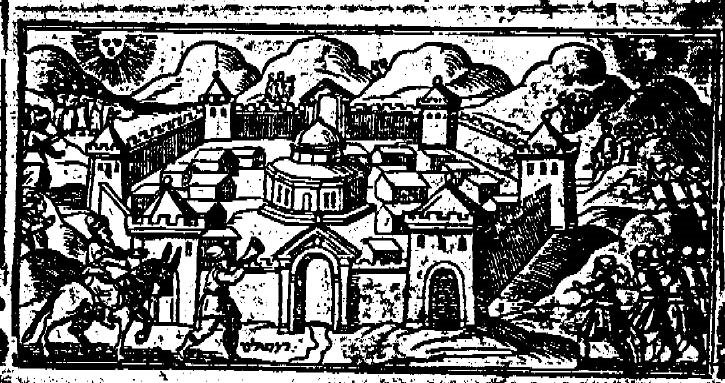
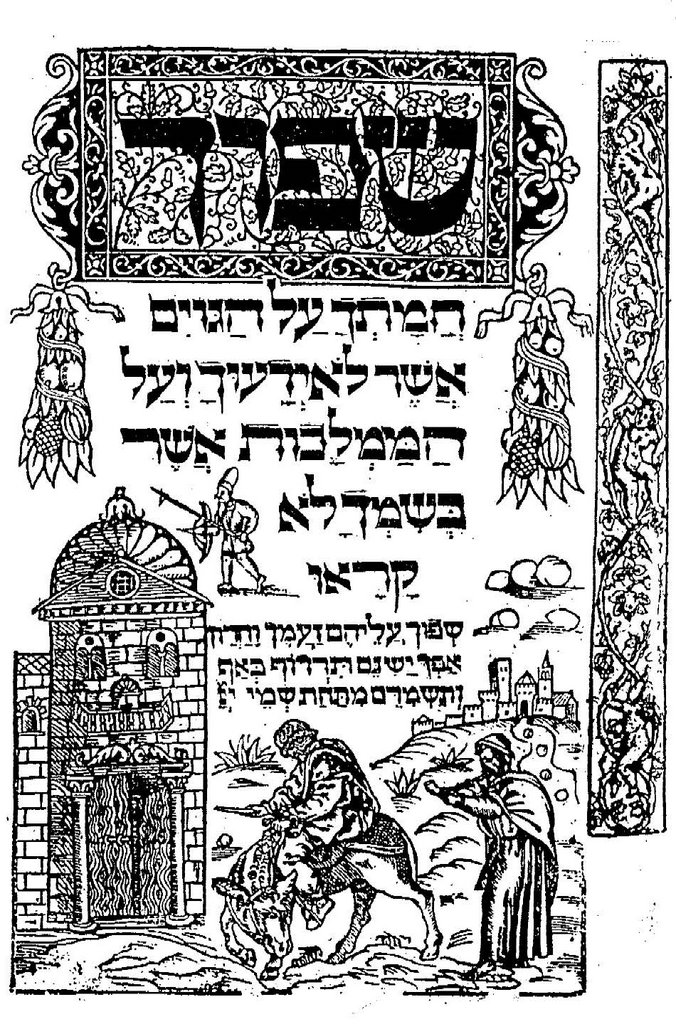
A rather interesting custom sprang up in connection with Eliyahu’s visit on Pesach night. R. Jousep Schammes (1604-1678), records that the custom in Worms was to draw depictions of Eliyahu and the Messiah in order to bring to life the belief in these figures. As you can see from the pictures on the side, this was common in the Haggadah. The first picture is a depiction of Messiah on his donkey. This was originally depicted in smaller format in the Prague 1526 haggadah, but in this edition, Mantua, 1560 is greatly enlarged. The second picture comes from the Venice 1629 hagaddah. As you can see it is again the Messiah coming in to Jerusalem, but note the prominence of the Dome of the Rock in the center.

In Frankfort they went one step further than just drawing Eliyahu and the Messiah. R. Yosef Jousep Hahn (1570-1637) says they used to hang a dummy who looked like Eliyahu or the Messiah behind the door. When they would open the door for Eliyahu the dummy would drop down and seem as if he had appeared. (He then goes on to record a long story of a dybuk who invaded the body of a women who questioned whether the Exodus happened.) It is worthwhile noting that not everyone was thrilled with these depictions. R. Yair Hayyim Bacharach (1639-1702) who became the Rabbi in Worms at the very end of his life, says these types of things only make a mockery of the seder.

However, we see from the above, that there was, at least among some, an effort to create a feeling that Eliyahu actually would visit the seder. Some did it through pictures, others through reenactments. Although today those have fallen to the wayside, it would seem the idea that Eliyahu actually drinks from the cup is a form of those methods.

Sources: Yerusalmi, Haggadah and History; Shmuel and Zev Safrai, Haggadah of the Sages, p 177-78. Minhagei Vermisai, p. פז; R. Y. Bacharach, Mekor Hayyim.


Purim, Mixed Dancing and Kill Joys

Although the Megilah only lists mishloch monot, matnot l’evyonim, and reading the Megilah as the customs on Purim, many others have become accepted. Most are of the ilk of boofunery or merrymaking. From making noise to drinking in excess, all have become part of the Purim landscape. With these, however, there are some lesser known customs. What is perhaps of interest is that it seems that there are those authorities that permit much if not all of these types of customs, there are others who seem set on shutting down much of the Purim fun.

For instance, the Rabbi Judah of Minz permits cross-dressing on Purim. This is so, even though this runs counter to a law in the Torah prohibiting these actions. What is lesser know, is that R. Minz also permits mixed dancing on Purim as well. In the Taknot of Padua it says “we decree that no one is permitted to dance with a married woman, no man with any married woman, with the exception of Purim.” (emphasis added).

Rabbi Yehuda Herzl Henkin in his Beni Banim vol. 1 no. 37 (5), links the two statements of R. Minz. R. Henkin says, just as R. Minz permitted cross-dressing as it was done for the joy of Purim, he permitted the mixed dancing under the same rational. That is, the dancing was just an outgrowth of the joy and not for licetnioius purposes.

Or, in the Customs of Worms, they not only celebrated Purim on the day, on the Shabbat after Purim they celebrated with similar merrymaking. Including, after the Friday night prayers all the people would first go to the Rabbi for a blessing, and then proceed to the women’s section where the Rabbi’s wife “would place her hands on their heads and bless them.” Additionally, R. Hayim Yosef Azulai in his travelogue, Ma’agel Tov, records that the Jews in Amsterdam would party all night long on the Friday night after Purim.

Although R. Minz was a proponent of happiness and its outgrowth on Purim, there were others that did not view Purim in the same vein. Rather, they seem bent on outlawing as much as possible even on Purim.

For instance, R. Samuel Aboab takes issue with at least two such Purim customs. First, he says in his Sefer Zikhronot, an ethical work and published anonymously, that he was befuddled his entire life how R. Minz and in turn R. Moshe Isserles in his Rama could allow for cross dressing on Purim. He spends at least four pages to demonstrating why this is incorrect. He states even if R. Minz is correct he should have kept that to himself. This is not his only negative opinion regarding Purim. In his responsa, Devar Shmuel, he says it is absolutely prohibited to read or even own the parody Mesachat Purim. He says any such copies should be destroyed.

Another person who looked with askance on the merry making was R. David ben Shmuel haLevi (Taz). He first follows the ruling of his father-in-law, R. Joel Sirkas (Bach), that cross-dressing is prohibited. R. Levi then also states in the law of Tisha B’av, that the prohibition of filling ones mouth with joy, is applicable even at at wedding and even on Purim.

So it seems that just as in society at large there are those who dislike the merrymaking on Purim, this is reflected in the Halakhic authorities as well. And conversely, there are those that viewed the merrymaking as a positive thing and therefore permitted many other things in connection with that merrymaking.


Ten Commandment Displays

Menachem Mendel has a nice post collecting a lot of the material on the Ten commandments. However, there is one point that I think is worth discussing.While 10 Commandment displays are ubiquitous in synagogues, it is far from certain this is the correct approach. Specifically, the Talmud records that public recitations of the Ten Commandments are banned because there were those who understood these readings to mean only the Ten Commandments are important to the exclusion of the rest of the Torah. R. Yom Tov Lipman Heller in his commentary Ma’adani Melekh (or Ma’adaani Yom Tov) says this reasoning should apply to Ten Commandment displays and he questions the practice of putting such displays up in synagogues. This statement is quoted in the Ma’gen Avrhom’s commentary on the Shulkhan Orakh. Many others question this practice including R. Ahron Lewin, (Reischer Rav) in his commentary on Berkahot.None of this, however, stopped the Agudah, the OU, and Nathan Lewin (R. Ahron Lewin’s grandson) from filing a brief in the Supreme Court advocating for Ten Commandment displays. While there is one person who permits such displays – they do so only in the context of a synagogue. That is, because in a synagogue the Ten Commandments would be part of the rest of the ornaments – Torah etc. it is clear that one is not imbuing them with any additional import. But, it is equally clear that the types of displays the Court would allow for – those totally devoid of any other Jewish context would run afoul of the Talmudic injunction.


Chanukah Customs and sources

While the only mandated mitzvot for Chanukah consist of lighting candles and saying the full hallel, there are numerous other customs that have come to be associated with Chanukah.

The custom to play driedel on Chanukah is steeped in mystical allusions. From the letters which appear on the driedel to the way the driedel spins, people have offered explanations to link this to Chanukah. The Beni Yisscar, R. Tzvi Elimelch says that the reason the dreidel is spun from the top and the gragger on Purim is turned from the bottom has to do with how each holiday’s miracles were effected. On Chanukah the miracle came from above, directly from God. However, on Purim, the miracles were directly brought about by the actions of Ester, Mordechi and the Jewish people. Thus, the dreidel is spun from the top showing the miracle came from above, and the gragger from the bottom showing the miracle came from below. Others explain the symbolism of the letters that appear on the dreidel, נ, ג, ה, ש. According to one explanation these hint to the mitzvot that we have on Chanukah, נרות שמונה (candles all eight nights) and הלל גמר (the complete hallel). Others note the gematria (numerical value) of the letters which correspond to the same gematria as משיח (the Messiah). Others still, link the letters with גשנה the city Yosef secured for his family in Egypt.

According to at least one source, the custom of playing dreidel was actually started in the time of the Maccabis. They say that in an effort to circumvent the Greek decree against studying the Torah, children and their teacher would have a dreidel handy to start playing in case the Greeks came upon them studying the Torah. They would claim they were not studying instead they were just playing dreidel.

Despite all of these explanations, in truth, dreidel is not Jewish in origin. Rather, driedel is really the rather old game of teetotum. Teetotum, which uses a top with four sides and four letters is one and the same with dreidel. The letters that appear on the dreidel are really just the Hebrew letters that appear on a German or Yiddish teetotum, G, H, N, S. G= ganz (all), H halb (half), N nischt (nothing) and S schict (put). Teetotum dates back to at least the 16th century long before we have any Jewish allusions to dreidel(it was originally totum or top, but became TEEtotum due to the use of T for take all, on the top). The well-known depiction of children’s games done by Brueghel in 16th century includes Teetotum(see here and here for the complete painting). The earliest Jewish mention of dreidel or the significance of it dates to the late 18th century.

The story connecting dreidel to the ruse of the Maccabis was first published in the book Minhagi Yeshurun, which was first published in 1890 (the name was changed to Otzar Kol Minhagi Yeshurin in the third edition, which is available online here from Hebrewbooks.org . The author included a nice picture of himself at the beginning, although he was a Rabbi in Pittsburgh at the turn of the twentieth century, he is holding a quill pen.) His source is a contemporary of his. [As an aside, although his explanation of dreidel is well-known he offers a similar explanation for playing cards on Chanukah, i.e. that the Maccabi did so. However, that one is not nearly as well know.]

The custom of Chanukah Gelt appears to have changed over time. The earliest sources that mention money on Chanukah connect it with either collecting money for the poor (presumably for money to purchase the necessary implements for the Chanukah lights)(Sefer Mataamim) or giving money to ones children’s teachers. (Hemdat Yamim, Chapter 3 Chanukah early 18th century, anonymous author, some claim was Nathan of Gaza, Shabbtai Tzvi’s “prophet” others just a student of the Ari).

Again, especially amongst the Hassidic commentators, the custom took on a life of its own, both in its scope to include giving money to children and in its significance. There was also a special emphasis on giving their respective Rebbi money as well. R. Chaim Palache (Pellagi) (1788-1869) is the first to mention giving children money. He offers a kabbalistic reason “as children are representative of נצח והוד (eternity and glory). Something I don’t profess to have any idea what that means.

Another custom, again somewhat late in origin, is the custom to not study Torah on Christmas eve. Menachem Butler has a post here on some sources, however, one should add that there is now a full length sefer devoted to this topic, Yisrael Barukh Mestinger, Nitel U’Meorosav, 2000. As well as a pamphlet, Hefaru Toresecha, maamar maktif mminhag avotanu bi-yadun (sic) odot lel ha-ofel nitel nacht, u-minhag yisrael l’vatel ma-asek ha-torah, 2004. Additionally, R. Gavreil Zinner, devotes a section of his work, Neta Gavreil on Chanukah to Nitel.

For more on the various customs associated with Chanukah, see Neta Gavreil Chanukah; Pardes Eliezer Chanukah 2 vol.; R. Yitzhak Tessler, HaDreidel (Sivvivon) B’Chanukah: Mikoroteha, Tameha, u’Minhageha, in Ohr Yisrael 50-62, vol. 14 (Tevat תשנ”ט).


Minhagim Books No. 1

I hope to present a couple of post on various Minhagim books. Some will focus on communal Minhagim books, and others on the minhagim of specific people.

The Tashbetz, also known as the Tashbetz Koton to distinguish between this the teshuvot haTashbetz, are the customs of R. Meir of Rothenburg as recorded by his disciple. The disciple’s name formed the title, however, it is unclear what exactly was his name. Obviously, it is linked to the title, Tashbetz. Some explain the title as Talmid Shimon ben Tzodok others say he was Talmid Shmuel ben Tzodok, or Tosefot Shimon ben Tzodok, Tosefot Shimon ben Yoitz, orTikkun instead. The book was supposedly written when R. Meir was imprisoned.

The book collects all the customs of R. Meir dealing with the holidays, prayers and everything in between. As R. Meir is one of the gedoli Ashkenaz many of his customs were followed by subsequent generations. Of course, his customs were generally highly influential also due to his students, R. Mordechi ben Hillel haKohen, author of the Mordechai code on the Talmud, R. Asher b. Yehiel (Rosh) as well as his son R. Jacob (Tur) as well as many others.

There are many fascinating customs, whose sources are from the Tashbetz. , standing during the recitation of the Torah, washing ones hands after the kiddush, eating head of a ram on Rosh haShana, saying Zikhron Terura when Rosh haShana is on Shabbat, reciting both Eloki ‘ad shelo netzarti and aloki netzor on Yom Kipppur and the list goes on. There are also some key passages, which explain other unclear customs. For instance, Naftali Wieder explains a rather cryptic passage in the Tashbetz as offering a totally new rational for why some people switch the word b’Fie (Bet-Peh-Yud) in Barukh She’amar to b’Feh (Bet-Peh-Hey). According to Wieder, Fie, is a curse in numerous languages, [think fie fi fo fum] and thus, the Tashbetz is saying for that reason one must alter the word.

There is actually a new edition of this book, however, it has some rather glaring flaws. The editor of this edition, [Sefer Tashbetz haKoton, Israel, 2005 Machon Torah S’beketav] states that he used a specific manuscript for this version, namely the one that he matched up with R. Yosef Karo. From the fact that this manuscript conformed with R. Karo’s readings, this was the manuscript of the Tashbatz. Why the manuscript R. Karo, who lived some 300 years after the time of the transcription of the book, is left wholly unanswered. Further, aside from matching up a couple of passages from the Tashbetz with that of R. Karo, nothing further is offered about this manuscript. The editor never dates the manuscript, talks about where it was written and by whom. In fact, the reader is left to guess whether this manuscript was written after the Shulhan Orakh and Bet Yosef and was done with the specific purpose of conforming with the readings of R. Karo. The editor never says which of the “hundreds” of manuscripts there are of the Tashbetz is actually the oldest. Only that if R. Karo may have used one then that one is dispositive of R. Meir of Rotenberg’s statements. Obviously, this is absurd.

This fundamental flaw aside, there are some positive points of this reprint. The first is that they have reproduced the first edition of the Tashbetz, Cremona 1556. This is reproduced fully, including a interesting title page which can be added to a previous post of mine. The editor has also added some notes, which at times are helpful. He generally uses abbreviation in referencing other books, he includes a key to explain these abbreviations. However, he cites to R. Daniel Goldsmit’s Machzor as well as Weider (cited above) but for those abbreviations, the reader is left on there on. I assume he did not want to “taint” anyone with citations to scholars that although he saw fit to use, did not wish to fully reveal to his readers.

For further reading on both R. Meir and the Tashbetz, see Arbach Ba’alei haTosefot, 552-564; Yode’a Sefer (in vol. 2 of the Roest Catalog) no. 2525; Encyclopedia Judaica 11:1247-53; N. Wieder, Hisgabsut Nusakh haTeffila b’Mizrak u’Ma’ariv (The Formation of Jewish Liturgy in the East and the West) Jerusalem 1998 469-491.