Book announcement: Roots and Rituals: Insights into Hebrew, Holidays, and History by Mitchell First

Book announcement: Roots and Rituals: Insights into Hebrew, Holidays, and History

By Eliezer Brodt

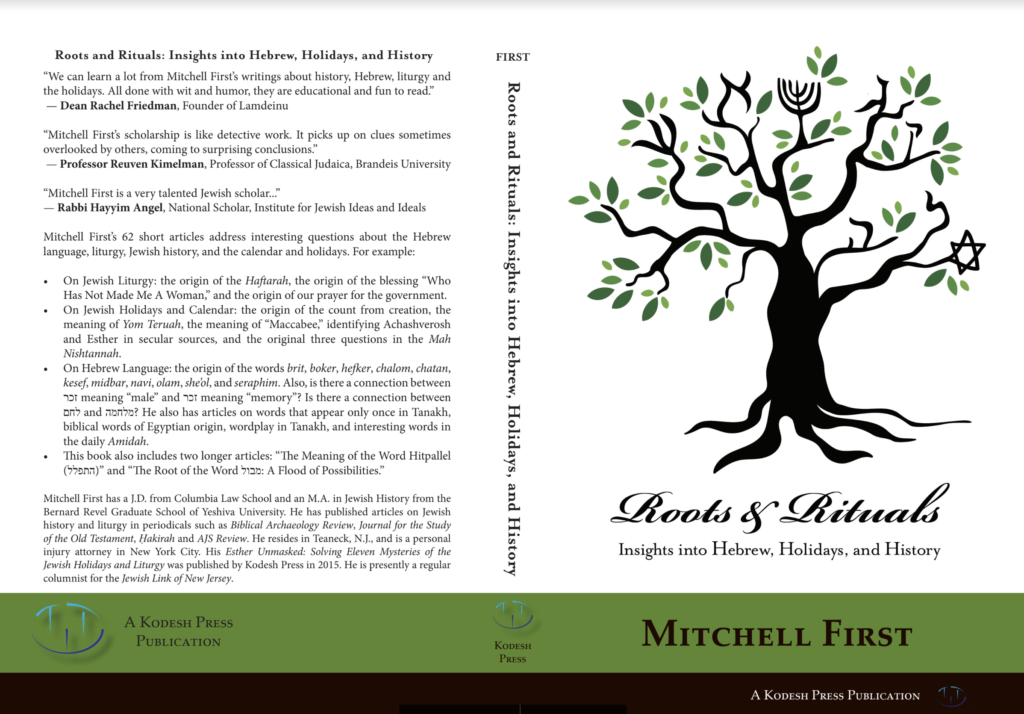
The Seforim Blog is proud to announce the publication of our contributor Mitchell First’s newest bookRoots and Rituals: Insighats into Hebrew, Holidays, and History (Kodesh Press, 2018.)


Mitchell First’s 62 short articles address interesting questions about the Hebrew language, liturgy, Jewish history, the calendar and holidays. For example: On Jewish Liturgy: the origin of the Haftarah, the origin of the blessing “Who Has Not Made Me A Woman,” and the origin of our prayer for the government. On Jewish Holidays and Calendar: the origin of the count from creation, the meaning of Yom Teruah, the meaning of “Maccabee,” identifying Achashverosh and Esther in secular sources, and the original three questions in the Mah Nishtannah. On Hebrew Language: the origin of the words brit, boker, hefker, chalom, chatan, kesef, midbar, navi, olam, she’ol, and seraphim. Also, is there a connection between זכר meaning “male” and זכר meaning “memory”? Is there a connection between לחם and מלחמה?

He also has articles on words that appear only once in Tanakh, biblical words of Egyptian origin, wordplay in Tanakh, and interesting words in the daily Amidah.

This book also includes two longer articles: “The Meaning of the Word Hitpallel (התפלל)” (which appeared on the Seforim Blog here) and “The Root of the Word מבול: A Flood of Possibilities (which appeared on the Seforim Blog here).”

The book can be ordered here.

For some reviews of the book see here, here and here.

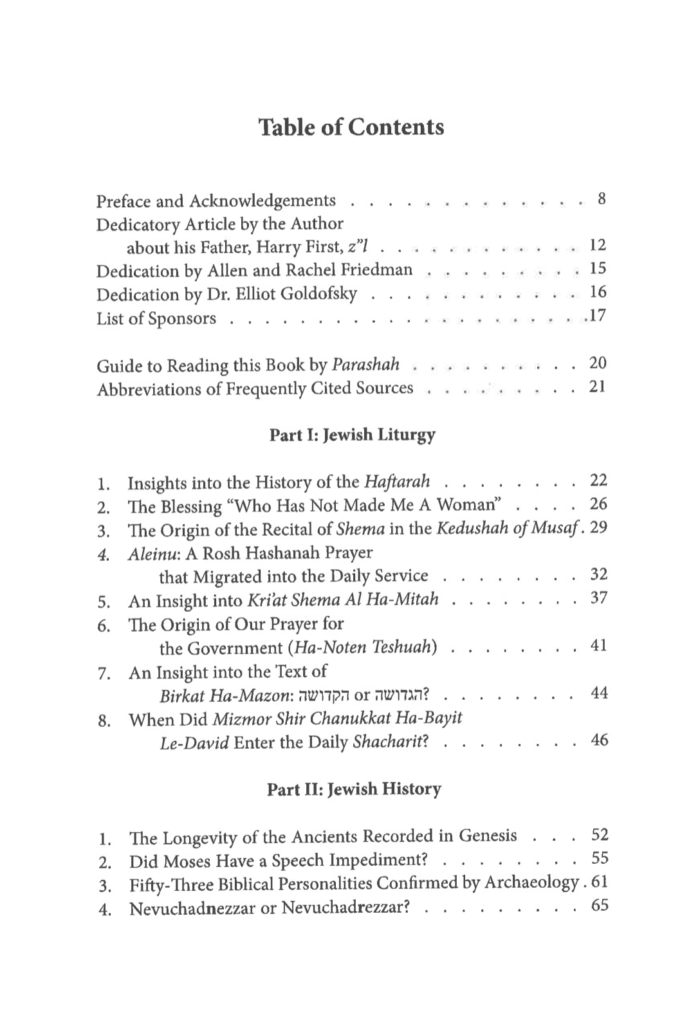
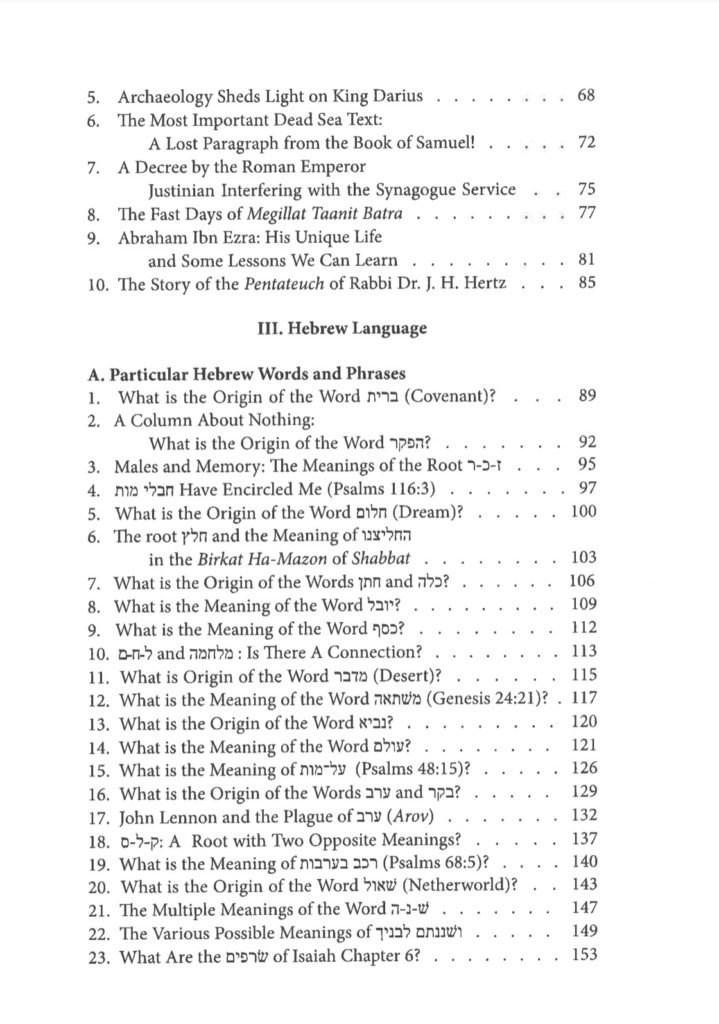
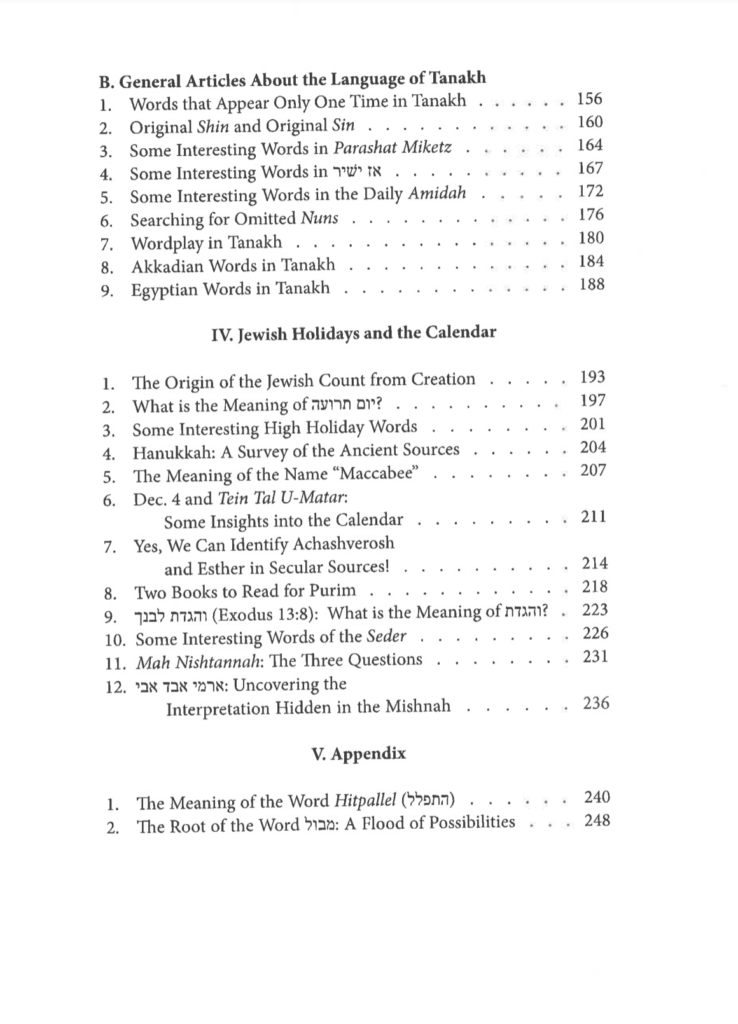
Here are the Table of Contents:


The Gaon’s Impact on the Interpretation of both Primary Sugyot in Zemanim

The Gaon’s Impact on the Interpretation of both Primary Sugyot in Zemanim

By William Gewirtz

Unquestionably, almost all iddushim in the understanding of the vast literature on zemanim have halakhic implications. My intent is not to influence what has become minhag Yisroel; my focus is on establishing more precise halakhic definitions and theoretical innovations in sugyot that are central to the study of zemanim. Competent poskim can implement any changes in halakhic practice, which they determine that these innovations support.[1]

Two areas dominate the study of zemanim:

  • How to determine precise delimiters for the day of the week, which concludes at the end of the period of bein ha-shemashot.[2]
  • How to calculate the hours of the daytime period, which according to all opinions begins at alot hashaar.

Interestingly, in both Hebrew and English, the words yom and day denote both the daytime period and the day of the week. Our focus is on:

  • the Gaon’s impact on the interpretation of two key aspects of Shabbat 34a-35b, which examines the transition between days of the week, and
  • a key aspect of the Gaon’s clarification of Pesaim 94a focused on the daytime period.

The approach to the above sugyot were radically changed by the Gaon’s observations.[3] However, only the impact on the former sugyah in Pesaim is usually recognized.

As I strongly indicated in a paper on errors in halakhic reasoning, I do not believe that attempts to deal with the critique of Rabbeinu Tam’s position by the Gaon have ever been fully effective. In this paper, however, the focus is not on the extensive halakhic literature written primarily in the period of the aaronim, but on the text of the gemara itself and its interpretation by rishonim. The conclusions reached are very different.[4]

The first two sections address areas in the gemara beginning on Shabbat 34a where a significant modification to an earlier reading of the gemara, often associated with rishonim aligned with Rabbeinu Tam, is strongly preferred, but only when assuming a slight modification to the presumed opinion of the geonim / Gaon.[5] In a similar vein we suggest a modification to how the bein hashemashot interval is to be used, something I believe to be independent of the positions of Rabbeinu Tam and the Gaon.

The third section addresses the Gaon’s innovative reading of the gemara in Pesaim 94a, a reading that is strongly supported by both elementary logic and astronomy. Included in the Gaon’s reading is a concept that was never made explicit in rabbinic literature prior to the Gaon, to the best of my knowledge. As will become clear, that observation forms the basis for the Gaon’s challenge to the opinion of Rabbeinu Tam.

My observations are not intended to be judged as controversial, although concluding a sugyah may not have been correctly understood (or at the very least properly explained) until the 18th century might be jarring.  It is beyond my focus or competence to deal with the implications of that observation; observations addressing that point would be welcomed.

Section 1: The endpoints of the period of bein ha-shemashot

The dispute between the geonim / Gaon and Rabbeinu Tam revolves around the placement of the interval of bein ha-shemashot, within the interval between sunset and tzait (kol) ha-kokhavim, whose length is (almost always) assumed to be the time needed to walk 4 milin.[6] The length of the bein ha-shemashot period is universally assumed to be the time needed to walk ¾ of a mil. It is normally assumed that

  • the opinion of the geonim / Gaon places the bein ha-shemashot period at the start of that interval, while
  • Rabbeinu Tam places it at its end.

Those two alternatives represent opposite extremes.  Two adjustments seem reasonable.

  • First, separate the dispute between the geonim / Gaon and Rabbeinu Tam into two distinct components:
    • The first concerns the beginning and the second the end of the bein ha-shemashot period, subject to a constraint that the length of the bein ha-shemashot interval must equal the time to walk ¾ of a mil.
  • Second, assume that there are multiple hybrid / intermediate positions, situated between the two generally assumed alternatives.[7]

This allows for

  • an interpretation of the gemara in Shabbat similar (or according to some identical) to the overwhelmingly compelling position of the geonim / Gaon relative to the end of the bein ha-shemashot period,
  • while defining the beginning of the bein ha-shemashot period using the textual approaches of many rishonim, albeit employing a significantly earlier point in time, much closer to sunset.

While I have not seen this conceptualization explicitly formulated[8] in the classic halakhic literature, practice and several pragmatic opinions are supportive of this approach.  More importantly, the challenges raised to the opinions of both Rabbeinu Tam and the Gaon are, without exception, directed at the late ending of the Shabbat according to the opinion of Rabbeinu Tam and at the early beginning of the Shabbat according to the opinion of the Gaon.[9] This approach sidesteps the challenges to both opinions. Additionally, this approach absolutely disputes the view that

  • Anyone who rejects the start of Shabbat precisely at or even a few minutes after sunset must embrace the approach of Rabbeinu Tam,

an assumption that does not follow logically, though it is occasionally found in the halakhic literature.[10]

There are numerous arguments in support for this position. We cite several of the strongest:

  1. The term mi-she-tishkeh ha-amah: Ramban in Torat Ha-Adam[11] and the many akhemai sforad who adopted his position stress that the meaning of the term mi-she-tishkehha-amah unquestionably implies not sunset but a point after A simpler phrase shikiat haamah would denote precisely sunset. Of course, mi-she-tishkehha-amah does not imply any specific time but only that the time follows sunset by some number of minutes. The only change required is to assume that mi-she-tishkeh ha-amah is referring to a point much closer to sunset, something that appears more reasonable than a point over 50 minutes later according to the (theoretical) view of Rabbeinu Tam. In other respects, the gemara is read like the numerous rishonim who assumed that mi-she-tishkeh ha-amah cannot refer to sunset proper.
  2. Tosefet Shabbat:[12] Ramban argues that tosefet Shabbat could only begin after sunset during an interval that is still a part of the daytime period. Ramban does not consider tosefet Shabbat prior to sunset as meaningful, equating it to the value of illumination from a candle during daylight.
  3. The sugyah in Shabbat applies year-round, not only during a specific season or seasons: The gemara in Pesaim 94a, which equates the time needed to walk 40 milin with the daytime period, must assume an average day around either the spring or the fall equinox. In the Middle East, during a winter day of approximately 10 hours or a summer day of approximately 14 hours, the distance covered in one day would vary considerably. However, unlike the gemara in Pesaim 94a that can only apply to a 12-hour daytime period, the gemara in Shabbat, defines the end of Shabbat using terms like ashekhah, hisif ha-elyon ve-hishveh le-taton and the appearance of three stars, all of which apply (nearly) uniformly throughout the year.[13]

At both the fall and spring equinox, the sun appears in the same place over the equator and you might expect Shabbat to begin and end at the identical time.  Certainly, regardless of how one measures darkness, it is equivalently dark any number of minutes after sunset at those two times.  However, in Jerusalem and other parts of the Middle East, unrelated to the degree of darkness, stars first appear a number of minutes later (after sunset) in the fall than they do in the spring.[14]Advantaged by the early appearance of Sirius and Canopus in the spring but not the fall, the Gaon restricts the focus of the gemara to the spring only.

Note that:

  1. All rishonim who choose to comment on the sugyah in Pesaim 94a state that the day in question occurs only around the spring (or fall) equinox.
  2. Not a single rishon makes an analogous comment, restricting the gemara beginning on Shabbat 34b to any specific time of year.
  1. Shmuel’s unchallenged statement:[15]With Prof. Levi’s table (provided in the appendix) as background, examine Shmuel’s unchallenged statement on Shabbat 35a, according to the position of the geonim / Gaon.[16] After discussing the appearance of the horizon and the length of the bein ha-shemashot period, the gemara states the opinion of R. Yehudah in the name of Shmuel who asserts: “one star – daytime, two stars – bein ha-shemashot, and three stars – night.”[17] This is followed by the opinion of Yosi (bar Adin) asserting that the stars in question are neither stars that appear in the day (i. e., large stars[18] or planets) nor small stars that only appear well after the time of tzait ha-kokhavim, but medium stars. How might Shmuel’s statement be reconciled with the previous discussion in the gemara?
  • First, exclude the implausible suggestion that R. Yosi bar Adin’s assertion that Shmuel’s statement is referring to medium stars applies only to the third part (or second and third parts) of the text. Under this interpretation, the first part of Shmuel’s statement concerning one star, includes not only medium stars but also large stars or planets that are on occasion visible before sunset.  Were that the case, the statement would be informing us that the appearance of a planet before sunset does not indicate that the bein ha-shemashot period has begun. In addition to being forced to argue that the different parts of Shmuel’s statement refer to different types of stars, such an assertion would hardly be necessary; the gemara gives no hint that the bein ha-shemashot period begins before sunset.[19]
  • Second, because R. Yosef begins bein ha-shemashot at the time walk 1/12th of a mil later than R. Yehudah, some[20] align Shmuel’s statement and even pasken like R. Yosef, assuming that R. Yehudah start to bein ha-shemashot precisely at sunset, cannot be reconciled with Shmuel’s statement. Prof. Levi’s chart challenges that approach, since a delay of at most 2 minutes[21] (after sunset) provides no benefit; the first medium star cannot be seen until at least 6 minutes after sunset.
  • Third, there are other (implausible) solutions that align Shmuel with Rabi Yosi only, some going so far as identifying the amora Yosi (bar Adin) as the tanna Rabi Yosi. To follow a sugyah focused on Rabi Yehudah, with an uncontested statement that accords only with Rabi Yosi is dubious, at best. Furthermore, Shmuel’s statement, which refers to the non-instantaneous, successive appearance of stars, is difficult to align with an opinion that the bein ha-shemashot interval is instantaneous.

The most plausible suggestion, like the view of R. Ḥaim Volozhin below, is that the bein hashemashot begins at least 6 minutes after sunset.[22]

  1. Seeing stars so early (even if only in the spring) is practically impossible:

If the start of the period of bein ha-shemashot for the geonim / Gaon is precisely sunset, there has been considerable effort[23] to align the appearance of three stars within the time it takes to walk ¾ of a mil after sunset. The only solution provided is to assume that the time needed to walk ¾ of a mil applies only around the spring equinox[24] [25] and, even then, to make yet further assumptions to arrive at so short an interval.  Particularly if the time needed to walk ¾ of a mil is 13.5 minutes and even if it is a bit under 17 minutes, three stars can rarely be seen so soon after sunset and then

  • only with great difficulty,
  • by experts, perhaps aided by telescopes, and
  • in a pristine environment absent urban sources of light, like the Judean desert.

Under no circumstances, is 13.5 minutes possible, and 16.85 minutes is almost equally unreasonable.[26]

  1. Multiple opinions that begin bein ha-shemashot slightly after sunset:
  • 4 to 5 minutes: The minimum time reported as the custom of Jerusalem[27] as well as the opinion of R. Shneur Zalman of Liadi,[28] the point when the sun is no longer visible even from the highest elevations around Jerusalem.[29]
  • Greater than 6 minutes: The opinion of R. Ḥaim Volozhin based on Shmuel’s statement concerning the appearance of a single star that is visible in the spring to an expert observer at that time.[30] The fact that R. Ḥaim Volozhin disagrees with his Rebbe, strongly suggests that the Gaon’s position that Shabbat starts at precisely sunset was only promulgated le’migdar miltah.
  • 7 to 15 minutes: These views are supported by a variety of sources mentioned previously including R. Kapach’s view of Rambam and R. Posen’s view of the opinion of the geonim. A time around 10 minutes is implied by many Sephardi poskim who mention that until the call of the Moslem mugrab for their fourth prayer service, it is still day thus allowing for the performance of a brit on that day for a baby born in those few minutes after sunset on that same day one week earlier.

When linked to the times given in Prof. Levi’s charts, various alternatives from 6 – 16 minutes after sunset can be plausibly suggested.  The next section on how the bein hashemashot interval was intended to be used will shed further light in determining how many minutes after sunset might still be considered daytime.

Section 2.  Before or after

One aspect of the Gaon’s interpretation of Shabbat 34b, often assumed without further examination, is that bein hashemashot is calculated by adding its length to the beginning of the beginning of bein hashemashot period.  That assumption will now be challenged.  Though not conclusive as to how the sugyah should be read, some seforim of near contemporaries[31] of the Gaon assume the opposite approach, subtracting the length of the bein hashemashot interval from the end of Shabbat. The arguments below attempt to demonstrate that this approach may have been standard before the writings of the Gaon proliferated years later in the middle of the 19th century.[32] While some may argue that counting forward from sunset versus backward from nightfall is somehow tied to the fundamental makhloket of the geonim / Gaon and Rabbeinu Tam, there does not appear to be any logical, textual or halakhic basis for such an assertion.

The fundamental question is:

What possible value could there be in introducing (especially in an era before clocks) a time-based approximation that is a lower bound, season dependent, rarely applicable, and then only under rare, idealized conditions, at best? In what context would such information be useful?

Thus, I propose that the time needed to walk ¾ of a mil should be interpreted differently than the Gaon proposed and instead we will attempt to demonstrate that

  • The time to walk ¾ of a mil is to be subtracted from the end of the bein ha-shemashot period as opposed to being added to its beginning.
  • The period is not a minimum (that occurs only around the spring equinox), but a maximum (that occurs around the summer solstice). Thus, the entire sugyah is applicable year-round providing a conservative upper-bound to the length of the bein ha-shemashot

The arguments for both assertions are interrelated and are presented concurrently.[33]

  1. The gemara in Shabbat is primarily focused on Friday night and determining when the bein ha-shemashot period begins, as opposed to when it ends. The gemara assumes that the end to the period of bein ha-shemashot is known; each of the disputants are addressing when the period of bein ha-shemashot begins on Friday night. However, if the time needed to walk ¾ of a mil were meant to be added to the time of sunset, it would be addressing the end of the bein ha-shemashot period and not the beginning.
  2. The three fractions (each expressed as the time needed to walk a part (1/2, 2/3 and ¾) of a mil,) given as alternatives for the length of the period of bein ha-shemashot would then all have identical semantics; each of the three fractions (of the time to walk a mil) is counting back from the assumed point of ashekhah, to calculate the beginning of the bein ha-shemashot Given Prof. Levi’s chart, under no circumstances could anyone imagine that the time to walk either ½ of a mil after sunset could be the point at which Shabbat ends. The amoraim, R. Yehudah and R. Yosi, are quantifying the opinion of Rabi Yehudah in contrast to Rabi Nehemiah’s interval, whose period of bein ha-shemashot is only the time needed to walk ½ of a mil.
  3. If someone were countering the position of Rabi Yosi, who says the period of bein ha-shemashot is instantaneous, it is more likely that he would say that it can be “as long as” opposed to “as short
  4. The significant issue raised previously of never seeing stars as early as at the time needed to walk ¾ of a mil after sunset becomes entirely moot.
  5. The period of bein ha-shemashot has some practical consequence providing a potentially useable, conservative upper bound as opposed to a purely theoretical lower bound, which is of limited to no use.
  1. As noted earlier, rishonim, who limit the gemara in Pesaim to the equinox periods in the fall and spring, make no such assertion with respect to the gemara in Shabbat. One might presume from the lack of commentary that rishonim assumed that the sugyah applies year-round.

Treating the gemara in Shabbat like the gemara in Pesaim as referring only to days around the spring (but not the fall) equinox[34] is unnecessary when thinking of the interval as a practical upper bound.  All the other descriptions in the gemara, either the appearance of the sky / horizon or the visibility of three stars, apply year-round.

Now examine the three elements in combination:

  • The various opinions of rishonim on the time to walk ¾ of a mil – 13.5, 16.85 and 18 minutes.
  • Levi’s chart indicating that 3 stars are visible to a careful observer 30[35] minutes after sunset in the summer.
  • The two suggested interpretations that
  • delay the beginning of bein hashemashot to a point slightly after sunset, and
  • view the sugyah as subtracting the length of bein hashemashot from its end to find its beginning.

We can then assume that Shabbat begins from 12 (subtracting 18 from 30) to 16.5 (subtracting 13.5 from 30) minutes after sunset.[36]  However, given

  • very natural and expected stringency that occurs even today but certainly are to expected in an era before (widely available and accurate) clocks, and
  • the need for tosefet Shabbat

practiced times for starting Shabbat between 5 and 10 minutes after sunset ought not be surprising.

Section 3. The Gaon’s approach to Pesaim 94a.

The Gaon’s approach to Pesaim 94a is premised on an incontrovertible astronomic and logical fact. Assuming that alot hashaar approximates the first light of the day, then its evening counterpart, tzait ha-kokhavim, must occur when the sun’s illumination has (next to) no remaining effect.[37]  At both of those times, all stars that are in position to be seen are not obscured by illumination from the sun. As a result, the Gaon adds the word kol to differentiate tzait ha-kokhavim, which throughout the Talmudic literature refers to the appearance of 3 stars, from tzait kol ha-kokhavim, the appearance of “all the (potentially visible) stars.” Of course, this point demolishes[38] Rabbeinu Tam’s interpretation that is predicated on the assumption that the meaning of the term tzait ha-kokhavim occurring in both Pesaim 94a and Shabbat 35a is the same. Slightly reformulated the Gaon asks how could the time of the appearance of only three stars and the time of alot hashaar, when (almost) all the stars are still visible, be separated by intervals of identical length from sunset and sunrise respectively?  The pre-dawn counter point to the time after sunset when (only) three stars are first visible cannot be alot hashaar when (almost) all stars are still visible.[39]

This iddush is not unexpected, even though the gemara in Pesaim is the primary sugyah used throughout halakhic history to provide a source for determining the time of alot hashaar.  Despite that halakhic application, the sugyah is focused primarily on geography and astronomy. Thus, harmonious use of the term tzait ha-kokhavim with its use elsewhere in Talmudic literature, which Rabbeinu Tam assumed, need not be presumed.

Since the notion of tzait kol ha-kokhavim is new, it is also not surprising that the Gaon did not specify, to the best of my knowledge, any halakhic uses for the notion of tzait kol ha-kokhavim. Of course, those who followed Rabbeinu Tam’s position had no reason to even consider a point in the evening after tzait ha-kokhavim.

However, that changed with the arrival of what we colloquially call the Brisker methodology. Talmudists of that school have produced potential halakhic implications. For example, it is not difficult to differentiate between:

  • halakhot tied to a specific day or those that are to be performed every day,
  • from those that have no connection to any specific day but are restricted to being performed only during the daytime period.

Presumably, the construction of the Beit HaMikdash is a straightforward example. While there is a daytime requirement,[40] there is no constraint on which day of the week that construction should take place. Another example, which does not comport with the above iluk, has been proposed by R. Moshe Soloveitchik. He suggested the use of tzait kol ha-kokhavim as a delimiter for tosefet Shabbat according to those following the Gaon.  While Shabbat ends at the time of tzait ha-kokhavim, R. Soloveitchik proposed that tosefet Shabbat is meaningful only until tzait kol ha-kokhavim.

While these examples[41] are noteworthy, the lomdus of a yartzeit shiur by R. Joseph Soloveitchik was astonishing. Effectively, but not explicitly, R. Soloveitchik disregarded both historic interpretation and practice when he transformed Rabbeinu Tam into an early supporter of the notion of tzait kol ha-kokhavim.[42]  As presented in that shiur, though expressed slightly differently, the dispute between the Gaon and Rabbeinu Tam revolves around whether Shabbat ends at tzait ha-kokhavim or tzait kol ha-kokhavim.[43]

In R. Soloveitchik’s formulation, the Gaon defined a critical point along a continuum beginning at the point of sunset, when there is almost complete exposure to the sun’s illumination, and ending at the point of tzait kol ha-kokhavim when no noticeable impact from the sun’s illumination can still be detected. That critical point occurs roughly when 3 medium stars first become visible and marks the transition point between days of the week according to the geonim / Gaon.  Rabbeinu Tam, however, according to R. Soloveitchik’s formulation, defined the transition between days of the week at the point when the sun’s impact has ended entirely, a point corresponding to the end of the continuum, at tzait kol ha-kokhavim.[44]

A possible approach that R. Soloveitchik did not employ is that the Gaon and Rabbeinu Tam decided differently based on two conflicting sugyot in Shabbat and Pesaim, respectively. Of course, that would be at variance with Rabbeinu Tam’s normal methodology for resolving conflicting sugyot.  Rabbeinu Tam tends to distinguish between sugyot, something he does explicitly with respect to these sugyot, as opposed to declaring sugyot in conflict and deciding between them. The principal motivation for even raising such a possibility is R. Soloveitchik’s complete avoidance of any mention of the challenges to Rabbeinu Tam’s position from the sugyah in Shabbat. This leads me to wonder if in R. Soloveitchik’s ahistorical reformulation of Rabbeinu Tam, and for reasons entirely unstated, R. Soloveitchik gave the sugyah in Pesaim prominence and preference over the sugyah in Shabbat according to Rabbeinu Tam.

Conclusions:

It is not at all usual to treat a ruling of the Gaon as le’migdar miltah.  However, three things increase my confidence that I am correct in this instance.

  1. The reality as described in the epistle of the Ba’al ha’Tanya referenced earlier, who lived at the same time and in the same general area, clearly describes people working beyond 30 minutes after sunset, something that the Gaon would be motivated to prevent as resolutely as possible.
  2. The opinion of R. Ḥaim Volozhin, in open disagreement with the Gaon’s stated position, demands a reconciliation of views.
  3. The textual arguments made by rishonim, the halakhic writings and positions of noted aaronim, and the various arguments that I have formulated appear convincing.

What should be noted is the Gaon’s interesting ability to impact not just pesak, but the way we (perhaps even unconsciously) approach the study of sugyot.

Appendix


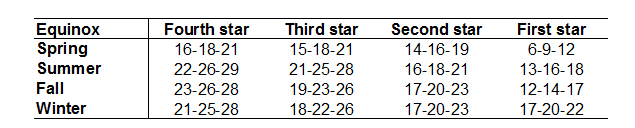
Prof. Levi’s Table

The three times listed in each cell of the table correspond to how difficult it is to see a star.

  • The shortest time noted is when an expert who knows exactly where to look can observe a star.
  • The intermediate time noted is when a star can be seen with great difficulty.
  • The third time noted is when a careful observer can see a star.

The time when stars are visible to a casual observer, is yet later.

[1] My assumption is that poskim may find the innovations useful in exceptional situations as opposed to more typical ones.
[2] According to the vast majority of rishonim, the day ends when bein ha-shemashot ends or at most 2 minutes later.
[3] Familiarity with both sugyot is assumed to fully assess this essay.
[4] See my article in Hakirah spring 2019 for more detail on the Gaon’s convincing attack on Rabbeinu Tam’s position.
[5] A version of that reading is presented in Ohr Meir as the opinion of the geonim, who R. Posen seeks to demonstrate conflict with that of the Gaon.  What the Gaon felt mei ikar ha’din can be disputed as will be illustrated.  Even if one were to reject any variation of the Gaon’s stated position, this paper can also be considered to apply to the less specific view of the geonim.
[6] Both 72 or 90 minutes are increasingly assumed to apply only in the Middle East around both equinoxes and require adjustment (using depression angles) to account for variation by season and latitude.
[7] These positions are more properly characterized as variants of the position of the geonim / Gaon as they are all much closer to their normally assumed period of bein ha-shemashot.
[8] Throughout R. Kapach’s commentary on Mishnah Torah, however, he asserts that this is the position of Rambam. See R. Posen’s view as well, mentioned in footnote 5.
[9] This seminal point was made explicitly by R. Chaim Sonnenfeld in teshuvah 33 (an approbation to a sefer on zemanim) in a recently published volume of his teshuvot.  His reaction, as might be expected, was to be mamir, and fulfill the stringencies of both opinions. I argue that the strengths of both opinions lead to the opposite and more probable conceptual position, adopting the leniencies of both positions.
[10] See Vol. 2 of HaZemanim BeHalakha by R. Ḥaim Benish, page 360, especially footnote 58.
[11] Pages 251 – 252, Chavel edition, Mossad Ha-Rav Kook.
[12] This argument is included due to its ancient provenance; it is easily challenged given that it is normally assumed that tosefet Shabbat can begin at plag ha’minah, which precedes sunset.
[13] Note as well, that the gemara in Pesaim 94a applies to

  • a day of average length,
  • which occurs around both the spring and fall equinox.

However, the days that would be referred to in Shabbat 34b would be

  • a minimum, as opposed to an average, and
  • restricted to those days when the appearance of three stars occurs within the time needed to walk ¾ of a mil after sunset. For astronomic reasons such days occur only in the spring and not in the fall.

While neither of these two differences is itself convincing, both lend further support to the thesis developed.
[14] See the chart by Prof. Levi provided in the attachment.
[15] A more extensive analysis of Shmuel’s statement will appear in a future issue of the Torah u’Maddah journal.
[16] This section assumes detailed familiarity with the sugyah on Shabbat 34b-35b.
[17] Prepositions have been omitted from the statement in order not to bias the semantics.
[18] Large stars are defined as kokhavei lekhet, moving stars, currently called planets. Other approaches to dividing stars into categories are much less likely and not considered.
[19] The isolated opinion of R. Eliezer mi’Mitz, who begins the bein ha-shemashot period before sunset, is difficult to reconcile with Shmuel’s statement, in any case.
[20] See the last two paragraphs on page 358 and especially footnote 50 in Vol. 2 of HaZemanim BeHalakha.
[21] The time to walk 1/12 of a mil is between 1.5 and 2 minutes.
[22] While normally I would assume Prof. Levi’s third entry matches Shmuel’s assertion, since this statement might mean seeing a star does not mean bein ha-shemashot has necessarily begun, it might mean just an accidental sighting, which may occur at the earliest time possible when normally only an expert, knowing exactly where to look, can locate a star.
[23] R. Benish, R. Willig, Prof. Levi among many others struggle with this issue.
[24] In the spring Sirius and Canopus can both be seen around 15 minutes after sunset.
[25] Having seen no earlier discussion of this issue anywhere in the halakhic literature, I believe this interpretation originated with the Gaon in O. . 261. The alternative under discussion, delaying the start of bein ha-shemashot by some small number of minutes after sunset, eliminating the hypothesis that bein ha-shemashot begins precisely at sunset, which leads to such questions.
[26] Perhaps one can assume some worsening of atmospheric conditions, as a result of pollution, slightly decreasing visibility.  I spoke with a chemist in my synagogue, Dr. Irwin Goldblatt, who verified this as a possibility.  I have no basis to determine how accurate this observation might be, but it is hard to imagine that it is consequential.
[27] See Minhagei Eretz Yisrael by R. Gliss, pages 102 and 282.
[28] Seder Hakhnosat Shabbat, found towards the end of every abad siddur, specifies 4 minutes. He reverses the position he took in Shulan Arukh HaRav, which supported Rabbeinu Tam.
[29]See Zemanim Ke’hilkhatam by R. Boorstyn, chapter 2, section 3, where he summarizes different 19th and 20th century posekim in the Middle East who supported times beyond 4 to 5 minutes and up to approximately 10 minutes after sunset.  The rationale he and many of these posekim used is varied often relying on the notion of sea level and / or visibility from higher elevations, a topic of continued debate.
[30] See the addition to Maaseh Rav section 19.  Six minutes is expressed as 1/10th of an hour to be applied in both the morning and evening, although Shmuel’s assertion of “one star – daytime” is given as the reason for the slight delay after sunset. How R. aim Volozhin determined this precise time that equals the time at which an expert can see Sirius remains a mystery.
[31] R. Adler, R. Loerberbaum, and R. Sofer all subtract the length of the bein hashemashot interval from the end of Shabbat, see my article, Zemannim: On the Introduction of New Concepts in Halakhah, in the TuMJ 2013.
[32] It goes without saying that the instantaneous communication that characterizes of our current environment cannot be anachronistically assumed in a prior period. This impacts the assumptions made about when some of these sources are read / known, a topic not pursued further.
[33] A set of arguments based on the statement of Shmuel about 1, 2 and 3 stars are not included and will be incorporated in a future paper examining both Shmuel statement and Rambam in multiple sections of Mishnah Torah, based on their mastery of astronomy as it was known in their times.
[34] First suggested by the Gaon in O. . 261, this approach is widely assumed in recent halakhic literature. Note that the gemara in Pesaim assumes an average day, which occurs in both the spring and fall around the equinox.  However, the Gaon’s argument assumes, not an average interval, but a minimum interval and one that occurs only in the spring, but not in the fall; stars are not visible as early in the fall as in the spring.  On the other hand, as suggested, a maximum would apply year-round.
[35] Prof. Levi uses a depression angle normalization to spring, which we will not explain.  His use of 28 is in fact closer to 30 minutes, as normally defined by clock-time.
[36] 12 – 13 minutes is consistent with the many rishonim supporting a time to walk a mil of 22.5 minutes.
[37] There is no reason to debate whether the underlying science favors either of the two most common halakhic definitions, which sandwich current technology’s identification of the point at which the first light of the sun is visible. Expressed as depression angles the 72- and 90-minute intervals equate to depression angles of approximately 16 and 20 degrees, respectively. With the best available equipment, light from the sun can be observed at a depression angle of approximately 18 degrees. One can then argue that 16 degrees is when the amount of light is visible to humans, while 20 degrees is when one arises in anticipation of emerging light. Both are reasonable positions for defining alot hashaar.
[38] So strong a word is intentional given the “bombe” kasha of the Gaon; see immediately below.
[39] R. Moshe Sofer might be trying to deal with this point about a symmetric point to the appearance of three stars in his commentary on Shabbat 34.
[40] See Rambam, Hilkhot Beit Ha’Beirah (1:12). Rambam’s formulation is originally stated in the negative, which raises possible questions that might be analyzed in this context.
[41] Other possible examples include the operation of a beit din, the laws of aveilut, particularly the first day, etc.
[42] The philosophical underpinnings that would enable such ahistorical iddushim is beyond the scope of this article. Despite an accusation of partiality, one cannot dismiss the assumption that R. Soloveitchik was aware of the various challenges to his iddush. Despite bringing support from the period of the rishonim, I believe the Rav was establishing what he knew to be a restatement of Rabbeinu Tam’s position, based on the undeniable accuracy and correctness of the Gaon’s notion of tzait kol ha-kokhavim. In my own mind, I have played out a long and imagined conversation with R. Soloveitchik on this subject.
[43] For any number of reasons, it is difficult to imagine the perspective presented was that of Rabbeinu Tam. Rather, it might represent Rabbeinu Tam’s position updated and enhanced by what is now known scientifically.
[44] What I also do not understand is why R. Soloveitchik referred to the mathematical notion of continuity as opposed to any astronomical knowledge, which I think would have been more relevant.


Rabbi Yechiel Goldhaber shiurim this week

You are cordially invited to the following shiurim/lectures by the noted author, Rav Yechiel Goldhaber, whose respected research and scholarship is well-known.

1. The next shiur will take place Monday, September 16th, 8 PM at Lakewood Courtyard Simcha Room 8:00 pm Yiddish/English.

2. Tuesday, September 17th the shiur will take place in Monsey at 20 Forshay Rd at בית המדרש אור החיים פארשעי  At 12:30 it will be in Yiddish and 8:30 it will be in English.

3. Wednesday September 18th The Shiur will take place back in Boro Park at 1611 46 st In בית המדרש ‘שפע חיים’ – צאנז. This shiur will be in Yiddish at 9:30 PM.

4. Thursday, September 19th, 12:45 – 1:30 at 919 Third Avenue, New York, NY (32nd floor). Rabbi Goldhaber’s speech will be delivered in English. RSVP by 10:00 AM Thursday, September, 19th is required to get through security. Please RSVP to myrna.rosado@debevoise.com

The subject of all these shiurim/lectures is “The Mesorah of the Esrogim”. Rabbi Goldhaber will present the subject matter in a comprehensive, detailed yet clear manner, aided by drawings, pictures and photographs.


Rabbi Yechiel Goldhaber lectures tomorrow night, 9/9/19, & Wednesday, 9/11/19

You are cordially invited to the following shiurim/lectures by the noted author, Rav Yechiel Goldhaber, whose respected research and scholarship is well-known.
The first shiur will take place Monday, September 9th, 7:30 PM at 1454 54th Street, Brooklyn, NY. Rabbi Goldhaber’s speech will be delivered in Yiddish. The subject of this shiur is “The Mesorah of the Esrogim”. Rabbi Goldhaber will present the subject matter in a comprehensive, detailed yet clear manner, aided by drawings, pictures and photographs.
This lecture is dedicated לזכר נשמת  the late Dr. Shlomo Sprecher ז״ל  who coordinated and hosted many of Rabbi Goldhaber’s shiurim.
The second shiur will take place Wednesday  September 11th, 8:45 PM at 39 Eastbourne Dr Chestnut Ridge, NY. Rabbi Goldhaber’s speech will be delivered in English. The subject of this shiur is “The Mesorah of the Esrogim”. Rabbi Goldhaber will present the subject matter in a comprehensive, detailed yet clear manner, aided by drawings, pictures and photographs.


On the Times Commonly Presented for Birkat HaL’vana, Part 3

On the Times Commonly Presented for Birkat HaL’vana, Part 3

By Avi Grossman

Some time ago, my first article appeared on the Seforim Blog (link). It felt good to join the club.

In the comments section, readers took much more issue with the opinion of Rabbi Bar Hayim that I mentioned at the outset than they did with any of the arguments I myself was advancing, and it it even got a little personal, but along the way, I was able to refine some points I had always wanted to make, and I discovered some potential answers to other lingering questions.

The Talmud relates (Sanhedrin 42a):

“R. Aha b. Hanina also said in the name of R. Assi in Rabbi Yohanan’s name: Whoever pronounces the blessing over the new moon (hahodesh) in its due time (bizmano) welcomes, as it were, the presence of the Shechinah: for one passage states, “This month will be your first month,” while elsewhere it is said, “This is my God, and I will glorify Him.””

Rabbi Bar Hayim had argued that “in its due time” was a reference to Rosh Hodesh. I called this an elegant proof, and others challenged the assertion of elegance, saying it was no proof at all. I countered that if one were to look elsewhere in the Talmud, specifically in the second chapter of Rosh Hashana and Maimonides’s laws of Sanctifying the New Moon, the expression the “new moon in its due time” always meant the night when the court was expecting witnesses to spot the new moon, i.e. the first night of the month. For some inexplicable reason, this was still not accepted, with the other side arguing that somehow, this passage in Sanhedrin was referring to something else, possibly the allowed, as opposed to prescribed, time for reciting the blessing,[1] which was the first half of the month. I showed that that was untenable based on the language, and also redundant, because if it were not the first half of the month, the blessing could not be recited at all, and therefore Rabbi Yohanan should just have said “he who recites the blessing on the moon.”

I also pointed out that Rabbi Yohanan’s proofs from the verses are also unequivocal. What is the connection between the verses he cites? Both have the word zeh, “this,” denoting that in the former verse, the one used as the source for all of our sages’ teachings concerning finding and sanctifying the new moon, God, so to speak, pointed out the appearance of the new moon to Moses and Aaron, while in the latter verse the people perceived God so clearly, it was as if they were pointing at Him. It is clear that Rabbi Yohanan can only be referring to spotting the new moon, and nothing else.

Some then pointed out that the offending word, bizmano, was not in some manuscripts of the Talmud, making any proof based thereon moot, but once again, the opposite would be true: If Rabbi Yohanan was specifically referring to the blessing on the hodesh, then it by force must be the first night of the month because thereafter the moon is not referred to as hodesh, “NEW moon,” but rather as just yareiah or l’vana!

Parenthetically, this, and the follow-up comments to my second post, made me realize that when trying to analyze the Talmud and codes, it is important to practice a form of  talmudic constitutional-originalism, in this case approaching the source texts with an intention to understand them as their writers meant them. In this case, I was advocating for an originalist approach to understanding what bizmano meant, and really, one should try to compare the sources with contemporaneous sources in order to be sure what the terms mean. My disputants were certainly not taking an originalist approach, and you can read their various arguments.[2]

However, and this is something that carries a significance I have only begun to realize, although intellectual honesty requires of us to be originalists when dealing with those facets of the Oral Law that have been committed to writing, when the sages themselves looked to the scriptures, they practiced originalism when trying to give over the p’shat, the plain meaning, but they also practiced a form of “living-and-breathing constitutionalism” (or whatever is the opposite of talmudic originalism) when they derived teachings using the methods of exposition, or as we would say in Yeshivish, “when they made drashos based on the middos shehatorah nidreshses bahem.” The sages engaged in active reinterpretation of verses, and in a functioning Sanhedrin, such new teachings were halachically binding for all of Israel. If you think about it, the Written Torah with its critical oral counterpart was meant to be interpreted as a living and breathing document, and this harks back to a point I made a few years ago.

I then pointed out something which has even more halachic consequences. The aforementioned passage from Sanhedrin continues:

“In the school of Rabbi Ishmael it was taught: Had Israel earned no other privilege than to greet the presence of their Heavenly Father once a month, it would be sufficient. Abaye said: Therefore, we must recite it standing.”

That is, according to this exact reading of the Talmud, one only succeeds in greeting the Divine Presence if he recites birkat hal’vana the night of Rosh Hodesh, and therefore one needs to stand for the blessing only if he recites the blessing the night of Rosh Hodesh! If you take another look at Maimonides’s formulation, you can see that is implied, because he first mentions the issue of standing, citing our version of the Talmud, and then mentions that after the fact, one can still recite the blessing after Rosh Hodesh.

Most importantly, the points I was making, namely that Rabbi Yohanan in Sanhedrin is discussing birkat hal’vana specifically on Rosh Hodesh, and that the implication is that one should stand for reciting the blessing only on Rosh Hodesh, can be found by reading Rabbeinu Manoah’s commentary on Maimonides, and that he goes even farther. Many of the blog’s commentators were arguing that what I was writing was entirely my own, but they should have looked at the sources!

The Hebrew version of the Schottenstein edition mentions that the classic commentators do not explain why the word bizmano is there, and that the expression has a seeming redundancy that of course one has to recite the blessing when it is the blessing’s time, but they do not try to find out what the term means elsewhere, and they mention that an alternative manuscript does not have that word, but they fail to make anything of it. Dealing with Rabbeinu Yona on B’rachot, there were always some lingering difficulties I had with his essay, as I wrote here:

Rabbeinu Yona’s comments at the end of the fourth chapter of B’rachoth describe three ways to understand what Massecheth Sof’rim meant by not reciting the blessing “ad shetithbasseim…” Rabbeinu Yona offers his own understanding, and this is the basis for all later misunderstandings: tithbasseim refers to the light of the moon being significantly “sweet,” a state that it only achieves “two to (or ‘or’) three days” into the new lunar cycle. Why the vague language? Because no two months are the same. By the time the moon becomes visible for the first time, it could be that the molad itself was anywhere from twelve hours to 48 hours to even more or even less before that, and each month has its own set of astronomical conditions that affect this. See this chart. Notice that no two months share a percent illumination, or location in the sky, and each has its own level of difficulty being spotted. When two days are shown consecutively, it is because the first day’s conditions were not sufficient for most to have actually enjoyed or even seen the light of the moon. The possibilities are endless, and there is no objective rule for determining how much time the moon takes each month to get to the stage Rabbeinu Yona describes, and that is why he used the vague terminology “two to three days.” (As pointed out on the last page of the linked file, Maimonides did feel that there was a mathematical formula for determining minimal visibility.) More importantly, the “two to three days” statement is just an example of how long it takes, but the underlying rule is when the light becomes “sweet…” In languages like 13th-century Rabbinic Hebrew and Modern Hebrew and English, “two to three days” or “two or three days” allow for all of those possibilities. The halacha also allows for that… it seems that in every subsequent work you can find (with the the very important and critical exception of the Beth Yosef), the opinion of Rabbeinu Yona’s mentor is referred to as “Rabbeinu Yona’s opinion,” even though he offered one that actually differed from that of his mentor, and it is inaccurately reported as waiting for three days after the molad, taking out the the critical “two or/to.” Even later, it is further transformed into waiting until after three days have passed, i.e., at least 72 hours. This evolution is clear from reading the sources as they appear in the halachic record in chronological order. This is unfortunate and also illogical, because we saw above that the whole idea of “two to three days” is only offered as a way to describe how long it may take the light of the moon to become “sweet.” It could actually vary, because the sweetness is the point. Rabbeinu Yona did not mean “three days, in every single situation, no matter what,” and even if he had said that the underlying rule is to wait three days from the beginning of the cycle, why did they add that “at least” modifier?

The readers of the Seforim Blog rightfully asked: how could it be that Rabbeinu Yona did not read what was obvious to others, that the starting point for the recitation of the blessing was Rosh Hodesh? Perhaps it was not obvious!? To this I offered that perhaps he had incomplete access to the sources. After all, he himself admits that he was unfamiliar with our text of Massechet Soferim, which explicitly mentions birkat hal’vana on Saturday night. It is not such a stretch to say that his text of Sanhedrin was deficient, or that he did not have the complete version of TY B’rachot.

They also failed to notice that Rabbeinu Yona’s explicit hava amina, assumption, was that birkat hal’vana should be recited on Rosh Hodesh, but  Massechet Soferim could be used to derive when the blessing should first be recited because his text of Sanhedrin apparently could not. That is, just like he did not recognize our text of Soferim, he apparently did not have our text of Sanhedrin.

In their commentaries to Maimonides’s ruling that birkat hal’vana should be recited on Rosh Hodesh, two other 13th century sages, Rabbeinu Manoah and the Hagahot Maimoniyot, aka Rabbi Meir Hakohen, a student of the Maharam of Rothenburg, are explicit that the Talmudic sources indicate what Maimonides says, and they go further. Rabbeinu Manoah explains why the decisors did not take Massechet Soferim into halachic account on this issue:

“Because it does not make sense for one to delay performing a commandment that he has an opportunity to perform. Who knows how the world runs and what may occur, and there is much that can come upon someone that can prevent him from eventually performing [the commandment]. Therefore, any one who fears God should bless [the moon] right when he sees it in its renewal, and not wait for Saturday night.”

Note that Rabbeinu Manoah also refers to the recitation of the blessing as “a commandment.”

The Hagahot Maimoniyot also described how the Maharam dealt with the apparent contradiction posed by following Massechet Soferim:

“And thus my master, Rabbeinu, may he live long, practices: when he takes the initiative to recite the blessing during the week so that he not miss the time for reciting the blessing – which is until the sixteenth of the month – he wears his fine suit.”

That is, the Maharam realized, as I wrote earlier, that our received text of Massechet Soferim describes how to recite the blessing, and not when. Thus, he satisfied the opinion of Massechet Soferim not by reciting the blessing on Saturday night, but by reciting it some other time while dressed nicely.

I also wondered why Rabbeinu Yona postulated that the blessing on seeing the new moon involved deriving pleasure (or benefit, depending on how you translate the word hana’a) from the light of the moon. Since when did that have to do with the other birkot har’iyah, the blessings recited upon seeing certain phenomena? Is one required to somehow benefit from seeing the sun, or the sea, or lightning in order to recite the relevant blessings? Now, the blessing on the blossoming of the fruit trees makes mention of how people receive pleasure from seeing them, but then why can’t that be the case with the moon, that one enjoys seeing it, but does not have to have enough light to have some utility.

I believe the answer is that Rabbeinu Yona took his cue from a similar blessing that is also connected to Saturday night, the only one that the sages said demands that one derive some sort of pleasure/benefit from that which he sees: the blessing on the fire, in the eighth chapter of the Brachot.

Most importantly, I also found an amazing explanation as to why Rabbeinu Yona’s interpretation of Massechet Soferim became the basis for a halachic practice and opinion that persisted in Northeast Europe, even though it was rejected by scholars who lived in more temperate lands.

Check out a link to this site, which has some pretty good diagrams indicating where and when the new moon was or will be visible. I have been looking at the site regularly for some years, but this afternoon I found something very interesting. During the summer of 1990, there were months in which the moon was positioned very far to the south of the sky. On August 21, 1990, which was Rosh Hodesh, 30 Av 5750, the new moon was visible in most of Africa and South America as the night began, but in Israel and Europe and most of North America, the moon was not visible until late the following afternoon (Fig. 1).
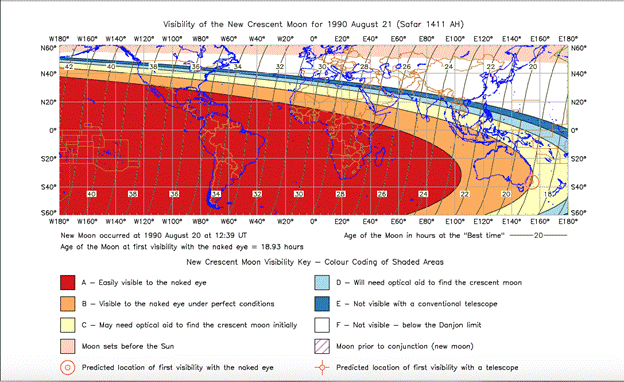
(Fig. 1)

Almost a month later, on September 19, 1990, Erev Rosh Hashana, the new moon was visible in the South Pacific (Fig. 2) and the next day, September 20, 1990, Rosh Hashana 5751, it was visible across Australia, Africa, and South America (Fig. 3), but once again, those In Israel, Europe, and most of North America did not see it until September 21 (Fig. 4), and this is remarkable because Australia is well to Israel’s east, and it seems reasonable that if the Australians could see the new moon, then the Israelis should have had an even easier time spotting it, being that for them the moon is almost half a day older, and therefore larger.
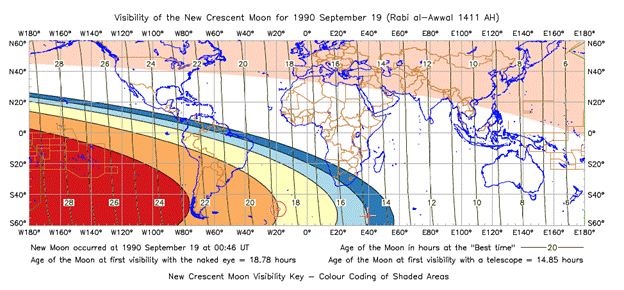
(Fig. 2)
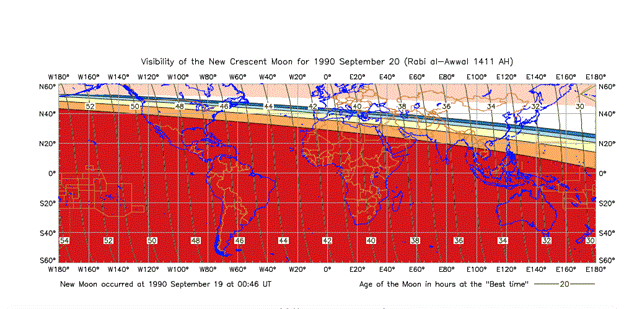
(Fig. 3)
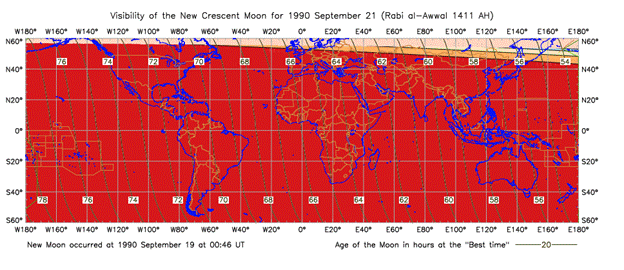
(Fig. 4)

On December 5, 2002, 30 Kislev 5763, the new moon was at least visible in Israel, but once again, it was not visible in Northeast Europe, in places where the Ashkenazic aharonim had lived (Fig. 5). The true molad, the lunar conjunction, had been the previous day, December 4, at 9:34 am Jerusalem time while the average molad was  at 9:06 pm and 13 parts, although as can be seen from here, it is actually not easy to translate the average molad times to our current UTC system. See more below about that.) The following February, the moon was much harder to see in classical Lita than it was in the Mediterranean basin (Fig. 6).
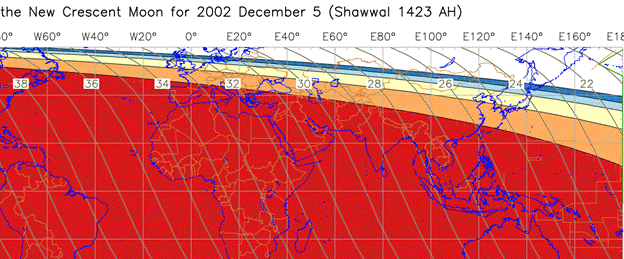
(Fig. 5)
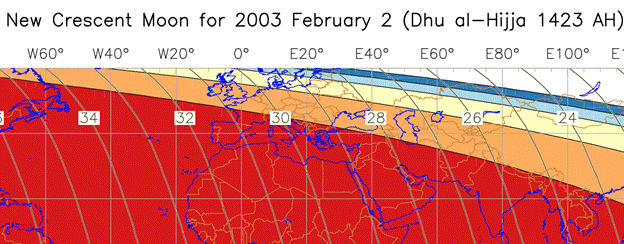
(Fig. 6)

I found all of these examples by a very superficial perusal of their archives, and it turns out there are dozens of examples that can be easily found in the last 30 years. A general rule can be derived: the farther a place is from the equator, the harder it will be there to spot the new moon compared to places of similar longitude but closer to the equator. For those in the Northern Hemisphere, there are many months when the added difficulty is quite significant.

Looking back, I could have extrapolated this from other information I already had, including the fact that the Israeli New Moon Society always publicizes that it is easier to spot the new moon from the Negev simply because it is in the south of the country.

All of this helps explain why we find that various forms of the practice of delaying birkat hal’vana for a day or two after what would appear to be the ideal time according to the classical opinions in the Talmudim is mostly a later Ashkenazic phenomenon, and one that Litvishe Rabbis, like Rabbi Tukachinsky, brought to Israel, whereas the generally Sephardic streams advocated for birkat hal’vana on Rosh Hodesh, or a week later, as per the kabbalistic practice. The fact that in Northeast Europe, the moon was often not visible until a day or two later than when it became visible in the more temperate regions seems to be a good explanation for this feature of the literature. Often, the Jews in Northeast Europe really had to wait for the moon to become barely visible even after the molad calculations indicated it was already well-visible in the places where the sages of the Talmud and the Rishonim used to live. I am grateful to have found this very real justification for a practice that at first seemed to go against the plain meaning of the Talmud.

Ultimately, I should have known that Maimonides was aware of all this, and took this into account. Chapters 11-17 of Kiddush Hahodesh are dedicated to explaining how to find the new moon in the sky, and that is the ultimate reason for knowing when the molad is of each individual month, and not so that one can add 72 or 168 hours to it in order to know when to recite the blessing, while the the eighteenth and last chapter discusses the practical case of the moon not being spotted for a number of months due to extenuating circumstances such as weather, and in our days, pollution. Towards the end of that chapter, he mentions that the more one stands to the east, the less likely he is to spot the new moon, while the farther to the west, the more likely, and then concludes with:

“All the above statements apply to the countries west and east [of Israel ] at the same latitude, i.e., they are between 30 and 35 degrees north [of the equator]. If they are located farther to the northerly, or less to the norther, different principles apply, for they are not parallel to Eretz Yisrael.”

There is no reason, therefore, to consider that places in northern Europe should be able to spot the new moon according to the molad in Israel, and as we have seen, they often have to wait significantly longer to see the moon.

Getting back to the issue of calculations and Professor Bromberg’s thesis, I recently saw that this year, the Ittim L’vina calendar has a new appendix explaining how there is a major disagreement regarding how to present the classic, average molad times in our modern terms. Considering that there are 1080 parts per hour instead of 3600 seconds, it should be easy to translate any molad time to any time on our clocks, but the problem is that no one knows, for example, if the tradition says that the molad for a given month is exactly at 15 hours of the day (9am), when that is according to the UTC time (adjusted for the Jerusalem time zone)! As Maimonides writes, the clock we use to determine the average moladot is, unlock the ritual clock used everyday, a constant, 24-hour clock, that assumes the day starts at hour 0, always 24 objective hours after the start of the previous day (like the secular system defines the start of the day as exactly 24 hours after the start of the previous) and therefore, during the summer, the “molad day” starts hours before the sundown, while during the winter, the “molad day” starts sometime well after the sundown that started that halachic, calendar day. The Ittim L’vina calendar brings four attempts to figure out how to determine when the average molad for any given month actually happens, and as Prof. Bromberg has shown, the truth is that no one knows. This can not be over-emphasized. When the calendar writers say, therefore, that on a given Saturday night, laymen should refrain from reciting birkat hal’vana at 7pm, as they depart the synagogue, because the average molad was say, at 8pm three or seven days earlier, and therefore they still have another hour before “the first opportunity” (sic) to recite the blessing, it is disingenuous, because they do not really know when the average molad was! It must be stated that, when Maimonides described the times of the average moladot, the only practical application was not birkat hal’vana, because up until the 13th century, no one even imagined that the time for birkat hal’vana should depend on the molad, but rather calculating the day of the week on which to establish the first day of Tishrei, which did not necessitate knowing when exactly the molad occurred according to which ever time piece they may have used. For example, if the calculation showed that on Monday the average molad was shortly before the end of the 18th hour (noon), making Monday fit for Rosh Hashana, it only meant that in the theoretical, 24-hour clock that started with the first molad, the molad of Tishrei was before the end of the 18th hour, but no one could know if that translated to before halachic noon on that particular Monday. And no one cared, either.

This revelation thus renders most of the foregoing discussions on the matter practically moot, and gives another very good reason why, if one were wondering when to recite the blessing on seeing the new moon, he should just follow the basic understanding of the talmudim and rishonim: when he sees the new moon, he should recite the blessing.

I would like to thank Rabbi David Avihail, Rosh Yeshivat Ramot, for his constant encouragement and support in producing these articles.

[1] For more on this critical distinction between the prescribed time and the allowed time, see, for example, Maimonides’s descriptions of the times for the daily prayers in his Laws of Prayer, 3:1-7.

[2] My blog, avrahambenyehuda.wordpress.com, has many more articles about understanding the original biblical and talmudic terms in context.
The Haftarot for Behar and Behukkotai

The Haftarot for Behar and Behukkotai[1]

By Eli Duker

The old Babylonian practice was to read Jeremiah 16:19 as the haftara for Parashat Behar and  Ezekiel 34 for Parashat Behukkotai, and this is attested to in most of the relevant Cairo Geniza fragments. One of them, Cambridge T-S B15.4, aside from also indicating this, is written in the Oriental Hebrew script and vocalized with the Babylonian supralinear system, indicating its antiquity.  Moreover, these haftarot are listed by R’ Shlomo ben Natan,[2] and their verses are the basis for the Zulatot in the Piyutim of  R’ Shmuel  ben Hoshana[3] written for these Parshiyot.[4] 

It would seem that Jeremiah 16:19 was chosen for Behar because the prophet’s pronouncements of  “Cursed is the man who relies on people” and “Blessed is the man who relies on Hashem” echo the blessing, mentioned in Parashat Behar, that is given to the sixth year of the Sabbatical cycle in anticipation of the Sabbatical year.

It is not clear to me why Ezekiel 34 was chosen as the haftara for Behukkotai, but it may be that its metaphor of a shepherd tending his flock (34:12) brought up immediate associations with the commandment to tithe the flocks and herds elaborated on in the Parsha.[5]

However, in Europe a new haftara beginning with Jeremiah 32:6 appears for Behar quite early on. Meanwhile, the original haftara for that parasha was “moved” to Behukkotai. These haftarot appear in R’ Shmuel Hanagid’s haftara list that is brought in Sefer Ha’eshkol,[6] and in R’ Elazar of Worms’s book on haftarot.[7] They are also listed by R’ Ya’akov Hazan in Etz Haim,[8] which serves as an account of the practices of Anglo Jewry on the eve of the Expulsion.

Abudarham lists only these haftarot for these two parashiyot,[9] and they are also the only haftarot in all of the Ashkenazic Humashim and haftara books in manuscript that I have come across,[10] excepting one[11] that reversed the two haftarot, placing Jeremiah 16:19 with Behar and Jeremiah 32:6 with Behukkotai. Moreover, they are the haftarot in the only humash[12] in our possession that is beyond a doubt from pre-expulsion Spain,[13] and all subsequent humashim that follow the Ashkenazic and Sephardic practices.

It is impossible to determine exactly why communities chose to change the practice regarding the haftarot for Behar and Behukkotai, or when and where this began to take place.

Nonetheless, Jeremiah 32:6 is an exceptionally appropriate haftara for Parshat Behar, as it describes how Jeremiah performed the commandment of redeeming the land formerly owned by a relative, a central part of the parasha.

As it is such an obvious fit, why did the Babylonians not choose it themselves? I believe that this is due to the fact that the old Babylonian practice was to read Jeremiah 32 as the haftara for Va’ethannan, beginning with 32:16. Later on, when communities that read the Torah according to the Babylonian annual cycle adopted the practice of reading “Nahamu”[14] (Isaiah 40:1) on the Sabbath following Tish’a B’av, when Parshat Va’ethannan is always read, Va’ethannan’s original haftara became “available” and thus was deemed very appropriate for Behar, while Behar’s original haftara was “moved” to Behukkotai.[15] The new haftarah for Behar – and the moving of its old one to Behukkotai – were accepted more than any other “new” haftara practice.[16] Only the Italian and Yemenite rites, most conservative regarding  retention of Babylonian haftarot, read the two hafarot as they were originally read.[17]

The practice in Poznań, interestingly enough, was to retain Jeremiah 32:6 as the haftara of Behar, while retaining the old Ezekiel 34 as the haftara for Behukkotai.[18]

Bibliography of Printed Works

 Avraham ben Yitzhak of Narbonne. ”Sefer Ha’eshkol”  Eds. Shalom and Hanokh Albeck.  Jerusalem: Wagshal, 1984.

Azulai,  Menahem. “Lifuyutam shel Yehudei Bavel -Kit’ei Geniza)” (Azulai, Ada. trans.)  Jerusalem: Azulai, 2010.

 Beukum, Walter Jaques van.  “Hebrew Poetry from Late Antiquity – liturgical poems from Yehudah” Leiden: Brill, 1998.

Biton, Eliyahu. “Or Yahudut Luv”  Biriah: Yeshivat Beit Yosef, 1982.

“Sefer Nahalat Avot -Minhagei Yehudei Luv”  Biria: Biton, 2007.

“B’rocho L’Mnachem – essays contributed in honor of Rabbi Menachem H. Eichenstein”   Ed.  Norman Paris. St Louis: United Orthodox Jewish Community – Vaad Hoeir of St. Louis, 1955

David Berabi Yosef Berabi David Ben Abduraham. “Abduraham Hashalem” Jerusalem: Osha, 1963.

Elazar of Worms. “Peirush Al Hahaftarot”  Warsaw: Zisberg, 1875.

Ginzburg, Christian D. “The Massorah”  Jerusalem: Makor, 1971.

“Hamisha Humshei Torah: Im haftarot Vihamesh Megilot” Eliezer ben Avraham Alaatansi, 1486.

“Humash Lima’an Shmo Be’ahava”  publisher and date of publication unknown.

 “Sefer Vayikra, Hamisha Humshei Torah Im Peirush Rashi,” V’im Da’at Mikra” Ed. Menahem Bula. Jerusalem: Mosad Harav Kook, 1991.

Jacob ben Jehuda Hazan of London. “The Etz Chaim” ed. Israel Brodie. Jerusalem: Mosad Harav Kook, 1962

“Machzor LiYamim Noraim” ed. Daniel Goldschmidt. Jerusalem: Koren, 1970.

Shlomo ben Natan. “Shlomo Ben Nattan Siddur Al Pi Hage’onim- Chibro Rabbenu Shlomo B’rabi Nattan.” Ed. Shmuel Chagai. Jerusalem: 1995.

Shmuel ben Hoshana, “The Yostserot of R Samuel the Third.” Edited by Joseph Yahalom and Noaya Katsumata. Jerusalem: Yad Itzhak Ben-Zvi,  2014.

Simha of Vitry. “Mahzor Vitry.” Edited by Arye Goldschmidt. Jerusalem: Makhon Otzar Haposkim, 2009.

Talmudic Encyclopedia, Edited by Meyer Berlin (Bar-Ilan) and Shlolmo Yosef Zevin. Jerusalem: Talmudic Encyclopedia Publishing, 1961.

Zeruk, Refael. “Luah Dinim Uminhagim Kehilot Yotzei Luv”  Bat-Yam: Ginzei Refael, 2008

[1] I would like to thank Rabbi Avi Grossman for editing both the original Hebrew version article as well as my English translation. I would also like to thank my son Moshe Duker for assisting me in looking up haftarot in printed humashim.

[2] Shlomo Ben Nattan, Siddur Al Pi Hageonim, p. 201.

[3] “The Yotserot of R Samuel the Third.” Vol. 1, pp. 519, 528-259.

[4] In Fried’s list of haftarot that appears as an appendix to Volume X of the Talmudic Encyclopedia, Isaiah 1:19 is brought as an alternate haftara for Parashat Behukkotai.This was based on Zulay’s understanding in Zur Liturgie der babylonischen Juden, regarding a piyut  composed by “Yehuda” for “Im Behukotai” with verses beginning with Isaiah 1:21 Zulay believed Yehuda to be Babylonian,  that that was the haftara for this Parsha. However, evidence brought by van Bekkum in his introduction to “Hebrew Poetry from Late Antiquity: Liturgical Poems of Yehudah” shows that Yehuda was a Palestinian Paytan. In addition, Isaiah 1:24 was the haftara for Sedra “Im Behukkotai” in the Palestinian triennial cycle of Torah readings. See Ofer,  “Hahatfarot Al Pi Haminhag Hatlat -Shenati” (here). I would like to thank Prof. Yosef Yahalom for directing me to van Bekkum’s work.

[5] See Daat Mikra,  Vayikra Vol. 1, pp. 323-324. The other reasons given there seem less convincing, as this is not a haftara of rebuke.

[6] Albeck Edition, p. 181.

[7] “Peirush Al Hahaftarot”. p. 8.  The haftara for Behar  is missing in the Ginsburg-Moscow Ms.of Mahzor Vitry while it lists Jeremiah 16:19 as the haftara for Behokkotai. See Goldschhmidt edition, Vol.2, p. 579.

[8] Vol. 1, p. 54.

[9] P. 303.

[10] Mss. Breslau 9: Cambridge St. Johns A1: Vatican EBR 13 14 15 16:  Parma 1885 2046 2148 2818: 3083 3085:  British Library 9401 9403:

[11]  Ms. Vatican EBR 20.

[12] Printed in Hijar in 1486. Another humash with the same haftarot for these parashiyot is believed to have been printed in Spain as well. See the National Library of Israel website: here.

[13] The practice in Saragosa was to read the original Babylonian haftarot. See “The Massorah,” Vol. 2b, p. 486.

[14] The practice of reading Nahamu on the Sabbath following Tisha B’Av was much more prevalent than the practice of reading special haftarot in subsequent weeks. Rambam (Tefilla 13:19) writes that Nahamu was the “practice of the people,’ (Nahagu Haam) while he describes the practice of reading the other six haftarot of Consolation as a local custom.The Italian practice is to only read haftarot of Consolation for the remainder of Av, but this is not directly related to my main thesis, as Italians read Jeremiah 16:19 for Behar.

[15] Parshat Behar plays a unique role in the Ashkenazic liturgy for the Omer period. In the Western rite, R. Baruch of Mainz’s “Aharei Nimkar Geula Tihyeh Lo” is the zulat for that Sabbath, while in Eastern Ashkenaz the GeulaYakush Ma’yano” is said. Both of these piyutim beseech Hashem, as our “close relative”, to perform the “commandment”of redeeming us. No other piyutim from the Omer liturgy are connected to the weekly parashiyot. However, in spite of the strong connection that Ashkenazic Jewry felt to the redemption commandments listed in Behar, is is unlikely that it is the reason for their choice of haftara, which appeared on the scene quite early, before the composition of these piyutim.

It is also worth noting that there has been a historical trend to eliminate haftarot of rebuke from the book  of Ezekiel,  but that doesn’t seem to be relevant to the haftara of Behukkotai as it is not a haftara of rebuke. See note 4.

[16] Unlike the old haftarot for Shemot (Ezekiel 16)and Bo (Isaiah 19) that were retained in some Spanish and Babylonian communities up to the present day. See the list in TE,  pp. 703-706.

[17] Humash L’maan Sh’mo B’Ahava claims that Libyan communities read Jeremiah 16:19 for Parashat Behar. No other sources back up this claim, and Luah Dinim U’Minhagim Yotzei Luv (2008, pp. 137-138) lists the “standard” haftarot for these parashiyot.

[18] See Mirsky, Shmuel K, in “Pinkas Bet Haknesset D’K”K Pozna” in “B’rcho L’Menachem”  p 262. The Poznan community preserved various customs with an Italian connection that either disappeared from the rest of Ashkenaz, or never got there in the first place.

For instance, they read Dirshu (Isaiah 55:6) as the haftara for the Sabbath between Rosh Hashana and Yom Kippur in years when there was a Sabbath between Yom Kippur and Sukkot long after that practice disappeared from the rest of Ashkenaz. See Mirsky, p. 264.
Moreover, during Minha of Yom Kippur they recited the kiklars of “Emunat Om Noteret” and “Efa’er L’Malki Bakodesh. The Kiklars come from the Kalirian kedushta “Odecha Bekol Areiv”, which is recited as the kedushta for Yom Kippur Minha in the Roman community. In Poznan they were inserted into the non-Kalirian Kedushta “Eitan Hikkir Emunatekha” which was recited in all Ashkenaz. (In Nusach Polin   only the  Koteret is inserted.) See Mirsky, p. 270, and Goldschmidt in the introduction to Mahzor L’yamim Nora’im, Vol. 2, pp. 45-46. I would like to thank Dr. Gabriel Wasserman for pointing this out to me.