Kitniyot and Mechirat Chametz: Paradoxical Approaches to the Chametz Prohibition

Contemporary Rabbis don’t bother to interrogate the sources of law and custom; instead, their purpose is to traffic in chumrot and create new prohibitions. They are unable to appreciate their hypocrisy … on the one hand, they roar like a lion against those who are open to change and the reformists, that one cannot alter an iota from what the kadmonim imposed, while on the other hand, casually discard the kadmonim whenever the achronim create new chumrot and they fight with all their might…to impose these new prohibitions.”

R. Yitzhak Shmuel Reggio, Yalkut YaShaR, Gorizia 1854.

Kitniyot and Mechirat Chametz: Paradoxical Approaches to the Chametz Prohibition

By Dan Rabinowitz

Some Pesach rituals trace their history for millennia. Others are of more recent vintage and continue to evolve significantly without any indication of stopping. Two in that category define the contours of chametz prohibition, one expanding and the other contracting its perimeters. Each’s creation was itself a radical departure from the status quo. In both instances, rabbis readily overcame established legal precedent. But their methodologies differ substantially and, at times, are contradictory. Yet, the intersection between the two, mechirat chametz and kitniyot, remains unexplored, and their conflicts unresolved.[1]

Mechirat Chametz

The present-day practice of “mechirat chametz” consists of the pre-Pesach transference of the title to the Jew’s chametz to a non-Jew, and upon the conclusion of Pesach, the chametz reverts to the Jew at no cost. The Torah prohibits any relationship between a Jew and their chametz on Pesach. Aside from the usual restrictions against eating or otherwise enjoying a prohibited item, here, the Torah proscribes even possession. One must destroy their chametz. The Mishna (Pesachim, 21a) and Talmud (Pesachim 13a) recognize that one can avoid liability if they sell their chametz to a non-Jew. But those transactions were permanent and irreversible, and the chametz never returned to the Jew. The first instance of a reversible transaction appears in the Tosefta (Pesachim 2:6).

ישראל ונכרי שהיו באין בספינה וחמץ ביד ישראל הז מוכרו לנכרי ונותנו במתנה וחוזר ולוקח ממנו לאחר הפסח ובלבד שיתנו לו במתנה גמורה

A Jew and a non-Jew are boarding a ship on the eve of Pesach, and the Jew has chametz, he can gift it or sell it to the non-Jew and get it back afterward so long as it was an absolute gift.

The Jew is boarding a ship on Erev Pesach,[2] on a journey that will extend beyond the holiday. There is enough non-chametz for Pesach, but if he destroys his chametz now, he likely will not survive the remainder of the journey. Can one violate Pesach and keep the chametz?  If the chametz is necessary to survive Pesach, he can keep it and even eat it on the holiday. But does a future pikuah nefesh issue justify violating the law now? According to the Tosefta, a reversible transaction will avoid liability for the chametz, so long as it is “matanah gemurah,” an unconditional gift, and not matanah ‘al meant le-hachzer.   One can justify relying on pure legal formalism and comply with all the technical requirements of a transaction, even if the practical effect of this transaction is a nullity.  

Another version of the Tosefta seems to envision an even more restrictive view of the transaction.  In this version, in addition to the requirement that the transaction is a “matanah gemurah,” there is one more caveat, “u-belvad she-lo yarim,” “so long as it is not a trick.” [3]

According to Rav Amram Gaon (810-875) and Rishonim, “no trickery” codifies the implicit limitation of the Tosefta, that this solution is exceptional (expressed nautically) and can never become the norm. This approach remained the practice for hundreds of years, and there was no yearly mechirat chametz. The Rambam and the Rosh repeat the case described in the Tosefta, occurring on a ship, not in any other context. [4]

R. Yisrael Isserlein (1390-1460), in his collection Terumat HaDeshen, is the first recorded instance of a Jew seeking to avoid financial loss affirmatively engaging in the Tosefta’s solution. He discusses a case where someone owns a significant amount of chametz and would incur a loss if he destroys it. But there is a non-Jewish acquaintance that is willing to accept the chametz gift with the understanding that he will return it after Pesach. Isserlein permits this approach so long as it is a gift without explicit conditions. Isserlein does not limit the frequency of resorting to this approach.[5]    

The immediate impact, and rate of adoption, of his decision, remains unclear. Indeed, some question the historicity of Isserlein’s responsa. They claim that the issues described are theoretical and are not in response to actual queries or events.

In the 16th century, R. Yosef Karo (1488-1575) discusses the legal issue of the retrievable sale in his commentary on the Tur, Bet Yosef, and records Isserlein’s ruling in Shulchan Orach but does not indicate whether it was commonplace.  In his commentary on Shulchan Orach, R. Moshe Isserless (1530-1572) (Rema) is silent on this issue entirely and does not mention a yearly custom to sell chametz.  The first to widely apply this technique and significantly lower the requirements was R. Yoel Sirkes (1561-1640).  

With the introduction of propination laws in the 16th century and the rise of the arendtor, there was consolidation in the alcohol industry, shifting control from localized production by peasants to the ruling class. Many of those licenses were managed or leased to Jews. By the late 16th century, Jews in Poland and Lithuania were firmly entrenched in the alcohol industry.  For many non-Jews, arendtor and Jew were synonymous. According to one account, Jews held a monopoly on the entire alcohol trade in Cracow. This created an issue for Pesach.  While Isserlein and Karo, and many others accept that one can sell their chametz, they all explicitly require, like any standard transaction, that the non-Jew remove the chametz he bought. Karo, in Shulchan Orach, codifies the requirement that the chametz is “me-chutz le-bayit,” outside of the Jews’ control. The Jew’s house was chametz-free.  But it was impractical to remove the distillers’ chametz from their property because of the substantial amounts and the fear that with alcohol, the non-Jew might not return it. [6] 

Faced with these issues, Sirkes created a new approach to the sale. Mechirat chametz is not just chametz, he also counseled to sell the ground underneath the chametz. It effectively created non-Jewish property within the Jew’s home. The chametz was “me-chutz le-bayit,” but remained in situ.

Sirkes’ ingenious solution created another issue. When the sale was just for chametz (a transportable good), a monetary transaction, even a nominal one, sufficed. But a written contract is required to sell land to a non-Jew.  Rather than change the process for the sale of chametz and mandate a written contract, Sirkes relaxed the contractual requirement.  He reasoned that requiring a contract for mechirat chametz potentially created another economic issue. He explained that a written agreement might otherwise induce the non-Jew to think the Jew fully sold the chametz and might keep it! This would trigger significant losses, and Sirkes was willing to forego the contract entirely.  He justifies both the sale and the diminution of its legal requirements because of potential economic harm.[7]  

Sirkes’ solution generally relaxed the legal requirements, but he did add two new aspects to mechirat chametz.  First, one must explicitly acknowledge the deficiency of the sale and announce that “I am selling you the room where the chametz is for money and even though I didn’t write a contract.”  He explains that this formulation works according to Tur and R. Karo in Bet Yosef (Choshen Mishpat 194), even for a land sale. Left unmentioned is that Sirkes rejects that position in that same section.

Second, the Jew must give the non-Jew a key to the house. Without that, no external action signifies the chametz is not the Jews, and the sale is clearly a sham.  By the early twentieth century, R. Yisrael Meir Kagan, in his Mishna Berurah, further eroded the key requirement and nullified the need for it entirely for all intents and purposes.  Rather than a physical transfer of the key, the Mishna Berurah allows one merely to identify the key’s location. Like the chametz, the keys can remain in the Jew’s possession, on their regular hook, and in the Jew’s control. There is no independent source for this leniency.  Instead, according to R. Kagan, it is “pashut.” [8] 

The key requirement was not the only aspect of Sirkes’ formula that fell by the wayside. Almost immediately after Sirkes created his workaround, it was being degraded.  Both R. Avraham Gombiner (1635-82), in his Magen Avraham, and R. David HaLevi Segal, in his Turei Zahav, hold that even giving a key is unnecessary. Simply setting aside a place for the chametz is enough.  (Although it seems that the key’s association with mechirat chametz was so pervasive that people began to sell the key rather than the chametz.) [9]

Sirkes’ idea that one can include non-chametz items in the fictional sale was adopted in a different context, again because of the effect of the alcohol trade. At the time, most distilling occurred with rye. The process produced a significant amount of spent rye, while otherwise useless, could be turned into cattle feed. Jewish cattle farmers recognized that they needed to sell their animal feed, and they did so. But, without that feed, the animal’s health and well-being were affected, and it took them time to recover after Pesach. Thus, it became customary to sell not only the chametz but also the cow. Now the non-Jews could come and feed the now non-Jewish cattle their regular diet. While this was initially frowned upon by some, many ultimately accepted it. [10]

The Dispute in Jassy Regarding Modifications to the Process

Despite all of these changes, until the 19th century, one aspect of the sale remained consistent; the individual conducted it, and there was no public communal sale of everyone’s chametz. Yet, leaving it to the individual proved problematic. According to some, there were widespread issues of sales not conforming with the (then) acceptable formulations, inattention to the transaction details, and a general failure to consummate the sale. To accommodate those realities, another shift in the process occurred. The most conspicuous example of introducing the new approach occurred in Romania in the 1840s. R. Yosef Landau and R. Aaron Moshe Taub, two of the leading rabbis in the same city, Jassy, disagreed about the propriety of instituting this new method. Collectively, they published six titles and five books supporting their respective opinions. 

Additionally, Landau asked one of the most well-known legal authorities in the region, R. Shlomo Kluger (1785-1869), to adjudicate the dispute. He wrote a lengthy teshuva siding with Landau’s approach. Yet, this remained unsettled in his mind, and some years later, he retracted his position and agreed with Tauber.

R. Yosef Landau (1791-1853) came from a rabbinic family and, in his youth, studied with R. Levi Yitzhak of Bardichiv. He married young, and when his first wife died at 18, he remarried. His father-in-law was wealthy and generously supported Landau, enabling him to study full-time. At 22, he accepted the position as Liytin’s rabbi. In 1834, at the suggestion of the Ruzhiner Rebbe, Landau took the position of chief rabbi of Jassy.

Jassy (Iași) is today located within northeastern Romania, near the border with Moldovia. In 1565, it became the capital of the former principality of Moldovia and today is the second-largest city in Romania. Jassy had long been the spiritual center for Jews throughout Romania/Moldovia. By the early 19th century, it became a hub for Chasidim. In 1808, R. Yehoshua Heschel Shor, the Apter Rebbe, settled in Jassy.

The early to mid-19th century was arguably the high point of Jewish life in Jassy. At the opening of the century, there were less than 2,000 Jews. By 1838, there were almost 30,000 Jews, accounting for over 40% of the total population. Concurrent with the influx of Jews into Jassy was a general improvement of its finances, especially after the Russian Turkish peace of Adrianople in 1829. Jews played a sizeable role in the city’s overall commerce. They held monopiles to several industries, cattle, cheese, cereals, and dominated in others, such as banking, and owned most commercial buildings in the center of town.

While progress had been good for Jassy, it came with challenges. The combination of the sprawling populace and robust commercial market created complexities that required a revision to the process. After Landau arrived in Jassy, he instituted a new form of mechirat chametz. He established a system where individuals would no longer transact directly with a non-Jew. A handful of select people would buy everyone else’s chametz, and those designated ones would execute the final sale to the non-Jew. Appointing a few knowledgeable people ensured consistency and greater compliance.

Sometime before 1842, Landau published the rationale for this decision. There are no extant copies of that book, Seyag le-Torah, and consequently, the publication date has confused some bibliographers. Friedberg, and after him, Vinograd, date Seyag le-Torah to 1846, which would place it at the tail end of the controversy, its final book, published after three years of silence. But Shmuel Ashkenazi demonstrated that Seyag le-Torah is the first book published regarding the communal mechirat chametz controversy in Jassy and was printed around 1842. The rest of our discussion follows Ashkenazi’s reconstruction of the dispute. [11]

By 1842 Landau could no longer lead the community alone. He requested for the Jewish community to hire a second rabbi. With Landau’s blessing, R. Aaron Moshe Tauber (1787-1852), originally from Lviv, was engaged. Tauber also came from a storied rabbinic family and was the grandson of R. Yoel Sirkes. He also married into a wealthy family in Przemysl, Poland, and studied there for a few years after marriage. He began a relationship with R. Yaakov Meshulum Orenstein (author of the Yeshuot Ya’akov), then rabbi in Jaroslaw, about ten miles from Przemysl. Tauber eventually left Przemysl and returned to Lviv. By this time, Orenstein was the chief rabbi of Lviv, and he and Tauber reconnected. Tauber also began regularly studying with R. Shlomo Kluger, then rabbi in Kulykiv, on the outskirts of Lviv. In 1817, Kluger would leave Kukykiv for Brody, but Tauber remained until 1820. When he was 32, he took a position in the hamlet of Snyatyn, Ukraine, over 150 miles south of Lviv. In 1831, he made an unsuccessful bid for the chief rabbi of Óbuda (one of the three towns that merged in 1873 to form Budapest). In 1842, after 24 years in Snyatyn, Tauber moved further south to Jassy as the new co-rabbi.

Soon after arriving, he learned of Landau’s mechirat chametz process and disapproved. In a public address, Tauber criticized the practice but declined to take any more concrete action against it because he deemed it an entrenched and accepted custom. Nonetheless, he counseled those “who have the fear and trembling of God in their heart” to execute a private sale. According to Tauber, Landau started a whisper campaign that all private sales of chametz are ineffective. Nonetheless, Tauber “remained silent” and held himself back from a direct conflict with Landau.

By Pesach of 1843, all the gloves were off. Tauber claimed that he identified additional issues with the new procedure that convinced him he must act; otherwise, all Jassy’s Jews risked liability. On the eve of Pesach 1843, he published Modo’ah Rabba (An Important Announcement), identifying issues with Landau’s approach to a communal mechirat chametz. Landau had his response ready and published Mishmeret Seyag le-Torah defending his position in Seyag le-Torah within a month. A second title, Bitul Modo’ah (A Nullification of the Announcement), specifically addressed the issues Tauber raised in Modo’ah Rabba appeared at the end of the book. While Landau was formulating and printing his response, Tauber was working to explain his position further.

A short time later, Tauber published Hagu Segim (Remove the Detritus, based upon Misheli 25:4), offering additional evidence against the new practice. But, he wrote this before seeing Landau’s Mishmeret Seyag le-Torah and did not discuss its arguments. To address that, soon after, Tauber published another pamphlet, Hareset Mishmeret (Destroying the Guardian), that attempted to rebut Landau’s rejoinder of Tauber’s rejoinder of Landau’s original defense.

Meshmeret Seyag Le-Torah, Jassy, 1842

A few copies of Landau’s Mishmeret le-Seyag with Bitul Mo’dah and Tauber’s Hareset Mishmeret survive. There are no extant copies of the other books. Mishmeret le-Seyag/Bittul Mo’dah and Hareset Mishmeret are now available online. But both digital versions are flawed. The National Library of Israel’s copy of Hareset Mishmeret is damaged, and some text is lost. But Tauber autographed the final page of that copy.
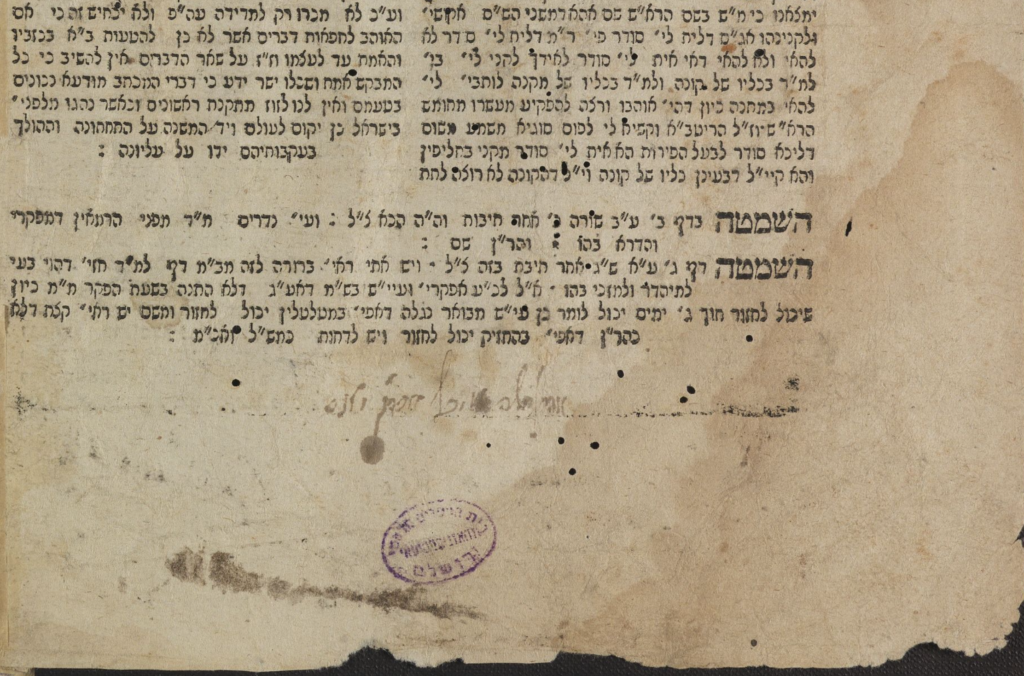
Final leaf from National Library of Israel copy with Tauber’s signature

The issue with the copy of Mishmeret le-Seyag le-Torah on Hebrewbooks.org is more significant. There is no title page, and the text begins on the first page. Typically, the verso of the title-page is blank or contains copyright information. This copy was originally reproduced by Copy Corner.  In the pre-internet era, the Goldberg brothers photocopied rare and out of print books and bound them in a rudimentary hardcover and distributed them through Beigeleisen Books in Boro Park. Through their efforts thousands of seforim were accessible to the wider public at very reasonable prices.  For those without access to libraries with significant seforim collections, Copy Corner’s catalog stepped in to address that gap. When Copy Corner photocopied the books they added their publication information to the verso of the title page. Normally not an issue, here it results in a blank page with just the Copy Corner legend substituted for the second page of the text of Mishmeret le-Seyag le-Torah.

Hareset Mishmeret was the last public missive, but the two sides remained at loggerheads privately. Communal leaders unsuccessfully pressed for a resolution but eventually, the two reconciled. Love instigated the cessation of hostilities.

In 1846, R. Landau’s son, Mattityahu, married Tauber’s daughter. But the marriage almost didn’t happen. Not because of the controversy over mechirat chametz. Instead, the bride’s and groom’s mothers shared the same name, Hindi. Some view such a match as taboo. But the Ruzhiner Rebbe, R. Yisrael Friedman, endorsed the match. He reasoned that there is no prohibition here because neither mother uses her given name. They both go by “Rebbetzin.” [12]

Sometime before the intermarriage of the two families, Landau requested R. Shlomo Kluger’s assistance to resolve the dispute and determine which approach to adopt. Kluger’s reply begins that he is personally unacquainted with R. Landau but that Tauber is a childhood friend. Despite that friendship, Kluger sides with Landau.

Tauber only recently arrived in Jassy, the largest city in Moldovia, and was unwise to the realities of a big city. Kluger attributes Tauber’s objections to his naivety. Tauber spent the last twenty-two as the rabbi of the small town of Sniatyn, where there were around 2,000 Jews compared to Jassy’s 30,000. The traditional practice of private transactions might work in a town the size of Sniatyn, where Tauber was able to supervise the process. Jassy was a different animal. Landau was responding to those realities when he restructured mechirat chametz. Kluger was the rabbi of Brody, a substantial city of an estimated 15,000 Jews, and saw first-hand the challenges of a large and more cosmopolitan community. Like Landau, Kluger adopted the revised mechirat chametz. Indeed, he had already done so six years earlier! Over the next seven printed double-column pages, Kluger justifies his and Landau’s mechirat chametz ritual, concludes that Landau’s approach is correct, and describes it as “takanah Gedolah,” a worthy edict. Kluger, however, notes that he finds the whole episode distasteful and that he doesn’t have time to engage in these sorts of controversies and communicates his mystification that such a vicious dispute could arise over a “davar katan” like this.

Despite Kluger’s comprehensive defense of the communal mechirat chametz ceremony, he ultimately regretted that position. Kluger included an addendum when this responsum went to press in 1851. After seeing the effects of the new approach, he explained that he was reversing his stance. With the consolidation of mechirat chametz into a communal sale, an industry arose. Profiteers saw an opportunity and began competing for people to sell them their chametz. With money as their only motive, they were incredibly sloppy with the sales. With the single points of failure, there was often no legally recognized transfer, leaving countless people owning chametz on Pesach. Kluger disavowed his lengthy defense. He ascribed it to alternative motives, preserving Landau’s honor. Kluger concluded with the recommendation that every individual execute their own contract with the non-Jew, i.e., Tauber’s position.[13]

During that same period, R. Moshe Sofer, in a very lengthy responsum, supports preserving the less than 100-year-old practice of selling chametz and rebuffing the many reasons it seemingly conflicts with established Jewish law. Despite his leading the rallying cry of “hadash assur min ha-Torah,” Sofer, who rejects new approaches because of their novelty, unqualifiedly approved of mechirat chametz.

R. Ephraim Zalman Margolis wrote to Sofer and raised issues with the current process as it was nothing more than “ha-aramah” and that certainly selling one’s animal is prohibited. Sofer began by noting that there are instances where ha-aramah is permitted. Hazal crafted those exceptions because they recognized that “אין כל המקומות והזמנים שוים.” Ultimately, he concluded that despite the sham nature of the modern procedure, it is a fully-realized transaction that discharges ownership for purposes of chametz and even permits the Jew to sell their cattle with the chametz. [14]

Sometime after the widespread adoption of communal mechirat chametz, there was another revision to the practice. Now, the individual no longer sells his chametz to the rabbi and the individual never directly executes a sale. Instead, the individual approaches the rabbi not to sell him the chametz but appoint him an agent to sell it on their behalf.[15]

The most recent shift in mechirat chametz is that it is no longer de facto but de jure.  According to some, R. Shlomo Yosef Eliashiv among them, today, mechirat chametz is obligatory even if one destroyed their chametz. [16]  

(Bardak, recently satirized the contemporary practice, with all its details, in an episode that imagined a very sophisticated purchaser that presses their rights, legal and political.)

Kitniyot

The historical approach to mechirat chametz and the willingness to adapt biblical law to the realities of modern society stands in sharp contrast to another chametz-related issue, kitniyot. There is no doubt that the biblical prohibition against chametz did not include kitniyot. The Mishna and Talmud agree that it is permissible. At best, it is an Ashkenazi custom and/or edict whose earliest record is the 13th century and was never universally adopted by all Jews. Consequently, many rabbis explicitly rejected the prohibition as either a “minhag ta’ot” or even a “minhag shetut.” Yet, according to some, kitniyot is such a powerful legal concept that even in instances of severe famine, kitniyot remains prohibited. Kitniyot is even more pervasive now than ever before, with new items added yearly to the list. [17]

There have been attempts to repeal kitniyot custom since the 18th century, without significant success. In the case of the nascent Reform Judaism movement, like many other laws and customs, it overturned kitniyot without any specific halakhic justification. But the other attempts came with substantial legal analysis that supported removing the prohibition. Many raised economic arguments to justify reversing kitniyot. In the case of mechirat chametz, the initial beneficiaries of the sale were well-to-do Jews who held large amounts of chametz. The kitniyot restrictions mainly affected the poor who could not afford expensive matza and for whom kitniyot’s low cost would provide a more economically feasible alternative to satisfy their daily caloric needs.

R. Tzvi Ashkenazi, Chakham Tzvi (1656-1718), one of the leading rabbis in Western Europe, first articulated this argument. Chakham Tzvi concluded that the economic harm justifies removing the restriction. Nonetheless, he declined to act alone, and without others joining his approach, the rule remained in effect even in the communities he served. Likewise, his son, R. Yaakov Emden (1697-1776), agreed with removing the restriction against kitniyot but required consensus among rabbis to make any practical change. [18]

Eventually, beginning at the turn of the 19th century, a handful of communities in Western Europe acted upon the approach of Hakham Tzvi (in addition to marshaling other arguments) and abolished the prohibition against kitniyot.[19] The first to do so was a community under French control, the Consistory of Kingdom of Westphalia, created by Napoleon in 1807, today located in the north-western corner of Germany. The argument for the repeal was initially only on behalf of garrisoned soldiers in the area. They did not have access to large amounts of matzo, and permitting kitniyot would alleviate their hunger. Ultimately, the kitniyot repeal applied to all Jews in the area. Perhaps the most well-known rabbi involved, R. Menahem Mendel Steinhardt, authored a lengthy defense of the dispensation and many other changes and sent it to his close friend R. Wolf Heidenheim (1757-1832). Although Steinhardt specifically told Heidenheim to keep the letter private, Heidenheim believed that the analysis was too compelling to hold back from the public. Heidenheim went ahead and published it without consent at his own expense. He also appended some of his notes to the book. The book, Divrei Iggeret, published in 1812, contains one of the most cogent published arguments for the abolition of kitniyot. Nonetheless, Steinhardt’s defense was rejected by many.

Despite those rejections, in addition to Heidenheim, others continued to support him, if not his kitniyot position. His former havruta, R. Betzalel of Ronsburg (1760-1820), who provided a haskamah to Steinhardt’s responsa work, Divrei Menahem, still held him in high esteem long after Divrei Iggeret. He also secured two subsequent rabbinic positions in other Jewish communities. Others, however, cast him as a villain.

One recent book characterizes Steinhardt and others as “the wicked maskilim may their names be blotted out” and ascribes their motivations as solely driven “to disparage the kadmonim.” Rather than concern for the poor, according to the book, the true purpose of reversing the prohibition against kitniyot is to permit chametz on Pesach eventually. [20]

Heidenheim’s support troubled some because he is an accepted orthodox figure. One approach is to attribute Heideheim’s willingness to publish Divrei Iggeret as a favor to Steindhardt’s uncle, R. Yosef Steinhardt, with whom Heidenheim studied in his teens.[21] This explanation seems implausible. First, this approach ignores Heidenheim’s unreserved praise of the force of Menahem’s arguments. Heidenheim justified his decision to unilaterally publish Menahem’s letter so that “every honest, sensitive, and intelligent person will see that [Menahem’s] purpose is to teach Beni Yehuda avodat Hashem, to fear and love Him in the ways of truth and peace . . . and to respond to the detractors and support the poor and provide them as much food as possible.” Second, when Divrei Iggeret was published, Yosef Steinhardt had been dead thirty-six years, and when he passed, his nephew, Menachem, was only seven years old. Indeed, another author, Benyamin Shlomo Hamburger, highlights this lack of connection between uncle and nephew to diminish any family prestige that might inure to Menachem.

Likewise, Hamburger turns Menachem’s adoption of his uncle’s surname (and not the more traditional approach of using his birthplace, Hainesport, as the surname) into a liability. Hamburger sees this as a blatant example of carpetbagging, trading on his uncle’s reputation. Similarly, Hamburger delegitimates Menachem’s responsa work, Divrei Menachem, and describes it as entirely self-interested, simply “an attempt to get any rabbinic position.”

Although Steinhardt’s approach to kitniyot did not significantly alter the orthodox practice, he substantially changed Jewish liturgical practices despite attempts to marginalize him. Steinhardt’s Divrei Iggeret comprises ten letters, one of which is devoted to kitniyot. The other nine argued for changes to other Jewish practices. The seventh letter addresses the custom to recite the mourner’s Kaddish.

Until the 19th century, the accepted Ashkenazi custom was to have each mourner recite the Kaddish individually. Steinhardt argued for adopting the Sefardic tradition of all the mourners reciting Kaddish in unison. While some rejected that position as a change to the status quo, including R. Moshe Sofer, Steinhardt’s modification of the practice is today widely accepted. His opinion was first cited approvingly in the commentary to Shulchan Orach, Piskei Teshuva, with the instruction to review Divrei Iggeret for its compelling arguments. Many of those arguments mirror those Steinhardt relied upon for his repeal of kitniyot. Among those that kitniyot lacks Talmudic sources, the current restriction did more harm than good, the Sefardim already do it, and R. Emden theoretically permits its annulment.

Steinhardt first categorizes the entire kaddish ritual as a custom that “has absolutely no root or foundation.” He challenges any attempt to find early sources that support incorporating Kaddish into the standard prayers. Neither the Bavli nor Yerushalmi nor the “Rishonim” incorporate the practice. Steinhardt dismisses midrashic sources, presumably the Zohar Hadash (Achrei Mot, 112), as irrelevant to determining practice. Second, the current custom of assigning only one mourner to right to lead Kaddish is detrimental because it leads to fighting for priority and a general lack of decorum. Third, the modification is the standard practice amongst Sefardim. Fourth, in theory, R. Yaakov Emden’s willingness to overturn the Ashkenazi custom in favor of the Sefardic one. Fourth, he cites R. Moshe Hagiz’s that implies reciting kaddish unison is permitted. He concludes that despite canceling the historical practice, his position is also ancient.[23]

Steinhardt’s change was embraced by conventional rabbis, explicitly citing the Divrei Iggeret and incorporating the change into their codifications. For example, Kitzur Shulchan Orach, Ta’amei Minhagim, Kol Bo’ al Avelut, and the more recent Peni Barukh associate the change with Divrei Iggeret. R. Gavriel Zinner, in his work on the laws of mourning, Neta Gavriel, didn’t just cite the Divrei Iggeret; he reproduces the entire letter from “ha-Gaon Rebbi Mendel Steinhardt.”[24]

Hamburger is again troubled by the seeming approval of Menahem’s modification of Kaddish and asks, “how is it possible that Divrei Iggeret received such a positive reception that he became the source of this [new] law?” The answer: Steinhardt hoodwinked the Eastern European rabbis. They thought that the change occurred with the consent of all the German rabbis and was unaware that Menahem acted alone and his true purpose was radical reform. Left unexplained is why many of the same Eastern European rabbis were aware of his actual intentions when it came to kitniyot.[25]

Likewise, many of those same personalities that vigorously defended the retention and extension of the leniency of mechirat chametz refused to budge on the custom of kitniyot. Despite the lack of supporting evidence, R. Moshe Sofer held that repealing the kitniyot restriction is impossible because it is a universally accepted formal edict. Nonetheless, among his arguments in defense of mechirat chametz was that “any restriction that the Talmud does not explicitly mention we cannot decree that is prohibited.” [26]

R. Tzvi Hirsh Chajes defends the practice of mechirat chametz. He accepted that the justification for mechirat chametz is economic. Nonetheless, he rejects the elimination of kitniyot as a too substantial reformation of Jewish practice to allow, even though it too caused significant financial hardship. According to him, because the Reform movement abolished kitniyot, any other attempt is tainted and assumed to be driven by the same anti-Orthodox sentiments and must be rejected to maintain the status quo. Even though the first major successful attempt to remove kitniyot was not a Reform congregation but an Orthodox one, headed by notable Orthodox rabbis, who based their decision on the law. [27]

The practice of mechirat chametz significantly altered the landscape of Pesach compliance. Each stage of its evolution required creative solutions to contemporary issues as they arose. Rather than invoking the general rule that chametz demands a strict reading of the law, leniencies were repeatedly devised and were near-universally adopted. Indeed, R. Isserlein, in his responsum permitting mechirat chametz, rejects that principle’s applicability to mechirat chametz. With limited exception, until the 17th century, Jews complied with the straightforward reading of the Biblical restriction, “chametz shall not be found in your houses.” The changing economics of the 17th century forced the rabbis to confront a new reality where it was no longer financially possible to physically remove one’s chametz. One rabbi’s solution was universally adopted, altering the mechirat “chametz” to include a second sale, that of the land. In less than a century, his formulation proved insufficient to deal with the continuing changing reality. Other Rabbis instituted additional modifications to the process. Now there is no direct sale of chametz, and the mechirat chametz ritual consists of appointing an agent. Each of these changes required reliance on leniencies, and in nearly every instance, the modifications themselves created ancillary issues. Ultimately, rabbis overcame all the objections, and the mechirat chametz ceremony remains in full effect.[28]

Paradoxically, kitniyot, despite the many reasons marshaled against retaining the practice, each of these is ruled insufficient to justify repealing kitniyot. Instead, the principle of “the severity of the prohibition of chametz (leavened food) mandates rejecting leniencies” was applied to kitniyot (non-leavening foods) to justify its endless expansion and ignored for mechirat “chametz.” As of now, mechirat chametz does not apply to kitniyot, and the two practices remain isolated from one another, just as they have in their development and legal approach. Both, however, remain examples of the dynamic nature of Jewish practice even within Orthodoxy.

NOTES

[1] This article is not intended to provide a comprehensive survey of all the literature regarding mechirat chametz and kitniyot. The focus of the article is the historical modifications to the practices. For a general discussion regarding the history and application of mechirat chametz, see Shmuel Eliezer Stern, Mechirat Hametz ke-Hilkhato (Bene Brak: 1989); R. Shlomo Yosef Zevin, Ha-Mo’adim be-Halakha, vol. 2 (Jerusalem: Talmud HaYisraeli HaShalem, 1980), 294-304; Tuvia Friend, Mo’adim le-Simha, vol. 4 (Jerusalem: Otzar haPoskim, 2004), 151-223.

For a comprehensive discussion regarding kitniyot, see the recently published book by Yosef Ben Lulu, Kitniyot be-Pesach: Gilgulo ve-Hetatputhoto ha-Halakhtit ve-Historiyt shel Minhag Zeh be-Adat Yisrael ’ad Yamenu (Be’er Sheva: Dani Sefarim, 2021); see also our discussion, “Kitniyot and Stimulants: Coffee and Marijuana on Passover,” Seforim blog, March 9, 2010.
[2] The scenario of boarding on the eve of Pesach is problematic. The Tosefta prohibits boarding a ship within three days of Shabbat. Tosefta Shabbat 13:13. He is already in breach of one prohibition confirms that this is an extraordinary case.
[3] This is an alternative text and not a later interpolation. See Leiberman, Tosefta ke-Peshuto, Seder Mo’ad, vol. 4 (New York: JTS, 2002), 495-96. But R. Yosef Karo mistook this just to be the commentary of the BaHaG and not part of the text because otherwise, it would prohibit the then-current form of mechirat chametz. Karo dismissed “shelo yarim” as an independent requirement and treated it as simply a reiteration of the prohibition against an explicitly conditional gift. See R. Shlomo Yosef Zevin, Ha-Mo’adim be-Halakha, vol. 2 (Jerusalem: Talmud HaYisraeli HaShalem, 1980), 295.
[4] See Lieberman, id. at 496, collecting sources.
[5] See R. Israel Isserlein, Shmuel Avitan ed., Terumat ha-Deshen (Jerusalem: 1991), no. 120, 93. Of note is that Isserlein does explicitly cite the Tosefta as his source. Indeed, his “rayah” “prooftext” is a passage from Talmud Bavli (Gitten 20b). He argues that the Talmudic source generally recognizes a transaction even when the parties’ intent is for the recipient to return it. It is possible that he held the Tosfeta alone is insufficient justification for the broad applicability of a reversible gift. Instead, he needed to prove the general efficacy of this type of transaction.
[6] Gershon Hundert, Jews in Poland-Lithuania in the Eighteenth Century (Berkley: University of California Press, 2004), 14-15, 36-37; see generally, YIVO Encyclopedia, Tavernkeepers; Glenn Dynner, Yankel’s Tavern: Jews, Liquor, & Life in the Kingdom of Poland (Cambridge: Oxford University Press, 2013). Jews’ association with the liquor trade persists today in Poland. Since the 1980s, Kosher and “Jewish style” vodka has become popular with Poles. These vodkas are considered premium brands, allegedly so pure as to stave off any ill effects the next morning. See Andrew Ingall, “Making a Tsimes, Distilling a Performance: Vodka and Jewish Culture in Poland Today,” Gastronomica, 3 (1), (2003), 22-27.
[7] Sirkes assumes that a written contract is unnecessary. The contemporary practice of executing a written agreement occurred later. See Mechirat Chametz ke-Helkhato, 68-9.
[8] For a survey of sources requiring giving the key, see Mechirat Chametz ke-Hilkhato, 13n18. Mishna Berurah, 448:12 & Sha’arei Tzyion, id. He asserts that this position is alluded to in the Hemed Moshe. But the Hemed Moshe (448:6) discusses an instance where the non-Jew decides to return the keys to the Jew unilaterally. In that instance, the Jew does not violate the law. But this scenario still contemplates the Jew physically transferring the key to the non-Jew. There is no indication that the Jew can forego the entire transaction by simply referencing the existence of a key.

R. Yechiel Epstein (Arukh ha-Shulchan 448) also rules that the mere identification of the key’s location is sufficient to avoid liability. He also holds that he need not go alone if the non-Jew uses the key to access the room, not for chametz but to get something else. The Jew is permitted to accompany him to ensure the integrity of the goods.
[9] See Mechirat Chametz Ke-Hilkahto, 13.
[10] For an exhaustive collection of sources, see R. Yitzhak Eliezer Jacob’s 2003 book, Tevu’at be-Ko’ah Shor, devoted to the topic; see also Mehirat Hametz ke-Hilkhato, 30-31.
[11] See Yisrael Landau’s son, Mattityahu Landau, wrote a biography of his father. Toldot Yosef, (Bardichiv, 1908), 13-16; Shmuel Ashkenazi, “Ha-Mahloket bein Rabanei Yus be-Shenat 1843,” Ali Sefer, 4 (June 1977), 174-77. Iasi, Yivo Encyclopedia; Iasi, Pinkas Kehilot Romania.

For biographical information for Tauber, see Hayyim Nasson Dembitzer, Kelilat Yofei (Cracow, 1888), 151n1.
[12] Landau, Toldot Yosef, 15.
[13] Shlomo Kluger, Shu” T meha-Gaon Mofes ha-Dor R. Shlomo Kluger, in David Shlomo Eibsheuctz, Na’ot Desha (Lemberg: 1851) 3a-6b (at the back of the book). Avraham Binyamin Kluger, Shlomo Kluger’s son, published the book.

A few years later, another Pesach controversy, machine-made matza, also involved R. Shlomo Kluger. He was against using the new technology for Pesach. See Meir Hildesheimer and Yehoshua Lieberman, “The Controversy Surrounding Machine-made Matzot: Halakhic, Social, and Economic Repercussions,” Hebrew Union College Annual 75 (2004), 193-26.
[14] Shu’T Hatam Sofer, OH, 62.
[15] Like the other solutions, using an agent created its issues. But none were significant enough to undermine the efficacy or acceptance of the practice. See Mechirat Chametz ke-Hilkhato, 5-6, 110-19.
[16] See Mechirat Chametz ke-Hilkhato, 7. The legitimacy of the sale is of such force that even if someone completely ignores it and continues to eat and use their chametz, the sale is still effective for anything that remains. See R. Moshe Feinstein, Iggerot Moshe, Orach Hayim 1 (New York: 1959), 203 (no. 149).
[17] Ben Lulu, Kitniyot, 31-93.
[18] Yaakov Emden, Mor u-Ketiah, 453.
[19] Another early attempt to rescind kitniyot was the inclusion of a responsum in Besamim Rosh that alleges kitniyot source is from the Karaites. There is no basis for this assertion. On the contrary, the extant evidence demonstrates that Karaites affirmatively rejected any prohibition against kitniyot. See Ben Lulu, Kitniyot,173-75. See here for our previous discussions regarding the Besamim Rosh.
[20] Moadim LeSimcha 241-42
[21] See R. Nosson David Rabinowich, “Be-Mabat le-Ahor: Kamma he-Orot be-Inyan “Heter” Achilat Kitniyot be-Pesach,” Kovetz Etz Chaim 15(2011), pp. 345–348.
[22] Binyamin Shlomo Hamberger, Ha-Yeshiva ha-Ramah be-Feyorda: Ir Torah be-Dorom Germaniyah ve-Geon’eha (Bene Brak: Machon Moreshet Ashkenaz, 2010), 398-422.
[23] See Divrei Iggeret, no. 7, 10b-11a; Tzvi Hirsch Eisenstadt, Piskei Teshuva, Yoreh De’ah, 376:6.
[24] Gavriel Zinner, Neta Gavriel: Helkhot Avelut (Jerusalem: Congregation Nitei Gavriel, 2001), 344n2.
[25] Hamburger, Ha-Yeshiva, 412-417.
[26] For a discussion of R. Moshe Sofer’s position regarding kitniyot and his involvement in the controversy, see Ben Lulu, Kitniyot, 185-88.
[27] See Darkei ha-Hora’ah, chap. 2, Kol Kitvei MaHaRiTz, vol. 1, 223-225; Minhat Kenot, Kol Kitvei MaHaRiTz Hiyut, vol. 2, 975-1031.
[28] Some refrain from selling certain forms of chametz out of an abundance of caution, but the custom of the vast majority of Jews is to sell all types of chametz. See Mehirat Chametz, 5-6.


Armin Wilkowitch about Shabbes Shekolim in his youth in Russia

Armin Wilkowitch about Shabbes Shekolim in his youth in Russia

by Gabriel Wasserman and Phillip Minden

Shabbes Shekolim (Shabbat Sheqalim) is the first of the four special Sabbaths in or near the month of Adar, when special passages are read from the Torah. In addition to the special readings from the Torah, Ashkenazic Jewry has distinguished these four Sabbaths with the inclusion of special piyyutim in the Sabbath service; these piyyutim – most, and perhaps all – are by Eleazar b. Qallir (or Qillir) of sixth- to seventh-century Eretz Yisrael, and they have been part of the liturgy of Ashkenazic Jewry ever since there has been such a thing as Ashkenazic Jewry, since before the year 1000 CE. Although many Ashkenazic communities today omit the piyyutim for Shekolim, happily there are still many Ashkenazic communities that maintain them through today, unlike many piyyutim for other occasions in the year, which have suffered almost complete extinction in living usage.

(As an aside: In the middle ages, many non-Ashkenazic communities, as well, recited piyyutim, different from the Ashkenazic ones, on the four special Sabbaths of Adar. These have fallen into complete disuse today, other than the piyyut “Mi Khamokha” by R. Judah Hallevi for Shabbat Zakhor. These piyyutim will not be the subject of this post.)

In the past, Shabbes Shekolim and the recitation, or singing, of these piyyutim had an aura of great emotional significance for many Ashkenazic communities. As an example of this, the Seforim Blog will present here a piece by Cantor Armin Wilkowitsch, originally published in the Österreichisch-Ungarische Cantoren-Zeitung (supplement to Die Wahrheit), vol. 24 no. 10 (4 March 1904), p. 10. Wilkowitsch writes here about the composition of a setting for the piyyut “Eshkol Ivvuy” (אשכל אווי), the opening of the piyyutim for Musaf of this Sabbath. Wasserman’s research, in a project to collect musical settings for all Ashkenazic piyyutim for special Sabbaths, has uncovered thirty different musical settings for “Eshkol Ivvuy,” and further research may discover far more; this piyyut was clearly very important to cantors, and communities, in generations preceding ours.

According to the biography on Geni.com, Cantor Wilkowitsch, was born in Kalvarija, in the Russian Empire (see map here), today in Lithuania. He lived most of his adult life in the Austro-Hungarian empire, and served as chief cantor of a community in Eger (Erlau, Cheb), in Hungary, for 32 years. In 1939, under Nazi occupation, Wilkowitsch got a visa to escape to America, to join his wife and children who were already there. He boarded the ship, but, in light of the terrible events going on in Europe at the time, he lost the will to live and committed suicide by jumping off the ship. Very sad, and creepy.

In his youth, Wilkowitsch was a meshorer in his native Russia. Meshorerim were a standard phenomenon in pre-modern Ashkenazic synagogues: a group of men and small boys who would accompany the cantor as a kind of choir, though without the Western rules of four-part counterpoint that define modern choirs.

Perhaps the most picturesque line in the story is: “the Special Sabbaths are coming, which are soon bound to chase the polar bear out of the land” (es kommen die ausgezechneten Sabbathe, die den Eisbären bald aus dem Land verjagen).

Wilkowitsch refers to a species of fish, eaten at shalleshuddes, by the Yiddish word shtinkes. This word may be familiar to some readers of this blog from halakhic literature (see, e.g., the commentary of Rashash on Sukka 18a, and here).

The text of Wilkowitch’s piece will be presented here, first in the original German (the educated language throughout the Austro-Hungarian Empire) and then in English translation. Hopefully it will give the readers a sense of what Shabbes Shekolim was like in those bygone days – as Wilkowitsch writes, in the Italian expression that concludes his story, tempi passati.

Jugenderinnerungen.
Von Kantor Armin Wilkowitsch.

Jüngst suchte ich unter meinen alten, längst ad acta gelegten Notenblättern herum. Wie pochte da plötzlich mein Herz, und als begegnete ich meinen besten Jugendfreunden, die mir Grüße von meiner Heimat brachte und längst vergangene und verschollene Geschichtchen auffrischten, so sprachen mich diese vergilbten, nach Moder riechenden Notenblätter an. Es waren hunderte von ein- und mehrstimmigen Kompositionen, die ich mir von verschiedenen Chasanim auf meinen Meschorer-Wanderungen mit vieler Mühe erworben hatte. Darunter auch russische und jüdisch-deutsche Liedlein, selbst Sabbathsemiroth, wie Zur mischelo ochalnu, oder Joh, ribbon olam, die ich in meinem Elternhause, im Vereine mit meinen Geschwistern, allsabbathlich sang. Später, als ich Einblick in die Harmonielehre gewann, gab ich den Semiroth regelrechte Rhythmen und bearbeitete sie für zwei Soprane und Klavierbegleitung.

Unter diesen losen Blättern fand ich u. a. für Sabbath-Schekolim einen Eschkol, welcher als Introduktion eine längere, polonaiseartige Melodie vorgespannt hatte und in einer „phrygischen“* Tonart sich bewegte. Herr Oberkantor Singer-Wien nennt, wenn ich nicht irre, diese Skala  „jüdische Tonleiter.“ Den russischen Chasanim ist aber meines Wissens keine jüdische Tonleiter bekannt und, wie gerne ich auch uns Juden eine Eigenart in der Musik einräumen möchte, muß ich trotzdem gestehen, daß ich dieser Skala schon bei mehreren kleinrussischen Volksliedern begegnete; auch das rumänische Volkslied dürfte wohl diese Tonart sich zu eigen gemacht haben.** Daß Anton Rubinstein die Melodie für die Worte:  „und der Sklave sprach“, in seinem  „Asra“ einem jüdischen Chasan abgelauscht hat, möchte ich stark bezweifeln. Das eine ist jedoch gewiß, daß den Deutschen diese Intervalle fremd sind, aber deswegen sind sie noch nicht speziell „jüdisch“.

Bei diesem Eschkol verweilte ich lange, lange…. Habe ich doch denselben  „mitkomponieren“ geholfen.

Der Kantor in Rußland betet nicht jeden Sabbath vor, höchstens, daß er am Sabbath-meworachim Jehi rozôn und Jechadschehu absingt, das weitere betet ein Balbos oder der Schammes, und hat der Chasan Chanukalichtlein mit den Meschorerim und Klesmorim entzündet, dann hält er seinen Winterschlaf, bis Sabbath-Schekolim, der erste von den ausgezeichneten Sabbathen, ins Land zieht.

Hui, wie tobt draußen der Sturm! Neue Schneeflocken häufen sich auf die längst zu Eis erstarrten und der grausame Winter herrscht noch mit unbeschränkter Macht. Was gilt ihm die Armut? Was die Not? Despot ist Despot! — Aber im Herzen regt sich die Hoffnung: es kommen die ausgezeichneten Sabbathe, die den Eisbären bald aus dem Lande verjagen, und ein Frühlingsahnen überkommt die geplagte Menschheit.

Es war Sabbath vor Schekolim. Wir, Meschorerim, saßen beim Chasan und halfen ihm zum Scholasch-sudos die länglichen, schmalen Stinkes (Fischlein) vertilgen. Da sprach Schimschon, der Tenor:  „Nu, Chasanleben, was wird sein mit eppes a neuen Eschkol? Wieder und aber die alten Trallalaikes?!“ Der Chasan ließ sich Majim-acharonim zum  „Benschen“ geben und machte dann eine Handbewegung, die soviel heißen sollte, wie:  „Bleibt alle hier!” Nach dem Tischgebet sprach er:  „Paßt auf!“ und fing leise eine Melodie zu singen an. Diese Melodie sangen wir, Soprane, einigemal nach, der Chasan sang indessen mit den Altisten die zweite Stimme, während die Tenöre und Bassisten sich nach eigenem Gutdünken ihre Stimmen bildeten. Und so entstand in zirka einer Stunde ein Eschkol fix und fertig, mit dem wir dann „die Welt eingenommen haben.“ Tempi passati!

Childhood memories

By Cantor Armin Wilkowitsch

Recently, I leafed through my old sheet music I had long filed away. How did my heart suddenly pound, and these yellowed sheets with their fusty odour talked to me as if I were meeting my dearest boyhood friends, who brought greetings from my homeland and revived stories long past and lost. There were hundreds of compositions for one and for several voices, which I had acquired with great effort from several chazzanim during my meshorer wanderings. Among them also Russian and Jewish-German songs, even Sabbath zemiroth such as Tzur mishelo ochalnu or Yoh, ribbon olam, which I used to sing every Sabbath in my parental home together with my siblings. Later, having gained some insight into harmonics, I gave regular rhythms to the zemiroth and arranged them for two sopranos with piano accompaniment.

Among other things, I found an “Eshkol” for Sabbath Shekolim in these unbound leaves, which was preceded by a longer polonaise-like tune as an introduction and moved in a “Phrygian”* mode. If I am not mistaken, Chief Cantor Singer of Vienna calls this scale “Jewish mode”. As far as I know, though, the Russian chazzanim are not aware of any Jewish modes or keys, and much as I should like to grant an original feature in music to us Jews, I have to concede that I’ve met this scale in several Little Russian [=Ukrainian] folk songs already, and it can be stated that the Roumanian folk song has embraced this mode as well.** I strongly venture to doubt that Anton Rubinstein overheard a Jewish chazzan and copied the tune for the words “und der Sklave sprach” [“and the slave said”] in his “Der Asra”. These intervals are certainly alien to Germans, but that does not make them specifically “Jewish”.

I dwelled long on this “Eshkol”… After all, I helped compose it.

A cantor in Russia doesn’t lead the prayers every Sabbath; at most he will sing “Yehi rotzon” and “Yechadshehu” on Sabbath Mevorachim, and a balbos or the shammes will lead the other prayers. As soon as the chazzan has kindled the Chanukkah lights with the meshorerim and the klezmorim, he goes into hibernation until Sabbath Shekolim, the first of the Special Sabbaths, comes round.

Oh, how does the storm rage out there! Fresh snowflakes pile onto those long frozen to ice, and grim winter still rules with unlimited power. What does it care about hardship? About affliction? A despot is a despot! But hope is rising in the hearts: the Special Sabbaths are coming, which are soon bound to chase the polar bear out of the land, and a hunch of spring spreads in plagued humankind.

It was the Sabbath before Shekolim. We meshorerim were sitting with the chazzan, helping him to devour the oblong, narrow shtinkes (little fish) during sholash-sudos. Shimshon, the tenor, then said: “So, my dear chazzan, is there maybe going to be a new ‘Eshkol’? Again and again the old trallalaikes?” The chazzan had mayim acharonim given to him for “benshen” and then waved his hand in a sense of “Everybody stay here!” When Grace After Meals was finished, he said “Listen!” and started to sing a tune in a low voice. We, the sopranos, repeated this melody a few times, the chazzan added the second voice with the altos, while the tenors and basses formed their voices as they seemed fit. And so, an “Eshkol” came into being, all done and ready in the course of approximately one hour, with which we then “conquered the world”. Tempi passati!

[1] d, es, fis, g, a, b, cis, d. Warum die Chasanim diese Skala  „phrygisch“ nennen, weiß ich freilich nicht, vielleicht aber findet sich ein Kollege, der uns Aufschluß zu geben vermag.
[2] Ich hatte einst Gelegenheit, in Wien eine Familie kennen zu lernen, die mehrere Jahre in Bukarest gelebt hatte. Eine Tochter des Hauses, die sich dem Gesangsstudium widmen wollte, trug mir ein rumänisches Lied mit Klavierbegleitung vor, in welchem ich wieder derselben Tonleiter begegnete.
[3] D, E flat, F sharp, G, A, B flat, C sharp, D. Why the chazzanim call this mode “Phrygian”, I cannot tell, however. But maybe a fellow cantor will be found who can enlighten us there.
[4] Once I had the opportunity to make the acquaintance of a family in Vienna who had lived in Bucharest for several years. The daughter of the house, who intended to dedicate herself to voice studies, performed a Roumanian song with piano accompaniment for me, in which I again encountered the same mode.


Haftaros of Vayetze and Vayishlach – A Mistake Rectified

Haftaros of Vayetze and Vayishlach – A Mistake Rectified[1]

By Eli Duker

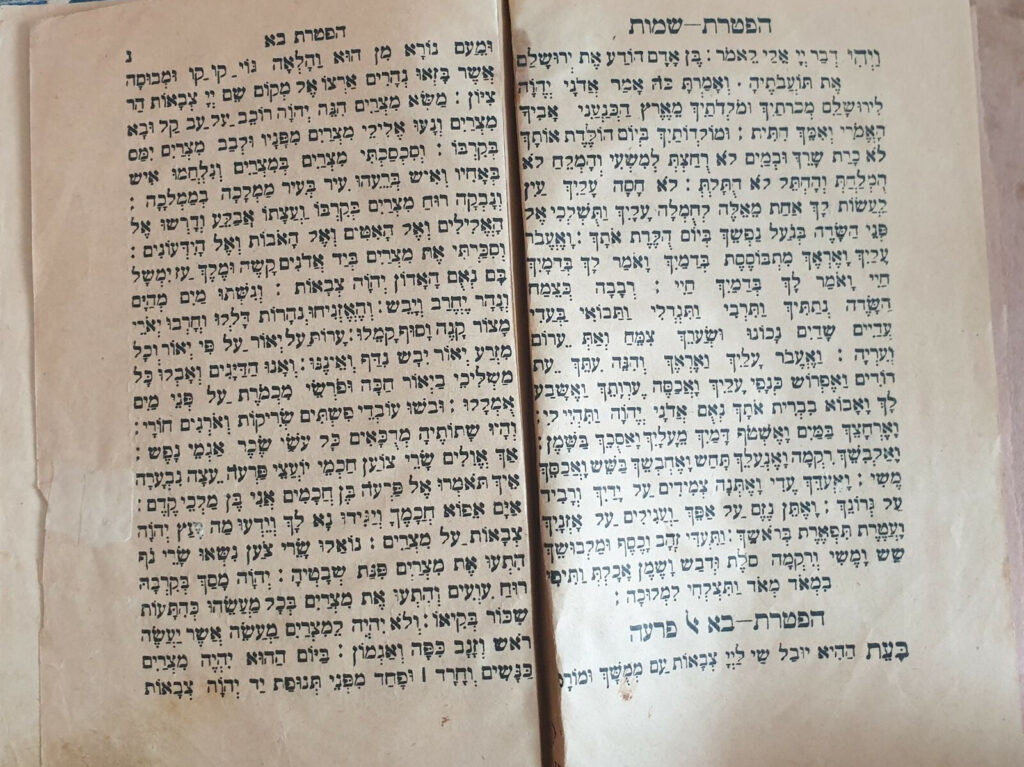
There had been one practice throughout the Jewish world concerning the Haftara of Vayishlach until the print revolution. The book of Ovadia is the Haftara listed in every Haftara list, including the one in the Rambam’s Seder HaTefillos in the Mishneh Torah, MS Ginsburg Moscow of the Machzor Vitry,[2] Etz Chaim (written in London on the eve of the Edict of Expulsion),[3] Abudarham,[4] and the list of Rabbi Shmuel Hanagid, cited in the Sefer HaEshkol.[5] It is also the Haftara in the “Emes” piyyut written by Rabbi Shmuel Hashelishi[6] and the “Zulas” piyyut written by Rabbi Yehuda B’Rabi Binyamin.[7] This is also the Haftara listed in all chumashim in manuscript[8] and in all Cairo Geniza fragments9 that I have seen.

This was also the practice of those who followed the triennial cycle in Eretz Yisrael,[10] the Haftara for the sidra of Vayishlach Yaakov was from the book of Ovadia. The reason for the Haftara is clearly due to it being a prophecy about Edom, and Edom is discussed in depth in the parasha.

The universal practice in all communities was to read from the book of Hoshea for the Haftara of Vayetze, but not everyone read the same verses. In all Geniza fragments[11] the Haftara begins at 11:7, “Ve’ami seluim.” In the fragments with a clear end to the Haftara I have found 3 that end at 12:14,[12] which is similar to what appears in the list of in the Rambam’s Seder HaTefillos, making it a classic Haftara of exactly twenty-one pesukim. One source has it end at 13:4,[13] which is the “Zulas” piyyut written by Rabbi Yehuda B’Rabi Binyamin for this parasha,[14] as well as in the Sefer HaShulchan, written by a student of the Rashba. The reason for the Haftara is due to the verse “Vayivrach Yaakov ,” which is clearly related to the events of the parsha, as well as, possibly, the mention of “Bes El” in 12:5

There were two different Ashkenazi practices in the pre-printing era. One was to begin at 12:13, “Vayivrach Yaakov ,” and to read until the end of the book. This is the Haftara found in MS Ginsburg Moscow of the Machzor Vitry,[15] Etz Chaim,[16] and in 12 of the 16 Ashkenazi chumashim in manuscripts I checked. Outside of Ashkenaz this was the practice among the Romaniots. It is also found in the “Zulas” piyyut of Rabbi Shmuel Hashlishi,[17] who lived in Eretz Yisrael in the 10-11 centuries and belonged to a community that read the Torah according to the annual cycle (although the Haftara ends there at 13:4, making it a Haftara of just seven verses!). It was also the Haftara for the sedra of “Vayetze Yaakov” in the triennial cycle of Eretz Yisrael.[18]

The secondary practice in Ashkenaz, which I found in three chumashim in manuscript, was to read starting from 11:7. One manuscript has the Haftara ending at 12:14,[19] and the other two end at 13:5.[20] The latter is the practice of the Ashkenazi community of Amsterdam.[21]

The first printed chumash with Ashkenazi Haftaros was the Soncino, printed in Brescia in 1492. It had the Haftara beginning at 12:13, following most other Ashkenazi sources. The 1517 Bomberg chumash, printed in Venice, has printed Haftaros according to both the Ashkenazi and Sephardi practices, and has the Haftara for Vayetze beginning at 11:7. After 13:5, the word “כאן” in written, followed by something that was erased (in the microfilmed copy of the Israel National Library) followed by “ההפטרה לספרדים,” that this is where the Haftara ends according to the Sefardi practice, which is quite normative. But before 12:13, at the front of the page, the words “הפטרת וישלח לאשכנזים” appear. The Haftara of Vayishlach in that chumash is from Ovadia, without any instructions, indicating a discrepancy between the two practices. It is clear that a mistake was made here, as Hoshea 12:13 is an Ashkenazi Haftara for Vayetze, not Vayishlach.

The 1517 chumash did not sell well among Jews, likely because its editor, Felix Pratensis, was a Jewish convert to Christianity.[22] In 1524 Daniel Bomberg published another chumash, this time with Yaakov ben Chayim ibn Adoniya as his editor, and this edition was much more popular among Jews. It is essential an entirely different book, as this editor did not rely on the first edition, yet, the Haftaros were, by and large, copied from the first edition, with only minor changes. Concerning our topic, the Haftara for Vayetze is 11:7, without any indication that there are other practices. Right before 12:13 it is written “כאן מתחילין הפטרת וישלח האשכנזים” with no indication where Sephardim finish the Haftara. Here too, Ovadia is listed as the Haftara for Vayishlach, without any instructions indicating that there is a discrepancy between communities.

The popularity of the chumash (already called “Mikraos Gedolos”) created a situation where a new reality was created. The Ichenhausen chumash, published in 1544, merely copied the Haftaros and their instructions from the second Bomberg chumash.

By contrast, another Venetian publisher, Marco Antonio Giustiani, also in 1544, went even further, and wrote in his chumash concerning the Haftara from Ovadia as “הפטרת וישלח כמנהג בני ספרד”. The instructions in this chumash created three changes:

  • It shortened the Sephardi Haftara for Vayetze and ended it at 12:12, a verse that that discusses the Israelites performing pagan sacrifices and the ramifications of this, an extremely inappropriate way to complete a Haftara.
  • It ignored the widespread Ashkenazi practice to begin the Haftara of Vayetze from 12:13. Instead, it has them all starting at 11:7 (as well as completing the Haftara at 12:12, which was unheard of).
  • It created a new Ashknenazi Haftara for Vayishlach, from Hoshea, which has nothing to do with the parsha at all, and did away with the reading from Ovadia, which had been a universal practice until that time.

Not all chumashim “ruled” in such a manner. In the Lublin chumash of 1517, the original Ashkenazi Haftaros of Hoshea 12:13 for Vayetze and Ovadia for Vayishlach were listed. Likewise, the Levush, published in 1590, listed these Haftaros as well.

Soon after, we begin to see many chumashim following the new practice. For example: Manitoba – 1589, Frankfurt am Main – 1662, Venice – 1684, as well Haftara books published in Frankfurt Oder in 1685 and in 1708. Yet, I found chumashim from this period with the original Ashkenazi Haftaros, but they were both printed in Prague, which is known to have kept the original practice, as will be discussed below.

The first to point out the error of the new chumashim was Rabbi Avraham Gombiner, in his commentary, Magen Avraham, on Orach Chayim of Shulchan Aruch in siman 428:[23]

מה שכתב בחומשי’ ויברח יעקב לפ’ וישלח ט”ס הוא ושייכ’ לפ’ ויצא (לבוש)

Magen Avraham was first published in 1692, after the author’s passing. He does not explicitly mention what the Haftara for Vayishlach is, but as he cites the Levush, it is clear that he meant it is from Ovadia, as with the exception of the new practice of reading Hoshea 12:13 for Vayishlach, which the Magen Avraham clearly rejects, Ovadia was the only known Haftara for Vayishlach. Nevertheless, chumashim printed after the publication of the Magen Avraham continued to list Hoshea 12:13 as the Ashkenazi Haftara for Vayishlach.[24] Even the chumash published by R’ Shabs ai Bass, author of the Sifsei Chachamim and publisher of Magen Avraham, had this as well.

In 1718 the book “Noheg Katzon Yosef” by Rabbi Yosef Yozefa Segal was published, a work on the practices of German communities in general and Frankfurt am Main in particular. He wrote the following concerning parashas Vayetze:[25]

כתב בלבוש החור ס’ תרס”ט שהפטרה של סדר זו הוא ויברח יעקב, והפטרת וישלח הוא ועמי תלואים, עיין שם. והנה באמת במקומות שמחלקים שתי פרשיות אלו מהושע לאמרם לשתי הפטרות משתי שבתות אלו היה הדין עם הלבוש להקדים המאוחר ולאחר המוקדם. דכד נעיין ביה שפיר נראה שכתיב ויברח יעקב “ובאשה שמר” שהוא מלשון ואביו שמר את הדבר, כלומר המתין עד שתנא ראויה לביאה, או ששמר את הצאן בעד האשה, שהוא מעין פרשת ויצא. ובעמי תלואים כתיב וישר אל המלאך ויוכל , שהוא על שם הכתוב כי שרית עם אלקים ועם אנשים ותוכל הכתוב בוישלח. א”כ למה לנו ליתן את של זה בזה ושל זה בזה? ואפשר שיצא משבשתא זו מפני ששתי הפטרות אלו הם סמוכים בקרא, ועמי תלואים מוקדם במקרא, לפיכך שמו המוקדם במקרא לפרשת ויצא המוקדמת, והמאוחר לפרשת וישלח המאוחרת. והמנהג בק”ק פ”פ שמפטירין בויצא מן ועמי תלואים עד סוף הנביא, דהיינו שתי הפטרות אלו ביחד, שמספר מה אירע ליעקב. ועיין מה שכתבתי בפרשת וישלח

It is written in the Levush Hachur siman 769 that the Haftara for this seder is “Vayivrach Yaakov ,” and the Haftara for Vayishlach is “Ve’ami seluim.” In reality, places that divide the Haftara from Hoshea in order to read it as two Haftaros over two Sabbaths should follow this Levush and read the latter part first and the earlier later, as when one looks examines the matter one see it says in “Vayivrach Yaakov ” (the words) “he guarded his wife,”[26] which is similar to, “and his father kept the matter in mind,”[27] meaning [Yaakov] waited until she was fit for marriage, or it means he guarded the sheep in order to marry the woman, which is similar to parshas Vayetze. And in “Ve’ami seluim” it is written “he strove with an angel and prevailed,” which is based on the verse “for you have striven with beings divine and human and prevailed,” which is written in Vayishlach. Therefore, why should we read them in the opposite order? It is possible that this mistake occurred because these Haftaros are adjacent to each other, and “Ve’ami seluim” appears first. Therefore, they put the first Haftara for Vayetze, which is the earlier parsha, and the latter one for the later Vayishlach. But the practice in Frankfurt is to read “Ve’ami seluim” until the end of the book, meaning to read both Haftaros together.

This piece is rather difficult to comprehend.

  • First, the Levush says nothing of the sort. The author proceeds to try to explain the mistake that developed due to the Levush, who did not write what is ascribed to him.
  • He recommends reversing the orders of the Hoshea Haftaras, rather than recommending that Ovadia be read, which he cites later as the practice in Frankfurt.[28]
  • He claims that the Frankfurt practice is to read from 11:7 until the end of Hoshea for Vayetze. All other sources claim that the practice there was to read from 12:13 for Vayetze and to read Ovadia for Vayishlach, and there is no other source for this “double Haftara” anywhere.

The Rav of Frankfurt, Rabbi Yaakov, author of the Shav Yaakov, wrote an approbation for the book “Noheg Katzon Yosef,” but after he found many errors he asked Rabbi Yehuda Miller, the author’s father-in-law, to fix the errors.[29] Some later printings of the book included these corrections in a booklet called “Tzon Nachalos,” where he wrote that the author was indeed mistaken with regard to the practice in Frankfurt.[30]

In 1729, eleven years after the publication of Noheg Katzon Yosef, Rabbi Yitzchak Aizik Mis wrote a commentary on the Haftaros known as Be’er Yitzchak, which was published in Offenbach, a town quite close to Frankfurt. He listed there various halachos and practices connected to Haftaros. He wrote there:[31]

בכל החומשים נפל טעות שציינו להפטורת ויצא ועמי תלואים ולפ’ וישלח ויברח יעקב וצריך להיות לפ’ ויצא ויברח יעקב לפי שבו כתיב ובאשה שמר שהוא מעניינא דפרשה ששמר את הצאן בעד האשה ולפ’ ושילח ועמי תלאים לפי שבו כתיב וישר אל מלאך ויוכל וגו’ שהוא מעניינא דפ’ כי שרית עם א-הים ועם אנשים ותוכל ובק”ק פרנקפורט דמיין אומרים לפ’ ויצא ועמי תלואים וגם ויברח יעקב ולפ’ וישלח חזון עובדיה

All of the chumashim have a mistake, as they cite the Haftara of Veyetze as “Ve’ami seluim” and that of Vayishlach as “Vayivrach Yaakov ,” while the Haftara for Vayetze should be “ Vayivrach Yaakov ,” as is written there “he guarded a wife” which is the matter of the parsha where (Yaakov) guarded the sheep for the wife’s sake, and that of Vayishlach should be “Ve’ami seluim,” as it is written there he strove with an angel and prevailed, which is the matter of “for you have striven with beings divine and human and prevailed.” In Frankfurt am Main they say “Ve’ami seluim” and “Vayivrach Yaakov ” for Vayetze, and “Chazon Ovadia” for Vayishlach.

It is clear that he did not just copy this out of the Noheg Katzon Yosef, as he views what is printed in chumashim as a mistake, while the Noheg Katzon Yosef mistakenly attributed it to the Levush. But it seems likely that his (erroneous) statement concerning the Frankfurtian practice does come from there.[32]

The famous printing press in Amsterdam, Proops, published a chumash in 1712 with similar Haftaros for these parshiyos to the Venice chumashim, but in another chumash, the 1734 edition, in the Haftara for Vayetze before 12:14 it is written כאן מתחילין האשכנזים פרשת ויצא while for Vayishlach, Ovadia is listed as the Haftara for Sephardim, with no mention of the Ashkenazi practice at all. It is likely that the publisher, who published a Shulchan Aruch with Magen Avraham,[33] was aware of the comment there concerning the mistake in the chumashim about the Haftara of Vayetze, but someone along the line did not realize the ramifications of this and just left Ovadia as the Haftara for Sephardim alone.

The 1754 Proops chumash cited the Venteian Haftaros, possibly as the best method to correct the error of the earlier chumash omitting an Ashekenzi Haftara for Vayishlach. But in the chumash they published in 1762, the following appears before the Haftara for Vayetze, Hoshea 11:7:

והמנהג הנכון לאשכנזים להפטרת ויצא ויברח יעקב וכן כתוב באחרונים

Before Hoshea 12:14 the following appears:

כאן מתחילים האשכנזים הפטרת וישלח, והמנהג הנכון לאשכנזי’ זהו הפטר’ ויצא ועמי תלואים שייך להפטר’ וישלח

It seems that the so-called “achraronim” mentioned here are the Be’er Yitzchak and the Noheg Katzon Yosef.

These Haftaros appear in later Proops chumashim in 1767 and 1797, as well as in another Amsterdam chumash, published in 1817 by a doctor named Yochanan Levi.

Other chumashim of the period continue to cite the Haftaros as they were listed in the Venice chumashim.[34]

Rabbi Shlomo Ashkenazi Rappaport of Chelm, in his Shulchan Atzei Shitim, wrote that the Haftara for Vayetze is Hoshea 12:14, and the Haftara for Vayishlach is from Ovadia, and in his Zer Zahav commentary he wrote:[35]

ויברח יעקב – ודלא כמו שנרשם בחומשים בטעות ויברח יעקב לפרשת וישלח דשייך לפ’ ויצא (ס’ תכ”ח)

This is clearly based on Magen Avraham.[36] It seems that his opinion concerning the Hafatros was not accepted in his day.[37]

Eighteenth-century Amsterdam was major center of Hebrew printing, and Proops was quite famous in terms of print quality, and in particular for using new methods for marketing their books.[38] Books from there were shipped to Danzig, from where they made their way into Eastern Europe. [39] Proops’ books were very popular there, which enabled them to raise the necessary funds to print a new edition of the Talmud Bavli[40] Rabbi Avraham Danziger, having grown up in the city, would have likely been exposed to the many sefarim published by Proops, and it is likely that he had their chumashim. The first edition of his Chayei Adam was published anonymously in 1810, and the matter of these Haftaros is not raised there, but in the second edition, published in the author’s lifetime in 1819, is it written:

מה שכ’ בחמשים הפטרת וישלח ויברח יעקב הוא טעות אלא בויצא מפטירין מן ויברח עד ויכשלו בם ובוישלח מפטירין מן ועמי תלואים וגם מקצת ויברח יעקב עד ומושיע אין בלתי (תכ”ח):

What was the source for this statement of the Chayei Adam? It does not seem likely that it is Noheg Katson Yosef, as that book had been published only once, a century earlier.[41] It is also not likely to be the Be’er Yitzchok, which was published in faraway Offenbach. It seems reasonable that he was exposed both to the Proops chumashim (or others with those Haftaros), as well as other chumashim with the Venetian Haftaros, which he saw as mistaken, and when he referred to “what is written in the chumashim,” he did not mean all of them.

The publishers of this of this edition, Menachem Mann and Zimmel, published a chumash for Ashkenazim in 1820 with Hoshea 14:12 as the Haftara for Vayetze and 11:7 for Vayishlach, likely following what was the ruling of the Chayei Adam at the time.

The next edition of the Chayei Adam was published in 1825, several years after the author’s death. As it had the same publisher, it seems unlikely that any changes were made by anyone but him. It is written there:

מה שכ’ בחומשים הפטרת וישלח ויברח יעקב הוא טעות אלא בויצא מפטירין מן ויברח עד סוף הושע (ואח”כ פסוקים מיואל ואכלתם אכול וכו’ וידעתם וכו’ ג”כ מטעם לסיים בטוב( ובוישלח מפטירין מן ועמי תלואים וגם מקצת ויברח יעקב עד ומושיע אין בלתי ועפ”י הגר”א נוהגין להפטיר בפ’ וישלח וישלח חזון עובדי’ (תכ”ח)

We see two changes here.

  • That two verses from Yoel should be added in to the Haftara for Vayetze (which he already pointed out in the previous edition is Hoshea 12:14) which otherwise ends with the mention of sinners stumbling.[42] Evidently, earlier authorities did not think it necessary to avoid such an ending. This is cited by the Mishna Berura,[43] but is not written in any chumashim published before the Holocaust.
  • He mentions that the Vilna Gaon ruled that we read Ovadia as the Haftara for Vayishlach, and those who follow him do so. The author of the Chayei Adam was related to the Vilna Gaon by marriage, and prayed with him in the Vilna Gaon’s Kloyz.

These additions were printed in later editions of the book.[44]

During the same year, 1819, Rabbi Efraim Margolies published the Sha’arei Efraim,45 which sounded similar to what was written in the Chayei Adam published in that same year:[46]

מה שנרשם במקצת חומשים הפטורת ויברח יעקב לפ’ וישלח הוא ט”ס, כי הוא שייך לפ’ ויצא, והפטורת וישלח בהושע ועמי תלואים למשובתי

It is unlikely that he saw the edition of the Chayei Adam that had been published just a few months beforehand. The fact that he writes that reading Hoshea 12:14 as the Haftara for Vayishlach is a mistake that appears in some chumashim indicates that he saw other chumashim with the Haftaros in what he considered the correct order, and is likely agreeing with them.

In the first edition of Shulchan Hakriah and Misgeres Hachulchan by R’ Dov Reifman, published in 1864, the opinion of the Sha’arei Efraim is cited,[47]  but in the second edition[48] it is not.

Later, the above-mentioned publisher of the Chayei Adam, Menachem Mann, changed his name to Romm and began publishing many books in Vilna, including the famous Shas Bavli. The chumashim published there had Hoshea 14:12 as the Haftara for Vayetze, and soon other publishing houses followed suit. Romm themselves continued to follow this approach,[49] even though luchos for Vilna printed in 1826[50] and 1839[51] had Ovadia as the Haftara for Vayishlach. It seems likely that in Vilna itself the publication of the Vilna Gaon’s practice in the Chayei Adam had an immediate effect.[52] Romm published the Toras Elokim chumash in 1874,[53] continuing to list Hoshea 11:7 as the Ashkenazi Haftara for Vayishlach, yet the following note was inserted before the Haftara:

הפטרה זו וגם הפטרת ויברח יעקב היא הפטרת ויצא לספרדים מפני שהם בנביא אחד אבל האשכנזים מפטירין בויצא רק ויברח יעקב ובוישלח חזון עובדיה כמבואר ברמב”ם ובלבוש

It is not clear what it means that both Haftaros are read by Sephardim for Vayetze, and it is rather strange that Hoshea 11:7 is listed for the Ashkenazi Haftara for Vayishlach with instructions that Ashkenazim actually read from Ovadia. Before the Haftara from Ovadia the following appears:

הגם שנמצא בחומשים כתוב שהיא הפטרה רק לספרדים אך מבואר ברמב”ם ובלבוש שהיא הפטרת וישלח בין לספרדים בין לאשכנזים

These instructions appeared in the Mikraos Gedolos chumash they published in 1880, and others used these rather strange instructions as well.[54]

The Mikraos Gedolos chumash published by Kadishson in Piotrkow had the Haftara from Hoshea 11:7 without any instructions, but wrote the following before the Haftara from Ovadia:

“כ”ה דעת הלבוש וראה עוד לזה ג”כ בסי’ תרפ”ד… הפטרת שבת א’ של חנוכה …

The Levush here explains that the reason why Zecharia is the Haftara on the first Sabbath of Chanuka while the fashioning of the menoras in Melachim in read on Chanuka only in the event that there is a second Sabbath is that that a Haftara discussing the future redemption is preferred, and the editor here felt the same applies to preferring Ovadia over Hoshea for parashas Vayishlach. The same instructions appear in the Romm Mikraos Gedolos printed in 1904.

Another Romm Chumash from 1898 had Ovadia as the Haftara for Sephardim only and Hoshea 11:7 for Ashkenazim. This chumash was reprinted in 1938, but that chumash was just a copy of one that was printed in Zhitomer in 1867, which is to this day viewed as the standard “shul chumash.”

The Chayei Adam as printed in 1825 edition onward is cited by the Mishna Berura.[55] It seems that by then many communities were reading Ovadia for Vayishlach.

The practice of returning to the original Ashkenazi Haftara was not limited to Vilna and its environs. Shortly after the publication of Sha’arei Efraim, we find many communities in what became the Austro-Hungarian empire (where Rabbi Efraim was from) who read Ovadia for Vayishlach. This includes Vienna,[56] Tarnow,[57] Pressburg[58] Erlau,[59] and Eperjes.[60] But the practice in Gálszécs[61] was to read Hoshea 11:7 for Vayishlach. This was the practice in Warsaw in Russian Poland as well, according to the luach from there in 1889. By contrast, in Przeworsk[62] they still maintained the Haftaros, based on the Venice chumashim, Hoshea 11:7 for Vayetze and 12:13 for Vayishlach.

Cities that retained the original Ashkenazi practice throughout

It is impossible to know the effect of printed chumashim in various eras on every local practice, but it is clear that there were communities that simply ignored them and continued the old practice from before the era of printing. We have already seen that that was the case in Frankfurt. This was the practice in Worms as well, as seen in “Minhagei K”K Vermeiza” by Rabbi Yosefa Shamash, circa 1648.[63]

Concerning Mainz, in “Minhagei K”K BeSeder HaTefilla Unuschoseha” in the Sefas Emes siddur printed in 1862,[64] Hoshea 12:14 is the Haftara for Vayetze. Although this is a late source, it seems to reflect a very early practice and only Haftaros that are not universal in Ashkenaz[65] are written there, which is why it does not mention the Haftara for Vayishlach, which by then was standard in Ashkenaz.

Concerning Prague (Bohemia), as mentioned earlier, chumashim there retained the original Haftaros of Hosea 13:12 for Vayetze and Ovadia for Vayishlach after they ceased to be printed as the Haftaros elsewhere. One chumash printed there 1697 does not, but it states explicitly that the Hafatros are as they are printed in Amsterdam. In Mendelsohn’s Biur, printed in 1836, the following is written:

‘מנהג פראג ויברח יעקב – והיא הפטרת וישלח כמנהג האשכנזים, ויש מתחילים אותה בהושע י”א פסוק ז

The verses between Hoshea 11:7-12:13 are printed in small letters, indicating they are generally not meant to be read by the intended audience. In a chumash printed in 1893, Ovadia and Hoshea 11:7 appear as Haftaros for Vayishlach, with these instructions before the former:

כמנהג האשכנזים רק בפראג ובמדינת בעהמען מפטירין חזון עובדיה

Before the Haftara from Ovadia the following appears:

כמנהג הספרדים פראג ומדינת בעהמען

In a chumash printed in Budapest in 1898 it is mentioned as a practice of Prague; not as one of all of Bohemia.

Just like there are different sources whether the original Haftaros were maintained in Prague alone or in all of Bohemia, there is a similar matter with regard to Frankfurt. In the chumash printed in Roedelheim in 1818 the Haftara for Vayetze is Hoshea 11:7. The note there states:

בק”ק פפד”מ ורוב אשכנז מפטירין בפ’ ויצא ויברח יעקב ואינם אומרים כלל ועמי תלואים

And for Vayishlach, where the Ashkenazi Haftara is listed as Hoshea 12:14, it is written:

כאן מתחילין האשכנזים הפטרת וישלח אבל בק”ק פפד”ם ורוב אשכנז מפטירין בפ’ וישלח חזון עובדיה דלקמן

The same appears in the 1854 chumash published there, as well as all subsequent printings, including the edition this chumash published in Basel in 1964.[66] The same notes appear in a chumash printed in Konigsberg[67] in 1851 and Vienna in 1864. A chumash printed in Furth in 1901 had Hoshea 11:7 as the Ashkenazi Haftara for Vayishlach, but mentioned that the practice in Frankfurt was to read from Ovadia.

Here there is evidence that the retaining of the original Haftaros spread beyond Frankfurt, as it was the practice in the old communities of Mainz and Worms.

Another community that appeared to have retained the old practice throughout is Posen, from which there is a Pinkas[68] with unique practices and carefully retained customs.

The original practice returned, as it was mentioned in sources and chumashim in the 19th century. It was in the luchos in the Austrio-Hungarian empire mentioned before and it was the practice in Chernowitz as of 1868. Later it was mentioned in the all of the luchos in Eretz Yisrael69] and in that of Ezras Torah in the United States, causing (or reflecting) that the old/new Haftaros became the standard practice for Ashkenazim.

The reacceptance of the two original Haftaros was and is not universal. The Beis Medrash Hayashan in Berlin read Hoshea 11:7 for Vayishlach until its bitter end,[70] while the practice of Kehal Adas Yisrael there was to read Ovadia.[71] The United Synagogue communities in the United Kingdom[72] (and some synagogues in some other Commonwealth countries) still read Hoshea, as it is listed as the Ashkenazi Haftara in the Hertz Chumash.[73] The Chabad[74] practice is similar to the Sephardi practice, and Amsterdam Ashkenazim read Hoshea 11:7 for Vayetze.

Adding verses from Yoel

The Chayei Adam cited this idea, which is then cited by the Mishna Berura. Two other options are mentioned in order to finish with a positive matter. One is to finish the Haftara earlier, at 14:7, and another is to add from Micha 7:18-20.[75]

Luach Eretz Yisrael of Rav Yechiel Michel Tucazinsky cites the practice of adding the two verses from Yoel. Lately, this practice has been cited by the Ezras Torah Luach in the United States.[76] Nonetheless, out of all of the chumashim that list the Haftara from Hoshea 12:13 for either Vayetze or Vayishlach, none mentioned this practice until the Koren Chumash of 1963, which cited that there are those who add the verses, and so is written in subsequent editions until today. By contrast, there are other Israeli chumashim that do not cite this practice.

The first edition of the popular English Stone Chumash, published by ArtScroll in 1993, did not cite this practice, but from the second edition onward the verses from Yoel are there, along with instructions in English that there are those who add them.

Summary

In the pre-printing era most Ashkenazi communities read Hoshea 12:14 for Vayetze and everyone read Ovadia for Vayishlach. This changed due to a mistake in the Venice chumash of 1517, after which most chumashim listed Hoshea 12:14 as the Ashkenazi Haftara for Vayishlach and Hoshea 11:7 for Vayetze. Magen Avraham noted this error, but mentioned only the correct Haftara for Vayetze, leading Noheg Katzon Yosef, Amsterdam chumashim, and after them the Chayei Adam and Sha’arei Efraim, to claim that Hoshea 11:7 is the Ashkenazi Haftara for Vayishlach. As time passed, and possibly due to the influence of the Vilna Gaon, the practice reverted to what it originally had been, to read Ovadia for the Haftara of Vayishlach.

[1] The topic of this article is the development of the Ashkenazic practices regarding these Haftaros. Any mention of other practices is just an aside. I would like to thank R’ Avraham Grossman for editing the original Hebrew and my brother R’ Yehoshua Duker for editing the English translation. I would also like to thank Dr. Gabriel Wasserman, R’ Dr. Eliezer Brodt, R’ Elli Fischer, R’ Mordechai Weintraub, my uncle Dr. Joel Fishman, and the staff of the National Library of Israel for their assistance and input.
[2] Goldshmidt Ed. Vo. 2. Krios Vahaftaros, p. 589
[3] Hilchos Krias Hatorah Ch. 4. P. 53.
[4] Keren Re’em edition, Vol. 3 29:23 (p. 29).
[5] Albeck edition, Hilchos Krias Hatorah p. 181.
[6] The Yotserot of R. Samuel the Third, Vo. 1 227-229
[7] Piyutei R Yehuda BiRabbi Binyamin (Elitzur ed.) pp. 113-114.
[8] See Fried, “Haftarot Alternativiot Befiyuttei Yanai Ush’ar Paytanim Kedumim” Sinai 2. He states one of my main claims there; i.e., that the change of the Haftara began at the onset of the printing era, but he does not mention specifics.
[9] Cambridge T-S A-S10241, B14.22, B14.88, B14.95, B15.5, B16.21, B20.2 B20.4 20.14 Cambridge Lewis-Gibson MISC 25.53.16.
[10] See list by Y. Ofer https://faculty.biu.ac.il/~ofery/papers/haftarot3.pdf
[11] T-S AS19.241, B20.2, 4,14, B14.62c, 125, B15.5
[12]  T-S B15.2, B20.2, 4.
[13] T-S B16.21
[14] Pp. 107-108
[15]  ibid.
[16] ibid.
[17] pp.214-215
[18] See Ofer
[19] Ms. Par. 2168.
[20] Ms. Lon Bl Add. 9408, Kennecott 3 (the last 3 verses are not vowelized),
[21] Hahogas Beis Haknesses DK”K Amsterdam, Proops ed. p. 519 , and Machon Yerushalayim ed. p. 221. It is not clear whether or not the Ashkenazim, who established their community there in 1632, adopted the practice of the Sephardim who had arrived in the city a half century earlier, or whether they had another Ashkenazi source. Concerning Ashkenazi Amsterdam practices in general, see the introduction to the Machon Yerushalayim edition pp 41-42.
[22] Concerning Pratensis and the publication of the chumash in general, see, Penkower, J.  “Mahadurat HaTanach Harishona Bomberg Laor V’Reishit Beit Defuso,” Kiryat Sefer, 1983 pp. 586-604.
[23] Meginei Eretz edition, Dyhernfurth (today Brzeg Dolny), Shabtai Meshorer pub.
[24]  This is the case in the chumashim published by Levy, H. in 1735, Atias J. in 1700, and Antonis A. in 1719, all in Amsterdam, as well as the di Foc. Florence, 1755.
[25] 179:2 pp. 239-240 Machon Shlomo Auman ed.,
[26] שמר in the original.
[27] שמר in the original.
[28]  p. 240
[29] Concerning the errors in the book see the introduction to this edition pp. 17-19, as well as Shorshei Minhag Ashknenaz, Hamburger R.B. vol. 2, pp. 250-251.
[30] Printed in same edition of Noheg Katzon Yosef, p. 441. Besides the chumashim (discussed later on) that discuss the Frankfurt practices, similar to what is cited in the Tzon Nachalos, this practice is also mentioned in Frankfurt by Divrei Kehillos, Geiger, R SZ, p. 369, but this source is later, as it is from 1864.
[31] Halacha 16.
[32] The book has Hoshea 12:13 as its Haftara for Vayetze. He lists Hoshea 11:7 as the Haftara for Vayishlach, followed by Ovadia under the headline “יש מפטרין הפטרה זו”. In a Haftara book with Mendelssohn’s bi’ur published by Shmidt A., in Vienna in 1818, all of the halachos mentioned in the Be’er Yitzhak were quoted, with the exception of the one with regard to Vayetze-Vayishlach. It is possible that the publisher was aware of the error here and did not want to insert it. Moreover, in the luach published by Shmidt for Vienna in 1805, he listed Hoshea 12:13 as the Haftara for Vayetze and Ovadia for the Haftara of Vayishlach, and it could be that he did not want to give the impression that the dominant practice is different from what he wrote there. The guidelines from Be’er Yitzchok, with the omission of this one, were also printed in chumashim published in Feurth by Tzendarf, D. in 1801, and another in Livorno by Prizek, A. in 1809.
[33] Published in 1720.
[34] Salzbach (1802, 1820), Livorno, 1795. Paris 1809.
[35] Siman 6:6:1.
[36] Magen Avraham was added as the source in the Krauss edition of 2013.
[37] See introduction to Krauss edit. p. 6.
[38] See “Hebrew Printing” by Fuks, L. Translated from Dutch in “European Judaism” 5:2 (summer 1971).
[39] See “Hebrew Book Trade in Amsterdam” Fuks-Mansfeld R. G. in Le Magasin de l’univers: the Dutch Republic as the centre of the European book trade: papers presented at the international colloquium, held at Wassenaar, 5-7 July 1990 / edited by C. Berkvens-Stevelinck [et al.].
[40] See Fuchs ibid.
[41] See Auman edition. Intro. p. 16.
[42] This matter is discussed at length in Zera Yaakov, Zaleznik, R.S.Z. S. 138
[43] 28:22
[44] Menachem Mann and Ziml ed. Vilna, 1829, and 1839. Huffer ed. Zhovkva 1837, Wachs Jósefów, 1839. Menachem Mann and Ziml ed. Vilna, 1839. Shklover ed. Warsaw, 1840.
[45] Published in Dubno.
[46] 9:18.
[47] S. 25 at the end
[48] Berlin, 1882.
[49] This is the case in the Mendelssohn Biur they published between 1848-1853, Tikkun Soferim in 1860, and again in 1864.
[50] Publisher unknown.
[51] Published by Menachem and Simcha Zisl, sons of R’ Boruch.
[52] Later luchos from Vilna listed Ovadia as the Haftara for Vayishlach. I was unable to read what it said for Vayetze on the 1880 copy I saw. No Haftara was listed in the 1890 edition, as only Haftaros that had alternative practices were mentioned, and Hoshea 12:13 for Vayetze had become quite widespread among Ashkenazim by them, leaving no need to mention it.
[53] There was an earlier version in 1872 but I have not been able to locate it.
[54] This includes chumashim published in Vilna by Rosenkrantz in 1893 and Metz in 1913, and a chumash published in New York by the Jewish Morning Journal (דער מארגען זשורנאל) in 1914.
[55] Ibid.
[56]  Luach in 1879
[57]  Found in luchos printed there annually through 1887-1890, as well as in 1894 in Vienna by Sturm, D. Luchos are the source for the other practices listed here as well.
[58] Now Bratislava from 1870, 1892, 1893, and 1894. Printed in Vienna by Elinger, M.
[59] Eger in Hungarian  1889.  Printed in Vienna by Engalder.
[60] Today Presov  1887. Printed in Vienna by Ster, D.
[61] Pronounced “Gossach”, the ancestral home of my wife’s family. Today it is called Sečovce. 1888. Printed in Vienna.
[62]  1888. This appears to be the last time there is a record of the Haftaros being read that resulted from the misprinting in the Venice chumashim.
[63]  Machon Yerushayaim ed. Vol II. p. 195.
[64] p. 12
[65] Ashkenaz here refers to western Germany.
[66]  These instructions are found in Haphtoroth / translated & explained by Mendel Hirsch, rendered into English by Isaac Levy. London, 1966. I believe this is the last time they were given.
[67] Now Kaliningrad
[68] See Pinkas Beis Hakneses DK”K Posna, Mirsky S.K. in Brocho l’Menachem: essays contributed in honor of Menachem H. Eichenstein, rabbi of the Vaad Hoeir, United Orthodox Jewish community, St. Louis, Missouri  published by the Vaad Hoeir, United Orthodox Jewish community, 1956. What is written there, that the Haftara for Vayetze is “VVayivrach Yaakov” from S. 11 is clearly a mistake in the numbering.
[69] 1947 onward.
[70] Minhagei Beis Medrash Hayashan DK”k Berlin, 1937.
[71] Minhagei Beis Hakanesses D’Khal Adas Yisrael, Berlin 1938.
[72] Heard orally from Henry Ehreich of London, as well as on the website of the Muswill Hill Synagogue. https://u.pcloud.link/publink/show?code=kZzoTE7ZiRKq7OeCnFVtgCP2qaUuqJtpwP27

A chumash was published by Valentine in the U.K. in 1868 with an English translation that had Ovadia as the main Haftara for Vayishlach, qualifying that some communities read Hoshea 11:7.
[73] First Edition, published in 1929 in both London and New York.
[74] p. XIII, Sefer Haftaros Lifi Minhag Chabad, Kehot, New York.
[75] In “Luach Halalachos Vihamingim LChu”L Lishnas 5779 (Weingarten edition) these practices were cited from Luach Vilna. In R. Tucazinsky’s luach he recommends that those communities that read the Haftara from a scroll that has the entire text of “Trei Asar” refrain from reading from Micha, as it is a violation of the principle not to skip to somewhere when it takes more to time to roll the scroll then for a translator to complete translating the previous verse.
[76] Nothing about this appears in the luach for 1995 and this does appears in 2000 onward.  I was unable to obtain the luchos in the interim. In 2005 it is written “כתוב בחיי אדם” and nothing else, most likely a printer’s error.


Shiur Announcement: Rabbi Yechiel Goldhaber in Brooklyn, 11/1/21 & 11/3/21

Shiur Announcement: Rabbi Yechiel Goldhaber

R’ Yechiel Goldhaber will be visiting the United States for a few weeks.

The readership of the Seforim Blog is invited to a lecture by the noted author, Rav Yechiel Goldhaber whose respected research and scholarship is well-known to Seforim Blog readers.

He will be giving a shiur tomorrow night, Monday, 11/1, at 7:30 PM. The address is at:

Rabbi Rabinowitz

1454 54th Street

This shiur will be in Yiddish

Wednesday night, 11/3, he will be giving a shiur in English

Rabbi Meir Adler at 7:30 pm

962 East 19th Street

Both of these shiurim will be about

איסור לא תחנםוהשלכותיו לגבי ההיתר מכירה לשמיטה, בליווי תעודות חדשות שטרם פורסמו

Rabbi Goldhaber will be available to give a shiur in your area. To book him, please contact him at: goldhaber.y@gmail.com


The Haftarah of Parashat Shemot

The Haftarah of Parashat Shemot[1]

By Eli Duker

The Babylonian haftarah for Parashat Shemot was from Ezekiel 16: “Hoda’ et yerushalayim.

The haftarah appears in at least six fragments from the Cairo Geniza,[2] is the haftarah used in the “Emet” piyyut of R’ Shemuel Hashelishi[3] and in the “Zulat” piyyut of R’ Yehuda Beirabbi Binyamin,[4] and is listed in the Seder Hatefillot in Rambam’s Yad Hahazakah as well as in the Siddur of R Shlomo Beirabbi Natan.[5]

This haftarah, an extremely graphic and difficult prophecy, was chosen because it begins by describing the Egypian enslavement and the Exodus. In all of the fragments that describe where the haftarah ends, the last verse is verse 16:15, likely so as not to continue with the difficult words of rebuke that follow that do not have anything to do with the parasha. The Baylonian custom allowed for haftarot that were less than twenty one verses even if the subject is left uncompleted because they still had the practice to read Jonathan’s Targum along with the haftarah, and thus were exempted from the twenty-one verse minimal requirement, as per the ruling of R’ Tahlifa bar Shemuel (Megilla 23b).[6]

This choice of haftarah seems to be problematic in light of the Mishna (Megilla 4:10):

מעשה ראובן נקרא ולא מתרגם מעשה תמר נקרא ומתרגם מעשה עגל הראשון נקרא ומתרגם והשני נקרא ולא מתרגם ברכת כהנים מעשה דוד ואמנון נקראין ולא מתרגמין אין מפטירין במרכבה ורבי יהודה מתיר ר’ אליעזר אומר אין מפטירין (יחזקאל טז, ב) בהודע את ירושלם.

The Mishna brings, without dissent, the opinion of Rabbi Eliezer, which forbids this haftarah. However, the Tosefta as it appears in MS Vienna National Library Heb. 20 seems to allow this haftarah, while Rabbi Eliezer’s view is brought as a dissent:[7]

הודע את ירושלם נקרא ומתרגם ומעשה באחד שהיה קורא לפני ר’ ליעזר הודע את ירושלם אמ’ לו צא והודע תועבותיה של אמך.

However, according to that same Tosefta as it appears in MS Berlin Staatsbiliothek Or. Fol. 1220, the Tanna Kamma merely permits haftarot with general rebuke directed at Jerusalem (תוכחת ירושלים), while Rabbi Eliezer objected to the particular choice of Ezekiel 16:

תוכחת ירושלים נקרא ומתרגם ומעשה באחד שהיה קורא לפני ר’ ליעזר הודע את ירושלים ואמ’ לו צא והודע תועבותיה של אמך.[8]

Like the Mishna above, the Talmud Yerushalmi brings Rabbi Eliezer’s prohibitive opinion regarding this haftarah, and presents no other view:

ר’ אליעזר אומר אין מפטירין בהודע את ירושלם את תועבותיה מעשה באחד שהפטיר בהודע את ירושלם את תועבותיה אמר לו ר”א ילך אותו האיש וידע בתועבותיה של אמו ובדקו אחריו ונמצאו ממזר.[9]

The following appears in both printed versions of the Talmud Bavli [10] as well as in three manuscripts of the Bavli:

הודע את ירושלם את תועבותיה נקרא ומתרגם פשיטא לאפוקי מדרבי אליעזר דתניא מעשה באדם אחד שהיה קורא למעלה מרבי אליעזר הודע את ירושלם את תועבותיה אמר לו עד שאתה בודק בתועבות ירושלים צא ובדוק בתועבות אמך בדקו אחריו ומצאו בו שמץ פסול .

This is very difficult to understand. How can the Gemara assume (פשיטא) that this haftarah can be read if the Mishnah already brought Rabbi Eliezer’s unchallenged opinion forbidding it?

Accordingly, two other manuscripts do not have the word פשיטא.

For example, MS. Columbia 294-295 has the following:

הודע את ירושלם את (..)[ת]ועבותיה נקרא ומיתרגם ומעשה באחד שקרא לפני ר’ אליעזר הודע את ירוש’ את תועב’ אמ’ לו צא והודע תועיבות שלאימך עד שאתה בודק בתועבות ירושלם צא ובדוק בתועבות אמו בדקו אחריו ומצאו בו שמץ פיסול.

Here, the story with Rabbi Eliezer is brought within the context of the view of the Tanna Kamma that it is permissible to read this haftarah. Rabbi Eliezer clearly does not reject this view outright, but still deemed this haftarah a poor choice and an inappropriate one at least under the circumstances.[11]

All of the other manuscripts besides this one feature an explicit disagreement between the Tanna Kamma, who permits this haftarah, and Rabbi Eliezer, who forbids it. The Gemara rejects Rabbi Eliezer’s opinion.

Communities that followed the triennial cycle of the Torah reading never read the beginning of Ezekiel 16 as a haftarah. However for the sidra of V’atta Tetzaveh, they did begin the haftarah from Ezekiel 16:10.[12] It could very well be that this haftarah was deemed permissible despite the Yerushalmi’s ban on the preceding prophecy due to the fact that they held a view later cited by the Levush[13] that the problem with Ezekiel 16 is not the severity of the rebuke but but merely verse 16:3, “Your father was an Amorite and your mother a Hittitess,” which was referenced in Rabbi Eliezer’s retort, seemingly because it casts aspersions of the kind with which no one would be comfortable.

In Europe there were two alternative haftarot for Parashat Shemot: Jeremiah 1:1 and Isaiah 27:6. It seems that many communities either did not want to read Ezekiel 16 even though it was allowed by Halacha because of the weight of Rabbi Eliezer’s rejection, or because they had versions of the Talmudic sources which unanimously presented the haftarah as permissible but undesirable.

In the Iberian peninsula, there were communities that retained the haftarah of Ezekiel 16. It is brought as the haftarah for Parashat Shemot by the Sefer Hashulhan, which was authored by Rabbeinu Hiya ben Shlomo ibn Habib, a student of the Rashba. However, R’ Shemuel Hanagid’s list of haftarot in Sefer HaEshkol lists Jeremiah 1 as the haftarah of Parashat Shemot. The same can be found in Sephardic haftarah books in manuscript[14] and in Sephardic lists of haftarot found in the Cairo Geniza.[15] The reason for this choice of haftarah is the parallel between Jeremiah’s first prophecy and that of Moses. Abudarham lists both of these practices, although it is unclear whether he meant that they were both read in Sepharad or whether he had other locales in mind.

In an early printed humash that is assumed to be Spanish and from around the year 1480, the haftarah for Parashat Shemot is Jeremiah 1:1, while the Hijar Humash from 1487-90 (the only dated humash with haftarot printed before the Expulsion) has Ezekiel 16 as the haftarah.[16] It would be at least over two hundred years later before any other humash was again printed with this as the haftarah.

The Italians adopted Jeremiah 1 as the haftarah for Parashat Shemot as well[17] which is quite surprising, as they preserved more Babylonian haftarot than any other community.[18]

In Ashkenaz, France-England, and Provence the practice was to read Isaiah 27:6 as the haftarah for Parashat Shemot. The same was used as the haftarah for the sidra of V’Eila Shemot in the triennial cycle of Eretz Yisrael.[19] This haftarah was chosen due to its literary rather than thematic associations with the Torah reading, as was generally the case with the rest of the haftarot read according to the triennial cycle. (The haftarot favored in the annual cycle were chosen for their thematic content.)

The first verse of the haftarah,הבאים ישרש יעקב יציץ ופרח ישראל parallels the first verse in the sidra: ואלה שמות בני ישראל הבאים מצרימה את יעקב איש וביתו באו. Three of the haftarah’s first six words are in the first verse of the sidra.[20] We also find that the Romaniote community, which often adopted haftarot from the triennial cycle, adopted Isaiah 27:6 as the haftarah for Parashat Shemot.[21]

This haftarah is also attested to in the Ginzburg manuscript of Mahzor Vitry, in Sefer Etz Haim, in the Sefer HaEshkol’s glosses on the Nagid’s list (where it begins at 27:5, one verse earlier), and in all Ashkenazic humashim and sifrei haftarot in manuscript (although three of them also begin the haftarah one verse earlier).[22]

This haftarah was read in some Morrocan communities.[23]

There were different practices regarding the end of this haftarah. In some manuscripts the final verse is 28:13 making it a “classic” haftarah of exactly twenty one verses, especially appropriate as it was never read with its translation by any community using the annual cycle. Some, in order to end on a clearly positive note, would skip from 28:13 to 29:22 and read two more verses. This is how it appears in all printed humashim with Ashkenazic haftarot. In other manuscripts, we find an alternate practice of extending the reading to verse 28:16, instead of skipping to a later point.

The ensuing printed humashim with Sephardic haftarot post-Expulsion all listed Jeremiah 1 as the Sephardic haftarah for Parashat Shemot

In spite of its absence from the printed humashim, Ezekiel 16 was still retained by many communities as the haftarah for Parashat Shemot. This created a bit of difficulty for those communities. In the recently published Kaf Naki, R. Khalifa Malka, who was active in Agadir, Morocco, between c. 1720-1760,[24] wrote:[25]

The early Magreb practice, as well as our practice, is to read for Parashat Shemot the haftarah of “Hoda’,” based on the Rambam at the end of Sefer Ahava. It is proper to act this way, as he is the rabbi of the Sephardim and the Magrebim. Also concerning this haftarah,[26] I requested of the printer, R’ Shlomo Proofs, to print it together with the haftarah of Hoda’…and he did this to please me in the humashim that he published later on, which had not been done in the days of the publishers who preceded me.[27]

I have not been able to locate any such humashim.[29] The first printed post-expulsion humash I was able to find with this haftarah was printed in Jerusalem by Zuckerman in 1866.

Besides Agadir, this haftarah was (dare I say, miraculously,) retained in many places in various Medditerian and Middle Eastern communities including Algiers,[29] Tafilalt,[30] Fez,[31] Libya,[32] Djerba,[33] Persia/Bukhara,[34] Yemen, and Baghdad.[35] In order to deal with the fact that it did not appear in printed humashim, the practice in Baghdad was to print this haftarah along with the haftarah from Isaiah they would read for Parashat Bo (that was not commonly featured in many printed humashim[36]) in special “Nokh” booklets which had lists of verses and selections from the Mishna that would be recited at home on Shabbatot.[37]


Nokh booklet with the haftarot for Shemot and Bo according to the Bavli custom. (Baghdad, 1930)

[1] I would like to thank Rabbi Avi Grossman for editing this.

[2] Cambridge T-S A-R A13, T-S A-S 19.241, T-S B14.54, T-S B14.62f, T-S B15.5, T-S B20.4

[3] The Yotserot of R. Samuel the Third, Yahalom and Kastuma ed., Vol. 1, pg. 294-295.

[4] Piyyutei R’ Yehuda Beirabbi Binyamin, Elitzur ed., P. 136.

[5] Siddur Rabbeinu Shemuel Beirabbi Natan Hagi ed. Pg. 200.

[6] See Teshuvot Hageonim, Sha’arei Teshuva 84, in the name of R Hai.

[7] Megilla 3:34

[8] See Tosefta Kifshuta, Part V, pg. 1216

[9] Megilla 4:12, This is the version in MS Leiden and all printings of the Yerushalmi.

[10] Vilna, Venice 1520-3, and Pesaro 1509-17.

[11] See Hiddushei HaRan there for an explanation as to why he objected in spite of its permissibility.

[12] See Ofer’s list at https://faculty.biu.ac.il/~ofery/papers/haftarot3.pdf

[13] Levush Hahur 478. See also Duker, Hahaftarot Lefarashiyot Aharei Mot UKdoshim L’fi Minhag Ashkenaz in Hitzei Gibborim Vol. 11, pg. 387-498.

[14] PARM 2054 and Angelica Rome 55.

[15] Cambridge T-S B20.2 and T-S B20.14

[16] Based on this and the Sefer Hashulchan, it could be that the retention of that haftarah was an Aragonian practice

[17] MS Parm 2169.

[18] Besides from retaining the original haftarot for Bo, Behar, and Behukkotai, the Italians only read the special haftarot of Destruction and Consolation during the month of Av, but not in Tammuz or Elul, thus retaining the Babylonian haftarot for the parashiyot of Matot, Masei, Shoftim, Ki Tetzei, Ki Tavo, and Nitzavim. The fact that, unlike as in other communities, the Italians did not read Jeremiah 1 on the Sabbath following the Seventeenth of Tammuz, may indicate that the practice of reading Jeremiah 1 as the haftarah for Shemot originated in Italy, but this is just conjecture at this point.

[19] Ibid. Ofer’s list.

[20] Heard orally from Prof. Yosef Ofer.

[21] See Fried list in the back of Encyclopedia Talmudit Vol. 10

[22] The haftarah appears as such in Geniza Fragment Cambridge T-S B16.19b as well. It is also the haftarah in the “Emet” piyyut of R’ Shelomo Suleiman al-Sinjari, but he vacillates between using haftarot from the Babylonian custom and the haftarot from the triennial cycle. See The Yoserot of Rabbi Selomo Suleiman al-Sinjari for the Annual Cycle of Torah Reading. Hacohen, ed. Pg. 368-370.

[23] Naziri, Otzar HaMinhagim VeHamesorot LiKhillot Tafilalt V’Sijilmasa pg. 84 footnote 128, and Danino, Miminhagei Yahadut Morocco. Avaialble at http://www.daat.ac.il/daat/toshba/minhagim/mar-tfi.htm. Avitan, Minhagei Halacha Lefi Kehillot Morocco., link. The fact that Isaiah 27:6 was read as the haftarah for Parashat Shemot in Morocco opens up the possibility that this may have been the practice somewhere in Spain prior to the Expulsion. Moroccan communities retained all three of the haftarot that we have for Parashat Shemot, as Jeremiah 1 was read in Sefrou (Naziri, ibid.) and is still read today in at least some communities that follow Morrocan practices. Others read Ezekiel 16, as discussed below.

[24] Published 2012, Orot Yehudei HaMagreb, Halamish M. ed.

[25] I would like to thank Rabbi Yehoshua Duker for translating this.

[26] Referring to Isaiah 19 as the haftarah for Parashat Bo.

[27] He proceeds to claim that it had not been printed due to the influence of the Levush which, (in his opinion,) was influential because of the dearth of other works on the Shulhan Aruch back then. I think it is merely because the haftarah was not printed in the Venetian humashim published by Bromberg (in particular, the 1524 edition), which had a heavy influence on the selection of haftarot in later humashim. I will address this in an article on the haftarot of Vayetze and Vayishlach that I hope to publish soon.

[28] He clearly saw the humash with these haftarot as he wrote about how the last verse of the haftarah for Shemot was left out.

[29] Zeh Hashulhan, Minhagei K”K Algier p. 245

[30] Naziri, pg. 84

[31] Ibid. footnote 128 quoting Sefer Ahavat HaKadmonim pg. 6a. It is also written there that this was the practice in Izmir and Turkey.

[32] Biton, Nahalat Avot, p. 65

[33] HaCohen, Brit Kehuna, pg. 16.

[34] Zuckerman Humash

[35] Sitbon, Alei Hadas, pg. 360.

[36] It was only printed in humashim with Italian haftarot (before the late 20th century) such as the following: Manitoba 1589, Amsterdam 1712 (Proofs), 1729 (Binyamin ben Uri Katz), and Venice 1820.This list not exhaustive.

[37] Simanei Pesukei Nokh, 1920. A complete listing of the various printings (seven in all) can be found in Ben Yaakov, Minhagei B’nei Bavel B’Dorot HaAharonim.


On the History of the Custom to Announce Upcoming Fasts in the Synagogue on the Shabbat Preceding the Fasts

On the History of the Custom to Announce Upcoming Fasts in the Synagogue on the Shabbat Preceding the Fasts

By Ezer Diena

About the author: Ezer Diena teaches Science and Judaics at Bnei Akiva Schools of Toronto. After studying at Yeshivas Toras Moshe for two years, Ezer received his B.Sc. in Chemistry and B.Ed. from York University.  He then joined Beit Midrash Zichron Dov of Toronto, where he studied for two years while serving as Rabbinic Assistant at BAYT and teaching in the Toronto and Thornhill communities. He welcomes any comments or feedback at ediena@torontotorah.com

Part 1: The sources of this custom

Many communities have the custom to make some type of announcement1 of a fast day on the Shabbat preceding it. In what is likely the best-known version of this custom, Shulchan Aruch (Orach Chaim 550:4) writes:

:(בשבת קודם לצום מכריז שליח צבור הצום חוץ מט”ב וצום כפור וצום פורים וסימנך אכ”ף עליו פיהו2 (ומנהג האשכנזים שלא להכריז שום אחד מהם

On the Shabbat prior to a fast, the Shaliach Tzibbur announces the [upcoming] fast, except for the 9th of Av, the fast of Kippur, and the fast of Purim [i.e. Ta’anit Esther], and the mnemonic for this is “AKaF alav pihu” [A = Av, K = Kippur, F = Purim] (Mishlei 16:26). Rema:3 And the custom of the Ashkenazim is not to announce any of them.

While the source of Shulchan Aruch’s formulation of the custom to announce fasts on the Shabbat prior is Abudarham4, this custom is described in a number of early sources. Two sources cited in support of this custom appear to be from Geonic times5, while another seven major sources span the first half of the second millennium. The Hebrew and English text of these nine sources, along with minimal analysis, follows:

Masechet Soferim (no later than 8th Century CE)

In standard printings of Masechet Soferim, Chapter 21 Halacha 36 references a custom that some individuals had to fast on Monday(s) and Thursday towards the end of the month of Nissan.7 The next passage8 reads

.במה דברים אמורים בצינעה, אבל לקרוא צום בציבור אסור, עד שיעבור ניסן

When is the above said? [When the fasting is done] privately, but to call a fast in public is prohibited, until Nissan has passed.

Rabbi Dr. Michael Higger (in his critical edition of Masechet Soferim, Volume II, p. 354, notes to line 13) notes no less than four other versions of the words that appear in the place of לקרוא צום בציבור, to call a fast in public: להטריח ציבור, to burden the community; להכריז צום בציבור, to announce a fast in public; להזכיר צום בציבור, to mention a fast in public; and להדין צום בציבור, to rule (?) a public fast. (Note as well that some of the versions lack the word צום, fast, but their meaning likely remains the same.)

Some commentaries to Masechet Soferim9 have therefore suggested that this line references this custom to announce fasts on the preceding Shabbat. While it is indeed the custom of many communities, even now, to recite a Mi Sheberach blessing on the first Shabbatot following Rosh Chodesh Iyar and Cheshvan for those who fast the Monday/Thursday/Monday fasts following Nissan and Tishrei,10 this does not seem to be the simple meaning of this passage of Masechet Soferim, for a number of reasons. Firstly, the passage in Masechet Soferim makes no mention of Shabbat, unlike all of the other sources discussing this custom. Secondly, it seems to be discussing the nature of the fast day itself as a fast of an individual, as opposed to the fast of the public. Thirdly, similar wording is used by Shulchan Aruch (Orach Chaim 429:2) to describe the prohibition of fasting during the month of Nissan, and the overwhelming majority of commentaries11 explain this phrase to refer to the act of public fasting, having nothing to do with an announcement on the Shabbat preceding the fast.12

A more plausible explanation13 of this passage in Masechet Soferim would be that this refers to the public display of fast day rituals, such as reading the Torah portion associated with a public fast day, or that there was some announcement of the fast to the public, but had nothing to do with the Shabbat preceding the fast.

In conclusion, there is no evidence from this passage in Masechet Soferim to suggest that the its author was aware of a custom to announce fast days in the synagogue on the Shabbat preceding.

Seder Rav Amram Gaon (9th Century CE)

Another early source supporting the custom of announcing fasts on Shabbat may be Seder Rav Amram Gaon. In Seder Hilchot Ta’aniyot (usually indicated as Section 57), some editions14 of this work contain the following paragraph:

ונהגו בכל המקומות שמכריז ש”ץ בשבת קודם התענית ואומר צום פלוני ביום פלוני שיהפוך אותו הקב”ה עלינו ועל כל עמו ישראל לששון ולשמחה. ככתוב. כה אמר ה’ צבאות צום הרביעי וצום החמישי וצום השביעי וצום העשירי יהיו לבית יהודה לששון ולשמחה ולמועדים טובים והאמת והשלום אהבו. תענית של צום הרביעי י”ז בתמוז, צום החמישי ט’ באב, וצום השביעי ג’ בתשרי, צום העשירי עשרה בטבת

It is the custom in all communities that the Shaliach Tzibbur announces on Shabbat before the fast and says “the fast Ploni will [take place] on the day Ploni, may Hakadosh Baruch Hu transform it for us and for His entire nation of Israel to gladness and happiness.” As it is written: “Thus said the LORD of Hosts: The fast of the fourth month, the fast of the fifth month, the fast of the seventh month, and the fast of the tenth month shall become occasions for joy and gladness, happy festivals for the House of Judah; but you must love honesty and integrity.” (JPS 1985 translation of Zechariah 8:19) The fast of Tzom Harevi’i is the 17th of Tammuz, Tzom Hachamishi is the 9th of Av, and Tzom Hashevi’i is the 3rd of Tishrei, [and] Tzom Ha’asiri is the 10th of Tevet.15

Unfortunately, this passage is not authentic. In addition to language that does not seem to fit the rest of the work16, it appears only in Manuscript Aleph (Oxford Bodleian Library Opp. Add. 4028) of this work, a manuscript known for many later interpolations based on French customs.17 Also, if such a custom was so widespread at that time, one would expect other evidence from approximately the same time period or earlier, which, if extant, has eluded this author entirely. Indeed, Professor Daniel Goldschmidt treats this section as a later addition in his edition of Seder Rav Amram Gaon.18 Therefore, it is significant as testimony to the custom in France in the 1400s, but not as a report from 500-odd years prior in a different part of the world.

Machzor Vitry (11th-12th Century CE)

Standard printings of the Machzor Vitry (Section 190), a French work composed around 1100 CE,19 read as follows:

וכשחל תענית כתוב בשבת הבאה יאמר הכי: מי שעשה כו’. עד לירושלם עיר הקודש ונאמר אמן. צום פלוני יום פלוני זה הבא עלינו יהפכהו הק’ לנו ולכל ישר’ לששון ולשמחה ולברכה ולשלום ונאמר אמן. ככת’ כה אמר י”י צום הרביעי צום החמישי צום השביעי וצום העשירי יהיה לבית יהודה לששון ולשמחה ולמועדים טובים האמת והשלום אהבו

When a “written fast” falls in the coming week, he should say as follows: “He who did…” until “to Yerushalaim, the holy city, and we say ‘Amen’!” [This text is found in the previous section as part of the prayer recited on the Shabbat before Rosh Chodesh.] “The fast of Ploni is on this day, Ploni, which is approaching. May Hakadosh Baruch Hu transform it for us and all of Israel to gladness and happiness and blessing and peace, and we say ‘Amen’!” As it is written, “Thus said the LORD of Hosts: The fast of the fourth month, the fast of the fifth month, the fast of the seventh month, and the fast of the tenth month shall become occasions for joy and gladness, happy festivals for the House of Judah; but you must love honesty and integrity.” (JPS 1985 translation of Zechariah 8:19)

Although there are various manuscripts of Machzor Vitry, and many of them have slightly different readings, the passage is considered entirely authentic. The details of this retelling of the custom, as well those which follow, will be analyzed at length later in this piece, and are brought here as a form of introduction, as well as if the reader would like to reference the full texts during other portions of this article.

Sefer Eitz Chaim (13th Century CE)

Rabbi Yaakov Ben Yehudah Chazzan lived in London in the 1200s, and produced a Halachic work called Eitz Chaim.20 Page 109 of the Brody Edition reads:

כשיארע צום21 לשבוע יאמר: צום פלוני יהיה יום פלוני, יהפכהו הקב”ה עלינו ועל כל ישראל לששון ולשמחה ולמועדים טובים, לריוח והצלה והצלחה, לברכה ושלום ונאמר אמן, כאמור: כה אמר יי [צבאות] צום הרביעי צום החמישי צום השביעי וצום העשירי יהיה לבית יהודה לששון ולשמחה ולמועדים טובים האמת והשלום אהבו

When a fast will fall in the week, he should say: “The fast of Ploni will be the day of Ploni, may Hakadosh Baruch Hu transform it for us and all of Israel to gladness and happiness and holidays, relief, deliverance and success, blessing and peace, and we say ‘Amen’!” As is said, “Thus said the LORD of Hosts: The fast of the fourth month, the fast of the fifth month, the fast of the seventh month, and the fast of the tenth month shall become occasions for joy and gladness, happy festivals for the House of Judah; but you must love honesty and integrity.” (JPS 1985 translation of Zechariah 8:19)

Kol Bo (13th-14th Century CE)

In an anonymous halachic work from around 1300, often attributed to Rabbi Aharon Ben Yaakov Hakohen22, we find the following in Hilchot Tefillat Yotzer Umussaf, Chapter 37:

.ועל ד’ הצומות שהן י”ז בתמוז וט’ באב וצום גדליה ועשרה בטבת מכריז בשבת שלפניהן ואומרים צום פלוני יהיה יום פלוני וכו’, אבל23 אין מכריזין על ט’ באב ועל צום גדליה24 לפי שהם ידועים לכל

On the four fasts, which are the 17th of Tammuz, the 9th of Av, the fast of Gedaliah, and the 10th of Tevet, he announces on the Shabbat prior to them, and they say: “The fast of Ploni will be on the day of Ploni…”. But we do not announce on the 9th of Av and the fast of Gedaliah, since they are known to all.

Orchot Chaim (13th-14th Century CE)

Standard printings of Orchot Chaim, an early 14th Century work by Rabbi Aharon Ben Yaakov Hakohen25 (Volume I, Seder Tefillat Shabbat – Shacharit, Section 8) read:

ועל ד’ הצומות שהן י”ז בתמוז וט’ באב וצום גדליה וי’ בטבת מכריז בשבת שלפניהם צום פלוני יהיה יום פלוני וכו’26 ועל ט’ באב וצום גדליה י”א שאין מכריזין עליהם לפי שהן ידועים לכל.27

On the four fasts, which are the 17th of Tammuz, the 9th of Av, the fast of Gedaliah, and the 10th of Tevet, he announces on the Shabbat prior to them: “The fast of Ploni will be on the day of Ploni…”. [Regarding] the 9th of Av and the fast of Gedaliah, some say that we do not announce them, since they are known to all.

Sefer Mitzvot Zemaniyot (13th-14th Century CE)

Rabbi Yisrael Ben Yosef Hayisraeli of Toledo, Spain, authored an Arabic work known as Sefer Mitzvot Zemaniyot around the beginning of the 14th Century. It was translated into Hebrew not long after his death by Shem Tov Ben Yitzchak Ardotial, and that translation alone remains.28 In his Hilchot Ta’aniyot, he writes:

וצריך להזהר בהם ולהזכירם ש”ץ ביום השבת הקודם אחר ההפטרה קודם שיאמר אשרי “אחינו ישראל [שמעו] צום פלוני יום פלוני. יהפוך אותו לנו29 הקב”ה לנו לששון ולשמחה, כמו שהבטיחנו בנחמות, ונאמר אמן”. והענין לזה, כדי שיקבלו עליהם הצבור קודם בואו. כי אם לא יקבלוהו ולא כיונו בו אלא אחרי בואו, יקרא תענית שעות, שאינו יום צום אלא מעת שכיון לקבלו עד תשלום היום. ואמרו אין מתענין לשעות. ואמרו עוד כל תענית שלא קבלו עליו מבעוד יום לא שמיה תענית.

One needs to be careful about them and the Shaliach Tzibbur should announce them on Shabbat Day after the haftarah before he says “Ashrei”: “Our brothers, Israel, hear: The fast of Ploni is on the day of Ploni. May Hakadosh Baruch Hu transform it for us to gladness and happiness, as he promised us in the consolations, and we say “Amen”!” The purpose of this, is so the community accepts [the fast] upon themselves before it arrives. For if they do not accept it, and only focus upon it after it arrives, it will be called a Ta’anit Sha’ot [fast of hours], which is [only considered] a day of fasting from the time that he intended to accept it until the completion of the day. And they said (Ta’anit 11b): “[One] does not fast for hours.” They also said (Ta’anit 12a): “Any fast which they did not accept while it was still [the previous] day is not considered a fast.”

Although he lived in Spain, he was tremendously influenced by Rabbi Asher Ben Yechiel (Rosh), who had lived in and travelled through various Ashkenazic communities before settling in Spain in 1306. Thus, this work may reflect an Ashkenazic custom, albeit one that may have become accepted in Spain at that time. It is also imperative to note that scholars have documented the influence of this work on the next two works listed, Sefer Abudarham and Sefer Menorat Hama’or.30

Sefer Abudarham (14th Century CE)

As mentioned above, Sefer Abudarham, a classic 14th Century Spanish liturgical work,31 served as the source for Shulchan Aruch’s ruling on this matter. The original text, found in printed versions of Sefer Abudarham (Seder Tefillat Hata’aniyot), reads:

ובשבת שקודם להם אחר קריאת ההפטורה קודם אשרי צריך שיכריז שליח צבור ולהודיע לקהל באיזה יום יחול הצום ואומר אחינו ישראל שמעו צום פלוני יום פלוני יהפוך אותו הקב”ה לששון ולשמחה כמו שהבטיחנו בנחמות ונאמר אמן. וג’ תעניות אין מכריזין עליהם ט’ באב יום הכיפורים ופורים וסימניך אכ”ף.32

And on the Shabbat before them, following the reading of the Haftarah, prior to Ashrei, the Shaliach Tzibbur must announce and notify the congregation on which day the fast falls, and he says: “Our brothers, Israel, hear: The fast of Ploni is on the day of Ploni. May Hakadosh Baruch Hu transform it to gladness and happiness, as he promised us in the consolations, and we say “Amen”!” There are three fasts which we do not announce [the date of]: The 9th of Av, Yom Hakippurim, and Purim, and the mnemonic is AKaF [A = Av, K = Kippur, F = Purim].

Sefer Menorat Hamaor (Rabbi Yisrael Al-nakawa; 14th Century CE)

Finally, at approximately the same time and place as Sefer Abudarham was written, Sefer Menorat Hama’or, a chiefly ethical work by Rabbi Yisrael Al-nakawa, was also composed.33 Standard printings of Chapter 2 of the book, entitled Hilchot Hata’aniyot (p.p.278-279 in the Anlau Edition), contain the following passage, in the context of formally accepting the “minor fasts”:

…ולפי’ נהגו להכריז ש”צ ביום השבת שהתענית חל להיות באותו שבוע הבאה אחריו. ואומר, אחינו ישראל שמעו, צום פלוני ביום פלוני, יהפוך אותו הב”ה לששון ולשמחה, כמו שהבטיחנו בנחמות, ונאמר אמן. כדי שיקבלוהו הקהל עליהם קודם שיחול, לפי שאין רובם בקיאים לקבל אותו עליהם מבעוד יום בתפלת המנחה, כמו שאמרתי.

…therefore, they have the custom that the Shaliach Tzibbur announces the fast on the Shabbat Day on which the fast falls in the week which follows it. And he says: “Our brothers, Israel, hear: The fast of Ploni is on the day of Ploni. May Hakadosh Baruch Hu transform it to gladness and happiness, as he promised us in the consolations, and we say “Amen”!” [This is done] in order that the congregation should accept it upon themselves before it arrives, since most of them are not expert enough to accept it while it is still daytime [before the fast] during the Mincha prayer, as I said.

To sum up the history of this custom, we see that it arose sometime near the start of the Second Millennium CE and was reported to be the custom of French Ashkenazic communities for at least the next few hundred years. We also see it in a distinct group of Spanish sources in the 1300s, which may have been influenced by Ashkenazic rabbis who either emigrated to Spain or were well-known in Spain, causing this to become common practice in those Sephardic communities. In the 1400s and 1500s, it appears that this custom was strong in certain Sephardic communities (especially Spanish ones), and possibly still in French communities, but virtually nonexistent in many Ashkenazic communities.

Following the dissemination of the rulings of Rabbi Yoseph Karo and Rabbi Moshe Isserles in the Shulchan Aruch and Mappah, we see significant adoption of this custom by communities that tended to follow Sephardic customs, and strong rejection of the custom by Ashkenazic communities across Europe. Ashkenazic codes of law from this point on either rejected this custom (which may be evidence that it was known to them, possibly via the ruling in Shulchan Aruch), or failed to mention it altogether, since it was not practiced.34 However, we see evidence of adoption of this custom among Yemenite Jews,35 Egyptian Jews,36 and Italian Jews.37

Part 2: Approaches to this custom

In order to properly understand this custom, we must ask the following questions:38

  1. What benefit might there be to people to announce a fast day on the Shabbat beforehand, and why would someone initiate such a custom?
  2. Why might some communities not have adopted this custom or disagreed with it?
  3. How do these reason(s) fit in with various details of the custom, as indicated in the sources noted above, including:
    1. the language of the announcement?
    2. the placement of the announcement in the prayer service?
    3. the dates which some communities do not announce?

In answering these questions, we find three distinct conceptual approaches39 to this custom, which will be outlined below. Each of these approaches finds support among the various details of this custom, as mentioned in the sources introduced above. However, rather than attempt to assign these understandings to various authorities, this article presents the general approaches and incorporates appropriate material from the primary sources. Assigning a particular approach to each source is inappropriate, since they do not fully reflect exactly how that author may have understood the custom, but rather, how it was being practiced in that locale at that time.

Approach #1: Informing the Community

Perhaps the simplest way to explain this prayer and custom is that it serves as a method of alerting the community to an upcoming fast day.40 The custom may have begun simply by necessity – members of a particular community may have not been fully aware of upcoming fast days, and as a result, it could have been decided by the community leaders that an announcement on Shabbat would be most effective to share this information with the community. Notably, around the times which we see this custom first being mentioned, there is reason to believe that there were more participants in the Shabbat prayer service than at other weekday services,41 and in addition, it provides significant time to prepare for the fast, which could be no earlier than the following day.42

One could further conjecture that in communities where the fasts were communicated otherwise, or where the general population was more aware of such dates, this announcement was simply unnecessary. Alternatively, even if there were more communities that would have benefitted from a public declaration about the upcoming fast, it is possible that while some communities incorporated this into their prayer service, others may have felt it unnecessary or inappropriate.

Such an approach is primarily taken by Abudarham43, who adds the words ולהודיע לקהל, emphasizing the element of announcement. (Truthfully, it is hard to reject this reading of virtually any source that mentions this custom.) If so, the words “אחינו ישראל שמעו44, צום פלוני [ב]יום פלוני”, serve as a crucial part of the announcement, as they serve the main goal of passing this information on to the congregation. This would also explain the proximity of this prayer to the similar announcement of when Rosh Chodesh will take place the following week.45

Commentaries to Shulchan Aruch that take this position are quite limited.46 One example is Kaf Hachaim (Orach Chaim 550:24), who cites the language of Sefer Abudarham, and in 550:26, he also cites Yafeh Lalev (Volume III, Orach Chaim 550:2), who in turn cites Orchot Chaim’s language (brought above). Since Orchot Chaim writes that according to some, we do not announce the fasts of the 9th of Av and Tzom Gedaliah “because they are known to all”, many understand this phrase to reflect an understanding that the purpose of the announcement is to make these dates known to all.47 This would be true of the passage in Kol Bo as well, which also gives that rationale without citing another view. Similarly, in Sefer Abudarham (and Shulchan Aruch), three dates are given on which we do not announce the fast on the preceding Shabbat. Yom Kippur and the 9th of Av were likely well-known, and did not need to be announced, and the Fast of Purim (Ta’anit Esther) need not be announced due to its proximity to Purim.48 However, it would be hard to understand why Tzom Gedaliah, which immediately follows Rosh Hashanah, would not fall into this category as well.49

Of particular interest50 to those who follow this approach is the custom in Egypt. Sefer Minhagei Mitzrayim (authored by Rabbi Yom Tov Ben Eliyahu Shirizali, Rabbi of Cairo in the mid-late 1800s; note 55) testifies that the custom in Egypt was not to announce any of the fasts. However, his successor Rabbi Rafael Aharon Ben-Shimon, in Sefer Nehar Mitzrayim (Hilchot Ta’aniyot 1) spoke very harshly against the custom of not announcing these fasts, since he was personally aware of complaints from G-d-fearing Jews who had unintentionally eaten on the 17th of Tammuz, and he re-instituted this custom in accordance with the view of Shulchan Aruch.51

Notably, a recent authority that takes this approach is Rabbi Mordechai Eliyahu. In Kol Tzofayich (Balak 5761), p. 3, he advocates that even in communities that do not have this custom, on the Shabbat preceding the fast, the Gabbai should announce the date on which the fast falls, as well as the start and end times for the fast.52

Approach #2: A Prayer

It is quite clear that the actual text of this addition to the Shabbat morning services contains two major components:

  1. An announcement of when the fast will be taking place
  2. A prayer that Hashem turn it into a day of happiness

When examining the various versions of this passage and the way it is described, one can see different emphases on each of these components. For example, in Orchot Chaim’s version, which reads “צום פלוני יהיה יום פלוני וכו’”, the only text mentioned outright is the announcement of the fast, although it is clear that some form of prayer was recited, since he includes וכו’, or “etc.” at the end of his statement. Thus, one would presume that the main focus of this addition is to alert the community to the upcoming fast, but we take the opportunity to also request from Hashem that these days be turned into happy occasions.53

In a second set of texts, we find the second component, the prayer, clearly written following the announcement, but it tends to be fairly short. For example, Sefer Abudarham has “יהפוך אותו הקב”ה לששון ולשמחה כמו שהבטיחנו בנחמות ונאמר אמן”.

In Machzor Vitry, we find two interesting changes. Firstly, prior to the actual announcement, there is an opening prayer which matches the opening prayer recited before the announcement of Rosh Chodesh. Secondly (and this is found in various early French records54), it concludes with a citation of the verse in Zechariah (8:19) that these days will be transformed into happy occasions. It cannot be determined if this verse was actually recited as part of the prayer at the time that these texts were written, or if the verse was printed following this prayer to explain it,55 but it clearly demonstrates a strong connection to the consolation of that verse. Additionally, in Machzor Vitry as well as Sefer Eitz Chaim, the list of blessings that we pray for is significantly longer than in other sources.

Furthermore, in Machzor Vitry we find an odd phrase – it refers to each fast that we recite this before as a “תענית כתוב”, a written fast. Different interpretations have been proposed,56 one of which is that this phrase refers to those fasts enumerated in Zechariah 8:19.57 What criterion would be only applicable to those four fast fasts, and why refer to it in this strange way? Perhaps the emphasis of Machzor Vitry was on the fact that these four fasts are enumerated in a verse which explicitly states that they will be turned into days of happiness, which according to him, would be the main purpose of this passage and custom.58

In addition to the above, many versions of Machzor Vitry omit the day of the week on which the fast will fall.59 This too serves to deemphasize the notion that this section was added to remind others of an impending fast, and perhaps further emphasizes the role of this addition primarily as a prayer.

Additionally, another text can be called upon to support this notion that the primary reason for adding this section was to pray for a reversal from sadness to happiness. Kol Bo’s language about this custom appears to be internally contradictory. It opens saying that on each of the four fasts listed in Zechariah, the fast should be announced, and the prayer text should be recited. He then writes that Tzom Gedaliah and Tish’a B’av should not be announced. Why would he open by stating that we do announce those fasts, and one line later, write that we don’t?60

Perhaps this contradiction can be resolved by noting a slight difference between the language of Orchot Chaim and that of Kol Bo.61 Kol Bo adds the word ואומרים, and they say, prior to the passage recited in the synagogue. Thus, Kol Bo opens with a statement that on these four fasts: a) one individual announces the fast to the congregation, and b) the community recites the following prayer text. Kol Bo continues by noting that on two of the aforementioned fast days, the announcement is not made, but it is possible that the prayer is still recited.62 In Orchot Chaim, however, the prayer recited is the same as the announcement, and thus, it is brought as two separate opinions as to whether the announcement/recitation takes place at all.

This suggests that the Kol Bo distinguishes between the announcement element and the prayer element of this passage, and according to him, although the announcement is recited only prior to the 17th of Tammuz and 10th of Tevet, the prayer is recited prior to each of the four fasts listed in the verse, which would also seem to indicate that its primary purpose was to ask G-d for this reversal.

If the main or sole purpose of this addition to the Shabbat morning service would be for prayer, its placement within the prayer service (as opposed to before or after, or at a completely separate time) is quite appropriate. The parallel to the mention of Rosh Chodesh, which is also surrounded by prayers for a successful month, is very easy to understand. However, as stated above, this view is limited in regards to the applicable dates on the Jewish calendar, since according to this view, the most appropriate fast day to ask for a reversal of would be the 9th of Av, yet, many sources, including Shulchan Aruch, designate that day as one that we do not recite this passage on the Shabbat prior.63 Additionally, it is hard to understand the opposition to this custom – why wouldn’t other communities have followed this custom as well?

Although there is no certain answer to this question, there are two factors worth noting:

  1. If one were to view the passage announcing the upcoming Rosh Chodesh as fulfilling a different role than a prayer for the future, this passage seems out of place. If some Ashkenazic authorities viewed the Birkat Hachodesh as either an announcement or as some ritualistic acceptance of the new month,64 they may have felt it inappropriate to add another section to the prayers which did not serve that same purpose.
  2. There is a general hesitancy to mention sad things on Shabbat;65 some have suggested that the rejection of this custom was in line with this ethic.66 Indeed, there were even communities that did not recite the general Rosh Chodesh passage during the month of Av, due to its negative nature, so as not to bring that up on Shabbat.67

While this view that this addition to the service serves primarily as a prayer is not explicitly mentioned by commentaries to the Shulchan Aruch, nor almost any writers,68 it is clear that there is certainly an element of prayer according to all views of this custom, and that it may indeed be the main purpose of the custom according to some of the authorities that we brought above.

Approach #3a: An Informal Acceptance

The final general approach brought here is the one that has been most discussed in previous sources. In particular, Rabbi Dr. Daniel Sperber’s article on the topic mainly addresses this approach, and the classic commentaries on Shulchan Aruch who take note of this custom (in this case, Be’ur Hagra to Shulchan Aruch Orach Chaim 550:4 and, following in Gra’s footsteps, Aruch Hashulchan (Orach Chaim 550:4) also follow this approach.69 However, as we will see, there is much material on this topic that has not yet been addressed, and therefore, it would be best to present the following spectrum of views within this approach, ranging from a wholly unofficial and non-halachic acceptance of the fast, to an extremely formal and legally valid acceptance of the fast.

On the less-formal side of things, Be’ur Hagra suggests that as per Talmud Bavli Rosh Hashanah 18a, the status of the fasts listed in Zechariah (likely excluding Tish’a B’av) depends on the situation of the Jewish people at that time. As the Talmud states there:

.אין גזרת המלכות ואין שלום רצו מתענין רצו אין מתענין

At a time where there is no decree of the kingdom and no peace, if they wish to fast, they should fast, and if they don’t wish to fast, they should not.”70

Based on one opinion71 that nowadays (assuming there is no persecution), or at the very least, several hundred years ago, when this custom first appeared, the status of these three72 fast days was still in the hands of the people, an announcement on the Shabbat beforehand was a form of “accepting” the fast as a community by declaring that the community wishes to fast. According to this approach, those who disagree with the institution of this custom believe that these fasts have already been formalized, and they are no longer dependent on community will at all.73

This approach does well in explaining the exclusion of Yom Kippur and the 9th of Av, since they have a status of being completely established,74 and do not require the will of the community to take effect. However, the exclusion of Ta’anit Esther is somewhat perplexing. Although it is certainly not included in the list of fasts that depend on community will, it doesn’t seem to be particularly established, especially when we contrast other halachot of the day. This led Gra to suggest that Shulchan Aruch was of the opinion that Ta’anit Esther is considered to be established in our day, that just as the Jewish people fasted as a community on the 13th of Adar, we too continue to fast each year. This is in line with Esther 9:31, as applied in Rambam Hilchot Ta’aniyot 5:5.75 On the other hand, based on Rema (Orach Chaim 684:2), Sperber suggested that Ta’anit Esther was simply a weak custom, and not obligatory to fast on at all,76 which is why it was excluded from this list.

This approach, while initially appealing, has several issues. Firstly, it is impossible to suggest this as a plausible understanding of Sefer Abudarham, the source of Shulchan Aruch, since he brings the view of Ramban that the fasts are considered absolutely obligatory and not subject to communal approval, without bringing a dissenting view. Thus, to suggest that those who support announcing the fast must disagree with Ramban would be a clear contradiction. Furthermore, a number of commentaries77 (possibly including Gra himself) understand that Shulchan Aruch also follows Ramban’s view, in which case Shulchan Aruch would also be subject to this contradiction.78

Addition issues are the lack of a clear parallel to the Rosh Chodesh announcement79, as well as language that doesn’t seem to indicate any sort of acceptance80.

Approach #3b: A formal acceptance

Many descriptions of this custom are very consistent in presenting it as a form of acceptance. Sefer Mitzvot Zemaniyot makes extensive reference to the possibility of this addition being an acceptance of the fast, and earlier in his Hilchot Ta’anit, he mentions that only the 9th of Av has status as a public fast day, unlike the other fasts. Sefer Menorat Hamaor, earlier in his Hilchot Hata’aniyot is also explicit that each individual must accept these fasts for them to be considered binding. One could certainly argue that the purpose of the announcement is to remind people to accept the fast individually, but it seems more likely that these sources viewed the mention on the Shabbat prior to be some sort of acceptance. It is also worth mentioning that this may be a more formal and individualized type of acceptance than what Gra and Sperber were referring to.

(It is also interesting to note the placement of this halacha in the various works which refer to it. In general, although it is not absolute, it seems that those authorities who place it in the Shabbat section81 tend to view it more as a prayer or announcement than an acceptance, whereas others who place it in the laws of fast days82 may view it as more of a formal acceptance.)

The question which must be posed for the adherents to this approach is by what mechanism mentioning a fast on the Shabbat prior is considered acceptance of a fast. For Mitzvot Zemaniyot (and possibly Menorat Hama’or), who view those fasts as optional, one would expect a halachically-binding acceptance.

Firstly, regarding the time gap that may occur between Shabbat and the actual fast day, it is possible that the acceptance is binding even a number of days prior to the fast. Interestingly, this halacha is derived by Ra’avyah (Ta’aniyot 857; also cited in Mordechai Ta’anit Remez 624 and Or Zaru’a Volume II, Hilchot Ta’anit 404) from the Mi Sheberach blessing of those who accept the fasts of Bahab (Monday-Thursday-Monday) around the time that the Torah is returned to the Aron on Shabbat morning on the Shabbat preceding those fats. Ra’avyah notes that if an individual answers Amen to this blessing and intends to fast on those days, they do not need an additional acceptance of the fast. Ra’avyah contends that despite the disagreement found in the Talmud (Ta’anit 12a) between Rav and Shemuel as to whether the fast must be accepted during the Mincha prayer, or simply at Mincha time, they would both agree that an agreement on the Shabbat before would be binding.83 While to lay out the specific details of accepting fasts according to all authorities is far beyond the scope of this article, it is still our custom to accept the Bahab fasts by answering to the Mi Sheberach on the Shabbat preceding, which means that practically speaking, we follow Mordechai. Nevertheless, Shulchan Aruch Orach Chaim 563:1 (based on Tur Orach Chaim 563 and Rosh Ta’anit 1:13) clearly implies that accepting a fast prior to Mincha-time on the day before the fast is insignificant, and that one would not need to fast if they accepted the fast earlier.84

Secondly, as to whether an announcement may serve as a formal acceptance of the fast, Shulchan Aruch (Orach Chaim 562:12) writes:

תענית שגוזרים על הצבור אין כל יחיד צריך לקבלו בתפלת המנחה, אלא שליח צבור מכריז התענית והרי הוא מקובל. ויש אומרים דהני מילי בארץ ישראל שהיה להם נשיא, לפי שגזרתו קיימת על כל ישראל, אבל בחוצה לארץ צריכים כל הצבור לקבל על עצמם כיחידים, שכל אחד מקבל על עצמו

A fast that they decree on the public, each individual does not need to accept it during the Mincha prayer, rather, the Shaliach Tzibbur announces the fast85, and it is accepted. And some say, that this was stated [only about] the land of Israel where they have a Nasi, since his decree is binding upon all of Israel, but in the diaspora, the entire community needs to accept the fast upon themselves as individuals, in that each [person] accepts it upon themselves.

It appears that this pronouncement of the community establishes the fast as a communal fast, which does not require any acceptance from anyone – they all must fast regardless.

If we follow the earlier view that the fasts of the 10th of Tevet, 17th of Tammuz and Tzom Gedaliah are still dependent on communal will, such an announcement might be required in order to formalize the fast. Such a view is ascribed by Sperber to Tur.86 However, one could argue that the purpose of the announcement here is to create a fast which would otherwise not exist, but for these established fasts, there is no such need. This position is explicitly taken by a number of authorities.87 Furthermore, even if there is a need to announce these fasts as a form of acceptance, as noted above, according to the second view in Shulchan Aruch, it is ineffective, so this seems to be a weak basis for announcing the fast. However, it is possible that it may be effective at continuing the custom of generations past to fast on this date,88 and despite the above challenges, Menorat Hama’or, noting that the general public was not knowledgeable and many did not formally accept the fasts as individuals, appears to suggest that this serves as a form of acceptance.89

However, both of these concerns (the acceptance of a fast not being effective prior to Mincha-time of the day before, and the potential inability of a non-Nasi Shaliach Tzibbur to affect a fast) can be addressed. Firstly, it is possible that this was not simply something announced by one individual, but that this section of the prayer service was actually recited by every individual (similar to what we find with the Rosh Chodesh announcement).90

Alternatively, one could posit that the Amen recited at the end of the passage acts as a verbal acceptance, just as it does in the case of the Mi Sheberach for those who commit to fast on the aforementioned Bahab days.91

As to the second concern, that the acceptance was made too early, it is possible that this custom of announcing the fasts was at one point practiced only in the afternoon prior to the fast. Sefer Mitzvot Zemaniyot brings up the fast in the context of the fast days which fall on Shabbat and are delayed to Sunday, and writes “therefore”, leading into his description of the custom to recite this extra passage on Shabbat. It is possible that this point in the prayer service was close enough to the time of Mincha to be considered an acceptance of the fast even by those who would require it to be accepted at Mincha-time. However, this is admittedly a very creative and innovative read of Mitzvot Zemaniyot, and various considerations make it highly unlikely that this was the author’s intent.92

The same cannot be said for Machzor Vitry. Firstly, of the four manuscript copies of this passage of Machzor Vitry, Rabbi Aryeh Goldschmidt notes that one version reads “וכשחל תענית כתוב למחר”, when a fast falls the next day.93 Additionally, he notes that three of the four manuscripts do not mention the day on which the fast falls, from which he concludes (Shinuyei Nuscha’ot note 15 and footnote 2) that the custom was not to announce the day on which it would fall, and that this indicates that the passage served more as a prayer than anything else. However, his analysis was based on looking at the sum of the manuscripts, rather than following each manuscript tradition individually. MS ex-Sassoon 535, which (as noted above) limited the prayer to when the fast fell on a Sunday, could not possibly include a day on which the fast falls, since the prayer is only recited the day before the fast! This leaves three manuscripts, two of which omitted the day. These two manuscripts94 read “וכשחל תענית כתוב לאחר השבת”, “when a fast falls after Shabbat”. This phrase, used in various places in Machzor Vitry95 refers to Sunday, which would explain why no weekday is provided in that version of the supplication text.

If so, three manuscripts of what appears to be the earliest record of this custom testify that this passage was added only on the day prior to a fast day.96 Thus, historically speaking, this addition may indeed have served as a form of accepting a fast for individuals or the community.97 This would also explain the emphasis on the verse in Zechariah, which serves as a reminder that these fasts are not as established as one might think, in that they are dependent on the will of the community, as above.

In conclusion, while many later authorities suggest that this announcement served as a form of accepting the impending fast, there is little explicit support for this notion among early records of the custom. Only Menorat Hamaor and possibly Mitzvot Zemaniyot seem to conceptualize the added passage in this way, but it may be a major factor in the origin of this custom.

Conclusion

This custom to add a short passage announcing an upcoming fast to the Shabbat morning services is multi-faceted. While many authors have tried to provide a clear conceptual framework for this custom, based in one of the three approaches outlined above, in truth, there is no clear approach to explain every detail of this custom. Rather, as we analyze the text, placement and framing of the custom over many hundreds of years across different locales, we find that it incorporates elements of each of these three understandings. Such is the richness of this custom, that we find a way to provide practical reminders to the community, properly accept these fasts upon ourselves, and simultaneously pray for G-d’s salvation, may it come speedily in our days!

[1] Note: Although this article presents three major conceptual framings of this custom, the custom itself will be often described as an “announcement” or “prayer” throughout the article, even when those approaches to the custom are not being discussed.
[2] While the mnemonic AKaF is the product of Rabbi David Abudarham, who served as Shulchan Aruch’s source for this law (see below), Rabbi Karo appears to have expanded it on his own, as when he cites Abudarham in Beit Yosef, only the mnemonic AKaF appears, not the verse. (It is possible that other versions of Abudarham included this expansion as well – in the damaged St. Petersburg Russia Ms. C 98, folio 122, there is a larger gap than would be expected at that point in the text. His selection of this verse as an expansion of this mnemonic is interesting, since one could have also chosen Michah 6:6, “אכף לאלהי מרום”. Perhaps the reference to a verse about hunger is appropriate for a fast day, or, that the compulsion of one’s mouth refers to the acceptance of the fast by pronouncing it in advance. For a kabbalistic interpretation of this hint, see text box following note 44 in Halachot Uminhagim – Hilchot Ta’aniyot (Kovetz Halacha Umesorah – Teiman).
[3] See Rabbi Dr. Daniel Sperber, Minhagei Yisrael 4 (p.p.248-9) in regards to whether this comment was actually written by Rema, or whether printers added this in accordance with Rema’s view in Darkei Moshe (Orach Chaim 550:1) that the custom of the Ashkenazim is not to announce any of these fasts on the preceding Shabbat. Early printings of Shulchan Aruch with the comments of Rema (such as the early 1600s Krakow edition) contain this comment but lack an introductory “הגה:”.

It should also be noted that the Knesset Hagedolah, whom Sperber noted brought this comment from the Sefer Hamapah (possibly as opposed to Darkei Moshe) seems to not have had a copy of Darkei Moshe on Orach Chaim, as both times he cites something from it in his works, it is a secondary citation.
[4]Seder Tefillot Hata’aniyot; p. 254 in Abudarham Hashalem, (Yerushalaim/Usha Edition). This text will be presented in full later in this article.
[5] Tosfot Yom Tov (Ta’anit 2:9) raises the possibility that this was the custom in Mishnaic times as well, but this seems to be without a firm basis.
[6] All of this is part of Halacha 1 in the Higger/Debei Rabbanan Edition of Masechet Soferim (Volume II, p. 354).
[7] See Tur, Beit Yosef, and other commentaries to Orach Chaim 429 and 492 for discussion of this custom, and interpretation of this passage of Masechet Soferim; some understood this to be referring to fasts following the conclusion of Nissan.
[8] Halacha 1, lines 12-13 in Higger’s edition, Halacha 4 in standard printings.
[9] See e.g. Be’urei Soferim (Wasserstein) to Masechet Soferim 20:4, citing Nachalat Ariel to Masechet Soferim 20:4.
[10] See e.g. Shach Yoreh Deah 22:31
[11] See e.g., the comments of Chok Ya’akov, Magen Avraham, and Mishnah Berurah to Shulchan Aruch there.
[12] It would be appropriate to note that similar phraseology appears in multiple places in Tanach, such as Melachim I 21:9, Yonah 3:5 and various other places. See Sperber, Minhagei Yisrael 1:24, footnote 5 for some sources that address this.
[13] Be’urei Soferim (Wasserstein) to Masechet Soferim 20:4 (citing Nachalat Ariel, as above) does offer an alternative explanation as well, and the Kerem Re’em Edition of Masechet Soferim (Chapter 21, note 28) concludes similarly.
[14] See e.g. Seder Rav Amram Hashalem (Frumkin), Volume 2, p. 78. As we will discuss, any printing which used the Oxford Bodleian Library manuscript of the work includes this passage.
[15] Two notes on translating this passage, which apply to the remaining translations as well: 1. Although the citations of Zechariah 8:19 found in the different sources are not identical, the same JPS translation was used throughout. 2. Whether to close the quotes before or after the citation of the verse from Zechariah was not certain; some versions of the prayer include the verse, but others do not.
[16] For example, elsewhere, the author identifies customs by locale, rather than write “all places”.
[17] See Seder Rav Amram Gaon (Goldschmidt/Mossad Harav Kook Edition), p. 12, which details the history of this manuscript.
[18] Seder Rav Amram Gaon, Mossad Harav Kook Edition, p. 96, section 57*.
[19] See e.g., the Encyclopedia Judaica entry for Mahzor Vitry and The Jewish Encyclopedia entry Simha Ben Samuel of Vitry.
[20] See e.g. The Jewish Encyclopedia entry for Jacob ben Judah Hazzan of London.
[21] This term, as opposed to Ta’anit (found in other descriptions of the custom) may indicate that it refers to the four fasts in Zechariah, which are referred to in that fashion; compare the language of Orchot Chaim and Kol Bo. For further discussion of the differences between these two terms, see The Academy of the Hebrew Language, Tzom Veta’anit (published August 4, 2014).
[22] There is a significant amount of literature devoted to the relationship between (and history of) Kol Bo and Orchot Chaim, a work authored by Rabbi Aharon Ben Yaakov Hakohen, and virtually every edition of either work addresses this issue to some degree. Rabbi Mordechai Menachem Honig (“On the new Edition of Sefer Hamaskil of Rabbi Moshe ben Rabbi Elazar Hakohen” (Hebrew), published in Yerushateinu Volume I (5767), p. 237 and footnotes 144-145) writes, based on various sources, that Kol Bo was authored in Provence in the late 13th Century, and served as an early version of Orchot Chaim, which was published in Majorca at a much later point in the author’s life.
[23] Shu”t Olat Yitzchak (Ratzabi) Orach Chaim 167 (p. 372) suggests that the words יש אומרים (and presumably the prefix of the next word) were omitted by a scribe; although this lacks manuscript support (e.g. Russian State Library, Guenzburg Collection, MS 72), it should not be discounted. This suggestion is motivated by the open contradiction in Kol Bo’s words, where he first writes that one announces the fast on all four days, then immediately writes that Tish’a B’av and Tzom Gedaliah are not announced. An alternative reading of Kol Bo will be presented later in the article.
[24] Based on the contradiction noted in the previous footnote, Rabbi David Avraham (Kol Bo Feldheim Edition, Volume 2, Column 218, footnote 59) suggests that this is a scribal error and should read “Tzom Kippur”. This is completely incorrect, as in addition to a lack of manuscript evidence, comparison to Orchot Chaim demonstrates that this is not the case, and even if one were to change this word, the contradiction in regards to the 9th of Av would still remain.
[25] See footnote 22 above, as well as the Encyclopedia Judaica and The Jewish Encyclopedia entries for Aron Ben Jacob haKohen (spellings vary slightly). It should be noted that the author of Orchot Chaim was expelled from France (likely Narbonne) in 1306 and moved to Majorca. Although it is not clear exactly when this work was written, it is likely, however, that this work represents the French custom at the time, and not necessarily the Spanish custom.
[26] The previous section in Orchot Chaim contains a prayer recited on the Shabbat prior to Rosh Chodesh Av, which is intended to be recited here as well.
[27] According to this latter view that the announcement is only made on the Shabbat preceding the 17th of Tammuz and the 10th of Tevet, Or Torah (Elul 5777, p. 1204) provides the mnemonic יאמר ד”י לצרותינו (a play on words from Bereishit Rabbah 92:1), which references the fast of the 4th (Daled) and 10th (Yud) months.
28 See Dr. Nahem Ilan, “He who has This Book Will Need no Other Book”: A Study of Mitzvot Zemaniyot by Rabbi Israel Israeli of Toledo (published in various languages in various journals).
[29] The only printed version of Mitzvot Zemaniyot (published from manuscript by Rabbi Moshe Blau in 1985) contains this word, but it is clear that it is an error. Indeed, in the manuscript that Blau used, Oxford Bodleian Library Or. 603, one can observe folio 39v and see that this word does not appear. )The same is true of National Library of France Heb. 831 manuscript, folio 386v and Oxford Bodleian Library Reg. 63 manuscript, folio 141r, although in the latter, neither occurrence of לנו appears.) The full list of manuscripts of this work is available in Dr. Ilan’s article, and many of them are available online.
[30] See Dr. Nahem Ilan, “He who has This Book Will Need no Other Book”: A Study of Mitzvot Zemaniyot by Rabbi Israel Israeli of Toledo (published in various languages in various journals), especially footnotes 80 and 81; it is quite apparent that Mitzvot Zemaniyot was used as the basis for their formulations of this custom.
[31] See Encyclopedia Judaica and Jewish Encyclopedia entries for David Ben Joseph Abudarham.
[32] Note that Shulchan Aruch appears to have completed the verse in the mnemonic (see footnote 2), as it does not appear in printings of Abudarham. It is also unclear if this mnemonic was created by Abudarham, or may have been known in communities that followed this practice. Some considerations include the usage of the term Purim as referring to Ta’anit Esther (see Sperber’s comments on this in a footnote to Minhagei Yisrael 1:24), the lack of testimony to it in other contemporary sources, and Abudarham’s general tendency towards such hints.

It is also fascinating to note that Avraham Almaliach (Meichayei Hayehudim Betripolitania, in Mizrach Uma’arav, Volume III, p. 124) writes that the custom of Libyan Jews was to refer to Tzom Gedaliah as Achi Kippur, the brother of [Yom] Kippur, since they always fall on the same day of the week, and therefore, they have a special relationship. Or Torah (Elul 5777, p. 1204) suggests that this hint, AKaF, also includes Tzom Gedaliah, interpreting the mnemonic as Achi KiPPur.
[33] See Encyclopedia Judaica and Jewish Encyclopedia entries for Israel Ben Joseph Al-Nakawa (or Alnaqua).
[34] In addition to Rema’s comments in Darkei Moshe (Orach Chaim 550:1), Levush (Orach Chaim 550:4) writes explicitly that these fasts are not announced, and the vast majority of Ashkenazic commentators/codifiers, as well as books of customs from Ashkenazic communities, make no mention of such a custom altogether.
[35] See e.g., Moshe Gavra, Mechkarim Besidurei Teiman – Shabbat Uvirchot Hanehenin, p. 216 and Shu”t Olat Yitzchak (Ratzabi), Orach Chaim 167 (p. 371).
[36] Evidence and discussion of this practice will be brought later in this article.
[37] Early versions of the Italian liturgy contain no such custom, and modern-day siddurim do. Further research is required to track exactly when these changes occurred for many of the communities influenced by Sephardim, including Italian communities.
[38] A more basic version of these questions appears in Sperber’s treatment of this topic (vis-à-vis the disagreement between Shulchan Aruch and Rema), found in Hebrew in Minhagei Yisrael Volume 1, Chapter 24 and in English in Why Jews Do what They Do: The History of Jewish Customs Throughout the Cycle of the Jewish Year, Chapter 11.
[39] These do not include kabbalistic approaches; for more on the kabbalah that relates to this, See Rabbi Chaim Ben Avraham Hakohen, Tur Bareket to Orach Chaim 550:4 (1654 Amsterdam Printing, p. 244) and text box following note 44 in Halachot Uminhagim – Hilchot Ta’aniyot (Kovetz Halacha Umesorah – Teiman).
[40] Note that such announcements (not on Shabbat) are very ancient in nature; see footnote 12 for further documentation of this practice.
[41] See e.g. Shibbolei Haleket Section 170 (a 13th Century German/Roman Rabbi), who writes in the name of his brother that some don’t always come to synagogue on weekdays.
[42] Specifically, in communities where individuals may have formally accepted the fasts at Mincha (or Mincha-time) on the day before, this would make sure that the entire community was aware in advance. The notion of accepting the fast will be discussed at great length in Approach #3.
[43] Likely, by extension, Shulchan Aruch takes this approach as well; even though the language of Sefer Abudarham is not copied in Shulchan Aruch itself, it is copied in Beit Yosef Orach Chaim 550.
[44] The addition of these three opening words, which don’t appear in many of the early versions of this custom, indicate that this was viewed as an announcement. Almost identical language is found in Talmud Bavli Ketubot 28b, also in the context of alerting the community.
[45] In his critical edition of Machzor Vitry (Tefillot Shabbat, Section 16, footnote 2, p. 287), Rabbi Aryeh Goldschmidt suggests that if the focus of the announcement of the upcoming Rosh Chodesh, in accordance with various Rishonim, is to alert the community to the upcoming day of Rosh Chodesh so that they may properly follow the associated halachot, it is logical to assume that this announcement fills a similar need. If, however, the purpose of the announcement of Rosh Chodesh is some form of Kiddush Hachodesh (as suggested by Rokeach, Section 53), this pre-fast announcement should simply be a prayer. (Interestingly, in the Nissan 5775 (Volume 70) Or Yisrael Journal, p. 240, footnote 10, Rabbi Meir Rose supports the notion that the Rosh Chodesh prayer is an announcement from this following section about fasts.)

While the main comparison to the announcement of Rosh Chodesh is certainly valid, there are two clear issues with his argument:

  1. a) Since Machzor Vitry itself follows the former view (that the Rosh Chodesh announcement is intended to alert the public to the upcoming Rosh Chodesh, so that they can properly follow the laws of the day), one would expect that the same purpose is served by the announcement of the upcoming fast. However, Rabbi Goldschmidt concludes (based on some manuscript evidence) that this section functions only as a general prayer and follows some manuscripts which remove the day of the fast from this prayer! These manuscript issues will be discussed later in the essay, but there are various possible explanations for the omission of the day of the fast in those manuscript without creating somewhat of an internal contradiction.
  2. b) In terms of Rabbi Goldschmidt’s second comparison (to a watered-down version of Kiddush Hachodesh, which establishes the date as Rosh Chodesh), it would be more natural to view this announcement as a form of accepting the fast (which establishes the date as a fast day) rather than viewing it as a general prayer, which seems to be less related.

[46] As noted above, many Ashkenazic commentaries seem to ignore this ruling altogether, so this custom is addressed primarily by Sephardic commentaries.
[47] Although one could counter that the first opinion brought in Orchot Chaim (to recite this prayer in advance of all four fasts) clearly disagrees with this reason.

Fascinatingly, the custom to avoid announcing the fast of Tzom Gedaliah was addressed at length by Rabbi Menachem Ben Yosef Chazan in Seder Troyes, a 13th Century work addressing customs of Troyes. The printed version (Section 9; Weiss Edition p. 25) reads:

ומן הזכרת צום גדליה מצאתי בשם הר”ר יהודה ז”ל וז”ל היה קשה לי מפני מה אין מזכירין צום גדליה שהוא בחדש השביעי כמו שמזכירים צום הרביעי וצום החמישי וצום העשירי, לסוף נ”ל מפני יום כפור שאינן מניחים להזכיר צום גדליה, ועוד ט”א טוב שלא יטעו העם כשישמעו צום הרביעי ויסברו זיהו צום כפור ונפיק חורב’ מיניה, מ”ר יהודה עכ”ל. ואמנם מורי אבי היה מזכירו גם מנהג ק”ק טרוייש להזכירו גם בשבת, אך שאין מזכירים חדש תשרי כשאר החדשים

In regards to mentioning Tzom Gedaliah, I found in the name of Rabbi Yehudah z”l, and these are his words: “It was troubling to me, for what reason don’t we mention Tzom Gedaliah, which is in the seventh month, just as we mention the fast of the fourth, the fast of the fifth, and the fast of the tenth? It later seemed to me because of Yom Kippur that they do not allow to mention Tzom Gedaliah, and another reason it is good that the nation should not err when they hear the fast of the fourth and think that it is the fast of Kippur, and destruction will emerge from it. Rabbi Yehudah.” However, my father would mention it, and the custom of the holy congregation of Troyes was to mention it also on Shabbat, even though they don’t mention the month of Tishrei like other months.

These words are particularly hard to understand, no doubt due to a very corrupt text. If we restore this text from available manuscripts (Cod. Parm. 1902 and JTS Rab. 1489; unfortunately, this entire chapter is missing from the copy of Seder Troyes in the Austrian National Library Cod. hebr. 175 manuscript, and the German Senckenberg Ms. Oct. 227 has been catalogued incorrectly; it contains a different Seder Troyes (usually spelled differently in Hebrew), often printed at the back of standard copies of Sefer Haminhagim – Tyrnau), we find three very significant changes to the text:

  1. מפני יום כפור שאינו נזכר מניחים להזכיר צום גדליה. Presumably, since Yom Kippur is not mentioned, it seems inappropriate to give so much honour and exposure to a minor fast that is so close in proximity.
  2. שלא יטעו העם כשישמעו צום השביעי ויסברו זיהו צום כפור. If people misunderstand the “fast of the seventh” to refer to Yom Kippur, there are various issues that may arise, including not fasting properly on Yom Kippur itself. This is an obvious emendation and should have been changed even without other manuscript evidence.
  3. גם מנהג ק”ק טרוייש להזכירו גם כשחל רה בשבת. This text may indicate that they regularly announced Tzom Gedaliah on Rosh Hashanah, even when Rosh Hashanah coincided with the Shabbat prior, or the reverse.

Both this source and general topic requires much further study and analysis and could certainly serve as the basis of another full article of its own. Some additional sources to see are Rabbi Yair Rosenfeld, Hama’ayan 56:1, #215 (Tishrei 5776), p. 17 and footnote 12, Halachot Uminhagim – Hilchot Ta’aniyot (Kovetz Halacha Umesorah – Teiman), note 44 and Shu”t Olat Yitzchak (Ratzabi), Orach Chaim 167.

[48] Mark Mietkiewicz pointed out that in some communities, there might already be changes to the liturgy on these Shabbatot that would remind any attendees of the impending fast, even without explicitly noting the date of the fast, although one would expect that the same applies to Tzom Gedaliah as well, since it follows Rosh Hashanah.
[49] Indeed, Kaf Hachaim (Orach Chaim 550:27) rules in accordance with the view that this is not recited, and a quick survey of modern-day siddurim shows that this is the accepted view.
[50] And as brought by Sperber in Minhagei Yisrael 1:24 footnote 3, as evidence that not all “classic” Sephardic communities followed this rationale. One can add that Ateret Avot (Machon Moreshet Avot Edition, Volume II, Chapter 26 footnote 1 p. 378) writes that some communities in Jerusalem, Tunis and Djerba did not have the custom to announce fasts either.
[51] He even instituted that there should be further announcement on Shabbat, not just the prayer recited in the synagogue.
[52] This does seem superfluous in a world where synagogue calendars, which generally include this information, are so well disseminated, both in print and online forms, and it is possible that now, Rabbi Eliyahu would be more lenient in this regard than he was approximately 20 years ago.
[53] Although it is more likely that Orchot Chaim did not print the full prayer to save space, since an identical prayer was mentioned in the previous section to be recited on the Shabbat prior to Rosh Chodesh Av.
[54] Sefer Eitz Chaim, the selection from Seder Rav Amram Gaon, as well as the 12th Century Provencal work, Malmad Hatalmidim (Parshat Devarim), which explores why this verse was chosen to be recited in this passage.
[55] In the versions found in Eitz Chaim and Machzor Vitry, the words ונאמר אמן, which appear to conclude the prayer, appear before the citation of the verse. However, one could argue that this was recited after the answering of amen, and the evidence from Malmad Hatalmidim (above) appears to favour this interpretation.

If one looks to modern versions of this passage, there are various customs and siddurim that include the verse as part of the prayer (e.g. Siddur Sha’ar Binyamin – Damascus, p. 402), and many others that do not (e.g. Tichlal Hamevu’ar – Baldi (Korach Edition, p. 302)). Also note the Provencal custom to recite it, as recorded in the 1762 Amsterdam printing of Seder Le’arba Tzomot Ule’arba Parshiyot according to the Provencal custom.
[56] Sperber (Minhagei Yisrael 1:24 footnote 6) assumes that this refers to any Biblical fast (which would include Yom Kippur), and this seems to be the understanding of Rabbi Dr. Alter Hilewitz in his Chikrei Zemanim, p. 375 (Ta’anit Esther). In 1954, Sefer Keter Shem Tov (by Rabbi Shem Tov Gaugin) Volume IV p. 49 suggested that this refers to any fasts listed in the verse in Zechariah, and this is also the position taken by Rabbi Goldschmidt in his commentary to Machzor Vitry (p.p. 287-8, footnote 5).
[57] In line with the latter view above.
[58] As noted in footnotes 21, 47 and 55, similar emphasis is found in Eitz Chaim, Seder Troyes and Malmad Hatalmidim.
[59]  While Rabbi Goldschmidt puts tremendous emphasis on this point, even choosing to follow the versions that do not list the weekday, we will provide an alternate reading later in the article that significantly weakens the argument from this detail.
[60]  See further footnotes 23 and 24 for suggested emendations that attempt to resolve this contradiction, which may render the following suggestion unnecessary.
[61] As outlined in footnote 22, these works are strongly related.
[62] These two elements could be roughly equivalent to the two major components of Birkat Hachodesh, one of which is to announce the day on which Rosh Chodesh actually falls, and the prayer which follows.
[63] A similar argument was made in the Sinai periodical (Tishrei-Adar 5729, 64) by Rabbi Dr. Alter Hilewitz on p. 27 of his article on Ta’anit Esther. See also his article in Chikrei Zemanim referred to in footnote 56.
[64] See the views mentioned in Rabbi Goldschmidt’s footnote 2 on p. 287 of his edition of Machzor Vitry, referred to in footnote 45.
[65] See various details relating to fasting and crying or otherwise relating to troubles on Shabbat in Tur and Shulchan Aruch (and their various commentaries) to Orach Chaim 288 and note Mishnah Berurah Orach Chaim 307:3.
[66] Rabbi Amram Aburbia, in his Netivei Am (Orach Chaim 55:2 p.p.323-324 in the 5766 edition) appears to be the first to invoke this reason, although Professor Zvi Zohar (in his article on Rabbi Aburbia, published in Harav Uziel Uvnei Zmano, p. 148) understands this not to be the rationale of Rema in his disagreement with Shulchan Aruch, but rather, an external reason which happens to support Rema. This is quoted by name in a few Sephardic works, and interestingly, appears word for word in Nitei Gavriel Hilchot Chanukah (Chapter 60, footnote 2) in the name of “Poskim”. Rabbi Yitzchak Abadi (Shu”t Or Yitzchak 1:216) also mentions this possibility.
[67] See mentions of this custom in Mordechai (Hagahot Tish’a B’av, found in Hagahot Mordechai to Moed Katan Section 934, citing Tosfot), Orchot Chaim (Seder Tefillat Shabbat – Shacharit, note 7) and Kol Bo, Chapter 37. See also Sefer Yisrael Vehazemanim (Rabbi Mordechai Hakohen, Volume II, p. 225), who writes that the custom to avoid blessing Rosh Chodesh Av is related to (if not influenced by) the hesitation to announce upcoming fasts on Shabbat.

One could argue that there is a connection between these two practices, although a less direct one. Although Mordechai (cited above) brings the custom to not announce Rosh Chodesh Av on the Shabbat prior, he also brings a number of objections to this practice, and concludes that one should announce even Rosh Chodesh Av. One objection brought is that one should specifically pray for blessing in this month, since it is “מוכן לפועניות”, or, in other words, a time of bad luck. One could make a similar argument regarding announcing the fasts, which might have been instituted specifically to pray for a reversal. Those who opposed this custom might not have felt it to be that important to pray for the upcoming month (or that mentioning these fasts would be in some way inappropriate).
[68] The various footnotes on this section list some of those who do raise this possibility.
[69] Quite shockingly, despite significant overlap between his own presentation and the presentation of Gra (and Aruch Hashulchan), Sperber does not mention their views at all throughout his article, which is especially strange since he focused on the disagreement between Shulchan Aruch and Rema, and quotes lesser-studied commentaries, such as Kaf Hachaim. This was later pointed out to him by two colleagues, Professor David Henshke and Rabbi Chaim Cohen (of Ramat Modi’in), and he noted this omission in Minhagei Yisrael 4, p.p.249-50.
[70] The details and exact parameters of this statement (e.g. which body decides whether or not they wish to fast – individuals, communities, or the entire Jewish people?) are discussed by various Rishonim and Acharonim, and are far beyond the scope of this article. Some details are discussed by Sperber in his presentation of this view, and interested parties are referred there.
[71]  See Sperber’s article (Minhagei Yisrael 1:24), which includes Mar Rav Cohen Tzedek cited in Shibolei Haleket 278, Rabbeinu Chananel (Rosh Hashanah 18a), Rashba (Rosh Hashanah 18a), and other Geonim. Be’ur Hagra to Orach Chaim 550:1 seems to identify Tosfot (Megillah 5b, d.h. verachatz) as potentially agreeing with this group of authorities, or at the very least, taking a lighter stand than Ramban (cited in the coming notes).
[72 ]The fast of Gedaliah, the 10th of Tevet, and the 17th of Tammuz. The Talmud in Rosh Hashanah continues with a discussion of the differences between the 9th of Av and the remaining three fast days. Various commentaries there address whether it is possible that the 9th of Av may also have this status; while the majority assume that the 9th of Av is not subject to the will of the public, there is a minority view which does understand that the 9th of Av is equivalent to the other “minor” fasts – see Rashba Megillah 5b, as well as Tur Orach Chaim 550 with Bach; the view of Rashba is elaborated upon by Rabbi Asher Weiss in “Gidrei Hatzomot Bazman Hazeh” (5777).
[73] This view is generally identified with Ramban (Torat Ha’adam Sha’ar Ha’evel – Inyan Aveilut Yeshanah, Chavel edition p. 243), who is widely cited by modern-day authorities, and is identified by many as the source of Tur’s comments in Orach Chaim 550.

In that passage, Ramban offers two reasons for fasting, which appear to be distinct: a) the Jewish people have accepted this as a custom, and one must not veer from that custom, b) various communities are experiencing persecution, and therefore, these fasts return to their original status, that of Divrei Kabbalah as established by Nevi’im. However, Tur omits the detail of persecution, and it is not clear if he assumes that these fasts return to their original status just through our acceptance of them. This confusion is compounded by various authorities who mix these reasons without clarifying, and who compare other views to them. It is particularly hard to understand Sperber’s classifications in Minhagei Yisrael 1:24. A much clearer classification of views is provided by Professor David Henshke, who is quoted by Sperber in Minhagei Yisrael 4, p. 249.
[74] Yom Kippur certainly does not require acceptance, and as noted in footnote 72, the vast majority of authorities agree about the 9th of Av as well. Note also Talmud Bavli Ta’anit 11b and 12b, that the only public fast day in Babylonia is the 9th of Av.
[75] Birkat Eliyahu commentary on Be’ur Hagra, p. 212, footnote 2 notes that although Gra also states that Ra’avad wrote the same, the author was unaware of a source. It is possible that Gra is referring to the second answer of Ra’avad cited in Rosh Ta’anit 2:24, which is similar to the approach detailed above. Once again, there is a lot more to be said about the status of Ta’anit Esther, but this is not the forum for it. Various authors have written excellent articles on it, and some of them incorporate this comment from Gra.
[76] See Minhagei Yisrael 1:24, footnote 28 (spanning p.p.175-177), much of which is relevant to Gra’s view as well.
[77] Only Ba’er Hagolah, Nachalat Tzvi and Gra cite Ramban by name as the source for Shulchan Aruch, and Gra also cites a dissenting view. However, Machatzit Hashekel and Ma’amar Mordechai also make reference to Ramban’s view (all commentaries are found in Orach Chaim 550:1).

Truthfully, the association with Ramban likely depends on how one understands the two statements made by Ramban (see footnote 73), since Shulchan Aruch uses similar language to both Ramban and Tur but omits their key statement that the status returns to one of Divrei Kabbalah. Sperber argues therefore that Shulchan Aruch believes that these fasts are theoretically dependent on community will, but we simply have a strong custom which cannot be violated. See Magen Avraham Orach Chaim 550:1 as well.
[78] One could resolve this contradiction by suggesting that historically the custom was intended as a form of acceptance but was later adopted and adapted by these authorities (perhaps as an announcement), despite their disagreement with the original reason.
[79] Although one could reasonably argue that this view is parallel to the minority view that the Rosh Chodesh announcement is a form of Kiddush Hachodesh, which also creates the status/sanctity of that day and informs our behaviour on it, that view is almost universally rejected; see Rabbi Goldschmidt’s notes to Machzor Vitry (Tefillot Shabbat, Section 16, footnote 2, p. 287). See further footnotes 45 and 64.
[80 Compare this to the regular prayer used to accept fasts during the Mincha prior, which explicitly mentions acceptance.
[81]  Machzor Vitry, Eitz Chaim, Orchot Chaim and Kol Bo.
[82]  The addition to Seder Rav Amram, Mitzvot Zemaniyot, Abudarham and Menorat Hama’or.
[83] This is far from being universally accepted; see Tur and Beit Yosef to Orach Chaim 562 and 563 for extensive discussion of sources on this topic. In particular, the view of Rabbeinu Tam (cited there) that an actual verbal acceptance may not be necessary at all would seem to support the notion that an announcement in advance might qualify as a formal acceptance of a fast.
[84]  Note the very strong disagreement with this view from Taz, Orach Chaim 562:16 and 563:1. For further discussion, see Magen Avraham Orach Chaim 563:1, Peri Megadim (Mishbetzot Zahav) Orach Chaim 563:1, Sha’ar Hatziyun to Orach Chaim 562, note 37, and various other sources in these two sections of Orach Chaim.
[85]  Note: there is no indication that this happens on Shabbat.
[86] Tur writes “תענית שגוזרין על הציבור אין כל יחיד ויחיד צריך לקבלו תחלה אלא ש”ץ מכריז התענית והרי הוא מקובל וכל שכן תעניות הכתובים בפסוק”. Sperber assumes that the final clause, which references the fasts listed in Zechariah, is referring to Tur’s comment that the Shaliach Tzibbur announces it, and then it takes effect. It seems more likely that Tur is referring back to the fact that it needs not be accepted, and that an announcement is necessary only when a fast is being instituted anew, but that for an established fast, there is no need for an announcement. This fits well with the usage of “כל שכן” by Tur here. Additionally, Tur himself clearly follows the stringent opinion of Ramban that these fasts have returned to their original status of Divrei Kabbalah, and also does not bring the custom of announcing the fasts on Shabbat.
[87] Sperber notes Levush (Orach Chaim 562:12) and Elyah Rabbah (note 11)/Zutah (note 4), who are followed by a number of later commentaries.
[88] See Sperber’s conclusion. See also Aruch Hashulchan Orach Chaim 562:32.
[89] Albeit with some reluctance. Rabbi Blau, in his notes to Mitzvot Zemaniyot, footnote 6, understands that Mitzvot Zemaniyot follows suit, and traces this to Rosh Ta’anit 1:13 (citing Ra’avad) that an announcement certainly works to accept a fast, and it would not require a formal acceptance. This is significant, since Mitzvot Zemaniyot (and following it, Menorat Hama’or) appears to be influenced by the school of Rosh, and such an announcement may have been far more acceptable at that time and place than at later times. On the other hand, Rosh also does not allow for early acceptance of the fast, as noted above, so this approach is hard to understand.
[90] For example, the language of Kol Bo seems to indicate that each individual recited the formula, as the printed versions read “ואומרים” prior to the text recited. Having an individual acknowledge out loud that the fast will be taking place on a specific day is tantamount to verbal acceptance. However, other (earlier) printings and manuscripts only had the word ואומר or a shortened form from which no conclusions can be drawn.
[91] See Levush, Orach Chaim 562:9, Magen Avraham 563:1 and commentaries for further discussion of this.
[92] The full citation of Mitzvot Zemaniyot is:

ואמנם שאר הצומות כשנופל ביום שבת, ואפילו ט”ב, ידחה ליום ראשון שלאחריו. וצריך להזהר בהם ולהזכירם ש”ץ ביום השבת הקודם אחר ההפטרה קודם שיאמר אשרי

However, it is far from certain that this was his intention, since those who relied upon this passage (Abudarham and Menorat Hamaor) interpreted it as referring to any fast which falls within the same week. Furthermore, the wording used includes “יום פלוני”, which would be entirely unnecessary if it was only ever practiced when a fast fell on Sunday.
[93]  Manuscript Shin, MS ex-Sassoon 535, which is the oldest, and possibly most authentic version. Rabbi Goldschmidt writes (Shinuyei Nus’cha’ot there, note 14) that this requires further study.
[94] Manuscript Nun, JTS Library MS no. 8092 and Manuscript Mem, Russian State Library, Guenzburg Collection, MS 481.
[95]  Sections 222, 499, 500, and Hilchot Pesach, Sections 23, 106, 108, albeit without the lamed prefix.
[96]  The only manuscript which does not support this reading is the British Museum MS no. 655, which contains various additions (see Rabbi Goldschmidt’s introduction to Machzor Vitry, where he dedicates Chapters 7 and 8 to discuss this manuscript). We can only speculate as to whether this was accidentally or purposefully changed, and it may have been due to a different custom at that time, or a harmonization to the custom of mentioning Rosh Chodesh.
[97]  It is still unlikely that this was the intention of Machzor Vitry, for there would be no reason to include the 9th of Av, for as part of the school of Rashi, the author would have understood that the 9th of Av does not require any form of acceptance (see Rashi to Rosh Hashanah 18a and Megillah 5b; contrast to the view of Rashba, mentioned in footnote 72). One other plausible explanation would be that this announcement was made on the day before every fast, not necessarily on Shabbat only; compare the language of Seder Troyes cited in footnote 47.

Note as well that if the fasts were originally scheduled for Shabbat, but pushed to Sunday, that may also be a basis for accepting them early (meaning, on the day that they were originally scheduled to take place on), or general leniency. This factor is discussed in Aliba Dehilchesa 97 (Haminhag Veta’amo, p. 36), in regards to the possibility of requiring an announcement prior to when the fast of Tish’a B’av falls on Shabbat, and by Rabbi Yair Rosenfeld, Hama’ayan 56:1, #215 (Tishrei 5776), p. 17 and footnote 12 in regards to Tzom Gedaliah.