Saul Lieberman and his Ketubah, Driving on Shabbat, an Unusual Marriage Practice, Girls born on Friday, and More

Saul Lieberman and his Ketubah, Driving on Shabbat, an Unusual Marriage Practice, Girls born on Friday, and More

Marc B. Shapiro

For a long time, I have had an interest in Saul Lieberman. It has been almost twenty years since my book Saul Lieberman and the Orthodox appeared.[1] I have also dealt with Lieberman in many Seforim Blog posts. A few years ago, I did a series of eighteen classes on Lieberman on Torah in Motion. You can watch the classes on Youtube here or listen to the podcasts here. A letter from Lieberman that has recently come into my hands allows me to turn to Lieberman again. Yet before doing so, I must note at the same time that I was researching, writing, and teaching about Lieberman, Aviad Hacohen also published a number of works on Lieberman. His latest is a lengthy article on Lieberman and the Lithuanian Torah world that appeared in the recently published Rabbi David Golinkin Jubilee volume titled Shir ha-Ma’alot Le-David. It can be read here. In his article, Hacohen includes this nice photograph of Lieberman speaking with R. Aharon Lichtenstein.

We can also look forward to Hacohen’s forthcoming volume of Lieberman’s letters which will be vital for any future scholarship on Lieberman.

While Lieberman was always careful not to do anything that would be at odds with the Orthodox rabbis, there was one exception to this, and that was his ketubah. In order to help solve the Agunah problem, Lieberman proposed including in the ketubah a clause that the husband and wife authorize the beit din to award compensation if either party refuses to come to the beit din to halakhically end the marriage. For those married under Conservative auspices, the beit din mentioned in the ketubah would be the newly formed beit din of the Rabbinical Assembly and the Jewish Theological Seminary.[2]

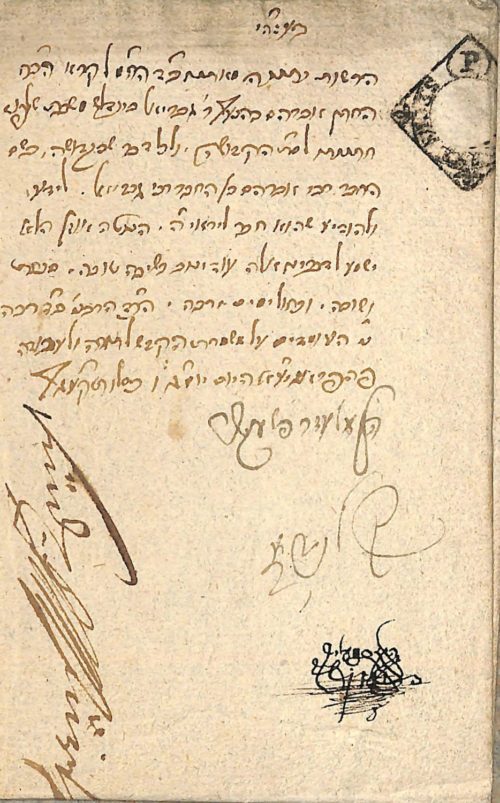
A lengthy letter from Lieberman to R. Isaac Herzog, dated November 22, 1954, was recently placed at auction, available here. I thank a student who purchased the letter and sent it to me, enabling me to see page 4 which is missing from the auction site. After this post appears, I will present the letter to a suitable archive for safekeeping. This letter is of great significance, as Lieberman explains what motivated him to develop his addition to the traditional ketubah. We are also given insight into how he viewed the Orthodox and Conservative rabbis. Those who wish can see the complete letter in one PDF here.

In the letter, Lieberman begins by saying that he had not written to R. Herzog—who was a very close friend[3]—because he did not want to create difficulties for R. Herzog by bringing him into the controversy swirling around his proposed ketubah. He explains that certain non-Orthodox rabbis had begun to perform marriages for women who were only divorced civilly. This led people to think that the obligation of a get was not a serious matter. Lieberman notes that in circumstances where the husband does not want to give a get, it is usually possible to convince him to do so. The problem is that these “menuvalim” demand so much money to issue the get, that the women are unable to pay this: ואין מי שיתבע את עלבון העלובות

Lieberman then turns to what in his time was a well-known agunah case. I do not wish to go into details but only mention that the woman involved was the famous Trude Weiss-Rosmarin, who after her experience became a critic of the Orthodox approach in Jewish marriage and divorce law. In Lawrence Grossman’s great new book, Living in Both Worlds: Modern Orthodox Judaism in the United States, 1945-2025, p. 204, he writes that Weiss-Rosmarin was “perhaps the first woman from an Orthodox background to publicly demand the wholesale revision of the system [of Jewish divorce law].” In Weiss-Rosmarin’s 1953 article, “Wanted: Equality for Jewish Women,”[4] and in her later article “The Agony of the Agunah,”[5] she called for batei din to assume the authority of issuing divorces instead of husbands. She further claimed that “Jewish law is male-made and inevitably the male prerogatives are protected at the expense of the rights of women. While Jewish law is chivalrous in certain areas, ‘chivalry’ is not enough for the modern woman.”[6] Because of her strong stand in the matter of agunah, Weiss-Rosmarin has even been called the “the first feminist Jew and the first Jewish feminist.”[7] You can read about her here.

Lieberman says that when he saw how the rabbis did not do anything to help Weiss-Rosmarin, that he came to the conclusion that he must do something. His answer to the agunah problem was his ketubah. If the beit din orders payments based on the ketubah, he believed that this would be upheld by the secular court. Lieberman states that originally he wanted the beit din that would be in charge of this to have: רבנים יראי שמים ובקיאים בדיני גיטין וקדושין. He even reveals that R. Abraham Price of Toronto agreed to serve on this beit din, which means that R. Price accepted the halakhic legitimacy of Lieberman’s ketubah. However, the Rabbinical Council of America threatened to put the Orthodox rabbis in herem if they joined Lieberman’s proposed beit din.[8] Lieberman adds that since the RCA did not allow for Orthodox rabbis to join this beit din, there was no longer any possibility that the beit din would be able to write gittin. Rather, its only role would be to compel the man who refused to give a get to do so. He tells R. Herzog that he reformulated the ketubah, so that any recognized beit din can compel the man to issue a divorce and also require monetary payments.

Lieberman adds that the Orthodox assertion that Conservative rabbis wish to involve themselve in matters of gittin is laughable. It is of interest how Lieberman distinguishes between Orthodox and Conservative rabbis, something that only comes across in the Hebrew words he uses for “rabbi”:

כל הצעקה של הרבנים שהרבייס הקונסרבטיביים רוצים להכנס לענייני גיטין היא מצחיקה

Lieberman continues that the Conservative rabbis have no need for the income they could get from doing gittin, and they can make more money from other things. They have not gotten involved in kashrut, which is less complicated than gittin and has much more money in it. Lieberman adds that the fact that the Conservative rabbis accepted his proposal is a very positive thing, since if any of them now perform a wedding before the woman has received a get, they will be expelled from the Rabbinical Assembly. All Conservative rabbis are therefore forced to explain to their communities that civil divorce is meaningless and the woman is still regarded as married.

Lieberman then tells about the “young rabbis” who were in an uproar about his proposal. By this he means the rabbis of the Rabbinical Council of America. He says that they were claiming that it is forbidden to alter any of the formulations used in the ketubah, and that this is based on the fact that it is also forbidden to alter the text of a get from what the Sages have decreed.[9] Lieberman notes that he did not pay them any mind, and was happy to let them show their ignorance in public. He adds that the RCA rabbis have now begun screaming that the beit din of the Conservative rabbis has permitted kohanim to marry divorced women and to drive to synagogue on Shabbat.[10] Lieberman says that this is completely false. To begin with, they do not have a beit din. What this apparently means is that the Conservative movement does not have a national beit din that could issue rulings for the movement. Lieberman adds that a number of Conservative rabbis, mostly his students, demanded that any rabbi who performs a wedding between a kohen and a divorced woman, or permits his congregants to drive on Shabbat, should be expelled from the Rabbinical Assembly. Yet at the convention of the Rabbinical Assembly this proposal was rejected.

Already in 1952 the Committee on Jewish Law and Standards permitted Conservative rabbis to perform weddings between kohanim and divorced women.[11] As for driving on Shabbat, the famous responsum that permitted driving to synagogue, and only to synagogue, on Shabbat, was authored by Rabbis Morris Adler, Jacob Agus, and Theodore Friedman. It was reprinted in Mordecai Waxman, ed., Tradition and Change: The Development of Conservative Judaism (New York, 1958). Here is part of the preface to the responsum from which you see background:

The responsum printed below is the collective effort of three men who prepared it for the approval of the Law Committee of the Rabbinical Assembly. It secured the support of a majority of the Law Committee and it was subsequently presented at a convention of the Rabbinical Assembly (1950). However, in conformity with the policy of the Assembly not to give approval to legal provisions which have not been unanimously approved by the Law Committee, it was not voted upon. It thus remains as the opinion of a group of men, but has no official status.[12]

Although the responsum did not have official status as a ruling of the Conservative Movement, because of the support it received on the Committee on Jewish Law and Standards—the new name of the Law Committee beginning in 1948—it was regarded by the Conservative Movement as a halakhically acceptable option.[13] The way the Committee worked is that “a unanimous opinion is recorded as such and becomes binding upon every member of the Rabbinical Assembly. Where there is a difference of opinion, the opinion which dissents from the majority becomes a minority opinion, and the minority opinion also may be followed by the members of the Rabbinical Assembly.”[14]

In a 2023 article that appeared on the Rabbinical Assembly website here, it states that the responsum “was approved by the Law Committee,” which must mean “approved” as an acceptable option.

The halakhic position advocated by Adler, Agus, and Friedman is summed up in this paragraph from the responsum:

Refraining from the use of a motor vehicle is an important aid in the maintenance of the Sabbath spirit of repose. Such restraint aids, moreover, in keeping the members of the family together on the Sabbath. However, where a family resides beyond reasonable walking distance from the synagogue, the use of a motor vehicle for the purpose of synagogue attendance shall in no wise be construed as a violation of the Sabbath but, on the contrary, such attendance shall be deemed an expression of loyalty to our faith.[15]

Since we are dealing with a halakhic teshuvah, they also had to come up with a way to permit driving to synagogue that could be in line with halakhic sources. The way they did this was by asserting that driving a car is only a rabbinic prohibition. When it comes to the electricity that the car uses, that was not a difficult point to argue, but how could they assert that combustion of gasoline to produce power is also only a rabbinic prohibition? Their solution is to claim that burning is only a Torah-prohibited act when used for the purposes that the Sages recorded, such as cooking, heating, or lighting. “Burning for the sake of power was not included in this list” (p. 369). They also claim that any heat produced by the car’s combustion of gas is not intended or desired so it is a pesik reisha de-lo niha leh “which is permitted by the latest authorities” (p. 369). For good measure they add that the combustion is a melakhah she-einah tzerichah le-gufah according to the opinion of Tosafot, since the combustion is not for the purpose of burning but in order to cause the car to move.

After concluding that driving a car on Shabbat is only a rabbinic prohibition, they then claim that rabbinic prohibitions can be set aside when they prevent the fulfillment of a mitzvah, in this case the mitzvah being attendance at synagogue which is “indispensable to the preservation of the religious life of American Jewry.”[16] It is important to remember that the permission to drive on Shabbat was only for the purpose of attending synagogue. In 1961 Friedman clarified that the permission to drive on Shabbat was only intended to apply to the synagogue one normally attends, not to allow people to drive to a bar mitzvah at another synagogue. This outlook was affirmed in a statement adopted by the Committee on Jewish Law and Standards.[17]

It continues to amaze me that the majority of the Committee on Jewish Law and Standards, and no doubt the overwhelming majority of all Conservative rabbis, supported the Adler, Agus, and Friedman responsum. In the responsum it states: “To continue unmodified the traditional interdiction of riding on the Sabbath is tantamount to rendering attendance at the synagogue on the Sabbath physically impossible for an increasing number of our people.” This was always a foolish argument. In the 1950s there were plenty of Orthodox synagogues that had members who drove to synagogue on Shabbat. There were even Orthodox synagogues that left the parking lot open. But they never officially said that this was permissible. They just looked the other way, and many of the children of those who drove to synagogue became completely observant. In fact, over time, a number of those who drove to an Orthodox synagogue also became observant, precisely because they were never told that it was OK to drive on Shabbat and instead were given a religious goal—Shabbat observance—to strive for. This is the exact model today of Chabad synagogues.

In Rabbi Robert Gordis’ dissenting opinion from the majority of the Committee on Jewish Law and Standards, he wrote: “All experience teaches that the task of winning back the erring and the estranged, heartrendingly difficult as it is, is more often successfully achieved by traditional religion than by its non-traditional forms.”[18] Gordis also states: “To modify Jewish law in order to bring it into conformity with their [Sabbath violators’] way of life is tantamount to amending the Constitution of the United States so as to harmonize it with the viewpoint of an anarchist. . . . Had there been a large number of Elisha ben Abuyas or general Sabbath violators in their day, the Rabbis would not have consulted them as to how Sabbath observance should be conceived of.”[19]

Why couldn’t the Conservative movement simply ignore the fact that people in the synagogue had driven there on Shabbat instead of seeking to offer halakhic justification? Were they afraid that if congregants felt that the rabbi viewed them as sinning by driving to synagogue, that the congregants would be inclined to join a Reform temple where they wouldn’t be judged? Did they really think that people would stop coming to synagogue if they did not permit driving on Shabbat? The authors of the responsum were certainly aware that the people who drove to synagogue on Shabbat did not restrict themselves to only driving there, but they also drove throughout the Sabbath to wherever they wanted to go. So, what in the end did they think would be accomplished by this responsum? How did they not see that once the permission was granted, that even rabbis and cantors would avail themselves of it rather than moving within walking distance of their synagogues?[20] In 2003 Rabbi Ismar Schorsch, chancellor of the Jewish Theological Seminary, said that the decision to allow driving to the synagogue on Shabbat was a mistake,[21] but by this time, there were hardly any Conservative rabbis in the United States who would agree with him.[22]

Returning to Lieberman’s letter, he notes that “the rabbi from Boston,” by which he means R. Joseph B. Soloveitchik, also attacked him—without mentioning Lieberman by name—regarding the proposed addition to the ketubah. This is interesting, as I am unaware of any public communication from the Rav in which he attacked Lieberman. However, in 1954 R. Emanuel Rackman, working “with the direction of” R. Soloveitchik, expressed opposition to the Lieberman Ketubah. Rackman would later claim that the Rav’s opposition was “mild” and that the Rav admitted that he would have been able to work out a mutually satisfactory version of the ketubah with Lieberman.[23] Also of note is that in 1959, R. Norman Lamm published a critique of the Lieberman Ketubah.[24] Knowing Lamm’s connection to R. Soloveitchik, it is hard to believe that he would have published this article without the Rav’s approval. It is noteworthy that at this point in the letter Lieberman also refers negatively to musmakhim of RIETS as רבייס.

Lieberman continues that he would never change a text established by the Sages, but there is no problem changing the ketubah’s language. He cites R. Simeon ben Zemah Duran that one is even allowed “to lie” in the ketubah (the quotation marks are found in the letter). The case of R. Duran is about a young woman who was not a virgin but they wrote “virgin” in the ketubah, and R. Duran says that there is no problem in doing this.[25][26]

Lieberman adds that the Rabbinical Council of America has an ally in their opposition to Lieberman’s ketubah, namely, Professor Mordechai Kaplan, who viewed Lieberman as more dangerous than all the Orthodox rabbis.

Lieberman concludes the main part of the letter that he is prepared to accept the ruling of a beit din in Israel. His condition is that the beit din be composed of R. Herzog, R. Isaac Zev Soloveitchik (the Brisker Rav), and a third rabbi that they would agree on. If they rule that his ketubah is forbidden, he will abandon it. Since the ketubah he prepared was for the Conservative movement, it mentioned that the parties have to come to the Conservative beit din. However, Lieberman says that one can insert the name of any beit din in the ketubah, “as longs as it is a beit din that does not accept bribery.”

The remainder of the letter contains comments on a Torah article of R. Herzog.

It is noteworthy that R. Herzog dealt with the Lieberman ketubah at a meeting of the Moetzet ha-Rabbanut ha-Rashit on March 10, 1955.[29]

In attendance at the meeting, representing the Rabbinical Council of America, were Rabbis David Hollander and Herschel Schacter. At the meeting, R. Herzog said that although Lieberman is a great Torah scholar, he is not a gadol ba-Torah that we are all obligated to listen to. He adds that he does not see Lieberman’s addition to the ketubah as halakhically problematic. However, he has strongly protested the notion that a Conservative beit din will have any involvement in this matter. In 1953 R. Herzog wrote to British Chief Rabbi Israel Brodie and mentioned that years before he had already suggested a proposal similar to that of Lieberman.

See also this 1953 letter to South Africa Chief Rabbi Louis I. Rabinowitz where he repeats what he told R. Brodie.

We see from both these letters that R. Herzog had no objection to Lieberman’s ketubah and even wondered if Lieberman’s proposal based on his own prior suggestion.[30]

Great Torah scholar that he was, the ability to stand up to voices on his right was not one of R. Herzog’s strengths. As such, it was not long before he was dragged into a strong condemnation of the Lieberman Ketubah. Here is how Amihai Radzyner sums up what happened:

It appears that Rabbi Herzog was not at all sure that the new clause in the ketubah posed a halakhic problem (unlike the Conservative rabbinical court issue) and therefore decided that the Rabbinate would discuss the matter further and consider issuing an official protest. Later, Rabbi Herzog formulated a relatively moderate objection, in which he expressed doubt regarding the halakhic claim that the new clause would inevitably lead to coerced (and thus invalid) divorce (גט מעושה). Herzog drafted a statement to this effect, which he sent to members of the Chief Rabbinate Council. The moderate nature of the statement did not please Rabbi Reuven Katz, who insisted that would “assist criminals, God forbid.” He demanded a stronger wording that would express solid opposition to this “serious matter.” His demands seem to have been heeded: the Rabbinate ultimately would issue a statement in which Rabbi Herzog would warn congregations in the U.S. of the grave danger posed by the Conservative ketubah, in accordance with the wishes of the American Orthodox leadership. This statement – an appeal to rabbis of the United States signed by Israel’s two Chief Rabbis – refers to the Conservative ketubah as the “defiant ketubah” (כתובה חוצפנית) and states that the amendment will not solve the problem of “chained women,” and also warns that the new language, in conjunction with the new rabbinical court, could lead to a rift within the Jewish people.[31]

Here is the statement of the Chief Rabbinate, which includes the attack on the Lieberman ketubah, that Radzyner refers to.

It would be great to see how R. Herzog explained to his good friend Lieberman why he was forced to issue the condemnation, complete with its derogatory description of the Lieberman Ketubah. Unfortunately, no such letter exists in the archive, but Lieberman well understood the pressures R. Herzog was under.

Here are some additional points relevant to my Saul Lieberman and the Orthodox.

1. Mesorat Moshe, vol. 3, p. 389: Someone asked R. Moshe Feinstein if you can rely on Lieberman’s Tosefta. R. Moshe replied that Lieberman is a religious Jew so there is no fear that he would alter the text of the Tosefta.

2. In September 2025 Legacy Judaica, see here, put this letter up for auction from R. Chaim Kanievsky.

He replies that there is no prohibition to use the works of Lieberman. Asked about purchasing works published by JTS, he replies that he does not know. See here where I published the letter from Lieberman recommending that R. Kanievsky receive the Rothschild Prize, and see also here.

See also R. Meir Mazuz, Makor Ne’eman, vol. 3, no. 1337, who permits use of Tosefta ki-Feshutah.

3. See Ha-Ma’yan64 (Tamuz 5784), p. 119 n. 27, that R. Amos Tabanchik reports that R. Elazer Shakh gave R. Noah Shimanovitz a copy of Tosefta ki-Feshutah as a present. Also of note is that the ArtScroll English translation of Mishnah, Kilayim 8:4 cites Tosefta ki-Feshutah.

4. In Saul Lieberman and the Orthodox, I mentioned that R. Shemaya Grunbaum, a Satmar hasid, published a letter from Lieberman in his book,Siyata di-Shemaya al Masekhet Shabbat (Jerusalem, 1970), pp. 159-160. He does not refer to Lieberman by name, but as “hakham ehad”. However, Lieberman’s identity is only slightly veiled, as R. Grunbaum leaves in the letter’s reference to Ha-Yerushalmi ki-Feshuto. He obviously intended that those “in the know” would recognize with whom he was corresponding.

After R. Grunbaum’s book appeared, he sent it to Lieberman and asked Lieberman to send him his recently published Sifrei Zuta/Talmudah shel Kesarin. R. Grunbaum also apologized that due to reasons beyond his control, he could not mention Lieberman by name and thus referred to him as “hakham ehad”.[32]

5. In Ha-Mashbir5 (2025), I published a few letters from Lieberman to Heschel. See here. In one of the letters, Lieberman offers some notes to Heschel’s Torah min ha-Shamayim. Here is Heschel’s reply to Lieberman’s letter.[33]

6. I am writing this right before Thanksgiving, so it reminded me that it is reported that Lieberman did not saytahanunon Thanksgiving. Shearith Israel in Manhattan also does not say tahanun on Thanksgiving. In fact, they say a partial Hallel, from הללו את ה’ כל גוים until the final הודו לה’ כי טוב.[34]

7. David Sarna reports that Lieberman did not accept the Manhattan eruv and that he would not allow a bat mitzvah girl to address the congregation at the JTS synagogue.[35]

* * * * * * * *

I want to call Seforim Blog readers’ attention to the wonderful Youtube channel of Kerem: Bein Torah le-Hokhmah here. The main feature is R. Yonason Marton’s daily daf yomi and other shiurim. While his shiurim are in Yiddish, the summaries available in the show notes on Youtube are in Hebrew. R. Marton’s shiurim are a unique combination of traditional lomdus and academic scholarship. In addition, Kerem has hosted numerous academic scholars whose videos are also on the Youtube channel. Kerem is a unique institution led by special people, and I wish it much success as it continues to grow.

Appendix

We routinely use the word “virgin” in the ketubah, together with the applicable monetary amount, unless the woman has been previously married. We even do so if the couple is living together. As mentioned, this is allowed because as long as the future husband knows the truth, it does not matter what is written in the ketubah. That this is the law has been affirmed in modern times by R. Moshe Feinstein[36] and many others. In fact, this is so well established that I think it is a “known truth” that before marriage the husband needs to know if his future wife is a virgin, and that the ketubah is invalid if he gets married without knowing the truth. Indeed, how could it be any different, as we see from Ketubot 11b that if the man marries a woman thinking she is a virgin and she is not, that it is a mekah taut?

It will therefore come as a surprise for many that this view is not accepted by all. For instance, R. Shalom Mordechai Schwadron[37] deals with a case of an orphan woman who not only was not a virgin, but who had a child out of wedlock. She later got engaged to a man who did not know about her past. R. Schwadron ruled that in the interests of peace they could write “virgin” in the ketubah and keep the husband in the dark. As for the incorrect monetary amount, R. Schwadron has a few suggestions on how to deal with this as well, including having the woman sign a document foregoing the extra ketubah money due a virgin. This document would have to be kept with the beit din as the husband would not be aware of it.

I think people will also be surprised by the following, not merely the ruling of R. Joseph Hayyim but the entire situation he describes, as it is so foreign from our experience. I apologize if what follows is a little too explicit, but everything comes directly from Rav Pealim, vol. 1, Even ha-Ezer, no. 2.[38] R. Joseph Hayyim describes the following case. A man betrothed a woman on the assumption that she was a virgin. At the time, her father, mother and all her relatives “knew” that she was a virgin. However, between the betrothal and the marriage her parents learned that she had been intimate a few times with another man.

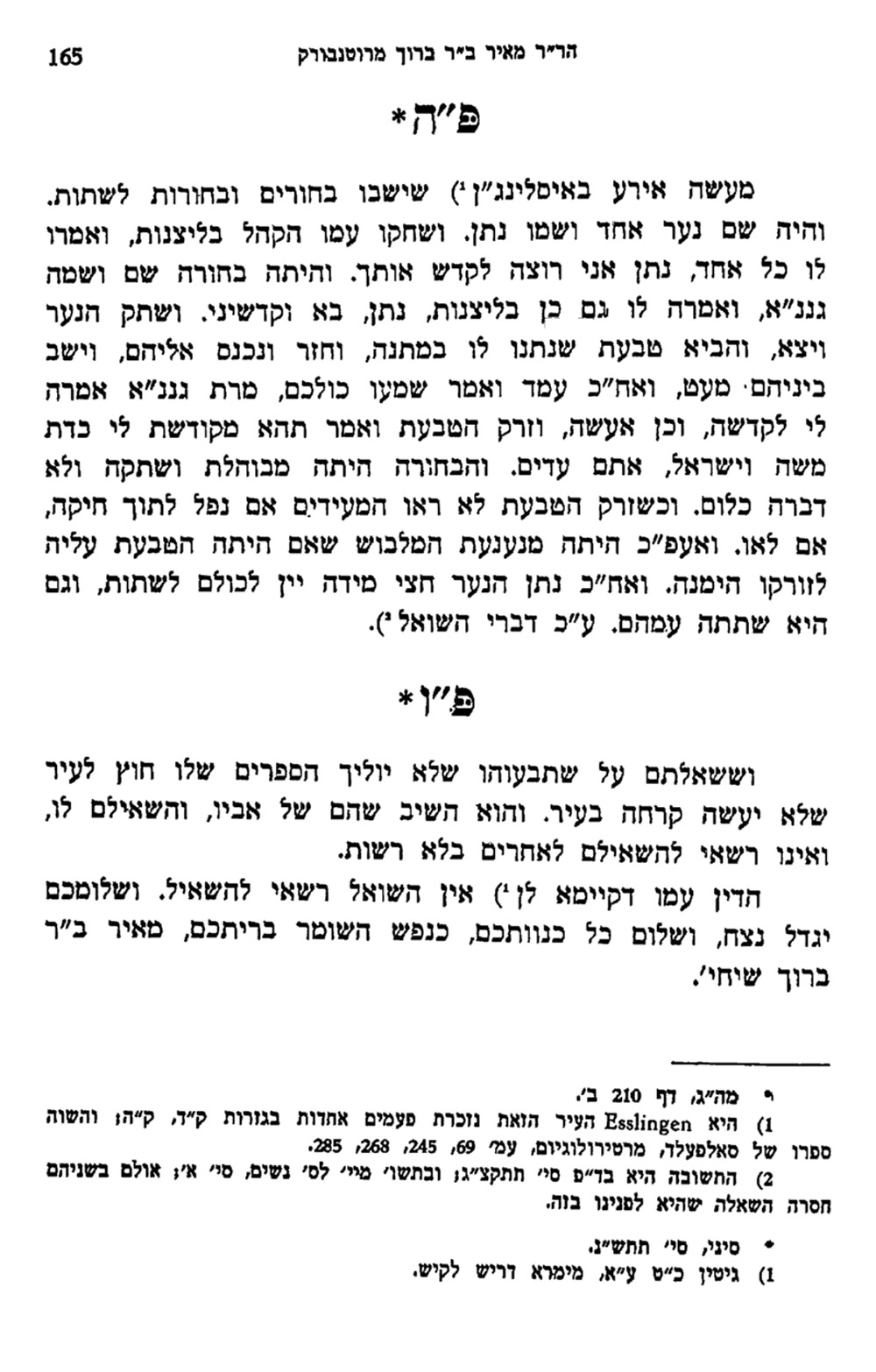
The practice in Baghdad was that on the night of the wedding, after the bride and groom went into their room, female relatives of the bride and groom would sit outside the door. In addition, a few male relatives and friends of the groom would also be there. They were all waiting to see the dam betulim. After the husband finished his marital duty, he would get dressed, open the door, and leave.[39] The women would then come in to see the dam betulim. If they saw it, they would make the loud celebratory sound we have all heard from women from Arab countries, which is called zaghrouta. If they did not see the dam betulim, that meant the groom did not do his job properly, and he would come back to try again.[40]

In the particular case of the responsum, the parents of the woman came up with a trick to spare her embarrassment: The bride put blood on the sheet, but it was not her blood. However, someone who was close to the family of the bride knew the truth and was worried that the marriage was not halakhically binding. After all, the man married her under false pretenses as he thought she was a virgin, and so it was written in the ketubah.

R. Joseph Hayyim replies that the marriage is binding and the husband should not be told that he was fooled, as this will lead to great shame for the bride and her family. As for the matter of the ketubah, R. Joseph Hayyim says that the bride and her relatives must be told that in the event of her being able to collect the ketubah money, she can only claim that which a non-virgin is entitled to.

Both R. Schwadron and R. Joseph Hayyim are cited by R. Netanel Meoded in his own responsum where he concludes that one should not inform a man that the woman he is marrying, whom he thinks is a virgin, was sexually active before their engagement. See Mizrah Shemesh, vol. 2, no. 31.

R. Joel Roth, writing from a Conservative perspective, argues for removing the word betulta from the ketubah. See Roth, Hakol Kol Yaakov, ed. David Golinkin (Jerusalem, 2023), pp. 361ff.

Let me now turn to another strange thing. In previous centuries there was a belief among some that a girl who was born on Friday did not have betulim. Quite apart from the absurdity of the belief, the halakhic problem it would create is obvious, since as R. Abraham Zvi Klein notes, it would mean that with any woman whose birthday is unknown, there would be no ta’anat betulim because perhaps she was born on Friday. To this I would add, since there is no mention of this “medical” point in the Talmud or rishonim, it is shocking that anyone took it seriously. In R. Eliyahu Bar Shalom’s standard work, Mishpat ha-Ketubah,[42] he feels it necessary to write:

גם לנולדת ביום ששי יש כתובת בתולה ככל שאר הנישאות, אף שיש שמועה שאין לה בתולים

What is the origin of this belief? The first reference I found is in R. Isaac Lampronte of Ferrara’s (1679-1756) halakhic encyclopedia Pahad Yitzhak. R. Lampronte was also a doctor, so his recording of this medical legend is itself noteworthy.

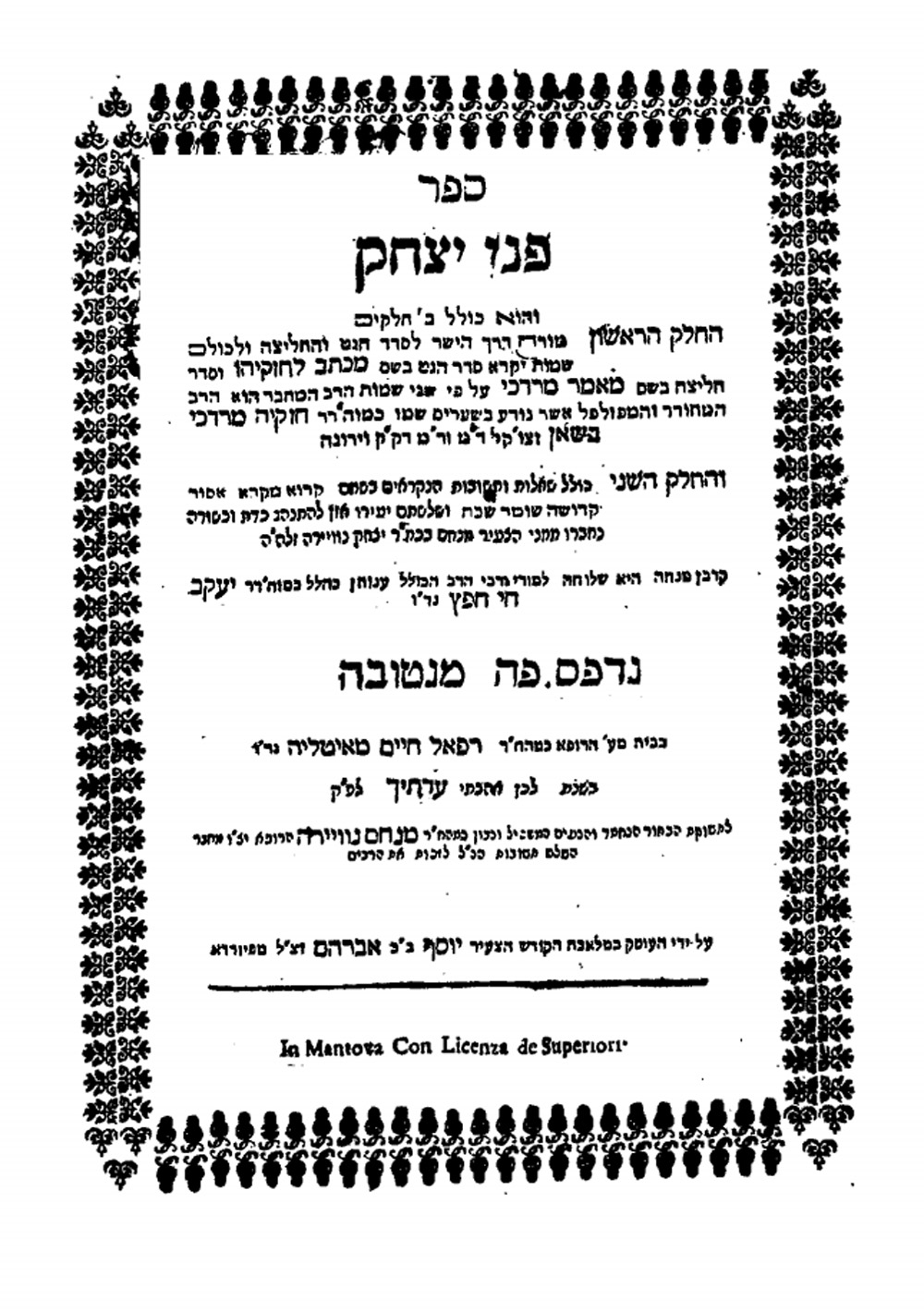
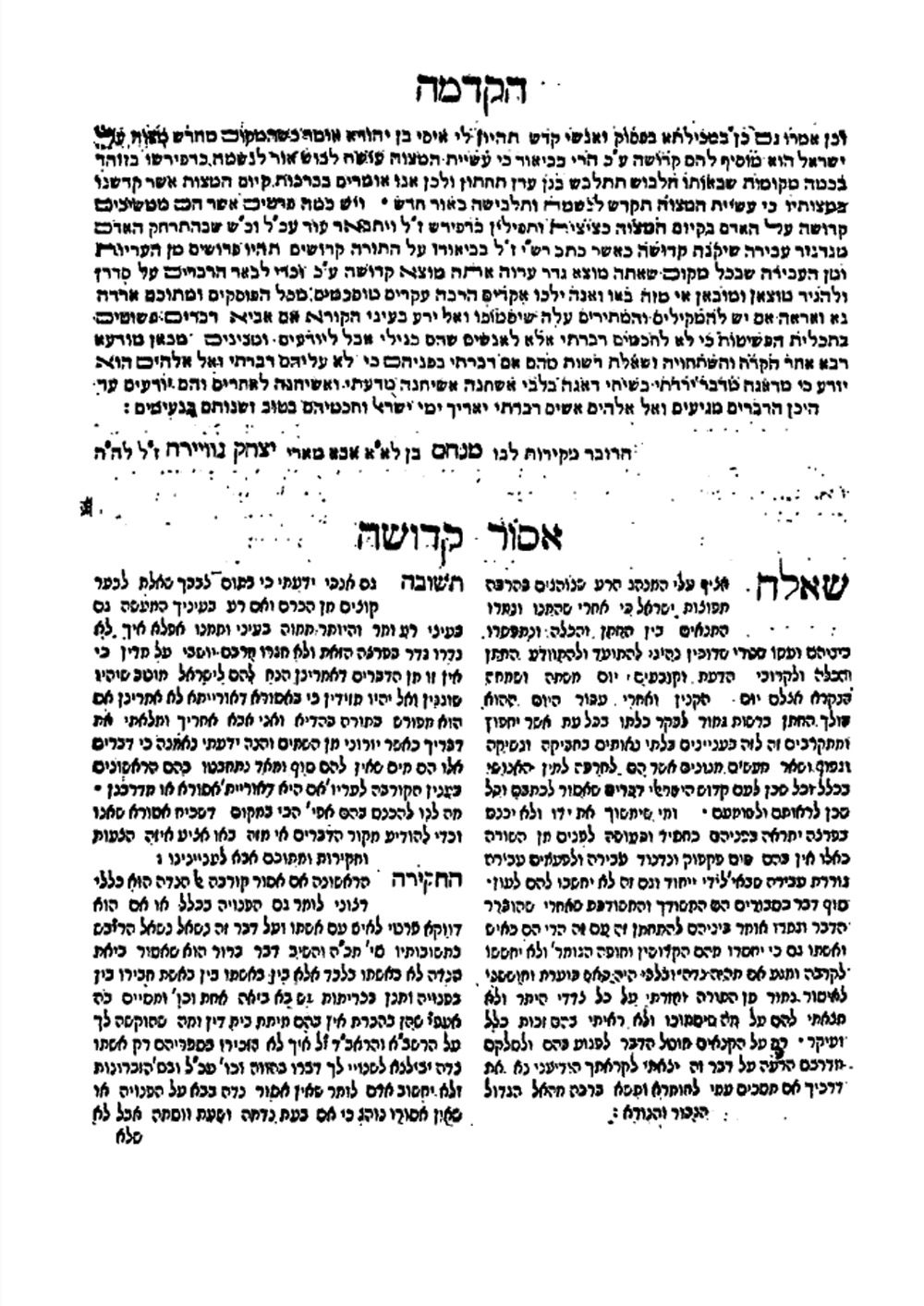
In Pahad Yitzhak, s.v. na’arah, R. Lampronte mentions that in Italy the practice is that if a girl is born on Friday this fact is recorded, precisely in order to deal with the halakhic issue already mentioned. That is, if the husband will later assert that there was no dam betulim, this would not be regarded as a valid claim. R. Lampronte states that despite the Italian practice, he did not find any mention of the unique nature of girls born on Friday either in the Talmud or poskim, and that there is also no mention of it in scientific or medical works. He therefore claims that the assumption that girls born on Friday lack betulim should not be relied upon, as on the contrary, sometimes girls born on Friday indeed have belutim.

R. Hayyim Joseph David Azulai, who lived in Italy, also mentions the belief that girls born on Friday lack betulim. He says that he was told about this from distinguished people in Italy and Amsterdam. He also cites from the then unpublished section of Pahad Yitzhak just mentioned. As with R. Lampronte, R. Azulai is surprised by this biological assumption, because if it is true, the Sages would have mentioned something about it.[43]

Many people have cited the Pahad Yitzhak and Hida, however, the story does not end there. There was another great rabbi in Italy, R. Daniel Tierni of Florence (died 1814), author of the commentary on the Shulhan ArukhIkarei ha-Dat (הד”ט – playing on the abbreviation of his name). In his commentary to Yoreh Deah 21:10, he tells us that he saw additions that R. Lampronte made to the Pahad Yitzhak. These additions have not appeared in print, so we must be grateful for what R. Tierni preserved. Here R. Lampronte states that the entire matter is a complete falsehood, sheker gamur.[44] Yet R. Tierni adds that everywhere in Italy where he has lived, they are careful to record in the communal record whenever a baby girl is born on Friday to avoid problems when she later gets married. He notes that the non-Jews also do this. As for why there are girls born on Friday who have betulim, he explains this through astrology, and suggests that it depends when on Friday they are born, since only certain hours on Friday are under the rule of Venus.

As late as 1902, R. Isaac Raphael Ashkenazi (1826-1908), the rav of Ancona, writes that the practice of his city is to record the girls who are born on Friday, and he thinks this is what other communities should do as well.[45]

Riddles

It has been a long time since I included a riddle, and I now have a bunch of books that I can give away to those who get the right answers. If you have the answers, email them to me at shapirom2 at scranton.edu

1. Where do we find that Shammai not only disagrees with Beit Shammai, but also agrees with Beit Hillel?

2. In the days of the tannaim a certain item was unquestionablymuktzeh. However, in the post-talmudic period, some hold that this item is no longermuktzeh. What item am I referring to? Provide the actual source in the Talmud and later authorities to justify your answer.

I asked ChatGPT this question but the answer it provided was phony, complete with a non-existent citation from R. Moshe Isserles. I am sure ChatGPT will provide other answers, and perhaps one of them might be correct

* * * * * *

[1] This book began as an invited lecture in memory of Lieberman sponsored the Union of Traditional Judaism. One of the organizers of the event was Rabbi Ronald Price. I mention this because R. Price is the author of the newly published book, Divrei Halev: Thoughts of Rabbi Professor David Weiss Halivni on the Weekly Torah Portion. Here is part of the book’s description on Amazon:

Divrei Halev is the result of a multi-year collaboration between Rabbi Ronald D. Price and his teacher, the world-renowned Talmudic scholar Rabbi Professor David Weiss Halivni, of blessed memory. Nearly every week from 2008 to 2012, Rav Halivni shared a thought with Rabbi Price on the weekly Torah portion, which the student faithfully recorded. Divrei Halev includes over two hundred brief divrei Torah spread across all fifty-four parashiyot.

I was one of those privileged to write a blurb for the book, together with Professors Gershon Bacon Reuven Kimelman, David Novak, and Dr. Elana Stein Hain. In the interests of space, my blurb was edited, so here is a good opportunity to record my unabridged blurb.

Rabbi Halivni’s greatest contribution was of course his groundbreaking talmudic scholarship. Yet anyone who had the pleasure of davening with Rabbi Halivni on Shabbat, as I did in the late 1990s and early 2000s, saw a different side of him, that of a rav of a kehillah, a spiritual leader, whose spoken word on Shabbat was able to both enlighten and inspire. Those of us who were able to experience this, and those who never had the opportunity, owe a great debt to Rabbi Ronald Price for bringing the words of our teacher to life.

Regarding Halivni, see also what I wrote here.

Let me now share another story about Halivni. On Erev Pesah 2001 or 2002 I was walking to shul on the Upper West Side and I saw Halivni coming down the street. I asked what brought him to my neighborhood, as I knew he did not live in the area. He told me that he wanted to find a minyan that said Hallel after maariv. I took him to Ohab Zedek and was told that they do not say maariv. We started out in search of another shul and came upon the Chabad minyan on the Upper West Side, where we davened. I remember being very impressed by two things at this minyan. First, that the Chabad rabbi and at least a couple of other Chabad attendees knew who Halivni was. Second, how they treated him with the greatest respect.

[2] Subsequent to publication of my Saul Lieberman and the Orthodox, Monique Susskind Goldberg discussed Lieberman’s Ketubah in id. and Diana Villa, Za’akat Dalot: Pitronot Hilkhati’yim le-Be’ayat ha-Agunot bi-Zemanenu (Jerusalem, 2006), pp. 104ff. On p. 112, she also discusses a proposed adjustment to the ketubah by R. She’ar Yashuv Cohen.

Whether the Lieberman Ketubah could be civilly enforced was at the center of the famous 1980s N.Y. case, Avitzur vs. Avitzur. See here and here. Contrary to all the naysayers, the court upheld the legitimacy of the Lieberman Ketubah from the standpoint of American law. The National Jewish Commission on Law and Public Affairs, an Orthodox organization, got involved with the case together with the Jewish Theological Seminary to support the plaintiff whose husband had refused to appear before the beth din of JTS and the Rabbinical Assembly in order to give her a get. Nathan Lewin told me that R. Moshe Sherer, the head of Agudat Israel, asked Lewin to become involved with the case. Even though it did not focus on the Orthodox community, Sherer—and the Agudah rabbinic leadership he must have consulted—thought it was important that the principle that the government could, in certain circumstances, require people to go to beit din be upheld.

[3] According to Chaim Herzog, Lieberman was his parents’ closest friend. See Elijah J. Schochet and Solomon Spiro, Saul Lieberman: The Man and His Work (New York, 2005), p. 53. On this page, Schochet and Spiro write that “Lieberman enjoyed the respect of R. Yosef Shalom Eliashiv, the av beit din of Jerusalem.” If one consults the source they offer for this sentence, Yitzhak Raphael’s eulogy for Lieberman in Sinai 93 (Nisan-Iyar 5783), p. 91, one finds that Raphael’s actually refers to R. Elyashiv’s grandfather, the kabbalist R. Solomon Elyashiv.

[4] Congress Weekly, Aug. 17, 1953, cited in Regina Stein, “The Boundaries of Gender: The Role of Gender Issues in Forming American Jewish Denominational Identity, 1913-1963” (unpublished doctoral dissertation, Jewish Theological Seminary, 1998), p. 319.

[5] Conservative Judaism 20 (Fall 1965), pp. 51-54.

[6] Stein, “The Boundaries of Gender, p. 320.

[7] See Naomi Salfati, “On Feminist Judaism, Jewish Feminism and the Advancement of Women’s Roles in Jewish Tradition” (unpublished master’s dissertation, Hebrew University, 2014), p. 16, available here. Salfati discusses Weiss-Rosmarin’s article, “The Unfreedom of Jewish Women,” which also deals with the “unfairness of Jewish marriage laws to divorced and abandoned women.”

Weiss-Rosmarin is also known for her book Judaism and Christianity The Differences. In Alan Brill’s newly published A Jewish Trinity: Contemporary Christian Theology through Jewish Eyes, Weiss-Rosmarin’s approach, which is the “standard” view Jews are taught, is specifically rejected throughout the book. In the very first paragraph of A Jewish Trinity, Brill writes: “For many Jews and Christians, Weiss-Rosmarin’s basic unbridgeable theological divide between the religions remains a truism. This book rejects Weiss-Rosmarin’s simple zero-sum declaration by asking whether the Jewish theological vision and the Christian theological vision are fundamentally irreconcilable, or can the positions be conceptually bridged.”

[8] In a December 3, 1954, statement, the RCA and the Rabbinical Alliance of America condemned the Lieberman ketubah, stating that it had “the gravest implications to the sanctity of Jewish family life and represents the most disastrous disavowal of the principles of Jewish law.” See Benjamin Steiner’s important article, “The Lieberman Clause Revisited,” American Jewish Archives 69 (2017), p. 54.

[9] For criticism of the Lieberman Ketubah from another angle, see R. Eliezer Waldenberg, Tzitz Eliezer, vol. 5, pp. 23ff., vol. 21, no. 62. See also R. Joseph Elijah Henkin, “Tikun o Harisah,” Ha-Pardes, Shevat 5755, pp. 20-22. R. Isaac Herzog responded to this article, see Tehukah le-Yisrael al Pi ha-Torah, vol. 3, pp. 208-209.

At a 1953 gathering of Conservative rabbis and JTS faculty, Lieberman discussed his proposal, which he referred to as a takkanah. He said as follows, clearly exasperated with the American Orthodox rabbinate.

I saw that some of you were accused of being frightened by the Orthodox rabbis. I want to tell you that I am not frightened by them at all.

I want, therefore, to give you a point of information. In truth, they were frightened, and I want you to know why they were frightened. They weren’t afraid that the בית דין would issue some תקנות. No, not at all. They were afraid that the בית דין will issue תקנות in accordance with the law.

As a matter of fact, one of the very important members of the Orthodox rabbis said so in so many words: If this בית דין of the Rabbinical Assembly will issue a תקנה, that will be תקנתו קלקתו. It will be a great misfortune because they will get authority and that is the reason why they oppose this. Many of them think that that בית דין will begin to move in this line, the movement can become strong and it will affect them.

Now about this תקנה. I would like to tell you that this תקנה has nothing to do with the בית דין that will be established—and I hope it will be established soon; but this I would like to see you adopt immediately because it has a tremendous practical value.

David Golinkin ed., Proceedings of the Committee on Jewish Law and Standards of the Conservative Movement 1927-1970 (Jerusalem, 1997), vol. 2, pp. 810-811.

[10] These two points are mentioned by Rabbi Hollander at the meeting with the Moetzet Ha-Rabbanut ha-Rashit. See below. Hollander refers to Conservative rabbis permitting these matters, not a Conservative beit din.

[11] See here. The basis for the Committee on Jewish Law and Standard’s ruling was the responsum of Rabbis Ben Zion Bokser and Theodore Friedman published in Proceedings of the Committee on Jewish Law and Standards of the Conservative Movement 1927-1970, vol. 3, pp. 1459-1462.

[12] Waxman, Tradition and Change, p. 351.

[13] Regarding the change of name from Law Committee to Committee on Jewish Law and Standards, see here.

It is of interest that in 1992 the Conservative movement in Israel, known as Masorti, issued a ruling forbidding travel to synagogue by car on Shabbat in Israel. See here. See also Rabbi David Golinkin’s responsum on this matter here.

[14] Formulation of Rabbi Aaron Blumenthal in Proceedings of the Committee on Jewish Law and Standards of the Conservative Movement 1927-1970, vol. 3, p. 1464.

[15] Waxman, Tradition and Change, p. 361.

[16] Waxman, Tradition and Change, p. 370.

[17] Proceedings of the Committee on Jewish Law and Standards of the Conservative Movement 1927-1970, vol. 3, pp. 1186-1188.

[18] Waxman, Tradition and Change, p. 390.

[19] Waxman, Tradition and Change, p. 390. See also ibid., pp. 392ff. for Rabbi Ben Zion Bokser’s rejection of the permission to drive on Shabbat

[20] For the recent debate of the Committee on Jewish Law and Standards regarding use of an electric car on Shabbat, see here. In this article, Rabbi Danny Nevins is quoted: “Those who accept the 1950 CJLS minority position permitting people to drive to synagogue in a gas-powered car would be justified extending this permission to electric cars.” Yet as mentioned above, the 1950 CJLS position permitting people to drive to synagogue on Shabbat was the majority position, not the minority.

[21] See here.

[22] Regarding driving to synagogue on Shabbat, I think many will be surprised by some of the lenient views that have been expressed. Following this paragraph is a responsum from Kollel Eretz Hemdah’s Be-Mareh ha-Bazak, vol. 3, no. 38, in which they rule that it is permitted for a non-Jew to drive a Jew to synagogue on Shabbat if this is vital to keep the person connected to Judaism. They also state that this should not be done every week. According to what is stated at the beginning of the volume, all responsa published in the book were approved by R. Shaul Yisraeli.

R. J. Simcha Cohen suggested that for people who could not walk to synagogue in Century Village in West Palm Beach, that they could get on the bus that transports people along set routes within the community’s confines. This would only apply if the driver was not Jewish. See Cohen,Shabbat: The Right Way(Jerusalem, 2009), pp 181ff. He also includes R. Moshe Dovid Tendler’s letter opposing this leniency. R. Tendler writes: “The heter would destroy the sanctity of the Shabbos. It would be extended to other ‘good deeds’ like visiting parents, hospital patients, attending rallies and even earning money on Shabbos to pay yeshiva tuition.” R. Yosef Carmell, the head of Eretz Hemdah, also replied, and he followed the approach already approved by R. Yisraeli.

If the bus is clearly labeled as a ‘Shabbat bus,’ is announced as appropriate only for those too weak to walk on their own, and even then only to be used for transportation to and from shul, it could be positive, provided that someone familiar with the community feels it would be necessary. (One must, of course, verify that only non-Jewish drivers are used.) However, we would recommend monitoring public impression (not only before implementation but also after) so as to gauge whether people view this as either a religious farce or a sweeping abrogation of hilchot Shabbat (in which case the service should be discontinued).

We would also like to suggest the aforementioned ruling of Rav Yisrael, zt”l (Be-mareh ha-bazak IIII:38) of having the Shabbat bus run only occasionally (or perhaps alternate weeks, etc.) so as to stress that we are dealing with a she’at ha-dechak.

R. Carmell understood R. Cohen to be referring to a special Shabbat bus run by the Jewish community. But what he was referring to was the already existing bus that transports people, free of charge, to different places within Century Village.

Significantly, when asked by the community of Century Village, Boca Raton, R. Hershel Schachter gave his permission for people who can’t easily walk to take the communal bus to synagogue. See here.

See also R. Schachter, Nefesh ha-Rav, p. 233, that R. Soloveitchik opposed having a “Shabbat bus”. The Rav noted that although this could be justified halakhically, since driving to synagogue on Shabbat had become a symbol of the Reform and Conservative movements, this means that even driving to synagogue in a halakhically permissible manner is now forbidden.

R. Ben Zion Uziel earlier gave permission for Jews to use public transportation to go to synagogue, but only in a place where the majority of riders are non-Jewish. SeeMishpetei Uziel, vol. 1,Orah Hayyim, no. 9, Mahadura Tinyana, vol. 1, Orah Hayyim, no. 32.

At the end of his book, R. Cohen offers a different suggestion, namely, a rickshaw attached to a bicycle. He writes:

Accordingly, a rickshaw bicycle driven by a non-Jew would also not be prohibited because of the concern that he might repair the bicycle on Shabbat, since a Gentile may repair anything he wishes on Shabbat. . . Using all the methods mentioned above, one could arrange, well within the bounds of Halacha, for a bicycle rickshaw to transport Jews who are unable to walk to and from the synagogue on Shabbat. This would involve no Biblical violations at all.

In Hakirah 37 (2025), Avi Kadish published a memoir which describes how he became religious. He reports that R. Moshe Feinstein permitted him to ride to synagogue on Shabbat in the car driven by his father. This only happened twice, as Kadish’s father realized that his son was uncomfortable using the car. From then on, every Shabbat they walked the two hours fifteen minutes each way to synagogue. What makes R. Feinstein’s ruling so interesting, is that Kadish was over bar mitzvah age. (Kadish notes that R. Avraham Pam had also given such a ruling with regard to a katan.) Kadish publishes the following comment from R. Shabbetai Rapoport:

I see no halakhic novelty here. If your father was going to shul anyway, why should there be any reason to forbid you to go with him? Rav Moshe’s opinion was that there is no difference between partnership with a Sabbath violator and partnership with a gentile. The ḥumra that a passenger in a car causes more fuel to be burned is mentioned in his writing, but only as a ḥumra. Therefore, this ruling fits his halakhic methodology quite well. The [real] novelty is that he did not fear any criticism that might have arisen, and this is indeed characteristic and correct [of Rav Moshe].

I don’t understand R. Rapoport’s point. The novelty is that Kadish was receiving benefit from a melakhah done on Shabbat by a Jew.

R. Shlomo Zalman Auerbach has an interesting pesak in Minhat Shlomo, Orah Hayyim, no. 3 (end). He rules that one who accepts Shabbat early is able to be driven by a non-Jew, and in a “tzorekh gadol” can also be driven by a Jew. He says that there is no ziluta de-Shabbat involved.

הואיל וליכא בכה”ג זילותא דשבתא שהרי אצל כולם עדיין הוא חול

R. Yitzhak Yosef states that for someone who drives to synagogue on Shabbat, it is better that he arrange to be taken by a non-Jew, unless this will lead to communal problems (e.g., others who are currently walking to synagogue might now feel that it is OK to have a non-Jew take them). Thus, he requires a local rav who knows the situation to make such a decision. SeeYalkut Yosef, Hilkhot Shabbat, vol. 5, p. 61.

Regarding using an autonomous taxi on Shabbat, see R. Eitan Kupietzky in Ha-Ma’yan, Tevet 5784, pp. 35-42. According to R. Aharon Goldberg, R. Shlomo Zalman Auerbach’s grandson, R. Auerbach had no objection to use of a car on Shabbat if there are no halakhic violations with this car, and that this could actually enhance Shabbat observance. In response to the objection that use of such a car would destroy Shabbat as we know it, a concern that was at the center of the Hazon Ish’s approach to use of electricity on Shabbat, he replied:

ההלכה היא לא איך שנראה לנו, אלא אם זה מותר אז מותר!

See Aryeh Edrei and Amir Mashiah, “Arba Amot shel Halakhah: Ha-Rav Shlomo Zalman Auerbach,” in Binyamin Brown and Nissim Leon, eds. Ha-Gedolim (Jerusalem, 2017), pp. 720-721. Along these lines, a new pesak has recently appeared from R. Menachem Perl, the head of the Tzomet Institute. According to him, one can make use of an iRobot vacuum on Shabbat as long as it is activated before Shabbat. See here.

Because the world is changing so much when it comes to technology, I think that due to pressing circumstances the future will bring a number of lenient rulings regarding Shabbat. For example, the day is not far off when in major cities one will not be able to enter an apartment building, or even a private apartment in such a building, without using an electronic keypad or key card. It is hard to imagine that poskim will rule that Jews are not allowed to live in these buildings, as that would mean the end of Orthodox communities in many places.

[23] Stein, “The Boundaries of Gender,” pp. 331, 338.

[24] Norman Lamm, “Recent Additions to the Ketubah,” Tradition 2 (Fall, 1959), pp. 93-118.

[25] The case R. Duran discusses is of a girl who might not have even been twelve years old. She was kidnapped by non-Jews and brought to Tunis where she was redeemed (“bought”) by a Jewish man who proceeded to have sex with her. Another man then removed her from Tunis—he must have paid the first man—to bring her to her father. On the way he married her, and that is when the ketubah was written stating that the young woman was a virgin. By this time, she was checked by women and showed signs of physical maturity, and the halakhic significance of this is discussed by R. Duran. The fact that the girl was raped by her first “redeemer” is not even discussed as it is not relevant to the halakhic issue R. Duran focuses on.

In general, when one sees responsa that refer to sexual relations with young girls, one need not assume that we are dealing with a case of rape, as it is possible that the husband was also very young. See e.g., Teshuvot Hakhmei Tzarfat ve-Lotir, no. 14:

בועל בעילת מצוה ופורש בתנוקת מפני צחצוחי זיבה

See also ibid., no. 52.

[26] See Appendix.

[27] See Saul Lieberman and the Orthodox, p. 20, where I discuss Lieberman’s relationship with Kaplan, and that it seems that after the Agudas ha-Rabbonim put Kaplan in herem, Lieberman observed the herem. See also my earlier post here. See also here where I discuss the burning of Kaplan’s siddur and show that contrary to what has often been said, this was not sanctioned by Agudas ha-Rabbonim.

[28] Regarding Lieberman and the Brisker Rav, see the passage from R. Mordechai Elefant’s memoir I posted here.

[29] Israel State Archives, Chief Rabbinate files, 15796/2-גל, new file locator: 000ier0.

[30] The letters to Brodie and Rabinowitz are found in Israel State Archives, Herzog files 4255/11-פ, new file locator: 000bvq8. There is another letter to Brodie in Herzog, Tehukah, vol. 3, pp. 201-202. See also Herzog, Tehukah, vol. 3, p. 201, from a 1954 letter to Haim Cohn, where he again mentions Lieberman’s ketubah with reference to his own suggestion. This last reference and the manuscript letter to Brodie published here are mentioned in Amihai Radzyner, “Reform or Necessary Change: The Attempt to Translate the Ketubah into Hebrew and the Reactions to It,” Hebrew Union College Annual 93 (2022), p. 176 n. 111. However, he does not mention R. Herzog’s letter to Rabinowitz.

[31] Radzyner, “Reform or Necessary Change,” p. 176.

[32] This letter is found in the Saul Lieberman Archives, Arc. 76/6, Library of the Jewish Theological Seminary of America. I thank the Library for permission to publish this letter as well as the letter from Heschel to Lieberman below.

[33] This letter is found in the Saul Lieberman Archives, Arc. 76/6, Library of the Jewish Theological Seminary of America.

[34] This was confirmed by Zachary Edinger, Ritual Director at Shearith Israel.

[35] Sarna, Growing up Conservadox, pp. 30, 32.

[36] Iggerot Moshe, Orah Hayyim, vol. 4, no. 118.

[37] Teshuvot Maharsham, vol. 7, no. 152.

[38] In some communities there was even a practice after the wedding night of a public recitation of a blessing known as birkat betulim. Maimonides, however, saw this as a disgraceful breach of modesty as well as a berakhah le-vatalah. See Ezra Brand’s post here.

[39] He would leave and not return to her, because the practice in Baghdad was that husband and wife did not sleep alone in the same room until after she had gone to the mikveh. This was also the practice in Djerba (it no longer is), and there is a source for this in the rishonim. See R. Meir Mazuz, Asaf ha-Mazkir, pp. 299-300.

Regarding the Baghdad practice described by R. Joseph Hayyim, see Ketubot 12a:

In Judea, at first they would appoint for them two groomsmen [shushvinin], one for him and one for her, in order to examine the groom and the bride at the time of their entry into the wedding canopy [and thereafter, to ensure that neither would engage in deception with regard to the presence or absence of blood from the rupture of the hymen]. . . . In Judea, at first the groomsmen would sleep in the house in which the groom and bride sleep, [in order to examine the sheet on which the marriage was consummated immediately following intercourse].

[40] See Tosafot, Kiddushin 12b. s.v. mishum, that according to R. Tam, this custom is to be regarded as peritzut.

דהיינו פריצותא לפי שצריך או עדי ביאה או עדי יחוד ודבר מכוער שמעמיד עדים על כך

[41] See Roth, Hakol Kol Yaakov, ed. David Golinkin (Jerusalem, 2023), pp. 361ff.

[42] Vol. 3, p. 124.

[43] Ayin Zokher, ma’arekhet bet, no. 3.

[44] See, similarly, R. Joshua Solomon Ardit, Hina ve-Hisda, vol. 1, p. 164a. I saw this reference in Zev Wolf Zicherman, Otzar Pelaot ha-Torah, vol. 3, p. 926.

[45] Va-Ya’an Yitzhak, Even ha-Ezer, no. 8.


Disputatious Divorces: Public Controversies over Gitten and Couple Relations

Disputatious Divorces: Public Controversies over Gitten and Couple Relations
by Marvin J. Heller[1]

God said “It is not good that man be alone: I will make him a helper, a counterpart to him.
Therefore, a man shall leave his father and mother and clings to his wife, so that they become one flesh. (Genesis 2:18, 24)
As a rose among the thorns, so is my beloved among the young women.
As an apple tree among the forest trees, so is my beloved among the young men (Song of Songs 2:2,3).
A man takes a woman [into his household as his wife] and becomes her husband. She fails to please him because he finds something obnoxious about her, and he writes her a bill of divorcement (Sefer Keritut, get), hands it to her, and sends her away from his house (Deuteronomy 24:1).

The Bible makes clear that the normal relationship is for men and women to marry and have a warm conjugal relationship, stating this near the opening of Genesis, the first human relationship being formed on the sixth day of creation, the day the both man and women were created. This relationship is emphasized by King Solomon in the Song of Songs (Shir ha-Shirim) who, as noted above, describes the affection each member of a couple has, should have, for each other. Alas, unfortunately, this is not always the case. When that unfortunate occurrence occurs, the Torah mandates a procedure for terminating the relationship, hopefully with a minimum of animosity and acrimony.

In contrast to the above, several contentious divorces in the Jewish community, in the sixteenth through eighteenth centuries, had a very public countenance, this in contrast to the concept that divorce is a private affair. In all of these instances the disputations and the opinions of the prominent rabbis involved were recorded in numerous books of responsa. This article looks at several of those divorces and related publications, one in which none of the participants were Jewish. In that instance, however, halacha was a matter of interest. Background of the disputes are discussed in this article and several of the leading related publications are described. Five contentious divorces are addressed in this article in chronological order, excepting the English royal divorce addressed at the conclusion of the article.

I

1566 – Tamari-Venturozzo affair – We begin with the controversial divorce known as the Tamari-Venturozzo Affair, after its participants, Samuel (Shmuel ha-katan) ben Moses Ventura of Perugia, known as Venturozzo and Tamar, the daughter of Joseph ben Moses ha-Kohen Tamari, “the leading physician in Venice.” Shlomo Simonsohn, begins his description of the “divorce scandal” writing that in contrast to other communal disputes the Tamari-Venturozzo affair, an issue of Jewish law, “roused the Jewish public throughout Italy” and social conflict in the communities.[2]

In 1560, Samuel Venturozzo, was promised, (engaged to) Tamar (Tamari). Three months after the betrothal a dispute between Venturozzo and Tamari, the latter close to the Venetian government, occurred, the former reputedly for violating his marriage vows, customarily made at in Italy at the time of betrothal. As a result, Venturozzo left Venice, claiming that he fled the city because Tamari had reported him to the authorities. Venturozzo moved about in Italy, pursued by Tamari, who demanded a get (bill of divorce) for his daughter, as erusin (betrothal) involving the exchange of marital vows, that is, apart from and prior to nissu’in (marriage), had taken place, necessitating a get.

After four years, Tamari brought the case to the Maharam of Padua (R. Meir ben Isaac Katzenellenbogen, 1482-1565), among the leading rabbis in Italy. He ruled, on February 27, 1564 (4 Adar, 5324), that within a month Venturozzo must either consummate the marriage or divorce Tamar. After considerable difficult negotiations, Venturozzo returned to Venice and formally divorced Tamar, giving her a get. This did not, however, conclude the matter. Venturozzo subsequently reputed the divorce, claiming that he had been compelled to grant the get; Tamari charged that Venturozzo was mercenary. Furthermore, Tamari claimed that Venturozzo’s charges, after the fact, did not negate the get. Rabbinic and secular authorities were marshaled by both sides, in Venice on behalf of Tamari, the rabbinate in Mantua, and Cosimo I, Duke of Florence, on behalf of Venturozzo, who would later be librarian for the Duke’s Hebrew books. Even the Church, represented by Cardinals and the Inquisition, became involved. The dispute occupied the attention of Italian Jewry for seven years.[3]

According to Robert Bonfil the Tamari-Venturozzo controversy was one of several within the Italian-Jewish community. Each dispute involved numerous rabbis, none with sufficient authority to render a final decision. He writes that “the personal authority of the individuals involved was severely weakened by some harsh facts which came to light in the wake of these conflicts.” Furthermore, social tension between ethnic groups was aggravated. “Even in the case of the Tamari-Venturozzo divorce, the Mantua community was divided into two camps: the scholars of the Ashkenazic yeshivot on the one hand, and R. Moses Provenzali and the Italian community on the other.[4]

This dispute over the get divided the Ashkenazic and Sephardic communities of Italy, and, prior to its resolution, involved a wide spectrum of rabbinic authorities, in such locations as Venice, Florence, Ferrara, and Mantua, as well as Italian officialdom and even beyond Italy, in such diverse locations as Salonika, Constantinople and Eretz Israel. Polemic tracts and collections of responsa were issued for and by both sides.

Several works of responsa address this dispute, of those noted here, one was printed in Venice, R. Baruch Uziel ben Baruch Hazketto’s Hatzaah al Odot ha-Get, and two were published in Mantua, R. Samuel ben Moses Venturozzo’s Elleh ha-Devorim and R. Moses ben Abraham Provencal’s Be’ur Zeh Yaza Rishonah.[5]

1566, Hatzaah al Odot ha-Get
Courtesy of the National Library of Israel

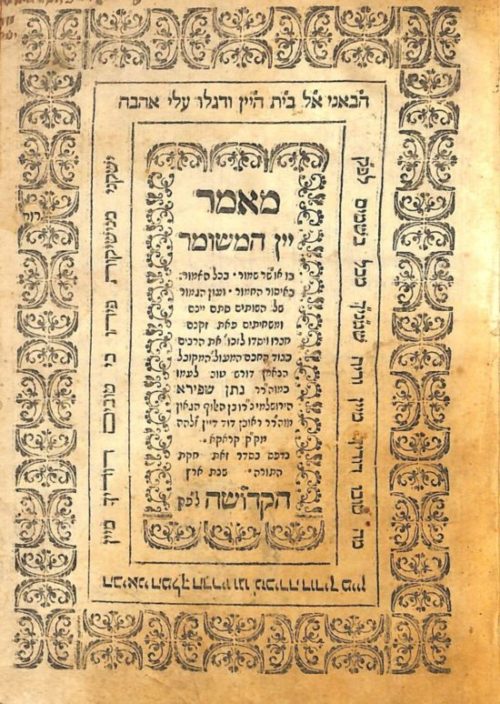
Hatzaah al Odot ha-Get (Proposal on the matter of the get given by Samuel known as Venturozzo) is a collection of responsa from a number of rabbis in support of Tamari. It was published at the press of Giorgio di Cavalli (Venice, 1565) in a small format (21 cm. 77 ff.). Cavalli, a scion of an ancient Veronese family made Venetian patricians, was an active printer of Hebrew books from 1565 to 1567, issuing more than twenty Hebrew titles. His pressmark was an elephant bearing a turret.

Hatzaah al Odot ha-Get was published by the Tamari family and the rabbis of Venice who supported the family. The book was published at intervals and subsequently assembled as a complete work. R. Baruch Uziel ben Baruch Hazketto (d. 1571, Hazketto is a Hebraized form of his name: ḥazak, forte, פורטי, “strong”).[6] The title-page of Hatzaah al Odot ha-Get states that it’s subject matter is the get given by the young Samuel known as Venturozzo. It is dated 8 Tishrei השכ”ו ([5]326 = Monday, September 3, 1565) and “contains all the details, in general and in particular, from beginning to the end. . . . and in it can be found all the facts of the divorce.” The text begins with an account of the affair from the Tamari perspective. It is followed by correspondence and rulings supporting the Tamari family from rabbis who express their opposition to R. Moshe Provencal (Provencali), who led the rabbis of Mantua, and his supporters, the leading adherents of the Venturozzo position.[7]

Elleh ha- Devorim represents the Venturozzo family’s position. It was published in quarto format (40: pp. 46 ff.) with the assistance of R. Moses ben Abraham Provencal. Although the title-page states it was printed in Mantua the publisher is not known. In addition, a second, this the primary work representing the Tamari family position, was Provencal’s Be’ur Zeh Yaza Rishonah.

R. Moses ben Abraham Provencal (1503–1575), born in and rabbi of Mantua was a prominent Talmudist and among the preeminent contemporary Italian rabbis. Among the many works for which he is known, in addition to his responsa, are an approbation for the printing of the Zohar (Mantua, 1558–60), and other varied works.[8] A leading supporter of Venturozzo, Provencal (1503-1575), invalidated the get, contending it was given under duress. His position was opposed by many rabbis in Italy, as well as rabbis throughout Italy and Turkey. Provencal wrote to the Venetian rabbinate informing them that Tamar could not remarry until the matter was resolved. The Venetian rabbinate sought and gained the support of the rabbis (six) in the Ashkenaz yeshiva in Mantua, who “banned” Provencal, an activity supported by several prominent rabbis in Italy and abroad. Provencal was actually put under house arrest by the authorities in Mantua for his position.[9] Much of the Italian rabbinate supported Provencal.

1566, Elleh ha- Devorim
Courtesy of the National Library of Israel


1566, Be’ur Zeh Yaza Rishonah
Courtesy of the National Library of Israel

Provencal’s Be’ur Zeh Yaza Rishonah is a small work. It was printed in Mantua in octavo format (80: [22] pp.), the press, as noted above, unknown. The title-page describes Be’ur Zeh Yaza Rishonah as including all the laws concerning women on divorce and betrothal when discord occurs between a man and his wife and the monetary issues when they bring their case to judgment. In addition to the works described here Simonsohn notes several other related responsa, some still in manuscript.

When the matter became so heated there were riots, suppressed by the civil authorities, in Milan. Soon after, however, the public lost interest in the affair and it was quickly forgotten. At the end of the century Provencal’s grandchildren were unable to sell copies of his pamphlet still in their possession.

(TSB Editor note: For more about this controversy see Eliezer Brodt’s recent presentation available here.)

II

Divorce of Vienna, 1611 – Our second contentious divorce, a cause celebre known as the Divorce of Vienna (Get Mi-Vi’en) concerns a young man from Poland, sixteen years of age, who married a young woman from Vienna. He became severely ill. The couple did not have any children. Persuaded by his wife’s family, the husband agreed to divorce his wife, to give her a get, so that she would not have to undergo halitzah after his passing.[10] At the time of the divorce, the husband’s position was based on his being informed that if he recovered the marital relation would be resumed. He was provided with written and oral assurances that if he recovered, he could remarry his wife. The young man did recover, but his wife declined to resume the prior relationship and return to her [ex]husband. The issue came before R. Meir ben Gedaliah of Lublin (Maharam of Lublin, 1558–1616) who determined that because of the husband’s understanding of the situation and recovery the original divorce was invalidated.

Another rabbi of repute to whom the question of this divorce was also addressed was R. Mordecai Jaffe (Levush, 1530-1612). It was his position that the verse in Deuteronomy (24:1–2) that only if his wife does not please him, as in the header verse “he writes her a bill of divorcement, hands it to her, and sends her away from his house . . . And she shall go out of his house and became a wife to another man …” It was the Levush’s contention that a woman can remarry only if she did not find favor in her husband’s eyes. If, however, the divorce was due to other reasons, a “divorce of love” is Jaffe’s term, it “is not effective as an instrument empowering marriage to another.”

In contrast to the above, in a synod of the Polish and Russian rabbinate, R. Shmuel Eliezer Edels (Maharsha, 1555-1631) determined that, given the prior understanding, the divorce was valid. Similarly, R. Joshua Falk (1555-1614), author of Beit Yisrael commentary on the Arba’ah Turim as well as Sefer Meiros Enayim on the Shulkhan Arukh argued that the get was valid, as no explicit condition had been written in the get. Finally, the wife’s family did not permit the remarriage.[11]

(TSB Editor note: For more about this controversy see Eliezer Brodt’s recent presentation available here.)

III

Urbino 1727 – Our next contentious divorce, this quite different from our other separations, took place in Urbino, at one time capital of the province of Pesaro e Urbino, duchy of Urbino, but subsequently later a portion of the States of the Church. Jews may have been resident in Urbino as early as the thirteenth century, albeit in small numbers. The details of the divorce and the participants in the ensuing divorce are detailed in R. Isaac ben Samuel Lampronti’s (1679-1756) multi-volume encyclopedia entitled Pahad Yitzhak, most parts printed posthumously.

Lampronti, a physician, rabbinic scholar, and head of the yeshiva in Mantua, a Sephardic sage in Italy, began to assemble the contents of Pahad Yitzhak when a student in Mantua. It is an encyclopedic and comprehensive work on Jewish subjects, arranged alphabetically. Lampronti worked on Pahad Yitzhak his entire life, but only beginning to publish it when elderly. A thirteen-volume work, the first volume (Venice, 1750) of Pahad Yitzhak was printed at the Bragadin press. It is the only part of Pahad Yitzhak to be published in Lampronti’s lifetime; it is on the letters א and ב. The remainder of the work was published posthumously.[12] Publication of Pahad Yitzhak was completed in Berlin (1885-87), the final volumes published by the Meḳiẓe Nirdamim Society.[13]

1750, Pahad Yitzhak 
Courtesy of Jewish National Library


1866, Pahad Yitzhak
Courtesy of HebrewBooks.org

The case of the Urbino divorce is addressed in Pahad Yitzhak, volume 7 (Lyck, 1866), under the heading safek (doubt). Ninety pages reproduce the various works, responsa, and related correspondence concerning this dispute. The detailed Pahad Yitzhak entry on the disputed Urbino divorce is summarized by Cecil Roth in an article on the dispute. The remainder of this article entry is a concise recapitulation of that summary.[14]

In this occurrence Consolo Moscato, a very attractive orphan girl, was resident in Urbino. She was sought after by many of the local young men, but she chose to wed her cousin Solomon Vita Castello. The match was arranged, but did not take place immediately, Consolo’s father having passed away and her mother, signora Diana, remarried. The couple lived under the same roof, in the home of an aunt. Due to difficult economic conditions the year stipulated for the wedding passed and it was three years before anything was done. At the end of June, 1727 Castello purchased attractive attire for the bride from a merchant for no less than twelve zecchins.

Soon after, however, the groom became ill and his mind was affected. Castello threw himself down a well; quickly saved he was bound hand and foot to prevent another attempt. His madness was followed by periods of lucidity “or what was convenient to consider lucidity.” Castello had relapses, at which time he called upon the Saints for assistance. When his kinsfolk stopped this speech, he responded with blasphemies. When this became known priests were sent by the church authorities to save his soul. There was concern that the church would seize Consolo to accompany Castello. She therefore fled, in terror, to her mother’s home and took steps to annul her engagement.

Subsequently, Consolo became betrothed to Moses Samuel Guglielmi on Friday, October 17, 1727, freeing her from Castello, with whom she had not undergone a formal ceremony. Soon after, however, Castello regained his health and found, to his dismay, that his bride had been estranged. Consolo was now prepared to cancel her new relationship and return to Castello. However, a local rabbi, R. Judah Vita Guglielmi, a relative of Moses Guglielmi, ruled that Consolo’s renewed relationship to Castello was illegal. Consolo and Castello secretly married. It was alleged that Guglielmi had even employed a non-Jewish sorceress to break the couples’ bond. R. Judah Vita Guglielmi, seeing his authority flouted appealed to other rabbis, as did the other side. Leading rabbinic authorities in Italy became involved. After serious contentiousness on both sides, it was agreed unanimously, in the decision of R. Solomon David del Vecchio, that Consolo must be divorced by both of her suitors, neither of whom could be considered her husband. Castello subsequently demanded repayment for his expenses refusing to grant her freedom, with the result that he was excommunicated. He finally consented, the excommunication was withdrawn, bringing the Urbino dispute to a conclusion.

IV

Cleves, 1766-67 – In 1766-67, a dispute arose over a get in Cleves (Kleve), a city in the historic duchy of Westphalia in western Germany, less than 5 miles (8 km) south of the Dutch border. Jews are mentioned in Cleves as early as 1142 and were granted a charter of privilege in 1361. They received patents allowing them freedom of movement (Geleitbriefe) in 1647–51 and 1713–20. Nevertheless, Jewish residence there was small, numbering only four families in 1661, 19 in 1739, and 22 families in 1787.[15] The small number of Jews notwithstanding, there too a dispute over a divorce, the get of Cleves, was contentious and became a wide spread dispute involving leading rabbinic authorities.

Here too the dispute concerns a husband who had intermittent mental illness. In this case the subject was the marriage Isaac (Itzik) ben Eliezer Neiberg of Mannheim to Leah bas Jacob Guenzhausen of Bonn, on Elul 8, 5526 (August 14, 1766). On the Sabbath after the wedding, Isaac (Itzik), took the dowry of 94 gold crowns and disappeared. He was subsequently found, after a widespread search, two days later, in a gentile home in Farenheim and returned home. Not long afterwards, Isaac told his wife’s family that he could no longer remain in Germany because he was in serious danger and that he had to immigrate to England. Isaac stated that he was prepared give Leah a get so that she would not be an agunah (technically still married and unable to rewed). Leah agreed and Cleves was chosen as the place where the get would be given. Afterwards, Leah returned to Manheim and Isaac preceded to England. Although he gave his wife a get the validity of the divorce was questionable; it is necessary that one giving a get be of sound mind. As a result, the validity of the get became an issue of contention between rabbinic authorities in Western Europe.[16]

The divorce was given, on 22 Elul, 5526 (August 27, 1766), under the direction of R. Israel ben Eliezer Lipschuetz, the av bet din (head of the rabbinic court) of Cleves. When Isaac’s father learned of the divorce, he suspected that the whole affair had been arranged by Leah’s relatives in order to extract the money for the dowry from Isaac. Isaac’s father then turned to R. Tevele Hess of Mannheim, who determined that the get was not valid, Isaac not having been of sound mind when he gave it to Leah. Hess sought support for his position, turning to the bet din (rabbinical court) of Frankfurt, headed by R. Abraham ben Zevi Hirsch of Lissau. Abraham ben Zevi Hirsch supported Hess’s ruling but that was not the case with other prominent rabbis such as R. Naphtali Hirsch Katzenellenbogen of Pfalz, R. Eliezer Katzenellenbogen of Hagenau, and R. Joseph Steinhardt of Fuerth. While Abraham ben Zevi Hirsch agreed and even demanded that Lipschuetz invalidate the get, agreeing that Leah was still a married woman, the others did not support him, saying the divorce was valid and Leah might remarry. Furthermore, many other prominent rabbis also validated the get.[17] The Frankfurt rabbinate, here influenced by the Frankfurt am Main dayyan (judge) R. Nathan ben Solomon Maas opposed the validity of the get, publicly burning the supportive responsa of the other rabbis, condemning their support of Lipschuetz and his position. Finally, the couple remarried, and in respect of R. Abraham of Frankfurt, did so without any of the traditional blessings at the ceremony. Instead, Isaac said “with this ring you are still married to me.”

The above events are recorded in two works, both validating the get. R. Aaron Simon ben Jacob Abraham of Copenhagen’s Or ha-Yashar are favorable responsa published in the year “as a sign for rebellious ones לאות לבני מרי (529 = 1769)” (Numbers 17:25) in Amsterdam by Gerard Johan Yanson at the press of Israel Mondavo. Aaron Simon was the secretary of the Jewish community of Cologne. He was also the author of Bekhi Neharot, on the flood in Bonn in 1784 (Amsterdam, 1784). He expresses his agreement with and support of Lipschuetz in Or ha-Yashar.[18] The title-page of that work informs that it was completed in the month that the Torah was given to Israel (Sivan) and is dated “as a sign for rebellious ones לאות לבני מרי (529 = 1769)” (Numbers 17:25). Or ha-Yashar is a 19 cm. ([7], 111, [1], ff.) work. Aaron Simon ben Jacob had followed the events and had himself played a part in the granting of the get. Or ha-Yashar records the complete episode of the Cleves divorce.[19]


1769 Or ha-Yashar
Courtesy of Hebrewbooks.org

1770, Or Yisrael
Courtesy of Hebrewbooks.org

The following year Lipschuetz published Or Yisrael in defense of his position. It is dated with the popular phrase “[Rock of Israel], arise to the aid of Israel קומה בעזרת ישראל (530 = 1770)” in defense of his position. Or Yisrael was published in Cleve at the press of the widow Sitzman as a 20 cm. (120 ff.) work. It is the only Hebrew book to have been printed in Cleve. Or Yisrael is comprised of thirty-seven responsa, primarily concerned with the Cleve divorce. Responsa 34-36, which are very critical of the Frankfurt rabbis, were omitted in their entirety, the numeric order of the printed responsa being 33, 37, while responsum 33 was printed with modifications.[20]

A negative result of this controversy was similar to that of the Tamari-Venturozzo controversy, as noted above. Here too, Mordecai Breuer suggests that in the polemic over the Cleves get “rabbis and rabbinical courts from various communities likewise fought against each other with fierce antagonism. . . . and the Cleves divorce, undoubtably had a detrimental effect on the standing of the rabbinate.”[21]

Or ha-Yashar was reprinted once, in Lvov (1902). This is the only edition of Or Yisrael.[22]

(TSB Editor note: For more about this controversy see Eliezer Brodt’s recent presentation available here.)

V

Henry VIII – We conclude with what is the most unusual of our contentious public divorces, that of Henry VIII (June 28, 1491 – January 28, 1547) king of England. Henry reigned from April 22, 1509 until his death in 1547. He is an important and influential figure in English history. Henry took England out of the Roman Catholic Church, had Parliament declare him, in 1534, supreme head of the newly founded Church of England, beginning the English Reformation. He did this because the pope would not annul his marriage to Catherine of Aragon, who had not provided him with a male heir.[23]

Henry’s first marriage – he married six times, this apart from mistresses – was to the Infanta Catherine of Aragon (1485-1536) in 1509.[24] Catherine was the daughter of King Ferdinand and Queen Isabella of Spain and the widow of Arthur, his elder brother. Arthur and Catherine did not have children; the related question of levirate marriage, the question of its application to them, will be addressed below. Henry was eighteen at the time and Catherine five years older when they wed. The marriage was a political union, as were many royal marriages at the time. Henry and Catherine did have a child, Mary, born in February 1516. Of the many pregnancies and several births that Henry would have from his many wives, Mary was the only child to survive.[25]


Henry VIII
Hans Holbein the Younger

Catherine was reportedly devoted to her “young, athletic, charming husband.” She was a committed wife and very much wanted to give her husband a male heir. Their first child was a daughter, stillborn in 1510. She was followed by a son, named Henry, born in January 1511, but he lived only 52 days. In October, 1513, Catherine miscarried; in February 1515, she had a stillborn son. “In February 1516, there was happiness as Princess Mary was born. There was joy in the sign that Catherine could bear a vital child which kept alive the hope of a son.” There was, however, sadness with this birth, Catherine having been informed two weeks earlier that her father had passed. One more child was born to the royal couple, in 1518, a stillborn daughter, the last of their children.

After eighteen years of marriage and seven pregnancies, Henry despaired of having a male son with Catherine of Aragon. Winston Churchill writes that by 1525 she was forty years old. Five years earlier, Catherine had been privately mocked by Francis I, king of France, “saying she was already ‘old and deformed.’ A typical Spanish princess, she had matured and aged rapidly; it was clear that she would bear Henry no male heir.”[26]

Henry did have an illegitimate son, daughter of a maid in the court, named Henry, who was made duke of Richmond, but was not an option as successor. Henry VIII became enamored with Anne Boleyn (ca. 1504-1536), a lady in waiting to Catherine, whom he secretly wed in Whitehall Palace. He then attempted to discredit his marriage to Catherine.[27] Henry’s marriage to Anne was also not successful. Anne Boleyn was not a submissive woman. In April 1566, three years later, Anne was accused of high treason, adultery, incest with her brother George, and plotting to kill the king, and tried before a jury. On 15 May, four days later, she was convicted and beheaded. These charges, investigated by historians, are rejected as false.[28]

Henry submitted a request to Pope Clement VII that his marriage to Catherine be dissolved. The pope, however, did not agree to Henry’s request. Cecil Roth writes that the pope would have been prepared to “grant the favor” and annul the marriage but for fear of Catherine’s nephew, Emperor Charles V, who was opposed due to the slight he felt this put upon his house.[29] Henry’s marriage to Catherine was, from a religious, Biblical perspective, questionable, marrying a sibling’s wife, even if he was deceased, being prohibited. The exception to this is where the deceased brother did not have offspring, in which case the commandment of levirate marriage becomes operative.

A complex issue, biblical interpretation and Hebrew tradition assumed importance. Jewish interpretation of scriptures was not readily accessible, as the Jews had been expelled from England by Edward I on 18 July 1290. It was to Italy, therefore, with its notable Jewish community, particularly to the Venice community, that the protagonists turned.[30] Henry sent Richard Croke, an eminent classical scholar and royal tutor, to Venice to seek adjudications on the subject.

Responses both in favor and opposed to Henry’s request are found among the rabbinic authorities in Venice. Among the people that Henry consulted was Mark Raphael, a convert to Christianity who reputedly had previously held a high rabbinic position in Venice.31 The subject of Henry’s query was of the legality, according to Jewish law, of his levirate marriage to Catharine.[32]Raphael, who arrived in London on Jan. 28, 1531, held that while Henry’s marriage to Catherine was legal, the king might nevertheless take a second wife conjointly with the first wife. This decision was not acceptable, so Raphael suggested that, as Catherine’s marriage to Arthur had born no children, and Henry had married Catherine without the intention of continuing his brother’s line, that marriage was not legitimate but rather invalid. This position was presented to Parliament, Raphael subsequently being rewarded, being given special import rights in 1532.[33]


Response of Jacob Rafael Peglione of Modena, relating to Jewish marriage law that might apply in the divorce of King Henry VIII from Catherine of Aragon. Italy, 1530.
Courtesy of British Library Board
https://www.timesofisrael.com/dont-divorce-her-rabbis-letter-to-henry-viii-at-heart-of-british-library-show/

Members of the Venetian rabbinate in general were not positive, not supportive of Henry’s position. Among those approached by Henry’s representatives was R. Jacob Raphael Jehiel Hayyim Peglione of Modena. He, however, determined in a responsum that the marriage could not be dissolved. In addition to rabbinic opposition several prominent Venetian physicians opposed Henry’s position, among them Elijah Menahem Halfon, a Talmudist, physician, and kabbalist and Jacob ben Samuel Mantino, physician and translator of philosophical works.[34]

Henry VIII’s offspring did include one son, born to Jane Seymour, a sickly boy, who ruled as Edward VI (1547 – 1553). Edward was succeeded on the throne by Henry’s daughter, Mary, from Catherine of Aragon ( 1553 – 1558), a devout Catholic, remembered today as Bloody Mary, for her attempt to restore Catholicism as the state religion with utmost severity. Henry’s last offspring to rule was the daughter of Anne Boleyn, who ruled as Elizabeth I (1558-1603, reigned from 1558). Elizabeth, was, in contrast to what one might expect from Henry’s relationships with his wives and with Anne Boleyn in particular, that being a short marriage concluding with Anne’s beheading, a popular, successful, and among England’s most preeminent and perchance most significant monarch.

Conclusion – We have addressed five public and contentious divorces. What they have in common is that they were all public and controversial, the opposite of what all parties generally attempt to avoid when marriages fail. As noted at the beginning of this article, what should be a positive and affirmative relationship, should, when it fails, be a private and hopefully not overly contentious dissolution of an unsuccessful bond. The cases described here, over three centuries, were public and unpleasant affairs. They attracted attention not because of the distinction of the subject individuals in the divorces but rather because of the rabbinic participants who were called upon to resolve the issues. The exception to all of this is the divorce of Henry VIII, not Jewish, but whose advisers called upon rabbinic authorities for support.

Again, the above notwithstanding, marriage is meant to be a joyful and positive relationship, as we find in the verses from King Solomon:

As a rose among the thorns, so is my beloved among the young women.
As an apple tree among the forest trees, so is my beloved among the young men.

[1] Once again, I would like to thank and express my appreciation to Eli Genauer for his review and helpful comments on the article.
[2] Shlomo Simonsohn, History of the Jews in the Duchy of Mantua (Jerusalem, 1977), pp. 501-04.
[3] Simonsohn, History of the Jews in the Duchy of Mantua.
[4] Robert Bonfil, Rabbis and Jewish Communities in Renaissance Italy (London, Washington, 1993), pp. 107-08. Among the other disputes noted by Bonfil are the Finzi-Norzi controversy, the dispute over the mikveh of Rovigo, and a dispute over the use of gentile wine. Concerning other disputes over gentile wine see Marvin J. Heller, “R. Nathan Nata ben Reuben David Tebele Spira and his Works: Among them Ma’amar Yayin ha-Meshummar, on the prohibition against drinking Stam Yeinam (gentile wine), and Contemporary Books on that Subject” Seforim blog, June 26, 2023, reprinted in Further Essays on the Making of the Early Hebrew Book . . .
[5] All three titles were sold by Kedem Auction House, November 23, 2021, Auction 83 part 1. Elleh ha-Devorim, lot 12: Estimate: $6,000 – $10,000 Sold for: $5,000; Be’ur Zeh Yaza Rishonah, lot 13: Estimate: $6,000 – $10,000 Sold for: $5,750; Hatzaahh al Odot HaGet, this the copy of R. Akiva Eger, Estimate: $15,000 – $20,000 Sold for: $21,250, all three sale prices include the buyer’s premium.
[6] Umberto (Moses David) Cassuto, “Forti, Baruch Uziel ben Baruch,” vol. 7 Encyclopedia Judaica, p. 133.
[7] For a detailed listing of the supporting rabbis and the contents Shmuel Glick, Kuntress Ha-teshuvot He-Hadash: A Bibliographic Thesaurus of Responsa Literature Published from ca. 1470-2000 I (Jerusalem, Ramat-Gan, 20006), p. 277 no.1120.
[8] Mordechai Margalioth, ed., Encyclopedia of Great Men in Israel IV (Tel Aviv, 1986), cols. 1143-44 [Hebrew]; Shimon Vanunu, Encyclopedia L’Chachmei Italia (Jerusalem, 2018), pp. 345-46 [Hebrew].
[9] Simonsohn, p. 502.
[10] Halizah is the biblically mandated ceremony performed by the brother of a man who dies childless and who dies not want to marry his sister-in-law (yibum). Concerning halizah see my Jewish Learning https://www.myjewishlearning.com/article/halitzah-the-ceremonial-release-from-levirate-marriage/.
[11] J. David Bleich, Contemporary Halakhic Problems, vol. 1 (New York, 2018), available at https://www.sefaria.org/Contemporary_Halakhic_Problems%2C_Vol_I%2C_Part_I%2C_CHAPTER_V_Medical_Questions.1?lang=bi&with=all&lang2=en chapter VII Part I, Chapter VII Marriage, Divorce and Personal Status. Also see https://bethdin.org/the-proper-timing-of-a-get/.
[12] Shimon Vanunu, Encyclopedia Arzei ha-Levanon. Encyclopedia le-Toldot Geonei ve-Ḥakhmei Yahadut Sefarad ve-ha-Mizraḥ III (Jerusalem, 2006), pp. 1305-07 [Hebrew]; ibid. Encyclopedia L’Chachmei Italia, pp. 282-84 [Hebrew].
[13] The Meḳiẓe Nirdamim Society (lit. “rousers of those who slumber”), founded in 1862, was the first society to publish medieval and later Hebrew literature (Israel Moses Ta-Shma, “Meḳiẓe Nirdamim,” vol. 13, Encyclopedia Judaica, p. 797).
[14] Cecil Roth, “Romance at Urbino” in Personalities and Events in Jewish History (Philadelphia, 1961), pp. 275-282.
[15] Chasia Turtel, “Cleves,” vol. 4 Encyclopedia Judaica (Jerusalem, 2007), p. 759.
[16] Shlomo Tal, “Cleves Get” vol. 4 Encyclopedia Judaica, p. 760. The following account is primarily based on that entry.
[17] Among this latter group were R. Saul ben Aryeh Leib Loewenstamm of Amsterdam, R. Jacob Emden, R. Ezekiel Landau of Prague, R. Isaac Horowitz of Hamburg, R. David of Dessau, R. Aryeh of Metz, R. Elhanan of Danzig, R. Solomon ben Moses of Chelm, and a minyan (ten) scholars of the klaus (bet-midrash) of Brody.
[18] Heinrich Haim Brody, “Aaron Simeon ben Jacob Abraham of Copenhagen,” vol. 1 Encyclopedia Judaica, p. 221.
[19] A detailed discussion based on these works in English may be found in Aaron Rathkoff, “The Divorce in Cleves, 1766” Gesher 4:1 (New York, 1969) pp. 147-69.
[20] The highly controversial omitted and modified responsa were from R. Isaac ha-Levi Horowitz, R. Aryeh Leib of Hanover, and a proclamation from the author (Glick, Kuntress Ha-teshuvot), p. 46 no. 171). Or ha-Yashar was sold at auction by Kedem Auction House on April 2, 2014, lot 334. The asking price was $400. Sale price was $500. This was the copy of R. Samson Raphael Hirsch (Kedem-Auctions.com).
[21] Mordecai Breuer and Michael Graetz, German-Jewish History in Modern Times ed. Michael A. Meyer, asst. ed. Michael Brenner, translator William Templer vol. 1 (New York, 1996), p. 259. The Hamburg amulet controversy refers to the dispute between R. Jacob Emden and R. Jonathon Eybeschutz over in which the former accused the later of having written an amulet with hidden allusions to Shabbetai Tzevi.
[22] Ch. Friedberg, Bet Eked Sefarim, (Israel n.d.), alef 1155, 1160 [Hebrew].
[23] https://www.britannica.com/biography/Henry-VIII-king-of-England.
[24] Henry’s other wives were Anne Boleyn, Jane Seymour, Anne of Cleves, Catherine Howard and Catherine Parr.
[25] https://www.history.com/news/henry-viii-wives  ; https://www.encyclopedia.com/people/history/british-and-irish-history-biographies/catherine-aragon. Until her death Catherine insisted that her marriage to Arthur was never consummated.
[26] Winston Churchill, A History of the English-Speaking Peoples, vol. 2, p. 46. Although Churchill discusses Henry VIII’s divorce in some detail, he makes no mention of the involvement of rabbinic authorities, either an oversight by him or perhaps an over emphasis of their importance by Jewish sources. 

[27] https://www.encyclopedia.com/ var. cit.
[28] Catherine Howard was also charged with adultery and executed on February 13, 1542 (https://www.britannica.com/question/Why-did-Henry-VIII-kill-his-wives).
[29] Cecil Roth, The Jews in the Renaissance (1959, reprint New York, 1965), pp. 158-61.
[30] Cecil Roth, The History of the Jews in Venice (Philadelphia, 1930), p. 79; ibid. The Jews in the Renaissance.
[31] Raphael is credited with the invention of an improved invisible ink, as well as a number of theological treatises in Hebrew, “still not discovered,” at the instigation of Francesco Giorgio, a kabbalist of the Franciscan Order. It was Giorgio who converted Raphael to Christianity and translated the manuscripts for the king. (https://www.encyclopedia.com/religion/encyclopedias-almanacs-transcripts-and-maps/raphael-mark).
[32] Levirate marriage, based on the verse (Deuteronomy 25:5-6) “When brothers dwell together and one of them dies, and he has no child the wife of the deceased shall not marry outside to a strange man; her brother-in-law shall come to her and take her to himself as a wife, and perform levirate marriage.” The purpose being that offspring shall bear the name of the deceased brother, thereby perpetuating his name, or memory. In the absence of that marriage a ceremony entitled halitzah is to be performed.
[33] Isidore Singer, Joseph Jacobs “Mark Raphael,” Jewish Encyclopedia, X (New York, 1901-06), p. 319.
[34] Kaufmann Kohler, Isaac Broydé, “Halfon, Elijah Menahem,” Jewish Encyclopedia, VI, p. 170, relate that Halfon was not only recognized as a Talmudic scholar, but that a responsum of his (no. 56) is included in R. Moses Isserles’ responsa; Gotthard Deutsch, Isaac Broydé, “Mantino, Jacob ben Samuel” Jewish Encyclopedia, VIII, pp. 297-98.70.


The Etymology of “Onah”

The Etymology of “Onah”

by Mitchell First (MFirstAtty@aol.com)

I thought it would be useful if everyone would have a better understanding of how the root ענה, occurring at Exodus 21:10 in the form “onatah,” can refer to the sexual obligation. I will offer several possibilities.

First I must provide a brief overview of this widely occurring root. It is typically viewed as having four meanings as a verb: 1) respond, 2) sing, 3) afflict, and 4) occupy oneself with.

It is hard to unify all these meanings. But it is easy to see that perhaps the first and second meanings have a common origin.

As to the third meaning, the word ענו, a submissive, humble individual, probably derives from this meaning and the word עני, a poor individual, also probably derives from this meaning.

The fourth meaning is a rare one in Tanakh. It is only found in the book of Kohelet.

It is also possible that ענה has a “time-related” meaning in Tanakh. We will discuss this below.

—–

Exodus 21:10 reads: “If he marries another, he must not diminish her food, her clothing, or ‘onatah’ (=her onah).” The person being protected is the Israelite slave who was the first wife.

The Mishnah at Ketuvot 5:6 understands “onah” (without any discussion) as referring to the man’s sexual obligation to his wife,[1] and then proceeds to delineate the obligation for various occupations.

Our first question is whether we can fit this meaning of “onah” into any of the first four meanings above. Note that Rashi on our verse explains the word as “tashmish” but does not provide any explanation.

We could connect our word with the “response” meaning above and suggest that “onatah” means “a response to her request for intimacy.” But it is hard to imagine that such an important obligation would be phrased in such a vague way.[2]

Here are a few better approaches:

1. There is a word מעון and other words related to it that appear many times in Tanakh and mean “dwelling.” Presumably, their root would have been עון. If the root of our “onatah” (which has no vav) would be עון with its “dwelling” meaning, we can interpret the word “dwelling” as symbolizing a main activity that goes on in a dwelling, i.e., sexual relations.[3] Our verse would be referring to sexual relations but doing it euphemistically. As a parallel, in English the word “cohabit” typically now has a sexual meaning, even though the word originated with a “habitation” meaning.

Of course, we can alternatively interpret our verse to be stating that a man may not diminish the living quarters of his wife and that the verse has nothing to do with sexual relations. Rashbam and Cassuto are among the many who take this approach.[4] But obviously we would like to avoid this interpretation.

2. It has been argued that Ayin-Nun-Heh has a meaning related to “time” in Tanakh. We know that it has such a meaning in early Rabbinic Hebrew. See, e.g., Mishnah Peah 4:8: “onat ha-ma’aserot.”[5]

If there was a root Ayin-Nun-Heh (or Ayin-Nun-Tav) with a time-related meaning in the era of Tanakh, “onatah” could be referring to a husband’s obligation to provide relations to his spouse at certain time intervals. R. Saadiah Gaon and Ibn Ezra are among the many who follow this approach. Daat Mikra offers it as its second interpretation.

But this is still not a simple way of reading the verse. As Luzzatto observes: “It does not stand to reason that the Torah would designate a man’s relations with his wife by the term ‘set time,’[6] besides the fact that nowhere in the Torah is there any timetable for this matter.”[7]

There is an alternative way of obtaining the relations meaning based on the “time” meaning of “onah.” We can say that “onah” means “her time,” and in the case of two competing women, as is the case here, it means “her turn.”[8]

——

We still have to address the issue of whether Ayin-Nun-Heh or Ayin-Nun-Tav really did have a time-related meaning in Tanakh.

There are three arguments to support this.

First, the word עת means “time” many times in Tanakh. Many believe this derives from a root [9]ענת, but many disagree with this etymology.[10]

Second, עונן and מעונן refer to one who engages in divination. Many understand this word as deriving from Ayin-Nun-Heh with a “time” meaning. I.e., perhaps these individuals made predictions as to what is a good time to do things. But others interpret these words with a different etymology altogether. E.g., perhaps these individuals made predictions by looking at cloud formations. Many other possibilities have been suggested for the etymology of עונן and מעונן. But the time-related etymology is a real possibility.

– Third, the fact that our word appears in early Rabbinic Hebrew with a time-related meaning is some evidence that this meaning already existed in Biblical Hebrew.

3. A third approach observes that there are many instances in Tanakh where Ayin-Nun-Heh occurs in the piel construct in a context of a man forcing a woman to have intercourse. See, e.g., Gen. 34:2 (Dinah), and Deut. 21:14 (woman captured in war).[11] We are used to translating these piel verbs with an “afflict sorrow or pain” meaning, or perhaps a “humbled” meaning.12 But perhaps Ayin-Nun-Heh in the piel in all or some of these cases is better understood as “rape.”[13] If Ayin-Nun–Heh in the piel construct can mean “rape,” that same root in the kal construct can mean “consensual relations.” Then we could utilize this meaning for our word at Ex. 21:10.[14]

To complete our discussion, I must mention two other Tannaitic passages about “onah”: one in the Mekhilta, and the other: a baraita in the Talmud.

As I mentioned at the outset, the Mishnah at Ketuvot 5:6 assumes that the “onah” of our verse means “relations” and does not offer any alternative view or any derivation.

The Mekhilta in Mishpatim offers three different interpretations of “onah.” The first is “relations” (“derech eretz”). This view is brought in the name of R. Yoshiah. The prooftext he cites is Gen. 34:2 (regarding Dinah): “va-yishkav otah va-ye’aneha.” This citation is surprising because it is usually assumed that “va-ye’aneha” here has the “afflict” or ”humbled” meaning. (This citation fits loosely with our third approach.)

A second view (in the name of R. Yonatan) interprets “onah” to be a reference to giving clothing that is appropriate to the season. A third view (in the name of Rebbi) interprets “onah” as food (giving a strange prooftext, Deut. 8:3). This third view interprets a different word in verse 21:10, one from the root שׁאר, as referring to “relations.”

At Ketubot 47b, there is a baraita very similar to the Mekhilta (although with different Tannaim) that also gives the above three views. In the view of the tanna kamma, the verse cited for the “relations” meaning is a statement of Lavan at 31:50: “If you will ‘ta’aneh’ my daughters and/or take other wives besides my daughters…” Yet in this verse, our root clearly means “afflict” and does not mean “relations.”[15]

——

To sum up, if one wants to interpret “onah” as “relations,” one approach is to relate it to the word מעון and its meaning “dwelling.” “Dwelling” can symbolize a main activity that goes on in a dwelling. Alternatively, the approach that “onah” simply refers to “her time” (=her turn) sounds plausible as well. Finally, we have the suggestion that Ayin-Nun-Heh in the kal construct may refer to consensual relations.


[1] The Mishnah does not cite our verse but is implicitly referring to it. Admittedly there are other interpretations of “onah” among the Tannaitic Sages. I will discuss them at the end of this article.
[2] Nevertheless, S.D. Luzzatto is willing to adopt something like this approach. S. Mandelkern takes it seriously as well. The Brown-Driver-Briggs lexicon mentions it as a possibility. In more modern times, M.Z. Kaddari, Millon Ha-Ivrit Ha-Mikrait (2006), p. 815, adopts it without any discussion.

For more on the view of Luzzatto and on this entire topic, see the article by Marty Lockshin from Jan. 27, 2022 on thetorah.com: “Onah: A Husband’s Conjugal Duties?”

Lockshin points out that Targum Onkelos merely renders the Hebrew term with an Aramaic equivalent, so we cannot determine how it was understood in this translation. He also discusses the views of the other early Aramaic translations. He also mentions the view of the Septuagint. It has “homilian,” which literally means “company” or “conversation,” but which many scholars think is being used euphemistically here for “relations.”
[3] Daat Mikra adopts something like this as the first of its two interpretations. Luzzatto mentions some who take this approach, even though he disagrees with it.

The scholars who view there to have been a root Ayin-Vav-Nun (=to dwell) view the vav as being vocalized with a shuruk. See, e.g., Brown-Driver-Briggs, p. 732 and Theological Dictionary of the Old Testament (2000), vol. 11, p. 229. If the underlying meaning was “dwell,” then one can argue that our word should have been vocalized as “unatah.” Even if this is correct, probably most of us could live with the idea that there was an error in the vocalization of the vav by the post-Talmudic Masoretes.
[4] More recently, it is adopted in Theological Dictionary of the Old Testament, vol. 11, p. 229. Prior to Rashbam, it was one of two interpretations offered by Menahem Ibn Saruq (10th cent.). It was also offered by Karaites.
[5] See also the baraita at Ketuvot 48a (view of the tanna R. Eliezer b. Yaakov) and the Mekhilta, Mishpatim (view of the tanna R. Yonatan). Other aspects of these passages are discussed at the end of this article.
[6] For further elaboration on this point, see Lockshin’s article. The passage itself is ambiguous as to what Luzzatto’s reasoning was.
[7] Translation from D. Klein’s edition.
[8] This view is mentioned in the Anchor Bible in the name of Arnold Ehrlich (d. 1919). It is one of many views mentioned in the long and very speculative discussion there.
[9] See Ernest Klein, A Comprehensive Etymological Dictionary of the Hebrew Language for Readers of English (1987) p. 489-90. See also Ibn Ezra to Ex. 21:10 and to Ecc. 9:11. See also the similar words at the end of Ezra 4:10, 4:11, and 4:17.
[10] See Theological Dictionary of the Old Testament, vol. 11, p. 229 and p. 437.
[11] The additional occasions are: Deut. 22:24 and 22:29, Judges 19:24 and 20:5, 2 Sam. 13: 12,14,22, and 32, Ezekiel 22:11, and Lam. 5:11.
[12] When you “humble” someone, you make them submit to your authority. This is a different meaning than “afflicting” them, even though the two meanings are related. The 1917 Jewish Publication Society of America translation uses “humbled” often in these sexual contexts. See also their translation of God’s statement to Pharaoh at Ex. 10:3: “How long wilt thou refuse to humble thyself (לענת) before Me?.”
[13] What if we can argue compellingly that the piel of Ayin-Nun-Heh does not mean “rape” in at least one of these cases? For example, at Gen. 34:2, we have “va-yishkav otah va-ye’aneha.” Since we are already told “va-yishkav otah,”perhaps the next word has the “afflict” or “humble” meaning. Of course, this is not a strong question. Moreover, even if we can argue compellingly that, in one or more of the verses with the piel construct, ענה does not mean “rape,” that does not mean that it cannot mean “rape” in some of the others.
[14] I have seen this suggestion made by Ariella Deem. See her “The Goddess Anath and Some Biblical Hebrew Cruces,” Journal of Semitic Studies 23 (1978), pp. 25-30. This suggestion was probably made by others prior to this. Deem like this interpretation because she uses it to give a new meaning to the name of the ancient goddess “Anat” (a “sexual love” meaning). Deem also uses this idea to explain the third “anot” at Ex. 32:18. She suggests: “the sound of an orgy.”
[15] One can claim that the meaning is “afflict my daughters by withholding relations,” but this would not be a proper prooftext that the root Ayin-Nun-Heh meant “relations.”


Legacy Auction, agunot, censorship, and other notable items

Legacy Judaica will be holding its latest auction on April 4th. The auction includes a few lots regarding agunot and comprehensive attempts to annul marriages.  In the early 20th century, especially in the aftermath of WWI, some tried to find global solutions to the massive agunah problem.  To those books offering solutions were those which disputed the validity of those solutions.  There is a lot of ten historic books on the controversies and a lot of letters from American rabbis.  One of the most substantial responses is, Ein Tenai be-nesunin , whose title leaves no doubt as to its position.  The book includes an important letter from R. Chaim Ozer and other rabbis.  According to some, the book was a response to one of the more eclectic figures invovled in the controversy, R. Yosef Shapotsnik.  His book, Lekor le-Asirim Dror, also leaves no doubt as to his position.  Although that book does not appear at this auction, Shapotshnik was involved in many other controversies and one of his books on the issue with an eruv in London.  (lot 48).   One of R. Nathan Shapira’s polemics, one against drinking yayin neskeh, and the other on Lurianic observances of certain mitzvos constitutes (lot 76).

A  lesser-known example of censorship are the two “first” editions of R. Yehuda Greenwald’s Shut Zikhron Yehuda, both published in 1923.  The first contains a lengthy letter questioning how R. Yosef Hayyim Sonenfeld could associate himself with the Agudah.  In the second edition that is replaced with a letter regarding eating on the eve of Yom Kippur.  Unfortunately in the second version although they changed the letter they weren’t as thorough as they should have been left the original title in the index. (lot 50).

The version of the Shulkhan Arukh with the commentary Gur Areyeh that contains the portraits of rabbis is lot 47.  Regarding the use of the portraits and whether they were offensive see our recent post.

Lot 49 is a large double-sided broadside polemic against the Reform rabbinical conferences signed by R. Samson Raphael Hirsch when he was still the rav and av beis din of Emden. Here is an excerpt:


Lot 13 is Sefer Zichronos of R’ Abohav although quoted by many it was very rare and almost no one saw it inside but rather came to it through secondary sources including the Magan Avhrhom who quotes it often,and was printed by Ahahvat Sholom twice.

Another point of interest related to this work is this work was printed anonymously The Chida deals with this at length in his Shem hagedolim if this is a proper practice. See also most recently Yakav Speigel in Amudim Betoldost Sefer haivri ( BEsharei Hadefus) Chapter Two and see our post here. We also dealt with R Abuhav here.

Lot 12 is the first edition of of ha-Kesav Ve-ha-Kaballah by R. Jacob Zvi Mecklenburg (Leipzig, 1839).

Earlier on the blog (here) we have pointed to pieces only found in the first edition of this work and this particular volume is from the main synagogue in Koningsberg where R. Mecklensberg was the rabbi.

Lot 24 is the Nesivot Mishpat. an interesting tidbit about of this work has been noted in this post

Lot 28 is the Shut Meshiv Davar of the Netziv.  The entry notes that there are two editions of the first edition. The one for sale is more complete.  Some of the differences have been noted in The series on the seforim blog “The Netziv, Reading Newspapers on Shabbos in General & Censorship” (here, here and here). Part four in the series will hopefully be published shortly dealing with some more differences between the various editions.

Lot 94 is R’ Moshe Koerner and his Toras Moshe. There are two editions of this work, each with a different introduction. This was pointed out by Dr. Sprecher in his introduction to R’ Koerner’s Birchas Moshe which he reprinted. He also printed copies of both introductions. This is not noted in the Mifal bibliography entry on this work. Also, worth pointing to about R’ Koerner is recent excellent article from, Uriel Gellman, “Between Worlds: The Miserable Life of an Itinerant Preacher on the Eve of Modernity”, Jewish Quarterly Review, vol. 109 no. 1, 2019, pp. 54-83.

Lot 82 Sefer Safra Detzniusah DeYakov  about this rare book R’ Ephrayim Zalman Margolis who had a excellent collection writes picturesquely about this work:

.והספר היה אצלי ונשרף בעוה”ר בשריפה שהיה פ”ק שנת תק”ן לפ”ק ומאז לא בא לידי

See ( מעלות היוחסין עמ’ סד) for this reference.

Lots 111-112 manuscripts of the Maaseh Rav sound very interesting one hopes that who ever prints them makes them available to the public to study. For now see R Dovid Kamenetsky article here

Lot 102 Zemirot mateh Yehudah. See what the Pre Megadim writes about this work:

בספר נטריקן, יורשלים תשכד, דף טז ע”ב: “ועיין בספר מטה יהודה על זמירות ואדם גדול היה“. וראה שם הקדמה דף ו ע”א.

Lot 103

The Dibuk highlighted in auction entry is dealt with at great length in   Sara Zfatman’s  excellent book Jewish Exorcism in Early Modern Ashkenaz (heb.).

Lot 162 provides evidence of which edition of the haggadah the Netziv might have used at the seder, R’ Eliezer Ashkenazi ‘s Maasei Hashem.  The Netziv quotes this work in his commentary on the Sifri (1:243) and in his work on Chumash Bershis (44:34). This was his personal copy:

Lot 204 is a copy of Teudas Chaver (Prague 1813) signed by the Prague beis din, including R. Elazar Fleckeles, and R. Shmuel Landau, the Noda be-Yehuda’s son.

Lot 205 R Chaim Ozer and R Kook, relating to their relationship. See R. Dovid Kamenetsky’s article here


New Book Announcement – נשמת הבית

New Book Announcement
נשמת הבית, שאלות שנשאלו ליועצות ההלכה של מדרשת נשמת בנושאי היריון, לידה, הנקה ואמצעי מניעה בליווי הדרכה מעשית והסברים ונספחים רפואיים, 367 עמודים
Nishmat Habayit is a collection of 63 she’elot uteshuvot on Pregnancy, Birth, Nursing, and Contraceptives. Each question has a short answer, as a yoetzet halacha would addresses the woman with the question, followed by a more extensive halachic discussion. The questions were selected from among tens of thousands in Nishmat’s Taharat Hamishpacha database. The responses were authored by a team of yoatzot halacha, under the supervision of Rabbi Yehuda Henkin and Rabbi Yaakov Varhaftig; and edited by Rabbi Yehuda and Chana Henkin. The book includes medical appendices, helpful even to poskim. The responses display sensitivity to women, coupled with complete faithfulness to halacha. The book carries haskamot of recognized poskim in Israel. The book was published by Maggid Press and is available here. Sample chapters are available upon request [Eliezerbrodt@gmail.com ]
Here is the title page, table of contents, and haskamot.


Engaged Couples, צעירים, and More

Engaged Couples, צעירים, and More
Marc B.Shapiro
Continued from here
1. Regarding engaged couples having physical contact, this is actually the subject of a section of the book Penei Yitzhak by R. Hezekiah Mordechai Bassan. Here is the title page.
This book was published in Mantua in 1744 by Menahem Navarra who was a descendant of R. Bassan. Navarra, who was at this time a doctor, not a rabbi, was nevertheless very learned in Torah matters. (He would later be appointed rabbi of Verona.[1]) Navarra included three essays of his own in the volume, the second of which is called Issur Kedushah. In this work he criticizes members of the Jewish community for allowing engaged couples to have physical contact before marriage. Here are the first two pages of the work.
Navarra and the others I have referred to are only dealing with an engaged couple touching before marriage, but not with actual sexual relations. Yet this too is mentioned many centuries before Navarra. Ezra 2:43 and Nehemiah 7:46 refer to בני טבעות. A commentary attributed to R. Saadiah Gaon[2] explains this as follows:

בני טבעות: שקלקלו אבותם גם [צ”ל עם] ארוסותיהם קודם שיכניסו אותם לחופה והיו סומכין על קדושי טבעות ומקלקלין עם ארוסותיהן.
What this means is that after kiddushin, which was effected by aטבעת  (ring), but before actual marriage (the two used to be separated, sometimes for many months), the engaged couple would have sexual relations. The children who resulted from this were referred to negatively as בני טבעות. As S. H. Kook points out,[3] R. Saadiah’s explanation is also mentioned by R. Hai Gaon.[4]
R. Hayyim Benveniste, in seventeeth century Turkey, also speaks about how engaged couples would have physical contact. This shows again that there was a divergence between what the halakhah requires and what the people were actually doing (much like you find in a large section of Modern Orthodox society today). Here are R. Benveniste’s words:[5]
להתייחד שניהם כמו שנוהגים פה תירייא ואיזמיר, שאחר השדוכין אחר עבור קצת ימים מתייחדין החתן והכלה ומכניסים אותה לחדר וסוגרין אותן הסגר מוחלט כמו שמסגרין הנשואה אחר ז’ ברכות, מנהג כזה רע ומר הוא, ואיכא איסורא מכמה פנים . . . ועוד שנכשלים באיסור נדה, וברוב הפעמים תצא כלה לחופתה וכריסה בין שיניה, וכמה מהם הודו ולא בושו שבאים עליה שלא כדרכה. אלא א-להים הוא יודע שטרחתי הרבה לבטל מנהג זה פה תיריא ועלה בידי, ועשיתי הסכמה בחרמות ונדויים על זה, ולסבת בעלי זרוע בעלי אגרופין אשר אין פחד א-להים לנגד עיניהם חזר המנהג לסורו רע.
There are a few different points that are of interest in what R. Benveniste writes. The first is that he says that in the majority of cases the bride arrives at the huppah וכריסה בין שיניה. This means that she is pregnant. Even if there is some exaggeration here, R. Benveniste is telling us that many Jewish women were getting pregnant before marriage. Readers might recall my post here where I mentioned R. Ovadiah Bertinoro’s assertion that most Jewish brides in Palermo were pregnant at the time of their wedding.
R. Benveniste mentions how he was able to improve matters by using the power of the herem to keep people in line, but that his success was short-lived as powerful members of the community were able to undermine his authority. This shows us, just as we saw in the text I quoted from R. Eleazar Kalir, that parents were often happy when their children had physical contact before marriage, and they opposed what they regarded as the overly puritanical approach of the rabbis. When R. Benveniste refers to those who באים עליה שלא כדרכה, this means that some of the couples had a sexual relationship, but wanted the woman to be a virgin at the wedding.
R. Jonah Landsofer (Bohemia, died 1712) also testified to the problem we have been discussing:[6]
בבית ישראל ראיתי שערוריה איכה נהיית’ כזאת שאין איש שם לבו להוכיח בשער בת רבים על התקלה וקלקלת שוטי’ שקלקלו והרגלו הרגל דבר עד שנעשה טבע קיים לבלתי הרגיש ברעה אשר ימצאם באחרית הימים והוא אשר נעשה בכל יום ערוך השלחן וצפה הצפית מיום שגומרין שידוכין בין בחור ובתולה מושבים אותם יחד ומוסרי’ הבתולה לזנות בית אביה בחיבוקים ונשוקים ומעשה חידודי’ וכל הקרואים והמסובי’ מחזיקי’ בידו.
Because the masses had no interest in what the rabbis had to say about this matter, R. Landsofer concludes that one need not even rebuke them, as they won’t listen anyway. Not long ago I heard a rabbi going on about the holy communities of Europe of a few hundred years ago, about their support of Torah, the respect they gave to the rabbis, and their commitment to halakhah. All of this is true, but if you look a little closer you find that these communities were actually very much like contemporary Modern Orthodox communities, in that together with a commitment to halakhah, many people also felt that they could determine which halakhot could be ignored. Or perhaps they didn’t even think they were violating halakhah. Maybe they assumed that the rabbis were making their lives difficult with extreme humrot. Either way you look at it, it is very obvious that there were many in traditional Jewish societies who created their own standards of practice which did not always correspond to what the rabbis insisted on, and they had no interest in changing their ways because of what the rabbis were saying.[7]
While the standard rabbinic view has always been that bride and groom are not to have any physical contact until after the wedding ceremony, the rabbis in Germany were a little more lenient. Sefer Maharil records that the practice was for the bride and groom to touch before marriage, but only on the morning of the wedding, a time that also included celebration.[8]
בעלות השחר ביום הששי היה קורא השמש לבא לבה”כ . . . ומביאים הכלה וחברותיה. וכאשר תבא עד פתח חצר בה”כ הלך הרב והחשובים והיו מוליכין את החתן לקראת הכלה. והחתן תופש אותה בידו ובחיבורן יחד זורקין כל העם על גבי ראשן חטין ואומרים פרו ורבו ג”פ. והולכין יחד עד אצל פתח בה”כ ויושבין שם מעט ומוליכין הכלה לביתה.
This detail, that the groom held the bride’s hand prior to the wedding, is found in a number of other German sources.[9] I don’t know how this practice of holding the bride’s hand before the wedding ceremony can be reconciled with what appears in Tractate Kallah, ch. 1:
כלה בלא ברכה אסורה לבעלה כנדה.
The word כלה here means a woman who is betrothed but not yet married.
R. Hayyim Joseph David Azulai, Kisei Rahamim, Kallah, ch. 1, comments on this passage:
כלה בלא ברכה אסורה כלומר אפי’ לחבק או ליגע בה כנדה.
I also find it noteworthy, and strange from our perspective, that Sefer Maharil tells us that for the wedding ceremony the rabbi would bring the bride to the groom, holding her by her robe:[10]
והרב היה תופס אותה בבגדיה והוליכה והעמידה לימין החתן.
R. Israel David Margulies (19th century) cites this text from Sefer Maharil and correctly notes that in medieval times the brides were much younger than in his day. He assumes that the typical bride was under 12 and a half years old, and therefore there was no problem of impure thoughts with such brides.[11]
ואיזה הירהור יהי’ בכלה קטנה או נערה כזאת, ולכן לקח אותה הרב בעצמו אצל מפתן הבית מן יד הנשים, והביאה אל החתן ושארי הנשים נשארו ולא היה להם שום עסק בבהכ”נ ולא היה חשש הרהור במקום קדשו.
2. Recently I heard a shiur where the rabbi said that if there is a Torah or rabbinic commandment to do something, only the talmudic sages can, as an emergency measure, forbid the action. The classic example is the Sages telling us not to blow the shofar if Rosh ha-Shanah falls out on Shabbat. There is nothing controversial in what the rabbi said, and I think most would agree, even if there some exceptions to this general rule. The rabbi further noted that post-talmudic authorities cannot make gezerot as this power is also reserved for the talmudic sages. This viewpoint is shared by many, yet there are important authorities who disagree, and perhaps more significantly there is evidence of post-talmudic gezerot.
I mention this now, after Passover [this post was written a few weeks ago], since those who reviewed the laws of Pesach would have seen Shulhan Arukh 453:5 which states:
האידנא אסור ללתות בין חטים בין שעורים.
“Nowadays, it is forbidden to moisten either wheat or barley [for grinding].”
If you look at the Mishnah Berurah he explains that while the Sages forbid moistening barley because it will easily leaven, according to the Talmud it is permitted to moisten wheat. In fact, according to the Talmud, Pesahim 40a, Rava held that it is an obligation to wash the grains of wheat: מצוה ללתות.
The Mishnah Berurah explains that it is the geonim who forbid moistening wheat since we are not expert at doing it properly, and it might come to be leavened, or we might delay removing the wheat after the moistening (before grinding) and this might lead to leavening. If the geonim forbid something that the Talmud permitted (or even required), isn’t this to be regarded as a gezerah?
3. Let me now mention something relating to Sukkot, which I had hoped to post closer to the holiday, but as the rabbinic saying goes, מה שהלב חושק הזמן עושק.
Shulhan Arukh, Orah Hayyim 649:4 states:
גנות הצעירים של עובדי כוכבים וכיוצא בהם מבתי שמשיהם מותר ליטול משם לולב או שאר מינים למצוה.
[Regarding what has grown in] the gardens of the צעירים of idolators and similar [gardens] of the houses [or: buildings] of their attendants, one is permitted to take from there a lulav or the other minim for the mitzvah.
Who are the צעירים of the idolators? The Taz states that he does not know:
איני יודע פירושו, אבל הוא ענין ממשרתי עבודת אלילים.
It is not just the Taz who doesn’t know, as none of the traditional commentaries have a clue. The Feldheim English translation of the Shulhan Arukh with Mishnah Berurah (which I make use of when I provide translations) doesn’t translate the word הצעירים, and instead simply transliterates it.[12]
In fact, I  am sure that R. Joseph Karo, living in the Muslim world, did not know what the צעירים are either. You might find this a strange assertion. After all, if R. Karo recorded the halakhah, how could he not know what he was writing? However, in this case R. Karo was just recording what appears in R. Aaron Hakohen of Lunel’s Orhot Hayyim (Florence, 1750), Hilkhot Lulav, no. 8, in the name of the Ritva:
כתב הר’ יום טוב אשבילי ז”ל בשם רבו ז”ל הוי יודע שגנות הצעירים והדורסים וכיוצא בהם מבתי הכומרים אינם משמשי ע”ז ולא נויי ע”ז ופירותיהם וכל אשר בהן מותרין בהנאה ומותר ליטול משם לולב או שאר מינין למצוה עכ”ל.
From a halakhic standpoint the importance of the halakhah is that it tells us that one can take a lulav and other other minim from the garden of an idolator, and it is not important exactly what type of idolator the צעירים are.
As mentioned, the halakhah in the Shulhan Arukh is taken from the Orhot Hayyim. It is first quoted in the Beit Yosef, Orah Hayyim 649, where it cited more exactly from the Orhot Hayyim than what appears in the Shulhan Arukh:
כתוב בארחות חיים ]הל’ לולב סי’ ח[ נגות הצעירים והדורסים וכיוצא בהם מבתי הכומרים מותר ליטול משם לולב או שאר מינים למצוה.
In the Beit Yosef (and also in Orhot Hayyim) it says הצעירים והדורסים. Furthermore, instead of מבתי שמשיהם that appears in the Shulhan Arukh, we have מבתי הכומרים, which means the houses (or buildings) of the priests. I have no doubt that the the word שמשיהם is a censor’s replacement of the original הכומרים. In the first printing of the Beit Yosef, Venice 1550, the sentence quoted above appears in its entirety. Yet when the Beit Yosef was next printed, Venice 1564, the entire sentence was deleted, obviously a requirement of the censor. The Shulhan Arukh was first printed in Venice, also in 1564. It thus makes sense that the deletion of the word הכומרים is due to censorship, and it could be that it was this alteration that prevented the entire halakhah from being deleted.
Before we get to הצעירים, what is the meaning of הדורסים that appears in Orhot Hayyim and is copied in the Beit Yosef? If you look at the Ritva that the Orhot Hayyim is citing, he states:[13]
והוי יודע שגנות השעירים והדוכסים וכיוצא בהם מבתי הכומרים, אינם משמשי ע”ז ולא נויי ע”ז, ופירותיהם וכל אשר בהם מותרים בהנאה, ומותר ליטול משם לולב או שאר מינין למצוה וכן קבלנו מרבותינו ז”ל הלכה למעשה.
The first thing to notice is that instead of הצעירים we have the word השעירים. This is a clear mistake, and the editor notes that the word הצעירים appears when the passage is cited in Orhot Hayyim. Unfortunately, the editor doesn’t note that are also least two other places where in speaking about benefit from avodah zarah the Ritva refers to גנת הצעירים.[14]The text from Ritva quoted above also has, instead of הדורסים which appears in Orhot Hayyim, another strange word, הדוכסים. This means “dukes” (or noblemen, princes, rulers, etc.) and makes no sense here since the context is avodah zarah which has nothing to do with a duke’s garden.

So we now have to explain not just what צעירים means but also דורסים or דוכסים. R. Hayyim Joseph David Azulai[15] suggests that צעירים is derived from Zechariah 13:7: והשבתי ידי על הצוערים, “And I will turn my hand upon the little ones.” It is hard to see how telling us that צוערים is related to צעירים helps us to understand the point of the Shulhan Arukh. R. Azulai also refers the reader to Rashi’s commentary on Zech. 13:7:
על הצוערים: על השלטונים הצעירים מן המלכים.
Perhaps I am missing something, but I don’t see what this passage adds other than showing us thatצוערים  and צעירים mean the same thing. Why does R. Azulai have to tell us this? The wordצעיר  is found elsewhere in the Bible, so we already know what it means.
R. Azulai’s short note also refers the reader to Abarbanel’s comment to Zech. 13:7. It is Abarbanel who will help us to understand what is going on with the word צעירים. (As R. Azulai was commenting on the Shulhan Arukh, he did not attempt to explain דורסים/דוכסים which is only found in the Beit Yosef. We shall return to this word soon.)
Abarbanel writes:
והשיבותי ידי על הצוערים שראוי שיפורש כפי זה הדרך על כומרי אדום הדורשים להם אמונתם וכזביהם והם עצמם נקראים אצלם צעירים להורות על ענוותנותם ושפלותם כי בעבור שאלה חטאו והחטיאו את אחרים בלמודם ודרושותיהם [!] אמר השם שישיב ידו ומכותם עליהם.
While this passage has nothing to do with the Shulhan Arukh, R. Azulai saw the relevance of it as Abarbanel makes the connection between צוערים and צעירים as we saw already with Rashi. Abarbanel also specifically connects this to Catholic priests, telling us that these priests would call themselves צעירים as a sign of modesty.
From this we can understand that when the Shulhan Arukh refers to gardens of the צעירים he means gardens belonging to Catholic priests. But who in particular are the צעירים? To answer this question let’s return to the Beit Yosef which referred to both צעירים and דורסים/דוכסים. As already noted, this entire passage is taken from the Orhot Hayyim.
In 1902 R. Moses Schlesinger published the second volume of the Orhot Hayyim. In the introduction he included a helpful list of all the times that the Beit Yosef cites the Orhot Hayyim. When he comes to our example, p. xv, he has a note in which he cites the great Abraham Berliner[16] that the proper reading is גנות הצעירים והדורשים. In other words, instead of דורסים/דוכסים, which appears in the Ritva and the Orhot Hayyim, it should say דורשים. When he wrote the Beit Yosef, R. Joseph Karo probably just copied the word דורסים that was in his copy of the Orhot Hayyim without knowing exactly what it meant (as its exact meaning, while of interest to historians and Seforim Blog readers, is not relevant to the underlying halakhah).[17]
So what does הצעירים והדורשים mean? Berliner explains this as well (and it was actually earlier explained by Leopold Zunz[18]). The two most important medieval Catholic orders were the Franciscans and the Dominicans. The actual name of the Franciscans is the “Order of Friars Minor.” They were often called “Little Brothers” or “Minorites.” Thus, when the Ritva and Orhot Hayyim refer to the צעירים this is just the Hebrew translation of “Minorites”, i.e., the Franciscans. As Abarbanel correctly pointed out, this term was adopted as a sign of humility.[19]As for the דורשים, the meaning of this is obvious (after Berliner and Zunz have enlightened us). The actual name of the Dominicans is the “Order of Preachers,” so דורשים (preachers)=Dominicans. What the Ritva and Orhot Hayyim are telling us is that when it comes to the mitzvah of lulav, one can use that which grows in the gardens of the Franciscans and the Dominicans (and the same halakhah would apply to other Catholic orders. The monasteries would often have gardens and Jews would be able to purchase things from there.)

In Nahmanides’ Disputation[20] he too refers to theצעירים  and the דורשים.
והיו שם ההגמון וכל הגלחים וחכמי הצעירים והדורשים.
In his note, R. Hayyim Dov Chavel identifies the צעירים as the Franciscans. However, he doesn’t know that the דורשים are the Dominicans, and he therefore explains that the word means הנואמים. In his English translation, Chavel writes, “Among them were the bishop [of Barcelona] and all the priests, Franciscan scholars, and preachers.”[21]
It is noteworthy that the fifteenth-century R. Solomon ben Simeon Duran, who lived in North Africa, was apparently also unaware of the meaning of צעירים, and therefore applied it to all young Catholic religious figures, not merely Franciscans. )At least, that is what I think he means, as opposed to understanding his use ofצעיריהם  to refer to young men as a whole.) After contrasting the sexual purity of the Jews with what occurs in surrounding society, he writes, in very strong words:[22]
וצעיריהם הם כולם מטונפים בעריות מנאפים עם נשי רעיהם ובאים על הזכור והטוב שבהם מוציא שכבת זרע לבטלה בידו וזה מפורסם אצלם.
4. Since in a prior post I discussed Jacob’s love of Rachel and Leah, let me share a strange interpretation I recently found, involving love and Jacob’s brother, Esau. The general understanding is that Esau loved Isaac. Indeed, it is very difficult to read the Torah and conclude differently. Therefore, I was quite surprised to find that the medieval R. Abraham Bedersi is of the opinion that, after Isaac gave Jacob the blessing intended for Esau, not only did Esau not love Isaac, but he was ready to cause his death! This would be accomplished by killing Jacob, since Isaac’s great sorrow would bring on his end. To arrive at this interpretation, Bedersi offers a novel understanding of Gen. 27:41: יקרבו ימי אבל אבי ואהרגה את יעקב אחי. The standard understanding of these words is that when the days of mourning for his father arrive, then Esau will kill Jacob. As he didn’t want to cause his father pain, he decided to wait until he was dead to kill Jacob. However, Bedersi understands ואהרגה to mean, “when I will kill Jacob” this will cause my father to die.
Here are his words from his Hotem Tokhnit:[23]
ועשו הרשע ידוע שלא היה אוהב יצחק אביו כמו שתראה שאמר יקרבו ימי אבל אבי ואהרגה את יעקב אחי וביאור נכון בו אהרגה את יעקב אחי ובאמת יקרבו ימי אבל אבי שהוא יצטער על בנו וימות.
As mentioned, this is a strange interpretation so I Iooked around to see if I could find a similar approach. I didn’t see anything in Torah Shelemah. I looked in the ArtScroll extended commentary to Genesis (not the Stone Chumash) and it does not bring any interpretations that suggest that Esau intended to cause Isaac’s death. However, the commentary states as follows:
Ralbag interprets similarly:[24] Even if it accelerates my father’s death [lit. brings near the days of mourning for my father] I nevertheless will kill my brother Jacob (cited by Tur).
I don’t know where they got this from, as Ralbag does not say what is attributed to him. All Ralbag says is that Esau wished to kill Jacob after Isaac’s death. The Tur, who was a contemporary of Ralbag, does not cite him.
R. Abraham Bedersi’s Hotem Tokhnit focuses on Hebrew synonyms and in an era before concordances and computers would have required an enormous amount of work. It found on hebrewbooks.org, but it is not on Otzar ha-Hokhmah.

Among the many interesting things you will find in Hotem Tokhnit is that he says that unlike the word יהודי, the word עברי is only used in the Bible in the context of slavery, and he provides examples of this (p. 152). With this in mind, I can see why some people would prefer the term Mishpat Yehudi instead of Mishpat Ivri.

On p. 202  he quotes an otherwise unknown comment of Ibn Ezra that the meaning of the word סלה is “truth”.
כי ענין סלה אמת ונכונה ועל זה אמר אשרי יושבי ביתך עוד יהללוך סלה (תהלים פ”ד ה’) באמת וביושר.
Beginning on p. 1 in the second section, there is a long letter from Samuel David Luzzatto. He refers to an unnamed scholar who could not accept that Rabad, in his comment to Hilkhot Teshuvah 3:7, would say that people greater than Maimonides thought that God had a physical form. He therefore suggested changing גדולים וטובים ממנו to גדולים וטובים מעמֵנו (tzeirei under the mem).
Luzzatto completely rejects this point, arguing that גדולים וטובים מעמנו means people greater than our nation, i.e., non-Jews. Furthermore, he adds, where do we find Rabad, Rashi, etc. using the word עמנו to refer to the Jewish people.
On p. 2 Luzzatto records the following lines from one of Bedersi’s poems, in which one word summarizes each of Maimonides’ Thirteen Principles:
נמצא כיִחודו והֶבדלו                    קדמות עבודתו נבואתו
משה ותורתו אֲנצחַ                       ידע גמול גואל בהחיותו
Luzzatto also publishes a long poem from Bedersi together with Luzzatto’s commentary, without which it would be very difficult to understand much of what Bedersi was saying. One of my favorite lines is found on p. 13:
ולא תבין שפת כל-עם בשירים        לבד טרחם, כפז על גב בעירי
What this means is that poems are difficult for the masses, of every nation and language, to understand. They regard them as a burden, much like an animal, if you place gold on its back, won’t appreciate what it is carrying. It will only feel the burden of the weight.
5. Since I mentioned Mendelssohn in the last post, let me note the following. I recently saw that Eliezer Segal, in his wonderful book, Introducing Judaism (London and New York, 2009), p. 110, uses a picture of Mendelssohn. You can see it here. (Copyright prevents me from posting the picture.) We are told that the image is from the 18th century, yet there is no doubt that this is not a picture of Mendelssohn. You can look at authentic pictures of Mendelssohn here and they look nothing like this image. Incidentally, in a student’s description of Mendelssohn’s 1777 meeting with Kant, he is described as  having a goatee.[25]
6. In a comment to my last post, Maimon wrote: “On the subject of R. Bachrach’s responsum – it bears noting that the pre-reform homogeneous [should be: heterogeneous] Jewish society (especially in Germany) contained people of varying levels of observance from across the spectrum and as such many behavioral patterns that would be unthinkable in contemporary Orthodox society are detailed in the Halakhic writings from that era.” Maimon is correct, and it is not only in recent centuries or in Germany that one finds communities with people of different levels of religious observance. This is how Jewish societies have always been, in every era and place, at least until the second half of the twentieth century and the creation of haredi societies. I have already cited numerous examples that justify this statement, but let offer one more that shows how even in medieval times young men and women would socialize in a way that Maimon might say “would be unthinkable in contemporary Orthodox society.” I would only add that instead of “contemporary Orthodox society,” I prefer to say “contemporary haredi society,” since as mentioned already, Modern Orthodox society still has significant variations in level of observance. (When I speak of variations in level of observance, I have in mind bein adam la-Makom halakhot. I am not referring to halakhot having to do with monetary issues and dina de-malchuta dina, regarding which I believe the Modern Orthodox community is superior to what we find in the haredi world.)
R. Meir of Rothenburg was asked about young Jewish men and women who were drinking together. As a joke, one of the young women asked one of the men if he would betroth her. He took a ring and threw it to her, and recited the text of kiddushin. (At a future time I can discuss the halakhic arguments that R. Meir used to free the woman from having to receive a get.) One cannot overlook the fact that the way the young men and women were socializing together, much like you would find among kids at Modern Orthodox high schools, shows that there was no strict separation between the sexes. Here is the question, as it appears in Irving Agus, ed., Teshuvot Ba’alei ha-Tosafot, no. 85.

R. Meir of Rothenburg’s answer is found in She’elot u-Teshuvot Maharam mi-Rothenburg, Prague ed., no. 993.7. Two people have asked me to comment on Rabbis Yitzchok Adlerstein’s and Michael Broyde’s article here arguing that hasidic schools shouldn’t be forced to offer secular education. While the Seforim Blog is not the place for commenting on these sorts of matters, after reading the article I felt I had to make one point. Adlerstein and Broyde cite the famous Supreme Court case which allowed the Amish to opt out of secular education and they apply this logic to the hasidic communities. While it is true that if it went to court the hasidic communities would probably prevail, there is a big difference between the Amish and the hasidic communities. The Amish do not take welfare, food stamps, and other forms of government assistance. Thus, they make choices and live with the consequences. However, the hasidic communities refuse to provide their children with the basic skills needed to function in the modern economy, and as a result rely heavily on the welfare state. No one who believes in limited government and is opposed to the welfare state can support a situation where kids are allowed to grow up almost guaranteed to be in need of public assistance.[26]


[1] Regarding Navarra, see Cecil Roth, “Rabbi Menahem Navarra: His Life and Times. 1717-1777,” Jewish Quarterly Review 15 (1925), pp. 427-466.
[2] Perush al Ezra ve-Nehemiah (Oxford, 1882), p. 30.
[3] Iyunim u-Mehkarim (Jerusalem, 1959), vol. 1, p. 259.
[4] Ginzei Kedem 4 (1930), p. 52. While there is no historical evidence for this explanation, it does show that the practice of using a ring for kiddushin existed already in the geonic period. For other sources from this era, see Mordechai Margaliot, ed., Ha-Hilukim bein Anshei Mizrah u-Venei Eretz Yisrael (Jerusalem, 1938), no. 25. For a very detailed discussion of use of a ring for kiddushin, see Pardes Eliezer: Erusin ve-Nisuin (Brooklyn, 2010), vol. 4, ch. 30.
Only in Yemen did the practice of using a ring not become widely accepted (though even there it was used in some places). See R. Yitzhak Ratsaby, Shulhan Arukh ha-Mekutzar, vol. 7, pp. 27-28. There is no mention of using a ring for kiddushin in the Talmud. It does, however, appear in Tikunei Zohar, nos. 5, 10 (as pointed out by R. Moses Isserles, Shulhan Arukh Even ha-Ezer 27:1), but Tikunei Zohar does not date from the tannaitic or amoraic period. The Sefer ha-Hinukh, no. 539, says that the reason we use a ring for kiddushin is so that every time the woman looks at her hand she remembers the following things (which apply to all means of kiddushin, but wearing a ring allows her to remember them).
שהיא קנויה לאותו האיש ולא תזנה תחתיו ולא תמרוד בו ותתן לו יקר והוד לעולם כעבד לאדוניו.
Regarding what I have underlined, even if today some men like being treated like that, going into a contemporary marriage expecting to get this sort of treatment is a recipe for marital disaster.
The ring for kiddushin has nothing to do with the engagement ring. I always wondered why the practice of giving a diamond engagement ring was not condemned as hukkot ha-goyim, especially by those who have an expansive understanding of this halakhah. Even if it is not halakhically forbidden, it is clearly a practice that came from non-Jewish society. How is it that people who refuse to have anything to do with things like Mother’s Day or Thanksgiving have no problem giving a diamond ring as an engagement present? R. Chaim Rapoport pointed out to me that R. Zvi Hersh Ferber of London (d. 1966) condemned the giving of engagement rings as hukkot ha-goyim. See Kerem Tzvi: Bereishit, vol. 1, p. 132.
As for wedding rings for men, R. Meir Mazuz states that there is absolutely no problem with a man wearing a ring. See Asaf ha-Mazkir, p. 194, Bayit Ne’eman, pp. 441ff. He calls attention to Shabbat 62a, וחילופיהן באיש, from which we see that this was not regarded as a problem. He also quotes Kaf ha-Hayyim 161:31 who writes (summarizing an earlier source):
דת”ח שתורתם אומנתם וכן בעלי בתים שעוסקים במו”מ ואין להם מלאכה גרועה א”צ להסיר הטבעות בשעת נט”י אע”ג דמהדקי טובא.
R. Mazuz states that on his wedding day his father, the great R. Matzliach Mazuz, gave him a ring to wear, and that in Tunisia this was the general practice, that a groom received a ring and wore it for the rest of his life. However, upon coming to Israel R. Mazuz saw that it is not accepted for talmidei hakhamim and “fearers of heaven” to wear a ring so he stopped wearing it. (This is his language in Asaf ha-Mazkir. In Bayit Ne’eman he writes that the haredim do not wear rings.) R. Mazuz adds that he does wear the ring on the night of Passover to commemorate the words of Genesis 15:14: “Afterward shall they come out with great substance.” (“Great substance” includes jewelry.)
R. Mazuz notes that in a picture of the Moroccan sage, R. Isaac Bengualid (1777-1870), author of the responsa work Va-Yomer Yitzhak, he is wearing a ring. Here is the picture.

He also mentions a picture of R. Elijah Hazan (1848-1908) of Alexandria, author of the responsa work Ta’alumot Lev, where he is wearing a ring. I have not been able to find this picture. See also here where S. has a picture of R. Bernard Illowy wearing a ring as well as a picture of R. Samson Wertheimer’s wedding ring.
R. Hayyim Amselem, here (from May 5, 2105), writes very strongly against those who oppose wedding rings on religious grounds, using the opportunity to once again blast the Ashkenazic haredim.
איפה ההגיון הבריא?
הבוקר בעתון ישראל היום ובערוץ 7 מפרסמים בהבלטה ובהתפעלות פסק הלכה “חדש” המתיר ואפילו ממליץ בעידן המודרני לגברים נשואין לענוד טבעת נישואין, בעולם הדתי והחרדי, שוללים זאת כי זה “מנהג גוים”, לדעתם וכו’ וכו’ .
מה שהם אינם יודעים שאין כאן כל חדש ובעדות הספרדים היה זה מנהג פשוט שרבים מאוד מהגברים ענדו על ידם טבעת נשואין, או טבעת בכלל ולא היה פוצה פה ומצפצף, ידועות כמה תמונות של גדולי תורה והלכה שבאצבעם טבעת כגון תמונתו של הגאון רבי יצחק בן וואליד רב ודיין בעיר תיטואן במרוקו, וכן עוד רבנים, שכך עשו מעשה, עיין בספר אסף המזכיר עמוד קצ”ד.
מה הבעיה? הבעיה היא שהרבנים האשכנזים ובעיקר החרדים, מה שהם חושבים בדעתם שזה אסור, ובמיוחד אם זה דומה להנהגה לא “חרדית” אז זה כבר אסור וחילול השם וכו’ והם לא מסוגלים להכיל בסובלנות דעה אחרת, מה גם שהם בטוחים לגמרי שהתורה היא רק שלהם ואין לאחרים זולתם כלום, וכמובן ההמון הפשוט שומע ונוהה אחריהם בעינים עוורות.
גם אם תוכיח להם שאפילו בתלמוד כך משמע [עיין מסכת שבת (דף ס”ב ע”א)] לא יעזור כלום, ואם תעיז גם להביע את דעתך, אוי ואבוי אתה חולק על גדולי ישראל? אתה נגד “ההשקופע” החרדית, דמך בראשך.
איי איי איי איפה היהדות השפויה והמתונה נעלמה?
[5] Keneset ha-Gedolah, Even ha-Ezer 66, Tur no. 1.
[6] Meil Tzedakah, no. 19.
[7] In the prior post I gave examples of takanot forbidding an engaged man to enter the house of his fiancée. For another example from 1594 in Italy, see R. Solomon ha-Levi, Divrei Shlomo (Venice, 1594), p. 299a. R. Hayyim Palache mentions that in nineteenth-century Izmir they also proclaimed such a takanah. See Hayyim ve-Shalom, vol. 2, no. 89, Masa Hayyim, ma’arekhet shin, no. 124 (p. 27a). R. Elijah ha-Levi (16th century) of Constantinople, Zekan Aharon, no. 117, discusses the matter as well. He states that in his community there is no “evil practice” of having the engaged couple spend time together at her home, which leads to all the problems that have been mentioned.However, he notes that this was an old practice in some places in the Ottoman Empire, and therefore in order to prevent serious sins the rabbis instituted that at the engagement the wedding blessings were recited and the woman would also go to the mikveh at this time.
Regarding the engaged couple before the wedding, it is also worth noting that among some hasidic groups from the Chernobyl line, there is a festive meal, called a חתן מאהל, the evening before the wedding. At this time, the future bride and groom dance together using a long handkerchief or gartel. At the wedding itself, the practice in a number of hasidic groups (and not only among the Hasidim) is that the bride and groom dance together actually holding hands. See Pardes Eliezer: Erusin ve-Nisuin, vol. 5, p. 538; Ohel Moshe 7 (Kislev 5750), p. 67. Here are two examples of this from Youtube.

Regarding dancing while holding hands, I found something quite interesting in R. Joseph Hahn (d. 1637), Yosif Ometz (Frankfurt, 1928), p. 344:
המספר מעות לאשה כדי להסתכל בה אף על פי שמלא תורה ומעשים לא ינקה מדינה של גיהנם וכל שכן הנוגע בידה ממש, ובמחול של מצוה המדקדקים כורכים סביבות ידיהם בגד שקורין וטשינלן, ואם יודע בעצמו בודאות שלא יבא לידי הרהור שרי.
R. Hahn tells us that during a Mitzvah dance, when there are men and women dancing together, those who are careful about halakhah would wear a type of glove. This means that even if they held hands with a woman they would not touch her skin. R. Hahn says that one who knows that he will not be driven to sexual thoughts is permitted to do this.
R. Ezekiel Feivel, Toldot Adam (Jerusalem, 1987), ch. 15 (p. 215), says that R. Shlomo Zalman of Vilna (the brother of R. Hayyim of Volozhin) used to dance with brides holding their hand. A handkerchief or something other covering ensured that he didn’t touch their skin::
אחז ביד החתן ודבר עמו דברי תורה אשר זורו במזור האמת והאמונה . . . אחר כן רקד עם הכלה אחוזי יד על ידי מטפחת בנועם לב ופנים מאירות ובסדר מתוקן ונעים מאד.
R. Abraham Hayyim Schorr, Torat Hayyim: Avodah Zarah 17a, was very opposed to this practice of holding the bride’s hand, even if separated by something like a handkerchief, which he says was done by some talmidei hakhamim. (He means actually holding hands with the handkerchief ensuring that skin does not touch. He is not referring to when the man and woman each hold a different end of the handkerchief. See R. Yosef Rapoport’s letter in Or Yisrael 24 [Tamuz 5761], p. 245.)
ונר’ דאסו’ ללכת במחול עם הכלה בשבעת ימי המשתה אפי’ אינו אוחז בידה ממש אלא בהפסק מטפחת כדרך שנוהגין מקצת ת”ח שבדור הזה אפ”ה לאו שפיר עבדי.
I will deal with the larger issue of mixed dancing, and the rabbinic responses, in a future post.Regarding R. Shlomo Zalman covering his hands, we are told that he never touched the pages of a sefer with his bare hands. He always turned the pages while wearing gloves or with a handkerchief. One time he didn’t have either with him, and he turned the pages with his lips. See Toldot Adam, p. 214.

We are also told that when he slept he wore gloves in order that his bare hands not touch his body. This way when he woke up he could start studying Torah immediately without washing his hands, so careful was he not to waste even a moment away from Torah study. See Toldot Adam, p. 218. This approach of R. Shlomo Zalman ignores the main reason offered for washing in the morning, namely, that it is to remove the ruah ra’ah. Therefore, R. Hayyim Eleazar Shapira could not believe that the story of R. Shlomo Zalman wearing gloves was true. See Nimukei Orah Hayyim, 4:1


על כן אין להאמין על אותו צדיק טעות ומעשה כזה

.
See also R. Ovadiah Yosef, Yabia Omer, vol. 4, Orah Hayyim no. 2:8-9; and R. Moshe Yehudah Leib Rabinovich’s letter at the beginning of R. Zev Zicherman, Otzar Pelaot ha-Torah, vol. 1 (Brooklyn, 2014)..

[8] Ed. Spitzer (Jerusalem, 1989), p. 464.
[9] See Yaakov Yisrael Stall’s note in R. Judah he-Hasid, Sefer ha-Gematriot (Jerusalem, 2005), p. 309 n. 71. (R. Judah he-Hasid states that the groom would lift up his future bride.)
[10] Sefer Maharil, p. 465.
[11] Har Tavor (Pressburg, 1861), p. 33b. Regarding the age of Jewish brides in medieval times, See Avraham Grossman, Hasidot u-Mordot (Jerusalem, 2001), ch. 2. He makes the following interesting point (Pious and Rebellious, trans. Jonathan Chipman [Waltham, 2004], pp. 47-48):
The phenomenon of beating wives may also have been exacerbated by marriage of girls at an early age. The fact that at times the wife was extremely young led the husband to relate to her as he would to his own daughter. This was particularly true in those places where young girls were married to husbands significantly older than themselves, which was, as we have seen, a common phenomenon in Jewish society, and particularly in Muslim countries. Moreover, it may well be that the beating of the wife, which was a part of the life of the young couple, also continued thereafter.
[12] R. Yihye Moses Abudi, Magen Ba’adi (Jerusalem, 1904), vol. 2, p. 30b, also doesn’t know what the word means. What he thinks is the obvious meaning is, as we will soon see, mistaken.
ול”נ פשוט כיון שהם קורין לה גנות הגדולים אנו מכנים להם שם לגנאי לקרות להם גנות הצעירים.
[13] Hiddushei ha-Ritva: Sukkah 29b, Mossad ha-Rav Kook ed., cols. 278-279.
[14] Hiddushei ha-Ritva: Avodah Zarah 51b, Mossad ha-Rav Kook ed., col. 259; Hiddushei ha-Ritva: Rosh ha-Shanah 28a, Mossad ha-Rav Kook ed., col. 264.
[15] Birkei Yosef, Orah Hayyim 649:3. R. Moses Sofer also refers to Zech. 13:7. See the Makhon Yerushalayim ed. of Shulhan Arukh, ad loc.
[16] Abraham Berliner was an outstanding representative of German Orthodoxy. He was a member of R. Azriel Hildesheimer’s separatist Orthodox community, and he taught for many years at the Rabbinical Seminary of Berlin. Nevertheless, the annual Yerushatenu, which is devoted to the study of all aspects of German rabbinic history, prayers, customs, etc., saw fit to publish a letter which attacks Berliner and places him in what the letter-writer regards as the “anti-Torah” camp. See Yerushatenu 3 (2009), p. 396. This was an unfortunate lapse in judgment by the editors of what is otherwise a fabulous publication. The editors intended to show their open-mindedness by publishing even the nonsense of an extremist, but the job of the editors is to ensure the high quality of their publication, and this means that they have to reject that which is unsuitable.
[17] Unfortunately, the Makhon Yerushalayim edition of the Beit Yosef simply points out that instead of דורסים the text should perhaps read דוכסים. In other words, the editors were unaware that דורשים is the correct reading. Hopefully, in the next printing they will correct this matter. If they do so, based on this post, it will be my second “contribution” to this magnificent edition. Here is the Makhon Yerushalayim TurEven ha-Ezer 173, p. 539.

In note 3 at the bottom of the page it refers to a קושיא גדולה printed in the journal Or Torah in 1992 (Heshvan 5753, no. 23). This was a question I asked R. Meir Mazuz and he replied that instead of ונשא בתו the text should apparently read ונשא בת אשתו .
[18] Zur Geschichte und Literatur (Berlin, 1845), p. 181.
[19] In his defense of R. Moses Hayyim Luzzatto and his circle, R. Jacob Hazak uses the phrase גנות הצעירים to make a nice melitzah. See Iggerot Ramhal u-Venei Doro, ed., Shriki (Jerusalem, 2008), p. 357:
ואל יחשבו אותנו כמורדים וכפושעים ח”ו, וכל מי שתורת אלקיו בקרבו, ואהבתו ית’ גברה בו, ילבש בגדי קנאה ולא ישמע גנ”ות הצעירים.
[20] Kitvei Rabbenu Moshe ben Nahman, ed. Chavel, vol. 1, p. 308.
[21] Ramban: Writings and Discourses (New York, 1978), vol. 2, p. 668.
[22] Milhemet Mitzvah (Leipzig, 1855), p. 14.
[23] (Amsterdam, 1865), p. 16.
[24] The word “similarly” makes no sense here, as the commentary does not previously cite an interpretation similar to the one given by “Ralbag.”
[25] See Paul Mendes-Flohr and Jehuda Reinharz, eds., The Jew in the Modern World (Oxford, 1995), p. 61.
[26] According to the last census, Kiryas Joel has a higher percentage of residents receiving food stamps than any other city or town in the entire country. See here. The taxpayer should never be required to subsidize communities when the poverty is self-imposed.