Answers to Quiz Questions and Other Comments, part 1

Answers to Quiz Questions and Other Comments, part 1
By Marc B. Shapiro
It is now time to announce the names of those who were able to answer the quiz questions I posed. The only two people to answer both questions correctly were Alex Heppenheimer and Yonason Rosman. I fortunately had two CDs so both of them received the prize.

Question no. 1 was: The word for turkey is תרנגול הדו. There is a dagesh in the dalet. Why? Bring a proof for your answer from Berakhot between page 34a and 38a.

Alex Heppenheimer emailed as follows: “The dagesh represents a missing nun in the word הדו. The Aramaic form, in Berachot 36b, is הנדואי. (There is also similarly הנדויין in Yoma 34b and ר’ יהודה הנדואה in Kiddushin 22b.)”

This is correct. The name India (and thus also Hindu) originates with the Persians and Greeks for the land beyond the Indus River. You can see in the Aramaic terms referred to by Heppenheimer that the nun is part of the word. See also the Targum to Esther 1:1 where הדו is translated as .הנדיא Bava Batra 74b, Avodah Zarah 16a, and Bekhorot 37b have other forms of the word, all including the nun.[1] Berakhot 37b refers to נהמא דהנדקא, i.e., “Indian bread.” Targum Ps. Jonathan to Gen. 2:12 translates translates חוילה as הינדקי.

(As to why turkey was referred to by those in Spain, and later the rest of Europe, as “Indian fowl”, that is because when it was first brought back to Europe it was believed to be coming from the area around India, which is where Columbus himself thought that he had ended up.)

For those who are interested in grammatical matters like how the dagesh is used, let me recommend a new book, Adir Amrutzi’s Dikdukei Aviah (Tel Aviv, 2010). In speaking of nuns that drop off, on p. 13 he calls attention to Kiddushin 70a where the word אתרונגא appears. The nun in this word shows us that the plural of etrog is not etrogim, but etrugim, with a dagesh in the gimel and a kubutz under the resh. The singular word etrog should be written as אתרג (All this follows the pattern of tof-tupim [תף-תפים], dov-dubim [דב-דבים]. When the vav holam is in the word, the holam sound remains: חול-חולות, עוף-עופות).

Returning to India, the passage in Berakhot 36b reads: “The preserved ginger which comes from India (הנדואי) is permitted.” The problem is that when you look at Rashi, for his translation of הנדואי he writes: כושיים.

Cushi’im means “Ethiopians” (Translating “Cush” as “Ethiopia” does not imply that it corresponds to the borders of modern day Ethiopia. Some even prefer “Nubia” to Ethiopia”, as Ethiopians are Semitic while Nubians are “Hamitic” [and Cush was a son of Ham]. It perhaps also can refer generally to black Africa. This can explain Pesahim 94a which states that Egypt is one sixtieth of Cush. Also, the Targum to II Chron. 21:16 translates כושים as אפריקאי.)

So where does Rashi get the idea that Cushites are Indians? Did he not know that הנדואי means India? In his commentary to Kiddushin 22b he writes as follows:


הנדואה: מארץ כושי כוש מתרגמינן הנדואה

We see the same identification by Rashi in Yoma 81b.[2] Since the book of Esther distinguishes between India (הדו) and Cush, and Rashi identifies הנדואה with Cush, one might be tempted to conclude that Rashi didn’t realize that הנדואה is the same as הדו. But is it possible that he wouldn’t know this?

And to confuse matters even more, in Avodah Zarah 16a, where הינדואה is mentioned, Rashi explains that it means ארץ הדו.

So not only do we have the problem of Rashi identifying הנדואה as Cush, but we also have the problem of consistency, because in one instance he identifies the place correctly. To add one more thing to the mix, in his commentary to Sukkah 36a Rashi states that Cush is further from the Land of Israel than it is from Babylonia. This means that Rashi thought that Cush is to the east of Babylonia. In other words, Rashi does not believe that Cush is Ethiopia.[3]

So where does Rashi get this notion? He actually gives us his source in his commentary to Yoma 34b, where he refers to the Targum to Jeremiah 13:23. This verse famously states: “Can the Cushi change his skin, or the leopard his spots?” If you look at the Targum on this verse Cushi is translates as .הנדואה In the Targum to Isaiah 11:11 Cush is also identified as India.

So again, I ask, what is going on here? How could the Targum translate Cushi as “Indian”?

P. S. Alexander writes as follows: “It was a common view in ancient geography, shared by Ptolemy and probably also the author of the book of Jubilees . . . that Ethiopia was joined to India in the east. It is this idea that lies behind the [talmudic] statement that Cush and Hodu are adjacent.”[4] He also notes that the Indians dark skin was one reason for the identification. Furthermore, Alexander tell us, there was an ancient belief that there was a land connection between Ethiopia and India south of the Indian Ocean.

Since we have been speaking of India,[5] let me share with you what I found in R. Hayyim Hirschensohn’s Nimukei Rashi on Bamidbar (a copy of which I will give out to the winner of my next quiz[6]). On p. 81b he suggests that the revolt in India against English rule was a punishment of England for splitting the Land of Israel when it created Transjordan.

Returning to the quiz, my second question was: There is a rabbinic phrase that today is used to praise a Torah scholar, but in talmudic days was used in a negative fashion. What am I referring to?

Megillah 28b speaks of a צנא דמלא סיפרי . Today this expression is used to praise scholars. Yet if you look at the talmudic passage its meaning is the exact opposite. Rashi explains:
אינו אלא כסל שמילאוהו ספרים ואין מבין מה בתוכה אף שונה הלכות ולא שימש ת”ח ללמוד שיבינוהו טעמי משנה ופעמים שדברי משנה סותרין זה את זה וצריך לתרצה כגון הכא במאי עסקינן וכגון הא מני רבי פלוני היא וכגון חסורי מיחסרא אינו יודע מה שונה.

Rashi’s explanation should remind people of a phrase used by R. Bahya Ibn Paquda in Hovot ha-Levavot 3:4. In its medieval Hebrew translation it became famous: חמור נושא ספרים. I first heard this expression in yeshiva. Only later did I realize that it came from R. Bahya, and only some time later did I learn that R. Bahya didn’t invent it. Rather, it originates in the Quran 62:5.[7]

* * *

Since this post is not up to my normal length, let me make some more comments. At least one person thinks that my criticism of Artscroll regarding Kalir is unfair. If you recall, I originally criticized them for identifying Kalir as a tanna. In my last post I mentioned that in the first edition of the Artscroll Machzor this identification is rejected, and only in subsequent editions does the Machzor state that Kalir was a tanna. I also claimed that Artscroll knows the truth but in order to mollify its critics, changed what it originally wrote.

This, incidentally, is not the only time that I assume that Artscroll knows what it is writing is incorrect, but writes so anyway. I have a good example of this in the book I am currently working on, so I don’t want to give it away now. I already noted another example in Limits, where I call attention to the introduction to the Artscroll Chumash which states: “Rambam sets forth at much greater length the unanimously held view that every letter and word was given by God to Moses” (emphasis added). This statement, that the view of the Rambam is unanimously held, is false. Furthermore, Artscroll knows it is false, and in its commentary to Deut. 34:5 it mentions the talmudic view that the last verses were given to Joshua.[8]

Here is another example along these lines that I think readers will find interesting. It comes from the new Artscroll Midrash Rabbah, and was called to my attention by R. Avrohom Lieberman (who already called my attention to the Kalir change in the Machzor).

In explaining Tikun Soferim, Artscroll’s note states that this “cannot, Heaven forbid” be taken literally. Yet the editors of Artscroll, who are learned men, know perfectly well that there are traditional sources that state precisely this (See Limits, pp. 98ff). There is no question that the intent of the words “Heaven forbid” is to make the reader think that Artscroll’s perspective is unanimously held.

Since we are now on the subject of Artscroll (the most important and influential Orthodox publishing venture of all time), and lots of people want me to post more on this topic, let me give one final example.[9] It comes from Ecclesiastes, as I dealt with this book in the last series of posts. The upshot of what I and others have already pointed out is something everyone already knew, namely, that Artscroll has a religious agenda. Much like the New York Times’ agenda can be seen not only in the editorial page, but in the news reports as well, so too Artscroll’s agenda is seen not only in the “overviews,”[10] but in the selection of commentaries also. There is enough material for a very long and detailed article spelling all this out.

Eccl. 2:8 states: .עשיתי לי שרים ושרות
What does this mean? The simple explanation is that the author, traditionally Solomon, is telling us about all the wonderful things he amassed with which to enjoy himself, and among them are “men singers and women singers.” Artscroll translates the passage as “I provided myself with various musical instruments.” Now this might be an apologetic translation, but if so, it is not Artscroll that is to be too criticized, but the Talmud, Gittin 68a, since according to Rashi this is how the Talmud explains the words.[11] Artscroll is obviously within its rights to adopt this understanding, even if one assumes that this explanation is not in accord with the simple sense of the verse.

The problem comes with the next passage in the Artscroll commentary which states: “Rav Yosef Kara, Alshich, Metzudas Zion and others translate ‘singers.’” I will get to Kara and Alshich shortly, but let’s begin with Metzudat Tziyon, since this is easiest for most people to access as it appears in the Mikraot Gedolot. He writes as follows:

שרים: משוררים זכרים. ושרות: משוררות נקבות

So now I ask my fair-minded readers: Is Artscroll’s statement that Metzudat Tziyon translates שרים ושרות as “singers” accurate? I think the answer is clearly “no”. Metzudat Tziyon translates the words in question as “male singers and female singers,” and yet—don’t tell me you are surprised—in Artscroll this morphs into “singers”. Why would Artscroll fudge the translation? The answer is obvious. They don’t want people to think that Solomon would have listened to women singing. I am not sure why this is so problematic for them. After all, if Solomon engaged in idolatry (at least according to the biblical text’s simple meaning),, hearing women sing is not so far-fetched. In fact, in his comment on some other words in the verse, R. Jacob Lorberbaum[12] writes as follows):

רמז על שעבר על לא ירבה נשים שהזהירה התורה

Lorberbaum, therefore, has no difficulty in seeing the verse as pointing to misdeeds of Solomon.

Let us now see what Kara and Alshich say on the verse, since they too were quoted by Artscroll. Kara’s commentary is printed in Otzar Tov, ed., Berliner and Hoffmann (Berlin, 1886-1887), p. 10: עשיתי לי שרים ושרות: תיקנתי לי זכרים ונקיבות לשורר לפניי

Alshich explains the verse to be referring to משוררים ומשוררות

So we see that the commentators Artscroll refers to are explicit that the meaning of the passage is “male and female singers.”

Among other sources that interpret this way are Kohelet Rabbati, ad loc:


שרים ושרות: זמרין וזמרתא

Yalkut Shimoni, Kohelet no. 968:

עשיתי לי שרים ושרות: משוררים זכרים ונקבות.

See also the Targum to Eccl. 2:8, where שרים ושרות is translated as .זמריא וזמריתא

R. Moses Almosnino, Yedei Moshe (Tel Aviv, 1986), Eccl. 2:8 (p. 58), even explains why the female singers were desirable, as they helped create a better harmony:


על כן אמר שהיו לו שרים ושרות שהם המשוררים והמשוררות, אנשים ונשים יחד, שבהתמזגם יהיו הקולות ערובות, שקול האשה דקה וקול האיש הוא קול יותר עב, ובהתמזגם יחד יצא השיר בנועם.

When the Jews returned from Babylonia to the Land of Israel in the days of Ezra and Nehemiah, the Bible (Ezra 2:65, Nehemiah 7:65) states explicitly that they came with משוררים ומשוררות, “male and female singers.”

As for how Solomon could listen to women sing, for those who feel the need to answer this question, perhaps Solomon agreed with those authorities who feel that there is no blanket prohibition on hearing a woman’s singing voice,[13] a viewpoint that has recently been resurrected by Rabbis Moshe Lichtenstein,[14] David Bigman[15] and Avraham Shammah.[16] According to this perspective, only singing that is sexually arousing is forbidden.[17] Let us not forget that the Talmud speaks of a woman’s voice. It is the post-Talmudic authorities who clarify that this refers to a singing voice, but does this mean any singing voice or only one that in the minds of normal men could be arousing?

R. Marc Angel agrees with the rabbis mentioned in the last paragraph. He writes: “When the prohibition of “kol ishah” is applied to all instances of women singing in the presence of men, this is a distortion of the intent of the halakha. . . . Men and women may sing in the presence of those of the other gender, as long as the songs are of a religious nature, or of a general cultural nature (e.g., opera, folk songs, lullabies).”[18]

R. Yonatan Rosenzweig doesn’t go so far as to permit one to attend a concert with a female singer, but he does say that since today many people are used to hearing recordings of women’s voices, that possibly it is even permissible to watch a woman singing on television.[19]

A number of years ago there were ads in New York Jewish papers for a concert by Neshama Carlebach. The ads stated that the concert was open for women, as well as for men for whom the singing was permissible. This was a very strange formulation. Knowing that R. Mordechai Tendler was Neshama’s posek, I asked him about this. He explained to me that the language originated with him and was based on the notion that the prohibition against kol ishah is not a blanket prohibition, but depends on whether the singing is sexually arousing. (This approach can be supported by the view found in some rishonim that kol ishah that is not sexually arousing is only forbidden during keriat shema. Otherwise, there is no prohibition.[20]) Therefore, men who are used to hear women sing and will not be aroused by Neshama are permitted to attend the concert, and this explains the strange language in the ads.[21] Tendler also told me that this view of kol ishah as being what we can call a “situational prohibition” rather than an absolute issur, was held by his grandfather, R. Moshe Feinstein.[22]

This opinion, that whether or not a woman’s singing voice is prohibited depends on how men will react to it, will no doubt strike some as “unorthodox.” This approach is definitely not as widely held today as in years past. Yet many people reading this post can recall a time when kol ishah, as a general prohibition, was simply not an issue for the Modern Orthodox, or even for many of the more right-wing Orthodox. This was no different than the situation in Germany, where pretty much all of the Orthodox, including members of Hirsch’s community, saw no problem in attending the opera.

If you went back to the 1960s, other than the hasidim and the tiny yeshiva world, it would be hard to find an Orthodox Jew in New York City who didn’t see the Broadway performance of “Fiddler on the Roof.” I would even assume that that there were some roshei yeshiva who saw it. Until the 1980s there was no problem with Modern Orthodox synagogues sponsoring trips to Broadway musicals. My own shul even put on a performance of “Fiddler on the Roof” in the early 1980s. That would be unimaginable today at almost all Orthodox shuls.[23] (Yet somehow YU is able to continue its long tradition of a fundraising night at the opera, and I have not heard of any attempt by the roshei yeshiva to end this practice.)

Until the 1980s, girls would also have solo singing roles in the musical productions put on by many Modern Orthodox yeshiva high schools and summer camps. (Was there a Modern Orthodox summer camp where girls did not sing?) Readers can correct me if I am wrong, but as far as I know, only Ramaz, Flatbush, and SAR still have girls singing solos.[24] The other schools that have girls sing have them do so in groups, or at least with one other girl.

To bring us back to the earlier era, where women singing was acceptable in the Modern Orthodox world, let me quote Rabbi Marc Angel:

I was raised in the Sephardic community of Seattle, Washington, and well remember our many family gatherings where romances were sung. Jews of great piety sang right along with those of lesser piety. I do not remember anyone ever objecting to the singing of love songs by men and women. In the early 1980s, Haham Dr. Solomon Gaon, himself a Judeo-Spanish-speaking rabbi, taught classes in Sephardic folklore at my Congregation Shearith Israel in New York City. I well remember him singing love songs, enthusiastically and nostalgically. Both of us participated in a program of Sephardic culture sponsored by the Hebrew College of Boston. A female soloist sang a selection of romances, after which Haham Gaon not only applauded loudly but rose to speak in praise of the singer for her beautiful rendition of the songs. Haham Gaon, who served as chief rabbi of the Spanish and Portuguese Congregations of England and as head of the Sephardic Studies Program of Yeshiva University in New York, was a very prominent Orthodox Sephardic rabbi and a man of impeccable piety.[25]

R. Eliezer Berkovits wrote:


Nowadays, the singing of a woman is not fundamentally different from what the original Halakhah termed “her regular voice.” A woman’s voice, even when she is singing, is nothing unusual today, and it is no more distracting during the Shema prayer than that of a man singing. Only in specific amorous situations as in the Song of Songs, may it have a sensual quality.[26]
In Hirsch’s famous Schiller speech, delivered at his Frankfurt school, a note states that male and female students alternatively sang songs.[27] As I pointed out in my own note to the speech, girls were permitted to sing at Hirsch’s school. Mordechai Breuer, Modernity Within Tradition, p. 411 n. 11, calls attention to a report in Jeschurun 18 (1885), p. 11, of a public function at the school at which a teenage girl sang in the presence of a crowded audience.

In Between the Yeshiva World and Modern Orthodoxy, p. 216, I quote Jacob Rosenheim who attempts to explain why Hirsch permitted girls to sing at public examinations in the higher grades (and I also note that this passage was censored in the Netzah translation). A halakhic justification of hearing unmarried girls sing was actually penned by R. Isaac Unna, the rav of Mannheim. The short responsum appears in his Shoalin ve-Dorshin no. 2.

Unna cites the Ba’er Heitev thatקול פנויה מותר . In context, what this means is exactly what it says, namely, that unlike a married woman’s (singing) voice, which is always prohibited, the singing of an unmarried woman is permitted to be heard. When he says this is permitted, he means if it doesn’t cause sexual thoughts. (Moderate sensual thoughts would be permitted according to Maimonides, as I mention below.) If it does, then of course it is forbidden. But this prohibition is a general prohibition against arousing oneself sexually and has nothing to do with the prohibition of kol ishah, which only refers to married women and is apparently based on the assumption that the voice of a married woman is always sexually arousing.[28]

In recent generations, poskim have all written that the פנויה referred to here is one who does not have the status of a Niddah, that is, a pre-pubescent girl. The first source to adopt this approach seems to be the eighteenth-century Peri Megadim, Orah Hayyim 75:3. As far as I can tell, none of the early poskim who discuss the matter even mention this point, and they all assume that פנויה mean an unmarried woman, of any age. This approach also continued among certain poskim even subsequent to the Peri Megadim.

See for example this page R. Jacob Pardo’s Apei Zutrei (Venice, 1797), Even ha-Ezer 21:8:

Pardo is very clear that פנויה means exactly what it says. He compares the halakhah of kol ishah to that of hair covering, and just like only a married woman has to cover her hair, so too it is only a married woman’s voice that is prohibited, not the voice of a single woman. (As mentioned already, this would only be prohibited if it was sexually arousing.) As for extending the prohibition to unmarried women, he sees this as an excessive stringency and applies the rabbinic phrase kol ha-mosif gorea, noting that the people will not listen to such a ruling and this will turn them into brazen sinners.

This is not to say that Pardo approves of listening to single women sing. He doesn’t, and applies to such singing the rabbinic phrase מוטב שיאכלו ישראל בשר תמותות כשרות, which comes from Kiddushin 22a and is stated with reference to something distasteful. It is distasteful, yet permitted nonetheless. Pardo’s careful distinction between what is preferred behavior and what the halakhah actually requires is seen in this comment as well, where he refers to Job. 31:1: “[I made a covenant with mine eyes;] how then should I look upon a maiden?”[29]


הן אמת דלבטל ההרהור יש להחמיר ע”ד ומה אתבונן על בתולה. אך אינו מן הראוי להשוותה לנשואה לאסור מפאת הדין.

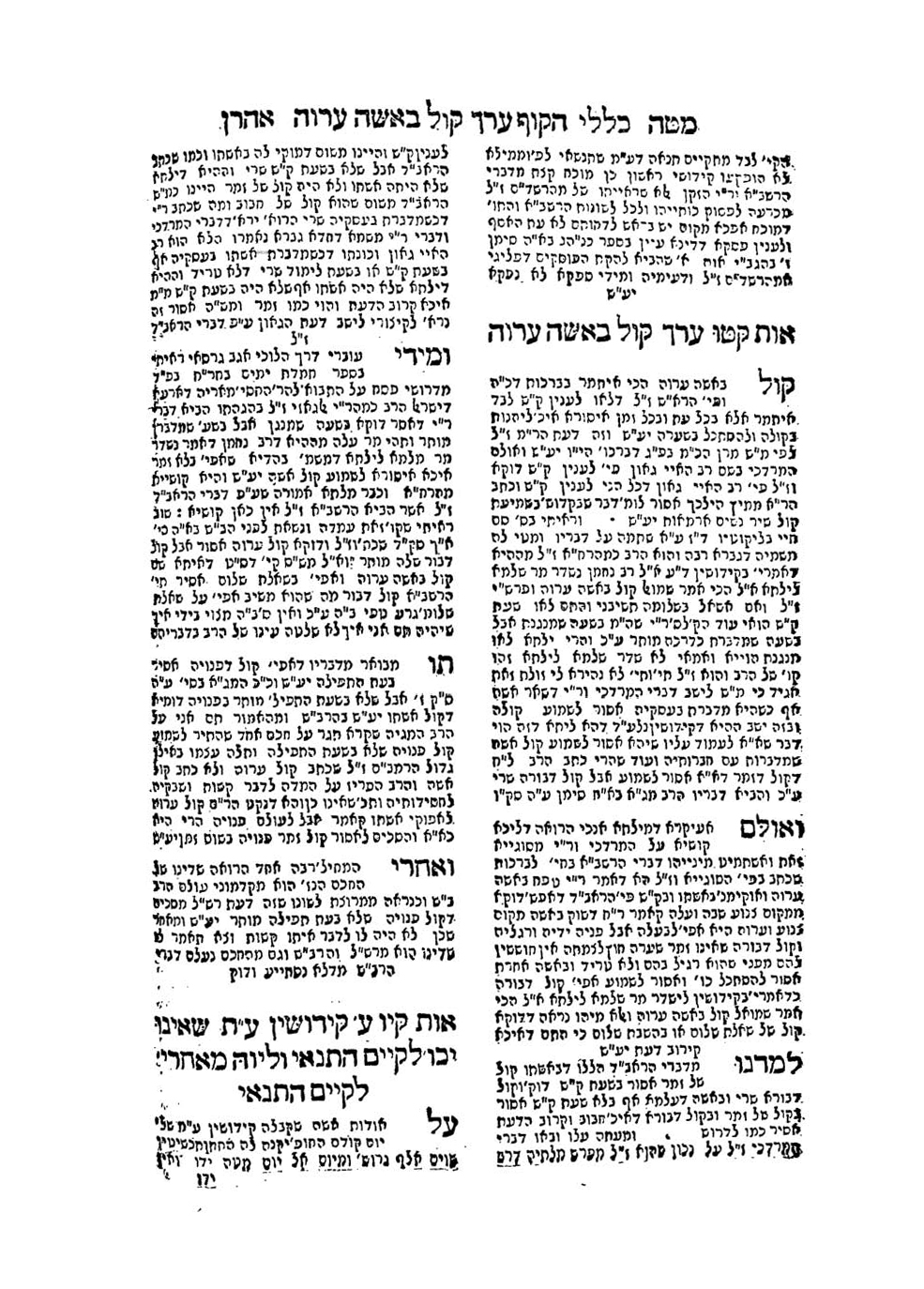
Here is a page from R. Aaron ha-Levi, Mateh Aharon (Salonika, 1820), p. 260b, where we see some more interesting comments, including defending a rabbi who permitted listening to the voice of a single woman.
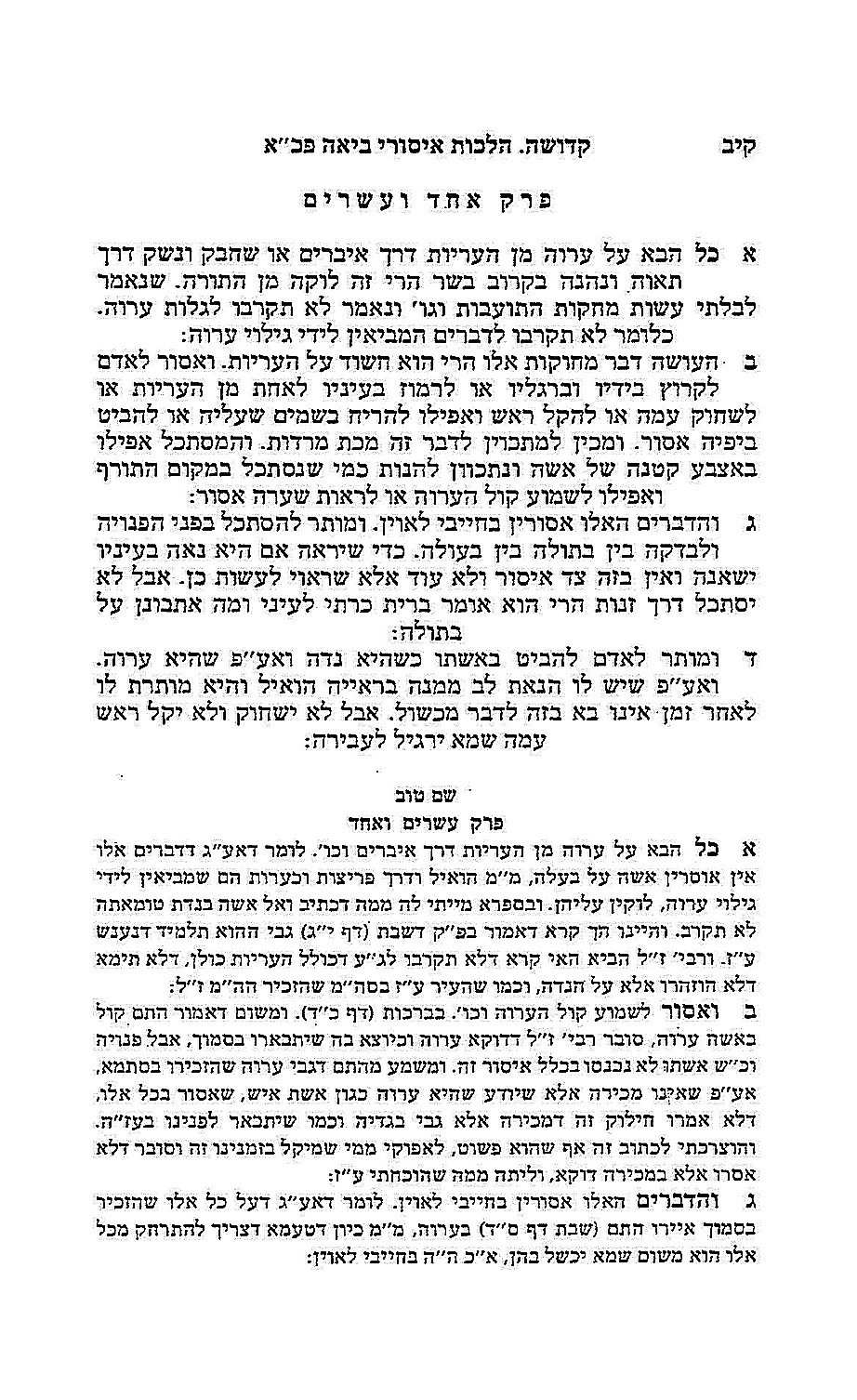
And finally, here is a page from R. Hayyim Kasar’s Shem Tov, a twentieth-century commentary on the Mishneh Torah, Hilkhot Issurei Biah 21:2. While Kasar is quite strict in forbidding a man to hear the voice of an ervah, even if he is not familiar with her, he is also clear that a penuyah means an unmarried woman and that there is no blanket prohibition on hearing her voice, just like there is no blanket prohibition on seeing the hair of an unmarried woman.

I would only add that this makes perfect sense according to Maimonides. If, as Maimonides says, one is permitted to look at an unmarried woman and enjoy her beauty,[30] it stands to reason that one can listen to the singing of an unmarried woman and also enjoy it.[31]

Returning to German Orthodoxy, Der Israelit was the newspaper of the German separatist community. Yet it seems to have had no problem highlighting an Orthodox female opera singer and stressing her commitment to Orthodoxy.[32] Mordechai Breuer called attention to this last point, and I assume that he didn’t have any knowledge of opera or he would have pointed out that the female singer referred to by the paper, Rosa Olitzka (1873-1949), was quite famous in her day. Here is a picture of her.
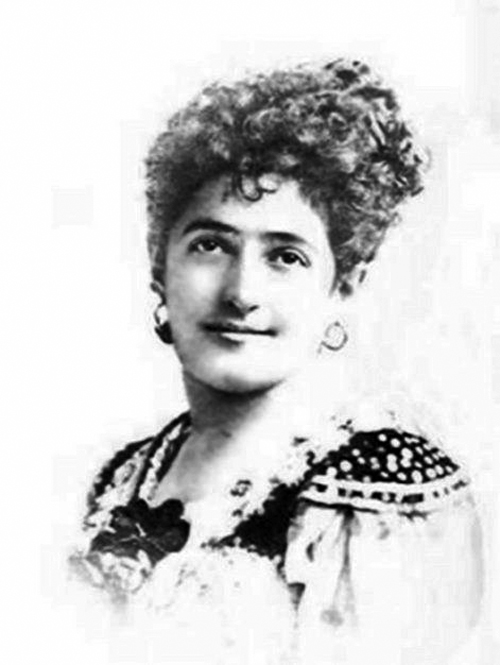
Right after telling us that Olitzka is the daughter of the hazan of the Berlin Adass Jisroel (i.e., R. Esriel Hildesheimer’s separatist community), Der Israelit mentions her starring as Carmen in the London Opera production. One can find a good deal of material about Olitzka online,[33] and can even purchase recordings of hers.[34] Maybe a reader knows whether she remained observant in her later years.

Breuer also refers to the JüdischePresse’s review of the opera “Samson and Delilah”.[35] While Der Israelit was the paper of the Frankfurt Orthodox, Jüdische Presse was published by the Orthodox of Berlin.[36]

The view that kol ishah is not an absolute prohibition, but depends on whether or not the singing is sensual in nature, was also held by R. Joseph B. Soloveitchik, at least according to R. Aharon Rakeffet.[37] Rakeffet has also reported on a number of occasions that the Rav attended the opera in Berlin.[38] At the Maimonides School first Hanukkah Banquet in 1939, “the program included Betty Brooks, a prominent radio personality singing a variety of Jewish and English songs, Mabel Wingert, a dancer, and Frost and Helene, society dancers.”[39]

R. Ovadiah Yosef’s viewpoint on kol ishah is also worth noting, especially as it has undergone a change. In the first volume of Yabia Omer, published in 1954, R. Ovadiah deals with the following question (Orah Hayyim no. 6):

נשאלתי בדין קול זמר של אשה בגרמפון או ברדיו, אם יש בו משום קול באשה ערוה, וצריך להזהר שלא לשמעו בעת ק”ש ותפלה.
His formulation reflects the notion we have already seen, expressed by some rishonim, that the prohibition of kol ishah is a special prohibition related to shema (and prayer), rather than a general prohibition on hearing women sing (which if sexually arousing would be forbidden on other grounds.)

Here is how he formulates the question and answer in the table of contents:

קול זמר של אשה ברדיו וגרמפון, אין צריך להזהר מלשמעו בשעת ק”ש ותפלה, כשאינו מכיר את המשוררת, ואין בזה משום קול באשה ערוה
We see from here that there is no problem of kol ishah when you are not familiar with the female singer. In other words, you can recite shema and tefillah while hearing this. Again, however, this is not related to the wider issue of sensual songs. If you are “turned on” by hearing a song even if you don’t know the singer, then it is forbidden at all times. But by the same token, since the prohibition of kol ishah is exclusive to shema and tefillah, the implication is that a woman’s voice at other times is not prohibited if it doesn’t arouse sensual feelings.

Based on this understanding of R. Ovadiah’s responsum, I don’t think there is a contradiction between this teshuvah and R. Ovadiah’s well known love for the music of the Egyptian singing sensation Umm Kulthum.[40] Here is what Umm Kulthum looked like in her younger years.

If R. Ovadiah’s responsum in Yabia Omer intended a blanket prohibition on hearing the voice of a woman you are familiar with, rather than just confining this prohibition to shema and tefillah, then we would be confronted with a tremendous contradiction between the responsum and how R. Ovadiah lived his own life. It is not like R. Ovadiah wrote something in his responsum and did something else in his private life where people couldn’t see. His love of Umm Kulthum’s music was something everyone knew about, and he listened to it in the company of others. Clearly, therefore, his responsum which prohibits listening to the singing of one you are familiar with only applies during shema and tefillah. At other times, it is only prohibited if one is sexually aroused by the music, and since R. Ovadiah was not, he was permitted to listen to Umm Kulthum. Rabbi J. David Bleich is therefore incorrect when he summarizes R. Ovadiah’s responsum as follows: “Rabbi Yosef concurs in this ruling but adds that it is forbidden to listen to a female vocalist who is known to the listener even if the woman in question is known to him only through photographs.”[41] (I hope no one attempts to argue that R. Ovadiah didn’t know what Umm Kulthum looked like. She was only the most prominent celebrity in Egypt, with her picture everywhere.)

I was also informed by R. Avraham Yosef that his father, R. Ovadiah, later retracted his ruling in this responsum that if you are familiar with the singer that you can’t hear her voice in shema and tefillah. I later saw that R. Ovadiah himself states as much in Yabia Omer, vol. 9 no. 108:43:

ומה שכתבתי שם שאם ראה אותה בתמונה ג”כ, אסור, אינו מוכרח, שיש לומר . . . “ביודעה ומכירה”, זהו רק כשראה אותה בחיים חיותה במלא קומתה

If you hear her voice while you are saying shema or reciting blessings, R. Ovadiah advises וירכז מחשבתו לכוין בברכותיוR. Ovadiah’s words בחיים חיותה במלא קומתה might be taken to imply that even if you know the woman from television, there still is no prohibition of kol ishah.

R. Avraham Yosef states that while it is permitted to hear a woman sing even if you know what she looks like, it is not permitted to attend a live performance or even watch on television. R. Avraham assumes that alllive and television performances are prohibited, not only those that could be sexually arousing.[42] It also needs to be stated that despite how I interpreted R. Ovadiah, that female singing is only prohibited if it is sensual music, the upshot of what R. Ovadiah states throughout his writings is that by definition a live female singer is sexually arousing and thus prohibited. Although I think the evidence shows that R. Ovadiah agrees that theoretically kol ishah is only forbidden if it leads to <>hirhurim >, in practice he assumes that <>alllive female singing falls into this category. (I wonder, however, if he would also forbid the live singing of a very old woman, which would in no way be sensual.)


I found another interesting passage regarding kol ishah in the Meshivat Nefesh of R. Yohanan Luria (16th century). On p. 144, after explaining how the women of the desert could sing in front of the men (Ex. 15:21), he writes:

ומזה הטעם ראוי למחות לנשים המשוררות לכלות לפני האנשים רק הבתולות שמותרים בזה כדי לחבב הבחורים לקפוץ עליהם לשם אישות.

He makes the same point on the previous page, and concludes (p. 143):

רק הבתולות ראוי להם שיחבבו עצמם על הבריות לקפוץ אחריהם

What it means is that while married women can’t sing in front of men, unmarried women are permitted to do so in order to attract the attention of the young men, similar to what they did in Temple days when they would dance before the eligible bachelors.

Some might be wondering, how was this permitted since married men will also hear the women sing, and being that they are not in the “market” for a wife, what permission is there for them to listen to and be physically attracted to the young women? I think the answer is obvious, that those men who would have had improper thoughts were not supposed to listen to the women, just as I presume they were not supposed to watch the single women dance in Temple days. Yet the Sages did not ban this dancing because of what some men might be thinking, and similarly, Luria permits the singing by single women and is not concerned that some married men might also be listening. The logic behind Luria’s position is that young men looking for brides are supposed to be attracted to young women. The latter dress up nicely so that the men look at them, they put on makeup for this purpose, and yes, they sing in front of the men, all in order to make themselves attractive.

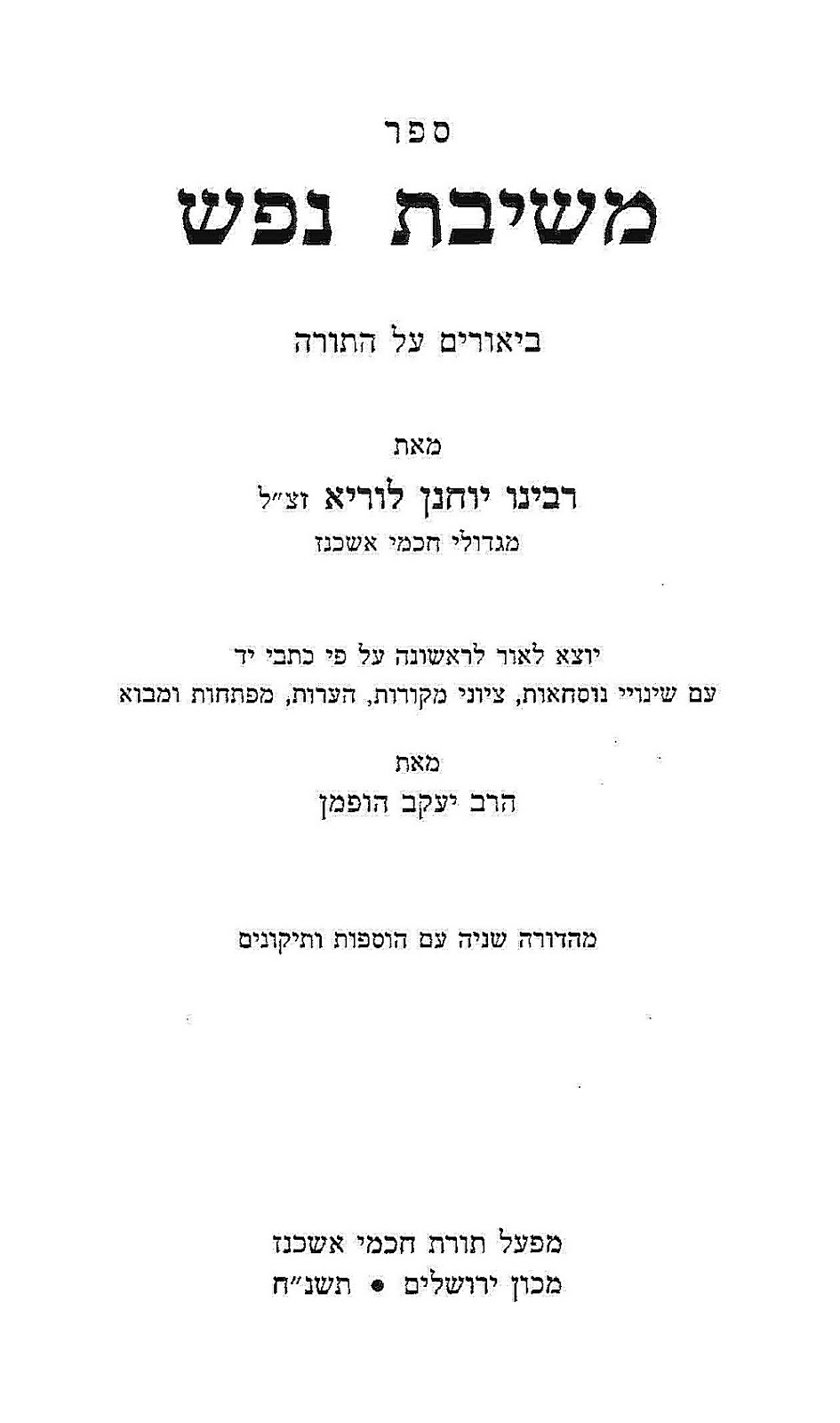
Here is the title page of Luria’s sefer.
I already mentioned the opera, so before concluding I refer you to S.’s post here.

He points to an early eighteenth-century communal decree in Altona-Hamburg-Wandsbek forbidding attendance at the opera, except for on Hanukkah and Purim when it was permitted. The text is also found in Simhah Assaf, Ha-Onshin Aharei Hatimat ha-Talmud, p. 116.

Finally, I would like to point to a very interesting source that as far as I know has never been mentioned in any of the many halakhic articles dealing with kol ishah. I refer to R. Joseph Hayyim’s Imrei Binah, ch. 3, no. 79. Here is the page.

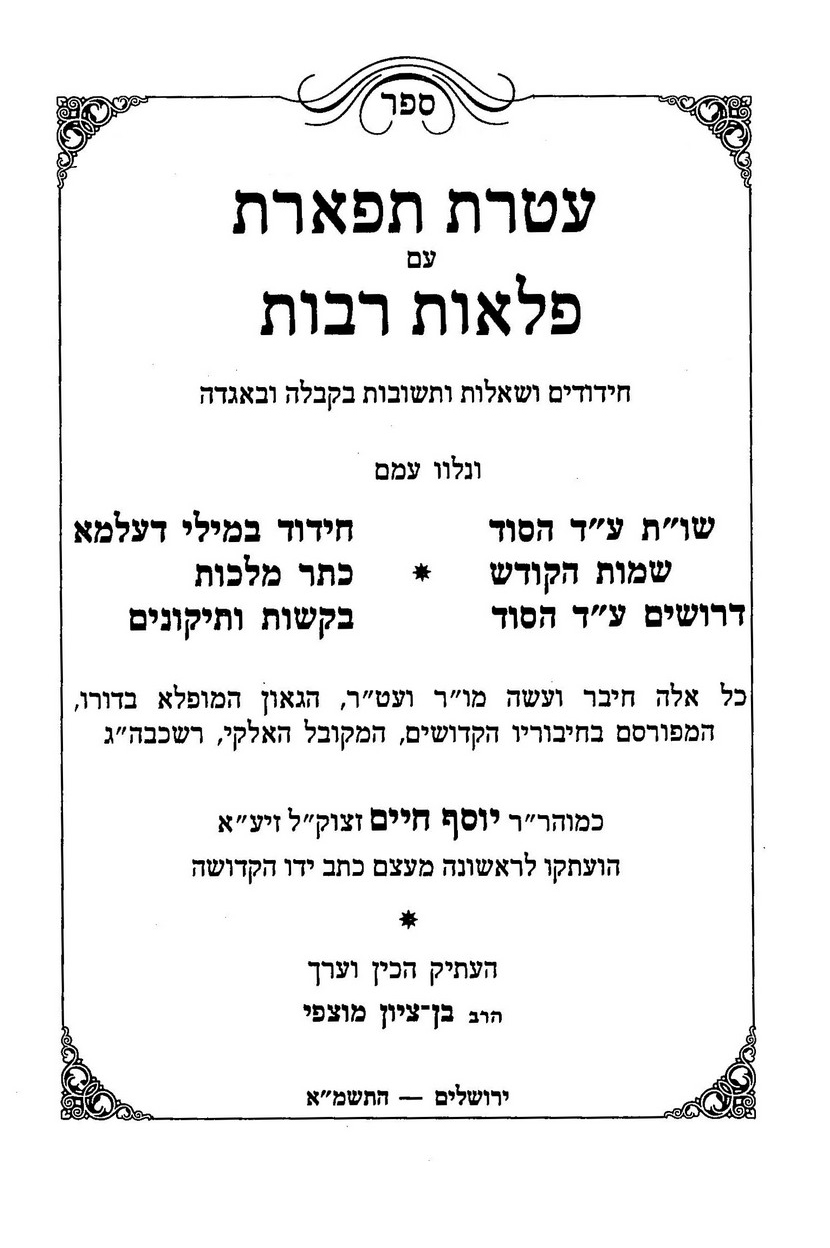
For those who are unclear as to what he means, he explains it himself in his book Ateret Tiferet im Pelaot Rabot. Here is the title page of the book, which for some reason is not on hebrewbooks.org or Otzar ha-Hokhmah. The text that appears in Imrei Binah also appears in this book, and R. Joseph Hayyim’s explanation is found on p. 116 (no. 202).

According to R. Joseph Hayyim, if the singing of an individual woman is accompanied by instruments, meaning that there are “many voices”, then it is permissible. This is an incredible limud zekhut, because pretty much every singer today is accompanied by music.[43]
[1] Referring to the beginning of Esther, where Ahasuerus is said to rule from Hodu to Cush, the Talmud, Megillah 11b, states:
From Hodu to Cush: Rav and Samuel gave different interpretations of this. One said that Hodu is at one end of the world and Cush at the other, and the other said that Hodu and Cush adjoin one another, and that [the meaning is that] as he ruled over Hodu and Cush, so he ruled from one end of the world to the other.
This passage should immediately raise a couple of questions in people’s minds. 1. Since there is no doubt that both amoraim knew where India and Ethiopia were located, why did one of them explain that the two countries are next to each other? How come he didn’t accept the common identification of Cush and Ethiopia? 2. According to the first opinion, that Hodu is at one end of the world and Cush at the other, are we to understand from this that he thought that the world was flat? (I realize that “end of the world” could be used the same way we use it today, but I wonder if that is the peshat.)

[2] See also his commentary to Isaiah 18:1, where he regards Cush as being in the East.

[3] In the last post I spoke a bit about what Rashi regarded as beautiful, based on his commentary to Song of Songs. We also find from other comments of his that he did not regard Cushim as beautiful. Based upon what we have already seen, I assume that for Rashi a Cushi would have an Indian complexion. (See Moed Katan 16b regarding the skin of the Cushites.) In his commentary to Gen. 12:11 he speaks of “black and repulsive people, brothers of the Cushim.” In Num. 12:1 the Torah speaks of the Cushite that Moses married. Rashi does not take this literally and writes: “Because of her beauty she is called Cushite, as one calls his handsome son ‘Cushite’ in order that the evil eye should not have power over him.” (This same passage appears in Midrash Tanhuma 96:13, and see Yitzhak Aviner, Heikhal Rashi [Tel Aviv, 1960], vol. 4, p. 234, that it was inserted from Rashi into the Tanhuma). I think it must be very hard to teach this Rashi in elementary and even high school. One can easily see that if one of the students is a “person of color” or the student’s parent is, that the assumption of this Rashi could be very hurtful to the student. Has any reader had to deal with this?

For the same approach by Rashi, and here too it appears to be his own interpretation (although obviously based on the earlier rabbinic understanding of Cushite), see Sukkah 53a, where it mentions that Solomon had two Cushite servants. Rashi writes:

תרי כושאי: על שם שהיו יפים קרי להו הכי
See Arukh la-Ner, ad loc., who questions Rashi’s explanation, since while the Sages speak of Tziporah as being called Cushite in Num. 12:1 because of her beauty, they never say that a man would be called Cushite if he was handsome. This is precisely why I noted that what Rashi writes here is apparently his own interpretation.

Incidentally, the Artscroll translation to this passage makes as unfortunate error. While the Talmud speaks of “two Cushites”, Artscroll translates תרתי כושאי as “two Cutheans.”


The Vilna Talmud’s version is תרתי כושאי, while Rashi has תרי. Rashi’s text preserves the correct version (see also Arukh ha-Shalem, s. v. כש, p. 348 n. 4) as תרי is masculine while תרתי is feminine. In R. Meir Mazuz’s new book, Darkhei ha-Iyun, p. 5, he deals with these words and calls attention to the common grammatical error when people write תרתי דסתרי. Since דסתרי(=(הסותרים is masculine, the proper formulation is ether תרי דסתרי or תרתי דסתרן.

For more on the identification of Cushite with ugliness, see Jonathan Schorsch, Jews and Blacks in the Early Modern World (Cambridge, 2004), chs. 3-4, and Abraham Melamed, The Image of the Black in Jewish Culture (London, 2003).
[4] “Toponomy of the Targumim,” (unpublished doctoral dissertation, Oxford University, 1974), p. 134.

[5] I think readers will find this document interesting: link (pdf).

It contains the Chief Rabbinate of Israel’s acknowledgment that Hinduism is monotheistic. I don’t even think that one can speak of shituf when it comes to Hinduism. What you have in Hinduism are manifestations of the one God, and this does not appear to violate any Noahide commandment. This is significant since in the Jewish imagination Hinduism has often been seen as a classic example of real idolatry. Thus, right at the beginning of many seforim it states that passages dealing with Gentiles are only referring to idolators in places like India.


Related to the latter point, there is an unbelievable error by the great R. Judah Aszod. In 1833 the Hatam Sofer responded to the following query of a Hungarian rabbi: During Christian religious ceremonies that pass through the city, are Jews permitted to put candles in their windows? The fear was that if the Jews don’t do that, their homes would be attacked on Christian thugs (Hatam Sofer, Yoreh Deah, no. 133 [end]). The Hatam Sofer concluded that while it was permissible to indirectly request a non-Jew to light the candle, it is absolutely forbidden for a Jew to do so.

הישראל אסור לעשות וצריך למסור נפש ע”ז
The same issue is dealt with by the Hatam Sofers’s son in Ketav Sofer, Yoreh Deah no. 84, and a similar issue by his grandson in Da’at Sofer, Yoreh Deah, no. 59. See also R. Eliezer Deutsch, Peri ha-Sadeh, vol. 3 no. 10.

In the Hatam Sofer’s responsum he speaks of the candle lighting that takes place in “India”.

ולענין מה שמסבבים בארץ הודו בע”ז שלהם, וכל הדרים באותו המבוי צריכים להדליק נרות, ויהודים הדרים שם אם אינם מדליקים הם בסכנה מפני ההמונים.
There is no doubt whatsoever that the word “India” is not to be taken literally and that the Hatam Sofer is referring to local Christian practices. After all, he was responding to the question of a Hungarian rabbi! The responsa by his son, grandson, and Deutsch don’t even feel that it is necessary to point this out, as it is so obvious.

It is incredible is that R. Judah Aszod, Yehudah Ya’aleh, Yoreh Deah, no. 170, takes the Hatam Sofer to really be speaking of India, even though as just mentioned, he was responding to a halakhah le-ma’aseh question from Hungary, not from a rabbi in Bombay! This misunderstanding contributes to Aszod’s lenient decision.


לענ”ד הח”ס דוקא קאי על ארץ הודו שמסבבים בע”ז שלהם . . . משא”כ במדינתינו אינו חק המדינה כ”א באיזו מקומות ולא עפ”י המושל אלא מרשעת שונאי ישראל, והדלקת הנרות אצלם נמי רק אין כוונתם להעביר על הדת כ”א שיהודים ישמחו עמהם וזה מותר משום איבה כברמ”א ביו”ד ססי’ קמח . . . וגם בזה”ז לא עובדי ע”ז הן לא מקרי אליל שלהם עכו”ם כמ”ש הש”ך סי’ קנא ס”ק יז.
In this passage he cites two sources. The second one is the Shakh, whom he cites as claiming that the Christian religious item (I assume he means the crucifix) does not have the status of an אליל. However, the Shakh actually says the exact opposite of what Aszod quotes him as saying.

ודוחק לומר דכיון דבזמן הזה לאו עובדי עבודת כוכבים הן לא מיקרי אליל שלהם עבודת כוכבים
The other source he cites is R. Moses Isserles, whose comments are indeed quite significant. I don’t understand why this source is not cited in support of celebrating Thanksgiving even by those who assume that there is some religious component to the holiday.

אם נכנס לעיר ומצאם שמחים ביום חגם ישמח עמהם משום איבה דהוי כמחניף להם ומ”מ בעל נפש ירחיק מלשמוח עמהם אם יוכל לעשות שלא יהיה לו איבה בדבר
Presumably, the opponents of Thanksgiving assume that there is no enmity in not celebrating, so the Rama’s permission doesn’t apply. I wonder though, do the people in Lakewood who require the non-Jewish bus drivers to work on Thanksgiving really think that this insistence doesn’t create enmity?
Returning to the responsum of Aszod, the problems I have pointed to were noted by R. Hayyim Eleazar Shapira, Minhat Eleazar, vol. 1 no. 53:3, and he is dumbfounded. It is precisely with regard to this sort of responsum, where the errors are obvious (misunderstanding the clear meaning of the Hatam Sofer, misquoting the Shakh), and it was published posthumously, that people are often tempted to claim that it is not authentic. I won’t go this far, but is it possible that a student wrote the responsum and Aszod just signed his name without examining it carefully?
[6] As with the other volumes of this series, one can find lots of interesting passages in vol. 4. Here are just a few. P. 56b: Moses opposed the eating of meat, but he could not forbid it because the people would regard this as heresy. P. 98b: Hirschensohn mentions the notion, already expressed by the Vilna Gaon, that sometimes the Talmud’s explanation of the Mishnah is to be understood as a form of derash. In other words, the explanation is not in accord with what the Mishnah really intended. He also refers to Berdyczewski and writes zikhrono li-verakhah after his name. P. 14a: There is no obligation in contemporary times for married women to cover their hair.

וזהוא ההיתר שנוהגים היום ברוב המדינות שהנשים מבנות ישראל הולכות בגלוי הראש, אם שהראשונות שבטלו את המנהג היו נקראות עוברות על דת משה אבל הבאים אחריהם אחרי שכבר נתבטל המנהג אין בזה איסור עוד.
This source has not been mentioned in any of the recent discussions about women’s hair covering. I hope to soon discuss Hirschensohn’s viewpoint at greater length, including his radically new understanding of שער באשה ערוה. I will do so as part of a larger discussion of the issue of women’s hair covering.
[7] See S.’s post here.

[8] R. Moshe Taub reminded me of Artscroll’s commentary to Deut. 34:5, which I neglected to mention in my book.
[9] I had been planning to offer one further example, but I was shown to be wrong. Let me explain: A little while ago R. Natan Slifkin had a post on werewolves, citing R. Efraim ben Shimshon’s strange comments in this regard. See here.

Slifkin earlier had written about this in his Sacred Monsters. None of this was a revelation to me since I had earlier seen the material from R. Efraim in R. Yosef Aryeh Lorincz’ Pelaot Edotekha, vol. 2, pp. 136-137. Not surprisingly, Lorincz takes this all very seriously. Readers might recall that I mentioned Lorincz’ book here. I called attention to his discussion of whether it is permitted to eat the flesh and drink the blood of demons. After this post I had a correspondence with someone who wanted to know what I thought about what Lorincz had written. I told him although I don’t know what the halakhah is in this matter, I nevertheless promise to eat the first demon that Lorincz is able to capture. I further told him that I would even volunteer to shecht it. My correspondent wasn’t seeing the comedy in this, as he thought that this was a very serious issue, that someone whom we are told to respect for his Torah knowledge could actually, in the twenty-first century, be discussing such a matter as a real halakhic problem. He was also adamant that if such a book was published by someone who taught at a Modern Orthodox school, the principal should immediately fire the author. Further correspondence revealed that he also didn’t think that anyone who believed in demons should be allowed to teach at Modern Orthodox schools.

My response to him was that I don’t think we need to get all out of shape about demons. To begin with, and readers can correct me if I am wrong, I don’t think that most people in the American haredi world really believe in demons. Yes, I know they study the talmudic passages that refer to demons, and will mention them as the reason for washing one’s hand three times in the morning, but based on conversations I have had with people in the haredi world (admittedly, most of them from the intellectual elite), I don’t think that they take it seriously. (When I say they don’t “believe” in demons, I mean real belief in the role of demons and how they affect humanity, as expressed in the Talmud and elsewhere.) It is almost like the emperor has no clothes, in that they don’t believe it but continue acting as if they do, afraid of what will happen if they are “outed”. (I have found a similar phenomenon with regard to Daas Torah. I have discussed this issue with many people in the haredi world, and have yet to find even one who accepts the version of Daas Torah advocated by so-called Haredi spokesmen and Yated Neeman.) But even if I am wrong in this, there are lots more important things to keep out of Modern Orthodox schools than an occasional reference to demons. How about the negative comments about non-Jews and even racist statements (sometimes under the guise of Torah) that children are exposed to in Modern Orthodox schools? How about rebbes telling the students that there is such a thing as spontaneous generation, which is akin to telling the students to sign up with Flat Earth society?

Getting back to werewolves, there is someone much better known than R. Efraim who refers to them, namely, Rashi. In his commentary to Job 5:23, Rashi explains that חית השדה means werewolf. (He offers the Old French, for which see Moshe Catane, Otzar ha-Loazim, no. 4208, and Joseph Greenberg, Otzar Loazei Rashi be-Tanakh, p. 211) He further adds that this is also the meaning of אדני השדה (See Kilayim 8:5). I have to admit that I was all set in this post to mention that Artscroll, which always cites Rashi’s interpretation, in this example chose to omit it. Without even examining the commentary, I was sure that Artscroll would choose to avoid mentioning anything about werewolves. Yet when I actually opened up the commentary, prepared by R. Moshe Eisemann, I was pleasantly surprised to see that he indeed tells the truth, and the whole truth, i.e.,, that Rashi was referring to a werewolf. I found something else in this volume that I didn’t expect. In an appendix he discusses whether the commentary attributed to Rashi was actually written by him. Unfortunately, Eisemann did not feel that he should inform the reader which academic sources he used in preparing this appendix.
[10] I don’t understand why Artscroll uses this word. The overviews found at the beginning of their books are actually not overviews. (Look up the word if you are not sure what it means). They should have been called what they are, namely, “introductions.”
[11] The Talmud explains sharim ve-sharot as מיני זמר, and Rashi, Eccl. 2:8, clearly based on the Talmud, explains sharim ve-sharot as מיני כלי זמר. Either Rashi’s text of the Talmud also included the word כלי , or this is how he understood the talmudic expression מיני זמר. (Literally, מיני זמר means “types of music”, and when the word כלי is added it means “various musical instruments.”)
[12] His commentary, Ta’alumot Hokhmah, is found in the standard Mikraot Gedolot.
[13] According to R. Jehiel Jacob Weinberg, the Rambam’s opinion is that kol ishah is only forbidden if one derives sensual pleasure from it. See Seridei Esh, vol. 2 no. 8.
[14] See here.
[15] See here.
[16] See here.
[17] R. Yuval Sherlo does not permit one to attend the opera, but if one is stuck in a situation, such as a soldier at a military event, then he rules that it is permissible to remain even though women are singing. See here.
[18] Conversations 12 (Winter 2012), pp. 43, 47; also available here. At the end of the article, Angel concludes: “Married women need not cover their hair, as long as their hair is maintained in a modest style. The wearing of wigs does not constitute a proper hair-covering for those married women who wish to cover their hair. Rather, such women should wear hats or other head coverings that actually cover their hair.” He also discusses hair covering on YouTube here.
[19] “Kol Ishah Bimeinu,” Tehumin 29 (2009), p. 143.
[20] See Seridei Esh, vol. 2 no. 8, and see also the helpful summary of positions available here.

[21] In support of this view, one can cite Hagahot Maimoniyot, Hilkhot Keriat Shema 3:16:
וקול אע”ג דאינה נראית לעינים הרהור מיהא איכא וכל אלה דוקא שאין רגילות להגלות אבל בתולה הרגילה בגלוי שער לא חיישינן דליכא הרהור וכן בקול לרגיל בו
[22] It seems to me that Tendler’s description of R. Moshe’s opinion is contradicted by Iggerot Moshe, Orah Hayyim 1, no. 26, Orah Hayyim 4, no. 15.

[23] For a contemporary example of an Orthodox synagogue allowing women to sing, see here.

[24] See e.g., here, here, here and here.
[25] Foundations of Sephardic Spirituality (Woodstock, VT, 2006), p. 186.
[26] Jewish Women in Time and Torah (Hoboken, 1990), p. 62. Berkovits also understood the matter of women’s hair covering in the same fashion, and did not regard it as an obligation in contemporary times (heard from Berkovits’ son, Prof. Avraham Berkovits).

[27] See here.
[28] Note the language of the Shulhan Arukh, Even ha-Ezer 21:1: ואסור לשמוע קול ערוה או לראות שערה

I don’t think anyone today assumes that there is a prohibition in seeing the uncovered hair of an ervah, if one is not sexually aroused, the reason being that we see it all the time and are thus used to it. By the same logic, if one is unaffected by hearing a woman sing, even if she is married, there should be no prohibition even according to how I explained the Ba’er Heitev. This is indeed the conclusion of R. Aharon de Toledo, Divrei Hefetz (Salonika, 1795), p. 113a:

עלה בידינו דהא דאמרי’ קול באשה ערוה היינו כשהיא הומיה ושוררת שירי עגבים ומתכווין ליהנות ממנה
However, the subsequent words of Toledo show that he only permits listening to a woman who is singing non-sensual songs on her own. He specifically forbids female songs directed towards men, as in a concert.

[29] The verse from Job is used in an Aggadic sense in Bava Batra 16a and Avot de-Rabbi Nathan, ch. 2, and then used by Maimonides in Hilkhot Issurei Biah 21:3.


ומותר להסתכל בפני הפנויה ולבודקה, בין בתולה בין בעולה, כדי שיראה אם היא נאה בעיניו, יישאנה; ואין בזה צד איסור. ולא עוד, אלא ראוי לעשות כן. אבל לא יסתכל דרך זנות, הרי הוא אומר “ברית, כרתי לעיני; ומה אתבונן, על בתולה”
Since he cites a verse from the book of Job, it appears that looking דרך זנות is only a rabbinic prohibition.
[30] Commentary on Sanhedrin 7:4. What this means is that one can look at a possible future wife and appreciate her beauty, for after all, one is supposed to be attracted to her. As we have seen already, in Hilkhot Issurei Biah 21:3, Maimonides adds a caveat. He states that is forbidden to look at an unmarried woman דרך זנות. What this means is that while one can look at and admire the beauty of a single woman (what I earlier referred to as “moderate sensual thought), one cannot leer at her, i.e., with lascivious intent.
[31] When Maimonides speaks of enjoying an unmarried woman’s beauty, I am certain that he is speaking of a Jewish woman, whom you can marry.
[32] Breuer, Modernity Within Tradition, p. 150. See Der Israelit, April 5, 1894, p. 503. See my post here, where I deal with the unsubstantiated rumor that Hirsch attended the opera. I quote from Prof. Breuer’s email to me where he writes: “When I went to the opera as a boy of 13-14 years my father [Isaac Breuer] did not express his dissatisfaction.”

[33] See e.g. here.
[34] See e.g. here.
[35] Modernity Within Tradition, p. 150.
[36] Since I am speaking about German Orthodoxy, let me use this opportunity to correct something I wrote. In Between the Yeshiva World and Modern Orthodoxy, p. 53, I record the recollection of Judith Grunfeld, “daughter of a learned German rabbi,” that she had never heard of a prohibition against women singing in front of men until she went to Poland (where she taught at the Beth Jacob school). Dr. Yitzchok Levine pointed out to me that Grunfeld’s father, while living in Germany, was actually Hungarian.
[37] Listen to his shiur from Feb. 8, 2010, available here, beginning at 48:20. Rakefet also quotes R. Aharon Lichtenstein that the Rav held that in modern times there is no obligation for married women to cover their hair. Listen to the shiur just mentioned beginning at 62 minutes. I will return to this point in a future post when I deal with R. Michael Broyde’s article on the topic.

[38] See, however, R. Hershel Schachter, Mi-Peninei ha-Rav, p. 269, that the Rav told YU students that due to kol ishah it was forbidden for them to sell tickets to the opera (presumably referring to the annual YU fundraising event). This is not necessarily a contradiction to Rakefet’s point. If the Rav felt that a woman’s singing voice was only prohibited if it was sexually arousing, who can say if that applies to the person you sell the ticket to? Perhaps that is why he told them it was prohibited.
[39] Seth Farber, An American Orthodox Dreamer: Rabbi Joseph B. Soloveitchik and Boston’s Maimonides School (Hanover, NH, 2004), p. 165 n. 19.
[40] See Zvi Alush and Yossi Elituv, Ben Porat Yosef (Or Yehuda, 2004), p. 37. See p. 408 that to this day he listens to her music, and see also the testimony to this in Or Torah, Tevet 5770, pp. 383-384. According to R. Avraham Shammah, cantors used her tunes for various tefillot, a practice that continues to this day. See here, p. 10.
[41] Contemporary Halakhic Problems, vol. 2 p. 151. One could be led to this summary by reading the conclusion of the responsum, which states as follows:

המורם מכל האמור דביודעה ומכירה אפי’ ע”י תמונה אסור לשמוע קולה בגרמפון או ברדיו, אבל אם אינו מכירה מותר, ואין בזה משום קול באשה ערוה.
However, this conclusion needs to be read in conjunction with the question as well as the summary of the answer in the table of contents, both of which are quoted in the text and clearly state that the issue is kol ishah in the context of shema and tefillah.

[42] See here.

[43] For another important limud zekhut by R. Joseph Hayyim, see here. In the newly translated text, we see that R. Joseph Hayyim believed that the practice of European Jewish women to go with uncovered heads can be justified, and is not to be regarded as sinful.


New Book On the Kashrut of Modern Etrogim

On the Kashrut of Modern Etrogim

Sukkot is fast approaching. For many this means selecting a “mehudar” etrog. Depending upon where one is this task can involve not only selecting an etrog with or without a pitum, bumpy or smoother, with or without a gartel, or a host of other considerations, but also selecting which type, Berman or Hazon Ish. Indeed, today, there are variety of types of etrogim identified by the farm or personalities that have ostensibly certified them as Kosher for use during the holiday. But, how do we know that any of these types are preferred? Where did these etrogim originate? Are they really Kosher?
Until recently, the answers to many of these questions have been shrouded in mystery. Sure one may have been told that so-and-so decided (mostly by merely looking at a particular tree) this etrog is Kosher. Today, however, Zohar Amar, who has written extensively on agriculture and other issues involving mesorah as it relates to Kashrut, has published a book where he investigates these questions, Etrogei Eretz Yisrael, Israel, 2010, 85 pp.
In reality, this latest book complements his book published last year discussing all the four species, Arbat ha-Minim, Israel, 2009, 101 pp. The earlier book, as it relates to etrogim focuses on how and when we identified the etrog with the biblical commandment of “prei etz hadar.” Amar seeks to disprove the notion that etrogim were not native to the Middle East until far after the Jews were present. This is important as some want to argue that the use of etrogim for araba minim is of late origin and thus undermine the mesorah associating etrog with prei etz hadar. Amar’s thesis is can be summed up using the talmudic expression “lo raenu enu rayah.” That is, much of what has been said about this point is predicated on the lack of etrogim seeds or evidence that can be dated to an early period – i.e. when Jews were in Israel practicing the Torah.
Amar provides the earliest evidence that we have of etrogim and their use on Sukkot. For example, etrogim appear on some Jewish coins and in mosaics. While some may associate the “gartel” or figure eight shaped etrogim with hassdim (probably because some hassidim wear such belts all year-round), in reality, many of these early depictions show etrogim with a gartel.
Additionally, Amar discusses the development of using etrogim from outside of Israel and then their importation and eventual grafting of those etrogim. The reason these foreign etrogim were used were because, for the most part, etrogim that are indigenous to Israel aren’t what we would consider mehudar today. Typically they lacked the pitum and weren’t shaped nicely and were smoother than our bumpy etrogim. Thus, some began to use etrogim from outside of Israel. This in turn created a controversy as to whether those etrogim were Kosher as well as whether there is a preference for Israeli etrogim over those from outside of Israel.
As part of this controversy the issue of grafted etrogim became a much larger issue. Indeed, the issue of grafting etrogim doesn’t appear in Jewish literature until 16th century. Amar, discusses the development and application of this concept as it relates to etrogim.
Returning to Amar’s latest book, Etrogei Eretz Yisrael. This time around Amar turns his focus to the mesorah of Israeli etrogim. He has extensively researched this topic and his research included visiting the etrogim farms and speaking with the farmers. What emerges is that for most of the etrogim available today, the best we can trace their pedigree is 100 years. For many, it is less than that. That. is, while many claim significantly longer pedigrees, the stories fail to match with fact. That is not to say that today’s etrogim aren’t Kosher or that many are grafted, only that we don’t have evidence that today’s etrogim are the same as were used more than 100 years ago. Amar concedes that more research, including genetic and other scientific testing is necessary to determine which etrogim are pure and ungrafted.
In all, this latest book is an important one as it sets the baseline for further research regarding etrogim, and, additionally, provides more background on the specific types of etrogim currently available in the marketplace today.
The books are distributed by Girsa and Shalem in Israel and is available at Beigeleisen in the US.


מנהג אכילת ה’סימנים’ בליל ראש השנה וטעמיו

מנהג אכילת ה’סימנים’ בליל ראש השנה וטעמיו*
מאת אליעזר בראדט
מנהג אכילת ה’סימנים’ בליל ראש השנה נפוץ ומוכר בכל קהילות ישראל[1]. וכבר נתנו בו רבותינו הראשונים כמלאכים טעמים:
בעלי התוספות מסבירים: “ראש השנה, מפני שהוא תחילת השנה, מרבים בסעודה לעשות סימן יפה, וכמה ענינים עושים בו לסימן יפה, כדאמרינן במסכת הוריות וכריתות”[2]. ומהפנייתם למסכתות הוריות וכריתות ברור, שכוונתם לתת טעם למנהג ה’סימנים’.
אולם גם לאחר דבריהם עדיין לא מובן מדוע ראיית ירקות וזרעונים מסויימים או אכילתם מביא ‘סימן יפה’ לכל השנה; כיצד זה מתבצע?
לפיכך הוסיפו רבותינו האחרונים להמתיק המנהג בהוספת יסודו המפורסם של הרמב”ן בפירושו על התורה:
ודע, כי כל גזירת עירין כאשר תצא מכח גזירה אל פועל דמיון, תהיה הגזירה מתקיימת על כל פנים. ולכן יעשו הנביאים מעשה בנבואות, כמאמר ירמיהו שצוה לברוך: ‘והיה ככלותך לקרוא את דברי הספר הזה, תקשור עליו אבן, והשלכתו אל תוך פרת, ואמרת: ככה תשקע בבל’ וגו’ (ירמיה נא סג-סד). וכן ענין אלישע בהניחו זרועו על הקשת (מל”ב יג טז-יז): ‘ויאמר אלישע: יְרֵה וַיּוֹר, ויאמר: חץ תשועה לה’, וחץ תשועה בארם…’[3].
כלומר, כל ‘גזירת עירין’, גזירת שמים, הן טובה והן להפך, אין בהכרח שתצא לפועל, שיתכן שכביכול הקב”ה ינחם על הרעה או הטובה שגזר[4]. אולם אם הנביא היודע מאותה גזירה עושה כדוגמת אותה גזירה, כמו שהטביע אבן לנהר כסימן לטביעתה ושקיעתה של בבל, בוודאי ‘תהיה הגזירה מתקיימת על כל פנים’. לפיכך, כך ביארו האחרונים, בקיום מנהג ה’סימנים’ בליל ראש-השנה עושה האדם כדוגמא לגזירות טובות, זאת בתקווה שנגזרו עליו גזירות טובות ועשייה כדוגמתן תכריח ש’תהיה הגזירה מתקיימת על-כל-פנים’, שלא יגרמו העוונות שיתבטלו חלילה.
כך ביאר ר’ אברהם דאנציג בספרו חיי אדם: “וכיון שהוא תחילת השנה… נוהגים לעשות, לסימן טוב, לאכול דברים הרמוזים לזה. והטעם לזה עיין ברמב”ן, דכתב: ודע, כי כל הגזירות עירין כאשר תצא מכח גזירה אל פועל דמיון, תהיה הגזירה מתקיימת על כל פנים[5]. וזה נראה לי ברור, שהוא הטעם שאמרו רז”ל[6]: השתא דאמרת סימנא מילתא”[7].
כאמור, אחרונים רבים ביארו את מנהג ה’סימנים’ לפי יסודו של הרמב”ן[8]; שאין ציטוט דברי ר’ אברהם דאנציג אלא דוגמא מייצגת. ברם, קדם לכולם ר’ יהודה ליווא ב”ר בצלאל מפראג, ‘מהר”ל’, אשר בחיבורו באר הגולה דן באריכות בענין שלפנינו:
אמר אביי, השתא דאמרת סימנא מילתא היא, יהא רגיל למיכל בריש שתא קרא[9]… גם דבר זה מצאתי שהם תמהים, מפני שנראה להם שהם ניחוש, ודבר זה אינו, שאם כן יהיה מעשה אלישע ומעשה ירמיה ענין ניחוש…[10] ולא היה ענין אלישע וירמיה ניחוש. והנה, דבר זה סימן ואות להיות נגמר הדבר. ודבר זה ביאר הרב הגדול הרמב”ן ז”ל, אשר אליו לבד נגלו תעלומות חכמה וסודי התורה, וכתב בפרשת ‘לך לך’, וזה לשונו: ודע, כל גזירת עליונים, כאשר תצא מכח הגזירה אל פועל דמיון, תהיה הגזירה מתקיימת על כל פנים. ולכך יעשו הנביאים מעשה בנבואתם, כמאמר ירמיה לברוך… וכן אלישע… עד כאן לשונו. ודברים אלו ברורים, ומעתה תדע להבין דברים אלו, כי הדבר הזה הוא חכמה נפלאה, לעשות לגזירה עליונה דמיון וסימן למטה, כדי שתצא לפועל הטוב ותהיה מקויימת הגזירה לטוב. לכך ראוי לעשות סימן ודמיון, כמו שתמצא שעשו הנביאים. וזה ענין הדמיון ל’מכלא בריש-שתא’ דברים שיש בהם סימן טוב, כדי שתצא הגזירה לפועל, ואז תהיה הגזירה הטובה מתקיימת. ואין בזה ניחוש, רק הוא הכנה שתצא הגזירה לטובה. והיינו דאמר ‘השתא דאמרת סימנא מילתא‘, כי הוא מילתא לענין זה שעל-ידי סימן תצא הגזירה לפועל הטוב. ודברים אלו נעימים ויקרים מפז, וכל חפצים לא ישוו בהם[11].
אגב, הסיבה שמהר”ל מפראג נתן דעתו ועטו לבאר מנהג זה היא מפני לעגם של אנשי הכמורה הנוצריים לפיסקת התלמוד “השתא דאמרת סימנא מילתא…”, שהם כללו אותה בתוך רשימת הקטעים ה’מוזרים’ לטענתם-טעותם. כבר העיר, בצדק, מ’ ברויאר[12], כי למרות האגדות הרבות סביב חיי המהר”ל הרחוקות מן האמת ההיסטורית, בלשון המעטה[13], שאחת מהן מספרת על ניהול ויכוח דתי עם שלש-מאות כמרים במשך שלושים יום, אגדה שאין ידוע על נכונותה, העיון בספר ‘באר הגולה’ מוכיח שאחת המטרות שרצה מחברו להשיג היא ביאור ותרוץ האגדות התמוהות בעיני הנצרות ונושאי דגלה. פרט זה מוכח מכך, שלכל אחד מקטעי התלמוד התמוהים בעיני הנוצרים – שנאספו לחבורים מיוחדים[14] – הקדיש לו המהר”ל מקום בספרו ‘באר הגולה’ ועמל לבארו בטוב טעם ודעת.
* * * *
רבי משה ב”ר נחמן, הרמב”ן, ירה אבן יסוד ונבנה עליו בנין גדול ורחב. על-פי יסודו של הרמב”ן נתפרשו בידי חכמים מאוחרים דברי אגדה ומנהגים רבים, למרות שלא תמיד ידעו המפרשים המאוחרים מבטן מי יצא יסוד זה; עד כדי כך התפשט היסוד שטבע הרמב”ן.
לדוגמא בעלמא, אציין מספר מנהגים שהוסברו בידי חכמים לפי הכלל שקבע הרמב”ן[15]:
1. ר’ אלכסנדר משה לפידות מבאר שהתפילה בעת חיבוט הערבות בהושענא רבה מעלתה גדולה, מפני “שתפילה פועל יותר בצירוף מעשה בפועל בעת רצון”[16]. ברור, אפוא, שרעיונו מושתת על יסוד הרמב”ן.
2. ר’ יוסף חיים מבגדאד, בעל ‘בן איש חי’ כותב: “המנהג פה עירינו יע”א, כשאומרים פסוק ‘פותח’ הנזכר[17], פּוֹרְשִׂים כפיהם לעיני השמים. והוא מנהג יפה, לעשות בזה פועל דמיוני לקבלת מזלם את השפע מלמעלה[18]. והסכים עמו ר’ אליעזר פאפו בספרו דמשק אליעזר: “טעם נכון למה שנוהגים כמה בני אדם כשאומרים ‘פותח את ידיך’, בתפילה ובברכת המזון, זוקפין ידיהם למעלה בפישוט ידים. וכוונתם הפשוטה, שהשם יתברך גופיה יפתח ידו ואוצרו הטוב להשביע לכל חי רצון, ואין מקום לבני אדם לפשוט ידיו. אלא האי טעמא שפותחין ידיהם, כדי לקבל השפע מאת השם, כמו שאומרים ב’ברך עלינו’: ‘ומלא ידינו מברכותיך’ וכו’. ואין לתמוה על מנהגן של ישראל, דיש להם סמך”[19].
3. את המנהג לקדש על היין בבית הכנסת בכל ליל שבת, הסבירו הגאונים שהוא משום סגולה לרפואה[20], ור’ יעקב שור ביאר דבריהם לפי יסודו של הרמב”ן: “ואף כי עיקר סגולת כל מצוה היא בקיומה, בכל זאת תפעול יותר כאשר תצא אל הפועל באיזו פעולה דמיונית המורה על חיבוביה ועל חוזק האמונה בתועלותה… [כ]אכילת מינים שונים בריש שתא… וכדברים הללו כתב הרמב”ן על התורה, פרשת ‘לך לך'”[21].
עד כאן רשימת מנהגים קצרה שכל אחד מהם הוסבר על-פי יסודו של הרמב”ן[22]. אך נתתי דעתי, שכיון שניתנה הרשות לחכמים לבאר, אוסיף – מדעתי – להמתיק בכך עוד מנהג:
ר’ יצחק ווייס, אב”ד ווערבוי, מספר: “ראיתי בילדותי, בהיותי ‘בעל מקרא’ דקהילה קדושה פרעשבורג, שכל בני בית-הכנסת עלו ועמדו על הבימה… משום שרצו להיות מכוין נגד פני הכהנים[23]. הוא מוצא לכך מקור מ’ספר וְהִזְהִיר’, מתקופת הגאונים, הכותב: “והכהנים כשמברכין את ישראל, צריכין כל העם לנוד ממקומן ולהתקרב אל הברכה[24]. אולם מקור למנהג עדיין לא הופך להיות טעמו, שעדיין יש להבין: מדוע יש להתקרב אל כהנים ככל האפשר? אלא שליסודו של הרמב”ן המנהג מתיישב על הלב, כי המתברכים רצו לעשות פעולה המשקפת את רצונם לזכות בברכה, ובכך אכן תחול הברכה עליהם.
הרמב”ן קבע את כללו על ‘עשה’ ולא ב’לא-תעשה’. כלומר, עשיית פעולה הדומה לגזירה גורמת ש’תהיה הגזירה מתקיימת על-כל-פנים’. אמנם יתכן, שכלל זה נאמר גם ב’לא-תעשה’, היינו, אי-עשיית פעולה כלשהי – נגד רצונו, לפעמים – מביאה שדבר הדומה לו לא ייעשה. לפיכך ניתן להמתיק את אי-השינה בראש-השנה, כי בכך לא יישן דבר הדומה לאדם, הוא מזלו.

[1] נוסד על-פי הוריות יב ע”א; כריתות ה ע”ב. ונפסק להלכה בשו”ע, או”ח, סי’ תקפג, סעיף א.
[2] תוס’ ד”ה ‘ערב יום טוב’, עבודה זרה ה ע”ב.
[3] פירוש רמב”ן על התורה, בראשית יב ו.
וכך ביאר את הפסוק (בראשית מח כב): “ואני נתתי לכם שכם אחד על אחיך, אשר לקחתי מיד האמורי בחרבי ובקשתי”, וזה לשונו על אתר: “…שעשה יעקב כדרך שיעשו הנביאים – נטה ידו בחרב כנגד ארץ האמורי וזרק שם חצים להיותה נכבשת לבניו, כענין שעשה אלישע: ‘וישם ידיו על ידי המלך, ויאמר אלישע: יְרֵה וַיּוֹר’ (מל”ב יג טז)… ויתכן שזה טעם אמרו ‘לקחתי’, כי מאז לוקחה הארץ לבניו”.
עוד בענין יסודו של הרמב”ן, ראה: מ’ הלברטל, על דרך האמת: הרמב”ן ויצירתה של מסורת, ירושלים תשסו, עמ’ 224-224.
[4] ראה, לדוגמא, ירמיה יח י: “ועשה הרע בעיני… ונחמתי על הטובה אשר אמרתי להיטיב אותו”.
[5] עד כאן תורף דברי רמב”ן, שם. ומכאן ביאורו של ר’ אברהם דאנציג למנהג ה’סימנים’.
[6] הוריות שם:
[7] חיי אדם, כלל קלט, דין ו.
[8] ראה, לדוגמא: ר’ חיים ב”ר אברהם הכהן מארם צובה, טור ברקת, סי’ תקפג, סעיף א; ר’ אברהם חמוי, מחזור בית דין, עמ’ כח אות ב; ר’ שלמה שיק, ספר תקנות ותפילות, מונקאטש תרנ, דף סה ; ר’ חיים צבי עהרענרייך, קצה המטה (על ספר מטה אפרים), סי’ תקפג, סעיף ט; ר’ משולם פינקלשטיין, אלף המגן (על ספר ‘מטה אפרים’), סי’ תקפג, ס”ק קטז; ר’ ראובן מרגליות, נפש חיה, סי’ תקפג, סעיף א; הרב עובדיה יוסף, חזון עובדיה, חלק ימים נוראים, ירושלים תשסה, עמ’ צח-צט.
[9] עד כאן הוא ציטוט מהוריות שם.
[10] כאן הביא את מעשה ירמיה (בהשלכת האבן לנהר) ומעשה אלישע (בהנחת זרועו על הקשת), ראה לעיל במצוטט מפירוש הרמב”ן.
[11] באר הגולה, באר השני, ירושלים תשלב, עמ’ לג-לד. ור’ יאיר בכרך, מקור חיים, ר”ס תקפג, ציין לו, עיי”ש.
בביאורו לאגדות התלמוד, הוריות שם, כפל מהר”ל את הדברים, יותר בקיצור אך בעקימת לשון חשובה, ולפיכך אצטטו: “שאין יותר חבור אל דבר כמו האכילה, ואין זה דבר קטן, כי כבר האריך הרמב”ן בפרשת ‘לך לך’, כי גם נביאים היו עושים סימנים שיהיה הסימן לטוב להם… לכך יסתם פיהם של דוברי שקר המדברים על צדיקים עתק, שחושבים דבר זה כמו ניחוש, ואין הדבר כן! רק שהוא סימן טוב בשעה שראוי על זה, וכמו שאמרו ז”ל: סימנא מילתא היא” (חידושי אגדות מהר”ל, הוריות יב ע”א).
[12] מ’ ברויאר, ‘ויכוחו של מהר”ל מפראג עם הנוצרים’, אסיף מפרי העט והעת, ירושלים תשנט, עמ’ 129-137.
[13] חלק גדול באשמת יהודה יודל רוזנברג, שזייף את הספר ‘נפלאות מהר”ל’ (דפוס ראשון: וארשא תרסט), בו התיימר לספר את “האותות והמופתים… מאת… מהר”ל מפראג… אשר הפליא לעשות… על ידי הגולם אשר ברא” (לשון שער הספר, במהדורה הנ”ל). על זיופו של הספר עמדו חכמים וחוקרים רבים, ראה, לדוגמא: רמ”מ אקשטיין, ספר יצירה, סיגט תרע (מלשון שער הספר: “כולל… הענין בריאה על-ידי ספר יצירה, ולברר אי אמתת הספר נפלאות מהר”ל הנדפס כעת…”); ג’ שלום, פרקי יסוד בהבנת הקבלה וסמליה, ירושלים תשלו, עמ’ 409, הערה 72; מ’ בר-אילן, ‘נפלאות ר’ יהודה יודיל רוזנברג’, עלי ספר, יט (תשסא), עמ’ 184-173, וש”נ הפניות נוספות.
[14] ראה: ח’ מרחביה, ‘קונטרוס נגד התלמוד מימי שריפת התלמוד באיטליה’, תרביץ, לז (תשכח), עמ’ 78-96; הנ”ל, עמ’ 191-207 ובמיוחד בעמ’ 204.
[15] על דברי אגדה ושאר רעיונות שאינם מנהגים שנתפרשו לפי יסוד הרמב”ן, ראה, לדוגמא: ר’ יעקב לורברבוים מליסא, בעל ‘נתיבות המשפט’, הגדה של פסח עם פירוש מעשה נסים, ד”ה ‘פרעה לא גזר אלא על הזכרים’, ד”ה ‘ובאותות זה המטה’, ד”ה ‘ואילו הוציאנו’, ד”ה ‘על אחת כמה וכמה’ בסופו [בטופס שלפני אין ספרור עמודים, לפיכך ציינתי לפי ד”ה]; הנ”ל, מגילת סתרים, אסתר ג ט, וראה עוד: ר’ יוסף פאצאנובסקי, פרדס יוסף, בראשית יב ו, ובכל הנסמן שם.
[16] הביאו ר’ אברהם הרשוביץ, מנהגי ישרון, וילנא תרצט, עמ’ מו. וראה, עתה: הרב נ’ גרינבוים (מהדיר), תורת הגאון רבי אלכסנדר משה, ליקוואוד תשסו, עמ’ תל.
[17] כוונתו לפסוק (תהלים קמה טז): “פותח את ידך, ומשביע לכל רצון”.
[18] ר’ יוסף חיים מבגדאד, בן איש חי, שנה א, פרשת ויגש, אות יב.
[19] ר’ אליעזר פאפו, דמשק אליעזר, סי’ ט, סעיף א.
לאור מקורות אלו תמיהני על הרב י’ גולדהבר, מנהגי הקהילות, א, עמ’ קט: “בעת אמירת הפסוק ‘פותח את ידיך’, הצמידו את כפות הידים יחד, ובתנועה זו הרימו אותם כלפי מעלה מול הראש”. ובהערה 2, שם: “לא מצאתי כזאת בקהילות אחרות”. הרי לך העלם דבר! וכבר הערתי על כך במאמרי ‘ציונים ומילואים לספר “מנהגי הקהילות”‘ ירושתינו, ספר ב (תשסח), עמ’ ר.
עוד על מנהג פרישת הידים כלפי השמים באמירת ‘פותח את ידיך’, ראה: י’ זימר, עולם כמנהגו נוהג, ירושלים תשנו, עמ’ 83, הערה 67; מ’ חלמיש, הקבלה, רמת גן תשס, עמ’ 310, הערות 150-151; ד’ שפבר, מנהגי ישראל, א, ירושלים תשנ, עמ’ רכז.
[20] ראה י’ ברודי (מהדיר), תשובות רב נטרונאי גאון, א, או”ח, סי’ עו: “הכי אמר רב נטרונאי ריש מתיבתא: מקדשין ומבדילין בבתי כנסיות אף על פי שאין אורחים אוכלין שם… מפני שהטעמת יין של קידוש שבת רפואה היא – וזה שטועם כל הצבור כולו, לא שחובה היא לטעום אלא שחובה לשמוע קדוש בלבד, וכיון ששמע קדוש יצא ידי חובתו ואין צריך לטעום. וזה שמקדש ומטעים לצבור, משום רפואה מקדש ונותן להם, כדי ליתן ממנו על עיניהם… זמנין דאיכא מן הצבור דלית ליה יין ומקדש אריפתא, ותקנו חכמים לקדש בבית הכנסת על היין, משום רפואה“. וראה שם בהערה, למקורות המביאים תשובה זו.
[21] יהודה בן ברזילי מברצלונה, ספר העתים, פירוש ‘עתים לבינה’ לר’ יעקב שור, ירושלים תשמד, עמ’ 179, הערה לג.
[22] היו שביארו לפי יסודו של הרמב”ן ענייני השקפה מחשבה ואגדה שונים, ראה, לדוגמא: ר’ שמואל אביגדור, הגדת תנא תוספאה, ירושלים תשנג, עמ’ כה; הגדה לליל שמורים, עם ביאור ‘אור ישרים’ לר’ יחיאל העליר, קעניגסבערג תריז, עמ’ ו’; ר’ שלמה זלמן אב”ד ניישטאדט, [נכד בעל מעלת התורה] בית אבות, אבות [פרק א משנה י], ברלין תרמט, עמ’ 60; ר’ שלמה שיק, סידור רשב”ן, וינה תרנד, כד ע”ב; ר’ ראובן מרגליות, נפש חיה, סי’ תרה, סעיף א.
[23] ר’ יצחק ווייס, אלף כתב, א, בני-ברק תשנו, עמ’ קנג.
[24] י”מ פריימאן (מהדיר), ספר והזהיר, ב, פרשת נשא, ווארשא תרמ, עמ’ קמג.


Kitniyot and Stimulants: Coffee and Marijuana on Passover

Kitniyot and Stimulants: Coffee and Marijuana on Passover
One of the more interesting customs for Pesach in that of refraining from kitniyot. There is much discussion regarding the origins of this mysterious custom.  That is, the exact time this custom began, as well as it initial rationale is cloaked in mystery. That is not to say that numerous reasons haven’t been offered, only that we probably will never know for certain why this was enacted.  Moreover, what exactly is encompassed in this custom is similarly cloaked in mystery.  We have food items running the gamut.  Aside from the standard fare of rice, we have those prohibiting such seemingly odd foods as garlic and carrots.  Thus, it should come as no surprise that many have included foods that there is no legitimate reason for doing so. Indeed, as we shall see, in some instances the foods in question are prohibited although it is clear that the persons prohibiting them have no idea what exactly the foods are.  This hearkens to the idea espoused by Dr. Daniel Sperber, discussed in this article, and expanded upon in this book, that if one understanding of history, bibliography and other relevant areas is lacking this may lead one to make grievous errors in halakhic matters. In this post we will deal with two foods, both of which were prohibited under the rubric of kitniyot, and, apparently, those who made these decisions were unaware of the actual characteristics of the foods in question.  The two items we shall deal with are coffee and cannabis (hemp, hemp seed, and marijuana). [Our discussion below is with the recognition that one must always comply with all relevant federal and state laws and we limit our discussion to what position Jewish law takes regarding this topic.]
Coffee
Coffee was introduced to Western Europe in the 17th century. [See David Liss’s excellent fictionalized account of the burgeoning coffee trade in Jewish Amsterdam, The Coffee Trader. (Avner Gold has an Artscroll book, A Scandal in Amsterdam, that uses much of the same material, one wonders if it was “influenced” by Liss’s book.)]  With its introduction, some rabbis began dealing with its halakhic status, which blessing is required and, as relevant here, whether it is permissible on Passover.  R. Ya’akov Reischer (1670-1733), in his Shevut Ya’akov (vol. 2 no. 5), deals with both these questions.  Regarding the first, he holds a shehakol is the correct blessing.  Regarding the issue of Passover, he permits coffee.  He is skeptical that coffee would be considered kitniyot because “he has been told” that coffee is grown on trees, and whatever one may think about the scope of kitniyot, it does not encompass tree fruits.  But, R. Reischer hedges a bit and notes that even if coffee would be deemed kitniyot, as coffee is roasted, or, as he refers to it “burnt prior to Passover” this renders coffee unfit for even a dog and permissible on Passover.
R. Yosef b. David of Breslau, in Hok Yosef (no. 457, first published in 1730), however, disagrees.  He first questions the argument regarding roasting or burning the beans and notes that the roasting process is an integral part of coffee process.  More fundamentally, he argues that indeed coffee is kitniyot. He notes that his father-in-law, R. Abraham Broda, similarly held that coffee is kitniyot and prohibited.
R. Hayyim Yosef David Azulai (HIDA), disputes this holding in very strong terms.  HIDA explains (Shu”t Tov Eyin, no. 8) that these rabbis “should be forgiven [for holding coffee is prohibited as kitniyot] because coffee is the fruit of a tree.”  Regarding this classification HIDA is not speaking from second hand accounts like R. Reischer, rather HIDA notes that “a few years ago I saw a coffee tree in Amsterdam in the botanical gardens, as well as in Pisa and thus there is no reason to be strict regarding coffee.”  HIDA in his travelogue describes in detail his visit to the Amsterdam botanical gardens, Hortus Medicus. On the 18th of Iyar, 1778, in the afternoon,  HIDA went to the gardens. He says “that these gardens are truly indescribable they are so beautiful, all the plants and grasses are in rows, and everything is so clean, it is a testament to human intelligence.  Every plant is labeled. There are plants from America, Portugal and Turkey all in rows according their nationalities.  The wall have holes where fires can be lit to control the temperature of the gardens and ensure that the plants can survive even in the cold climate of Amsterdam.  Among the plants I saw was the coffee plant.”  (Ma’agel Tov ha-Shalem p. 150-51 ) While HIDA is unwilling to accede that these rabbis were completely unaware that coffee is tree fruit, it begs the question what those who prohibit coffee were thinking in considering coffee kitniyot.
It is not only those who prohibit coffee who seem to be unaware of exactly what they are discussing.  More recently, R. Yitzhak Isa’ak Weiss (1875-1944), one of the Spinka Rebbis, discusses “two” types of coffee, one grown on trees and the other grown “in gardens.”  He ultimately holds that both types of coffee are permitted, but the issue is that coffee always grows on tress.  There are two major types of coffee, arabica and robusta, both of which grow on trees.  Perhaps what R. Weiss is discussing is another type of coffee – one that was commonly substituted for coffee – but is not in fact coffee.  The common substitute, which has its own history and own halakhic issues, is chicory. [See. R. Y. Goldhaver’s excellent articles regarding chicory and its treatment under Jewish law in Yeshurun 19:792-834, 20:839-864] Chicory is indeed a bush and not a tree and perhaps is what R. Weiss is discussing.
Today, for most (with Passover, one can almost always find a group that prohibits something) coffee is not deemed kitniyot and is Kosher for Passover.  Indeed, one of the more common haggadot is the one produced by the Maxwell House Coffee company. (For more on the Maxwell House haggadah see our  post, “On The Maxwell House Haggadah.”)  One scholar has commented on this phenomenon: “As always, entrepreneurs, Jewish and otherwise, capitalized on wives’ and mothers’ desires to have just the right foods on the table for Passover, that longest standing of traditions.  Maxwell House coffee, reportedly, caused a stir at many seder meals when it introduced a new ‘tradition’ of drinking coffee rather than tea at the end of the sumptuous holiday banquet. A decade or so later, the company would print its own Haggadah to insure a ‘unique relationship between a product and a people.” (Jeffrey S. Gurock, Orthodox Jews in America (Bloomington: Indiana University Press, 2009), p. 151.) Maxwell House even advertised in Yiddish in HaPardes: [Thanks to M. Butler for these two sources.]


Marijuana
In 2007, the Green Party in Israel made headlines in coming out that Ashkenzim should not smoke marijuana on Passover.  There were articles from the Jerusalem Post on the topic as well as other publications.  Most are notable only in that how poor they are in substance.  Indeed, another recent example can be found here.  Although from reading these articles one may get the sense that rabbis haven’t discussed the marijuana, indeed there is at least one responsa on cannabis, the plant from which marijuana is derived, and its status on Passover.
R. Yitzhak Ya’akov Weiss (1902-1989), in Shu”t Minhat Yitzhak (vol. 3 no. 138(b)), discusses cannabis on Passover.  Specifically, he is dealing with two foods, cannabis and cotton-seed oil, but we will focus on cannabis. Prior to engaging in this discussion we should note that the cannabis plant produces three things: (1) hemp which is fibrous and can be used to make clothing, and was commonly used to make strong rope; (2) hemp seed, which is used in food and in some homeopathic remedies; and (3) as a narcotic referred to as marijuana. [See also Y. Felix, Marot ha-Mishna, Jerusalem: 1977, p. 131; and Z. Amar, “Hashish and the Hashishim in Eretz Yisrael and Syria During the Medieval Period,” in Ariel 120 (1997), pp. 277-282 (he discusses, among other topics the band of assassins that are associated with the narcotic).]  R. Weiss first notes that cannabis shouldn’t be questionable at all for Passover as Rambam, in the laws of prohibited mixing of seeds, labels cannabis as a vegetable and not kitniyot.  However, R. Weiss points out that there is an internal problem with the Rambam, one that many of commentaries on Rambam have dealt with, but not to R. Weiss’s satisfaction. It should be noted that one commentary, Radbaz (1479-1589 or 1463-1573), in his discussion of this issue makes it apparent that he is aware of cannabis’s narcotic use.  He explains that “in Egypt they eat [smoke?] cannabis and become high and those who do report that it makes them very happy . . . in other places they use cannabis to make clothing like linen.” Returning to the conflict in Rambam, R. Weiss’s solution is that there is no conflict and instead Rambam is referring to two distinct plants both of which are called cannabis.  He arrives at this conclusion by noting that cannabis is defined differently.  Some define cannabis as a fiber and others refer to it as a food item.  Thus, he concludes that there must be two different plants which share the same name.  This conclusions is of course wrong.  There are not two distinct plants but a single plant that has a variety of uses.  [Additionally, it should be noted that R. Weiss “proves” his point by referencing a Mishna that contains nikkudot.  He doesn’t identify which edition he is referring to – Kehati or some other, but using such a source is highly questionable. The Kaufmann Mishna, one of the oldest examples of a nikkud mishna doesn’t contain both mentions of cannabis in the Mishna and therefore it is impossible to determine if the nikkud follows that advocated by R. Weiss.]
R. Weiss, based upon his non-existent two plant types, concludes that hemp would be included in the prohibition of kitniyot. In so doing, R. Weiss provides yet another example of someone incorrectly categorizing a food based on lack of knowledge of the plant itself. In all events, this responsum of R. Weiss, even though it is incorrect, is not referred to in any of the above cited articles.  Indeed, the Star-K reaches the opposite conclusion and lists hemp and hemp seed as permitted on Passover (so long as one ensures there are no errant grains mixed in). Thus, it appears that marijuana would equally be deemed non-kitniyot.
Even if one accepts that marijuana is kitniyot, there is another reason that smoking it on Passover would be permitted.  This is so as R. Ya’akov Emden, (Mor u-Kitziya no. 511) discusses using tobacco on Passover where there is a fear that the tobacco may have been soaked in beer.  R. Emden explains that using such tobacco poses no problem on Passover for many reasons.  In fact, he is so sure that such tobacco is permitted he “would have announced that Jew can affirmatively soak his tobacco in beer prior to Passover, but for the fact that am haratzim would view this as wrong.” [In part this sweeping permission is due to the fact that tobacco is inedible and thus immediately after the beer is mixed in it is no longer edible.]  R. Emden concludes that he “remembers that his father [R. Tzvi Ashkenzi, Hakham Tzvi] used to laugh at those who displayed piety (mit-hassdim) and purchased Kosher for Passover tobacco.”  R. Emden’s rationale applies with equal force to marijuana.  In particular, R. Emden explains that smoking is merely deriving benefit and not considered ingesting the item in question.  This is so even if one derives benefit through one’s mouth.  R. Emden goes further to allow one to use snuff where one is partially ingesting the tobacco.  Thus, according to R. Emden, smoking something that contains hametz (beer) is not a problem, surely something that is kitniyot would pose no problem. Therefore, presuming one is smoking marijuana, this would be allowed on Passover even according to those who consider it kitniyot.
What is particularly surprising is that if one is resorting to Jewish law to determine the status of marijuana, this question is not limited to Passover.  Indeed, irrespective of marijuana’s status vis-à-vis Passover, various Rabbis have opined that using marijuana is always prohibited. For example, R. Moshe Feinstein (Shu”t Iggerot Moshe, Y”D vol. 3, no. 35) was asked about “the Yeshiva bochorim that have begun to smoke hashish (marijuana)” and if this is permissible.  R. Feinstein replies unequivocally that according to Jewish law the practice is prohibited. Similarly, R. Shlomo Zalman Auerbach prohibits the use of marijuana.  (Nishmat Avraham, O”H no. 155, no. 4)  He also deals with the issue of if one is under the influence what is their halakhic status. (Shulchan Shelmo, Refuah, vol. 2, p. 223).
Additional Sources Regarding Kitniyot Generally:
Israel Ta-Shma, “Prohibition of Kitniyot on Pesach,” Early Franco-German Ritual and Custom (Jerusalem: Hebrew University Magnes Press, 1992), p.271-282 (Hebrew)
R. Shlomo Yosef Zevin, Ha-Mo’adim be-Halakha, pp. 305-312
Simcha Emanuel, Deroshot ha-Rokeach le-Pesach, Mossad Bialik, pp. 51-53 (reviewed here)
Shut Beis Mordecai (Fogelman) #23
R.Yakov Chaim Sofer, Menuchas Sholom 7, 93-99, Menuchas Sholom, 8, p. 219-230
Minhag Avotenu be-Yadnu, 2, Chapter 20
There is also a chapter on kitniyot in Mo’adim le-Simcha although there are some inaccuracies contained therein.  Additionally, some of those inaccuaries are the same that appear in the early article in Minhag Yisrael Torah vol. 2 no. 457, thus providing yet another example of plagiarism on the Mo’adim le-Simcha‘s part.  


Marc B. Shapiro – Responses to Comments and Elaborations of Previous Posts III

Responses to Comments and Elaborations of Previous Posts III
by Marc B. Shapiro

This post is dedicated to the memory of Rabbi Chaim Flom, late rosh yeshiva of Yeshivat Ohr David in Jerusalem. I first met Rabbi Flom thirty years ago when he became my teacher at the Hebrew Youth Academy of Essex County (now known as the Joseph Kushner Hebrew Academy; unfortunately, another one of my teachers from those years also passed away much too young, Rabbi Yaakov Appel). When he first started teaching he was known as Mr. Flom, because he hadn’t yet received semikhah (Actually, he had some sort of semikhah but he told me that he didn’t think it was adequate to be called “Rabbi” by the students.) He was only at the school a couple of years and then decided to move to Israel to open his yeshiva. I still remember his first parlor meeting which was held at my house. Rabbi Flom was a very special man. Just to give some idea of this, ten years after leaving the United States he was still in touch with many of the students and even attended our weddings. He would always call me when he came to the U.S. and was genuinely interested to hear about my family and what I was working on. He will be greatly missed.
1. In a previous post I showed a picture of the hashgachah given by the OU to toilet bowl cleaner. This led to much discussion, and as I indicated, at a future time I hope to say more about the kashrut industry from a historical perspective.[1] I have to thank Stanley Emerson who sent me the following picture.
It is toilet bowl cleaner in Israel that also has a hashgachah. Until Stanley called my attention to this, I was bothered that the kashrut standards in the U.S. had surpassed those of Israel. I am happy to see that this is not the case. (In fact, only in Israel can one buy a package of lettuce with no less than six (!) different hashgachot. See here)
But in all seriousness, I think we must all be happy at the high level of kashrut standards provided by the OU and the other organizations. This, of course, doesn’t mean that we have to be happy with what has been going on at Agriprocessors. I realize that this is a huge contract, but it was very disappointing to see that the first response of the OU to the numerous Agriprocessors scandals, beginning with the PETA video, has been to circle the wagons and put out the spin. Any changes from the OU only came after public outrage, and if the hashgachah is eventually removed from Agriprocessors, it will once again be due to this outrage. To be sure, we no longer can imagine cases of meat producers locking the mashgiach in the freezer,[2] but it does seem that the company was being given pretty free reign in areas where the hashgachah could have been using more of its influence. (Let’s not forget that Agriprocessors needs the OU more than the reverse.) At the very least, we need some competition in the glatt kosher meat business. Agriprocessors has a near monopoly and as we all know, competition is what forces businesses to operate at a higher standard.
In fact, the entire glatt kosher “standard” should be done away with and turned into an option for those who wish to be stringent. This has recently been tried in Los Angeles, with the support of local rabbis, but I don’t know how successful it has been. The only way this can happen on a large scale is if the OU once again starts certifying non-glatt. The masses have been so brainwashed in the last twenty years that they will not eat regular kosher unless it has an OU hashgachah. There is no good reason – there are reasons, but they aren’t good – why the OU does not certify non-glatt. As is the case with the Chief Rabbinate in Israel, the OU should certify both mehadrin (glatt) and non-mehadrin.
It might be that people in Teaneck and the Five Towns don’t feel the bad economic times. Yet there are many people who are having difficulty making ends meet. It is simply not fair to create a system where people are being forced to pay more money for meat than they should have to. The biggest problem Orthodoxy faces, and the factor that makes it an impossible lifestyle for many who would otherwise be drawn to it, is the enormous costs entailed. Anything we can do to lower this burden, even if it is only a couple of hundred dollars a year–obviously significantly more for communal institutions–should be done.
Returning to Agriprocessors, while the current issue focuses on the treatment of workers, the problem of a couple of years ago focused on the treatment of animals. Yet the two should not necessarily be seen as so far apart. According to R. Joseph Ibn Caspi (Mishneh Kesef [Pressburg, 1905], vol. 1, p. 36), the reason the Torah forbids inflicting pain on animals is “because we humans are very close to them and we both have one father”! This outlook is surprising enough (and very un-Maimonidean), but then he continues with the following incredible statement: “We and the vegetables, such as the cabbage and the horseradish, are brothers, with one father”! He ties this in with the command not to cut down a fruit tree (Deut. 20:19), which is followed by the words כי האדם עץ השדה. This is usually understood as a question: “for is the tree of the field man [that it should be besieged of thee?] Yet Caspi understands it as a statement, and adds the following, which together with what I have already quoted from him will make the Jewish eco-crowd very happy.
כי האדם עץ השדה (דברים כ’ י”ט), כלומר שהאדם הוא עץ השדה שהוא מין אחד מסוג הצמח כאמרו כל הבשר חציר (ישעיה מ’ ו’) ואמרו רז”ל בני אדם כעשבי השדה (עירובין נד ע”א)
Finally, in Rabbi Shmuel Herzfeld’s op-ed on Agriprocessors in the New York Times (see here) he wrote as follows: “Yisroel Salanter, the great 19th-century rabbi, is famously believed to have refused to certify a matzo factory as kosher on the grounds that the workers were being treated unfairly.” Herzfeld was attacked by people who claimed that there is no historical source to justify this statement. While the story has been garbled a bit, the substance indeed has a source. I refer to Dov Katz, Tenuat ha-Mussar, vol. 1, p. 358. Here R. Yisrael Salanter is quoted as saying that when it comes to the production of matzah, one must not only be concerned with the halakhot of Pesah, but also with the halakhot of Hoshen Mishpat, i.e., that one must have concern for the well-being of the woman making the matzah.
אין כשרות המצות שלמה בהידוריהן שבהלכות פסח לבד, כי אם עם דקדוקיהן גם בדיני חשן משפט
2. In my previous post I wrote: “With regard to false ascription of critical views vis-à-vis the Torah’s authorship, I should also mention that Abarbanel, Commentary to Numbers 21:1, accuses both Ibn Ezra and Nahmanides of believing that the beginning verses of this chapter are post-Mosaic. Yet Abarbanel must have been citing from memory, since neither of them say this. In fact, Ibn Ezra specifically rejects the notion that the verses were written by Joshua.” I made a similar point in Limits of Orthodox Theology, p.106 n. 102.
I looked at Abarbanel again and would like to revise what I wrote. I don’t think it is correct to say that Abarbanel was citing from memory, since he quotes Nahmanides’ words. With regard to Ibn Ezra, I now assume that Abarbanel thinks Ibn Ezra is being coy. In other words, although Ibn Ezra cites a view held by “many” that Joshua wrote the beginning of Numbers 21, and then goes on to reject this view, Abarbanel doesn’t trust Ibn Ezra. He thinks that Ibn Ezra really accepts the “critical” view. I see absolutely no evidence for this. Ibn Ezra has ways to hint to us when he favors a critical view, and he never does so with this section. Furthermore, I am aware of no evidence that the “many” who hold the critical view are Karaites, as is alleged by Abarbanel.
What led Abarbanel to accuse Nahmanides of following Ibn Ezra in asserting that there are post-Mosaic verses in Numbers 21? As with Ibn Ezra, Abarbanel sees Nahmanides as hiding his critical view and only hinting to it. Numbers 21:3 reads: “And the Lord hearkened to the voice of Israel, and delivered up the Canaanites; and they utterly destroyed them and their cities; and the name of the place was called Hormah.” Yet as Nahmanides notes, it is in Judges 1:17 that we see the destruction of the Canaanites and the naming of the city Hormah. How, then, can the city be called Hormah in Deuteronomy when it won’t be conquered and named for many years?
Nahmanides writes that the Torah here is relating “that Israel also laid their cities waste when they came into the land of Canaan, after the death of Joshua, in order to fulfill the vow which they had made, and they called the name of the cities Hormah.” In other words, the Torah is describing an event, including the naming of a place, which will only take place a number of years later. This event is described in the book of Judges. The verse in Numbers is written in the past tense, which would seem to render Nahmanides’ understanding problematic. Yet as Chavel points out in his notes to his English edition, this does not concern Nahmanides. “Since there is no difference in time for God, it is written in the past tense, for past, present, and future are all the same to Him.”
This is certainly true with regard to God, but what about the Children of Israel? How are they supposed to read a section of the Torah that speaks about an event as having happened in the past but which in reality has not yet even taken place? These are problems that the traditional commentators deal with, but Abarbanel sees Nahmanides as departing from tradition and offering a heretical interpretation. He is led to this assumption because Nahmanides uses the ambiguous words “Scripture continued” and “Scripture, however, completed the account.” Why didn’t Nahmanides say that Moses wrote this? It must be, according to Abarbanel, that Nahmanides is hinting that this was written down after Moses’ death. In Abarbanel’s words:
כי הרב כסתה כלימה פניו לכתוב שיהושע כתב זה. והניח הדבר בסתם שהכתוב השלימו אבל לא זכר מי היה הכותב כיון שלא היה משה עליו השלום והדעת הזה בכללו לקחהו הראב”ע מדברי הקראים שבפירושי התורה אשר להם נמנו וגמרו שלא כתב זה מזה והרמב”ן נטה אחרי הראב”ע והתימה משלימות תורתו וקדושתו שיצא מפיו שיש בתורה דבר שלא כתב משה. והם אם כן בכלל כי דבר ה’ בזה.
From here, let me return for the third time to what some would see as an aspect of biblical criticism in Radak. To recap, in his commentary to I Sam. 4:1 Radak writes:
על האבן העזר: כמו הארון הברי’ והכותב אמר זה כי כשהיתה זאת המלחמה אבן נגף היתה ולא אבן עזר ועדיין לא נקראה אבן העזר כי על המלחמה האחרת שעשה שמואל עם פלשתים בין המצפה ובין השן שקרא אותה שמואל אבן העזר שעזרם האל יתברך באותה מלחמה אבל מה שנכתב הנה אבן העזר דברי הסופר הם וכן וירדף עד דן.
Dr. H. Norman Strickman convinced me that Radak means that the words “and pursued as far as Dan” are a later insertion, since the city was only named Dan after it was conquered in the days of Joshua (Joshua 19:47). In a comment to the post, Benny wrote:
There is no reason to assume that Radak is not referring to Moses prophetically writing the word Dan. It just means that in the time that the story took place, the name was not Dan. . . . I think that it is definitely possible that Radak understood that Moshe is the one who wrote “Et HaGilad Ad Dan”.
Dr. Yitzchak Berger wrote to me as follows:
I think the commenter ‘Benny’ was right about Radak’s view of Gen. 14:14. At I Sam 4:1 he’s probably merely contrasting the author-narrator’s [i.e. “sofer’s”–MS] perspective with that of the players in the story, concerning the phrases in both Samuel and Genesis (in the case in Samuel there would be no reason for him to introduce a later editor).”
As is often the case in these sorts of disputes, I find myself being moved by the last argument I hear. As I noted in the earlier post, Radak elsewhere insists on complete Mosaic authorship of the Pentateuch. Thus, it is certainly easier to read this text in a way that would not create a contradiction.
While on the subject of Mosaic authorship, let me also add the following. David Singer recently wrote an interesting article on Rabbi Emanuel Rackman.[3] With the recent passing of Rabbi Moses Mescheloff,[4] Rackman, born in 1910, might be the oldest living musmach of RIETS. If this is so, don’t expect this to be acknowledged in any way by the powers at YU.[5] The ideological winds have blown rightward in the last thirty years, and Rackman has moved leftward. He is thus no longer regarded as representative of RIETS or worthy of any acknowledgment.[6]

A similar thing happened at Hebrew Theological College in Skokie. Rabbi Eliezer Berkovits (died 1992) was, in my opinion, the most significant and influential person ever to teach on its faculty. (Unfortunately, they didn’t let him teach Talmud, only philosophy.) Yet not only does HTC currently have no interest in recognizing him, in 2001, some eighteen years (!) after the appearance of Not in Heaven, a very negative review appeared in the Academic Journal of Hebrew Theological College.[7] To show how insignificant Berkovits is in Skokie, neither the author, Rabbi Chaim Twerski, nor any of the editors, realized that his last name is not spelled Berkowitz! Were he alive today, can anyone imagine that HTC would allow him to speak? (It would be interesting to create a list of people who founded or taught at institutions and today would be persona non grata there. A few come to mind, and for now let me just mention R. Zev Gold, the outstanding Mizrachi leader who was one of the founders, and first president, of Yeshiva Torah Vodaas. Gold, who was also a rabbi in Scranton, was one of the signers of Israel’s declaration of independence.[8])
Some people pointed out that in Twerski’s negative review, Berkovits is never even referred to as Rabbi, only as Dr. (A cynic might add that in his zeal to use the title “Dr.” instead of “Rabbi” for those he doesn’t approve of, Twerski even gives R. Judah Leib Maimon a doctorate, referring to him as Dr. Maimon.) In the following issue, Twerski apologizes for any disrespect, noting that while some people took offense at how he referred to Berkovits, others “who know [!] him well have told me that he always preferred to be addressed as ‘Dr. Berkovits.'” I think this is a fair response. After all, would anyone criticize an author for referring to “Dr. Lamm”? Yet I must also say that someone reading the article will not learn that Berkovits was a great talmudic scholar, and I don’t even know if Twerski recognizes this.
Returning to Singer, in his article he writes that Rackman accepted the Documentary Hypothesis. I discussed this issue with Rackman some years ago and this is definitely not what he told me. The most he would say was that he would not regard someone as a heretic if he accepted biblical criticism. Yet he personally was not a believer in the theory. In support of Singer’s assertion to the contrary, he quotes the following passage from Rackman: “The most definitive record of God’s encounters with man is contained in the Pentateuch. Much of it may have been written by people in different times, but at one point in history God not only made the people of Israel aware of his immediacy, but caused Moses to write the eternal evidence of the covenant between Him and His people.” He also quotes another statement by Rackman: “[T]he sanctity of the Pentateuch does not derive from God’s authorship of all of it, but rather from the fact that God’s is the final version. The final writing by Moses has the stamp of divinity – the kiss of immortality.”
Singer misunderstands Rackman. There is no Higher Criticism here, no Documentary Hypothesis. What Rackman is saying is that the stories in the Pentateuch might have been recorded by various people before Moses, but that these stories were later included in the Torah at God’s command, with Moses being the final author. In both of these passages Rackman is explicit that the Torah was written by Moses. Rackman’s position in these quotations is very traditional, asserting that all that appears in the Torah is Mosaic. With this conception it doesn’t matter if, for example, the stories of Noah or the Patriarchs had earlier written versions passed down among the Israelites, since what makes them holy and part of the Torah is God’s command to Moses that they be included in the Holy Book. This was done by Moses’ “final writing.” I can’t see anyone, even the most traditional, finding a problem in this.
While on the subject of Rackman, let me make a bibliographical point. R. Moshe Feinstein, Iggerot Moshe, Yoreh Deah IV, no. 50:2 refers to:
המאמרים של רב אחד שמחשבים אותו לרב ארטאדקאקסי שנדפסו בעיתון שבשפת אנגלית . . . והנה ראינו שכולם דברי כפירה בתורה שבעל פה המסורה לנו.
R. Moshe goes on to further attack the heresy of this unnamed rabbi, who is none other than Rackman. This can be seen by examining Ha-Pardes, May 1973, p. 7, where R. Moshe’s letter first appeared. It is not a private communication but is described as coming from Agudat ha-Rabbonim of the United States and Canada, and R. Moshe signs as president of the organization. Earlier in this issue (it is the lead article) and also in the April 1973 Ha-Pardes, R. Simhah Elberg published his own attack on Rackman, referring to him as ראביי ר. Elberg refers to Rackman’s articles which appeared regularly in the American Examiner, and which so agitated the haredim – and also many of the centrist Orthodox. This paper then joined with the Jewish Week, and became known as the Jewish Week and American Examiner. Rackman continued to publish in the paper until around 2001. (His article discussing my biography of Weinberg was one of the last ones he would write, and it is reprinted in the second edition of One Man’s Judaism [Jerusalem, 2000], pp. 402-404.)
3. Many people were interested in the claim, quoted in an earlier post, that rabbis turned over their own children to become soldiers if these children were no longer observant. If something like this ever happened it would have been very heartless, and there were, of course, many children of gedolim who became non-religious. While in some cases the child choosing a different path led to estrangement with his father, in others, father and son remained close, and I think today everyone realizes that this is the only proper approach to take.
R. Jehiel Jacob Weinberg thought that it might be a good idea for a father to attend his son’s intermarriage, in order not to break ties completely. (Believe it or not, this statement was published in Yated Neeman.) Yet to see how different things were in years past, at least among some parts of our community, consider the following responsum by the important Hungarian posek, R. Jacob Tenenbaum.[9] The case concerned an Orthodox shochet whose son went to the בית האון (This means the non-Orthodox rabbinical seminary in Budapest, against which the Orthodox rabbis carried on a crusade.) The problem was that during his vacations the son came home to his parents’ house. Tenenbaum was asked if this meant that the shochet was disqualified and could no longer serve the community. The father pleaded that he loved his son, and Tenenbaum replied that התנצלות זה הוא הבל. Tenenbaum also rejected the father’s claim that if he doesn’t show love to his son, the latter will go even further “off the derech.”
Tenenbaum demanded that the father make a complete break with his son (that is, if the father wanted to be regarded as a Jew in good standing). The choice was clear: The father had to decide between loving his son and making a living (for if chose the former he would be blacklisted throughout the country):
ואם אביו יתן לו מקום בביתו או יתמכהו באיזה דבר בזה יגלה דעתו שגם בו נזרקה מינות [!] ובזה אין חילוק בין שו”ב לאיש אחר . . . אם יחזיק ידו או יתן לו מקום בביתו הנה ידו במעל הזה אשר בנו פנה עורף לדת ה’ ועל כן צא טמא יאמר לו, ושלא יוסיף עוד ראות פניו אם לא ישמע לדבריו לעזוב דרך רשע.
I know this sounds like a Hungarian extremist approach, but R. Kook had basically the same viewpoint. In Da’at Kohen no. 7, he too is asked about a shochet whose non-religious sons live at home. R. Kook replies that while technically the actions of the sons do not destroy the hezkat kashrut of the father, nevertheless, the matter is very distasteful (מכוער). Even if the father could not be blamed at all in this matter, nevertheless, it is a hillul ha-shem. Since the beit din has the power to legislate in matters beyond the strict law, “there is no migdar milta greater than this.” He explains the reason for his uncompromising viewpoint:
שלא ילמדו אחרים להפקירות עוד יותר, כשרואין שבניו של השו”ב הקבוע הם מחללים ש”ק, ע”כ לע”ד ברור הדבר, שכ”ז שבניו הם סמוכין על שולחנו, ואין פוסקין מחילול ש”ק, איננו ראוי להיות שו”ב קבוע, ומה גם בעדה חרדית.
If this is said about a shochet, how much more would it apply to a rav of a community. It is therefore easy to understand why non-religious children of some well-known rabbis are no longer welcome in their parents’ home. (Other well-known rabbis have a completely different outlook, and reject what they would categorize as the conditional-love approach of Rabbis Tenenbaum and Kook).
4. Since I have mentioned R. Jehiel Jacob Weinberg a few times, I must call attention to something that was pointed out to me by Rabbi Chaim Miller. Miller might be known to some readers for his wonderful editions of the Chumash and Haggadah with a commentary based on writings of the Lubavitcher Rebbe. He has also published the first volume of a multi-volume work on the Thirteen Principles.[10]
I have often been asked if Weinberg gave semikhah to the Lubavitcher Rebbe. There is such a story yet I always found it suspicious that it was never mentioned in the Rebbe’s lifetime. Furthermore, Weinberg never mentions this in his letters. (He does mention that R. Yosef Yitzhak Schneersohn loved him.) So when asked, I always replied that I didn’t believe the story to be correct, as there is no evidence. In fact, I thought that the story was created as a clever way of giving the Rebbe semikhah. There is no record of him receiving semikhah before he arrived in Germany or after he left, so it made sense to have him receive it during his time in Berlin. Once you assume that the semikhah is received in Berlin, who better than Weinberg to give it to the Rebbe? Yet I always assumed that that this was a legend and wondered if the Rebbe even had semikhah.
Rabbi Miller called my attention to the new book, Admorei Habad ve-Yahadut Germanyah, pp. 103ff., where R. Avraham Abba Weingort, who is completely trustworthy (and far removed from Habad), records the testimony of two other reliable people from Switzerland who knew Weinberg well. Although there is probably some exaggeration in the details of the story they tell, they report being told by Weinberg that he indeed gave semikhah to the Rebbe, and the circumstances of how this came about (including requiring that the Rebbe come to some of his shiurim at the Berlin Rabbinical Seminary).[11] I can now better understand why the Rebbe’s contact information given to the University of Berlin was the address of the Berlin Rabbinical Seminary.[12] From now on, whenever I am asked if the Rebbe received semikhah from Weinberg, I will reply yes.
5. In recent years a few volumes from the writings of R. Yehudah Amital have been translated into English, allowing many new people to be exposed to his thoughts. Here is a provocative passage from his newest volume, Commitment and Complexity: Jewish Wisdom in an Age of Upheaval, p. 48:
We live in an era in which educated religious circles like to emphasize the centrality of Halakha, and commitment to it, in Judaism. I can say that in my youth in pre-Holocaust Hungary, I didn’t hear people talking all the time about “Halakha.” People conducted themselves In the tradition of their forefathers, and where any halakhic problems arose, they consulted a rabbi. Reliance on Halakha and unconditional commitment to it mean, for many people, a stable anchor whose purpose is to maintain the purity of Judaism, even within the modern world. To my mind, this excessive emphasis of Halakha has exacted a high cost. The impression created is that there is nothing in Torah but that which exists in Halakha, and that in any confrontation with the new problems that arise in modern society, answers should be sought exclusively in books of Halakha. Many of the fundamental values of the Torah which are based on the general commandments of “You shall be holy” (Vayikra 19:2) and “You shall do what is upright and good in the eyes of God” (Devarim 6:18), which were not given formal, operative formulation, have not only lost some of their status, but they have also lost their validity in the eyes of a public that regards itself as committed to Halakha.
This reminds me of the quip attributed to Heschel that unfortunately Orthodox Jews are not in awe of God, but in awe of the Shulhan Arukh. In truth, Heschel’s point is good hasidic teaching, and R. Jacob Leiner of Izbica notes that one can even make idols out of mitzvot.[13] He points out that the Second Commandment states that one is prohibited from making an image of what is in the heavens. R. Jacob claims that what the Torah refers to as being in the heavens is none other than the Sabbath. The Torah is telling us that we must not turn it into an idol. In this regard, R. Jacob cites the Talmud: “One does not revere the Sabbath but Him who ordered the observance of the Sabbath.”[14]
I believe that the “halakho-centrism” that Amital criticizes has another pernicious influence, and that is the overpopulation of “halakhic” Jews who have been involved in all sorts of illegal activities. A major problem we have is that it is often the case that all sorts of halakhic justifications can be offered for these illegal activities. One whose only focus in on halakhah, without any interest in the broad ethical underpinnings of Judaism, and the Ramban’s conception of Kedoshim Tihyu, can entirely lose his bearings and turn into a “scoundrel with Torah license.” The Rav long ago commented that halakhah is the floor, not the ceiling. One starts with halakhah and moves up from there. Contrary to what so many feel today, halakhah, while required, is not all there is to being a Jew, and contrary to what so many Orthodox apologists claim, halakhah does not have “all the answers.” One of the most important themes in Weinberg’s writings is the fact that there are people in the Orthodox community who, while completely halakhic, are ethically challenged.
Since I already mentioned Rabbi Rakow, let me tell a story that illustrates this. I went to Gateshead to interview him about his relationship with Weinberg. When I got there I had a few hours until our meeting so I paid a visit to the local seforim store. I found a book I wanted and asked the owner how much it cost. He gave me a price, and then added that if I was a yeshiva student there was a discount. When I later met with Rakow I asked him if it would have been OK for me to ask one of the yeshiva students to buy the book at discount, and then I could pay him for it. He replied that there was certainly no halakhic problem involved. After all, the first student acquires the book through a kinyan and then I buy it from him. But he then added: “Yet it would not be ethical.”

Weinberg’s concerns in this area were not merely motivated by the distressing phenomenon of halakhically observant people who showed a lack of ethical sensitivity. His problem was much deeper in that he feared that this lack of sensitivity was tied into the halakhic system itself. In other words, he worried that halakhah, as generally practiced, sometimes led to a dulling of ethical sensitivity. Weinberg saw a way out of this for the enlightened souls, those who could walk the middle path between particularist and universal values. Yet in his darkest moments he despaired that the community as a whole could ever reach this point. This explains why he esteemed certain Reform and other non-Orthodox figures. Much like R. Kook saw the non-Orthodox as providing the necessary quality of physicality which was lacking among the Orthodox, Weinberg appreciated the refined nature of some of the non-Orthodox he knew and lamented that his own community was lacking in this area. It was precisely because of his own high standards that he had so little tolerance for ethical failures in the Orthodox community. Weinberg’s sentiments, which focused on inner-Orthodox behavior, were not motivated by fear of hillul ha-shem. It was simply an issue of Jews living the way they are supposed to. [15]

In his opposition to halakho-centrism, Amital finds a kindred spirit in R. Moses Samuel Glasner and cites the latter with regard to the following case. What should someone do if he has no food to eat, except non-kosher meat and human flesh. From a purely halakhic standpoint, eating non-kosher meat, which is a violation of a negative commandment, is worse than cannibalism. The latter is at most a violation of a positive commandment (Maimonides) or a rabbinic commandment according to others.[16] Yet Glasner sees it as obvious that one should not eat the human flesh, even though this is what the “pure” halakhah would require, for there are larger values at stake and the technical halakhah is not the be-all and end-all of Torah.[17]
Glasner writes as follows in his introduction to Dor Revi’i:
כל מה שנתקבל בעיני בני אדם הנאורים לתועבה, אפילו אינו מפורש בתורה לאיסור, העובר על זה גרע מן העובר על חוקי התורה . . . ועתה אמור נא, בחולה שיש בו סכנה ולפניו בשר בהמה נחורה או טרפה ובשר אדם, איזה בשר יאכל, הכי נאמר דיאכל בשר אדם שאין בו איסור תורה אע”פ שמחוק הנימוס שמקובל מכלל האנושי, כל האוכל או מאכיל בשר אדם מודח מלהיות נמנה בין האישים, ולא יאכל בשר שהתורה אסרו בלאו, היעלה על הדעת שאנו עם הנבחר עם חכם ונבון נעבור על חוק הנימוס כזה להינצל מאיסור תורה? אתמהה!
In other words, the Torah has an overarching ethos (Natural Law?) which is not expressed in any specific legal text, and this can sometimes trump explicit prohibitions.[18]
Glasner has another example of this: Someone is in bed naked and a fire breaks out. He can’t get to his clothes and has two choices: He can run outside naked or put on some women’s clothes. The pure halakhic perspective would, according to Glasner, require him to go outside naked, since there is no biblical violation in this. But Glasner rejects this out of hand:
ובעיני פשוט הדבר דלצאת ערום עברה יותר גדולה . . . כי היא עברה המוסכמת אצל כל בעלי דעה, והעובר עליה יצא מכלל אדם הנברא בצלם אלוקים.
While I don’t know if the Rav would agree with Glasner, he too acknowledged that ethical concerns are a part of halakhic determination, meaning that not everything is “pure” halakhah. “Since the halakhic gesture is not to be abstracted from the person engaged in it, I cannot see how it is possible to divorce halakhic cognition from axiological premises or from an ethical motif.” Yet he adds: “Of course, in speaking of an ethical moment implied in halakhic thinking, I am referring to the unique halakhic ethos which is another facet of the halakhic logos.”[19] I wonder, though, if the approach set out here stands in contradiction to how, in his famous essay, he portrays the Halakhic Man’s mode of thinking. Would Halakhic Man, whose values arise exclusively from the halakhic system, be able to write the following, which acknowledges a significant subjective element?
Before I begin the halakhic discussion of the subject matter I wish to make three relevant observations . . . I cannot lay claim to objectivity if the latter should signify the absence of axiological premises and a completely detached attitude. The halakhic inquiry, like any other cognitive theoretical performance, does not start out form the point of absolute zero as to sentimental attitudes and value judgments. There always exists in the mind of the researcher an ethico-axiological background against which the contours of the subject matter in question stand out more clearly. . . . Hence this investigation was also undertaken in a similar subjective mood. From the very outset I was prejudiced in favor of the project of the Rabbinical Council of America and I could not imagine any halakhic authority rendering a decision against it. My inquiry consisted only in translating a vague intuitive feeling into fixed terms of halakhic discursive thinking.[20]
How often have I seen Orthodox polemicists criticize this very approach?
Finally, with regard to the issue of cannibalism mentioned above, let me point to one more relevant source (I can’t resist). In a previous post I mentioned that since every topic in halakhah has been dealt with in such detail, scholars today have to find new areas to focus on. Because of this, large books constantly appear about all sorts of things that are found in the sources, but to which no one ever gave much thought in previous years. The example I gave was an entire book dealing with the halakhot of sex change operations. The halakhot of cannibalism is one of the last areas which hasn’t yet been given a book-length treatment. However, R. Yosef Aryeh Lorincz has recently published Pelaot Edotekha.[21] The author is a rosh kollel whose previous book won an award from the municipality of Bnei Brak (see here). He is also the son of Shlomo Lorincz, one of the elders of haredi politics. He raises the following question (before reading any further, make sure the digitalis is in easy reach): Is it permitted to eat the flesh and drink the blood of demons?! Let me quote some of what he says on the topic:
יש לעיין באותם השדים שיש להם דמות אדם ומתו מה דין בשרם ודמם האם אסורים באכילה, דפשוטו אינם אדם וגם אינם בהמה אלא בריה בפנ”ע ולא מצינו שאסרה תורה לבשר ודם דשדים, אולם להאמור לעיל דשד הוה מקצת אדם, א”כ הוה כעין חצי שעור ואסורים באכילה, עוד יש לעיין אם בשרו ודמו יש להם טומאה כמת עכו”ם, ואם אסורים בהנאה לשיטות דמת עכו”ם אסור בהנאה.
Whatever you may think about hashgachot on candles and toilet bowl cleaner, I am fairly certain that even if Lorincz can prove that demon’s flesh and blood is kosher, none of the kashrut organizations will be rushing to add their symbol to this product. But in all seriousness, I know that I am not the only one who thinks that it is very unfortunate that we have Torah scholars spending time on this sort of thing.
6. I have been asked to say something about the current conversion controversy. The halakhic problems will be sorted out by the poskim, but let me make a few comments about the historical issue. There have been a number of people who have stated that the lenient approach often associated with R. Uziel is a singular opinion, or that this view was original to him. That this is mistaken can be seen by anyone who examines Avi Sagi’s and Zvi Zohar’s book Giyur u-Zehut Yehudit. In fact, throughout most of Jewish history a lenient approach to conversion was the mainstream approach.
Now it is true that R. Herzog famously states that in earlier times one could be more lenient than today, because in a traditional society when someone converted he was immediately part of a community and was required to be observant.[22] Things are very different today when you can convert and move to a secular neighborhood in Tel Aviv. There is no communal pressure for you to be observant, and the convert can look around and see that the leaders of the Jewish people in Israel, Peres, Olmert and Livni, are not religious. In such a world, R. Herzog didn’t think we could rely on certain leniencies used in the past.

However, despite R. Herzog’s opinion, the lenient approach, which didn’t insist on a convert’s complete observance of mitvot remained popular in modern times. (Contrary to what has often been stated, the lenient approach, and this includes R. Uziel, always insisted on kabbalat mitzvot. The dispute concerns what “kabbalat mitzvot” means, and whether a formal acceptance, without inner conviction, is sufficient.) Until recent years the lenient approach was even a mainstream position, alongside the more stringent (and widespread) approach. Among the adherents of the lenient approach one must mention R. David Zvi Hoffmann, who was the final halakhic authority in Germany until his death in 1921. Almost every Orthodox rabbi in that country, and many in other parts of Western Europe, looked to him as their authority. Others who held this position include R. Unterman and R. Goren. In addition, the Israeli Chief Rabbinate batei din, which were full of haredi dayanim, until recently followed the lenient approach. Many non-Jews were converted in Israel by dayanim who knew perfectly well that these people were not going to live an Orthodox life. Some of them were even intent on marrying people who were living on secular kibbutzim.[23] No one ever challenged the validity of these conversions. The situation was similar in places outside of Israel. See R. Yitzhak Yaakov Weiss, Minhat Yitzhak, vol. 6, no. 107:
לצערנו הרב גם רבנים חרדיים ומומחים מגיירים כעין זה ומחשיבים אותה כבדיעבד.
Unlike what goes on today, in previous generations there were never any classes for future converts. In fact, according to R. Akiva Eger, these classes are improper, since one is not permitted to teach Torah to a non-Jew.[24] Now obviously, this is not the position we accept, but it does illustrate that in reality converts don’t need to know much about Judaism. R. Malkiel Zvi Tenenbaum writes similarly in dealing with a case from England where a man was with a non-Jewish woman and wanted to convert her. The man had stopped eating non-kosher and attended synagogue on Rosh ha-Shanah and Yom Kippur, but he was obviously not a completely observant Jew. Tenenbaum notes that even though it is possible that the only reason the woman is converting is so that she can remain with her husband–apparently she thought that this was in doubt due to his new religiosity– nevertheless, one should not be too exacting with her, other than telling her a few weighty and light mitzvot. This approach should be adopted because ex post facto the conversion will be fine, “and by doing this, we will save the Jew from living with her in a forbidden manner . . . but it is best that she learn everything [relating to Judaism] after she converts, and in particular in this case when we have to hurry to save the husband from sin.”[25]
Even R. Moshe Feinstein’s opinion regarding conversion is not uniform, and you can see changes in his view in the direction of leniency. But leaving that aside, although R. Moshe requires real kabbalat mitzvot, he acknowledges that a rejection of complete halakhic observance might not really be a rejection, because the person might not think that a particular law is really required. For example, what about a case where a woman converted in order to marry a Sabbath violator and was herself now a Sabbath violator? This is the exact sort of conversion that would be thrown out today. The fact that after the conversion she never observed Shabbat would suffice to show that there was no kabbalat mitzvot. Yet R. Moshe disagrees. He says that it depends on the woman’s mindset. In this case, perhaps she never intended on violating the halakhah, but she didn’t believe that Shabbat is really a law! And why should she, when she sees that most Jews don’t keep it? In R. Moshe’s words, she thought that observing Shabbat was hiddur be-alma, that is, something nice, but not required. This means that she never rejected the halakhah of Shabbat, she just didn’t know about it, and people are not required to know every halakhah before they convert. Therefore, R. Moshe concludes that the conversion is valid.[26] In another responsum,[27] R. Moshe explains that even if one rejects a particular mitzvah of the Torah, ex post facto the conversion is still valid:
ולכן צריך לומר שכיון שאיכא עכ”פ קבלת מצות אף שלא בכולן הוא גר ונתחייב בכולן אף שלא קבלם דהוה מתנה ע”מ שכתוב בתורה.
Anyone who reads responsa literature of the last hundred years often comes across cases where a man was intermarried and wanted to convert his wife, or wanted to convert his future wife. Often he had a child with the non-Jewish woman and wanted the child to be converted. A few different issues are discussed in these responsa, in particular nitan al ha-shifhah, but one thing you find very little discussion of is kabbalat mitzvot. The rabbis often give permission to convert the children even though the parents are not religious, and they give permission to convert the non-Jewish spouse even though there is no expectation that the person is going to lead a religious life. This obviously shows us that these rabbis had a different conception of conversion than what is today declared to be the only acceptable approach. Rabbi Yehudah Herzl Henkin[28] has recently called attention to Rabbi Abraham Price’s comments in this regard.[29] Price was the leading rav in Toronto, and he defends the lenient approach (which was being carried out all over the world). Yet today, these conversions would be thrown out. Here is the page from Price’s sefer.
In the recently published responsa of R. Eliezer David Rabinowitz-Teomim (the Aderet), Ma’aneh Eliyahu, no. 65, he discusses converting a Gentile who was involved with a Jewish woman. He raises the issue of whether it is proper to convert the man if he will not be observant. Even though the woman will be spared the sin of intermarriage, the man who is converted will now be violating the prohbitions of Niddah and Shabbat. This means that he was in a better place before he converted, as he was not obligated in these laws. The Aderet never assumes that the conversion won’t be valid because the man will be non-observant. Indeed, his entire responsum is based on the fact that it will be valid, which leads him to wonder if conversions like this are a good idea.
אם הם מדור החדש, וקרוב הדבר שלא תשמור לטבול בזמנה, ויחללו שבת, ויכשלו באיסור נדה החמורה, רחמנא ליצלן, ועוד ועוד, באופן כזה חלילה, צריך ישוב והתבוננות אם לטובלו לדת ישראל.
(There are many other responsa where halakhists show great annoyance that people who convert often don’t live a religious life, but very few of these halakhists mention anything about the conversions not being valid.)
Here is another example that nicely illustrates what I am talking about. It has not been quoted in any of the numerous discussions of the issue and can be added to the lenient side. Yet as I indicated, there is nothing unusual in this case as the approach seen here was very popular. R. Shlomo Sadowsky was a rav in Rochester and in 1918 he published his sefer, Parparaot le-Hokhmah. On page 63 he discusses converting a non-Jewish woman who is married to a Jewish man. In this case, he turned to R. Gavriel Zev Margulies, one of the leading poskim in America. (Joshua Hoffman wrote a wonderful masters dissertation on him.) The decision is made to convert her, and there is no mention of authentic acceptance of mitzvot. The halakhic concern focuses on a different matter, and the two rabbis are guided by the desire to help the man get out of the sin of intermarriage. Here is the responsum.

A few pages prior to this, Sadowsky has a responsum from 1906, when he was a rav in Albany. Here he discusses converting the son of a Jewish father and a non-Jewish mother. The mother had no interest in converting. Sadowsky agrees to convert the child who would, of course, be raised in an intermarried home without any Torah or mitzvot. He sent his responsum to the great R. Moses Danishefsky, the rav of Slobodka, and Danishefsky agreed with him. There is absolutely no discussion about the fact that the boy will be brought up without Torah observance. Both Sadowsky and Danishefsky assume that there is a benefit to being Jewish, even if one is being brought up in an intermarried home.[30] Here are the responsa from Rabbis Sadowsky and Danishefsky.

The technical issues are probably easier in this last case, as a child doesn’t need to have kabbalat mitzvot to be converted. Yet it is still significant that the issue of being raised in a non-religious home is not considered. There have been cases in Israel where the rabbinate refuses to convert children in situations like this, since the parents are not religious. The parents are thus forced to raise non-Jewish Hebrew speaking children, who of course will serve in the army and then marry Jewish Israelis.
For another example of converting women where there is no real expectation that they will be “observant” (by current standards), since their husbands were themselves not religious, see this responsum by R. Judah Leib Zirelson, from his Atzei ha-Levanon, no. 63.
I could cite a number of other sources, but it should be obvious by now that the lenient approach is hardly a daat yahid, identified only with R. Uziel. I believe that an examination of the responsa literature reveals that until recently this was a mainstream approach among both rabbis doing conversions and poskim who dealt with this issue. I am not saying that it was the dominant approach, only that it was widespread. As we all know, however, many converts of years past would not be accepted by batei din today. (Nothing I have mentioned so far should imply that R. Druckman’s beit din followed any of the sources mentioned so far. From what I have been able to determine, his beit din required a lengthy instruction period as well as attachment to an Orthodox family during this period, and also complete acceptance of mitzvot. For one relevant article, see R. David Bass in Tzohar 30, available here.)
There is another important source, a pre-modern responsum that is not mentioned by Sagi and Zohar and is directly relevant to the issue of revoking of conversions. It is cited by the Shas member of Kenesset (and author of seforim), R. Hayyim Amselem,[31] as part of his responsum against the revoking of any conversions. R. Simeon ben Tzemach Duran, Tashbetz, vol. 3, no. 47, writes as follows:
מי שלא נתגייר אלא שעה אחת וחזר לסורו לאלתר ועבד ע”ז וחלל שבתות בפרהסיא כמנהגו קודם שנתגייר ומין הוא ומן המורדים הוא, דלא קרינן ביה אחיך כמ”ש למעלה, ואפ”ה חשבינן ליה ישראל משומד וקידושין קידושין . . . וכן ראיתי בתשובה למורי חמי הרב רבנו יונה שכתב כן, וכן כתוב בספר העיטור ובספר אבן העזר, שמעשה הי’ בכותי שקידש ואצרכוה גיטא מר רב יהודה ומר רב שמואל רישי כו’, והדבר ידוע שגזרו עליהם להיות כעכו”ם גמורים כדאיתא בפרקא קמא דחולין.
In other words, in a case where a convert immediately after the conversion practices idolatry and violates Shabbat, the rishonim mentioned hold that the conversion is valid and the person has the status of a sinning Jew. Today, we would be told that such a conversion is completely invalid, as it is obvious that the convert never intended to accept Judaism. The proof of this is that immediately following the conversion he continued in his old ways. Yet these rishonim hold that the conversion is binding.
R. Shlomo Daichovsky, until recently a dayan on the Supreme Rabbinic Court, held this position. Eight years ago he expressed his opinion against R. Avraham Sherman and wrote as follows:[32]
נשותיהן של שלמה ושמשון עבדו עבודה זרה – כך מפורש בתנ”ך. גירותן היתה מפוקפקת מלכתחילה, כלשון הרמב”ם: ‘והדבר ידוע שלא חזרו אלו, אלא בשביל דבר’. בנוסף: ‘הוכיח סופן על תחילתן שהן עובדות עבודה זרה שלהן’. ועוד יותר: ‘לא על פי בית דין גיירום’. יש כאן שלושה חסרונות גדולים. אין לי ספק, כי אם היתה באה גירות כזאת לפני בית הדין ברחובות, היו פוסלים אותה, ללא כל בעיה. יתכן, וגם אני הייתי מצטרף לכך. אף על פי כן, רואה אותן הרמב”ם כישראליות לכל דבר. ומוסיף בהלכה י”ד: ‘אל יעלה על דעתך ששמשון המושיע את ישראל או שלמה מלך ישראל שנקרא ידיד ה’ נשאו נשים נכריות בגיותן’. כלומר, אסור להעלות על הדעת, אפשרות כזו. ובעצם, למה לא?
אין מנוס ממסקנה כי בדיעבד, אינו כלכתחילה. ולא ניתן לפסול גיור בדיעבד, לאחר שנעשתה.
R. Ovadiah Yosef believes that we can void a conversion, but only if there was (or should have been) a certainty before the conversion that the whole thing was a sham. But if there was no reason to think so, even if the convert did not become an observant Jew the conversion is valid. He writes (Masa Ovadiah, p. 438[33]):
“אם באמת היה הדבר גלוי וידוע מראש שאינם מקבלים עליהם עול תורה ומצוות, רק ע”ד האמור: ‘בפיו ובשפתיו כבדוני ולבו רחק ממני’, ואנן סהדי שלא נתכוונו מעולם לקיים המצוות בפועל, אז גם בדיעבד י”ל שאינם גרים. אבל אם לא היה כאן אומדנא דמוכח בשעת הגיור, אע”ג דלבסוף אתגלי בהתייהו, דינם כישראל מומר, שאע”פ שחטא ישראל הוא.
In the famous Seidman case, where R. Goren – based on R. David Zvi Hoffmann’s well-known responsum – converted a woman who was going to be living with a kohen after the conversion, R. Ovadiah agreed that the conversion was valid be-diavad. (See R. Shilo Rafael, “Giyur le-Lo Torah u-Mitzvot,” Torah she-Baal Peh 13 (1971), p. 131).
R. Yitzhak Yaakov Weiss was opposed to voiding conversions carried out by a valid beit din (Minhat Yitzhak, vol. 6, no. 107):
אם היה הגירות נעשה בפני בי”ד כשרים היינו מוכרחים לומר שהבי”ד בדקו היטב בשעת מעשה וראו שמקבלים בלב שלם, ע”כ אף שראינו שאח”כ אין מחזיקין במה שקבלו עליהם אמרינן דהדרו בהו ויש להם דין ישראל מומר
The rabbis at Kollel Eretz Hemdah were asked from Karlsruhe, Germany, about people who convert and continue to violate Shabbat and act no differently than before the conversion.[34] In other words, they fooled the Beit Din. Are they to be regarded as converts? The reply is that while le-hatkhilah one cannot convert people unless they accept to observe the Torah
אי-אפשר לבטל את הגירות של גרים שנתגיירו בבית-דין אורטודוקסי, אף על פי שלא היו כנים בבית-הדין ולא קיבלו על עצמם באמת לקיים את כל מצוות התורה, כל עוד שבאמת הם רוצים להיות יהודים, ורוצים להשתייך לעם ישראל.
As mentioned already, this is a matter that will have to be decided by the halakhic authorities. But I think that what I have written so far is sufficient to establish that there has been a great deal of distortion regarding this issue, often by well-meaning people. (In particular, I noticed that a number of writers, including talmidei hakhamim, have mistakenly claimed that the Bah is the only one to say that the Rambam didn’t require kabbalat mitzvot be-diavad.)
What is important to remember is that it is not just some modern Orthodox and religious Zionist rabbis who oppose the revoking of a conversion, but no less a figure than the Tashbetz. If today’s authorities disagree, that is their right, but it is simply wrong for haredi leaders to say that conversions have always required absolute commitment to mitzvah observance, and that lacking such commitment the conversions were always regarded as having no validity. As is often the case, there are different traditions. The adherents of the stricter approach are attempting to recreate the past, as if there has been only one approach. In fact, there is an even more radical view found in the rishonim. I refer to the Meiri’s position that be-diavad one can convert without a beit din. That is, following circumcision one can then accept the Torah and immerse all by oneself, and ex post facto it is a valid conversion.[35]
I understand that all the discussions about the revoking of conversions have been very difficult for converts. After all, they were taught that once they convert they are as good as any other Jew. They have begun to learn that matters are not so simple. What is one of these converts supposed to think when they see the heading of R. Menasheh Klein’s responsum, Mishneh Halakhot vol. 9, no. 237: גרים כשרים אין להם יחוס וראוי לזרע ישראל לרחק מהם ? 
He explains:
וודאי שיש מצוה לקרב ולאהוב את הגרים אבל אין זה מחייב להתחתן עמהם והרי משה רבינו קבל כמה גרים דכתיב וגם ערב רב עלה אתם ואפ”ה לא נתערבו בהם ולא התחתנו עמהם בני ישראל.
(By the way, the heading of the responsum following this is בענין נשים בעצם אם הם במדרגה אחת עם אנשים. Maybe on another occasion I will return to this, but I think everyone can predict what his conclusion is.)
This is a theme that is found in a number of his responsa.[36] In fact, it appears that if he had his way there would be a complete ban on conversions.[37] Since not every convert will be able to find another convert to marry, I guess he would advise having them marry the community’s losers, as no self-respecting Jew should marry a convert, at least not if you want your children to turn out right.[38] As to why the children of converts don’t turn out properly, Klein has his own theory.[39]
ודע דעלה בלבי מפני מה גרים לא יצליחו בניהם ע”פ רוב לפמ”ש דגר שנתגייר בידוע שנשמתו גם כן היתה מאותם שרצו לקבל התורה מסיני ולכן סופה שתתגייר, והנה כל זה נשמתו אבל נשמת זרעו שממשיך לא היו במעמד הר סיני ולכן אין זרעיו מצליחין . . . ומעתה מי פתי יסור הנה לישא אשה אשר יצאו ממנה בני סורר ומרה, ואם לפעמים ימצא שלא יצאו בדור הזה אולי עד עשרה דרי לא תבזה ארמאה ויחזרו ח”ו לסורם, ועכ”פ ע”פ רוב הכי הוא, והגע עצמך אם יאמרו לו שישא אשה חולנית שבעוד חמשה שנים תמות ורק על דרך נס יש אחת מיני אלף שתחיה או שע”פ רוב תלד בנים חולי גוף או רוח ודאי לא ישאנה . . . וכ”ש הכא שיצאו ממנו ח”ו דורות כאלו וכיוצא בה, מי הוא בעל אחריות שייעץ לאדם לישא אשה כזו.
He then quotes some negative things said about converts in the Zohar, and concludes as follows, in words that the Eternal Jewish Family[40] will never include in its literature and which are very hurtful:
ומעתה מי זה יכול ליעץ לאדם מישראל אשר נתחייבנו עליו ואהבת לרעך כמוך ואמרו ז”ל מה דסני לך לחברך לא תעבד והאיך נעבור על יעצנו רע ח”ו לזרע קודש משרשא קדישא וגזעא דקשוט להתערב ולתתגעל בגיורת המזוהמה בזוהמת הנחש . . . ולכן ודאי דכל מי שחש וחס על עצמו ועל זרעו יראה להדבק בטובים.
It is interesting that R. Moshe Sternbuch expresses the exact opposite approach to converts.[41] We can see the same sort of dispute between them with regard to baalei teshuvah, with Klein having a suspicious and at times negative view toward them, and Sternbuch having the opposite approach. But before one assumes that Klein’s outlook is just another example of the far-out positions he often takes, take a look at the following from R. Kook,[42] commenting on Berakhot 8a which states: “Some say it means: Do not marry a proselyte woman”:
כי ראוי לדאוג שיהיו תולדותיו זרע ברך ד’ בטבעם קשורים ג”כ בקשר טבעי עם ד’. אבל הגיורת, קשורה אינו כ”א בחירי ואיננו חזק כ”כ כהטבעי. ע”כ יש לחוש על קיומו, גם המדות הקדושות שהאומה הישראלית מעוטרות בהן חסרות הנה בהכרח, והמזג פועל על הבנים.
Finally, let me say something about RCA’s agreement with the Chief Rabbinate that all conversions already recognized by the RCA will be accepted in Israel. Unfortunately, I don’t believe that the Chief Rabbinate can deliver on this. That is because, as we have seen in the latest controversy, the dayanim are not bound by the Chief Rabbinate’s agreements. The Chief Rabbinate can accept a convert for its own purposes, but local dayanim have the autonomy to issue their own rulings, as we saw Rabbi Sherman do.
Furthermore, there is no guarantee that the agreement with the Chief Rabbinate will be upheld for a more fundamental reason: It violates the conscience and halakhic standards of the haredi world, which is currently taking over the religious court system. Let me explain what I mean. Many people who converted through RCA rabbis did not become completely observant. Some didn’t become observant at all. (I have already mentioned that this was the case with haredi rabbis as well.) If a dayan feels that such a conversion is invalid halakhically, the fact that the Chief Rabbinate made an agreement that all RCA conversions from previous years will be accepted is irrelevant. An agreement of this nature cannot override halakhah. So the dayan in question will be forced to reject this conversion no matter when it took place.
To show how difficult the situation can become, take a look at this article from Yated Neeman that appeared a few years ago.[43] I think we can get a good sense from it where we are heading with regard to conversion, and why the only solution is to have two separate court systems dealing with this matter. Yes, it is true that people converted by the Religious Zionist courts might not be accepted by the haredim, but so what? In the unlikely event that one of these converts or their children will want to marry a haredi, they can undergo a second haredi conversion. This is hardly a big deal, and certainly not reason enough for the Religious Zionists to entirely abandon their vision of halakhah, all in order to satisfy the haredi demands for a “single standard,” which by definition always means the haredi approach.
[1] In the meantime, see my article in the Forward. R. Menachem Genack responded here.
Contrary to Genack, the Modern Orthodox world would unquestionably still be eating non-glatt if it was available under (what they viewed as) reliable hashgachah. I also think everyone understood that my comments about the D symbol was not in criticism of identifying a product as dairy, but that the OU does not use the DE symbol (Incidentally, neither of these symbols existed when I was growing up. You knew if a product was dairy by looking at the ingredients, and one does not need to be concerned with the equipment unless you are specifically told – as you now are – that a product was made on dairy equipment. Even then, there are poskim who hold that you can ignore the DE and eat the product with meat, since despite what it says on the label, we don’t actually know that the parve food we are eating was produced within 24 hours of a dairy run.) Why do I think the D symbol instead of DE reflects a turn to the right?: I called the OU on three separate occasions and spoke to three different rabbis, and all of them explained that the reason DE is not used is because they have a fear that some small bits of milk might still be in the product. This is an incredible chumra, which incidentally has no real basis, as companies have to be very careful about not allowing milk into products which are non-dairy. (The threat of major lawsuits from people who are allergic to milk is a constant concern for the companies.) Furthermore, to claim that any such milk might exist in large enough quantities not to be batel is incredibly far-fetched. Despite raising these points in all three conversations, I was told that the organization chooses to be strict.
[2] R. Gedaliah Silverstone, who for many years was the leading rav in Washington, D.C. writes as follows (Tokhahat Hayyim, 1928, p. 14):
מעשה היה בעירי שטבח אחד הסגיר את הרב המשגיח בתיבת המקרה לערך חצי שעה ולא נתן לו לצאת, ואמרתי אז בדרוש על הטבח הזה שלכל הפחות היה לו פעם אחת בתיבת המקרה (שנקרא איז באקס) שלו חתיכה של בשר כשר.
For those who don’t read Hebrew: When the Mashgiach was locked in the freezer, Silverstone quipped that at least on one occasion there was a piece of kosher meat found there! See Yosef Goldman, Hebrew Printing in America 1735-1926 (Brooklyn, 2006), p. 765.
[3] “Emanuel Rackman: Gadfly of Modern Orthodoxy,” Modern Judaism 28 (May 2008), pp. 134-148.
[4] See here.
[5] When planning its ninetieth anniversary celebration in 1976, Yeshiva University was upset to find that Mordecai Kaplan was its oldest living graduate. This squelched any plans to make a big to-do in honor of the graduate. See Jeffrey S. Gurock and Jacob J. Schacter, A Modern Heretic and a Traditional Community (New York, 1997), p. 1.
[6] No one has yet written an article focusing on the Rackman-Lamm contest for election to the presidency of YU, and the historical significance of Lamm’s victory. I hope that a capable YU student takes upon himself this task. To do it right, he must interview the people still alive who were on the committee and can testify as to what led them to go with the younger and less distinguished Lamm. Until now, all we have had are rumors and fairy tales. One example of this is the following passage from R. Herschel Schachter’s Mi-Peninei ha-Rav (p. 170).
לפני כעשרים וחמש שנים, לאחר שנפטר הר”ר שמואל בלקין, והיו צריכים לבחור נשיא חדש לישיבה אוניברסיטה, החליט רבנו שאחד מהמועמדים לא היה ראוי לאותה אצלטא בגלל דיעותיו הבלתי-מסורתיות. רבנו כינס את כל הרמי”ם ביחד, וערך וניסח מכתב לועד-הנאמנים של הישיבה שהוא מתנגד מאוד להתמנותו של פלוני, וחתם את שמו למטה, ומסר את המכתב לשאר הרמי”ם שאף הם יחתמו. אחד מהרמי”ם פתח ושאל לרבנו, ומה כל הרעש הזה, מה פשעו ומה חטאתו של אותו פלוני. ענה רבנו ואמר, שיהודי המדפיס במאמר בעתון שלפי דעתו שני חלקי ספר ישעיה נכתבו על ידי שני בני אדם נפרדים, אפיקורס הוא, ואי אפשר למנותו כנשיא של הישיבה. והמשיך הלה לטעון ואמר, דהלא אף באברבנאל גם כן מצינו לפעמים דברים זרים אשר הם נגד מסורות רז”ל חכמי התלמוד. וענה רבנו ואמר, שאף את האברבנאל לא היה רוצה לראות כנשיא ישיבה-אוניברסיטה. ובזה נסתיים הויכוח. כל הרמי”ם שהיו נוכחים בשעת מעשה חתמו על מכתבו של רבנו, המכתב נמסר לועד הנאמנים, ונתבטלה מועמדותו של הלה.
I have it on very good authority (from conversations with two people who were intimately involved in the election process) that the event described here never happened. There might, however, be a kernel of truth in the story, as is often the case with such tales, and perhaps one of the readers can illuminate the matter. As for Rackman and Deutero-Isaiah, since he is not a Bible scholar I am certain that he never expressed his opinion in the way described here (I also hope that the Rav never said what is attributed to him. R Joseph Karo, Kesef Mishneh, Berakhot 3:8 refers to Abarbanel as הנשר הגדול)
What Rackman does say is as follows (One Man’s Judaism, pp. 248-249):
The Talmud itself was not dogmatic, but contemporary Orthodoxy always feels impelled to embrace eveery Tradition as dogma. The Talmud suggests that perhaps David did not write all the Psalms. Is one a heretic because one suggests that perhaps other books were authored by more than one person or that several books attributed by the Tradition to one author were in fact written by several at different times? A volume recently published makes an excellent argument for the position that there was but one Isaiah, but must one be shocked when it is opined that there may have been two or three prophets bearing the same name? No Sage of the past ever included in the articles of faith a dogma about the authorship of the books of the Bible other than the Pentateuch. . . . How material is it that one really believes that Solomon wrote all three Scrolls attributed to him? Is the value of the writings itself affected? And if the only purpose is to discourage critical Biblical scholarship, then, alas, Orthodoxy is declaring bankruptcy: it is saying that only the ignorant can be pious – a reversal of the Talmudic dictum.
The book about Isaiah he refers to is Rachel Margalioth’s The Indivisible Isaiah: Evidence for the Single Authorship of the Prophetic Book, published in 1964 by Yeshiva University’s Sura Institute. (She was the wife of famed scholar Mordechai Margalioth.)
[7] No one has yet written an article focusing on the Rackman-Lamm contest for election to the presidency of YU, and the historical significance of Lamm’s victory. I hope that a capable YU student takes upon himself this task. To do it right, he must interview the people still alive who were on the committee and can testify as to what led them to go with the younger and less distinguished Lamm. Until now, all we have had are rumors and fairy tales. One example of this is the following passage from R. Herschel Schachter’s Mi-Peninei ha-Rav (p. 170).
לפני כעשרים וחמש שנים, לאחר שנפטר הר”ר שמואל בלקין, והיו צריכים לבחור נשיא חדש לישיבה אוניברסיטה, החליט רבנו שאחד מהמועמדים לא היה ראוי לאותה אצלטא בגלל דיעותיו הבלתי-מסורתיות. רבנו כינס את כל הרמי”ם ביחד, וערך וניסח מכתב לועד-הנאמנים של הישיבה שהוא מתנגד מאוד להתמנותו של פלוני, וחתם את שמו למטה, ומסר את המכתב לשאר הרמי”ם שאף הם יחתמו. אחד מהרמי”ם פתח ושאל לרבנו, ומה כל הרעש הזה, מה פשעו ומה חטאתו של אותו פלוני. ענה רבנו ואמר, שיהודי המדפיס במאמר בעתון שלפי דעתו שני חלקי ספר ישעיה נכתבו על ידי שני בני אדם נפרדים, אפיקורס הוא, ואי אפשר למנותו כנשיא של הישיבה. והמשיך הלה לטעון ואמר, דהלא אף באברבנאל גם כן מצינו לפעמים דברים זרים אשר הם נגד מסורות רז”ל חכמי התלמוד. וענה רבנו ואמר, שאף את האברבנאל לא היה רוצה לראות כנשיא ישיבה-אוניברסיטה. ובזה נסתיים הויכוח. כל הרמי”ם שהיו נוכחים בשעת מעשה חתמו על מכתבו של רבנו, המכתב נמסר לועד הנאמנים, ונתבטלה מועמדותו של הלה.
I have it on very good authority (from conversations with two people who were intimately involved in the election process) that the event described here never happened. There might, however, be a kernel of truth in the story, as is often the case with such tales, and perhaps one of the readers can illuminate the matter. As for Rackman and Deutero-Isaiah, since he is not a Bible scholar I am certain that he never expressed his opinion in the way described here (I also hope that the Rav never said what is attributed to him. R Joseph Karo, Kesef Mishneh, Berakhot 3:8 refers to Abarbanel as הנשר הגדול)
What Rackman does say is as follows (One Man’s Judaism, pp. 248-249):
The Talmud itself was not dogmatic, but contemporary Orthodoxy always feels impelled to embrace eveery Tradition as dogma. The Talmud suggests that perhaps David did not write all the Psalms. Is one a heretic because one suggests that perhaps other books were authored by more than one person or that several books attributed by the Tradition to one author were in fact written by several at different times? A volume recently published makes an excellent argument for the position that there was but one Isaiah, but must one be shocked when it is opined that there may have been two or three prophets bearing the same name? No Sage of the past ever included in the articles of faith a dogma about the authorship of the books of the Bible other than the Pentateuch. . . . How material is it that one really believes that Solomon wrote all three Scrolls attributed to him? Is the value of the writings itself affected? And if the only purpose is to discourage critical Biblical scholarship, then, alas, Orthodoxy is declaring bankruptcy: it is saying that only the ignorant can be pious – a reversal of the Talmudic dictum.
The book about Isaiah he refers to is Rachel Margalioth’s The Indivisible Isaiah: Evidence for the Single Authorship of the Prophetic Book, published in 1964 by Yeshiva University’s Sura Institute. (She was the wife of famed scholar Mordechai Margalioth.)
[8] Here is a bit of Jewish Scranton trivia. Many people know that Harry Wolfson and R. Shraga Feivel Mendlowitz lived there. But did anyone know that R. Herschel Shachter was born in Scranton?
[9] Naharei Afarsemon, mahadurah tinyana, no. 15.
[10] See here.
[11] R. Pini Dunner writes: “I asked him [R. Yosef Tzvi Dunner] if he remembered the Rebbe from his time in Berlin (1932-36). He smiled and said he remembered him well – he was the rather modern-dressed young man with the neatly trimmed beard who stood at the back of the shiur room and who would talk in learning after almost every shiur with Rav Yechiel Yaakov Weinberg z”l.” See here.
[12] See Shaul Shimon Deutsch, Larger Than Life, vol. 2 (New York, 1997), p. 75.
[13] Beit Yaakov, vol. 2, p. 256.
[14] Yevamot 6b
[15] I think an important point, which I have not seen anyone make, is that the entire concept of hillul ha-shem has basically disappeared in the United States. This perhaps has had some impact on Orthodox misconduct. What I mean is that in years past people were held back from doing things because of a fear of how it would look to the non-Jewish world, i.e., it would lead to Jews and Judaism being degraded in their eyes. Today, very few Jews think like that. We live in a great country. If a Jew, or an Orthodox Jew, does something illegal, even if he is on the front page of the newspaper, the typical non-Jew does not take this as a reflection on Jews as a whole or on the religion – and we have had many examples to illustrate the empirical truth of this statement. People know that there are scoundrels in every religious group, and one should not judge another person or religion based on the actions of individuals. When we have reached this wonderful point, what room is there for hillul ha-shem as a motivating factor?
[16] See J. David Bleich, Contemporary Halakhic Problems, vol. 1 pp. 194-196.
[17] Ve-Ha’aretz Natan li-Venei Adam (Alon Shvut, 2005), pp. 38ff.
[18] In attempting to explain why there is no explicit prohibition against cannibalism in the Torah, R. Kook expresses a similar concept (Otzarot ha-Re’iyah [2002], vol. 2, p. 89):
לא הוצרכה תורה לכתוב עליו איסור מפורש, שאין האדם צריך אזהרה על מה שקנה לו כבר מושג טבעי בזה.
Weinberg speaks of cannibalism as being against “the will of the Torah,” even though not explicitly forbidden. See Seridei Esh, vol. 3, no. 127 (p. 342). See the discussion in Daniel Sinclair, “Musar u-Mishpat ha-Tiv’i be-Mishpat ha-Ivri: Akihlat Basar Adam ke-Mashal,” available here.
[19] Community, Covenant and Commitment, ed. N. Helfgot (Jersey City, 2005), p. 276.
[20] Ibid., pp. 24-25.
[21] (Bnei Akiva, 2008). The passage I refer to comes from vol. 2, pp. 125-126.
[22] See Pesakim u-Khetavim, Yoreh Deah nos.89, 92. R. Abraham Dov Ber Kahana Shapiro expressed the same sentiments. See Devar Avraham, vol. 3, no. 28.
[23] In referring to such a case, where after conversion the woman would live on a secular kibbutz where she would not be able to observe mitzvot, R. Yehudah Herzl Henkin writes (Bnei Vanim, vol. 2, p. 135):
אם היא סברה שסדורי החיים שבקבוץ לא איפשרו לה דהוי כעין אונס שעומד לבוא עליה לפי דעתה ואינו חסרון בקבלת המצוות אף על פי שלדינא אינו אונס שהרי לא נאנסה להשאיר בקבוץ.
[24] Teshuvot, vol. 1, no. 41.
[25] Divrei Malkiel, vol. 6, no. 19.
[26] Iggerot Moshe, Yoreh Deah I, no. 160. This notion, that even apparently obvious Jewish laws could be viewed by some people as not binding, has all sorts of ramifications and has often dealt with by poskim. One interesting example is Teshuvot Maharam Lublin, no. 15, where R. Meir of Lublin was asked about a man who was caught having sex with a Christian prostitute, and he was sentenced to death. He could escape this sentence by converting to Christianity. (The responsum, which was sent to the city of Apta, deals with a young man held prisoner by the “Ishmaelites” because he was found with an “Ishmaelite” prostitute. Obviously, R. Meir is speaking in code, as Muslims were not in large supply in Apta. I will speak more about this sort of code in a future post.) The local community wanted to know if they had an obligation to ransom him, as it could be that the imprisoned man had the status of a mumar le-teavon. R. Meir rejects this point and offers the following incredible justification:
ופרט בזמנינו זה בעו”ה שרבים נכשלים בעבירה זו שאין להחשיבה כמומר לתיאבון.
See also the famous responsum of R. Akiva Eger (Teshuvot, vol. 1, no. 96), who deals with otherwise otherwise religious Jews who shave with a razor. (While reading his words ask yourself if the community he describes sounds more like a haredi community or a Modern Orthodox one.):
י”ל דהשתחת בתער דנתפשט בעו”ה אצל הרבה לא חשב שזהו איסור כ”כ דלא משמע להו לאינשי דאסור, וכאשר באמת נזכר בג”ע שהשיב להמוכיח שהרבה אנשים חשובים עושים כן, וכיון דבאמת פשתה המספחת בזמנינו גם לאותן הנזהרים בשאר דברים נדמה להם דאינו איסור כ”כ.
R. Eliezer Papo, Pele Yoetz, s. v. hov, writes:
ע”פ מה דקיימא לן אומר מותר אנוס הוא ומאחר שדרך איש ישר בעיניו נמצא שהוא אומר מותר ואנוס הוא.
The last three sources mentioned are quoted by R. Zvi Yehudah Kook, Li-Netivot Yisrael, vol. 1 pp. 154-155.
[27] Iggerot Moshe, Yoreh Deah III, no. 106.
[28] See here.
[29] Mishnat Avraham, vol. 2, p. 274.
[30] R. Moshe Feinstein recognized the logic of this approach. See Iggerot Moshe, Yoreh Deah I, no. 158:
לא ברור הדבר במדינה זו שהוא זכות כיון שבעוה”ר קרוב שח”ו לא ישמור שבת וכדומה עוד איסורים. אך אפשר שמ”מ הוא זכות שאף רשעי ישראל עדיפי מעכו”ם.
Iggerot Moshe, Even ha-Ezer IV, no. 26:
וגם אף אם לא יתגדלו להיות שומרי תורה מסתבר שהוא זכות דרשעי ישראל שיש להם קדושת ישראל ומצותן שעושין הוא מצוה והעבירות הוא להם כשגגה הוא ג”כ זכות מלהיות נכרים.
R. David Horowitz, Imrei David, no. 172, also permits the conversion of the child, and holds out hope that the parents will do teshuvah (apparently even including the non-Jewish mother in this):
מה לנו להתחכם נגד מצות ד’ . . . מצינו כי אדם רע עשוי לעשות תשובה, וגם כאן נאמר כי עוד יבוא יום וישעה אדם אל עושהו ותפקחנה עיני עורים וידעו כי ערומים הם והרבה לחטוא.
[31] Or Torah, Tamuz 5768.
[32] See here.
[33] In Yabia Omer, vol. 10, Yoreh Deah no. 26, he decides that a particular conversion can be voided, and one of the reasons is subsequent non-observance. Yet this was not the main justification for his decision. In addition, this was a special case as it concerned an agunah.
[34] Be-Mar’eh ha-Bazak, vol. 3, p. 149
[35] Beit ha-Behirah, Shabbat 68a.
[36] See e.g., Mishneh Halakhot, vol. 10, no. 239:
ודאי דזרע אברהם יצחק ויעקב המיוחסים מתרחקים מן הגרים כפי האפשר הגם שמקרבים אותם מצד מצות ואהבתם את הגר אבל אין זה מצוה לנו להתחתן עמהם.
I certainly think he is going overboard when he writes (ibid., vol. 15, p. 151): ואין ממנים גר להיות שמש בביהכ”נ
[37] See ibid., vol. 16, p. 384: .ומשבח אני בזה מנהג הספרדים שאין מקבלין בקהלותיהם גרים He is referring to the Syrian ban on converts, which has its own racist elements, as in both the popular and even in some of the rabbinic mind of this community there is a stress on “pure Jewish blood.” This latter point is far removed from opposition to converts in order to prevent intermarriage, and leads to a shunning of all converts, even those converted as babies, as well as a shunning of children and even grandchildren of converts.
[38] ] See ibid., vol. 9, no. 239
[39] See ibid., vol. 10 no. 239.
[40] See here.
[41] Teshuvot ve-Hanhagot, Even ha-Ezer no. 728. See also ibid., vol. 2 no. 623, where he writes: עיקר היחוס הוא כששומרים מצוות.
[42] Ein Ayah, Berakhot 8a.
[43] Available here. The “so-called Orthodox rabbis” referred to in this article are Rabbis Gedaliah Dov Schwartz, Reuven Bulka and Shmuel Goldin. The RCA is described as an “organization of rabbis who call themselves Orthodox, but are known as modern.” The article also defames Rabbis Shear Yashuv Cohen and Shalom Messas. There are a number of falsehoods in the article, but let me just mention one: “The conversion was made for the purpose of marriage, and such types of converts are not to be accepted according to the halocho.” Yet the almost unanimous opinion of poskim, from all circles, is that when confronted with a possible intermarriage, one should convert the non-Jewish partner if all all feasible. The only dispute is how observant the convert must be in order to be accepted.


Jews, Drinking & Kiddush Clubs

The popular press, in this case Newsweek, does not always get Jewish practices correct. Newsweek just published a short piece on Jewish drinking and specifically mention “Kiddush clubs.” While the article makes it appear that this is a new problem, (and to be fair, it seems that is what they were erronously told by those they spoke with), in fact, as is almost always the case, ain hadash tachas ha-shemesh – there is nothing new under the sun. First, the article claims that “Jews don’t drink – much. Historically, Jews have not had alcohol problems to the extent as some other religious groups.” This claim, that Jews don’t drink, echos the erroneous assertions of some non-Jews, especially during the temperance movement of the 19th and early 20th century in the United States. Much of the temperance movement was lead by certain Christians and pointed to Jews or more specifically the Old Testament in suport of banning alcohol. One particularly egregious mistake in doing so was to misinterpret the prohibitions of Passover. That is, the problem that some in the temperance movement were required to deal with is if Jesus drank wine at the Last Supper, then how can wine be bad? To answer this, some pointed to “Jewish” practice. Specifically, they noted that the Last Supper took place on Passover, “and we know that the Jews were scrupulous in using at this ceremony none but unleavened bread and unfermented wine.” Of course, while leavened bread is prohibited there is no related prohibition on fermented wine.[1] Professor Hayim Solovetick has shown that historically Jews were involved in the wine business and drank as much as their non-Jewish neighbors. These facts may have affected certain halachik rulings. This does not mean that Jews must drink alcoholic beverages. Although wine is mandated for numerous rituals, according to most, grape juice suffices. For this point we again turn back to the temperance movement and this time the effect of the 18th Amendment. The 18th Amendment prohibited the consumption of alcohol. However, the National Prohibition Act carved out an exemption that allowed for consumption for “religious rites.” As a consequence, there was a market for fraudulent rabbis and other religious figures that would permit the otherwise prohibited. To counter these scofflaws, R. Levi Ginzburg,[2] penned a responsum arguing that grape juice sufficed to Jewish religious purposes. This responsum remains the most comprehensive discussion of grape juice in Jewish law. Isaac Wise, authored an essay discussing the topic of how Judaism views being a teetotaler. Wise rejects this practice. Wise notes that “Isaiah, upbraiding the weakness of his people says: ‘Thy wine is adulterated with water.’ and the Psalmist sings: ‘And wine gladdens the heart of man.'” Wise continues and highlights the use of “mishteh, ‘a drinking occasion.” Accordingly, Wise explains that since “Moses and the Talmud are not opposed to the use of wine or strong drink. The Jew might consider it superfluous to be more orthodox than Moses, the prophets, or the rabbis of old.” Wise further argues that if the reason for prohibiting drink is due to the harm that may come from overindulging, there is a much more pernicious “evil” that of the amassment of wealth. Wise claims that “the wildest imagination [is] too feeble to depict a mere fraction of the woes and crimes caused by money. It makes rogues of honest men, and villains of generous souls . . . Money makes slaves, hypocrites, gamblers, thieves . . . [it] ruins virtue, beguiles innocences.” Thus, Wise concludes that “the use of wine or strong drink as a beverage is no moral wrong . . . the abuse of religion and prayer is worse than the abuse of liquor, [and] the present crusade [of temperance] will not remedy the evil; it is contrary to law and liberty, and it makes us ridiculous in the eyes of the civilized world.” As was the case with Wise, there can be no doubt that drinking has been a controversial topic for one reason or another. One of the more well-known cases of censorship relates to a ruling on wine. The Rama’s responsum on the consumption of ya’yin nesach was removed in most of the editions of his responsa. This responsum was so unknown that some charged the Rama never authored it and it was a forgery.[3] But we need not go so far afield as ya’yin nesach to find controversy. As is mentioned in the article, there are those who participate in Kiddush clubs and, (as would be expected), there are those who question such gatherings. What no one appears to mention is that the Kiddush club is not a recent invention. Instead, from at least mid-sixteenth century, such gatherings took place. Specifically, R. Moshe Yitzhak M’zia (1530-1600, most of his responsa were authored between 1560-80) in his Yefeh Nof was asked About the custom of the bachurim on Shabbat to leave the synagogue after the Torah is removed from the ark to drink whisky before the mussaf, is this permitted? If they do not sit down for a meal this is permitted because the law does not follow Rav Huna who prohibits tasting prior to mussaf.[4] According to this responsum, groups would leave to drink during the prayers.[5][5] From this responsum we can glean a few important facts about the custom during that period. First, such gatherings probably would not be called Kiddush clubs because they did not make Kiddush at all. Second, R. M’zia does not condemn the practice and expresses no outrage or suggestion that it stop. Instead, it appears so long as it was halachikally ok, R. M’zia was unwilling to challenge this practice.

[1] For more on the topic of unfermented wine (raisin wine) on Passover and its connection with the temperance movement see Jonathan Sarna, “Passover Raisin Wine, The American Temperance Movement, and Mordechai Noah,” HUCA, 59 (1988), 269-88. Additionally, see the fascinating article by Hannah Sprecher, “‘Let Them Drink and Forget Our Poverty’: Orthodox Rabbis React to Prohibition,” American Jewish Archives 43:2 (Fall-Winter, 1991): 134–179. Sprecher discusses the one Orthodox response to Ginzberg. Id. at 158. See, as well, Marni Davis, “‘On the Side of Liquor’: American Jews and the Politics of Alcohol, 1870-1936,” (PhD dissertation, Emory University, 2006), esp. chap. five (“‘A House Divided Against Itself’: American Jews Respond to Prohibition”), 190-250. Finally, see J. David Bleich, Contemporary Halakhic Problems, vol. V, 2005, chap. viii, “The Whiskey Brouhaha,” where he takes issue with the monkier used by a drinking club – the Glatt Cigar Society. Aside from actually drinking, Jews also authored parodies on drinking. One such parody is devoted to prohibition Gerson Kiss, Massekhet Prohibishon (Brooklyn, 1929), a description of which is found in in Sharon Liberman Mintz & Gabriel M. Goldstein, eds., Printing the Talmud: From Bomberg to Schottenstein (New York: Yeshiva University Museum, 2005), 300. And, Y. Friedlander, the possible author of the well-known forgery Yerushalim on Seder Kodshim, also authored a drinking parody. This parody, however, focused on the hassidic custom of drinking for the purposes of tikkun. The parody is titled Sefer ha-Tikkun and is a “Shulhan Orakh” on all the various times and occasions to make a tikkun. See Baruch Oberlander, “Ha-Yerushalmi le-Seder Kodshim vehaMotzei le-Or Shelo,” Or Yisrael 15 (1999), 174-75; see also Boaz Haas, Ke-Zohar ha-Rakiyah, Jerusalem, 2008, 353 n.330 who also discusses the Sefer ha-Tikkun. For other examples of parodies see Eliezer Brodt’s post on the topic here. [2] As an aside, it worth noting that Ginzburg was originally a student of Telz Yeshiva and later in life went on to teach at JTS. However, after Telz relocated to the United States, he helped with the publication of the Teshuvot R. Eliezer from R. Eliezer Gordon, Rosh ha-Yeshiva of Telz. Ginsburg was thanked in the back of this edition in a full page, it appears that in some copies, (perhaps those disturbed to Telz students) Ginzberg’s name was pasted over. Additionally, on the topic of Ginzburg and Telz Yeshiva, Ginzburg authored an excellent five volume work on the Yerushalmi, Pirushim ve-Hiddushim al ha-Yerushalmi. R. Gifter and Ginzberg carried on a correspondence regarding this work which still remains in manuscript – but is facinating in its content.[3] See Y.S. Speigel, Amudim be-Tolodot Sefer ha-Ivri Ketivah ve-haTakah, Ramat Gan, 2005, 273 and the notes therein.[4] This responsum was first published by Assaf in his Mekorot l’Tolodot ha-Hinukh be-Yisrael, (in the original version it appears in vol. 4. no. 39:6, p. 43 and in the latest version, edited by Shmuel Glick, Jerusalem, 2002, it appears in vol. 1. P. 111). R. M’zia’s responsa remained in manuscript until 1986 when Mechon Yerushalim published them. This edition includes a biography of R. M’zia by Professor Eric Zimmer. Additionally, Zimmer authored an article on M’zia. See E. Zimmer, “The book Yefeh Nof of R. Yitzhak M’zia,” Kiryat Sefer 56 (1981), 529-545; E. Zimmer, Gahalaton shel Hakhamim, Jerusalem, 1999, 84-105.[5] This is distinct from the custom of stopping the prayers and everyone, not just the bachurim, going home to eat a snack and then study prior to the start of the Torah reading; this custom is discussed at length by R. Y Goldhaver. See R. Y. Goldhaver, Minhagei ha-Kehilot, Jerusalem, 2005, vol. 1, 200-208. R. Goldhaver’s work includes notes by the prolific and encyclopedic R. Shmuel Ashkenazi. On this topic of taking a break during services, Ashkenazi notes that Goldhaver made a common bibliographic mistake of attributing the Shu”t Hut ha-Meshulush to the author of the Tashbetz, R. Shimon b. Tzemach Duran, because both works were published together. See R. Shmuel Ashkenazi comments id., vol. 2, 316.