The Twice Told Tale of R’ Yonasan Eybeshutz and the Porger

The Twice Told Tale of R’ Yonasan Eybeshutz and the Porger[1]

Moshe Haberman

Moshe Haberman currently lives in Los Angeles and is a businessman. Originally from New York, he learned in Brisk and publishes the Torah journal Chitzei Giborim.

Introduction

The only Halachic sefer[2] published in the lifetime of R’ Yonasan Eybeshuts was the ספר כרתי ופלתי which is a פירוש on Shuchan Aruch Yoreh Deah, dealing with issues of treifos, basar b’chalav, taaruvos, etc. The sefer was published in 1763, a year before his death in 1764 in Altona, which at that time was in the dominion of the King of Denmark.

In his preface to כרתי ופלתי, R’ Yonasan explains that he had already written other seforim, including Urim Vtumin, B’nei Ahuva, and Ya’aros Dvash. However due to the difficult situation he found himself in over the controversies regarding Kameos ascribed to him, that were allegedly Sabbatean in nature, he felt it was impolitic to publish his works earlier in his lifetime. He also shied away from getting the approbations customary upon the publication of a work, and כרתי ופלתי was published without any haskamos.

Despite the seriousness of the Sabbatean allegations, there is no doubt that he was considered to be a genius in Torah, and his influence over his many students was immense. His works are widely used by later generations of Halachic decisors; in many halachic issues, his views are considered normative.

In סוף סימן ס’ה, which is focused on the issur of Gid Hanasheh, the “displaced” nerve that is not allowed to be eaten, he discusses a story illustrative of how difficult the removal of the nerve can be, ie. Porging. There was someone considered to be a Talmud Chochom and expert in porging that claimed that the nerve that the general practice to remove was in actuality the wrong one, and he was being taken seriously in the German communities. When he came to Prague, he met with R’ Yonasan, who was the acknowledged Posek in this field, and (as R’ Yonasan relates the story) he was told by R’ Yonasan that he was wrong, the nerve that this expert was referencing was only found in male animals and not in female animals. R’ Yonasan showed him in the Semag[3] that Gid Hanashe applies to males and females. Apparently this expert accepted this authority and stopped his agitation.

The problem with this is that there is no such סמ”ג. The סמ”ג does not mention anything about males or females in his section on Gid Hanashe at all.

Worse, due to the fact that the סמ”ג is a sefer that counts and expounds on the 613 Mitzvos, many understood the structure of the סמ”ג to be similar to other Sifrei Hamtizvos (such as the Chinuch) where there is a listing of who the Mitzva applies to. Therefore, it was understood that what R’ Yonasan was actually saying was that since the Mitzva applies to male and female people, it should also apply to male and female animals.

This is a strange logic to say the least. It almost seems that he made a mistake where he fundamentally does not understand the issues.

This was the conclusion of R’ Yechezkel Feivel in his sefer, Toldos Adam[4] that R’ Yonason Eybeshutz just made a mistake and that mistakes just sometimes happen, and he goes on to discuss a number of mistakes that he found in Rabbinic literature.

In his article on this subject, R’ Shnayer Leiman[5] lists a number of Maskilim that used the list of mistakes that are mentioned in Toldos Adam to undermine the authority of the rabbinical leadership, stating surprise how one that studies these texts day and night could possibly make such a grave error, one that a child should be able to spot.

Many other authorities discuss this issue. Some take the approach that an emendation is needed, and that the reference is meant to be to a different sefer with a similar acronym such as Semak[6] or possibly Behag.[7]

Most prominently among these rabbinic authorities, the Chasam Sofer[8] grapples with this issue. He also seems to understand the issue as described, that the סמ”ג does make mention of males and females, however referring to male and female people. He also contemplates the possibility that since the proof that R’ Yonason provided was not correct, maybe we should be careful and not eat the other nerve as well.

Based on this question the Chasam Sofer states that as a general rule men and women are included in any מצות לא תעשה as there is no reason to exclude them, however when there is a reason to exclude women, there would need to be some kind of extra לימוד to include them. Therefore if the nerve is particular to the male animal then that would serve as a reason to exclude women, and there would need to be a לימוד to include them, which we do not have.

I believe that the proper understanding of the Chasam Sofer requires one to look at the source of the reasoning behind why the Gid Hanashe is proscribed in the first place. Yaakov was fighting with the angel of Esav, his brother, and his nerve was displaced due to a blow from that angel. The Torah then states, therefore B’nei Yisroel do not eat the Gid Hanashe (עַל־כֵּ֡ן לֹֽא־יֹאכְל֨וּ בְנֵֽי־יִשְׂרָאֵ֜ל אֶת־גִּ֣יד הַנָּשֶׁ֗ה אֲשֶׁר֙ עַל־כַּ֣ף הַיָּרֵ֔ךְ עַ֖ד הַיּ֣וֹם הַזֶּ֑ה כִּ֤י נָגַע֙ בְּכַף־יֶ֣רֶךְ יַעֲקֹ֔ב בְּגִ֖יד הַנָּשֶֽׁה). If this nerve was only in males (animals and people), it would make sense that women would be excluded, as the whole reasoning has nothing to do with them.

This logic was disputed by R’ Shlomo Kluger[9] for a couple of reasons. One, he doesn’t believe that the type of logic is appropriate to apply to R’ Yonason, who would have explained his thought process more clearly, and second, the logic of the Chasam Sofer should also apply to Shabbos, for example, as it is a Mitzvas Aseh with a set time, which as a general rule women are excluded from, women should not be included in the negative prohibitions of Shabbos without a limud, based on the principle explained by the Chasam Sofer. Especially as in the prohibition regarding Shabbos it also says “speak to the Bnei Yisroel” why would we not exclude the women?

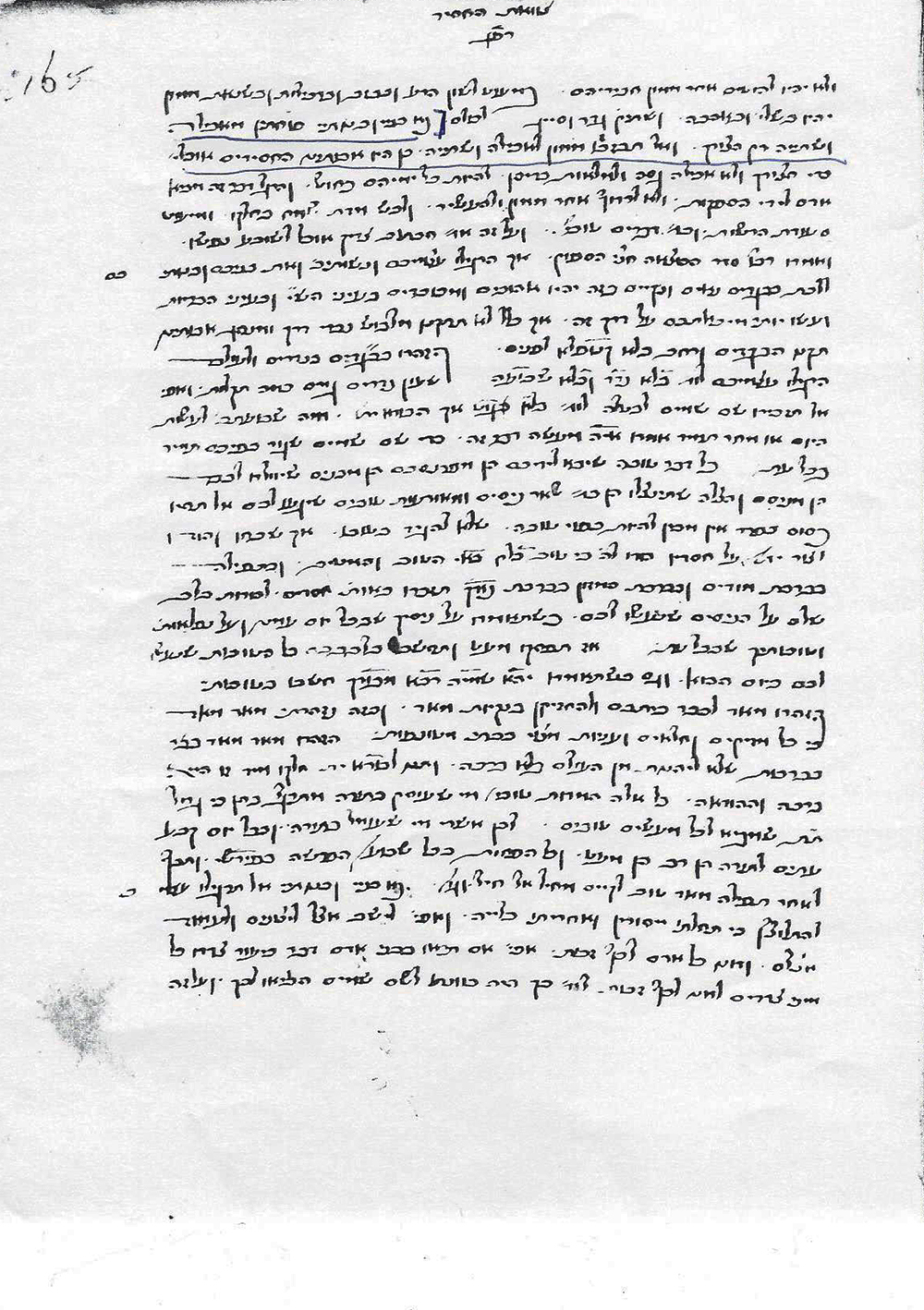
In 1930 in a publication from Chicago known as Hapardes[10], there was an article written by R’ Shlomo Michoel Neches of Los Angeles. He writes that in his possession (אצלי) he has a first print of the כרתי ופלתי, and R’ Yonasan, the author, emends the סמ”ג to סה”נ and then writes Seder Hilchos Nikkur. It is not entirely clear which Sefer this refers to, as there is no sefer of that exact name.

This answer was picked up by the Pardes Yosef[11], and it appeared to be the final word on the matter. As a matter of clarity, this answer rings true as to what the author’s original intent was, for the following reasons;

  1. This “expert” that came to Prague appeared to be satisfied with the answer given to him by R’ Yonason. It is doubtful that someone that went through all that trouble would accept a source that is non-existent, or logic that appears to be dubious.

  2. It is clear that R’ Yonasan himself was not the one that prepared the text for printing. It was a student named R’ Ahron Katz[12] .I have in my possession a 1763 Altona edition, and there are many annotations that would point out where there is a good question or a good answer. Here is an example:

It is highly unlikely that R’ Yonasan himself would write in his own sefer “good answer”.

Rabbi Neches was born in Jerusalem and came to Los Angeles in 1910. He was the Rabbi of the famous Breed Street Shul in Boyle Heights (now listed on the national register of historic places) and was the founder of what is now Sharei Tfilah, a shul in the Hancock park area of Los Angeles. He was a collector of seforim and he published articles in Torah journals.

When I moved to Los Angeles it became a mission of mine to track down this volume of the כרתי ופלתי with emendations in R’ Yonasan’s own hand. I spoke with those that had attempted to find this sefer and had been unsuccessful. Apparently Rabbi Neches’s collection was auctioned off after his death and parts of it were donated to the Jewish Federation. No records of this volume were found.

I was able to track down one of the old librarians of the Federation and she told me that most of what they had went to AJU, but she did remember there were boxes of notebooks and other items that were never cataloged. I went to the AJU library and indeed they had boxes that appeared to be never opened. I spent an afternoon going through everything they had, and alas, no כרתי ופלתי.

However, I did find a handwritten catalog of the seforim that Rabbi Neches had in his collection, it was hard to tell if there were more pages due to the degraded condition, however there was no Kreiti Upleiti listed. Not only that but I started to notice that there were no first prints or older seforim on the list. It appeared to be that he was primarily collecting seforim that were printed contemporaneously.

This got me thinking, what if he never had it in his collection? Maybe he saw it in someone else’s collection? There weren’t too many seforim collectors in Los Angeles in the 1920’s but maybe someone had it in his possession as a family heirloom. I decided to look at the academic libraries in California and see if they had a 1763 edition of the Kreiti Uplaiti. With the help of R’ Yaakov Yitzchak Miller, we found it in the Theodore E. Cummings Collection in UCLA[13].

Just as advertised, the Shaar Blat showed the signature of R’ Yonasan Eybushutz, and the emendation was there in siman 65. However, something was wrong. The signature was from R’ Yonasan Halevy Eybeshutz of Leshitz. The author of כרתי ופלתי wasn’t a Levi, nor was he from Leshitz.

This volume wasn’t the personal property of the author of כרתי ופלתי, who fixed an unintentional error, it was the property of an entirely different person, albeit with the same name, that lived 150 years later.

This information, that Rabbi Neches provided was wrong, and therefore the issue of R’ Yonason’s mistake was back in play, was made public a few years back[14], and it would appear that we are back to square one, that this apparent mistake has other potential answers, including that of the Chasam Sofer.

Is it possible that Rabbi Neches simply made a mistake? It did not appear likely to me as it is pretty clear what it says, and he would know that R’ Yonasan, the author, was not a Levi.

Furthermore, in the private collection of Dr. Steven Weiss, there is a sefer, Shaar Yonason written by R’ Yonasan Eybeshutz of Leshits, that was acquired from the collection of Rabbi Neches, and it has the distinctive binding that Rabbi Neches would put on his seforim, so Rabbi Neches clearly knew of that there was another R’ Yonasan Halevi Eybesutz of Leshitz.(See Appendix B)

Rabbi Neches was right.

Rabbi Neches did not make a mistake. Incredibly, this particular volume that was owned by Rabbi Yonasan Halevi Eybeshutz of Leshitz, was also owned by Rabbi Yonason Eybeshutz, the author of כרתי ופלתי.

The odds would appear to be stacked against this, however if you look at the Shaar Blatt of the volume, reproduced here you can see two distinct handwritings, both say “Yonason Eybeshutz”, one appear to be more elongated and cursive and the other more rounded and of an older type, where each letter was not formed in one continuous stream.

Towards the top middle you can see under the first signature reproduced here

And on the left side center you can see a very different autograph, reproduced here

I was able to obtain with the kind assistance of R’ Shnayer Leiman images of signatures that have been verified to be R’ Yonasan Eybeshutz (see Appendix A), and if you put them together, the conclusion is inescapable.

From a receipt for money received that is verified to be R’ Yonason Eybeshutz, the author. (Appendix A)

From the Shaar Blatt of the כרתי ופלתי in UCLA.

This is clear evidence that this volume was the personal copy of the author himself.

Now let’s turn to the emendation, reproduced here

The letters are the rounder letters that are consistent with the author’s writing than the angular writing of the other R’ Yonason Eybeshutz.

It turns out that my thought process in tracking down this volume was actually wrong. The Cummings collection in UCLA was not donated by a local collector, it was actually purchased in 1963 from Israel, from the defunct publishing firm of Bamberger and Wahrman.[15] Mrs. Cummings merely footed the bill for the acquisition in honor of her husband.[16] I corresponded with Arnold Band, who was in charge of the acquisition, and he confirmed that it only made it to Los Angeles in 1963, and he had personal knowledge that the Kreiti Upleiti was part of the acquired collection. As Rabbi Neches moved to Los Angeles in 1910 and his article was published in 1931, he must have been working off of memory or notes that he took from when he saw it in Israel.

The only issue with that is the language Rabbi Neches used in the article, which that it was in his possession (אצלי), which it clearly wasn’t.

Sefer Hilchos Nikkur

There are a number of candidates for this sefer. Although there are no seforim with this exact title, Leiman[17] makes a persuasive case that the reference is to a 1577 volume printed in Cracow with the title הלכות הניקור , with the section title of סדר הניקור . With the conflation of the two titles, this is probably what R’ Yonason is referring to. The annotations were made by Rabbi Zvi Bochtner, who states that he consulted with Rabbi Moshe Isserles, the Rema, on his conclusions.[18]

This is a sefer that is unusual in that it is highly focused on one area of halacha, annotated by someone that wrote no other sefer and is not a well-known Rav, yet has authority. This sefer would be familiar to those that were in the practical business of porging, however would be unknown to the general learned public. The Rema’s endorsement, of course as the Posek of the German communities would be accepted by the expert as dispositive.

Conclusion

Despite the many twists and turns of this tale, it appears that R’ Yonason Eybeshutz did not make a mistake. The person that prepared the manuscript for printing made an understandable error due to the very unique nature of this particular sefer, and misunderstood which sefer the author was referencing, and subsequently the author himself fixed the issue. Rabbi Neches also did not make a mistake, although some confusion still exists how he actually saw this volume. To use the phrase that Rabbi Neches wrote in his article regarding his discovery of the emendation in R’ Yonason’s own hand, it is a mitzva to publicize this fact.

Appendix A


Appendix B


[1] Porging, or the act of removal of a nerve to make an animal kosher, is actually an English word, it is both in the Oxford English dictionary and Merriam-Webster. The source given is based on Judeo-Spanish. It appears to be highly unusual that a word would be extant in the English language that is specifically related to Jewish halacha, yet does not derive from either Yiddish (טרייבער) or Hebrew (מנקר).
[2] There was a sefer published to defend his case against R’ Yakov Emden called Luchot Edut, published in Altona 1755, and another called V’evoh Hayom El Ha’ayin which had disputed authorship.
[3] Rabbi Moshe of Coucy’s (d.1260) ספר מצוות גדול.
[4] Feivel, Rabbi Yechezkel, “Toldos Adam Chelek Bais”, Vilna 1884, pg. 43.
[5] Leiman, Rabbi Dr. Shnayer Z. “Judaic Studies” No. 4 Fall 2004, “Rabbi Jonathan Eybeshuetz and the Porger” pg. 16.
[6] Rabbi Isaac of Corbeil’s (d. 1280)’s ספר מצוות קטן.
[7] Rabbi Simon Kayyara’s  (d. 8th Century) הלכות גדולות, known in halachic literature as the בעל הלכות גדולות.
[8] In שו”ת חתם סופר סימן ס”ט.
[9] In ‘שו”ת טוב טעם ודעת סימן ק.
[10] Hapardes No. 4 Vol 1 (1930) pg. 18-19.
[11] Pozonovsky, Rabbi Yosef, פרדס יוסף פרשת וישלח.
[12] Introduction to the Kreiti Upleiti, Altona, 1763.
[13] Charles E. Young Research Library, UCLA, “Kereti U’Feleti”, Eybeschuetz, Jonathan, H0000017129.
[14] Wild Wild West-Orthodox Jewish Pioneers in LA, https://youtu.be/LEysLjApKOU ; “Kovetz Hama’eyan” (vol. 215; Tishrei 5776, pg 100 – 102).
[15] https://www.jta.org/1963/04/19/archive/university-of-california-gets-collection-of-33520-books-from-israel
[16] Her son Theodore Cummings served as Ambassador to Austria in the Reagan administration.
[17] Ibid, pg. 27,
[18] Valmadonna Trust London England 4822, שחיטות / של מוהר”ר יעקב ווייל, עם ההגהות והחדושים שליקט ואסף הר”ר צבי בר יצחק יעקב, ממה שבא לידו ובדק ונסה זה כמה שנים, והוגה אות באות על פי מוהר”ר משה איסרליס, בי הירש בן יצחק יעקב, מקראקא.


Foie Gras “Fake News”: A Fictitious Rashi and a Strangely Translated Ethical Will

Foie Gras “Fake News”: A Fictitious Rashi and a Strangely Translated Ethical Will
by Ari Z. Zivotofsky
Controversial topics can sometimes lead to contrived sources, i.e. fake news. That is certainly true with the effort by vegetarians to find traditional sources to support their position. In the past I have shown how a booklet claiming Judaism supports vegetarianism was full of misquotes (here here ) and how a “quote” of the Rema was fabricated ( here ). Here I will expose two fake quotes that have been used by vegetarians in the battle against foie gras.
Foie gras (pronounced “fwä-grä, meaning “fat liver” in French) is the fattened liver of a waterfowl that grew to 5-10 times its usual size due to gavage. Foie gras, a delicacy today rightly associated with the French who are indeed by far the largest producers and consumers of it, was for much of history an Ashkenazi Jewish expertise. This luxury item has been the subject of a great deal of controversy in recent years. Until its production was banned in 2003 by the Supreme Court, Israel was one of the leading producers in the world. Within the last year, kosher foie gras has begun to be produced in the US for the first time in history.
The issue driving the current debate is animal welfare, or in the Jewish world, tza’ar ba’alei chaim. For hundreds of years, in traditional Jewish sources “stuffed goose” was indeed controversial, but not because of animal welfare. The debate revolved around potential treifot due to possible damage to the esophagus caused during the feeding process. it was a widespread debate involving the greatest of authorities. The Rema (YD 33:9) notes that in his town they would stuff geese to make schmaltz and they would check the veshet of each bird. Rav Yoel Sirkis (Bach, YD 33) was in favor of banning force feeding because of this potential serious problem. The Aruch Hashulchan (YD 33:37) says they did not do force feeding in his town. The Chochmas Adam (16:10) preferred to ban the gavage process because of the concern for treifot of the veshet, but agreed that if done, it could potentially be kosher. In modern times the Tzitz Eliezer (11:49, 11:55, 12:52) and Rav Ovadia Yosef (Yabia Omer 9:YD:3) came out against foie gras, while Rav Yosef Shalom Elyashiv was reported as approving the foie gras that was being produced in 2005. The most famous posek to permit stuffed geese was the Chasam Sofer (2:YD:25; Chullin 43b).

Despite the centuries long debate, force feeding geese was extremely common among Ashkenazic Jews. Many of the greatest poskim lived in regions where they would have been personally exposed to the process and yet none of them ever suggested that it was cruel and bordered on tza’ar baalei chaim. The issue was not even raised for discussion until the late 20th century. The only place tzaar ba’alei chaim is mentioned in the context of fattened geese is in the opposite direction – the rabbis were aware that geese used to being fed in this manner would not eat any other way and thus, out of concern for tza’ar ba’alei hayyim, permitted, with certain stipulations, gavage for these geese on Shabbat (Mishna Berurah 324:27). This is as opposed to other chickens and geese, for which this is not permitted.

Despite efforts by some to demonstrate that force feeding geese is cruel and was recognized as such by Jews in previous generations, it’s a common misunderstanding based on a mistranslation that seems to defy explanation, and one of these situations where people keep repeating an error because they didn’t examine the primary source. In contemporary Jewish anti-foie gras literature, two “quotes” are regularly bantered about, even by scholars. One is a “quote” from Rashi and the other from a 14th century ethical will.

Both quotes can be found in the book “The Foie Gras Wars: How a 5,000-Year-Old Delicacy Inspired the World’s Fiercest Food Fight” (2011) by Chicago Tribune reporter Mark Caro. On p. 26 he writes:

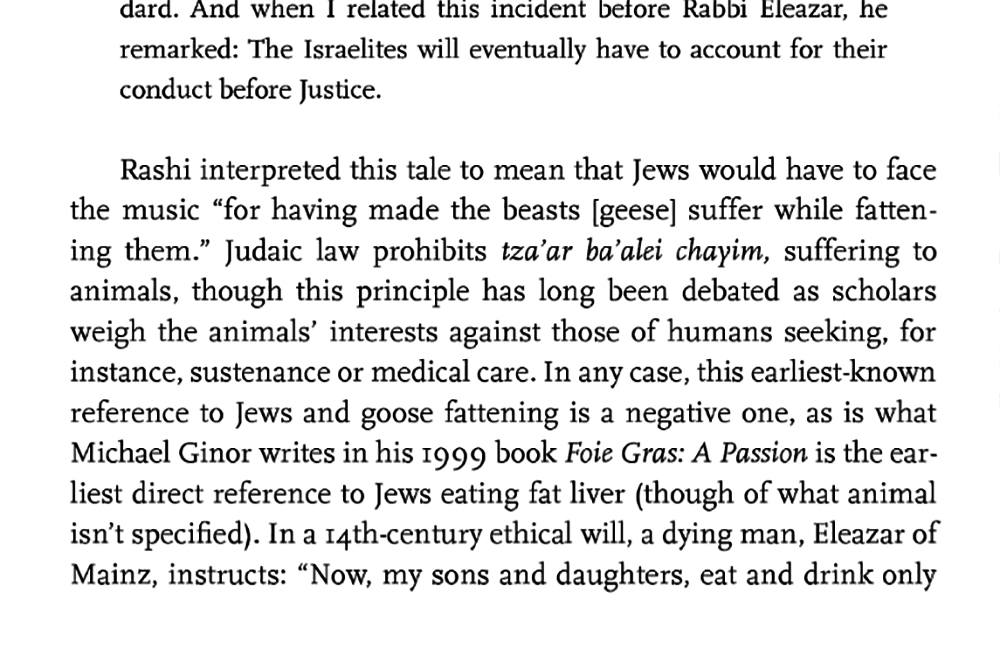
“Rashi interpreted the tale to mean that Jews would have to face the music ‘for having made the beasts[geese] suffer while fattening them’.”

And on p. 26-27 he writes:
“In a 14th-century ethical will, a dying man, Eleazar of Mainz, instructs: “‘Now, my sons and daughters, eat and drink only what is necessary, as our good parents did, refraining from heavy meals, and holding the gross liver in detestation’.”
The comment of Rashi sounds like it may indeed be a condemnation of fattening geese. It turns out that Rashi never wrote any such thing. First, the source for this “quote” is Bava Basra 73b and as is well known, on 29a of Bava Basra of our printed texts, there is a note in bold letters in the Rashi column that says: “until here is the commentary of Rashi zt”l, from here on in is the commentary of Rabbeinu Shmuel ben Rav Meir”, ie Rashbam. The first error is therefore that the comment was not written by Rashi but by his grandson. 

Nonetheless, even if Rashbam had written that, it would be of significance. But he didn’t.

The comment was made on the 10th of the fantastic, esoteric tales of Rabbah bar bar Chanah. The story is:
תלמוד בבלי מסכת בבא בתרא דף עג עמוד ב
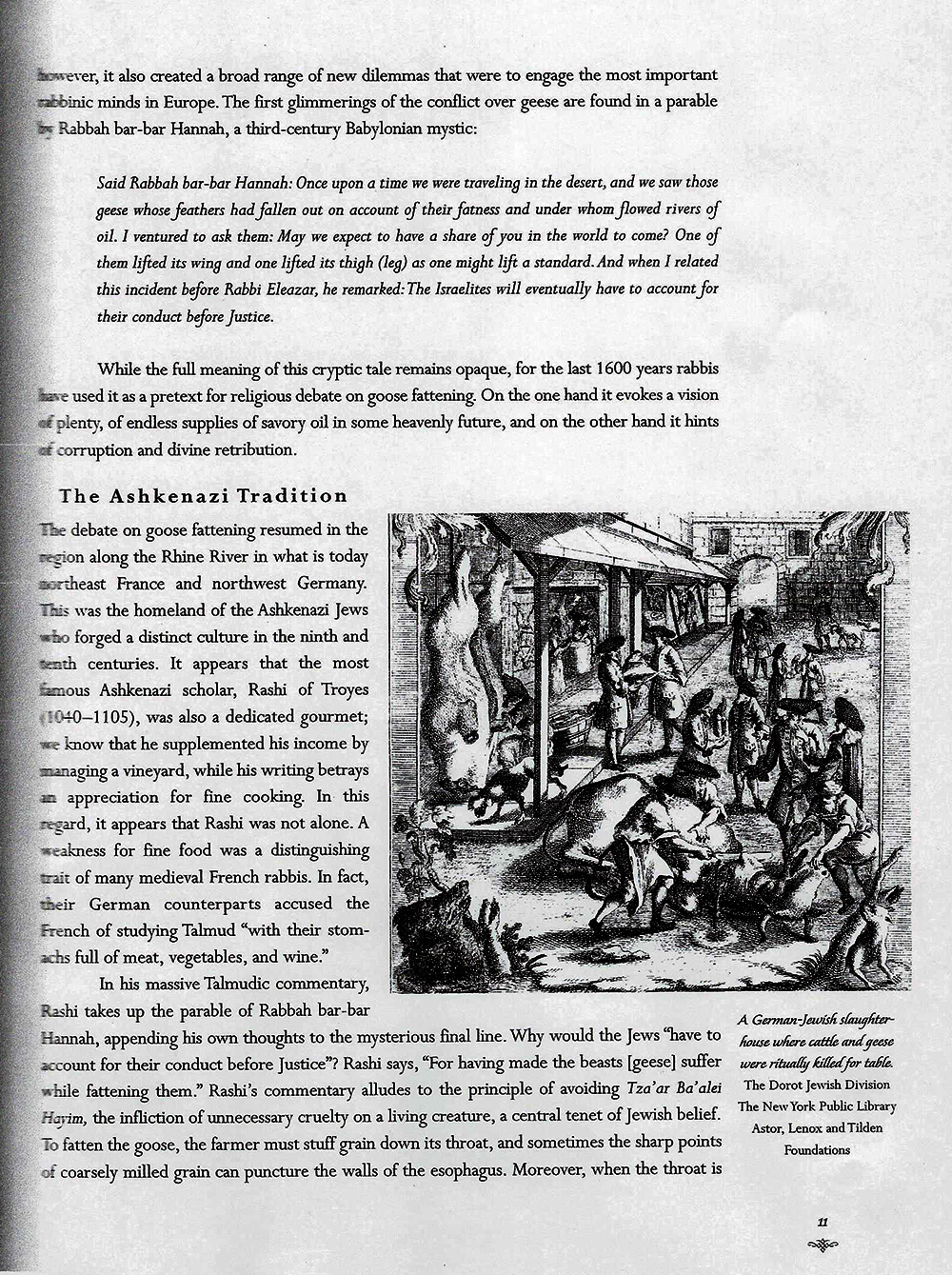
ואמר רבה בר בר חנה: זימנא חדא הוה קא אזלינן במדברא, וחזינן הנהו אווזי דשמטי גדפייהו משמנייהו וקא נגדי נחלי דמשחא מתותייהו, אמינא להו: אית לן בגוייכו חלקא לעלמא דאתי? חדא דלי גדפא, וחדא דלי אטמא. כי אתאי לקמיה דרבי אלעזר, אמר לי: עתידין ישראל ליתן עליהן את הדין.

Rabbah b. Bar Hana also related: We were once travelling in the desert and saw geese whose feathers fell out on account of their [excessive] fatness, and streams of oil [fat] flowed under them. I said to them: ‘Shall we have a share of your [flesh] in the world to come?’ One lifted up its wing, the other lifted up its leg. When I came before R. Elazar he said to me: Israel will be held accountable because of them.

Commenting on the last line, Rashbam commented:
רשב”ם מסכת בבא בתרא דף עג עמוד ב
ליתן עליהם את הדין – שבחטאתם מתעכב משיח ויש להם צער בעלי חיים לאותן אווזים מחמת שומנן.
According to the Rashbam, the Jews are responsible for the suffering of the geese in that the geese had to live extra-long with unnatural fat because the Jews sinned and thereby delayed the coming of the Messiah and the slaughtering of these geese. The Rashbam was discussing a fanciful story involving the suffering of mythical geese whose feathers fall out and whose fat drips off of them, i.e. who were clearly suffering and are different from a typical goose. Such geese he suggests may suffer due to their excessive fat. He makes no mention of the fattening process and says nothing about any suffering during that process or about the suffering of geese that his Jewish neighbors were raising.
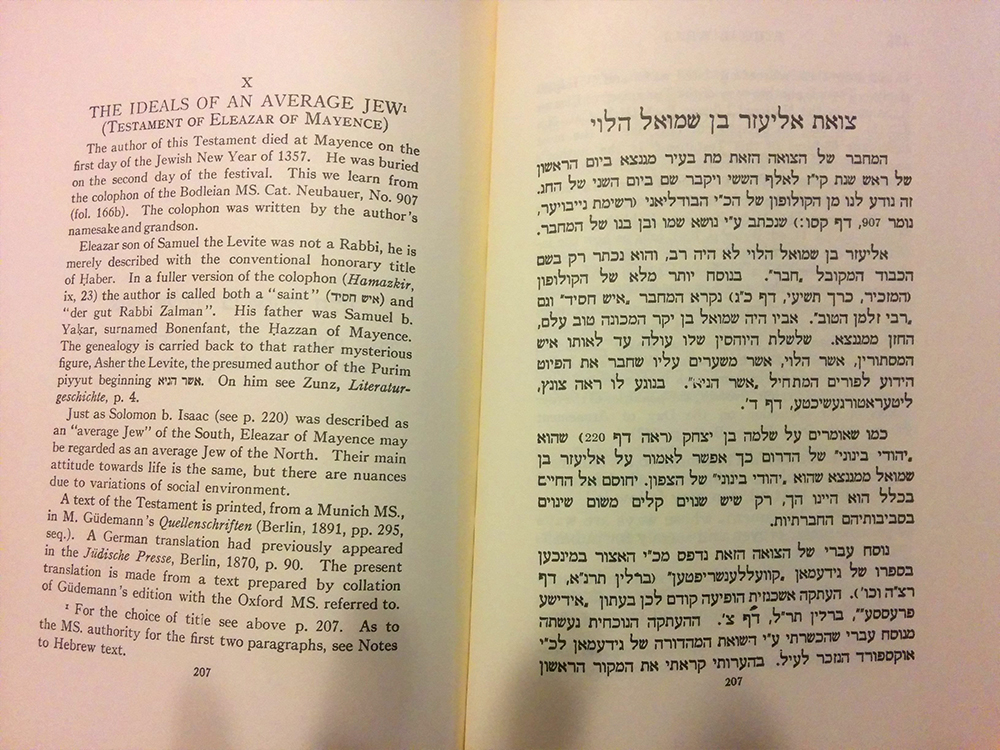
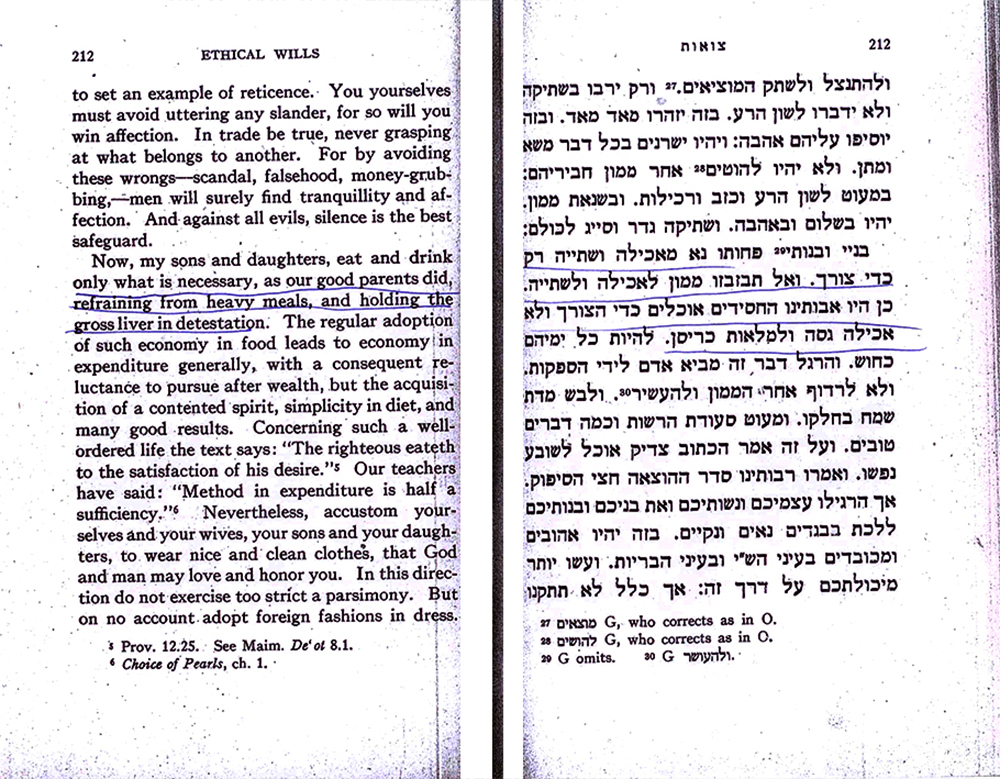
And how about the ethical will? Hebrew Ethical Wills (JPS Library of Jewish Classics) (English and Hebrew Edition) [1976], Israel Abrahams (Editor), Judah Goldin (Foreword) is a facsimile edition of the 1926 original. Beginning on p. 207 is “The Ideals of an Average Jew (Testament of Eleazar of Mayence)” and on p. 212 it indeed says: “Now, my sons and daughter, eat and drink only what is necessary, as our good parents did, refraining from heavy meals, and holding the gross liver in detestation.” 

From this it is not at all clear why liver should be so disliked, and it is certainly not obvious that he is talking about foie gras. It could be that he simply abhors liver (perhaps because, as Chazal note, it is full of blood). In an effort to better understand, I looked on the other side of the page, at the Hebrew text. And what a shock! It seems that when Israel Abrahams (Reader in University of Cambridge and a Senior Tutor at Jews’ College) translated this text he used some poetic license, likely never suspecting it would be then adopted by the anti-foie gras activists. Here is what the Hebrew found in Abrahams says:
בניי ובנותי פחותו נא מאכילה ושתייה רק כדי צורך. ואל תבזבזו ממון לאכילה ולשתייה. כן היו אבותינו החסידים אוכלים כדי הצורך ולא אכילה גסה ולמלאות כריסן. להיות כל ימיהם כחוש.
No mention whatsoever of liver! It appears that it is not an actual translation. It seems strange that Abrahams fabricated the liver in the English. He says the translation was made on the basis of two Hebrew texts. Maybe he translated straight off of them and the Hebrew in his edition is not accurate. The first is a text that is based in a Munich MS and appears on Moritz Güdemann’s Quellenschriften (Berlin, 1891, reprinted by Philo Press in 1968).

There on p. 296 one finds an almost identical text:
בניי פחותו נא מאכילה ושתייה רק כדי צורך ואל תבזבזו ממון לאכילה ולשתייה. כן היו אבותינו החסידים אוכלים כדי הצורך ולא אכילה גסה ולמלאות כריסן להיות כל ימיהם כחוש
The other manuscript is Bodleian MS cat Neubauer No. 907, fols. 164a-166a (not 166b as Abrahams erroneously wrote) and the relevant section is at the top of 165a (I thank Ezra Chwat for his assistance in obtaining this ms.). As can be seen the text is identical to that found in the Abrahams’ book. 
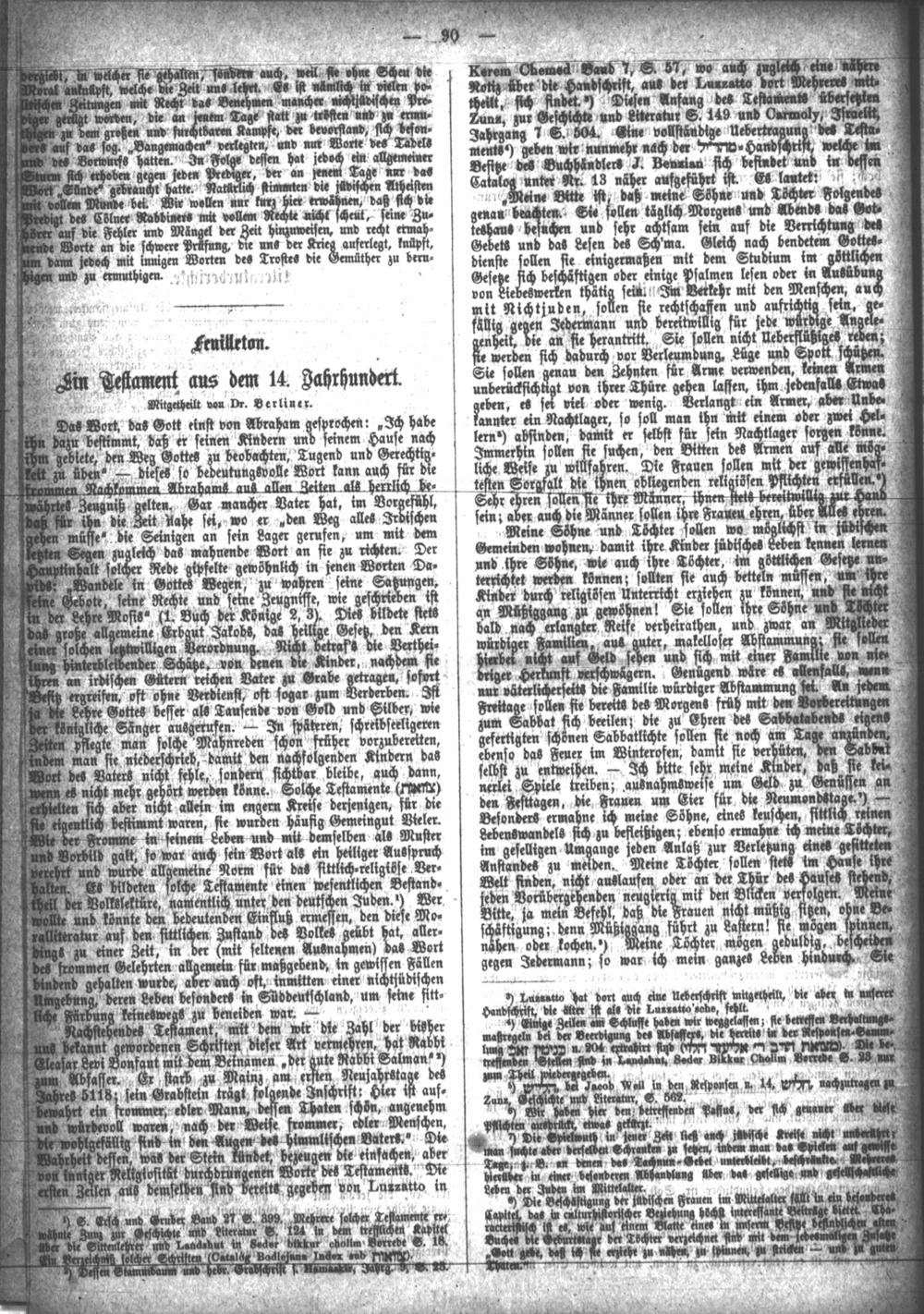
There seemed to be a final possibility. In his introduction, Abrahams notes that a previous translation, into German, had appeared in the journal Jüdische Presse, Berlin 1870, p. 90.

The journal is available here (I thank Sharon Liberman Mintz for finding that link for me). In issue 11 (Sept 9, 1870) a translation appears on the 6th and 7th page of the issue, pages 90-91 of the volume, as can be seen in the figure below.
However, it is only a translation of the first half of the will, ending just before the relevant section. It says that it was to be continued, but unfortunately that was the first year of the journal and the next issue (12) is missing (as are several others such as 3, 7, 9, 10) from the digitized microfilm at that website and I have been unable to locate it in any Israeli library. the translation until that point seems to be accurate and it is hard to ascribe the insertion of the liver to the German translator (I thank Rabbi Dr. Seth Mandel and Prof Michael Segal for assistance with the German).
It thus seems clear the liver was inserted into the English transition for some inexplicable reason, but certainly does not appear in this 14th century ethical will.
Once an author is convinced of the authenticity of the sources they often embellish. In the academic work, Food and Morality: Proceedings of the Oxford Symposium on Food and Cookery (2007) edited by Susan R. Friedland, there is a chapter called the foie gras fracas: sumptuary Law as Animal welfare? By Cathy K. Kaufman, a scholar-chef and Adjunct Chef-Instructor, Institute of Culinary Education, in New York City.
On p. 126 she writes: 

“The best written evidence for the medieval production of foie gras – and its ambiguous moral status – is found among the writings of the Ashkenazi Jews who spread throughout Europe. Rabbi (sic) Rashi ……”

But in fact we have shown that among the Jewish writings there is ZERO evidence regarding any ambiguous moral status!
Even the well-known American cookbook author Joan Nathan couldn’t avoid this pitfall. 
Recently, in her King Solomon’s Table: A Culinary Exploration of Jewish Cooking from Around the World (2017) on p. XXI she wrote: 

“Rashi was a thinker who knew both religion and agriculture. He condemned, for example, the force-feeding of geese to produce foie gras ….”.

In 2013, an article in Moment magazine (here) stated: 

“More complex, however, were the ethical questions. In the 11th century, the French scholar Rashi warned Jews against the force-feeding practice, “for having made these beasts (geese) suffer while fattening them.” This went against Jewish law prohibiting tza’ar ba’alei chayim, suffering to animals, although some rabbis claimed that since none of the geese’s limbs were harmed and the geese did not feel discomfort in their throats, foie gras was not treyf, or forbidden. Other rabbinic scholars suggested that it is only permissible to inflict pain on an animal when the benefit of doing so is significant; since there are no real nutritional benefits to foie gras, the process of force-feeding was questionable.”

One can only wonder who these “some rabbis” and “other rabbinic scholars” were who argued with this non-existent Rashi!
The book that is the source for many of these other articles is the beautiful coffee-table book Foie Gras: A Passion (1999) by Michael Ginor and Mitchell Davis. Ginor, an American who spent two years in the IDF and while in Israel discovered foie gras, co-founded, co-owns, and is President of NY based Hudson Valley Foie Gras and New York State Foie Gras, the most comprehensive foie gras producer in the world. His book is an absolutely comprehensive book on everything one could possibly want to know about foie gras. And there on p. 11 he quotes the non-existent Rashi and on p. 12 the English version of the strangely translated ethical will. I have no idea where he found those two quotes that have today become so common in the vegetarian literature. 
The fact that all one has to do is look in the Hebrew originals to see that these quotes are fake news, explains why they are found in English sources and I have not yet found them in any of the Hebrew works on animal rights.


Young Rabbis and All About Olives

Young Rabbis and All About Olives

Marc B. Shapiro
I am currently working on a book focused on the thought of R. Kook, in particular his newly released publications. A book recently appeared titled Siah ha-Re’iyah, by R. David Gavrieli and R. Menahem Weitzman. It discusses a number of important letters of R. Kook. In addition to the analysis of the letters, each of the letters is printed with explanatory words that make them easier to understand. We are also given biographical details about the recipients of R. Kook’s letters. Here is the title page.
In reading the book, I once again found myself asking the question, how can intelligent people sometimes say nonsensical things? On p. 252 the book states that R. Menahem Mendel Cohen studied in yeshivot in Tiberias and Safed, and was appointed as chief rabbi of the Ashkenazic community of Cairo in 1896 when he was only ten years old!

How is it possible for anyone to write such a sentence, that a ten-year-old was appointed as a communal rabbi? Let me explain what happened here, but first, I must note that the name of the man we are referring to is not R. Menahem Mendel Cohen, but R. Aaron Mendel Cohen. Here is his picture, which comes from a very nice Hebrew Wikipedia article on him.

As for R. Cohen being appointed rabbi at age ten, whoever prepared the biographical introduction must have had a source which mistakenly stated that R. Cohen was born in 1886. Since this source also said that he became rabbi in Cairo in 1896, this means that he was ten years old was he was appointed rabbi. Yet we can only wonder how the authors did not see the obvious impossibility of a ten-year-old being appointed rabbi of Cairo, which should have led them to investigate a little further. Simply by googling R. Cohen’s name in Hebrew, the Wikipedia article will come up, and it tells us that R. Cohen was born not in 1886 but in 1866. Thus, instead of a ten-year-old rabbi he is now thirty years old.

With regard to young rabbis, let me repeat, with some slight edits, something I wrote in an earlier post here.

In terms of young achievers in the Lithuanian Torah world, I wonder how many have ever heard of R. Meir Shafit. He lived in the nineteenth century and wrote Sefer Nir, a commentary on the Jerusalem Talmud, when not many were studying it. Here is the title page of one of the volumes, where it tells us that he became rav of a community at the age of fifteen.

The Hazon Ish once remarked that the young Rabbi Shafit would mischievously throw pillows at his gabbaim![1]

Regarding R. Jacob Schorr [mentioned earlier in the original post] being a childhood genius, this letter from him to R. Shlomo Kluger appeared in Moriah, Av 5767.

As you can see, the letter was written in 1860 (although I can’t make out what the handwriting says after תר”ך). We are informed, correctly, that R. Schorr was born in 1853, which would mean that he was seven years old when he wrote the letter. This, I believe, would make him the greatest child genius in Jewish history, as I don’t think the Vilna Gaon could even write like this at age seven. Furthermore, if you read the letter you see that two years prior to this R. Schorr had also written to R. Kluger. Are there any other examples of a five-year-old writing Torah letters to one of the gedolei ha-dor? From the letter we also see that the seven-year-old Schorr was also the rav of the town of Mariampol! (The Mariampol in Galicia, not Lithuania.) I would have thought that this merited some mention by the person publishing this letter. After all, R. Schorr would be the only seven-year-old communal rav in history, and this letter would be the only evidence that he ever served as rav in this town. Unfortunately, the man who published this document and the editor of the journal are entirely oblivious to what, on the face of things, must be one of the most fascinating letters in all of Jewish history.

Yet all that I have written assumes that the letter was actually written by R. Schorr. Once again, we must thank R. Yaakov Hayyim Sofer for setting the record straight. In his recently published Shuvi ha-Shulamit (Jerusalem, 2009), vol. 7, p. 101, he calls attention to the error and points out, citing Wunder, Meorei Galicia, that the rav of Mariampol, Galicia was another man entirely, who was also named Jacob Schorr.

This is what I wrote in the prior post. Let me now add some additional information about R. Shafit, the fifteen-year-old communal rav. The first thing I want to point out relates to the city in which R. Shafit became rav at age fifteen. If you look at the title page you can see that its name is מיצד. This is actually an alternate way of spelling the city which is better known as מייצ’ט. Anyone who knows their Lithuanian rabbinic history will recognize this city as Meitchet (Molchad in English), made famous by the great R. Solomon Polachek, known as the Meitcheter Iluy. (R. Polachek was not actually born in Meitchet, but in a small town nearby.) There is so much to say about R. Polachek, but it will have to wait for a future post.

Returning to R. Shafit, although he is hardly a household name, in his day he was actually quite a well-known rabbi. He contributed to R. Israel Salanter’s journal Tevunah,[2] and those who study the Jerusalem Talmud know that his commentary is a very important work.[3] R. Adin Steinsaltz, who is from R. Shafit’s family, even took time away from his own work on the Talmud to publish from manuscript a commentary of R. Shafit on the Jerusalem Talmud. Here is the volume that appeared in 1979.


In the preface, R. Steinsaltz writes:

כל החכמים הלומדים בירושלמי בכל השיטות, למן חכמי בית המדרש נוסח ליטא העתיקה עד לאנשי המדע המובהקים, כולם כאחד הודו שפירוש “הניר” הוא מחשובי הפירושים שנכתבו אי פעם על התלמוד הירושלמי
I do not need go into more detail on R. Shafit since in 2014 Hillel Rotenberg published an entire book on him.[4] And while it is true that, as mentioned already, R. Shafit is not a household name, there are today people who celebrate his hillula. See here. In case you are wondering what a Lithuanian rabbi is doing with a hillula, R. Shafit was actually a Slonimer Hasid.

In response to my earlier comments about the young R. Shafit, Seforim Blog contributor R. Ovadiah Hoffman sent me another example of a young rabbi: Avigdor Aptowitzer. Aptowitzer, who was one of the twentieth-century’s leading academic scholars of rabbinic literature, is best known as the editor of R. Eliezer ben Joel Halevi’s halakhic work Ra’avyah, concerning which he published another important volume as an introduction to the Ra’avyah, and a book called Hosafot ve-Tikunim le-Sefer Ra’avyah (Jerusalem, 1936). 

According to Abraham Meir Habermann, when Aptowitzer was around seven years old his father, the rabbi of Tarnopol, became ill. Young Avigdor took the place of his father as rabbi. During the week he taught students and on Shabbat people carried him to the synagogue so that he could deliver the derashah.[5] As far as I know, this makes Aptowitzer the youngest person ever to serve as a communal rabbi, even though he was never officially appointed to the position.

It is also reported that R. Shimon Sofer, the son of R. Abraham Samuel Sofer (the Ketav Sofer), was so learned as a child that he received the title חבר from R. Judah Aszod when he was only nine years old.[6]

In speaking about young rabbis, it is also important to mention a passage in R. David Abudarham’s[7] commentary on the Haggadah, s.v. אמר רבי אלעזר הרי אני כבן שבעים שנה. Abudarham cites the Jerusalem Talmud, Berakhot 4:1, that R. Elazar ben Azariah was appointed nasi of the Sanhedrin at age 13. Our version of the Jerusalem Talmud has “age 16”, but the version cited by Abudarham appears in other early sources.[8]

Regarding age 16, R. Solomon Ibn Gabirol wrote his azharot for Shavuot when he was that old. At the beginning of the azharot he wrote (with great self-confidence, I might add):[9]

והנני בשש עשרה שנותי ובי שכל כמו בן השמונים
Avodah Zarah 56b tells about a child who learned Tractate Avodah Zarah when he was six years old. The Talmud describes how he was asked halakhic questions on the tractate, and his replies apparently signify that he was deciding halakhic matters at the age of six.

He was asked, ‘May [an Israelite] tread grapes together with a heathen in a press?’ He replied, ‘It is lawful to tread grapes together with a heathen in a press.’ [To the objection] ‘But he renders it yein nesekh [10] by [the touch of] his hands!’ [he answered], ‘We tie his hands up.’ [To the further objection] ‘But he renders it yein nesekh by [the touch of] his feet!’ [he answered], ‘Wine touched by the feet is not called nesekh.’  

Although not an example of a child rabbi, I think it is worthwhile to mention R. Jacob Berab’s statement that when he was only eighteen years old, and did not yet have a beard, he was the rabbi and halakhic authority for a community of 5000 families in Fez.[11]

Returning to Aptowitzer, R. Meir Mazuz directs a comment at him in a recent issue of his weekly Bayit Ne’eman.[12] In discussing the proper size of a kezayit, R. Mazuz notes that the Ashkenazic rishonim did not have any personal knowledge of olives, and thus did not know how big they were.[13] He cites R. Eliezer ben Joel Halevi, the Ra’avyah, who writes as follows:[14]

וכל היכא שצריך כזית צריך שיהיה מאכל בהרווחה, לפי שאין אנו בקיאין בשיעור זית כדי, שלא תהיה ברכה לבטלה
You cannot get any clearer than this that R. Eliezer, who lived throughout Germany, had no idea how big an olive was.[15] Yet in Aptowitzer’s note to the words לפי שאין אנו בקיאין בשיעור זית, he writes:

כלו’ אלא ע”י מדידה וחשבון, וכאן שבברכה אחרונה אנו עסוקין וכבר אכל ואי אפשר לחשוב ולמדוד, לכן יזהר שיאכל מתחילה שיעור גדול שאין להסתפק בו שהוא כזית
He explains the Ra’avyah to be saying that we do not know how large our portion of food is without measuring it. Since we are dealing with the final blessing and the food is already eaten and thus can no longer be measured, people should eat enough so that there is no doubt that they ate an olive’s worth and thus no problem with a berakhah le-vatalah.

It is hard to understand how Aptowitzer could have written something so obviously incorrect, as there is no doubt as to the passage’s meaning. R. Mazuz writes:

איזה “חכם”, שנכון שאחרי שכבר אכל את הזית לא יכול למדוד, אבל לפני שאכל הוא רואה את הגודל אז למה צריך לאכול בהרווחה?! אלא לא היו מכירים את הזיתים
Here is something else relevant to Aptowitzer. Nahmanides, Commentary to Genesis 31:35, writes (Chavel translation):

The correct interpretation appears to me to be that in ancient days menstruants kept very isolated for they were ever referred to as niddoth on account of their isolation since they did not approach people and did not speak to them. For the ancients in their wisdom knew that their breath is harmful, their gaze is detrimental and makes a bad impression, as the philosophers have explained. I will yet mention their experiences in this matter. And the menstruants dwelled isolated in tents where no one entered, just as our Rabbis have mentioned in the Beraitha of Tractate Niddah: “A learned man is forbidden to greet a menstruant. Rabbi Nechemyah says, ‘even the utterance of her mouth is unclean.’ Said Rabbi Yochanan: ‘One is forbidden to walk after a menstruant and tread upon her footsteps, which are as unclean as a corpse; so is the dust upon which the menstruant stepped unclean, and it is forbidden to derive any benefit from her work.’”

Baraita de-Masekhet Niddah is a strange work, with all sorts of extreme statements not found in mainstream rabbinic literature. This is not the place to review in any detail the various scholarly views about the text’s origin.[16] Suffice it to say that Saul Lieberman thought that the author was a sectarian, but not a Karaite.[17] Aptowitzer, however, took issue with Lieberman and argued that Baraita de-Masekhet Niddah is a Karaite forgery designed to insert Karaite views into the Rabbanite community, and also to make the Sages look like fools. As an example of the latter, Aptowitzer quoted the “halakhah” recorded in Baraita de-Masekhet Niddah that a kohen whose family member – by which it means one he lives with – is a niddah cannot offer a sacrifice or perform birkat kohanim.[18] Aptowitzer concluded that it is “very unfortunate” that some rishonim were misled by this forgery, thinking it an authentic work.[19]

Aptowitzer’s work, Mehkarim be-Sifrut ha-Geonim, in which he expressed this judgment, was published by Mossad ha-Rav Kook. R. Hayyim Dov Chavel also published his commentary on Nahmanides with Mossad ha-Rav Kook, and on the just-mentioned passage of Nahmanides to Genesis 31:35, R. Chavel quotes Aptowitzer’s view.

It is easy to see why, from a traditional perspective, what Aptowitzer said is problematic. After all, he posits that Nahmanides, one of the greatest of the medieval sages, was taken in by a heretic’s forgery. His apology, as it were, that Nahmanides and other medieval sages were not critical scholars, and thus it is not a cause for wonder that they were fooled in this matter, is not the sort of thing that will be seen as respectful in traditional circles. It is one thing to write about more recent sages being fooled by Besamim Rosh and the Yerushalmi on Kodashim, but when dealing with a figure like Nahmanides such a position is bound to be more controversial.

This is exactly what happened, and R. Chavel must have been subjected to criticism for citing Aptowitzer in this matter. In the second edition of his commentary, vol. 1, p. 554, R. Chavel backtracks from what he wrote. Had he been able to reset the type and delete the entire note from the text of the commentary I am sure he would have done so. However, he had to settle for a comment in the hashmatot u-miluim, which most people never bother to look at. He writes as follows:

על דעת בקורתית זו יש להוסיף: אף כי חכם גדול היה ר’ אביגדור אפטוביצר, ונאמן רוח לתורה ולחכמה, נתפס כאן לסברה בעלמא, שלא שזפה עינו החדה כי הברייתא הזאת (ברייתא דמסכת נידה) היא עדות מוכחת עד כמה גידרו קדמונינו עצמם להתרחק מטומאת הנדה. כטומאת הנדה היתה דרכם לפני (יחזקאל לו, יח). ואף שלא היו הדורות נוהגים למעשה בכל החומרות הנזכרות בברייתא זו, הלא כבר כתב ה”חתם סופר” [או”ח  סי’ כג] שאולי נשתנו הטבעים והמקומות, או כיון שדשו בה רבים שומר פתאים ה
As readers can see, R. Chavel’s point is completely dogmatic without any scholarly argument. 

Returning to Nahmanides’ comment to Genesis 31:35, he tells us that he will have more to say on this matter. This is found in his commentary to Leviticus 18:19, where he writes that the blood of menstruation “is deadly poisonous, capable of causing the death of any creature that drinks or eats it.” He further states:

If a menstruant woman at the beginning of her issue were to concentrate her gaze for some time upon a polished iron mirror, there would appear in the mirror red spots resembling drops of blood, for the bad part therein [i.e., in the issue] that is by its nature harmful, causes a certain odium, and the unhealthy condition of the air attaches to the mirror, just as a viper kills with its gaze.

I find it noteworthy that such a great figure as Nahmanides, who was also a doctor, was able to be taken in by these fairy tales. He certainly had never seen any red spots showing up on a mirror so why did he believe such a story without attempting to confirm its accuracy himself? I realize that in medieval times people were much more credulous, and repeated all sorts of far-fetched things that they heard.[20] Nahmanides himself repeats that people in Germany would make use of demons, and he had no reason to doubt this report.[21]

שמעתי בבירור שמנהג אלמניי”ו לעסוק בדברי השדים ומשביעים אותם, ומשלחים אותם ומשתמשים בהם בכמה ענינים
He also believed a report that travelers to the east had discovered the Garden of Eden, but were then killed by the flaming sword that guards the Garden.[22]

 ובספרי הרפואות היונים הקדמונים, וכן בספר אסף היהודי סיפרו כי אספלקינוס חכם מקדוני וארבעים איש מן החרטומים מלומדי הספרים הלכו הלוך בארץ ועברו מעבר להודו קדמת עדן למצוא קצת עלי הרפואות ועץ החיים למען תגדל תפארתם על כל חכמי הארץ, ובבואם אל המקום ההוא ויברק עליהם להט החרב המתהפכת, ויתלהטו כלם בשביבי הברק, ולא נמלט מהם איש
However, when dealing with red spots on a mirror this was something that Nahmanides could have easily confirmed, and yet instead he relied on what he heard, or perhaps read. In seeking to understand how Nahmanides could have been misled in this matter, it helps to be reminded of Bertrand Russell’s famous comment made with reference to Aristotle’s assertion that men have more teeth than women.

To modern educated people, it seems obvious that matters of fact are to be ascertained by observation, not by consulting ancient authorities. But this is an entirely modern conception, which hardly existed before the seventeenth century. Aristotle maintained that women have fewer teeth than men; although he was twice married, it never occurred to him to verify this statement by examining his wives’ mouths.[23]

Returning to the matter of olives, it is noteworthy that the halakhic authorities, including those in the twentieth and twenty-first centuries, who argued that olives have shrunk since the days of the Sages did not actually seek to prove this with historical evidence. Had they done so they would have found that the size of olives has not changed. However, concerning another measurement we find that the Steipler was indeed interested in what the historical record revealed. R. Avrohom Marmorstein and Jacob Djmal both called my attention to a letter of the Steipler that was recently up for auction. Here is the item from Kedem’s January 2018 auction catalog (catalog no. 59), pp. 269-270 (item no. 298).

This letter already appeared in Aleh Yonah (Jerusalem-Bnei Brak, 1989), p. 134.

We see that in trying to determine the size of a cubit, the Steipler actually wrote to the archaeology department at “the university” (i.e., Hebrew University). This sort of effort is exactly what is required when trying to investigate a matter such as this. Yet look what happened when this letter was published in the Steipler’s Karyana de-Igarta, vol. 2, no. 402. The section showing that the Steipler reached out to the academic world was simply deleted, with no indication given that anything has been removed from the letter.

Finally, it is worth mentioning the Hazon Ish’s position that although the various measurements go back to Sinai, the actual size of the measurements required in order to fulfill an obligation was established by the Sages. In other words, while the measurement of a kezayit is mi-deoraita, how big this olive is – as there are different size olives – was given to the Sages to be determined.[24]

וכשנאמרו שיעורין בסיני נאמרו על האומד ומה שנראה לו לאדם זהו שיעורו, ואמנם הדבר מסור לחכמים לקבוע גדרי השיעור לכל ישראל וכמו שאמרו חכמים כזית שנאמרו זה אגורי כשעורה זו מדברית כעדשה זו מצרית לא שנאמרה למשה כך אלא נאמרה סתם והיא הבינונית אלא חכמים עיינו בדבר וקבעו לכל ישראל שכזית אגורי ושעורה מדברית ועדשה מצרית הם הבינונים, וכשם שמסור לדעתו של רואה להכריע על הבינוני של הפרי בין חביריו הגדולים והקטנים כן מסור לחכמים לקבוע את המדידה שיש להגיד עליה שפירותיה הם הבינונים בהגלילים והארצות השונות
Regarding the kezayit measurement, there is one other point worth mentioning. Everyone knows that one is required to eat a kezayit of maror at the Seder. Nevertheless, the practice of the Ropshitz hasidim used to be precisely the opposite, as they were careful not to eat a kezayit of maror. This strange practice goes back to the founder of the Ropshitz dynasty, R. Naphtali Zvi Horowitz (1760-1827). (I don’t know if the practice continues today.) Not only is the lack of a kezayit problematic, but there is the other issue regarding whether one can even say a blessing on the maror with less than a kezayit

R. Aryeh Zvi Frommer deals with Ropshitz practice, and also mentions that he heard that R. Shalom of Belz and R. Ezekiel of Shinova also told people to eat less than a kezayit of maror and to make the blessing on it.[25] R. Frommer attempts to justify this practice halakhically, and he states explicitly that he is doing so in order that the actions of these hasidic masters not be in contradiction to the Mishnah, Pesahim 2:6, the meaning of which appears to be that a kezayit is the minimum amount required for maror.[26] He also notes that he wants to justify the practice of “most of Israel” who use horseradish for maror and also do not eat a kezayit. His justification is only of eating less than a kezayit of horseradish, so it does not seem that this will be of any help with regard to the view of the Ropshitzer, as his avoidance of a kezayit of maror apparently applied to all types of maror, even lettuce. 

Many people probably remember their grandparents telling them that in Europe they used horseradish for maror, but that unlike today there was no concept of being careful to eat a kezayit. If you had any doubts about what your grandparents reported, R. Frommer tells us the exact same thing. Are we to say that most Jews in Europe did not fulfill the mitzvah of maror? This is a conclusion that no rabbi wants to reach, and that is why R. Frommer is motivated to find some justification for the practice.

כנלע”ד ליישב דברי הצדיקים ז”ל שלא יסתרו למשנה מפורשת הנ”ל וליישב מנהג רוב ישראל שאוכלין למרור חריין פחות מכזית ומברכין עליו על אכילת מרור
R. Frommer was obviously concerned that what he wrote would be regarded as too radical. Thus, on the very last page of the book, where one finds the corrections, he stressed that his words were only a limud zekhut because most people do not eat a kezayit, but le-khathilah one cannot rule this way.

כ”ז כתבתי רק דרך למוד זכות מחמת שרוב ההמון ונשים נוהגין כן אבל לכתחלה אין להורות כן וכ”מ באבני נזר סי’ שפ”ג

R. Frommer has another relevant comment on this matter:[27]

ביום ג’ שמות חלם לי, שהגידו לי בשם הרה”צ ר’ פינשע ז”ל מפילץ דאף מי שמגיע לו יסורים ר”ל, סגי ביסורים כ”ש [כל שהוא], דלא עדיף ממרור דלא בעי כזית, ומה”ת סגי במשהו כמ”ש הרא”ש פ”י דפסחים סי’ כ”ה, כמו בזה סגי במשהו
There is no need for me to go into this matter in any detail, as it has been comprehensively analyzed in a wonderful article by Levi Cooper.[28] I would just like to call attention to some sources not mentioned by Cooper. 

1. R. Mordechai Shabetai Eisenberger, Berurei Halakhot (Netanya, 2006), no. 51, offers a halakhic justification for the Ropshitzer, and claims that it is only applicable to horseradish.

2. The following story, quoting R. Aaron Rokeach, the Belzer Rebbe, appears in Aharon Pollak, ed., Beito Na’avah Kodesh (2007), vol. 2, p. 482:

פ”א, בליל הסדר שנת תש”ט, נכח דודי הר”ר יוסף צבי וועבער ז”ל (לאחר שניצל מגיא ההריגה במלחמה  באירופה, וזכה לעלות ארצה אחר החורבן שם), והנה כ”ק מרן זי”ע נתן לו בידו מעט מאוד מה”מרור”. אחד מן הנוכחים שם, הרהיב עוז והעיר למרן זי”ע, ש”זה רק כל שהוא”. נענה מרן זי”ע והתבטא בלשונו “ער האט  שוין געהאט גענוג מרירות”! – (בשם בעל העובדא
3. The following story, that R. Joel Teitelbaum of Satmar refused to follow his father-in-law’s practice of eating less than a kezayit of maror, appears in Aharon Perlow, Otzroteihem shel Tzadikim al ha-Torah ve-ha-Moadim (2006 edition), p. 323, quoting Moshian shel Yisrael, vol. 4, p. 17:

בליל התקדש חג הפסח בעריכת הסדר היה המנהג בבית דזיקוב לברך על אכילת מרור בשיעור פחות מכזית, וכן נהגו גם בפלאנטש. אולם רבינו (כ”ק מרן אדמו”ר מסאטמאר) ז”ל נהג כפשטות לשון הפוסקים וכנהוג בבית אבותיו הק’ לאכול שיעור מרור כזית כדאיפסקא הילכתא. וכשהיה רבינו ז”ל סמוך על שולחן חותנו (מזיוו”ר – הרה”ק רבי אברהם חיים הורביץ מפלאנטש זצוק”ל) לא נתנו לו שיעור מרור כראוי. ורק פחות מכזית – כמנהגם – ולא רצו שרבינו ז”ל יתנהג אחרת ממנהגם. אבל רבינו ז”ל השכיל להכין ולהצניע מראש מקדם בכיס הגלימא שלו שיעור כזית לאכילת מרור, ובעת עריכת הסדר כשהגיע לקיים מצות אכילת מרור אכל רבינו כשיעור
  
4. Matityahu Gutman, Belz (Tel Aviv, 1912), p. 31, states:

רבי יהושע מבלז אמר: אבי היה פוסק, והוא אמר שאין צריך לאכול כזית מרור, ובתשובות הנדפסות בסו”ס אמרי נועם למועדים כותב שמקובל כך מזקנו הק’ מרופשיץ וכן היו נוהגין כל בני ביתו, מחמת אי בריאות

The words I have underlined are how later generations mistakenly attempted to reconcile the practice of the Ropshitzer and his descendants with the halakhah.

Excursus

Another proof that the medieval German sages never actually saw olives is provided by R. Hayyim Benish – the expert in all matters of halakhic measurements and times – in what is still probably the best discussion of the history and halakhah of the kezayit measurement (and he did not need an entire book to make his points). See Benish, “Shiur Kezayit: Berur Da’at ha-Rishonim ve-ha-Aharonim,” Beit Aharon ve-Yisrael 50 (Kislev-Tevet, 5754), pp. 107-116. 

R. Benish calls attention to a medieval Ashkenazic series of halakhic rulings published by Shlomo Spitzer in Moriah 8 (Sivan 5738). On p. 4, in discussing the size of an olive and the problem created by the medieval Ashkenazic assumption that two olives equal one egg, the unknown author writes:

ולי הכותב אינו קשה כי ראיתי זיתים בא”י ובירושלים אפילו ששה אינם גדולים כביצה
From this we see that the medieval Ashkenazic sages did not know what an olive looked like, and because of this they were mistaken in their assumption that two olives equal one egg. The author himself, who had journeyed to Eretz Yisrael and had seen actual olives, was able to correct his Ashkenazic contemporaries. Yet his statement that an olive is not even one sixth the size of an egg is not in line with the Rashba, Torat ha-BayitMishmeret ha-Bayit, Mossad ha-Rav Kook ed., vol. 2, col. 52 (bayit revi’i, sha’ar rishon), who had olives at his disposal and describes them as less than one fourth the size of an olive. (See R. Benish, p. 109, for the common view that according to Maimonides an olive is one third of an egg.) See also R. Jacob Moelin, Sefer Maharil, ed. Spitzer (Jerusalem, 1989), Likutim, no. 55, that whereas two olives equal one egg, three dried figs also equal an egg. In other words, he believed that a fig is smaller than an olive, which could only be said by someone who never saw an olive. Perhaps he never saw a fig either, but the measurement of three figs equaling one egg is held by the geonim and Maimonides. See R. Eliyahu Zini, Etz Erez, vol. 3, pp. 201-202.
There are, of course, different types of olives, and R. Benish, p. 114, has a chart with the different measurements. Regarding the anonymous medieval Ashkenazic author, who stated that an olive is not even a sixth the size of an egg, it is possible that when he returned to Germany he forgot the exact size, and recalled them as being smaller than they actually were.
The editor of Torat ha-Bayit, R. Moshe Brun, finds the Rashba’s statement that an olive is not even a quarter of an egg so significant that he remarks:

חדוש גדול חידש לנו רבינו בהלכות שיעורין, דיותר מד’ זיתים בכביצה
R. Benish concludes that the size of a kezayit is 7.5 square centimeters. Recognizing that this is a good deal smaller than what people are told today, he concludes with the following important words which explain why a kezayit by definition must be a really small size.[29] What he says would appear to be basic to all of the Sages’ measurements, but for some reason I was never taught this in yeshiva:

רבים יתמהו ודאי, האם בשיעור זעיר כל כך מקיימים מצוות אכילה הכתובה בתורה. תמיה זו יסודה בחוסר הבנה במושג שיעורי תורה בכלל, ובשיעור אכילה בפרט. בסיס השיעורים בכל מקום ומקום הוא השיעור המזערי ביותר שעליו ניתן לומר שיש לו מהות. וכמו שיעור רוחב אגודל במדות האורך – מדה מחייבת בענינים התלויים במדות אורך (כמו לאו דהשגת גבול. ראה רמב”ם הל’ גנבה פ”ז הי”א), ושיעור פרוטה, שיעור מתחייב בממון, למרות שהוא שיעור זעיר ביותר . . , ואם יקדש אשה בשיעורי ממון זה – מקודשת. וכן הוא ה”כזית” – שיעור אכילה: השיעור המיזערי ביותר שיצא מכלל פירור ויש בו חשיבות אוכל . . . ואין תנאי במצות אכילה שיהיה בו שיעור מיתבא דעתא או שביעה
See also Beit Aharon ve-Yisrael 53 (Sivan-Tamuz 5754), pp. 91ff., where R. Benish responds to criticisms of his article. On p. 96 he mentions that one person criticized him by saying that the information he wrote about should not be made public!

והנה אמר לי חכם אחד: לא חידשת במאמרך מאומה, הדברים הינם ידועים, אלא שנאמרו, אפילו ע”י גדולי הפוסקים, מפה לאוזן, ואתה הוצאת זאת שלא כדין ושלא לצורך לרשות הרבים
Finally, no mention of the size of an olive would be complete without referring to R. Natan Slifkin’s essay on the topic available here.
One complicating factor in any discussion of the kezayit is that R. Joseph Karo, Shulhan ArukhOrah Hayyim 586:1, writes:

שיעור כזית יש אומרים דהוי כחצי ביצה
R. Karo knew what an olive looked like, so why in his codification of the Passover laws would he record the view that it is the size of half an egg? Furthermore, why does he ignore the views of R. Isaac Alfasi, Maimonides, and R. Asher who held that a kezayit is less than this? And finally, how come in Orah Hayyim 210 when he discusses the kezayit he does not define it as half an egg? 

These points are all raised by R. Hadar Yehudah Margolin in support of R. Benish’s position that when, in the laws of Passover, R. Karo mentions the view that a kezayit is half an egg, this is only to be regarded as a humra. However, R. Karo himself holds that the basic law is that a kezayit is really the actual size of an olive (which is certainly smaller than half an egg). See Beit Aharon ve-Yisrael 51 (Shevat-Adar 5754), p. 119.

In the recently published De-Haziteih le-Rabbi Meir (Jerusalem, 2018), vol. 1, p. 399, we see that R. Meir Soloveitchik did not like the suggestion that medieval Ashkenazic sages did not know how big an olive was.

אמר על כך הגר”מ שהרי ההגהות מיימוניות (פרק א’ ממאכלות אסורות אות מ’) מביאים שרבינו תם נתקשה בסימני עוף טהור, ואז עף אל שולחנו עוף טהור, ועל ידי זה ידע את הסימנים. ומזה רואים כמה סייעתא דשמיא היה להם שלא יטעו לומר דבר שאינו נכון, וא”כ איך אפשר לומר שכיון שלא ראו זיתים לכן לא ידעו מה שיעור כזית
* * * *

My Torah in Motion 2019 summer trips will be to Morocco, Central Europe, and Greece. Information about them will soon be up on the Torah in Motion website.

Notes

[1] A. Horowitz, Orhot Rabbenu (Bnei Brak, 1991), vol. 1, p. 364. Horowitz adds that he asked the Steipler how they could appoint a fifteen-year-old rabbi when it says in Shulhan Arukh, Hoshen Mishpat that a dayan has to be eighteen-years-old. The Steipler replied that a rabbi is not a dayan, as he only decides halakhic questions and is not on a beit din. Horowitz also asked the Steipler about what appears in the Beit Yosef, that semikhah should not be given to anyone under eighteen. The Steipler replied that this is only a general rule, but there are exceptions.

Regarding eighteen as the minimum age of a dayan, contrary to what Horowitz states, this is actually not recorded as halakhah in the Shulhan Arukh. R. Karo writes as follows inHoshen Mishpat 7:3:

יש אומרים שאינו ראוי לדון אלא מבן י”ח ומעלה והביא שתי שערות. וי”א דמבן י”ג ומעלה כשר ואפילו לא הביא שתי שערות
This is actually a case of יש אומרים ויש אומרים, and according to R. Yitzhak Yosef the general rule in such a case is that the second opinion is the one we accept. See Ein Yitzhak, vol. 3, pp. 438ff. (Kelalim be-Da’at ha-Shulhan Arukh, no. 28).

Sefer Meirat Einayim explains the position that allows a thirteen-year-old dayan as due to the fact that being a dayan is only dependent on חריפותו ובקיאותו .
R. Kook refused to give semikhah to a young man as he believed that semikhah should only be given to one who was knowledgeable in the entire Torah (!). See his responsum published in Peri ha-Aretz 5 (1982), pp. 6-9.
[2] Tevunah (1861), nos. 39, 40.
[3] Sections of this commentary that have not yet appeared in print were recently offered for sale at an auction. See here.
[4] Ha-Gaon ha-Hasid Rabbi Meir Marim Shafit. See also the very nice story about R. Shafit recorded here.
[5] Habermann, Anshei Sefer ve-Anshei Ma’aseh (Jerusalem, 1974), p. 139.
[6] R. Asher Anshel Yehudah Miller, Olamo shel Abba (Jerusalem, 1984), p. 181.
[7] The common pronunciation of his name as “Abudraham” is a mistake. See here.
[8] See R. Menahem Kasher, Haggadah Shelemah, p. 17 n. 141.
[9] Israel Davidson, Otzar ha-Shirah ve-ha-Piyut (New York, 1924), vol. 1, p. 303. As Davidson notes, this is the correct version of the text.
[10] This is how the words are pronounced, not yayin nesekh.
[11] See R. Levi Ibn Habib, Teshuvot, no. 147 (Kuntres ha-Semikhah, no. 4), s.v. ומתחלה. R. Baruch Rabinovich, about whom I have written a good deal in recent posts (and more is to come) was appointed גאב”ד of Munkatch immediately upon his marriage, when he was only eighteen years old. See R. Nathan David Rabinowich, ed., Hashav Nevonim (N.Y.-Jerusalem, 2016), p. 9.

This post deals with young rabbis, not precocious children. However, regarding children wise beyond their years, I just came across the following from R. Hayyim ben Bezalel, Be’er Mayim Hayim (London, 1964), vol. 1, p. 165:

ואני בעודי נער כמו בן ז’ שנים פעם אחת בליל שבת של פרשה זו הסיבו יחד זקנים בעלי הוראה ונתנו ונשאו בזאת הקושיא והייתי מקשיב לקולם לאחר דבריהם אמרתי לחוות דעי גם אני ברשותם . . . והודי לי רבותיי והנהתי להם מאד

[11] No. 99 (18 Shevat 5778), p. 6 n. 35. Regarding R. Mazuz, I think readers will enjoy the song devoted to him that recently appeared.


Here are other songs devoted to him


Here is Lipa Schmeltzer on Sukkot 2018 singing before R. Mazuz and R. Shlomo Amar. The first song he sings is a poem that R. Mazuz wrote about Maimonides.

[13] R. Mazuz also shows that the medieval French sages never saw a date, and this explains why they describe it incorrectly. See Bayit Ne’eman, Orah Hayyim, no. 25 (pp. 135, 137-138).

[14] Berakhot no. 107.
[15] See Excursus.
[16] Interested readers can consult the numerous sources listed by R. Eliezer Brodt, Likutei Eliezer, pp. 38ff.
[17] Sheki’in (Jerusalem, 1939), p. 22.
[18] See R. Moses Sofer, She’elot u-Teshuvot Hatam Sofer, Orah Hayyim, no. 23, who discusses the matter of birkat kohanim, as it is also quoted by Rabad in his commentary to Tamid 33b from Sefer ha-Mikzto’ot. R. Efraim Zalman Margulies, Beit Efrayim, Orah Hayyim no. 6, explains the Ashkenazic practice of not reciting birkat kohanim every day as due to the concern that there might be a niddah in a kohen’s house. With reference to the notion that a kohen does not recite birkat kohanim if there is a niddah in his house, which as just noted is quoted by Rabad from Sefer ha-Miktzo’ot, R. Joseph Kafih writes (commentary to Moreh Nevukhim 3:47, n. 31):

והדעות הללו חדרו גם לשכבות מסוימות של היהדות והחלו להתנהג במנהגותיהם, ראה לדוגמא פירוש הראב”ד למסכת תמיד הפרק האחרון בשם ספר המקצעות
In other words, R. Kafih is in agreement with Aptowitzer that this is an example of sectarian ideas finding their way into the writings of rishonim

The late Yaakov Elman even saw Zoroastrian influence in a practice that would become part of the Niddah laws. He wrote the following here:

As to the non-elitist Babylonian Jews, we have a report regarding the ordinary Babylonian Jewish women. Rabbi Zera reports that the “daughters of Israel had undertaken to be so strict with themselves as to wait for seven [clean] days [after the appearance] of a drop of blood the size of a mustard seed [although biblically they are required only to separate for seven days from the onset of menstruation]” (Berakhot, fol. 31a; Megillah, fol. 28b; Niddah, fol. 66a). It is clear from Niddah (fol. 66a) that this stringency was a popular practice and not a rabbinic prohibition, probably in response to a “holier than thou” attitude perceived by the populace as emanating from their Persian neighbors. It seems that Babylonian Jewish women had internalized their Zoroastrian neighbors’ critique of Rabbinic Judaism’s relatively “easy-going” ways in this regard.
[19] Mehkarim be-Sifrut ha-Geonim (Jerusalem, 1941), pp. 166-168.
[20] Of course, in modern times people can also be quite credulous. Since we are discussing menstruation, here is another myth repeated by R. Hayyim David Halevi, Mekor Hayyim, vol. 5, p. 70:

וכבר הוכח שאחיזת יד האשה הנדה בפרחים ממהרת נבילתם
[21] Kitvei Ramban, ed. Chavel, vol. 1, p. 381. See also ibid., p. 149, that he believed it is possible for necromancers to raise the spirits of the dead.
[22] Kitvei Ramban, vol. 2, p. 296. Nahmanides wrote this in the thirteenth century when all sorts of tall tales were believed. Yet I still recall how surprised I was when told by a high school rebbe in the 1980s that he believed that the Ten Tribes were hidden somewhere on earth, waiting to be discovered. Perhaps relevant to this, R. Aharon Leib Steinman writes that the reason we cannot find the Sambatyon river is because of hester panim. See Ayelet ha-Shahar, Devarim, p. 190.
In general, it never ceases to amaze me how even very great figures have been taken in by phony stories. For one example (and I could provide a very long list of similar examples), here is a story about the power of the evil eye that R. Joseph Zechariah Stern records inZekher Yehosef, vol. 4, Tahalukhot ha-Agaddot, p. 13a. It actually upset me when I saw this, as I am a big admirer of R. Stern and was disappointed that he, too, readily accepted a phony story as fact.

ובענין עין הרע שנמצא באגדות הנה גם אנשים שאין להם חלק בתלמוד מחכמיהם ענו אמן על התאמתם וכנודע ע”פ מ”ע [מכתבי עת] כי הרופאים בע”מ פ”ב [בעיר מלוכה פטרבורג] עשו נסיון מבחינה שעשו שהניחו ככר לחם לפני אחד מחייבי מיתות ושהרעיבו אותו שלש ימים מקודם, ואותו חלק מהלחם שהניחו לפניו מבלי ליתן אותו לנגוע בו רק במבטי עיניו נהפך אח”כ לסם המות
This source, and the one from R. Steinman mentioned earlier in this note, are referred to in the recently published Otzar Hemdah (n.p., 2018), pp. 81, 150. See also ibid., p. 219, which cites R. Elijah David Rabinowitz-Teomim, Over Orah (Jerusalem, 2003), p. 237:

כבר נודע שבעת פריחת הגפנים אז גם היין שכבר הוא מכמה שנים במרתפים תוסס, (וכן אנו רואים בעת פריחת התבואות אז העיסה תוססת), ודבר זה נעלם מחכמי הטבע, אבל הכל רואים דבר זה בחוש, וא”כ ודאי שגם מה שכשאומרים דבר שמועה בשמו גורם ששפתותיו דובבות בקבר אין להתפלא כלל, אף שאין אנו מבינים דבר
How is it that R. Rabinowitz-Teomim can write that everyone sees the phenomenon with grapes and wheat he describes when the entire description is completely without basis? Otzar Hemdah, p. 219, cites a similar passage from R. Hayyim Joseph David Azulai,Homat Anakh (Jerusalem, 1986), parashat Matot (p. 67a):

הלא תראה היין שהוא במרתף ומונח בחבית סתומה בעת שדורכים הענבים אף שהוא רחוק מאד היין שבחבית מתנועע והוא פלא
Again, we have to ask, how is it that so many people believed that they saw something which never occurred?
[23] The Impact of Science on Society (London and New York, 2016), p. 6.
[24] Hazon Ish, Hilkhot Shabbat 39:1 (Kuntres ha-Shiurim).
[25] Eretz Tzvi, vol. 1, no. 85.
[26] I say the meaning “appears to be,” as there is a famous comment of R. Asher ben Jehiel, Pesahim, ch. 10, no. 25, which some understand to be suggesting a different approach to maror and the obligation of kezayit. See R. Aryeh Leib Gunzberg, Sha’agat Aryeh, no. 100; R. Mordechai Shabbetai Eisenberger, Berurei Halakhot (Netanya, 2006), no. 51; R. Samuel Pardes, Avnei Shmuel (Jerusalem, 1993), no. 13; R. Asher Weiss, Minhat Asher: Haggadah shel Pesah (Jerusalem, 2004), pp. 203ff.
[27]  Eretz Tzvi, vol. 2, p. 401.
[28] “Bitter Herbs in Hasidic Galicia,” Jewish Studies Internet Journal 12 (2013), pp. 1-40.
[29] See also R. Naphtali Zvi Judah Berlin, Meromei Sadeh, Pesahim 39a, who states that a kezayit is very small:
וזה ברור דשיעור כזית המבואר בשו”ע הוא שיעור קטן מאד


The First Artichoke Controversy of 2012

The First Artichoke Controversy of 2012
By Leor Jacobi
Recently a kashrut controversy surrounding traditional Italian fried artichokes has received major media coverage in the New York Times and the Seforim Blog (twice, in chronological order, not order of importance).  In order to prove the antiquity of Jewish artichoke consumption, depictions of artichokes in medieval illuminated haggadot have been adduced. These were the topic of a lesser-known artichoke controversy in 2012 here in the comments section of the Seforim Blog, which can be as nasty and difficult to find as artichoke bugs.
The Controversy: Do Catalonian medieval Haggadot portray maror as an artichoke? Were artichokes actually consumed in fulfillment of the rabbinic requirement to consume bitter herbs found in the Mishnah and Tosefta?
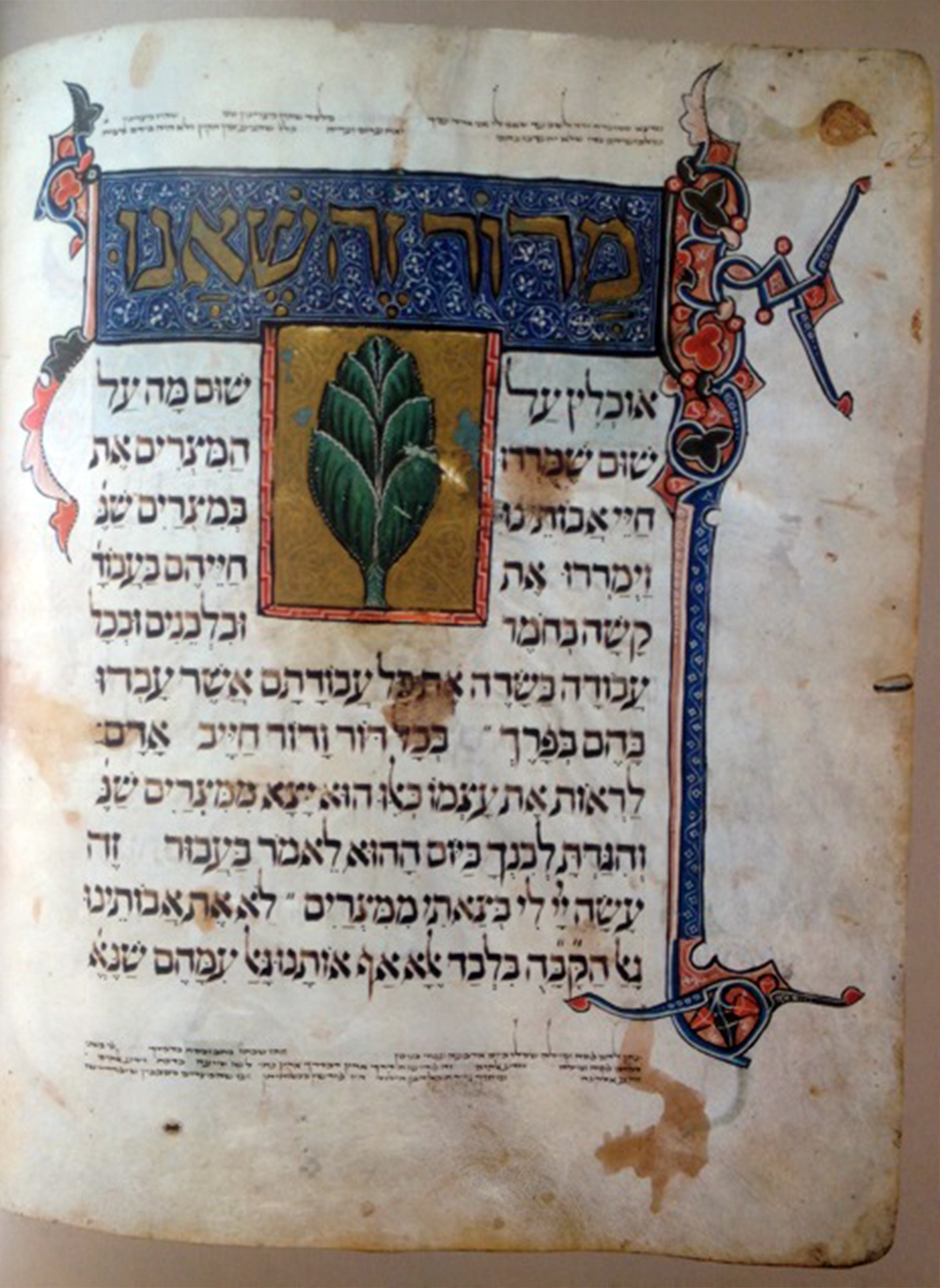
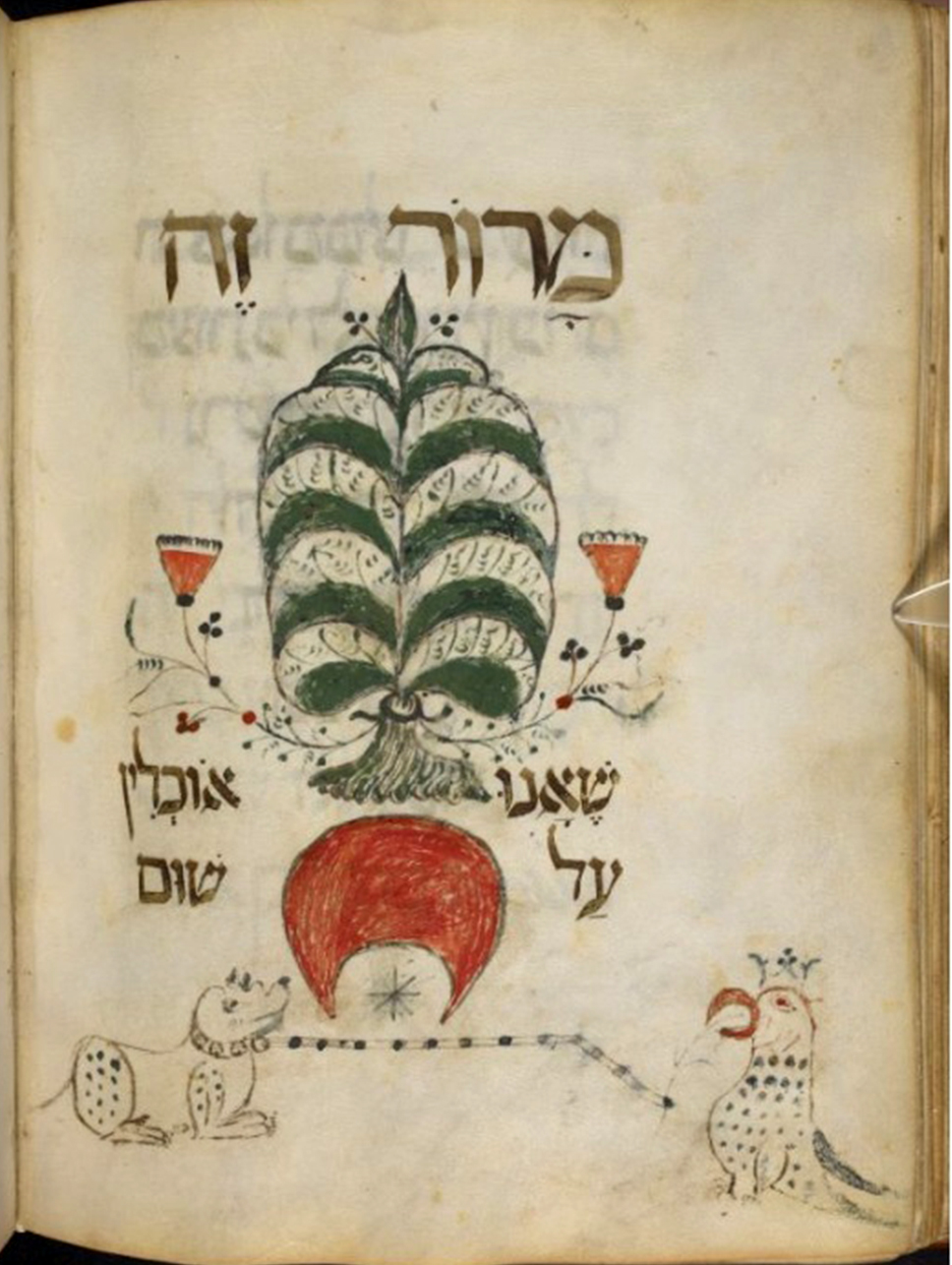
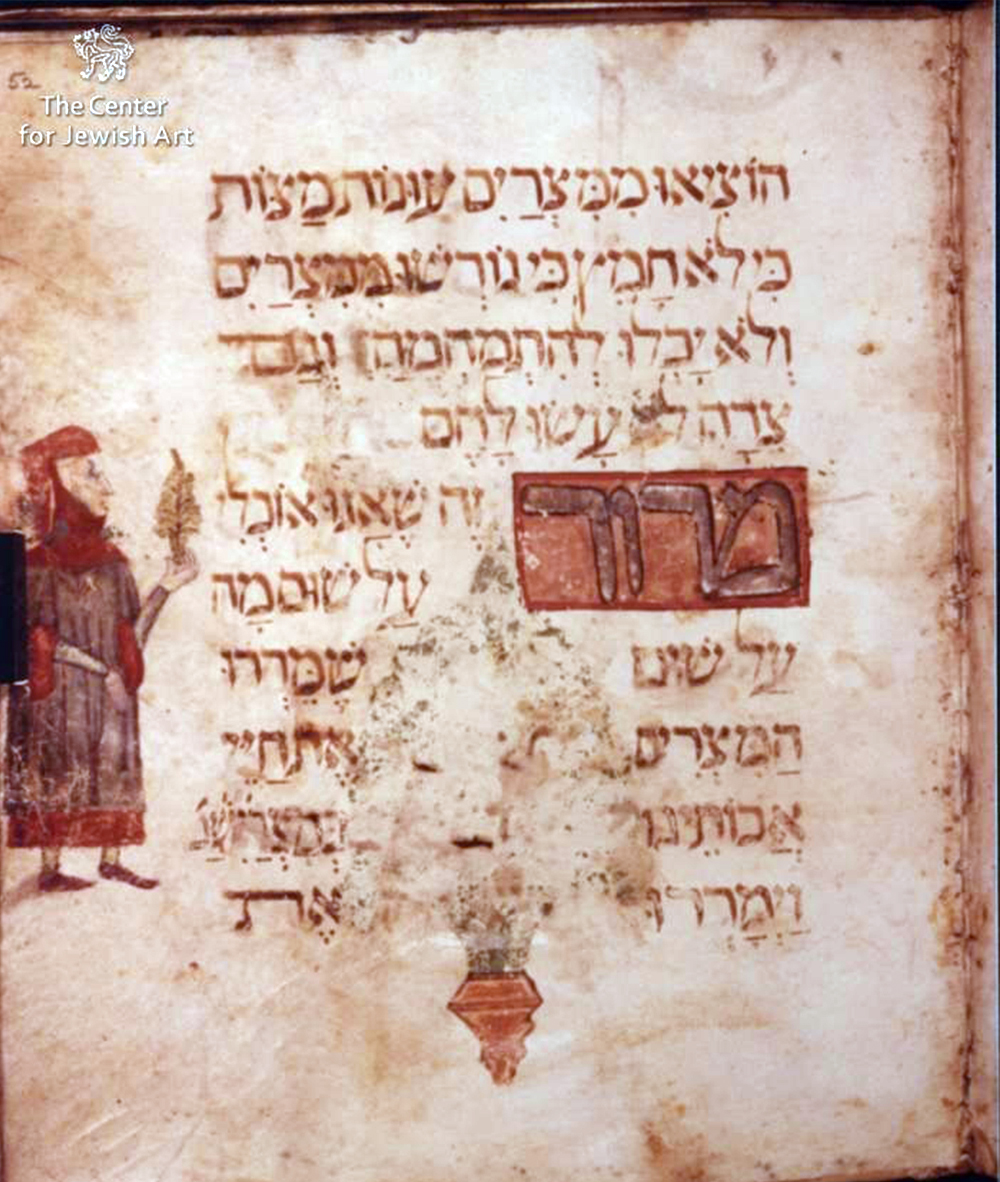
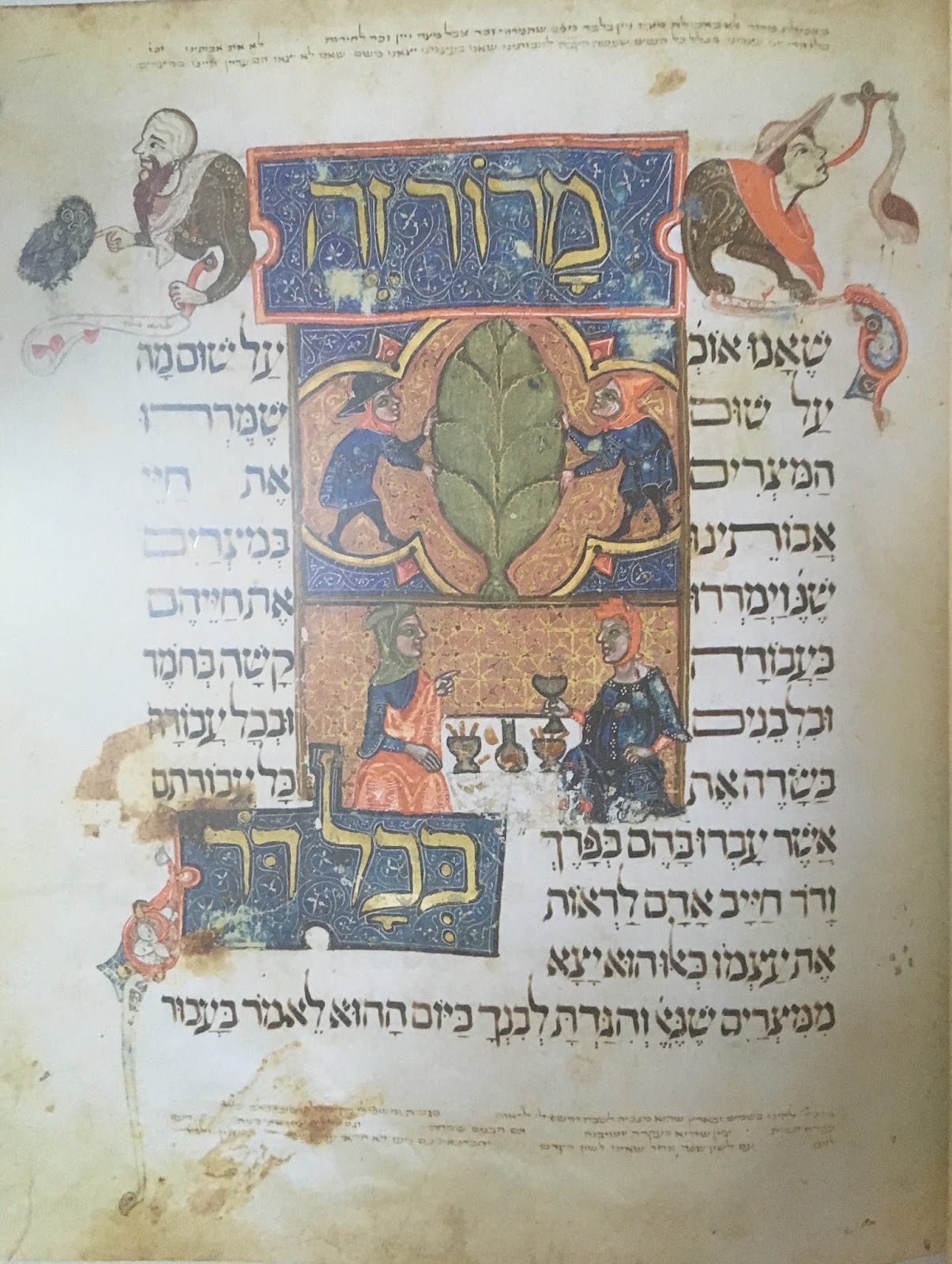
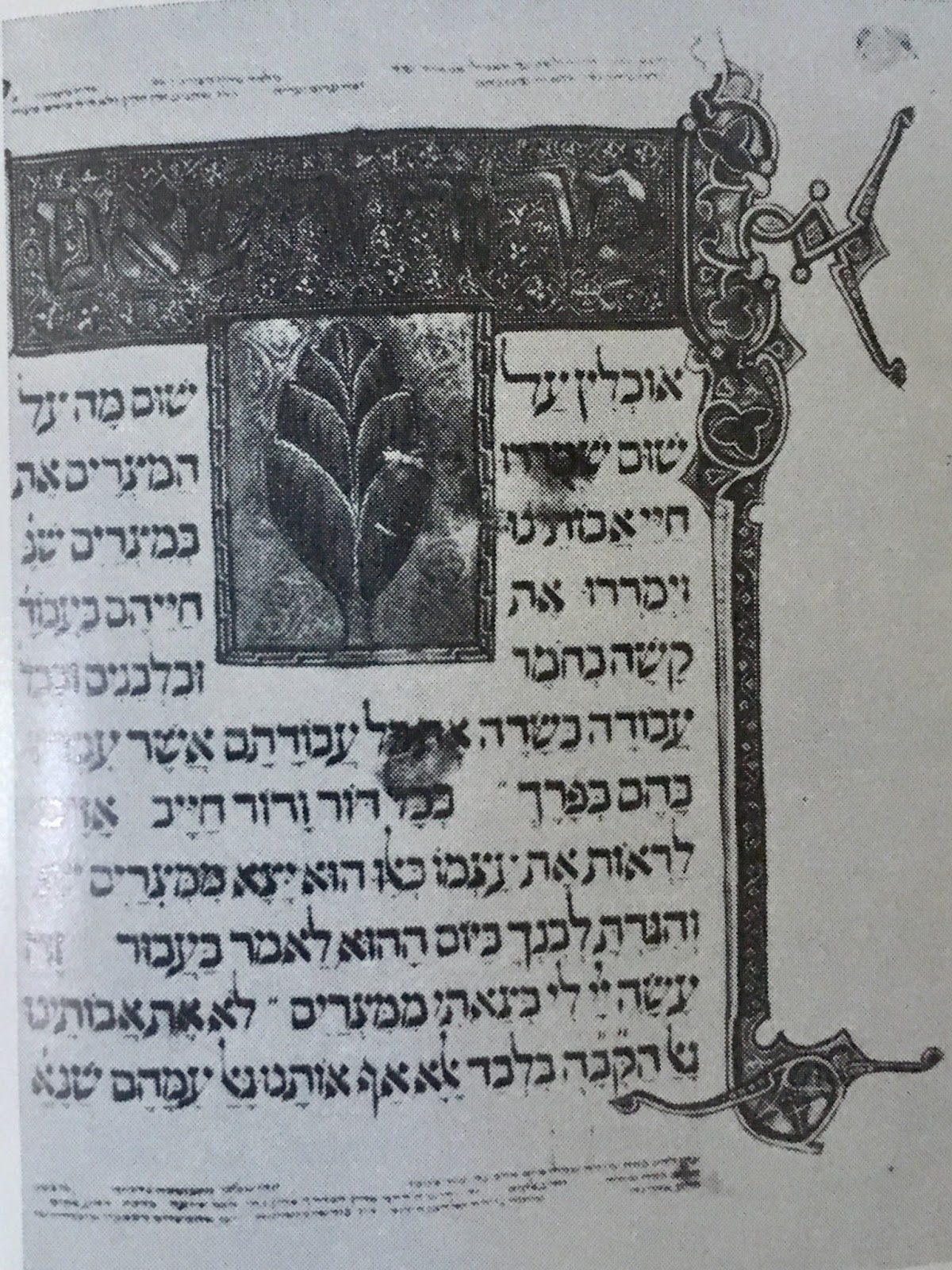
“Brother Haggadah”, BL Oriental 1404, f. 18
Here’s the story behind the scenes as it occurred in real time, during the Pessah season of 2012. I was scheduled to deliver a talk on chrayn at a rabbinic conference on the Hebrew language organized by Yitzhak Frank on April 10, Chol ha-Moed Pessah. In the course of some late preparatory research (= Googling) on April 5 (13 Nissan, the day of bedikat chametz) I came across a fascinating responsum on maror by David Golinkin that had just been published on April 2, 2012.  Struck by the reliance on visual evidence from illustrated manuscripts in establishing a medieval custom to consume artichokes as maror, I sent the post to Marc Michael Epstein of Vassar College for comment. Within an hour he replied:
I don’t believe the Sephardic mss show an artichoke, rather they depict an entire head of romaine lettuce. The way to prove or disprove this would be to compare contemporary or roughly contemporary botanical mss.
I immediately began “intensive research” (= more Googling) and discovered that the artichoke question was (probably first) posed by Yoel Finkelman and his parents in 2005. Significantly, they already collected the three examples cited by Golinkin: the RylandsBrother, and Sarajevo Haggadot. Finkelman states that his father circulated the query widely.
Rylands Haggadah, 1988 facsimile edition, f. 31v
The next day, April 6, Erev Pessah, I emailed Golinkin directly, requesting sources for his identifications. He replied on the same day that artichokes are definitely depicted in the three illuminated haggadot and that artichokes were probably identified as one of the five plant species mentioned in the Mishnah (Pesahim 2:6). Indeed, in Golinkin’s own post of April 2:
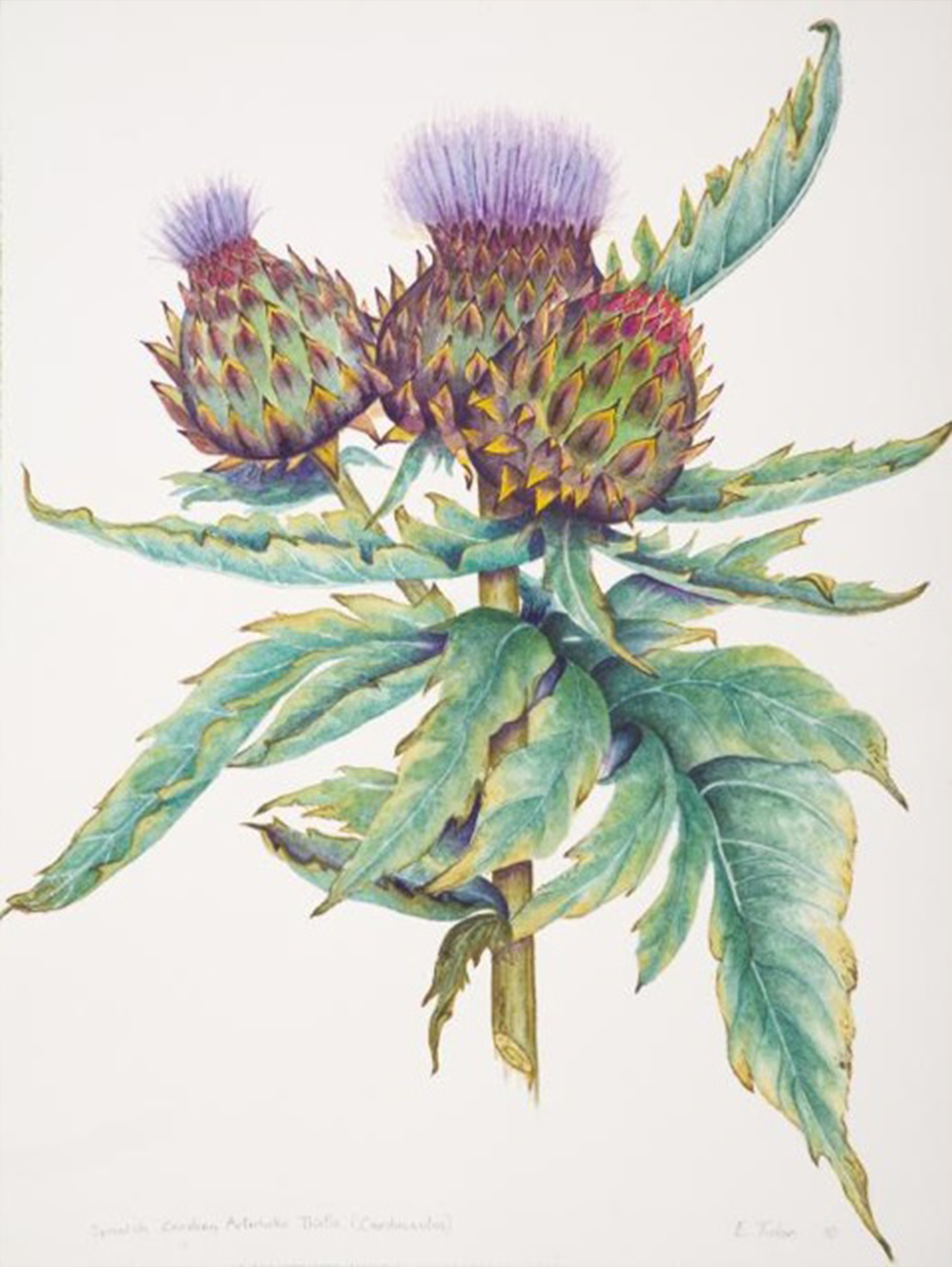
Rabbi Natan ben Yehiel of Rome (1035-ca. 1110) says in his Talmudic dictionary  (ed. Kohut, Vol. 8, p. 245) that tamkha is cardo, which is cardoon. Prof. Feliks says that this is carduus argentatus or silver thistle, while Dr. Schaffer says that it is cynara cardunculus or artichoke thistle.
Cardoon Artichoke Thistle. a painting by Elizabeth H Tudor
So, textual and visual evidence interlock to support the conclusion that artichokes were used as Maror. However, the textual evidence is weak. Sefer Ha’arukh is a dictionary, not a responsum, a legal code or a gloss to one, like Hagahot Maimoniyot which identifies tamkha as horseradish – chrayn, associated with an actual custom. The definition of Ha’arukh is not a singular, definitive identification  (yesh ‘omrimmarrobio, another species, also Rashi’s identification), and according to Prof. Jehudah Feliks cardo does not describe artichokes at all.
Opposite this scanty textual evidence stands a mountain of Rabbinic silence. As far as I am aware, nowhere in any codes, Haggadas, commentaries, or anywhere else do we find even a hint that artichokes were ever used as maror. There are limits to what can be learned ex silentio but we are discussing thousands of sources. If artichokes were used, we would expect a mention somewhere.
As for the visual information, we have “two witnesses and three witnesses”: The Rylands and Brother Haggadahs should be considered one witness because one is copied from the other. Bezalel Narkiss designated the name “The Brother Haggadah” (along with a lot of other names of Haggadah, most of which have stuck, for better or worse) because it is the “brother” copied from the Rylands Haggadah. According to Katrin Kogman-Appel, the Brother was more likely the original from which the Rylands was copied. For our purposes, the direction of the copying makes no difference. Just as the Rosh and Tur can’t really be counted as two legal authorities, these two sources are reflections of one another. What about the other witness, the Sarajevo Haggadah?
I do not think that there is even a remote possibility that the Sarajevo Haggadah depicts an artichoke:
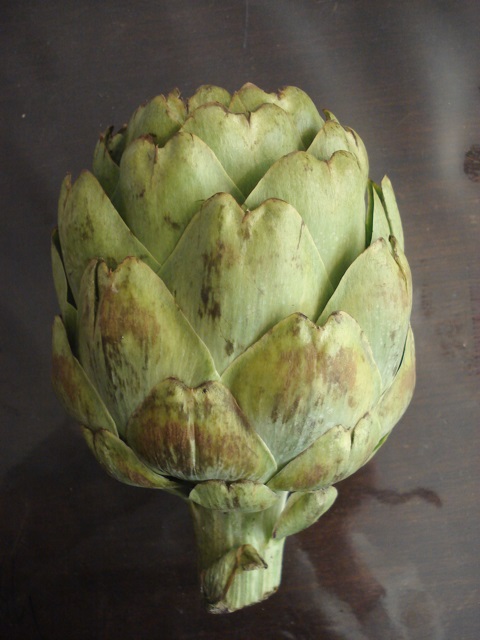
The leaves are ridged but all species of artichoke leaves are smooth save for the thorn in the middle. An artist whose intention was to depict artichokes would not draw them in this manner. Moreover, Epstein, (in personal correspondence) adds that the “artichoke” leaves are “veined” like lettuce leaves, and bound together with a cord at the base.
Israeli Artichoke, Photo: Leor Jacobi, April 20, 2012
The same day, April 6, Erev Pessah, I communicated my skepticism back to Golinkin, especially regarding the depiction in the Sarajevo Haggadah.  Golinkin’s April 2 post had already inspired creative contemporary midrash by April 9 (the truth of which in revealing hidden aspects of the divine plan should be judged independently of the historical claims.) Clearly these progressive folk placed artichokes on their seder plate on seder night, April 6 or 7, 2012, and were already expounding homiletically on the custom they had only learned about on April 2 at the earliest. Epstein notes that this an excellent example in “real time” of a minhag in development thanks to what he calls “the heter of the Internet.”
I gave the Chrayn talk on April 10 and the very next day, April 11, a long and fascinating Seforim blog post by Dan Rabinowitz was published, wherein, inter alia, he stated:
In the Brother to the Rylands Haggadah, marror is depicted as an artichoke, as is in the case with the Sarajevo Haggadah.
Golinkin wasn’t cited but it’s doubtful that his April 2 post is the source —  perhaps serendipity. After some discussion in the comments, Marc Epstein wrote:
Rabbosai (and Marasai): A manuscript is NOT a mirror. Jews depict themselves in their art (or commission art that depicts them) not as they were, but as they desired to be seen. Please please please do not engage in the typical Wissenschaft strategy of looking at illuminated manuscripts for “clues to Jewish life in the Middle Ages” or even to Jewish history. What we can learn from them is histoire des Mentalites, but even that takes a lot of work to get to.
Re: the “artichoke”: I don’t believe the Sephardic mss show an artichoke, rather they depict an entire head of romaine lettuce. The way to prove or disprove this would be to compare contemporary or roughly contemporary botanical mss. It may have been “misunderstood” by some illuminators as an artichoke, but not corrected by the recipients of the manuscript because if you are not looking for an artichoke it seems totally absurd that an artichoke would be used as maror, You don’t SEE an artichoke, but a head of Romaine lettuce, no matter how “artichoke-like” it seems to us in 5772.
Also, because a head of Romaine is SHOWN in the haggadah it doesn’t mean that there a head of (possible unchecked-for-bugs) Romaine on the table. Every image is not a snapshot, but a representation — a combination of the real, the general, the ideal and the symbolic. Showing the head is a way of REPRESENTING Romaine — it says, “We use a type of lettuce that grows with leaves together in a head like this.” It does NOT necessarily mean “We use complete heads of Romaine at the Seder, like this.” Do you see the difference? A representation must shorthand its descriptions for clarity: If you showed individual artichoke leaves, for instance, it would be difficult to ascertain that the plant was an artichoke. Artichoke leaves are shaped like baby spinach leaves, though baby spinach is more pliable. If a leaf of that shape was shown, what would distinguish the artichoke leaves? Showing an artichoke in its entire, thistly configuration makes it indisputable that it is an artichoke.
Epstein’s points are compelling. How does one portray lettuce in an illustration? For example, this modern lettuce clip-art isn’t much more lettuce-like than the illustration in the Brother Haggadah:
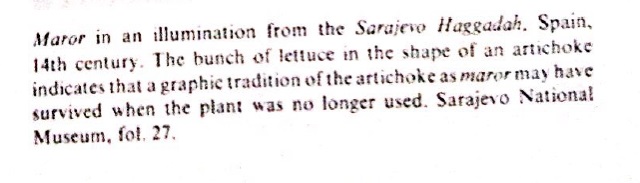
After Pessah, on April 22, I received an additional reply from Golinkin with more sources. The entry for maror in the first edition of Encyclopedia Judaica was written by Jehudah Feliks (pp. 1014-5). The entry includes an image of the maror depiction from the Sarajevo Haggadah with a caption:
According to this astounding caption, lettuce is depicted in the Sarajevo Haggadah but the claim is that it can still be supposed that the artichoke-like shape of the lettuce reflects an old custom of eating artichokes as maror. This custom had already been lost in the 14th century, but was preserved in the form of illustrations of maror in haggadot! (We find something similar in the illustrations of maror in the Prague Haggadah. According to Rav Peles, the custom of pointing at the wife when stating “this bitter[ness/Bitter Herb]” had already disappeared, but was preserved in the caption to themaror illustration in the Haggadah; see also here). However, note that above, in Golinkin’s post, Feliks did not identify the Arukh’s cardo as artichokes. It is not entirely clear that Feliks composed this caption. Bezalel Narkiss served as IIlustrations Consultant on the first edition (sadly most illustrations were cut from the second edition, including this one and the caption).
As Narkiss was then the acknowledged expert in medieval illuminated manuscripts, it stands to reason that he may have either selected the illustration or wrote the caption, either alone or in consultaion with Feliks. In any case, the author(s) of the caption maintain that lettuce is depicted even if the rest of their proposal is extremely speculative.
For the Rylands Haggadah, Golinkin cited the Raphael Loewe facsimile, Steimatzky, 1988: “The bitter herb is intended to be lettuce, despite its artichoke-like compactness.”  This pithy source contradicts Golinkin’s identification, and suggests a practical explanation for this lettuce design.
As for the Brother Haggadah, Golinkin wrote that he learned about this from an expert on Jewish art. However, as far as I can tell this expert does not deal primarily with interpretation of medieval art. Theories are tested by evidence. Thus, it remains that if someone wishes to argue that these images depict artichokes the best way to advance the thesis would be by means of comparisons with contemporary illustrations of artichokes, as Marc Epstein advises.
Finally, an image of maror from the Barcelona Haggadah, folio 62, illustrates how creative illustrations of lettuce (?) could get and how dangerous it would be to try to learn history from them as if they were snapshots.
Adapted from Evelyn Cohen’s description in the facsimile volume:
Verso, The scribe left almost the whole of the page for a depiction of the bitter herbs, but the crude illustration we now see was not executed in the Middle Ages, although it may have been based on models from the fourteenth century. The vegetable, commonly portrayed in a highly stylized manner, was no longer understandable to the later artist, and the red holder with which it is sometimes shown seems to have been misunderstood by the artist, who interpreted it as a red crescent.
The post-medieval illustrator here may have utilized haggadah depictions of artichoky lettuce as a model and was probably as bewildered by them as we are.  In note 39 Cohen lists the Hispano-Moresque, Graziano, Golden, and Sister Haggadas as displaying maror holders. The matzot in these haggadot look nothing like real matzot, with elaborate color and geometric designs. The entire maror holder could be a design element in this vein, so that the maror is grounded and not floating in space.
Graziano Haggadah
Sister Haggadah
‘Hispano-Moresque’ Haggadah
Golden Haggadah
Epstein adds (personal correspondence) that we should be wary of concluding on the basis of these images that Jews of Medieval Spain had actual red maror holders. They may have developed from an earlier model like the Golden Haggadah, which only meant to portray a reddish-yellow color which develops towards the base:
I certainly hope enterprising Judaica forgers, the creators of “Marrano cups” and such don’t get wind of this, or appraisers, experts and curators will have a whole new wave of fake “authentic” pre-Expulsion Sephardi ritual items to deal with. Indeed Romaine lettuce is most suitable for maror because it generates increasing bitterness the longer one chews the leaves, and the closer one gets to that all-important base. Romaine is appropriate for maror in metaphoric terms: like the servitude in Egypt, which started out as a “public works” project with the full participation even of Pharaoh, and ended up as the most abject of slavery, a torture inflicted exclusively upon the Israelites. When one first begins to chew the leaves Romaine lettuce, one could think one was eating a lovely salad. More chewing, and getting eventually to the lower “spine,” however, makes the experience increasingly bitter. The rabbis understood that unlike the consistent blast of heat one experiences with horseradish and other truly bitter plants, it is in the initially non-bitter, even pleasant, but then the increasing nature of the bitterness of Romaine that the precise metaphor for the Egyptian servitude is experienced.
It is notable that per Kogman Appel’s dating, the Golden Haggadah is earlier (c. 1320) than some of the examples brought above (c. 1350-), and may have served as their model in some sense, including the fact that whatever we are seeing, (whether the “veins” in a single lettuce leaf, or the ruffled leaves in the head when cut open and depicted laterally, like the Chinese cabbage shown below,) gives the leaf/leaves a  “spiky” appearance. (If there is a lateral view here, the question, of course, is why such a view was taken. Most authorities prefer whole Romaine leaves for maror, so a view “cutting through” the head might be confusing, although some advocate the consumption of only, or primarily the spines.)
The more I think about it, although links and distinctions have been made between the opening sequence of biblical narrative illuminations in the Golden, Sister and Sarajevo Haggadot and the Rylands/Brother Haggadot, the TEXT illustrations (matzahmaror etc.) may have more mutual influence and cross-influence, and relate also to those in the Barcelona Haggadah and others. Since the GH was earlier than the Sarajevo, Rylands/Brother Haggadot, the image of the maror there, clearly— though stylized—Romaine may have influenced, been misunderstood by the artists of the later ms. In other words, the veiny (or the lateral, or side-viewed, rippling) leaves of Romaine could have been mistaken for the “spiky” leaves of an artichoke and thus been illustrated. (The Sarajevo artist, for instance, depicted the “artichoke” leaves not only as serrated but with “veins” more typical of lettuce.)
The Sarajevo, Rylands/Brother ARTISTS  misunderstanding the [veined single lettuce leaf or laterally viewed or cut head of] lettuce in the Golden Haggadah or a similar model, might have thought they were illustrating an artichoke. The PATRONS did not “correct” this because OBVIOUSLY the vegetable could not have been an artichoke as there was no massoret of the use of that vegetable for maror. There for they accepted the “artichoke” of the artists as the “lettuce” of halakhah.
While we can never recover the actual conversation that precipitated the visual result, both consideration of the near-instantaneous creation via “the heter of the Internet” of the minhag of placing artichokes on the seder plate, and the spinning of homiletics around that minhag;  and the invention of the “maror holder”are reflections—within our present conversation!—of the kinds of transmission problems ever present in such conversations in any time or place. This whole adventure has, for me, been very important in thinking about artist-patron relationships.
Cohen adds an interesting point (personal correspondence):
I found other manuscripts where there was a blank space where the image of the maror should have been placed, while all the other areas left blank by the scribe contained illustrations. This lead me to believe that the appearance of the maror was sometimes customized based on the minhag of the patron, who for whatever reason never had it added.
These are fascinating questions. The goal of the artists was to produce art which resonated with their patrons symbolically and aesthetically. By misinterpreting these images as snapshots of historical reality, we can invent artichokes and maror holders. One could just as well conclude that it was customary to only sit on one side of the Seder table!
Fast forward to May, 2018, we find ourselves embroiled in a new artichoke controversy and the Seforim Blog is back with artichokes in the Haggadah. This is a fascinating little post on kashrut and custom, but nothing about ancient or medieval practices can be proven from these sources. A follow-up post based on textual sources by Susan Weingarten, an expert on foods in antiquity (and incidentally, the sister of Elihu Shanun, who also spoke at the rabbinic conference on April 10, 2012 which started us off) provides a much more reliable textual path towards establishing the antiquity of artichoke consumption.
In summary, there is no evidence that Jews ever ate artichokes to fulfill the obligation of consuming maror on the Passover Eve. Maybe b’shas hadahak, but who knows? The textual evidence and visual evidence don’t support each other to advance a radical historical claim. However, artichokes are delicious and, if clean, Kosher for Pessah. Jews very likely did consume them historically wherever they were found.
Thanks to: Marc Epstein, David Golinkin, Evelyn Cohen, Sara Offenberg, Moshe Glass, and Jean Guetta. I also wish to acknowledge the Memorial Foundation for Jewish Culture for their support.


The Not-So-Humble Artichoke in Ancient Jewish Sources

The
Not-So-Humble Artichoke in Ancient Jewish Sources
Susan
Weingarten

Susan
Weingarten is an archaeologist and food historian living in
Jerusalem. This is an adapted extract from her paper The
Rabbi and the Emperors: Artichokes and Cucumbers as Symbols of Status
in Talmudic Literature,’
in
When
West met East: the Encounter of Greece and Rome with the Jews,
Egyptians and Others: Studies presented to Ranon Katzoff on his 75th

Birthday.
Edited
by
D.
Schaps, U. Yiftach and D. Dueck.
(Trieste,
2016).

There
has been a lot of discussion of artichokes recently in the wake of
the ruling by the Israeli Rabbinate that they are not kosher. A
recent post on Seforim Blog traced their ancestry as a Jewish food
back to the 14th
century.
But we can go back further, to the talmudic literature, where
artichokes appear as qinras.
We
can identify many Greek (and fewer Latin) food-names in the Aramaic
and Hebrew of the written texts of the talmudic literature. The
rabbis sometimes use Greek terminology to explain food names. Thus,
for example, biblical regulations on agriculture include a ban on
growing two different kinds of crops together. Mishnah Kilayim
tells
us that thistles (qotzim)
are allowed in a vineyard, i.e. they are seen as wild growths, but
artichokes (qinras)
are not allowed, so that it is clear that artichokes are seen as
cultivated rather than wild growths.[1] Qotz,
the wild thistle, is a biblical Hebrew term, while the Aramaic qinras
appears
to be derived from the Greek for artichoke,
kinara

or
kynara.
Artichokes
were carefully cultivated in the Graeco-Roman world; presumably their
name came with the agricultural methods which turned wild thistles
into cultivated artichokes. It is still difficult to know whether the
artichoke proper is meant here, or rather the closely related
cardoon.[2] It is clear, however, that there were a number of edible
thistles which grew wild, and that the artichoke is a cultivated
variety. The medical writer Galen describes the artichoke as
‘overvalued.’[3] This was partly because of its negative health
properties, for he saw it as unwholesome, sometimes hard and woody,
with bitter juice. So he recommends boiling artichokes and adding
coriander if eating them with oil and garum;[4]
or frying them in a pan.
But
Galen’s objections to artichokes may not be merely medical. They
may also be an echo of the attitude we find in Pliny,[5] who tells us
that artichokes were exceptionally prized by the gourmets of Rome,
and that there was a roaring trade in them. Pliny disapproved:

‘There
still remains an extremely profitable article of trade which must be
mentioned, not without a feeling of shame. The fact is that it is
well-known that at Carthage, and particularly at Cordoba, crops of
carduos,
artichokes,
yield
a return of 6000 sesterces from small plots – since we turn even
the monstrosities of the earth to purposes of gluttony … they are
conserved in honey-vinegar with silphium and cumin, so that there
should be no day without thistles for dinner.[6]

Pliny,
writing in the first century, uses all the tricks of rhetoric to put
over his disapproval of this ridiculous fad of over-valuing
artichokes, and eating them out of season: note the alliteration and
assonance of carduos
with
Cartago and Corduba, which he presumably despised as far-away
provincial cities.[7] He is also indignant about the enormous prices
charged for them, satirising the rich who eat the artichokes as being
lower than the animals who despise them.[8] His diatribe does not
seem to have been generally successful. Artichokes were still clearly
prized in the Roman world of the third and fourth centuries: a mosaic
from the so-called ‘House of the Buffet Supper’ in Antioch shows
them on a silver tray as a first course for dinner.[9] And in a
Palestinian context, another mosaic with what look like two purplish
artichoke heads and a silver bowl, dated to the third century, has
been found recently in excavations of ancient Jerusalem – or rather
Aelia
Capitolina
.[10]
The
classical picture of artichokes as food for the rich and upper
classes is confirmed by the talmudic literature. For example, Midrash
Esther Rabbah, writes:

‘Bar
Yohania made a feast for the notables of Rome … What was missing?
Only the qinras
(=artichoke).’[11]

S.
Klein in his article ‘Bar-Yohannis from Sepphoris at Rome,’
suggested
that this may be the first reference to the famous Roman Jewish
artichoke dish carciofi
alla giudia
.[12]
(For a recipe see E. Servi Machlin The
Classic Cuisine of the Italian Jews

[NY,1981,
1993] p. 180-1). Unfortunately there is no proof to confirm Klein’s
charming suggestion, since, as we have seen, artichokes seem to have
been famously popular among the Roman pagan nobility.[3] One of the
reasons for the perceived desirability of artichokes as food may also
have been the effort needed to prepare them – an effort usually
only available to the rich through their slaves – the poor would
have had little time for this. But one time when the poorer Jews
would have had time would be on a festival, when ordinary work was
not allowed, but food-preparation was permitted, as it contributed to
the enjoyment of the festival. The Tosefta specifically states that
while cutting vegetables was generally not allowed on a festival (in
case people actually went and cut them down in the fields), trimming
artichokes and ‘akavit/‘aqubit,
a wild thorny plant, was allowed, as this was part of the preparation
needed for cooking these prickly vegetables, which was allowed on a
festival:

‘[On
a festival] they do not cut vegetables with shears but they do trim
the qinras,
artichoke,
and the‘akavit/‘aqubit.’[14]

Whether
poorer people actually ate artichokes as special festival food, or
rather only ate the wild ‘akavit/‘aqubit
is
unclear from this source. It is also unclear what the reason for
trimming was: to remove the thorny stems or to cut off the upper part
of the leaves and remove the inedible inner part known as the
‘choke’?
The
Babylonian Talmud records that artichokes were sent over long
distances to be eaten by Rabbi Judah haNasi. A rich man called Bonias
‘sent Rabbi a measure of artichokes from Nawsah, and Rabbi
estimated it at two hundred and seventeen eggs.’[15] The eggs here
are a measure of volume: clearly there were quite a lot of
artichokes. ‘Nawsah’ may refer to a settlement on an island in
the Euphrates River outside Babylonia.[16] It was a long way from
Galilee where Rabbi lived, and only the rich could afford to pay for
the transport of these luxuries. Some way of preserving the
artichokes, like keeping them in honey-vinegar as described by Pliny
above, must have been used.
Unlike
the classical sources, there is no moral condemnation here of
artichokes as symbols of conspicuous consumption, and tampering with
nature. The rabbis of the Talmudim are generally presented as
appreciative of good food, and as seeing feasting as desirable,
rather than to be condemned.[17] Eating good food, for example, is
one of the recommended ways of celebrating or ‘honouring’ Sabbath
and festival.[18] Indeed, Rabbi himself, when looking back
nostalgically to the time when the Temple still stood, represented
his longing for it in terms of desire for the wonderful foods that
would have been available in that now legendary time.[19]
How
did Rabbi eat his cucumbers and artichokes? Unfortunately the
talmudic literature does not tell us, but there are details in some
Roman authors which may give us some idea of the possibilities.
Athenaeus tells us artichokes must be well-seasoned, or they will be
inedible. The fourth-century Roman cookery book attributed to Apicius
recommends serving artichokes with liquamen
and
oil, and either chopped boiled egg; or cumin and pepper; or pounded
green herbs with pepper and honey.[20] We have already cited Rabbi’s
contemporary, the medical writer Galen, who visited Syria and other
parts of the Near East. He sometimes describes methods of cooking
similar to those found in the talmudic literature.[21] We saw that
Galen recommends eating artichokes boiled with the addition of
coriander, garum
and
oil. He also mentions frying them. Was this the origin of carciofi
alla giudia
?

[1]
Mishnah Kilayim v 8.
[2]
The identification of the Latin term cardui
with
artichokes, rather than cardoons, has recently been questioned:C.A.
Wright ‘Did the ancients know the artichoke?’
Gastronomica
9/4
(2009) 21-27.
[3]
Galen On
the powers of foods
ii.
[4]
Garum
was
the famous Graeco-Roman salty fermented fish-sauce, called liquamen
by
Apicius, used widely as a condiment. R.I. Curtis Garum
and salsamenta: production and commerce in materia medica
(Leiden,
1991); M. Grant Roman
Cookery

(London,
1999); S. Grainger, C.Grocock Apicius:
a critical edition
,
(Totnes, 2006)373-387:
Appendix
4: Excursus on garum and liquamen
.
It is found in the talmudic literature under the name of muries:
S. Weingarten ‘Mouldy bread and rotten fish: delicacies in the
ancient world,’ Food
and History

3
(2005) 61-72. Sauces combined with garum are mentioned in eg Tos
Betsah ii, 16 and in BTYoma76a, but it is not clear that Babylonian
Jews were using this term to mean the same foodstuffs as were used by
the Jews of the Land of Israel.
[5]
Pliny : NH
19,
152f.
[6]
Pliny NH
19,
152-3: certum
est quippe carduos apud Carthaginem magnam Cordubamque praecipue
sestertium sena milia e parvis redderareis, quoniam portent quoque
terrarium in ganeam vertimus, serimusque etiam ea quae refugiunt
cunctae quadrupedes …condiuntur quoque aceto melle diluto addita
laseris radice et cumino, ne quis dies sine carduo sit.
[7]
On Pliny’s distrust of the ‘foreign’ taking over the Roman, an
old Roman literary trope, see T. Murphy Pliny
the Elder’s
Natural
History:
the empire in the encyclopedia
(Oxford,
2004) 68ff.
[8]
On Pliny’s hostility to luxury, a traditional theme of Latin
poetry: Murphy (above n.35) 71. See also M. Beagon Roman
Nature: the thought of Pliny the Elder

(Oxford,
1992)  190: ‘moral condemnation of luxuria
is
more than a commonplace to Pliny.’
[9]
F. Cimok (ed.) Antioch
Mosaics

 (Istanbul,
1995) 44-47.
[10]
The mosaic was excavated by Shlomit Wexler-Bdollach and has been
published by Rina Talgam Mosaics
of Faith
(Jerusalem/Pennsylvania,
2014) p. 48 fig 70. I am grateful to both for allowing me to see
their pictures and text prior to publication.
[11]
The question of whether the midrash is to be seen as referring to a
Persian situation is beyond the scope of this paper.
[12]
BJPES
7
(1940) 47-51 (in Hebrew)
[13]
See also
I.
Löw Die
Flora
der Juden

vol
I, (Wien, 1924, repr Hildesheim, 1967) p.409.
[14]
Tosefta Beitzah [Yom Tov] iii,19 and cf BTBeitzah 34a. ‘Akavit/
‘aqubit

has
been identified with tumbleweed, Gundelia
Tourneforti
,
which is a wild edible thistle still eaten in Galilee and Lebanon,
and known by its Arabic name, ‘aqub.
See
A. Shmida Mapa’s
dictionary of plants and flowers in Israel
(Tel
Aviv, 2005, in Hebrew) 236; A. Helou ‘An edible wild thistle from
the Lebanese mountains’ in Susan Friedman (ed.) Vegetables:
proceedings of the Oxford Symposium on Food and Cookery 2008
(Totnes,
2009) 83-4. ‘Aqub
can
still be bought in the present-day market in Tiberias in the spring,
its price depending on whether the vendor has removed the thorns or
left that pleasure to the buyer. Its taste when cooked is not unlike
artichoke.  
[15]
BT Eruvin 83a (my translation).
[16]
For the identification of Nawsah see A. Oppenheimer, Babylonia
Judaica in the Talmudic Period

(Wiesbaden,
1983) pp.266-7.
[17]
This point about the generally positive attitude of the rabbis (in
this case the Babylonian rabbis) to the good things in life is made
by I.M. Gafni The
Jews of Babylonia in the talmudic era: a social and cultural history

(Jerusalem,
1990) 130 citing M. Beer Amoraei
Bavel  – peraqim be-hayei ha-kalkalah

(Ramat
Gan תשל”ה
).
But having made his point, Gafni hedges here, warning against taking
a series of anecdotes from different periods as evidence. However, we
should note that this picture is consistent over both Palestinian and
Babylonian sources, and if we compare it to, say, the attitudes of
early Christian writers or Philo, we see that this trend is absent
there. See my paper ‘Magiros,
nahtom
and
women at home: cooks in the Talmud’ Journal
of Jewish Studies
56
(2005)
285-297.
[18]
For a discussion of the rabbinical requirement in both  Bavli
and Yerushalmi to honour the Sabbath by eating good food, see S.J.D.
Cohen,’Dancing, clapping, meditating: Jewish and Christian observance
of the Sabbath in pseudo-Ignatius’ in B. Isaac, Y. Shahar (eds)
Judaea-Palaestina,
Babylon and Rome: Jews in Antiquity

(Tübingen,
2012) 33-38.
[19]
Midrash Lamentations Rabbah iii, 6/17.  
[20]
Apicius
3.6.
[21]
See e.g.  S. Weingarten ‘Eggs in the Talmud’ in R. Hosking
(ed.) Eggs
in Cookery: Proceedings of the Oxford Symposium on Food and Cookery,
2006

(Totnes,
2007) 274-276.


The Humble Artichoke

The New York Times recently discussed a novel ruling of the Israeli Chief Rabbinate.  The Rabbanut held that artichokes fall into the category of prohibited foods.  This is not because they are listed as such in the Torah. Rather the expansion of the biblical category is because of a secondary concern, the presence of insects.  Those insects may reside in the heart which without opening the tight leaves that comprise the vegetable one is unable to determine if insects are present, thus, eating artichokes whole risks also ingesting insects.

Jews in Italy, however, took issue with this ruling. They pointed to a long-standing tradition of eating artichokes whole after deep frying.  That tradition places the creation of the dish sometime in the 16th century in the Jewish ghetto in Rome. Indeed, their preparation is so intertwined with Jews, in Italian it is called Jewish-style artichoke—Carciofo alla giudia.  Today many travel books include this delicacy among those to try in Italy listing various kosher restaurants that offer the Jewish Artichoke.  The Rabbi of Rome refused to reform the practice of Italian Jews and continues to eat and provide his hechsher to restaurants which serve this vegetable prepared in the traditional manner.[1]  

The history of how the fried artichoke became associated with Jews is somewhat murky but likely dates at least to the 16th century.  But we have even earlier manuscript evidence that artichokes were eaten by Jews.  Indeed they were eaten at a time when Jews were especially punctilious regarding food, Pesach.  A number of medieval haggadot contain illustrations of marror, most include a leafy green of some type.  Two haggadot, the Rylands and the Brother, composed in the mid/late-14th century depict marror as an artichoke. [2]  

[1] Regarding the autonomy of the local rabbinate see Teshuvot haRosh, Klal 21, 8-4, 9-2, and generally the sources collected in HaMahkloket beHalakha,  Hanina Ben-Menahem, Neil Hecht, Shai Wosner, eds., vol. 2 (Boston:  Institute of Jewish Law Boston University School of Law, 1993), 753-820. 
Students of history will recall that this is not the first time that the norms and traditions of the Italian Jews came into conflict with the different prevailing norms among other groups of Jews. In the controversy engendered by the publication of the pamphlet Divrei Shalom ve-Emet by Naftali Herz Wessely in the aftermath of Emperor Joseph II’s Edict of Toleration, which called for educational reform among his Central European subjects. After his pamphlet was found objectionable and insulting by leading rabbis, Wessely wrote to rabbis in Italy, believing that many of the ideas he was advocating, like a graded curriculum, a non-exclusive emphasis on Talmud, and use of the general vernacular, were well within the norms of their tradition. In fact, with the exception of only one of the Italian rabbis, R. Ishmael Ha-kohen of Modena, all the others agreed and supported him and helped the controversy die out. These aspects of the Wessely affair are discussed in Lois C. Dubin, “Trieste and Berlin: The Italian Role in the Cultural Politics of the Haskalah,” chapter 8 in Jacob Kats, ed., “Towards Modernity: the European Jewish Model” (New York, 1987) and the series of articles by Yisrael Natan Heschel in Kovetz Beit Aharon ve-Yisrael 8 (1993) titled “דעתם של גדולי הדור במלחמתם נגד המשכיל נפתלי הירץ וויזל.”
[2] The Rylands Haggadah manuscript is discussed in Katrin Kogman-Appel, Illuminated Haggadot from Medieval Spain: Biblical Imagery and the Passover Holiday (University Park:  Penn State University Press, 2006) 91-97.  The Brother manuscript has recently been reprinted in full with an excellent introduction by Marc Michael Epstein in addition to other relevant articles.  The Brother Haggadah:  A Medieval Sephardi Masterpiece in Facsimile (New York:  Thames and Hudson, 2016).  For a discussion of the identification of marror see Zohar Amar, Merrorim: Hameshet Minei haMarror sheAdam Yotseh Bahem Yedei Hovato bePesach (Modiin [], 2008).