1

Eliyahu Drinking from the Cup

I hope to have a few posts in the coming days discussing some of the artwork found in various haggdah. While for hundreds of years artwork played an integral part of the haggadah recently this has fell into disuse. While there are few notable exceptions to this, Raskin, Moss Haggadahs, this practice of richly illustrating the haggdah has been replaced with a focus on commentaries.

One of the reasons, however, the practice of illustrating the haggadah, can be found in the discussion which sheds light on the custom of pretending or assuming that Eliyahu, who according to legend, visits each home on Pesach night.

The last cup of wine poured is for Eliyahu. While originally this cup was not necessarily connected to Eliyahu, today it has become associated with him. The cup of Eliyahu is not mentioned until the 15th century. Various reasons are given. The Gra explains as there is a controversy whether one must drink 4 or 5 cups, a controversy which will be resolved only when Eliyahu comes. (Divrei Eliyahu, Parshat Va’arah p. 35). The earliest source to discuss the cup, R. Zeligman Benga (student of Mahril), says that the custom to pour a cup for Eliyahu is as the night of Passover is an auspicious night for redemption, we await Eliyahu’s coming and therefore we need a cup for him.

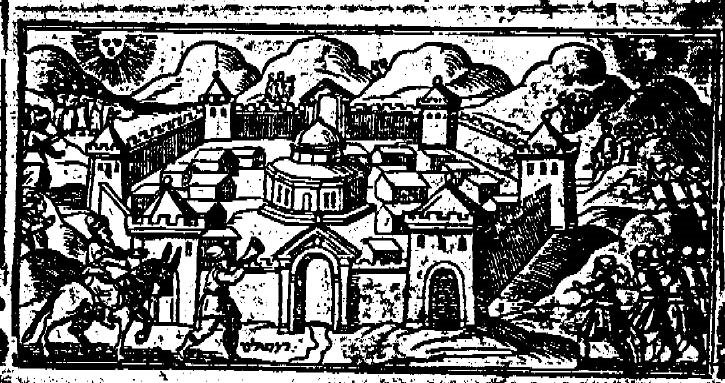
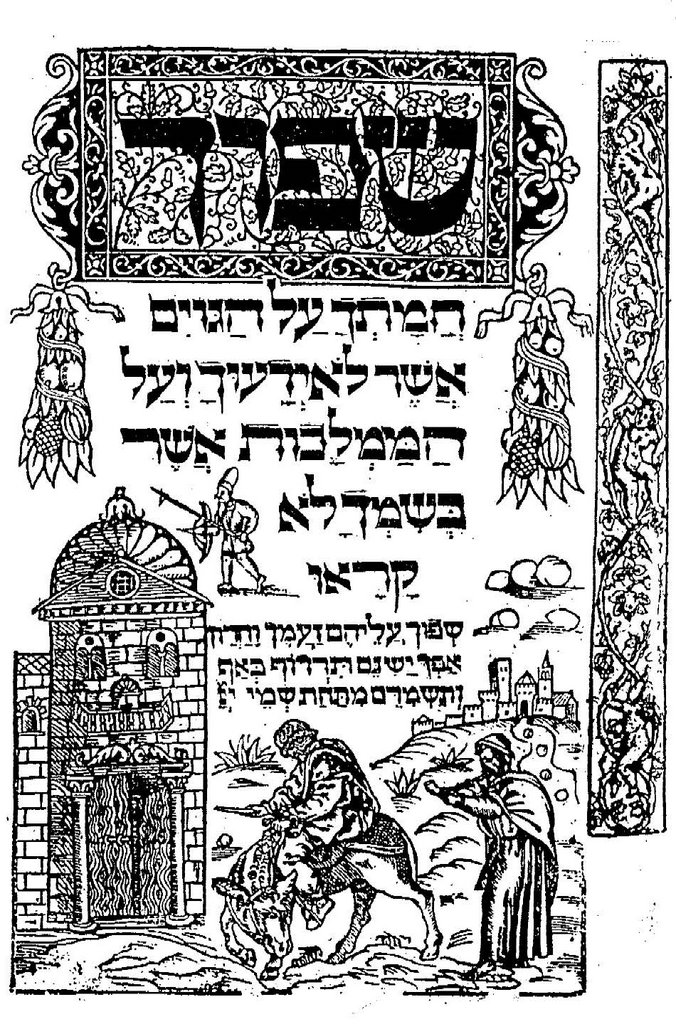
A rather interesting custom sprang up in connection with Eliyahu’s visit on Pesach night. R. Jousep Schammes (1604-1678), records that the custom in Worms was to draw depictions of Eliyahu and the Messiah in order to bring to life the belief in these figures. As you can see from the pictures on the side, this was common in the Haggadah. The first picture is a depiction of Messiah on his donkey. This was originally depicted in smaller format in the Prague 1526 haggadah, but in this edition, Mantua, 1560 is greatly enlarged. The second picture comes from the Venice 1629 hagaddah. As you can see it is again the Messiah coming in to Jerusalem, but note the prominence of the Dome of the Rock in the center.

In Frankfort they went one step further than just drawing Eliyahu and the Messiah. R. Yosef Jousep Hahn (1570-1637) says they used to hang a dummy who looked like Eliyahu or the Messiah behind the door. When they would open the door for Eliyahu the dummy would drop down and seem as if he had appeared. (He then goes on to record a long story of a dybuk who invaded the body of a women who questioned whether the Exodus happened.) It is worthwhile noting that not everyone was thrilled with these depictions. R. Yair Hayyim Bacharach (1639-1702) who became the Rabbi in Worms at the very end of his life, says these types of things only make a mockery of the seder.

However, we see from the above, that there was, at least among some, an effort to create a feeling that Eliyahu actually would visit the seder. Some did it through pictures, others through reenactments. Although today those have fallen to the wayside, it would seem the idea that Eliyahu actually drinks from the cup is a form of those methods.

Sources: Yerusalmi, Haggadah and History; Shmuel and Zev Safrai, Haggadah of the Sages, p 177-78. Minhagei Vermisai, p. פז; R. Y. Bacharach, Mekor Hayyim.


Review of Where there’s Life there’s Life

Rabbi David Feldman, who is well known for his book on issues relating to Jewish law and the beginning of life (abortion, birth control etc.), has now published via Yashar Books, a book on end of life issues and Jewish law. This book covers such topics as reproductive technology, stem cells, organ transplants, suicide, and determining death. Although it covers such weighty topics it is a rather easy read. Rabbi Feldman eschews highly technical discussion and instead has opened the book for everyone. Each topic gets about ten pages of treatment and Rabbi Feldman lays out the basic principles underlying each of these issues.

He begins with an extensive introduction on pikuach nefesh which much of the subsequent discussions are premised upon. The book is a little over 130 pages, which means none of the topics are treated in great depth. However, as Rabbi Feldman states in the introduction his purpose was not to provide a comprehensive book on the topic, rather to give some general guidance on this hot button issues. In this area he succeeds. He does provide a very basic introduction to the topics and does provide some of the key sources. Consequently, one who reads this book will have the basics to further investigate these issues.

However, with this approach there are some significant draw backs. Rabbi Feldman, while stating what he feels the commentaries say, does not provide sources for these. He give almost no citations to any source he quotes (there are two exception to this, once he gives a citation to R. Feinstein’s responsum and once he gives a cite to a responsum from R. Moshe Sofer). For example, when discussing organ transplants he tells us the key responsum is from R. Yechezkel Landau (Noda Biyehudah) where he holds when the organ donor is “in front of us.” That is, on a simple level, one can only do a transplant when one has a ready person to accept the organ. Rabbi Feldman then goes on to discuss others who have applied this statement all without ever providing where R. Landau said it, nor where the subsequent discussion can be found. This seriously hampers any follow up a reader wishes to do or for that matter, to ensure Rabbi Feldman’s reading is the correct reading.

To be fair, Rabbi Feldman does offer that is one contacts him via email he will provide citations and additional sources, however, his email doesn’t appear anywhere in the book. Assuming these citations were omitted to enable easier reading, why they could not be included on a page or two at the end I do not understand. Instead, we are left to blindly trust Rabbi Feldman in his assessment of the sources.

Further, Rabbi Feldman is far from the first to write on these topics. Instead, a simple search of RAMBI one can see there are numerous articles on all of these topics, none of these are provided. While Rabbi Feldman is not obligated to cite the works of others, it is difficult to understand Rabbi Feldman’s claim that “the need to address [these issues] is both urgent and constant,” as these very issues have been already comprehensively discussed by many, many others.

Additionally, as I mentioned previously, this book does provide an excellent starting point for these discussions. We are bombarded with many who claim to know what the Bible says for these important topics, but most are blissfully unaware of what the Bible and more specifically Jewish law says and has said about these topics, this cures that. But, it is hard to say it will facilitate further discussion when one doesn’t know where to go next.

In the end, this book, in a clear and straightforward manner, if a bit curt, which provides the groundwork for understanding extremely important issues regarding the end of life and new technologies relating that implicate life and death.


Purim, Mixed Dancing and Kill Joys

Although the Megilah only lists mishloch monot, matnot l’evyonim, and reading the Megilah as the customs on Purim, many others have become accepted. Most are of the ilk of boofunery or merrymaking. From making noise to drinking in excess, all have become part of the Purim landscape. With these, however, there are some lesser known customs. What is perhaps of interest is that it seems that there are those authorities that permit much if not all of these types of customs, there are others who seem set on shutting down much of the Purim fun.

For instance, the Rabbi Judah of Minz permits cross-dressing on Purim. This is so, even though this runs counter to a law in the Torah prohibiting these actions. What is lesser know, is that R. Minz also permits mixed dancing on Purim as well. In the Taknot of Padua it says “we decree that no one is permitted to dance with a married woman, no man with any married woman, with the exception of Purim.” (emphasis added).

Rabbi Yehuda Herzl Henkin in his Beni Banim vol. 1 no. 37 (5), links the two statements of R. Minz. R. Henkin says, just as R. Minz permitted cross-dressing as it was done for the joy of Purim, he permitted the mixed dancing under the same rational. That is, the dancing was just an outgrowth of the joy and not for licetnioius purposes.

Or, in the Customs of Worms, they not only celebrated Purim on the day, on the Shabbat after Purim they celebrated with similar merrymaking. Including, after the Friday night prayers all the people would first go to the Rabbi for a blessing, and then proceed to the women’s section where the Rabbi’s wife “would place her hands on their heads and bless them.” Additionally, R. Hayim Yosef Azulai in his travelogue, Ma’agel Tov, records that the Jews in Amsterdam would party all night long on the Friday night after Purim.

Although R. Minz was a proponent of happiness and its outgrowth on Purim, there were others that did not view Purim in the same vein. Rather, they seem bent on outlawing as much as possible even on Purim.

For instance, R. Samuel Aboab takes issue with at least two such Purim customs. First, he says in his Sefer Zikhronot, an ethical work and published anonymously, that he was befuddled his entire life how R. Minz and in turn R. Moshe Isserles in his Rama could allow for cross dressing on Purim. He spends at least four pages to demonstrating why this is incorrect. He states even if R. Minz is correct he should have kept that to himself. This is not his only negative opinion regarding Purim. In his responsa, Devar Shmuel, he says it is absolutely prohibited to read or even own the parody Mesachat Purim. He says any such copies should be destroyed.

Another person who looked with askance on the merry making was R. David ben Shmuel haLevi (Taz). He first follows the ruling of his father-in-law, R. Joel Sirkas (Bach), that cross-dressing is prohibited. R. Levi then also states in the law of Tisha B’av, that the prohibition of filling ones mouth with joy, is applicable even at at wedding and even on Purim.

So it seems that just as in society at large there are those who dislike the merrymaking on Purim, this is reflected in the Halakhic authorities as well. And conversely, there are those that viewed the merrymaking as a positive thing and therefore permitted many other things in connection with that merrymaking.


Is Tu-beshevat a Sabbatian Holiday?

There are those who claim the custom to celebrate Tu-beshevat as a holiday is based upon the book Hemdat Yamim. This book, according to many, was either written by Nathan of Gaza (Shabbati Zvi’s “prophet”) or one of follower of Shabbati Zvi. (This is contrary to the assertion in the Philogos that Nathan is not author, a contention which has little to no source). In Ha’aretz, an article appeared with this contention, namely the source for the Tu-beshevat custom is Sabbatian or as the headline reads “The New Year for the Trees, Isn’t is Shabbati Zvi.”

However, a closer look at the history reveals, that although some of the customs on Tu-beshevat can be traced to Hemdat Yamim the actual celebration dates much earlier. Avraham Ya’ari, the noted bibliographer, in an article traced the history of Tu-beshevat. He explains that much of the early mentions of Tu-beshevat were only in the negative, i.e. one can’t fast or say tachanun. Obviously, the first mention is in the Mishna in Rosh Hashana which states, according to Bet Hillel, Tu-beshevat is the new year for trees. The new year does not conotate a New Years like celebration, instead, this only has implications for questions of tithing. One can’t tithe fruits from one year using a different years fruits. Thus the 15th of Shevat is the cut off point.

Ya’ari, however, notes the first mention in connection to a celbration or the like is in the 16th century. Specifically, R. Issachar ibn Susan (c. 1510-1580) in Ibur Shanim, published in 1578 (the book was published earlier, in 1564, this was done without the knowledge or R. Issachar and according to R. Issachar, with numerous errors) he mentions “the Ashkenazim have the custom [on Tu-beshevat] to eat many fruits in honor of the day.” Mention of this custom also appeared in a Jedeo-German Minhagim book first published in 1590. “The custom is to eat many fruits as it is the New Year of the trees.”

In the community of Worms there was a rather interesting permentation of the custom. As R. Jousep Schammes in his Minhagim de Kehilah Kedosha Vermaysa, states:

On Purim and the 15 of Av and Shevat these were vacation days for the Rabbis, especially the 15ht and the 33rd day of the Omer for the students and their teachers. On these days the students did not go to school nor did the teachers go in. The teachers were required to distribute to the students as they left that morning, on the 15th and the 33rd day of the Omer whiskey and sweet cake from the teachers’ own pocket, they should not charge the students, this is the custom.


He repeats this in his comments to the 15th of Shevat. “One doesn’t say tehina even during the morning prayer. It is a vacation day for the students and the teachers, especailly the younger students, it is a holiday for the teachers. The custom is for the teachers to distribute whiskey to the students and make merry with them.”

While we have shown there was a custom for those Ashkenazim to celebrate Tu-beshevat, amongst the Sefardim, it is correct the source is Hemdat Yamim. Hemdat Yamim, first published in 1732 anonymously has the entire seder for Tu-beshevat. This includes passages from the Bible as well as specific foods. This in turn was popularized to a greater degree when it was included in the book Pri Etz Hadar first published in 1753 and republished an additional 29 times by 1959. This book included the entire Hemdat Yamim service.

So at the end of the day, although some of the customs of Tu-beshvat may come from the Hemdat Yamim he clearly is not the only or the first source for celebrating Tu-beshevat.

For more on the Hemdat Yamim, a controversy that has recently been stirred up again with the republication by R. Moshe Tzuriel of the Hemdat Yamim with an extensive introduction. Additionally, Ya’ari has a book Talmuot Sefer which his conclusion has been disproven by Tishbi in his Nitvi Emunah U’Minut. R. Tzuriel’s publication engendered the publication of a small pamphelet Hemdat Yosef as well as a bunch of articles in the journal Hechal HaBeshet. Rabbi Dr. Leiman in his latest article in Ohr haMizrach has a footnote with all the citations. [R. Dr. Leiman’s article collects all of R. Y. Eybeschit’s and R. Y. Emden’s approbations].

Also, anyone can get a copy of Hemdat Yamim. There are two places on the web where it is available free. The first is at the Jewish National Libraries site for rare books online here. For this one you need to download their viewer. Or at SeforimOnline.org (which for some reason is not online as I write this). Who has it in PDF format?

Additionally, Ya’ari has an article on the piyutim for Tu-beshevat here.


Chanukah Customs and sources

While the only mandated mitzvot for Chanukah consist of lighting candles and saying the full hallel, there are numerous other customs that have come to be associated with Chanukah.

The custom to play driedel on Chanukah is steeped in mystical allusions. From the letters which appear on the driedel to the way the driedel spins, people have offered explanations to link this to Chanukah. The Beni Yisscar, R. Tzvi Elimelch says that the reason the dreidel is spun from the top and the gragger on Purim is turned from the bottom has to do with how each holiday’s miracles were effected. On Chanukah the miracle came from above, directly from God. However, on Purim, the miracles were directly brought about by the actions of Ester, Mordechi and the Jewish people. Thus, the dreidel is spun from the top showing the miracle came from above, and the gragger from the bottom showing the miracle came from below. Others explain the symbolism of the letters that appear on the dreidel, נ, ג, ה, ש. According to one explanation these hint to the mitzvot that we have on Chanukah, נרות שמונה (candles all eight nights) and הלל גמר (the complete hallel). Others note the gematria (numerical value) of the letters which correspond to the same gematria as משיח (the Messiah). Others still, link the letters with גשנה the city Yosef secured for his family in Egypt.

According to at least one source, the custom of playing dreidel was actually started in the time of the Maccabis. They say that in an effort to circumvent the Greek decree against studying the Torah, children and their teacher would have a dreidel handy to start playing in case the Greeks came upon them studying the Torah. They would claim they were not studying instead they were just playing dreidel.

Despite all of these explanations, in truth, dreidel is not Jewish in origin. Rather, driedel is really the rather old game of teetotum. Teetotum, which uses a top with four sides and four letters is one and the same with dreidel. The letters that appear on the dreidel are really just the Hebrew letters that appear on a German or Yiddish teetotum, G, H, N, S. G= ganz (all), H halb (half), N nischt (nothing) and S schict (put). Teetotum dates back to at least the 16th century long before we have any Jewish allusions to dreidel(it was originally totum or top, but became TEEtotum due to the use of T for take all, on the top). The well-known depiction of children’s games done by Brueghel in 16th century includes Teetotum(see here and here for the complete painting). The earliest Jewish mention of dreidel or the significance of it dates to the late 18th century.

The story connecting dreidel to the ruse of the Maccabis was first published in the book Minhagi Yeshurun, which was first published in 1890 (the name was changed to Otzar Kol Minhagi Yeshurin in the third edition, which is available online here from Hebrewbooks.org . The author included a nice picture of himself at the beginning, although he was a Rabbi in Pittsburgh at the turn of the twentieth century, he is holding a quill pen.) His source is a contemporary of his. [As an aside, although his explanation of dreidel is well-known he offers a similar explanation for playing cards on Chanukah, i.e. that the Maccabi did so. However, that one is not nearly as well know.]

The custom of Chanukah Gelt appears to have changed over time. The earliest sources that mention money on Chanukah connect it with either collecting money for the poor (presumably for money to purchase the necessary implements for the Chanukah lights)(Sefer Mataamim) or giving money to ones children’s teachers. (Hemdat Yamim, Chapter 3 Chanukah early 18th century, anonymous author, some claim was Nathan of Gaza, Shabbtai Tzvi’s “prophet” others just a student of the Ari).

Again, especially amongst the Hassidic commentators, the custom took on a life of its own, both in its scope to include giving money to children and in its significance. There was also a special emphasis on giving their respective Rebbi money as well. R. Chaim Palache (Pellagi) (1788-1869) is the first to mention giving children money. He offers a kabbalistic reason “as children are representative of נצח והוד (eternity and glory). Something I don’t profess to have any idea what that means.

Another custom, again somewhat late in origin, is the custom to not study Torah on Christmas eve. Menachem Butler has a post here on some sources, however, one should add that there is now a full length sefer devoted to this topic, Yisrael Barukh Mestinger, Nitel U’Meorosav, 2000. As well as a pamphlet, Hefaru Toresecha, maamar maktif mminhag avotanu bi-yadun (sic) odot lel ha-ofel nitel nacht, u-minhag yisrael l’vatel ma-asek ha-torah, 2004. Additionally, R. Gavreil Zinner, devotes a section of his work, Neta Gavreil on Chanukah to Nitel.

For more on the various customs associated with Chanukah, see Neta Gavreil Chanukah; Pardes Eliezer Chanukah 2 vol.; R. Yitzhak Tessler, HaDreidel (Sivvivon) B’Chanukah: Mikoroteha, Tameha, u’Minhageha, in Ohr Yisrael 50-62, vol. 14 (Tevat תשנ”ט).


Minhagim Books No. 1

I hope to present a couple of post on various Minhagim books. Some will focus on communal Minhagim books, and others on the minhagim of specific people.

The Tashbetz, also known as the Tashbetz Koton to distinguish between this the teshuvot haTashbetz, are the customs of R. Meir of Rothenburg as recorded by his disciple. The disciple’s name formed the title, however, it is unclear what exactly was his name. Obviously, it is linked to the title, Tashbetz. Some explain the title as Talmid Shimon ben Tzodok others say he was Talmid Shmuel ben Tzodok, or Tosefot Shimon ben Tzodok, Tosefot Shimon ben Yoitz, orTikkun instead. The book was supposedly written when R. Meir was imprisoned.

The book collects all the customs of R. Meir dealing with the holidays, prayers and everything in between. As R. Meir is one of the gedoli Ashkenaz many of his customs were followed by subsequent generations. Of course, his customs were generally highly influential also due to his students, R. Mordechi ben Hillel haKohen, author of the Mordechai code on the Talmud, R. Asher b. Yehiel (Rosh) as well as his son R. Jacob (Tur) as well as many others.

There are many fascinating customs, whose sources are from the Tashbetz. , standing during the recitation of the Torah, washing ones hands after the kiddush, eating head of a ram on Rosh haShana, saying Zikhron Terura when Rosh haShana is on Shabbat, reciting both Eloki ‘ad shelo netzarti and aloki netzor on Yom Kipppur and the list goes on. There are also some key passages, which explain other unclear customs. For instance, Naftali Wieder explains a rather cryptic passage in the Tashbetz as offering a totally new rational for why some people switch the word b’Fie (Bet-Peh-Yud) in Barukh She’amar to b’Feh (Bet-Peh-Hey). According to Wieder, Fie, is a curse in numerous languages, [think fie fi fo fum] and thus, the Tashbetz is saying for that reason one must alter the word.

There is actually a new edition of this book, however, it has some rather glaring flaws. The editor of this edition, [Sefer Tashbetz haKoton, Israel, 2005 Machon Torah S’beketav] states that he used a specific manuscript for this version, namely the one that he matched up with R. Yosef Karo. From the fact that this manuscript conformed with R. Karo’s readings, this was the manuscript of the Tashbatz. Why the manuscript R. Karo, who lived some 300 years after the time of the transcription of the book, is left wholly unanswered. Further, aside from matching up a couple of passages from the Tashbetz with that of R. Karo, nothing further is offered about this manuscript. The editor never dates the manuscript, talks about where it was written and by whom. In fact, the reader is left to guess whether this manuscript was written after the Shulhan Orakh and Bet Yosef and was done with the specific purpose of conforming with the readings of R. Karo. The editor never says which of the “hundreds” of manuscripts there are of the Tashbetz is actually the oldest. Only that if R. Karo may have used one then that one is dispositive of R. Meir of Rotenberg’s statements. Obviously, this is absurd.

This fundamental flaw aside, there are some positive points of this reprint. The first is that they have reproduced the first edition of the Tashbetz, Cremona 1556. This is reproduced fully, including a interesting title page which can be added to a previous post of mine. The editor has also added some notes, which at times are helpful. He generally uses abbreviation in referencing other books, he includes a key to explain these abbreviations. However, he cites to R. Daniel Goldsmit’s Machzor as well as Weider (cited above) but for those abbreviations, the reader is left on there on. I assume he did not want to “taint” anyone with citations to scholars that although he saw fit to use, did not wish to fully reveal to his readers.

For further reading on both R. Meir and the Tashbetz, see Arbach Ba’alei haTosefot, 552-564; Yode’a Sefer (in vol. 2 of the Roest Catalog) no. 2525; Encyclopedia Judaica 11:1247-53; N. Wieder, Hisgabsut Nusakh haTeffila b’Mizrak u’Ma’ariv (The Formation of Jewish Liturgy in the East and the West) Jerusalem 1998 469-491.