Changing the Immutable: How Orthodox Judaism Rewrites Its History

Changing the
Immutable: How Orthodox Judaism Rewrites Its History
Marc B. Shapiro
I am happy to announce that my
new book is now with the printer and should be at the distributor by May 4. Amazon
and book stores will have the book not long after that. Changing the
Immutable
has taken quite a long time and I hope readers find that it was
worth the wait. One of the main reasons it has taken so long is that some of my
time in recent years has been devoted to my posts on the Seforim Blog. When I
first started posting here I saw it merely as a pleasant diversion. However, I
now see my Seforim Blog posts as an important part of my scholarly
writing.  Throughout Changing the
Immutable
I reference not only my posts but many others that appeared on
the Seforim Blog.
I am making this announcement now
rather than after the book appears because Amazon is offering a pre-order
discount (link). For those who want to wait, I know that Biegeleisen will be selling
it at a very good price.


ArtScroll’s Response and My Comments

 ArtScroll’s Response and My Comments
by Marc B. Shapiro 
My recent post here was more popular than my typical post. I base this statement on the fact that I received more emails from readers than usual and the post was picked up by a variety of different websites. The part dealing with the censorship of Rashbam was translated into Hebrew here (with one of the commenters calling for a herem to be placed on ArtScroll)[ and see also here.
ArtScroll has now issued its response. The following has been sent out to those who wrote to ArtScroll about the censorship.
Let us make clear at the outset, ArtScroll has total and uncompromising respect for Chazal and the classic commentators. We do not censor them. Every one of their words is holy, and we have never deigned to tamper with their sacred texts.
For an understanding of the matter under discussion, it is important to present the background of the published versions of Rashbam’s commentary on the Torah.

·      Rashbam’s commentary was first printed in 1705, based on the only existing manuscript of his virtually complete commentary on the Chumash. That manuscript began with Parashas Vayeira.

·      Subsequent editions were based on that 1705 printing.

·      In 1882, David Rosin published a new annotated edition of Rashbam’s commentary.

·   The new edition also included a commentary on the Parshiyos Bereishis, Noach, and Lech-Lecha based on comments culled by Rosin from Rashbam’s other writings as well as selections from other works that cite Rashbam. Additionally, this 1882 edition included material taken from a newly-discovered manuscript containing one page of commentary ascribed to Rashbam, on only the first chapter of Bereishis ending in the middle of verse 1:31.

·      This manuscript fragment includes an exegesis that appears several times – an exegesis that Ibn Ezra, in his famous Iggeres HaShabbos, vehemently condemns, stating, that it had been put forth by “minim” (heretics). Furthermore, a later exegesis in the same manuscript page (on verse 14) directly contradicts that earlier exegesis.
In our Czuker edition of Mikraos Gedolos, we wished to provide the Torah public with the fullest version of the Rashbam’s commentary, so rather than beginning with Parashas Vayeira, we incorporated additional material from the 1882 Rosin edition, from the beginning of Bereishis. However, given Ibn Ezra’s attribution of this exegesis to “minim,” coupled with a completely contradictory exegesis in verse 14, it is questionable whether Rashbam actually proposed the exegesis attributed to him.  Because of these factors we added only those writings attributed to Rashbam whose authenticity have not been questioned. Far from “censorship,” we have added to the older, standard Mikraos Gedolos editions.
Nevertheless, for the sake of clarity, we should have indicated that the basis for our text of Rashbam was the standard Vilna edition of 1898, with emendations from the Rosin edition of 1882. Indeed, this is what we have indicated in our just-published Sefer Shemos volume, and which will be reflected in future reprints of Sefer Bereishis.
* * * *
In my response I will only deal with the matter at hand, that is, the censorship of Rashbam’s commentary, not with the larger matter of whether ArtScroll really has “total and uncompromising respect for . . . the classic commentators.” I have dealt with this latter point in previous posts and offered evidence that contradicts ArtScroll’s assertion.
Let me begin by saying that the one word that best describes ArtScroll’s statement is “chutzpah”. Here we have an explanation from Rashbam that has been discussed and dealt with by some of the greatest Torah scholars for well over a century, yet ArtScroll feels that it knows better than all of them and thus has the authority to simply delete passages from the commentary. If that isn’t chutzpah, I don’t know what is.

Rashbam’s brother, Rabbenu Tam, famously attacked those who deleted or emended passages in the Talmud based on their own understanding.[1] Rabbenu Tam realized that if everyone had the freedom to do with the text as he wished, it wouldn’t be long before the Talmud was irrevocably damaged. As such, anyone who has a suggestion about a mistake in the text is free to add it in the form of a note or in a commentary, but he is not permitted to alter the text itself. The only honest thing would have been for ArtScroll to have included the “objectionable” passages and then explain why they feel that these texts are not authentic.
The fact that ArtScroll sees the passages that it deleted as heretical is irrelevant. Great people have regarded texts of the Rambam, of R. Kook, and of many others as heretical. Does that mean that we can start deleting these texts? There are aharonim and at least one rishon who believe that there are passages in the Talmud that were inserted by people intent on mocking the Sages (details will be in a future post). Does that mean that if ArtScroll shares this opinion it is entitled to delete these passages as well?
As I mentioned, the chutzpah is seen in the fact that ArtScroll feels that it knows better than such great figures as R. David Zvi Hoffmann[2] and R. Yaakov Kamenetsky.[3] Both of these men were not simply great talmudists but were also great biblical scholars, and they expound Rashbam’s view. It never occurred to them to delete the passages or to claim that they aren’t authentic. Cassuto was another great biblical scholar and he believed that Rashbam’s understanding of the verse is correct.[4]
Every student of Torah is taught the virtue of humility. What this means is that if you don’t understand something you seek out people greater than yourself to hear their perspective. How come ArtScroll didn’t follow this route before taking the drastic step of deleting the comments of Rashbam?
Unfortunately, if ArtScroll’s mikraot gedolot becomes the standard, anyone who uses the commentaries of R. Hoffmann, R. Kamenetsky, Cassuto and so many others will be very confused. These commentaries will cite Rashbam and explain his words, but the reader who opens up his ArtScroll mikraot gedolot to see what Rashbam says “inside” won’t be able to find it. If he doesn’t read the Seforim Blog, he won’t know what is going on.
For over a hundred years people studied Rashbam’s commentary without any problem. Different interpretations were offered, all in order to make sense of Rashbam’s words. Around fifteen years ago a few people, none of whom have any scholarly or religious standing, started making noise that there is heresy in Rashbam’s commentary on Genesis chapter 1.[5] This led a couple of haredi publishers to delete some or all of the “problematic” comments (different editions have different deletions).[6]
ArtScroll has chosen to follow this regrettable path. When this nonsense first began with the haredim in Israel, the great R. Yehoshua Mondshine, whose recent passing is an enormous loss for all, published the following letter in Kovetz Beit Aharon ve-Yisrael.[7]

The disdain he shows in this letter would be magnified if he were writing about ArtScroll, as one would expect ArtScroll to know better. It is unfortunate that ArtScroll did not heed his final words directed towards publishers inclined to censorship.
יש להתרות במו”לים שלא יהיו נחפזים “לצנזר” את פירוש הרשב”ם מכח סברות תמוהות וקלושות, ויחרדו לנפשם מאזהרות הקדמונים דלייטי ליד המגיה בספרים.
Following R. Mondshine’s letter, there appears a very lengthy letter by R. Menahem ben Shimon[8] explaining that Rashbam’s comments at the beginning of Genesis should not be controversial at all. He concludes by comparing censorship of Rashbam to the burning of Maimonides’ Guide of the Perplexed, and adds
יש בזה עזות מצח, וביזוי דברי הקדמונים, והתייחסות לדבריהם כאילו חלילה מדובר בתקליטור עם משחקים חינוכיים “בהכשר הרבנים”, וכיו”ב, וכבר הזהירונו חז”ל להיזהר בכבוד תלמידי חכמים שכל דבריהם כגחלי אש.
I have to acknowledge that some people are having a good chuckle right now at my expense. Call it naiveté, but I was convinced that the response of ArtScroll would be to admit the mistake, blame it on an error in “editing” or something like that, and correct matters in the next printing. That would have been a great outcome. I, more than many others, was shocked by ArtScroll’s response. 
In its response ArtScroll states: “[G]iven Ibn Ezra’s attribution of this exegesis to “minim,” coupled with a completely contradictory exegesis in verse 14, it is questionable whether Rashbam actually proposed the exegesis attributed to him.”
The first thing to note is that in the preface to the Iggeret ha-Shabbat, where Ibn Ezra explains what led him to write the work, he does not attribute this exegesis to “minim”. ArtScroll would have you believe that Ibn Ezra stated that the passages they have deleted are heretical interpolations. Even if this was the case, it would only be Ibn Ezra’s opinion. This would not entitle ArtScroll to delete the passages, just like they don’t have the right to delete other passages that some commentator thought were not authentic. But in this case ArtScroll is simply wrong, and I hope that they are not intentionally misleading people. (I also hope that they informed the sponsor of the new mikraot gedolot that they intended to delete passages from Rashbam.[9])

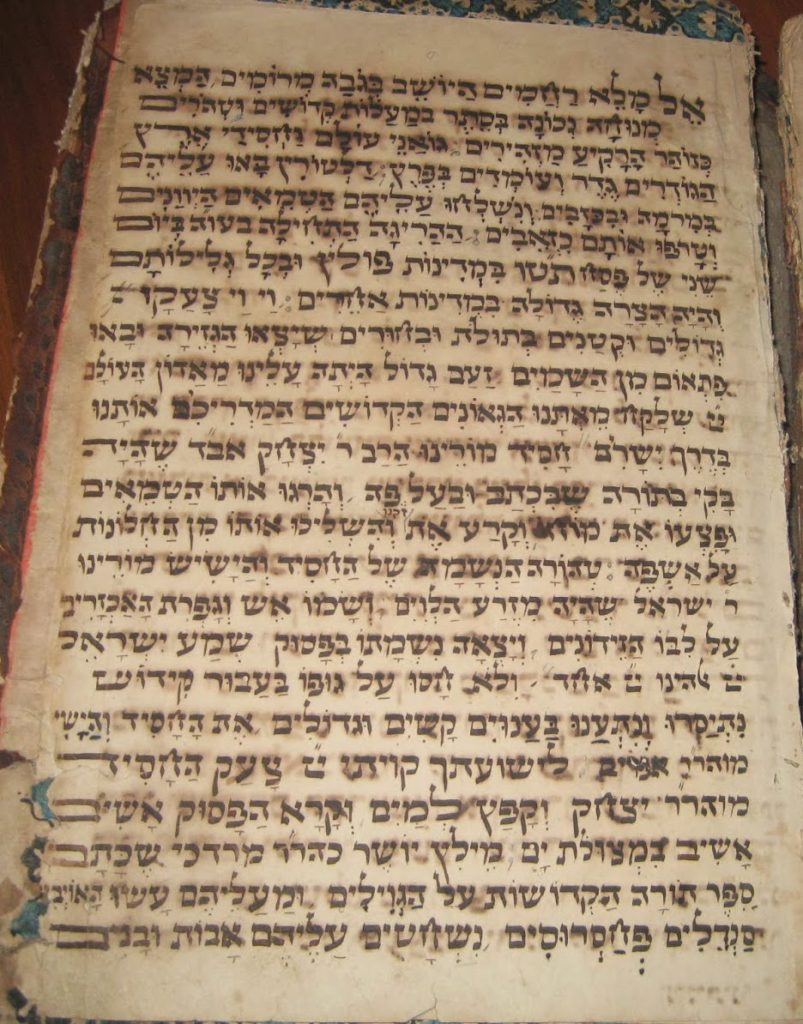
Here is the text from Ibn Ezra.[10]

As you can see, Ibn Ezra responds very sharply to the interpretation mentioned by Rashbam. Although Rashbam is not mentioned by name, the standard view in traditional and scholarly circles is that Ibn Ezra was indeed directing his words at Rashbam and not at others who shared this perspective. This would explain his use of the words ולא תשא פני איש which would only be used with reference to an outstanding scholar.[11] David Kahana suggests that, as a sign of respect, Ibn Ezra does not mention Rashbam by name and he also does not curse the author of the explanation he is attacking.[12] He only curses the one who reads it aloud and the scribe who writes it. If Ibn Ezra was directing his comment against some heretic, we would expect him to curse this person, so the fact that he does not do so is quite significant and indeed points to Rashbam as the “addressee” of Ibn Ezra’s Iggeret ha-Shabbat.
Ibn Ezra never denies the authenticity of the interpretation he is responding to; he just attacks it. His attack on Rashbam’s view is just like Nahmanides’ attack on Maimonides’ view that the angels who came to Abraham were really just part of a prophetic vision. Nahmanides does not deny that Maimonides said this, but he does say that it is forbidden to accept what Maimonides says. It is the exact same thing here. Ibn Ezra is not denying that Rashbam offered the interpretation. He is simply saying that it is forbidden to accept this approach. (I should also add, since we are discussing a dispute between Ibn Ezra and Rashbam, that by any traditional measure Rashbam must be regarded as a more significant and authoritative figure than Ibn Ezra.)

ArtScroll also states that since Rashbam’s commentary to Genesis 1:14 contradicts what he says in the passages deleted by ArtScroll, this gives weight to their assumption that the other passages were not written by Rashbam but were instead inserted by some heretic. To begin with, since there are five[13] “problematic” comments and one “non-problematic” comment, perhaps it is the “non-problematic” comment to Genesis 1:14 that is to be regarded as inauthentic and should be removed. I say this only tongue and cheek, since ArtScroll should have realized two pretty basic things.
1. Rashbam often offers explanations, even in matters of halakhah, that are in line with the peshat of the text but diverge from the talmudic understanding. I understand that in some contemporary circles this would be regarded as heretical, since they assume that the meaning of the verse, especially in halakhic matters, can only be what the sages of the Talmud declare. Yet Rashbam had a different perspective, and he allowed for a peshat that diverges from what the Talmud states.
2. If you have contradictory explanations in the same chapter, the proper thing to do is to see if they can be reconciled before deciding that some of the comments are not authentic and can therefore be deleted. This was the approach of the great scholars of the last century who discussed Rashbam’s commentary. If ArtScroll had “uncompromising respect” for these figures, who devoted great time to understanding what Rashbam was saying, they would not have dared delete Rashbam’s comments, since by doing so they are in effect claiming that they know better than R. Hoffmann, R. Kamenetsky, and so many others.
Let me cite some other writers, including outstanding Torah scholars, who discussed Rashbam’s comments on when the day begins. In ArtScroll’s eyes this was all a big waste of time, since Rashbam never could have said what appears in his commentary. I guess we should all feel sorry for these Torah scholars that when they wrote they didn’t have ArtScroll around to set them straight. The more important question is why didn’t ArtScroll think that any of the explanations offered by these scholars were enough to save Rashbam’s comments from being deleted? (My own sense is that the individual who made the choice to censor Rashbam did not begin to understand the issue and was unaware of the sources referred to in this post.)
1. R. Menahem M. Kasher discusses Ibn Ezra’s attack on Rashbam and offers an explanation for Rashbam’s position, distinguishing between how the days were structured in the first six days of creation and what occurred afterwards.[14] R. Kasher also cites R. Pinhas Horowitz, Ha-Makneh to Kiddushin 37b, that before the giving of the Torah night came after day, and this can also be an explanation for Rashbam’s approach. In support of his assumption, R. Horowitz cites a verse not mentioned by Rashbam, Genesis 8:22:  ויום ולילה לא ישבתו. As you can see, in this verse night comes after day. (R. Horowitz repeats this explanation in his Panim Yafot to Genesis 8:22.) R. Moses Sofer cites this point from R. Horowitz and notes that even today it is only with regard to Jews that night precedes day, but for non-Jews the halakhah remains that day precedes night.[15]
R. Ezekiel Landau agrees with R. Horowitz that before the giving of the Torah the day did not start at night.[16] In support of this approach, R. Samuel Mirsky refers to Ugaritic literature which he regards as real evidence for Rashbam’s position.[17]
R. Moshe Malka also takes note of R. Horowitz’s position.[18]  Based on it he claims that
נחה שקטה תמיהתו של הראב”ע על הרשב”ם, כי הוא דבר על מעשה בראשית לפני מת”ת
R. Catriel David Kaplin also refers to R. Horowitz’ perspective and explains that Rashbam agrees with it.[19]
R. Kasher further cites R. Isaac Israeli (14th century) as agreeing with R. Horowitz. In his Yesod Olam[20] R. Israeli writes
וכן נהגו כל ישראל ממתן תורה ועד עתה להתחיל קדושת השבת ושאר ימי מקראי קודש מתחילת הלילה . . . ועל העיקר הנכון הזה יסדו לנו קדמונינו וקבעו בחשבון מולדות הלבנה ותקופת החמה.
R. Kasher calls attention to the words ממתן תורה ועד עתה and concludes that R Israeli is telling us that before the giving of the Torah the day began in the morning.
Finally, R. Kasher points to two separate rabbinic texts, one talmudic and one midrashic, that he feels can support Rashbam’s approach.
2. Da’at Mikra to Genesis 1:5 (p. 10 n. 168) explains that Rashbam’s understanding of when the day begins only refers to the six days of creation.
3. A different approach in explaining Rashbam is taken by R. Moshe Schwerd in a recent article in Or Yisrael.[21]
4. The Lubavitcher Rebbe refers to Rashbam’s explanation of when the day begins in order to illustrate how explanations in accord with peshat can contradict the accepted halakhah.[22]
5. R. Chaim Leib Zaks calls attention to the fact that two medieval authorities explain Genesis 1:5: ויהי ערב ויהי בקר, just as Rashbam did, that is, that day comes before night.[23] The first is the commentary attributed to Rashi, Ta’anit 11b, s.v. למחר.[24] The second is the commentary attributed to Rashi, Nazir 7a s.v. התם.[25]
6. R. Eliyahu Katz, who served as rav of Bratislava under the Communists and later as chief rabbi of Be’er Sheva, published a number of interesting books which appear to be completely unknown. In his Emor ve-Amarta[26] he states that R. Judah ha-Nasi might also have held that according to the peshat night comes after day, and that Rashbam might have based his explanation on R. Judah’s opinion. He also points out that Rashi, Genesis 1:14 writes
שמוש החמה חצי יום ושמוש הלבנה חציו הרי יום שלם
This is a strange formulation since Rashi appears to be agreeing with Rashbam that the day – שמוש החמה – comes before the night – שמוש הלבנה.
7. R. Jacob of Vienna, in his commentary to Genesis 1:5, writes[27]:
וא”ת אימא הלילה הולך אחר היום והכי קאמר ויהי ערב של יום הראשון ויהי בקר של יום שני אז נשלם יום שלם
In his note to this passage R. Zvi Rotberg understandably refers to Rashbam, as R. Jacob might indeed be alluding to him here.[28] The editor of R. Jacob’s volume, R. Menasheh Grossberg, refers to R. Pinhas Horowitz’s view mentioned above.
8. R. Shlomo Fisher, without question one of the top Torah scholars in the world, elaborates on the implication of Rashbam’s view that it is only through Torah she-Ba’al Peh, not the peshat of the verses, that we know that day comes after night.[29] A student of R. Fisher asked him about the censorship of Rashbam, and not surprisingly he expressed strong opposition to any such tampering with the writings of rishonim. He also told this student about a contemporary “scholar” who claims that Rashbam was influenced by evil people who caused him to go astray! Talk about chutzpah![30]
10. Michael Landy called my attention to the fact that Abarbanel cites the interpretation mentioned by Rashbam in the name of יש מהמפרשים.[31]
All of these sources that I have quoted, and believe me when I tell you that there are many more, are simply designed to show that the view of Rashbam expressed in his commentary to the first chapter of Genesis is part and parcel of Torah history and literature. Many of our great minds have discussed Rashbam’s view in a variety of contexts. Yet ArtScroll, on its own, has decided that it knows best and chose to remove the words of Rashbam from the public eye. They have no right or authority to do this. Their action is a betrayal of Rashbam and of those who want to study the writings of Rashbam. It is also an incredible display of disrespect to those great Torah scholars who have devoted time to the matter and explained the comments of Rashbam that ArtScroll prefers to view as heretical.
After all we have seen, let us return to the issue of Ibn Ezra’s attack on Rashbam and ask why it was so harsh. After all, what is so terrible about explaining the peshat of the Torah even if it diverges from the accepted halakhah, an approach that is found in numerous commentators?
The significance of the example we have been discussing is that there were indeed sectarians who observed Shabbat from Saturday morning until Sunday morning. Rashbam’s interpretation was thus dangerous as it could have had real world implications by giving support to the anti-halakhic behavior just mentioned.
In his commentary to Exodus 16:25 Ibn Ezra refers to “many people, lacking in faith” who erred in this matter and did not start Shabbat on Friday night. He tells us that they based their mistaken approach on Genesis 1:5: ויהי ערב ויהי בקר. In other words, they interpreted the verse in the same way that Rashbam did. Towards the end of Iggeret Shabbat, p. 171, he also mentions these “minim” who do not observe Shabbat beginning Friday night. It is thus easy to see why Ibn Ezra reacted so strongly and set out to uproot Rashbam’s interpretation.
Who were these sectarians Ibn Ezra refers to? Presumably the Mishawites, a group that we know started Shabbat on Saturday morning.[32] Benjamin of Tudela records meeting sectarians in Cyprus, again presumably Mishawites, who indeed observed the Shabbat in this fashion.[33]
In the last paragraph of the ArtScroll letter it states that from now on they will note that their text of Rashbam is the standard Vilna edition of 1898 with “emendations from the Rosin edition of 1882”. This is clearly obfuscation as we are not dealing here with any “emendations” suggested by Rosin. To repeat what the issue is: Rosin printed from manuscript Rashbam’s commentary to Genesis chapter 1. This section of the commentary does not appear in the standard Vilna edition. ArtScroll chose to include Rashbam’s commentary to Genesis chapter 1 in its recently published mikraot gedolot. However, ArtScroll also chose to delete those sections of the commentary it didn’t like, assuming (without any evidence) that these sections were written by heretics. This is censorship of  Rashbam. That is all people need to know.[34]
ArtScroll has done some great things. They have also done some pretty disappointing things. But as I said in the prior post, nothing comes close to this. Deleting comments of one of the greatest rishonim is simply outrageous. Some have said that what ArtScroll did is unforgivable. I think this is going too far. If ArtScroll acknowledges its error and reinserts that which has been removed, I think that we all would be very happy to put this behind us. One of the most important aspects of a Torah personality is the ability to recognize when one has made a mistake and rectify it. If ArtScroll is able to do this, it would lead to great admiration.

On the other hand, if ArtScroll refuses to acknowledge that it has made a terrible error, even after seeing the evidence presented in this post, then one must conclude that ArtScroll is knowingly suppressing the words of a great rishon. One can only hope that ArtScroll does not wish to have this blemish permanently attached to its name.

[1] ArtScroll and other publishers should pay close attention to the words of Rabbenu Tam, which I would have thought would be enough to scare off the censors. Sefer ha-Yashar, ed. Rosenthal (Berlin, 1898), p. 75:
ומגיהי חנם, בעיני דינם, למדורי גהינם
P. 105:
כי כאשר לא יודעים, העולם מטעים, וכאשר תוהים, הספרים מגיהים. ואתם הרעות מהם, כי הם כותבים ה”ג בהגהותיהם, ולכן ניכר מעבדיהם. ואתה לא כן, אך סותם הגהותיך וסומכים עליך וטועים . . . אין עצה ואין תבונה, רק להעמיד על האמת ולזרוק מרה במגיהי הספרים
Even if they are not scared of מדורי גהינם, one would have thought that they would have seen the wisdom of what Rabbenu Tam writes in the introduction to Sefer ha-Yashar, ed. Schlesinger (Jerusalem, 1985), p. 9:
והדין נותן אם לא ידע אדם הלכה יכתוב פתרונו לפי ראות עיניו אם ירצה אך בספרים אל ימחק שדברי תורה עניים במקומן ועשירים במקום אחר ואם דבר רק הוא ממנו הוא [רק]
                       
[2] Sefer Bereshit, trans. Asher Wasserteil (Bnei Brak, 1969), pp. 26-27. Hoffmann writes as follows:
כמו גם פרשנים חדשים רבים הוא [רשב”ם] סבר, שבימי מעשה בראשית נמנו הימים באופן שונה מדרך מנייתם לאחר מכן, בימי מתן תורה, כשם שגם תחילת השנה לפני מתן תורה שונה – לדעת ר’ אליעזר – מזו שלאחריו.
[3] Emet le-Yaakov (Cleveland Heights, 2007), p. 17.
[4] Umberto Cassuto, A Commentary on the Book of Genesis, trans. Israel Abrahams (Jerusalem, 1998), p. 28.
[5] As far as I know, the first one to assert that Rashbam’s comments are heretical interpolations was R. Yehudah Nachshoni, Hagut be-Farashiyot ha-Torah (Bnei Brak, 1981), vol. 1, p. 262, but this had no impact on the haredi world. Here is the page from Nachshoni.

He writes:
לדעתו יש לחשוש שמא חלו ידי קראים בדברי הרשב”ם
What this means is that Ibn Ezra thought that perhaps Rashbam’s metaphorical interpretation of the commandment of tefillin in Ex. 13:9 is a Karaite interpolation. This is complete nonsense as Ibn Ezra says nothing of the sort. I think, therefore, that there is a typo and the first word should read לדעתי. It is still nonsense but at least now the sentence is understandable. Following this, Nachshoni adds another absurdity, stating that Rashbam’s interpretation of when the day starts is also a Karaite interpolation. (Prof. Daniel Lasker has confirmed to me that all Karaites began the Sabbath on Friday night.)
Now comes the real irony. ArtScroll published a posthumous translation of Nachshoni’s book in 1988. Apparently ArtScroll was embarrassed by what Nachshoni wrote so ArtScroll censored it! Here is the English version, Studies in the Weekly Parashah, vol. 2, pp. 414-415.
In 1988 ArtScroll censored the writings of Nachshoni because he said that Rashbam’s comments were heretical interpolations, but in 2014 ArtScroll accepted this very position and instead censored Rashbam! Can it get any crazier than this?
As an aside, let me also note that I find it strange that ArtScroll does not give Nachshoni the title “Rabbi” on the title page of its translation of his book, even though he is referred to as such in the preface.
[6] It is possible that the haredi publishers who censored Rashbam did so purely for financial reasons. After putting a lot of money into their editions, a pashkevil directed against them, incited by some extremist, could be financially devastating. In the haredi world it is often enough to say that there is a “problem” with a book for people not to buy it. The masses won’t have a clue about the issue, but if there is a choice between two competing mikraot gedolots, they will feel safer buying the one which has not had any questions raised about it.
[7] (Kislev-Tevet 5760), p. 150.
[8] Ibid., pp. 151-155.
[9] I don’t have the newly published ArtScroll mikraot gedolot on Exodus (and will refuse to buy it until Rashbam’s commentary is fixed). I was curious if Rashbam on Ex. 13:9 appears in full or if it too was censored. Here Rashbam states that the commandment of tefillin in this verse: והיה לך לאות על ידך ולזכרון בין עיניך, is to be understood metaphorically. Ibn Ezra, in his commentary on Ex.13:9, harshly criticizes the metaphorical interpretation. A friend sent me a copy of this page of Rashbam and the commentary appears in full. I did notice, however, that in the following verse in Rashbam, Ex. 13:10, it reads חוקת הפסח with a dagesh in the kuf. This is a mistake, and in the next printing the dagesh should be removed.
If ArtScroll is looking for something to censor in the newly released volume, Or ha-Hayyim to Ex. 31:16 probably fits the bill. In this controversial passage Or ha-Hayyim states that we don’t violate Shabbat to save the life of someone who will not live until the next Shabbat. This contradicts an explict talmudic passage, Yoma 85a, that one violates Shabbat even for hayyei sha’ah. See R. Ovadiah Yosef, Hazon Ovadiah: Shabbat, vol. 3, pp. 296ff. R. Judah Aryeh Leib Alter, Sefat Emet: Likutim (New York, 1957), p. 77a (Ki Tisa), already suggested that an “erring student” wrote these words in Or ha-Hayyim.
[10] It appears in Kerem Hemed 4 (1839), pp. 160-161.       
[11] See Aharon Mondshine, “Li-She’elat ha-Yahas she-Bein Perusheihem shel R. Avraham Ibn Ezra ve-Rashbam la-Torah: Behinah Mehudeshet,” Teudah 16-17 (2010), p. 17.
[12]  Rabbi Avraham Ibn Ezra (Warsaw, 1894), vol. 1, part 2, p. 45 n. 4.
[13] In the previous post I noted four examples of ArtScroll’s censorship with regard to Rashbam’s peshat  understanding of when the day begins: Gen. 1:4, 5, 8, 31. I neglected to mention Rashbam’s commentary to Gen. 1:6 which is also censored by Artscroll. Regarding why Rashbam’s commentary to the first three parashiyot of Genesis were missing from the manuscript, see Itamar Kislev in Tarbiz 73 (2004), p. 229 n. 12.
[14] Torah Shelemah, vol. 10-11, pp. 276-279.
[15] Hiddushei Hatam Sofer to Shabbat 87a. R. Akiva Eger points out that R. Horowitz’s position leads to a very interesting conclusion. Here is the summary in R. Yaakov Moshe Shurkin’s commentary to Teshuvot Rabbi Akiva Eger (Lakewood, 2003), vol. 2, p. 769 (Pesakim, no. 121):
וכתב רבינו דלפי חידושו של הפנים יפות הנ”ל, דדין עכו”ם ששבת חייב מיתה הוא ביום ולילה שלאחריו, יש להמליץ זכות על אלו שבאו להתגייר ומרגילים את עצמם לשמור את השבת גם קודם שנתגיירו כנ”ל, די”ל שאינם עוברים בזה באיסור דעכו”ם ששבת, דסגי להו אם יעשו מלאכה במוצאי שבת, וכדברי הפנים יפות הנ”ל. ואין צריך למחות בשפחות הנ”ל מלשבות בשבת.
[16] Tziyun le-Nefesh Hayah to Pesahim 116b.
[17]  “Midot ha-Parshanut ha-Mikrait,” Sura 1 (1954), p. 396.
[18] Be’er Moshe (Lod, 1994), p. 14. He also questions R. Horowitz’s position by citing Mishnah, Hullin 5:5:
                  
מה יום אחד האמור במעשה בראשית היום הולך אחר הלילה
Rashbam could easily reply that the Mishnah is not speaking in terms of peshat. However, I am surprised that neither R. Horowitz nor R. Landau discuss this text which would appear to contradict their approach, as they assume that the Talmud agrees that before the giving of the Torah night came after day.
[19] Keter Nehora (Jerusalem, 2004), p. 114.
[20] (Berlin, 1848), vol. 1, p. 35 (2:17).
[21] “Hagdarat Zemanei ha-Yom ve-ha-Laylah al pi Halakhah u-Mahashavah” Or Yisrael (Nisan 5770), pp. 226ff.
[22] Sihot Kodesh (1967), part 2, sihah from 12 Tamuz 5727, p. 284.
[23] “Be-Inyan ha-me-Et le-Et shel Ma’aseh Bereshit,” Ha-Maor (Oct. 1957), pp. 4ff.
[24] This source was also noted by R. Abraham Elijah Kaplan. See Divrei Talmud (Jerusalem, 1958), vol. 1, p. 42 n. 97:
וזה מזכיר דברי רשב”ם שנלחם בם ראב”ע במחברתו אגרת השבת
[25] Kaplin, Keter Nehora, p. 115, also refers to this commentary to Nazir.
[26] (Be’er Sheva, 1994), vol. 1, pp. 26-27.
[27] Peshatim u-Ferushim (Mainz, 1888),  pp. 9-10
[28] Le-Misbar Kera’e (Bnei Brak, 2005),  p. 49.
[29] Derashot Beit Yishai (n.p., 2004), p. 48 n. 11.
[30] E-mail of this student to me.
[31] Commentary to Genesis, p. 33 in the standard edition.
[32] Regarding the Mishawites, see Zvi Ankori, Karaites in Byzantium (Jerusalem, 1968), pp. 372-416. Regarding whether the Dead Sea Sect started the Sabbath on Saturday morning, see Lawrence Schiffman, The Halakhah at Qumran (Leiden, 1975), pp. 84-85. See also Jacob Z. Lauterbach, Rabbinic Essays (Cincinnati, 1951), pp. 446ff.
[33] See The Itinerary of Benjamin of Tudela, ed. Adler (London, 1907), pp. 17-18 (Hebrew), p. 15 (English).
[34] Here is the page listing the texts used in preparation of the ArtScroll mikraot gedolot for the Book of Genesis.

There is no mention of the Mossad ha-Rav Kook editions, perhaps because of copyright concerns. But there is no doubt that in preparing its text of the mikraot gedolot, an important source for ArtScroll for the commentaries of Ibn Ezra, Ramban, Hizkuni, R. Bahya ben Asher, and Sforno were the Mossad ha-Rav Kook editions (and perhaps also Bar Ilan’s Mikraot Gedolot ha-Keter).
For instance, look at the description of Hizkuni. The page from ArtScroll states that its text is based on the first printing and the manuscript thought to be from the author. This is exactly what one finds in Chavel’s edition of Hizkuni published by Mossad ha-Rav Kook. Does anyone really think that ArtScroll compared, line by line, the first printed edition to the manuscript? This work was already done by Chavel. All ArtScroll had to do was use the text provided by Mossad ha-Rav Kook. So how come ArtScroll can’t tell us this, and instead puts on this charade?

ArtScroll does not mention consulting manuscripts with any of the other texts included in its mikraot gedolot, only with the ones already published by Mossad ha-Rav Kook. ArtScroll also says that its edition of Hizkuni is based on the first printing, Cremona 1559. Yet the first printing was in Venice 1524. ArtScroll simply repeated Chavel’s mistake. See Chavel’s introduction to his edition, p. 11.
The title Hizkuni (which I don’t italicize since it is now used as a personal name) comes from the author’s introductory poem to the work. Here is the relevant page from the Chavel edition and on line 7 you can see the word vocalized.

Louis Jacobs, Jewish Biblical Exegesis (New York, 1973), p. 69, claims that the word should be vocalized as Hazekuni, which is the piel plural imperative (“strengthen me”; dagesh in zayinsheva under zayin). R. Chaim Mordechai Brecher made the same point. See G. Kressel, ed., Ha-Ahim Shulsinger (Jerusalem, 1986), p. 119. I don’t see why this is preferable as Hizkuni is also correct, as the kal plural imperative, and the kal imperative is actually much more common in the Bible than the piel imperative. Furthermore, Hizkuni rhymes better with yizkeruni, the parallel word in the poem. Finally, look at the sentence in its entirety
ויקרא שמו בישראל חזקוני, למען קוראיו בשמו יזכרוני
This means that one who pronounces the title of the book, Hizkuni, will be reminded of the name of the author, Hizkiyah. This mnemonic only works if the title of the book has a hirik under the het, like in the author’s name. See A. Ben Ezra in Kressel, ed. Ha-Ahim Shulsinger, p. 119.
Here is the introductory poem from ArtScroll’s edition. The word חזקוני is missing a dagesh in the zayin which means that ArtScroll understood it as an imperative. (Chavel places a dagesh in the zayin, meaning that he understood it as  piel plural perfect.)

Look at the third line from the bottom on p. 8 where ArtScroll has
ומבואר [נ”א: ומכוער]
Anyone who understands Hebrew can see that ומבואר is incorrect (and this error also appears in the Venice 1524 edition). When ArtScroll prepared its mikraot gedolot it had Chavel’s edition in front of it. Chavel’s edition is based on what appears to be the manuscript of the author. In this manuscript (which ArtScroll claims to have consulted) one finds the reading ומכוער. So how come this is not the word that appears in the text published by ArtScroll? This is the original reading, not a נוסח אחר. (At best, ArtScroll could have put ומבואר in brackets, but why would this even be necessary in a non-critical edition?) If ArtScroll thinks that it is important to cite the Cremona reading, then how come immediately following this it doesn’t have כי מי ימצא בו דבר חכמה מפואר. As you can see, this is what appears in the Cremona text, and again, one who knows Hebrew will realize that it doesn’t make much sense.

In the manuscript, which is the basis of Chavel’s version, the text reads אשר ימצא בו דבר חכמה מפואר. This is what appears in ArtScroll, with no indication that there is an alternative text. So why did ArtScroll feel the need to add [נ”א: ומכוער] in the previous part of the sentence? Is this just a way of showing the reader that ArtScroll is “scientific” and has examined the different versions?
If you compare ArtScroll’s version of the introductory poem to that which appears in Chavel’s edition, which is based on the manuscript, you will find that other than the example just mentioned, ArtScroll relies entirely on the mistaken text from the Cremona edition instead of using the correct version from the manuscript. Just skimming through the commentary I found other examples where ArtScroll ignores the manuscript reading in favor of the Cremona edition. I don’t know why ArtScroll did this, but it again shows that ArtScroll’s new edition of mikraot gedolot was not properly edited. 

I also found what I think is a punctuation mistake in ArtScroll’s edition of the poem. See the page from Chavel printed above, the second column, second to last line: ובעיני א-להים יישר. Chavel punctuates יישר as a pual imperfect. ArtScroll punctuates it as a kal imperfect. Because of the rhyming, I think Chavel is correct.

The issue of how ArtScroll uses works of prior scholarship requires a more detailed study than I can provide here. I would, however, like to point to one problematic aspect. Let us look briefly at ArtScroll’s Five Megillos, the earliest ArtScroll publication. ArtScroll is very proud of the fact that it only uses traditional rabbinic sources. On the first page of the commentary to each of the five megillot, we are informed that all material in square brackets is a comment from the author, which we are to assume is an original insight.
Here is ArtScroll’s commentary to Ruth 4:10.

Now read what appears in the Soncino commentary to Ruth 4:10.

ArtScroll’s entire comment is lifted from Soncino. Quite apart from the plagiarism, I find it troubling that ArtScroll feels that Soncino is good enough to be used, just not good enough to be mentioned by name. (When ArtScroll changed some of Soncino’s wording, a mistake crept in. Soncino has “sacred duty of building a home.” ArtScroll intended to change this to “sacred task of building a home,” but instead of “task” it reads “text”.)
After David Farkas called this example to my attention, it did not take me long to find other examples, of which I offer two. Here is Soncino’s commentary to Ruth 4:1.

Now look at ArtScroll on this same verse.

It is obvious that Soncino is the basis for what is found in ArtScroll. (Note the words “fairly large edifice” in both Soncino and ArtScroll.) 
Here is Soncino’s commentary to Esther 2:20.

Now look at ArtScroll on this same verse

Again, it is obvious that Soncino is the basis for what is found in ArtScroll. (Note the words “filial piety” in both Soncino and ArtScroll.)


Self-Censorship in the Arukh ha-Shulhan, ArtScroll’s Latest Betrayal, and Other Assorted Comments

Self-Censorship in the Arukh ha-Shulhan, ArtScroll’s Latest Betrayal, and Other Assorted Comments
Marc B. Shapiro

1. R. Mordechai Rabinovitch has recently published the second volume of his commentary on the Arukh ha-Shulhan, dealing with the laws of Hanukkah. I strongly encourage anyone who prepares for the holiday by studying the halakhot in the Arukh ha-Shulhan to use R. Rabinovitch’s valuable work.
Interestingly, R. Rabinovitch vocalizes the work as Arokh ha-Shulhan. This is based on the fact that these words, with this vocalization, appear in Isaiah 21:5. Yet this is incorrect. As R. Eitam Henkin has pointed out, when the work was published by R. Epstein himself, the title in Russian also appeared on the binding. R. Epstein knew Russian very well, and the Russian reads “Arukh”. Henkin also notes that in the edition published in Vilna by his daughter, the title appeared in Latin letters. Once again we see that it was pronounced “Arukh”.[1] This latter point might have been known to some long-time readers of the Seforim Blog, as this page with the Latin letters was reproduced in this post from 2007. Here it is again.

The Arukh ha-Shulhan was the subject of a dispute between R. Shaul Yisraeli, a member of the Supreme Rabbinic Court (Beit Din ha-Gadol) and Menachem Elon, of the Israeli Supreme Court. The context was that France had requested that Israel extradite a criminal. Elon argued that this was permitted according to Jewish law. In support of this he cited Arukh ha-Shulhan 388:7, which states that there is no law of mesirah when dealing with a civilized government and legal system, such as in Czarist Russia[!] and England. Here is the text.

When challenged by R. Shaul Yisraeli that the text in the Arukh ha-Shulhan was written with an eye to the anti-Semitic government, Elon defended his position that the text is R. Epstein’s authentic opinion.[2] I don’t wish to get into this dispute at present,[3] and readers interested in the topic can consult R. Michael Broyde’s article “Informing on Others for Violating American Law: A Jewish Law View”, available here
R. Rabinovitch’s new commentary is also relevant to this debate, since he identifies examples of what he regards as self-censorship in the Arukh ha-Shulhan, and these are in areas not as potentially problematic as the halakhot dealing with mesirah. In his discussion of the Hanukkah story, Arukh ha-Shulhan 670:3, R. Epstein writes: שכשנכנסו אנשי אנטיוכס להיכל. Yet in the Talmud it states שכשנכנסו יוונים להיכל. R. Rabinovitch suggests that this is an example of self-censorship.[4] At first I thought that this was somewhat far fetched. I didn’t think that there was any reason to fear that government officials would be offended by a simple historical description that mentions the ancient Greeks. However, S. wrote to me as follows.

Yevanim was a particularly loaded term in Russia (for historical purposes this includes regions outside of Russia proper, like Ukraine), because Jews called the non-Jews Yevanim. They did so because many Ukrainians were of the Ukrainian Greek Catholic Church (the Russian Orthodox Church is an Eastern Orthodox Church and in that way ‘related’ to Greece as well). It is for this reason that Hanover called his account of the Khmelnitzky massacres Yeven Metzula, and refers to the Cossacks as yevanim – but we can see it from other sources, too. For example, see attached for a horrifying account of a massacre on the second day of Pesach 1655. You can see he calls the Cossacks yevanim (from here).

Supposedly it was also a play on the name Ivan, but I’m not sure if that’s just folk etymology. But more importantly, we can see that some works took it seriously and changed yevanim to something else, to avoid offending the censor. See here where changing yevanim to “yehirim” in Maoz Tzur was a somewhat common change.

And see here where it documents in the 1840s that Jews called the Russians yevanim  – and doubtless you can show it from many Yiddish sources, too. See here where I discuss how the Slavuta Talmud actually changes a gemara; “Rabbi said, why speak Syriac in Eretz Yisrael? Speak Hebrew or Greek!” to “Speak Hebrew or Akum!” 

So in my view the Arukh Ha-Shulchan definitely deliberately wrote Antiochos.

We can argue about whether this or that particular halakhah in the Arukh ha-Shulhan is an example of self-censorship, but there can be no doubt about the basic fact that R. Epstein did indeed censor himself for fear of the Czar. All one needs to do is see his fawning essay “Kevod Melekh”, at the beginning of Arukh ha-Shulhan, Hoshen Mishpat, to get a sense of the environment he had to operate in. In this essay he tells the reader how much the Jews love the Czar, and that is why they pray for him and his family every Shabbat and Yom Tov.
R. Eliyahu Zini,[5] whose books I hope to discuss in a future post, points to a clear example of the Arukh ha-Shulhan’s self-censorship in Orah Hayyim 329:9. There he writes:
לסטים שצרו על בתי ישראל אם באו על עסקי ממון . . . אבל אם באו על עסקי נפשות להרוג ולאבד או אפילו באו סתם והיינו שאין ידוע לנו על מה באו הוה ג”כ כבבירור על עסקי נפשות דסתם לסטים הם הורגי נפשות יוצאים עליהם בכלי זיין ומחללין עליהם את השבת ובזמן הקדמון בזמן שבהמ”ק היה קיים ובאו לעיר העומדת על הגבול. . . .
This halakhah is derived from Eruvin 45a, but in this text there is no mention of bandits – לסטים. Rather, the Talmud is speaking of non-Jews – נכרים (an alternate reading cited by Dikdukei Soferim is גוים). Secondly, there is nothing in the Talmud about the last halakhah I quoted only applying in the era when the Temple stood. These changes made by R. Epstein were due of fear of creating problems with the government. I think this is as clear as it can be, which makes it very surprising that R. Ovadiah Yosef took the Arukh ha-Shulhan at face value that the latter halakhah only applied in the days of the Temple. R. Ovadiah then points out that the Shulhan Arukh disagrees, seeing the halakhah as also applying in contemporary times.[6]

R. Zini cannot contain himself at this (mis)understanding of R. Ovadiah, and as he often does, he rejects R. Ovadiah’s point very strongly.[7]
ומי פתי הוא זה שלא יבין שבעל ערוך השלחן “צינזר את עצמו” מפחד הצאר, כפי שעשה בעשרות מקומות בספרו זה . . . ופלא נשגבה ממני איך הגר”ע יוסף שליט”א לא הבחין בכך?!
As mentioned already, the Talmud, Eruvin 45a, uses the word נכרים. This means non-Jews, and only non-Jews. Imagine my surprise, therefore, when I saw that the Soncino translation has the following: “If foreigners besieged Israelite towns.” Since there is no way that the translator, who was a learned man, could have made such a mistake, I can only assume that this translation was also designed to avoid any non-Jewish ill will.
Since the author of the Arukh ha-Shulhan, R. Jehiel Michel Epstein, was the brother-in-law of R. Naftali Zvi Judah Berlin, now is a good place to note the problem with one of the titles of R. Berlin’s works. His commentary to R. Ahai Gaon’s She’iltot is העמק שאלה. How should these words be pronounced? Some scholars write Ha-Amek She’alah, basing themselves on Isaiah 7:11. However, Gil S. Perl argues that the correct pronunciation is Ha-Amek She’elah. As he puts it, if the pronunciation in Isaiah was intended, “the title would mean ‘sink to the depths,’ the ‘depths’ (from the word she’ol) being a reference to the netherworld or Hell—a rather strange title for a work of halakhic commentary.” Perl therefore suggest that the Netziv “intended his title as a play on those words from Isaiah pronounced Ha’amek She’alah, meaning ‘delve into the question” or perhaps ‘delve into the She’ilta.’”[8]
Speaking of proper pronunciation of titles, ArtScroll might play a positive role in this. Since today so many people studying Talmud are using ArtScroll, they will see that the tractates are pronounced “Arachin”, not “Eruchin”, and “Horayos”, not “Horiyos”. So I hope that these yeshivish pronunciations will soon be a thing of the past, at least among English speakers, and if so this will be thanks to ArtScroll. Furthermore, since their edition of the Midrash Rabbah has started to appear people in yeshiva circles will begin to use it, and slowly the pronunciation “Medrish” may go by the wayside (at least we can hope so). Now if we could only rid people of the pronunciation “ikrim” instead of “ikarim”.
Having said all this, it is also the case that general convention can sometimes trump proper grammatical pronunciation. For example, take the words נודע ביהודה which appear Psalms 76:2. These words are pronounced Noda Bihudah, yet when referring to the book by this title the convention is to write Noda bi-Yehudah, even though this is not the correct pronunciation.
For those who want to see a bit of “Sephardic supremacy” when it comes to pronunciation, see this video where R. Ovadiah really lets the Ashkenazim have it.

Returning to the Arukh ha-Shulhan, its significance has declined in the last two generations. While figures such as R. Joseph Elijah Henkin, R. Moses Feinstein, and R. Yaakov Kamenetsky regarded the Arukh ha-Shulhan as more authoritative than the Mishnah Berurah,[9] not many poskim still have this perspective. Whereas the Arukh ha-Shulhan used to stand on its own, in our day we have seen the publication of an edition of the Arukh ha-Shulhan accompanied by the pesakim of the Mishnah Berurah, the point of which is to let the reader know that while one can study the Arukh ha-Shulhan as a theoretical work, when it comes to practical halakhah one must follow the Mishnah Berurah.[10]
The truth is that one can use the Arukh ha-Shulhan as a work of practical halakhah just like one can use the Mishnah Berurah. This reminds me of an experience I had many years ago when I believe I was still in high school. I was at a shiur where the rabbi was learning Mishnah Berurah. After reading one halakhah in the Mishnah Berurah he pointed out that “we don’t hold like this”. A member of the audience asked how one who learns the Mishnah Berurah by himself is supposed to know when that is the case, that is, when “we don’t hold” like it. The rabbi replied that this is why it is important to have a rav, so that you will know when we follow the Mishnah Berurah and when we don’t.
Even though I was quite young I thought that this was a mistaken reply, and the many years subsequent have not changed my mind. It is of course important to have a rav, but not for the reason the rabbi said. There is absolutely nothing wrong with someone learning the Mishnah Berurah (or Arukh ha-Shulhan) and following everything in it. One doesn’t need, and it would be an impossible task, to ask his rabbi about each and every halakhah if this is what “we follow”. One who lives in an Orthodox community will learn that sometimes the community practice is more lenient than what appears in these works, and sometimes it is more strict. It is in those circumstances that I think that one should consult one’s rav, and ask him if despite common practice it makes sense to be lenient in accord with either of these texts, or if one should be strict as recommended by either the Mishnah Berurah or Arukh ha-Shulhan even though the common practice is not like this. But as a general rule, and I have never had a teacher who thought otherwise, one can rely on either of these classic halakhic texts.
2. Many people were distressed to see the sources from great pre-modern poskim that spoke about all sorts of physical mutilation, including R. Asher ben Jehiel agreeing that an adulteress’ nose could be cut off. I have mentioned in the past, but it bears repeating here, that the various punishments seen were also found in the contemporary non-Jewish society.[11] I know this may be troubling to some readers, to see that leading rabbis had an approach to punishment that today people regard as barbaric. Yet there really is no alternative, as to a certain extent, every generation reflects the general values of society at large. Halakhah and Jewish thought are often likewise affected in this way. I have provided numerous examples of this throughout the years, so there is no need to go through it again.[12]
3. In a question “ripped from the headlines”, I was asked if I know of any past examples of someone secretly observing women in the mikveh. I don’t of any such cases, although in the anti-hasidic text Shever Posh’im[13] it quotes a hasidic author as follows:
ואני אומר דראוי לעמוד בשעת טבילה. ויאמין לי שפעם אחת עמדתי בעת שטבלה אשה אחת וראיתי באותו מקום ודי עלי כאוות ולא כלום. ולאחר שהלכתי משם שרי עלי קדושה גדולה.
I have never heard of such a mikveh, where men would bathe on one side and women immerse on the other. In fact, I wouldn’t pay this text any mind, since I find it hard to believe that anyone who examines the citations from the work, which are supposedly notes on the Tur, will not conclude that it is a forgery designed to make the Hasidim look bad.[14] There are so many outrageous things said in the text that nothing else makes sense. Did any hasid, even the most extreme, ever say that one who prays properly need not fast on Yom Kippur ?[15]
כתב הטור: יוה”כ אסור באכילה ושתי’. וכתב המין: ומי שיוכל לכוין בתפלה כתיקונה מותר בכל, ואין אכילה רק שיהא עם רוחניות ולא עם גשמיות כידוע ליודעי חן.
It is difficult even to record the following shocking text,[16] but we are not in the business of censorship here, and as mentioned, I have no doubt that this is a forgery.
כתב הטור: דבעל קרי מותר האידנא בתפילה . . . וה”ה אף להוציא זרע מחמת גודל החימום הק”ש והתפילה כי זהו העיקר לכבוד השי”ת, כידוע לחכמים השלימים.
Speaking of authentic texts, however, R. Joseph Hayyim does deal with a case of voyeurism and prescribes a teshuvah for this. I don’t want to get any more explicit, so for those who read Hebrew here is the text from Od Yosef Hai: Halakhot, parashat Shofetim, no. 51[17].

I am aware of only two times that a woman (other than one’s wife) can be seen without her clothes. One is the sotah, when her top is removed.[18] R. Judah states that if her breasts are attractive, they are not exposed,[19] but his opinion is not accepted. The other time is that the kohen must examine both men and women for tzara’at, and in both cases they are to be naked.[20]
As for the current controversy about whether dayanim need to see a female convert immerse, no one has yet referred to the following responsum from Kitvei R. Weinberg, vol. 1, no. 10. When I published this book I decided to have this short responsum translated from German, although I wasn’t sure if it was worth the trouble since all R. Weinberg was doing was repeating the halakhah as it appears in the Shulhan Arukh. Recent attempts to alter the traditional method of womens’ conversion, by arguing that the dayanim should not see the actual tevilah, show that even a simple responsum like this one can have value. I am very happy that it was translated and included in the sefer, so that it can now be part of the public conversation. 

Regarding the sources that have been cited in support of changing the traditional practice, no one has yet referred to a responsum by R. Isaac Herzog in which in the specific case he discusses (and I don’t think it can be used le-khathilah for other cases) he allows that only women see the tevilah.[21]
Also worth noting, even though in my opinion it has no halakhic significance, is Masekhet Gerim 1:4 which states:
האיש מטביל את האיש והאשה מטבלת את האשה
R. Hayyim Kanievsky points out, in his commentary ad loc., that this implies that men did not see any part of the immersion (unlike the current practice).
משמע שהאנשים לא יראוה כשהיא טובלת . . . משמע שאין רואין טבילתה רק הנשים.
R. Aryeh Leib Grossnass, Lev Aryeh, vol. 2, no. 11, argues that the beit din does not actually have to see the immersion in order for the conversion to be valid. It is this responsum that R. Moses Feinstein is responding to in Iggerot Moshe, Yoreh Deah vol. 2, no. 127.

S. also called my attention to this document from 1844 signed by Isaac Leeser and currently on auction at Sotheby’s (link). It records how the conversion of a girl was only witnessed by two women, not by the beit din.

4. Simcha Goldstein was kind enough to send me these pictures from a Passover Haggadah sent out to donors by Yeshiva Torah Vodaath. It hardly needs to be said that such pictures (check out how the women are dressed), not to mention the Zionist theme as a whole, would never appear today in anything sent out by this yeshiva. 

Regarding Yeshiva Torah Vodaath, in the book Mi-Pihem shel Rabbotenu (Bnei Brak, 2008), p. 49, there in an interview with R. Don Ungarischer who states that when R. Reuven Grozovsky came to the United States during World War II, Torah Vodaath was the only yeshiva in America. This is incorrect and I am not just referring to the existence of Yeshivat R. Yitzchak Elhanan or Beit ha-Midrash le-Torah in Chicago, as Yeshivat R. Chaim Berlin also existed during this period. 
5. The second volume of Haym Soloveitchik’s collected essays has just been published. This is a very important work, especially since nine of the essays have never before appeared in print. Among these newly published essays are those that put forth a new thesis about the origins of Ashkenazic religious culture. There is so much learning in this book, and it is written in such an engaging style, that anyone with an appreciation for the history of halakhah will be spellbound.
The essay “The ‘Third Yeshivah of Bavel’”, where Soloveitchik elaborates on his new thesis, is a particular favorite of mine. It could be that in the end the scholarly community will reject his position. Yet just to read how he develops his argument, and attempts to create an entirely new paradigm, is a treat. Here is one lengthy paragraph from the essay that I found quite significant (p. 161).
Shift back now to the mid-tenth century and the original characteristics of Ashkenaz. I have noted that the new settlers saw no difference between the aggadic sections of the Talmud and the halakhic ones and exegeted both in equal detail. We take this, too, for granted because we find a commentary on both sections on every printed page of the Talmud that we have seen since early youth. Think, however, what this entails lexically. The halakhic portions of the Talmud are strongly formulaic, as is any unpunctuated text. If one knows some thirty to forty idiomatic phrases in Jewish Babylonian Aramaic, most halakhic passages will pose few linguistic problems. (Understanding their legal content is a different matter.) However, the aggadic narratives entail a wide-ranging and detailed knowledge of the Aramaic language—all the terms of different household utensils, farm equipment, agricultural practices, domestic animals, flora and fauna, to mention just a few areas of life that are reflected in the narratives of the aggadeta. We are talking about a vocabulary of some 10,000-12000 words, if not more. (Actually, much more, as one should count meanings rather than words or roots [shorashim]. Most words have multiple meanings, and commanding a language means precisely controlling the numerous meanings of its words, as well as its idioms.) Unless these settlers had a vast dictionary, alongside which the Sefer he-Arukh would seem a Berlitz phrase book, and unless this enormous dictionary and even the memory of it got lost in the Mainz academy within one generation, we must conclude that these immigrant founders of Ashkenazic culture were Aramaic speakers. Precisely because Aramaic was their native tongue, they could readily undertake what the scholars of Kairouan, Fez, and Lucena (all native Arabic speakers) could only attempt with trepidation, namely, to exegete the entire Talmud, leaving no phrase, halakhic or aggadic, unexplained.
6. The most recent issue of Milin Havivin has appeared. My article “Torah im Derekh Eretz as a Means of Last Resort” can be seen here.
I also published a letter from R. Jehiel Jacob Weinberg and part of another letter he wrote.

These are important letters as they show R. Weinberg’s strong belief that in the modern world rabbis need to have a secular education in order to be effective. Those who read Hebrew will see very clearly where R. Weinberg stood on this issue, and that for all his love and respect for the haredi roshei yeshiva, intellectually and spiritually he was not part of their world.
7 Finally, we come to what I have termed ArtScroll’s latest betrayal. These are harsh words, but I believe them to be entirely justified. It is one thing to censor R. Zevin, or to cut out passages from other recent works. But to do this with rishonim is a completely different matter. After my book appears, I will discuss a number of examples of censorship that for one reason or another I did not include in the book, as well as examples that I only became aware of after the book was in press. However, this is such an important example that I did not want to wait. Its importance is such that I have no doubt that according to halakhah, anyone who demands a refund from ArtScroll is entitled to his money back, as what I will show you is nothing less than a betrayal not only of the reader, who paid good money to get what he thought was a complete mikraot gedolot chumash, but also of one of the greatest rishonim, R. Samuel ben Meir (Rashbam).

Soon after Rosh ha-Shanah 2014, ArtScroll released the first volume of its mikraot gedolot chumash. It is a beautifully typeset edition, completely punctuated. The response was so positive that within a month the volume was reprinted, and it would not be a surprise if the ArtScroll mikraot gedolot became the new standard.
One of the new elements of this edition is that Rashbam to Genesis chapter 1 is included, which is not the case with the old mikraot gedolot chumashim. (It is found in the Mossad ha-Rav Kook Torat Hayyim mikraot gedolot). As you can see on this page, the Rashbam’s commentary is taken from the Rosin edition (which is where the commentary to Gen. ch. 1 first appeared).

In his commentary to chapter 1 Rashbam advances the notion that according to the peshat of the Torah, the day does not start in the evening, but in the morning. This is only one of many examples where Rashbam’s commentary explains biblical verses in accordance with the peshat, and in opposition to the rabbinic understanding. He even states that according to the peshat the commandment of tefillin in Exodus 13:9 is not to be understood literally.[22] Of course, Rashbam put on tefillin, but in this case he was only explaining what he thought the peshat was. Similarly, he began Shabbat in the evening, not in the morning, but this did not stop him from offering a peshat that differed from the halakhah.
For some reason, ArtScroll finds this difficult to take, and therefore decided to delete all of Rashbam’s “problematic” comments regarding the beginning and end of the day. I repeat, since I know this will be hard for people to believe: ArtScroll omitted portions of Rashbam’s commentary from its mikraot gedolot.

Here is Rashbam’s commentary on Gen. 1:4 and 1:5 in the Rosin edition.

Now look at ArtScroll’s version of Rashbam’s commentary to Gen. 1:4 and 1:5. Entire sections of his commentary to each of the verses have been omitted!

Here is Rashbam’s commentary to Gen. 1:8 in the Rosin edition.

Here is how the commentary to Gen. 1:8 appears in ArtScroll.

Again you can see that a section of the commentary has been deleted.
Here is Rashbam’s commentary to Gen. 1:31 in the Rosin edition.

ArtScroll completely omits this short comment.
It is not only in Genesis chapter 1 that Rashbam’s that has been tampered with. I only skimmed a few other places and I found the following problem with Gen. 49:16. The first words in ArtScroll’s version of Rashbam commentary are המפרש על שמשון.

Yet look at the Rosin edition where the first word is המפרשו.

Small emendations such as this are obviously not acceptable, but they are in an entirely different category than the censorship in Genesis chapter 1.
I also found problems with ArtScroll’s punctuation of Rashbam. For example, in his commentary to Gen. 37:2, which is one of his most famous passages, Rashbam states that he heard from his grandfather (Rashi) that if he had time he would write new commentaries לפי הפשטות המתחדשים בכל יום. The word הפשטות is to be vocalized as ha-peshatot, i.e., the plural of peshat. ArtScroll has the mistaken vocalization ha-pashtut. Later in this verse Rashbam writes (in the Rosin version) לפי דרך ארץ קורא אחיו. ArtScroll has קרא, changing the verb from participle to perfect. I have not gone through even one chapter of the book, comparing Rosin’s edition to ArtScroll (not to mention other commentaries). If I were to do so, I am sure many more such examples would be revealed.
This post does not need any long conclusion, as the evidence speaks for itself. I would only add that when modern publishers feel that they can start deleting commentaries of rishonim, then we have reached a new low. Will students of Torah, those who treasure the words of Rashbam, tolerate this betrayal? I think (hope) not, which is why it is imperative that in the next printing ArtScroll reinsert the words of Rashbam.

[1] “Sifrei Arukh ha-Shulhan – Seder Ketivatam ve-Hadpasatam,” Hitzei Giborim 7 (2014), p. 518.
[2] See Elon, “Dinei Hasgarah be-Mishpat Ivri,” Tehumin 8 (1987), pp. 263-286, id. “Bisus ha-Ma’arekhet ha-Mishpatit al Dinei ha-Torah,” ibid., pp. 304-309; R. Yisraeli, “Hasgarat Avaryan le-Shiput Zar,” ibid., pp. 386-297. (also found in Yisraeli, Havot Binyamin, no. 23). R. Eliezer Waldenberg agreed with Elon. See Tzitz Eliezer, vol. 19, no. 52 (end).
[3] Among those who agree with R. Yisraeli is R. Menasheh Klein, Mishneh Halakhot, vol. 17, no. 108. (Look who this responsum is addressed to.)

Since I just mentioned R. Klein, let me present another responsum of his, from 1987, which unlike the others he sent me was not included in Mishneh Halakhot. It is published here for the first time.

The reason he did not include it in his responsa was undoubtedly because the “letter” he disputes is by none other than R. Kook, and R. Klein did not want to be associated with R. Kook even if he disputes with him. That explains why he won’t even mention his name here. In fact, when R. Klein cites a book published by Mossad ha-Rav Kook, he simply writes הוצאת קוק. See Mishneh Halakhot, vol. 10, p. 382. See also vol. 8, p. 78 where he writes הוצאת רמב”ן קוק.
Here is the letter from R. Kook to which R. Klein is responding (Iggerot ha-Re’iyah, vol. 1, pp. 99-100).

[4] See also p. 20 n. 13, where R. Rabinovitch points to another example where he thinks that R. Epstein’s formulation was influenced by fear of the government.
[5] Eretz Hemdatenu (Haifa, n.d.), p. 139.
[6] Masa Ovadiah (Jerusalem, 2007), p. 341.
[7] Eretz Hemdatenu, p. 139.
[8] The Pillar of Volozhin (Boston, 2012),  pp. 17-18, n. 37. This too is perhaps not the best transliteration, as in most texts the ayin in העמק has a sheva. In a minority of texts it has a hataf patah.
[9] Regarding R. Henkin, see my post here.

After that post appeared a member of R. Moshe Feinstein’s family wrote to me as follows:

I spent a great deal of time learning with and talking to Reb Moshe, both on the East Side and in the mountains.  He unambiguously told me exactly what you quote from Rav Henkin.  He explained that the Aruch Hashulchan was a Rav, while the Mishna Berura was a Rosh Yeshiva, and the psak of a Rav is better authority.  Therefore, when he was unwilling to make his own determination, he would follow the AH over the MB.  I mentioned this story to Rabbi Dovid Zucker, Rosh Kollel of Kollel Zichron Shneur in Chicago, and he told me that he heard precisely the same thing from his Rebbi, Rav Yaakov Kaminetzki.

R. Yehudah Herzl Henkin wrote to me as follows:

I notice in Seforimblog from Jan. 26 ’08 that you quote R’ Ratzabi, concerning the superiority of MB [Mishnah Berurah] over AH [Arukh ha-Shulhan], as stating  that the CI [Chazon Ish] wrote that MB is ‘like the Sanhedrin.’ He is undoubtedly referring to Igrot CI pt. 2 no. 41 which is widely misquoted in this regard. The CI says only that a ruling of the Bet Yosef and MA and MB all together– and that no one disagrees with– is like a ruling of the Sanhedrin, ayen sham. (The CI could hardly have thought that MB alone is like the Sanhedrin, as he disagrees with him in practice dozens of times.) By coincidence, I wrote this in Hatzofeh on Feb. 8 ’08. Incidentally,  R’ Menashe Klein, in comments in BB [Bnei Banim] vol.1 p. 225, attributed the popularity of MB almost to a bat kol. I expressed my surprise. Later when he reprinted his comments in Mishne Halachot he omitted the term.

[10] See R. Eitam Henkin’s (unsigned) review of this edition in Alonei Mamre 120 (2007), pp. 119-124. The Hafetz Hayyim was aware of the fact that the popularity of the Mishnah Berurah led to a decline in study of the Magen Avraham. See Meir Einei Yisrael (Bnei Brak, 2004), vol. 5, p. 403.
[11] One reader called my attention to Tory Vandeventer Pearman, Women and Disability in Medieval Literature (New York, 2010), p. 80, who discusses how cutting off the nose of an adulterous woman was a common punishment and parallel to male castration. R. Menachem Sheinkopf reminded me of Hut ha-Meshulash (Munkacs, 1984), p. 38a, which records how the Hatam Sofer in his youth witnessed the sentencing to death of an informer. This text was deleted from the next edition of Hut ha-Meshulash. See Meir Hildesheimer, “The Attitude of the Hatam Sofer toward Moses Mendelssohn,” PAAJR 60 (1994), p. 155 n. 50. It is also reported that as a youth, the Hatam Sofer personally killed an anti-Semite. See Siah Sarfei Kodesh (Bnei Brak, 1989), vol. 4, p. 154. (I don’t think that this report has any substance).
[12] One example I have often given to illustrate this was that today every rabbi will be happy to speak about how Judaism opposes slavery, and that the slavery mentioned in the Torah was far removed from the slavery in pre-Civil War days. Yet two hundred years ago, plenty of rabbis would have found nothing objectionable with Southern slavery. (When I write “every rabbi” in the first sentence of this note, it is an exaggeration. See my post here. See also R. Avigdor Miller, Q&A, vol. 2, p. 12, that it was a mistake for Lincoln to free the slaves, as they could have used another 50 or 100 years of slavery in order to “civilize” them.)
[13] Published in Mordechai Wilensky, ed., Hasidim u-Mitnagdim (Jerusalem, 1970), vol.. 2 p. 117. This strange passage is mentioned by David Biale, Eros and the Jews (Berkeley, 1997), p. 125.
[14] Wilensky leaned in this direction, see ibid., p. 112.
[15] Ibid., p. 120.
[16] Ibid., p. 119.
[17] (Jerusalem, 1910), p. 51b (second pagination)
[18] Mishnah, Sotah  1:5.
[19] Ibid. Although the Mishnah states אם היה לבה נאה this is obviously a euphemism for breasts. As is to be expected, R. Jacob Emden, Lehem Shamayim, ad loc., has something to say on this passage. How does the kohen know that she has attractive breasts, to know whether or not they can be revealed? Emden states that he heard as much from her husband. But this answer does not satisfy him, for סתם אשה כל יופי שלה שם הוא. As support for this notion, he cites Berakhot 10b שאחזה בהוד יפיה, which Rashi explains to mean “breasts” If he was more of a fan of the Zohar perhaps he would have cited Zohar, Bereshit 45a: ושפירו דאתתא באינון שדים . Zohar, Shemot 80b, states
ר’ אבא פתח (שיר השירים, ח,ח) אחות לנו קטנה ושדים אין לה מה נעשה לאחותנו ביום שידובר בה. אחות לנו קטנה דא כנסת ישראל דאקרי אחות לקב”ה. ושדים אין לה היינו דתנינן בשעתא דקריבו ישראל לטורא דסיני לא הוה בהון זכוון ועובדין טבין לאגנא עלייהו דכתיב ושדים אין לה דהא אינון תקונא ושפירו דאתתא ולית שפירו דאתתא אלא אינון
See also R. Yitzhak Ratsaby, Olat Yitzhak, vol. 2, p. 390. The second quote from the Zohar shows the importance of understanding the literal meaning of Song of Songs in order to appreciate the allegory.
[20] See Mishneh Torah, Tum’at Tzara’at 9:12.
[21] Pesakim u-Khetavim, Yoreh Deah no. 99 (p. 327). On this page R. Herzog also states we should require all ba’alei teshuvah, especially public Sabbath violators, to immerse themselves in the mikveh. This is the upshot of the Vilna Gaon’s comment to Shulhan ArukhYoreh Deah 268:30.
[22] Commentary to Ex. 13:9.


The Pew Report and the Orthodox Community (and Other Assorted Comments), part 2

The Pew Report and the Orthodox Community (and Other Assorted Comments), part 2
by Marc B. Shapiro
Continued from here.
Returning to the matter of Jewish men and non-Jewish women, it is noteworthy that the Spanish scholar R. Solomon Alami (14th-15th centuries), in his ethical will to his son, specifically warns him to abstain from sexual relations with non-Jewish women.[1] Note how in the following passage he also assumes that Reuben actually had sexual relations with his father’s concubine (an opinion also shared by talmudic sages, though in my experience the alternative view, that he didn’t actually do this, appears to be the standard approach among contemporary darshanim).
בבת אל נכר אל תחלל בריתך. היה גבור כארי למשול בתאוותך, תהי צדיק מושל יראת א-להים להטיבך באחריתך. השמר ממר ממות ופרוש מן הזימה. טמאת השם רבת המהומה. וזכור דבר זמרי ורעתו. וחרפת שבטו ברדוף נשיאם תאוותו. הלא אל אלה חטא שלמה מלך ישראל ונחלקה מלכותו. וזכור צדקת יוסף אשר גבר על יצרו ולא נתן מאוויי גבירתו. ותשב באיתן קשתו. עם גודל יופיו ועדונו והוא בבחרותו. והיה זה סיבה לשום במרום מדרגתו. וכל בית אביו חיו בזכותו. ונתנה לו הבכורה ונדחה ראובן בחללו יצועי אביו מבכורתו. כי לא יאות הכבוד לנקשר בזימה בכחשו.
An Italian list of takkanot from 1418 also speaks about this problem, that Jewish men thought that there was nothing wrong with having sex with non-Jewish women[2]: הנשים הנכריות מותרות בעיניהם. The fact that the various moralists speak about this issue shows that it was a real problem. While suggestions were offered to help men overcome sexual temptations, there was a recognition that, as the Talmud, Hullin 11b, states, “There is no guardian against unchastity,” אין אפוטרופוס לעריות. This principle is quoted by R. Joseph Karo in Shulhan Arukh, Even ha-Ezer 22:15.[3] Yet interestingly enough, in R. Karo’s Magid Meisharim[4] he is told that since he is entirely involved with service of God he cannot be seduced even by a naked woman.
מאחר שלבך תמיד אינו מהרהר אלא בעבודתי אפילו תפגע באשה ערומה לא תבוא לידי חטא
We know that there were some who argued that it was better for men to use Jewish (single) prostitutes so that they not come to having sex with married women or engage in homosexual acts.[5] (I am referring to places where Jews could not avail themselves of non-Jewish prostitutes, as the punishment for this was often execution.) R. Moses Hagiz[6] argues against this position, stating that we do not permit a lesser offense to prevent one from violating a more severe offense. He even calls this approach hukot ha-goyim.
והלכו בחוקת הגיום שזו היא טענת פטור אצלם אכן אנו בני ישראל הקדושים כשהשני איסורים הם מדאורייתא או תרי דרבנן אין לנו להתיר הא’ מחשש שלא יבא לעשות האחר
This passage is quoted by R. Isaac Lampronte, Pahad Yitzhak, s.v. boel aramit. He then adds that he heard from a hakham that sex with a Jewish prostitute is worse than sex with a non-Jew because of the possibility that that one will violate the niddah prohibition.
דיכול לבוא לאיסור נדה שהיא בכרת
Notice how he doesn’t say that one will certainly violate the niddah prohibition, only that it is a possibility. What this means is that even the Jewish prostitutes were expected to go to the mikveh, but that one can’t assume that they would indeed do so, and this explains why sex with a non-Jewish woman is preferable.[7]
But he adds that this should not be said publicly or to an ignorant person as this knowledge could lead men to have sex with non-Jews since they will mistakenly conclude that the prohibition is not so serious.
אין אומרים דבר זה בפרהסיא או בפני עם הארץ, כדי שלא ינהגו פריצות בביאות גויות.
What we are discussing was not simply theoretical since R. Isaac Arama, writing in fifteenth-century Spain, tells us that not only did the Jewish community leaders (שופטי ישראל) not take prostitution seriously, but in a few (קצת)[8] communities Jewish prostitutes were welcomed and even supported with Jewish communal funds (!).[9] This was done as the prostitutes were thought to be performing a public service, since without them it was thought that men would be led to have sex with married women or non-Jewish women (which as mentioned already could lead to execution). From a responsum of R. Judah ben Asher,[10] we see that even in an earlier era this point had been made with regard to “loose women” (and was rejected by R. Judah who thought it was better to have sex with a non-Jewish woman for whom the niddah prohibition did not apply):
ומוטב שיסתכנו הגופים מן הנפשות
Arama tells us that on different occasions he argued with the communal leaders, and also before גדוליהם which I assume means their rabbis, that it is one thing if someone commits a sin in private. In such a case, Arama would probably agree that it would be better for a man to have sex with a Jewish prostitute than with a with a non-Jew. (It must be that these prostitutes went to the mikveh, as Arama doesn’t mention anything about the niddah prohibition.) But Arama is firm that it is absolutely forbidden for the community – and he includes in this בתי דיניהם showing that the rabbis were complicit – to countenance any sin whatsoever, in this case welcoming in Jewish prostitutes, even if this strict stance leads to people committing greater sins or being executed by the non-Jews.[11]
R. Isaac Bar Sheshet (Rivash) had earlier also testified to the fact that the “gedolei ha-dor” had acquiesced to the existence of Jewish prostitutes in order to prevent men from visiting non-Jewish women, with all the dangers this entailed.[12] Contrary to Avraham Grossman,[13] the Rivash is not saying that this is what the “gedolei ha-dor” should do when faced with such a circumstance. Rather, he is decrying what they did. I am curious to hear if readers agree with me. Here are the words of the Rivash:
והרמב”ן ז”ל כתב בפ’ התורה שהיא אזהרה לב”ד שלא יניחו בנות ישראל להפקיר עצמן לישב בעינים על הדרך או בקובה של זונות לזנות לכל יבא. בואו ונצווח על דורנו שאין דומה יפה, וגדולי הדור העלם יעלימו את עינים פן יכשלו בני פריצי עמנו בנכריות ותצא אש ומצאה קוצים ונאכל גדיש
Returning to intermarriage, we see something very interesting in Pirkei de-Rabbi Eliezer, ch. 39. According to this text (which is paralleled by other midrashim[14]), Jacob’s sons married their sisters. The explanation given is that they did so in order not to marry the local inhabitants:
כדי שלא יתחתנו בעמי הארצות
This is quite an incredible assertion, since incest is forbidden under the Noahide code. If there were no eligible marriage partners, one would have expected Jacob’s sons not to marry at all rather than marrying their sisters. R. David Luria, in his commentary on the passage, does not even deal with this problem, instead noting that elsewhere in rabbinic literature one finds that Jacob’s sons did marry the local women. (For some reason, R. Luria’s edition does not include the words כדי שלא יתחנתו בעמי הארצות, which comes right after the text stating that Jacob’s sons married their sisters. This does not appear to be an act of censorship, since the real issue is not the explanation for their marriages, but the incestuous marriages themselves, and this is still found in R. Luria’s edition.)
The Tosafists have a simple response to this problem: Since the Torah had not yet been given Jacob’s sons only observed what they wanted.[15]
מאחר שלא נצטוו על התורה אע”פ שידעוה ברוה”ק מה שהיו רוצין היו מקיימין ומה שלא היו רוצין היו מניחין.
Nahmanides, Commentary to Gen. 38:2, assumes that each of the brothers married one of the twins of the other brothers, but not their own twins. Furthermore, no one actually married a complete sister, i.e., sons of Leah did not marry daughters of Leah. Thus, they did not violate Noahide Law. (I think this is probably also what the Tosafists assumed in the passage mentioned above.) While Nahmanides’ understanding works with some of the midrashim, it cannot be fit into the language of Pirkei de-Rabbi Eliezer, ch. 36, which states explicitly that each son was born together with his future wife:
  וכולן נולדו זווגן עמם חוץ מיוסף שלא נולדה זווגה עמו
Furthermore, Bereshit Rabbah 80 states that Simeon married Dinah, and she was his sister from the same mother. It is precisely in order to answer this problem that a Tosafist cites the Aggadah[16] that Dinah was actually first impregnated in Rachel, and God later transferred her to Leah, meaning that Simeon and Dinah were really not from the same mother.[17] (Many have pointed out that this has implications to the debate about the status of children born from surrogate mothers.[18])
The Maharal explains that the situation of the brothers marrying their sisters was an exceptional case, since if they did not marry them the only available marriage partners would have been pagan women.[19] As the Maharal notes, the parallel is to the sons of Adam who were permitted to marry their sisters since there was no one else for them to marry. This permission to marry their sisters was known to Jacob through ruah ha-kodesh, and the Maharal adds that one should not think that this contradicts the Torah, “for the one who gave the Torah forbade [it] and the one who gave the Torah [also] permitted [it].” In other words, God is the source of the law so he can choose to alter it if he chooses.
This approach can also explain the story of the akedah which troubles so many. If the reason not to murder is because God says so, then God can, if He wishes, permit murder in certain cases. I don’t want to get into the issue of Natural Law and the Euthyphro problem. Suffice it to say that most people would assume that the prohibition against incest is indeed part of Natural Law and not simply because God forbids it. Yet it must be noted that Sanhedrin 58b records a view that the Noahide code does not forbid marriage between brothers and sisters. According to Sanhedrin 58b, and this is followed by pretty much all commentators and halakhists, a non-Jew is permitted to marry his daughter. See also Mishneh TorahHilkhot Melakhim 9:5.[20] That at least some of the prohibitions on incest are not part of Natural Law would also seem to be a necessary conclusion of the Sifrei,[21] which states that the Children of Israel were driven to tears when Moses told them that they could no longer marry their sisters (from their fathers).[22]
וישמע משה את העם בוכה למשפחותיו . . . שהיו ישראל מצטערים בשעה שאמר להם משה לפרוש מן העריות מלמד שהיה אדם נושא את אחותו ואחות אביו ואחות אמו ובשעה שאמר להם משה לפרוש מן העריות היו מצטערים.
R. Ari Chwat has made the following interesting point.[23] The fact that the Sages state that the sons of Jacob married their sisters, something forbidden under Noahide law, illustrates how important it was for them to show that the brothers did not marry Canaanite women. In order to free them from the stain of intermarriage, the Sages were even prepared to claim that they had incestuous marriages. This shows how bad intermarriage was regarded by them.
נראה שכך יש להבין גם את המדרש (פרקי דר’ אליעזר פל”ה [צ”ל ל”ו] וב”ר פ, יא) שבני יעקב נשאו את אחיותיהם, למרות שיש בכך משום האשמתם בגילוי עריות, דבר שאסור אפילו לבני נח מלפני מתן תורה. אלא שרצו חז”ל ללמד זכות על אבותינו עצמם, ולנקותם מעבירת נשואי תערובת, עבירה בעייתית בדורם של חז”ל. כלומר: היות ועבירת נשואי אחיות לא עמדה על סדר יומם של חז”ל, ממילא האשמה זו תפגע בכבודן של אבותינו פחות מאשר להאשימם בנשואי תערובת, מעשה המתאים רק לשפלים ביותר בעם.
Regarding intermarriage, take a look at the following fascinating responsum from R. Meir of Rothenburg that appears in Teshuvot Ba’alei ha-Tosafot, ed. Agus, no. 72 (pp. 152-153). 

It begins by referring to the widow of a man “who was not pure”. What does this mean? From the responsum it would appear that this woman was “married” to a non-Jew. Based on the answer, it seems that she was claiming that she had done nothing wrong with this “marriage”, as she had received rabbinic permission, and therefore she should not suffer any stigma.[24] R. Meir tells us that he knew a woman of whom it was said that the rabbis permitted her to have sexual relations with a non-Jew. He also states that he heard that in France the rabbis permitted this for several women. What this appears to mean is that the rabbis permitted the Jewish women to live with non-Jewish men (since the rabbis were certainly not permitting promiscuous sexual relations). Irving Agus reasonably suggests that the reason these “intermarriages” were permitted is that refusal to allow them would have endangered Jewish lives.[25]
R. Meir does not accept this permission at all, and points out that the talmudic examples of Jewish women having sexual relations with non-Jews were when they were forced. Yael’s sexual encounter with Sisera was intended to weaken him out so she could then kill him. Following R. Meir’s responsum, there is an additional note, apparently from R. Mordechai ben Hillel, stating that it is not certain that had Esther and Yael consulted with halakhic authorities that they would have been given permission for their actions. The copyist rejects this point, noting that since the actions of Esther and Yael were done in order to save the Jewish people, what they did was certainly permitted. Howewver, one cannot use these cases to also permit other women to have sexual relations with non-Jews.
On the general matter of sex, I would like to call readers’ attention to a book that recently appeared. It is called Devar Seter and no author is given. You can see the book here.
This book is, as far I know, the most liberal work on the halakhot of sex ever to appear. I am worried that if I get too explicit and explain what I mean by “liberal” that some readers’ internet protection will prevent them from accessing this post. Therefore, I won’t say any more about the book except than I find it interesting that a number of rabbis who praise it only feel comfortable doing so anonymously.
Another book on sex recently appeared, this time in English, which also has a very liberal perspective, although it is not focused on halakhah but is a self-help book. It is authored by Rabbi David Ribner and Jennie Rosenfeld and is titled The Newlywed’s Guide to Physical Intimacy.[26]
A reader alerted me to an article on the book available here, and asked if I could comment on the following excerpt.
It is widely believed that ultra-Orthodox Jews are so concerned about modesty that they have sex through a hole in a sheet.
But this is a total myth, says Ribner: “There has never been a group of Jews anywhere in the world that has advocated having sex through a hole in a sheet. That has never happened. It doesn’t happen today, it never happened in history. It’s not advocated in any text within the Jewish community.”
I have no idea if there is anyone today who uses a sheet for sexual intercourse. There is certainly no community that insists on this (not even the Gur Hasidim, whose sexual behavior is extremely ascetic). However, it is simply incorrect to say that this action is not advocated in any text. Usually, when you have a widespread rumor like this, there is some basis for it, even if the original source has been distorted.
What is the origin of the idea of sex through a sheet? The Jerusalem Talmud, Yevamot 1:1, states that R. Yose ben Halafta, who performed the levirate marriage with his sister-in-law, had sex in this fashion: דרך סדין בעל. In case the words דרך סדין were not clear to readers, R. Baruch ben Isaac explains in Sefer ha-Terumah, Hilkhot Halitzah (Jerusalem, 1983), p. 46a, that it means that R. Yose ben Halafta made a hole in the sheet[27]: 

נקב עשה בסדין דרך מקום ביאה
This was done so that his personal pleasure be reduced and the focus be on the mitzvah.[28] The Talmud records that he had five children with this woman, and it is not clear if he used the sheet throughout their marriage or only in conceiving the first child (see Korban ha-Edah, ad loc., and also R. Hayyim Kanievsky’s commentary).[29]
If this was all we had, it would not be of great significance. All it would show was that one talmudic sage used the “hole in the sheet” method. There is no implication from the passage that anyone else adopted this approach. Yet based on this text, R. Meir of Rothenburg indeed assumed that when it came to levirate marriage this was the general practice among the pious during tannaitic times.[30]
ואפי’ חסידים הראשונים דור התנאים כשהיו מיבמין היו בועלין דרך סדין כדמשמע בירושלמי (פ”ק דיבמות ה”א) ר’ יוסי בר’ חלפתא הי’ בועל יבמתו דרך סדין
R. Jacob Emden, whose writings include a good deal about sexual matters, assumes that this type of hasidut is only applicable with levirate marriage, but not with one’s wife.[31]
דווקא ביבמה יש מקום לחסידות כזה לא זולת
There is also another significant passage, and it comes from the Vilna Gaon. He comments on the following text from the Shulhan Arukh, Orah Hayyim 240:8:
וי”מ מגלה טפח ומכסה טפח שלא היה ממרק האבר בשעת תשמיש כדי למעט הנאתו
The point of this text is that even during sex one should attempt to lessen the pleasure. In his note on this passage, the Gaon ties R. Joseph Karo’s words to what we have just seen in the Jerusalem Talmud. He then states that although one can say that R. Jose ben Halafta acted this way only because he was performing a religious ritual (levirate marriage), nevertheless, “it is also proper to act this way with one’s wife.” In other words, in contrast to what R. Jacob Emden wrote, the Gaon tells us that the practice of sex through a sheet is according to one opinion a valid and even recommended method of lessening sexual pleasure. A well-known talmid hakham who examined this text at my request wrote to me that since the Gaon does not object it implies acceptance, meaning that the Gaon would have approved of the proverbial hole in the sheet.
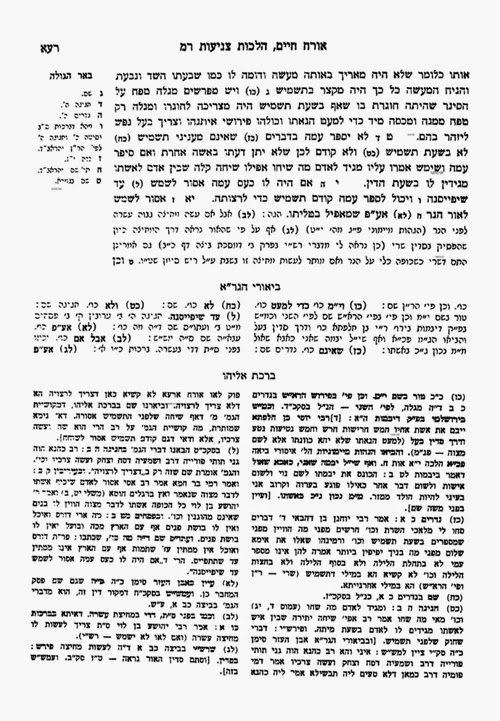
Use of a sheet would appear to be contradicted by the following passage in Ketubot 48a:
R. Joseph learnt: Her flesh [שארה] implies close bodily contact, viz., that he must not treat her in the manner of the Persians who perform their conjugal duties in their clothes. This provides support for [a ruling of] R. Huna who laid down that a husband who said, ‘I will not [perform conjugal duties] unless she wears her clothes and I mine’, must divorce her and give her also her ketubah.
Yet this text, which rejects the approach of the Persians, is itself opposed by R. Gamaliel who stated: “For three things do I like the Persians: They are temperate in their eating, modest in the privy, and chaste in another matter [i.e., sexual behavior]” (Berakhot 8b).[32]
Another interesting point related to sex and seforim is the following. Megillah 13b states: “R. Johanan said: Bigthan and Teresh were two Tarseans and conversed in the Tarsean language. They said: From the day this woman came we have been able to get no sleep. Come, let us put poison in the dish so that he [Ahasuerus] will die.”
Bigthan and Teresh couldn’t get any sleep since they could not go to sleep as long as the king was awake. But why was the king not going to sleep? Rashi explains that he found Esther so attractive that he had lots of sex with her, and this was keeping him up at night.
מתוך שהיתה חביבה עליו היה מרבה בתשמיש
R. Baruch Epstein, Torah Temimah, Esther 2:23, offers a different explanation of the Talmud. He claims that Ahasuerus was up at night because he so enjoyed taking walks with and talking to Esther.
כי היה מטייל ומשוחח עמה הרבה
What I can’t figure out is why R. Epstein expects us to prefer his understanding, which turns Ahasuerus into a perfect gentlemen, over that of Rashi.[33]
Finally, let me offer an example of distortion when it comes to sex. R. Israel Yanovski, Taharat Yisrael, vol. 2, p. 100b, no. 33, states:
מי ששם אצבעו בתורף אשה פריצות גדולה היא ויש בו איסור
The source offered for this surprising invasion of the marital bedroom is R. Yerucham, Toledot Adam ve-Havah, vol. 1, netiv 23 (p. 192d in the standard edition). Yet R. Yerucham says something very different.[34]
מי ששם אצבעו בתורף אשת איש פריצות גדולה היא ויש בו איסור ואפילו המסתכל אבל אינו חייב מלקות
The only question is if R. Yanovski’s quotation was a careless error (copied perhaps from R. Dovber Karasik, Pithei Olam, Orah Hayyim 240:16, who uses the same mistaken wording) or an intentional distortion due to puritanical feelings.[35]  R. Moshe Stern, Be’er Moshe, vol. 3 p. 204, assumes the former while I think the latter is also possible. I say this because Taharat Yisrael is quite an extreme work when it comes to sexual matters, which R. Yanovski wants to limit as much as possible. Thus, he praises those tzadikim whose children, we are told, equal exactly the number of times these tzadikim had sexual relations. In other words, if a certain tzaddik only had three children, then in his entire life he only had sex three times.[36]
As for other pious peopleR. Yanovski, based on kabbalistic sources, tells them to avoid sexual relations on Rosh Ha-Shanah (and tavo alav berakhah if one can abstain for the entire Ten Days of Penitence), Hoshana Rabbah, the three days preceding Shavuot and also on Shavuot, from Rosh Hodesh Av until the 11th of Av, the first and second night of Passover, the nights of Shemini Atzeret and Simhat Torah, and hol ha-moed Pesah (unless it falls on Shabbat). If this wasn’t enough, he also assumes that sex is forbidden on Hanukkah and Purim and any day that you don’t recite tahanun (!).[37]
בחנוכה ופורים נראה דאסור וכ”ש שאר ימים שאין נופלין על פניהם בהם דאסור בלי ספק

Finally, let me call attention to Berakhot 57b which states that three things resemble the World to Come, “the Sabbath, sunshine, and tashmish.” What does tashmish mean? Normally you would assume it to mean tashmish ha-mitah, i.e., sexual relations. However, the Talmud explains that it doesn’t mean this but refers to “tashmish of the orifices.”R. Samuel Alexandrov claims that the original rabbinic saying indeed meant what it said, i.e., that sex resembles the pleasure of the World to Come. However, the later sages didn’t want people to focus on sexual matters so they explained the passage in a different way.[38]

Regarding the connection between sex and the World to Come, R. Solomon Alkabetz quotes “the kedoshim” that sexual pleasure is one sixtieth of “the true pleasure”, i.e., the World to Come.[39]

To be continued

* * * * * *
Most of R. Yanovski’s Taharat Yisrael (mentioned in this post) focuses on the laws of niddah and mikveh. It was printed twice in Europe and then was reprinted in the United States in 1952. This latter publication was dedicated to the memory of R. Judah Leib Forer, the rabbi of Holyoke, Massachusetts. This page appears at the beginning of the book.
Here is the page of American haskamot added for this edition. This is one of a handful of haskamot from R. Soloveitchik, and I think is the first to appear in print.
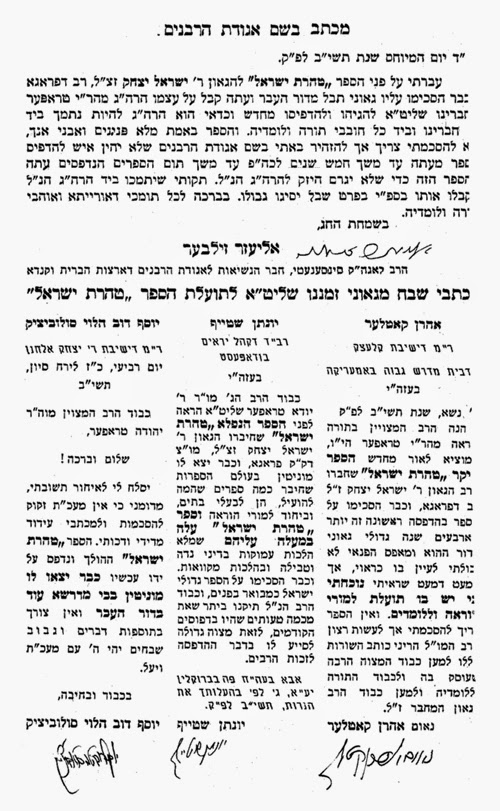
Regarding R. Forer, who was an outstanding student of R. Hayyim Soloveitchik, there is a good deal of information from family members available on a website here. Among the points noted was that R. Shach was a student of his.
Here is the title page of Milei de-Igrot, consisting of Torah letters between R. Forer and R. Mordechai Gifter. There is also one letter from R. Shach to R. Forer. On p. 181 we also see that R. Forer delivered a shiur at RIETS. (There is another volume of Milei de-Igrot and this contains letters between R. Gifter and his teacher R. Moses Aaron Poleyeff. There is a good deal of biographical information about R. Gifter in this latter volume, including his difficult relationship with R. Bernard Revel.) 
The one point I would like to add to all the recollections that appear on the website I have referred to is that R. Forer was unique in that he was the spiritual leader of both the Orthodox and Conservative communities. That is, the membership of the Conservative synagogue liked R. Forer so much that while they wanted a mixed pew congregation, they also wanted him as their rabbi. This information was confirmed to me by elderly members of the Orthodox and Conservative synagogues. What is not known is if R. Forer ever actually attended the Conservative synagogue or if he was ever officially recognized as their rabbi. He was, however, the only spiritual leader in the town, recognized by all, and I don’t know of another example in history where there was one rabbi for both the Orthodox and Conservative congregations.
[1] Iggeret Musar, ed. Haberman (Jerusalem, 1946), p. 33. It is interesting that later in this work, in giving an example of an anti-Semitic decree in Spain, Alami mentions that Jews were forced to grow their beards. See p. 40. This shows that going clean-shaven was common in medieval Spain. Alami sees this as an example of midah ke-neged midah, i.e., since the Jews were improperly cutting off their beards, it was the non-Jewish authorities who forced them to grow the beards.
[2] Jubelschrift zum siebzigen Geburtstag des Prof. Dr. H. Graetz (Breslau, 1887), p. 60 (Hebrew section). Both this source and Alami are cited in Israel Abrahams, Jewish Life in the Middle Ages (New York, 1975), p. 94 (he mistakenly dates the  Italian document as 1413). Louis Finkelstein, Jewish Self-Government in the Middle Ages (New York, 1964), ch. 10, reprints the Italian document (mistakenly dating it as 1416). The passage I have referred to appears in Hebrew on p. 286, but is missing, together with much else, in what is supposed to be the translation on p. 294. Among the other Italian takkanot is one stating that a man can only wear one gold ring. See Jubelschrift, p. 59. I mention this only because some have the mistaken perception that Jewish men never wore rings. See also S’s post here which has a painting of R. Bernard Illowy wearing a ring.
[3] In the days of the Talmud we find that plenty of betrothed, but not yet married, couples were having sex, or at least suspected of it. See Ketubot 9b, 12a.
[4] Parashat Miketz, mahadura kama.
[5] R. Moses Sofer, She’elot u-Teshuvot Hatam Sofer, Even ha-Ezer no. 133, writes:

ועוד דזנות דפנויה קיל לאינשי ולא משמע להו איסורא כל כך אע”ג שהם נדות, ועינינו רואות דרובן פרוצות בפנוייתן ונעשות צנועות אחר נישואי[הן]י

Understood as written, the second part of this sentence is quite incredible, as the Hatam Sofer is stating that most unmarried Jewish women are sexually active. Yet there is no question in my mind that what he is really means is that most of those who are sexually active before marriage, behave properly after marriage. See here.

[6] Leket ha-Kemah (Amsterdam, 1707), p. 29a.
[7] R. Jacob Kamenetsky was adamant that it is worse for a man to marry a non-Jew than to marry a Jew who won’t observe taharat ha-mishpahah. See Emet le-Yaakov, parashat Ve-Yehi, p. 237, translated here.
[8] Perhaps this should be better translated as “some communities”, but I am dan le-kaf zekhut. See also Abraham Neuman, The Jews in Spain (Philadelphia, 1944), vol. 2, p. 279 n. 42.
[9] Jewish prostitutes definitely felt that they were part of the community. See R. Raphael Ankawa, Karnei Re’em (Jerusalem, 1910), no. 225, for a responsum sent to Brazil, regarding whether it was permissible for the synagogue to accept charity from the prostitutes, as well as a parochet they made for the synagogue. See also R. Moses Isserles, Shulhan Arukh, Orah Hayyim 153:21. R. Raphael Aaron ben Shimon, Nehar Mitzrayim (Alexandria, 1908), vol. 1, p. 12a, discusses a case where not only did the prostitute donate a parochet, but she also inscribed her name into it in golden letters. As R. Raphael notes, this is especially problematic since if allowed then people praying in synagogue would see her name staring down upon them and this would invariably lead to improper thoughts. (He adds that this particular prostitute had been with a lot of the young Jewish men.) Therefore, he ruled that the parochet could not be used and any gifts from prostitutes to the synagogue could not have their names on it. He also mentions a prostitute who donated a sefer Torah to the synagogue (!), and this was accepted on the condition that her name not appear on it..
Regarding Jewish prostitutes, see also the documents from the Russian archives recently published in ChaeRan Y. Freeze and Jay M. Harris, Everyday Jewish Life in Imperial Russia (Waltham, 2013), pp. 337ff., and see also Dan’s earlier post here. In 1611 the Prague Jewish community ordered the Jewish prostitutes to leave. See Simhah Assaf, Ha-Onshin Aharei Hatimat ha-Talmud (Jerusalem, 1922) p. 114. Any prostitute found plying her trade after this time would have a mark of shame branded onto her skin!
וזו שתזנה ח”ו מהיום והלאה יתוו עליה תו-קלון על ידי ברזל לוהט
See also Takanot Kandia, eds. Cassuto and Artom (Jerusalem, 1942), no. 31.
Pimps also felt that they were part of the community. See R. Joseph Hayyim, Rav Pealim, vol. 2, Orah Hayyim, no. 18, who rules that it is forbidden to give a pimp an aliyah, even if he only deals with non-Jewish prostitutes and non-Jewish clients. R. Hayyim Palache ruled that pimps must be expelled from the Jewish community. See Masa Hayyim, p. 14a. R. Solomon Kluger discusses Jewish pimps in Ha-Elef Lekha Shlomo, Yoreh Deah, no. 192, and see also R. Hayyim Palache, Hayyim be-Yad, no. 19, and R. Hayyim Hezekiah Medini, Sedei Hemed, Pe’at ha-Sadeh, ma’arekhet alef, no. 152 (s.v. apotropos le-arayot) .
[10] Zikhron Yehudah, no. 17.
[11] Akedat Yitzhak, Bereshitsha’ar 20.
[12] She’elot u-Teshuvot ha-Rivash, no. 425.
[13] Hasidot u-Mordot, p. 240 n. 96:
הוא סבר שעל “גדולי הדור” להעלים עיניהם מקיומן של זונות יהודיות מחשש לתגובה קשה של הסביבה הנוכרית, אם יהודים יקיימו יחסי מין עם נשים נוכריות
[14] See Torah Shelemah, Gen. 37, note 200, and see also Rashi, Gen. 37:35.
[15] See Da’at Zekenim mi-Ba’alei ha-Tosafot, Gen. 37:35
[16] See Berakhot 60a.
[17] Tosafot ha-Shalom, ed. Gellis, to Gen. 46:8.
[18] See R. Avraham S. Avraham, Nishmat Avraham (Jerusalem, 2007), vol. 3, p. 32.
[19] See Gur Aryeh, Gen. 46:10.
[20] The one exception I know of is Meiri, Sanhedrin 58b, who states that a non-Jew cannot marry his daughter. Even though the Talmud rejects this opinion, Meiri does not see this rejection as the Talmud’s final word on the subject. אפשר שדרך דחיה הוא וסוגיא בעלמא. However, just a few lines below this Meiri writes that if a Jew’s daughter (through a non-Jewish woman) converts to Judaism, he can marry her! While R. Abraham Sofer doesn’t comment on this seeming inconsistency, in R. Yitzhak Ralbag’s edition of Meiri on Sanhedrin, published in Sanhedrei Gedolah, vol. 4, he writes:
ק”ק לשיטת רבינו שב”נ אסור בבתו איך מותרת לו אחר הגירות.
Before you reply that the convert is like a “new person” and thus has no connection to her father, recall that in Yevamot 22a it explains that the incest prohibitions that are applicable for a non-Jew remain forbidden (rabbinically) even after conversion. So how then, according to Meiri, can a father marry his converted daughter?
[21] Ba-Midbar 90. See also Shabbat 130a.
[22] See also Maimonides. Hilkhot Melakhim 9:5, that this is permitted for non-Jews. I will return to the matter of incest in a future post.
[23] See his article “Ha-Zakaim be-Mikra ve-Hayavim be-Hazal,” available here.
[24] See Irving Agus, Rabbi Meir of Rothenburg (New York, 1970), vol., 1, p. 279.
[25] Teshuvot Ba’alei ha-Tosafot, p. 33. See also Agus in Jewish Quarterly Review 49 (1959), pp. 217-218.
[26] A number of years ago two of my friends got married. One of them met with his rabbi for “the talk”, and was told that when it comes to sex, pretty much everything is permitted. The other friend attended a “hatan class” in New York City. He called me one night, surprised at being told that in sexual relations only one position is permitted. This was stated as a matter of halakhah and the directly opposing statement of R. Moses Isserles, Shulhan Arukh, Even ha-Ezer 25:2, was never even mentioned. R. Isserles writes:
ויכול לעשות עם אשתו מה שירצה . . . ובא עליה בין כדרכה בין שלא כדרכה או דרך איברים ובלבד שלא יוציא זרע לבטלה. ויש מקילין ואומרים שמותר שלא כדרכה אפילו אם מוציא זרע אם עושה באקראי ואינו רגיל בכך. ואף על פי שמותר בכל אלה כל המקדש עצמו במותר לו קדוש יאמרו לו
Note R. Isserles’ last sentence. In other words, my friend’s hatan teacher decided (without asking his students) that all the future grooms sitting before him were going to be called קדוש.
[27] See also R. Moses of Coucy, Sefer Mitzvot Gadol, pos. no. 52. R. Hayyim Ozer Grodzinski, She’elot u-Teshuvot Ahiezer, vol 3, no. 24:4-5, has a different understanding.
[28] R. Nahman of Bratslav stated that not only does the tzaddik not experience any sexual pleasure, but he suffers during sex, even more than a boy suffers during circumcision. See Arthur Green, Tormented Master (Woodstock, VT, 1992), p. 39. Regarding sexual pleasure, there is an old question as to why one does not recite a blessing over it. R. Zvi Elimelech Shapira of Dinov stated that before sex one should make a shehakol on food or drink and include in thisalso the anticipated sexual pleasure. See his Magid Ta’alumah (Bnei Brak, 2006), to Berakhot 40a, 43a. Recognizing that people will find this suggestion quite strange, especially as no one before him ever had this idea, R. Zvi Elimelech adds:
כתבתי זה מסברתי והמשכיל לא ישליך דברי אחרי גיוו כי דברי טעם הם
Elsewhere, R. Zvi Elimelech writes that optimally one should not have any pleasure from sex. See Igra de-Firka (Jerusalem, 1973), p. 28b (no. 197):
ובאמת עפ”י התורה יותר טוב שלא ליהנות
[29] See also Tosafot, Shabbat 118b, s.v. eima, that R. Yose ben Halafta performed yibbum with five different women.
[30] She’elot u-Teshuvot Maharam be-R. Barukh, ed. Bloch (Budapest, 1895), no. 866.
[31] Mor u-Ketziah 240.
[32] It is also worth noting that R. Isaac Luria held that one’s tallit katan should remain on during marital relations. See R. Hayyim Joseph David Azulai, Birkei Yosef, Orah Hayyim 8:7. See also Magen Avraham, Orah Hayyim 240:22, and R. Avner Afgin, Divrei Shalom, vol. 5, pp. 417ff. R. Mordechai Eliyahu, Darkhei Taharah ha-Shalem, p. 278, writes: 

והמקפידים ללבש טלית טקן כל הזמן חוץ משעת רחצה, יניחו בשעת התשמיש את הטלית על צוארם שלא יחצץ ביניהם
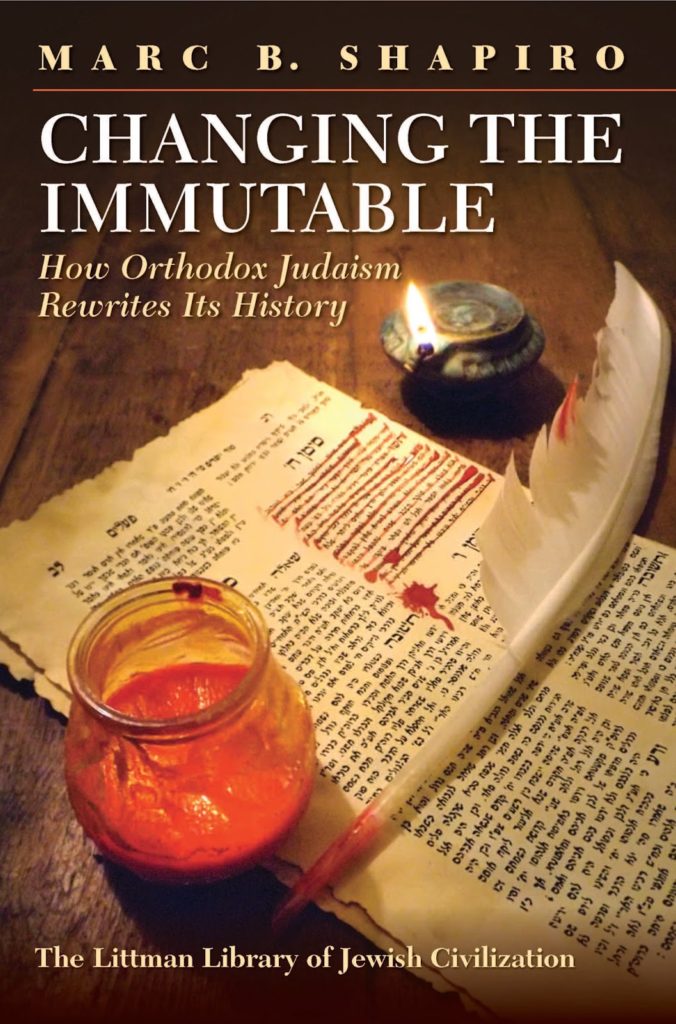
 

[33] A friend pointed out to me that R. Ovadiah Yosef adopted R. Epstein’s explanation. See Hazon Ovadiah: Purim, p. 279.
[34] R. Yerucham’s formulation is also quoted by R. Moses Isserles, Darkhei Moshe, Even ha-Ezer 21:2.
[35] R. Yanovski’s “revision” of R. Yerucham relates to the matter of female sexual pleasure. There is a good deal to say about this, especially with regard to the approach of the Gur hasidim which forbids any foreplay from the husband. However, for now, let me just note that R. Joseph Hayyim says the exact same thing, and unlike the Gur hasidim who see this as an added stringency, he sees it as an actual prohibition (which for many women would mean that in their entire lives they would never experience any sexual pleasure ומפני הצניעות אקצר.) See Ben Yehoyada, Niddah 13a:
גם הנשים אסורות להשחית הזרע שלהן, כמ”ש רבינו האר”י ז”ל. מיהו נראה גם באשה אם בעלה עושה משמוש ידים באותו מקום דרך שחוק והתעוררות תאוה ודאי גורם לה בזה הזרעה לבטלה, ואיכא איסור של השחתת זרע
(See, however, Torah li-Shmah, no. 504, where he does not regard this as an actual prohibition.)The Lehem Mishneh, Hilkhot Ishut 15:18, says the exact same thing as appears in Ben Yehoyada without using any kabbalistic sources:

כשהבעל ממשמש באותו מקום דודאי מן הדין אסור לעשות כך דאסור למשמש שם
Lehem Mishneh’s view is accepted by R. Isaac Palache. Yafeh la-Lev, Even ha-Ezer 25:8.
R. Yitzhak Abadi, Or Yitzhak, vol. 2, p. 65, is very disturbed by the Lehem Mishneh and states:
הוא תמוה לחדש כן בדברי הרמב”ם מכח קושיא בדבריו . . . ובכלל עצם הענין הזה לחדש דברים כאלה בלי שום ראיה הוא דבר תמוה, ובפרט שרש”י אומר בפירוש שמותר, ועוד שמצוותו בכך
Regarding the talmudic statement, Niddah 13a, נשים לאו בנות הרגשה נינהו, R. Moshe Malka, Mikveh ha-Mayim, vol. 6, p. 57, writes as follows, in surprisingly strong language:
כמה קשה עלי שמועה זו שהיא נגד הטבע, וכי נשים לאו בני הרגשה נינהו? וכי אינן נהנות גם הן מתשמיש כמו הגברים?
I was surprised to see that R. Shlomo Aviner does not regard female sexual pleasure as having any real significance. Here are passages from two separate letters (quoted in Yakir Englander and Avi Sagi, Guf u-Miniyut be-Siah ha-Tziyoni-Dati he-Hadash [Jerusalem, 2013], p. 108).
מה שאין אשתך נהנית בשעת החיבור אין זה אסון, זה קורה לנשים רבות, והעיקר שהיא אינה סובלת מזה. היא נהנית הנאה רגשית פנימית מעצם הקרבה, מעצם האהבה האחווה השלום והרעות, ואינה זקוקה להנאה גופנית
בעניין ההנאה – מה שאינך נהנית, אינו קריטי, ישנן נשים שלא נהנו כל ימי חייהן אפילו פעם אחת ולא הפריע להן, אלא הכול היה באהבה גדול
I hope to return to this very interesting book. But for now I can’t resist citing a passage from R. Eliezer Melamed (quoted ibid., p. 128). Not only could an American Modern Orthodox rabbi never express such sentiments (if he wants to keep his job), but I am convinced that even if such a passage appeared in an American haredi publication, the women would be quite offended.

איזו אישה כשירה? העושה רצון בעלה, זה הסדר. כאשר יש החלטה כזו או אחרת, בנהוג שבעולם שהאיש הוא הקובע, כך מקובל. כאשר זה לך כך, בדרך כלל שני בני הזוג לא מרוצים. אפילו אם האישה שמחה שהיא מחליטה בלבד ומשפיעה על מהלך העניינים, בסוף היא מתמרמרת שהיא לא נשואה לבעל, לא לגבר, אלא לסמרטוט. כמובן שיכולים להיות דברים מסוימים שבהם האישה קובעת, “נו, תחליטי את איזה צבע נבחר לספה”. הבעל ג’נטלמן, בבקשה, תחליטי את. אבל הוא נותן לה את המנדט להחליט, כך מקובל
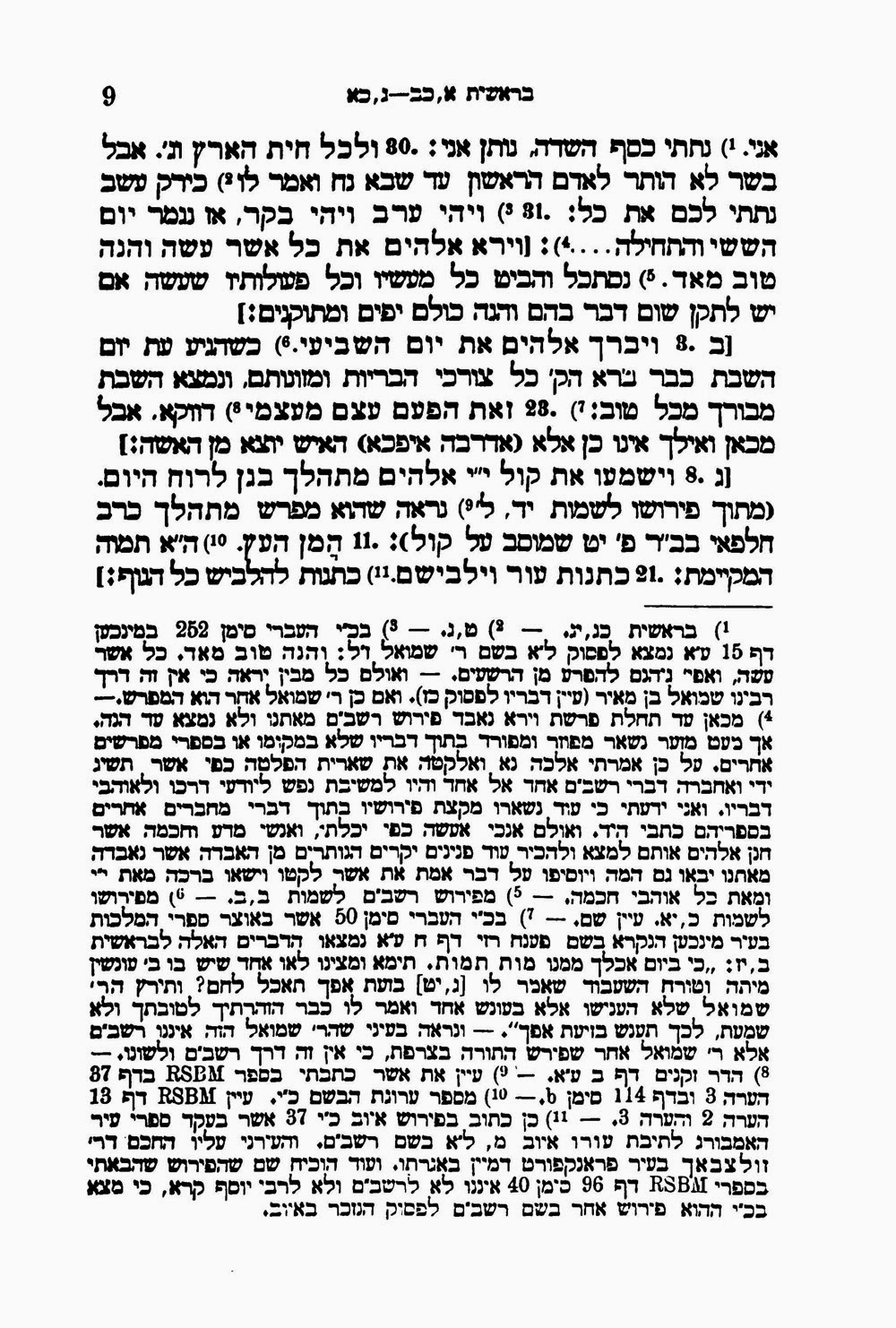
R. Aryeh Leib Steinman, Ayelet ha-Shahar, Kiddushin 30b, also states that a wife is obligated to obey her husband. It is easy to find plenty of earlier sources that say this, but I wonder how many haredi women today have such an understanding of their position in a marriage.

Regarding R. Melamed’s point that a man has to be a “man”, it reminded me of an interesting Meiri to Kiddushin 82b. The Talmud, ibid., states: “Happy is he whose children are males, and woe to him whose children are females.” Meiri suggests the following explanation: “Woe to him whose sons are like females,” with all the negative implications this implies:


שבניו נקבות שהזכרים פחותים וחסירים, ואשרי מי שבניו זכרים שנמצא בהם השלמות המכוון בהם

R. Yoel Schwartz, Ben Torah vi-Yeshivah (Jerusalem, 1978), p. 143, mentions this Meiri in the course of his discussion of male and female roles in Judaism. Schwartz makes the following very enlightened comment about how men should relate to “women’s work”, i.e., housework.


טיפוח הבית, הוא חלק האשה כמו שביארנו לעיל, מאחר שכאמור שטח זה הוא בתחום האשה, מי שמתעסק בטיפוח הבית מפסיד את כל ערך התועלת של קנין תורה
I shouldn’t mock it, however. If these guys can get their women to go along, who am I to protest? It wasn’t that long ago that pretty much all men had this Archie Bunker-like attitude.
[36] Taharat Yisrael, vol. 2, p. 97b.
[37] Taharat Yisrael, vol. 2, p. 97a.

[38] Mikhtevei Mehkar u-Vikoret (Vilna, 1907), vol. 1, p. 51. See also David Biale, Eros and the Jews (Berkeley, 1997), pp. 42-43, who sees here a conflict between the Sages and popular belief, with the latter assuming that there is a place for sexuality in messianic days. (When the Talmud refers to the World to Come it means the messianic era.)

[39] Shoresh Yishai (Sziget, 1891), to Ruth 3:7 (p. 56a).


Book review: Asaf Yedidya, Criticized Criticism – Orthodox Alternatives to Wissenschaft des Judentums 1873 – 1956

אסף ידידיה, ביקורת מבוקרת: אלטרנטיבות אורתודוקסיות ל’מדע היהדות’ 1956-1873, 415 עמודים, ירושלים תשע”ג
Asaf Yedidya, Criticized Criticism – Orthodox Alternatives to Wissenschaft des Judentums 1873 – 1956
By Ezra Brand
Criticized Criticism is a book which I think would greatly interest any reader of the Seforim Blog. It deals with the history of the Orthodox “alternatives” to secular Jewish Studies, as well as many important issues that religious Jewish Studies scholars face.[1]  In this, it fills a definitely felt lack in Jewish historiography.  It follows a trend of recent works devoted to the history of specific aspects of Jewish Studies.[2]  The book is especially important since we do not yet have a complete history of Jewish Studies, but rather many works that focus only on slices of it.  For example, there are a number of works on the history of research into the Cairo Genizah, as well as numerous books and articles on individual researchers and institutions.[3] This is part of a larger trend in academia – the study of the history of academic disciplines themselves. Given its scholarship and readability, Criticized Criticism is likely to take a deserved place with other important works on the history of Jewish Studies.
The book does not try to encompass the entire history of the phenomenon it studies. As stated on the cover, it covers an 83-year period, from 1873 until 1956. The significance of the year 1873 is that this is the year that the Rabbinical Seminary in Berlin was opened by R’ Ezriel Hildesheimer. With the establishment of the Seminary, an “alternative,” Orthodox, Jewish Studies had an institutional home.  1956 is the year that Bar-Ilan University was opened. As Yedidya explains, Bar-Ilan was intended by its founders to continue the tradition of providing an “alternative” form of Jewish Studies, but ended up producing scholarship with essentially the same assumptions as mainstream Jewish Studies, for various reasons. The Orthodox alternative tradition no longer had an institutional home.[4]
The book begins with a general overview of the early development of Jewish Studies, starting from the early nineteenth century in Berlin (including a description of what Jewish Studies then entailed, and how it was different from traditional Jewish scholarship), and its subsequent spread to Eastern Europe. In Chapter Two, a short history of early Orthodox reactions to Jewish Studies is given.[5] At the end of this chapter, the program of the book is stated: To analyze Orthodox reactions to secular Jewish Studies, which on the one hand accept the scientific method, and on the other hand accept Orthodox principles of faith as a given. Yedidya states (pg. 72): “The first real attempt in this direction was the establishment of the Rabbinical Seminary headed by R’ Ezriel Hildesheimer in Berlin, which devoted itself among other things to Jewish Studies.” [6] In Chapter Three, the book begins its discussion of the Seminary.
The book discusses many other major figures, such as R’ Yitchak Isaac Halevi and Ze’ev Ya’avetz. Yedidya carefully analyzes their methodology and their underlying ideology.
A major portion of the book is devoted to discussing Orthodox Jewish Studies in Eretz Yisrael in the early twentieth century. Many of the scholars in this group were greatly influenced by R’ Kook, and his influence is discussed extensively. R’ Kook supported studying texts scientifically, and expanding the range of texts studied. However, R’ Kook is portrayed by Yedidya as doing so only in order to counter heretical scholarship: “R’ Kook supported the Orthodox study of ‘Jewish Studies’, as an alternative to the non-Orthodox study” (pg. 273, my
italics). Again: “R’ Kook sought to widen the scope of limmud hatorah […] and to add additional Torah subjects, which would prepare Talmidei Chachamim for intellectual creativity which would allow them to confront with the litereature of Haskalah and secular nationalism” (pg. 282, my italics). However, it appears that in fact R’ Kook believed that scientific Jewish Studies is important for its own sake. R’ Ari Shvat, in a series of articles, shows that R’ Kook had great respect for Jewish Studies, and felt that it inherently had great religious worth.[7] R’ Kook writes: “Subjecting the intellect and causing it to slumber […] is the destruction of the world […] therefore, when the attempt to cause the intellect to sleep comes in the name of ‘faith’, in the name of ‘fear of Heaven’, in the name of ‘diligence in Torah study’ and ‘doing mitzvos’, it is a terrible falsehood […] the hatred of haskalah[8] because of a faith-based bias (הנטיה האמונית) comes from the poison of heresy, which divides the domains (המחלקת את הרשויות)”.[9]
At the end of the book, Yedidya summarizes the common denominator among all the scholars attempting to defend their beliefs and create an “Orthodox alternative.” In the beginning of the book, we are told that the book will discuss scholars who are between two opposite extremes: On one side, traditional Orthodox scholars who refuse to accept the legitimacy, or usefulness, of the scientific method, and on the other side, scholars who look at the discipline of Jewish Studies as they would any other subject. Yedidya explains very nicely how the scholars about whom he writes are different from both of these extremes. Three differences – numbered – are listed for differences from the former, and six for differences from the latter. I’d like to make two observations.
In the enumeration of differences from traditional Orthodox scholars, the second difference listed is the following (pg. 372): “Secondly, from a thematic perspective, they dealt with a wide range of disciplines – Tanach, literature of Chazal, Jewish history, and Jewish philosophy, and did not focus only on specific debates with ‘problematic’ works or with introspective inner-gazing at the roots of the specific movement they are part of.” This may be meant to be implied by Yedidya, but it is important enough that it should have been mentioned explicitly: The scholars discussed by Yedidya wrote almost exclusively on Jewish history, the history of Torah Sheba’al Peh; and Tanach. (These are the titles in Critized Criticism of chapters four, five, and six, respectively. Of course, these scholars also researched traditional Jewish literature, such as R’ Chaim Heller’s edition of Sefer HaMitzvos.) Which of these scholars researched Kabbalah as did Graetz, Shadal, Jellenick, Franck, and later Scholem? Which of these scholars wrote on Jewish philosophy and science in the Middle Ages, as did Steinschneider? Which of them researched piyyutim (Zunz, Shadal, Brody), Karaism (Poznanski), or magic (Blau and Trachtenberg)? It would appear that, in fact, these scholars did not write on any subject that touched on Jews, except in one of three cases: one, if they felt they had to defend something; two, if it was important for educational purposes; three, if it was part of Talmud Torah.
The attempt at creating religious “alternatives” to secular Jewish Studies mostly ended in the 1950s, as pointed out by Yedidya. However, this is not true for the study of Tanach. Defense of the traditional understanding of Revelation, against academic Bible Studies, was relaunched with full force by R’ Mordechai Breuer in 1960. Breuer’s idea of “Bechinot” caused great controversy, but he continued to publish and teach his ideas. The yeshiva that he became associated with, Yeshivat Har Etzion in Alon Shvut, or “The Gush” as it is colloquially known, is now synonymous with an entire method of Biblical hermeneutics, known as the “The Gush method.” R’ Amnon Bazak’s pioneering book, Ad Hayom Hazeh (Tel Aviv 2013), systematically lays out for the first time possible flexibility in the traditional understanding of the Bible. “Orthodox alternatives” are alive and well.[10]
That Criticized Criticism can prompt such lively discussion is a tribute to its author and his presentation of his subject.  The book is an enjoyable and informative read, and I heartily recommend it.


[1] “Jewish Studies” meaning the critical, historical research into Jewish sources, using all tools and methods available, whether
history, philology, realia, or comparison to non-Jewish sources. Recently, a number of religious Jewish Studies scholars have discussed the differences between traditional methods of study and the scientific method. See, for example, the important article by Menachem Kahana (מנחם כהנא, “מחקר התלמוד באוניברסיטה והלימוד המסורתי בישיבה”, בחבלי מסורת ותמורה, רחובות
תש”ן, עמ’ 113-142), and the articles mentioned in the introduction to Sperber’s Neitvot Pesikah (דניאל שפרבר, נתיבות פסיקה, ירושלים תשס”ח). See also further, footnote 10.
[2] One of the first to study at length the history of research in Jewish Studies is the great Jewish historian Salo Baron. His essays on this topic are collected in History and Jewish Historians, Philadelphia 1964.
[3] Some of the researchers have full-length academic monographs devoted to them, usually including both a biography as well as an analysis of their works and methods.  Examples are the following (authors of the biographies in parenthesis; more information can easily be found in online catalogs): Nachman Krochmal (Jay Harris), Shlomo Yehuda Rapoport (Isaac Barzilay), Heinrich Graetz (ראובן מיכאל), Gershom
Scholem (David Biale). Others have only non-academic, popular biographies: Isaac Halevy (O. Asher Reichel), Louis Ginzberg (Eli Ginzberg), Saul Lieberman (Schochet and Spiro). Articles on individual scholars can be found in all the Jewish enyclopedias (Jewish Encyclopedia, both editions of Encyclopedia Judaica, and in the Hebrew Encyclopedia Ha’Ivrit), as well as in the following works: Getzel Kressel, Lexicon Hasifrut Ha’ivrit Bedorot Ha’achronim,  Tidhar, Encyclopedia Lechalutzei Hayishuv Ovonav, S. Federbush, Chochmat Yisrael B’Ma’arav
Eiropa
, 1–3, Jerusalem 5719-5725; Encyclopedia shel HaTziyonut Hadatit, 1-5, Jerusalem 5718-5743. These last two works are the ones usually used in the work under review for biographies of people mentioned in the book; numerous other works can be found in the bibliography. Another important resource is of course Jubilee volumes, memorial volumes, and tribute articles.
[4] This is no longer completely true. The Gush Yeshiva can currently be considered an institution that offers a consistent alternative methodology, at least in regards to Tanach. See later.
[5] For some reason, Maharatz Chajes is not mentioned at all in this section.
[6] My translation of the book’s Hebrew.
[8]  This can be translated either as “Haskalah” (as in the movement) or as “education.”  R’ Kook may have been intentionally ambiguous.
[9] Orot Haemunah, ed. 5745, pg. 98. Quoted by Shvat, “Chochmat Yisrael”, near footnote 88.
[10] There is also a nascent interest in yeshivos in the academic study of Talmud and Rambam. The academic study of Talmud was experimented with by R’ Shagar, and continued in the yeshiva of Otniel, especially by R’ Yakov Nagen (Genack) and R’ Meir Lichtenstein. However, as far as I know it has not produced any “school” of methodology. R’ Shagar ultimately rejected the academic method. See the collection of his essays, B’toraso Yehege (הרב שמעון גרשון רוזנברג – שג”ר, בתורתו יהגה : לימוד גמרא כבקשת אלוקים, בעריכת זוהר מאור, אלון שבות תשס”ט). R’ Nagen discusses the religious advantages and disadvantages of the academic method in his fine article, “Scholarship Needs Spirituality, Spirituality Needs Scholarship: Challenges for Emerging Talmudic Methodologies”, Torah u-Madda Journal 16 (2012-2013), pg. 101-133 . The academic study of Rambam was pioneered by R’ Rabinowitz and R’ Sheilat in Ma’aleh Adumim. R’ Rabinowitz’s commentary on Rambam is in the same tradition as the works described by Yedidya, but is not properly an alternative, as it is not guided by a reaction to the secular, scientific study of Rambam. (The main “secular” academic expositors of Rambam’s Mishneh Torah are David Henshke and Yaakov Blidstein. Henshke used to teach in Ma’aleh Adumim.) An extension of Yedidya’s research past 1956 is desideratum. In addition, it would be interesting to analyze the relationship of the traditional Orthodox (i.e., those who not consider themselves to be participating in scientific study of texts), and especially Chareidim, to academic scholarship. In the past few decades, we have seen a phenomenon of traditional scholars being aware of academic scholarship, and even using it, but not acknowledging it. (For those interested in examples, please contact me.) For a similar phenomenon in regards to popular Chareidi literature, see the fascinating study by Yoel Finkelman, Strictly Kosher Reading: Popular Literature and the Condition of Contemporary Orthodoxy, Boston 2011.


Assorted Comments

Assorted Comments
Marc B. Shapiro
1. In this post I mentioned the strange comment of R. Shabbetai Bass in his Siftei Hakhamim, Exodus 33:13, Moses thought that God was joking with him.[1] A few readers emailed me that in the new Mikraot Gedolot Ha-Maor this passage has been deleted, i.e., censored. Here is how the passage looks in the first edition of Siftei Hakhamim, published in R. Bass’ lifetime..
Here is the passage as it appears in the censored Mikraot Gedolot Ha-Maor.

Fortunately, the new English translation of Siftei Hakhamim published by Metsudah includes the passage in its entirety.

2. In a recent post I referred to the Yemenite Rabbi Shlomo Korah and his experience in Lakewood. R. Korah has also published a commentary on Maimonides’ Mishneh Torah entitled Sefat Melekh. Although R. Korah presumably knows Arabic, for some reason he didn’t know what to make of the word שָם found throughout the Mishneh Torah, including right at the beginning:

יסוד היסודות ועמוד החכמות לידע שים שם מצוי ראשון
Numerous commentaries struggle with the word, and R. Korah offers his own interpretation, stating that it should be vocalized with a tzereh under the shin, not a kamatz.[2] Yet R. Samuel Ibn Tibbon, in the introduction to his translation of the Guide, already explained what the word means.
שבערבי כשירצו החכמים לומר שיש בעולם דבר או בנמצא דבר אחד, יאמרו שיש שם דבר אחד, רומזים במלת “שם” אל המציאות.

See also R. Joseph Kafih’s commentary to Hilkhot Yesodei ha-Torah 1:1. Confusion about the word שם goes back to medieval times, and in a recently published text of the Provencal sage R. Meir ha-Meili we see that he too did not know its meaning.[3]
R. Shlomo Korah should not be confused with R. Ezra Korah who is the translator of a new edition of Maimonides’ Commentary on the Mishnah that was published in 2009. The new translation is not very different than R. Kafih’s translation and is obviously based on the latter. It is also not an improvement on what R. Kafih provided us with. What makes this edition valuable is that each page is full of helpful notes compiled by a team of scholars. In fact, I don’t think anyone can seriously study Maimonides’ Commentary on the Mishnah without making use of this new edition.
Yet there is something deeply problematic about this edition. As is well known, R. Kafih’s translation of Maimonides’ Commentary sparked a new interest in study of this work, and for decades was the text that everyone used.[4] R. Korah’s new edition, which as already indicated is based on that of R. Kafih, only mentions R. Kafih once in the lengthy introduction.[5] Throughout the notes to the Commentary, R. Kafih is not mentioned, but is referred to as יש מי שכתב or יש מי שתרגם.

When will these people ever grow up and realize that just because you don’t agree with someone’s outlook doesn’t mean you can’t be a mensch and give him the scholarly credit he deserves? To give an idea of who R. Kafih was, R. Mordechai Eliyahu went so far as to state that was greater than R. Abraham Maimonides![6]

אנו, שאנו מכירים את הרב יוסף קאפח, הוא יותר טוב מבנו של הרמב”ם, איזה בקיאות יש לו בדברי הרמב”ם, הבן שלו לא ידע והוא ידע.

Here is the English dedication page of the new translation and the Hebrew title page.

Look at what it says in the dedication page. Is it possible that they told the donor that the translation that he was funding would be the first time that the Commentary on the Mishnah would be translated into Hebrew?

3. I have many unpublished rabbinic letters that readers will find interesting. Some of them need to be published in a journal, complete with an introduction and footnotes, as I have done in Milin Havivin, Or Yisrael, and elsewhere. (Discerning readers will note the incongruity of the two journals just mentioned.) For others, I don’t need to do anything but post them, as they are easy to read and self-explanatory.

Here is one such example. It is a 1950 letter from Chief Rabbi Isaac Herzog to R. Isser Yehudah Unterman, chief rabbi of Tel Aviv. I found it in the R. Herzog archive in Jerusalem and I thank the archive for allowing me to reproduce the letter. It is significant in that we see how impressed R. Herzog was with R. Elyashiv, and he hopes that R. Elyashiv will agree to move to Tel Aviv to serve as a dayan.[7]

Recently there was talk that if the Israeli draft bill was passed that the Belzer Rebbe would leave the State of Israel. Here is a February 14, 1948 letter from R. Herzog to a previous Belzer Rebbe. As you can see, R. Herzog was very upset when he heard that the Rebbe was thinking of leaving Eretz Yisrael due to the deteriorating security situation. He thought that this would create a hillul ha-shem and break the spirits of some of the Rebbe’s followers.

According to the Steipler, R. Isaac Zev Soloveitchik (the Brisker Rav) also wanted to leave Israel during the 1948 war, and even traveled to Haifa to receive his exit permit. In the end, he was prevented from leaving for reasons beyond his control, and didn’t continue his efforts in this regard. The Steipler explained that his desire to leave Israel was not because he was afraid but because he thought that the halakhah requires one to leave a place of danger to life.[8] I have difficulty understanding this view, as it would mean that all the Jews in Israel would have been required to leave. Presumably, R. Velvel’s point was that one who has no civilian or military role has to leave, since there is no justification for such a person to put his life in danger as he is not in any way contributing to the military cause.

4. In his latest article criticizing the haredi mentality, R. Berel Wein writes:

The great struggle of most of Orthodoxy in the nineteenth and early twentieth centuries against Zionism influenced all Orthodox thought and behavior. As late as 1937, with German Jewry already prostrate before Hitler’s madness and Germany already threatening Poland, the mainstream Orthodox rabbinate in Poland publicly objected to the formation of a Jewish state in the Land of Israel on the grounds that the heads of that state would undoubtedly be secular if not even anti-religious.

A number of people wanted details about this rejection of a Jewish state by the Polish rabbinate in 1937. Let me begin by saying that there is no truth to what Wein reports. The mainstream Polish rabbinate, represented by the Agudat ha-Rabbanim of Poland, never publicly objected to the creation of a Jewish state. The Agudat ha-Rabbanim included many rabbis who were Zionist and thus would never act in the way Wein describes. In fact, R. Yehezkel Lifshitz, author of the respected work Ha-Midrash ve-ha-Ma’aseh, was the head of the Agudat Rabbanim until his death in 1932. He was also a great lover of Zion who supported the creation of a Jewish state.[9]

In 1937, not only did Agudat ha-Rabbanim of Poland not reject the idea of a Jewish state, but it issued a public letter affirming the Jewish right to the Land of Israel. This letter also stated that under no circumstances could Agudat ha-Rabbanim agree with the removal of any part of the Land of Israel from future Jewish sovereignty.[10] Here is part of this letter, containing the Agudat ha-Rabbanim’s strong endorsement of a Jewish state.

ישמעו העמים הנאורים שהצהירו בסן-רימו על זכותנו הישנה והמוחלטת על נחלתנו הקדושה בגבולותיה שהציב בורא עולם ית’ את העוולה הנוראה שרוצים לעשות לנו. מחאתנו הכבירה צריכה להגיע לועדת המנדטים, למלך אנגליא, לנשיא ארצות הברית של אמריקה ולבישוף מקנטרבורי

Even Agudat Yisrael at its 1937 international convention in Marienbad (the third Kenesiyah Gedolah) did not reject a Jewish state, even though it was urged to do so by R. Elchanan Wasserman and R. Aaron Kotler. Neither R. Wasserman nor R. Kotler reflected the outlook of the mainstream Lithuanian or Polish rabbinate in this matter. In fact, according to the report of R. Samuel Aaron Pardes who attended the convention, R. Kotler agreed with R. Wasserman that acceptance of a Jewish state before the coming of the Messiah, even a State that would be completely Torah observant, is a denial of the messianic belief.[11] In other words, they both shared what would later be identified as the Satmar philosophy.

5. The internet is an amazing thing. Yechezkel Moskowitz, who listened to my Torah in Motion classes on R. Hayyim Hirschensohn, asked me where he was buried. I didn’t know but after only a couple of minutes online I found the answer: Riverside Cemetery in Saddlebook, N.J. The cemetery was very helpful and sent both me and Yechezkel a picture of the grave. Seeing that it needed to be cleaned up, Yechezkel took the opportunity to do this mitzvah, and here is how the grave currently looks.

Yechezkel also sent the picture to Kevarim.com and it can be found here here.

Here is a picture of R. Hirschensohn.

There is so much to be said about R. Hirschensohn and his enormous literary output and fascinating ideas in all areas of Torah. (I also have a number of unpublished responsa of his.) I have never seen anyone refer to the many short musings of R. Hirschensohn that appear in the Budapest journal Apiryon. I could have a lengthy post discussing any number of his short comments, that remind me both of R. Kook’s Shemonah Kevatzim and also of Nietzsche. Here is musing no. 46, which appears in Apiryon 3 (1926) p. 183:

יש עיקרי אמונה לישראל אשר אינם בספר רק בדם ובמורשה, ואם הספר מתנגד להם ישבקו לקראי דאינהו דחוקים ואוקמי אנפשייהו

The final words of the sentence are derived from Pesahim 59b, and the translation is (based on Artscroll) “Leave the verses alone, for they force themselves to be interpreted this way.”

What R. Hirschensohn is saying in the first part of the sentence is that there are Jewish principles of faith that are not to be found in a book, but are intuitive, i.e., part of our heritage and our blood. We can each come up with our own examples. One which comes to my mind is that it is a principle of faith not to try to settle Jewish problems by involving the non-Jewish authorities. Over thousands of years we have learnt that such an approach leads to all sorts of negative consequences, both foreseeable and unintended.

The second half of the sentence tells us that when a “book truth” contradicts the principle of faith we know intuitively, then the “book truth” is to be understood (reinterpreted if necessary) to conform to our intuitive faith. One can find similarities to this idea in the writings of R. Kook (see here and here where I discussed the observant Jewish masses’ innate natural morality and how according to R. Kook it is superior to the book-learning-based morality of the scholars).

The significance of R. Hirschensohn’s words is in 1) the denial that basic principles of faith are all found in books, and 2) the assertion that intuitive truths can effectively trump what appears in the canonical books. It is obvious that what when R. Hirschensohn writes of דם ומורשה he is speaking about the experience of the Jewish people as a whole, not about the Torah scholars. The Torah scholars are to be viewed as part of this experience of דם ומורשה , not something apart.[12]

In previous posts I have commented that one of the novelties of haredi ideology is the notion that the “Gedolim” are the carriers of all truth. See here where I quote R. Itzele of Ponovezh’s assertion that it is the people, עמך, not the Gedolim, who represent what today is referred to as Daas Torah.[13] This idea can be found in the Talmud and later rabbinic literature as well. When the Talmud and post-Talmudic authorities state
אם אינם נביאים בני נביאים הם  or
פוק חזי מאי עמא דבר  or
 קול המון כקול ש-די  or
מנהג ישראל תורה  they are not referring to the Gedolim but to the masses of pious Jews, the ones who make up the kehillah kedoshah.

Earlier in this post I referred to R. Kook and Nietzsche. Some readers might be thinking that I should write “R. Kook and Nietzsche lehavdil.” Yet R. Hirschensohn rejects the notion that this word should be used to distinguish Jews from non-Jews. See his commentary to Horayot (Jerusalem, 1926), part 3, p.6a.

וזה אין לנו לומר כי הלא אב אחד לכלנו א-ל אחד בראנו

For those who do want to use the word, R. Hirschensohn says that it is wrong to say הגוי להבדיל since it is precisely the Jews whom God chose to separate as his special people. Therefore, one should say (if he want to use the word),  “Nietzsche and R. Kook lehavdil.” Yet as mentioned already, R. Hirschensohn rejects the usage of this word when it comes to Jews and non-Jews. In addition to what I already quoted, he writes:

כונת האומר “להבדיל” הוא כמו להבדיל בין הקדש ובין החול, ואין הבדלה כזאת בין ישראל לעמים, כי כל בני תמותה נבראו בצלם אלקים וחייבים בשבע מצות רק אותנו הבדיל אלקים לו לחייבנו בתרי”ג מצות

R. Hirschensohn is assumed by everyone to be very liberal, in both his outlook as well as in his halakhic decisions. Yet this is not the entire truth, as we can see from his comment in Apiryon 3 (1926), p. 101, where he describes the “New Orthodoxy”, also known as “Conservative”, as akin to Christianity!

היהדות היא פעולת המוח על הלב הנצרות היא פעולת הלב על המוח, אך רבים מחליפים המושגים, לזאת נמצאים יהודים כשרים רבים אשר הם באמת לדאבון לבבינו נוצרים במסוה יהודית אשר קוראים בשם אורטודוקסיה חדשה או קאנסירוואטיף.

He states that in traditional Judaism  the mind is the center, and the heart is influenced by it, while in Christianity it is the reverse, with the heart influencing the mind. The problem with the “New Orthodox” is that they too put the stress on the heart over the mind. As we all know, when the heart is the determining factor, then Jewish law must be constantly updated in accord with people’s changing feelings.

His very next musing (ibid.) is undoubtedly directed against Hasidism, which he sees as mixing up the heart and mind.

עוד כת אחת יש בישראל אשר אם שהם שומרי תורה, אבל יש בהם עירבוב המושגים והתנגשות הלב והמוח

And finally, what is one to make of the following statement (ibid.) that removes Christian belief (as opposed to worship) from the status of avodah zarah?

אין בהנצרות ע”ז רק אולת ושגעון, אבל ההשתחויה מול התמונות הקדושות להם היא עבודה זרה גמורה ע”כ אמרו יום נצרי לעולם אסור.

Does this mean that a belief alone can never rise to the level of avodah zarah?

There is a lot more I want to say about R. Hirschensohn. In the Limits of Orthodox Theology I mentioned his view that even in Messianic days animal sacrifices would not be reinstated. He also has some significant comments about sacrifices in the introduction to his Nimukei Rashi, vol. 3. (This four volume commentary on Rashi is an outstanding work of scholarship.) 

In discussing the origins of sacrifices, R. Hirschensohn sees no reason to assume that Cain and Abel actually brought sacrifices in the sense we think of. While for us, a sacrifice means placing something on an altar and burning it, R. Hirschensohn states that there is no evidence that this is what Cain and Abel did. It is possible that all Cain did was bring his vegetable offering to the top of a mountain where he would commune with God, and left it there. With Cain’s “meager religious philosophical knowledge” he perhaps thought that after he left it there, God would take it. This is how R. Hirschensohn explains that Cain concluded that his sacrifice was not accepted. He reascended the mountain after a few days and lo and behold, the sacrifice had not been taken by God. For Cain, this meant that God didn’t accept it. And what about Abel’s sacrifice? Here, too, R. Hirschensohn says that there is no reason to think that it was burnt on an altar. Rather, it was a gift to God, and what Abel did was send his offering away, so that it would wander freely. This was the gift to God, not that he killed an animal. If you look at Genesis ch. 4, all it mentions is that Cain and Abel brought their offerings to God, not that they were ever burnt as a sacrifice.

How then did the idea of offering animal sacrifices come to be? The first example we have in the Bible is that of Noah when he leaves the ark. At this time he was not yet permitted to eat meat and yet he concluded that it would be proper to kill animals and birds for God. Where did he get this notion? The question is especially sharp as one would have assumed that Noah would be more interested in ensuring that the species multiply, rather than killing members of them. After Noah offers his sacrifices, we are told (Gen. 8:21), “And the Lord smelled the sweet savour; and the Lord said in His heart: ‘I will not again curse the ground any more for man’s sake; for the imagination of man’s heart is evil from his youth; neither will I again smite any more every thing living, as I have done.” This would seem to imply God’s approval of Noah’s sacrifices. R. Hirschensohn’s suggested understanding of this episode is, I think, shocking in its boldness:

ואם שלא רחוק לפרש פסוק זה כמו שהקב”ה צחק בלבו ורחם על קטון דעת האדם החושב להודות לו על ידי עולה וזבח עולת הבהמה ועולת העוף לשורפם ולכלותם בעת אשר הם כל כך מעט בעולם וחושב זה לטובתו, שזה בכלל יצר לב האדם רע מנעוריו שגם מנחה לאל עושה בדרך אכזריות, אמנם צריכים לעמוד על מחשבת האדם ודעתו בהתפלספותו בפליסופיא [!] אלקות איך יוכל לחשוב שבזה יתרצה אל אדוניו?
R. Hirschensohn’s suggested explanation assumes that part of man’s heart being “evil” from his youth was the thought that he should serve God is such a cruel fashion as killing an animal, and God accepting this sacrifice was an example of God being kind to the simpleton Noah who didn’t know any better.

R. Hirschensohn continues by saying that he in no way rejects the sacrificial system. His explanation is only applicable to an era when eating meat was not allowed. However, once the Torah makes clear that killing an animal to eat it is not cruel, we cannot say otherwise. Furthermore, he says, it makes no sense for people who eat meat to object to sacrifices on philosophical grounds.

R. Hirschensohn still has to explain the origin of sacrifices, and his position is quite original. He states that in ancient days people showed their loyalty to one another by a ceremony in which blood was drawn from each of them and mixed together. Later it developed that instead of using human blood to seal covenants, animal blood was used. The next natural development was the notion that sacrifices to the deity should also involve blood, and this is why the nations began to offer sacrifices to their gods, including sacrifices for all the good the god did.

R. Hirschensohn adds that sacrifices represent instinctual religious feelings, and no one who believes in God can degrade such a sign of faith.[14]

Let me now return to what I wrote here concerning R. Hirschensohn’s discussion of the comment of Rashi to Genesis 26:8. The verse states that Abimelech looked out his window and saw that Isaac “was amusing himself with Rebekah.” Upon this verse, Rashi, based on a Midrash, states that Abimelech saw them having marital relations. In the earlier post I expressed surprise that some commentators thought it was appropriate for them to discuss the Patriarch’s sexual life. One reader called my attention to R. Levi ben Hayyim, Livyat Hen: Eikhut ha-Nevuah ve-Sodot ha-Torah, ed. Kreisel (Beer Sheva, 2007), p. 672, which is another example of what occasioned my surprise.

R. Levi contrasts Isaac negatively to both Abraham and Jacob. He regards the latter two as on a higher spiritual level, and thus closer to God, than Isaac, and brings a number of biblical proofs to support this contention. In a really outrageous comment, much more objectionable than R. Levi’s allegorical passages that R. Solomon ben Adret was so upset with (and which don’t appear at all problematic when seen in context), R. Levi suggests that Isaac’s blindness was brought on by the fact that he was so attracted to Rebekah’s beauty[15] that it led to him having too much sex! (Although R. Levi reflects an old superstition, there is actually a medically documented phenomenon of temporary blindness following sex.)
גם תראה היותו נמשך לתענוגים, עד שאהב עשו בעבורם ואמר (בר’ כז, ג): “ועשה לי מטעמים כאשר אהבתי”. ואפשר שזה סבב לו להרבות המשגל עד שכהו עיניו מראות, כי נמשך אחרי יפי רבקה, שהעיד עליה הכתוב שהיתה יפת תואר מאד, הלא אבימלך ראהו מן החלון מצחק עם רבקה אשתו

Finally, let me make one more point about sexual matters in the Torah. Genesis 35:22 states that “Reuben lay with Bilhah.” The Artscroll multi-volume commentary on Bereshit (i.e., not the Stone Chumash), p. 1522, states that in Shabbat 55b “the Sages emphatically declare that Reuben did not commit the sin of adultery. They proclaim that מי שאמר ראובן חטא אינו אלא טועה.”

I believe this to be a conscious distortion of what appears in the Talmud, in the name of “frumkeit”, of course. If you open up the Talmud to Shabbat 55b you find that, first of all, it is not the “Sages” who proclaim מי שאמר ראובן וכו’ but one of the Sages, R. Samuel Bar Nahmani in the name of R. Jonathan. This is a very minor point, since following this statement in the Talmud we find other Sages who agree with this statement, i.e., they also assume that Reuben never actually had sexual relations with Bilhah (and they are quoted in the Artscroll commentary to Bereshit). However, from the Talmud we also learn that there were Sages who disagreed with R. Jonathan and took the biblical text literally. It is none other than the Artscroll Talmud that, quoting Maharsha, explains that according to R. Eliezer, Reuben did have sexual relations with Bilhah.

The Artscroll commentary on Bereshit is a very long work (2232 pages), providing numerous perspectives on every verse. Yet in this case they chose not to include the view of R. Eliezer and R. Joshua that Genesis 35:22 is to be taken literally, and Reuben indeed had sexual relations with Bilhah. A conscious choice had to be made to exclude this view, and I think we all understand why. But doesn’t Artscroll’s choice in this regard show a real lack of respect for R. Eliezer and R. Joshua? Maybe others see things differently, but it appears to me that Artscroll stood in judgment, as it were, over R. Eliezer and R. Joshua, and decided that their view was not worthy of being included since Artscroll did not like what they said. This is hardly the sort of kevod ha-Torah that Artscroll is supposed to represent.

[1] In a comment to my post, Cyril Fotheringay-Phipps noted that Siftei Hakhamim’s interpretation is actually based on a misreading of what appears in R. Elijah Mizrachi’s commentary on Rashi.
[2] See similarly R. Menahem Krakowski, Avodat ha-Melekh, ad loc. R. Hayyim Kanievsky, Kiryat Melekh, ad loc., also apparently has this view, as both he and R. Krakowski refer to Pirkei de-Rabbi Eliezer, ch. 3:
עד שלא נברא העולם היה הקב”ה ושמו הגדול לבד
See Va-Ya’an Shmuel 1, pp. 63-64, where R. Meir Mazuz writes to R. Korah to correct his error.
[3] See Yehudah Hershkovitz, “Ma’amar Meshiv Nefesh le-R. Meir ben R. Shimon ha-Meili,” Yeshurun 27 (2012), p. 78.
[4] I should say “almost everyone”. See Mesorat Moshe, p. 612, that R. Moshe Feinstein only used the old translation because he (mistakenly) assumed that the translators were “geonim” and thus superior to any modern translator. In Iggerot Moshe, Yoreh Deah, vol. 1, no. 63, R. Moshe assumes that the word “wine” in Maimonides’ Commentary on the Mishnah is a later insertion. Yet examination of R. Kafih’s edition shows that Maimonides indeed wrote this word. According to R. Yisrael Genos, R. Velvel Soloveitchik used to consult with R. Kafih as to the correct translation of Maimonides’ Commentary. See his haskamah to R. Kafih’s She’elot u-Teshuvot ha-Rivad (Jerusalem, 2009). See also R. Joseph Karo, Beit Yosef, Orah Hayyim 26, who assumes that a passage in the Commentary on the Mishnah was put in by an “erring student”. Yet this is incorrect. See R. Kafih’s note to Commentary on the Mishnah, Menahot 4:1.
[5] See p. 32 n. 162.
[6] “Ma’alat Beuro shel Mahar”i Kafih al ha-Rambam,” Masorah le-Yosef 8 (2014), p. 16.
[7] See the similar letter R. Herzog sent to R. Judah Leib Maimon in Ha-Shakdan, vol. 3, pp. 20-22.  
[8] A. Horowitz, Orhot Rabbenu, vol. 5, p. 74.
[9] See Moshe Tzinovitz, Ishim u-Kehilot (Tel Aviv, 1990), p. 209. See also Geula Bat Yehudah, Ish ha-Hegyonot (Jerusalem, 2001), p. 19.
[10] Ha-Hed, Elul 5697 (1937), p. 13.
[11] See Ha-Pardes, October 1937, p. 8. The October and November 1937 issues of Ha-Pardes contain a detailed report from the convention. See also Zvi Weinman, Mi-Katowitz ad Heh be-Iyar (Jerusalem, 1995), ch. 21
[12] R. Kook offers a different perspective (which does not seem to be in line with the passages I earlier referred to that focus on the masses’ natural morality). See Ma’amrei  ha-Re’iyah, p. 91:
שמא תאמר ליישב ע”פ הנוסח הרגיל מיסודו של מר אחד-העם: הספר הוא ספר, והלב עושה את החיים, וכיון שהלב נלחם בספר – הראשון הוא המנצח. במטותא מנך חביבי, אל נא תרפא שבר גדול על נקלה. הספר וכל אגפיו – גילוייו של הלב הם, ואיזה לב – לב האומה, הלב של נשמתה, הלב של תמצית כל הוייתה, של מעמק חייה, זה הלב דוקא בספר הוא מונח וגנוז, ותוך כל גרגיר המתגלה מאוצר הספר המון רב של לב ושל חיים מונחים.

[13] Those who are interested in R. Itzele should read R. M. S. Shapiro’s article on him in Ha-Mesilah 2 (Shevat, 5697), pp. 2ff. Among other things, Shapiro discusses how R. Itzele went from a supporter of Zionism to a strong opponent. One of the reasons he offers was the influence of Jacob Lifshitz, the askan par excellence. As Shapiro notes, the great rabbis were afraid of Lifshitz, for anyone who didn’t follow his orders was in danger of having Lifshitz destroy his reputation. The other reason Shapiro gives for R. Itzele’s rejection of Zionism was the fact that R. Chaim Soloveitchik was such a strong opponent of it
[14] For another comment of R. Hirschensohn on sacrifices, see Malki ba-Kodesh, vol. 1, p. 37:
זה פשוט שבימי דעה אלו [ימות המשיח] לא יהיה בהם המושג לרצות פני א-ל ברבבות נחלי שמן
See also Nimukei Rashi, vol. 3, parashat Va-Yikra, nos. 10-12. I think many will be surprised to see Rashi’s somewhat negative view of sacrifices. See his commentary to Psalms 40:7 (called to my attention by R. Moshe Shamah) and Amos 5:25. R. Isaac Sassoon refers to this latter passage in his Destination Torah (Hoboken, 2001), p. 202. Sassoon regards it as unlikely that the sacrificial system will ever again be reinstituted.
For Ibn Caspi’s negative view of sacrifices, see his Mishneh Kesef, vol. 2, p. 229, translated here.
[15] Speaking of physical beauty, in R. Yaakov Fink’s recently published Tiferet Yaakov, Introduction, p. 20, we are told that when his future wife was described to him by the shadchan as not being too good-looking, he replied: נו – אתרוג צריך להיות יפה. As a result of this, R. Fink’s wife made sure every year to find a beautiful etrog for him! (R. Fink was a student of R. Jehiel Jacob Weinberg.) 

See also Hokhmat Manoah to Ketubot 16b (found in the back of the Vilna Shas) who discusses Ketubot 17a, which states that according to Beit Hillel (and this is the halakhah) even regarding a bride who is not attractive one says that she is “beautiful and graceful,” נאה וחסודה. Hokhmat Manoah suggests that the two words, נאה and חסודה, mean two separate things. He explains that one says to the groom כלה נאה. However, to everyone else one says חסודה, which means חרפה, just like we find with the word חיסודא in Aramaic (see Onkelos, Genesis 30:23, 34:14, and Jastrow. This is also one of the meanings ofחסד  in Hebrew). In other words, while one tells the groom that his bride is beautiful, to everyone else at the wedding one says that she is repulsive! This is done, Hokhmat Manoah tells us, so that the men at the wedding don’t desire her:

שלא יתאוו ולא יחמדו לה שלא יעברו על לא תחמוד אשת רעך
Even in our age of increasing humrot, I can’t imagine Hokhmat Manoah’s suggestion being adopted anytime soon.
Regarding the matter of desiring other men’s wives, the following is also relevant. When someone gets married, Ketubot 7b tells us that the following words appear in one of the blessings recited:
                       
והתיר לנו את הנשואות על ידי חופה וקידושין  [נ”א בקידושין]
These are the words recorded by Maimonides, Hilkhot Ishut 3:24, and are found in almost all early sources from the Sephardic world, as well as in many from the Ashkenazic world. However, at Ashkenazic weddings (and I believe at all Sephardic weddings as well, see R. Ovadiah Yosef, Yabia Omer, vol. 5, Even ha-Ezer no. 6) the following is recited:
והתיר לנו את הנשואות לנו על ידי חופה וקדושין
Why do we repeat the word לנו as it is not part of the original blessing? R. Nissim, in his commentary on the Rif to Ketubot (p. 2b in the Alfasi pages), writes:

ורבינו תם ז”ל הגיה והתיר לנו את הנשואות לנו
What this means is that R. Tam altered the text of a blessing that had been in use for probably a thousand years. This is obviously a very radical step, so what led him to do it? As R. Meir Mazuz, Or Torah, Av 5772, p. 1012, points out, the original formulation is somewhat ambiguous. It states והתיר לנו את הנשואות, which could be understood to mean that through this blessing one can now have sexual relations with all married women. (This reason for R. Tam’s emendation is also noted by the Taz, Even ha-Ezer 34:3, R. Samuel ha-Levi, Nahalat Shiv’ah [Bnei Brak, 2006], 12:6, and many others.) Ritva, Ketubot 7b, wonders why the blessing is so ambiguous:
ותימה גדולה למה תקנו לשון סתום בזה הברכה הנאמרת ברבים
Not noted by R. Mazuz is that Rashi is cognizant of the problem and on the words והתיר לנו explains:
את נשותינו הנשואות לנו על ידי חופה וקידושין
What R. Tam did was take the explanation of Rashi and insert it into the blessing by his addition of the word לנו. It is, of course, difficult to imagine that anyone would have really assumed that the blessing allowed him to sleep with other married women. Yet according to R. Tam, the fact that the words could be understood in an improper way was reason enough to alter them. R. Abraham ben Nathan notes that R. Tam’s emendation was directed towards the stupid people. See his commentary to Kallah Rabbati (Tiberias, 1906), p. 7:
ומנהג צרפת בברכה לומר והתיר לנו את הנשואות לנו, לרווחא דמילתא שלא להטעות הפתיים
Although by now R. Tam’s emendation is the standard version recited by Ashkenazim and Sephardim, neither R. Joseph Karo nor R. Moses Isserles, Shulhan ArukhEven ha-Ezer 34:1, refer to it.