1

Maimonides and Prophecy, R. Pinhas Lintop, R. José Faur, and More Examples of Censorship

Maimonides and Prophecy, R. Pinhas LintopR. José Faur,  and More Examples of Censorship

by Marc B. Shapiro

1. In my last post here I discussed whether Maimonides believed that the entire people of Israel experienced prophecy at Mt. Sinai. I neglected to refer to Hilkhot Yesodei ha-Torah 8:3, which states:
לפי שנבואת משה רבנו אינה על פי האותות כדי שנערוך אותות זה לאותות זה, אלא בעינינו ראינוה ובאזנינו שמענוה כמו ששמע הוא
This is one of those passages that presents problems for the interpreter, since what Maimonides says in the Mishneh Torah, that all Israel experienced prophecy as Moses did, is contradicted by what he says in the Guide. As is to be expected, R. Kafih takes note of this problem in his commentary to Yesodei ha-Torah 8:3 (p. 165 n. 13), and what he says is fascinating. Commenting on the passage I quoted above, R. Kafih writes:
הדברים אמורים כאן על דרך ההטפה, אבל ברור בדעת רבנו שכל אחד שמע כפי רמתו, וכמשפט כל חזון, ועיין מו”נ ח”ב סוף פ’ לב, ופ’ לג, שם הביא לשון חז”ל במכילתא שמות יט כט משה מחיצה בפני עצמה ואהרן מחיצה בפני עצמה.
What R. Kafih is saying is that Maimonides’ words in the Mishneh Torah, that all Israel “saw and heard[1] with [its] own eyes and ears as he did,” should be understood as rhetoric, designed to have an effect on the reader, but they do not reflect Maimonides’ actual view which is that all of Israel did not see and hear as Moses did.

Regarding this issue, see also R. Kafih’s commentary to Guide 2:33, n. 5, where he writes:

לאו לדיוקא נקטה לא למין ההשראה באופן כללי, ולא לסוגיה

Further discussion of this matter, where R. Kafih elaborates on what he only hinted at elsewhere, can be found in his She’elot u-Teshuvot ha-Rivad (Jerusalem, 2009), nos. 24-26, where he explains to R. Mazuz what Maimonides had in mind.

In previous writings (books, articles, and posts), I have called attention to many examples where Maimonides writes things that he does not actually believe, so what we have just seen is nothing new. The significance of the example I have mentioned is that R. Kafih accepts this approach as a valid method of explaining a formulation of Maimonides in the Mishneh Torah. For another example from R. Kafih, see his note to Guide 2:45 (p. 268), where he writes:

וברור כי רבנו אמר את הדברים כאן על דרך הדרש וההטפה שדרך המטיף לגדיל ולהפריז בענין.
In Ketavim, vol. 2, p. 619, R. Kafih writes:
אמנם כתב הרמב”ם מה שכתב באיגרת תימן כדי להרתיע את מאמיני משיח השוא, וכדי להשקיט לבות החוככים אם להימין ואם להשמאיל. אבל באמת לא כן עמו.
2. R. Bezalel Naor’s translation of Orot is back in print. This time it is published with the Hebrew text as well. For those who don’t know this work, it is a masterpiece of translation. The introduction and notes are also fantastic. When people ask me what to read to get a sense of R. Kook’s thought and the conflicts it created, one of the things I always recommend is Naor’s introduction to Orot.
On the subject of Naor, I would like to call attention to another work of his which did not get the exposure it deserves. In 2013 he published Kana’uteh de-Pinhas, which focuses on the interesting figure R. Pinhas Lintop, rav of the hasidic (Habad) community of Birzh, Lithuania. R. Lintop was unusual among Lithuanian rabbis in that he intensively studied Kabbalah. He was also a supporter of the Mizrachi movement.[2]
Here is his picture.

                                                                                                             
Those who want to see a picture of his recently discovered tombstone can go here.
Anyone interested in Lithuanian rabbinic thought should examine Kana’uteh de-Pinhas. Among other things, it includes previously unknown letters from R. Lintop to the Chafetz Chaim and R. Kook. It also includes chapters by Naor on aspects of the philosophy of Habad, R. Tzadok, and R. Solomon Elyashiv. 

Naor calls attention to R. Lintop’s view of Maimonides’ Thirteen Principles. Unfortunately, I did not know of this when I wrote my book on the subject. R. Lintop is no fan of Maimonides’ concept of dogma or of Maimonides’ intellectualism in general. He rejects the notion that otherwise pious Jews can be condemned as heretics merely because they don’t accept Maimonides’ principles. He even makes the incredible statement that of the great rabbis, virtually all of them have, at the very least, been in doubt about one fundamental principle.

הנה לא הניח בן לאברהם . . . כמעט אין אחד מראשי חכמינו, החכמים הצדיקים כו’ כו’, אשר לא יטעה או יסתפק באחד משרשי הדת

Are we to regard them all as heretics? Obviously not, which in R. Lintop’s mind shows the futility of Maimonides’ theological exercise, which not only turned Judaism into a religion of catechism, but also indoctrinated people to believe that one who does not affirm certain dogmas is to be persecuted. According to R. Lintop, this is a complete divergence from the talmudic perspective.[3]

R. Lintop further states that there is no point in dealing with supposed principles of faith that are not explicit in the Talmud.[4]

הגידה נא, אחי, בלא משוא פנים, היש לנו עוד פנים לדון על דבר עקרים ויסודות את אשר לא נזכרו לנו בהדיא במשנה וגמרא?

As for Maimonides’ view that one who is mistaken when it comes to principles of faith is worse than one who actually commits even the worst sins, R. Lintop declares that “this view is very foreign to the spirit of the sages of the Talmud, who did not know philosophy.” As is to be expected, he also cites Rabad’s comment that people greater than Maimonides were mistaken when it came to the matter of God’s incorporeality.[5]

As part of his criticism of Maimonides and the Jewish philosophers in general, R. Lintop writes, in words similar to those earlier used by Samuel David Luzzatto:[6]

קרבו לנו דעות רבות נכריות וגיירו אותם עד כי היו לאמהות בישראל וגרשו את אמנו האמיתית

In his Pithei Shearim[7] R. Lintop criticizes Maimonides’ view, Hilkhot Melakhim 8:10, that given the power Jews must force non-Jews to adopt the Noahide laws. According to R. Lintop, this command only applied to the seven nations that inhabited ancient Canaan, but does not apply to any other non-Jew, even those living in the Land of Israel. Throughout his discussion, R. Lintop shows a strong moral sense and it is this which leads him to disagree with Maimonides. As he states:

  אין הקב”ה מקפח שכר כל בריה

As for those non-Jews who don’t observe the Noahide laws (referring in particular to the commandment against avodah zarah), R. Lintop sees them as blameless as they don’t know any better, having been born into their cultures.[8]

Among other things, I was surprised to see R. Lintop write:[9]

 הגאון המשכיל הנפלא בספרו בשמים ראש רנ”ב בשם אחד מהראשונים

He assumes that Besamim Rosh preserves authentic medieval responsa and yet he also recognizes that the publisher Saul Berlin was a maskil. This is significant since as far as I know, everyone else who believes Besamim Rosh to be authentic has no idea who Saul Berlin was.

Many who have heard of R. Lintop know of his correspondence with R. Kook and assume that they shared the same outlook. This is actually not the case, and in a letter to R. Yaakov Moshe Harlap R. Lintop said as much himself.[10]

כבודו הולך בזה ממש בדרך התחי’ שהולך ידי”נ הגאון מוהרא”י קוק במאמריו וספריו, והנה אמנם יש לי הרבה לדבר בזה כי אינני מהמסכימים לדרכיו, ורבות פלפלתי עמו בזה. הוא חושב כי אהבתינו הגדולה היא מפני השתוות דעותינו, ואני השבתיו כי להיפך מפני אי השתוות דעותינו אנו שואפים אחד להתמלאות מחבירו.

In 2013 the fourth volume of Reuven Dessler’s Shenot Dor va-Dor appeared. This volume contains two lengthy letters from R. Lintop to R. Kook (pp. 414-437). R. Lintop does not hesitate to criticize R. Kook’s understanding of hasidut. One of his criticisms is particularly noteworthy (pp. 435-436). R. Kook had written about how Hasidism is based on the idea of ahavat Yisrael for both the collective and the individual. R. Lintop replies that this is incorrect, as hasidut is not based on ahavat Yisrael but on ahavat avodat Yisrael and ahavat avodat ha-hasidut.

Then comes the following incredible passage, incredible since R. Lintop was at the time serving as rav of a Habad community and was generally quite connected to Habad philosophy, although he himself was not a Habad hasid. Some readers might see this as a purely academic type of statement, but anyone who knows the thought of R. Lintop will realize that this is, if not actually criticism, certainly disappointment with some of R. Shneur Zalman of Lyady’s statements.

הכי נוכל לחשוב את חסידות מורנו ורבנו אדמו”ר הזקן לחסידות אהבת ישראל אחרי הניח ליסוד מוסד באגרת הקודש (בתניא ח”ב) וז”ל לא זו הדרך ישכן אור להיות חפץ בחיי בשרים ובני ומזוני כו’ וראשית הכל שישמח האדם ויגל בכל עת ובכל שעה ויחיה ממש באמונתו כו’ ומי שעצב ומתאונן מראה בעצמו שיש לו רע ויסורין וחסר לו איזה טובה והרי זה ככופר ח”ו כו’ ומי שאין שוין לו מראה בעצמו שהוא מערב רב דלגרמייהו עבדין כו’ וע”כ הוא חפץ בחיי בשרים ובני ומזוני . . . בפ’ כ”ד מספר התניא משריש כי האדם העובר על רצון ה’ אפי’ עבירה קלה מד”ס הוא בהתכלית הפירוד מיחודו ואחדותו ית’ יותר מס”א וקליפה הנקראה אלהים אחרים ויותר מבהמה טמאה שקצים ורמשים (ובאגרת הקודש מג פוסק שכל העובר על ד”ס אפי’ באיסור קל של דבריהם חייב מיתה כעובר על חמורות שבתורה והדברים נוראים. גם בא ופוסק להלכה בספרי [!] אורח חיים [צ”ל חושן משפט] חלק ו’ הלכות נזקי גוף ונפש ט’ ישראל שעומד ברשעו תמיד כגון רועה בהמה דקה כו’ וכן כל כיוצא בהם אין כישראל דתם הוציאם מכלל ישראל ורחוק הדבר מאהבת ישראל הכללי.

There are many Habad adherents who read this blog and maybe some of them will want to weigh in on this.

Since, in the passage just quoted, R. Lintop cites the Tanya, let me share something interesting that appears in R. Mazuz’s recently published Asaf ha-Mazkir, p. 558. He mentions having heard that mitnagdim made fun of the Tanya since it begins as follows:

תניא משביעים אותו תהי צדיק ואל תהי רשע ואפילו כל העולם כולו אומרים לך צדיק אתה היה בעיניך כרשע

This comes from Niddah 30b and is stated by R. Simlai. The reason for the mitnagdim’s mocking is that R. Simlai was an amora so therefore the term תניא, which begins R. Shneur Zalman’s work, is inappropriate, as this term is used to introduce a baraita. (R. Mazuz argues that contrary to popular belief R. Simlai was a tanna, yet this is impossible.)

Finally, R. Isaac Nissenbaum tells us that R. Lintop was not a fan of R. Samson Raphael Hirsch.[11] (I wish I knew of this source earlier so I could have included it in my forthcoming article – already with the publisher – on Orthodox responses to Hirsch):

[הוא] הניא אותי מלהמשך אחרי “החורב” של רבי שמשון רפאל הירש, באמרו: “היהדות האמתית היא יהדות התורה ולא יהדות הרגש. היהדות תתקיים בתלמידי חכמים ולא ברגשנים דתיים. . .”

Just as I was finishing this post, a new book by Naor appeared entitled Mahol la-Tzaddikim. It focuses on the controversy between R. Moses Hayyim Luzzatto and R. Eizik of Homel regarding the purpose of creation.
3. In my new book I give examples of passages that were not translated properly, or not translated at all. After reading the book, Joel Wolowelsky sent me an edition of Birkat ha-Mazon, first published in 1946 (i.e., right after the Holocaust). The translation is by Rabbi Chaim Brecher, who is mentioned in my book in another context. Brecher’s edition of Birkat ha-Mazon actually became quite popular and was reprinted many times. In fact, the bentchers handed out at my own bar mitzvah were reprints of this edition.
At the beginning of Birkat ha-Mazon for weekdays, Psalm 137 (Al Naharot Bavel) appears (although almost no one says this). The final verse of this psalm reads:
 אשרי שיאחז ונפץ את עלליך אל הסלע
A proper translation of this verse is: “Happy shall he be, that taketh and dasheth thy [the Babylonians’] little ones against the rocks.”
I think it is fair to say that in modern times most people would be uncomfortable with the feeling expressed here. That explains the false translation of the verse provided by Brecher: “He will be as joyous as were you when you dashed our little ones against the stones.”

Was it a general humanistic feeling that impelled this false translation or was it the impact of the Holocaust that was responsible? In other words, with the then recent murder of so many Jewish children, perhaps it was not thought proper to give publicity to a verse that spoke of killing children of another people. Whatever the reason, it is obvious that this is an intentionally false rendering of the verse.
Regarding my book, let me also note the following:
Pp. 38-39. I wrote that there are no Ashkenazic siddurim, even those published in the State of Israel, that have an uncensored version of Birkat ha-Minim in the Amidah. As people know, I was working on this book for many years, and when I originally wrote this sentence it was correct (or so I believe). However, by the time the book appeared it was no longer correct. Rabbi Barry Gelman called my attention to the fact that in 2012 a nusach Ashkenaz siddur appeared without the censored text. Here it is.

Over the summer I was in Vienna and learnt that a couple of years ago Rabbi Schlomo Hofmeister, one of the community rabbis of Vienna, published Siddur Tefilat Yeshurun, and this siddur also includes an uncensored text of Birkat ha-Minim. I had never before seen this siddur, and what led me look at its version of Birkat ha-Minim were the following words that appear on the title page:
כמנהג בני אשכנז ללא שיבושי הצנזורה ושינויי המשכילים והמדקדקים המאוחרים
P. 55 n. 34: I somehow missed the fact that Esther Farbstein, Be-Seter Ra’am, pp. 614-616 n. 92, indeed discusses the story of the 93 Bais Yaakov girls committing suicide in Cracow. She also shows the fictional character of the story. (Thanks to R. Yaakov Taubes for calling this to my attention.)
P. 83: I refer to a responsum by R. Samuel Aboab who states that the words minhag shel shetut regarding kapparot were added by the printer. My language was not precise as this comment is not found in a responsum of Aboab but is quoted in Aboab’s name in a responsum of his student, R. Samson Morpurgo, referred to on p. 83 n. 11.
p. 131 n. 45: I report Derek Taylor’s claim that Chief Rabbi Joseph Hertz once attended a non-Jewish event without a head covering. I also note that Taylor does not provide documentation of this claim. Rabbi Dr. Benjamin Elton, who has recently been appointed rabbi of the prestigious Great Synagogue of Sydney, called my attention to this photograph in which Hertz is not wearing a kippah (source).
This was not even a non-Jewish event, but a lunch sponsored by the Polish-Jewish Refugee Fund. Hertz is also wearing a clerical collar.
Here is another picture of Hertz without a kippah (source).
Here he is wearing a kippah (source).

The men sitting behind him with the clerical collars are not Anglican priests. As you can see they too are wearing kippot. This is how Jewish “men of the cloth” used to dress in England. In this picture Hertz also has a clerical collar.
On p. 138 n. 64 I write that this photo from the Lubavitcher Rebbe’s student file at the University of Berlin[12] recently had a kippah placed on it.

The picture I referred to is the following, from R. Abraham Weingort, ed., Haggadah Shel Pesah al Pi Ba’al ha-Seridei Esh (Jerusalem, 2014), p. 53.

Regarding my discussion of the German Orthodox practice of not wearing a kippah, only after my book was in press did I read the memoir of the rabbinic scholar R. Shmuel Weingarten.[13] Weingarten describes coming to the Berlin home of R. Meier Hildesheimer and finding him and two other men drinking coffee with uncovered heads. Only when the Hungarian Weingarten entered the room did they pull their kippot out of their pockets and place them on their heads.
There is one more interesting text I would like to call people’s attention to. In R. Judah ben R. Asher, Zikhron Yehudah, no. 20, we see that R. Judah was asked if it is permitted to learn Torah with an uncovered head. R. Judah replied that it is not proper to do so, but his language makes it clear that there is no prohibition in this. He also adds that sometimes the heat will be such that one may feel unable to keep his head covered.
וטוב הוא שלא לישב בגילוי הראש בשעת הלימוד למי שיוכל לסבול לפי שילמוד יותר באימה ולפעמים מפני כובד החום אינו יכול לסבול
In R. Judah’s day they did not have small kippot like we have. It is obvious that the head covering was a significant item and when removed the man would be bareheaded.

In R. Azriel Hildesheimer’s responsa[14] the publisher included a note from Hildesheimer that informs us that in a copy of R. Judah ben R. Asher’s responsa (from the edition published in Berlin, 1846), there is a handwritten comment to the responsum just discussed. The author of the comment is described as הגאב”ד but it is not known whom this refers to. Alongside the words quoted above, that one who can bear the heat should cover his head, the unknown גאב”ד wrote:

לשון זה הוסיפו המגלים ראש ובכ”י כתוב בזה”ל: וטוב שלא לישב בגלוי הראש בשעת הלימוד כדי שישב באימה יותר ולפעמים מפני כובד החום נראה להקל. כבר נהגתי בעצמי לישב בכובע של פשתן דק כקופוצא בעתות החום לצאת ידי כולם

The Hebrew passage just quoted begins by stating that the comment in Zikhron Yehudah that one can take off one’s head covering if it is hot was added by “those who are bareheaded”.[15] This is followed by a quotation from the manuscript in which R. Judah says that on hot days he would sit with a lighter head-covering than normal. However, even this version has the language וטוב שלא לישב בגלוי ראש which also implies that there is no prohibition to be bareheaded during Torah study. This manuscript also has ולפעמים מפני כובד החום נראה להקל, which implies that one can be completely bareheaded if it is hot, to which it then adds that R. Judah himself did not sit bareheaded but wore a lighter head-covering. I therefore don’t see any substantial difference between the two versions of the responsum, yet the unnamed גאב”ד did see a problem with the first version and assumed that the text had been tampered with by a heretic.

In many prior posts I have discussed the assumption that heretics altered manuscripts (most recently in my posts regarding ArtScroll’s censorship of Rashbam). The example I have just given is one of the first where a rabbinic figure makes this argument about a halakhic text.[16] I have to say that in all of the numerous cases where modern rabbis claim that medieval texts written by great rabbinic figures have been altered by heretics, there is not even one instance where they make a compelling argument. Their approach is always along the line of, “This position goes against what we know to be true, so Rabbi X couldn’t have said it.” In this case there are actually two manuscripts in existence, and the words of one are exactly what we find it in the printed version of Zikhron Yehudah, while the other has the text mentioned by the גאב”ד.[17]

P. 218: I wrote that even a circumcised non-Jew is referred to as an arel. I was asked what my source for this is. I did not need to provide a source for my statement in the book, as it is a basic fact, and can be confirmed by looking in dictionaries. However, for those who want a rabbinic source see Mishnah Nedarim 3:11:

קונם שאיני נהנה לערלים מותר בערלי ישראל ואסור במולי עובדי כוכבים. קונם שאיני נהנה למולים אסור בערלי ישראל ומותר במולי עובדי כוכבים שלא היתה הערלה קרויה אלא לשמם שנאמר כי כל הגוים ערלים וכל בית ישראל ערלי לב

This Mishnah is explicit that even circumcised non-Jews are referred to as arelim.[18]

I would like to thank all those who have sent comments about my book. Only a small amount can be posted but I do try respond to all emails. I believe that I have mentioned all of the corrections. I hope that R. Menahem Lonzano would regard me as one of the ישרים בלבותם, for he wrote:[19]

הישרים בלבותם יאהבו החולק עליהם בדעת וישנאו העוזרם בלי דעת

4. In Saul Lieberman and the Orthodox I discussed the dispute over R. José Faur. I also published a letter in support of Faur by R. Jacob Kassin (who would later retract this support). It is well known that R. Faur’s greatest backer was R. Matloub Abadi, an important figure in the Syrian community and author of the halakhic work Magen Ba’adi. R. Abadi is mentioned in this regard by R. Kassin, in the letter of R. Kassin that I published in Saul Lieberman and the Orthodox. Here are two additional documents relevant to this matter. The first one is a 1966 letter from R. Abadi in praise of R. Faur.[20] I transcribed the document but was unable to make out some of the words.

The second document is a 1969 letter from R. Abadi to Chief Rabbi Yitzhak Nissim defending R. Faur. I found this document in the R. Nissim archive at Yad ha-Rav Nissim in Jerusalem. Together with the letter is a note that provides the following identifications.

ר”פ נ”י = R. José Faur
אויבו ורודפו = Rabbi Abraham Hecht
יוסף בן א’ = R. Yosef Harari-Raful (יוסף בן אהרן)

One more point about R. Faur that is worth noting is that he was such a close student of R. Aaron Kotler that he was one of the people chosen to carry R. Kotler’s coffin at his funeral.[21]
I have many more interesting documents that have never before appeared in print. I hope to publish some of them in future posts.
5. Let me share another example of censorship. It comes from a recently published book (too recent to be included in Changing the Immutable).
R. Joseph Messas has a passage, now famous among the Orthodox feminists, in which he refers to an unnamed book that mentions that in Spain there were places with women’s prayer groups at which each woman wore a tallit and some wore tefillin. It appears in his Nahalat Avot (Haifa, 1980), vol. 5:2, p. 268.

In 2015 the multi-volume set of Nahalat Avot was reprinted in Jerusalem. Take a look at the following page and you will see that the passage dealing with the women’s prayer groups has been deleted in its entirety.

Unlike Ashkenazic internal censorship of this sort, Sephardic censorship is a relatively new phenomenon (only a few decades old). Here is another example. R. Isaac Abraham Solomon’s book Akim et Yitzhak was published in Baghdad in 1910. On pages 112b-113a he rejects a position of the recently deceased R. Joseph Hayyim, the Ben Ish Hai.

R. Solomon appears to even cast doubt on R. Joseph Hayyim’s integrity when he writes:

וקי”ל ת”ח שאמר מילתא לאחר מעשה אין שומעים לו להחזיק דבריו

This book was reprinted in 1971, and here is how the pages look.

R. Eliyahu Sheetrit reports that R. Ovadiah Yosef was upset with this censorship and annoyed that the publisher thought that he could do as he wished with someone else’s book.[22]

6. There has been a lot written about the murder of Eitam and Na’ama Henkin הי”ד. There has even been a song dedicated to them. See here. Quite apart from the incredible family and personal tragedy, the murder of Eitam is a tragedy for the world of Torah and scholarship. I was planning on writing about this, but people who knew Eitam much better than I have already spoken and I don’t have much I could add to their moving words. I would only note that the amount of significant material published by Eitam is astounding, and I learnt so much from him, both from his printed work and from the many emails we exchanged. It is hard to think of anyone who accomplished so much in so short a period of time. I encourage all who can read Hebrew to examine his website here where many of his writings are found.

In my post here I posted this picture of the grave of R. Joseph Elijah Henkin’s son, Hayyim Shimi, which Eitam kindly sent me.

Someone asked me about the name שימי. We all know this as a nickname for שמעון but this is not something that you would put on a tombstone. I inquired about this from Eitam and here is his reply

אכן השם שלו היה חיים שימי, ואין זה קיצור חיבה של ‘שמעון’ (כמובן לא היו עושים כן על מצבה). הוא נקרא כך, למיטב ידיעתי, על שם סבתו (אם-אמו, חותנתו של הרב הענקין) שימא קריינדל, שנפטרה כשנה וחצי לפני הולדתו.

פעם שאל אותי חסיד אחד, מילא לקרוא לבן ע”ש בת אינו חידוש ומצאנו כן במעלה הדורות, אבל להמציא בשביל זה שם חדש, היכן מצאנו דבר כזה אצל שלומי אמוני ישראל?! והשבתי לו, אולי הגמרא לא מלאה ברב שימי בר אבין [צ”ל אשי] וכיו”ב?

In the post I wrote: “It is noteworthy that R. Henkin saw fit to mention on the tombstone that Hayyim was a student at Yeshiva College (= Yeshivat R. Yitzhak Elhanan).” R. Elazar Meir Teitz correctly pointed out that when Hayyim Shimi (or did they pronounce it “Simi”?) died in 1927, there wasn’t yet a Yeshiva College. This was only established in 1928.[23] However, R. Henkin’s other two sons did attend Yeshiva College.

Eitam also called the following to my attention. In R. Yitzhak Dadon’s Athalta Hi, vol. 2 (Jerusalem, 2008), p. 339,[24] this picture appears.

The rabbi on the right is identified as R. Shlomo Goren and the one on the left as R. Dovid Lifshitz. While the one on the right does look like R. Goren, it is actually R. Lifshitz (a fact confirmed to me by Dr. Chaim Waxman, R. Lifshitz’s son-in-law). Eitam informed me that the one on the left is R. Moshe Margolin, the secretary of Ezras Torah. Why did Dadon assume that the rabbi on the left was R. Dovid Lifshitz? He must have seen this photo somewhere with R. Lifshitz identified as appearing in it, and since he assumed that the man on the right was R. Goren, he concluded that the one on the left must be R. Lifshitz.

7. In recent weeks there has been a good deal of outrage after the appearance of an article in Mishpachah that appealed to the Palestinians not to kill haredim since they don’t go on the Temple Mount.[25] There is also an effort underway, supposedly authorized by the Edah Haredit, to publicize the same message in Arabic newspapers. See here. With this in mind, readers should examine the following document, which is found in the Central Zionist Archives S25/4752.[26]

It is a copy of a letter sent to the Supreme Muslim Council in Jerusalem from Aryeh Leib Weissfish. Weissfish was later to become famous as one of the leaders of the Neturei Karta, and strangely enough he was also a great fan of Nietzsche. You can read about his colorful career here, where it mentions how he illegally entered Jordan in 1951 to bring a message from the Neturei Karta that Jordan should invade Jerusalem and the Neturei Karta would be its ally in this. When he was deported to Israel he was put on trial and sentenced to six months in prison.

In view of the fact that there was a fear that Germany would invade the Land of Israel and that this would also lead to the Arabs persecuting Jews, Weissfish wrote to let the Muslim leaders know that the Old Yishuv type of Jews that he is speaking about are not involved in politics and oppose the Zionists. They have always treated the Arabs with respect and he therefore requests that these Jews be protected. He also offers to provide the names of the families who should be given this special treatment. As you can see from Yitzhak Ben-Zvi’s handwritten note at the bottom of the letter, Ben-Zvi copied this from the original letter which he found in the Supreme Muslim Council’s archives.

8. Information about my summer 2016 tours to Central Europe, Italy, Spain, and Germany will soon be available on the Torah in Motion website here.

9. For those who do not own Between the Yeshiva World and Modern Orthodoxy, you might be interested in knowing that Amazon is now offering it at a 36% discount ($15.92). See here

[1] This refers to the revelation at Sinai. The Touger translation of the Mishneh Torah mistakenly explains that these words refer to Moses’ “appointment as a prophet.”
[2] See Y. L. Fishman, Sefer ha-Mizrachi (Jerusalem, 1946), p. 120.
[3] Kana’uteh de-Pinhas, p. 75. When an earlier work of Lintop is quoted in Naor, Kana’uteh de-Pinhas, I have referred to the latter.
[4] Kana’uteh de-Pinhas, p. 75.
[5] Yalkut Avnei Emunat Yisrael, pp. 66-67.
[6] Yalkut Avnei Emunat Yisrael, p. 99
[7] (Vilna, 1881), pp. 14a-b.
[8] Pithei Shearim, p. 14b.
[9] Kana’uteh de-Pinhas, p. 78.
[10] Hed Harim (Jerusalem, 1953), pp. 30-31.
[11] Iggerot ha-Rav Nissenbaum (Jerusalem, 1956), p. 260 n. 7.
[12] The picture first appeared in Shaul Shimon Deutsch, Larger than Life (New York, 1997), vol. 2, p. 204.
[13] Perurim mi-Shulhanam shel Gedolei Yisrael (Jerusalem, 2004). The passage referred to is on p. 95.
[14] She’elot u-Teshuvot Rabbi Azriel: Even ha-Ezer, Hoshen Mishpat (Tel Aviv, 1976), no. 253.
[15] Eric Zimmer refers to this comment in his “Men’s Headcovering: The Metamorphosis of This Practice,” in J. J. Schacter, ed., Reverence, Righteousness, and Rahamanut (Northvale, N.J., 1992), p. 331 n. 28: “Hildesheimer claims that Reform Jews who advocated bareheadedness tampered with the original text in order to justify their own.” There are a couple of problems with Zimmer’s formulation. First, Hildesheimer does not make any claim. He simply reports what the גאב”ד wrote. Second, there is no mention of Reform Jews. The reference might be to them but it could also refer to maskilim. I assume that the quotation from Zimmer is missing a final word and what it means to say is that they “tampered with the original text in order to justify their own behavior”? 
[16] Regarding aggadic texts, we find a number of earlier examples. One well-known instance is R. Samuel Jaffe’s comment about the “Midrash” that in the future pig will become permitted:
למה נקרא שמו חזיר מפני שעתיד להחזירו לישראל
R. Jaffe writes (Yefeh Toar: Va-Yikra Rabbah 13:3, p. 78b):
לפי דעתי לא היה ולא נברא . . . היה מי שהיה רוצה להתחכם ממציא איזה מאמ’ [מאמר] שיפור’ [שיפורש] בו פי’ הלציי והיה תולה אותו מאיזה מהמדרשי’ הרחוקים להמצא ביד כל אדם
[17]  See R. Avraham Yosef Havatzelet, “Limud be-Rosh Meguleh – Ha-Omnam Ziyuf bi-Ketav Yad?” Yeshurun 7 (2000), pp. 735-738, and the note in the Makhon Yerushalayim edition of Zikhron Yehudah, no. 20.
[18] See also Da’at Mikra: Yirmiyahu, to Jeremiah 9:25, and R. Ratzon Arusi, Ha-Torah ve-Halikhot Ameinu (Kiryat Ono, 1998), vol. 1, p. 27 (second pagination).
[19] Shetei Yadot (Venice, 1618 ), p. 81.
[20] I thank R. Moshe Shamah for providing me with this document.
[21] After having heard this report, I confirmed its accuracy with R. Faur.
[22] Sheetrit, Rabbenu (Jerusalem, 2014), p. 203.
[23] See Jeffrey S. Gurock, The Men and Women of Yeshiva (New York, 1988), p. 94.
[24] In volume 1 there is a chapter on R. Jehiel Jacob Weinberg in which the author makes great use of Kitvei ha-Gaon Rabbi Yehiel Yaakob Weinberg. I jokingly tell people that I like Athalta Hi because the author refers to me as המו”ל שליט”א. See ibid., vol. 1, p. 259.
[25] See here for R. Eliyahu Zini’s statement that the editors of Mishpachah have lost their share in the World to Come. Regarding the Temple Mount, there is a shocking statement in the geonic era Pitron Torah, ed. Urbach (Jerusalem, 1978), p. 339. 

שגם היום הזה אותם האנשים שהבית בידם עשו אותו בית עבודה ומובחר ומעולה ומכובד, ואותה העבודה כך אמר שנעבד לא-ל אחד, שברא שמים וארץ ולו בריות, לכך אמ’ כל היום, עד ביאת מורה צדק ויום העתיד ואותו היום תתחדש בו עבודת הצדקה ותהיה מקובלת לפני ש-די
Rather than being upset at seeing the Muslims in charge of the Temple Mount, Pitron Torah seems to see this as a good thing that will last until the messianic era..This passage was noted by Daniel J. Lasker, “Tradition and Innovation in Maimonides’ Attitude toward Other Religions,” in Jay Harris, ed., Maimonides After 800 Years (Cambridge, MA., 2007), p. 182. As I noted in Studies in Maimonides and His Interpreters, p. 151, Pitron Torah, p. 241, contains the earliest recorded Jewish use of the term משוגע with regard to Muhammad. 

Ron C. Kiener claims that the following passage in Zohar Hadash 27d is referring to Muslim control of the Temple Mount. Its view is exactly the opposite of what we saw in Pitron Torah:

אבנא אבנא אבנא קדישא עילאה על כל עלמא בקדושתא דמארך זמיני בני עממיא לאתזלזלא בך ולאותבא גולמי מסאבין עלך לסאבא אתרך קדישא וכל מסאבין יקרבון בך ווי לעלמא בההוא זמנא

Oh stone, oh stone! Oh holy stone, greater in the world in the holiness of your Master. In future times the nations will humiliate you and place upon you defiled objects, defiling your holy place. And all the defiled ones will come unto you. Woe to the world at that time!

Translation by Kiener, “The Image of Islam in the Zohar,” Mehkerei Yerushalayim be-Mahashevet Yisrael 8 (1989), p. 51.

[26] Many years ago I saw a reference to this letter in a book, but I can no longer remember where.


Assorted Comments on R. Jacob Emden, Ashkenazic Views of Sephardic Gedolim, and More

Assorted Comments on R. Jacob Emden, Ashkenazic Views of Sephardic Gedolim, and More
by Marc B. Shapiro

1. Since I have discussed R. Jacob Emden in many posts, let me add the following. If you examine Emden’s Birat Migdal ha-Oz you find that he refers to himself as הסריס. Here is the Berditchev 1836 edition of the work, p. 135a.[1]
I think all would agree that this is a strange title to give oneself. In this work, p. 116a, he also calls himself שלו.

On p. 44a he refers to himself as שאול.
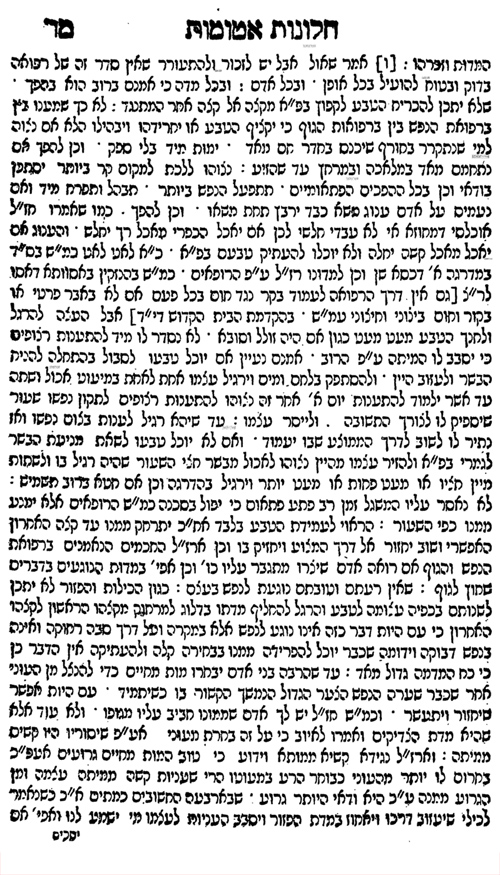
On pp. 101b and 102a he refers to himself as שכוי.

Here is Lehem Shamayim (Wandsbeck1728), vol. 1, p. 1a (see also 2a) where he also refers to himself as שכוי.
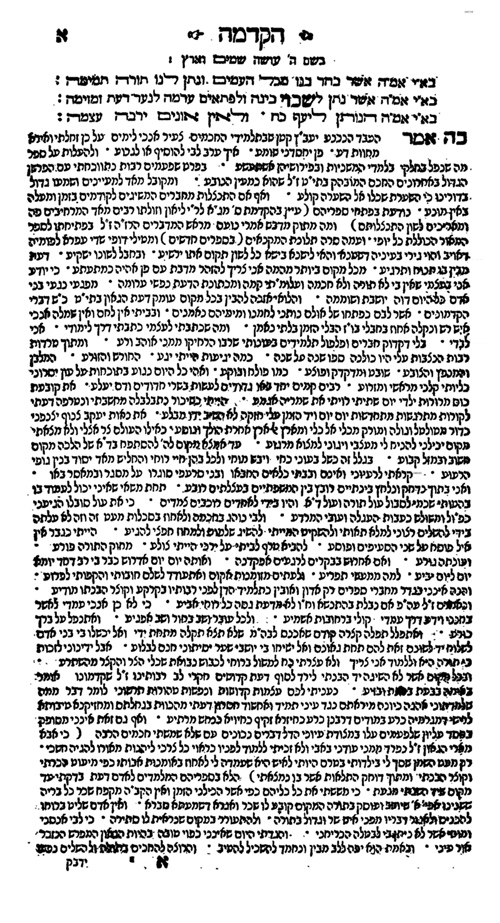
Returning to Birat Migdal Oz, on p. 108b he refers to himself as שלה.
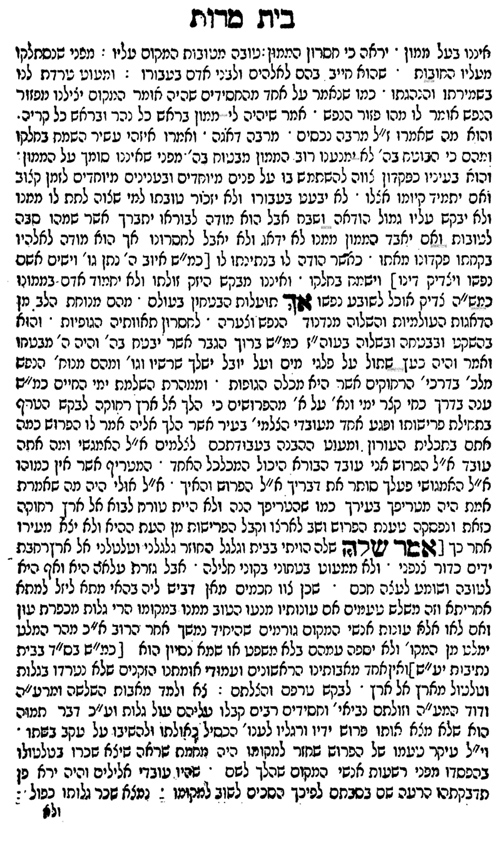
What is this all about? The answer was revealed by R. Meir Segal in his 1881 commentary on Emden’s siddur (although I am sure many people had already figured it out).[2] The gematriyot of all these words are either 335 or 336. This corresponds to יעקב בן צבי, the gematria of which is also 336 (and we know that gematriyot are allowed to be off by one number).
In Amudei Shamayim, vol. 2, p. 154a, which you can see here

Emden writes:
סוד פורי”ים בקצור רומז ג”א ממותקים בג”ה (ס”ה של”ו הוא בה”ס . . .)

As R. Segal explains,[3] this is to be “translated” as: 

סוד פורים בקיצור רומז ג’ א-להים ממותקים בג’ הויות ס”ה גימטריא של”ו הוא בעל הספר

ס”ה obviously stands for סך הכל and what it is saying – ignoring the kabbalistic allusion – is that the gematria of פורים equals 336 and this is also equaled by א-להים x 3 = 258 + הויה x 3 = 78 (258+78=336)..

As mentioned, Emden refers to himself as שלו. How is this supposed to be pronounced? Some people would assume shelo. I originally thought that a more likely meaning was shalev, which means “calm” or “tranquil”. R. Segal also understands it this way since he writes[4]  כנה א”ע בשם שלו כי השלום יאות לבוטח

Shilo is also sometimes spelled as שלו so that is another possibility.

However, these suggestions are incorrect, and the proper way to pronounce it is selav, as in quail. We know this because of the verse in Psalms 105:40:

שאל ויבא שלו ולחם שמים ישביעם

The second half of the verse has the words לחם שמים. This is the name of Emden’s commentary on the Mishnah. I am certain that the connection of שלו and לחם שמים was regarded as significant by Emden, and this also reveals how שלו should be pronounced.[5]

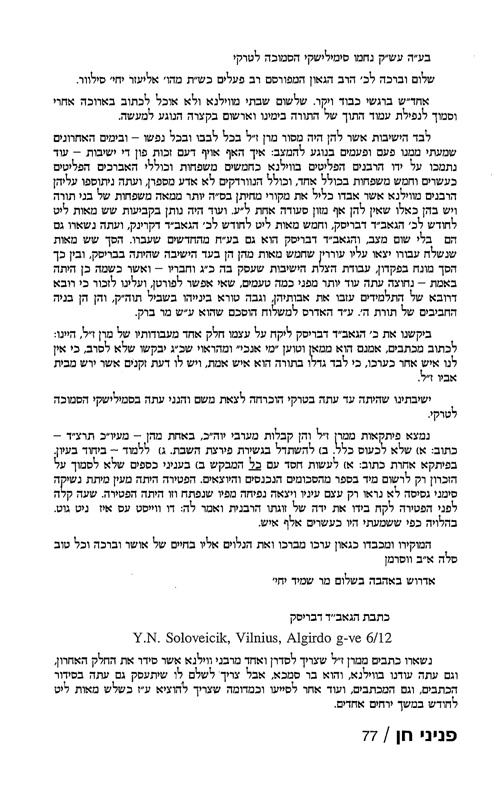
2. In Changing the Immutable, p. 205, I cite a letter from R. Elhanan Wasserman to R. Eliezer Silver and note that the published version of the letter, in Kovetz Ma’amarim ve-Iggerot, vol. 2, p. 97, omits R. Wasserman telling R. Silver that before R. Hayyim Ozer Grodzinski’s death the latter reached for his wife’s hand. R. Moshe Maimon informed me that the letter with the deleted words restored was published in R. Pinchos Lipshutz, Peninei Hen (Monsey, 2000), pp. 76-77. Here it is.

From the original letter we can see that R. Hayyim Ozer’s comment that things are not good was made to his wife. However, one who reads the letter in Kovetz Ma’amarim ve-Iggerot would have to conclude that this statement was made to R. Elhanan, as the passage reads:
שעה קלה לפני הפטירה . . . אמר: “דוא וויסט עס איז ניט גוט” (אתה יודע שהמצב אינו טוב)
As I mentioned in the book, I think it is significant that the publisher inserted three dots showing that something was deleted, since this is very uncommon among haredi publishers. But the following is also important: In the original letter R. Elhanan writes אמר לה, meaning that R. Hayyim Ozer made this comment to his wife. Also (and this point was made to me by Maimon), in the Hebrew translation what appears is אתה יודע which is masculine and indicates that the comment was made to R. Elhanan. These changes had to be made since once the line about holding his wife’s hand is removed, it would not make sense for the reader to see a reference to a woman, as in אמר לה.

Maimon also called my attention to the following: Here is a famous painting portraying Napoleon granting freedom to the Jews. Notice how Napoleon appears like Moses, holding a Tablet of the Law. 
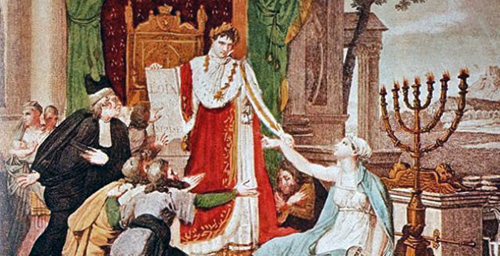
Here incidentally is another image from a coin minted on the occasion of the meeting of the Sanhedrin summoned by Napoleon. Notice how Napoleon is handing the Two Tablets of the Law to Moses. In other words, Napoleon is portrayed as God.[6]

Returning to the painting of Napoleon, it is reproduced in R. Binyamin Shlomo Hamburger’s Meshihei ha-Sheker u-Mitnagdeihim (Jerusalem, 2009), p. 481, yet here sleeves have been added to the woman.

Since I have just mentioned R. Moshe Maimon, let me continue with a couple of his comments. In my book, p. 97 n. 67, I translate minhag vatikin[7] as a “long established practice”. I actually should have said “long established practice of the pious ones” (although some might see this as already implied). Maimon questions whether there is any relationship between vatikin and “long established”, or it if just means “the pious ones”. I always assumed that vatikin means the “pious ones of old”. Indeed, Jastrow translates the word as “the conscientiously pious men of former days”, and an online search reveals that others translate similarly.

Yet Rashi, Berakhot 9b, explains vatikin as אנשים ענוים ומחבבין מצוה, and in this explanation there is no assumption that the vatikin lived in former days. In other words, a practice developed by contemporary pious ones could also be regarded as a minhag vatikin, and there appears to be no reason for me to have thought that Rashi would assume that the vatikin he describes were also “men of old”.

While modern Hebrew uses the word vatik to mean old or one involved in something for a long time, e.g., מוותיקי הסופרים, I have to acknowledge that, with apparently one exception (see note 8), I have not found early uses of the term that have this connotation. One who paid attention during the High Holidays liturgy would have noticed the term and it has nothing to do with “old” here, e.g., הועד והותיקות, לותיק ועושה חסד, and others.[8] See also Arukh, ed., Kohut, s.v. ותק, which offers Arabic and Greek cognates that have no connection to age. For those really interested in the topic, you should consult David Golinkin’s learned and comprehensive article which also shows that the term vatikin has no connection to age.[9]

Maimon also made the following correction. On p. 229 n. 64, I refer to R. Hayyim Eleazar Shapira’s criticism of Slobodka students and his negative view of R. Moses Mordechai Epstein, and note that this was removed from some editions of R. Moses Goldstein’s Mas’ot Yerushalayim.[10] The censored material I refer to is from a conversation between R. Shapira, the Rebbe of Munkacz, and R. Solomon Eliezer Alfandari, and contrary to what I carelessly wrote, what was deleted was stated by R. Alfandari, not R. Shapira. This matter, and the censorship, is discussed by Maimon in a Seforim Blog contribution here.

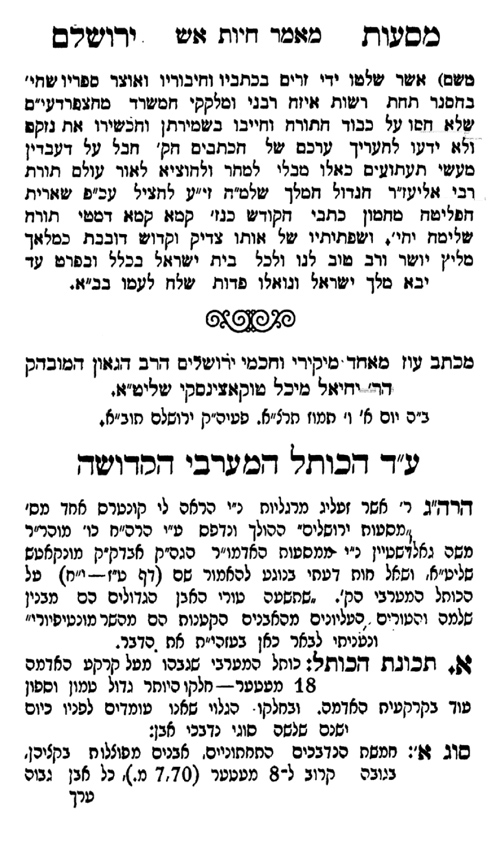
Let me offer another example where Mas’ot Yerushalayim is censored (and this is not noted by Maimon in his post just mentioned). Here is Mas’ot Yerushalayim (Munkacz, 1931), pp. 91a-91b.
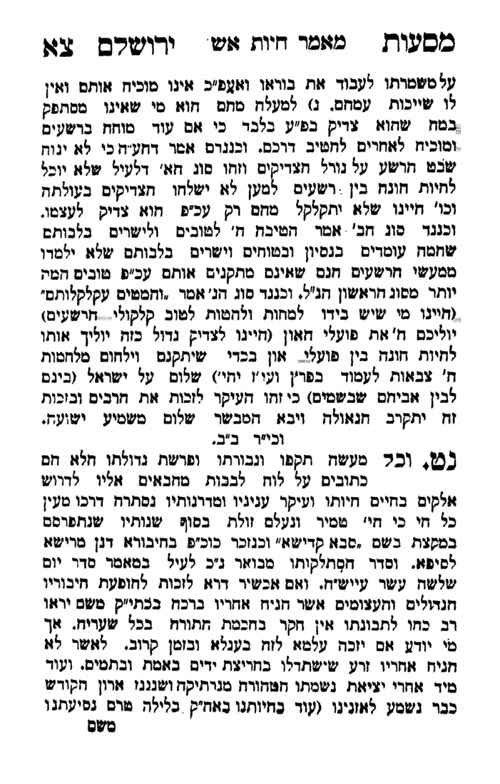
It mentions that after R. Alfandari’s death his writings were under the control of certain Sephardic rabbis who were associated with the Chief Rabbinate. These rabbis are referred to as .איזה רבני ומלקקי המשרד מהצפרדעי”ם The last word, צפרדעים (frogs) is a play on ספרדים.

Here is how the page looks in a later edition published in Israel (pp. 319-320). As you can see, the reference to the צפרדעים has been deleted.
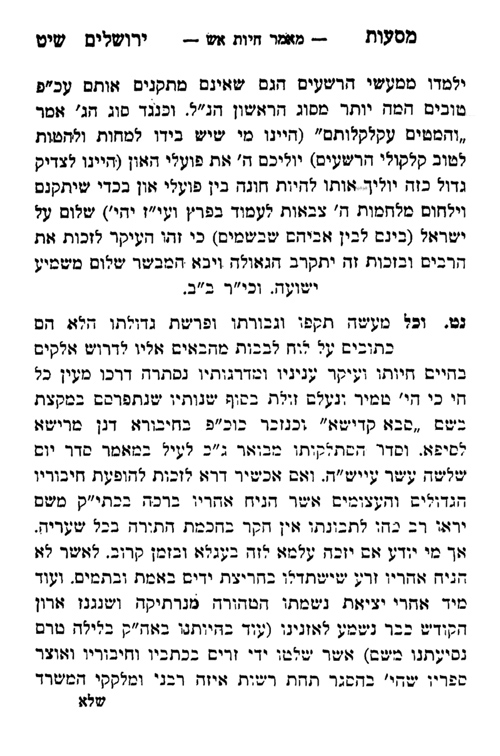
The same deletion is found in the 2004 edition (p. 237)
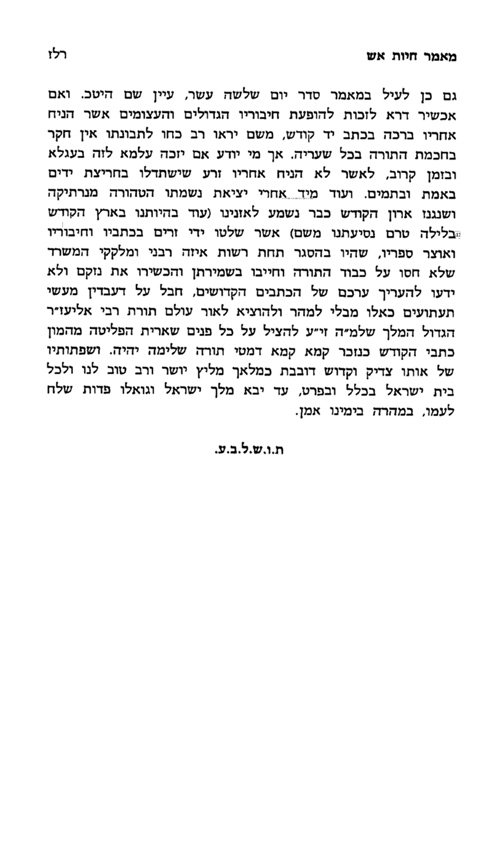
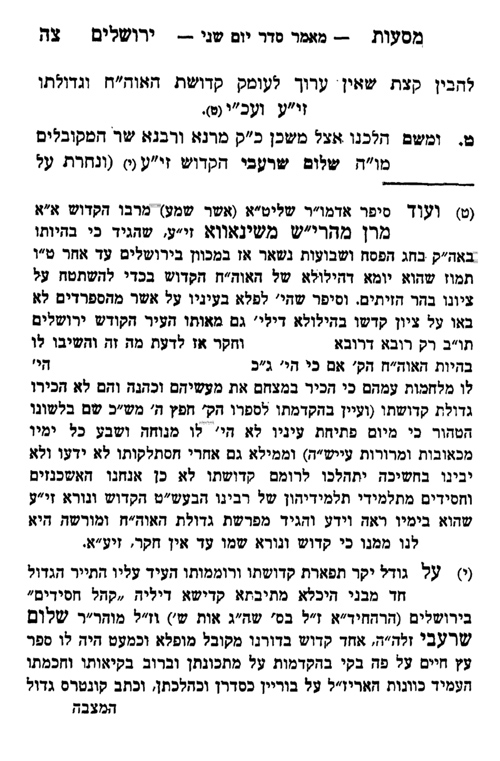
Needless to say, Sephardic readers were not pleased to see this. But this wasn’t the only thing to upset them. Earlier in the book (pp. 26a-b in the first edition), we find that R. Shapira stated that he heard from R. Yehezkel Shraga Halberstam of Sieniawa that when the latter was in Jerusalem on the yahrzeit of R. Hayyim ben Attar, the Or ha-Hayyim, he observed that the Sephardim did not visit his grave. He inquired about this and was told that even though the Or ha-Hayyim was a Sephardi, he had disputes with the Sephardim and the latter did not recognize his greatness. Referring to the Sephardim, he quotes Psalms 82:5: “They know not, neither do they understand; they go about in darkness.” This is contrasted to the Ashkenazim who give the Or ha-Hayyim his proper respect.

Here is the passage.

The text was altered in the next edition.
In the Jerusalem 2004 edition it is back in its entirety.

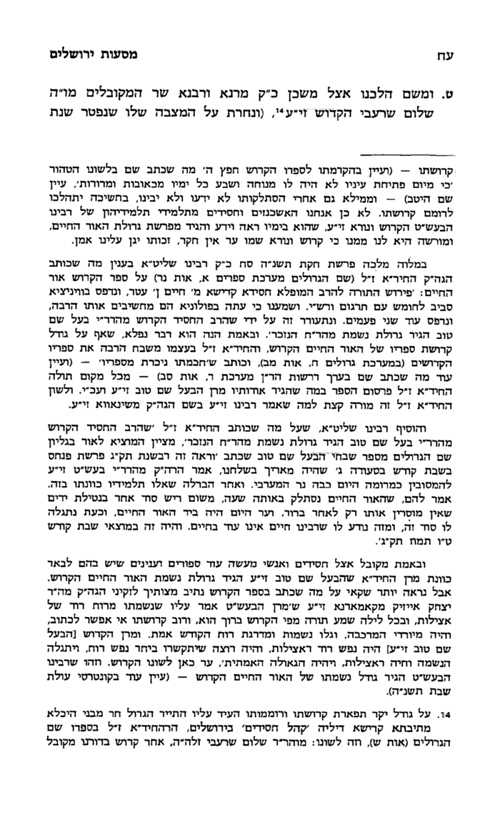
When Mas’ot Yerushalayim appeared, R. Meir Vaknin, the rav of Tiberias, was quite angry upon seeing the two texts I have discussed and responded sharply.[11] He completely rejects the notion that the Sephardim do not properly respect the Or ha-Hayyim. He also denies that there was ever a dispute between the Sephardic community and the Or ha-Hayyim.

Why then do the Sephardim not go to the Or ha-Hayyim’s grave on his yahrzeit?  R. Vaknin explains that the reason is simple, namely, that Sephardim don’t have this minhag and they were never taught to do so by R. Isaac Luria. Therefore, they don’t go to graves on any yahrzeit, “not to the ARI, not to Maran the Beit Yosef, and not to the Rambam. Even to Rabbi Shimon Ben Yohai only a very small number go to Meron.”

R. Vaknin is speaking about the Sephardic community in the Land of Israel before the massive aliyah of the North African Jews. Today, of course, Meron is full of Sephardim on Lag ba-Omer (which people mistakenly believe to be the yahrzeit of R. Shimon Ben Yohai[12]), but R. Vaknin provides testimony about how things were very different not too long ago.

As for Mas’ot Yerushalayim referring to Sephardim as צפרדעים, R. Vaknin is simply outraged by this insult:

והאם טוב וישר הדבר הזה בעיני א-להים ואדם לכתוב ולכנות שם רע על העם הקדוש הספרדי כולו בכללותו, מי יוכל להתאפק על בזיון ושם רע על כללות עם הקודש, ואיזה תקון יועיל לכלות העון הזה ולהתם הפשע החמור, אפילו המכנה שם רע לחברו עיין ברז”ל כמה חמור ענשו, וכל שכן על כללות העם כולו אשר כמה וכמה גדולי תורה נמצאים בתוכו, כמה צדיקים וחסידים וסובלי חולאים וסיגופים ותעניות לכבוד ה’ ותורתו נמצאים בתוכו

R. Vaknin also printed a letter by R. Jacob Zarihan of Tiberias. He too was very upset by what appears in Mas’ot Yerushalayim.

The 2004 edition of Mas’ot Yerushalayim has Goldstein’s reply to R. Vaknin in which he apologizes if he caused offense.[13] He stresses that his negative words about the צפרדעים were only made with reference to those Sephardic rabbis associated with theמשרד , i.e., the Chief Rabbinate.[14] This could hardly have been of any comfort to R. Vaknin since unlike the Ashkenazic world, the Sephardic world did not have an extremist Edah Haredit, and almost all of the Sephardic rabbis had great respect for the Rishon le-Tziyon, R. Jacob Meir, and the other outstanding Sephardic rabbis who worked with him.

It is noteworthy that Goldstein’s rebbe, R. Hayyim Eleazar Shapira, also had some negative things to say about Sephardim. In his discussion about the apparently Sabbatean work Hemdat Yamim, R. Shapira refers to R. Hayyim Palache who in his Kol ha-Hayyim[15] defends the Hemdat Yamim, even if the author was a Sabbatian. As R. Palache states, Rabbi Akiva made a mistake in thinking that Bar Kokhba was the Messiah, but this does not disqualify the Torah teachings of R. Akiva. Similarly, we should not disqualify the Hemdat Yamim no matter what the author believed about Shabbetai Zvi. R. Shapira thinks that this is nonsense, and it is obvious to him that if the author of Hemdat Yamim was a Sabbbatian then the work must be shunned.

What angers R. Shapira even more is that R. Palache later states (Kol ha-Hayyim, p. 18a) that there is a tradition not to speak at all about the Shabbetai Zvi episode, not even in a negative way[16]:

וכבר יש קבלה מרבותינו ואבותינו הקדושים שלא לדבר מטוב ועד רע על ענין ש”ץ כי גם קוב לא תקבנו גם ברך לא תברכנו

R. Shapira finds this outrageous, since how can one not speak negatively about such an evil person as Shabbetai Zvi. He writes:[17]

ורחמנא לישזבן מהאי דעתא הנפסדת המטלת ספיקות מעין היש ה’ בקרבנו וכו’ והיתכן כי על משיח השקר שהמיר דתו למחמדנות באונס או ברצון ועכ”פ שהסית והדיח אלפים מישראל עליו כתוב “גם קוב לא תקבנו” ובודאי בע”כ שהטיל ספיקות אולי הי’ אמת ע”כ קוב לא תקבנו לרעה. לא יאומן כי יסופר שיהי’ כזה נדפס מרב מגדולי הספרדים לולי ראיתי בעיני – אוי לנו שכך עלתה בימנו שהפרוץ מרובה. ואולי [צ”ל ואילו] הי’ כזה נדפס בדור הקדום היו גדולי הדור מרעישים עולם.

After these harsh words, R. Shapira offers his explanation of how R. Palache could have written what he did, and it is perhaps the all-time greatest put-down of Sephardim in rabbinic literature. While R. Shapira has great respect for the Sephardim of earlier generations, and also for special individuals such as R. Alfandari,[18] he thinks that most Sephardim of recent years are simply not that smart, and are thus able to believe all sorts of nonsense.

וחשבתי להצדיק קצת את הה”ג ז”ל בע”ס כל החיים להיות הספרדים בימינו בטבעם רובם נמוכי השכל נוחין להתפתות ולהאמין לכל דבר ע”כ השיאם עון אשמה גם לגדוליהם רבניהם בספיקות כאלה.

What R. Shapira did not know is that this strategy of not speaking bad about Shabbetai Zvi had nothing to do with being sympathetic to him, and was certainly not an example of Sephardic stupidity. Rather, as Gershom Scholem notes, it was a strategy chosen by the rabbis in order to allow the community to return to normal.

In choosing this course, the rabbis of Constantinople and Smyrna may have attempted the impossible; at any rate they acted in what seemed to them the most reasonable and responsible fashion. . . . The messianic propaganda, which had not been checked by either the rabbis or the lay leaders, had roused their emotions and faith to such a pitch that rational criticism and appeals to traditional standards would probably have availed little. It seemed safer and wiser to ignore the whole matter as far as possible, and to let time and oblivion heal the wound. Neither condemnation nor apologies, but silence alone would enable the disturbed community to find the way back to normal life.[19]

Scholem quotes the passage from R. Palache cited above, and he also summarizes another passage from the very same section in R. Palache’s Kol ha-Hayyim.

The earlier version of the story was that R. Sabbatai Ventura of Sofia had shown disrespect at Nathan’s tomb, whereupon his hand dried up and remained paralyzed until he returned again to the tomb and prayed for forgiveness. When his son Abraham Ventura passed through the city on his travels on behalf of the community of Safed, “a drop fell on him during his first night there and he died . . .  and was buried next to the tomb of R. Nathan.” (The story is told by R. Hayyim Palache of Smyrna in Kol ha-Hayyim [Smyrna, 1874], pp. 17-18.)[20]

In the earlier Hebrew version of Scholem’s work, Shabbetai Tzvi  (Jerusalem, 1957), vol. 2, p. 794 n. 2, the direct quotation of R. Palache is a little different:

“נפל עליו טיפה בלילה ראשונה שנכנס שם וימת שם אברהם וקברוהו סמוך ממש לקברו” של ר’ נתן, כפי שסופר בס’ כל החיים לר’ חיים פאלאג’י מאיזמיר, דפים יז, יח.

Notice how in the Hebrew quotation from R. Palache there is no mention of “R. Nathan” (of Gaza). In other words, the English version is mistaken in including the words “R. Nathan” as part of the direct quote.

Most people who examine the matter will probably also assume that Scholem’s Hebrew text is mistaken, since the story R. Palache tells (which appears on p. 18a, not pp. 17-18 as mentioned by Scholem), has nothing to do with Nathan of Gaza and thus the latter should not have been mentioned by Scholem. As you can see from the page following this paragraph (from Kol ha-Hayyim 18a), R. Palache’s story is about the grave of the anonymous author of Hemdat Yamim, not Nathan of Gaza. (Scholem himself did not regard Nathan of Gaza as the author of Hemdat Yamim.[21])
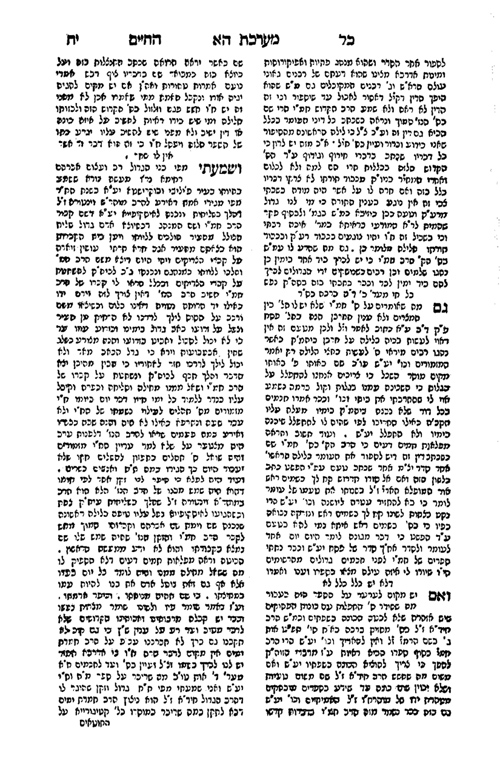
What is going on here? Can we assume that a careful scholar like Scholem made such a blunder and inserted Nathan of Gaza into a story that has nothing to do with him? The answer is no, and let me explain what is behind what Scholem writes since for some inexplicable reason he doesn’t do it himself. In Mekhkerei Shabtaut (Tel Aviv, 1991), p. 251, Scholem notes that once R. Jacob Emden (mistakenly) identified Nathan of Gaza as the author of Hemdat Yamim,[22] most Ashkenazic scholars kept away from the book. However, the Sephardic scholars had a different view, and they continued to treasure Hemdat Yamim despite the fact that they regarded Nathan of Gaza as its author. Furthermore, they began to refer to Nathan of Gaza as הרב חמדת ימים.

So let us now look again at the passage from R. Palache. It mentions that R. Shabbetai Ventura visited the city of איסקופייא where the grave of הרב חמדת ימים is found. איסקופייא is none other than Skoplje in Macedonia, and this is where Nathan of Gaza died and was buried. In other words, when the story speaks about visiting the grave of הרב חמדת ימים it is referring to visiting the grave of Nathan of Gaza. In Kol ha-Hayyim, p. 17b, R. Palache states that we don’t know who wrote Hemdat Yamim, so it seems that he was passing on a tradition the significance of which even he did not grasp. (If my assumption is correct that R. Palache did not realize that the story he told was referring to visiting the grave of Nathan of Gaza, then he must have assumed that while his generation did not know who the author of Hemdat Yamim was, earlier generations did know, and even knew where his grave was.) What Scholem writes in Sabbatai Sevi about the grave of Nathan of Gaza and Rabbi Shabbetai Ventura and his son Abraham is incomprehensible without the explanation just given, and I have no idea why Scholem did not feel it necessary to provide it himself.

Returning to the comments of R. Hayyim Eleazar Shapira, I wonder what he would have said about the Ashkenazi R. Joseph Seliger who commented that it really doesn’t matter whether R. Jonathan Eybeschuetz believed in Shabbetai Zvi, and our respect for him would not be lessened by such an error.[23]

בדבר המחלקת שבין הגאונים ר’ יונתן ור’ יעקב עמדן כבר עשה העם כלו פשרה בין שני החולקים ששניהם היו חכמי אמת וצדיקים גמורים, אלא שר’ יונתן ז”ל היה נוח ועלוב וענו תלמידו של הלל. ולכן עלה גם בחכמה וגם במעשה מאיש ריבו הקנא והקפדן של שמאי. נושא המחלקת היה נכבד רק בשעתו, בעת אשר פשתה האלילות של ש”ץ וכמעט גמרה לבלע את כל ישראל ותורתו בהבליה ובקסמיה. היום הנה שאלה קלת ערך אם האמין ר’ יונתן בש”ץ או לא . . . לו האמין ר’ יונתן באמת בש”ץ, אין הטעות החלקית הזאת גדולה מהטעות הכללית להאמין בקמעות. ואם בכל זה כבוד ר’ יונתן במקומו מונח לפי מצב הדעות בזמנו, כי לא כל חכמי ישראל זוכים לאמונה צרופה כבן מימון, לא היה ר’ יונתן נופל בעינינו אף לו האמין בנביא השקר כר”ח בנבנשתי ז”ל. אבל באמת לא היתה בר’ יונתן האמונה הזאת לא ממנה ולא מקצתה.

Due to what R. Shapira said about Sephardim, R. Ovadiah Yosef was very unhappy with him. The following passage, from 24 Sivan, 5767, appears in R. Eliyahu Sheetrit’s Rabbenu.[24] This book is quite fascinating as it is a diary that Sheetrit kept during the years he learnt with R. Ovadiah and assisted him in publishing his books. Most significantly, only a few of the published texts of the diary have been censored.

רבנו כתב על החמדת ימים, ואז ראה בספר חמשה מאמרות של אחד מגאוני הדור הקודם שכתב בצורה לא יפה על הרבנים הספרדים ועל הספרדים בכלל, וגם נזכר במה שבזמנו אמר הגאון הנ”ל על הספרדים “צפרדעים”, וביקש ממני לעבור בספר, ובכל מקום שכתוב שמו של הגאון הנ”ל למחוק את המלה “הגאון”. עוד אמר רבנו, שהגאון הנ”ל ביקר אצל הגאון מהרש”א אלפנדארי, ושלשה ימים לאחר מכן, נפטר מהרש”א אלפנדארי (ואמר רבנו, שכנראה הגאון הנ”ל עשה עליו עין הרע).

It would be interesting to check if indeed R. Ovadiah’s books published after 2007 are missing the title הגאון before R. Shapira’s name. In the introduction to Hazon Ovadiah: Arba Ta’aniyot, published in 2007, R. Ovadiah refers to R. Shapira’s comments and indeed in this source not only is there no הגאון before his name, but R. Shapira also doesn’t get the less exalted הרה”ג, and he is left with just a ר’. As for what R. Ovadiah said about R. Shapira apparently unintentionally causing the death of R. Alfandari, this will obviously be a great insult to all Munkatcher hasidim.

It must also be noted that R. Ovadiah did not remember correctly, as it was not R. Shapira who referred to the Sephardim as צפרדעים but his follower Moses Goldstein.

R. Chaim Amsalem took note of R. Shapira’s comments about Sephardim and he too was quite offended, and placed these comments in the context of continuing discrimination against Sephardim by the Ashkenazic haredim. He writes as follows (adding a heavy dose Sephardic pride at the end):[25]

מה אני יכול לומר על דברים מעליבים ופוגעים שכאלו “בטבעם רובם נמוכי שכל”, אני רק יכול להודות לו שגלה דעתו האמיתית מה הוא חושב הוא ואחרים שכמותו, וא”כ אין פלא על יחס השחצנות והגזענות שהם מגלים כלפי הספרדים, שרי ליה מאריה, וכמה ראוי לו לבקש מחילה קודם כל ממושא הערצתו הגאון מהרש”א אלפאנדרי זצ”ל, הדברים כ”כ נמוכי שכל שאינני רוצה להגרר להעלבות וכדומה, דבריו מדברים בעד עצמם, אבל עוד יבואו ימים שכולם יאכלו מכף ידינו . . .

I am aware of another place where R. Shapira speaks negatively about a great Sephardic sage, R. Hiyya Pontremoli, author of the halakhic work Tzapihit bi-Devash. In Minhat Eleazar, vol. 4, no. 45 (p. 37a), R. Shapira writes as follows:

הנה עשה א”ע כאלו לא ידע או העלים בכונה סוף דברי רש”י . . . וכבר תמהתי עליו איך שכח או במזיד הביא להיפך ממ”ש במאירי

Simply put, he is accusing R. Pontremoli of intellectual dishonesty. R. Ovadiah Yosef[26] calls attention to the second part of the quotation just given, and expresses his great distress that R. Shapira spoke this way about R. Pontremoli.

ואנכי איש צעיר נוראות נפלאתי עליו הפלא ופלא, מפני היד שנשתלחה, לחשוד רב גדול כהגאון בעל צפיחית בדבש, ששכח או הזיד ח”ו בדברי המאירי. הס כי לא להזכיר.

In Abir ha-Ro’im, the recent biography of R. Ovadiah by his grandson, R. Yaakov Sasson, the latter also gives examples of Ashkenazic scholars belittling Sephardic gedolim.[27] The instances Sasson cites should not be understood as conscious belittling. It is just that in these cases the Ashkenazic scholars, not knowing anything about the Sephardic Torah greats, did not take them very seriously. One of Sasson’s examples comes from Iggerot Moshe, Hoshen Mishpat, vol. 2, no. 69 (p. 298), which is R. Moshe Feinstein’s famous responsum on abortion. Here R. Moshe writes:

ופלא שראיתי בספר רב פעלים לחכם ספרדי

Sasson is correct that this is not the most respectful way to refer to R. Joseph Hayyim. R. Moshe continues by rejecting R. Joseph Hayyim’s view and does not pay him much regard. It is because of this that R. Eliezer Waldenberg, in his response to R. Moshe, says as follows after expressing his surprise with the way R. Moshe deals with R. Joseph Hayyim:[28]

ושרי ליה מריה בזה

I would like to know, did R. Moshe even have any idea who R. Joseph Hayyim was? Someone obviously showed R. Moshe the responsum in Rav Pealim, but was it explained to R. Moshe that the author of Rav Pealim is the Ben Ish Hai, and that for many Sephardim R. Joseph Hayyim’s significance is the equivalent of what the Hafetz Hayyim is for Ashkenazim, i.e., a towering figure, both spiritually and halakhically? Did R. Moshe even know the name of the man who wrote Rav Pealim, since if he only had a copy of the responsum he wouldn’t see the author’s name, as there is no name given at the end of the various teshuvot?

It is possible that the answer to one or more of these questions is “no”, and R. Moshe therefore related to R. Joseph Hayyim the same way he related to other scholars, Sephardic and Ashkenazic, whom he did not view as top-of-the-line poskim. In the last paragraph of his responsum, when dealing with R. Eliezer Waldenberg, here too R. Moshe does not show great respect but simply refers to R. Waldenberg as .חכם אחד. Contrast this with how in this responsum R. Moshe refers to R. Hayyim Ozer Grodzinksi, R. Jehiel Jacob Weinberg, and R. Isser Yehudah Unterman.

Leaving aside what I have just mentioned, R. Moshe’s responsum does have some problematic elements. R. David Feldman even claimed that it was not written by R. Moshe! Here is his letter that appears in Tzitz Eliezer, vol. 20, no. 56.

This is a very strange claim, as the responsum first appeared in 1978 in the Sefer ha-Zikaron for R. Yehezkel Abramsky. Are we supposed to believe that a responsum that appeared in R. Moshe’s lifetime was not written by him? This is clearly impossible. (When I made this point to R. Feldman he continued to insist that R. Moshe did not write the responsum.) Yet as I mentioned, there are indeed some problematic things in this responsum. For example, what is one to make of the following sentence in which R. Moshe attacks a point in R. Eliezer Waldenberg’s first responsum on abortion?[29]

וגם כתב שהשאילת יעב”ץ מתיר אף שאסר בפירוש, בשביל לשון וגם בעובר כשר יש צד להקל לצורך גדול, אף שברור ופשוט שלשון יש צד להקל הוא כאמר שיותר צדדים איכא לאסור.

R. Waldenberg states that it is “ridiculous” to claim that when R. Jacob Emden writes יש צד להקל that it really means that it is forbidden.[30] We, of course, would never use such language about something R. Moshe wrote, but the question remains, could R. Moshe really have believed that יש צד להקל means שיותר צדדים איכא לאסור?

R. Moshe Maimon wrote to me as follows:

As for the question of יש צד להקל – I think all R. Moshe meant is that when a posek says יש צד להקל he is conceding that the presumption is that it should really be אסור but nevertheless sees some ground for a קולא. To R. Moshe this indicates that this posek is more inclined to the צד איסור and can be counted on as a סניף supportive of a more stringent view.[31]

An alternative perspective is offered by a Lakewood scholar who wrote to me: “R. Moshe may have vehemently disagreed with the יעב”ץ but preferred to twist the meaning rather than say openly that the יעב”ץ was mistaken, a very typical thing for someone like R. Moshe to do.” I responded that I don’t find this compelling, since in the second to last paragraph of his responsum R. Moshe has no problem stating that Emden is mistaken, so why would he write differently in the last paragraph?

The Lakewood scholar replied as follows:

If it was a sensitive issue (I’m guessing) R. Moshe may have wanted to strip the opposing view of any legitimacy by insisting that the יעב״ץ didn’t mean it. It’s almost like saying he couldn’t have meant it. Regarding the general approach of twisting the words of achronim in order make it consistent with your own view: The Mekor Baruch describes a similar approach that he attributes to Rabbi Chaim Volozhin, that although one may rule against the Shulchan Aruch, one should nonetheless seek to find hairsplitting differences between your ruling and the Shulchan Aruch’s so not to appear as if you are going head on. The Chazon Ish would say that a טעות סופר נפלה rather than say a rishon made a mistake.

Similar to what the Lakewood scholar claimed, R. Chaim Rapoport, who has published a good deal on the Iggerot Moshe, wrote to me as follows:

מ”ש הגרמ”פ שם “שברור ופשוט שלשון יש צד להקל הוא כאמר שיותר צדדים איכא לאסור” [שיש שתמהו על זה], הנה לפענ”ד הדבר מתאים מאד לדרכו של הגרמ”פ כשהוא משוכנע לחלוטין בצדקת שיטתו ובשלילת השיטה החולקת, ובכה”ג הרגיש בעצמו שמוכרח הוא לקרב את הרחוקים בזרוע, כדי לקיים את מה שהי’ ברור בעיניו כשמש בצהריים.  

ובאמת, בנידון תשובה זו אין דבריו תמוהים כ”כ, שהרי לפעמים מצינו בדברי הפוסקים שכתבו שיש צד להקל ומ”מ אין להקל למעשה [וע”כ צ”ל דהיינו] בגלל שישנם צדדים אחרים [ואפילו צדדים יותר גדולים] להחמיר. ואם כי בנדו”ד הרי מתוכן דברי היעב”ץ אין נראה כן, מ”מ העמיס הגרמ”פ כוונה זו בדברי היעב”ץ, כי ‘ההכרח לא יגונה’. 

מה שזלזל הגרמ”פ בכבודו של הגרא”י ולדנברג בעל שו”ת ציץ אליעזר, הנה אם כנים הדברים, נראה שהי’ זה בגלל שהיטב חרה לו להגרמ”פ ע”ז שפרסם הגרא”י ולדנברג את היתרו להפיל עוברי ‘תיי-סקס’ – אשר לדעתו הר”ז בגדר שפיכת דמים ממש, ואורייתא הוא דמרתחא בי’. 

 ומ”ש הרב בעל ציץ אליעזר על הגרמ”פ “ושרי לי’ מרי’ בזה” [על מה שנראה מלשונו שמיעט בחשיבותו ומעמדו של הרב פעלים] נראה שכתב כן כלפי מה שכתב הגרמ”פ בתשובתו הנ”ל עליו [על הצי”א] “ושרי לי’ מרי’ בזה”, ועד”ז כתב הגרמ”פ בתשובתו (שם) על היעב”ץ, וע”ד מה שאחז”ל מדויל ידי’ משתלים. 

Finally, returning to the matter of negative portrayals of Sephardim, take a look at this bizarre passage in Israel Abraham’s classic Jewish Life in the Middle Ages, p. 122.

There was less warmth in the Oriental Jewish home, less of that tenderness which was once a common characteristic of Jews all the world over, but came in process of time to distinguish Western Jews from their gayer but more shallow brethren of the East. One seems to detect a feebler sense of responsibility in the mental attitude of an Oriental father to his offspring, just as one detects more volubility but less intensity in the Oriental Jew’s prayers.

3. For those who are interested, on Saturday night November 7 at 8pm, I will be speaking at Congregation Ohr Torah, 48 Edgemount Road, Edison, N.J. The title of the talk is “Some Unusual Orthodox Responses to the Rise of Nazism.”

[1] He also refers to himself this way in Birat Migdal Oz two pages later, which is mistakenly numbered as 135a. See also Torat ha-Kenaot (Lvov, 1870), p. 54, where he writes: ונמסר לי הסריס.
[2] Va’ad le-Hakhamim (Lublin, 1881), p. 3a.
[3] Ibid., p. 3b.
[4] Ibid., p. 4a.
[5] See R. Meir Mazuz, Emet Keneh (Bnei Brak, 2000), p. 227. R. Mazuz knows that Emden referred to himself as השכוי, but I can’t tell if he is aware that Emden also referred to himself as .שלו I say this since R. Mazuz mentions the gematria of שלו without indicating that Emden ever used the word. He then makes the connection to ולחם שמים ישביעם.
In 1756 the book Shevirat Luhot ha-Aven appeared. The title page says Zolkiew but this is probably intended to cover up its real place of publication, Altona. According to the haskamah, written by R. Abraham of Zamocz, the author is דוד אוז, an otherwise unknown person. There is no doubt, however, that this book was written by Emden. R. Menahem Mendel Goldstein even found a gematria to tie this name to Emden. See Etz Hayyim 15 (Tamuz-Av, 5771), p. 235 n. 46:
דו”ד או”ז עם ב’ הכוללים בגי’ יעק”ב ב”ן צב”י במספר קטן

[6] The image is from here. This site mistakenly explains that “The kneeling figure represents the Sanhedrin.”
[7] Technically, the word should be pronounced vetikin, with a sheva under the vav, but no one does this.
[8] See Ovadiah Hen, Ha-Ketav ve-ha-Mikhtav (Bnei Brak, 2014), p. 89. See also Ben Yehudah’s dictionary which does not list any early sources in which vatik means old. However, Michael Sokoloff, A Dictionary of Jewish Babylonian Aramaic of the Talmudic and Geonic Periods (Ramat Gan, 2002), p. 396, gives “old” as a translation for ותיק, referring to its use in an incantation bowl.
[9] “Le-Ferush ha-Munahim ‘Vetikin’, ‘Vatik’, ve’Talmid Vatik’ be-Sefer Ben Sira u-va-Sifrut ha-Talmudit,” Sidra  13 (1997), pp. 47-60.
[10] Maimon and pretty much everyone else transliterate the title as Masaot Yerushalayim. I believe this to be mistaken. מסעות in the title is a construct, and is the same thing as מסעי. There should be a sheva under the samekh, not a kamatz. See here.
[11] See his Va-Yomer Meir, vol. 1, no. 10.
[12] For the origin of the notion that R. Shimon Ben Yohai died on Lag ba-Omer, see Eliezer Brodt’s post here.
[13] This letter originally appeared in Vaknin, Va-Yomer Meir,vol. 1,  no. 10.
[14] Mas’ot Yerushalayim (2004), p. 258.
[15] Ma’arekhet he, no. 18 (pp. 17ff.).
[16] I am surprised that R. Shapira doesn’t also criticize R. Palache for mentioning the tradition that R. Hayyim Joseph David Azulai was a gilgul of the author of Hemdat Yamim. See Palache, Kol ha-Hayyim, p. 18a.
[17] Hamishah Ma’amarot (Jerusalem, n.d.), p. 157 (Ma’amar Meshiv Mipnei ha-Kavod).
[18] Regarding R. Alfandari, see the first two stories here from Otzrot ha-Sofer 13 (Tishrei 5763), p. 89.

It boggles the mind to think that there are people who are so gullible that they can actually believe that R. Alfandari met the Hatam Sofer in Pressburg.

There are all sorts of legends about great rabbis visiting far-off places and meeting with other great rabbis. Sometimes the stories are chronologically impossible, e.g., the tale of Ibn Ezra visiting Rashi. See Naftali Ben-Menahem, Inyanei Ibn Ezra (Jerusalem, 1978), pp. 356ff. See my Limits of Orthodox Theology, p. 115, about the legend of Maimonides’ visit to France. See also Otzar ha-Geonim: Hagigah, p. 16, where we are told of the well known “fact” that R. Natronai Gaon magically came from Babylonia to Spain and then returned home.

ודבר ברור ומפורסם לאנשי ספרד ומסורת בידם מאבותיהם כי מר רב נטרונאי גאון זצ”ל בקפיצת הדרך בא אליהם מבבל וריבץ תורה וחזר, וכי לא הלך בשיירא ולא נראה בדרך
[19] Gershom Scholem, Sabbatai Sevi: The Mystical Messiah, trans. R. J. Zwi Werblowsky (Princeton, 1973), pp. 698-699.
[20] Scholem, Sabbatai Sevi, p. 926 n. 270.
[21] See Scholem, Mehkerei Shabtaut (Tel Aviv, 1991), p. 251.                                                             
[22] See Avraham Ya’ari, Ta’alumat Sefer (Jerusalem, 1954), p. 10.
[23] Kitvei ha-Rav Dr. Yosef ha-Levi Seliger (Jerusalem, 1930), p. 503. The last section of this book, where the quoted comment appears, has been deleted (censored?) on Otzar ha-Hokhmah. It can be found in full on hebrewbooks.org.
[24] (Jerusalem, 2014), p. 378.
[25] Gadol ha-Neheneh mi-Yegio (n.p., 2012), pp. 93-94. The three periods at the end of the quotation appear in the original.
[26] Yabia Omer, vol. 2, Orah Hayyim, no. 18.
[27] See Abir ha-Ro’im, vol. 2, p. 134.
[28] Tzitz Eliezer, vol. 14, p. 186.
[29] Iggerot Moshe, Hoshen Mishpat 2, p. 300.
[30] Tzitz Eliezer, vol. 14, p. 186.
 ומגוחח {צ”ל ומגוחך] הוא לפרש כוונתו ולומר דלשון יש צד להקל הוא כאומר שיותר צדדים איכא לאיסור
[31] Somewhat parallel to this is R. Yair Hayyim Bacharach’s view that when R. Moses Isserles write ויש מחמירין it actually means that he doesn’t accept the stringency, since if he did he would have written .ויש אוסרין See Havot Yair, no. 185.


R. Zevin, R. Ovadia Yosef, Pras haRav Kook and a Minor Case of Censorship

R. Zevin, R. Ovadia Yosef, Pras haRav Kook and a Minor Case of
Censorship
by Jacob D.
At the
end of R. Zevin’s introduction to his Sofrim u-Sefarim [1] we read –
In R.
Zevin’s footnote we see that one of the works that he wanted to review but
didn’t yet get to was R. Ovadia Yosef’s two volumes of Yabia Omer. As someone
who enjoys R. Zevin’s pen immensely (both his style and substance, especially
the way he analyzes books and their authors) [2], and as someone that studies
from R. Ovadia Yosef’s prolific halakhic literature quite often, I was curious
to know if R. Zevin ever ended up writing a review on any ​of ​R. Ovadia
Yosef’s works. For this I turned to R. Zevin’s grandchildren.[3] In a phone
conversation with R. Nahum Zevin (of Kiryat Eliyahu,Haifa) I was told that
although he has some unpublished R. Zevin material, ​and also existing are​
some highly critical book reviews that R. Zevin felt should remain unpublished,[4]
he doesn’t think anything was written about R. Ovadia Yosef.
In R.
Ovadia Yosef​’s​ Yabia Omer we find among the numerous approbations this –
Not
exactly an approbation but an explanation why the work deserved the R. Kook
prize ​of​ Torah literature for the year 571​5​ (1955). I have no doubt that
although R. Zevin signs his name along with two other judges​,​ the explanation
was penned by R. Zevin himself​​. From the three periods before​ these​ few
sentences ​​it seemed to me that more had been written than the few lines which
were ​printed in the ​book. I wanted to find the rest of the story​ (although I
wasn’t expecting a full review essay because R. Zevin wrote in his  Sofrim u-Sefarim published in 1959 that he
hadn’t gotten around to reviewing this work)​ and I spoke with the department
in the Tel Aviv municipality that handles these prizes (see here).
They said ​that ​they don’t have any additional information or documents that
pertain to this but ​that ​I should contact the Tel Aviv city archive (here) and they should be able to help. After speaking with the kind staff of that
archive I receive an email with two documents and a short message-
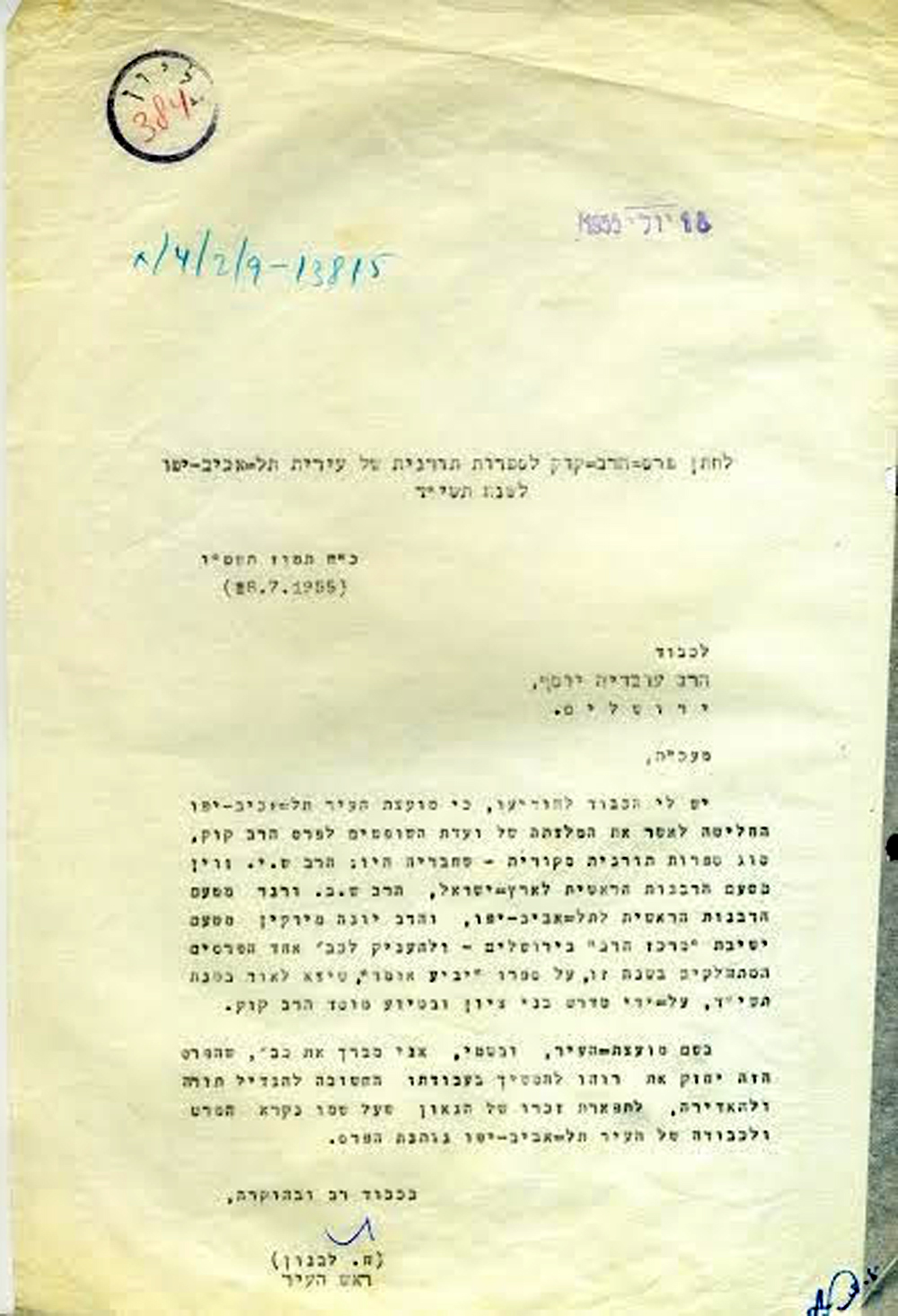
אנו שולחים לך סריקה של ההחלטה על הענקת הפרס לרב עובדיה יוסף וכן
סריקה של מכתבו של ראש העיר חיים לבנון לרב עובדיה המודיע לו על זכייתו ומברך אותו
עליה. אין בידינו נימוקים מפורטים יותר
בברכה,
רבקה פרשל-גרשון
הארכיון העירוני
By now I
kind of gave up, and forgot about the matter.
A short
while later I get a call from my friend Israel Mizrahi of Judaicaused.com (and the Musings of a Jewish Bookseller blog). He
tells me that I’m not going to believe it but in a recent shipment from Israel
of some old books he found a little booklet printed for one years Pras haRav
Kook. Upon opening it he sees that it was the booklet printed in the year
571​5​ (Summer 1955)​,​ the year that Yabia Omer was awarded the prize​​!

​For a
small fee I purchased the booklet ​and although I found ​it​ quite
interesting​,​ unfortunately nothing really more had been written about Yabia
Omer that hadn’t been​ ​printed in the book. Nothing really​ I say​, aside for
one small surprise.

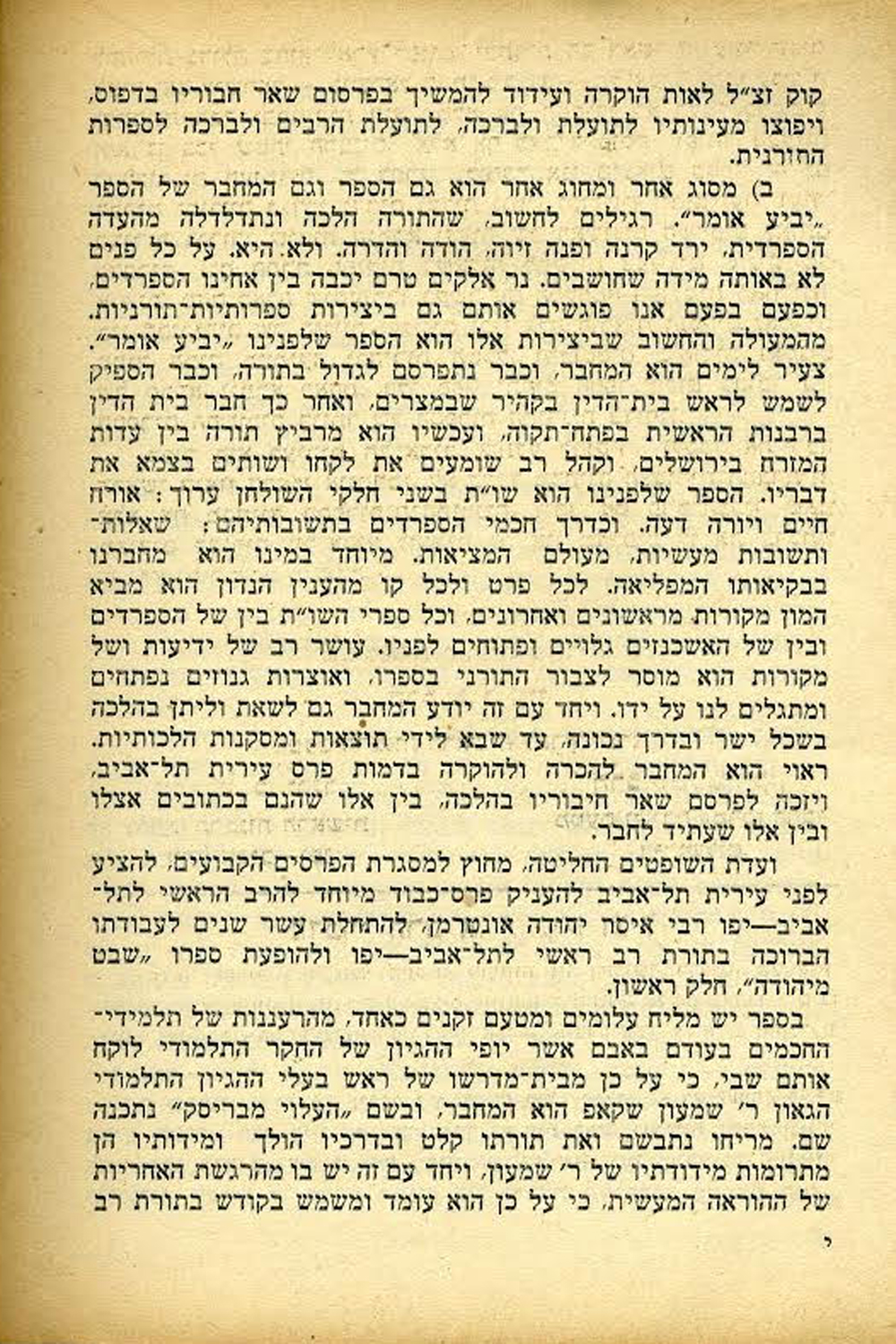
In the beginning of the
little piece written about Yabia Omer we read-
 ​רגילים לחשוב שהתורה
הלכה ונתדלדלה מהעדה הספרדית, ירד קרנה ופנה זיוה הודה והדרה. ולא היא. על כל פנים
לא באותה מידה שחושבים
These
​last seven​ words​-
על כל פנים לא באותה מידה שחושבים
may seem
offensive to the level of Sephardic scholarship at that time and were therefore
censored out of​ ​ Yabia Omer volume one. Interestingly they were printed in
Yabia Omer volume two. This is consistent in the numerous later editions of the
books as well, including the latest re-typset edition (5775-2015).
We now
learn that Artscroll’s “The Festivals in Halacha” was ​​not the
​only, nor the ​earliest case of R. Zevin censorship (see here).​
It should
be mentioned that in R. Ovadia Yosef’s first volume of responsa Teshuvot Hazon
Ovadia, he receives a nice close to page long approbation by R. ​Zevin, but
still not the full review essay I was hoping for.
​[​​​​1​]​ I thank Eliezer Brodt for finding me the full three volume set. This set
doesn’t turn up in used bookstores too often​​. It’s an exception from most of
R. Zevin’s other books that have been reprinted many times over.​ I remember
the special morning I received his email informing me that he found them like
yesterday.​
​[​2​]​ ​R. Zevin’s ​Ishim ve-Shitot​ includes ten long essays on more famous Torah
personalities ​​,​ and ​his ​three volumes of Sofrim u-Sefarim​ includes about
a hundred and seventy-five (!) short essays​.
​​[​3​]​ I had previously spoken to one grandson Eliyahu who’s an attorney living in Tel
Aviv about having Sofrim u-Sefarim added to Hebrewbooks.org. In the course of
our conversations Eliyahu mentioned that he heard Hebrewbooks.org had already
scanned and posted some of R. Zevins’s other books, and that was
done without permission. He asked me to send them a message that the family
will take legal action if the issue isn’t straightened out. Upon Hebrewbooks
hearing that​,​ they seemed uninterested in dealing with the family to obtain
permission to keep the books on their site​,​ and all of R. Zevin’s
books were instantly removed. Also included in the books removed was the essay
whose true author is still in question about Yeshiva boys serving in the
Israeli Army. See my comment here and see
this post here.
[4] That
came to me a little bit as a surprise because in the three volumes worth of
essays that R. Zevin chose to publish in his Sofrim u-Sefarim, we do find some
highly critical reviews. See for example in volume one (Geonim, Rishonim,
u-Teshuvot)​​ his review on the third volume of Teshuvot Yaskil Avdi by R.
Ovadia Hedaya (pg. 258), and in volume two (Pesakim, Pirushim, ve-Hidushim), a
highly critical review of R. Aryeh Pomoranchik’s first volume of Torat Zera’im
(pg. 221)​.​​ Also in this same volume a pretty serious charge leveled
(delicately) ​at his friend and colleague R. Yehezkel Abramsky’s Hazon Yehezkel
Hullin (pg. 114). However, upon looking through some old issues of Ha-Tzofeh
from the 1930’s and 40’s (where most of the material in Sofrim u-Sefarim first
appeared, ​see ​here​​)​,​ I was able to come across some of the 
extremely critical reviews that R. Zevin chose not to publish in his
books. None of the reviews that R. Zevin published in his books were nearly as
critical as these.
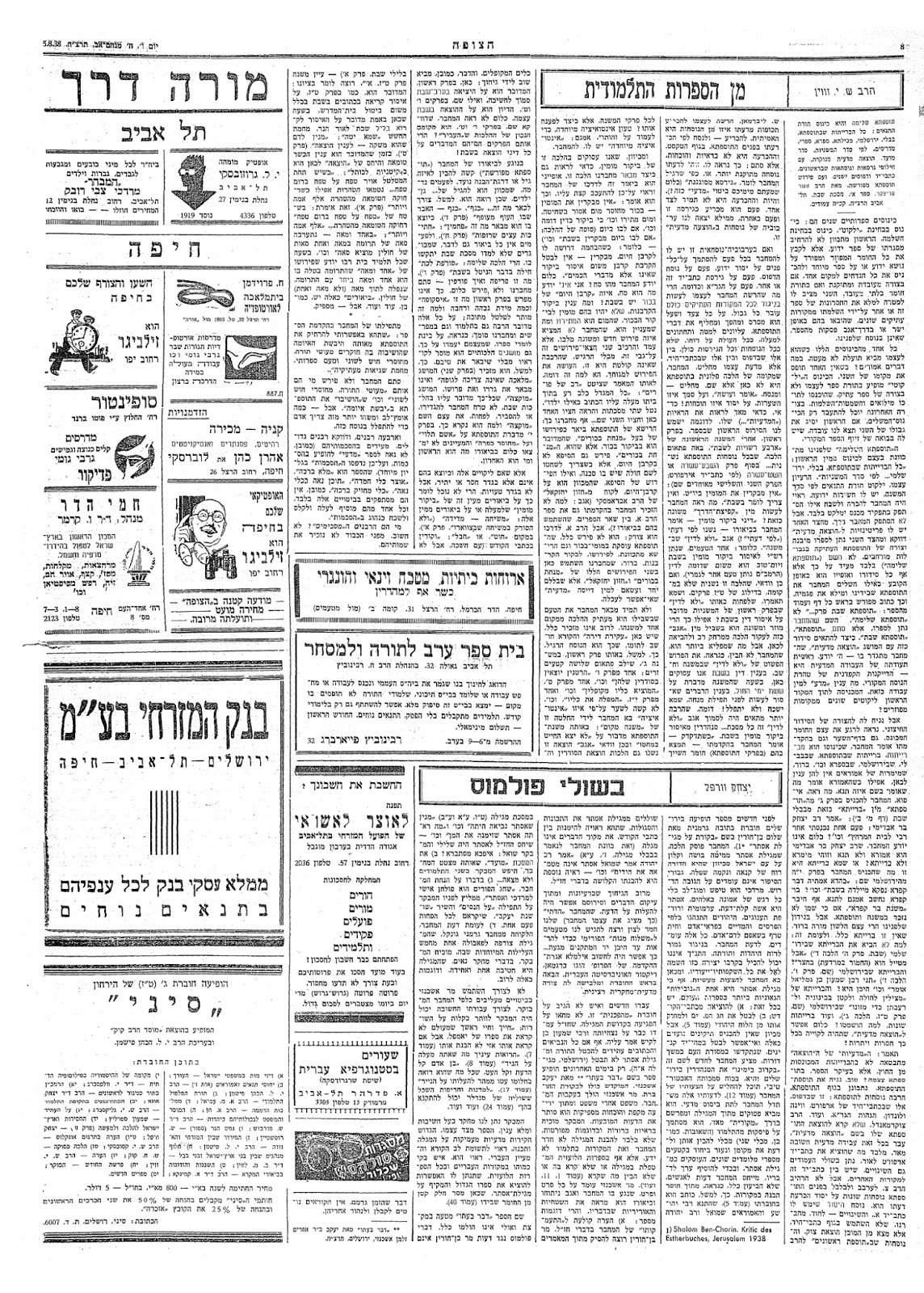
See Ha-Tzofeh
Fri. Aug 5th 1938
and Ha-Tzofeh
Fri. Sep. 27th 1940


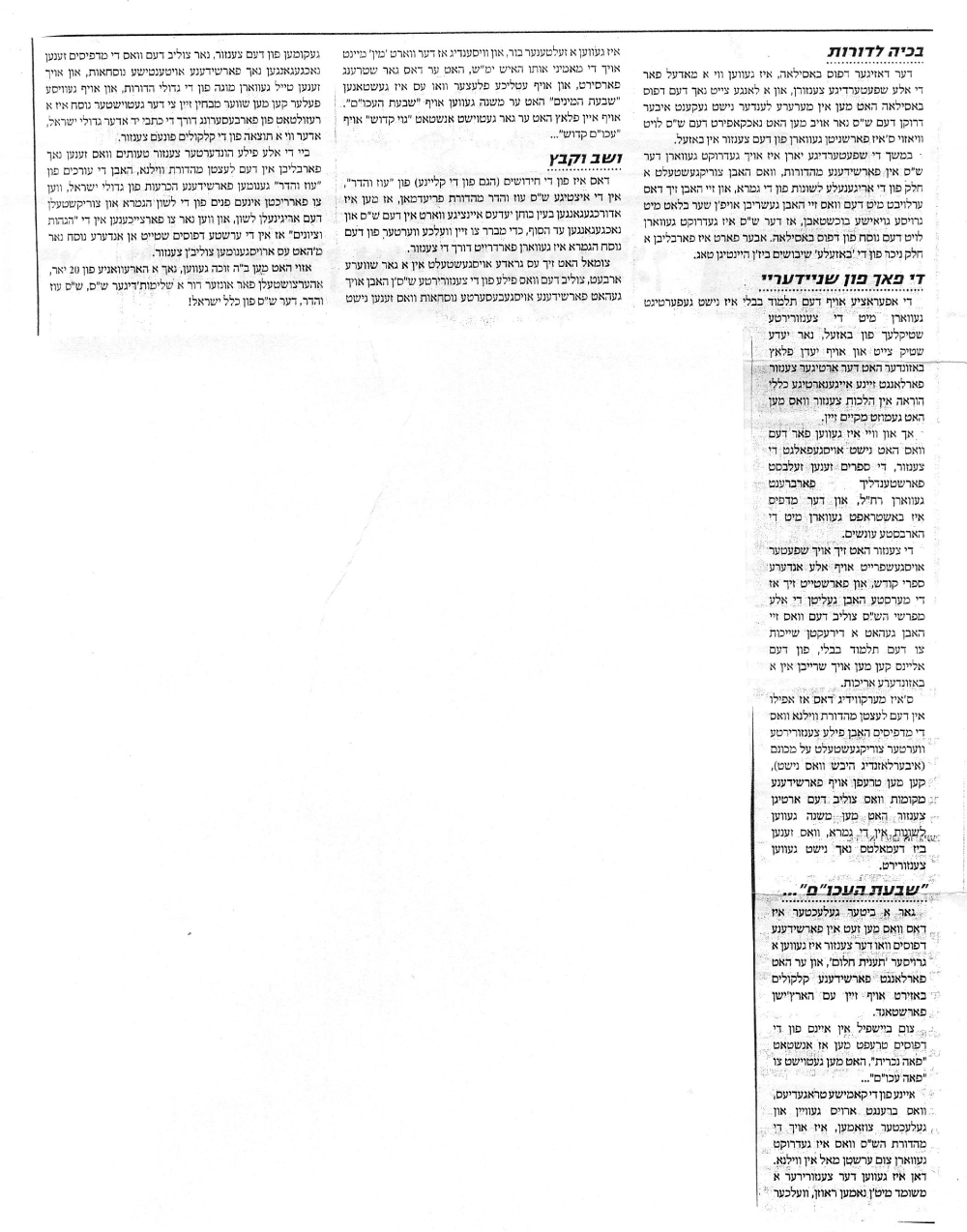
על שיבושי הצנזורה שנמצאים בהדפסות החדשות של התלמוד

הרב
ברוך אבערלאנדער
אב”ד
הבד”צ דקהילות החרדים דבודאפעסט
ורב
דקהילת חברה ש”ס – ליובאוויטש
בהמשך
לרשימה שהופיעה ב’ספרים-בלוג‘ אודות
הצנזורה הנני מפרסם כאן מתוך מה שרשמתי בענין.
הצנזורה
בתלמוד מאז ‘דפוס באסיליאה’
לפני קרוב
לארבע מאות וחמשים שנה, בשנים של”ח-שמ”א, נדפסה התלמוד הבבלי בעיר בזל
שבשוצריה. ש”ס זה ידוע בשם ‘דפוס באסיליאה’ של הנוצרי אמברוסיאו פרוביאנו. מהדורה
זו נדפסה על-פי ביקורת הצנזור מארקו מארינו, וזה השחית את תוכן המסכתות במאות
מקומות. מסכת עבודה זרה לא הדפיסו כלל – והטעם מובן. הדפוסים הבאים נמשכו אחרי
דפוס זו בלי לתקן השינויים ולהשלים ההשמטות שנעשו מפני הצנזורה.
אמנם קיים ספר
‘חסרונות הש”ס'[1], “והוא ספר קבוצת ההשמטות כולל כל
הדברים חסרים בתלמוד בבלי ורש”י ותוספות ורא”ש והג”א ופי’ המשניות
להרמב”ם… וכן השלמת החסרון חדושי הלכות ובח”א מהרש”א…”.
בהסכמתו לספר כותב הגאון בעל ‘הכתב והקבלה’: “איש נבון דעת ישתדל להוציא לאור
העולם את הספר הנקרא בשם ‘קבוצת ההשמטות’, וכל איש משכיל יודע התועלת הגדולה בל
ישכחו ברוב ימים, ומהראוי לעמוד בימין עזרתו ולסייעו להוציא מחשבתו הטובה מן הכח
אל הפועל”.
הלכה שלמד
הגר”מ פיינשטיין מתופעת הצנזורה
פסק
המהרש”ל ב’ים של שלמה’ (בבא קמא פ”ד סי’ ט, ע”פ גמרא שם לח, א
ותוד”ה קראו), שאם שאלו גוי על דין מדיני התורה ואינו יכול להישמט ממנו, ואם
יאמר לו את הדין יוכל לבוא לידי סכנה, אסור לו לשנות את הדין, שכל דבר ודבר מן
התורה נקרא תורת השם, ואם הוא משנה מפטור לחיוב וכיוצא בזה הריהו ככופר בכל התורה,
ולכן צריך למסור נפשו על זה, עיי”ש באריכות. (דברי המהרש”ל נעתקו בספרים שונים וכן ב’אנציקלופדיה
תלמודית’ כרך כב עמ’ ע והערה 193 שם.)
וכתב הרב
דוד קאהן בספרו ‘העקוב למישור’ (עמ’ לד) שהציע פעם את דברי היש”ש להגאון ר’ משה
פיינשטיין זצ”ל, “וענה לי הגר”מ זצ”ל דלית הלכתא כוותיה, שהרי
אנו רואים שהמדפיסים כתבו שכל מקום שנאמר עכו”ם או כותי בש”ס או בספרים
שונים אין המכוון לגוי שבימיהם ולא מיחו בידם חכמי הדור”[2].
אמנם יש
לציין שמצינו להגרמ”פ בכמה מקומות בספריו שהסתמך על דברי היש”ש
הנ”ל – שו”ת ‘אגרות משה’ (או”ח ח”ב סי’ נא), ‘דברות משה’
עמ”ס שבת (עמ’ קנט) ו’דברות משה’ עמ”ס כתובות (תשובה ג שבסוף הספר אות
ו).
‘שבט
הלוי’: “ההשמטות של הצנזורה… מצוה גמורה איכא להשלים החסר”
מעניין מאד
מכתבו של הגאון ר’ שמואל הלוי ואזנר זצ”ל, בשו”ת ‘שבט הלוי’ (ח”ח
סי’ רכה), ואעתיקו מפני חשיבותו:
כבוד ידידי המכובד
מאד פאר היחס והמעש הה”ג השלם כש”ת מוה”ר שבתי פרנקל שליט”א.
אחדשה”ט
וש”ת באה”ר.
העיר ה’ את כבודו
נ”י לפאר גם את התלמוד בבלי (אחרי שזכה לזה בהרמב”ם) בהוספות יקרות,
ולרגל עבוה”ק נולד ספק לכ”ת למעשה היות ידוע כי במשך הדורות גרמו הגוים
לשנות לשונות בהש”ס וגם להוציא קטעים שלמים ממנו, וגם בש”ס וילנא עם כל
הבקורת והגה עדין נשארו טעויות הדפוס למאות כידוע, ועד עכשיו כל המדפיסים לא
הסתכלו על זה רק מצלמים או מעתיקים הש”ס וילנא כמות שהוא עם המעלות וחסרונות
הטעויות, והיות כי ע”י טכניקה של היום אפשר לתקן את הסילופים של הצנזורה ואת
טעויות הדפוס שנשארו עדין אלא שעולה הרבה כסף, ע”כ נסתפק כ”ת לדינא, אם
מצלם את הש”ס כמות שהוא הוא [אי] ארוך להלכה כי כבר דשו ורגילים בו כלל ישראל,
או כיון שסו”ס אפשר בעולם לתקנו לגמרי ואם אינו מגיהו עד הסוף עדין עובר על
לא תשכון באהליך עולה שנדרש בכתובות י”ט ע”ב על המשהה ספר שאינו מוגה ל’
יום, ונפסק להלכה ביו”ד סי’ רע”ט. אלו דברי מכ”ת בתוס’ קצת, וגם
העיר מתשובת הרמ”א סי’ י’ שפסק כעין זה בנוגע לספרי הרמב”ם.
…פשוט בעיני
שכיון שהש”ס הזה הוגה בשעתו אלא לרבוי התיבות ואותיות לאלפי אלפים רבבות לא
יתכן בלי טעויות, מכ”מ הטעויות אינם יסודים בהלכה, ואין חשש שיצא מזה מכשול
בהוראה, בפרט לדידן שפוסקים מתוך השו”ע לא מהש”ס, א”כ אין בזה משום
אל תשכון באהליך עולה, ואפילו ההשמטות של הצנזורה נהי דמצוה גמורה איכא להשלים
החסר אבל גם בזה אין חסרון הזה יכול לגרום בלבול בהוראה וכיו”ב.
אבל בין בזה בין
בזה עכ”פ תבא עליו ברכה איכא בודאי, וגם מצוה לתקן, וע”כ השבושים
שמזדמנים לכם דרך עבודת הקודש שלכם בודאי מצוה וחיוב לתקן ובפרט במקום שרואים
בעליל שהוא מטעות המדפיסים, אבל לחפש עוד אין שום חיוב נגד מה שנדפס כזה כבר עשרות
פעמים, אבל בדרך תבא עליו ברכה אם אפשר כן ולהמציא לכלל ישראל דבר מושלם ומתוקן
ביותר מה טוב ומה נעים ותבא על כ”ת ברכת טוב.
ועל מה
שכתב ש”ההשמטות של הצנזורה… אין חסרון הזה יכול לגרום בלבול בהוראה”
יש להעיר מפסק הרמב”ם (הל’ ע”ז פ”ה ה”י): “ואפילו להזכיר
שם עבודה זרה שלא דרך שבועה אסור”, וכתב ב’הגהות מיימונית’ (סוף אות ג
במהדורת פרנקל): “…אבל שם הדיוטות כגון שמות בעלמא כשמות הגוים, אע”פ
שעשאוהו אלוה, כיון שבזה השם אין בו אלהות ואדנות וגם לא ניתן לו לשם כך מותר…
ובכמה מקומות בתלמוד הוזכרו ישו הנוצרי ותלמידיו, ואין אלוה גוים יותר ממנו”
(והועתק ב’ביאור הגר”א’ יו”ד סי’ קמז סק”ג). הרי שלומדים הלכה
מהסיפורים שבהם הוזכרו “ישו הנוצרי ותלמידיו” בתלמוד, הרי שגם סיפורי
ישו ותלמידיו חשובים להלכה.
דעתו של
כ”ק אדמו”ר זי”ע מליובאוויטש על הדפסת ההשמטות
בענין הדפסת
הקטעים שנשמטו על-ידי הצנזורה האריך פרופ’ יעקב ש’ שפיגל בספרו ‘עמודים בתולדות
הספר העברי – הגהות ומגיהים’ (מהדורה שניה עמ’ 584-588, 592-595), והביא הדברים
השונים שנכתבו בזה עיי”ש.
ואתעכב בזה
רק על פרט אחד, על מה שהביא בשמי שם (עמ’ 587 הערה 45) להעיר מדעתו של הרבי
מליובאוויטש בזה. ויש להוסיף ולתקן שהכוונה למבואר ב’תורת מנחם’ תשי”ב (ח”ב
עמ’ 46-47, 51-52). ואלו דברי הרבי שם:
“ספרתי כמה
פעמים שכאשר כ”ק מו”ח אדמו”ר ביקר בווינא נטפלו אליו יהודים
מהקהילה החרדית… שיש להם טענות על הנהגתו: ישנו סימן בשולחן ערוך [חו”מ סוף
סי’ תכה] – טענו הם –שיש בו פס”ד אודות אלה ש’לא מעלין ולא מורידין’, ויתירה
מזה, ‘מורידין ולא מעלין’, ח”ו, וכיון שכן – טענו הם – למה צריכים להחמיר
יותר מהשו”ע… ולהתעסק בהצלתם של יהודים כאלה שהם בגדר ד’לא מעלין ולא
מורידין’, ועאכו”כ להתעסק בהצלתם של יהודים כאלה שהם בגדר ד’מורידין ולא
מעלין’?!…
…אם לא די בכך
שפרטי הדינים הנ”ל הם באחד הסימנים האחרונים שבחלק האחרון
דהשו”ע (שבזה מודגש כאמור שלימודם צ”ל לאחרי לימוד וקיום כל
השו”ע) – היתה בזה גם השמטת ה’צענזור’ של הקיסר.
– הוא (ה’צענזור’)
בעצמו חשב שהסיבה לכך היא מפני שאין זה מתאים לחוקי המלכות של ממשלתו, אבל האמת
היא שישנה סיבה אחרת לדבר: כיון שהעלם והסתר הגלות התגבר ביותר עד כדי כך שקיימת
אפשרות לעשות שימוש בסימן הנ”ל בשו”ע… בנוגע לקיום הדברים בפועל
ממש
… לכן, סיבבו מלמעלה שיבוא גוי, שאינו בעל-בחירה, וישמיט חלק
מהתורה, רחמנא ליצלן, כדי שלא יהיו כאלה שיטעו להתנהג בהתאם לכך – ביחס
ליהודי אחר – בפועל ממש!”
וע”ז
כתב פרופ’ שפיגל שם:
“אמנם אפשר
שדברי האדמו”ר היו למקומם ולשעתם, והוא רצה בזה ‘להביא ראיה’ לגישת חסידות
חב”ד, שיש לקרב כל יהודי, וח”ו לומר לגביו ‘לא מעלין ולא מורידין’ וכד’.
אבל גם האדמו”ר יודה שאם נבוא להדפיס היום את השולחן ערוך יש להעדיף להדפיסו
ללא ההשמטות הללו”.
למרות
שפרופ’ שפיגל מהסס לקבוע דברים באופן ברור, לדעתי אין מקום לספק כלל שלדעת הרבי יש
להדפיס היום את ה’שלחן ערוך’ ללא ההשמטות. ושתי הוכחות ברורות לדבר.
א) בריבוי
מקומות בכתבי הרבי אנו מוצאים שמתייחס ל”דפוסים שלא שלטה יד הצענזור”,
וכן ש”יש לחפש בדפוסים ובכתבי-יד שלא שלטה בהם יד הצענזור”, ולדוגמא
אציין כמה הפניות ב’ליקוטי שיחות’ (חלק כה
עמ’ 56 הערה 29, חלק כו עמ’ 160 הערה 5, חלק ל עמ’ 130 הערה 34, חלק לד עמ’ 24
הערה 7), ב’אגרות קודש’
שלו (חלק יח עמ’ שלא, חלק
ל עמ’ עז) וב’תורת מנחם’ (תשי”א ח”א עמ’ 218 הערה ב,
תשט”ז ח”ב עמ’ 257, תשמ”ב ח”ד עמ’ 1951, תשמ”ג ח”ג
עמ’ 1333, תשמ”ה ח”ג עמ’ 2001, תשמ”ו ח”א עמ’ 608). ועוד.
ב) כשהרבי
התחיל להדיר מחדש בשנת תש”כ את שו”ע אדה”ז בעל ה’תניא’, ציין ב’פתח
דבר’ לחלק הראשון בין הדברים המיוחדים שנתחדשו בהוצאה זו: “לאחר חלק ששי בא
שער ההוספות, הכולל: א) השמטות בשו”ע רב[י]נו שנשמטו מפני יראת
הצענזאר…”. לפועל כשאכן נדפס החלק הששי בשנת תשכ”ח לא נכללו בו
ההשמטות הללו “מפני סיבות טכניות” (כפי שציינו מערכת ‘אוצר החסידים’ ב’הקדמה’
שם), אמנם אלו נתפרסמו
בסוף ספרי ‘מראי מקומות וציונים’ שנערכו לכל חלקי שו”ע אדה”ז, ויצאו
לאור ע”י הוצאת קה”ת[3].
על יסוד
דברי הרבי הנ”ל אכן תוקנו בפנים כל השינויים וההשמטות במהדורת קה”ת
החדשה (שנדפס משנת תשס”א ואילך).
ש”ס ‘נהרדעא’
לעומת הוצאת ‘עוז והדר’
בהוצאות
החדשות של התלמוד בבלי שיצאו לאחרונה ישנן מגמות הפוכות.
ב’מבוא
קצר’ שבראש מסכת ברכות של הש”ס ‘נהרדעא’, שיוצא לאור על-ידי הוצאת וגשל, כותב
המו”ל (בפרק “השלמת הגהות והערות”): “במהדורה זו הושלמו כל
חסרונות הש”ס שהושמטו על ידי הצנזור הנוצרי, ושייכים לגמרא, ובמהדורתינו
הושלמו להחזירם למקומם על הדף. (מלבד תיבות מיוחדות שסילפו בכל הש”ס במקום
‘גוי’ תיבת עובד כוכבים, ובמקום ‘משומד’ 
כתבו מומר, ובמקום ‘גמרא’ כתבו ש”ס, תלמוד[4]. דבזה לא החזרנו התיבות כבמקור ודי בהערה
זו כאן)”.
ואילו
ב’מבוא לתלמוד בבלי מהדורת עוז והדר’ שבראש מסכת ברכות (עמ’ ו) כתוב: “בגוף
הגמרא השארנו בדרך כלל את שבושי צנזורה שבש”ס וילנא (עי’ שו”ת ארץ צבי
ח”ב סי’ עד), והערנו עליהם בהגהות וציונים. במפרשים שבסוף מסכת תיקננו אותם
לפעמים”.
מי הורה
לעורכי ‘עוז והדר’ שלא לתקן את שיבושי הצנזורה?
אחי הרה”ח
ר’ שלום שי’ אבערלאנדער העביר לי צילום מאמר שהופיע בעיתון באידיש שיצא לאור בניו
יארק (‘דער איד’ ה’ טבת תשס”ח, צווייטע אפטיילונג ב/36), לכבוד סיום עריכת
והדפסת הש”ס מהדורת ‘עוז והדר’.
המאמר
מגולל חלק מההיסטוריה של הצנזורה בהדפסות התלמוד. ושוב מספר שעורכי ‘עוז והדר’ היו
להם ספיקות גדולות האם להחזיר עטרה ליושנה ולנקות את התלמוד משיבושי הצנזורה, ועל
כן הם פנו להגאון ר’ יצחק טובי’ ווייס שליט”א גאב”ד העדה החרדית
בירושלים, שהכריע נגד זה, כיון שגם היום יש לחשוש מעלילות מצד הנכרים למיניהם.
אני מסופק
מאד באמיתות הסיפור, נוסף לזה שידיעה חשובה זו לא מופיעה ב’מבוא’ הנ”ל, הרי
לפי שיטה זו מה הועילו חכמים בזה שלא החזירו את ההשמטות למקומם, הרי אחרי שאלו
מופיעים בלשונם בשולי הגליון, הרי שוב יש לחשוש מפגיעתם רעה של מחפשי רעתנו.

שיבושי
הצנזורה בש”ס ‘נהרדעא’, בהוצאת ‘עוז והדר’ ובפירוש ‘שוטנשטיין’
דוגמא א
סנהדרין
מג, א
אודות משפט ישו
ותלמידיו הוא ודאי הדוגמא הכי בולטת על אופן ההתייחסות לדברים שנשמטו מפני צנזורה.
בש”ס
‘נהרדעא’ החזירו את ההשמטה למקומה בפנים הגמרא, ובהערה (אות י) העירו: “מכאן
ועד סוף העמוד הושמט ע”י הצנזורה ונוסף כאן ע”פ ויניציאה ר”פ
וס”א”.
בהוצאת
‘עוז והדר’ לא החזירו את ההשמטה למקומה, אמנם העתיקו את זה ב’הגהות וציונים’ (אות
ב): “בדפו”י (שלפני הצענזור) נוסף… (כל הענין נשמט בדפוסים מפני
הצענזור והעתקנוהו מדפו”י עם הוספות ותיקונים ע”פ כת”י)”.
ב’שוטנשטיין’
בלה”ק נדפס “תבנית ש”ס ווילנא מהדורת עוז והדר” מהדורה קמא
(שבו לא מופיע מדור ‘הגהות וציונים’) ששם זה לא מופיע. ובעמוד שממול בפירוש סתמו כתבו:
“המשך הדיון בענין אינו מופיע לפנינו בגמרא”. והוסיפו בשוה”ג (הערה
38): “בגירסת הש”ס של הדפוסים שלפנינו, חסר בגמרא החלק הבא אחר שאלה זו.
לנוסח השלם של הדברים, ראה דקדוקי סופרים”. הקורא אינו מקבל אפילו רמז לתוכן
ההשמטה הארוכה.
אציג עכשיו
לפי סדר הש”ס עוד דוגמאות שונות להשמטות ותיקונים והאופן שבו זה מופיע
בהוצאות השונות.
דוגמא ב
ברכות יב,
א:
וקורין עשרת
הדברות שמע והיה אם שמוע ויאמר אמת ויציב ועבודה וברכת כהנים. אמר רב יהודה אמר
שמואל: אף בגבולין בקשו לקרות כן, אלא שכבר בטלום מפני תרעומת המינין (שלא יאמרו
לעמי הארץ אין שאר תורה אמת, ותדעו שאין קורין אלא מה שאמר הקב”ה ושמעו מפיו
בסיני. רש”י). ומפרש רש”י: “המינין. עכו”ם”.
בדפוס
ונציה נדפס (תחילת ע”ב): “המינין – תלמידי ישו”.
בש”ס
‘נהרדעא’ העירו (אות ט): “בס”א: תלמידי ישו”.
בהוצאת
‘עוז והדר’ העירו (אות ז): “בדפו”י: תלמידי ישו”.
ב’שוטנשטיין’
בלה”ק פירשו: “מפני תרעומת מינין (עובדי עבודה זרה)”, והרחיבו על
כך בשוה”ג (הערה 3): “רש”י. ואין הכוונה כאן לאותם ה’מינים’
הנזכרים לקמן עמוד ב, ובמקומות אחרים, שהם יהודים המאמינים בתורה שבכתב אלא
שכופרים בקבלת חז”ל והופכים דברי התורה שלא כהלכה. [עיין צל”ח
ומהר”ץ חיות; ועיין גם מגדים חדשים.]”
פיענוח
הדברים: הצל”ח מדייק בלשון רש”י שפירש “המינין. עכו”ם”,
שבא לשלול מינין שמאמינים בתושבע”פ. אמנם ה’מגדים חדשים’ העיר: “הצל”ח
כתב דבריו לפי מש”כ ברש”י לפנינו המינין עכו”ם. אמנם אין זה מלשון
רש”י, אלא הוא ‘תיקון’ מעשה ידי הצנזור” (וכן העירו על כך בהערה טו בצל”ח
שי”ל ע”י מכון ירושלים). ולפי
הגירסא האמיתית ברש”י הרי גם המינין שבעמוד א, וגם המינין שבעמוד, שניהם הם
תלמידי הנוצרי.
דוגמא ג
ברכות יב,
ב:
פרשת ציצית מפני
מה קבעוה? אמר רבי יהודה בר חביבא: מפני שיש בה חמשה דברים: מצות ציצית, יציאת
מצרים, עול מצות, ודעת מינים, הרהור עבירה, והרהור עבודה זרה וכו’. והרהור עבודה
זרה מנלן? דתניא: אַחֲרֵי לְבַבְכֶם [במדבר
טו, לט] – זו מינות.
ופרש”י: “ההופכים טעמי התורה למדרש טעות ואליל”.
בדפוס
ונציה נדפס (דף יג, א): “תלמידי הנוצרי ההופכים טעמי התורה למדרש טעות ואליל”.
בש”ס
‘נהרדעא’ העירו (אות מ): “בס”א: תלמידי הנוצרי”.
בהוצאת
‘עוז והדר’ העירו (אות ח): “בדפו”י: תלמידי ישו הנוצרי”.
ב’שוטנשטיין’
בלה”ק לא העתיקו דברי רש”י, וסתמו לכתוב: “שלא להתבונן בדברי
מינות”.
דוגמא ד
ברכות יז,
ב:
אין פרץ – שלא תהא
סיעתנו כסיעתו של דוד שיצא ממנו אחיתופל, ואין יוצאת – שלא תהא סיעתנו כסיעתו של
שאול שיצא ממנו דואג האדומי, ואין צוחה – שלא תהא סיעתנו כסיעתו של אלישע שיצא
ממנו גחזי, ברחובותינו – שלא יהא לנו בן או תלמיד שמקדיח תבשילו ברבים.
בדפוס
ונציה נדפס (דף יח, א): “תלמיד שמקדיח תבשילו ברבים, כגון הנוצרי”.
בש”ס
‘נהרדעא’ לא תוקן ואף לא העירו ע”ז.
בהוצאת
‘עוז והדר’ העירו (אות ב): “בדפו”י ובכת”י ובע”י נוסף: כגון
ישו הנוצרי”.
ב’שוטנשטיין’
בלה”ק לא העירו כלום.
דוגמא ה
גיטין נו,
ב–נז, א:
אונקלוס
בר קלוניקוס בר אחתיה דטיטוס הוה, בעי לאיגיורי, אזל אסקיה לטיטוס בנגידא וכו’. אזל
אסקיה לבלעם בנגידא וכו’. אזל אסקיה בנגידא לפושעי ישראל וכו’.
בדפוס
ונציה נדפס: “אזל אסקיה לישו בנגידא”.
בש”ס
‘נהרדעא’ העירו (אות ב): “בס”א: ליש”ו”.
בהוצאת
‘עוז והדר’ העירו (אות ג): “צ”ל אסקיה לישו בנגידא (דפו”י לפני
הצענזור)”.
ב’שוטנשטיין’
בלה”ק פירשו: “ועלה באוב אחד מפושעי ישראל”, והרחיבו על כך
בשוה”ג (הערה 4): “לפי כתבי יד ודפוסים ישנים, מדובר בתלמיד רבי יהושע
בן פרחיה שיצא לתרבות רעה והסית והדיח את ישראל (ראה סוטה מז, א; סנהדרין קז,
ב)”.
דוגמא ו
סנהדרין יז,
א:
אמר רבי יוחנן:
אין מושיבין בסנהדרי אלא בעלי קומה, ובעלי חכמה, ובעלי מראה, ובעלי זקנה, ובעלי
כשפים. ופרש”י: “להמית מכשפים הבוטחים בכשפיהם להנצל מידי בית דין,
ולגלות על המכשפין המסיתין ומדיחין בכשפיהן, כגון המצרים“.
בדפוס
ונציה נדפס: “כגון [ישו] הנוצרי”.
בש”ס
‘נהרדעא’ העירו (אות י): “בס”א: נוצרי או הנוצרים”.
בהוצאת
‘עוז והדר’ העירו (אות נ): “צ”ל כגון ישו נוצרי (דק”ס ע”פ
דפו”י שלפני הצענזור)”.
ב’שוטנשטיין’
בלה”ק סתמו ולא העירו כלום.
דוגמא ז
סנהדרין קז,
ב:
תנו רבנן לעולם
תהא שמאל דוחה וימין מקרבת. לא כאלישע שדחפו לגחזי בשתי ידים.
בדפוס
ונציה נוסף בסוף דברי הברייתא: “ולא כרבי יהושע בן פרחיא שדחפו לישו בשתי ידים”.
בש”ס
‘נהרדעא’ הוסיפו את זה בגליון (אות ז), וכתבו בסוף: “הושמט ע”י הצנזורה
ונוסף כאן ויניציאה ר”פ וס”א”.
בהוצאת
‘עוז והדר’ הוסיפו את זה בגליון (אות ג) וכתבו: “בדפו”י (לפני הצענזור)
נוסף…”.
אודות ‘שוטנשטיין’
ראה לקמן דוגמא ז.
דוגמא ח
בהמשך דברי
הגמרא שם נוסף בדפוס ונציה: ר’ יהושע בן פרחיה מאי היא? כדקטלינהו ינאי מלכא לרבנן
אזל רבי יהושע בן פרחיה וישו לאלכסנדריא של מצרים. [ובהמשך מובא סיפור ארוך שקרה
בין הרב והתלמיד.]
בש”ס
‘נהרדעא’ הוסיפו את זה בתוך דברי הגמרא, ובגליון (אות ט) כתבו: “מכאן עד את
ישראל הושמט ע”י הצנזורה והועתק ע”פ ויניציאה ר”פ וס”א”.
בהוצאת
‘עוז והדר’ הוסיפו את זה בגליון (אות ג) וכתבו: “בדפו”י (לפני הצענזור)
נוסף…”.
ב’שוטנשטיין’
בלה”ק הוסיפו תוכנו של קטע זה והקודם (דוגמא ז) בשוה”ג (הערה 17) בהשמטת
שמו התלמיד, וכתבו: “בהשמטות הש”ס מובא מקרה נוסף של רב שדגחה את תלמידו
בשתי ידיו והתוצאות הקשות שיצאו מאותה דחיה…”.
סיכום
העריכה במהדורות השונות
בהוצאת
‘עוז והדר’
אפשר
להבחין בשיטה עקבית. ה’מהדורה קמא’ שלהם, שבו לא מופיע מדור ‘הגהות וציונים’, היתה
העתק מושלם של ש”ס ווילנא וההוצאות הקודמות לו, כולל כל השמטות הצנזור
והתיקונים שנשארו בתוך הטקסט בלי להעיר עליהם. גם ב’מהדורה בתרא’ שלהם לא תיקנו
כלום בתוך הטקסט של הגמרא או של פירושי הגמרא, אבל במדור ‘הגהות וציונים’ העירו באופן
עקבי על כל השינויים והעתיקו אותם בלשונם, ואף נתנו לקורא להבין שהשינויים הללו
קשורים ל”דפו”י שלפני הצענזור”.
בש”ס
‘נהרדעא’
אין שיטה
עקבית. יש שהחזירו את ההשמטה לתוך דברי הגמרא (דוגמא א), אמנם לפעמים השמיטו גם הם ואף לא העירו על
כך (דוגמא ד), אמנם ברוב המקרים לא החזירו את ההשמטה
לתוך דברי הגמרא אמנם העירו על השינויים בגליון והעתיקו אותם בלשונם (דוגמאות ב-ג, ה-ו). ויש שבאותו עמוד עצמו החזירוו קטע אחד
לתוך דברי הגמרא וקטע אחר העתיקו רק בגליון (דוגמאות
ז-ח). ברוב המקרים אין
לומד מבין ממה נובעים השינויים ש”בס”א [=בספרים אחרים]”, אמנם יש
והם מגלים שזה קשור לצנזורה (דוגמאות ז-ח).
ב’שוטנשטיין’
בלה”ק
החליטו
שאין להזכיר את שמו של הנוצרי כלל וכלל, ועל כן יש שמשמיטים לגמרי קטעים מהגמרא (דוגמא א, ד, ו), ויש שמצטטים את התוכן (ולא את לשון
הגמרא!) אבל משמיטים את שמו (דוגמא ה,
ח). בפירושם יש
שמתעלמים מדברי רש”י הלא מצונזרים (דוגמא
ג), ועוד יותר תמוה
לפרש לפי הגירסא המצונזרת דוקא (דוגמא ב)[5].
אמנם להעיר
שלפעמים כן מעירים לשיבושי הצנזורה וכגון: “הגירסא שלפנינו ‘לכותים’ היא
משיבושי הצנזורה, וצריך לומר ‘לגוים'” (ביצה
כ, ב הערה 16),
“כידוע ‘לעובדי כוכבים’ הוא משיבושי הצנזורה, וצריך לומר כאן ובכל הסוגיא
להלן ‘לגוים'” (שם כא, א
הערה 24). אמנם מסיימים:
“לא שינינו בפנים את הגירסא שלפנינו” (הוריות יא, א הערה 37).
“ליקוטי
רש”י” מיוסד על שיבושי הצנזורה
שיטתם של
עורכי מהדורת ‘עוז והדר’ להעיר על השינויים רק ב’הגהות וציונים’ גורם לטעויות,
וכגון בראש השנה (יז, א), ששם אומרת הגמרא ש”המינין… יורדין לגיהנם
ונידונין בה לדורות”, מפרש רש”י (כפי שנדפס בדפוסים שלפנינו):
“האנשים אשר הפכו דברי אלהים חיים לרעה, כגון צדוקים ובייתוסים”, ובצדק
העירו שם במהדורת ‘עוז והדר’ (הערה ע) שהגירסא הנכונה היא: “תלמידי ישו
הנוצרי אשר הפכו דברי אלהים חיים לרעה”.
אמנם
ב’ליקוטי רש”י’ שם ליקטו מדברי רש”י בכמה מקומות בש”ס:
“המינין. עכו”ם [ברכות
יב.]. משרתים לעבודה
זרה [שבת קטז.]. שאינם מאמינים לדברי רז”ל כגון
צדוקים [חגיגה ה:]. תלמידי ישו שאינם מאמינים לדברי רבותינו
זכרונם לברכה [שם
ע”פ רש”י ישן]. כומרין
לעבודת כוכבים בין עובדי כוכבים בין ישראלים [ע”ז כו:]”[6].
אמנם חלק
מהציטוטים אלו אינם אלא משיבושי הצנזורה, וכך זה יראה באם נגיה אותם ע”פ
הדפו”י שרובם נעתקו ב’הגהות וציונים’: “המינין. עכו”ם תלמידי ישו
[ברכות יב.]. משרתים משומדין לעבודה זרה [שבת קטז.]. שאינם מאמינים לדברי רז”ל כגון צדוקים
[חגיגה ה:]. תלמידי ישו שאינם מאמינים מודים לדברי
רבותינו
זכרונם לברכה חכמים [שם ע”פ רש”י ישן]. כומרין לעבודת כוכבים לעבודה זרה
בין עובדי
כוכבים גוים בין ישראלים [ע”ז כו:]”.
בָּרוּךְ הַמַּבְדִּיל בֵּין
קֹדֶשׁ לְקֹדֶשׁ.
[1] ב’בית עקד ספרים’ (ח”ב עמ’ 386) נרשמו הוצאות שונות של
‘חסרונות הש”ס’, ראשון ביניהם אמ”ד תס”ט. ולא ראיתי זכרם במקום
אחר.
[2]
ב’ספרים-בלוג‘ שם (הערה
28) ציין שכדברים האלו נמצא כבר ב”כתב התנצלות ותשובה מחכמי פראג על הדפסת
התלמוד עם השמטות בשנת תפ”ז לפ”ק” (נתפרסם ב’המגיד’ י”ח סיון
תרל”ז עמ’ 199), וכך כתבו: “…דעת מהרש”ל להחמיר אף במקום סכנה.
אמנם מעשים בכל יום שמהפכין הדין ומשנין מדרכי השלום בהפקעת הלואה וכדומה, ולא
שמענו פוצה פה לעולם. וכן נראה היפוכו בדברי מהר”ם רבק”ש [ב’באר הגולה’]
בש”ע ח”מ סי תכ”ה [ס”ק ש] ודברים המה מועתקים בספרים רבים”.
[3] ר”י מונדשיין מציין (‘תורת חב”ד’ ח”ב עמ’ לו):
“סעיפים שלימים וביאורים ארוכים שב’קונטרס אחרון’ נשמטו בעטיית
הצנזורה”. והוא ערך שם (עמ’ לז-מז) רשימה של רוב ההשמטות והשינויים של
הצנזורה.
[4]
זה כמובן טעות, ואדרבה, וכפי שכתב הרנ”נ רבינוביץ ב’מאמר על
הדפסת התלמוד’ (עמ’ עז במהדורת הברמן): “ותחת המלה תלמוד נדפס שם גמרא או
ש”ס או למוד”.
[5] דומה לזה נמצא ב’שוטנשטיין’ באנגלית (יומא נו, ב הערה 26) הסבר
מפורט למהות הצדוקים, מיוסד על שיבוש הצנזורה “אמר ליה ההוא צדוקי”,
במקום הגירסא הנכונה: “אמר ליה ההוא מינא”. הערה זו נשמטה מ’שוטנשטיין’
בלה”ק שם.
[6]
‘שוטנשטיין’ בלה”ק שם נמשכו אחרי ‘עוז והדר’ וכתבו בפירושם:
“אנשים המסלפים את התורה להפוך דברי אלהים חיים לרעה, כגון הצדוקים וכתות
אחרות כמותם”, וציינו מקורם (הערה 8): “עיין ליקוטי רש”י”.


ArtScroll and More

ArtScroll and More
by Marc B. Shapiro
Continued from here.
1. As mentioned, I believe that on occasion ArtScroll is unaware that the text it is explaining is a censored text. Sometimes it might even be an internally censored text (i.e., censored by Jews so as to avoid difficulties with the non-Jewish authorities). This same problem is often found with aharonim. How about with rishonim? For example, was Rashi ever misled by an internally censored text? I would hesitate to say so but this is exactly what is suggested by R. Elijah David Rabinowitz-Teomim (the Aderet), though he piously prefaces his remarks with the words לולי דברי רש”י.
Sanhedrin 58b states:
Resh Lakish said: A heathen who keeps a day of rest, deserves death, for it is written, “And a day and a night they shall not rest” (Gen. 8:22), and a master has said: Their prohibition is their death sentence. Ravina said: Even if he rested on a Monday.
The Aderet sees it as obvious (פשוט) that the original version of Ravina’s statement was “Even if he rested on Sunday,” and this was changed to “Monday” due to fear of the Christians.[1] Rashi, however, offers an explanation as to why “Monday” is mentioned, meaning that if the Aderet is correct then even Rashi was misled by the altered text.[2]
As part of his explanation on this passage, Rashi also writes: אחד בשבת ששובתין בו הנוצרים. This is the authentic version of Rashi which appears in the early Talmud printings. It is also found in Steinsaltz and Oz ve-Hadar. The censored Vilna Talmud, followed by ArtScroll, omit the word הנוצרים.
Even in the censored Vilna Talmud the word הנוצרים appears in Ta’anit 27b where we find the following:

Our Rabbis have taught: The men of the Mishmar prayed over the sacrifice of their brethren that it may be favorably accepted, whilst the men of the Ma’amad assembled in their synagogues and observed four fasts, on Monday, Tuesday, Wednesday and Thursday of that week. On Monday [they fasted] for those that go down to the sea; on Tuesday for those who travel in the deserts; on Wednesday that croup may not attack children; on Thursday for pregnant women and nursing mothers, that pregnant women should not suffer a miscarriage, and that nursing mothers may be able to nurse their infants; on Friday they did not fast out of respect for the Sabbath; and certainly not on the Sabbath. Why did they not fast on Sunday? — R. Johanan said: Because of the Christians (הנוצרים). R. Samuel b. Nahmani said: Because it is the third day after the creation of Man. Resh Lakish said: Because of the additional soul. For Resh Lakish said: Man is given an additional soul on Friday, but at the termination of the Sabbath it is taken away from him, as it is said, “He ceased from work and rested” [shavat va-yinafash], that is to say, once the rest had ceased, woe! that soul is gone.

There is something very strange about this passage, and yet it is not noted in Soncino, ArtScroll, Koren, or by R. Zvi Hirsch Chajes whom I could have expected to pick up on it. I assume that most people read this passage without even realizing the problem, which for the rishonim was not a problem as I will explain. The Sages, in describing what went on in Second Temple days, make clear that the men of the Ma’amad did not fast on Sunday. R. Johanan, who lived in third-century Eretz Yisrael, says that this was because of the Christians. Rashi explains that the Christians “make this day [Sunday] their holiday.”[3] R. Gershom, in his commentary on the passage, writes that the Christians’ “holiday is on Sunday and if the Jews would fast they [the Christians] would be angered.”[4]
The problem with all this is that in the days of the Second Temple there was no significant Christian community for Jews to be concerned with. Furthermore, these early followers of Jesus would not have observed the Sabbath on Sunday.[5] I think the answer to this problem is that the talmudic sages regarded Jesus as a student of R. Joshua ben Perahyah who flourished in the latter part of the second century BCE (i.e., ca. 130-100 BCE). In other words, in the talmudic conception Jesus lived at least a century earlier than the historical record tells us, and the amoraim assumed that the Christianity as they knew it was also practiced centuries before. Robert Travers Herford writes: “R. Johanan transferred to the time of the Temple a feature of the religious life of his own totally different time.”[6] The predating of Jesus’ life was also shared by the rishonim, which explains why the chronological problem did not trouble them.
Ketubot 102b states:

If a man died and left a young son with his mother, [and while] the father’s heirs demand, ‘Let him be brought up with us’, his mother claims, ‘My son should be brought up by me’, [the son] must be left with his mother and may not be left with anyone who is entitled to be his heir. Such a case once occurred and [the heirs] killed him ער”ה.

What does ער”ה mean? The first thing to note is that these letters are not part of the original talmudic text. In talmudic manuscripts, the writings of the rishonim, and also the early printed editions in Pesaro and Venice, the uncensored text reads “killed him on the eve of Passover.”[7] Because this is the authentic reading, this is how it appears in Steinsaltz, Koren, and Soncino. ArtScroll, however, translates the last words of the passage as “They butchered him on the first evening of his stay,” reading ער”ה as ערב הראשון.
ArtScroll’s action is quite strange, as there is absolutely no question what the authentic reading of the text is. Not only does ArtScroll translate the false acronym, but it even offers an explanation of it. “They were so eager for his blood that he did not even last a single night with him. They killed him on the evening of his arrival.” This is wildly incorrect as the acronym ער”ה is simply a printer’s invention.
ArtScroll continues its explanation as follows:

The words ערב הראשון, the first evening, are not actually found in the Baraisa. Rather, the Baraisa contains an acronym – ער”ה – which is read as ערב הראשון (see Rosh; Mesoras HaShas). Another interpretation of this acronym reads it as ערב הפסח, on Pesach eve (Meiri; Hagahos Yavetz)

This note also needs to be corrected as there is no dispute among rishonim about how to how to read the acronym, as the acronym did not exist in the days of the rishonim. It is an invention of one of the printed editions. Thus, contrary to what the note states, Meiri never gave an interpretation of the acronym to mean ערב הפסח. Rather, these words were in his text of the Talmud, and they were also in the Rosh’s text of the Talmud and appear in the manuscripts of the Rosh. The printed version of the Rosh has been “corrected”, just like the text of the Talmud and Rif was “corrected”.[8]
Why did printed editions of the Talmud begin to use the acronym? This talmudic passage was cited by anti-Semites to support the blood libel, namely, that Jews would kill Christian children before Passover to use their blood.[9] Thus, this “correction”, like so many others, was designed to undermine anti-Semitic attacks against the Talmud.[10]       
Seth Leibowitz called my attention to the Stone Chumash, p. 407, where in the introduction to the Ten Commandments it states:

Rambam (Moreh Nevuchim II:32) comments that they only heard the first two [commandments] from God, but they could hear only the sound of the Divine voice, as it were, and could not understand the words He was saying. . . . Thus, the people experienced prophecy, for they heard God’s voice, but their faith in Moses was reinforced, because only he understood what God was saying.

The first thing to note is that the reference should be II:33 not II:32. The passage just quoted states that the people experienced prophecy. Does Maimonides say this? Guide 2:33 is a very difficult chapter and any interpretation given can be challenged with alternative perspectives. (See Yaakov Levinger, Ha-Rambam ke-Filosof u-khe-Fosek, ch. 3.) Yet I think I am on safe ground in saying that Maimonides does not believe that what the people as a whole experienced is to be regarded as prophecy. While Guide 2:33 might be ambiguous in this matter, the previous chapter, 2:32, states explicitly: “As for the Gathering at Mount Sinai, though through a miracle all the people saw the great fire and heard the frightening and terrifying voices, only those who were fit for it achieved the rank of prophecy, and even those in various degrees.”
Shem Tov explains:
ואחר שסלק הרב אלו הטעיות אשר יראה מהם שהשם ינבא כל איש מבני אדם, סלק מעלינו ספק גדול והוא מעמד הר סיני אשר אנשים ונשים סכלים ובלתי ראויים כל היו נביאים וזה יביא לחשוב שהשם ית’ ינבא כל מי שירצה מבלתי שיהיה מוכן, ואמר שאף שכלם היו רואים האש הגדולה ושומעים הקולות הנוראות המפחידות וזה היה על צד הפלא, לא הגיע למדרגת הנבואה אלא הראוי לה והראויים יתחלפו מדרגותיהם ג”כ
Finally, so that all the attention is not on ArtScroll, the following point was called to my attention by Benjamin Apfel. Here is the first page of Jastrow’s introduction to his dictionary. Read the last paragraph.

Here is the first page of Philip Birnbaum’s introduction to his translation of sections of the Mishneh Torah.[11]
The first paragraph is lifted from Jastrow. Would it have been so difficult for Birnbaum to simply add a note indicating that he was adapting Jastrow’s words?
2. In my post here I referred to selections from Rashbam’s commentary on Psalms that were recently printed from manuscript. This should be distinguished from Rashbam’s commentary on Psalms published in Vienna in 1816 by Isaac Satanow. Here is the title page which tells us that the manuscript comes from the royal library in Berlin.
This commentary on Psalms is a forgery. While the volume is attributed to Rashbam it was actually written by Satanow. Regarding this forgery, David Rosin writes as follows:[12]
הכי קרא שמו יצחק ויהי כצחוק בעיניו להתחפש במעטה רבנו שמואל ולעשות מעשהו ולעבוד עבודתו. זר מעשהו ונכריה עבודתו, כל השומע יצחק לו
3. In my post here I quoted R. Moses Isaac Ashkenazi in his Ho’il Moshe that King David is not to be regarded as a prophet as he only had ruah ha-kodesh. One of the commenters wrote:

Rashi Megilla 14a quotes a Halachot Gedolot which names David as [a] prophet. Rashi speaks specifically about prophets as opposed to Ruach Hakodesh, and excludes Daniel based on Megilla 3a.

 Another commenter was more strident:

Wonderful example how modern scholars have no place in the Torah world! As first commenter pointed out, Dovid Hamelech is prominent in the list of 48 neviim, and there are scores of sugyos based on the nevuah of DH. The makom mizbeach, etc. Pure AmHaaRatzus!

I am not sure if I am the am ha-aretz he is referring to, which in any case would be uncalled for since I never said that David only had ruah ha-kodesh and was therefore not a prophet. All I did was point out that R. Moses Isaac Ashkenazi said this. When I called the commenter’s attention to the fact that his strong words were directed against R. Ashkenazi, he wrote:

I wouldn’t start up with Hoil Moshe, but was pointing out the danger of someone reading this post, and then taking it at face value. For anyone fluent in Shas they will find numerous references to DH’s nevua. Ruach HaKodesh wouldn’t work for all the halachos we learn out from DH. . . . I do thoroughly enjoy your posts, but find them quite dangerous. I would prefer my children at least stick to Artscroll and have their basics –DH’s nevua – straight!

Now let me say something that I did not put in the comments because I want the entire audience to see it, not just the tiny group that reads the comments. The commenter just quoted is a perfect example of one who is certain of something, and certain that the opposing position is incorrect, and this leads to very harsh language. Let’s leave aside R. Moses Isaac Ashkenazi who is not an important scholar. All would agree that R. Moses Sofer, the Hatam Sofer, is important and certainly not an am ha’aretz (which is the term the commenter used). Yet the Hatam Sofer is explicit that David was not a prophet and only had ruah ha-kodesh, which is exactly what R. Ashkenazi states and what the commenter so harshly attacks. Here are the Hatam Sofer’s words in Torat Moshe ha-ShalemBa-Midbar, p. 74.

הנה לא מצינו לישראל מלך שיהי’ גם נביא משולח לעם כי אם משה רבינו ע”ה, דכתיב גבי’ (דברים ל”ג ה’) ויהי בישורון מלך, אבל שארי נביאים לא היו מלכים והמלכים לא התנבאו, ודוד המלך ע”ה רה”ק הו”ל ולא נבואה, ולכן אחז”ל (גיטין נ”ט ע”א) מימות משה עד רבי לא מצינו תורה וגדולה במקום אחד, דאלו כל הנביאים היו עליהם בגדולה השופט והמלך שבימיו, וכל המלכים אפי’ דוד ושלמה היו הנביאים שבדורם גדולים מהם בתורה . . . שהרי אין מלך נביא.

This notion, that the kings were not prophets (other than Moses), is also stated in Zohar, Terumah, p. 154a, and this is presumably the Hatam Sofer’s source. I don’t deny that there are other authoritative sources that contradict this, including passages in the Talmud. Some of them are cited by R. Reuven Margaliyot in his note to the Zohar, ad loc., and we can speculate as to why the Hatam Sofer preferred the Zohar over these other sources. I cite this only to show that commenters should be very careful before labeling something as am ha’aratzus, as you never know whom you might be insulting with this comment.

4. The latest book in my series with Academic Studies Press has recently appeared. It is Sara Reguer, My Father’s Journey: A Memoir of Lost Worlds of Jewish Lithuania. (Reguer is the granddaughter of R. Simcha Zelig Reguer, the dayan of Brisk.) Here is the book’s description.

Born into a leading Lithuanian-Jewish rabbinic family, Moshe Aron Reguer initially followed the path of traditional yeshiva education. His adolescence coincided with World War I and its upheavals, pandemics, and pogroms, as well as with new ideas of Haskalah, Zionism, and socialism. His memoir, recently discovered and here translated and published for the first time, discusses his internal struggles and describes the world around him and the people who influenced him. Moshe Aron Reguer wrote his memoir at the age of 23, on the eve of his departure for Eretz Israel in 1926. However, his story did not end there, but continued in British Mandated Palestine and the United States. He kept in touch with the family in Brest-Litovsk until the Nazis destroyed Jewish Lithuania, and some of their correspondence is included within this volume.

Anyone who is interested in Jewish Lithuania and the great yeshivot will find this book of value.

I also want to call attention to the recent publication of Menachem Kellner, Jewish Universalism, edited by Hava Tirosh-Samuelson and Aaron W. Hughes. Kellner’s work has made a great impact, not only in Jewish scholarship but among thinking Jews in general. This small volume is a wonderful read and contains an intellectual portrait of Kellner written by James A. Diamond as well as a lengthy interview with Kellner.

This book is number 12 in Brill’s Library of Contemporary Jewish Philosophers. Here is what has appeared so far and what if forthcoming (taken from the Brill website).

Published Volumes

Vol. 1: Eliezer Schweid: The Responsibility of Jewish Philosophy
Vol. 2: Jonathan Sacks: Universalizing Particularity
Vol. 3: David Novak: Natural Law and Revealed Torah
Vol. 4: Eugene B. Borowitz: Rethinking God and Ethics
Vol. 5: Elliot N. Dorff: In Search of the Good Life
Vol. 6: Judith Plaskow: Feminism, Theology, and Justice
Vol. 7: David R. Blumenthal: Living with God and Humanity
Vol. 8: Moshe Idel: Representing God
Vol. 9: Lenn E. Goodman: Judaism, Humanity, and Nature
Vol. 10: Avi Sagi: Existentialism, Pluralism, and Identity
Vol. 11: Elliot R. Wolfson: Poetic Thinking
Vol. 12: Menachem Kellner: Jewish Universalism

Forthcoming Volumes

Vol. 13: J. David Bleich: Where Halakhah and Philosophy Meet (est. October 2015)
Vol. 14: Michael Fishbane: Jewish Hermeneutical Theology (est. October 2015)
Vol. 15: Norbert M. Samuelson: Reasoned Faith (est. November 2015)
Vol. 16: Arthur Green: Hasidism for Tomorrow (est. January 2016)

5. The issue of truth-telling in halakhic matters, discussed in the last chapter of my new book, has been of interest to many people. I did not want to be too lengthy in my response to Aryeh Frimer here, because it was not my own independent post. So let me now add some more details. DG reminded me of the following source. According to R. Jacob Moellin, when the Talmud states that a law is rabbinic but a verse is brought as an asmachta, this was done so as to mislead the people into thinking that it is a Torah law so that they would observe it more carefully.[13] In other words, the Sages were engaging in falsehood for a higher purpose.

This is exactly the sort of thing that Frimer claimed is not part of mainstream halakhic thought, a point which I disputed. It also is very relevant to my discussion of the dispute between the Hatam Sofer and R. Zvi Hirsch Chajes regarding “raising the prohibition”. Here are the Maharil’s words, as quoted by his student.

כל היכא דאיתמר מדרבנן הוא וקרא אסמכתא בעלמא, הכי פירושו ודאי תקנתא דרבנן הוא והם יצאו ובדקו ומצאו להם סמך מקרא, וסמכו דבריהם עליו כדי להחזיקם שיהיו סבורים דהוא מדאורייתא ויחמירו בו, ולא אתו לזלזל ולהקל בדברי חכמים

In the notes to this text, the editor informs us that one of the manuscripts has a different version. Instead of כדי להחזיקם שיהיו סבורים it reads להטעות הבריות שהם סבורים. This text is even more explicit that the Sages were not being honest with the masses. This manuscript has a handwritten note explaining that instead of reading להטעות הבריות it should say להטעים לבריות because the word להטעות is a דבר מגונה . In other words, the person who made this “correction” was troubled by the explicit statement that the Sages would deceive people, even if it was for a higher cause.

If there is one thing people have learnt from my posts over the years, it is that whenever you find a passage that diverges radically from what others think is appropriate, you will find those who deny the passage’s authenticity. In this case, the most prominent of the deniers is R. Joseph Engel[14]:

לענ”ד לא מיסתברי כלל ולא אאמין כלל שיצאו מפה קדוש המהרי”ל ז”ל

R. Simhah Klein writes[15]:
וכי ישקרו חז”ל לחזק דבריהם שיהיו סבורין דהוא דאורייתא

However, R. Eliyahu Bohbut is not at all bothered by the claim of the Maharil that the Sages engaged in a form of deception vis-à-vis the masses. After quoting the passage he explains matter-of-factly[16]:

כלומר דאסמכתא באה כביכול “להטעות” את העם שיסברו דאיכא איסור דאורייתא “ויחמירו בו”

Regarding one of the other matters I discussed in the book, namely, so-called “Orthodox history”, the folllowing appears in Divrei David (p. 30a), a collection of teachings of R. David Moses Friedman, the first Chortkover Rebbe.

פ”א סיפרו לפניו על איזה מעשה שאדמ”ור מרוזין זי”ע סיפר אותו פעם בסינגון זה ופעם בסיגנון אחר אמר על זה מרן אדמ”ור זי”ע שהסיפורי מעשיות שמספרים הצדיקים הוא לפי מה שצריך באותו שעה

This is an acknowledgment that the stories told by the rebbes are not really history, as they are designed to serve the needs of the present. As I think most people today realize, haredi “historical” writing in general is as much about the present as the past, and it is precisely because of this that authors feel it is legitimate to cover up or even alter the historical record in order to best serve the religious needs of the present.

Finally, a few people have asked about what I wrote on p. 244, that the strand of Jewish tradition that countenances falsehood “deserves to be understood in a sympathetic manner as well”. This does not mean that people need to agree with those who countenance falsehood, and I certainly do not. However, in writing an academic study as opposed to a polemic, it is important to recognize that approaches that today we might regard as unacceptable, were viewed very differently in other times and cultures (and for some, these “other times and cultures” continue into our own day). I am interested in understanding what leads people to diverge so dramatically from a value that I regard as important. In my book I did not set out to judge them, but in a sympathetic manner, i.e, with a sensitivity to their worldview, attempt to understand them. (When I used the word “sympathetic”, I did not mean that I approved of what I was describing, only that I was sensitive to the motivations behind the approach.) By the same token, when I see that great figures from earlier years have written troubling things about non-Jews or women, I also approach this in a sympathetic manner, understanding that for these people, living in a vastly different time and often suffering under terrible anti-Semitism, it made sense that they would express certain thoughts that today pretty much everyone regards as unacceptable. One need not be a complete historicist to acknowledge that all people are influenced by their era, for good and for bad. This is what I mean by understanding in a sympathetic manner.

Coming Soon: R. Ysoscher Katz and Modern Orthodox Halakhah; The Nineteenth- and Early Twentieth-Century Dispute Regarding the Historicity of the Hanukkah Miracle; R. Steinman and the Messianic Belief; R. Mazuz’s Short-Lived Entry into Politics; and a response to R. Aharon Lopiansky’s article in Dialogue.


[1] See his note in Mekabtzi’el 36 (2009), p. 64.
[2] Was Maimonides ever misled by a censored text? According to R. Eliyahu Zini, Eretz Hemdatenu, p. 75, this was indeed the case. Mishneh Torah, Hilkhot Avodah Zarah 9:13 states:
 המוכר ביתו לעבודה זרה דמיו אסורין בהנייה ויוליך אותם לים המלח
As Kesef Mishneh and others point out, the origin of this halakhah is Gittin 44a. Yet the authentic reading there is המוכר ביתו לגוי (the Vilna Talmud has לעובד כוכבים). As Dikdukei Soferim ha-Shalem (Jerusalem, 2001), ad loc., informs us, לגוי is the reading in all surviving manuscripts and early printings. Meiri, ad loc., explains the halakhah as follows:
שהמוכר בית לגוי בארץ ישראל ר”ל לאחד מעובדי האלילים דמיו אסורים מתורת קנס על שנתן לעובדי האלילים חנייה בקרקע
Since Maimonides had the reading לעבודה זרה, R. Zini concludes that the talmudic manuscript he used had been altered. This is much more compelling than the explanation offered by Kesef Mishneh and Lehem Mishneh that Maimonides interpreted לגוי to mean לעבודה זרה.
Yet there is no doubt that R. Zini is incorrect. As has been pointed out by many, one who examines Tosefta, Avodah Zarah 7:2, will see that this, and not Gittin 44a, is the source for Maimonides, and Kesef Mishneh and Lehem Mishneh were simply unaware of this source. It is significant that לעבודה זרה appears even in manuscripts of the Tosefta. 

Regarding Tosefta, Avodah Zarah 7:2 and Gittin 44a, I assume that only one of the versions preserves the authentic text, but I don’t think we can determine which one it is. The only thing that remains to be explained is why Maimonides did not codify the halakhah in Gittin 44a. (It could be that his version of Gittin 44a was indeed the same as that which appears in the Tosefta, but this has nothing to do with censorship.)

[3] Kesef Mishneh, Hilkhot Melakhim 10:9, cites Rashi. You can see the uncensored text of Kesef Mishneh in the Frankel edition. The version of Kesef Mishneh that appears in older editions of the Mishneh Torah is a censored text, and instead of recording Rashi’s statement about Sunday, the following appears: או בע”ש ששובתים בו הישמעלים. For printers in the Christian world there was no problem speaking about Muslim beliefs and practices, so in this case the original statement, made with reference to Christians, was substituted with one referring to Muslims. The printers who made this “correction” had the same misconception as many today, namely, that Friday is a day of rest for Muslims. It is not. Friday is a day of gathering for prayer, but Muslims do not have a sabbath, i.e., a day of rest.
[4] Interestingly, I found an anonymous medieval Italian text that records a “minhag tov” not to eat meat on Sunday. One reason offered is kevod Shabbat, namely, by having meat so soon after Shabbat one lessens the special nature of this day in which meat is the main dish. (Obviously, meat was not regarded as an everyday meal in this author’s time and place.) The second reason is מפני קלון הנוצרים. What this means is that since Sunday is the Christians’ holy day, Jews should avoid eating a special food like meat on that day. See Minhag Tov, ed. Weiss (Budapest, 1929), p. 230, no. 47.
[5] See Reuven Kimelman, “Birkat ha-Minim and the Lack of Evidence for an Anti-Christian Jewish Prayer in Late Antiquity,” in E. P. Sanders, et al., eds., Jewish and Christian Self-Definition (Philadelphia, 1981), vol. 2, p. 242.
[6] Christianity in Talmud and Midrash (London, 1903), p. 172. His first name “Robert” never appears in his works, as he went by “R. Travers Herford”. I supplied the first name in full as I did not want people to assume that we are dealing with “Rabbi Travers Herford”. Herford wrote a number of works about the Pharisees. His positive portrayal of them was in opposition to the standard Christian view. This highly impressed R. Zvi Yehudah Kook, who suggested translating Herford’s works into Hebrew. See his letter here where he writes:
חשבתי אז להעירו ע”ד ספריו החשובים של החכם האנגלי הרפורד, – היודע ואוהב את היהדות באופן נפלא, –  ע”ד תורת היהדות הפרושית וערכה העולמי, כהמשכה האמיתי של הנבואה בחיוניותה הנמשכת עד היום. כדאי וחשוב מאד היה לתרגמם לעברית, בשביל הנוער שלנו המתחשב מאד עם דבריו של גוי, וביחוד לעומת הרבוי של תרגומי דברי תפלות, שזכו ומזכים בהם את ספרותנו החדשה. אולי יואיל כ’ לזכות במצוה זו בהתמחות זריזותו ושקידתו
Herford’s commentary on Pirkei Avot is full of interesting points. To give one example, he argues that the proper vocalization of אמרו  in Avot 1:5: באשתו אמרו קל וחומר באשת חבירו, is amaro, not amru. (R. Mazuz told me that this is definitely incorrect.)
[7] See Dikdukei Soferim ha-Shalem, ad loc., Saul Lieberman, Tosefta ki-Feshutah, Ketubot, p. 365.
[8] See R. Yonatan Binyamin Buchinger in Or Yisrael 46 (Tevet 5767), pp. 237ff., ibid. 48 (Tamuz 5767), pp. 240-241, ibid. 51 (Adar Sheni 5768), p. 246. The authentic text of the Rif, which reads ערב הפסח, is found in the Constantinople 1509 edition. See Hilkhot Rav Alfas, ed. Zaks (Jerusalem, 1969), vol. 2, p. 128.
[9] See Ariel Toaff, Blood Passover (available online) ch. 8 n. 8. (Unfortunately, this book continues to give ammunition to anti-Semites.)
[10] See F. H. Wettstein, Halifat Mikhtavim (Cracow, 1900), p. 97; R. Dovid Cohen, He-Akov le-Mishor (Brooklyn, 1993), to Ketubot 102b (p. 106); Soncino’s note, Ketubot 102b.
[11] Maimonides’ Mishneh Torah (New York, 1967).
[12] Introduction to his edition of Rashbam on the Pentateuch, p. xix. See also Reuven Elitzur, Degel Mahaneh Reuven (n.p., n.d.), pp. 365ff. Not knowing who Satanow was, R. Yisrael Yaakov Fisher of the Edah Haredit refers to him as ר’ יצחק מסטנוב ז”ל. See Even Yisrael, vol. 8, no. 9. I found the same lack of awareness in R. Aryeh Leib Neimark, Even Yaakov (Slutzk, 1910), p. 57b: יפה פירש החכם מהר”י סאטנאב
[13] Sefer Maharil, ed. Spitzer (Jerusalem, 1989), Likutim, no. 70 (p. 629).
[14] Beit ha-Otzar, vol. 1, kelal 190 (p. 118b).
[15] Peleitat Soferim 1 (2012), p. 87 n. 7.
[16] Shoshanat ha-Amakim (Jerusalem, 2008), p. 257.


וְהָאֱמֶת וְהַשָּׁלוֹם אֱהָבוּ; On Changing the Immutable by Marc B. Shapiro

וְהָאֱמֶת וְהַשָּׁלוֹם אֱהָבוּ; On Changing the Immutable by Marc B. Shapiro
By Yitzchok Stroh
Professor Marc Shapiro’s latest work, Changing the Immutable, contains considerable interesting and pertinent information for the student of Jewish history. As stated on the cover, the author attempts to reveal how the (Jewish) orthodox ‘establishment’ silences both past and present dissenting voices through “Orthodox Judaism Rewriting Its History.” I don’t intend this to be a review of the entire work (that would take a lot more time and space), however I did want to share some of my frustration here, because I sense that the author’s bias affected his objectivity, and I am afraid that many a reader will be left with an impression that in many ways does not reflect the reality of this complex topic. In this article, I would like to examine one passage of Shapiro’s work to illustrate this point. In chapter eight, entitled, “Is the truth really that important?” Shapiro writes:
Because my purpose in this chapter is to chart the outer limits of what has been viewed as acceptable when it comes to falsehood and deception. I will be focusing on the more ‘liberal’ positions. My aim is to show just how far some rabbinic decisors were willing to go in sanctioning deviations from the truth. One must bear in mind, however, that there are often views in opposition to the ones I shall be examining. Perhaps this knowledge can serve as a counterweight to the shock that many readers will experience upon learning of some of the positions I will mention.
One ‘liberal’ position was expressed by R. Moses Isserles, who went so far as to say that one can even slander someone for the sake of preserving the community. The particular case he was discussing concerned a terrible community dispute that had created the possibility that the Jewish population would be expelled from the city. In what many will find a problematic decision, Isserles offered the opinion, which was then put into action, that it was acceptable to provide false information about an individual whom the government suspected of wrongdoing, if this would alleviate the situation. Although the Talmud states, with regard to giving a man up for execution in response to a demand made by non-Jews, that this is not the way of the pious, Isserles defended his approach: “Even if we did not act in accord with the way of the pious, nevertheless, we acted in accord with the law. I have proven that it is permitted to speak leshon hara [slander] in order to preserve peace.”[1]
Here, Shapiro portrays the רמ”א, the primary codifier of halacha for Ashkenazic Jewry, to have ruled that for the sake of preserving the peace, it is acceptable to provide false information to non-Jewish authorities about a presumably innocent individual whom the government suspected of wrongdoing.
Shocking indeed.
Unfortunately, Shapiro fails to present the תשובה of the רמ”א thoroughly and accurately, and as a result, the reader is left with an erroneous understanding of the opinion of the רמ”א. Furthermore, Shapiro fails to present the relevant section of Talmud precisely, which may lead to further misunderstanding. I am not accusing Professor Shapiro of intentional distortion, but חז”ל do teach us הוי זהיר בתלמוד ששגגת תלמוד עולה זדון — so, with this in mind, I would like to offer a more careful presentation of the Rema’s position as a counterweight for those who’ve read this (inaccurately presented) ‘shocking’ position of the רמ”א.
סימן י”א in  שו”ת הרמ”א is written in complicated rabbinic style, and does not provide a full account of what transpired — but, as the רמ”א writes in the introduction to the תשובה, we should be able to extract sufficient background information as necessary for our purposes[2]:  
The תשובה is a כתב התנצלות[3] (a “writ of justification”) defending actions taken by the בית דין of the רמ”א in response to a local crisis, and as the  רמ”א makes it quite clear in his description of the events, the ensuing bitter results were unexpected and troubling:
 … הנה בכל אלה לשלום נתכוונו בעצם וראשונה, אף כי במקרה מרה היתה באחרונה, ואף מקצת עזי פנים היו בקרבנו ועכשיו מהפכים דברינו לתוהו ובהו. מיהו אנו לשם שמים נתכוונו, והכל נמשך אחר המחשבה והכוונה. אף כי אחריתו ראש ולענה. “Behold in this entire incident our intention was peace, first and foremost, even though by happenstance the end was bitter. There were also a few brazen individuals amongst us, who are now turning things into utter chaos. However, our intent was for the sake of Heaven, and ‘everything follows one’s thoughts and intentions’, even though the end was gall and wormwood.”

While it is probably impossible to reconstruct a precise account of the incident, the following is obvious from the details presented in the תשובה: (1) The government did not suspect anyone of any type of wrongdoing[4]. (2) It was not an individual that was slandered; it was a group of about one hundred respectable community leaders or activists that were slandered. (3) False information was never provided to non-Jewish authorities, and those slandered were not slandered publicly — they were slandered in a private ruling by the decision of a בית דין which was then recorded in a written document. (4) Furthermore, the document was fashioned in a manner which made it evident that the ruling was an exaggeration and not an actual account, and (5) it was drafted only to be used as a means of forcing two opposing sides to reconcile a community quarrel. Unfortunately, (6) the document did become public knowledge and its intention was misconstrued by unscrupulous individuals.[5] And (7) there were dire consequences, probably due to involvement of the non-Jewish authorities, but we do not know what those consequences were.
The actual events that led up to this action are described at length and can be summed up as follows:
A group of pretentious rabbinic and lay leaders[6] convened to place a ban on a certain individual, causing him great harm[7]. (The reason for the ban is not clear.) This individual then sought to take revenge upon those who had placed the ban upon him[8] and was joined by others who sympathized with his cause,[9] ultimately splitting the entire community between his supporters and his enemies[10]. This caused a tremendous desecration of G-d’s name as the strife continued to escalate[11], which led to placing the entire community in danger of being expelled by the authorities[12].
The רמ”א and his colleagues attempted to intercede with the individual’s opponents, but were completely ignored[13], and the matter escalated to the point of death threats against the man upon whom the ban had been placed[14]. In an attempt to resolve matters, the רמ”א and his partners decided to write a fictitious halachic ruling[15], containing exaggerated and slanderous accusations against the individual’s opponents, with the goal being that the individual in question would then use this document to extort the ruling written against him from his enemies, whereby both the documents would be exchanged and destroyed. 
Now, before you extrapolate from here that the רמ”א  had a flippant attitude towards honesty, please consider:
(1) The רמ”א and his colleagues were quite concerned about the possibility that this individual might use the document inappropriately (i.e. reveal its contents to the authorities), and to prevent this, they had him swear a strict oath that he would not show the document to anyone else, and that he would only use it to get his opponents to hand over their original חרם document to him[16]. Anyone familiar with the severity of an oath in Jewish law, and the general fear of swearing falsely at that time, will understand why the outcome was quite a surprise to the rabbis who signed this slanderous document. Furthermore, רמ”א had taken additional steps to insure that the document would be null and void if misused, and as the רמ”א concludes in his justification, “אבל לא נחתם להרע בו לשום אדם חלילה לנו מרשע” (…it was not signed to inflict harm upon any person; G-d forbid that we should do evil).
(2) Regardless of the fact that the slanderous ruling and the resulting document were extremely limited in nature and not meant to be seen by the public (and certainly not the government), the רמ”א was clearly still troubled by the elements of dishonesty. He makes it quite obvious that he felt that he had no choice, and that it was entirely out of concern for the safety of the community that made speaking and writing falsely and negatively about fellow Jews necessary in this case. It is this decision that the רמ”א is attempting to justify in his כתב התנצלות – and as we will see, this was hardly taken lightly.
The רמ”א goes on to quote various sources to support his decision, and proceeds, in rabbinic style, to argue the point by analyzing a Talmudic ruling. Shapiro, when he discusses the Talmudic ruling tells only half the story. Shapiro writes, “The Talmud states, with regard to giving a man up for execution in response to a demand made by non-Jews, that this is not the way of the pious.” However, as we shall see, giving a man up for execution in response to a demand made by non-Jews has nothing to do with the pious — indeed, it is strictly forbidden according to the Talmud. The Mishnah in תרומות rules that if non-Jews were to approach a group of Jewish women and demand that they hand over one of them be defiled or else they would defile all of them, that it is forbidden to hand over one of the women. The Talmud Yerushalmi adds that the same rule would apply in a situation where a non-Jew demands of a group of Jews that they hand over one Jew to be executed or else they would all be killed, that it is likewise forbidden to hand over one of them[17]. 
In this תשובה the רמ”א applies an analogy: Just as it is forbidden to save the lives or the innocence of all through giving over one individual to be defiled or killed, so too it would be forbidden to slander, ridicule, and deride one individual, or a group of individuals (even if no one ever became aware of the slander) in order to remove slander and ridicule from the entire community.
However, the רמ”א sees two distinctions between the cases: Firstly, the halachah that forbids giving someone over applies to a situation where it is done with an action, whereas if it is a matter of speech it would be permitted. Meaning that if the powers that be needed information with which they could kill one of the group, and they threatened that unless that information is provided they would kill them all, it would be permissible to give this information — since by merely providing information they are not directly participating in the action of murder, and therefore they would not be considered accomplices to the execution. So too in our situation, since slander is a matter of speech, the Talmud’s aforementioned rule would not apply. And secondly, the prohibition not to give someone over to the gentiles, is only in a case where they do not request a specific individual. However, were the non-Jews to demand a specific individual to defile or kill, and threaten that if he isn’t turned over they would defile or kill the entire group, then it would be permitted to turn him over. The רמ”א compared the situation in his city to a situation where specific individuals are being targeted; therefore he permitted falsehood and לשון הרע to be spoken.
Regarding this second limitation, the רמ”א questions his ruling based on the following anecdote related in the Talmud Yerushalmi: An individual was sought by the royal government, and he escaped to לוד. When the government surrounded the מדינה, ר’ יהושע בן לוי handed him over to them. Until this point in time it had been common for Eliyahu HaNavi to visit R. Yehoshua, but after this incident, אליהו הנביא ceased his visits. Subsequently, R. Yehoshua fasted many fasts, and Eliyahu appeared to him, and said, “Shall I reveal myself to a slanderer?” To which R’ Yehoshua responded, “But have I not acted according to the משנה?”  To this Eliyahu replied, “Can this be considered משנת חסידים?”
It is in response to this that the רמ”א states, “even if we did not act in accordance with ‘the way of the pious’, nevertheless, we acted in accordance with the law.” It seems reasonable to assume that since the slander recorded in the document written by the רמ”א and his colleagues was never meant to be seen by anyone and would have alleviated the threat of expulsion, the רמ”א felt that it was not necessary to follow “the ways of the pious” and was satisfied with following the letter of the law[18]. Hence, Shapiro’s claim in the name of the רמ”א “that it was acceptable to provide false information about an individual whom the government suspected of wrongdoing if this would alleviate the situation” is neither fair nor accurate.
In conclusion, I think it is fair to say that the position of the רמ”א in שו”ת הרמ”א סימן י”א does not represent a radical position which may shock many readers as being “on the outer limits of what has been viewed as acceptable when it comes to falsehood and deception”. Rather, there is no reason not to view this as the position of a responsible community leader of a high moral caliber, and it is unfortunate that he has been portrayed differently.
Postscript:
Although the following does not affect the above, I include it for whatever historical interest it may have: From the language of תשובה י”א in שו”ת הרמ”א (קהלתנו, עירנו, רחובותינו, = our community, our city, our streets) it seems almost certain that the case under discussion took place in the author’s city.  If the author was the רמ”א, that city would be Cracow, Poland where the רמ”א served as Rav from an extremely young age until his passing. However R. Asher Ziv, the Rema’s biographer and editor of his תשובות, suggests that the incident took place in the city of Prague in Bohemia[19]; a city plagued by strife and under the constant threat of expulsion. Since the five תשובות following סימן י”א in שו”ת הרמ”א were written by various rabbanim regarding problems in the city of Prague, it is not unlikely that תשובה י”א also concerns a dispute in Prague.
Based on the above, it would seem plausible to conclude that תשובה י”א was not even authored by the [20]רמ”א; rather it was sent to him by a colleague from Prague[21]. It is additionally possible that the תשובה was in no way connected to the רמ”א, however, since the תשובה was found among the other תשובות relating to Prague it was included accidently. This would not be all that surprising, since we do know that there are תשובות in שו”ת הרמ”א which were erroneously included in the collection[22].
   
Response by Marc B. Shapiro

Let me begin by thanking Rabbi Yitzchok Stroh and the many others who have read my book carefully, especially those who have sent comments. Some readers have pointed out errors or alternative ways to read passages and others have called attention to important new sources. I have already mentioned some of these in past posts and will continue to do so in future posts.
Stroh believes that my presentation of a responsum of R. Moses Isserles is inaccurate and suggests that it was my bias that led to my objectivity being affected. I am not sure what my bias would be in this case, presumably a desire to make use of an important source in support of my argument.
Stroh’s summary of the responsum is helpful, especially since as Stroh notes it is difficult to reconstruct exactly what happened. The beginning of the case was, as Stroh states:
A group of pretentious rabbinic and lay leaders convened to place a ban on a certain individual, causing him great harm. (The reason for the ban is not clear.)
In reading over the responsum, I think that the reason for the ban is explained on p. 56 in Siev’s edition. It states:
עליו נגזרה גזירה ונחתך עליו דין מסור הגמורה
I assume this means that they regarded him as a moser, and that is why he was placed under the ban. Earlier it states regarding this man ודמו להיות מותר which apparently alludes to the fact that a moser should be killed.
Stroh notes that I am mistaken in assuming that the government suspected one of the Jews of wrongdoing and that R. Isserles ruled that false information could be provided if this was the only way to save the community. He also states that contrary to my presentation, it was not one person who was to be slandered but numerous community leaders.
I have read over the responsum and I have to agree that the slander was not directed against one person but against a group, so I thank Stroh for this correction. In fact, I am not the only one to make this mistake, and am indeed in good company (not that this is in any way an excuse). Nachum Rakover also describes the case as being one of slander against an individual.[23]
מוציאי הדיבה קיוו, שאם “ישנו את טעמם”, כלומר ישקרו אודות מישהו מהקהילה, יעלה בידם להחזיר את השלום על כנו.
Based on this, Rakover then has an entire section dealing with if it is OK to sacrifice an individual to save the many.
R. Aryeh Pomeranchik writes:[24]
בתשו’ הרמ”א סי’ י”א למד מזה, דמותר להוציא שם רע על אחד מן הצבור כדי להשקיט בזה המריבה שנפלה בין הצבור ולעשות שלום
R. Aharon David Goldberg writes:[25]
אמנם בתשובות הרמ”א סי’ י”א מפורש דלא כדבריו, שדן בשאלה אם מותר להוציא שם רע על אחד מן הצבור כדי להשקיט מריבה
R. Yitzchak Zilberstein might also make this error (although it could be that he was simply not being exact in his description of the case, as his focus is on the underlying halakhah):[26]
ובתשובות הרמ”א (סימן יא) למד מזה, שמותר להוציא שם רע על אחד, כדי להשקיט בזה מריבה שנפלה בין הציבור ולעשות שלום.
It is certain, however, that R. Zilberstein is mistaken when he states[27] שלמעשה הרמ”א לא התיר, as the entire responsum is indeed a justification of the action which occurred, and R. Isserles states: “Even if we did not in accordance with ‘the way of the pious’, nevertheless, we acted in accordance with the law.”
What about the non-Jewish government? Again, I have to agree with Stroh that there is no evidence that the slander was ever directly reported to the government, although I still assume that R. Isserles would agree that to save the community, one would even be permitted to slander someone to the non-Jewish authorities, not merely to the Jewish community. As I see it, and please correct me if I am wrong, the entire logic of R. Isserles’ responsum leads to this result even if, in the case under discussion, the slander was intended to remain in the Jewish community. How else is one to understand his words (p. 53):
דמותר להוציא שם רע אם כוונתו לשמים ולתכלית טוב כדי לעשות שלום
I thank Rabbi Stroh for setting the record straight.
Regarding giving up a man for execution in response to a demand made by non-Jews, I thought I was clear that we were dealing with a demand for a specific person, the details of which Stroh properly explains. Yet I should have also mentioned that the case must be one where the entire community will itself be killed if they do not give up the man.[28]
In his conclusion, Stroh states that the position of R. Isserles should not be seen as radical. “Rather, there is no reason not to view this as the position of a responsible community leader.” Yet I still think that in the eyes of most people what R. Isserles agreed to will be seen as “on the outer limits of what has been viewed as acceptable.” In fact, R. Daniel Eidensohn, who translates some of R. Isserles’ responsum here, writes as follows: “As far as I know the ruling of the Rema was not accepted and is not cited with approval by anyone else. It is the thinking, however, of one our major poskim and illustrates how important community peace is.”
R. Israel Zev Minzberg finds the permission to slander another for the sake of peace incomprehensible, and states that one cannot rely on this ruling.[29]
דברי התשו’ הנז’ נפלאו ממני ולדעתי אין לסמוך ע”ז למעשה כלל וכלל.
R. Yitzhak Hutner also found the responsum unacceptable and stated that it was not written by R. Isserles.[30] In other words, contrary to Stroh, Rabbis Eidensohn, Minzberg and Hutner do find the conclusion of the responsum surprising, and indeed “on the outer limits”.
Finally, I must note that R. Zilberstein refers to the responsum of R. Isserles in another place where he discusses the following problem:[31] Reuven is a very good and God-fearing student. His brother Shimon is not, and causes Reuven all sorts of serious problems. The teacher of Reuven wants to stop Shimon from doing this, and the only way to do so is to tell Shimon’s father, Yaakov, that Shimon said that he was going to steal from Yaakov in order to hire some thugs who would attack Reuven. When Yaakov hears this, he will take steps against Shimon and this will stop Shimon’s harassment of Reuven. Is it permitted for the teacher to lie about Shimon in order to protect Reuven?[32]
R. Zilberstein concludes that it is permitted to tell Yaakov the falsehood about Shimon, since Shimon is a “ba’al mahaloket”. In addition to citing R. Isserles’ responsum, he also cites an opinion of the Hafetz Hayyim.[33] The Hafetz Hayyim states that if one sees that a certain individual will be a bad influence on his son or student, he should warn him to keep away from this individual. If, however, by telling the truth about this individual, it will not be enough to keep one’s son or student away, the Hafetz Hayyim states that “it is possible” that it is permitted to exaggerate the individual’s wrongdoing, on the condition that one does this le-shem shamayim and not because of any personal grudge.
ולענין הפרט שלא יגדל העולה יותר ממה שהיא אם יספר להם כאשר היא לא יתרחקו מאתו ויכול לבוא מזה ריעותא אפשר דמותר לגדל

Although the Hafetz Hayyim shows some hesitation as to whether this is permissible, R. Zilberstein has no such qualms and concludes that it is permitted to lie for the good purpose of helping Reuven.

This decision provides further proof for my point that there are many voices in the tradition that sanction departing from the truth when they deem it necessary.


[1] Shapiro, Changing the Immutable, p. 255.
[2] All excerpts from שו”ת הרמ”א are from R’ Asher Ziv’s 1970 edition. “יבינו הקורא מעצמו מתוך דברי ענין ההתנצלות בעצמו”. (שו”ת הרמ”א נ”ב ע”ב.)
[3] “כתב התנצלות בענין מעשה שנעשה בשנות טעמים מפני רדיפת שלום” (שם).
[4] כנראה שטעותו של שפירא נובע מב’ קטעים בתשובת הרמ”א, הא’ – ממה שכותב הרמ”א שם עמ’ נ”ד “ובנדון דידן ייחד לנו אחם מהם, שאומר האויב כי נפשותיהם של אלו היה מבקש כמו שנתבאר”, וכנראה ששפירא הבין שהמדובר הוא באויב אינו יהודי מאישי הממשלה, אבל ברור שה”אויב” הוא אותו היהודי שהיה מוחרם מתחלה כפי שמבואר בפירוש בהמשך התשובה שהוא היה האויב של קבוצת הקצינים שהחרימו אותו. עי’ בהמשך דברינו בפנים. 
הב’ – ממה שכותב הרמ”א “ולא היה לנו למסור נפש אחת מישראל …”  ושפירא הבין שהכוונה למסור נפש אחת מישראל לעכו”ם, אבל ברור הדבר כפי שכותב הרמ”א בהמשך דבריו שמדובר אודות מסירה ללעג ולקלס ולהוצאת שם רע כמו שכותב הרמ”א “ולא היה לנו למסור נפש אחת מישראל ללעג ולקלס ולהוציא עליו דברים אשר לא כן. כ”ש על חשובים כמאה מנהיגי המדיניה, כמו שעשו במעשה אשר אבאר למטה” וכפי מה שמבאר הרמ”א למטה לא היה מעולם מסירה לאינו יהודים.
וגם בהקטע שם נ”ה ע”א “דמצינו שפת יתר על קציני ארץ ליתן אותם לפני בני בליעל” כוונתו על המסירה לפני אויביהם היהודי הנ”ל וחביריו.
[5] שם עמ’  “… ומפרש בו (בהפסק דין) דברים זרים אשר לא עלו על לבנו מעולם, והתחברו אליו אנשים רקים … מוציאי דבה…”
[6] שמכנף הארץ שמענו שנתחברו יחד כתרנגולים של בית בוקיא, ועי’ ברש”י יבמות פ”ד ע”א שפי’ בקיאים וחריפים ואין מניחים תרנגול נכרי ביניהם.
[7] שם נ”ה ע”א “וזה המעשה אשר אירע לא ראינו מעשה מעולם כזה לרוע, שמכנף הארץ שמענו שנתחברו יחד כתרנגולים של בית בוקיא כל רועי ישראל האזינו גדולי ארץ גודרי פרץ פרשו מצודתם בנציבותינו על אחד ונלכד בחרמם ובמצודתם וכדגי הים יאסוף במצותם, ודמו להיות מותר וכסהו בעפר.”
[8] שם “הנ”ל רצה על אויביו שהמציאו עליו הדברים לנקום ובהם התעבר הצריח ואף התגבר.”
[9] שם “ונתחברו אליו אנשים לעזרתו, אשר היה להם צר בצרתו.”
[10] שם “ובסבת זה נחלקה הקהלה לשנים …”
[11] Apparently the strife came to be judged before the authorities as the רמ”א writes: “כמו שהיה ידוע מקדמות דנא לכל באי שער עירנו, המעשים הרעים שהיו נגד פנינו, ואויבינו היו פלילים. וכאן כנראה כוונתו לאויבים אינו יהודים כמאמר רז”ל המובא ברש”י ריש פרשת משפטים.  
[12] שם. “ובזה נתמוטטו עמודי ארץ ויסודיה. והיה לחוש בן יפוק ח”ו חורבא מיניה מאת פני המלך והשרים לגרש כל העם הזה כולו כהניה ושריה.”
[13] שם. “פתחנו לשלום ודברנו עם הצד שהיה מנגד להשלים אתו והיינו בעיניהם כמתעתע”
[14] שם. “[ואמרו] כי לא ישקטו עד אשר רצו להרוג אותו” (בדפוסים אחרים כתוב עד שרצו להרוג אותנו).
[15] שם עמ’ נ”ז: “גם מתוך השטר ניכר כי לא דינא עבדנו רק ע”ד גיזום … כי השטר מזויף מתוכו … השטר בטל ומבוטל … כי לא נתקן אלא מפני השלום …”
[16] שם נ”ו: “כי נשבע לנו שבועה חמורה שלא רצה לגלות השטר החתום לעולם ובשמנו לא יהא נקרא. רק שיוכל להתפאר בו שגם לו חתומים כאלה, באולי יכול להוציא ע”י זה השטר החתום עליו (כלומר שטר החרם) ויבואו על ידי זה להשלים אתו, ויבערו שני הצדדים השטרות מן העולם. ואם ככה היה עשה לנו לא היה בדבר אלא קדוש השם יתברך … אבל מעולם לא עשינו בכוונה אחרת כי אם להוציא את שלום. ואם לא קיבל עליו להחזיר לנו את חתימתנו.”
[17] כמובן שכל זה  מיירי אף כשברור הדבר שביכולתם להרוג את כולם, ולדוגמא אם נמצאו כמה יהודים בבנין ויש ביכולת הנכרים להרוג כולם ע”י שיפוצצו כל הבנין, והנכרים מבקשים למסור להם אחד מהיהודים אסור מן הדין למוסרו להם. וביאור הדבר הוא כי אף באם לא ימסרו אחד מהיהודים להנכרים יהיה אותו יהודי נהרג עם האחרים אך אין לנו רשות לברר מי הוא זה שיצא להריגה. אך כאשר הנכרים מבקשים איש פרטי אזי מעיקרא דדינא מותר למסור אותו אמנם עפ”י דברי הירושלמי אינה ממידת חסידות כי למעשה אנו מוסרים אותו להריגה וטוב לנו להניח הדבר בידי שמים אף שעל פי דרך הטבע מן הסתם יהיו כולם נהרגים.
[18] If one were to be מדייק in the language used by the רמ”א in formulating his ruling, he will notice that the רמ”א permits one to be משנה (alter) for the sake of peace, but he never allows one to be משקר (lie) for the sake of peace. This רמ”א would be proof to the opinion of the Lubavitcher Rebbe Ztz”l (שיחות קודש שבת פ’ עקב תשמ”א אות כ”ז עי”ש) who explains that one may be משנה (alter) for the sake of peace, but not be משקר (lie) for the sake of peace.
[19] הר’ זיו שם הערה 64, “אבל קרוב הדבר לומר שהכוונה פה לקהילת פראג העתיקה …”
[20] ואולי זהו הכוונה במש”כ בתוכן הענינים שנדפס בדפוס ראשון של שו”ת הרמ”א, כתב התנצלות בענין רדיפות שלום לגדול אחד, היינו שהתשובה הוא לגדול אחד ולא יצא מידי הרמ”א.
הר’ אשר זיו מילת אלו מתוכן הסימנים והעיר בשולי הגליון, בכל ההוצאות נוסף פה ‘לגדול אחד’. ואולי הבין שהכוונה הוא שהתשוב נכתב אל גדול אחד.
[21] אולם הר’ זיו לא הזכיר שתשובה זו אינו להרמ”א
[22] זיו בהמבוא לשו”ת הרמ”א עמ’ 30
[23] Matarah ha-Mekadeshet et ha-Emtza’im (Jerusalem, 2000), p. 176 (emphasis added here and in subsequent quotations).
[24] Emek Berakhah, p. 41.
[25] Shirat David, Bereshit-Shemot, p. 132.
[26] Hashukei Hemed, Sukkah, pp. 443-444.
[27] Ibid., p. 444.
[28] JT Terumot 8:4.
[29] She’erit Yisrael, Orah Hayyim no. 13.
[30] Sefer ha-Zikaron le-Maran Ba’al “Pahad Yitzhak”, p. 334.
[31] Hashukei Hemed, Makot 11a.
[32] One should not assume that this question, or any of the other strange questions in R. Zilberstein’s works, are actual cases. I think it is obvious that he makes them up in order to have a springboard to discuss various halakhic issues.
[33] Hafetz Hayyim, Kelal 4, Be’er Mayim Hayyim, no. 43.