1

A Bizarre Case of Censoring the Besamim Rosh

In the majority of cases of self-censorship it is fairly easy to surmise why something has been removed. Most typically, it is due to the current writer or publishers either fear of offending their audience or their own ideological sensibilities. Thus, commonly statements, approbations and the like which at the time seemed innocuous, today some may take offense for ideological reasons and thus some people remove them. This, of course, is not to say this justifies such practices but instead is merely to point out the reasons underlying them.

But, it seems there is a very curious case of such self-censorship. This case, where a teshuva [responum] has been removed does not readily conform with the above understanding. Instead, the teshuva in question espouses a rather popular view and while discussing a controversial topic comes out on the traditional side. This case deals with the well known work Besamim Rosh attributed to R. Asher b. Yechiel and claimed to be a forgery. [For more on the history see my earlier post here and upcoming posts.]

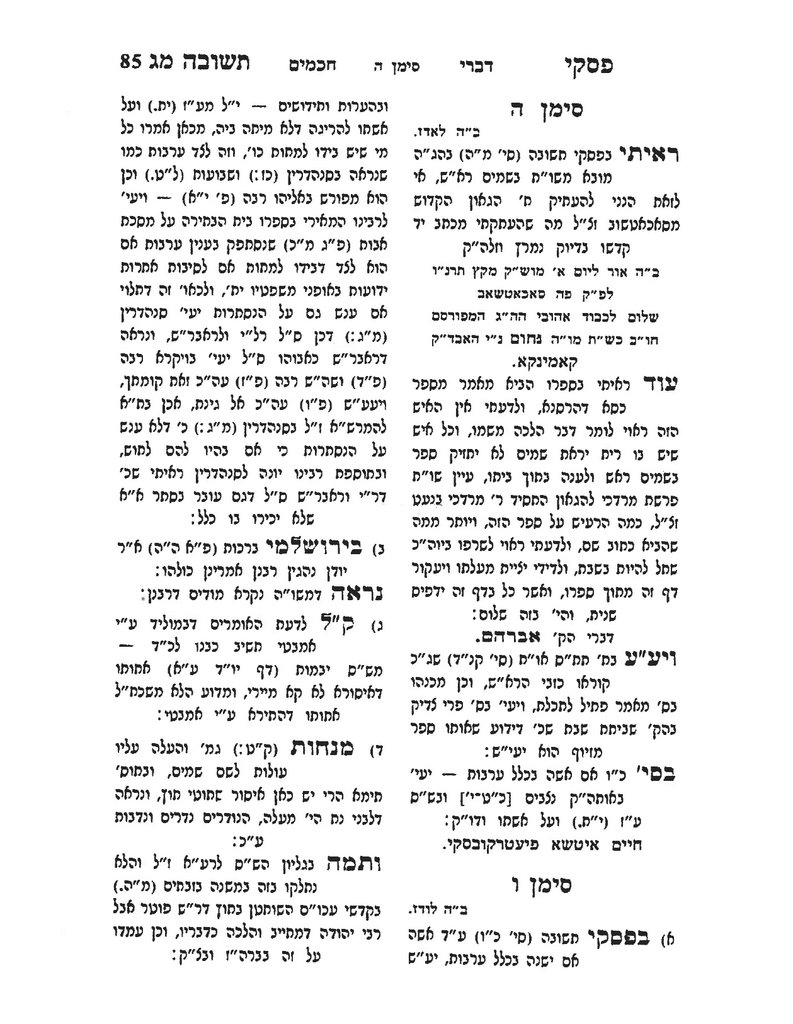
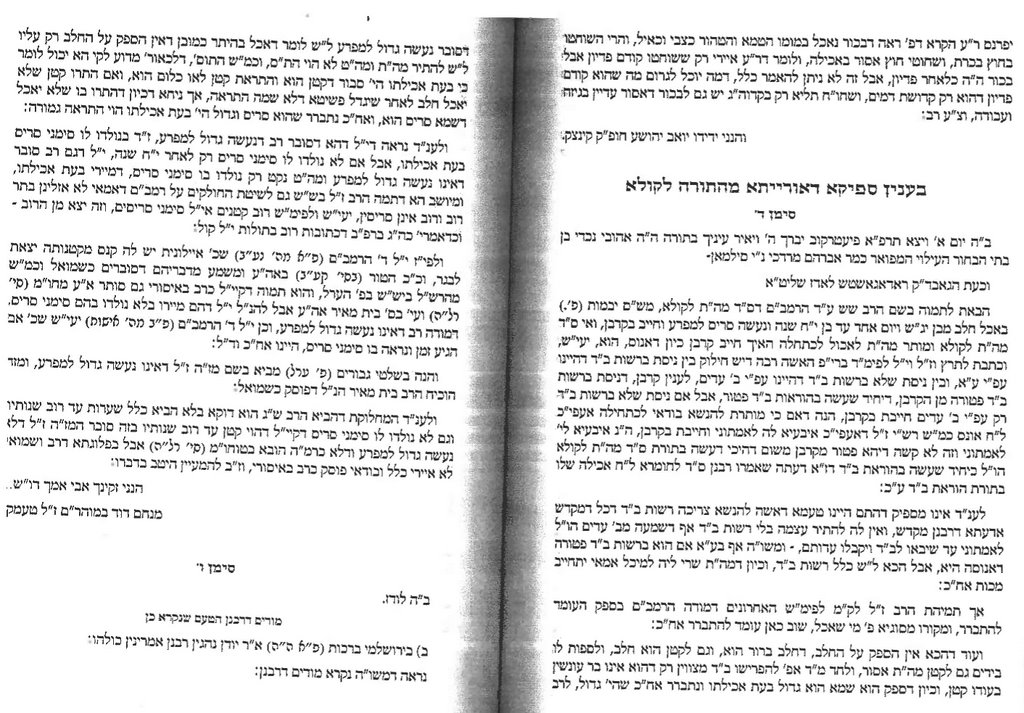
Now, to discuss our instance of censorship. One of the more well-known statements against the Besamim Rosh is by R. Avraham Bornstein (Sochaczew Rav) author of the Avnei Nezer and Eglei Tal. His statement was recorded in the book Piskei Teshuvot. The Piskei Teshuvot is a collection of interesting responsa, which have been abridged and notes added by the editor R. Avraham Pietrekovski. It was published in three volumes and included a fourth volume which contained comments from others about the work and was thus titled Divrei Chachamim. In the Divrei Chachamim, R. Nachum Kamikna wrote in to express his puzzlement at R. Pietrekovski’s mention, in one of his notes, of the Besamim Rosh. R. Kamikna includes the opinion of R. Bornstein on the entire Besamim Rosh issue.

R. Bornstein writes:

I believe that the person [the author and editor of the Besamim Rosh – R. Saul Berlin] is not one who is worthy of quoting any halakha in his name, any person who has a fear of heaven should not have the book Besamim Rosh in his house . . . I believe the book is worthy to be burnt [even] on Yom Kippur that falls on Shabbat.

Needless to say, this is not a ringing endorsement of the Besamim Rosh. But, in 2001, a reprint of the Piskei Teshuvot was done, with reset type and organized according the Shulhan Arukh’s divisions. For some reason, however, this teshuva does not appear. In the earlier editions it was number 5 in Divrei Chachamim in this edition the numbering skips from four to six.

While recently, some have attempted to rehabilitate the Besamim Rosh, most notably in the 1984 reprint, these attempts are not part of the mainstream and it does not appear the Besamim Rosh is any more accepted today than he was previously. This is not to say he is never quoted, only that most are aware of the storied history and the question of whether in fact it is representative of the Rosh. In fact, since 1984 no further attempts to reprint this work have materialized. Thus, in light of this, it is rather odd this particular teshuva has been removed.

In addition to my previous post on the Besamim Rosh, see Moshe Samet, “R. Shaul Berlin’s Besamim Rosh: Bibliography, Historiography and Ideology,” (Hebrew) Kiryat Sefer 48 (1973): 509-523; and upcoming posts at the Seforim blog.

Appendix:
Divrei Chachamim: Before/After


Another Case of Historical Censorship at Volozhin or Simply Poor Research?

One of the more important sources for the history relating to the famed Volozhin Yeshiva is Moshe Shmuel v’Doro, by R. Moshe Shmuel Shapiro (Shmukler), which is is full of important material on this yeshiva and the related personalities. R. Schapiro also published a monograph on the founder of the Yeshiva, R. Chaim of Volozhin. This work, Toldot Rabbenu Chaim Volozhin, was first published in 1909 in Vilna, republished a year later in Vilna and then published twice in Israel, once in Bnei Brak in 1957 and once in Jerusalem in 1968. Recently, in 2000, Toldot Rabbenu Chaim Volozhin, was republished by R. Schapiro’s descendants.

In the 2000 edition of Toldot Rabbenu Chaim Volozhin, R. Schapiro’s descendants include a brief introduction about the history of the book, yet they were unaware of some key facts. First, they claim the book was only published twice, when in fact it was published four times. Additionally, then erroneously note that their edition is the third when in fact it is the fifth. Finally, they claim the first edition was the 1910 edition, when in fact the first edition appeared in 1909.

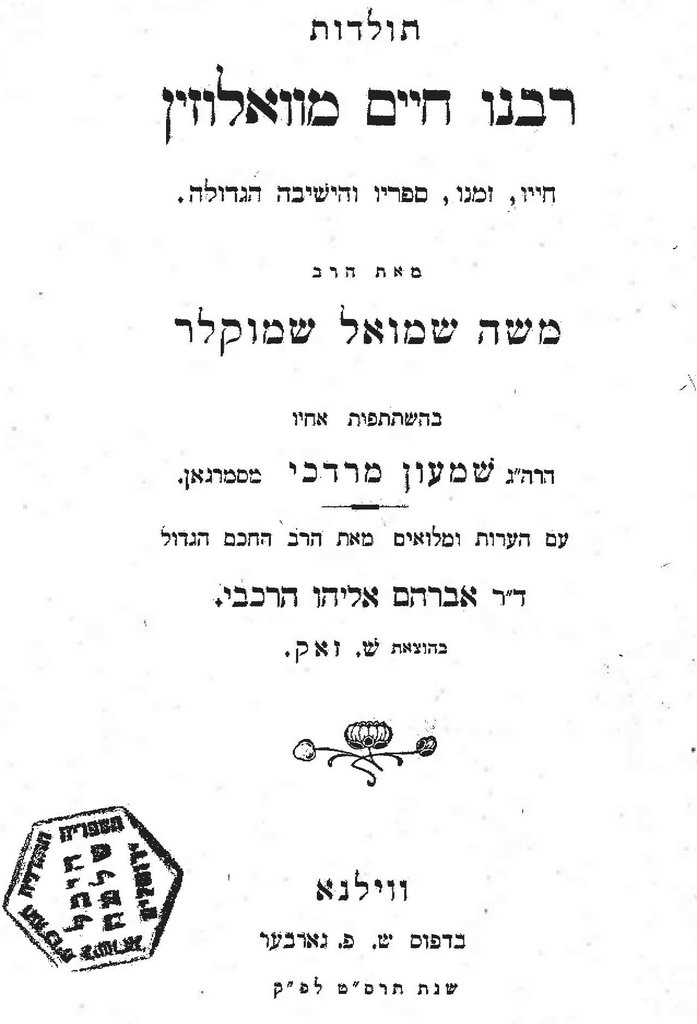
In addition to these three inaccuracies and omissions, there is a much more glaring one; not bibliographical in the abstract, but related to the content of the book – they have left out something which appeared in the earlier editions. In the first (1909) edition, a letter from R. Dr. Abraham Eliyahu Harkavy (1839-1919), a former student at the yeshiva in Volozhin, appears which contains both his warm approval of the book as well as a few comments on the book. Further, the fact Harkavy’s letter was included was no small thing as this was noted on the title page of the book. Specifically, the title page states the book includes:

עם הערות ומלואים מאת הרב החכם הגדול
ד”ר אברהם אליהו הרכבי

In the 1909 edition of Toldot Rabbenu Chaim Volozhin, Harkavy’s letter and notes were included by R. Moshe Schapiro. In the current reprint, the time that the fifth edition of Toldot Rabbenu Chaim Volozhin, published in 2000, by Schapiro’s grandchildren, Harkavy’s letter and notes are mysteriously missing. Perhaps this letter was removed intentionally as Harkavy was a maskil (intellectual) and later the head librarian at the Imperial Library in St. Petersburg.

It is possible these are missing due to a corrupted reprint the current publishers are relying upon. But, even if that would be the case, it does not absolve them of getting the first (or their “first” edition – the 1910 edition). Moreover, the title page they include does not give the current editions date, instead, the date and thus the reference is to the Vilna 1910 edition. Thus, giving the appearance they are merely reproducing the 1910 edition which is incorrect.

As an interesting aside, in 1999 the Artscroll publishing house released the first of two volumes of Shenot Dor v’Dor (the second was published in 2004) by Reuven Dessler, of a collection of priceless letters from important rabbinical personalities culled from the invaluable manuscript collection of the Dessler family, wherein an entire section (in vol. 1) is devoted to correspondence between Harkavy and some of the greatest rabbis of his time, many of them his colleagues and teachers at the yeshiva in Volozhin, including R. Naftali Zvi Yehudah Berlin (Netziv) and R. Chaim Soloveitchik.

Appendix:
Title page of Toldot Rabbenu Chaim Volozhin (1909)


Controversial Book on the Development of the Siddur

In the Jewish liturgy there is a fundamental question dealing with the composition of the Hebrew found therein. There are two major types of Hebrew – Rabbinic and Biblical. The question becomes which should one be using when praying. This at first blush may appear to be of minor significance, however, most controversies regarding various words throughout the prayer book can be traced to this one point. This issue of which Hebrew to follow was brought to head in the 18th century. During this period there were a few books published dealing with the proper nusach (composition of the prayers). Some of these works advocated for various changes in the prayer book based upon the authors understanding of which Hebrew to follow when praying. This in turned provoked a fairly large controversy which can be felt today by anyone sensitive to the nusach of the prayers.

Today, although most may be unaware, many changes effected during the above referenced time period are still to be found in almost all the standard prayer books. This is so, as Wolf Heidenheim in his prayer book, which became the standard for most which followed him, relied and incorporated numerous changes based upon these 18th century works. Heidenheim’s book became, in part, the standard after he was able to secure an approbation from one of the most traditional Orthodox rabbis of the day – R. Moshe Sofer (Hatam Sofer). R. Sofer, whose well known statement “anything new is prohibited” was either unaware of the “newness” of Heidenheim’s work or perhaps agreed with his alterations, ensured Heidenheim’s work would become the exemplar for all subsequent prayer books.

One of the more interesting books to come out of this period has recently been reprinted. This book, Yashresh Ya’akov, was originally published around 1768 and, according to the title page, was authored by R. Ya’akov Babini. The work is supposedly based upon a question which R. Babini was asked. Specifically, someone wrote that he entertained an Italian guest. This guest when it came time to say birkat hamazon (grace after meals) said the prayer with numerous changes from the standard format. The host wrote to R. Babini to ask whether these changes were in fact correct. All of these changes are more or less based upon the notion that one should follow the Biblical Hebrew as opposed to the Rabbinic Hebrew. R. Babini defends the guest’s alteration and demonstrates that in each instance the changes were correct.

That is the basic background on the book. Yet, there are numerous other important facts that are not necessarily apparent from just a casual read of the book. First, as I mentioned, taking a position that Biblical Hebrew is the correct Hebrew and thus one should alter the standard was highly controversial. In an effort to avoid controversy the true author of the book – not R. Babini – hid his name. The true author is really R. Ya’akov Bassan.[1] R. Bassan gave an approbation to this work although he did not use his own name as the author. Instead, R. Bassan picked someone who had less than a stellar reputation – R. Babini. R. Babini in 1759 published a book under his own name titled Zikhron Yerushalayim which listed various holy places in Israel as well as where certain Rabbis are buried in Israel. R. Babini, neglected to mention in this publication that this work had already been published in 1643 under the very similar title Zikhron B’Yerushalayim, which contains, with minor changes, the very same text R. Babini offered as his own. Thus, looking for a patsy, R. Bassan picked someone who already did not have such a great reputation. R. Bassan although unwilling to offer his name to his own publication decided to instead offer his approbation to his own work.

Aside from hiding the authorship, the place of publication was also altered. The title page reads Nürnberg as the place of publication. This is incorrect, in actually this was published in Altona. The date on the title page reads 1768, however, the date on the approbation reads 1769 thus making the date offered an impossibility. All of these “hints” should lead an observant reader to realize something funny is going on here – namely nothing is what it appears. These types of hints to the ultimate author were actually somewhat commonplace during this period. Most famously, R. Y. Satnow would publish books not under his own name, instead either in the approbation or the title page he would offer hints that only an astute reader would notice demonstrating that R. Satnow was in fact the true author.[2]

As R. Bassan correctly surmised, his work was in fact controversial. R. Binyamin Espinoza wrote a work directed at disproving the underlying premise of R. Bassan’s that one should stick with the standard liturgy and not change it to conform with Biblical Hebrew. R. Espinoza, originally from Tunisia was unsuccessful in publishing his rebuttal and it remained in manuscript, although its existence was known to many. R. Espinoza pulls no punches and takes R. Bassan to task in very sharp terms for his advocating these changes. As mentioned above this was to no avail as either surreptitiously or knowingly many of the changes and other similar ones have in fact become standard today.

Recently both the Yashresh Ya’akov and R. Espinoza’s work Yesod HaKium have been republished together. This edition which includes an extensive introduction which contains all the history above and more is excellent. Obviously, for understanding the development of the liturgy of the prayer book this is extremely important. Also those interested in bibliographical quirks will also enjoy these books. The book is available from Beigeleisen books (718-436-1165) who has informed me he has recently received a new shipment of these as the prior one had been sold out. This new edition was edited by Rabbis Moshe Didi and David Satbon from Kiryat Sefer, Israel (ת.ד 525 and 154 respectively).

For more on these books see here.

Sources:
[1] This understanding that R. Ya’akov Basson is the actual author runs counter to many earlier assertions that the author was R. Avrohom Basson. In the new edition of this work, however, they demonstrate the problems with associating R. Avrohom and instead argue that in fact it is R. Ya’akov.

[2] Satnow was not the only one; according to some, R. Saul Berlin, in the Besamim Rosh, offered similar hints to his authorship of this controversial work.
Bedatz Bans HaGaon

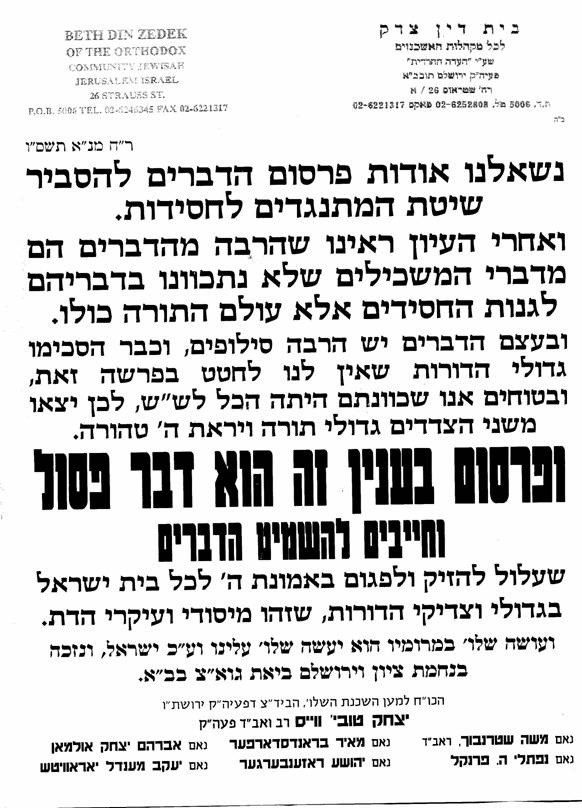
As discussed previously, there are some, mainly Hassidim, who had strong objections to R. Eliach’s biography HaGaon. Now it appears that Bedatz of Jerusalem has also issued a ban on the work (thanks to all those who sent this to me). The ban is reproduced on the side. The ban itself contains some interesting language. Specifically, the ban claims that the sources relied upon by Eliach were “maskilik.” You will recall that all Eliach did was reproduce many of the herems and the like from the non-Hassidim at the time. Now, it is correct that most of those polemics were collected by Wilensky in his Hassidim u’Mitnagdim, but the actual texts are those of some of the greatest Rabbis (not maskilim) of that time period.
Additionally, far from advancing haskalah (enlightenment) R. Eliach repudiates it. Many academics claim that the Gra was the precursor to modernity as the Gra advocates for studying secular subjects (among other things). Eliach, however, devotes an entire chapter demonstrating the Gra was against the haskalah. Eliach also includes additional material on this topic in other places as well. In doing so, he demonstrates that far from accepting maskilik or hasklah literature he actually accepts as true many anti-maskilik assertions. One example is particuarly telling. R. Eliach accepts that the Noda B’Yehuda banned R. Naftali Hertz Wessely. The source for this is an article which appeared in the Journal Kovetz Bet Ahron v’Yisrael by R. Y.A. Heschel. R. Heschel’s article is full of errors and wild assumptions. Most notably, R. Heschel assumes that the ban in question is from the Noda B’Yehuda solely because it was found in a stack of papers also from the Noda B’Yehuda. There is no other cooberating evidence. Instead, this is an unsigned letter that contains no other internal or external indica of reliablity. R. Eliach, however, in his attempt to prove the vehemence as well as the universiality of condemnation of the haskalah accepts this as true. Thus, it is somewhat difficult to understand how R. Eliach could be accused of accepting and advancing maskilik ideas and positions.

Finally, it is rather unclear why in August of 2006 the Bedatz is banning a book published in 2002. It was not as if this book was “under the radar.” Instead, immediatly with its publication there were other bans, articles and condemnations of the book. Further, R. Eliach secured the approbation of R. Chaim Kanievsky and was featured in Dei’ah veDibur the Haredi newspaper. While this wouldn’t be the first controversy between Beni Brak and Jerusalem, (famously the controversy over using the Ben Asher Nach was essentially between the two communities) it is a bit strange in its timing.


An Example of Women & Learning Removed from the Bavli?

There is what appears at first glance to be a technical passage (although some may find it of interest on its own) in the Talmud dealing with the issue of which types of impurity bars one from Torah study. The Talmud states “הזבים והמצורעים ובעולי נדות קורין בתורה ושונין מדרש הלכות והגדות ובעלי קרי אסור בכולן” “A zav, a metzorah, boli niddot, are permitted to read from the Torah, study Midrash, Laws, and ‘agadot, however a ba’al keri can study none of these.” So according to this all these types of men, as this is in the masculine, are able to study these things even though they have some level of impurity. This is how it appears in the Talmud Bavli.

However, the Jerusalem Talmud and the Tosefta preserve a different reading. They have both men and women in the list. Hence “זבין וזבות נדות וילדות קורין בתורה וכו” “zavim and zavot (the feminine) and menstruating women, and a women who just gave birth can read from the Torah etc.” according to this reading women would need to know whether they could engage in study of Midrash and Law etc. So what happened?

Lieberman states “I think that the women would intentionally removed [from the Munich manuscript of the Talmud Bavli and hence our corrupted texts] and were replaced with men.” So the menstruating women were replaced with a man who had marital relations with a menstruating woman. And instead of a woman who gave birth we have a metzorah. The reason is obvious to have the Talmud discussing whether women in this state of impurity could study these texts assumes that they regularly studied them, something that for some may not have been accepted.

Sources: Saul Lieberman, Tosefet Rishonim vol. 1, 15; Jerusalem Talmud, Berakhot, 3:4; Talmud Bavli Berakhot 22, a; Tosefota, Berakhot 2 :12; Lieberman, Tosefta K’Peshuto p. 20.


Kehati Revision

Menachem Mendel has posted about a very interesting revision to the English Kehati edition of the Mishna.