1

Using a Colophon to Find a Shidduch: on Ella the Zetser.

Using a Colophon to Find a Shidduch

by Eli Genauer

There has been much talk lately about the so called Shidduch crisis. Various initiatives have been proposed to address this problem, all of which are well meaning and well thought out. Many might be surprised to learn that an interesting approach was suggested by a 12 year old girl in the town of Frankfurt on Oder way back in 1699. This approach was based on a Pasuk in Yirmiyahu which deals with Messianic times.

We are all familiar with the 31st chapter of Yirmayahu. The first 19 pesukim of this Perek comprise the Haftorah of the second day of Rosh Hashana. The Navi begins, “Koh Amar Hashem, Matzah Chain BaMidbar”. The Haftorah proceeds to lay out a vision of Hashem’s love for the Jewish people and its eventual return to Tziyon, a fitting theme for a day in which we ask Hashem to grant us a good year. The stirring Pasuk of “HaVain Yakir Li Ephraim” concludes the Haftorah, but the Perek continues with Yirmiyahu’s vision of Yemos HaMoshiach.Yirmiyahu speaks of the Jewish people in Galus and after having been there for so long, they return to Hashem. Pasuk 21 states the following:

כא עַד-מָתַי תִּתְחַמָּקִין, הַבַּת הַשּׁוֹבֵבָה: כִּי-בָרָא יְהוָה חֲדָשָׁה בָּאָרֶץ, נְקֵבָה תְּסוֹבֵב גָּבֶר

How long will you hide, O backsliding daughter? For the Lord has created something new on the earth, a woman shall go after a man.

According to the Radak, the Navi is imploring the people to travel on a straight path and to return to Hashem. This will be a time when, as it were, the Bas HaShoveiva, the backsliding daughter, will be the one who seeks out a husband, in this case Hashem. The Navi says that this is something that is radical, but certainly required at that time.

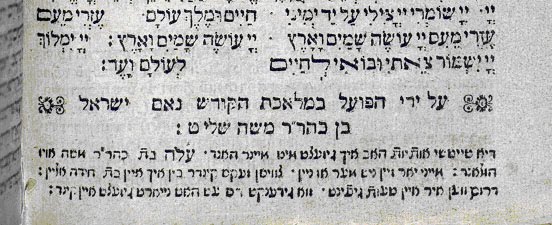
We fast forward a bit to 1696 and we meet an amazing nine year old girl, born in Amsterdam, but now living in Dessau, Germany. Her name is Elle and she is the daughter of a man named Moshe ben Avraham Avinu. Moshe worked for years setting type and printing important Jewish books in various places in northern Europe, the last of which he did under very trying circumstances in Halle.(1) Moshe employed his children to help him in the arduous task of typesetting. We know a bit about his daughter Elle from some crumbs that she left us as she signed her name to the books she helped bring to print. She and her brother worked on setting type of the Siddur Drash Moshe printed in Dessau in 1696. After recording that the book was set to type by Yisroel ben Moshe, someone wrote a poem which tells us that a nine year old girl named Elle (עלה) helped Yisroel in this project:(This scan and those following are all courtesy of the JTS Library)
The Yiddish letters I set with my own hand
I am Elle, the daughter of Moses from Holland
a mere nine years old
the sole girl among six children
So when an error you should find
Remember, this was set by one who is but a child (2)

Did she compose the poem herself, or was it composed by her father or brother? Remarkably, we find another case not soon thereafter, of a nine year old setting type, and there we do know whether he could read or not. Nicholas Basbanes, in his book “A Gentle Madness”, records the following:

“Born in poverty, Isaiah Thomas came to know the touch and smell of ink on paper when he was only a child. Only nine years old in 1758….young Thomas was already completing his apprenticeship in the dingy Boston shop of Zechariah Fowle…When he later became the most successful printer and publisher in the United States-Benjamin Franklin dubbed him the Baskerville of America- Isaiah Thomas enjoyed telling friends that he knew how to set type before he was able to read.”(3)

Whether or not she could read at age nine, we do know that this little girl was able to recognize the Judeo Yiddish letters of a manuscript and set to type similar letters from which to print a book. Perhaps she had the potential to become as successful as Isaiah Thomas but for her gender and religion.

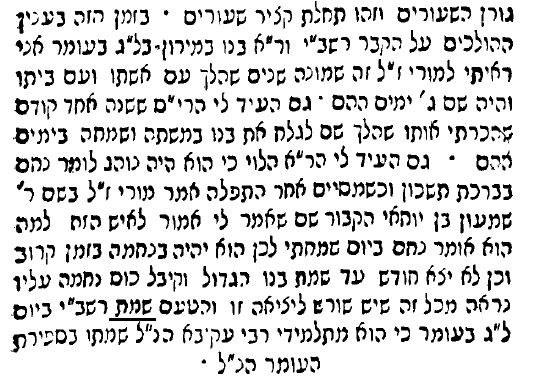
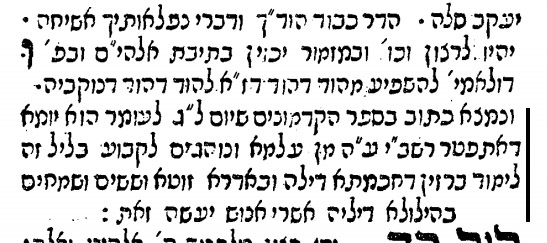
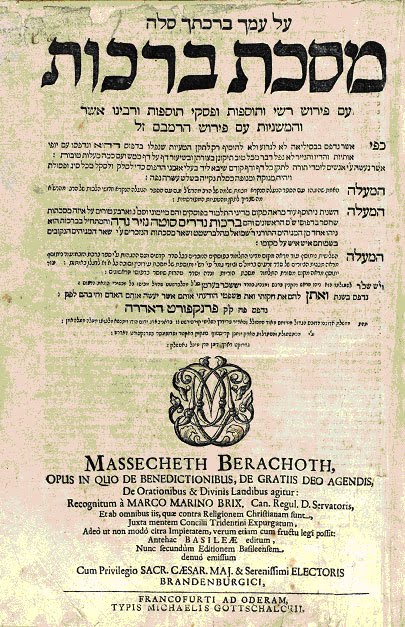
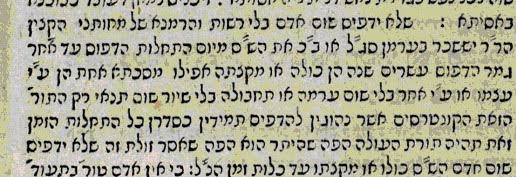
We meet Elle again in 1699, this time as a typesetter working on the famous Berman Shas of Frankfurt on Oder. This printed edition of the Talmud ( 1697-1699) was financed by the wealthy court Jew, Yissachar Berman Segal of Halberstadt who gave away half the 5,000 copies printed to needy scholars throughout Europe.(4)The Berman Shas is one of the most respected early printed editions of the Talmud because it contained many additional commentaries which became standard in following editions. It was the first edition since that of Gershom Soncino in the early 16th century to contain most of the diagrams we are familiar in Seder Zeraim, and Masechtos Eiruvin and Sukah. (5) It was also the first to contain Charamos from various Rabbanim prohibiting others in that general area from printing the Talmud for an extended period of time.(6) The following Cherem, recorded in Maseches Brachos, was written by Rav Dovid Oppenheim who lived at that time in Nikolsburg and later became chief Rabbi of Prague:At the end of Maseches Nidah printed in 1699, Elle signs her work a bit more boldly, and leaves us wondering what was going through her mind when she set the letters for the colophon.

“ By the hand of the faithful typesetter in this holy work, Yisroel the son of Reb Moshe. And by the hand of his maiden sister Elle, daughter of Rav Moshe, in the year “N’Kaivah T’Soivev Gaver” ( “a woman shall go after a man”.)

When you add up the letters which are set in large type, you come up with the year 459 according to the Peret Koton ( the abbreviated era ). This is the year 5459 (1699). What intrigues even the casual observer is why she, or her older brother Yisroel chose to record the year 5459 using that unusual Pasuk? One could argue that the Pasuk is tangentially related to some of the topics covered in Maseches Niddah, but there are many other Pesukim which deal more directly with the subject matter that could have been formatted to equal 459.(7) I think it is more logical to relate the Pasuk to the girl typesetter, who we are informed, is still unmarried. In Messianic times, it will be the Kallah, Am Yisroel, who seeks out its Chasan, Hashem. Perhaps Elle thought her circumstances and position necessitated a similar approach to finding a suitable Chasan. We hear the last from her in the next year having worked on a Machzor with her brother Yisroel.(8) We hope that after that, this extraordinary girl found an appropriate Shidduch. We wish the same for all those seeking the wonderful rewards that marriage has to offer.

(1) Marvin J Heller, “Studies in the Making of the Early Hebrew Book”, Boston 2008 pps. 218-228. The entire chapter on Moses ben Avraham Avinu makes for some fascinating reading. I am indebted, as are we all, to Marvin Heller for his research into this field of study.
(2) Ibid: p.222
(3) Nicholas Basbanes, ‘A Gentle Madness” New York, 1995 pps144-145
(4) R.N.N. Rabinowitz “Ma’amar Al Hadfasas HaTalmud”, A.M. Haberman edition, Mosad HaRav Kook 2006, page 96 footnote 1.
(5) Ibid. p. 98
(6) Ibid p.100
(7) Two examples of a more fitting Pasuk to denote the year of publication for Tractate Niddah are:

“B’Mai Nidah Yischatah” which was used in Frankfurt A/M edition of 1720, and

“V’Safrah Lah Shiva Yomim, V’Achar Ti’Taher” which was used in the Dyhernfurth edition of 1816-21 ( although the highlighted letters actually add up to (5)773)

(8) Heller, page 223


תורת הצורה והחומר וההעדר: ספרים המדברים בהשמטות הרמב”ם ובכללים להסבירם

מאת עזרא בראנד
ידוע הוא לכל יודע ספר המשנה תורה שאחת מהמידות שהמשנה תורה נדרש בה היא ההשמטה ממנו. כמעט כל מפרשי הרמב”ם הניחו כיסוד שהרמב”ם כוון לכלול בספרו כל התורה שבעל פה (כמו שהזכיר הרמב”ם בהקדמתו למשנה תורה), ואם יש דין חסר ממנו יש דברים בגו[1]. אמנם גם לאחר שהוכרה ההשמטה בהרבה מקרים קשה לדעת מה ללמוד מזה; אם להחמיר או להקל, לטמא או לטהר, לפסול או להכשיר (ולעתים קרובות נחלקו בזה המפרשים), אבל הכל מודים שניתן ללמוד מכל השמטה.
א. ספרים העוסקים בהשמטות הרמב”ם
ישנם כמה וכמה ספרים שמרבים לדון בהשמטות מהמשנה תורה לרמב”ם, ומעירים על הרבה מהם, כגון מגיד משנה, כסף משנה, לחם משנה, מעשה רקח (כל אלו פירושים על הרמב”ם), בית יוסף על הטור, ביאור הגר”א על השלחן ערוך, ספר צל”ח על הש”ס ושו”ת נודע ביהודה להר’ יחזקאל לנדאו, וספר ראשון לציון על הש”ס (מבעל ‘אור החיים’ על התורה).
וכן יש ספרים שתכליתם המוצהרת להעיר וללקט השמטות הרמב”ם. הרב ישעיה פיק בספרו ‘אומר השכחה’[2] ליקט הרבה מההשמטות של הרי”ף, הרמב”ם, הסמ”ג, הרא”ש, הטור, והשו”ע. כנראה, ספר זה לא הוכן לדפוס ע”י המחבר[3]. הוא מעיר על מאה וששים השמטות, מהן מאה עשרים ותשע הן השמטות הרמב”ם[4]. וברור שרשימה זו היא אך מעט מן המעט מן המנין השלם[5]. פעמים שהמחבר מאריך לתרץ את ההשמטה[6], או מציין לספר אחר בו יישבה[7], אבל ע”פ רוב הוא מסתפק להעיר עליה, ולהניחה בקושייה. הר’ פיק כותב כמה פעמים שהקשה השמטות אלו לגדולים שונים, ושהתשובות מובאות בספרי שאלות ותשובות שלהם[8]. וגם הביא השמטות שהקשו לו אחרים (אולי היה מפורסם בהתעניינותו בענין זה!)[9].
כידוע, הרב ישעיה פיק כתב השלמות לציוני ‘מסורת הש”ס’ הנדפסים בגליון הגמרא (מאת הרב יהושע בועז). הוא גם כתב השלמות לציוני ‘עין משפט’ שבצד הגמרא המציינים למקום המובא אותו דין במשנה תורה לרמב”ם, בשלחן ערוך, ובסמ”ג (גם ציונים אלה חיברם הרב יהושע בועז), והשלמותיו נדפסים ב’עין משפט’ בסוגריים[10]. בהשלמות אלו העיר לפעמים על השמטות הרמב”ם[11].
וכן הרב יצחק אריאלי בספרו עינים למשפט העיר על הרבה השמטות מספר משנה תורה, גם במהדורה הקצרה וגם בארוכה של הספר[12]. בהקדמה למהדורה הקצרה כתב ש”ממטרות ספר זה להבליט ולהטעים את ההשמטות”, אבל כנראה גם הוא לא השלים את העבודה כראוי, והשמיט לציין כמה מההשמטות. אולם, במהדורתו הארוכה נראה שהשלים את המלאכה ובאמת העיר על כל השמטה של הרמב”ם (אבל לא בדקתי באופן יסודי), אבל לא כתבו אלא על שש מסכתות.
הרב יעקב ליב מוינעשטער העיר על הרבה השמטות הרמב”ם במסכת ביצה בסוף מהדורתו של מסכת ביצה (נדפס בשנת תרצ”ד בניו יורק). הוא מרבה להביא קושיות בענין השמטות מה’ראשון לציון’ (מבעל ‘אור החיים’) ואחרים, ומביא את תירוציהם, וגם משתדל להסבירם בעמצמו. וגם הוא, כמו הרב ישעיה פיק, הקשה לאחרים על אודות השמטות שמצא, ומביא תשובותיהם. ותשובותיהם ג”כ נדפסו בשאלות ותשובות שלהם.
הרב רחמים יוסף אג’ייני, רבה של עיר צפרו במרוקו, ונפטר בשנת תרנ”ג, ג”כ ליקט השמטות הרמב”ם. צאצאיו הדפיסו את רשימה זאת על סדר הרמב”ם בירושלים תשל”ד. היא מובאת במאסף תורני ‘הר המלך’, (נחלת הר חב”ד תשמ”ז), עמ’ לז-צב, על שם ‘קונטרס השמטות’.
הרב יהודה צארום ליקט הרבה השמטות הרמב”ם ממסכת שבת בספרו ‘משנת יהודה’ על מסכת שבת. הוא מביא הסברים שונים—בין של עצמו בין של אחרים–להסביר כל השמטה. הוא בכונה אינו משתמש בכללים שהביא במבואו כתירוץ לקושיא מדוע השמיט דין פלוני, כמו שכותב בסוף המבוא (עמ’ כ).
גם ב’ספר המפתח’ על הרמב”ם מהדורת פרנקל ליקטו הרבה השמטות על סדר המשנה תורה. כנראה הם ליקטו הכמות היותר גדולה של השמטות מכל המלקטים דלעיל. אבל דא עקא שסדר ה”מפתח” הוא על סדר הרמב”ם, ובהרבה מקרים קשה לדעת איפה הסעיף בספר המפתח המעיר על איזושהיא השמטת הרמב”ם, כיון שנשמט הדין מהרמב”ם! ובשלמא בדין שהיה שייך להרמב”ם להביאו רק במקום אחד לבד, ניחא לציין על סדר הרמב”ם, אבל כשהדין מענינם של כמה הלכות או פרקים, או שיכול לבוא באחד מכמה מקומות שונים, קשה לדעת איפה למצוא את הציון בספר המפתח. ויש להמליץ שיעשו מפתח השמטות על סדר הש”ס.
ויש להעיר שבהרבה מקומות העירו המפרשים על דינים שהושמטו מהרמב”ם, ובאמת הם נמצאים ברמב”ם[13]. וכתבו המפרשים סיבות שונות לתופעה זאת. המגיד משנה בסוף הקדמתו לפירושו לספר זמנים כתב שאירע הדבר כשהרמב”ם הביא סוגיא אחת בשני מקומות שונים משום שכך התאים יותר ע”פ סדר הדינים:
“מהפלגת רבינו (=הרמב”ם) בשמירת הסדר היה לשנות בקצת מקומות קצת דינים להיות לכל אחד מהן מבוא בענינים חלוקים כפי החלוקה הישרה שנחלקו מאמריו ונסדרו, ולפיכך ראוי למעיין להתבונן בזה. וכבר ראיתי למי שהיה בקי בספריו (=בספרי הרמב”ם) שלא הרגיש בנמשך אחרי זה, רצוני לומר שבהיות לדין אחד מבוא בשני ענינים יבאר רבינו חלק אחד במקומו הראוי לו והחלק השני במקומו האחר ויעיין המעיין בדין ההוא וימצאהו במקום אחד מבלתי שלמות חלקיו ויתמה על זה”[14].
המאירי בהקדמתו ל’בית הבחירה’[15] כתב טעם אחר, משום שלפעמים הרמב”ם כתב דין במקום שבאמת אינו ראוי לו ע”פ סדר הדברים, אלא שבא שם אגב דין אחר: “והוא שיקרה זה לפעמים תפול המחשבה על דבר אחד היותו במקום אחד, ואחר החפוש תמצא במקום אחר לא עלה על לב המעיין היותה שם, אלא שבאה שם על ידי גלגול איזה ענין…”[16].
וכתב העינים למשפט בהקדמתו לקידושין דמסתבר להניח לגבי טעיות האחרונים אחר הופעת ציוני ה’עין משפט’ שפעמים מכיון שלא היה מצויין בספר עין משפט בגליון הגמרא סברו האחרונים שאינו ברמב”ם, ובאמת הוא ברמב”ם אלא שנשמט מהעין משפט[17].
ב. כללי השמטות הרמב”ם
מפרשי הרמב”ם למשך כל הדורות חידשו כללים המתארים אילו דינים המופיעים בגמרא השמיט הרמב”ם ממשנה תורה. נראה לחלקם לשני סוגים: יש מהכללים שהם אינטרינסיים (INTRINSIC), זאת אומרת שהם אומרים שאין הרמב”ם מביא דינים שהם מסוג מסויים. לדוגמא, הרבה כותבים שהרמב”ם אינו מביא הדינים שהם נובעים מחשש רוח רעה. ויש כללים שהם אקסטרינסיים (EXTRINSIC), דהיינו שהרמב”ם אינו מביא דינים מטעם חיצוני כלשהו. דוגמא לזה הוא מה שכתבו אילו מפרשים שאין הרמב”ם מביא דין שיש בו מחלוקת בגמרא ואינו יודע כיצד להכריע.
הרב יצחק אריאלי, בהקדמתו למסכת קידושין–המסכתה הראשונה שנדפסה בסדרת ספריו ‘עינים למשפט’ (במהדורה הארוכה[18]), כתב שבעה כללים להסביר אילו דינים הושמטו. בהצגת כל כלל וכלל בפני הקורא, מביא הר’ אריאלי כמה דוגמאות לדינים שעל פי הכלל ההוא הושמטו מהמשנה תורה, וכן לכל אורך ספרו מרבה להשתמש באותם הכללים להסביר השמטות רבות[19].
הרב יהודה צארום בסוף ספרו ‘משנת יהודה’ על מסכת שבת כולל מאמר שקרא בשם ‘מבוא להשמטות הרמב”ם’, והאריך בו הרבה באיסוף כללים רבים שחודשו על ידי המפרשים לבאר וליישב השמטות הרמב”ם. אולם, אין הכללים מסודרים כ”כ, והם מעורבים בתוך פלפולים ארוכים. הר’ צארום עוסק שם בענין זה לאורך כעשרים עמודים, וכמעט שלא הניח מקום לאחרים להתגדר בנושא זה.
מחבר נוסף שדן בענין כללי השמטות הוא הרב יעקב חיים סופר, שליקט כמה כללים בתוך ספר ‘מעט מים’ (עמ’ יח), ומציין שם מקומות שונים בספריו שליקט מראה מקומות על כללים אלו. וישנם עוד ספרים ומאמרים שליקטו כללים מלבד אלו.
נחוץ להעיר שישנם הרבה דינים שעל פי כללי המחברים לא היה לרמב”ם להביאם במשנה תורה ואף על פי כן מופיעים שם. אכן, מטרת המחברים היתה רק לתאר ולקטלג את הדינים שלא הביאם הרמב”ם. לפיכך, אין לנו לומר שהרמב”ם לא הביא כלל דינים מסוג זה או אחר, אלא רק שהרמב”ם לא הרגיש צורך מוחלט להביא כל דין ודין מאותו הסוג.


[1] אולם, עי’ חזון איש, ‘קובץ איגרות’ חלק ב (בני ברק תש”נ), איגרת כא שכתב שאין לדייק מהשמטה אלא אם כן משמיט פרט אחד מדין שלם. ולפי”ז לכאורה יוצא שאין לדייק מרוב השמטות הרמב”ם. ושמעתי שנחלקו תלמידי החזון איש בטעמו. יש אומרים שכוונת החזון איש היתה ששייך שהרמב”ם למד את הסוגיא באופן שמעולם לא עלה על דעתינו, ולו היינו לומדים כמותו, היינו נוכחים לדעת שהדין העולה מן הסוגיא באמת כלול במה שפסק או שאי אפשר לו לפסוק כן משום שישנה סוגיא אחרת הסותרת את הדין הזה . ויש אומרים שסבר שאין לדייק משום ששייך שהרמב”ם שכח להביא את הדין. וכהבנה זאת מבואר מדברי הרב יהודה לפקוביץ, ‘דרכי חיים’ חלק ב (בני ברק תשס”ז), עמ’ קעט-קפ, שהאריך בענין “לכל נברא יש גבול עד היכן יכול להשיג בתורה” (כן היא כותרת הקטע), ובסוף כתב: “ויסוד הדברים שמעתי ממרן ‘החזון איש’ זצ”ל שדיבר בארוכה כדברים אלו לענין השמטות הרמב”ם”. ועל כל פנים שיטה זאת מחודשת היא מאוד, ולא מצאתי לה חבר. ולכאורה כל המפרשים שהקשו על הרמב”ם למה השמיט דין מסויים סוברים שלא כחזון איש בזה.
[2] נדפס לראשונה בשנת תר”כ בקניגסבורג.
[3] עי’ ‘אומר השכחה’ דף ג ע”א לפסחים מ ע”א: “ועמ”ש קונ’ שה”ם (=שטרי המאוחרין) עירובין יז: ישוב הגון וראוי להעתיקו לכאן בעת הפנאי“. וכן משמע מהא שמצינו שעד דף ה ע”ב מדפי הספר הההשמטות נסדרות על סדר הש”ס, ומשם והלאה אין להן סדר.
[4] ויש שליקטו עוד השמטות והוסיפו על אלו של הרב ישעיה פיק, הרי הם הרב גרשון ליינער ובנו הרב ירוחם ליינער (אדמו”רים מראדזין), נדפסים בסוף ‘אומר השכחה’ הוצאת מנורה (ניו יורק תשי”ט).
[5] כמו שיראה לכל המעיין בספר המפתח על הרמב”ם מהדורת שבתי פרנקל. להשערתי, יש בממוצע יותר מהשמטה אחת—דהיינו השמטה שמעירים עליה המפרשים או שהיה ראוי למפרשים להעיר עליה–בכל דף גמרא שעוסק בהלכה (בניגוד לדפים העוסקים באגדתא, שאין להוציא מהם כ”כ הרבה הלכות, וגם אינו ברור שהרמב”ם קיבל על עצמו לפסוק את כל הדינים המשתמעים מסוגיות אגדתא כמו בסוגיות העוסקות בהלכה). ועי’ הרב משה צוריאל, ‘אוצרות המוסר’ (ירושלים תשס”ג) חלק א, עמ’ 208, שהביא מנין השמטות הרמב”ם שבספר אומר השכחה (הוא כתב שהמנין שמונים ושבע, והוא טעות), וכתב שהוא פלא שהשמיט כ”כ מעט. ובאמת השמיט הרבה יותר מזה, כנ”ל. והאומר השכחה העיר רק על השמטות אחדות בהרבה מסכתות, ובודאי שיש להקשות על הרבה יותר מזה. ושאלתי את הרב משה צוריאל את זה והודה לי, ואמר שכתב כן לפני שהכיר שיש כ”כ הרבה השמטות.
[6] עי’ דף ב ע”ב לפסחים לד ע”א; דף ז ע”ב לסנהדרין קיב ע”א.
[7] כגון דף א ע”ב לשבת קט ע”א: “ובהפלאה שבערכין ערך שרק הארכתי בס”ד”; דף ג ע”ב לביצה כ ע”א: “עיין אריכות בזה בקונטרס קשות מיושב”; דף ד ע”א ליומא פג ע”א: “ועמ”ש בס”ד בחיבורי יש סדר למשנה”; דף ד ע”ב לבבא קמא נט ע”א: “ועמ”ש קונ’ שה”ם סוטה י”א”; דף ו ע”א לערכין יא ע”א: “והארכתי בתקוני כ”ש (=כלי שרת)…”; דף ו ע”ב לתוספתא פרק ראשית הגז: “ועמ”ש בראש כרך הרמב”ם חלק ד’ “; דף יא ע”א לקידושין נח ע”א: “וכמו שהארכתי במקצת בשאילת שלום אות קל”ב קחנו משם”.
[8] כגון בדף א ע”ב לעירובין דף צב ע”ב שהביא תשובה מבעל ‘שו”ת זכרון יוסף’ (חיברו הרב יוסף משטיינהרט, שנשא בזווג שני את אחותו של הרב ישעיה פיק. כן כתוב בהקדמת המו”ל ב’שו”ת זכרון יוסף’ מהדורת ירושלים תשס”ה) לקושייתו אליו. ובדף יב ע”ב לשבת עה ע”ב: “והארכתי בס”ד בענין זה בתשובתי להרב מו”ה איצק פאלצבורג חתן גיסי הגאון בעל זכרון יוסף”. ויותר מפורסם הוא התכתבותו עם הרב יחזקאל לנדאו, וכמה תשובות בספרו של הרב יחזקאל, ‘שו”ת נודע ביהודה’, נכתבו להשיב לקושיותיו של הרב ישעיה פיק אליו. והרבה מקושיות אלו היו בענין השמטות הרמב”ם והפוסקים. עי’ נודע ביהודה מהדורא תנינא או”ח סי’ סט שנשאל אודות השמטה הנזכרת באומר השכחה דף ב ע”ב לפסחים כח ע”ב (נדפס משום מה לפני הקטע השייך לפסחים ו ע”א); נודע ביודה מהדורא תנינא יו”ד סי’ קמד שנשאל אודות השמטת דין בפסחים ב ע”א (ומעניין שבצל”ח בפסחים שם ג”כ דיבר בעל הנודע ביהודה בזה); נודע ביהודה מהדורא תנינא או”ח סי’ צד אודות השמטה הנזכרת בדף ב ע”ב לפסחים ח ע”ב; נודע ביהודה שם אודות השמטה הנזכרת בדף ג ע”ב לראש השנה טז ע”ב; נודע ביהודה מהדורא תנינא יו”ד סי’ קסג אודות השמטה הנזכרת ב’קשות מיושב’ (חיברו הרב ישעיה פיק, קניגסברג תרכ”ה) דף א ע”ב. וכמה פעמים הזכיר הרב ישעיה פיק שהאריך בענין השמטה זאת או שהביא תשובה מגדול אחד “בחיבור כנסת חכמי ישראל” (כגון דף ב ע”ב לפסחים כח ע”ב (נדפס משום מה לפני הפסקה לפסחים ו ע”א), דף ג ע”ב לראש השנה טז ע”ב, דף ד ע”ב לבבא קמא קי ע”א, דף ה ע”א לעבודה זרה לב ע”א, דף ה ע”א לתמורה לג ע”ב), ולא ידעתי מה הוא.
[9] כגון דף ד ע”ב לנזיר לב ע”ב: “הרב הגאב”ד דכאן נר”ו הקשה חידוש דנשמט דבר זה ברמב”ם שלא הזכירו”; דף ה ע”א לזבחים פז ע”א: “נשאלתי מהגאון המפורסם אב”ד דכאן נר”ו למה השמיט הרמב”ם הך מילתא דבשמיני…”; דף ז ע”ב לסנהדרין קיב ע”א: “…ונשאלתי בזה מהרב הגאון מו”ה עקיבא אייגר מליסא נר”ו”; דף יב ע”ב לחולין ד ע”א: “שאלני ידידי האברך הרבני השלם מו”ה בירך…”; שם לפסחים קכא ע”א: “נשאלתי מחכם אחד…”; דף יד ע”ב ליומא מא ע”א: “וכן הערני בעל המחבר בנן יהושיע נר”ו”.
[10] וע’ הרב יהודה ליב מימון, ‘תולדות הגר”א’ (ירושלים תשט”ו), עמ’ קיג בהערה, שהקשה על הרב ישעיה פיק ב’אומר השכחה’ ליומא כב ע”ב דכתב “לא מצאתי בפוסקים, רק המגן אברהם ריש סי’ קנו הביאו”, והפליא עליו הרב מימון “ושכח כי הרמב”ם הביא הלכה זו בפ”ד מהל’ תמידין ה”ד, וכמו שמצויין גם בעין משפט בגמרא שם”, ע”ש שהאריך להפליא איך שייך שהרב ישעיה פיק ישכח שהלכה זו מובאת ברמב”ם. וכן העיר הרב ירוחם ליינער בהערותיו על ‘אומר השכחה’ (הוצאת מנורה). ונראה לי שקושיא זו בטעות יסודה, דהנה באומר השכחה שם כתב “לא מצאתי בפוסקים, רק המגן אברהם ריש סי’ קנו הביאו, אבל בסמ”ג וברי”ף והרא”ש וטור ושו”ע לא מצאתי ראיתי”, ולא הזכיר שהרמב”ם השמיטו. ועל כרחך כשכתב “לא מצאתי בפוסקים” כוונתו לשאר פוסקים מלבד הרמב”ם.
ומעניין שב’שו”ת פני מבין’ יו”ד סי’ שכט באמת טעה והקשה אודות השמטה זאת, וכתב ליישבו ע”פ כלל ?. וכן תמה עליו הרב עובדיה יוסף ב’שו”ת יביע אומר’ חלק ב חלק יו”ד סי’ טז אות ט. ואולי הטעתו מה שהקשו המפרשים למה לא מנו מוני המצוות איסור זה למנות יהודים, עי’ בספר המפתח להל’ תמידין פ”ד ה”ד. ועוד נראה לי אפשרות גדולה שרהיטת הלשון של ספר ‘אומר השכחה’ הנ”ל הטעה את מחבר ה’פני מבין’, שכן ‘פני מבין’ נדפס בשנת תרע”ג, מ”ח שנים אחר ש’אומר השכחה’ יצא לאור בשנת תרכ”ה, ומסתבר שהספר היה לפניו. וכן קצת משמע ממה שציין ב’פני מבין’ שם: “ועי’ מג”א סי’ רלא” (הוא טעות וצ”ל “מגן אברהם סי’ קנו“), וכן ציין ב’אומר השכחה’ שם שהוא הפוסק היחידי שהביא את הדין. וכן קצת משמע מהראיה האחרת שהביא ה’פני מבין’ שם להוכיח את הכלל הנ”ל, והיא הגמרא בברכות יג ע”א “כל הקורא לאברהם אברם עובר בעשה…”, שהשמיטו הפוסקים. וזוהי ההשמטה הראשונה שהקשה עליה ב’אומר השכחה’.
[11] כגון סוטה מח ע”א אות ב; שבת קמט ע”א אות ח.
[12] הרב יצחק אריאלי חיבר שתי מהדורות של סדרת ‘עינים למשפט’, כל אחת של שלשה כרכים. במהדורה שאני קורא “הארוכה” (נדפס בירושלים משנות תרצ”ו-תשל”א) הוא משלים ומתקן את ציוני ‘עין משפט’ והעיר על השמטות הרמב”ם, וגם מאריך בליקוט הראשונים והפוסקים. בדרך זאת פירש רק שש מסכתות בלבד (ברכות, נדרים, קידושין, בבא בתרא, סנהדרין, ומכות). ובמהדורה שאני קורא “הקצרה” (ירושלים תשכ”ג-תשכ”ו) הוא משלים ומתקן את ציוני ‘עין משפט’ והעיר על קצת השמטות הרמב”ם, וסדרה זו כוללת כל מסכתות הש”ס וגם ירושלמי ומסכתות קטנות. הרב יצחק אריאלי התמנה ע”י הרב קוק להיות הראש הישיבה הראשון בישיבת מרכז הרב בירושלים. הרב למד בצוותא עם רב קוק כל יום, ובלימודם התרכזו לעסוקי שמעתתא אליבא דהילכתא. הרב קוק עצמו הקדיש הרבה זמן לכתוב “הלכה ברורה”, שהוא מהדורה של הגמרא עם ליקוט כל פיסקי הרמב”ם המשתייכים לאותו עמוד בתחתית העמוד. בישיבת מרכז הרב ממשיכים את הפרויקט.
[13] עי’ לקמן הערה 15, והערה 18. ועי’ ‘עינים למשפט’ בהקדמה למהדורתו הקצרה עמ’ 6-7 עוד דוגמאות לזה (וכתב שהן “דוגמאות אחדות ממאות רבות”). ועי’ רב צארום עמ’ יט עוד שתי דוגמאות. וע’ אמרי בינה דיני יו”ט סי’ יח שהשמיט הרמב”ם הא דאיתא בביצה לד ע”א “אבל מפצעין את האגוז במטלית ואין חוששין שמא תקרע”. ובאמת הביאו הרמב”ם בהל’ שבת פכ”ב הכ”ד. וע’ ערוך השלחן סי’ מט אות ג שהשמיט הרמב”ם הא דאיתא בגיטין ס ע”ב “דברים שבכתב אי אתה רשאי לאומרן על פה”. ובאמת הביאו הרמב”ם בהל’ תפלה פי”ב ה”ח. וע’ ‘אבן שלמה’ על הראב”ן (ירושלים תשל”ה) סי’ מב עמוד לא ע”ב ד”ה “נלע”ד” שהשמיט הרמב”ם הא דאיתא בגיטין שם “דברים שבעל פה אי אתה רשאי לאומרן בכתב”. ובאמת הביאו הרמב”ם בהל’ תפלה פי”ב ה”י.
[14] ע”ש שהביא מקרה שהרשב”א טעה בזה. ועי’ כסף משנה בהל’ שבת פ”ו ה”ד שהעיר על הרמ”ך שטעה בזה.
[15] נדפס בראש ‘בית הבחירה’ למסכת ברכות (ירושלים תשכ”ה), עמ’ כז.
[16] עי’ שם שהביא המאירי דוגמאות של דינים שלא ברור מאיליו היכן למצואן ברמב”ם, משום שהדין בא ב”גלגול” במקום אחר. ועי’ עוד דוגמאות בIsadore Twersky, Introduction to the Code of Maimonides, New Haven 1980, pg. 293-294 . אגב, יש להעיר על פרט אחד במאירי שם בדוגמתו הראשונה: “כמו שתאמר על דרך משל מה שאמרו בחכם שכור שלא יורה אפילו אכל תמרים או חלב ונתבלבלה דעתו. והנה יחשוב המעיין למצאה בהלכות דעות לפי הענינים הנכללים שם, והנה ימצאוה בספר עבודה…”. ולכאורה מה שכתב “בהלכות דעות” אינו מובן כ”כ, דפשטות כוונתו ל לפרק ה שם שמדבר בו הרמב”ם איך ינהוג תלמיד חכם. אבל שם מדבר במידות טובות שינהוג בהם תלמיד חכם, ולהורות כשהוא שיכור הוא איסור. ולולי דמסתפינא הייתי אומר שהמקום הראוי להלכה זאת הוא בהלכות סנהדרין, ואולי יש ט”ס במאירי.
עוד הערה דרך אגב: עי’ שם במאירי בהקדמה שהאריך (החל מעמוד כו ד”ה “כאשר”) לומר שמי שירצה ללמוד גמרא עם פסקי הרמב”ם יצטרך לחפש הרבה במשנה תורה כשבא לסוגיא שאינו מעין שאר המסכתא. ושלכן כתב את ספרו ‘בית הבחירה’ שהוא פסקים על סדר הגמרא. ולכאורה, עכשיו שיש לנו ציוני ‘עין משפט’ בצד הגמרא, באמת יכולים ללמוד גמרא על פי המהלך המעודף על המאירי. והרב קוק כיוון למהלך זה בתוכנתו של ‘הלכה ברורה’.
[17] עי’ שם בהערה ה שהביא שש עשרה מקומות בקידושין בלבד ששייך שטעו האחרונים בזה.
[18] ראה מה שכתבתי על אודות מהדורות ‘עינים למשפט’ לעיל הערה 12.
[19] ועי’ בהקדמה לעינים למשפט על מסכת קידושין (בסדרו הארוך) עמ’ ח שכתב בסוגריים “יחדתי לזה מקום במבוא ל”ספר המקורים להרמב”ם” אשר אקוה לסדרו בקרוב אי”ה”, וכנראה שלא הספיק להדפיסו.


New Writings from R. Kook and Assorted Comments, part 2

New Writings from R. Kook and Assorted Comments, part 2
Marc B. Shapiro
Continued from here.
I must now deal with R. Joseph Ibn Caspi, who is often described as holding a view similar to what we have seen already, but more radical in that he saw it as a general principle of interpretation. I refer to the notion that the Torah incorporates all sorts of untruths because these were what people believed at the time. It is said that this is how Ibn Caspi understands the rabbinic phrase “The Torah speaks in the language of men.” Here is a lengthy quotation from the late Isadore Twersky taken from his classic article on Ibn Caspi.[1]
Kaspi frequently operates with the following exegetical premise: not every Scriptural statement is true in the absolute sense. A statement may be purposely erroneous, reflecting an erroneous view of the masses. We are not dealing merely with an unsophisticated or unrationalized view, but an intentionally, patently false view espoused by the masses and enshrined in Scripture. The view or statement need not be allegorized, merely recognized from what it is. . . . Many scriptural statements, covered by this plastic rubric, are seen as errors, superstitions, popular conceptions, local mores, folk beliefs, and customs (minhag bene adam), statements which reflect the assumptions or projections or behavioral patterns of the people involved rather than an abstract truth. In its Kaspian adaptation, the rabbinic dictum may then be paraphrased as follows: “The Torah expressed things as they were believed or perceived or practiced by the multitude and not as they were in actuality.” Leshon bene adam is not just a carefully calculated concession to certain shortcomings of the masses, that is, their inability to think abstractly, but a wholesale adoption of mass views and local customs. . . . The Torah did not endorse or validate these views; it merely recorded them and a proper philosophic sensibility will recognize them.
Many people have understood Twersky to be saying that the Torah includes within it all kinds of superstitions and folk beliefs that were shared by the masses. (According to Ibn Caspi, the Torah does contain “necessary beliefs” that are not true, but these are of a different sort, as they relate to the masses’ inability to grasp philosophical truths.) While it is true that according to Ibn Caspi these beliefs are included in the Torah, they are not advocated by the Torah, but are to be understood as mistaken beliefs of the masses. In other words, Ibn Caspi does not say that the Torah itself, that is, when it is God speaking to Moses or in general narrative sections, should be regarded in this fashion.
So, for example, in the story of Rachel, Leah and the mandrakes (Gen. 30: 14-17), Ibn Capsi suggests that Rachel and Leah shared a common superstition that these mandrakes would help one conceive, and the story in the Torah is from these women’s perspective.[2] Yet the Torah itself never states that the mandrakes have magical properties. That is, the Torah does not incorporate a superstition because this is what people believed, but rather records a superstition that was believed in by some. Another example is that the Torah mentions that God told the Israelites (Ex. 12:13) to put blood on their doorposts. Ibn Caspi explains that this was due to the ancient superstition that blood had magical qualities.[3] The Torah thus commanded an action that took into account the masses’ superstition, but it was not the Torah itself advocating the superstition.
I am unaware of any place in his writings where Ibn Caspi states that the Torah itself is expressing a superstitious belief, that is, where it affirms the efficacy of a superstition or a folk belief because it is reflecting the views of the masses.
Readers will recall that in part 1 I quoted examples where the Bible, including the Torah, includes incorrect scientific information because this was what was believed at the time. Someone who wishes to remain anonymous called my attention to Samuel David Luzzatto’s commentary to Gen. 1:6. Shadal offers another example of what he thinks is the Torah using incorrect science because of what was the common ancient belief, and he includes this example under the rubric of “the Torah speaking in the language of men”. The Torah speaks of a rakia, and describes it as standing between the waters, that is, the water on earth and the water in the heavens. Shadal explains, and brings other biblical verses to show that this conception of water being found in the heavens was later rejected.
Because the term rakia was based on the belief in higher waters, “the waters that are above the heavens” (Ps. 148:4) and which the rakia supported, and because this belief became obsolete and forgotten, the term rakia itself became obsolete. . . . Hence the Torah spoke on a human level and according to human belief when it said, “let there be a rakia.” However, its intended message remains true and settled: God set the waters in nature to be lifted up and then to fall to earth.[4]
R. Samuel Moses Rubenstein offers another example of what he thinks is the Torah using language that is not accurate but reflects the mistaken beliefs of the masses.[5] He refers to the fact that the Torah speaks of God in a way that implies that there are also other gods in existence, a phenomenon scholars refer to as “monolatry”. This means belief in many gods but worship of only one.
Monolatry was clearly the belief of much of Israel throughout the biblical period. When Israelites worshipped the Baal or other gods, it is not that they rejected the existence or power of the God of Israel. It is just that they were hedging their bets, and if they were in need of rain it made sense to them to also worship Baal, the storm god. The question is, does the Bible itself assume a monolatrous world? Traditional commentators assert no, while many academic scholars believe that it does. (Yechezkel Kaufmann was a notable exception.)
The academic biblical scholars argue that the Bible takes the existence of other gods for granted, and cite many biblical verses in support of this assumption. For example, Ex. 15:11: “Who is like thee, O Lord, among the gods.” See also Deut 4:19: “And lest though lift up thine eyes unto heaven, and when thou seest the sun and the moon and the stars, even all the host of heaven, thou be drawn away and worship them, and serve them which the Lord thy God hath allotted unto all the peoples under the whole heaven.”
As mentioned, traditional commentators offer alternative interpretations of verses such as these. Yet Rubenstein concluded that the Bible reflects the mistaken monolatrous views of the masses. In Kadmoniyot ha-Halakhah (Kovno, 1926), pp. 44-45, he writes:
מקומות אין מספר בכתה”ק מתארי ה’: “הא-ל הגדול הגבור והנורא”, א-להי האלהים”, “ה’ א-ל רחום וחנון” ודומיהם המראים שה’ א-להי ישראל לא היה גם אצל ישראל לא-לוה יחידי מוחלט לכל העמים והארצות רק לא-להי ישראל והארץ ובעל תארים נכבדים שאין כמוהם לאלהים אחרים.
He is careful to point out—contrary to critical biblical scholars— that this was not the belief of Moses or of the wise men of Israel. Yet he also insists that the peshat of the Torah and other parts of the Bible indeed reflects the mistaken views of the masses (ibid., pp. 44-45, n. 1):
אין מספר להמקומות המתבארים ומובנים על אמתתם בכתה”ק על פי זה. אבל יש לדעת כי אמונה זו היתה רק אמונת ההמון. והגדולים וגם המחוקק בעצמו הוכרחו לדבר לפי רוח ההמון ואמונתם. אבל אין לחשוב בשום אופן כי כן היה גם אמונת ראשי העם והגדולים. ולזה א”א שתמצא חוק בתורה שתחזק אמונה זו.
The notion that the Torah records things that are incorrect actually goes back to Maimonides. In Limits of Orthodox Theology, pp. 68-69, I noted how according to Maimonides the corporeal descriptions of God were intended to be taken literally by the masses. This was the way to educate then about God’s existence. Only after His existence was certain in their minds were they able to move beyond the corporeal conception of the Deity.
There is also Maimonides’ famous conception of “necessary truths” in Guide 3:28. For example, the Torah describes God as expressing anger. Yet God has no emotions, so why does the Torah describe Him this way? Maimonides says that this is a “necessary belief” and as explained by Efodi, Shem Tov and many others, this means that even though the belief is not true, the Torah teaches it so that the masses will be led to obedience of God. Only the elites can be expected to understand that God doesn’t have emotions and thus interpret the verses figuratively. However, and this is the novelty of Maimonides (as explained by many of his interpreters), the Torah intended for the masses to adopt an untruth that the Torah itself taught. In other words, according to this interpretation, not everything in the Torah is “true”, that is, factually true. However, these untruths are contained in the Torah because they accomplish an important goal. Here are Shem Tov’s words:
ועוד צותה התורה להאמין קצת אמונות שאמונתם הכרחית בתקון עניני המדינה כמו שצוה להאמין שהשם חר אפו ויכעס על עוברי רצונו, וזאת האמונה אינה אמתית כי הוא לא יתפעל ולא יחר אפו כמו שאמר אני ה’ לא שניתי, וצריך שיאמין זאת האמונה האיש המוני שהוא יתפעל ואף שהוא שקר הוא הכרחי בקיום המדינה ולכן נקראו אלו אמונות הכרחיות ולא אמתיות, והחכם יבין כי זה נאמר בלשון דברה תורה כלשון בני אדם.
While on the subject of “necessary beliefs,” I want to call attention to an error that was very common for decades. In Guide 3:28 Maimonides gives as one of the necessary beliefs the notion that God responds immediately to the prayer of someone wronged or deceived. (He obviously means one whose prayer is expressed in a proper fashion.) Now I don’t think that any of the masses today really believe this, though you can correct me if I am wrong. I think that even the masses today are sophisticated enough to realize that you can pray all you want, with the best kavvanah, and you still might not be answered. For example, if it is your time to die, then all the prayer in the world will not prevent this.
Maimonides, however, saw this as a “necessary belief”, something that it was important for the masses to accept. In other words, it was vital to their spirituality to think that if they only prayed better, they would be spared whatever bad thing was upon them. As mentioned already, I have never met people who think like this. However, it could be that even today there are those who are convinced that if only he or she would have prayed with more kavvanah then the evil decree would have certainly been averted. Yet anyone with some degree of sophistication knows that this isn’t always the case. Even complete believers in divine providence are aware that sometimes, when God has made a decision (such as to destroy Sodom and Gomorrah), nothing you do can change this.
With this in mind, which appears obvious from so many Jewish sources, I was surprised to find that the Tur, Orah Hayyim 98, has a different perspective. He writes, after describing how one should pray: ואחר שיעשה כל זה מובטח לו שתתקבל תפלתו
R. Joseph Karo must have also found this formulation strange, because in his comment in the Beit Yosef he writes: הם דברי עצמו. In other words, there is no rabbinic source for the Tur’s notion, which Maimonides sees as a primitive belief, namely, that proper prayer will automatically bring about a good result.
Returning to Maimonides in Guide 3:28, I have often seen articles where people write that in Maimonides’ opinion it is a “necessary belief” that God responds to prayer. In fact, within the last year I read a manuscript from a contemporary scholar who made the same comment. My reply to him was that Maimonides nowhere says that God does not respond to prayer. If you want to argue that this is his esoteric teaching, and the only reading that makes sense when speaking of an unchanging God, that is one thing. But to say that Maimonides regards the notion that God responds to prayer as suitable only for the unsophisticated, and to give as a source Guide 3:28, is incorrect. As mentioned already, all Maimonides says in this chapter is that the “necessary belief” is that God responds immediately to prayer. Yet he says nothing about God responding to prayer per se.
It always bothered me that so many people, including scholars, had made such an error. I never knew what to make of it, since anyone who looks in the Guide can see clearly what Maimonides is talking about. Just a few months ago I stumbled across the answer to my problem. If you look at Michael Friedlaender’s translation of the Guide, which is found online and was the standard English translation for some seventy years, this is how he translates the end of Guide 3:28: “[I]n other cases, that truth is only the means of securing the removal of injustice, or the acquisition of good morals; such is the belief . . . that God hears the crying of the oppressed and vexed, to deliver them out of the hands of the oppressor and tyrant.” In other words, according to Friedlaender’s rendering, which is in opposition to all the other translations, Maimonides is denying that God ever responds to prayer. It is based on this translation that so many were led astray.
Returning to R. Kook’s Li-Nevokhei ha-Dor, in chapter 5 he tells us that there comes a point when the events at the beginning of Genesis move from a general story of humanity’s development to the actual historical tale of one man, whom he refers to as .האדם ההיסטורי This is the one of whom the Torah lists his descendants in precise detail. R. Kook is not prepared to read the genealogies given in Genesis in a non-literal fashion.
The genealogy beginning with Cain in Gen. 4, as well as the detailed genealogy of Seth’s descendants in Gen. 5, are obviously a difficulty for those who want to read more than the first few chapters in a non-literal fashion. In fact, it was the children that Eve is said to have bore (and for two of these children there follows genealogical lists) that convinced Gersonides that both Eve and Adam of Gen. 2-3 were real people.[6] His comment is directed against Maimonides, whom he identifies by name,[7] for he understands Maimonides to regard Eve as an allegory. Gersonides cannot accept this approach, for what then are we to do with the genealogy beginning with Eve that the Torah provides? While Gersonides asserts that the story with the snake must be understood allegorically,[8] he is equally certain that Adam and Eve are historical.[9]
The same question about genealogy that Ralbag asks with regard to Maimonides can also be asked of Ibn Caspi, who explains Maimonides as saying that the Torah does not speak of a historical Adam.[10] According to this reading, the “Adam” described in the opening chapters of Genesis is really speaking of Moses who is the first “man,” that is, the first human to reach the heights of intellectual perfection.[11] As Lawrence Kaplan has further pointed out,[12] Ibn Caspi states that according to Maimonides the account of creation continues through Gen. 6:8. This means that the detailed genealogy of Gen. ch. 5 is also not to be regarded as historical, and the first real genealogy we get is in ch. 10, with the descendants of Noah..[13]
Returning to ch. 5 of Li-Nevokhei ha-Dor, there is one other point that is noteworthy. R. Kook describes how life would have continued in Paradise, had it not been for human sin. There would have been the potential for all sorts of things, including space travel and settlement in outer space!
כי ברב ההשתלמות ההדרגית יתגלו עוד בנקל דרכים להתיישב בכוכבים רבים ועולמות אין מספר.
* * * *
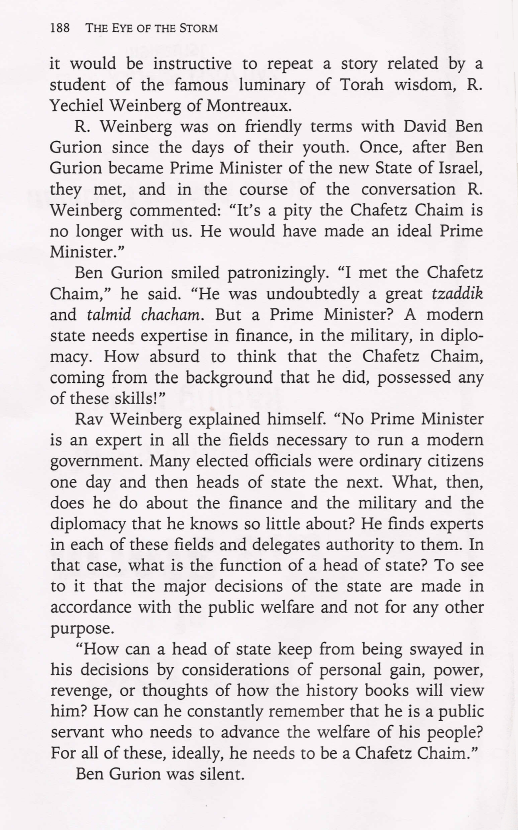
1. Someone sent me the following page from R. Aharon Feldman’s new book, The Eye of the Storm.

My correspondent asked me if there is any truth to this story. I have to say that it is a complete fiction. R. Weinberg did not know Ben Gurion from his youth, and he never met him after he became Prime Minister. I am also certain that the Ben-Gurion never met the Chafetz Chaim.
2. With all that has been in the news recently, I am sure that I am not the only one looking at the writings from the Spinka dynasty. I recently found a passage that I don’t understand. I understand the words, but I don’t understand how the Rebbe could have said it, and if anyone can explain the passage I will be grateful. It appears in Hekel Yitzhak, parashat Toldot, p. 30b:
ושמעתי מאאמו”ר זצוק”ל שמקובל מרבותינו שמעולם לא נתגייר גר מישמעאל כי הוא כולו ערלה ר”ל . . . אבל מעשו נתגייר כמה גרים כדאי’ בדחז”ל, ולעת”ל כולם יתגיירו משום דשרשם בקדושה כדאי’ בהארי ז”ל.
My concern is not with the notion that Esau and his progeny are superior to that of Ishmael. Rather, how could he possibly state that there have never been Arab converts?
To be continued
[1] “Joseph Ibn Kaspi: Portrait of a Medieval Jewish Intellectual,” in Twersky, ed., Studies in Medieval Jewish History and Literature (Cambridge, 1979), pp. 239-241.
[2] Matzref Kesef, p. 74. The same approach is adopted by Radak in his commentary to Gen. 30:14. This is only one possible answer given by Ibn Caspi, and he also suggests that perhaps mandrakes do indeed have special properties that help a woman to conceive.
[3] See Matzref Kesef, p. 137. Based on this Ibn Caspi explains why Tziporah circumcised her son (Ex. 4:25):
ותקח צפורה וכ’. אין עלינו עכ”פ לתת טעם הכרחי מה זאת הרפואה לחולי משה, כי לא כתבה התורה שציוה לה משה שתעשה כן, ואיך שהוא, מבואר כי בימים ההם היה דעת פשוט בהמון העם, כי הדם יש לו סגולה לכל חרדה והתגעשות, ולכן צוה השם שישימו דם על המשקוף ועל המזוזות בבתי ישראל, בחרדתם והתגעשם על צעקת כל מצרים . . . לכן ותקח צורה צור ותכרות את ערלת בנה.

The example of the mandrakes and Tziporah circumcising her son are cited by Isaiah Dimant, “Exegesis, Philosophy and Language in the Writing of Joseph Ibn Caspi” (unpublished doctoral dissertation, UCLA, 1979), pp. 55-56
[4] Translation in Daniel A. Klein, The Book of Genesis: A Commentary by Shadal (Northvale, 1998).
[5] Rubenstein began as a traditional rabbi, as can be seen from his Avnei Shoham (Warsaw, 1902), which includes correspondence between him and R. Joseph Zechariah Stern. However, he later adopted an approach that today we would term “academic”. There is a great deal that can be written about Rubenstein, but as of yet only one article has appeared: Hanan Gafni, “R. Shmuel Moshe Rubenstein, ha-Hoker ha-Rabani mi-Shavli (1870-1943),” Moreshet Yisrael 5 (2008), pp. 139-158. To give an example, not mentioned by Gafni, of how Rubenstein’s later thought broke with tradition, see his Ha-Rambam ve-ha-Aggadah (Kovno, 1937), p. 103, where he claims that the story of the miracle of Hanukkah is almost certainly a late aggadic creation, and like many other miracle stories in aggadic literature was not originally intended to be understood as historical reality:
ספק הוא אם הנס של “פך השמן” הוא אפילו הגדה עממית קדומה, קרוב שהוא יצירה אגדית חדשה מבעל הברייתא עצמו או מאחד מבעלי האגדה, ונסים אגדיים כאלו רבים הם בברייתות וגמרא ומדרשים ע”ד ההפלגה כדרכה של האגדה. ולבסוף הובן נס זה למעשה שהיה. עיין שבת כ”ג א’. [טעם ברייתא זו הובא גם במגילת תענית (פ”ט) אבל כמו שנראה היא הוספה מאוחרת, ועיין (שם) ובפסיקתא רבתי (פיסקא דחנוכה) עוד טעם להדלקת נרות חנוכה].
During the most recent Hanukkah I was using R. Joseph Hertz’ siddur, the Authorized Daily Prayer Book. Based upon how he describes the holiday and the lighting of the menorah, omitting any mention of the miracle of the lights (pp. 946-947), I assume that he also didn’t accept it literally. Note how he states that the lights were kindled during the eight-day Dedication festival, and this is the reason for the eight days of Hanukkah, rather than offering the traditional reason that the eight days of Hanukkah commemorate the eight days that the menorah miraculously burnt.
Three years to the day on which the Temple was profaned by the blaspheming foe, Kislev the 25th 165, Judah Maccabeus and his brethren triumphantly entered the Holy City. They purified the Temple, and their kindling of the lights during the eight-day festival of Dedication—Chanukah—is a telling reminder, year by year, of the rekindling of the Lamp of True Religion in their time.
There is no mention of this passage in Benjamin J. Elton’s recent wonderful discussion of Hertz’s theology and religious policy. See Britain’s Chief Rabbis and the Religious Character of Anglo-Jewry, 1880-1970 (Manchester, 2009), chs. 7-8. (He also doesn’t mention Hertz’s comment that those Jewish commentators who understand aggadah literally are “fools.” See Hertz’s Foreward to the Soncino Talmud, printed at the beginning of tractate Berakhot.)
[6] Commentary to Gen. 3 (end of chapter).
[7] Lawrence Kaplan, ”Rationalism and Rabbinic Culture in Sixteenth Century Eastern Europe: Rabbi Mordecai Jaffe’s Levush Pinat Yikrat” (unpublished doctoral dissertation, Harvard University, 1975), p. 246 n. 139, comments that when Ralbag later in this passage criticizes those who understand Cain, Abel and Seth allegorically, he has Maimonides in mind, but avoids mentioning him out of respect.
[8] Regarding Eve and the serpent, R. Chaim Hirschensohn speaks of רעיוני ההתפתחות במליצי המיטלאגי
In other words, he sees the Torah as using mythological language in the Creation story. See Penei Hamah, p. 6, which is part 2 of Hirschensohn’s Musagei Shav ve-Emet (Jerusalem, 1932). Dov Schwartz has recently discussed this passage. See his “Maimonides in Religious-Zionist Philosophy,” in James T. Robinson, ed., The Cultures of Maimonideanism (Leiden, 2009), p. 399:
Hirschensohn assumes as self-evident that the Bible had been influenced by mythological language. The author of the Creation story “couches the ideas of development in mythological metaphors.” How did Hirschensohn explain these mythological stories? He separated paganism from the “original” mythology. In his view, the mythological stories had been, from the start, a description of a class struggle for which the narrators resorted to symbolic language, just as the Bible refers to the sons of God and the daughters of men (Gen. 6:2). Only later, then, did their deference and their fear of their ancestors lead Greeks to literal interpretations of their mythology: “But before philosophy became dominant there, the later Greeks had mistakenly revered their ancestors and thought of them as gods” [Penei Hamah, p. 36]. The Bible, then, uses a mythological style but its messages are social and ideological.
[9] When one sees how Ralbag describes Eve, I think many readers would wish that he had interpreted her allegorically. Here is his comment earlier in Gen. 3 (p. 110 in the Birkat Moshe edition):
והנה קרא האדם שם אשתו “חוה”, כאשר השיג בחולשת שכלה, רוצה לומר שלא עלתה מדרגתה על שאר הבעלי חיים עילוי רב, ואם היא בעלת שכל, כי רוב השתמשותה אמנם הוכן לה בדברים הגופיים, לחולשת שכלה ולהיותה לעבודת האדם, ולזה הוא רחוק שיגיע לה שלמות השכל.
Ralbag’s view of Eve was also transferred to women in general. One of my teachers once referred to him as the first advocate of the kollel philosophy, for as Ralbag explains in a number of places, the role of women is to enable men to reach their intellectual perfection. That is, their essence is entirely utilitarian. All the relevant references can be found in Menachem Kellner’s essay comparing Ralbag’s and Maimonides’ view of women, which has now appeared in English in his just published Torah in the Observatory. (This book was published by Academic Studies Press, which in the last few years has published a number of important volumes by top scholars including José Faur, David Berger, David Shatz, and Zvi Mark.)
Take a look at this passage referring to women and tzitzit, from towards the end of Ralbag’s commentary on Shelah (p. 188a in the old edition):
למדנו שאין הנשי’ חייבות בציצית וראוי היה להיות כן כי הענין אשר העיר עליו זאת המצוה הוא רב העומק ולא יתכן שיגיע אליו שכל הנשים לקלות דעתן
I wonder, if a haredi spokesman quoted this Ralbag as part of his attack on Orthodox feminism, would he take any flak in his own community? Would the haredi women protest? I have another question and I am curious to hear readers’ responses. (I have my own view, but also want to hear from others.). Do leaders of the haredi world believe in separate but equal when it comes to men and women? This is what is often claimed, but I wonder, do they really hold a Ralbag-like position?
The same question I asked at the beginning of the previous paragaph with regard to Ralbag can also be asked about Radak. Here is what he writes in his commentary to Gen. 3:1:
ואמר אל האשה ולא אמר לאדם, האשה קרובה להתפתות יותר מן האיש, כי דעתה קלה
If this explanation appeared in say the English Yated, independently offered by a contemporary rabbi with no mention of Radak, would haredi women be offended?
And would women be offended if the following passage, from R. Zvi Travis’ Pirkei Hanhagat Bayit, ch. 2 (which I am told used to be a popular sefer), appeared in an English newspaper (called to my attention by Dr. Yitzhak Hershkowitz; emphasis added):
אף אחר בריאת האשה אין כאן שותפות. אלא, וטול כלל זה בידך, תכלית הבריאה היא האיש, והקדוש ברוך הוא נתן לאיש מתנה שתעזור לו, והיא האשה.
Another good example is found in R. Avraham Blumenkrantz’ Gefen Poriah, p. 352, where he quotes approvingly another rabbi who states as follows (emphasis added):
Her tears are ever ready to flow at the most miniscule suggestion of being dealt with as a maidservant. She will concede you the service of והוא ימשל בך. She will consent to call you בעלי, but don’t accent the דגש in the בית too heavily. She must constantly be reassured that there is honor and dignity in her subservience. Honor her more than you honor yourself. She must be compensated for her subjugation, and be made to feel that she has a genuine share in the dignity of the throne.
Do haredi women really feel that they are subservient or subjugated? Do haredi men feel this way about their wives? Haven’t the masses in haredi society (American haredi society at least) also accepted the notion of separate but equal when it comes to men and women?
[10] Commentary to Guide 1:2:
רמז המורה על קצת נסתר במעשה בראשית כי האדם הנזכר שם לא היה אחד רמוז לבד אבל על הכלל
[11] Commentary to Guide 1:14.
[12] “Rationalism,” p. 251 n. 150.
[13] In his commentary to Guide 2:30, Ibn Caspi also discusses the creation story, and records what was apparently a popular saying in his day. For those of you who sometimes get frustrated with some of your co-religionists, it is worth bearing in mind: אלמלא המשתגעים יהיה העולם חרב. Regarding the saying, see also R. Judah Leib Zlotnick, Midrash ha-Melitzah ha-Ivrit (Jerusalem, 1938), p. 57. The saying is also found in Maimonides’ introduction to Nezikin.

ftn


Review of Shaul Stampfer, Families, Rabbis & Education

Review of Shaul Stampfer, Families, Rabbis and Education: Traditional Jewish Society in Nineteenth-Century Eastern Europe
by Marc B. Shapiro
The continuation of my last post will be ready soon, but in the meantime I am posting my short review of Shaul Stampfer’s new book. It appeared on the H-Judaic listserv, but since most readers of Seforim Blog probably did not see it, I am posting it here as well.
For many years, Shaul Stampfer has been recognized as an authority in all things dealing with nineteenth-century Jewish Eastern Europe. In his newest book, we have a collection of numerous essays representing more than twenty years of his scholarship, including one essay published for the first time (“The Missing Rabbis of Eastern Europe”). Stampfer’s focus is not on the purely intellectual debates between rabbinic elites. He is more interested in social history, how average people and in particular women lived. Even his discussions of rabbis emphasize such matters as inheritance of rabbinic positions and the rabbi’s role in communal life. His sources are quite broad: traditional rabbinic works as well as Hebrew, Yiddish, and Russian texts and newspapers.
I could write extensively about every essay, each of which taught me a great deal. (And I never imagined that an entire essay could be written on the pushke and its development.) Yet to remain within the word limit for this review, let me just mention some of Stampfer’s most important points, the major theses of the book.
People have generally assumed that marriages in Jewish Eastern Europe were very stable, with divorce being quite rare. Stampfer, however, provides evidence to demonstrate that divorce was common and not shameful. Based on his evidence, he is fundamentally correct. In addition to citing statistics, Stampfer also refers to memoir literature that mentions divorce. Yet I also think that Stampfer (and ChaeRan Y. Freeze before him) exaggerates the frequency of divorce. For example, one of his statistics of marriage and divorce is from the 1860s in the city of Berdichev where for every three to four marriages, there was one divorce. He cites similar statistics for Odessa (p. 46). Stampfer goes so far as to claim that “it may well be the case that there were thirty divorces for every hundred weddings in the nineteenth century” (p. 128). However, these numbers are certainly skewed for the simple reason that while marriages took place in every town, to obtain a divorce couples had to travel to a larger city where there was a beit din and scribe. Thus, divorces from any one city do not reveal a ratio of marriage to divorce. The situation is identical to what happens today. Couples get married anywhere they want, but must come to a central location for their divorce.

Stampfer also argues that contrary to another popular stereotype, early teenage marriage was not at all common in traditional Jewish society. While it occurred among the economic and intellectual elite, and is immortalized in memoirs of the latter, early teenage marriage does not reflect the life experience of the average young Jew. Similarly, the lower class, which encompassed most Jews, did not have much use for matchmaker services, and indeed, romance was a factor in their marriages.

Tied to the points made so far is the place of women in society. Many of us are accustomed to think of traditional society as one in which men had all the power and made all the decisions, and in which the husband went out to work while the wife served as a homemaker. Yet Stampfer shows that while this perception fits in very well with contemporary “family values,” it is not how East European Jewish society functioned. Women generally worked, were involved in business ventures, and were thus “out of the home.” Unlike today, the stay-at-home wife and mother was not necessarily an ideal. Stampfer also notes that many Jewish names were created from women’s names, which he thinks “reflects a reality in which both men and women could be in the centre” (p. 133).

Adding to these arguments, Stampfer includes the following suggestive comment: “Another indication of the place of women in Jewish society can be found in the aesthetics of Jews in Eastern Europe. Males were regarded as attractive if they were thin, had white hands, and wore glasses. These were all reflections of lives devoted to study and perhaps to asceticism. On the other hand, attractive women had full bodies and were strong and active. Their appearance promised work and support. Different ideals are expressed here, but the image of the ideal woman is not one of weakness” (p. 133). In short, East European Jewish society was not what we would regard as a patriarchy. Conservative views on the importance of women staying in the home to raise children might be sound social policy, yet we should not assume that this is how East European Jews ever actually lived.

Another fact noted by Stampfer, which will no doubt be surprising to readers, is the existence of coed heders. This is certainly not the image that people have of this institution. Yet while the coed aspect is interesting, especially, as Stampfer states, “given the contemporary concern (or obsession) in certain very Orthodox Jewish circles regarding co-educational education even in elementary grades,” even more significant is what this says about education for girls (p. 169 n. 11; see also p. 32). Contrary to what many think, there were East European Jewish girls who were educated just like their brothers, and Stampfer thinks that the ratio of girls to boys in heder was approximately one to eight (p. 170).

As for education in general, while some people like to imagine Eastern Europe as a placenwhere Torah study always thrived, Stampfer notes that “one can safely conclude that by the mid-1930s there were far more young Jewish males in secondary schools than in yeshivas” (p. 272). Also worthy of note is Stampfer’s point that the kollel (a school of rabbinic studies for married men) system developed because there were no longer many rich fathers-in-law willing to support a son-in-law who was studying. In addition, he argues that the shrinking of the job market for rabbis also had a share in the development of the kollel.

Let me conclude with some minor comments and corrections. On page 69, note 39, the proper reference in  Pithei Teshuvah  is  Even ha-Ezer 9:5, and the rabbi cited should be R. David Ibn Zimra (Radbaz), not R. Jacob Willowski (Ridbaz).On page 181, Stampfer discusses the famous description by R. Barukh Epstein of his aunt, Rayna Batya, the wife of R. Naphtali Zvi Judah Berlin. While acknowledging that some have doubted the veracity of Epstein’s story, Stampfer states that “the account seems plausible.” Here I must disagree. While there can be no doubt that Batya was an unusual woman, Epstein’s account of his conversations with her, as with much else in his autobiography, cannot be relied on. I have discussed this at length elsewhere, and readers can examine my arguments at the Seforim Blog here.

On page 285, Stampfer refers to the Moscow crown rabbi Jacob Mazeh (1859-1924) as having been martyred. Yet this is incorrect as Mazeh died a natural death. On page 326, note 6, regarding the Vilna Gaon’s attitude toward R. Jonathan Eibeschuetz, see Sid Z. Leiman, “When a Rabbi Is Accused of Heresy: The Stance of the Gaon of Vilna in the Emden-Eibeschuetz Controversy,” in Ezra Flescher, et al, eds., Meah Shearim (2001). Finally, on page 327, Stampfer offers evidence of criticism of the Vilna Gaon during his lifetime. In my September 12, 2009, post at the Seforim Blog, available here, I offer another example of such criticism. This is reported by R. Hayyim Dov Ber Gulevsky who heard it from his grandfather, R. Simhah Zelig Rieger, the dayan of Brisk. (Incidentally, Gulevsky is quoted by Stampfer on page 353.)

As mentioned at the beginning of this review, there is much more that can be said about Stampfer’s careful scholarship, which is a treat for all readers. I know that many share my wish to soon see in print the English edition of his classic work on the Lithuanian yeshivot.
* * *
Let me now add a few additional comments especially for the benefit of those who had already read the review before I posted it here.
1. Stampfer’s book is published by my favorite press, Littman Library. I want to call readers’ attention to another recent and wonderful book published by Littman: Sharon Flatto, The Kabbalistic Culture of Eighteenth-Century Prague. Interestingly, two dissertations were written at the same time on the Noda bi-Yehudah. The other was by David Katz, which bears the interesting title “A Case Study in the Formation of a Super-Rabbi: The Early Years of Rabbi Ezekiel Landau, 1713-1754 (University of Maryland, 2004). Although Katz’ dissertation has not yet appeared in print, there is definitely room for the two as they focus on different areas and are both works of great learning. (Yet I hope that when Katz publishes his book, he changes the title. It is bad enough that today we have people writing about how they “consulted Daas Torah” as if there is such an individual so named. The only thing worse would be to hear people recount how “I asked the Super-Rabbi his opinion” or to have Yated tell how how “The Super-Rabbi has issued his Daas Torah.” That will surely leave the religious Zionists reaching for their kryptonite.)

Regarding how Landau was indeed a “Super-Rabbi,” to use Katz’ expression, I found interesting testimony in R. Shraga Feivish Shneebalg, Shraga ha-Meir, vol. 2, no. 76. He states that he heard from R. Dov Berish Wiedenfeld, who heard from R. Meir Arik, that the Noda bi-Yehudah was the posek ha-dor. Assuming there is such a position, I don’t know of anyone more qualified for it than Landau. I must admit, however, that this is an Ashkenazic-centered perspective, because it is unimaginable that a Sephardic scholar would ever come into consideration by most of those who like to speak of the gadol ha-dor. Thus when people refer to R. Yitzhak Elhanan Spektor, R. Hayyim Ozer Grodzinski, etc. as the gadol ha-dor. they never wonder if perhaps there was a great sage in the Sephardic world who fit the bill. When people speak about the gadol or posek ha-dor, it really means the gadol or posek of their world.

Returning to Arik, he said that after the Noda bi-Yehudah the Hatam Sofer held that role. Here again, I don’t think there will be much argument. But the names he gives after this show how Arik, a Galician scholar, sees matters differently than a Lithuanian. He claimed that R. Solomon Drimer was the next posek ha-dor, yet I don’t think most people reading this post have even heard of him. For the next period, he gave the Hungarian posek R. Solomon Leib Tabak of Sighet (died 1908), author of Erekh Shai. Again, I don’t think most people reading this post have ever heard of Tabak. Yet Arik regarded him as the posek ha-dor. As a Galician, not a Lithuanian, Arik had a different perspective on who the great poskim were.[1] Yet a Lithuanian hearing this would laugh. If you asked him who the posek ha-dor was for the period of Tabak, he could give all sorts of names: R. Yitzhak Elhanan Spektor, R. Naftali Zvi Judah Berlin, R. Jehiel Michel Epstein, R. Joseph Zechariah Stern, and the list goes on, but Tabak wouildn’t even make it to the top twenty.

This different perspective was recognized by R. Jehiel Jacob Weinberg. In one responsum (Kitvei R. Weinberg, vol. 1, no. 11), after quoting a position of a Hungarian posek, Weinberg writes:

ודאי שרבני ליטא ופולין ילעגו על דברים אלה ואולם המחבר הנ”ל הי’ גאון וצדיק מפורסם וחלילה לבטל דבריו בתנופת יד גרידא. כתבתי כל הנ”ל כדי להוכיחו שצריך הוא להיות זהיר ומתון ולא להמשך אחרי הקולות של רבני ליטא ופולין שהם גדולים וחכמים בהלכה אבל בהוראה למעשה עולה עליהם רבני אונגארן וגאליציען ומובחרי השו”ת בהוראה למעשה שיצאו בזמן האחרון נתחברו על ידם.
Earlier in this responsum Weinberg writes:
כבר רמזתי לכת”ר שבעינים כאלו יש לסמוך יותר על רבני אונגארן הקרובה לאשכנז ויודעים מצב הדברים באשכנז יותר מרבני פולין וליטא. ובכלל נוטה אני מדעת חברי ורבותי רבני פולין וליטא שאינם משגיחים הרבה ברבני אונגארן. גם אני הייתי סבור כן קודם בואי לכאן, אבל אח”כ ראיתי כי בעניני הוראה עולים הם על רבני פולין וליטא, כי יש להם חוש מיוחד להוראה מעשית וכמעט כולם נתחנכו בבית מדרשו של רבינו שבגולה החת”ס ז”ל שהוא הי’ עמוד ההוראה כידוע ומפורסם.
These words are amazing because Weinberg is admitting that before he came to Germany, he too shared the feeling of superiority that he describes here. Before then it was unimaginable to him that a posek outside of Lithuania or Poland would have had much of value to add.
2. In a previous post, available here, I wrote about rabbis who began writing books at a very young age. I was asked if there are additional examples of this. There are indeed a number, and in a future post I will discuss one in more detail. For now, here is the title page of R. Aaron Friedlander’s Avrekh, where it tells us that part of the book was written when the author was nine years old! See also the approbations to this volume.

Here is the title page of R. Hezekiah David Abulafia’s Ben Zekunim. If you read the introduction you will see that the first part of this book was written when the author was thirteen years old.

R. Yitzhak Arieli reported being told by R. Kook that the latter authored a book on Song of Songs when he was only eleven years old. You can find Arieli’s testimony here.
As I am writing this people are once again outraged by something R. Ovadiah Yosef said, in that he attributed the fires in Israel to lack of Sabbath observance. Obviously, this is not the sort of comment that appeals to those with a modern temperament, but in traditional societies it is an expectation of the people that the leading rabbis will find some spiritual reason to explain tragedies. So why I am mentioning this now? Because in the document from Arieli, no. 38, he quotes R. Kook as saying something that people will find even more shocking than anything R. Ovadiah has ever said. (I don’t think you will find the students of R. Kook ever repeating it.) R. Kook wondered if the 1929 pogrom in Hebron was perhaps due to the fact that the Hebron Yeshiva brought in their “modern” ways to Israel, by which he means their way of dressing, hair style and beardless faces.
בהפרעות (בשנת תרפ”ט) בחברון מצאתיו ביום ראשון יושב ובוכה והבליט מפיו שמא מפני שהכניסו תלבושת והנהגה חדשה בארץ (היה מתנגד לגלוח הזקן (כמובן במכונה או בסם) ובלורית ואולי גם בגדים קצרים, ובישיבה העיר כ”פ ע”ז ( אבל קשה היה לשנות ההרגלים שבחו”ל).
I agree that this sounds shocking and offensive to modern ears, especially to those who lost family members in this event. I mean, can you imagine telling someone whose child was killed that it was because certain yeshiva students were dressing in a modern fashion? But again, the traditional mind works differently than the modern mind. I say this not to recommend that we all reprogram our minds so that these sorts of explanations are once again appealing, any more than I would wish that, as with Jews in medieval Germany, we once again believe that demons are all around us causing all sorts of problems. I mention it only to add some context and help explain how the most influential rabbinic mind of the twentieth century could say something which to modern ears sounds outrageous. Just as it wrong to judge pre-modern science negatively because it didn’t have access to modern technology, so too we must be careful about being prejudiced against traditionalist explanations because we might no longer share the same assumptions as our predecessors
3. With regard to R. Baruch Epstein’s discussions about his uncle the Netziv in Mekor Barukh, the irony is that the Netziv thought that there was no good purpose in reading the biographies of great Torah sages. He thought that this was nothing less than bitul Torah. See the letter from R. Hayyim Berlin printed at the beginning of his father’s Meromei Sadeh.
The Netziv’s concern with bitul Torah was such that when his wife (I presume his first wife, Rayna Batya) had to have an operation and the students wanted to say Tehillim for her, the Netziv refused to stop the learning for this. After the students continued to push, he agreed to allow five minutes of tehillim. This was reported by R. Zvi Yehudah Kook, who must have heard it from his father. See R. Hayyim Avihu Schwartz, Be-Tokh ha-Torah ha-Goelet (Beit El, 2006), p. 201.
In an e-mail discussion with one reader, he contrasted the Netziv to R. Chaim Soloveitchik and R. Velvel ,saying that the Netziv was so “normal”. I don’t want to use words like that, and while R. Chaim had many unique qualities, I don’t think the stories told about him are any more unusual than those told of other gedolim. Most of these stories are, in fact, quite inspiring. The stories about R. Velvel are, I admit, of a different flavor. I mentioned two such examples here.

Yet lest one thing that these type of stories are unique to R. Velvel, let me mention a story about the Aderet “brought down” (to use the yeshiva lingo) in the book I just referred to, Be-Tokh ha-Torah ha-Goelet, p. 324. R. Zvi Yehudah told how one of the Aderet’s sons died right after birth, just as Shabbat was starting . The Aderet told his wife that she should perpare the Shalom Zakhor as if everything was normal, for there is no avelut on Shabbat and the community does not need to know that anything is wrong. When the Rebbetzin began to cry the Aderet replied to her that she is acting this way because she doesn’t study Talmud. If she studied Talmud she would know that there are often times when we are left with questions, and the same is true in life.

4. Stampfer’s point about the frequency, and lack of shame, of divorce in Eastern Europe was an eye-opener to me. In Between the Yeshiva World and Modern Orthodoxy, p. 22, I mention that divorce was very uncommon in traditional Lithuanian Jewish society, and almost unheard of among the rabbinate. I now see that I was mistaken in this assumption (which was based on my general impressions, not on the sort of evidence Stampfer makes use of). For examples of rabbinic figures who got divorced, see here.
5. I referred to Daas Torah above, and since someone asked me if I could write up what I said about it in a recent lecture, I will do so now. In this lecture I quoted what appears in R. Yitzhak Dadon’s new book, Rosh Devarkha. This is the follow-up to his earlier book, Imrei Shefer, both of which record the teachings of R. Avraham Shapiro, Rosh Yeshiva of Merkaz ha-Rav. On p. 10 one finds R. Avraham’s very harsh comments against Daas Torah. He would refer to it as Ziyuf ha-Torah. Here are some of his words:

האם התורה עוברת רק דרך אדם אחד?! בחו”ל לא היה כדבר הזה! זה אמר כך, וגדול פלוני חלק עליו וחשב אחרת, מישהוא אמר שהפלוני הזה הוא נגד “דעת תורה”?! מהיכן הביאו את הדבר הזה? אם ה”חפץ חיים” סבר כך ורבי מאיר שמחה אחרת ופלוני גדול אחר
חלק עליהם, יש מי מהם שהוא נגד “דעת תורה”? איזו הנהגה היא זו? זו השתלטות על דעת הרבנים, ולא היה כזאת בעם ישראל.

As for the practice of declaring what the Daas Torah is through the newspaper or through placards, without any sources to support this, here are R. Avraham’s strong words (and apologies if any wives are offended):

כלפי רבנים המוצאים חוות-דעת ותלמידיהם מפרסמים זאת תחת הכותרת: “דעת תורה”, בלי שום אסמכתאות ומקורות נאמנים היה מרן זצ”ל אומר: “איזו מין דעת תורה היא זו? כשאדם אומר “דעת תורה” בלי שום מקורות, אז הכוונה היא כזאת: זה קצת מבוסס על מה שהוא למד, והרוב זה מה שאשתו אמרה לו, זה הפירוש דעת תורה.

Anyone who is honest will admit that the current practice of Daas Torah is completely phony. My proof of this is very simple. If tomorrow R. Elyashiv would declare that everyone has to say hallel on Yom ha-Atzmaut, would the Lithuanian yeshiva world listen to his Daas Torah? Of course not. They would simply replace him with another gadol whose Daas Torah is more palatable to them. In other words, the gadol only has Daas Torah because the masses, or the askanim, let him have it, and only when they like what he says. (I am curious. Has R. Elyashiv’s ruling that fashionable sheitls are forbidden had any effect on his supposed followers?).

Try to imagine what would happen if someone in the haredi world discovered a letter from the Hazon Ish, the ultimate Daas Torah authority, in which he said that only the best and the brightest in the State of Israel should devote themselves to Torah study. However, everyone else should go to work. Does anyone think that this letter would ever see the light of day? Of course not! We all know what would happen. The letter would be kept hidden, and if by chance some rebel did publish it, the haredi world would find a way to justify why they don’t accept the Hazon Ish’s viewpoint.

6. In this post I referred to a mistaken point by R. Ezriel Tauber in his recent book Pirkei Mahashavah al Yud Gimel Ikarim le-ha-Rambam. I was asked if my negative comment relates to the entire book, or just the one point I referred to. My answer is that I wasn’t referring to the entire book, and I am sure that people will find things that are valuable in it. Yet I have to say that I don’t find it helpful when an author like Tauber asserts, p. 428, that people who claim to be atheists are really not. Rather, they just don’t want to believe, but deep down they know the truth.

Contrary to Tauber (and he is not the only one to express himself this way), the only intellectually honest position is to take people like Christopher Hitchens at their word and deal with it. Claiming that the atheist really believes is no better than the atheist saying that the believer really knows the truth that there is no God.
Furthermore, from my perspective I can’t take an author seriously when he says things like how in the Far East there are people who have the power to use black magic, and their knowledge is part of a tradition that goes back to Abraham. P. 133:
ואכן במזרח הרחוק יודעים שמות של טומאה, ויש להניח ששורש הידיעה היא מאברהם אבינו. ואף על פי שהם כוחות אמיתיים, אסור לנו להשתמש בהם.
*  *  *
I want to take this opportunity to invite all Seforim Blog readers on what I know will be an amazing Jewish heritage tour to Central Europe this summer. Details can be found here. They are still working on the price, and it will be posted soon. Those who want further details are invited to contact me.
With Christmas Eve almost upon us, I also invite readers to watch, or listen to, my lecture “Torah Study (or Lack of It) On Christmas Eve: The History of a Very Strange Practice.” It is available here. The few dollars (Canadian) that it costs go to support a very worthy organization, Torah in Motion.
Notes


[1] Wiedenfeld, who is the source for the information from Arik, actually had a special place in the eyes of the Lithuanian yeshiva  world. Haym Soloveitchik writes (TUMJ 7 [1997],  p. 144):

Intellectually, the Lithuanian approach to talmudic study (derekh ha-limmud) has triumphed. One could scarcely imagine a Hungarian rosh yeshiva being considered as a candidate to head a Lithuanian yeshiva. Nor is it accidental that with one early, minor exception (the Tchebiner Rav [Wiedenfeld]), all the embodiments of da’at Torah, both in America and Israel, have been Lithuanian.


אדם דואג על אבוד דמיו / ואינו דואג על אִבוד ימיו

In the prior post, Yitzhak discussed a phrase and its origins. We now present, a chapter from R. S. Askenazi unpublished works, related to the same topic. As mentioned before we are working on printing his writings. At this point three volumes are completely ready to print (with a few more on the way). While they still require financial assistance to see the light of day we are very close, only 5K is necessary. With the help of many people, including some generous readers of the Seforim blog, we have gotten pretty far in this long journey. If anyone could help in any way possible it would be greatly appreciated. Thanks in advance. For any information or questions about this project contact me at EliezerBrodt@gmail.com
אדם דואג על אבוד דמיו / ואינו דואג על אִבוד ימיו
הפרקים
א. מקורות ראשונים
ב. בדורות הבאים
ג. באור הפתגם
ד. ‘מדרש פליאה’
ה. השמוש בפתגם בחיי הקהלה
ו. יחוס מוטעה
ז. מקור הרעיון בראשונים
ח. רעיונות דומים
ט. פתגמים-אחים ופתגמים-יריבים
י. ‘…מתאוננים, שאין להם במה לחיות…’
א. מקורות ראשונים
כתב ר’ שלמה בלוך, בספר החיים, ח”ד, פרק ב: אמרי אינשי. אדם דואג על איבוד דמיו / ואינו דואג על איבוד ימיו. דמיו אינם עוזרים / וימיו אינם חוזרים[1].
ר’ שלמה בלוך לא חִבר את ספר החיים, אלא הוציאו בתרגום אשכנזי בשנת תרח בהנובר (ואח”כ במהדורות רבות) [על-פי מהדורת יחזקיהו רפוס (פפד”מ תקצה), בתוספת תפלות חדשות ותרגום ליהודית-אשכנזית, באותיות צו”ר]. מחברו של הספר הוא ר’ “שמעון בר’ ישראל יהודה, הנקרא בפי כל: שמעון פראנקפורטער“. ונדפס לראשונה ע”י בן המחבר (ר’ משה) בשנת תסג באמשטרדם. המשל נמצא שם, בדף י ע”א.
בהמשך מוסיף ר’ שלמה בלוך שיר החתום בשמו (שלמה): ואמר המשורר: שוכני תבל רודפי הבל / לשוא עמלו כל חייהם / מיום היותם סבלותם / הגם צדה לא עשו במותם.
אולם באמת, המשורר הוא ר’ משה ן’ חביב, והשיר נדפס בספרו דרכי נועם. אלא שמישהו שיבש את שתי השורות האחרונות, כדי שיצא האקרוסטיכון שלמה (עי’ אוצר השירה והפיוט, ש 636). הנוסח המקורי הוא: ובסכלותם עד יום מותם / גם צדה לא עשו להם.
פתגם מחורז זה מופיע, בשנוים, גם בספר מראה המוסר, מאת זעליגמאן אולמא, הנקרא גם צוכט שפיגל (אוביבאך תעו, דף ח ע”א; אוריינט, 1846, עמ’ 606): אנוש קובל על איבוד דמיו / ואינו קובל על איבוד ימיו. והוא יכול להחזיר דמים / ולא יוכל להשיב הימים.
בהמשך בא התרגום ליהודית-אשכנזית: איי דוא פר גענקליכי נערישי וועלט / דאז מענכר קלאגט איבר זיין פאר לארן געלט / אונ’ ניט איבר זייני טעג דיא אים אנטרינן / דז ער דאך פר לארן געלט קאן ווידר גיווינן / אבר נאך דען פר לארן טעג ברעך דיר ניט דיין זין / זיא ווידר צו בקומן דען הין אישׂט הין (מראה המוסר, שם).
בריל (יארביכר, IX, עמ’ 52) מביא את הפתגם מתוך כתב-יד מהמאה הטז, ושם נוסח החרוז השני: והלא אפשר להחזיר דמיו / ולא אפשר להחזיר ימיו.
נוסח דומה הביא ברוך גלזמן: אדם דואג על איבוד דמיו / ואינו דואג על איבוד ימיו. דמיו הולכים וחוזרים / ימיו הולכים ואינם חוזרים (טויטנטאנץ, באָדן [רבעון, בעריכת נ”ב מינקאוו], כרך ג, חוברת 4-3 [ניו-יורק 1937-1936], עמ’ 33).
וקדם לכולם ר’ שאול בר’ דוד, ר”י ור”מ ממדינת רוסיא, בספרו חנוכת הבית (פראג שעו, דף ט סע”ד): … מאהבת הכסף יכסוף שיגיע לתקופת הימים, ושתכלה השנה, כדי שיקרבו הימים שימצא בהם חפץ. נמצא רוצה שיתקצרו ימיו ושניו. ועליו נאמר ושנות רשעים תקצרנה [משלי י כז]. וכמו שאמר החכם: אדם קובל על איבוד דמיו / ואינו קובל על אבוד ימיו …
אמנם כותבי המודיע לא ידעו, כנראה, על מקורות אלו, ולפיכך יחסו את פתגמנו לר’ ישראל מסלנט! (ראה להלן, פרק ט).
ב. בדורות הבאים
הפתגם נשתגר בפי הבריות ונזכר בכמה וכמה חבורים. נצין אחדים מהם:
כתב ר’ אלעזר קליר, בספרו חות יאיר חדש, פראג תקנב, דף כא ע”ד: ובילדותי אמרתי, שזה פי’ החידה: אדם דואג על איבוד דמיו / ואינו דואג על איבוד ימיו; דמיו אינם עוזרים / וימיו אינם חוזרים – – –
וכתב ר’ יחזקאל לנדא [תעד-תקנג], בספרו דרושי הצל”ח (דרוש א, ליום א דסליחות, סי’ כג, ווארשא תרמד [! צ”ל: תרמו], דף ה ע”א): אבל הרשעים, חייהם אינם חיים, ואין לימים שלהם שום מציאות. ועליהם נאמר: ימי קלו מני ארג [איוב ז ו]. כי אין להם שום משקל משום זכות, ואדם דואג על איבוד דמיו ואינו דואג על איבוד ימיו – – –
ור’ נתן מברסלב כותב בספרו לקוטי הלכות (הלכות מגילה, הלכה ו, סעיף יח): עיקר אבידת הימים … ע”י תאות ממון … וכמורגל לשון זה בספרי מוסר: אדם דואג על איבוד דמיו / ואינו דואג על איבוד ימיו.
ובפירוש קול יהודא[2] על ספר מבחר הפנינים, שער היאוש, ווילנא תרלה: ואדם דואג על איבוד דמיו / ואינו דואג על איבוד ימיו. כי דמיו אינם עוזרים / וימיו אינם חוזרים. כמבואר בספרי מוסר.
לבסוף כדאי לרשום כאן את השיר הנפוץ בין אחינו מבני עדות המזרח: בן-אדם! למה תדאג על הדמים / ולא תדאג על הימים. הדמים אינם עוזרים / והימים אינם חוזרים. רדוף אחר התורה והמצוות, אשר הם לעד קימים[3].
זכות גדולה עמדה לפתגמנו, שהולחנו לו כמה מנגינות, בהן היו שרים אותו בעלי המוסר.
כך מספר אברהם יצחק קריב (ליטא מכורתי, חיפה תשכ, עמ’ 28) על ‘בעלי המוסר’ שנפוצו בליטא: הליטאי… אין הוא להוט ‘לבלות’ את הזמן. אלא אדרבא, צר לו על הזמן שמתבלה. אדם דואג על איבוד דמיו ואינו דואג על איבוד ימיו – היו שרים בעלי המוסר ומושכים במלות החרוז ובנגינתן העצובה בשביל למצות את חשבון הנפש שבהן.
והרי כמה מובאות אצל בני הדורות האחרונים:
טוביה פסח שפירא [תרה-תרפד], משל הקדמוני, “מאסף משלי עם המסורים ושגורים בפי העם”, פילדלפיה תרפה, לב, 5, מביא את הפתגם כולו: אדם דואג על איבוד דמיו / ואינו דואג על איבוד ימיו. ימיו אינם חוזרים / ודמיו אינם עוזרים.
ואִלו שלמה יצחק שיינפלד [תרכא-תשג], מסתפק בחציו הראשון בלבד: כמה נאמנים הם דברי המשורר: אדם דואג על איבוד דמיו / ואינו דואג על איבוד ימיו (ציונים בדרך החיים, ח”א, שיקאגא תרפב, סוף עמ’ 228).
וכך גם בספרם של ביאליק-רבניצקי, ובספרו של עקיבא גולנפול[4].
חציו הראשון של הפתגם (בלבד), בנסוח שונה, אנו מוצאים באוספו הלועזי של פלנטויט, תלמידו של ר’ יהודה אריה ממודינה, שנדפס בשנת 1645 [תה], מס’ 1786, ומשם הוכנס לאוצר המשלים והפתגמים של ישראל דודזון, ירושלים תשכז, מס’ 1453: שוטה מתאבל על איבוד דמיו / ולא ישית לבו על אבידת ימיו.
נִסוח זה נמצא במשלי שבעים חכמים, סי’ סה[5]. ואין ספק, שמכאן לקחו פלאנטאוויט!
השוה גם נִסוחו של אפרים דוֹמוֹרצקי: מתאונן אויל על אזלת כספו, ועל חלוף ימיו לא ידאג (משלי אגור, ורשה תרמא, יט י).
וראה גם: מלון אידי-עברי מלא. נקבצו ובאו בו כל המלים, הניבים, הפתגמים והיינו דאמרי אינשי, שיש להם מהלכים בשפתנו המדוברת. כולם מתורגמים בשפת עברית צחה ורעננה, מאת אבק [=אליעזר ברזניאק]. פריס, תרצט-תשא, דף 203 ע”א: א מענש זארגט זיך ווען ער ווערט אָן געלט, און ניט ווען ער ווערט אָן יאהרען. אדם דואג על אבדן דמיו / ואינו דואג על אבדן ימיו.
ונִסוח קצר: פארלארענע יארן איז ערגער ווי פארלארענע געלט (יידישע שפראך, II [1942], עמ’ 29, מס’ 68).
ג. באור הפתגם
כמה באורים ופירושים נאמרו לפתגם זה.
כתב ר’ אלעזר קליר, בספרו חות יאיר חדש, פראג תקנב, דף כא ע”ד – כב ע”א: ובילדותי אמרתי, שזה פי’ החידה: אדם דואג על איבוד דמיו / ואינו דואג על איבוד ימיו; דמיו אינם עוזרים / וימיו אינם חוזרים … כשאדם דואג על איבוד דמיו, ואינו רואה הסיבה לדאוג על מה שאיבד ימיו … אשר זו הסיבה שממונו אבד, אז, דמיו מה שאיבד אינם עוזרים לו, כי ימיו אינם חוזרים למקומם, מאחר שלא שב בתשובה. משא”כ אם לא היה דואג על איבוד הדמים, רק על הסיבה, היו לו דמים הללו לעזר, שהיו ימיו חוזרים. הני ימים, דדחפי לבר, היו חוזרים ע”י תשובתו. כמאמר הזוהר [בפרשת ויחי, דף רכא ע”ב – רכד ע”א, שהובא לעיל, דף כא ע”ג-ע”ד][5א].
והביא דבריו ר’ מרדכי ראטהשטיין, בפירושו שערי פרנסה טובה, על ספר תהלים, מ’-סיגעט תרמט[6].
באור נוסף לפתגם הציע עקיבא גולנפול, בספרו לקסיקון הפולקלור העברי, והובאו דבריו להלן (פרק ו).
וראה עוד בפרק הבא.
ד. ‘מדרש פליאה’
הפתגם התגלגל והפך למדרש פליאה!
כך מספר ר’ חיים בנימין ליפקין, בספרו חבל בנימין (יוהניסבורג תרצד, עמ’ 154-153), בשם זקנו ר’ יצחק ליפקין.
כאשר בא אדמו”ר הצדיק מהר”ש שניאורסאן הרבי מליבאוויץ זצק”ל לוויטעבסק לחתונת בנו ר’ מנדל עם בתו של הגביר ר’ יוסף פאפיערין, נכדתו של הגאון מלבי”ם זצ”ל, וגם הוא בא לחתונת נכדתו. וכאשר ישבו אצל החתן בעת ‘קבלת פנים’ כמנהג, אמר ר’ יוסף הנ”ל: עתה יושבים פה שני גדולי ישראל, ואשר זכיתי להיות בחברתם, אבקש אתכם לבאר לי מדרש פליאה אחד אשר לא אוכל להבין (הרב ר’ יוסף היה ג”כ למדן מופלג). על פסוק וילכו שניהם יחדיו [בראשית כב ח] אומר מדרש פליאה ישן: הה”ד הלוך ילך ובכה [תהלים קכו ו]. אדם דואג על איבוד דמיו / ואינו דואג על איבוד ימיו.
ויען המהר”ש ויאמר. כי הסבא של הכלה הוא זקן ממנו, וראוי לו הכבוד שנשמע ממנו קודם את חות דעתו בזה. ויקם הגאון [מלבי”ם] ויפרש את המדרש בפלפול נאה, כדרכו. ועתה נשמע, אמר ר’ יוסף, מאבי החתן את ביאורו.
ויען המהר”ש ויאמר: המדרש יבואר ע”פ הגמ’ זבחים, שאם נפסל הדם של הקרבן, נשפך לאמה[7]. ולכן כאשר שמע יצחק מאביו לעולה בני, חרד ואמר בלבו: שמא אבא לא יוכל לכבוש את רחמיו מעל בן יחידו, ודעתו לא תהיה צלולה ומיושבת עליו, ועלול לטעות ויפסול את הדם, וילך הדם לאיבוד. וזהו פי’ המדרש פליאה, ההד”כ הלוך ילך ובכה, כלומר, יצחק הולך ובכה. וזהו אדם דואג על איבוד דמיו, דואג שהדם שלו יאבד, ואינו דואג מה שיאבד ימיו, כלומר חייו.
וכאשר סיים את דבריו קם הגאון המלבי”ם ז”ל מעל כסאו ואמר: אין זה כי אם ברוח הקודש, שבו פירש המחותן את המדרש פליאה. והוא ביאור נפלא מאד, וגם פשוט כל כך.
בעל הטורים האלה שמע בעצמו מאחד ששמע זה מפי הגאונים הנ”ל, כאשר היה לומד בוויטעבסק בישיבת זקינו הגאון ר’ יצחק ליפקין זצ”ל.
ע”כ ספורו של ר’ חיים בנימין ליפקין.
באור זה למדרש הפליאה, בשם המלבי”ם, נזכר גם במטעמי יצחק, שכתב ר’ יצחק מרדכי פאדוואה לספר אילנא דחיי, המקבץ מתורתו של ר’ מנחם מענדיל מרימנאוו, ונדפס בשנת תרסח בפיעטרקוב. וזה לשונו (פרשת וירא, דף ט ע”ב, הערה ד): שמעתי. שהק’ מהרא”י מסאדיגורי זצ”ל שאל להרה”ג המלבים זצ”ל, שיפרש לו דברי הילקוט [!] דכתיב ביה בזה הלשון: בשעה שעקד אברהם אבינו ע”ה את יצחק בנו, בכה בכייה גדולה, ואמר: הנני דואג על איבוד דמיו ואיני דואג על איבוד ימיו. והשיב לו הגאון ז”ל: דהנה יש פלוגתא אם נתערבו שני מיני דמים, על איזה מהן יזה. ודעת החכמים, שישפוך. והנה, גם יצחק אבינו ע”ה היה בכור ועולה, וא”כ הוי כנתערב שני מיני דמים, דלדעת החכמים ישפוך, וא”כ לא יעלה העולה לרצון לפניו ית’. וזהו שאמר אברהם אבינו ע”ה: הנני דואג על איבוד דמיו, היינו שצריך לשפוך הדמים שלו וילך לאבדון, ואיני דואג על איבוד ימיו, היינו שעל הימים שלו לא היה חס, כיון דהוא ציווי השי”ת, אך ע”ז היה מצטער, כיון דלא יעלה לרצון לפניו ית’.
עכ”ל רי”מ פאדוואה בשם המלבי”ם. אך הוא עצמו מסים בנימת בקורת: ואינני מקבל אחריותו עלי, כי מי יודע אולי הוא מאמר בדוי. אך יען שהוא דבר נכון, כ'[תבתיו].
ה. השמוש בפתגם בחיי הקהלה
פתגם זה התפרסם בצבור גם בזכות המנהג שרווח בקהלות מזרח אירופה לכתבו על ‘עמוד’ התפלה של שליח הצבור[8]. גם ה’מעוררים’ את הצבור משנתו, לתפלת הבוקר או לאמירת ה’סליחות’ בימי הרחמים, היו משלבים את האמרה לנוסח קריאתם.
כך מספר אפרתי (ח”ד, עמ’ 40): … דאס הייזעריקע באסאווע קול פון בערל דעם שמש, א ייד א ניינציקער […] דאס וועקט ער צו סליחות […] איי, שטייט אויף, איי, שטייט אויף, איי, שטייט אויף, צו עבודת הבורא! אדם דואג על איבוד דמיו / ואינו דואג על איבוד ימיו. דמיו אינם עוזרים / וימיו אינם חוזרים. שטייט גיך אויף צו סליחות! (א מענטש זארגט זיך ווען ער פטרט זיין געלט, און קימערט זיך גארנישט וואס ער פטרט זיינע יארן. זיין געלט קען במילא גארנישט העלפן, אבער די יארן קערן זיך שוין מער קיין מאל נישט אום אויף צוריק).
וכעין זה מספר גם יהושע בר-יוסף (בסמטאות ירושלים, ירושלים תשא, עמ’ 39): קול המעורר (בלילות): עצל, עצל, עד מתי תשכב? הוי רץ כצבי וגבור כארי לעשות רצון אביך שבשמים! אדם דואג לאבוד דמיו / ואינו דואג לאבוד ימיו; דמיו – אינם עוזרין / ימיו – אינם חוזרין.
ו. יחוס מוטעה
לאחר שנתפרסם הפתגם, יצאו חוקרי פתגמים לברר את מקורו. וכשלא מצאוהו, החליטו ליחס לפתגם מקורות מפורסמים, שמעולם לא הופיע בהם הפתגם.
ישראל חיים טביוב כותב: חרוזים מוסריים שגורים, ונתפרסמו ע”י הספר הפופולארי מענה לשון[9]. עכ”ל. אך כבר העיד ר’ יהודה ליב זלוטניק [אבידע], שבדק ולא מצא![10]. ואִלו ביאליק-רבניצקי מביאים בספרם רק את החרוז הראשון (אדם דואג על אבוד דמיו / ואינו דואג על אבוד ימיו) ומצינים מקורו: בחינת עולם[11]. ומהם שאבו אחרים. כך מאיר וכסמן (משלי ישראל, ירושלים תרצג, סי’ 108) מביא את שני החרוזים בשם “בחינת עולם לר’ ידעיה הפניני“. ואחריו הובא באנציקלופדיה למימרות ישראל ואומות העולם (מאת אדיר כהן, כרך ב, תל-אביב תשיח, דף 354 ע”ב, סי’ 7369), בשם בחינת עולם: אדם דואג על איבוד דמיו / ואינו דואג על איבוד ימיו; דמיו חוזרים / וימיו אינם חוזרים.
גם עקיבא גולנפול, בספרו לקסיקון הפולקלור העברי (קאונס-נויורק תרצז, עמ’ 34, סימן 169), מביא את חלקו הראשון של הפתגם ומיחסו לאבן-עזרא!: אדם דואג לאבידת ימיו, ואינו דואג לאיבוד ימיו.
ובהערה: אבידת ימים במשמע כשהימים אובדים וחולפים מאליהם, איבוד ימים – כשהאדם מאבד אותם בידיו, במעשיו המקולקלים […][12]. וזוהי נוסחא אחת בין שאר הפתגמים בענין הדאגה, המתיחסים לאבן עזרא, כעין אדם דואג לאיבוד דמיו / ואינו דואג לאיבוד ימיו. עכ”ל.
ואני לא ידעתי מי הם המיחסים פתגם זה לאבן-עזרא.
בהמשך מביא גולנפול את הפתגם בתרגום לאידיש: דער מענטש דאגהט וועגן זיינע טעג וואס ווערן פארלארן (פון זיך אליין), און ער דאגהט ניט וועגן די טעג וואס ער ברענגט אום (מיט די אייגענע הענד).
ז. מקור הרעיון בראשונים
המקור לרעיון השואת הממון לחיים לענין הדאגה עליהם ואי-שובם, כבר נפתח בדברי הראשונים.
ר’ אברהם אבן חסדאי [סוף האלף החמישי], כותב ב’הקדמת המעתיק’ לספר בן המלך והנזיר שתרגם מערבית: אבדה האמונה ונכרתה מפיהם / ולא נשאר מעשה אבותיהם בידיהם / יבלו בהבל ימיהם / ועינם תחוס על כליהם. / ובזה הוכיחו החכמים הראשונים תלמידיהם, / ואמרו להם: מי יתן וישוו חייכם / כשוה כסף אחד בעיניכם. כי תחמלו מאד על הוצאתן לשם ולתהלה, / ולא תחמלו על מספר ימי חייכם לבטלה[13].
וכתב ר’ מנחם המאירי [ה’ט-עה]: כמאמר חכמי המוסר, שאמר אחד מהם לתלמידיו: מי יתן והיו חייכם יקרים בעיניכם שוה כסף אחד. וכאשר היה בעיניהם כמתעתע, ביאר להם חידתו ואמר: כי תחמלו על כסף אחד שלא להוציאו לבטלה, ולא תחושו על הוציאכם רוב ימיכם לבטלה ובישיבת קרנות וברחובות (פירוש המאירי למשלי, ב ד).
וכבר כתב כזאת בספרו חבור התשובה שכתב ב”ילדותו”: ומה נכבד מאמר חכמי המוסר … אמר אחד מהם לתלמידיו: מי יתן והיו חייכם בעיניכם כשוה כסף אחד אשר תחמלו על הוצאתו לבטלה ותתנדבו בפיזור ימיכם לבטלה, עם דעתכם היות הזמן נשמט מבין ידיכם (חבור התשובה, מאמר ב [משיב נפש], פרק ט, ירושלים תשלו, עמ’ 421)[14].
ח. רעיונות דומים
האזהרה להקפיד על הזמן לא פחות משמקפידים על הממון, מצויה בדורות הבאים בנסוחים שונים.
כן כותב ר’ יהודה ליב מרגליות [תקז-תקעא]: אמר אחד מהחכמים: לא נברא הכילי, אלא שילמד התלמיד-חכם ממנו, להזהר, שלא יוציא רגע אחד מן היום בבטלה – כמו שהכילי מדקדק שלא להוציא בחינם אפילו פרוטה אחת (טל אורות, שער ט, ענף ה, פרעסבורג תרג, דף סג ע”א).
והוא אשר אמר החכם הרומאי לוציוס אנאוס סנקא: אין איש דואג להיטיב ערך החיים, כי אם להאריך אותם; בעוד אשר יכול אדם להגיע לתקון ארחות חייו, אבל לא להאריך את המדה שנקצבה להם (מכתבי מוסר, כב, עמ’ 52).
עִבוד ‘מודרני’ לדברי האחרון מציע רשבא”ש: פליאה! אדם דואג לחיים ארוכים, ואינו דואג לחיים יפים. בעת שבידו לחיות יפה, ואין בידו להאריך ימיו (שמואל הורביץ [רשבאש], פתגמים, אפיגרמים ומחשבות, ניו-יורק 1953 [תשיג], ראש עמ’ 15).
אותו חכם רומאי, סנקה, כותב במכתב קודם: הכל, חביבי, הוא קנין אחרים, רק הזמן – שלנו הוא. את הקנין היחיד הזה הבורח ומשתמט מידינו נתן לנו הטבע במתנה, וכל מי שרוצה בא ותוקף אותו מאתנו. וכה רבה סכלות בני אדם, עד שאם לקחו הדבר היותר קטן ונבזה, ואשר אפשר להחזירו על נקלה, הם מודים בזה שצריך הדבר להזקף על חשבונם, אבל אם זמן לקח אדם מאת חבירו, איננו רואה את עצמו כבעל-חוב – אף על פי שלקח את הדבר היחיד שלא יוכל להחזירו, גם אם יכיר טובה על מה שקבל (מכתבי מוסר, א, עמ’ 1).
ט. פתגמים-אחים ופתגמים-יריבים
והרי צורות חדשות של פתגמים שנוצרו מהפתגם שלפנינו.
בני אדם על הכסף יחמולו / למען לא לריק ייגעו יעמולו; ועל הזמן לא תחוס עין / יכלה בהבל ותוהו ילך ואין! (מרדכי ויסמן-חיות [מו”ח], דברי חכמים וחידותם, וינה 1892 [תרנב], ח”ג, עמ’ 23)[15].
על כל פרוטה מפרוטותיו / מרבה אדם לחוס; אך אלפים משעותיו / יוציא ברוב בזבוז (חנניה רַיכמן, פתגמים ומכתמים, תל-אביב תשכא, עמ’ 210).
אל תמכור עתך בלי הון, כי לא תקנהו בכל מחיר (יצחק הלוי סַטַנוֹב, משלי אסף, ח”א, ברלין תקמט, יד, כב). ובבאור: הוכח יוכיח, שכל שלם באדם לא יוציא את עתו לבטלה בלי מקנה מה מני השלמיות, כי לא תקנה הזמן בכל הון יקר.
אולם, מנוגד לפתגמנו, הוא הפתגם העממי הגורס: זמן שווה כסף! ואכן בתוספת לגליון המודיע (ד בתשרי תשנה, עמוד ל) בחרו להקבילו-ניגודית לפתגם אדם דואג לאיבוד דמיו / ואינו דואג לאיבוד ימיו. וכה הם כותבים:
מה שוה יותר? העולם אומר: זמן שוה כסף – הכסף הוא דבר היקר ביותר, ולכן כדאי להשקיע זמן כדי להרויח כסף.
אנו אומרים: כסף שוה זמן – הדבר היקר ביותר הוא זמן. בתנאי שמנצלים אותו לתורה ולמעשים טובים. לעתים כדאי להשקיע כסף בשביל לחסוך בזמן ולנצלו כראוי!
ואמר ר’ ישראל מסלנט: אדם דואג לאיבוד דמיו / ואינו דואג לאיבוד ימיו; דמיו אינם עוזרים / ימיו אינם חוזרים!
י. ‘…מתאוננים, שאין להם במה לחיות…’
אמנם מהאִמרה שלפנינו נוצרה אִמרה נוספת המיוחסת לר’ משה סופר, בעל חתם סופר.
כן כותב מרדכי ליפסאן, בספרו די וועלט דערציילט, ניו-יורק תרפט, סימן 834: דער חתם סופר פלעגט זאגן: מענטשן טוען זיך כמה מאל בקלאגן, זיי האבן נישט מיט וואס צו לעבן. כ’האב נאך אבער קיינמאל נישט געהערט, א מענטש זאל זיך באקלאגן, אז ער האט נישט מיט וואס צו שטארבן.
ובעברית: רבי משה סופר, בעל חתם סופר, היה אומר: שמעתי כמה בני-אדם מתאוננים, שאין להם במה לחיות. מעולם לא שמעתי אדם מתאונן, שאין לו במה למות… (מרדכי ליפסון, מדור דור, כרך א, תל-אביב 1929 [תרפט], סוף עמ’ 243, סימן 667)[16].
[עתה יצא ספר גן יוסף, לר’ יוסף פאצאנאווסקי, בני ברק תשנח, ובסימן תקפד (לאבות ד טז): עולם הזה דומה לפרוזדור. חתם סופר, זי”ע, אמר, שאנשים קלאגין זיך, שאין להם עם מה לחיות, אבל עוד לא שמעתי, שאיש יתלונן על עצמו, שאין לו עם מה למות.]
היו מי שיחסו את הדברים לאישים אחרים.
אלתר דרויאנוב מיחסם לר’ לוי יצחק מברדיטשוב: רבי לוי יצחק היה אומר: הבריות קובלים שאין להם במה לחיות, ואני תמה אם יש להם במה למות (ספר הבדיחה והחדוד, סי’ 2415).
ויש שיחסום לר’ הילל ליכטנשטיין מקולומיי, אך הוא עצמו מיחסם לר’ שמואל מבראד!
זה לשון ספר בית הילל, טירנויא תשא, עמ’ נג: והיה רגיל [ר’ הילל ליכטנשטיין מקולומיי] לומר לאנשים שבאו בקובלנא ואמרו: רבי! איך האב ניכט מיט וואס צו לעבען. השיב להם: האט איהר מיט וואס צו שטערבען?.
וקדם לו ד’ מלר, בספרו בשורות טובות, כולל “שיחות וסיפורים, הוא קובץ כמה סיפורים ותורות יקרים וטובים… מפיהם ומכתיבת יד קדשם”, חלק שיחות וסיפורים, בילגורייא תרפז, עמ’ [19]: הה”צ [ר’ שמואל מבראד] ז”ל, אמר: ישנם אנשים צועקים ובוכים שאין להם במה לחיות, ואני צועק ובוכה, שאין לי במה למות.
אולם ר’ הילל עצמו מביא, ששמע “בשם קדוש עליון ר’ שמואל מבראד ז”ל”, שהיה אומר: דיע וועלט שרייט אונד וויינט: זייא האבען ניכט מיט וואס צו לעבען; איך אבער שריי אונד וויין: איך האב ניכט מיט וואס צו שטארבען [העולם צועק ובוכה: אין להם במה לחיות; ואלו אני צועק ובוכה: אין לי במה למות!] (ספר משכיל אל דל, חלק רביעי… חברתי… אני הק’ הילל ל”ש… לעמבערג תרלא, הקדמה, עמ’ [3], בהערה).
והובאו הדברים בספר ילקוט דוד … בדרושי אגדה … חברתי … דוד המכונה טעבל יפה, מגיד בבית המדרש אהבת תורה, פ”ק קראקא, קראקא תרנו, דף י ע”ב: ובספר משכיל אל דל, חלק רביעי, מביא בההקדמה דברי קדוש ד’, הצדיק ר’ שמואל מבראד זצ”ל, בעל המחבר ספר קטן הכמות ורב האכות[!], תורת האדם שמו, אשר היה מרגלא בפומיה לומר בזה הלשון: הרבה בני אדם צועקים ובוכים שאין להם במה לחיות, ואני צועק ובוכה שאין לי במה למות.
אחרים מיחסים את האִמרה לר’ איצעלע פטרבורגר[17] או לר’ ישראל סלנטר ששמעה מידידו[18], ויש אומרים אותה בשמו של ר’ ישראל מאיר הכהן, החפץ חיים[19].
שמואל הורביץ [רשבאש] מספר את הדברים על ‘רבי’ סתם: חסיד התאונן לפני רבו, שאין לו במה לחיות, ורבו התאונן בתשובתו, שאין לו במה למות (פתגמים, אפיגרמים ומחשבות, ניו-יורק 1953 [תשיג], עמ’ 19)[20].
השוה גם: ישראל שטנדל, מעבר לחלוני, תל-אביב תשכ, עמ’ 97: הצרה היא, לא רק זה שלא למדנו לחיות, גרוע מזה: לא למדנו למות.
1 מלשון השער: “ספר החיים, … בו מפורש היטב כל דיני שמחות … בכל עסקי המתי[ם] בתכריכהון ובקבורת’ ובטהרתם במים. ומה שיתפלל החולה והגוסס … ומה שיתפללו וילמדו בעבורו … וכל התפלות ותחנות… בבית החיים על קברי אבות”, חובר בידי ר’ שמעון פרנקפורטר ב”ר ישראל יהודה, והדפיסו באמשטרדם תסג.
2 זה לשון השער במהדורה הראשונה: ספר מבחר הפנינים … עם פירוש מספיק שמו קול יהודא אשר חברתי … יהודא ליב [שפירא] בא”א מו”ה יעקב זללה”ה חופ”ק אופינא במדינת זאמוט …, ווילנא תרלה. ואולם שתים-עשרה שנה לאחר מכן (בשנת תרמז) נדפס אותו הפירוש באמשטרדם, בשם קול אריה! (זה לשון השער: ספר מבחר הפנינים … עם פירוש מספיק, שמו קול ארי’, אשר חברתי הצעיר ארי’ ליב שפירא בא”א מוה’ יעקב זללה”ה המתגורר כעת באמשטרדם, ולפנים רב בק”ב [בקניגסברג] לבני רו”פ [רוסיה ופולין] …).
3 ישמח ישראל, ירושלים [תרלה], פתיחות, סי’ ו; הוצאה שניה, ירושלים תרסא, סי’ א [דף יא ע”ב]; נותן זמירות, הוצאת אברהם שאלתיאל, חמ”ד תרלט, עמ’ 80; חמ”ד תרפג, עמ’ 98; יגל יעקב, ירושלים תרמה, פתיחות, סי’ ו; קול זמרה, הוצאת יהודה קסטל, ירושלים תרסא, סי’ ו [דף ג ע”ב]; שיר ושבחה, ירושלים תרסה; ניו-יורק 1919, דף 27 ע”ב; הוצאת רפאל חיים הכהן, מהדורה שניה, ירושלים תרפא, דף לא ע”א, סי’ כו.
4 עי’ להלן, פרק ו.
5 בדפוס מנטובה: סי’ סו.
בשנת תרמב נדפס בורשה ספר ארץ חמדה על חמשה חומשי תורה. כולל שלשה ספרים: א) … דרשות על סדר פרשיות התורה בדרך פרד”ס … מאת … הרב … מאיר ליבוש מלבי”ם זצ”ל … נעתקו מכי”ק … ב) ספר חות יאיר, מהגאון מו’ אלעזר קאליר … ג) דרשות … מספר כתונת פסים, שחבר הרב … יוסף בהרבמשה – – –
שלושת הספרים נדפסו ב’תערובת’ בסדר הפרשיות, ובראשי כל הדפים באה הכותרת ארץ חמדה. הספר חזר ונדפס כמה פעמים [בד”ס].
דברי חות יאיר הנ”ל נדפסו בהפטרת פרשת מטות, דף כא ע”ג-ע”ד, אך מכיון שבראש הדף נדפסה הכותרת ארץ חמדה, הרי הקורא הממוצא מיחסם למלבי”ם! ולא יעלה על דעתו לחפש ולבדוק למעלה (בדף יט ראש ע”ג) ולמצוא שם את האותיות הזעירות: מספר חות יאיר!
וכדי להסיר מכשול מדרכו של המעין בספר, מצאתי לנכון להעיר על כך.
6 ספר תהלים… עם… פי’ ע”ד דרוש ומוסר השכל… ויקרא שמו בישראל שערי פרנסה טובה … ממני … מרדכי ראטהשטיין בן … מו”ה יעקב זאב, מ’-סיגעט … בשנת בונה ירושלם [תרמט], צ יב:
למנות ימינו כן הודע ונביא לבב חכמה. אפשר לרמז… עפ”י הזוה”ק, ויחי [רכד ע”א. עי’ שם!], וז”ל: ויקרבו ימי ישראל למות … דתניא. אינון יומין דבר נש כד אתבריאו, בהאי יומא דנפיק לעלמא, כולהו קיימי בקיומייהו, ואזלין וטאסין בעלמא … זכה, תב האי יומא לאתרא … הה”ד ויקרבו ימי ישראל למות, כלהו בשלימותא …
והנה בדברי הזוה”ק הנ”ל פירש בספר הקדוש חות יאיר [חדש] את החידה: אדם דואג על איבוד דמיו / ואינו דואג על איבוד ימיו; דמיו אינם עוזרים / וימיו אינם חוזרים.
ההוא אמר, משום דהקב”ה מעניש האדם מקודם בהפסד ממון, דאין בעל הרחמים פוגע בנפשות תחלה, כדי שיקח אדם מוסר לנפשו על מה עשה ד’ ככה, ומענישו באיזה פסידא, והוא חוזר בתשובה. משא”כ רוב המון עם, שרואים שיש להם איזה הפסד, המה דואגים, המה רק דואגים על ההפסד, ואינם רואים כלל על הסיבה. ובהיות כן, הקב”ה מענישו יותר ויותר. ואם היה חכם […] והיה מרגיש תיכף בהפסד ממונו, שבסיבת חטאיו בא לו זה […] היה חוזר בתשובה, והיתה אבידה זו לטובתו, והיו חוזרים ימיו החסרים למקומם, כמאמר הזוה”ק הנ”ל.
וזה פירוש החידה: כשאדם דואג על איבוד דמיו, ואינו רואה הסיבה שממונו אבד, אז דמיו, מה שאיבד, אינם עוזרים לו, כי ימיו אינם חוזרים למקומם, מאחר שלא שב בתשובה. משא”כ אם לא היה דואג על איבוד הדמים, רק על הסיבה, היו לו דמים שאבד לעזר, שעשה תשובה בעבורם, והיו ימיו חוזרין ע”י תשובתו, כמאמר הזוה”ק הנ”ל. ע”כ תוכן דבריו הקדושים.
7 משנה, זבחים ח ז: נתערב בדם פסולין – ישפך לאמה.
8 עי’ מה שכתב זלוטניק (הובא להלן, הערה 10).
9 אוצר המשלים והפתגמים, מהדורה שניה: ברלין תרפב, סי’ 23.
10 כן הוא כותב בספרו מדרש המליצה העברית, אמרי חכמה ואמרי אנשי, ירושלים תרצח, עמ’ 16: אדם דואג באיבוד [או: על איבוד] דמיו – ואינו דואג באיבוד ימיו; דמיו אינם עוזרים / ימיו אינם חוזרים. חרוזים אלו היו רגילים לכתוב על ה’עמוד’ [התיבה] שבבתי כנסיות ובתי מדרשות. באורח מישור מביא את זה בין המאמרים שלא נמצא להם מקור. אמנם טביוב כותב, שחרוזים אלו נתפרסמו ע”י הספר הפופולארי מענה לשון. אבל במענה לשון שתחת ידי (שנת תפג) לא ראיתים ולא מצאתים. עכ”ל זלוטניק.
11 ספר המשלים והפתגמים, מלוקטים מתוך המקרא, התלמוד והמדרשים והספרות שלאחריהם, סדורים, מנוקדים ומבוארים על-ידי י”ח רבניצקי וח”נ ביאליק, ברלין תרפד, חלק ג: מזמן שלאחר התלמוד, סימן א (עמ’ 161).
12 אמנם כבר הובא לעיל נוסחו של פלאנטאוויט (שמקורו במשלי שבעים חכמים): שוטה מתאבל על איבוד דמיו / ולא ישית לבו על אבידת ימיו, הסותר “פירושו” של גולנפול!
13 כבר הראה ישעיה ברגר (הדואר, תרצו, גליון יג) על דברים אלו כמקור רעיוני למכתם שבספר מראה המוסר (הובא לעיל, בראש המאמר). והביא את דבריו יהודה ליב זלוטניק [אבידע], שם, עמ’ 16.
14 הערת המהדיר (ר’ אברהם סופר): לא מצאתי.
15 על-פי כתובות נג ע”ב: לא שדי אינש זוזי בכדי; בבא בתרא סד ע”ב: אין אדם רוצה שיטול מעות ויפרח באויר.
16 מכאן נטל יחזקאל שרגא ברנדסדורפר והכניס לספרו אוצר פתגמים ושיחות (“לקט מעשיות של רבנים ואדמו”רים”), ירושלים תשלג, עמ’ 43.
17 מ’ גערץ, מוסרניקעס, ריגע 1936 [תרצו], עמ’ 23: מיט וואס לעבט מען? (האט געפרעגט דער קרעמער ר’ יוזיל יוסף הורוויץ). און איך פרעג – האט ר’ איצעלע פטרבורגר רחמנותדיק אנגעקוקט זיין נייעם באקאנטן – מיט וואס שטארבט מען? איר פארשטייט, מיט וואס שטארבט מען?!
18 כך מספר דוד זריצקי, גשר צר, בני-ברק תשכט, עמ’ 29: (ר’ יוסף שואל את ר’ ישראל סלנט🙂 ובמה אחיה אני? אם אתמסר כליל לעולם?. (ור’ ישראל עונהו:) … שמעתי מפי ידיד: אדם דואג במה יחיה, ובמה ימות, כבר יש לו? וכי כמה חייו של אדם – כהרף עין, ואִלו המיתה היא עולמית… מה שוה יותר?
19 בספר חפץ חיים על התורה… שנאמרו מפי … מרן ר’ ישראל מאיר הכהן … נערך ונסדר ע”י הרב שמואל גרינימן, בני ברק תשיד, פרשת בלק, עמ’ ריג, במעשי למלך: ופעם אמר [החפץ חיים] בצחות לשונו, על מה שהעולם דואג ומיצר על מצב הפרנסה: עס איז שווער צו לעבען, ניטא מיט וואס צו לעבען. ואני שואל אותם – און צו שטארבען איז דא מיט וואס?
והוסיף ר”ש גרינימן: לכל זמן אמר החכם מכל אדם – עת ללדת ועת למות. לא אמר עת לחיות, כי החיים כה קצרים, השנים חולפות ועוברות כ”כ מהר, עד שלא נשאר זמן-לחיות…
ובספר חיי המוסר, מאמרים ופתגמים מרבותינו חכמי המוסר, נערך וי”ל ע”י חבר תלמידי ישיבת בית יוסף באוסטרובצה, אוסטרובצה תרצו, עמ’ קיז, סי’ צז, בשם ה’חפץ חיים’: העולם דואגים שאין להם במה לחיות, ומדוע אינם דואגים שאין להם במה למות.
וכך מסופר על ר’ קלונימוס קלמן פרבר (נפ’ תשנז), תלמידו של החפץ חיים: מרגלא בפומיה בשם ה’חפץ חיים’: העולם דואג במה לחיות, ואני שואל: ובמה למות יש? (אברהם אליעזר סופר, מליצי יושר, ירושלים תשסג, עמ’ 523, בשם מאיר עיני ישראל, עמ’ 167).
20 וכן כתב ר’ חיים מאיר ברוין (תולדות חיים, ליום ז’ באדר, קונטרס אבל אם, סי’ כב, ירושלים תשכג, דף רכב ע”ב): אבל הצדיקים להיפך, המה דואגים תמיד עבור מיתתם ושיצטרכו ליתן דין וחשבון, וצדיק אחד בהתנצלותו אמר: העולם כולו מודאגים שאין להם במה לחיות, ואני דואג שאין לי במה למות – – –


“Whence Worry?” – On the Murky Trail Of An Aphorism

by Yitzhak, of בין דין לדין

[I am greatly indebted to Wolf2191 and Mississippi Fred MacDowell for reading an earlier draft of this essay and for providing numerous valuable references.] This past Rosh Ha’Shanah, my friend A.F. showed me a collection of various homilies of the Rav related to the days of Awe, “prepared, translated and edited by B. David Schreiber”. While browsing through them, I noticed the following passage:

Every Jew must also ensure the continuity of future generations

(45) There is another dimension to the equation between man and tree, כי האדם עץ השדה. In addition to roots, a tree also has נוף, branches which form a panoramic vista. Chazal debate if אילן בתר עיקרו או בתר נופו, whether the roots of a tree are more important than its expanse. A tree must have both roots and branches in order to exist and flourish. Likewise, it is insufficient for man to be merely involved in the past; he must also identify with the future. The roots are bound to the tree’s past; the flowers and branches relate to its future. Likewise, the bris yisroel comprises both past and future. Nowadays, Jews are concerned with the bris of the past, but in the days of antiquity, in the time of Avraham and Moshe, they were concerned with the future. את אשר ישנו פה ואת אשר איננו פה עמנו היום. Moshe was very troubled and wanted to ensure the continuity of the Jewish religion. Through אדם עץ השדה, man is bound to the past, nonetheless, he must anticipate the future and take all actions necessary to ensure that continuity. The past requires a future, and the future requires a past. Had Jews not identified with both the past and the future, the Jewish people could not have survived.

People often say incorrectly and sarcastically,

,העבר אין, העתיד עדיין, ההווה כהרף אין, אם כן דאגה מניין,

The past is remote, the future has not yet occurred, the present is fleeting, why, then, should one be concerned?

Yahadus disagrees. Yahadus proposes:

העבר יש, והעתיד יש, וההווה גשר המקשר את העבר ואת העתיד. אם כן, יש לדאוג.

The past exists. The future exists. The present is the bridge between the past and the future. Therefore, one should be concerned.i

The first time I ever heard this “incorrect, sarcastic” aphorism was a decade or two ago, as a catchy hit song composed by Yossi Green and sung by Mordechai ben David (a contemporary cover of the song at a wedding). In an interview with the Israeli magazine בקהלה, Green discusses the provenance of the lyrics and his composition of the song:

“הקריטריון שלי”, מספק יוסי גרין את הנוסחה, “אינו אם השיר יהיה קצבי או רגוע. הניגון צריך להיות מיוחד וחייב להיות בו חידוש מוזיקלי או קונספטואלי. זה המוטיב המאפיין כל שיר שלי. אתן לך דוגמא. כשהלחנתי את ‘דאגה מניין’, זה היה בתקופה שבה רווח בכל מקום המשפט ‘דונט וורי, בי הפי’ (אל תדאג, היה שמח). לאברמ’ל פריד הלחנתי באותה עת את ‘נישט געדאגהט יידן’ ולמרדכי בן דוד את ‘דאגה מניין’. זה היה בלתי שגרתי בעליל, משהו שכולם דיברו עליו”.

על ‘דאגה מניין’ יש לו גם סיפור, אחד מני רבים. “זאת באמת שאלה טובה, איך הגעתי למילים הללו”, הוא אומר כשאני תוהה על כך באוזניו. “אמי הייתה מאושפזת במצב לא טוב. רציתי להשמיע באוזניה דברים שייתנו מרגוע לנפשה. עיינתי בספרים הקדושים ומצאתי באבן עזרא את המילים הללו, שהן מילים נפלאות והקראתי לה מתוכן. הדברים נסכו בה עידוד רב.

“כשבאתי הביתה, קראתי למרדכי בן דוד לביתי ואמרתי לו, יש לי מילים נפלאות לשיר. כשהשמעתי לו את המילים, הוא אמר לי, אני לא מאמין. איפה מצאת מילים כאלו. הוא תמיד קורא לי, ‘הנה יוסף בעל החלומות’. גם הפעם השתמש בביטוי הזה באומרו, מאיפה אתה מוצא את המילים הללו. כך הולחן השיר”.

Green’s attribution of the aphorism to Ibn Ezra is a common error; while there are, indeed, many relatively recent works that do so (one of which Green probably encountered), none provide a source, and it is fairly certain that this is a misattribution. Wolf2191 points out another apparent misattribution; Rav Baruch Epstein ascribes authorship to Shelah, but unfortunately provides no source:

ולפעמים כשהיה אבי זקני רואה איש שקוע בצער ודאגה, היה משתדל לפזר מעליו ענני העצבות ולהשיב רוחו ולהרגיע נפשו, והטעים לו דברי נחומים ותקוה, ובתוכם זכר את דברי השל”ה שכתב בענין מניעת הדאגה בכלל, כזה:

העבר אין והעתיד עדיין וההוה כהרף עין ואם כן הדאגה מנין

והכוונה, כי אחרי אשר הזמן העבר כבר איננו, ואם כן איננו בדאגה עוד, והעתיד – איש לא ידענו, ועל כן אינו צריך להיות בדאגה עליו, וההוה ימשך כהרף עין, ומה ערכו ושויו של זמן קצר כזה כי נדאג עליו ..ii

As Wolf2191 notes, not only is our aphorism not to be found in Shelah, but on the contrary, Shelah is quite in favor of worrying:

גם יהיה דאגה בלבו. הנה צער ויגון שייך על העבר, שיצטער ויהגה על העבר דהיינו מה שעשה. ודאגה על העתיד, ידאג ויפחד מעונש עוונותיו, כי יש עוונות שהתשובה תולה כפרתן ויסורין ממרקין, כמו שנאמר (תהלים לח:יט) ,כי עוני אגיד אדאג מחטאתי’.

ועוד שנית, ידאג ויפחד תמיד אולי הוא מקצר בחובת התשובה, בצער ובמרירות ובצום ובכי. וגם כי הרבה צער והרבה בכי, יזחיל ויירא, אולי לעומת זה הרבה אשמה ולא השלים חקו, ויבונן בגודל עבודת הבורא על יצוריו, וכי אין קץ לרעת הממרה את פיו. כל אשר יוסיף בעבודת ד’ ובדרכי התשובה, הלא מצער אצלו ויהיה למעוט בעיניו.iii

The aphorism is found, though, in a work by a contemporary of Shelah, whom the latter esteemed – the יוסף אומץ (Frankfurt 5483) of Rav Yosef Yuspa Nördlinger, chief דיין of Frankfurt , who mentions and explains a version of the “מליצה”, but gives no hint of its provenance:

ואכתוב עוד צרי ליגון מחלת לב תוחלת ממושכה על ידי מיעוט הבטחון והיא מליצה, לחזק לב האדם שיבטח בלב שלם באלקיו ולא יצטער כלל על מה שישיגהו בעניני העולם הזה וזאת היא המליצה:

אנוש מה תדאג ותעיין, העבר אין והעתיד עדיין, וההוה כהרף אין, אם כן דאגה מניין.

וזה פירוש המליצה: העבר אין ולמה תצטער עלין הלא מה שעבר עבר ולא תוכל לשנות מה שכבר נעשה, והעתיד עדיין רצוני לומר עדיין עתיד לבא ולמה תצטער עליו והלא ישועת ד’ כהרף עין, גם אפשר שתצטער על עולם שאינו שלך כי שמא קודם באו עת הדאגה שעתה מצטער עליה יקחך ד’ לעולמך, וההוה כהרף עין רצוני לומר ההוה אין זמנו אלא כרגע ואם כן למה תצטער על דבר שאינו אלא כרגע ורצוני לומר אף אם זמן צערך ויגונך ארוך הלא כל רגע ורגע זמן בפני עצמו ואפשר שאחרי כלות הרגע ישתנה ענינו כמו שפירשתי העתיד עדיין.

אתה בן אדם כתוב זאת המליצה על לוח לבך ואז תפיק דאגותיך.iv

[From the Jewish Encyclopedia:

Hahn was the author of “Yosif Omeẓ,” which was published at Frankfort-on-the-Main in 1723 by Moses Reiss Darum, son-in-law of Joseph ben Moses Kosman. This interesting work treats of liturgical questions, of the most important moments of religious life, of education, charity, morality, the Christian holidays, and the civil calendar. It is written in a popular style; and short remarks show the author to have been a master of the Halakah. As such he was acknowledged by his contemporaries Isaiah Horowitz, author of “Shene Luḥot ha-Berit,” and Joel Särkes, author of “Bayit Ḥadash.” He expresses rational views in regard to pedagogics. He recommends adherence to the old rule given in Prov. xxii. 6, “Train up a child according to its way” (A. V. “in the way he should go”), and that the scope, method, and subject of instruction be adapted to the capacity of the child: it should not be compelled to learn what is beyond its comprehension. If not fit for the study of the Talmud, it should receive thorough instruction in the Bible, which is plain and wins the heart for the fear of God. In this work Hahn also tells of the troubles that befell the Frankfort Jews before and during the persecutions caused by Vincent , of their expulsion in 1614, and of their readmission in 1616.]

The יוסף אומץ was brought to my attention by Wolf2191, who also notes that the work הדרת אליהו‎ (Prague 5545) attributes it to “the early ones” and an anonymous “sage”:

והואיל דאתא לידן דברי הרב בעל עקרים הנ”ל … אזכור מה שפרשתי בזה בס”ד דברי התנא במס’ (אבות פרק א’) וז”ל

הוא היה אומר אם אין אני לי מי לי וכו’ ואם לא עכשיו אימתי.

… ועתה לא באתי אלא לפרש הסיפא דאמר ואם לא עכשיו אימתי. אשר בזה נפלא ממני פירושו שעל איזה זמן אמר התנא בלשון עכשיו כאלו הזכיר קודם לזה איזה זמן מוגבל.

אמנם על פי דברי הרב בעל עקרים הנ”ל דיבר התנא דברי תוכחת מוסר. ונפרש תחילה דברי הרב הנ”ל שאמר לעיל וז”ל

ואולם העתה עצמו אינו זמן על דרך האמת וכו’

רצונו בזה כי אין עת בעולם אשר יאמר עליו כי הוא זה עתה או יעלה במחשבה שהזמן זה הוא עתה. כי טרם יכלה מחשבת מלת עתה ממחשבתך אף שהוא זמן קצר מאוד מאוד. עם כל זה כבר עבר וחלף הזמן המעט הזה ונעשה ממנו עבר ואין זמן בעולם נמצא אשר תהיה וחל עליו זמן עתה אף במחשבה ופשיטא שלא יכלכלו הדבור לומר עתה כי טרם יפתח פיו לומר מלת עתה כבר עבר זמנו ובטל מחשבתו ונעשה עבר. ואם כן אין זמן עתה בעולם כי אם העבר והעתיד נפגשים זה בזה תמיד ואין תווך מבדיל בינותם.

וכבר ידוע מה שהביאו הקדמונים ז”ל. אמר החכם

העבר אין והעתיד עדיין אם כן דאגה מניין.

אך פן יאמר האומר אמת דעל זמן העבר אין לי שום דאגה ועל העתיד גם כן לא אדאג כמאמר החכם אל תצר צרות מחר. אך עכשיו הנה רע ומר לי. לזה בא התנא ואמר ואם לא עכשיו כלומר אם אין עכשיו בעולם נמצא על איזה זמן תדאג וק”ל:v

Returning to Yossi Green – he was actually apparently not the first to turn the aphorism into a song; it is claimed that it used to be sung in the great Yeshivah of Novardok:

סיפר הרב שנשאל מהו המקור של המאמר שהיו שרים בנובהרדוק “העבר אין והעתיד עדיין וההוה כהרף אין ודאגה מנין”, ופלוני אמר שהוא ב”אבן עזרא”, ולא מצאתיו אבל מקור המאמר נמצא בספר “פלא יועץ” (אות “דאגה”).vi

The ‘Rav’ (Rav Chaim Kanievsky) refers us to the celebrated nineteenth century moralistic treatise פלא יועץ, by the Bosnian-Bulgarian Rav Eliezer Papo:

כתיב (משלי יב:כה) דאגה בלב איש ישחנה. ופרשו רבותינו ז”ל (יומא עה.) יסיחנה מדעתו, אי נמי ישיחנה לאחרים.

ותרויהו איתנהו, שבתחלה ישתדל להסיחה מדעתו במחשבות טהורות וטענות מספיקות שיש ויש כדי לדחות הדאגה,

ואם לא יכול ישיחנה לאחרים, דהינו תלמידי-חכמים ואנשי מדע שידעו לתקנו בעצה טובה וידברו לו דברים המבטלים הדאגה ומישבים את הלב, כי כבר אמר החכם (מראה מוסר, ה) העבר אין, העתיד עדין, דאגה מנין, קום שתה יין. שאם הדבר כבר עבר מה יועיל בדאגה, האם יוכל להשיבו, ולא די לו רעת הרעה שארע לו אלא שיוסיף רעת הדאגה וחיי צער יחיה יסיחנה מדעתו. ואם הוא דבר שעתיד להיות, אם יש תקנה יעשה התקנה, ואם לא יש תקנה מה יועיל בדאגה, יבטח בשם ד’ וישען באלקיו זה כלל גדול להסיר הדאגה:vii

[The referral of the sufferer of depression to “men of science who will know how to repair him with good counsel and will speak to him words that will nullify the worry and settle his heart” is a remarkably modern-sounding endorsement of therapy.] While the earlier editions of the work, from its first publication in 1824 and on, that I have checked provide no source for the “sage’s” statement, a recent edition (Yerushalayim 5767) refers us to something called מראה המוסר. As described in בית עקד ספרים:

מראה מוסר, דער צוכט שפיגל, איין געטליך אונ’ וועלטליך ספר, שפריך ווערטר פאן אונזרע חכמים, מה”ר זליגמן אולמא מגינצבורג

A mere decade ago, I might have given up here, since I do not have ready access to a good library, but today, thanks to the incredible work of those behind HebrewBooks.org, the work is easily available with the proverbial click of a mouse. While the work is now rather obscure, it was apparently quite popular in its day, going through four printings in the seventeenth and eighteenth centuries. It is an alphabetical collection of miscellaneous aphorisms, moralisms and other quotable passages, in Hebrew and Aramaic, with Yiddish explanations, many from the Talmud, but many of much murkier provenance, our aphorism obviously among the latter.viii HebrewBooks has the third edition (Ovibach 5476):

אנוש אח קין. מה תדאג ותעיין.

בהפקד קנין. ורוב ענין

במשקל ובמנין. הכל הבל ורעיון.

העבר אין. והעתיד עדין.

וההוה כהרף עין. אם כן דאגה מנין:ix

Anyone can use HebrewBooks, but it takes Mississippi Fred MacDowell to point out that the other three editions (in addition to the Ovibach one) are available from the Jiddische Drucke collection at the Universitätsbibliothek Frankfurt a.M.:

The claim that this is the (direct) source of the פלא יועץ is problematic, though, in light of the differences between the versions: R. Papo omits the phrase “וההוה כהרף עין”, and adds the phrase “קום שתה יין”. In any event, here the trail goes cold; while מה”ר זליגמן אולמא מגינצבורג is clearly not the originator of these verses, I have been unable to trace them back any further, and so I pass the baton to the erudite readership of the Seforim blog: where and when does this aphorism originate?

iנוראות הרב, חלק חמשה עשר, דרשות על ברכות מלכיות, זכרונות ושופרות, קדושת יום הכיפורים, והגיונו של אדם, נערך, תורגם והוגה על ידי ב. דוד שרייבער, עמוד 97
iiמקור ברוך חלק ראשון פרק ג’ “החיים והלשון” סעיף ה’ עמודים שפט.-:‏
iiiשני לוחות הברית, מסכת יומא פרק נר מצוה, אות ס”ט
ivיוסף אומץ (פ”פ דמיין תפ”ג) עמוד קסח: – קשר
vהדרת אליהו חלק ראשון דרוש שני סימן ה’ עמודים לד:-לה. ד”ה ונשובה – קשר, קשר
viדרך שיחה עמוד ז.
viiפלא יועץ ערך דאגה
viiiContrary to the citation in the פלא יועץ, it actually appears under the letter א and not ה, as it is part of a larger poem beginning with the word אנוש.
ixמראה המוסר (אוביבאך תע”ו), אות א’ עמוד ה. – קשר
xבית עקד ספרים gives 374, but the title page explicitly states 438, as per the Universitätsbibliothek catolog.
xiבית עקד ספרים has 493; the Universitätsbibliothek gives “ca. 1750”.