1

Sixty Years Since Rabbi Dr. Yechiel Yacov Weinberg, the Seridei Eish: A Fire the World Still Needs

Sixty Years Since Rabbi Dr. Yechiel Yacov Weinberg, the Seridei Eish:
A Fire the World Still Needs

By Jacques (Yacov) R. Rothschild

This week marks sixty years since the passing of Rabbi Dr. Yechiel Yacov Weinberg, the Seridei Eish. He left this world on the 4th of Shevat in 1966, well before I was born, yet his presence has never felt distant to me – because it lived, vividly and lovingly, in my mother’s voice. “Shema b’ni musar avicha, v’al titosh Torat imecha” – “Hear, my child, the instruction of your father, and do not forsake the Torah of your mother.” For me, Rav Weinberg’s Torah was transmitted precisely this way: not first through books or institutions, but through a mother who spoke of him with reverence, warmth, and quiet awe.

The following brief sketch cannot do justice to the full arc of his life. Readers seeking a comprehensive biographical and intellectual account may consult Professor Marc B. Shapiro’s authoritative study, Between the Yeshiva World and Modern Orthodoxy: The Life and Works of Rabbi Jehiel Jacob Weinberg, 1884-1966 (London: Littman Library, 1999), as well as subsequent scholarly and popular essays. What follows outlines only the essential contours.

From a young age, Rav Weinberg displayed extraordinary promise. Born in Ciechanowiec in 1884, he rose from an unassuming background to become known as the Illuy of Czechanowic. As a teenager he was already delivering public shiurim, and at seventeen he entered the Slabodka Yeshivah, studying under the Alter, Rav Nosson Tzvi Finkel, and becoming a chavrusa of Rav Naftali Amsterdam, the foremost disciple of Rav Yisrael Salanter. There he absorbed a worldview that would shape him for life: uncompromising halakhic rigor joined to the Mussar movement’s insistence on human dignity, ethical seriousness, and disciplined moral self-formation. He forged close ties with leading figures of the Mussar world. Already then, he embodied a rare synthesis – intellectual rigor, spiritual sensitivity, and moral seriousness.

In the years that followed, Rav Weinberg served as Rav of Pilwischki and spent formative time in Warsaw, moving within the orbit of leading rabbinic, intellectual, and communal figures. In 1936 he published Lifrakim, a collection of essays in Hebrew, German, and Yiddish that already displayed the breadth of his mind: halakhic sensitivity, historical consciousness, literary power, and a refusal to simplify Judaism for ideological convenience. His path then led westward to Germany, where he became Rosh Yeshiva and effectively rector of Rav Esriel Hildesheimer’s Rabbinerseminar in Berlin, shaping a generation of rabbanim who carried Torah with courage, thoughtfulness, and depth, as he was confronted with unprecedented historical and theological upheavals. Unlike many of his contemporaries, he neither viewed engagement with general culture and academic scholarship as a betrayal of Torah nor mistook accommodation for capitulation. His posture was one of disciplined openness, with Torah sovereign yet resilient rather than brittle.

During the war, he served as president of the Agudas HaRabbanim of Warsaw and was also a lecturer at the University of Giessen. Universally recognized as a master of Shas and poskim, his knowledge extended far beyond Torah, encompassing history, philosophy, and Judaic studies.

He survived the destruction of European Jewry, but survival came at a severe cost. Rav Weinberg lost his entire immediate family in the Holocaust. His health was permanently damaged, and the world in which he had lived was gone. When the war ended, he emerged alone. He eventually found refuge in Montreux, Switzerland, carrying with him a loss that did not recede with distance or time. And yet it was there, after all of this, that the most consequential part of his written legacy still lay ahead.

Montreux was a quiet, picturesque town overlooking Lake Geneva and home to Yeshivat Eitz Chaim, a small and demanding institution that drew refugees, scholars, and young men who would later assume positions of leadership. Giants passed through its modest halls, carrying only fragments of the world that had been destroyed, unsure whether those fragments could be assembled into anything lasting. Torah life there was serious and inward, marked by uncertainty and strain. It was not sustained by institutions or prestige, but by individuals who lived with loss as a daily fact and understood responsibility as something that could not be deferred.

It was no accident that Rav Weinberg felt at home in Montreux. The town’s quiet dignity mirrored his own. Removed from ideological battles and institutional power, he could think clearly and write honestly. From this tranquil place, Torah once again flowed outward. Letters and visitors arrived from across the Jewish world: rabbanim, authors, medical researchers, historians, and even leaders of the young State of Israel, including David Ben-Gurion (a meeting my mother attended). Though physically distant from centers of authority, his voice remained indispensable. He was offered the position of Chief Rabbi of Israel, which he declined, choosing instead an obscurity that enabled him to remain faithful both to halakha and to the damaged human reality it was now required to address.

“From Montreux,” writes Professor Marc B. Shapiro, Rav Weinberg “resumed his correspondence with students, friends, and colleagues, writing many hundreds of letters a year, most of which have been lost to posterity.” Yet Montreux also imposed real constraints. Far from the great libraries and scholarly settings that had once sustained his academic work, serious research was difficult. More significantly, the shift from public authority to private existence carried a personal cost. For a man who had stood at the center of a major rabbinic institution, life in a small town brought with it a sense of narrowing that no material stability could fully counterbalance.

It was in Montreux, despite his broken health, that Rav Weinberg published three volumes of Seridei Eish – in 1961, 1962, and 1966 – with a fourth appearing posthumously. Seridei Eish, “Remnants of Fire,” was both literal and symbolic: much of his Torah had been lost in the Holocaust, yet what remained burned with clarity, depth, and moral courage.

It was also to Montreux that my mother arrived after the war as a young girl. She had lost the overwhelming majority of her family in Nazi Germany, surviving only through her mother’s courage in escaping clandestinely to Italy. Upon entering Italy illegally, her mother was suspected of being a spy, arrested and imprisoned, and the two young girls – my mother and her sister, both under five – were sent to a monastery. By miracle, they were reunited after the war and eventually reached Switzerland, settling in Montreux.

There, while my mother was entertained in school by Charlie Chaplin’s daughter, she also encountered Rav Weinberg, beginning a relationship that would quietly shape her life.

Starting as a teenager, my mother assisted him by typing his correspondence and helping with administrative work. She knew how to type, spoke several languages, and worked at a local Swiss bank. None of these skills was remarkable on its own; in combination, they answered a very specific need. For several years she assisted Rav Weinberg on a daily basis. She typed his responsa as he dictated them, organized and mailed his correspondence, and attended to the practical details that made sustained scholarly work possible. She sat with him for hours as he formulated replies to inquiries arriving from across the Jewish world, one after another, without interruption.

Jews in Montreux and neighboring towns knew she had daily access to Rav Weinberg, so they entrusted her with questions that structured postwar Jewish life. They would leave chickens – with kashrut questions – for her to bring to him. Kosher shechita was forbidden in Switzerland then, as it remains today, and Jews relied on mail-order poultry from France, salting their chickens at home. Observance was fragile, complicated, and deeply human.

These chickens carried more than halakhic questions; they carried hope. For Jews in post-war Europe, having a kosher chicken – literally examined and approved by a Gadol – was a way to sanctify Shabbat, to reclaim dignity and spiritual normalcy after devastation. Rav Weinberg approached each case with extraordinary care, ensuring that his rulings remained halakhically rigorous while never shattering the fragile dreams of Jews striving to observe Shabbat properly. This was not halakha in theory. This was Torah meeting kitchens, trauma, and lives slowly rebuilding.

Despite his circumstances, Rav Weinberg never sought popularity or easy acceptance. Some of his rulings were difficult and, at times, controversial – precisely because his deliberations reached beyond the present moment. He anticipated developments in science, technology, medicine, and society before they became unavoidable crises. Yet throughout, his loyalty to halakha and to Sinai was absolute, insisting that halakha be applied with foresight rather than reaction. For him, innovation did not mean rupture or accommodation. It meant responsibility, assumed fully and without evasion. His Torah moved deliberately, listened deeply, and spoke only after accounting for the full weight of human reality.

The questions that reached him were often complex and carried real consequences for those who asked them. At times Rav Weinberg did not respond immediately. My mother later recalled that he insisted on thinking matters through, and would occasionally ask her to walk with him along the shore of the lake while he worked through the questions before him. Only afterward would he commit his rulings to paper.

His involvement in my family’s life extended beyond advice and correspondence. He personally guided the shidduch of my mother’s older and only sister, and later that of my parents. These actions reflect the same moral world in which he lived and worked – a Torah attentive not only to texts and communal questions, but to the concrete ordering of individual lives from what remained after destruction.

Very recently, I learned something that cast this inheritance in an even deeper light. My sister discovered, quite by chance, a copy of Rav Weinberg’s German book Das Volk der Religion in my parents’ archives. Inside was a handwritten dedication by Rav Weinberg himself, addressed not to my maternal grandmother, whom he knew well from Montreux, but to my paternal grandmother – my mother’s future mother-in-law – Flora Rothschild. The inscription, written in German, is dated 4 Nissan 5709 (April 4, 1949), almost twenty years before my parents would marry, at a time when they were still in their early teens:

“In fond memory and in friendship of your visit to me in Montreux this past 4th of Nissan 1949.

Mrs. Flora Rothschild, the tireless one.

In admiration of our continued mutual cooperation for the fight to preserve Torah, the Jewish people and spirit, and the Land of Israel.

Best wishes and continued success.

Montreux, 4th of Nissan 5709.”

Only now does the deeper resonance of this moment emerge. Long before my mother could have imagined her future – and entirely unbeknownst to her – Rav Weinberg had already met the woman who would one day become her mother-in-law and formed a bond of respect and friendship with her.

Flora Rothschild, my paternal grandmother, was herself a remarkable woman, selflessly involved in the rebuilding of Jewish life after World War II. After surviving the camps, she settled back in Antwerp, having lost her husband, daughter, parents, and siblings to the Nazis. Read against this background, the dedication takes on added weight.

My grandfather, Tzvi Hersh Lerner HY”D – my mother’s father – whose yahrzeit falls on the 2nd of Shevat, was murdered in Sachsenhausen in 1939 after intervening on behalf of a young Jewish boy who had been caught stealing a piece of bread in the camp. His death left my mother without a father and forced my grandmother to flee Berlin with two small children. She moved first into hiding in Italy and, after the war, on to Switzerland, where they eventually settled in Montreux. And yet, even then – long before anyone could have named an outcome – quietly and almost imperceptibly, the threads of the next generation were already being woven.

This discovery opens a vivid window into the deeply human side of Rav Weinberg: his attentiveness to individual lives, his capacity for enduring relationships, and his role as a bridge between shattered pasts and rebuilding futures.

I never met the Seridei Eish, though I have studied his responsa. My mother knew him. She typed those responsa as he dictated them. She walked with him through Montreux. She carried chickens to his door so that he could examine them. Because of that, his presence never belonged to the past for me. It was part of the daily texture of my childhood. His Torah reached me not through institutions or ceremonies, but through work done repeatedly, quietly, and without display. In that way, what survived was not only his Torah, but the way it was lived.

Studying the Seridei Eish is for me a Torat imecha, grounded in my mother’s experience and in her years assisting Rav Weinberg in Montreux. To honor his memory is not only to study his writings, but to reckon with what his absence has cost, and with the kind of Torah leadership his life continues to require.

When Rav Yechiel Yacov Weinberg passed away at the age of eighty-eight, the Jewish world lost not only a great rabbinic scholar, but a model of Torah leadership grounded in judgment, humility, and moral seriousness. He combined intellectual breadth with personal restraint, and independence of thought with unwavering fidelity to halakha. Such a voice is acutely lacking today, especially in moments of internal crisis, when slogans replace deliberation and affiliation eclipses responsibility.

Even in death, Rav Weinberg did not fit neatly into any one world. Having no surviving children, his burial in Jerusalem became the subject of controversy. The two worlds that claimed him were the Chareidi and the Mizrachi. Though Rav Weinberg had requested to be buried beside his friend Rav Yitzhak Isaac Halevi Herzog, Chareidi leaders diverted the funeral to another cemetery, claiming him as their own. The tension itself was revealing: a man too broad for easy categories, too principled to be fully absorbed by any camp.

And perhaps the truest way to honor his memory is not only to study his writings – but to recognize how deeply the world still misses him, and how desperately it still needs leaders formed in his image.

Yehi zichro baruch, and may Rav Yechiel Yacov Weinberg’s purified soul be a melitz yosher for Am Yisrael.


R. Nathan Nata ben Moses Hannover: The Life and Works of an Illustrious and Tragic Figure

R. Nathan Nata ben Moses Hannover:
The Life and Works of an Illustrious and Tragic Figure
by
Marvin J. Heller[1]
Save me, O God; for the waters have come up to my soul. I sink in deep mire (yeven mezulah), where there is no standing; I have come into deep waters, and the flood sweeps over me. I am weary of my crying; my throat is parched; my eyes fail while I wait for my God. Those who hate me without cause are more than the hairs of my head; those who would destroy me, who are my enemies wrongfully, are mighty. (Psalms 69:2-4).
In 1683, R. Nathan Nata ben Moses Hannover, dayyan in Ungarisch Brod, was murdered while at prayers by a stray bullet fired by raiding Turkish troops. Thus was the untimely death of a multifaceted individual, author of highly valued and varied books, congregational rabbi and dayyan, who recorded the tribulations of late seventeenth century Jewry
Hannover’s birthplace and early background is uncertain. Varied locations and accounts are given for Hannover’s origin and early background. Nepi- Ghirondi suggests that Hannover was from Cracow and, based on references in Yeven Mezulah, that he was a student of the kabbalist R. Hayyim ben Abraham ha-Kohen (Tur Bareket c. 1585-1655). Moritz Steinschneider demurs, writing “Nostrum cum Natan Cracoviensi confundit Ghirondi,” that is, Ghirondi is in error and Hannover is not to be confused with R. Nathan of Cracow. William B. Helmreich writes that “Hannover was born in Ostrog, Volhynia in the early twenties of the seventeenth century.
According to Helmreich, Hannover’s parents left Germany at the end of the previous century when the Jews were expelled from Germany. He suggests that they likely lived in Hanover as it was common practice for Jews to take the name of the community in which they resided. He adds that Ostrog was a center of Torah studies and that after studying with his father, apparently a learned man, who perished in the Chmielnicki massacres, Hannover studied in the Ostrog yeshiva headed by R. Samuel Edels (Maharsha, 1555 – 1631). He is also reported to have learned Kabbalah with R. Samson Ostropoler of Polonnoye (Volhynia) who died on July 22, 1648 at the head of his community in the Chmielnicki massacres.[2]
Hannover married the daughter of R. Abraham of Zaslav, had two daughters, it is not known whether he had other children, and delivered sermons and discourses, often based on kabbalistic works. Hannover’s residence in Zaslav, Volhynia, apparently peaceful and untroubled, came to an end with the Chmielnicki massacres of 1648-49 (tah ve-tat), witnessed and recorded by him in Yeven Mezulah. He subsequently wandered throughout Europe, travelling from southeastern Poland to Germany, Amsterdam, Venice, Livorno (Leghorn), and Moldavia. In Venice, Hannover studied Lurianic Kabbalah with Italian and Safed kabbalists then in Italy. For a time, Hannover served as rabbi in Livorno, before accepting several positions in Eastern Europe, the last as dayyan in Ungarisch Brod, Moravia, where, he was murdered by a stray bullet while at prayers, as noted above.[3]
In explaining these peregrinations, David B. Ruderman writes that the many migrations of Jewish intellectuals at this time “especially the large and conspicuous movements of persecuted or economically deprived Jews, constituted a vital dimension of early modern Jewish culture,” citing Hannover as one of many examples.[4] This article, both historical and bibliographic in nature, will describe the books authored by Hannover and the presses that published them. We begin, however, with a brief background as to the events that preceded and caused Hannover’s itinerant life, and are described in detail in Yeven Mezulah.
I
Jewish life in the sixteenth and first half of the seventeenth century Poland was noticeably better than elsewhere in contemporary Christian Europe, resulting in considerable Jewish immigration to Poland, for example, Hannover’s family relocation from Germany to Poland. This is reflected in the correspondence and responsa of the time. Bernard D. Weinryb quotes from R. Moses Isserles (Rema, 1530-90) and R. Hayyim ben Bezalel (c. 1520–1588) to bring contemporary sources in support of this position. Two examples, the Rema and Hayyim ben Bezalel, respectively write,
In this country [Poland] there is no fierce hatred of us as in Germany. May it so continue until the advent of the Messiah.’ He also says: `You will be better off in this country . . . you have here peace of mind. . . .
It is known that, thank God, His people is in this land not despised and despoiled. Therefore a non-Jew coming to the Jewish street has respect for the public and is afraid to behave like a villain against Jews, while in Germany every Jew is wronged and oppressed the day long. . . .[5]
This is not to say that disabilities were not recognized and anti-Semitism was not present. Salo Wittmayer Baron writes, for example, that Jesuit colleges frequently became the centers of agitation and disturbances directed against the Jews. Jewish pedestrians passing the Jesuit college in Cracow were required to pay 4 groszy, if on horseback 6 groszy, and if passing with horse and buggy 12 groszy.[6] Nevertheless, Jewish life in Poland at the time was still understood to be better than elsewhere. All of this changed in 1648 with the Chmielnicki massacres of 1648–49 (gezerot taḥ ve-tat תחתט), led by Bogdan Chmielnicki (1595–1657) head of a Cossack and peasant uprising against Polish rule in the Ukraine in which the Cossacks and Tartars “acted with savage and unremitting cruelty against the Jews.” Chmielnicki is regarded as “one of the most sinister oppressors of the Jews of all generations.”[7]
The sources vary in their accounts of the number of victims. Among the sources quoted by Israel Zinberg those who perished are estimated by R. Mordecai of Kremsier (Le-Korot ha-Gezerot) at 120,000 and R. Samuel Feivish Feitel (Tit ha-Yaven) at 670,000.[8] In contrast, a contemporary writer, Shaul Stampfer, writes that “The number of Jewish lives lost and communities destroyed was immense. However, the impression of destruction was greater than the destruction itself” suggesting that the true number “appears to be no more than 18,000-20,000 out of a population of about 40,000.”[9]
Jonathon Israel, while noting that the Chmielnicki massacres of 1648 was “a horrific episode which dwarfed every other Jewish tragedy between 1492 and the Nazi Holocaust.” He concludes, in contrast to most other historians of the period, that it “was less a turning-point in the history of Polish Jewry than a brutal but relatively short interruption in its steady growth and expansion.” The traditional position that it was a “decisive turn for the worse” for Polish Jewry is, based on more recent research, to place “events in a misleading light.”[10]
In counterpoint, Simha Assaf quotes R. Shabbetai Sheftel Horowitz, son of R. Isaiah Horowitz (Ha-Shelah ha-Kadosh, c.1565–1630), who writes concerning gezerot taḥ ve-tat that the “third Churban (destruction of the Temple) done in our days in the years taḥ ve-tat . . . truly was comparable to the first and second Churban.” Assaf notes that from that time and on the Jews of Poland left to fill positions in the west, especially in Germany. In Poland communities remained depleted, impoverished, and even intellectually in decline until the nineteenth century.[11]
II
All of this is reflected in Hannover’s itinerant life and, as the chronicler of these events, in his Yeven Mezulah. Nevertheless Hannover’s first published work, Ta’amei Sukkah, is quite different. Based on a sermon delivered in Cracow in 1646 it was published in Amsterdam in 1652 at the press of Samuel bar Moses and Reuben bar Eliakim. In format it is a medium quarto (40: 12 ff.).[12] Samuel bar Moses ha-Levi was, together with Judah [Leib] ben Mordecai ben Mordecai [Gimpel] of Posen, the first Ashkenazi printers in Amsterdam. After their partnership ended in 1651, Samuel ben Moses continued to publish for a brief period in partnership with Reuben ben Eliakim of Mainz. Among their publications is Ta’amei Sukkah.
 
As the title-page makes clear, Ta’amei Sukkah is a discourse on the festival of Sukkot, explaining Talmudic statements by way of esoteric allusions. The title-page states that in the discourse,
are explained all of the hard-to-understand sayings and Talmudic adages, and the accounts in the Zohar related to Sukkot. In it are revealed deep esoterica, explained and made intelligible according to and based on the Talmud, Rashi, and Tosafot and; “set upon sockets of fine gold” (Song of Songs 5:15). . . . to satisfy the soul’s yearning. In it the seeker will find “good judgment and knowledge” (cf. Psalms 119:66), “the honeycomb” and “pleasant words” (Psalms 19:11, Proverbs 15:26, 16:24), for this is a treasured and desirable discourse. . . .
The title page is dated “to life and to peace ולשלום” (412 = 1652″; the colophon dates completion of the work to the month Menahem (Av) Zion and Israel “And this is the Torah וזאת התורה אשר (412 = July/August 1652) which Moses set before the people of Israel” (Deuteronomy 4:44). Hannover’s introduction (1b) follows. He emphasizes his youth and informs that he has written discourses on the entire Torah and festivals, entitled Neta Sha’ashu’im because it contains his name.
Lack of funds have prevented Hannover from publishing the entire work; therefore, at this time he is printing this discourse only, delivered in Cracow in 1646. Hannover’s plaint that due to a lack of funds he has been unable to publish the entire book and at this time is printing one discourse only, really just a pamphlet, that is, Ta’amei Sukkah, is not unique. Indeed, what makes Hannover different from other authors with like difficulties is that in contrast to the other authors, who are printing medium excerpts of their works in hopes of finding a patron to support publication of the larger tome, those authors are today unknown except for their medium works. Hannover, in contrast is relatively well known, if only because of his other published titles.[13]
Hannover entitles this discourse Ta’amei Sukkah because it is on Sukkah and the arba’ah minim; it explains wondrous midrashim and sayings in the Zohar and Talmud relating to Sukkot; and furthermore, the numerical value of Ta’amei טעמי (129) equals his name Nata נטע (129). The text follows, set in two columns in rabbinic type with leaders in square letters. Ta’amei Sukkah is a multi-faceted work with kabbalistic and midrashic content. Within the text are several headings in which Hannover notes that, based on the prior section, he will now explain a Midrash RabbahZohar, or other work, such as the Alshekh. At the end of Ta’amei Sukkah, after the colophon is a tail-piece, the bear pressmark.[14] Ta’amei Sukkah has been reprinted once, in Podgorze (1902).
III
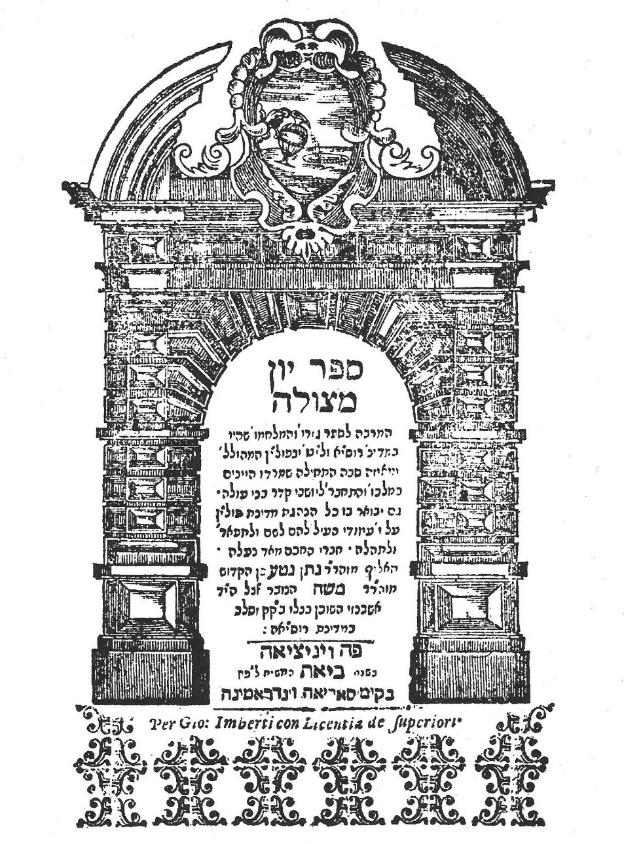
The following year, continuing his peripatetic movements, Hannover was in Venice where he published Yeven Mezulah, his detailed chronicle of the horrific experiences of Polish Jewry during the Chmielnicki massacres of 1648-49 (tah ve-tat) in which, according to contemporary sources, as many as several hundred thousand Jews were murdered and hundreds of communities destroyed.[15] This, the first edition of Yeven Mezulah, is based on first person accounts taken from oral testimony and other contemporary works. It was printed at the Vendramin press in 1653, also in quarto format (40: 24 ff.). Founded in 1630 by Giovanni Vendramin this press, broke the monopoly enjoyed until then by Bragadin. For the first ten years the press operated under the name of its founder, but after his death it became known by the names Commissaria Vendramina and Stamparia Vendramina. The press eventually joined with that of Bragadin and the combined presses continued to operate well into the eighteenth century.[16]
The title is from, “[I sink in] deep mire (yeven mezulah), [where there is no standing; I have come into deep waters, and the flood sweeps over me]” (Psalms 69:3). The title page, which has an architectural frame and is dated “coming ביאת (413 = 1653) of the Messiah,” states that it comes to relate the decrees and wars in the lands of Russia, Lithuania, and Poland. There is an introduction from Hannover, which begins,
I am the man who has seen affliction by the rod of his wrath” (Lamentations 3:1), when the Lord smote His people Israel, His first born. He cast down from Heaven to Earth His glory, the land of Poland, His delight. “Beautiful for situation, the joy of the whole earth” (Psalms 48:3) “The Lord has swallowed all the habitations of Jacob without pity” (Lamentations 2:2) “the lot of his inheritance” (Deuteronomy 3 2:9) “and remembered not his footstool in the day of his anger!” (Lamentations 2:1). All of this was foreseen by King David )may he rest in peace( when he prophesied the joining of the Kadarim (Tartars) and the Greeks to destroy Israel His chosen people in the year זאת (408 = 1648).
Hannover has entitled the work Yeven Mezulah because the events that transpired it are alluded to in Psalms. Also, yeven (yavanim – Greeks) refers to the Ukrainians, who belonged to the Greek Orthodox Church. Hannover writes that he has recorded both major and minor occurrences, all the decrees and persecutions, and their dates, so that families can calculate when their relatives perished. He also describes the customs of Polish Jewry, their religious devotion, based upon the pillars that support the world (ref. Avot 1:2, 18), and notes the high level of Torah scholarship, unmatched elsewhere. Yeven Mezulah has been described as “a complex work that recounts not only the cruel fate of Ukrainian Jewry, but also the socioeconomic and political factors that led up to the rebellion. . . . it is noteworthy that he is able to give details of various political and military developments within the Polish camp.”[17]
The introduction concludes with a request that the book be purchased to enable him to publish Neta Sha’ashu’im, a work that, as noted above, was never published. It then records in detail the tribulations that befell Eastern European Jewry, concluding with a description of the inner life of the Jews, how they lived in accordance with the pillars of Torah, Divine Service, charity, truth, justice, and peace, set forth in AvotYeven Mezulah is organized by community, describing what befell them, excepting an intermediate section on Chmielnicki. Two examples, the first a description of what occurred in 1Nemirow, relating how Chmielnicki and his followers gained entry by the ruse of flying Polish flags and thus passing themselves off as a relief force.
The people of the city were fully aware of this trickery, and nevertheless called to the Jews in the fortress: “Open the gate. This is a Polish army which has come to save you from the hands of your enemies . . . No sooner had the gates been opened than the Cossacks entered with drawn swords, and the townspeople too, armed with spears and scythes, and some only with clubs, and they killed the Jews in large numbers. Women and young girls were ravished, but some of the women and maidens jumped into the moat surrounding the fortress in order that the uncircumcised should not defile them. . . . but the Ukrainians swam after them with their swords and their scythes, and killed them in the water. Some of the enemy shot with their guns into the water, and killed them till the water became red with the blood of the slain. . . . The number of the slain and drowned in the holy community of Nemirow was about six thousand. They perished by all sorts of terrible deaths. . . . May God avenge their blood.
The second example, concerns R. Samson Ostropoler of Polonnoye (Volhynia), and his community,
Among them was a wise and understanding divinely inspired Kabbalist whose name was, Our Teacher and Master Rabbi Samson of the holy community of Ostropole. An angel would appear to him every day to teach him the mysteries of the Torah. . . . He preached frequently in the synagogue and exhorted the people to repent so that the evil would not come to pass. Accordingly all the communities repented sincerely but it did not avail, for the evil decree had already been sealed.
When the enemies and oppressors invaded the city, the above mentioned mystic and three hundred of the most prominent citizens, all dressed in shrouds, with prayer shawls over their heads, entered the synagogue and engaged in fervent prayer. When the enemies arrived they killed all of them upon the sacred ground of the synagogue, may God avenge their blood. Many hundreds who managed to survive were forced to change their faith and many hundreds were taken captive by the Tartars.[18]
A critical view of Yeven Mezulah is expressed by Edward Fram who writes that Hannover, in describing the massacre of Jews in Tulczyn, copied from other works, particularly Zok ha-Ittim, at times paraphrased those works, and “in some instances he took events said to have happened elsewhere and wove them into his own tale of Tulczyn,” without acknowledging his debt, melding them into his own tale of the massacre in Tulczyn. Fram suggests that Hannover did so because Zok ha-Ittim was not compelling enough to emphasize Jewish martyrdom and “place 1648 in the tradition of past tragedies, [therefore] a more resolute image of martyrdom would be necessary.”[19]
Nevertheless, Yeven Mezulah is regarded as the classic and most important work on tah ve-tat and has been frequently reprinted as well as having been translated into Yiddish, French, German, Russian, Polish, and English.
IV
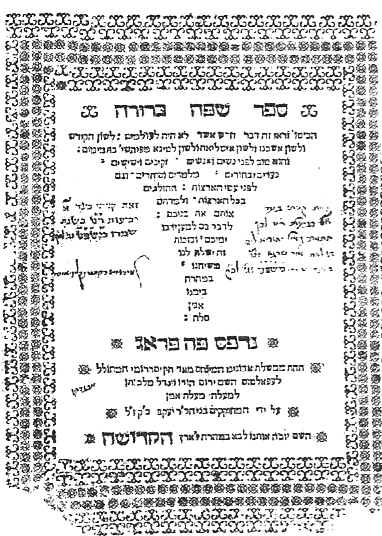
We next, in terms of Hannover’s publications, find him in Prague, where he published Safah Berurah, a popular four language, Hebrew-German-Latin-Italian, glossary for conversation and as a guidebook for travelers. Printed at the renowned press of the Benei Jacob Bak, opened as early as 1605. Safah Berurah is a medium format book (80: [44] ff.). The title is from, “For then I will convert the peoples to a clear language (safah berurah)” (Zephaniah 3:9). The title page states,
Behold, and see” (Lamentations 1:12) this new thing that was not before. The holy tongue (Hebrew), Ashkenaz, Italian, and Latin spread out flawlessly. It is good for women and men, the aged and elderly, adolescents and young, teacher and businessmen and also before the uneducated, who travel through all lands, “And you shall teach them to your children, speaking of them, so that your days may be multiplied” (cf. Deuteronomy 11:19,-21), and in this merit may He send to our Messiah speedily in our day. Amen Selah.
The Lord grant us the merit to come soon to the holy land הקדושה (420 = 1660).
 
The introduction follows, in which Hannover repeats the description of the book from the title-page and adds that it is based on the words in the Torah, the twenty-four books of the Bible, and some words from the six Sedorim (Mishnayot). He follows “after the reapers” (Ruth 2:7), gleaning every strange word in the sheaf: from concordances, Mirkevet ha-Mishneh, and commentaries.[20] Safah Berurah is so entitled because from this straightforward work all four languages will be pure and clear. In the second paragraph, in a mediumer font, Hannover explains the structure of the work, and that the Ashkenaz is not, with rare exception, that of the gentiles but of the Jews (Yiddish), but that the Latin is of the highest order, in order to be able to speak before kings and nobles.
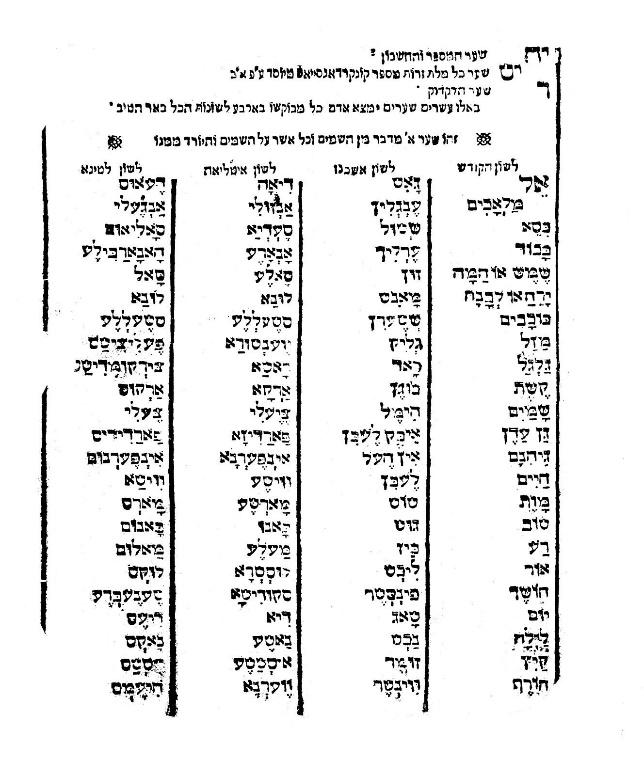
This is followed by a list of the twenty she’arim that make up Safah Berurah, that is, the divisions of the book, which is not alphabetic but by subject. This arrangement was apparently followed because Hannover believed that it would be more convenient for conversation to be able to locate words related by subject. The first two she’arim include terms dealing with the Divine and Torah; the next three with earthly objects; six through nine, fish, birds, animals and humans; continuing with material objects; such as clothing, jewelry, metal, arms, tools, nations, including proper forms of address, business, arithmetic, calendar, and grammar.
The approximately 2,000 words comprising the text follow, in four columns, from right to left, of Hebrew, Ashkenaz, Italian, and Latin, all in square vocalized Hebrew letters. At the end of the book are errata by language and a colophon in which Hannover thanks Gabriel Blanis and Jacob Szebrsziner for their assistance with the Italian and Latin, and notes that it was necessary to reduce the size of the glossary due to conditions in Poland, where there are no buyers.[21]
Safah Berurah has also been republished several times, beginning with an edition prepared by Jacob Koppel ben Wolf that included French at the press of Moses ben Abraham Mendes Coitinho (Amsterdam, 1701), and even an edition with Greek and Turkish (lacking place and date.[22]
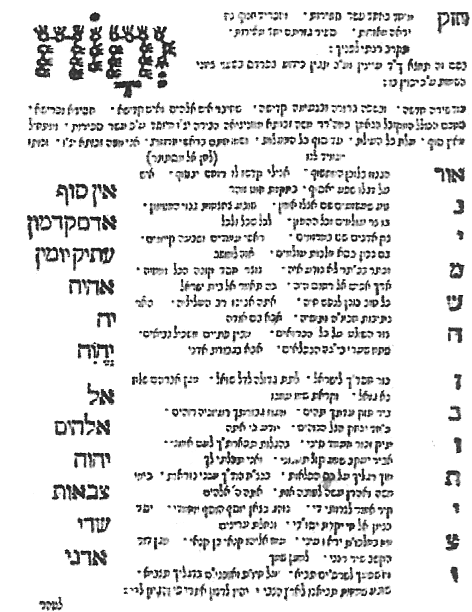
Sha’arei Ziyyon, Hannover’s, last published title, is a collection of Lurianic kabbalistic prayers, particularly for Tikkun Hazot (midnight prayers). First printed in Prague in the year “The trees of the Lord have their fill; the cedars of Lebanon, which he has planted ישבעו עצי י’י ארזי לבנון אשר נטע (422= 1662)” (Psalms 104:16), also at the press of Benei Jacob Bak. Sha’arei Ziyyon is a medium work set in octavo format (80: [38] ff.). The title is from “The Lord loves the gates of Zion (sha’arei Ziyyon) more than all the dwellings of Jacob” (Psalms 87:2).
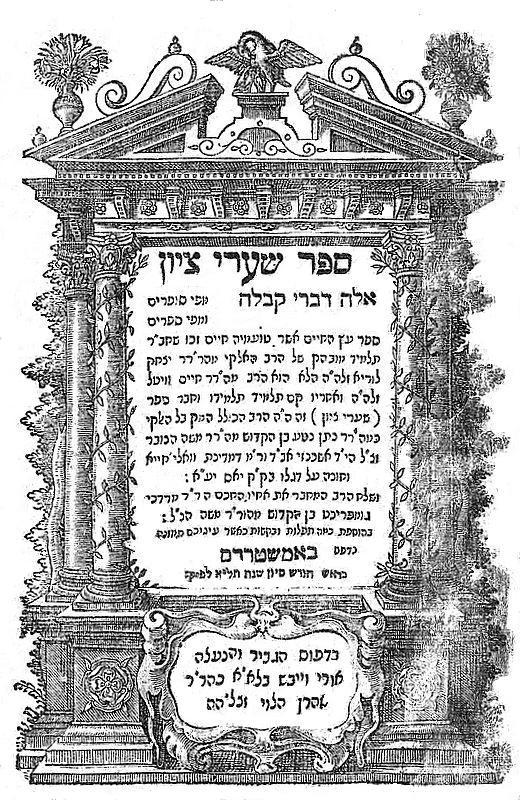
The following text and images are from the Amsterdam 1671 edition, published by Uri Phoebus ben Aaron ha-Levi in quarto in format (40: 54 ff.). Similar but not identical to the earlier Prague printing this edition is dated Rosh Hodesh Sivan 431 (Sunday, May 10, 1671). The title-page has an architectural frame with an eagle at the apex surrounds the text.[23] The text states,
These are the words of Kabbalah according to the scribes and according to the texts, Sefer Etz Hayyim, those who taste it merit life, written by the foremost student of the Godly rav, R. Isaac Luria, that is, R. Hayyim Vital. After him rose up students of his students and wrote this work (Sha’arei Ziyyon) . . .
The author sent his brother R. Mordecai Gumpricht ben Moses with many additional prayers and supplications, as can be seen . . .
The title-page is followed by the approbations reprinted from the first Prague edition, from R. Nahman ben Meir Kohen of Keremenec, R. Samuel ben Meir of Ostrow, and R. Israel ben Aaron Benzion of Satanow. They are followed by Hannover’s introduction, which concludes with a description of the seven sha’arim comprising Sha’arei ZiyyonTikkun Hazot based on R. Hayyim Vital’s Etz ha-HayyimTikkun ha-Nefesh, to be said after Tikkun Hazot with Yedid NefeshTikkun ha-Tefillah according to Kabbalah; Tikkun Kriat ha-TorahTikkun Kriat Shema with the appropriate kavvanotTikkun shel Erev Rosh Hodesh; and Tikkun Malkhut on Rosh Ha-Shanah and Yom ha-Kippurim.
Text is in a single column in rabbinic type, with headers, initial phrases, and some limited text in square letters. The volume concludes with an epilogue dating the conclusion of the work to “half of (15) Kislev, ‘And he shall judge the world תבל (Tuesday, November 17, 1671) in righteousness’ (Psalms 9:9) and compassion.” Printing was supervised by Mordecai Gumpricht ben Moses, Hannover’s brother.[24]
Sha’arei Ziyyon is primarily a compilation of existing prayers assembled into one work. Prayers such as Ribbono shel Olam, recited today prior to the removal of the Torah from the Ark by R. Jeremiah of Wertheim and the Yehi Ratzon after the priestly blessing are taken from Sha’arei Ziyyon. This edition, as stated on the title-page, is much expanded from the first edition (80 38 ff.). It contains additional prayers, piyyutim, and supplications, some of considerable length, among them prayers for someone incarcerated, for those who are ill, and has verse for the dedication of a new Torah scroll in the synagogue.[25]
Gershom Scholem, in describing the influence of Kabbalah on Jewish life writes that one of the areas in which it had the greatest influence was prayer. Among the most influential books in this sphere was Sha’arei Ziyyon in which Lurianic doctrines “of man’s mission on earth, his connections with the power of the upper worlds, the transmigrations of his soul, and his striving to achieve tikkun were woven into prayers that could be appreciated and understood by everyone, or that at least could arouse everyone’s imagination and emotion.”[26]
The popularity of Sha’arei Ziyyon is such that it has been described by Sylvie-Anne Goldberg as “one of the most widely read books in the Jewish world.”[27] Indeed, Sha’arei Ziyyon was reprinted in Prague three times in the seventeenth century (1682, 1688, 1692), and three additional times within a decade, in Dyhernfurth ([1689]), Wilhermsdorf (1690) and Dessau (1698). The Bet Eked Sefarim enumerates fifty-four editions through 1917.[28]
Hannover’s life reflects the times in which he lived, both in the adversity and travail he faced but also in how he overcame them. Just as the Jews of mid-seventeenth century Europe had their lives uprooted but survived to rebuild thriving communities so too Hannover’s accomplishments stand out. Not only did he both live and survive to chronicle the struggles and turmoil of gezerot tah ve-tat in Yeven Metzulah but he also wrote such varied books as Safah Berurah, a lexicography, and Sha’arei Ziyyon, a liturgical work, all three important and much reprinted titles. In addition, Hannover was the author of Neta Sha’ashu’im, noted above; Neṭa Ne’eman, a Kabbalistic work; a discourse on Purim, extant in manuscript, and a commentary on Otiyyot de-Rabbi Akiva, no longer extant. In addition to the printed editions of his books Hannover’s works were sufficiently popular that they were often copied by hand and numerous manuscripts of his works are extant. KTIV, the International Collection of Digitized Hebrew Manuscripts records twenty-six entries under Nathan Hannover, the most popular being by far being Sha’arei Ziyyon.[29]
Despite experiencing suffering and tragedy, Nathan Nata Hannover survived to live a life of meaning and leave us a legacy of value. Yeven Metzulah concludes that the Jews who escaped from the swords of their enemies were treated with kindness in Moravia, Austria, Bohemia, Italy, and especially Germany, given food, drink, lodging, garments, and gifts “each according to his importance,”
May their justice appear before God to shield them and all Israel wherever they are congregated, so that Israel may dwell in peace and tranquility in their habitations. May their merit be counted for us and for our children, that the Lord should hearken to our cries and gather our dispersed from the four corners of the earth, and send us our righteous Messiah, speedily in our day. Amen, Selah..
 
Seforim Blog Editors’ note:
 
For more sources on the significance of the work Sha’arei Ziyyon see Eliezer Brodt’s post on the Seforim Blog here specifically the section headed שערי ציון. Footnote 33 has some more current Hebrew literature on the sefer, and also of interest is the appendix where Brodt has a whole new look at  the relationship between this work and the Magen Avraham.
 
In addition, it’s worth noting that a beautiful new edition of the Sha’arei Ziyyon was printed in 2012 based on the first edition, and the volume includes his Ta’amei Sukkah. The Yeven Mezulah also has also been reprinted a few times in recent years.
[1] I would like to express my appreciation to Eli Genauer for reading the article and his comments. Images are courtesy of the Library of Congress, the Jewish National and University Library, the Valmadonna Trust Library, Ozar ha-Hochmah, and of Virtual Judaica.
[2] Ḥananel Nepi, Mordecai Samuel Ghirondi, Toledot Gedolei Yisrael (Trieste, 1853), p. 270 [Hebrew]; Moritz Steinschneider, Catalogus Liborium Hebraeorum in Bibliotheca Bodleiana (CB, Berlin, 1852-60), col. 2044; and William B. Helmreich, forward to Nathan Nata Hannover, Abyss of Despair (Yeven Metzulah), translator Abraham J. Mesch, (New York, 1950; reprint, New Brunswick, London, 1983), pp. 13-15; Israel Zinberg, A History of Jewish Literature IV (New York, 1975), translated by Bernard Martin, pp. 122-23.
[3] Hersh Goldwurm, ed. The Early Acharonim (Brooklyn, 1989), p. 194; Mordechai Margalioth, ed., Encyclopedia of Great Men in Israel IV (Tel Aviv, 1986), cols. 1181-82 [Hebrew].
[4] David B. Ruderman, Early Modern Jewry: A New Cultural History (Princeton, N. J., 2011), pp. 41, 51.
[5] Bernard D. Weinryb, The Jews of Poland; a Social and Economic History of the Jewish Community in Poland from 1100 to 1800 (Philadelphia, 1972), p. 166.
[6] Salo Wittmayer Baron, A social and religious history of the Jews XVI (Philadelphia, 1976), p. 98.
[7] Shmuel Ettinger, “Chmielnicki (Khmelnitski), Bogdan,” Encyclopaedia Judaica, edited by Michael Berenbaum and Fred Skolnik, vol. 4 (2007), pp. 654-656.
[8] Zinberg, p. 122.
[9] Shaul Stampfer, “What Actually Happened to the Jews of Ukraine in 1648?” Jewish History, 17:2 (2003), pp. 221-222.
[10] Jonathon Israel, European Jewry in the Age of Mercantilism 1550-1750 (London ; Portland, Or, 1998) p. 99.
[11] Simha Assaf, “The Inner Life of Polish Jewry (Prior to the Period of the Haskalah” Be-Ohole Yaʻaḳov: Peraḳim me-hHaye ha-Tarbut shel ha-Yehudim bi-Yeme ha-Benayim (Jerusalem, 1943), p. 80 [Hebrew].
[12] L. Fuks and R. G. Fuks Mansfeld, Hebrew Typography in the Northern Netherlands 1585 – 1815 (Leiden, 1984-87), I p. 197 no. 275.
[13]  Concerning such medium books published as a prospectus see my “Books not Printed, Dreams not Realized,” in Further Studies in the Making of the Early Hebrew Book (Brill, Leiden/Boston, 2013), pp. 285-303.
[14] Concerning the varied usage of the bear pressmark see my “The Bear Motif on Eighteenth Century Hebrew Books” The Papers of the Bibliographical Society of America 102:3 (New York, N. Y., 2008), pp. 341-61, reprinted in Further Studies, pp. 57-76.
[15] Other contemporary works describing the horrors of tah ve-tat are R. Samuel Feivush ben Nathan Feitel’s Tit ha-Yaven (Venice, c. 1650), R. Meir ben Samuel of Shcherbreshin’s Zok ha-Ittim (Cracow, 1650), and R. Jacob ben ha-kodesh (the holy, suggesting that he was among the murdered) Simeon of Tomashov’s Ohel Ya’akov (Venice, 1662). The latter writing ““Light became darkness” (Job 18:6) for me, for they killed my wife and three sons, “and I lived in the land of Nod” (cf. Genesis 4:16) until 1656. In that year arose grievous troubles, old and also new, and I came uponmidat ha-din (strict justice) and “Disaster upon disaster” (Ezekiel 7:26), plunder after plunder, until finally I encountered pestilence, sword, famine, and captivity and every day was worse than before. Also to be noted are selihot commemorating tah ve-tat (1648-19) such as R. Gabriel ben Joshua Heschel Schlussburg’s Petah Teshuvah ([1651], Amsterdam) selihot and lamentation on the Jews massacred in tah ve-tat (written as a commentary on the book of Lamentations and R. Shabbetai ben Meir ha-Kohen (Shah)’s Selihot ve-Kinnot (Megillat Eifah, 1651, Amsterdam).
[16] David Amram, The Makers of Hebrew Books in Italy (Philadelphia, 1909, reprint London, 1963), p. 372; Joshua Bloch, “Venetian Printers of Hebrew Books,” in Hebrew Printing and Bibliography (New York, 1976), p. 86.

[17] Adam Teller, “Hannover, Natan Note,” YIVO Encyclopedia of Jews in Eastern Europe 1 (New Haven & London, 2008), p. 656.

[18] Both translations are from Mesch, pp. 51, 63-64 respectively.
[19] Edward Fram, “Creating a Tale of Martyrdom in Tulczyn, 1648,” Jewish History and Jewish MemoryEssays in Honor of Yosef Hayim Yerushalmi, ed. Elisheva Carlebach, John M. Efron, David N. Myers (Hanover, 1998), pp. 90-91.
[20] Mirkevet ha-Mishneh (Cracow, 1534), by Asher Anshel of Cracow, is a concordance and glossary of the Bible. Published by Samuel, Asher, and Elyakim, sons of Hayyim Halicz, it was the first Yiddish book printed in Poland. Concerning Mirkevet ha-Mishneh see Marvin J. Heller, The Sixteenth Century Hebrew Book: An Abridged Thesaurus I (Brill, Leiden, 2004), pp. 216-17.
[21] Shimeon Brisman, History and Guide to Judaic Dictionaries and Concordances (Hoboken, 2000), pp. 44-46.
[22] Ch. B. Friedberg, Bet Eked Sepharim, (Israel, n.d.), shin 2223 [Hebrew].
[23] “The Eagle Motif on 16th and 17th Century Hebrew Books,” Printing History, NS 17 (Syracuse, 2015), pp. 16-40.
[24] Fuks and R. G. Fuks Mansfeld, II pp. 263-64 no. 32.
[25] A. Z. Idelsohn, Jewish Liturgy and Its Development (1932, reprint New York, 1995), pp. 55, 80, 259.
[26] Gershom Scholem, Kabbalah (NewYork, 1973), p. 193.
[27] Sylvie-Anne Goldberg, Crossing the JabbokIllness and death in Ashkenazi Judaism in Sixteenth through Ninteenth-Century Prague (Berkeley, 1996), p. 88.
[28] Friedberg, Bet Eked Sepharimshin 2148.
[29] I would like to thank Eli Genauer for bringing this to my attention. The address for KTIV is http://web.nli.org.il/sites/nlis/en/manuscript.


Chaim Zelig Slonimsky and the Diskin family

Chaim Zelig Slonimsky and the Diskin family
by Zerachya Licht
Two years ago, the Seforim Blog published an article, written by Zecharya Licht, about the maskil, Chaim Zelig Slonimsky, and the Chanuka controversy he’d ignited.
Last year, the Seforim Blog published published Part I of another article, also written by Zecharya Licht, which again focused on the above-mentioned maskil. This second article highlighted Slonimsky’s relationship with the Diskin Family.
Part II of the article, which had already been published, zeroed in on Slonimsky’s relationship with R’ Binyomin Diskin of Horodna, the patriarch of the illustrious and rabbinical Diskin family. In this article, Licht reproduced hitherto unknown letter written by R’ Yehoshua Leib’s son, Binyomin Diskin to the maskil, Shmuel Yosef Finn. In that letter, Binyomin Diskin mentions the relationship between Slonimsky and Diskin’s grandfather R’ Binyomin of Horodna.
Presented here is Part II of the monograph which focuses on R’ Yehoshua Leib’s connection with Slonimsky. In the appendixes, R’ Yehoshua Leib’s positive relationship to the Haskalah is discussed. The enlightenment of the wider Diskin family, and R’ Abbele Paslover’s attitude towards the books published by the maskilim, are also discussed here.
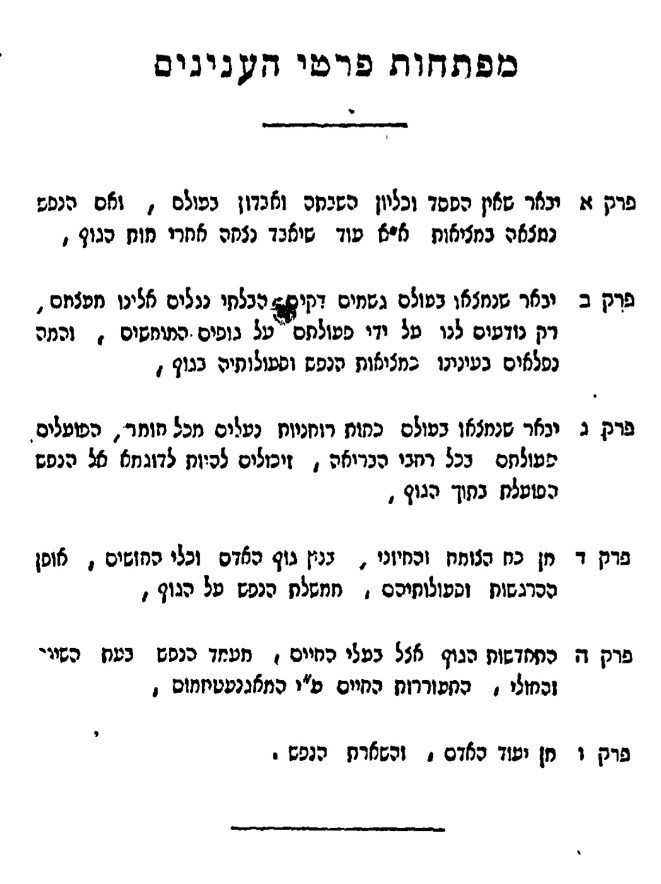
Perakim א’ through ד’ appear in Part I.
פרק ה: מציאות הנפש – השכלתו הכללית של מהרי”ל דיסקין.
נספח א: יחסו של מהרי”ל דיסקין להשכלה כללית בעודו משמש ברבנות באירופה.
נספח ב: יחסם להשכלה כללית של שאר בניו וחתנו של רבי בנימין דיסקין.
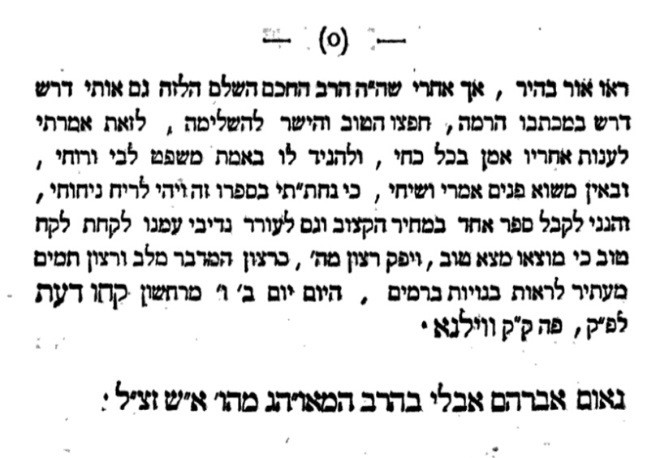
נספח ג: הסכמות מרבי אבלי לספרי משכילים.
פרק ה
מציאות הנפש – השכלתו של מהריל דיסקין
בחנוכה שנת תרי”ב הוציא חז”ס לאור את ספרו ‘מציאות הנפש’ ששמו המלא הוא ‘מציאות הנפש וקיומה חוץ לגוף – מבואר על פי ראיות נכוחות הלקוחות מן בחינות הטבע’. בדבריו “אל הקורא” כתב המחבר, שספרו מיועד לאלה “אשר ספר אלה [ספרים ההולכים על דרך העיון והמחקר] ואלה [ספרי מוסר והיראה הנמצאים אתנו למרבה] בלתי נכון לפניהם לפשט עקמומיות שבלב, והמה האנשים אשר …”
נראים הדברים שספרו ‘מציאות הנפש’ מצא חן בעיני הרבנים, ויעיד עליו העובדה שספר זה צוטט ע”י הגאון רבי מרדכי גימפל יפה האב”ד ראזיאני[1] בספרו ‘תכלת מרדכי’ על הרמב”ן (בראשית א, יד). אמנם מה שמעניין ביותר הוא שיתכן מאד שגם הגאון רבי יהושע ליב דיסקין זצ”ל עשה שימוש בספר זה. שהרי בכתביו של מהרי”ל דיסקין נמצא כתוב:
העיקר, ידוע אנחנו מאמינין בהשארות הנפש, ואולם חה”ע[2] מודים בזה, לפי שלא נמצא בעולם שום נברא שנעדר מן העולם, כי אם לבוש צורה אחרת, וכן הנשרף נשאר אפר והעודף בעשן נשאר נחלק למים ואויר, ונפש זה שהכרנוה בחיים איפה היא? אם לא שישנה בפני עצמה וכו’.[3]
רעיון זה שיש להוכיח השארת הנפש מ’חוק שימור החומר’ שגילו המדענים בני המאה ה-18 מופיע בפרק ראשון מהספר ‘מציאות הנפש’. מטרת הפרק היא, בלשונו של חז”ס, ש”יבאר שאין הפסד וכליון, השבתה ואבדון בעולם ואם הנפש נמצאה במציאות אי אפשר עוד שיאבד נצחה אחרי מות הגוף”. סביר להניח שמהרי”ל דיסקין ראה דבר זה בשם חכמי האומות העולם בספרו של חז”ס ומשם רשם רשימתו הנ”ל.
 
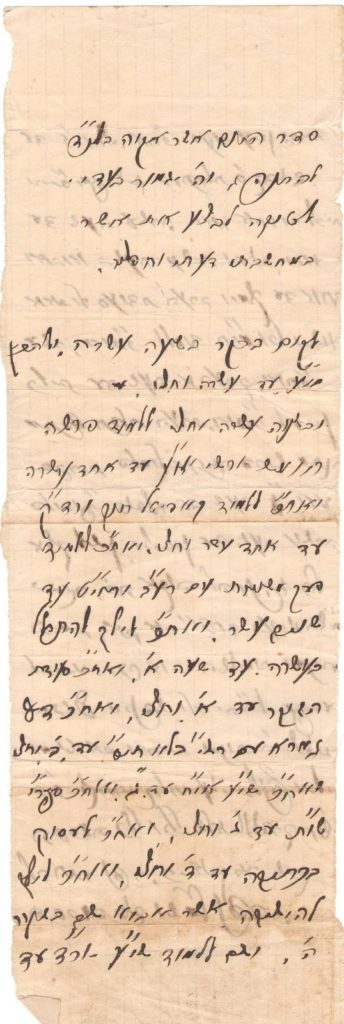
כבר פרסם הפרופסור מלך שפירא בספרים בלוג שהגאון רבי יהושע ליב ציין לספר ‘הכורם’ מהמשכיל נפתלי הירץ הומברג[4]. הומברג היה מחבריו של משה מנדלסון ואף כתב את ה’ביאור’ על חומשים במדבר ודברים. מה שמפתיע ביותר הוא מה שגילה הרב אליעזר בראדט במאמרו על קופרניקוס[5] שבסדר יומו של מהרי”ל דיסקין שנתפרסם מתוך כתב ידו מצאנו שמהרי”ל דיסקין קיבל על עצמו “לעיין בספרים פלפול אגדה דרוש מחקר פלוסופי’ השכלה…”. לאור תגליות אלו לא רחוק הוא לומר כהשערתי שמהרי”ל עיין גם בספר של עמיתו חז”ס.
טרם שנמשיך לשרטט עוד פרטים אודות חז”ס ופעילותיו הספרותית, אעיר על איזה פרטים שבתוך סדר היום הנ”ל של מהרי”ל.
יש להעיר שהמהדיר בספר זכרון יהוסף, סילף כוונת מהרי”ל דיסקין, בכוונה או שלא בכוונה. בהערה כ”ב ‘מפרש’ המהדיר הנ”ל, שקבלתו של מהרי”ל דיסקין ללמוד ‘ספרי פלוסופיה’ היינו ספרים כמו מורה נבוכים להרמב”ם וכדומה, דבר זה עדיין בכלל הגיוני. אבל בהערה כ”ג ‘מפרש’ שקבלת מהרי”ל דיסקין ללמוד ‘ספרי השכלה’, היינו ספרי קבלה והיא מלשון ‘השכל וידוע אותי’, זה הפירוש כבר מביא הקורא לידי גיחוך[6]. הכל יודעים מה זה ‘השכלה’ ואין כאן מקום לפרשה בתרי אנפין. ועוד, אפילו אם יתעקש בזה המתעקש, הלא סדר הדברים מורה שמהרי”ל קבע הזמן לפני הליכתו לשינה לדברים יותר קלים הדורשים שיעור פחות של ריכוז המוח: פלפול, אגדה, דרוש, מחקר, פילוסופיה, השכלה. ואם נפרש כולם כפשוטם, הרי לפנינו סדר של לימוד דברים קלים ולא כל כך רציניים כמו שאר לימודיו במשך היום, אבל אם נפרש שהכוונה לקבלה אז אין כאן סדר של מהכבד אל הקל. וכבר שקלו וטרו בזה באוצר החכמה פורום ואין צורך לכפול את הדברים.
עוד פרט חשוב שראוי להעיר עליו הוא, שמהרי”ל קבע לימודו ב”פרשה חומש ורש”י ואבן עזרא”. וידוע שפירוש האבן עזרא אהוב ביותר על בעלי המחקר והשכלה. וגם על פרט זה לא דלגו עיניו של המהדיר הנ”ל, וכדי להגן על מהרי”ל דיסקין וגינוניו האנטי-משכיליים מצא לנכון להוסיף בהערה ד’ שהגרנ”צ ווייס רשם כמה פעמים על דברי האב”ע “אין הדין כן – מהרי”ל דיסקין זצ”ל”. הרי במקום שאנו יכולים ללמוד ממהריל”ד שיש לקבוע לימודינו בפירוש האבן עזרא, בא המהדיר להעיר לנו שדברי האבן עזרא הם נגד הדין!
עובדה נוספת מעניינת מאד מופיעה בהקדמה ל’אלון בכות’ [הספד על מהרי”ל] שנכתבה על ידי תלמידו הרב יעקב אורנשטיין[7] ובה הוא מונה את אותן החכמות שהשתלם בהן אביו של מהרי”ל, הגאון רבי בנימין, כחכמות שהצטיין בהן גם מהרי”ל:
החכמות שיש בהם צורך לתוה”ק בכולם היה לו עשר ידות, בהנדסה, באלגיברה, בתכונות שמים וגלגלי המזלות, בכל אלה למד ולימד הפליא עצה הגדיל תושיה – בכל אלה לו דומיה תהילה[8] ע”כ דבריי מעטים.[9]
הרי לנו עדות מפי תלמיד מהרי”ל שניתן ללמוד ממנה, שבאותן חכמות שהצטיין בהן רבי בנימין דיסקין, ואחריו חז”ס, גם מהרי”ל הצטיין בהן, והן אלגברה ותכונות השמים.
¨¨¨
נחזור לספר ‘מציאות הנפש’. בהשקפה הראשונה נראה שתוכן הספר הוא חיזוק אמונה בהשארת הנפש. ואכן לפי ר’ יעקב ליפשיץ, התבטא בזה השתייכותו של חז”ס למשכילי דור הישן שכיבדו את המסורה:
החכם מר חז”ס נחשב בימים ההם ממשכילי הדור הישן כמו שכנה הוא את עצמו באיזה מאמרו “תלמיד מבית המדרש הישן”, ובספריו ובמאמריו מימי נעוריו התראה כעין מגן ומחסה למסורת אבות. שלתכלית זו נחבר את ספרו ‘יסוד העיבור’ ומחברתו ‘מציאות הנפש’ להוכיח אמיתת השארת הנפש.[10]
ברם, הוסיף ר’ יעקב ליפשיץ:
המבקרים המומחים הכירו גם במחברותיו אלה שצפונה בם ארס של חפשיות עד שאפילו הסופר המפורסם ‘ליליענבלום'[11] יאמר במחברתו הידועה ‘חטאת נעורים’ שמאז שקרא את המחברת ‘מציאות הנפש’ התעוררה בלבבו הספק של מציאות הנפש’.[12]
עם כל זה מסיק ליפשיץ:
ביחס למשכילי דורו שקפצו בעזות להיות לרוכבים ומנהיגים על ישראל בכח הרשות והטיחו דברים בספרותם כלפי מסורת אבות, נחשב חז”ס לבעל נימוס, ורבים נהגו בו כבוד ויקר.
יש שטענו שערבוביה זו של חיזוק אמונה יחד עם קרירותה, לא הייתה מקרית. אלא שבכוונה חיבר חז”ס ספרים שבאופן רשמי באים לחזק את הדת, אבל במקום לחזקה, הטמין בו חז”ס ארס נגד הדת. אברהם אריה עקביא[13] מעיר, שבכל מאמריו וספריו נזהר חז”ס שלא לגלות שמץ של כפירה באלקים ולא לפגוע ברגשי אנשי הדת; ולא עוד, אלא דווקא בהגיעו במחקריו המדעיים לנקודות העלולות לשמש יסוד או ראייה לכפירה, דווקא שם הוא מוצא לנכון לדבר בשבח האמונה ולהאדיר את גדולת אלקים הכל יכול, אבל לא תמיד נראים כיוצאים מלב אמת.[14] עקביא ממשיך להביא דוגמא לכך – ובלשונו “היא הדוגמה החריפה ביותר” – מהספר הקטן בעל השם הארוך ‘מציאת הנפש וקיומה חוץ לגוף מבואר על פי ראיות נכוחות הלקוחות מן בחינות הטבע’. תמצית דבריו של עקביא היא, שבמקום להוכיח את השארת הנפש, מסיק חז”ס כי כל הראיות שהביא לשם כך לא היו אלא ראיות על דרך ההיקש ואילו מופת מוחלט המוכיח מצד עצמו את מציאות הנפש וקיומה בהיפרד מן הגוף אי אפשר למצוא בשום פנים, אלא שטבע האדם הוא, שאין הוא יכול להאמין בכיליון הנפש… אחת היא האמונה באושר הנצחי המנחמת את האדם מכל יגון החיים, אשרי אדם עוז לו בה! הרי בא ללמד הוכחות להשארת הנפש ונמצא למד שאין לאמונה זו מופת.
יתר דברי חזס ומעשיו יופיעו בעזהית בעתיד
נספח א
יחסו של מהריל דיסקין להשכלה כללית בעודו משמש ברבנות באירופה
מעניין לעניין, ברצוני להזכיר כמה רמזים שמצאתי פה ושם המורים על השקפתו החיובית של מהרי”ל דיסקין לשאר חכמות בכל אותן השנים ששימש ברבנות בחו”ל. בזמן שבתו בירושלים היה ידוע למקנא קנאת ה’ נגד אלו שהלכו לרעות בשדי נכרים. לכן, הדבר מפתיע ביותר שלא כן היו נראים פני הדברים בעודו יושבת בארץ טמאה, חוצה לארץ.
1. תקופת קאוונא:
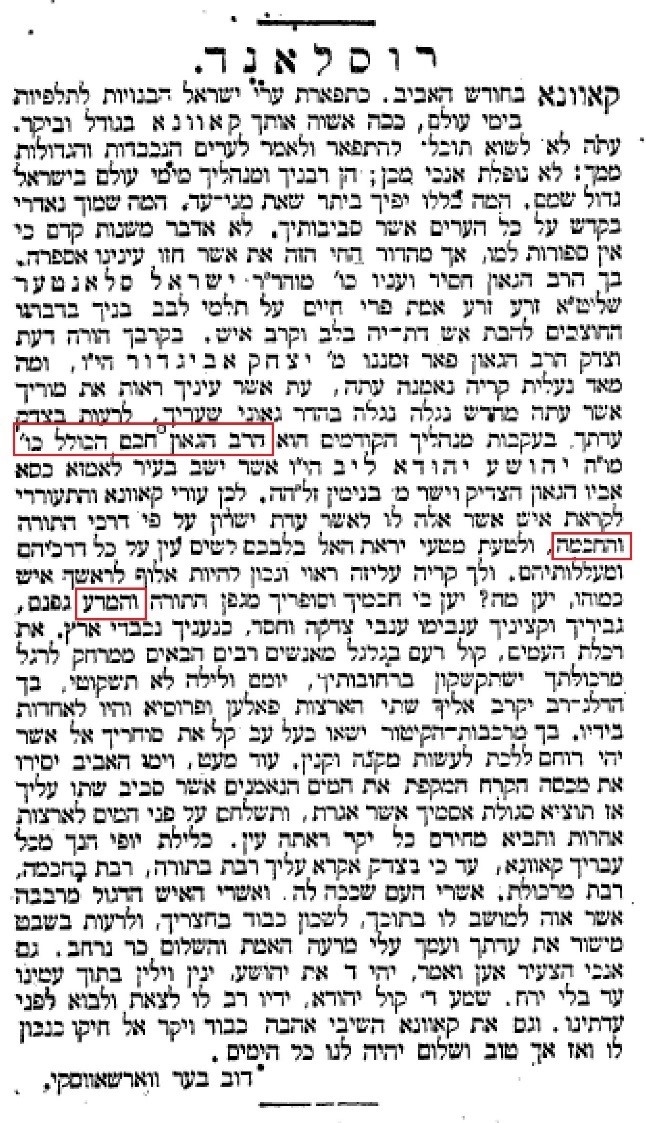
כשנתקבל מהרי”ל לשמש כרב אב”ד בעיר הגדולה קאוונא (1861) נתפרסם בהמגיד מודעה אודות התמנותו. מתוך סגנון הדברים משמע שהרב יהושע ליב רכש לו לכה”פ איזו ידיעות בעניני העולם:
קאוונא בחודש האביב. כתפארת ערי ישראל הבנויות לתלפיות בימי עולם, ככה אשוה אותך קאוונא בגודל וביקר. עתה לא לשוא תוכלי להתפאר ולאמר לערים הנכבדות והגדולות ממך: לא נופלת אנכי מכן; הן רבניך ומנהליך מימי עולם בישראל גדול שם. המה כללו יפיך ביתר שאת מני-עד. המה שמוך נאדרי בקדש על כל הערים אשר סביבותיך. לא אדבר משנות קדם כי אין ספורות למו, אך מהדור החי הזה את אשר חזו עינינו אספרה. בך הרב הגאון חסיד ועניו כו’ מוהר”ר ישראל סלאנטער שליט”א זרע זרע אמת פרי חיים על תלמי לבב בניך בדבריו החוצבים להבת אש דת-יה בלב וקרב איש. בקרבך הורה דעת וצדק הרב הגאון פאר זמננו מ’ יצחק אביגדור הי”ו, ומה מאד נעלית קריה נאמנה עתה, עת אשר עיניך ראות את מוריך אשר עתה מחדש נגלה נגלה בהדר גאוני שעריך, לרעות בצדק עדתך בעקבות מנהליך הקודמים הוא הרב הגאון חכם הכולל כו’ מו”ה יהושע יהודא ליב הי”ו אשר ישב בעיר לאמזא כסא אביו הגאון הצדיק וישר מ’ בנימין זלה”ה. לכן עורי קאוונא והתעוררי לקראת איש אשר אלה לו לאשר עדת ישרון על פי דרכי התורה והחכמה. ולטעת מטעי יראת האל לבבבם לשים עין על כל דרכיהם ומעללותיהם. ולכן קריה עליזה ראוי ונכון להיות אלוף לראשך איש כמוהו. יען מה? יען כי חכמיך וסופריך מגפן התורה והמדע גפנם, גביריך וקצינך ענבימו ענבי צדקה וחסד… דוב בער ווארשאווסקי[15]
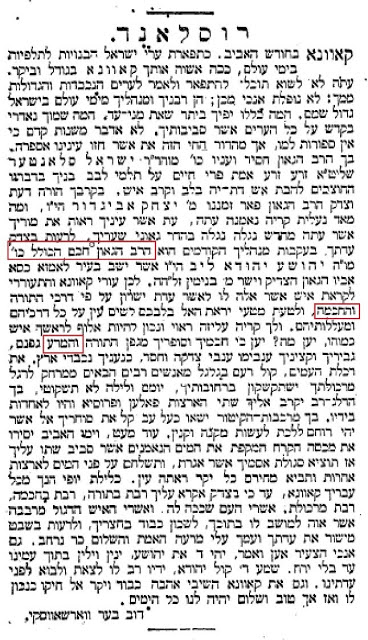
2. תקופת שקלאוו:
לאחר שכיהן בקאוונא עבר לשרת בעיר שקלאוו. בתקופה זו מצאנו הדים למהרי”ל הקנאי מצד אחד, אבל מאידך מצאנו עדים המעידים על הידיעות הכלליות שרכש ועמדתו החיובית כלפיהן.
בסוף תקופת רבנותו בעיר שקלאוו נתפרסם במכ”ע הלבנון פרטים אודות ביקורו של מהרי”ל באשכנז. אנו למדים מתוך הכתבה שבלבנון, שזמן מה לפני כן נתפרסם בעיתון המליץ “כי הרב הגאון הזה כל מעיינו להוליך את העם בחשך”[16]. כמענה לכך, מדגיש הסופר של ‘הלבנון’ איך שרבי יהושע ליב היה פתוח מאד להקים בית ספר לתורה ולחכם ברוסיה ופולין. וכך הוא כותב:
מאינץ. כ”א תמוז. – זה שבנו מעיר זאדען אשר הלכנו לשם לראות את פני הרב הגאון הגדול צדיק וענו מוהר”ר יהושע ליב נ”י האבד”ק שקלאב, אשר בא הוא ורעיתו הצדקת והמשכלת תי’ לשתות ממעיני מים חיים אשר בזאדען. מאד מאד שבעה לה נפשנו שובע נעימות מראות את פני האדם הגדול הזה, וביותר אחרי דברנו עמו בהענינים הנוגעים לתקון מעמד המוסרי והרוחני של אחינו ברוסיא. ספרנו לו מדבר בית הספר לתורה וחכמה אשר יסד הרה”ג הצדיק מוה’ רפאל שמשון הירש בפפד”מ, והבטיחנו כי בשובו דרך פפדמ[17] יבוא לראות את כבוד הבית הזהלמען יספר באזני אחיו הרבנים הגאונים ברופ [ברוסיה ופוליןאיך יעזור ה‘ לחוסים בו המשתדלים לגדל את בני הנעורים על ברכי התורה והדעהלמען יראו וישמעו אחינו ברוסיא ויעשו כמעשה אחינו בפפדמ. ואחרי שמענו את כל מחשבותיו הטובות והרצויות, אמרנו מי יתן ויכולנו להביא הלום את אלה המבאישים אשר נסו להבאיש את שמן הרקח בשערי ‘המליץ’, לאמר כי הרב הגאון הזה כל מעיינו להוליך את העם בחשך. – מי יתן והיו האנשים האלה בפנינו כי עתה בכלימה כסנו פניהם בדברם על צדיק עתק. כי האמנם בכל לבבו יחפץ הרב הגאון הנז‘ אשר אחינו ברוסיא ידעו שפת ארץ מולדתם וכל הידיעות הדרושות לאדם לדעתאבל בראש כולם יחפץ כי לא תשתכח חו התורה מפי זרענו.
בהפרדנו מלפני הרב הגאון הצדיק הזה, אמרנו בלבבנו: מי יתן ויכולנו לאסוף את אחינו באשכנז לעיר זאדען, למען תאורנה עיניהם מאור פני גאון וצדיק מרוסיא, למען לא יוסיפו לחשוב תועה על כל אחינו יושבי רוסיא כי מרביתם הם כאלה הדופקים על דלתותם לבקש מהם ככר לחם ואגורות נחושת. יבואו נא אחינו האשכנזים עתה לזאדען, יבאו ויראו ויקימו בפניהם ויוכחו לדעת כי התורה והצדקות יחד עם ענוה טהורה תשכון מרומים עוד היום ברוסיא.
מכל אחינו האוהבים את התורה היושבים סמוך לזאדען, נאוה תהלה לאיזה מנכבדי עמנו אשר בפפד”מ כי באו לבקר את פני הגאון הנז’ ולשמו ולזכרו תאוות נפשם. גם הגביר הצדיק מוה’ זיסקיד הירש אשר הוא עתה בזאדען בקר את כבוד הגאון הזה בביתו.[18]
חודש אחד לאחר מכן, נתפרסמה עוד כתבה בעיתון הלבנון, שנכתב ע”י הסופר אפרים בן דוב ראסקין[19], יליד שקלאוו, ומטרתה להעיד על אמיתת הדברים שבכתבה הנ”ל, ולהבהיר את עמדתו החיובית של מהרי”ל כלפי השכלה כללית. סופר זה מציג את עצמו כאחד משומעי לקחו הטוב של מהרי”ל, בשיעור תלמוד איזה שעות בכל יום, ומהנכנסים אליו בלא בר.
אפרים ראסקין מספר בפרוטרוט אודות הנהגתו של מהרי”ל עם גוים שבאו להישפט בפניו. וכך הוא כותב:
כמה פעמים הייתי בבית הגאון הנ”ל, כשבאו עברים ונוצרים לפניו לבקש מאתו, שיהיה השופט ביניהם, אודות הסכסוכים אשר בעסקיהם, בעת שלא היו עוד שופטי השלום בערי רוססיא הלבנה, כי שמו הטוב הוא מפורסם גם בין הרוססים יושבי המקום, התקין שכל הטענות אשר היו בין העברי והנוצרי יהיו בלשון רוססיא, כדי שיבין הנוצרי מה שידבר ויטעון נגדו העברי, וכאשר בין אחינו אז היה יקר מאוד מי שיבין לדבר בלשון רוססיא, ובפרט לסדר טענות נגד איש ריבו, אשר שפתו שגור על לשונו, אמר שהעברי יעמיד מליץ, שידבר בעדו בלשון רוססיא לפני כבודו, כי הוא מבין בלשון רוססיא.[20]
ולגבי גוף העניין, שמהרי”ל החזיק מעמד חיובי כלפי לימוד שפות זרות וכו’,, כותב אפרים ראסקין:
בערדיאנסק. י”ד אב. שנת “התברכו”. בעלה 47 – ממ”ע הזאת שנה ט’. קראתי דברי המו”ל על אודות כבוד אדמו”ר, הב הגאון הגדול, צדיק ועניו, מפואר במעלות ובמדות, שונא בצע, הר”ר יהושע יהודא ליב דיסקין נרו יאיר ויופיע. האב”ד משקלאוו עיר מולדתי אשר דבר עמו בנוגע להשכלת אחינו ברוססיא הלבנה, ועד כמה נחוץ ללמדם לשון ושפת המדינה, והנני לקיים הדברים האלה… שמעתי מאדמור כמה פעמיםכי לא טוב הדבר בעינו מה שלא ירגילו בני הנעורים את לשונם לדבר בלשון המדינהכי טוב תורה עם דרך ארץוהוא יודע לילך לפי רוח עת החדשה להצמיד האמונה והתבונה ביחד. בתחילת בואו לשקלאוו, פרצה אש המחלוקת בין המתנגדים והחסידים[21], ורבים תלו אשמת המחלוקת באדמו”ר, אשר ידוע כעת לכל אנשי עיר שקלאוו, כי חף הוא מפשע המחלוקת. ואחרי כן כאשר רבים הכירו ערכו ותכונותיו היקרות והנחמדות[22] ונשקעה חמת המחלוקת, קפצה עליו חמת עלילי דברים, כאשר נתפרסם הדברים במ”ע הרוססים, ובמ”ע “היום” בלשון רוססיא שיצא אז לאור באדעססע, כתבו משכילי עיר שקלאוו, והצדיקו את הגאון מהפשעים אשר חפאו עליו. וגם לי ידוע כי נקי הוא מהפשעים אשר עללו עליו, וכל אלה וגם סיבת נפילת מעמד אנשי עיר שקלאוו, אשר נפלו פלאים – ד’ ירחם עליהם – עצרו בעדו מלדבר על לב אנשי עיר שקלאוושלא ילכו נגד העת החדשה הקוראת בכח. וכפי דברי הרב המו”ל בעלה הנ”ל, הבטיח לו אדמו”ר, בשובו בשלום שקלאווה, יסע דרך פפד”מ… למען בבואו לביתו ידבר על לב נדיבי עיר שקלאוו, להוציא מחשבתו הטובה, אשר הוא חושב, לאור. ולתקן בעירו דבר טוב ומועיל כזה, בית תלמוד תורה אשר מאתו תצא תורה ותבונה ביחד, אמרתי אבא במאמרי זה, לעורר את אחינו בערי רוסייא הלבנה בכלל, ויושב עיר שקאלוו בפרט, לשמוע ולהקשיב לקול העת החדשה הקוראת בכח, לעורר בני הנעורים הנרדמים בחיק העצלות והיאוש, להבינם ולהשכילם כי ערומים הם מחכמה ודעת דרכי החיים. ואקרא! למען יתאמצו ללמוד לבני הנעורים שפת המדינה על בוריה. כי מי כמוני יודע המכשולים אשר יפגשו בני הנעורים אחרי אכלם את לחם העצלות בבית אביהם וחותנם, ואחרי כן כאשר יאבדו הונם בענין רע רח”ל, ואפס מהם כל תקוה לפרנס את ביתם ועולליהם במקום מגורם מוכרחים הם לגלות את עצמם לערי רוססיא הגדולה, הקטנה או החדשה לבקש טרף לנפשם ונפש עולליהם המבקשים לחם בתקותם למצוא שם את אשר יבקשו. וכשהם נודדים בארץ, אז ירגישו ברגש מכאיב לב, המכשולים אשר יקרה להם בארץ נידודיהם, בזה שלא יבינו שפת המדינה, ולא ידעו דרכי החיים, ויקללו את יום הולדם. וגם את הוריהם ומוריהם לא ינקו. [ולאחר שהוא ממשיך לעורר אנשים שילמדו את בניהם שפת המדינה, הוא מסיים:] ואל ראשי החברה כנכבדה “מרבי ההשכלה בין אחינו ברוססיא” ראשי ונדיבי אחינו בארצינו אקרא, שגם אתם תשימו לב על מחשבת הגאון משקלאוו, אשר במחשבתו לעשות, ותתאמצו להיות לעזר להדבר הטוב והמועיל הזאת. ומהנכון שתעוררו את הגאון הנ”ל במכתב פרטי, להציע לפניו את אשר יכשר בעיניכם, לעשות בהדבר הטוב הזאת, ולחזקהו ולאמצהו ולכם תהיה צדקה…[23]
אחיכם המדבר באמת אפרים בן דוב ראסקין, ילידי שקלאוו
מיד אחר הכתבה הנ”ל של ראסקין, יש הערה מהמו”ל אודות התמנותו של מהרי”ל לשרת כאב”ד בעיר בריסק:
בזה הננו לבשר לכל מוקירי שם כבוד הגאב”ד משקלאב הי”ו נ”י, כי נעתר לבקשת עיר ואם בישראל ק”ק בריסק דליטא לשבת בתוכם על כסא הרבנות, [ואף כי צר לו מאד לעזוב שקלאב אשר נפשו קשורה בנפש העדה הקדושה שם, רק מפני רוע אוירה ומצב בריאותו רפה מוכרח לעזוב אותה], ובעוד איזה שבועות יבוא אליהם. בכל לב נברך עדת עיר בריסק כי תשמח היא באיש אלקים הזה אשר זכתה כי יהיה לה לרב והוא ישמח בה עד עולם.[24]
3. תקופת בריסק:
גם בתקופת כהונתו בבריסק מצאנו שתי דמויות הנ”ל משתמשים בערבוביה. המשכילים מאשימים אותו כאיש ההולך בחושך ובאפלה שאינו רוצה להתקדם ולהתפתח. אמנם מאידך מצאנו מגינים עליו ומעידים על השכלתו הכללית.
בעיתון הלבנון מופיע מענה לדברי המשכילים שהתלוצצו בעיתון המגיד[25] על פעילות מהרי”ל בעיר בריסק לחזק את שמירת שבת. המענה נדפס בהלבנון ונחתם בשם ‘פל”א’ ובו הוא מוחה על שהתלוצצו במהרי”ל, וכדי להצדיק את הצדיק, מזכיר הסופר איך שמהרי”ל אהב גם חכמות:
לא נוכל להתאפק לשים יד לפה מהשיב דבר את המחרף אשר לצון חמד לו, למען בסופרים יתחשב, ותדרוך נפשו עוז, לעלות על במתי ‘המגיד’ לחרף ולגדף את הגאון הגדול צדיק יסו”ע מוה’ יהושע יהודא ליב אבד”ק בריסק נ”י על אשר החזיר העטרה ליושנה להזהיר את בעל חנויות מחלל את השבת. מי יתן ונדע אם המפעל הזה עצר בעד ההשכלה הצועדת קדימה…? האם רוח הפאנאטיזסום לוטה בהמפעל הזה אשר מהר חיש להודיע קבל עם את עון הגאון כי גדול מאוד? מי לא ידע את מצעדי הגאון והלך נפשו אשר הוא אחד מהשרידים האומרים גם לחכמה אחותי את, ודבר שפתיים אך למחסור לדבר אדותו חי נפשי! כי צחוק מכאיב לב היה לנו בראותנו כי ישים אשם נפש הרב, על כי שמשי עיר בריסק הסכינו להזהיר את אנשי המסחר בלשון צלו-דג “זיד פיש”[26] – האם הרב שם בפי השמש את הקריאה הזאת ואל ישנה? דברי פיך יענו בך כי רוח הרעפארם נזרקה בך באמרך כי אחרי בלותו היה להמנהג הזה עדנה, הלא מעולם לא נשבת המנהג הישן הזה מהעירות אשר הסכינו מראש בזה, כי גם היום לא פסקו שמשי מחוז ליטא מלדפוק בכל עש”ק על פתחי החנויות להבהיל את העם לביתם, ומעולם לא מלא רוסי אחד שחוק פיו על המנהג הזה ותהי להפך כי הרוסים הנבונים ישבחו ויהללו את היהודים על כי השבת קודש הו אלמו, ומאשר מפעל הגאון לא יתאים עם מטרת חפץ המתלוצץ והלך נפשו, לכן פער פיו לבלי חוק לתתו ללעג בין כת המכנים את עצמם בשם משכילים אשר כבכורה טרם קיץ כן יבלעו כל מלה אשר תצא מפי רועי צאן יעקב, לחלל כבוד האורתודוקסים ולהתלונן כי לא יבוא כל תועלת ותושיה, רק להזהיר את ישראל מחלל את השבת. אילו בא הרב ותקן בתי-תפלה כתבנית ב”ת הבנוים על אדני הרעפארם, וגם לספח ארגעל אליו, כי עתה פרשת ידיך להלל את הרב הגאון כי שפך רוח עצה וחכמה על העם. תהלה לאל עירות רבות הנה ההולכות קדימה לרוח הזמן. ואשר כפלים להן לתושיה ולחכמה בעיר בריסק, בכ”ז מאד יתעצבו אל לבם בראותם כי הרהיב שועל אחד עוז בנפשו לחבל כרם ד’ צבאות ולתת לשמצה את הגאון, ועירנו אחת מהן אשר העירתני לענות את הכסיל כאולתו אשר בא לבער אחר מנהגי ישראל יען כי קנאת סופרים אכלתהו למען הראות לעיני כל כי רוח החופש יתנוסס בו, ויותר הרבה השתוממותנו על ‘המגיד’ הנושא דגל האמת והשלום, כי הטה אזל לאיש כזה ההולך בשרירות לב ואשר כמוהו כאנשי בריתו יבערו ויכסלו לחשוב כי הציוויליזאציא אור למו ובאמת המה כהמה להם האוכל להאמין כי רק מסוה פרושה על פני המגיד ולבו לא כן? ומאשר לא מצאתי מאומה להצדיקהו אפונה אם לא כנים המה דברי האומרים כי בעל ‘המגיד’ מתהפך כחומר חותם לכל הצדדים לפי רוח הזמן והעת.[27]
4. אשתו ובנו:
גם אשתו של רבי יהושע ליב [שרה/סוניה], “הרבנית מבריסק”, שהייתה מראשי הלוחמים נגד המתחדשים, “הייתה יודעת שפות אירופיות” (אנציקלופדיה לחלוצי הישוב עמוד 565). במקור אחד הוזכר שבנוסף לידיעתה ובקיאותה בתלמוד, שו”ע, ובספרי מוסר ואגדה וכו’, ידעה גם עברית, רוסיתצרפתית בדיבור ובכתב. יש הרבה להאריך אודות אישיות מופלאת זו, ואולי עוד חזון למועד.
גם בנו יחידו מאשתו הראשונה, הגאון רבי יצחק ירוחם, ידע לדבר בכמה לשונות. בספר “דורות האחרונים” (עמוד 111 ערך דיסקין, ירוחם יצחק), מתואר ריי”ד כ”גאון גדול וחריף, מופלא במדע ויודע לשונות”.
למרות שקיצרתי בענין השכלתם הכללית של אשתו ובנו של מהריי”ל דיסקין, אעתיק כאן מהספר ‘בתוך החומות’ מאת ‘מנחם מנדיל פרוש’ לגבי השכלתו הכללית של רבי יצחק ירוחם. בראשית דבריו מתארו הסופר הנ”ל כ”אישיות גאונית ופלאית ורבת הסתירות”[28]. אך הסופר הנ”ל מרחיב הדברים וכך כתב:
כשהופיע בירושלים בשנת תרס”ז עפ”י דרישת גבאי ומנהלי המוסדות שיסד אביו הרב מבריסק מוהריי”ל זצ”ל, לא נתקבל מאת ראשי ומנהיגי העיר בכל הכבוד הראוי לו, אולי משום… וגם מפני… גם אחרי שבא ירושלימה, הסתיגו ממנו הת”ח והלומדים מפני צורתו החצונית ותלבושתו המודרנית אף שמעו עליו שיודע שפות זרות רוסית וצרפתית גם יש לו ידיעה במדעים חצוניים ויודע פרק בחוקי משפט של נכרים כמו עורך דיןביחוד נרתעו בני ירושלם כששמעו שאשתו לובשת פאה נכרית עם כובע אירופית…[29]
בהמשך מזכיר הסופר הנ”ל התנגדותם של הקנאים הקיצונים, בייחוד של כולל אונגארין, שנמנעו “מלדרוך על סף בית הגריי”ד [=הגאון רבי יצחק ירוחם דיסקין] עד זמן מחלוקת הרבנות שאז נצלו את שמו והכתירו אותו לנשיא עדתם.”
מעניין שגם בעניינו של רבי יצחק ירוחם חוזר ונשנית התיאור ‘אריסטיקרטי’ שמצאנו אצל כמה מבני משפחתו. וכך כותב הסופר פרוש הנ”ל:
מין אצילות אריסטיקרטית מהספירות הגבוהות היה חופף עליו שהטיל חרדה נעלמה ובלתי מבוררת יחד עם הדרת הכבוד על כל איש רציני בעל כובד הדעה שנגש אליו.[30]
דברים מרחיקי לכת אודות נטייתו של רבי יצחק ירוחם לציונות ראוי להעתיק כאן מפני שאם כנים הדברים יהיה בזה צד השווה בינו לבין דודו הרב נח יצחק שהיה מחובבי ציון. וכך כתב פרוש:
בעיר אומן מקום שהיה גר שם [רבי יצחק ירוחם] שנים רבות ושם נשא אשתו השניה מרת ינטה עה”ש היה שם מהציונים הראשונים, וד”ר הרצל פנה אליו במכתב ובקש ממנו שיעמיד את עצמו בראש התנועה הציונית במחוזו.[31]
הכי מעניין הוא טענת פרוש שאשתו העשירה [ינטה] של רבי יצחק ירוחם הייתה הסיבה מדוע התנגד להרב קוק, שכן טענה זו ממש טענו מעריכי אביו רבי יהושע לייב שהתנגדו לפולמוסים שלו, שאשתו הגבירה [סוניה] הייתה הסיבה לכך. וכך כתב פרוש:
חלק גדול בהתנגדותו [להרב קוק], היתה לאשתו שכיבדוה מאד, היתה ממשפחה עשירה, ודעתה היתה זחוחה עליה, ועזרה במסירות רבה בכלכלת בית היתומים וגם היותה דעתה בכל עניני ההנהלה והיא הקפידה הרבה על כבוד בעלה. זכורני שפעם כאשר בא רבינו [אברהם יצחק הכהן קוק] מיפו ירושלימה וביקר מקודם בבית הרב רבי חיים ברלין ז”ל התרגזה עד כדי כך שאמרה שלא תעזוב את רבינו [קוק] לבוא לביתם, ובקושי עלה לפייסה עד שתנוח דעתה.[32]
עוד בענין השכלתו הכללית של מהרי”ל, ראה כאן וצפו כאן.[33]
נספח ב
יחסם להשכלה כללית של שאר בניו וחתנו של רבי בנימין דיסקין
לאחר שהראנו כיצד דמויותיו של הרב יהושע ליב בחוצה לארץ אינה שחור לבן, ושהיא שונה היא לחלוטין מזה שאנו מכירים בירושלים, ראוי למלאות את דברינו על ליקוט פנינים כאלה אודות בני משפחתו הרחבה. כל עובדות הללו מצביעים בכיוון אחד, והוא מה שכבר הראנו בחלק ראשון של מאמר זה, שאבי המשפחה, הרב בנימין מהורודנה, הנחיל דמות של גדלות מופלאה בתורה ממוזג עם השכלה כללית ואריסטוקרטיה.
ונתחיל עם האח של מהרי”ל, הרב נח יצחק:
1. הרב נח יצחק דיסקין מלומזה
בספר עץ חיים (שו”ת ממשפחת אבלסון עמוד פב) מתאר הרב אברהם יואל אבעלסאהן את רבי נח יצחק “הגאון המפורסם זך הרעיון החכם הכולל ר’ יצחק דיסקין”, ואילו מהרי”ל דיסקין עצמו מתואר בשם “הגאון אריה דבי עלאי צי”ע”. רואים מכאן שביחד למהרי”ל היה ר’ נח יצחק יותר עולמי ומפותח עד כדי כך שהתואר “החכם הכולל” הולמתו במקום שהתואר “אריה דברי עלאי צדיק יסוד עולם” הולם את האח הגדול.
כמו כן בספר ה’סבלוני’ מאת אביו של הגרי”א הרצוג, הרב יואל ליבוש הרצוג מלומזה (ווארשא, 1890) כותב המחבר הנ”ל שבמקום לקחת הסכמות על ספרו “הראתי את כתבי לכבוד הרב הגאון הגדול כליל החכמה והמדעים שלשלת היוחסין כקש”ת מו”ה ר’ נח יצחק דיסקין מלאמזא וגם לכבוד הרב הגאון הגדול צמ”ס [צנא מלא ספרא] שלשלת היוחסין כקש”ת מו”ה ר’ אליהו דוד תאומים מק”ק פאניוועז…”. (אני מודה לפרופסור מלך שפירא שהפנה אותי לספר ה’סבלוני’)
מלבד היותו “כליל החכמה והמדעים” היה רבי נח יצחק נמנה “מחובבי ציון” (אישים וקהילות עמוד 384 – הרב משה צינוביץ). ובאנציקלופדיה של הציונות הדתית (ערך דיסקין, נח יצחק) כתוב שהיה פעיל בתנועה זו, וגם השתתף באסיפותיהם של “חובבי ציון” בלומזה ואף נאם שם. מעניין, שהוזכר שם שהקנאים הקיצוניים שבעיר נאלצו לשתוק על פעולתו זו, משום כבודו של אחיו רבי יהושע לייב דיסקין, ראש הקנאים בירושלים. ראה שם עוד פרטים בעניין זה.
בספר זיכרון של קהילת לומזה (אכסניה של תורה עמוד 109) נזכרו כמה פרטים אודות רבי נח יצחק המזכירים מאד את דמות אביו, רבי בנימין. כתוב ש”רבי נח יצחק היה אדם יפה-תואר, הדור בלבושו, אציל הרוח ונוח לבריות. בדיני תורה ו’שאלות’ היתה דרכו להקל. בחוגי הממשלה כבדוהו לרגל תלבושתו המהודרת וכובע צילינדרו המבריק, והציגו אותו דוגמא לעומת רבנים אחרים, מסביבות לומזה, שהיו באים אל השלטונות כשאינם לבושים כהוגן ורבבים על בגדיהם.”
כבר ראינו למעלה שימוש בכינויים אלו ‘החכם הכולל’ ו’הדר בלבושו’ גם על רבי בנימין. כמו כן ראינו אגדות המקשרים רבי בנימין עם הממשלה.
עוד הובא (שם) בשם המצייר בוגאצקי שהיה אומר “לצייר צורתו הפטריארכלית של ר’ נח יצחק דרוש לי המכחול של ראפאל או רמבראנד”. ובשם רבי טוביה פנסטר שהיה מרואי פני רבי נח יצחק הובא שם, שכשהיה דרוש לפנות אל הבארון רוטשילד הפראנקפורטי בדבר ענין ציבורי, נבחרו למטרה זו בפולין שני רבנים מפורסמים ובראשם רבי נח יצחק, שידע היטב את השפה הגרמנית.
רבי יצחק אייזיק הלוי הרצוג (ספר זיכרון לקהילת לומזה – רשומות עמוד 323), יליד לומזה, הקהילה אשר בה כיהן רבי נח יצחק כראש בית דין, מספר שהיה מצוי הרבה אצל הג”ר נח יצחק דיסקין זצ”ל, הואיל ואביו [של רבי יצחק אייזיק] הורה ודן אתו יחד משך חמש שנים. אצטט כאן מלשונו של רבי יצחק אייזיק, אשר לימים היה רב הראשי לישראל:
[הרב נח יצחק] היה טיפוס מעניין. הוא היה בנו של הגאון רבי בנימין דיסקין זצ”ל ואחיו של הגאון רבי יהושע ליב דיסקין הידוע כאן בירושלים בשם הרב מבריסק ז”ל. התענגתי מאוד לשמוע שיחותיו הנעימות מתובלות בדברי תורה ובזכרונות על אחיו שבירושלים עיה”ק, על גאונותו המפליאה ועל חסידותו המופלגת. ועל אביו רבי בנימינק”א, ועל הגאון [רבי יצחק אלחנן] מקובנה שלמד אצלו [= אצל רבי בנימינק”א] בגרודנה [אולי כוונתו לוואלקאוויסק פלך גרודנה] שלוש שנים. כשהייתי בן שמונה והתפללתי בשבת עם אבא זצ”ל במנינו הפרטי, כיבדני לדרוש, אחרי קריאת התורה. לאחר סיום דרשתי נשקני על ראשי ואמר: אע”פ שאין מנשקים בבית הכנסת לילד כזה מותר.
והראה לי פרופסור מלך שפירא שבספר ‘אמרי יואל’ (בראשית, עמ’ 200) מאת אביו של הרב הרצוג, ישנו הספד שנשא על הג’ ר’ משה יהושע יהודה ליב דיסקין, ובראש ההספד מזכיר הרב הרצוג ש”גזר עלי אחיו הגאון ר’ נח יצחק ראב”ד דק”ק לאמזא ז”ל להספידו כהלכה בבית המדרש הגדול אשר שם התפלל ודרש. והנה כאשר המקום היה צר לכן הוציאו כל הספסלים החוצה וכל העם מקטן ועד גדול עמדו על רגליהם כל העת, המחזה לעצמה הייתה נוראה וזאת אשר דרשתי…” עוד הראה לי שבספר הנ”ל (שמות, עמ’ 28, וחלק ד עמ’ נו ועמ’ קנג) מזכיר הרב יואל הרצוג דברי תורה וסיפורים בשם רבי נח יצחק.
אנו מוצאים כתבה מעניינת בעיתון הצפירה (מרץ 11, 1879 עמ’ 67) אודות רבי נח יצחק המעידה גם כן על ידיעותיו הרבות ועל נועם הליכותיו. מי שחותם את שמו ‘הירש פערלא, מורה בטשענסטאכויא’, מתלונן שם שכבר עברו איזה ירחים מאז נתקבל רבי נח יצחק לשמש כרב אב”ד בעיר טשענסטאכויא, ועדיין לא קיימו העיר את מוצא שפתיהם למנות אותו כרב. המורה הנ”ל מתאר איזה מין רב דרוש לעירו:
אשר מלבד תורתו וחכמתו, יהיה גם איש טאלעראנטי היודע לנהג את בני עדתו בשלום ובמישור; רב היודע לתווך בין סוחר לסוחר בכל עניני מסחר וקנין בדעת ותבונה, ולפשר ביניהם בדברים כבושין ובחכמה; רב אשר יוכל לשאת מדברותיו בדרושיו המחוכמים בדברים פשוטים המובנים לכל ההמון כו’ וכו’ לנו נחוץ רב היודע ומבין לבד השפות רוססית ואשכנזיתגם שפת פולאנית, כי לבד הפולאנים הרבים הגרים פה, ואשר רוב עסקי היהודים פה סובבים על אופניהם, עוד רבים מבני ישראל בעירנו ידברו גם הם רק שפת הפולאנים. והרב אשר אלה לו, יוכל לקנות לו את לב בני עדתנו, לאהבה אותו בכל לבבם. וכל המעלות האלה נמצאו בהרב הגאון רני דיסקין מלאמזאאחד לא נעדר. לבד יחוסו הגדול מאביו זצלל”ה, ומכבוד אחיו הגאונים הגדולים והמפורסמים בכל הארץ…
ובשולי הגיליון של הצפירה מעיר המו”ל, חז”ס, שהוא עצמו הכיר את רבי נח יצחק דיסקין באופן אישי מתקופת למדו אצל אביו של רנ”י, והעיד חז”ס שכל השבחים שנאמרו אודות רבי נח יצחק אמתיים הם.
מעניין מאד שבעיתון ‘חבצלת’ (פברואר 9, 1898) מדווחים ש”קרובי ומקורבי הרב הגאון המנוח מוהר”ר משה יהושע יהודא ליב זצ”ל, בקשו את אחיו הרב הגאון מוהר”ר נח יצחק דיסקין נ”י אב”ד בלאמזא, לבא ירושלימה, למלא מקומו, ולעמוד בראש מוסד החסד בית היתומים אשר יסד, כפי הנשמע נעתר הרב הגאון הנ”ל לבקשתם ויודיעם בטע”ג [טלגרף] בשבוע הזה, כי יבא ירושלימה. מכירי הרב הגאון הנזכר מהללים אותו כי חכם גדול הנהו ודעתו מעורבת עם הבריות.”
2. רבי זרח דיסקין מהורודנה
למרות שלא מצאתי כל כך מידע אודות הרב זרח דיסקין, מכל מקום זה ברור שלא היה קנאי ואף הראה פנים מסבירות לציונות (אישים וקהילות שם). לאחר פטירת רבי זרח הופיע בעיתון הצפירה (ספטמבר 14, 1914) מודעה זו:
הגאון ר‘ זרח דישקין זל
ביום ו’, י”ג אלול, נפטר בעירנו הגאון המפורסם ר’ זרח בהגאון ר’ בנימין דישקין זצ”ל.
המנוח היה אחד מארבעת האחים הגאונים הנודעים שהיו תפארת לישראל: ר’ יהושע ליב מבריסק, שהיה אח”כ רב בירושלים, הגאון ר’ שמואל, שהיה רב בוולקוביסק, והגאון ר’ נח יצחק אב”ד בלומזה. הגאון ר’ זרח היה המוהיקני האחרון [The last of the Mohicans] במותו פסקה הרבנות הגאונית, חכמת ישישים ובטלה השקדנות. המנוח היה למדן ושקדן שאין דוגמתו. מבן חמש עד יום מותו לא הניח הספר מידו. בנעוריו נסה להיות סוחר, אבל עד מהרה נוכח, שאין המסחר יכול להשביע רוחו הגדול ואת לבו הרחב, ויפן אל הרבנות, ויהי רב בהורודנה, באותו הפרבר, ששם כהן פאר אביו הגאון ר’ בנימין זצ”ל, כארבעים שנה. בדעתו את העולם ובחכמתו הרבה ידע להתהלך עם הבריותויהי אהוב ומכובד על כל איש. עונג וקורת רוח היה לאיש שישב בחברת המנוח ושמע שיחותיו הנעימות והערבות, שיחות תלמיד חכם מתובלות בזיכרונות דברי הימים, כי המנוח הצטיין גם בכח זיכרון עמוק ונפלא, עם גדלו בתורה ויראה לא היה קנאי אדוקלא השמיע תוכחהבדעתו שאין לשחות נגד הזרם. בשנת תרכ”ב הוציא בקניגסברג את ארבעת הטורים עם ביאור נפלא משלו. ומאז כתב הרבה ולא הדפיס, באמרו, “דייני שאני יודע שאינני למדן”. במות אחיו הגאון ר‘ יהושע ליב בירושליםפנו אליו יקירי ירושלים בהצעה לרשת את כסא הרבנות בירושליםאבל המנוח בהיותו רחוק מריב מפלגות ומפני זקנתו המופלגת דחה את ההצעה.
בן תשעים ושלש היה במותו. לא כהתה עינו ולא נס ליחו. זקנתו המופלגת לא עצרה כח להכריע את רוחו הגדול. המנוח לא עזב את הספר עד רגעו האחרון, ויהי באמת מזקני תלמידי החכמים, שכל זמן שמזקינים דעתם מתישבת עליהם.
להלויתו, שהיתה ביום הראשון, ט”ו אלול, נהרו אנשים לאלפים.
תנצב”ה.
ידידיה ינובסקי
3. הרב ישראל אברהם שמואל מוילקובסיק
כל ארבעה אחים מילאו מקומו של אביהם, מהרי”ל מילא מקומו בלומזה, רבי נח יצחק גם כן מילא מקומו בלומזה, רבי זרח בהורודנה, ורבי ישראל אברהם שמואל שהיה בעל מחבר ספר ‘לבני בנימין’ מילא מקום אביו בעיר וולקוביסק. למרות שבדרך כלל לא התערב הרב אברהם שמואל בענינים ציבוריים, יש ממנו מכתב הנדפס במוריה (שנה יח, גליון ג) בו הוא משתדל לבטל גזירת הממשלה שאיימה על עמדתם של הרבנים המסורתיים, ומתלונן על ‘הגאון מקאוונא’, שלא התערב עד אז. וכך הוא כותב לידידו הגאון רבי מרדכי גימפל אב”ד רוזאני, “מכתב קדשו הנורא הגיעני כרגע קראתי בשברון מתנים, אהה ד’ אלקים כלה אתה עושה לשיור התורה הזאת. שאלה אחת אשאלה מכת”ר, מדוע יחשה הגאון מקאוונא, הלא הוא היה ראש המדברים בשאלת היהודים הכללי, וכאשר לא נמניתי עד היום בארצינו בכל דבר הכלל ולא נודע שמי, דעתי להוחיל עד בוא דבר הרב מקאוונא שליט”א”. בתוך דבריו מציע הג”ר אברהם שמואל שהוא עצמו ייסע לדבר לפני השר ומתפאר בעצמו שהוא ראוי לכך, “ואני כאשר הייתי בפאריז לא עמדו לפני כל חכמיהם ומלומדיהם כי מצאו בי עשר ידות בכל השלמות אשר המה מתהללים בהם ולא נעלם ממני כל אשר שאלו ממני”. רואים מכאן שמצד אחד השלים עצמו בחכמות, אבל היה מקנא קנאת ה’ לבטל גזירת המשכילים.
מצאתי עוד פרט אודות רבי אברהם שמואל הנוגע קצת לענינינו, והוא מדברי הרב הראשי רבי יצחק אייזיק הרצוג ז”ל (תחומין ו, עמ’ 311) בשם אביו:
מאבא מארי ז”ל שמעתי שהגאון ר’ אברהם שמואל דיסקין ז”ל, רבה של וילקוביסק פלך גרודנא, (נפטר קרוב לחמשים שנה בערך), מחבר ספר לבני בנימין, היה גדול בשחמט ושחכמתו זו עמדה לו להנצל מצרה.
4שרה דבורה רוזנברג
לארבעה אחים הנ”ל היתה גם אחות ושמה שרה דבורה. היא הייתה אשתו של רבי אליהו רוזנברג. רבי אליהו היה סוחר משכיל, מפורסם בעשרו ומופלג בתורה (ישראל לוינסקי, ספר זיכרון לקהילת זאמברוב עמ’ 458). בספר זיכרון לקהילת לומזה (עמ’ 126) כתוב שרבי אליהו דאג שחתנו ר’ עקיבא רבינוביץ ילמד גם לימודי חול, רוסית ופולנית גרמנית ורומית. בראשית דרכו של חתנו הנ”ל, הוא היה רב מטעם, ואחד מהרבנים של חובבי ציון. לאחר מכן נעשה מקורב לרבי שמואל מוהליבר שהמליץ לפני קהילת פולטאווה למנותו בה לרב. אולם בעת ועידת חובבי ציון בווארשה נהפך לב רבי עקיבא והפך להיות מתנגד חריף לתנועת ציון, ויסד את ה”פלס” ומלא אותו במאמרים נגד הציונות.
היה גם נכד לרבי אליהו, שקראו לו בנימין, ואותו לקח הסבא ר’ אלי’ רוזנברג לווארשא, ושם למד תלמוד ומפרשים אצל מלמדים מובהקים וגם השכלה. סבא שלו שכר לו מורים טובים למתמטיקה, עברית, לשון המדינה ושפות אירופה (ישראל לוינסקי שם). יש סיפור מעניין אודות ר’ אליה בספר זיכרון לקהילת לומזה הנ”ל:
ר’ אליה רוזנברג היה חתן הרב ר’ בנימין דיסקין והצטיין בחריפותו ותבונתו. כאשר עזב ר’ י”ל דיסקין, גיסו, את לומזה ועבר למזריץ’, בשנת 1859 בערך, נשאר הוא הדיין והמורה צדק בלומזה, שלא על מנת לקבל פרס. ר’ אליהו היה מעשירי לומזה, סוחר ישר ומפורסם וגם פטריוט פולני וכפי מה שמסופר ב’כרמל’ (שנה ב’ עמ’ 10) ערך ר’ אליהו אזכרה בבית המדרש הגדול ביום כ’ תמוז תרכ”א (1861) למותו של החכם הסופר הפולני יואכים לאלאוויל. באותו יום בבוקר נערכה אזכרה בבית התפילה של הקאפוצינים ומשם הלכו כולם אל בית המדרש הגדול. השתתפו נוצרים רבים, כוהני דת ופקידים גבוהים. הרב דמתא הספידו פולנית מעל הנייר ואחריו ניגן “אל מלא רחמים” ופרקי תהילים החזן ר’ אברהם משה בלושטיין שהפתיע הנוכחים הנוצרים בקולו החזק.
סיכום אודות משפחת דיסקין
נראים הדברים שיוצאי בית מדרשו של רבי בנימין דיסקין נהנו מידיעותיו בעניני העולם, כגון אסטרונומיה, אלגברה, ועוד חכמות. יתכן מאד שבתחום הזה השפיע רבי בנימין על חז”ס שיתקדם בלימודים הללו. כמובן, שרבי בנימין לא היה מרחיק לכת כמו חז”ס, אבל התמונה החדשה שהצגנו כאן אודות רבי בנימין, בני משפחתו, ויוצאי בית מדרשו, נותן קצת קונטקסט לחז”ס. אין הכוונה, שאישיותו של חז”ס דורש קונטקסט, הלא רבים מבני דורו עזבו בית מדרש הישן ודבקו בדרכים החדשים של אסכולת ההשכלה, אבל מאחר שאנו רואים איך שחז”ס בראשית דרכו כתב ספרים דווקא על הנושאים שהיה רבו בקי בהם, ומאחר שאנו רואים שחכמת המדעים ודברי ההשכלה לא היו כל כך רחוקים מדרכי משפחת דיסקין עצמם, הרי יש לנו קונטקסט בין אם יש צורך בכך או לא. הראנו איך שחז”ס מתגאה בזה ששקד על דלתי רבי בנימין וגם מעיד על היכרותו עם בני רבו. והבאנו דברי נכד מהרי”ל שהצביע על חז”ס כעדות על השכלת רבי בנימין, אבי סבו. אך לא מצאנו קשר ישיר בין מהרי”ל וחז”ס, שכן לא נתקבל אצלנו העובדה שחז”ס ביקש הסכמה ממהרי”ל, אבל מצאנו אולי מקום אחד שינק מהרי”ל מחכמת חז”ס שבספרו מציאות הנפש.
נספח ג
הסכמות מרבי אבלי לספרי משכילים
בקשר להסכמת רבי אבלי לספרו של חז”ס, ראוי להזכיר שחז”ס לא היה המשכיל הראשון שקיבל הסכמה מרבי אבלי. רבי אבלי כבר הסכים על הספר ‘תעודה בישראל’ שש שנים לפני שהעניק הסכמתו ל’מוסדי חכמה’. הספר ‘תעודה בישראל’ חובר ע”י ה’מנדלסון הרוסי’ יצחק בר לוונזון[34] המכונה ריב”ל, וכך כתב הרב אבלי בהסכמתו:
קול התורה נשמע בארצנו, וזמיר החכמה הגיע עדינו, כי נראה קסת הסופר בימינו, ספירת דברים דברי חכמה ובינה, כמסמרות נטועים וכדרבונה, פעמי שולמית בתורה ובחכמה להכינה, ומה הדרבן מכוון להביא חיי העוה”ז אף דברי חכמים הגם שעיקרן לחיי עד עם כל זה בחכמתם מכוונים גם חיי עוה”ז לכוננה, ולכן נקראו אבות שגם הם מביאים לחיי עוה”ז כמו האב. אפס כי לא רבים יחכמו ללקט מפניני פנימה אמרות טהורות ללבות דברים כגחלי אש, אשר אם לבה מלבה והיה לאש בוערת, ואשר הם כחדום בלשונם לשון זהב ואדרת, לזאת יקרו בעיני מאד מליצינו ורעינו, אשר לטובת בני עמינו, בחבורתם נרפא לנו, לרפאות משבח ה’ ההרוס כי יוסיפו לספר בשבח האר”ש ארשנ”ו הרעננה ארשת שפתינו, שפת לשון עבר ואשורית, זכה וצחה מלובנת בקמוניא אשלג ובורית, וילמדנו דעת סדר הלמוד ללמד לבני יהודא, לתורה ולתעודה, בישראל שמו, כי העד העיד בעמו, ויתן אומר אמרי שפר, ככל הכתוב פה בספר, לשובב נתיבות ולגדור פרץ, בלמוד התורה והחכמה וגם בדרך ארץ, ויישר לישורון הדרך הנכוחה, לדעת לשון וספר ולאחוז במלאכה, או במסחר הראוי לעשות ככה, ולדרוש שלום העיר המחוז והפלך, ולעשות הטוב והישר בעיני אלקים ומלך, ויחזק חרש זה כל דבריו את צורף באמרות ה’ הצרופות, או בדברי חז”ל בעלי אסופות, הן כל אלה פעל ועשה גבר חכם בעוז, יקר מפז, החכם המפואר ותורני מופלג הרב מוה יצחק בער מקרעמניץ יצו, חזיתי איש מָאור מעיר במלאכתו לפני מלכים יתיצב, גזרתו ספיר אבן מחצב, וספרו זה ראו חכמים ויאשרוהו, שרים ורוזנים ויהללוהו, סופרים הביטו ונהרו, ומשוררים יצאו לקראתו ושרו, עד שעלה והגיע למרום מצבו, כי עד מקום שאדונינו הקירה במסבוהובא להתבונן בו מה טיבוויחוננהו הקירה כרוב נדבת לבו, למען יצא לאור לראות באבו, הן מאן חשוב ומאן ספון ומאן מעייל אזובי הקיר, לא ראו אור בהיר, אך אחרי שה”ה הרב החכם השלם הלזה גם אותי דרש במכתבו הרמה, חפצו הטוב והישר להשלימה, לזאת אמרתי לענות אחריו אמן בכל כחי, ולהגיד לו באמת משפט לבי ורוחי, ובאין משוא פנים אמרי ושיחי, כי נחת”תי בספרו זה ויהי לריח ניחוחי, והנני לקבל ספר אחד במחיר הקצוב וגם לעורר נדיבי עמנו לקחת לקח טוב כי מוצאו מצא טוב, ויפק רצון מה’, כרצון המחבר מלב ורצון תמים מעתיר לראות בגויות ברמים, היום יום ב’ ו’ מרחשון קחו דעת לפ”ק, פה ק”ק ווילנא.
נאום אברהם אבלי בהרב המאו”הג מהו’ א”ש זצ”ל
קשה לראות בהסכמה זו שום דבר אחר, מלבד הסכמה נלהבת לספרו המשכילי של ריב”ל. ואכן בנוסף ל’תורה שבכתב’ הנ”ל מאת הרב אברהם אבלי, יש לנו גם ‘תורה שבעל פה’ המעידה על מבטו החיובי של הגאון רבי אברהם אבלי על הספר ה’תעודה בישראל’.
מ. ליפסן מספר:
כשהוציא רבי יצחק-בר לווינזון, הריב”ל, את ספרו “תעודה בישראל” נתקבל הספר בכל תפוצות ישראל ורבו המעיינים בו.
שאלו לרבי אבלי מפוסביל: ספר “תעודה בישראל” מהו בעיני רבנו?
ספר זה – אומר רבי אבלי – חסרון אחד יש בו.
חסרון זה מהו? – שואלים אותו.
חסרונו, – משיב רבי אבלי – שהגר”א מווילנה לא חבר אותו…[35]
סיפור זה הובא גם ע”י מ. אשעראוויטש[36] עם תוספת ביאור, כלומר, שכוונתו של רבי אבלי הייתה שספר כמו התעודה בישראל אפילו הגאון מווילנה היה מחברו.[37]
ברם, ר’ דב אליאך מתקשה להבין כיצד יתכן שרבי אבלי – אחד מגדולי הדור – יסכים על ספרו של ריב”ל – ‘המנדלסון הרוסי’. ומתוך כך בא לידי מסקנה שלא מרצונו הטוב עשה רבי אבלי כן, אלא שאימת המלכות הייתה רובצת עליו. וכך הוא כותב:
לריב”ל זה היו מהלכים במסדרונות השלטון, והוא נעזר בו רבות למימוש מזימתו. ראשי השלטון שראו ברעיונותיו פתרון מתאים לעתיד היהודים בני חסותם, נאותו להקציב לו סכום כסף נכבד לשם הוצאת ספרו, והדבר צויין על ידו בהקדשה מיוחדת בראש הספר. מה תימה אפוא, אם חתימת הג”ר אבלי, מגדולי הפוסקים בימיו, מתנוססת בראש הספר, אחר שריב”ל נזקק לה כדי לקבל אישור ותוקף לחיבור. אימת השלטון הצארי פעלה כאן את פעולתה.[38]
הרב אליאך[39] מפנה את הקורא לספר ‘רבינו אליהו מווילנא’ שהעיד שזה היה דבר ידוע בקרב זקני ווילנא שרבי אבלי עשה כן בבחינת אנוס על פי הדיבור. וכך כותב יצקן:
כלנו יודעים את כל המסופר אחורי התנור בבתי המדרש[40], על דבר הסכמתו של רבי אבלי פאסוולער על הספר “תעודה בישראל” להריב”ל, שזה אחד מהדברים הסתומים שזקני ליטא כבר דרשו עליו תילי תילים של אגדות וסיפורי מעשיות. איך ובמה הגיע לכך. זה יספר לדבר ברור לפי המסורת הנאמנה שבידו כי רבי אבלי עשה זאת רק מפני שלום מלכות, מאחר שהקרמיניצר [כינויו של לוינזן שגר בקרמניץ] היה מבאי ביתו של הקיסר ניקולאי הראשון כידוע, ולוּ לא נתן רבי אבלי את הסכמתו על ספרו, כי אז הלא יכול היה להביא שואה על כל בית ישראל חלילה. וזה מספר כי רמזו לו ממקום גבוה. ורבי אבלי כתב בדמע. אבל בין כך ובין כך הכל מודים, ואין אף ספק אצלם, כי רבי אבלי לא היה נותן את הסכמתו על “התעודה” בלתי איזו סיבה חיצונית שהביא לכך. ומעשה באחד מזקני המוצי”ם שבוילנא, שקרא תגר על אחד מתלמידיו, על שנמצא אצלו ‘התעודה’. ויתאמץ הצעיר להתנצל ולהצטדק בזה, כי הלא רבי אבלי נתן הסכמתו עליו. ויתמרמר הזקן ובחמת רוחו הכהו על הלחי לאות ולחרפה על שאלתו הנבערה, “הטרם תדע”, קרא המו”צ בשצף קצף, “כי לא מדעת עצמו נתן את ההסכמה הזאת? [מעשה שהיה לפני שנים אחדות, ועדים חיים אתנו כהיום, שמוכנים להעיד על אמתת הדבר]”[41]
ברם, כל הסיפורים והאמתלות האלו יכולים להתקבל על לבו של מי שמעולם לא ראה את הסכמתו של רבי אבלי, אבל מי שבאמת קרא הסכמתו של רבי אבלי, לא ישתכנע מסיפורים אפולוגטיים כאלה. שהרי מי שהוא אנוס ע”פ הדיבור אינו חייב להעניק הסכמה כל כך חמה ושופעת חן. אין זו הסכמה שנכתבה ‘בדמע’. כמו כן מתעלם הרב אליאך מהעובדה שרבי אבלי העניק הסכמותיו גם לספרו של חז”ס וגינצבורג[42]. ומה שיצקן מספר שהיה אנוס על פי המלכות, למרות שיש אולי רגליים לדבר מהעובדה שהקיסר השתתף בהוצאת הספר ‘התעודה בישראל’, מכל מקום הלא חכם עדיף מנביא, וכבר ראה מזלו של רבי אבלי, שיבואו אלו ויהרהרו שבלא לב ולב כתב הסכמתו, ולכן הדגיש רבי אבלי בהסכמתו, שלא כן הוא פני הדברים, אלא שהוא כותב כן ‘באמת’. רבי אבלי מדגיש שלא הלחץ מאת הקיר”ה הפעיל עליו, אלא למרות שהספר “עלה והגיע למרום מצבו, כי עד מקום שאדונינו הקיר”ה במסבו, הובא להתבונן בו מה טיבו, ויחוננהו הקיר”ה כרוב נדבת לבו”, הוא עצמו רוצה “להגיד לו באמת משפט לבי ורוחי, ובאין משוא פנים אמרי ושיחי, כי נחת”תי בספרו זה ויהי לריח ניחוחי.”
עדותם של ‘זקני ווילנא’ שנמסרה יותר משבעים שנה לאחר המעשה, אינה מתקבלת כלל נגד מכתב ברור. וגם ה’הוכחה’ שהביא אליאך[43] על השקפתו של רבי אבלי הנלמדת מתוך הסכמתו לספר איל משולש, אינה ראויה להשיב עליה. רבי אבלי כתב בהסכמתו להדפסת הספר ‘איל משולש’ שחובר ע”י הגר”א, ואשר נושא הספר הוא חכמות ההנדסה, האלג’ברה ותכונה, ש”ראוי ונכון לפרסם חכמת הגאון [רבינו אליהו מווילנה] זללה”ה, למען ידעו רבים, כי חסידי ישראל הם חכמים אמתיים, וחכמתם עמדה להם לעבודת השי”ת ב”ה”. לדעת אליאך רואים מזה שבעיני רבי אבלי “כל חשיבות הדפסת הספר אינה אלא למען ידעו הרבים, כי חכמת גדולי ישראל עמדה להם לעבודת ה’, והם הם החכמים האמתיים, אבל לדברי הספר הזה, כמו לחכמות בכלל, אין כל ערך עצמי ומהותי, המחייב לקרוא לציבור הרחב לעסוק ולהתמיד בהם”.
קשה לקבל ‘דיוק’ לשון כזה בדברי רבי אבלי, שהרי בין בהסכמתו לספר ‘התעודה בישראל’ של ריב”ל, ובין בהסכמתו לספר ‘מוסדי חכמה’ של חז”ס, ברור מללו שרבי אבלי חשב שהפצת החכמות היא דבר חיובי מצד עצמה ולא רק “למען ידעו הרבים כי חכמת גדולי ישראל עמדה להם לעבודת ה’ והם הם החכמים האמתיים”. דברי רבי אבלי בשתי ההסכמות הללו מוחקים את התמונה שצייר אליאך. אין אנחנו חייבים לקבל את האגדה של ליפסן שרבי אבלי הגזים שהגר”א היה ראוי לחבר ‘התעודה בישראל’, אבל לעומת זה איננו יכולים לקבל האגדה בשם ‘זקני ווילנא’ אשר כאילו רבי אבלי כתב את דבריו כמי שכפאו שד.
מעניין לעניין, ראוי להזכיר, שגם בנו של הנודע ביהודה, “הרב הגאון הגדול החכם השלם הגביר המפואר הדר עמו ותפארת לאומו, גבר חכם בעוז לפני מלכים יתייצב כבוד מוהר”ר יעקבקא לנדא נ”י”[44] דיבר בשבח הספר במכתב שנתפרסם ע”י ריב”ל בספרו הנ”ל מיד אחר הסכמת רבי אבלי.
[1] רבי מרדכי גימפל (1820-1891) היה רבה של העיירה רוז’נוי שברוסיה הלבנה ועלה לארץ בשנת תרמ”ח (1888).
[2] בשולי הגליון כתבו עורכי ‘אוצרות ירושלים’: אולי צ”ל חכמי האומות העולם.
[3] אוצרות ירושלים חלק יג עמוד ל.
[4] הירץ הומברג (1749-1841) היה איש תנועת ההשכלה מראשית פריחתה בגרמניה.
אך מהראוי להעיר כאן שהקטע שהפסוק שאותו מפרש מהרי”ל ומייחס פירושו למה שראה ב’הכורם’, על אותו הפסוק נמצא ב’הכורם’ פירוש אחר. שהרי זהו הקטע מתוך ספרו של מהרי”ל דיסקין:
וזה הפירוש שהובא בהכורם על אותו פסוק:
[5] הערה 70.
[6] בנוסף ראוי לשים לב שבהקדמתו ל’אלון בכות’ [הספד על הרב דיסקין] מתאר תלמידו הרב יעקב אורנשטיין את גדלותו בתורה של מהרי”ל, ואת בקיאותו העצומה בשני התלמודים, ובדברי הראשונים והאחרונים, ולא כתוב שם ולו ברמז שהיתה לו ידיעה כלשהי בתורת הנסתר. אולם בספר עמוד אש (עמ’ ג) כתב שרבי יצחק ירוחם דיסקין ראה בחדר בדידותו המיוחדת של אביו מהרי”ל “את הספרים הגדושים בארגזי הספרים העומדים שם, והנה כולם ספרי קבלה”. ואם קבלה היא נקבל.
[7] לדברי יוסף שלמון במאמרו ‘איש מלחמה: ר’ משה יהושע לייב (מהרי”ל) דיסקין’ (ה’גדולים’ עמ’ 315), ר’ יעקב אורנשטיין היה “תלמיד חכם מובהק, שפרסם מאמרים תורניים וכן מאמרים במתמטיקה ופילוסופיה”.
[8] יש כאן רמז שמוטב לא לדבר בגודל מעלתו בחכמות חיצוניות.
[9] אלון בכות עמ’ 5 והובא ע”י יוסף שלמון במאמרו שבספר ה’גדולים’ (עמ’ 303).
[10] זכרון יעקב, ג’ עמ’ 205.
[11] משה ליב ליליינבלום (1843-1910) היה משכיל וסופר מראשי תנועת חובבי ציון ברויסה.
[12] חיפשתי בספר חטאת נעורים ולא מצאתי דבר זה.
[13] חוקר הלוח העברי ותוכן (1882-1964).
[14] ארשת ה עמ’ 387.
[15] המגיד אפריל 4, 1861.
[16] למרות שכעת עתה לא מצאתי דבר זה בעיתון המליץ, ראוי לציין לכתבה אודות העיר שקלאוו שהופיע בהמליץ בשנת 1872 (דצמבר 31) ובו מתלונן הסופר על חסרון השכלה בעיר שקלאוו. בראשית המאמר מעיד הסופר “עדתנו זאת רחוקה עוד מדרך השכלה כמו לפני מאה שנים. כל לימוד וכל סדר חדש, אף שאינו מתנגד במאומה להש”ע ולתורת היהדות פגול המה בעיני העם השוכן בה! רבניה, נגידיה, אלופיה, והמונה. די לשפוט מזה, כי אחרי אשר בחרו לראשונה לרב מטעם הממשלה את ה’ פעסקין העבירוה שנתים ימים מכהונתו רק לאשר התנוסס בו רוח השכלה במעט ויאבה לעשות איזה תקונים, לא בדת ודין חילה, רק משטרים נכונים נחוצים למשאלות העת החיה… וגם מנה שטות לא יבל. וזה האות כי בימיו עשו בשנה העברה חופת דודים על שדה הקברים… ואם אמנם הרב התורני הגאון לא עזר לשטות ולא העיר את ההמון לעשות תועבות כאלהאך גם לא התיצב נגדם לסכל מועדיהם הנבערות, האף כי הוא יודע עד מאד כי היא נגד דת תוה”ק ובידו היה למחות…
[17] הראה לי החכם הרב מהרמ”מ שבקובץ ישורון ח”ו עמ’ תשה נזכר פרטים נוספים אודות ביקורו של מהרי”ל דיסקין בעיר פפד”מ.
[18] הלבנון שנה תשיעית, יולי 23, 1873.
[19] בשנת תרנ”ה הוציא אפרים ראסקין לאור ספר בשם אוצשעבניקקאנטראליאר אשר מטרתו ללמד כתיבה וקריאה ברוסיה בתוך שלש שבועות בלי צורך למורה. ראוי להזכיר שבהקדמה לספר ‘משפחות ק”ק שקלאב’ מאת שלמה בערמאן ומיכל רבינוביץ, ירושלים תרצ”ו, נזכר ש”התורני מו”ה אפרים ראסקין יליד שקלאב היושב בווארשא, מו”ל הלוח ה”יומי”, אסף הרבה חומר וכתבי יד והתכונן לחבר ולהוציא לאור “תולדות העיר שקלאב” כעין הספר “קריה נאמנה” לרש”י פין ז”ל.” כותב ההקדמה, שלמה ברמן, משער בשנת תר”ץ, שלא עלה ביד ראסקין לכתוב הספר עפ”י החומר שאסף מסיבת המלחמה העולמית [הראשונה].
[20] הלבנון אוגוסט 20, 1873.
[21] מהנכון להעתיק כאן מה’מכתב מהאמלע’ שהופיע בהמליץ, בו מתלוצץ משכיל אחד החותם שמו ‘יפת”ח הגלעדי מפלך מאהליב’ על מנהגי החסידים בעיר האמלע. מענין מאמרינו להעתיק כאן איך שמתאר הסופר הנ”ל מסיבת ליל י”ט כסלו לפני כמעט 150 שנה:
י”ט כסלו הוא ליל שמורים שקימו וקבלו אותו כל המתחסדים לעשותו יום טוב ולכבדהו במשתה שמרים עד בוא הגואל. מי יתן לך קורא יקר כנפי יונה, או מיכאל המלאך יביאך בטיסה אחת לפה וראית את כל ההכנות, השמחה והקדושה והיהודים שמיחדין לשם קוב”ה ושכינתיה בלילה ההוא. כל אחד ואחד מתלבש בבגדי יום טוב ופניו צהובים, כי אין דומה אור פניו של חסיד בכל ימות השנה כקלסתר פניו באותו שעה. לא אכבירה במילים למצוא חשבון כמה בקבוקי יין שרף או כמה אווזות של רבה בר בר חנה ולשונות עם חרדל אשר יהיו לברות למלתעותם. דעת לנבון נקל, כי אז מצוה על כל איש לקחת שקל אחרון מכיס אשתו אשת החיל אשר בזעת אפה תוציאהו, לתתו בקופת הלשכה. הדרושים והשיחות אשר הלמו ומחצו תוף אזני שומעיהם, הלא אבניהם הטבעו לחרף גאוני ומשכילי עמנוכמו את הרב הגאון ר‘ יהושע יהודה ליב המכהן פאר בשקלאבומשנהו הרהג החכם הכולל הכהן הגדול מאחיו מהרז ראפאפורט ממינסק – אשר בשם מין וצדוקי יעיזו לכנותו -. ואנכי זכיתי לראות כל המחזה מהחל עד כלה את כל הקהל שמחים וטובי לב – כי בעל האושפיזין שלי הוא מנכבדי בהמ”ד וע”ש נקרא ובביתו יחוגו את החג הנאדר הזה בתופים ובמחולות -, וק”ו בן בנו של ק”ו כי קללת שמעי בן גרא יקללו את האיש הנעלה הרמבמ”ן זצ”ל והחכם ריב”ל ז”ל ואחריהם כל דורשי חכמה ודעת עם כל המוציאים לאור מ”ע לב”י. (המליץ, ספטמבר 5, 1871)
קשה לדעת אם התואר ‘משכיל’ נופל רק על מהר”ז ראפאפורט ממינסק, והתואר ‘גאון’ נופל על ראש מהרי”ל דיסקין, ובאמת היה מהרי”ל משולל השכלה, או ששניהם כלולים יחד תחת התואר ‘גאוני ומשכילי’. בין כך ובין כך, רואים כאן שנאת החסידים למהרי”ל, ואיך שמשכיל זה קינא לכבודו.
[הרב הגביר הגאון החכם והשלם, ר’ יקותיאל זיסל הכהן ראפופורט, מנכבדי עיקר מינסק, היה שר וגדול בתורה ופעל הרבה לטובת הציבור בכלל וישיבת וולוז’ין בפרט (המגיד, מרץ 20, 1872). בשנת 1851 הוציאה הממשלה צו, שילמדו בישיבות את הלשון הרוסית, וראשי הישיבות מצאו דרכים לעקוף את הגזירה הזאת, שכאשר באו פקידים בכירים לבחון את תלמידי הישיבה בידיעת הלשון הרוסית, היו מושיבים לפניהם אלה מן התלמידים שהרוסית היתה ידועה להם מבית אבא. רבי יהושע השיל לעווין, בעל עליות אליהו רצה להכניס אי-אלו תיקונים בישיבת וולוז’ין, כדי שתהיה מוכרת באורח רשמי ע”י הממשלה ותוכל להתחרות בשני בתי-מדרש לרבנים שבווילנה ובזיטומיר. דבר זה היה למורת רוח הרבנים, ולהשקפות גדולי הרבנים הצטרפו הגבאים מווילנא וממינסק, ביניהם בעל תורה וחכמה ועסקנים ציבוריים וותיקים.. מהם כדאי להזכיר את רבי יעקב באריט מווילנא והגביר המפורסם רבי זיסל הכהן רפפורט ממינסק, שאף הם היו בין המכריעים את הכף לטובת הנצי”ב שיעמוד הוא בראש הישיבה ולא הרב לעווין (משה צינוביץ, עץ חיים עמ’ 223). מהר”ז הכהן רפפורט נפטר ביום כ”ז אדר א’ תרל”ב והספידו הגאון הנצי”ב מוולוז’ין הספד מר (המגיד שם).
בספר ‘מקור ברוך’ מובא שבעל ‘צמח צדק’ סיפר לבעל ‘ערוך השולחן’, שהיה אחד שהתלוצץ על רב נחמן מבראסלאוו נ”ע, אבל הגיב הצמח צדק שאפשר למחול אותו על זה, כי לא ברוח מחלוקת ולא לקנטור וגם לא ברוח שנאה בנפש דיבר מה שדיבר, כי אם לתכלית ההלצה בלבד, וכמו שרגילים לומר במקרה “להשתעשע מטוב לב”; ועם זה, הנה גדול זה האיש בתורה ושלם במדעים ומיוחס גדול, ועל כולם – עשיר ובעל נכסים, אשר כידוע, במצב העשירות יערך בעולם קנינו בתורה ובחכמה פי שנים, ובעיני עצמו – פי חמש; וזה אשר רשם החכם העשיר הזה בגליון אחד הספרים של מהר”ן הנזכר, על מה שכתב מהר”ן “כי בהושענא רבה מצוה לרכוב ולאחוז הושענא ביד”… רשם הנ”ל בגליון בצד הדברים ההם כדברים האלה “היה לו להסמיך זה על הפסוק בתהלים (סח) “לרוכב בערבות”; ושימש כאן בלצון ובהיתול במלה “בערבות” להוראות ערבות מלשון ערבי נחל הושענות, תחת הוראתה האמתית – שמים; “והנה עם כל צדדי הזכות אשר הראיתי לזכותו של האיש הזה – גמר הרב [בעל צמח צדק] את דבריו – עם כל זה אין זה מן הנימוס ודרך ארץ לאנשים מתוקנים ומנומסים”. ובהערת שוליים גילה בעל ‘מקור ברוך’ כי למרות שהרב [צמח צדק] לא קרא בשם את האיש הזה, מבני משפחת הרב נודע לאבי [בעל ערוך השולחן] כי זה מוסב על הרה”ג ר’ זיסל רפפורט, ממינסק. (מקור ברוך חלק שלישי, פרק כ סעיף ב)
ראוי לציין כאן מש”כ הרב יהושע מונדשיין (‘מקור ברוך’ – ‘מקור הכזבים’) להוכיח מסיפור זה שדברי ה’מקור ברוך’ בכזב יסודם. וכך כתב הרב מונדשיין,
ומכיון שה’מקור ברוך’ היה לץ מתלוצץ, ורצה להעביר לקוראיו גם דברי חידודין על הצדיקים ועל החסידים, כיצד יעשה זאת? אין לך דבר פשוט מזה: את כל ההלצות הללו נתן בפיו של הצמח צדק שסיפרם באריכות ובפרטי פרטים (בתוספת הסתייגות של צער וכאב על שדברים מגונים מעין אלו נאמרים על הצדיקים…), והכל כשר וישר! כך הצליח ה’מקור ברוך’ לשלב בספרו בעקיפין ובצורה “מתוחכמת” דברי לעג וקלס על מרן הבעש”ט נ”ע, על הרה”ק ר’ לוי יצחק מברדיטשוב ועל הרה”ק ר’ נחמן מברסלב – דבר שלא היה עולה בידו לעשותו אילו רצה לכתוב את אותם הדברים בצורה גלויה וישירה. אגב כך מתאפשר לנו להיווכח בסילוף נוסף של ה’מקור ברוך’: הוא מביא בשם הצמח צדק, שמהר”נ מברסלב כותב בספרו “כי בהושענא רבה מצוה לרכוב ולאחוז הושענא ביד, לקיים מה שנאמר מרכבותיך ישועה” (עמ’ תרכה), ובכך תולה הוא את דברי הליצנות על הפסוק “לרוכב בערבות”. ברם, בכתבי ר”נ מברסלב לא נאמר אלא “מי שרוכב על סוס יוליך עמו הושענות” (ספר המדות, פרק ‘דרך’ אות ו). וכבר אמרוהו רבותינו הראשונים בקשר לערבה של הושענא רבה: ושמעתי שיש בה סגולת שמירה למתכוין בה בסכנת דרכים (ס’ מנורת המאור, נר ג, כלל ד, חלק ו, סוף פרק ז). ואת ה”ליצנות” שה’מקור ברוך’ תולה בפסוק “לרוכב בערבות”, המעיין בזוהר פ’ תרומה (דף קסה, א) יראה שאלו הם דבריו (כמצויין בהגהותיו של הרב מטשעהרין לס’ המדות שם).]
[22] בהערת שוליים שבתוך הכתבה מוסיף אפרים ראסקין: אחת מהם אציג לפני הקוראים היקרים: כי שונא בצע הוא, ולבד השכירות אשר נקבה לו עדת שקלאוו, לא יקבל משום איש מתנה אפילו קטנה. וההכנסות אשר נהוגים אצל רב כל עיר בישראל, גם כן לא יקבל. ופזרן גדול הוא בנדבותיו הגדולות לכל דבר טוב ומועיל.
[23] שם.
[24] שם.
[25] בעיתון המגיד (פברואר 3, 1874) מופיע כתבה שבו מתלוצץ הסופר על המנהג שהנהיג מהרי”ל דיסקין בעיר בריסק, שהשמש יחזור על פתחי החנויות להזהירם על השבת. וכך הוא כותב:
בריסק. בצדק תוכל קריתנו לקוות כי השכלה תתחיל לפרוש כנפיה גם במלוא רוחב עירנו הישנה מימי קדם קדמתה, כי מעת אשר נבנו בפה מסלות הברזל מארבע רוחות העיר המתאחדים אותה עם ארבע כנפות הארץ היתה עירנו למרכז גדול לעיר הומים תשואות מלאה ורוכלת עמים ולקול התקיעות והתרועות אשר שומעים אנחנו שלשים קלות בכל שעה וירוצו ויעופו אליה בעל עב קל אנשים רבים מכל המקומות, וכן גרי עירנו יסחרו את הארץ ומסלות הברזל תשאינה אותם לכל ערי העולם. ע”כ תקוה נשקפה כי יעשו חיל בהכירום את אחיהם יושבי הערים אחרות המלאות חכמה ודעת ויראת ד’ היא אוצרם. – מי יתן ותבוא שאלתנו ותקותנו בל תהי’ מפח נפש.
כן חמד פה לשבת הרב הגאון מו”ה ר’ יהושע ליב נ”י מלאמזע אשר היה איתן מושבו עד כה בעיר שקלאב הישנה. על פיו נתחדשו חדשות בהלכות העיר במנהגיה ובעניניה ולדוגמא אציג פה רק חדשה אחת המשמחת את נפש הקורא ומזה ישפוט על השאר. –
הדת מכבוד הדר גאונו יצאה כי מדי ערב שבת בשבתו כחצות היום ילך שמש הקהל בכל רחובות קריה ובחוצותיה מקצה ועד קצה ואל חכו כשופר ישמיע קול רעש גדול אדיר וחזק אשר תצילנה אזני השומע: “זיד פיש” (Sud Fisch)! המנהג הזה ישן נושן הוא ועליו אבד כלה, שאלנו אבותינו ולא הגידו לנו זקנינו ולא אמרו, ועתה אחרי בלותו היתה לו עדנה בעיר מגורתנו.
לב מי לא ישבע עונג ונחת לראות איך יתנו לשמצה יעקב וישראל לגדופים!!! מה נהדר המראה איך שמש הקהל החרד אל דברי משלחו יצעד כגבור משכיל בחוצות העיר ישתקשק ברחבותיה בגאון ובשלות השקט ושואג בקול את הפזמון שלו החודר מאוד לאזני השומע כסוד שיח שרפי קודש! וכאשר יפגשוהו אנשים אשר לא מבני ישראל ימלאו שחוק פיהם ולשונם קלסה ואחריו ראש יגיעו בהבינם לדעת איך רוח הזמן (!) נשפכה על יושבי עירנו ומרחפת על פני שערינו וחוצותינו! אשרי עין תראה כל אלה ולמשמע אוזן דאבה נפשנו!
עוד יזעקו המשכילים ואוהבי עמם באמת מרה בשערי מכתבי עתים על הרבנים הרועים את צאן יעקב כי מודדי אור המה ויושבים אחורי התנור והכירים מבלי עשות תושיה להועיל לטובת הכלל ואין חולה מהם עלינו! תואנה המה מבקשים! יראו לדעת כי שקר יענה פיהם, יראו לדעת כי לא אלמן ישראל מרעפארמאטארען וממתחדשים חדשות לבקרים לכבוד ישראל לעמן יאמרו בעמים רק עם חכם ונבון וכו’! יראו אחינו ורבנינו בהערים הגדולות ויעשו גם המה כמעשה אחיהם הגאון בעירנו בתקונו הגדול לתפארת ישראל ולתועלתו! א. ל פ”ז.
[26] ראה שבת (לה, ב) “כדי לצלות דג קטן”.
[27] הלבנון מרץ 11, 1874.
[28] בתוך החומות עמ’ 200. תודה רבה לידידי הרב משה מיימון שהפנה אותי למקור זה.
[29] שם.
[30] שם עמ’ 202.
[31] שם עמ’ 203.
[32] שם.
[33] יוסף שלמון במאמרו ‘איש מלחמה: ר’ משה יהושע לייב (מהרי”ל) דיסקין’ שהופיע בספר ה’גדולים’ (עמ’ 315), למרות שהוא לא דן ברוב המקורות שהבאנו בקשר להשכלתו הכללית של מהרי”ל, הוא מסכם את הדברים בנוסח הזה:
יעקב אורנשטיין, כמו הרב דיסקין ואפילו הרבנית דיסקין, היו תוצר של תופעה מנטלית של היפוך התודעה: הם – שהיו בקיאים בחכמות חיצוניות והכירו את העולם מחוץ למובלעת של קהילתם הירושלמית או המזרח-אירופאית – הפכו לשוללי ההשכלה הכללית, המודרנה, המערב, והעולם מחוץ ל’מובלעת’, שבהם תלו את חילון. הייתה זו שלילה אידיאולוגית ולא נטיית לב המבוססת על זרות או ניכור.
[34] נולד ביום כ”ט אלול תקמ”ח (1788) ונפטר ביום כ”ב שבט תר”כ (1860).
[35] מר דרור – ניו יארק 1929 מתורגם מספרו “די וועלט דערציילט” ניו יורק כרך שני תרפ”ט עמוד 136. מיד לפני פירסם מאמרי’ ראיתי בספר ‘נאחז בסבך’ מדוד אסף עמ’ 43 הע’ 49 שמתייחס לסיפור זה כ’פולקלור משכילי’. ועתה ראיתי ב’לשם שמים’ מאת עמנואל אטקס (עמ’ 282 הע’ 36) שסיפור זה מובא ע”י ריב”ל בעצמו במהדורה שנייה של הספר תעודה בישראל (ווילנא תרט”ז) ב’ראש דבר למהדורא תניינא’ בהערת שוליים על המילים “וגאוני הזמן במדינה זו וחוצה לה נתנו עליו עטרת תפארת, וירוממוהו בקהל עם ברשיונם” וכך כתב:
והגאון האמיתי ר’ אבלי הראב”ד דווילנא נ”ע, אחרי תתו הסכמתו עליו, שאלוהו נכבדי קהלת ווילנא באסיפה רבה לאמור: מה ספר זה? מה טובו? ומה חסרונו? ויען הרב קבל-עם “לא נמצא בו חסרון כי אם זה: שלא חיברו רבינו הגדול ר’ אליהו החסיד דווילנא”.
[36] ‘שטעט און שטעטלעך אין אוקראינע’ כרך שני ערך “יצחק בער לעווינזאן” עמוד 49.
[37] ראה מש”כ אריה מורגנשטרן ב’גאולה בדרך הטבע’ הוצאת ‘מאור תשנ”ז; עמוד 163 הערה 26 אודות הסכמה זו.
[38] הגאון ח”ג עמוד 1305.
[39] שם הערה 18.
[40] מיד לפני פירסם מאמרי זה, ראיתי בספר ‘נאחז בסבך’ מדוד אסף (עמ’ 43 הע’ 49) שהוכיח מלשון זה ‘אחורי התנור בבית המדרש’, “שיצקן, עורך היומון ‘היינט’, הביא זאת כדבר הבל שסופר ‘אחורי התנור בבית המדרש’. אינני משוכנע שזוהי כוונת יצקן, וגם לא נראה כן מהקשרם של הדברים, שהרי יצקן משתמש בזה להוכיח שרבי זלמלי לא היה מעניק הסכמה לרש”ד אילו הכירו טוב. בין השאר כותב יצקן “עוד לא הגיע בימים ההם לליטא רוח ברלין, וגדולי וילנא לא ידעו מאומה מכל הנעשה בין אחיהם הרחוקים אשר באשכנז. ספק גדול הוא בעינינו אם היה רבי זלמלי מולאזין נותן הסכמתו על ספרי רש”ד… לו ידע באמת מי הוא זה הרש”ד, כי היה חבר להרמבמ”ן, ומי הוא הרמבמ”ן ומה שמרננים אחריו. לא נוכל להחליט כי היה מתנגד [רבי זלמלי] להם כיתר הרבנים הקנאים בדורו, מאחר שאין אנו יודעים מדת רוחו בדברים כאלה, אבל גם הסכמה, כמדומה שלא היה נותן”. מיד אחר דברים האלה מביא יצקן ‘ראיה’ לדבריו מהסיפורים אודות רבי אבלי, ומסיק “מכל אלה יכולים אנחנו לראות כבראי את מחזה התמימות והאדיקות הנוראה, שהיו אבותינו שקועים בה בראשם ורובם, מבלי לזוז ממנה אף כמלא נימא, בהיות נפשם ורוחם מסורים לדתם ולתורתם ויפחדו מפני כל צל עובר ועוף פורח לבל ידע חלילה לרעה באישן בת עינם. וגם אין כל פלא ושמץ טינא על רבי זלמלי הצדיק אם לא היה נותן הסכמתו על ספרו של רש”ד הבא מברלין, לו רק ידע מאיזה חברה הוא בא ואת כל הנעשה שם. ואם נתן, קרוב לודאי, כי לא ידע מאומה, ולא היה לפניו רק מה שעיניו רואות”. כלומר, שלדעת יצחק לא היו אדוקים כמו רבי זלמלי ורבי אבלי מעניקים הסכמה לספרי משכילים אילו ידעו שיש בהם שמץ של השכלה ובאים לחלל את הקודש.
[41] ש”י יצקן, ורשה תר”ס עמ’ 119. מעניין שהסופר ‘בנימין נהוראי’, במוסף שבת קודש של יתד נאמן; תשנ”א פרשת שמות העתיק כמעט כל דברי יצקן, אבל השמיט השורה “ויתמרמר הזקן ובחמת רוחו הכהו על הלחי לאות ולחרפה על שאלתו הנבערה”. אולי לא רצה נהוראי שילמדו קוראי היתד מדרכי המו”ץ של ווילנא ויעשו כמעשהו.
[42] ראה הערה למעלה אודות הסכמה זו.
[43] ‘הגאון’ חלק ב עמודים 633-634.
[44] לשונו של ריב”ל בריש התעודה בישראל.
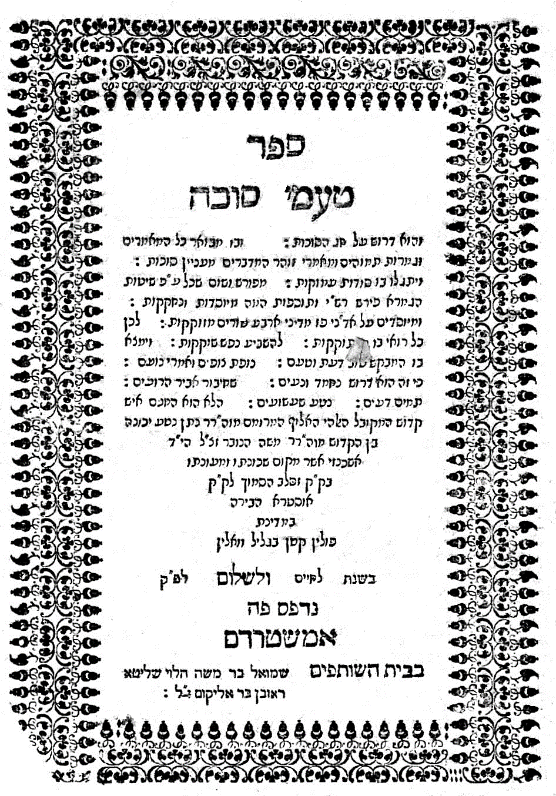


The Ze’enah –Re’enah and its Author

The
Ze’enah –Re’enah
and its Author
Morris
M. Faierstein, Ph.D.
It has traditionally assumed that Rabbi Jacob ben Isaac of Yanova was the author of the Ze’enah U-Re’enah. Every edition of the Ze’enah U-Re’enah lists him as the author on the title page. Recently, this assumption has been questioned and the suggestion made that there may have been another author of this seminal work in addition to Rabbi Jacob ben Isaac. This article will consider two aspects of the Ze’enah U-Re’enah and its author. First, the two-author theory and its evidence. Second, who was the author of a section of the Ze’enah U-Re’enah entitled “Hurban ha Bayit [Destruction of the Temple]”, which is found immediately following the commentary on Lamentations?
1. The two-author theory.
The second volume of the earliest extant edition of the Ze’enah U-Re’enah (Basel/Hanau, 1622) begins with the following statement:
“The five Megillot and the Haftarot. In addition, Hurban ha-Bayit [Destruction of the Temple] in Yiddish which was weighed and researched by the noble and pious Rabbi Jacob, the son of Rabbi Isaac, of blessed memory, from the family of Rabbino, who erected his tent and dwells in the holy community of Janova. He is the man who has already authored the five books of the Torah in Yiddish with nice midrashim and innovative interpretations.”
The same or similar statement can be found in all subsequent editions of the Ze’enah U-Re’enah. Rabbi Jacob ben Isaac was also the author of several other books, published both during his lifetime and posthumously by family members. A statement of his authorship of the Ze’enah U-Re’enah is also found in these books.[1] The first one to question the authorship of the whole Ze’enah U-Re’enah by Rabbi Jacob ben Isaac, was Simon Neuberg in his book, Pragmatische Aspekte der jiddischen Sprachgeschichte am Beispiel der Zenerene.[2] More recently, Jacob Elbaum and Chava Turniansky have reiterated
Neuberg’s argument and supported it.[3] The Elbaum/Turniansky article provides a clear summary of Neuberg’s argument. It would be helpful to begin with this summary:
In a meticulously systematic analysis of the language of the Tsene-rene Simon Neuberg has demonstrated that the vocabulary of each of the three sections (Torah, Megillot, haftarot)  differs clearly from that of the of the two, a phenomenon that becomes particularly prominent in the section khurbn in loshn ashkenaz, which, together with Ruth, differs in its linguistic features most conspicuously from that of the other four Megillot in the Tsene-rene.[4] The conclusions of the linguistic analysis seem to indicate clearly that Rabbi Jacob, the author of the first volume of the Tsene-rene (on the Torah), was not the author of the various components of the second volume of this book (Megillot and Haftarot).
The discussion of the questions about the integration of the two volumes into one opus is beyond the framework  of this article.[5] It is, however, relevant that an earlier printed Yiddish booklet on the destruction of the Temple has been inserted directly after the Yiddish translation and explanation of Lamentations. The difference between the Tsene-rene’s treatment of Lamentations and that of the other four Megillot leads to the
conclusion that whoever included the booklet in the second volume of the Tsene-rene wished to differentiate Lamentations from the other Megillot. Since the khurbn booklet consisted of midrashim, the preceding rendition of Lamentations required no more than a Yiddish translation and explanation of the text, as has been done in
the section of the Haftarot. Indeed, there is a great similarity between the manner of rendition of the haftarot and the methods used in the rendition of Lamentations.[6]
Neuberg bases his conclusions on the basis of his study of the vocabulary of the various sections of the Ze’enah U-Re’enah and the variations that he has found. This mode of philological analysis is ancient, going back to Alexandrian studies of Homer and revived in the study of the Biblical text in the Early Modern and Modern periods. The starting point of this mode of analysis is the concept that a certain text is considered to be a unitary product of one author, whether Homer or Moses, and the scholar endeavors to show that in fact there is more than one hand discernable in the production of the final product. The most famous example of this type of analysis is the “Documentary Hypothesis” relating to the Five Books of Moses. The fatal flaw in Neuberg’s analysis is that he assumes this unitary authorship, that Rabbi Jacob ben Isaac was the author in the way one thinks of someone being the author of a novel or a monograph, the intellectual product of one mind and one style. In fact, the Ze’enah U-Re’enah is a very different sort of work, one composed of passages from a wide variety of texts of different periods and styles that were collected, reworked, paraphrased and abbreviated by Rabbi Jacob to form a bricolage, an anthological commentary based on a diversity of sources.
As an integral part of my English translation of the Ze’enah U-Re’enah[7] I have endeavored to document the sources that Rabbi Jacob utilized and show how he built his commentary.[8] My conclusion is that Rabbi Jacob built his text from the whole panoply of Talmudic, Midrashic, and medieval and early modern Biblical commentaries. He even cites the Torah commentary Keli Yakar (Lublin, 1602) of Rabbi Ephraim Lunshits of Prague, which was most likely published while he was at
work on the Ze’enah U-Re’enah.
Rabbi Jacob had no specific model that he followed, but rather was guided by the commentaries that were available for a particular text. To
take the most obvious example, the number and type of commentaries
available for the Humash
is dramatically greater than what is available for the Megillot,
which is greater than what is available for the Haftarot.
As a result, the Humash
commentary is richer, has greater depth and is more extensive than
the other sections. Even within the Humash
commentaries, it is a well-known phenomenon that the quantity of
comments on Genesis and Exodus is much greater than those on
Leviticus, Numbers and Exodus. This pattern follows through from
Midrash and through all post Talmudic commentaries, from the earliest
medieval commentaries to those being written in the present. This is
also reflected in the allocation of space in the Ze’enah
U-Re’enah
. For example, the number of
pages devoted to Genesis is double the number of pages devoted to
Deuteronomy. It is a reflection of the available resources and not a
deliberate decision by Rabbi Jacob to privilege one part of the Torah
over another.
The
differing level of resources is much greater when one goes from the
Torah to the Prophets and Writings. In the Jewish tradition in
contrast to the Christian tradition, the Torah (Humash)
has been the center of study and interest, while the rest of the
Bible plays a secondary role. This is particularly true in the
Ashkenazi tradition and is evidenced by the paucity of commentaries
on the Prophets and Writings. The great exception is Rashi, whose
commentary encompasses the whole Bible and much of the Talmud. Thus,
we find that Rabbi Jacob has more than a dozen commentaries that he
regularly quotes and cites, not to mention the whole of Midrashic
literature that is largely focused on the Humash
and in the case of Midrash Rabbah,
also includes the Megillot.
The Talmud is also a rich source of comments and stories that are
interspersed in the Torah commentary. In contrast, when one comes to
the Haftarot,
the only commentaries that he relies on regularly are Rashi and Rabbi
David Kimchi.[9] Rabbi Jacob tries to leaven the commentary on the Haftarot
by adding to the end of most of the Haftarot,
a group of three stories taken from the medieval anthology, Yalkut
Shimoni
. It is noteworthy that this
group of stories is quoted in the same sequence that they are found
in the Yalkut Shimoni.
Rabbi
Jacob does not have a fixed form or pattern in his commentary. Each
verse or part of a verse is approached on its own merits. He appears
to have examined the universe of comments on that passage and then he
chooses those things that appeal to him. The range can be anything
from one sentence to several paragraphs, from one commentator to a
medley of several comments that expand on each other or they might
offer conflicting perspectives. Sometimes he ends a commentary with
the phrase, “from here we can learn”, which is a sign that he is
adding his own insights. In addition to the commentaries, or
occasionally in place of a commentary, he might cite a Talmudic or
midrashic passage. Not only do his sources vary widely, but his mode
of citation also varies. Sometimes he translates the Hebrew original,
more or less precisely. Other times, he might paraphrase a text or
summarize an argument from a source. It is also worth noting that he
does not comment on every verse. This too follows the pattern of the
commentaries that he relies upon, in that they also do not feel the
need to comment on every verse. The same applies to the Megillot
and Haftarot,
with the proviso that the universe of sources is smaller and
therefore the variations in form and style will not be as dramatic.
In
summary, any literary analysis of the Ze’enah
U-Re’enah
must take into account the
nature of the sources that underlie the text, how the author utilizes
the sources and the methods of composition. Without a thorough
knowledge of rabbinic literature in the broadest sense and the
ability to deal with these texts, both in the Hebrew/Aramaic original
languages and a solid ability to understand the Yiddish text of the
Ze’enah U-Re’enah, it
would be impossible to make any judgments about this work that have
merit and should be taken seriously.
Another
argument raised by Neuberg is the fact that the Basel/Hanau, 1622
edition of the Ze’enah U-Re’enah was
published in two volumes, with the Torah in one volume and Megillot
and Haftarot
in the second volume. He ascribes great significance to this fact but
does not provide any evidence to support his argument that there is
significance to this fact beyond the things that have already been
discussed. Since this was the first extant edition, we cannot learn
anything from the three preceding editions that have not survived. We
can only look at subsequent editions and see if this pattern is
repeated. The next edition of the Ze’enah
U-Re’enah
was published in Amsterdam,
1648. Rabbi Jacob’s son wrote in the Introduction of his edition of
his father’s small book Sefer Shoresh
Yaakov
that he was publishing this book
to raise funds to enable the publication of a new edition of his
father’s Ze’enah U-Re’enah.[10] The Amsterdam edition retained the same
format as the 1622 edition. That is, the Torah came first, followed
by the Megillot,
and ending with the Haftarot.
The one important change was that the work was published in one
volume and in a folio format. The first edition to break this pattern
was the Amsterdam, 1711 edition, which placed the Haftarot
for the Torah portions immediately behind the respective Torah
portion, in the same way that one would find it in a printed Hebrew
Humash.
This was probably the reason for the change and nothing more
significant. All subsequent editions followed the model of the 1711
edition. In addition, all editions of the Ze’enah
U-Re’enah
beginning with the
Amsterdam, 1648 were published in one volume.[11] The Basel/Hanau, 1622 edition is the only one that was published in
two volumes. It is most likely that the two volumes had simple
internal reasons related to practical aspects of the printing
process. Without additional evidence it would be inappropriate to
make assumptions about this fact.
2.
The authorship of Hurban ha-Bayit.
 
Immediately after the commentary on
Lamentations in the Ze’enah U-Re’enah
there is a separate section entitled, “Hurban
ha-Bayit
[Destruction of the Temple].” An examination of this section shows
that it is a Yiddish translation/paraphrase of a famous passage from
the Talmud about the causes of the destruction of the Second Temple,
found in tractate B. Gittin
55b-58a. After the passage from Gittin
until the end of this text there is a combination of passages taken
from Yalkut Shimoni,
Lamentations, Remez
995 and 996, and selections from Lamentations
Rabbah,
Petihtah
24.
In
1979, Sara Zfatman published an article about a pamphlet by an
anonymous author that was published in Cracow, before 1595.[12] The text of this pamphlet is identical to the “Hurban
ha-Bayit
[Destruction of the Temple]” material in the Ze’enah
U-Re’enah.
[13] Two pamphlets containing this material were reprinted in the
nineteenth and twentieth century[14] and it was even translated into German.[15] It is likely that they were extracts from the Ze’enah
U-Re’enah
, and not from the Cracow
pamphlet.

The
question that concerns us is the authorship of this pamphlet and the
section in the Ze’enah U-Re’enah.
The similarity of both versions of the text is strong evidence that
one person is the author of both. The title page of the second volume
of the Basel/Hanau, 1622 begins with the following statement. “The
five Megillot
and the Haftarot.
In addition, the destruction of Jerusalem in Yiddish which was
weighed and researched by the noble and pious Rabbi Jacob, the son of
Rabbi Isaac, of blessed memory.” Having argued that there is one
author of the whole Ze’enah U-Re’enah,
Rabbi Jacob ben Isaac, it naturally follows Rabbi Jacob ben Isaac is
also the author of this pamphlet and the text in the Ze’enah
U-Re’enah.
 
It
is not hard to understand why Rabbi Jacob might have felt the need to
create a supplement for Lamentations, where there is no similar need
or the other Megillot.
Tisha B’Av
when Lamentations is read in the synagogue became the date to
commemorate and mourn a variety of destruction and catastrophes in
Jewish history. The text of Lamentations is so specific to the
situation of the First Temple that over the centuries a whole
literature developed to supplement the Book of Lamentations and
better express the emotions engendered by later events being
commemorated and mourned. I would suggest that Rabbi Jacob first
wrote this pamphlet as an additional text for Tisha
B’Av
observances and later
incorporated it into the Ze’enah
U-Re’enah.
The sparse nature of his
commentary on Lamentations points to this. There is virtually no
effort to add commentary. Aside from a few references to Rashi, the
commentary on Lamentations is no more than translations or
paraphrases of the Biblical text.
[1]
Melitz Yosher
(Lublin, 1622; Amsterdam, 1688); Sefer
ha-Magid
(Lublin,
1623-1627); Sefer
Shoresh Ya’akov
(Cracow, 1640). The relationship of Rabbi Jacob ben Isaac to Sefer
ha-Magid
is
complicated. See, R. Hayyim Lieberman, “Concerning the Sefer
ha-Magid
and its
Author [Yiddish].” In idem. Ohel
RH”L.
3 vols.
(n.p.: Brooklyn, 1984), 2: 231-248. A Hebrew version of the article
is found in idem. 3: 365-382. The article was originally published
in Yidishe Shprakh,
vol. 26 (1966): 33-38.
[2]
Neuberg,
Simon. Pragmatische
Aspekte der jiddischen Sprachgeschichte am Beispiel der Zenerene.

Buske: Hamburg, 1999, 109-115.
[3]
Elbaum,
Jacob. and Turniansky, Chava. “The Destruction of the Temple: A
Yiddish Booklet for the Ninth of Av.” In Midrash
Unbound, Transformations and Innovations
.
Ed. Michael
Fishbane and Joanna Weinberg. Oxford: Littman Library, 2013,
424-427.
[4]
See Neuberg,
Pragmatische
Aspekte
,
109-115.
[5]
At this point there is a lengthy footnote about the significance of
the title pages of the two volumes and the fact that there are two
volumes. I will address the issues raised here in my response.
[6] Elbaum
and Turniansky, “The Destruction of the Temple,” 425.
[7] Faierstein, Morris M. Ed. Ze’enah
U-Re’enah: A Critical Translation into English
.
2 Vols. Berlin: De Gruyter, 2017 (Studia Judaica, 96).
[8] The Index of Sources in my translation is a vivid example of the
wide variety of sources found in the Ze’enah
U-Re’enah
.
[9] Rabbi David Kimchi was a member of the medieval Spanish school of
Biblical commentary that emphasized grammar and logic rather than
the more midrashic and mystical approach of many of the Ashkenazi
commentaries. It is noteworthy that neither Kimchi nor the other
great Spanish commentator Rabbi Abraham Ibn Ezra are mentioned in
the Torah commentary. It is only in the Prophets where Kimchi is
consulted, because the number of commentaries is limited.
[10] Sefer Shoresh
Yaakov
, Cracow,
1640, Introduction.
[11] A complete bibliography of Ze’enah
U-Re’enah

editions can be found in Morris
M. Faierstein, “The
Ze’enah U-Re’enah
:
A Preliminary Bibliography”, Revue
des etudes juives
,
172, 3-4 (2013), 397-427.
[12] On this pamphlet and its history see, Sara Zfatman, “The
Destruction of the Temple, Cracow, before 1595 – An Additional
Yiddish Text from the Sixteenth Century [Hebrew],” Kiryat
Sefer
54 (1979):
201-202.
[13] Zfatman, “The Destruction of the Temple,” 201 n. 5.
[14] The nineteenth century edition was published in Johnnisburg
(Prussia), 1862. See,
Faierstein, “The
Ze’enah U-Re’enah
:
A Preliminary Bibliography,” 411 no. 121. The twentieth century
edition was Brooklyn, 2007. See, idem. 422, no. 240.
[15] The German translation is, Die
Zerstörung Jerusalems: aus dem Buche Zeena u’reena. Deutsch von
Alexander Eliasberg

(Berlin: F. Gurlitt, 1921). See, Faierstein, “The
Ze’enah U-Re’enah
:
A Preliminary Bibliography,” 424 no. 264.


Book announcement: Two books on Karlin-Stolin Chasidim

Book announcement: Two books on Karlin-Stolin Chasidim
By Eliezer Brodt
בנימין בראון, כספינה מיטלטלת, חסידות קרלין בין עליות למשברים, 659 עמודים, מרכז זלמן שזר ר’ אברהם אביש שור, כתבים, פרקי תולדות ועיון במשנת קרלין-סטולין, תדפיסים מתוך קובץ בית אהרן וישראל, 1229 + 18 עמודים.
Recently a good amount of literature devoted to Chasidim has appeared. In this announcement I am just mentioning two recent works, related specifically to Karlin-Stolin Chasidim. One is written by an academic (outsider) and one is written by a Stoliner Chassid (insider). This would be a great way to compare them, based on Chaim Liberman’s classic essay “Keitzad Chokrim Chasidus BYisrael?” (Ohel Rochel, 1, pp. 1-49).
The first volume is from Dr. Benny Brown, renowned for his massive book on the Chazon Ish a few years back (mentioned here and here) and for a more recent book edited by him (mentioned here) called HaGedolim. Last year Dr. Brown wrote a book devoted to understanding Charedim (451 pp.) called Madrich Lechevrah HaCharedis, where part of it he focuses on Chassidim. A few months ago his latest volume appeared, devoted to Karlin-Stolin (659 pp.) titled כספינה מיטלטלת.
This book also includes many documents which he got from insiders (no idea why they gave it to him). I was happy to see some discussion of a special Karliner Chasid that I had the great privilege to have a close relationship with, R’ Yossel Zeinvorth.

The table of contents to this work may be viewed here (link).Here is the cover:

The second book just released earlier this week is called Kesavim from Rabbi Abish Shor. R’ Abish is one of the most prolific writers in the Charedi Chasidic world. His articles have been featured in the Karlin-Stolin journal Kovetz Beis Aron V’Yisroel for the past thirty years. This is a collection of all his essays that appeared in that journal arranged in chronological and topical order. This volume has important information related to the history of Chasidim in general, based on numerous manuscripts amongst other sources. This huge volume was printed in a limited edition and for a short time is available for sale through me at eliezerbrodt@gmail.com

View the table of contents to the work here (link).Here is the cover:


The Collected Writings of Moshe Reines Kickstarter

The Collected Writings of Moshe Reines Kickstarter

Moshe Reines was a polymath: Talmudist, Hebraist, historian, investigative reporter, social commentator – a prolific and influential thinker, writer, and author. The son of Rabbi Yitzchok Yaakov Reines, Moshe Reines died tragically in 1891 at the astonishingly young age of twenty-one.  The obituary which appeared in Hamagid had this to say about the young Reb Moshe z”l: “He excelled amazingly in his absolute mastery of Shas…”
The volume (compiled and edited by Eliezer Brodt) awaiting printing is approximately seven-hundred pages. It is filled with fascinating material on the burning issues of 19th century Russian Jewry, from the politics surrounding the founding of the famed Kovno Kollel to the financial problems of the Volozhin Yeshiva, from the challenge of Rabbonus in a changing world to controversial methods of studying Gemara, from the question of Haskalah to the promise of Zionism. These are issues we still grapple with today, and R’ Moshe addressed them all with courage, verve, sensitivity, and wisdom beyond his years. He wrote in an engaging style in magnificent Hebrew, sparking debates in the periodicals of the day. 
We are on the cusp of going to print, but the costs are obviously much higher than originally anticipated. Printing costs alone exceed three thousand dollars, and that does not include the costs of scanning hundreds of pages 
For more detailed information and to fund the project please visit this LINK – only four days to go for this project to be fully funded!:

https://www.kickstarter.com/projects/1050680532/the-collected-writings-of-moshe-reines