The Strange Shape of the Marcheshet Pan

                             The Strange Shape
of the Marcheshet Pan
                                                            
By Eli Genauer
“The underlying basis of our work is that
pictures are an organic part of the commentary, and it possible that Rashi even
allowed himself to limit his explanatory words when a picture was available to
the reader. This is in the sense of “a picture is worth a thousand
words”. The picture is an integral part of the written book, no less
important than the words.” 
                                                              
Dr Ezra Chwat
                                                    
Department of Manuscripts, National Library of Israel
                                                     
Giluy Milta B’Almah Blog
                                                          
January 15, 2017
There were many vessels
used in the Beit HaMikdash. Nevertheless, without pictures or diagrams drawn
contemporaneous to their existence, there remains some doubt as to exactly what
they looked like. I would like to discuss one vessel used quite often in the
Temple and see what the diagrams of the Rishonim can tell us about its makeup.
I would also like to analyze a diagram in Rashi’s commentary to Talmud Bavli
and see how it fits into our discussion.

Massechet Menachot 63a
האומר הרי עלי במחבת, לא יביא במרחשת; במרחשת, לא יביא במחבת.  מה בין מחבת למרחשת–אלא שהמרחשת יש לה כסוי, ולמחבת אין לה כסוי, דברי רבי יוסי הגלילי; רבי חנניה בן גמליאל אומר, מרחשת עמוקה ומעשיה רוחשין, ומחבת צפה ומעשיה קשין
One who says, “I take upon myself [to offer a grain offering prepared]
on a griddle, he must not bring [one baked] in a pan. If [he says “I take upon
myself to offer a grain offering prepared] in a pan,” he must not bring [one
prepared] on a griddle. What is the difference between a griddle and a pan? The
pan has a lid to it, but the griddle has no lid – [these are ] the words of
Rabbi Yose Hagili; Rabbi Hanina ben Gamliel says : a pan is deep and what is
prepared is spongy, a griddle is flat and what is prepared is hard.[1]

Leaving  aside the opinion of Rabbi Yossi Haglili, let us concentrate on the statement of Rabi Chanina ben Gamliel
We would imagine that the Marcheshet is a deep vessel, and the Machvat
is flat, as it is described as a griddle. 
Perhaps like this:

                                   
The Gemara then cites a Braita which deals with the following
situation.  If a person takes a vow
saying “I take upon myself a Marcheshet”, it remains unclear whether he meant
he will bring the vessel called a Marcheshet, or the normal Korban Mincha that
is brought in a Marcheshet. Beit Hillel is of the opinion that since there was
a specific vessel in the Beit Hamikdash called a Marcheshet, we understand that
he is talking about that vessel and we require him to donate it to the Beit
HaMikdash.[2] Here are the words of the Braita which describe in some detail
the appearance of this Marcheshet pan:
כלי היה במקדש ומרחשת שמה ודומה כמין כלבוס עמוק וכשבצק מונח
בתוכם דומה כמין תפוחי הברתים וכמין בלוטי היוונים

There was a vessel in
the Temple called Marhesheth, resembling a deep mould, which gave the dough
that was put into it the shape of Cretan apples and Grecian nuts. (The Soncino
Hebrew/English Babylonian Talmud)

Rashi goes to great
lengths to explain this uncertain statement and includes a diagram in his commentary.
This diagram first appeared in printed form in the early 18th
century but unfortunately, it does not align with the words Rashi uses to
describe the overall shape of the pan. 
Additionally, It does not match the diagram we have in a manuscript of
Rashi nor diagrams in manuscripts of other Rishonim.
But first some
background
The diagrams we have
today in the Vilna Shas in Rashi and other Rishonim come from earlier printed
editions. The first printed edition of the entire Talmud to contain diagrams
was the Behrmann Shas printed in Frankfurt on Oder, 1696-98.[3] Raphael Natan
Nata Rabinowitz posits that by the time diagrams were included in the printed
text, there were very few manuscripts around because most had been placed in
Genizah.[4]  He therefore concludes that manuscripts were not used in the early
18th century as a source for diagrams. What was the source of those
diagrams for the Behrmann Shas ? According to the editors of the Behrmann Shas,
they mostly came from the Chochmat Shlomo of 1582.[5] It’s an extremely
reliable source because it was written by Rav Shlomo Luria who specifically
wrote it to correct the text of the Bomberg Shas and to insert the relevant
diagrams. Rav Shlomo Luria lived at a time when there were still many
manuscripts around, so either he used those manuscripts for his textual
emendations and as a source for his diagrams, or he used his own capabilities
to come up with his changes and additions. Since most of our present day
diagrams follow from the Behrmann edition, they have an aura of authenticity
attached to them.[6]
The problem arises when
we discover that Chochmat Shlomo does not include all the diagrams we have
today. For example, in our case, there is no Chochmat Shlomo on Menachot.
Let us now take a look
at the diagram in Rashi on Menachot 63a.
The first time it
appeared in print was in the Frankfurt am Main edition of 1722, exactly 200
years after the diagramless Bomberg edition. We know its source was not a
manuscript of Rashi nor was it the product of the Maharshal.
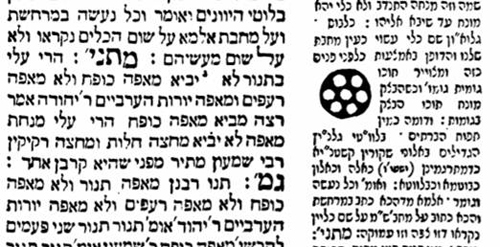
Putting aside the
diagram for a moment, let us concentrate on the words of Rashi as he tries to
describe the Marcheshet:
כלבוס
– גלואו”ן שם כלי עשוי כעין מחבת שלנו והדופן באמצעות כלפי פנים
כזה  ומצוייר תוכו גומות גומות וכשהבצק מונח בתוכו [נכנס] הבצק
בגומות:
Rashi concentrates on
the word כלבוס as the Gemara itself says that a Marcheshet is shaped like a
deep כלבוס. Rashi first gives us an old French word
which is normally translated as “tongs”.[7] He says that the Marcheshet is like
his present day Machvat pan and that the “wall in the middle faces the inside,
like this”. The problem is that the diagram does not seem to show a wall in the
middle facing the inside. Additionally, if a כלבוס is a pair of tongs, and the shape of the
vessel looked somewhat like a pair of tongs, how does that align with the
diagram which is circular?
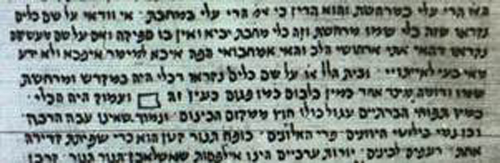
The Shita Mekubetzet
which is included on the standard page of the Vilna Shas has a completely
different diagram.
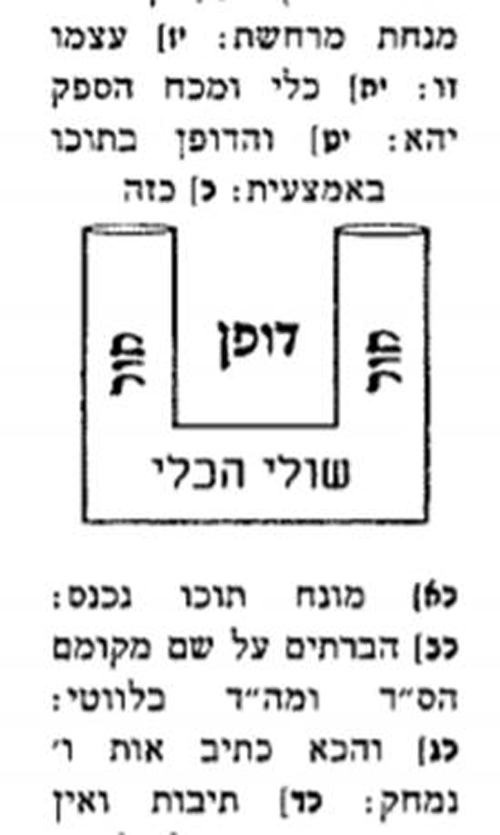
Notice that the word
Dofen is in the middle of the diagram just as Rashi says והדופן באמצעות כלפי פנים
The
volume of the Bomberg edition that belonged to Rav Betzalel Ashkenazi the
author of the Shita Mekubetzet contains the exact same diagram inserted in the
blank space of the Rashi.
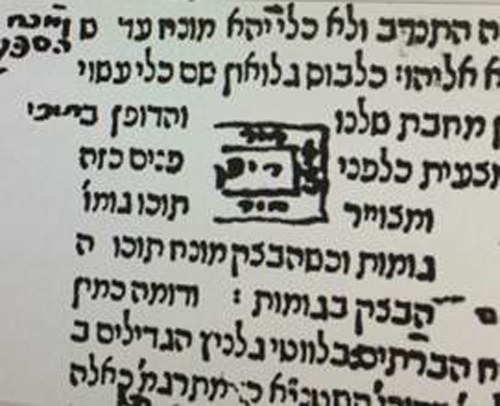
Jerusalem – The National Library of Israel Ms. Heb. 4°79 (link).
In his book Dikdukei
Sofrim on Menachot (Munich, 1886) R.N.N. Rabinowitz writes about the
importance of the comments of the Shita Mekubetzet as they were addressed to
the Bomberg edition of 1522 and relied heavily on manuscripts which included a Rashi
manuscript.[8] The Acharit Davar printed at the end of the Vilna Shas also
extols the importance of the Shita Mekubetzet on Kodshim as it came from a
manuscript and was based in part on a manuscript misidentified but actually of
Peirush Rashi.[9]
Going back in history,
we can get an idea if a diagram did in fact exist in Rashi manuscripts by
looking at the first printed edition of Menachot which was Bomberg 1522. Its
source had to be from manuscripts because no printed edition preceded it.
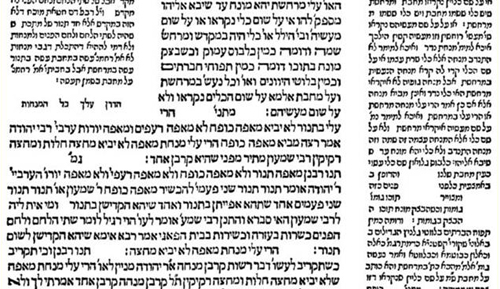
You can see that the
Bomberg editors included the word “כזה” in the text of the Rashi and left 2
spaces indicating that their manuscript included 2 diagrams. This may explain
why our present diagram does not reflect the shape of the overall pan as there
may have been one diagram depicting its shape and a second one depicting the
apple like insets. In fact, a notation in the Oz Vehadar edition states quite
clearly that our diagram just illustrates the words “גומות
גומות”.
As mentioned before,
the words of Rashi seem to support the idea that the Marcheshet pan was
semicircular in nature. In addition, the shape of the vessel is likened to a כלבוס which is an
item dealt with a number of times by Rashi
For example this Rashi
on Shabbat 59b:
Rashi states that an
item worn by women called a “מנקתא פארי” ( starting with the letters “וי״מ” for ויש מפרשים) is “כּמין חצי עגול עשוי כמין כלבוס” and then draws your attention to a
diagram of a semi circle.
Fortunately I was able
to find a manuscript of Rashi on Menachot which is identified as Vatican
487  and is from the 13th
century. (Made available by the Polonsky Digitization Project) It pictures the
Marchseshet pan in a semicircular shape and thus fits in more with the words of
Rashi.
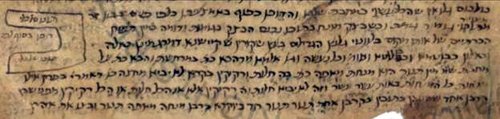
It’s clear that the
diagram included only deals with the semicircular nature of the vessel and not
the little depressions inside the “Tocho Shel Kli”. This diagram is very
similar to the one in the Shita Mekubetzet and it is possible it served as a source
for the Shita Mekubetzet.[10]
We are confronted with
another diagram of the Marcheshet pan in what is known as the Peirush Rabbeinu
Gershom first printed in the Vilna Shas. This Peirush describes the vessel
being shaped like a כלבוס and then says it is “כמו פגום”, which means incomplete. One would expect
to see a vessel like in the Shita Mekubetzet and in the Rashi manuscript which
is not either completely circular or square in nature. Nevertheless, the diagram
in the Vilna Shas depicts this vessel as being square like this
In the Achrit Davar the
editors of the Vilna Shas state that they had a manuscript of this Peirush
Rabbeinu Gershom however the following manuscript shows the pan as having an
indentation and not being square.
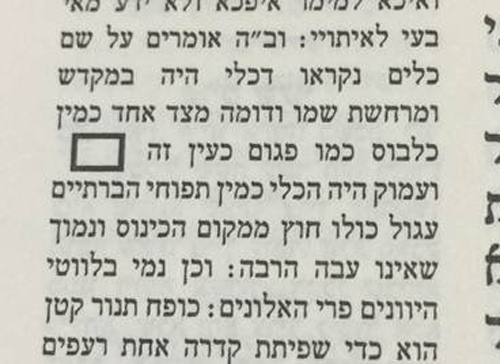
Roma – Biblioteca Angelica Or. 1 (link):
It could be they that
had a manuscript depicting a square pan, or it is possible that their
manuscript had a pan with an indentation and this was not transferred
successfully to the printed page. Certainly the words of the Rabbeinu Gershom
indicate the latter.
Conclusion:
Nowadays it is easy for us to transfer an image from a
manuscript to a printed or electronic page. All we have to do is point, shoot,
copy and paste. The result is an exact duplicate of what is on the manuscript,
and it is even easier to work with than the original. But hundreds of years ago
it was not so simple. A woodcut or an engraving of the image could be made and
then transferred to the printed page, but that was time consuming and
expensive. Because of this, images such as diagrams were just left out, and
when they were added, they were often misleading and sometimes even incorrect.
The printing revolution was a giant step forward for the dissemination of
Jewish knowledge, but, at least at its beginning, played havoc with many important
diagrams.
[1] English translation
from Sefaria.org.
[2] The Rambam Paskens
according to Beit Hillel. Since Beit Hillel speaks about the Marcheshet being
different than a Machvat,  and not just having a cover) it is clear that the
Rambam holds like Rav Chananya ben Gamliel
[3] Maamar ‘al hadpasat ha-Talmud with Additions, ed. A.M. Habermann, Mossad ha-Rav Kook, Jerusalem: 2006, p.41. The Soncino family printed individual editions of the Talmud between 1483- 1518, but not an entire set. Some of those editions such as Eiruvin did contain diagrams and some did not. The first complete set of the Talmud was the Bomberg edition 1519-1522. That edition did not contain diagrams, only empty spaces which were to indicate where diagrams were to go (the only exception was Sotah 43a). There were numerous full editions of the Talmud printed between 1522-1697, but these also did not contain diagrams. 
[4] Printing
the Talmud: A History of the Earliest Printed Editions of the Talmud
, Marvin J. Heller, Im Hasefer 1993 p.6 states as follows: “Rabbinovicz attributes the dearth of Talmud codices to
the manner in which they, and many other manuscripts, had been written; without
any commentaries, with errors and erasures, and lacking even lines. Rashi and
Tosafot (additions by Ashkenazic luminaries after Rashi) were separate
manuscripts, suffering from the same conditions. As a result, learning must
have been difficult, with the reader having to continuously peruse three different
works, assuming that he owned them. Therefore, when the Talmud was printed with
Rashi and Tosafot, “men no longer learned from their manuscripts, but
considered them as utensils without further value, placing them in genizahs, so
that they no longer exist.”
[5] Other sources mentioned by the editors of the Behrmann Shas are Maharsha and Maharam Lublin. Neither of those sources contain diagram for our Rashi.
[6] A good summary of
the subject of where our present day diagrams came from can be found in the
introduction to the Shas Nehardea, under the heading of “המקור לציורי הש”ס”. (Vagshal Publishing Ltd,
Jerusalem, 2008, p.5 of the introduction. The overall section on diagrams
starts on page 4 of the introduction under the heading “מבוא לציורי הש״ס”.)There are a few diagrams that are
not in the Berman Shas but first appear in the Frankfurt am Main edition of
1720-1722. Here too, the editors of that edition say that the source of their
diagrams was the Chochmat Shlomo.
[7] All the Meforshim
understand that Beit Hillel is saying that the Marcheshet pan is shaped like
a כלבוס,
meaning the pan is shaped like a pair of tongs. 
I would imagine tongs to look like this, with the top part being
semicircular especially in the open position

Jastrow renders our
Braita saying that a Marcheshet is “a baking form in the shape of forceps with
cavities”
[8] Rabbinowitz writes
on page 1 of his introduction that when he wrote his emendations on Menachot
that “I had in my hand a handwritten manuscript of the Shita Mekubetzet by Rav
Betzalel Ashkenazi…..And he wrote his comments on the 1522 Venetian edition
including Gemara, Rashi and Tosafot with the help of handwritten manuscripts he
( Betzalel Ashekenazi) had in his hands”
[9] Achrit Davar at the
end of Masechet Nidah, p.6
[10] The Oz VeHadar edition of the Talmud
actually changes the diagram inside the Rashi to the diagram of the Shita
Mekubetzet



Mezuzah Revisited. Parshat Vaetchanan.

Mezuzah
Revisited. Parshat Vaetchanan.
By
Chaim Sunitsky.
Rashi on
this Parsha (Devarim 6:9) says that since the word Mezuzot is
written without the Vav[1], only
one Mezuzah is necessary. It’s generally assumed that Rashi can’t argue with a
clear Talmudic statement that every door of the house needs a Mezuzah[2] and
therefore he can’t be understood at face value. However the custom in many
places in Medieval Europe had always been to only affix one Mezuzah per house[3]. We
will now try to examine if indeed there ever was a tradition that supported
this minhag.
The Rema makes a
unique statement in Yoreh Deah (287:2): “The commonly spread minhag in
these countries is to attach only one Mezuzah per house and they have nothing
to rely on”. This statement is very unusual. Rema is known for
supporting Jewish minhagim and it’s very common for him to use the
expression “common minhag” often followed by a statement that this minhag
should not be changed, or at least that this minhag can be relied on.
Here however the Rema is saying just the opposite: the minhag has
nothing to rely on and a “yere Shamaim” person should affix the Mezuzot
on every entrance.
It’s hard to understand
how this incorrect “minhag” could have possibly become wide spread. R. Yissachar
Dov Eilenburg[4]
(the author of Beer Sheva on the Talmud) suggested that this mistake became
widespread due to incorrect understanding of our Rashi. However I find
it strange if the previous minhag was to affix a Mezuzah on every
doorpost, how would it change in many countries simply because they misunderstood
the Rashi’s Torah commentary[5]. As
for the correct understanding of Rashi, two possibilities were offered:
either Rashi is saying that we don’t have to affix two Mezuzot on each
doorframe[6], or
that Rashi is following the opinion of R. Meir that if an entrance has
only one doorpost on the right, there is a need to affix Mezuzah (despite the
lack of second doorpost[7]). As
for Rashi’s actual drasha[8]
we don’t see it in any known source in Hazal[9].
In general there was[10] some
attempt to explain the custom of affixing only one Mezuzah based on the fact
that many of the inside rooms in their houses were not clean enough, but this
does not explain what people relied on when the house itself had more than one
entrance[11].
However Rashi[12]
on our Gemorah brings an interpretation according to which if a house
has exactly two entrances, it needs only one Mezuzah on the more commonly used
entrance, since the other entrance is batela (is unimportant) compared
to the first one. Only if the house has more than two entrances then we don’t
say that two entrances are batelim to the one commonly used entrance.
Maybe then Rashi on the Chumash is following his shita and
saying that a house (or room) with two entrances requires only one Mezuzah. Interestingly,
in Yerushalmi[13]
there is even a stronger statement that seems to imply that only one entrance per
house requires a Mezuzah:
בית
שיש לו שני פתחים נותן ברגיל היו שניהן רגילין נותן בחזית היו שניהן חזית נותן על איזה
מהן שירצה
The simple meaning of Yerushlami
seems to contradict the Talmud Bavli and imply that only the entrance that’s
used more often needs the Mezuzah. If he uses both entrances equally, then the
Mezuzah is affixed to the “stronger” entrance and is they are equally strong,
one can affix the Mezuzah on either entrance.
To conclude we seem to
have found a possible explanation of Rashi according to the simple
meaning of his words[14] and
a possible justification for the old minhag in Europe[15]. Needless
to say our words are only theoretical and Baruch Hashem that minhag has
disappeared a long time ago and every Orthodox Jew today affixes a Mezuzah on
every entrance.


[1] Apparently Rashi
implies that Mezuzot is written without the second Vav and can be read as Mezuzat.
Our scrolls written according the Mesorah, Rambam (Sefer Torah
2:6), Semag (Asin 22) and Minhat Shai have the first Vav
between two Zain’s missing, but Leningrad scroll (used on Bar Ilan disk)
in fact has the second Vav missing. It’s also possible that Rashi meant
that as long as some Vav is missing we can “transfer” the missing Vav to the
last position and thus read the word as Mezuzat. See also Minhat Shai,
Shemot
12:7. Interestingly the famous statement of the GR”A that
there are 64 different Tefilins one would need to put on to fulfil all opinions
does not consider the various opinions about how to write various words like “mezuzot”,
“totafot”, which would bring the numbers of different Tefillins to hundreds.
[2] See for
instance Menachot 34a.
[3] In this article
we only discuss if there is any justification for the custom of affixing one
Mezuzah on one’s home. See however Semag (Asin 3) that there were
some people in Spain who did not affix Mezuzot at all, and see there in Asin
23 some weird “justification” they used for their “minhag”.
[4] In his super-commentary
on Rashi called Tzeda Lederch and his “Beer Maim Chaim” usually
printed in the end of Beer Sheva.
[5]  To say nothing about the fact that Halacha is
rarely learned from a Torah commentary as Rashi does not “pasken
there.
[6] In Yalkut
Shimoni
on Mishley (remez 943) indeed there is an opinion
that each of the doorposts requires two Mezuzot, but our Gemorah (Menachot
34a) does not hold like this opinion and does not even mention it (see also Shu”t
Minchat Yitzchak
1:9).
[7] Obviously the
Biblical word Mezuzah means not the parchment but the pole itself, so one Mezuzah
in Rashi means one doorframe.
[8] Which Rabeinu
Bahya quotes as words of Razal.
[9] See however Mordachai
(962) who brings in the name of Rif that R. Meir and Rabonan who
argue about the above law apparently learn from the spelling of Mezuzot. It may
be according to this girsa, not found in our Rif, R. Meir had no
Vav and Rabonan had a Vav in the word “Mezuzot” in Devarim 6:9. The
Talmud mentions that R. Meir was a scribe and it’s possible he had some
especially accurate scrolls that were different from the more commonly used
ones (his “Torah scroll” is mentioned in Midrashim, see for instance Bereshit
Rabbah
94:9). Our Gemora however only mentions the learning from “Mezuzot”
with the Vav to support the shita of Rabonan (see also the first Tosafot
on 34a).
[10]
See Maharil, Minhagim, Laws of Mezuzah, 1 and Tshuvot 94 . In practice the
Maharil and Rema did not accept these explanations.
[11] See also Shu”t
Divrey Yatziv Yore Deah 191
who proposes that maybe only the Mezuzah on the
outside doorpost is a Biblical command, but the question of a house with two
entrances still remains.
[12] Menachot 33a
starting with words Holech Achar Haragil and 34a starting with words
Af Al Gav Deragil Beechad.
[13] The end of Megila,
34a (see however second perek of Tractate Mezuzah, in Vilna Shas
it’s printed at the end of the volume with Avoda Zara). Even if our
interpretation off the Yerushalmi is correct, if the house has many
rooms, it would seem to need a Mezuzah for each one even according to Yerushalmi.
[14] In Sefer
Zechor Leavraham
on Rashi in Likutim in the back the author
also interprets Rashi to mean only one Mezuza is needed. He proposes
that Rashi quotes a lost Midrash similar to the one preserved in Yalkut
Shimoni
I quoted above. According to the author the dispute there is not whether
the Mezuzah is placed on both sides of one entrance but whether there is a need
for a Mezuzah on every entrance of the house.
[15] It’s known that
many European communities started in Italy, where Yerushalmi was often
followed to a greater extent than Bavli and therefore it’s possible that
the earliest settlers in France and Germany were told only to affix one Mezuzah
on the main entrance leading to the street. Regarding inside rooms, maybe they
did not have any since simple houses had only one room in those times or maybe
they relied on some of the weak reasons mentioned in Maharil (who
rejects them) but regarding the outside doors if there are only two they may
have followed Rashi and if some of their houses had more than two entrances
they may have followed Yerushalmi or some other lost opinion (partially
preserved in the Yalkut Shimoni).   


Notes on RASHI, ArtScroll Censorship, and Emendation of Rabbinic Texts

Notes on RASHI, ArtScroll Censorship, and Emendation of Rabbinic Texts
By David Shasha
A new post on the Seforim blog by Professor Marc Shapiro discusses the problem of ArtScroll publishers and the way that it routinely censors rabbinical texts:
Shapiro looks at the issue of RASHBAM’s commentary to Genesis 1, a big problem for Orthodox literalists.
Here is a post from Failed Messiah that explains the difficulty:
RASHBAM is the grandson of RASHI and the brother of Rabbenu Tam; a central figure in one of the most illustrious of all the rabbinical dynasties in the Ashkenazi tradition.
RASHBAM’s comment to Genesis 1 asserts that, according to the literal meaning of the text, the day, contrary to Jewish law, begins in the morning and not the evening.
I will leave the legal controversy to Shapiro and others, but would like to discuss his point on textual emendation.
It is interesting to see the plethora of Ashkenazi figures that Shapiro cites, including Rabbenu Tam and Abraham ben David (RABAD) to support the idea that no texts should be emended based on personal opinion.
The problem with this formulation is that the principle of textual emendation was most emphatically adopted by RASHI, the most important figure in the Ashkenazi rabbinical tradition.
Jose Faur in his classic article “The Legal Thinking of the Tosafot” discusses the matter in some detail:
He notes the freedom Ashkenazi rabbis accorded themselves to emend texts:
The Franco-German school had a liberal attitude toward the text of the Talmud, It is well known that this school felt free to amend, interpolate and delete from the text of the Talmud.
Referencing the classical Ashkenazi source Sefer ha-Yashar and academic discussions by Joseph Weiss and Benjamin Lewin, Faur explains that RASHI’s famous “Hachi Garsinan” – the code term for his many emendations of Talmudic texts – was a central part of the Ashkenazi rabbinical heritage:
The liberal attitude toward the text is reflected in the Franco-German position that the Talmudic text was not put into writing until post-talmudic times, late in the Middle Ages. Accordingly, the Talmudic text was never authoritatively fixed. Since there was no authoritative transmission of the text, it was subject to further development and errors.
We have seen this principle dangerously expanded in the current school of academic Talmud studies which holds that the Talmud was not completed until the late Geonic period, when the bulk of what is called the STAM (anonymous) layer of the corpus was written; contrary to the traditional formulation found in the canonical Epistle of Sherira Ga’on.
For more on the current scholarly revolution against the normative Jewish tradition, led by David Weiss-Halivni, see the following books:
Without any actual documentary or historical evidence, the revisionist scholarship – similar to German Higher Criticism of the Hebrew Bible – demands that we see different historical strata in the Babylonian Talmud.  This would undermine its literary unity and its historical presentation of the classical rabbinic tradition as formulated in the academies of Sura and Pumbedita.
The new scholarship claims that the text is a frightful hodge-podge of confused materials that is often sloppily and incoherently edited.  Texts are ignorantly assembled by anonymous rabbis who lack a historical connection to their predecessors.  It is all a fabrication lacking the firm authority of tradition.
The close of the Talmudic canon, as formulated by Sherira Ga’on in his famous Epistle, is in the 6th century:
Jose Faur has written an excellent treatment of the matter in his “Textuality in the Rabbinic Tradition,” chapter 4 of his book Golden Doves with Silver Dots, which is an important corrective to this benighted revisionism:
A good deal of the current scholarship attacking the Geonic tradition and its dating of the Talmudic corpus seeks to aggressively negate Faur’s assertions about the Oral Law and its textual manifestations. The written form of the Talmud and the tradition of emendation by Ashkenazi rabbis, and now academic scholars, has thus become part of a larger problem of the authority of the Oral Law in contemporary Judaism. Shapiro claims that the Ashkenazi rabbis, and their Sephardic followers like Moses Nahmanides, were firmly against this method of emendation, even though the leader of their school, RASHI, was a strong proponent of it:
The following discussion by Jacob Neusner reviews the salient points involved the matter of RASHI and the Tosafist School:
Neusner claims that RASHI emended the Talmudic text over 2,300 times based on his own personal opinion!
It is interesting to note both the parallels and differences between the emendation process in the older Ashkenazi tradition and the way it is now being deployed by Ultra-Orthodox fundamentalists like ArtScroll.  The idea of censorship has become a very modern way of dealing with inconvenient historical details.  So while the substantive elements of RASHI and ArtScroll are indeed quite different it should be noted that the role of PILPUL and “Da’as Torah,” the imposition of personal opinions and values on Jewish texts, remain a central part of Ashkenazi rabbinic authoritarianism and its modern academic offshoots.
The historical dialectic is quite striking.
In addition to the emendation process during the early Middle Ages in Germany and France, the Ashkenazi tradition as embodied in the PILPUL methodology of Rabbenu Tam and the Tosafists developed the “Davqa/Lav Davqa” method of analysis which would interpret texts in a relativistic manner.  Some texts were, Davqa, to be interpreted as written, others, Lav Davqa, were not to be interpreted as written.
Again, it is Jose Faur who has been best able to decode this casuistic methodology, finding a connection with the hermeneutics of Peter Abelard and his Scholastic apologetics:
The Tosafot, occasionally, prefaced their analysis of the Talmud by declaring that the sense of the text is lav davqa (not exact). The lav davqa methodology revolutionized the study of the Talmud and changed the content of Jewish law. This methodology is grounded on the assumption that the rabbinic texts may be interpreted not in accordance to their usual sense. The methodology, as well as the philosophy of language that it projected, was brilliantly formulated by Abelard. Abelard, in his attempt to reconcile the conflicting views found in the writings of the Church Fathers, formulated the semantic principles that the same word may be differently used by different writers.
Here is how Faur sums up the matter:
It is intellectually acceptable to describe things not in accordance to what they really are.
This explication ties together the various anti-rational strains that are inherent to the Ashkenazi rabbinical tradition and its modern exponents.
In the end it affirms the absolute power of the interpreter over the text, the rabbi over the Law. It removes agency from the community and dangerously invests absolute power in the rabbinical class.
It is therefore quite interesting to read Shapiro’s attack on ArtScroll which does not at all reference the history of RASHI’s emendations, the PILPUL method of the Tosafot, or the shocking revisionism of contemporary Judaic scholars which has essentially sought to eviscerate the historical integrity of the Talmudic tradition.


A note on an extra word in Rashi – “על ידי שבשביל” – גליון שנשתרבב?

A note on an extra word in Rashi
By L. Weiss
 
“על ידי שבשביל” – גליון שנשתרבב? מאת לייביש ווייס
בתחילת הפרשה (ויצא, כח: י) כתב רש”י: ויצא יעקב. על ידי שבשביל שרעות בנות כנען בעיני יצחק אביו הלך עשו אל ישמעאל, הפסיק הענין בפרשתו של יעקב, וכתיב וירא עשו כי ברך וגו’, ומשגמר, חזר לענין הראשון.
פתיחתו של רש”י בדיבור זה מוקשה, מהו כפל הלשון “על ידי” “שבשביל”, הרי משמעותם אחת היא!? והיה די לו לרש”י לנקוט אחד מהם.
על קושי זה, עמדו הראשונים וראשוני האחרונים, ביניהם: מושב זקנים; חזקוני; ר”א מזרחי ועוד רבים, ותירוץ על פי פשטות נאמר על כך על ידי רבים מהם, כפי שנביא בהמשך. אך קודם נביא תירוץ מעניין, דבר שנמצא אצל שניים מגדולי האחרונים, והוא קשור ושייך לדרכם של הסופרים בימי קדם, וכפי שנרחיב בזה.
רבינו ישראל מברונא, (ק”ס-רל”ו), תלמידו של הגאון בעל תרומת הדשן, בגיליון כתב יד של ‘פירוש הטור על התורה’ הוסיף הערות וביאורים[i], אם דברים הקשורים לדברי בעל הטור בפרט, אם דברים על המקרא ומפרשיו בכלל, ובריש פרשתנו הזכיר קושי זה בדברי רש”י, וז”ל:
פרש”י “ע”י שבשביל כו'”, ומק”ה (=ומקשים העולם) למה פרש”י ב’ טעמים, ‘על ידי’ וגם ‘שבשביל’.
ובתחילת דבריו כתב מהלך אחד ליישב הדברים, אח”כ מביא בשם ‘י”א’ מהלך אחר שקשור בטעות סופר, יעו”ש דבריו. ולאחרונה הוא מוסיף לומר בדרך שלו, וכך הם דבריו:
וכהאי גוונא[ii] נראה לי דרש”י לא כתב רק ‘על ידי’, והתלמיד כתב בגיליון ‘על ידי’ פירוש ‘בשביל’, כדתנן בפרק הפועלים (ב”מ צג א) ‘קוצץ אדם “על ידי” בנו ובתו’ ופרש”י ‘”בשביל” בנו ובתו’.
דבריו נאמרו בקצרה – סתם ולא פירש – ואינם ברורים בלי שנכיר סדר כתיבת והעתקת ספרים בטרום המצאת הדפוס, על כן נפרט קצת הדברים.
בימינו, וכך כבר במשך כ-500 שנה, מחבר ספר, או מי שרוצה להוציא ספר של מחבר אחר, עושה זאת על ידי שמביאו לבית הדפוס, וכך מוציא לאור עולם מאות עותקים, כולם זהים. אבל לפני המצאת הדפוס בשנת ה’ אלפים ר”ל בערך (1470), דבר זה היה בלתי אפשרי, ומי שחיבר ספר והיה ברצונו להפיצו היה צריך לעמול קשה ולהוציא על כך הוצאות מרובות דמי סופרים – מעתיקים, שיעתיקו עבורו את הספר. וכמובן שלא ימלט שיהיו בו שגיאות קטנות, או אפילו גדולות, שייעשו על ידי שהמעתיק יחסיר איזה תיבות או אפילו שורות שלימות, או שיטעה בקריאת המקור או בהעתקה. ולכן על פי רוב ספר שהיה מבוקש הועתק לבקשת הלומד, ולא על ידי המחבר. וכדבר הזה כן הוא גם לגבי ספרי חז”ל כספרי התלמוד – גמרות, ומדרשים וכדומה.
מי שהיה בידו טופס של ספר כזה, כתוב בעט ובדיו, אם ימצא בו איזה טעות, או איזה חיסור, כמובן שיתקן זאת כדי לקיים “אל תשכן באהליך עולה” (איוב יא, יד; כתובות יט ב). את התיקון יעשה בדרך כלל על ידי שיוסיף בגיליון – בצד הטקסט – את החסר, או את התיקון למה שנכתב בטעות. דבר זה נמצא לאלפים ולרבבות בכתבי היד. אחר כך, מי שבא להעתיק את הספר מתוך עותק זה, היה עליו להעתיק את הכתוב בגיליון בתוך הספר, דהיינו להעתיק הדברים בשלימותם, דהיינו את ההוספה שבגיליון היה עליו להעתיק בתוך רצף הטקסט, ובכך לתקן את המעוות שנוצר על ידי המעתיק הקודם.
אולם, לפעמים היה הלומד בספר מוסיף על הגיליון לא רק תיקונים, אלא גם הגהות אחרות, אם הגהות וחידושים משלו – כפי שראינו למעלה גיליונות שכתב מהר”י ברונא בעותק של פירוש הטור שהיה בידו – ולפעמים הוסיף רק פירוש לכתוב בספר. ואף דבר זה היה נפוץ ביותר, וספרות שלימה הגיעה לידינו שהיא בעצם מהגהות שכתבו חכמים על ספרי קדמוניהם – לדוגמא בעלמא: הגהות רבינו פרץ (שנכתבו מסביב לסמ”ק ולתשב”ץ); הגהות מיימוניות (שנכתבו מסביב ספר יד החזקה להרמב”ם); הגהות אשרי (שנכתבו מסביב לפסקי הרא”ש) וכן עוד רבים.
מעתה, הוטלה על המעתיק עבודה קשה ויסודית, להבחין בשעת העתקה איזה גיליון בא להשלים תיבות חסרות שנחסרו ע”י המעתיק הקודם והשלימם על הגיליון – אשר זה עליו להשלים בתוך רצף החיבור אשר הוא מעתיק; ואיזה גיליון הוא תיקון לכתוב בפנים – אשר אז צריך לכתוב רק את הגיליון ולא את פנים החיבור; ומה אינו אלא ביאור או הוספה לכתוב בחיבור – אשר אינו שייך לתוך החיבור, ואם ברצונו להעתיק זאת, גם עליו להעתיקו בגיליון.
מה שקרה לפעמים – ובפרט אם הסופר המעתיק לא היה יודע ספר, ולא הבין את תוכן הדברים שהוא מעתיק – שלא ידע הסופר להבחין מהו תיקון טעות ומהו השלמה, ומה אינו אלא הוספה חיצונה.
כך קרה – לפי הצעתו של רבי ישראל מברונא – עם דברי רש”י שלפנינו, לדבריו רש”י כתב רק “על ידי שרעות…”, ובא התלמיד והוסיף בגיליון הפירוש של
‘על ידי’, דהיינו “שבשביל”, ולאחריו בא מעתיק ובחשבו שמדובר בתיבה שנחסרה העתיק את שניהם כאחד “על ידי שבשביל שרעות…”. ומאז והלאה השתלשלה הטעות וכפל הלשון.
**
כמאתיים שנה לאחריו, מביא הגאון ר’ נתן שפירא מהוראדנא[iii] (בערך ר”נ-של”ז) בספרו ‘אמרי שפר’ על התורה, שמצא כתוב כדבר הזה; וזה לשונו:
ואף על פי שמצאתי מי שכתב וז”ל: ראה ראיתי באמת כתיבת ידו של רש”י ז”ל, שלא היה כתוב בה אלא ‘על ידי’ שרעות בנות כנען כו’ ולא היה כתוב בה בפנים מלת ‘שבשביל’, אלא שום תלמוד (צ”ל תלמיד) היה כותב בחוץ בגליון מלת ‘שבשביל’, להורות שמה שכתו’ בפנים ‘על ידי’ פירושו הוא ‘שבשביל’, ואחר כך טעו הסופרים וחשבו שמלת ‘שבשביל’ הוא גם כן לשונו של רש”י ז”ל, כתבו בפנים ‘על ידי שבשביל’, עד כאן לשונו. כך מביא הגר”נ שפירא מאותו אחד שאת דבריו מצא באיזה מקום. אך הוא מגיב על זה בלשון הזה: ואני אומר אם זה האמת (כוונתו למה שכתב הכותב הנ”ל ‘ראה ראיתי “באמת” כתיבת ידו של רש”י…’) הוא אמת, הרי טוב וקבלה נקבל, ואם לאו הרי כבר פירש הרא”ם ז”ל מה שפירש… וכאן ממשיך ומביא פירושם של הראשונים וגדולי האחרונים בזה, וכפי שנביא מהם להלן.
**
מתגובתו של הגר”נ שפירא על דברי הכותב נראה שאין ברצונו לקבל הדברים, וכלשונו: “אם זה האמת אמת הוא”, ואכן לשונו של הכותב שצריך להעיד על דבריו בלשון כזה “ראיתי באמת” אכן נותנים לנו הרגשה שחשש שלא יאמינו לדבריו, אולם יש להסתפק אם עצם הרעיון לא היה ניחא ליה להגרנ”ש – ליישב הדברים באופן כזה שמדובר בגיליון שנשתרש לתוך דברי רש”י – או שהעדות שמעיד שראה “כתיבת ידו של רש”י” היה נראה בעיניו דבר רחוק. עכ”פ כל עוד ולא נדע מיהו הכותב קשה לדון כלל בדבר.
**
והנה, בעיני רבים אולי נראה דבר כזה – ליישב נוסח מוקשה ברעיון כזה, כדבר רחוק ומופרך, אשר על כן אמרתי להביא שני מקורות – מתוך רבים – שמצאנו לגדולי הדורות שכתבו כדבר הזה.
ראשונה נביא תשובה שנכתבה על ידי רב שרירא גאון (ד”א תרס”ו-ד”א תשס”ו), או על ידי בנו רב האי גאון (ד”א תרצ”ט-ד”א תשצ”ח), כפי הנראה לבני קירואן, ששאלו ממנו לבאר לו פירושה של תיבה אחת בגמ’. הגאון מזכיר השאלה: וש’אלת הא דאיתמר אמ’ר רבא כת’ שור ושור פסולי המוקדשין שננחו. מהו כת’ שור. הדברים מוסבים על גמ’ במסכת בבא קמא, דף נג א-ב, שם איתמר בדין שור ושור פסולי המוקדשים שנגחו, ולפניו היה נוסח ‘אמר רבא כת’ שור ושור פסולי המוקדשים’, מהו תיבת “כת'” שנראה כֿ’כתיב’, הרי מה שייכותה כאן?
והשיב לו הגאון: זה שכתבתם כת’ אינו בתלמוד כל עיקר, והא שמעתא הכין גרסינן לה איתמר שור ושור פסולי המוקדשין שנגחו אביי אמ’ משלם חצי נזק רבינא אמ’ משלם רביע נזק. ופירושו שור פסולי המוק’ דעדאן (=דעדיין) לא פריק. ואנו לא גרסנן בשמועה זו אמ’ רבא כאשר כתבתם. ואף רבנן דגרסי השתא אינן אומ’רים בה אמ’ רבא. אלא שנמצא בנוסחי דגמ’ דבי רב ישי שכתוב בהן אמ’ רבא שור ושור פסולי וכול’. הגאון מביא שבנוסחאות הגמ’ שלהם לא נזכר כלל “אמר רבא” אלא “איתמר” (וכן היא בגמרא בדפוסים שלנו), ויש נוסח בגמרא דבי רב ישי אשר שם כתוב “אמר רבא” במקום “איתמר” (וגירסה כזו הובאה שם גם ע”י הרמב”ן).
ועתה מבאר לנו הגאון מנין באה הגירסה שהיתה לפני השואל: וכן ניראו לנו הדברים, כי אדם כתב את התלמוד בלשון שלנו ‘איתמר שור ושור פסולי המוקדשין שנגחו’ כשאין בה ‘אמ’ רבא’. וכשמצא נוסחא דכתי’ב בה ‘אמ’ רבא’ כאשר פירשנו למע’לה תלה על ראש השמועה ‘אמ’ רבא כתי” – כלומ’ר מצאתי שכתוב ‘אמ’ר רבא’. ובא הנוֹסח (=המעתיק) ומצא שם תלוי כך, וחשבו כשאר דברי התלמוד, ולא ידע כי זכרון הוא, ונסח (=והעתיק) את הדברים כולן בקולמוס אחד ‘איתמר אמ’ רבא כתי’ שור’ וכול’.
הגאון מפרט לנו בטוב טעם היאך קרה זאת, שבגיליון הוסיף אחד “אמר רבא כתי'” להורות שיש גירסה “אמר רבא” במקום “איתמר”, ולאחר מכן בא המעתיק והעתיק את שניהם כאחד עם תיבת כת’, וכך נגרם שבא לידי אותו שואל גמרא ובה נוסח כפול, ואף נוסף בה ההוראה ‘כתיב’! ומסיים הגאון:
והרבה מצוי כן שתולין בקצה הנוסח (=בגיליון) או בין טורין (=בין השורות) תיליא דאדכרתא (=מילים לזכרון) או דפירושא או לשון אחר, ובא הנוסח וחושבו עיקר וכותבו כולו כאחד, ומטעה הוא, עד שיפול בידי חכם שהוא מצרף את הדבר ומוציא את כל מילה לטעמה[iv]. עד כאן לשון תשובת הגאון, והדברים מדברים בעד עצמם.
כך מצאנו גם ל’רבינו תם’ בספר הישר[v], שכתב על גמ’ במס’ נדרים יט א: אבל תלמידים כתבו ברייתא דפירקא קמא דפסחים דמיתנייא הכי לאקשויי על הך שמעתא, וטעו סופרים וכתבוה בפנים[vi].
**
ראינו שליישב קושי בנוסח בדרך זו, מקובל הוא, מעתה נחזור לדברי רש”י. הנה כשנבדוק את דפוס הראשון של פירוש רש”י, שנדפס ב’ריג’ו די קלבריה’ שבדרום איטליה, בשנת רל”ה, שם אכן הנוסח הוא: “על ידי שרעות בנות כנען…”, ואין בו “שבשביל”, דבר זה מתאים היטב להשערה הנזכרת שתיבה זו רק נוספה בגיליון כפירוש ל’על ידי’, ולכן אינה כאן.


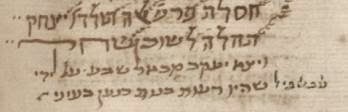
אולם באמת, אין נראה כלל לסמוך על מקור זה לומר שמקורי הוא, אלא יותר נראה הדבר כתיקון שנעשה על ידי מגיה, שבא לתקן כפל הלשון ולכן מחק תיבת ‘שבשביל’, שכן כבר בכתבי היד הקדומים והחשובים של פירוש רש”י נמצא כפל לשון זה, וביניהם כתב יד לייפציג[vii], כתב יד שנכתב על ידי חכם אחד בשם ‘מכיר’ במאה הי”ג (=1300-1200), שהעתיק את הפירוש מתוך פירוש רש”י כתיבת ידו של רבינו שמעיה תלמידו הגדול של רש”י [ראה צילום]; וכן בכתב יד מינכן 5, כתב יד שנכתב בשנת ד’ אלפים תתקצ”ג (=1233).
וכן יעידו שאר דפוסים הקדומים, בהם הנוסח הוא כשלפנינו. וראיה לכך, שכן מצינו גם כתב יד[viii] (מאוחר יחסית) בו נעשה תיקון הפוך, שכתוב בו רק ‘שבשביל’ בלא ‘על ידי’, דבר המעיד שסופר/מעתיק היה עלול לתקן בהעתקתו את כפל הלשון, בהבאת רק אחד מהם.
מעניין הוא להביא כאן מעוד כתב יד[ix], שנכתב כנראה בארצות המזרח בסביבות שנת ק’, ונוספו עליו השלמות ותיקונים בכתב מאוחר אשכנזי, אשר הסופר כתב ברש”י רק “על ידי שהיו רעות בנות כנען…”, והמגיה המאוחר, הוסיף “שבשביל”, ולא בתור פירוש, אלא בתור הוספה, כאשר יוכיח ההוספה בתחילת שורה הבאה, ולא בסמוך ל’על ידי’.
**
אשר על כן, ולסיומא, נביא הפשט הפשוט בכוונת רש”י, אותו כתבו כמה וכמה מגדולי מפרשי רש”י, ונביא דבריו הקולעים והקצרים של המהר”ל ב’גור אריה’: כפל הלשון ‘על ידי’ ‘שבשביל’, מפני שמלת ‘בשביל’ – לומר: בשביל שרעות בנות כנען הלך עשו אל ישמעאל, ו’על ידי’ – לומר: על ידי זה הפסיק הענין בפרשתו של יעקב. וראה עוד ב’ביאורי מהרא”י’ לבעל ‘תרומת הדשן’, שכתב שהיה אפשר לסרס הלשון, ולכתוב כל אחד בנפרד, אלא שאז היה רש”י צריך לומר “על ידי כך”, ועכשיו הרוויח שאין צריך לתיבת “כך”. וה’לבוש’ ב’לבוש האורה’ כתב כעין זה, אלא לדבריו הרוויח פחות מזה, שהיה צריך לכתוב “שהפסיק” ועתה הרוויח אות שי”ן וכתב רק “הפסיק”. יעו”ש דבריהם.


[i] הספר יצא לאור בשם ‘גליון רבינו ישראל מברונא’, א”י תשס”א.
[ii] בדרך של טעות סופר, כהמהלך הקודם שם.
[iii] בעל ‘מבוא שערים’ על ‘שערי דורא’, זקנו של ה’מגלה עמוקות’.
[iv] תשובות הגאונים, הרכבי, ברלין תרמ”ז, סי’ רעב; ב”מ
לוין, אוצר הגאונים, ב”ק, ירושלים תש”ג, עמ’ 37; רנ”ד רבינוביץ,
תשובות ופירושי רב שרירא גאון, ב, סי’ עה, ירושלים תשע”ב, עמ’ תרל-תרלא.
[v] מהד’ שלזינגר, עמ’ 60, סי’ עד.
[vi] לדוגמאות נוספות ראה י”ש שפיגל, ‘לשונות פירוש והוספות
מאוחרות בתלמוד הבבלי’, תעודה, ג, ת”א תשמ”ג, עמ’ 112-91.
[vii] על כת”י לייפציג, ראה א’ גרוסמן, חכמי צרפת הראשונים,
ירושלים תשס”א3, ע”פ המפתח, ובפרט עמ’ 193-187.
[viii] כת”י ירושלים, NLI Yah. 228, כתיבה
ביזנטית מאה הט”ו.
[ix] פרנקפורט, הספריה העירונית והאוניברסיטאית, Ms. hebr.
qu. 19


Comments on This and That, part 1

Comments on This and That, part 1
by Marc B. Shapiro

1. In this post I referred to R. Hayyim Hirschensohn’s Nimukei Rashi, and stated that I thought it was one of his best works. This led to some correspondence with readers regarding the commentary. I have no doubt that I could devote ten posts to Hirschensohn, but then what would happen to everything else I want to discuss? But there are people who want me to call attention to some more interesting comments from Hirschensohn. I know that among them are those who go to hebrewbooks.org and print out some of the sources I refer to and bring them to shul on Shabbat. That is fine, as long as you aren’t looking at it during the rabbi’s sermon. As it is, Hirschensohn writes a good deal about how the rabbis are not given proper respect, and how ignoramuses have all too much power. At least in one respect, however, things have gotten better since Hirschensohn’s day. In Nimukei Rashi, Bereshit, pp. 46a-46b, he speaks about how the people give more respect to the hazzan than to the rabbi. This doesn’t apply anymore because there are hardly any synagogues that still have a hazzan.

In response to requests, let me therefore mention one more very interesting passage in Hirschensohn’s Nimukei Rashi in this post (with more to come in future posts). But my real suggestion is to study it yourself, even though it might make for difficult reading at times. To paraphrase Chazal (Avot 5:22), “no pain, no gain.” Or as R. Tuvia Hanks put it: “It’s supposed to be hard. If it wasn’t hard, everyone would do it. The hard is what makes it great.”[1]

Before quoting the comment in Nimukei Rashi that I have promised, I also want to record one formulation of Hirschensohn that I think it is magnificent. While R. Soloveitchik undoubtedly would disagree with much of what Hirschensohn writes, if he would have heard the following, I know that he would have regarded it wonderful, expressing the essence of what real Torah learning is all about. In his Musagei Shav ve-Emet, Section Penei ha-Hamah, p. 64, Hirschensohn gives his definition of a lamdan. I am sure readers have their own definitions. Some will say that one who knows a few tractates is a lamdan, while other will say that one who gone through the Ketzot ha-Hoshen earns the title. Hirschensohn has his own approach:

אינני קורא למדן (שם זארגני על ת”ח גדול) רק את זה אשר רמב”ם קשה או רש”י סותרות או תוספות מופרך לא מניח לו לישון

When one can honestly say that a difficult Rambam or Rashi keeps you up at night, only then can you be called a lamdan. As I mentioned, this is a formulation that the Rav would have embraced, and he actually lived this way. I heard from Dr. David Fand, a student of the Rav from the 1940s, who studied in Boston’s Yeshivat Heichal Rabbenu Hayyim Halevi, that one night the Rav woke some students up in order to tell them a hiddush.

In Nimukei Rashi, Bereshit, p. 48b, Hirschensohn discusses the comment of Rashi, Gen. 26:8. The verse states that Abimelech looked out his window and saw that Isaac “was amusing himself with Rebekkah.” Upon this verse, Rashi, based on a Midrash, states that Abimelech saw them having marital relations. The question is, of course, obvious. How is this possible that Isaac and Rebekkah would do this in such a way that people could observe him? As Hirschensohn puts it:

ובאמת זה קשה מאד לחשוב כזאת על עולה תמימה כיצחק שיעשה דבר מגונה כזה ונגד היכל מלך

Hirschensohn therefore refuses to take this Midrash literally. He sees it as a mussar derash about how people living among those at a lower moral level can be negatively influenced by them. He offers his own example of this: elderly women in America. (By “elderly”, I think he means women over sixty.) In Europe they used to dress modestly but in America they were negatively influenced to dress in an inappropriate fashion. He continues:

ואינני חושב שחשבו חכמים שבאמת שימש יצחק מטתו ביום לפני חלון פתוח נגד היכל המלך, רק זה אחד מדרכי הדרוש המוסרי לקשור אותו לאיזה צלצול בלשון להפריז הדבר להגדיל את מוסרו.

Hirschensohn’s comment is not surprising. We have come to expect that anytime there is an unusual Midrash, or one that reflects poorly on a biblical figure, that one of the aharonim will argue that it is not meant to be taken literally. This is no different than the attempts to understand various strange Aggadot allegorically.[2] A good rule of thumb is if the Aggadah is strange, then someone will interpret it in a non-literal fashion. I opened up the Artscroll Rashi translation for the verse we are discussing and was therefore not surprised to find the following: “In truth, according to the Zohar, Isaac conducted himself modestly with Rebekkah. Abimelech did not see them in a physical sense; he understood through some astrological means that they were having relations (Maskil LeDavid).”

Regarding the character of Isaac, Hirschensohn writes:

על יצחק אשר ישב ארבעים שנה בלא אשה ולא שם עיניו על בנות הארץ וישב עשרים שנה עם אשתו בלא בנים ולא לקח אשה אחרת עליה אשר לזה הי’ דבר הרגיל מאד בכל איש שם להרבות נשים ופלגשים ושפחות, אות הוא שהי’ מצונן או מצדקתו משל ביצרו, ואיש כזה לא ישמש מטתו נגד חלון פתוח מול היכל מלך.

In dealing with the issue raised, Hirschensohn appears to be correct that there are only two options in describing Isaac. Either that he didn’t have a sexual drive or that he overcame it. Nevertheless, it does strike me as a bit strange to be speaking of the Patriarch in this fashion, although maybe this is just my own prudishness. Here, for example, is what R. Yehiel Michel of Glogau (died 1730) says about this episode with Isaac in his Nezer ha-Kodesh, vol. 3, p. 329a (64:5), a classic commentary on Bereshit Rabbah.

אע”ג דאמר ר”י המשמש מיטתו ביום ה”ז מגונה והיינו כמ”ש המפרשי’ דמיירי אפילו בבית אפל או במאפיל טליתו דאל”ה מה מגונה דקאמר הא אפילו איסורא איכא . . . ולא שרי בכה”ג בת”ח אלא לצורך שעה בראותו שיצר תאותו מתגבר עליו הרבה כדי שלא יבא לידי הוצא’ ש”ז לבטלה או הרהור רע אצ”ל דבאמת הוי נמי כה”ג ביצחק וזה רמז הכתו’ באומרו והיה כי ארכו לו שם הימים כלומר שאירע לו מקר’ כזה להתגבר יצר תאותו ע”י שארכו לו הימ’ שלא נזדווג לאשתו משו’ שמקמי הכי אפילו בצינעא בלילה לא שימש מיטתו פן תתעבר ויתפרסם הדבר לפני אבימלך ועמו אבל אז הי’ צורך שעה לכך ולזה לא נזהר מלשמש אף ביום.

The author might think he is helping Isaac’s reputation with his explanation, but I actually think just the opposite, that what he says reflects negatively on Isaac. Let’s remember who we are speaking about here. We are not talking about some average guy. We are speaking about the Patriarch Isaac, whom many sources portray as the holiest of the Patriarchs. And regarding him R. Yechiel Michel says that it was צורך שעה?! Does he really expect us to believe that it was such an emergency that Isaac couldn’t have waited until the night? With all due respect to the author, who certainly knew who Isaac was, I can’t understand how he could suggest this. Hirschensohn’s description of Isaac is thus much more in line with how the Tradition encourages us to view the Patriarchs. Of course, I understand what is driving R. Yechiel Michel, namely, the reality of Isaac having sexual relations in the daytime. Unless one is prepared to read this in a non-literal fashion, as did Hirschensohn, there is a real problem and I guess the answer he offered was the best one he could come up with.

I am sure most readers are with me in not feeling comfortable engaging in speculation about the sexual life of the Patriarchs, and yet the truth is that we find such speculation among the commentators. Let me give one example. The Torah states (Gen. 29:20): “And Jacob served seven years for Rachel; and they seemed unto him but a few days, for the love he had to her.” R. Hayyim Zev Rosenfeld, in his Sefer ha-Hayyim (London, 1922), p. 22, asks a very good question. If you love someone, and desperately want to be with her, then it is not seven years that will seem like a few days, but precisely the reverse. A few days would seem like seven years. So why does the Torah say that the years went by very quickly for Jacob? According to Rosenfeld, the answer is that Jacob’s love for Rachel had no sexual component.

Rosenfeld brings the following support for his contention. In blessing Reuben, Jacob says (Gen. 49:3): “Reuben, thou art my first-born, my might, and the first-fruits of my strength.” As a number of talmudic and midrashic passages explain, the sperm that impregnated Leah was the first one ever to leave Jacob’s body.[3] Since the Talmud tells us that a woman cannot become pregnant from the first intercourse, [4] how is it that Leah became pregnant? The Maharsha, Yevamot 34b, deals with the problem. In what can only be described as an exercise in original Midrash, Maharsha suggests that since Jacob was able to prevent any seminal emissions for more than eight decades, one can assume that in his first intercourse with Leah he also did not ejaculate (so that the sperm not be wasted). Therefore in truth, Leah did not become pregnant from the first intercourse.

Maharsha’s explanation, which shows how far removed Jacob was from carnal pleasures, is cited by Rosenfeld as support for his assumption that Jacob’s love for Rachel was entirely non-sexual:

שפיר נוכל לומר עליו באהבתו אותה שלא היה כונתו תאות המשגל

And since his love was non-sexual, that is why the long time waiting seemed like a short time.

(As is often the case with biblical commentaries, Rosenfeld’s question is better than his answer. We can all point to plenty of examples of non-sexual love in which a short time seems much longer [e.g., a parent longing for a child]. Just because Jacob’s love was non-sexual, why should that mean that seven years seemed like a few days?)

The Rashi dealing with Abimelech, Isaac, and Rebekkah reminds me of how in high school, when we first learnt Rashi intensively, we would sometimes come across texts which created all sorts of problems, and the teachers often didn’t deal with them properly. Would it have been so hard for the rebbe to acknowledge that yes, he too finds certain Midrashim strange? I specifically remember when we learnt Rashi to Gen. 25:26, which quotes a Midrash that explains why Esau was born first even though Jacob was conceived first. At the time, we were studying biology and knew that the biological description in this Rashi was incorrect. In what was for me a prologue to the Slifkin affair, one of the students raised this point. I also recall how his question was pushed aside, as if it was unimportant.[5] (Later, I was surprised to find that even in the nineteenth century R. Akiva Eger was clueless about the anatomy of pregnant women. Here is what he writes in his comment to Berakhot 63b, quoting a medieval source:

דז’ חדרים יש באשה שלשה מימין ושלשה משמאול ואחד באמצע אם תתעבר מימין יהיו זכרים ובשמאל נקבות ובאמצע טומטום או אנדרוגינוס)

Another Rashi which raised a problem, for me at least, was Gen. 24:2. Commenting on the biblical expression, שים נא ידך תחת ירכי, Rashi quotes the Midrash that Abraham asks Eliezer, in taking his oath, put his hands on Abraham’s circumcision.

לפי שהנשבע צריך שיטול בידו חפץ של מצוה, כגון ספר תורה או תפילין, והמילה היתה מצוה ראשונה לו ובאה לו על ידי צער והיתה חביבה עליו ונטלה

I remember in high school thinking that this was very strange. But I assumed that it was only since I was corrupted by modern values that I found this strange, and that those who had a pure “Torah hashkafah” would not even raise an eyebrow. I was even too embarrassed to ask the rebbe about this Rashi (which comes from Bereshit Rabbah).[6] It was only many years later that I found that the great R. Raphael Berdugo (1747-1821), known as the מלאך among Moroccan Jewry, had the same response as a fourteen-year-old American student. He does not hesitate to tell us that he finds this Midrash quite strange (Mesamhei Lev, ad loc.).

שהמילה אין בגופה קדושה אדרבה הוא מקום הבושת ואיך יקח בידו ערות חבירו ויזכיר שמו ית’ . . . גם אם רבינו הקדוש לא הניח ידו למטה מחגורו ק”ו אברהם אבינו ע”ה, גם מאכילת עץ הדעת יבושו בני אדם זה מזה וזילותא הוא לאדם נכבד שיחזיק אחר במבושיו

What this shows us is that when a rebbe is asked about this Rashi by one of his students, he should not put on an act and make believe that he too doesn’t find it strange. Instead, he should be honest, just like Berdugo, and acknowledge that this is indeed an unusual Midrash. Such an honest approach will earn the respect of the students and come in handy as the class comes to other strange Midrashim.[7]

Rosenfeld, whom we just cited, also deals with this passage and has a very interesting formulation (p. 21):

שים נא ידך תחת ירכי: כאשר רמזתי לעיל שהיה כלי הולדה קדוש בעיניו, אך משה אסר זאת בתורתו להיות קדושים.

In other words, the old way of taking an oath, which was acceptable in Abraham’s day, was later rendered invalid due to the heightened moral standards of the Torah. His comment, that Abraham regarded the genitals as holy, is explained by him as follows (p. 19):

שאצל אברהם היתה המילה תיקון הדת להקדיש כלי הולדה שהוא המקור מכל מין האנושית, ולכוף את תאותיו . . . וגם המילה היא מקור הולדה והשפע בא על ידו

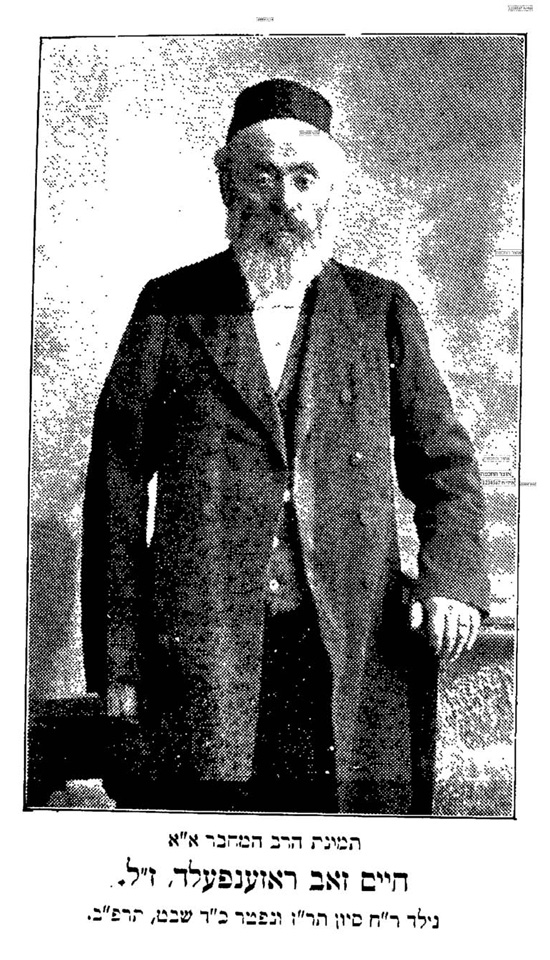
I will return in a future post to discuss Rosenfeld, who was very unconventional and expressed all sorts of provocative notions.[8] He was also unusual among those born in Eastern Europe in that he published many books in English. Here is his picture, which appears in his Sefer ha-Hayyim, showing that despite his unusual ideas he certainly had the rabbinic look.


2. I want to now go back to one of my earliest posts, from four years ago, in which I discussed the meaning of the word olam in the Bible and how the words Adon Olam should be translated. See here.

I received many e-mails after this post, and there were many important comments posted online. I told a number of people that I would try to mention their comments in a post. Although I can’t get to all of them, at least with regard to some, better late than never.

With regard to appearances of the word olam in the Torah where modern scholars say it means eternal (or something along those lines[9]) and traditional interpreters understand it to mean “world”, R. Nathan Kamenetsky called my attention to Gen. 21:33, where it is clear from Onkelos, Rashi, and Ramban that the word means “world.”[10] To this I will add that Maimonides also understands olam in this verse to mean “world”. See Mishneh Torah, Hilkhot Avodah Zarah 1:3 (Simon Glazer, in his translation, mistakenly renders it “Everlasting God” instead of “God of the World”, “God of the Universe” or something like that. Similarly, Eliyahu Touger, in his translation of this halakhah mistakenly renders it “eternal God”.) See also the index to Pines’ translation of the Guide under Gen. 21:33 for instances in the Guide where Maimonides refers to the verse, and also Schwartz’ edition of the Guide 2:13 n. 14. We must also translate Maimonides’ opening words of each of the three sections of the Guide (and elsewhere[11]) בשם ה’ א-ל עולם as “In the Name of the Lord, God of the World.”

As for what the words Adon Olam mean, in a comment to the original post, Kovner clinches the meaning, I think. He called attention to Berakhot 7b: “From the day that the Holy One, blessed be He, created the world (olam) there was no man that called the Holy One, blessed be He, Lord, until Abraham came and called Him Lord (adon).” I had forgotten about this passage, and I think it is obvious that the words Adon Olam are based on this text, meaning that the passage should be translated as “Master of the Universe”, or something along those lines. A very learned reader also pointed out to me that this same point is made by R. Pinchas Zebihi in his Mi-Zahav u-mi-Paz (Jerusalem, 1993), at the end where there is a commentary on Adon Olam. See also the online discussion here.

Responding to Kovner, R. Yitzhak Oratz e-mailed me that Kovner’s very point was approved by the Vilna Gaon and repeated by none other than the Brisker Rav. See Dov Eliach, Sefer ha-Gaon, vol. 1, pp. 425-426, where it states that the Gaon was shown this point in the siddur Magid Tzedek and said that the entire siddur was worthwhile for this one point. Ad kan R. Oratz.[12]

With regard to the word olam, it is true that in rabbinic literature it means “world”, but I would be remiss in not mentioning that the older meaning is found as well. Sometimes, it is unclear which the correct meaning is. For example, Mishnah Yadayim 3:5 reads:

אין כל העולם כולו כדאי כיום שניתן בו שיר השירים לישראל

Soncino translates: “The whole world is not as worthy as the day on which the Song of Songs was given to Israel.” Others translate similarly. Yet A. S. Halkin renders it: “All of time is not as worthy as the day on which the Song of Songs was given to Israel.”[13] Halkin’s opinion is noted in a comprehensive article devoted to the very issue here being discussed.[14] Fuderman and Gruber, the authors of this article, also point to two biblical texts “of Hellenistic date” in which they claim olam means “world.” One of them is Dan. 12:7: .חי העולם They translate this as “the life/vital force of the world,” and note that this usage is found in the Jewish liturgy where it has been transformed into חי העולמים, with the same meaning.

The other example they give is Eccl. 3:11: גם את העולם נתן בלבם. They are not the first to translate olam here as “world.” The old JPS also translated it this way: “He hath set the world in their heart.” But in the Soncino edition, which uses the old JPS, the commentary rejects this translation, commenting that “the only signification” olam has in the Bible is “eternity.” The translation would therefore have to read: “He hath set eternity [i.e., a sense of the future] in their heart.” Soncino’s note might be based on Ibn Ezra’s comment to this verse, where he says flatly that in the Bible the word olam only means “eternity,” not “world.” (He says likewise in his Short Commentary to Exodus 31:17; Commentary to Psalms 66:7, 89:4.) Daat Mikra agrees with Soncino, explaining the verse as follows: את העולם: את השאיפה לחיים עולם ונצחיות ולדעת את הנעלם, מה שהיה לפנים ומה שיהיה לאחור [15]

I will leave the meaning of olam in this verse to the biblical scholars to fight over. But I want to return to the point made by Fuderman and Gruber that Ecclesiastes was composed in the Hellenistic period, many centuries after Solomon. Based on this they don’t see it as at all incongruous that the word olam means “world” in this book because we are dealing with a later development of biblical Hebrew.[16] This relates to another interesting point.

At the beginning of the standard Vilna edition of the Mishnah there is an essay on R. Judah the Prince by R. Moses Kunitz. Here is the first page.

This essay is excerpted from Kunitz’ Beit Rabbi (Vienna 1805), most of which is actually a play in six acts.[17] Kunitz is best known for his Ben Yohai which is a valiant, if unsuccessful, defense of the ancient dating of the Zohar against R. Jacob Emden’s Mitpahat Sefarim. He was a very pious man and in his lifetime was treated with great respect.

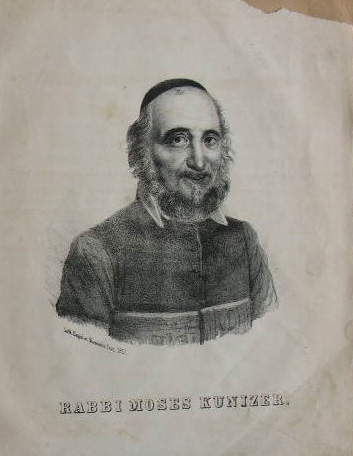
In the next issue of Milin Havivin I will have information regarding this, so there is no need to repeat it here. Here is his picture.

Kunitz is also famous as one of the rabbis whose responsum to the early Reformers is printed in Nogah ha-Tzedek. This was from a time when the Reformers made it seem that all they were looking for was a more lenient halakhic approach. They also succeeded in receiving letters from two Italian rabbis. Just as these rabbis were not Reform in any way, neither was Kunitz. Not knowing who the Reformers were, he fell into their trap, which is perhaps the best way to put it. Yet as I mentioned, this didn’t greatly affect his standing in the rabbinic world, because people assumed that his was an innocent error. In fact, in all the polemics against the Reformers, none of the great rabbis of the day even mention Kunitz.[18]

A few years ago a new edition of the classic Vilna Mishnah was reprinted, and lo and behold, Kunitz’ essay is missing. The publisher was obviously told that there was some controversy around Kunitz, and he therefore just cut out the essay. Yet if the publisher wanted to censor, he missed the real thing. (I wouldn’t be surprised if following this post, future printings of the Mishnah also cut out what I will now discuss. That is the reason why I don’t call attention to various “interesting” books that have been put up on hebrewbooks.org [including Karaite literature], at least until they are also on Google books. I know that soon after I discuss them, they will be taken down. As it is, a number of anti-hasidic and Haskalah works have already been removed from the site. Sometimes these books have come down within a day or two of being put up, after someone has informed the site that they put up a “dangerous” volume. So you have to be quick when they post the new books and download anything you think might be removed.)

Immediately following Kunitz’ essay, there is another article on the grammar of Mishnaic Hebrew by Solomon Loewisohn. In the very first note he refers to the book of Ecclesiastes, and concludes his comment with והטעם ידוע למשכילי עם Here is the page.


What he is alluding to in this note is that Ecclesiastes is a late biblical book, and thus could not have been written by Solomon. To show this he points to the word חוץ, which in its usage in Ecclesiastes 2:25 is an Aramaism, and thus post-dates the biblical Hebrew of Solomon’s day.[19] To use an expression of the Sages, we live in an olam hafukh. Kunitz’ essay was thought worthy of censorship, and at the same time this note remains in every printing of the Vilna edition of the Mishnah. Yet as I mentioned above, let’s see how long it is before this note, or even the complete essay, is also removed.

Regarding the book of Ecclesiastes, in Limits, p. 26 n. 140, I referred to a comment of R. Israel Bruna which appears to say that Ecclesiastes was not divinely inspired. R. Yonasan Rosman (one of whose seforim I mentioned in an earlier post) has taken issue with me in this. However, he also points out that this is exactly what Maharsha seems to be saying in his commentary to Shabbat 30b. I also found that R. Zvi Hirsch Chajes, in his note to Berakhot 4a and in Kol Sifrei Maharatz Chajes, vol. 2, p. 927, states explicitly that Ecclesiastes was not divinely inspired. R. Michael Broyde has noted that this is also stated by R. David Ibn Zimra in his responsa, vol. 2, no. 722.[20]

Rosman also points out that Maimonides, Hilkhot She’ar Avot ha-Tum’ot 9:6, states that Ecclesiastes (and Song of Songs) are “words of wisdom”, with the implication that these books are not divinely inspired. This expression, “words of wisdom”, comes from Tosefta Yadayim 2:14, where it is explicitly contrasted with ruah ha-kodesh.

ר’ שמעון בן מנסיא אומר שיר השירים מטמא את הידים מפני שנאמרה ברוח הקדש. קהלת אינה מטמא את הידים מפני שהיא מחכמתו של שלמה.

Based on the passage just mentioned, I initially assumed that Maimonides is indeed saying that Ecclesiastes was not written with divine inspiration. I also found that the important commentator R. Masud Hai Rakah is of this opinion. Yet then there is a problem, because according to the Tosefta, Song of Songs was written with divine inspiration and yet Maimonides also refers to this book as “words of wisdom.” Rakah himself raises this problem and can offer no solution,[21] but it is likely that when Maimonides speaks of these books as being “words of wisdom” it does not mean that they are lacking in divine inspiration. We can see this from Hilkhot Talmud Torah 5:4, where he quotes Song of Songs and writes regarding it אמר שלמה בחכמתו. The same words are found in Hilkhot Yesodei ha-Torah 2:12 and Hilkhot Deot 3:3, 4:15, 19 and in these cases Maimonides is quoting verses from Proverbs. Maimonides believed that both Song of Songs and Proverbs were written with divine inspiration, and yet we see that he uses the term “wisdom” with regard to them. The truth is that this phraseology comes directly from the Talmud,[22] and need not have anything to do with whether the text being described is divinely inspired. This whole problem is dealt with by the brilliant R. Meshulam Roth in an article in Sinai 17 (1945) pp. 267ff. With his typical erudition, Roth shows that Maimonides indeed regarded Ecclesiastes as being divinely inspired and in fact states so explicitly in Guide 2:45. Roth also shows how in a few places he describes Solomon as a prophet.[23]

Many might find this entire discussion strange, for they assume that if a book is in the canon that means it must be regarded as having been divinely inspired. I have found such a conception in many books.[24] Yet it is incorrect, and as Shnayer Leiman has shown, the tanna R. Simeon ben Menasia, while he regarded Ecclesiastes as an uninspired book, also thought that it was canonical. Thus, while he states that Ecclesiastes does not defile the hands, he also expounded a verse from Ecclesiastes.[25]

As far as I know, the Sages never “decided” that Ecclesiastes is a divinely inspired book. It would therefore seem to be entirely acceptable for one to hold the position of R. Simeon ben Menasia, which was shared by Beit Shammai and R. Meir,[26] that the book is not a product of ruah ha-kodesh. Obviously, one who rejects the book, or any other biblical text, claiming that it was a mistake to have been included in the Canon, has to be regarded as a sectarian. However, here too I think that there is more room for personal opinions than people often think. For example, what about someone who accepts Ecclesiastes as part of the Canon but thinks that the Sages were wrong in this decision, and that they should have adopted the view that the ideas of this book are not fit to be included in the Bible? This was Samuel David Luzzatto’s early position, although he later became more sympathetic to Ecclesiastes. Yet despite this negative view, Luzzatto never rejected the canonical status of this book.[27]

Or what if someone thinks that the halakhah should have been decided in accordance with Samuel (as understood by a number of rishonim)[28] that the book of Esther should not have been included in the canon? As long as one accepts the halakhah as recorded by the Sages he is not to be regarded as a Zaken Mamre, which shows that acceptance of the halakhah in practice is what is important, but one doesn’t have to think that the Sages were correct. After all, in the story of the Oven of Akhnai (Bava Metzia 59b), while R. Eliezer was forced to accept R. Joshua’s viewpoint, I don’t think there can be any doubt that R. Eliezer still believed that he was correct. How could he not, when God Himself agreed with him? Yet the most R. Eliezer could hope for was that his decision would be adopted by a future beit din, and maybe only after the arrival of the Messianic era. Let us not forget that the Mishnah in Eduyot 1:5 explicitly tells us that minority opinions are recorded so that a later court can rely on them, meaning that there is no problem for one to argue the case of a rejected opinion, as long as one does not adopt it in practice (i.e., before a later court gives its imprimatur to do so).[29]

All this seem to be no different than someone who, after examining a talmudic dispute, thinks that the weight of the evidence shows that the halakhah should be in accordance with Abaye, and yet the Talmud decides the halakhah in accordance with Rava. Such a person accepts the practical halakhah, and this is no different than someone who thinks that the Shulhan Arukh decided the halakhah improperly, but who nevertheless follows the law as recorded. You can even argue that this is a very high level of commitment, namely, one who thinks the halakhah should be different, but nevertheless sublimates his personal feelings and accepts the law as we have it.[30]

Similarly, the assumptions of academic Talmud study lead, in theory, to the undermining of many talmudic conclusions. But the practitioners of this form of study have always insisted that since they don’t seek to change the accepted halakhic practice, there can be no religious objection to their approach.

The only reason the Song of Songs was included in the Canon is because it was interpreted in an allegorical fashion.[31] Does this mean that one must accept that this was the original meaning of the book? Jacob Barth (1851-1914) certainly didn’t think so. Barth was the son-in-law of R. Esriel Hildesheimer and one of the most brilliant Semitists of his day. In addition to teaching at the University of Berlin, he was also a long-time and revered faculty member at the Rabbinical Seminary of Berlin. Just to give one example of this, in discussing the great achievements of German Orthodoxy, R. Jehiel Jacob Weinberg lists the following four men as examples of what German Orthodoxy can be proud of: Hirsch, Hildesheimer, Hoffmann, and Barth.[32]

Here is a picture of Barth.


Barth argued—and taught his students at the Rabbinical Seminary of Berlin—that the Song of Songs was not originally intended as an allegory, but this was a later interpretation of the Rabbis, and as already mentioned it was precisely this interpretation that enabled the book to be included in the Canon.[33] Barth believed that the Song of Songs was actually a collection of different songs, composed in various periods.[34] They were designed to be sung at a wedding and the days of feasting, and give expression to marital happiness and love which are basic to the Jewish family. According to Barth, just like the Psalms were originally written by the Psalmist with specific circumstances in mind, but their meaning for the Jewish people throughout history is not tied to this original intent, the same can be said for the Song of Songs. What it originally meant is different than what it later came to mean for generations of Jews.[35]


To be continued
* * * *
In my last post, available here, I wrote about the issue of lo tehanem. As far as the Modern Orthodox are concerned, based on the Meiri and others, these laws are no longer regarded as applicable in modern times. (Although as I mentioned, the Centrists are trying to bring them back.) Someone sent me a link to Dov Bear’s post available here. Dov Baer included the following text that recently appeared (and highlighted certain sections).

I have already mentioned the Slifkin controversy in this post, and regarding matters of science and Torah there definitely are differences between the Modern Orthodox and the haredim. However, I think that when it comes to matters like lo tehanem, the divide is much more significant. If the haredi/ hasidic world really accepts the outlook of the page printed above, then its understanding of what “Jewish values” are all about is far removed from that of the Modern Orthodox.[36] We can also see how secure haredi Jews in America must feel in order for them to put this sort of material in the English language, for all to see.

In two posts from now, I will discuss a dispute currently taking place in the hasidic world in America about how to relate to non-Jews. For now I will simply note that a common theme among virtually all who abandon hasidic life, in explaining what they found objectionable in their former lifestyle, is the denigration of “the other” found in the hasidic world. In the forthcoming post, I will deal with a brave voice from that world who is putting forth a different approach.


[1] See here.
[2] Here is what Louis Ginzberg wrote about the unusual aggadot (On Jewish Law and Lore [New York, 1970], p. 77 (I thank Gershon Bacon for reminding me of this passage.) There is a lot one can say about this comment.

With your permission I shall commence my lecture by recounting an incident that happened to me. It is a memory from boyhood, which means the time when I had already been liberated from the hard discipline of the master of the heder, and, though yet a child of nine, had begun to study, in the traditional phrase, “by myself.” I was then studying the tractate Baba Bathra. When I reached the tales of Rabbah bar bar Hannah, doubts began to disturb my mind; my peace was particularly troubled by those geese who were so fat that they had streams of oil flowing from them and by the bird that was so big that the waters of the sea reached only to its ankles and its head split the heavens. My joy was great when I came across a book by one of the “enlightened” of the older generation (if my memory is correct it was the Maphteah by Shatzkes), from which I learned that these geese were neither fat nor thin and that the giant bird possessed neither feet nor wings, but that the whole tale was merely a flight of the imagination, or, as the ancients used to say, it was only a parable—the moral I have forgotten. I was a child then; but when I reached maturity I realized that in truth the geese of Rabbah bar bar Hannah were real geese and the giant bird was literally a bird. When regarded as natural creations of the folk imagination, they lost their strangeness and incomprehensibility. On the contrary, it would be all the more strange if we possessed no such tales; in that case it would be extremely difficult to explain so striking a difference between our people and all others, one involving so great a triumph of reason over imagination that the latter had become completely atrophied.


[3] See Torah Shelemah, Gen. ch. 49, note 47.
[4] Do any of the readers know where the Talmud picked up this piece of folklore? I assume it was a common notion in ancient times. See Bereshit Rabbah 45:5, where the matter is disputed. Noda bi-Yehudah, Even ha-Ezer no. 22, recognizes that there are women who do become pregnant after first intercourse, and therefore claims that the Talmud was only giving a general rule, but there are exceptions. See R. Neriah Gutel, Hishtanut ha-Tevaim (Jerusalem, 1995), pp. 88ff.
[5] I assume that the rebbe’s response was due to the fact that the passage quoted by Rashi is a Midrash. If it was Rashi’s own explanation, I don’t think he would have regarded it as a disrespectful question. In general, and readers can correct me if I am wrong, I don’t think that the opponents of Slifkin assume that together with Hazal the greatest rishonim are also infallible on scientific matters (the one exception perhaps being the Lubavitchers when it comes to the Rambam). When I was in yeshiva I never came across a rebbe who thought that, although I can’t remember anyone actually spending time on one of the rishonim and explaining why what he says is not correct scientifically, or, to take a different issue, that perhaps the rishon’s view of women doesn’t reflect how we currently think. Had they done so, it would have had an enormously positive influence on some of the students who instead came to believe that the Torah was out of date and not relevant to their lives.

To give one example of many, the online elucidation of Tosafot, available here, in discussing Tosafot, Shabbat 65b. s.v. sahada, offers the following preface:

Before we approach this Tosfos we must realize that during the times of the Reeshonim, there were very few if any maps in Europe of any of the areas that are being discussed in the G’moro. All the knowledge that they had about the rivers and places was what they gleaned from the G’moro or Midrosh about these places.

What forces the translator to add this comment is that Tosafot rejects Rashi’s explanation (which I will soon come to) and incorrectly states that all rivers flow from east to west. (Among European rivers, the Danube flows west to east.) It turns out that Rashi’s explanation is also geographically incorrect. Rashi, Shabbat 65b s.v. sahada, writes about the Euphrates: שהוא יורד מארץ ישראל לבבל

In other words, Rashi thought that the Euphrates originated in the Land of Israel, and flowed from there to Babylonia. Yet this is incorrect as the Euphrates is not within the Land of Israel. Artscroll recognizes the problem and states that the Euphrates is on the northern border of “Greater Israel,” i.e., the land promised to Abraham. I believe that this is an apologetic explanation. The Euphrates will only be part of the Land of Israel in messianic days. It was never a part of Israel during the First Temple, or during the Second Temple. Yet Rashi is speaking about the river as actually part of the Land of Israel. See Isaac Samuel Reggio, Ha-Torah ve-ha-Filosofyah (Vienna, 1827), p. 63.

[6] See also the various Midrashim cited in Torah Shelemah, Gen. 47:29, where Jacob is speaking to Joseph and he too says שים נא ידך תחת ירכי.
[7] There are other ways of dealing with the Midrash. See e.g., R. Paragi Alush, Ohev Mishpat (Djerba, 1928), vol. 1, no. 3, that Eliezer only touched the organ from outside of Abraham’s clothes. R. Eliyahu Katz, Amar ve-Amarta (Beer Sheva, 1994), Gen. 24:2, finds the Midrash so strange that he can’t take it literally, and even uses the term has ve-shalom with reference to the literal meaning. He does so even though, as far as I can tell, all the standard commentaries on the Midrash and Rashi do take it literally. Here are his words:

תמוה מאד שהמילה נחשבת כחפץ של מצוה. והרי אין בזה מן הצניעות . . . אך ודאי שאין הכוונה ח”ו כפשוטו, אלא הכוונה שהזכיר את המצוה כמו שאומר שנשבע בשם ה’.

[8] For now, here is one just one example. He assumes that Gen.36:31-43 is post-Mosaic.

ואלה המלכים אשר מלכו בארץ אדום לפני מלוך מלך לבני ישראל: מזה נראה כי זמן רב נכתבה פרשה זו, כי ידע כבר את מלכי ישראל.


[9] See Sacha Stern, Time and Process in Ancient Judaism (Oxford, 2003), pp. 75 n. 43, 109ff.
[10] Mordecai Spitz called my attention to Neh. 9:5, where the traditional commentaries also understand olam to mean world.
[11] See Saul Lieberman, Hilkhot ha-Yerushalmi, p. 5 n. 7.
[12] I should also mention that there is dispute about how the word חבלי should be translated in Adon Olam. According to Salomon Speier the meaning is “my portion” and not “my pain” See his note in Journal of Jewish Studies 4 (1953), pp. 40-41. Zebihi, Mi-Zahav u-mi-Paz, at the end, also argues for this understanding. None of the many translations I have checked agree with this. [S. of On the Main Line calls my attention to David Levi’s London 1794 Rosh Hashanah Machzor, where the passage is translated as “Rock of my portion in time of distress.”]
[13] The meaning of olam in Avot 1:2 – על שלשה דברים העולם עומד – has also been called into question. See Judah Goldin, Studies in Midrash and Related Literature (Philadelphia, 1988), p. 34.
[14] Kirsten A. Fudeman and Mayer I. Gruber, “’Eternal King/ King of the World’: From the Bronze Age to Modern Times” A Study in Lexical Semantics.”REJ 166 (2007), pp. 209-242.
[15] R. Elijah Benamozegh translates Ps. 106:48: ברוך ה’ אלקי ישראל מהעולם ועד העולם as “Blessed is the Lord, God of Israel, From World to World,” and Ps. 145:13 מלכותך מלכות כל עולמים as “Your kingship is a kingship of all worlds.” See Israel and Humanity, trans. Maxwell Luria (New York, 1995), p. 184. I wonder if Benamozegh meant these as scientific translations, or if this is to be regarded as derush.
[16] See also Robert Gordis, Koheleth—The Man and His World (New York, 1968), pp. 231-232.
[17] The version of Kunitz’ essay that appears in the Vilna Mishnayot is not identical to that which appears in Beit Rabbi. In particular, a few footnotes have been added. This is not the only example where the editors of the Vilna Mishnayot (Romm) tampered with texts. See Kalman Kahana, Heker ve-Iyun (Tel Aviv, 1960), vol. 1, p. 134 (called to my attention by Eliezer Brodt).
[18] Anyone who wants to visit Kunitz’ grave can find it in the Kozma cemetery in Budapest. For people looking to visit graves, the most famous in the Kozma cemetery is R. Shimon Oppenheim, and he is easy to find. He is not that well known and yet his grave is visited more than many other gedolim who were of much greater significance. This is because R. Shimon promised, as it states on his tombstone, that whoever comes to his grave and recites the Menuhah Nekhonah, his prayers will be answered. (The E-l Male Rachamim commonly recited is an abridged version of the Menuhah Nekhonah, which is found in the kabbalistic work Maavar Yabok) . Since this is a guarantee from a holy rabbi, it is not surprising that his grave would attract people.

So how to find Kunitz’ grave? Unfortunately, the computer print-out provided by the cemetery directs people to the wrong place. If you are standing at R. Shimon’s grave, the plot to the left is that of R. Israel Wahrmann. He was the first chief rabbi of Pest. His grandson, Mor Wahrmann, was the president of the Jewish community from 1883-1892 and a member of parliament from 1869. He was a proud Jew, no question about it. He once even had a duel with an anti-Semite. Neither was killed, but Wahrmann was sentenced to eight days in prison. See Kinga Frojimovics, et al, Jewish Budapest (Budapest, 1999), pp. 214ff., 260. However, he despised the Orthodox (and they detested him). During the debate in Parliament over the Orthodox request to create separate communities, he stood up and started reading sections of the Shulhan Arukh to show how foolish the Orthodox were. All three of his children ended up converting to Catholicism. See Jewish Budapest, p. 216 and R. Leopold Greenwald, Korot ha-Torah ve-ha-Emunah be-Hungaryah (Budapest, 1921), p. 78, and in Apriyon 2 (1925), p. 130.

Two graves to the right of R. Shimon’s is that of Kunitz. Unlike R. Shimon, no one has yet stepped forward to redo Kunitz’ tombstone, which is in bad condition. In another hundred years it will probably be entirely illegible. However, a good portion of it can still be read. This left me perplexed, as it is not the same inscription as that found in Greenwald’s Mekorot le-Korot Yisrael (Humenne, 1934), p. 27. How to explain this?

[19] See R. Meir Mazuz, Kovetz Ma’amarim (Bnei Brak, 2003), p. 60. There are a number of other unusual words in Ecclesiastes, such as pardes (2:5) and pitgam (8:11; both Persian loanwords), which academic scholars have pointed to to show that the book is post-Solomonic. (Pardes is also found in Song of Songs 4:13.) See Shadal in Otzar Nehmad 3 (1860), p. 19, who discusses this and among other points notes that the words כבר and ענין do not appear in any other biblical book. See also Robert Gordis, “Koheleth: Hebrew or Aramaic?” Journal of Biblical Literature 71 (1952), pp. 93-109. In Amos Hakham’s introduction to the Daat Mikra Shir ha-Shirim, pp. 12-13, he rejects the significance of Persian loanwords in dating the text.

Incidentally, R. Moses Isaac Ashkenazi, Ho’il Moshe: Hamesh Megilot ve-Sefer Mishlei (Livorno, 1880), pp. 80-81, states that you can also find some Aramaic words and expressions in Proverbs, as well as later Hebrew forms, none of which could originate in Solomon’s era. Yet this discovery did not trouble Ashkenazi in the slightest.

אין לתמוה אם נפלו בספר זה כמה תיבות ומליצות מל’ ארמי וגם איזו זרות בדקדוק הלשון כמו פעל נשתוה (סימן כ”ז ט”ו) בנין נתפעל ע”ד נשתנה נתרפא נצטרע ודומיהם בלשון חכמים . . . לפי שמפי שלמה יצאו המשלים בל’ מדויק, רק בעברם מפה אל פה דור אחר דור בעוד שקרבת ארם הכניסה בשפת ב”י [בני ישראל] תיבות ומליצות נכריות, נהיה שבבוא יום ונרשמו על ספר כבר הורגלו לאמרם כמו שנמצאו אצלנו, ואם היו מחליפים בהם דברים היו נגרעים מערכם, כי כן יארע לכל משל מאיזה לשון שיהיה שצריך לאמרו כמו שהוא בפי המון העם ואין לתקן בו או להוסיף עליו או לגרוע ממנו

[20] “Defilement of the Hands, Canonization of the Bible, and the Special Status of Esther, Ecclesiastes, and Song of Songs,” Judaism 44 (Winter 1995), p. 70.


[21] Ma’asah Rakah,ad loc.: לא ידעתי למה קרי שיר השירים דברי חכמה דהלא ברוח הקודש נאמר וקדש קדשים הוא He does not ask this question about Ecclesiastes, which shows that he assumes that according to Maimonides Ecclesiastes is only divrei hokhmah.
[22] See R. Zvi Hirsch Chajes, Kol Sifrei Maharatz Chajes, vol. 1, p. 439; Sid Z. Leiman, The Canonization of Hebrew Scripture (New Haven, 1991), p. 173 n. 317.
[23] For examples from the Talmud where Solomon is described in this fashion, see R. Betzalel Zev Safran, She’elot u-Teshuvot ha-Rabaz, vol. 1, Yoreh Deah no. 64 (in the note). Regarding R. Meshulam Roth, it is unfortunate that almost nothing has been written about him. The Tchebiner Rav is reported to have stated that had R. Meshulam been a member of Agudat Israel, the haredim would have crowned him gadol ha-dor. I hope to discuss him in a future segment of my Torah in Motion classes.
[24] Pretty much everyone also seems also to assume that a divinely inspired book included in the Canon had to be have been written in Hebrew. Yet Ibn Ezra, Job 2:11, thinks that the book of Job is a translation from another language, and that is why it is so difficult to understand.
[25] See Leiman, Canonization, p. 113.
[26] Megillah 7a.
[27] Shadal originally thought that Ecclesiastes taught heretical doctrines and was fraudulently attributed to King Solomon. Along these lines, I should note that there were talmudic sages who thought that Solomon had sinned so grievously that he lost his share in the World to Come. See Saul Lieberman, “Hearot le-Ferek Alef shel Kohelet Rabbah,” in Studies in Mysticism and Religion Presented to Gershom G. Scholem (Jerusalem, 1968), pp. 163ff. If someone today expressed agreement with this rabbinic position, I am certain that he would be roundly condemned.
[28] See Broyde, “Defilement of the Hands,” p. 68.
[29] By the same token, someone I know once commented that while in practice he accepts the halakhah as recorded in the Talmud and Shulhan Arukh, some of these halakhot relating to economic matters derive from a very different circumstance than what we have today. He assumes that a future Sanhedrin will revise some of these halakhot which are economically counterproductive and out of touch with how markets work.
[30] See Seridei Esh, vol. 3 no. 54 where R. Weinberg admits that a halakhah in the Shulhan Arukh causes him anguish.

ואודה על האמת, שאיסור זה גורם לי צער גדול

Weinberg was dealing with whether a woman whose father isn’t Jewish can marry a kohen. He would have liked to permit it, but the Shulhan Arukh ruled otherwise. What made the Shulhan Arukh’s ruling so frustrating to Weinberg is the fact that R. Joseph Karo went against his own principle and ruled in accordance with R. Asher, despite the fact that the Rif and Rambam ruled differently. Furthermore, the Vilna Gaon agreed with the Shulhan Arukh. So in the end, Weinberg felt that he must accept the Shulhan Arukh’s ruling. While Conservative halakhists are able, in cases like this, to fall back on conscience, which can trump even biblical law, Orthodox halakhists cannot do so. They must accept the halakhah even if they think it should have been decided differenttly.

[31] Interestingly, Daniel Boyarin has argued that the earliest rabbinic approach to the book was not allegory. He writes as follows:

According to the earliest strata of Rabbinic hermeneutics, the Song of Songs was not an allegory in the sense of paradigms projected onto the syntagmatic axis or concrete entities and events that signify abstractions. Rather it was an actual love dialogue spoken by God to Israel and Israel to God in concrete historical circumstances, or written by Solomon, as if spoken by Israel and God in those circumstances. . . . If the impulse of Origen is to spiritualize and allegorize physical love quite out of existence in the allegorical reading of the Song, the move of the midrash is to understand the love of God and Israel as an exquisite version of precisely that human erotic love. Reading the Song of Songs as a love dialogue between God and Israel is then no more allegorical than reading it as a love dialogue between King Solomon and the Queen of Sheba. The Song is not connected with an invisible meaning but with the text of the Torah and thus with concrete moments of historical memory.

See Boyarin, “The Eye in the Torah: Ocular Desire in Midrashic Hermeneutic,” Critical Inquiry 16 (1990), pp. 543, 549. See also Gerson D. Cohen, Studies in the Variety of Rabbinic Cultures (Philadelphia, 1991), pp. 3-17.
[32] Li-Frakim (1967 edition), pp. 232-233.
[33] “Hartzaotav shel Yaakov Barth al Sefer Yishayahu ba-Beit Midrash le-Rabanim be-Berlin” in Uriel Simon and Moshe Goshen-Gottstein, eds., Iyunei Mikra u-Farshanut (Ramat Gan, 1980), pp. 83-85. (Regarding the dating of Ecclesiastes, discussed earlier in this post, see ibid. for Barth’s view that Ecclesiastes was written ca. 200 BCE.) I have elsewhere discussed the controversy that broke out when R. Raphael Breuer published a commentary to the Song of Songs that interpreted the book in a literal fashion. See Between the Yeshiva World and Modern Orthodoxy, p. 83, and my article on the Frankfurt rabbinate in Milin Havivin 3 (2007), available here.

This commentary was one of the issues that led people to oppose Breuer inheriting his father’s position as rabbi of the Frankfurt separatist community. I find it hard to understand why this commentary aroused such opposition. After all, why can’t the Song of Songs be understood as describing a loving Jewish marriage? Breuer was not denying the allegorical interpretation, only adding an additional level of meaning.

Incidentally, once when a cantor at a wedding sang some words from Song of Songs as the bride walked around the groom, R. Soloveitchik “was not happy. This, after all, was a passuk [verse] in Shir Hashirim which he felt should not be applied to a man and woman in a literal sense.” See Heshie Billet, “Rav Yosef Dov HaLevi Soloveitchik (The Rov) ZT”L: Role Model Par Excellence,” in Zev Eleff, ed., Mentor of Generations (Jersey City, 2008), p. 152. The same opinion is expressed by R. Yosef Lieberman, Mishnat Yosef, vol. 7, no. 101. See also R. Moshe Feinstein, Iggerot Moshe, Yoreh Deah II, no. 142. In addition, Sanhedrin 101a states הקורא פסוק של שיר השירים ועושה אותו כמין זמר . . . מביא רעה לעולם (Avot de-Rabbi Nathan, ch. 36, states that such a person has no share in the World to Come.) However, Kallah Rabati: Baraita, ch. 1, explains this passage as follows: היכי דמי כמין זמר כגון דזמיר ביה ודעתיה על הרהור See also R. Jacob Emden’s note to Sanhedrin 101a:

הקורא פסוק של שיר השירים ועושה אותו כמין זמר נראה דהיינו שמשתמש בו לעשות ממנו זמר לחשוקה אילת אהבים ולחבר אותו לשיר עגבים

This means that there is no objection to singing a song from Shir ha-Shirim in a “kosher” fashion, such as at a wedding or if sung as praise of God. (Emden’s note was published from manuscript in the Wagschal Talmud, and does not appear in the standard editions. I learnt of this from R. David Teherani, Divrei David, vol. 2, Orah Hayyim no. 37.)

See R. Ovadiah Yosef, Yabia Omer, vol. 3, Orah Hayyim 15:5, that in Egypt the practice was to sing verses from Song of Songs in the synagogue between Passover and Shavuot. He also quotes R. Meir Abulafia, Yad Ramah, Sanhedrin 101a who writes:

ויש לפרש דהני מילי מאן דקרי ליה דרך שחוק אבל מאן דמיכוין לשבוחי ביה לקב”ה דרך ניגון שפיר דמי ומילתא צריכא עיונא

Returning to the Rav, it must be noted that he was opposed to all singing under the chupah. See Daniel Greer, “Ma’aseh Rav – V’dok,” in Eleff, ed., Mentor of Generations, p. 177, that at his wedding Rav stopped the cantor from singing Im Eshkochech Yerushalayim. (Others are opposed to all songs which use biblical verses, whether the words are taken whether the words are taken from Song of Songs or from any other biblical text. The only permission would be at a seudat mitzvah. See R. Ben Zion Abba Shaul, Or le-Tziyon, vol. 2, ch. 14 no. 35.) As for the Song of Songs, the Rav also stated that it is “forbidden” to interpret it literally. He even put this into a halakhic context:

בשיר השירים איכא הלכה שאין בו פשט אלא כפי הבנת הרמז הדרש והסוד. המקרא יוצא מידי פשוטו והדרש הופך להיות הפשט

See Reshimot Shiurim, Bava Kamma, ed. Reichman (New York, 2005), p. 494 (to Bava Kamma 83b). See also R. Hershel Schachter, Nefesh ha-Rav, pp. 289-290.

[34] אפריון and פרדס (3:9, 4:13) are among the late Hebrew words he points to show that some sections of the book were composed in the post-exilic period, many centuries after Solomon. R. Moses Isaac Ashkenazi, introduction to Ho’il Moshe: Hamesh Megilot ve-Sefer Mishlei, rejects the notion that based on a couple of individual words one can establish the book’s date. Yet while Ashkenazi defends the Solomonic authorship of Song of Songs and Proverbs (see above, n. 19), he does not believe that Ecclesiastes was written by Solomon. One of his proofs is from Eccl. 1:16: “Lo, I have gotten great wisdom, more also than all that were before me over Jerusalem.” According to Ashkenazi, since Solomon was only the second king to reign in Jerusalem, he never would have written in this fashion. See also 2:7. 9 where the author writes about how he differs “from all who were before me in Jerusalem.” Again, Jerusalem had not been in Israelite hands for that long so it is hard to see Solomon saying this. Ashkenazi also points to the numerous Aramaic words in the book as showing that it had to have post-dated Solomon.
[35] I found a difficult passage in the Netziv’s commentary on Song of Songs, (Metiv Shir). Commenting on the first verse, he writes:

וכן שיר אחות לנו קטנה נאמר בימי א”א [אברהם אבינו] כמבואר בב”ר פ’ לך, ויבואר במקומו, אבל שלמה אסף השירים ברוה”ק וגם הוסיף הרבה משלו ועשאן שיר נפלא אחד.

The Netziv states that the section of Song of Songs beginning with ch. 8:8 (“We have a little sister . . .”) was written in the days of Abraham. What is his proof? Bereshit Rabbah 39:1 states: “R. Berekhiah commenced: We have a little sister (ahot; Song of Songs 8:8), this refers to Abraham, who united (ihah) the whole world for us.” R. Berekhiah continues to find allusions to Abraham in the next couple of verses as well. In other words, R. Berekhiah offers a nice Midrash about how Song of Songs homiletically refers to Abraham. But how does the Netziv possibly derive from this that the verses were written in the days of Abraham? The very next section in Bereshit Rabbi cites a verse from Ecclesiastes and states: “this refers to Abraham.” Does the Netziv assume that this too was written in the days of Abraham? Midrash is full of this type of homiletic comment, so why here does the Netziv think that we can learn something historical from R. Berekhiah’s statement?

[36] See also my post here.


Mayer I. Gruber — How Did Rashi Make a Living?

How Did Rashi Make a Living?[1]

Mayer I. Gruber

Professor in the Department of Bible Archaeology and the Ancient Near East

Ben-Gurion University of the Negev, Beersheva, Israel

It has long been taken for granted that Rashi engaged in viticulture, which is to say, the cultivation of vineyards and the preparation and sale of wine made from the grapes he cultivated.[2] However, in 1978 the question of how Rashi made a living was reopened by Haym Soloveitchik.[3] Indeed, Soloveitchik asserted: “Indeed the presumption is against anyone being a winegrower in Troyes. Its chalky soil is inhospitable to viticulture. . . .”[4] Soloveitchik went further and declared, “Rashi may nevertheless have been a vintner; but by the same measure he may have been an egg salesman.”[5]

Since, on the face of it, Soloveitchik had declared that being a vintner, i.e., a cultivator of vineyards, and being an egg salesman were equally plausible careers for Rashi, notwithstanding Soloveitchik’s unequivocal declaration that the soil of Troyes was “inhospitable to viticulture,” it seemed worthwhile to me to explore three questions. These were 1) Rashi’s association with eggs; 2) the plausibility and implausibility of viticulture in Rashi’s vicinity; and 3) alternative careers for Rashi in view of the alleged inhospitability of Rashi’s native city of Troyes to viticulture.

Eggs

A perusal of the published responsa of Rashi reveals that, in fact, eggs were a favorite in Rashi’s diet. Rashi’s famous disciple Shemayah[6] tells us that on more than one occasion he had seen that Rashi was served grilled meat[7] or fried eggs with honey.[8] The latter delicacy was called in Old French ab-bstr.[9] Moreover, Shemayah informs us that Rashi was wont to pronounced the berakhah shehakkol ‘by whose will all things come into being’ and consume these foods prior to beginning the meal with washing of the hands and the berakhah over bread.[10] Shemayah explains that Rashi informed him that the reason he did not wash his hands and recite ha-motzi over bread before eating eggs fried with honey is as follows: “This is much more enjoyable to me than bread, and I like bestowing my benedictions to laud my Creator with respect to [the food that I love].”[11]

What this halakhic text tells us about Rashi and eggs is that fried eggs mixed with honey were among his favorite foods, which he enjoyed so much that he ate them as an appetizer before the meal itself which began with the washing of the hands and ha-motzi. Fried eggs mixed with honey[12] were among the food items for which Rashi had no patience to wait. Notwithstanding Rashi’s enjoyment of fried eggs, neither this text nor any other text so far published intimates that Rashi was engaged in either the retail or wholesale trade in eggs. On the contrary, the following responsum demonstrates that Rashi received eggs and other edible products for his personal consumption from others:

It happened to me, Solomon ha-Yitzhaqi. A Gentile sent me cakes and eggs on the eighth day of Passover. The Gentile entered the courtyard and called to my wife, and my wife sent a messenger to the synagogue. Thereupon, I gave instructions to keep the eggs in a corner until the evening. In the evening [after the end of Passover] I permitted their use allowing the amount of time that it would have taken [to bring them to my house had they set out for my house after the this time [when the holiday had already ended].[13]
Cows and Sheep

Several of Rashi’s responsa suggest that he and other Jewish residents of Troyes from time to time owned pregnant cows and ewes.[14] None of these texts accounts suggest that either Rashi or the other Jews mentioned in these responsa owned herds of cattle or flocks of sheep. The one cow or sheep was probably the family’s source of dairy products. In each of the recorded instances Rashi advised divesting oneself of ownership in favor of a Gentile so as to avoid being subject to the mitzvah of redeeming the firstborn male of a cow or ewe, a mitzvah which cannot be accomplished in the absence of the Temple (see Deut. 12:6, 17: 14:23). In the one instance where one of Rashi’s Jewish neighbors made the mistake of acquiring and slaughtering for meat a firstborn lamb born of a ewe of which the Jew was legal owner, Rashi decided that the only recourse was to bury the slaughtered lamb half on Rashi’s property and half on the other Jew’s property so that the act of burying all that meat would be less conspicuous and the Jews would not be suspected by their neighbors of engaging in some kind of witchcraft.[15]

According to Rashi’s own testimony he acquired and ate eggs. To date, however, there is no evidence that he was an egg salesman. Likewise, on more than one occasion Rashi owned a cow or a sheep. However, owning an occasional cow or sheep did not make Rashi into a rancher or a cowboy. Likewise, numerous testimonies both in his response as well as in his commentary to Babylonian Talmud, Shabbat 18a and in his biblical commentary on Jer. 25:30 to Rashi’s familiarity with the details of wine production do not prove that Rashi actually cultivated vineyards either for private use or for commercial purposes.[16] As argued by Soloveitchik, all the texts bearing upon Rashi’s familiarity with wine production serve only to demonstrate that, in fact, the Jews of Troyes in Rashi’s era had to produce their own wine because halakhah prohibited Jews from consuming wine produced by Gentiles.[17]


Wine barrel with Rashi’s seal

The reference in a responsum by Rashi to a wine barrel that bore Rashi’s seal[18] does not necessarily make Rashi a commercial producer of either grapes or wine any more than does his ownership of a pregnant cow make him a cowboy. On the other hand, another responsum by Rashi refers to a Jewish borrower who pledged a vineyard as collateral for a loan.[19] The latter text is one of a number of texts[20] which suggest that Soloveitchik may have gone too far in arguing that one of the reasons that Rashi could not have been a vintner is that the region in which he lived could not support viticulture.[21]

So how then did Rashi make a living?


In the conventional presentation of Rashi’s biography[22] Rashi is assumed to have been a vintner by profession and the head of an academy of Jewish learning as an avocation. However, when Baron so described Rashi, the corpus of Rashi’s Responsa had not yet been published by Elfenbein.[23] The facts, which can be culled from examination of the responsa, hardly portray Rashi as an amateur rabbi/scholar or his yeshivah as a hobby.

In fact, the conventional presentation of Rashi’s biography also fosters the widely accepted notion that religious instruction, the study of sacred texts whether from a historical, halakhic, or a theological perspective, whether in the university, the yeshivah, the modern rabbinical seminary, the Jewish day school, or seminaries for teachers, or wherever, is or should be essentially a leisure activity. Careful reading of Rashi’s responsa for what they tell us about daily life among Rashi and his disciples reveals that Rashi himself succeeded by his very professionalism in his very careful and by no means subtle design for making his yeshivah an intellectual and spiritual center for all of world Jewry and indeed, for all persons both friendly and hostile, who wished to understand the Torah.

Rashi as Gaon

It is no accident therefore that Rashi’s yeshivah was called Yeshivat Geon Yaakov “the Yeshivah of the Glory of Jacob,” the official name of the academy that still functioned in Baghdad in Rashi’s time, and which claimed to have been founded by Rav in 219 CE in Sura. Likewise, Rashi’s title was Rosh Yeshivat Geon Yaakov, “Head of the Yeshivah of the Glory of Jacob.”[24] Also, like the heads of the Babylonian Jewish academies, Rashi referred to himself by the title of the spiritual leaders of Babylonian Jewry, Gaon.[25]

Apparently, it was from the funding he received from communal assets paid on behalf of his students by the communities from which they came,[26] Rashi was able to dress himself, his wife, and his daughters in the style that befits a spiritual, intellectual, and communal leader of Jewry far beyond the boundaries of Troyes.

Implications for Today

Indeed, it may change the way we relate to our schools of Jewish learning and our programs of Jewish learning, both religious and secular, if we can liberate ourselves from the view that for Rashi, Rabban shel Yisrael,[27] our mentor, par excellence, studying Torah, teaching Torah, and adding to the corpus of Torah literature, were all hobbies, rather than aspects of a profession. Once it is grasped that Rashi’s Torah activities constituted a profession, we may begin to treat not only the people who raise money for and administer Torah institutions and programs for the academic study of Judaism as persons who deserve to make a living from what they do but also those who study and teach to extend the frontiers of our knowledge and to broaden the base of persons, who are privy to this rich heritage. Likewise, seriously treating day school teaching as a profession might have a positive effect on both the working conditions and pay of day school teachers and the way in which the children of the fortunate treat their teachers.

Notes:

[1] This article is based upon material found in the Introduction to Mayer I. Gruber, Rashi’s Commentary on Psalms (Brill Reference Library of Judaism, vol. 18; Leiden & Boston, Brill, 2004), and is published at the Seforim blog with permission of Koninklijke Brill NV, Leiden. Special thanks are due to Editor Michiel Klein Swormink of Koninklije Brill in Boston.

[2] Maurice Liber, Rashi, trans. Adele Szold (Philadelphia: Jewish Publication Society, 1906), 56; Irving Agus, The Heroic Age of Franco-German Jewry (New York: Yeshiva University Press, 1969), 173; Israel S. Elfenbein, “Rashi in His Responsa,” in Rashi, His Teachings and Personality, ed. Simon Federbusch (New York: Cultural Divison of the World Jewish Congress, 1958), 67; Salo W. Baron, “Rashi and the Community of Troyes,” in Rashi Anniversary Volume, ed. H. L. Ginsberg (New York: American Academy for Jewish Research, 1941), 60.

[3] Haym Soloveitchik, “Can Halakhic Texts Talk History?” AJS Review 3 (1978): 153-196.

[4] Ibid., p. 172, n. 54.

[5] Ibid.

[6] For the important contributions of Shemayah, who was Rashi’s personal secretary, who edited Rashi’s personal correspondence, wrote commentaries on the piyyutim of Eliezer ha-Kalir, helped Rashi edit the final versions of Rashi’s commentaries on Isaiah, Ezekiel, and Psalms, and composed glosses on Rashi’s commentary, which are preserved in Leipzig Stadtbiliothek, Ms. Wagenseil, B.H. fol. I, see the extensive discussion in Avraham Grossman, The Early Sages of France (2d ed.; Jerusalem: Magnes, 1997), 174, 347-426 (in Hebrew).

[7] For the different possible textual readings and their respective meanings see Israel Elfenbein, Responsa Rashi (New York: Shulsinger, 1943),114 #86, nn. 4-5.

[8] Elfenbein, Responsa Rashi, 310-11 #270.

[9] Ibid., 310, n. 1.

[10] Ibid., 215.

[11] Ibid.

[12] The text of the responsum refers, in fact, to eggs fried in honey. In light of the commentary of Nissim Gerondi (commonly known in the yeshivah world as “the RaN, at the top of Babylonian Talmud, Nedarim 52b, it appears that “fried in honey” is a literary convention in Rabbinic Hebrew for “mixed in honey and fried [in oil].” For this information I am indebted to Professor Alan Witztum, Professor of Botany at Ben-Gurion University of the Negev, Beersheva, Israel.

[13] Elfenbein, Responsa Rashi, 142 #114. Here Rashi takes for granted the principle attributed to Rav Papa in Babylonian Talmud, Betza 24a: If a Gentile brought a Jew a present at night just after the end of a Jewish festival, the Jew may benefit from the gift only after the elapse of enough time for the Gentile to have prepared the gift after the end of the festival.

[14] Elfenbein, Responsa Rashi, 202-03, #182-184; contrast Emily Taitz, The Jews of Medieval France (Contributions to the Study of World History, no. 45; Westport, Ct.: Greenwood Press, 1994), 85.

[15] Elfenbein, Responsa Rashi, 202 #182.

[16] Contrast Moche Catane, La Vie en France aus lle siecle e’apres les ecrits de Rachi (Jerusalem: Editions Gallia, 1994), 130-31; cf. Taitz, 72-77.

[17] Soloveitchik, 172-73. Of course, the original reason for the prohibition was the presumption that virtually all Gentiles worshipped a multiplicity of gods and that wine from virtually any barrel of wine they sold or gave to Jew had been poured out as a libation in the worship of “other gods.” Later the Rabbinic Sages (Babylonian Talmud, Shabbat 17b) extended this prohibition to any wine that had been touched by any Gentile so as to discourage socializing that might lead to intermarriage and thereby to the total assimilation of the Jewish people.

[18] Oxford Bodleian Ms. Oppenheim 276, p. 35a, cited by Grossman, The Early Sages of France, 132; 135, n. 45.

[19] Elfenbein, Responsa Rashi, 66, #61; see also the discussion in Taitz, 84.

[20] Note, for example, the “ordinance of Rashi” in Louis Finkelstein, Jewish Self Government in the Middle Ages (2d printing; New York: Feldheim, 1964), 147, which specifically exempts from taxation by the self-governing Jewish community of greater Troyes household items, houses, vineyards, and fields; see the discussion in Robert Chazan, Medieval Jewry in Northern France: A Political and Social History (Baltimore & London: Johns Hopkins University Press, 1973), 16. See also the account of the case that came before R. Joseph b. Samuel Tob-Elem (Bonfils) at the end of the 10th and the beginning of the 11th century CE concerning the attempt of the community of Troyes to ignore, with respect to a certain Leah, the community’s traditional exemption of vineyards from taxation. Fortunately for this Leah, the learned R. Joseph agreed with her that the traditional exemption should be upheld. See Chazan, 15-16. Irving Agus, Urban Civilization in Pre-Crusade (2 vols.; New York Yeshiva University Press, 1965), 438-446 anticipates Soloveitchik’s attempt to play down the importance of vineyards in the economic life of the Jews of Troyes in the time of Rashi, and he goes so far as to argue from silence that Leah was at that time the only owner of a substantial vineyard. In any case, both the litigation in question and the reference to vineyards along with household goods and houses in the so-called “ordinance of Rashi” should put to rest the contention that the soil of greater Troyes was inhospitable to viticulture. See also the numerous references to wine production in Rashi’s commentaries on the Babylonian Talmud where Rashi frequently contrasts the realia referred to in the Talmud with the corresponding realia in 11th-12th century CE Troyes; these sources are listed and analyzed in Catane, La Vie en France aus lle siecle d’apres les ecrits de Rachi, 130-133; see also the references in Rashi’s responses to Jews’ hiring Christians to carry wine casks; see Elfenbein, Responsa Rashi, #160; #260; see Taitz, 84.

[21] Soloveitchik, 172, n. 54.

[22] In addition to Baron and the other authorities cited in n. 2 above, see passim in Taitz; and see also Herman Hailperin, Rashi and the Christian Scholars (Pittsburgh: University of Pittsburgh Press, 1963), 268, nn. 10-11; Grossman, The Early Sages of France, 121, n. 1; 130, n. 31; and see also Mordechai Breuer, “Toward the Investigation of the Typology of Western yeshivot in the Middle Ages,” in Studies in the History of Jewish Society in the Middle Ages and in the Modern Period: Presented to Professor Jacob Katz on his Seventy-Fifth Birthday, ed. E. Etkes and Y. Salmon (Jerusalem: Magnes, 1980), 49, n. 26 (in Hebrew).

[23] See above; additional responsa are discussed in Grossman, The Early Sages of France, 127-159; see also Soloveitchik, 153-196.

[24] Elfenbein, Responsa Rashi, 93 #73.

[25] Ibid., 245-246 # 115.

[26] Gruber, Rashi’s Commentary on Psalms, 20-22; see Norman Golb, The Jews in Medieval Normandy (Cambridge: Cambridge University Press, 1998), 154-196.

[27] For the sources of this explanation of the acronym Rashi see Gruber, Rashi’s Commentary on Psalms, 1, n. 1.

Mayer I. Gruber is Professor in the Department of Bible Archaeology and Ancient Near East at Ben-Gurion University of the Negev in Beersheva, Israel. He received his Ph.D. in Ancient Semitic Languages & Literatures at Columbia University in the City of New York (1977). Gruber also earned Rabbinic Ordination at the Jewish Theological Seminary of America in New York (1970). Prior to aliyah with his family in 1980, Gruber taught at Spertus College of Judaica in Chicago and was rabbi of Mikdosh El Hagro Hebrew Center in Evanston, Illinois.

Gruber’s Rashi’s Commentary on Psalms (Leiden: Brill, 2004), which includes the Hebrew text of Rashi’s Commentary, an English translation, a supercommentary on the form of notes, and a comprehensive introduction to Rashi’s life and work. Gruber’s other publications include a series of articles on the diagrams, which Rashi included in his biblical commentaries, a collection of Gruber’s articles entitled, The Motherhood of God and Other Studies (Atlanta: Scholars Press, 1992; now available from University Press of America in Lanham, Md.); additional studies on women in the biblical world and early Judaism; Aspects of Nonverbal Communication in the Ancient Near East (2 vols.; Rome: Biblical Institute Press, 1980), which deals with gesture language and its impact on the vocabulary of Biblical Hebrew and other ancient Semitic languages; the commentary on Job in the Oxford Jewish Study Bible (2003); and the revision of the entry “Job” in the 2d edition of the Encyclopaedia Judaica (2006).