New Sefer Announcement – פירוש התורה לרבינו אברהם בן הרמב”ם, ספר שמות

New Sefer Announcement

By: Eliezer Brodt

פירוש התורה לרבינו אברהם בן הרמבם, ספר בראשת, תרעח עמודים

פירוש התורה לרבינו אברהם בן הרמבם, ספר שמות, תתלב עמודים

מאמר על הדרשות ועל האגדות לרבינו אברהם בן הרמבם, מעיתיק השמועה, [בירורים בתולדות חכמי התלמוד] צז+צ עמודים

Recently the second volume of R. Avraham b. HaRambam’s perush on Chumash Shemot was released (832 pp.). This new edition was edited by Rabbi Moshe Maimon and was published in a beautiful edition by Machon Aleh Zayis.

Last Year Rabbi Maimon published the first volume (678 pp.) and the volume on R. Avraham’s Ma’amar Al Ha-Derashot.

What follows is a short description of the work. IY”H I hope to very shortly publish on the Seforim Blog an interview with the author where he describes more at length his work on R. Avraham b. HaRambam and his new edition of the Perush.

The Perush of R. Avraham b. HaRambam was first rescued from centuries of obscurity in 1958, when Dr. Ephraim Weisenberg of London translated into Hebrew the centuries-old manuscript owned by Oxford University, from its original Arabic. Weisenberg’s edition included the original Arabic along with a translation and commentary, accompanied with footnotes incorporating comments of other biblical commentators as well as works of the Rambam.

It has never been reprinted in full, and although the translated (but un-annotated) text has in fact been reprinted and marketed several times, these editions are also out of print and have long been unavailable to the public.

Among the highlights of this new edition of R. Maimon is that he has retranslated many hundreds of difficult words and passages from the original Arabic, utilizing advances made in the field by leading Judeo-Arabic experts.

In addition, since the initial publication of the commentary, amazing strides have been made in Genizah research which have transformed the field of Judeo-Arabic studies in general, and the Geonic-Andalusian tradition in particular. Many of the sources employed by R. Avraham in his writing of the commentary are now being made available in the form of critical editions of the works of R. Saadia and R. Shmuel b. Chofni Gaon. The result has been the identification of many obscure sources referenced by R. Avraham, as well as the clarification of untold number of passages in his commentary.

Both volumes are enhanced with essay length introductions (and copious and erudite footnotes) that trace the history of R. Avraham’s Perush, his commentarial style, and his particular contribution to the Maimonidean strain of the Andalusian tradition so prominently on display in his Perush. This new edition is a welcome addition to any serious student of Biblical commentary, and, together with the annotated edition of R. Avraham’s Ma’amar Al Ha-Derashot (Essay on Rabbinic Homilies) released by Rabbi Maimon last year, are a great contribution to Rabbinic studies in general and Maimonidean studies in particular.

Email me at Eliezerbrodt@gmail.com for parts of the introduction and some sample pages of this special new work.

Copies are available for purchase at Beigeleisen (Brooklyn), Judaica Plaza (Lakewood), and Tuvia’s (Monsey) as well as through many other fine retailers.

On can purchase it online through Mizrahi’s Bookstore at this link.

In Eretz Yisrael, if you’re interested in purchasing copies contact me at Eliezerbrodt@gmail.com


The Significance of Avraham Avinu’s Performance of the Mitzvot

The Significance of Avraham Avinu’s Performance of the Mitzvot

By Michael Landy

Perfection for a Jew can only be realized through the performance of the mitzvot [commandments] of the Torah, which were given from G-d to Moshe on Sinai [Matan Torah]. Since man is finite, his thinking and understanding is limited and constrained to factors of time and space. Man is not capable, and it is beyond his intellectual reach, to calculate a finite system that can relate to the infinite ruchaniyut world—existence beyond time and space. Man needed a revelation from G-d that would give him such a system whereby in the physical world man could affect and achieve perfection in the ruchaniyut existence. Torah is this system given by G-d to the Klal Yisroel, and its function is realized through the performance of the mitzvot.[1] The mitzvot are an “interface” from finite physical existence to the ruchaniyut existence. It is our emunah [belief], and a rational deduction, that only through the performance of the mitzvot, given from G-d to Moshe on Sinai, that a Jew can reach completeness and perfection in this world and in his ruchaniyut existence.

The Talmud in Yoma 28b[2] states: אמר רב קיים אברהם אבינו כל התורה כולה שנאמר עקב אשר שמע אברהם בקולי וגו’ – Avraham Avinu (performed and) fulfilled all the commandments of the Torah.[3] In a responsum, the Rema (Rabbi Moshe Isserles) writes that this statement of the Talmud refers only to Avraham, to the exclusion of Yitzchak and Yaakov.[4] What is the overall intent of the Talmud stating and proving that Avraham kept the mitzvot? Since Avraham lived before Matan Torah, what would be the implication if Avraham did not observe all the mitzvot? Additionally, why is the emphasis on Avraham to the exclusion of Yitzchak and Yaakov

Early church theology dealt with a dilemma as to the status of Divine Law—Torah: the function of the mitzvot [commandments] as written in the Torah.[5] Historically, in order to counter judaization of the Galatian Church, then comprised of pagan converts to Christianity, and, as a general attack on Jewish converts who still kept to traditional Jewish observance of the mitzvot, Paul declared that belief in[6] ישוע הנוצרי [Jesus of Nazareth, the historical central figure in Christianity] alone was sufficient for man’s perfection.[7] As a consequence of this supposition, the observance and performance of Divine Law—the mitzvot of the Torah—would no longer be necessary for a person’s completeness or perfection.

The fundamental proof for this assertion was the Torah’s description of Avraham who lived prior to Matan Torah.[8] Avraham referred to as righteous (Bereshit 15:6) and his attainment to the level of navi [prophet] (Bereshit 20:7), all occurring before Matan Torah, were used as proofs that performance of the mitzvot was not essential and not necessary for man’s perfection. In their view, Matan Torah with the requirement of the performance of mitzvot, was a temporary necessity only for the generation exiting Egypt into a wilderness and for a number of subsequent generations, culminating with the destruction of the Second Temple in Jerusalem and with the introduction of Jesus of Nazareth [יש”ו]. They postulated: with the appearance of Jesus of Nazareth, Torah Law and mitzvot became obsolete and were no longer necessary for a Jew’s performance. The basic requirement for a man’s completeness and perfection was only a type of identification with Jesus of Nazareth.

The Torah is completely opposed to this outlook. As stated above, perfection for a Jew can only be realized through the performance of the mitzvot [commandments], which were given from G-d to Moshe on Sinai [Matan Torah], and defined in the Torah she-ba’al peh. This is one of the main ramifications of Matan Torah for the world, that only through the performance (or non-performance) of mitzvot can a Jew’s ruchaniyut existence be affected. Any pronouncement of such a system existing outside the realm of the Torah and the function of its mitzvot is avodah zarah (עבודה זרה). (Therefore, the Chassidic legend that by whistling during Yom Kippur prayers the “gates of heaven” opened, and the prayers were elevated and accepted,[9] is in concept avodah zarah. The Torah gave man a mitzvah of Tefilla, and Chazal defined its structure and system.) Before Matan Torah one’s perfection was realized through observance of the seven Noahide commandments. According to the Talmud, the seven Noahide commandments were G-d given,[10] and before Matan Torah were communicated to mankind through a type of prophecy to specific individuals. What the Greeks and others refer to as Natural Law (or sometimes referred to in our literature as nemusi’im [נימוסים]) is in reality the seven Noahide commandments. Non-Torah philosophers throughout history have erred by denying the necessity that the seven Noahide laws also had to be G-d given.[11]

This supposition that man can achieve perfection through belief in Jesus of Nazareth, as well as the belief that Jesus of Nazareth became a prophet[12] lacking the necessary Halachic requirements, is an intentional distortion and outright rejection of the fundamentals of the Torah, as explained above. Their main proof from the Torah: the statement that Avraham was righteous, and the statement “All the families of the earth shall bless themselves by you” Bereshit 12:3), were used as examples of one who lived before Matan Torah, and yet had the ability to achieve spiritual completeness without the performance of the mitzvot. In a direct refutation of these distortions, the Talmud states emphatically: Avraham performed and fulfilled all the mitzvot in the Torah, which include the Written Torah and the Oral Torah. The Talmud brings a proof for this assertion from the verse: עקב אשר שמע אברהם בקלי וישמור משמרתי מצותי חקותי ו [Because Avraham obeyed My voice and observed My mishmarti, My commandments, My decrees, and My Torah] (Bereshit 26:5). The achievement of completeness and perfection of Avraham Avinu would not have been possible without the performance of the same mitzvot given at Matan Torah. Since before Matan Torah the only obligation for man was the fulfillment of the seven Noahide commandments, Avraham’s knowledge of the complete Torah and the mitzvot could only have been realized through prophecy, as explained and defined by the Rishonim.[13] The Talmud specifically references Avraham because the proof offered for this antinomic argument only mentions Avraham, and does not mention Yitzchak or Yaakov. It is probable that this issue was a prevalent theological debate of that era.14 Therefore, besides being a testimony of Avraham’s religious devotion and adherence to the mitzvot, the Talmud’s statement as to Avraham’s fulfillment of the entire Torah was a theological declaration as to the necessity of Matan Torah and the function of the mitzvot. And, consequently to categorically dismiss and deny what contemporary and current detractors of the Torah were and are teaching.

[1] [HaRav] Dr. Chaim Zimmerman, Torah and Reason: Insiders and Outsiders of Torah (Jerusalem: Tvuno, 1979), 20.

[2] This statement of the Talmud is also found at the end of a Mishnah in Kiddushin 82a, with a text variant. Yoma: Avraham קיים the whole Torah. Kiddushin: Avraham עשה the whole Torah. Rabbi Shmuel Eliezer Eidlisz [מהרש”א] in Yoma unites the two texts: קיים refers to fulfillment of the negative commandments, and, עשה refers to performance of the positive commandments. Therefore, Avraham performed and fulfilled all 613 commandments of the Torah—positive and negative commandments—including the Torah she ba’al peh (תורה שבעל פה).

[3] The author of the Yoma 28b statement is Rav, or רב אבא בר איבו. There is no mention in Yoma of this statement having a Mishnaic source, even though it is referenced and included in the Mishnah in Kiddushin 82a. Rabbi Akiva Eiger (גליון הש”ס קדושין שם) references Perush Kuntarus at the end of Tractate Kinim stating that sometimes a baraita [ברייתא] will be inserted at the end of a Mishnah. Rav is referred to in some places in the Talmud with the status of a Tanna: רב תנא הוא ופליג. Rabbi Aaron Hyman in Toldoth Tannaim Ve’Amoraim [תולדות תנאיים ואמוראיים] (I:17) quotes Rabbenu Hai Gaon that there are three baraitot [ברייתות] that should be attributed to Rav.

[4] שאלות ותשבות הרמ”א סימן י’

[5] Antinomianism (Epistles: Gal 3; Rom 4).

[6] This Hebrew spelling is in accordance with the Rambam (משנה תורה הלכות עבודה זרה פרק י’ והלכות מלכים פרק י”א). There are examples in rabbinic literature where the spelling has been changed to יש”ו. These authors probably follow the Talmud dictum לעולם ישנה אדם לתלמידו דרך קצרה [one should teach in the most concise language] (Pesachim 3b) and Megillah 25b.

[7] Samuel Sandmel, A Jewish Understanding of the New Testament (Cincinnati: Hebrew Union College Press, 1956), 69, 91.

[8] Sandmel, A Jewish Understanding of the New Testament, 89.

[9] See Shmuel Agnon, Ya’mim Nora’im (Jerusalem; Tel Aviv: Schocken Publishing, 1968), 369.

[10] Sanhedrin 56b

[11] See Rambam, Mishneh Torah: Hilchot M’lachim 8:11. According to what is written here, the text does not necessarily have to be amended. The correct text can be: “and NOT from their scholars” (ולא מחכמיהם).

[12] See also Alexander Altmann, “Maimonides and Thomas Aquinas: Natural or Divine Prophecy?” AJS Review 3 (1978): 1-19, https://www.jstor.org/stable/1486419.

[13] Concerning the specific level of prophecy of Avraham, the Ramban in his commentary on Bereishit 26:5 uses the term ruach ha-kodesh (רוח הקדש). The Rambam in Moreh Nevuchim 2:39 uses the term chazon (חזון). The Abarbanel in his commentary to Shmot 20 uses the term nevuah (נבואה).

[14] As seen by its explicit inclusion in Gal 3; Rom 4.


Parshanut in English: Rabbinic Bible Commentary in Translation

Parshanut in English: Rabbinic Bible Commentary in Translation

Revised updated edition

Yisrael Dubitsky

The following revises, expands upon and updates my previous effort on this forum. Originally it was meant as a ten year retrospective, to see not only which works were completed in that time span but also which commentators were first touched upon. Of course, in the course of my research, I found several errors of mine from the earlier edition, and many items I had neglected to include, or was not even aware of before. Technical difficulties have delayed its appearance until now but what better time to present it than at the beginning of a new Torah reading cycle?

In contrast to the first edition, I struggled with the criteria for inclusion. Ideally, and initially, I had wished to include only items which were

1)  Commentary on Tanakh or an individual book within it (but not a supercommentary upon a commentary);

2)  Rabbinic in substance (so, for example, not Samaritan, or Karaite, or based on modern scientific scholarship);

3)  Generally, from the High Middle Ages and later (thus not classical rabbinic midrash or targum; but medieval midrash compilations/anthologies such as: Midrash ha-Gadol; Midrash Lekah Tov; Midrash Sekhel Tov; Yalkut Makhiri; or Yalkut Shimoni would be eligible; and so would slightly earlier work such as Geonic literature if any existed);

4)  Where the work was an intentional and systematic commentary on the biblical book (meaning, not that every verse in a chapter is commented upon, but most are; not simply essays on “themes” or “issues” in the chapters or parshiyot);

5)  Where the translation was complete, not adapted, digested, excerpted, paraphrased, or selected from the original;

6)  Of significant length, meaning (subjective as the choice was) more than a chapter or two long (unless the entire biblical book was only a chapter, such as Obadiah);

7)  Where no matter in what language the original work first appeared, the translation was into English (meaning, original commentary – even in English — was not eligible);

8)  Appears in a separate monograph publication, either entirely devoted to the work, or even just a chapter within the book, but not simply an article in a periodical, which is more difficult for the average reader to access.

Unfortunately as I progressed in my compilation, I realized I could not stand by many of these requirements. There were simply too many less-than-ideal-as-above works, which a learned public would expect and/or require in such a listing. For example, Abarbanel or Hasidic commentary are not precisely verse by verse but are important, and perhaps expected, additions to a listing of rabbinic commentary. I think I retained fully requirements 2, 3 and 7 above, but the other requirements are less than perfectly observed. Thus, among other breaches, there are supercommentaries as well as some journal articles represented.

There were several items (especially theses from HUC or books at British Library) which I couldn’t examine personally. Nevertheless, I added them to the list. If it should turn out that the items were not actually relevant to this list (i.e. they don’t translate a text systematically, etc.), I will delete them in a later edition. In case they were relevant, however, it is important that readers are aware of them.

Clearly, as a delimited compilation, there will be some works that many will believe should not be included, and some that many may think should be included. Every reader may have a different perspective on what should or should not be included. However, a bibliographer must be granted privilege in determining which items to include. I welcome arguments, complaints, suggestions or recommendations and apologize in advance for inadequacies, deficiencies and/or errors in my compilation.  The nature of the beast is such that this is a work in progress (hopefully to be updated in less than 13 years’ time between editions).

Commentaries are arranged chronologically by author, and then by biblical book (standard Hebrew Bible order). For space and simplicity sake, works are identified only by their author’s and translator’s (or publishers’) names but, for fuller bibliographical data, also linked to a bibliographical record in a library catalog database (usually the National Library of Israel [NLI]; where a record didn’t exist there, or I was unsatisfied with it in some way, I linked to OCLC’s public international union catalog database WorldCat. When needed, I linked to other catalogs instead. Sometimes i recorded a newly published volume not yet represented on any of the WorldCat contributor records). This method of linking to a stable URL of a catalog’s bibliographical record could not be done in the previous edition, as JTS at that time had not provided permanent URLs for their records. Thus, clunky as it may have been, the only alternative to reach the bib records at JTSAL was to request readers copy and paste the Call Number I provided. Thankfully, this method is no longer required. I will expand a bit on my linking to library bib records, rather than standard bibliographical citation, below.

Where a title of an author’s work, rather than his name, serves more popularly as his principal identification, the title is used, with the author’s name appearing parenthetically. Otherwise, the author name is the primary identifier. Translations of entire works are listed before only parts of the same, and then by date of publication. As mentioned, links to online library catalog records (generally, NLI or WorldCat) for the item serve as the full bibliographic data. Publication years in parentheses following the link indicate only the first year of the edition. Generally, where possible, the first edition of the work is listed.

As mentioned, generally only significantly lengthy works (covering more than one or two chapters of Bible text) are included. There are several cases of introductions to works that are included here too. Unless delimited otherwise, items cover the entire book, number of volumes notwithstanding (e.g. 4 vols. on the five books of Torah). Items marked “currently…” imply a work in progress.

Again, as mentioned, adaptations, anthologies, digests, excerpts or paraphrases of translations, such as are found in the Hertz, Soncino Press, Judaica Press (except for Rashi), ArtScroll, Living Torah and Living Nach or Etz Hayim bible commentaries, are generally not included. However, this ideal could not always be observed. Perhaps contradicting the above, but condensed versions, as are sometimes found in Munk translations, are in fact included. The JPS Commentators Bible, in addition to its systematic translation of four major commentators, also occasionally includes selections from Bekhor Shor, Radak, Hazekuni, Gersonides, Abarbanel and Sforno. These latter have not been included in the list.

Further, as per requirement 2 above, academic or modern critical commentaries, even those written by rabbis, are excluded.

It is important to emphasize, no implication regarding quality of the translation (or the commentary itself!) should be drawn from inclusion in this list.

I have endeavored, where feasible, to include in addition a link to a digital copy of the work – whether as a simple PDF (from sites such as Hebrewbooks, Internet Archive, Google Books or the like) or via more sophisticated presentations such as on Sefaria or Alhatorah or the like. I only include links to sites that are free for all, not subscription or paid sites which would limit access. In addition, Sefaria or Alhatorah or other websites sometimes host a work before it has reached print status; as such, it is “online-only” or even “born-digital.” These I included by adding the word “online” in parentheses following the author name; if it wasn’t clear to me when the work was added to the site, it appears with a question mark in place of the year of publication. Moreover, Sefaria and Alhatorah are such wonderful sites that they often add new material so that my listing may be incomplete or obsolete very soon after it appears. Yet another reason for this compilation to be considered a work in progress!

Furthermore, I have colored items in red that are new or newly discovered by me since the first edition some 13 years ago. When the commentator’s name is in red, it means all works/translations beneath it are new. When a new work or an added volume of an already published work has appeared in that time period, that detail (e.g. biblical book name, volume number, publication year) is in red. Thus, readers will be able to spot new materials immediately. 

Romanization of Hebrew titles follows Mahler’s Library of Congress authorized system (e.g. no doubling for dagesh, etc.; except for inferior dots). Thus, for example, Hazekuni, and not Chizkuni. Authors’ names are based on the spelling in VIAF, but not always its form (thus, Rashbam, not simply “Samuel ben Meir”; or Joseph Kara, not “Kara, Joseph”). Further, where an added word (or different date) will make the identification more accessible (e.g. Rabenu Hananel and not just Hananel ben…), it is preferred. Bold-face is used to reflect more popular identifications. 

Finally, a brief word as to reasons for a bibliography linking to library catalog records rather than the standard format of a bibliographical index of works: While standard bibliography format represents the known literature of the subject in a very brief form, there is often little way for an average reader to access all the material, or even know where to turn to reach it. In these times, however, where much of the world is a click away, it is important for the average reader – one not necessarily associated with a university library or geographically near a large library – to have easy access to the material and the choice of whether to see further bibliographical data than the absolute minimum. A library catalog record provides the bibliographical data, and holding information for where the item is held; a particular library’s holdings information is an important gauge in evaluating its worth. Furthermore, a database like WorldCat is important for providing many different library possibilities in varying geographical areas. This helps the average reader access the item. A catalog may be a bit unwieldy, inasmuch as different titles on the different volumes of the same work may result in the work spread out over a few records (see the Sifte Hakhamim records as an example) – or even duplicate records for the same item (as happens often in WorldCat). Those varying details, however, are often covered over in a standard bibliography which may “normalize” all variations so as to be contained in one line entry. A more severe disadvantage of such a system is if/when the library catalog changes (permanent) URL details. However, this is a risk that seems to be outweighed by the advantages of such a system. Referring to a book via its library catalog record will prove beneficial to more readers than a standard bibliography.

BIBLIOGRAPHY OF ENGLISH TRANSLATIONS OF RABBINIC BIBLE COMMENTARIES

Medieval

  1. Sa`adia ben Joseph Gaon [882-942]
  2.   Torah

Linetsky [Gen 1-28] (2002)

  1.     Job

Goodman (1988)

  1.     Esther

Wechsler (2015)

         alhatorah.org

  1.   Daniel

Alobaidi (2006)

  1. Rabenu Hananel ben Hushi’el [d. 1055/6]

Torah

Munk (2006) 4 vols.

Sefaria.org

  1. Rashi [Solomon ben Isaac, 1041-1105]

A.  Bible

Judaica Press (Hoenig/Rosenberg):

  1. [All] CD (1998) / Chabad
  2. [Gen] (1993) 3 vols.
  3. [Ex] (1995) 2 vols.
  4. [Nakh] (1969) 20 vols. in 24

    B. Torah

  1. Rosenbaum/Silbermann (1929) 5 vols.

a. Sefaria.org / Sefaria.org / Sefaria.org / Sefaria.org / Sefaria.org

b. Alhatorah.org

  1. Ben-Isaiah/Sharfman (1949) 5 vols.
  2. Metsudah (Kleinkaufman) (1991) 5 vols.

Mnemotrix

  1. Artscroll (Herczeg) (1994) 5 vols.
  2. JPS (Carasik) (2005) 5 vols
  3. Lowe [Gen] (1928)
  4. Doron [Gen 1-6] (1982)
  5. Milstein [currently partial ?] (1993) 9 vols.
  6. “Ariel Chumash” (Feldman et al.) [currently Gen] (1997) 2 vols.
  7. Moore [currently Gen] (2002)

C. Joshua

  1. See above: Judaica Press
  2. Metsudah (Davis) (1997)

a. Sefaria.org

b. alhatorah.org

D. Judges

  1. See above: Judaica Press
  2. Metsudah (Rabinowitz/Davis) (1998)

a. Sefaria.org

b. alhatorah.org

E. Samuel

  1. See above: Judaica Press
  2. Metsudah (Pupko/Davis) (1999) 2 vols.

a. Sefaria.org

b. alhatorah.org

F. Kings

  1. See above: Judaica Press
  2. Metsudah (Pupko/Davis) (2001) 2 vols.

a. Sefaria.org

b. alhatorah.org

G. Isaiah

  1. Turner [Isa 11; 52-53] (1847)

         pdf

  1. See above: Judaica Press

H. Ezekiel

  1. VanGemeren [Chariot chapters and passages] (1974)
  2. See above: Judaica Press

I. Psalms

  1. See above: Judaica Press
  1.     Gruber (2004)
  2. Feldheim (Herczeg) (2009) 2 vols.

J. Five Scrolls

  1. See above: Judaica Press
  1.     Metsudah (Pupko/Davis) (2001)

a. Sefaria.org

b. alhatorah.org

  1. Beattie [Ruth] (1977)
  2. Schwartz [Esther, Song of Songs, Ruth] (1983)
  3. Shute [Lamentations] (1998)
  4. Anderson [Lamentations] (2004)

pdf

  1. Herczeg [Esther] (2016)

K. Daniel

  1. See above: Judaica Press
  2. Shahar/Oratz/Hirshfeld (1994)


  1. Joseph Kara [ca. 1065-1135]

  A. Ezekiel

VanGemeren [Chariot chapters and passages] (1974)

  B. Lamentations

Anderson (2004)

  1. Pdf
  2. alhatorah.org


  1. Rashbam [Samuel ben Meir, ca. 11-12th cens.]

A.  Torah  

  1. Lockshin

           a.   [Gen] (1989)

b.   [Ex] (1997)

c .   [Lev & Num] (2001)

d.  [Deut] (2004)

alhatorah.org

  1. Munk (2006) 4 vols.

Sefaria.org

  1. JPS (Carasik) (2005) 5 vols.

    B. Five Scrolls

  1. Thompson [Song of Songs] (1988)

alhatorah.org

  1. Japhet/Salters [Ecclesiastes] (1985)
  1. Eliezer, of Beaugency [ca. 12th cen.]

Ezekiel

VanGemeren [Chariot chapters and passages] (1974)

  1. Menachem ben Simon, of Posquières [ca. 12th cen.]

Ezekiel

VanGemeren [Chariot chapters and passages] (1974)


  1. Abraham ben Meir Ibn Ezra [1092-1167]

   A. Torah

  1.     Strickman/Silver (1988) 5 vols.
  2.     Benyowitz (2006) 3 vols.
  3.     JPS (Carasik) (2005) 5 vols.
  4.     Oles [Gen] (1958)
  5.     Shachter [Lev, Deut] (1986) 2 vols.

a. Sefaria.org / Sefaria.org

b. alhatorah.org / alhatorah.org

  1.     Linetsky [Gen 1-6] (1998)
  2.     Lancaster [introduction] (2003)

   B.  Isaiah

  1. Friedlander (1873)

Sefaria.org

  1. Turner [Isa 11; 52-53] (1847)

pdf

C. Hosea

Lipshitz (1988)

D.  Haggai, Zecharia, Malakhi

Frazer (2017)

E. Psalms

Strickman (2009) 3 vols.

         alhatorah.org

     F. Five Scrolls

  1. Mathews [Song of Songs] (1874)

a. Pdf

b. Alhatorah.org

  1. Block [Song of Songs] (1982)
  2. Beattie [Ruth] (1977)
  3. Strickman (online) [Ecclesiastes] (2017)

a. Pdf

b. Alhatorah.org

  1. Shute [Lamentations] (1998)

Pdf

  1. Anderson [Lamentations] (2004)

a. Pdf

b. alhatorah.org


  1. Moses ben Sheshet [fl. ca. 1190-1200?]

Jeremiah/Ezekiel

Driver (1871)

pdf

  1. Shmuel ibn Tibbon [1150-1230]

Ecclesiastes

Robinson (2007)

  1. Radak [David ben Joseph Kimhi, ca. 1160-ca. 1235]

  A. Genesis

Munk (2006) 4 vols.

  1. Sefaria.org
  2. alhatorah.org

     B. Isaiah

  1. Turner [Isa 11; 52-53] (1847)

pdf

  1. Cohen [Isa 40-66] (1954)

     C. Ezekiel

VanGemeren [Chariot chapters and passages] (1974)

D.  Hosea

Turner [Hos 1] (1847)

         pdf

    E.  Zechariah

M’Caul (1837)

pdf

   F.  Psalms

  1.     Greenup [Pss 1-8] (1918)
  2.     Finch [Pss 1-10, 15-17, 19, 22, 24] (1919)

Sefaria.org

  1.     Baker/Nicholson [Pss 120-150] (1973)

G.  Ruth

Beattie [Ruth] (1977)

H.  Chronicles

Berger (2007)

  1. Ezra ben Solomon, of Gerona [d. ca. 1238]

Song of Songs

Brody (1999)

  1. Joseph ben Isaac Bekhor Shor, of Orleans [12th cen.]

Genesis

  1.     Thompson (online) [Gen 1-2 :3] ( ?)

alhatorah.org

  1.     Lockshin (online) [Gen 2 :4-9 :13] ( ?)

alhatorah.org


  1. Unknown [Anonymous, late 12th cen]

Song of Songs

Japhet/Walfish (2017)


  1. Ramban [Moses ben Nahman = Nachmanides, ca. 1195-ca. 1270]

  A.  Torah

  1.     Chavel (1971) 5 vols.
  2.     Artscroll (Blinder et al) (2004) 7 vols.
  3.     JPS (Carasik) (2005) 5 vols.
  4. Newman [Gen 1-6] (1960)
  5. Bick [introduction] (online) (?)
  6. Kanter [introduction] (In: Academic Journal of Hebrew Theological College, 1 (2001): 13–35)
  7. Strickman (online) [currently Ex] (?)

alhatorah.org

    B. Ecclesiastes

Chavel (1978): vol. 1


  1. Tanhum ben Joseph ha-Yerushalmi [ca. 1220-1291]

Five Scrolls

  1. Alobaidi [Song of Songs] (2014) 
  2. Wechsler [Ruth/Esther] (2010)
  1. Shem Tov ben Joseph Falaquera [ca. 1225–1295]

(Torah)

Jospe (1988)

  1. Zohar [ca. 1280]

Torah

  1. Soncino (Sperling/Simon) (1931) 5 vols.
  2. Matt (“Pritzker edition”) (2004) 12 vols.
  1. Midrash ha-Ne`elam (Zohar) [ca. 1280]

Ruth

Englander/Basser (1993)

  1. Hazekuni [=Hezekiah ben Manoah, 13th cen.]

Torah

Munk (2013) 4 vols.

  1. Sefaria.org
  2. alhatorah.org


  1. Da`at Zekenim mi-Ba`alei ha-Tosafot [probably compilatory, 13th cen]

Torah

Munk (online) (2015)

  1. Sefaria.org
  2. alhatorah.org


  1. Yalkut Shimoni [=Shim`on ha-Darshan, of Frankfurt?; compilatory, 13th cen]

  A. Jonah

Greenup (1922)

  B.   Nachum

Greenup (1923)

C.    Zecharia

King (1882)

         pdf

D.  Psalms

  1. Narot (1940)
  2. Fischer [Bk 1] (1962)
  3. Waldenberg [Bk 2-3] (1962)


  1. Unknown [Anonymous, probably compilatory, 13th cen]

Job

Hirsch (1905)

         pdf


  1. Ba`al ha-Turim [= Jacob ben Asher, ca. 1269-ca. 1340]

Torah

  1.     Artscroll (Touger) (1999) 5 vols.
  2.     Munk (2005) 4 vols.

a. Sefaria.org

b. alhatorah.org

  1. Ralbag [Levi ben Gershom = Gersonides, 1288-1344]

A.  Job

  1. Lassen (1946)
  2. Stitskin [introduction] (1963) In: Tradition, 6:1 (Fall 1963): 81-85

B.    Song of Songs

  1. Weis (1983)
  2. Kellner (1998)


26. Rabenu Bahya ben Asher ben Hlava [d. 1340]

Torah

Munk (1998) 7 vols.

  1. Sefaria.org
  2. alhatorah.org


  1. Yalkut ha-Makhiri [=Makir ben Aba Mari, ca. 1335-1410]

Jonah

Greenup  (1911)

         pdf / pdf


  1. Abraham ben Isaac ha-Levi Tamakh [d. 1393]

Song of Songs

Feldman (1970)


  1. Midrash ha-Gadol [=Adani, David ben Amram, 14th cen]

Numbers

         Fisch (1940)

                     pdf


  1. Avat Nefesh [Unknown, end of 14th cen]

Genesis

Gartig (1994)


  1. Akedat Yitshak [= Isaac ben Moses Arama, ca. 1420-1494]

Torah

Munk (1986) 2 vols.

Sefaria.org


  1. Isaac Abravanel [1437-1508]

A.  Torah

  1. Tomaschoff [Gen] (2007)
  2. Bar Eitan [currently Gen-Lev] (2012) 5 vols.
  3. Lazar (2015) 5 vols.
  4. Kasnett (2017)

  B.   Jonah

Werner (1979)

  1. Tseror ha-Mor [= Abraham ben Jacob Saba, 1440-1508]

Torah

Munk (2008) 5 vols.


  1. Obadiah ben Jacob Sforno [ca. 1470-ca. 1550]

Torah

  1.     Artscroll (Pelcovitz) (1987) 2 vols.
  2.     Munk (2006) 4 vols.
  1. Sefaria.org
  2. alhatorah.org
  1.     Stahl [Deut] (1975)


(Pre-)Modern

  1. Moses Alshekh [ca. 1520-1593]

A.  Torah

  1. Munk (1988) 2 vols.
  2. Rose [Gen] (2019) 2 vols.

B.    Jonah

  1. Werner (1979)
  2. Shahar (1992)  

C.    Psalms 

Munk (1990) 2 vols.

D.  Proverbs

  1. Munk (1991)
  2. Hirshfeld/Braude (2006) 2 vols.

E.    Job

Shahar (1996) 2 vols.  

F.    Five Scrolls

  1. Shahar [Song of Songs] (1993) 
  2. Shahar/Oschry [Ruth] (1991)
  3. Hirshfeld [Lamentations] (1993)
  4. Shahar [Ecclesiastes] (1992)
  5. Honig [Esther] (1993) 2 vols.   

g.  Daniel

Shahar/Oratz/Hirshfeld (1994)


  1. Eliezer ben Elijah Ashkenazi [1512-1585]

Esther

Brown (2006)


  1. Keli Yakar [= Ephraim Solomon ben Aaron, of Luntshits (Lenczycza), 1550-1619]

Torah

  1.     Levine [currently Gen-Ex] (2002)
  1. Genesis
  2. Exodus 2 vols.
  1.     Kanter [Deut] (2003)


  1. Tse’enah u-Re’enah [= Yaakov ben Yitzchak Ashkenazi, of Janow, 1550-1628]

Torah

  1.     Artscroll (Zakon) (1983) 3 vols.
  2.     Faierstein (2017) 2 vols.
  3.     Hershon [Gen] (1885)

pdf


  1. Shelah [Shene Luhot Ha-berit = Isaiah Horowitz, ca. 1565-1630]

Torah

Munk (1992) 3 vols.

Sefaria.org


  1. Sifte Hakhamim [=Shabbetai ben Joseph Bass, 1641-1718]

Torah

Davis et al.

  1. Genesis (2009) 2 vols.
  2. Exodus (2009) 2 vols.
  3. Leviticus (2012)
  4. Numbers (2013)
  5. Deuteronomy (?)


  1. Me`am Lo`ez [= Jacob Culi, d. 1732, et al.; Shmuel Yerushalmi, d. 1997]

Moznaim (Kaplan et al.) (1977) 43 vols.:

  1.                 Torah (1977) 20 vols.
  2.                 Joshua (1990)
  3.                 Judges (1991)
  4.                 Samuel I (1991) Samuel II (1993)
  5.                 Kings I (1994) Kings II (1997)
  6.                 Isaiah (1999)
  7.                 Jeremiah (1994) 2 vols.
  8.                 Trei Asar (1997) 2 vols.
  9.                   Psalms (1989) 5 vols.
  10.                   Proverbs (1993) 2 vols.
  11.                 Ruth (1985)
  12.                   Song of Songs (1988)
  13.               Ecclesiastes (1986)
  14.                 Lamentations (1986)
  15.                 Esther (1978)


  1. Or ha-Hayim [= Hayyim ben Moses Attar, 1696-1743]

Torah

  1.     Munk (1995) 5 vols.
  1. Sefaria.org
  2. alhatorah.org
  1.     Artscroll (Herzka) (2016) 10 vols.


  1. Moses Mendelssohn [1729-1786]

Ecclesiastes

Preston (1845)

pdf


  1. Hatam Sofer [= Moses Sofer, 1762-1839]

Torah

Stern [currently Gen-Lev] (1996) 3 vols.


  1. Ha-Ketav veha-Kabalah [= Jacob Zevi Meklenburg, 1785-1865] 

Torah

Munk (2001) 7 vols.


  1. Shadal [Samuel David Luzzatto, 1800-1865]

Torah

  1. Munk (2012) 4 vols.
  2. Klein [currently GenEx] 2 vols.
  1. Genesis (1998)

alhatorah.org [only Gen 1-11]

  1. Exodus (2015)

alhatorah.org [only Ex 1-5]

  1. [Leviticus (March 2021)]
  1.     Morais [introduction] (1926)

pdf


  1. Samson Raphael Hirsch [1808-1888]
  1.   Torah
  1.     Levy (1956) 6 vols.
  2.     Haberman (2000) 6 vols.
  3.     Breuer [Gen] (1948) 2 vols.


  1. pdf (v.1)
  2. pdf (v.2)

     B. Psalms

Hirschler (1960) 2 vols.

C.    Proverbs

Paritzky (1976)


  1. Malbim [Malbim, Meir Loeb ben Jehiel Michael Weiser, 1809-1879]

A.  Torah

Faier [GenEx 12] (1978) 5 vols.

         alhatorah.org [currently Ex]

B.    Jonah

Werner (1979)

C.    Proverbs

Wengrov/Zornberg (1982)

D.  Job

Pfeffer (2003)

  E.   Five Scrolls

  1. Kurtz [Ruth] (1999)
  2. Weinbach [Esther] (1990)
  3. Taub [Esther] (1998)


  1. Netsiv [Naphtali Zevi Judah Berlin, 1817-1893]

Song of Songs

Landesman (1993)


  1. Bet ha-Levi [= Joseph Baer Soloveichik, 1820-1892]

Torah

Herczeg [currently Gen-Ex] (1990) 2 vols.


  1. Julius Hirsch [1842-1909]

Isaiah

Breuer (2015)


  1. Joseph Breuer [1882-1980]

  A.  [Torah

See above: Hirsch (Genesis)]

B.    Jeremiah

Hirschler (1988)

C.    Ezekiel

Hirschler (1993)


  1. Da`at Sofrim [= Chaim Dov Rabinowitz, 1911-2001]

Bible

Starrett [currently Jos-Jud; Sam; Kgs; Isa; Jer; Ezk; 12; Ps; Prov; Job; Dan-Neh; Chr]  (2001) 12 vols.


  1. Da`at Mikra [=Mordekhai Zer-Kavod et al., 20th cen.]

  A. Psalms

Berman (2003) 3 vols.

B.    Job

Green (2009)

C.    Proverbs

Kanter & Cohen (2014)

Hasidic:

  1. Levi Isaac ben Meir, of Berdichev [1740-1809]

Torah

Munk [currently Gen-Lev] (2009) 3 vols.


  1. Menahem Mendel, of Rymanov [1745-1815]

Torah  

Levine (1996)


  1. Me ha-Shiloah [= Mordecai Joseph Leiner, 1802-1854]

Torah

Edwards (2001)


  1. Sefat Emet [= Judah Aryeh Leib Alter, 1847-1905]

Torah

Green (1998)


Post-Mosaic Additions to the Torah?

Post-Mosaic Additions to the Torah?

Marc B. Shapiro

In his post here, Ben Zion Katz deals with medieval rabbinic views regarding post-Mosaic additions to the Torah. Katz refers to The Limits of Orthodox Theology, and I have mentioned many additional sources in Seforim Blog posts. (A couple of people have commented that in a few recent publications on this topic it seems that the authors used my writings without any acknowledgment. I would only say that I don’t have a copyright on any sources. Once I discuss the sources publicly, then anyone is free to make use of them. It would, however, be appropriate for these authors to at least mention my book and posts if that is how they learned of these sources.)

In Limits, pp 109-110, I mention that the Tosafist R. Avigdor Katz cites interpretations found in R. Judah he-Hasid’s commentary to the Torah both with regard to post-Mosaic additions to the Torah and about material being removed from the Torah and placed in the book of Psalms. (While R. Avigdor only refers to one chapter [Psalm 136] being removed from the Torah, R. Judah he-Hasid speaks of this and all other anonymous Psalms written by Moses.) R. Avigdor does not mention R. Judah he-Hasid, and regarding the removal of the chapter from the Torah and placing it in the book of Psalms, before citing this interpretation he states, “I have heard.” Thus, I think it is fair to say that the “critical” interpretations he mentions were “in the air.”

H. J. Zimmels published the two passages from R. Avigdor just mentioned,[1] but there is another comment that appears as a note to R. Avigdor’s manuscript. It has recently been published by Miriam Weitman,[2] and states:

וישם את אפרים לפני מנשה פי‘ לא על יעקב אמ‘, אל‘ משה רבינ‘ שם ראש דגל אפרי‘ לפני מנשה בעבור שיעקב אמ‘ ואחיו הקטן יגדל ממנוויהושע או אנשי כנסת הגדול‘ כתבודאי משה כתבו אם היה לו [צל היה לו לומראני שמתי כמו שאומ‘ אחרכ‘ ואני נתתי לך שכם אחד על אחיך

This interpretation, speaking of a post-Mosaic addition to the Torah, is also found in R. Judah he-Hasid’s commentary. 

In a previous post, available here, I mentioned R. Shlomo Fisher’s rejection of R. Moshe Feinstein’s view that R. Judah he-Hasid’s “biblical criticism” is a forgery. As R. Fisher put it, R. Moshe assumed that R. Judah he-Hasid has to accept Maimonides’ Principles, but that is not the case, and when it comes to the issue of complete Mosaic authorship, R. Judah he-Hasid disagrees with Maimonides. R. Uri Sherki has apparently also discussed this matter with R. Fisher, as he cites R. Fisher as stating that the issue of whether post-Mosaic additions are religiously objectionable is a dispute between the medieval Ashkenazic and Sephardic sages. See here.

What this means is that in medieval Ashkenaz it was not regarded as heretical to posit post-Mosaic additions, while the opposite was the case in the Sephardic world (and this would explain why Ibn Ezra could only hint to his view). I am skeptical of this point, particularly because Ibn Ezra’s secrets are, in fact, explained openly by people who lived in the Sephardic world.[3] Yet Haym Soloveitchik has also recently made same point, and pointed to differences between Jews living in the Christian and Muslim worlds. His argument is that since medieval Ashkenazic Jews were not confronted with a theological challenge of the sort Jews had to deal with in the Islamic world, where Jews were accused of altering the text of the Pentateuch, there was no assumption in medieval Ashkenazic Europe that belief in what we know as Maimonides’ Eighth Principle was a binding doctrine of faith.

Here is some of what Soloveitchik writes (the emphasis does not appear in the original):

One tanna had stated, simply and with no ado, that the last eight verses were of Divine origin but not of Mosaic authorship, and R. Yehudah he-Hasid added that there were several more verses that were not penned by Moses. Was such a position seen as being thoroughly mistaken? Most probably. Was it viewed as odd and non-conformist? Undoubtedly; though hardly more eccentric than R. Yehudah’s view that King David, to flesh out his book of Psalms, lifted from the text of the “original” Pentateuch many anonymous “psalms” that Moses had penned! Were these strange and misguided views, however, perceived as being in any way heretical or even dangerous? At that time and place, certainly not. They contained no concession to the surrounding culture, opened no Pandora’s Box of questions. Indeed, one can take the religious temperature of R. Yehudah he-Hasid’s explanation by the matter of fact way European medieval commentators (rishonim) treated the passages in Menahot and Bava Batra where the tannaitic dictum of Joshua’s authorship is brought.[4] In their world, these words did not abut any slippery slope of a “documentary hypothesis” or of “Jewish forgery”. No need, therefore, to reinterpret this passage or to forfend any untoward implications. What concerned R. Yehudah he-Hasid’s contemporaries, the Tosafists, in this statement were its practical halakhic implications for the Sabbath Torah readings, not its theological or dogmatic ones, for to them, as to R. Yehudah, there were none.[5] 

One of the biggest theological changes in Orthodoxy in the last decades—perhaps the sources collected in Limits were significant in this regard—is the acknowledgment that asserting limited post-Mosaic additions to the Torah is not to be regarded as heretical.[6] In Limits and subsequent blog posts I have recorded around thirty-five rishonim and aharonim who claim that Ibn Ezra believed in post-Mosaic additions. When you throw in R. Judah he-Hasid, R. Avigdor Katz, R. Menahem Tziyoni, and other sources I referred to in Limits, it is hard to convince people this is a heretical position, despite what Maimonides’ Eighth Principle states. It is also hard to convince them that this matter has been “decided” in accordance with Maimonides’ view. R. Mordechai Breuer states flatly that the legitimacy of Ibn Ezra’s opinion cannot be denied.[7] 

אין אני יודעאם רוח חכמים נוחה מהדברים האלהמכל מקום הם יצאו מפי אבן עזראושוב לא נוכל לשלול את הלגיטימיות שלהם

Yet fifty years ago, speaking about these opinions would have been regarded as incredibly controversial, if not heretical in many eyes. Today, it seems like it is no big deal, and I have in mind not just Modern Orthodox circles but in the intellectual haredi world as well. It is significant that it its affirmation of Torah mi-Sinai, the Rabbinical Council of America did not deny the existence of views that speak of small additions to the Torah, but instead noted the great difference between these views and modern critical approaches. Here is the relevant paragraph (the entire statement can be seen here).

When critical approaches to the Torah’s authorship first arose, every Orthodox rabbinic figure recognized that they strike at the heart of the classical Jewish faith. Whatever weight one assigns to a small number of remarks by medieval figures regarding the later addition of a few scattered phrases, there is a chasm between them and the position that large swaths of the Torah were written later – all the more so when that position asserts that virtually the entire Torah was written by several authors who, in their ignorance, regularly provided erroneous information and generated genuine, irreconcilable contradictions. Beyond a shadow of a doubt, none of the above mentioned figures would have regarded such a position as falling within the framework of authentic Judaism

Without getting into the content of this statement which I believe is generally correct,[8] what is important for our purposes is that I do not believe such a statement would have been issued even fifty years ago, as it acknowledges the existence of “remarks by medieval figures” that are at odds with  Maimonides’ Eighth Principle.[9] 

What are we to make of the approach to Torah mi-Sinai in R. Judah he-Hasid’s “school”? Weitman suggests a few possibilities, one of which is that they believed in the existence of a “continuing revelation,” namely, that the Torah continued to be revealed even after the initial revelation to Moses. This would be an extension of the talmudic view that the last eight verses of the Torah were written by Joshua. While some might find this approach quite provocative, I think it is actually the meaning not just of R. Judah’s “school” but of Ibn Ezra and pretty much everyone who believed in intentional post-Mosaic additions. That is, they believed that these were added by prophets, as they would have regarded as completely unacceptable, indeed heretical, the notion that the Torah contains non-prophetic verses.

One of the most important sources in this matter is R. Judah he-Hasid, as he is a universally recognized rishon who pointed to post-Mosaic additions. Not surprisingly, his opinion is often quoted, and the censorship of his commentary has also been widely discussed. R. Judah he-Hasid’s words have been read in the exact same way by the greatest Torah scholars as well as the greatest academic scholars, and yet, what if everyone is mistaken? This is the claim of Eran Viezel, who in a recent article has argued that the passages in R. Judah he-Hasid’s commentary that point to post-Mosaic additions were actually written by R. Judah he-Hasid’s son, R. Moses Zaltman, a figure who does not have the religious authority of his famous father.[10] Since Viezel feels that he has removed the veil of “Bible critic” from R. Judah he-Hasid, he also wonders if R. Moses, and not R. Judah he-Hasid, should be identified as the source of the claim that texts were removed from the Pentateuch and placed in the Psalms. In this case, however, he acknowledges that there is no evidence to support his suggestion.

I have gone through Viezel’s arguments, and while I agree that it seems that R. Moses is the author of the “critical” comment to Leviticus 2:13, I don’t see this when it comes to the other passages. More importantly, none of the scholars I have consulted in this matter accept Viezel’s argument, so I don’t think we need to revise all the discussions about R. Judah he-Hasid and substitute his son, R. Moses. I would also add that it is precisely the other two passages in R. Judah he-Hasid’s commentary that speak of post-Mosaic additions, as well as the passage that speaks of Psalms being removed from the Torah, that appear as well in R. Avigdor Katz’s commentary (with the difference noted above that R. Avigdor only speaks of one Psalm having been removed). In other words, what we have here is not some radical individual view advocated by R. Moses, but a position that was shared by others and no doubt well known.

It is noteworthy that while earlier editions of Otzar haChochma included the censored version of R. Judah he-Hasid’s commentary, the current edition includes the uncensored text. Otzar haChochma is careful not to include anything heretical on its site, so this can be seen as a “koshering,” as it were, of the uncensored commentary of R. Judah he-Hasid. Also significant is that in the new Otzar ha-Rishonim on Torah, two of the four “critical” comments in R. Judah he-Hasid’s commentary are included (Lev. 2:13, Deut. 2:8). Here is the page that includes the commentary to Deuteronomy 2:8.

As far as I know, no one has placed the Otzar ha-Rishonim in herem for including R. Judah he-Hasid’s comments. 

There is one other thing that is noteworthy about this edition of the Humash. Here is a page where you can see something called Targum Yerushalmi ha-Shalem.

This is not found in the regular Mikraot Gedolot Humash. There you only have a fragmentary Targum Yerushalmi. In academic circles, the complete Targum Yerushalmi is known as Targum Neofiti, and it was only discovered in 1949. You can read about it in Wikipedia here. The Wikipedia entry states that Neofiti is “the most important of the Palestinian Targumim, as it is by far the most complete of the Western Targumim and perhaps the earliest as well.”[11] 

Returning to Viezel, I want to now offer  some valuable information which in my opinion not only shows that Viezel’s argument is lacking, but is significant in its own right. From this point on, when speaking of important medieval Ashkenazic sages who believed that there are post-Mosaic additions in the Torah, in addition to R. Judah he-Hasid and R. Avigdor Katz, we have to add R. Judah he-Hasid’s student, the great R. Elazar of Worms. This at least is Amos Geula’s identification of the author of an unpublished medieval commentary on the Torah, and for the purposes of this post I will assume Geula is correct.[[12] 

In his commentary to Genesis 36:1, R. Elazar writes:[13] 

ואלה המלכים [בראשית לולאלפי הפשט עזרא כתב ואלה המלכים עד שאולאו משה כתבו ברוח הקדשכבלעם שכתב מעשה אגג ומשיח . . . לפני מלוך מלך בישר[אל] אילו המלכים מלכו קודם שאול המלך כי כשהומלך שאול הכניע אדום כי נלחם באדום ובעמלק עד זמן יהורם שכת‘ ומלך אין באדום נצב מלך [מלא כבמח] . . . ואלה שמות אלופי (אדום) [עשו] [ברלוממזמן שאול עד יהורם

אלה המלכים המלכים היו קודם האלופים שהרי מנה אותם תחילהאלופים [מלכיםאילו קודם שמלך דוד שנ‘ לפני מלוך מלך לבני ישר[אלואין לך לומר לפני משה שהרי לא מצינו שמלך משהואין לומר ויהי בישורון מלך [דב‘ לג,המשה

R. Elazar explains that according to the peshat, Genesis 36:31-39, which gives the list of kings “that reigned in the land of Edom, before there reigned any king over the children of Israel,” was written by Ezra. He offers another suggestion that Moses wrote this prophetically, but as you can see from the rest of his comment, this is not the approach he adopts, as he assumes that these verses, as well as Genesis 36:40-43, are post-Mosaic.

This interpretation is already found in R. Judah he-Hasid and R. Avigdor Katz, who think that these verses were written in the days of Anshei Keneset ha-Gedolah. According to a medieval Tosafist collection of Torah commentaries, this view was also held by R. Samuel ben Meir (Rashbam).[[14] It is thus obvious that this was a common interpretation in medieval Ashkenaz, and as more medieval manuscripts are published we will no doubt find more such “critical” interpretations.

As Geula notes, in the published version of R. Elazar Rokeah’s commentary on the Torah,[15] which was apparently written not by him but by one of his students,[16] we also find the view that Genesis 36:40-43, in addition to Genesis 36: 31-39, are post-Mosaic.

הרי אילו יא אלופים היו בימי ח‘ מלכי ישראל לכן נקרא אלוף תמנע כי מנעו מהםמלך אין באדום נצב מלך (מלכים א כבמחכנגדם העמידו ישראל יא שפטים יהושע עד שמואלובימי השפטים העמידו מלכים באדום

From all we have seen of how members of this “school” explained this chapter of Genesis, it is clear that this commentary does not mean that the names of the chiefs or the kings were written prophetically.

Another comment from R. Elazar pointing to a post-Mosaic addition is on Genesis 47:26: “And Joseph made it a statute concerning the land of Egypt unto this day, that Pharaoh should have the fifth.” This refers to the produce given in Egypt to the Pharaoh. But what do the words “unto this day” mean? R. Elazar sees these words as a post-Mosaic addition.[17] 

ושם אתה יוסף לחוק למשפטעד היום הזה עד שהגלה נבוכד נצר [!] ובימי משה שכתב את התורה עדיין היה חוק

On this verse, R. Menahem ben Solomon (12th century), in his Midrash Sekhel Tov,[18] writes:

עד היום הזה אלו דברי הסדרן

Geula understands the “sadran” to be a post-Mosaic author, and at first glance this would seem to make the most sense. However, Richard C. Steiner has studied the use of the term “sadran” in various medieval works, and he believes that it could also be used with reference to Moses.[19] 

Returning to R. Elazar of Worms’ commentary, we find something interesting in the manuscript, although we have no way of knowing what the original text was.[20] The copyist wrote:

וכתב שדהו במשנה תורה [דב‘ היחלפי שכבר סמוך שייכנסו לארץ [וי]היה להם שדות

However, this was corrected to read:

לפי שכבר נכנסו לארץ והיה להם שדות

The question is why in the version of the Ten Commandments in Deuteronomy 5:18, in the commandment against coveting, does it include coveting your neighbor’s field while this point is missing from the Ten Commandments in Exodus 20:13. According to the second reading in the manuscript, the word שדהו was added after the Israelites entered the Land of Israel. Geula rightly asks, was this a “correction” of a reader of the manuscript, or was he returning the text to its original form?

With all the evidence that we now have, and as mentioned more will no doubt be forthcoming as additional manuscripts are published, it is clear that the viewpoint that there are limited post-Mosaic additions in the Torah was considered acceptable in medieval Ashkenaz (and thus it is hard to see how it can be regarded as an unacceptable view today[21]).

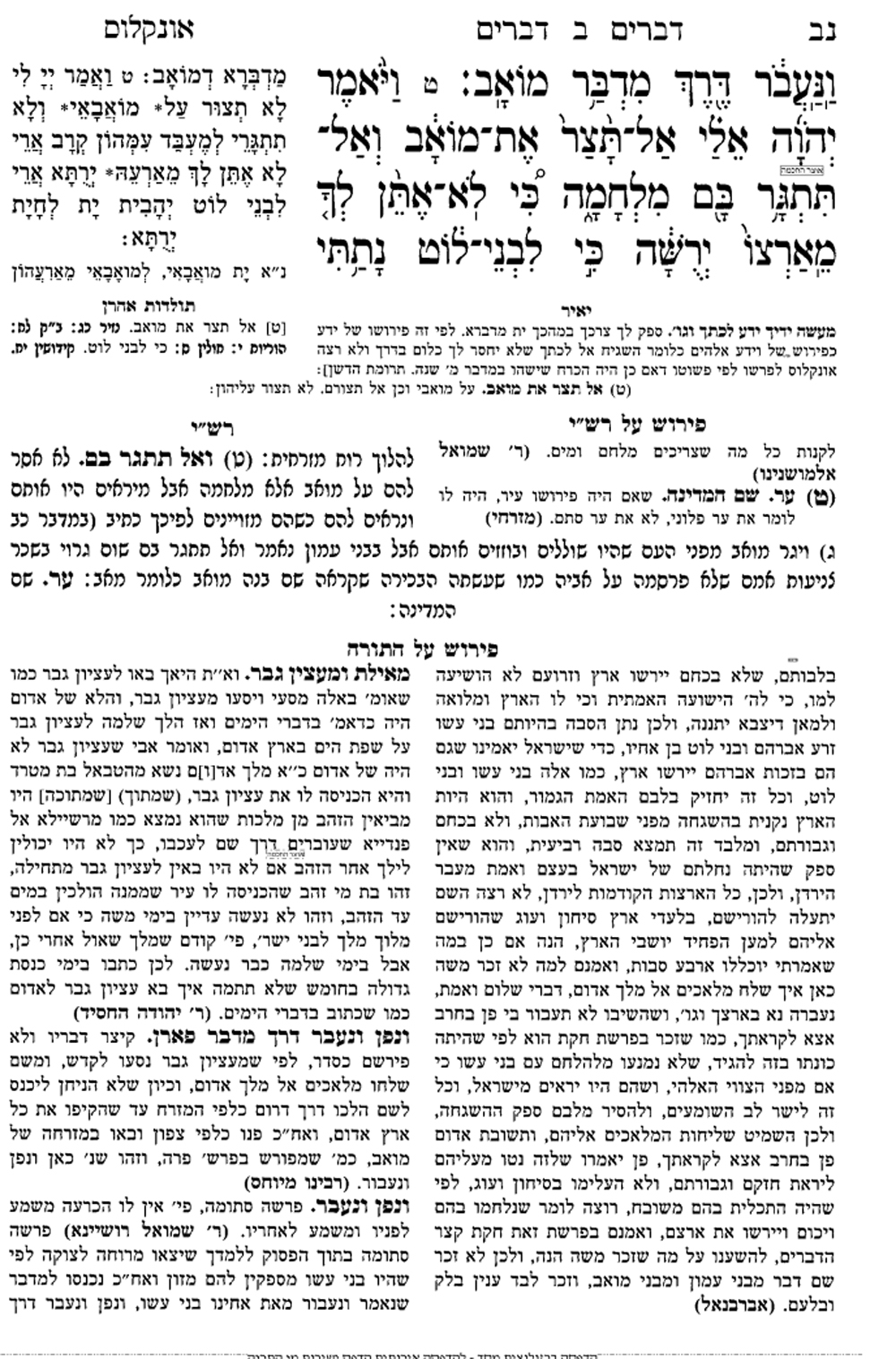
Regarding R. Judah he-Hasid, the following is also worth noting. Here is his commentary to Deuteronomy 2:8.

In the middle we see the following words:

שהוא נמצא כמו מרשיילא או פנדייא שעוברים דרך שם לעכבו כך לא היו יכולין לילך אחר הזהב אם לא היו באין לעציון גבר מתחילה

What does לעכבו mean? Viezel translates as follows: “For it was located like Marseille or Pontoise [place names], as a way station en route [to the gold] so that they were not able to go after the gold unless they came to Etzion Geber first.” (His identification of פנדייא as Pontoise must be correct, and in medieval times Pointoise was an important commercial center.)

Zev Farber in his article here translates the passage as follows: “For it is situated like Marseilles or Pandaya[22] such that people must pass through there to stop in, so that they could not get to the gold if they did not stop first in Etzion-geber.”

I have underlined the words that Viezel and Farber use as translations of לעכבו. Yet both of them overlooked what I pointed out in Limits, p. 109 n. 136, that the parallel text of R. Avigdor Katz allows us to see that the word לעכבו is a mistake and it should actually read לעכו, “to Acre”, which for almost two hundred years was part of the Crusader Kingdom of Jerusalem.[23] Now the passage makes perfect sense.

Let me make three final comments about the text of the Torah.

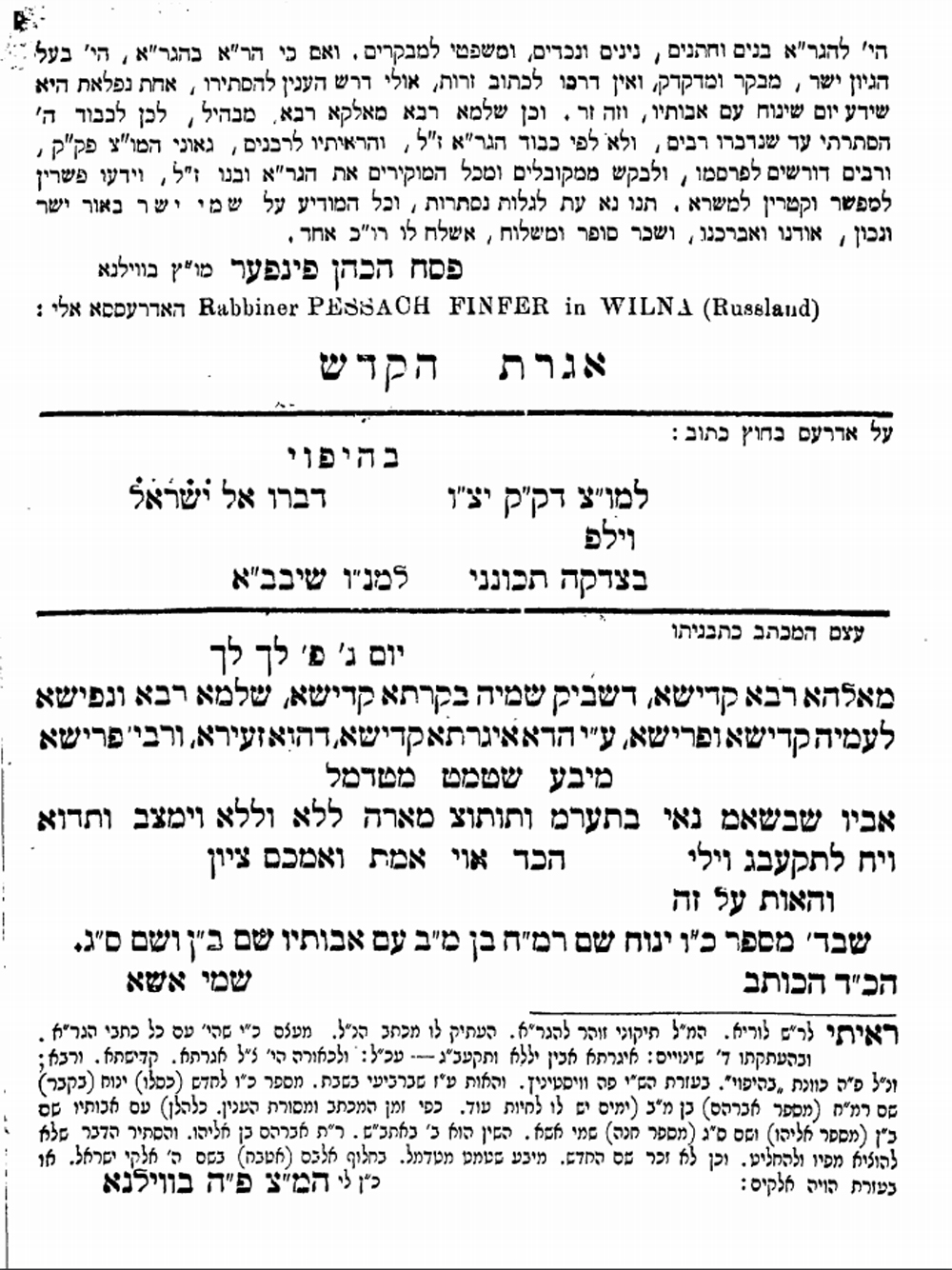
A. In Limits I discussed those who understand Tikkun Soferim literally. To the list of the authorities I mention, we can add R. Pesah Finfer,[24] R. Isidore Epstein, and R. Joseph Messas.


R. Finfer was a dayan in Vilna and considered the expert on masoretic matters in Lithuania.[25] In his Masoret ha-Torah ve-ha-Nevi’im (Vilna, 1906), p. 6, he writes:

ראוי הי‘ עזרא שתנתן התורה על ידו . . . והוא ונחמי‘ עשו תיקון סופרים וכינויי סופרים.

R. Epstein, Judaism (Baltimore, 1959), pp. 195-196, writes:

The spiritualization of the conception of God is reflected already in certain changes known as Tikkune Soferim (Corrections of the Scribes), which, ascribed to Ezra, were introduced into the Biblical text in order to tone down certain anthropomorphic expressions.

R. Messas, Minhat Yosef (Jerusalem, 2012), vol. 4, p. 40, writes:

וזה אחד מתקוני סופרים בתורה לכנוי ולתקון לשון עכ”ל. ענין זה מפורש בתנחומא פרשת בשלח על הכתוב וברוב גאונך, ובעץ יוסף שם, ובערוך ערך כבד . . . והעולה מכלם הוא, כי בי”ח מקומות בתנ”ך תקנו הסופרים שהם אנשי כנה”ג איזה תקונים בהם

B. One of the greatest Moroccan rabbis of the last two hundred years was R. Raphael Berdugo (1747-1821), known as המלאך, who wrote important responsa and biblical and talmudic commentaries. In his Mesamhei Lev on Joshua, chapter 5, R. Berdugo calls attention to verse 12 which shows us that even after entering the Land of Canaan, the Israelites were still fed for a time with manna. “And the manna ceased on the morrow, after they had eaten of the produce of the land; neither had the children of Israel manna any more; but they did eat of the fruit of the land of Canaan that year.”

R. Berdugo points out that Exodus 16:35 states: “And the children of Israel did eat the manna forty years, until they came to a land inhabited; they did eat the manna, until they came unto the borders of the land of Canaan.” The problem is obvious. The verse in Exodus is written from the perspective of when the Israelites were no longer eating the manna, yet we see from the book of Joshua that they continued eating the manna even after Moses’ death. So who wrote the verse in Exodus?

R. Berdugo acknowledges that one can say that it was prophetically written by Moses. Yet he doesn’t think that this makes sense, namely, to write a verse prophetically so that it appears to be written about an event that happened in the past. Therefore, he says that Joshua wrote the verse. It seems that that this does not raise any theological issues for him, and he compares it to the dispute about the last eight verses in the Torah where one tanna holds that Joshua wrote these verses because they refer to events after Moses’ death. Here, too, R. Berdugo states that since the verse refers to something that took place after Moses’ death, it makes sense to say that it was written by Joshua.[26] 

ויאכלו מעבור הארץ ולא היה עוד לבני ישראל מן וגומשמע שאחר שבאו לארץ כנען היו אוכלים מןומש בתורה את המן אכלו עד בואם אל קצה ארץ כנען הוא סמוך ליריחו אחר מות מרעהואכ צע מי כתב אותו פסוק בתורהואף כי אין מעצור לומר כי מרעה כתב זה ברוח קדשו ידע העתידות ושישראל יאכלו המן אחר מותו מכל מקום לשכל קשה זה וכש שיאמר אותם בלשון שכבר נעשוולכן העיקר שיהושע כתבו אחרי מות מרעהוכן מצאנו שנחלקו רזל בפסוק וימת שםשר‘ יוסי אמר שיהושע כתבו וכו‘.

Also of interest is R. Berdugo’s comment to Deuteronomy 34:10, where in speaking about verses at the end of the Torah written after Moses’ death, he attributes them to כותבי התורה rather than just to Joshua.[27] 

C. In the very interesting book, Derekh Sihah, which records conversations with R. Hayyim Kanievsky, the following questions and answers appear (vol. 1, pp. 323- 324):

שאלה: באור החיים הק‘ (לדכטכתב ממדרש שקרני ההוד נעשו עי שיור הדיו שנתן על ראשווהכוונה כי משה מרוב ענוה לא כתב והאיש משה עניו עם יודולכן נשאר דיווזה פלא וכי כתב איך שירצההרי כל אות היתה בנבואה

תשובה: כיוצא בזה כתב בעל הטורים (ריש ספר ויקראשכתוב אלף זעיראכי רצה משה לכתוב ויקר“, אמר לו הקבה כתוב עם אלףאבל ממ כתב אותה בזעיראוכנראה שזה לא נמסר לו איך לכתוב.

שאלה: שאלתי להרב שליטא עד דברי האור החיים” הק‘ שכתב כי קרני הוד של משה משיירי קולמוסשהיה צריך לכתוב עניו” עם יודוכתב בלא יודוכי זה נתון לדעתוואמר הרב שלא אמרו לו כיצד לכתובוחזינן שאמרו רק התוכןוגם כאן כן הוא.

תשובה: שם זה היה על התיבה הזאת בלבד שלא אמרו לו איך לכתובאבל פעם שאלתי מהגר גדליה נדל שליטא שרואים בחזל טענות על נביאים כיצד אמרו בלשון מסוייםכגון במסכת פסחים (סוב‘) כל המתייהר אם נביא וכו‘ מדבורה דכתיב חדלו וכו‘, וזה היה בנבואהוכן במסכת מגילה ידב‘ “כרכושתא כתיב בה אמרו לאיש ולא אמרה אמרו למלך“, ושם מלכים (ב‘ כבטוכתוב כה אמר ה‘, חזינן מזה שיש פעמים שהשאירו הבחירה ביד הנביא אלו תיבות לומר

R. Kanievsky states that Moses on his own decided to leave out the yud in the word ענו in Numbers 12:3. R. Kanievsky supports this position with the comment of the Baal ha-Turim on Leviticus 1:1 who states that Moses on his own wrote the final aleph in the word ויקרא in small print. (I did not cite this comment of Ba’al ha-Turim in Limits, as I don’t see it as in opposition to Maimonides’ Eighth Principle. The Principle speaks of the letters of the Torah themselves, not whether they are regular size or small.[28]

Despite the citation of Ba’al ha-Turim, I am sure that some will regard R. Kanievsky’s position as inappropriate, or even in opposition to the Eighth Principle which states that the entire Torah found in our hands is of divine origin, for R. Kanievsky states that Moses had the authority to determine if the word ענו should be written with a yud or not.[29] It is true that in the Mishneh Torah, Hilkhot Teshuvah 3:8, Maimonides defines a heretic as “One who says that the Torah, even one verse or one word, is not from God.” Maimonides here does not include one who says that a single letter is not from God. However, in the Eighth Principle he does not make such a distinction. Presumably, R. Kanievsky would say that the words of the Eighth Principle must be understood in line with what appears in the Mishneh Torah. Nevertheless, it is significant that R. Kanievsky regards as theologically legitimate the notion that Moses independently determined how a word in the Torah should be written, as the standard view is that all such matters were determined by divine command.

R. Kanievsky further supports his position with a striking insight. He points to Pesahim 66b and Megillah 14b where statements of Deborah and Hulda are criticized by the Sages for being boastful. Yet both these statements are actually part of a prophecy, so how could the Sages find problems with these words if they came from God? R. Kanievsky concludes from this that while the prophetic message comes from God, there are times when the actual words originate in the prophet’s mind, and this explains how the Sages can regard these words as problematic. Although Moses’ prophetic level was above that of all other prophets, R. Kanievsky believes that on at least one occasion Moses was allowed to choose how a word in the Torah was written.

***********

My Torah in Motion classes are now being placed on Youtube. Those who are interested can view them here.

***********

[1] Abhandlungen zur Erinnerung an Hirsch Perez Chajes (Vienna, 1933), pp. 259, 261.

[2] “Hedei Parshanuto shel Rabbi Yehudah he-Hasid be-Kitvei Talmidav – Hemshekh Mul Tzimtzum,” Megadim 55 (2014), p. p. 77.

[3] In Limits and subsequent blog posts I listed numerous rishonim and aharonim who understood Ibn Ezra’s hints to mean that there are post-Mosaic additions in the Torah.  Here is another important text, a comment by Tosafot (Tosafot ha-Shalem, ed. Gellis, to Gen. 12:6 [p. 14]:

והכנעני אז בארץ . . . ואם איננו כן יש לו סודכי כוונתו שזה לא כתבו משה אך נכתב אחר שנכבשהוכן דעתו בהרבה פסוקים

Tosafot rejects this opinion, stating:

ואנחנו לא ניאות בזה הדעת שכל התורה כתבה משה מפי ה’ בלא חילוק ושנוי

It is significant that Tosafot does not refer to Ibn Ezra’s interpretation as heretical. For another source that assumes that Ibn Ezra believed that there are post-Mosaic additions in the Torah, see R. Aharon Friedman, Be-Har ha-Shem Yeraeh (Kerem be-Yavneh, 2009), p. 30.

[4] I am aware of no evidence that the rishonim in the Islamic world interpreted these passages in a fundamentally different way than the Ashkenazic rishonim. As noted in Limits,  pp. 104-105, R. Joseph Ibn Migash openly accepted the viewpoint that Joshua wrote the last eight verses of the Torah. One point which I did not make in Limits is that while the Talmud attributes to individual tannaim the view that the last eight verses in the Torah were written by Joshua, in Sifrei, Devarim, piska 357, this opinion is cited anonymously, apparently signifying that it is the view of the Sages as a whole, which is then challenged by R. Meir.

וימת שם משה איפשר שמת משה וכותב וימת שם משה אלא עד כאן כתב משה מיכן ואילך כתב יהושע רבי מאיר אומר הרי הוא אומר ויכתוב משה את התורה הזאת איפשר שנתן משה את התורה כשהיא חסירה אפילו אות אחת . . .

See Nahum Bruell in Beit Talmud 2 (1881), p. 15.

[5] “Two Notes on the Commentary on the Torah of R. Yehudah he-Hasid,” in Michael A. Shmidman, ed. Turim (New York, 2008), pp. 245-246. Ephraim Kanarfogel, The Intellectual History and Rabbinic Culture of Medieval Ashkenaz (Detroit, 2013), p. 32, writes: “The availability of this kind of interpretational freedom and variety also allowed Hasidei Ashkenaz to be comfortable with Ibn Ezra’s stipulation of verses that may have been added to the Torah after the revelation at Sinai.”

[6] See my “Is Modern Orthodoxy Moving Towards an Acceptance of Biblical Criticism?” Modern Judaism 37 (May 2017), pp. 1-29, where I also discuss Modern Orthodox thinkers who go beyond this and have accepted the assumptions of modern biblical scholarship regarding source criticism. See also my post here. In my article, I neglected to mention R. Michael Abraham who also sees no religious objection to post-Mosaic additions to the Torah, or even that the Torah is composed from different sources (as posited by the Documentary Hypothesis). See herehereherehere, and here.

[7] Shitat ha-Behinot” shel ha-Rav Mordechai Breuer, ed. Yosef Ofer (Alon Shevut, 2005), p. 311. The standard view is that Ibn Ezra believed that the post-Mosaic additions are from later prophets, but R. Breuer seems to understand Ibn Ezra to mean that these additions are simply readers’ notes, which would not be prophetic (p. 312):

והואיל ואין כל ודאותשנוסח הרוב הוא גם הנוסח הנכוןכבר אפשרי הדבר שספר התורה שבידינו כולל דברים שנוספו לו אחר כך על ידי סופרים טועיםאך מעולם לא היו בספר שנמסר למשה מפי הגבורה.

והאמור בטעויות סופרים אמור גם בתוספות של תלמידיםשהרי הדבר ידועשדרכם של קוראים להוסיף את הערותיהם בגיליון הספר – ואחר כך באים תלמידים טועים” ומוסיפים את ההערות האלה בגופו של הספרואין לך ספר שאיננו כולל הוספות או גלוסות כאלהואבן עזרא סבורכנראהשגם ספר התורה לא יצא מכלל זהוהוא כולל אפוא גם דברים שלא נכתבו על ידי מחבר הספראלא נוספו לו אחר כך על ידי הלומדיםאבל מובן מאליושהוא יכול היה לומר את הדבר הזה רק על אותם מקומות מועטיםשתוכנם מעיד עליהם שהם הוספות מאוחרות.

[8] I say “generally correct” because the assumption that medieval figures only referred to “the later addition of a few scattered phrases” is not accurate if one includes explanations offered by commentaries on Ibn Ezra. In this post as well I give examples which refer to more than a few scattered phrases”

[9] R. Yehoshua Enbal, who often presents original perspectives, has a very strange passage in his Torah she-Ba’al Peh (Jerusalem, 2015), p. 685:

הטענה שכל התורה שבידינו היא המסורה למשה רבינו עליו השלום“, אינה באה בנימוק הגיוני שלא יתכן שאירעה איזו טעות בימי יהושע בן נון ונוספה אות ו‘ באיזו מלהכאשר בזמן משה לא היתה קיימת אות זוטכנית אולי הדבר ייתכןואף יש חילופי נוסח זעומים בפועל בין העדותאלא שמי שמחזיק בדעה כזועם כל הכבוד וההערכהוהנימוקים ההגיוניים שאולי יצרף לדבריואינו חלק מהדת שלנושכן ויתור על אות אחתהינו ויתור על הטקסט כולושאינו אלא סך של אותיות.  אם נוותר על א‘ ועל ב‘ ועל ג‘, איננו מאמינים בכלוםהקישור בין כלל זה לבין נימוק הגיונימעקר את הכללאין העיקר קובע שהגיוני מאד שלא אירע שום שינוי ואף מנסה לשכנע אותנושכן נימוק הגיוני אין כחו יפה בהכרח כנגד נימוקים שיבואו מולואו מחקרים אחרים שיבואו ביום מן הימיםהעיקר קובע שרירותית את גבולות הדתהדת מוקירה ומעריכה כל שימוש בהגיוןואף יכולה להביע הערכה להברקות מקוריותאבל המחזיק בדעה שלא כל התורה מפי הגבורהחוצה פורמלית את הגבול שבין דת להעידרה.

R. Enbal’s declaration that one who expresses doubt about the authenticity of a vav in the Masoretic text is to be regarded as a heretic cannot be taken seriously, especially as he himself notes, there are differences in this regard between different communities. In fact, before the printing press, there were widespread variations among Torah scrolls when it came to minor spelling differences, and the Talmud, Midrash, and medieval commentators often preserve different readings than the Masoretic text. See Limits, ch. 7. And what is one to make of his statement that העיקר קובע שרירותית את גבולות הדת? Principles of faith are to be determined arbitrarily without regard for truth? Earlier on the page he writes (emphasis added):

באוקיינוס של דעות מתפשטותשהתחיל כבר בזמן הרמבםוכמובן בזמננומבלי גבול שרירותינישאר רק עם טקסט.וכמובן גם הטקסט עצמו זקוק להגנה שרירותיתשכן ניתן לטעון שחלקים ממנו אינם מקוריים.

I can’t imagine that this approach, which sounds like it comes from Isaiah Leibowitz, will find many backers. R. Breuer obviously had a different perspective. See “Shitat ha-Behinot” shel ha-Rav Mordechai Breuer, p. 74:

אף על פי שרק נוסח המסורה ראוי להיקרא נוסח המקרא” – שהרי רק הוא נתקבל על ידי ההלכה – עדיין רשאים אנחנו לשאול אם זהו גם הנוסח המקורי של המקרא

[10] Viezel, “R. Judah he-Hasid or R. Moshe Zaltman: Who Proposed that Torah Verses were Written After the Time of Moses?” Journal of Jewish Studies 66 (Spring, 2015), pp. 97-115.

[11] In R. Menahem M. Kasher’s Torah Shelemah, beginning with parashat Ki Tissa, vol. 2, this Targum is included. R. Kasher was very excited by the discovery of this Targum and wrote about it in a number of places, in particular in Torah Shelemah, vol. 24, which is devoted to the Targumim. One of the most fascinating points he makes is as follows (Torah Shelemah, vol. 24, pp. 22ff.).

Deut. 24:3 states: וכתב לה ספר כריתות. Each of the three Targumim translates this passage differently.

Onkelos: ויכתוב לה גט פטורין

Neofiti: ויכתוב לה אגרא דשיבוקין

Ps. Jonathan: ויכתוב לה ספר תירוכין

Mishnah, Gittin 9:3 states:

גּוּפוֹ שֶׁל גֵּטהֲרֵי אַתְּ מֻתֶּרֶת לְכָל אָדָםרַבִּי יְהוּדָה אוֹמֵרוְדֵין דְּיֶהֱוֵי לִיכִי מִנַּאי סֵפֶר תֵּרוּכִין וְאִגֶּרֶת שִׁבּוּקִין וְגֵט פִּטּוּרִיןלִמְהָךְ לְהִתְנְסָבָא לְכָל גְּבַר דְּתִצְבַּיִן

The Gemara offers no reason for the text of the get that R. Judah requires. Why would one need to repeat the same thing in three different ways? (Contemporary gittin differ from R. Judah’s text, but still include the three terms: פטרית ושבקית ותרוכית) Later rabbinic authorities offer all sorts of forced explanations for this. R. Betzalel Ashkenazi, She’elot u-Teshuvot, no. 21, writes:

גט פטורין כמו שתרגם אונקלוס על גט כריתות אבל תרוכין ושבוקין ושאר הדברים שהם דברי עצמו אשר לא כתוב בספר

R. Ashkenazi recognizes that the words גט פטורין appear in Onkelos, but he thinks the other two words are original to R. Judah. (This shows that R. Ashkenazi did not have access to Targum Ps. Jonathan).

According to R. Kasher, R. Judah was simply using the Targumim known to him. He required inclusion in the get of the three different words that explain the term כריתות so that everyone would understand its meaning. In other words, he was including every possible translation of כריתות that was prevalent among the Aramaic speaking Jews, and this would ensure that a get written this way would be accepted by all who used these Targumim.

[12] Geula, “‘Le-Fi ha-Peshat Ezra Katav . . . O Moshe Ketavo be-Ruah ha-Kodesh’: Hearot al Hibbur ha-Torah be-Ferush Hadash le-Torah mi-Ketav Yad Vatican,” in Avigdor Shinan and Yisrael Y. Huval, eds.,Divrei Hakhamim ve-Hidotam (Jerusalem, 2018), pp. 89-114.

[13] Geula, pp. 91, 92. The verse is cited as מלוך מלך instead of מְלָךְ, but that is to indicate the pronunciation, as the first lamed has a kamatz katan. We find examples of this in our text of the Talmud (although we would have to check manuscripts to see how far back this goes). For example, the word כּׄתֶל, if you put a suffix on it, the holam then becomes a kamatz katan:  כָּתְלנו, as we see in Song of Songs 2:9. Yet throughout the Talmud we find the form כּותליinstead of כָּתְלי. The same thing happens if you put a suffix on the word צׄרֶך. Thus, in II Chron. 4:15 we have צָרְכך not צורכך. In the Talmud, however, you have the form צורכי (as well as צרכי). This was noted by R. Bentzion Cohen, Sefat Emet ((Jerusalem, 1997), p. 167.

[14]  See the text published by Isaac Lange in Ha-Ma’yan 12 (Tamuz, 5732), p. 83.

[15] Perush ha-Rokeah al ha-Torah (Bnei Brak, 1979), p. 258; also in Tosafot ha-Shalem al ha-Torah, vol. 3, p. 287,

[16] See Geula, p. 90.

[17] Geula, p. 96.

[18] Ed. Buber (Berlin, 1900), p. 298.

[19] “A Jewish Theory of Biblical Redaction from Byzantium: Its Rabbinic Roots, Its Diffusion and Its Encounter with the Muslim Doctrine of Falsification,” Jewish Studies Internet Journal 2 (2003), pp. 123-167.

[20] Geula, p. 100.

[21] On the other hand, R. Zvi Yisrael Tau, Tzaddik be-Emunato Yihyeh, pp. 281-282, rejects the legitimacy of this opinion in favor of Maimonides’ principle. He further states that allowing such a view, that there are limited post-Mosaic additions, will open the door to all forms of Higher Criticism and the consequent rejection of Torah min ha-Shamayim. As such, he does not believe that future teachers should be exposed the views of Ibn Ezra, R. Judah he-Hasid, and the others we have discussed.

מדוע חשוב לו כל כך לומר את זהלמה כל כך חשוב למרצה הזה שהמורה העתידי יידע את זההתשובה היא כי אחרי שעוברים את המחסום הזהנעשים פתוחים לכל ביקורת המקרא ולכל הדעות האוניברסיטאיות.

[22] Farber’s note: I do not know what city פנדייא is or even how to transliterate it properly.

[23] See Abhandlungen zur Erinnerung an Hirsch Perez Chajes, 259.

[24] This is the proper spelling, not Pinfer. See Masoret ha-Torah ve-ha-Nevi’im, p. 119.

[25] R. Finfer wished to publish a Tanakh that would replace the Christian chapters we have become accustomed to with the Jewish divisions. In Masoret ha-Torah ve-ha-Nevi’im, p. 118, he published a letter from R. Elijah David Rabinowitz-Teomim agreeing with him in this matter and calling this a “mitzvah gedolah. However, it is reported that the Hazon Ish disagreed, as the Ein Mishpat on the Talmud refers to the Christian chapters, and we have become so attuned to this that any change now would cause more problems than it is worth. See R. Reuven Elitzur, Degel Mahaneh Reuven, p. 363. (The Hazon Ish was the older brother of R. Finfer’s son-in-law, R. Moses Karelitz.) R. Finfer had a small success in that Koren’s divisions are based on R. Finfer. See R. Eliyahu Katz, Be’er Eliyahu (n.p., 2002), p. 151.

R. Finfer reports that the Vilna Gaon brought back the practice of reading the haftarah from a scroll, and that this then spread throughout Lithuania. See Masoret ha-Torah ve-ha-Nevi’im, p. 114.

Also of interest is that it was R. Finfer who published the famous mysterious letter of the Vilna Gaon. Often reprinted, the letter first appeared in the Jerusalem journal Torah mi-Tziyon 3 (Tishrei 5658).

Regarding unknown materials from the Vilna Gaon, I recently found a letter from Shirley Feuerstein to Yaacov Herzog that I think readers will find of interest. It is located in the Yaacov Herzog Archives at the Israel State Archives, available here; old file no.: 4068/21-פ, new file no.: 000zl9r.

[26] Mesamhei Lev (Jerusalem, 1990), p. 296, called to my attention by Rabbi Yitzhak Churaqi. R. Berdugo offers a different perspective in his Mei Menuhot (Jerusalem, 2009), vol. 2, p. 917:

שלא יחובר לתורתו של משה רבינו ע”ה שום נבואה אחרת כללת כי מסלוק משה רבינו ע”ה נחתמה התורה . . . כי לא קם ולא יקום מי שיוסיף על התורה אפילו אות אחת

[27] Mesamhei Lev, p. 150.

[28] See Pithei TeshuvahYoreh Deah 274:7, who cites R. Jonah Landsofer, Benei YonahYoreh Deah 274:20,  that if a letter is mistakenly written large or small it does not disqualify the Torah scroll.

[29] See R. Nahum Abraham, Darkhei ha-Ma’amarim (n.p., 2017), pp. 146-147 (first pagination), who states that what appears in Derekh Sihah is heresy, and therefore he denies that R. Kanievsky could have said it. 


Don’t Oppress the Ger

Don’t Oppress the Ger

Ben Zion Katz

The Torah in Motion blog by Rabbi Jay Kelman[1] discusses the daily daf as well as the parashah of the week. When reviewing Baba Metzia 59, Rabbi Kelman mentioned that the Talmud stated that there were 36 or 46 places where the Torah commands not to oppress the stranger/convert[2] (ger), but that he was not aware of any list of the verses in question.  This paper is an attempt to generate such a list.

We will begin with the Talmudic discussion itself, which is not completely straight forward. The gemara (Bab Metzia 59b) begins (my translation): “Our rabbis taught: One who oppresses a stranger/convert verbally (from the root aleph-nun-heh) violates three negative commandments, and one who oppresses a stranger/convert financially (from the root lamed-chet-tzadi)[3] violates two negative commandments.”

One would expect the Talmud now to bring three prooftexts for the former and two for the latter statement.  Instead, the Talmud brings three prooftexts for each, the third in each case not even using the word ger!

The three prooftexts for the first statement are Exod. 22:20, Lev. 19:33 and Lev. 25:17.  All three verses use the root aleph-nun-heh, but only the first two use the word ger; the third verse uses the word amito, which could be translated as his fellow citizenThe Talmud excuses the latter anomaly by claiming that certainly a ger is a fellow citizen!

The three  prooftexts for the second statement are (again) Exod 22:20 (this verse uses the verb lamed-chet-tzadi as well as the root aleph-nun-heh, so it can be used as proof for both statements), Exod. 23:9 (which uses the root lamed-chet-tzadi) and Exod. 22:24 which again is missing the word ger (and also does not use the root lamed-chet-tzadi) – the verse simply states You shall not be a usurer to him, the Talmud again stating that the ger is included in the generic “him”.  The Talmud then concludes that with either type of oppression (financial or verbal) one is actually violating three negative commandments.

The Talmud then continues: “We learned in a baraita: Rabbi Eliezer the Great stated: Why did the Torah warn us 36 times, and some say 46 times, about the ger?”  Before analyzing the verses referred to by Rabbi Eliezer the Great, we will conclude the Talmud’s discussion of the ger.  The Talmud answers Rabbi Eliezer’s question by saying “because their inclination is bad.”[4]  The most charitable way to explain this seemingly harsh response is that the convert has more temptations to sin because he or she wasn’t brought up with Torah values and/or has no religious family for support, so it is easier for them to backslide; consequently we must be especially careful in our dealings with them.  The Talmud then asks one final, obvious question: Why are we reminded not to verbally or financially oppress the convert because we were strangers in the land of Egypt?  Why is our being strangers in the land of Egypt thousands of years ago a reason for not oppressing a convert today?  The answer is taken from a baraita of Rabbi Nathan, which explains that one should not gloat about a past defect in yourself that is (still) present in another.  Presumably Rabbi Nathan felt that converts may feel like strangers even after their conversion.  The Talmud then concludes this discussion with a reminder not to offend anyone even inadvertently.[5]

Now we will analyze the purported 36 or 46 verses to which Rabbi Eliezer the Great (Rabbi Eliezer ben Hyrcanus – a second generation tanna[6]) referred.  The word ger appears in the Torah 68 times in 61 verses according to the Evan Shoshan concordance.[7]  Six verses can be eliminated from consideration because they are either referring to Israelites, they are in a narrative and not a legal context or there is simply no oppression of any kind mentioned or implied in the verse.  For example, when Abraham is attempting to purchase a burial plot for his recently departed wife Sarah from the people of Chet he says to them “I am a stranger and a sojourner with you” (Gen. 23:4).  A second verse using the word ger unrelated to Rabbi Eliezaer’s statement is when God says to Abraham that his children will be strangers in a land not theirs (Gen. 15:13)[8].  Moses says twice he is a stranger in a strange land (Exod. 2:22 and 18:3).  God warns us of strangers rising up against us if we disobey the Torah (Deut. 28:43).  Finally we are told not to sell property forever because all land belongs to God and we are merely strangers and sojourners before Him (Lev. 25:23).

Of the remaining verses, 9 specifically state to be good to the stranger/convert because we were strangers in the land of Egypt.[9]  These 9 verses (or sets of verses) are the three to which the Talmud already called our attention (Exod.  22:20, Lev. 19:33-34 [these two adjacent verses make a single point, so they will be counted as a single instance] and Exod. 23:9), as well as Deut. 5:13-15 (the Sabbath commandment in the second set of the Ten Commandments,[10] which commands that even the stranger/convert needs to rest on the Sabbath because we [lit. you] were slaves in Egypt), Deut. 10:18-19 (commands to love the stranger because we [lit. you] were strangers in Egypt), Deut. 16:11-12 (the stranger should rejoice on Shavuot because we [lit. you] were strangers in Egypt),[11] Deut. 23:8 (don’t hate the Egyptians because you were once strangers in his land) Deut. 24:17-18 (don’t pervert judgment against the stranger because we [lit. you] were strangers in Egypt), and immediately following, Deut. 24:19-22 (crops that should be left for the stranger [and others] because we [lit. you]  were strangers in Egypt.  (These last 3 verses list three types of crops to be left for the stranger, but give a single reason at the end, so are counted as a single reference.)

The next set of 6 verses or sets of verses parallel the ones just brought, but omit the reason (because we [lit. you] were strangers/slaves in Egypt) presumably because the rationale was already stated in the parallel verse.  For example, in the first set of the Ten Commandments (Exod. 20:10) the stranger/convert is also commanded to rest, but a different reason is given (because God created the world in six days and rested on the seventh day, although as Ibn Ezra points out [long commentary on Exod. 20:1] that is not a specific reason why the stranger/convert should rest; only the reason given in Deut. explains that part of the command.)  Another verse also commands to allow the stranger/convert to rest on the Sabbath (Exod. 23:12).  Lev. 19:10 mirrors Deut. 24:21, but again sans raison.  Lev. 23:22 parallels Deut. 24:19-21 in idea, but without the reason or the linguistic parallels of the previous example.  Two verses/sets of verses parallel Deut. 16:11-12 re the stranger being joyous on holidays: Deut. (16:13-14) command the stranger to be happy on Succot and Deut. 26:11 reiterates the command for the stranger to be joyous on Shavuot; in both of these cases, however, the reason (because we [lit. you] were strangers in Egypt) is lacking.  This brings the total number of verses or sets of verses warning not to oppress the stranger to 15.

Six more verses remind us to be good to the ger in different situations, or warn us not to oppress the ger, without the reason being given anywhere: Lev. 25:35 (do not lend money with interest even to a ger), Lev. 25:47 (redeem the property of a ger as you would a kinsman), Deut. 14:29 (regarding a tithe that includes distribution of benefits to the ger), Deut. 24:14 (you may not withhold anyone’s wages, including those of the ger), Deut. 26:12-13 (the declaration given when the tithe from Deut. 14:29 is brought to Jerusalem), and Deut. 27:19 (a curse for someone who subverts the rights of the ger).  This brings the verse count to 21.

The next set of 23 verses/sets of verses state that the ger should be treated the same as an Israelite and has similar obligations and punishments.  Exod. 12:19 forbids the ger from consuming leaven on Passover (Hag HaMatzot).  Exod. 12:48-49 commands that a circumcised ger can share in the paschal offering and then states more generally that one set of laws (torah achat) should apply to the circumcised ger and us (lit. you).  Num. 9:14 in the discussion of the second Passover, parallels both the specific command regarding the stranger celebrating the pesach offering and equality before the law (chukah achat), although the requirement for circumcision is lacking, likely because it is understood.  Lev. 16:29 includes the ger in the Yom Kippur commemoration.  Lev. 17:8 equates the obligations of two kinds of sacrifices (the olah and zevach) for the ger and Israelite, while verse 17:9 commands the ger too upon the proper, applicable sacrificial procedure.  Verses 17:10-12 enjoin the ger as well as the Israelite from consuming blood.  Verse 17:13 instruct the ger and Israelite how to hunt.  Verses 17:14-16 again forbid the consumption of animal blood but add prohibitions for both Israelite and ger about how the meat must be consumed and what to do if the meat is not consumed properly.[12]  Lev. 22:18 equates the ger and Israelite regarding freewill offerings.  Num. 15:14-16 in general equates the sacrificial laws for Israelites and gerim.  Lev. 20:2 forbids a certain kind of idolatry (Molech worship) equally for gerim and Israelites.  Lev. 18:26 and 24:22 again make general statements about equality under the law for gerim.  Lev. 24:16 enjoins both ger and Israelite from blasphemy.  Num. 19:10 and 35:15 equate Israelite and ger regarding the exculpatory ceremony of the red heifer (for an unsolved murder) and cities of refuge (for one who commits accidental homicide).  Num. 15:26 includes the ger in the communal sin offering ritual, while Num. 15:27-29 includes the ger in the individual sin offering ritual.  Num. 15:30-31 includes the ger in the punishment (karet) meted out for the willful violation of commandments.  Deut. 1:16 commands that judges treat gerim as they would their (Israelite) brethren.  Deut. 29:19 includes gerim in the second covenant between God and the Israelites at the end of the forty years of desert wandering, while Deut. 31:12 includes gerim in the obligation to hear the public recitation of the Torah every seven years on Sucot (Hakhel).

This brings the total verse/set of verses count to 44.  Presumably, there were some Rabbis who were “lumpers” and may have included some of the duplicate verses above as single instances when interpreting the list of Rabbi Eliezer ben Hyrcanus, making the list total 36, while others were “splitters” and divided some of the verses above considered a set, making the total 46.   In any event, I submit that the list of verses generated above is likely similar to the one compiled by Rabbi Eliezer ben Hyrcanus.

[1] TIM.org

[2] While ger (plural gerim) is usually translated as stranger or foreigner, in Rabbinic parlance it often means a convert.  I will use the term ger or translate as either stranger or stranger/convert unless it becomes obvious from the context (see below) that the Talmud is referring to a convert.  See also below, footnote 12.

[3] Probably because both roots are found in the same verse (Exod. 22:20 – see below) the Rabbis assumed they referred to different types of oppression.  These two definitions are already found in the Tannaitic literature (Mekilta de-Rabbi Ishmael, ed. JZ Lauterbach, vol. 3, Jewish Publication Society, 1935, 1961, p. 137).

[4] Here it is obvious the Talmud is referring to a convert.

[5] The expression used in the Talmud is not to mention to someone to “hang something up” if someone in that person’s family had been hung.

[6] M Margolioth. Encyclopedia of Talmudic and Geonic Literature. Joshua Chachik. Tel Aviv. 1970. vol. 1. Pp. 92-101 (Hebrew).

[7] Avraham Even Shoshan.  A New Concordance of the Bible.  Kiryat Sefer, Jerusalem.  1990, 1997.  Pp 242-3.

[8] While clearly this verse provides the moral basis for not oppressing the ger, since it is referring to descendants of Abraham, it cannot be part of a list warning not to oppress the “other”.

[9] Based on the Talmudic discussion, it is surprising there aren’t more verses such as these in the Torah.

[10] Ten Statements is probably a better translation for the way the expression is used in the Torah (e.g., Deut. 4:13).

[11] Perhaps because the pilgrimage festivals all are tied in to leaving Egypt, strangers also need to rejoice on those festivals, for we too were also once strangers (although it is odd that this injunction is not found in relation to Passover, only for Shavuot and Succot – see below).

[12] Deut. 14:21 is not included in this list, because this verse allows a ger to eat certain types of prohibited meat, unlike Lev. 17:15, presumably because the two verses are dealing with different types of gerim.


The Haftarot for Behar and Behukkotai

The Haftarot for Behar and Behukkotai[1]

By Eli Duker

The old Babylonian practice was to read Jeremiah 16:19 as the haftara for Parashat Behar and  Ezekiel 34 for Parashat Behukkotai, and this is attested to in most of the relevant Cairo Geniza fragments. One of them, Cambridge T-S B15.4, aside from also indicating this, is written in the Oriental Hebrew script and vocalized with the Babylonian supralinear system, indicating its antiquity.  Moreover, these haftarot are listed by R’ Shlomo ben Natan,[2] and their verses are the basis for the Zulatot in the Piyutim of  R’ Shmuel  ben Hoshana[3] written for these Parshiyot.[4] 

It would seem that Jeremiah 16:19 was chosen for Behar because the prophet’s pronouncements of  “Cursed is the man who relies on people” and “Blessed is the man who relies on Hashem” echo the blessing, mentioned in Parashat Behar, that is given to the sixth year of the Sabbatical cycle in anticipation of the Sabbatical year.

It is not clear to me why Ezekiel 34 was chosen as the haftara for Behukkotai, but it may be that its metaphor of a shepherd tending his flock (34:12) brought up immediate associations with the commandment to tithe the flocks and herds elaborated on in the Parsha.[5]

However, in Europe a new haftara beginning with Jeremiah 32:6 appears for Behar quite early on. Meanwhile, the original haftara for that parasha was “moved” to Behukkotai. These haftarot appear in R’ Shmuel Hanagid’s haftara list that is brought in Sefer Ha’eshkol,[6] and in R’ Elazar of Worms’s book on haftarot.[7] They are also listed by R’ Ya’akov Hazan in Etz Haim,[8] which serves as an account of the practices of Anglo Jewry on the eve of the Expulsion.

Abudarham lists only these haftarot for these two parashiyot,[9] and they are also the only haftarot in all of the Ashkenazic Humashim and haftara books in manuscript that I have come across,[10] excepting one[11] that reversed the two haftarot, placing Jeremiah 16:19 with Behar and Jeremiah 32:6 with Behukkotai. Moreover, they are the haftarot in the only humash[12] in our possession that is beyond a doubt from pre-expulsion Spain,[13] and all subsequent humashim that follow the Ashkenazic and Sephardic practices.

It is impossible to determine exactly why communities chose to change the practice regarding the haftarot for Behar and Behukkotai, or when and where this began to take place.

Nonetheless, Jeremiah 32:6 is an exceptionally appropriate haftara for Parshat Behar, as it describes how Jeremiah performed the commandment of redeeming the land formerly owned by a relative, a central part of the parasha.

As it is such an obvious fit, why did the Babylonians not choose it themselves? I believe that this is due to the fact that the old Babylonian practice was to read Jeremiah 32 as the haftara for Va’ethannan, beginning with 32:16. Later on, when communities that read the Torah according to the Babylonian annual cycle adopted the practice of reading “Nahamu”[14] (Isaiah 40:1) on the Sabbath following Tish’a B’av, when Parshat Va’ethannan is always read, Va’ethannan’s original haftara became “available” and thus was deemed very appropriate for Behar, while Behar’s original haftara was “moved” to Behukkotai.[15] The new haftarah for Behar – and the moving of its old one to Behukkotai – were accepted more than any other “new” haftara practice.[16] Only the Italian and Yemenite rites, most conservative regarding  retention of Babylonian haftarot, read the two hafarot as they were originally read.[17]

The practice in Poznań, interestingly enough, was to retain Jeremiah 32:6 as the haftara of Behar, while retaining the old Ezekiel 34 as the haftara for Behukkotai.[18]

Bibliography of Printed Works

 Avraham ben Yitzhak of Narbonne. ”Sefer Ha’eshkol”  Eds. Shalom and Hanokh Albeck.  Jerusalem: Wagshal, 1984.

Azulai,  Menahem. “Lifuyutam shel Yehudei Bavel -Kit’ei Geniza)” (Azulai, Ada. trans.)  Jerusalem: Azulai, 2010.

 Beukum, Walter Jaques van.  “Hebrew Poetry from Late Antiquity – liturgical poems from Yehudah” Leiden: Brill, 1998.

Biton, Eliyahu. “Or Yahudut Luv”  Biriah: Yeshivat Beit Yosef, 1982.

“Sefer Nahalat Avot -Minhagei Yehudei Luv”  Biria: Biton, 2007.

“B’rocho L’Mnachem – essays contributed in honor of Rabbi Menachem H. Eichenstein”   Ed.  Norman Paris. St Louis: United Orthodox Jewish Community – Vaad Hoeir of St. Louis, 1955

David Berabi Yosef Berabi David Ben Abduraham. “Abduraham Hashalem” Jerusalem: Osha, 1963.

Elazar of Worms. “Peirush Al Hahaftarot”  Warsaw: Zisberg, 1875.

Ginzburg, Christian D. “The Massorah”  Jerusalem: Makor, 1971.

“Hamisha Humshei Torah: Im haftarot Vihamesh Megilot” Eliezer ben Avraham Alaatansi, 1486.

“Humash Lima’an Shmo Be’ahava”  publisher and date of publication unknown.

 “Sefer Vayikra, Hamisha Humshei Torah Im Peirush Rashi,” V’im Da’at Mikra” Ed. Menahem Bula. Jerusalem: Mosad Harav Kook, 1991.

Jacob ben Jehuda Hazan of London. “The Etz Chaim” ed. Israel Brodie. Jerusalem: Mosad Harav Kook, 1962

“Machzor LiYamim Noraim” ed. Daniel Goldschmidt. Jerusalem: Koren, 1970.

Shlomo ben Natan. “Shlomo Ben Nattan Siddur Al Pi Hage’onim- Chibro Rabbenu Shlomo B’rabi Nattan.” Ed. Shmuel Chagai. Jerusalem: 1995.

Shmuel ben Hoshana, “The Yostserot of R Samuel the Third.” Edited by Joseph Yahalom and Noaya Katsumata. Jerusalem: Yad Itzhak Ben-Zvi,  2014.

Simha of Vitry. “Mahzor Vitry.” Edited by Arye Goldschmidt. Jerusalem: Makhon Otzar Haposkim, 2009.

Talmudic Encyclopedia, Edited by Meyer Berlin (Bar-Ilan) and Shlolmo Yosef Zevin. Jerusalem: Talmudic Encyclopedia Publishing, 1961.

Zeruk, Refael. “Luah Dinim Uminhagim Kehilot Yotzei Luv”  Bat-Yam: Ginzei Refael, 2008

[1] I would like to thank Rabbi Avi Grossman for editing both the original Hebrew version article as well as my English translation. I would also like to thank my son Moshe Duker for assisting me in looking up haftarot in printed humashim.

[2] Shlomo Ben Nattan, Siddur Al Pi Hageonim, p. 201.

[3] “The Yotserot of R Samuel the Third.” Vol. 1, pp. 519, 528-259.

[4] In Fried’s list of haftarot that appears as an appendix to Volume X of the Talmudic Encyclopedia, Isaiah 1:19 is brought as an alternate haftara for Parashat Behukkotai.This was based on Zulay’s understanding in Zur Liturgie der babylonischen Juden, regarding a piyut  composed by “Yehuda” for “Im Behukotai” with verses beginning with Isaiah 1:21 Zulay believed Yehuda to be Babylonian,  that that was the haftara for this Parsha. However, evidence brought by van Bekkum in his introduction to “Hebrew Poetry from Late Antiquity: Liturgical Poems of Yehudah” shows that Yehuda was a Palestinian Paytan. In addition, Isaiah 1:24 was the haftara for Sedra “Im Behukkotai” in the Palestinian triennial cycle of Torah readings. See Ofer,  “Hahatfarot Al Pi Haminhag Hatlat -Shenati” (here). I would like to thank Prof. Yosef Yahalom for directing me to van Bekkum’s work.

[5] See Daat Mikra,  Vayikra Vol. 1, pp. 323-324. The other reasons given there seem less convincing, as this is not a haftara of rebuke.

[6] Albeck Edition, p. 181.

[7] “Peirush Al Hahaftarot”. p. 8.  The haftara for Behar  is missing in the Ginsburg-Moscow Ms.of Mahzor Vitry while it lists Jeremiah 16:19 as the haftara for Behokkotai. See Goldschhmidt edition, Vol.2, p. 579.

[8] Vol. 1, p. 54.

[9] P. 303.

[10] Mss. Breslau 9: Cambridge St. Johns A1: Vatican EBR 13 14 15 16:  Parma 1885 2046 2148 2818: 3083 3085:  British Library 9401 9403:

[11]  Ms. Vatican EBR 20.

[12] Printed in Hijar in 1486. Another humash with the same haftarot for these parashiyot is believed to have been printed in Spain as well. See the National Library of Israel website: here.

[13] The practice in Saragosa was to read the original Babylonian haftarot. See “The Massorah,” Vol. 2b, p. 486.

[14] The practice of reading Nahamu on the Sabbath following Tisha B’Av was much more prevalent than the practice of reading special haftarot in subsequent weeks. Rambam (Tefilla 13:19) writes that Nahamu was the “practice of the people,’ (Nahagu Haam) while he describes the practice of reading the other six haftarot of Consolation as a local custom.The Italian practice is to only read haftarot of Consolation for the remainder of Av, but this is not directly related to my main thesis, as Italians read Jeremiah 16:19 for Behar.

[15] Parshat Behar plays a unique role in the Ashkenazic liturgy for the Omer period. In the Western rite, R. Baruch of Mainz’s “Aharei Nimkar Geula Tihyeh Lo” is the zulat for that Sabbath, while in Eastern Ashkenaz the GeulaYakush Ma’yano” is said. Both of these piyutim beseech Hashem, as our “close relative”, to perform the “commandment”of redeeming us. No other piyutim from the Omer liturgy are connected to the weekly parashiyot. However, in spite of the strong connection that Ashkenazic Jewry felt to the redemption commandments listed in Behar, is is unlikely that it is the reason for their choice of haftara, which appeared on the scene quite early, before the composition of these piyutim.

It is also worth noting that there has been a historical trend to eliminate haftarot of rebuke from the book  of Ezekiel,  but that doesn’t seem to be relevant to the haftara of Behukkotai as it is not a haftara of rebuke. See note 4.

[16] Unlike the old haftarot for Shemot (Ezekiel 16)and Bo (Isaiah 19) that were retained in some Spanish and Babylonian communities up to the present day. See the list in TE,  pp. 703-706.

[17] Humash L’maan Sh’mo B’Ahava claims that Libyan communities read Jeremiah 16:19 for Parashat Behar. No other sources back up this claim, and Luah Dinim U’Minhagim Yotzei Luv (2008, pp. 137-138) lists the “standard” haftarot for these parashiyot.

[18] See Mirsky, Shmuel K, in “Pinkas Bet Haknesset D’K”K Pozna” in “B’rcho L’Menachem”  p 262. The Poznan community preserved various customs with an Italian connection that either disappeared from the rest of Ashkenaz, or never got there in the first place.

For instance, they read Dirshu (Isaiah 55:6) as the haftara for the Sabbath between Rosh Hashana and Yom Kippur in years when there was a Sabbath between Yom Kippur and Sukkot long after that practice disappeared from the rest of Ashkenaz. See Mirsky, p. 264.
Moreover, during Minha of Yom Kippur they recited the kiklars of “Emunat Om Noteret” and “Efa’er L’Malki Bakodesh. The Kiklars come from the Kalirian kedushta “Odecha Bekol Areiv”, which is recited as the kedushta for Yom Kippur Minha in the Roman community. In Poznan they were inserted into the non-Kalirian Kedushta “Eitan Hikkir Emunatekha” which was recited in all Ashkenaz. (In Nusach Polin   only the  Koteret is inserted.) See Mirsky, p. 270, and Goldschmidt in the introduction to Mahzor L’yamim Nora’im, Vol. 2, pp. 45-46. I would like to thank Dr. Gabriel Wasserman for pointing this out to me.