Jewish Communal Workers, Preacher’s Kid Syndrome, and Sefer Shmuel

Jewish Communal Workers, Preacher’s Kid Syndrome, and Sefer Shmuel [1]

This article is dedicated to the memory of HaRav Gedalia Dov Schwartz, zt”l, – whose 5th Yahrtzeit was on Erev Chanukah, the 24th of Kislev 5786 (2025). Rav Schwartz was an overflowing spring of Halachic guidance, wisdom, and practical rabbinic advice. I will always feel indebted to Rav Schwartz for the numerous times he graciously shared his vast knowledge — as well as his compassionate heart — with me.

______________________

. . . וכל מי שעוסקים בצרכי צבור באמונה, הקדוש ברוך הוא ישלם שכרם . . .

. . . and all those who faithfully occupy themselves with the community’s needs, may the Holy One, Blessed is He pay their reward . . . [2]

Yichus [pedigree] is a lot like potatoes – often times, the best part is underground.” [3]

While great ancestry may sometimes provide a person with a head start in life, pedigree offers no guarantee of achieving greatness. We have observed this reality in the world around us, we know this fact from our study of Jewish history, and we certainly know this to be true from countless episodes in Tanach.

It is important to remember, however, that while a child may not have emulated the lofty character traits and/or achievements of his/her parents, those parents and their child-raising efforts are not necessarily at fault. After all, numerous factors (i.e. inborn nature, environment, etc.) play a role in shaping a child’s development. Unless there are clear indications of bad parenting, it would be foolish speculation (at best) or outright cruelty (at worst) to accuse parents of failing to properly raise their children.

If we agree not to automatically label friends and neighbors as bad parents based on how their child(ren) turned out, do our great ancestors — our role models found in Tanach — deserve any less? Of course, we ought to extend them the same courtesy. Hence, we should not assert that any of the great figures of Tanach were guilty of poor parenting without clear indications from the texts themselves, the teachings of our Mishnaic / Talmudic Sages, or the early Biblical commentaries that this was in fact the unfortunate case.

In the Book of Shmuel I, we sadly find two tragic cases where the sons of great Jewish leaders — Eli and Shmuel — did not live up to the hopes of their fathers or their people[4]. While our Sages and the classic commentaries suggest interpretations which minimize the guilt of each leader’s sons[5], it is clear nonetheless that the sons of Eli (the High Priest of the Tabernacle at Shiloh) as well as the sons of Shmuel (the great selfless prophet) abused the power of their respective offices and were therefore unworthy of leading the Jewish people.

Do Eli’s and Shmuel’s sons’ failures to live up to their fathers’ examples indicate poor parenting on the part of their fathers? Fortunately, there is at least one of our classical commentaries to offer us some direction.

Among the early Biblical commentaries, the explanations of Ralbag[6] to Tanach are most unique. Aside from authoring a running commentary, Ralbag also provides us at regular intervals with what he refers to as the To’eliyos — the practical lessons to be learned from many Biblical episodes. Ralbag’s takeaway lessons offer a treasure trove of insights into human nature, the character traits which we aspire to attain, and a better understanding of the Mitzvos. Finally, Ralbag often utilizes his To’eliyos as a vehicle for explaining the Torah’s worldviews.

In two places in his To’eliyos to Shmuel I, Ralbag provides us with a great deal of insight into the sons of Eli and Shmuel — as well as their fathers’ roles in their unfortunate outcomes.

Ralbag #1

רלב”ג שמואל א פרק ז

העשרים ושלשה[7] הוא להודיע כי לא היתה הסבה בחטא בני עלי הוא היות עלי בלתי משגיח בענינם ובלתי מיישיר אותם אל הטוב. וזה כי את פני עלי ובהשגחתו נתיסר שמואל לשרת את ה’. ועם כל זה לא הועילה הנהגת עלי להישיר בניו אל השלמות מצד רוע תכונתם.

To paraphrase Ralbag, the sins of Eli’s sons were not due to a lack parental oversight and/or an effort to steer them in the proper direction. After all, it was Eli’s oversight and guidance which brought Shmuel to properly serve G-d. Unfortunately, Eli’s efforts did not succeed in steering his own sons towards wholesomeness, for they were born with a propensity for wrongdoing.

In this To’eles, Ralbag relates several details about Eli and his sons:

A) Eli was an involved parent. He was משגיח בענינם — he looked after the affairs of his sons and tried to be מיישיר אותם אל הטוב — steer them in the right direction.

B) Eli’s parenting skills were successful in ensuring that Shmuel — his young charge and student — developed into the consummate servant of G-d we know him as.

C) Despite Eli’s valiant efforts as a parent, unfortunately, he was unsuccessful with his own sons. Why were Eli’s parenting skills effective with Shmuel but not with his own biological children?

רוע תכונתם — unlike Shmuel, Eli’s sons naturally possessed a propensity for wrongdoing.

The picture of Eli which emerges from this To’eles / lesson of Ralbag is that of an involved parent. Though he was successful in raising Shmuel, Eli saw no such success with his own sons. Why not? The fault was not Eli’s. With a natural disposition for wrongdoing, Eli’s sons had a handicap working against them which they failed to overcome.

On the surface, this To’eles of Ralbag, wherein Eli seems blameless for the failures of his sons, stands in sharp contrast to a second To’eles of Ralbag found just a bit later in Shmuel I.

Ralbag #2

Following Chapter 12 of Shmuel I, Ralbag records another To’eles which assesses Eli’s parenting efforts.[8]

רלב”ג שמואל א פרק יב

הראשון הוא להודיע שראוי לשלם שידקדק בהנהגת בניו שתהיה באופן הראוי, ולא יקל מזה מפני רוב טרדותו בהנהגת העם. הלא תראה מה שקרה לשמואל בעבור שלא דקדק בהנהגת בניו שתהיה לפי הראוי. וזה, שזה היה סבה שסרה הממשלה מזרעו. ונמשך מזה ששאלו להם ישראל מלך, שהיה סבה בסוף לגלות ישראל מעל אדמתם, כמו שזכרנו. וכזה בעצמו קרה לעלי, מפני שלא דקדק בהנהגת בניו לפי הראוי. כי זה היה סבה שמתו בניו, וסרה מבי’ עלי בסוף הענין הכהונה הגדולה ונתנה לזרע פנחס בן אלעזר.

To paraphrase Ralbag, a wholesome person ought to be exacting in regard to his children’s conduct. One must not let communal responsibilities get in the way of his familial obligations. As an example, see what resulted from Shmuel’s not having been as exacting with his sons as he should have been. As a result, his children were not worthy of being leaders of the Jewish people. This led the people to request a King, which was the eventual cause of their exile from Israel. This is exactly what befell Eli — and it was all a result of his not having been as exacting with his sons as he should have been. This is why Eli’s sons died and the office of the High Priesthood was transferred to the offspring of Pinchas the son of Elazar.

In this To’eles / lesson, Ralbag teaches us that:

A) A truly good parent is one who is מדקדק בהנהגת בניו — exacting regarding his/her children’s conduct — despite the many communal responsibilities he/she may be tasked with.

B)  Unfortunately, Shmuel could have done better in this regard. As he was so occupied in his selfless work on behalf of the Jewish people, he neglected to be as exacting as he should have been with his own sons. Regrettably, Shmuel’s neglecting to properly involve himself in his sons’ lives eventually resulted in tragedy for the Jewish people. This sounds very much like what is referred to nowadays as “preacher’s kid syndrome” – which is “a situation in which the parents of a preacher’s kid are attuned to everyone’s problems but those of the kid.” [9]

C) Sadly, Eli preceded Shmuel in this very regard. He too was not as exacting with his sons as he should have been. Eli’s deficiency in this parental role had grave consequences for his immediate family.

The second To’eles of Ralbag clearly ascribes the failure of the sons of both Eli and Shmuel to some lack of parental involvement. On the surface, this second To’eles of Ralbag seems to contradict what he wrote about the diligent parenting efforts of Eli in the previously quoted To’eles. In that first comment, Ralbag had written that Eli’s sons failed in life as a result of their own deficiencies — not because of any lack in Eli’s parenting.

Can these two seemingly contradictory comments of Ralbag be reconciled?

I believe the following approach best resolves the apparent contradiction between Ralbag’s two Toeliyos involving the parenting efforts of Eli:

According to Ralbag, there are two different levels of parental involvement one can exercise when raising children:

  1. Ralbag’s lower level of parental involvement is described as being – משגיח בענינם. Such a parent is by no means oblivious of what the child is up to. On the contrary, that parent keeps tabs on the child, monitors the child’s affairs, and maintains a certain level of involvement in the child’s life.[10]
  2. Ralbag’s higher level of parental involvement is described as being – מדקדק בהנהגת בניו. That parent is exacting and even more involved, taking a hands-on interest in the life of the child. Such a parent is not just a משגיח / observer looking in on the child’s life. This level of parental involvement connotes one who is actively involved in every aspect of the child’s conduct.

From Ralbag’s perspective, neither Eli nor Shmuel was an uninvolved father who gave no time to their sons and left their kids alone to raise themselves. They were fathers who were definitely involved in their sons’ lives. Their commitment in raising their sons, however, was simply limited to משגיח בענינם — general oversight, that is the lower level of parental involvement. Neither Eli nor Shmuel could claim to have been a father who was מדקדק בהנהגת בניהם. According to Ralbag, they just were not exacting with, or extremely involved in every aspect of their sons’ lives.

Thus, there is no contradiction between the two To’eliyos of Ralbag. In his first To’eles, Ralbag noted that Eli fulfilled the first level of his parental responsibilities vis-à-vis his sons — that of being משגיח בענינם. While that level of parental involvement may suffice when raising a child with a propensity for goodness — i.e. Shmuel — it is not the level of involvement needed when raising children with an inclination for wrongdoing — i.e. Eli’s own sons.

In his second To’eles, Ralbag stated that while one would be wrong to claim that both Eli and Shmuel completely ignored their parental responsibilities, neither of them was as fully involved of a father he should have been. Both Eli and Shmuel should have realized that in order to successfully raise their sons, each would need to be a father who was מדקדק בהנהגת בניו. Their sons’ inborn dispositions demanded a greater level of parental involvement from their fathers.[11]

Why did Shmuel fail to be as exacting with his sons as he should have been? Ralbag clearly states that Shmuel erred due to his pre-occupation with being the consummate Jewish communal leader.[12] While Shmuel never fully ignored his parental responsibilities, Ralbag learns that in his passion to selflessly address the very real needs and concerns of his people, unfortunately, Shmuel neglected to give his sons the full measure of parental involvement which — due to their dispositions — they so desperately required.[13]


Conclusion

Having presented a working approach to reconcile two seemingly conflicting תועליות of Ralbag, it behooves us to conclude by emphasizing Ralbag’s crucial message.

In Koheles (2:14) we read: . . . הֶחָכָם עֵינָיו בְּרֹאשׁוֹ, וְהַכְּסִיל בַּחֹשֶׁךְ הוֹלֵךְ — The wise man’s eyes are in his head, but the fool walks in darkness . . . Long before the Boy Scouts of America coined their motto, King Solomon taught how important it is to “Be Prepared”. In a similar vein, during World War II, Winston Churchill is credited as having stated: “He who fails to plan is planning to fail”.

In his To’eliyos cited above, Ralbag reminds us how crucial it is that every Jewish communal worker adopt a strategy for juggling his/her many responsibilities. Jewish communal workers must struggle with allocating their limited amounts of time, attention, and energies. Anyone involved in such work must be ever alert to ensure that the needs of his/her family are not overlooked in the process of nobly serving the needs of their community.

Is there any one proven formula to help a Jewish communal worker properly balance the very real and competing needs of one’s spouse, family, and community? Absolutely not — after all, the characteristics and circumstances of no two spouses, families, communities, or Jewish communal workers are perfectly alike.

There are, however, three crucial steps which I believe each Jewish communal worker should take when allocating his/her time, attention, and energies:

  1. Communicate — One must truly know and understand their spouse, family, and community in order to correctly allocate the time and attention each requires. The only way to accomplish this is through frequent and meaningful communication.
  2. Re-evaluate — As good a balance one may have achieved in the past, the needs of one’s spouse, family, and community constantly change. As such, it is wise for every Jewish communal worker to periodically reassess the formula he/she has created to meet the needs of those requiring his/her time, attention, and energies.
  3. Pray — Ultimately, each and every Jewish communal worker is only human. As such, even one’s most thought-out plans to allocate his/her limited resources may have been made in error. Without G-d’s help, no Jewish communal worker can possibly hope to succeed in the balancing act he/she must perform. Once one has done his/her part in this process, the Jewish communal worker should sincerely ask G-d for His assistance as he/she strives to work on behalf of His people.

May the lives of Eli HaKohoen and Shmuel Hanavi serve as an inspiration — as well as a lesson — to all Jewish communal workers.[14]

  1. I am greatly indebted to my Rabbeim who introduced me to Ralbag’s commentary to Tanach during my years in Yeshiva; Rabbi Avrohom Semmel (Queens, NY) and Rabbi Yitzchok Shapiro (Boca Raton, FL) for their assistance (several years ago) with the sources cited in this article; and my father, Mr. U. Harold Males for his editorial assistance.
  2. From the pre-Mussaf prayer recited each Shabbos in synagogues around the world.
  3. A number of years ago, I heard that sharp remark from Rabbi Berel Wein, zt”l, during a Jewish history lecture. In a personal communication with Rabbi Wein regarding the origins of this adage, he told me that while he was not aware of a specific source, he believes it to be one of our people’s great Yiddish folk sayings.
  4. See Shmuel I, 2:12-22 and Shmuel I, 8:1-5.
  5. See for example the ideas mentioned in Rashi to Shmuel I, 2:22 and Radak to Shmuel I, 8:2.
  6. Ralbag (רלב”ג) is the acronym for Rabbi Levi ben Gershom — sometimes referred to by his Latinized name — Gersonides. Ralbag (1288-1344) lived in the region of Southern France known as Provence. In recent years, Ralbag’s commentaries on much of Tanach have been masterfully annotated and republished by Mossad Harav Kook in Jerusalem, Israel.
  7. In the standard Mikra’os Gedolos editions of Nach, this To’eles is listed as number 23 and can be found after Chapter 7 of Shmuel I. In the newer Mossad Harav Kook edition, however, it is listed as תועלת number 24.
  8. In all editions of Ralbag’s commentary this lesson is listed as number 1 in this group of To’eliyos.
  9. From: http://en.wikipedia.org/wiki/Preacher’s_kid
  10. According to Ralbag, this parent also makes efforts to be מיישיר אותם אל הטוב — to steer his/her children in the proper direction.
  11. Although he did not state so overtly, it seems clear that Ralbag understood Shmuel’s sons as having propensities for wrongdoing just like Eli’s sons did. Otherwise, the lower level of parental involvement, which Ralbag described as משגיח בענינם in his first To’eles would have sufficed for Shmuel’s sons.
  12. See Shmuel I 7:15-16 and Ralbag’s accompanying comments for an example of Shmuel’s devotion to serving his people in such a time-consuming and selfless fashion.
  13. Why did Eli fail to be as involved of a parent as he should have been? Ralbag does not address that question. Was Eli overly occupied with the needs of his people — like Shmuel — so that his sons’ needs were neglected? Or, perhaps Eli was not as busy with the needs of the Jewish people, but he just did not realize his sons had propensities for wrongdoing, and therefore required a higher level of parental involvement on his part? While one could certainly speculate, Ralbag does not seem to clearly address this point.
  14. Two additional comments of Ralbag concerning Dovid HaMelech are very relevant to this discussion. See Ralbag’s comments to Shmuel II 8:18 as well as To’eles #3 to Melachim I chapter 2. In both of those places, Ralbag introduces an even greater level of parental involvement which he called משגיח במוסר בניו – ensuring that one’s child is reprimanded and/or punished for his/her wrongdoings. This highest level of parenting goes beyond mere oversight, and is necessary when one’s child has stepped beyond the lines of acceptable behavior. According to Ralbag, had Dovid achieved that level of parental involvement, several of his sons might have turned out better. (It is important to note that unlike his treatment of Shmuel, Ralbag did not overtly attribute Dovid’s parental failings to his untiring efforts on behalf of the Jewish people.)


Of Clowns, Giants, Mules, and Centaurs: The Enigmatic Anah

Of Clowns, Giants, Mules, and Centaurs:

The Enigmatic Anah

By Yecheskel Sklar

Yecheskel Sklar, a student of Beth Medrash Govoha in Lakewood NJ, is the author of various essays and kuntreisim. His most recent work – an overview of a debate in Amsterdam between Rabbis Sasportas and Morteira about false witnesses – can be purchased on Amazon.

The verse tells us that Anah is he (or she[1]) who found הימם in the desert while herding the donkeys of his father[2]. What exactly are הימם? What exactly did Anah do regarding them? There are many views on this matter and the following is my attempt to present them.

I. MULES

Perhaps the most well-known interpretation is that הימם refers to mules. In the Talmud it states:

Rabbi Shimon ben Gamliel says, Mules {came into existence} in the days of Anah, as it says, He is Anah who found הימם in the desert…Anah was unfit, therefore he brought unfitness into the world”[3], “Said Rabbi Yehoshua ben Levi, Why are they called ימים, for their fear is placed on mankind, for Rabbi Chanina said, No one has ever asked me about the wound inflicted by a white mule…that was healed”[4].

According to this explanation, it would seem that “found” means ‘invented’ or ‘discovered’[5]. Some commentators point out that while Rashi seems to say that Isaac had mules[6], this is not necessarily a contradiction, since it is possible that mules existed before Anah, but only came into being naturally. According to this hypothesis, what Anah discovered was not the mule itself. Rather, Anah discovered the science of crossbreeding animals.[7] For that time the ability to recognize that the two species could crossbreed was considered a mark of great wisdom.[8] Alternatively, it is possible that until Anah mule breeding was exclusive to royalty. Anah introduced the technique to the general populace[9]

This would seem quite straightforward. However, in the Jerusalem Talmud we find an argument about the meaning of this word:

“What are הימם, R’ Yehuda ben Simon says המיונס, and the Rabbis say [10]המיסו, half horse and half donkey. And these are its signs, Rabbi Yehuda says, If it has small ears its mother is a horse and its father a donkey, If they are big its mother is a donkey and its father a horse…What did Tzivon and Anah do, They brought a female donkey and they mated a male horse with it, and a mule came from that.”[11]

What is המיונס and המיסו and what is the difference between them? This difficulty is compounded by the Sefer Mosef Ha’Aruch. In the entry for המיונס he writes “R’ Yehuda Ben Simon says המיונס; The explanation in the Greek language is mule”. The Aruch is referring to the Ancient Greek word for mule, ἡμῐ́ονος, a compound of ἡμῐ, which means half, and ὄνος, meaning donkey[12]. The phonetic pronunciation of this compound would be hēmíonos. In the entry on המיסו, The Mosef Aruch states: ”And the Rabbis say המיסו, half horse and half donkey; The explanation in the Greek language is half”. This is the word ἥμισυ in ancient Greek, which means half[13], and would be pronounced hḗmisu. It is clear, then, that both המיונס and המיסו refer to mules. What, then, is the difference between the two?

This difficulty has already been raised by Rabbi Marcus Lehman. Rabbi Lehman posits that המיונס refers to a mule whose father is a donkey and whose mother is a horse, known in German as Maultier. המיסו however, refers to the adverse, i.e. the product of a male horse and a female donkey. In German this is called a Maulesel. According to this explanation, the Jerusalem Talmud’s statement regarding Tzivon and Anah, “They brought a female donkey and they mated a male horse with it”, is only according to the Rabbis, as Rabbi Lehman readily points out[14].

In fact, in English too there are different names for the two. While a mule born of a male donkey is known simply as a mule, one with a horse for a father is called a hinny. According to this explanation it would be quite understandable why the JT proceeds to describe the method of determining which is which.

However, the etymology is problematic. Rabbi Lehman says that anyone who knows Ancient Greek would recognize the difference between the two. Yet, according to the Aruch and modern dictionaries, as stated above, while המיונס means half-donkey, המיסו means half. There is no evidence, to my knowledge, of המיסו meaning hinny. In fact, the very word hinny comes from the Greek word ‘hinnos’ which means little mule, thus suggesting that there was no word for a hinny in Ancient Greek, and both versions of mules were called by the general ‘hēmíonos’. How, then, does המיסו refer to a hinny? A colleague of mine, Rafael Vim, suggested that because mules in general are more donkey-like, they could be called half-donkey. However, hinnies are not horse-like enough to be called half-horse. Therefore, to reference them one would just say ‘half’.

Alternatively, the argument between Rabbi Yehuda ben Simon and the Rabbis could be along the lines of the argument of Rabbi Yehudah and Chananya in the Babylonian Talmud:

Rabbi Yehuda says: Those {mules} born from a horse, even though their father is a donkey, are permitted to {be mated with} each other. But those born from a {female} donkey, are forbidden {to be mated} with those born from a {female} horse. Says Rabbi Yehuda says Shmuel: These are the words of Rabbi Yehuda who says that the seed of the father is not taken into consideration. However, the Rabbis say: All types of mules are one. Who are the Rabbis? Chananya, who says we do take the father’s seed into consideration, and whether it is the son of a {female} horse and a {male} donkey, or the son of a {female} donkey and a {male} horse, they are all one species”. [15]

It is possible that Rabbi Yehuda ben Simon says המיונס because he was of the opinion that we consider only what type of animal the mother was to ascertain what legal status this animal has. Hence, ‘Half-donkey’. The Rabbis, however, were of one opinion with Chananya, namely that all mules are the same. Therefore, they could all be called just ‘half’.[16] What is gained by this interpretation, aside from a Halachic difference, is that the statement of the Jerusalem Talmud, “They brought a female donkey and they mated a male horse with it”, could have been said in accordance with the views of both Rabbi Yehuda ben Simon and the Rabbis[17]. In fact, it could be suggested that because of this Midrashic tradition, namely that Anah’s mule was a hinny, Rabbi Yehuda ben Simon says half-donkey, for only the mother is taken into account.

I would like to suggest another possible explanation. Many commentators explain המיסו to be a Hebrew word meaning half[18]. This is based on the Mishna that says that pomegranates are required to be tithed משימסו. The Jerusalem Talmud explains what משימסו means, “When half is ripened. Rabbi Yonah asked: Maybe you heard this from the Haggadic Rabbis, {who explain the verse[19]} אחינו המסו את לבבנו, {to mean} Split our hearts[20].”

If we accept this premise, perhaps we can explain that all the sages agree that הימם are mules. The dispute revolves around the root of the word. Rabbi Yehuda ben Simon believed that הימם is derived from the Greek word המיונס, to which the Rabbis responded that the word is simply a Hebraic word meaning half, i.e. half-horse half-donkey[21].

As previously stated, (though not explained), the Babylonian Talmud circumvents the whole issue by stating that the word is derived from the Hebrew word אימה, meaning fear, so called because of the severity of mule inflicted wounds.

However, that the word הימם refers to mules is far from universally agreed upon. As Ramban already points out, this is only the view of some of the Talmudic sages. He is referring to the fact that in the aforementioned Talmud, Rabbi Shimon ben Gamliel, who says that Anah created mules, is arguing with Rabbi Yose. Rabbi Yose is of the opinion that God put the thought of creating mules in Adam’s mind, and Adam bred them. According to Rabbi Yose, then, mules were already being created well before the time of Anah.

II. Giants

Another explanation of the meaning of הימם is based on the somewhat cryptic translation of the Targum Unkelos. There, הימם is translated as גבוריא, strong ones. The Ramban explains that Unkelos is connecting הימם with the nation called אמים, a nation of giants referred to in the Torah. According to this hypothesis, מצא would either mean that the אמים were attempting to steal Tzivon’s donkeys and Anah was saved from them[22], or that they found him and he was saved. He was thereafter known by this act of great strength.

The אמים are mentioned a few times in the Torah. The Ramban refers to the verse that states, “The אמים had previously lived there, a big and populous nation, and as strong as giants. The רפאים were considered like giants, and the Moabites called them אמים”[23]. They were so called because their fear is placed on mankind.[24] This explanation is lent credence by the fact that the Zohar suggests this is a possible explanation of our verse, before rejecting it because the words are spelled differently.[25]

Some point out that Unkelos there renders אמים as אימתני and not גבוריא. If the Ramban is interpreting Unkelos correctly, why then does Unkelos not interpret ימים to be אימתני? I believe the answer to this question can be found in the commentary to a different verse. In Genesis it states:

“And in the fourteenth year K’darlaomer came, and the kings that were with him, and they struck the רפאים in Ashteros Karnayim, and the זוזים in Ham, and the אמים in Shaveh Kiryasayim”[27].

Rashi writes “The זוזים: They are the זמזומים”. Rabbi Eliyahu Mizrachi explains that because רפאים, אמים, and זמזומים are three names for the same people, therefore Rashi infers that the זוזים are in fact זמזומים. The Yefe Toer, however, says that this can’t be. If they are all the same, why were they all in different places? Therefore, he says, it is clear that the אמים were a nation in their own right, and later the רפאים were called אמים after them, because of the fear that they too inspired. In other words, while there was a nation called אמים, it was also a word used to describe any people who inspired fear. Therefore, where the verse is referring to the naming process, “and the Moabites called them אמים”, it is appropriate to translate אימתני, namely those that inspire fear. However, when the verse refers to a group of nondescript ימים that were encountered, the correct translation is, in fact, strong ones or giants. For that is the name used to connote giants.

Now, let us move on to the nature of these giants. The Midrash says that they have seven names, and that among those are אמים and נפילים.[28] If so, it seems that we should investigate the Nephilim to discover the true nature of the אמים. The verse states:

“The Nephilim were in the land in those days, and even after, they which the sons of אלהים came onto the daughters of man, they are the strong men, who were always renowned people”.[29]

The identities of both the “sons of אלהים” and the “daughters of man” is a subject of some debate. Some suggest that it refers to the children of Seth, who were of a more refined nature, marrying the wild and murderous daughters of Cain.[30] Alternatively, the sons of the judges, who should have been the most civilized, instead abused their power to forcefully take women.[31] Finally, perhaps the most well-known explanation is that fallen angels took human women.[32] Regardless of the identity of their parents, it seems to be agreed upon that their children were giants.[33]

The Midrash describes these giants:

“Anyone who saw them, his heart melted like wax, Mentromin[34] and Magisters of war, the skull of one of them was measured to be eighteen cubits”. [35]

When the spies saw these giants when they went to scout the Land of Milk and Honey, they reported, “And we were like locusts in our eyes, and so we were in their eyes”.[36] Rashi, quoting the Talmud[37], writes that they overheard the giants, referring to the spies, commenting that ants were seen roaming through the fields.[38]

Giants are in fact mentioned numerous times in the Scriptures. From Og, the king of Bashan, who famously survived the Deluge by holding onto the Ark for dear life, and was fed by Noah through a window, to the still more famous Goliath, felled by the puny slingshot of a young shepherd named David, giants play a large role in many of the stories related in the Bible. This, then, at least according to the Targum, is another to be added to the list, the great donkey herder Anah rescuing his or her father’s donkeys from the wanton violence of these giants.

III. Clowns, Centaurs, and Other Mysterious Creatures

The final explanation to be dealt with at length here also centers around the Jerusalem Talmud and the mysterious word המיונס. The commentary on Bereishes Rabba attributed to Rashi[39] explains this word to mean “A species of wild animal”. His words are quoted by many other commentators[40]. However, what animal it is referring to seems to be a mystery.

One of the preeminent commentators on the JT, however, can shed some light on this. He writes, “I found in the Midrash Divrei Hayamim, types of people who are of an odd shape”[41]. The Midrash Divrei Hayamim, commonly known as Sefer Hayashar[42], records the following story:

And it happened when {Anah} was herding the donkeys of his father, and he brought them into the desert, as he had many other times, to pasture. And it was on this day, and he brought them into one desert on the shore of the Red Sea, opposite the desert of the nations. And he was herding them thelre and behold! An exceedingly strong whirlwind came from across the sea, and it rested on the donkeys herding there, and they all stood. Afterwards, there came from across the sea, from the desert, around one-hundred and twenty big and awesome beasts, and they all came to the place of the donkeys and stood there. And these beasts; their lower half was like the shape of a person, and their upper half; some resembled bears, and some resembled monkeys[43]. And they had tails behind them, from between their shoulders, and which reached down to the ground, like the tail of a Duchifas[44]. And these beasts came, and they mounted and rode those donkeys, and led all of them, and they all went away until this day. And one of these beasts approached Anah, hit him with his tail, and chased him away from that place. And he saw this story and he was exceedingly scared for his soul, and he ran, and he sprinted, and he dashed to Seir. And he told his father and brothers all that happened, and many men went to search for the donkeys, and they were not found. And Anah and his brothers did not go to that place anymore, from that day onwards, for they were exceedingly scared for their souls.”[45]

Similarly, the Gaon of Vilna, writes in his glosses, “המיונס, Explanation: Half-human, half-horse”[46].

It seems to be that there is some evidence that המיונס refers to a hybrid human. While the beasts described in Sefer Hayashar have almost no parallels, half-human half-horses are one of the most popular creatures in mythology. Known in English as centaurs, from the Greek Centauros, the stories about them are manifold.

References to half-humans in Jewish sources, however, are few and far in between. Perhaps sirens, (better known as mermaids), are the most spoken about. From the Talmud’s reference[47] to הדלפונין or בני ימא, who procreate either like people[48], or with people[49], explained by Rashi to be “Fish in the sea that half of them are in the shape of a person, and half in the shape of a fish[50], And in French Seirene; to the Toras Kohanim[51] which includes סירונית in the prohibition of eating non-kosher sea animals[52], on which the Raav’ad comments “In French it is called Seirene, and its top half is like the shape of a woman, and it sings like a person”; to the story in the Mosef Aruch about the King of Denmark and Norway almost seeing a siren[53]; all the way to the siren using its unnaturally long[54] hands to open the locked doors of the Egyptians during the plague of wild animals[55], sirens are well documented in Jewish sources.

Other half-human hybrids, however are almost nonexistent. The earliest supposed reference to centaurs is in Genesis Rabbah. [56] It states,

“They asked before Abba Kohein Bardela; Adam, Shes, Enosh, and {than} silence?[57] He said to them: until then they were in the form and image {of God}, from then on , קנטרין

[58]

The Mosef Aruch explains:

“The explanation in Greek and Latin: a type of uncultured people, and the poets invented that from their half up they were people, from their half down horses, to hint that they were as horse, as mule, without understanding”.[59]

However, every other commentator[60] explains קנטרין to mean contrary, that is, in reverse of the form of God. In fact, the continuation of the Midrash would make very little sense if it was actually referring to centaurs, for the Midrash continues:

“Four things changed in the days of Enosh: The mountains became hard, the dead began to rot, their faces became like monkeys, and they became profane for demons”.

If centaurs are being referred to, it should mention the fact that their feet became horse-like. It seems that even the Mosef Aruch sensed this difficulty, which is why he explains the horse-like feature to be an invention of the poets. The Midrash then is only referring to the fact that the later generations weren’t fully cultured in comparison to their predecessors. Instead they were wild and not in the form of God. (This is aside from the obvious difficulty with suggesting that all the post-enoshian generations were centaurs).

I have found two other references to centaurs in Jewish sources. One is in reference to the Dor Haflaga, the Generation of Dispersion, when people decided to build a tower to ascend to the heavens and rebel against God. God responded by changing the people of the world’s language so that they could not cooperate with each other.[61] This is the Biblical story. The Talmud[62] adds a few details: There were three groups of people. There were those who wanted to go up to the sky and live there.[63] They were dispersed. Another group who wanted to go up and worship idols, were punished by having their languages changed. The final group, who wished to ascend to the heavens to wage war on God, were changed into monkeys, spirits, demons, and Liliths.[64] Other sources add that in addition to above, they were also changed to elephants.[65]

In Shalsheles HaKabbalah[66], this theme is expanded on. In his telling, God also changed many of them into other weird creatures. “They say that after the splitting of the languages, God created strange creatures”. He proceeds to list many creatures. One of those listed are: “In Sitea there is a species which has the form of a person, and their legs are similar to a horse, and they are called centaurs”.[67]

The other source, while not strictly Jewish, is the famed letter of that fabled Christian king, Prester John, ostensibly written to the Emperor of Rome and the King of France. It only deserves mention here because it was printed and reprinted many times in Hebrew due to the mention of the Ten Lost Tribes and their fantastical way of living.[68] There too, among unicorns and other mythological creatures it mentions,

“We have in our country bowmen who from the waist up are men, but whose lower part is that of a horse. They carry in their hands bows and arrows, and they can pull harder than any human being, and they live on raw flesh. Some of our courtiers capture them and keep them chained and people come to see this great marvel.”[69]

How does המיונס refer to centaurs or other wild beasts? While it can be argued that this was simply a name for such creatures that was since lost, the Pnei Moshe suggests a different explanation. He refers to the Midrash[70] which talks about the מיומס which is brought into the theaters. He explains that a מיומס is a person who can change his shape, a shapeshifter, and that this word was borrowed here for people who are, in essence, differently shaped.

The word מיומס, in fact, is derived from the Greek word μῖμος, which in turn is the root of the English word Mime. As the Mosef Aruch explains[71], “The explanation in Greek and Roman is: a comedian who acts like another, and at times puts a mask on his face”. According to this explanation we can suggest that perhaps הימם were mimes, and Anah was the first to put the practice of making shows which featured the performances of mimes and clowns. In effect, Anah was the world’s first ringmaster.

Other commentators on the actual verse also suggest that הימם are certain wild animals. Rabbi Meyuchas writes, “And הימם, Species of wild animals, and there is no similar word in Scripture, and according to the Targum[72] they are strong animals, as in ‘יקראו להם אמים’. He seems to believe that הימם is the name of a type of wild animal, and then quotes the Targum who argues that the word is derived from אמים. Others[75], however, while also saying that they were wild animals, suggest that the word is derived from אימה, fear.[76] They are so called because they frighten people. Rabbi Nathan Adler, basing himself on this interpretation, suggests that הימם are gorillas, and they are so called because they scare people and are confused with giants[77].

IV: Other Possibilities

There are other explanations for the word הימם.

The Zohar says that הימם refers to the demonic offspring of Cain, who were created between the sixth and seventh day of creation. Only someone as wicked as Anah had the ability to see them[78].

Some suggest that הימם refers to plants. Ibn Ezra emphatically rejects this view, because the donkeys are then superfluous.

The consensus of the non-Jewish Bible scholars is that הימם refers to hot springs, which seems to be built on a non-traditional vowelization of the word. This view is not accepted by any Jewish scholars.[79]

הימם is transliterated in the Septuagint, suggesting that either it was understood to be a proper noun, or that the translation was unknown. Rabbi Samson Raphael Hirsch, in his German translation, follows the lead of the Septuagint, and does not deign to translate it.

We can suggest that perhaps הימם is referring to the person named הימם whom the Torah mentions a few verses prior. This הימם was a close relative of Anah. Maybe he was lost for some time and Anah found him roaming the desert. The fact that this possibility is not mentioned by any earlier authority, is most probably because they are vowelized differently. However, this does not seem to me to be an insurmountable difficulty, given that the spelling of people’s names often changes throughout Scriptures.

NOTES

[1] Tosfos Bava Basra 115b S.v. Melamed, “And It seemed to Rabbenu Tam that Anah was a woman, as the verses indicate, for it is written, (Genesis 36,14) ‘And these were the sons of Oholivama daughter of Anah daughter of Tzivon’…And that which it states, ‘He is Anah’ in masculine form, that is because she inherited with her brother Tzivon like a male”. Rashi, however, says that Anah was a man and that Oholivama was the daughter of Tzivon and his daughter-in-law who was Anah’s wife, and therefore she is called both the daughter of Tzivon and Anah. (Genesis 36,2. Quoted by the aforementioned Tosfos).

[2] Genesis 36, 24

[3] Pesachim 54b

[4] Chullin 7b, both brought by Rashi Genesis, ad loc.

[5] Ibn Ezra, ad loc. Cf. Pseudo-Jonathan in which it seems that he mated the animals without a specific purpose, and only later did he find mules being born. According to that interpretation “found” can be understood in its traditional sense.

[6] Genesis 26,13

[7] Chizkuni, Bartenoro on Genesis 36, 24

[8] Ramban, ad loc.

[9] Rabbenu Efraim, Genesis 26,13

[10] This is the version of the Aruch and in the Midrash Rabba and seems to be correct. However, in most editions of the JT, we find היימים.

[11] Jerusalem Talmud Brachos 8,4. Bereishes Rabba 83

[12] Liddell & Scott (1940) A Greek–English Lexicon, Oxford: Clarendon Press

[13] Ibid.

[14] Meir Nasiv. JT ad loc.

[15] Chullin 79a

[16] Cf. Chidushei Rabbi Eliezer Simcha on Genesis, ad loc. It is not clear if this is his meaning, וצ”ע.

[17] See Rashi Genesis ad loc. who says that it was the opposite, i.e. a male donkey and a female horse. See Tzeda La’Derech and other supercommentaries.

[18] Rashi BR ad loc., Rabbi Shimon Serliau JT ad loc.

[19] Deuteronomy 1, 28

[20] JT Maasros 1,2

[21] See, however, Aruch מס, who seems to suggest that the JT is explaining that the Mishna is using the Greek (or Latin, see Aruch Hashelem) word for half. I find this explanation difficult, because why than would Rabbi Yona have to point to the Haggadic Rabbis translation of the verse?

[22] Based on Psalms 21,9

[23] Deuteronomy 2,11

[24] Rashi ad loc., Cf. Bereishes Rabba 26,7

[25] Vayishlach 178b

[26] Rabbi Nathan Adler, Nesinah La’Ger

[27] 14,5

[28] Bereishes Rabba 26,7

[29] Genesis 6,4

[30] See Rokeach; Midrash brought by M.M. Kasher, Torah Sheleimah; Rosh; Ibn Ezra; ad loc. See also Rabbi S.R. Hirsch who talks about this at some length.

[31] Bereishes Rabba 26,5; Rashi; Ramban; Ibn Ezra.

[32] Yuma 67b; Pirkei D’Rabbi Eliezer 22; Rashi. See Rosh who brings a Midrash about the creation of a constellation: Angels attempted to seduce a righteous woman. Tricking them into giving her wings, she flew to the heavens, and was placed among the stars. This is the constellation Virgo. The angels were than stuck on earth until they were able to return on the ladder of Jacob’s dream.

[33] Abarbanel suggests that נפילים means stillborns. The sons of Elohim were those who lived unnaturally long lives. They were strong, and humongous in stature. They took by force the regular more ‘human’ women, and impregnated them. Their regular human bodies, however, were not strong enough to carry the huge fetuses growing inside them and this caused them to miscarriage. This explanation is perhaps alluded to in the BR, “And they filled the entire world with נפלים with their licentiousness”. Also see Malbim, who ingeniously re-interprets the verse to be an answer to idolatry. Those mythological gods and demi-gods, says the verse, were not more than the warriors of the day. The pagans attributed divinity to anyone powerful. In fact, however, they were only human.

[34] Interpreted by Mosef Aruch to be from the Greek word for fear, meaning here, those who instill fear. Chanoch Kuhut, Aruch Ha’Shalem, suggests that it refers to either monitors or mandates of war.

[35] Bereishes Rabba 26,7

[36] Numbers 13,33

[37] Sotah 35

[38] Ad loc. Malbim suggests that the word כן, normally translated to mean so, here refers to a louse, the singular form of כנים, lice. Accordingly, the spies were saying that while they considered themselves to be as large as locust when compared to the giants, the giants themselves looked at the spies as small and insignificant as a louse. (Perhaps this is why Rashi refers to ants instead of locust).

[39] Rabbi Yaakov Emden, Introduction to Etz Avos, says that it was not written by Rashi. This is brought by the Chida, Shem Hagedolim, Shin, 35, who argues that since it was printed in Tzfas in the generation after Rabbi Yosef Karo, and all the great rabbis there agreed that it was in fact Rashi, that is the truth. See, however Rabbi Yaakov Chaim Sofer, Menuchas Shalom Vol. 4, Pg. 78, who proves quite convincingly that it was not written by Rashi.

[40] Matnas Kehuna Ad loc., Rabbi Shimon Serliau JT ibid.

[41] Pnei Moshe, ad loc.

[42] The Midrashic work Sefer Hayashar was first printed in Venice in 16??. According to the introduction, it is an ancient work that was found by the Roman Emperor Titus in the ruins of Jerusalem. However, Rabbi Yehuda Aryeh of Modena, who was one of the rabbis of Venice at this time, in his work Ari Nohem, questions the authenticity of this work. The Chida in Shem Hagedolim, on the other hand, identifies it with “The Wars of the Sons of Jacob”, mentioned by early authorities such as the Ramban and Rabbenu Bachye. Rabbi Avraham ben Hagr”a in his Rav Poalim also vouches for this works authenticity. See however Yosef Dan’s introduction to his edition of Sefer Hayashar.

[43] Translated from קופים. There are variants of Sefer Hayashar. See M.M. Noah, The Book of Jashar, pg. 108, who translates it as keephas. I have differed from his translations in a few instances.

[44] One of the non-kosher birds; listed in Leviticus 11, 19. See Rashi ad loc. who quotes from the Talmud Gittin 68b that it is Tarnugal Habar. See also Rashi on Chullin 63a. It is commonly translated as a hoopoe. See Rabbi Chaim Fuchs, Hakol Al Segulas Haduchifas, www.kikar.co.il/לעיוורן-לעקרה-להצלחה-סגולת-הד.html.

[45] Sefer Hayashar, Ad loc.

[46] JT, ad loc.

[47] Bechoros 8a

[48] The accepted version of the Talmudic text. See Aruch brought in footnote 35 who has this version also.

[49] Rashi ad loc.

[50] Ibid. See Mosef Aruch Entry דלפון, however, who quite understandably translates it to be dolphins. See also Ha’aruch Hashalem for an explanation of בני ימא according to this translation.

[51] Shmini, 3,7

[52] Rabbi Chanina even entertains the possibility that a dead siren could cause anyone under the same roof to become ritually impure, a law which is (generally) exclusive to humans!!

[53] Entry for סרני

[54] Ten cubits

[55] Sefer Hayashar Parshas Bo, according to Rabbi Eliyahu Kramer’s glosses on Toras Kohanim, ibid. See also Rabbi Tzvi Hirsch Rapaport, Ezras Kohanim and Tosfos Ha’azarah, who also ties in this Sefer Hayashar, and adds that sirens have scales near their tail. It is worth mentioning that Rabbi Yisroel Meir Kagan, better known as the Chofetz Chaim, in his explanation of Toras Kohanim, writes that even if they have fins and scales they are non-kosher, for otherwise it would be obvious that they are non-kosher. Cf. Rabbi Yechiel Michel Epstein, Aruch HaShulchan YD 83,10, who says that they definitely have fins and scales, but adds that without this Toras Kohanim we would think that the fish half would be permitted.

[56] 23, 6

[57] i.e. In Genesis Chapter 4 it talks about the children of Adam, it mentions Shes, than Enosh, and than it states “These are the descendants of Adam…” and proceeds to list all the generations. What than is special about these 3? (Rokeach Ad Loc)

[58] This seems to be a play on Enosh’s sons name קינן. See Ramban who quotes this Midrash as “from than on,קינןקנטורין.

[59] קינטורין

[60] Pseudo-Rashi, Matnas Kehunah, Maharzav. In fact, as is pointed out by the Mosef Aruch himself, the Aruch brings this Midrash in the entry for קנתר, along with many other places in which the word undoubtedly means contrary, or as the Aruch writes “Words of anger”.

[61] See Genesis 11, 1-9.

[62] Sanhedrin 109a.

[63] Rabbi Yonasan Eybeshutz in his Nefesh Yehonasan ad loc. famously suggested that it was a launching pad for some sort of primitive spacecraft for people who wanted to live on the moon to escape God.

[64] Rashi explains the difference between the three: spirits are bodiless and formless, demons are shaped like humans and have eating patterns similar to them, and Liliths are shaped like humans but have wings. See Rabbi Reuven Margolios, Margoliois HaYam, who asks that in Chagigah 16 it seems that demons have wings too.

[65] Meleches Shlomo, K’layim 8,6 quoting “the wise and pious kabbalist Rabbi Meshulam”, says that in the Generation of the Deluge people were changed into monkeys and elephants, “for monkeys are similar to people, and elephants understand the language of men”. The Meleches Shlomo proceeds to quote the aforementioned Midrash about the days of Enosh as support for this statement. This seems to me to be quite dubious for it says only that their faces were similar to monkeys, and elephants are not mentioned at all. Dovid Yoel Weiss, in his Megadim Chadashim, Brachos 58b, points to what I believe is the correct source for Rabbi Meshulams’ assertion. The Sefer Hayashar, Noach, writes that the people of the Generation of Dispersion were changed into monkeys and שנהבים. שנהבים are mentioned in Kings I 10,22 as things that were brought on the boats of Tarshish to King Solomon along with monkeys and peacocks. It refers to ivory which is made from the tusks of elephants. It is most probable that the Sefer Hayashar was referring to the elephants themselves. This then is the source of Rabbi Meshulam’s statement, and the word ‘Deluge’ should be changed to ‘Dispersion’.

[66] Rabbi Gedalia ibn Yichya. Quoted also in Rabbi Yechiel Halpern, Seder Hadoros. However, Shalsheles HaKabbala is considered notoriously unreliable. See Rabbi Yosef Shlomo Delmidigo, known as Yashar of Candiya, Metzaref Lechochma p.6, quoted by Rabbi Halpern himself in the introduction to Seder Hadoros. (In a play on the title, The Chain of Tradition, Yashar suggests that Rabbi Ibn Yichya should be placed in chains of iron). The Chida in Shem Hagedolim, Aleph, 9; wonders why Rabbi Halpern, who was “exceedingly wise”, brings many things from the Shalsheles Hakabblah which are not true.

[67] See also Rabbi Azriel Rakovsky, Sheleima Mishnasoi, Brachos 56b, who claims that they were also turned into the “people of the forest” who than went to America and were not killed during the Deluge. These are the people that Cristopher Columbus found. He says that this can answer the question raised by the philosophers, as to how these people exist, if all descend from Adam.

[68] See Beckingham, Charles F. and Ullendorf, Edward. The Hebrew Letters of Prester John. Oxford: Oxford University Press, 1982.

[69] Translation from Slessarev, Vsevolod. Prester John: The Letter and the Legend. Minneapolis: The University of

Minnesota Press, 1959. Another being is mentioned there which sounds quite similar, “We have in our country also other men who have hoofed legs like horses and at the back of their heels they have four strong and sharp claws with which they can fight in such a way that no armor can withstand them; and yet they are good Christians and will willingly till their lands and ours and pay us a big tribute.”

[70] Eicha Rabbah, Pesichta 17

[71] ממס

[72] We have discussed this Targum earlier.

[73] Deuteronomy 2, 11

[74] Peirush Rabbi Meyuchas, Genesis Ad loc.

[75] Paneach Raza, Rabbi Yitzchak Ben Yehudah, Ad loc.

[76] As noted before, the Talmud explains הימם this way also, although through this, connecting the word with mules.

[77] Nesinah La’Ger, Ad loc. Similarly, Rabbi Yisroel Lipschutz, Tiferes Yisroel, Klayim 8,5, suggests that the אדני השדה, who according to some could also cause ritual impurity just by being under the same roof, refer to orangutans, who can be taught “to chop wood, draw water, and also to wear clothes exactly as a human, and to sit at a table and eat with a spoon, knife and fork”.

[78] Vayishlach 187b

[79] Aryeh Kaplan, The Living Torah; Nesinah La’ger; Ad loc.


Eli Genauer: Breishit 9:18 – Noach’s Family or Noach’s Drunkenness?

Breishit 9:18 – Noach’s Family or Noach’s Drunkenness?

Eli Genauer


וַיִּֽהְי֣וּ בְנֵי־נֹ֗חַ הַיֹּֽצְאִים֙ מִן־הַתֵּבָ֔ה שֵׁ֖ם וְחָ֣ם וָיָ֑פֶת וְחָ֕ם ה֖וּא אֲבִ֥י כְנָֽעַן׃

“The sons of Noach who came out of the ark were Shem, Cham, and Yefet; and Cham was the father of Canaan.”

Rashi:

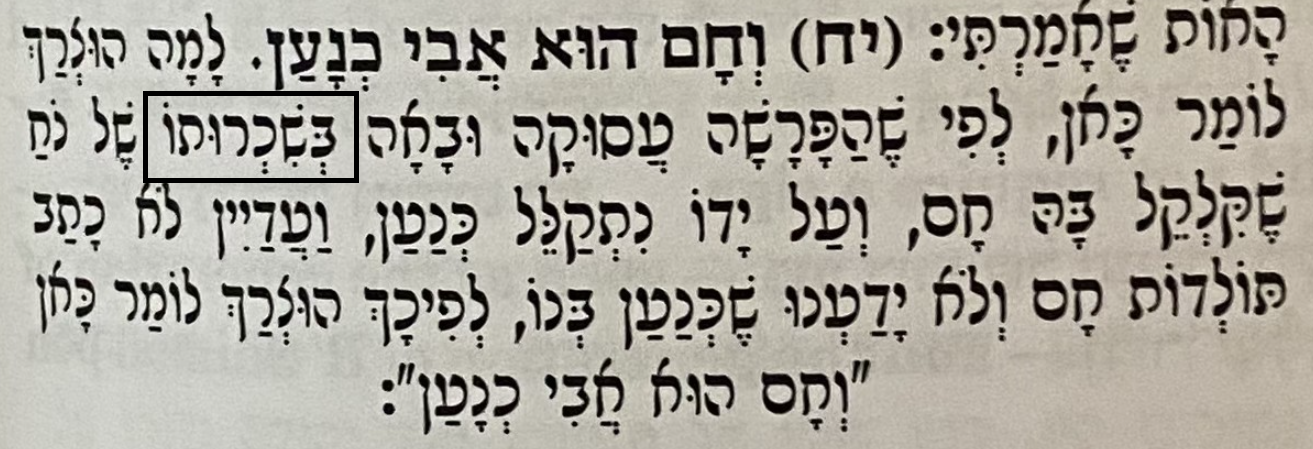
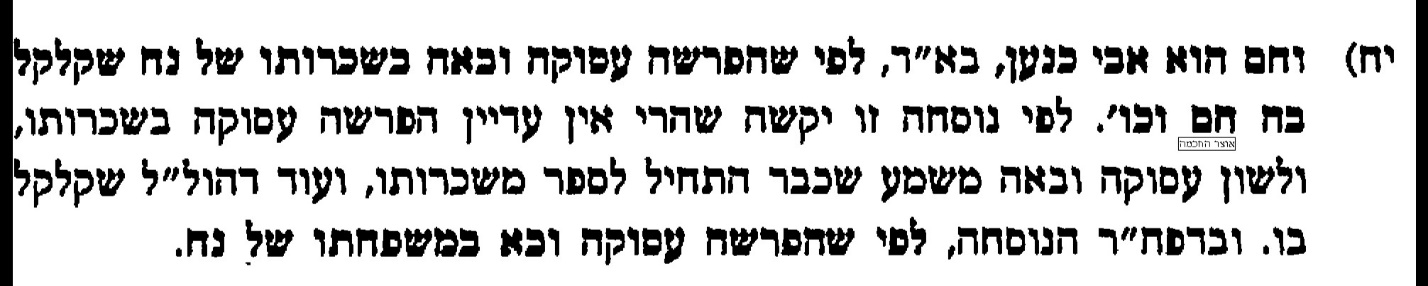
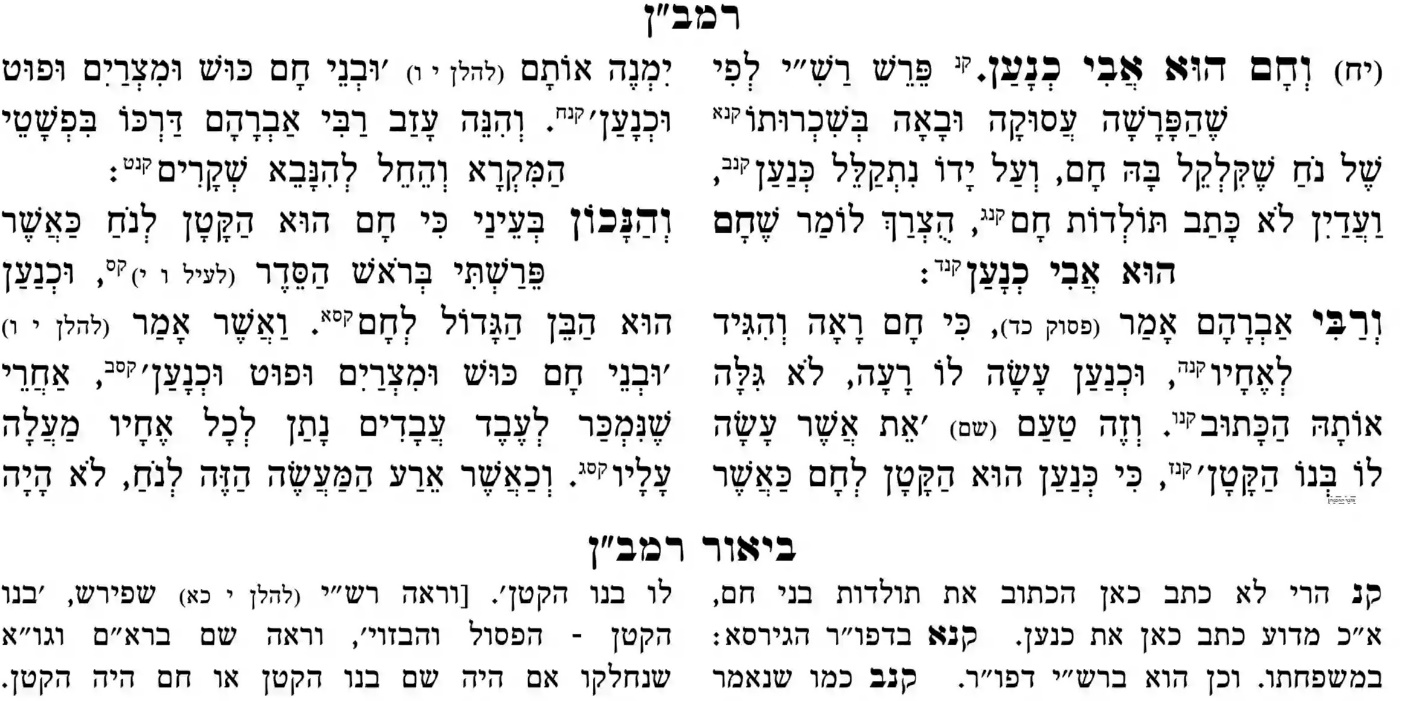
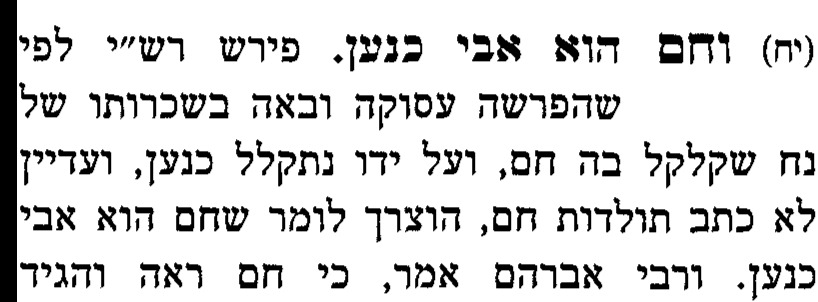
וחם הוא אבי כנען. לָמָּה הֻצְרַךְ לוֹמַר כָּאן? לְפִי שֶׁהַפָּרָשָׁה עֲסוּקָה וּבָאָה בְּשִׁכְרוּתוֹ שֶׁל נֹחַ שֶׁקִּלְקֵל בָּה חָם וְעַל יָדוֹ נִתְקַלֵּל כְּנַעַן, וַעֲדַיִן לֹא כָתַב תּוֹלְדוֹת חָם, וְלֹא יָדַעְנוּ שֶׁכְּנַעַן בְּנוֹ – לְפִיכָךְ הֻצְרַךְ לוֹמַר כָּאן וְחָם הוּא אֲבִי כְנָעַן:

AND CHAM IS THE FATHER OF CANAAN – Why is it necessary to mention this here? Because this section goes on to deal with the account of Noah’s drunkenness when Cham sinned, and through him, Canaan was cursed. Now, as the generations of Cham have not yet been mentioned, we therefore would not know that Canaan was his son. Therefore, it was necessary to state here that “Cham is the father of Canaan”.

This is how it appears in the Artscroll Elucidated Rashi[1]:

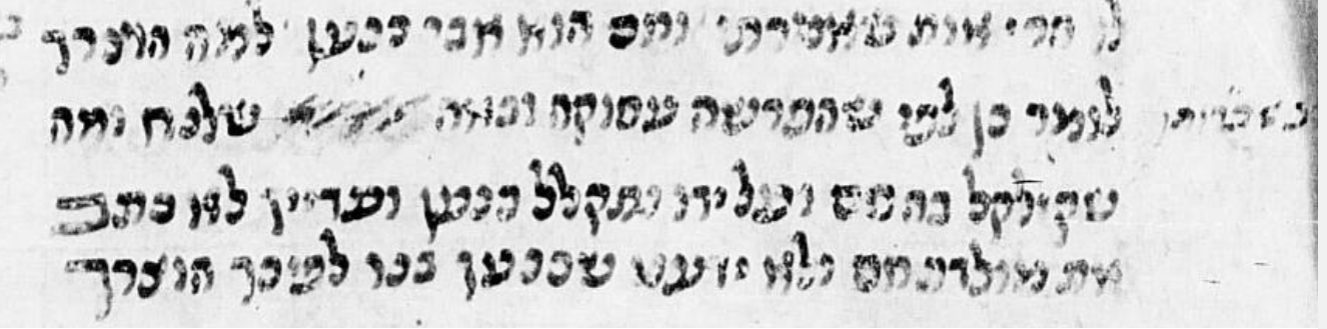
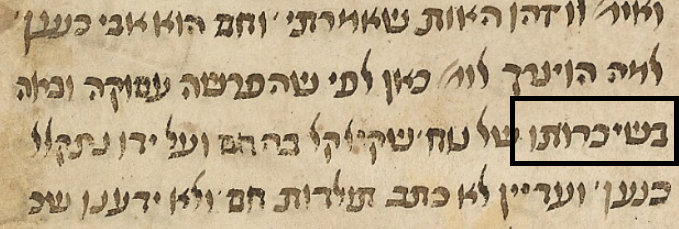
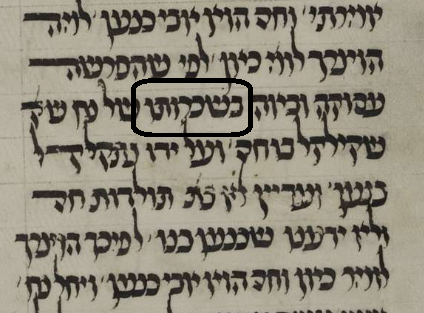
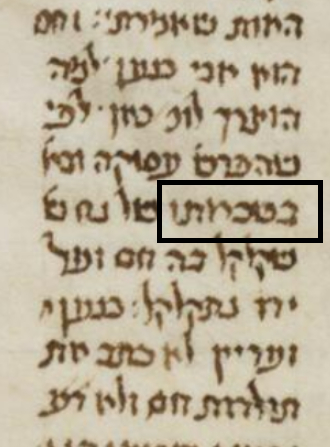
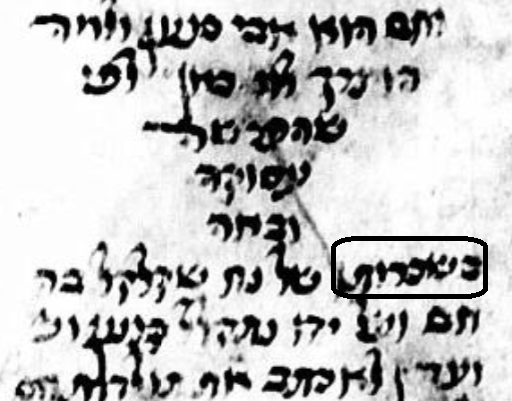
Yet the author of the Sefer Yosef Da’at (Prague 1609) writes that he had a Rashi manuscript and other Sefarim which substituted the word “במשפחתו “for the word” בְּשִׁכְרוּתוֹ”. He also writes that it was the Nusach of Ramban ( when quoting this Rashi).

בדבור המתחיל וחם הוא אבי כו׳, נכתב בצדו על מלת ״בשכרותו״ שבפנינו, וברש״י קלף בס״א (בספרים אחרים) במשפחתו של נח. והיא נוסחאות הרמב״ן ז״ל.

The text of Rashi would then read:

וחם הוא אבי כנען. לָמָּה הֻצְרַךְ לוֹמַר כָּאן? לְפִי שֶׁהַפָּרָשָׁה עֲסוּקָה וּבָאָה במשפחתו שֶׁל נֹחַ שֶׁקִּלְקֵל בָּה חָם וְעַל יָדוֹ נִתְקַלֵּל כְּנַעַן…..

Why is it necessary to mention this here? Because this section goes on to deal with the account of Noah’s family when Cham sinned, and through him, Canaan was cursed…

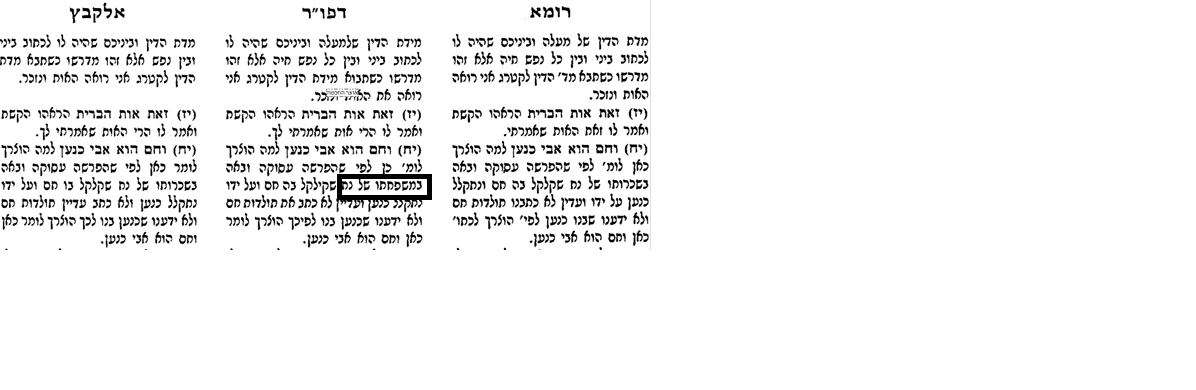
As mentioned by Yosef Da’at, one of the Eidei Nusach for having the word במשפחתו is Ramban, who quotes Rashi’s comment. The website Al Hatorah notes, that this Nusach appears in the following Ramban manuscripts: Parma 3255, Munich 138, Fulda 2, Paris 222, and Paris 223. It also appears that way in the first printed edition of Ramban, that of Rome (printed before 1490).

This is the Ramban manuscript known as Munich 138 where Ramban quotes Rashi:

Here is the text of Ramban in the Rome edition where he writes(פ׳(רוש) ר״ש (למה:

Al Hatorah also notes that the word במשפחתו, appears in the text of a Rashi manuscript, Parma 3115, (which it seems was close to the text with which the Ramban worked) before it was “corrected”.

וכן בכ”י פרמא 3115 של פירוש רש”י (שהוא כנראה קרוב לנוסח שעמד בפני רמב”ן) לפני שתוקן בין השיטין

Ktav Yad Parma 3115, for Rashi:

Al Hatorah then notes that most Rashi manuscripts have בְּשִׁכְרוּתוֹ

בכ”י רומא 44, פרמא 2978, דפוס ליסבון: “בשכרותו”, וכן ברוב כ”י של רש”י.

Parma 2978 is the Ramban on Noach which has “בשכרותו”:

For Rashi on this Pasuk ,Al HaTorah records that most Rashi manuscripts have בְּשִׁכְרוּתוֹ, but Regio di Calabria, as quoted by Ramban and the Rashi manuscript Parma 3115, have it as במשפחתו.

וחם הוא אבי כנען – למה הוצרך לומר כאן. לפי שהפרשה עסוקה בשכרותו של נח שקלקל בה חם, ועל ידו נתקלל כנען, ועדיין לא כתב תולדות חם, ולא ידענו שכנען בנו. לפיכך הוצרך לומר כאן: וחם הוא אבי כנען.

ב. כן בכ״י אוקספורד 165, מינכן 5, אוקספורד 34, לונדון 26917, ברלין 1221, דפוס רומא.

דפוס ריגייו: ״במשפחתו״, וכן מופיע בפירוש רמב״ן כאן ברוב עדי הנוסח, בכ״י פרמא 3115

. אפשר שכך היה הנוסח גם בכ״י המבורג 13.

In Zechor L’Avraham (Berlin 1867 and Frankfurt am Main 1905), there is no indication of alternative Nusach. Avraham Berliner does not mention the alternative Nusach of Yosef Daat, the Dfus Rishon or the Girsa of Ramban:

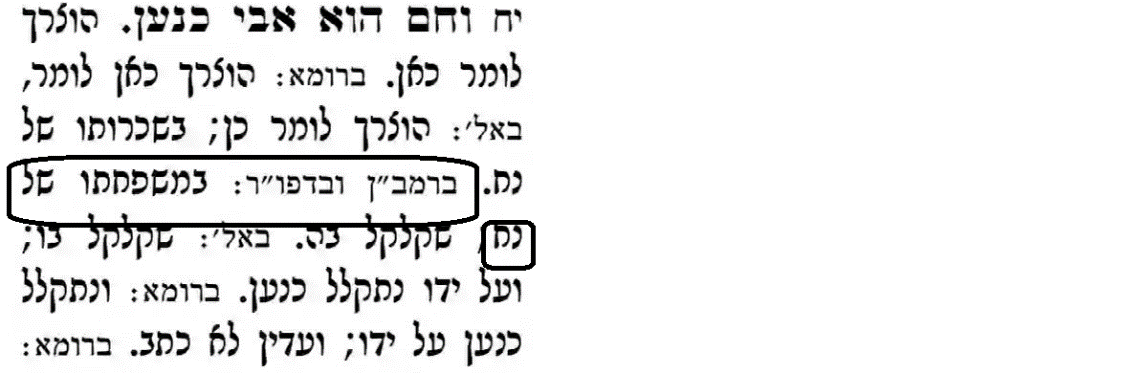
In Yosef Hallel (Brooklyn 1987), Rabbi Brachfeld notes that the Dfus Rishon of Regio Callabrio (1475) has the word במשפּחתו. He does not note that it is the Lashon of the Ramban but seems to think that במשפחתו is a better reading because of his questions on the use of בְּשִׁכְרוּתוֹ:

In Rashi HaShalem Mechon Ariel ( Jerusalem 1987), there is no indication of another Girsa but in the back of the Sefer, it does have it as part of Defusim Rishonim:

Defusim Rishonim:

Guadalajara (1476) Reggio di Calabrio (1475) Rome (1470)

It is interesting to note that the Alkbetz edition is what is known as the Mahadura Sefardit ( according to Professor Yeshayahu Sonne and Dr Yitzchak Penkower), and yet it has בשכרותו. The same goes with Hijar(1490), which generally copies Alkabetz.

Oz Vehadar Rashi HaMevuar 2008, has במשפחתו in the back in Chilufai Girsaot, noting that it is the Girsa of Ramban and the Dfus Rishon:


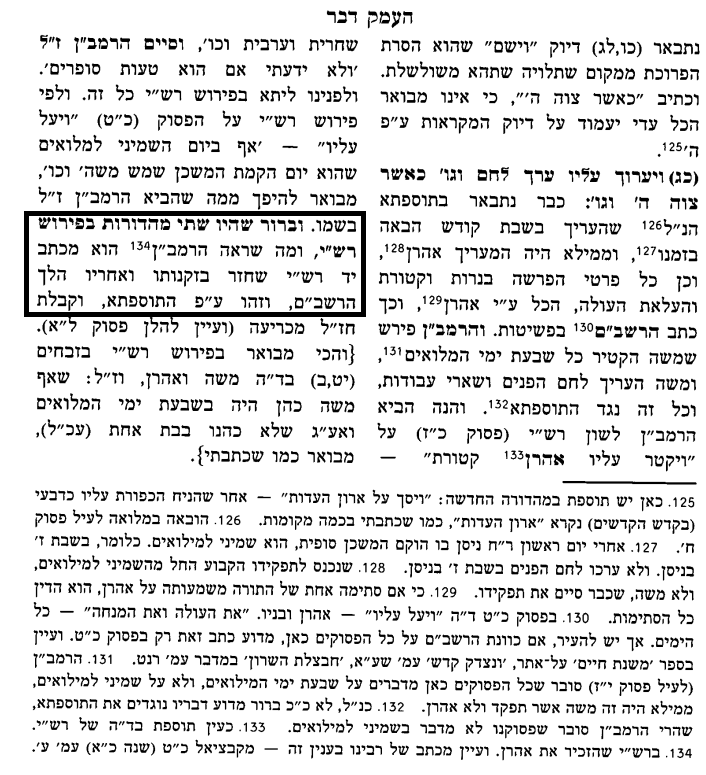
Rabbi Isaac Chavel in his edition of Rashi ( Mosad HaRav Kook – 2007 edition) notes that Defus Rishon of Rashi (Regio di Calabria) has ,במשפחתו and this Lashon also appears in the text of Ramban as he quotes Rashi. He also says about the use of the word “במשפחתו” that is more correct (“וכן נראה”) based on the Lashon of the Midrash Agadah which places the emphasis on familial relationships of Noach:

What do the manuscripts indicate:

Oxford CCC 165 (Neubauer 2440) – 12th century

Hamburg 13 (1265), has the word in question rubbed out and changed to בְּשִׁכְרוּתו on the side. It might have originally said במשפחתו:

Oxford-Bodley Opp. 34 (Neubauer 186):

London 26917 (Neubauer 168) (1272):

Berlin 1221:

Vatican Urbinati 1 (1294):

Nuernberg 5 (1297):

How did the text of Rashi in printed editions evolve over time?

The Dfus Rishon of Regio di Calabrio recorded it as במשפחתו. As mentioned, Yosef Da’at noted במשפחתו as a variant reading in a Rashi Klaf and in ,ספרים אחרים and bolstered it with it being the Nusach of Ramban:

בדבור המתחיל וחם הוא אבי כו׳, נכתב בצדו על מלת ״בשכרותו״ שבפנינו, וברש״י קלף בס״א (בספרים אחרים) במשפחתו של נח. והיא נוסחאות הרמב״ן ז״ל.

Hanau 1611-1614, regularly included the Girsaot of Yosef Da’at so we would have expected it to have had בְּשִׁכְרוּתוֹ and then in parentheses have Sefarim Achairim as במשפחתו. But is doesn’t, and that sealed the fate of that Nusach in terms of it becoming a mainstream Girsa of Sefarim Achairim:

The Netziv in Shemot 40:23 cites a comment of the Ramban in which he quotes Rashi and says that our text of Rashi is different. He proposes that there were two Mahdurot of Rashi, of which Ramban had the first Mahadura and we have the second one. In that second Mahadura, Rashi reversed himself from what he said in the first Mahadura. It is possible that this occurred here- in the first Mahadura, Rashi wrote במשפחתו and that is the Mahadura which Ramban had. Later on, Rashi changed it to בְּשִׁכְרוּתו and that has become the standard Girsa:
Conclusion:

There is a lot of ammunition for the Girsa being במשפחתו:

  1. It is in Dfus Rishon, (indicating either inclusion in a manuscript or taken from Ramban)
  2. It is the Lashon of the Ramban, (this is the main argument)
  3. It has logic behind it (Rabbi Chavel’s and Yosef Hallel’s comments)
  4. It is attested to by Yosef Da’at as being in a manuscript
  5. Parma 3115 originally had “במשפחתו”
  6. Hamburg 13 was altered and could have said במשפחתו

But it did not survive as an alternative Girsa of ספרים אחרים today mainly because the influential edition of Hanau (1611-1614) did not include it.

Sidenote:

Many editions of the Ramban today still attribute the word בְּשִׁכְרוּתוֹ to Rashi even though it is clear that the original Ramban had במשפחתו. This was most likely done to make it conform with the accepted Nusach of Rashi.

Here is Oz Vehadar Jerusalem on Ramban 2015 which has בְּשִׁכְרוּתוֹ but says it is במשפחתו in Defus Rishon:

Here is Peirush HaRamban with Peirush Menachem Tziyon printed in 2019 which also has בְּשִׁכְרוּתוֹ:

  1. There is no comment on this Rashi in the Siftei Yeshainim section


Depicting Difference: The Tower of Babel and the Language of Sacred Art

Depicting Difference: The Tower of Babel and the Language of Sacred Art

“For form is only the manifestation, the shape of content.”
Ben Shahn, The Shape of Content, p. 72

Genesis chapter 11 presents the narrative of the Tower of Babel, detailing how, contrary to the divine directive to disperse and populate the earth, the descendants of the flood’s survivors congregated in a single city and commenced construction of a substantial tower. God intervened to prevent further cooperation among them by disrupting their shared language, thereby introducing linguistic diversity, which ultimately ceased the building process and resulted in the broad dispersal of the population.

The account of the Tower of Babel offers a unique context for exploring what characterizes an image—and, by extension, a work of art—as Jewish. In Christian artistic traditions, from medieval illuminations to Renaissance paintings, the tower is often portrayed as a symbol of pride and serves as a cautionary emblem against human ambition. In contrast, Jewish philosophy and visual culture do not treat the tower as an important iconographic motif or as a warning against aspiration. Where the story does appear in Jewish art, it offers an alternative interpretation, and in certain instances, it recasts the tower motif in a more positive light.

The Architecture of Arrogance: Bruegel’s Tower and the Christian Moral Imagination

A painting of a tower of babel AI-generated content may be incorrect.

Figure 1: Pieter Bruegel, The Tower of Babel, Kunsthistorisches Museum, Vienna

Among the most celebrated representations of the Tower of Babel is Pieter Bruegel the Elder’s painting housed in Vienna’s Kunsthistorisches Museum (we previously discussed another painting from the museum, Samuel van Hoogstraten’s Old Man at a Window, and whether it is a Jewish painting, its subject a famous Rabbi). Measuring over three feet wide and five feet high, this work features a monumental spiral structure composed of arches and tiers that ascend unevenly into the clouds. The immense scale of the tower stands in stark contrast to the small human figures depicted throughout—hundreds of workers engaged in various tasks. Bruegel’s paintings are notable for their comprehensive and detailed portrayal of subjects. (This site allows you to zoom in on all the details.) In this scene, each trade and stage of construction is rendered with meticulous attention; some laborers transport massive stone blocks along ramps, while oxen-pulled carts bear heavy loads of building materials. Human-powered treadwheel cranes lift supplies upward, and scaffolding constructed from poles, planks, and ropes clings to the sides of the tower. Masons apply mortar and lay bricks, carpenters reinforce beams, and overseers direct operations, attempting to manage the complexity and activity inherent in such an undertaking.

In the foreground, King Nimrod, adorned in elaborate robes and a crown, oversees the construction as the principal architect of the tower. He reviews architectural plans with his attendants while laborers kneel. Surrounding him, foremen gesture towards the ascending walls, effectively conveying his directives to the assembled workforce. Beyond the imposing structure of the tower, ships are visible entering the harbor, their masts prominent on the horizon.

Bruegel often used allegory in his work. By integrating contemporary construction methods and maritime elements into the depiction of the ancient story, he placed Babel in the context of his own time. The painting presents examples of human innovation alongside the risks associated with ambitious endeavors, making its observations applicable from the 16th century to the present day.[1]

A painting of people working on a tower AI-generated content may be incorrect.

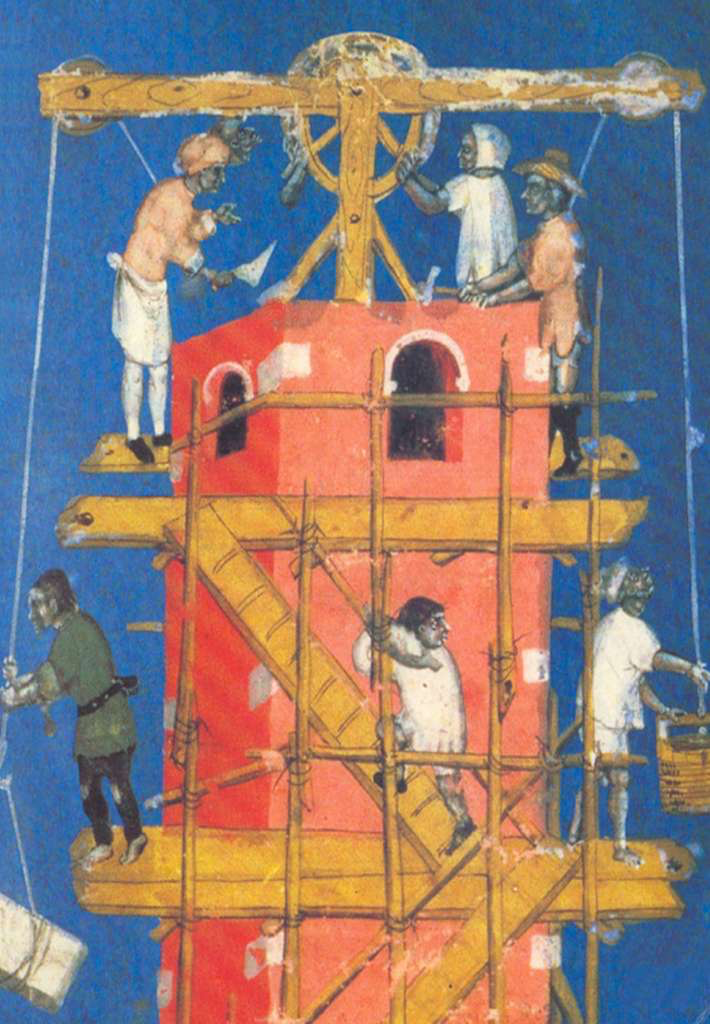
Figure 2: 13th Century Manuscript of Rudolf von Ems Poetry

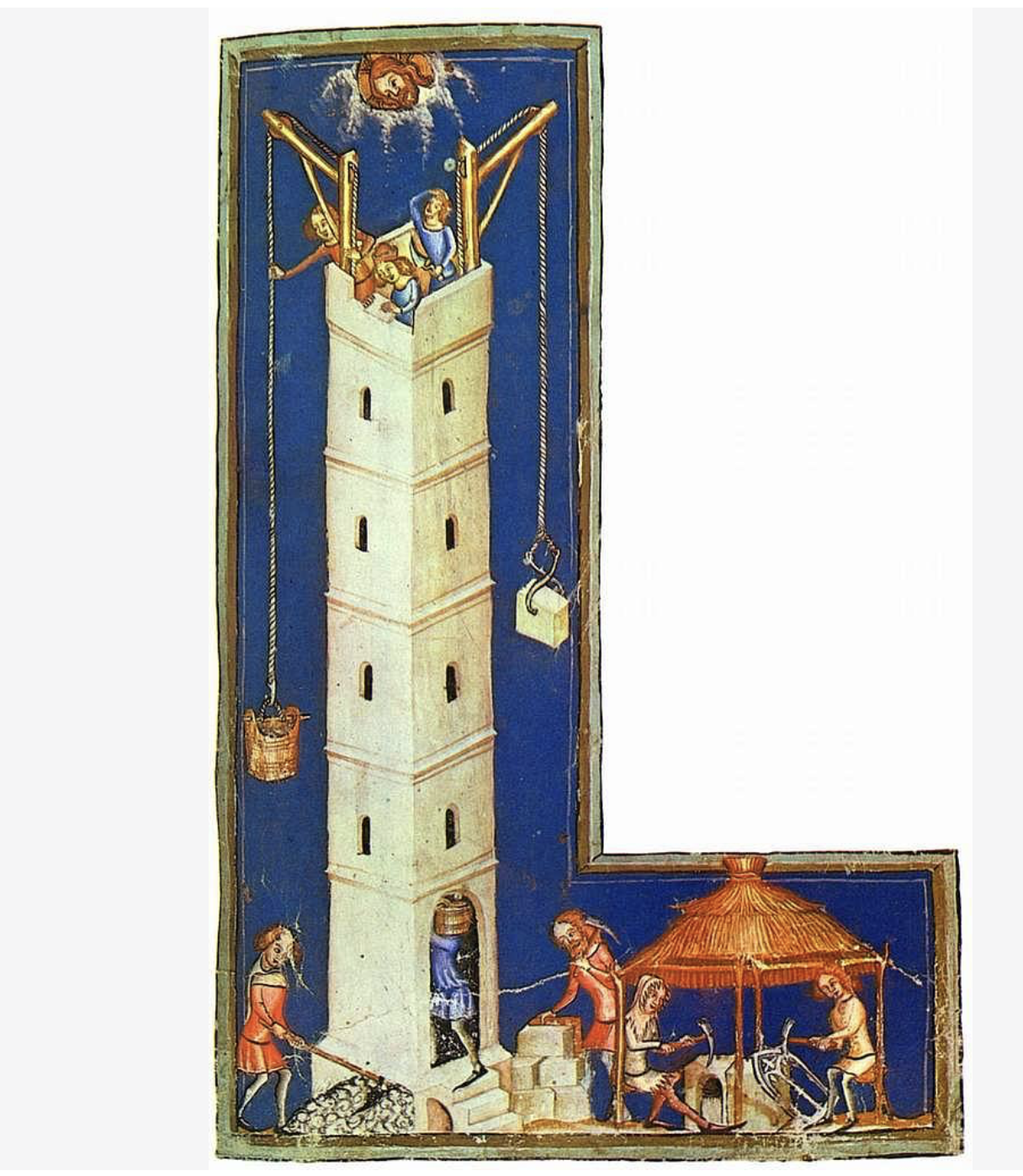
A letter l with a tower and people working AI-generated content may be incorrect.

Figure 3: 14th Century York Manuscript

Earlier artistic portrayals commonly focused on Babel’s height and grandeur. Medieval manuscripts and Church paintings often depicted it as upright, rectilinear, and monumental, resembling a fortress or cathedral spire. In contrast, Bruegel presents the tower as unstable, leaning, and showing deterioration at its foundation, while construction continues at the upper levels. The structure appears to challenge natural order by being built atop a mountain and using brick, which leads to rock formations that affect its stability. Bruegel incorporates Roman arches reminiscent of the Colosseum, suggesting parallels to historical architecture that had fallen into decline by the time of his visit in 1560. Some areas are already inhabited; for example, a woman is seen hanging laundry. The residents appear unaware of the structural issues beneath them, blinded by their hubris. Nimrod’s prominence in the foreground, with the workers genuflecting to him and his plans that he holds in his hands, further emphasizes the fetishization of human ambition.

At the time, Bruegel’s audience didn’t have to look far to see a potential Babel in the making: Antwerp was booming, expanding, and building like never before, and its populace risked falling into the sin of pride. In 1563, when Bruegel painted the Tower of Babel, the city was Europe’s busiest port and a magnet for wealth, with goods and materials streaming in daily through the Scheldt River. Massive new fortifications were under construction to secure the city’s growth, while the Cathedral of Our Lady still stood unfinished, its single soaring spire a symbol of grandeur halted midstream. Cranes, treadwheels, scaffolding, and teams of laborers were familiar sights on Antwerp’s skyline, all details Bruegel carefully folded into his painting. Even the ships visible in the harbor of his Babel recall Antwerp’s bustling docks, tying the biblical story directly to his contemporaries’ lived experience. For Bruegel’s viewers, the tower was not just a monument to ancient pride but a mirror of their own city’s dazzling ambition and its underlying fragility.

Bruegel does not show the dramatic aftermath, the confusion of tongues, and the scattering of peoples across the earth. Instead, he arrests the narrative at the moment of construction, filling the canvas with the feverish activity of workers and the looming mass of the tower itself. In doing so, he lets the architecture bear the weight of the story: the leaning walls, the buckling arches, and the crumbling base foreshadow the enterprise’s futility. The punishment is absent because the tower already embodies it, an image of human ambition that carries within itself the seeds of its own destruction.

Bruegel’s legacy is twofold. On the one hand, he fixed Babel’s appearance for centuries: spiraling, leaning, and crumbling, the visual template repeated in paintings, engravings, church murals, and biblical illustrations well into the modern era. From 16th-century Flemish workshops to 18th-century Bibles, from church frescoes to Romantic illustrations, and even into 20th-century literature and contemporary art, Bruegel’s leaning Tower of Babel has been endlessly reimagined as the enduring image of human ambition and collapse.[2] On the other hand, he reshaped its meaning. Earlier images celebrated human pride by showing the tower upright and impregnable. Bruegel’s version, and the generations of artists and authors who followed, transformed it into a parable of fragility, a monument doomed to collapse even as it rose.

Buildings Fall Books Endure: The Jewish Reading of Babel

Within the Jewish exegetical tradition, the story of Babel carries a different emphasis than in Bruegel’s Christian retelling. The tower itself is a bit player in a larger story, a catalyst and not the focus, less important than the human decision it symbolizes. In Genesis 9:1, God commands Noah’s descendants to “be fruitful, multiply, and fill the earth.” Yet instead of dispersing across the world, humanity chooses to settle in one place and build a city and tower “lest we be scattered abroad upon the face of the whole earth” (Gen. 11:4). In this reading, the sin is not arrogance against heaven but resistance to God’s plan of dispersal. The tower becomes a narrative device, a means of dramatizing humankind’s determination to remain unified, sedentary, and secure.[3]

Seen from this perspective, the confusion of languages and scattering of peoples is not so much a punishment as a necessary correction. The multiplicity of tongues is God’s way of ensuring that His will for humanity, for it to spread, diversify, and populate the earth, is carried out. The Jewish interpretation, therefore, reads the story as a lesson about human attempts to thwart divine design, not Bruegel’s Christian vision, which centers on pride and monumental ambition. What matters is not the tower’s collapse but humanity’s refusal to scatter, and the way God ultimately enforces the order of creation.

This contrast is confirmed by the way Jewish tradition titles the episode “Dor Haflagah,” meaning “the Generation of Division,” rather than “Migdal Bavel,” the Tower of Babel. (Sanhedrin 10:3; Baba Metziah 4:2). The Hebrew name shifts attention away from architecture altogether and toward the human drama: the refusal to scatter, the divine act of dividing languages, and the dispersal across the earth. In other words, where Christianity made the tower a visual icon, Judaism made the generation itself the lesson.[4]

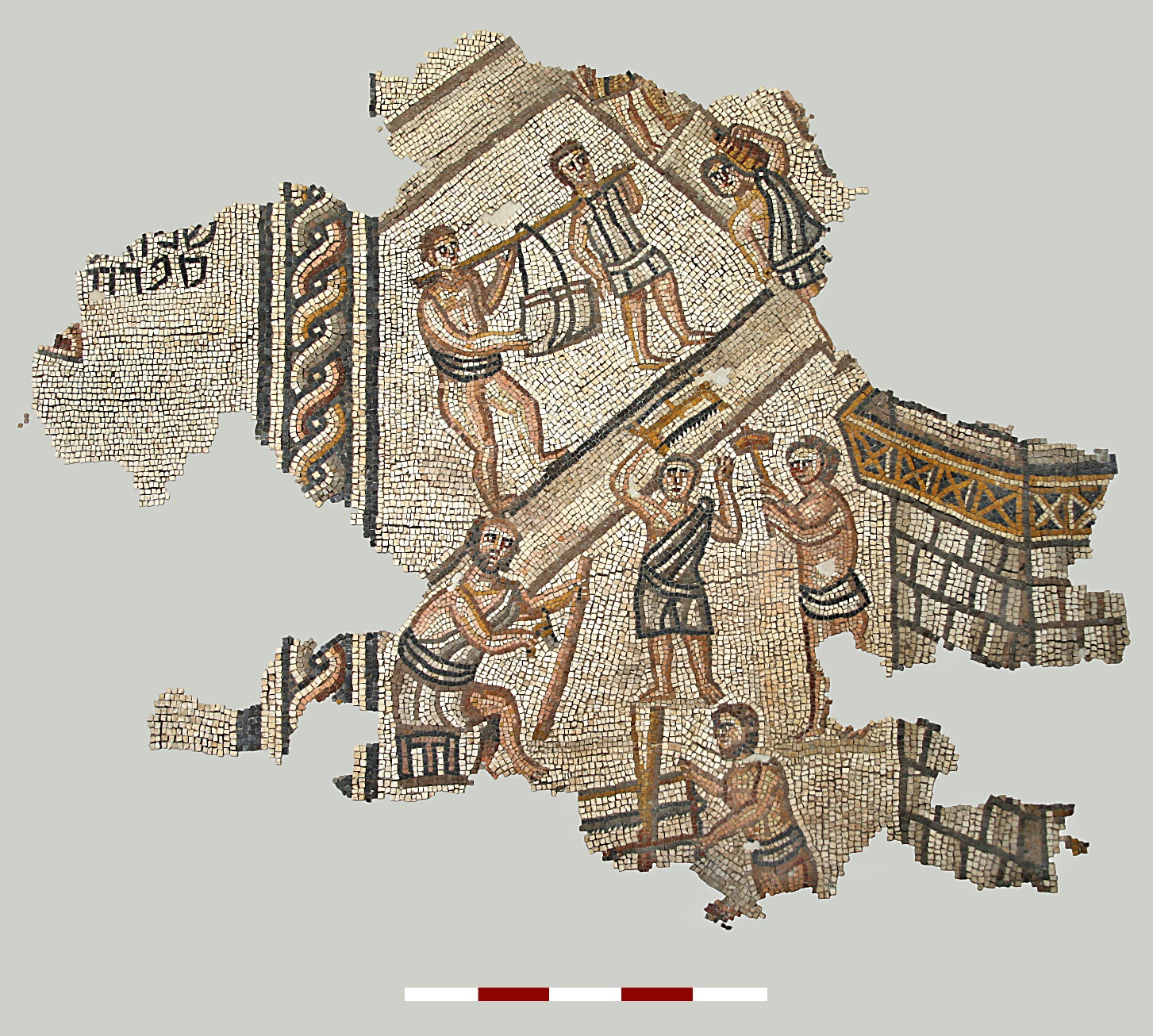
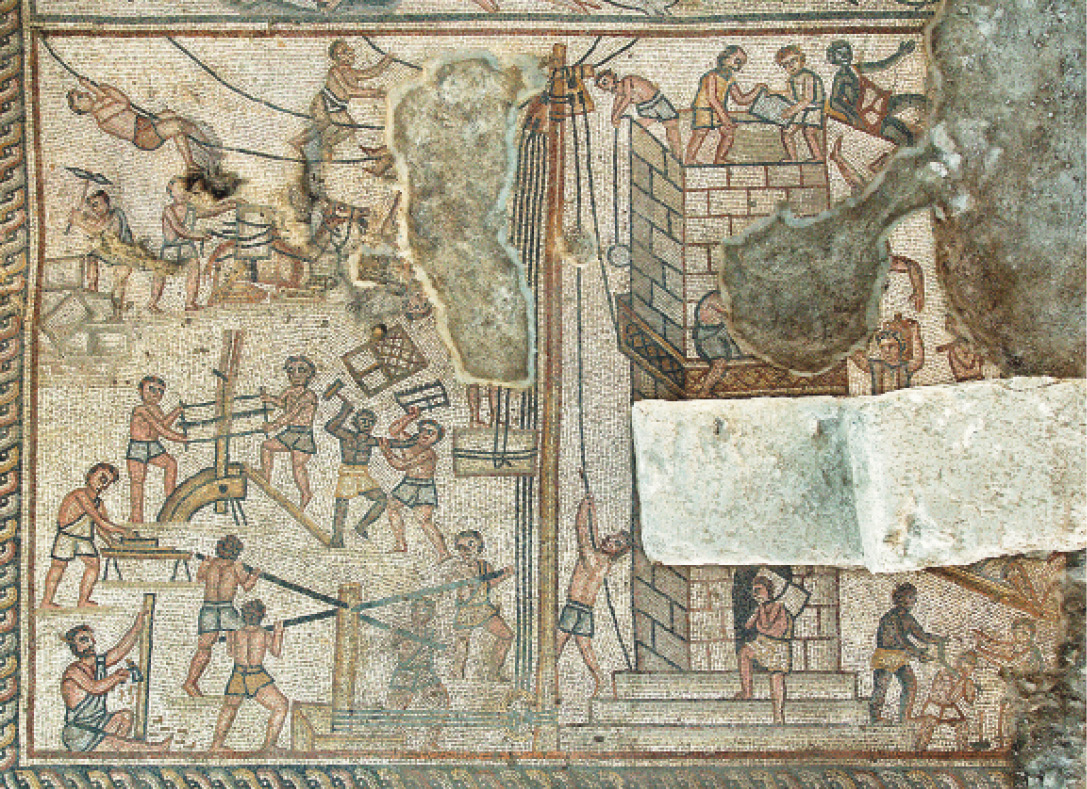
This approach was not only in Jewish exegesis but also in Jewish art. There are only five identified examples of the tower in Jewish art, but in all of them, it is illustrated in a uniquely Jewish manner.

A mosaic of people in different poses AI-generated content may be incorrect.

Figure 4: Tower of Babel, Khirbet Wadi Hamam Mosaic, c. 3rd century, source.

A mosaic of people working on a building AI-generated content may be incorrect.

Figure 5: Tower of Babel, Huqoq Synagogue, c. 5th Century

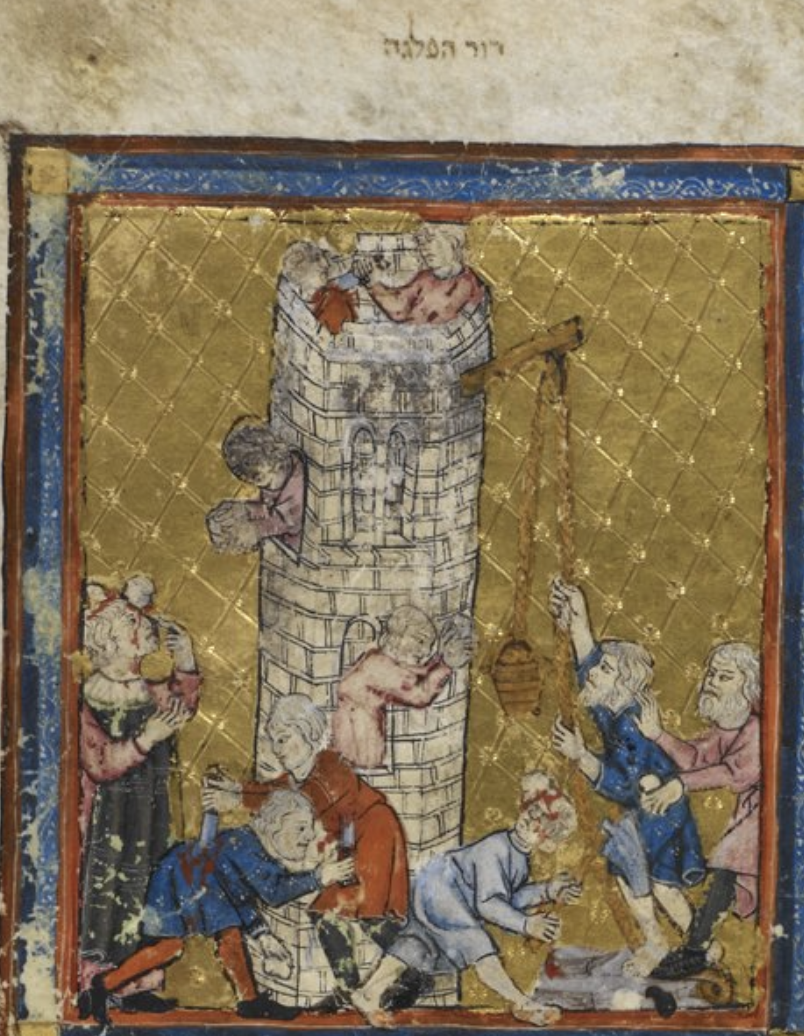
The earliest two examples are synagogue mosaics, a third-century synagogue in Wadi Hamam, and a recently discovered fifth-century mosaic on the floor of the Huqoq Synagogue in northeastern Israel. Only a part of the Wadi Hamam scene has survived, though it is the largest intact biblical scene found. It shows workers and a tower on the left. In the center, two workers are hitting each other. The Huqoq mosaic is larger and illustrates all stages of construction, including detailed depictions of hoists, levers, and various chiseling and cutting tools. At the center of the scene, two workers are engaged in conflict—one wielding a hammer and the other a saw.[5] Similarly, three medieval manuscripts feature this theme; in two, the depiction of violence is the central focus, while in the third, it forms part of a broader image, akin to the mosaic. [6]

A close-up of a painting AI-generated content may be incorrect.

Figure 6 Golden Haggadah, fol. 3r

Although these examples feature the tower, they can be distinguished from the Christian perspective. Firstly, the labeling of the images aligns with Jewish tradition, specifically referencing Dor Haflagah. Secondly, Bruegel’s comprehensive visual representation notably omits any mention of violence. The interpretation that linguistic confusion led to violence is exclusive to Jewish sources, appearing in Genesis Rabba and various other texts, but not in Christian writings.[7] Given that the mosaic dates to the third century, this seems to potentially point to an earlier codification of Genesis Rabba than is currently assumed or that this approach was already was an oral legend.[8] The only known medieval Christian manuscript featuring a descent into violence, The Bedford Book of Hours, has prompted one scholar to assert that it “is undoubtedly based on a Jewish legend.”[9]

While Jewish manuscript culture preserves the uniquely Jewish interpretation of the iconography of the Tower of Babel, Jewish print culture would transform Bruegel’s symbol of pride and sin into a fortress of divine protection.

The Soncino family was the first great dynasty of Hebrew printers, active in northern Italy from the late 15th to the early 16th century.[10] Originating from the town of Soncino in Lombardy and operating intermittently between roughly 1483 and 1527, they established presses in a succession of Italian cities, including Soncino, Brescia, Fano, Pesaro, and Rimini, as well as in Turkey. The founder, Joshua Solomon Soncino, and his nephew, Gershom ben Moses Soncino, expanded the enterprise into one of the most respected printing houses of Renaissance Italy. Gershom issued one of the earliest dated Hebrew books, a Talmudic tractate printed at Soncino in 1484. This work, with its unique layout, is the first of its kind to become canonized, combining the source text with two surrounding commentaries, and is itself a work of art. Their editions combined typographic precision with decorative sophistication equal to the best contemporary Latin and vernacular presses, and their name became synonymous with the art of Hebrew printing itself. They did not just print for a Jewish audience, but also printed over 100 non-Jewish titles, outdoing their Jewish output of 64 titles.

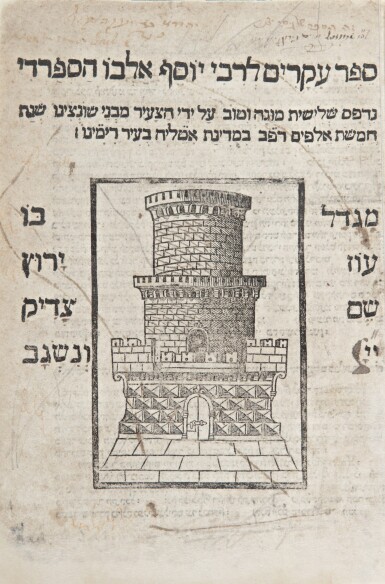
SEFER IKKARIM (BOOK OF PRINCIPLES), RABBI JOSEPH ALBO, RIMINI: GERSHOM SONCINO, 1522 | Sacred Splendor: Judaica from the Arthur and Gitel Marx Collection | 2019 | Sotheby's

Figure 7: Joseph Albo, Sefer Ikkarim, Rimini, 1522

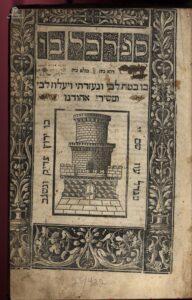
The Soncino family was active from 1483, but in books printed from 1522, first in Rimini and subsequently in Salonika and Constantinople, Gershom incorporated a new printer’s mark – essentially a printer’s coat of arms.[11] This first appeared in R. Joseph Albo’s Sefer Ikkarim and depicts a traditional Renaissance-style solid stone tower rising above a crenellated wall, accompanied by the verse ‘מִגְדַּל עֹז שֵׁם יְהוָה, בּוֹ יָרוּץ צַדִּיק וְנִשְׂגָּב” “the name of the Lord is a mighty tower; the righteous runneth into it, and is set up on high,’ (Proverbs 18:10) on the left and right sides of the image. Gershom chooses to highlight the tower, unlike other possible symbols such as the rainbow, clouds of glory, or King David, which could have served a similar purpose.

Figure 8: Kol Bo, Rimini, 1525, Gross Family Collection

In the Sefer Kol Bo, published in Rimini circa 1525 and considered Gershom’s most distinguished work from that period, a prominent introductory statement appears above the tower: “In You I place my heart and you will help me, and I will raise my heart and with song I will praise you: ‘the name of the Lord is a strong tower; the righteous runs into it, and is safe.’” This clearly presents the tower as an icon of divine protection and intervention. Notably, Gershom’s tower does not correspond with any physical structure in Soncino or Rimini; instead, the tower symbolizes a spiritual rather than an earthly construct.[12] There is one small, but somewhat strange, detail about Gershom’s tower: the doors are latched on the outside, making the locks useless. This oddity reinforces that the tower is divine, as it does not need a locked door. We reenact this belief annually during the Pesach seder. Gershom’s tower, rooted in Mishlei rather than Bereishit, represents divine protection in contrast to retribution. For a Jewish printer deeply engaged with Renaissance book art, this choice offered a thoughtful reinterpretation, reclaiming the tower as a symbol of resilience and trust in God’s safeguarding of the Jewish community people.[13]

The story of the “tower,” whether Bruegel’s collapsing monument or Soncino’s enduring emblem, reminds us how difficult it is to define what makes art “Jewish.” The same image can signify pride or faith, sin or sanctity, depending on the hands and the heart that shape it. Jewish art, then, is not confined to subject or style, but often lives in subtler places — in the design of a page, the mark of a printer, or the choice of a verse. Ultimately, even art speaks in different languages.

Notes: 

  1. For background on the creation of the painting see Margaret A. Sullivan, Bruegel and the Creative Process, 1559-1563 (Ashgate: England, 2010), 191-204. For a direct comparison of the painting with the biblical narrative see Ruth Dorot and Edna Langenthal, “Pieter Bruegel the Elder’s The Tower of Babel (1563). From Art to Architecture,” Journal Education Culture and Society, 2, (2023), 380-400.

  2. See Diána Kulisz, “The Tower of Babel Motif in the Art of the Low Countries,” in Mesopotamia Kingdom of Gods and Demons, ed. Zoltán Niederreiter, (Budapest: Museum of Fine Arts, 2024), 424-439.
  3. See Umberto Cassuto, A Commentary on the Book of Genesis, Part II, trans. Israel Abrams, (Jerusalem: Magnes Press, 1974), 225-226. Abarbenal, however, interprets the section much more in line with Bruegel’s themes. See Nehama Leibowitz, Studies in Bereshit, trans. Aryeh Newman, (Jerusalem: World Zionist Organization), 95-97.
  4. See Cassuto, id. at 203.
  5. See Karen Britt and Ra’anan Boustan, “Artistic Influences in Synagogue Mosaics: Putting the Huqoq Synagogue in Context,” BAR, May/June 2019, 40-41. They note that these are the only two known examples of synagogue mosaics to depict the Tower of Babel.
  6. The Golden Haggadah, Bezalel Narkiss ed. (England, 1996) 24-25; Marc Michael Epstein, The Medieval Haggadah: Art, Narrative & Religious Imagination (New Haven: Yale University Press, 2011), 157-158.
  7. For a collection of the various sources see M.M. Kasher, Torah Shelemah, vol. 1, 515, no. 60 and 517 no. 73.
  8. See Anat Reizel, Introduction to Midrashic Literature, (Tevunot: Alon Shevut, 2011), pp. 105–106.
  9. See Mira Friedman, “The Tower of Babel in the Bedford Book of Hours,” in The Old Testament as Inspiration in Culture, Jan Heller, ed. (Trebenice: 2001), 113-114.
  10. See generally, A.M. Haberman, Perakim be-Toldoth Hamdpissim ha-Ivrim (Jerusalem: Rubin Mass, 1978),15-101; Moses Marx, “Gershom Soncino’s Wander Years in Italy, 1498-1527” in HUCA XI (1936), reprinted as a stand alone work with many examples of Soncino illustrations, in 1969, by the Society of Jewish Bibliophiles.
  11. Abraham Yaari, Hebrew Printers’ Marks: From the Beginning of Hebrew Printing to the End of 19th Century (Jerusalem: Hebrew University Press, 1943), 4-5, 123-124. Gershom once used a different mark with a tower in the 1505 Fano edition Mashal ha-Kadmoni. Id. 124.
  12. Yaari, Printers Marks, 124.
  13. Gershom’s prayer may have been tied to a conflict with a Jew who had converted to Christianity. In the end, perhaps because of this conflict, although it remains unclear, Gershom was forced to flee Italy soon after. See Marx, “Wandering Years,” 55-59.


Mikra Pashut: A New Reading of the Tanakh

Mikra Pashut: A New Reading of the Tanakh

David Curwin

David Curwin is an independent scholar, who has researched and published widely on Bible, Jewish thought and philosophy, and Hebrew language. His first book, “Kohelet – A Map to Eden” was published by Koren/Maggid in 2023. Other writings, both academic and popular, have appeared in Lehrhaus, Tradition, Hakirah, and Jewish Bible Quarterly. He blogs about Hebrew language topics at www.balashon.com. A technical writer in the software industry, David resides in Efrat with his wife and family.

I have read the Tanakh in many translations. In my youth, I began with the Koren Jerusalem Bible, continued with the 1985 JPS edition, and came to appreciate R. Aryeh Kaplan’s The Living Torah. More recently, I have enjoyed the literary translations produced by Robert Alter, Everett Fox, and the new Koren edition, among others. Each edition, in its own way, makes the Bible a book to be read.

In Hebrew, the situation is different. There is no shortage of Chumash and Tanakh editions  – ranging from traditional to modern – each offering layers of commentary and interpretation. Hebrew speakers have countless tools to learn the Bible, to chant it ritually, to analyze it verse by verse. Even modern commentaries such as Daat Mikra, while aiming to elucidate the peshat, are constructed as learning tools, not as continuous reading experiences. By contrast, readers of translations in other languages can pick up a Bible and read it as a flowing narrative, aided by paragraphs and punctuation that match modern literary conventions.

Mikra Pashut, edited by biblical researcher Dr. Avi Shveka with the guidance of an editorial committee and published by Koren under its Maggid imprint in 2024, seeks to change this. The Hebrew-only edition spans four hardcover volumes- Torah, Prophets I, Prophets II, and Writings – and remains faithful to the Masoretic text while using modern punctuation and layout to create a seamless reading experience. It strips away the tools that have shaped the text for centuries – verse numbers, chapter breaks, parashah divisions, and cantillation marks. That absence may startle traditional readers at first, but once that surprise fades, they may discover how enjoyable and revealing it is to read the Tanakh continuously, uncovering new dimensions in a text they thought they knew.

Opening any volume immediately shows how different this edition is. The layout transforms the Tanakh into something that can be read fluently, without commentary mediating every line. Shveka and his team provide a substantial Hebrew introduction that explains the project’s history and the reasoning behind its editorial decisions. In addition to this general introduction, each biblical book comes with a brief preface focusing on issues specific to its punctuation and layout. While the introduction does not detail every individual punctuation and design choice, it sets out the principles that guided the work. This review draws on the editorial principles outlined in the introduction and how they are reflected in the edition’s design. While Mikra Pashut is entirely in Hebrew, understanding how it was designed and why these choices were made is of interest to anyone concerned with how we encounter the biblical text.

The editor and his context

Avi Shveka’s project continues a family tradition of innovation in access to Jewish texts. His father, Prof. Yaacov Choueka (1936–2020), played a central role in the development of the Bar-Ilan Responsa Project, which transformed rabbinic scholarship by making classical sources digitally searchable. (Mikra Pashut is dedicated to his memory.) Just as Choueka removed technological barriers – developing tools that made rabbinic literature digitally searchable – so his son Avi removes barriers of format, the conventions that have kept Hebrew readers from simply reading the Bible.

To carry out this vision, Shveka assembled an editorial committee representing diverse perspectives and backgrounds. Members included Rabbi Chaim Sabato (Rosh Yeshivat Yeshivat Birkat Moshe, Ma’aleh Adumim), Rabbi Yuval Cherlow (Rosh Yeshivat Yeshivat Orot Shaul, Tel Aviv), Prof. Haggai Misgav (Hebrew University), Prof. Noam Mizrahi (Head of the Bible Department, Hebrew University), Dr. Hillel Gershuni (researcher, editor, translator), Ayal Fishler (director of Machon Maaliyot), and Avishai Magence (Koren Publishers). This collaboration ensured that the edition drew on rabbinic tradition, literary analysis, and academic scholarship, while keeping the biblical text itself untouched.

This edition is deeply rooted in Jewish tradition. It preserves the sanctity of the biblical text and builds on the insights of generations of commentators. At the same time, it reflects that tradition’s awareness that every era must find its own ways to make the text accessible, and it responds to that need with a format that speaks to contemporary Hebrew readers.

A reader’s edition

Mikra Pashut is explicitly a reader’s edition. Its title, meaning “Plain Scripture” (and implying a “simple reading”), reflects its ambition to present the biblical text in a clear, straightforward manner focused on the peshat. Shveka notes that it was designed in a format as similar as possible to a regular modern Hebrew book. It is not a study Bible and not a tool for ritual chanting; it is a text meant to be read from start to finish.

The visual presentation makes this clear. Mikra Pashut begins from the austere model of a Torah scroll, which contains only the unpunctuated, unvocalized words of the text with no divisions between verses. The scroll’s starkness preserves the primacy of the words themselves. Building on that foundation, this edition introduces only what is necessary for modern readability: the traditional vowels are included to make the sometimes archaic or confusing Hebrew words more accessible, but the page remains free of commentary, Targum, and Masoretic notes. Verse numbers are absent from the body of the text. The words appear in justified paragraphs, with clear indentations. Each page header combines two elements: the traditional chapters and verses covered on that page, along with a brief title summarizing the section’s content. These headings function like chapter titles in a modern book, guiding the reader through the narrative without offering commentary.

The re-division of chapters is particularly significant. Shveka chose not to retain the breaks of the weekly Torah portions (parashat hashavua), which were set according to a variety of considerations and not always primarily to separate distinct topics. Nor did he follow the Christian chapter divisions, introduced in the 13th century by Archbishop Stephen Langton, which are often based on thematic reasoning but in many cases are debatable and, in some places, clearly mistaken. Instead, he created a new chapter division based on literary units. This is, as he notes, the first time in roughly eight centuries that a Hebrew Bible has introduced a new division of chapters. 

For example, the traditional Christian division ends Genesis 1 with the sixth day of creation and oddly begins chapter 2 with the description of the seventh day. The Masoretic division, followed in standard Hebrew Bibles, keeps the seventh day together with the other six in the first chapter and starts the second with the verse, “Such is the story of heaven and earth when they were created. On the day that the LORD God made earth and heaven” (Genesis 2:4), which then continues into the Adam narrative. Shveka’s edition instead splits Genesis 2:4 itself: “Such is the story of heaven and earth when they were created” closes the creation account, while “On the day that the LORD God made earth and heaven” opens the story of Adam.

Within these larger sections, the text is further divided into passages and paragraphs that follow shifts in narrative, dialogue, or thematic focus. Lists, such as genealogies or censuses, are arranged with each item on its own line. Poetry – including Psalms, prophetic oracles, and the Song of Songs – is laid out in parallel lines, often in two columns, highlighting the symmetry of biblical verse. Unlike most editions, where all text appears in a uniform block style, this formatting reflects the different genres within the Tanakh and makes their structure immediately visible to the reader.

The decision to omit chapter and verse numbers also follows this logic. These markers were historically created to aid study, allowing readers to locate verses quickly, but they were never intended to serve the experience of reading. Since this edition encourages smooth, uninterrupted reading, such references would only disrupt the flow. For those who still desire them, the chapter and verse ranges are provided discreetly in the page headers without breaking the continuity of the text.

Modern punctuation as parshanut

Shveka’s most radical innovation is the use of modern punctuation. This edition adds all the marks familiar to contemporary readers: commas, periods, colons, question marks, exclamation points, quotation marks, and parentheses. Dialogue appears in quotes, with long speeches indented as block text. Lists begin with colons. Parentheses, never before used in a printed Tanakh, enclose digressions or editorial asides embedded in the text. Unlike in academic editions, their use here does not indicate that the enclosed passage is uncertain or suspected of being a later addition; rather, it highlights material that functions as an aside within the narrative. The aside in Genesis 2:12 about the gold of Havilah – “(And the gold of that land is good; bdellium and onyx stone are there)” – is enclosed in parentheses, signaling its role as a tangential note.

These choices highlight the narrative’s structure and dramatic flow. This edition also makes distinctive use of semicolons, more frequent than in most modern Hebrew texts, because biblical clauses are often only loosely connected to the main sentence. A comma would obscure their near-independence, while a period would separate them too sharply; the semicolon preserves their intermediate status. Exclamation marks, also used more liberally than modern literary norms, reflect the dramatic tone of prophecy and biblical poetry. Shveka notes that he is not editing Isaiah as a modern literary editor might, but seeks to convey the intensity of the original voice. When a sentence functions as a dramatic declaration or impassioned cry, it receives an exclamation point – even if many appear close together on the same page. The prophet or poet, he insists, has the right to cry out, and the punctuation mirrors that urgency.

The omission of ta’amei hamikra (cantillation marks) also reflects this philosophy. Cantillation is invaluable for liturgy, but it was never intended as a full guide to syntax. The accents do not always follow the peshat, and the considerations of those who set them were not purely grammatical; they also reflected musical needs, patterns of symmetry, and even halakhic factors. Moreover, even if the original motives were grammatical, we cannot simply reverse-engineer them to determine how modern punctuation should match their intent.

For similar reasons, the edition could not rely on a single commentary, such as Rashi, to determine punctuation. Rashi does not always adhere to the peshat, and his commentary only addresses select passages and phrases, leaving vast portions of the text without guidance. No commentary answers all the grammatical and structural questions required for punctuating the entire Tanakh. Shveka and his committee therefore made independent editorial decisions, informed by a broad range of traditional and modern interpretations.

Every translation of the Tanakh uses full, modern punctuation. No one would expect a modern reader to engage with a translation that lacks these aids, since punctuation dramatically improves the reading experience. Translations, by their nature, must address every question of grammar and syntax because every word and phrase must be interpreted. This made them a particularly valuable resource for Mikra Pashut: unlike commentaries, translations cover the entire text consistently and reveal how meaning can be clarified through structure. Shveka consulted translations, especially into English, as an important reference point, though never following them mechanically.

Ultimately, this punctuation is not neutral. It is, as Shveka acknowledges, a form of parshanut – interpretation. Every comma, every period is a decision. Genesis 4:8 illustrates this: the Masoretic text leaves Cain’s words hanging –  “And Cain said to Abel his brother” – without reporting what he said. Shveka’s punctuation must choose whether to treat this as a complete sentence or as an introduction to dialogue. This edition chose the former. Such decisions inevitably align with some interpretations and exclude others. While all these editorial choices carry interpretive weight, Shveka presents them as aids to reading, not as claims of authority.

Faithfulness to the Masoretic text

While the layout and punctuation are new, the words themselves remain exactly as the Masoretic tradition preserves them. The editors never considered modernizing spelling or grammar. The sacred text itself is untouched; only its framing has changed. This includes the treatment of ketiv/qere – the traditional system in which a word is written one way (ketiv) but read differently (qere). Unlike in a traditional Tanakh, in this edition, the qere appears in the main body of the text, in a lighter font to indicate its status as the read form, while the key is placed at the bottom of the page. This subtle change emphasizes how the text is encountered in actual reading, while still preserving the integrity of the written tradition.

Taken together, these choices highlight that Mikra Pashut’s only “commentary” is the formatting itself. Its headings, paragraphs, and punctuation serve to guide the reader without adding explanation.

Reading Instead of learning

As Shveka notes in the introduction, “the Mikra, as its name implies, was intended for kri’ah – reading.” The editorial choices all serve the edition’s central purpose: to make the Tanakh readable in Hebrew. While commentaries can be valuable, they inevitably create a barrier to continuous reading, breaking the flow of the text and steering attention toward interpretation rather than the words themselves. Mikra Pashut removes that barrier by presenting the text in clear, uninterrupted form, with layout and punctuation that guide the reading without reliance on additional commentary. It is not an edition for traditional study, liturgical use, or verse-by-verse analysis with commentary. Instead, it invites readers to experience the Tanakh as narrative and poetry – an experience long available through translations in other languages but now offered to Hebrew readers in the original.

In this sense, the project parallels Rabbi Adin Steinsaltz’s Talmud edition, which made the text’s language and structure accessible while still demanding intellectual engagement. Shveka’s formatting likewise enables comprehension and contemplation, freeing readers to think about the content.

The distinction is not between Mikra Pashut and any single edition such as Mikra’ot Gedolot. It is between editions for learning – which dominate in Hebrew – and editions for reading, which Hebrew readers have lacked. As Shveka argues, in every other language the Bible can be read as a book; Hebrew readers should not be denied that.

Impact of format

The format itself shapes meaning. Traditional printings – with their verses, chapters, and commentaries – frame the Bible as a text to be dissected. Mikra Pashut frames it as a text to be absorbed. Its use of white space between textual units recalls the Torah’s gaps between sections, giving the reader room to pause and reflect. The layout draws attention to patterns, structures, and nuances that might otherwise be lost.

For serious students, this edition will not replace traditional formats. In practice, many will use both: a standard Tanakh for learning and Mikra Pashut for reading. The two serve different, complementary purposes.

Reception

So far, the edition has been met with curiosity and praise. Educators value how it allows students to read without technical distractions. Readers report discovering new details in familiar passages. Some have expressed discomfort with the removal of verse numbers or the interpretive nature of punctuation. Yet no major public condemnation has emerged. One online commenter quipped that “until a sharp pashkevil is issued – either by the Eidah Chareidis or by Har Hamor – the book won’t get the proper publicity.”

The lack of controversy may be because, despite its innovations, this edition does not threaten the sanctity of the text. The Tanakh Ram project, edited by biblical scholar Avraham Ahuvya and first published in 2010, translated the Bible into Modern Hebrew and quickly became the subject of heated debate. Many critics argued that replacing the biblical language with contemporary phrasing undermined the sacred character of the text. Mikra Pashut, by contrast, leaves the Masoretic text entirely unchanged. It does not translate or paraphrase the Bible but merely reframes it typographically, preserving its language while making it easier to read.

Conclusion

Mikra Pashut offers something unprecedented: a Tanakh that Hebrew readers can read with the same ease that others experience through translation. It preserves the Masoretic text unchanged while reimagining its form through modern punctuation, literary divisions, and thoughtful design.

This edition does not aim to replace traditional bibles for study. It stands alongside them, offering a complementary way to engage with Scripture. By lowering the barriers to reading, it allows the biblical text to speak for itself – clearly, directly, and continuously.

In doing so, Avi Shveka and his team have created more than a new edition: they have opened a new path to encountering the words of the Tanakh, one that begins with reading and only afterward moves to interpretation.


The Star Spangled Banner and The Song at the Sea of Exodus 15

The Star Spangled Banner and The Song at the Sea of Exodus 15

Reuven Kimelman

The most rousing expression of American Civil Religion is the well-known The Star-Spangled Banner[1] sung ritually at patriotic events especially on July 4. What is less known is how much the American anthem was inspired by ancient Israel’s hymn, the Song at the Sea.[2]

Both the Song at the Sea in Exodus 15 and the Anthem were triggered by a wondrous upset. As America surprisingly eluded the British effort to resubjugate them at Chesapeake Bay, so Israel miraculously eluded the Egyptian onslaught to resubjugate them at the Re[e]d Sea.

Each of these events inspired songs that liturgize the baffling reversal by compressing the past into the present, where the singers bear witness to their astonishing deliverance. More than mirroring the event, the songs re-enact it, placing singer and listener at the event.

Seeing the parallel with the ancient Israelites, Francis Scott Key composed an Anthem reverberating with echoes of the Song as he composed other biblically-nourished hymns including “Lord, with Glowing heart I’d Praise Thee” and “Before the Lord We Bow.”[3]

Both Anthem and Song begin with a double reference to visualizing the victory thereby transforming the vocalists into eyewitnesses:

The Anthem begins: “O say can you see”; “O’er the ramparts we watched”; whereas Exodus introduces the Song with “Israel saw Egypt dead on the shore of the sea” (14:30). And “Israel saw the wondrous power which God had wielded against the Egyptians” (14:31).

Both focus twice on the visibility of morning: The Anthem opens with “O say can you see, by the dawn’s early light,” and then notes synonymously in the second stanza: “Now it catches the gleam of the morning’s first beam in full glory reflected now shines in the stream.” Similarly, the Song notes, “At the morning watch, God looked down upon the Egyptian army from a pillar of fire and cloud and threw the Egyptian army into panic” (Exod. 14:24), then noting “at dawn the sea returned to its normal state” (Exod.14:27).

Both emphasize the impact of seeing the dead on the shore:

The Anthem begins its second stanza with “On the shore dimly seen through the mists of the deep, Where the foe’s haughty host in dread silence reposes.” The Song says: “And that the enemy was seen dead on the shore of the sea” (Exod. 14:30). The Anthem and the Song refer to the enemy’s arrogance similarly: The Anthem says: “The foe haughty host” (second stanza); whereas the Song quotes the “foe” arrogantly screaming his sevenfold murderous intentions “I, I, I, my, I, my, my” (Exod. 15:19).

Both focus listeners’ imaginations on the waters of the deep and the blowing of the wind in describing the battle: The Anthem notes “the mists of the deep” and “the breeze … fitfully blows” (second stanza); whereas the Song states: “The deeps covered them” (Exod. 15:4); “You made Your wind blow, the sea covered them” (Exod. 15:10).

A line added to the Anthem during the Civil War underscores the ramifications of those saved: “By the millions unchained, who our birthright have gained”; whereas the middle of the Song states: “In Your love You lead the people You redeemed” (Exod. 15:13).

Finally, both paeans place their trust in a saving God. The Anthem concludes with: “Praise the power that hath made and preserved us a nation,” saying “our motto – “In God is our trust”; whereas the Song is introduced, proclaiming: “On that day, God saved Israel from the hand of Egypt” (Exod. 14:30) initiating the Song with: “They trusted in God” (Exod.14:31).

As the Song begins, so the Anthem ends.

Indeed, the title itself, “The Star-Spangled Banner,” harks back to Israel’s triumph over Amalek in the next scene where it states: “God is my banner” (Exod. 17:15)

Unbeknownst to the millions who have sung the Anthem. The Star-Spangled Banner serves as the American version of the liturgized biblical Song at the Sea, emblazoned in our memory and abiding on our lips.

[1] For the historical background, see https://en.wikipedia.org/wiki/The_Star-Spangled_Banner
[2] For a full analysis of the liveliness of the Song at the Sea, see my forthcoming The Rhetoric of Jewish Prayer: A Historical and Literary Commentary of the Prayer Book, published by Littman Library of Jewish Civilization.
[3] The first two stanzas link ancient Israel with modern America.

Before the Lord we bow, the God Who reigns above,
And rules the world below, boundless in power and love.
Our thanks we bring in joy and praise, our hearts we raise

To Heaven’s high King.The nation Thou hast blest may well Thy love declare,
From foes and fears at rest, protected by Thy care.
For this fair land, for this bright day, our thanks we pay,
Gifts of Thy hand.