Another Obvious Mistake, More Grammatical Points, Bubbe Mayseh, Apostates and the Zohar

Another Obvious Mistake, More Grammatical Points, Bubbe Mayse, Apostates and the Zohar
 
Marc B. Shapiro
1. In my last post here I gave an example of an obvious error in a recent book focusing on the letters of R. Kook. I found another example of an obvious error in R. Dov Eliach’s new book, Be-Sod Siah.

This is quite an interesting volume as it contains interviews with a number of leading haredi rabbis. I could have an entire post on the material in this book, but let me just call attention to a couple of things related to R. Jehiel Jacob Weinberg before dealing with the error. One of the rabbis interviewed is the late R. Moshe Shapiro. In discussing R. Weinberg, he states (pp. 126-127):
דוגמא לתלמיד שהסבא הרבה להשקיע בו לפי טיבו וכישרונותיו – הגר יחיאל יעקב ויינברג בעל השרידי אש“. עלוי וכוח גדולשהיה מה שנקרא אאוטסיידר” – חריג ויוצא דופן באופיושבקלות היה יכול להחליק ולמצוא עצמו בין המשכילים“. ובזכות חכמתו ויגיעתו של הסבא הוא נשאר בבחינת שלומי אמוני ישראל“.
R. Shapiro tells us that R. Weinberg was an “outsider” and that he could have easily gone the way of Haskalah. It is fascinating that a haredi figure says this, because this is precisely the sort of comment that I think might have angered R. Weinberg’s now deceased right-wing students. Yet I have to say that R. Shapiro is exactly correct in his description. I don’t know if his knowledge of R. Weinberg’s life comes from my book or from R. Nathan Kamenetsky’s Making of a Godol – I only spoke to R. Shapiro once, and it was not about R. Weinberg – but he obviously knew something about the ups and downs of R. Weinberg’s life.
Here is p. 273 in the book, which includes a picture of R. Weinberg.
  
Not noted by Eliach is that this picture comes from my post herewhere I published it for the first time (and thanked the person who gave it to me). I realize that once the picture is on the internet it is there for anyone to use it, but it would still be nice if people would acknowledge where it came from.
Eliach also includes a lengthy interview with R. Bezalel Rakow of Gateshead which understandably has a good deal about R. Weinberg. (I have previously discussed R. Rakow here and here.) What I find fascinating is how people like Eliach simply can’t get a handle on R. Weinberg. On the one hand, they know that he was a great scholar and posek. On the other hand, they know that his views were not in line with the haredi world. Eliach asks R. Rakow the following (p. 274):
בשורה התחתונה – שאלתי את הרב ראקוב – האם הרב ויינברג מוגדר על ידכם כמנהיג תורני חרדי?
Eliach wants to know if R. Rakow regards R. Weinberg as a haredi Torah leader. R. Rakow responds very diplomatically:
בודאיהגאון הרב ויינברג היה ירא וחרד לדבר ה‘. איש ההלכה הצרופה שחרד על כל סעיף בשלחן ערוך!
R. Rakow knew perfectly well that he was dodging the question, and if the definition of haredi is one who is completely halakhically observant, then R. Soloveitchik and R. Lichtenstein (and endless others) should also be regarded as haredi leaders. Only in the continuation of the interview does R. Rakow acknowledge that R. Weinberg’s views were not all in line with the haredi approach (p. 276):
ועדיין ניתן לומרשאי אלה ממחשבותיו לא עלו בקנה אחד עם הדרך המקובלת לנו מרבותינו.
Now for the obvious mistake in Eliach’s book. Here is pp. 66-67.


He begins by mentioning that in his book on the Vilna Gaon he told a story that before World War II, R. Aaron Kotler was not sure where he should go, Eretz Yisrael or the United States. He therefore performed the goral ha-Gra and Exodus 4:27 came up: “And the Lord said to Aaron: ‘Go into the wilderness to meet Moses.’” He understood this to refer to R. Moses Feinstein, who at the time was living in the spiritual wilderness of New York.
Eliach states that it has been established that this story is not correct, and he cites the grandsons of R. Kotler who told him that their grandfather was never in doubt about where he was to go. They also pointed out that there is no way that the name “Moses” could have been seen as a reference to R. Moses Feinstein who was not well-known at that time.
So far so good (and these points are so obvious that one wonders how Eliach fell for a typical yeshiva bubbe mayse[1]). However, Eliach continues, and it must be that he is citing something that he was told by one of the current Kotlers, but he has completely mangled it. He writes:
אם היה מקום לסיפורהרי שהפוסק היותר ידוע בימים ההם באמריקההיה הגר יוסף רוזיןנשיא אגודת הרבנים דארצות הברית וקנדה“, ומחבר ספרי “נזר הקודש“.
Eliach tells us that if the story is true, it would have been with reference to R. Joseph Rosen, who was the most well-known posek in America at the time, the honorary president of Agudat ha-Rabbonim, and the author of the books entitled Nezer ha-Kodesh.
The first thing to ask is how could the goral ha-Gra performed by R. Kotler have anything to do with R. Joseph Rosen when the verse that came up mentioned “Moses”? How Eliach did not see this is beyond me. Furthermore, R. Joseph Rosen not only was not a well-known posek, he was not even a little-known posek. He was also not the president of Agudat ha-Rabbonim, and he never wrote a book called Nezer ha-Kodesh. The only thing of interest, and accurate, in Eliach’s discussion is that he somehow got a copy of the document appointing Rosen rabbi of Passaic, New Jersey, and he includes a picture of this in the book.
Here is what happened: Eliach was told that if the story of R. Aaron Kotler performing goral ha-Gra had any truth to it, the “Moses” referred to would have been R. Moses Rosen, who indeed was a great rav, author of Nezer ha-Kodesh, and served for a time as president of Agudat ha-Rabbonim.[2] R. Rosen is most famous for being the rabbi of Chweidan, Lithuania, where the Hazon Ish’s wife was from and where the Hazon Ish lived after getting married. R. Rosen and the Hazon Ish became close, and supposedly it was R. Rosen who first told R. Hayyim Ozer Grodzinski about the unknown genius, R. Abraham Isaiah Karelitz.[3] The Hazon Ish also proofread the volume of Nezer ha-Kodesh on Zevahim. This was published in Vilna in 1929 when R. Rosen was already living in the United States.[4] While R. Rosen is famous for his connection to the Hazon Ish, not so well known is that he was also a Zionist.[5]
3. My last post here gave examples of grammatical mistakes in the ArtScroll and Koren siddurim, which are the most popular in the English-speaking world. I received a lot of feedback about this, and I did not realize that so many people are interested in the often arcane points of grammar. (While I myself am quite interested in this, I am hardly an expert.) Here are a couple of more examples (and interested readers should consult the comments to the last post for additional instances).
In Ashrei we read עיני כל אליך, which comes from Psalms 145:15. The correct way to read עיני is with the accent on the ע, not on the נ. This word is commonly mispronounced, and neither ArtScroll nor Koren place the accent where it should be.[5a]
I found another mistake in the ArtScroll Machzor for Rosh ha-Shanah and Yom Kippur. In the prayer of the chazzan before Musaf, he says הפך [נאלנו ולכל ישראל. Some versions have the first word as הפוך. In both cases, since this is an imperative there needs to be a hataf patah under the ה. Yet in the ArtScroll Machzor there is a patah under the ה and the accent in הפך is mistakenly put on the first syllable, the ה. [After writing this I checked the second edition of the Machzor and was happy to see that it has been corrected. This shows that any errors we point out are valuable, as ArtScroll is prepared to correct them in future editions.]

Btzalel Shandelman wrote to me about ArtScroll’s comment on Genesis 39:8, which explains why there is a pesik following the word וימאן

The adverb adamantly is suggested by the staccato and emphatic Masoretic cantillation of this word: the shalsheles, followed by a psik [disjunction], both of which set off the word and enhance the absoluteness of its implication. It indicates that Joseph’s refusal was constant, categorical, and definite. He repulsed her with absolute firmness. Haamek Davar notes that the Torah gives no reason for his rejection; his sense of right and wrong was so clear that he did not even consider her pleadings. To her, however, he gave an explanation, trying to convince her to stop pestering him.

Shandelman correctly points out that this explanation is based on a mistake, as the vertical line found in the Torah after word וימאן is not a real pesik, as a pesik can never follow a shalshelet in the Torah (or the other sixteen biblical books that use the Torah’s system of cantillation). The reason for this is that a pesik is only found after conjunctive te’amim, and in the Torah shalshelet is always disjunctive. So why is there a vertical line after shalshelet if it is not a pesik? Joshua R. Jacobson explains:

In the te’amim of the three books (ספרי אמת), the shalshelet sign can serve as both a conjunctive and a disjunctive accent. To distinguish one from the other, a vertical line was added after the disjunctive shalshelet. Even though in the twenty-one books the shalshelet sign has only one use – as a disjunctive accent – nevertheless, the Masoretes retained the vertical line. . . . The vertical line after the shalshelet word is not a pasek: it does not indicate an extra pause.[6]

Another way to put this is that in the Torah the vertical line that always follows the shalshelet is not a separate symbol, but rather part of the shalshelet.
Nevertheless, pre-modern Hebrew texts that deal with masoretic matters seem to have no other way to refer to the vertical line, so it is called a pesik even by those who recognize that it does not function as a pesik. Thus, in the Masorah Gedolah to Lev. 8:23 it states:
ז‘ מלין בטעמא מרעימין ומפסיקין
מרעים is another word for shalshelet.
Returning to the example noted by Shandelman, I replied to him that the mistake is not that of ArtScroll. Although it is not clear in the excerpt printed above, the comment about a pesik following the shalshelet has its origin in R. Naphtali Zvi Judah Berlin’s Ha’amek Davar.[7] This is actually a common mistake, as the rules of trop are not well known. Unless someone has studied these rules, he will have no reason to assume that a vertical line is not a real pesik. The next step is to offer explanations of verses based on this assumption that the vertical line represents a real pesik after the shalshelet.
I don’t think that any of the following explanations are based on the mere appearance of the vertical line. Rather, the authors assume that it is a real pesik and one can therefore base interpretations on it.
R. Tuviah ben Eliezer (12th century) writes:[8]
וימאן מיאון אחר מיאון הרבה פעמים דכתיב בפסיק ובשלשלת
Solomon Buber, the editor of the text, explains R. Tuviah’s words:
דורש הטעמיםכי על וימאן הוא שלשלת ואחכ הוא בפסיק
R. Yeruham Levovitz stated as follows:[9]
ועל כן תיכף לוימאן” יש פסיקכי הופסק אצלו כל הענין אף טרם ניתח העולה על הרוחאף טרם נתן כל טעם וביאור על המיאוןכי טרם כל וכל הוא ממאן על הדבר וחסלוהטעמים והביאורים יתן אחרי כןוזהו אמרו אחרי הפסיקואומר אל אשת אדוניו וגו‘.
R. Samuel Borenstein writes:[10]
וימאן מוטעם בשלשלת ופסיקכדי להפרידו בפעוהיינו שהמיאון לא הי‘ מחמת הטעם אלא מצד עצם הנפש למעלה מהטעם.
R. Shlomo Zvi Schueck leaves no question that in his mind the vertical line is a real pesik.[11]
ואמרתי שחכזל דרשו זאת מן הטעם שלשלת העומדת על תיבת וימאן אם רצו להודיע בטעם שלשלת להפסיק שם בדיבור למה בחרו בניגון זה דוקאהא כמה טעמים מפסיקין הםועוד הא אחר תיבת וימאן הוא עומד הקו פסיקולמה לן תרי מפסיקין כאן?
R. Shlomo Amar writes:[12]
תיבת וימאן” הכתובה בפסוק מוטעמת בטעם שלשלתומיד לאחריה מופיע טעם פסקונראה דזה בא ללמדשיוסף הצדיק מיאן במיאון אדיר וחזקוגם מיאונו היה פסוק וחתוך.
I would only add that it is very difficult to say about so many great sages, ועפר אני תחת רגליהם, that they are wrong about the function of the pesik following a shalshelet. What I have written is based on the standard works on the topic. However, if anyone knows of an authentic tradition in which there is a pesik after shalshelet, please let me know. 

Finally, as I am writing this post not long after Hanukkah, here is an example of a translation where ArtScroll gets it right and pretty much everyone else I have checked gets it wrong (though we can understand why they intentionally get it wrong). In Maoz Tzur we read:
לעת תכין מטבח מצר המנבח
אז אגמור בשיר מזמור חנכת המזבח
ArtScroll translates:
When you will have prepared the slaughter for the blaspheming[13] foe,
Then I shall complete with a song of hymn the dedication of the Altar.[14]
Here is Koren’s translation of the first line:

When you silence the loud-mouthed foe.

This a much more comfortable rendering, and if you examine other siddurim you will find similar “softer” translations. Given the choice between “slaughter” and “silence,” most people will pick the latter. Yet unfortunately for them, the text does not say “silence.” It says “slaughter,” and the words תכין מטבח are based on Isaiah 14:21: הכינו לבניו מטבח, “Prepare ye slaughter for his children.” Koren’s translation is thus a politically correct distortion of the text’s meaning.
This is not a matter that started with Koren. For a long time now, translators have been afraid that if people knew what the text actually said that they would not want to sing the song. Yet how can you have Hanukkah without Maoz Tzur? It is even recited publicly at the White House Hanukkah party. (It is amazing to me that no one has yet made an issue of publicly singing these politically incorrect words.) So, a little bit of creative “translating” was thought necessary. Isn’t it interesting that ArtScroll – which has shown us many times that it has no difficulty censoring and distorting texts it finds problematic – has the courage to give us the correct, uncensored translation?
Interestingly, R. Joseph Hertz in his siddur, p. 950 in the note, tells us what the words mean. Yet was uncomfortable with this, and therefore instead of תכין מטבח he changed it to תשבית מטבח. This is not a version attested to in any old text. It was simply made up by Hertz or perhaps suggested by an unnamed collaborator on his siddur commentary. Hertz writes: “By a slight change, this is now ‘when Thou shalt cause all slaughter to cease, and the blaspheming foe, I will complete, etc.’”[15]
4. Since I have been discussing the ArtScroll and Koren siddurim, it is only right for me to mention that there is a new siddur on the market. The new RCA siddur, called Siddur Avodat Halev, has just appeared. For decades, Modern Orthodox synagogues had to make do with the RCA ArtScroll siddur. However, other than including the prayer for the State of Israel, there was nothing in that siddur that made it a good fit with Modern Orthodox synagogues.
The new RCA siddur, which will come to be the standard at hundreds of synagogues for decades to come (especially as the RCA ArtScroll siddur is no longer being sold), is a siddur that the Modern Orthodox community can embrace. The commentary and essays – including essays by R. Jehiel Jacob Weinberg, R. Joseph B. Soloveitchik, R. Aharon Lichtenstein, and R. Yehudah Amital – include both traditional learning and historical scholarship, something that is not found in any siddur on the market. There is also an attention to the role of women that is welcome.[16] Relevant to my last post, this siddur tells women to say מודה אני with a kamatz under the ד. The siddur also offers the option of women forming a mezuman and reciting חברותי נברך. Of particular importance is the inclusion of prayers for Yom Ha-Atzmaut and Yom Yerushalayim. In the instructions before Tahanun, we are informed that Tahanun is omitted on these two days. For Hallel, readers are given the option of reciting with a berakhah or without. I will return to discuss this siddur in a future post, as there is something in it that will be of particular interest to Seforim Blog readers.
Excursus
Earlier in this post I used the expression bubbe mayse. The origin of these words is not “grandmother’s tale,” although that is what is commonly thought. Bubbe mayse is a later corruption of what was originally Bove mayse. I can do no better than quote from the Wikepedia entry here.
The Bovo-Bukh (“Bovo book”; also known as Baba Buch, etc.; Yiddish: בָּבָאבּוּךבּוֹבוֹבּוּך ‬), written in 1507–1508 by Elia Levita, was the most popular chivalric romance in Yiddish. It was first printed in 1541, being the first non-religious book to be printed in Yiddish. For five centuries, it endured at least 40 editions. It is written in ottava rima and, according to Sol Liptzin, is “generally regarded as the most outstanding poetic work in Old Yiddish”. [Liptzin, 1972, 5, 7]
The theme derives from the Anglo-Norman romance of Bevis of Hampton, by way of an Italian poem that had modified the name Bevis of Hampton to Buovo d’Antona and had, itself, been through at least thirty editions at the time of translation and adaptation into Yiddish. The central theme is the love of Bovo and Druziane. [Liptzin, 1972, 6], [Gottheil] The story “had no basis in Jewish reality”, but compared to other chivalric romances it “tone[s] down the Christian symbols of his original” and “substitute[s] Jewish customs, Jewish values and Jewish traits of character here and there…” [Liptzin, 1972, 8]
The character was also popular in Russian folk culture as “Prince Bova”.
The Bovo-Bukh later became known in the late 18th century as Bove-mayse “Bove’s tale”. This name was corrupted into bube mayse “grandmother’s tale”, meaning “old wives’ tale”. [Liptzin, 1972, 7]
Here is the title page of the Bovo Bukh.

R. Elijah Levita (1469-1549), who thought it worth his time to produce Yiddish romances – in addition to the Bovo Bukh he published Paris and Vienna – is also the well-known author of, among other works, the Tishbi, the Hebrew dictionary that is still used today.[17] It was recently reprinted by Yeshivat Kise Rahamim together with comments by later authors including R. Meir Mazuz. Here is the title page.
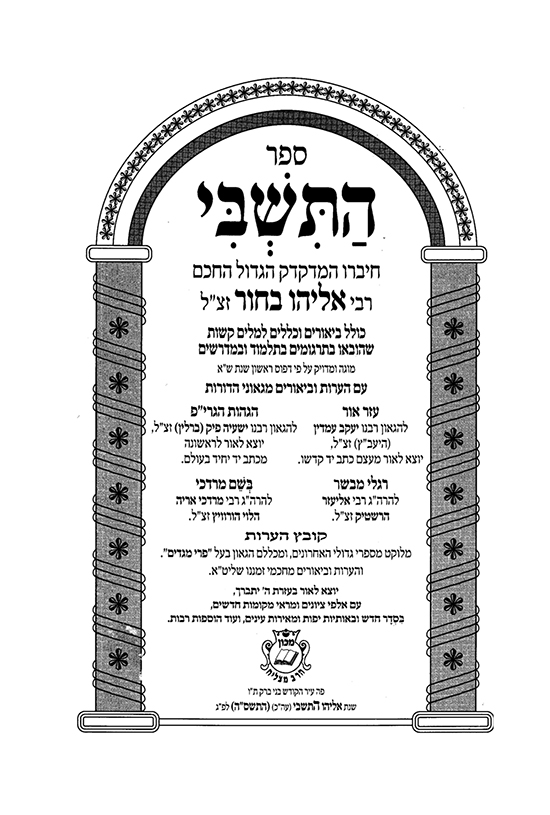
At the end of the volume, there is a collection of critical comments on the Tishbi by R. Solomon Zvi Schueck, and responses to R. Schueck by R. Aryeh Mazuz. Interestingly, there were two printings of the Kise Rahamim edition of the Tishbi. The one intended for sale in certain haredi neighborhoods did not include the comments of R. Schueck, as he is persona non grata among extremist haredim. Regarding the two editions, see Dan Rabinowitz’s earlier Seforim Blog post here.
For more on Levita, who even has a street named after him in Tel Aviv, see the Seforim Blog post by Dan Yardeni here. It is also worth noting that former British Prime Minister David Cameron is descended from Levita. See here.
I would be remiss in not mentioning that two grandsons of Levita also played a role in Jewish history. One was named Vittorio Eliano (which means “from the house of Elijah”), and the other was his brother Giovanni Battista. They were both apostates. Eliano became a priest as did Battista, who was actually a Jesuit.[18] Battista testified before the Inquisition in Venice and stated that “the Talmud teaches them [Jews] that it is legitimate to orally swear false oaths, even if they do not come from the heart, along with hundreds of thousands of other things which are injurious to Christianity.”[19]
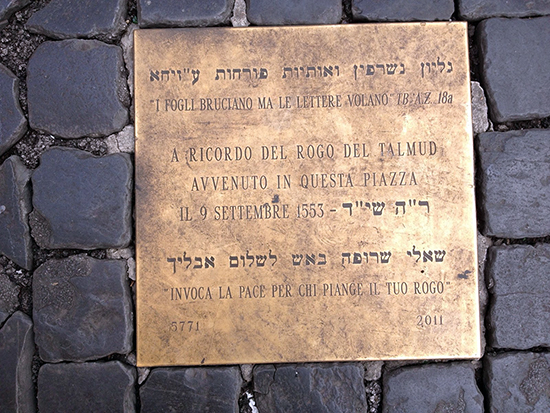
During the great sixteenth-century dispute in Venice between two Christian printers of Hebrew books – a dispute that also involved R. Meir Katzenellenbogen and R. Moses Isserles – both Christian sides denounced the other to Rome “for producing works which contained matter offensive to the Holy Catholic Faith.”[20] Eliano and Battista ended up giving testimony about supposedly blasphemous material in the Talmud, which in turn led to the Talmud being burned in Rome, in the Campo de Fiori, on September 9, 1553. Soon after that the Talmud was burned in Venice and in other places in Italy, and the work itself became an illegal text.[21]
In 2011 the following plaque was placed on the ground in the Campo de Fiori in commemoration of the burning of the Talmud.
Although the Talmud was illegal, the Zohar was not. It was none other than the apostate Eliano who had a central role in the second printing of the Zohar in Cremona in 1559-1560, as he was a proof reader.[22] (The first printing was in Mantua in 1558-1560.) This edition “was the preferred of the two editions by eastern European kabbalists.”[23] Contrary to what appears in many books, the Cremona Zohar was published by Jews (although the actual printing was done by a non-Jew, which was standard practice in Italy).[24]
Here is the title page of the Cremona Zohar. You can see at the bottom the statement that the publication was approved by the Inquisition.

Here is the last page of the Cremona Zohar. You can see that Eliano is mentioned as one of the two people who prepared the text for publication.


הבחור כמר ויטוריי אליאנו נכדו של ראש המדקדקים החר אליהו המדקדק סגל זצל
You can also see the actual Latin approval from the Inquisition.
Seeing how Eliano made sure that he was referred to as הבחור כמר, one who did not know better would assume that he was Jewish. Meir Benayahu chalks this up to one of the paradoxes of Jewish Italy:[25]
משומד שמשתבח במלאכת קודש זו ומזכיר שמו בנוסח רבני ועולה על כך שייקרא בתואר כמר” (בקולופון הזוהר), הוא מן הנפלאות שרק הפאראדוכסים המצויים אצל יהודי איטליה יכולים להסבירם.
Graetz,[26] followed by others, states that Eliano wrote the following Hebrew introduction to the Cremona Zohar.
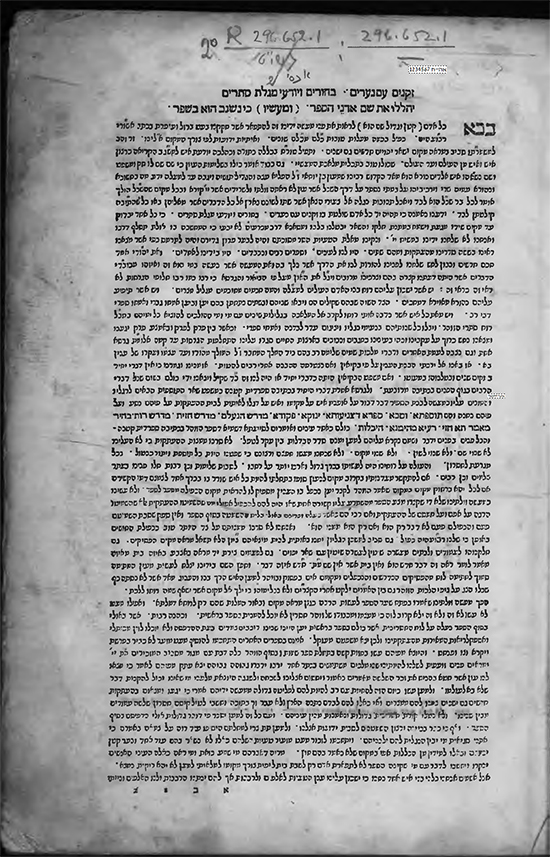
Graetz does not tell us how he knows that Eliano wrote the introduction, and I find it difficult to believe that this is the case. As we can see from the last page of the Cremona edition (printed above), a Jew was also involved with preparing the text for publication. So why not assume, with Isaiah Tishby,[27] that the Jew wrote the introduction, which is a typical pious introduction that one would expect for the Zohar?
In fact, there is evidence that Eliano did not write it. Avraham Yaari called attention to the fact that in the introduction it subtly tells us that there are printing errors because the book was also prepared for publication on Shabbat, a time when Jewish proofreaders would not be able to examine it.[28]
וחסרון חלוף או השמטת אות יוכל להמנות על היות דבר הדפוס נחוץ לכל שומרי שבת כהלכתה ודל.
The word נחוץ here means something along the lines of “harried”. (See I. Sam. 21:9, for the use of the word in the Bible, which has a different meaning than in modern Hebrew.) He is saying that the reason there are mistakes in the text is due to the problems confronted by shomer Shabbat proofreaders (who do not work on Shabbat). In other words, the mistakes in the text are due to the one who did work on Shabbat. Such a line, criticizing the proofreader who worked on Shabbat, could not have been written by the apostate Eliano. On the contrary, it must be seen as directed against Eliano. This is an important point which I have not seen anyone make. There is another point which no one has made, and that is that on the second line of the introduction the author left an allusion to Eliano:
ואותיות ידועות לפי צורך המקום אלינו
Another book Eliano was involved with was Hizkuni,[29] printed in Cremona in 1559.[30] Here is the last page of the book which states:
הוגה ברוב העיון עי הבחור ויטוריו אליאנו נכד ראש המדקדקים החר אליהו בחור אשכנזי סגל זצל

While on the topic of apostates and the Zohar, here is another interesting point. The Soncino Press of London published a translation of the Zohar. For some of this translation they had the assistance of Paul Levertoff. Here is the title page of one of the volumes.

What makes this so significant is that Levertoff, who began life as a Habad Hasid and later studied in Volozhin, was an apostate.[31] If you search on the internet you will find that Levertoff continues to have a real influence among Messianic Jews.
I find it astounding that the Soncino Press, which was identified with British Orthodoxy, chose to collaborate on the Zohar translation with an apostate, especially an apostate who was a “true believer,” not simply an opportunist like Daniel Chwolson. Supposedly, late in life Chwolson was asked what he came to believe that led him to adopt Christianity. He replied: “I believed that it was better to be a professor in St. Petersburg than a melamed in Anatevka [insert whatever shtetl name you wish].” He also famously said about himself, punning on the words from the Yom Kippur liturgy,[32] “Ve-Akhshav she-Notzarti [= converted to Christianity] ke-Ilu lo Notzarti.”[33]

________________
[1] See Excursus.
[2] See Ha-Pardes (January 1953), p. 52.
[3] Shlomo Kohen, Pe’er ha-Dor, vol. 1, p. 191. As far I as I know, the report in Asher Rand, Toldot Anshei Shem (New York, 1950), p. 62, that R. Rosen and the Hazon Ish established a yeshiva together, is without foundation.
[4] Orhot Rabbenu (2014 edition), vol. 5, p. 138. This source does not mention which volume of Nezer ha-Kodesh it was, but the volume on Zevahim was the only one printed in Vilna. Since R. Rosen was living in the United States, this explains why it would have been much more convenient for for the Hazon Ish to do the proofreading. According to Cohen, Pe’er ha-Dor, vol. 1, p. 270, some of the material in the book in brackets is from the Hazon Ish. Cohen also states regarding these comments:

רובן פותחות במיהו” ולפעמים צויין בראשיתיבות שור (שוב ראיתי). כששאלו אותואיך זה תואם את האמתהשיב החזוןאיש באירוניהלא שוב ראיתי“, כי אם שוב וראה“.
For מיהו see pp. 69, 82, 88. For שו”ר see pp. 84, 86.
[5] See Entzyklopedia shel ha-Tziyonut ha-Datit, vol. 5, cols. 597-598.
[5a] It could be that עיני is not to be read with full stress on the ע, but only a partial stress, with the real accent on the connected word כל (in the Aleppo Codex עיני is joined to כל with a makef). Yet there certainly is no accent on the נ of עיני. See R. Yedidyah Solomon Norzi, Ma’amar ha-Ma’arikh in Norzi, Ha-Nosafot le-Minhat Shai, ed. Zvi Betser (Jerusalem, 1997), pp. 97ff.
[6] Chanting the Hebrew Bible: The Art of Cantillation (Philadelphia, 2002), p. 105 n. 14, 107. See also ibid., p. 233 n. 2, and Mordechai Breuer, Ṭaʻamei ha-Miḳra be-Khaf-Alef Sefarim u-ve-Sifrei Alef-Mem-Taṿ (Jerusalem, 1982), p. 19.
[7] See the Jerusalem, 2005 edition, p. 534. 

ומשום הכי איתא פסיקכדי שלא נפרש דמשום הכי מיאן בשביל ויאמר וגו‘”, אבל הפסיק מלמד שהמיאון היה בפני עצמו.

This comment was not part of the original commentary but was added later by the Netziv. In this edition, the editors have inserted the comment in the text of Ha’amek Davar, but inside brackets that look like this {} to show that it is a later addition.

[8] Lekah Tov, ed. Buber, p. 198.

[9] Da’at Torah: Bereshit (Jerusalem, n.d.), p. 230.
[10] Shem mi-Shemuel (Jerusalem, 1992), parashat Va-Yeshev, p. 69.
[11] Torah Shelemah (Satmar, 1909), vol. 1, p. 179a.
[12] Birkat Eliyahu (Jerusalem, 2007), vol. 1, p. 260.
[13] The word נבח, which literally means “bark” (see Isaiah 56:10, Eruvin 86a), had an anti-Christian connotation in medieval Hebrew. See Eli Yassif, ed. Sefer ha-Zikhronot (Tel Aviv, 2001), p. 404 n. 87; Daniel Goldschmidt and Avraham Frankel, eds., Leket Piyutei Selihot me-et Paytanei Ashkenaz ve-Tzarfat (Jerusalem, 1993), vol. 1, p. 398. Thus, in Maoz Tzur the “blaspheming foe” refers to the Christians.
R. Shlomo Fisher, Derashot Beit Yishai (Jerusalem, 2004), p. 234 writes:
ויבואר עפ כל זהדברי הפייטן בזמר לחנוכהתכון בית לתפלתי ושם תודה נזבחלעת תכין מטבח מצר המנבחדהיינו טביחת היצהר
This would make a very nice derashah on Hanukkah, and had Hertz known of it, he could have offered this perspective in his commentary and kept the original version of the song. Yet in its historical context, this is hardly what the author is referring to. Similarly, R. Raymond Apple is not correct when he writes that the words refer to “the defeat of Gog and Magog who will attempt to overcome Israel before the coming of the Messiah.” See here. When Maoz Tzur speaks of the destruction of the “barking [i.e., blaspheming] foe,” it is referring to a real flesh and blood enemy of the Jewish people, which in the medieval Ashkenazic context means the Christian world. The word “barking” is used in this song as throughout pre-modern Jewish literature dogs were portrayed in a negative way. See also here.
[14] I do not know why ArtScroll capitalizes “Altar”.
R. Meir Mazuz recently commented that while Maoz Tzur is a wonderful song, “it contains small [grammatical] errors, as is the practice with the Ashkenazim who do not know Hebrew well.” Bayit Ne’eman, no. 139 (30 Kislev 5779), p. 1 n. 1. One example he gives is לעת תכין מטבח מצר המנבח. It should say לצר המנבח. He adds:
מאיפה אני לומד את זהמפסוק בישעיה הכינו לבניו מטבח בעוון אבותם” (יד כא), לא מבניו אלא לבניו.
Regarding Hanukkah, I recently found that R. Naphtali Zvi Judah Berlin suggests the possibility that when the Maccabees entered the Temple they did not light the menorah, as we are accustomed to think, but rather only lit one candle. See Ha’amek She’alah, Va-Yishlah, no. 24, p. 173:
ולכאורה הי‘ אפשר לומר שלא היו מדליקים אז במנורה כלל . . . ואכ הי‘ מקום לומר שלא השתמשו באותם שמונה ימים במנורה כלל משום שלא הי‘ להםוהדליקו באותו פך הטהוראו בכלי גללים וכלי אבנים וכלי אדמהואכ לא הי‘ אלא נר א‘ כדי לקיים להעלות נר תמיד

Also of interest is R. Joseph Messas, Otzar ha-Mikhtavim, vol. 2, no. 1305, who cites midrashic sources that there will not be a menorah in the future Temple.

 
I have vocalized the title of the Netziv’s book as Ha’amek She’alah, which is how scholars have been accustomed to write it, based on Isaiah 7:11 where these words appear.
However, Gil S. Perl argues that the correct pronunciation is Ha’amek She’elah. As he puts it, if the pronunciation in Isaiah was intended, “the title would mean ‘sink to the depths,’ the ‘depths’ (from the word she’ol) being a reference to the netherworld or Hell—a rather strange title for a work of halakhic commentary.” Perl therefore suggest that the Netziv “intended his title as a play on those words from Isaiah pronounced Ha’amek She’alah, meaning ‘delve into the question’ or perhaps ‘delve into the She’ilta.’” See Perl, The Pillar of Volozhin (Boston, 2012), pp. 17-18, n. 37.
[15] Regarding how Maoz Tzur appears in British siddurim, see John D. Rayner, “Liturgical Emendation: The Case of the Ma’oz Tzur,” available here.
[16] For more on the new RCA siddur and women, see the anonymous post here.
[17] The Tishbi was first printed in Isny, Germany in 1541. It is one of the first Jewish books to cite biblical passages by chapter. As most people know, the chapters are a Christian innovation. According to Abraham Berliner, the first Jewish scholar to publish a book using the chapter divisions was R. Isaac Nathan, who published a biblical concordance between 1437 and 1448. See Berliner, Ketavim Nivharim (Jerusalem, 1969), vol. 2, p. 134. On this page Berliner also writes:

החלוקה לפרקים של כל ספרי המקרא נתקבלה ונתפשטה רק עם הדפסת המהדורה השניה של המקראות הגדולות (ויניציא רפד).
Yet the first edition of the Mikraot Gedolot, published in Venice, 1518, is on Otzar ha-Hokhmah, and you can see that it too has the chapter divisions.
[18] See Heinrich Graetz, Geschichte der Juden (Leipzig, 1907), vol. 9, p. 320; Encyclopaedia Judaica, vol. 6, col. 615; Meir Benayahu, Ha-Defus ha-Ivri bi-Kremona (Jerusalem, 1971), pp. 95ff.. For sections of an autobiography written by Battista, in which he describes his apostasy, see Isaiah Sonne, Mi-Paʾulo ha-Reviʻi ad Piyus ha-Hamishi (Jerusalem, 1954), pp. 150-155.
[19] See Amnon Roz-Krakotzkin, The Censor, the Editor, and the Text: The Catholic Church and the Shaping of the Jewish Canon in the Sixteenth Century, trans. Jackie Feldman (Philadelphia, 1007), pp. 42-43.
[20] Cecil Roth, The History of the Jews of Italy (Philadelphia, 1946), p. 291.
[21] See Roth, The History of the Jews of Italy, p. 292. For detailed discussion of this matter, which shows all the other factors that were present, see Kenneth Stow, “The Burning of the Talmud in 1553, in the Light of Sixteenth Century Catholic Attitudes Toward the Talmud,” Bibliothèque d’Humanisme et Renaissance 34 (1972), pp. 435-459.
[22] Regarding Allessandro Franceschi, another sixteenth-century Italian apostate who supported the printing of the Zohar, see Yaakob Dweck, The Scandal of Kabbalah (Princeton, 2011), pp. 166-167.
[23]  Marvin J. Heller, The Sixteenth Century Hebrew Book (Leiden and Boston, 2004), vol. 1, p. 503.
[24] See Yitzhak Yudelov, “Al Sefarim, Madpisim, u-Mo”lim,” in Yosef Eliyahu Movshovitz, ed., Ha-Sefer (Jerusalem, 2008), vol. 2, p. 557 n. 22.
[25] Ha-Defus bi-Kremona, p. 97.
[26] Geschichte, vol. 9, p. 345.
[27] “Ha-Pulmus al Sefer ha-Zohar,” Perakim 1 (1967-1968), p. 147 n. 54.
[28] Mehkerei Sefer (Jerusalem, 1958), pp. 170-171. Yaari also mentions other Hebrew books that were printed on Shabbat.
[29] Regarding how חזקוני is to be pronounced, see my post here.
[30] For other examples of Hebrew books whose printing Eliano was involved with, see the index of both Roz-Krakotzkin, The Censor, the Editor, and the Text and Benayahu, Ha-Defus ha-Ivri bi-Kremona.
[31] See Elliot R. Wolfson, “Paul Philip Levertoff and the Popularization of Kabbalah as a Missionizing Tactic,” Kabbalah 27 (2012), pp. 269-320. On p. 272, Wolfson states that Levertoff received semikhah from R. Naphtali Zvi Judah Berlin. He provides no evidence for this assertion so I cannot judge its accuracy. As far as I have been able to determine, Levertoff never received semikhah.
[32] The passage originates in the Talmud, Berakhot 17a, where it is attributed to Rava, and Yoma 87b, where it is attributed to R. Hamnuna.
[33] See Zvi Hirsch Masliansky, Memoirs, trans. Isaac Schwartz and Zviah Nardi (Jerusalem, 2009), p. 138.


Parshat Tetzaveh. Greek letter Chi and Tav in Paleo-Hebrew

Parshat
Tetzaveh. Greek letter Chi and Tav in Paleo-Hebrew
By Chaim
Sunitsky
Rashi[1] on Parshat
Tetzave
writes that the priests were anointed with oil, poured in the shape
of the Greek letter כי.[2] One would assume this is referring to
letter Χ[3] – 22nd
letter of the Greek alphabet which sounds somewhere between English K and H[4]. This
letter spelled χῖ in Greek, is usually spelled “Chi” in English and indeed if one wanted to write it
in Hebrew, he would probably transcribe it as כי
(where Chaf is intended without dagesh). Moreover[5], when
Hebrew names are transliterated into Greek, Chi is used for Hebrew Chaf. In
addition, if the Talmud meant this letter it becomes clear why it didn’t use an
example of any Hebrew letter, as this shape is not found in Ashuri script of
Hebrew.
Despite all this
evidence we find various other shapes offered by the Rishonim[6]. In
fact in our printed editions of the Gemora only in Rashi on Kritot (5b) the printed
illustration looks like an “X.” Some of Rambam’s editions (Kelei Hamikdash 1:9)
also printed this shape, but the Frankel edition of Rambam[7]
claims that neither Rashi nor Rambam had this shape in mind and it was changed
later by some publishers[8]. Still,
one is inclined to think that the correct explanation is that it is the letter
X, and most Rishonim simply didn’t know Greek or have access to find out, and the correct tradition regarding
the shape of “Greek Chi” was forgotten, despite the fact that it pertains to
many halachot[9].
Before we go on, I’d
like to make another interesting point: Greek X has the same shape as the last
letter Tav in Paleo-Hebrew. Let us first examine the relationship of Greek
letters to Phoenician[10] and Paleo-Hebrew[11]. R.
Shaul Lieberman[12]
brings a very interesting idea with regards to the letter Tav in Paleo-Hebrew. We
find in Yehezkel (9:4) that Tav was marked on the foreheads of people to
distinguish the righteous from the wicked who were sentenced to death. According
to Hazal (Shabbat 55a) the mark was the actual letter Tav. As we mentioned this
letter in Paleo-Hebrew looked like the Greek Chi (X)[13] and
indeed became symbolic for a number of reasons[14]. R.
Lieberman brings that the X shape was used for crossing out a debt and was
therefore represented an annulment of a bad decree. On the other hand, Tav was pronounced
similarly to Greek Theta, whose shape was also associated with a death sentence[15]. We
thus have a double association of Tav (X) with Theta and with Chi. (Note in
general that while most letters in Greek alphabet clearly come from respective[16]  letters in Phoenician[17],
there are a few Greek letters, where it’s not certain which Phoenician letter
they correspond to and the Greek X is one of them[18].)
R. Lieberman further proposes
that originally the symbol of X written in blood was taken to mean forgiveness (crossing
out the decree) while X in ink was symbolic of death sentence (verdict written
in ink). However, since X has a shape similar to a cross, the early Christians started
to utilize cross in blood as symbolic of atonement, and therefore our sages
reversed that symbolism[19].
Coming back to the
shape of “Greek Chi,” it seems logical that the Hazal’s tradition is based on
an earlier tradition that the shape was that of letter Tav in Paleo-Hebrew[20] –
the last letter of the alphabet. It’s also possible that there was some
connection between the “sign” on the forehead in Yehezkel and the anointing of
a High Priest. Though the correct shape of this letter became subject to
multiple disputes over time, we may now be able to restore its ancient
symbolism[21].
[1] On verse 29:7
based on the Talmud (Kritot 5b, Horayot 12a). He also brings the same shape in
verse 29:2 in regards to the way oil was poured on the meal offerings.
[2] In some places
instead of Chi Yevanit there are versions that say Chaf Yevanit, but the
preferred girsa is Chi. While it is possible if the original version had Chi,
some copyists changed it to familiar Chaf, but if the original was Chaf, why would
someone change it to Chi? It is also possible that the Hazal themselves
sometimes used an expression Chaf Yevanit and sometimes Chi Yevanit.
[3] See additions
to Aruch by R. Benjamin Mussafia (Erech כי יונית) and Tiferet Yisrael on Menachot 6:3 and
after the last Mishna in the 10th perek of Zevachim.
[4] The Russian
letter Х (kha) also comes from it, and it is usually transliterated as kh into
English (e.g. Mikhail Gorbachev).
[5] We will discuss
this in the 17th footnote below. Similarly for those Greek words that
made it into rabbinical Hebrew, כ is generally used for χ (e.g. אוכלוסא –
populace – όχλος). However there are some exclusions, as קנקנתוס (or קנקנתום) has the first letter χ in Greek but for
some reason is not spelled with כ but with ק.  
[6] See Rabeinu
Gershom on Kritot 5b and Menachot 74b, Rashi (ktav yad) on Menachot 74b and Kritot
5b, Tosafot Menachot 75a, Rashi on Shemot 29:2, Rambam, Perush Hamishna
Menachot 6:3, Rash and Rosh on Mishna Kelim 20:7, Meiri, Horayot 12a.
[7] In the end of
Frankel’s edition they have a section where variant girsaot are brought.
[8] At least one of
the “corrections” is based on “Mesoret Hashas” in Horayot 12a, but Frankel’s
Rambam points out that Rashi’s explanation on the Gemora actually contradicts
this shape. Indeed Rashi writes different explanations in various places and the
shapes in our editions include that of Hebrew Chet (Horayot) and Tet (Menachot)
and Nun (Torah commentary to Shemot, but Tosafot quote him as mentioning the
shape of a Gimel there, see also the super-commentaries on Rashi, Shemot 29:2
and the English Artscroll where all the variant shapes of Rashi are explained).
Tosafot (ibid) also mentions Kaf and that is the shape in some editions of
Rambam. They also seem to understand Aruch to mean a shape like ^ (similar to a
Greek Lambda). These shapes are reasonably similar, they all contain a type of
semicircle (כ,ט,נ) with
possibly a sharp angle (^) or two angles (ח), see Tzeda Laderech super commentary on
Rashi ibid. None of these shapes look even remotely similar to X. (Note also
that Lekach Tov on Shemot 29 apparently has a shape of Kappa, but I didn’t find
anyone who agrees with this).
[9] See for
instance Menachot 74b-75a regarding pouring oil on certain types
meal-offerings; also this crisscross shape seems to be mentioned in Kelim 20:7,
see TIferet Yisrael there. We find another shape based on the Greek Gamma used in
various halachot (e.g. Kelim 28:7, Pesachim 8b, Baba Batra 62a, Zevachim 53b
and many other places) which was preserved quite well (see commentators to
these sugias).
[10] This is ancient
Canaanite script very close to Paleo-Hebrew. Note that Ramban (Bereshit 45:12)
and Ibn Ezra (Yeshayahu 19:18, see also his perush hakatzar to Shemot
21:2) knew that Canaanites spoke the Hebrew language, (though Hazal also thought
that Hebrew was a somehow unique Holy Tongue used only by Avraham and his
descendants, see for instance Sotah 36b).
[11] This ancient
Canaanite Hebrew script is called Ktav Ivri, see Sanhedrin 21b. In times
of Rishonim the shape of Ktav Ivri letters was not too well known
(see Haara Nosefet printed in the end of Ramban’s Torah commentary, how when he was shown an ancient coin with Ktav Ivri he had to ask a Samaritan to read it for
him). Still these letters apparently did retain some influence in certain
communities. Some Yemenite Jews actually make Shin-Dalet-Yod with Tefillin
straps on their hands in Ktav Ivri, not like the prevalent custom to make a
Shin and Dalet in Ashuri script. R. Reuven Margolios proposed that our
“four-headed” Shin on the left side of Tefillin Shel Rosh is actually based on
the Shin in Ktav Ivri (which looks similar to English “W”).
[12] “Greek in
Jewish Palestine”, pages 185-191.
[13] And
interestingly both are the 22nd letters of their respective
alphabets. 
[14] Besides being
the last letter of the alphabet this letter is taken by Hazal to stand for life
or death (Shabbat 55a), but the primary reason for its symbolism according to
R. Lieberman is its shape.
[15] This tradition
was also preserved in R. Bahye to Yitro (20:14) who discusses why there is no
letter Tet in the 10 commandments and associates Tet and Theta with death: כי לשון טיט”א סימן הריגה, see also comments of R. Chavel ad loc. in the name of Emuna
Vibitachon.
[16] On an unrelated
topic I’d like to mention that R. Reuven Margolios (HaMikra Vehamesora, 22)
wanted to prove, based on the shape of Paleo-Hebrew letters, that the so called
Arabic numbers (that are assumed to have come from India) were actually
invented by Jews. I find this theory far-fetched. If one looks at the
Paleo-Hebrew alphabet only Bet, Dalet and Het seem to look like 2, 4 and 8 and
moreover the shape of the “Arabic numerals” changed drastically over time and
in the times “the Jews” could have possibly invented them, they didn’t look
similar to the way we write them today. As for his other proofs that sometimes
we find gematrias of numbers used together with the position of the
digits as for example in Midrash (see Theodor Albeck edition of Bereshit
Rabbah
, 96) about the number of animals Yakov had: קבזר : מאה ותרתין רבוון ושבעה אלפין ומאתיין (1027200) that uses קב
(102) then ז (7) and thenר  (200), at most this shows
that for very large numbers they already started using some letters to indicate
thousands and ten-thousands (רבבות) separately. Similarly we write for year 5776: תשעו ’ה, but this is a far
stretch from system developed in India where the value of each digit depends on
its position. Indeed the Rishonim that R. Margolius himself mentions all
attribute this to Indian system. (As a side point, just to illustrate the advantage
of current mathematics symbols, look at the Rif on Pesachim, 23b, where he
calculates the reviit in terms of cubic fingers. In current notation, his
calculations taking half a page, would take one line: 3*243/(40*6*4*4)=10.8=2*2*2.7.)
 
[17] Many of them
look like Phoenician letters, except they are inverted vertically, since in
Greek the writing is from left to right.
[18] Certainly this
letter can’t come from Tav since it is pronounced completely differently. Note
that the issue of correspondence between Greek and Phoenician letters is not
related to the issue of how various Hebrew letters were transliterated in the
Septuagint and other Greek translations of Hebrew writings. By the time these
translations were made, the pronunciation of many letters changed both in
Hebrew and in Greek. For example, Theta is usually used to transliterate Tav,
and Tau to transliterate Tet, while their origins are the opposite: Tau came
from Tav, and Theta from Tet, as their names and shapes indicate. Perhaps by
the time of Septuagint the Tav without dagesh was pronounced in some areas closer
to English “th” and so was Theta, and that’s why the translators chose to use
Theta for Tav. Similarly, Mitchell First in an article “The Meaning of the Name
‘Maccabee,’ ” (available on this blog here), writes that Kuf is usually
transliterated as Kappa and Kaf-Chaf as Chi, even though originally the Greek
letter Kappa came from Kaf-Chaf. The reason for this might be similar, at the
time of these translations, the pronunciation of Chaf and Chi was similar,
while Kuf sounded like Kappa. (Other examples of this include Samech that is transliterated
as Sigma, not as Xi which originally came from it, but sounded at the times of
Septuagint like English X=KS, not S; similarly in Greek words used by Hazal,
Sigma is transliterated not as Sin from which it came but as a Samech, possibly
because at that time Sin and Samech were pronounced the same but since Sin is
written as Shin, Samech was chosen to make it clear the sound is S, not Sh.)
[19] See the
above-mentioned sugia in Shabbat 55a. We find occasionally that the sages had to
change the explanation “keneged haminim,” see for example Sanhedrin 31b, see
also Berachot 59a, 12a.
[20] It’s not
surprising that they used a Greek letter rather than not well known Paleo-Hebrew.
Moreover they sometimes used Greek letters instead of Ashuri, see Shekalim 3:2.
[21] It might be
possible to suggest that in medieval times this shape was purposefully
misrepresented, especially when dealing with the way anointing is performed.
The associations regarding Messiah, “the anointed one,” with anointing an X on
the High Priest’s head would certainly make many Jews living in Christian lands
recoil. Later on, this may have influenced the Jews living in Muslim lands.
Interestingly the Frankel edition of Rambam and R. Kapach (in his edition of Rambam’s
Mishna commentary) bring that in the manuscript attributed to Rambam’s own
writing (Kritot), the picture of Chi was blotted out.


Kaddish – His Will

Kaddish – His Will
Leor Jacobi

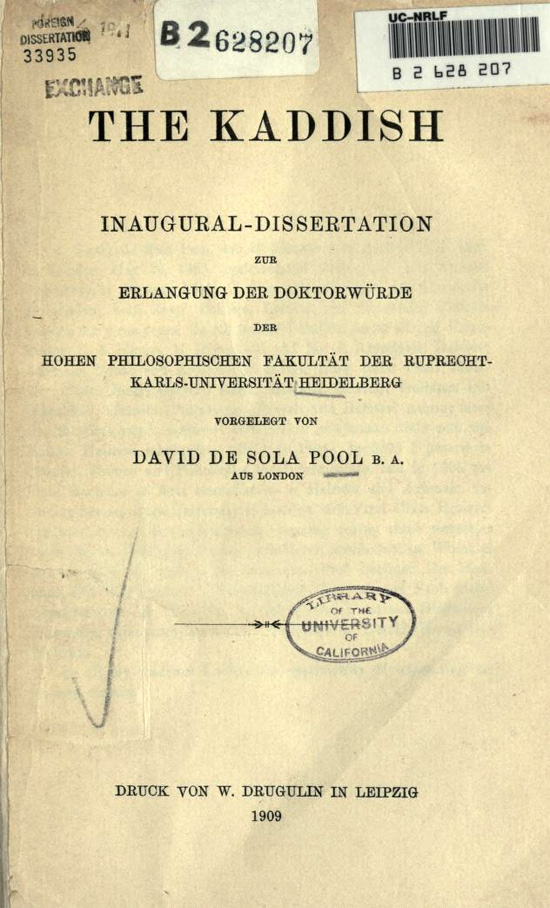
Note: I wrote the following essay outline several years ago, but shelved it upon discovering that most of its novelty and much more had already been published by David de Sola Pool over a hundred years ago.[1] On the sad occasion of the recent passing of my beloved mother I offer it now in her memory. Prayer and divinity were close to her heart. May our prayers be deepened by their study.

The Kaddish is one of the most familiar and repeated prayers in the liturgy. In various forms, it concludes both the main body of the prayer and smaller sections. It is also recited by mourners and upon the conclusion of learning a tractate or a sermon.
Despite, or perhaps due to its familiarity, few are aware of an alternate interpretation and syntax at the beginning of the Kaddish, accompanied by altering the pronunciation of one word slightly, but significantly. This study will describe and analyze these two interpretations and propose a third.
1. The “Standard” interpretation. R. Yehudah ben Yakar (Ramban’s teacher), Rokeah, and Avudraham all followed the standard interpretation. See R. Shmuel Eliezer Stern’s concise compilation of their perspectives.
2. The GRA’s interpretation
3. Alternate interpretation

1. The Standard Interpretation

…יִתְגַּדַּל וְיִתְקַדַּשׁ שְׁמֵהּ רַבָּא בְּעָלְמָא דִּי בְרָא כִרְעוּתֵהּ, וְיַמְלִיךְ מַלְכוּתֵהּ

May his great name be exalted and sanctified in the world which he created according to his will. And may his kingship reign …

The deity is not referred to directly, but his great name is to be exalted and sanctified in the very world which he himself created, according to his own will and volition. The fact that the world was created according to the will of the deity seems rather obvious, pshita. However, in the liturgy of the evening prayers, we find the divine will associated with the maintenance of the celestial bodies:


ברוך אתה … אשר בדברו מעריב ערבים בחכמה פותח שערים ובתבונה משנה עתים ומחליף את הזמנים ומסדר את הכוכבים במשמרותיהם ברקיע כרצונו

This may be referred to in the Kaddish. Perhaps the divine will is mentioned in the Kaddish to emphasize that the details of the physical world were planned by the creator, not happenstance, hence it is fitting to exalt and praise his great name.
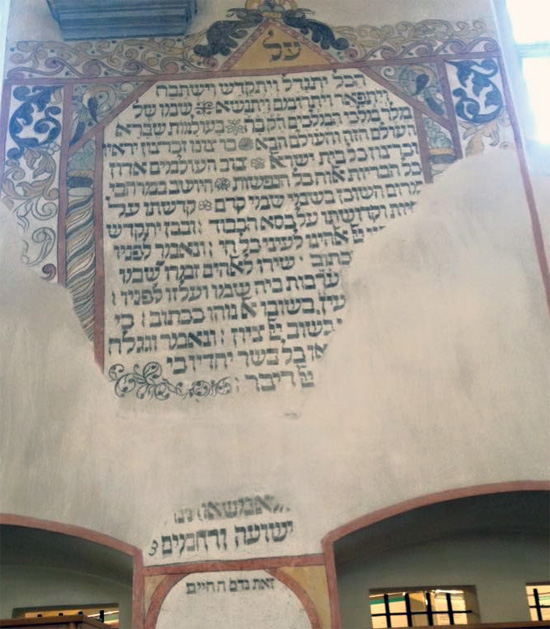
A more serious difficulty with this standard interpretation is found in the prayer על הכל based on the Kaddish which is recited upon removing the Sefer Torah from the Aron Ha-Kodesh. In modern prayerbooks it is found among the Sabbath prayers. In surviving synagogues of Tikocyn (טיקטין) and Krakow and in in other Polish synagogues the text was painted on the wall along with other “extra” prayers and sayings.[2] This prayer clearly parallels the Kaddish, but does not follow the standard interpretation, as will be explained in the next section. R. Yehudah ben Yakar (Ramban’s teacher), Rokeah, and Avudraham all followed the standard interpretation. See R. Shmuel Eliezer Stern’s concise compilation of their perspectives.

2. The GRA’s Interpretation
…יִתְגַּדַּל וְיִתְקַדַּשׁ שְׁמֵהּ רַבָּא בְּעָלְמָא דִּי בְרָא, כִּרְעוּתֵהּ, וְיַמְלִיךְ מַלְכוּתֵהּ

May his great name be exalted and sanctified, according to his will, in the world which he created. And may his kingship become regnant…

Notice the additional comma and the concomitant hard vocalization of the כּ with a dagesh in the following word: כִּרְעוּתֵהּ. Here the phrase “according to his will” refers back to the first clause of the preceding phrase, the exaltation and sanctification. It does not refer to the immediately preceding clause as per the standard interpretation.
The minor conceptual difficulty of the standard interpretation is now transformed into a deep and compelling concept. The purpose of the creation of the world was so that the creator’s name be exalted and sanctified within it.
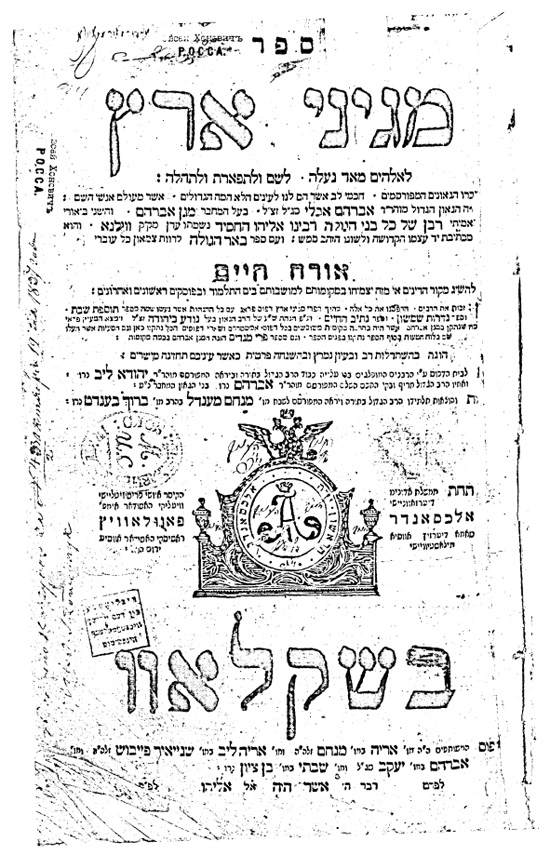
This interpretation can be attributed to the Gaon, R. Elijah of Vilna, GRA in Ma’ase Rav 54, where it is noted that he was particular about the pronunciation of the hard כּ. GRA’s Diyyuqim b’nusḥey ha-tefilah v’ha-berakhot were first printed in the first edition of Shulhan Arukh with Biyur ha-GRA, Shklov 1803, and appear at the bottom of the first page of Priy Chodosh in later editions.

There, the concept it is explained more fully, with a proof is presented in the aforementioned על הכל prayer recited upon removing the Torah from the Ark:
עַל הַכּל יִתְגַּדַּל וְיִתְקַדַּשׁ וְיִשְׁתַּבַּח וְיִתְפָּאַר וְיִתְרומַם וְיִתְנַשּא שְׁמו שֶׁל מֶלֶךְ מַלְכֵי הַמְּלָכִים הַקָּדושׁ בָּרוּךְ הוּא. בָּעולָמות שֶׁבָּרָא הָעולָם הַזֶּה וְהָעולָם הַבָּא. כִּרְצונו וְכִרְצון יְרֵאָיו וְכִרְצון כָּל בֵּית יִשרָאֵל. צוּר הָעולָמִים אֲדון כָּל הַבְּרִיּות אֱלוהַּ כָּל הַנְּפָשׁות. הַיּושֵׁב בְּמֶרְחֲבֵי מָרום הַשּׁוכֵן בִּשְׁמֵי שְׁמֵי קֶדֶם. קְדֻשָּׁתו עַל הַחַיּות וּקְדֻשָּׁתו עַל כִּסֵּא הַכָּבוד
Note that this Hebrew prayer generally follows the structure of the Kaddish. However, the phrase “According to his will” is accompanied by “the will of those who fear him” and “the will of all of the house of Israel.” This cannot refer to the creation of the world, for mortals were not party to that event. Perhaps it refers to the post-facto consent of men. If so, it would differ conceptually with כרצונו, the will of the creator at the time of the creation. Also, stressing this point runs counter to the thrust of the prayer, exalting and praising the creator.

Wall of Tykocin synagogue, Poland, Leor Jacobi
This source suggests that an ancient tradition does not follow the standard interpretation. Furthermore, we find an association of the words כרצונו and יתגדל in Daniel 11:36, applied to an earthly king:

…וְעָשָׂה כִרְצוֹנוֹ הַמֶּלֶךְ וְיִתְרוֹמֵם וְיִתְגַּדֵּל עַל כָּל אֵל וְעַל אֵל אֵלִים יְדַבֵּר נִפְלָאוֹת

Some medieval prayer books do contain a hard כּ in כרעותיה. In the National Library of Israel there are examples from Provence, Italy, and Ashkenaz on microfilm. I refer to this interpretation as the GRA’s, although it probably preceded him by hundreds of years, because he related to the issue and is understood to have favored this interpretation. It should be noted that many early siddurim were not precise in following grammatical rules so the mere presence or absence of a dagesh should not in and of itself be taken as an indicator of syntax or interpretation.
GRA’s interpretation, while not well known, was endorsed somewhat in Arukh haShulhan 56 (where much of the previous discussion is found). GRA-oriented prayerbooks also reflect this interpretation via the punctuation, such as Siddur Vilna and Ezor Eliahu. However, Siddur Tefilat Yosef features the hard כִּ but without a comma before it, possibly a compromise approach: have it both ways or either way.
I now raise a couple of difficulties. The most striking aspect of this approach is its awkward word order. A much more straightforward formulation of GRA’s interpretation would be:

…יִתְגַּדַּל וְיִתְקַדַּשׁ שְׁמֵהּ רַבָּא. כִרְעוּתֵהּ, בְּעָלְמָא דִּי בְרָא, וְיַמְלִיךְ מַלְכוּתֵהּ

Perhaps the word כִּרְעוּתֵהּ was a later addition, hence not deemed proper to insert in the middle of the first phrase. In any case, GRA’s interpretation does not fit the text as well as the standard interpretation, where no re-ordering is required.
A minor difficulty with the GRA’s interpretation emerges upon comparison with the “Great Kaddish” recited upon the completion of a Tractate or Seder. The word כִּרְעוּתֵהּ does not appear in that text at all. This is explainable, and perhaps even necessary, according to the first interpretation, because the Great Kaddish does not refer to the creation of the world at all, but rather to the future redemption:
יִתְגַּדַּל וְיִתְקַדַּשׁ שְׁמֵהּ רַבָּא בְּעָלְמָא דִּי הוּא עָתִיד לְאִתְחַדְתָּא, וּלְאַחֲיָאה מֵתַיָּא, וּלְאַסָּקָא יַתְּהוֹן לְחַיֵּי עָלְמָא, וּלְמִבְנָא קַרְתָּא דִּי יְרוּשְלֵם, וּלְשַׁכְלְלָא הֵיכָלֵהּ בְּגַוָּהּ, וּלְמֶעֱקַר פּוּלְחָנָא נוּכְרָאָה מִן אַרְעָא, וּלְאָתָבָא פּוּלְחָנָא דִּי שְׁמַיָּא לְאַתְרָהּ, וְיַמְלִיך קוּדְשָׁא בְּרִיךְ הוּא בּמַלְכוּתֵה וִיקָרֵהּ בְּחַיֵּיכוֹן וּבְיוֹמֵיכוֹן וּבְחַיֵּי דְכָל בֵּית יִשְׂרָאֵל
However, if כִּרְעוּתֵהּ refers back to יִתְגַּדַּל וְיִתְקַדַּשׁ, as per GRA’s interpretation, the absence of the word in the Great Kaddish version is puzzling, or at least conspicuous. This suggests that כִּרְעוּתֵהּ refers back to בְּעָלְמָא דִּי בְרָא and hence, disappears in the Great Kaddish along with it.
To summarize so far, we have seen two competing interpretations of the same (orthographic) text of the Kaddish. Some evidence contradicts each of the two, with no clear tilt of the scales in favor of either. It seems to me more likely that the GRA’s interpretation would develop into the standard one in order to “correct the syntax” than the reverse direction. Lectio dificilior potior. This situation suggests exploring other alternatives.[3]

3. An Alternate Interpretation

…יִתְגַּדַּל וְיִתְקַדַּשׁ שְׁמֵהּ רַבָּא בְּעָלְמָא דִּי בְרָא, כִּרְעוּתֵהּ יַמְלִיךְ מַלְכוּתֵהּ

May his great name be exalted and sanctified in the world which he created. May his kingship become regnant according to his will …

Rather than throwing the word כִּרְעוּתֵהּ back to one clause or another of the previous phrase, in this interpretation the word applies to the text that follows, a prayer for the establishment of the divine kingdom.
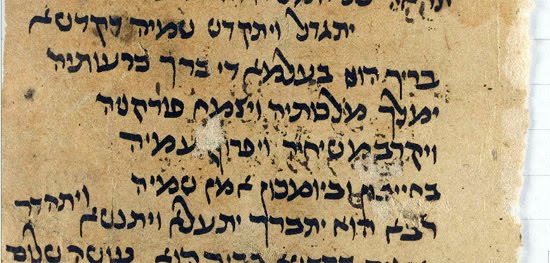
This interpretation is aided by the omission of the ו in the word ימלך following the word כרעותיה. The emendation is minor, and we do find an early textual example from a manuscript in the Cairo Geniza, JTS ENA 1983.2:

The absence of the ו assists this interpretation but it does not in and of itself negate the others. However, the interpretation is also suggested by another rabbinic source. The על הכל prayer discussed previously appears to be a later adaptation, an earlier version of which appears in Masekhet Sofrim 14:6:

ועוד צריך לומר, על הכל יתגדל ויתקדש וישתבח ויתפאר ויתרומם ויתנשא ויתהדר ויתעלה ויתהלל ויתקלס שמו של מלך מלכי המלכים הקדוש ברוך הוא הנכבד והנורא בעולמות שברא בעולם הזה ובעולם הבא. כרצונו וכרצון יראיו וכרצון כל עמו בית ישראל תגלה ותראה מלכותו עלינו במהרה ובזמן קרוב, והוא יבנה ביתו בימינו ויחון פליטתינו ופליטת כל עמו בית ישראל בהמון רחמיו וברוב חסדיו לחן ולחסד ולרחמים לחיים ולשלום והוא ירחם עלינו ועל כל עמו בית ישראל בעבור שמו הגדול ואמרו אמן

I added some punctuation above and would translate part of the prayer literally as follows:

… in the worlds that he has created, this world and the next one. According to his will, the will of those in awe of him, and the will of his entire people, the house of Israel, his kingship shall be revealed and appear to us speedily and soon. He shall rebuild …

One may argue that, here too, the phrase: “According to his will…” refers back to the previous clause. In the adapted form that appears in prayer books, the phrase must be understood as referring back to the previous phrase, since the following phrase simply doesn’t appear. However, in this expanded and seemingly earlier form in Masekhet Sofrim, we would expect a connecting ו to follow the phrase, even more so than in the Kaddish itself, yet we do not find one. When על הכל was adapted from this prayer, the syntax was adjusted or corrupted.
The difficulty noted above in reconciling the GRA’s interpretation with the Great Kaddish is relieved via this approach, if not eliminated. The absent word כרעותיה is explained if the substantial additions in the Great Kaddish are an expansion[4] of כרעותיה.
May his great name be sanctified and exalted by the reign of his kingdom in the world he created, according to his will.
[1] David de Sola Pool, The Kaddish, Leipzig 1909, pp. 28, 33-35, 111-112. Among issues not covered here, see especially parallels in various verses and to the Christian Lord’s Prayer (Paternoster).
[2] In the “Isaac Shul” of Krakow על הכל was written in three different locations which have been restored and are all visible today. It may have moved from location to location at different periods and different layers were restored. Alternatively, it may have been painted in different locations for the convenience of the worshippers, so that they would not have to strain or move to another location during the procession after removing the Torah scroll from the Ark.
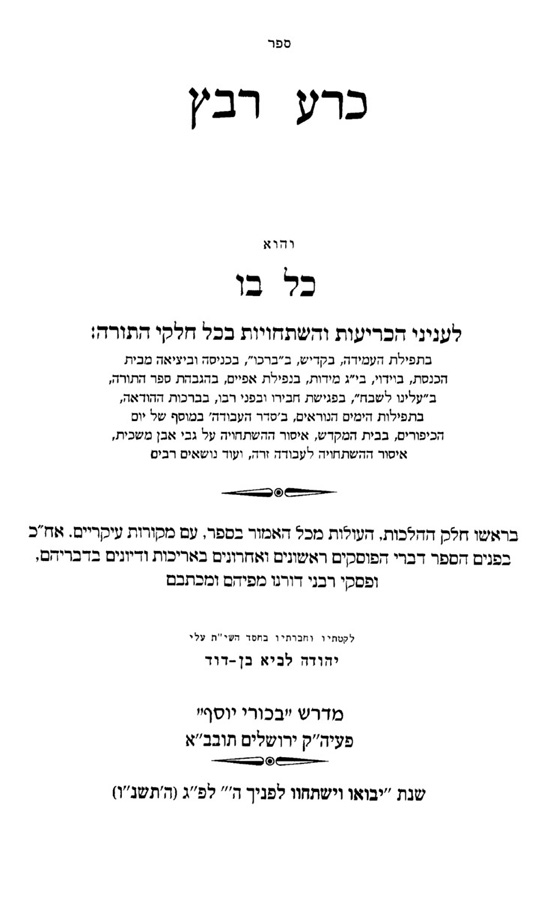
[3] My first attempt was to propose that the word כִּרְעוּתֵהּ is itself an erroneous later scribal addition. An ancient tradition maintains that one should bow during the Kaddish at several places. Sefer Kra’ Ravaṣ, by Rabbi Yehuda Lavi Ben-David is an excellent modern halakhic compendium of the various laws of bowing, accompanied with much original analysis.

The book lists no fewer than seventeen different opinions as to where exactly to do the bowing. Some medieval prayer books have a Hebrew instruction to bow written in the margin: כרע. These might have been misinterpreted as Aramaic and incorporated into the text of the Kaddish itself. However, since I have not located any significant textual evidence to support this theory, I mention it here solely for the reader’s edification and entertainment.
[4] If the third alternative is a genuine interpretation of the text of the Kaddish, and an early one, it could hypothetically have developed into the other interpretations.

First, the standard interpretation developed. The word כרעותיה was understood as referring back to the immediately preceding creation of the world and in tandem a ו was introduced verbally in וימלך. Alternatively, the Great Kaddish may have been composed or edited in accordance with the first, standard interpretation. This development may have been the result of a growing influence of the written texts, without vocalization and punctuation, as opposed to earlier oral forms which would have preserved the original interpretation.

Next, this new interpretation collided with the original, possibly in written form, with the ו in וימלך being introduced where the original interpretation was preserved orally along with the hard כּ of כרעותיה. This friction would have been resolved by artificially throwing back כרעותיה to the beginning of the first phrase, giving birth to the GRA’s interpretation.

Or כרעותיה originally went in both directions, following both GRA and the alternate interpretation, as De Sola Pool proposed (see note above).


The Meaning of the Word Hitpallel (התפלל)

The
Meaning of the Word Hitpallel (
התפלל)
By
Mitchell First[1]

It is clear from the many places that it
appears in Tanakh that התפלל connotes praying. But what was the
original meaning of this word? I was always taught that it meant something like
“judge yourself.” Indeed, the standard ArtScroll Siddur (Siddur Kol Yaakov) includes the following in its introductory
pages: “The Hebrew verb for praying is מתפלל;
it is a reflexive word, meaning that the subject acts upon himself. Prayer is a
process of self-evaluation, self-judgment…”[2]
More recently, when I searched Jewish
sites on the internet for the definition that was offered for hitpallel and mitpallel, I invariably
came up with a definition similar to the above. Long ago, Rabbi S. R. Hirsch
(d. 1888) and R. Aryeh Leib Gordon (d. 1912) also gave definitions that focused
on prayer as primarily an action of the self.[3]
In this post, I would like to share a different
interpretation offered by some modern scholars, one based on a simple insight
into Hebrew grammar. This new and compelling interpretation has unfortunately
not yet made its way into mainstream Orthodox writings and thought. Nor has it
been given proper attention in academic circles. For example, it did not make
its way into the widely consulted lexicon of Ludwig Koehler and Walter
Baumgartner.[4] By sharing this new interpretation of התפלל,
we can ensure that at least the next generation will  understand the origin of this critical word.
                                                            
——
There
are two issues involved in parsing this word: 1) what is the meaning of the
root פלל? and 2) what is the import of the hitpael stem, one that typically implies
doing something to yourself?
With
regard to the root פלל, its meaning is
admittedly difficult to understand. Scholars have pointed out that the other
Semitic languages shed little light on its meaning.[5]
If
we look in Tanakh, the verb פלל is found 4 times:[6]
1)      It
seems to have a meaning like “think” or “assess” at Genesis 48:11: re’oh fanekha lo filalti…(=I did not
think/assess that I would see your face).[7]
2)      It
seems to have a meaning like “intervene” at Psalms 106:30: va-ya’amod Pinḥas va-yefalel, va-teatzar ha-magefah (=Pinchas
stood up and intervened and the plague was stopped).[8]
3)      It
seems to have a meaning like “judge” at I Sam. 2:25: im yeḥeta ish le-ish u-filelo elokim…(If a man sins against another
man, God will judge him…).[9]
4)      It
also appears at Ezekiel 16:52:  את שאי כלמתך אשר פללת לאחותך גם (= You also should bear your own shame that you pilalt to your sisters). The sense here is difficult, but it is
usually translated as implying some form of judging.                                                                                     
    
What
I would like to focus on in this post, however, is the import of the hitpael stem in the word התפלל. 
Most students of Hebrew grammar are taught early on that the hitpael functions as a “reflexive” stem,
i.e., that the actor is doing some action on himself. But the truth is more
complicated.
One
source I saw counted 984 instances of the hitpael
in Tanakh.[10] It is true that a
large percentage of the time, perhaps even a majority of the time, the hitpael in Tanakh is a “reflexive” stem.[11] Some examples:
●       “station
oneself”; the verb יצב is in the hitpael 48 times in Tanakh (e.g., hityatzev)
●       “strengthen
oneself”; the verb חזק is in the hitpael 27 times in Tanakh (e.g., hitḥazek)
●       “sanctify
oneself”; the verb קדש is in the hitpael 24 times in Tanakh (e.g., hitkadesh)
●       “cleanse
oneself”; the verb טהר is in the hitpael 20 times in Tanakh  (e.g., hitaher)
        But it is also clear that the hitpael transforms meanings in other
ways as well. For example: 
●       At
Genesis 42:1 (lamah titrau), the form
of titrau is hitpael but the meaning is likely: “Why are you looking at one
another?”   This is called the
“reciprocal” meaning of hitpael.
Another example of this reciprocal meaning is found at II Chronicles 24:25 with
the word hitkashru; its meaning is
“conspired with one another.”
●       The
root הלך appears in the hitpael 46 times in Tanakh,
e.g., hithalekh. The meaning is not
“to walk oneself,” but “to walk continually or repeatedly.” This is called the
“durative” meaning of the hitpael.
There are many more durative hitpaels
in Tanakh.[12]
Now
let us look at a different word that is in the hitpael form in Tanakh: התחנן. The root here is חנן which means “to be gracious” or “to show favor.”  חנן
appears in the hitpael form many
times in Tanakh (התחנן, אתחנן, etc.). At I Kings 8:33 we even have a hitpael of פלל
and a hitpael of חנן adjacent to one another: 
והתחננו והתפללו.  If we are constrained to view התפלל as doing something to yourself, then what
would be the meaning of התחנן?  To show favor to yourself? This
interpretation makes no sense in any of the contexts that the hitpael of חנן
is used in Tanakh.
Rather,
as recognized by modern scholars, the root חנן
is an example where the hitpael  has a slightly different meaning: to make
yourself the object of another’s action.
(This variant of hitpael has been
called “voluntary passive” or “indirect reflexive.”) Every time the root חנן is used in the hitpael, the actor is asking another
to show favor to him. As an example, one can look at the beginning of parshat va-et-ḥanan. Verse 3:23 states
that Moshe was אתחנן to God.   אתחנן
does not mean that “Moshe showed graciousness to himself.” Rather, he was
trying to make himself the object of God’s
graciousness.
Let
us now return to our issue: the meaning of התפלל.
Most likely, the hitpael form in the
case of התפלל is doing the same
thing as the hitpael form in the case
of התחנן: it is turning the word into a voluntary
passive/indirect reflexive.[13]  Hence,
the meaning of התפלל is to make oneself the object of God’s פלל (assessment, intervention, or judging). This is a much
simpler understanding of התפלל than the ones that
look for a reflexive action on the petitioner’s part. Once one is presented
with this approach and how it perfectly parallels the hitpael’s role in התחנן,
it is very hard to disagree.[14]
  
Some
Additional Comments
1.      It
is interesting to mention some of the other creative explanations for התפלל that had previously been proposed (while
our very reasonable interpretation was overlooked!):
a.       The
root is related to a root found in Arabic, falla,
which means something like “break,” and reflected an ancient practice of
self-mutilation in connection with prayer.[15] Such a rite is referred to at 1
Kings 18:28 in connection with the cult of Baal (“and they cut themselves [=va-yitgodedu] in accordance with their
manner with swords and lances, until the blood gushed out upon them”).[16]
b.      התפלל  is derived from the root נפל (fall) and reflected the ancient practice of prostrating
oneself during prayer.[17]
c.       התפלל  did not originate based on a three-letter
root, but was a later development derived from a primary noun תפלה. In this approach, one could argue that התפלל  is not even a  hitpael.
(This approach just begs the question of where the word  תפלה
would have arisen. Most scholars reject this approach because תפלה does not look like a primary noun. Rather, it looks like a noun
that would have arisen based on a verb such as פלל
or פלה.) 
2.
There are other examples in Tanakh of
words that have the form of hitpael
but are either voluntary passives (like  התפללand התחנן)
or even true passives, as the role of the hitpael
expanded over time.[18] Some examples:[19]
a.       Gen
37:35: va-yakumu khol banav ve-khol
benotav le-naḥamo, va-yemaen le-hitnaḥem
…(The
meaning of the last two words seems to be that Jacob refused to let himself be
comforted by others or refused to be comforted; the meaning does not seem to be
that he refused to comfort himself.)
b.      Lev.
13:33: ve-hitgalaḥ (The
meaning seems to be “let himself be shaved by others.”)
c.       Numb.
23:9: u-va-goyim lo yitḥashav
d.      Deut.
28:68:  vehitmakartem sham
le-oyvekha la-avadim ve-li-shefaḥot…
(It is unlikely that the meaning is
that the individuals will be selling themselves.)
e.       Psalms
92:10: yitpardu kol poalei
aven 
(The evildoers are not
scattering themselves but are being scattered.)
f.       Is.
30:29: ke-leil hitkadesh ḥag…(The holiday is not sanctifying
itself.)
g.      Prov.
31:30:  ishah yirat Hashem hi tithalal
h.      Jonah
3:8: ve-yitkasu sakim ha-adam ve-ha-behemah… (Animals
cannot dress themselves!)
i.       
II Kings 8:29 (and similarly II Kings
9:15, and II Ch. 22:6): va-yashav Yoram
ha-melekh
le-hitrape ve-Yizre’el… (The
meaning may be that king Yoram went to Jezreel to let himself be healed by
others or to be healed.)
              
3.  As we see from this post, understanding the
precise role of the hitpael is
important to us as Jews who engage in prayer. Readers may be surprised to learn
that understanding the precise role of the hitpael
can be very important to those of other religions as well. A passage at Gen.
22:18 describes the relationship of the nations of the world with the seed of
Abraham:
.והתברכו בזרעך כל גויי הארץ 
(The phrase is found
again at Gen. 26:4.) Whether this phrase teaches that the nations of the world
will utter blessings using the name
of the seed of Abraham or be blessed
through the seed of Abraham depends on the precise meaning of the hitpael here. Much ink has been spilled
by Christian theologians on the meaning of hitpael
in this phrase.[20]
                                                                ——
Whoever suspected that grammar
could be so interesting and profound!
         
             !ונתחזק  חזק חזק
(Does the last word
mean “let us strengthen ourselves,” “let us continually be strengthened,” or
“let us be strengthened”?   I will leave
it to you to decide!)
Notes:
[1] I would like to
thank my son Rabbi Shaya First for reviewing and improving the draft.
[2]  P. xiii.
[3]   The edition of Rav Hirsch’s Pentateuch
commentary translated by Isaac Levy includes the following (at Gen. 20:7): התפלל means: To take the element of God’s truth,
make it penetrate all phases and conditions of our being and our life, and
thereby gain for ourselves the harmonious even tenor of our whole existence in
God….  [התפלל
is] working on our inner self to bring it on the heights of recognition of the
Truth and to resolutions for serving God…Prior to this, the commentary had pointed
out that the root פלל  means “to judge” and that a judge brings
“justice and right, the Divine Truth of matters into the matter….”
R.
Aryeh Leib Gordon explained that the word for prayer is in the hitpael form because prayer is an
activity of change on the part of the petitioner, as he gives his heart and
thoughts to his Creator; the petitioner’s raising himself to a higher level is
what causes God to answer him and better his situation. See the introduction to Siddur Otzar Ha-Tefillot (1914), vol. 1,
p. 20. The Encylcopaedia Judaica is
another notable source that uses the term “self-scrutiny” when it defines the
Biblical conception of prayer. See 13:978-79. It would be interesting to
research who first suggested the self-judge/self-scrutiny definition of prayer.
I have not done so. I will point out that in the early 13th century
Radak viewed God as the one doing the judging in the word התפלל. See his Sefer
Ha-Shorashim
, root פלל.
[4] The Hebrew
and Aramaic Lexicon of the Old Testament
(1994). The authors do cite the
article by E.A. Speiser (cited in the next note) that advocates the
interpretation. But they cite the article for other purposes only. The
interpretation of התפלל that Speiser
advocates and that I will be describing is nowhere mentioned.
[5]  For example, E.A. Speiser writes that
“[o]utside Hebrew, the stem pll is at
best rare and ambiguous.” See his “The Stem PLL
in Hebrew,” Journal of Biblical
Literature
82 (1963), pp. 301-06, 301. He mentions a few references in
Akkadian that shed very little light. There is a verb in Akkadian, palālu, that has the meaning: “guard,
keep under surveillance.” See the  פללarticle in Theological
Dictionary of the Old Testament
, vol. 11, p. 568 (2001), and
Koehler-Baumgartner, entry פלל, p. 933. This perhaps
supports the “assess” and “think” meanings of the Hebrew פלל.
[6]  Various forms of a related noun, פלילים, פללים, פלילי and פליליה, appear 6 times. The meanings at Deut. 32:31 (ve-oyveinu pelilim), Job 31:11 (avon pelilim), and Job 31:28 (avon pelili) are very unclear. The
meaning at Is. 16:3 (asu pelilah) is
vague but could be “justice.” The meaning at Is. 28:7 (paku peliliah) (=they tottered in their peliliah) seems to be a legal decision made by a priest. Finally,
there is the well-known and very unclear ve-natan
be-flilim
of Ex. 21:22. Onkelos translates this as ve-yiten al meimar dayanaya. But this does not seem to fit the
words. The Septuagint translates the two words as “according to estimate.” See
Speiser, p. 303. Speiser is unsure if this translation was based on guesswork
or an old tradition, but thinks it is essentially correct.
[7]  Note that Rashi relates it to the word maḥshavah. Sometimes the verb is
translated in this verse as “hope.” Even though this interpretation makes sense
in this verse, I am not aware of support for it in other verses. That is why I
prefer “think” and “assess,” which are closer to “intervene” and “judge.” Many
translate the word as “judge” in this verse: I did not judge (=have the
opinion) that I would see your face. See, e.g., The Brown-Driver-Briggs Hebrew and English Lexicon, entry פלל. 
[8] Brown-Driver-Briggs translates ויפלל using a similar verb: “interpose.” See
their entry פלל.  Alternatively, some translate ויפלל here as “executed judgment.”
[9] It has been
suggested that the “judge” meaning is just a later development from the
“intervene” meaning.
[10] The exact number
given varies from study to study. I have also seen references to 946, 780 and
“over 825.” See Joel S. Baden, “Hithpael and Niphal in Biblical Hebrew:
Semantic and Morphological Overlap,” Vetus
Testamentum
60 (2010), pp. 33-44, 35 n.7.
[11]  We must be careful not to assume that the hitpael originated as a reflexive stem.
Most likely, the standard Hebrew hitpael
is a conflation of a variety of earlier t-stem forms that had different roles.
See Baden, p. 33, n. 1 and E.A. Speiser, “The Durative Hithpa‘el: A tan-Form,” Journal of the American Oriental Society
75 (2) (1955), pp. 118-121.
[12]  See the above article by Speiser. For example,
with regard to the hitpael of אבל, the implication may be “to be in mourning
over a period of time.” With regard to התמם
(the hitpael of תמם; I I Sam. 22:26 and Ps.18:26.), the implication may be “to be
continually upright.” Some more examples: משתאה  at Gen. 24:21 (continually gaze),  תתאוה
at Deut. 5:18 (tenth commandment; continually desire), ויתגעשו  at Ps. 18:8 (continually
shake), and  התעטף
at Ps. 142:4 (continually be weak/faint ). Another example is the root נחל. When it is in the hitpael, the implication may be “to come into and remain in
possession.”
[13] See T. Lambdin, Introduction to Biblical Hebrew (1971),
pp. 249-250, and Speiser, The Stem PLL,
p. 305.
[14] Rav Hirsch views התחנן as “to seek to make himself worthy of
concession.” See his comm. to Deut. 3:23. This is farfetched. Hayim Tawil
observes that there is an Akkadian root enēnu,
“to plead,” and sees this Akkadian root as underlying the Hebrew התחנן. He views the hitpael as signifying that the pleading is continous (like the
import of the hitpael in hithalekh). See his An Akkadian Lexical Companion For Biblical Hebrew (2009), pp.
113-14. But there is insufficient reason to read an Akkadian root into התחנן, when we have a very appropriate Hebrew
root חנן.
[15]  See Theological
Dictionary of the Old Testament
, vol. 11, p. 568, Ernest Klein, A Comprehensive Etymological Dictionary of
the Hebrew Language for Readers of English
(1987), p. 511,
Brown-Driver-Briggs, entry פלל, and
Koehler-Baumgartner, entry פלל, p. 933.
[16] The Soncino commentary
here remarks that this was “a form of worship common to several cults with the
purpose of exciting the pity of the gods, or to serve as a blood-bond between
the devotee and his god.”
[17] See Theological Dictionary of the Old Testament,
vol.  11, p. 568,  Klein, p. 511, and Koehler-Baumgartner, entry
פלל, p. 933.
[18] One scholar claims
to have located as many as 68 such instances in Tanakh, but does not list them. For the reference, see Baden, p.
35, n. 7. Baden doubts the number is this high and believes that the true
number is much lower. Baden would dispute some of the examples that I am
giving. Hitpaels with true passive
meanings are found more frequently in Rabbinic Hebrew. The expansion of the
meaning of the hitpael stem to
include the true passive form took place in other Semitic languages as well.
See O.T. Allis, “The Blessing of Abraham,” The
Princeton Theological Review
(1927), pp. 263-298, 274-278.
[19] These and several
others are collected at Allis, pp. 281-83. 
For a few more true passives, see Kohelet 8:10, I Sam. 3:14, Lam. 4:1,
and I Chr. 5:17.

[20] See, e.g., Allis,
and Chee-Chiew Lee, “Once Again: The Niphal and the Hithpael of ברך in the Abrahamic Blessing for the
Nations,” Journal for the Study of the
Old Testament
36.3 (2012), pp. 279-296, and Benjamin J. Noonan, “Abraham,
Blessing, and the Nations: A Reexamination of the Niphal and Hitpael of ברך in the Patriarchal Narratives,” Hebrew Studies 51 (2010), pp. 73-93.


Abraham’s Chaldean Origins and the Chaldee Language

ABRAHAM’S CHALDEAN ORIGINS AND THE CHALDEE LANGUAGE

by Reuven Chaim (Rudolph) Klein
Rabbi Reuven Chaim Klein is the author of the newly published Lashon HaKodesh: History, Holiness, & Hebrew [available here]. His book is available online and in bookstores in Israel and will arrive to bookstores in America in the coming weeks. Rabbi Klein published articles in various journals including Jewish Bible Quarterly, Kovetz Hamaor, and Kovetz Kol HaTorah. He is currently a fellow at the Kollel of Yeshivas Mir in Jerusalem and lives with his wife and children in Beitar Illit, Israel. He can be reach via email: historyofhebrew@gmail.com.
For the purposes of this discussion, we shall divide the region of Mesopotamia (the area between the Tigris and Euphrates Rivers) into two sub-regions: the southern region known as Sumer (Shinar in the Bible) and the northern region known as Aram. Under this classification, Sumer incudes Babylon and the other cities which Nimrod (son of Cush son of Ham) built and ruled in southern Mesopotamia (Gen. 10:8–10). The northern Mesopotamian region of Aram includes the city of Aram Naharaim, also known as Harran, and Aram Zoba, also known as Aleppo (Halab). Both regions of Mesopotamia shared Aramaic as a common language.

ABRAHAM WAS BORN IN SUMERIAN UR

In painting the picture of Abraham’s background, most Biblical commentators assume that Abraham was born in Ur and that his family later migrated northwards to Harran. The Bible (Gen. 11:28; 11:31; 15:7; Neh. 9:7) refers to the place of Abraham’s birth as “Ur Kasdim,” literally “Ur of the Chaldeans.” Academia generally identifies this city with the Sumerian city Ur (although others have suggested different sites).[1]
According to this version of the narrative, Abraham’s family escaped Ur and relocated to Aram in order to flee from the influence of Nimrod. The reason for their escape is recorded by tradition: Nimrod—civilization’s biggest sponsor of idolatry—sentenced Abraham to death by fiery furnace for his iconoclastic stance against idolatry.[2] After Abraham miraculously emerged unscathed from the inferno, his father Terah decided to relocate the family from Ur (within Nimrod’s domain) to the city of Harran in the Aram region, which was relatively free from Nimrod’s reign of terror (Gen. 11:31). It was from Harran that Abraham later embarked on his historic journey to the Land of Canaan (Gen. 12).
Josephus in Antiquities of the Jews mentions a similar version of events. He quotes the first-century Greek historian Nicolaus of Damascus who wrote that Abraham, a “foreigner” from Babylonia, came to Aram. There, he reigned as a king for some time, until he and his people migrated to the Land of Canaan.[3]

NAHMANIDES: ABRAHAM WAS BORN IN HARRAN

Nahmanides (in his commentary to Gen. 11:28) offers a slightly different picture of Abraham’s origins and bases himself upon a series of assumptions which we shall call into question.
He begins by rejecting the consensus view that Abraham was born in Ur Kasdim by reasoning that it is illogical that Abraham was born there in the land of the “Chaldeans” because he descended from Semites, yet Chaldea and the entire region of Sumer are Hamitic lands. He supports this reasoning by noting that the Bible refers to Abraham as a “Hebrew” (Gen. 14:13) not a “Chaldean.”
He further proves this point from a verse in Joshua (24:2) which states, Your forefathers always dwelt ‘beyond the River’, even Terah, the father of Abraham, and the father of Nahor. The word always (m’olam) in this context implies that Abraham’s family originated in the “beyond the river” region, even before Terah. Similarly, he notes, the next verse there (24:3) states And I took your forefather Abraham from ‘beyond the river’ and led him throughout all the land of Canaan, which also implies that Abraham is originally from the region known as “beyond the river.” For reasons we shall discuss below, Nahmanides assumes that the term “beyond the river” favors the explanation that Abraham was originally from Harran, not Ur Kasdim.
Nahmanides further proves his assertion from the fact that the Bible mentions Terah took Abram his son, and Lot the son of Haran, his grandson, and Sarai his daughter-in-law, his son Abram’s wife and he went forth with them from Ur Kasdim to go into the land of Canaan and they came unto Harran and dwelt there (Gen. 11:31). In this verse, the Bible only mentions that Terah travelled to Harran with Abraham, Sarah, and Lot, yet elsewhere, the Bible mentions Nahor lived in Harran (see Gen. 24:10 which refers to Harran as the City of Nahor). Nahmanides reasons that if Abraham’s family originally lived in Ur Kasdim and only later moved to Harran without taking Nahor with them, then Nahor would have remained in Ur Kasdim, not in Harran. Hence, the fact that Nahor lived in Harran proves that the family originally lived in Harran, not Ur Kasdim.
Elsewhere in his commentary to the Bible (Gen. 24:7), Nahmanides offers another proof that Abraham was born in Harran and not Ur Kasdim. He notes that when Abraham commanded his servant to find a suitable bride for his son Isaac, he told him, Go to my [home]land and the place of my birth (Gen. 24:4), and the Bible continues to tell that the servant went to Harran, not to Ur Kasdim, implying that Harran is the place of Abraham’s birth. He further notes that it is inconceivable that Abraham would tell his servant to go to Ur Kasdim to find a suitable mate for Isaac, because its inhabitants—the Chaldeans—were Hamitic and are therefore unsuitable to intermarry with the family of Abraham (who were of Semitic descent).

Abraham’s early travels according to Nahmanides

In light of his conclusion that Abraham was born in Harran, not in Ur Kasdim, Nahmanides offers a slight twist to the accepted narrative. He explains that Abraham was really born in Aram, which is within the region known as “beyond the river,” and is well within the territory of Shem’s descendants. He explains that Terah originally lived in Aram where he fathered Abraham and Nahor. Sometime later, Terah took his son Abraham and moved to Ur Kasdim, while Nahor remained in Aram in the city of Harran. Terah’s youngest son, Haran, was born in Ur Kasdim. Based on this, Nahmanides explains that when the Bible says Haran died in the presence of his father Terah in the land of his birth, in Ur Kasdim (Gen. 11:28), the Bible means to stress that Ur Kasdim only was the city of Haran’s birth, but not the city where Abraham and/or Nahor were born. After living in Ur Kasdim, Terah and his entourage eventually left and returned to Harran (when Abraham was en route to the Land of Canaan).
The Talmud (TB Bava Batra 91a) mentions that Abraham was jailed in the city Cutha and identifies that city with Ur Kasdim. Nahmanides also cites Maimonides (Guide to the Perplexed 3:29) quotes the ancient gentile author of Nabataean Agriculture[4] who writes that Abraham, who was born in Cutha, argued on the accepted philosophy of his day which worshipped the sun, and the king imprisoned him, confiscated his possessions, and chased him away. Nahmanides explains that researchers have revealed that the city of Cutha is not in Sumer, the land of Chaldeans, but is, in fact, located in the northern Mesopotamian region of Aram between Harran and Assyria. This city is considered within the region of “beyond the river” because it lies between the Euphrates and Tigris Rivers (making it “beyond the Euphrates” if the Land of Israel is one’s point of reference).[5] Thus, argues Nahmanides, the Talmud also shares his view that Abraham was born in Aram, not Sumer.
Based on his view of Abraham’s early life, Nahmanides explains an inconsistency addressed by the early commentators. When God commanded Abraham to go to the Land of Canaan, He told him to leave from your [home]land and from the place of your birth and from the house of your father (Gen. 12:1). The early commentators (see Rashi and Ibn Ezra ad loc.) address the following question: If Abraham had already left Ur Kasdim, the presumed place of his birth, and had moved with his father to Harran, then why did God tell him again to leave the place of his birth? Nahmanides answers that according to his own understanding, this question does not even begin to develop because Abraham was not born in Ur Kasdim, he was born in Harran and later moved to Ur Kasdim, only to return to Harran from where God commanded him to go to the Land of Canaan.
In addition to what Nahmanides wrote in his commentary to Genesis, he repeats this entire discussion of Abraham’s origins in his “Discourse on the words of Ecclesiastes.”[6]

QUESTIONING NAHMANIDES’ ASSUMPTIONS

As we have already mentioned, Nahmanides’ position is based on several assumptions, each of which needs to be examined. Firstly, Nahmanides asserted that it is illogical to claim that Abraham was born in Ur Kasdim because the inhabitant of Sumer were Hamitic peoples, yet Abraham was a Semite. This claim is unjustified because there is no reason to assume that only Hamites lived in Sumer, only that Sumer was, in general, a Hamite-dominated principality. Furthermore, even according to Nahmanides’ own internal logic, this argument is certainly flawed because Nahmanides himself admits that Abraham and his family did live in Ur Kasdim at some point, thus he clearly concedes that Semites could live there.
Secondly, Nahmanides maintains that while Terah and his two eldest sons were born in Harran, he later relocated with Abraham alone to Ur Kasdim. Nahmanides fails to explain Terah’s rationale for moving with Abraham Ur Kasdim and why he did not take Nahor with him. This vital part of the story should have been explained by the Bible or at least by tradition. Abarbanel (to Gen. 11:26) raises this issue as one of five difficulties with Nahmanides’ approach. He compounds the difficulty by arguing that if Terah’s family originally lived in Harran and only later moved to Ur Kasdim, then the Bible should read and he went forth with them from Ur Kasdim to go into the land of Canaan and they returned to Harran and dwelt there, to imply that they had once lived in Harran. Yet, instead the Bible says and they came unto Harran and dwelt there, implying that they reached Harran for their first time.
Furthermore, Nahmanides proves that Abraham’s family originated in Harran not Ur Kasdim from the fact that after Terah took Abraham, Sarah, and Lot from Ur Kasdim to Harran—leaving Nahor where he was—Nahor was also found in Harran, even though he did not come there with his father. However, this proof is also unjustified and had already been addressed by Ibn Ezra (in his commentary to Gen. 11:29). Ibn Ezra writes that it is likely that Nahor arrived to Harran either before or after his father and for that reason he is not listed amongst Terah’s entourage when relocating from Ur Kasdim to Harran. In fact, there is Biblical precedent for Ibn Ezra’s first suggestion, for when Jacob and his family relocated from the Land of Canaan to Goshen in Egypt, Judah was sent there ahead of the rest of his family (see Gen. 46:28). In the same vein, it is likely that when Terah relocated his family from Ur to Harran, Nahor was sent ahead of everyone else.
In addition, Nahmanides proves from Abraham’s incarceration at Cutha that he lived in Aram at the time; however, contemporary scholars seem to agree that Cutha is actually in Sumer, not in northern Mesopotamia as Nahmanides mentions in the name of other researchers.[7]
Nonetheless, to Nahmanides’ credit, there is some proof that Cutha is in northern Mesopotamia, not in Sumer: The abovementioned Talmudic passage (TB Bava Batra 91a) notes that in addition to his incarceration at Cutha, Abraham was also jailed at Kardu. Where is Kardu? When the Bible tells that the Ark of Noah landed at the mountains of Ararat (Gen. 8:4), all the Tagumim (Onkelos, Jonathan, Neofiti, and Peshitta) explain that Ararat is Kardu. This leads to the conclusion that the location of Abraham’s imprisonment was Armenia, north of Assyria and northeast of Aram, the region in which the Ararat mountains lie (in present-day Turkey). In fact, the name Kardu is preserved by a contemporary nameplace in that region: Kurdistan and its inhabitants who are called Kurds.[8] Based on this, one can argue that if Abraham was incarcerated at Kardu, then Cutha is also likely in that same general area, placing the city closer to Aram than to Sumer.

R. NISSIM OF GERONA AND ABARBANEL DISAGREE WITH NAHMANIDES

R. Nissim of Gerona (1320–1376), in his commentary to the Torah, quotes Nahmanides and then proceeds to disagree. He argues that even if Ur Kasdim is in Sumer as Nahmanides assumes, the verse Your forefathers always dwelt ‘beyond the River’ is still not true. This is because the word always implies that Abraham’s family never lived elsewhere, yet even Nahamanides freely admits that the family lived in Ur Kasdim, which he does not consider within the region of beyond the river. R. Nissim reasons that if Haran and Lot were born in Ur Kasdim, then Terah’s family must have stayed there for at least thirty years (a reasonable age of fatherhood in the post-Babel era, see Gen. 11:10–26) for Haran to be born, mature, and father Lot.
Instead, R. Nissim proposes that Ur Kasdim is, in fact, considered beyond the river. Accordingly, he understood that Ur Kasdim is actually located in northern Mesopotamia [9] and Abraham was born there, as were Haran and Lot, before the family relocated to Harran, which is also within the same region. According to this explanation, Your forefathers always dwelt ‘beyond the River’ literally means that Abraham’s family never left that region, even when they lived in Ur Kasdim.[10] This view is also adopted by Abarbanel.[11]
In addition to the two difficulties mentioned above and R. Nissim’s question, Abarbanel points out two more difficulties with Nahmanides’ approach. He quotes the verse And Abram and Nahor took for themselves wives… (Gen. 11:29) and notes that by grouping together Abraham and Nahor’s respective marriages, the Bible implies that Abraham and Nahor married their wives together—at the same time and place. If so, this passage is at odds with Nahmanides’ explanation who understood that at that time, Nahor was in Harran while Abraham was in Ur Kasdim.
Abarbanel’s fifth and final difficulty is with Nahmanides’ assumption that Ur Kasdim is not considered beyond the river. He cites two Biblical verses which together imply that Ur Kasdim is considered beyond the river. When God identified Himself to Abraham He said unto him: ‘I am the LORD that brought thee out of Ur Kasdim, to give thee this land to inherit it’ (Gen. 15:7). Quoting God, Joshua says I took your father Abraham from beyond the River, and led him throughout all the land of Canaan, and multiplied his seed, and gave him Isaac (Josh.24:3). When analyzing these two verses collectively, one concludes that Ur Kasdim and beyond the river are synonymous, casting suspicion on Nahmanides’ view that Ur Kasdim is not considered beyond the river. (Nahmanides himself addresses this issue by differentiating between being “brought out of” Ur Kasdim and being “taken” from beyond the river, a distinction which Abarbanel rejects.)

WHO WERE THE CHALDEANS?

Another issue with Nahmanides’ abovementioned explanation (although not necessarily crucial to his position on Abraham’s birthplace) is his assumption that the Chaldeans were Hamites who did not live together with Semites and would certainly not marry them. This assumption is clearly at odds with other early commentators who assume that the Chaldeans were indeed Semitic peoples. Furthermore, the Bible never explicitly mentions the “Chaldean” people in connection with Sumer until the time of King Nebuchadnezzar of Babylon; thus, there is no reason to assume that the Chaldeans occupied Sumer in the time of Abraham.
The notion that the Chaldeans are Semitic peoples has its roots in early works. Josephus writes in Antiquities of the Jews that the Chaldeans descend from Arphaxad, the son of Shem,[12] an assertion echoed by R. Gedaliah Ibn Yahya (1515–1587).[13] Interestingly, the last three letters of Arphaxad’s name (KHAF-SHIN-DALET) spells Kesed (Chaldea), the eponym of the Kasdim (Chaldeans).
Ibn Ezra (to Gen. 11:26) writes that while Abraham was born in Ur Kasdim, the city was not yet known under that name in his time because Kasdim are descendants of Abraham’s brother Nahor.[14] It seems that Ibn Ezra understood that in Abraham’s time, the Chaldeans had not
yet developed into a nation. Similarly, Radak (to Gen. 11:28) writes that Ur Kasdim was not actually called “Ur of the Chaldeans” at the time that Terah’s family lived there because the Chaldeans did not yet exist. He explains that the Chaldeans are descendants of Terah’s grandson Kesed, son of Nahor (mentioned in Gen. 22:22, see Radak there) who was born later. Radak mentions this a third time in his commentary to Isaiah 23:13 where he notes that the Chaldeans, who descend from Kesed, son of Nahor, conquered the cities originally built by Assur and his descendants.
Maharal of Prague (1520–1609) explains[15] that the Chaldeans were mostly descendants of Assur (a son of Shem, see Gen. 10:22) but were called “Chaldeans” because the descendants of Kesed conquered them. Maharal also equates the Chaldeans with the Arameans, implying that the Chaldeans were not a Hamitic nation, but rather a Semitic nation descending from Aram, another son of Shem (see Gen. 10:22). By equating the Chaldeans with the Arameans, Maharal understood that the Chaldeans were not a Hamitic nation; but were Semitic. Maharal elsewhere[16] also identifies the Chaldeans with the Arameans and notes that his explanation is inconsistent with the words of Nahmanides in Parshat Hayei Sarah, but does not specify what Nahmanides says or even to which passage in Nahmanides he refers. Given our discussion, it seems that Maharal refers to the passage in question in which Nachmanides writes that the Chaldeans are descendants of Ham. In fact, Maharal in his commentary to the Torah (Gur Aryeh to Gen. 24:7) explicitly rejects much of what Nahmanides there writes.[17]
In short, most commentators understand that the Chaldeans were actually Semitic peoples, unlike Nahmanides’ assumption that they were Hamitic. Nonetheless, there is some support for Nahmanides’ position in the apocryphal Book of Jubilees (11:1-3) which tells that Reu, the great-grandfather of Terah, married the daughter of Ur, son of Kesed, who founded the city Ur.[18] While according to Radak, the Chaldeans descend from Kesed, a grandson of Terah, Jubilees seems to maintain that the Chaldeans descend from an earlier person named Kesed who already lived in the time of Reu, Terah’s great-grandfather, and merely married into the Semitic family.[19] Either way, there is certainly no validation of Nahmanides’ assertion that the Hamitic Chaldeans and the Semites were completely separate.

NEBUCHADNEZZAR THE CHALDEAN WAS A HAMITE

There is one Talmudic source which, by reasonable extension, might serve as a source for Nahmanides’ assumption that the Chaldeans were Hamitic peoples. The Talmud (TB Hagiga 13a) states that Nebuchadnezzar was “a son of a son of Nimrod.” As explicitly noted in the Bible, Nimrod was a Hamite (a son of Cush, son of Ham).[20] Prima facia, the Talmud explains that Nebuchadnezzar was a grandson of Nimrod, thereby making Nebuchadnezzar a Hamite. Although the Bible never mentions explicitly that Nebuchadnezzar was a Chaldean, it certainly implies such by calling his subjects in Babylonia “Chaldeans.” Furthermore, the Talmud calls Nebuchadnezzar’s granddaughter Vashti a Chaldean (see below), implying that Nebuchadnezzar himself was also Chaldean. All of this together raises the likelihood that the Talmud understood that Chaldeans are Hamites.
Rashi (to TB Pesahim 94b) endorses a somewhat literal reading of the Talmud and explains that Nebuchadnezzar was not really Nimrod’s grandson; he was simply a descendant of Nimrod (a view shared by Tosafot to TB Yevamot 48b). Rabbi Aryeh Leib Ginzberg (1695–1785) favors this approach in his work Turei Even (to TB Hagiga 13a), giving credence to the notion that Nahmanides took this Talmudic passage literally as well.
However, the Tosafists (there) reject a literal reading of the Talmud. They argue that since there is no source to the notion that Nebuchadnezzar was a descendant of Cush (Nimrod’s father), then the Talmud must not mean that Nebuchadnezzar was literally a grandson or even descendant of Nimrod.[21] Instead, the Tosafists explain that the Talmud was simply drawing an analogy between Nimrod, who was a wicked ruler of Sumer and persecuted Abraham, and Nebuchadnezzar, who was also a wicked king there and persecuted the Jews, as if to imply that Nebuchadnezzar was his “spiritual” heir. Furthermore, there is a Jewish legend which states that Nebuchadnezzar descended from the union of King Solomon and the Queen of Sheba.[22] According to this legend, Nebuchadnezzar was certainly not paternally Hamitic.[23]
Finally, some commentators understand that the Talmud does not mean that Nebuchadnezzar was literally a genealogical descendant of Nimrod, rather that he was a reincarnation of Nimrod.
All in all, there is no clear proof from the Talmud’s assertion about Nebuchadnezzar that the Chaldeans were Hamites.

THE LANGUAGE OF THE CHALDEANS

We shall now turn to a discussion concerning the Chaldean language, which may help us better understand the origins of the Chaldean people and whether they were Hamitic or Semitic.
The prophet Isaiah relates that God said, I will rise up against them—the word of God, Master of legions—and I will discontinue from Babylonia its name and remnant, grandchild and great-grandchild—the word of God (Isa. 14:22). The Talmud (TB Megillah 10b) tells that R. Yonatan would expound this verse as an introduction to the Book of Esther. The Talmud understood that this verse refers to the Chaldeans (the people of Babylonia) who destroyed the First Temple. R. Yonatan would explain that its name refers to their script, remnant refers to their language, grandchild refers to their monarchy, and great-grandchild refers to Vashti—the last scion of the Babylonian royal family who was wed to the Persian king Ahasuerus and was executed at the beginning of the Book of Esther. Accordingly, declares the Talmud, the Chaldeans are a nation that has neither script nor language.[24]
However, in actuality, the Chaldeans did have a language, for the Chaldeans spoke Aramaic. Why then does the Talmud not reckon with the fact that they spoke Aramaic? This question is asked explicitly by the Tosafists (to TB Megillah 10b, Avodah Zarah 10a) and is addressed by many commentators.
Rashi[25] explains that the Talmud does not mean that the language spoken by the Chaldeans would cease to exist, but rather that the Chaldeans borrowed their language (Aramaic) from other people (Arameans). According to this understanding, the Chaldeans were the inhabitants of Southern Mesopotamia (i.e. Sumer, where Babylon lies), while the Arameans were the inhabitants of Northern Mesopotamia (i.e. Aram) and are not the same people, they simply shared a common language. Although Rashi fails to explain the significance of the fact
that the Chaldeans borrowed Aramaic from the Arameans, his explanation does shed light onto the Talmud’s declaration that the Chaldeans do not have a language; the Talmud means that the Chaldeans do not have their own language.
The Tosafists (there) offer another answer. They explain that the when the Talmud states that the Chaldeans have neither language nor script, this does not refers to a common language and script, but rather to a royal language and script. That is, the Talmud acknowledges that the Chaldeans spoke Aramaic, but understood that they are to be “discontinued” in that their royal class would no longer have a special language of its own. It seems that the Babylonian royalty originally spoke a separate language (perhaps Akkadian[26] or the even older Sumerian) than did the rest of the nation, and this language was eventually lost as punishment for their role in the destruction of the First Temple.[27]
R. Shlomo Alkabetz (1500–1580) proves this explanation in the introduction to his work Manot HaLevi (a commentary to the Book of Esther). He shows from the fact that Nebuchadnezzar and all the Babylonian kings after him spoke Aramaic—by then the dominant language in the Ancient World—that the original Chaldean language fell into disuse. In fact, he notes, the Bible tells that the Chaldean language had to be taught to members of the royal household (see Dan. 1:4), proving that it was by then relegated to obscurity. It is unlikely that the “Chaldean Language” referred to is actually Aramaic because one would assume that members of the royal court in Babylon already knew Aramaic![28] R. Alkabetz further notes that by the time of Ahasuerus, king of Persia, the Chaldean language was almost extinct and with the demise of Vashti, the language completely died, allowing Ahasuerus to declare each man shall rule over his house and speak the language of his nation (Est. 1:22), marking the utter end of the language of Babylon.
Interestingly, R. Moshe Ashkenazi Halpern (c. 1555)[29] writes in his work Zikhron Moshe (to Est. 1:22) that Vashti justified her impudence by claiming not to understand the language of Ahasuerus. He explains that this is the meaning of the verse the queen Vashti refused to come at the king’s commandment (Est. 1:12) which can super-literally be translated as the queen Vashti refused to engage in the king’s words. Because of this, upon executing Vashti, Ahasuerus proclaimed that each man should be able to speak the language of his nation, i.e. without his wife claiming not to understand him.
Maharsha and R. Yehuda Aryeh Leib Alter (1847–1905)[30] reject a literal reading of the Talmud and instead explain it esoterically. They understand, in slightly different ways, that when the Talmud mentions that the language of the Babylonians would be discontinued, it does not refer to their actual language but to the “essence” of their existence, which their language represents. They are therefore not bothered by the question of the Tosafists that Aramaic continued and continues to exist as a spoken and written language because they understood that the Talmud was not actually talking about the discontinuation of their language, it was discussing the discontinuation of their core essence. Once their core essence disappeared, they needed to adopt the “essence” of other nations in order to continue to exist, thereby losing their own identity. If this meta-physical reality was mirrored by physical reality (a point which is unclear in those sources), it would probably mean that the Chaldeans originally spoke Akkadian and/or Sumerian, but when their “essence” was lost, they needed to borrow Aramaic from the Arameans, their northern neighbors (similar to the understanding of Rashi).
However, Maharal, who similarly interpreted this passage esoterically[31] and understood that the Chaldeans and Arameans are one and the same (as mentioned above), would certainly not agree with this theory. Instead, Maharal cites a Talmudic passage (TB Sukkah 52b) which relates that God “regretted” that He created the Chaldeans. Because of this “regret,” the Chaldeans are considered non-existent, personae non grata. If the Chaldeans do not exist, then their language, Aramaic, is to be considered equally non-existent, lingua non grata. For this reason, explains Maharal, Aramaic is not counted in the seventy languages.[32]

THE CHALDEAN LANGUAGE IN PERSPECTIVE

To summarize, according to Maharal, the Chaldeans and the Arameans are one and the same, so the Chaldean language is to be identified with Aramaic. This explanation precludes the view of Nahmanides who maintains that the Chaldeans were Hamitic people (as opposed to the
Arameans who were Semitic). In fact, we have already shown that Maharal explicitly disagrees with Nahmanides on this issue.
On the other hand, Rashi (and perhaps others) understood that the Chaldeans took Aramaic from the Aramean inhabitants of northern Mesopotamia. According to this explanation, the Chaldeans are a distinct people from the Arameans. This explanation leaves open the possibility for Nahmanides’ view that the Chaldeans were the original Hamitic inhabitants of Sumer, albeit their Semitic neighbors to the north influenced them linguistically.
Similarly, according to the Tosafists, the Chaldean language was spoken by the royal court in Babylon in tandem with Aramaic. This explanation also leaves open the possibility for Nahmanides’ explanation that the Chaldeans were the Hamitic inhabitants of southern Mesopotamia, and despite their acceptance of Aramaic (which originated from their neighbors to the north and had spread throughout most of the civilized world), they also maintained a distinct Chaldean language to be used by the ruling class.

IN SUMMATION

In short, Nahmanides proposes a new theory that Abraham was actually born in Harran (in the northern Mesopotamian region of Aram), before his family relocated to Sumerian Ur and eventually returned to Harran. Nahmanides offers several justifications for his theory, most significant of which is the notion that Sumerian Ur, which was inhabited by the Chaldeans, was Hamitic territory and it is therefore unlikely that Abraham’s family, who were Semitic, originated there. We cast doubt on this proof by noting that even if the Chaldeans occupied Sumer at that time, they were not necessarily Hamitic peoples and certainly there is no justification for arguing that non-Hamitic families could not live there. Additionally, we explored the possibility of Hamitic origins for the Chaldean by surveying various commentators’ understandings of the “Chaldean Language” mentioned in the Talmud. While some of those explanations definitely allowed room for Nahmanides’ position, none of them directly support it. Finally, each of the proofs that Nahmanides offers for his view is based on certain assumptions and we have shown that each of those assumptions is not universally agreed upon.


[1] A. Marcus, Keset
HaSofer
(Tel Aviv, 1971) pgs. 296–297 writes that Ur Kasdim was definitely
in the southern region of Mesopotamia, close to the Persian Gulf.

[2] TB Pesachim 118a, Bereishit Rabbah §38:13, Targum Jonathan
(to Genesis 11:28), and more.

[3] See Kitvei Yosef ben Matityahu, Kadmoniut
HaYehudim
Vol. 1 (Jerusalem: Reuven Mass, 1939) pg. 31.

[4] The work Nabataean
Agriculture
was written in Arabic by the 9th century Muslim
philosopher Ibn Wahshiyya. It is supposedly an Arabic translation of an ancient
Syriac text describing the beliefs of the Sabian religion. However, academia
believes this work to have been forged (at least in part) by Ibn Wahshiyya
himself.

[5] Interestingly, several
popular maps place Ur Kasdim southwest of the Euphrates River, meaning that it
is on the same side of the Euphrates as is the Land of Israel, technically
outside of Mesopotamia, albeit still within the same general vicinity. This lends
credence to Nahmanides’ view that Aram is considered “across the river”
while Ur Kasdim is not, even though both are in the general region of
Mesopotamia. See A. Kaplan, The Living Torah (New York: Maznaim
Publishing Corporation, 1985) pg. 42; Ramban Al HaTorah Bereishit
Vol. 1 (Artscroll/Mesorah Publications, 2004) pg. 593; and Y. Elitzur & Y.
Keel (eds.), Atlas Da’at Mikra (Jerusalem: Mossad HaRav Kook, 1998) pg.
66.

[6] C. Chavel (ed.), Writings
of the Ramban,
Vol. 2 (Jerusalem: Mossad HaRav Kook, 1963) pp. 202–203.

[7] M. Berenbaum and F.
Skolnik (eds.), “Cuth, Cuthah,” Encyclopedia Judaica 2nd ed.
Vol. 5. (Detroit: Macmillan Reference USA, 2007) pp. 344–345.

[8] Y. Elitzur & Y.
Keel (eds.), Atlas Da’at Mikra (Jerusalem: Mossad HaRav Kook, 1998) pg.
386.

[9] P. Berlyn, “The Journey
of Terah to Ur-Kasdim or Urkesh,” Jewish Bible Quarterly Vol. 33:2
(Jerusalem: Jewish Bible Association, 2005) suggests that Ur mentioned in the
Bible is actually Urkesh, an ancient city in Northern Mesopotamia. Other than
that, she accepts the narrative proposed by Nahmanides (that Terah
originally lived in Harran where Abraham was born, relocated to Ur, and later
returned to Harran), without mentioning him by name.

[10] L. A. Feldman (ed.), Pirush
HaRan Al HaTorah
(Jerusalem: Machon Shalem, 1968) pp. 153–154.

[11] See there for an
explanation of why Ur is associated with the “Chaldeans” if it is located in
Aram. Rabbi Eliezer Ashkenazi (1512–1585) disagrees with Nahmanides’
narrative and instead proposes that Abraham never lived in southern
Mesopotamia. He argues that Abraham’s family moved from within northern
Mesopotamia from Aram Naharim to Harran (which he understands to be two
separate places) and all references to Ur of the Chaldeans do not refer to a
southern Mesopotamian city named Ur but rather to the Chaldean (Sumerian?)
dominion over northern Mesopotamia in Abraham’s time. See Ashkenazi’s Maasei
HaShem
(Warsaw, 1871) pp. 78a–79a .

[12] Kitvei Yosef ben
Matityahu, Kadmoniut HaYehudim
Vol. 1 (Jerusalem: Reuven Mass, 1939) pg.
27.

[13] Shalshelet
HaQabbalah
(Jerusalem, 1962) pg. 218.

[14] A. Marcus, Keset
HaSofer
(Tel Aviv, 1971) pgs. 296 criticizes Ibn Ezra for confusing Kesed
son of Nahor with Kesed of the family of Arphaxad.

[15] Gur Aryeh to
Deuteronomy 32:21.

[16] Gevurat HaShem (Ch.
54).

[17] See also “Galut
V’Geulah”
(by Rabbi Chaim Wallin of Baltimore) printed in Kovetz
Yeshurun
Vol. 7 (New York-Jerusalem: Machon Yeshurun, 2000) pg. 572 who
elaborates on what Maharal writes there.

[18] E. Yassif (ed.), The
Chronicles of Jerahmeel
(Ramat Aviv: Tel Aviv University, 2001) pg. 121
gives “Milcah bat Ruth” as the name of Reu’s wife.

[19] Nonetheless, Jubilees
(9:4) mentions that Arphaxad’s land includes Chaldea, which implies that the
Chaldeans are descendants of Arphaxad (as Josephus understood).

[20] Rabbi Gershon Chanoch
Heinich Leiner (1839–1891) discusses Nebuchadnezzar’s lineage in light of his
previous position at the court of the Assyrian king Sannechreb. See Rabbi
Leiner’s Petil Tekheilet, (Lublin, 1904) pp. 137–138.

[21] R. Hayyim Yosef
David Azulai (1724–1806) in his work Petah Einayim (to TB Hagiga 13a) notes that a contradiction
between selections of Tosafot to differing tractates is not considered a
contradiction because they were authored by different people. However, Tosasfot
HaRosh
, which was ostensibly written by one person, namely R. Asher ben Yehiel
(1250–1327), also contains this contradiction: In Tosafot HaRosh to TB Hagiga
13a, he writes that Nebuchadnezzar was not literally a descendant of Nimrod,
while in Tosafot HaRosh to TB Yevamot 48a, he writes that he was. This
contradiction has yet to be resolved.

[22] See Rashi to I Kgs.
10:13 and J.D. Eisenstein (ed.), Otzar Midrashim (New York, 1915) pg. 46
and Rabbi David Yoel Weiss’ Megadim Hadashim (to TB Hagiga
13a).

[23] Nonetheless, it is
possible that his Hamitic lineage comes from his maternal genealogy, for Sheba
is listed as a grandson of Cush (Gen. 10:7). However, it is equally plausible
that the Queen of Sheba herself was Semitic as the name Sheba also appears
twice in Semitic genealogies, namely as a son of Joktan (Gen. 10:28) and as a
grandson of Abraham (Gen. 25:3).

[24] The Talmud elsewhere
(TB Avodah Zarah 10a) makes a similar comment about the Romans (who destroyed
the Second Temple), see the commentators there.

[25] To TB Megillah 10b, as
explained by R. Yosef Hayim of Baghdad (1832–1909) in his Talmudic work Ben Yehoyada (there).

[26] If, in fact, the
“lost language” to is Akkadian, then it is much easier to understand
how and why Aramaic suddenly superseded Akkadian as the lingua franca of the
Ancient world and why rabbinic literature seemingly never refers to that
language.

[27] Azulai in Petah
Einayim (to TB Megillah 10b) quotes
an anonymous scholar who explains the juxtaposition of the lack of a royal
language and the death of Vashti. He explains that because Vashti rejected
Ahasuerus’ request to appear before him unclothed by publicly responding to him
a disrespectful way, Ahasuerus had no choice but to execute his wife in order
to save face. Had there been a royal language used internally by the ruling
class, Vashti’s insolence would not have created such an impact because she
would have responded to her husband in that language, limiting the knowledge of
her disrespectful response to her husband and his royal courtiers, while the
other attendees at the party would not have realized what transpired.

[28] Ibn Ezra (Daniel 2:4)
writes that when the Bible says that Nebuchadnezzar’s necromancers spoke to him
in Aramaic, this refers to the Chaldean language, which was spoken by the king.
See also M. Amsel, Shut Hamaor Vol. 1 (Brooklyn, 1967) pp.
472–474.
[29] R. Halpern was either
the father-in-law or brother-in-law of the more famous scholar R. Shmuel
Eliezer Eidels (Maharsha). See Zikhron Moshe (Jerusalem: Zichron
Aharon  Publications, 2003) pp. 7–9 for
further discussion.
[30] Sfat Emet (to TB Megillah 10b).
[31] In the introduction to Ohr Hadash (a commentary to the Book of Esther).
[32] See Tiferet Yisrael (Ch. 13), Gevurat
HaShem,
(Ch. 54) and Chiddushei Aggadot (to TB Sotah 33a).


The Root of the Word מבול: A Flood of Possibilities

                      The Root of the Word מבול: A Flood of Possibilities
By Mitchell First[1]  (MFirstatty@aol.com)
                                                                                   
            A common assumption is that the word מבול means “flood.” This is how the word is translated in ArtScroll’s Stone Chumash, in the
Hertz Pentateuch, and in the Koren Tanakh. But in order to truly understand the meaning of a word, we must determine its three letter root.
           The word מבול has four letters, the first of which is a mem. Usually, a mem at the beginning of a noun is not a part of the root. It is what is added to turn a verb into a   noun. Thus, an initial thought might be that the root of מבול is בול.[2]
           But there is no evidence for a verb בול in Biblical Hebrew. Therefore, the vav is probably not a root letter here and one of the three original root letters probably dropped out. The dagesh in the bet of מבול also implies that a root letter dropped out. Our task is to determine what that letter was.
           One possibility is that the original root was בלל and that the dropped letter was a  lamed.[3] In this view, the original noun was perhaps מבלול. If the original root was בלל, the fundamental meaning of the word מבול would be “mixture/intermingling/confusion.”
          The fact that the story of migdal Bavel follows shortly after the story of the מבול gives some credence to this approach. The root בלל is a main theme of the migdal Bavel  story (see Genesis 11:7 and 11:9). But the dagesh in the bet of מבול implies that the dropped letter was the first letter of the root.[4]
           Therefore, a more likely possibility for the root of מבול is נבל.[5] The verb נבל has the meaning of “fall, decay, destroy.”[6] The root letter nun often drops as the first letter of the root. In this approach, the original noun was מנבול.
            The problem with claiming that the root נבל underlies the word מבול is that נבל is typically used in the context of a gradual destruction, such as in the context of leaves and flowers.[7] See, e.g., Is. 28:1: ve-tziz novel, Is. 34:4: ki-nevol aleh mi-gefen, and Is. 40:7: naval tzitz. It seems to mean “wither” and “decay,” rather than “destroy.” There is one instance in the Tanakh where the root נבל is applied to the world. See Is. 24:4: navlah ha-aretz…navlah tevel. But even here the implication may be one of gradual decay.[8]
             Radak agrees that the root of מבול is נבל, but takes a different approach.[9] In his approach, the fundamental meaning of the root נבל is “fall.”[10] But the word is not being used to describe the effects of the flood (earthly items falling and being destroyed). The word is being used to describe something that is itself falling from the heavens. In Radak’s view, anything that falls from the heavens (e.g., snow, hail and fire) can be called a מבול.[11]
             A third approach to the root of מבול is that it is יבל.[12] This seems to be the most likely approach. In this approach, the original noun was מיבול, but the yod dropped.[13]
            Throughout Tanakh, יבל is a root relating to movement and flow.[14] See, e.g., Ps. 60:11: mi yovileini ir matzor (who will lead me into the fortified city?), Is. 53:7: ka-se la-tevach yuval (as a lamb is led to the slaughter), and Is. 55:12: u-ve-shalom tuvalun (and you will be led out with peace).
             Another example of the root יבל relating to movement is in the context of the jubilee year. At Lev. 25:10, we are told: yovel he tiheyeh lachem ve-shavtem ish el achuzato… יובל means “ram” in several places in Tanakh.[15] Based on the statement in Lev. 25:9 that the shofar is blown to proclaim the jubilee year, Rashi believes that yovel must mean ram at Lev. 25:10, and that the reference is to the blowing of the horn of the ram. But the plain sense accords with the view of the Ramban that the meaning of yovel at Lev. 25:10 is “being brought back,” i.e., a time of being brought back to one’s land.[16]
           Also, the root יבל is connected to water in several verses. See Is. 30:25 and 44:4: מים יבלי (streams of water) and Jer. 17:8: יובל. See also Dan 8:2 (אובל).
                                         
           Hayyim Tawil’s An Akkadian Lexical Companion for Biblical Hebrew contributes to our understanding and supports our suggestion that the root of מבול in Biblical Hebrew is יבל. Tawil points out that there is a word in Akkadian bubbulu, which means something like a flood of water.[17] Most probably, this word is related to the Hebrew word mabbul, since Hebrew and Akkadian are related languages, and m and b often interchange. Since bubbulu is used in the context of water, this suggests that the root of מבול is יבל, and not נבל or בלל.                                                      
      
           The issue of the root of the word מבול is not just an etymological one. Philosophically, what we are asking is: was the מבול a force meant to cause intermingling/ confusion? a force meant to cause things to fall/decay/be destroyed?[18] or more neutrally, a force of flowing water? Most likely, the root is יבל and the last is correct.[19]
          Interestingly, Rashi conducts practically the same analysis of the word מבול that we did. In his explanation of the word at Gen. 6:17, he writes:
            she-bilah et ha-kol, she-bilbel et ha-kol, she-hovil et ha-kol min ha-gavoha la-namukh…
 
בלה means “destroy and wear down,” similar to נבל.  בלבל means “mix,” the equivalent of בלל. הוביל means “move” and is from the root יבל.[20] But Rashi seems to believe that the word מבול was purposely chosen to convey all three connotations.
                                                    Additional Notes
        1. Outside of the 12 times the word מבול appears (in various forms) in parshat Noach, the only other time the word appears in Tanakh is at Psalms 29:10: Hashem la-mabbul yashav. Many assume that the meaning here is something like “God sat enthroned at the Flood,”[21] but the prefix la- is difficult in this approach.
           An interesting interpretation is provided by Tawil. He cites a scholar who claims, based on a parallel in Akkadian, that למבול here means “before the Flood,” i.e., “from time immemorial.” The phrase Hashem la-mabbul yashav would then parallel the subsequent phrase va-yeshev Hashem melekh le-olam.[22]
          Many other interpretations of la-mabbul yashav have been suggested.[23] Most creative is the suggestion of Naphtali Herz Tur-Sinai that the reference is to God having dried up the waters of the mabbul and that ישב here is just a methathesized form of יבש![24]
        2. An analysis similar to the one we have conducted on the word מבול can also be conducted on בול, the pre-exilic name for the month of Marchesvan.[25] Is בול named for some activity in the month relating to mixing (בלל)? relating to withering (נבל)? or relating to moving/gathering produce (יבל)? All have been suggested.[26] Because בול may have typically been a rainy month, a derivation from the word מבול has also been suggested. See, e.g., Radak to I Kings 6:38.
              Interestingly, a statement at Midrash Tanchuma, Noach, sec. 11, explains the word מבול as based on the fact that the Flood spanned 40 (מ) days in the month of בול![27]
        3. I focused above on determining the root of  מבולin Biblical Hebrew. If we rephrase the question and ask what the root of the word was in proto-Semitic, the answer changes slightly. The answer would be vav-bet-lamed. The prevailing scholarly view is that most Hebrew roots with an initial yod derive from earlier Semitic roots with an initial vav.[28]


[1] I would like to thank Rabbi Avrohom Lieberman and Sam Borodach for reviewing the draft.
[2] Also, no Hebrew root begins with the two letters mem and bet. See Eduard Yechezkel Kutscher, A History of the Hebrew Language (Jerusalem: Magnes Press, 1984 ), p. 7: It is also instructive that [in a Semitic language] in the first two positions, not only are
 identical consonants excluded (the patterning AAB being non-existent except in Akkadian) but even  homorganic consonants (produced by the same organ) do not occur in this position.  Mem and bet are homorganic consonants. (Kutscher admits that there are some exceptions to the rule he stated.)
[3] See, e.g., R. Abraham Ibn Ezra to Gen. 6:17, who makes this suggestion. He also suggests נבל as the root.
[4] Of course, all the dagesh really shows is that whoever inserted this dagesh believed that a letter was dropped. But most likely, the vocalization was based on the pronounciation at the time, which presumably reflected a tradition that the word was pronounced mabbul,
and not mavul. This suggests that there was once a root letter preceding it.
[5] See, e.g., Ibn Ezra, Seforno, and S.D. Luzzatto, on Gen. 6:17. Those who take this approach can point to the fact that the word  מבוע (Ecc. 12:6), also with a dagesh in the bet, undoubtedly comes from the root נבע.
[6] Seforno writes that נבל means mapalah ve-hefsed and Luzzatto writes that נבל means nefilah ve-hashchatah. Seforno points to the use of the word משחיתם (=destroy them) at Gen. 6:13 as evidence that mabul probably has this meaning as well. Very likely, the roots נבל and נפל are related.
[7] R. Samson Raphael Hirsch argues that this is precisely the point. By using the term מבול, the Torah was implying that on some level the event was only of a mild character. I do not find this argument convincing. Although Noah and his family remained in the Ark for one year and ten days (see Gen. 6:11 and 7:14), the implication of verse 7:23 (va-yimach et kol ha-yekum…) is that every living thing was destroyed decisively in the first 40 days.
[8] See, e.g., the translation in the Soncino edition. The Hebrew root בלה also connotes gradual decay. See, e.g., Deut. 8:4 (clothes), 29:4 (shoes), and Gen. 18:12 (Sarah). It may be related to the root נבל. In Akkadian, the root nabulu may have more of a connotation of destruction than the Hebrew root נבל.  See, e.g., the concordance of S. Mandelkern, entry מבול, and Ernest Klein, A Comprehensive Etymological Dictionary of the Hebrew Language for Readers of English (New York: MacMillan, 1987), p. 311. This would give more of a basis to interpret מבול as deriving from נבל.
[9] In addition to his comm. to Gen. 6:17, see his Sefer ha-Shoreshim, entry נבל.
[10] In rabbinic Hebrew, a נובלת is an unripe fruit that falls off of the tree.
[11] Both San. 108b and Zev. 116a refer to a mabbul shel esh.  Radak also points to the phrase nivlei shamayim at Job 38:37, where the context indicates that the phrase refers to falling rain. But it seems more likely that  נבלי  there means “vessels,” i.e., the clouds that hold the rain.
    It has been suggested that מבול is related to the “vessel” meaning of נבל. In this view, the meaning of מבול is “a receptacle that holds water.” See, e.g., Hayim ben Yosef  Tawil, An Akkadian Lexical Companion for Biblical Hebrew  (Jersey City: Ktav, 2009) p. 196, who mentions such a suggestion. Probably, the origin of the “vessel” meaning of נבל is that vessels were often made from the skin of a fallen animal (=a נבלה.)
    נבל also has the meaning “disgusting,” probably because withering and falling things become disgusting. But it seems farfetched to connect מבול with this meaning of נבל.
[12] See, e.g., Moses David Cassuto, Peirush al Sefer Bereshit (Jerusalem: Magnes, 1953), vol. 2, p. 45, Daat Mikra (comm. to Gen. 6:17), Menachem Tzvi Kadari, Millon ha-Ivrit ha-Mikrait (Ramat Gan: Bar Ilan Univ., 2006), p. 575, and Tawil, p. 196. The Daat Mikra commentary to Genesis 6:17 (p. 177, n. 52) points out that all three sons of Lemekh have a name derived from the root יבל: Yaval, Yuval, and
Tuval Kayin. See Gen. 4:20-22.
[13] Some other examples of words whose initial yods dropped are: מצע (Is. 28:10, from יצע) and מסד (I Kings 7:9, from יסד). See Daat Mikra to Gen. 6:17.  There is a dagesh in the middle letter of both of these words.
[14] The word also has the related meaning of “carry.” See, e.g., Psalms 76:12: yovilu shai (carry presents). In the Shema, the word יבולה is used to mean the produce of the land. Most likely, it has this meaning because produce must be carried in from the land. (See similarly, the word תבואה, which also means produce, and comes from the root בוא. See Klein, p. 689.) Alternatively, the word יבולה means produce because produce flows from the land.
[15] Yovel means ram at Ex. 19:13 and throughout the sixth chapter of the book of Joshua. (That yovel means ram at Ex. 19:13 is evident from Josh. 6:5. It is also suggested by Ex. 19:16.)
[16] Ramban defines yovel as הבאה. R. Hirsch also takes this approach to this verse. See also the commentaries of R. Saadiah Gaon, Ibn Ezra,
and Hizzekuni. R. Hirsch also makes the suggestion that when yovel is used in the context of a sound being made, we can translate yovel as “home-calling signal,” based on the verb יבל. Despite the brilliance of this suggestion, a comparison of Ex. 19:13 with Josh. 6:5 suggests that, in the sound contexts, yovel is merely short for keren ha-yovel (=the horn of the ram). Is there a connection between the “movement/bringing” meaning of yovel and the “ram” meaning?  R. Hirsch makes the following interesting suggestion:
[T]he  ram, is the leader of the flock, the one who “brings” them to their pasturage, perhaps quite specially, who goes in front, and the flock following him, “brings them home.” See similarly Klein, entry יובל (p. 256): “leader of the flock, bellwether.”
[17] Tawil, p. 196. The standard word in Akkadian for flood is abūbu.
[18] Or, according to Radak, a force of falling water.
[19] It is interesting to note that in the Septuagint the word מבול was translated as κατακλυσμός = down-cleansing. (The ArtScroll Tehillim commentary to Psalms 29:10, p. 354, refers to the mabul as a “cataclysmic” upheaval. Surely, this is just coincidence!) But the Greek-speaking Egyptian Jews had a very limited understanding of the structure of Hebrew words. Surely, they did not see the root יבל in the word.
[20] For further elaboration, see the Siftei Chakhamim and ArtScroll’s Sapirstein edition of Rashi. The three-pronged interpretation expressed in this Rashi seems to be his own.
[21] See, e.g., the ArtScroll Siddur. See also Rambam, Moreh Nevukhim, part I, chap. 11.
[22] See Tawil, p. 196.
[23] For example, the Daat Mikra commentary to Psalms 29:10 cites a suggestion that מבול here means “throne,” based on a resemblance to a word in Arabic. The suggestion is made by Jacob Nahum Epstein in “Mabbul,” Tarbitz 12 (1940), p. 82. But the Arabic word that Epstein bases his suggestion on is pronounced מנבר; Epstein must assume that there was a switch of resh and lamed. (The Daat Mikra comm. to Gen. 6:17 states that the relevant word is in Akkadian, but this is an error.)
    The Anchor Bible translates: “has sat enthroned from the flood” (=from the time of the flood) and argues that the reference is not to the מבול of the time of Noach, but to some other water-related Divine victory.
[24] See his Peshuto shel Mikra, vol. 4, part 1 (Jerusalem: Kiryat Sefer, 1967), p. 56.
[25] See I Kings 6:38.
[26] See, e.g., J. Talmud Rosh ha-Shanah 1:2, Daat Mikra to I Kings 6:38, and Ludwig Koehler and Walter Baumgartner, The Hebrew and Aramaic Lexicon of the Old Testament (Leiden-New York-Köln: Brill, 1994), vol. 1, entry בול. (The connection to בלל seems least likely.)
     Of course, because the word בול lacks a mem at the outset, there is less reason to suspect that an initial root letter such as nun or yod was dropped. But the בול of Job 40:20 surely comes from יבול.
[27] See Gen. 7:11-12.
[28] Support for this in our case is that there is a word in Arabic, wabala, to bring down rain. See Cassuto, vol. 2, p. 45. See also Tawil’s reference (p. 196) to the Akkadian word (w)abālu.
   Of course, it is possible that מבול is a non-Semitic word that happened to make its way into the Tanakh and we are completely misguided in our search for its origin and meaning in Biblical Hebrew and the other Semitic languages. But it is a noun that begins with mem and this is a typical Biblical Hebrew form. Moreover, the parallels in the other Semitic languages support our conclusion that the origin of the word   is a Semitic one and that its root is vav-bet-lamed/yod-bet-lamed.