The Meaning of the Word Eduyos in מסכת עדיות

The Meaning of the Word Eduyos in מסכת עדיות

David S Farkas

Mr. Farkas received his rabbinic ordination from Ner Israel Rabbinical College in 1999. He lives with his family in Cleveland, Ohio, where he serves as Senior Corporate Counsel for one of the largest energy distribution companies in the United States.

Masechet Eduyos is a unique volume of the Talmud. It is the only halachic tractate not confined to a single defined area of law. It is, rather, a collection of Mishnayos on diverse topics, some of which appear elsewhere throughout the six orders of the Mishna and the Gemara. It is also, along with Avos, the only volume in Seder Nezikin with no Gemara, neither Bavli nor Yerushalmi.[1]

What exactly does the word Eduyos mean? Two traditional explanations have been offered, one significantly older than the other. Both explanations are not without difficulties. In this brief note I propose, with all appropriate caution and respect, a new explanation – a חדוש that, to my knowledge, has never before been suggested.

The classical explanation is stated by the Rambam in his Introduction to the Mishna, as follows:[2]

ורוב עניין זאת המסכתא הוא לזכור בה כל ההלכות שהעידו עליהם אנשים ברורים נאמנים, ושעדותם ראוי לסמוך עליהועדויות הם הודעת הדברים שהעידו בם לפני השופטים בעיתים ידועים וקבלו אותם מהם

Thus, Eduyos means “testimonies”. The volume is a record of various halachic statements made by reliable men in front of judges, assembled into a single volume. To be more precise, as the Rambam also writes at the end of the second chapter of his commentary, based on Berachos 27b, these testimonials took place when R. Gamliel was deposed from his position of Nasi, and replaced by R. Elazar ben Azaryah. This would indeed appear to be the simplest explanation, as the phrase העיד – a Tanna “testified” – appears numerous times in Eduyos. And the plural of the word is, in fact, עדיות, as it appears in Makos 6b הרי אלו שתי עדיות.

And yet the matter is not quite that simple. For these numerous examples all appear only in the last three chapters of the 8-chapter volume. (The word is also used, in a passing and different context, in the third Mishna of the first chapter.) In fact, the majority of the rulings found in the volume were not decided on the basis of any testimony at all. Shouldn’t the name of the masechta reflect the character of the entire masechta?

There is a second interpretation of the word, based on an alternate name for Eduyos found several times in the Gemara: בחירתא. The meaning of this word is “the chosen”, or “the best”. The sense of the word is that these Mishnayos are “the best”, because the halacha follows them, since their content comes from great authorities. See, e.g., Rashi to Brachos 27a and Kiddushin 54b. Noting this, the Tiferes Yisrael commentary of R. Yisrael Lifschitz (1782-1860) writes in the name of his father that the name of the volume should really be pronounced עִדיות (Idiyos) with a chirik under the ayin. The word would thus parallel the term בחירתא, and would also be understood as “the choice ones”, in the same way that word is sometimes used in the Talmud, as in לא בא הכתוב אלא לִגְבּוֹת לנזקין מן העדית (Bava Kama 6b). The scholar Y. N. Epstein, in his מבוא לנוסח המשנה, also prefers this alternative “choice” explanation, citing Geonic spellings of the volume as עידיות which, in concert with the alternative name בחירתא, supports this understanding. (Interestingly, while Epstein cites this explanation in the name of the early Reform leader Abraham Geiger, a contemporary of R. Lifschitz, this view is already found in the Maarich of R. Menachem di Lonzano (1550-1626) under the entry for בחר.)[3]

Nevertheless, after R. Lipschitz records this suggestion he discredits it, based on Rashi in Kiddushin 54b. Rashi thereto, in explaining the word בחירתא, writes: מסכת עדיות קרי בחירתא שכל דבריהם העידו מפי הגדולים והלכה כמותן. Since Rashi deliberately employs the word העידו (rather than אמרו), he feels that Rashi did not agree with his father’s proposal, and instead accepted the traditional explanation that it means “testimony.” Yet this too, is not quite clear. While Rashi does clearly make a point of emphasizing the word העידו, he also uses the words מפי הגדולים, which speaks to “the best”. (And in his commentary to Brachos he does not use the word העידו at all.) The following must be noted as well: In the Rambam cited above, en route to explaining the word to mean “testimony”, Rambam writes that the volume contains “testimony from choice and trustworthy men.” (אנשים ברורים נאמנים). This too, speaks to the alternative “choice” explanation. Thus, both Rambam and Rashi appear to deliberately conflate both meanings – “testimony” and “choice” – in explaining the meanings of עדיות and בחירתא.

The ambiguity in Rashi and Rambam seem to suggest they saw merit in both explanations – which is another way of saying, perhaps, that they also sensed the difficulties in both. The most glaring difficulty, it seems to me, is that neither of the two explanations get to the heart of what Eduyos really is: a miscellany of disconnected and unrelated teachings. If the name of the volume is supposed to characterize the content it contains, surely a more apt appellation could have been chosen.

It is precisely because of this question that R. Yitzchak Rabinowitz, in Doros HaRishonim, posits that strictly speaking, only the last three chapters are called עדיות; these three chapters were added to a pre-existing work written in the early days of Yavneh (as the Tosefta to Eduyos indicates) that contained the first five chapters.[4] Together, the entire work is called בחירתא. R. Rabinowitz proceeds at length, with close analysis, to describe how the work ultimately came together, but of interest here, in doing so notes the following:

המסהזאות היוצאת לגמרי מכל כלל מסכתות כולו, אשר הם ידברו מפרט אחד של שבת או יבמות וכווהיא אין לא פרט כלל מסויים. ולא יכול להיות כזה, לפי שכל ענינה היפך מזה, כי מתחילה נבראה בימי הבירורים להביא שם העוללות מענינים השונים אשר עדיין לא נסדרו אצל יסוד המשנה ובמקומם, העוללות השייכים לדברי בש ובה, והעוללות של סוף ימי הבית אשר עדיין לא נסדרו במקומם….יש בהם אשר נשארו כן גם לפנינו רק במסעדיות לפי שהינם [כצל] עומדים לעצמם, ואין להם התלת גמורה אצל יסוד המשנהוהדבר מובן מעצמו כי בעסקם בימי הבירורים כל דברי בש ובה היה עליהם להביא את הדברים האלו אשר עדיין לא קנו מקומם ואשר אך במקום הזה הוא גם עיקר מקומם בהמסהזאת, אשר נוסדה לכל העוללות האלה

R. Rabinowitz’s point is that Eduyos was intended as a sort of clearing house to record all sorts of information that did not have a natural home elsewhere in the Mishna.

With this in mind, I draw the reader’s attention to the following verse, Isaiah 64:5:

וַנְּהִי כַטָּמֵא כֻּלָּנוּ וּכְבֶגֶד עִדִּים כָּל צִדְקֹתֵינוּ וַנָּבֶל כֶּעָלֶה כֻּלָּנוּ וַעֲו‍ֹנֵנוּ כָּרוּחַ יִשָּׂאֻנוּ

We have all become defiled, and all our righteousness is like a worn-out garment; we all wither like a leaf, and like a wind, our sins carry us off. (Artscroll translation)

Note the phrase כבגד עדים. Rashi explains: וכבגד עדים וכלבוש מרחק (תי) כבגד מאוס שהכל אומרים הסר. עדים תרגום של הסרה. The phrase means a piece of clothing to be cast out, something repulsive that everyone removes. Idim is the Targum of the word “removal”.

Rashi writes similarly in Genesis 4:19, in explanation of Lemech’s two wives, one of whom was named עדה. After explaining that the custom then was for men to take two wives, one for propagation and one for carnal pleasure, Rashi writes: עדה היא של פריה ורביה, ועל שם שמגונה עליו ומוסרת מאצלו. עדה תרגום של סורה. Adah was called by this name because she was repulsive to and cast out from her husband. It is the Targum on the word “remove”. Indeed, in Genesis 49:10 the words לא יסור are translated by Targum as לא יעדי.

R. Isaiah D’Trani (ריד c. 1165-1240) relates the phrase to Proverbs (25:50) מעדה בגד ביום קרה, and says it means בגד ישן הרבה והוסר כל צמרו a very old cloth from which all the wool has been removed. The JPS translation (1999) renders it “Disrobing on a chilly day”, which retains the sense of discarding or removing.[5]

Radak, in his commentary to Isaiah, explains similarly: תרגום ספחת עדיא, ויש מפרשים מתרגום הרה מעדיא, כלומר כשתלד בגדיה מלוכלכים בדם, ויש לפרש בגד סמרטוט ובלוי, וכן בדברי רבותינו זל המשמשת בעדים עד שהוא נתון תחת הכר, והענין אחד כי בגד מלוכלך הוא מוסר מהבריות.. The Targum of “discoloration” (Leviticus 13:2) is Adia. Some explain it based on the Targum of “pregnant” (Genesis 16:11) which is Mi-Adya, that is, when one gives birth, her clothes are soiled with blood. It should thus be understood here as a used rag. The sages employed a similar usage concerning a woman who cohabits with the use of cloths, i.e, the sheet under the pillow [to determine her halachic status as a menstruant.] The sense of the phrase is thus a dirty rag removed from people.

The concept of הסרה removed is thus common to all these explanations. Stated otherwise, the word עד or perhaps עדי means something cast aside. As noted by Radak (as well as the Aruch; see also R. Hai Gaon to Nidah 1:1, cited in Kohut’s Aruch Ha-Shalem) the word עד used in the laws of Nidah, commonly thought to mean that the use of a cloth bears “witness” to one’s halachic status as a menstruant, actually refers to the cloth itself. In the context of Isaiah, the phrase takes on a connotation of “filth”. However, as both Rashi and the Rid explain, and in view of the examples they cite, it appears that the word itself has no inherent connotation of uncleanliness. (To the contrary, if the rag were already soiled it would be of no use for determining one’s halachic status for purposes of Nidah.) The key point is that it refers to something cast off or discarded – a negligible item of no value by itself.

If so, we may have here the true meaning of the name of this most unusual Masechta. For, as noted by the Doros HaRishonim, what is the volume of Eduyos, if not an eclectic collection of random Mishnayos without any unifying theme in which they could otherwise find a home?

In Bava Basra 14b, after proposing that the prophet Hosea, of the 12 minor prophets, should be written separately, the Gemara rejects the proposal, commenting איידי דזוטר מירכס. Since it is small, if it would be written separately it would be lost.

Just so. The Mishnayos of Eduyos are teachings without a בית אב. They are small, individual items, with no common theme. If they were not assembled together in a single volume, they would have been lost. They would have been discarded and forever removed from the Talmudic cannon, except insofar as some of them found their way into the Gemara in the same way as other Beraisos did. These Mishnayos are all בגדי עידם – outcasts, left outside the other tractates because of their individualized nature. They are, then, to use the word we would use today: Miscellaneous.

It remains to be asked, if the name of the Masechta is based on the meaning of עד or עדי in the sense of “Outcasts”, (or as I prefer, “Miscellaneous”), rather than “Testimonies”, why then is it called עדיות rather than עדים? For this it is sufficient to note that there are many places in which the Sages employed words in grammatical formats different from the way they are found in Tanach. See Chulin 137b. כי סליק איסי בר היני אשכחיה לריוחנן דקא מתני ליה לבריה רחלים אמר ליה אתנייה רחלות אל כדכתיב רחלים מאתים אמר ליה לשון תורה לעצמה לשון חכמים לעצמן. In this example, R. Yochanan directed Issi to use the term רחלות with a feminine suffix, even though the Torah itself uses the masculine, because rabbinic terminology has its own pattern. As noted in the Soncino commentary, “In the speech of the rabbis there is a marked tendency to adopt the plural ending ‘oth’ in place of the ending ‘im’ with which the same words are found in the Bible. Compare the plural of המון, קרבן, עולם etc.” The word עדיות would thus fit neatly within this pattern.[6]

Alternatively, perhaps the sages thought the word עדים might be confused with the word for “witnesses”, and thus chose to use the word עדיות instead. There is precedent for such a suggestion – מסכת ביצה, it has been suggested, is pronounced differently from how the ordinary word ביצה is pronounced, for fear of confusion with a similar-looking word.[7]

Finally, it is entirely possible that the sages deliberately used the word עדיות to give it a broad meaning, so as to encompass all three meanings of the word עד: testimonies, choice, and miscellaneous. To call it עדים would only have given this third, new meaning suggested here. We have already noted above that both Rashi and the Rambam appear to recognize both of the first two meanings within their commentary. If so, and if I am correct in this suggestion that the word carries the connotation of “miscellaneous”, the sages may still have called the volume עדיות to preserve the other two meanings as well.

I acknowledge the inherent risk one undertakes in proposing a new reading in so basic and fundamental a point. Nevertheless, מקום הניחו לנו להתגדר. I believe this rare but well-established meaning of the word עד is, in whole or in part, the source of the name of Masechet עדיות.

[1] There is, however, a kind of pseudo-gemara to Eduyos, compiled from the rest of the Talmud by R. Shlomo Sirillo (1485 – 1554) with a commentary of his own. The manuscript, which was seen and highly praised by the Chida in Shem HaGedolim, was part of the Gunzburg collection in Moscow for many years. Parts of it were published sporadically by R. Avraham Shoshana of Machon Ofeq, and the complete manuscript was finally published in Jerusalem in 2014.

[2] R. Yehuda Al-Charizi translation, Mossad HaRav Kook edition of the Introduction to the Mishna.

[3] It is unclear, at least to me, if the word עידית is Hebrew or Aramaic. It could be the word is based on the usage of עד in the sense of “ornament”, as in Jeremiah 4:30 (מַה תַּעֲשִׂי כִּי תִלְבְּשִׁי שָׁנִי כִּי תַעְדִּי עֲדִי זָהָב) or Ezekiel 16:7 (וַתִּרְבִּי וַתִּגְדְּלִי וַתָּבֹאִי בַּעֲדִי עֲדָיִים). Yet the word is also often found contrasted with זיבורית, meaning “inferior quality”, a word which does not appear in Tanach and which most scholars seem to think is Aramaic. At any rate, both עידית and זיבורית are found already in the Mishna, so it is not impossible that a volume of Mishnayos would be named עדיות in the sense of “choice.”

[4] Doros HaRishonim, Vol. 3, pp. 216-222.

[5] Rashi in Chulin 133a also connects the two phrases of וכבגד עדים and מעדה בגד.

[6] Soncino translation and commentary of R. Eli Kasdan, both of whom I have previously written in this space.

[7] See Tiferes Yisrael commentary, beginning of Beitzah. Note that Rabbeinu Chananel’s commentary to the volume begins with a rhyme אתחיל מסכת ביצה, בעזרת גדול העצה perhaps an indication that it is to be pronounced in its usual way.


Book Announcement: Mitchell First’s, “Links to Our Legacy: Insights into Hebrew, History, and Liturgy”

Book Announcement: Links to Our Legacy: Insights into Hebrew, History, and Liturgy by Mitchell First

By Eliezer Brodt

The Seforim Blog is proud to announce the publication of our frequent contributor Mitchell First’s newest book Links to Our Legacy: Insights into Hebrew, History, and Liturgy (236 pp.)

Mitchell First’s 66 short articles address interesting questions about the Hebrew language, Jewish history, and liturgy. For example:

• On Hebrew language: insights into the original meanings of the words chamushim, totafot, kohen, minchah, nefesh, netzach, selah, tefillin and many others.

• On Jewish history: the order of the letters in the Hebrew alphabet, the absence of the book of Esther among the Dead Sea Scrolls, the distinction between Neviim and Ketuvim, Rashi’s motivations in writing his Torah commentary, biography of Nehama Leibowitz, and the symbolism of the Israel Postal Company logo.

• On Jewish liturgy: the meaning of sekhvi, the authorship of U-Netanneh Tokef, and the origin of the reading of each of the Five Megillot.

For an article that originally appeared on the Seforim Blog see here.

The book can be ordered here and here

Some reviews of the book can be seen here and here

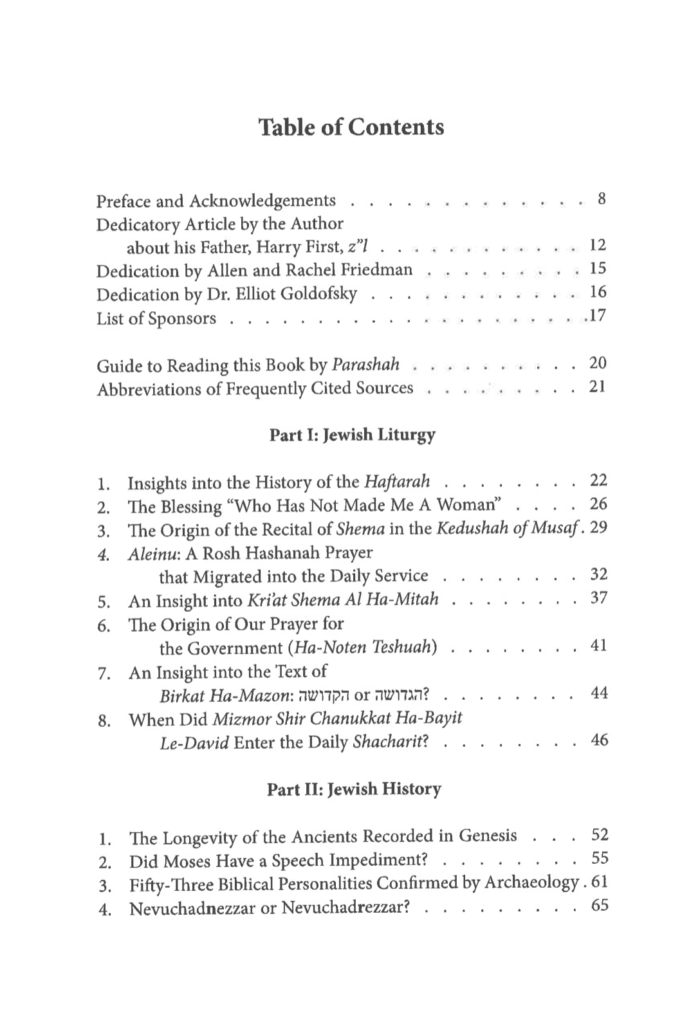
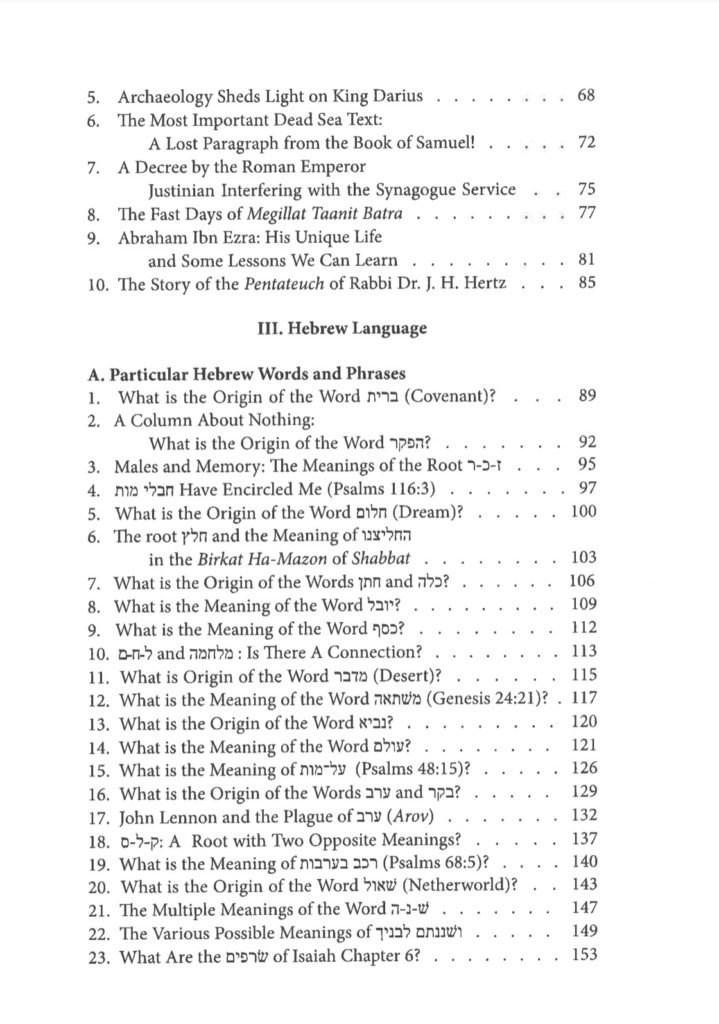
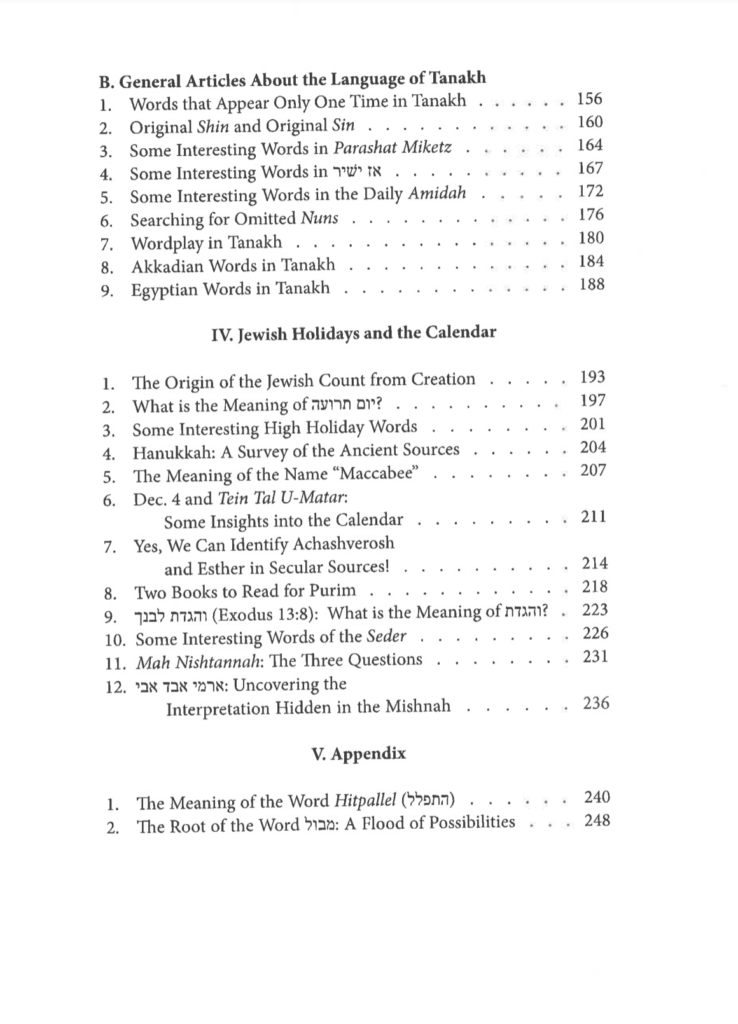
Here are the Table of Contents:


The Meaning of Ayelet Ha-Shaḥar at Tehillim 22:1

The Meaning of Ayelet Ha-Shaḥar at Tehillim 22:1

By Mitchell First
MFirstAtty@aol.com

The phrase השׁחר אילת is found at Tehillim 22:1. The entire verse reads: “la-menatzeaḥ al ayelet ha-shaḥar mizmor le-David.” What is the meaning of השׁחר אילת ? This is the only time this phrase appears in Tanakh. Its meaning is so unclear that Radak offers five interpretations!

Literally, השׁחר אילת means: “doe of the dawn.” A male deer would be an ayal. An ayalah is a female deer (=a doe).[1] Ayelet is the construct state of ayalah. It means “ayalah of the…”

There are two times in Tanakh where the root איל has the meaning “strength.” These are at Tehillim 22:20: eyaluti, and 88:5: eyal.[2] Accordingly, some suggest that that the meaning of the phrase in our verse is “strength of the morning,” i.e., “sunrise.”3 But the איל words in those verses lack a dagesh in the yod. Our ayelet has a dagesh in the yod. With the dagesh, the meaning in Tanakh is always the “deer/doe” meaning.[4]

An amora in the Jerusalem Talmud (Berakhot 1:1 and Yoma 3:2) explains ayelet ha-shaḥar by taking the position that the light of morning first appears like two horns on the horizon and then illuminates the entire horizon. He probably means that there is a similarity to the antlers of a deer which branch out in different directions. In this interpretation, the verse is referring to the morning light.[5] But the word used in Tehillim 22:1 is ayelet, referring to a female deer, and 99% of the time, these have no antlers![6] (Of course, a response could be that the verse is speaking about male deer and for some poetic reason chose to use the female form.[7])

The above amora also mentions an alternative view that ayelet means כוכבתא .כוכבתא literally means “star,” but is commonly translated here as a reference to the planet Venus. Could ayelet have meant “star” at Tehillim 22:1?[8] This is very unlikely because nowhere else in Tanakh do ayal, ayalah, ayelet or other forms of איל have such a meaning.[9]

Many interpret ayelet ha-shaḥar as a musical instrument. Note for example that Tehillim chapter twelve begins as follows: la-menatzeaḥ al ha-sheminit mizmor le-David. Most likely, ha-sheminit is a musical instrument, one of eight strings. The format of our verse, 22:1, perfectly parallels the format of verse 12:1. But try as I might, I cannot imagine a musical instrument with a name like “doe of the dawn.”[10]

Rashi and Radak mention a view that the doe symbolizes Bnei Yisrael who seek the redemption symbolized by the word shaḥar.[11]

The key to solving our problem is the introductory sentence of psalm 56: la-menatzeaḥ al yonat eilem reḥokim. There are several possible interpretations of the words yonat eilem reḥokim, but most likely the reference is to a dove that is far away and the only issue is the meaning of eilem (אלם).[12] A “dove that is far away” cannot possibly be a reference to a musical instrument. The commentary in the Soncino edition writes here that it “is doubtless the title of a song to whose melody the Psalm was sung.”

This must be the approach we should take to verse 22:1. The introductory sentence is pointing to a well-known song called ayelet ha-shaḥar and telling the conductor to use the tune of this song. This approach is taken in the Encyclopaedia Judaica (13:1321)[13] and in the commentary on our verse in the Soncino edition: “In all probability, the name of a melody to the accompaniment of which the Psalm was to be rendered.”[14] Among our Rishonim, Ibn Ezra takes this approach as well on both verses, 22:1[15] and 56:1.

Although this “tune instruction” approach does not fit the word על perfectly, we should be able to live with it. The entry in the Encyclopaedia Judaica takes the position that al ayelet ha-shaḥar may have been the name of the song, but this is unlikely. It is too coincidental that the song at 56:1 would begin with al as well. Rather,על is a common word used in those first line instructions in the book of Tehillim. Sometimes it is an instruction regarding the specific musical instrument to be used and other times, like here, it can be an instruction with regard to the tune. (For examples of other times where the introductory verse likely refer to a tune, see the introductory verses to chapters 45, 57-59, 60, 69,75, and 80, and the commentary in the Soncino edition on each.)

——

Here are the five approaches that Radak had mentioned: 1) the name of a musical instrument, 2) strength of the morning, implying that the psalm was said at sunrise, 3) the name of a morning star, 4) an allusion to David fleeing from Saul, and 5) a way of referring to the Israelites. He preferred the last approach.

As to Rashi, here is what he offers: 1) the name of a musical instrument, 2) a way of referring to the Israelites, 3) the Sages’ homiletical approach that it refers to Esther (see Yoma 29a) and 4) strength, citing Menachem Ibn Saruk.[16]

Uriel Simon[17] points out that Ibn Ezra wrote two poems based on the theme that Israel is an ayelet. But as a commentator, he does not even mention this view in his standard commentary, since it is not at all a plain sense approach.[18]

Finally, it is interesting to offer a contemporary parallel to our interpretation of ayelet ha-shaḥar as an instruction regarding the tune of the psalm by referencing a well-known song. Nowadays we might say: “To the tune of Mary Had a Little Lamb.” (I thank Dr. Richard Gertler for this suggestion.)

[1] I am here reminded of the phrase “Doe a deer, a female deer” that I heard in the film The Sound of Music when I was a little child. That phrase finally came in handy!

[2] The Targum gives ayelet the strength meaning at 22:1, translating it as תקוף.

[3] This is the position taken by R. Saadiah Gaon. See Uriel Simon, Four Approaches to the Book of Psalms (1991), p. 51. It is referred to at the beginning of Ibn Ezra, although Ibn Ezra does not mention R. Saadiah by name.

[4] At Shir Ha-Shirim 2:7 and 3:5, אילות has the “deer/doe meaning” even without the dagesh.

[5] These statements in the Jerusalem Talmud are best understood in light of a statement at Yoma 29a.

[6] Female deer only have antlers when they have excess testosterone. This is very rare. Rashi (Yoma 29a) points out that ein karnayim le-nekeivah.

[7] In a different context, it is interesting to note the poetic license taken by the Israel Postal Company with their logo. For decades they have used a deer with antlers, intending an allusion to Gen. 49:21 (a verse that describes the delivery of imrei shefer.) But this verse refers to an ayalah. For further discussion, see my Links to Our Legacy (2021), pp. 205-208. (In recent years, their logo has been modified. Unless you knew, you cannot tell that a deer or any animal was intended originally.)

[8] Malbim is one who had adopted this interpretation.

[9] But “morning star” is a common understanding of the phrase ayelet ha-shaḥar in modern Hebrew.

[10] My son Shaya jokingly suggested that it could be a musical instrument that looked like a doe and was used to wake people in the morning! (My son’s wife is named Ayelet. It was his engagement to her in 2019 that inspired me to do this research.)

[11] See further Shir Ha-Shirim 6:10.

[12] As to eilem, perhaps it means “silent” or is a reference to a tree. Accordingly, the Encyclopaedia Judaica entry suggests “speechless dove far-off” and “dove of the far-off terebrinths.”

[13] This entry was authored by Nahum Sarna.

[14] Similarly, Robert Alter, The Book of Psalms (2007), p. 71, writes that the reference is to “a musical instrument of some sort, or alternately, to a melody.” Hebrew & Aramaic Lexicon of the Old Testament, eds. L. Koehler and W. Baumgartner (1995, revised edition), p. 40, has: “beginning of a song?” Finally, Daat Mikra follows the “tune instruction” interpretation in its main commentary (but suggests that the song is about the morning star) and then offers many other suggestions in the footnote.

[15] He thinks that the allusion is to a love song, since that word ayelet is used in the expression ayelet ahavim at Mishlei 5:19.

[16] Based on the manuscript evidence provided at Alhatorah.org, most likely the last was not in the original comment of Rashi and was added by others later.

[17] Four Approaches to the Book of Psalms, p. 240.

[18] But Simon points out that he does mention and reject it in an earlier recension of his commentary on Tehillim.


Recent Notes On Hebrew Pronunciation

Recent Notes On Hebrew Pronunciation

By Rabbi Avi Grossman

Edited by Mr. Jonathan Grossman 

Many of the ideas discussed in this article were in my notebook for some time, and just as I was getting around to preparing them for publication, my prolific colleague Rabbi Reuven Chaim Klein sent a copy of Professor Geoffrey Khan’s The Tiberian Pronunciation Tradition of Biblical Hebrew to me. After reading it and briefly corresponding with the author, I concluded that it was time to release this article. Professor Khan invites the yeshiva world to read his book, available for free at this link, and to check out his website. Full disclosure: although Prof. Khan’s research is enlightening, not only do I not agree with or endorse everything he claims, I do not believe that certain points are admissible as halachic sources in the Bet Midrash. 

With regards to the details of halachic pronunciation, I have already released my own book wherein I try to show how the rishonim would pronounce Tiberian Hebrew, and I direct readers to Rabbi Bar Hayim’s videos on the subject. Rabbi Bar Hayim follows the views of Rabbi Benzion Cohen. All of us are attempting to recreate something that we cannot really know, and for now, we still have to debate the fine details. I seriously doubt that the Masoretes spoke a ritual Hebrew that sounded exactly the way any of us describes it. 

Before getting into the nitty gritty of Prof. Khan’s arguments, I would like to introduce some basic ideas that can be gleaned from an elementary, comparative study of Arabic.

A few years ago I took some classes in modern spoken Arabic, which I hoped would help me begin to read Maimonides’s original writings. Aside from helping me realize how there is so much I have to learn about that language, it helped me learn more about Biblical Hebrew. Fifteen years ago, when I started working on what would become my aforementioned book about Masoretic Hebrew, I wondered about certain missing consonants. Thankfully, those and many other questions I had have been somewhat answered, and I now wish to present some of my own findings. I realize that for some, these may not be so novel, but my intention is to bring them to the attention of those in the yeshiva world who, for whatever reason, would enjoy learning about this but will not come across these issues in their regular courses of study.

Concerning the Consonants:

Arabic has only a cursive form, unlike our Hebrew which has had over the course of time many forms, including the common, Assyrian block form and the various cursive forms, which thanks to the advent of modern-Hebrew education has become much more standardized. Also, many letters have up to four forms: the isolated (stand-alone) form, the initial form, which the letter takes at the beginning of the word or in the middle of the word when the previous letter is cursively non-connective, the medial form, and the final form. For some letters, there is significant overlap. See a chart here, for instance. 

The Arabic letter alif is basically the Hebrew alef, but it is used much more often as a mater lectionis, the Latin translation of the Hebrew אם קריאה. (See below.) 

The Arabic equivalent of bet, ba, is always strong, meaning that in most forms of Arabic there is no letter that represents the weak bet sound, that of V, while the Arabic equivalent of pei, fa, is always weak, and never strong.This means that in most forms of Arabic there is no letter that represents the strong pei sound, that of P. Thus, many native Arabic speakers have a hard time pronouncing foreign words that have the P or V sounds. Today, in Israel at least, the solution is to use the stop, B, to also represent the P, thus giving us words like بيانو, biano, for piano, while the V sound is a variant of the fa, ف, and sometimes it is marked with three dots on top instead of one to indicate the V. Consequently, Israelis who pronounce their surnames that begin with vav in the standard, European-influenced accent, e.g. Vaynshtain instead of Weinstein, have the Arabs spell their names with a variant of fa

Unlike in Hebrew, the diacritical dots you find above and below certain Arabic letters are not vocalizations but rather critical components of the letters. It seems that early on the diacritics were used to distinguish between alternate sounds created by single letters, like the dagesh qal is and was used to distinguish between sounds made by single letters, while other letters originally had unique forms, but evolved into identical forms, and the diacritics were introduced in order to preserve the distinctions. The initial and medial forms of the Arabic letters ba, nun, ya (the equivalent of the Hebrew yod), and ta (the equivalent of the Hebrew tau) are orthographically identical and distinguished by the diacritics, the ba with one dot below, the ya with two; the nun with one above, and the ta with two, even though in all of the earlier Semitic alphabets, the equivalent consonants had distinct forms. This has made Arabic very receptive to new letters: it is very easy to modify an already existing letter form by adding anywhere from one to three dots as a superscript or subscript. In Hebrew, we still have not completely assimilated new consonantal symbols into new letters (the ג׳, ץ׳, ז׳, etc.), and the typical method of representing them looks out of place in context. 

Gimmel: In many languages, the hard G sound has been assimilated to a soft one, and this is as true in Arabic as it is with certain English words. However, the Arabic jim is not always pronounced like a J, which, as I pointed out in my book, is a combination of the D sound followed by a voiced shin (SH) sound, or the voiced equivalent of the CH sound achieved by clustering the T and SH sounds. Rather, jim makes the voiced shin sound (the G in massage) on its own. Also, the jim is still pronounced like a hard G in some countries, such as Egypt. 

Dal is the Arabic equivalent of our dalet, and it, like our dalet, has a weak, fricative counterpart, the dhal, (as in “the”), although unlike Hebrew, in which the weakness or strongness of the bet, gimmel, dalet, kaf, pei, or tau (the “beged kefet” letters) depends on the form of the word, and one set of rules governs all of these letters, in Arabic it seems that dal and dhal no longer have such a relationship, and as above, are now considered separate letters. 

The Arabic waw serves the same purposes as our vav. More on that soon. 

Het has its equivalent in the Arabic ha, while the sound of our kaf’s weak counterpart, khaf, appears in Arabic as a variation of the ha, pronounced kha, and the latter is represented by writing the former with an additional upper dot: ح and خ, respectively, while the one with a lower dot, ج, is the aforementioned jim. This seems to indicate that the weak sound of the khaf that distinguishes our Hebrew so much from English is a historical latecomer, and that while we first made it a variation of kaf, the Arabs made it a variation of het, and indeed, since in most Jewish circles the het is pronounced (incorrectly) as a khaf, perhaps the Arabs were just anticipating us. Many academics claim that the sound migrated; even in Hebrew the sound of the khaf was made by the het in certain words, but later, when all hets were pronounced alike, the sound was given to the weak kaf. This would explain why, for instance, certain proper nouns have been historically transliterated unusually. E.g., Jericho, Rachel, etc.

The Arabic counterpart of tet is the ta, but unlike our Hebrew tet which has no voiced counterpart, like tau has dalet and samech has zayin, the Arabic ta does have a voiced counterpart, the dad, ض, which is the D in words like Ramadan. Just like English transliterations of Hebrew commonly lose the distinction between tau and tet, they also lose the distinction between dal and dad, and in many systems used to teach Arabic to Hebrew speakers, they simplify the dad and tell them that just like they always pronounce the tet like a tau, they can pronounce the dad like a dal.

The Arabic counterpart of the yod is ya, and it pretty much behaves like the yod, but has traditionally been used as a mater lectionis even more than yod has. For example, many transliterations of Hebrew into Arabic not only use the ya to represent the Hebrew tzeirei, they even use the ya to represent the segol in open, accented syllables.

I was asked concerning the yod in second-person-possessive male suffixes, as in, for example בנֶיךָ ba-NE-cha: if the yod is not meant to be pronounced as part of the segol vowel, why is it even there? My proposed answer is that it is there to distinguish the singular from the plural, along the lines of the silent yod in the third person counterparts of those nouns, for example in בנָיו ba-NAW, which most never even get around to wondering why we do not pronounce as ba-NAYW. I believe that the yod in words such as בניו may have once been pronounced, and this explains the suffix’s relationship to its Aramaic counterpart, וֹהִיx or וֹיx. In essence, the two languages present the combined sound of the low vowel with the two semivowels, just that in Hebrew the Y sound preceded that of the W, whereas in Aramaic the W sound preceded the Y. Similarly, up until the common era, decisors would represent the western sound of “OW” (as in “brown” and Ashkenazi surnames with “baum” in them) in Yiddish and Yiddish-influenced written Hebrew as וֹי, “oy,” despite the inaccuracy. In any event, the silent yod in the plural possessive suffix is a critical indicator of the plural state, even more so than the potential vav of the holam in words like אבֹתֶיך  and עֹלֹתֵיכם. As a matter of fact, the vast majority of these words are written in the Torah with the yod and not the vav, and even when there is no need for a possessive or constructive suffix, the vav of the (generally) feminine plural suffix is usually omitted. Rather, the holam is usually written plene when the vav (or the yod that it replaces) is part of the root of the word. Thus, there is always a vav after the first tau in the word Torah (of the root yod-reish-silent hei) and its derivatives, but more often than not there is no vav after the reish indicating the plural of Torah.)

Sometimes, at the end of words, the alif is in the form of a ya minus the two lower dots that  distinguish the ya from the ta, ba and nun. Such an alif is called an alif maqsura (a “shortened alif”), and is often used in place of the ya that was part of the root word. See below for how this may relate to the phenomenon of the equivalency of yod and silent hei as the third letter of many Hebrew roots.

The Arabic counterpart of kaf, ka, is always strong. This would remind us of the instances in which the suffix khaf in Hebrew is strong, as in ארוממךָּ, although in spoken Arabic, what was once the sound of qamatz/patah after the suffix ka has now been placed before the kaf, such as in possessives that end with the sound “ak” instead of “ka.”  Similarly, the possessive suffix is pronounced “kha” in Hebrew, while in Aramaic it is pronounced as “akh.” 

The Arabic counterpart to lamed, lam, is often orthographically combined with the alif that precedes it or comes after it. Certain Hebrew printers would use a combined letter for alef and lamed; I do not know who learned from whom (no pun intended), or if it is just a coincidence. 

Samech has no true Arabic counterpart because the Arabic sin corresponds to both the Hebrew sin and samech. Considering how the samechsin redundancy in other Semitic languages predates the Arabic’s language’s evolution, this is understandable. Yiddish also has this phenomenon: in native Yiddish words, only samech is used to represent the S sound, and the sin is only used for words that have their source in semitic languages. Rav Mazuz recently pointed out that in Rashi-era French, not only did the samech and sin sound like an S, but the shin also did, and this is why when Rashi invokes French, the shin is usually used for the S sound. 

Ayin exists also in Arabic, although orthographic variants thereof, specifically the addition of a diacritic dot above, changes the ayin to a ghayn. (I would have expected the aforementioned jim to therefore to be an orthographic variant of this letter instead of the ha.) Many have pointed out that early Greek translations of personal nouns such as ra’am, ‘amora and ‘aza have used the progenitor of the latin G, and this would indicate that Hebrew once had a similar dual use for the ayn symbol, and as Professor Khan has shown me, the jim was once actually the equivalent of a hard G, and still is in some places, so it would be a natural and eventual variant of the ghayn

Pei’s equivalent is the fa. It has this weak form, and never a strong form. As I wrote above, modern Israeli Arabic uses a new variant of the ba, but with three lower dots, to represent the P sound. 

The tzadi has the Arabic sad. Further, the sad has a voiced counterpart, ظـ, ẓāʾ, the most recently developed letter in the Arabic language, and the sad and tet are already variants of each other, with the ta being a sad with a vertical line. Strangely, the voiced counterpart of the ta is a sad with an extra dot, ضـ, while the voiced counterpart of the sad, the ẓāʾ, is a ta with a dot. I would have done the opposite. Years ago I wondered why Hebrew did not have these letters. I now realize that they are just too inconvenient, or else we could also expect to see the fricative forms of both the tet and the dad in Arabic. Thus, Arabic developed and maintained letters to represent many of the consonantal sounds that were either lost by spoken dialects of Hebrew, or were never present in Hebrew. Considering that the twenty-two-letter Hebrew alphabet is considered sacrosanct by the Hebrews, and that even the weak sounds from the six beged kefet letters did not earn their own letters, I do not believe we will see new Hebrew letters to represent these sounds any time soon, although the sound of the jim (represented in Modern Hebrew by ג׳) and the modern English CH (represented by צ׳), for instance, are today ubiquitous. I was prompted to think about this by my daughter, who, in second grade, was mindful enough to point out that her version of the Alphabet had both bet and vet, but Ashrei, as printed in her siddur, only had a verse for bet.

Modern Hebrew tutorials for spoken Arabic use the samech to represent the Arabic sad, because the samech is much closer to the way sad should be pronounced than the way the Modern Hebrew tzadi is, although on some street signs, proper nouns with sad’s are rendered with tzadi in Hebrew, e.g. the town of Musmus in the Galilee is מוצמוץ, which delighted my daughter. Also, the ubiquitous condiment hummus, although spelled חומוס in modern Hebrew, should be spelled חֻמֻץ to accurately reflect its Arabic spelling. There are even some families here in Israel that do not eat chickpeas on Passover not because they are legumes but because back in the old country, the word was too similar to חמץ, “leaven.”

Quf: Many people know that the Hebrew quf should be pronounced like the true Arabic quf, what the speech professionals call the voiceless uvular stop, or, to the rest of us, the sound made by pressing the tongue farther back in the mouth, but like the quf in Modern Hebrew, the Arabic quf has also suffered from neglect. In some places it is pronounced like a hard G, while in others it is pronounced like a K, as we do, and sometimes, especially in local dialects, it is not pronounced at all, and is basically treated like an alif. For example, local speakers refer to Jerusalem as al-uds instead of al-quds, and even al-uds often comes out as il-uts, all of the previous with a short vowel sound. Or the imperative of stand up is um instead of qum, and daqiqeh, minutes, becomes da’i’eh

Reish: The Arabic sign for reish is the zayn with an additional dot on top, which may indicate the closeness of the two sounds. According to Sefer Yetzira, the reish is produced by the teeth, just like the zayin and samech.  

Shin and sin are one symbol, with the shin having three dots on top. They both even resemble the Assyrian shin: س ش. The extra tails do not appear mid word.

Tau: Both the strong and weak tau have Arabic counterparts, the ta and tha, respectively, with the former with two dots, the latter with three. As we mentioned, the strength of the Hebrew beged kefet letters depends on a letter’s position in a given word, while in Arabic that is not the case. 

More interestingly, the ta has a common silent form, called “ta marbuta,” literally, a “sad ta,” that appears as the feminine suffix roughly equivalent to the qamatz-silent-hei suffix in Hebrew. Interestingly enough, this ta marbuta is silent, like our hei, and is even written as a ha but distinguished by the characteristic two dots on top, just like a ta. That is, orthographically it is a combination of ha and ta. Just like the Hebrew hei suffix becomes an actual tau in various construct states, the ta marbuta becomes an actual ta in construct states. For example, the Arabic word for automobile is sayara, while “his car” is sayarato. When we consider Hebrew, we often think of the silent hei as converting to tau in construct forms, whereas from this point of view, the tau can be considered the default letter, and the hei that exists in isolated forms is the simplified form. This explains, for instance, why we encounter words like zimrath as in עזי וזמרת י-ה and aqereth in מושיבי עקרת הבית are spelled with the tau although they are not in the construct state. (Hat tip: Rabbi Yedidya Naveh of Koren Publishers.)

This is reminiscent of the phenomenon in Hebrew that in certain roots, the final silent hei become a tau in certain conjugations, e.g. ראה is ראתה in the feminine, while in other conjugations it becomes a yod, e.g., as in ראיתי and ראינו. Had an alef been in those roots, it would have stayed in both types of conjugations: the feminine of ברא is ברָאת, and the first persons are בראתי and בראנו.

Concerning the possessive suffixes, in spoken Arabic the male form is as in Hebrew, an O sound, but it is written with a silent ha, reminiscent of uncommon instances where the mater lectionis is also hei for the holam, as in שלמֹה, שילֹה, אהלֹה, and סֻכֹּה. Whereas in Hebrew, the female possessive suffix is usually qamatz-nonsilent (mappiq) hei, and this is mostly overlooked in spoken Hebrew. I know of no one, (not even the usual professionals who otherwise pronounce things properly) who actually tries to pronounce the mappiq hei in conversation. The equivalent suffix in spoken Arabic is much easier to say, as it is written as ha-alif, and is pronounced as “ha.”

The lack of a local Arabic equivalent to the hard G sound made by gimmel has led to some interesting inconsistencies regarding how to spell Ben Gurion, which comes up often considering all the places named after him. Some spell his name with a jim, others with a ghayn, and others with the new, hard-G gim, the aforementioned jim but with three dots instead of one. The first version enjoys the precedent that the Hebrew gimmel has been represented by the Arabic jim, and it is up to the reader to know that historically both were pronounced as G, while the second version enjoys the precedent that foreign words with a hard G have been represented with a ghayn because vocally it is is closest to the hard-G sound. For example, in Arabic a gorilla is called a ghorilla. Indeed, in this case they would be pronouncing “Gurion” with a form of gimmel, just the weak form. I have noticed that, especially around the eponymous airport, all three Arabic spellings of Gurion are commonplace.

Otherwise, many Israeli street signs can be seen as the work of vigilant trolls, who mock the way most Jews pronounce the tzadi, vav, tet, and quf incorrectly. For example, the signs pointing to my town, Kochav Yaakov-Tel Zion, appear as they should in Hebrew, כוכב יעקב – תל ציון, but in Arabic they are rendered as كوخاڤ ياكوڤ تل تسيون, which, represented in Hebrew characters, is כּוכאבֿ יאכּובֿ תל תשיון. That is, although the Biblical name of Jacob has a well-known classical rendering in Arabic, because the Jews pronounce the ayin and quf as alef and kaf respectively, they are rendered as such, and the same with the tzadi of Zion, rendered ts because that is how it is pronounced. Similarly, place names with tet are transliterated with the counterpart of tau, ta, because that is how it is incorrectly pronounced. An example: טירת צבי, Tirat Zvi, is rendered by the Arabic equivalent of תיראת תשבֿי. Lastly, פתח תקוה is (thankfully) transliterated into formal English as Petah Tiqwa, but in Arabic it is   ‎بتاح تكفا, or in Hebrew characters, פּתאח תכּבֿא, although it would have been more egregious had they rendered the first word as פתאך.

The Vowels

The Arabic counterpart of the dagesh hazaq is the shadda, a small W or shin-like symbol written above the letter indicating its gemination. The counterpart of the sh’wa nah (silent sh’wa) indicating that the consonant closes the previous syllable is the sukkun, which appears as a small circle above the letter in question.  

As a general rule, the major vowels are represented with their plene spellings, while the minor vowels are defective, and the ya represents what sound like the Hebrew tzeirei and hiriq, while the waw represents the holam and shuruq sounds. However, there is more ambiguity with regard to the representations of the minor vowels: there is one vowel superscript symbol that represents the short patah sound, and not coincidentally it is called fat-ha, while a single waw-like superscript is used to represent both the equivalents of the qamatz qatan and qubbus, and a single subscript dash represents the equivalents of the short segol and hiriq. Surprisingly, accented, segols in open syllables are transliterated into Arabic also as plene. For example, Petah Tiqwa, above, is sometimes spelled with a yod after the pei equivalent, פיתאח. And, along those lines, many of the counterparts of the qamataz gadol are represented by an additional alןf, as are patahs in open-accented syllables. Thus, names like Ibrahim (Abraham) and Binyamin are written with alif’s after the reish and ya respectively, and in Israel place names with the words sha’ar and har are represented by the Arabic equivalents of האר and שאער. This far more liberal use of the alif to represent the presence of vowels is also characteristic of Yiddish, in which the alef has completely transformed from a mater lectionis into a vowel-letter, although I would be very grateful if someone could enlighten me as to why in Yiddish, our ancestors chose to represent the segol with the ayin. I cannot fathom even a tenuous connection between that particular vowel and the consonant.

Concerning mater lectionis it must be noted that although in many of the languages under discussion they are silent place holders that do not affect the pronunciation, once upon a time they did. It is not due to some arbitrary decision or convenience that the prophets chose to represent the holam and shuruq sounds, for example, with a waw. Rather, it is because the vav and yod once were, and often should still be, a natural, necessary, and logical component of the vowels’ pronunciations, and as I wrote about in my book, the true hiriq and shuruq sounds cannot be articulated without the natural semivowels that complete them, and when they are followed by guttural letters that necessitate the additional patah g’nuva, or the epenthetic in Prof. Khan’s jargon, the semivowel is even geminated. 

Plural suffixes: Instead of im, יםx, in Arabic, as in Aramaic, “in” is often used. In feminine forms, instead of oth, ותx,  ات, which is the equivalent of אתx, is used. However, many nouns have a unique plural form that does not employ a suffix or any set rule of new vowel structure.

And now for the nitty-gritty of Prof. Khan’s book. The second volume of Khan’s work is a translation of the Hidāyat al-Qāri, which was written by a prominent grammarian, and it and other Karaite works and documents make up a significant portion of his sources. Although there may be that which we can learn from both Karaite and Samaritan sources, they can hardly be considered by traditional Jews to be sources for anything halacha l’ma’aseh. For example, the notion that the shuruq form of vav hahibbur before labial letters is pronounced as “wu,” and not “u,” is very hard for me to believe, especially because it contradicts most modes of pronunciation among world Jewry, and makes one wonder why such a vav would not therefore be considered a complete syllable unto itself. As I wrote about last time, an analysis of the trop indicates that the Masoretes did not not count the prefix vav as a syllable even when it was pronounced as a shuruq. If they had been pronouncing such a vav as “wu”, it would count as a full syllable, especially if it preceded a letter with a sh’wa. I believe that even the Karaites and Samaritans themselves do not pronounce it that way anymore, if they ever did. R’ Schachter likes to relate a story about a conversation between Rabbi Soloveitchik and Rabbi Saul Lieberman, in which the former was dismissive of certain medieval sources, because just like today when we have pseudo-scholars who write halachic nonsense, they also had such things back then. Just because you can find that Karaites distinguished between the mobile and silent sh’was using different criteria from ours, we should do as they do?!

I would also like an explanation as to why, considering the mountain of proof that the vav was and should be pronounced like a W and not like a V, he recommends that it be pronounced as a V in certain instances. It is inconsistent in theory as well as in practice. However, it is interesting to note that historically Jews in Palestine began to assimilate the vav into a V sound around the same time that speakers of Greek began to assimilate the sound. Although I am happy to let people speak however they may like, I would strongly recommend against this and another common phoneme, namely the Modern Hebrew pronunciation of reish. Both made it into Modern Hebrew via Yiddish, and both make Modern Hebrew sound unpleasantly Germanic. For example, the word aquarium is both pleasant and easy to pronounce, and sounds like a fun place to visit with children, while ak-VA-ghi-um is jarring, hard to pronounce, and sounds sinister. If most can pronounce the vav and reish properly, they should try to do so. For those who may ask, I spell the name of the letter v-a-v in order to distinguish it from the Aarabic waw, although I believe that it makes the W sound. 

Prof. Khan’s take on orthoepy on page 101 fits with my point here that the Sifrei Emet have a higher tendency toward conjunctive cantillation marks than the rest of the books of the Bible. Along similar lines, you will find that in the majority of the biblical books, the non-Emet books, the lower level disjunctives, which therefore also occur earlier in a particular half of a verse, tend to be musical flourishes, and not unsurprisingly, can have many more conjunctive words (i.e., words marked with conjunctive trops) preceding them. For example, silluq and ethnah have at most one conjunctive word connected by either a mercha or munah, respectively, and the second-level disjunctives like tip’ha and zaqef have at most two conjunctives, while the pazer and t’lisha g’dola often have four or five conjunctives, and even up to seven at my last count. (Often, a string of connective words form one adjectival phrase beginning with asher, that or who, even if that phrase itself has many parts of speech.) Jacobson has already pointed out that there are no disjunctives lower than these, and therefore, even at preceding words where we would expect disjunctives, we find conjunctives. There is thus a proportional relationship between musicality and connectivity. 

A recurring argument is that when the Karaite transliterations into Arabic omit mater lectionis, the indication is a short vowel in the original Hebrew. I disagree, because we see that the farther back we go in Biblical Hebrew, fewer and fewer long vowels, especially qamatz and holam, are in the plene form. Incidentally, some have asked me for rules of thumb as to when the holam is plene or deficient. I have two of them: 1. In post-biblical Hebrew, the accented holam of segolate nouns is deficient (e.g., חֹדֶש, עֹשֶק, אֹכֶל, etc.) while in participles, the holam is unaccented and written in the plene form (e.g., אוֹכל, עוֹשֶק, etc.). In Biblical Hebrew, the older the book, the less likely these participles are to have the vav. 2. In the Torah and the earlier biblical books, the holam is often deficient when it is part of a plural suffix. Those words in which it is written plene, e.g., in בנות, are the exceptions. However, when the vav is part of the root, it usually is written, for example when the root of the word is yod-reish-(silent) hei and the conjugation is in the hif’il, which is why the word תורה and its variants are written in the plene form. 

Pg. 113. I used to joke that the common Ashkenazi practice of distinguishing between qamatz and patah and tzeirei-segol was an enactment of the biennial convention of Ashkenazic Jewry, for if you were to claim that qamatz and patah used to sound the same, and tzeirei-segol sounded the same, why do Ashkenazim distinguish between? However, Prof. Khan seems to say that it was apparently the case, and we are left looking for an explanation as to how our ancestors figured out the difference in theory and adopted it in practice. 

The argument on page 409 regarding epenthetic vowels fits with the argument I made previously about the pronunciation of ohela.

Pg. 428: Yaamdu. I believe that Prof. Khan and I are making similar proposals, except that he is using much more advanced terminology. 

Pg. 450: As per the brilliant and indispensable treatise on cantillation found in the classic Tiqqun Mishor, I believe that it is much easier to explain the vocalization of the word מה (ma) with the rules governing the hei hay’dia, the definite article. The atei merahiq (dehiq) explanation may account for the dagesh in the first letter of the second word, but it does not account for the variety of possible vowels: segol, qamatz, patah, etc. that parallels that of the hei hayedia and that can be explained using the general principles of vowel shifts. 

Pg. 509. Is the masoretic hyphen supposed to be called a מַקֵּף or מַקָּף? I can entertain either, just like the exact vowelization (and names for that matter) of the words we use for the vowels are also pretty dynamic, and the same can be said of the trop. 

Pg. 519: Prof. Khan does not find any lengthening of the vowel in the syllable marked by the metiga of the zaqef gadol, nor of the geresh of the ravia mugrash. As I wrote earlier, I am of the belief that these particular symbols are quite arbitrary, and their placement is less about accentage, etc., and more about distinguishing them from similar symbols, and explains why trop like the dehi and t’lisha gedola are always marked on the first syllables even if those syllables are not accented. 

Pg. 524: Concerning the verb להניח, Prof. Khan offers that the forms which have the dagesh are not reflective of a different root altogether, but rather are a convention to create a distinctive meaning. The forms with the weak nun imply “to give rest,” while the forms with the strong nun imply placement. It would thus seem logical that the blessing on laying t’fillin should be להַנּיח תפלין and not להָניח תפלין. However, most siddurim follow the Shulhan Aruch’s ruling (Orah Hayim 25:7) to use the latter formulation, and indeed, the Mishna B’rura there explains that the weaker form implies placement, while it is the strong form that implies handing over. However, in the original source in the Beth Yosef, it is mentioned that there is no actual difference in meaning between the two forms, but the weak form is preferred because it is the one used in the verse (Ezekiel 44:30), להָניח ברכה, “to place a blessing within your house.” The Vilna Gaon seems to endorse this view. 

The following is from a letter I wrote to the publishers of the Makbili edition of the Mishneh Torah:

במהדורתכם, בהלכות תפילין, פרק ד׳, כל פעם שמדובר על מעשה הנחת תפילין וברכתה, הנו״ן דגושה והתנועה לפניה או חיריק חסר או פתח, ושתיהן תנועות קלות, וזה למרות דעת השולחן ערוך וכמה אחחרונים שצ״ל נו״ן רפה והתנועה לפניה או קמץ או צירה, ושתיהן תנועות גדולות. לדעת מרן הבית יוסף, זה בגלל שהנחת תפילין שורשו נו״ח, ומעשה ההנחה הוא בבנין הפעיל, לעומת הנחה בנו״ן דגושה, שהיא באה משורש אחר ומשמעותה לשון עזיבה

?האם דעתו של הרמב״ם מפורשת שכן צריכים להגות ״הנחה״, או האם יש לכם סיבה אחרת בשיטת הניקוד

In short, they decided to vowelize l’haniah t’fillin, the blessing on laying t’fillin, with a dagesh in the nun, l’hanniah t’fillin. This is in contrast to most known opinions, including that of the Shulhan Aruch. Whose opinion were they following, bearing in mind that Maimonides himself did not actually state anything in regards to the matter and his own editions of the Mishneh Torah were not vowelized?

The editor answered that

:זוהי תמצית תשובת ד”ר יחיאל קארה, עורך המשנה של המהדורה לענייני ניקוד

במהדורתנו ניקדנו על פי המסורת התימנית, וכן הוא גם בכ”י קאופמן של המשנה. אכן במקרא אפשר שיש מקום להבחין בין “והניח לכם מכל אויביכם” ב-נ’ פשוטה לעומת “והניחם שם” ב-נ’ דגושה, כהבדלה בין נתינת מנוחה לבין שימה, אך הדבר אינו מוחלט, ובכל מקרה מדובר במה שמכונה “פועל עלול”, שבו יש תנועה בין הגזרות השונות. וראה גם במילון אבן שושן, שמביא את שתי הצורות בלא להבחין ביניהן

Or in short, that there is a Yemenite tradition that it should be that way. Indeed, one Yemenite rabbi showed me some Yemenite codes that explicitly record the practice.

A few years ago, I found what may be the source for the Yemenite/Maimonidean tradition.  According to the Shulhan Aruch, the three-letter root of l’haniah is nunyod (or waw)-heth. Thus, all the letters of the root are present in that conjugation, and thus do not require any letter to be geminated in order to compensate. However, In The Guide for the Perplexed, 1:67, Maimonides wrote (Friedlander translation):

Our Sages, and some of the Commentators, took, however, nuaḥ in its primary sense “to rest,” but as a transitive form (hif’il), explaining the phrase thus: “and he gave rest to the world on the seventh day,” i.e., no further act of creation took place on that day.

It is possible that the word wayyanaḥ is derived either from yanaḥ, a verb of the class pe-yod, or naḥah, a verb of the class lamed-he, and has this meaning: “he established” or “he governed” the Universe in accordance with the properties it possessed on the seventh day”; that is to say, while on each of the six days events took place contrary to the natural laws now in operation throughout the Universe, on the seventh day the Universe was merely upheld and left in the condition in which it continues to exist. Our explanation is not impaired by the fact that the form of the word deviates from the rules of verbs of these two classes: for there are frequent exceptions to the rules of conjugations, and especially of the weak verbs: and any interpretation which removes such a source of error must not be abandoned because of certain grammatical rules. We know that we are ignorant of the sacred language, and that grammatical rules only apply to the majority of cases.

Thus, it seems that in the form l’hanniah, the yod of the beginning of the shoresh has been left out, necessitating the dagesh in the second letter of the root, the nun. However, Maimonides acknowledges the apparent difficulty: usually, when the first letter of a root is yod, verbs in the hiph’il conjugation are vowelized with a full holam after the prefix, for example להוציא from יצא and להושיב from ישב, and even להוליך from הלך, which does not even have a yod

Pg. 599-600: The discussion reminds me of my epiphany concerning the Vilna Gaon’s pronunciation of זֵכר. The difficulty native speakers have when trying to distinguish between sets of similar sounds is very frustrating, especially when they attempt to add their own vowelizations. I tell Israeli schoolteachers that it is not even worth it for them to try, because when it comes to qamatz-patah and segol-tzeirei, they will always get it wrong. 

Finally, Prof. Khan is not alone in advocating that the sh’wa na’ of Tiberian Hebrew be pronounced basically like a hataf patah. Support for this position comes from written testimony that describes it as such. However, I do not accept this. It seems to me today, linguists discuss dozens of types of vowels, and spoken English, for example, utilizes dozens of vowel sounds, but in the medieval period, they used to only discuss three, and then five, different vowel qualities. It makes sense that to them, the sh’wa would have to fit into one of those descriptive categories even if we now have the tools to be more specific. Further, if the sh’wa was supposed to sound like a hataf patah in the majority of cases, why did the Msaoretes choose the sign of the sh’wa, which half the time is used to mark a letter that closes a syllable, and not the hataf patah, which they had already created to mark specific sh’wa’s? Also, it would be a practice that contradicts the living custom of most of Jewry, and would require a thoroughly novel explanation as to why the pronunciation of the vav hahibbbur changes before words that begin with a letter vowelized with sh’wa. However, I also believe that a sh’wa should not be pronounced identically to the short I sound as is common in most places today. The best description of the sound that I can offer today is the sound in the word “the,” as in “I went to the store.”

Concerning Vav Hahippuch

As opposed to the conjunctive vav, the vav hahippuch generally turns a past-tense verb into future tense, and a future-tense verb into past tense. Many thus believe that the hippuch, inversing, refers to the tense. But, the vav hahippuch inverses a lot more:

The accentage: In most past-tense verbs converted to future, the accent is shifted from the middle syllable, if that is its position, to the last syllable. E.g. a-HAV-ta is “you loved,” whereas w’A-hav-Ta is “you shall love”. (Most speakers of Hebrew are unaware that the past-tense second person plural verbs are accented on the last syllable: אהבתם is ahav-TEM, and not aHAV-tem, and when marked with the vav hahippuch stay accented as such.) Notable exceptions occur in verbs with yod/silent hei as the last letter of the root. E.g., w’a-SI-tha, “you shall make,” is accented on its middle syllable even though it is future tense. Once again it is verbs of this category that are the major exception; last time I pointed out that the singular masculine past-tense conjugations of these verbs do not follow the rule of athei merahiq. In the case of a future-tense verb made past, the accent is shifted from the last syllable to an earlier one. (e.g., ya-QUM becomes way-YA-qom, and yo-MAR becomes way-YO-mer).  

The syntax: Standard form would be subject-verb-object. When vav-hahippuch is utilized, the order is verb-subject-etc.. This is the usual form used throughout the Bible when describing events, and usually in chronological order. When I teach about vav hahipppuch, this is the first indication: Does the verb start the sentence or clause instead of the subject? If yes, then you most likely have vav hahippuch.

Lastly, the vocalization is changed, at least from future to past. Instead of simply being marked with a sh’wa, or whatever would have taken the sh’wa’s place based under other considerations (e.g., becoming a shuruq before labial letters), the vav hahippuch is vowelized with either a patah before the future-prefix tau, yod, or nun, or a qamatz before the future prefix alef, which cannot receive a dagesh. Thus, when you have a vav hahippuch before a first-person singular pi’el verb like avaqqesh, which starts with an alef vocalized with a hataf patah, the vav hahippuch will be marked with a qamatz. There are two practical applications with regard to the meaning: If the vav preceding such a verb was not a vav hahippuch, it would be marked with an ordinary patah and the verb is in standard future-tense form, and therefore the reader must distinguish between the two. If he does not, he should be corrected, and normally, the vocalization of the vav hahippuch actually matters.  However, the vocalization of the vav hahibbur, which can prefix all parts of speech, is not critical, i.e., whether one pronounces it with a sh’wa, or any vowel, or as a shuruq, does not affect the meaning and intent. Because vav hahippuch only prefixes verbs, any time a vav prefixes anything but a verb, I would not correct the reader if he pronounces it with the wrong vowel. For example, if one were to read וגדולה as vig-do-LA  instead of ug-do-LA, or ושמעון as wa-shim-’ON instead of w’shim-’ON.

As far as I can tell, classical Aramaic has no vav hahippuch, and perhaps others can weigh in on whether such a form exists in other semitic languages.  

Once one is familiar with the style of the vav hahippuch, he will notice that certain verses (or parts of verses) actually follow standard syntax: The subject will precede the verb, which will be in the correct tense. In such cases, the subject may be preceded by a vav hahibbur, and the overall indication will be that the information expressed is that which had happened previously. I.e., such a style of syntax indicates the past perfect. Some examples:

Genesis 4:1: והאדם ידע את חוה אשתו, “The man had known his wife, Eve.” Many scholars have pointed out that this indicates that Eve had at least conceived her first children before Adam ate of the forbidden fruit, with the Midrash even describing Cain’s birth the day Adam and Eve were created.

Genesis 14:1: עָשׂוּ מִלְחָמָה אֶת-בֶּרַע מֶלֶךְ סְדֹם, “They had made war against Bera, King of Sodom, etc.” As is evident from the subsequent verses, the initial war preceded the events of the running narrative by some fourteen years.

Genesis 18:17: וַה׳ אָמָר הַמְכַסֶּה אֲנִי מֵאַבְרָהָם אֲשֶׁר אֲנִי עֹשֶׂה “And the Lord had said, would I conceal from Abraham that which I am doing?” That is, God had already decided, so to speak, that He would inform Abraham of the judgment against Sodom and Gomorrah. 

If you read II Samuel 2, it seems that Abner crowned Ishbosheth in the aftermath of Saul’s death, shortly before or right around the time David was crowned king of Judah, and considering that the verse describes how Ishbosheth’s kingdom gradually expanded as more tribes accepted him, it seems to me that it took David five and a half years after Ishbosheth’s death to then be accepted as king over all of Israel, and in support of the Ttosafists’ classical position against that of  Rashi’s (Sanhedrin 20a) , it took some time before Ishboshesh was accepted  by all of the tribes, but the five years of no kingdom seem to have been after his death, as the tribes came around to accepting David as king.  


Concerning Athei Merahiq, Nasog Ahor, and the Ravia Mugrash, and More

Concerning Athei Merahiq, Nasog Ahor, and the Ravia Mugrash, and More

by Rabbi Avi Grossman

(The author would like to express his gratitude to those who supported the recent publication of his Haggadat Hapesah. Contact him at avrohom.grossman@gmail.com to obtain a copy. Parts of this post originally appeared here.)

Recently, I was privileged to be part of a fun-yet-esoteric discussion on matters of Hebrew grammar. First, some background: there is a grammatical phenomenon in Biblical Hebrew known as “nasog ahor,” literally, “stepped back.” In certain words that are accented on the last syllable but have an earlier syllable that is open, sometimes the accent is shifted to that earlier syllable if the proceeding, grammatically connected word is accented on one of its earlier syllables. Examples with which many are familiar include the blessing on the Torah, wherein the word בחר, when connected to the next word, BA-nu, becomes “a-sher BA-har BA-nu,” or the blessing on the bread, wherein the word would normally be ham-mo-TZI, but when connected to LE-hem, it becomes ham-MO-tzi LE-hem. 

The second is a phenomenon that is often a consequence of the first, and it is not well known at all. “Athei merahiq,” lit. “coming from afar,” is when a word ends with an open, unaccented syllable vowelized with a qamatz or segol and is joined to the proceeding word that is accented on the first syllable, placing a dagesh in the first letter of that latter word. The fact that the first word’s last syllable is unaccented may be due to the “stepped back” phenomenon described above, but not always. Examples that come to mind from recent Torah readings include Genesis 30:33, w’A-n’tha BI, in which the beth has a dagesh, and 31:12, O-seh LACH, in which the lamed has a dagesh.

While the nasog ahor phenomenon makes sense to me, and interestingly enough, has its parallels in spoken English, for instance, I do not understand the latter phenomenon, nor am I aware of any explanation among the various authorities. However, based on the theories I outline in my book, I can tolerate why this phenomenon of basically closing the final syllable of the first word would happen only with the segol or qamatz. The segol is a t’nu’a q’tana, a minor or short vowel, and the only t’nu’a q’tana that occurs in open, accented syllables that end words, making it more versatile than the patah, the only other short vowel that occurs in open or accented syllables, and because it does not have a natural semivowel at its end (the Y sound at the end of the long E and A sounds, or the W at the end of long O or U sounds), closing its syllable does not result in an unaccented consonant cluster, which, as explicated by Gesenius, is not allowed. As for the qamatz, it is the only t’nu’a g’dola, major or long vowel, that does not have a natural semivowel conclusion, and once again closing its syllable does not result in the formation of a consonant cluster, although this would then require us to explain why an ordinary qamatz is treated like the other major vowels if it is lacking this essential feature. 

Like every rule, athei merahiq has its exceptions. For example, we read A-sa LO in Genesis 37:3 , and in that case, the lamed should have a dagesh, but it does not, or in 1:5, QA-ra LAY-la, and once again the lamed should have a dagesh, but it does not. It seems that whenever a past tense, singular, masculine verb in the pa’al conjugation that ends with a silent hei or alef is accented on its first syllable, it does not place a dagesh at the beginning of the next word. I have not yet found an explanation as to why this class of verbs should not follow the athei merahiq rule, and it is quite surprising being that their female counterparts (words like קראה and עשתה, etc.) are sometimes accented on their first syllables and then follow the rule of athei merahiq.

Recently, Dr. Marc Shapiro, k’darko baqodesh and blogs, released another must-read article on the Seforim blog. In it he made the following point: 

In the ArtScroll siddur, p. 86 it reads:

ועל מאורי אור שעשית, יפארוך, סלה

There is a dagesh in the ס of סלה. This means that the comma after יפארוך is a mistake, as you cannot place a dagesh in this ס if preceded by a comma.

Dr. Shapiro’s assumptions in this matter are that the samech of sela receives a dagesh because of the athei merahiq rule, meaning that the previous word, y’fa-a-RU-cha, must be connected to it, and therefore it would be wrong to have a comma between the words. If there were a comma, then the samech would not receive a dagesh. It is then that I took issue with his argument, and wrote the following to him:

Actually you can have a dagesh. For example, אַ֭שְׁרֵי יֽוֹשְׁבֵ֣י בֵיתֶ֑ךָ    ע֝֗וֹד יְֽהַלְל֥וּךָ סֶּֽלָה.

This is a well-known verse from the Psalms. 

Now, you might be initially inclined to dismiss this example, as in this case, sela is connected to the previous word by the trop, but the truth is that in the Sifrei Emeth, what would normally be a mercha tip’ha (pause) siluq succession (in the other 24 books), does not and cannot exist when the word with the siluq is less than three whole syllables (or when accented before the last syllable, four whole syllables). Instead, what would be the tip’ha, the mafsiq, becomes the m’shareth of the siluq. For example, in Chronicles we have this well-known verse

 הוֹד֤וּ לַֽיהוָה֙ כִּ֣י ט֔וֹב כִּ֥י לְעוֹלָ֖ם חַסְדּֽוֹ׃

But in the Psalms, because the word hasdo only has two syllables, the last three words are all connected, and hasdo is connected to the previous word: 

:הוֹד֣וּ לַֽיהוָ֣ה כִּי־ט֑וֹב    כִּ֖י לְעוֹלָ֣ם חַסְדּֽוֹ

The trop of the word ki is not the tip’ha-mafsiq that exists in the other books, rather, it is also a m’shareth:

This happens to also hold true for the etnah in Sifrei Emeth, which, according to R’ Breuer, and as you can see from this example, has the weight of a zaqef of the other books, and also converts its mafsiq mishneh into a m’shareth when the word with the etnah is “short.” I have yet to figure out why this is. So, for example, if the verse lha’alot ner (mafsik) tamid were to be in Psalms, it would just be lha’alot ner tamid. Or the verse nagila w’nism’ha vo. In the Torah, it would have been nagila w’nism’ha (pause) Bo, but because bo is a short word, it is automatically connected to the previous. Every time the word sela appears at the end of a verse, it must be connected to the previous word, even if in context, the mafsiq that was supposed to be right before it would indicate the highest grammatical disjunction. For example, in the above verse, if sela were not there, it would be read “ashrei (pause) yosh’vei veithecha; od, y’hal’lucha (full stop).” And the same is true for basically every verse in Psalms that ends with sela

 :יְהוָ֣ה צְבָא֣וֹת עִמָּ֑נוּ    מִשְׂגָּֽב־לָ֨נוּ אֱלֹהֵ֖י יַֽעֲקֹ֣ב סֶֽלָה

Logically, according to our accepted use of commas, all of those verses should have a comma, or perhaps even a period, right after the penultimate word. “The Lord of Hosts is with us; Our stronghold is the God of Jacob. Sela!” Yet, here sela is once again connected to the previous word. 

So yes, if “m’orei or she’asita, y’faarucha, sela” were a verse in Psalms, the last two words would be connected (because y’fa’arucha is accented on an early syllable and ends with a qamatz) and the samech would have a dagesh.

Dr. Shapiro had some follow up questions: 

I see that you are assuming that a tipcha equals a comma (and let’s assume we are dealing with Tehillim). Leaving aside the issue of since when do siddurim insert commas before words like they did before סלה? I have not seen that anywhere. But is a tipcha really a comma?

He also complimented me, and I wrote the following response to him:

The answer is that tip’ha is sometimes a comma. The rule in the 21 ordinary books of scripture is that tip’ha is the mafsiq before the siluq. Every verse in those books has at the very least a siluq and a tip’ha.

This needs to be clarified. There are probably only a few dozen or so verses wherein the last mafsiq before the siluq is an ethnah, but in those cases, the ethnah is preceded by a tip’ha

However, the objective value of the tip’ha depends on the entire context of the particular verse. In a short verse, like “Adam Sheth Enosh” (I Chronicles 1:1) it corresponds to absolutely no punctuation. In וַיָּ֥זֶד יַֽעֲקֹ֖ב נָזִ֑יד וַיָּבֹ֥א עֵשָׂ֛ו מִן־הַשָּׂדֶ֖ה וְה֥וּא עָיֵֽף׃, the second tip’ha has the value of what we would call a comma, while the first tip’ha (under Yaakov) [does not.] If the word sela would ever end any verse in the 21 books, it would be preceded by a tip’ha, by definition, or perhaps the even stronger ethnah, and then you would have to examine the verse’s context and meaning to determine what ever mafsiqim are featured. As you know, in some verses, there aren’t even zaqefim, let alone etnahim, before the tip’ha, e.g.  וְהָי֞וּ הַדְּבָרִ֣ים הָאֵ֗לֶּה אֲשֶׁ֨ר אָֽנֹכִ֧י מְצַוְּךָ֛ הַיּ֖וֹם עַל־לְבָבֶֽךָ׃

In contrast, the verses in Sifrei Emeth have almost half a dozen ways of ending! Some have a ravia mugrash where the tip’ha would be, some turn the final ravia into a m’shareth (like the examples I showed you earlier), and some have a string of m’shar’thim with no mafsiqim, once again due to the shortness of all the words:  עֵֽינֵי־כֹ֭ל אֵלֶ֣יךָ יְשַׂבֵּ֑רוּ וְאַתָּ֤ה נֽוֹתֵן־לָהֶ֖ם אֶת־אָכְלָ֣ם בְּעִתּֽוֹ׃

My guess is that this has something to do with certain musical rules. 

The sages noted that the verses of Sifrei Emeth tend to be shorter than the verses in the rest of the Bible. I would also add that after careful analysis, including a thorough comparison of the verses and passages that appear in both (David’s victory song, for example), the verses of Emeth tend to have less mafsiqim. I would really like to find someone with whom to work to understand these phenomena, but alas, I immigrated to Israel after R’ Breuer and R’ Kappah left us.

Therefore, in answer to your question, I insert the comma because that is how the verse is to be understood when translated, and that is how the English language and modern Hebrew work, but in the scriptural form, the laws of grammar/music dictate that the pause be subsumed due to the shortness of the word. My belief is that the siddur makers should always leave in the trop where ever possible, but certain liturgies are not biblical, and therefore the siddur makers try to help the reader by adding our Western conventions. 

(75:4 is also a perfect example, by the way: נְֽמֹגִ֗ים אֶ֥רֶץ וְכׇל־יֹשְׁבֶ֑יהָ

  אָנֹכִ֨י תִכַּ֖נְתִּי עַמּוּדֶ֣יהָ סֶּֽלָה

If we were to parse this verse using modern commas and periods, the period would be before the word sela. And that is how, for example, the JPS 1917 has it.)

Consider: How should one say “al tig’u bimshihai“? In Chronicles, there is a disjunctive pashta on the first word, leaving the dagesh in the following beth, but in the Psalms, tig’u has a conjunctive mercha, making the next word “vimshihai.” Or “Lo tirtsah, lo tinaf.” When read with one set of trop, the tavim are strong, while when read with the other set, the tavim are weak. When you are speaking or lecturing, or perhaps reciting those verses as part of your prayers but not as part of whole paragraphs, which set of trop do you use? I have no answer at the moment. But this doubt must exist when the liturgy adds sela to the end of a sentence. Do we read it as though it were one of the Psalms?

In the three books of Emeth, there are many verses that conclude with a series of connected words, whereas in the other books, such a series would demand a number of mafsiqim preceding the end of the verse. However, with regards to the beginnings of verses, the opposite is true, when we deal with unusually long words. In the books of Emeth, the tendency is to have more mafsiqim, whereas in the other books, there are sequences of many connected words, usually leading into the flourishing mafsiqim of the fourth level, pazer, t’lisha, gershayim, etc. This might have something to do with those flourishes. Because the books of Emeth are more musical, the flourishes tend to be at the ends, so that would allow for more conjunctives, whereas in the other books, the flourishes and conjunctives are concentrated at the beginnings of verses.

… 

There is much to be said about the ravia mugrash (the trop that marks words such this: נַ֝פְשִׁ֗י,) one of the most common disjunctives found before the conclusion of verses in the books of Emeth. Most often, it does fill the role of the tip’ha found before the conclusion of the vast majority of verses in the rest of the Bible, but not always.

The zaqef gadol that occurs on “long” words that, due to their lack of an open syllable that is not accentable, can not receive a secondary accent (ta’am mishneh) is represented by the ordinary symbol for the zaqef qaton and another symbol, called a m’thiga, the symbol that normally represents the qadma or pashta, placed above the second letter of the word. Together, these two symbols signify the zaqef gadol, and not, as many believe, that the word is actually hosting both the accent of the zaqef and the secondary accent of the pashta/qadma. An illustration: לְזַ֨רְעֲךָ֔. In this case, all of the accents and musical notes should be placed on the final syllable, and no accent whatsoever is put on the first syllable, zar, the one under the m’thiga. Many are misled by the m’thiga, and it is unfortunate.

The ravia mugrash is similar to this type of zaqef gadol in that it is represented by the combination of two symbols, in this case the common ravia above the accented syllable plus another symbol, the one that normally represents the geresh, above the first letter of the word. Once again, these two symbols combine to form one unified symbol, and the presence of the geresh symbol on the first letter does not indicate secondary accentage. However, there are a number of cases in which a single word does have multiple trops, and the lesser of the two does indicate a secondary accent, for example, in words that have a munah and a zaqef qaton, or both qadma and azla (geresh), or, in rare cases, a tip’ha and an ethnah (Numbers 28:26) or the like on exceptionally long words. 

The ravia mugrash most often appears toward the end of a verse when what follows is a “long” word, or at least two words. Generally speaking, a “long” word is one that has three full syllables, whereas two words will do the trick even if combined they only have two full syllables. When discussing post-talmudic Hebrew poetry, the terms t’nu’a (lit., a “movement”) and yathed (lit., a “peg”) are used to describe the two types of syllables that can be formed in Hebrew. The former refers to a pure syllable, whether closed by a consonantal sound or not, while the latter refers to a pure syllable preceded by the sound of a consonant marked with a sh’wa na‘* (or a guttural letter vowelized with some sort of hataf vowel, which are types of sh’wa na’.). For the purposes of Emeth, both t’nu’oth and y’thedoth are (often literally) counted as syllables, whereas in the other books of the Bible, there are cases in which this categorical lumping is not admitted. (In later Hebrew terminology, including modern Hebrew, t’nu’a is also the word for a vowel sound, with the connection being that every syllable has but one vowel sound, with options for consonantal sounds to both precede and follow the vowel.) Rabbi Meir Mazuz uses this piyut as an example for beginners:

adon (yathed, as the alef is vowelized with a hataf patah) ‘o-lam (two t’nu’oth, pure syllables) asher (yathed) ma-lach (two t’nu’oth)…

These definitions of syllables are entirely unlike the ones with which we are familiar from our spoken languages. Indeed, we must also keep in mind that throughout the Bible, words connected by maqqafim (hyphen-like symbols) are, for all of our grammatical intents and purposes, considered as one word. Whether a compound noun, adjective, or adverb is “hyphenated” into one compound word or not is a delicate syntactical matter, and sometimes both forms appear in a single verse. 

In a particular verse, if there is only one word (according to our liberal definition) after the word that can potentially receive the ravia mugrash, in order for the ravia mugrash to appear, that ultimate word must, as we have said, have at least three syllables. Therefore, the following are not considered syllables:

  1. Any syllable that may be after the accented syllable. That is, in words accented mil’eil, before the last syllable, the latter syllables do not count. Thus, words like KE-sef and ME-lech are considered monosyllabic for our purposes, while huq-QE-cha, and yag-GI-du are merely disyllabic. 
  2. Similarly, the patah g’nuva necessitated by the combination of long vowels closed with final guttural consonants also does not count as a syllable: ya-REI-ah and ma-NO-a’ only have two syllables for our purposes, while Noah is a monosyllabic name.
  3. Any letter vowelized with a sh’wa na’ or hataf vowel also does not form a countable syllable. Therefore, words like l’o-LAM only have two syllables. In poetry terms, both y’thedoth and t’nu’oth count as only one syllable each. 
  4. When a prefix waw with a sh’wa is converted to a shuruq because it precedes a labial letter, and therefore seemingly forms a third syllable, it still does not count, and it is viewed as though it remained a waw with a sh’wa na’. Examples: u-va-A-retz  (Psalms 113:6) and u-vi-NA (Proverbs 23:23) are both still considered as disyllabic, the former because the last syllable is after the accented syllable. (When the prefix waw becomes a shuruq because the first letter of the word is vowelized with a sh’wa, in most cases a new, countable syllable is formed with the original first letter, e.g., וּשְמוֹ ush-MO or וּבְיוֹם uv-YOM, and in some exceptional cases recorded in the masora, the waw/shuruq forms its own syllable, and the subsequent sh’wa is na’ is still connected to the next syllable, e.g., u-Z’HAV (Genesis 2:12). In either of these cases, a syllable is added to the count.)
  5. Lastly, if a word has every type of additional factor that does not increase its syllable count, i.e., both of its true syllables are preceded by some form of sh’wa na’ or hataf and it has another, third syllable after the accented syllable, then it may be considered a long word, e.g., l’sho-L’HE-cha (Proverbs 22:21), y’va-R’CHU-cha (Psalms 145:10) , and y’sha-R’THEI-ni (Psalms 101:6), but as can be seen from Psalms 145:6, asap-P’REN-na, this is not always the case. 

Thus, in Proverbs 29:22, the hyphenated word rav-PA-sha is not considered two words because of the maqqaf, nor is it considered a “long word” because it only has “two syllables,” the third syllable not being considered because it proceeds the accent, and therefore the preceding word is marked with a conjunctive munah, and the same can be said about the word y’shar-DA-rech five verses later, while in Psalms 145:4 EIN HE-qer does allow for a preceding ravia mugrash despite its lack of syllables because the words remain unhyphenated.  

The d’hi, (as in: ר֭וּחוֹ ) which we have addressed earlier, is also slightly misleading, due to its resemblance to both the disjunctive tip’ha of the rest of the Bible and the connective tip’ha of Emeth, and the fact that it is always written before the word, thus never indicating which syllable is to be accented. Further, the rules we have stated above regarding the ravia mugrash before the silluq apply to the d’hi that appears before the ethnah, i.e., that it is replaced by a connective trop in certain circumstances, but with one important addition: If no other word appears in the ethnah‘s domain before the word that is to receive the d’hi, and no other words are to appear connected to the word with the ethnah after the d’hi, the d’hi is replaced by a mercha, its counterpart conjunctive. This explains the phenomenon in the example I brought earlier, in the following verse with which many are familiar (I Chronicles 16:22): 

אל־תִּגְּעוּ֙ בִּמְשִׁיחָ֔י וּבִנְבִיאַ֖י אַל־תָּרֵֽעוּ׃

The second word is bim-shi-HAI, with a strong beth sound, whereas in the corresponding verse in Psalms(105:15),

אל־תִּגְּע֥וּ בִמְשִׁיחָ֑י    וְ֝לִנְבִיאַ֗י אַל־תָּרֵֽעוּ׃

the word is vim-shi-HAI, with a weak, veth sound. The (compound) word al-tig-G’U before the (long) word vim-shi-HAI has no other words before it, and therefore it is not marked with the disjunctive d’hi. This also explains the following noticeable break in the pattern in the final psalm, which is a good illustration of most of the rules we have discussed until this point: 


As you can see, the word hal’luhu, is usually marked with a disjunctive, because it is a verb followed by an object composed of multiple words (as in the conclusions of these verses), but in the second and fifth verses, the first hal’luhu‘s (in blue) have no words before them, nor do the subsequent words with the ethnah’s have other conjoined words. Thus, the hal’luhu‘s in those verses lose their disjunctive d’hi’s, and the following words (or hyphenated compound word), are modified, vig-vu-ro-THAW or v’tzil-tz’lei-SHA-ma’, respectively, and the prefix beth in each word is weak. In verses 3 and 4, the word hal’luhu in the first halves is proceeded by multiple words in the domain of the ethnah (the green words), and therefore it keeps its disjunctive d’hi. Now, one may ask, why is it that in verse 5 btziltzlei shama’ becomes one hyphenated word, whereas in verse 3, the seemingly shorter words b’theqa shofar remain separate? The answer lies in the fact, that, based on what we wrote above, b’tziltz’lei and b’theqa are both “short” words, but b’theqa has an open syllable capable of receiving an accent, whereas b’tziltz’lei does not have an accentable syllable that would not be adjacent to the accented syllable of SHA-ma’. Its latter syllable is obviously unfit due to proximity, and its first syllable is closed, making it also ineligible. Secondary accents may only be placed on open syllables.

A major exception to these rules occurs a number of times in the shortest verses of Emeth. In the verses that open each of the principles speeches in Job, (3:2, 4:1, 6:1, etc.) there are only three or four words, and we find that either a ravia (in the three-word verses that introduce Elihu or Job’s speeches) or a ravia mugrash (in the four-word verses that introduce the others with the longer names) precedes the final word, even though that final word is accented on its penultimate syllable. This can be explained by the perhaps-necessary proposition that every single verse needs at least one internal disjunctive trop, and there is no other place to put one in those verses, or that the final word actually is a “long” word, and we are just left with the question as to why “way-yo-MAR,” which is normally accented milra’, is here accented mil’eil, like its counterpart way-YO-mer, which has the same meaning, but normally appears at the beginning of a phrase. I hope the readership has any insights regarding this matter.

An opposite exception is in Job 6:4, whereby the “long” word YA-‘ar-CHU-ni is still connected to the previous word. I can hypothesize that this word should be considered short, as it was once pronounced with “only” two countable syllables, as though vowelized thusly: יַעְרְכוּנִי, ya’-R’CHU-ni.

….

One will also take note of the fact that in the Mechon Mamre edition (the online edition from which I borrowed these visual aids) and the various MHK editions edited by R’ Breuer, some verses have ordinary ravia’s instead of the ravia mugrash. For example, in the last verse of Psalm 150 above, the penultimate word has a ravia, but in the various Koren publications, for instance, and other traditionally Ashkenazi texts, those words also have a ravia mugrash. Apparently, R’ Breuer was of the opinion that a ravia mugrash can only appear in verses that already have an ethnah (or one of its replacements). The others do not subscribe to such a rule. Also, I find it interesting that in verses like those that conclude the last five psalms, we find a striking pattern that effectively divides the verse into three parts, instead of the usual two. Most verses in the Psalms follow the symmetrical division pattern, with the half-way point marked by an ethnah, and the quarters marked by a d’hi and ravia mugrash, respectively, but in these cases, the ordinarily symmetrical verse has the climactic Hallelujah added at the end, and because the ravia (mugrash) has to come before the silluq, what would have been the silluq is downgraded to a ravia mugrash, necessitating the downgrading of the the ethnah at what would have been the verse’s midpoint, resulting in it also receiving a ravia. This dispute between the publishers and the phenomenon of the verse being effectively divided into three by the ravia’s indicates to me that for our purposes both types of ravia (ordinary and mugrash) have the same punctuational value, and that in whatever theory we use to explain the hierarchy among the ta’amei emeth, the simple analogy of emperors, kings, viceroys (primary, secondary, and tertiary disjunctives), etc., that features in the other books of the Bible is not adequate for the books of Emeth. For example, in his introduction to the Daat Mikra Psalms, R’ Breuer wrote about how there are no “emperors” in ta’amei emeth, except for the silluqim, and how both the ravia and ethnah are on the same level, both being “kings.” I would like to offer that if we must use the nomenclature and analogies familiar from the other books, the silluq and oleh w’yoreid are the emperors, and the ethnah is the king, ravia’s are viceroys, etc., except that, in a radical departure from the rest of the Bible, most of the verses of Emeth, due to their shortness, have only one emperor, the silluq, and often the kings are also missing, as in those verses in which, as pointed out by R’ Breuer, some sort of ravia takes the ethnah‘s place because there are not enough words proceeding it that can be furthered divided.

One should also note how in the following two verses,

:וַיְדַבֵּ֣ר יְהוָ֔ה אֶֽל־אַהֲרֹ֖ן לֵאמֹֽר

and

:וַיְדַבֵּ֥ר יְהוָ֖ה אֶל־מֹשֶׁ֥ה לֵּאמֹֽר

the only difference is that the name of the object in the latter verse is slightly longer, and not even by a syllable. We see that the mere addition of a hei with a hataf patah lengthens the name Aharon enough so that it justifies upgrading the mercha before the silluq to a tip’ha, and the tip’ha that was already marking the Divine Name to be upgraded to a zaqef. Not only would this not fly in Emeth, as I have mentioned before, this shows the general tendency of the cantillation in most biblical books to have more disjunctives, especially when close to the “emperors,” whereas in Emeth the tendency is toward more conjunctives, especially as words get closer to the primary disjunctives. It is telling that the silluq, ethnah, zaqef, and tip’ha of most of the Bible have at most two words in their immediate domains connected to them by the trop, whereas the lesser disjunctives, e.g. the pazer, t’vir, and pashta are often preceded by three and sometimes four words marked with conjunctives. A comparison of similar words and phrases indicates for example, that the disjunctive t’vir of the rest of the bible is often converted to a conjunctive in Emeth. 

….

In the rest of the books of the Bible, this idea that the sh’wa na’ forms one syllable with that which follows is often preserved in the phenomenon of the athei me’rahiq. In the second reading of Wayeira, we have the combination ha-LI-la L’CHA, whereby the lamed of l’cha receives a dagesh because it is part of an accented syllable that is immediately preceded by a connected word that ends with an unaccented qamatz in an open syllable. 

Yet, there is also the phenomenon that a rule that distinguishes between two possible trops is even more specific than syllable count; sometimes, for instance, whether a word is marked with a qadma or munah, both conjunctives, depends on whether that word is accented on its very first letter, and that, in turn, effects the subsequent disjunctive. Two ready examples are Deuteronomy 15:7, V’CHA, and 17:18, w’CHA-thav. Words like these are either marked 1.with a munah if accented on their first letters, or 2. marked with a qadma if accented on any other letter. These examples show how exactly this rule is followed, as in both of them the first (compound) syllable is accented, but that is not sufficient to allow for the munah. Consequently, the following words are then, despite their being eligible to receive a gershayim, marked with a geresh, as there can not be a word marked with gershayim immediately following a word marked with a qadma

With this in mind, we can understand an unusual difference of opinion. In Numbers 33:9, most of the tiqqunim have the words שתים עשרה marked with a qadma and azla (geresh). Had the word esreh appeared alone, (which technically could not happen because the word, as vowelized, only exists in conjunction with another,) it would have been marked with a gershayim because it is accented on its latter syllable, but because the word שתֵּים, which by our definition is monosyllabic, is not accented on its first letter, it therefore receives a qadma, which in turn converts the gershayim on עשרה into a geresh. (The word gershayim itself is unusual in that if it or any word of its mishqal were to appear in the Bible, it could never be marked with a gershayim precisely because it is accented mil’eil! It is very odd that thousands of young men are taught the trop by singing their names, thus becoming familiar with the “ger-sha-YIM.”) However, in MHK publications and in the Mechon Mamre edition, שתֵּים is marked a munah, and this makes perhaps more sense, as in the words שְתַּיִם, שְתֵּי, and שְתֵּים the taw is still strong, indicating the tradition that in these words, the sh’wa under the shin is not pronounced na’ and it would have been more appropriate for me to represent שְתֵּים as shteim, without the apostrophe I have been using to represent the sh’wa na. If the shin is indeed read in one consonant cluster with the taw, then this word is now accented on its very first letter (along with all four of its letters), thus calling for its trop to be a munah and not a qadma. In Diqduq Eliyahu and Lehem Habikkurim, this strange circumstance is illustrated by placing a phantom alef vowelized with a short vowel before the shin, thus making the shin appear to close a syllable and “immobilizing” its sh’wa. In a similar word, the singular masculine form of the imperative “drink,” שְתֵה, the shin is pronounced with a sh’wa na’ and therefore the taw is weak, while when the word שְתֵּי is prefixed with a mem, e.g., in Judges 16:28, indicating the contracted word מִן, the shin does receive a dagesh to compensate for the missing nun, making its sh’wa a sh’wa na’, and the taw does lose its dagesh

Taking Issue with the Ish Matzliah 

Rabbi Mazuz is the leading authority on all things grammatical, and it is a testament to his influence and greatness that two of his more questionable opinions, opinions that can not be reconciled with the traditions we have received, have become more and more popular, and is partly attributable to the fact that the tiqqun published by his students, Tiqqun Qor’im Ish Matzliah, and the subsequent Hummash of the same name for synagogue use have become fixtures in many synagogues.

The first involves the public reading of Genesis 35:22, the Reuben incident. According to the traditional practice, this verse describing Reuben’s actions is combined with the next verse (what should be 35:23, “And the children of Israel were twelve,” but in many editions is not numbered) thus eliminating its silluq, the Torah reader’s cue for the Targum reader, depriving the Targum reader a chance to actually read the translation to the former verse aloud, and when he hears the silluq of the latter verse, he only reads the Targum thereto. The author of the weekly letter “Tamey Torah” (spelled in Hebrew טעמי תורה, tameytorah@gmail.com) has pointed out in the name of the Rabbi Jacob Emden that this is the explanation for the alternate sets of trop that accompany the Decalogue, both iterations of which are traditionally read publicly in the ta’am elyon, a set of trop which recombines the traditional verses, i.e. rearranges the silluqim, such that some verses are thereby combined into one verse, whereas another verse is divided into multiple short verses, thus cuing to the Targum reader to read his lines after individual commandments and not actual verses. The standard set of trop is referred to as the ta’am tahton, and the usual systems of numbering the verses follow it.

For centuries now, most Jewish communities have not been reading the Targum along with the public Torah reading, and based on this explanation, there is no longer any reason for us to continue reading these three sections with the ta’am ‘elyon, and indeed there are places in which the practice of reading the Decalogue with the ta’am ‘elyon has been suspended. However, in places where the Targum is still read publicly, this upholds the talmudic imperative to not translate the account of the Reuben incident (M’gilla 4:10, Laws of Prayer and Torah Reading 12:12). Rabbi Emden’s understanding is even mentioned by Rabbi Mazuz in his introduction to his tiqqun, yet, it was his father’s practice (see Tamey Torah for written sources) to read Genesis 35:22 twice, once on its own and once connected to the next verse, in order to thereby read the verse with both sets of trop, as though to satisfy all of the opinions because we can not know which is the correct set of trop to follow. Tamey Torah has documented a number of sefarim, all of North African origin, that record this practice, which, aside from the fact that it utilizes the Reductio Ad Opinionibus At Dissiderent fallacy instead of trying to come to sort of halachic solution, has the negative consequence of now having Reuben’s incident read in front of native Hebrew-speakers twice, ensuring that they clearly hear the verse as is, and maybe even provoking them to look into it further, because attention has now been drawn to it. In both this case and the next, it is surprising that the Lehem Habikkurim “died from a kashya” and altered the practice, because in other lands, the answer to his kashya (“why are there two sets of trop?”) had already been offered and accepted, thereby upholding the traditional practice. Tamey Torah also notes that the Vatican manuscript they claim as a source is misunderstood: its marginal note is merely pointing out the existence of two sets of trop, and does not literally mean that both sets should somehow be read publicly.

As a side note, the other peculiarity found in the Vatican manuscript, indicating that Genesis 35:22 should feature a zarqasegol series in the ta’am elyon, was also included in the tiqqun. Now, there are two competing schools of thought regarding what exactly a segol is supposed to be:

  1. Segol is a disjunctive trop on the level of an ethnah, and together they divide the verse into three parts, the first third concluding with the segol, the second with the ethnah. This explains why the segol always precedes the ethnah. (I know of only one verse in the Bible that has a segol but no ethnah.) When examining many verses, you can see that this makes a lot of sense, and is attributed to the Ibn Ezra and others, and is also endorsed by Rabbi Mazuz.
  1. Segol is a disjunctive on the level of a strong zaqef, and when a verse calls for many trops of that level, the first becomes a segol, under specific conditions. Jacobson brings a number of verses, including I Samuel 5:3-4 to illustrate this, and this is the position of Rav Breuer, among others, and explains why the segol‘s second mishneh is a ravi’a and not a zaqef, but it does not explain why segol is always before the ethnah.

According to the common tradition, Genesis 35:22 is to be read thusly:

:וַיְהִ֗י בִּשְׁכֹּ֤ן יִשְׂרָאֵל֙ בָּאָ֣רֶץ הַהִ֔וא וַיֵּ֣לֶךְ רְאוּבֵ֔ן וַיִּשְׁכַּ֕ב אֶת־בִּלְהָ֖ה פִּילֶ֣גֶשׁ אָבִ֑יו וַיִּשְׁמַ֖ע יִשְׂרָאֵֽל

and the subsequent verse, which as I mentioned, is not independently numbered in many editions, appears thusly:

וַיִּֽהְי֥וּ בְנֵֽי־יַעֲקֹ֖ב שְׁנֵ֥ים עָשָֽׂר׃

Now, there are two main ways we could have combined these verses into one long verse and preserve the hierarchy of the trop:

  1. The first verse is now only half a verse, and therefore, it’s silluq is downgraded to an ethnah, and its z’qefim and tip’hoth should be downgraded to pashtoth, r’vi’im, t’virim etc.,

or

  1. being that the latter verse has no ethnah, we could perhaps divide the combined verse into thirds, with the first verse containing the first two thirds, and its silluq becoming an ethnah and its own ethnah becoming a segol, but, as pointed by R’ Breuer and others, even if one were to assume that a segol is a disjunctive on the level of an ethnah, there is no such thing as a segol in such proximity to an ethnah. Therefore, this possibility is ruled out.

Yet, in the original verse, the zaqef on the word ההִוא is the strongest internal disjunctive after the ethnah of אביו, and when the verses are combined, because the original ethnah is downgraded, it stands to reason that the zaqef of hahi should have been downgraded to a ravia, and certainly not upgraded to a segol as it has been in the Tiqqun Ish Matzliah. On the contrary, if the Reuben verse is then extended by a new phrase that is “ruled by an emperor,” then the segol should at least be placed where the Reuben verse’s ethnah appeared, and I would therefore argue that if anything, we could only entertain a segol on the word hahi in the ta’am tahton of that verse.

Elsewhere in the tiqqun, the words ohela (genesis 18:6 and elsewhere) and tzo’ara (ibid 19:23) are, in accordance with the opinion of the Lehem Habikkurim, accented on their last syllables, o-he’LA and tzo-a’RA’, respectively, whereas in most tiqqunim, the words are accented on their first syllables, as is seemingly indicated in the oldest manuscripts, O-he’la and TZO-a’ra’. The argument for this position is as follows: Normally, the addition of an unaccented suffix qamatz-silent hei is an alternate form of the directional el or the prefix lamed (the same suffix when accented indicates femininity). “To Hebron” can either be el hevron, or l’hevron, or hevrona. In the latter case, the accent stays on the syllable that is normally accented, and the additional syllable formed by the qamatz and silent hei is not accented. Note also what happens to a word like goshen, which is of the same mishqal as tzo’ar and ohel. The normal pronunciation of the word is GO-shen, and when the directional is appended, it becomes GOSH-na, with the shin now closing the strong vowel of the accented syllable, but in the case of these two words, the presence of the guttural letter vowelized with a hataf, hei with a hataf segol and ‘ayin with a hataf patah, respectively, creates what appears to be a third syllable. Now, according to the rules of grammar with which we are familiar, those gutturals can not receive the accents because they have hatafim, and no hataf or sh’wa na’ is accented. Further, and this is the crux of the dispute, the first syllables of these words should not receive the accents either because that would result in words that are primarily accented too far away from the end of the words, and they are vowelized with holam, necessitating the subsequent guttural letters to be vowelized with forms of hataf vowels, themselves types of shwa na’, which according to another rule, can not follow a full vowel, a tnu’a g’dola, that is accented. Normally, Hebrew words are accented milra’, on the last syllable, whereas in some cases the word is mil’eil, accented before the last syllable, but even in those cases, the accent is at least on the syllable right before the last. There is no such thing as a word accented on a syllable two or more syllables away from the last syllable, and when there is a full vowel in an accented syllable, it can be closed by a shwa nah. For example, in אומרים o-m’RIM, the accented syllable has a hiriq gadol and is closed by the (unwritten) shwa nah of the mem, and in אומר o-MER, the tzeirei of the accented syllable is closed by the shwa nah of the reish.

However this argument is mistaken, because, as we have now learned, consonants, whether guttural or not, when vowelized with sh’wa na’ or any form of hataf do not count as syllables. Therefore, in the words ohela and tzoara, it is not the case that the first of three syllables is accented. Rather, it is just that the first of two syllables is accented. Also, because this first argument could be rejected by the editors of the tiqqun because they may not hold of this theory of explaining the vowels, it must be pointed out that even according to their own theory, when words do have full vowels in their final, accented and closed syllables and the final consonant is a pronounced guttural letter (‘ayin, heth, or a non-silent (“mappiq“) hei), then we add a phantom patah between the vowel and the consonant. If words like ohela and tzo’ara were to follow this model, we would have to pronounce them like אֹ ַהְלָה Oah-la and צֹ ַעְרָה TZOa’-ra, thus adding another seeming syllable to the word. (I added spaces within these words to show where the patah sound would be inserted. In words like תפוּחַ most people know to articulate the patah between the shuruq and the final heth.) In a word like GOSH-na, we would not be confronted with any problem because we already have a precedent for closing a holam‘s accented syllable with a shin sound without having to add a phantom patah, e.g., ראש, rosh. The truth is that in these unusual words, which are ideally accented on their first syllables which feature full vowels closed by guttural consonantal sounds, we have few options.

I welcome whatever insights the readers can offer. 

* For almost twenty years, I have followed the Soncino Talmud’s convention of representing the waw as a “w”  and thaw as “th” in transliteration. This, despite its unpopularity, eliminates many ambiguities and more accurately reflects the proper pronunciation. 


Book announcement: Roots and Rituals: Insights into Hebrew, Holidays, and History by Mitchell First

Book announcement: Roots and Rituals: Insights into Hebrew, Holidays, and History

By Eliezer Brodt

The Seforim Blog is proud to announce the publication of our contributor Mitchell First’s newest bookRoots and Rituals: Insighats into Hebrew, Holidays, and History (Kodesh Press, 2018.)


Mitchell First’s 62 short articles address interesting questions about the Hebrew language, liturgy, Jewish history, the calendar and holidays. For example: On Jewish Liturgy: the origin of the Haftarah, the origin of the blessing “Who Has Not Made Me A Woman,” and the origin of our prayer for the government. On Jewish Holidays and Calendar: the origin of the count from creation, the meaning of Yom Teruah, the meaning of “Maccabee,” identifying Achashverosh and Esther in secular sources, and the original three questions in the Mah Nishtannah. On Hebrew Language: the origin of the words brit, boker, hefker, chalom, chatan, kesef, midbar, navi, olam, she’ol, and seraphim. Also, is there a connection between זכר meaning “male” and זכר meaning “memory”? Is there a connection between לחם and מלחמה?

He also has articles on words that appear only once in Tanakh, biblical words of Egyptian origin, wordplay in Tanakh, and interesting words in the daily Amidah.

This book also includes two longer articles: “The Meaning of the Word Hitpallel (התפלל)” (which appeared on the Seforim Blog here) and “The Root of the Word מבול: A Flood of Possibilities (which appeared on the Seforim Blog here).”

The book can be ordered here.

For some reviews of the book see here, here and here.

Here are the Table of Contents: