?האם אמנם קבר רחל אמנו נמצא בבת לחם

?האם אמנם קבר רחל אמנו נמצא בבת לחם

נכתב ע”י משה צוריאל

Rabbi Moshe Zuriel has published numerous works in virtually all areas of Torah scholarship. The Seforim Blog is grateful that he has chosen to publish his latest essay here.

מפורסם באומה כי קברה של רחל נמצא בבית לחם. יש שם גם מבנה ומצבה המציין כך. וכך כתוב בתורה “ויהי עוד כברת הארץ לבוא אפרתה ותלד רחל ותקש בלדתה וכו’. ותמת רחל ותקבר [נפעל] בדרך אפרתה היא בית לחם. ויצב יעקב מצבה על קבורתה, היא מצבת קבורת רחל עד היום, (בראשית לה, טז-כ). שוב חזרה התורה לבאר את המיקום, בדברי יעקב ליוסף: “ואני בבואי מפדן מתה עלי רחל בארץ כנען בעוד כברת ארץ לבוא אפרתה, ואקברה שם בדרך אפרת היא בית לחם” (בראשית מח, ז). אמנם יש סתירה לכך מדברי שמואל הנביא אל שאול: “בלכתך מעימדי ומצאת שני אנשים עם קבורת רחל בגבול בנימין בצלצח” (שמואל-א י, ב). כידוע, בית לחם היא בחלקת שבט יהודה, ולא שייכת לשבט בנימין? חז”ל היו ערים לסתירה זו, ובארבעה מקומות מצאנו שיישבו הסתירה בדרך דרש [בכל המקומות חזרו על אותו פתרון], כך: בעת שדיבר שמואל עם שאול היו שני האנשים בגבול בנימין בצלצח, והם יוצאים ממקומם כמו ששאול יוצא מהמקום שנמצא בו בעת הדיבור, ויפגוש אותם בקבר רחל שביהודה (תוספתא, סוטה פי”א ה”ט; בראשית רבה פרשה פב, פסקא ט; מדרש שמואל פרק יד; ילקוט שמעוני ח”ב רמז קח-קט). והדוחק מבואר. נוסף על כך, יש סתירה גם בדבר חז”ל. בספרי (פרשת וזאת הברכה, פסקא שנב) “ר’ מאיר אומר בחלקו של בנה מתה” [כלומר בנימין] ועיין שם שהדברים עמומים. נוסף על כך, שלשה מגדולי הראשונים כותבים כי מתה רחל ונקברה בחלקו של בנה בנימין. [א] רלב”ג על התורה (בראשית לה, כ. מהד’ מוסד הרב קוק, עמ’ ריג; וכן בסוף פרשת ויחי, עמ’ רסה) קובע שהיא קבורה בחלק בנימין “לפי שכבר ידע בנבואה שהיה המקום ההוא לבניה”. ומה שהכתוב מעיד “היא מצבת קבורת רחל עד היום”, “עד היום” פרושו עד זמן נתינת התורה (שם, עמ’ ריג). [ב] גם החזקוני (שהיה בדורו של רמב”ן) על בראשית (מח, ז) סבור כי היא קבורה בחלקו של בנימין “כי ידעתי כי אותו גבול יעלה לחלק בניה, וכבודה להיות נקברת בחלק בניה” והוא מצטט מהפסוק בשמואל-א (י, ב) “ומצאת שני אנשים עם קבורת רחל בגבול בנימין”. [ג] בדברי רמב”ן מצאנו שסותר את עצמו. בביאורו לבראשית (מח, ז, מהד’ מוסד הרב קוק, עמ’ רסא) הוא כותב “ואקברה שם בדרך, כלומר בדרך אשר יעברו בה בניה (בעת שגלו מארצם בימי נבוכדנצר) ושם קברתיה לטובתה, כי היא לא מתה בדרך רק ברמה, שהיא עיר בארץ בנימין, ושם נקברה”. אבל רמב”ן סותר את עצמו, כי בביאורו לפרשת וישלח (לה, טז) מוסיף על דבריו שהעתיק דברי רש”י וחלק עליו: “זה כתבתי תחילה, ועכשיו שזכיתי ובאתי אני לירושלם, שבח לאל הטוב והמטיב, ראיתי בעיני שאין מן קבורת רחל לבית לחם אפילו מיל והנה הוכחש הפירוש הזה וכו’ וכו’. וכן ראיתי שאין קבורה ברמה ולא קרוב לה, אבל הרמה אשר לבנימין רחוק ממנה כארבע פרסאות, והרמה אשר בהר אפרים (שמואל-א א, א) רחוק ממנה יותר משני ימים. על כן אני אומר שהכתוב ש’אומר קול ברמה נשמע’ (ירמיה לא, יד) מליצה כדרך משל, לאמר כי היתה רחל צועקת בקול גדול ומספד מר עד שנשמע הקול למרחוק ברמה שהיא בראש ההר לבנה בנימין, כי איננו שם, והיא חרבה מהם לא נאמר בכתוב ‘ברמה רחל מבכה על בניה’, אבל אמר כי שם נשמע הקול. ונראה בעיני כי קברה יעקב בדרך ולא הכניסה לעיר בית לחם יהודה הקרובה שם, לפי שצפה ברוח הקודש שבית לחם אפרתה יהיה ליהודה ולא רצה לקברה רק בגבול בנה בנימין, והדרך אשר המצבה בה קרובה לבית אל בגבול בנימין וכך אמרו בספרי (זאת הברכה לג, יא) בחלקו של בנימין מתה, כדאיתא בפרשת וזאת הברכה”. עכ”ל רמב”ן. ואפשר בקלות לבאר כיצד רמב”ן שינה בדבריו. כי המאמר על בראשית (מח, ז) כתב רמב”ן בהיותו בספרד. וכאשר הגיע לארץ הקודש וראה בעיניו את מצבת קבורת רחל, החליט שהיא קרובה לבית לחם (מיל, כאלפיים פסיעות בלבד) והוסיף קטע לפירושו על התורה, בפרשת וישלח. וכדבריו “זה כתבתי תחילה, ועכשיו שזכיתי ובאתי אני לירושלים”. ונדחק רמב”ן לבאר כי חלקו של בנימין הגיע עד שם. ויש בזה קושי, כי בבית המקדש עצמו, חלקו של בנימין הגיע רק עד המזבח וצפונה. ומן המזבח דרומה הוא שייך לשבט יהודה. ומה שסבור רמב”ן שהגיעה נחלת בנימין עד קרוב למיל של בית לחם, וכמו מובלעת, היא אוקימתא. בדקנו במפה גיאוגרפית, “רמה” של בנימין היא כתשעה ק”מ צפונה לירושלים (דעת מקרא, ירמיה מ, א, עמ’ תצא) ובית לחם היא תשעה קילומטר דרומה לירושלים. ומה שהרמב”ן סבור היה שהמצבה הזו שראה בעיניו היא האמתית אין בזה שום הוכחה. כי דברי התורה “עד היום הזה” פירושו עד עת מתן תורה (כדברי רלב”ג לעיל). אותה מצבה שראה רמב”ן מי שהוא אחר הקים, ואין אנו יודעים אם ראוי לסמוך עליו. קושיא גדולה יש על הסבורים שנבוכדנצר וחייליו העבירו את היהודים הגולים לבבל בדרך בית לחם. הרי בבל היא לצפונה של ירושלים. בית לחם היא דרומה. כיצד יעלה על הדעת שהשובים האכזרים והמנצחים יסכימו להעביר את היהודים שהיו באזיקים ושלשלאות, והולכי רגל, בדרך עקומה עד לדרום, תשעה קילומטר? ומי שיציע שמדובר ביהודים תושבי חברון ובאר שבע, והם בדרכם צפונה עברו את בית לחם, עליו לענות על המקרא. מבואר בירמיה (נב, טו) שהגלה רק מתושבי ירושלים. אבל שאר האוכלוסיה בשבט יהודה בערי השדה השאיר בארץ ישראל, למען יהיו כורמים ויוגבים (שם. ועיין מלכים-ב כה, כב). נראה לומר שהפשטנים (רלב”ג, חזקוני, רמב”ן בהיותו בספרד) ידעו היטב דברי חז”ל בתוספתא, במדרש רבה ומדרש שמואל. והתעלמו מדברי דרש של חז”ל כדי לבאר פשוטו של מקרא. בכל זאת, כיצד נסביר את הפסוק המזהה, המופיע פעמיים בתורה, שיעקב קבר את רחל “ותקבר בדרך אפרתה, היא בית לחם”? אלא המלים “היא בית לחם” אינן מוסבות על מעשה הקבורה, אלא הם תואר של הדרך המובילה לאפרת, אשר בית לחם נמצא סמוך לאפרת. זאת אומרת, ודאי יעקב קבר את רחל בדרך, וסמוך לרמה, שבחלק בנימין, וכדעת ר’ מאיר בספרי. אבל הדרך ההיא מובילה לאפרת, אשר שם באפרת יש בית לחם, ולא שרחל קבורה שם. יעקב היה יכול לכאורה להביא אותה העירה (בית לחם) אבל נמנע מכך מהטעם שכתב רלב”ג (סוף פרשת ויחי, עמ’ ריג) או מהטעם שכתב רמב”ן (בראשית מח, ז, עמ’ רסב). ודאי נכון כי השבאים הוליכו את בני ישראל הגולים ליד קבר רחל, בדרכם לבבל, וכדברי רש”י (על בראשית מח, ז) המביא מדרש חז”ל על כך. אבל זה היה אי-שם מצפון לירושלים, בחלקו של בנימין, ולא ליד בית לחם דרומה לירושלים. רחל נקברה בדרך, ולא בבית לחם. ולכן אין אנו יודעים היום היכן מקום קבורתה של רחל, וכדברי רמב”ן שאין קבר מפורסם ברמה לייחס שם את מקום הקבר שלה. * מה שנוגע למלת “בעוד כברת ארץ לבוא אפרתה” (בראשית מח, ז) אמנם רש”י הביא בשם ר’ משה הדרשן כי מדובר במרחק מיל בלבד. אבל בקונקורדנציה של דר. שלמה מנדלקורן (ח”א עמ’ 530) ייחס מלת “כברת” לאחות-תאומה באשורית וענינה “גדול או הרבה”. ויש לסייע דבריו גם מדברי המקרא בשאר מקומות “ורוח כביר אמרי פיך”, (איוב ח, ב) “כביר מאביך ימים” (שם טו, י) “כשאון מים כבירים” (ישעיה יז, יב) “כזרם מים כבירים” (ישעיה כח, ב) ועוד. ופרשנות ר”מ הדרשן תמוה, שהרי יעקב אבינו בא לסלק תלונת יוסף בנו מעליו, והרי הוא מקשה על עצמו. אם המרחק הוא רק מיל, הליכה של שמונה עשרה דקות, משום מה לא התאמץ עוד קצת? אלא ודאי להיפך, בא להתנצל שהמרחק הוא רב מלהכניס אותה לאפרת.
כעת מצאתי עוד אחד מגדולי המפרשים האחרונים, הרב יעקב צבי מקלנברג (הכתב והקבלה, על בראשית מח, ז) המחלק שיש מקום הנקרא “בית לחם” והוא הנמצא בגבול בנימין, ויש מקום הנקרא “בית לחם יהודה” והוא נמצא בגבול שבט יהודה. ובחמשה מקומות הוא מתואר כך (שופטים יז, ח; פרק יט, פסוקים א, ב, יח ופעמיים באותו הפסוק). אין מלה מיותרת במקרא. משום מה להוסיף מלת “יהודה” אם לא להבחין שאין זאת “בית לחם” שבנחלת בנימין? ונ”ל סיוע לדעתו, כי מצאנו עוד מקומות בשם “בית לחם”, כמו בנחלת זבולון (יהושע יט, טו). ואפשר להביא קצת סיוע לדעת “הכתב והקבלה” מהנאמר בנחמיה (ז, כה-כז) על העולים בין שבי ציון “בני גבעון, אנשי בית לחם ונטופה, אנשי ענתות”. גבעון וענתות היו ערי בנימין (יהושע יח, כה; יהושע כא, יח). ושמא כך היא גם בית לחם המוזכרת? והיא אינה “בית לחם יהודה”. [אמנם “נטופה” היא לשבט יהודה, אבל כיון שהעולים משם היו מתי מספר, סונפו לאנשי בית לחם].


Comments on This and That, part 2

Comments on This and That, part 2
by Marc B. Shapiro

Continued from here.

Barth’s opinion was shared by R. Joseph Hertz, who referred to Song of Songs as a “collection of ancient lyrics of the spring-time and youthful love.”[1] Some might regard this as a radical, even un-Orthodox opinion, but from Avot de-Rabbi Natan 1:4, we see that the early Jewish leaders did not regard the Song of Songs (and Ecclesiastes and Proverbs) as anything special.


Originally, it is said, Proverbs, Song of Songs, and Ecclesiastes were suppressed, for since they were held to be mere parables and not part of the Holy Writings [the religious authorities] arose and suppressed them. [And so they remained] until the men of Hezekiah came and interpreted them.

I already quoted a couple of times from R. Moses Isaac Ashkenazi’s Ho’il Moshe, so let me mention that in the introduction to his commentary on Song of Songs, he assumes that the book was indeed sung as part of the wedding celebrations, and as with Barth, he thinks that this was the original purpose of Song of Songs. He also suggests that perhaps שיר השירים אשר לשלמה  does not mean that Solomon wrote it, but that it was written for Solomon. He compares this to Psalm 72:1 which begins לשלמה and means “[A Psalm] for Solomon.” Interestingly, he also thinks that the Shulamite (7:1) is none other than Abishag the Shunamite.[2] Here is the title page of his book.


While Artscroll sees a literal interpretation of Song of Songs as blasphemous, Ashkenazi (together with Breuer and Barth) sees the book as teaching the values that make for a successful marriage. This viewpoint is also expressed in the introduction to the Soncino translation:

The main moral of the Book is that love, besides being the strongest emotion in the human heart, can also be the holiest. God has given the gift of love to sweeten the toil of the laborer, as in the case of Jacob to whom the fourteen years in which he toiled for Rachel appeared but a few days, for the love he had for her (Gen. xxix. 20). Love transfigures and hallows, but it’s a boon that requires zealously to be guarded and sheltered from abuse. This Book pictures love as a reward enjoyed only by the pure and simple, a joy not experienced by the pleasure-seeking monarch and the indolent ladies of the court. It is a joy reserved for the loyal and the constant, and is denied to the sensual and dissolute.

Ashkenazi concludes with these strong words:

גם אם נפרשהו ע”ד הפשט, נוכל ללמוד ממנו דברים נאותים. . . . רק אנשי חונף העושים מעשה זמרי ומבקשים שכר כפנחס יטילו בו דופי, בעוד שהם בשבתם על השולחן בבית חתן וכלה יוציאו מפיהם דברי נבלה המלבינים פני כל אדם ישר השמועה; והלואי ואולי היו משוררים שיר נחמד זה בסעודת חתנים. ויופי הקולות והנגינה ישמחו הלבבות ויגדילו חשק חתן וכלה זה לזה, ויגביהו לבות הבחורים והעלמות ברחשי הכבוד הראוים והנאותים להם.

Finally, let me mention Amos Hakham’s introduction to the Daat Mikra edition of Shir ha-Shirim. While he isn’t sure if the entire book can be traced to wedding feasts, he is certain that this is so for at least one section, namely, the song that ends in 5:1:: “Eat, O friends; drink, yea, drink abundantly, O beloved.” How could this not originate in a wedding feast? As for dance songs, Hakham points to 7:1 as an example: “Return, return, O Shulamite; Return, return, that we may look upon thee.” As with those already cited, Hakham argues that the allegory only adds a deeper level to our understanding, but it in no way discounts the peshat of the verses.[3] This is in direct opposition to Artscroll’s position that “The literal meaning of the words is so far from their meaning that it is false” (Artscroll Pesach Machzor, p. 567).

Hakham also calls attention to Va-Yikra Rabbah 9:6, where R. Yohanan understands Song of Songs on the peshat level to be referring to a real married couple. Based on two verses in Song of Songs, R. Yohanan derives “that a bridegroom should not enter the bridal chamber unless the bride gives him permission.”

Hakham states: “It is unimaginable that prophecy would use matters that are distasteful in themselves as an allegory for holy and pure matters.” Here is how he sums up his main point (pp. 8, 9):

כלומר שאמנם לפי המשמעות המילולית הפשוטה מתוארת בשיר השירים אהבה שבין דוד ורעיה שהם שניהם בשר ודם, אלא שבהיות אהבה זו תמה, זכה, טהורה וקדושה, ראויה היתה שתשמש סמל ודוגמה לאהבה נעלה יותר. . . . טעות ביד מי שחושב, שחז”ל דרשו את שיר השירים על דרך הרמז משום שבפירושו כפשוטו היה נראה בעיניהם כשיר העוסק בענינים שאינם ראויים להכלל בכתבי הקודש. לא כן הדבר. כבר העירו גדולי המפרשים שאין להעלות על הדעת, שהנבואה תקח עניינים מאוסים כשלעצמם כמשל לענינים קדושים וטהורים, אלא ודאי שכמו הנמשל כן גם המשל קודש הוא. ואם מצאנו שהנבואה ממשילה את הברית שבין כנסת ישראל ובין הקב”ה כברית שבין איש ואשתו, משמע שהברית הזאת שבין איש ואישה קדושה היא ונעלה. וכבר אמרו חז”ל: איש ואשה, זכו – שכינה ביניהן.

I would assume that if a Modern Orthodox Machzor for Passover is ever published, that Hakham’s perspective will be the one to be included rather than what we find in Artscroll.

R. Zvi Yehuda has the same perspective, writing that the literal meaning has an independent existence, and “it too is raised to the level of holiness, not just on account of the nimshal, but on its own strength.”[4] He quotes Rashi who in his introduction to Song of Songs stresses that the allegory must be attached to the peshat of the verse:

ואף על פי שדברו הנביאים דבריהם בדוגמא, צריך ליישב הדוגמא על אופניה ועל סדרה.

Yehuda brings a wonderful example of this. Song of Songs 4:1 reads: “Behold, you are fair, my beloved; behold, you are fair; your eyes are [like] doves; from within your kerchief your hair is like a flock of goats that streamed down from Mount Gilead.” Rashi explains the second part of the verse as follows: “This praise is a paradigm of the praise of a woman beloved by her bridegroom. Within your kerchief, your hair is beautiful and glistens with brilliance and whiteness like the hair of white goats descending from the mountains whose hair gleam in the distance.” The biblical text does not give any color to the goats, and Yehuda notes that the standard approach is that the goats are black, so that the hair being praised is also black. Yet Rashi speaks of light hair as being beautiful, and therefore he understands the color of the goats differently. Based on this, Yehuda concludes that “Visions of female beauty, in his [Rashi’s] time and place, influenced his commentary.”

The fact that the mashal needs to reflect reality is seen in another Rashi as well (not cited by Yehuda). Song of Songs 7:5 reads אפך כמגדל הלבנון. Rashi writes: “I cannot explain this [אפך] to mean a nose, either in reference to its simple meaning or in reference to its allegorical meaning, for what praise of beauty is there in a nose that is large and erect as a tower? I say therefore that אפך means a face.”
If the allegory is all that is important, then Rashi would not have a problem. He could translate אפך as nose, which is the literal translation,[5] and offer the allegorical explanation. Yet precisely because it is important that the peshat be coherent, Rashi is forced away from the literal meaning, for what man can praise his bride as being beautiful for having such a nose?[6]

One other interesting point that I learnt from Yehuda’s article is that the rishon, R. Avigdor Kohen Tzedek, gives the following strange explanation for why God’s name doesn’t appear in Song of Songs.[7]

ולא נכתב שם קודש בשיר השירים לפי שנאמר כל הספר בלשון חשק ואהבה ואינ’ דרך כבוד להזכיר השם ב”ה על דבר חשק.

Yehuda also cites the sharp comment of R. Solomon Akriti in R. Joseph Kafih, ed., Hamesh Megilot (Jerusalem, 1962), p. 19:

ואחרי אלה ההערות אינני רואה שיסופק שום משכיל בדברי הספר לחשב בם שהם כפשוטם, ואלו היו כפשוטם לא היו חולי חולין בעולם כמותם, ולא היה נזק גדול לישראל כיום שניתן להם שיר השירים, כי פשוטו יעורר תאוה וביותר תאות המשגל אשר היא המגונה מכלם

Yet after quoting these passages, which Artscroll would be very happy with, Yehuda takes his place with the others I have referred to and insists on the validity, and holiness, of the peshat interpretation (p. 478):

שיר השירים, על כל בחינותיה ורבדי מובניה – ואף לפי פשוטה – היא “קודש קודשים”. האהבה האנושית המתוארת בה – מתרוממת לגובהי קדושה.

He concludes (p. 481) that it is a mistake to think that the Sages explained Song of Songs allegorically because they had a problem with its literal meaning. According to Yehuda, the opposite is the case, and it is precisely because the Sages valued the literal meaning of the book that they explained it allegorically. It is because they saw the human love described in the book as so exalted that they were prepared to also view the book as an allegory for heavenly love.

With reference to Song of Songs, there is another reason why it is important to know the peshat. Maimonides’ Hilkhot Teshuvah 10:3, speaks about the love of God. He compares it to the love of a woman. Just as one who is in love constantly thinks about the woman, so too should be your love for God. He concludes that “The whole book, Song of Songs, is an allegory on this subject.” In other words, only one who understands what human love is all about can move to the next level and achieve love of the Divine. This is elaborated upon by R. Mordechai Gifter in his Hebrew preface to the Artscroll Shir ha-Shirim. One can only wonder why Artscroll did not see fit to translate R. Gifter’s important words into English. R. Gifter even mentions the importance, indeed centrality, of sexual desire. He does so not to speak of its great danger, as is often the case, but to stress how vital the sexual urge is even from a spiritual sense:

וכל זה מבו’ בדבריו של ר’ יצחק דמן עכו ז”ל שהביא בראשית חכמה – בסוף פ”ד משער האהבה – שמי שלא חשק לאשה הוא דומה לחמור ופחות ממנו והטעם כי מהמורגש צריך שיבחין העבודה האלקית.

He also writes:

שכל הלשונות שבמשל הן עצמיים ובשרשם העליון ענינם נשגב למאד, אלא שהענינים הרמים אלה משתלשלים ויורדים מעולם לעולם עד שמגיעים אלינו מצטיירים לנו צורה זו הנאותה לפי מציאות האדם בעולם הזה.

With regard to Artscroll, everyone knows that the “translation” they provide of Song of Songs is allegorical. In the Passover Machzor that is all you get, but in their separate edition of Song of Songs they do provide the literal translation in the commentary, for those who wish to look at it. Artscroll’s approach vis-à-vis the Song of Songs has been the subject of harsh criticism in the Modern Orthodox world, especially from its intellectual elite. In fact, I think when people criticize Artscroll, this is one of the things that is high on the list of what annoys them.

Yet it must also be noted that Artscroll’s method of translation is exactly what the Targum does.(See also R. Nahum Finkelstein’s Yiddish “translation” of Song of Songs [Jerusalem, 1929]) So it is not like Artscroll invented this approach. In addition, there is a responsum of R. Joseph Hayyim in Rav Pealim, vol. 1, Yoreh Deah no. 56, that is relevant. Here he states that a teacher in Baghdad translated the Song of Songs into Arabic, and the children copied this translation. R. Joseph Hayyim opposed this, stating that one should not teach the children and the masses the literal meaning of the words because they are not meant to be understood literally. The literal meaning of the book, he states, is no different than a love song (he adds “has ve-shalom”),[8] and unlike the opinions we have already noted, for R. Joseph Hayyim (as with Artscroll) the literal meaning of the Song of Songs is obscene.[9] The same viewpoint is expressed by the nineteenth-century R. Elijah Schick in his Ein Eliyahu, Yadayim 3:1:

כל הכתובים יש פשטות ג”כ אבל בשיר השירים אין שום פשטות אלא הכל קאי על יראת שמים וקבלת עול מלכות שמים, כי על פי פשט היא דברי חשק וזה אי אפשר לומר וקאי הכל על דביקות בה’.

Today we have an interesting phenomenon. When the Targum was written the vernacular was Aramaic, so the typical Jew would not be able to understand Song of Songs in the original. Only the scholar could understand the actual words, and he would know that they were to be interpreted allegorically. Today, in America, the situation is the same, as the typical Jew also cannot understand the Hebrew. Artscroll’s English “translation” therefore serves the same function as the Targum did centuries ago.

Yet what about Israelis? We now have a situation where “the masses” can understand the Hebrew Bible since Hebrew is their vernacular. This is a completely new phenomenon. How are these masses to be protected from reading the text literally, for as we have seen, Artscroll tells us in the Pesach Machzor that “the literal meaning of the words is so far from their meaning that it is false”? In the Introduction to the Artscroll Shir ha-Shirim, p. lxiv, we are told that when the words שני שדיך, “your bosom” [Artscroll won’t use the word “breasts”] refer to Moses and Aaron, this is not

departing from the simple literal meaning of the phrase in the least. Song of Songs uses words in their ultimate connotations. Just as geshem, rain, means the power of stimulating growth, shodayim, the bosom, refers to the Heavenly power of nourishment. . . . They [Moses and Aaron], Israel’s sources of spiritual nourishment, are not implied allegorically or derived esoterically from the verse; the verse literally means them.

In other words, Shir ha-Shirim (in this instance, at least) is not even speaking about a woman, not even on the level of peshat. I have to admit that all this seems like a lot of double-talk to me. I can understand if you tell me that “breasts”, excuse me, “bosom”, allegorically means “Moses and Aaron.” But when you tell me that even the literal meaning of shodayim is “Moses and Aaron”, that’s when I have difficulty.

(Speaking of haredi circumlocutions, since the Agudah convention is in a few days I can’t resist mention of the following. A letter was sent out to attendees inviting them to a breakfast at which they will be addressed by a psychologist and and rabbi-lawyer. You can see the letter here. Notice that the letter speaks about how “the issue of child abuse has become a major topic in our society and children in our community have been and continue to be at risk.” Of course, child abuse is not the issue at all. We are not being confronted on an almost weekly basis with stories of children in our communities being beaten or anything like that. What we have is child sexual abuse, and yet the author of this letter can’t even bring himself to say the word “sexual.” It’s like we are all in grade school and this word is off-limits.)

One opinion in Shir ha-Shirim Rabbah 1:10 states that Solomon wrote Song of Songs in his youth. This is elaborated upon by R. Hayyim Jeremiah Flensburg, Markevot Ami (Vilna, 1910), p. 6. He explains how Solomon’s words are indeed drawn from the real world he experienced, which once again shows how important the peshat, the literal meaning of the words are:

שאף שהנמשל של שיר השירים הוא קודש קדשים, עכ”ז מתוך המשל שעשה לעטוף בו הנמשל, ניכר שהיה אז ילד, שהוא נשא משלו מחתן וכלה, ומגנים ושושנים יפים, ומכל הדרת האביב, וזמרת צפרים.

R. Yosef Ben Arzah, in his popular Yosef Da’at, Bava Kamma 97, also explains in this fashion.

וידוע, האהבה זמנה בימי הנעורים, משא”כ בימי הזקנה “ותפר האביונה”. וכמו שאמרו ששלמה המלך עליו השלום, בילדותו אמר שיר השירים, שהוא תוקף האהבה.

When Ben Arzah writes that the time of love is the youth, he is clearly referring to sexual love, for he follows this by noting that this is not the case in old age when (quoting Eccl.12:5) “[sexual] desire fails.” In other words, the Midrash means that because Solomon wrote the Song of Songs in his youth, that is why it has sexual imagery, for sexual love is strongest when one is young.[10]

I don’t think anyone is going to suggest that Artscroll produce a Hebrew version of its allegorical translation and that this is what the masses should be looking at during the reading of Song of Songs. But why not? If it is religiously objectionable for English speakers to be exposed to the literal meaning of the words of Song of Songs, then it is just as objectionable (if not more so) for Hebrew speakers to read the actual words and understand them literally.

Despite my facetious comment, no one has ever assumed that the Israeli masses should be told not to look at the actual text of Song of Songs. Rather, they are provided with commentaries that explained what the allegorical meaning of the text is. If it is therefore acceptable for Israelis to first understand the text literally, and then see what the allegorical meaning is, I ask Artscroll, why can’t American Jews be given the same prerogative, namely, to have a literal translation together with a commentary that offers the allegorical interpretation?

Finally, let me mention that for Sefer Hasidim it was important to know what the Song of Songs literally meant, for he declares that all the parts of a woman’s body mentioned in the book are forbidden to be seen. See no. 110: שער באשה ערוה לגלות וכל האמור בשיר השירים כגון בטנך ערימת חטים שוקיו עמודי שש שני שדיך וכו’ וכל שדרך לכסות ערוה לאשה לגלות He repeats this in no. 614 where he also adds the following, which never became normative halakhah: צריך להזהר שלא ישמע קול אשה והוא הדין לאשה שלא תשמע קול איש.

Adopting this position might be a good strategy for those who have been trying unsuccessfully to shut down the Jewish concert scene. They haven’t been able to convince the haredi masses that these are in any way problematic, especially when men and women sit separately. But perhaps the new humra that could achieve their objective is that it is forbidden for women to hear men singing. A few years of indoctrination of this view in the various Bais Yaakovs should be able to convince the younger generation, and would mean the end of the haredi concerts.[11]

* * *

Returning to my post on Adon Olam, the other point dealt with in that post was the meaning of the abbreviation ס”ט. I don’t think anyone who read the post still thinks that it means “Sephardi Tahor.” But in case there are still any doubters, let me offer the following. Here is a page from R. Joseph Shabbetai Farhi’s Tokfo shel Yosef (Livorno, 1846), p. 38b. It contains the end of a letter from none other than Jacob the Patriarch, and you can see clear as day that he also signed himself ס”ט. Now if that isn’t a proof, I don’t know what is. . . .


There was, in fact, one person who did refuse to change his mind, even after I presented him with the evidence. I refer to the late R. Meir Amsel, editor of Ha-Maor. Amsel is deserving of his own post, having edited Ha-Maor for over fifty years. If I were to ever write a history of Orthodox Jews in America, this journal would be an important source, together with its competitor, Ha-Pardes, because in these journals one finds most of the important issues that were part of the American Orthodox experience. Ha-Maor was the more extreme of the two journals, and all sorts of polemics were carried in its pages. But it would also contain all sorts of surprises, and Amsel’s viewpoints were not always predictable. Yet as I mentioned, he didn’t accept what I told him, and changing his mind even in the face of evidence to the contrary was not something he was prepared to do.

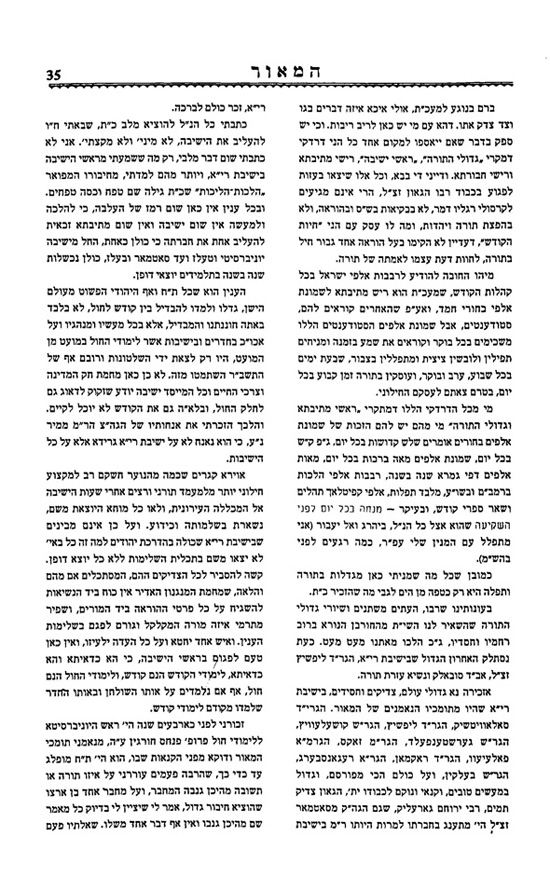
Imagine my surprise when after sending Amsel a letter on the topic he published his response in his journal (Jan.-Feb., 1993). Here it is.

I sent him a second letter which he published, together with his response, in the March-April 1993 issue. Notice how he subtly mocks me at the beginning of this reply.


I didn’t take offense at the mocking as this was classic Amsel. Few had such a sharp pen as he, and woe to those he turned it against. To give one example of his many polemics, readers of the journal will never forget how he targeted R. Elya Svei. Yet he wouldn’t mention him by name. Instead, and as a way to show how little he thought of Svei, he referred to him as “the melamed in Philadelphia.”[12]

The March-April 1993 issue of Ha-Maor, in which he responded to me, is of broader interest for another reason. It contains his hesped for R. Joseph B. Soloveitchik, who had recently passed away. In this hesped he mentions a few things, among them that the Rav told him that he wasn’t really a Zionist, and that while Yeshivat R. Yitzhak Elhanan was not in accord with his family’s philosophy, nevertheless he taught there as it provided intellectual freedom.

In the next issue (June-July, 1993), Amsel printed a letter he received from R. Norman Lamm, thanking Amsel for what he wrote about the Rav, and also criticizing him for mentioning the point about the Rav not feeling connected to RIETS. Note how Lamm specifically asked Amsel not to publish his letter, and Amsel published it anyway.

Also, look at the first paragraph on p. 35, as it shows how the Hungarian extremist Amsel was happy to point out how Lamm was head and shoulders above those in the Lithuanian yeshiva world. (I wonder, where did Amsel get the crazy figure of eight thousand students, that he mentions in the second paragraph? Even if you include the post-graduate schools you won’t get to that number. Did Amsel even realize that non-Jews attend Yeshiva University’s medical and law schools?)


* * *

In my original post on Adon Olam I dealt with Artscroll, so here is as good a time as any for some assorted Artscroll comments.

The custom on Rosh ha-Shanah is to sound additional shofar blasts towards the end of the morning prayers. Most sound these blasts after Musaf of Rosh ha-Shanah, while some sound thirty of them during the silent Amidah. There is no talmudic source for this practice. Why then do we do it? Here is how the Artscroll Machzor explains the matter, citing Eliyahu Kitov’s Sefer ha-Toda’ah as the source:

The source of this custom is the Scriptural narrative of the triumph of Deborah the Prophetess over Sisera, the Canaanite conqueror. In her song of gratitude for the victory, Deborah noted that Sisera’s mother whimpered as she worried over the fate of her dead son. Her friends comforted her that he had surely won a great victory and was apportioning spoils and captive women among his officers and troops (Judges 5:28-30). According to the Midrashic tradition she whimpered and groaned 101 times. Although one cannot help but feel sympathy for a worrying, grieving mother, one must be appalled at the cruelty of a mother who could be calmed by the assurance that her son was busy looting and persecuting innocent victims. The Jewish concept of mercy is diametrically opposed to such barbarism. By sounding the shofar one hundred times, we seek to nullify the forces of cruelty exemplified by Sisera and his mother, and bring God’s compassion upon us. Although she whimpered one time more than a hundred, we do not sound the shofar 101 times, because we, too, feel the pain of a mother who loses a child, even one as loathsome as Sisera.

The first thing to note is that for some reason, the explanation offered by the Taz is ignored. According to the Taz, the reason for the extra blasts is because people might not have properly heard the earlier kolot (Orah Hayyim 596:1). Furthermore, despite what is written, there is no source that speaks of Sisera’s mother whimpering 101 times. What we have is a story in the Arukh s.v. ערב , about Sisera’s mother (אימיה דסיסרא) and her one hundred cries or laments (פועיות This does not mean whimpers! The Arukh cites the story as coming from the Jerusalem Talmud. It is lacking in our versions of the Talmud, but the term “Yerushalmi” was also used for various Midrashim written in the Land of Israel.)

Ashkenazim, therefore, indeed sound the shofar the same amount of times as Sisera’s mother’s cries. Yemenites and Sephardim, on the other hand, blow an extra kol at the end, called Teruah Gedolah,[13] so they actually sound 101 blasts. Many explain that they do this precisely in order to be different than Sisera’s mother.

Here for example is what R. Ovadiah Yosef states, Shiurei Maran ha-Rishon le-Tziyon (Jerusalem, 2008), vol. 1, p. 75:

והנה אם סיסרא פעתה ובכתה מאה בכיות, ואנו תוקעים מאה תקיעות ועוד אחד, כדי לבטל הקטרוגים הנמשכים מהבכיות שלה . . . וזהו “הן אתם מאין ופעלם מאפע.” “מאין” = 101 הן ה100 פעיות של אם סיסרא שבמאה ואחת תקיעות שלנו ה’ מכפר לנו, ומתקנים אנו את הפעיות [“אפע” נוט’ פעיות אם] של אם סיסרא.

The Arukh’s explanation is quoted in a number of medieval sources, Yet what is the logic here? Why would anyone have thought of connecting Sisera’s mother’s cries with how many shofar blasts we sound, as they have nothing to do with each other? Is it really possible that how we blow the shofar has anything to do with what the mother of the wicked Sisera did?

It has been suggested by R. Hayyim Yehudah Ehrenreich[14] and R. Menachem M. Kasher[15] that there is a copyist’s error in the Arukh, and instead of reading it should read אמנו שרה , or something along these lines. This suggestion is made based upon the following passage in Pirkei de-Rabbi Eliezer ch. 32:

When Abraham returned from Mount Moriah in peace, the anger of Samael [Satan] was kindled, for he saw that the desire of his heart to frustrate the offering of our father Abraham had not been realized. What did he do? He went and said to Sarah: “Hast thou not heard what has happened in this world?” She said to him: “No.” He said to her: “Thy husband, Abraham has taken thy son Isaac and slain him and offered him up as a burnt offering upon the altar.” She began to weep and to cry aloud three times corresponding to the three Tekiot, three howlings corresponding to the Teruot. and her soul fled, and she died.

In this text we have a connection made between the cries of Sarah and the blowing of the shofar. Here it states that she cried three times corresponding to the Tekiah and three times corresponding to Teruah. (What we call Shevarim is one possibility for how the Teruah should be sounded.) Alternate versions have Sarah crying aloud six times or ninety times.

We still have the problem: How did the name Sarah become confused with Sisera? It turns out that there is indeed a connection between the mother of Sisera and the shofar. Rosh ha-Shanah 33b states:

The length of the Teruah is equal to the length of three yevavot. But it has been taught that the length of the Teruah is equal to three Shevarim. Abaye said: Here there is really a difference of opinion. It is written, It shall be a day of Teruah unto you [Num. 29:1], and we translate [in Aramaic], a day of yabava, and it is written of the mother of Sisera, Through the window she looked forth [va-teyabav; Judges 5:28]. One authority thought that this means drawing a long sigh, and the other that it means uttering short piercing cries.

We see from here that the Sages, in attempting to figure out how the Teruah should be sounded, looked for evidence in a biblical passage dealing with Sisera’s mother. Since she is thus connected to the Shofar blowing, it is not hard to see how the other passage, which describes how Sarah cried, could have morphed into Sisera’s mother.

The problem with this suggestion, one must acknowledge, is that we have no evidence of a text that has Sarah crying one hundred times. Yet it is certainly possible that this tradition did exist, and is now lost.

Here are some more comments about Artscroll. In the original post I mentioned how in the Artscroll Siddur, p. 870, it mistakenly places R. Elaazar Kalir in the second century. R. Avrohom Lieberman pointed out to me that in the original edition of this Siddur they placed Kalir centuries later. Here is a copy of the page.

The change was obviously made in response to criticism. Yet they should have stuck with the original version, since what appears in the “corrected” edition is mistaken. I assume that Artscroll knows it is mistaken, but leaves it in anyway so as not to antagonize its critics.

Before Lekhah Dodi the Artscroll Siddur writes: “לכה דודי is recited responsively. In most congregations, the chazzan repeats each verse after the congregation. In others the procedure is reversed.” More Artscroll siddurim are sold to Modern Orthodox synagogues than to anywhere else. This is especially the case due to the RCA version of the siddur. So wouldn’t one expect that the instructions would reflect reality? In my entire life I don’t think that I have ever been in a Modern Orthodox synagogue that recites Lekhah Dodi responsively. While in the previous post I wrote how the Artscroll instructions have changed how Modern Orthodox synagogues recite Hallel, as far as I know no synagogue has given up the practice of communal singing for Lekhah Dodi because of this particular instruction. As it stands, this particular instruction is a sign of how little Artscroll respects the customs of the Modern Orthodox world.

Also on Friday night, the Siddur states that each stanza of Shalom Aleikhem is recited three times. Why not mention that there is also a common practice to only recite each stanza one time?

In the Machzor for Sukkot, p. 132, in discussing the different practices when it comes to wearing tefillin on hol ha-moed, it states: “It is not proper for a congregation to follow contradictory customs. Thus, if one whose custom is not to wear tefillin during Chol haMoed prays with a tefillin-wearing minyan, he should don tefillin without a blessing. Conversely, if one whose custom is to wear tefillin prays with a non-tefillin-wearing minyan, he should not wear his tefillin while praying but may don them at home before going to the synagogue.” The source for this ruling is the Mishnah Berurah. Yet with the exception of hasidic synagogues, where I presume everyone does the same thing, this ruling is no longer applicable. In all the synagogues I have ever been in, both Modern Orthodox and non-hasidic haredi, there is no one minhag and everyone does what his family practice is. In other words, the minhag today is for everyone to follow his own personal minhag, and shuls do not have a “custom” in this regard.

Also in the Sukkot Machzor, p. 957 (as well as in the other Machzors), it writes as follows: “It is virtually a universal custom that those whose parents are still living leave the synagogue during Yizkor. This is done to avoid the ‘evil eye,’ i.e., the resentment that might be felt by those without parents toward those whose parents are still living.” Can one conclude from this that Artscroll has a Maimonidean approach to the concept of the “evil eye”?

Quiz

In past posts I have offered a quiz and given out prizes to the ones who answered the questions. People have wondered why I stopped doing this. The answer is simple: I didn’t have anything to give out. But now I have a few items so I can do some more quizzes. For the winner of this one I can give a CD of the music of R. Baruch Myers, rav of Bratislava. Rabbi Myers is a trained classical musician and his music is very different from what you think of when you think hasidic music. Unlike in the past, I will not give the prize to the one who answers the question first. This is unfair as due to the different time zones, some people won’t see the question until it has already been answered. I will give people a couple days and if more than one has answered correctly, I will randomly choose a winner. You will also have to answer two questions, in different genres. Yet even if you only know the answer to one, send it in, for if no one gets both answers, I will give it to a person who got one correct. Send answers to shapirom2 at scranton.edu

Question 1: The word for turkey is תרנגול הדו There is a dagesh in the dalet. Why? Bring a proof for your answer from Berakhot between page 34a and 38a.

Question 2: There is a rabbinic phrase that today is used to praise a Torah scholar, but in talmudic days was used in a negative fashion (at least according to Rashi). What am I referring to?

* * * *

Some people have asked me if I am leading a Jewish history trip to Europe this summer. Actually, I am leading two trips, one to Italy and the other to Central Europe. (The latter is a repeat of the sold-out trip from last summer). Both trips are sponsored by Torah in Motion and details will be available soon.


* * * *

Here is something I think readers will enjoy. It is a picture from Prof. Isadore (Yitzchak) Twersky’s wedding. I thank R. Aharon Rakefet for sharing the picture. According to R. Rakefet, the man second to the left, whose face is obscured by an unknown rabbi, is R. Zev Gold. (R. Rakefet claims that the hair gives it away.) Beginning with Gold, we find Dean Samuel Sar, Isadore Twersky (standing) R. Dovid Lifshitz, R. Eliezer Silver, the Rav, R. Chaim Heller, R. Meshullam Zusia Twersky, Tolner Rebbe of Boston, R. Moshe Zvi Twersky, Tolner Rebbe of Philadelphia.

[1] Authorized Daily Prayer Book, p. 790.

[2] This identification has recently been advocated by Christopher W. Mitchell in his massive work, The Song of Songs (St. Louis, 2003), pp. 130ff.

[3] Medieval commentators, notably Ibn Ezra, put a great deal of effort into explaining the peshat. See also the medieval commentary on Song of Songs written by R. Joseph Ibn Aknin, entitled Hitgalut ha-Sodot ve-Hofa’at ha-Meorot (Jerusalem, 1964). Ibn Aknin provides a three part commentary, with one section focused on peshat, and the other two on derash and sod. From more recent times, see R. Samuel Naftali Hirsch Epstein, Imrei Shefer (Vilna, 1873), and R. Eliyahu Halfon Shir ha-Shirim im Perush Ateret Shlomo (Nof Ayalon, 2003).
[4] “Shir ha-Shirim” Kedushatah shel ha-Megilah u-Farshanutah,” Sinai 100 (1987), p. 475.
[5] Soncino explains: “The comparison is between the well-proportioned nose and the beautiful projecting tower.”
[6] This point was made by R. Isaac Jacob Reines. See R. Judah Leib Maimon, ed., Sefer Rashi (Jerusalem, 1956), vol. 2, pp. 12-13. See also Rashi to Song of Songs 1:2 “Let him kiss me with the kisses of his mouth.” Rashi comments: “In some places they kiss on the back of the hand or on the shoulder, but I desire and wish that he behave toward me as he behaved toward me originally, like a bridegroom with a bride, mouth to mouth.” Artscroll does not mention this Rashi. The Vilna Gaon has an interesting comment on this verse. He notes the plural “kisses,” and explains: כמו שנושק הבעל לחשוקתו א’ על מה שמתחברת עמו והב’ על שאינה מתחברת באחר
[7] Perush Shir ha-Shirim (Jerusalem, 1971), p. 11.
[8] See also Ibn Ezra’s introduction to Song of Songs: וחלילה חלילה להיות שיר השירים בדברי חשק Despite saying this, he still feels it is important to explain the peshat.
[9] See also Rav Pealim, vol. 4, Sod Yesharim no. 11, where R. Joseph Hayyim explains why God’s name does not appear in the Song of Songs.
[10] Since we are speaking of love, I should also mention Elhanan Reiner’s provocative claim, put forward in very stylistic Hebrew, that R. Yair Haim Bachrach’s responsum, Havot Yair, no. 60, is not a real case, but simply a fictional love story that Bacharach inserted into his responsa. See here. For Raphael Binyamin Posen’s response see here, and Reiner responds to Posen here.
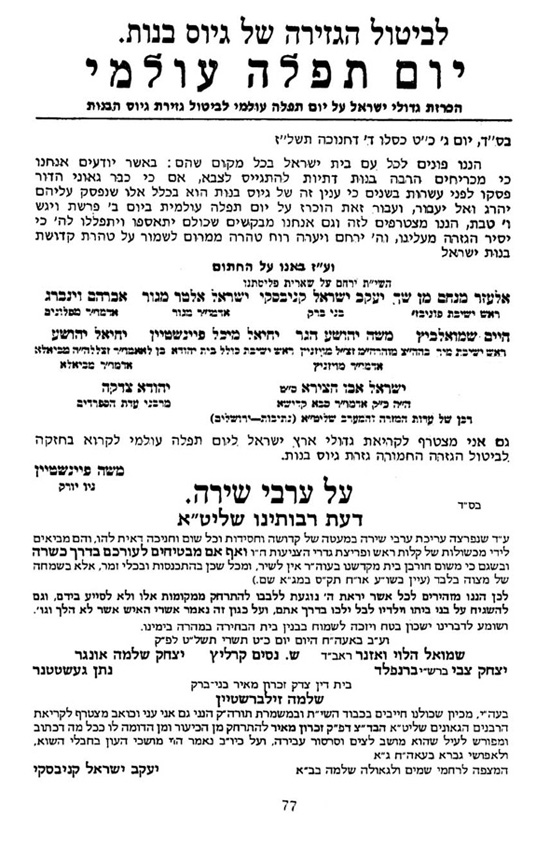
[11] Incidentally, the opposition of haredi gedolim to these concerts is often portrayed as if the only issue is tzeniut, and therefore, when men and women sit separately there should be no problem. This is a complete distortion of the issue, for even without tzeniut concerns, the main reason for the opposition, and I know this will be hard for American haredim to stomach, is that the Israeli haredi gedolim are opposed to all musical entertainment, and “fun” in general, when not connected to simchah shel mitzvah, such as Purim, a wedding, etc. Concerts are doubly problematic since these gedolim believe that is forbidden to listen to live music when not connected to a seudat mitzvah. Here is one proclamation that makes this clear (from Hashkafatenu [Bnei Brak, 1985], p. 77).

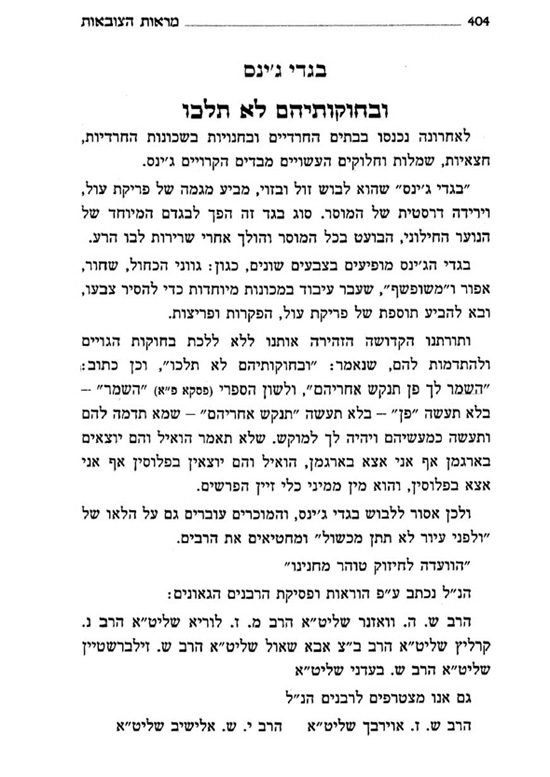
In R. Yaakov Yisrael Lugasi’s Mar’ot ha-Tzovaot (Jerusalem, 2009), p. 401, he states flatly: “The entire concept of entertainment is pasul. This is a condition of moshav leitzim and throwing off the yoke, and is the culture of the non-Jews and the secularists.” Interestingly, a few pages after this, Lugasi prints the herem against wearing jeans skirts. For those who never saw it, here it is.

[12] It is no secret that R. Svei was a polarizing figure in Orthodoxy, even in haredi circles. This is also seen in the book on R. Ahron Soloveitchik written by his son, R. Yosef. It was uploaded to the internet a few weeks ago and until recently was found here. Since many people downloaded the book when it was up, I think it is worthwhile to make some comments about it. I understand that it is a preliminary version of what will be published in book form. I hope the author takes the necessary time to revise it properly, because as it stands, it is an unfortunate publication. On the positive side, it includes a great deal of Torah from R. Ahron, and shows his strong insistence on honesty when it comes to dealing with non-Jews and the government. There are also wonderful tidbits of historical interest. See p. 5 that R. Baruch Ber Leibowitz used to stand up for R. Ahron when he was a child, since he was, after all, the grandson of the Rebbe (R. Hayyim).

See also p. 404 for the following incredible statement: “Rav Ahron told his son that it is not right to print his brother’s דרשה of יוסף ואחיו about the Mizrachi because his brother regretted saying this דרשה ” This is perhaps the most important derashah the Rav ever delivered and is a basic text of study for religious Zionists. It explains how the Rav could break from his family tradition and become a Zionist. It is also the derashah that R. Shakh attacked, saying that it contained דברים שאסור לשומען וכש”כ להפיצן ברבים (Mikhtavim u-Ma’amarim, vol. 4, no. 320). What are we to make of R. Ahron stating that the Rav regretted this derashah?

Among other passages that caught my eye, see e.g., p. 6, where R. Ahron tells a bubba maisah about a rabbi in Auschwitz who killed some twenty Nazis with a chair. On p. 327 R. Ahron claims that Bible Criticism “paved the road for the Nazi ideology.” On this page he also states that Catholics do not support Bible Criticism. This is incorrect. The Catholic Church accepts Bible Criticism and does not see this as harming the holiness of the Bible. In fact, there are only two religious groups that do not accept the academic approach to the Bible, namely, Christian fundamentalists and (most) Orthodox Jews. (In a future post I will explain why I use the word “most”.

Why do I say that this is an unfortunate publication? Because there is a way to write and a way not to write, and someone who is very upset about how his father was treated is not the best person to review important incidents in his life. I can’t see how anyone could believe that the book brings honor to R. Ahron. I am impressed, however, that despite the harshly polemical tone, the author included documents directed against R. Ahron, as this helps with the historical record.

I have to say that after reading the publication, I think I have a better understanding of why R. Ahron had so many difficulties. In order to be a successful leader, one must, at times, be willing to compromise. One must also recognize when the time for battle is over. R. Ahron was so guided by the truth as he saw it, that he appears to have been unable to do this. For him, it was worth fighting a battle to make a point, even if there was no chance of emerging victorious and it would cost lots of money to do so. (I refer to his attempt to cancel the sale of the Chicago Mizrachi building to Buddhists.)

When publishing the letter of the other faculty members of Hebrew Theological College stating that they do not want R. Ahron in a leadership position, the author would have been wise to explain the different perspectives of the protaganists, rather than heaping abuse on them. The same is true when it comes to how he describes the haredim. There is no question that many of his complaints are justified. This is especially the case when he deals with the support given by the haredi gedolim to Elior Chen, which makes everything else pale in comparison. Yet despite this, the language Soloveichik uses in is really over the top.

I also can’t imagine that the family of the Rav will be happy to see how he too makes appearances in the book. Is it really appropriate to quote the Rav’s harsh comment against a certain Agudah leader? And I have a more fundamental question with regard to this last example. When two people agree to take their dispute to a beit din, not a government beit din but a private beit din, don’t they have an expectation of confidentiality? This is especially the case when one of the disputants is still alive. What gives the author the right to reveal the content of a private dispute brought before a private beit din, even if one of the participants did act in a disgraceful manner?

Apropos of R. Ahron, let me mention two things he told me so as to preserve them for posterity.

1. He stated that because of what R. Moshe Stern wrote about the Rav, one should not quote Stern in halakhic discourse. In truth, as I later learnt, it is not so clear that Stern’s harsh comments (pigul, metuav) are about the Rav. It is possible that he is referring to teaching and study at Yeshiva University. (See David Berger in Tradition 27 [Winter 1993], p. 94.) I will let readers judge for themselves. The text appears in Be’er Moshe, vol. 8, no. 3.

2. R. Ahron told me, halakhah le-ma’aseh, that if you have food in the oven when Shabbat starts, that this food can be returned to the oven on Shabbat morning in order to heat it up. I have heard that the Rav gave the same pesak to NCSY, but I have not confirmed this.

[13] See Shulhan Arukh, Orah Hayyim 596:1; Sefer Zikaron Divrei Shelom Hakhamim (Jerusalem, 2003), p. 264.
[14] Otzar ha-Hayyim, Tevet 5695, pp. 87-88.
[15] Ner Maaravi 2 (1925), pp. 227-228; Divrei Menahem, vol. 4, no. 13.


Computer Confirmation of “P” – A Biblicist’s Perspective

Computer Confirmation of “P” – A Biblicist’s Perspective By Joshua Berman

Joshua Berman is a lecturer in Tanach at Bar-Ilan University and an associate fellow at the Shalem Center. His most recent book, Created Equal: How the Bible Broke with Ancient Political Thought (Oxford, 2008) was a National Jewish Book Award Finalist in Scholarship in 2008.

Prof. Moshe Koppel—a revered friend and senior colleague—has produced what is for me as a biblicist is a fascinating and exciting study.[1] His demonstrated capacity to tease apart books like Jeremiah and Ezekiel when their verses are randomly shuffled will find good application, I am sure, within the field of biblical studies. At the conclusion of that study, Koppel and his team report that they applied their methodology to the Torah, and that their split of its verses “corresponds to the expert consensus regarding P and non-P for over 90% of the verses in the Pentateuch for which such consensus exists.” The claim has generated much theological debate. In this post, however, I wish to respond to these findings solely within the terms and assumptions found within the discipline of biblical studies itself. The findings produced by Prof. Koppel’s team constitute an academic, scientific claim and deserve to be addressed in kind. I wish to extend my heartfelt appreciation to Prof. Koppel for sharing his data with me, and for elucidating many points for me in subsequent exchanges between us. For two primary reasons, I conclude that the findings are of little consequence for Pentateuch studies, and to the extent that they are of consequence they suggest a different significance than that reported in his initial article. The Koppel team’s compelling work, teasing apart books such as Jeremiah and Ezekiel, does not, in its present form, provide sufficient basis for an analysis of the Torah. Here’s why: Jeremiah and Ezekiel are two whole, integral works. Buoyed by the success of separating two books Koppel’s team split the verses of the Torah into two “authorial categories,” one of which seems to have affinity with the set of verses source-critical scholars refer to as the priestly source of the Pentateuch. The other authorial category, however, “Non-P” is not a single, integral, distinct book. Source critics (again, I am constructing an argument here that would be valid within the field of biblical studies) are unanimous that the non-priestly material in the Pentateuch is an amalgam of many other sources. It is more difficult to separate a single integral book from an amalgam of many different works than it is to separate one integral work from another. Put differently, an alternative experiment needs to be carried out utilizing other biblical books, before these data about the Torah can be statistically validated. Prof. Koppel and team would need to take, say, all of Jeremiah, and shuffle it with smatterings of verses from several other books, and successfully retrieve the verses from Jeremiah. I am clueless about computational linguistics, and so I shared this intuition with Prof. Koppel. He confirmed for me that the experiments carried out separating whole integral books can only offer a “weak-indicator” for the case of the texts of the Torah. But let’s give that weak-indicator the benefit of the doubt, or let’s assume that those experiments have been successfully executed, extracting Jeremiah, say, from an amalgam of other texts. What do the data in hand about the Torah suggest? I would propose that the significance is rather different than that which has been reported. To appreciate the data, however, requires a brief whirlwind tour of the history of source criticism of the Pentateuch, particularly of developments of the last twenty years. Classical source-criticism does not merely claim that the first four books of the Torah may be divided into three sources, J, E and P. It claims that each of these three sources were originally complete histories of Israel, from Creation until the time of Moses. There was a time—in the early twentieth century—that the comprehensive theories of the great minds were considered to be the final word on the subject. Einstein, it was believed, had given us the final word on physics, Freud on psychology. In the world of biblical studies, it was Wellhausen who was believed to have given us the final word on the origins of the Pentateuch with his source-critical account. But in the last generation many scholars have walked away from the table of source-criticism. For some, source-criticism proved too unruly; scholars seemed never to agree on the criteria necessary to split the putative sources. Others found source-criticism disappointing on the level of content: the sources did not seem to produce clear, consistent and differentiated theological agendas. Others found that many of the so-called indicators of multiple authorship could better be explained by recognizing the literary techniques at work in these texts as coherent wholes. For others—and this is significant—the inconsistencies in the text are best understood as individuated issues. There were indeed two flood stories in ancient Israel, they would say, but why assign these to larger strands or sources?[2] Koppel and his team use the work of Richard Elliot Friedman, Who Wrote the Bible? as a baseline to identify the Priestly source. They chose that work because Friedman—like Driver before him—schematically assigns each and every verse of the Torah to one of the four classical sources. Friedman’s work—written in 1987—is still quoted in some circles. But it cannot be said to be the universally accepted gospel on the Torah within the field of biblical studies. It is telling that since Friedman no scholar of any note has deigned to offer (let alone defend) a schematic accounting of all the verses of P, much less the whole Pentateuch. This speaks volumes to the methodological malaise currently afflicting Pentateuch studies in the academy. Unable to find a common methodological language, biblicists themselves now inhabit a post-Babel world. Does this mean that there are no source-scholars left in the 21st Century? Does it mean that there is no consensus about anything pertaining to source-criticism within the academy? Hardly. Concerning biblical law, such consensus exists. Nearly all biblicists, for example, will happily identify legal sections pertaining to the cult as deriving from a source called P. Where there is far less consensus is in the area of narrative. It is true that those that engage in source-criticism of Pentateuchal narrative find a common language and accord on many passages in identifying them as P narratives. But they are a dwindling breed. For the vast majority of scholars working today, the determination that the laws of Leviticus should be ascribed to a source called P is an infinitely easier call than is the ascription to P of the account of Shimon and Levi in Shechem. It’s not that they’re convinced that the story should be ascribed to another source. Nor would they rule out the possibility that perhaps that account was penned by the author of a P source. The hesitation comes from misgivings about the entire enterprise of viewing Torah narratives as derived from distinct, continuous sources that each detailed the history of Israel. Now let’s go to the data. In many instances, verses that source-critics assign to a source other than P, the Koppel team’s program, likewise, assigns to the category “Non-P. ” At the same time, it is important to note that the program also fails to positively confirm what source critics see as priestly material. Here we come to the main point: in the genre of law, the program does a very good job of correlating with the sections that critics see as priestly law. These, not surprisingly, tend to be cultic law. In the genre of narrative, however, a very different story emerges. Of 253 verses in Genesis that source-critics identify as “priestly”, the program could only confirm 38 of them (15%). In Exodus the discrepancy is even greater, and the program confirms 5 out of 80 (6%) priestly narrative verses. In Numbers, the correlation is much higher, but overall, the program’s results correlate with the so-called priestly narrative less than half the time. Does this suggest a “flaw” in the Koppel team’s program? Not at all. Rather, it confirms the suspicions of a very large number of biblicists: the notion of priestly narrative in the Pentateuch is on much shakier ground than is the notion of priestly law. Finally, moving away from the Koppel team’s stimulating findings, I’d like to address an issue that hovers over the entire discussion and that is the definition of an “author” and the highly anachronistic use we make of that term, especially when analyzing ancient sources. It’s a good thing that Rashi wrote in the eleventh century, because had he come out with his commentary to the Torah today, he would likely be assailed in some quarters as a plagiarizer. In many instances, Rashi attributes the midrashim he cites. But in many other instances he simply borrows entire sentences from chaza”l and presents them in his own voice. Only the discerning disciple will note that Rashi, has, in fact, lifted entire sentences from an earlier source, without attribution. Of course, Rabban Shel Yisrael was no plagiarizer. Rather, Rashi, like many medieval and ancient writers before was writing in a world where old was good. The mark of a good writer was someone who appropriately saw himself as a member of a long and venerated tradition. Good writing was precisely writing that imitated earlier style—nay, sometimes a variety of styles–and in many cases, directly lifted and borrowed whole passages.[3] The same was true in ancient contexts as well. You’d think that to ask, “Who wrote the Code of Hammurabi?” is akin to asking, “Who’s buried in Grant’s Tomb?” But it isn’t. The issue is not simply that it was Hammurabi’s scribes who actually penned that classic, and not the Babylonian king himself. It’s that we now know that those scribes invoked a number of sanctioned styles in their composition, and lifted phrases from prior works.[4] The composition is unitary because a single agent—Hammurabi and his scribes—published this composition as something to be read as such. Ancient readers may, no doubt, have noticed the unevenness of its style. But they would have seen that as the mark of a great work, produced within a venerable tradition, in which writing routinely draws from a variety of canonical and classical works. Its status derived not from the fact that it was the original composition of a single author, but that it was produced by a single authority. Readers of the Code would never have even thought to ask whether every sentence originated with Hammurabi himself. But the fact that it was under his authority that multiple styles were brought together is what made it a great work. Many other classics of the ancient world, such as the Epic of Gilgamesh likewise exhibit a plurality of styles. This is how many of the great works of the ancient world looked.[5] In defense against the claims of higher biblical criticism, the faithful often counter that divine writing is different than human writing, for the Almighty speaks in several styles and voices. This dichotomy, whereby God alone can speak in many styles, but humans must exhibit consistency, is a false one. It is human writing, too, in the premodern, and especially ancient world, that expresses itself in a variety of styles. In his commentary to the beginning of parashat Pekudei, the Ralbag questions why the Torah repeats the parshiyot of the Mishkan, in a manner that seems overly repetitious. He concludes that what appears to us as repetitious and hence, unseemly, may not have been the case in an earlier age: ואפשר שנאמר שכבר היה מנהג האנשים ההם בזמן מתן תורה שיהיו סיפוריהם בזה האופן. והנביא אמנם ידבר לפי מנהג. We may say that it was the norm at the time of Matan Torah that compositions were crafted in this fashion, and that the prophet speaks in the style of the times. It may well be that divine writing expresses itself in multiple styles. But if the Almighty has indeed done so in the Torah, then He has done so, לפי המנהג – according to literary tastes that may seem grating to modern notions of authorship, but were entirely keeping with ancient sensitivities.

[1] See Moshe Koppel, Navot Akiva, Idan Dershowitz and Nachum Dershowitz, “Unsupervised Decomposition of a Document into Authorial Components” (link).
[2] On the waning interest in Pentateuchal source criticism within biblical studies, see Rolf Rendtorff, “What Happened to the “Yahwist”?: Reflections after Thirty Years” (http://www.sbl-site.org/publications/article.aspx?articleId=553) and David Clines, “Response to Rolf Rendtorff’s “What Happened to the Yahwist? Reflections after Thirty Years” (link).
[3] See A. J. Minnis. Medieval Theory of Authorship; Scholastic Literary Attitudes in the Later Middle Ages (London: Scholar Press, 1984).
[4] Victor Avigdor Hurowitz, Inu Anum sirum : Literary Structures in the Non-juridical Sections of Codex Hammurabi (Philadelphia: University Museum, 1994).
[5] See David M. Carr, Writing on the Tablet of the Heart. Origins of Scripture and Literature (New York: Oxford University Press, 2005); Karel Van Der Toorn, Scribal Culture and the Making of the Hebrew Bible (Cambridge: Harvard University Press, 2007).


The Date of the Exodus: A Guide to the Orthodox Perplexed

The Date of the Exodus: A Guide to the Orthodox Perplexed [1] by Mitchell First

A pdf of this post can be downloaded here, or viewed here.

The Exodus is arguably the fundamental event of our religion. The Sabbath is premised upon it, as are many of the other commandments and holidays. Yet if one would ask a typical observant Jew “in what century did this Exodus occur?,” most would respond with a puzzled look. The purpose of this article is to rectify this situation. Admittedly, the date of the Exodus and the identity of the relevant Pharaoh are difficult questions. The name of the Pharaoh is not provided in the Bible. One scholar has remarked:[2]

The absence of the pharaoh’s name may ultimately be for theological reasons. The Bible is not trying to answer the question “who is the pharaoh of the exodus” to satisfy the curiosity of modern historians. Rather, it was seeking to clarify for Israel who was the God of the exodus.[3]

Nevertheless, there have been some important developments in recent decades which warrant this post. Part I: The Date of the Building of Solomon’s Temple According to 1 Kings 6:1, 480 years elapsed from the Exodus to the building of the First Temple in the 4th year of the reign of Solomon.[4] This suggests that a first step towards dating the Exodus would be obtaining the BCE date for the building of the First Temple.[5] When books published by ArtScroll and other traditional Orthodox publishers provide a date for the building of the First Temple, the date they provide will usually be around 831 BCE.[6] Unfortunately, this date is far off. The date for the building is approximately 966 BCE. Why is there such a discrepancy? ArtScroll and the other traditional Orthodox publishers will provide a date around 831 BCE because that is the date for the building of the First Temple that is implied from rabbinic chronology. 831 BCE is the date that is arrived at after subtracting from 70 CE: 1) the 420 years which rabbinic chronology assigns to the Second Temple period, 2) the 70 years between the Temples, and 3) the 410 years which rabbinic chronology assigns to the First Temple period.[7] (In this calculation, one arrives at 831 BCE and not 830 BCE, because there is no year zero between 1 BCE and 1 CE.) But there are two problems with this calculation: 1. The Second Temple period spanned 589 years, not 420 years. I have addressed this extensively in my book, Jewish History in Conflict (1997), and will only touch upon it briefly here: The Tanach does not span the entire Persian period, which lasted about 207 years (539-332 BCE). Only some of the kings from the Persian period are included in Tanach.[8] The rabbinic figure of 420 years for the length of the Second Temple period probably originates with R. Yose b. Halafta of the 2nd century C.E., who was the author or final editor of Seder Olam.[9] When R. Yose had to establish a length for the Second Temple period, he did not have complete information. In assigning a length, he decided to utilize a prediction found at Daniel 9:24-27. Here, there is a prediction regarding a 490 year period, but the terminii of this 490 year period are unclear. For a variety of reasons, R. Yose decided to interpret the 490 year period as running from the destruction of the First Temple to the destruction of the Second Temple. After subtracting 70 years for the period between the Temples, he was left with only 420 years to assign to the Second Temple period. This forced him to present a chronology with a shorter Persian period than he otherwise would have.[10] (Even so, he probably did not believe that the Persian period spanned anything close to two centuries.) 2. The First Temple period spanned approximately 380 years (c. 966-586 BCE), not 410 years. The First Temple was destroyed in 586 BCE[11] (and not 421 BCE, as implied by rabbinic chronology). It was built in the 4th year of Solomon. The BCE dates for the reigns of Solomon and the other First Temple period kings can be calculated because of the interactions between some of our kings and some of the Egyptian and Assyrian kings.[12] For example, the Tanach tells us (I Kings 14:25) that king Shoshenk (=Shishak) of Egypt invaded Jerusalem in the 5th year of Rehavam. Based on Egyptian sources, this invasion can be dated to 926 or 925 BCE. Assuming we (arbitrarily) utilize the 925 BCE date and assuming that Rehavam followed an accession-year dating system,[13] this means that the year Rehavam acceeded to the throne (=the year Solomon died), would have been approximately 930 BCE. Solomon ruled into his 40th year (I Kings 11:42 and II Ch. 9:30) This means that the fourth year of his reign would have been approximately 966 BCE.[14] The Tanach nowhere states that the First Temple period spanned 410 years. If one totals the reigns of the individual kings of Judah during the First Temple period, and adds the last 37 years of the reign of Solomon, one obtains a figure of approximately 430 years.[15] The origin of the 410 year figure is somewhat of a mystery.[16] The large 430 year total is probably due to cases of co-regencies of father and son, or cases where the son ruled while the father was still alive but not functionally reigning. In these cases, the Tanach has sometimes provided the full amount of years that each king reigned, even if only nominally, despite the overlap.[17] —- Once we realize that the First Temple was built in approximately the year 966 BCE, we can date the Exodus, based on I Kings 6:1, to approximately the year 1446 BCE.[18] If so, Thutmose III (1479-1425) would be the Pharaoh of the Exodus.[19] Part II. Must We Accept the 480 Year Figure Found at I Kings 6:1?[20] Two separate questions are implied here: 1. Are we, as Orthodox Jews, required to accept this figure found in the book of Kings? 2. What evidence supports and contradicts this figure? I am not going to address the first question. This kind of question has been discussed elsewhere.[21] (My book includes much discussion of whether Orthodox Jews are required to accept the 420 year tradition for the length of the Second Temple period. But admittedly that is a different issue, because only a rabbinic tradition is involved.) As to the second question, the 480 year figure is roughly consistent with a 300 year figure utilized by Yiftah, one of the later Judges, in a message he sends to the king of Ammon (Judges 11:26):

While Israel dwelt in Heshbon and its towns, and in Aror and its towns, and in all the cities that are along by the side of the Arnon, three hundred years, why did you not recover them within that time?

But what happens when we compare the 480 figure with the data found in the books of Joshua, Judges and Samuel? The specific years mentioned in the book of Judges (8, 40, 18, 80, 20, 40, 7, 40, 3, 23, 22, 18, 6, 7, 10, 8, 40, and 20) total 410.[22] To calculate the period from the Exodus to the 4th year of Solomon, one must add to this: -40 years for the desert wandering; -a length for the period the Israelites were led by Joshua, and after his death, by the elders; [23] -a length for the judgeship of Shamgar; -40 years for the judgeship of Eli (I Sam. 4:18);[24] -a length for the judgeship of Samuel;[25] -a reasonable length for the reign of Saul;[26] -40 years for the reign of David (II Sam. 5:4-5, I Kings 2:11); and – the first 3 years of Solomon. If one does this, one arrives at a sum greater than 480 for the period from the Exodus to the 4th year of Solomon. (But to the extent that some of the numbers in the book of Judges can be viewed as overlapping,[27] the discrepancy is reduced.) The 300 year figure utilized by Yiftah can be interpreted as only an approximation. More importantly, the context of the statement suggests that it was only an exaggeration, made with the intent of strengthening the Israelite claim to the land involved. As one scholar writes (exaggeratingly!):[28]

Brave fellow that he was, Jephthah was a roughneck, an outcast, and not exactly the kind of man who would scruple first to take a Ph.D. in local chronology at some ancient university of the Yarmuk before making strident claims to the Ammonite ruler. What we have is nothing more than the report of a brave but ignorant man’s bold bluster in favor of his people, not a mathematically precise chronological datum.

The 480 figure, in its context, does sound like it was meant to be taken literally.[29] But it has been argued that it was only a later estimate based on mistaken assumptions.[30] Moreover, we have no other evidence that the Israelites in the period of the Judges and up to the time of Solomon were keeping track of how many years it had been since the Exodus. There was a time when there was significant evidence in support of a 15th century BCE Exodus. For example: ° When Yeriho was excavated in the 1930s by John Garstang, he found a city wall that he estimated to have collapsed around 1400 BCE. He also excavated an area which was destroyed in part by fire, and dated this destruction to around 1400 BCE.[31] But Kathleen Kenyon, excavating two decades later, showed that the collapsed wall was from about 1000 years earlier,[32] and that the destruction and conflagration that Garstang had dated to 1400 BCE should in fact be dated to around 1550 BCE.[33] ° The volcanic eruption that occurred long ago on the Mediterranean island of Santorini[34] might explain most of the ten plagues and the parting of the yam suf.[35] This was the second largest eruption in the past four millenia, and there is no question that it had an impact as far away as Egypt.[36] This eruption had traditionally been dated to around 1500 BCE. But recent radiocarbon and other scientific dating now strongly suggest that this eruption took place in the middle or late 17th century BCE.[37] There is much circumstantial evidence against a 15th century BCE Exodus: ° The implication of the book of Exodus is that the Israelites, in the northeastern part of Egypt, were not far from the capital.[38] But in the period from 1550- 1295 BCE, the Egyptian capital was located in a region farther south, at Thebes.[39] It was only beginning with Seti I (1294-1279) that an area in the northeastern part of Egypt began functioning as the Egyptian capital, when Seti I built a palace there.[40] ° After the Six-Day War and additional areas came under Israel’s control, Israeli archaeologists were able to study much new territory that had been part of ancient Israel. Their studies show that the period that Israelite settlements began to appear in the land was the late 13th and early 12th centuries BCE, not the 15th and 14th centuries BCE.[41] ° Scores of Egyptian sources from 1500-1200 BCE have come to light that refer to places and groups in Canaan.[42] Yet there is no reference to Israel or to any of the tribes until the Merneptah Stele from the late 13th century BCE.[43] (The Merneptah Stele will be discussed below.) ° The Philistines appear as a major enemy of Israel during the period of the Judges,[44] appearing in chapters 3, 10 and 11 of the book of Judges.[45] But they only arrived in the land of Canaan around the 8th year of Ramesses III (=1177 BCE).[46] ° Egypt is never mentioned as one of the oppressors against whom Joshua or a leader in the book of Judges fought. This would be very strange for a conquest commencing around 1400 BCE. Egypt seemed to have exerted strong control over the land of Canaan at this time and for the next 200 years.[47] Part III. Most Likely, the Relevant Pharaohs are Ramesses II (1279-1213) and Merneptah[48] (1213-1203) We have already observed that, archaeologically, the period that Israelite settlements began to appear in the land is the late 13th and early 12th centuries BCE. This suggests that we should be looking in the 13th century BCE for our Pharaoh of the Exodus. Moreover, Exodus 1:11 tells us that the Israelites built store cities (arei miskenot) called Pitom andרעמסס .[49] Since the latter is an exact match to the name of a Pharaoh, this suggests that the Pharaoh who ordered this work (=the Pharaoh of the Oppression) bore this name. No Pharaoh bore this name until the 13th century BCE. The first to do so was Ramesses I. But he only reigned sixteen months (1295-94). Thereafter, after the reign of Seti I, Ramesses II reigned for over six decades. [50] Since Ramesses I only reigned sixteen months, while Ramesses II reigned over six decades, it is much more likely that the latter is the Pharaoh we should be focusing upon. Moreover, archaeology has shown that Ramesses II was responsible for building a vast city called Pi-Ramesse, which would have required vast amounts of laborers and brick.[51] Ramesses I, on the other hand, is not known to have built any cities.[52] Exodus 2:23 tells us that the Pharaoh of the Oppression died. If Ramesses II was the Pharoah of the Oppression, the Pharaoh of the Exodus would be his successor, Merneptah.[53] But there is problem with this scenario. The Stele of Merneptah,[54] dated to his 5th year, refers to “Israel”[55] as one of the entities in the region of Canaan that Merneptah boasts of having destroyed.[56] This implies that Israel was already a significant entity in the land at this time. The pertinent section of the Stele reads: [57]

The princes lie prostrate… Not one lifts his head among the Nine Bows.[58] Destruction for Tehenu! Hatti is pacified Cannan[59] is plundered with every evil Ashkelon is taken; Gezer is captured; Yanoam is made non-existent; Israel lies desolate; its seed[60] is no more; Hurru has become a widow for To-Meri; All the lands in their entirety are at peace…[61]

If the Exodus was followed by a 40 year period of wandering in the desert, and all of the Israelites entered Israel in the same stage, it would be impossible for Merneptah to have been the Pharaoh of the Exodus, since there was already an entity called Israel in the land of Canaan in the 5th year of his reign. Of course, one approach is to view Ramesses II as both the Pharaoh of the Oppression and the Pharaoh of the Exodus, and to treat verse 2:23 as an erroneous detail that somehow made its way into our official tradition. Obviously, we would like to avoid such an approach. Interestingly, there is a rabbinic view that treats the death mentioned at 2:23 euphemistically. According to this midrashic rabbinic view, verse 2:23 did not mean that the Pharaoh died; it only meant that he became leperous.[62] Identifying the Pharaoh of the Oppression with the Pharaoh of the Exodus is at least consistent with this rabbinic view.[63] A different solution is to postulate that some Israelites never went down to Egypt, and that these are the Israelites referred to by Merneptah. Although we are not used to thinking in this manner, there is perhaps some evidence in Tanach for such an approach.[64] Other solutions view the Israelites referred to by Merneptah as Israelites who left Egypt before the enslavement began, or who were enslaved but left Egypt in an earlier wave. Rabbi J. H. Hertz took the first of these approaches, and his comments (although written in the 1930’s) bear repeating: [65]

[If the reference in the Stele is to Israelites], then it refers to the settlements in Palestine by Israelites from Egypt before the Exodus… From various notices in I Chronicles[66] we see that, during the generations preceding the Oppression, the Israelites did not remain confined to Goshen or even to Egypt proper, but spread into the southern Palestinian territory, then under Egyptian control, and even engaged in skirmishes with the Philistines. When the bulk of the nation had left Egypt and was wandering in the Wilderness, these Israelite settlers had thrown off their Egyptian allegiance. And it is these settlements which Merneptah boasts of having devastated during his Canaanite campaign. There is, therefore, no cogent reason for dissenting from the current view that the Pharaoh of the Oppression was Rameses II, with his son Merneptah as the Pharaoh of the Exodus.

—– If we view the entity “Israel” in the Stele as representing the body of Israelites who came out of Egypt in the main Exodus, the matter of the determinative sign used for “Israel” becomes significant. The name “Israel” is marked with a determinative sign that differs from the determinative sign used for all the other city-states and lands in this section. All of the others[67] are accompanied by the determinative sign for city-state/land/region, while “Israel” is accompanied by the determinative sign for “people.” This could mean that the people of Israel were viewed as having arrived in Israel only recently and as having not yet settled down. This interpretation of the sign would support the view that the Exodus occurred only shortly before the time of the Stele, i.e., in the 13th century BCE.[68] Alternatively, the sign could mean only that the people of Israel were viewed as a nomadic people, or as a people that were settled in scattered rural areas but not as a city-state.[69] The implication of the different determinative sign for “Israel” has been much debated.[70] —– A key issue that needs to be addressed is how a 13th century BCE Exodus squares with the book of Joshua and its listing of various sites in Canaan that were conquered by the Israelites. We would like to know, for each site,[71] if there is evidence of people having occupied the site in the 13th and 12th centuries BCE (so that they could have been there for the Israelites to defeat), and whether or not there is evidence of a 13th or 12th century BCE destruction at the site.[72] I cannot discuss every site included in the book of Joshua, but I will briefly discuss four of them: [73] °Hazor: The archaeological evidence indicates that there was an occupation at Hazor which was terminated by a destruction in the latter half of the 13th cent. BCE.[74] Evidence of a conflagration as part of this destruction has also been found. Joshua 11:11 had referred to a destruction by conflagration at Hazor. °Lachish: The archaeological evidence indicates that there was an occupation at Lachish which was terminated by a destruction around 1200 BCE, and an occupation which was terminated by a destruction in the reign of Ramesses III (1184-1153 BCE).[75] °Ai (= Et-Tell). The archaeological evidence indicates that this area was entirely deserted from around 2400 BCE to around 1200 BCE, when a new smaller occupation seems to have begun peacefully.[76] °Yeriho: The archaeological evidence indicates that there was a conflagration and destruction at Yeriho in approximately 1550 BCE.[77] There was minimal occupation thereafter, without any wall, in the period from about 1400-1275 BCE.[78] There is no evidence of any occupation in the period from about 1275-1100 BCE.[79] Thus, the evidence from Hazor and Lachish is consistent with a 13th century BCE Exodus, but the evidence from Ai and Yeriho is not. But Et-Tell may not have been the Biblical Ai; many other sites for Ai have been suggested.[80] With regard to Yeriho, it may have only been a small fort in the 13th century BCE, with only a minor wall,[81] and the evidence of this minor occupation and destruction may have eroded away over the centuries.[82] The book of Joshua never calls Yeriho a “large” city.[83] —- Finally, a few other matters need to be discussed in connection with attempting to identify the relevant Pharaohs as Ramesses II and Merneptah: °Exodus 7:7 records that Moses was 80 years old when he first spoke to Pharaoh. If the Pharaoh of the Oppression was Ramesses II, and Moses was born shortly after he began to reign in 1279 BCE, Ramesess II, Merneptah and Amenmesses (the subsequent Pharaoh) would all have died by the time Moses was 80.[84] (The reigns of Ramesses II, Merneptah, and Amenmesses total approximately 79 years). Yet the book of Exodus only records the death of one Pharaoh between the beginning of the Oppression and the Exodus. A response is that we do not have to make the assumption that Moses was born after Ramesses II began to reign and that Ramesses II was the Pharaoh who ordered the male infants thrown into the river. We can understand the decrees against the Israelites to have been enacted in stages by separate Pharaohs, and assume that the book of Exodus oversimplifies matters in portraying only one Pharaoh of the Oppression. The import of Exodus 1:11 can be that the Israelites eventually built or completed the store cities of Pitom and Ramesses under Ramesses II.[85] ° The 14th chapter of Exodus and Psalms 106:11 and 136:15 can be read as implying that even the Pharaoh drowned.[86] But the mummies of both Ramesses II and Merneptah (and of nearly every Pharaoh from the New Kingdom[87]) have been found,[88] and their examination suggests that Ramesses II died from old age[89] and that Merneptah died from heart trouble.[90] Moreover, if all the Egyptians at the scene drowned, it would have been unlikely that the body of a drowned Pharaoh would ever have been recovered. A response is that one can easily understand the 14th chapter of Exodus and the above verses from Psalms as not necessarily implying that the Pharaoh actually entered the water.[91] ° The fact that the book of Ruth (4:20-22) records David as being only the sixth generation from Nahshon can be reconciled with a 13th century BCE Exodus. On the other hand, the list of high priests that the Tanach provides from Aaron to the time of Solomon is longer,[92] and the geneaology of Samuel that the Tanach provides is even longer.[93] Thus, the evidence from the geneaological lists in Tanach is inconsistent. [94] Part IV. A Brief Response to “Exodus Denial” A mainstream view in scholarship today is that all or most of the Israelites originated in Canaan.[95] If a portion of the Israelites were slaves in and fled from Egypt, it is argued that they were only a small portion. “Exodus Denial” has infected the new Encyclopaedia Judaica as well.[96] The archaeological evidence for the theory that all or most of the Israelites originated in Canaan is very speculative.[97] Archaeology has been able to document a large increase in population in the central hill country of Canaan commencing at the end of the 13th century BCE,[98] and to provide grounds for identifying this new population with early Israel.[99] But determining where this increased population came from is a much more difficult task.[100] A main reason the occurrence of an Exodus is disputed is the lack of Egyptian records recording a story of an enslavement of Israelites and their flight.[101] But we do not have narrative history works from the times of the possible Pharaohs of the Exodus. Nor, with regard to the 13th century BCE Pharaohs, do we have their administrative records. As the noted Egyptologist Kenneth Kitchen has remarked:

As the official thirteenth-century archives from the East Delta centers are 100 percent lost, we cannot expect to find mentions in them of the Hebrews or anybody else.[102]

In the limited 15-13th century BCE material from the Egyptian palaces and temples that has survived, there is evidence that foreign workers and captives were employed in building projects; that the supervision of the work was two-tiered;[103] that straw was used as an ingredient in the bricks; that workers were faced with brick quotas; and that workers were supervised by taskmasters threatening to beat them with rods.[104] The one thing we are lacking is a document or relief from Egypt referring to slaves or workers as “Israel.” But even though the Merneptah Stele refers to our ancestors outside the land of Egypt as “Israel”, this does not mean that Egyptians would have used this term for our ancestors as slaves inside Egypt. Levantines in Egypt would typically be described as “Asiatics” (Egyptian: ‘amw), not by specific affiliations.[105] Moreover, our ancestors may have been intermingled with native Egyptians and other foreign groups while enslaved. Leiden Papyrus 348, a decree by an official of Ramesses II, does record that grain rations were given to: “the apiru who are dragging stone to the great pylon (=gateway)” of Ramesses II.[106] There was a time when a mainstream scholarly position was that apiru was a reference to the Israelites. Now most scholars believe that the term is a general term for a class of renegades or displaced persons. As has been noted, the Biblical Hebrews (=Israelites) may have been apiru, but not all apiru were Biblical Hebrews.[107] It has often been pointed out that it is unlikely that any people would invent a tradition of slavery in another land. Moreover, references to the Exodus are numerous in Tanach.[108] Instead of looking at Egyptian history for references to the Israelite enslavement in Egypt, some scholars take a different approach to proving the enslavement. They attempt to find evidence in the Bible for knowledge of Egyptian practices and beliefs.[109] For example, all of the following suggest that there was an Israelite enslavement in Egypt: -The Biblical knowledge of the details of the slaveworking process in Egypt (e.g., two tiers of supervision, bricks from straw, and brick quotas). -The fact that some of the Biblical plagues seem to reflect a negation of Egyptian deities. -The fact that some of the Biblical stories seem to be a polemical response to Egyptian beliefs. For example, the emphasis on the hardening of the Pharaoh’s heart seems to be a response to an Egyptian belief in the lightness of an innocent heart.[110] The use of the phrase חזקה ביד seems to be a response to the use of a similar term in Egypt to describe the power of the Pharoah.[111] The story of the saving of the baby Moses is perhaps a response to an Egyptian mythical birth story involving Horus.[112] -Many words in the Bible are of Egyptian origin. I will conclude with another quote from Kitchen:[113]

The Egyptian elements suggest a direct knowledge of how Egyptian labor functioned; the magical practices and the plagues are closely tied to specially Egyptian conditions… The Exodus route via Pi-Ramesse and Succoth fits the 13th century B.C… The lack of any explicit Egyptian mention of an Exodus is of no historical import, given its unfavorable role in Egypt, and the near total loss of all relevant records in any case…The sudden increase in settlement in 12th century [BCE] Canaan is best explained by an influx of new people (not needfully a military conquest…)…That they had ultimately come from Egypt is not proven but (in light of the long and pervasive biblical tradition and good comparative data) is by far the most logical and sensible solution.[114]

End Note There are Egyptian legends from as early as the 4th and 3rd centuries BCE which refer to a mass departure of Jews from Egypt in ancient times. One could argue that these reflect independent Egyptian traditions confirming the Exodus. But more likely, these legends originated as Egyptian corruptions of an Exodus tradition that originated with the Jews, or as Egyptian polemical responses to such a tradition. I will now describe these Egyptian legends. Hecateus of Abdera, a 4th century BCE Greek historian, tells us that a pestilence arose in Egypt in ancient times. The common people ascribed it to the workings of a divine agency. The Egyptian observances had fallen into disuse due to the many strangers in their midst. To remedy the situation, the people decided to expel the foreigners. The most outstanding of the foreigners ended up in Greece; the majority of the foreigners were driven into Judea, and were led by Moses.[115] Hecateus is known to have traveled to Egypt and to have written a book about the ancient Egyptians. Most likely, he heard this story in his travels in Egypt. Manetho, a 3rd century BCE Egyptian historian, tells us two Exodus stories. The first story[116] begins with an erroneous equation of the Israelites with the Hyksos invaders.[117] Manetho reports that there was a certain shepherd-people called Hyksos who came from the east and ruled Egypt for several hundred years. Eventually, the Egyptian king Misphragmouthosis defeated them and confined them to a place called Auaris. His son, king Thoummosis (whom he later calls Tethmosis), concluded a treaty with them.[118] Under the treaty, the Hyksos were allowed to evacuate Egypt unharmed. Manetho continues:

Upon these terms no fewer than two hundred and forty thousand, entire households with their possessions, left Egypt and traversed the desert to Syria. Then, terrified by the might of the Assyrians, who at that time were masters of Asia, they built a city in the country now called Judaea, capable of accomodating their vast company, and gave it the name of Jerusalem. After the departure of the pastoral people from Egypt to Jerusalem, Tethmosis, the king who expelled them from Egypt, reigned twenty-five years and four months… [119]

The second story[120] is one which Manetho admits is less reliable.[121] In this story, the king involved is named Amenophis.[122] The following is one scholar’s summary of this story:[123]

Amenophis desired to behold the gods and received an oracle that he would attain his wish if he purified the land of lepers. The king gathered them and sent them to forced labor in the quarries, then gave them the city of Avaris as their territory, their number amounting to eighty thousand. After they had fortified themselves in Avaris, they rebelled against the king and elected a priest of Heliopolis by the name of Osarseph as their leader.[124] Osarseph commanded the lepers to cease worshipping the gods, also ordering them to slaughter and eat the sacred animals of the Egyptians. He further forbade them to associate with people not of their persuasion. He fortified Avaris with walls and sent an invitation to the descendants of the Hyksos who lived in Jerusalem to come to his aid in the conquest of Egypt. They obeyed him willingly and came to Egypt to the number of 200,000. King Amenophis fled in fear to Ethiopia, taking with him the sacred animals, and stayed there thirteen years, as long as the lepers ruled Egypt. The rule was of unparalleled cruelty; the lepers burned down towns and villages, plundered Temples, defiled the images of the gods, converted shrines into shambles and roasted the flesh of the sacred beasts. Ultimately, Amenophis gathered courage to fight the lepers, attacking them with a great host, slaying many of them and pursuing the survivors as far as the frontiers of Syria.

Select Bibliography Galpaz-Feller, Penina. Yitziat Mitzrayim: Mitziyut o Dimyon, 2002. Hasel, Michael G. “Israel in the Merneptah Stela,” Bulletin of the American Schools of Oriental Research 296 (1994), 45-56. Hasel, Michael G. “Merenptah’s Inscription and Reliefs and the Origin of Israel,” in Beth Albert Nakhai, ed., The Near East in the Southwest: Essays in Honor of William G. Dever, 2003, 19-44. Hess, Richard S., Gerald A. Klingbeil, and Paul J. Ray, Jr. eds. Critical Issues in Early Israelite History, 2008. Hoffmeier, James K. Israel in Egypt, 1997. Hoffmeier, James K. “What is the Biblical Date for the Exodus? A Response to Bryant Wood,” Journal of the Evangelical Theological Society 50/2 June 2007, 225-47. Kitchen, Kenneth. “The Exodus,” in Anchor Bible Dictionary, vol. 2, 700-08, 1992. Kitchen, Kenneth. The Reliability of the Old Testament, 2003. Malamat, Abraham. “Let My People Go and Go and Go and Go,” Biblical Archaeological Review Jan-Feb. 1998, 62-66. Wilson, Ian. Exodus: The True Story, 1985.

[1] I would like to thank Sam Borodach, Allen Friedman, and Ari Leifer for reviewing the draft and for their insights. The views expressed here are solely my own.
[2] James K. Hoffmeier, Israel in Egypt (1997), p. 109.
[3] The truth is that the absence of the name of the Pharaoh in the book of Exodus does not appear to be for theological reasons. “Pharaoh” originally meant “great house.” Ibid., p. 87. It began to be used as an epithet for the monarch in the 15th cent. BCE, but it was only in the 10th cent. BCE that the name of the monarch began to be added.
[4] “It was in the 480th year of the children of Israel coming out of the land of Egypt, in the fourth year…of the reign of Solomon over Israel, the house of God was built.” From a parallel passage at II Ch. 3:1-2, it is seen that the sense of the passage in Kings is only that Solomon began the work of the rebuilding at this time.
[5] The fact that the First Temple was built in the year 2928 according to rabbinic chronology does not determine the issue. In order to convert this to a BCE date, one must make assumptions about the lengths of the First and Second Temple periods.
[6] The exact date provided depends on whether 68, 69, or 70 CE is used as the date for the destruction of the Second Temple. 831 BCE is the date arrived at if one uses 70 CE.
[7] The tradition that the First Temple period spanned 410 years is recorded at Tosefta Zevahim 13:3, Yoma 9a and J. Megillah 72d (1:12). The tradition that the Second Temple period spanned 420 years is recorded at Tosefta Zevahim 13:3, Yoma 9a, Arachin 12b, Avodah Zarah 9a, and J. Megillah 72d (1:12). See also Nazir 32b. The earliest source for the 410 and 420 figures is Seder Olam (“SO”). The 420 year figure is explicit in SO chap. 28 and implicit in chap. 30. The 410 year figure is not explicit in SO, but is implicit in its statement in chap. 11 that the period that the Israelites spent in the land, from the time they entered until the time they left, was 850 years. 480 less 40, added to 410, equals 850. The 410 and 420 year traditions are implicit in the accepted Jewish count from creation. The tradition that the exilic period spanned 70 years is recorded at Jer. 25:11-12 and 29:10, Zech. 1:12 and 7:5, and Dan. 9:2.
[8] The Persian period begins with Cyrus and Cambyses, who reigned before the Temple was built in the reign of Darius I. After Darius I, six other major kings ruled until the next Persian king, Darius III, was defeated by Alexander. The Tanach mentions Cyrus, Darius, Achashverosh (=Xerxes), Artachshasta (=Artaxerxes I), and Darius II (see Neh. 12:22). It does not mention any of the Persian kings after this: Artaxerxes II, Artaxerxes III, Arses, and Darius III. (As to Cambyses, his reign is alluded to in the word ve-ad at Ezra 4:5.). In the chronology of SO, the Persian period spanned the reigns of only three Persian kings. See SO, chap. 30.
[9] Yevamot 82b and Niddah 46b
[10] Jewish History in Conflict, pp. 128-137.
[11] Some historians use the date 587 BCE. By my use of the date 586 BCE, I am not intending to take a position on this issue.
[12] See Kenneth Kitchen, “How We Know When Solomon Ruled,” BAR Sept-Oct.2001, pp. 32-37 and 58.
[13] In an accession-year dating system, the partial year in which the king began his reign is not counted as his first year. The prevailing view is that the kings of Judah followed this system. The kings of Israel used non-accession year dating in the tenth and ninth centuries BCE, but changed to accession-year dating in the eighth century BCE. Ibid., p. 35, and Kitchen, On the Reliability of the Old Testament (2003), p. 29.
[14] If the meaning of the verses is that Solomon ruled 40 complete years, i.e., into his 41st year, then his 4th year would have been 967 BCE.
[15] From Rehavam to Tzidkiyahu, the total years of the kings of Judah are 393½. See Divrey ha-Yamim, Daat Mikra edition, vol. 2, appendix, pp. 73-74. Adding another 37 years, for years 4 to 40 of Solomon, yields a total of 430½.
[16] It can be suggested that since there were nineteen kings of Judah from Solomon to Tzidkiyahu (not including two kings who reigned only three months each), it was decided to subtract 19 from 430 years because the last year of each of these kings and the first year of his sucessor would usually have been the same year. But why was 20 subtracted from 430? Moreover, would not the above approach have warranted a subtraction of only 18 years? I would not rule out the possibility that the 410 figure originated with a gematria based on be-zot (בזאת) yavo Aharon (Lev. 16:3). This gematria is found in a few classical sources, e.g., Baraita of 32 Rules (M. Margaliot, Midrash ha-Gadol to Genesis, p. 37), Lev. Rabbah 21:9, Numbers Rabbah 18:21, Pesikta Rabbati, chap. 47, Pesikta de-Rav Kahana, p. 177a (ed. Buber), and Midrash ha-Gadol to Lev. 16:3. Some of these sources record it in the name of a 3rd cent. Palestinian Amora, R. Levi. But it could have been in existence at the time of SO. The suggestion is made at Divrey ha-Yamim, Daat Mikra edition, vol. 2, appendix, p. 72, that the Sages wanted to create a chronology in which the length of time from the entry into the land until the departure spanned exactly 17 jubilee cycles (480-40, plus 410 equals 850). But there is no compelling reason that the Sages should have desired to adopt such a scheme, unless one theorizes that there was a desire to create a chronology which would approximately fit ונושנתם (852) of Deut. 4:25. But this seems very farfetched. If the chronology originated based on a gematria, an origin based on the exact fit of בזאת seems more likely. See also the comments at p. 72, n. 16.
[17] See Divrey ha-Yamim, Daat Mikra edition, vol. 2, appendix, pp. 70-72. As stated here, if we focus on the period from Yehu to the Assyrian exile, and compare the total of the lengths of reigns of the kings of Israel with the total for the kings of Judah, there is a discrepancy of approximately 21 years. The kings of Israel in this period reigned a total 143 years and 7 months, and the kings of Judah reigned a total of 165 years. Obviously, the method of counting lengths of reigns employed in the Judean kingdom was different from the method employed in the Israelite kingdom, and the method employed in the Judean kingdom must have been a more generous one.
[18] But if the Exodus was year one on the 480 count (and not year zero), we should go back only 479 years.
[19] All the dates I have used in this article for the reigns of Pharaohs are taken from Kenneth Kitchen, “Egypt, History of (Chronology),” Anchor Bible Dictionary, vol. 2 (1992), pp. 322-331 (tables at p. 329). A radiocarbon study published in 2010 suggests that these dates should be pushed back a few years. See Science, vol. 328, June 18 2010, pp. 1489-1490 and 1554-1557. Thutmose III was young at the time of his accession. Hatshepsut, who was his stepmother and aunt, served as the acting Pharaoh for the first 22 years of his reign until her death. (Based on I Kings 6:1, the Pharaoh of the Exodus almost turns out to be a woman!)
[20] The Septuagint has a different number here, 440 years.
[21] See, e.g, Shalom Carmy, “A Room with a View, but a Room of our Own,” in Carmy, ed., Modern Scholarship in the Study of Torah (1996), pp. 22-24, and Marc B. Shapiro, “New Writings from R. Kook and Assorted Comments,” seforim.blogspot.com, Parts I and II, 20 Marheshvan, 2010, and Feb. 9 2011. Shapiro cites a few Rishonim who take the position that the long lifespans recorded in the beginning of Genesis are not be taken literally. Mishnah Taanit 4:5 records the 17th of Tammuz as the date of the breaching of the city wall, impliedly with regard to both Temples, while the Tanach (in three separate places) records the 9th of Tammuz as the date of the breaching of the city wall in connection with the First Temple. The view is expressed by an Amora in the Jerusalem Talmud (Taanit 4:5) that the 9th of Tammuz date is not correct, and that the calamaties of the time led to a mistaken date being recorded. This Amora makes a similar observation about a date expressed at Ezekiel 26:1. Admittedly, these verses concern errors of very small lengths of time, not hundreds of years.
[22] See, e.g., Soncino Books of the Bible: Joshua ·Judges (1950), intro. to Judges, p. 153. See also James K. Hoffmeier, “What is the Biblical Date for the Exodus? A Response to Bryant Wood,” Journal of the Evangelical Theological Society 50/2 (2007), p. 227.
[23] Judges 2:7. Joshua himself lived until 110. Judges 2:8. Joshua was described as a naar at Ex. 33:11.
[24] The number 40 is one of the most frequently occurring numbers in the Bible. There are 33 forty-year spans mentioned in the Bible. This is only surpassed by the number of seven-year spans; there are 34 of those. Hoffmeier, What is the Biblical Date, p. 236. By way of contrast, no Egyptian Pharaoh is reported to have reigned 40 years.
[25] According to I Sam. 7:14, Samuel judged Israel until the end of his life.
[26] Despite I Sam. 13:1, which states that Saul reigned only 2 years. See, e.g., the commentaries of Soncino and Daat Mikra to this verse. In the Septuagint, some versions drop verse 13:1 altogether (the first part of the verse is problematic as well), some give Saul a reign of 42 years, and some give him a reign of 31 years. At Acts 13:21, Paul allots 40 years to Saul. See Hoffmeier, What is the Biblical Date, p. 227, n. 8.
[27] Only a limited number of “after him” phrases link successive judges. Probably, many were only regional rulers and some served as contemporaries in different areas. See, e.g., Soncino Books of the Bible: Joshua ·Judges, intro. to Judges, p. 153, Hoffmeier, What is the Biblical Date, p. 228, and Kitchen, On the Reliability, pp. 202-03.
[28] Kitchen, On The Reliability, p. 308.
[29] Even though numbers like 40 and its various multiples could perhaps be interpreted schematically. Umberto Cassuto studied the formulation of numbers in the Hebrew Bible. He concluded that numbers written in ascending order are generally intended to be technically precise figures, while numbers written in descending order are generally non-technical numbers found in narrative passages, poems, and speeches. He writes:

[W]hen the Bible gives us technical or statistical data and the like, it frequently prefers the ascending order, since the tendency to exactness in these instances causes the smaller numbers to be given precedence and prominence.

See Cassuto, The Documentary Hypothesis and the Composition of the Pentateuch, tr. by Israel Abrahams (1961), p. 52. (Cassuto developed this theory in order to refute the view that the explanation for the different orders was a difference in sources.) The number in I Kings 6:1 is written in ascending order (80 + 400).

[30] It has been suggested that the author of this number believed that the period from the Exodus to Solomon spanned 12 generations and just assumed 40 years for the length of each generation. See, e.g., Hoffmeier, What is the Biblical Date, p. 236, Kitchen, On the Reliability, pp. 307-08, and EJ 6:1044-45 and 8:576. (All my citations to the EJ are to the original edition, unless otherwise noted.)
[31] Bryant G. Wood, “Did the Israelites Conquer Jericho?,” BAR March-April 1990, p. 49.
[32] Ibid., pp. 49-50. The walls of Yeriho were destroyed or collapsed from earthquakes many times over the centuries. See Barbara Sivertsen, The Parting of the Sea: How Volcanoes, Earthquakes, and Plagues Shaped the Story of the Exodus (2009), p. 95.
[33] Wood, p. 49. See also Kitchen, On the Reliability, p. 187. A recent radiocarbon estimate agrees with the 1550 BCE dating, dating this destruction to 1571-1529 BCE. Sivertsen, p. 97.
[34] This island was known to the ancient Greeks as Thera. It is near Crete.
[35] E.g., clouds of ash caused the plague of darkness, and a tidal wave (tsunami) caused the parting of the Sea. This suggestion was first made in 1964. Sivertsen, p. 7. In 2006, the suggestion was the subject of a documentary film, The Exodus Decoded, by filmmaker Simcha Jacobovici. (I was initially supposed to appear in this film and be interviewed on the topic of Jewish chronology. But the interview never took place.)
[36] Volcanic ash from Santorini was found in the Nile Delta. Sivertsen, p. 168, n. 28.
[37] Ibid., pp. 23-24. But there are those who still adhere to the later date. See, e.g., Sivertsen, p. 166, n. 3, and there are radiocarbon tests which support this position. For further background to this eruption and the controversy about its date, see the entries in Wikipedia for “Santorini” and “Minoan eruption.” See also Science, vol. 328, June 18 2010, pp. 1489-1490.
[38] For example, the daughter of the Pharaoh of the Oppression found the baby Moses at a site on the Nile. From here, Miriam was easily able to run home to fetch her mother (Ex.2:1-10). Also, the Pharaoh of the Exodus was able to summon Moses and Aaron to his palace in the middle of the night (Ex. 12:30-31).
[39] Nahum M. Sarna, Exploring Exodus (1986), p. 10 and Ian Wilson, Exodus: The True Story (1985), p. 23. The 17th Dynasty operated out of Thebes as well, ruling the southern part of the country, while the Hyksos ruled the northern part of the country from Avaris. Sarna, p. 16.
[40] Wilson, p. 23. Ramesses II built his city and palace at Pi-Ramesse around this earlier palace. Hoffmeier, Israel in Egypt, p. 123. Excavations beginning in the early 1990s at Tell el-Dab‘a/Ezbet Helmi, very close to Pi-Ramesse, have now revealed two palaces which were in use in the period from 1550-1400 BCE. See Manfried Bietak, “The Palatial Precinct at the Nile Branch (Area H),”;. But the main Egyptian capital still seems to have been Thebes in this period.
[41] See Israel Finkelstein, The Archaeology of the Israelite Settlements (1988), p. 353; Israel Finkelstein and Neil Asher Silberman, The Bible Unearthed (2002), pp. 107-115, and William G. Dever, Who Were the Early Israelites and Where Did They Come From? (2003), pp. 97-99, 154-155, and 167. The early Israelite settlements are particularly found in the areas of Ephraim and Menashe. Beginning in 1978, Adam Zertal conducted an extensive survey of the history of the settlement in Menashe. Among his conclusions: -In the period from 1550-1200 BCE, the number of settlements sharply declined in comparision to the period 1750-1550 BCE, with only one quarter of the sites remaining. In the period from 1550-1200 BCE, no new sites were established. -There was a considerable increase in settlements during the period from 1200-1000 BCE. See Ralph K. Hawkins, “The Survey of Manasseh and the Origin of the Central Hill Country Settlers,” in Richard S. Hess et al, eds., Critical Issues in Early Israelite History (2008), pp. 167-68. Those who argue for a 15th century BCE Exodus and Conquest can take the position that the Israelites lived pastorally for their first 200 years, and that this accounts for the lack of archaeological evidence for their settlement. See, e.g., Paul Ray, “Classical Models for the Appearance of Israel in Palestine,” in Critical Issues, p. 93. Such a position is very much out of the mainstream today.
[42] Hoffmeier, What is the Biblical Date, pp. 241-42, based on Shmuel Ahituv, Canaanite Toponyms in Ancient Egyptian Documents (1984).
[43] There are references in Egyptian texts from the 13th and 12th centuries BCE to a place called ’Isr. ’Isr has been equated by some with the Israelite tribe of אשר. See, e.g., Ray, p. 84, n. 3. But the identification should probably be rejected. See Kitchen, Ramesside Inscriptions, vol. 1 (1993), pp. 40-41. Manfred Görg argues that there is an inscription which provides evidence of Israel’s existence in the 15th century BCE. The inscription itself dates to the 13th century BCE, but based on the spellings, Görg suggests the names were copied from a 15th century BCE source. The inscription refers to Ashkelon, Canaan, and a third toponym. The third toponym is only partially preserved. If it is restored to spell “Israel,” the spelling would be slightly different from the spelling of Israel on the Merneptah Stele. Hoffmeier writes that “Gorg’s reading of this name…is plagued by serious linguistic and orthographic problems that preclude it from being Israel.” Hoffmeier, What is the Biblical Date, p. 241.
[44] Ibid., p. 242
[45] Judges 3:31, 10:7 and 13:1.
[46] Kitchen, On the Reliability, pp. 339-340 and EJ 13:399.
[47] In the 12th century BCE, the Egyptian grip on Canaan began to loosen considerably, so the Israelites could have operated with little Egyptian interference. Hoffmeier, What is the Biblical Date, pp. 242-43. According to Lawrence F. Stager, “the Egyptians maintained some control over parts of Canaan until just after the death of Rameses III in 1153 BCE.” See his “Forging an Identity: The Emergency of Ancient Israel,” p. 123, in Michael D. Coogan, ed., The Oxford History of the Biblical World (1998). See also Carol A. Redmount, “Bitter Lives: Israel in and out of Egypt,” Ibid., pp. 117-118.
[48] More recently, scholars have been spelling his name Merenptah. I have followed the traditional spelling. Merneptah was the 13th son of Ramesses II. Ramesses II outlived the first twelve.
[49] A region called רעמסס was mentioned earlier at Gen. 47:11. רעמסס is also mentioned as the place the Israelites began their departure from. See Ex. 12:37 and Num. 33:3,5. As to Pitom, this is the only time this place is mentioned in Tanach. Many suggest it means “the house of Atum” (see, e.g., Hoffmeier, Israel in Egypt, p. 119, and Daat Mikra to Ex. 1:11), in which case we would be looking for a site where the god Atum had a special position. There are various theories as to its location. See Hoffmeier, Israel in Egypt, pp. 119-121. Papyrus Anastasi 6 refers to “the pools of Pithom-of-Merneptah.” Herodotus (2:158), 5th cent. BCE, refers to a town called Patoumos.
[50] There were other Pharaohs named Ramesses thereafter, starting with Ramesses III in 1184 BCE. But a 12th century BCE Pharaoh of the Oppression would considerably compress the period of the Judges, and be egregiously inconsistent with the 480 year and 300 year verses mentioned above. Also, a 12th century BCE Pharaoh of the Oppression followed by 40 years of desert wandering would not fit the archaeological evidence that shows that Israelite settlement began in the late 13th and early 12th centuries BCE.
[51] Kitchen, On the Reliability, p. 255. The city and palace at Pi-Ramesse were built around an earlier palace built at this location by Seti I. Ibid., p. 256. Pi-Ramesse was abandoned as a royal residence around 1130 BCE. I am not assuming that this is the city referred to at Ex. 1:11. But this is possible too.
[52] Kitchen, On the Reliability, p. 255.
[53] It has been suggested that the references to mayan mei neftoah at Joshua 15:9 and 18:15 are to a place that derives its name from Merneptah (and perhaps from his campaign in Palestine, see below). The combination of mayan and mei is redundant and is not attested elsewhere in Tanach. Also, Papyrus Anastasi 3 includes a reference to the “wells of Merneptah” in Canaan. See Kitchen, On the Reliability, pp. 165-66 and Hoffmeier, What is the Biblical Date, p. 243. (In the movie “The Ten Commandments,” Seti I was the Pharaoh of the Oppression, and Ramesses II was the Pharaoh of the Exodus.)
[54] The Stele was discovered in 1896 at Thebes. A fragmentary copy was later discovered at Karnak. At Karnak, the section where “Israel” would have been written has not survived.
[55] The actual reading is: ysri3r (in Egyptian hieroglyphs). Hoffmeier, Israel in Egypt, p. 30 and Michael G. Hasel, “Israel in the Merneptah Stela,” Bulletin of the American Schools of Oriental Research 296 (1994), p. 46. The Egyptian dialect at that time did not have an “l” sound; both the “r” sound and the “l” sound were written with the Egyptian “r”. See Kitchen, “The Victories of Merenptah, and the Nature of their Record,” Journal for the Study of the Old Testament 28 (2004), p. 271. (The Philistines are referred to as prst in Egyptian inscriptions from this era. EJ 13:399.)
[56] This is the earliest reference to the entity “Israel” outside of the Bible. It is ironic that in this first reference, Israel is described as having been destroyed! (The name “Israel” for an individual is known prior to the Merneptah Stele. It is found at Ebla and Ugarit. Hasel, p. 46.) The Stele was probably constructed after a successful military expedition into Palestine by Merneptah’s forces (perhaps led by Merneptah himself.) There is other evidence for such an expedition. For example, Merneptah adopts the epithet “conqueror of Gaza” in a different stele. See Sarna, p. 12, Hasel, p. 55, and Hasel, “Merenptah’s Inscription and Reliefs and the Origin of Israel,” in Beth Albert Nakhai, ed., The Near East in the Southwest: Essays in Honor of William G. Dever (2003), p. 27. Moreover, the reliefs at Karnak are now generally viewed as illustrations of the conquests referred to in the Stele. This further supports the likelihood that there was such an expedition. Ibid. It has been suggested that if the Exodus occurred in the reign of Ramesses II, Merneptah’s expedition may have been a response to the Israelites’ expanding their control in Canaan during the early period of the Judges. Hoffmeier, What is the Biblical Date, p. 243.
[57] The above translation is from D. Winton Thomas, ed., Documents from Old Testament Times (1958), p. 139.
[58] “Nine Bows” is an Egyptian expression for all subjugated peoples. Hasel, Israel in the Merneptah Stela, p. 55.
[59] This can be another term for Gaza, and not the land of Canaan. Hoffmeier, Israel in Egypt, p. 29 (but compare p. 45).
[60] The Egyptian word can mean either human seed or grain. Ibid., p. 45. If the meaning is “grain,” the implication may be that Israel was no longer a military threat to Egypt. Also, one could perhaps infer that Israel was an agrarian society and hence already established in the land. Hasel, Israel in the Merneptah Stela, p. 53.
[61] Sarna writes (p. 12):

[T] he “Nine Bows” are the traditionally hostile neighbors of Egypt; the Tehenu are one of the Libyan peoples; Hatti is the land of the Hittites, now Asiatic Turkey; Ashkelon and Gezer are two southerly Cannanite towns; Yanoam is a town in the north of the country; Hurru , the land of the Hurrians, who are the Biblical Horites, is an Egyptian term for Palestine and Syria. To-Meri is another name for Egypt.

[62] See Exodus Rabbah 1:34, and Targum Jonathan to Ex. 2:23. For a connection between death and leprosy, see Num. 12:12. There is a similar midrashic rabbinic teaching on Isaiah 6:1, a verse that mentions the death of king Uzziahu.
[63] The passage at Exodus Rabbah 1:34 does not state what motivated it to treat the death euphemistically. But a different version of this passage is found at Midrash ha-Gadol to Ex. 2:23. There, additional language is found (underlined below) which helps explain what motivated the euphemistic reading: (Ex. 9:16 ) העמדתיך זאת בעבור ואולם אומר הוא והלא מת וכי (citing Num. 12:12) …כמת והמצורע שנצטרע אלא Given the reliability of Midrash ha-Gadol with respect to its quotations of midrashim (see, E.g., EJ 11:1515), it is reasonable to view the added language as original, and not as a later interpolation. For further possible background to the midrash at Exodus Rabbah 1:34, see Louis Ginzberg, The Legends of the Jews, vol. 5, n. 101, pp. 412-413. Many rabbinic commentaries offer a different explanation of what motivated the euphemistic reading (without being aware of the additional language in Midrash ha-Gadol). The groaning and crying out referred to at verse 2:23 perhaps make no sense if the Pharaoh had died; we would expect an optimistic hope for change. Hence, a euphemistic interpretation of the “death” is called for.
[64] See, e.g., I Chronicles 7:20-24. The events described here imply that Ephraim and his sons and daughter were living in Israel, not Egypt. See Y. Zakovitch and A. Shinan, Lo Kach Katuv be-Tanach (2004), pp. 145-150, and Gary N. Knoppers, I Chronicles 1-9 (The Anchor Bible) (2003), pp. 464-65.
[65] The Pentateuch and Haftorahs (2d. ed. 1975), p. 395 (Exodus-Additional Notes). An interesting suggestion was made by Abraham Malamat. The Bible implies that the Exodus occurred over a relatively brief period, i.e., that it was a “punctual” event. But perhaps it was a “durative” event (=an event which spanned a long period of time), and involved a steady flow of Israelites out of Egypt over hundreds of years. If it was a durative event, the search for a specific date is not the correct approach. All we really should be looking for is the peak period, when Moses was their leader and the highest percentage left. See his “Let My People Go and Go and Go and Go,” BAR Jan.-Feb. 1998, pp. 62-66. A longer version of this article is included in Ernest S. Frerichs and Leonard H. Lesko, eds., Exodus: The Egyptian Evidence (1997).
[66] I believe Hertz is referring to I Chronicles 7:20-24, but he is giving a different interpretation than the one I just suggested.
[67] Specifically: Tehenu, Hatti, Canaan, Ashkelon, Gezer, Yanoam, and Hurru. “Nine Bows” has a bow as a determinative, but this was not a city-state or land.
[68] For example, Sarna writes (p. 13):

[I]t may be concluded that… [at the time of the Stele] the people of Israel was located in Canaan, but had not yet settled down within definable borders. Its presence there was of recent origin, so that the Exodus would have taken place in the course of the thirteenth century BCE.

See also the comments of Lawrence Schiffman in “Making the Bible Come to Life: Biblical Archaeology and the Teaching of Tanach in Jewish Schools,” Tradition 37/4 (Winter 2003), p. 48, n . 19:

The text describes the situation in Canaan in the thirteenth century B.C.E. with Israel alone pictured as a people without a geographical designation. This clearly refers to the period between the invasion and the actual settlement of the various Israelite tribes.

Those advocating an earlier date for the Exodus can make a different argument from the Stele. Since Merneptah felt that the destruction of Israel was something to boast about, Israel must have been a significant entity, one that was long-established in the land.

[69] Hasel, Israel in the Merneptah Stela, pp. 53-54.
[70] See the two articles by Hasel cited previously. See also his “Merenptah’s Reference to Israel: Critical Issues for the Origin of Israel,” in Critical Issues, pp. 47-59.
[71] Of course, there are always questions of whether archaeology has identified the correct site. Even if a name similar to the Biblical name has been preserved at a village or tel, the Biblical name may refer instead to the larger region. Moreover, even if the correct site has been identified, typically only 5% of each site is dug. Kitchen, On the Reliability, p. 183.
[72] But it must be stressed that there is little reason to expect that the victories of the Israelites would have left archaeological traces of destruction in most instances. The Israelite victories over a city and its people are typically described only by the terms ויכה and ויכוה, and the underlying Israelite goal was only to kill the leaders and the inhabitants. The cities themselves were eventually to be occupied by the Israelites. The victories described in the book of Joshua can be viewed mainly as disabling raids. After their victories, the Israelites did not attempt to hold the areas; they remained based at Gilgal. Kitchen, On the Reliability, p. 162. Only in the cases of Jericho, Ai and Hazor does the book of Joshua specify that the city was burnt, something that can be tested for archaeologically. See Kitchen, On the Reliability, pp. 183 and 189-90, and Hoffmeier, Israel in Egypt, pp. 33-44. It has also been observed that the descriptions of the conquests in the book of Joshua are formulaic and use rhetorical language, suggesting that they are somewhat exaggerated. The continuing presence of the Canaanites in Canaan after the time of Joshua is seen from the book of Judges.
[73] A similar analysis must also be conducted with regard to how a 13th century BCE Exodus squares with the cities in Transjordan mentioned in the book of Numbers as conquered by the Israelites (e.g., Arad, Heshbon, Dibon, and Edrei). Compare Kitchen’s analysis, On the Reliability, pp. 190-196 with Dever’s analysis at pp. 23-35.
[74] Dever, pp. 66-68. Judges 4:2 describes the Israelites as having been handed over to Yavin, king of Canaan, who reigned in Hazor. But this was many years later and the city may have been rebuilt by this time. Soncino, comm. to Judges 4:2.
[75] Kitchen, On the Reliability, pp. 184 and 211. See also Dever, pp. 50 and 210.
[76] Joseph Callaway, “Ai,” in David Noel Freedman, ed., The Anchor Bible Dictionary (1992), vol. 1, pp. 125-30, and Kitchen, On the Reliability, p. 188.
[77] See above, Part II.
[78] Kitchen, On the Reliability, p. 187.
[79] Ibid., and Wood, “Did the Israelites Conquer Jericho?,” p. 50.
[80] A recent discussion is that of Bryant G. Wood, “The Search for Joshua’s Ai,” in Critical Issues, pp. 205-240.
[81] See, e.g., Richard S. Hess, “The Jericho and Ai of the Book of Joshua,” in Critical Issues, pp. 36-38. I am reminded here of Mark Twain’s remarks in The Innocents Abroad, end of chap. 46, after his visit to Palestine in 1867. In Sunday school, he imagined the kings mentioned in the Bible to be similar to the kings of England, France, Spain, Germany, and Russia, “arrayed in splended robes ablaze with jewels, marching in grave procession…” Now that he has been to Palestine, he realizes they were probably only “petty chiefs- ill-clad and ill-conditoned savages much like our Indians, who lived in full sight of each other and whose ‘kingdoms’ were large when they were five miles square and contained two thousand souls.”
[82] Hess, p. 38, Kitchen, On the Reliability, pp. 187-88, and Kitchen, “The Exodus,” Anchor Bible Dictionary (1992), vol. 2, p. 702.
[83] It has also been argued that the city could not have been too large if the Israelites were expected to march around it seven times in one day and then have sufficient energy to fight a battle. Hess, p. 35. Kitchen (On the Reliability, pp. 182-90) analyzed 24 cities listed as conquered in the book of Joshua. He omitted places whose identification on the ground was doubtful or which had not yet been explored archaeologically. He concluded ( p. 189):

[O]nly four can be regarded as deficient in background finds for LB II [=Late Bronze II, c. 1350-1200 BCE] and in those cases there are factors that account for the deficiency. The rest shows very clearly that Joshua and his raiders moved among (and against) towns that existed and which in several cases exhibit destructions at this period…

Kitchen’s four deficient sites were: Makkedah, Yeriho, Ai, and Givon, and his suggested explanations were: erosion (Yeriho), wrong site (Ai), and most of the site still undug (Makkedah and Givon). Most scholars who have analyzed the sites listed as conquered in the book of Joshua have come out to more critical conclusions. See, e.g., Dever, pp. 54-72.

[84] Ramesses II died in 1213 BCE , Merneptah died in 1203, and Amenmesses died in 1200. Thereafter, Seti II died in 1194, Siptah died in 1188, Tewosret died in 1186, Setnakht died in 1184, and Ramesses III died in 1153. Should Moses have been born as late as 1250, by the time he reached the age of 80, his life would have spanned the deaths of Ramesess II, Merneptah, Amenmesses, Seti II, Siptah, Tewosret, and Setnakht.
[85] Indeed, Hoffmeier writes (What is the Biblical Date, p. 233):

[C]onstruction at Tell el-Dab‘a-Qantir is now documented under the previous reigns of Horemheb (1323-1295 BC) and Seti I (1294-1279) BC. This means that the oppression of the Hebrews could have begun decades before the reign of Ramesses II and culminated with the construction of Pi-Ramesses.

The construction by Horemhab involved renovations at the Temple of Seth and enlargement of a fortress. Kitchen, On the Reliability, p. 309, Hoffmeier, Israel in Egypt, p. 123, and Bietak, p. 10.

[86] Psalms 106:11:צריהם אחד מהם לא נותר מים ויכסו; Psalms 136:15: ונער פרעה וחילו בים-סוף.
[87] The New Kingdom comprises the 18th-20th dynasties, from Ahmose in the mid-16th century BCE to Ramesses XI, at the beginning of the 11th century BCE.
[88] Hoffmeier, What is the Biblical Date, p. 239. They were found in the Deir el-Bahri cache of royal mummies discovered in 1881.
[89] Wilson, p. 24.
[90] Ibid., p. 25. When this mummy was first examined, the salt deposits found were thought to provide evidence that Merneptah had drowned at sea. It was later realized that such deposits are found on most mummified remains and derive from the mummification process. Ibid., p. 24. All of the mummies of the 15th century BCE Pharaohs have been found. None indicate a death by drowning. Hoffmeier, What is the Biblical Date, p. 240.
[91] For example, one can understand פרעה at Psalms 136:15 to be a metaphor for Egypt. Hoffmeier points out (Ibid., p. 239) that even Cecil B. DeMille did not have Yul Brynner follow the Israelites into the sea! There are also rabbinic sources that take the view that Pharaoh survived. See, e.g., Mechilta, Beshalah, Masecheta Bet, parsha 6 (view of R. Nehemiah), and Pirkey de-Rabbi Eliezer, chap. 43. There is also an issue of whether these mummies are actually whom they purport to be. In June 2007, it was discovered that the mummy thought to have been that of Thutmose I was in fact that of another. The secretary–general of Egypt’s Supreme Council of Antiquities stated: “I am now questioning all the mummies. We have to check them all again.” This process, using CT scanning and DNA tests, is ongoing.
[92] I Ch. 5:29-36.
[93] I Ch. 6:18-23 and I Ch. 6:7-13.
[94] It would seem that the most logical approach would be to rely on the longest of these lists and to view the others as abbreviated. But Gary Rendsburg takes a different approach, and argues that the royal geneaology (David to Nahshon) should be considered the most reliable. Based on this, he argues for a 12th century BCE conquest and settlement. See his Rendsburg, “The Internal Consistency and Historical Reliability of the Biblical Genealogies,” Vetus Testamentum XL, 2 (1990), pp. 185-206, and “The Date of the Exodus and the Conquest/Settlement: The Case for the 1100S,” Vetus Testamentum XLII, 4 (1992), pp. 510-527. (With regard to the Merneptah Stele, he takes the position that the Stele refers to the Israelites as slaves in Egypt.)
[95] Some scholars postulate instead that the Israelites originated in Syria or Transjordan before they came to Canaan (and did not get to Transjordan following an Exodus).
[96] The original EJ had an entry “Exodus” (6:1042-1050) that discussed much of the material I have discussed and concluded that the evidence supported a 13th century BCE Exodus. Similar was the section “The Exodus and Wanderings in Sinai” (8:575-577) in the “History” entry. In contrast, the new EJ eliminated the “Exodus” entry, and completely revised the section in the “History” entry. The “History” entry now includes the following:

The discussion of the Exodus is connected with the Israelite Conquest of Canaan. Both of these events are not historical… Truth to tell, there was never any external evidence for the enslavement in Egypt and the subsequent exodus. Those scholars who supported some version of the enslavement tradition argued, irrelevantly, that no one would have made up a tale of enslavement, and that the tradition was persistent… The general consensus at present is that the people Israel arose in the land itself or perhaps from an area slightly to the east, with no indication of an Egyptian cultural past… [T]he tradition that the people of Israel originated outside the land serves to distance Israel from peoples to whom [they] were ethnically quite close…

The view that the Israelites obtained possession of Canaan mainly through a military conquest at the time of Joshua has also come under much attack in recent decades. The general consensus at present is that the settlement process was largely a peaceful infiltration into areas that had not been settled by the Canaanites. This rejection of the Conquest model contributes to Exodus denial, as many argue that if there was no Conquest, there was probably no Exodus. But the Exodus and Conquest are not dependent on one another. One can easily take the approach that most of the Israelites arrived in Canaan subsequent to an Exodus from Egypt but that the book of Joshua overdramatizes what happened thereafter.

[97] It is based largely on claims that the Israelite pottery of 1200-1000 BCE is similar to Canaanite pottery or reflects a natural evolution from it. But these interpertations are disputed by other scholars. Dever (p. 121) writes: “no issue in the current study of the early history of the Israelite people is as controversial as the above question. Debates rage among specialists, accompanied by acrimonious name-calling…” If there was no common historical past in Egypt, how the Israelites eventually coalesced into one nation requires explanation. The theory that all or most of the Israelites originated in Syria or Transjordan has practically no archaeological basis.
[98] See above, n. 41. As Lawrence Stager writes (quoted at Dever, p. 99):

This extraordinary increase in population in Iron I cannot be explained only by natural population growth of the few Late Bronze Age city-states in the region: there must have been a major influx of people into the highlands in the twelfth and eleventh centuries BCE….That many of these villages belonged to premonarchic Israel…is beyond doubt.

(Iron I is the period c. 1200-1000 BCE. The Late Bronze Age is the period c. 1550/1500-1200 BCE.) Kitchen jokingly suggests that if we do not accept an outside origin for the Israelites, the only other explanation for the huge population growth in highland Canaan between 1250/1200 and 1150 BCE is “a half century of fertility cult sex orgies.” See On the Reliability, pp. 226-27.

[99] See, e.g., Finkelstein, The Archaeology of the Israelite Settlements, pp. 27-33, and Dever, pp. 81, 84, 105 and 108. Some of the indications that a settlement is probably Israelite are: houses in the pillar-courtyard (=four room) style; stone-lined silos and collared-rim jars; the absence of pig bones; and the location of the settlement at a site which we know from later 10th century BCE sources to have been Israelite. Also, most early Israelite sites consist of only ordinarily dwellings without public buildings (e.g., a ruler’s quarter or storehouses).
[100]Adam Zertal has argued that the evidence from the different Israelite cooking pots in use in successive periods documents a movement by the Israelites in Canaan from east to west. Finkelstein has argued for such a movement based on successive pottery styles. See, e.g., Kitchen, On the Reliability, pp. 227-28, and 551, and Hawkins, Critical Issues, pp. 170-173. An east to west movement would be consistent with the Israelites having entered Canaan from the outside. But an east to west movement also fits approaches that view the Israelites as indigenous. (Finkelstein adopts such an approach). Many scholars find the evidence for an Israelite movement in Canaan from east to west unconvincing. There is now some evidence for possible Israelite settlement on the east side of the Jordan in the second half of the Late Bronze Age and the early Iron I Age. The evidence consists of sites with four room houses and/or collared-rim jars. See Kitchen, On the Reliability, pp. 198-199, and Hawkins, Critical Issues, p. 175.
[101] Even though Papyrus Ipuwer is often cited as an extra-Biblical source that confirms the plagues, and the extant copy of Papyrus Ipuwer dates from the New Kingdom, Egyptologists believe that Papyrus Ipuwer is merely a copy of a text composed many centuries earlier. See, e.g., Donald B. Redford, Egypt, Canaan, and Israel in Ancient Times (1992), p. 66, and Hoffmeier, Israel in Egypt, p. 72, n. 63. According to Redford, a passage from Papyrus Ipuwer was already excerpted in a 20th cent. BCE source.
[102] Kitchen, On the Reliability, p. 466. The only administrative records found at Pi-Ramesse so far involve a handful of wine-jar dockets. To quote Kitchen: “[w]ine jars do not an Exodus record!”
[103] I.e., Egyptian taskmasters oversaw leaders drawn from the oppressed group.
[104] See, e.g., Kitchen, The Exodus, p. 704.
[105] Kitchen, On the Reliability, p. 466, and Redmount, p. 89.
[106] Hoffmeier, Israel in Egypt, p. 114. See also, Kitchen, On the Reliability, p. 248.
[107] Kitchen, The Exodus, p. 703. For a recent discussion of the term apiru, see Patrick Mazani, “The Appearance of Israel in Canaan in Recent Scholarship,” in Critical Issues, pp. 105-107. Apiru is a reconstruction of the Egyptian pronounciation of the term (in the consonant-only Egyptian script). In other languages, this group of people are called Habiru or Hapiru. They are referred to in areas as far away as Syria and Mesopotamia. Hoffmeier, What is the Biblical Date, p. 242, n. 96. There are verses in Tanach which seem to distinguish between Israelites and ivrim. See, e.g., I Sam. 14:21-22. It has been suggested that such verses are referring to Apiru/Habiru/Hapiru.
[108] Kitchen, The Exodus, p. 701.
[109] One scholar who has focused on such an approach is Penina Galpaz-Feller. See her Yitziat Mitzrayim: Mitziyut o Dimyon (2002).
[110] Ibid., pp. 80-85.
[111] See, e.g., Kitchen, On the Reliability, pp. 253-54.
[112] For further references, see Gerald A. Klingbeil, “ ‘Between North and South’; The Archaeology of Religion in Late Bronze Age Palestine and the Period of the Settlement,” in Critical Issues, pp. 124-126.
[113] Kitchen, The Exodus, p. 707. This article belongs in the new EJ in an “Exodus” entry!
[114] I must disclose that Kitchen takes the approach here (p. 705) that the Exodus only involved about 72,000 Israelites, relying on a redefinition of the word אלף. A reduced number of Israelites involved in the Exodus helps explain why no evidence has been found in the Sinai of the Israelite wandering. A reduced number is also much more consistent with the recent population estimates of the ancient Israelite settlements in the period from the 13th through the 11th centuries BCE. (See Dever, p. 98, for some of these estimates.) In his On the Reliability, p. 265, Kitchen reduces his estimate of the number of Israelites who left in the Exodus to about 20,000. He estimates the total population of Canaan thereafter (including the Israelites) to have been about 50,000 to 70,000. It has been argued that if the Israelites were served by only 2 midwives (see Ex. 1:15), the Israelite population in Egypt at that stage could not have been in the hundreds of thousands. It has also been suggested that the tradition of 2 midwives has its roots in an alternative tradition of the number of Israelites enslaved.
[115] The above was my summary of a much longer passage. This material from Hecateus was preserved in Diodorus (1st cent. BCE.). We know of the Diodorus material from Photius (9th cent. CE). The passage is printed and translated in Menahem Stern, Greek and Latin Authors on Jews and Judaism, vol. 1 (1974), pp. 27-29.
[116] The story is preserved in Josephus, Against Apion, I, commencing with para. 75.
[117] Josephus argues for this equation as well.
[118] According to modern scholars, the Hyksos were driven out of Egypt in a series of campaigns by the Pharaohs of the 17th and 18th dynasties. See, e.g., Redmount, p. 108. One of the Pharaohs of the 17th dynasty who led a campaign against the Hyksos was named Kamose (1555-1550). Perhaps we see echoes of this name in the name Misphragmouthosis. The next king mentioned by Manetho, as preserved in Josephus, sounds like a reference to Thutmose. The reference could be to Thutmose I (1504-1492), Thutmose II (1492-1479), Thutmose III (1479-1425), or Thutmose IV (1400-1390). But based on versions of Manetho preserved in other sources (which refer to Amosis, Amos or Amoses), the reference seems to be to Ahmose, the first king of the 18th dynasty. See John Day, “The Pharaoh of the Exodus, Josephus and Jubilees,” Vetus Testamentum XLV, 3 (1995), p. 377. Ahmose is known to have led a campaign against the Hyksos. He reigned 25 years (1550-1525).
[119] Manetho continues with the names of the kings who reigned over the next several centuries. Some are identifiable. For example, he lists “Harmesses Miamoun” as reigning sixty-six years and two months. Surely, this is Ramesses II.
[120] Josephus, Against Apion I, commencing with para. 230.
[121] Josephus, Against Apion I, para. 229.
[122] The exact identification of the king intended is unclear. He is probably one of the four kings named Amenhotep. See, e.g., the note by H. St. J. Thackeray at p. 257 in Josephus, Against Apion I (Loeb Classical Library edition) (suggesting Amenhotep III or IV) and Day, p. 378 (suggesting a conflation of Amenhotep IV and Merneptah).
[123] Victor Tcherikover, Hellenistic Civilization and the Jews (tr. by S. Applebaum, 1959), pp. 361-362.
[124] Manetho adds that he changed his name to Moses when he went over to these people.


Joshua Berman: What Orthodoxy Can Gain From Academic Biblical Studies

 
What Orthodoxy Can Gain From Academic Biblical Studies: The Torah as Political Theory[1]

by: Joshua Berman

Joshua Berman is a lecturer in Tanakh at Bar-Ilan University and an Associate Fellow at the Shalem Center. He is the author of Created Equal: How the Bible Broke with Ancient Political Thought (Oxford University Press, 2008) which was the National Jewish Book Award Finalist in Scholarship for 2008.


    In ways that were astonishingly new and counter-intuitive, in ways that served the purposes of no known interest group, the political philosophy of the Torah may be seen to rise like a phoenix out of the intellectual landscape of the ancient Near East. Throughout the ancient world the truth was self-evident: all men were not created equal.  It is in the five books of the Torah that we find the birthplace of egalitarian thought.  When seen against the backdrop of ancient norms, the social blueprint found in the Torah represents a series of quantum leaps in a sophisticated and interconnected matrix of theology, politics and economics. 
    To appreciate the claim that the Torah represents the dawn of egalitarian thought, let us set the claim in historical perspective.  It is only in the European revolutions of the 18th and 19th centuries that the privileges of rank and nobility are rejected, and the entrenched caste, feudal, and slave systems delegitimated.  Greece and Rome had known their respective reformers, yet nowhere in the classical world is there evidence of a struggle to do away with class distinctions.[2] None of the ancient authors championed egalitarianism in their ideal systems. “From the hour of their birth,” wrote Aristotle, “some are marked out for subjection, others for rule.”[3] It was assumed that some would be rich and that many, many more would be poor. Not simply because that’s the way things were, but because that was the way things were actually supposed to be. For Aristotle, justice meant that equals be treated as equals and unequals as unequals.[4] The Greeks and Romans possessed an overwhelming belief in the harmony of various classes. The medieval mindset, too, believed that in an ordered society each socioeconomic class performed its tasks for the common good.[5] Political theorists from classical times through the Italian Renaissance, assumed that independence and freedom could not be achieved by those who did not already possess it.[6]  Social stratification was likewise the norm in the empires and lands of the ancient Near East. Not a culture in the region believed in the ideal of a society without entrenched class divisions that were founded on the control of economic, military, and political power.
    To be sure, the Torah manifestly speaks of multiple classes of individuals within the Israelite polity, an order which may not be termed egalitarian in the full sense of the word. The Torah speaks of those with entitlements and privileges, such as the king, priests and Levites.[7] But the control of economic and political resources enjoyed by these groups is greatly attenuated in contrast to the surrounding cultures of the ancient Near East. Most significantly, the Torah rejects the divide between a class of tribute imposers, which controls economic, and political power and an even larger class of tribute bearers. In its place, the Torah articulates a new social, political, and religious order, the first to be founded upon egalitarian ideals and the notion of a society whose core is a single, uniformly empowered, homogeneous class.
* * *
    The revolution of political thought in the Torah begins with a revamping of theology: for people to think anew about politics, they would first have to think anew about theology. Our view of things political as distinct from things religious is a thoroughly modern notion: not a single culture in the ancient Near East has a word for “religion” as distinct from “state”.  The Tanakh reflects a world in which theological beliefs were intimately bound up with the politics of the times and the support of social hierarchy.
    To appreciate just how intimately politics and theology went hand in hand in the ancient world, imagine that we are archeologists digging up an ancient culture called “America.”  Deciphering its religious texts, we discover that the paramount god of the pantheon was “Commander in Chief,” who resided in a heavenly palace, or temple called “White House,” and would traverse the heavens in his vehicle, Chariot One.  We further discover that Commander in Chief had a consort known as “First Lady”—herself a goddess of apparently meager powers, yet assumed by some to possess a keen aesthetic sense. Our digging would further reveal that opposite “White House” in the heavens, was another temple, this one domed and populated by 535 lesser, regional deities, who routinely schemed and coalesced into partisan groupings, and who were known, on occasion, to have been able to depose Commander in Chief.
    Put differently, what we would discover is that the institutional order “down below” is parallel to the divine order “up above.”  This phenomenon, whereby the political structure of the heavens mirrored that of the earthly realm, was nearly ubiquitous in the ancient world, and it is easy to see why. Political regimes are, by definition, artificial, constructed, and therefore tenuous:  there is no real reason why one person should reign, and not another. A regime can receive immeasurable legitimation, however, if the masses underfoot believe that it is rooted in ultimate reality and unchanging truth; that the significance of the political order has cosmic and sacred basis.  The heavenly order mirrors the earthly order because ancient religion is a mask that covers over the human construction and exercise of power.[8]
    For example, we find that the chief god of the Mesopotamian pantheon, Enlil, utterly resembles his earthly counterpart, the king.  Enlil, like the king, rules by delegating responsibilities to lesser dignitaries and functionaries. Like his earthly counterpart, he presides over a large assembly. He resides in a palace with his wives, children, and extended “house.”[9]  Generally speaking, the gods struggled to achieve a carefree existence and enjoyed large banquets in their honor. Like kings, gods needed a palace, or what we would call a temple, where they, too, could reside in splendor in separation from the masses, with subjects caring for their every physical need.
    If a god wanted something, say a temple repaired, or the borders expanded, he communicated through various agents with the king, and the king was his focus.[10] The gods never spoke to the masses, nor imparted instruction to them.  Ancient creation myths depict the masses serving a single purpose: to toil and offer tribute. Common humans were servants, at the lowest rung of the metaphysical hierarchy. The gods were interested in the masses to the extent that a baron or feudal lord would have interest in ensuring the well-being of the serfs that run the estate and supply its needs.[11] Servants, no doubt, play a vital role in sustaining monarchical order, but from an existential perspective, it is a decidedly diminished and undignified role.
    The Torah achieves a dual accomplishment as it reconfigures theology in a way that supports an egalitarian agenda: it articulates a portrait of the heavens that strips earthly hierarchies of power of their sacral legitimation.  Moreover, it provides a theological grounding for the existence of a homogeneous nation of equal citizens. 
    This is achieved through the Exodus and the revelation at Sinai – stories that would have made a distinct and unusual impression on the ancient mind. The ancients had no problem believing that the gods could split the seas, or descend in fire upon a mountaintop. Yet the Exodus and Sinai stories required an enormous stretch of the imagination, as they required listeners of subsequent generations to believe in political events that were without precedent and utterly improbable, even in mythic terms. Slaves had never been known to overthrow their masters.  Gods had never been known to speak to an entire people. In propagating the story of an enslaved people simply upping and outing, however, the Torah also pre-empted claims of election and immanent hierarchy within the Israelite nation.  The Exodus story effectively disallowed any Israelite to lay claim to elevated status. All Israelites emanate from the Exodus—a common, seminal, liberating, but most importantly equalizing event.
    Although the revelation at Sinai is usually conceived in religious terms, its political implications are no less dramatic, and constitute the bedrock of the egalitarian theology the Torah sought to adduce. Elsewhere, the gods communicated only to the kings, and had no interest in the masses. But at Sinai, God spoke only to the masses, without delineating any role whatever for kings, and their attendant hierarchies.[12]  Archeological findings allow us to grasp the way in which the Sinai narrative transforms the masses into kings. 
    Here’s how it works: As scholars noted more than fifty years ago, the pact, or covenant between God and Israel displays many common elements with what are known in biblical studies as ancient Near Eastern vassal treaties between a great king and a weaker one. In these treaties the more powerful king acts on behalf of a weaker, neighboring king: sensing an opportunity to foster a loyal ally, he may send food during a famine, or soldiers to break a siege.  In return, the lesser king demonstrates his appreciation to the powerful one by agreeing to a series of steps that express his gratitude and loyalty.  In these treaties the vassal king retains his autonomy and is treated like royalty when he visits the palace of the powerful king.  Having been saved from Egypt by God, the Israelites sign on at Sinai to a vassal treaty as sign of loyalty, becoming subordinate partners to the sovereign king, God.
    The theological breakthrough of the Hebrew Torah the transformation of the status and standing of the masses, of the common person, to a new height, and the elimination of nobles, royalty, and the like.  In the Torah, the common man received an upgrade from king’s servant to servant king.[13]
    The ennoblement of the common man is manifested in the very notion that the accounts of Exodus and Sinai should be promulgated among the people as their history. The point requires a note of context for us as moderns.  Although there are over one million inscriptions in our possession from the ancient Near East, there is nowhere evidence of a national narrative that a people tells itself about its collective, national life, of moments of achievement or of despair that is recorded for posterity.
    Stories abound in the ancient Near East—but they revolve around the exploits of individual gods, kings and nobles.[14]  The stories were written, oddly enough, for the gods themselves—as witnessed by the fact that these texts were often discovered in temple libraries, buried, or in other inaccessible locations. Myths were recited to remind the gods of their responsibilities. Texts that detail a king’s achievements on the battlefield were read as a report to a deity about the king’s activities on his or her behalf.  They were not composed for the masses.
    In an age and place such as our own, where literacy is nearly ubiquitous, access to texts of many kinds and the knowledge they bear is unfettered and, in theory, available to all. But in the ancient world physical access to written texts and the skills necessary to read them were everywhere highly restricted. The production and use of texts in the cultures of the ancient Near East as well as of ancient Greece were inextricably bound up with the formation of class distinctions: those who could read and write were members of a trained scribal class who worked in the service of the king.[15]  Writing originated in the ancient Near East as a component of bureaucratic activity. Systems of writing were essential for the administration of large states. The elite in these cultures had a vested interest in the status quo, and had an interest in preventing others from gaining control of an important means of communication. Far from being interested in its simplification, scribes often chose to proliferate signs and values. Both cuneiform writing in Mesopotamia and hieroglyphics in Egypt are systems of writing whose signs and symbols run into the hundreds. The texts produced in Mesopotamia were composed exclusively by scribes and exclusively for scribal use—administrative or cultic, or in the training of yet other scribes.
    The Cambridge anthropologist Jack Goody noted that a culture’s willingness to disseminate its religious literature inevitably reflects an emphasis on the individual within that culture.[16]   The comment sheds light on the Torah’s agenda to establish an ennobled egalitarian citizenry, as the Torah eagerly looks to share the divine word with the people of Israel. Moses reads the divine word to the people at Sinai (Exodus 24:1-8).  Periodically, the people are to gather at the temple and hear public readings of the Torah (Deuteronomy 31:10-13).  It is telling that the Tanakh never depicts priests or scribes as jealous or protective of their writing skills, as was common in neighboring cultures.[17]
* * *
    Turning from theology, we see that the Torah radically revamped regnant notions of political office and the exercise of power, with an egalitarian agenda. The Torah is the first work in history to adopt the rule of law. The great 20th century political philosopher, Friedrich Hayek, saw Athenian political philosophy as the birthplace of the notion of equality before the law,[18] but it is already present in the Torah, especially in Deuteronomy. Elsewhere in the ancient world, the kings composed and promulgated law, but were above it, not subject to it.  By contrast, all public institutions in the Torah—the judiciary, the priesthood, the monarchy, the institution of prophecy—are governed and regulated by law.[19] Moreover, the law is a public text whose dictates are meant to be widely known thus making abuse of power more obvious, and thus safeguarding the common citizenry.  
    Moreover, the most important body of authority in the polity envisioned by the Torah is, none other than the people themselves.  The Torah addresses the fraternal and egalitarian citizenry in the second person, “you”, and charges them with appointing a king and to appoint judges.  Put differently, the Torahh specifies no nominating body for appointing leaders or representatives. Rather, the collective “you”—the common citizenry—bears ultimate responsibility to choose a king and to appoint judges.   From the history of the United States we know how unthinkable it was only a few generations ago for many to contemplate the notion that persons of color or women should play a role in choosing who rules. For the royal monarchies of the ancient Near East, it was equally unfathomable that the masses—who elsewhere were serfs, servants— would hold any sway over those that ruled them.
   Thomas Hobbes recognized the fundamental principle that rule is legitimate only if the people choose to surrender some of their authority to a central figure. But the origins of the idea that a king would be appointed only if the people wanted one are in the Torah. Furthermore, if the people did elect to have a king, the Torah determined that he should be but a shadow of what a king was elsewhere.  Elsewhere kings played central roles in the cult.  In the Torah he plays none.[20]  Elsewhere, the kings aimed to build a strong army.  The Torah calls for him to have a limited treasury and to forego a cavalry, limitations that would leave him commanding only a small army. Moreover, were a royal chariot force to serve as the backbone of the nation’s defense, it would inevitably emerge as an elite military class.[21]  The great jurist of Athens, Solon, extended preferred status to the members of the cavalry over other citizens. But what confers status in the Torah is citizenship in the covenantal community, and this is shared by all. Elsewhere, the king would consolidate his power through a network of political marriages.[22]  The Torah forbids the king from taking a large number of wives.
    Finally, the Torah wrote a page in the history of constitutional thought, one that would not be written again until the American Founding. It pertains to a highly advanced notion of the separation of powers. Classical Greek political thought understood that in the absence of a strong monarch or a tyrant, factionalism threatened the stability of the polity. It was inevitable that the population would contain rich and poor, nobles and commoners. The stratification of the social order led classical theorists to balance power by allotting a share of the rule to each faction within society.
     Yet, the balance of power was not a balance of institutions of government, as we are accustomed to today. Rather, the balance was achieved by allowing each of the socioeconomic factions a functioning role within each seat of government. Thus, for the Roman jurist Polybius the legislative branch of government in the republic was to consist of two bodies: the senate for the nobles and the assembly for the commoners, with each institution permanently enshrined in law.[23]  
      The accepted wisdom that the effective division of power was predicated upon its distribution across preexisting societal seats of power was one that would hold sway throughout most of the history of political thought, from Roman theorists through early modern thinkers.  It is central even to the thinking of Montesquieu, the father of modern constitutional theory, who is credited with the separation of powers into three branches, executive, legislative and judiciary in his 1748 work, The Spirit of the Laws.
    Looking at the English model of his day, Montesquieu held that the legislative power should consist of a body of hereditary nobles and of a body of commoners.[24]   He saw hereditary nobility not as a necessary evil, nor even as an inevitable fact of life, but rather as a boon to effective government. With its inherent wealth and power, the nobility would serve as a moderating force within government against the abuses of the monarch.[25]   Moreover, the fact that the nobility’s strength was derived from its own resources would endow its members with a sense of independence. Together with developed education and time for reflection, this would enable the nobles to contribute to effective government in a way members of the lower classes could not.[26] Montesquieu could not conceive of a classless society, and a regime where the division of powers was purely institutional and instrumental, where the eligibility to hold office was independent of class.
     Here the Torah stands distinct. Elsewhere, political office legitimizes preexisting societal seats of power, and is awarded upon the basis of class and kinship. For the first time in history, the Torah articulates a division of at least some powers along lines of institution and instrument without regard to social standing.  Anyone, according to the law of the king in Deuteronomy, who is “among your brethren” is eligible to be appointed king. Moreover, the king is appointed by the collective “you,” mentioned before. How that selection occurs, apparently, is an issue that the Torah deliberately left open, implying that there is no selecting body that a priori has a greater divine imprimatur than any other.
    The same is true with regard to the judiciary in the book of Deuteronomy. Anyone may be appointed judge, and no less importantly, anyone, in theory, is eligible to participate in the process of appointing judges. The appointment of judges is mandated with the sole purpose of achieving the execution of justice, rather than the assignment of office to perpetuate the standing of a noble class. In this sense, Deuteronomy’s notion of offices that are entirely institutional and instrumental is an idea that would again appear only with the American Founding Fathers.
* * *
     The Torah understood that in order to create an egalitarian order, it would also need to rethink the economic structure of society, for without equity, there is no equality, and it sought to achieve this through radical legislation on several fronts.  The first concerned the allocation of land, the primary source of a livelihood.  Elsewhere, land was owned by the palace and by the temple.[27]  The Torah, in contrast, knows of no land holding for either king or cult.  Instead, nearly the entire land is given to the people themselves, in an association of free farmers and herdsmen, subsumed within a single social class.[28] The idea that wide tracks of available land should be divided among the commoners was without precedent.  Indeed, it is hard to think of another example of this until the American Homestead Act of 1863.  With the Great Plains open to mass settlement, nearly any person 21 years of age could acquire at virtually no cost a tract of 160 acres that would become his after five years of residence and farming. For 2 million new arrivals and other landless Americans, the Homestead Act was an opportunity to acquire assets and to bring equality of economic standing in line with equality before the law.[29]
    The revamping of economic norms is evident in the Torah’s approach to debt-relief.  Royal edicts of debt relief were common in the ancient world, and almost always declared during the first year of a new monarch’s reign, with clear political motivations.[30] The Greek historian Plutarch writes that when the Spartan ruler Agis sought to impose debt relief, the measure was considered by his detractors as nothing more than a Robin-Hood scheme: “By offering to the poor the property of the rich, and by distribution of land and remission of debts, he [bought] a large bodyguard for himself, not many citizens for Sparta.”[31] In contrast, debt-relief in the Torah is enacted every seven years, and is in no way dependent on the will of the king.  Debt relief, which had been a political tool of the ascending king, is now transformed to a legislated right of the common citizen.
    With the release mandated to be enacted every seven years, the inequities of free trade would be leveled out on a more regular basis than they would have been elsewhere in the ancient Near East. For a society predicated upon the principle of the rejection of hierarchy, there could be no more important legislation; equity is a vital component of equality. The release of debts every seven years serves as a hedge against the permanent development of an indigent underclass.[32]
One of the elements that could contribute to a peasant’s descent into the cycle of insolvency was the burden of tribute or taxation.

    In casting God as an economist, the Torah took specific aim at the prevailing norms of taxation in the ancient Near East.  Elsewhere, taxes to the state and to the cult were deeply integrated.[33]  In the Torah, no taxes are specified for the state.[34]  No regime would be able to function without taxing its populace; but the Torah apparently envisioned that taxes would be levied without sacral sanction, as was so prevalent elsewhere.  God would not be invoked as the taxman. Moreover, far less produce is demanded from the people of Israel for the temple than was customary in the imperial cults of the ancient Near East.[35] The priests and Levites that serve in the temple are considered by the Torah to be a divine honor guard.  Whereas elsewhere, cultic personnel controlled vast tracts of land, the Torah balances the status that these groups maintain in the cult by denying them arable lands of their own.  They are dependent upon the people they represent for their subsistence, and in some passages are even grouped together with other categories of the underprivileged: widows, orphans, and aliens. The Torah further legislates that one type of tax should not be paid to the temple at all, but rather, distributed to the needy—the first known program of taxation legislated for a social purpose (Deut 14:27-29; 26:12-15).[36]

      What is most remarkable about the Torah’s economic reforms is the manner in which the new economy is incorporated into a new measure of time.  Elsewhere in the ancient Near East the calendar was based upon readily perceptible astronomical rhythms: the counting of days stems from observing the rising and setting of the sun; of months, from observations of the waxing and waning of the moon; of years, from observing the seasons and position of the sun.  The ancient Near East, however, knows no calendar that incorporates the notion of a week.[37]  The week is the invention of the Torah, and is rooted in the Torah’s account of creation, in which God worked for six days, and rested on the seventh.
    The new unit of time is integral to the Torah’s egalitarian vision. The Sabbath principle regulates the schedule of the laws of social welfare, as a great equalizing force between haves and have-nots. The Sabbath day is a day of rest for all. In the seventh year—the “Sabbatical” year—the field lies fallow and is available for all to enjoy, and debt release, as we saw earlier is enacted in this year. Time itself is marshaled in the establishment of the egalitarian agenda.[38]
    It may be challenged that the institution of the priesthood undermines the central thesis of this essay.  But when seen in ancient Near Eastern perspective, it is clear that the Torah designed a priesthood that would be stripped of many of the powers that priests had in neighboring cultures.  We have already seen how this is true with regard to land-holding and literacy.  To this we may add that nowhere else in the ancient world do we find pejorative accounts concerning the high priests.  The Torah, however, tells us only one substantive story about Aaron – the sin of the golden calf (Exodus 32) – and one substantive story about his sons – the sins of Nadab and Abihu (Leviticus 10), both stories that are pejorative in the extreme.  Elsewhere in the ancient Near East, temples were strictly off limits to all but temple officiates.  Within the Torah, the common men and women of Israel play a more active role in the Temple, than is found anywhere else in the ancient world.  No other culture revealed the laws of the cult to the masses in the way that Leviticus does to the entire populace.  When seen in ancient perspective, the power and mystique of the priesthood is greatly vitiated, and the status of the common citizen greatly elevated.
Throughout the ancient world, the truth was self-evident: all men were not created equal.  The ancients saw the social world they had created, and, behold, it was good.  It was good, they deemed, because it was ordered around a rigid hierarchy, where everyone knew their station in life, each according to their class.  By contrast, the Torah articulates an integrated grand vision. For the first time a society was told that the gods were something other than their own selves writ large, in a vision that radically rethought God as it rethought man.  It introduced new understandings of the law, of political office, of military power, of taxation, of social welfare.  It conceived in radically new ways the importance of national narrative, of technologies of communication, and of a culture’s calibration of time.  Never, in the annals of human thought, has one document revolutionized so much political thought, with so little precedent to inspire it.


[1] This essay is derived from my Created Equal: How the Bible Broke with Ancient Political Thought (Oxford University Press, 2008).


[2] Howard Adelson, “The Origins of a Concept of Social Justice,” in Social Justice in the Ancient World, eds. K. D. Irani and M. Silver (Westport, Conn.: Greenwood, 1995), 26.


[3] Aristotle, Politics, 1:5 (1254a20) [Benjamin Jowett translation]. Available: http://classics.mit.edu/Aristotle/politics.1.one.html. [December 6, 2007].


[4] Aristotle, Politics, 3:9.


[5] Adelson, “The Origins of a Concept,” 32.


[6] Philip Pettit, Republicanism: A Theory of Freedom and Government (Oxford: Oxford University Press, 1997), 162.

[7] There are many areas in which the blueprint laid forth by the Torah sees women as subordinate to men in areas such as the judiciary, the cult, the military, and in land ownership, to name just a few. Yet much of what follows about how the Torah empowered and ennobled the common Israelite is true of women as well as of men.   Moreover, there is evidence that the status of women in the Tanakh was higher than the standing ascribed to women in ancient Near Eastern literature. See Tikva Frymer-Kensky, In the Wake of the Goddesses: Women, Culture, and the Biblical Transformation of Pagan Myth (New York: Free Press, 1992); idem., Reading the Women of the Tanakh: A New Interpretation of Their Stories (New York: Schocken, 2002).
[8] Peter L. Berger, The Sacred Canopy: Elements of a Sociological Theory of Religion (Garden City: Doubleday, 1967), 31-38;  Paul Ricouer, Figuring the Sacred: Religion, Narrative, and Imagination (Minneapolis: Fortress Press, 1995), 54. See also, S. N. Eisenstadt, “Introduction: The Axial Age Breakthroughs–Their Characteristics and Origins,” in The Origins and Diversity of Axial Age Civilizations, ed. S. N. Eisenstadt (Albany: State University of New York Press, 1986), 2-4.  See discussion with regard to ancient Near Eastern religions in J. David Schloen, The House of the Father as Fact and Symbol: Patrimonialism in Ugarit and the Ancient Near East (Winona Lake: Eisenbrauns, 2001), 92.
[9] Thorkild Jacobsen, The Treasures of Darkness: A History of Mesopotamian Religion (Hew Haven, Conn.: Yale University Press, 1976), 4; Jean Bottéro, Religion in Ancient Mesopotamia (trans. Teresa Lavender Fagan; Chicago: University of Chicago Press, 2001), 51, 91, 220; Robert Karl Gnuse, No Other Gods: Emergent Monotheism in Israel (Sheffield: Sheffield Academic Press, 1997), 153.
[10] Henri Frankfort, Kingship and the Gods: A Study of Ancient Near Eastern Religion as the Integration of Society and Nature (Chicago: University of Chicago Press, 1948) 258-59.
[11] S. A. Geller, “The God of the Covenant,” in One God or Many?: Concepts of Divinity in the Ancient World, ed. Barbara Nevling Porter (Casco Bay Assyriological Institute, 2000), 309.
[12] All of this, of course, changes with the rise of the Davidic dynasty and the sacral legitimation given it.  My arguments here concentrate on the vision of society as set forth in the Torah, a vision that, it would seem, was not fully realized at any point in biblical history.
[13] The theological implications of the vassal treaty paradigm are explored in greater depth in my article, Joshua A. Berman, “God’s Alliance with Man,” Azure 25 (Summer 2006) 79-113.
[14] Edward L. Greenstein, “The God of Israel and the Gods of Canaan: How Different Were They?” World Congress of Jewish Studies 12 (1999): A:56*; John Van Seters, “The Historiography of the Ancient Near East,” Civilizations of the Ancient Near East, ed. Jack M. Sasson, et al (4 vols.; Peabody: Hendrickson, 1995) 4:2433-44 (henceforth CANE).
[15] On the general topic, see David Carr, Writing on the Tablet of the Heart: Origins of Scripture and Literature (Oxford: Oxford University Press, 2005).
[16]  Jack Goody, The Logic of Writing and the Organization of Society (Cambridge: Cambridge University Press, 1986), 2.
[17] See, for example, the Admonitions of Ipuwer, a mid-second millennium Egyptian composition in Miriam Lichtheim, Ancient Egyptian Literature, (3 vols.; Berkeley: University of California Press, 1976) 1:155.
[18] F. A. Hayek, The Political Ideal of the Rule of Law (Cairo: National Bank of Egypt, 1955), 6-9.

[19] See Bernard M. Levinson, “The Reconceptualization of Kingship in Deuteronomy and the Deuteronomic History’s Transformation of Torah,” Vetus Testamentum 51 (2001) 532.

[20] Levinson, “The Reconceptualization of Kingship,” 523. The separation of monarchy and cult, however, is distinctly deuteronomic. Many kings are seen offering sacrifices, most notably Solomon (1 Kgs 8:5), and indeed Solomon is the driving force in the construction of the First Temple (1 Kgs 6-8). No protest is registered against kings anywhere in the prophetic literature for performing cultic activities, a note registered only in 2 Chr 26:16-20, with reference to Uzziah.
[21] Shemaryahu Talmon,  “Kingship and the Ideology of the State,” in World History of the Jewish People, ed. Ben-Zion Netanyahu, 8 vols. (Tel Aviv: Massadah, 1963- ) 4:13-14; Mayes, (A. D. H. Mayes, Deuteronomy [Grand Rapids: Eerdmans, 1979], 272) notes that the agenda of attenuating royal prestige by limiting the number of horses accords with other biblical references which suggest that the possession of wealth and horses deny a person the capacity to trust in God (Isa 2:7-9; Mic 5:10ff).
[22] See Patricia Dutcher- Walls, “The Circumscription of the King in Deuteronomy 17:16-17 in its Ancient Social Context,” Journal of Biblical Literature 121:4 (2002) 609; Richard D. Nelson, Deuteronomy: A Commentary (Louisville: Westminster John Knox Press, 2002), 224.
[23] Thomas L. Pangle, Montesquieu’s Philosophy of Liberalism(Chicago: University of Chicago Press, 1973), 118-20.

[24] Montesquieu, Spirit of the Laws, 11:6.


[25] Judith N. Shklar, Montesquieu (Oxford: Oxford University Press, 1987), 87.


[26] Pangle, Montesquieu’s Philosophy of Liberalism, 129.

[27] With regard to Egypt see David O’Connor, “The Social and Economic Organization of Ancient Egyptian Temples,” in CANE 1: 319-29. With regard to Mesopotamia, see Norman Yoffee, “The Economy of Ancient Western Asia,” CANE 3:1387-99.  It would appear that alongside royal estate holdings, some form of private ownership of land was extant in all period and all places in the ancient Near East, with the possible exception of Egypt, where it may be that all lands were considered to be the property of the king. See Snell, Life in the Ancient Near East, 125-28 and the extended bibliography in Chirichigno, Debt Slavery in Israel, 35, n. 1.
[28] Jeffrey A. Fager, Land Tenure and the Biblical Jubilee: Uncovering Hebrew Ethics through the Sociology of Knowledge (Sheffield: JSOT Press, 1993), 88.
[29] On the Homestead Act see Heather Cox Richardson, The Greatest Nation of the Earth: Republican Economic Policies During the Civil War (Cambridge, Mass: Harvard University Press, 1997).
[30] Moshe Weinfeld, Social Justice in Ancient Israel and in the Ancient Near East (Jerusalem: Magnes Press, 1995), 77.
[31] Plutarch, Lives: Agis and Cleomenes 7:7, trans. Bernadotte Perrin (Cambridge: Harvard University Press, 1913) vol. 10, p. 19. See similar sentiments in Roman times, in Cicero, Duties 2, 78-80. See discussion in Weinfeld, Social Justice, 11.
[32] Nelson, Deuteronomy, 192.
[33] Elsewhere, both in the Hebrew Tanakh and in almost all ancient Near Eastern sources, tithes are delivered to the temple or sanctuary. Cf. H. Jagersma, “The Tithes in the OT,” Oudtestamentische Studiën 21 (1981): 123. In Israel as well, the distinction between the royal and temple tithes is not always clear, since temples were ispo facto royal temples (Amos 7:13) and the kings controlled their treasuries (1 Kgs15:18; 2 Kgs 12:19; 18:15) and were responsible for their maintenance (2Kgs 12:7-17; 22:3-7; Ezek 45:17; 2 Chr 31:3-6). See Jacob Milgrom, Cult and Conscience: The Asham and the Priestly Doctrine of Repentance (Leiden: Brill, 1976), 57. For an overview of tithing in the Tanakh and its relationship to tithing in the ancient Near East, see Moshe Weinfeld, “Tithing in the Tanakh: Its Monarchic and Cultic Background,” Be’er Sheva 1 (1973) 122-31 (Heb.).
[34] This is decidedly not the case throughout the Tanakh, however. In 1 Sam 8:15-17 and 1 Kgs 4:7, the tithe is a tax collected through the legal claim of the kingdom as sacral monarchy, belonging to God and the king together. See Frank Crüsemann, The Torah: Theology and Social History of Old Testament Law, trans. Allan W. Mahnke (Minneapolis: Fortress, 1996), 217.
[35] John F. Robertson, “The Social and Economic Organization of Ancient Mesopotamian Temples,” in CANE 1:444-46. Occasions mentioned elsewhere in the Tanakh, however, indicate that major cultic occasions could involve massive economic resources (cf. 1 Kgs 8:5).
[36] Crüsemann, The Torah, 217.
[37] Different systems were adduced for breaking down the month into smaller units in Mesopotamia. See William W. Hallo, “New Moons and Sabbaths: A Case Study in the Contrastive Approach,” Hebrew Union College Annual 48 (1977) 12-13.
[38] Hallo, “New Moons and Sabbaths,” 15; M. Tsevat, “The Basic Meaning of the Biblical Sabbath,” Zeitschrift für die alttestamentliche Wissenschaft 84 (1972): 448; Benjamin Uffenheimer, “Myth and Reality in Ancient Israel,” in The Origins and Diversity of Axial Age Civilizations, ed. S. N. Eisenstadt (Albany: State University of New York Press, 1986), 150-53.
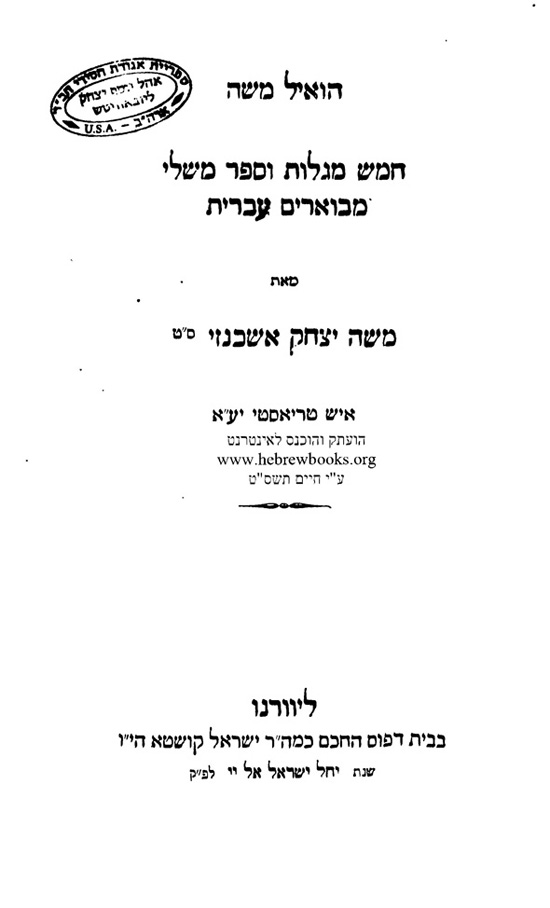
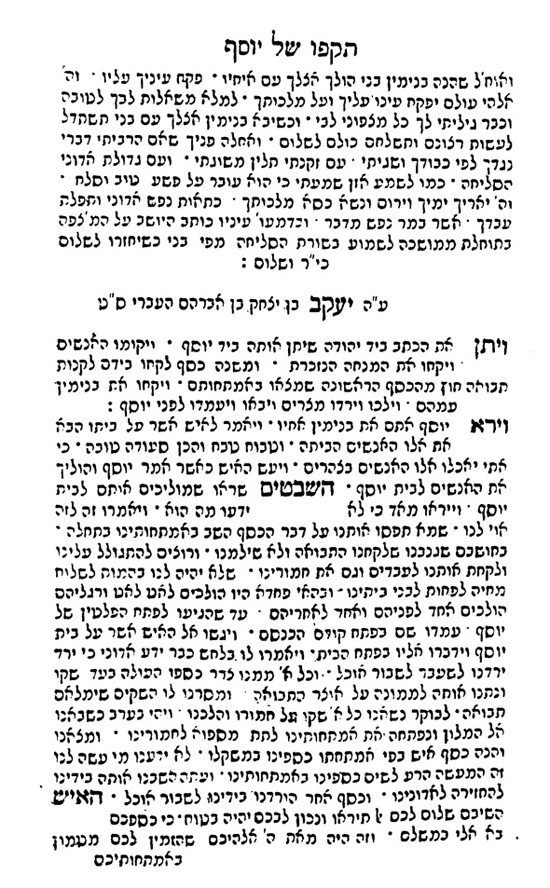
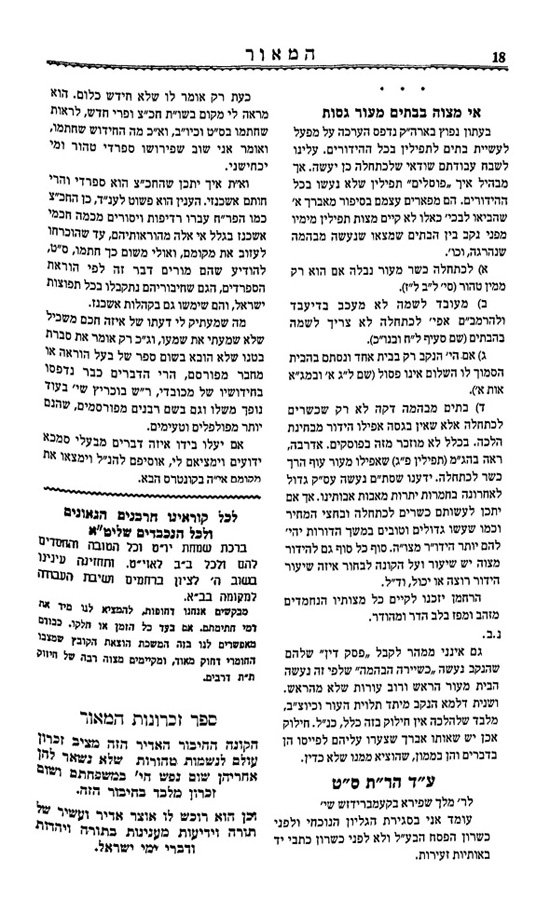
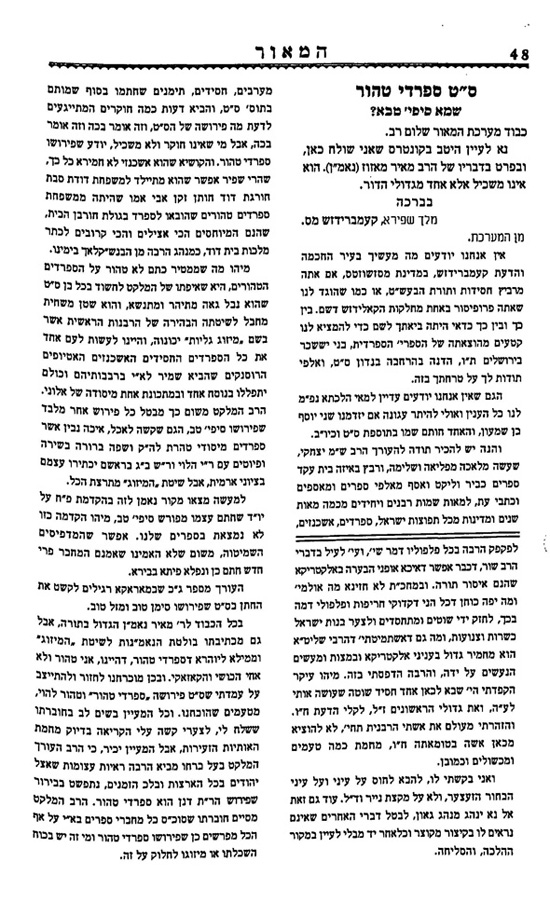
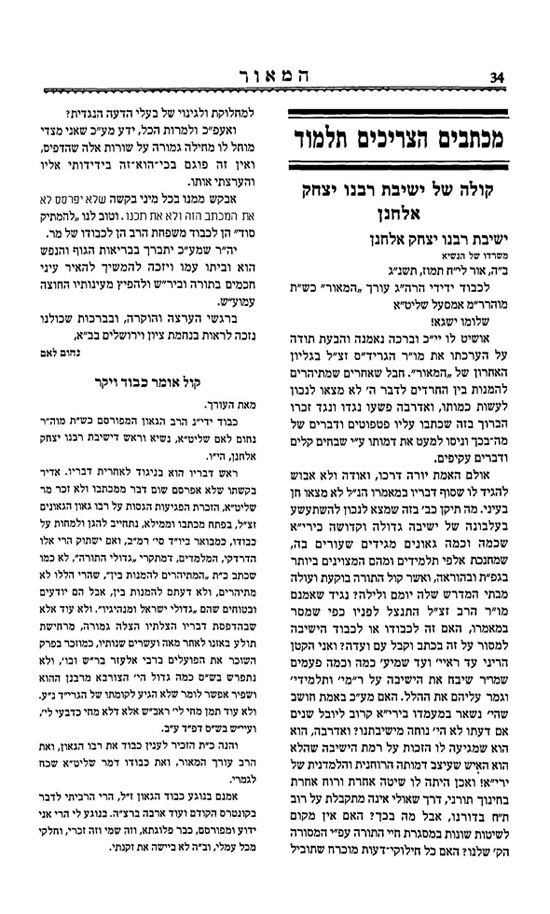
Neziv on Ancient Near East

Neziv on Ancient Near East at the Michtavim blog.