Bridging the Kabbalistic Gap Nefesh HaTzimtzum by Avinoam Fraenkel reviewed by Bezalel Naor

Bridging the Kabbalistic Gap
Nefesh HaTzimtzum by Avinoam Fraenkel
Vol. 1: Rabbi Chaim Volozhin’s Nefesh HaChaim with Translation and Commentary
Volume 2: Understanding Nefesh HaChaim through the Key Concept of Tzimtzum and Related Writings
(Jerusalem: Urim, 2015)
Reviewed by Bezalel Naor
Recently there has been a spate of English translations of the classic of Mitnagdic philosophy, Nefesh ha-Hayyim by Rabbi Hayyim of Volozhin (1749-1821), eminent disciple of the Vilna Gaon. This is perhaps the most glorious—certainly the lengthiest—of the translations, one that attempts to rewrite the debate between Hasidim and Mitnagdim.
The present edition, the most extensive to date, is divided in two volumes. Volume One consists of a Hebrew-English edition of the entire book with the exception of the famous note by the author’s son, Rabbi Isaac (Itzeleh) of Volozhin, known as “Ma’amar Be-Tzelem.” That note and other related writings of Rabbi Hayyim have been translated in Volume Two. In a unique typesetting innovation, the translator divides the complex Hebrew sentences into phrases, easing the English reading.
In the lengthy introduction to Volume Two, entitled “Tzimtzum—The Key to Nefesh HaChaim,” Avinoam Fraenkel has carved out for himself a most ambitious goal: to tackle the perennial problem of latter-day Kabbalah, namely the Lurianic doctrine of Tzimtzum or divine self-contraction. Traditionally, there have been two schools of thought on the matter: those who hold “tzimtzum ki-peshuto,” i.e. the doctrine is to be taken literally; and those convinced that “tzimtzum she-lo ki-peshuto,” i.e. Tzimtzum is not to be taken literally. As Fraenkel points out, this terminology first gained currency in the debate between two Italian kabbalists, Rabbi Joseph Ergas (author Shomer Emunim) and Rabbi Immanuel Hai Ricchi (author Yosher Levav) back in 1736-7.[1]
Fraenkel’s thesis is that even when things are “pashut” (simple), they truly are not so “pashut” (simple). Even when a kabbalist such as Rabbi Shelomo Elyashiv (author Leshem Shevo ve-Ahlamah) writes boldly that he understands the doctrine literally as did the author of Yosher Levav—that requires complexification.
You might ask of what concern is this rarefied debate to the masses of Jews living in the twenty-first century. Ah! It just so happens that many if not most historians have assumed that this debate, which translates into transcendentalist versus immanentist theology, was at the heart of the terrible controversy between the Mitnagdim and Hasidim that tore apart East European Jewry in the late eighteenth century. At that time, the Vilna Gaon issued a herem, an official rabbinic ban excommunicating the followers of the Ba’al Shem Tov.
If it can be proven that there is essentially no difference of theology between the Tanya (the “Bible” of Hasidism), written by Rabbi Shneur Zalman of Liadi, founder of the Habad school of Hasidism, and the Nefesh ha-Hayyim (the “Shulhan ‘Arukh” of Mitnagdic ideology), then we will have dissolved any continuing animus between Hasidim and Mitnagdim, and “Shalom ‘al Yisrael” (Peace to Israel). This is the fondest wish of the author.
The truth is—as the author makes us aware—this is not the first attempt to smooth over theological differences between the Tanya and Nefesh ha-Hayyim. On the eve of World War Two, Rabbi Eliyahu Eliezer Dessler—a preeminent master of the Mussar school, Mashgi’ah Ruhani of Gateshead and later of the Ponevezh Yeshivah in B’nei Berak—then residing in London, wished to issue a proclamation to the effect that there is essentially no mahloket, no difference of opinion between Rabbi Shneur Zalman and Rabbi Hayyim regarding the correct interpretation of Tzimtzum. Rabbi Dessler’s distinguished houseguest at the time was Rabbi Yitzhak Horowitz (known in Lubavitch as “Reb Itche Der Masmid,” on account of his legendary “hatmadah,” or devotion to learning), who acted as fundraiser on behalf of the Lubavitcher Rebbe, Joseph Isaac Schneersohn. Rabbi Dessler asked Rabbi Horowitz to sign on the proclamation.
To make a long story short, eventually Rabbi Dessler’s overtures were forwarded to the son-in-law of the Rebbe, Rabbi Menachem Mendel Schneerson (eventual successor to his father-in-law as Rebbe of Lubavitch), who penned a formal reply. For the life of him, Rabbi M.M. Schneerson could not fathom how someone with competence in Kabbalah (which Rabbi Dessler certainly did possess) could fail to see the obvious differences between the Habad and Volozhin understandings of Tzimtzum. (Rabbi Schneerson further outlined that there was a difference between the Vilna Gaon and his student Rabbi Hayyim of Volozhin regarding Tzimtzum, a point in the letter which continues to rile Mitnagdim to this day. In fact, Rabbi Yosef Zussman of Jerusalem, eminent disciple of Rabbi Ya‘akov Moshe Harlap, wrote several unanswered letters to the Lubavitcher Rebbe remonstrating how absurd it is to entertain the notion that Rabbi Hayyim, who adored his master the Gaon, disagreed with him on so basic an issue.)
Left without a “partner in peace” of the opposite camp, Rabbi Dessler’s proclamation was buried. Where titans such as Rabbis Dessler and Schneerson could not see eye to eye, Avinoam Fraenkel certainly has his work cut out for him. Before we proceed further to the “nuts and bolts” of the Tanya—Nefesh ha-Hayyim debate, the reader may wish to listen to some music pleasing to the ear:

·         When Rabbi Abraham Mordechai Alter, Rebbe of Gur (“Imrei Emet”) asked Rav Kook how he knew so much Hasidut, Rav Kook responded that he had studied Nefesh ha-Hayyim.
·         Rabbi Michael Eliezer Forshlager of Baltimore, a foremost student of Rabbi Avraham Bornstein, Rebbe of Sokhatchov (author Responsa Avnei Nezer) carried in his tallit bag a volume which consisted of Tanya and Nefesh ha-Hayyim bound together at Rabbi Forshlager’s special request.
·         Once around the family table in Brooklyn, Rabbi Menachem Mendel Schneerson (by then Lubavitcher Rebbe) spoke so enthusiastically of Nefesh ha-Hayyim that his brother-in-law Rabbi Shemariah Gurary said in jest: “Then perhaps we Hasidim should take to studying Nefesh ha-Hayyim.”

Back to the mahloket. What are the cold facts concerning the debate?
It is incontrovertible that Rabbi Hayyim has stood the Zohar’s terms “memale kol ‘almin” (“filling all worlds”) and “sovev kol ‘almin” (“surrounding all worlds”) on their heads. What for the Tanya is “memale kol ‘almin,” is for Nefesh ha-Hayyim, “sovev kol ‘almin,” and vice versa. Rabbi Shelomo Fisher of Jerusalem has written that this is merely semantics.[2] Others read into the shift of terminology a substantive controversy as to Weltanschauung. What for Hasidism is common experience, namely the immanence, the immediate presence of God, is for Mitnagdism a recondite mystery reserved for the elite.
In the words of Rabbi Eizik of Homel, a major disciple of Rabbi Shneur Zalman of Liadi and of his son, Rabbi Dov Baer of Lubavitch (Mitteler Rebbe):

This belief is possessed by all the Hasidim, but the Mitnagdim, even those who are not etc. [the word etc. occurs in the original], do not have this faith, only in a very, very concealed manner, as Israel were in Egypt…They have no room for this faith that Altz iz Gott (All is God).[3]

Fraenkel observes that much of the “poisoning of the waters” was done by publication of a spurious letter attributed to the “Alter Rebbe,” Rabbi Shneur Zalman, in the anonymous Matzref ha-‘Avodah (Koenigsberg, 1858). Later the letter was incorporated in Heilman’s more responsible Beit Rebbi (Berdichev, 1902). In the forged epistle, Rabbi Shneur Zalman writes that it has come to his awareness that the Vilna Gaon understands Tzimtzum literally.
This letter contributed to Rabbi Menachem Mendel Schneerson’s formulation concerning the Vilna Gaon’s view of Tzimtzum. One might mistakenly assume that once the letter is exposed as a forgery, Habad should have no problem accepting that there truly was no disagreement between the two rival camps concerning Tzimtzum. But Fraenkel knows that this is not the end of his troubles.
There is the matter of the passage in the second part of Tanya (titled Sha‘ar ha-Yihud ve-ha-Emunah) which reserves some pretty harsh language for the literalists:

…the error of some wise men in their own eyes, may the Lord forgive them, who erred and were mistaken in their study of the writings of the Ari, of blessed memory, and understood the doctrine of Tzimtzum mentioned there literally, that the Holy One, blessed be He, withdrew Himself and His essence, God forbid, from this world, only that He supervises from above.[4]

Who are the unnamed villains of this passage? To endeavor to answer this question, we would do well to research the printing history of the Tanya. The passage in question was missing from all editions of the Tanya printed before the year 1900. In that year, the passage surfaced in the Romm edition printed in Vilna at the behest of Rabbi Shalom Dov Baer Schneersohn of Lubavitch. Until that time, it had been preserved in manuscript in the keeping of the heirs of the Ba‘al ha-Tanya. That means that for over a century since the Tanya was first printed in Slavuta in 1796, this sensitive piece—a sort of J’accuse, if you will—was suppressed. Why was it ever suppressed to begin with, and why was it finally revealed in 1900?
An obvious solution would be that the passage obliquely lambasted the Vilna Gaon, and it was not until a century later that a direct descendant of the author felt that times had changed and that the sociological “climate” had warmed sufficiently to allow for an unexpurgated version of the Tanya to appear in print. This time, no herem would be issued in Vilna.
And for the record, Rabbi Menachem Mendel was not the first Schneerson to assume that the Gaon understood Tzimtzum literally. Earlier, the Rebbe of Kopyst, Rabbi Shelomo Zalman Schneerson (1830-1900), author Magen Avot, wrote in a letter to Rabbi Don Tumarkin: “This is the entire subject of Tzimtzum, and this is the Hasidism of the Ba‘al Shem Tov and the Maggid, may they rest in peace, that the Tzimtzum is not to be taken literally, as opposed to the opinion of the Mishnat Hasidim [i.e. Rabbi Immanuel Hai Ricchi] and the Gaon Rabbi Elijah, of blessed memory.”[5]
Fraenkel is not willing to accept that the passage in Tanya is directed at the Vilna Gaon or earlier Rabbi Immanuel Hai Ricchi. He stands in good company. Upon receipt of Hayyim Yitzhak Bunin’s Mishneh Habad II (Warsaw, 1933), Rav Kook wrote back to the author requesting that he retract his statement that the pejorative “wise men in their own eyes” refers to the author of Mishnat Hasidim and the Gaon of Vilna.[6]
But then the question remains. Who are the “bad guys” of the Tanya? Fraenkel would have us believe that the reference is to the likes of the crypto-Sabbatian Nehemiah Hiyya Hayyon, against whom Ergas inveighed in his polemical works Tokhahat Megulah and Ha-Tzad Nahash (London, 1715).[7]
If that were the case, the language of the Tanya is too mild and reserved. Sabbatians (believers in pseudo-Messiah Shabtai Tzevi) are usually treated to much more invective, such as “blasted be their bones.” There is a parallel passage in the work of Rabbi Aaron Halevi Horowitz of Starosselje, Sha‘arei ha-Yihud ve-ha-Emunah. There the language is even more compassionate and conciliatory. It is hard to imagine that the Ba‘al ha-Tanya and his prime pupil Rabbi Aaron Halevi Horowitz would show such empathy towards a Sabbatian heresiarch. With very few exceptions, members of the rabbinate were not “melamed zekhut” when it came to deviants of the Sabbatian persuasion. The passage reads:

…As it occurred to some latter-day kabbalists who attempt to be wise (mithakmim)…to understand Tzimtzum literally, as if He contracted Himself, and this is a crime, and their sin is too great to forbear, but their merit is that they have not spoken all these things with premeditation, God forbid, but rather from lack of understanding. May the Lord forgive them, “for in respect of all the people it was done in error” (Numbers 15:26).[8]

Tzimtzum-literalism is not a characteristically Sabbatian posture, nor is it the exclusive domain of Sabbatians. Rabbi Jacob Emden, the arch-nemesis of the Sabbatians, took Tzimtzum literally, drawing an analogy to the vacuum created by a pump.[9] In fact, Emden excoriated Ricchi for belaboring the point, when “certainly, absolutely, it is not to be construed other than literally, and it is one of the a priori assumptions for the believer in our holy religion, if not for anti-religious apikorsim who do not concede the creation of the world.”[10]
There is another problem with deflecting the Tanya’s critique away from the Gaon of Vilna toward Sabbatian kabbalists. If Sabbatians were being targeted, then why did the passage need to be suppressed at all? The Vilna Gaon and his disciples were certainly condemnatory of Sabbatianism in all its guises, so there would have been nothing in the passage to give offense to the Mitnagdim, the opponents of Hasidism.
Fraenkel’s work is much more difficult than that of Rabbi Dessler, for Fraenkel has tasked himself with harmonizing the view of Rabbi Shelomo Elyashiv (1841-1926), author of Leshem, as well. Rabbi Shelomo Elyashiv wrote—both in his Helek ha-Bi’urim and in his recently published correspondence with fellow Mitnagdic kabbalist Rabbi Naftali Herz Halevi Weidenbaum—that he subscribes to the literalist interpretation of Tzimtzum as described in Ricchi’s Yosher Levav.[11] The Leshem went so far as to cast aspersions on the Likkutim printed at the conclusion of Bi’ur ha-Gra to Sifra di-Tzeni‘uta, which present a non-literal reading of Tzimtzum.[12]
Professor Mordechai Pachter was struck by the most incongruous dovetailing of the perspectives of Lubavitch and Leshem concerning the Vilna Gaon’s interpretation of Tzimtzum. Both ascribe to the Gaon a literalist interpretation.[13]
“To cut to the chase,” Fraenkel’s strategy for reconciling what appear glaring differences of opinion involves invoking the kabbalistic theory of relativity, namely the distinction between the divine perspective and the human perspective. The Aramaic expressions that convey this thought are “le-gabei dideh” versus “le-gabei didan.”[14] (In Nefesh ha-Hayyim, the Hebrew terms “mi-tzido”/”mi-tzidenu” serve the same purpose.)[15] This distinction is certainly a valuable tool but it should not be overused. It strikes this reader as overly simplistic to assume that all writers (with the exception of Sabbatians) who grasp Tzimtzum literally are necessarily writing from the human perspective, while writers who understand Tzimtzum non-literally are necessarily writing from the divine perspective. And if the distinction should not be overused, a fortiori it should not be misused. To ascribe the human perspective (as opposed to divine perspective) to Rabbi Immanuel Hai Ricchi when he clearly writes the opposite, is to do violence to his words. A key passage in his Yosher Levav (quoted in fact by Fraenkel) reads:

Therefore relative to us (le-gabei didan), it is as if there was no Tzimtzum and we can say that the Tzimtzum is not literal. However, relative to the Ein Sof (le-gabei ha-Ein Sof) itself, it is literal.[16]

How it is then possible to flip around the author’s mindset and reverse his stated position, is beyond me.
At day’s end, the warring factions within Knesset Yisrael may have to make peace with their differences of opinion intact, even in the matter of Tzimtzum.

[1] Prof. Menachem Kallus confided to the writer that in his estimation the earliest discussion whether Tzimtzum was intended literally or not, is to be found in the notes to Vital’s ‘Ets Hayyim penned by Rabbi Meir Poppers (ca. 1624-1662). Poppers writes that it sounds to him as if Luria’s disciples Rabbi Hayyim Vital and Rabbi Yosef ibn Tabul understood from the Rav [Isaac Luria] that “the Tzimtzum is literal” (“ha-tzimtzum ke-mishma‘o”). See Rabbi Meir Poppers, ’Or Zaru‘a, ed. Safrin and Sofer (Jerusalem: Hevrat Ahavat Shalom, 1986), Sha‘ar ha-‘Iggulim ve-ha-Yosher, chap. 2 (p. 29).
[2] See “Derush ha-Tefillin” in Rabbi Shelomo Fisher, Beit Yishai—Derashot (Jerusalem, 2004), p. 355.
[3] Rabbi Eizik of Homel, “Igeret Kodesh” (Holy Epistle) printed at the conclusion of Hannah Ariel—Amarot Tehorot (Ma’amar ha-Shabbat, etc.) (Berdichev: Sheftel, 1912), 4b.
[4] Tanya II, 7 (83a).
[5] Published in M.M. Laufer, Ha-Melekh bi-Mesibo II (Kefar Habad: Kehot, 1993), p. 286.
[6] Rav Kook’s manuscript was published in Haskamot ha-Rayah (Jerusalem: Makhon RZYH Kook, 1988).
Ironically, Rav Kook’s maternal grandfather Raphael Felman was a Hasid of the Rebbe of Kopyst.
Fraenkel dismisses out of hand the notion that the Tanya pilloried Ricchi because of the fact that references to Ricchi’s Mishnat Hasidim figure prominently in the Tanya. See Nefesh HaTzimtzum, vol. 2, p. 79, n. 89. This argument is unconvincing. It is quite conceivable that the Ba‘al ha-Tanya was fond of Mishnat Hasidim, a popular digest of Lurianic Kabbalah, while viewing Ricchi’s other work Yosher Levav as being outside the pale. And for the very reason that such a venerable Kabbalist erred in his judgment concerning Tzimtzum, he was worthy of compassion. Cf. Rabbi Tzadok Hakohen Rabinowitz:
There were already found many great men, authors among the Mekubbalim, who stumbled in this, including the author of Yosher Levav, who explained the matter of Tzimtzum and similarly many matters of Kabbalah in [terms recognizable] to the understanding [as] total corporealization. I have spelled out his name, for some authors published after him already publicized him in order to clarify his errors in this respect. Behold he was a great and holy man, as is known, and erred only in his faith. Though this too is a great error and requires atonement (as explained above), nonetheless it is not such a grievous sin, as explained in the words of the Rabad…”
(Sefer ha-Zikhronot in Divrei Soferim [Lublin, 1913], 32d)
The reference is to Rabad’s animadversion to Maimonides’ statement in MT, Hil. Teshuvah 3:7 that one who professes belief in a corporeal deity has the halakhic status of a “min.”
[7] Fraenkel’s “Shabbetian Tzimtzum Kipshuto” (as opposed to the “Acceptable Tzimtzum Kipshuto”) strikes this writer as a “straw man” contrived for purposes of pilpul.
[8] Rabbi Aaron Halevi, Sha‘arei ha-Yihud ve-ha-Emunah (Shklov, 1820), Part 1, Gate 1, chap. 21, note (f.51).
[9] Rabbi Jacob Emden, Mitpahat Sefarim (Altona, 1768), 35b-36a (i.e. 45b-46a).
[10] Mitpahat Sefarim 35b (i.e. 45b).
To the question of whether Ricchi himself was a crypto-Sabbatian, I devoted an entire chapter of my book Post-Sabbatian Sabbatianism (1999): “Immanuel Hai Ricchi—Literalist among Kabbalists.”
[11] Rabbi Shelomo Elyashiv, Helek ha-Bi’urim (Jerusalem, 1935), 3a-b. The letters of Rabbi Elyashiv to Rabbi N.H. Halevi Weidenbaum were published in Rabbi Moshe Schatz, Ma‘ayan Moshe (Jerusalem, 2011).
[12] Helek ha-Bi’urim, 5b.
[13] Mordechi Pachter, “The Gaon’s Kabbalah from the Perspective of Two Traditions” (Hebrew), in The Vilna Gaon and his Disciples (Ramat-Gan: Bar-Ilan University Press, 2003), pp. 119-136.
[14] See Rabbi Menahem Azariah da Fano, Ma’amar ha-Nefesh, Part 2, chap. 4 in Ma’amrei ha-Rama mi-Fano (Jerusalem: Yismah Lev, 1997), p. 339; Rabbi Immanuel Hai Ricchi, Yosher Levav (Amsterdam, 1737), chap. 15 (10a), Rabbi Moshe Hayyim Luzzatto, Kalah Pithei Hokhmah (Koretz, 1785), petah 27 (31b); idem, Peirush Arimat Yadai in  Adir ba-Marom II, ed. Spinner (Jerusalem, 1988), p. 74; Rabbi Aaron Halevi Horowitz, Sha‘arei ha-Yihud ve-ha-Emunah (Shklov, 1820), Part 1, Gate 1, note to chap. 21 (43b-44a); Rabbi Isaac of Volozhin, “Ma’amar Be-Tzelem” (note to Nefesh ha-Hayyim, Gate 1, chap. 1) in Avinoam Fraenkel, Nefesh HaTzimtzum, vol. 2, p. 397; Rabbi Abraham Isaac Hakohen Kook, Shemonah Kevatzim (Jerusalem, 2004), 2:120 (vol. 1, p. 284).
[15] Nefesh ha-Hayyim III, 6.
[16] Rabbi Immanuel Hai Ricchi, Yosher Levav (Amsterdam, 1737), chap. 15 (10a). Quoted in Nefesh ha-Tzimtzum, vol. 2, pp. 260-261. See also Fraenkel’s discussion of Ricchi’s position on pp. 63-71.


The Agunah Problem, part 2; Wearing a Kippah; More Censorship by ArtScroll

The Agunah Problem, part 2; Wearing a Kippah; More Censorship by ArtScroll
Marc B. Shapiro
1. Continued from here.
There is even an opinion, which as far as I know is accepted by many, that if a man apostatizes the beit din can still not force him to issue a divorce. This is first mentioned by R. Meir of Rothenburg and his reason is quite surprising. He says that a woman would rather be married to an apostate than not married at all.[1]
כתב מורי רבינו עובר על דת או אפילו משומד אין כופין אותו להוציא ותדע מדלא מנה רשע עם שכופין אותן להוציא וטעמא דטב למיתב טן דו מלמיתב ארמלו אם לא שעבר על דת שקיבל עליו חרם שהוא כלפי דידה כגון שלא להכותה או שלא להקניטה.
This position, and the opposing one that we do force a meshumad to give a get: משומד כופין אותו על ידי גוים, is mentioned by R. Moses Isserles, Even ha-Ezer 154:1.
Today, there is no way in the world that a religious woman would wish remain married to an apostate, so how could the hazakah טב למיתב טן דו מלמיתב ארמלו be applicable in such a case? I therefore don’t see how any beit din could tell a woman whose husband apostatized that they are not able to compel him to divorce her. Incidentally, R. Solomon Luria couldn’t believe that R. Meir of Rothenburg really meant what he said. According to R. Luria, the word משומד here does not mean “apostate” but a משומד לכל התורה, that is, a complete sinner who is still in the Jewish community and can be brought back to Torah observance, perhaps even by his wife.[2]
כל זמן שלא נטמע ביניהם אפי’ הוא משומד לכל התורה כולה אין כופין אותו מאחר שיכול לקיים שאירה כסותה ועונתה כראוי וגם אולי על ידה יתחרט ויחזור למוטב ובזה יתיישבו דברי מהר”ם שכתב שאין כופין כלל אפילו משומד.
This is not the standard position as pretty much everyone assumes that R. Meir of Rothenburg was talking about an actual meshumad. Yet it must be noted that as with R. Luria, R. Jehiel Jacob Weinberg also found R. Meir of Rothenburg’s language strange, since how can you say טב למיתב טן דו מלמיתב ארמלו about a woman living with an apostate? R. Weinberg therefore suggested that perhaps R. Meir just meant a sinner.[3] Elsewhere, R. Weinberg sees it as obvious that a Jewish woman would not want to marry an apostate, even one who has repented from his apostasy.[4]
והנה זה דבר ברור שהמומר מאוס בעיני כל אחד מישראל, ואפילו אם חזר בתשובה שלמה הוא מאוס כשזוכרים שהמיר את דתו, וק”ו ב”ב של ק”ו אם לא עשה תשובה שלמה אלא הרהר תשובה בלבו ואח”כ חזר לסורו שהוא מאוס ואין שום בת ישראל מתפייסת עם אדם כזה.

הכל יודעים ששום בת ישראל לא תנשא לאיש שהמיר דתו אפילו אם עשה אח”כ תשובה בלבו ואפילו אם ימיר את דתו החדשה בדת ישראל.

Just as with the case of a real meshumad, it is hard to imagine that today a woman who wants to divorce her husband because he has become completely non-observant, and the husband refuses to give the get, that this woman would not be regarded as an agunah. I am speaking about the more modern communities. What about in the haredi world? I was shocked to read the following in a recent work by R. Judah Itah explaining why it is that even today a woman would rather be married to an apostate than be alone, something that is obviously factually incorrect and is a terrible indictment of Jewish women.[5]
והנה בדין זה אם כופין המומר לכאורה איירי דבאה האשה ומבקשת מהבי”ד שיעזרו לה לצאת מרשות המומר כי לא טוב לה להיות בחברת המומר. א”כ היאך אתה דוחה את רצונה בנימוק דטוב לה כיון דטב למיתב תן [!] דו וכו’ הרי היא זועקת דאין זה טובה בשבילה. וצ”ל דקים לחז”ל דכל אשה רוצה להיות בחברת איש מלהיות בודדה, ומה שאומרת שרצונה לצאת מהמומר לא זה סיבה בגלל המומר אלא אפשר מפני שעיניה נתנה באחר ולכן אין כופין המומר, דלא מאמינים למה שאו’ שכל רצונה לא להיות בחברת המומר.
Can R. Itah really believe that a Bais Yaakov girl could live with an apostate and the only reason she would scream to get out of the marriage is because she has her eye on someone else? If there was a haredi woman who chose to remain with an apostate rather than demand a divorce, wouldn’t the haredi world regard her as a traitor?
In the previous post I discussed R. Weinberg’s responsum dealing with a man accused of sexual abuse. In that case, R. Weinberg refused to force him to give a get. This responsum is mentioned in a 2013 decision by the Jerusalem Beit Din available here. In a 2-1 decision the beit din refused to order a convicted sexual abuser to give his wife a get. The majority recommended that the husband give a get, but as far as compelling the husband, or even telling him that he was obligated to give a get, the beit din felt that its hands were tied.
We are taught that the ways of Torah are pleasant. Can it really be that a woman who wants to be divorced from a sexual abuser has no recourse? Must it be the case that the beit din’s hands are tied and the husband can keep his wife a prisoner? 
This brings me to a suggestion which can perhaps solve some of the problems at least in the State of Israel. I am not naive enough to think that it will ever be implemented, but I do think that it is a good approach. As I just mentioned, the Jerusalem Beit Din case of the convicted sexual abuser was decided by a 2-1 majority. One of the dayanim thought that the husband could be compelled to give the divorce, but unfortunately for the wife he was in the minority. If you examine the decisions of the various batei din you find that some dayanim are more liberal than others when it comes to ordering the husband to issue a divorce. This doesn’t mean that the other dayanim are “bad guys”, as some feminists like to portray them. They just feel bound by certain halakhic restrictions. The more liberal dayanim, however, follow a halakhic tradition that assumes that if the husband and wife have been separated for a long time, or if there are good reasons for the woman to want a divorce, even if these reasons are not mentioned in the Talmud, then the husband can be forced to issue the get.
Since I think we all agree that freeing women from dead marriages is a positive goal, would it violate any halakhic procedure for certain communities to have batei din composed exclusively of those rabbis who accept the halakhic position that a husband can be obligated to divorce his wife even in cases not specified in the Talmud? This would not be an example of deciding the halakhah before the case was heard, but only of creating a beit din of dayanim who are at least open to a more liberal understanding of when divorce is to be required.
This would no different than the conversion courts set up in Israel recently under the direction of R. Nachum Rabinovitch. Only dayanim who have a liberal perspective on conversion are on this court. This doesn’t mean they will always agree on all points, but they will agree on certain baseline positions. This might be a solution to the sort of case that appeared before the Jerusalem Beit Din, discussed above. Had the make-up of the beit din been different, rather than a 2-1 decision leaving the wife in a miserable marriage perhaps for the rest of her life, the decision could have been 2-1 or 3-0 in her favor.
I don’t think anyone would object if a community said, for example, that they will only hire a rabbi who supports, or opposes, the heter mekhirah. That is the community’s prerogative. So why should it be problematic to say that for certain communities only dayanim who have a liberal perspective on when a husband is obligated to give a get should be seated on batei din dealing with these issues? I think that some dayanim will be fine with this. While their interpretation of halakhah does not generally permit them to obligate a husband to give a get, they recognize that others have a different perspective. It is not uncommon for a posek to tell a questioner that he should inquire of another posek who will probably give him a more lenient answer. For example, both R. Shlomo Zalman Auerbach and R. Ovadiah Yosef, when confronted with questions about abortion, rather then reply that it was forbidden they advised the questioners to ask R. Eliezer Waldenberg, as he had a more lenient opinion in this matter.[6] Many more such examples could be cited dealing with a whole host of issues.[7]
Here is what appears in R. Eliyahu Sheetrit’s Rabbenu, p. 137. 

It describes how R. Ovadiah Yosef did exactly what I am suggesting. He purposely arranged to have a dayan join the beit din on a certain day, knowing how this dayan held in a halakhic matter. In other words, R. Ovadiah was “stacking the deck” to get a decision he believed to be correct. If R. Ovadiah felt comfortable in doing this, then I don’t think there is a problem with picking dayanim who are known to accept the view that men can be required to issue a get in a wide range of cases.
Another way to solve the problems I have written about in the last two posts would be if the batei din accepted the view of R. Moshe Feinstein that when the husband and wife are living separately, and there is no chance of reconciliation, then halakhah requires the husband to give a get. I realize that R. Moshe’s position is not in line with the sources I have previously referred to, but since so much is at stake, perhaps the dayanim could agree that R. Moshe’s position is sufficient to rely on. This is what he states in Iggerot Moshe, Yoreh Deah 4, no. 15:2 (emphasis added):
ובדבר איש ואשה שזה הרבה שנים שליכא שלום בית, וכבר שנה וחצי דרים במקומות מופרדים, וכבר ישבו ב”ד חשוב ולא עלה בידם לעשות שלום ביניהם. וראינו גילוי דעת חתום מהב”ד שלא הועיל כל השתדלותם לעשות שום. וכנראה מזה שהב”ד סובר שא”א לעשות שלום ביניהם. אז מדין התורה באופן כזה מוכרחין להתגרש ואין רשות לשום צד לעגן, לא הבעל את אשתו ולא האשה את הבעל, בשום עיכוב מצד תביעת ממון. אלא צריכים לילך לפני ב”ד לסדר התביעות בענייני ממון ולסדר נתינת וקבלת הגט.
R. Moshe’s approach was anticipated by R. Hayyim Palache in the 19th century. Therefore, if some poskim feel that R. Moshe’s authority isn’t enough to rely on, R. Palache words might be sufficient for them (and indeed, in recent years some dayanim have relied on R. Palache).[8] R. Palache actually sounds like he is describing the contemporary scene when he says that if either husband or wife refuses to allow the divorce to go through in order to take revenge on a spouse, that the heavenly punishment for such an action is very great. He then says that if it has been eighteen months and the couple still can’t get along, then the husband is forced to give a divorce.[9]
וידעו נאמנה כי כל הבא לעכב מלתת גט בענין זה כדי להנקם זה מזה מחמת קינאה ושינאה ותחרות כאשר יהיה האופן פעמים שהאיש רוצה לגרש והאשה אינה רוצה וכדי להנקם מהאיש מעכבים הדבר שלא לש”ש עתידין ליתן את הדין . . . וכמו כן להפך כשהאשה רוצה להתגרש והאיש איו רוצה וכדי להנקם מהאשה מעכבים מלתת גט שלא לש”ש כם בזה לא בחר ה’ ויש עונש מן השמים . . . והנני נותן קצבה וזמן לדבר הזה דאם יארע איזה מחלוקת בין איש לאשתו וכבר נלאו לתווך השלום ואין להם תקנה ימתינו עד זמן ח”י חדשים ואם בינם לשמים נראה לב”ד שלא יש תקנה לשום שלום ביניהם, יפרידו הזווג ולכופם לתת גט עד שיאמרו רוצה אני.                     
As I mentioned, some dayanim will be very content not to sit on cases where their stringent approach will lead to a situation where the husband is not obligated to give his wife a get. They will recognize the problems women are sometimes placed in because of their approach and be happy that other dayanim have a different perspective, even though they themselves cannot agree. What then to do about the dayanim with a stringent perspective who will not agree to recuse themselves? I don’t see any reason why communities cannot declare that they do not wish to accept a situation where women are locked in dead marriages if there are valid halakhic options. As such, they will only hire dayanim who adopt a liberal perspective as to when a husband can be obligated to issue a divorce. This does not mean that these communities would be deciding cases in place of the dayanim, and every case is obviously different. However, there is nothing wrong with inquiring of a dayan what his halakhic philosophy is before seating him on the bench. This has nothing to do with deciding specific cases, as anyone who has ever watched a Supreme Court nominee hearing understands.[10] You are permitted to ask a question of a posek whom you assume will offer a lenient decision, as long as you are prepared to follow the decision even if in the end it is not what you expected. By the same token, one can appoint as a rav or a dayan someone whose halakhic philosophy is in line with the values of the community he will serve. That is all that I am suggesting
As mentioned in the last post, R. Jehiel Jacob Weinberg states that if there is a dispute among halakhic authorities, we must reject the view that will bring the Torah into disrepute in people’s eyes (Kitvei ha-Gaon Rabbi Jehiel Jacob Weinberg, vol. 1, p. 60):
ואגלה להדר”ג [הגרא”י אונטרמן] מה שבלבי: שמקום שיש מחלוקת הראשונים צריכים הרבנים להכריע נגד אותה הדעה, שהיא רחוקה מדעת הבריות וגורמת לזלזול וללעג נגד תוה”ק.

This formulation of R. Weinberg can provide justification for the approach I am suggesting. Interested readers should also examine R. Eliezer Waldenberg, Tzitz Eliezer, vol. 5, no. 26, where he writes to R. Elyashiv and justifies his liberal perspective. He sums up his position with these important words

ואחרי זאת בקחתנו גם בחשבון חומר השעה המיוחד שאנו חיים בה בתקופתנו אשר רבו שוטני התורה וכן בראותינו פירצת הדור הצעיר המנוער מתורה ויראת שמים וכשלא מוצא אוזן קשבת לדבריו עושה במחשך מעשיו, וכמה פעמים הרי אזנינו שומעות ולא זר מהמכשולים הגדולים שהנשים נכשלות ומכשילות את הרבים באיסור א”א ואנו עומדים רפה אונים באין בידינו להעמיד הדת על תלה, נדמה לי ששפיר ישנו במה שכתבתי בספרי שם כר נרחב לתת מקום לדון בכובד ראש בהערכת כל מקרה ומקרה שלטענת מאוס עלי ולהשתמש לפי הצורך בכפיה . . . ולכן לפענ”ד נאמנים המה דבריו של המהר”א טוואה בחוט המשולש שכותב שאפי’ לדעת הסוברים שלא לכוף אם יש צורך שעה בכפייה יכופו דאין לדיין אלא מה שעיניו רואות, ובלבד שתהא כוונת הדיין לש”ש ויחקור על הדבר כראוי.

I quoted R. Waldenberg at length as there are some people who thought that my previous post sounded “reformist”, because I argued that divorce halakhah should not be decided in a vacuum but should take into account the contemporary reality. As you can see, this is exactly what R. Waldenberg says.

R. Waldenberg concludes that the final decision on this matter should come from all the rabbinic courts in Israel. He does not want to have a situation like we have today, where different courts have entirely different approaches when it comes to how to deal with divorce law. 

There is another point that is important to make. I have heard people say that the problem of the agunah that we have today, where a man refuses to give his wife a get, is a new phenomenon. This is completely incorrect, as this phenomenon is already seen in the medieval responsa. However, you won’t generally find it discussed among the responsa that deal with agunah. The matter is discussed when dealing with whether one can be forced to give a divorce. From medieval times until the present, women in unhappy marriages have demanded divorces. As we have seen, in situations that many people today would consider cases of agunah, in prior generations the rabbis ruled that the woman was not entitled to a get

Even in earlier years, however, we do find examples of agunot where the husband refused to give a get, even after being told to so by a beit din, and the community tried to help. The 19th century Hebrew newspapers have a number of such cases. Here is one example that appeared in Ha-Magid, Feb. 13, 1861, pp. 27-28.
It is interesting that when they caught up with the man they imprisoned him in the rabbi’s house. They also took his money and used it as leverage.
Let me make one final point. In matters of divorce my feeling is that when either husband or wife wants a get, and it is obvious that there is no future in the marriage, then neither party should prevent the divorce from taking place. There shouldn’t be any reason to go to a beit din to force a divorce. Adults should be able to see that the marriage isn’t working out and come to a conclusion that it is time to end it. Any husband who chooses to withhold a get when he knows that the marriage is over is acting in a very cruel way, and the full weight of halakhically acceptable communal pressure should be brought on him. Nothing should scandalize us more than a so-called religious person keeping his wife captive as a means of revenge. I would even suggest reading the names of some agunot during the Shabbat prayers, in order to sensitize people to the issue.
I know that many people will regard what I have just written as obvious. What I will now say might anger some, but I think that it too should be obvious. I have often heard it said that a get should never be withheld, and that the get should be given immediately. For example, on ORA’s website it states: “[I]t is never acceptable to refuse to issue a get once the marriage is irreconcilable.” On JOFA’s website it states: “As soon as it becomes clear that there will be no reconciliation, the Get should be written and delivered to the woman so that it cannot be used as a bargaining tool in financial or custody negotiations.” 

While in general both these statements are correct, it is not correct that this is always the case. For instance, let’s say the wife runs away to Europe with the kids. Does anyone seriously think that the husband is still obligated to give her a get? In such a circumstance it is entirely appropriate for the husband to insist that she come back to the United States and settle all custody issues before a get is issued. Or let’s say a husband and wife separated, and the wife refuses to let the husband see his children. It could be many months before the secular court rules on the matter of visitation. Why would anyone think that in the meantime the husband is obligated to give his wife a get if she refuses to allow him to see his children? I don’t think that there is any reputable beit din in the world that would side with the woman in these two cases. These are obviously extreme examples, and have nothing to do with the typical agunah case we hear about. Yet we should be aware that there are nuances that sometimes come into play, and every case must be investigated by a reputable beit din before judgments are made.

Finally, those who want to learn more about the matters we have been discussing should consult R. Shmuel Gartner’s detailed book, Kefiyah be-Get (Jerusalem, 1998). A 2000 page book with the title Mishpat ha-Get has just appeared. I have not yet seen it but it must have important material as well. There is also another book that is worth noting, R. Raphael Aaron Ben-Shimon’s Bat Na’avat ha-Mardut (Jerusalem, 1917). R. Ben-Shimon (died 1928) was a leading Egyptian rabbi and author of a number of significant works. What makes Bat Na’avat ha-Mardut of particular interest is that he has a number of formulations that if written today would lead certain people to claim that he was a feminist or an adherent of Open Orthodoxy. For example:

P. 4:

ואמנם בזמנינו זה הנה מתלאה, כי הוסב דין המורדת לאכזריות נוראה כי בתי דינין בזמנינו האחרונים, לסיבת כי לא מצאו כל הדין מפורש מה יעשה לה להמורדת בטענת מאיס עלי ואחרי אשר אין לנו עתה דין הכפיה לכוף את הבעל לגרש בשום אופן אחזו בשיטת החומרא עד דיוטא התחתונה, ושמו להם לקו כי המורדת היא כאשה מפרת באמונה וכל חמירא דאיכא ברשותייהו נתנו אותה על ראש המורדת האומללה, כאלו הוא דין דאיסור והיתר אשר המחמיר בה בטוח הוא ממכשול יותר מהמתיר, וע”כ העמידוה על גחליה ריקה. חופשה לא ניתן לה, הפסידה נדוניתה וכ”ש כתובתה, ואף אם חזרה בה לא יקבלו תשובתה
P. 8:
דהרמב”ם ז”ל נתמלא חמלה וחנינה על בנות ישראל
P. 154:
 ואמינא ולא מסתפינא שאם היה הרמב”ם ז”ל חי אתנו היום, היה מרעיש העולם, על אחרוני זמננו אשר דנין את המורדת דמאיס עלי במשפט מר וקשה ואכזרי כנ”ל, ואומר בקול רם הלא תבושו הלא תכלמו לתלות בי קלון אכזריות כזאת אשר לא דמיתי, ולא עלתה על לבי, הן אנכי חסתי על נפשות בנות ישראל, שיחיו חיי צער ויהיו כשפחות וכשבויות חרב להבעל לאיש שנוי [שנאוי] נפשם
2. In the previous post I referred to a couple of Supreme Rabbinic Court decisions. In these cases R. Elyashiv was a member of the court and the decisions were published in the Piskei Din shel Batei Din ha-Rabaniyim be-Yisrael. In both of the cases I cited the decision was unanimous and no individual dayan is recorded as having authored the published decision. Nevertheless, the rulings are reprinted in R. Elyashiv’s Kovetz Teshuvot, vol. 1, as if they were written by him alone (and maybe they were, but no evidence for this is provided). This volume was not published by R. Elyashiv but by one of his followers, and is a collection of previously published court rulings and responsa. There are 253 sections and the table of contents at the beginning of the volume provides the original sources of all the material.
When you look at the list of sources you find something unusual. While the names of the various books and journals are given one also finds some abbreviations. This is strange since these abbreviations are nowhere explained, and abbreviations are only used for a very small number of the many different sources. I was unable to figure out what all of the abbreviations mean but I did figure out the following:
פ”ד = פסקי דין של בתי הדין הרבניים בישראל
י”א = יביע אומר
ד”י = דרך ישרה
מ”ש = משפטי שאול

When reprinting rulings from R. Elyashiv that appeared in the Israeli government Beit Din publication, rather than telling the reader where they are taken from, all we get is פ”ד. Similarly, the typical reader will have no way of knowing that material has been taken from R. Ovadiah Yosef’s Yabia Omer, R. Yitzhak Yedidyah Frankel’s Derekh Yesharah, and R. Shaul Yisraeli’s Mishpetei Shaul. Obviously, for the individual who published the Kovetz Teshuvot, there is something problematic with all of these individuals, and with the government beit din, and he therefore wouldn’t even mention the name of their publications.
If you look at Yabia Omer, vol. 3, Orah Hayyim no. 33, and Mishpetei Shaul, no. 34 you can see the original letters from R. Elyashiv. Needless to say, in these letters he relates to R. Ovadiah and R. Yisraeli as valued rabbinic colleagues. However, in Kovetz Teshuvot the beginning of the letters has been deleted, and the reader therefore has no idea who R. Elyashiv was corresponding with. Elsewhere in Kovetz Teshuvot, when the recipient of a letter is “kosher” in the eyes of the publisher, the beginning of the letter is indeed included.[11] For some reason, in the list of sources the publisher does not abbreviate the titles of R. Isaac Herzog’s Heikhal Yitzhak and R. Yitzhak Nissim’s Yein ha-Tov. Yet he still deletes the beginning of R. Elyashiv’s letters taken from these books, so the reader does not see the very respectful way he refers to R. Herzog and R. Nissim. Here, for example, is how R. Elyashiv’s letter appears in Heikhal Yitzhak, vol. 2, no. 24.

As you can see from the titles R. Elyashiv gives to R. Herzog, he has the utmost reverence for him.

Here is how the page appears in Kovetz Teshuvot, where all this is deleted.

Also, notice how at the beginning of the letter in the original it says אני מודה לכ”ג מרן, yet the wordמרן  is deleted from Kovetz Teshuvot. In the second paragraph R. Elyashiv writes
ואנכי לא באתי בשורות אלה אלא להשיב על מה שהעיר מרן שליט”א

In Kovetz Teshuvot מרן has been removed, leaving us with להשיב על מה שהעיר שליט”א, which doesn’t make sense since שליט”א does not follow a verb.[12]
For those who have read my new book, this example will not be surprising and illustrates once again the lack of basic intellectual integrity that we find in some segments of the haredi world. From the response to my book, I can tell you that the ones most upset about this sort of thing are none other than haredim. They really believe in the haredi outlook and can’t understand why some members of their society, such as the publisher of Kovetz Teshuvot, feel that the haredi position is so weak that it can only survive by misleading people. How could a haredi not be upset when seeing how a publisher feels that he knows better than R. Elyashiv which rabbis are deserving of respect, and therefore takes upon himself to “correct” R. Elyashiv’s “mistakes”? If this is not a complete undermining of Daas Torah, then I don’t know what is.
3. In this post I referred to the German Orthodox practice of men not wearing a kippah. R. Yoel Catane informed me on the authority of his mother, a native of Frankfurt and a relative of the Breuer family, that even R. Joseph Breuer when he taught secular subjects at the Hirsch school in Frankfurt did so without a kippah. R. Catane also points out that many German Orthodox Jews continued the practice of going bareheaded even when they came to Israel. R. Catane gives as an example of this Yitzhak Ernst Nebenzahl, who served as State Comptroller in Israel and was punctilious in his Torah observance. His son is the famous Rabbi Avigdor Nebenzahl. Even in his old age in Jerusalem, the elder Nebenzahl continued his practice of going bareheaded, which when it came to the German Orthodox was not a reflection about their level of piety. Here is a picture of him without a kippah.
Dr. Aharon Barth, a grandson of R. Azriel Hildesheimer, was also a well-known German Orthodox Jew. He served as the director of Bank Leumi and was one of the two people whose signature was on the first currency of the State of Israel. He also wrote the Orthodox philosophical work Dorenu Mul She’elot Netzah, which has been reprinted a number of times and has also been translated into English, French, and German. You can read about Barth here. Here is his picture showing him bareheaded.

R. Catane mentioned the following anecdote. Once Barth was giving a lecture to bankers in Israel and he heard some thunder. He stopped the talk, took a kippah out of his pocket and put it on his head, made the blessing on the thunder, then put the kippah back into his pocket and continued with the lecture.
4. In Saul Lieberman and the Orthodox I wrote about how in its English translation of R. Zevin’s Ha-Moadim ba-Halakhah, ArtScroll censored references to Saul Lieberman, removing his rabbinic title. Leon Well pointed out to me that ArtScroll didn’t just remove the “R.”, but in one case removed Lieberman’s name entirely. In Ha-Moadim ba-Halakhah (Tel Aviv, 1955), p. 133, in the article on Shemini Atzeret, R. Zevin writes:

בנוגע לתוספתא משער ר”ש ליברמאן [!] ב”תוספת ראשונים” השערה חריפה

In the Festivals in Halachah, vol. 1, p. 346, the following “translation” appears: “As regards the passage from Tosefta on which Rashi’s interpretation is based, Tosefes Rishonim ventures a daring speculation.”

On the topic of Saul Lieberman’s name being censored, Professor Yaakov Spiegel called my attention to the following. Here is R. Dov Berish Zuckerman’s Beit Aharon: Beurei ha-Rambam al pi ha-Meiri (Jerusalem, 1984) p. 311.

This volume appeared posthumously, published by Machon Yerushalayim. If you look at the second column, 6 lines from the bottom, it says שוב הראני חכם אחד. Who is the anonymous scholar? What appears in this book had earlier been printed in Talpiot 4 (1949), p. 139. In the original we find הר”ש ליברמן שליט”א.[13]

David Farkas called my attention to another case of ArtScroll censorship, this time in its new Midrash Rabbah. Here is a page from Bereshit Rabbah, Miketz, Parashah 90.

In the Etz Yosef commentary there are three dots, showing that something is missing. This is the only time I am aware of that when ArtScroll engaged in censorship they let the reader know that something was removed, so I guess we have to be thankful for this.

What was so terrible in the Etz Yosef that ArtScroll had to delete it? Here is the uncensored version of the commentary, and as you can see, Etz Yosef cited Mendelssohn. That is why it had to be removed.

While on the topic of censorship, let me share another example of censorship of R. Kook. This time R. Kook’s name is removed from R. Meir Abovitz’s commentary on the Jerusalem Talmud.

5. I want to call readers’ attention to a new book recently sent to me by R. Yaakov Shapiro. Its title is Halachic Positions: What Judaism Really Says About Passion in the Marital Bed, available here. This is the most detailed book there is on halakhah and marital sexuality. In many ways it is designed to counter a lot of the stringencies that have arisen over time and which the author feels are non-halakhic and also psychologically unhealthy, thus making a happy, balanced marriage much more difficult. You can also watch the author herehere and here. I think readers will be surprised, and perhaps upset, when they learn that some of what they have been told is forbidden is actually permitted according to the standard halakhic authorities. See also what I wrote here in note 26.

I also should add that this book is not for the prudish, as it is very explicit in what it discusses. This in fact relates to one of the themes of the book, that halakhah itself is not prudish as sex is an important part of life and is discussed in halakhic works just like everything else. Having said that, I must note that there is a difference between being prudish and refraining from inappropriate slang when discussing halakhic matters. While the author is careful in this matter, he does refer to another recent book that makes this mistake. I am uncomfortable in even recording the title of this other new halakhic work by Rabbi S. Even-Shoshan, but readers can see it here.

I don’t think I am being overly fastidious if I say that in my opinion any halakhic work with a title like that should not be regarded as a legitimate text. My yardstick in this regard is if one would feel comfortable using a word when speaking with a great rabbi or when giving a lecture. Thus, while the term “oral sex” is fine (and I was even present when a well-known rav was asked a question using these words), for the life of me I can’t understand how a rabbi discussing a halakhic topic can use a slang word.[14] In fact, I don’t think that even an acceptable term like “oral sex” should be used in the title of a book, as it is needlessly provocative. This sort of provocative title is also found with another book published by Rabbi Even-Shoshan. One who wants to write about these matters should use a title like “Jewish Sexual Ethics” or “Marital Intimacy in Halakhah”, with all the details discussed in the book.[15]

6. In the last post I wrote about a dispute in understanding a text between Rabbis Israel Brodie and Shlomo Yosef Zevin on one side, and Profs. Shlomo Zalman Havlin and Israel Moshe Ta-Shma on the other. I was incorrect in this, as R. Zevin actually agrees with Havlin and Ta-Shma. Thanks to Rabbi Dovid Solomon for noting this.

[1] Hagahot Maimoniyot, Hilkhot Ishut 25:4.
[2] She’elot u-Teshuvot Maharshal, no. 41. Cf. Yam Shel Shelomo, Yevamot 4:22.
[3] Seridei Esh, vol. 3, p. 75.
[4] Kitvei ha-Gaon Rabbi Yehiel Yaakov Weinberg, vol. 2, pp. 443, 447.
[5] Even Sapir (Jerusalem, 2013),  pp. 358-359.                     
[6] See R. Ovadiah Yosef, Ma’yan Omer, vol. 8, p. 173; R Nahum Stepansky, Ve-Alehu Lo Yibol, vol. 3, p. 296.
[7] Since I referred to Ve-Alehu Lo Yibol in the last note, see also in this book, vol. 3, p. 191, for another example, this time dealing with a kashrut issue. R. Auerbach thought that the matter was forbidden, but stated that if the questioner wished he could also ask R. Waldenberg for his opinion. See also ibid., p. 212, where the author asked a question of R. Waldenberg and he replied, “Do not ask me. I am stringent in this matter. Go to R. Ovadiah and ask him.”
[8] Hayyim ve-Shalom, vol. 2, no. 112. Another important source is R. Shlomo Moshe Amar, Shema Shelomo, vol. 3, Even ha-Ezer no. 19. In an email to me, Prof. Amichai Radzyner noted that in recent years many dayanim have been adopting a more liberal position regarding when a husband can be forced to give a get, and also when he is told that he is obligated to give a get even if the court cannot force him. Much important material in this regard is found in the many issues of the journal Ha-Din ve-ha-Dayan, found here
[9] R. Palache’s responsum is cited by many and is an important source for those who have argued for a more liberal approach to Jewish divorce law. I don’t think anyone will be surprised that R. Abraham Samuel Judah Gestetner, who in his Megilat Plaster [Monsey, 2014] makes the ridiculous argument that R. Jacob Emden’s Megilat Sefer is a Haskalah forgery, also says that this responsum of R. Palache was inserted into the volume by an unknown heretic. See ibid., p. 85.
[10] My own opinion is that no one should be appointed a dayan in the State of Israel unless he has served in the army. After all, how can a dayan understand the people appearing before him without having had such an experience? Yet I realize that this is a pipe dream.
[11] Strangely enough, he includes the beginning of the letter to R. Yitzhak Yedidyah Frankel even though, as I have mentioned, he doesn’t tell us where the letter comes from.
[12] The censorship in Kovetz Teshuvot was also noted by Avraham (Rami) Reiner in his fine article, “Kavim Rishoni’im le-Darko ha-Hikhatit shel ha-Rav Yosef Shalom Elyashiv,” Netuim 17 (2011), p. 78 n. 12.
[13] R. Zuckerman also mentions Lieberman’s point, and refers to him by name, in Kol Torah 12 (Adar 5718), p. 22.
[14] It is worth noting that there are some passages in rabbinic literature that if said by anyone today would be regarded as nibul peh (this is the correct transliteration, not “nivul”). See Changing the Immutable, ch. 6, for some examples. See also Megillah 25b: “R. Huna b. Manoah said in the name of R. Aha the son of R. Ika: It is permitted to an Israelite to say to a Cuthean, Take your idol and put it in your שי”ן תי”ו (buttocks).” Tanna de-Vei Eliyahu: Eliyahu Zuta, ch. 22 (end), is very explicit: ‘בני אותו מקום שאתה אוהב וכו
[15] An example of what I am talking about is Jennie Rosenfeld and David Ribner, The Newlywed Guide to Physical Intimacy. This book is explicit in its discussion, but the title is an appropriate one.


The Agunah Problem, Part 1; Incarceration and Free Speech

The Agunah Problem, Part 1; Incarceration and Free Speech
Marc B. Shapiro

1. There has been a lot of discussion recently about the International Beit Din and its rulings allowing certain marriages to be voided, thus freeing women from being agunot. As is to be expected, this beit din has been subject to strong attacks, even of a personal nature, despite the fact that the members of the beit din are recognized talmidei hakhamim. These dayanim are intent on keeping everything above board and have published the reasoning behind their rulings, thus giving opponents the opportunity to engage in halakhic argumentation.
From what I have read, the International Beit Din has three approaches to freeing agunot. One is annul the marriage based on mekah taut, i.e., there was some problem with the husband that would have prevented the wife from marrying him had she known of it. This is a perfectly valid mechanism that has been used by many poskim, such as R. Zvi Pesah Frank, R. Moshe Feinstein, and R. Avraham Shapiro. Although one can, of course, criticize the application of mekah taut to a particular case, the mechanism itself is part of standard halakhic operating procedure and the International Beit Din is well within its rights to use mekah taut when possible. 

The second approach is to find a problem in the marriage ceremony itself, meaning that the marriage never took place. For example, one can show that there were no proper witnesses to the marriage. Here again, one can disagree with particular rulings, but not with the basic approach.

The third approach is that of get zikui, which in the current context means that the beit din issues a divorce to the woman on behalf of the man, even if the man has not approved of this and even if is against his will.[1] While there has been a good deal of discussion of this approach, I can’t find on the International Beit Din’s website that any marriage has actually been dissolved by using this mechanism. Unlike the other two approaches, there is little precedent for use of a get zikui, which means that its chances of being generally accepted are nil.
The use of a get zikui is actually suggested by R. Jehiel Jacob Weinberg, Seridei Esh, vol. 3, no. 25. In fact, R. Weinberg’s responsum is the most detailed discussion of get zikui but surprisingly it is not included on the International Beit Din’s website. It must be noted, however, that R. Weinberg is only prepared to suggest a get zikui if the husband would want the get to be given. However, in the contemporary agunah situation the problem is that the husbands do not want to give the wives a get, and concerning these cases R. Weinberg writes: נפל היסוד של כתיבת גט מטעם זכי’
Is there another possible approach? How about a heter meah rabbanim for a married woman if she can’t get a get? I know you are thinking that this is crazy, but look at the following page, which comes from the medieval work Etz Hayyim by R. Jacob Hazan.[2] 
As you can see from the very end of the page, it states that the rabbis required a man to give a get if he contracted a marriage באיסור, which in this case means he was already committed to marry someone else. Then it says that if this man disappeared the woman can be freed with a heter meah rabbanim (actually, it says ish, not rabbanim, but I don’t want to get into that now). This is a very radical position, that a woman can be freed by a heter meah rabbanim, and it is attested to nowhere else. Not surprisingly, R. Israel Brodie, the editor of Etz Hayyim,[3] calls attention to this unusual halakhic position. R. Shlomo Yosef Zevin also refers to this novel idea.[4]
But are Rabbis Brodie and Zevin correct? Israel Moshe Ta-Shma and Shlomo Zalman Havlin say no, and see this as a serious mistake. According to them, the last case discussed in Etz Hayyim has nothing to do with the man who married באיסור but refers back to a case mentioned earlier on the page of a man who was only committed to marry a woman. If this man then disappears, מתירין הבחורה במאה איש. In other words, the woman is released from any obligation to marry the missing man, but this has nothing to do with a woman already married. I will let the readers decide for themselves who is correct.[5]
As for the problem of women not being able to get a divorce because the man refuses, there are some important points that must be made which I don’t think everyone is aware of. Today, many people assume that a woman who wants out of a marriage, for whatever reason, has that right. After all, a woman is not a prisoner and a husband should not force her to be married to him if she doesn’t want to. However, this viewpoint is very much a modern approach.[6] If you look at the standard halakhic sources you will find that there is no obligation for a man to give his wife a divorce just because she wants it. Ever since R. Gershom, the same situation is also found in reverse, namely, a husband is not allowed to divorce his wife against her will just because he no longer wishes to be married to her. This approach to ending marriage is very much in line with how secular society use to operate before the introduction of no fault divorce.
Significantly, Maimonides does require the husband to give his wife a divorce if she says she no longer wishes to live with him.[7] R. Kafih elaborates on the wisdom of Maimonides’ position, and here are some of his important words[8]:
ברוך ה’ א-להי ישראל אשר הזריח לנו את המאור הגדול הזה אשר במבטו החודר פלש למעמקי הדורות וצפה גם את דורנו הפרוץ לבשתינו ולמגנת לבבנו, אוי לעינים שכך רואות ואוי לאזנים שכך שומעות, ואלו ראו שאר חכמי הדורות את דורנו היו חותמים על פסקו של רבנו בשתי ידים. כי המציאות הוכיחה צדקת רבנו, שכל התובעת ג”פ בימינו וטוענת מאיס עלאי, לא רק עיניה נתנה באחר אלא היא כבר בחיק האחר או האחרים וחביטא קמייהו כמברכתא, ולפיכך מצוה לכוף את הבעל המתעקש בכל כפיה אפשרית כדי להפריד בין הדבקים ויפה שעה אחת קודם.
However, it is the view in opposition to Maimonides that became the standard position, and it is this view that is recorded in the Shulhan Arukh[9] and followed by batei din. According to this approach, even if a woman says she can no longer live with her husband, he is not obligated to give her a get. What this can lead to is most vividly illustrated by the movie Gett, available here to watch for free for Amazon Prime members.
I have been told that the Beth Din of America operates on the principle that if one of the parties wants a divorce, for whatever reason, and there is no chance for reconciliation, then the Beit Din will instruct the other spouse to comply. But this is not how many other batei din operate. We have to be honest and acknowledge that the problem many women face is not because the dayanim are cruel or anti-women, but that it is Jewish law itself, or rather an interpretation of Jewish law, that is preventing them from receiving their divorces. 

I feel it is necessary to stress this since we can now better appreciate why certain rabbis have attempted to find solutions within Jewish law to the contemporary agunah problem. Many on the right don’t see why this is necessary and why batei din cannot just follow Jewish law as it has operated until now instead of looking for “solutions”. These people might not realize the difficult situation this puts women in, a situation that might have been tolerable years ago but for more and more Orthodox Jews that is no longer the case. On the other hand, many on the left think that it is a simple matter to solve the agunah problem, and that it is just cruel and insensitive rabbis preventing this. This too is a distortion as the rabbis’ hands are often tied by halakhah, and this remains the case no matter how much of a “rabbinic will” they have.

Let me illustrate what I am talking about. As an example of how sentiments have changed over the centuries, here is a passage from R. Hayyim Benveniste that I have cited in two previous posts. In Keneset ha-Gedolah, Even ha-Ezer 154, Hagahot Beit Yosef no. 59, in discussing when we can force a husband to give a divorce, R. Benveniste writes:
ובעל משפט צדק ח”א סי’ נ”ט כתב דאפי’ רודף אחריה בסכין להכותה אין כופין אותו לגרש ואפי’ לו’ לו שחייב להוציא
Can anyone imagine a posek, from even the most right-wing community, advocating such a viewpoint today? The logic behind this position, as can be seen by examining the original responsum in Mishpat Tzedek, is that even if the man is running after her with the knife, we don’t assume that he will actually kill her. He must be doing it just to scare her, and that is not enough of a reason to force him to divorce her, or even to tell him that he is obligated to do so. And if we are wrong, and he really does kill her? I guess the reply would be that this isn’t anything we could have anticipated even if we saw the knife in his hand. This example shows how some poskim from prior generations made it extremely difficult for women to receive a divorce.
Let me give a few examples from more recent years. In 1967 the Supreme Rabbinic Court, consisting of Rabbis Yitzhak Nissim, Betzalel Zolty, and Yosef Shalom Elyashiv, concluded as follows.[10]
כשם שאין כופין בעל לגרש את אשתו בגלל טענת מאיס עלי, כך אין מחייבין את הבעל לגרש עקב טענה זו
This approach, which repeats itself again and again, completely undermines the assumption so many have that a man is obligated to give his wife a get when she no longer wishes to be married to him.
Look again at the conclusion of Rabbis Nissim, Zolty and Elyashiv. It couldn’t be any clearer that this woman is not an agunah. Their conclusion also contradicts the definition of agunah provided by JOFA (see here p. 22).

AGUNAH (pl: AGUNOT) A married woman who may not remarry because the death of her husband has not been verified or because (for whatever reason) she is unable to obtain a get from her husband.

It is simply not true that a woman unable to obtain a get from her husband “for whatever reason” is an agunah. I wish it were different, and I wish Maimonides’ ruling carried the day. But that is not the case, which means that an agunah has to be defined as one whose husband refuses to issue a get after ordered to do so by a beit din.
R. Zvi Hirsch Grodzinski, perhaps the leading talmudist and halakhist in the United States in the early years of the twentieth century, discusses a case where a woman committed adultery (or only claimed to have done so; the matter is not clear, but for this post I am assuming she actually did commit adultery). She then wished to get divorced from her husband.[11] She must have had some connection to Judaism as she requested that her husband give her a get. I think most people would assume that in such a case, where the woman will no longer be living with her husband, that it is essential that the husband give her a get so that she is no longer committing adultery. With the get she can repent and move on with her life. Hopefully, she will be able to find another husband and live as pious Jew.
Yet just because most of us might intuitively feel this way, this does not mean all halakhists have to agree. R. Grodzinski concludes that the husband cannot be forced to give the get. To use today’s popular language, this meant that he was allowed to keep her as an agunah for the rest of her life. Of course, R. Grodzinski would deny that the woman was an agunah. Despite the woman’s adultery, I think most people will still be troubled reading the following words from R. Grodzinski, from which we see that he saw no problem in condemning her to live the rest of her life without receiving a get.
כ”ש בנ”ד שנאסרה עליו ע”י זנות דאין כופין אותו לגרשה בגט, כיון שהיא נתנה אצבע בין שיניה, וגרמה לעצמה במעשיה הרעים והוא לא עשה און, ולמה נכוף אותו ליתן לה גט, לא תבעל לו ותוצרר אלמנות חיות כל ימיה, הלא אינה מצווה על פו”ר, וכי בשביל שהיא הולכת אחרי שרירות לבה וזנתה תחתיו נכוף אותו לגרשה
I don’t think you need to be a member of JOFA or Open Orthodox to be upset by what R. Grodzinski writes, as it probably closed off any chance of repentance on the part of the woman. He also views the withholding of the get as a suitable form of punishment for the woman. Not being obligated in the commandment to procreate, she can be kept a “living widow”.[12]
For another noteworthy example, here is the conclusion of a 1953 Jerusalem Beit Din decision, by the dayanim R. Jacob Ades, R. Bezalel Zolty, and R. Yosef Shalom Elyashiv:[13]
החשש כי האשה תצא לתרבות רעה אם הבעל לא יתן לה גט, אינו משמש יסוד לחייב את הבעל לתת לה גט
This decision from the Jerusalem Beit Din has another passage that is very troubling to me. I find it hard to believe that any Modern Orthodox beit din could conclude in this fashion, and it is precisely attitudes such as this that convinced women that the rabbinic courts in Israel were stacked against them.[14]
הא דברועה זונות יש לחייבו לתת לה גט, היינו היכא שהאשה היתה רוצה לחיות אתו, אלמלא שהבעל הוא רועה זונות, במקרה זה יש מקום לחייבו לגרשה כשהיא דורשת גט, משום שרועה זונות יאבד הון וסופו לא יהיה בידו לפרנסה, וגם משום שעצם היותו רועה זונות נוגע לה שהוא גורע מעונתה, וגם יש חשש של סכנה לחיות אתו, אבל במקרה שהאשה מורדת בבעלה ולא רוצה לחיות אתו בגלל איזו סבה שהיא, ואחרי זה נהיה הבעל רועה זונות אף שיש עבירה בידו, מכל מקום אין לחייבו משום זה לתת לה גט, כיון שהיא מורדת בו הרי הוא פטור ממזונותיה ושוב אין החשש שרועה זונות יאבד הון ולא יהיה בידו לפרנסה, וגם אין הטעם שברועה זונות הדבר נוגע לה שהוא גורע מעונתה וגם יש חשש סכנה לחיות אתו, דהלא היא מורדת בו ולא רוצה בכלל לחיות אתו.
What is a woman supposed to do in a case like this? After learning that her husband frequented prostitutes she had even more reason not to want to return to him, and yet the beit din held that in such a case the husband did not have to give her a get since her initial reason for wanting to be divorced was something else. Again we see that a man can, if he chooses, prevent his wife from being free.
Also of interest are the three reasons the court suggests why a woman would not be happy if her husband was going to prostitutes: 1. He will be spending their money, 2. He will be using them as his sexual outlet and will not want to sleep with his wife, 3. He could pass on a disease to her.
While it is true that a wife’s anger will include reasons 1 and 3, these are not the main reasons she will be upset. For example, the husband could be as rich as a former New York governor and have used protection, yet the wife will still be devastated for the simple reason that his actions were a terrible breach of trust. More than anything else, modern marriages are based on trust. As for reason 2, it is hard to imagine that there is any modern woman who, if she discovered that her husband was going to prostitutes, would want to be divorced because of this reason.
Where did the dayanim get these three reasons, as surprisingly, they don’t tell us? I found reason 1 cited in the Beit Yosef, Even ha-Ezer 154 (towards the end, s.v. מצאתי כתוב בשם ספר אגודה). It originates in R. Alexander Susslein Ha-Kohen’s Sefer Agudah: Yevamot, no. 77.[15] Reasons 2 and 3 are found in the Arukh ha-Shulhan, Even ha-Ezer 154:16.[16]
These reasons undoubtedly reflect a different understanding of marriage, one which does not see the modern romantic notion of trust as the centerpiece of a marriage. Since people’s psychology has changed over the centuries, I don’t think that the reasons offered by medieval authorities operating in a completely different environment can determine what modern women will regard as “deal-breakers” when it comes to marriage. If a modern woman has different expectations of what marriage is than what people had years ago, I would think that this must be taken into account by a beit din in determining what situations require ordering the husband to give a get.
In fact, Sefer Agudah cites another reason why the court compels a husband visiting prostitutes to divorce his wife.
פעם אחת בא מעשה לידי לאה טוענת על ראובן שהיה רועה זונות והוא כופר. ופסקתי שאם תביא עדים שהוא כן יוציא ויתן כתובה. איבעית אימא קרא, איבעית אימא גמרא, איבעית אימא סברא . . . ואיבעית אימא סברא דגרע מכל הנהו דפרק המדיר.
In the final words just quoted (and underlined), Sefer Agudah is referring to this Mishnah in Ketubot 77a:

ואלו שכופין אותו להוציא מוכה שחין ובעל פוליפוס והמקמץ והמצרף נחושת והבורסי בין שהיו עד שלא נישאו ובין משנישאו נולדו ועל כולן אמר רבי מאיר אע”פ שהתנה עמה יכולה היא שתאמר סבורה הייתי שאני יכולה לקבל ועכשיו איני יכולה לקבל. 

The following are compelled to divorce [their wives]: A man who is afflicted with boils, or has a polypus, or gathers [objectionable matter] or is a coppersmith or a tanner, whether they were [in such conditions or positions] before they married or whether they arose after they had married and concerning all these R. Meir said: Although the man made a condition with her [that she acquiesces in his defects] she may nevertheless plead, “I thought I could endure him, but now I cannot endure him.”

This final reason given by Sefer Agudah is based on sevara and not on a rabbinic text.[17] I don’t know why it was not cited by the dayanim, but it supports the point I made that the beit din need not be bound by examples given in the Talmud or other rabbinic sources. Rather, it can evaluate the current psychology of women and how they regard marriage.

For another example of how different current understandings are from what they used to be, look at this responsum of R. Zvi Hirsch Ashkenazi, Hakham Zvi, no. 133.
It deals with a man who committed adultery with a married woman, and his wife therefore wishes to divorce him. In such a case, contemporary Orthodox Jews of all persuasions would agree with the general view in society, that if the wife can forgive her husband and remain married, then it is no one else’s business what goes on in their lives. However, contemporary Orthodox Jews would also agree that if the betrayal is so devastating that the wife will never be able to trust her husband again, and she wants a divorce, then the husband should be required to give the divorce. To paraphrase what the Sefer Agudah said, this is certainly on the level of the things for which the Mishnah in Ketubot requires a husband to grant his wife if she requests if.
Yet the Hakham Zvi refuses to require the man to issue the divorce. One of the things he says is that even the Sefer Agudah would agree that in order to force a divorce the husband has to have been given prior warning not to visit prostitutes. In the case the Hakham Zvi was asked about, he says that there is another reason not to require the get, and that is that the man claims that he wishes to repent. So here we have a case where a man commits adultery, his wife cannot accept this and requests a divorce, and the man refuses and says he will repent. Today people would say that this woman is an agunah, as she is trapped in a marriage she doesn’t want to be in with a husband who cheated on her. Yet the Hakham Zvi rules in favor of the man that no divorce is required.
One can find numerous examples where poskim rule similarly. Here, for instance, is a decision of the Tel Aviv Beit Din.[18]
I think people will be shocked to learn that a woman who wants to divorce her husband because he went to a prostitute is being told by the beit din that she must stay with him if he promises not to do it again. But this only illustrates that the so-called agunah problem is inherent to the halakhic system, which according to the dominant interpretation does not recognize that a woman should be able to exit a marriage if she feels she can no longer live with her husband. There are literally hundreds of examples in the responsa literature and beit din proceedings where a woman is told that even though she wants to be divorced, there is no obligation on her husband to give her a get. Isn’t this where poskim must put their efforts to see if changes can be made? What a woman will tolerate today is not necessarily the same thing as what the Sages and earlier poskim assumed, and this is a point that was already made by halakhic authorities in prior generations.[19]
To further illustrate my point, R. Joseph Karo states that even if a husband is beating his wife he can’t be forced to divorce her.[20] She will obviously live apart from him, but R. Karo does not accept the view of some earlier authorities that the husband can be forced to issue her a divorce. This means that the woman is what we would today call an agunah, but the problem we are facing is not just about an evil man but arises from the halakhah itself. As we have just seen, according to R. Karo it is the halakhah that prevents us from forcing a husband to divorce his wife, even if he beats her.
In this case, R. Moses Isserles strongly rejects R. Karo’s opinion and states that we can force a man beating his wife to divorce her.[21] The passage I have underlined is of particular significance regarding the point I made previously.[22]
ואיני רואה בזב דבריו כלל דכדאי הם הגאונים לסמוך עליהם כל שכן שהרמב”ן ומהר”מ הסכימו בתשובותיהן בענין הכאת אשתו והביאו ראיות ברורות לדבריהם גם הסברא מסכמת עמהן ומה שלא הוזכרו בדברי הפוסקים אפשר לומר שהיה פשוט בעיניהם וקל וחומר הוא מהאומר איני זן וכו’
In deciding which opinion to follow, that of R. Karo or R. Isserles, I think that a point made by R. Jehiel Jacob Weinberg is relevant. He states that if there is a dispute among earlier halakhic authorities, we should reject the view that will bring the Torah into disrepute in people’s eyes.[23]
ואגלה להדר”ג [הגרא”י אונטרמן] מה שבלבי: שמקום שיש מחלוקת הראשונים צריכים הרבנים להכריע נגד אותה הדעה, שהיא רחוקה מדעת הבריות וגורמת לזלזול וללעג נגד תוה”ק

Can anyone deny that in the dispute between R. Karo and R. Isserles, the sort of consideration R. Weinberg was referring to would force dayanim, even Sephardic dayanim, to decide in accord with R. Isserles? In today’s day and age, it would be simply incomprehensible to people that a man who regularly beats his wife cannot be forced to give her a get.
There is another noteworthy decision given by the Supreme Rabbinic Court, again consisting of Rabbis Yitzhak Nissim, Bezalel Zolty, and Yosef Shalom Elyashiv.[24] The case was that a married man left his first wife and married another wife. The problem was that he never divorced the first wife, making him a bigamist. Furthermore, he refused to give his first wife a get. The woman therefore turned to the Beit Din asking them to force him to do so. The conclusion of the Beit Din was that while in this case, as opposed to the ones we saw earlier, the man was indeed obligated to divorce his wife, nevertheless the Beit Din could not force him to do so. Since the Beit Din ruled that he was obligated to give the get, his not doing so would make the woman an agunah in the eyes of the court. But since the Beit Din felt that it was unable to force the man to issue the get, who knows how long (maybe her entire life) the woman was forced to remain an agunah. Unfortunately for the woman, R. Shaul Yisraeli, also a member of the Supreme Rabbinic Court, was not one of the dayanim in this case, since he wrote to R. Elyashiv arguing that the court should indeed force the husband to give the get.[25]
Since I mentioned R. Weinberg earlier in this post, take a look at this responsum from Seridei Esh, vol. 3, no. 29.
R. Weinberg was asked about a man who was sent to jail for sexual abuse of young girls. Understandably, his wife wanted a divorce. The rabbi didn’t know what to do and therefore wrote to R. Weinberg. He mentions that he never had to deal with a case of sexual abuse and doesn’t know how to relate to it from a Jewish law perspective. He also assumes that there was no actual sexual relations but only fondling.
R. Weinberg, relying on the Hakham Zvi, states that the husband cannot be forced to divorce his wife, since he was never warned and there was no testimony in a beit din. He also says that one cannot rely on testimony given in a secular court, and makes the valid point that during that time, the Nazi era, there was a great deal of anti-Semitism and pleasure in making the Jews look bad.
None of this could have been of much comfort to the woman. We have no idea about her relationship with her husband. She might have already suspected him of being a pervert, or when he was arrested it might have clarified certain things that she wondered about. She might have confronted him after the arrest and seeing his reaction to her questions she knew he was guilty. Whatever the case, she no longer wished to remain married to someone she believed to be a sexual abuser. R. Weinberg was as open-minded a posek as one could imagine, yet even he was of the opinion that the husband could not be compelled to divorce his wife.
Today, if someone accused of sexual abuse refused to issue his wife a get, rabbis in the United States would call for protests in front of his house. Yet R. Weinberg does not see this as warranted. I think one of the most difficult things for people to grasp in his responsum, and in that of the Hakham Zvi, is the need for the husband to be warned. We are not talking about sentencing him in a beit din, where warning is a technical requirement, but whether or not the woman wants to live with him any more. In the two cases we have just seen, the issues of concern to the wives are one man’s visits to a prostitute and the other’s sexual abuse of children. Neither wife cared if her husband was “warned” in beit din since the offense is the same to her either before or after the “warning”.
Nevertheless, the notion that the husband has to be warned is found elsewhere as well. For example, regarding a husband who beats his wife, R. Moses Isserles, Shulhan Arukh, Even ha-Ezer 154:3, states that according to some such a man can be forced to give his wife a get. The Vilna Gaon explains, in words that lead to a liberal understanding of when a man can be forced to divorce his wife:
יש אומרים שכופין כו’: שאפילו על שאר דברים שאין לה צער כל כך כגון המדיר שלא תלך לבית אביה או לבית האבל כו’ [כתובות עא ע”ב] או שלא תשאל נפה וכברה כו’ [שם, עב ע”א], כל שכן במצערה בגופה. תשובת הרמב”ן סימן ק”ב.
Yet after stating that some say that a man who beats his wife can be forced to divorce her (an opinion he himself held, as we saw earlier in the quotation from Darkhei Moshe [26]), R. Isserles adds that a prior warning is required: ובלבד שמתרין בו תחילה פעם אחת או שתים.

Now that we have seen some of the real halakhic difficulties that stand at the center of the so-called agunah problem, in the next post I will offer a simple suggestion that I think can solve at least some of the cases.

2. Someone who read my earlier posts that discussed various punishments ordered by Jewish courts asked me about a quotation from R. Shlomo Yaffe, dean of the Institute of American and Talmudic Law, which offers a different perspective. See here. Before even getting to the particular quotation, let me say that I have real problems with some of what was said (or at least reported to have been said) at the recent conference on Jewish law reported on the link just given. For example, Rabbi Yaffe was asked, “If there were no First Amendment would we still have the freedom of speech?” The only correct answer has to be that without the First Amendment our freedom of speech will be endangered, and it could even become illegal to speak publicly about certain laws in the Torah (e.g., homosexuality), as this could be categorized as “hate speech”. But instead, Rabbi Yaffe replied: “Absolutely . . . We know that God had freedom of speech. He spoke and the world came into being. . . . We have free will and the ability to express ourselves.” How does this bit of darshanut answer a serious question about the importance of the First Amendment?
Professor Jeremy Waldron stated at the conference, “People have a right to be protected from vicious defamations upon them on account of their religion. So if somebody says, ‘All Muslims are terrorists,’ we believe [Muslims] have a right to be protected against that defamation.”[27] This is exactly why we need a First Amendment and why free speech must be protected. If it became illegal for some idiot to say, “All Muslims are terrorists,” then the next thing would be punishing people for saying that “Muslims are more likely to support terrorism than adherents of other religions,” and bans on the drawing of Muhammad’s picture and insulting the Prophet would not be far behind because after all, these are viewed by Muslims as defamations of their religion. (Muslims in Europe have already demanded that those insulting Muhammad not be protected by free speech laws.)
In other words, giving an inch in this matter would open up the floodgates and would be the end of free speech in America. As I already mentioned, this would also be a big problem for the traditional Jewish community, since it is only the constitutional guarantee of free speech that prevents “progressive” groups from legislating against “hate speech” found in religious communities. Based on the quote from Waldron, I would assume that he is a supporter of the “speech codes” that at one time were so popular at universities, until people began to realize the stifling effect they actually had on free speech. For those who are having trouble remembering what they learnt so many years ago: The First Amendment was created precisely in order to protect unpopular speech.
The particular quote from Rabbi Yaffe that I was asked about is the following: “In general, Jewish law and tradition are extremely opposed to incarceration as fundamentally immoral unless it is to protect someone from inflicting real harm on another human being.” What this means is that incarceration is only designed to protect the innocent, but Jewish law and tradition does not recognize incarceration as a means of punishment. This statement is simply false. Let us remember that incarceration must be seen as an improvement over the physical punishments I have detailed in earlier posts. Given the choice between lashing people and mutilating them, certainly incarceration is preferable. (See also what I wrote here.) As for incarceration itself, the Rambam states as follows in Mishneh Torah, Hilkhot Sanhedrin 24:9:
יש לכפות ידיים ורגליים ולאסור בבית האסורין
What this means is that a judge may bind a prisoner’s hands and feet and may imprison him. Punishment is one of the reasons that this is done, as Maimonides explains ibid. 24:10. Although there is nothing in the Torah about imprisonment, it was used as a punishment throughout Jewish history.[28] Simhah Assaf, who writes a good deal about Jewish prisons in Ha-Onshin Aharei Hatimat ha-Talmud, pp. 25ff, informs us that such prisons were found in Babylonia, Spain, Italy, Moravia, Poland, and Lithuania. One can also add Hungary and Bohemia to this list. According to Assaf, it is only in France and Germany that we don’t find Jewish prisons.[29] In addition to actual prisons, we also find something else: 

A symbolic imprisonment, which served as a means for expiation as well as one of humiliation and embarrassment, consisted of shackling a suspected murderer, for example, during a service. He was to have his hands as well as his body chained. This was apparently a tradition received from R. Judah the Pious.[30]

[1] See R. J. David Bleich’s discussion of get zikui in Tradition 35:4 (2001), available here. See also the responsum of R. Solomon David Kahane in Sefer ha-Yovel Karnot Tzaddik (Kefar Habad, 1992), pp. 253ff. For the Safed beit din’s decision to issue a get to a woman whose husband was in a vegetative state, see here, and see the beit din’s defense of its decision here. An entire book was published in opposition to this decision; see here.
[2] Vol. 2, p. 236.
[3] Vol. 3, p. xi.
[4] See Sinai 60 (1967), p. 319.
[5] See Havlin in Ha-Ma’yan (Tevet 5728), pp. 33-34 n. 14.
[6] In previous posts I have cited numerous examples that show that the notion that men and women are equal is also a modern idea. The standard traditional view was that a woman is secondary to her husband and under his authority. I mention this here only because I recently found a very interesting formulation that is relevant to what we will be discussing. In R. Hayyim Aryeh Leib ben Joseph Hayyim, Sha’ar Bat Rabim (Warsaw, 1900), parashat Tazria, p. 24a-b, he explains why a woman, who is “enslaved to her husband as a slave,” does not choose to run away like other slaves do.
והוא ימשול בך: לעבוד עבודתו. ואעפ”י שהיא משועבדת לבעל כעבד ודרך העבד לברוח מאדונו כדי שלא להשתעבד מ”מ גזר ה’ עלי’ שתחפוץ להשתעבד לבעלה כשפחה מדה כנגד מדה כי חוה נתנה גם לבעלה ויאכל במצותה לכן נענשה שלא תהיה היא עוד מצוה עליו אלא הוא יצוה עלי’ כל רצונו כן כתב רמב”ן.

[7] Mishneh TorahHilkhot Ishut 14:8.
[8] Sefer Nashim, vol. 1, pp. 306-307.
[9] See Shulhan Arukh, Even ha-Ezer 77:2.
[10] Piskei Din shel Batei Din ha-Rabaniyim be-Yisrael, vol.  7, p. 3 (emphasis in original).
[11] Ha-Measef 9 (5664), nos. 1, 24.
[12] Ha-Measef 9 (5664), p. 1b. Many of his words are taken from She’elot u-Teshuvot ha-Rosh 43:8.
[13] Piskei Din shel Batei Din ha-Rabaniyim be-Yisrael, vol. 1, p. 139. R. Eliezer Waldenberg had a different approach. See Tzitz Eliezer, vol. 4, p. 109:
מכל האמור יש כר נרחב לדון בדבר כפיה לגרש במקום שישנו בטענת המאיס עלי אמתלא מבוררת, ובית הדין רואה צורך השעה לכוף את הבעל לגרש כדי שלא תצא האשה לתרבות רעה.
[14] Piskei Din shel Batei Din ha-Rabaniyim be-Yisrael, vol. 1, p. 141. A decision directly opposed to this was given in 1979 by the Supreme Rabbinical Court. The dayanim were R. Mordechai Eliyahu, R. Joseph Kafih, and R. Shaul Yisraeli. See Piskei Din shel Batei Din ha-Rabaniyim be-Yisrael, vol. 12, p. 25:
אפילו אם נעשה “רועה זונות” לאחר שאשתו עזבה אותו אין לחייבה לחזור ולחיות אמו.

[15] The Sefer Agudah’s ruling is cited in R. Moses Isserles, Shulhan Arukh, Even ha-Ezer 154:1. However, R. Isserles does not provide the Sefer Agudah’s reason, only his conclusion that a man who visits prostitutes can be forced to divorce his wife.
[16] It appears that the Arukh ha-Shulhan derived reason 2 from a formulation in the Sefer Agudah. However, R. Yosef Goldberg argues that the Arukh ha-Shulhan is mistaken and that the Sefer Agudah cannot be seen as a source for this reason. See Goldberg, “Teviat Ishah le-Hayev et Ba’alah be-Get,” Zekhor le-Avraham  (2000), vol. 2, pp. 669ff.
[17] See also R. Simeon ben Zemah Durah, She’elot u-Teshuvot Tashbetz, vol. 2, no. 8:
ואפילו לכוף אותו להוציא יש לדון מקל וחומר דבעל פוליפוס, דהשתא מפני ריח הפה כופין, מפני צער תדיר שהוא מר ממות לא כל שכן.

[18] Piskei Din shel Batei ha-Din ha-Rabaniyim be-Yisrael, vol. 8, p. 254.
[19] For a detailed discussion of the matter, see R. Avishai Teherani, Amudei Mishpat, vol. 1, Even ha-Ezer, no. 12. R. Teherani’s own conclusion is as follows:
המכה את אשתו, ואין סכנת נפשות לאשה, אין כופין אותו להוציא, שיש לחוש שלא נכשל בגט מעושה, אכן אם יש לאשה סכנת נפשות אמיתית, כופין אותו לגרשה בטרם יהרגנה, ויש לדיין ליתן עיניו בזה הרבה, כי כבר היו מעשים מעולם [!] ברצח האשה
(emphasis added). This is hardly a position that will find a sympathetic ear among most contemporary Orthodox Jews. R. Hanan Aflalo, Asher Hanan, vols. 3-4, no. 77, adopts an entirely different tone. With regard to the matter of a woman who wants a divorce because her husband visited prostitutes, unlike the decisions already mentioned, R Aflalo shows a real understanding of how a modern woman relates to this sort of thing. He writes as follows (p. 421):  
מאסה בו על עצם המחשבה שגופו היה דבק בגופן של נשים אחרות במעשה הניאוף והטינוף שבו, ובכך נגעלת מעצם המחשבה לכך לחזור עמו לחיי אישות ולשלום בית. ובאמת שמילים וטענות אלו יש בהם ממש.
R. Uriel Lavi, av beit din of the Safed beit din that issued the controversial get to a woman whose husband was in a vegetative state (see note 1), and who has been villified in the haredi world and through their pressure kept off the Supreme Rabbinic Court (see here), has the same sympathetic approach as R. Aflalo. See his Ateret Devorah, vol. 2, p. 644:
חיוב הבעל בגט הוא מפני המאיסות שבמעשיו. אמנם בעלמא באומרת מאיס עלי אין כופין גירושין, אך כשמאיסות זו היא כה חמורה ונובעת ממעשיו הנלוזים של הבעל, ואין זו בעיה חריגה של האשה, אלא מאיסות המוכרת והמקובלת בנסיבות אלו אצל כל הנשים, יש לכפות את הבעל.
It is precisely rabbis with this type of modern understanding that can provide a solution to the problem we have been discussing, as we will see in the next post.
[20] Beit Yosef, Even ha-Ezer 154 end, s.v.מצאתי בתשובת רבינו שמחה 
[21] Darkhei Moshe, Even ha-Ezer 154:21 (The text is from the Machon Yerushalayim edition which has added material from Darkhei Moshe ha-Arokh).
[22] R. Isserles also adds the following which is relevant to recent events in which a number of people were sentenced to prison for kidnapping and torturing men who refused to give a get.
נראה דטוב שלא לכופו ליתן גט אלא בדרך זה להחרימו או לתופסו בידי גוים או בשוטים שלא להכותה או שיוציא ויתן גט ובדרך זה לא מיקרי כפייה על הגט רק לקיים מה שמחוייב לעשות.
[23] Kitvei ha-Gaon Rabbi Jehiel Jacob Weinberg, vol. 1, p. 60.
[24] Piskei Din shel Batei ha-Din ha-Rabaniyim be-Yisrael, vol. 7, p. 65.
[25] Mishpetei Shaul, no. 34
[26] For a detailed discussion regarding whether the beit din can force a wife beater to divorce his wife, see R. Isaac ben Walid, Va-Yomer Yitzhak, vol. 1, no. 135.
[27] If someone said, “All NRA members are terrorists,” would Waldron think that NRA members also have a right to be protected against that defamation? And if not, why not? What possible legal distinction is there between belonging to a religion and belonging to an organization?
[28] See R. Yehoshua Inbal, Torah she-Ba’al Peh (Jerusalem, 2015), p. 215.
[29] Assaf, Ha-Onshin, p. 25.
[30] Eric Zimmer, Harmony and Discord (New York, 1970), p. 93.


A Picture and its One Thousand Words: The Old Jewish Cemetery of Vilna Revisited*

A Picture and its One Thousand Words: The Old Jewish Cemetery of Vilna Revisited*
by Shnayer Leiman
A. The Photograph.
            Recently, I had occasion to publish the above photograph – a treasure that offers a glimpse of what the old Jewish cemetery of Vilna looked like in the inter-war period.[1] Indeed, it captures the oldest portion of the rabbinic section of the old Jewish cemetery. The purpose of this essay is to identify the persons buried here and – where possible – to reconstruct and print the epitaphs on their tombstones. Seven partially legible inscriptions can be seen by the naked eye, as one moves from left to right across the photograph. An empty frame that once held a tombstone can be seen in the center of the photograph, as well. With the aid of a magnifying glass, as well as literary evidence, we shall attempt to identify all those buried here and to restore the full texts of their epitaphs. In effect, we shall engage in a virtual tour of a Jewish cemetery that – sadly — exists today almost entirely underground.
            Briefly, the old Jewish cemetery was the first Jewish cemetery established in Vilna. According to Vilna Jewish tradition, it was founded in 1487. Modern scholars, based on extant documentary evidence, date the founding of the cemetery to 1593, but admit than an earlier date for its founding cannot be ruled out.[2] The cemetery, still standing today (but denuded of its tombstones), lies just north of the center of the city of Vilna, across the Neris (formerly: the Vilia) River, in the section of Vilna called Shnipishkes (Yiddish: Shnipishok). It is across the river from, and just opposite , one of Vilna’s most significant landmarks, Castle Hill with its Gediminas Tower. The cemetery was known as the Piramont[3] cemetery, also (in Yiddish) as der alter feld or der alter beys eylam [so in Lithuanian Yiddish; in Ashkenazic Yiddish: beys oylom]. It was in use from the year it was founded until 1831, when it was officially closed by the municipal authorities. Although burials no longer were possible in the old Jewish cemetery, it became a pilgrimage site, and thousands of Jews visited annually the graves of the many righteous heroes and rabbis buried there, especially the graves of the Ger Tzedek (Avraham b. Avraham, also known as Graf Potocki, d. 1749), the Gaon of Vilna (R. Eliyahu b. Shlomo, d. 1797), and the Hayye Adam (R. Avraham Danzig, d. 1820). Such visits still took place even after World War II.[4]
            The cemetery, more or less rectangular in shape, was spread over a narrow portion of a sloped hill, the bottom of the hill almost bordering on the Neris River.[5] The photograph captures some of the oldest mausoleums and graves at exactly that spot, i.e. at the bottom of the hill almost bordering on the Neris River. The tombstone inscriptions face north, toward the top of the hill. As one moves from  left to right across the photograph, one is in effect moving uphill toward the entrance of the cemetery, a gate built into the northern portion of the cemetery fence.[6] We shall move from left to right, and begin with the first tombstone inscription.
1. R. Menahem Manes Chajes (1560-1636).
R. Menahem Manes was among the earliest Chief Rabbis of Vilna. Indeed, his grave was the oldest extant grave in the Jewish cemetery, when Jewish historians first began to record its epitaphs in the nineteenth century.[7] R. Menahem Manes’ father, R. Yitzchok Chajes (d. 1615), was a prolific author who served as Chief Rabbi of Prague. Like his father, R. Menahem Manes published several works in his lifetime, including a dirge entitled סליחה על שני קדושים  (Lublin, 1596)[8]; a treatise in rhyme encompassing all the laws of ערב שבת, entitled קבלת שבת (Lublin, 1621)[9]; and left still other works in manuscript form (e.g., a commentary on פרשת בלק, entitled דרך תמימים, now in the Bodleian Library at Oxford University).[10] His epitaph reads:[11]
2. R. Shaul Katzenellenbogen (ca. 1770-1825).
 

Son of the Chief Rabbi of Brisk, R. Yosef Katzenellenbogen,[12] R. Shaul frequented Vilna as a youth in order to converse with the Gaon of Vilna. After meeting with the young Shaul, the Gaon purportedly said: “ראה זה רך בשנים וטעם זקנים מלא”.[13] Ultimately, R. Shaul settled in Vilna where he served with distinction as a מורה צדק. Influenced by the Gaon’s methodology and piety, it is no coincidence that he was asked to write letters of approbation for the first printed editions of works by the Gaon[14] and by (and about) his favorite disciples, R. Shlomo Zalman[15] (d. 1788) and his brother R. Hayyim of Volozhin[16] (d. 1821). R. Shaul’s glosses on the Talmud are included in the definitive edition of the BabylonianTalmud (ed. Romm Publishing Co.: Vilna, 1880-1886). He left an indelible impression on all who knew him; and especially on his students, among them R. David Luria[17] (d. 1855) and R. Samuel Strashun[18] (d. 1872) – two of the leading rabbinic scholars of 19th century Lithuania. He was honored at his death by being buried next to some of Vilna’s greatest rabbis, despite the fact that he was one of the last rabbis buried in the old Jewish cemetery. In 1826, a kloyz was established in Vilna in his memory. Called “Reb Shaulke’s [probably pronounced: Shoelke’s or Sheyelke’s] kloyz,” it remained in continuous use until, and even during, the Holocaust.[19]
The inscription that can be seen on the photograph reads:


This is simply an informational sign (almost certainly of early 20th century origin) that indicates to the visitor that R. Shaul was buried in this mausoleum. In fact, he was buried between R. Menahem Manes Chajes (d. 1636) and R. Moshe Rivkes (d. 1672), author of באר הגולה, and ancestor of the Vilna Gaon. His tombstone inscription, not visible in the photograph, reads:[20]
3.     R. Moshe, Dayyan of Vilna (ca. 1670-1740).
Little is known about R. Moshe, other than – as indicated on his epitaph – he served with distinction as a dayyan in Vilna.[21] Some of his Torah teachings are preserved in his son R. David’s, מצודת דוד (Altona, 1736).[22] R. Moshe was popularly known as “R. Moshe Charaz,” חר”ז being an abbreviation for חתן ר’ זאלקינד “son-in-law of R. Zalkind.” R. Zalkind should probably be identified with R. Shlomo Zalkind b. Barukh, who lived in the second half of the 17th century, and was a respected lay leader of Vilna’s Jewish community.[23] R. Moshe’s epitaph stands outside a second mausoleum, with its own entrance, separate from the first mausoleum (where R. Menahem Manes Chajes, R. Shaul Katzenellenbogen, and R. Moshe Rivkes were buried). The epitaph reads:[24]


4. R. Hillel b. Yonah (d. 1706).
The empty frame in the third mausoleum from the left held a wooden tombstone that existed into the 20th century.[25] Before it was removed for repair, it was photographed in situ, and the photograph was preserved at the Ansky Museum in Vilna. The photograph was published just prior to the onset of World War II.[26] The epitaph on the tombstone commemorates the life and death of R. Hillel b. Yonah, Chief Rabbi of Vilna, and his wife Rachel (d. 1710). They were the only occupants of the third mausoleum. R. Hillel served as Chief Rabbi of Chelm prior to his appointment as Chief Rabbi of Vilna in 1688. Some of his Torah teachings are preserved in R. David b. R. Moshe’s מצודת דוד (Altona, 1736).[27] The joint epitaph reads:[28]
5. R. Moshe Darshan (d. 1726).
R. Moshe Darshan was born in Vilna in 1641. His father, R. Hillel b. Naftali Hertz, was the celebrated author of בית הלל (on Shulhan Arukh Yoeh De’ah and Even ha-Ezer), who served on the rabbinic court of R. Moshe b. Yitzchok Yehuda Lima of Vilna (author of  חלקת מחוקק on Shulhan Arukh Even ha-Ezer) from 1651-1666, and later served as Chief Rabbi of Altona-Hamburg, and then Zolkiev.[29] R. Moshe was appointed ראש בית דין and דרשן of Vilna and served in that capacity until his death. His epitaph reads:[30]
6. R. Yaakov Kahana (d. 1826).[31]
R. Yaakov b. R. Avraham Kahana, a disciple of the Vilna Gaon, was the son-in-law of R. Yissakhar Ber (d. 1807), a brother of the Vilna Gaon.  Supported regally by his father-in-law, R. Yaakov suddenly found himself without support upon the death of his father-in-law. The Vilna kehilla immediately appointed him trustee of its various charities, in order to provide him with a dignified income, while enabling him to continue his pursuit of Torah study. R. Yaakov authored a classic commentary on B. Eruvin, גאון יעקב (Lemberg, 1863 and later editions).[32] His epitaph reads:[33]
7. R. Eliyahu Hasid (d. 1710).
R. Eliyahu was the son of R. Moshe b. David Kramer, who served as Chief Rabbi of Vilna from 1673 to 1687.[34] R. Eliyahu served as an administrator of Vilna’s צדקה גדולה and also as a dayyan. He was a great-grandfather of the Vilna Gaon, and the Gaon was named after him.[35] The epitaph reads:[36]
8. R. Yosef b. Elyah (d. 1718).
A communal leader (ראש, אלוף, מנהיג) in Vilna about whom little else is known.[37] That he was buried in proximity to R. Eliyahu Hasid (d. 1710), and that at a later date R. Moshe Darshan (d. 1726) was buried in proximity to him, is sufficient proof of his prominence, perhaps in wisdom and certainly in wealth. His epitaph reads:[38]
————————-
B. A Visit to the Old Jewish Cemetery in 1940.
            Known affectionately as “Reb Dovid,” Rabbi Meshulam Dovid Soloveitchik is currently Rosh Yeshiva of the Brisk Yeshiva in the Givat Moshe (also called: Gush Shemonim) section of Jerusalem. A descendant of R. Hayyim of Volozhin (d. 1821), and a scion of the Soloveitchik dynasty – his grandfather was R. Hayyim Soloveitchik (d. 1918), Rosh Yeshiva of Volozhin and Chief Rabbi of Brisk; and his father was R. Yitzchok Zev Soloveitchik (d. 1959), last Chief Rabbi of Brisk, and founder of the Brisk dynasty in Jerusalem) – he is a leader of the Haredi community in Israel.
A still active nonagenarian, he was born circa 1923. Upon the outbreak of World War II, he fled from Brisk and made his way to Vilna, which – largely due to the Molotov-Ribbentrop Pact of August 23, 1939, and Stalin’s subsequent decision to hand Vilna over to  Lithuania – became the newly recognized capital of Independent Lithuania. Reb Dovid, a teenager at the time, resided in Vilna from October 22, 1939 through January 19, 1941, when together with his father (and other members of the family), he embarked on the arduous and dangerous journey that would bring him to the land of Israel, where the family ultimately settled.[39]
            Some 15 volumes of Reb Dovid’s teachings have appeared in print, many under the title: שיעורי רבנו משולם דוד הלוי. These are transcriptions of his lectures as recorded by his students, with focus primarily on Torah and Talmud commentary. One of the volumes, however, includes a riveting account – in R. Dovid’s own words – of how he managed to survive the Holocaust. The memoir includes a brief description of a visit he made to the old Jewish cemetery in Vilna in 1940.[40] The passage reads:[41]

“When in Vilna, I went several times to visit the cemetery where the Vilna Gaon was buried, but it was closed. The gate was kept locked because burials no longer took place in the old Jewish cemetery, which was inside the city limits. Burials now took place in another cemetery [Zaretcha] which was outside the city limits.[42] Moreover, the caretaker who had the keys [to the old Jewish cemetery] lived far from the cemetery. Once, however, I came to the cemetery and found the gate open and went in to visit the Vilna Gaon’s grave. On my way to the grave, I passed an ancient tombstone with the words משיח ה’ inscribed on its epitaph.[43] I could not understand what this signified and who was buried there.[44] From there I reached the Vilna Gaon’s grave, and nearby, the grave of R. Avraham the Ger Tzedek. (At some later date, I chanced upon a pamphlet which contained a eulogy by R. Shaul Katzenellenbogen,[45] of blessed memory, over the author of Ha-Pardes.[46] In this pamphlet about the author of Ha- Pardes, it is stated that when he died a search was made in the old Jewish cemetery for a place where he could be buried. One empty plot was found, to the right of which was buried [R. Moshe Rivkes] the author of Be’er Ha-Golah, and to the left of which was buried R. Manes משיח ה’. Since no one had been buried in the empty plot next to these rabbis for some 85 years,[47] a rabbinic court was convened to decide whether the plot could be used now for the author of Ha-Pardes. The decision was that he should be buried between the two rabbis. They explained that it was a special privilege for the author of Ha-Pardes to be buried next to these righteous persons, and went on to describe the righteousness and piety of R. Manes משיח ה’. It seems likely that this was the tombstone I saw with the words משיח ה’ on its epitaph.”

This delightful account offers important testimony regarding what a living witness observed during a visit to the old Jewish cemetery in Vilna in 1940. On his way to the Vilna Gaon’s grave, R. Dovid saw a tombstone with the words משיח ה’ inscribed on its epitaph. The reference, of course, is to the grave of R. Menahem Manes Chajes (see above, epitaph 1). It is indeed nearby to the Gaon’s mausoleum, and one could easily stop to see it on the way to the Gaon’s grave. The alert reader will surely wonder why in the photograph taken in the inter-war period, which includes the epitaph of R. Menahem Manes Chajes, one cannot make out the words משיח ה’, whereas R. Dovid testifies that in 1940 it was precisely those words that caught his attention. The answer, I believe, is provided by another photograph of R. Menachem Manes Chajes’ epitaph taken in the summer of 1936.[48]
It too, at first glance, seems to have the words משיח ה’ erased. But if one examines the photograph closely, one can make out the words משיח ה’. The white paint that once covered these etched letters has been chipped off. The inter-war photograph, a “group” photograph taken from a distance, could not capture the etched letters that now appeared as black on black. The naked eye of a human being, however, could pick up the etched stone letters that read משיח ה’. So too, a close up photograph of the Chajes epitaph alone, taken in 1936.
R. Dovid adds that, subsequently, he chanced upon a pamphlet that helped him identify the epitaph he had seen. The pamphlet contained a eulogy by R. Shaul Katzenellenbogen over the author of Ha-Pardes, who apparently died in Vilna. Initially, an appropriate burial place could not be found for him in the old Jewish cemetery. But after much search, an empty plot was found between R. Manes משיח ה’ and [R. Moshe Rivkes,] the author of Be’er Ha-Golah. Since no one had been buried in proximity to these rabbis for some 85 years, a rabbinical court had to convene in order to decide the issue. The ruling was in favor of the burial, and special mention was made of the piety of R. Manes משיח ה’, which clearly identified the epitaph that R. Dovid had seen.
            Sadly, I have not succeeded in locating such a pamphlet. If indeed R. Dovid saw such a pamphlet, he cannot be faulted for summarizing its content. It certainly enabled him to identify the epitaph as belonging to the tombstone of R. Menahem Manes Chajes. But problems abound. R. Shaul Katzenellenbogen (see above, epitaph 2) died in 1825. He wrote no pamphlets and published no eulogies. The author of Ha-Pardes was R. Aryeh Leib Epstein, chief Rabbi of Koenigsberg (today: Kaliningrad).[49] He died in 1775 and was buried in Koenigsberg.[50] Thus, R. Shaul Katzenellenbogen, five years old at the time, could not have published a eulogy over him. In fact, it was R. Shaul Katzenellenbogen (as described above in epitaph 2) – and not the author of Ha-Pardes – who was buried between R. Menahem Manes Chajes and R. Moshe Rivkes.
            One suspects that the pamphlet R. Dovid chanced upon was R. Zvi Hirsch Katzenellenbogen’s גבעת שאול (Vilna and Grodno, 1825).
The author, a devoted disciple of R. Shaul,[51] published a eulogy upon the death of his teacher. He writes:[52]

“On the day of his [R. Shaul Katzenellenbogen’s] burial, an oracle was heard – a voice without pause[53]  – that an empty plot had been found between R. Moshe Rivkes, author of Be’er Ha-Golah and the Gaon R. Manes Chajes (who was depicted on his tombstone as משיח ה’, already so in the early generations, in the year [5]386 [= 1626],[54] even aside from the seven virtues listed by the Sages that characterize all great individuals[55]). In that section of the cemetery, the gravediggers did not dare to dig a grave during the last 85 years, for they feared for their lives. For that section of the cemetery was filled with holy and pious Jews.[56] But due to an agreement of the Moreh Zedek’s of our community, they began digging and found an empty plot waiting for this righteous Rabbi’s remains since the week of Creation.

            Here – and apparently in no other pamphlet – we have all the basic elements in R. Dovid’s account, with one glaring exception. Nothing is mentioned about the author of Ha-Pardes, R. Aryeh Leib Epstein. As indicated above, the author of Ha-Pardes in any event had nothing to do with a burial in Vilna. He lived at the wrong time (when empty plots were still available throughout the old Jewish cemetery) and died and was buried in the wrong place (in Koenigsberg). It is possible that we have in R. Dovid’s account a conflation of two unrelated pamphlets, each named גבעת שאול. Aside from R. Zvi Hirsch Katzenellenbogen’s גבעת שאול (cited above), a pamphlet with the exact same title, and also offering a eulogy, was authored by R. Shemariah Yosef Karelitz (d. 1917).[57]
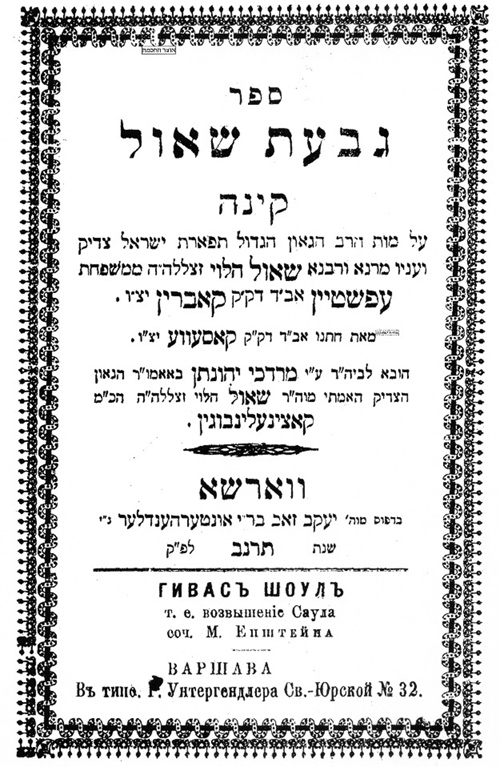
The pamphlet, גבעת שאול (Warsaw, 1892), was a eulogy over Karelitz’ father-in-law, whose name also happened to be R. Shaul Katzenellenbogen (1828-1892), and who had served with distinction as rabbi of Kossovo and then Kobrin (both today in Belarus). This second R. Shaul Katzenellenbogen was a descendant of R. Aryeh Leib Epstein, author of Ha-Pardes. Indeed, on the first title page of Karelitz’ גבעת שאול, R. Shaul Katzenellenbogen is described in bold letters as a member of the Epstein family. On the second title page, he is described in bold letters as a descendant of “R. Aryeh Leib Epstein, author of Ha-Pardes.”
[
            In sum, R. Dovid’s account provides impeccable testimony that the epitaph on the tombstone of R. Menahem Manes Chajes – the oldest tombstone preserved in the old Jewish cemetery – could still be visited and read in 1940.[58] What he claims to have read in a pamphlet at some later date remains problematic and requires further investigation or, as the later commentators would have put it, צריך עיון.
In memory of Khaykl Lunski (ca. 1881-1943), fabled librarian of the Strashun Library, who was the embodiment of the very soul of Jewish Vilna. His last essay – a study of the faded tombstone inscriptions in Vilna’s old Jewish cemetery – was written in the Vilna Jewish ghetto created by the Nazis. It perished together with him during the Holocaust. See Shmerke Kaczerginski, חורבן ווילנע (New York, 1947), p. 198 (henceforth: Kaczerginski). Cf. Hirsz Abramowicz, Profiles of a Lost World (Detroit, 1999), p. 264. Kaczerginski’s description of Lunski’s last years in the Vilna ghetto are worth citing here:
Khaykl Lunski (ca. 1881-1943)
NOTES:

[1] Sid Z. Leiman, “Lithuanian Government Announces Construction of a $25,000,000 Convention Center in the Center of Vilna’s Oldest Jewish Cemetery,” The Seforim Blog, September 13, 2015, available online here, reprinted here. A similar photograph (from a slightly different angle) appears in Leyzer Ran, Jerusalem of Lithuania (New York, 1974), vol. 1, p. 100 (henceforth: Ran). Alas, its lack of clarity renders it mostly useless.
[2] See Israel Klausner, קורות בית-העלמין הישן בוילנה (Vilna, 1935; reissued: Jerusalem, 1972), pp. 3-5 (henceforth: Klausner). Cf. Elmantas Meilus, “The History of the Old Jewish Cemetery at Šnipiškes in the Period of the Grand Duchy of Lithuania,” Lithuanian Historical Studies 12 (2007), pp. 64-67 (henceforth: Meilus).
[3] It was originally called “Pioromont,” because the old Jewish cemetery was adjacent to a street and neighborhood named after Stanislav Pior, an 18th century starosta who owned land in the area (Meilus, p. 88).
[4] See, e.g., the testimony of Chaim Basok, who together with Rabbi Kalman Farber visited the Vilna Gaon’s grave in the old Jewish cemetery at Piramont after Vilna was liberated by the Russian army in 1944. See Kalman Farber, אולקניקי ראדין וילנא (Jerusalem, 2007), p. 413. I have personally interviewed several former residents of Vilna who visited the Gaon’s grave in the old Jewish cemetery at Piramont between 1945 and 1948.
[5] A detailed map of the cemetery, as it appeared in 1935, is appended to Klausner.
[6] For an artist’s depiction of the gate at the northern entrance to the cemetery, see Sholom Zelmanovitch, דער גר-צדק ווילנער גראף פאטאצקי (Kovno, 1934), opposite p. 44. Notice Castle Hill at the upper right hand corner of the sketch; the inscription above the gate, והקיצו לקץ הימין; and the inscriptions on the sides of the gate, בית עולם ווילנא and zydu kapines. Here is the sketch:
[7] See, e.g., Shmuel Yosef Fuenn, קריה נאמנה (Vilna, 1860), p. 63 (henceforth: Fuenn 1860). Cf. the second and revised edition of קריה נאמנה (Vilna, 1915), p. 67 (henceforth: Fuenn 1915).
[8] Yeshayahu Vinograd, אוצר ספר העברי (Jerusalem, 1994), vol. 2, p. 359, entry 65.
[9] See Moshe Dovid Chechik, “ מהר”ר מנחם מאניש חיות וספר קבלת שבת,” ישורון 17(2006), pp. 668-691.
[10] Adolf Neubauer, Catalogue of the Hebrew Manuscripts in the Bodleian Library and in the College Libraries of Oxford (Oxford, 1886), column 59, entry 293.
[11] We have attempted to transcribe the Hebrew texts exactly as they appear in the photograph. We add in brackets the reconstruction of letters and words that in all likelihood once appeared in the original texts, but were no longer visible when the photograph was taken. For other photographs of the epitaph, see Klausner, p. 36; Zalman Szyk,   יאר ווילנע 1000 (Vilna, 1939), pp. 408 and 416 (henceforth: Szyk); Ran,  vol. 1, p. 101 ; and Reuben Selevan, A Trip to Remember: New York to Europe 1936 (New York, 2009), p. 113. The reconstructions are based mostly on the earlier transcriptions of the epitaphs in Fuenn and Klausner.
Over the years, some of the epitaphs were redone, and the reconstructed texts are often faulty. Enlarged and/or dotted letters (signaling acrostics, names, or dates) were sometimes made small and the dots were omitted. Small letters were sometimes enlarged. Letters and words were added or dropped when a partially erased word could no longer be read. Thus, for example, the first three words of R. Menahem Manes Chajes’ epitaph (in the photograph) read: פה נטמן בו, an impossible construction in Hebrew. It is obvious that one or more words are missing from the opening line of the epitaph. It is also evident the first lines form an acrostic spelling out his name: מנחם מאנש. When the epitaphs were redone, the original line divisions were not always retained. For the letters in bold relating to the year of his death (קדרו ושמים), see below, note 54.  Based upon the earlier transcriptions in Fuenn (Fuenn 1860, p. 63; Fuenn 1915, p. 67) and Klausner (pp. 36-39), and a measure of common sense, the original epitaph probably read:
[12] R. Shaul was also the brother of his father’s successor in the rabbinate of Brisk, R. Aryeh Leib (d. 1837). See Aryeh Leib Feinstein,
עיר תהלה (Warsaw, 1886), p. 30.
[13] Abraham Dov Baer ha-Kohen Lebensohn, אבל כבד (Vilna, 1825), section “תולדות הנאון,” p. 2.
[14] See ספרא דצניעותא (Vilna and Grodno,1820), page following title page.  
[15] See R. Yehezkel Feivel, תולדות אדם (Dyhernfurth, 1809), vol. 2, page following title page.
[16] See R. Hayyim of Volozhin, נפש החיים (Vilna and Grodno, 1824), page following title page.
[17] Samuel Luria, “תולדות הרד”ל,” in R. David Luria, קדמות ספר הזהר (New York, 1951), pp. 12-14.
[18] See Hillel Noah Maggid Steinschneider, עיר ווילנא (Vilna, 1900), vol. 1, p. 163.
[19] See Aliza Cohen-Mushlin, Sergey Kravtsov, Vladimir Levin, Giedrė Mickūnaitė, and Jurgita Šiaučiūnaitė-Verbickienė, Synagogues in Lithuania (Vilnius, 2012), vol. 2, p. 316, item 55. Cf. Ran, vol. 1, p. 112. (The alleged photograph of R. Shaulke’s kloyz in Ran is misidentified; cf. Synagogues in Lithuania, vol. 2, p. 348, n. 248.) The address of the kloyz was Szawelska (later: Žmudskij) [Yiddish: Shavli] 5 (today: Šiauliu 2). The original building no longer stands. During the Holocaust, the kloyz continued to serve as a prayer house and it housed a Yeshiva named in memory of R. Hayyim Ozer Grodzenski (d. 1940). See Kaczerginski, p. 209; cf. Zelig Kalmanovitch, יומן בגיטו וילנה (Tel-Aviv, 1977), pp. 83 and 100 (English edition: Zelig Kalmanovitch “A Diary of the Nazi Ghetto in Vilna,” Yivo Annual of Jewish Social Science 8[1953], pp. 30 and 47).
[20] Fuenn 1860, pp. 236-238; Fuenn 1915, pp. 237-239; Klausner, p. 75.
[21] See Fuenn 1860, p. 100; Fuenn 1915, p. 107; and cf. Klausner, pp. 43-44.
[22] See, e.g. מצודת דוד, pp. 3a, 7a, and 31a.
[23] Fuenn 1860, p. 107, paragraph 50, number 11; Fuenn 1915, p. 113, paragraph 51, number 11.
[24] The text of the epitaph was not recorded either by Fuenn or Klausner. However, it is easily restored by combining the general information they provide with the legible portions of the text in the photograph.
[25] There is good reason to believe that wooden tombstones once proliferated in the old Jewish cemetery, but they did not survive the ravages of time and circumstance. See, e.g., Klausner, p. 38 (who indicates that as late as 1810 the fee exacted by the חברא קדישא for stone tombstones was twice the amount exacted for wooden tombstones) and Szyk, p. 406 (who states that the majority of tombstones in the old Jewish cemetery were made of wood but did not survive). Only two wooden tombstones (in the old Jewish cemetery) survived into the twentieth century; those of R. Hillel b. Yonah and R. Yehoshua Heschel b. Saul, who served as Chief Rabbi of Vilna from circa 1725 until his death in 1749. For photographs of R. Yehoshua Heschel’s wooden tombstone, see Klausner, p. 52; Szyk, p. 416; and Ran, vol. 1, p. 101.
[26] Klausner, p. 42. Cf. Szyk, p. 416 and Ran, vol. 1, p. 100 (mostly illegible).
[27] See, e.g., מצודת דוד, p. 27a.
[28] Fuenn 1860, pp. 97-98; Fuenn 1915, pp. 104-105.
[29] See Eduard Duckesz, אוה למושב (Krakau, 1903), pp. 4-7.
[30] Fuenn 1860, pp. 99-100; Fuenn 1915, pp. 106-107; Klausner, p. 43.
[31]  Moving from left to right on the photograph, R. Yaakov Kahana’s tombstone (tombstone 6) appears to the right of R. Moshe Darshan’s tombstone (tombstone 5). But as one walks uphill from the bottom to the top of the cemetery, one passes the three mausoleums, then the twin gravestones of R. Yaakov Kahana and R. Eliyahu Hasid (tombstone 7), and only then the grave of R. Moshe Darshan.
[32] For biographical information about R. Yaakov Kahana, see Fuenn 1860, p. 239; Fuenn 1915, pp. 239-240; and the third edition of Kahana’s גאון יעקב, entitled גאון יעקב השלם (Jerusalem, 1997), introductory pages. See also Yaakov Polskin, “ספר צוף דבש,” ישורון 4(1998), p. 270, notes 7-9.
[33] Here too, the photograph presents an empty frame. Only the opening lines (i.e. the marker identifying the grave) can still be read. The original epitaph is recorded in Fuenn 1860, p 240; Fuenn 1915, pp. 240-241. Klausner (p. 53) mentions Kahana’s grave but does not record the epitaph.
[34] For biographical information about R. Moshe Kramer, see Fuenn 1860, pp. 95-96; Fuenn 1915, pp. 102-103, and the references cited in the next note.
[35] See R. Avraham b. R. Eliyahu (the Gaon’s son), סערת אליהו (Vilna, 1889), p. 18. Cf. R. Yehoshua Heschel Levin, עליות אליהו (Vilna, 1885), p. 39, note 5.
[36] The opening lines (i.e. the marker identifying the grave) are painted on the upper portion of the tombstone. The epitaph is encased below the tombstone’s upper portion. For the epitaph, see Fuenn 1860, p. 99; Fuenn  1915, pp. 105-106; and Szyk, p. 408.
[37] See Fuenn 1860, p. 107; Fuenn 1915, p. 113.
[38] Here too the opening lines represent the marker identifying the grave, almost certainly added at a later date. For the epitaph, see Klausner, p. 43.      
[39] See  שיעורי רבנו משולם דוד הלוי: דרוש ואגדה (Jerusalem, 2014), pp. 390-396. For the date when R. Dovid left Vilna (January 19, 1941), we have followed Shimon Yosef Meller, הרב מבריסק (Jerusalem, 2003), vol. 1, p. 513.
[40] No precise date is provided by R. Dovid for his visit to the old Jewish cemetery. But since he arrived in Vilna on October 22, 1939, and his first attempts to visit the cemetery were thwarted, we assume the visit took place in 1940, the only full year he spent in Vilna. It is possible, however, that the visit took place late in 1939 or early in 1941.
[41] שיעורי רבנו משולם דוד הלוי: דרוש ואגדה (Jerusalem, 2014), pp. 393-394. The translation provided here is paraphrastic. The original Hebrew text reads:
[42] In 1940, Jewish burials were still taking place in Zaretcha, the successor cemetery to the old Jewish cemetery, which was closed in 1831. Zaretcha (today: Užupis), just outside the Old Town, and across the Vilenka River, was part of the Vilna municipality in 1940.
[43] In the latter part of the 19th century and the first half of the 20th century, the northern gate was no longer used. One entered the old Jewish cemetery from a side entrance on Derewnicka Street. The path from the entrance would lead one to the section where R. Menahem Manes Chajes was buried (on the right) and to the mausoleum where the Vilna Gaon was buried (on the left).
[44] The biblical title משיח ה’ (see, e.g., I Sam. 24:7 and Lam. 4:20), rendered “the Lord’s anointed one,” was usually reserved for kings and would-be messiahs (by their followers), not rabbis. R. Dovid could not identify the occupant of the grave, perhaps because the line with the name מהור”ר מנחם מאנש simply didn’t resonate to a 17 year old yeshiva student. One could claim that the line with R. Menahem Manes’ name was no longer legible in 1940 (as it was not legible in the inter-war photograph that forms the basis of this essay), but this seems highly unlikely in the light of the Selevan photograph taken in 1936. See below, note 48. The Selevan photograph is a close-up photo, and R. Dovid was standing directly in front of the same tombstone. He had no trouble reading poorly painted words.
[45] See discussion below.
[46] See discussion below.
[47] R. Menahem Manes Chajes died in 1636; R. Moshe Rivkes died in 1672. Eighty five years after these dates would be between 1721 and 1757. Since, as we shall see, the author of Ha-Pardes died in 1775, “85 years” cannot be referring to the time that elapsed between their deaths and his. “100 years” and more would have been a more accurate estimate. See below, note 56, for a likely explanation of the “85 years.”
[48] Reuben Selevan, A Trip to Remember: New York to Europe 1936 (New York, 2009), p. 113. I am deeply grateful to the author for granting me permission to scan and post the photograph (taken by his father in 1936) of R. Menahem Manes Chajes’ epitaph.
[49] For a biography of R. Aryeh Leib Epstein, see R. Ephraim Mordechai Epstein, גבורות ארי (Vilna, 1870). Ha-Pardes, only partially published, was an encyclopedic work encompassing many different genres of rabbinic literature. It includes talmudic commentary, listing and exposition of the 613 commandments, responsa literature, halakhic codes, kabbalistic teaching, sermons, eulogies, and more. The first fascicle with the title ספר הפרדס was published in Koenigsberg, 1759. It is a available today in several editions, including: ספרי בעל הפרדס (Bnei Brak, 1978), 2 vols.; and ספרי הפרדס (Jerusalem, 1983), 4 vols. See also מעשה רב חדש (Bnei Brak, 1980), pp. 29-80.
[50] His grave is no longer standing. A sketch of his grave, as it looked in 1904, appears in Festschrift zum 200jahrigen Bestehen des israelitischen Vereins für Krankenpflege und Beerdigung Chewra Kaddischa (Koenigsberg, 1904), sketch IV. The full Hebrew epitaph is printed opposite p. XX.

[51] See the entry on him in Encyclopaedia Judaica (Jerusalem, 1973), vol. 10, column 830.
[52] גבעת שאול, p. 23a. The translation here is paraphrastic. The Hebrew text reads:
[53] See Deut. 5:19 and Rashi’s comment ad loc.
[54] The year of R. Menahem Manes Chajes’ death was recorded on his epitaph with the words: קדרו ושמים. Several of these letters had  protruding dots above them; the numerical value of the dotted letters yields the year of his death. At a very early period, some of the dots could no longer be read. Fuenn (1860, p. 63; 1915, p. 67) writes that he was able to make out dots above the letters ר, ו , and מ. But those letters alone could not possibly refer to his date of death. This passage indicates that in 1825, at least, the dotted letters also includedק   and final ם, totaling [5]386 = 1626. On other grounds, we know that Chajes died in [5]396 = 1636, so it appears likely that the dotted letters also once included the י of ושמים. If not for Fuenn’s testimony, we would claim that the second word by itself, ושמים ( = [5]396) yields the year of Chajes’s death. Cf. Moshe Dovid Chechik (above, note 9), p. 675.
[55] See M. Avot 5:7.
[56] Given that this passage was written in 1825, “85 years” here refers to the period between 1740 and 1825. As the passage itself makes clear, the reference is to the many rabbinic greats who were buried in this section of the cemetery by 1740 – and not later. See above, epitaphs 1,3,4,5,7, and 8, all of which are samples that support the claim that after 1740 no rabbinic greats were buried in this section of the cemetery. Epitaphs 2 and 6 are in harmony with this claim. Epitaph 2 is the epitaph of R. Shaul Katzenellenbogen, the case at hand. Epitaph 6 (R. Yaakov Kahana) is dated 1826, a year after the case at hand and the publication of the passage in R. Zvi Hirsch Katzenellenbogen’s גבעת שאול.
[57] The father of R. Avraham Yeshaya Karelitz (d. 1953), author of חזון איש.
[58] I am deeply grateful to Professor Dovid Katz of Vilnius, mentor and colleague, whose astute comments have enhanced the final version of this essay.


The Yom Tov Lecture of R. Eliezer Hagadol

The Yom Tov Lecture of R. Eliezer
Hagadol

By Chaim Katz, Montreal
Our
Rabbis taught in a baraita: R. Eliezer was sitting and lecturing about
the laws of the festivals the entire day. A first group left and he said: these
people own pithoi (huge storage containers). 
A second group left and he said: these people own amphorae (smaller
storage containers). A third group left . .
.
 A forth group left . . .  A fifth group . . .  When a sixth group started to leave. . . He
looked towards his students and their faces turned white. He said:  “my children, I wasn’t speaking to you, but to
those who left, who abandon eternal life and busy themselves with mundane life.”
When the students were dismissed he said to them: “Go, eat delicacies, and
drink sweet drinks . . . for today is a holy day . . .”
The
baraita has: “who abandon eternal life and busy themselves with mundane
life”.   But isn’t the joy of the
festival a mitzva? Rabbi Eliezer’s opinion is that joy of the festival
is a reshut as was taught: Rabbi Eliezer says: A person on Yom Tov has
no way except to eat and drink or to sit and study [Torah].  R. Yehoshua says: divide [the time], half for
eating and drinking and half for the study hall. (Betza 15b) [1]
To
summarize:  1) R. Eliezer was critical of
those who walked out during his lecture. 2) R. Eliezer’s criticism is in
agreement with his opinion that eating on the festival is not a mitzvah. 3)
However, he believes that eating is valid on a holiday and is equivalent to study
on a holiday.  4) R. Eliezer encourages
his students to eat delicacies and drink sweet beverages after the lecture has
ended. 
Something
doesn’t seem right.
In his book on R. Eliezer ben Hyrcanus ,
Professor Yitzhak D Gilat, writes:
From R. Eliezer’s reaction to the groups
leaving the study-room, it appears that the alternative of eating and drinking
is merely a hypothetical one . . .   In
practice he disapproves of it. [2]
I think there
is another way to reconcile the different aspects of the story but first some
background:
The
definition of a derasha (the term for R. Eliezer’s lecture) is a talk
(usually related to the current Sabbath or holiday) that was delivered to the
general public. It had a standard form, and was delivered at a specific time.
[3]
An
eye-witness description of a derasha from the time of the Gaonim
exists: [4]
The
head of the yeshiva of Sura opens the lecture (with a verse) and the meturgaman
stands near to him and proclaims his words to the people. When the head of the yeshiva
lectures, he lectures with awe. He closes his eyes and wraps himself in his tallit,
even his forehead is covered. While he lectures, no one in the congregation
makes a sound or says a word.  If he senses that someone in the audience is
speaking, he opens his eyes and a dread of trembling falls upon the entire
congregation…
The derasha was delivered either at
night (the eve of yontov), or in the morning (after the Torah Reading)
or during the afternoon [5].  
R. Eliezer probably did not lecture the
entire day, [דורש
כל
היום
כולו]. He probably lectured for only part of
the day. Parallels prove this point:
1.      They said about R. Yohanan ben Zakai that
he was sitting in the shade of the Temple sanctuary lecturing the entire day.  (Pesahim 26a)
דתניא אמרו עליו על רבן יוחנן בן זכאי שהיה יושב בצילו של
היכל ודורש כל היום כולו 
R.
Yohanan b Zakai couldn’t have sat in the shade all day unless he started on the
west of the heichal and later moved himself (and the audience) to the
eastern side of the heichal. It’s likely that his derasha took
place in the afternoon, when shadows extend towards the east. [6]
2.      They
immediately sat him [Hillel] at the head and appointed him nassi over them
[the Sanhedrin]. He lectured the entire day on the laws of Passover. (Pesahim
66a)
מיד הושיבוהו בראש ומינוהו נשיא עליהם. והיה דורש כל היום
כולו בהלכות הפסח
As
the Gemarah describes, they first searched for someone who could tell
them what to do when the eve of Passover falls on the Sabbath. They found
Hillel. They interviewed him. He presented his arguments, but his reasoning was
rejected. He argued a different way and his reasoning and halakha were accepted.
They offered him the leadership of the Sanhedrin and he accepted. They gathered
the people and he gave the derasha. All that must have taken some time,
which leads to the conclusion that he also lectured during the second part of
the day.
To summarize:  
1)      The people who attended the derasha were mainly regular shul-goers –
members of the community.
2)      Although R. Eliezer’s disciples where also present, the people who left the
lecture before it ended were the regular shul-goers. [7]
3)      R. Eliezer’s lecture took up only part of the day. Based on the expressionדורש כל היום כולו , the derasha probably took place  in the latter part of the afternoon, (like
the derashot of his teacher and his teacher’s teacher).
4)     
Therefore, we can conclude that R. Eliezer expected his
congregants to eat a yomtov meal and they most probably already did so
before the derasha started. He holds that you can observe the holiday either
by eating or by learning Torah – but neither of these activities has to last the
entire day.  
The
climax of the story, the phrase “they abandon eternal life and busy themselves
with mundane life”, also needs to be explained. The sentence is used a number
of times in the Talmud, but it has a bit of a different meaning each time it’s
used. The primary sense is in Taanit 21a: Ilfa and R. Yohanan decide to leave
the beit-ha midrash in search of a more financially secure lifestyle. At
the start of their journey, an angel is heard saying, they are “abandoning
eternal life and occupying themselves with mundane.”
However, in our story
the simple straightforward meaning doesn’t fit. How
were the congregants abandoning eternal life by leaving the lecture early?  They certainly heard more Torah on this day
than they heard on a regular work day. And why were they more engaged in the
mundane today while eating a holiday meal compared to when they eat a normal week-day
meal on any other day? [8]
Which
leads to another point – we aren’t very
familiar with R. Eliezer and his halakhic opinions. We
know he had an affinity for Beit Shammai (and was maybe the last of the Beit
Shammai) and we know that the sages and most of his own disciples distanced
themselves from him and his teachings were not preserved. [9]
R.
Shaul Lieberman in his commentary to the Tosefta of Berakhot, tells us
something about R. Eliezer that I believe is the key to understanding our
story.
We
read in the Tosefta (Berakhot 4:1):
לא ישתמש אדם בפניו ידיו ורגליו אלא לכבוד קונהו שנא’
(משלי טז)
כל פעל ה’ למענהו
One
should not use his face hands or feet but in honor of his Maker as it says:
Everything G-d creates, He creates for its specific purpose.  (Proverbs 16:4)
Professor
Lieberman explains: [10]
לפי פשוטו משמעו שלא ישתמש אדם בהם להנאתו גרידא אלא לכבוד שמים ואם הוא עושה כן הרי כבוד שמים מתירן לו בהנאה.
A
person is not to act solely for his own pleasure but is to act for the honor of
heaven. When he acts this way, his intention for the sake of heaven grants him a
license to enjoy the pleasure.
R.
Lieberman continues and demonstrates that this is the position of Hillel.
However Shammai has a different approach; Shammai regards physical pleasure as
something to be accepted only grudgingly or maybe even involuntarily:
Everything
you do should be for the sake of Heaven, like Hillel.  . . . 
“Where are you going Hillel”, “I’m going to do a mitzvah.” “What mitzvah
Hillel?” “I’m going to the bath-house.” “Is that a mitzvah”, “Yes . . . ”
But
Shammai wouldn’t say that, rather he would say “let us fulfill our obligation
to this body of ours.” [11]
Prof.
Lieberman points out that R. Eliezer follows and practices the teaching of
Shammai. [12]
Returning
now to our story: R.
Eliezer however, views the yontov food like ordinary week-day food, i.e.
 שמחת יום טוב רשות,
and being an ordinary meal, the physical pleasure of the food or drink cannot be
fully enjoyed. [13]
R. Eliezer expects his community to follow
his own rulings and practices. [14]  He suspects that the groups who left before the lecture concluded
were returning home to drink wine and enjoy tasty food for the physical
pleasure of eating and drinking. They were abandoning eternal life – the life of eating purely without
thinking of the physical pleasure and were engaged in the temporal life of
self-indulgence. [15]
Yet, R. Eliezer could still be conciliatory
to his students and encourage them to eat and drink delicacies in honor of the
holiday because he knew they would eat their food in a befitting way and live
up to his teaching and principals.
I believe it’s possible to clarify the
positions of R. Eliezer based on writings of Maimonides. [16] Starting with Sefer
Ha Mitzvot
:
ואחרי עיניכם  – זו זנות שנאמר: ויאמר שמשון
אל אביו וגו’ (שופטים יד, ג (הכוונה באמרם זו זנות רדיפת התענוגות והתאות הגופניות
והעסקת המחשבה בהן תמיד.
The Sifre interprets  . . . don’t follow after your eyes (Numbers
15:39) this refers to promiscuity (zenut)  . . .   including the pursuit of pleasure and pursuit
of physical gratification as well as the constant wishful thinking about them.
[17]
In the Guide, Maimonides expands this
point. [18]
There are some – a partition separates
between them and G-d, the collection of dimwits, who suppress their faculty of
thinking about ideas, who pursue only the sensory feeling which is our greatest
disgrace – the sense of touch. They have no thought or notion except for
thoughts of eating, sex and nothing else . . .
In contrast, the ideal person whom everyone should emulate fits the
following profile [19]
[people] for whom all compulsory
materialness is humiliating and disgraceful;  a flaw  which is forced upon them, especially the
sense of touch, which is humiliating to us as Aristotle wrote, that moves us to
desire eating, drinking and sexual acts, which must be minimized as much as
possible. One must be discreet and pained when engaged in it, not make it the
subject of our speech, not talk about it freely, not sit in assemblies for
these purposes but rather control of all of these needs and reduce them to the
essential minimum as much as we can.
R. Eliezer follows this ideal. I would
argue this is not asceticism. R. Eliezer is doing the same things that everyone
else does. His feelings are different (and that affects his behavior somewhat),
but his feelings follow from his understanding of the Torah’s instruction:  לא תתורו,
and by definition, carrying out the rules
of the Torah is not called asceticism.
In the 5th chapter of the
introduction to his commentary on Abot, Maimonides speaks about dedicating
one’s actions for the sake of heaven, לשם שמיים:
[20]
Know that this level is an outstanding and
difficult accomplishment that is reached by very few, after very much practice.
If there is a man who behaves this way I don’t consider him inferior to the
prophets. Someone who uses all of his powers and directs them solely for the
sake of G-d, who doesn’t perform any big or small activity or speak a word
unless that activity or word brings one toward virtue  . . .
Maimonides’ idea of “for the sake of
heaven” is that certain activities are forbidden unless they are performed for the
sake of heaven. These activities include listening to music, studying science,
spending time on appreciating art or nature and others like them.
For “required” mundane activities like
eating, bathing and so on, the intention for the sake of heaven is also
necessary and permits two things. 1) It allows more elaborate activities (e.g.,
to eat a tasty more elaborate meal, as in Baba Kama 72a- אכילנא בשרא דתורא).
2) It also allows one to enjoy the pleasure associated with the activity
according to Hillel. As we’ve seen, R. Eliezer disagrees with the second point.
[21]
Rabbi Moshe Sokol defines Neutralism: [22] 
Pleasure in itself is neither good nor
bad. Pleasurable activities are also, in themselves, neither good nor evil.
Pleasurable activities derive their value only instrumentally, either by
considering the consequences . . .  or by
considering the intentions of the person engaging in the pleasurable activity .
. .
I believe that R. Eliezer is also a
neutralist because he is not forbidding any permitted pleasurable activity. If a
“mundane” pleasurable activity is clearly a mitzvah, (eating matzah
at the seder(?)), then I would guess the pleasure can probably be
enjoyed. If it’s not a mitzvah then the pleasure can’t be enjoyed.
I saw a midrashic source, which at first
glance seems to describe R. Eliezer’s asceticism.
The
Beit Hamidrash of R. Eliezer was shaped like a stadium. There was a special stone
there which was reserved for R. Eliezer to sit on. Once R. Yehoshua came in and
began to kiss the stone saying this stone is like Mount Sinai and the one who
sat on it is like the Ark of the Covenant. [23]
Why
did R. Eliezer sit on a stone? But this is an invalid question. Everyone in the
beithamidrash sat on the floor and this had nothing to do with
asceticism (see Yevamot 105b).  The
teacher however didn’t sit on the floor but sat a little higher, maybe on a
stone like this one [see note 24].
 The same midrash describes R. Eliezer’s
school:
One
time R. Aqiba was late in coming to the beit hamidrash. He sat
outside. A question was asked. They said the halakha is outside  . . . 
the Torah is outside  . . .  Aqiba is outside. They cleared a way and he
came and sat in front of the feet of R. Eliezer. [25]
It
sounds like the students sat (cross-legged) on the ground in concentric circles
around R. Eliezer. R. Eliezer sat (cross-legged) on his stone and R. Aqiba (the
most senior student) sat directly at R. Eliezer’s feet. [26]
If
this arrangement was also in place during R. Eliezer’s derasha, then the
first group – the group of congregants that left the earliest were probably sitting
(on the ground) on the outermost concentric circle closest to the exit so that
they could easily make their get-away. The other groups (who were also planning
on leaving early), also sat on the ground nearer to the exit. The students however,
who planned on staying until the end sat closest to their teacher R. Eliezer.
 [1]
ת”ר מעשה ברבי אליעזר שהיה יושב ודורש כל היום כולו בהלכות
יום טוב יצתה כת ראשונה אמר הללו בעלי פטסין כת שניה  אמר הללו בעלי חביות כת שלישית אמר הללו בעלי כדין כת רביעית
אמר הללו בעלי לגינין כת חמישית אמר הללו בעלי כוסות התחילו כת ששית לצאת אמר הללו
בעלי מארה נתן עיניו בתלמידים התחילו פניהם משתנין אמר להם בני לא לכם אני אומר אלא
להללו שיצאו שמניחים חיי עולם ועוסקים בחיי שעה בשעת פטירתן אמר להם לכו אכלו משמנים
ושתו ממתקים ושלחו מנות לאין נכון לו כי קדוש היום לאדונינו ואל תעצבו כי חדות ה’ היא
מעוזכם
אמר מר שמניחין חיי עולם ועוסקין בחיי שעה והא שמחת יום טוב
מצוה היא רבי אליעזר לטעמיה דאמר שמחת יום טוב רשות דתניא רבי אליעזר אומר אין לו
לאדם ביום טוב אלא או אוכל ושותה או יושב ושונה ר’ יהושע אומר חלקהו חציו לאכילה
ושתיה וחציו לבית המדרש.
[2] Yitzhak D Gilat, R. Eliezer ben
Hyrcanus A Scholar Outcast
Bar-Ilan University press 1984, p 279 (English
edition).
[3] In the Practical Talmud Dictionary by Rabbi
Yitzhak Frank, s.v. דורש this example is
quoted (Sota 40a):
R. Abbahu and R.
Hiyya b Abba happened to come to a certain town. R. Abbahu taught aggada; R.
Hiyya b Abba taught halakha.  Everyone
abandoned R. Hiyya b. Abba and went to hear R. Abbahu.
רבי אבהו דרש באגדתא רבי חייא בר אבא דרש בשמעתא שבקוה כולי
עלמא לרבי חייא בר אבא ואזול לגביה דר’ אבהו 
[4] Quoted on page 1 of the  introduction to Sheiltot
d’Rav Achai
 
ed. Rabbi Samuel K. Mirsky (Jerusalem, 1960) from Medieval Jewish
Chronicles
Seder ha-Ḥakhamim ve-Korot ha-Yamim, (Part ii, page 84)
edited by Adolf (Avrohom) Neubauer.
עד שפותח ראש ישיבת סורא והתורגמן עומד עליו ומשמיע דבריו לעם. וכשדורש דורש באימה וסותם את עיניו
ומחעטף בטליחו עד שהוא מכסה פדחחו. ולא יהיה בקהל בשעה שהוא דורש פוצה פה ומצפעף ומדבר דבר .וכשירגיש באדם שמדבר פותח את עיניו ונופל על הקהל אימה ורעדה.  וכשהוא גומר מתחיל בבעיא ואומר
[5] R. Ezra Zion Melamed in Mavo Lsifrut
Hatalmud
page 74. (However the derasha of the head of the Sura
Yeshiva on the occasion of the nomination of the exilarch (previous note) was
given before the reading the Torah.)
[6]
Mishna Midot 2:1
הר הבית היה חמש מאות אמה על חמש מאות אמה רובו מן הדרום, והשני לו מן המזרח, והשלישי לו מן הצפון,
ומיעוטו מן המערב.  מקום שהיה רוב מידתו,
שם היה רוב תשמישו.
The
temple mount was five hundred cubits by five hundred cubits. Most of the free
space was on the south; then on the east; then on the north; and the smallest
area was on the west. The larger the area the more it was used.
[7] Artscroll translated: the first group of students
left . . . the second group of students 
. . .
[8]
The same phrase also appears in Shabbat 10a and there too the plain meaning
doesn’t fit well:
Rava
saw R. Hamnuna prolonging his prayers and said: They abandon eternal life and
busy themselves with the mundane.
Aside
from the plural language, how could one describe prayer (service of the heart
(Taanit 3a)) as “mundane”?  A friend
(res) suggested that if this is the same Rav Hamnuna who was criticized by Rav
Huna for being single (Kiddushin 29b) and if he still wasn’t married by now
then Rava might be telling him that he is abandoning eternal life (marriage and
potential children), and busy with prayer , which is temporal because it
benefits only himself.  Or if it’s the
same Rav Hamnuna who in Berakot 31a taught an approach to prayer based on
Hannah’s prayer, then maybe Rava, who was a descendent of Eli the Priest (Rosh
Hashana 18a – manuscripts), like his forbearer, misunderstood this type of
prayer and considered it to be mundane.    
[9] R. Ezra Zion
Melamed, Pirkey Mavo Lsifrut Hatalmud (Jerusalem 5733), p. 64.
[10] R. Saul Lieberman
Tosefta kiPheshuto, Berakhot
, p. 56, explaining the beginning of the
4th chapter.
[11]
Solomon Schechter ed, Abot de-Rabbi Nathan, Vienna, 1887, Recession B,
chapter 30. Page 33b
שמאי לא היה אומר כך אלא יעשה חובותינו עם הגוף הזה
[12] Nedarim 20b
[13]
Mishna Betzah (5:2), reshut is a voluntary type of action that has a
certain dimension of mitvah-bility to it.
כל שחייבין עליו משום שבות, ומשום רשות, ומשום מצוה בשבת–חייבין עליו ביום טוב אלו הם משום רשות–לא דנין, ולא ולא מקדשין, ולא חולצין, ולא מייבמין
[14]
R. Eliezer also said: one may cut down trees to make charcoal for manufacturing
iron tools to perform a circumcision on the Sabbath  . . . Our Rabbis taught: In R. Eliezer’s
locality they would follow his teaching and cut down trees to make charcoal to
make iron tools to circumcise a child on the Sabbath – Shabbath 130a
[15] Rambam
Shebitat Yom Tov  6:18 writes:
The people gather early in the morning in
the synagogues and houses of study. They say the prayers, read the Torah
relevant to the day and return home to eat. They go to the houses of study,
read [Torah], recite [Mishna] until after noon. 
They say the afternoon prayers and return home to eat and drink for the
remainder of the day and night. 
R.
Kapah notes that they return home to eat (after shaharit), but return
home to eat and drink after the minha prayer. Here too, R.
Eliezer mentions the household items used mainly to store wine.
[16]
I assume that vis-à-vis these philosophical teachings, there was no “rupture
and reconstruction” to interrupt between the times of Chazal and Rambam.
[17]
Sefer HaMitzvoth, (Neg. 47) Rabbi
Kapah’s edition:
“ואחרי עיניכם”
– זו זנות שנאמר: ויאמר שמשון אל אביו וגו’ (שופטים יד, ג (הכוונה באמרם זו זנות רדיפת התענוגות והתאות הגופניות
והעסקת המחשבה בהן תמיד.
[18]
Guide section III, chapter 8, R. Kapah’s edition. (R. Kapah, in his Sefer
Hamitvot points out this parallel)
אבל האחרים שמסך מבדיל בינם לבין ה’ והם עדת הסכלים, הרי בהפך זה, ביטלו כל התבוננות ומחשבה במושכל, ועשו תכליתם אותו החוש אשר הוא חרפתנו הגדולה, כלומר: חוש המישוש, ואין להם מחשבה ולא רעיון כי אם באכילה ותשמיש לא יותר
[19]
Guide section III, chapter 8, R. Kapah’s edition.
כל הכרחי החומר אצלם חרפה וגנאי ומגרעות שההכרח מחייבם,
ובפרט חוש המישוש אשר הוא חרפה לנו כפי שאמר אריסטו אשר בו מתאווים אנו האכילה והשתייה והתשמיש, שראוי
למעט בו ככל האפשר, ולהסתתר בו ולהצטער בעשייתו. ושלא ייחד בכך שיחה ולא ירחיב בו דיבור, ולא יקהל
לדברים אלה, אלא יהיה האדם שולט על כל הצרכים הללו, וממעט בהן ככל יכולתו, ולא יקח
מהן כי אם מה שאי אפשר בלעדיו.
[20] Shemone Perakim, Chapter 5, internet
edition here.
ודע, שהמדרגה הזאת היא מדרגה עליונה מאוד וחמודה.
ולא ישיגוה אלא מעטים,
ואחר השתדלות רבה מאוד. וכשתזדמן מציאות-אדם, שזה מצבו, לא אומר, שהוא למטה מן הנביאים,
רצוני לומר: שיוציא כוחות-נפשו כולם וישים תכליתם האלוהים יתעלה לבד,
ולא יעשה מעשה קטון או גדול,
ולא יבטא מילה, אלא שאותו מעשה או אותו ביטוי יביא ל”מעלה” או ל”מה שמביא אל מעלה”.
[21]
I don’t think Maimonides discusses the pleasure associated with physical
activities performed for the sake of heaven. I noticed that in In The Sages
– Their Concepts and Beliefs
E.E. Urbach 
(Jerusalem 1978 Heb.), page 299, the author understands that according
to Shammai there is no concept of acting for the sake of heaven when it comes
to activities that fulfill bodily needs like eating, washing and so on, but I
don’t understand why the author says so.
[22]
Attitudes Toward Pleasure in Jewish Thought, Moshe Z. Sokol, in Reverence,
Righteousness and Rahamanut – Esssays in Memory of Rabbi Dr. Leo Jung
ed.
Jacob J. Schacter, page 300-304
[23]
Shir Hashirim Rabba 1:3  לריח שמניך טובים
ובית מדרשו של רבי אליעזר היה עשוי כמין ריס, ואבן אחת הייתה שם והיתה מיוחדת לו לישיבה. פעם אחת נכנס רבי יהושע התחיל ונושק אותה האבן ואמר: האבן הזאת, דומה להר סיני, וזה שישב עליה, דומה לארון הברית.
[25] Shir Hashirim Rabba 1:3 
פעם אחת שהה רבי עקיבא לבא לבית המדרש בא וישב לו מבחוץ. נשאלה שאלה: זו הלכה, אמרו: הלכה מבחוץ. חזרה ונשאלה שאלה. אמרו: תורה מבחוץ.  חזרה
ונשאלה שאלה. אמרו: עקיבא מבחוץ. פנו לו מקום. בא וישב לו לפני רגליו של רבי אליעזר.

[26]
The story in Berakhot 28a (and Yerushalmi Berakhot 4:1 (daf 32b in mechon-mamre
and snunit sites), (the question about the obligation of the evening prayer), speaks
about a beitmidrash with benches. Maybe the meeting place of the
Sanhedrin was different and they didn’t sit on the floor?


Textual Emendations in Minhag Anglia

Textual
Emendations in Minhag Anglia

Harry
Freedman

Harry
Freedman’s
The Talmud: A Biography is
published by Bloomsbury Publications. His next book,
The Murderous History
of Bible Translations will be published by Bloomsbury in 2016

In
his book Changing the Immutable Mac Shapiro notes that, for reasons of
propriety, the Birnbaum siddur transliterates the words מי רגליים in פטום הקטרת
[1],
instead of translating them. Philip Birnbaum was not the only translator to be
troubled by these words.
In
1890 Rev. Simeon Singer produced a prayer book in London, with the sanction and
authorisation of Chief Rabbi
Nathan Marcus Adler. Singer’s object was to produce ‘a
correct text and satisfactory translation’ which could be used in ‘Synagogues,
families and schools.’[2] Singer
used Yitzhok (Seligman) Baer’s Avodat Yisrael  as his base text.
As befits a
prestigious Victorian publication, Singer’s siddur was grandly entitled The
Authorised Prayer Book of the United Hebrew Congregations of the British
Empire.
Known ever since as The Singer’s, it became and remains the
defining text of Minhag Anglia.

Notwithstanding
its source in the gemara, and the fact that מי רגליים is itself a
euphemism, its translation must have been
considered unsuitable for inclusion in Singer’s family friendly siddur. But
unlike Birnbaum he did not transliterate the Hebrew words. Instead he just left
out the entire translation of והלא מי רגליים יפין לה אלא שאין מכניסין מי רגליים בעזרה מפני הכבוד. He left his readers with no explanatory note as to what he had
done.
In 1904 Arthur Davis and Herbert Adler published a set of
machzorim. Popularly known as the Routledge machzorim  they served for many years  as minhag anglia’s definitive yomtov
texts. They followed Singer in omitting the entire translation of והלא מי רגליים יפין לה אלא שאין מכניסין מי רגליים בעזרה
מפני הכבוד.
By 1939 Singer’s siddur had run to its 16th impression.
Now under the auspices of Chief Rabbi J.H. Hertz, those mitpallelim
accustomed to saying פטום
הקטרת would have
been bemused to find the final sentence missing, not just in English, but now
also in Hebrew. Dayan Ivan Binstock, the Minhag Anglia editor of the Sacks
Koren machzorim, suggests that Hertz required this change for consistency, to
bring the Hebrew and English into line. The alternative remedy, of adding an
English translation to the extant Hebrew, was clearly not appropriate.
This was not Chief Rabbi Hertz’s only editorial
amendment. He substantially reduced the Prayer for the Government (in England
this was known as the Prayer for the Royal Family). Amongst other omissions he
removed הפוצה דוד עבדו מחרב
רעה and
significantly reduced the number of verbs required to elevate and protect the
monarch. Possibly, such over-anxious concern for the monarch’s welfare was not
deemed appropriate for the still-powerful British Empire.
Chief Rabbi Hertz had his own concerns about indelicacy.
In the siddur with commentary that he published in 1946 he too omitted all
mention, in Hebrew and English, of מי רגליים. But he also
ameliorated the words of the Shabbat shacharit Amidah. In the Hertz siddur, the
ערלים who do not dwell in the Sabbath’s rest[3] have
become רשעים. In his commentary Hertz notes that ‘for many
centuries most prayer books had this reading instead of ערלים, which recent
editions, through the influence of Baer, have reintroduced’.[4]
לא ישכנו רשעים is found in a number of siddurim including R. Shlomo
Ganzfried’s Avodat Yisrael, R. Yehudah Leib ben Meir Gordon’s Beit
Yehuda
and R. Yosef Teumim’s Higayon Lev. R. Yaakov  Emden[5] and
R. Chaim Elazar Spira[6],
amongst others, argue against it on the grounds that whereas  ערלים are not
obligated to keep the mitzvah of Shabbat, many רשעים are.
Baer, whom Hertz holds responsible for the current use of
ערלים, states in a footnote: ערלים: כן הנוסחא בכל ס”י (=ספרי ישנים) ובסדורי
ספרדים וברמב”ם. [7]  Hertz’s
choice of רשעים in place of reflects at best a minority
opinion and has neither precedent nor subsequent in Minhag Anglia. It
was almost certainly introduced for reasons of propriety.
In 2006 a fourth edition of the Singer’s siddur was
published with a new translation by Chief Rabbi Jonathan Sacks. For the first
time in the history of Minhag Anglia, פטום הקטרת was printed in
full, including the final sentence, in both Hebrew and English. מי רגליים may have not
have been brought to the azarah  מפני הכבוד but in our
more plain-speaking age its restitution to  פטום הקטרת seems just as
much to be an expression of כבוד.

[1] B.
Keritot 6a.
[2]
Preface to 1st edition of the Authorised Daily Prayer Book, ed.
Simeon Singer, London 1890
[3] וגם במנוחתו לא ישכנו ערלים
[4] J.H.
Hertz, Authorised Daily Prayer Book with Commentary, p 458-9
[5] לוח ארש, 312
[6] מאמר נוסח התפילה, 23
[7] Siddur
Avodat Yisrael,
5628 edition p. 219.