R. Elazar Fleckeles’s Haggadah Maaseh BR’ Elazar

R.  Elazar Fleckeles’s Haggadah Maaseh BR’ Elazar
By Eliezer Brodt
In the past I wrote:
Perhaps the topic which has engendered the most commentary in Jewish literature is the Haggadah shel Pesach. There are all kinds, in all languages, and with all types of commentary, pictures, etc. Whatever style one can think of, not one, but many Haggadahs have been written. So, whether it’s derush, kabbalah, halakha, mussar or chassidus there are plenty of Haggadahs out there. Then, there are people who specialize in collecting haggadahs although they do not regularly collect seforim. In almost every Jewish house today one can find many kinds of Haggadahs. Every year people print new ones; even people who had never written on the Haggadah have had a Haggadah published under their name, based on culling their other writings and collecting material on the Haggadah. When one goes to the seforim store before Pesach it has become the custom to buy at least one new Haggadah; of course one finds themselves overwhelmed not knowing which to pick! Every year, besides for the new Haggadahs being printed, old ones are reprinted, some in photo off-set editions, others with completely retype set.
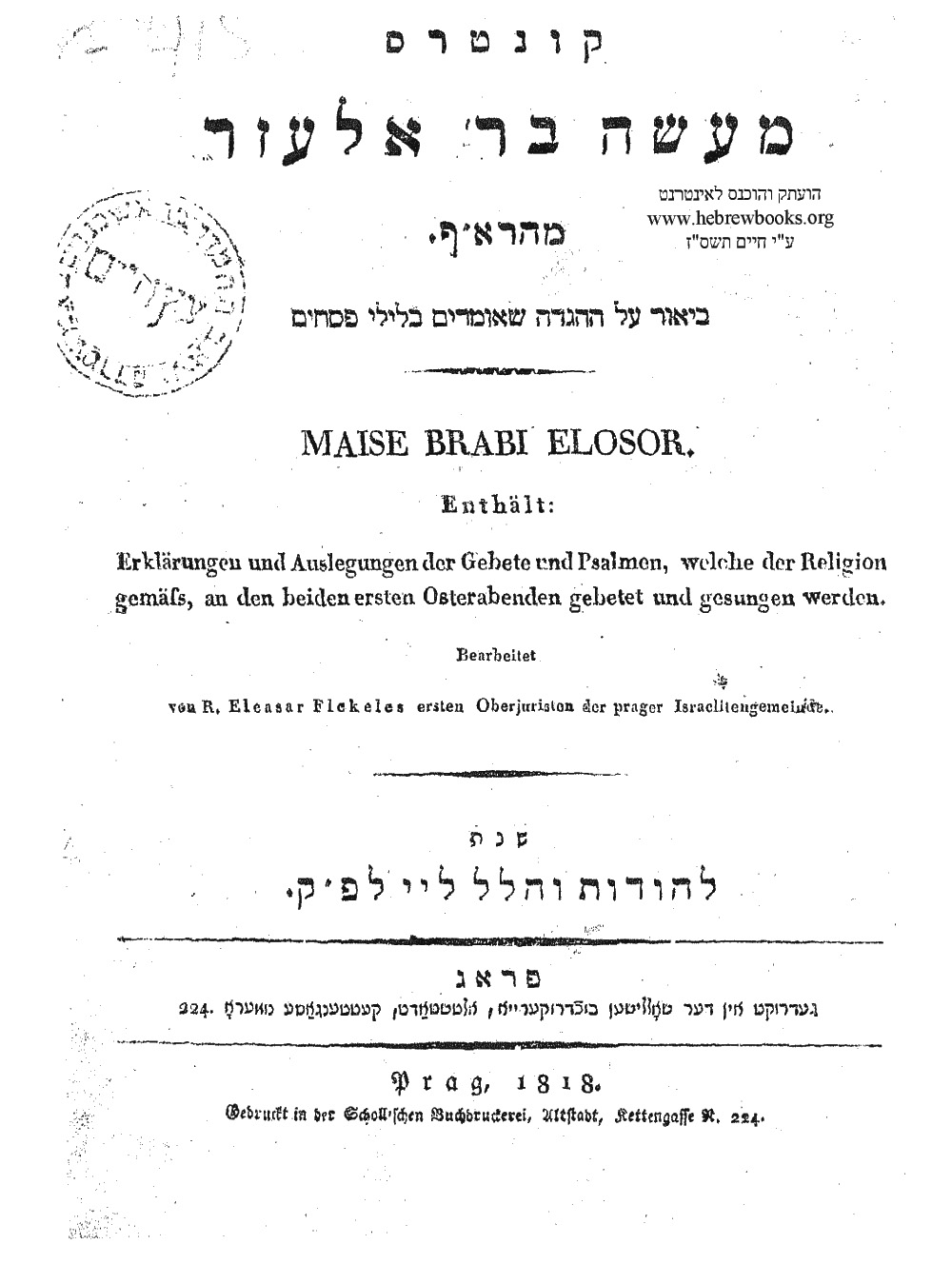
Some years there are many choices of what to buy; in recent years, while the quantity of Haggadahs being printed has not ebbed, the quality most arguably has. This year, one important and high quality Haggadah that has been retype-set and republished is Maaseh BR’ Elazar by R’ Elazar Fleckeles.
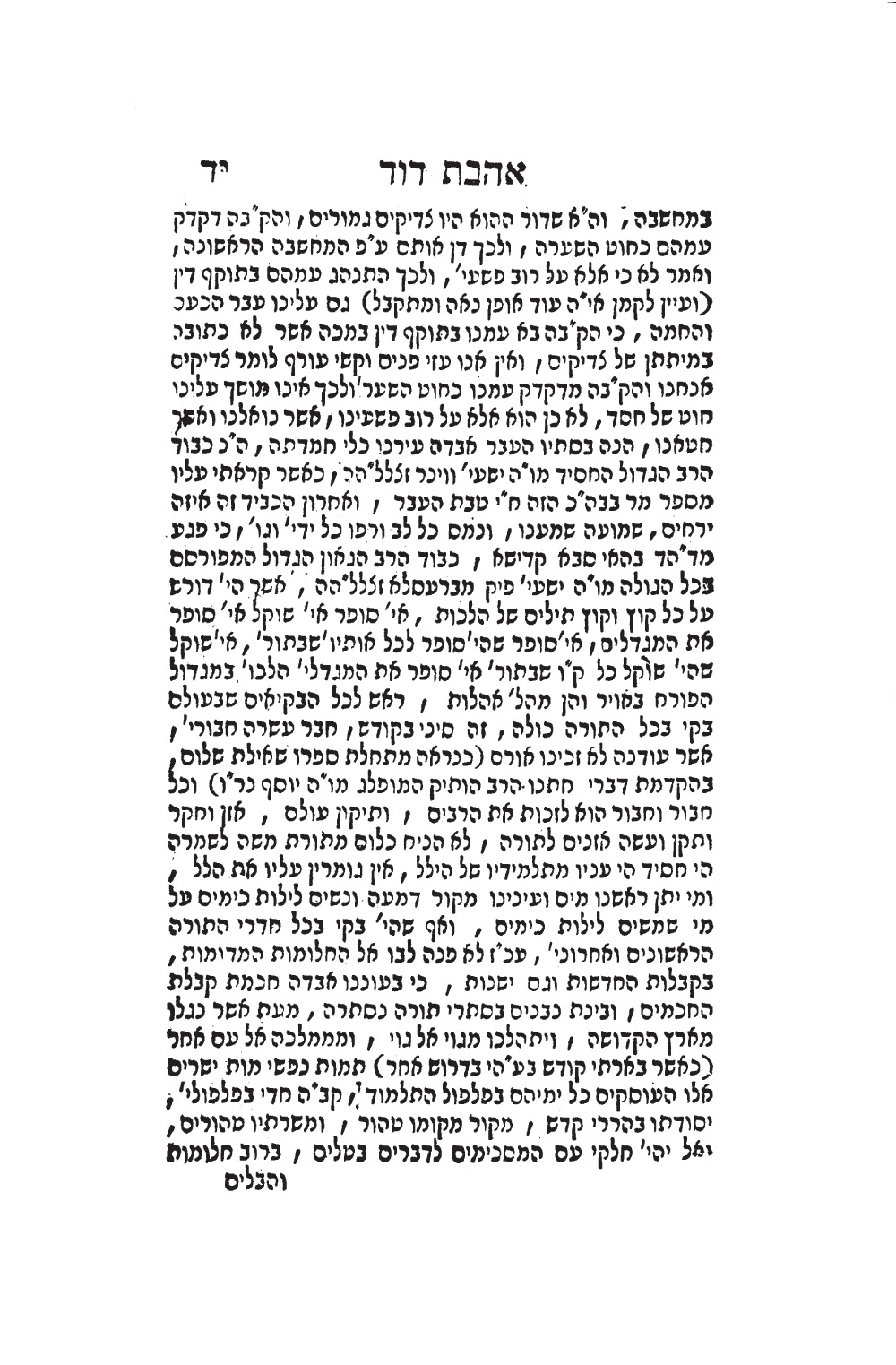
R’ Elazar Fleckeles was born in 1754 in Prague and died there in 1826. He was a direct descendant of R’ Ephraim Luntschitz, author of the Keli Yakar, whom R’ Fleckeles quotes many times throughout his writings. When R’ Fleckeles was 14, he went to study with R’ Ezekiel Landau and spent ten years studying there. R’ Landau, as is evident from his haskamot to R’ Fleckeles works, held R’ Fleckeles in high regard. Additionally, many teshuvot in R’ Landau’s Noda b’Yehuda are addressed to R’ Fleckeles. In R’ Fleckeles’s writings, he quotes many interesting statements from R’ Landau. When R’ Fleckeles was twenty-four, he became the Rabbi of Kojetin, a town in Moravia. However, just four years later R’ Fleckeles returned to Prague to sit on R’ Landau’s Bet Din and serve as a head of a yeshiva. [See also here and here].R’ Fleckeles authored many works on halakha and derush, as well as a commentary on the Haggadah called Maaseh BR’ Elazar. R’ Fleckeles was a skilled halakhist, as is evident from his volumes of responsa, Teshuva m’Ahavah, but his fame also rests on his skills as a darshan. His derashot were published in a four volumes, Olat Chodesh. The fourth volume contains, R’ Fleckeles series of derashot he gave against Shabbatai Tzvi and Jacob Frank (this section has a separate title, Ahavat David) [recently auctioned off as noted here].

Almost all of his works besides his Teshuva m’Ahavah, are very hard to find.
A few years ago a new Boro Park-based Machon called Netzach Yaakov started reprinting his seforim. In 2014 they printed a volume of his Drashot related to Elul and Tishrei along with two works, Chazon LaMoed and Olat Chodesh (437+20 pp.). This beautifully produced work, including an introduction about R’ Fleckeles and a detailed index, matches the content of the actual Drashot.
 A few weeks ago this company released a new edition of his commentary on the Haggadah: Maaseh BR’ Elazar (224 +23 pp).
The Maharil noted in a drasha that he gave before Rosh Hashonah:
כל אדם יחזור וילמוד התפלה והקרובץ מקודם להיות שגורים בפיו בר”ה בשעת התפלה. וכן ילמוד בניו ובני ביתו סדר התפלה, ויריצם סדר הברכות ומלכיות זכרונות ושופרות, כדי שלא יצטרך בר”ה להפסיק בין גאולה לתפלה להראות להם אז הסדר, כי צריכנא לסמוך גם ביום טוב גאולה לתפלה. [וכשחל ר”ה בשבת כל שכן – דצריך אדם לסדר להרגיל התפילה להראות לבני ביתו בתחילה – דאז משנין בכמה מקומות התפילה – והקרובץ [מהרי”ל, עמ’ רעב]
 But specifically more instructive is the Sefer Hamaskil‘s comment:
מה טוב ומה נעים לעיין תמיד דבר בעתו בכל שבוע ושבוע בפירוש חומש ומחזיר וסליחות… ואגדת פסח [ספר המשכיל עמ’ 70].
His basic point being that one should try to prepare before each occasion the tefilos we specific to that occasion – and for Pesach that is the Haggadah.
Many people look all over each year to have nice new pieces of Torah to say over at the seder. This work is full of nice (many) shorter pieces focusing on Peshat and Derush (not Kabbalah) which can be enjoyed by different audiences.
Some General comments on this work;
This Haggadah was first printed by the author in Prague in 1818.
Abraham Yaari, in his work A Bibliography of the Passover Haggadah, writes about this work:
הפרט העברי ככתבו עולה תקע”ב אולם יש לקרוא את שני היודין של השם כשם הויה, ואז יעלה תקע”ח, בהתאם לשנה הלועזית 1818, ולהסכמת הצנזור שניתנה באוקטובר 1817 [מספר 418]
For recent Discussion of other works with similar wording see Yakov Speigel Amudim be-Toldot ha-Sefer ha-Ivri; BeSharei HaDefus, pp. 273-296.
In 1944 in Oradea, Romania this work was printed again. It appears that this was the last Haggadah printed in Europe during World War Two. To me it is fascinating that in this turmoil time they bothered to print this work.
Yaari records this edition [number 2308] as does Yitzchak Yudolov in The Haggadah Thesaurus [number 3918]
This 1944 edition has an interesting addition, as noted by the publisher. Into the text of the Haggadah the prelude Li Shem Yichud was added:
 ולא הוספתי עליו רק מה שנוהגים לומר לפני כל מצוה לשיחקב”ה וכו’ [=לשם יחוד קודשא…] הצגתי כהסכמת הגאון משאמלויא שליט”א…
In R’ Ehreneich’s second letter to the publisher he writes:

 אבל בזמנינו נתפשט המנהג
של צדיקי הדורות זי”ע לאמרו והגאון המחבר זצ”ל שהוא בעולם האמת
בודאי לא יקפיד ע”ז ויאחז כאו”א ויעשה כמנהגו…


Although it’s very nice that they decided to add this into R’ Fleckeles work and not hide this addition but I do not think they had any right to do such a thing. R’ Fleckeles was very outspoken about saying Li Shem Yichud, to say the least.
דרך כלל יאות לבטל כל התחנו’ ובקשות אלו וכיוצא בהן שנתחדשו מלקוטי האחרונים ומעיד אני עלי שמים וארץ שראיתי אחד הי’ רצה לברך על אתרוג המהודר של רבינו הגאון האמתי נ”ע (כי הי’ תמיד מהדר מן המהדרין אחר אתרוג המהודר בכל מיני הידור וכסף וזהב לא הי’ נחשב בעיניו מאומ’ אף שהאתרוג הי’ בתכלית היוקר) וכאשר ראה שאותו פלוני אמר יה”ר קודם נטילת לולב (הנדפס במחזורים ובלקוטי צבי) כעס ורגז ואמר בקצף גדול האומר יה”ר אינו מניחו לברך על אתרוג שלו ולא הניחו לברך ועיין מ”ש רבינו בספרו נ”ב חלק א”ח סי’ ל”ה דף כ’ ע”ג ובחלק י”ד סי’ צ”ג והרבה יש לי לדבר בענינים האלה וכאלה ומרוב טרדותי לא אוכל להאריך [שו”ת תשובה מאהבה, א, סוף סי’ א][1]
He was following in the path of his Rebbe, the Nodeh BeYehudah, who as is well known was adamantly against the saying of Li Shem Yichud:
ועל הרביעית אשר שאל בנוסח לשם יחוד אשר חדשים מקרוב נתפשט ונדפס בסידור הנה בזה אני משיב עד שאתה שואלני נוסח אמירתו יותר ראוי לשאול אם נאמר כי טוב באמירתו. ולדעתי זה רעה חולה בדורנו ועל הדורות שלפני זמננו שלא ידעו מנוסח זה ולא אמרוהו והיו עמלים כל ימיהם בתורה ובמצות הכל ע”פ התורה וע”פ הפוסקים אשר דבריהם נובעים ממקור מים חיים ים התלמוד עליהם נאמר תומת ישרים תנחם והם הם אשר עשו פרי למעלה וגדול מעל שמים חסדם. אבל בדורנו הזה כי עזבו את תורת ה’ ומקור מים חיים שני התלמודים בבלי וירושלמי לחצוב להם בורות נשברים ומתנשאים ברום לבבם כל אחד אומר אנכי הרואה ולי נפתחו שערי שמים ובעבורי העולם מתקיים אלו הם מחריבי הדור. ועל הדור היתום הזה אני אומר ישרים דרכי ה’ וצדיקים ילכו בהם וחסידים יכשלו בם. והרבה היה לי לדבר מזה אבל כשם שמצוה לומר דבר הנשמע כך מצוה שלא לומר דבר שאינו נשמע וה’ ירחם עלינו. עי”ש באריכות. [נודע ביהודה (קמא) יו”ד, סי’ צג].
A few months ago I mentioned the censorship of this Teshuvah.
This topic of saying Li Shem Yichud will hopefully be discussed at a different time.[2] But just to add some sources.
In 1805, R’ Menachem Mendel of Shklov, one of the main talmidim of the Vilna Gaon, printed the Gra’s work on the Haggadah for the first time.

Before Maggid it says:
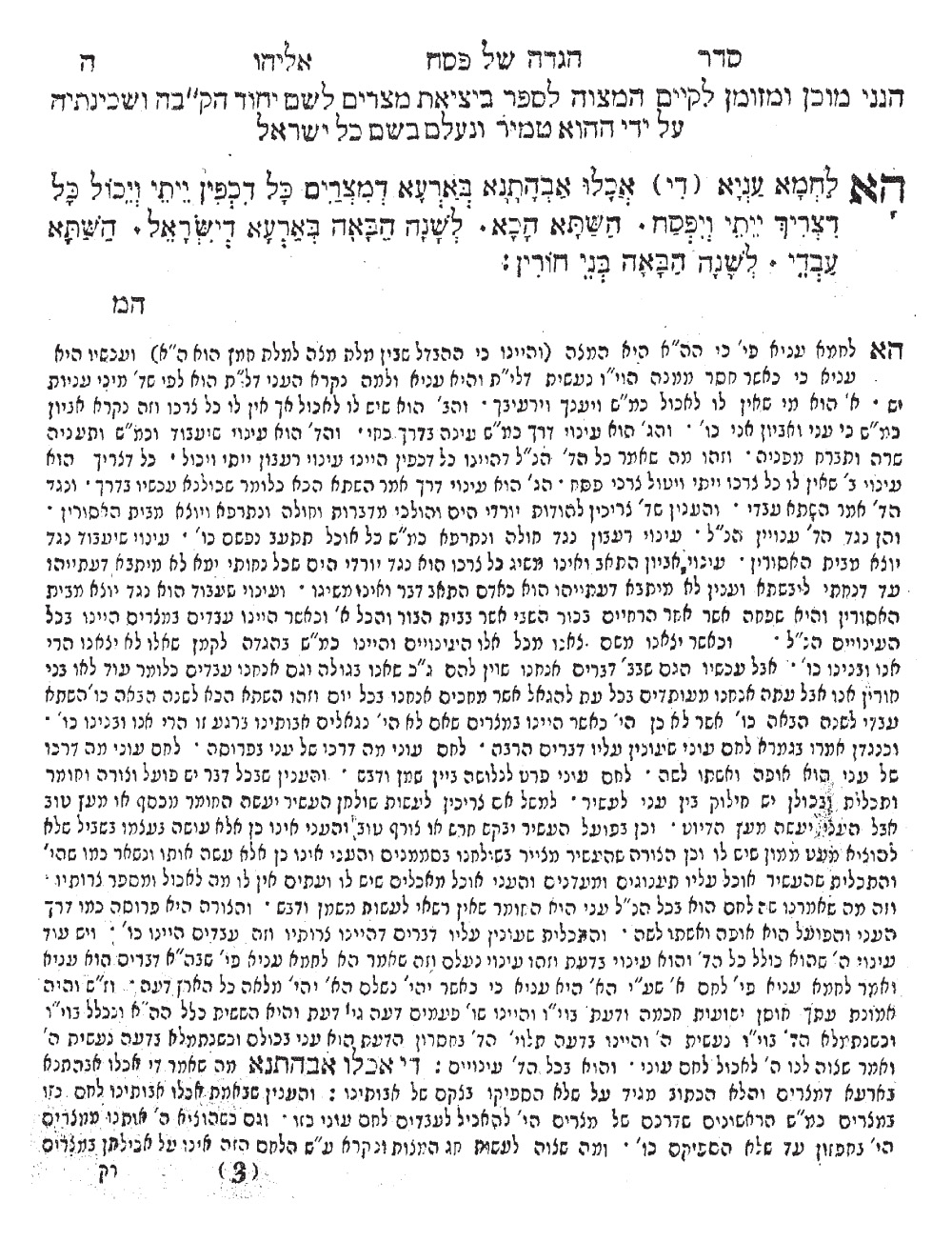
הנני מוכן ומזומן לקיים המצוה לספר ביציאת מצרים לשם יחוד הקב”ה…
In a recent edition of the Gaon’s Haggadah the editor writes:
והנה אין גילוי מפורש בדעת רבינו הגר”א ז”ל באמירת לשם יחוד אך אילו ידע רמ”מ ז”ל שרבינו ז”ל מתנגד לאמירתה בוודאי לא היה מדפיסה… [ר’ חנן נובל, הגדה של פסח עם פירוש הגר”א, ירושלים תשע”ג, עמ’ כט, עי”ש].[3]
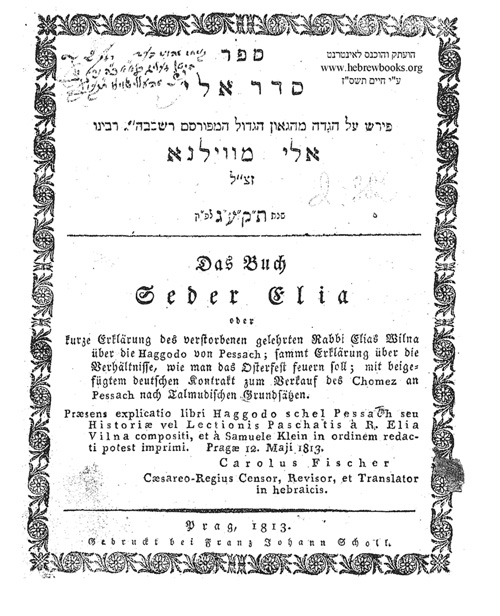
This same passage appears in later prints of the Gra Haggadah including one printed in Prague in 1813 at the time R’ Fleckeles was very active there. [Worth noting is the censor was R’ Fleckeles friend, Karl Fisher].

Even though it is unclear what the Gra held about saying Li Shem Yichud, another talmid of his appears to write against it. Here is what R’ Menashe M’IIlyah writes about it in Alfei Menashe:

In the beginning of the Haggadah, R’ Fleckeles deals with the famous question as to why there is no Beracha on Sipur Yetzias Mitzrayim, quoting a Shut Besamim Rosh on the topic [see here]. A few lines later he quotes the real Shut HaRosh, with this preface:
ובתשובות הרא”ש המקובלת לנו ראיתי…
Returning to this newest edition of the Maaseh BR’ Elazar.
One nice piece in this Haggadah is his discussion against his Rebbe, the Nodeh Beyhudah, about the Issur of Chametz in Mitzrayim.
He writes:
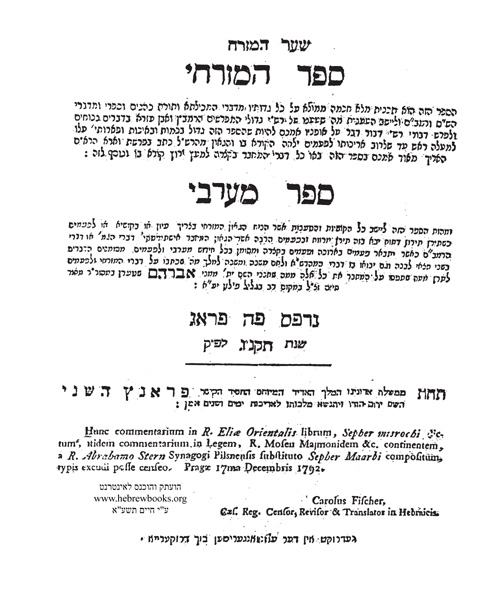
הנה חדשים מקרוב נדפס ספר מערבי וראיתי…
The current editors do not write to which sefer he is referring. This is the work he is referring to, first printed in 1793:

In 1959, Yitzchak Refael printed numerous additions to this Haggadah in the journal Sinai (45: 22-36). The source of these addenda is R’ Fleckeles personal copy, which he had specially bound with added on margins and blank pages inserted between each page, affording the author ample room for marginalia. After passing through several hands, finally arriving in R’ Maimon’s library. This new version of the work includes all of these addenda, in their proper places. Interestingly enough, neither Yaari nor Yudolov mention these additions in their entries on this Haggadah.Returning to Li Shem Yichud Sharon Flatto writes in her ‘The Kabbalistic Culture of Eighteenth Century Prague’:

Notably a Haggadah was recently discovered that was owned during the late 1780s by Fleckeles…. The margins of this Haggadah contain leshem Yihud formulas to be recited before the blessing on the the four cups of wine penned in Fleckeles’ hand.

In the footnote she writes they seem to have been written between 1784-1790.'(pp. 225-226). While I wish I had more clearer sources about this discovery. She does not note that the Haggadah that R’ Fleckeles himself printed in Prague in 1818 nor in the manuscript updates of R’ Fleckeles to his own Haggadah does he write to say Li Shem Yichud or any such Tefilah in the Haggadah. This newest edition of the Maaseh BR’ Elazar prints the Haggadah like R’ Fleckeles did in 1818 without Li Shem Yichud.

Besides for all these new pieces added into this new edition, the volume also includes a well-written introduction about R’ Fleckeles, including an interesting eye witness account from manuscript of the day he died in Prague. Another plus to the new edition are the numerous sources they added, at times quoting R’ Fleckeles references from his other works.  Finally, there is a very useful index of topics and seforim quoted by R’ Fleckeles at the end of the volume. I really hope they continue to print the rest of R’ Fleckeles works.
To purchase this Haggadah try Girsa in Jerusalem, Biegeleisen in NY or your local seforim store.
Appendix:

One of the seforim noticeably omitted, for the most part, from R’ Fleckeles works, including this Haggadah, is the Zohar.
Much of the sources in R’ Fleckeles writings regarding the Zohar and Kabalah in general has been gathered in Boaz Huss’ recent work, KeZohar Harokeyah (pp. 322-323). Most notable is this piece which I quote here in its entirety:
ועתה אין מן הצורך להשיב את האיש אשר רצה להמצי’ דבר חדש להשביע את האיש הישראלי בספר הזוהר… את זה כתבתי לדעת האיש ההוא שהספר הזוהר כלו קדוש אבל אני אומר הריני נשבע בתורת ה’ שבספר הזוהר נמצאו כמה זיופים וקלקולים אשר הוסיפו ועלה אחת מתלמוד בבלי הויות דאביי ורבא קדוש יותר מכל ספר הזוהר הנה אם אמרו חכמי התלמוד על ברייתא דלא מתנייא בי ר’ חייא ור’ אושיעא מאן ימר דמתרצתא היא דלמא משבשתא היא וספר הזה ודאי לאו בר”ח ורב אושיעא אתמר כי כל הדורות מראש לא זכרו מספר הזוהר מאומה לא בהקיץ ולא בחלום כי הנה אם אמת הדבר שהחבור הזה הוא מהתנא ר’ שמעון בר יוחאי אשר ר’ יהודה הנשיא קבל גם ממנו כמבואר בהקדמ’ הרמב”ם לספרו יד החזק’ איך לא זכר את הספר הזה בחבורו ש”ס משניות או בשום מקום ואף ר’ יוחנן שחיבר תלמוד ירושלמית אינו מזכירו בשום מקום ורבינא ורב אשי שחברו תלמוד בבלי מאה שנים אחר חבור תלמוד ירושלמי והיו סוף אמוראים ולא שמו רמז בכל התלמוד מספר הזוהר ורבה בר נחמני שחובר רבות ושוחר טוב וכיוצא בהם הרבה לא זכרו מחבור רשב”י גם רבנן סבוראי והגאונים והרי”ף והרמב”ם ורש”י ותוס’ והרמב”ן והרשב”א והרא”ש והטור והילקוט שמעוני אשר אסף ולקט כל המדרשות והמכילתות והברייתות כלם לא ידעו ולא ראו ממנו דבר עד שזה קרו’ לשלש מאות שנים ענו ואמרו שמצאוהו ואיזהי כנסיה אשר קבלוהו בכנופיה, כמו תלמוד בבלי וירושל’ וז”ל הרמב”ם בהקדמתו לספר יד החזקה אבל כל הדברים שבגמרא הבבלי חייבין כל ישראל ללכת בהם וכופין כל עיר ועיר וכל מדינה ומדינה לנהוג בכל המנהגות שנהגו חכמי הגמרא ולגזור גזירותם וללכת בתקנותם הואיל וכל אותם דברים שבגמרא הסכימו עליהם כל ישראל עכ”ל ויעיין עוד שם ואין אני חלילה מטיל דופי ופגם בכבוד התנא אלדי ר’ שמעון בר יוחאי כי הוא היה מחסידי עליון אלא אני אומר לאו גושפנקא דרשב”י ועזקתיה חתום עליה ומי שיש לו חצי דעת יגיד כן שהרי נזכרו בספר הזוהר כמה תנאים ואמוראי’ שהיו אחר רשב”י שנים רבות במספר והארכתי בזה במקום אחר מפי סופרים ומפי ספרים כמבואר בס’ מטפחת להגאון מו”ה יעב”ץ זצלל”ה שגזר אומר שחלו בו ידים מזייפים וחשד את החכם ר’ משה דיליון יעיי”ש.
והינה מיום שנתחדש ספר הזוהר הרבה נכשלו ע”י כי כמה דברים סתומים וחתומים אשר המציאו האחרוני’ להתעות בני אדם יושבי חשך השכל, צאו וראו כמה קלקולים רבים קלקלו מאמיני הכלב רע שבתי צבי שבור ואחוזת מרעהו ברכי מסאלנוקא ויעקב פראנק שם רשעים ירקב, ותלו דבריהם בספר הזוהר אשר בודאי לא יאונה לצדיק ר’ שמעון בר יוחאי כל און.
מה טוב ומה נעים, אשר כתבתי בחבורי קטן אשר קראתיו בשם קונטרס אהבת דוד שנדפס בק”ק פראג תק”ס וזה לשוני שם באו ונחזיק טובה וחינות לשני מלכים גדולי אדירי’ אדוננו המשובח המנוח הקיסר יאזעף השני ואדוננו המהולל הקיסר פראנץ השני אשר צפו והביטו בחכמתם הנפלאה, רבות רעות ושבושי דעות תסתעפנה מחלומות והבלים המקובלים, והמה לנזקי בני האדם נזקי הגופות ונזקי הנפשות, ופקדו באזהרה גדולה שלא להביא ספרי קבלה בכל מדינות מלכותם הפקודה הראשונה העכסט האף דעקרעט פאם ב’ נאוועמבר למספרם והשני פאם ז’ יוני למספרם והארכתי שמה בדברים נכונים… (תשובה מאהבה חלק א סי’ כו).
According to Shmuel Werses, Haskalah and Sabbatianism, (Heb.), pp. 68 and Boaz Huss, KeZohar Harokeyah (p.323) this teshuvah has been censored out of the 1912 edition of TM. I have been unable to independently confirm this, as the 1912 editions I have seen (both in NLI and in BIU) have it in full – as do most reprints available today, including the edition found on the HebrewBooks.org website
In another teshuvah on this topic R’ Fleckeles writes:
ובלא”ה כבר כתבתי פעמי’ רבות שאין ראי’ מזוהר שלא נודע ברור מי הוא המאסף והמלקט ספר הזוהר והרבה הוסיפו  (תשובה מאהבה א:סב).
It is worth pointing out that R’ Fleckeles does not dismiss the Zohar completely taking it into account elsewhere in TM; for example in this teshuvah he writes:
מה ששאלני מדוע רובא דעלמא מקילים והולכים בבקר ד’ אמות בלי נטילת ידים שחרית הא כבר כתב המ”א בשם הב”ח בשם תולעת יעקב כל ההולך ד’ אמות בלי נטילת ידים שחרית חייב מית’ עיי”ש וכמה בני תורה אשר אינם שוגגים מקילים ואין להם על מה שיסמכו. ידע ידידי שדבר זה כתב בעל תועלת יעקב בשם הזוהר וכן העתיקו הב”ח, והמג”א השמיט בשם הזהר או מן השמים השמיטוהו כי חפשתי בספר הזוהר יגעתי ולא מצאתי ובעל א”ר האמין לשמועותיו בשם הזוהר והאר”י וצדר להקל עיין סי”א סק”ד ולבסוף מסיק בשם ספר דמשק אליעזר שדבר זה  דוקא בזמנם כמו גילוי וזוגות עיין שם ולענ”ד ליתא בזוהר כלל והרב בית יוסף אשר העתיק בכל פעם דברי הזוהר לא שם רמז מזה ושארי לי’ מארי’ שעשה רוב ישראל לחייבי מיתות שוגגן ישרים יחזו במסכת ברכות דף  סמ”ך ע”ב ישר יחזו פנימו ולענ”ד היא משנת חסידים והזריז הרי זה משובח ואפשר דזוהר מיירי אם מים מצוים לפניו והולך ד’ אמות בלי נטילת ידים ואח”ז ה’ אנה לידי ספר ברכי יוסף וראיתי שמביא דברי הזוהר כת”י וסיים וזה לשונו אלא דשמיע לי מרבני קדישו דזמנין דמיא הרחק מאד מאדם ובלכתם ילכו פחות מד’ אמות כאותה שאמרו גבי שבת עיין שם סימן א’ אות א’ ולשון הזוהר אינו לפני לעיין והנרא’ לענ”ד כתבתי. (תשובה מאהבה חלק א סי’ יד וראה חלק ב סי’ א אות ד)
As an aside, the shitos of R. Fleckeles on the Zohar are bland compared to those of his Rebbe, the Noda Beyehudah, as found in the recently printed drasha of his from manuscript by Dr. Maoz Kahana and M. Silber. I note in passing that this drasha has sparked a debate between them and Dr. Flatto, to which she responded in a later version of the journal Kabbalah.


[1]  See also his Melechas Hakodesh, p. 132
[reviewed here].
[2]  See Moshe Hallamish, Kabbalah (Heb.),
pp. 45-70; Maoz Kahane, MiHaNoda BiYehuda LaHatam Sofer, pp. 89-91 and
pp. 235-236; most recently Shimon Szimonowitz, Haggadah
Aleh Zeis
(2016), pp. 35-78.
[3]  Thanks to R’ Dovid Vieder for this source.


Aaron the Jewish Bishop

Aaron the Jewish Bishop

The exodus from Egypt was led by Moses and Aaron. Moses, however, does not appear in the Passover haggadah (with one exception that is likely a later interpolation).[1] Aaron does make two appearances in the hallel section.  That said, in numerous illuminated haggadahs, from the medieval period to present, both appear in illustrated form. Additionally, in printed haggadot, most notably the 1609 Venice haggadah, one of the seminal illustrated haggadot, Moses and Aaron appear on the decorative border.

Generally, conclusively determining Jewish material culture, especially from the biblical period, is nearly impossible.  Regarding Moses, other than his staff, the bible provides no additional information.[2]  Aaron is a different story.

The Torah expends a significant amount of verses discussing the details of the Kohen Gadol’s (the high priest) garments but while the descriptions are detailed, we still struggle to determine what these special clothes looked like.  Rashi, for example, has to resort to anachronistic parallels for the “me’il” comparing it to a medieval French equestrian pant.  Similarly, by the Talmudic time, the details of the headband were subject to dispute. We should briefly pause here to correct a common misconception – that the Vatican or the Catholic Church still retains items related to the Jewish temple.  Unfortunately, this misconception is so prevalent, that a number of Israeli officials have requested that the Vatican repatriate the temple vessels.  Briefly, while the Talmud mentions that sometime between the 2nd and 5th centuries, temple vessels may have resided in Rome, there is no indication whatsoever of them since the 5th century. In addition, due to the numerous sackings that Rome underwent, or the reality that the Catholic Church is an entirely different sovereign than the Roman ruler Vespasian who sacked Jerusalem, it must be regarded as highly unlikely at best that any former temple vessels remain (assuming they were ever there) within the Vatican. For additional discussion regarding this issue, see here.
The ambiguity about the clothing has not stopped many from attempting to depict what they believe is the correct version.  Thus, depictions of Aaron the High Priest appear in Hebrew books. Hebrew manuscripts did not shy away from including illuminations and illustrations to create a more aesthetically pleasing product.  All sorts of shapes and images are employed to this end, on page borders, end pages, or just sprinkled throughout a manuscripts and – geometric patterns (Hebrew manuscripts are the first to use micrography), animals, people or combinations thereof of half-human-half-beast.  Noticeably, however, biblical figures are not included in this category. While biblical scenes appear in Hebrew manuscripts it is only to actually illustrate the content, and not independently for aesthetic purposes.
With printing, however, this slowly changed. Printing began in 1455 with Gutenberg and Hebrew books followed soon after.  These early books, however, did not follow all the conventions that we associate with books today.  Title pages did not begin until the 16th century and it wasn’t until the early 17th century that title pages were de rigueur.  Apart from information relevant to the books contents, title pages also began to included aesthetic details.  Sometimes these are architectural, pillars etc. other times flowers or some other flower or fauna.
Generally, printers did not explain why certain images were included on title pages, the assumption is that it was simply for aesthetic purposes.  At least in one case, this was made explicit.  The Shu’’t Ma-harit”z, Venice, 1684, by Yom Tov Tzalahon, includes an illustration of the temple on the title page.  The publisher, Tzalahon’s grandson, provides that this was included as “it makes it more beautiful” and he was so enamored with the illustration – even though it is very rudimentary he included it three times in the book (this likely speaks more about the publisher’s exposure – or lack thereof – to art in general).[3]
There are, however, at least a few examples of a title page illustration serving a purpose beyond the aesthetic. Some illustrations are including because of allusions to the author’s name, but at least in one instance a Hebrew title page illustration was used to illustrate the title.
The most common form appearing “on the frontispiece of countless printed books,” were biblical figures Moses, Aaron, David, Solomon, nearly always coupled, and “became the accepted heraldic figures.”[4]  The first biblical figures to appear in Hebrew books were was a woodcut by Hans Holbein of David and Solomon, flanking one, among other biblical scenes, in the Augsburg 1540 Arba’ah Turim. This illustration, however, did not appear on the title page, which is plain, instead it appears on folio 7.[5]  See Heller, 242-43.
The first frontispiece to include a biblical figure is the Tur Orach Hayyim, Prague, 1540, that includes, at the top of the page, a depiction of Moses holding the tablets.[6] The first frontispiece to include the coupling of biblical figures – the most ubiquitous form of biblical figures – is Jacob Moelin’s She’elot u-Teshuvot Mahril printed in Hanau in 1610. That frontispiece depicts Moses on the left in one hand the tablets and the other hand he grasps his staff.  Aaron is wearing the garments of the high priest:  the tunic, bells, breastplate and and is carrying the incense.
 
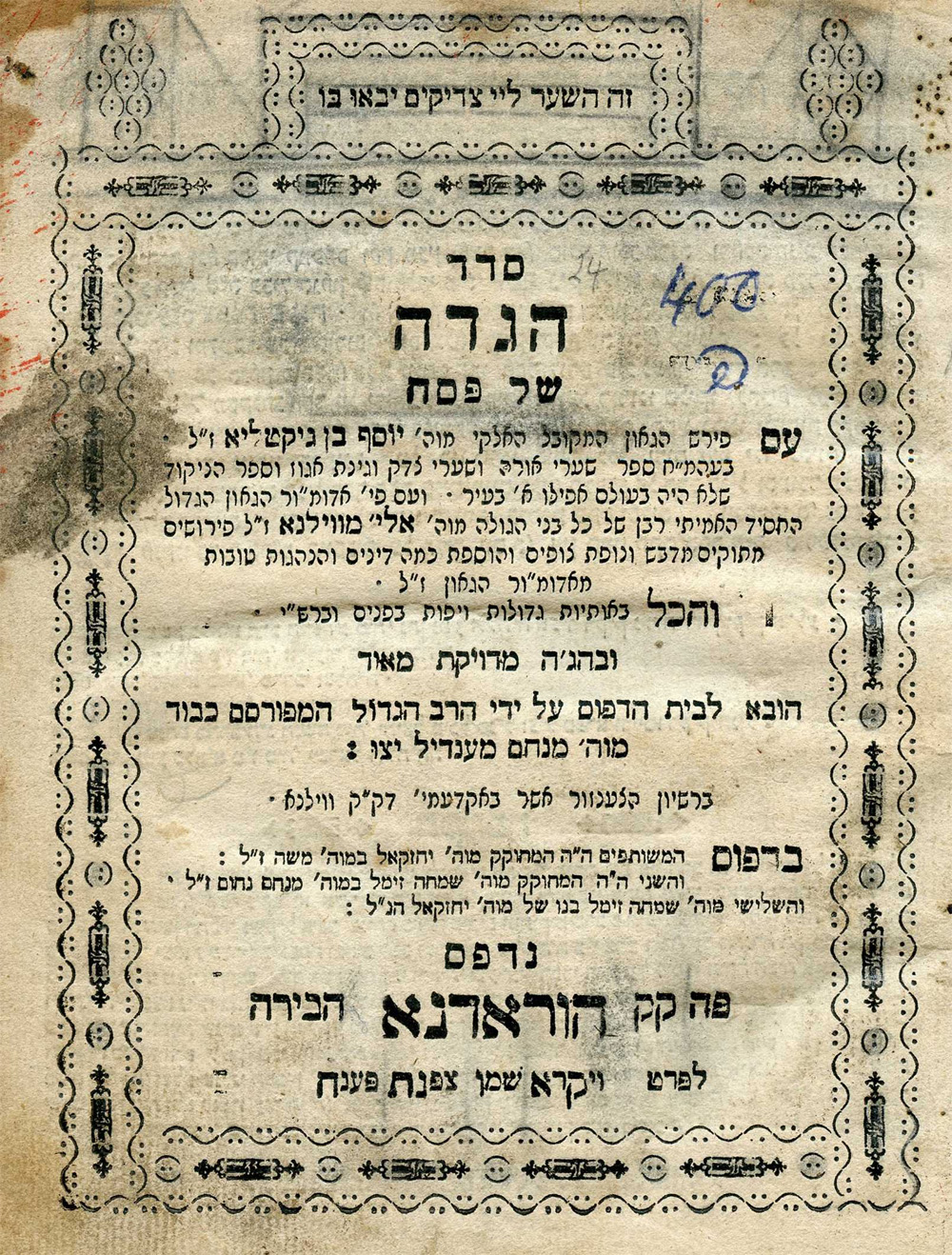
The usage of Moses and Aaron on Hebrew frontispieces thus began with Hanau, 1610.  By way of comparison, the first appearance of Moses and Aaron on the frontispiece of a book in English was the King James Bible, published a year after Hanau in 1611. The Hanau printer reused the Moses/Aaron frontispiece on two more books:  Nishmat Adam by Aaron Samuel ben Moshe Shalom of Kremenets, 1611 and Joseph ben Abraham Gikatilla’s, Ginat Egoz, Hanau 1615.[7]  The illustration best fits the Nishmat Adam, and may have originally been the book for which this illustration was intended and not Molin’s.  Unlike Jacob Molin’s work that has no direct connection with Aaron or Moses, the author of Ginat Egoz’s name includes both Moses and Aaron, and while Samuel is not captured in the illustration, the year of publication is derived from “Samuel.”
Moses and Aaron became the most common biblical figures on frontispieces, but not the exclusive ones.  In some instance, a mélange of biblical figures is presented.  The Amsterdam printer, Solomon Proops, included the image of Moses, Aaron, David, and Solomon, each wearing a crown, and a Moses carrying not the tablets but instead the Torah scroll.

A deviation from the coupling of Moses and Aaron appears in Beit Aharon, Frankfurt am Oder, 1690, which displays Aaron and Samuel.  In that instance, however, the deviation is explained because the figures are allusions to the author’s name, Aaron ben Samuel.  The use of coupled figures was not exclusive to Biblical figures; in many Hebrew books a variety of mythical and pagan figures and scenes are commonplace on title pages.  A partial list of pagan deities include:  Venus, Hercules, Mars and Minerva that appear on ennobled works such as Rambam’s Mishne Torah, Venice 1574, and Abarabenel’s commentary on Devarim, Sabbioneta 1551, and were reused many times.[8]  The use of pagan figures in Jewish items is not limited to Hebrew books and these images appear on the Second Temple menorah, and the Dionysus, Poseidon are inscribed on Palestinian mezuzotSefer Raziel mentions Zeus and Aphrodite, Dionysus and Poseidon reappears in a common prayer said during the priestly blessings, and Dionysus appears individually in the additionally yehi ratzon that some recite during Aveinu Malkanu (helpfully Artscroll and other siddurim direct that for the prayers that include these names, they should “only be scanned with the eyes and concentrated upon, but should not be spoken,” as they are “divine names”).[9]
Returning to the use of Moses and Aaron on frontispieces of Hebrew books, as mentioned above, the basic form of the illustrations remained fairly static with Moses appearing with his staff and/or the tablets or the Torah and Aaron in his priestly clothing.  And, these are prevalent throughout the 17th century, across the Europe and the Middle East.  In Europe the coupling appears in Altona, Amsterdam, Venice, Furth and Izmir, on diverse works – Talmudic commentaries, Mendelssohn’s commentary to the bible, and a commentary on the zemirot (which includes a heliocentric depiction of the constellations).  

A slightly different version appears in the Ma’ashe Rokeakh that has Aaron holding a slaughter knife.

There is, however, one notable exception to this depiction both in terms of the items displayed in addition to the “coupling.”  Aaron ben Hayyim Perachia’s Perekh Matteh Aaron, published in Amsterdam, 1703, includes a coupling but rather than Moses and Aaron, in this instance both images are that of Aaron.  Additionally, the Aaron on the left is the standard depiction of items, but the one on right is distinct in that it has Aaron holding a budding almond branch – perach mateh Aaron.  Of course, these deviations are understandable as the “second” Aaron and his unique “staff” is not merely aesthetic but is illustrative of the title of the book, the first time an title page illustration illustrates the title.[10]

 
A final note regarding the frontispiece depictions of two items Aaron’s clothing.  First, in many instances, including the Hanau prints, Aaron’s hat is not the traditional wrapping or turban associated with the mitznefet, but a bishop’s mitre.  At times, the mitre is horned, for example, Zohar, Amsterdam, 1706.  The horned mitre, however, is based upon “the mistaken belief that the horned mitre descended from the Jewish high priest” when in reality the bishop’s mitre is related to “Moses’ horns and their symbolic meaning within the context of the medieval Church.”[11]
The frontispiece is not the only time that the kohen’s headgear is interpreted contrary to Jewish tradition.  In a recent illustrated edition of Mishna Tamid, the editors depict the Kohen not only wearing the turban but also a yarmulke.  The Torah enumerates the priestly garments and any addition to those items is subject to the death penalty.  Thus, a Kohen wearing a yarmulke – as illustrated and that is not included in the Torah’s description of the Kohen’s outfit – commits a capital crime.[12] Here is another example of Aaron, looking very much like a bishop. This illustration is from a 15th century manuscript called המשכן וכליו by Simon ben Joel.

Unlike Aaron’s head-covering that appears from time to time as a bishop’s mitre, the second odd item that Aaron carries appears almost universally. Specifically, Aaron holds the incense in his hand, but unlike the Rabbinic interpretation that the incense was delivered in a shovel, Aaron is always depicted with the incense in a ball or  censer.  There is no Jewish source that records that form of the incense ritual and is an exclusive non-Jewish understanding of the Torah.
Ironically, the only person to take issue with the depiction of Moses and Aaron (and other biblical figures) argues against their use does not raise these issues nevertheless counsels against these biblical depictions.  His rationale, however, is counter-factual.  Specifically, Samuel Aboab, decries the depiction of biblical figures because the depictions are anachronistic and but for non-Jewish influences would never have been included in Jewish items.
While there is no doubt that some elements of the depictions are non-traditional, since at least the second century, biblical figures are found in a variety of Jewish contexts.  For example, the second century synagogue of Dura Europos and a few years later at the Bet Alpha synagogue contain biblical images. Dura Europos contains numerous illustrations of biblical figures and scenes, including Moses and Aaron.  And, while Abaob is correct that both Moses and Aaron are depicted anachronistically – in typical clothing of that time period, a toga-like garment – this is simply explained by the fact the purpose of the illustrations was to remind the viewers of the people and stories.  Therefore, had Aaron “been depicted with the biblical clothing that were no longer in use, the viewer might not know what they are looking at.”[13]  Thus, the anachronisms are not to make these seminal biblical figures in our image, but to simply ensure that the art clearly transmit its message.

[1] David Henshke, “The Lord Brought Us Forth from Egypt: On the Absence of Moses in the Passover Haggadah,” AJS Review, Vol. 31, No. 1 (Apr., 2007), pp. 61-73.
[2] The lack of information has not stopped the theorizing as to Moses’ visage.  The most notable example is R. Yisrael Lipschutz’s comments at the end of Kiddushin.  See Shnayer Z. Leiman, “R. Israel Lipschutz and the Portrait of Moses Controversy,” in Isadore Twersky, ed., Danzig, Between East and West: Aspects of Modern Jewish History (Cambridge, Mass., 1985), pp. 51-63, and for a different version, “R. Israel Lipschutz: The Portrait of Moses,” Tradition 24:4 (Summer 1989): pp. 91-98 (available here). See also the important chapter on this subject in R’ Shmuel Ashkenazi, Alpha Beita Kadmeysuh, Jerusalem:2000, pp. 337-371. For additional sources on this story see R’ Dov Turish in his various works; Maznei Tzedek, p.149, 310; Ginzei Ha-Melech, p. 38, 40, 43,48, 56; MiArat haMchpeilah, p. 101 and onwards.
[3] Shmuel Glick, Kuntress ha-Teshuvot he-Hadash, Schechter Institute of Jewish Studies, Jerusalem & Ramat Gan, 2007, n. 2120.  For more on Glick’s work see here and  here.
[4] Richard I. Cohen, Jewish Icons, Art & Society in Modern Europe, University of California Press, Berkley & Los Angles, 1998, 127.
[5] Marvin J. Heller, The Sixteenth Century Hebrew Book, An Abridged Thesaurus, Vol. I, Brill Leiden & Boston, 2004, 242-43.
[6] That is not to say the first to contain, rather than appear on the title page illustration, figures of living persons.  The Prague 1526 haggadah depicts, Adam, Eve, David, Goliath, Judith, and Samson in the woodcuts accompanying internal pages.  For a list of Hebrew books containing Moses with horns and without see Two Prague Haggadahs, Valmadonna Trust Library, 1978, 16-18 n.16
[7] An examination of the haskamot (approbations) accompanying the early Hanau prints also provides evidence of “the breakdown of central rabbinical authority in Germany during this period.”  Stephan G. Burnett, “Hebrew Censorship in Hanau: A mirror of Jewish-Christian coexistence in Seventeenth-century Germany,” in Raymond B. Waddington and Arthur H. Williamson, eds., The Expulsion of the Jews: 1492 and After, Garland Studies in the Renaissance, Vol. 2. New York & London: Garland Publishing Inc., 1994, pp. 202-03 (available here).
[8] Marvin J. Heller, Studies in the Making of the Early Hebrew Book, Brill NV, Leiden, 2008, 1-17.
[9] See Daniel Sperber, Magic & Jewish Folklore in Rabbinic Literature, Bar Ilan University Press, Ramat-Gan, 1994, 97-98 and n. 29; Yosef Shaposhnik, Siddur im Revid ha-Zahav, Chief Rabbi of the Rabbinical Association, London, 1929, 63.
[10] By way of comparison, a few years after the Perach Matteh Aaron, the frontispiece of the haggadah with the commentary Mateh Aaron, Frankfort A.M., 1710 does not include any depiction of Aaron or his staff. Instead it reuses a non-Jewish woodcut that depicts the Eye of Providence – an allusion to the all seeing eye of “god” –  the trinity as it is depicted within a triangle or three sided object, as it does on the back of the US dollar bill.  But, notably, the eye appearing on the Mateh Aaron is not within a triangle.  Perhaps this was deliberately changed or the original woodcut for some other reason elected not to use the triangle, but to arrive at any definitive conclusion requires additional research into the history of the particular woodcut which is outside the scope of this article.

[11] Ruth Mellinkoff, The Horned Moses in Medieval Art & Thought, University of California Press, Berkley, 1970, 105,94-96.
[12] Dan Rabinowitz, “Yarmulke: A Historic Cover-up?,” akirah: The Flatbush Journal of Jewish Law and Thought, 4 (2007): 231-32.
[13] E.L Sukenik, The Synagogue of Dura-Europos and its Frescoes, Bialik Foundation, (Jerusalem, Palestine):1947, 97.


Upcoming Auction Review

Upcoming Auction Review:
By Dan Rabinowitz and Eliezer
Brodt
In
recent years a number of auction houses specializing in Hebrew books,
manuscripts and ephemera have opened.  In
some instances, these have displaced and surpassed more well-established houses
and certainly provide more opportunities for the collector. A new house, Legacy Auctions, is holding its first
auction on April 13. One can view their complete catalog here
[There is also a link to a PDF if one scrolls down here.] As we have done in the past, we
wanted to highlight some of the available items.
Lot
23 is R. Samuel David Luzzato’s, (Shadal), the Italian biblical scholar and
relative of R Moses Hayyim Luzzato (Ramchal), translation and commentary to
the Torah, published in 1871-76 (lot 23). While Shadal modeled his edition
based upon Mendelshon’s Pentateuch, unlike Mendelsshon’s version that translates the
Torah in German using Hebrew characters, Shadal’s contains an Italian
translation, in Latin characters.  In
both Mendelsshon and Shadal’s works the accompanying commentary is in
Hebrew.  Ironically, Shadal, in the
introduction takes a much more aggressive stance regarding the ability to
reinterpret biblical texts contrary to established conventions while
Mendelsshon’s introduction defends traditional positions, most notably the
positon that the Zohar dates to the 2nd century and was authored by
R. Shimon bar Yochai.  Mendelsshon’s
version was banned which never occurred with Shadal’s version. Worth mentioning
is that Shadal’s work was just reprinted with much new material from
manuscripts [for a sample email Eliezerbrodt@gmail.com]
Ha-Torah ve-Hochmah
by R. Zechariah Isaiah Jolles
(lot 28) [See here]
is interesting for a number of reasons – it includes a portrait of the author –
and some are discussed in the lot’s descriptions, but others include his work Megilah Nikrat. In an attempt to answer
the “question” why the generic word “megilah” refers to Esther even though there
are other megilot, he posits that the entire story of Esther can be told
using the acrostic of Mem, gimil, lamed,
heh
, and then proceeds to do so. Especially noteworthy is his mentioning of
a custom he attributes to the Gra, a repetition of a “suspect” word in Tanach, le-hasmeid (vev) le-harog in Megilat
Esther.  There are numerous words that we
are unsure of their pronunciation yet, we never repeat them.  Indeed, the custom he records, and its
expanded form of repeating zekher/zekher, is a very late custom
as this book wasn’t published in 1913, and thus evidences the modernish basis of the custom.  
Lot
43-44 are two books regarding the Cleves Get controversy, both of which
belonged to R. Ruderman the late Rosh Yeshiva of Ner Israel. A number of
books in this auction come from his collection, which evidence a very eclectic
scope.  This is somewhat ironic in
light of the alleged tale that at Ner Israel, even the Abrarbanel’s commentary was kept under
lock and key. (Many also bear the stamp of R. Ruderman’s son-in-law, R. Yaakov
Weinberg.)
Returning
to the Get of Cleves controversy.  The
bet din of Cleves accepted a get from
a husband whose sanity was questioned.  A
get requires awareness and insanity
void the get. Another bet din,
Frankfort, however, questioned the validity of that annulment. Because
questioning the ruling of another bet din runs afoul of the accepted ruling of
Rabbenu Tam, this immediately escalated into a major battle with each side
publishing books justifying their respective positions.  The Cleves’ Rabbi, Israel Lipchitz, published
Or Yisrael, defending his position
and his work was subject to censorship – mainly to excise the rulings of others
who agreed with him.  In this particular
copy other passages critical of some rabbis have been crossed out.   And, while the Cleves controversy occurred
in the late 18th century, this issue is far from settled.  Regularly, (indeed, as recently as the past
six months) courts, and sometimes just individuals, attack the divorce ruling
of their sister courts.  Although,
depending upon the circumstances, the original courts, rather than defending
themselves as the Frankfort court did, do not defend or even recant their
original rulings.
Another
work that touches on censorship, although there is nothing controversial in the
book, is R. Hutner’s Torat Ha-Nazir
(lot 49).  This is first edition of the
book, Kovno, 1932, in paperback, and includes the approbation of R. Kook, among
others.  And, like other books containing
his approbation, in reprints of Torat
ha-Nazir
the approbation does not appear. 
Unlike other examples, however, in this instance it was not only R.
Kook’s approbation depending upon which reprint of Torat ha-Nazir, either all the approbations are missing or all the
ones on the page that R. Kook’s appears. For other examples of censorship of R.
Kook, see here.
The
first edition of the Vilna Goan’s commentary on Shulchan Orach Yoreh De’ah (lot 92) is among the many sifrei ha-Gra offered.  The first edition of the Shulchan Orach is
unique not only being the first time his commentary was published but also because
of the format.  Unlike, the Ba’al
haTanya, who successfully began the  publishing of his commentary during his lifetime, the
Gra’s commentary was left to his sons to publish.  By this time, however, the format of the Shulchan Orach had been standardized
with the main body in the middle of the page and, depending upon the volume,
two commentaries on surrounding it with a handful of others filling the
page.  Adding the Gra’s commentary posed
a problem, where on the page should it be? If the regular layout was retained,
the Gra’s commentary would be relegated to the bottom of the page, something
that was unconscionable to some.  Thus,
in this volume, Yoreh Deah, (the
Gra’s commentary to Shulchan Orach
wasn’t published at once, the final volumes on Hoshen Mishpat were not published until 1866), removes the standard
commentaries of the Shach and Taz, and only the Gra’s comments and
that of his ancestor, the Be’ar ha-Goleh
appear.  Apparently the removal of the
standard commentaries led to a minor insurrection and in the middle of the
volume on Even ha-Ezer they were
restored. Consequently, up to siman
25, the format of just the Gra appears and beyond that the regular commentaries
were restored.  Apparently R. Hayim
Volhzhin had to approve of moving the Gra’s comments to “below the fold,” for
this to occur. 
In
the history of the Hebrew book, one of the greatest authors (in terms of his
literary output alone) and bibliographers is R. Hayim Yosef David Azulai,
Hida.  Lot 136, is his commentary on Horayos and some responsum, Sha’ar Yosef.  But this copy was a presentation copy and
contains a dedication from Hida, in his hand, to “the great scholar and friend
R. Shmayah Seryannu.”
One
of the unique representations of Aaron the High Priest appears on the
frontispiece of Ma’aseh Rokeach,
Venice, 1742 (lot 147).  Aaron is
carrying a slaughter knife.  Beyond the
frontispiece, the work itself is important as it contains Rambam’s comments
from manuscript that were recorded by his son, Abraham.
Another unique item
is Ahavat Dovid (lot
18) from R. Eleazar Fleckeles (see here)
which is series of derashot he gave against Shabbatai Tzvi and Jacob
Frank. In general, throughout R. Fleckeles
writings, there are interesting statements about Kabbalah and the Zohar
especially, in this work he prints a letter from R. Naftali Hertz Wessley which
says: 

כי שמעתי מפי הגאון המקובל הגדול שהי’ ידוע הזוהר וכל ספרי
האר”י ז”ל בעל פה הוא הרב ר’ יהונתן אייבשיטץ זצ”ל שהיה
אומר לשומעי דבריו בעיני הקבלה כשראה שהם מפקפקים בהם ואמר אם לא תאמינו אין בכך
כלום כי אין אלו מעיקרי אמונתנו, וכן היה אומר לאלו המביאים הקדמות מדברי קבלה
לישב איזה גמרא או מדרש לא חפצתי בזאת ומה חדוש על פי קבלה תוכל ליישב מה שתרצה
אמור לי הפשט הברור על ידי נגלה ואז אודך וכל זה אמת… 

This letter is
censored out of some of the editions of this work See Marc Shapiro, Changing
the Immutable
, p. 220.
Also worth
mentioning is his description of R. Yeshaya Pick in this work:
 
Some other first editions worth
mentioning are, Minchas Chinuch published anonymously in 1869 (lot 35), and
Nefesh HaChaim, Vilna 1824 (lot 86).
There
are many other noteworthy lots, including one incunabula (lot 17), and many
letters and other ephemera related to important pre-Holocaust Yeshivot,
including the Mir and Telshe and letters from R. Hayyim Heller, R. Kook,
Seridei Eish, R. Mordechai Banet. 
Hopefully this is just the first of many auctions for Legacy.


Book Announcement: Gabriel Wasserman’s Haggadah

Book Announcement:
הגדה של פסח “אשירה ואשננה בחשיקות”
מאת גבריאל וסרמן

You may purchase a copy here.

Every year, many haggadot are published, with various features, but almost all of them have the nearly identical Hebrew text. Yes, Ashkenazic haggadot have a few songs at the end that are not in most Sephardic haggadot, and some Sephardic haggadot may have a few kabbalistic passages that are not in Ashkenazic haggadot, but by and large the texts are well-nigh identical.
In the past, various communities had unique passages that they would include at various points in the seder, but hardly any books today include these passages.
Enter Haggada shel PesaḥAshira Va’ashannena Baḥashiqot”. The author of this haggada, Gabriel Wasserman, has been working on this book for years, assembling texts from various periods and places; first for use at his own seders, and then, due to popular request, also for sale. The haggada includes the text of the haggada as is customary today, but also three types of supplementary additions, at various points in the text: (a) Passages that were once common in the seder rituals of certain communities, and may still be recited in some communities today; (b) passages from rabbinic or piyyuṭic literature, which were never part of the haggada, but are appropriate for innclusion, in the spirit that “all that expand the story are praiseworthy”; and (c) passages that the author has composed himself, mostly piyyuṭim.
But this is not all. The author has included a commentary on the haggada, focusing mostly on the history of the halakhot and rituals of the seder, and on some literary issues of the texts. More detailed discussions are left for essays in back of the volume. Everything – the standard haggada text, the supplemental passages, the commentary, and the essays – is presented in two facing columns, in Hebrew and English; all translations are by the author.
A sample of the English translation is given here, from the Nishmat prayer:
The soul of every living thing renders blessing unto Thee, O Lord our God, and the spirit of all flesh praises and glorifies the mention of Thee, O our King, forever. For all eternity Thou art God, and besides Thee we have no king, redeemer or rescuer, ransomer or releaser, who sustains and has compassion in every time of distress and trouble – we have no king but Thee!
Besides the essays in the back of the volume, there are also sections including recipes (in facing Hebrew and English), and musical notation of some tunes, with discussions of the history of these tunes (again, in Hebrew and English).
One unusual feature of this haggada is that it includes not only texts for seder night, but also for lunchtime on the first two days of Pesaḥ, havdala, and, for the first time, for the night of the seventh and last nights of the holiday, called Yom Vayyosha‘ after the opening word in Exodus 14:30. (The Yom Vayyosha‘ texts, unfortunately, are not translated, but hopefully will be in a future edition.)
Available for purchase here.


Lecture Announcement: Rabbi Yechiel Goldhaber

The readership of the Seforim Blog is invited to a shiur that will be taking place this Sunday April 3, at 7 PM. The shiur will be given by the noted scholar and author Rav Yechiel Goldhaber of Eretz Yisroel (link). He has authored many wonderful articles and works on a wide range of topics, notably Minhagei Kehilos about customs, Kunditon (link) about the Titanic, and the Cherem on Spain, and two volumes of Ginzei Yehuda, a collection of assorted letters from various rabbis. (The lecture will be in English.)
The subject of the Shiur is חיפושו של ר’ ישראל משקלוב אחרי עשרת השבטים, and it will take place in Brooklyn at 3114 Quentin Rd, Brooklyn, NY 11234. 
Thank you to Dr. Shlomo Sprecher for his help in coordinating this Shiur.


The Pros and Cons of Making Noise When Haman’s Name is Mentioned: A historical perspective (updated)

The Pros and Cons of Making Noise
When Haman’s Name is Mentioned: A historical perspective (updated)
By:
Eliezer Brodt
Severalweeks before Purim, one can already see children of various ages playing with cap guns and other loud noisemakers. All of this is done in the spirit of preparing for the laining of the Megillah and the noise that will be made whenever the name of Haman is mentioned—sort of like reviewing the halachos of Yom Tov 30 days before the chag!
On a more serious note, what are the reasons for the minhag of “banging” whenever the name of Haman is said? In this article I will try to trace some of the sources and their various aspects.[1] This post first appeared last year as an article in Ami Magazine; the current version contains many additions to that article. A much more expanded version of this article will appear in Hebrew (IY”H) in the future.
According to the Yerushalmi, one should say “arur Haman ubanav, Haman and his children should be cursed, but it does not specify when. It then mentions that R’ Yonasan would curse Nevuchadnetzar after he was mentioned during the Megillah.[2] However, in Masechtas Sofrim, where this is also brought down, it says that “arur Haman ubanuv” was said after the Megillah was read. From this it is clear that the reason for saying this is the pasuk in Mishlei, that when one mentions the name of a tzaddik he should say “zecher tzaddik livrachah” and “shem reshaim yirkav” whenever an evil person is mentioned.[3]  Today, the practice is to say “arur Haman ubanav after the Megillah, during the piyyut Asher Heini[4], and specifically when its most famous stanza is recited, Shoshanas Yaakov.[5] In fact, this might be what the Gemara is referring to when it says one should be intoxicated to the point of not knowing the difference between “arur Haman” and “baruch Mordechai.”[6]
The Manhig writes that in Spain the custom was to say “arur Haman baruch Mordechai” after the Megillah reading. The children in France and Provence had a custom to write Haman’s name on the bottom of rocks and bang them together in fulfillment of ““shem reshaim yirkav.”[7] From this source it would appear that this was done specifically by children and each and every time Haman’s name was mentioned.
Rav Aharon Hakohen Miluneil (d. 1330) in his work Orchos Chaim adds that the children of France and Provence did this for the additional reason of fulfilling “macho timcheh es zecher Amalek,” but does not specify when this was done. It appears that this was simply a custom that was done on Purim although not necessarily during the Megillah, reading. [8]
The Avudraham mentions the custom from the Manhig and adds that there is a source in the Midrash saying that one should erase Amalek from wood and stones.[9]
The Sefer HaAsufot cites another Midrash (which we don’t have) to show that the children banged on the wall when Haman’s name was mentioned.[10]  The Shibolei Haleket writes that some people in Italy had the custom of stamping their feet, banging stones and breaking pots, after which everyone would get up and thank Hashem for saving the nation;[11] he writes that while it is not obligatory, it is a good custom. It appears that this was done by everyone, not only the children.
From the Sefer Hatadir, it appears that “children who were zealous to do mitzvos” would break pots when Haman and Zeresh were mentioned.[12] It seems from both of these Italian sources that it was not done during the Megillah reading, but neither gives a reason for this custom.
In yet another Italian source, the Machzor Kiminhag Roma printed by Soncino in 1485-1486, we find that they would
smash pots when the piyyut was recited after the Megillah, but during the Megillah laining they would stamp their feet, clap
their hands and make other sounds. It’s also clear that this was done by everyone.[13]
A bit later, R’ Yehudah Aryeh Modena (1571-1648) wrote about Italy that some would bang when Haman’s name was said.[14]
R’ Zalman of St. Goar, in his work Sefer Maharil, writes that he observed that his Rebbe, the Maharil, did not bang when Haman’s name was said.[15] The Rama brings this down in his Darchei Moshe.[16] Various Acharonim have different explanations as to why the Maharil did not bang.[17] There is, however, a manuscript written by the Maharil’s son saying that his
father did indeed bang when Haman’s name was mentioned.[18]
R’ Avraham Saba writes that some have the custom to bang two stones together, based on the words “vehayah im bin hakos harasha,” as the final letters of the first three words spell Haman[19]. This remez is also brought by the Sifsei Kohen Al Hatorah[20], Minchah Beilulah[21], Levush[22] and Mateh Moshe.[23]
The Rama writes that there was custom among children to make a picture of Haman or write his name on wood or rocks
and erase them in fulfillment of “macho timcheh” and “shem reshaim yirkav.” From this they developed the custom of banging during the Megillah reading, and one should not abolish or belittle any custom because there was a good reason for it being established.[24] In Darchei Moshe he writes that his source is from the Manhig as quoted by the Avudraham.
In the very popular Yiddish book by R’ Shimon Ginsburg, first printed in 1590, we find the custom of the children “banging”[25]. Similarly, the Levush also writes that we should keep this custom, as does the Magen Avraham.[26] The Levush then says that when Haman’s name is mentioned one should actually say “shem reshaim yirkav”[27]. At first glance this appears to be a big chiddush, as talking during the Megillah reading is a hefsek. The Mishnah Berurah[28] and Rav Moshe Feinstein conclude that one should not say this during the Megillah.[29] However, after quoting the Levush, the Magen Avraham writes “see Midrash Rabbah about Nevuchadnetzar”.[30] The Magan Avrhom is referring to the Medrash we quoted in the beginning, of Esther which says R’ Yonasan would curse Nebucadnetzar after it was mentioned during the Megilah. So from this Medrash we see clearly that during  the Megilah reading he would say this and he would not wait for after the Megilah. This supports the Levush.[31]
R’ Avraham Klozner writes that the reason children bang rocks together is that they do not know how to say “shem reshaim yirkav, Whereas the adults say that during the Megillah”.[32] The anonymous comments, in Sefer Haminhagim of Rav Isaac Tirina writes the same.[33]
Those Opposed to “Banging”
R’ Binyamin Halevi writes in the Machzor Maagalei Tzedek (first printed in 1550) that he is opposed to these customs,
as well as the burning of a mock Haman in effigy. Not only do they cause a great disturbance in shul, but we live among non-Jews who are constantly looking for reasons to attack us. In other words, these minhagim are dangerous and should be abolished, as was done with other customs.[34]
To illustrate how these things can get out of control, R’ Eliyahu Capsili describes an incident that occurred in Crete in 1545 when a firecracker went off and caused utter pandemonium in shul. A takanah was subsequently made forbidding this kind of thing on Purim.[35]
R’ Avrohom Chaim Naeh writes about Yerushalayim in the 1940’s :
הרמ”א כתב על מנהג הכאת המן דאין לבטל שום מנהג… אבל המנהג היה להכות בעצים, ויומא כי האדינא חידשו להם הילדים מנהג חדש שמכין עם כדור פולווער [חומר נפץ], שנשמע קול יריה והפולווער הזה מוציא עשן מסריח ומחניק, עד שאי אפשר כלל לעמוד בבית הכנסת. העשן נכנס בגרון הקורא, וקולו נעשה צרוד, ובקושי אפשר לו להמשיך הקריאה, וכן הצבור סובלים מחוסר אויר, ומצפים מתי יגמרו הקריאה. בודאי חובה לעקור המנהג של היריות שעת הקריאה, דזה אינו מנהג וותיקין ועל דבר זה צריך לעמוד לפני הקריאה בכל תוקף, ולהוציא מידם כלי היריות [קצות השלחן, הערות למעשה, עמ’ קמו אות ה].
Another reason to refrain from banging is found in the Shelah Hakadosh, which is that it simply makes too much noise and people can’t fulfill the obligation to hear the Megillah.[36] The Pri Megadim writes something similar, that it confuses people.[37]
Another early source opposed to banging R’ Shmuel Portaleone (1570-1648).[38] One of his concerns was that the non-Jews would make fun of us.
The Seder Hayom (1599) writes that it’s not proper to make a ruckus in shul but if it’s being done by small children there’s no need to be concerned, due to simchas hayom.[39]
In Egypt and in London[40] (1783) they abolished the noisemaking completely.[41] Rabbi Avraham Levinson in Mekorei Haminhaghim[42] and R’ Ovadiah Yosef[43] were also for abolishing it. Similarly, Rav Yosef Henkin writes that the banging should be stopped during the actual Megillah laining.[44]
A Compromise
Rabbi Chaim Benveniste (1603-1673) in his work Sheyarei Knesses Hagedolah writes that in Izmir the chazzan would say the names of Haman and his children very loudly so the children would hear it and bang on the floor;[45] this was the intention of the Orchos Chaim. The banging was only done this one time during the Megillah. However, it’s worth pointing out that eventually the banging was abolished completely in Izmir.[46]
Rabbi Yuzpeh Shamash (1604-1678) of Worms writes that noise was made only when the Haman of “asseres bnei Haman” was said.[47] The Mekor Chaim writes the same but adds that woman and children did stamp their feet when Haman’s name was mentioned.[48] The Ben Ish Chai writes that the community would bang when “asseres bnei Haman” was read in Bagdad, but he himself would stamp with his foot after the first and last Haman.[49]
R’ Avrhom Chaim Naeh writes:
בעיה”ק חברון ת”ו, שהצבור היו אומרים עשרת בני המן לפני שהבעל קורא אומרם, ובזמן זה היו התינוקות מכים, ואחר כך אומרם הקורא מתוך המגילה. ויש לומר, דמשום זה זכו עשרת בני המן שהציבור יקרא אותם תחלה, כדי שיוכלו לספוג המכות, דבזמן שהקורא אומרם אי אפשר להכות כיון שצריך לאמרם בנשימה אחת [קצות השולחן, הערות למעשה, עמ’ קמו].
We find a few sources showing that attempts were made to abolish the minhag but for the most part they were unsuccessful.
In her memoirs, Pauline Wengeroff (b. 1833 in Minsk) wrote: “Whenever the hateful name of Haman was heard the men stamped their feet and the young people made an uproar with shrill graggers. My father was irritated by this and forbade it but it was of no use; every year people did it again”.[50] Her father was R’ Epstein, a talmid of R’ Dovid Tevel, author of Nachalas
Dovid
who was a talmid of R’ Chaim Volozhiner.[51]
R’ Yosef Ginsburg writes that it best to bang only when Haman’s name is mentioned with his father’s, as done in communities in Lita and Rasin.[52]
In a memoir written describing Kovno the author relates how a local talmid chacham unsuccessfully tried to convince the children not to throw firecrackers during the Megillah laining.[53]
In a letter written in Telz in 1915 R’ Avraham Eliyhau Kaplan notes that Purim has passed and the children have already made their disturbances with their graggers.[54]
According to the Orach Hashulchan, one should make sure that the noise does not get out of control; otherwise it is preferable to hear the Megillah at home with a minyan.[55]
Sources that they did bang
Still, it appears that for the most part, the minhag remained.
R’ Yair Chaim Bachrach writes:
כלי נקישה שעושין לתינוקות לנקש כמו בפורים יזהר גדול מלטלטלו, אבל ביד התינוקות אין מוחין, כ”ש כשחל פורים ביום א’ כשהולכין בערב לבה”כ [מקור חיים, סי’ שמג]
This appears to be some sort of noise maker.
R’ Yakov Emden brings down that his father the Chacham Tzvi used to bang with his feet when Haman’s name was said during the Megilah.[56]
In the cynical, anonymous, satire Ketav Yosher, first printed in 1794 (and attributed to Saul Berlin), we find one of the Minhaghim he makes fun of is the banging by Haman.[57]
In 1824 a parody called the Sefer Hakundos (trickster) was printed in Vilna. This parody was written by a maskil as a vicious attack on the Jews of the time poking fun at many things. The plus about this parody is we get a very interesting glimpse into Jewish life in those days.[58] When discussing Purim he writes “He (the trickster) must bang with all his strength for a long time every time Haman’s name is mentioned until he is either thrown out or quieted down. If he gets thrown out due to his long
banging even better and he must scream welcome when Haman’s name is said”.
See here what On the Main line brings about New York in 1841.
In a very informative Memoir describing life in Lithuania in the 1880’s the author describes: “We all went to the Synagogue equipped with our Haman Dreiers… and each time the reader of the Megillah… mentioned the name haman the nosie of the rattles was deafening”.[59]
In a diary describing Russia in the 1890s the author writes: “At every mention of Haman’s name there are general cries while the children howl and make as much noise as possible with graggers…the adults beat their pews with sticks as a token of their desire to beat Haman”.[60]
S. Ansky writes in his memoirs of World War One: “On Purim I went to Synagogue to hear the reading of the book of Esther. At the the mention of Haman’s name the children traditionally make noise say by clapping but when these children tried to clap, though very softly, their frightened parents hastily shushed them. Why didn’t they let the children make noise? I asked somebody afterword. Someone might object he stammered. Try and prove that they meant the ancient Haman and not the present one.”[61]
R’ Elayshiv, zt”l, never stopped the crowd from making noise but he himself did not.[62]
Jews in the Eyes of Gentiles
Many of sources of information about how various minhaghim were observed come from non-Jews or meshumadim, which must obviously be used with caution because some of these writers were tendentious or may not have fully understood what they observed or heard of even if they tried to be objective. These accounts however seem sound.
Johannes Buxtorf (1564-1629) writes in his Synagoga Judaica: ” There is also the custom that as often as the name of Haman is mentioned the young Jews knock him, and there is a great commotion. They used to have two stones, on one of which was written “Haman,” and they knocked them together until the name had disappeared, and they said and called out: Jimmach Schmo, his name shall be blotted out, or, Schem reschaim jirkabh, the name of the wicked shall rot. Arur Haman, cursed be Haman…”.[63]
In a letter written by John Greenhalgh in 1662 to a minister friend of his we find the following description of his visit to a shul: “My Rabbi invited me afterward to come and see the feast of Purim which they kept he said for the deliverance from Haman’s conspiracy mentioned in the Book of Esther in which they use great knocking and stamping when Haman is named”.[64]
In the Present State of the Jews (1675) Lancelot Addison writes: “Both the women and children…at the naming of Haman make a hideous noise with their hands and stamping with their feet.”
Johann Eisenmenger (1654-1704) writes that “the boys… clench their fists and strike them together, and hissing at the name of Haman make a mighty noise”.[65]
In the Ceremonies of the Present Jews (1728) we find: “They clap their hands or beat the benches to signify that they curse [Haman]”.[66]
In the book Religion, Ceremonies and Prayers of the Jews the pseudonymous Gamaliel Ben Pedazhur (1738) writes: “All the Jews, young and old, stamp their feet on the floor… the children generally have hammers with them at the synagogue… this
is done by way of rendering [Haman’s] memory as obnoxious as they can.”
Hyam Isaacs in Ceremonies Customs Rites and Traditions of the Jews, first printed in 1794, writes (second edition, 1836, p. 89): “and as often as the reader mentions the name Haman… it is customary for the children, who have little wooden hammers to
knock against the wall as a memorial that they should endeavor to destroy the whole seed of Amalek”.
 In his notes, a Christian traveler describes the events of a visit of his in a shul in Jerusalem, he also writes how the kids would make noise with graggers whenever haman’s name was said and the adults would bag with their feet or sticks.[67]
Reasons for this Custom
What follows from all this is that according to some Rishonim it ties specifically to Shem Rishoim Yirkav whereas others tie it to Mochoh Timcha Es Zeicher Amalek. According to some it was done specifically by the children; according to others it was also
done by adults. Some sources report it as being done after the Megilah reading; others say it was done during the Megilah reading.
The Rama (S.A. 690:17), after bringing some of the earlier sources for this custom, writes that one should not abolish or make fun of any custom because there was a good reason for its establishment.
It is interesting that the Rama, who brings many customs throughout his work, specifically chose this case to spell out this rule.[68] Two, the Magan Avrohom specifically here (690:22) has a lengthy discussion as to various “halachos” of Minhaghim. The question is, why?
Throughout history there were many who were against the “banging of Haman”. So the question is, what lies behind this Minhag. If we can understand that then perhaps we can better understand the Rama and Magan Avrohom.
To backtrack a bit, the Gemara in Sanhedrin (64b) mentions something about jumping on Purim “kmashvarta d’puria.” R’ Nissim Gaon and Rashi understand this to be referring to fires that the children made to jump through on Purim. But the Aruch says that it refers to a minhag to make an effigy of Haman that the children would hang from the roofs and burn on Purim, dancing and singing around it.[69] This is mentioned by others such as such as the Orchos Chaim[70] and Avudraham[71] as well as in Mesechtas Purim by R. Kalonymus ben Kalonymus (1286-1328).
Many have also noted that in the year 408 (!) a law was passed banning the Jewish custom of burning an effigy of
Haman on a gallows in the form of a cross.[72]
In Yemen they did not “bang” but fashioned a man out wood, dressed him up and dragged him around the whole day before hanging him in effigy.[73] The same was done in Baghdad[74] and other communities.[75]
Another minhag related to all this; R’ Tzvi Hirsch Koidonover in his classic work Kav Hayashar brings from his Rebbe R’ Yosef MeDubnov that R’ Heschel[76] (known as the Rebbe R’ Heshel) had a custom when he tested out his writing instrument he used to write either the name Haman or Amalek and then he would erase it to “fulfil” Mocho Timcha Es Zeicher Amalek.[77]
The significance of this source is this work was first printed in 1705-1706 in both Hebrew and Yiddish and was printed over eighty times! It was extremely popular amongst all kinds of readers so this custom of R’ Heschel was very famous.
An additional reason for the widespread popularity of this custom was that the Sefer Zechirah from R’ Zecariah Simnar also brings it, first printed in 1709.[78] This work was extremely popular in its time and was printed over 40 times.
It appears that the custom has to do with both Shem Rishoim Yirkav and Mochoh Timcha Es Zeicher Amalek.
But why did they do this?
What follows is an adaptation of Shut Mili D’avos (3:13) by R’ Yisroel Margolis Yafeh, a talmid of the Chasam Sofer, 9 with some additions and elaboration):
The Torah enjoins us to remember what Amalek did to us. The question is how do we go about doing this, and how often do we need to? The Arizal had a custom to say it every day.[79] What is behind this? It’s to remind us how Amalek set out to completely destroy us. But it also represents our other enemies throughout time, even if they are not direct descendants of Amalek.
The Chinuch writes that the reason for this mitzvah is to impress upon us that whoever oppresses us is hated by Hashem and that their punishment is commensurate with their wrongdoing.[80] Doing an action helps us remember. The banging is to help us remember that part of what we are doing is Mocho Timcha Es Zeicher Amalek, when we read the Megilah. Furthermore it takes time to read the Megilah so to constantly remind us, we bang. It’s also to keep us awake during the leining,[81] but even more so, writes R’ Margolis Yaffe, that similar to Pesach where we do many things for the children’s sake, on Purim as well the children were also saved from this decree of Haman. To get them to learn and remember about Purim we do all this, i.e. have them bang etc. Therefore it is not considered a Hefsek to bang or say Shem Rishoim Yirkav.
In various Rishonim we find a custom to say certain Pisukim of the Megilah out loud. The reason given is that it adds to the Simcha[82] while  some add to this that it’s specifically for the children.[83]
On Rosh Hashonah we have a custom to eat various fruits and say Tefilos. Many ask why we do this. Numerous Achronim,[84] when explaining this Minhag point to a Ramban[85] who writes that when an action is done down here it has an affect ‘upstairs’ causing something on earth to happen. To illustrate this a bit better this Ramban is used to explain numerous issues. There is a custom amongst some that when they say Poseach Es Yodecha during Ashrei, where one is supposed to have in mind about asking Hashem for parnasha, they keep their hands open to “receive” the parnasa.[86]
When an action is done ‘down here’ it has an affect ‘upstairs’, thereby causing something to happen in the physical world.[87] When we make noise when Haman’s name is mentioned, it “triggers” Hashem to destroy Amalek and our other enemies. This, R’ Dovid Pardo in his work on the Sifrei writes, is what is behind this Mitzvah of “Remembering what Amalek did to us” and why some say it daily.[88]
Moreover, when R’ Yehudah Hachasid was asked why we bang on the walls when Haman is mentioned, he answered that they do the same thing in gehinom.[89]
Connected to all this is the second reason brought for banging by Haman which is Shem Rishoim Yirkav. The Nezer Hakodesh explains that when evil people are cursed it has a great effect on their punishments in gehinom[90].  According to some this lies behind the reason when referring to Yoshkah we say Yeshu (Yud-Shin-Vav) as it’s the abbreviation of Yemoch shemo Vizichro[91]. With this we can easily understand its connection to Haman and the banging by Haman, all of the above explanations lie behind the custom.
R’ Eliezer Hakalir even wrote a piyyut for Parshas Zachor in which one says “yimach shemo vezichro” after every (other) stanza.[92]
Another reason is found in the Kaf Naki. He writes that we find Jews, children and adults, from all over, bang with sticks and stones for Haman as if he is still alive. He writes that although the Goyim mock us for this, there is a sound reason for all the commotion. The reason is to remind us that Haman and other enemies were destroyed by Hashem, therefore we bang and make a big deal to remind us of this fact and so that the children will learn that if another enemy rises against us, he too will be destroyed.[93]
Perhaps with all this we can understand why the Rama wrote about Minhaghim not to make fun of them; to teach us that even though it appears to not make sense to us, there is more to the story.
[1]The first large collection of sources on this subject was printed by Yom Tov Lewnsky, Keisad Hekahu Es Haman Betufuzos Yisroel, 1947, 89 pp. For other useful collections on this topic see; Rabbi Avrohom Levinson, Mekorei Ha-Minhaghim, Siman 62; R’ Shem Tov Gagin, Keser Shem Tov, 2, pp. 542-545; S. Ashkenazi, Dor Dor Uminhagahv, pp. 98-104; Rabbi Gedaliah Oberlander, Minhag Avosenu Beydenu, 2, pp. 307-324; Rabbi Tuviah Freund, Moadim Li-Simcha, 3, pp. 299-323; Pardes Eliezer, (Purim) pp. 186- 252; Rabbi Gur-Aryeh, Chikrei Minhaghim,1, pp. 218-222; Rabbi Rabinowitz,  Iyuni Halachot, 3,pp.
488-515; Daniel Sperber, Minhagei Yisroel, 3, pp. 156-159; 4, pp. 331-333; 6, pp. 242-246; Ibid, Keisad Mackim Es Haman, 47
pp. See also M. Reuter, The Smiting of Haman in the Material Culture of Ashkenzai Communities: Developments in Europe and the Revitalized Jewish Culture in Israel- Tradition and Innovation, (PhD Hebrew University 2004) (Heb.).
Another important work that was very helpful for this topic is Eliot Horowitz, Reckless Rites, Princeton 2006. I hope to deal with all this more in depth in the future.
[2]  Yerushalmi, Megillah, 3:7. See the comments of the Korban HaEdah; Shiurei Korban; R’ Eliyahu Hacohen, Midrash Eliyhau, 89b; R’ Shlomo Kluger, Chochmas Shlomo, 690. See also R’ Ratner, Ahavas Tzion Vi-Yerushlayim, Megillah pp. 77-78; S. Abramson, Rav Nissim Gaon, p. 279; R’ Yissachar Tamar, Alei Tamar, Megillah, pp. 142-144; R’ Palagi, Yafeh Li-Lev, 690:6-7.
[3]  Mesechtas Sofrim, 14:6-7. See the Mikra Sofrim (on Mesechtas Sofrim), and the sources in the Higger edition of Mesechtas Sofrim, pp.254-255.  For other versions of this Chazal, see the Midrash Bereishis Rabbah (Theodore-Albeck), pp. 496-497; Yalkut Makheri Mishlei printed from a manuscript by Yakov Spiegel, Sidra 1 (1985), pp. 123-125; Torah Sheleimah, Esther, p. 62. 200; Esther Rabbah, (Tabori and Atzmon Ed.) pp. 178-179, 114-115, [on this new edition see here].
[4]  On the Piyyut Asher Heni see I. Davidson, Otzar Hashira Vehapiyyut 1, p. 372, #8215; R’ Fack, Yemei Mishteh Vsimcha, pp. 158-161; Avrohom Frankel, “Asher heniya – toldoteha shel berakhah mefuyetet, available on the Piyyut website here; Rabbi Yakov Stahl. Segulah (2012), p. 32, no. 30-31.
[5]  On the exact Nussach of Shoshanas Yakov and the censors see R’ Yakov Laufer, Mei-Soncino Vi-ad Vilna, pp. 41-43; Sefer
HaZikuk
in Italia 18 (2008), p. 183.
[6]  Some Rishonim assume it is referring to a Piyyut;  See Sefer Hamanhig, 1, p. 242; Zror Ha-Chaim, p. 118; Shita leMesechtas
Megillah,
pp. 34-35; Avudraham, p. 209; Rashash, Megillah 7b; Meir Rafeld, Nitivei Meir, p. 198. I hope to return to this topic;
for now see Rafeld, ibid, pp. 190-209.
[7]  Sefer Hamanhig, 1, pp. 242-243.
[8]  Orchos Chaim, Purim, 41. The Beis Yosef (690) appears to have a different version of the Orchos Chaim than we have.  On
the Orchos Chaim, see Dr. Pinchas Roth, Later Provencal Sages- Jewish Law and Rabbis in Southern France, 1215-1348, (PhD Hebrew University 2012), pp. 38-41.
[9] Avudraham, p. 209. I believe this addition is not a quote from the Manhig, contra Y. Rafael (in his notes to Sefer Hamanhig, 1, pp. 242) and others appear to have understood the Avudraham.
Regarding the source of this Midrash, Rashi at the end of Ke Sisa brings such a Midrash. The Minchas Chinuch writes he does not know the source for it (Mitzvah 604) The Aderes (Chesbonot Shel Mitzvah, pp. 377-378) and R’ Meir Simcha point to the Mechilta in Beshalach [See Mechiltah Di R’ Yishmael at the end of Parshas Bishalach and the Mechiltah Di Rashbi, p. 126; R’ Menachem Kasher, Torah Sheleimah, Beshalach p. 270 (120), 274 (130); See also Menachem Kahana, Hamechiltos Li Parshas
Amalek
, pp. 190-191, 194, 314, 355. See also the important comments of Daniel Sperber, Minhagei Yisroel, 4, pp. 331-333.
[10] Meorot Rishonim, pp. 168-169.
[11] Shibolei Haleket, Purim, 200. See also the Tanyah Rabosi (Purim, 40) who says the same.
[12]  Sefer HaTadir, p. 209. On this work see R’ Rafael Nosson Rabinowitz, Ohel Avrohom, pp. 14-15.
[13] Machzor Ki-Minhag Roma (1485) in the 2012 reprint p. 62a. See Yitzchack Yudolov, Kovetz Mechkarim Al Machzor Ki-Minhag Bnei Roma (2012), p. 34, and pp. 32-33. M. Gidman, Ha-Torah Ve-Hachaim, 2, pp. 189-190 brings another Italian Machzor from manuscript that says the same. See also E. Horowitz, Reckless Rites, p. 272.
[14]  Shulchan Orach, p. 84.
[15]  Maharil, pp. 427-428. On this work see the Y. Pelles, The Book Of Maharil According to its autograph manuscripts and its specialty as a Multi-Draft versions work (PHD, Bar Ilan University 2005).
[16] Darchei Moshe, 690. See Magan Avrohom, 690:19 who brings down the Maharil.
[17] See Shut Maharam Shick, Y.D. # 216
[18]  Maharil, p. 428, note 6.
[19] Eshkol Hakofer, 9:32. About him see the introduction to the recent edition of his work Tzror Hachaim, Jerusalem 2014.
[20] End of parshas Ki Sisa.
[21] Ki Sisa, 25:2.
[22] Levush, 690:17.
[23] Mateh Moshe, 1006.
[24] S.A. 690:17
[25] On this work See Jean Baumgarten, “Prayer, Ritual and Practice in Ashkenazic Jewish Society: The Tradition of Yiddish Custom Books in the Fifteenth to Eighteenth Centuries”, Studia Rosenthaliana, Vol. 36, (2002-2003), pp. 121-146.
[26]The Magan Avrhom (690:19) says to be careful not to miss words [See the Noheg Ketzon Yosef p. 200 who says the same]. The Magan Avrhom says to say a pasuk or two from the Chumash (because might have missed it). However the Mekor Chaim says this is only if you have a kosher Megillah.
[27] 690:17.
[28]  Sharei Tzion, 690:57.
[29] Igrot Moshe (O.C., 1:192). R’ Moshe deals with the intention of the Yerushalmi and more. See also Chazon Ovaadiah, pp. 93-94; Haghot Pnei Menachem, (printed in the back of the Zichron Aron Levush).
[30]  690:21. See the important comment of the Machtzis Hashekel. See also the Yafeh Mareh on the Midrash Raba on parshas Va-Yayra 49:1.
[31]  There is much more to this story, depending on the exact Girsa in the various Midrashim that talk about saying ‘Aror Haman Ubanuv’. I hope to return to this in the future; for now see the important notes in Midrash Rabah (Theodore-Albeck), pp. 496-497; Yalkut Makheri Mishlei printed from a manuscript by Yakov Spiegel, Sidra 1 (1985), pp. 123-125. See also the important Teshuvah of R’ Yissachar Teichtal, Mishnat Sachir, siman 228-229 where he deals with when exactly do we say Shoshanas Yakov, which relates to all this.
[32]  Sefer Ha-Minhaghim Li R’ Avrohom Klozner (2006), p. 74. On this work see Rachel Mincer, Liturgical Minhaghim Books: The Increasing Reliance on written texts in late Medieval Ashkenaz, (PhD JTS, 2012), pp. 91-149.
[33]  Sefer HaMinhaghim Li R Issac Tirina, (2000), p. 48 # 55. On the authorship of these notes see the Introduction Ibid.
[34]  Maagalei Tzedek, (2000), pp. 175-176. I hope to return to this work in the near future.
[35]  Takonot Kandyah, pp. 130-131. See also the Kitzur Shelah, p. 88a, who describes a similar incident. For the most recent work on R’ Capsali see: Aledia Paudice, Between Several Worlds: The life and writings of Elia Capsali, Munchen 2010.
[36]  Shelah, p. 87a.
[37]  The Mishna Berurah quotes this but it’s not clear what his outcome with all this is.
[38]  Printed in Meir Benayhu, Yosef Bechiri, p. 437,418.
[39]  Seder Hayom, p. 240.
[40] Keser Shem Tov (above note 1).
[41] See Niveh Sholom, Dinei Purim, 7; Na-har Mitzrayim, pp, 52b-53b.
[42]  Siman 62. See also R’ Yakov Reifman, Ha-maggid (1858), issue # 11, p. 44.
[43]  Chazon Ovadiah, Purim, pp. 62-63.
[44]  Shut Gevurot Eliyhau, p. 209.
[45]  Shirei Knesses Hagedolah, 690. About him see the recent work of Yakov Barnai, HaMaruh Shel Europia, Jerusalem 2014.
[46]  Yafeh Li-Lev, 690:15.
[47]  Minhaghim De-Kehal Vermeizah, (1988), pp. 259-260.
[48]  Mekor Chaim, 690.
[49] Ben Ish Chai, first year, Parshas Tzaveh, 10.
[50] Pauline Wengeroff, Memoirs of a Grandmother, 2010, p. 113
[51]  Her father authored an important work called Minchas Yehudah. On this work see S. Abramson, Sinai, 112 (1993), pp.1-24; N. Steinschneider, Ir Vilna, pp. 248-249.
[52]  Itim LeBinah, p. 237.
[53]  Yoser Yasrani, 1, p. 168.
[54]  Be-Eikvot Ha-Yeriah, p. 162,
[55]  Oruch hashulchan, 690:23.
[56]  Siddur R’ Yakov Emden 2, p. 472.
[57] Prakim BeSatira Haivrit (1979), p.93.
[58] See the critical edition of this work printed in 1997, p. 67.
[59] Benjamin Gordon, Between Two worlds: The Memoirs of a Physician, p. 37.
[60] M. Zunser, Yesterday, p.42.
[61] The Enemy at his Pleasure (p. 284).
[62]  I witnessed this myself a few times when I davened there. See also Halichos VeHanhagot, (Purim), p. 14; Ish El haedah, 2, p. 275.
[63]  Synagoga Judaica, pp. 556-557.
[64] Dr. A. Cohen, An Anglo-Jewish Scrapbook 1600-1840, London 1943, p. 267.  See also Ibid, p. 260.
[65] Johann Eisenmenger, The Traditions of the Jews, U.S.A. 2006, p. 853. On this work see E. Carlebach, Divided Souls, London 2001, pp. 212-221.
[66] Ceremonies of the Present Jews, p. 44.
[67] Masei Notzrim Le Eretz Yisroel, p. 802.
[68] See Maharatz Chayes, Darchei Horaah, pp.235-235. For general information about the importance of Minhaghim, see R’ Heller, Maoz Hadat, Chapter 3.
[69] Aruch, s.v. Shvar quoted by the Rama in Darchei Moshe (690). See R’ Yakov Shor, Mishnat Yakov, pp. 398-399; S. Abramson, Rav Nissim Gaon, p. 278; Sefer haManhig, Mossad Harav Kook ed. vol. 1, pp. 249;  Herman H. Pollack, Jewish Folkways in Germanic Lands (1648-1806), pp. 175-177,328.
[70]  Orchos Chaim, Purim, 42.
[71]  Avudraham, p. 209.
[72]  See Yom Tov Lewnsky, (above note one), p. 16; Daniel Sperber, Minhagei Yisroel, 1, p.17; E. Horowitz, Reckless Rites, pp. 213-217; Sarit Gribetz, “Hanged and crucified: The book of Esther and Toledot Yeshu”, in Toledot Yeshu Revisited, (Peter Schafer and others ed.), Tubingen 2011, pp. 171-175. See also another early source that appears to be alluding to this, Shirat Bnei Ma-Aravah (Yahlom and Sokolof ed.), pp. 216-217, 33.
See also Levi Ginsburg, Shut Ha-Geonim Min Hagenizah New York 1909, pp. 1-3; R. S. Schick, Sefer Haminhaghim p. 51a; Korot Luv Ve-Yhudehah, p. 198; Israel Davidson, Parody in Jewish Literature, pp. 21-22; E. Horowitz, Reckless Rites, pp. 93-106. See also R’ Reuven Margolis, Margaliyot Hayam, Sanhadrin 64 b (17-18); Israel Yuval, Two Nations in your Womb, pp.165-166; T. Gaster, Festivals of the Jewish Year, pp. 227-229.
[73] See Rabbi Yosef Kapach, Haleichos Teiman (1968), p. 40. Earlier about Teiman the famous traveler R’ Yakov Sapir already describes this, Even Sapir, pp, 86b-87a [R’ Reuven Margolis Nefesh Chayah, 690].
[74] See R’ Dovid Sasson, Maseh Bavel, p. 226. See the nice collection of sources about this in Pineinim 54 (2012); Pineinim 55, (letters to the Editor); Pineinim 64, (letter to the editor) [Thanks to Yisachar Hoffman for sending me these sources].
[75]  This kind of stuff gets out of control in 1932 some youngsters made such a Mock Haman out of R Kook! See Rabbi S. Goren’s autobiography, With Might and strength (Heb.), p. 68; R’ Menachem Porush, Besoch Hachomos, (1948), pp. 323-324. See also the recent collection of Material on this called “Einei Yochel Lehashlim Im Das Hakanoyim“.
[76] E. Horowitz, Reckless Rites, p. 109 identifies this R’ Heshel incorrectly to be R’ Heshel Zoref. However already in the first edition printed by the author in the Yiddish part he writes he is referring to R’ Heshel Av Beis Din of Cracow. See also R’ Shmuel Ashkenazi’s notes to the Kav Ha-Yosher (1999), p. 23.
[77] Kav Ha-Yosher, ch. 99; Yesod Yosef, Ch. 82. On this work see: Y. Schachar, Bikurot Hachevrah, pp. 3-6; Jean Baumgarten, ‘Eighteenth-Century Ethico-Mysticism in Central Europe: the “Kav ha-yosher” and the Tradition’, Studia Rosenthaliana, Vol. 41, Between Two Words: Yiddish-German Encounters (2009), pp. 29-51; see also his Introduction to old Yiddish Literature, index; Yakov Elbaum, ‘Kav Ha-Yashar: Some remarks on its structure, content and literary sources’, Chut Shel Chein (heb.), pp. 15-64.  On the Yesod Yosef, see: Yeshurun 3 (1997), pp. 685-687.
[78] Sefer Zechirah, (1999), p. 273. See R’ Shmuel Ashkenazi’s notes to the Kav Ha-Yosher (1999), pp. 4-5. On this work see my Likutei Eliezer, pp. 13-25. For additional sources on this see E. Horowitz, Reckless Rites, pp. 107-109; Pardes Yosef, Devarim
beis, pp. 1077-1078 [Thanks to Professor Yakov Speigel for pointing me to this source].
[79] See Olat Tamid (O.C. 1:6); Magan Avrohom 60:2 See also his important comment in his Zayis Raanan, p. 51 b; Radal, Pirkei Di R’ Eliezer, Ch.44:5 (Haghot); Malbim, Artzos Hachaim, Eretz Yehudah, 1:4; Moshe Chalamish, Chikrei Kabbaah UTefilah, pp. 209-226 who collects numerous sources on this topic. See also: Aderes, Chesbonot Shel Mitzvah, pp. 382-383; R’ Zevin, Leor Ha-Halacha, (2004), pp. 270-278; Encyclopedia Talmudit, 12, pp. 217-223.
[80] Chinuch, Mitzvah 603.
[81] Some say this is why some pesukim of the Megilah are read out loud by everyone (see more on this further on).
[82] Sefer Hamanhig, 1, p. 243.
[83] See Yakov Spiegel, Pischei Tefilah UMoed, pp. 195-204.
[84] See for example R’ Margolis in his Shut Machlos Hamachanyim, pp. 27b-28a.
[85] Breishis, 12:6; 48:22.
[86] R’ Yosef ben Naim, Noheg BiChochma, pp. 167-168. See Daniel Sperber, Minhagei Yisroel, 3, pp. 113-172.
[87]  See Daniel Sperber, Minhagei Yisroel, 3, pp. 113-172.
[88] Sifri DeBei Rav, 4, (1990), pp. 181-183.
[89] Meorot Rishonim, p. 171; M. Gidman, Ha-Torah Ve-Hachaim, 1, p. 121. A similar idea is found in R’ Eliyahu Hacohen, Midrash Eliyhau, 89b.
[90]  Nezer Hakodesh, 2, (2014) p. 400. On the actual concept of Shem Rishoyim see Chida in his work Kisay Rachamim on Mesctas Sofrim, 14:7 I hope to return to this in the future.
[91]  R’ Avigdor Hazarfati, p. 414. For additional sources on this see R’ Hamberger, Mishichei Sheker Umisnagdeyium, (2009), pp. 121-122.
[92]  In the recently discovered Pirish from the Beis Medrash of Rashi on the piutim [Piyutim LeArbah Parshiyous, (2013), p. 77] it says the reason for saying Yemoch shemo Vizichro in this piyyut is because of the Medrash quoted earlier.
[93]  Kaf Naki, Lud 2014, pp. 95-96. The Chida brings this piece down from manuscript in his Machzik Beracha, Kuntres Achron, Siman 687 and in his Midbar Kadmot, Ois peh:12.