Afikoman – “Stealing“ and Other Related Minhagim

Afikoman – “Stealing“ and Other Related Minhagim*
By Eliezer Brodt


One of the most exciting parts of Seder night for kids is the “stealing” of the afikoman. Children plan well in advance when the best time would be for them to steal it, where they will hide it, as well as what they should ask for in exchange for it. Not surprisingly, toy stores do incredibly good business both during Chol Hamoed and in the days following Pesach because of this minhag. In this article I would like to trace the early sources of this minhag and also discuss rabbinic responses to it.[1]


That the minhag of stealing the afikoman was observed widely in recent history is very clear. For example, Rebbetzin Ruchoma Shain describes how she stole the afikoman when she was young; her father, Rav Yaakov Yosef Herman, promised her a gift after Yom Tov in exchange for its return.[2] Raphael Patai describes similar memories from life in Budapest before World War II.[3] In another memoir about life in Poland before the war, we find a similar description,[4] and in Alexander Ziskind Hurvitz’s Yiddish memoir about life in Minsk in the 1860s, he writes that he stole the afikoman on the first night of Pesach, that his father gave him nuts in return, and that he was warned not to steal it on the second night.[5]


Interestingly, there were occasions when the stealing of the afikoman involved adults as well. For example, in his informative memoir about life in Lithuania in the 1880s, Benjamin Gordon describes stealing the afikoman with the help of his mother,[6] and going back a bit earlier, we find that Rav Eliezer Shlomo Schick from Hungary was encouraged by his mother to steal the afikoman and to ask his father for something in exchange.[7]


But even those who recorded this minhag occasionally referred to it in less than complimentary terms. For example, in 1824 a parody called the Sefer Hakundos (literally, the “Book of the Trickster”) was printed in Vilna,[8] which describes how the “trickster” has to steal the afikoman and claim that someone else stole it.[9] In fact, this custom is even found in the work of a meshumad printed in 1856.[10]


Opposition to the Minhag


Given the implication that this minhag not only encouraged stealing but actually rewarded children for doing so, there were many who opposed it, including the Chazon Ish,[11] the Steipler,[12] Rav Shlomo Zalman Auerbach,[13] the Lubavitcher Rebbe[14] and Rav Tzvi Shlezinger.[15] Rav Shemtob Gaguine writes that Sefardim do not have the custom of stealing the afikoman, and he explains that this is because it is forbidden to steal even as a joke since it encourages stealing.[16] And Rav Yosef Kapach writes that this was not the minhag in Teiman as it is forbidden to steal, even for a mitzvah.[17]


Rav Aron of Metz (1754-1836) protests against this minhag in his work Meorei Or, as the goyim will say that the Jews are trying to teach their children to steal, as they did in Mitzrayim.[18] The question is, what does he mean?


In the anonymous work of a meshumad printed in 1738, we find a detailed description of the stealing of the afikoman by the youngest child and how he tries to get a reward for it from his father. He writes that the reason for this minhag is to teach the child to remember what the Jews did in Mitzrayim—that they borrowed from the Egyptians and ran away with the items.[19] This was the concern of Rav Aron of Metz. It is possible that this is why Rabbi Yair Chaim Bacharach of Worms writes in Mekor Chaim that there is reason to abolish this minhag.


How far back can this minhag be traced, and what is the source for it?


In most of the Rishonim and early poskim, in describing the part of the Seder called Yachatz, we find mention of breaking the matzah. Some go so far as to say that the leader of the Seder puts it on his shoulders and walks a bit with it (others do this only later on, when they eat the afikoman).[20] Some mention putting it under a pillow to watch it,[21] but there is almost no mention of children stealing it. The earliest source for the custom of stealing the afikoman that I have located is the illustrated manuscript Ashkenazic Haggadah, known as the Second Nuremberg Haggadah, written between 1450 and 1500. On page 6b, the boy puts out his hand to get the afikoman from his father. Later on in the Haggadah (p. 26b), in the section called Tzafun, the leader asks for the afikoman that the boy had hidden.[22] However, in almost all the many works related to the Seder, we do not find such a custom mentioned.


Although it’s mentioned in the Second Nuremberg Haggadah, we do not find it mentioned again after that for many years. Worth noting, for example, is that in the famous illustrated Haggadah of Prague (1526), there is no mention or picture of such a thing.[23]


In the work Siach Yitzchak of Rav Yitzchak Chayes (1538-1610), which is a halachic work on the Seder night, first printed in 1587, there is mention of the stealing of the afikoman, but not exactly the way we do it today.[24]


Rabbi Yair Chaim Bacharach of Worms (1638-1702) writes in Mekor Chaim that the children had a custom to steal the afikoman.[25]


One of the earliest printed references can be found in the work Chok Yaakov on hilchos Pesach by Rabbi Yaakov Reischer (1660-1733), first printed in 1696 in Dessau. He wrote that in his area, children had the custom to steal the afikoman.[26]


Rav Yosef Yuzpha of Frankfurt also cites this custom in his Noheg Ketzon Yosef, first printed in 1717.[27] Rav Yaakov Emden (1698-1776) cites the custom as well.[28]


Where does this minhag come from? Many Acharonim[29] point to the Gemara (Pesachim 109a), which mentions that we are “chotef” the matzos on the night of Pesach for the children.[30] What does “chotef” mean in this context? The Rishonim offer different explanations.[31] The Rambam writes that on this night one has to make changes so that the children will notice and ask why this night is different, and one answers by explaining to them what happened. The Rambam adds that among the changes we make are giving out almonds and nuts, removing the table before we eat, and grabbing the matzah from each other.[32] Rabbeinu Manoach points to the Tosefta as the source for the Rambam that “chotef” means to grab.[33] Some Rishonim, quoting the Tosefta, write clearly that it means to steal.[34]


The truth is that, based on the Rambam, we can understand where this minhag came from. The night of Pesach is all about the children. The Seder night is a time when we do many “strange” things with one goal in mind—to get the children to notice and ask.[35] The purpose of this is to fulfill the main mitzvah of the night—sippur yetzias Mitzrayim. The mitzvah of zecher l’yetzias Mitzrayim lies behind many mitzvos. The reason for this, says the Chinuch, is that Yetzias Mitzrayim was testimony that there is a God Who runs the world, and that He can change what He wants when necessary, as he did in Mitzrayim.[36] Elsewhere, the Chinuch adds that the reason Yetzias Mitzrayim is related to so many mitzvos is that in doing a variety of activities with this concept in mind, we will internalize the importance of this historic event.[37]


“Strange” Things at the Seder


Following are some of the various minhagim that are intended simply to get the children to ask questions.


The Gemara (Pesachim 109a) mentions that they gave almonds and nuts so that the children should stay awake.[38] All the various aspects of the Karpas section of the Seder, according to many, are for the purpose of prompting them to ask[39] what’s going on—from washing before eating vegetables[40] to omitting a brachah on the washing,[41] dipping the vegetable into salt water, and eating less than a kezayis,[42] breaking the matzah at Yachatz,[43] lifting the ke’arah before saying “Ha Lachma Anya,”[44] switching to Hebrew at the end of “Ha Lachma Anya,”[45] removing the ke’arah before reciting the Haggadah[46] (or removal of the table), giving even the children four cups of wine, and pouring the second cup at the beginning of the Haggadah.[47] Although numerous reasons are given for these minhagim, one common reason is that they are intended to spark the children’s curiosity, which leads to a discussion of Mitzrayim and all the miracles that took place there.


According to the Rambam, this is what lies behind the stealing of the afikoman—it is yet one more thing that we do to get the children involved and prompt them to ask questions. All this can explain another strange custom. The Chida writes that at a Seder he attended during his travels, a servant circled the ke’arah around the head of each male at the Seder three times, similar to what many do during kaparos with a chicken.[48] There are even earlier sources for such a minhag.[49]


Additional Sources in Favor of “Stealing”


At the Seder of the Chofetz Chaim and his son-in-law, the children did steal the afikoman.[50] In Persia, we find that some had this custom as well.[51] Rav Yisroel Margolis Yafeh, a talmid of the Chasam Sofer, also defends the minhag of stealing the afikoman.[52]


Earlier, I mentioned that Rav Shlomo Zalman Auerbach was against stealing the afikoman. Interestingly enough, his rebbe, Rav Dovid Baharan Weisfish, did allow it.[53] Rav Avigdor Nebenzahl writes that he did not understand the reasoning of his rebbe, Rav Shlomo Zalman, since it did not encourage the children to steal but simply helped them stay awake.[54]


There is a much earlier work that offers a similar premise. Rav Yosef Yuzpa of Frankfurt writes in his work Noheg Ketzon Yosef that one should not discontinue the minhag that children steal the afikoman and get something in return from their father, as this keeps them awake and they discuss Yetzias Mitzrayim.[55] And as far as the argument that stealing is never permitted, Rabbi Weingarten points to Hilchos Purim, in which we find that some level of damage is permissible for the sake of simchas Yom Tov.[56]


Other Reasons for This Custom[57]


Rabbi Yair Chaim Bacharach of Worms writes in Mekor Chaim that the reason for custom is to teach children to cherish the mitzvos.


Related to all of this is an interesting teshuvah in the anonymous work Shu”t Torah Lishmah. The author was consulted by a talmid chacham who had visited a family on the Seder night, and the head of the household put out a stack of matzah before beginning the recital of the Haggadah so that everyone could recite it over a piece of matzah. When he brought out the matzah, everyone ran to grab a piece. The guest was upset about this, and they explained to him that the purpose was to demonstrate their love for the mitzvah. The guest felt that it was an embarrassment to the mitzvah to act in such a coarse way; in addition, there is an issue not to grab bread greedily. The author of Torah Lishmah pointed to the Gemara in Chullin (133a), which suggests that since they were doing it to show their love for the mitzvah, it was not a problem.[58]


Rav Moshe Wexler, in Birkas Moshe (1902), gives a simple reason for this minhag. We are concerned that we will forget to eat the afikoman; what better way to remember than to have a child remind you since he wants to get his reward?[59]


Deeper Message Behind the Minhag


One last idea about this minhag, which is very much worth quoting, comes from Rabbi Shimon Schwab:


“I personally do not care for the term ‘stealing the matzah.’ It is un-Jewish to steal—even the afikoman! The prohibition against theft includes even if it is done as a prank (see Bava Metzia 61b)… Notwithstanding the fact that children taking the afikoman is not stealing because it is not removed from the premises, it would still be the wrong chinuch to call it ‘stealing.’ Rather, I would call it ‘hiding the matzah,’ to be used later as the afikoman, which is called ‘hidden.’


“There is an oft-quoted saying, although not found in any original halachic source, that all Jewish minhagim have a deep meaning… Thoughtful Jewish parents of old, in playing with their children, always incorporated a Torah lesson into their children’s games. Similarly, the minhag of yachatz, whereby we break the matzah into a larger and smaller piece, with each being used for its special purpose, is also deeply symbolic. The smaller piece, the lechem oni, the poor man’s bread, is left on the Seder plate, along with the maror and charoses. However, the larger piece is hidden away for the afikoman by the children, who who will ask for a reward for its return, and it is then eaten at the end of the meal.


“I heard a beautiful explanation for the symbolism of this minhag from my father. He explained that the smaller piece of matzah, the lechem oni, represents Olam Hazeh, with all its trials and tribulations. This piece is left on the Seder plate along with the maror and charoses, reflecting life in this world, with all its sweet and bitter experiences. However, the larger, main piece, which is hidden away during the Seder, to be eaten after the meal as the afikoman, represents Olam Haba, which is hidden from us during our lives in this world. The eating of this piece after the meal, when one is satiated, is symbolic of our reward in Olam Haba, which can be obtained only if we have first satiated ourselves in this world with a life of Torah and mitzvos. The children’s request for a reward before giving up the afikoman is symbolic of our reward in Olam Haba, which is granted to us by Hakadosh Baruch Hu if we have earned it.”[60]


There is an additional widespread custom of saving a piece of the afikoman for after Pesach.[61] Where does this minhag come from?


In her memoirs, Pauline Wengeroff (b. 1833 in Minsk) wrote: “In some Jewish homes, a single round matzah was hung on the wall by a little thread and left there as a memento.”[62] Mention of this custom is found in the work of a meshumad printed in 1794,[63] and another from 1856.[64] Chaim Hamberger also describes witnessing someone breaking off a piece of the afikoman and saving it as a segulah.[65] The Munkatcher Rebbe used to give out a piece of the afikoman, which some would save for the entire year.[66] In Persia, some also had the custom of saving a piece of the afikoman.[67]


In a book[68] filled with humor, which received a haskamah from Rav Chaim Berlin, a rich man complains to his friend that the mice are eating his clothes. His friend suggests that he sprinkle the clothes with the crumbs of the afikoman that he saves each year. He guarantees that the mice will not eat the clothes as the halachah is that one cannot eat anything after the afikoman!


In an even earlier source, the Magen Avraham—Rav Avrohom Gombiner’s classic work on the Shulchan Aruch, first printed in 1692—he makes a cryptic statement in Hilchos Yom Tov (not in Hilchos Pesach) in a discussion of making holes in meat, saying that one should hang the afikoman in such a way that he can make a hole in it with a knife.[69] What is he referring to?


Rabbi Yaakov Reischer (1660-1733), in Chok Yaakov on hilchos Pesach, first printed in 1696, writes that there is a custom to break off a piece of the afikoman and hang it, and he points to this Magen Avraham as proof.[70] Neither of these sources gives us insight into the reason for the practice, but it is clear that it is a segulah done with the afikoman.


The answer may be found in another work of Rabbi Yaakov Reischer. He was asked about his thoughts on the Kitzur Shlah, who writes that there is a problem with hanging the afikoman since it is a bizayon [disgrace] for the food, which is a halachic issue.[71] Rav Reischer says that it is not an issue since it serves to remind us of Yetzias Mitzrayim. He adds that his father and teachers observed this custom.[72]


Rabbi Yair Chaim Bacharach of Worms also writes that the reason for the minhag to hang a piece of the afikoman is zecher l’yetzias Mitzrayim.[73]


But why isn’t there an issue of bizui ochlin? Perhaps we can understand it based on Rav Avigdor Nebenzahl’s[74] explanation of the general issur of bizui ochlin, which is that bread is a special gift that Hashem gives us from Olam Haba so it is prohibited to use it in an embarrassing way. However, here one is using it for the mitzvah of zecher l’yetzias Mitzrayim, so maybe that’s why Rav Reisher held that it was not an issue.


From these sources it appears that hanging the matzah has nothing to do with any segulah but is simply zecher l’yetzias Mitzrayim.


The Kitzur Shlah, however, suggests that if one wants to observe this minhag, he should not hang the piece of afikoman but should carry it around with him. He adds that this segulah is a protection from thieves.[75] Rabbi Yair Chaim Bacharach of Worms also mentions that the piece of afikoman is a segulah for protection when traveling, but he does not quote a source for this.


In other early segulah sefarim, we find different segulos associated with the afikoman. In a rare work first printed in 1646, we find that it protects one from mazikim. At the end of the same work, the author writes that it can protect one from drowning at sea[76]; Rav Binyamin Baal Shem makes the same statement.[77] Rabbi Zechariah Simnar’s Sefer Zechirah, first printed in 1709, states that the piece of afikoman protects one from mazikim. This last source is an additional reason for the widespread observance of the custom because the sefer was extremely popular in its time and was reprinted over 40 times.[78]


One famous personality who actually used this segulah was Sir Moses Montefiore. When he found himself in the midst of a terrible storm, he cast a piece of afikoman into the sea. His family used to commemorate this miracle each year.[79]


In the anonymous work of a meshumad printed in 1738, he says it is used to ward off the evil eye.[80] Rav Yisachar Shlomo Teichtal has a very interesting teshuvah on this segulah. He writes that in the Shulchan Aruch it appears that the afikoman has all the dinim of the korban Pesach; with that comes the problem of leaving behind even one piece. He says that one should leave a piece behind for this segulah only from the matzah of the second night. He says that the people in Eretz Yisrael should save a regular piece of matzah. He then cites the Yosef Ometz, who writes that he made sure not to lose one crumb of the afikoman, so how could one possibly save a piece for the entire year?[81] His suggestion at the end is that it is better to save a regular piece of matzah.


Rav Chaim Hakohen, a talmid of Rav Chaim Vital, writes in his work Tur Barekes that there is a special segulah to save and hang a piece of matzah for the entire year and that it protects one from mazikim.[82] This practice is also cited in the very popular anonymous work Chemdas Yamim, which was first printed in 1731.8[3] Rabbi Moshe Chagiz (1671-1751) writes the same about the segulah, [84] as does Rav Dunner.[85] All of these sources appear to say that the segulah is not specifically associated with a piece of the afikoman.


Until 2010, these was the array of earlier sources known for this custom. In 2010, a fascinating manuscript of Rav Chaim Vital (1543-1620) was printed for the first time—Sefer Hape’ulos.[86]


Rav Chaim Vital is best known in the realm of Kabbalah; he was the primary student of the Arizal, entrusted with disseminating his teacher’s works.


What makes Sefer Hape’ulos especially interesting is that we see Rav Chaim Vital in a different light than he was previously known. In the first part of this work we see him as a doctor of sorts. He provides remedies to people for all kinds of illnesses—asthma, infertility, headaches, toothaches and many other conditions. Much of his advice was based on segulos and the like. In this work, he shows a familiarity with medical procedures of that period. He quotes advice that he had read in various medical works. There is also a section on alchemy.


The whereabouts of the actual manuscript are a mystery.


Rumors are that it is being sold page by page as segulah, and each page fetches a large sum of money. But copies of the manuscript are accessible on various databases.


In this work, Rav Chaim Vital writes that to calm the sea in a storm, one should take a kezayis of the afikoman and throw it into the sea.[87]


According to this statement, we see that Rav Vital does not agree with the sources saying that the afikoman should be regarded as regular matzah. Furthermore, we see that he was not concerned with Rav Teichtal’s issues as he was in Eretz Yisrael and he still said the afikoman should be used.


Burning With the Chametz


One last aspect of the treatment of the afikoman comes from Rav Schick, who says that since the afikoman is eaten as a zecher of the korban Pesach, we should keep a piece of it to burn with the chametz in order to remind us that any leftovers of the korban Pesach were to be burned.[88] Rav Dunner did the same.[89] The aforementioned work of a meshumad, printed in 1856,[90] mentions this aspect of the custom.


* A version of this article was printed in April of last year in Ami Magazine.


[1] For sources on this topic that helped me prepare this article R’ Moshe Katz, Vayaged Moshe, pp. 118-120; R’ Moshe Weingarten, Seder Ha-Aruch 1 (1991), pp. 336-338; R’ Y. Lieberman, Chag Hamatzos, pp. 458-460; R’ Avrohom Feldman, Halacha Shel Pesach, pp. 299-302; R’ Chaim David Halevi, Shonah Bishonah (1986), pp. 144-148; R’ Tuviah Freund, Moadim Li-Simcha (Pesach), pp. 340-354 [=Tzohar 2 (1998, pp. 196-206]; Pardes Eliezer, pp. 158-172; S. Reiskin, Yedah Ha-Am, 69-70 (2010), pp. 114-121 [Thanks to R’ Menachem Silber for this source]. See also, R’ Melamed, Hadoar 69 (1990), pp. 13-14.
[2] Ruchoma Shain, All for the Boss, (Young readers edition) (2008), pp. 6-7.
[3] Raphael Patai, Apprentice in Budapest: Memories of a world that is no more (1988), p. 156.
[4] Norman Salsitz, A Jewish Boyhood in Poland: Remembering Kolbuszowa (1999), pp. 166-167.
[5] A. Z. Hurvitz, Zichronot Fun Tzvei Dorot (1935), p. 138.
[6] Benjamin Lee Gordon, Between Two Worlds: The Memoirs of a Physician (2011), p. 24.
[7] R’ Shlomo Tzvi Schueck, Seder Haminhagim, (1880) p. 69b. About R’ Schueck, see Adam Ferziger, “The Hungarian Orthodox Rabbinate and Zionism: The Case of R. Salamon Zvi Schück”, Eleventh World Congress of Jewish Studies (Jerusalem, Israel, July 1993). I hope to return to him in a future piece.
[8] See the critical edition of this work printed in 1997, p. 67.
[9] P. 64.
[10] H. Baer, Ceremonies of Modern Judaism (1856), p. 149.
[11] R’ Z. Yavrov (ed.), Ma’aseh Ish Vol. 5 (2001), p. 19.
[12] R’ A. L. Horovitz (ed.), Orchos Rabbeinu Vol. 2 ( p. 78.
[13] R’ Y. Turner & R’ A. Auerbach (ed.), Halichos Shlomo (Moadei Hashanah: Nissan-Av) (2007) p. 260; R’ T. Freund, Shalmei Moed, (2004) p.400.
[14] R’ M. M. Schneersohn, Haggadah Shel Pesach Im Likutei Tamim Vol. 1 (2014), p. 11. See also p. 179.
[15] R’ Y. Shlezinger, Meorot Yitzchak (2012) p. 345.
[16] R’ S. Gaguine, Keser Shem Tov Vol. 3 (1948), p. 176.
[17] Halichos Teiman (1968), p. 22. See also, R’ Razabi, Hagadah Pri Etz Chaim, p. 337-338; R’ Harari, Mikroei Kodesh, p. 209.
[18] Meorei Or, Od Lomoed, p. 178a. The Orchos Chaim (Spinka). 473:19 quotes this piece. See R’ Yisachar Tamar, Alei Tamar, Moed 1, p. 311. On this work see the important article of Yakov Speigel, Yerushaseinu 3 (2009, pp. 269-309. About this specific piece see Ibid, pp. 279-289; R’ Dovid Zvi Hillman, Yeshurun 25 (2011), p. 620.
[19] Gamliel Ben Pedahzur, The Book of Religion, Ceremonies and Prayers of the Jews, London 1738, pp. 54-55. On this work see C. Roth, Personalities and Events in Jewish History, pp.87-90, David B. Ruderman, Jewish Enlightenment in an English Key, Princeton University Press 2000, pp. 242-49.
[20] See Hanaghot HaMarshal, pp. 10-11; Magen Avraham, 473:22; Chidushel Dinim Mei-Hilchos Pesach, p. 38. See Rabbi Chaim Benveniste, Pesach Meuvin, 315; Vayagid Moshe, pp. 116-117. There are numerous sources for putting on short skits at the seder I hope to return to this in the future.
[21] See Rabbi Yechiel Heller, Or Yisharim, p. 3b; R’ Reuven Margolis, Haggdas Baer Miriam (2002), p, 26.
[22] The Haggadah is now online here (http://jnul.huji.ac.il/dl/mss-pr/mss_d_0076/). See Bezalel Narkiss and Gabriella Sed-Rajna article about this Hagdah available there. Thanks to Rabbi Mordechai Honig for pointing me to this source.
[23] On this haggadah see Y. Yudolov, Otzar Haggadas, p. 2, # 7-8. See also Rabbi Charles Wengrov, Haggadah and Woodcut, (1967), pp, 69-71; the introduction to the 1965 reprint of this Haggadah; Yosef Yerushalmi, Haggadah and History, plate 13; See also Yosef Tabori, Mechkarim Betoldos Halacha (forthcoming), pp. 461-474. I hope to return to this Hagdah in a future article.
[24] Sich Yitzchack, p. 21a. About this Gaon see the Introduction of R’ Adler in his recent edition of his Pnei Yitzchchak- Apei Ravrivi.
[25] Mekor Chaim, Siman 477. This incredible work was first printed from manuscript in 1988.
[26] Chok Yaakov, 472:2. About him see S. Shilah, Asufot 11 (1998), pp. 65-86.
[27] Noheg Ketzon Yosef, p. 222.
[28] See his siddur, volume 2, p. 48. This comment is from the recent additions printed from the manuscript of his siddur.
[29] The first to tie it to this Gemarah was Chok Yakov (1696), R’ Yakov Emden; R’ Yedidya Thia Weil, Marbeh Lisaper, (1791), p. 7a; R’ Shimon Sofer (son of the Chasam Sofer), Mectav Sofer p. 110b; R’ Tzvi Segal, Likutei Tzvi, (1866) p. 28; R’ Shlomo Tzvi Schueck, Seder Haminhaghim, (1880) p. 69b; Sefer Matamim, p. 154; Meir Ish Sholom, Meir Ayin Al Seder Vehagadah Shel Leli Pesach, (1895), p. 34; Rabbi Yeshayah Singer, Mishneh Zichron, (1913) p. 180; R. Avraham Eliezer Hershkowitz, Otzar Kol Minhaghei Yeshrun (St. Louis, 1918), p. 136. See also Daniel Goldschmidt, Haggadah Shel Pesach (1948), p. 22 [This piece does not appear in his later edition]. See the interesting Teshuvah on this from R’ Munk, Pas Sudecha, Siman 51.
[30] Related to this, see Shu”t Torah Lishmah, #138 where he describes a custom on the Seder night.
[31] See Rashi; Rashbam; Riaz.
[32] Rambam, Chometz Umatzah 7:3.
[33] See R’ Saul Lieberman’s Tosefta Kifshuto, Pesachim, p. 653; R’ Yisachar Tamar, Alei Tamar, Moed 1, p. 311; Meir Ish Sholom, Meir Ayin Al Seder Vehagadah Shel Leli Pesach, (1895), pp. 34-35; Yosef Tabori, Pesach Dorot, p. 254; Shmuel & Zev Safrai, Haggadas Chazal, (1998), pp. 47-48.
[34] See Rashbam; Sefer HaMichtam; Maharam Halewa; Rabbenu Yerchem; Meiri. See also Ri Melunel and the Nimukei Yosef. See also Mahril, p. 114.
[35] This topic is dealt with at great length in Rabbi Mordechai Breuer’s Pirkei Mo’adot, pp. 171-192; Shama Friedman, Tosefta Atiktah, pp. 439-446. See also Rabbi Yosef Dubovick’s unpublished paper on the topic [many thanks to him for making it available to me]. See also Hagada Shel Pesach, Mesivtah, pp. 101-107. For more on this see the excellent recent work of Dovid Henshke, Ma Nishtna (2016), pp.271-299, 397-405.
[36]. See Chinuch Mitzvah 10.
[37] Chinuch Mitzvah 20.
[38] See R’ Chaim Berlin, Nishmat Chaim, p. 179. Yechezkel Kotik describes in his memoirs (Ma She’ra’iti, p. 164) getting nuts on Erev Pesach. See also Pauline Wengeroff, Rememberings, p. 44 who also describes getting nutson Pesach.
[39] See R’ Chaim Berlin, Shut Nishmat Chaim (Bei Brak), Siman 50.
[40] Chock Yakov, 473:28 see also Mahril, p. 98; Yosef Tabori, Pesach Dorot, (1996), pp. 212-244; R’ Yosef Schachar, Hod Vhadar Kevodo, pp. 124-125 [A Letter of Rabbi Chaim Berlin]; my Bein Keseh La-asur, pp. 148-153.
[41] See Yosef Tabori, Pesach Dorot, ibid.
[42] See Drasha of the Rokeach, p. 97
[43] Seder Hayom, p. 153
[44] Drasha of the Rokeach, p.98.
[45] Drasha of the Rokeach, p.98.
[46] See Drasha of the Rokeach, p. 9. But see Magan Avrhom 473:25 and Chock Yakov 473:33.
[47] See Magan Avrhom, 473:27; Seder Haaruch, 1, p. 388-390.
[48] Maagal Tov, pp. 62. On this work see my article in Yeshurun 26 (2012) pp. 853-874 and my earlier article in Ami Magazine, September 27, 2012 Is the Zoo Kosher?
[49] See the collection of sources in Rabbi Tovia Preshel, Or Yisroel 15 (1999),pp. 149-151; Rabbi Yisroel Dandorovitz, Yechalek Shalal (2014), pp. 92-98. It appears that the Barcelona Haggadah, produced after 1350, is the earliest record of the custom to place the Seder Plate on someone’s head during the recitation of Ha Lahma Anya [Thanks to Dan Rabnowitz for this source].
[50] Hagadas HaGershuni, p. 58
[51] Yehudei Poras, pp. 25, 26-27.
[52] Shut Mili D’avos (3:14).
[53] Orech Dovid, p. 107
[54] Hagadah Yerushlyim Bemoadeah,p. 55. See also R’ Harari, Mikroei Kodesh, p. 209
[55] Noheg Ketzon Yosef, p. 222.
[56] Seder Haaruch 1, p. 338. However see the Aruch Hashulchan 696:10 who says today we are not on such a level.
[57] For additional reasons see R’ Shimon Sofer (son of the Chasam Sofer), Mectav Sofer p. 110b; R’ Yisroel Margolis Yafeh, Shut Mili D’avos (3:14); Rabbi Yeshayah Singer, Mishneh Zichron, (1913) p.67a.
[58] Shut Torah Lishma, #138. On this work see: M. Koppel, D. Mughaz and N. Akiva (2006), New Methods for Attribution of Rabbinic Literature Hebrew Linguistics: A Journal for Hebrew Descriptive, Computational and Applied Linguistics; M. Koppel, J. Schler and E. Bonchek-Dokow (2007), Measuring Differentiability: Unmasking Pseudonymous Authors, JMLR 8, July 2007, pp.1261-1276; R’ Y. Liba, Shevet MeYehudah, pp. 213-236; R’ Yakov Hillel, Ben Ish Chai (2011), pp. 410-422; (excellent) intro-
duction to the new edition of this work; Levi Cooper, A Bagdadi Mystery: Rabbi Yosef Chaim and Torah Lishmah, JEL 14;1 (2015), pp 54-60.
[59] Birchat Moshe, pp. 15-16
[60] Rav Schwab on Prayer, pp. 542-543.
[61] R’ Menachem Kasher, Torah Shlemah, 12:286; Rabbi Moshe Weingarten, Seder Ha-Aruch 2 pp.244-245; Pardes Eliezer, pp.172-179. The most recent discussion of this custom is by R’ Bentzion Eichorn where he devoted a complete work called Simchat Zion (2008) (73 pps.) devoted to the many aspects of this minhag. See also D. Sperber, The Jewish Life Cycle, p. 585.
[62] Rememberings, p. 45.
[63] H. Isaacs, Ceremonies, Customs Rites and Traditions of the Jews, London 1794, pp. 111.
[64] H. Baer, Ceremonies of Modern
Judaism, Nashville 1856, p. 149.
[65] Tzefunot 11 (1991), p.97.
[66] Darchei Chaim Ushalom, pp. 193-194.
[67] Yehudei Poras, p.27.
[68] Osem Bosem, p. 35.
[69] Siman 500:7. For a possible early source for this dating to 1550 see Y. Yuval, Two nations in your Womb, p.245.
[70] Chok Yakov, 477:3.
[71] Kitzur Hashilah, p. 67a. See Hatzofeh Lichochmas Yisroel 9 (1925), pp.235-241 for an additional problem with observing this custom.
[72] Shut Shevous Yakov, 3:52.
[73] Mekor Chaim, Siman 477.
[74] Yerushalayim BeModeah (Purim), p. 258.
[75][76] Derech HaYashar, p. 8, p. 42.
[77] Amtachas Binyomin, p. 18.
[78] Sefer Zechira, p. 271. On this work see my Likutei Eliezer, pp. 13-25.
[79] See Cecil Roth, Personalities and Events in Jewish History, p. 85. See also Abigail Green, Moses Montefiore: Jewish Liberator, Imperial Hero (Cambridge, Mass. Harvard University Press, 2010, pp. 82-83 and 447 n.104. [Thanks to Menachem Butler for this last source].
[80] Gamliel Ben Pedahzur, The Book of Religion, Ceremonies and Prayers of the Jews, London 1738, p.78. Earlier on p. 55 he mentions some carry it with them as a segulah when traveling to stop a storm.
[81] Mishnat Sachir, # 122.
[82] See also R’ Dovid Zechut, Zecher Dovid, 3:27, p. 183.
[83] Chemdas Yomim, Pesach, p. 26 b. On this work see my Likutei Eliezer, p. 2.
[84] Eleh hamitzvos 19, p. 58.
[85] Minhagehi Mahritz Halevi, p. 167-168.
[86] On this work see Gerrit Boss, extensive article “Hayyim Vital’s Practical kabbalah and Alchemy; a 17th Century book of secrets” in the Journal of Jewish Thought and Philosophy, Volume 4, pp. 54-112. See also my Likutei Eliezer, pp.46-89.
[87] Sefer Hape’olot p. 241. In 2015 a beautiful haggadah, Hagaddas Medrash BiChodesh, (2015), was printed for the first time of R’ Eliezer Foah (died 1658) talmid of the Remah Mi Pano where he also brings this segulah of throwing it in to the sea (pp. 19-20). The editor incorrectly writes that this is the first source for this segulah.
[88] Siddur Rashban, 33b.
[89] Minhagehi Mahritz Halevi, p. 167-168.
[90] H. Baer, Ceremonies of Modern Judaism, Nashville 1856, p. 149.


Book announcement: New edition of Avudraham and other works, R. Greensweig, etc.

Book
announcement New edition of Avudraham and other works
By Eliezer Brodt
אבודרהם, עם הגהות
וביאורים תהלה לדוד, א, ירושלים תשס”א, שכא עמודים
אבודרהם, א, ירושלים
תשע”ה, נערך מחדש על פי דפוס ראשון מוגה ומפוסק עם מקורת מלאים, מדור הערות
הארות וביאורים מקורות ומקבילות לדברי רבינו, תפילות חול, 429 עמודים
אבודרהם, ב, ירושלים
תשע”ו, כהנ”ל, תפילות שבת ומועדים, 625 עמודים
ר’ אליהו
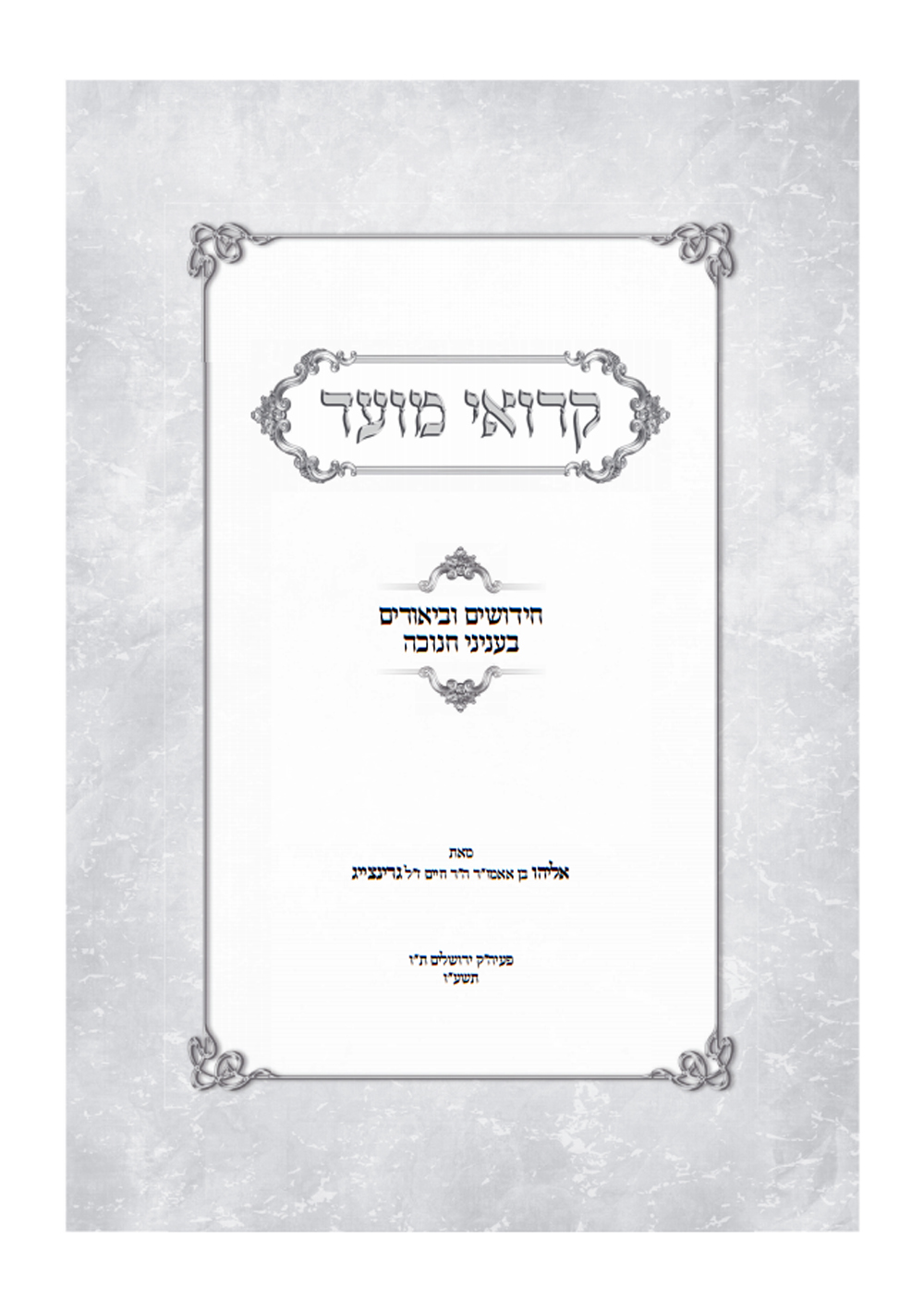
גרינצייג, קרואי מועד, פסח, שעה עמודים
הנ”ל, קרואי
מועד
, ראש השנה, שלג עמודים
הנ”ל, קרואי
מועד
, ספירת העומר שבועות, רמט עמודים
הנ”ל, קרואי
מועד
, חנוכה, רצה עמודים
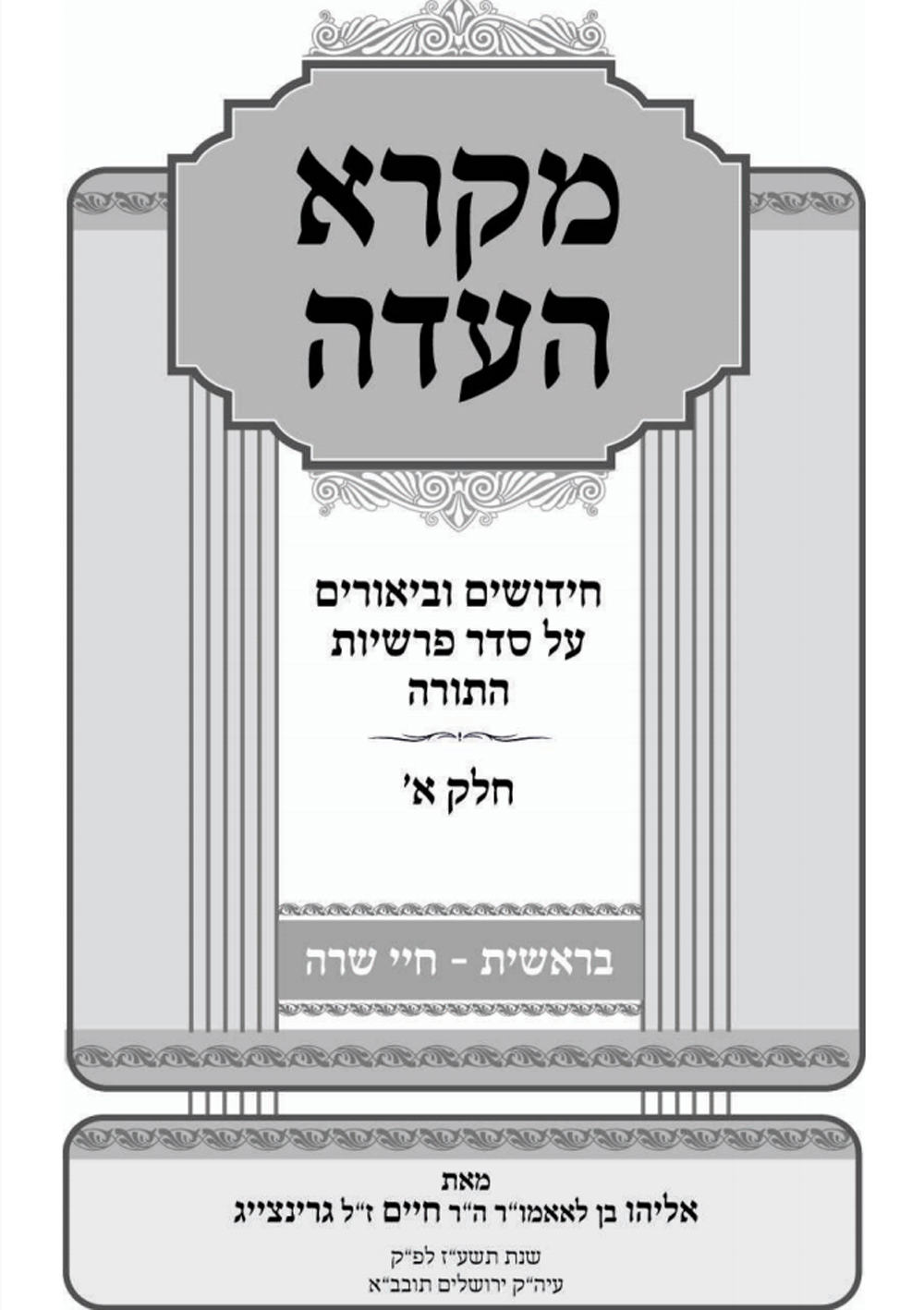
מקרא העדה, חידושים
וביאורים על סדר פרשיות התורה, א, בראשית-חיי שרה, תקסד עמודים
Many
years ago, while still a bochur learning in the Mir, a friend of mine took me
along for a Shabbas meal, promising me I’d meet an amazing Talmid Chochum
obsessed with seforim. This was my first encounter with R’ Eliyhau Greensweig. My
friend did not exaggerate in any way. The whole meal I simply sat there drooling
at the wall-to-wall seforim library. Later I learned this was only part of his
library. This was a collection which I had never before seen the likes of.
During the meal we spoke about numerous seforim and random sugyos; I was simply
blown away. From that Shabbas, I began visiting him every few weeks and we
would speak for a few hours about different topics and seforim. His vast knowledge
was, simply put, incredible. One additional attribute which always struck me
while talking with R’ Greensweig was his tremendous humility. Many times, when
specific topics came up, he would say “I wrote a whole kuntres on
this”. Once, he took out a huge stack of papers and said to me “this
is a work on Rambam Sanhedrin”. Over time, it came out that he had ghost
written numerous articles and works. Once I mentioned to him that I had noticed
that a specific volume of a particular set of seforim has a different style
than previous volumes and that whoever wrote the notes is familiar with “not
the ‘standard stuff'”. He smiled at me and said “guess who wrote
those notes…?” Still, much of his work has appeared under his own name. One
of the main projects which he had worked on for many years was  Otzar Mifarshei HaTalmud from Machon
Yerushalayim. Without getting into the pros or cons of this work, anyone
familiar with it knows it has references to thousands of seforim. This was done
long before many of the modern Torah computer programs came on to the playing
field (which is beside the point, as R’ Greensweig does not know how to use a
computer search engine!). One description I had heard of him was “he was
Mechon Yerushalyim’s ‘secret weapon'”.
Over the past
twenty five years various prominent Torah Journals, such as Yeshurun, Yerushaseinu,
Beis Aharon V’Yisroel, Moriah, Kol Torah and others, have
featured numerous articles authored by him. Some of the times he would print a
section of the Avudraham with his erudite notes; other times the article
was related to the Torah reading (Parsha) or an upcoming Yom Tov.
In 2001, an
annotated edition of part of the classic work Avudraham appeared on the seforim
market. Printed by the Or Hasefer Publishing house, it included an anonymous
commentary called Tehilah Ledovid.
The significance
of the Avudraham is well known and hardly needs mentioning here; just to
cite the well-known Haskamah of the Nodeh Beyehudah to the Prague
edition:

כבר נודע בשער בת
רבים גודל מעלת החיבור ספר אבודרהם, ורוב מנהגי התפילות והברכות קדושות והבדלות על
ספרו בנוים, ובטור אורח החיים מביאו הבית יוסף והאחרונים לרוב מאוד, והוא ספר יקר
הערך ויש בו צורך, כי האחרונים העתיקו ממנו דברים בקיצור…

Avrhom E. Harkavy writes:

סי’ אבודרהם יקר
ונכבד הוא לנו כי בו שרד וימלטו דברים רבים מסדור רב עמרם גאון (שלא בא לידנו
בתמונתו וצבינו) ומסדור רב סעדיה גאון ומשאר חבורים קדמונים. [חדשים גם ישנים, עמ’
237]

For anyone looking to learn through an enjoyable
sefer about Tefilah and Yom Tovim – this the work for him.
The notes in the
Or Hasefer edition impressed numerous experts and Talmedei Chachomim. However
almost no one knew who the author was, as he chose to remain anonymous. The
author is, of course, none other than R’ Eliyahu Greensweig. Interestingly, the
introduction of the 2001 volume “claims” to be based upon manuscripts,
sadly however, this is not the case. This claim was something the publisher
added by himself after he checked up a few things in manuscript; R’ Greensweig
himself never checked up manuscripts. The primary aim of his notes was to provide
the sources for the material quoted (utilized) by the Avudraham and to
cite those sources who discuss the sefer. Most accurately, the notes are
encyclopedic and full of thousands of sources, many from rare seforim. The
notes are also full of “Torah” and at times perhaps a bit lengthy (as
is common these days). Additionally, it is clear from the material cited that
the author has an excellent command of academic literature, as well. For the
most part all these sources could be found in R’ Greensweig’s incredible
library! However, despite the great value in this edition, until recently only
one volume was available leaving many to wonder when the rest would (ever?) be
completed.
In 2015, volume
one was reissued in a limited edition with corrections and many additions by
the Keren Re’em publishing house. One useful correction was that some of the
longer notes were removed for the body and placed in the appendix. In the
summer of 2016, volume two was released privately for the first time.
A few months ago
the two volumes were released for sale to the public distributed by Yefeh Nof publishers,
with the final volume, volume three, due to be released in the summer, BE”H. I
highly recommend this work and am sure that many will benefit from these
volumes.
Besides for this new work on Avudraham,
as I mentioned previously, R’ Greensweig has written voluminously over the
years. Thanks to the efforts of his sons and some generous sponsors, some of
his other works have just been printed. To date, four volumes on the Yom Tovim
have appeared in a paperback edition, each one including the related section of the Avudraham
in the back, with R’ Greensweig’s invaluable notes. The most recent of the four
seforim is on Pesach. A few weeks ago, a hard cover volume on the first
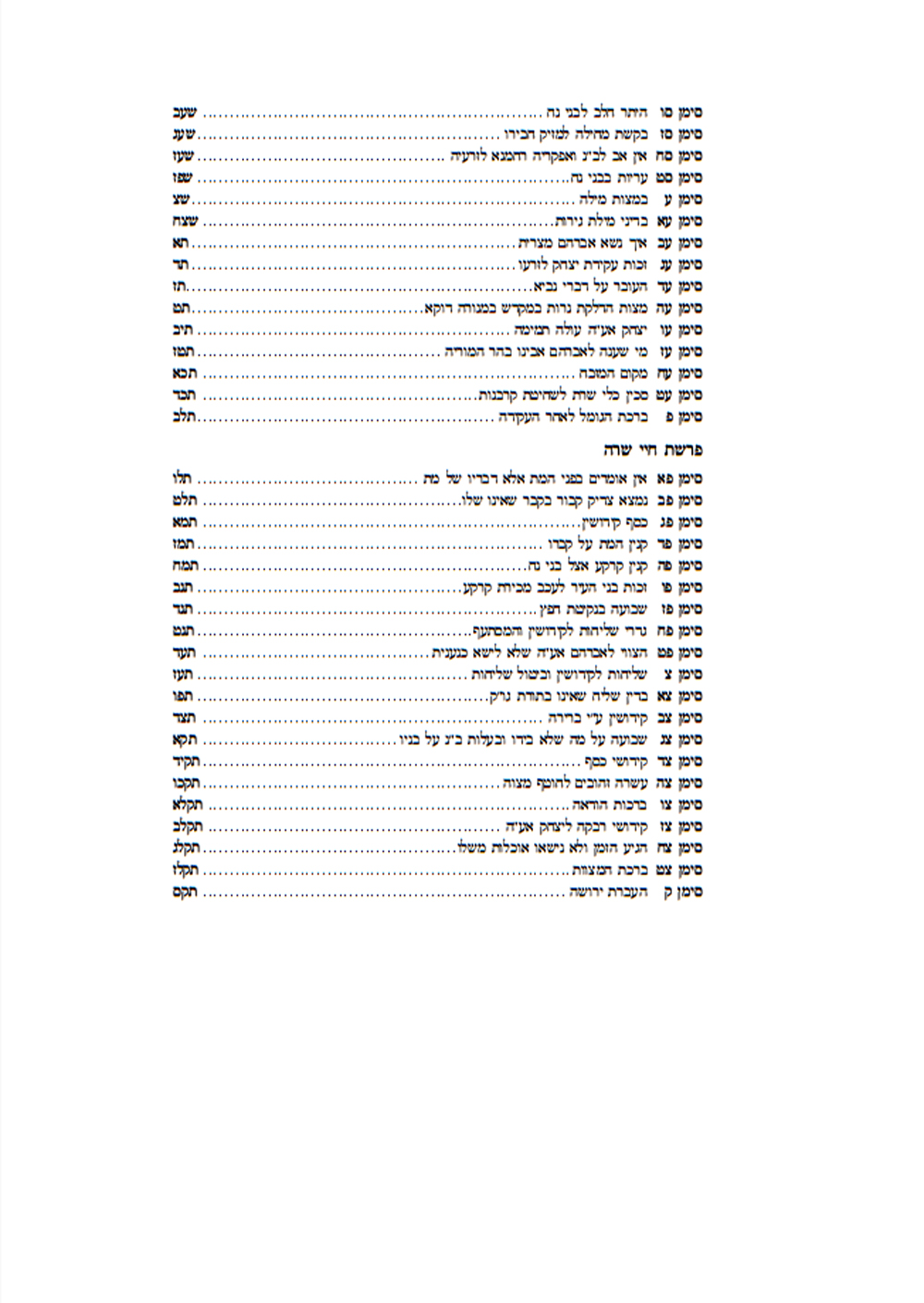
half of Chumash Bereishis appeared, with a total of eighty pieces! All
this material is pieces he wrote over the years; each week he would write on
one topic, and then add to it when he found more material, with a small
percentage of the articles having appeared in various journals throughout the
years. One does not have to wait until Chumash Bereishis arrives to
learn this sefer as the pieces are encyclopedic and useful all year around (see
below for the table of contents). One weakness, pointed out in the introduction,
is sometimes there can be a certain amount of redundancy and sometimes the
pieces smack of a lack of proper editing. The reason for these drawbacks is that
proper editing (and condensing the redundant pieces) would hold up and delay
printing.
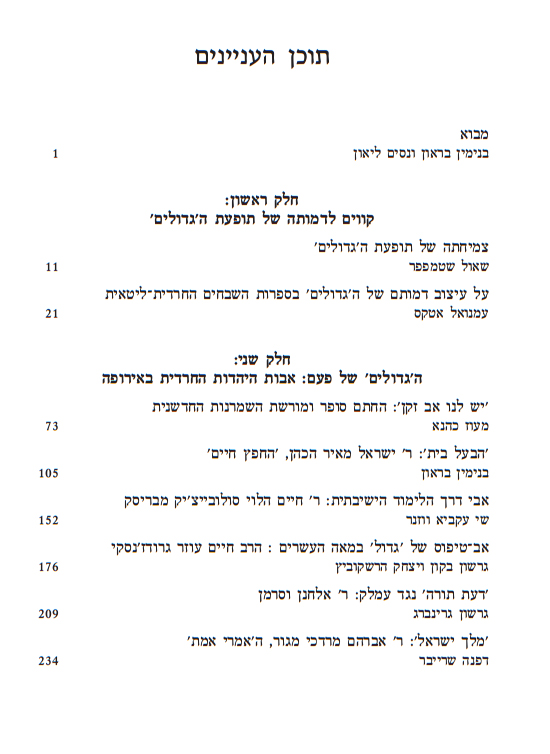
Here are the table
of contents of some of these works, showing the wide range of topics discussed.
A PDF sample piece of the Avudraham and of one article is available upon request,
also available upon request is a much more in-depth Table of contents of the
works.

Copies of the newly
published two volume set of Avudraham should be available in regular stores.
The paperback works on Yomim Tovim are available for purchase at Begieleisen in
Boro Park and Judaica Plaza in Lakewood.


Dr. Shlomo Sprecher ז”ל: In Memoriam

Dr. Shlomo Sprecher ז”ל: In Memoriam
אין חכמת האדם מגעת אלא עד מקום שספריו מגיעין,
ולכן ימכור אדם כל מה שיש לו ויקנה ספרים, כי דרך
משל מי שאין לו ספרי התלמוד אי איפשר לו להיות
בקי בו, וכמו כן מי שאין לו ספרי הרפואה א”א להיות
בקי בה.
דרכי התלמוד לר’ יצחק קנפאנטון
A person’s wisdom reaches only as far as his library. Therefore, a person should sell everything he owns and
acquire books. For example, one who doesn’t own a set of the Talmud cannot possibly master its content. Similarly, one who doesn’t own the basic medical books cannot possibly be expert in the field of medicine.
          It is with deep sadness that the Seforim Blog joins the thousands who mourn the death of our dear contributor and supporter, Dr. Shlomo Sprecher ז”ל. A distinguished תלמיד חכם and radiologist, R. Shlomo was a world renowned collector of books, who mastered their content, and spent a lifetime sharing his books and his knowledge freely with others. Doubtless, רבי יצחק קנפאנטון had the likes of R. Shlomo in mind, in the passage cited above.
          R. Shlomo was a מרביץ תורה and a מרביץ חכמה to a degree rarely seen in modern times. Despite a professional medical career that in and of itself would have exhausted others, he somehow found time ללמוד וללמד. He learned Torah incessantly, gave public שיעורים on a regular basis, and managed to arrange for others, often younger scholars, to give שיעורים and lectures in his neighborhood. He served with distinction on the editorial boards of ישורון and Hakirah, where he contributed his own studies and, and no less significantly, recruited, indeed cajoled others to publish the results of their research.
          R. Shlomo’s literary legacy includes such gems as:
1.   Introduction and table of contents for the reissue of R. Meir Dan Plotzki’s שאלו שלום ירושלים (New York, 1991).
2.   מבחר כתבי מו”ה מרדכי גומפל שנאבר הלוי לעווינזאהן ז”ל (Brooklyn, 1995). The  English section includes a lengthy introductory essay (by R. Shlomo and Mati Sprecher) on the life and times of Mordechai Gumpel Schnaber – not surprisingly, an eighteenth century rabbinic scholar and physician.
3.   “בסתר בצל: קווים לדמותו הסמויה של הג”ר בצלאל בנו יחידו של המהר”ל מפראג זצ”ל” in
ישורון  2(1997), pp. 623-634.
4.   “הפולמוס על אמירת מכניסי רחמים” in ישורון 3(1997), pp. 706-729.
5.   “Mezizah be-Peh – Therapeutic Touch or Hippocratic Vestige?”
in Hakirah 3(2006), pp. 15-66.
6.   “A Gemeinde Gemeinheit,” (by R. Shlomo and Mati Sprecher), posted on the Seforim Blog, June 9, 2009. An earlier version appeared in a pamphlet distributed at the wedding of Uri and Rivi Sprecher on November 13, 2008.
    In common, all of R. Shlomo’s contributions are characterized by dazzling erudition, lucid presentation, and originality. They advanced discussion significantly. It will certainly be a measure of consolation – and an important contribution to Jewish scholarship – if the family will gather his published studies and publish them in a bound volume. 
Above and beyond R. Shlomo’s intellectual excellence was his excellence of character. Others, more talented than us, will have to write about it. For those of us who experienced it, no further descriptions are necessary. For those of us who never experienced it, we doubt that the breadth and depth of his excellence of character can be adequately described in mere words. R. Shlomo leaves a void that will not easily be filled.
חבל על דאבדין ולא משתכחין.
 Eliezer Katzman
 Shnayer Leiman 


Churches, Ronald McDonald, and More

Churches, Ronald McDonald, and More

Marc B. Shapiro
1. In a recent post I mentioned R. Leon Modena, so let me note the following. In my article on entering churches,[1] available here, I mention that R. Modena entered churches to hear the sermons. I also quote R. Eliezer Waldenberg’s description of R. Modena as an איש הפכפך. Only after my article appeared did I find that R. Solomon Scheinfeld uses similar language in describing R. Modena[2]:

הוא היה גדול בתורה וחכמת העולם, היה גאון בטבעו, אבל כדרך הרבה גאונים שהם קרובים לפעמים אל השגעון, היה הפכפך, איש זר בכל דרכי חייו, איש שאין בו נכונה, אמונה וכפירה התרוצצו בו.

R. Scheinfeld’s point about some great Torah scholars (he actually says “many geonim”), that often they have, let’s call it “unusual” characteristics (R. Scheinfeld actually uses a different term), is certainly worthy of note. I first heard this almost thirty years ago from the late R. Herschel Cohen of West Orange, N.J., who in his youth had studied under R. Judah Leib Chasman. As a young man I used to visit him, and one day he showed me a certain sefer. He very much enjoyed the book, but also commented that the author was a “meshugena.” I replied: “But he is a gaon,” and R. Cohen shot back: “There is often a very fine line between a gaon and a meshugena.”[3] In this regard, I would add that R. Moshe Feinstein was wary of geniuses, commenting that אין לנו הרבה נחת מהעילוים.[4]
Regarding R. Modena, it is also worth noting that R. Mordechai Spielman, who knew exactly who R. Modena was, refers to him as הגאון ר’ יהודה ארי’ ממודינא ז”ל. This reference comes from R. Spielman’s Tiferet Tzvi, vol. 6, p. 99. I don’t know how many readers are aware of this significant work on the Zohar, and it is unfortunate that it is not found on either hebrewbooks.org or Otzar ha-Hokhmah. In fact, Tiferet Tzvi is one of the most important works of Torah scholarship not to be found on either of these two sites.
Regarding going into churches to hear sermons, it appears that this is mentioned by R. Isaac Arama. At the beginning of his introduction to Akedat Yitzhak, in speaking of Christian preachers speaking to the population, he writes:

ובני ישראל באו בתוך הבאים ושמעו אמריהם כי נעמו נתאוו להם להרים דגל כמותם. אומרים אמור היו יהיה חכמיהם ומביניהם שואלים ודורשים במדרשיהם ובבתי תפלתם ונתנם טעם לשבח על התורה ועל הנביאיםם  ככל חכמי הגוים לאומותם. 

In Hazut Kashah, beginning of sha’ar 4, he writes:

חכם אחד מחכמי הגוים בתוך דבריו אשר דבר במקהלות עם רב ובאזני קצת גוברין יהודאין אשר קרא לנו לשמוע מפיו דבר כמנהגם.

In the introduction to his edition of Akedat Yitzhak, note 6, R. Hayyim Joseph Pollak, suggests that R. Arama is referring to sermons that Jews were forced to attend, but in the first source this doesn’t seem to be what he is referring to.
Returning to my article on entering churches, I am honored that Rabbi J. David Bleich used some of the sources I collected and mentioned a couple of my comments in his own article on the topic that appeared in Tradition 44:2 (2011), pp. 73-101 (available here, and it has also just appeared in Contemporary Halakhic Problems, vol. 7).[5] I now have some additional sources to add. With regard to R. Modena, in my article I neglected to refer to his autobiography where he also describes being present for a sermon in the San Geremia church in Venice, which is very close to the Jewish ghetto.[6]
In my listing of those rabbis known to have entered churches,[7] I referred to R. Jacob Meir, who served as Rishon le-Tziyon. Unfortunately, one word (בכנסיה) was mistakenly omitted from the quotation, and readers might therefore have wondered why I assumed that R. Meir entered the church. Here is the full quotation, with the crucial word underlined. It comes from Gad Frumkin, Derekh Shofet bi-Yerushalayim (Tel Aviv, 1954), p. 294:

באותו זמן, נתתי דעתי בתחום אחר לגמרי, והוא למצוא ביטוי חגיגי ברוח לאומית לרגש אשר עטף אותנו לרגל שחרור ירושלים מעול העותומני, כצעד ראשון לגאולה השלימה. סיר רונלד סטורס, כמושל ירושלים, הנהיג לחוג ברוב פאר שנה שנה את יום כניסת צבאות אלנבי לירושלים, בתשיעי לדצמבר. בבוקר היו מתפללים לכבוד היום הזה בכנסית סט. ג’ורג’, ולאחר הצהריים היה מקבל אורחים בביתו. גם היהודים השתתפו בטכס בכנסיה ובין הבאים היה הרב יעקב מאיר בתלבושתו הרשמית ענוד אותות הכבוד שנתכבדד בהם על ידי  השולטן ומלכי יוון ואנגליה.

In fact, the mistaken omission of the word בכנסיה created another problem. When I read over the article just before publication, I didn’t realize that the word בכנסיה had been mistakenly deleted. I therefore added a note that maybe the meaning of the passage is that R. Meir only went to the home of Ronald Storrs, who was the Jerusalem Military Governor. (R. Bleich quotes my mistaken assumption.[8]) I also changed my formulation prior to the quotation to say that R. Meir “appears” to have entered a church. However, as we can see from the passage, Frumkin is clear that R. Meir indeed entered the church for the event.
R. Immanuel Jakobovits was asked if he would go into a church. He replied: “Perhaps for a visit, but not during prayers or a religious ceremony.” He also recounted a time when while visiting Russia it seems that he got stuck in a church during a prayer service:

On Sunday I visited Zagorsk, the repository of the treasures of the Russian Orthodox Church, where there are wonderful cathedrals in which many choirs chant. They seated me at a pulpit, where it was difficult to leave in the middle of the service, apparently so I would cancel my visits to the refuseniks in Moscow later that afternoon.[9]

As mentioned in note 7, the British chief rabbis will enter churches for various official events. As R. Jakobovits wrote on another occasion, this policy has the approval of the London Beth Din.

Another relevant text is from R. Shlomo Riskin who wrote as follows[10]:

Question:
Am I allowed to attend my friend’s wedding in a church? Are Jews allowed to enter churches at all?

Answer:
Evangelical churches do not have icons or statues and it is certainly permissible to enter Evangelical churches.[11] Catholic and most Protestant churches do have icons as well as paintings and sculptures. If you enter the church in order to appreciate the art with an eye towards understanding Christianity and the differences between Judaism and Christianity so that you can hold your own in discussions with Christians, then it is permissible.[12] Participating[13] in a church religious service is forbidden unless it is for learning purposes or unless it would be a desecration of God’s name if you don’t attend, as in the case of Chief Rabbi Sacks’ attendance at Prince William’s wedding.

R. Asher Weiss here provides support, bediavad, for R. Haskel Lookstein’s attendance at a prayer service in a church which was part of the celebrations following President Obama’s inauguration.
In my article on entering churches I refer to R. Joseph Messas’ responsum in which he mentions going into a church. I subsequently found that in his Otzar ha-Mikhtavim, vol. 1, no. 280 (p. 133), he tells of a visit to Malaga, Spain, where he also entered a church. Earlier, while still in Spanish Morocco, he explained to some non-Jews that Jews do not hold a grudge against Spain and do not hate contemporary Spaniards because of what their forefathers did. He then said something very strange (p. 131), namely, that contemporary Jews have to be thankful to the earlier Spaniards for how they persecuted the Jews of their time, since this enables everyone to see how connected Jews are to God, that despite the persecution they did not give up their faith! Is there any other rabbinic text that lets murderers “off the hook” so easily?

לדעתי, ראוי להחזיק טובה לאבותיכם על כל הרדיפות וכו’, כי על ידם נודע, שאנחנו עבדים נאמנים לא-להינו, ואף כל מיני ענויים ומיתות משונות לא הפרידו בינינו ובין א-להינו.

R. Messas finds other ways to be “melamed zekhut” on those who persecuted and even killed Jews in Spain, and if I didn’t know that he was a truly great rabbinic authority,[14] I might think that what he writes comes from the pen of a Catholic apologist for the Spanish Inquisition.[15]

שכל הרדיפות היו מפני שנאת הדת, שהנוצרים היו אוהבים מאד את דתם, ולכן היו שונאים כל בעל דת אחרת, והיהודים מאהבתם ג”כ לדתם, לא ידעו [ל]כלכל את מעשיהם, והיו ההדיוטים שבהם אומרים בפה מלא, שדת יהודית היא האמת, וזולתה שוא ודבר כזב, וזה הוסיף אש ועצם על המדורה, ובפרט המומרים מאהבת הכבוד, או מאהבת נשים, אשר אחיהם היהודים הקילו בכבודם על תמורתם, הלשינו אותם ואת דתם בדברים שלא היו ולא נבראו, כדי לנקום מהם חלול כבודם, וא”כ הא למה זה דומה, למי שיש לו בן, הוא חביב עליו מאד, ודאי ישנא כל אשר ישנאהו וכל המדבר עליו תועה, ואם תמצא לאל ידו, יהרגהו, והנוצרים היתה לאל ידם, והרגו כל השונא את דתם שהיא חביבה עליהם כבן יחיד, ואף שאין זה שכל ישר, מ”מ דעת אנשי אותו הזמן היתה כך, ואין להאשימם.

Regarding entering churches, also of interest is the report of the sixteenth-century painter and writer, Giorgio Vasari, that Roman Jews would come on the Sabbath to the Church of San Pietro in Rome to stand before Michelangelo’s statue of Moses.[16]
A number of years ago, R. Dov Linzer gave a shiur on this very topic of entering churches. At the time, I called his attention to some responsa that do not deal with this matter, but which permitted Jews to donate money to assist in building a church. These responsa are R. Mordechai Horowitz, Mateh Levi, vol. 2, Yoreh Deah, no. 28, R. Isaac Unna, Shoalin ve-Dorshin, no. 35, R. Shalom Messas, Shemesh u-Magen, vol. 3, Orah Hayyim, nos. 30-31. When there is fear of enmity (and only in this circumstance), R. Yehudah Herzl Henkin, Benei Vanim, vol. 3, no. 36, also permits donating money for the building of a church, as long as the building can be built without the Jew’s donation or his donation is merely symbolic. R. Henkin also suggests that the person donating the money make it a condition that the money go to building the parking lot or something not connected to worship. (He concludes that these suggestions will also allow one to donate to a Reform or Conservative synagogue if not doing so could arouse enmity.) In the interest of full disclosure I should mention that the first responsum of R. Messas as well as R. Henkin’s responsum were sent to me.
Some time after I showed R. Linzer these responsa, there was an attack on a church in Charleston where nine people were killed. The very next day there was an arson attack by a radical Jew (or perhaps more than one individual) against a church in the Galilee. This followed other acts of vandalism directed against churches in Israel in recent years. R. Linzer sent out the following email.
Rabbosai,
Given the recent horrific attack in Charleston and the terrible burnings of churches that has occurred in the last few days, I encourage all of you to show your support for those who have been attacked, and to act in a way of kiddush shem Shamayim to counteract these terrible hate crimes.
One way you can do this is by donating money to help in the rebuilding of these churches. While there are poskim who rule otherwise (see Melamed li’hoyil 188:2), a number of recent poskim have dealt with this issue on a halakhic basis and ruled that it is totally permissible and at times even obligatory.[17] This is based on the widely accepted ruling that Christianity is not avoda zara for non-Jews. Thus, helping non-Jews in their permissible worship of God can in no way be considered מסייע לדבר עבירה, a form of aiding transgressive behavior. Some of these teshuvot have pointed out that church buildings are often repurposed as synagogues, and this again points to the non-halakhically problematic status of these buildings. Relatedly, Rav Moshe (YD 1:68) ruled that an architect can draw up the plans for the construction of a church, and that mi’ikar ha’din it is permitted to actually participate in the building of a church (and this is even without the argument that it is not avoda zara for them!).
There are some halakhic issues when giving to avoda zara directly implicates the giver in the avoda itself (see YD 149:4 and 143), but that is not relevant to this case.
I am attaching 3 contemporary teshuvot, all thanks to Marc Shapiro, who is the shoel of the teshuva of Rav Meshash [!], and who make the argument as outlined above.
I would like to quote in particular from the teshuva of the Mateh Levi, both the question and a section from the beginning and end of the answer:

ביום א’ של שבוע זה נאספו פה אנשים אשר לא בני בריתנו המה (קאטהאליקים) ובאסיפה זאת נגמר בדעתם לבנות להם בית תפילה בעירנו. ובאשר הם מתי מספר מעט מזעיר זאת העצה היעוצה להם לשאול מאת היהודים אשר פה נדבות אחדות לבנינם ובטח גם אלי יפנו בימים הבאים. לכן הנני בבקשתי שייטיב ידידי להודיעני אם מותר לתת נדבה לדבר זה כי קדוש ה’ הוא אחרי אשר הכהן הקאטהאלי מלא פיו שבח והודיה לנדבת לב בני ישראל לסמוך ידי אחיהם בדברים של קדושה. אמנם ללמוד אני צריך וכדבריו כן אעשה… דן בנרש 

תשובה: ידעת גם ידעת ידידי נ”י כי רבים וכן שלמים מגדולי הקדמונים התירו והקילו בענינים האלה משום דרכי שלום ומשום איבה וע”י כך נעשו בין האחרונים שתי דרכים נפרדות שאף אותם הגדולים שכתבו להחמיר לא כתבו רק להלכה ולא למעשה… ואני כל ימי ראיתי שאין אמת אלא אחת ומה שאינו עולה יפה למעשה גם להלכה אינו. על כן אני אומר אין אני זז מן האמת לא משום דרכי שלום ולא משום איבה. אבל לאחר העיון נראה שהדין דין אמת וכל דרכי התורה לאמתה דרכי נועם וכל נתיבות הדין שלום… 

ועל כל הדרכים האלה נגיע לתכלית הדבר ופשוט אצלנו שאין כאן שום איסור כלל וכיון שאיסורא ליכא ממילא הדין עם ידידי נ”י שמצוה נמי איכא היינו מצות קדוש שמו הגדול [וידוע כי שר הגדול בישראל אשר לא ישכח שמו במחנה העברים כש”ת מוה’ משה מנטפיורע ז”ל קדש ש”ש ע”י זה שבנה להם בית תפלה ברמסגט] על ידי עמו ישראל ויראו כל עמי הארץ שאנחנו יהודים נאמנים עתידים בכל שעה למסור את נפשנו באהבה בעד קידוש השם שהוא ד’ אחד ושמו אחד ולהשליך את כל יהבנו ואת כל כבודנו בעולם הזה בעבור אמונתנו הקדושה…וכלנו מודים שכל מי שאינו ישראל יכול להיות אחד מחסידי וגדולי עולם ובני עולם הבא…

R. Linzer was attacked after this email was sent out, and some people made it seem as if he had come up with a crazy idea. Yet the truth is that what he suggested – donating to a church – had already been approved by a couple of recognized gedolei Yisrael. Even his point about making a kiddush ha-shem has a precedent in R. Mordechai Horowitz, the Matteh Levi, who said exactly this in discussing Moses Montefiore’s donation to a church, and this is quoted in R. Linzer’s email.
Regarding kiddush ha-shem, even if we don’t go as far as R. Linzer, I think that one can make a good case that donating to a church can be a sanctification of God’s name if, as happened in Israel, the church was set on fire by a radical Jew (or Jews). We cannot have the spectacle of Jews burning down churches in Israel, and the damage this can do to Jews worldwide is immense. Would it be out of line to argue that if Jews burn down a church, that at least to prevent enmity Jews should also help rebuild it? It is easy to see how such an action can be regarded as a kiddush ha-shem, even if most poskim would see it as technically forbidden. (I wonder, can something be both a kiddush ha-shem and a violation of halakhah?) In fact, after the church was burnt in Israel, a number of rabbis, including the great R. Nachum Rabinovitch, helped raise money to repair it.[18] What this shows is that the matter is not as clear-cut as might appear at first glance.
Speaking of Jewish donations to churches, it is of interest that Mordechai Maisel (1528-1601), the leader of the Prague Jewish community, donated to the St. Salvator Church, which is very close to the Jewish Quarter. Rachel L. Greenblatt writes that this was “an alliance-seeking neighborly act not as unusual as it might sound.”[19] Yet I do not know of any other case like this in the sixteenth century or prior, so it certainly sounds unusual to me. Unfortunately, it is not known if any of the Prague rabbis approved of Maisel’s donation, which Maisel must have assumed would create a lot of good will with the non-Jewish population, good will that might later save the community from an expulsion or even a pogrom. Two hundred years later, Meyer Amschel Rothschild (1744-1812) donated money to build a church in Kassel. The local ruler required this in order for Rothschild to be regarded as a “protected Jew” in Kassel, where he often stayed while conducting business.[20]
I have a lot I would like to say about Christianity and its impact on Judaism, in particular when it comes to seforim. For  now, here is something that I very recently found and I am not sure if it is a conscious distortion. In R. Moses Hayyim Luzzatto’s Tikunim Hadashim (Jerusalem, 1958), p. 10, as part of his messianic vision he states as follows:

כלא יתקשר ברישא דברך יחידאה מלכא משיחא לשלטאה ביה על כל עלמא ולאתגלאה נהורך עד סופא  דכלא. וכל רע יתעבר מעלמא ויתהדר כלא לאשתעבדא קמך.

R. Mordechai Chriqui has edited numerous works of Ramhal. In 1986 he published Yesod Olam, which a short book on Ramhal’s life and thought. On p. 43 he provides the following Hebrew translation of part of the Aramaic text just cited:

והכל יתקשר בראש דבריך. המיוחד מלך המשיח שלוט על כל העולם.

Yet this translation is completely mistaken. I wonder if this is an innocent mistake or was intentional so that the reader not see a text that sounds Christian (although Ramhal was not referring to Jesus). What the Aramaic text really means, and I have underlined the crucial part, is that all will align themselves with your only son, the Messiah. I am curious to hear what readers think about this (and maybe someone will even want to defend Chriqui’s rendering).[21]
Further on the subject of Christianity, R. Chaim Rapoport published an interesting responsum by R. Hayyim Galipapa (fourteenth century) of Spain.[22] In this responsum, R. Galipapa states that the Trinity is not to be regarded as avodah zarah. (R. Rapoport claims that he only means that it is not avodah zarah for non-Jews, who are not obligated to have an absolutely pure conception of God, but is indeed to be regarded as avodah zarah as far as Jews are concerned.) Here are R. Galipapa’s words:

וענין השלוש לאו ע”ז היא, אלא שהא-להות אינו מקובל עליהם כראוי, ולדעת חז”ל נקראים הם וכיוצא בהם “קוצצים בנטיעות”, וזה ברור. וכן פי’ קצת המפרשים ע”ז [= על זה], ר”ל על השלוש, הכתוב בדניאל (י”א ל”ו): “ועל א-ל אלים ידבר נפלאות”, כלו'[מר] שמדברים ומאמינים הם בא-ל אלים, רק שמדברים בו נפלאות ונמנעות והוא השלוש.

Finally, in my article on entering churches I noted that R. Jacob Meir, the Rishon le-Tziyon, wore a ceremonial medallion in the shape of a cross (I am not sure which government awarded this to him). 
You can see it here.
Here is an Israeli stamp with R. Meir on it, and you can see the medallion.
Yehudah Mirsky called my attention to this picture of R. Kook that is found in Mar’eh Kohen (Jerusalem, 2002), p. 52. The British medallion, awarded by King George V, is not completely showing.[23] I would assume, and Mirsky agrees,[24] that this was intentional.

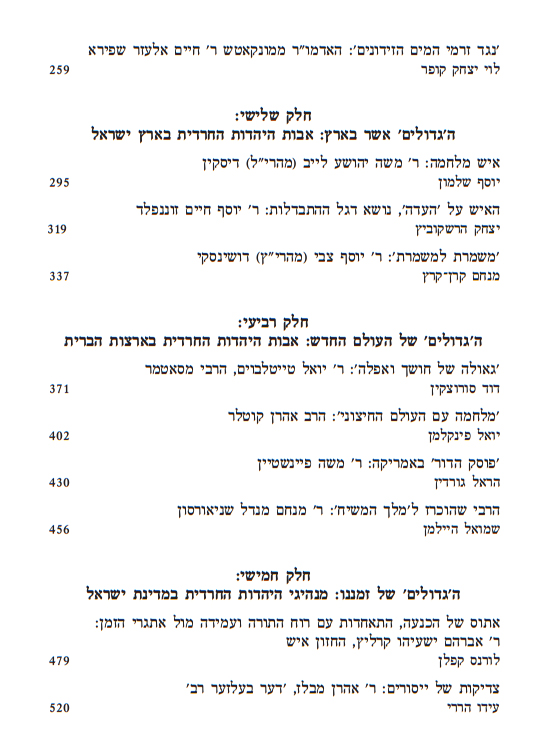
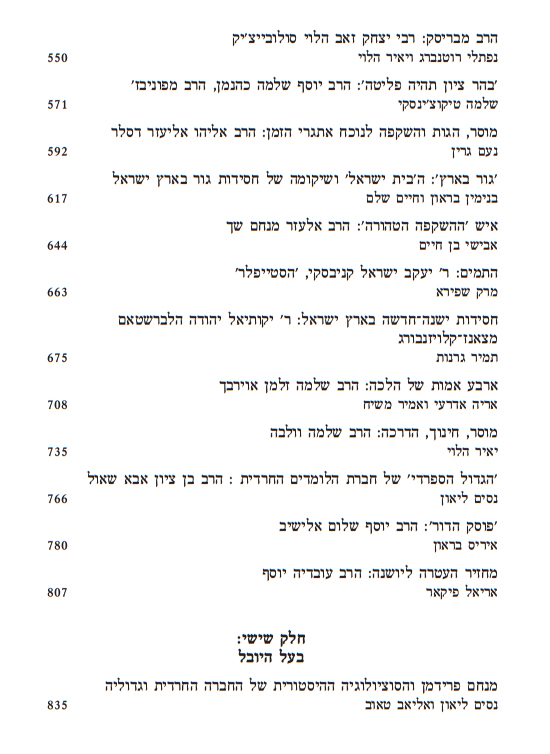
2. In his post here, Eliezer Brodt mentioned the new book Ha-Gedolim (available here). My article in the volume is on the Steipler. As you can see from the table of contents posted by Brodt, they wanted to give each article a catchy title. One of the editors suggested Ha-Tamim for the title of my article, and I thought that this was a good suggestion. In traditional rabbinic literature תמים has the connotation of pure and unblemished, and this is how one can describe someone who has a simple, unquestioning faith. This, I thought, was a great description of the Steipler who was opposed to philosophical investigation of Judaism and even opposed polemicizing with the non-Orthodox for fear that this might expose readers to non-Orthodox ideas. (Chabad yeshiva students are also referred to as tamim.)
However, the word tamim can also have the connotation of “unsophisticated”. Even though this is clearly not what I had in mind, since at least a few people wondered about the word, I clarified it in a comment to Brodt’s post. I also asked if anywhere in rabbinic literature does the word tamim mean anything other than what I have written. From the responses I received, I have to say that the answer is no. While the word tam is used to mean “unsophisticated,” the word tamim only has a positive connotation. At least that is the opinion of everyone I have discussed the matter with. I also searched Otzar ha-Hokhmah where I found references to rabbis referred to as הגאון התמים. Otzar ha-Hokhmah also reminded me of how R. Jehiel Jacob Weinberg described his deceased student, R. Saul Weingort[25]:

בהנהגתו, באופני מחשבתו ובהילוכו עם הבריות הי’ טיפוס נעלה של יהודי תמים ונאמן לאלוקיו ולתורתו.

The Maharal writes[26]:

והתמים הוא שהולך בדרך הישר מעצמו בלי שום התבוננות, רק הולך בדרכו בתמימות.

One of the Seforim Blog readers was helpful in sending a number of relevant texts, illustrating the original meaning of tamim. Among these texts is one from the 1980s by R. Shlomo Tzadok who actually laments how the word tamim, which is supposed to have a positive connotation, has been turned into a negative term.[27]

ומדהים לראות שאף המלה תמים שנקטה תורה כאן סולפה משמעותה האמיתית בפי ההמון, וכשרוצים לקרוא למי שהוא לאיזה אמונה בלי דעת וחכמה ובלי הבנה, אומרים לו תמים תהיה! (אולי בעקבות השמוש השלילי בלשון חז”ל באגדה, תם, היפך חכם).

2. Seth Rogovoy published an article in the Forward titled “The Secret Jewish History of McDonald’s.” What precipitated the article was the recent appearance of the movie “The Founder” about Ray Croc of McDonald’s fame. Rogovoy focuses on Harry Sonneborn, the first President of McDonald’s, who came up with the idea of turning McDonald’s into a real estate empire, by owning the land under the restaurants and leasing it to the franchisees.
There is another “secret” Jewish history of McDonald’s, one which I think is of much greater interest. Ronald McDonald is the world’s most widely recognized commercial mascot, and he has “a recognition factor among children equaled only by Santa Claus.”[28] How many people know that it was a Jewish man, Oscar Goldstein, who was responsible for Ronald McDonald? The story is told in a number of places, most comprehensively in John F. Love’s McDonald’s: Behind the Arches from which I am taking the following description.
The most successful McDonald’s operation in the company’s history is that of Goldstein and his partner John Gibson. In 1956 they made a deal with Kroc for an exclusive franchise for the Washington, D.C. area. Gibson was behind the scenes focusing on financial and real estate matters, while Goldstein was running the actual restaurants which eventually reached 53. (Love says that there were 43 restaurants, but I was given other information.) As part of Goldstein’s advertising campaign, he sponsored a television show in the Washington market called Bozo’s Circus. The person who played Bozo was none other than Willard Scott, who would later find fame on the Today show.
When Bozo’s Circus went off the air, Goldstein decided that he needed another clown to appeal to the children. His ad agency came up with a clown which it proposed to call Archie McDonald. Willard Scott suggested the name Ronald McDonald, which was chosen, and Scott played the first Ronald McDonald. (Scott has often claimed that he invented Ronald McDonald, while in truth all he did – significant in and of itself – is to come up with the name.)
By the mid-1960s, the McDonald’s franchise in Washington was spending $500,000 a year on advertising – most of it on Ronald McDonald. It was more than any other local or national fast-food chain was spending on advertising, more than even McDonald’s Corporation itself. Goldstein also used Ronald McDonald to open each new store it built, and his personal appearances never failed to create traffic jams.

By 1965, Goldstein was convinced that he had discovered in Ronald McDonald the perfect national spokesman for the chain, and he offered the clown free of charge to Max Cooper, the publicist who by then had been hired as McDonald’s first director of marketing. Surprisingly, Cooper turned him down. “I told him the outfit was too corny and not up to our standards,” Cooper recalls. “Goldstein reminded me that his was the most successful market in the system.” After reflecting on that, Cooper decided not to argue, and he proposed a national Ronald McDonald to Harry Sonneborn.[29]

Here is a picture from Love’s book. Goldstein is second from the right. Harry Sonneborn is on the far right. Ray Kroc is standing in the middle.

I am certain that other than members of my family and old friends, all other readers are wondering why I have such an interest in McDonald’s. The answer is that Oscar Goldstein was my grandfather, my mother’s father. Jews are well known for being responsible for so much in American culture, but for some reason, Ronald McDonald as a Jewish creation has slipped through the cracks. Hopefully that will now change.
One final point: Why do I say that my grandfather owned 53 stores when Love puts the number at 43? Because that is what I heard from my grandmother, Gwendolyn Goldstein Freishtat, who passed away in January 2015 at the age of 99. When I questioned if she was sure it was 53, she insisted that there was no doubt. “I knew every one of those stores,” she said.
3. In my recent interview in the fascinating Der Veker, available here, I mention that I have a forthcoming article dealing with Modern Orthodoxy and modern biblical scholarship. Once the article appears I will have more to say about it on the blog. For now, let me just note that in the article I try to show how in some segments of liberal Modern Orthodoxy there has been a reinterpretation of the core theological principle of Torah mi-Sinai so as to align it with modern scholarship. I see this as a major theological development. There is no need to speak more about this now, as once the article appears readers can evaluate the evidence and see whether they think I am on to something.
One significant publication that appeared too late to be mentioned in the article is a new book by Jerome Yehuda Gellman, This Was From God: A Contemporary Theology of Torah and History. This book is precisely the sort of evidence I cite in the article to illustrate the changes that have taken place in recent years. Rather than summarize the book, let me just quote the first two paragraphs.
Increasingly, well-informed traditional Jews may find themselves distrustful of the reliability of Torah as history because of the conclusions of scholarly research from natural science, history, linguistics, Bible criticism and archaeology. And, they may not be swayed by attempts to restore their trust. If they do not have a fitting theology for their new predicament, they may well give up on Judaism altogether or else give up on their traditional Judaism. Or, they may simply repress their difficulty because they see no way of dealing with it that will allow them to retain their traditional religious loyalty. They will carry on as if they believed in the historical veracity of the Torah, when in fact they do not.
As one who has lived with this problem, I want to now propose that a person with prior emunah, belief and faith/loyalty in God and in the holiness of the Torah remain faithful to keeping God and the holiness of the Torah at the center of his or her life. What is needed is a theology that appreciates the force of the challenge to Torah as history and preserves one’s traditional religious loyalty. That is the task of the present book.
Gellman’s arguments are original and he even makes use of hasidic texts. Particularly interesting is his critique of the so-called Kuzari Argument that is sometimes used in support of the revelation at Sinai.
I mentioned Gellman’s book to someone and expressed the opinion that even if another ten theologians were to write similar books, I don’t see this as having any real impact on the ground – although it will be appealing for certain intellectuals – because at the end of the day traditional Judaism is a religion of halakhah and its leaders are talmudists and halakhic authorities. If a new theological approach does not have the imprimatur of even one outstanding religious authority – gadol for lack of a better term – I don’t see how it can gain traction in the community at large. In previous years I have made the same point about changes in women’s roles and so-called partnership minyanim. These phenomena are also having trouble making headway because they too are lacking the necessary imprimatur. Interestingly, years ago someone responded to me that my point was not valid because I was operating under an outdated “paradigm” in assuming that changes in religious life, and now we can say in theology as well, needed the imprimatur of a gadol. Yet I would like to see one example of a significant change in theology or religious life that reached wide acceptance without such an imprimatur.
4. Among other new books worth mentioning is R. Yonason Rosman’s Petihat ha-Iggerot available here. This book goes through R. Moshe Feinstein’s Iggerot Moshe and records discussions and criticisms of R. Feinstein’s points. It is like the Likutei Hearot on the Hatam Sofer’s responsa with one crucial difference: R. Rosman does not limit himself to citing traditional rabbinic works, but he also refers to English language halakhic writings and even academic works. The Seforim Blog is also mentioned a number of times.

[1] Milin Havivin 4 (2008-2011), pp. 43-50.
[2] Olam ha-Sheker (Milwaukee, 1936), p. 44. R. Solomon Judah Rapoport thought very highly of R. Modena. See Iggerot Shir (Przemysl, 1885), p. 71. As a result of this, he was worried that if R. Modena’s autobiography was published, which showed that he was addicted to gambling, it would destroy his reputation. See ibid., p. 120, where he writes to Samuel David Luzzatto:
עוד הכני לבי פן תגלה ח”ו חרפת הבונה בקהל רב, על דבר תאותו אל השחוק, ותתן מקום לשחוק וללעוג באדם יקר אחד מאלף, ולבזות את הנכבד כפי נטות לבך. ואולי תשלחהו ח”ו לבעלי ציון לבנות ציון תמרור על חרבות גבר מצויין, ותתן קברו את רשעים השמחים אלי גיל ישישו כי ימצאו קבר לגבר אשר דרכו נסתרה עד כה בענין אחד, ויסך אלוקי בעדו, ותשפוך דם נקי בקרב ישראל.
Every summer for the last five years I have led groups to Venice where I tell the story of R. Modena. I tell part of the story when standing in front of his tombstone (his actual burial place is unknown). Rather than losing respect for R. Modena because of his gambling addiction, I think people learn to appreciate that even very learned rabbis can have weaknesses.
[3] When he used the term “meshugena,” he did not mean “insane” in a clinical sense. I mention this because there is some recent research supporting the notion that there is indeed a thin line between genius and mental illness. See here.
[4] R. Michel Shurkin, Meged Giv’ot Olam ( Jerusalem, 2005), vol. 2, p. 23. R. Shurkin also quotes R. Leib Malin as saying that it is not good to be an illui. See Mesorat Moshe, vol. 2, p. 404, where R. Moshe notes another problem with iluyim.
[5] In his article, p. 74, in speaking of shituf and the famous Tosafot concerning it, R. Bleich states that “in historical context, it is obvious that the doctrine which the Tosafot seek to legitimize for non-Jews is Trinitarianism.” I don’t know how R. Bleich can say “it is obvious” when not only do many halakhic authorities not interpret Tosafot in this fashion, but great scholars such as Jacob Katz, Louis Jacobs, and David Berger have also stated that they do not think that Tosafot is in any way legitimizing Trinitarianism for non-Jews, but only permitting a non-Jew to take an oath in which he associates another being, such as Jesus, with God. On p. 74 R. Bleich himself notes that R. Ezekiel Landau, Noda bi-Yehudah, Mahadurah Tinyana, Yoreh Deah, no. 148, has the same view as Katz, Jacobs, and Berger. I would only add that the responsum in Noda bi-Yehudah that R. Bleich refers to was not written by R. Ezekiel Landau but by his son, R. Samuel Landau. For Katz, see his Exclusiveness and Tolerance (Oxford, 1961), p. 163. For Jacobs, see his A Tree of Life (London, 2000), p. 82 n. 12. Berger has expressed his opinion orally on a number of occasions, and see also his “How, When, and To What Degree was the Jewish-Christian Debate Transformed in the Twelfth and Thirteenth Centuries?” in Elisheva Baumgarten and Judah D. Galinsky, eds., Jews and Christians in Thirteenth-Century France (New York, 2015), p. 135 n. 31.
On pp. 80-81, R. Bleich states that R. Isaac Herzog’s acceptance of the Meiri’s view of the halakhic status of non-Jews was only a “hypothetical acceptance,” and he criticizes Itamar Warhaftig for assuming otherwise. In this matter, I see no way to read R. Herzog as R. Bleich has interpreted him, and thus agree with the understanding of Warhaftig that R. Herzog indeed accepted the Meiri’s view. On p. 81, R. Bleich interprets the words of R. Eliezer Waldenberg so that he also is not really accepting the Meiri. Here too, I see no way of reading R. Waldenberg as R. Bleich advocates, and I agree with David Berger’s understanding (Berger is mentioned by R. Bleich.) See Berger, “Jews, Gentiles, and the Modern Egalitarian Ethos: Some Tentative Thoughts,” in Marc D. Stern, ed., Formulating Responses in an Egalitarian Age (Lanham, MD, 2005), p. 100.
[6] Hayyei Yehudah, ed. Carpi (Tel Aviv, 1985), p. 63.
[7] R. Bleich, p. 98, writes: “Omitted from Shapiro’s list of rabbinic figures who have entered Christian houses of worship are the British Chief Rabbis who have done so on state occasions.” I did not mention the British Chief Rabbis as this is well known, and as I wrote I wanted to call attention to lesser known examples.
[8] Bleich mistakenly refers to Storrs as the High Commissioner of Palestine.
[9] Michael Shashar, Lord Jakobovits in Conversation (London, 2000) pp. 83, 103.
[11] If we assume that an Evangelical church is a place of avodah zarah, I do not see why the absence of icons or statues has any significance.
[12] Lots of people want to enter churches in order to appreciate the art or to understand Christianity. I have never heard of anyone doing so in order to be able to “hold his own” in discussions with Christians. If R. Riskin’s heter depends on this element being present, then according to him pretty much no one would be permitted to enter a church with icons or statues.
[13] I have no doubt that what R. Riskin meant to say is “Attendance at a church religious service,” since there is no possible way that a Jew is ever permitted to “participate” in a church religious service.
[14] R. Hayyim Amsalem’s just published book is titled Tokpo shel Yosef Messas. R. Amsalem sees R. Messas’ importance as providing a stellar example of the old Sephardic tradition, one that stands in opposition to the haredi ethos which has recently also taken root in some parts of the Sephardic world. For an example of what R. Amsalem is fighting against, here is a proclamation that appeared before Purim, signed by a number of Sephardic rabbis including a member of the Shas Council of Torah Sages. In addition to declaring that children cannot dress up as soldiers or policemen, it also states that “all the gedolei Yisrael” have forbid yeshiva students from enlisting in the army or in any program of national service.

This prohibition is not directed towards women but men. Can anyone imagine a Sephardic sage from earlier years declaring that it is forbidden for yeshiva students to enlist in the army or to do national service? It is this type of extremism, so far from the traditional Sephardic mentality, that has enabled R. Meir Mazuz to develop the largest following among the Sephardic masses. When R. Mazuz explains how important it is to bless the soldiers, as he did again the same week that the anti-army declaration came out, it is this sort of attitude that resonates with Israel’s Sephardic community, all of whom have family members who have served in the army. For the video of R. Mazuz’s most recent statement, see here.
[15] When reading what R. Messas wrote, I was reminded of R. Abraham Reggio’s strange claim that Christians should love Jews because according to them, the Jews’ killing of Jesus is what allowed Original Sin to be forgiven. See his letter to R. Mordechai Samuel Ghirondi published in Asupot 14 (2002), p. 306:
שיחוייבו לאהוב אותנו, יען כי בגללינו, לפי דעתם, נסלח עון אדה”ר [אדם הראשון] אחר פטרת משיחם, שאם לא היה נמצא אז בעולם מי שימיתהו, עדיין עונם על ראשם.
Just as strange are the reasons he gives why Jews must love non-Jews:
וגם אנחנו צריכים לאהוב אותם, שאילולי הם היינו חולים ומתים בשבתות ימי הקור, וגם ע”י שאוכלים כמה בעלי חיים האסורים ואילולי הם לא היתה הארץ יכולה להכיל כמה בהמות טמאות שרבו מארבה.
[16] Hermann Vogelstein, Rome, trans. Moses Hadas (Philadelphia, 1940), p. 263; Cecil Roth, The History of the Jews of Italy (Philadelphia, 1946), p. 195. R. Shlomo Goren recalled that on Tisha be-Av he used to pray on the roof of a church on Mt. Zion so that he could see the Temple Mount. He then began to have doubts about the appropriateness of using a church in this fashion so he moved to another place. See his autobiography, Be-Oz u-ve-Ta’atzumot, ed. Avi Rath (Tel Aviv, 2013), p. 217. (This book has recently appeared in English.) Regarding whether a synagogue can share the same building with a church, see R. Abraham Moses Fingerhut, She’elot u-Teshuvot (Jerusalem, 1964), no. 2.
[17] I don’t see where any of the teshuvot that permit donating to churches regard this as obligatory at times, unless we assume that when R. Horovitz writes that it is a mitzvah because of kiddush ha-shem that he means that it is obligatory. The only circumstance I can imagine where such a donation could be obligatory  would be if Jews themselves had damaged a church and posekim thought that to prevent enmity it was vital that Jews therefore help repair it.
[18] See here
[19] To Tell Their Children: Jewish Communal Memory in Early Modern Prague (Stanford, 2014), p.  25.
[20] See Amos Elon, Founder: A Portrait of the First Rothschild and His Time (New York, 1996), pp. 119-120.
[21] While on the topic of R. Moses Hayyim Luzzatto, R. Jeremy Rosten recently showed me page 14 n. 14 from the 1992 Bnei Brak edition of Kalah Pithei Hokhmah.

As you can see, material has been removed from the work on the advice of certain unnamed gedolim.
R. Rosten also showed me that a famous comment of Sforno to Lev. 13:47 has been censored.

In this passage Sforno states that most Jews, and all (!) non-Jews, are not subject to individual divine providence, but are only under general providence, just like the animal kingdom. These words were removed from the older Mikraot Gedolot.

At first glance, I thought that this censorship was because of the description of non-Jews. Rosten, however, believes that this is a theologically based censorship. In other words, Sforno’s view that most people are not subject to individual providence was viewed as religious objectionable and was thus deleted. My only problem with this suggestion is that even the censored version refers to the נרדמים, i.e., people who are not subject to individual providence, so the theological problem is not “solved” by what was removed.
[22] Se Or Yisrael 56 (Tamuz 5769), pp. 6ff.
[23] For details on R. Kook being awarded the medallion, see Natan Ophir’s note here (called to my attention by Mirsky).
[24] Rav Kook (New Haven, 2014), p. 172.
[25] Yad Shaul (Tel Aviv, 1953), p. 18.
[26] Netivot Olam, ed. Pardes (Jerusalem, 1988), p. 508.
[27] Shulhan Shlomo (Jerusalem, n.d.), p. 249.
[28] John F. Love, McDonald’s: Behind the Arches (Toronto, 1986),  p. 224.
[29] Love, McDonald’s, p. 223.


Parshat Tetzaveh. Greek letter Chi and Tav in Paleo-Hebrew

Parshat
Tetzaveh. Greek letter Chi and Tav in Paleo-Hebrew
By Chaim
Sunitsky
Rashi[1] on Parshat
Tetzave
writes that the priests were anointed with oil, poured in the shape
of the Greek letter כי.[2] One would assume this is referring to
letter Χ[3] – 22nd
letter of the Greek alphabet which sounds somewhere between English K and H[4]. This
letter spelled χῖ in Greek, is usually spelled “Chi” in English and indeed if one wanted to write it
in Hebrew, he would probably transcribe it as כי
(where Chaf is intended without dagesh). Moreover[5], when
Hebrew names are transliterated into Greek, Chi is used for Hebrew Chaf. In
addition, if the Talmud meant this letter it becomes clear why it didn’t use an
example of any Hebrew letter, as this shape is not found in Ashuri script of
Hebrew.
Despite all this
evidence we find various other shapes offered by the Rishonim[6]. In
fact in our printed editions of the Gemora only in Rashi on Kritot (5b) the printed
illustration looks like an “X.” Some of Rambam’s editions (Kelei Hamikdash 1:9)
also printed this shape, but the Frankel edition of Rambam[7]
claims that neither Rashi nor Rambam had this shape in mind and it was changed
later by some publishers[8]. Still,
one is inclined to think that the correct explanation is that it is the letter
X, and most Rishonim simply didn’t know Greek or have access to find out, and the correct tradition regarding
the shape of “Greek Chi” was forgotten, despite the fact that it pertains to
many halachot[9].
Before we go on, I’d
like to make another interesting point: Greek X has the same shape as the last
letter Tav in Paleo-Hebrew. Let us first examine the relationship of Greek
letters to Phoenician[10] and Paleo-Hebrew[11]. R.
Shaul Lieberman[12]
brings a very interesting idea with regards to the letter Tav in Paleo-Hebrew. We
find in Yehezkel (9:4) that Tav was marked on the foreheads of people to
distinguish the righteous from the wicked who were sentenced to death. According
to Hazal (Shabbat 55a) the mark was the actual letter Tav. As we mentioned this
letter in Paleo-Hebrew looked like the Greek Chi (X)[13] and
indeed became symbolic for a number of reasons[14]. R.
Lieberman brings that the X shape was used for crossing out a debt and was
therefore represented an annulment of a bad decree. On the other hand, Tav was pronounced
similarly to Greek Theta, whose shape was also associated with a death sentence[15]. We
thus have a double association of Tav (X) with Theta and with Chi. (Note in
general that while most letters in Greek alphabet clearly come from respective[16]  letters in Phoenician[17],
there are a few Greek letters, where it’s not certain which Phoenician letter
they correspond to and the Greek X is one of them[18].)
R. Lieberman further proposes
that originally the symbol of X written in blood was taken to mean forgiveness (crossing
out the decree) while X in ink was symbolic of death sentence (verdict written
in ink). However, since X has a shape similar to a cross, the early Christians started
to utilize cross in blood as symbolic of atonement, and therefore our sages
reversed that symbolism[19].
Coming back to the
shape of “Greek Chi,” it seems logical that the Hazal’s tradition is based on
an earlier tradition that the shape was that of letter Tav in Paleo-Hebrew[20] –
the last letter of the alphabet. It’s also possible that there was some
connection between the “sign” on the forehead in Yehezkel and the anointing of
a High Priest. Though the correct shape of this letter became subject to
multiple disputes over time, we may now be able to restore its ancient
symbolism[21].
[1] On verse 29:7
based on the Talmud (Kritot 5b, Horayot 12a). He also brings the same shape in
verse 29:2 in regards to the way oil was poured on the meal offerings.
[2] In some places
instead of Chi Yevanit there are versions that say Chaf Yevanit, but the
preferred girsa is Chi. While it is possible if the original version had Chi,
some copyists changed it to familiar Chaf, but if the original was Chaf, why would
someone change it to Chi? It is also possible that the Hazal themselves
sometimes used an expression Chaf Yevanit and sometimes Chi Yevanit.
[3] See additions
to Aruch by R. Benjamin Mussafia (Erech כי יונית) and Tiferet Yisrael on Menachot 6:3 and
after the last Mishna in the 10th perek of Zevachim.
[4] The Russian
letter Х (kha) also comes from it, and it is usually transliterated as kh into
English (e.g. Mikhail Gorbachev).
[5] We will discuss
this in the 17th footnote below. Similarly for those Greek words that
made it into rabbinical Hebrew, כ is generally used for χ (e.g. אוכלוסא –
populace – όχλος). However there are some exclusions, as קנקנתוס (or קנקנתום) has the first letter χ in Greek but for
some reason is not spelled with כ but with ק.  
[6] See Rabeinu
Gershom on Kritot 5b and Menachot 74b, Rashi (ktav yad) on Menachot 74b and Kritot
5b, Tosafot Menachot 75a, Rashi on Shemot 29:2, Rambam, Perush Hamishna
Menachot 6:3, Rash and Rosh on Mishna Kelim 20:7, Meiri, Horayot 12a.
[7] In the end of
Frankel’s edition they have a section where variant girsaot are brought.
[8] At least one of
the “corrections” is based on “Mesoret Hashas” in Horayot 12a, but Frankel’s
Rambam points out that Rashi’s explanation on the Gemora actually contradicts
this shape. Indeed Rashi writes different explanations in various places and the
shapes in our editions include that of Hebrew Chet (Horayot) and Tet (Menachot)
and Nun (Torah commentary to Shemot, but Tosafot quote him as mentioning the
shape of a Gimel there, see also the super-commentaries on Rashi, Shemot 29:2
and the English Artscroll where all the variant shapes of Rashi are explained).
Tosafot (ibid) also mentions Kaf and that is the shape in some editions of
Rambam. They also seem to understand Aruch to mean a shape like ^ (similar to a
Greek Lambda). These shapes are reasonably similar, they all contain a type of
semicircle (כ,ט,נ) with
possibly a sharp angle (^) or two angles (ח), see Tzeda Laderech super commentary on
Rashi ibid. None of these shapes look even remotely similar to X. (Note also
that Lekach Tov on Shemot 29 apparently has a shape of Kappa, but I didn’t find
anyone who agrees with this).
[9] See for
instance Menachot 74b-75a regarding pouring oil on certain types
meal-offerings; also this crisscross shape seems to be mentioned in Kelim 20:7,
see TIferet Yisrael there. We find another shape based on the Greek Gamma used in
various halachot (e.g. Kelim 28:7, Pesachim 8b, Baba Batra 62a, Zevachim 53b
and many other places) which was preserved quite well (see commentators to
these sugias).
[10] This is ancient
Canaanite script very close to Paleo-Hebrew. Note that Ramban (Bereshit 45:12)
and Ibn Ezra (Yeshayahu 19:18, see also his perush hakatzar to Shemot
21:2) knew that Canaanites spoke the Hebrew language, (though Hazal also thought
that Hebrew was a somehow unique Holy Tongue used only by Avraham and his
descendants, see for instance Sotah 36b).
[11] This ancient
Canaanite Hebrew script is called Ktav Ivri, see Sanhedrin 21b. In times
of Rishonim the shape of Ktav Ivri letters was not too well known
(see Haara Nosefet printed in the end of Ramban’s Torah commentary, how when he was shown an ancient coin with Ktav Ivri he had to ask a Samaritan to read it for
him). Still these letters apparently did retain some influence in certain
communities. Some Yemenite Jews actually make Shin-Dalet-Yod with Tefillin
straps on their hands in Ktav Ivri, not like the prevalent custom to make a
Shin and Dalet in Ashuri script. R. Reuven Margolios proposed that our
“four-headed” Shin on the left side of Tefillin Shel Rosh is actually based on
the Shin in Ktav Ivri (which looks similar to English “W”).
[12] “Greek in
Jewish Palestine”, pages 185-191.
[13] And
interestingly both are the 22nd letters of their respective
alphabets. 
[14] Besides being
the last letter of the alphabet this letter is taken by Hazal to stand for life
or death (Shabbat 55a), but the primary reason for its symbolism according to
R. Lieberman is its shape.
[15] This tradition
was also preserved in R. Bahye to Yitro (20:14) who discusses why there is no
letter Tet in the 10 commandments and associates Tet and Theta with death: כי לשון טיט”א סימן הריגה, see also comments of R. Chavel ad loc. in the name of Emuna
Vibitachon.
[16] On an unrelated
topic I’d like to mention that R. Reuven Margolios (HaMikra Vehamesora, 22)
wanted to prove, based on the shape of Paleo-Hebrew letters, that the so called
Arabic numbers (that are assumed to have come from India) were actually
invented by Jews. I find this theory far-fetched. If one looks at the
Paleo-Hebrew alphabet only Bet, Dalet and Het seem to look like 2, 4 and 8 and
moreover the shape of the “Arabic numerals” changed drastically over time and
in the times “the Jews” could have possibly invented them, they didn’t look
similar to the way we write them today. As for his other proofs that sometimes
we find gematrias of numbers used together with the position of the
digits as for example in Midrash (see Theodor Albeck edition of Bereshit
Rabbah
, 96) about the number of animals Yakov had: קבזר : מאה ותרתין רבוון ושבעה אלפין ומאתיין (1027200) that uses קב
(102) then ז (7) and thenר  (200), at most this shows
that for very large numbers they already started using some letters to indicate
thousands and ten-thousands (רבבות) separately. Similarly we write for year 5776: תשעו ’ה, but this is a far
stretch from system developed in India where the value of each digit depends on
its position. Indeed the Rishonim that R. Margolius himself mentions all
attribute this to Indian system. (As a side point, just to illustrate the advantage
of current mathematics symbols, look at the Rif on Pesachim, 23b, where he
calculates the reviit in terms of cubic fingers. In current notation, his
calculations taking half a page, would take one line: 3*243/(40*6*4*4)=10.8=2*2*2.7.)
 
[17] Many of them
look like Phoenician letters, except they are inverted vertically, since in
Greek the writing is from left to right.
[18] Certainly this
letter can’t come from Tav since it is pronounced completely differently. Note
that the issue of correspondence between Greek and Phoenician letters is not
related to the issue of how various Hebrew letters were transliterated in the
Septuagint and other Greek translations of Hebrew writings. By the time these
translations were made, the pronunciation of many letters changed both in
Hebrew and in Greek. For example, Theta is usually used to transliterate Tav,
and Tau to transliterate Tet, while their origins are the opposite: Tau came
from Tav, and Theta from Tet, as their names and shapes indicate. Perhaps by
the time of Septuagint the Tav without dagesh was pronounced in some areas closer
to English “th” and so was Theta, and that’s why the translators chose to use
Theta for Tav. Similarly, Mitchell First in an article “The Meaning of the Name
‘Maccabee,’ ” (available on this blog here), writes that Kuf is usually
transliterated as Kappa and Kaf-Chaf as Chi, even though originally the Greek
letter Kappa came from Kaf-Chaf. The reason for this might be similar, at the
time of these translations, the pronunciation of Chaf and Chi was similar,
while Kuf sounded like Kappa. (Other examples of this include Samech that is transliterated
as Sigma, not as Xi which originally came from it, but sounded at the times of
Septuagint like English X=KS, not S; similarly in Greek words used by Hazal,
Sigma is transliterated not as Sin from which it came but as a Samech, possibly
because at that time Sin and Samech were pronounced the same but since Sin is
written as Shin, Samech was chosen to make it clear the sound is S, not Sh.)
[19] See the
above-mentioned sugia in Shabbat 55a. We find occasionally that the sages had to
change the explanation “keneged haminim,” see for example Sanhedrin 31b, see
also Berachot 59a, 12a.
[20] It’s not
surprising that they used a Greek letter rather than not well known Paleo-Hebrew.
Moreover they sometimes used Greek letters instead of Ashuri, see Shekalim 3:2.
[21] It might be
possible to suggest that in medieval times this shape was purposefully
misrepresented, especially when dealing with the way anointing is performed.
The associations regarding Messiah, “the anointed one,” with anointing an X on
the High Priest’s head would certainly make many Jews living in Christian lands
recoil. Later on, this may have influenced the Jews living in Muslim lands.
Interestingly the Frankel edition of Rambam and R. Kapach (in his edition of Rambam’s
Mishna commentary) bring that in the manuscript attributed to Rambam’s own
writing (Kritot), the picture of Chi was blotted out.


New book announcement; He-Gedolim

New book announcement; He-Gedolim
By Eliezer Brodt
הגדולים: אישים שעיצבו את פני היהדות החרדית בישראל, בעריכת בנימין בראון, נסים ליאון, קובץ מאמרים לכבוד פרופ’ מנחם פרידמן ובהשראתו, מגנס מכון ון ליר, 968 עמודים

The Gdoilim:  Leaders Who Shaped the Israeli Haredi Jewry, Edited by Benjamin Brown, Nissim Leon, The Hebrew University Magnes Press, Van Leer Institute, 968 pages
For the most part, academic books are not found or read in regular “layman” or Chareidi circles, nor are those types of books available at most “seforim stores.” From time to time a volume emerges from the world of academia, that breaks through the status-quo and captivates and makes waves among various crowds of regular people and Chareidim. Examples include, the works of Professor Dovid Assaf (here) which many Chassdim were fascinated to read, and the work of Professor Benny Brown on the Chazon Ish, which the Yeshiva world was very curious to read. When Brown’s book (see here) came out a few years back, over 1,000 copies were sold in a period of two weeks. That may well be the record for an academic book (in Hebrew) selling in such a short amount of time. There were advertisements in Jerusalem and Bnei Brak stating that this work is a must-have for a Jewish home. Until today it’s unknown who put up the signs. Of course, within a few months, the book was attacked, as mentioned here.
This new volume, Ha-Geldolim, hot off the press from Magnes and Van Leer, promises to be another such work. It contains thirty chapters discussing Charedi Gedolim, from all different constituencies, the Yeshivah, Chassidic and Sefardi world, many of which have never really been properly discussed in academia. A similar lacuna was identified by Israel Ta Shema, in that instance, the lack of study of the Achronim. Keneset Mekhekarim, vol. 4, 283

 חקר הספרות הרבנית של מאות השנים האחרונות, הלוא היא תקופת ‘האחרונים’, הוזנח כליל במחקר המודרני, וממילא נשמט הנושא כולו מסדר היום של מחקר ההשכלה בישראל..
Just to give a plug to the Seforim Blog – it is quoted at least three times, (I even made it into a footnote; this is my second “Footnote” – of prominence in academic literature similar to the movie The Footnote 🙂 ) Professor Marc Shapiro, a regular contributor to the Seforim blog, has an essay in the volume. I am sure some of these essays will be the starting point of much further research and discussion of these Gedolim.
Of course, the immediate reaction of many when they look through the table of contents is: “why isn’t so and so there?” and “what exact criteria is applied to determine who ‘gets in’ to the volume?”. The editors anticipated these issues and others, and deal with it in the introduction (PDF available upon request, see my email address below).
The volume is dedicated to Professor Menachem Friedman, who is one of the “founders” of the academic research of the Charedi world.
Here are the Table of Contents of this special work.

The book can be purchased via Magnes Press or through me at Eliezerbrodt@gmail.com
Part of the proceeds will be going to help support the efforts of the Seforim Blog.
Copies of this work will be arriving at Biegeleisen shortly.