Some Highlights of the Mossad HaRav Kook Sale of 2018

Some Highlights of the Mossad HaRav Kook Sale of 2018
By Eliezer Brodt
For over thirty years, starting on IsruChag of Pesach, Mossad HaRav Kook publishing house has made a big sale on all of their publications, dropping prices considerably (some books are marked as low as 65% off). Each year they print around twenty new titles. They also reprint some of their older, out of print titles. This year they have printed some valuable works, as they did last year. See herehere and here for a review of previous year’s titles.
If you’re interested in a PDF of their complete catalog, email me at eliezerbrodt@gmail.com
As in previous years, I am offering a service, for a small fee, to help one purchase seforim from this sale. The sale’s last day is Sunday. For more information about this, email me at Eliezerbrodt-at-gmail.comPart of the proceeds will be going to support the efforts of the Seforim Blog.
What follows is a list and brief description of some of their newest titles.
הלכות פסוקות השלם, כרך ג, על פי כת”י ששון עם מקבילות מקורות הערות ושינויי נוסחאות, מהדיר: יהונתן עץ חיים.
תורת חיים תהלים, ג’ חלקים
This work is a continuation of their excellent Toras Chaim series which is very useful. To date they have done Chumash, Avot (2 volumes), 5
Megilot (3 volumes), Mishlei (2 volumes) and Hagadah Shel Pesach.
This item just arrived from the printer so it did not make it into the Catalog.
דניאל עם פירוש אבן עזרא, פירוש הקצר והארוך ע”פ כ”י ומבוא, מהדיר ר’ מרדכי שאול גודמן

תוספות הראש, מועד קטן ועבודה זרה
חיבור התשובה למאירי, ע”פ כ”י כולל מבוא הערות וביאורים מר’ משה צוריאל
שות הרמא, מהדורת אשר זיו
This is a reprint of the famous critical edition of Asher Ziv’s Shut HaRama.
אגרת המופת, רבי שמואל אבן ג’אמע, הלכות יורה דעה בכשרכות בע”ח עם המקור בערבית והערות בעריכת הרב ניסים לוי
רשי מסכת נדרים, ליקוטי פירושי רש”י מספרי הראשונים על המסכת ע”י ר’ יואל פלורסהיים
תהלים עם פירוש באר אברהם, מר’ אברהם בן הגר”א, ע”פ כ”י
שבחי ארץ החיים, רבי פסח הכהן פינפער, שבחה של ארץ ישראל
ופקדת נווך, ר’ ארז אברהמוב, הפרשת קטן מאיסורים,
המידות לחקר הלכה, חלק ב, ר’ משה אביגדור עמיאל
פתח ההצלה מטנגיר, אסתר פרבשטין ואילה נדיבי, רני רייכמן לעזרת יהודי אירופה
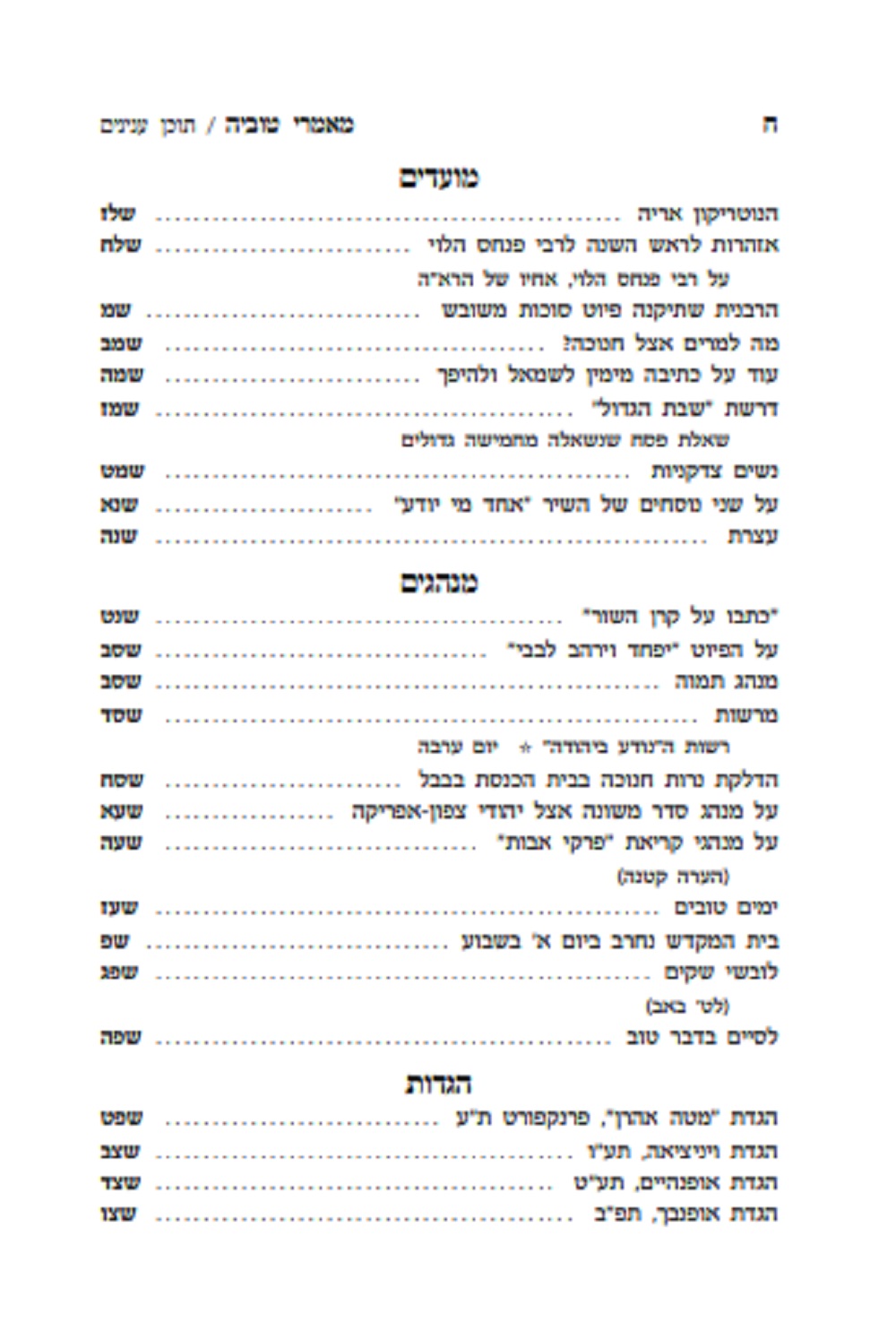
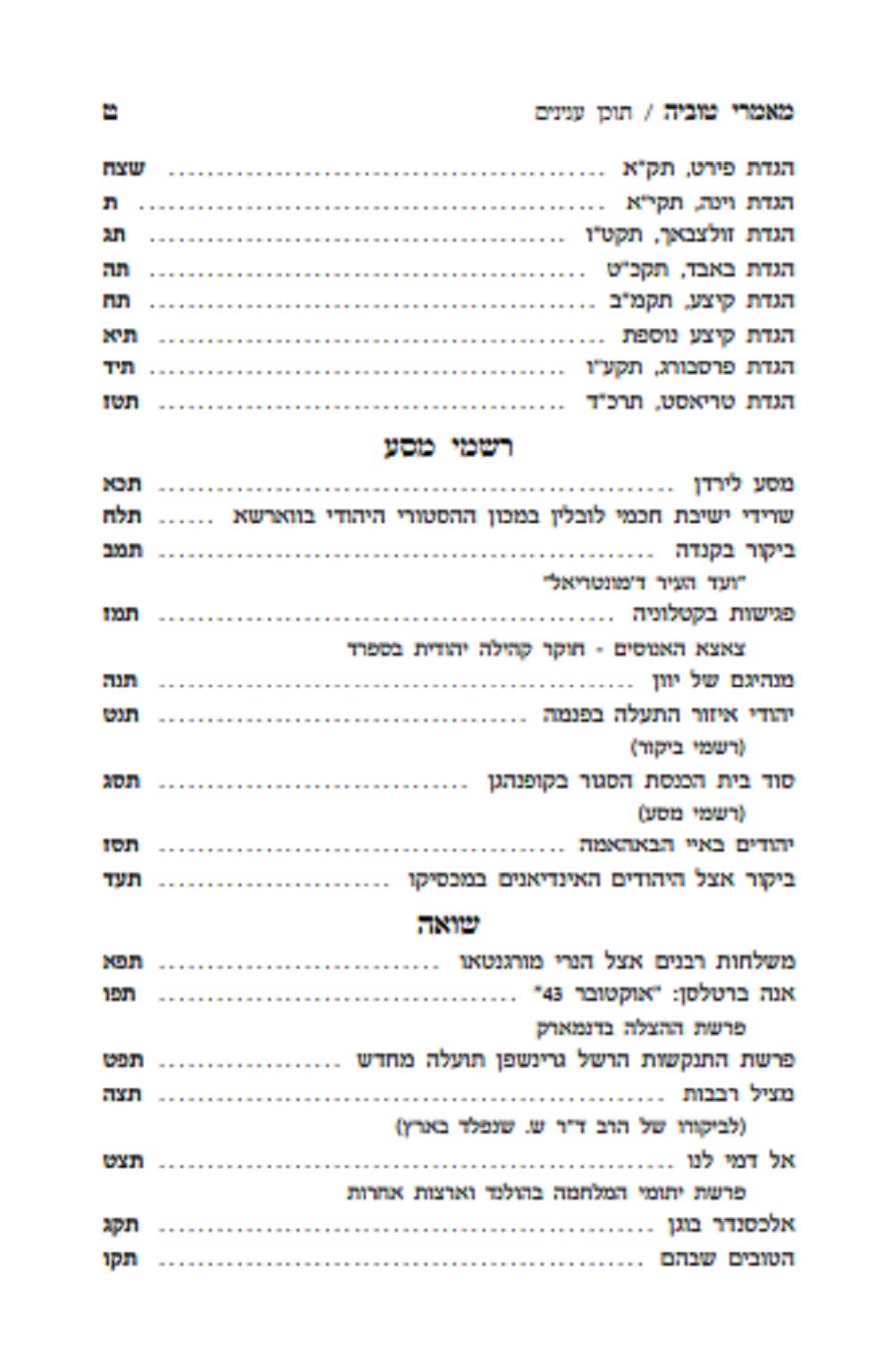
מאמרי טוביה, חלק ג, לר’ טוביה פרשל, 510 עמודים
Last year I wrote about the first two volumes as follows:

Just a few years ago, the great Talmid Chacham, writer and bibliographer (and much more), R’ Tovia Preschel, was niftar at the age of 91. R’ Preschel authored thousands of articles on an incredibly wide range of topics, in a vast array of journals and newspapers both in Hebrew and English. For a nice, brief obituary about him from Professor Leiman, see here. Upon his passing, his daughter, Dr. Pearl Herzog, immediately started collecting all of his material in order to make it available for people to learn from. Already by the Shloshim a small work of his articles was released. A bit later, she opened a web site devoted to his essays. This website is constantly updated with essays. It’s incredible to see this man’s range of knowledge (well before the recent era of computer search engines). A few months ago, Mossad HaRav Kook released volume one (424 pp.) containing some of his essays, and right before Pesach volume two was released (482 pp.) This is an extremely special treasure trove of essays and articles on a broad variety of topics. It includes essays related to Halacha, Minhag, bibliography, Pisgamim, history of Gedolim, book reviews, travels and personal encounters and essays about great people he knew or met (e.g.: R’ Chaim Heller, R’ Abramsky, R’ Shlomo Yosef Zevin, R’ Meshulem Roth, R’ Reuven Margolis, Professor Saul Lieberman). Each volume leaves you thirsting for more. At least another two volumes are in preparation by his daughter, Dr. Pearl Herzog. I wish her much Hatzlacha in this great service for readers of all kinds all over the world.

Here is a table of contents of the latest volume:


Also, back in print are the following older titles:
בעקבות היראה, לר’ אברהם אליהו קפלן
אגרות צפון לר’ שמשון רפאל הירש
שות מן השמים מהדיר ר’ ראובן מרגליות הלל צייטלין,
ספרן של יחידים


The 1526 Prague Haggadah and its Illustrations

The 1526 Prague Haggadah and its Illustrations
By ELIEZER BRODT

This piece was originally printed in Ami Magazine’s Kunteres 9 Nisan 5777 – April 5, 2017

The topic perhaps most written about in Jewish literature is the Haggadah shel Pesach. There are many kinds in many languages and with all kinds of pirushim and pictures. Whatever style one can think of, not one but many Haggados have been written—be it on derush, kabbalah, halachah, mussar or chassidus. There are people who specialize in collecting Haggados, even though they don’t regularly collect sefarim. In every Jewish house today one can find many kinds of Haggados. Over the years, various bibliographers collected and listed the various Haggados. In 1997, Yitzchak Yudolov printed The Haggadah Thesaurus, which contains an extensive bibliography of Haggados from the beginning of printing until 1960. The final number in his bibliography listing is 4,715! Of course, many more have been printed since 1960. New Haggados are printed every single year. Even people who never wrote chiddushim on the Haggadah have had one published under their name based on their collected writings. When one goes to the sefarim store before Pesach, it has become the custom to buy at least one, although it is very easy to become overwhelmed, not knowing which to pick.
The one I would like to focus on in this article was printed in Prague in 1526.[1] The Prague  edition of the Haggadah is considered by experts to be one of the most important illustrated Haggados ever published. It is perhaps the earliest printed[2] illustrated Haggadah for a Jewish audience, and it served as a model for many subsequent illustrated Haggados. Some insist that it is the greatest single Haggadah ever printed. “Certainly it is one of the chief glories in the annals of Hebrew printing as a whole and for that matter in the history of typography in any language.”[3] Printing came to Prague in 1487 (around 40 years after its invention), and the first Hebrew book was printed there in 1518. The Prague 1526 edition was published by the brothers Gershom (Cohen) and Gronom Katz on Sunday, 26 Teves 5287 or December 30, 1526.[4]
This Haggadah contains many of the halachos of the Seder beginning with bedikas chametz, a collection of pirushim on various parts of the Haggadah, and 60 illustrations made from woodcuts. However, we do not know who authored these halachos and divrei Torah (which are full of interesting ideas). The halachos written here are very significant, as they were written and printed before the Shulchan Aruch. The illustrations are also significant, as they had a tremendous impact on the illustrated Haggados printed afterward.
I would like to discuss some of the interesting things we can learn about the Seder and Haggadah via this Haggadah and some of its illustrations.
The first general question is why they chose to illustrate the Haggadah. Who was their intended audience? Various people who studied this Haggadah have debated this issue,[5] but to me it’s pretty clear that it had to do with one of the most important parts of the Seder night—the special audience—the children. This was a tool to help enable us to fulfil the important obligation of v’higadeta l’vincha. Last year, in an article in this magazine, I outlined many customs done during the Seder with the underlying theme to get the children “into” the Seder. One of the best ways to get kids “into” it is via visual aids, showing them pictures or acting out certain things.  Simply reciting the Haggadah and just saying “some Torah” is not as effective. It would seem to me that this was their intention when they illustrated the Haggadah. It could be that some of the pictures were to lighten it up for the adults too, as I will soon explain.
The significance of this point is that Rav Shlomo Zalman Auerbach, zt”l, raises possible issues with looking at illustrated Haggados on Pesach based on the halachos in the Shulchan Aruch (307:15) dealing with reading captions of images on Shabbos.[6]
If we are correct that the purpose is to educate the children, it might be a possible reason to permit looking at these images. To be sure, some of the Haggados with images were printed with the involvement of great gedolim, such as the illustrated 1590 Prague Haggadah, which had a kitzur of the Zevach Pesach of the Abarbanel written by Rav Yitzchak Chayis (1538-1610).
Just to emphasize the significance of visual aids when learning, in a haskamah for a work about shechitah that was written but never printed, the Aderes stresses the benefit of the numerous diagrams and illustrations of animals in the book for the understanding of the various complex halachos of shechitah.[7]
Similarly, Rav Belsky dissected an animal on video to give a visual aid for those learning Maseches Chulin. It is also related that when the Minsker Gadol, Rav Yerucham Perlman, zt”l (1835-1896), first became rav he made it his business to go to the head shochet of the city to learn all the aspects of animals for the laws of treifos and the like. The shochet asked him how he could possibly teach the rav anything. The Minsker Gadol replied, “It’s one thing to learn the halachos in sefarim, but when it comes to psak halachah one needs to know the exact aspects as they are on the actual animal.[8]
Additionally, there is a great benefit for us to analyze the pictures nowadays, as it can give us a glimpse into how they conducted the Seder in those days.
Halachos
One of the first parts of the Seder is the eating of karpas. Nowadays, for the most part, the custom is for the children to say, “We wash our hands, but we don’t say the brachah for this washing.” In the instructions to the Prague Hagadah it says to say the brachah for washing.[9] In fact, there are a number of Rishonim who say that one should say the brachah of al netilas yadayim.
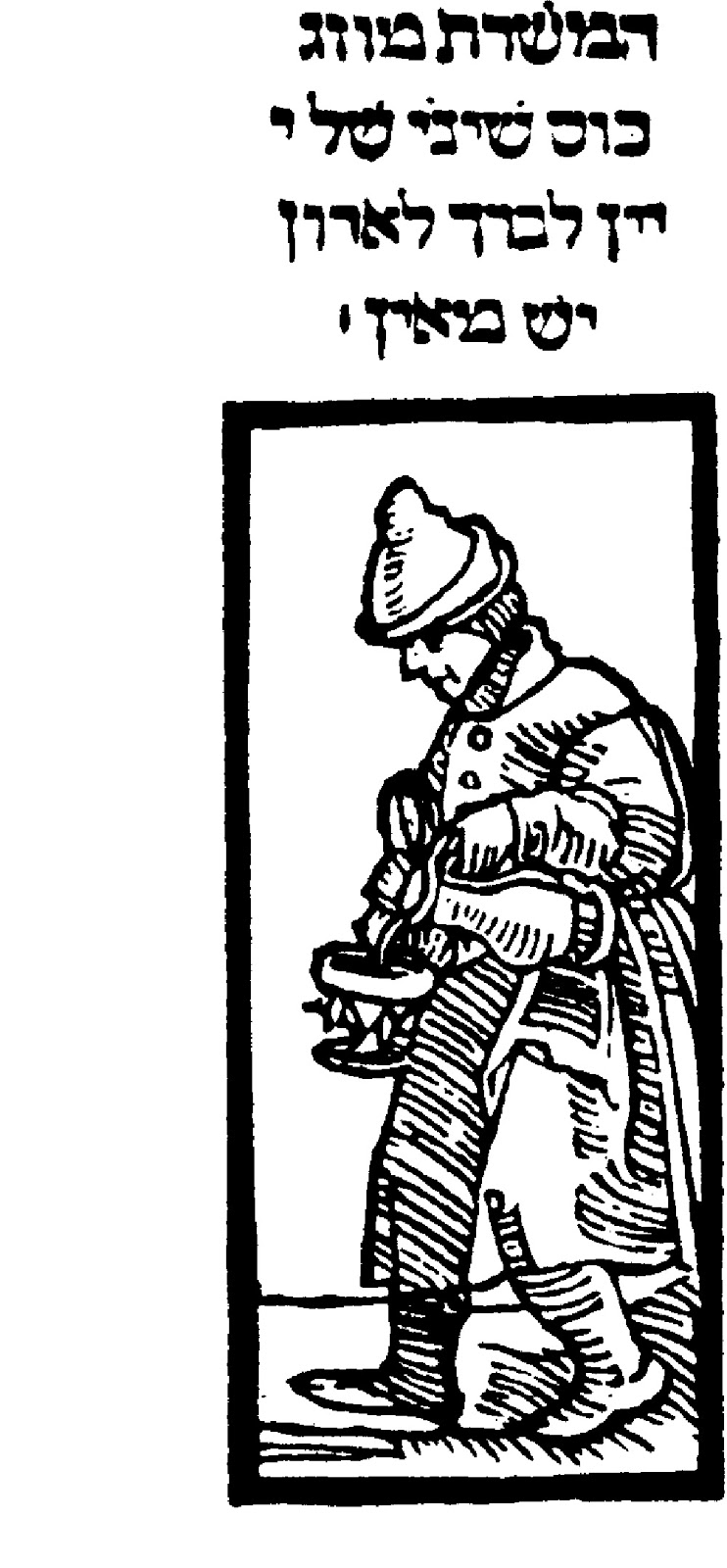
Who pours the wine?
After saying Ha Lachma Anya the cups of wine are refilled. There is a picture of someone refilling the wine with a caption stating that the servant should refill the wine. The Rama in Darchei Moshe says that the person who is conducting the Seder should not fill the cups of wine; rather, someone else should do it for him.[10] This would appear to be an earlier writter source with the same idea.[11] Interestingly enough, the Aruch Hashulchan writes that we do not do this. The leader can pour the wine for himself, and there is no reason that his wife should have to pour for him.[12] Rav Yitzchak Chayis writes in Siach Yitzchak—which is a halachic work about the Seder night first printed in Prague in 1587—that one should train his six or seven-year-old child to do this mitzvah.[13] Perhaps another minhag related to this statement of the Rama is that the one leading the Seder does not get up to wash his hands; rather, the water is brought to him.[14]
Pouring out the wine for the Ten Makkos
 
After saying Ha Lachma Anya the cups of wine are refilled. There is a picture of someone refilling the wine with a caption stating that the servant should refill the wine. The Rama in Darchei Moshe says that the person who is conducting the Seder should not fill the cups of wine; rather, someone else should do it for him.[10] This would appear to be an earlier writter source with the same idea.[11] Interestingly enough, the Aruch Hashulchan writes that we do not do this. The leader can pour the wine for himself, and there is no reason that his wife should have to pour for him.[12] Rav Yitzchak Chayis writes in Siach Yitzchak—which is a halachic work about the Seder night first printed in Prague in 1587—that one should train his six or seven-year-old child to do this mitzvah.[13] Perhaps another minhag related to this statement of the Rama is that the one leading the Seder does not get up to wash his hands; rather, the water is brought to him.[14]
Another minhag found in this Haggadah is the famous custom of dipping the fingers into the wine when saying the Ten Makkos. In this section of the Haggadah there is an illustration of someone dipping his finger into his cup and there is also a caption under the picture stating that some dip with the pinky, followed by a reason for this custom.[15]
The earliest known source for this minhag can be found in a drashah of the Rokei’ach, recently printed from a manuscript by Professor Simcha Emanuel.[16] But this source speaks about dipping the index finger. The Rama also writes to dip the index finger. Interestingly, the Magen Avraham says to dip with the kemitzah, which is the ring finger.
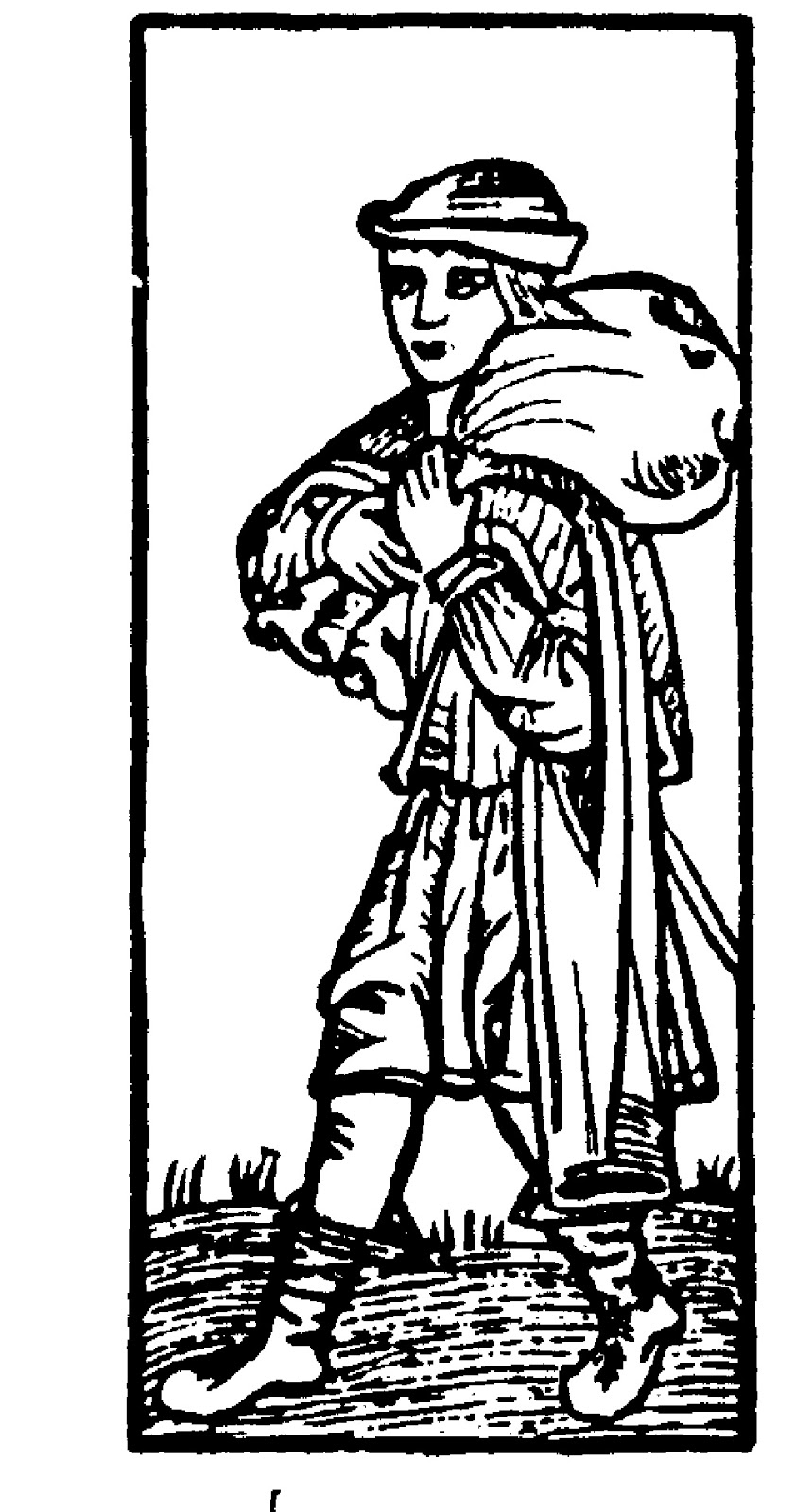
Walking with a sack on the back
There a few places in the Haggadah, such as near the paragraph of B’chol dor vador, where we find an illustration of someone walking with a sack (of matzah) on his back. The source for this can be found in some of the Rishonim and early Acharonim. After mentioning breaking the matzah in their description of Yachatz they add that the leader of the Seder puts it on his shoulders and walks with it for a bit; others do this only later on when they eat the afikoman.[17]
Eliyahu Hanavi coming to the Seder
I traced the sources for this in a previous article in Ami Magazine. When discussing the sources for this, Rabbi Sperber notes[18] that in a few of the illustrated Haggados there are pictures of a man on a donkey near Shefoch Chamascha. In some of them he is being led by someone else; for example, in the Prague Haggadah of 1526.
I also noted that Rabbi Yuzpeh Shamash writes that mazikin run away from any place where Eliyahu’s name is mentioned. He says that because of this some make a picture of Eliyahu and Moshiach for the children, so that the children seeing it will say “Eliyahu,” causing the mazikin to disappear.[19] This could indicate that the illustrations were shown specifically to the children, as I claimed earlier.
Nusach of the Haggadah
The actual nusach of the Haggadah is its own large topic, starting from the Gemara and moving onward to manuscripts and discussions among the poskim. In the beginning of the Haggadah we begin with the famous Aramaic passage of Ha Lachma Anya. Much has been written about different aspects of this passage. One aspect is whether the exact nusach should be Ha Lachma Anya or K’ha Lachma Anya. The Rama quotes Rav Avraham of Prague, who says to specifically say Ha Lachma Anya and not K’ha Lachma Anya. The Maharal says the same. We see that two great sages from the city of Prague paskened that we should say Ha Lachma Anya.
Who was this Rav Avraham of Prague quoted by the Rama?
Rav Dovid Ganz (a talmid of the Maharal) writes in his historical work Tzemach Dovid that he was the rosh yeshivah and av beis din of Prague in the 1520s. He also authored some notes to the Tur, which were printed by Gershom (Cohen) Katz in Prague in 1540.[20] Thus, it is interesting that in the Haggadah the nusach was different from that of the av beis din of the city. Interestingly enough, his sons printed two more Haggados (1556 and 1590) in Prague and there too the nusach is different from that of Rav Avraham. Ultimately, the Magen Avraham concludes that whichever nusach one says is fine.[21]
What to use for maror
Another interesting picture is of the maror. In two places in the Haggadah the illustration used for maror is that of a lettuce—chasah. This is chazeret, which is the first of the five types enumerated in the Mishnah that one can use for maror.
There is a famous teshuvah from the Chacham Tzvi where he writes at length that this is the ideal item to be used for maror, as it’s the first in the list of the Mishnah.[22] We also find that the Netziv wrote a letter to his son, Rabbi Chaim Berlin, urging him to use it for maror instead of sharper vegetables, especially after fasting and drinking wine.[23] There are also numerous earlier illustrated manuscripts that show pictures of lettuce for the maror.[24]
More on maror
Speaking of maror, the inscription next to the picture is of great interest. It says, “There is a custom when saying maror that the man points to his wife, as it says ‘An evil wife is worse than death.’” Much has been written about this illustration. Some have written that it is ridiculous and there cannot be such a custom. On the other hand, Rabbi Wengrov and, more recently, Rabbi Yisroel Peles,[25] have demonstrated that there are pictures of a man pointing to his wife near the paragraph of maror in various illustrated Haggadah manuscripts. It is clear, however, as Rabbi Wengrov writes, that this was done in a joking manner to lighten up the Seder, but it isn’t serious, chas v’shalom. Rabbi Wengrov demonstrates that other pictures found in these Haggados show that the authors had a sense of humor and drew certain illustrations to lighten up the mood.[26]
Explanation via illustration
 
 
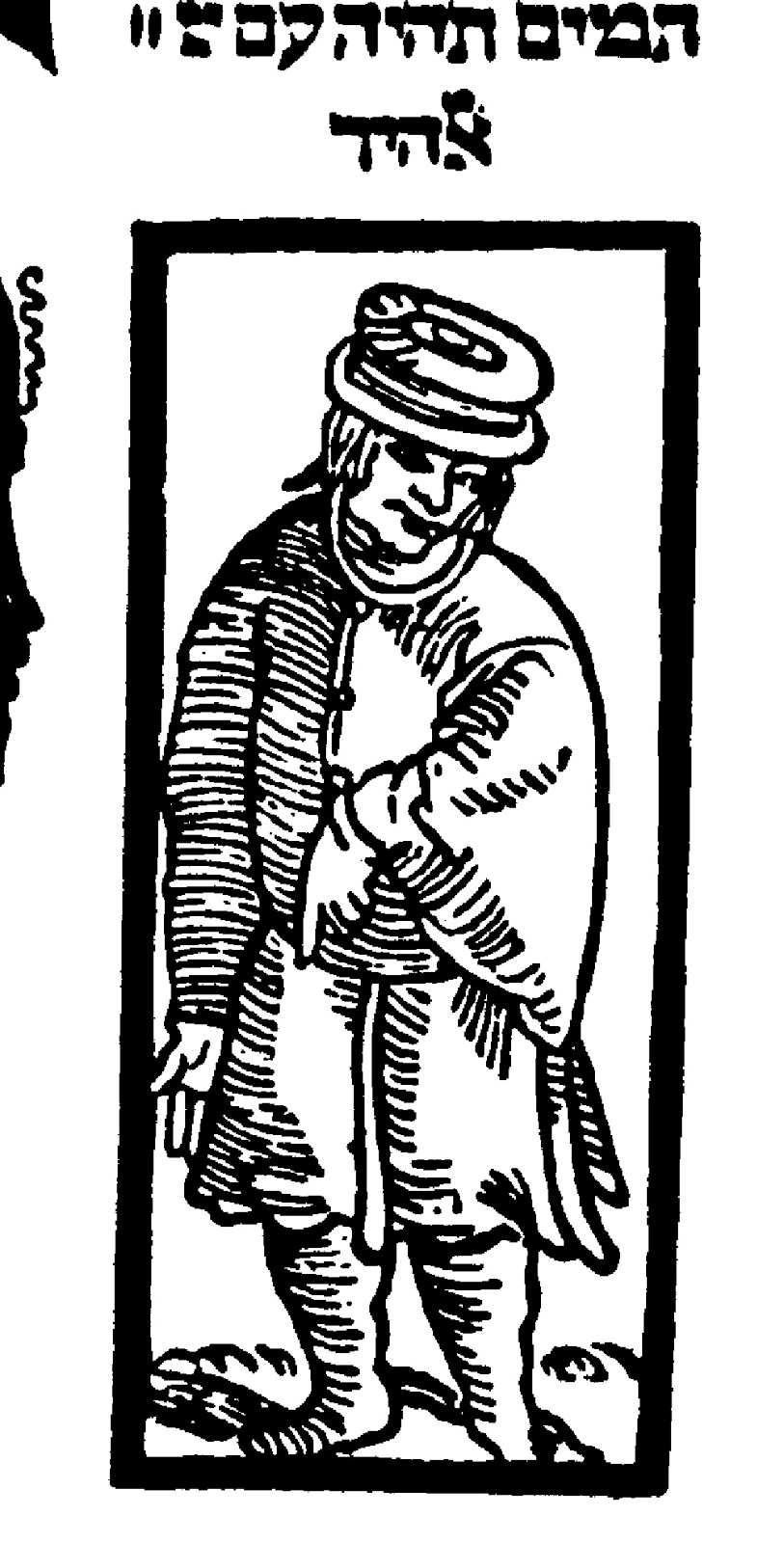
Some of the pictures in the Haggadah are to explain a particular passage. One such example is the image of the four sons. The tam is often translated as a derogatory term—the foolish son. However, the caption above the picture says, “Tamim tihyeh im Hashem” – always be complete with Hashem, which means that they understood the tam to be a man of piety.[27]
Omission
At the end of the Haggadah we conclude the Seder with a few songs, such as Echad Mi Yodei’a[28] and Chad Gadya. The authors and earliest sources for reciting them are unknown.[29] Rabbi Shemaryah Adler suggests that Chad Gadya may have been written by Daniel.[30] Rabbi Yedidyah Tiyah Weil writes in Marbeh L’sapeir on the Haggadah that he heard that these two songs were found in a manuscript from the beis midrash of Rav Elazar Rokei’ach. Numerous pirushim have been written about Chad Gadya, based on all the methods of learning Torah.[31] Be that as it may, many have noted that they are not found in this Haggadah. The first time they appear in print are in the Haggadah printed in Prague in 1590.
Another notable omission is the stealing of the afikoman. I wrote in the past in this magazine that one of the earliest sources in print can be found in the Siach Yitzchak, which mentions stealing the afikoman, but not in the same way as we do it nowadays.[32] It would seem that since no mention of it is made in the instructions of the 1526 Haggadah that it was not yet a widespread custom at that time.
Kiddush and Hunting
 

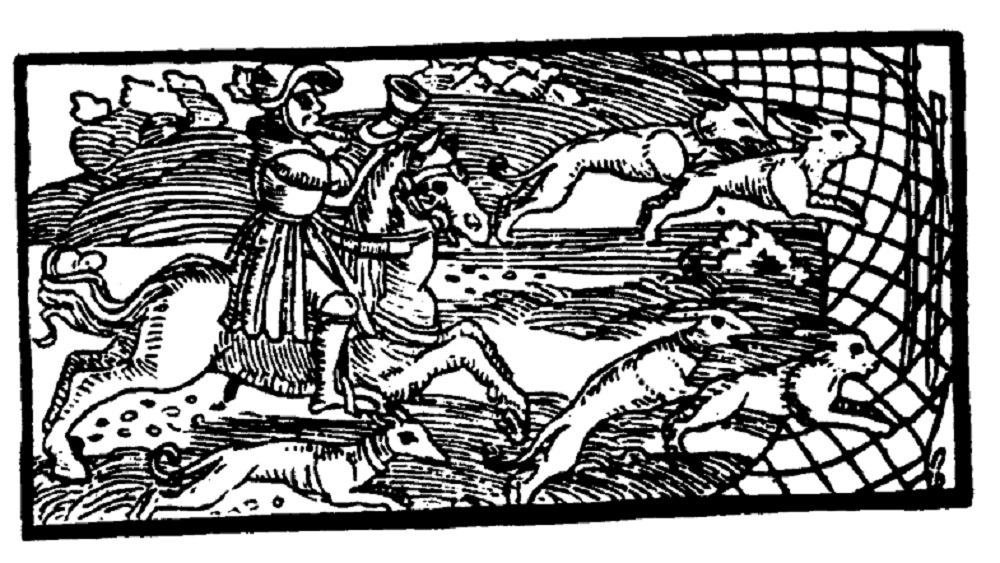
In the beginning of the Haggadah, on the bottom of the page of Kiddush, we find a mysterious picture of someone hunting hares with a horn and dogs. This picture can also be found in a bentcher printed by the Katz brothers in Prague a few years earlier. The question is obvious: What in the world does this have to do with Kiddush, especially as it is not a Jewish hobby? One of the answers suggested is that when Yom Tov occurs on Motzaei Shabbos we use an abbreviation known as Yaknehaz to remember the order in which to say Kiddush and Havdalah. The pronunciation of Yaknehaz is similar to jagen hasen, which is German for hunting hares, so this picture is meant to serve as a reminder of the abbreviation.[33]
Moreon Kiddush
Throughout the Haggadah there are illustrations of people holding cups of wine; sometimes the one holding the cup is dressed like a king. It would appear that this is to reflect the halachah to act like a king on the Seder night as part of the celebration of our freedom.
At other times the image is of an older man holding the cup either in his left hand or in his right. Rabbi Shaul Kook points out that some of the time it’s in the palm of his hand, which is the way it should be held according to various mekubalim, while at other times he holds the cup by its stem. He suggests that near the passage where Rabbi Elazar ben Azaryah says, “I am like someone who is 70 years old,” he is depicted as holding the cup in his left hand while stroking his white beard with the other to show that he’s really not that old.[34] At that point in the Haggadah one would not be holding the cup for the purpose of drinking one of the four kosos and that’s why he’s not holding it in his palm. Whereas in the pictures near where one would hold the cup for drinking he is holding it in the palm of his right hand. However, there is another picture on the page of Kiddush that is similar to the one of Rabbi Elazar holding the cup in his left hand and stroking his beard. Rabbi Kook says that this is because the printer was not educated and, not realizing the reasons for the difference, used the wrong woodcut.[35]
 
The problem with this is that the earliest source we have for holding the cup of wine specifically in the palm of the hand is in the Shalah HaKadosh, which was first printed in 1648—long after this Haggadah was printed.[36] It is, however, very possible that mistakes were made because printing with woodcuts is very difficult and confusing.
Sitting during Kiddush
Other customs that we can possibly learn from the illustration of Kiddush are that the person is both sitting and looking at the cup. These are also mentioned by various poskim in regard to the halachos for how Kiddush should be said.[37] There are other halachos of Kiddush that can perhaps be learned from these illustrations, but one has to be careful as to how much to “read into” them.
[1] On this Haggadah, see A. Yaari, Bibliography Shel Haggadot Pesach, p. 1. Y. Yudolov, Otzar Haggados, p. 2, # 7-8; the introduction to the 1965 reprint of this Haggadah; Yosef Yerushalmi, Haggadah and History, plate 13; Yosef Tabori, Mechkarim B’toldos Halachah (forthcoming), pp. 461-474. See especially the excellent work of Rabbi Charles Wengrov, Haggadah and Woodcut, (1967), which is completely devoted to this Haggadah. Another recent work devoted to this Haggadah was printed this year by R’ Yehoshua Goldberg, Haggadas Prague. Many thanks to my friend Dan Rabinowitz for the discussions about this Haggadah over the past few years. Here are two earlier posts by Dan on manucript Haggados and the 1526 Prague Haggadah: here and here. Thanks also to Mr. Yisroel Israel for his help with the images.
[2] As there are numerous illustrated manuscript haggadas.
[3] Yerushalmi, Haggadah and History, p. 30.
[4] This detailed publication information does not appear on the title page; rather, it appears at the end of the book in what is referred to as the colophon. On the printers see Chaim Friedberg, Toldos Hadefus Haivri, pp. 1-10. On various aspects about printing in these years in Prague, see Hebrew Printing in Bohemia and Moravia (Prague 2012).
[5] Richard Cohen, Jewish Icons, (1998), pp. 94-97; Chone Shmeruk, The Illustrations in Yiddish Books of the Sixteenth and Seventeenth Centuries (Heb. 1986).
[6] Halichos Shlomo (Pesach), pp. 267-268.
[7] Intro to Shu”t Ohel Yosef, 1903.
[8] Hagadol MiMinsk, p.51.
[9] Drashah L’Pesach L’Rabbi Elazar MiVermeiza, p. 96. See: Haggadah Shevivei Eish, p. 152; Y. Tabory, Pesach Dorot, pp. 216-244. See also what I wrote in my work Bein Kesse Le’assor, pp. 148-153.
[10] Darchei Moshe, 486:1.
[11] See also Siach Yitzchak (Brooklyn 2016), p. 241.
[12] Aruch Hashulchan, 473:6.
[13] Siach Yitzchak, p. 239, 252.
[14] Siach Yitzchak, p. 239.
[15] On this minhag see Zvi Ron, Our Own Joy is Lessened and Incomplete; The History of an Interpretation of Sixteen Drops of Wine at the Seder, Hakirah 19 (2015), pp. 237-255. I hope to return to this in the future.
[16] Drashah L’Pesach L’Rabbi Elazar MiVermeiza, p. 51, 101, 127.
[17] Rabbi Wengrov (above note 1), p. 60. See also Hanhagot HaMaharshal, pp. 10-11; Magen Avraham, 473:22; Chidushei Dinim MeiHilchos Pesach, p. 38. See Rabbi Chaim Benveniste, Pesach Me’uvin, 315; Vayageid Moshe, pp. 116-117.
[18] Minhagei Yisroel 4, pp. 168-170.
[19] Minhaghim Dik’hal Vermeiza, p. 86
[20] Tzemach Dovid, p. 139. See also Tzefunot 7 (1990) pp. 22-26.
[21] See also Siddur R’ Shabsei Sofer, 1, p. 5; Rabbi Yosef Zechariah Stern, Zecher Yosef, p. 4. [22] Chacham Tzvi, 119. On using this even though it is not bitter see also Dovid Henshke, Mah Nishtanah (2016), pp. 250-255, 215-220, 224-227, about Maror being bitter.
[23] Meromei Sadeh Pesachim 7b, See also Arthur Schaffer, History of Horseradish as the Bitter Herb of Passover, Gesher 8 (1981) pp. 217-237; Levi Cooper, Bitter Herbs in Hasidic Galicia, JSIJ 12 (2013), pp. 1-40; Z. Amar, Merorim, pp. 67-83. See also Rabbi Yehudah Spitz, Maror Musings, the not so bitter truth about Maror, Ami Magazine (2014), pp. 230-234.
[24] See Rabbi Wengrov (above note 1), p. 54. See also Rabbi Dovid Holtzer, Eitz Chaim 25 (2016), pp. 285-292.
[25] Hamaayan 51 (2011), pp. 11-14.
[26] On this and other pictures related to humor in the Haggadah see Rabbi Wengrov (above note  1),pp. 54-59.
[27] See also Rabbi Wengrov (abovenote 1), pp. 43-44; HaggadasMidrash B’chodesh (2015) of Rav Eliezer Foah (talmid of the Rama MiFano), p.135; R’ Elazer Fleckeles, Maaseh B’Rabbi Elazar, p. 63-64. See also Dovid Henshke, Mah Nishtanah (2016), pp. 358-359.
[28] See Rabbi Toviah Preshel, Kovetz Maamarei Tuviah 2, pp.64-65.
[29] See Chone Shmeruk, “The Earliest Aramaic and Yiddish Version of the Song of the Kid (Khad Gadye),” in The Field of Yiddish, 1 (New York 1954), pp. 214-218; Chone Shmeruk, Safrut Yiddish,pp. 40-42, 57-60; Asufot, 2 (1988), pp. 201-226; Rabbi Yisroel Dandrovitz, Eitz Chaim 23 (2015), pp. 400-416. Shimon Steinmetz discusses the origin of Chad Gadya here.
[30] Minchas Cohen, p. 73. Many thanks to my friend Rabbi Shalom Jacob for sending copies of this extremely rare work.
[31] Marbeh L’Sapeir, p. 140, 151. See also Rabbi Yosef Zechariah Stern in his Haggadah Zecher Yosef (p. 30), who writes that he did not find this piyut printed before the sefer Maasei Hashem. See also the Haggadah Shleimah ad. loc.; Assufot, vol 2 pp. 201-226; Mo’adim L’simcha vol. 5 ch. 11; Y. Tabory, Pesach Doros, pp. 341-342 and the note on pp 379.
[32] Siach Yitzchak, p. 21a. About this gaon see the introduction of Rabbi Adler in his recent edition of Pnei Yitzchak – Apei Ravrevi.
[33] See Rabbi Wengrov (above note 1), pp. 36-37.
[34] See Rabbi Yosef Zechariah Stern, Zecher Yosef, pp. 5a-6a.
[35] See Yeida Haam 2 (1954), p. 148; Iyunim Umechkarim, 1 pp. 81-83.
[36] See also R’vid Hazahav, Vayeishev (Kaf Paroh); Rabbi Mordechai Rosenbalt, Hadras Mordechai, Bereishis, 259. See also Shu”t Beis Yaakov, (1696) 174 who quotes such a custom from the Arizal.
[37] See Rabbi Dovid Deblitsky, Birchos L’rosh Tzaddik, pp. 25-31.


Passover with Apostates: A Concert in Spain and a Seder in the Middle of the Ocean by Elie Wiesel (1957)

Passover with Apostates:
A Concert in Spain and a Seder in the Middle of the Ocean
By Eliezer Wiesel
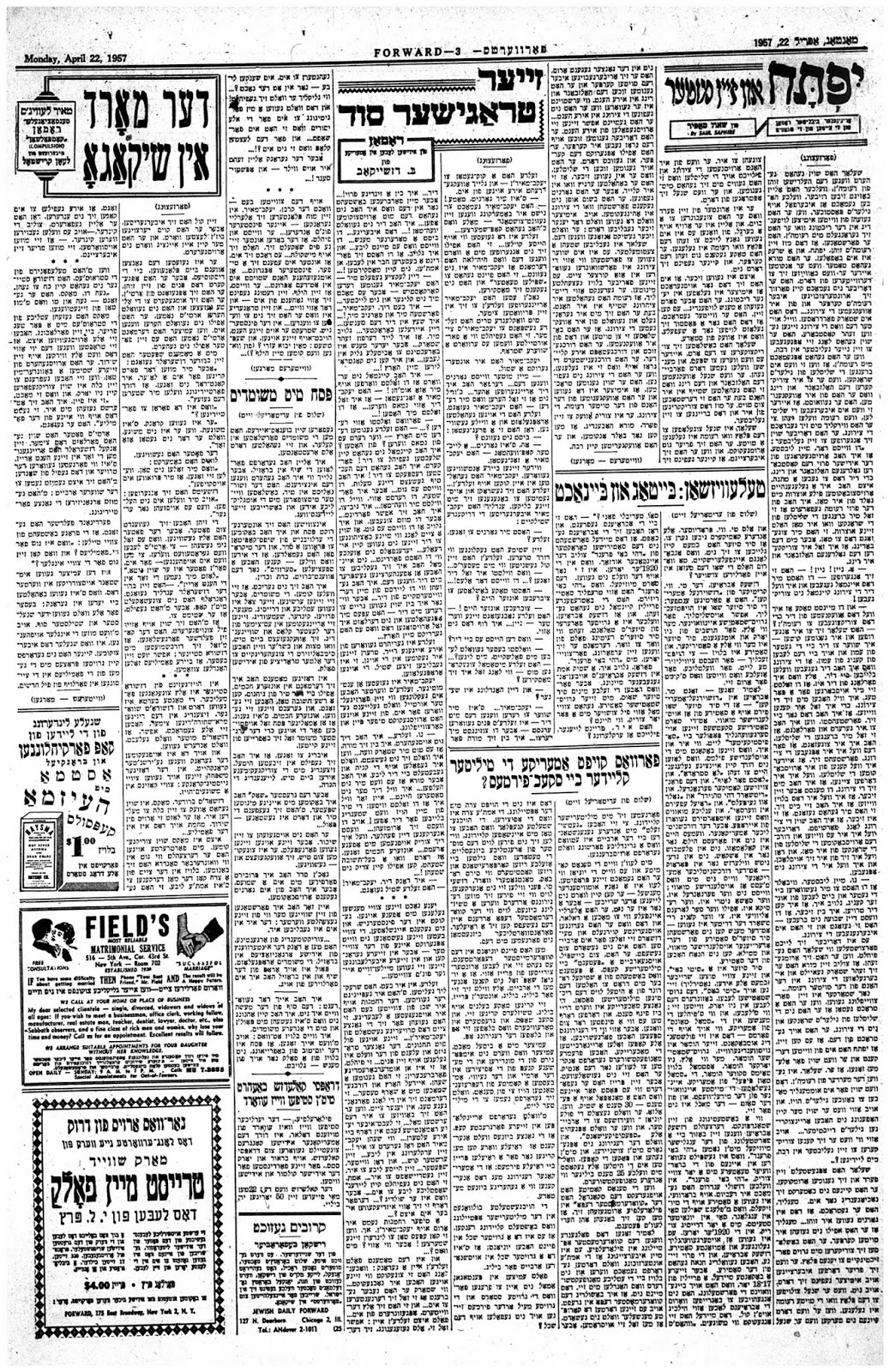
Forverts (22 April 1957) [Yiddish]
[Translated into English by Shaul Seidler-Feller (2018)]

If someone says to you that Passover is the festival of redemption not only of a nation but of each individual, believe him;
If someone explains to you that a Jew remains a Jew deep at heart, despite the masks he is often forced to wear, do not doubt him;
If someone tells you that, no matter what a Jew does, he will remain a living legacy of his people and his past, nod your head and say: True!
I ask that the skeptics among you listen to a story that happened to me a few years ago.
However, I must warn you: I know the beginning and middle of the story; the end, I do not know to this day.
I believe that, in this case at least, the end is not important. In any event, read on:
The Drunkard
In 1949, I traveled to Spain on assignment, spending several weeks crisscrossing the country, chatting with ordinary citizens as well as circumspect politicians, and seeking out here and there Jews and vestiges of Jewish life from the time of the Inquisition.
I found both Jews and tragic remnants of the Jewish past in that country of Judah Halevi and Samuel ha-Naggid.
However, the most interesting among them I encountered by chance, not in a museum or in Jewish company but in a cabaret.
Spanish colleagues, who brought me to Madrid and wished to show me the nightlife of the capital, led me to a cabaret, where overstuffed rich people came to admire flamenco performers who, in dancing and gyrating their bodies to some crazy rhythm, seemed as though they had been possessed by a dybbuk.
I do not know why my gaze, which wandered not only to the stage but also throughout the hall, suddenly fixed on a man in his 40s, who was sitting alone not far from us and did not stop drinking whiskey.
Perhaps the drunkard drew my interest and curiosity because I have met many drunkards in my life, but this one was different.
Most drunkards drink to forget; he drank to remember. So it seemed to me, based on the way in which he held the glass in his hand, brought it to his lips, and placed it back on the table.
He had a gentle face with a high, wrinkled forehead; thick eyebrows hanging over dark, mournful eyes; and delicate hands with fingers ranging from long to extremely long.
We sat in the cabaret for three hours, but, for all his drinking, the drunkard did not get sleepy.
My curiosity grew by the minute until I could no longer contain it. I called over the waiter and asked him who our bizarre neighbor was.
“Oh, you must mean Paul,” the waiter replied.
“Good, now I know his name,” I answered, “but who is he?”
The waiter smiled: “Wait a bit, be patient for a couple hours. Then you will see something you will not forget for the rest of your life. Wait, señor, it’s worth it…”
I wanted to question him further, but other guests summoned him. We had no choice but to wait.
The Divine Violin
In the meanwhile, the dancers grew tired from their dancing and the music itself began to die down.
The cabaret slowly started to empty out and a sudden gloom overtook this hall, to which people would come seeking false happiness and hollow illusions.
Our drunkard continued to knock back one glass after another, as if he had decided to drown himself, his life and his sadness, in the ever-full, ever-empty glass he held in his hand.
Suddenly, he gave the waiter a wink, and the latter understood what the guest wanted from him.
The waiter approached the stage, where the orchestra was playing sentimental melodies, and returned to the drunkard’s table with a violin in hand.
The drunkard took the violin, and a deathly silence descended upon the hall. All eyes were trained on him, on this elegant drunkard, who, eyes closed, stroked the bow for a long while, his face glowing as though flames were about to burst out of his head into the night.
Then he began to play.
And I shuddered.
I have heard many virtuosos in my lifetime, among them some of the most famous and talented.
But I had never heard anything like this.
Suddenly, it seemed to me that the cabaret had been transformed into a temple where he, the cantor, sought to purify his soul and ours in the blue sea of musical notes, of divine songs and harmonies.
I do not recall how long he played. I only remember that the impromptu concert was suddenly cut short and I was unable to catch a glimpse of the violinist, since he had already left the cabaret.
The magic came to an end, disappeared, and everything happened so quickly that I could barely believe it had been anything more than a dream.
The waiter then approached and told us that the drunkard comes every evening to the same cabaret, drinks his fill, and once he is good and plastered, he takes the violin and gives a free concert – for himself.
Who was he, this Paul? A German Jew, before the war he was a violinist who gave concerts. Hitler deported him to a concentration camp where he played in the camp orchestra. After the war, he was no longer up to performing in public. He came to Madrid in 1945-46. He had enough money – presumably from wealthy relatives. Many people suggested that he again give concerts, but he can only play when he is drunk.
That story left me then with a terrible impression. I decided to return to the cabaret the next day. But at the hotel a cable was waiting for me directing me to make a short trip to Tangier.
Two years later, I again visited Madrid and went to the same cabaret, but Paul was no longer there. They informed me that he had traveled to settle in Israel.
Apostates at the Seder
Three years ago, I celebrated Passover on a French ship, somewhere in the middle of the ocean between Brazil and Argentina.
We observed the Seder as it should be done. More than fifty people were seated at the table. But not all of them were Jews: thirty of them were… apostates.
The State of Israel was then going through difficult times, and Christian missionaries had arrived to buy up Jewish souls. Anyone who agreed to apostatize received a visa to Brazil and food for the journey.
Several hundred Jews left Israel then, having allowed themselves to be persuaded by the missionaries.
On a beautiful day, I took the French ship Provence and sailed to Brazil to see how the apostates were living there.
I knew that a couple dozen apostate Jews were traveling on that same ship, but I did not have access to them. First of all, the ship was large (with more than a thousand passengers), and go ask someone if he was not only not a Jew but an apostate! Second of all, the officers told me that many passengers almost never leave their cabin, so how is one supposed to go in to see them and ask indiscreet questions?
To my “luck,” a dramatic incident took place in Brazil: in Rio de Janeiro, the Immigration Authority refused to recognize the apostates’ entrance visas (to this day, no one knows why), and they were not allowed off the ship. According to international maritime law, the Provence had to bring them back to Marseilles, France. But because the ship was first traveling to Buenos Aires, they locked the apostates in the ship’s cellar and held them there under arrest.
I myself was supposed to disembark in Brazil, but immediately upon hearing about the incident, the journalist in me decided to travel on with these unhappy Jews to chronicle their suffering.
In the meanwhile, Passover sneaked up on us and I received permission from the ship’s captain to lead a Seder. The announcement came over the megaphone that those Jews who so wished could have a special “service” after dinner, as required by Jewish law.
I did not expect the apostates to come. But come they did. They numbered thirty-something: men, women, children. They sheepishly entered the coach dining hall and silently sat down at the table, where matzos and kosher wine symbolized their connection to the old traditions of the Jewish people.
At that moment, I remembered our Sages. Even at the gates of Hell, they said, a wicked person can repent. And they were correct, our Sages. It is enough that he witness an old-time Passover Seder for even the worst apostate to free himself of his shackles.
It goes without saying that I was in seventh heaven, sitting together at the table with Jews who had returned, reading the Haggadah.
But the greatest shock came a few minutes later. The door opened and there stood… Paul.
He did not appear drunk. But his eyes were cloudy. He came to the table, sat down, and… was silent.
After the Seder, I tried to have a conversation with him, but I could not extract anything from him.
One thing I understood more from his silence than from the few words he uttered: the Jew in him had remained.
…On the return from Argentina, thanks to the intervention of Jewish organizations in Brazil, they allowed the apostates off the ship.
Paul also left the ship, and in Brazil he escaped my eye.
I warned you: I do not know the end of this story. I have no idea what happened to Paul and the other apostates.
I know only this: if someone tells you that Passover is the festival of redemption not only of a nation but of each individual, believe him.


Jews, Baseball, and The Yiddish Press

Jews, Baseball, and The Yiddish Press
By Eddy Portnoy
Dr. Eddy Portnoy is Senior Researcher and Director of Exhibitions at the YIVO Institute for Jewish Research. He is the author of the recently-published (and much acclaimed, and fun) book, Bad Rabbi: And Other Strange but True Stories from the Yiddish Press (Stanford, 2017), available here.
This is his second contribution to the Seforim Blog. His previous essay, “The Yiddish Press as a Historical Source for the Overlooked and Forgotten in the Jewish Community,” was published here.
Jews love baseball! Well, maybe not all Jews. On the one hand, the editors of the Forverts, the largest and most successful Yiddish newspaper in history, enthusiastically commissioned an article at the end of August, 1909 explaining the fundamentals of the game to their audience of Yiddish-speaking immigrants. While they may not have expected their readers to run out and play ball, they did understand that it was of value culturally to understand how the game was played. In short, it was seen as part and parcel of the Americanization process.
And yet, on the other hand, a cartoon that appeared a few years later reveals somewhat of an antipathy to baseball from a different Yiddish precinct. Baseball appears to have been one of those rare matters upon which both Orthodox rabbis and secular Yiddish cartoonists could agree. It is thus with great sympathy that one of the cartoonists working for Der groyser kundes views the difficulty Orthodox rabbis in America had in trying to convince American Jewish boys to attend heder. Der kundes, a very popular and very secular satire publication oriented to Left Labor Zionism, lamented the disinterest the lunkheaded, foul-mouthed, baseball-obsessed Jewish youth. Not that they necessarily supported the acquisition of a traditional Jewish education (even though all their writers had one), but they didn’t like baseball either.
Not unlike Nusakh sfard, baseball won the battle and is now a pastime enjoyed by large numbers of American Jews. Many of them even went back to heder. Left Labor Zionists satire magazines, however, aren’t doing so well anymore.


Der groyser kundes, New York, May 29, 1914
The Forverts, New York, August 27, 1909

“The
Fundamentals of the Base-Ball ‘Game’ Described for Non-Sports
Fans,” The Forverts (27 August 1909): 4, 5, translated by Eddy
Portnoy.

  
Uptown, on 9th Avenue and 155th Street is the famous field known as the “Polo Grounds.” Every afternoon, 20 to 35 thousand people get together there. Entrance costs from 50 cents to a dollar and a half. Thousands of poor boys and older people go without some of their usual needs in order to pay for tickets. Professional teams play baseball there and the tens of thousands of fans who sit in row after row of seats all around the stadium, go nuts with enthusiasm. They jump, they scream, they simply go wild with enthusiasm when one of “their” players does well, or, they are pained or upset when they don’t succeed.
A similar scene takes place every day in another place – in the Washington Heights. And the exact same thing goes on in Brooklyn, in Philadelphia, in Pittsburgh, in Boston, in Baltimore, in St. Louis, in Chicago – in every city in the United States. And the newspapers print the results of these games and describe what happened and tens of millions of people run to read it with gusto. They talk about it and they debate the issues.
And here we’re only talking about the “professional games:” practically every boy, nearly every youth, and not a few middle-aged men play baseball themselves, belong to baseball clubs, and are huge fans. Every college, every school, every town, nearly every “society” and every factory has it’s own baseball “team.”
Millions are made from the professional games. Related to this, there is a special kind of “political” battle between different cities. A good professional player gets eight to ten thousand dollars for one season. Some of them are educated, college-educated people.
To us immigrants, this all seems crazy, however, it’s worthwhile to understand what kind of craziness it is. If an entire people is crazy over something, it’s not too much to ask to try and understand what it means.
We will therefore explain here what baseball is. But, we won’t do it using the professional terminology used by American newspapers use to talk about the sport; we must apologize, because we’re not even able to use this kind of language. We will explain it in plain, “unprofessional” and “unscientific” Yiddish.
So what are the fundamentals of the game?
Two parties participate in the game. Each party is comprised of nine people (such a party is called a “team”). One party takes the field, and the other plays the role of an enemy; the enemy tries to block the first one and the first one tries to defend itself against them; from now on we will call them, “the defense party” and the “enemy party.”
The “defense party” also takes the field and plays. Two of the team players play constantly while the other seven stand on guard at seven different spots. What this guarding entails will be described later. Let us first consider the two active players.
One of them throws the ball to the other, who has to grab it. The first one is called the “pitcher” (thrower) and the second is called the “catcher” (grabber).
Each time, the “catcher” throws the ball back to the “pitcher.” The reader may therefore ask, if so, doesn’t it happen backwards each time – the catcher becomes a pitcher and the pitcher becomes a catcher? Why should each one be called with a specific name – one pitcher and one catcher?
We will soon see that the way in which the catcher throws the ball back is of no import. The main thing during a game is how the pitcher tries to throw the ball to the catcher.
The enemy party, however, seeks to thwart the pitcher.
This occurs in the following way:
One of the team’s nine members stands between the pitcher and the catcher (quite close to the catcher) with a thick stick (“bat”) and, as the ball flies from the pitcher’s hand, tries to hit it back with the stick before the catcher catches it.
This enemy player is called “batter.” The place where he stands is designated by a number of little stars (****).
(The other eight players on the enemy team, in the meantime, do not participate. They each wait to be “next.”)
Imagine now, that the “batter,” meaning the enemy player, finds the flying ball with his stick and flings it. If certain rules, which we will discuss later, aren’t broken, this is what can happen with the ball: if one of the “guards” catches the hit ball while it is still in the air, then the opposition  of the “batter” is completely destroyed and the batter must leave his place; he is excluded (he is “out”). He puts down the “bat” and another member of his party takes his place.
The roles of the seven guards of the defense party are also specific: they must try and catch the hit ball in order to destroy the enemy’s attempt to hinder them and to get rid of the player doing the obstructing. They stand at various positions because one can never know in which direction the ball will fly. They watch the different trajectories in which the ball might fly, so a guard can be there, ready to catch it.
The readers can see the way the seven guards are distributed in our picture.
The entire official field on which the game is played is a four-sided, four-cornered one. This is in the center of our picture (The two round lines which go around it represent the tens of thousands of seats for the audience. That is how it usually is for the big professional games. It actually looks like a giant circus with a roof only for the audience. The field, with all the players, is under the open sky.).
As the readers see in the image, one corner is taken by the “catcher.” The other three corners of the four-cornered figure are stations. Each one is called a “base.” With the catcher facing the pitcher, the first “base” is outward from the direction of his right hand, just opposite him is the second base; and from his left hand is the third base.
A little bag of sand lay on every base. The guards, however, must not stand on the base, but next to it.
We previously mentioned three guards. They are called the first baseman, the second baseman and third baseman. A third guard stands between second and third base. He is called the “short stop;” when a ball is hit, it often goes in that direction and the “short stop” gets a chance to catch it in the air.
But if the ball flies way over the heads of these four “guards,” there are three other guards who stand on the outside field, or the “out field.” One of these is called the “right fielder,” the second, the “center fielder,” and the third, the “left fielder.”
Two of the four sides of the four-sided figure in our picture are marked with dots. When a hit ball flies over one of these two lines, it is called a false ball (foul ball). For it to be a proper ball (a fare ball), it must fly forward, or over the other two lines of the four-cornered figure.
When the batter doesn’t manage to hit the ball with his stick, it is called a “strike.” If he gets three “strikes,” he is “out,” or eliminated. Certain kinds of “foul balls” are considered “strikes,” however, we will not go into these details.
When the batter hits the ball and it is “proper,” and the guard doesn’t catch it, this means that the opposition, in this case, is successful. However, this success can either be greater or smaller. Depending on the level of this success, the following is done: as soon as the batter hits the ball, he throws his “bat” away and starts running; if nothing disturbs him, he runs to first base, from first to second, from second to third, and from third to the place where the catcher stands. This place is called “the home.” If he gets to the “home” spot, it means that the success of the opposition is complete.
This means that he made a whole “run:” and, based on these “runs,” the results of the game are figured out. The party which makes more runs is the winner.
But to make a full run at one time doesn’t happen all the time. In order to do so, the zetz that the batter gives the ball must be especially successful. It happens more often that he makes a quarter run, or a two quarter, or three quarter.
The rule is this: the running batter has no right to go to first base if the guard (the first baseman) holds, at that very moment, the ball in his hand. If the hit ball falls on the ground and one of the guards picks it up, the running batter is not yet eliminated.  He runs. But imagine that some guard throws the ball to the first baseman and that this first baseman catches the ball before the running batter physically arrives at first base: then this runner is eliminated. But if he catches the ball when the runner is already on the base, the runner is “saved” (safe).
If the runner keeps running to second base, the rule is a bit different: the second baseman can eliminate him only if he touches him with the ball; and the same rule works for the third baseman, he has to touch him with the ball in order to get him out. The catcher or pitcher can also get a runner out with a “touch” if he finds himself near the base or the “home” to which he ran.
Each player is the embodiment of agility, with strong, swift muscles and sharp, fast eyes. And the whole game is full of “excitement” for those who are interested in it.


כעומד לפני השכינה בשעת ער לערנט: Rabbi Aharon Lichtenstein on the Divide Between Traditional and Academic Jewish Studies

כּעומד
לפֿני השכינה בשעת ער לערנט
:
Rabbi
Aharon Lichtenstein on the Divide Between Traditional and Academic
Jewish Studies
By
Shaul Seidler-Feller
Shaul
Seidler-Feller strives to be a
posheter yid

and an oved
Hashem
;
the rest
is commentary. This is his third contribution to the
Seforim blog
;
for his previous articles, see here
and here.
This
post has been generously sponsored le-illui
nishmat
Sima Belah bat
Aryeh Leib, z”l.
Rabbi
Aharon Lichtenstein enthusiasts might be surprised to learn that
there was a time when the rosh
yeshivah
,
zts”l,
lectured publicly in Yiddish. I myself had no idea that this was the
case until my dear friend, Reb Menachem Butler, who fulfills
be-hiddur
the prophetic pronouncement asof
asifem

(Jer. 8:13) in its most positive sense, forwarded me a link
containing a snippet from a talk Rav Lichtenstein had given at the
Yidisher
visnshaftlekher institut-YIVO

on May 12, 1968, as part of the Institute’s forty-second annual
conference. Feeling a sense of responsibility to help bring Rav
Lichtenstein’s insights to a broader audience, I quickly translated
that brief excerpt into English, and, with the assistance of YIVO’s
Senior Researcher and Director of Exhibitions Dr. Eddy Portnoy, my
translation was posted
on the YIVO website in early December 2017. Realizing, however, that
the original lecture had been much longer, Menachem and I made some
inquiries to see if we could locate the rest of the recording, only
to come up empty-handed.
As
hashgahah
would
have it, on the Friday night following the publication of the
translation, I was privileged to share a meal with another dear
friend, Rabbi Noach Goldstein, whose great beki’ut
in Rav Lichtenstein’s (written and oral) oeuvre was already
well-known to me. In the course of our conversation, Noach mentioned
that there was another Yiddish-language shi‘ur
by Rav Lichtenstein available on the YUTorah website. I was stunned:
could this be the missing part of the YIVO lecture? After Shabbat, I
followed up with Noach, who duly sent me the relevant link
– and lo and behold, here was the (incomplete) first part of the
speech Rav Lichtenstein had given at YIVO![1] I told myself at the
time that I would translate this as well; unfortunately, though, work
and other obligations prevented me from doing so…
But
then, in another twist of fate, one
of the orekhei/arkhei
dayyanim

at The
Lehrhaus
,
Rabbi (soon-to-be Dayyan Dr.) Shlomo Zuckier, reached out to me at
the end of December in connection with a syllabus he was compiling
for a class he is teaching this semester at the Isaac Breuer College
of Yeshiva University on “The Thought of Rabbi Aharon
Lichtenstein.” I mentioned to him at the time that Noach had
recently referred me to the YUTorah recording and that I had hoped to
translate it. With his encouragement, the permission of YUTorah
(thank you, Rabbi Robert Shur!), and the magnanimous support of an
anonymous sponsor (Menachem Butler functioning as shaddekhan),
I present below a preliminary annotated English version of the
lecture, whose relevance to the current
debate
about Rav Lichtenstein’s attitude toward academic Jewish studies
should be clear. It is my hope to post my original Yiddish
transcription (which awaits proper vocalization), as well as any
refinements to the English, shortly after Pesah;
please check back then for an update.
[UPDATE
(June 15, 2018): My vocalized Yiddish transcription of both
recordings is now available as a PDF here. The text of the
translation below has also been improved accordingly.]
Note:
As was the case with my translation of the shorter recording
published previously, Romanization of Yiddish and loshn-koydesh
(Hebrew/Aramaic) terms attempts to follow the standards adopted by
YIVO,[2] and all bracketed (and footnoted) references were added by
me. It should also be borne in mind that the material that follows
was originally delivered as a lecture, and while the translation
tries to preserve the oral flavor of the presentation, certain
liberties have been taken with the elision of repetitions in order to
allow the text to flow more smoothly.
[A
Century of Traditional Jewish Higher Learning in America]
[Introduction]
I
beg your pardon for the slight delay. It was not on my own account;
rather, my wife is not able to attend, and I promised I would see to
it to set up a recording for her. In truth, I must not only ask your
indulgence; it may be that this behavior touches upon a halakhic
matter as well. After all, the gemore
says that “we do not roll Torah scrolls in public in order not to
burden the community” [see Yume
70a with Rambam, Hilkhes
tfile
12:23]. It is
for that reason that we sometimes take out two or three Torah
scrolls: so that those assembled need not wait as we roll from one
section to another. The gemore
did not speak of tape recorders, but presumably the same principle
obtains, and so I beg your pardon especially.
When
they originally asked me to speak on the topic of “A Century of
Traditional Higher Jewish Learning in America,” they presented it
to me as a counterbalance, so to speak, to a second talk, which, as I
understand it, had been assigned to Professor Rudavsky.[3] They told
me that since we are now marking the centennial of the founding of
Maimonides College, which, as Professor Rudavsky capably informed us,
was the first institution of higher Jewish scholarship in America,
perhaps it would be worthwhile to hear from an opposing view, so to
speak, from the yeshive
world, regarding another type, another model, of Jewish scholarship.
This was certainly entirely appropriate on their part – and perhaps
it was not only appropriate, but, in a certain sense, there was an
element of khesed
in their invitation to me to serve as such a counterbalance.
I
wish to say at the outset that what I plan to present here is not
meant to play devil’s advocate, contradicting what we heard
earlier; rather, just the opposite, I hope, in a certain sense, to
fill out the picture. However, as proper as the intention was, my
assignment has presented me with something of a problem. Plainly put:
my subject, as I understand it, does not exist. We simply do not have
a hundred years of so-called “traditional higher Jewish learning in
America” – at least, not in public. Privately, presumably there
were “one from a town and two from a clan” [Jer. 3:14], a Torah
scholar who sat and clenched the bench[4] here and there. But in
public, in the form of institutions, yeshives,
a hundred years have not yet passed, and for that centennial, I am
afraid, we must wait perhaps another ten to twenty years. At that
point – may we all, with God’s help, be strong and healthy –
they will have to invite a professor as a counterbalance to the
yeshive
world.
The
first yeshive,
which was a predecessor, in a certain sense, to our yeshive,
the Rabbi Isaac Elchanan Theological Seminary, a yeshive
known as Yeshiva University, was the Etz Chaim Yeshiva, founded in
1886. As a result, I find myself facing something of a dilemma here,
bound in – as it is known in the non-Jewish world – a Procrustean
bed, that same bed familiar to everyone from the gemore
in Sanhedrin.
The gemore
describes that when a guest arrived in Sodom, they had a
one-size-fits-all bed, and it seems that in Sodom they were not
particularly attentive to individual preferences. So they took each
guest and measured him against the bed: if he turned out too short,
they stationed one fellow at his head, another at his feet, and they
stretched him in both directions until he covered the bed; if he
turned out too tall, they would cut him down to size, sometimes at
his feet, sometimes at his head, so that, in any event, he would fit
[Sanhedrin
109b].
Here
I face the same problem, and I have one of two ways to extricate
myself from my present impasse. On the one hand, I could, perhaps,
make a bit of a stretch and broaden the definition of “traditional
higher Jewish scholarship and learning,” so that my title, my
subject, would be accurate and so that I might, after all, be able to
identify a hundred years during which people sat and learned. But, on
the other hand, perhaps I should rather stay firm and close to the
title, maintaining the pure, unadulterated conception of what
constitutes “learning,” “Jewish learning,” “traditional
learning,” even if doing so would come at the expense of completely
fulfilling the task assigned to me: to speak not about a brief span
of years, but a full hundred. You yourselves understand very well
that, given these two options, it is certainly better to choose the
latter – perhaps abbreviating a bit chronologically – in order to
grasp, at least partially, the inner essence of traditional learning
as I understand it.
In
taking up the work of presenting an approach to traditional Jewish
learning here in America, I believe that, in truth, I have two tasks.
The first is to define, to a certain degree, how I conceive of
“traditional Jewish learning,” or, let us say, more or less,
yeshive
learning – what constitutes the idea in its purest manifestation? –
though I fear this might take us to an epoch, a period, that does not
fit the title as it stands, in its literal form.
Second,
having somewhat limited the definition, I wish to briefly introduce
the principal players and give a short report simply on the
historical development of this form of study in the course of the
last hundred, or, let us say, a bit less than a hundred, years.[5]
When
we speak of “traditional higher Jewish learning,” we must analyze
four different terms. And, in truth, one could – and perhaps should
– give a lengthy accounting of each of the four. However, I
mentioned earlier the concept of not burdening the community, so I
will not dwell at all on the latter two. Rather, I will speak about
the first two, “traditional” and “higher,”[6] and it will be
self-understood that my words relate to “Jewish learning.” I
especially wish to focus on the first term, “traditional.”
[Three
Definitions of “Traditional”
]
What
does it mean? When we speak here of “traditional” learning – or
when we speak in general about some occurrence or phenomenon and wish
to describe it as “traditional” – I believe we could be
referring to three different definitions:
First,
learning can be “traditional” in the sense that it involves the
study of traditional texts – khumesh
or gemore
– in the same way that one could say about a given prayer, ballad,
or poem that it is “traditional,” and sometimes we speak of a
custom or even of a food as “traditional.” Here, the adjective
refers, simply, to a text that goes back hundreds or thousands of
years, that is rooted in the life of the nation, and that takes up
residence there – at least, so to speak, in a word.
Second,
we can speak of “traditional” learning and refer thereby to
learning that operates, methodologically, using concepts, tools, and
methods that are old. There were once yeshives
– but this issue does not concern yeshives
only: whatever the discipline, the learning is “traditional” if
one is using methods that are not new, that do not seek to shake up
or revolutionize the field, that have already been trod by many in
the past, with which all are familiar, and that have been employed
for study by a long “golden chain of generations.”
Third,
though, and perhaps especially, when we describe learning as
“traditional,” we refer to a methodology that is not only old,
but that is rooted in – and, to a certain extent, implants within
the student – a particular relationship to the past, or to certain
facets thereof; in other words, an approach to learning through which
the student absorbs a certain attitude to the Jewish past.
Among
these three points, the first – studying traditional texts – is
the least important in establishing and defining what I mean, at
least, when I say that I will speak about “traditional” Jewish
learning. At the end of the day, one can take a gemore
or a khumesh,
study it in a way that is consistent with the spirit of the Jewish
past, and thereby strengthen one’s commitment to Judaism; or,
Heaven forbid, one can do the opposite, studying the same text in
such a way that it undermines that commitment. Khazal
say of Torah learning itself that it can sometimes be a medicine and
at other times, Heaven forbid, a poison [Shabes
88b]. Of course, if one is not dealing with “traditional” texts,
one cannot be engaged in “traditional Jewish learning;” but this
is nothing more than a prerequisite, so to speak, not a determining
factor in establishing what constitutes “traditional Jewish
learning.”
The
second sense – in which one follows a path one knows others have
trod in the past – is much more directly relevant. First of all, it
gives a person a sense of continuity: that he is not the first, that
he is not blazing a trail, that he is not entirely alone, and that
before him came a long chain, generation after generation of Torah
giants, or – excuse the comparison – in the case of another
discipline, of professors, thinkers, or philosophers, who established
a certain intellectual tradition to which he can feel a kind of
connection. This feeling is obviously important not only in relation
to an intellectual tradition; it is significant in general and is
relevant to a person’s approach to social questions writ large –
but perhaps especially to intellectual questions. Second, aside from
not feeling isolated and alone, the benefit is straightforwardly
intellectual: when working in a traditional manner, a person has at
his disposal certain tools that other specialists developed before
him. He also has a common language with others who are engaged in
study, so that it is simply easier for him to express himself,
understand what his fellow says, and communicate with others. For in
the ability to communicate, of course, lies much strength.
However,
I am especially interested in discussing and defining the third
sense: a “traditional” methodology which is not only inherited
from our ancestors, a kind of memento from the house of our
grandfathers and great-grandfathers, but which seeks to implant
within us, on the one hand, and is rooted in, on the other, a
particular relationship to those great-grandfathers. And here I wish
– and I hope you do not misunderstand me – especially to
distinguish and define the wall – and it is a wall – separating
what we conceive of as a yeshive
style of learning from what is considered a more or less academic
approach: that same Wissenschaft
des Judentums
which
Professor Rudavsky mentioned earlier, which was identified with those
pioneers of the previous century – [Leopold] Zunz, [Abraham]
Geiger, and their associates – and which, of course, has many
exponents to this very day.
[Two
Differences Between Traditional and Academic Learning
]
Where,
then, is the point of distinction dividing a yeshive
approach from a more academic one? I believe that there are two
points in particular upon which it would be worthwhile to focus
briefly.
[Historical
vs. Analytical Orientations in Studying the Text
]
First,
the academic approach is more historically oriented. It is more
interested in collecting facts from the past; taking a particular
author or text – it makes no difference: it could be a popular
painter or poet, rishoynim,
Khazal,
even the Bible itself – placing it within the context of a
particular epoch; seeing to it to study, as much as possible, all the
minutiae of that period; and thereby attaining a clear understanding
of the nature, the essence, of the text, work, artist, or author. On
the other hand, the yeshive
or “traditional” approach – “traditional” at least in
yeshives,
and not only in yeshives
but in the study of halokhe
in general – is more analytical in its character. It does not seek
to expand upon a particular work in order to construct an entire
edifice, a whole framework of facts, that would help us understand
the circumstances under which it was written, or what sort of
intellectual or social currents acted upon a person, driving him to
work, paint, or portray one way and not the other. Rather, it is more
interested in exploring and delving deeply into the work itself.
Whatever was happening in the world outside the gemore
has a certain significance, but the main emphasis is not there. The
main emphasis is instead on understanding what the gemore
itself says, what kind of ideas are expressed therein, what sort of
concepts are defined therein, and what type of notions can be
extracted therefrom. In other words, the focus is not so much on
facts as it is on ideas; the approach is more philosophical than
historical; one is concerned more with the text than with the
context.
And
this point – the difference between a yeshive
or traditional approach, on the one hand, and a more academically
oriented one, on the other – is not limited to the walls of the
besmedresh;
it is not our concern alone. Those familiar with the various
approaches to and methods of treating and critiquing literature in
general know that the same argument rages in that field as well –
though perhaps not as sharply. For example, in 1950, during a session
of the Modern Language Association conference, two of the most
esteemed critics in the world of English literature spoke for a group
dealing specifically with [John] Milton. One of them, A.S.P. [Arthur
Sutherland Pigott] Woodhouse, then a professor at the University of
Toronto and a man with a truly incisive approach to literature, gave
a paper whose title – it was given in English – was “The
Historical Criticism of Milton.”[7] From the other side, Cleanth
Brooks, a professor at Yale and one of the “renewers,” so to
speak – or perhaps not a “renewer” but, at the very least, one
of the propagandists arguing on behalf of the so-called “New
Criticism” – gave a different paper entitled “Milton and
Critical Re-Estimates.”[8]
This
is nothing more than a single example – they were specifically
treating Milton in that case – of the aforementioned difference in
approach. On the one hand, Woodhouse argued consistently that in
order to understand Milton, one must delve deeply into the history of
the seventeenth century and of its various intellectual currents –
one of them was mentioned earlier by Professor Rudavsky: the great
interest in Hebrew studies that exerted its influence upon him –
and only once one has gathered together such information and is able,
as much as possible, to reconstitute the seventeenth century as it
was, can one properly understand Paradise
Lost
or Samson
Agonistes
. And Brooks,
who came from an entirely different school of thought – from I.A.
[Ivor Armstrong] Richards’ school and others’ – claimed that
certainly there is some value to that as well, but the main thing, at
the end of the day, is to understand the poem itself. To do so, one
needs to focus on addressing a different set of problems, problems of
form, and to grasp not so much the relationship of Milton to, let us
say, [Oliver] Cromwell, [Edmund] Spenser, or [John] Donne, but rather
the relationship of the first book of Paradise
Lost
– or of
Paradise Regained
– to the second, and so on. And, of course, this difference in
approach, in the goal one wishes to accomplish, manifests as well at
the basic level of one’s work. According to one line of thinking,
one must busy oneself with many small minutiae; according to the
other, one can limit oneself and concentrate on the poem itself.
The
same question can be asked in regard to learning and understanding
Torah. And it is possible that this question presents itself more
sharply with respect to Torah learning than with respect to other
fields of study. In the editor’s introduction to Chaucer’s
poetry, F.N. [Fred Norris] Robinson, one of the most prominent
Chaucer scholars – forgive me, before I became a rosheshive
I studied English literature – mentions that a French professor had
once bemoaned the fact that we find ourselves now in, as he termed
it, l’âge des petits
papiers
,[9] in a
period that busies itself with small scraps of paper. What he in fact
meant was that the aforementioned broadening required by the
historical approach – which was, of course, influenced by German
Wissenschaft,
especially in the last century – can at times simply overwhelm.
Rabbi Zevi Hirsch Berliner put it differently. Someone was once
speaking with him about Jewish Wissenschaft
and the like, so he said to him, “If you want to know what Rashi
looked like, what type of clothing he wore, and so on, go consult
Zunz.[10] But if you want to know who Rashi was, what he said, better
to study with me.”[11]
And
I wish to emphasize: when we speak here of a historical, academic
methodology, we refer not only to research. Those who adopt such an
approach certainly go much further, undertaking not only historical
research but also historical criticism. In other words, after having
studied all the minutiae through various investigations, one assesses
to what use they can be put and what light they can shine on some
dark corner of Jewish history. However, this form of criticism, which
is mainly rooted in a more historical approach, is different from the
yeshive
approach. The question turns mainly on what direction one is looking
in: from outside in, so to speak, or vice versa. Does one stand with
both feet in the gemore,
or does one stand outside and look in?
This
question is particularly important in regard to learning Torah. For,
at the end of the day, when we speak of “traditional learning,”
yeshive
learning,” we are dealing not only with an intellectual activity
but a religious one as well. This means that learning is not only a
scholarly endeavor meant to inform a person of what once existed,
what Khazal
thought, what they transmitted to us, what the rishoynim
held, but is bound up in a personal encounter wherein the individual,
the student, is wholly attached and connected to what he learns and
feels that he is standing before the Divine Presence while he learns.
If one takes to learning in this way, one’s entire approach of
emphasizing the need to keep one’s head in the gemore
attains a special significance unto itself.
Lionel
Trilling once wrote about [William] Wordsworth and Khazal.[12]
There he tells us a bit about his youth – Trilling is, of course, a
Jew – going to synagogue with his father, perusing an English
translation of Pirkey
oves
since he did not
know Hebrew, and years later realizing that the relationship of
Wordsworth to nature is the same as that of Khazal
to the Holy Scriptures and that of the rishoynim
to Khazal.
What they found therein he expresses by quoting the last line of
Wordsworth’s “Immortality Ode”: “Thoughts that do often lie
too deep for tears.”[13] Trilling recognized that for Khazal
or the rishoynim,
the Torah was not simply some sort of intellectual exercise. Rather,
it was something that penetrated into the depths of their souls. It
is to attain that feeling that every yeshive
student strives. Not all achieve it, but everyone does, and must,
aspire to it.
This
is one point distinguishing the method which emphasizes the text from
that which focuses on what surrounds it.
[Respect
vs. Reverence for the Text and the Jewish Past
]
A
second difference between the yeshive
and academic approaches is their respective attitudes to the text. I
just mentioned this a moment ago: a benyeshive
approaches a gemore
and other traditional works with a certain reverence, each time with
a greater sense of “Remove your sandals from your feet” [Ex.
3:5], feeling that he is handling something holy, that he is standing
before a great, profound, and sacred text. And this goes hand-in-hand
with an approach not only to a specific text, but to the entire
Jewish past, a past which a benyeshive
not only respects – after all, academics respect it as well – but
toward which he displays a certain measure of submissiveness and
deference. He stands before it like a servant before his master
[Shabes
10a], like a student before his teacher.
If
we seek a parallel to this point in the world at large, we should not
look to modern literary criticism; I do not know whether such an
approach exists among today’s literary disciplines. Rather, we
should go back, perhaps, to the seventeenth century – Professor
Rudavsky mentioned this as well – and the whole question, the great
debate that raged within various circles in Europe, regarding what
sort of approach one should take to the classical world: the
so-called “battle of the books.” You know well that [Jonathan]
Swift, the English author, once wrote a small work – more his
best-known than his best – about a library whose various volumes
suddenly began fighting with one another, this one saying, “I am
better,” and the other saying, “I am better.” What was the
whole argument about? The debate turned on the issue of which
literature should be more highly esteemed: the ancient, classical
literature, or the new, modern literature?[14]
Once
upon a time, people assumed this was just a parody, a type of jeu
d’esprit
; Swift was,
after all, a satirical writer, so he wrote it as a joke. However,
almost fifty years ago, an American scholar, R.F. [Richard Foster]
Jones, wrote a whole book about it, The
[Background of the]
Battle
of the Books,[15] in which
he demonstrated that this was not merely a parody in Swift’s time.
Rather, he was treating an issue that, for some, actually occupied
the height of importance: the so-called querelle
des Anciens et des Modernes
,
“the battle of the Ancients and the Moderns,” which manifests
itself in many, many literary works, especially in critical works of
the seventeenth century. For example, in [John] Dryden’s essay Of
Dramatick Poesie
,[16]
there is an entire dialogue between four different speakers, each of
whom deals with the question: how should one relate to the classical
world? And let us recall that during the Renaissance and Reformation,
people related to the classical world differently than even a
professor of classical literature does nowadays. For example,
[Desiderius] Erasmus, one of the greatest figures of the European
Renaissance, made it a practice to pray, Sancte
Socrates, ora pro nobis
,
“Holy Socrates, pray for us.”[17] By contrast, today, even in the
classical universities, I do not believe that they pray to Socrates
for help.
By
the seventeenth century, the feeling that was, for Erasmus, so
intense had somewhat weakened, but, nevertheless, the question was
still looming. For an academic today, in his approach to traditional
Jewish texts, “the Ancients
– the classics, Khazal,
rishoynim
– are, in the words of the English poet Ben Johnson, “Guides, not
Commanders.”[18] A bentoyre,
by contrast, recognizes to a much sharper and greater degree the
authority of Khazal,
rishoynim,
Torah, and halokhe.
For him, texts are not only eminent or valuable, but holy. And this
is a basic difference in attitude which, perhaps, distinguishes the
two approaches and leaves a chasm between them.
Edmund
Wilson, writing one time in The
New Yorker
magazine –
he is, of course, a non-Jew, but one who is greatly interested in the
Land of Israel and Jewish matters – mentioned that he believes that
a non-Jew cannot possibly grasp what an observant Jew feels when he
holds a Torah scroll, and not only when he is holding one; how he
thinks about khumesh,
about Torah. To a certain extent, it is difficult to convey to a
modern man who has no parallel in his own experience; perhaps it is
complicated to describe how a bentoyre
or benyeshive
approaches a gemore.
Of course, it is not the same way one approaches khumesh,
for khumesh
is, from a halakhic perspective, a kheftse
of Torah. Of what does Torah consist? Text. However, the kheftse,
the object, of the Oral Torah is not the text alone – which was
itself, after all, originally transmitted orally – but the ideas
contained therein and, in a certain sense, the human being, the mind,
the soul that is suffused with those ideas by a great mentor. Still,
while it may be that the relationship of a benyeshive
to a gemore
is difficult to convey, it is certainly, at the very least, sharply
divergent from the approach of an academic.
And
so, we have, for the time being, two points that distinguish the
traditional form of learning, yeshive
learning, from a more academic approach. But these two points, it
seems to me, are not entirely separate from one another; rather, just
the opposite, one is bound up in the other. At the end of the day,
why does a benyeshive
devote himself so fully specifically to text alone, to the arguments
of Abaye and Rove, and why is he not terribly interested in knowing
Jewish history and the like? Firstly, because he considers the text
so important; if one holds that a text is holy, one wishes to study
it. Secondly, because he believes that the text is not only holy, but
deep – there is what to study there! It contains one level on top
of a second level on top of a third. The more one delves into Torah,
the more one bores into its inner essence, the more distinctly one
senses the radiance and illumination that Khazal
tell us inhere within the Torah [Eykhe
rabe
, psikhte
2].
In
order to establish the various levels of interpretation and maintain
that one can examine a particular nuance with great precision, one
must actually believe that a text is both holy and important and that
it stems from an awe-inspiring source. For example, in the Middle
Ages, in – excuse the comparison – the Christian world, people
were involved in all sorts of analysis, each person seeing from his
own perspective…
Notes:
*
I wish at the outset to express my appreciation to my dear friends,
Rabbis Daniel Tabak and Shlomo Zuckier, for their editorial
corrections and comments to earlier drafts of this piece which, taken
together, improved it considerably.
[1]
The date assigned to the
shi‘ur
on the YUTorah website is erroneous; it should read: “May 12,
1968.”
Those
who listen to the original audio will note that it begins to cut in
and out at about 42:40, thus effectively eliminating the direct
connection between the present recording and the one posted on YIVO’s
website. However, it is clear from the short snatches of Rav
Lichtenstein’s voice that have been preserved after 42:40 that the
recordings do in fact belong to one and the same talk (and not two
separate Yiddish lectures on the same topic). Incidentally, if any of
the
Seforim
blog’s
readers knows where the intervening audio can be found, please
contact the editors so that it, too, can be translated for the
benefit of the public.
For
other Seforim
blog

studies related to Rav Lichtenstein, see Aviad Hacohen, “Rav
Aharon Lichtenstein’s
Minchat
Aviv
:
A Review
,”
the
Seforim blog

(September 8, 2014), and Elyakim Krumbein, “Kedushat
Aviv: Rav Aharon Lichtenstein zt”l on the Sanctity of Time and
Place
,” trans. David Strauss, the
Seforim blog

(December 5, 2017) (both accessed March 25, 2018).
[2]
See
the YIVO website
(accessed March 25, 2018) for a guide to Yiddish Romanization, as
well as Uriel Weinreich, ModernEnglish-Yiddish, Yiddish-English Dictionary
(New York: Schocken Books, 1977) for his transcriptions of terms
deriving from the loshn-koydesh
component of Yiddish.
[3]
David
Rudavsky, research associate professor of education in New York
University’s Department of Hebrew Culture and Education, presented
before Rav Lichtenstein on “A Century of Jewish Higher Learning in
America – on the Centenary of Maimonides College.” See the
conference program in Yedies:
News
of the Yivo
.
See also David Rudavsky, Emancipation
and Adjustment: Contemporary Jewish Religious Movements and Their
History and Thought

(New York: Diplomatic Press, 1967), 318-320, for a brief discussion
of Maimonides College.
For
a history of Maimonides College, founded in Philadelphia in 1867 by
Isaac Leeser – not to be confused with the
post-secondary school of the same name
located today in Hamilton,
Ontario – see Bertram Wallace Korn, “The
First American Jewish Theological Seminary: Maimonides College,
1867–1873
,” in Eventful
Years and Experiences: Studies in Nineteenth Century American Jewish
History

(Cincinnati: The American Jewish Archives, 1954), 151-213. The
charter of Maimonides College was published in “A Hebrew College in
the United States,” The
Jewish Chronicle

(August 9, 1867): 7 (I thank Menachem Butler for this latter source).
See also Jonathan D. Sarna, American
Judaism: A History

(New Haven and London: Yale University Press, 2004), 80,
431.
[4]
Yiddish kvetshn
di bank/dos benkl
is a
particularly evocative way of referring to someone putting in long
hours learning while sitting on a bench or chair in a besmedresh.
[5]
For this part of the
lecture, see my aforementioned, previous translation published on the
YIVO website.
[6]
It appears that the
section of the lecture relating to Rav Lichtenstein’s understanding
of “higher” learning has not been preserved in either of the two
parts of the recording available at present.
[7]
See A.S.P.
Woodhouse, “The HistoricalCriticism of Milton,” PMLA
66:6 (December 1951): 1033-1044.
[8]
See Cleanth
Brooks, “Milton and Critical
Re-Estimates
,” PMLA
66:6 (December 1951): 1045-1054.
[9]
F.N.
Robinson, ed., The
Complete Works of Geoffrey Chaucer

(Boston; New York; Chicago: Houghton Mifflin Company, 1933), xv.
[10]
Leopold
Zunz, Toledot
morenu ge’on uzzenu rabbenu shelomoh yitshaki zts”l ha-mekhunneh
be-shem rashi
,
trans. Samson Bloch ha-Levi (Lemberg: Löbl Balaban, 1840).
[11]
For a
survey and discussion of the various people to whom this critique of
Wissenschaft
has been attributed, see Shimon Steinmetz, “What
color was Rashi’s shirt? Who said it and why?
the
On the Main Line blog

(June 10, 2010) (accessed March 25, 2018). For a recent biography of
Zunz, see Ismar Schorsch, LeopoldZunz: Creativity in Adversity
(Philadelphia: University of Pennsylvania Press, 2016). It should be
noted that Zunz (1794–1886) had just turned six when Rabbi Berliner
(also known as Hirschel Levin or Hart Lyon; 1721–1800) passed away.
[12]
Lionel
Trilling, “Wordsworth
and the Rabbis: The Affinity Between His ‘Nature’ and Their
‘Law,’
Commentary
Magazine
20 (January 1955): 108-119, a revised version of his earlier
Wordsworth and the Iron Time,”
The
Kenyon Review

12:3 (Summer 1950): 477-497. The essay, or a version thereof, also
appeared in a number of other forums.
[13]
William
Wordsworth, “Ode:
Intimations of Immortality from Recollections of Early Childhood
,”
Wikisource,
l.
206 (accessed March 25, 2018). (The poem was first published under
the title “Ode” in Wordsworth’s Poems,
in Two Volumes
,
vol. 2 [London: Longman, Hurst, Rees, and Orme, 1807], 147-158.) This
line does not actually appear in the aforementioned Trilling article.
The Ode itself was the subject of a different essay by Trilling
published under the title “The Immortality Ode” in Trilling’s
The
Liberal Imagination: Essays on Literature and Society

(New York: The Viking Press, 1950), 129-159.
[14]
See
Jonathan Swift, An
Account of a Battel between the Antient and Modern Books in St.
James’s
Library

(London: John Nutt, 1704).
[15]
Jones’
monograph, The
Background of the
Battle
of the Books (St. Louis: Washington University Press, 1920), was
actually an offprint of an article by the same name that appeared in
Washington University Studies: Humanistic Series7:2
(April 1920): 99-162.
[16]
John
Dryden, Of
Dramatick Poeſie, an Essay

(London: Henry Herringman, 1668). See also the version reproduced
here
(accessed March 25, 2018).
[17]
Desiderius
Erasmus, The
Colloquies of Erasmus
,
trans. N. Bailey, ed. E. Johnson, vol. 1 (London: Reeves &
Turner, 1878), 186.
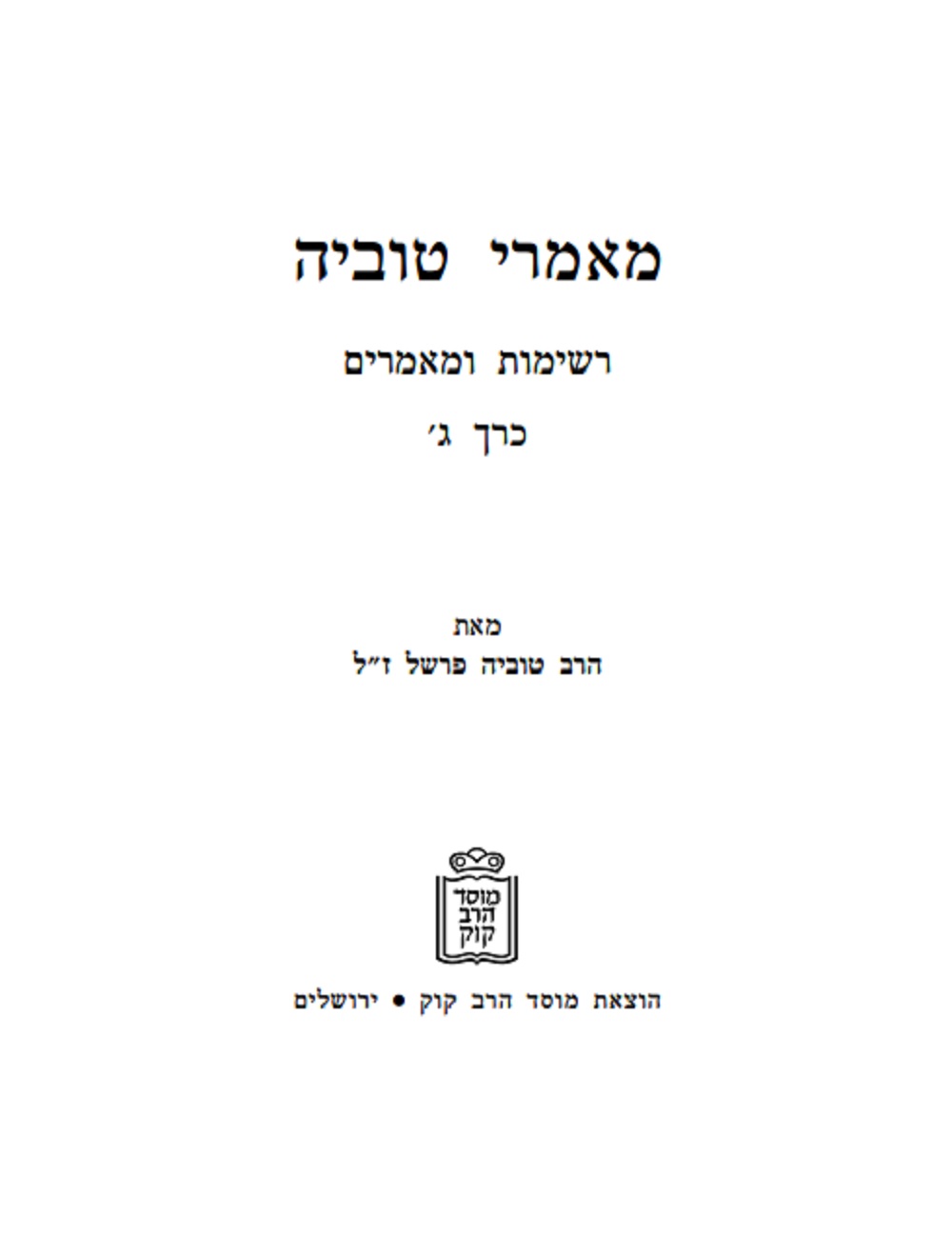
[18]
Ben
Iohnson, Timber:
or, Discoveries…

(London, 1641), 89.


Birchas Ha-ilanos in Nissan

Birchas Ha-ilanos in Nissan
By Eliezer Brodt
The Following article originally appeared in Yeshurn 32 (2015) [Eventually it will be updated]. For another part of this series see here.
הלכות ברכת הראייה במסגרת הספר מעגל טובלחידא (ג)1 ברכת האילנות
אליעזר יהודה בראדט
ברכה האילנות בניסן2 ביומנו ‘מעגל טוב’ כתב החיד”א ביום א’ בניסן תקל”ז: “וברכתי ברכת אילנות”3. בשנת תקל”ח כתב בכ”ט בניסן: “ואחר מנחה ברכתי ברכת אילנות בגן”4. ביומנו
גם רשם בשנת תקמ”ח: “ברכתי ברכת אילנות שילהי ניסן בפיזא”5. וכן בשנת תקמ”ט: “ברכת האילנות סוף ניסן”6.
בחיבורו ‘מורה באצבע’ כתב: “ישתדל לברך ברכת אילנות בימי ניסן, והמדקדקים מקפידים שיהיה בניסן דווקא… מאד יתעצם בכוונתו בברכה זו שהיא לתיקון הנשמות שהם מגולגלות בעצי השדה והעשבים בזמן הזה ויבקש עליהם רחמים”7. ובחיבורו ‘ברכי יוסף’ כתב: “ואני שמעתי דברכה זו על דרך האמת שייכא דוקא לימי ניסן”8.
מחמת דברי החיד”א הללו כתבו הרבה פוסקים מעדות ספרד שיש לברך ברכה זו דווקא בימי ניסן, שבקהילות הספרדים נוהגים כהוראות רבינו החיד”א כמעט בכל מקום9. רשימה חלקית של פוסקים אלו: ר’ אברהם כלפון ב’לקט הקציר’10, ר’ דוד זכות ב’זכר דוד’11 ר’ חיים פלאג’י ב’מועד לכל חי’12 ר’ אלישע דנגור ב’גדולות אלישע’13, ר’ יוסף חיים בעל ‘בן איש חי’ בחיבורו ‘לשון חכמים’14, ר’ אברהם חמוי ב’בית הבחירה’15, ור’ יעקב חיים סופר ב’כף החיים’16. וכן מצניו שבאלג’יר נהגו לברך דווקא בחודש ניסן17. ויש לציין לדברי ר’ אלעזר פאפו שכתב בספרו ‘חסד לאלפים’: “ויש להקפיד שיהא בניסן דוקא או אפילו ביום א’ של ר”ח אייר”18.
והנה, מקור הדין של ברכת האילנות הוא תלמוד ערוך בברכות: “אמר רב יהודה: האי מאן דנפיק ביומי ניסן וחזי אילני דקא מלבלבי, אומר: ברוך שלא חיסר בעולמו כלום וברא בו בריות טובות ואילנות טובות להתנאות19 בהן בני אדם”20. וכן נאמר במסכת ראש השנה21. מדברי הגמרא משמע שברכה זו נאמרת דווקא בחודש ניסן. וכך יש לדייק מסתימת הלשון של הרבה ראשונים “ביומי ניסן…”22. וכך הבין ר’ יעקב חאגיז ב’שו”ת הלכות קטנות’23.
אמנם כבר הביאו ‘מקור חיים’24 ו’אליה רבה’25 שב’צדה לדרך’ כתב: “והוא הדין רואה אילנות פורחות בחדש אדר26. וב’שו”ת עמודי אש’ מביא מ’ריטב”א’ בר”ה27: “ויומי ניסן לאו דוקא אלא כל מקום ומקום לפי מה שהוא דמלבלבי”28. וכן הביא ר’ יוסף זכריה שטרן בשם חתנו שציין לדברי הריטב”א הנ”ל והוסיף לציין לדברי ‘האשכול’29 ו’רוקח’, שאינו דווקא בניסן30. כוונתו לדברי הרוקח: “הרואה אילנות שהוציאו פרק, כגון בניסן…”31. כידוע כבר האריכו רבים לבאר שהביטוי כגון שיעורו לאו דווקא32.
וכן יש לדייק משאר ראשונים, שברכה זו אינו חיוב דווקא בניסן. כך משמע מדברי ר’ יהודה ב”ר יקר,33, רבנו ירוחם34 המרדכי35 וספר הפרדס36, שאינם מזכירים דווקא ניסן. וכן מצינו שכתב ר’ אברהם בן הרמב”ם בחיבורו ‘המספיק לעובדי השם’: “ונקבעה ברכה על מקצתו, והיא ראיית העצים הפורחים בימי האביב וכדומה…”37. ושוב כתב ר’ אברהם בן הרמב”ם: “והרואה בגנים וכד’ עצים פורחים בימי האביב מברך…”38. וכן מצינו ב’ספר התדיר’ שכתב בסתם: “הרואה אילנות מלבלבין מברך…”39. מכאן מבוארת דעת הרבה ראשונים שאין ברכה זו מוגבלת לניסן דווקא, אלא לתקופת ניסן.
בכל כתבי היד של המימרא במסכת ברכות ובמסכת ר”ה הנוסח הוא: “דנפיק ביומי דניסן“, פרט לכתב יד אחד40 שמביא נוסח מעניין: “אמ’ רב יהודה האי מאן דנפיק ביומי ניסן וביומי תשרי וחזא אילני דמלבלבי”. ב’דקדוקי סופרים’ שם כבר העיר עליו: “וט”ס דביומי תשרי אין האילנות מלבלבין ובא הטעות מלעיל ד’ ל”ה ב'”41.
יש אחרונים שציינו לדברים חשובים מבעל ‘ישמח משה’ ב’שו”ת השיב משה’, שנדרש לשאלה אם המימרא הגבילה עצמה לחודש ניסן דווקא:
אין זה צריך לפנים דודאי צריך לברך על חסדי המקום ב”ה יהיה באיזה זמן שיהיה דמ”ש, רק דהגמ’ נקט ביומי ניסן דהוא אורחא דמילתא ברוב השנים, ואם אמר יאמר למה ליה להש”ס למנקט הזמן וכו’ לזה אני אומר דאם הוי תני סתם הרואה אילנות שמוציאין פרח או האי מאן דנפק וחזי אילנות דמלבלבי הוי אמינא כל אימת דחזי, ר”ל אף אם ראה פעם אחד ובירך אם הלך אחר ל’ יום וראה עוד יברך שנית כמו ברואה מקום שנעשו בו נסים וכו’ לכך תני האי מאן דנפק ביומי ניסן ולא אח”כ באייר או בכל השנה אף שהוא אחר ל’ יום, אבל כשלא ראה ביומי ניסן או שלא גדל הפרח רק אח”כ ודאי דמברך כל אימת דחזי, ופירוש זה הבנתי מלשון רש”י שעל האלפסי ס”פ כיצד מברכין וז”ל שם, וחזי אליני דמלבלבי פעם ראשונה בשנה כשהן מוציאין פרח עכ”ל ודלעתי הדבר ברור כשמש דכוון למ”ש, דהי’ קשה לרש”י מאי האי דנקט ביומי ניסן ליתני סתם האי מאן דנפק וחזי אילני דמלבלבי, לכך כתב רש”י פעם ראשונה כו’ ר”ל כמ”ש דקמ”ל דאינו מברך אלא בפעם ראשונה, ולא מל’ יום לל’ יום, לכך תני בימי ניסן דאינו מברך רק ביומי ניסן לפי האורחא דמילתא ולא אח”כ אם ראה עוד, ולדעתי הוא ברור כשמש וכו’ הוא הפירוש האמיתי בש”ס בלי שום פקפוק42.
האדר”ת כתב ב’קונטרס עובר אורח’: “בימי עלומי כתבתי בס”ד שי”ל הכוונה בתקופת ניסן”43. וכבר הקדימו ברעיון זה ר’ נתן אדלר44. ר’ אברהם מבוטשאטש כתב ב’אשל אברהם’: “במה
שאמרו…. ביומי ניסן… צל”ע אם הוא דוקא לגבי ברכה דאילנות… או דאורחא דמלתא נקיט… וממה שכתב בשו”ע שאחר שהוציאו פירות אין לברך, משמע קצת שמברכין גם אחר ניסן, שהרי אין מצוי שיוציא אילן פירותיו בניסן…”45.
מקור לדברי החידא
 
השאלה היא מה המקור בקבלה לדבריו של החיד”א, שכתב “שמעתי דברכה זו על דרך האמת שייכא דוקא לימי ניסן”. בעל ‘פתח הדביר’ ציין לדברי הזוהר בפרשת בלק למצוא סימוכין לדעת החיד”א, אמנם לא ברור שזה כוונת הזוהר46. ואילו ר’ שמואל קונפורטי מביא מחיבור ‘ליקוטי אריז”ל’ שכתב: “ומי שמגולגל בצומח זמן עלייתו להתגלגל בב”ח הוא בד’ חדשים של השנה הראשונים הום ניסן אייר סיון תמוז… אם כן ודאי שראוי לאו’ אף אחר חדוש ניסן”47. וכפי שהעיר לי ר’ יוסף אביב”י, קטע זה נמצא בחיבור ‘שער הגילגולים’48 להאריז”ל וכנראה שהחזיק ברשותו חיבור זה בכתב יד.

מקור קדום על פי קבלה שברכה זו נאמרת דווקא בניסן. בספר ‘שפתי כהן’ של ר’ מרדכי הכהן, מתלמידי תלמידי האריז”ל, נאמר:

שר של מצרים… ובזה החודש הוא שולט והאילנות מוציאים פירות והתבואה גם כן עיקר גידולם הוא בחדש זה. לזה אמרה תורה ז’ ימים מצות תאכלו מצות מלשון מריבה שיריבו עמו ויחלישו כחו שלא יתגבר כי הוא נקרא חדש האביב אב לי”ב חדשים ולזה מברכין על האילנות מוציאים פרח בחדש זה ברוך שלא חסר בעולמו כלום וברא בו בריות טובות ואילנות טובות ליהנות וגו’. ואין מברכים בשעת בשול הפירות אלא בזמן הפרח שהוא עיקר הפרי… 49.

אמנם נראה שאע”פ שחיבור זה עמד לפני החיד”א50, מכל מקום לא הוא המקור של החדי”א, שהרי הטעם שמביא החיד”א לא נמצא בספר שפתי כהן.
נראה שמקורו של החיד”א הוא הספר ‘חמדת ימים’, שם נכתב:”ומתוך זה אתה למד טוב טעם על מה שאמרו בפרק כיצד מברכין אמר ר’ יהודה… ומנהג חסידים לצאת אל הגינות בימי ניסן ולברך ברכה זו וטעמו של דבר יען כי הנפשות הנידחות המה יציצו כעשב הארץ בקרב הימים האלה ומתלבשות בענפי האילונת ודשאים ובברכה זו אם יכוונו לתקן אותם המה יעלו בהר ה’ ותמצאן מנוחה בכח הברכה”51.
כידוע, החיד”א היה הוגה הרבה בספר חמדת ימים, וכמו שהוא רשם ביומנו שנדפס על ידי מאיר בניהו, הכולל ספר זה בין הספרים שקרא ולמד במשך השנה52, וכן שאר ספרים שהיו ליקוטים מ’חמדת ימים’53. וגם ידוע שעותק של ‘חמדת ימים’ היה מצוי בספרייתו54. לדעתי זה היה מקורו לברך דווקא בניסן.
השאלה היא מה הוא מקורו של החמדת ימים, כי בשנים האחרונות התגלה שכמעט אין בו דבר מחודש אלא הכל נלקח בשתיקה ממקורות שונים55. מעניין שכל הפרק הזה נמצא כמעט מילה במילה בספר ‘קב הישר’ לר’ צבי הירש קאיידנור56 (נדפס לראשונה בפרנקפורט דמיין תס”ה) מלבד פיסקה זו של ברכת האילנות. אפשר שהחמדת ימים ראה אצל בשפתי כהן שיש קפידא לברך בניסן דווקא, אלא שהוא הוסיף טעם על טעמו של בעל ‘שפתי כהן’ וצ”ע57. לאמיתו של דבר, מקורו הוא הספר של רבו ‘יסוד יוסף’58, וכדרכו העתיק ממנו.59 אלא שזה לא היה המקור של ‘חמדת ימים’, שהרי ספר זה נדפס לראשונה בשקלוב תקמ”ה.
ר’ יוסף זכריה שטרן כתב על דברי החיד”א, שמדברי הראשונים משמע שלא צריך לברך דווקא בניסן והוא הוסיף: “ומלבד מה דדבלא”ה חקרו היכי שהקבלה מחולקת עם הפוסקים. ובפרט דאין להשגיח מה שלא נזכר בספרי הקבלה מהקדמונים המוחזקים להקראות בשם דברי קבלה”60.
דבר חשוב ומעניין כתב הרב יעקב הלל:
בענין ברכת האילנות… בחודש ניסן דוקא… שלא נזכר מזה דבר חצי דבר… לא בזוהר ולא בכתבי האר”י רק בספר חמדת ימים שאינו בר סכמא, כתב מדעתו שתיקנו ברכת האילנות בחודש ניסן דוקא… ובאמת דברים אלו אין להם שום שורש ויסוד כלל בכתבי האר”י לענין ברכת האילנות… ועל פי דבריו הוסיפו האחרונים עוד שמועות מחודשות ללא שום בסיס, עד שהגענו למצב כהיום, שהעולם חושבים כדבר הפשוט והמוסכם שכל ענין ברכת האילנות נתקן כדי לתקן הנשמות המגולגלות בצומח ושזמנו דוקא ולמי כל חמדת ישראל לחדש מדעתו מה שלא גילו הזוהר והאר”י ולחלוק על ריהטת הסוגיא כדעת הפוסקים. אך דא עקא, כי בענין הנזכר נמשכו אחריו גם כמה מגדולי הפוסקים האחרונים… הם ג”ע החיד”א ומרן הרי”ח טוב ז”ל… נגררו ונמשכו לסמוך על הדברים הכתובים בספר חמדת ימים כאילו מקורם טהור מפי האר”י… ואנכי הקטן האוחז בשיפולי גלימתם, נמשכנו כולנו זה אחר זה, על סמך דברי ג”ע החיד”א ז”ל, שנתברר לנו עתה בלי ספק שכתב מ”ש על פי מה שראה בספר חמד”י הגם שלא הזכירו בפירוש, כי הרי אין שום מקור אחר קדום ממנו שהזכיר דבר זה. וישנם מהפוסקים האחרונים שאף לא העלימו את המקור הראשון לשמועה זו…61
אמנם נלענ”ד שלא כהרב יעקב הלל. החיד”א ידע שחלק מרבותינו הראשונים כתבו שניסן הוא לאו דווקא. ב’ברכי יוסף’ הוא מביא דברי ‘צדה לדרך’ מתוך ‘אליה רבה’, ושם ב’שיורי ברכה’
הוא מביא לשון של ‘רבנו ירוחם’ ו’ספר הפרדס’ מכתב יד. ובספרו ‘פתח עינים’ למסכת ראש השנה62 הוא מביא דברי הריטב”א מכתב יד. ואף שהוא ידע מכל אלו, אעפ”כ כתב מה שכתב שיש לברך ברכה זו על דרך האמת דווקא בימי ניסן. ואפשר לומר שהיה לו מקור אחר מלבד דברי ‘חמדת ימים’, מקור שהיה יותר מוסמך. כי אעפ”י שלמד הרבה בספר ‘חמדת ימים’, קשה לומר שהיה פוסק כוותיה כנגד כל ראשונים אלו בלי מקור ברור. ובפרט יש לדייק בדבריו: “ואני שמעתי דברכה זו על דרך האמת שייכא דוקא לימי ניסן”. אם מקורו רק מספר חמדת ימים, לא נראה לי שיכתוב לשון “שמעתי”, בפרט שידוע שספר זה היה בספרייתו וכבר בשנת תקכ”ז מצינו שהוא רשם שהוא למד בו63, וזה כמה שנים לפני שנדפס ‘ברכי יוסף’ בשנת תקל”ד64.
כמה הערות בעניין חמדת ימים
 
בעניין מה שכתב ב’חמדת ימים’ יש לציין לדברי ר’ דוד זכות שכתב:
ומנהג
אנשי מעשה לחזר אחר ברכה זו ויוצאים השדה
לברכה,
ואף
על גב דקאמר מאן דנפיק וכו’,
דמשמע
שאין שום חיוב לצאת,
ודוקא
אם קרה לו מקרה שראה אותם אז יברך…
מכל
מקום אם נסתכל בטעם הברכה ממנו נראה דאיפכא
מסתברא דהא כתב חמדת
ימים

דמנהג
החסידים לצאת על הגנות בימי ניסן…
ועל
כן פירוש הרב פת לחם,
הברכה
שלא חסר וכו’
דאפשר
שאנו מזכירים כך הבריות עם האילנות,
משום
שהנפשות הנדחות המה יציצו כעשב הארץ בימי
ניסן,
וע”י
הברכה מתתקנים,
והיינו
שצריך להודות שלא חסר מעולמו כללום,
באופן
שהוא חושב מחשבות לבלתי ידח ממנו נדח ולכך
ברא יחד בריות ואילנות ליהנות בהם בני
אדם,
משום
דעיד”ז
מתתקנים.
ולפי
זה ודאי חובה עלינו לצאת חוצה להביט ולראות
אם לבלבו האילנות
,
כדי
לתקן הנפשות אשר בענפיהם ישכונו,
וכן
כתב א”א
מ”ו
בספרו פירורי לחם חלק א סי’
רכו
שכן נהג לעצמו והנהיג
לחביריו ולתלמידיו
65.
עוד
יש להעיר שר’
אברהם
בן עזרא,
שהיה
רב באזמיר,
הקדים
את החיד”א
וכתב בחיבורו ‘בתי
כנסיות’
על
פי החמדת ימים שיש לברך ברכה זו דווקא
בחודש ניסן:
“היוצא
בימי ניסן כו’
מדברי
ח”י
בהלכות פסח ד”ו
דעיקר ברכה זו אינו אלא בימי ניסן”66.
לסיום
עניין זה יש להביא דברי ר’
אברהם
כלפון:
“ובהיותי
אני הצעיר …
בליוורנו
שנת התקס”ה
נזדמנתי עם החכם…
אברהם
קורייאט ז”ל
ובירכנו ברכת האילנות בכרם שהיה בחצר
בתוך העיר ושאלתי את פי ממ”ש
הרב המופלא חיד”א…
ואחר
הברכה אמרנהו…
ואח”כ
התפילה הסדורה בחמדת
ימים
…”67.
דעות
נוספות של הפוסקים בעניין
ר’
חיים
באכנר כתב בחיבורו ‘אור
חדש’:
“פרחים
מוציאים האילנות הרואה אותם בימי ניסן
וכן אם
רואה אילנות פורחות בחדש אדר נ
ל
מברך…”68.
וכן
כתב בעל ‘קיצור
השל”ה’
בסידורו
‘דרך
ישרה’,
שבניסן
או אייר יכול לברך ברכה זו69.
וכן
כתב ‘חיי
אדם’:
“שרואה
אילנות מלבלבין ולאו
דוקא בניסן
,
מברך
‘ברוך…
העולם
שלא חיסר בעולמו כלום וברא בו בריות
טובות’…”70.
וכן
כתבו ‘מחצית
השקל’71,
‘מגן
גבורים’72,
‘כרם
שלמה’73
ו’ערוך
לנר’74.

מעניין
לציין לדברי בעל ‘דברי
מנחם’
שהעיד
על עצמו:
“ברכתי
באדר ב’
יען
ראיתי דברי
הרוקח

ומהם דקדקתי דיש לברך קודם ר”ח
ניסן”75.
גם
האדר”ת
העיד על עצמו:
“הייתי
זהיר וזריז לקיים ד’
חז”ל
הקדושים לברך בימי ניסן או
אייר
על
הני אילני דמלבלבים…
וברכתי’
אחר
התפילה כדי לזכות את הרבים,
שאינם
יודעים כלל מדין זה”76.
ובערוך
השלחן כתב:
“במדינתינו
אינו בניסן אלא באייר או תחלת סיון,
ואז
אנו מברכין ואין ברכה זו אלא פעם אחת בשנה
אפילו רואה אילנות אחרות דברכה זו היא
ברכה של הודאה כלליות על חסדו וטובו
יתברך”77.
עוד
כתב:
“מיהו
בלא”ה
רפויה ברכה זו אצל ההמון,
ועיין
בדק הבית שכתב בשם ר”י
שלא נהגו לברך אבל כל ת”ח
ויראי ד’
נזהרין
בברכה זו”78.
אחריו
כתב במשנה ברורה:
“אורחא
דמלתא נקט שאז דרך ארצות החמים ללבלב
האילנות וה”ה
בחודש אחר כל שרואה הלבלוב פעם ראשון
מברך”79.
וכן
פסקו ר’
אברהם
חיים נאה80,
ר’
צבי
פסח פרנק81,
ר’
שמואל
דוד מונק82
ור’
יוסף
שלום אלישיב זצ”ל83.
לאור
דברי הראשונים והפוסקים שהבאתי לעיל,
גם
נשים תברכנה ברכה זו,
לפי
שאינה מצוות עשה שהזמן גרמא.
וכן
הסיקו כמה פוסקי זמננו.84
לסיום
ראוי להביא דברי ר’
יחיאל
מיכל מארפשטיק בחיבורו ‘סדר
ברכות’:
“היוצא
בימי ניסן ורואה אילנות המוצאין פרחים
אומר ברוך…
הזהיר
בזה עליו נאמר ראה ריח בני כריח השדה אשר
ברכו ה’
ויתן
לך וגו'”85.
ודבריו
הובאו ב’אור
חדש’86
וב’אליהו
רבה’87.
ברכת
אילנות בשבת
 
נדון
נוסף השנוי במחלוקת הלכה וקבלה בדין ברכת
האילנות מביא ‘כף
החיים’: “ובשבת
וביו”ט
אין לברך ברכת האילנות…
ונראה
לדברי המקו’ שכתבו
שע”י
ברכה זו מברר ניצוצי הקדושה מן הצומח יש
עוד איסור נוסף דבורר וע”כ
אסור לברך ברכה זו בשבת ויום טוב וכן עמא
דבר”.88
וכן
סבר ר’ יוסף
חיים ב’בן
איש חי’89.
וקודם
לכן מצאנו שכתב ר’
חיים
פלאג’י
בספרו ‘מועד
לכל חי’:
“לא
ראיתי ולא
שמעתי מימי עולם דמברכין בשבת ויום טוב
ברכת האילנות…”90.
אבל
טעמו אינו הטעם הנסתר של ‘כף
החיים’.
ואולם,
נימוק
זה קשה להבנה. לא
מצינו שיכתוב אפי’ אחד
מן הראשונים או הפוסקים שדנו בברכה זו
שאין לברך אותה בשבת או יום טוב.
ויש
לציין שר’ יעקב
חיים סופר שליט”א
כתב מאמר להסביר דעת סבו ‘כף
החיים’.91
האדר”ת
העיד על עצמו:
“הייתי
זהיר וזריז לקיים ד’
חז”ל
הקדושים לברך בימי ניסן או אייר על הני
אילני דמלבלבים,
והייתי
מהדר לברכה שבת

כדי למלאות החסר,
וברכתי’
אחר
התפילה כדי לזכות את הרבים,
שאינם
יודעים כלל מדין זה”92.
ר’
שלמה
זלמן אויערבאך כתב על דברי ‘כף
החיים’: “בכף
החיים כתב דבר
מוזר מאוד

לאסור משום בורר והוא תמוה ולא מובן”93.
ואכן
למעשה דעת הפוסקים היא שיכול לברך בשבת.
כך
נקטו ר’ אברהם
חיים נאה94,
ר’
שלמה
זלמן אויערבאך95,
ר’
יוסף
שלום אלישיב זצ”ל96
ועוד97.
הרואה
אילנות טובות ובריות נאות
98
בחיבור
‘מעגל
טוב’
מזכיר
החיד”א
כמה וכמה פעמים שביקר ב”גארדין”
בעיר…99
בגמרא
ברכות מצינו:
“ראה
בריות טובות ואילנות טובות מברך שככה לו
בעולמו”100.
ובגמרא
עבודה זרה נאמר:
“מסייע
ליה לרב,
דאמר
רב:
אסור
לאדם שיאמר כמה נאה עובדת כוכבים זו.
מיתיבי:
מעשה
ברשב”ג
שהיה על גבי מעלה בהר הבית,
וראה
עובדת כוכבים אחת נאה ביותר,
אמר:
מה
רבו מעשיך ה’!
ואף
ר”ע
ראה אשת טורנוסרופוס הרשע,
רק
שחק ובכה,
רק

שהיתה
באה מטיפה סרוחה,
שחק

דעתידה
דמגיירא ונסיב לה,
בכה

דהאי
שופרא בלי עפרא!
ורב,
אודויי
הוא דקא מודה,
דאמר
מר:
הרואה
בריות טובות,
אומר:
ברוך
שככה ברא בעולמו.
ולאסתכולי
מי שרי…”101.
ובירושלמי
ברכות:
“הרואה
אילנות נאים ובני אדם נאים אומר ברוך שכן
ברא בריות נאות בעולמו.
מעשה
ברבן גמליאל שראה גויה אשה נאה ובירך
עליה.
לא
כן אמר רבי זעירא בשם רבי יוסי בר חנינא
רבי בא רבי חייא בשם רבי יוחנן לא תחנם לא
תתן להם חן.
מה
אמר אבסקטא לא אמר.
אלא
שכך ברא בריות נאות בעולמו.
שכן
אפילו ראה גמל נאה סוס נאה חמור נאה אומר
ברוך שברא בריות נאות בעולמו.
זו
דרכו של רבן גמליאל להסתכל בנשים.
אלא
דרך עקמומיתה היתה.
כגון
ההן פופסדס והביט בה שלא בטובתו”102.
אעפ”י
שהחיד”א
ביקר כמה פעמים בגנים אלו,
מכל
מקום לא מצינו שרשם שבירך במהלך ביקוריו
אפילו פעם אחת “ברוך
שככה לו בעולמו”
כשראה
אילנות טובות.
דברי
הגמרא הובאו ברמב”ם:
“הרואה
בריות נאות ומתוקנות ביותר
ואילנות טובות מברך שככה לו בעולמו”103.
והטור
כתב:
“ראה
בריות טובות או בהמה ואילנות טובות אומר
ברוך…
גם
בזה כתב הראב”ד
דוקא בפעם ראשונה מברך עליהם ולא יותר
(עליהם)
ולא
על אחרים אלא אם כן ראה נאים מהם”104.
וכן
פסק ר’
יחיאל
מיכל מארפשטיק בחיבורו ‘סדר
ברכות’105.
ר’
יואל
סירקש כתב בב”ח:
“עיין
לעיל בסימן רי”ח.
ומשמע
דבאילנות טובות מודה רבינו להראב”ד
דאינו מברך אלא בפעם ראשונה”.
וכן
כתבו ב’עולת
תמיד’106
ור’
יאיר
חיים בכרך ב’מקור
חיים’107.
אמנם
ב’לחם
רב’
מצינו:
“ולא
לבד בפעם ראשונה צריך לברך כן אלא צריך
נמי לברך כן מל’
יום
לשלשים יום”108.
וכן
כתבו ‘לבוש’109,
אור
חדש110,
ואליה
רבה111.
יש
לציין ללשונו המעניינת של ר’
אברהם
בן הרמב”ם
ב’המספיק
לעובדי השם’,
“והרואה
עצים המוצאים
חן בעיניו

או בריות שיפיים וחנם
רבים

מברך”112.
ר’
חיים
באכנר כתב בחיבורו ‘אור
חדש’:
“והרי
זה מהנה עצמו בראותו דבר הגשמי ובברכה
שהוא מברך עליו עשאו רוחני…”113.
למעשה
הובאה הלכה זו בפוסקים,
ואפילו
ה’מגן
אברהם’
דן
אם יש לברך ברכה זה על גוי רשע שאסור להסתכל
בו.
הלכה
זו הובאה אף על ידי ר’
חיים
ליפשיץ בחיבורו ‘דרך
חיים’114
וע”י
ר’
אלחן
קירכהאן ב’שמחת
הנפש’115
ויותר
מאוחר על ידי ר’
שלמה
ממיר ב’שלחן
שלמה’116
ור’
שלמה
זלמן מליאדי בחיבורו ‘סדר
ברכת הנהנין117,
וא”כ
צ”ב
למה לא בירך החיד”א
ברכה זו ומתי הפסיקו לברך ברכה זה.
ר’
יוסף
האן נוירלינגן, כתב
בספרו ‘יוסף
אומץ’ (כתיבת
הספר הסתיימה כבר בשנת ש”צ
אבל נדפס רק בשנת תפ”ג):
“וכן
בברכה דשככה לו בעולמו שבמברכין על האילנות
ובריות טובות מקילין
גם כן דהתם
כולי עלמא סבירי להו דדוקא בפעם ראשונה
ודוקא שלא ראה כיוצא בהם מימיו ואם כן
בקלות יבא לידי ברכה לבטלה”.118ואפשר
שזה היה טעמו של החיד”א.
‘חיי
אדם’
כתב:
“הרואה
אילנות טובות ובריות…
אומר
ברוך…
שככה
לו בעולמו.
ודוקא
פעם ראשון כשרואה אותם ולא יותר,
לא
עליהם ולא על אחרים,
אלא
אם כן היו נאים מהם.
ונראה
לי מה שאין אנו נוהגין לברך ברכה זו…
ונראה
לי דהוא הדין בכל הברכות דכמו דהתם הברכה
היא על השמחה וכבר עברה,
הוא
הדין בכולם.
וכיון
שאנו רגילין תמיד בזה,
אין
לנו שינוי גדול”119.
בכך
כיון החיי אדם לדברי המאירי שכתב על ברכה
זה:
“נראה
לי דוקא במקום שאין האילנות או הבריות
מצויות שיש שם קצת חדוש”120.
ובכף
החיים,
לאחר
שהעתיק דברי החיי אדם,
כתב:
“ומ”מ
נ”ל
דיש לברך בלא שם ומלכות”121.
אפשר
שהחיד”א
ס”ל
כחיי אדם לכן לא בירך ברכה זו.
ויש
להעיר שבעל ‘קיצור
השל”ה’
בסידורו
‘דרך
ישרה’
מביא
הברכה על האילנות בניסן ולא מביא ברכה
זו122.
וכן
ר’
שלמה
חלמא בעל ‘מרכבת
המשנה’
לא
מביא הלכה זו בחיבורו ‘שלחן
תמיד’123,
ושניהם
היו לפני החיי אדם.
עוד
ניתן לפרש הנהגת החיד”א
שהוא סבר כשיטת ה’משנה
ברורה’
ב’שער
הציון’
שכוונת
הגמרא דווקא כשהן נאות ביותר124.
טעם
אחר לפרש הנהגת החיד”א
בדרך אפשר,
שסבר
כאדר”ת
ב’עובר
אורח’:
“ובריות
נאות לא הבנתי איזה גבול יש בזה לקרותו
נאה וכי רשות כל אחד לבר כפי מה שנראה
בעיניו”125.
וכן
פסק הרב יוסף שלום אלישיב:
“היום
לא נוהגים ברכה זו,
כי
צריך להיות נאים ביותר ומי יכול לדעת כמה
זה”126.
לסיים
אביא דברים חשובים שכתב ר’
ישראל
ליפשיץ בדרשתו ‘דרוש
אור חיים’:
זהו ג”כ
מ”ש
חז”ל
בברכי’
[דמ”ג]
האי
מאן דנפיק ביומי ניסן וחזא אילני דמלבלי,
אומר
בא”י
אמ”ה
שלא חיסור בעולמו כלום,
וברא
בו בריות טובות ואילנות טובות להתנאות
בהן בנ”א.
דתמוה
דמה לנו להזכיר בהברכה מבריות חיות שג”כ
באביב נראין יפות,
והרי
עכ”פ
הרי אינו מברך רק על האילנות שרואה אותן?
שסיים
להתנאות בהן בנ”א
איך ע”י
מעט הירוק שיראה באילנות יתנאו גם הבנ”א?
אמנם
העולם ובריותיה שעליה,
תמיד
עומדים יחד בקישור אמיץ מאוד,
מקרה
האחד הוא מקרה השני בחורף יהי’
לא
לבד חורף בעולם כ”א
גם כל הבריות בו והיו אז רפויי ידים ומוקעים
בתרדמה,
וקפאון
ונימכות רוח ימשולו על הכל.
ואולם
כאשר יבקע הקרן הראשון מאביב על פני העולם,
אז
שוב ישוב הכל להעצות נר החיים,
הכל
בהטבע יקבץ לחיי ילדות חדשים כמ”ש
חדשים לבקרים ר”ל
בכל בוקר יתרא’
יחות
חדש בהטבע וכח חדש יתראה בו,
רבה
אמונתך ה’,
ואיך
נאמן אתה ה’
שהלווינו
לטבע שלך בחורף כוחות העולם,
והנה
תשלם לנו באביב בפראצענטע כפולים מה
שהלווינו לה.
ולכן
אחז”ל
בפסחים [קיב’ב]
כד
חזית שור שחור בימי ניסן ריש תורא בדיקולא,
סק
לאגרי ושדי דרגא מתותך,
ר”ל
לך ונטה לך אז מהצד ממול הבהמות עלולים
להזיק אז ביהירות טבעם.
כל
הברואים והבנ”א
הם אז נאותים לקיים יותר מלמות,
לרפואה
ולבריות יותר מלחולשת ולחולאת לשמחה
ולעונג יותר מליגון ולנכאת לב כפוף.
והישראל
שבכל השנויים שיקרו בטבע תמיד ימצא בהן
בר אשר יעורו לבקש השלמת נפשו,
להכי
כדחזי אילני דמלבלי,
דהיינו
שיתהוו על ענפי האילנות כמו לבבות קטעים
רטובים יזכר כי גם האדם עץ השדה גם זה
האילן יאבד פ”א
רטיבות שלו בחורץ שלו,
דהיינו
בזקנתו,
אבל
בסוף החורף ההוא יקץ לאביב יותר יפה,
וישוב
לחיי נערות שוב ללבלב בחיים אחרים.
לכן
אומר אז ברוך שלא חיסר בעולמו כלום שלא
יניח בעולמו שום דבר להתאפס,
ואותו
הגויעה והתרדמה שראינו בהטבע בהחורף,
הי’
רק
הכנה להשלמה שיבוא אחריו,
כי
החסרון הזה שראינו בהחורף בהטבע הוא אשר
על ידו ברא הבריות טובות וחיות הנס שהם
עתה יותר יפים ואמצי לב מאשר היו בשלהי
הבציר,
וגם
האילנות הם עתה יותר טובות מאשר היו אז,
כי
עתה שבו לימי נעוריהן.
ומסיים
בדבריו עיקר כוונתו בברכתו שכל זה כסדר
כך מיוצר בראשית ית’
כדי
להתנאות בהן בנ”א,
שעי”ז
יחשוב האדם ג”כ
שהמיתה הנדמת שלו,
ישאנו
לחיים אחרים,
והענן
הרעם של המות תשאנו כאליהו לשמים,
לאור
לפני ה’
באור
החיים.127
1
חלק
מן המאמר פורסם מכבר בקובץ ‘הפעמון’
ד
(תשע”ב),
עמ’
81-86. אך
הפעם הוספתי הרבה על דבריי כאן.
ראה
מאמרי,
‘הלכות
ברכת הראייה במסגרת הספר מעגל טוב לחיד”א’,
ישורון
כו (תשע”ב),
עמ’
תתנג-תתעד
שיש מבוא על סידרה זו.
2
על
ענין זה ראה:
ר’
יצחק
נסים,
שו”ת
יין הטוב,
ירושלים
תשל”ט,
סי’
מג-מה;
ר’
יחיאל
זילבר,
בירור
הלכה,
או”ח,
ב,
בני
ברק תשל”ו,
עמ’
רז-רח;
הנ”ל,
תליתאה,
בני
ברק תשנ”ה,
עמ’
קכז;
ר’
אליהו
כהן,
מעשה
חמד,
בני
ברק תשמ”ז
[ספר
שלם על ברכת אילנות],
עמ’
צ-צא;
ר’
עובדיה
יוסף,
חזון
עובדיה,
(ט”ו
בשבט),
ירושלים
תשס”ז,
עמ’
תנז-
תס;
הנ”ל,
חזון
עבודיה,
פסח,
ירושלים
תשס”ג,
עמ’
כג-כה;
הנ”ל,
מאור
ישראל,
א,
ירושלים
תשנ”ו,
ר”ה,
דף
יא ע”א;
ר’
דוד
יוסף,
הלכה
ברורה,
יא,
ירושלים
תש”ע,
סי’
רכו,
עמ’
תכד
ואילך;
הערות
ר’
יעקב
הלל,
בעמודי
הוראה [בתוך:
מורה
באצבע],
ירושלים
תשס”ו,
עמ’
קל-קלא;
הנ”ל,
שו”ת
וישב הים,
ג,
ירושלים
תשע”ב,
סי’
כב;
ר’
אליהו
אריאל,
שער
העין,
מודעין
עילית תשס”ח,
עמ’
קט-קיז,
שפב-שפז;
ר’
פנחס
זבחי,
ברכת
יוסף,
ירושלם
תשס”ח,
עמ’
עד-עט;
ר’
שריה
דבליצקי,
איגרתא
חדא,
בני
ברק תשע”ב,
עמ’
מז-נד;
ר’
נחום
רנן,
מועדי
ה’,
מודיעין
עלית תשע”ב.
3
מעגל
טוב,
עמ’
92
4
שם,
עמ’
146.
5
נדפס
אצל מאיר בניהו,
רבי
חיים יוסף דוד אזולאי,
ירושלים
תשי”ט,
עמ’
תקמג.
6
שם,
עמ’
תקמד.
7
מורה
באצבע,
ירושלים
תשס”ו,
אות
קצח,
עמ’
קל-קלא.
8
ברכי
יוסף,
סי’
רכו,
ס”ק
ב.
וראה
חמדת ימים עמ’
שפד-שפה.
וראה
ר’
יהודה
עלי,
‘קמח
סלת’,
הלכות
חודש ניסן אות ד-ה,
שהביא
דברי החיד”א
בברכי יוסף ומורה באצבע.
ועיי”ש
שהביא דברי ‘חמדת
ימים’,
שם
אות ג [וראה
ר’
אברהם
אלקלעי,
זכור
לאברהם,
ב,
מונקאטש
תרנ”ה,
אות
ב סי’
כח].
עוד
הביאו את דברי החיד”א:
ר’
מרדכי
משה מגדאד,
מזמור
לאסף,
ליוורנו
תרכ”ד,
דף
קטז ע”ב;
ר’
משה
פריסקו,
בירך
את אברהם [נדפס
לראשונה תרכ”ב],
סי’
עב;
ר’
ישראל
פרידמאן,
לקוטי
מהרי”ח,
א,
ירושלים
תשס”ג,
דף
קנז ע”א.
9
ראה
ר’
שלמה
וענקין,
אגרות
והסכמות רבנו חיד”א,
בני
ברק תשס”ו,
עמ’
מח-נא.
10
לקט
הקציר,
סי’
יט
אות פא.
11
זכר
דוד,
ירושלים
תשס”א,
מאמר
שלישי,
עמ’
תת.
12
מועד
לכל חי,
סי’
א
אות ט. יש
להעיר שבנו של רבינו,
ר’
יוסף
פאלג’י,
יוסף
את אחיו,
ירושלים
תשס”ה,
עמ’
צא-צב,
מסיק
שניסן לאו דווקא וכמו שכתב בשו”ת
השיב משה.
ראה
לקמן.
13
גדולות
אלישע,
ירושלים
תשל”ו,
סי’
רכו.
14
לשון
חכמים, א,
ירושלים
תש”ך,
סי’
מב.
והשווה
לדבריו בהגדה של פסח ‘ארח
חיים’,
ירושלים
תשנ”ט,
עמ’
ט-י
אות א, י.
וראה
סדר ברכת האילנות שנדפס ממנו בגדאד:
ר’
יעקב
הלל, בן
איש חי:
תולדותיו
וקורותיו ומורשתו לדורות,
ירושלים
תשע”ב,
עמ’
496. וראה
ר’ דוד
ששון, מסע
בבל, ירולים
תשט”ו,
עמ’
רכו,
על
בבגדאד:
“בחדש
ניסן…
ומברכים
ברכת האילנות”.
15
בית
הבחירה,
ליוורנו
תרל”ה,
דף
כ ע”ב
אות א-ב:
“… עיקר
ברכה זו בימי ניסן והכי נהיגנא”.
16
כף
החיים,
סי’
רכו,
אות
א.
17
זה
השלחן,
אלג’יר
תרמ”ח,
עמ’
צט.
וראה
ר’ עמרם
אבורביע,
נתיבי
עם, ירושלים
תשמ”ט,
עמ’
קלב.
18
חסד
לאלפים,
סי’
רכא,
אות
כג. וראה
ר’
אברהם
איינהורן,
ברכת
הבית, דף
ע ע”ב,
שכתב:
”יש
להדר לברך בניסן אם אפשר”.
19
ראה
ר’ מלכיאל
הלוי, שו”ת
דברי מלכיאל,
ג,
סי’
ב.
20
ברכות
דף מג ע”ב;
ר’
נחמן
קורניל,
בית
נתן, ווין
1854, ברכות
שם, דף
כו ע”ב
בדפי הספר;
הנ”ל,
זכר
נתן, וויען
תרל”ב,
דף
כב ע”א;
ר’
שריה
דבליצקי,
איגרתא
חדא, בני
ברק תשע”ב,
עמ’
נג-נד.
21
ראש
השנה, דף
יא ע”א.
ידידי
ר’
מרדכי
מנחם הוניג הראני מקור חשוב וקדום לברכות
הראייה בכלל וברכות האילנות בפרט.
ראה:
ספר
בן סירא (מהדורת
מ’
סגל),
ירושלים
תשנ”ז,
פרק
מג,
וראה
שם בפרט,
עמ’
רפט:
“יבול
הרים כחרב ישיק,
ונוה
צמחים כלהבה”.
שהכוונה
ל’ואילנות
טובות אומר ברוך שככה לו בעולמו’.
22
ראה
לשון הרי”ף,
רמב”ם,
רא”ש
ועוד. וראה
ר’ יהודה
החסיד,
ספר
חסידים,
מהדורת
מקיצי נרדמים:
ברלין
1891, סי’
תקפא;
ר’
יעקב
חזן, עץ
חיים,
ירושלים
תשכ”ב,
עמ’
קפז:
“היוצא
לשדה ולגנות בימי ניסן…”.;
רשב”ץ,
מגן
אבות,
ירושלים
תשס”ז,
עמ’
366: “ומאן
דנפיק ביומי ניסן ורואה אילנות…”.
23
שו”ת
הלכות קטנות,
ב,
סי’
כח.
24
מקור
חיים, סי’
רכו.
25
אליה
רבה, שם
ס”ק
א.
26
צדה
לדרך,
ווארשא
תר”מ,
דף
לז ע”א,
מאמר
ראשון,
כלל
שלישי,
פרק
כח, כתב:
“היוצא
לגנות ולפרדסים בימי ניסן וראה אילנות
פורחים…
וכן
אם רואה אילנות פורחות בחדש אדר”.
וראה
מה שכתב ‘תורת
חיים’
(סופר)
שם,
לענין
‘צדה
לדרך’. על
החיבור ‘צדה
לדרך’ בכלל
ראה: שלמה
איידלברג,
בנתיבי
אשכנז,
ברוקלין
תשס”א,
עמ’
204-226.
27
ר”ה
דף יא ע”א.
וראה
מה שכתב ר’
צבי
פסח פרנק בשו”ת
הר צבי או”ח
סי’ קי”ח,
על
דברי הריטב”א.
28
שו”ת
עמודי אש,
לבוב
תר”ם,
סי’
ב,
ק’
מעון
הברכות אות יב.
וכ”כ
ראה שדי
חמד,
ה,
מערכת
ברכות סי’
ב
אות א.
חידושי
הריטב”א
למסכת ר”ה
נדפסו לראשונה בקניגסברג תרי”ח,
וכנראה
הראשון שהעיר לדברי הריטב”א
לעניין זה (מלבד
החיד”א
שראהו בכ”י)
היה
ר’
נחמן
קורניל,
ב’זכר
נתן’, וויען
תרל”ב,
דף
כב ע”א.
29
האשכול
(מהדורות
אויערבך),
א,
עמ’
68: “ולאו
דוקא ביומי ניסן אלא בזמן שרואה הפרח פעם
ראשון בשנה…”.
ואינו
מופיע באשכול מהדורת אלבק.
וראה
ר’
דוב
בער קאראסיק,
פתחי
עולם ומטעמי השלחן,
סי’
רכ”ו
ס”ק
א ור’
ראובן
מרגליות נפש חיה,
סי’
רכו
שמציינים לדברי האשכול.
30
שו”ת
זכר יהוסף,
ג,
סי’
קצד
בסוף. ספר
הרוקח הלכות ברכות,
סי’
שמב
כתב: “הרואה
אילנות שהוציאו פרח כגון בניסן”.
31
רוקח,
ירושלים
תשכ”ז,
סי’
שמב,
עמ’
רלה.
32
ראה
ר’ יוסף
ענגיל,
גליוני
הש”ס,
ברכות
דף ה ע”א
דה אף ת”ח.
וראה
ר’ ראובן
מרגליות,
מרגליות
הים, דף
צח ע”ב
אות יח;
ר’
דוד
יואל ווייס,
מגדים
חדשים,
ברכות,
ירושלים
תשס”ח,
עמ’
לט.
33
פירוש
התפלות והברכות,
ירושלים
תשל”ט,
ב,
עמ’
נו:
“יצא
לשדות וראה אילנות פורחים…”.
34
ספר
אדם, נתיב
יג, חלק
שני, דף
קד ע”א.
35
מרדכי,
ברכות,
סי’
קמח.
36
ספר
הפרדס,
ירושלים
תשמ”ה,
עמ’
סט.
37
המספיק
לעובדי השם (מהדורת
דנה), רמת
גן תשמ”ט,
עמ’
240.
38
שם,
עמ’
249.
39
ספר
התדיר,
ניו
יורק תשנ”ב,
עמ’
רצח.
40
פריס
671.
41
דקדוקי
סופרים,
ברכות,
עמ’
230, אות
ב.
42
שו”ת
השיב משה,
סי’
ח.
דבריו
הובא אצל הרבה וראה ר’
יוסף
זכריה שטרן,
שו”ת
זכר יהוסף סי’
נט
שהביא דבריו.
43
נדפס
בסוף ארחות חיים (ספינקא).
וראה
ר’
יוסף
זכריה שטרן,
שו”ת
זכר יהוסף,
ג,
סי’
קצד.
וראה
שם,
סי’
נט,
שהאדר”ת
כתב לו רעיון זה במכתב.
44
כך
מובא בשמו על ידי תלמידו חת”ס
בגליונות על השלחן ערוך שם.
וראה
ר’
אברהם
שווארץ,
דרך
הנשר (תורת
אמת),
ב,
ירושלים
תשמ”ג,
עמ’
מח-מט;
ר’
יעקב
חיים סופר,
קונטרס
יד סופר,
בסוף:
גדולות
אלישע,
ירושלים
תשל”ו,
עמ’
יא.
וראה
ר’
שריה
דבליצקי,
איגרתא
חדא,
בני
ברק תשע”ב,
עמ’
מח-מט.
45
אשל
אברהם,
סי’
רכו.
46
פתח
הדביר,
סי’
רכו.
ראה
מה שכתב ר’
פנחס
זבחי,
בברכת
יוסף,
עמ’
עה-עו.
47
שו”ת
עולת שמואל,
שלוניקי
תקנ”ט,
ליקוטים
דף לז ע”א.
48
שער
הגלגולים,
ירושלים
תשמ”ח,
הקדמה
כב,
עמ’
סא.
49
שפתי
כהן,
פרשת
בא,
עמ’
66. וראה
ר’
אברהם
חמוי,
בית
הבחירה,
ליוורנו
תרל”ה,
דף
כ ע”ב
אות ב,
שציין
לשפתי כהן.
50
ראה
למשל, ברכי
יוסף, או”ח
סי’ תקפ”א,
ס”ק
כא.
51
חמדת
ימים,
קושטא
תצ”ה,
ד”צ,
פסח,
פרק
א,
דף
ו ע”ב.
52
ראה
דברי החיד”א
בתוך:
מאיר
בניהו,
רבי
חיים יוסף דוד אזולאי,
ירושלים
תשי”ט,
עמ’
תקכט
ואילך,
ברשימות
הנהגותיו מכתב יד שבשנים תקכ”ז,
תקכ”ח,
תקל”ה,
תקמ”א,
תקמ”ג,
שהחדי”א
רשם שהוא קרא הספר חמדת ימים.
וראה
מה שכתב מאיר בניהו,
שם,
עמ’
קמג-קמד
ועמ’
קסז.
וראה
דבריו החשובים של י’
תשבי,
חקרי
קבלה ושלוחותיה,
ב,
ירושלים
תשנ”ג,
עמ’
346; ר’
יעקב
חיים סופר,
‘על
ספרים וסופרים’,
ישורון
כ (תשס”ח),
עמ’
תרעז-תרעח;
ר’
ראובן
כמיל,
שער
ראובן,
ירושלים
תשס”ח,
עמ’
מג-מד.
וצע”ג
על מה שכתב ר’
יעקב
סופר שם בעניין,
שהחיד”א
מציין לספר ‘חמדת
ימים’
רק
שלוש פעמים בספרו ורק בר”ת,
ומכאן
למדים על יחסו של הגאון החיד”א
לספר זה.
אבל
לאמיתו של דבר,
ברשימות
הנהגותיו [שר’
יעקב
חיים סופר יודע על קיומם והוא מציין להם
שם,
עמ’
תרעט]
הרבה
פעמים רשם שהוא למד בספר חמדת ימים.
וראה
הסיפור שמובא ב’שבחי
הרב החיד”א’,
בתוך:
מעגל
טוב,
ליוורנו
תרל”ט,
דף
כח ע”א
[=ר’
שלמה
ועקנין,
אגרות
והסכמות רבינו חיד”א,
בני
ברק תשס”ו,
עמ’
קמא].
ובאמת
צ”ע
בדעת החיד”א
בעניין זה ודעתו הכללית לגבי של לימוד
בספרים שיוחסו לשבתאות.
וראה
מה שכתב מאיר בניהו שם.
וראה
מה שכתב ישעיה תשבי,
ספר
החיד”א,
בעריכת
מאיר בניהו,
ירושלים
תשי”ט,
עמ’
מז-נג.
ואי”ה
אחזור לזה בהזדמנות אחרת.
וראה
ר’
אריאל
אהרונוב,
ק’
אר”ש
חמדה,
בני
ברק תש”ע,
עמ’
צו
ואילך.
53
ראה
מ’ בניהו
שם.
54
ראה
ספר החיד”א,
בעריכת
מאיר בניהו,
ירושלים
תשי”ט,
עמ’
מד
אות יב.
55
רבים
כבר האריכו בזה וראה מה שכתבתי בספרי
ליקוטי אליעזר,
ירושלים
תש”ע,
עמ’
ב,
ואי”ה
אחזור לזה בקרוב.
56
קב
הישר,
פרק
פח.
תודה
לידידי ר’
שמואל
תפילינסקי שהעיר לי לזה.
57
וראה
מה שכתב ר’
יעקב
הלל בזה בהערות שלו ‘עמודי
הוראה’
לחיבור
מורה באצבע,
ירושלים
תשס”ו,
עמ’
קלה;
וב’מקבציאל’,
לו,
עמ’
קכג-
קל
[תודה
לידידי ר’
שמואל
תפלינסיקי שהפנני למקור זה].
58
יסוד
יוסף,
ירושלים
תשס”א,
פרק
פג, עמ’
שעח-שעט.
59
ראה
על זה,
יעקב
אלבוים,
‘קב
הישר: קצת
דברים על מבנו,
על
ענייניו ועל מקרותיו’,
חוט
של חן, שי
לחוה טורניאנסקי,
ירושלים
תשע”ג,
עמ’
15-64; Jean
Baumgarten, ‘Eighteenth-Century Ethico-Mysticism in Central Europe:
the “Kav ha-yosher” and the Tradition’, Studia
Rosenthaliana
,
Vol. 41, Between Two Words: Yiddish-German Encounters (2009), pp.
29-51
60
שו”ת
זכר יהוסף,
ג,
סי’
קצד.
וראה
שם,
סי’
נט.
61
גבורת
האר”י,
ירושלים
תשע”א,
עמ’
קעז-קעח;
הנ”ל,
שו”ת
וישב הים,
ג,
ירושלים
תשע”ב,
סי’
כב.
62
פתח
עינים,
ר”ה
דף יא ע”א.
63
מאיר
בניהו,
רבי
חיים יוסף דוד אזולאי,
ירושלים
תשי”ט,
עמ’
תקל.
64
ראה
מאיר בניהו,
רבי
חיים יוסף דוד אזולאי,
עמ’
קפז-קפח.
65
זכר
דוד,
ירושלים
תשס”א,
מאמר
שלישי,
עמ’
תשצ”ט.
66
בתי
כנסיות,
ירושלים
תשנ”ז,
סי’
רכו.
המחבר
היה רב באזמיר.
נולד
בערך בשנת ת”ן
ונפטר בשנת תקכ”א,
אבל
ספרו נדפס פעם ראשונה בשנת תקס”ו.
וראה
לעיל שציינתי לעוד כמה אחרונים שמביאים
דברי החיד”א
וגם החמדת ימים.
67
לקט
הקמח, סי’
כב
אות ב. ר’
אברהם
התכתב עם החיד”א
הרבה שנים.
בתקופה
מאוחרת יותר אף ביקר אותו בליוורנו ושהה
אתו כשנה.
היו
ביניהם יחסי ידידות הדוקים.
בספריו
מרבה להביא מדברי החיד”א
ומוסר כמה אנקדוטות אישיות ושיחות שהיו
ביניהם.
וכן
מצטט מכל כתבי החיד”א.
מ’
בניהו,
ספר
החיד”א,
בעריכת
מ’
בניהו,
עמ’
קעח-קפב,
אסף
את כולם.
וראה
מה שנדפס מכ”י
של ר’ כלפון
בסוף ר’
יעקב
רקח, מעטה
תהלה,
ליוורנו
תרי”ח,
דף
קיט ע”ב
ואילך. על
ר’ אברהם
כלפון:
ראה
מה שכתבתי במאמרי ‘סגולות
לזכרון ופתיחת הלב’,
ירושתנו
ה (תשע”א),
עמ’
שנה.
ויש
להוסיף למה שכתבתי שם שלאחרונה הדפיסו
חיבורו ‘מעשה
צדיקים’
מכתב
יד.
68
אור
חדש, כלל
כז אות טז.
69
סידור
דרך ישרה,
פרנקפורט
דמין תנ”ז,
דף
קצב ע”א.
70
כלל
סג סעיף ב.
ור’
דוב
בער קאראסיק,
פתחי
עולם ומטעמי השלחן,
סי’
רכ”ה
ס”ק
כז הביא דברי החיי אדם.
קיים
דיון בדעת ‘בעל
התניא’
בעניין
זה.
בחיבורו
‘סדר
ברכת הנהנין’
משמע
דניסן הוא דווקא אבל מלוח ברכת הנהנין
נראה שדעתו הוא שניסן לאו דווקא.
ראה
ר’
אברהם
חיים נאה,
קצות
השלחן,
ב,
סי’
סו,
ס”ק
יח,
בדי
השלחן;
קצות
השלחן,
הערות
למעשה,
עמ’
קנט,
ודברי
בנו שם תכ,
ודברי
ר’
שלמה
זלמן אויערבך שם,
עמ’
תכו;
ר’
יהושע
מונדשיין,
אוצר
מנהגי חב”ד,
ניסן,
ירושלים
תשנ”ו,
עמ’
ט.
[תודה
לידידי ר’
לוי
קופר שהעיר לי על חלק ממקורות אלו].
71
מחצית
השקל, סי’
רכו.
וראה
מה שכתב ר’
אברהם
מבוטשאטש ב’אשל
אברהם’,
סי’
רכו:
“כמדומה
לי שבשנה זו ברכי על האילנות בנוסח רחמנא
מצד שהיה אחר ניסן והייתי מסופק,
ואולי
עדיף תמיד לברך בנוסח רחמנא גם בניסן…”.
72
מגן
גבורים,
שם.
73
כרם
שלמה,
פרעסבורג
1843, סי’
רכו.
וראה
ר’ אהרן
ווירמש,
מאורי
אור, ד,
מיץ
תקפ”ב,
באר
שבע, דף
יב ע”א
(ברכות).
74
ערוך
לנר, ר”ה
דף ב ע”ב,
תוס’
ד”ה,
בחדש,
עי”ש
ראייה שלו.
75
דברי
מנחם,
שולוניקי
תרכ”ו
סי’
רכו
סעי’
א.
76
נפש
דוד, בתוך:
סדר
אליהו,
ירושלים
תשמ”ד,
עמ’
138-139.
77
ערוך
השלחן,
סי’
רכו
ס”ק
א.
78
שם,
ס”ק
ב.
וראה
מה שכתב ר’
אברהם
מבוטשאטש,
אשל
אברהם,
סי’
רכו
[בסוף
שו”ע
מהדורת מכון ירושלים],
ד”ה
עוד מצאתי:
“שכעת
רובא דרובא אין מברכים ברכה זו”.
וראה
שם ד”ה
בימי ניסן.
וראה
מ”ש
ר’
דוב
בער קאראסיק,
פתחי
עולם ומטעמי השלחן,
סי’
רכ”ו
ס”ק
א.
79
משנה
ברורה,
סי’
רכ”ו
ס”ק
א.
וראה
ארחות חיים (ספינקא)
שם;
ר’
מאיר
אריק,
מנחת
פיתים,
שם.
וראה
ר’
יוסף
שווארטץ,
שו”ת
גנזי יוסף,
סי’
לג;
ר’
ישראל
יצחק מפראגא,
ברכות
ישראל,
ברוקלין
תשמ”ט
[ד”צ],
עמ’
80.
80
קצות
השלחן,
הערות
למעשה,
ירושלים
תשע”ד,
עמ’
קנט.
81
שו”ת
הר צבי,
או”ח,
סי’
קיח.
82
שו”ת
פאת שדך,
או”ח,
ב,
ירושלים
תשס”א,
סי’
סד,
עיי”ש
ראייתו שלשון ניסן לאו דווקא.
83
הערות
במסכת ברכות,
ירושלים
תשע”ב,
עמ’
שצד;
ר’
יוסף
אפרתי,
ישא
יוסף,
ירושלים
תשע”ב,
עמ’
סט.
84
ראה:
ר’
אליהו
כהן,
מעשה
חמד (לעיל
הערה 2),
עמ’
קמב-קמד,
רפח-רצ;
ר’
שריה
דבליצקי,
איגרתא
חדא (לעיל
הערה 2),
עמ’
נד;
ר’
עובדיה
יוסף,
חזון
עובדיה,
פסח
(לעיל
הערה 2),
עמ’
יא;
ר’
יצחק
יוסף, עין
יצחק, ג,
ירושלים
תשס”ח,
עמ’
קצד-קצז.
85
סדר
ברכות,
ירושלים
תשס”ג,
עמ’
יג.
86
אור
חדש,
ירושלים
תשס”ג,
כלל
כז,
אות
טז.
87
אליהו
רבה,
סי’
רכו,
ס”ק
א.
88
כף
החיים, שם
אות ד.
וראה
משה חלמיש,
הנהגות
קבליות בשבת,
ירושלים
תשס”ו,
עמ’
427.
89
ידי
חיים,
ירושלים
תשנ”ח,
עמ’
ז
אות ז. על
ספר זה ראה:
ר’
יעקב
הלל, בן
איש חי,
תולדותיו
וקורותיו ומורשתו לדורות,
ירושלים
תשע”ב,
עמ’
505-506.
90
מועד
לכל חי,
סי’
א,
אות
ח. וראה
ר’ עמרם
אבורביע,
נתיבי
עם, ירושלים
תשמ”ט,
עמ’
קלב.
91
‘בענין
ברכת האילנות’,
אור
ישראל סב (תשע”א),
עמ’
קמא-קמד.
92
נפש
דוד, בתוך:
סדר
אליהו,
ירושלים
תשמ”ד,
עמ’
138-139.
93
קצות
השלחן,
הערות
למעשה,
ירושלים
תשע”ד,
עמ’
תכ.
94
קצות
השלחן,
הערות
למעשה,
עמ’
קנט.
95
הליכות
שלמה,
תפילה,
עמ’
רפט
בהערה 121,
שרש”ז
אף בירכה בשבת.
96
ר’
יוסף
אפרתי,
ישא
יוסף,
ירושלים
תשע”ב,
עמ’
ע,
ודלא
כמו שמובא אצל ר’
יהושע
ברוננער,
איש
על העדה,
ב,
חמ”ד
תשע”ד,
עמ’
קכא.
97
ר’
עובדיה
יוסף, חזון
עובדיה, פסח,
עמ’
כ-כד,
הנ”ל,
שבת,
ד,
ירושלים
תשע”ב,
עמ’
עט;
ר’
אליהו
כהן,
מעשה
חמד (לעיל
הערה 2),
עמ’
רסב-רסד;
ר’
שריה
דבליצקי,
איגרתא
חדא (לעיל
הערה 2),
עמ’
נב-נג;
ר’
יעקב
הלל, שו”ת
וישב הים, ג,
ירושלים
תשע”ב,
סי’
כא.
וראה
ר’ יהושע
מונדשיין, ‘קבלה
דרוש והלכה’, אור
ישראל כט (תשס”ג),
עמ’
רכד.
98
ראה:
ר’
דוד
יוסף,
הלכה
ברורה,
יא,
(לעיל
הערה 2),
סי’
רכו,
עמ’
תיט-תכג;
ר’
אליהו
אריאל,
שער
העין,
(לעיל
הערה 2),
עמ’
קכד-קכה.
99
מעגל
טוב,
עמ’
5. וראה
שם,
עמ’
92, 81,98, 105, 150-151, 154, 155-156. וכבר
הארכתי במאמרי (לעיל
הערה 1)
למה
נהג לבקר במקומות אלו.
100
ברכות
דף נח ע”ב.
לעניין
נוסח הברכה ראה דבריו החשובים של ר’
אפרים
זלמן הלוי מוילנא,
מערכה
לקראת מערכה,
ווילנא
תרל”א,
עמ’
4.
יש
לציין לדברי האלשיך,
שמואל
ב’ פרק
יד: “אמר
המלך וגו’.
ראוי
לשים לב מה זו סמיכות אל הקודם,
וגם
אל ענין גלוחו ובניו וביתו.
אך
הנה ידוע כי הרואה בריות נאות חייב להלל
לה’ ולברך
ברוך שככה לו בעולמו.
ונבא
אל הענין,
אמר
כי גם אחר ששלח המלך אחרי אבשלום,
לא
היה יכול להסתכל בפניו,
ואמר
פני לא יראה,
אמר
ראה מה גדל כאב המלך על אמנון,
ומאוס
ברע הזה,
כי
עם היות שכאבשלום לא היה בכל ישראל להלל
מאד, שהוא
נאה להלל את ה’
מאד,
ולברך
ברכת הרואה בריות נאות ביותר,
ועם
כל זה לא היה יכול דוד להתאפק להביט אליו,
עם
שיברך ויהלל לה’
שככה
לו בעולמו”.
101
עבודה
זרה דף כ ע”א.
102
ברכות,
פ”ט
ה”א.
וראה
ר’ בער
ראטנער,
אהבת
ציון וירושלים,
ברכות,
ווילנא
תרס”א,
עמ’
199.
103
רמב”ם,
הל’
ברכות,
פר’
י
הל’
יג.
וראה
ר’
אליהו
כהן,
מעשה
חמד (לעיל
הערה 2),
עמ’
רמו-רמז.
104
סוף
סי’
רכה.
105
סדר
הברכות,
ירושלים
תשס”ג,
עמ’
יג.
106
סוף
סי’
רכה.
107
סוף
סי’
רכה.
108
לחם
רב,
סי’
רכה.
109
שם.
110
אור
חדש,
ירושלים
תשס”ג,
‘ברכות
על חוש הראות’
כלל
כז אות ז.
111
אליהו
רבה,
ס’
רכה
ס”ק
כג.
וראה
ר’
מרדכי
כרמי,
מאמר
מרדכי סי’
רכה
ס”ק
יב.
112
המספיק
לעובדי השם (מהדורת
דנה), רמת
גן תשמ”ט
עמ’
249.
113
אור
חדש, כלל
כז, אות
ז.
114
דרך
חיים,
זולצבאך
תס”ג,
דף
מח ע”ב,
אות
ל. על
ספר זה ראה:
שניאור
זלמן ליימן,
‘רשימות
היעב”ץ
לספרים החשודים בשבתאות’,
ספר
הזכרון לרבי משה ליפשיץ,
ניו
יורק תשנ”ו,
עמ’
תתפט;
ישעיה
תשבי,
נתיבי
אמונה ומינות,
ירושלים
תשנ”ד,
עמ’
43-44; 206-208; זאב
גריס,
ספרות
ההנהגות,
ירושלים
תש”ן,
עמ’
90 ועמ’
100.
115
שמחת
הנפש,
אמשטרדם
תפ”ג
[נדפס
לראשונה בפרנקפורט דמיין תס”ז],
דף
נט ע”ב.
על
ספר זה ראה מה שכתבתי בספרי,
בין
כסה לעשור,
ירושלים
תשס”ח,
עמ’
רסב-רסח.
116
שלחן
שלמה, סי’
רכה
בסוף. נדפס
לראשונה בפרנקפורט דאודר תקל”א.
עליו
ראה: שמואל
ווינער,
דעת
קדושים,
פטרבורג
תרנ”ז,
עמ’
206-207; הלל
נח שטיינשניידער,
עיר
ווילנא,
א,
ווילנא
תר”ס,
עמ’
168-169.
117
סדר
ברכת הנהנין,
פרק
יג אות יד [נדפס
לראשונה בשקלאוו תקס”ג].
118  יוסף
אומץ, ירושלים
תשכ”ה,
עמ’
93. המחבר
ישב בבית דין בפרנקפורט בראשות השל”ה.
ראה
עליו: ר’
מרדכי
הורוויץ, רבני
פרנקפורט, ירושלים
תשל”ב,
עמ’
34-41, 200-202.
119
חיי
אדם,
כלל
סג,
סעי’
א.
ראה
ערוך השלחן,
סו’
סי’
רכה
שכתב בערך כדברי החיי אדם:
“והרואה
אילנות טובות שאינן מצויות ובריות נאות
שמצויינין ביופיין…
כשרואה
בריה נאה ממיני בהמות ועופות מברך בשם
ומלכות ברוך שככה לו בעולמו והוא ברכת
שבח והודאה למקום ואינו מברך עליהם רק
פעם ראשונה ולא יותר לא עליהם ולא על
אחרים משום דלבד פעם הראשון אין בזה
התפעלות אא”כ
היו נאים מהראשונים”.
וראה
מה שהעיר ר’
בצלאל
שטרן, אהלך
באמיתך,
ירושלים
תשס”ה,
עמ’
קעא-קעב.
120
מאירי,
ברכות,
דף
מח ע”ב.
121
כף
החיים,
סי’
רכה,
אות
סה.
122
סידור
דרך ישרה,
פרנקפורט
דמיין תנ”ז,
דף
קצב ע”א.
123
שלחן
תמיד,
ירושלים
תש”ס,
עמ’
שיא-שיב.
124
שער
הציון,
סי’
רכה,
ס”ק
לג.
125
נדפס
בסוף ארחות חיים (ספינקא),
סי’
רכ”ה.
126
שיעורי
מרן הגרי”ש
אלישיב שליט”א,
ירושלים
תשע”א,
ברכות,
עמ’
תרמט;
הערות
במסכת ברכות,
ירושלים
תשע”ב,
עמ’
תקלב.
127
דרוש
אור חיים.
הדרשה
נאמרה לראשונה בשבת חול מועד פסח תר”ב
ונדפס לראשונה בהנובר,
שנת
תר”ה
בסוף פירושו ‘תפארת
ישראל’ על
משניות ניזקין.
אח”כ
נדפס בסוף תפארת ישראל ניזיקין א.
על
הדרשה ראה:
מרדכי
מאיר,
ישראל
ליפשיץ,
תולדותיו
כתביו ודיון ראשוני בשיטתו הפרשנית
בחיבורו ‘תפארת
ישראל’,
עבודה
לשם קבלת תואר דוקטר,
האוניברסיטה
בר-אילן
תשס”ה,
עמ’
54-55 משה
וינשטוק,
אמונה
והלכה בעולם המודרני:
מפעליהם
והגותם של ר’
ישראל
ובנו ר’
ברוך
יצחק לישפיץ,
עבודה
לשם קבלת תואר דוקטור,
האוניברסיטה
העברית
תשס”ח,
עמ’
36. עליו
ראה: הלל
שטיינשניידער,
עיר
ווילנא,
ווילנא
תר”ס,
עמ’
38-39; ר’
שריה
דבליצקי,
בינו
שנות דור ודור,
בני
ברק תשס”ו,
עמ’
ה-כח.