Another Obvious Mistake, More Grammatical Points, Bubbe Mayseh, Apostates and the Zohar

Another Obvious Mistake, More Grammatical Points, Bubbe Mayse, Apostates and the Zohar
 
Marc B. Shapiro
1. In my last post here I gave an example of an obvious error in a recent book focusing on the letters of R. Kook. I found another example of an obvious error in R. Dov Eliach’s new book, Be-Sod Siah.

This is quite an interesting volume as it contains interviews with a number of leading haredi rabbis. I could have an entire post on the material in this book, but let me just call attention to a couple of things related to R. Jehiel Jacob Weinberg before dealing with the error. One of the rabbis interviewed is the late R. Moshe Shapiro. In discussing R. Weinberg, he states (pp. 126-127):
דוגמא לתלמיד שהסבא הרבה להשקיע בו לפי טיבו וכישרונותיו – הגר יחיאל יעקב ויינברג בעל השרידי אש“. עלוי וכוח גדולשהיה מה שנקרא אאוטסיידר” – חריג ויוצא דופן באופיושבקלות היה יכול להחליק ולמצוא עצמו בין המשכילים“. ובזכות חכמתו ויגיעתו של הסבא הוא נשאר בבחינת שלומי אמוני ישראל“.
R. Shapiro tells us that R. Weinberg was an “outsider” and that he could have easily gone the way of Haskalah. It is fascinating that a haredi figure says this, because this is precisely the sort of comment that I think might have angered R. Weinberg’s now deceased right-wing students. Yet I have to say that R. Shapiro is exactly correct in his description. I don’t know if his knowledge of R. Weinberg’s life comes from my book or from R. Nathan Kamenetsky’s Making of a Godol – I only spoke to R. Shapiro once, and it was not about R. Weinberg – but he obviously knew something about the ups and downs of R. Weinberg’s life.
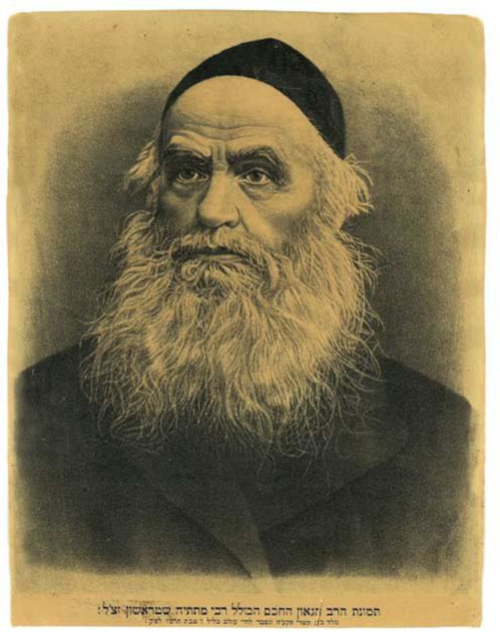
Here is p. 273 in the book, which includes a picture of R. Weinberg.
  
Not noted by Eliach is that this picture comes from my post herewhere I published it for the first time (and thanked the person who gave it to me). I realize that once the picture is on the internet it is there for anyone to use it, but it would still be nice if people would acknowledge where it came from.
Eliach also includes a lengthy interview with R. Bezalel Rakow of Gateshead which understandably has a good deal about R. Weinberg. (I have previously discussed R. Rakow here and here.) What I find fascinating is how people like Eliach simply can’t get a handle on R. Weinberg. On the one hand, they know that he was a great scholar and posek. On the other hand, they know that his views were not in line with the haredi world. Eliach asks R. Rakow the following (p. 274):
בשורה התחתונה – שאלתי את הרב ראקוב – האם הרב ויינברג מוגדר על ידכם כמנהיג תורני חרדי?
Eliach wants to know if R. Rakow regards R. Weinberg as a haredi Torah leader. R. Rakow responds very diplomatically:
בודאיהגאון הרב ויינברג היה ירא וחרד לדבר ה‘. איש ההלכה הצרופה שחרד על כל סעיף בשלחן ערוך!
R. Rakow knew perfectly well that he was dodging the question, and if the definition of haredi is one who is completely halakhically observant, then R. Soloveitchik and R. Lichtenstein (and endless others) should also be regarded as haredi leaders. Only in the continuation of the interview does R. Rakow acknowledge that R. Weinberg’s views were not all in line with the haredi approach (p. 276):
ועדיין ניתן לומרשאי אלה ממחשבותיו לא עלו בקנה אחד עם הדרך המקובלת לנו מרבותינו.
Now for the obvious mistake in Eliach’s book. Here is pp. 66-67.


He begins by mentioning that in his book on the Vilna Gaon he told a story that before World War II, R. Aaron Kotler was not sure where he should go, Eretz Yisrael or the United States. He therefore performed the goral ha-Gra and Exodus 4:27 came up: “And the Lord said to Aaron: ‘Go into the wilderness to meet Moses.’” He understood this to refer to R. Moses Feinstein, who at the time was living in the spiritual wilderness of New York.
Eliach states that it has been established that this story is not correct, and he cites the grandsons of R. Kotler who told him that their grandfather was never in doubt about where he was to go. They also pointed out that there is no way that the name “Moses” could have been seen as a reference to R. Moses Feinstein who was not well-known at that time.
So far so good (and these points are so obvious that one wonders how Eliach fell for a typical yeshiva bubbe mayse[1]). However, Eliach continues, and it must be that he is citing something that he was told by one of the current Kotlers, but he has completely mangled it. He writes:
אם היה מקום לסיפורהרי שהפוסק היותר ידוע בימים ההם באמריקההיה הגר יוסף רוזיןנשיא אגודת הרבנים דארצות הברית וקנדה“, ומחבר ספרי “נזר הקודש“.
Eliach tells us that if the story is true, it would have been with reference to R. Joseph Rosen, who was the most well-known posek in America at the time, the honorary president of Agudat ha-Rabbonim, and the author of the books entitled Nezer ha-Kodesh.
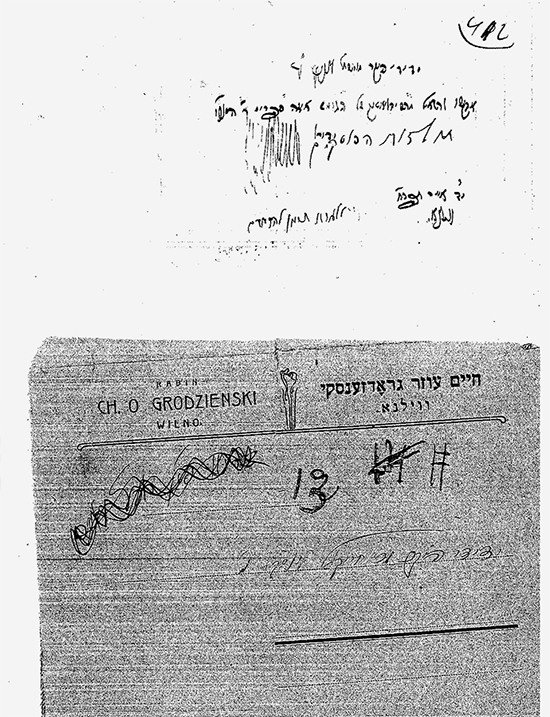
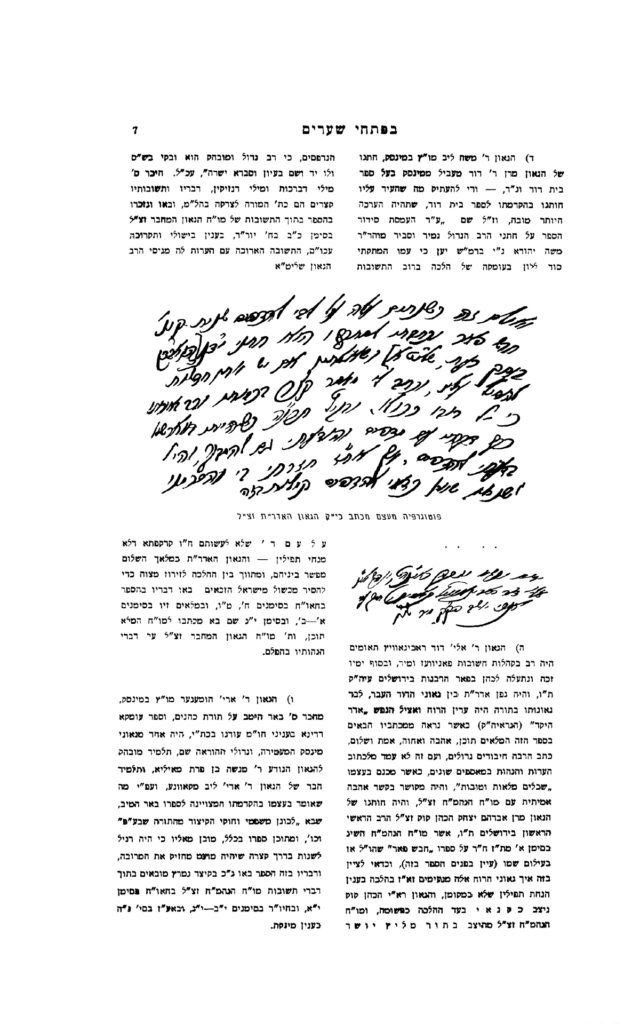
The first thing to ask is how could the goral ha-Gra performed by R. Kotler have anything to do with R. Joseph Rosen when the verse that came up mentioned “Moses”? How Eliach did not see this is beyond me. Furthermore, R. Joseph Rosen not only was not a well-known posek, he was not even a little-known posek. He was also not the president of Agudat ha-Rabbonim, and he never wrote a book called Nezer ha-Kodesh. The only thing of interest, and accurate, in Eliach’s discussion is that he somehow got a copy of the document appointing Rosen rabbi of Passaic, New Jersey, and he includes a picture of this in the book.
Here is what happened: Eliach was told that if the story of R. Aaron Kotler performing goral ha-Gra had any truth to it, the “Moses” referred to would have been R. Moses Rosen, who indeed was a great rav, author of Nezer ha-Kodesh, and served for a time as president of Agudat ha-Rabbonim.[2] R. Rosen is most famous for being the rabbi of Chweidan, Lithuania, where the Hazon Ish’s wife was from and where the Hazon Ish lived after getting married. R. Rosen and the Hazon Ish became close, and supposedly it was R. Rosen who first told R. Hayyim Ozer Grodzinski about the unknown genius, R. Abraham Isaiah Karelitz.[3] The Hazon Ish also proofread the volume of Nezer ha-Kodesh on Zevahim. This was published in Vilna in 1929 when R. Rosen was already living in the United States.[4] While R. Rosen is famous for his connection to the Hazon Ish, not so well known is that he was also a Zionist.[5]
3. My last post here gave examples of grammatical mistakes in the ArtScroll and Koren siddurim, which are the most popular in the English-speaking world. I received a lot of feedback about this, and I did not realize that so many people are interested in the often arcane points of grammar. (While I myself am quite interested in this, I am hardly an expert.) Here are a couple of more examples (and interested readers should consult the comments to the last post for additional instances).
In Ashrei we read עיני כל אליך, which comes from Psalms 145:15. The correct way to read עיני is with the accent on the ע, not on the נ. This word is commonly mispronounced, and neither ArtScroll nor Koren place the accent where it should be.[5a]
I found another mistake in the ArtScroll Machzor for Rosh ha-Shanah and Yom Kippur. In the prayer of the chazzan before Musaf, he says הפך [נאלנו ולכל ישראל. Some versions have the first word as הפוך. In both cases, since this is an imperative there needs to be a hataf patah under the ה. Yet in the ArtScroll Machzor there is a patah under the ה and the accent in הפך is mistakenly put on the first syllable, the ה. [After writing this I checked the second edition of the Machzor and was happy to see that it has been corrected. This shows that any errors we point out are valuable, as ArtScroll is prepared to correct them in future editions.]

Btzalel Shandelman wrote to me about ArtScroll’s comment on Genesis 39:8, which explains why there is a pesik following the word וימאן

The adverb adamantly is suggested by the staccato and emphatic Masoretic cantillation of this word: the shalsheles, followed by a psik [disjunction], both of which set off the word and enhance the absoluteness of its implication. It indicates that Joseph’s refusal was constant, categorical, and definite. He repulsed her with absolute firmness. Haamek Davar notes that the Torah gives no reason for his rejection; his sense of right and wrong was so clear that he did not even consider her pleadings. To her, however, he gave an explanation, trying to convince her to stop pestering him.

Shandelman correctly points out that this explanation is based on a mistake, as the vertical line found in the Torah after word וימאן is not a real pesik, as a pesik can never follow a shalshelet in the Torah (or the other sixteen biblical books that use the Torah’s system of cantillation). The reason for this is that a pesik is only found after conjunctive te’amim, and in the Torah shalshelet is always disjunctive. So why is there a vertical line after shalshelet if it is not a pesik? Joshua R. Jacobson explains:

In the te’amim of the three books (ספרי אמת), the shalshelet sign can serve as both a conjunctive and a disjunctive accent. To distinguish one from the other, a vertical line was added after the disjunctive shalshelet. Even though in the twenty-one books the shalshelet sign has only one use – as a disjunctive accent – nevertheless, the Masoretes retained the vertical line. . . . The vertical line after the shalshelet word is not a pasek: it does not indicate an extra pause.[6]

Another way to put this is that in the Torah the vertical line that always follows the shalshelet is not a separate symbol, but rather part of the shalshelet.
Nevertheless, pre-modern Hebrew texts that deal with masoretic matters seem to have no other way to refer to the vertical line, so it is called a pesik even by those who recognize that it does not function as a pesik. Thus, in the Masorah Gedolah to Lev. 8:23 it states:
ז‘ מלין בטעמא מרעימין ומפסיקין
מרעים is another word for shalshelet.
Returning to the example noted by Shandelman, I replied to him that the mistake is not that of ArtScroll. Although it is not clear in the excerpt printed above, the comment about a pesik following the shalshelet has its origin in R. Naphtali Zvi Judah Berlin’s Ha’amek Davar.[7] This is actually a common mistake, as the rules of trop are not well known. Unless someone has studied these rules, he will have no reason to assume that a vertical line is not a real pesik. The next step is to offer explanations of verses based on this assumption that the vertical line represents a real pesik after the shalshelet.
I don’t think that any of the following explanations are based on the mere appearance of the vertical line. Rather, the authors assume that it is a real pesik and one can therefore base interpretations on it.
R. Tuviah ben Eliezer (12th century) writes:[8]
וימאן מיאון אחר מיאון הרבה פעמים דכתיב בפסיק ובשלשלת
Solomon Buber, the editor of the text, explains R. Tuviah’s words:
דורש הטעמיםכי על וימאן הוא שלשלת ואחכ הוא בפסיק
R. Yeruham Levovitz stated as follows:[9]
ועל כן תיכף לוימאן” יש פסיקכי הופסק אצלו כל הענין אף טרם ניתח העולה על הרוחאף טרם נתן כל טעם וביאור על המיאוןכי טרם כל וכל הוא ממאן על הדבר וחסלוהטעמים והביאורים יתן אחרי כןוזהו אמרו אחרי הפסיקואומר אל אשת אדוניו וגו‘.
R. Samuel Borenstein writes:[10]
וימאן מוטעם בשלשלת ופסיקכדי להפרידו בפעוהיינו שהמיאון לא הי‘ מחמת הטעם אלא מצד עצם הנפש למעלה מהטעם.
R. Shlomo Zvi Schueck leaves no question that in his mind the vertical line is a real pesik.[11]
ואמרתי שחכזל דרשו זאת מן הטעם שלשלת העומדת על תיבת וימאן אם רצו להודיע בטעם שלשלת להפסיק שם בדיבור למה בחרו בניגון זה דוקאהא כמה טעמים מפסיקין הםועוד הא אחר תיבת וימאן הוא עומד הקו פסיקולמה לן תרי מפסיקין כאן?
R. Shlomo Amar writes:[12]
תיבת וימאן” הכתובה בפסוק מוטעמת בטעם שלשלתומיד לאחריה מופיע טעם פסקונראה דזה בא ללמדשיוסף הצדיק מיאן במיאון אדיר וחזקוגם מיאונו היה פסוק וחתוך.
I would only add that it is very difficult to say about so many great sages, ועפר אני תחת רגליהם, that they are wrong about the function of the pesik following a shalshelet. What I have written is based on the standard works on the topic. However, if anyone knows of an authentic tradition in which there is a pesik after shalshelet, please let me know. 

Finally, as I am writing this post not long after Hanukkah, here is an example of a translation where ArtScroll gets it right and pretty much everyone else I have checked gets it wrong (though we can understand why they intentionally get it wrong). In Maoz Tzur we read:
לעת תכין מטבח מצר המנבח
אז אגמור בשיר מזמור חנכת המזבח
ArtScroll translates:
When you will have prepared the slaughter for the blaspheming[13] foe,
Then I shall complete with a song of hymn the dedication of the Altar.[14]
Here is Koren’s translation of the first line:

When you silence the loud-mouthed foe.

This a much more comfortable rendering, and if you examine other siddurim you will find similar “softer” translations. Given the choice between “slaughter” and “silence,” most people will pick the latter. Yet unfortunately for them, the text does not say “silence.” It says “slaughter,” and the words תכין מטבח are based on Isaiah 14:21: הכינו לבניו מטבח, “Prepare ye slaughter for his children.” Koren’s translation is thus a politically correct distortion of the text’s meaning.
This is not a matter that started with Koren. For a long time now, translators have been afraid that if people knew what the text actually said that they would not want to sing the song. Yet how can you have Hanukkah without Maoz Tzur? It is even recited publicly at the White House Hanukkah party. (It is amazing to me that no one has yet made an issue of publicly singing these politically incorrect words.) So, a little bit of creative “translating” was thought necessary. Isn’t it interesting that ArtScroll – which has shown us many times that it has no difficulty censoring and distorting texts it finds problematic – has the courage to give us the correct, uncensored translation?
Interestingly, R. Joseph Hertz in his siddur, p. 950 in the note, tells us what the words mean. Yet was uncomfortable with this, and therefore instead of תכין מטבח he changed it to תשבית מטבח. This is not a version attested to in any old text. It was simply made up by Hertz or perhaps suggested by an unnamed collaborator on his siddur commentary. Hertz writes: “By a slight change, this is now ‘when Thou shalt cause all slaughter to cease, and the blaspheming foe, I will complete, etc.’”[15]
4. Since I have been discussing the ArtScroll and Koren siddurim, it is only right for me to mention that there is a new siddur on the market. The new RCA siddur, called Siddur Avodat Halev, has just appeared. For decades, Modern Orthodox synagogues had to make do with the RCA ArtScroll siddur. However, other than including the prayer for the State of Israel, there was nothing in that siddur that made it a good fit with Modern Orthodox synagogues.
The new RCA siddur, which will come to be the standard at hundreds of synagogues for decades to come (especially as the RCA ArtScroll siddur is no longer being sold), is a siddur that the Modern Orthodox community can embrace. The commentary and essays – including essays by R. Jehiel Jacob Weinberg, R. Joseph B. Soloveitchik, R. Aharon Lichtenstein, and R. Yehudah Amital – include both traditional learning and historical scholarship, something that is not found in any siddur on the market. There is also an attention to the role of women that is welcome.[16] Relevant to my last post, this siddur tells women to say מודה אני with a kamatz under the ד. The siddur also offers the option of women forming a mezuman and reciting חברותי נברך. Of particular importance is the inclusion of prayers for Yom Ha-Atzmaut and Yom Yerushalayim. In the instructions before Tahanun, we are informed that Tahanun is omitted on these two days. For Hallel, readers are given the option of reciting with a berakhah or without. I will return to discuss this siddur in a future post, as there is something in it that will be of particular interest to Seforim Blog readers.
Excursus
Earlier in this post I used the expression bubbe mayse. The origin of these words is not “grandmother’s tale,” although that is what is commonly thought. Bubbe mayse is a later corruption of what was originally Bove mayse. I can do no better than quote from the Wikepedia entry here.
The Bovo-Bukh (“Bovo book”; also known as Baba Buch, etc.; Yiddish: בָּבָאבּוּךבּוֹבוֹבּוּך ‬), written in 1507–1508 by Elia Levita, was the most popular chivalric romance in Yiddish. It was first printed in 1541, being the first non-religious book to be printed in Yiddish. For five centuries, it endured at least 40 editions. It is written in ottava rima and, according to Sol Liptzin, is “generally regarded as the most outstanding poetic work in Old Yiddish”. [Liptzin, 1972, 5, 7]
The theme derives from the Anglo-Norman romance of Bevis of Hampton, by way of an Italian poem that had modified the name Bevis of Hampton to Buovo d’Antona and had, itself, been through at least thirty editions at the time of translation and adaptation into Yiddish. The central theme is the love of Bovo and Druziane. [Liptzin, 1972, 6], [Gottheil] The story “had no basis in Jewish reality”, but compared to other chivalric romances it “tone[s] down the Christian symbols of his original” and “substitute[s] Jewish customs, Jewish values and Jewish traits of character here and there…” [Liptzin, 1972, 8]
The character was also popular in Russian folk culture as “Prince Bova”.
The Bovo-Bukh later became known in the late 18th century as Bove-mayse “Bove’s tale”. This name was corrupted into bube mayse “grandmother’s tale”, meaning “old wives’ tale”. [Liptzin, 1972, 7]
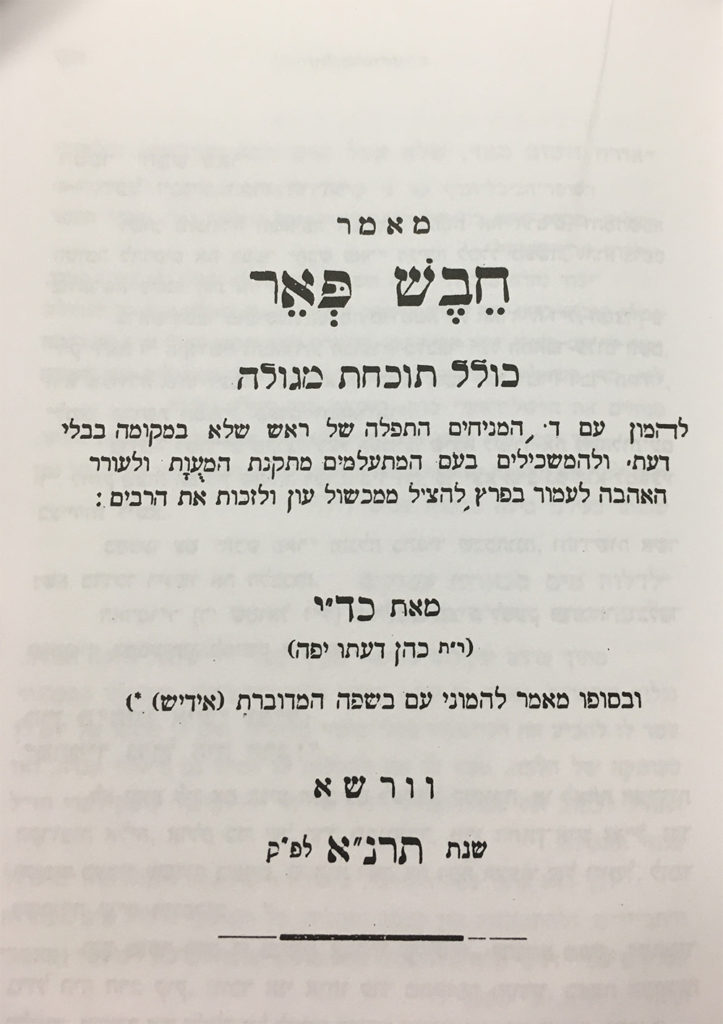
Here is the title page of the Bovo Bukh.

R. Elijah Levita (1469-1549), who thought it worth his time to produce Yiddish romances – in addition to the Bovo Bukh he published Paris and Vienna – is also the well-known author of, among other works, the Tishbi, the Hebrew dictionary that is still used today.[17] It was recently reprinted by Yeshivat Kise Rahamim together with comments by later authors including R. Meir Mazuz. Here is the title page.

At the end of the volume, there is a collection of critical comments on the Tishbi by R. Solomon Zvi Schueck, and responses to R. Schueck by R. Aryeh Mazuz. Interestingly, there were two printings of the Kise Rahamim edition of the Tishbi. The one intended for sale in certain haredi neighborhoods did not include the comments of R. Schueck, as he is persona non grata among extremist haredim. Regarding the two editions, see Dan Rabinowitz’s earlier Seforim Blog post here.
For more on Levita, who even has a street named after him in Tel Aviv, see the Seforim Blog post by Dan Yardeni here. It is also worth noting that former British Prime Minister David Cameron is descended from Levita. See here.
I would be remiss in not mentioning that two grandsons of Levita also played a role in Jewish history. One was named Vittorio Eliano (which means “from the house of Elijah”), and the other was his brother Giovanni Battista. They were both apostates. Eliano became a priest as did Battista, who was actually a Jesuit.[18] Battista testified before the Inquisition in Venice and stated that “the Talmud teaches them [Jews] that it is legitimate to orally swear false oaths, even if they do not come from the heart, along with hundreds of thousands of other things which are injurious to Christianity.”[19]
During the great sixteenth-century dispute in Venice between two Christian printers of Hebrew books – a dispute that also involved R. Meir Katzenellenbogen and R. Moses Isserles – both Christian sides denounced the other to Rome “for producing works which contained matter offensive to the Holy Catholic Faith.”[20] Eliano and Battista ended up giving testimony about supposedly blasphemous material in the Talmud, which in turn led to the Talmud being burned in Rome, in the Campo de Fiori, on September 9, 1553. Soon after that the Talmud was burned in Venice and in other places in Italy, and the work itself became an illegal text.[21]
In 2011 the following plaque was placed on the ground in the Campo de Fiori in commemoration of the burning of the Talmud.

Although the Talmud was illegal, the Zohar was not. It was none other than the apostate Eliano who had a central role in the second printing of the Zohar in Cremona in 1559-1560, as he was a proof reader.[22] (The first printing was in Mantua in 1558-1560.) This edition “was the preferred of the two editions by eastern European kabbalists.”[23] Contrary to what appears in many books, the Cremona Zohar was published by Jews (although the actual printing was done by a non-Jew, which was standard practice in Italy).[24]
Here is the title page of the Cremona Zohar. You can see at the bottom the statement that the publication was approved by the Inquisition.

Here is the last page of the Cremona Zohar. You can see that Eliano is mentioned as one of the two people who prepared the text for publication.


הבחור כמר ויטוריי אליאנו נכדו של ראש המדקדקים החר אליהו המדקדק סגל זצל
You can also see the actual Latin approval from the Inquisition.
Seeing how Eliano made sure that he was referred to as הבחור כמר, one who did not know better would assume that he was Jewish. Meir Benayahu chalks this up to one of the paradoxes of Jewish Italy:[25]
משומד שמשתבח במלאכת קודש זו ומזכיר שמו בנוסח רבני ועולה על כך שייקרא בתואר כמר” (בקולופון הזוהר), הוא מן הנפלאות שרק הפאראדוכסים המצויים אצל יהודי איטליה יכולים להסבירם.
Graetz,[26] followed by others, states that Eliano wrote the following Hebrew introduction to the Cremona Zohar.

Graetz does not tell us how he knows that Eliano wrote the introduction, and I find it difficult to believe that this is the case. As we can see from the last page of the Cremona edition (printed above), a Jew was also involved with preparing the text for publication. So why not assume, with Isaiah Tishby,[27] that the Jew wrote the introduction, which is a typical pious introduction that one would expect for the Zohar?
In fact, there is evidence that Eliano did not write it. Avraham Yaari called attention to the fact that in the introduction it subtly tells us that there are printing errors because the book was also prepared for publication on Shabbat, a time when Jewish proofreaders would not be able to examine it.[28]
וחסרון חלוף או השמטת אות יוכל להמנות על היות דבר הדפוס נחוץ לכל שומרי שבת כהלכתה ודל.
The word נחוץ here means something along the lines of “harried”. (See I. Sam. 21:9, for the use of the word in the Bible, which has a different meaning than in modern Hebrew.) He is saying that the reason there are mistakes in the text is due to the problems confronted by shomer Shabbat proofreaders (who do not work on Shabbat). In other words, the mistakes in the text are due to the one who did work on Shabbat. Such a line, criticizing the proofreader who worked on Shabbat, could not have been written by the apostate Eliano. On the contrary, it must be seen as directed against Eliano. This is an important point which I have not seen anyone make. There is another point which no one has made, and that is that on the second line of the introduction the author left an allusion to Eliano:
ואותיות ידועות לפי צורך המקום אלינו
Another book Eliano was involved with was Hizkuni,[29] printed in Cremona in 1559.[30] Here is the last page of the book which states:
הוגה ברוב העיון עי הבחור ויטוריו אליאנו נכד ראש המדקדקים החר אליהו בחור אשכנזי סגל זצל

While on the topic of apostates and the Zohar, here is another interesting point. The Soncino Press of London published a translation of the Zohar. For some of this translation they had the assistance of Paul Levertoff. Here is the title page of one of the volumes.

What makes this so significant is that Levertoff, who began life as a Habad Hasid and later studied in Volozhin, was an apostate.[31] If you search on the internet you will find that Levertoff continues to have a real influence among Messianic Jews.
I find it astounding that the Soncino Press, which was identified with British Orthodoxy, chose to collaborate on the Zohar translation with an apostate, especially an apostate who was a “true believer,” not simply an opportunist like Daniel Chwolson. Supposedly, late in life Chwolson was asked what he came to believe that led him to adopt Christianity. He replied: “I believed that it was better to be a professor in St. Petersburg than a melamed in Anatevka [insert whatever shtetl name you wish].” He also famously said about himself, punning on the words from the Yom Kippur liturgy,[32] “Ve-Akhshav she-Notzarti [= converted to Christianity] ke-Ilu lo Notzarti.”[33]

________________
[1] See Excursus.
[2] See Ha-Pardes (January 1953), p. 52.
[3] Shlomo Kohen, Pe’er ha-Dor, vol. 1, p. 191. As far I as I know, the report in Asher Rand, Toldot Anshei Shem (New York, 1950), p. 62, that R. Rosen and the Hazon Ish established a yeshiva together, is without foundation.
[4] Orhot Rabbenu (2014 edition), vol. 5, p. 138. This source does not mention which volume of Nezer ha-Kodesh it was, but the volume on Zevahim was the only one printed in Vilna. Since R. Rosen was living in the United States, this explains why it would have been much more convenient for for the Hazon Ish to do the proofreading. According to Cohen, Pe’er ha-Dor, vol. 1, p. 270, some of the material in the book in brackets is from the Hazon Ish. Cohen also states regarding these comments:

רובן פותחות במיהו” ולפעמים צויין בראשיתיבות שור (שוב ראיתי). כששאלו אותואיך זה תואם את האמתהשיב החזוןאיש באירוניהלא שוב ראיתי“, כי אם שוב וראה“.
For מיהו see pp. 69, 82, 88. For שו”ר see pp. 84, 86.
[5] See Entzyklopedia shel ha-Tziyonut ha-Datit, vol. 5, cols. 597-598.
[5a] It could be that עיני is not to be read with full stress on the ע, but only a partial stress, with the real accent on the connected word כל (in the Aleppo Codex עיני is joined to כל with a makef). Yet there certainly is no accent on the נ of עיני. See R. Yedidyah Solomon Norzi, Ma’amar ha-Ma’arikh in Norzi, Ha-Nosafot le-Minhat Shai, ed. Zvi Betser (Jerusalem, 1997), pp. 97ff.
[6] Chanting the Hebrew Bible: The Art of Cantillation (Philadelphia, 2002), p. 105 n. 14, 107. See also ibid., p. 233 n. 2, and Mordechai Breuer, Ṭaʻamei ha-Miḳra be-Khaf-Alef Sefarim u-ve-Sifrei Alef-Mem-Taṿ (Jerusalem, 1982), p. 19.
[7] See the Jerusalem, 2005 edition, p. 534. 

ומשום הכי איתא פסיקכדי שלא נפרש דמשום הכי מיאן בשביל ויאמר וגו‘”, אבל הפסיק מלמד שהמיאון היה בפני עצמו.

This comment was not part of the original commentary but was added later by the Netziv. In this edition, the editors have inserted the comment in the text of Ha’amek Davar, but inside brackets that look like this {} to show that it is a later addition.

[8] Lekah Tov, ed. Buber, p. 198.

[9] Da’at Torah: Bereshit (Jerusalem, n.d.), p. 230.
[10] Shem mi-Shemuel (Jerusalem, 1992), parashat Va-Yeshev, p. 69.
[11] Torah Shelemah (Satmar, 1909), vol. 1, p. 179a.
[12] Birkat Eliyahu (Jerusalem, 2007), vol. 1, p. 260.
[13] The word נבח, which literally means “bark” (see Isaiah 56:10, Eruvin 86a), had an anti-Christian connotation in medieval Hebrew. See Eli Yassif, ed. Sefer ha-Zikhronot (Tel Aviv, 2001), p. 404 n. 87; Daniel Goldschmidt and Avraham Frankel, eds., Leket Piyutei Selihot me-et Paytanei Ashkenaz ve-Tzarfat (Jerusalem, 1993), vol. 1, p. 398. Thus, in Maoz Tzur the “blaspheming foe” refers to the Christians.
R. Shlomo Fisher, Derashot Beit Yishai (Jerusalem, 2004), p. 234 writes:
ויבואר עפ כל זהדברי הפייטן בזמר לחנוכהתכון בית לתפלתי ושם תודה נזבחלעת תכין מטבח מצר המנבחדהיינו טביחת היצהר
This would make a very nice derashah on Hanukkah, and had Hertz known of it, he could have offered this perspective in his commentary and kept the original version of the song. Yet in its historical context, this is hardly what the author is referring to. Similarly, R. Raymond Apple is not correct when he writes that the words refer to “the defeat of Gog and Magog who will attempt to overcome Israel before the coming of the Messiah.” See here. When Maoz Tzur speaks of the destruction of the “barking [i.e., blaspheming] foe,” it is referring to a real flesh and blood enemy of the Jewish people, which in the medieval Ashkenazic context means the Christian world. The word “barking” is used in this song as throughout pre-modern Jewish literature dogs were portrayed in a negative way. See also here.
[14] I do not know why ArtScroll capitalizes “Altar”.
R. Meir Mazuz recently commented that while Maoz Tzur is a wonderful song, “it contains small [grammatical] errors, as is the practice with the Ashkenazim who do not know Hebrew well.” Bayit Ne’eman, no. 139 (30 Kislev 5779), p. 1 n. 1. One example he gives is לעת תכין מטבח מצר המנבח. It should say לצר המנבח. He adds:
מאיפה אני לומד את זהמפסוק בישעיה הכינו לבניו מטבח בעוון אבותם” (יד כא), לא מבניו אלא לבניו.
Regarding Hanukkah, I recently found that R. Naphtali Zvi Judah Berlin suggests the possibility that when the Maccabees entered the Temple they did not light the menorah, as we are accustomed to think, but rather only lit one candle. See Ha’amek She’alah, Va-Yishlah, no. 24, p. 173:
ולכאורה הי‘ אפשר לומר שלא היו מדליקים אז במנורה כלל . . . ואכ הי‘ מקום לומר שלא השתמשו באותם שמונה ימים במנורה כלל משום שלא הי‘ להםוהדליקו באותו פך הטהוראו בכלי גללים וכלי אבנים וכלי אדמהואכ לא הי‘ אלא נר א‘ כדי לקיים להעלות נר תמיד

Also of interest is R. Joseph Messas, Otzar ha-Mikhtavim, vol. 2, no. 1305, who cites midrashic sources that there will not be a menorah in the future Temple.

 
I have vocalized the title of the Netziv’s book as Ha’amek She’alah, which is how scholars have been accustomed to write it, based on Isaiah 7:11 where these words appear.
However, Gil S. Perl argues that the correct pronunciation is Ha’amek She’elah. As he puts it, if the pronunciation in Isaiah was intended, “the title would mean ‘sink to the depths,’ the ‘depths’ (from the word she’ol) being a reference to the netherworld or Hell—a rather strange title for a work of halakhic commentary.” Perl therefore suggest that the Netziv “intended his title as a play on those words from Isaiah pronounced Ha’amek She’alah, meaning ‘delve into the question’ or perhaps ‘delve into the She’ilta.’” See Perl, The Pillar of Volozhin (Boston, 2012), pp. 17-18, n. 37.
[15] Regarding how Maoz Tzur appears in British siddurim, see John D. Rayner, “Liturgical Emendation: The Case of the Ma’oz Tzur,” available here.
[16] For more on the new RCA siddur and women, see the anonymous post here.
[17] The Tishbi was first printed in Isny, Germany in 1541. It is one of the first Jewish books to cite biblical passages by chapter. As most people know, the chapters are a Christian innovation. According to Abraham Berliner, the first Jewish scholar to publish a book using the chapter divisions was R. Isaac Nathan, who published a biblical concordance between 1437 and 1448. See Berliner, Ketavim Nivharim (Jerusalem, 1969), vol. 2, p. 134. On this page Berliner also writes:

החלוקה לפרקים של כל ספרי המקרא נתקבלה ונתפשטה רק עם הדפסת המהדורה השניה של המקראות הגדולות (ויניציא רפד).
Yet the first edition of the Mikraot Gedolot, published in Venice, 1518, is on Otzar ha-Hokhmah, and you can see that it too has the chapter divisions.
[18] See Heinrich Graetz, Geschichte der Juden (Leipzig, 1907), vol. 9, p. 320; Encyclopaedia Judaica, vol. 6, col. 615; Meir Benayahu, Ha-Defus ha-Ivri bi-Kremona (Jerusalem, 1971), pp. 95ff.. For sections of an autobiography written by Battista, in which he describes his apostasy, see Isaiah Sonne, Mi-Paʾulo ha-Reviʻi ad Piyus ha-Hamishi (Jerusalem, 1954), pp. 150-155.
[19] See Amnon Roz-Krakotzkin, The Censor, the Editor, and the Text: The Catholic Church and the Shaping of the Jewish Canon in the Sixteenth Century, trans. Jackie Feldman (Philadelphia, 1007), pp. 42-43.
[20] Cecil Roth, The History of the Jews of Italy (Philadelphia, 1946), p. 291.
[21] See Roth, The History of the Jews of Italy, p. 292. For detailed discussion of this matter, which shows all the other factors that were present, see Kenneth Stow, “The Burning of the Talmud in 1553, in the Light of Sixteenth Century Catholic Attitudes Toward the Talmud,” Bibliothèque d’Humanisme et Renaissance 34 (1972), pp. 435-459.
[22] Regarding Allessandro Franceschi, another sixteenth-century Italian apostate who supported the printing of the Zohar, see Yaakob Dweck, The Scandal of Kabbalah (Princeton, 2011), pp. 166-167.
[23]  Marvin J. Heller, The Sixteenth Century Hebrew Book (Leiden and Boston, 2004), vol. 1, p. 503.
[24] See Yitzhak Yudelov, “Al Sefarim, Madpisim, u-Mo”lim,” in Yosef Eliyahu Movshovitz, ed., Ha-Sefer (Jerusalem, 2008), vol. 2, p. 557 n. 22.
[25] Ha-Defus bi-Kremona, p. 97.
[26] Geschichte, vol. 9, p. 345.
[27] “Ha-Pulmus al Sefer ha-Zohar,” Perakim 1 (1967-1968), p. 147 n. 54.
[28] Mehkerei Sefer (Jerusalem, 1958), pp. 170-171. Yaari also mentions other Hebrew books that were printed on Shabbat.
[29] Regarding how חזקוני is to be pronounced, see my post here.
[30] For other examples of Hebrew books whose printing Eliano was involved with, see the index of both Roz-Krakotzkin, The Censor, the Editor, and the Text and Benayahu, Ha-Defus ha-Ivri bi-Kremona.
[31] See Elliot R. Wolfson, “Paul Philip Levertoff and the Popularization of Kabbalah as a Missionizing Tactic,” Kabbalah 27 (2012), pp. 269-320. On p. 272, Wolfson states that Levertoff received semikhah from R. Naphtali Zvi Judah Berlin. He provides no evidence for this assertion so I cannot judge its accuracy. As far as I have been able to determine, Levertoff never received semikhah.
[32] The passage originates in the Talmud, Berakhot 17a, where it is attributed to Rava, and Yoma 87b, where it is attributed to R. Hamnuna.
[33] See Zvi Hirsch Masliansky, Memoirs, trans. Isaac Schwartz and Zviah Nardi (Jerusalem, 2009), p. 138.


Two Jewish Temples in Egypt

Two Jewish Temples in Egypt

Rabbi Reuven Chaim Klein is the author of the newly-released work God versus Gods: Judaism in the Age of Idolatry (Mosaica Press, 2018). His book follows the narrative of Tanakh and focuses on the stories concerning Avodah Zarah using both traditional and academic sources. It also includes an encyclopedia of all the different types of idolatry mentioned in the Bible. Rabbi Klein studied for over a decade at the premier institutes of the Hareidi world, including Beth Medrash Govoha in Lakewood and Yeshivas Mir in Jerusalem. He authored many articles both in English and Hebrew, and his first book Lashon HaKodesh: History, Holiness, & Hebrew (Mosaica Press, 2014) became an instant classic. His weekly articles on synonyms in the Hebrew language are published in the Jewish Press and Ohrnet. Rabbi Klein lives with his family in Beitar Illit, Israel and can be reached via email to: rabbircklein@gmail.com
 
In this article, we will discuss two different temples which the Jews built in Egypt: the temple at Elephantine, and Chonyo’s Temple. After providing the reader with the historical background to both temples, we will analyze the nature of the worship which took place there, as well as their possible Halachic legitimacy.

The Temple at Elephantine

Ancient papyri found on the Egyptian island Elephantine (יב, Yev in Aramaic) reveal the forgotten story of a Jewish Temple that was built there.
According to those documents, Jews living in Egypt when it was still an independent state built a Temple for Hashem at Elephantine. This occurred after the destruction of the First Temple, but before the construction of the Second Temple. Later, when the Persians conquered Egypt, they destroyed most of its temples,[1] but allowed the Jewish Temple at Elephantine to remain. Sometime afterwards, the priests of the Egyptian deity Khnum and the local Persian rulers colluded against the Jewish community at Elephantine, destroying their Temple and taking the Temple’s gold and silver for themselves.
The Jewish priests of the Elephantine temple, led by a priest named Jedaniah, sent letters appealing to the Persian-appointed Jewish governor of Judah and the Cuthean governate of Samaria to intervene on their behalf, and lobby the Persians for the restoration of their temple. In these letters, the priests of Elephantine repeatedly mentioned that they wished to resume sacrificing meal-offerings, burnt-offerings, and incense (which as we will see seems to be Halachicly problematic). It seems that the Second Temple in Jerusalem had already been built by this time; as the Elephantine priests mentioned in their letter that they had also written to Yochanan, the Kohen Gadol in Jerusalem, but had not received a reply.
The Elephantine Temple was eventually rebuilt, but the Jewish community at Elephantine did not last much longer.[2]

Were the Jews at Elephantine Loyal to Halachah?

The academic consensus views the Jews at Elephantine as practitioners of a syncretistic mixture of Judaism and Egyptian/Aramean idolatrous
cults.
[3] This comes as no surprise, because Jeremiah (Chapter 44) already mentioned that the Jews who remained in Judah after the destruction
of the First Temple and the subsequent assassination of Gedaliah (the Babylonian-appointed Jewish governor over what remained of Judah) migrated to Egypt, where they engaged in idol worship.
[4] As such, the deviant practices of these wayward Jews does not warrant any attempt at justification.[5]
However, some scholars have called this picture into question. In the Ancient Levant, it was standard practice for people to bear personal names
that refer to their gods. Such references to deities within a person’s name is known as a theophoric element. Accordingly, if the Jewish community at Elephantine was truly syncretistic, then we would expect the Jews of that community to incorporate the names of foreign gods into their personal names. But the evidence shows that they did not. Partially because of this lack of idolatrous theophoric elements, some scholars argue that the Jewish community at Elephantine was not idolatrous—rather they remained wholly devoted to Hashem. These scholars explain away alleged allusions to foreign gods at Elephantine as the assimilation of various pagan religious
concepts into their brand Judaism, as opposed to the outright acceptance of pagan deities.[6] Similarly, the Jews at Elephantine may have used Aramean phraseology to refer to Jewish ideas, but they did not adopt Aramean religion.[7]
According to this approach, we must seek out the Halachic justification for offering sacrifices at the temple in Elephantine, a practice which seems to defy the Torah’s ban on sacrifices outside of the Holy Temple in Jerusalem. Assuming that the Elephantine Jews were basically loyal to normative Judaism, how did they justify building a temple, complete with sacrifices?
As mentioned previously, it seems that those Jews who built the Temple at Elephantine only did so after the destruction of the First Temple in Jerusalem. Based on this, R. Ephraim Dov ha-Kohen Lapp (1859–1925) proposes that they followed a minority Halachic opinion which maintains that when the First Temple was destroyed, the site in Jerusalem lost it holy status, thus legitimizing the use of private altars.[8] Accordingly, the Temple at Elephantine had the Halachic status of a legitimate private altar. As a result of this status, the Jews at Elephantine only offered voluntary, votive sacrifices such as meal-offerings, burnt-offerings, and incense (as opposed to obligatory sacrifices, like sin-offerings or guilt-offerings). This
is, in fact, in accordance with the Mishnah
[9] that limits the permissible sacrifices at legitimate private altars to exactly such offerings.[10]

Private Altars in the Second Temple Period

Nonetheless, the issue that remains unresolved is why this temple was not discontinued or dismantled upon the construction of the Second Temple. We can possibly resolve this question by comparing the issue of the temple at Elephantine to the issue of private altars in the Kingdom of Judah.
As evident in the Book of Kings, private altars existed in the Kingdom of Judah throughout the First Temple period. There was no systematic
campaign to destroy them until Hezekiah came along. This begs the question: Why did righteous kings of Judah, such as Asa and Jehoshaphat allow these private altars to remain, if sacrifices were only allowed at the Holy Temple in Jerusalem?
R. Moshe Sofer (1762–1839) answers that many of the private altars in question were built before the prohibition of private altars came
into effect (i.e. before the Temple in Jerusalem was built). Therefore, since these private altars were built legitimately, they maintained a certain degree of holiness. Consequently, it was actually
forbidden to destroy them, and this prohibition remained in effect even once using them for ritual purposes became prohibited (i.e., when the Temple was later built). For this reason, even the “good” kings of Judah did not remove the private altars.[11]
Based on this understanding, we can conjecture that a similar approach may have taken hold at the temple in Elephantine. If that temple was
originally built at a time when private altars were permitted (because the First Temple in Jerusalem had already been destroyed), then perhaps some Jews attached a certain degree of holiness to the temple, and refused to dismantle it after the Second Temple in Jerusalem was built. Nonetheless, even if they were justified in allowing the temple at Elephantine to remain standing, there does not seem to be any justification for continuing to offer sacrifices outside of Jerusalem once the Second Temple was built.

The House of Chonyo

The Mishnah[12] mentions another Jewish temple in Egypt—the House of Chonyo (Onias). Chonyo was the son[13] of Shimon the Just, a righteous Kohen Gadol in the Second Temple in Jerusalem. Before his death, Shimon the Just said that his son Chonyo should succeed him as Kohen Gadol.
The Talmud[14] offers two Tannaic accounts of how Chonyo’s temple came about. According to R. Meir, Chonyo’s older brother Shimi became jealous that their father chose Chonyo to succeed him, so he tricked Chonyo into making a mockery of the Temple rituals and angering the other Kohanim. Shimi gave Chonyo “instructions” for his inaugural service by telling him that he was expected to wear a leather blouse and a special belt.
When Chonyo came to the altar wearing those “feminine” articles of clothing, Shimi insinuated to the other Kohanim that Chonyo wore those clothes in order to fulfill a promise to his “lover”.
[15] This raised their ire and they chased him to the Egyptian city of Alexandria,[16] where he established an idolatrous temple.
According to R. Yehudah, the story unfolds differently. Although Shimon the Just advised that his son Chonyo should become the next Kohen Gadol, Chonyo deferred that honor, allowing his older brother Shimi to be appointed instead. Nonetheless, Chonyo became jealous of his older brother, so he devised a plan to embarrass him and deprive him of his office. Chonyo gave Shimi “instructions” for his inaugural service by telling him that he was expected to wear a leather blouse and a special belt. When Shimi came to the altar wearing those “feminine” articles of clothes, Chonyo insinuated to the other Kohanim that Shimi wore those clothes in order to fulfill a promise to his “lover”. When the other Kohanim found out the truth, i.e. that Chonyo had tricked Shimi by giving him incorrect instructions for his inaugural service, they chased Chonyo to Alexandria, where he established a temple for Hashem.[17]
The Talmud concludes this second account by relating that Chonyo justified the establishment of his temple by citing the words of Isaiah,[18] On
that day, there will be an altar for Hashem inside the Land of Egypt, and a single-stone altar to Hashem next to its border
(Isa. 19:19).

Josephus’ Account of the Chonyo Story

Josephus offers a third account of how Chonyo’s temple was established. After the death of Alexander the Great, Greek holdings in the Middle East were divided between the Seleucid kingdom in Syria and the Ptolemaic kingdom in Egypt. A flashpoint of contention between these two rival kingdoms was the Holy Land, and different groups of Jews took different sides in the conflict. When the Seleucid king, Antiochus Epiphanes, led his army to Jerusalem, he violated the Holy Temple and halted the offering of daily sacrifices for three and a half years.
Chonyo, who was the Kohen Gadol in Jerusalem, was a supporter of the rival Ptolemaic kingdom. When the Seleucids came to Jerusalem, he fled to
Egypt. In Egypt, Ptolemy granted Chonyo permission to establish a Jewish community in the district of Heliopolis. There,
[19] Chonyo built a city resembling Jerusalem, along with a temple that resembled the one in Jerusalem. Centuries later, Chonyos’ temple met its eventual demise at the hands of the Romans. After they destroyed the Second Holy Temple in Jerusalem, the Romans ordered the closure of Chonyo’s temple in Egypt, and eventually its destruction.[20]
Josephus seems to attribute noble intentions to Ptolemy. He was said to have sponsored the establishment of a Jewish temple in Egypt so that the
Jews there would have the opportunity to worship Hashem (and would be more willing to help Ptolemy battle the Seleucids). However, in
explaining Chonyo’s rationale for building the temple in Egypt, Josephus reports that Chonyo built it in order to compete with the Temple in Jerusalem and draw Jews away from worshipping Hashem properly. Chonyo had a bone to pick with the Jewish leadership in Jerusalem on account of their rejection of him, which forced him to flee to Egypt.
Josephus also reports that Chonyo rationalized his building of a temple on foreign soil[22] by citing Isaiah’s above-mentioned prophecy.[22]

Chonyo’s Temple in Halacha

As we have seen above, whether or not Chonyo’s temple was idolatrous remains a matter of contention. According to Josephus and R. Meir,
Chonyo sought to worship something other than Hashem. On the other hand, according to R. Yehuda, Chonyo’s temple was established for
the sake of Hashem. If we follow the first view, then there can be no justification for what Chonyo did and the establishment of his idolatrous temple in Egypt. However, if he sought to worship Hashem, then from a Halachic perspective, there may be two ways of looking at Chonyo’s temple: Either his temple was a place of forbidden worship (albeit not quite idolatry in the classical sense of worshipping a foreign deity), or it might have been a completely legitimate place of worship.
Maimonides[23] follows R. Yehuda’s version of events, and explains that Chonyo’s temple was not idolatrous, per se, even though it violated the ban on sacrifices outside of the Temple in Jerusalem. In other words, the practices at Chonyo’s temple reflected an illegitimate way of worshipping Hashem. Maimonides also notes that many local Egyptians—known as Copts—became involved in Chonyo’s temple, and were thus drawn to worshipping Hashem.
The Tosafists[24] disagree with Maimonides’ premise that Chonyo’s temple violated Halacha. Instead, they explain that Chonyo avoided the prohibition of offering sacrifices outside of the Temple in Jerusalem by only offering sacrifices belonging to non-Jews. According to this approach, there was nothing technically wrong with Chonyo’s temple and the services there.

Gentiles Sacrifices outside of Jerusalem

Nonetheless, the commentators grapple over reconciling the Tosafists’ explanation with the opinion of the Tannaic sage R. Yose who maintains that the prohibition of offering sacrifices outside of Temple even extends to sacrifices of non-Jews.[25]
R. Avrohom Chaim Schor (1560–1632)[26] explains that the dispute about whether Chonyo’s temple was legitimate or not centers around whether or not one accepts R. Yose’s view. In other words, R. Meir accepted R. Yose’s view that even a non-Jew’s sacrifices may only be offered in the Holy Temple. As a result of that, R. Meir understood that Chonyo’s temple must have been illegitimate, so he branded the temple idolatrous. In contrast, R. Yehuda rejected R. Yose’s opinion, so he reasoned that there could be Halachic justification for Chonyo’s temple. Because of this, R. Yehuda asserted that Chonyo’s was not idolatrous, but reflected the genuine worship of Hashem, albeit—as the Tosafists explain—specifically for gentiles.
Alternatively, R. Schor proposes that although R. Yose forbids offering the sacrifices of gentiles outside of the Temple in Jerusalem, this prohibition only applies to Jewish priests. Accordingly, R. Yehuda believed that Chonyo and the Jewish priests at his temple did not actually participate in the ritual offerings there. Rather, they offered instructions for the attending gentiles to properly offer sacrifices to Hashem. In this way, no one at Chonyo’s Jewish-run temple ever violated the prohibition against offering sacrifices outside of the Temple in Jerusalem, because they themselves never engaged in such actions, they only helped the gentiles do so.[27]
Others suggest that even R. Yose differentiates between two different types of sacrifices offered by a non-Jew. If a non-Jew consecrated a sacrifice to be brought in the Temple in Jerusalem,[28] then R. Yose would say that this sacrifice may not be offered outside of the Temple in Jerusalem. However, if a non-Jew consecrated a sacrifice without specific intent that it should be offered in Jerusalem, then his offering may Halachically be brought elsewhere. According to this, all opinions agree that a Jew may offer a gentile’s sacrifice outside of the Temple in Jerusalem provided that the gentile did not initially consecrate the sacrifice with intent to bring to Jerusalem.[29] With this in mind, we may justify the services at Chonyo’s temple by explaining that they only offered the sacrifices of non-Jews that were consecrated without specific intent to be offered in Jerusalem.
R. Yehonassan Eyebschuetz (1690–1764) proposes another answer: the Tosafists’ discussion reflects the rejected opinion of the Amoraic sage R. Yitzchok.[30] R. Yitzchok understood that the prohibition of sacrificing outside of the Temple does not apply outside of the Holy Land, thus justifying the existence of Chonyo’s temple which stood in Egypt.[31]
R. Lapp extends this logic to also justify the continued existence of the Jewish temple at Elephantine (mentioned above), even after the construction of the Second Temple in Jerusalem. He argues that in accordance with R. Yitzchok, the entire prohibition of sacrifices outside of the Temple only applies in the Holy Land, not in Egypt.[32]

Egyptian Temples and Eradication of the Idolatrous Inclination

In short, there were two Jewish Temples in Egypt that coexisted with the Second Temple in Jerusalem: the Jewish Temple at Elephantine and Chonyo’s Temple in Alexandria/Heliopolis. We have shown that it is unclear whether or not these temples were idolatrous. If the two Jewish Temples in Egypt were non-idolatrous, then there may be some Halachic justification for their existence.

This, of course, also does not hamper our understanding of the Talmudic assertion that the idolatrous inclination was abolished with the beginning of the Second Temple Era. However, if these Jewish Temples in Egypt were indeed idolatrous, then they pose a challenge to the Talmudic assertions regarding the elimination of the idolatrous inclination.[33]

We shall resolve this difficulty by addressing each temple separately.

The Elephantine Temple seems to have predated the construction of the Second Temple in Jerusalem, and thus the eradication of the idolatrous inclination. As such, the Temple existed before the sages removed the idolatrous inclination. It is not a stretch of the imagination to postulate that even if the idolatrous inclination suddenly ceased to exist, those who already engaged in systematic idolatry beforehand would continue to do so simply out of habit. Once the Elephantine Temple had already been functioning for some time, it would not simply shut down operations overnight because the sages rid the Jews of the idolatrous inclination. There was too much at stake for the priests and other functionaries who profited from the temple.

Regarding Chonyo’s Temple—which certainly did not predate the construction of the Second Temple—even if it was idolatrous, we can argue that it was not the drive for committing idolatry which led to its establishment. Rather, Chonyo’s own ego and pursuit of honor led him to establish a new Temple in Egypt. Those who participated in his cult were merely supporting characters in Chonyo’s own private scheme. In other words, the existence of Chonyo’s idolatrous temple does not contradict the Talmudic statement that the sages had removed the idolatrous inclination, because the idolatrous inclination was not what drove Chonyo’s temple.

To recap, the Idolatrous inclination was not in play at these two temples. At Elephantine, it was the priests’ greed which motivated their continued idol worship and at Chonyo’s temple, it was a personality cult intended to elevate Chonyo which sponsored idolatry.


[1] The establishment of the Jewish community in Elephantine is uncertain regarding when it happened, although some scholars argue that it predated the destruction of the First Temple. Rabbi Moshe Leib Haberman challenges this assumption, citing the Elephantine Papyri that only reveals that the Jewish settlement was there before Cambyses, but the exact timing is unknown.

[2] Primary sources for the Elephantine Jewish community include B. Porten & A. Yardeni’s Textbook of Aramaic Documents from Ancient Egypt, vol. 1 (1986) and B. Porten’s The Elephantine Papyri in English (1996). Other sources that discuss this community include M.H. Silverman’s “The Religion of the Elephantine Jews—A New Approach” (1973), J.M.P. Smith’s “The Jewish Temple at Elephantine” (1908), and C. Cornell’s “Cult Statuary in the Judean Temple at Yeb” (2016).

[3] The Elephantine Papyri include texts that mention the name of a goddess, Anat-Yahu, which some scholars argue was a syncretistic merge of the Canaanite goddess Anat with Hashem, while others argue that it was wholly an Aramean creation.

[4] J.M.P. Smith suggests that the founders of the Jewish colony at Elephantine were Jews who fled to Egypt instead of remaining in Babylonian-occupied Judah, as called for by Jeremiah.

[5] C. Cornell believes that the Jews in Elephantine worshipped the One Hashem but also held multiple images/idols in their temple, which purported to depict Him in various hypostases.

[6] M.H. Silverman disagrees with the idea that the Jews at Elephantine were entirely idolatrous.

[7] Some scholars suggest that the seemingly idolatrous elements of the Jewish presence at Elephantine were only attempts to evoke Persian sympathy for their cause.

[8] Maimonides rules that the Temple’s site became permanently holy when King Solomon sanctified it, while Raavad disagrees and accepts the opinion that the site was no longer holy after the Temple was destroyed, until it was re-consecrated upon the construction of the Second Temple.

[9] Megillah 1:10 discusses the topic of when the Second Temple was considered to be permanent.

[10] Zivchei Efrayim Al Meseches Zevachim and Responsa Chasam Sofer discuss the question of whether a new site for the Temple would need to be found if the original site was lost.

[11] Responsa Chasam Sofer (Orach Chaim §32). See also R.C. Klein, God versus Gods: Judaism in the Age of Idolatry (Mosaica Press, 2018), pgs. 28–32.
[12] Menachos 13:10.
[13] In Antiquities, Josephus attributes the temple in Egypt to a later Chonyo, who was not the son of Shimon the Just. Nonetheless, some scholars claim that Josephus purposely attributed the establishment of the temple in Egypt to a later Chonyo who had never served as Kohen Gadol in
Jerusalem in order to delegitimize its religious value. See J. E. Taylor, “A Second Temple in Egypt: the Evidence for the Zadokite Temple of Onias,”
Journal for the Study of Judaism vol. 29:3 (1998), pgs. 297–321. Interestingly, R. Yisroel Lipschitz
(1782–1860) in
Tiferes
Yisroel
(Menachos 13:10, Boaz §2)
writes that the Chonyo in discussion was not literally a
son of Shimon the Just, but rather a grandson of Shimon the Just (a son of Shimon’s son Chonyo), accepting
Josephus’s account and adjusting his understanding of the Talmud
accordingly.
[14] TB Menachos 109b.
[15] R. Gershom and Rashi explain that this “lover” was his wife. Maimonides (in his commentary to the Mishnah Menachos
13:10) writes that this “lover” was an alleged mistress.
[16] TB Yoma 38a and JT Shekalim 5:1 relate that the House of Garmu did not wish to reveal the secrets
behind making the shew-bread and the House of Avtinas did not wish to
reveal the secrets behind making the incense for the Temple. In
response, artisans from Alexandria were imported to try and mimic
those secret recipes, but they were unsuccessful in exactly copying
what those families had been able to make. Both R. Yosef Shaul
Nathansohn (1808–1875) in
Divrei Shaul (to TB Yoma
38a) and R. Shalom Massas (1909–2003) in
ve-Cham
ha-Shemesh

(Jerusalem, 2003) pp. 326–327 independently draw an explicit
connection these Alexandrian artisans to Chonyo’s Temple in
Alexandria, although no other authorities do so. The notion of
Alexandrian artisans being unable to exactly replicate something from
Jerusalem is also found in Targum to Est. 1, which relates that
Achashverosh wished to create a replica of King Solomon’s famed
throne, and employed Alexandrian artisans to do so—but to no avail.
That story must have transpired before the establishment of Chonyo’s
Temple in Alexandria because Achashverosh lived before the
construction of the Second Temple. In light of this, we may suggest
that Alexandrian artisans were employed in all cases simply because
Greek Alexandria was a center of knowledge in its time, so the most
knowledgeable craftspeople lived there.
[17] The Jerusalem Talmud (JT Yoma 6:3) slightly differs in its retelling of this discussion. Whilst in
the Babylonian Talmud, the names of the two rival sons of Shimon the
Just are Chonyo and Shimi, in the Jerusalem Talmud, they are
Nechunyon and Shimon. However, R. Tanchum ha-Yerushalmi (a 13
th
century Egyptian Rabbi) writes that Chonyo had two names, Chonyo and
Nechunyo; see B. Toledano (ed.),
ha-Madrich
ha-Maspik
(Tel Aviv, 1961), pg. 154.
Furthermore, according to the Babylonian Talmud, R. Meir believed that Chonyo was
the victim of Shimi’s deceit and ended up establishing a temple for
idolatry, while R. Yehuda believed that Chonyo tricked Shimi, and
ended up fleeing for fear of Kohanic retribution and established a
temple for Hashem. The Jerusalem Talmud echoes the dispute in the
Babylonian Talmud regarding the
story
of Chonyo, but differs in the conclusions. According to the Jerusalem
Talmud, R. Meir understood that Chonyo’s Temple was for Hashem,
while R. Yehuda understood that it was for idolatry. See also
Piskei
ha-Rid
(to TB Menachos 109b)
who copies the entire story as related by R. Meir, but concludes that
Chonyo’s intent was to establish a temple for Hashem—not for
idolatry—in line with the Jerusalem Talmud.
[18] See Isa. 19:18 which calls this Egyptian place Ir
ha-Heres
(עיר ההרס, the city of destruction), which the Talmud (TB Menachos 110a) translates as Karta
de-Beis Shemesh
(קרתא דבית שמש, city of the House of the Sun, i.e. Heliopolis). Indeed, deviant
versions of the Bible (such as the Septuagint and the Dead Sea Scroll
1QIsa3) insert this tradition into the text and read
Ir
ha-Cheres
(עיר החרס, the city of the sun), instead of Ir ha-Heres.
[19] As we saw above, the Talmud locates Chonyo’s temple at Alexandria,
which is quite distant from Heliopolis. We can reconcile this
discrepancy between the Talmud and Josephus by noting that the term
“Alexandria of Egypt” used by the Talmud does not necessarily
refer just to the Egyptian city of Alexandria, but to the entirety of
Egypt; see R. Ulmer,
Egyptian
Cultural Icons in Midrash
(Berlin/Boston:
Walter de Gruyter, 2009), pg. 210 and A. Kasher,
The
Jews in Hellenistic and Roman Egypt: The Struggle for Equal Rights
(Tubingen: Mohr, 1985), pg. 347.
R. Last, “Onias IV and the ἀδέσποτος ἱερός: Placing Antiquities 13.62–72 into the Context of Ptolemaic Land Tenure,” Journal for the Study of Judaism vol. 41 (2010), pgs. 494–516 makes the case that Ptolemey
originally granted Chonyo land in Alexandria for the construction of
the temple, but Chonyo later appropriated other, ownerless lands near
Heliopolis upon which he built his temple.
[20] Josephus concludes with a note that Chonyo’s temple lasted 343 years, although some argue that this figure is exaggerated by close to a
century; see S. G. Rosenberg, “Onias, Temple of.,”
Encyclopedia Judaica 2nd ed. vol. 15 (Detroit: Macmillan Reference USA, 2007), pg. 432. R.
Yisroel Lipschitz writes in
Tiferes Yisroel (Menachos 13:10, Yachin§57) that Chonyo’s temple lasted close to 250 years.
[21] Ibn Yachya in Shalsheles ha-Kabbalah (Jerusalem, 1962), pg. 49 writes that after Chonyo built his temple in Egypt, he later built another temple at Mount Gerizim with the help of the Samaritans. An observation of noted Bible scholar Emanuel Tov accentuates the affinity between these two renegade Jewish cults (i.e. the Alexandrian/Egyptian sect and the Samaritans). Tov
categorizes witnesses of textual variations in the Torah by
essentially dividing them into two blocks: The Masoretic Text (which
Tov admits was the original) and the Septuagint/Samaritan block
(which was derived from the MT, but splinters off into other
directions). By using this mode of classification, Tov recognizes a
certain shared affinity, or perhaps even correspondence, between
these non-mainstream Jewish sects which existed in the Second Temple
period. See E. Tov, “The Development of the Text of the Torah in
Two Major Text Blocks,”
Textus
vol. 26 (2016), pgs. 1–27.
[22] The War of the Jews (Book I, Chapter 1 and Book VII, Chapter 10) and Antiquities
of the Jews
(Book XII, Chapter 9 and Book XIII, Chapter 3).
[23] In his commentary to the Mishnah Menachos 13:10.
[24] To TB Menachos 109b.
[25] Cited in TB Zevachim 45a.
[26] Tzon Kodashim to TB Menachos 109b.
[27] This explanation is also proposed by Sfas Emes (to TB Menachos 109b).
[28] The Mishnah (Shekalim 1:5) rules that the Temple can only accept from non-Jews votive sacrifices, but not what are otherwise considered obligatory offerings.
[29] See Mikdash David (Kodshim §27:9), written by R. David Rappaport (1890–1941), Even ha-Azel (Laws of Maaseh ha-Korbanos 19:7), by R. Isser Zalman Meltzer (1870–1953), and Sefer ha-Mitzvos le-Rasag vol. 2 (Warsaw, 1914), pg. 233b, by R. Yerucham Fishel Perlow
(1846–1934).
[30] See TB Megilla 10a.
[31] Yaaros Dvash (vol. 1, drush #9).
[32] Zivchei Efrayim Al Meseches Zevachim (Piotrków, 1922), pgs. 5–7.
[33] For a fuller discussion of this Talmudic assertion, see R.C. Klein, God versus Gods: Judasim in the Age of Idolatry
(Mosaica Press, 2018), pp. 244–276.


On the Times Commonly Presented for Birkat HaL’vana: Part 1

On
the Times Commonly Presented for Birkat HaL’vana: Part 1
Avi
Grossman
 
Abstract
 
Typical
Jewish calendars list two particular z’manim for “the
first time that one may begin to recite kiddush l’vana (or
birkat hal’vana).” The first is referred to as minhag
yerushalayim
or minhag haperushim, or simply “the
three-day minhag,” and the second time, to wait for seven
days to pass from the start of the lunar month to recite the
blessing, is attributed to the Shulhan Aruch. These two times are
calculated as exactly either 72 hours or 168 hours after the average
molad of each Hebrew month. These positions do not truly
reflect those of our sages, nor of the Rishonim, and nor of the
Shulhan Aruch. The usual shul calendars,
like the Ittim L’vina calendar and the Tukachinsky calendar,
mislead the public with regards to when the earliest time for saying
the blessing really is. The issue is based on a number of fallacious
calculations, including misapplying a chumra of the Pri
M’gadim regarding an opinion of the Rema to an opinion of the
Shulhan Aruch, and assuming that the
Shulhan Aruch completely dismissed the
halacha as described by the Talmud in favor of a later, kabbalistic
opinion. The purpose of this article is to argue for a reevaluation
as to how the typical calendars present these issues to the laymen
and to call for a more accurate presentation of the z’manim
as understood by Rishonim like Maimonides.
Introduction
If
you take a look at the usual Jewish calendars, you will find that
every month two particular z’manim are presented for “the
first time that one may begin to recite kiddush l’vana (or
birkat hal’vana).” The first is based on the writings of
the Vilna Gaon, and referred to as minhag yerushalayim or
minhag haperushim, or simply “the three-day minhag,”
and the second is attributed to Rabbi Yosef Karo, the author of the
Beth Yosef and the Shulhan Aruch, who was
usually referred to by the name of his former work. The Shulhan
Aruch makes mention of waiting for seven days to pass (ostensibly
from the start of the lunar month) to recite the blessing. These two
times are calculated as follows: exactly 72 hours (3 times 24 hours)
or 168 hours (7 times 24 hours) after the average molad of
each Hebrew month, the molad that is announced in the
synagogue before each Rosh Hodesh and used to calculate when each
Tishrei is to start, thereby making it the basis for our set
calendar.
It
is my goal to show that these positions do not truly reflect those of
our sages, nor of the Rishonim, and that Beth Yosef himself actually
held like the majority of Rishonim, while his seven-day minhag
is also misrepresented in the printed calendars. The usual shul
calendars, like the Ittim L’vina calendar and the Tukachinsky
calendar, mislead the public with regards to when the earliest time
for saying the blessing really is. I have tried to speak to the
publishers about this issue, but to no avail.
Talmud
And Rishonim: Birkat Hal’vana Ideally On Rosh
Hodesh
Rabbi
David Bar Hayim maintains that the monthly recitation of birkat
hal’
vana
should, in accordance with the plain meaning of the Talmud and the
opinion of the rishonim, ideally be on Rosh Hodesh, and in the event
that that cannot be done, as soon as possible thereafter. See here.
His first proofs are the most elegant.
 
“Whoever
recites the b’rakha over the new moon at the proper time
(bizmano) welcomes, as it were, the presence of the Sh’khina
(Sanhedrin 42a). What does bizmano mean if not that one
should strive to recite this b’rakha at the earliest
opportunity? In a number of manuscripts we find a variant reading –
“Whoever recites the b’rakha for Rosh Hodhesh…” – which
leaves no room for doubt as to R. Yohanan’s
intention.
 
It
should also be noted that throughout the rest of the Talmud, “z’mano
of the new moon is the night it is supposed to be sighted, i.e., the
first night of the month. He also points out that
The
Talmud Y’rushalmi (B’rakhoth 9:2) speaks plainly of reciting the
b’rakha at the time of the moon’s reappearance (HaRo’e
eth HaL’vana b’hidh
usha).
This is also the very deliberate wording of both Halakhoth G’dholoth
and Riph (Chap 9 43b). This expression can only be understood as
explained above.
 
This
is also the language utilized by Maimonides and the Shulhan
Aruch, and will become crucial when we seek to understand the opinion
of the Beth Yosef. Rabbi Nahum Rabinovitch,
the math professor turned Rosh Yeshiva, also told me that such is the
halacha, and it is proper to make others aware of this. There is a
group called the Israeli New Moon Society that keeps track of the
sightings of the new moon and publishes online guides for amateurs
who wish to spot the new moon. The society enjoys Rabbi Rabinovitch’s
support, and he used the society’s founder’s diagrams in his own
commentary on Maimonides’s Hilchot Kiddush
HaHodesh.
This
position should come as a surprise to many. In America, the
prevailing practice is to wait specifically for after the Sabbath,
while here in Israel most are used to hearing about the three-day or
seven-day customs.
We
should begin our discussion with the relevant Talmudic sources, YT
Berachot 9:2 and BT Sanhedrin 42-43, which state that one has until
the sixteenth of the month to recite birkat hal’vana. The
running assumption of the rishonim and logic is that the assumed
first time to recite the blessing is right at the beginning of the
month, similar to the obvious point that if one were told to perform
a commandment in the morning and that he had until 9am, then it would
be understood that he can start doing it when the morning starts.
After all, is he supposed to do it before the morning, while it is
still the preceding night? This position is explicit in Rashi’s
comments to the gemara, the Meiri’s explanation thereof, and in
Maimonides’s codification of the law (Berachot, 10:16-17), but is
also the only way to understand the halacha unless other
considerations are introduced. A simple reading of the both Talmudim
indicate without a doubt that the blessing is to be recited on Rosh
Hodesh. Rabbi Kappah, in his commentary to the Mishneh Torah (ibid.),
writes that this is and always was the Yemenite practice. Note also
that this halacha makes no mention of the molad or of any
calculation concerning the first time for reciting this blessing,
because as one of the birkot har’iya, it only depends on
seeing something.
I
believe that Hazal instituted this blessing specifically for the
first sighting of the moon because, once upon a time, the Jewish
people joyously anticipated the first sighting of the moon. The
Mishna in Rosh Hashana (chapter 2) describes how the Sanhedrin
actually wanted to encourage competition among potential witnesses!
Jewish life once revolved around the calendar, which itself was not
predetermined. Thus, every month, Jews throughout ancient Israel and
the Diaspora were involved in keeping track of the sighting of the
new moon, as it affected when the holidays would be. Imagine not
knowing during the first of week of Elul if the first of Tishrei was
going to be on Thursday or perhaps on Friday some weeks later. It can
have a major effect on everyone’s holiday plans.
However,
most of the calendars do not take into account when the actual first
sighting of the moon will be every month. Instead, they follow a
different interpretation of a view cited in the Beth Yosef, thus
presenting a first time for birkat hal’vana
that is sometimes as many as three days after the actual first
opportunity.
Massechet
Sof’rim And Rabbeinu Yona: Other Considerations
 
Rabbeinu
Yona (attached to the Rif’s rulings at the very end of the fourth
chapter of BT Berachot, page 21a in the Vilna printing, and cited by
the Beth Yosef to Tur Orah Hayim 426, garsinan
b’
masechet sof’rim;)
describe
s three ways to understand what Massechet Sof’rim
meant by not reciting the blessing ad
shetitbassem
.” Evidently, his version of Sof’rim was
different from ours, in which the first line of chapter 20 begins
with “ad motza’ei shabbat, k’shehu m’vusam.
This verb, titbassem, is from the root b-s-m, and like most
future tense forms with the prefix tau but no suffix, it can
either have a second-person masculine singular
subject (in this case, the one reciting the blessing), or a feminine
third
-person singular subject (the moon). Rabbeinu Yona
rejects the interpretation that it means to wait until Motzaei
Shabbat, when we recite the blessing over the besamim, because
Saturday night and Sunday have nothing to do with Rosh Hodesh more
than other days of the week. Our Rosh Hodesh is actually distributed
perfectly evenly among the days of the week. That is, one out of
every seven days that we observe as Rosh Hodesh is a Sunday, and
waiting for Saturday night every month can often considerably delay
the blessing. What if Rosh Hodesh was Monday? Why wait practically a
whole week to recite birkat hal’vana? The idea does not fit
with the typical halachic principle of trying to perform a religious
function as soon as possible.
Rabbeinu
Yona does not then entertain the reading of Sof’rim we possess,
which offers a different connection between the root b-s-m and
Motza’ei Shabbat, but instead offers his own interpretation: that
the moon should look like a canopy.”
If only about a 90 degree arc is visible, it is a stretch to say that
it looks canopy-like, but if it is closer to 180 degrees, then it
looks like what he is describing. This opinion was apparently not
accepted by any subsequent scholars, because it finds no mention in
subsequent literature. Lastly, Rabbeinu Yona offers his own mentor’s
understanding, and this is the basis for all later misunderstandings:
titbassem refers to the light of the
moon being significantly sweet,” a
state that it only achieves two to (or
‘or’) three days” into the new lunar cycle. He uses
intentionally vague language, because no
two months are the same. By the time the moon becomes visible for the
first time, it could be that the molad
itself was anywhere from approximately twelve hours to 48 hours
before that, and each month has its own set of astronomical
conditions that affect this.
[1] The possibilities are endless, and there is no objective rule for
determining how much time the moon takes each month to get to the
stage Rabbeinu Yona’s mentor describes, and that is why he used the
vague terminology
two to three days.”
More importantly, the
two to three days”
statement is just an example of how long it takes, but the underlying
rule is when the light becomes
sweet.”
I
will give an analogy.
Rubin
wished to buy a silver goblet from Simon. Simon asked Rubin for $200
in exchange for the goblet. Rubin, searching through his wallet,
realized he had not the cash, but he needed the goblet very soon.
Turning to Simon, he said, Right now, it
is about 9:30 Wednesday morning. I need this goblet at lunch today,
and if you give me two to three days to come up with the cash, I
would be grateful.” Simon agreed, because he knew that Rubin was
going to go back to his own business selling tomatoes and shoes, and
that sometimes he did not work Fridays, and the odds were good that
Rubin would have enough left after sales and buying his children
snacks to pay Simon. Now, we would all consider it perfectly
reasonable for Rubin to come back to Simon Thursday night at 8pm, or
Friday morning at 10am, or right before Shabbat, or even right after
Shabbat, because in languages like 13th-century Rabbinic Hebrew and
Modern Hebrew and English, two to three
days” or two or three days” allow
for all of those possibilities. The halacha also allows for that.
Thursday evening is at the end of two business days, right before
Shabbat is at the end of three, and right after Shabbat is the end of
the third day from when Rubin asked for more time. But all can be
described as having as taken place two
to three days” from when Rubin made his request.
Back
to the moon: it seems that in every subsequent work you can find
(with the very important and critical exception of the Beth Yosef),
the opinion of Rabbeinu Yona’s mentor is referred to as Rabbeinu
Yona’s opinion,” even though he offered
one that actually differed from that of his mentor, and it is
inaccurately reported as “waiting for three days after the molad,”
taking out the critical two or/to.”
Even later, it is further transformed into waiting until after three
full days have passed, i.e., at least 72 hours. This
evolution is clear from reading the sources as they appear in the
halachic record in chronological order. This is unfortunate and also
illogical, because we saw above that the whole idea of two
to three days” is only offered as a way to describe how long it may
take the light of the moon to become sweet.”
It could actually vary, because the sweetness is the point.
A
typical example was Rosh Hodesh Adar 5777,
when both the mean molad and the
actual molad happened
early Sunday morning, e.g. between 4 am and 9 am, the moon
was
not visible Sunday night, nor visible all Monday during the day, but
Monday night, after sunset, which is halachically Tuesday, the new
moon became visible to most people, assuming cooperative weather
conditions. Thus, it takes two to three
days,” i.e., a vague window of 26 to 72 hours, for the new moon to
show up after the molad. In our
case, it took most of Sunday, all of Monday, and just the beginning
of Tuesday, about 40 hours later, for the moon to reappear. Rabbi
Rabinovitch’s son, Rabbi Mordechai Rabinovitch, pointed this out to
me some years ago. The idea that miktzat hayom k’chullo,
that a part of the day is considered a full halachic day, is well
grounded in halacha. To sum up, Rabbeinu Yona did not mean three
days, in every single situation, no matter what,” and even if he
had said that the underlying rule is to wait three days from the
beginning of the cycle, why did later authorities add that at
least” modifier?
The
Beth Yosef and others who came after Rabbeinu Yona mentioned that the
new lunar cycle officially starts with the molad. Now, the
molad as discussed by the
authorities is just an average; the actual conjunction is usually a
few hours before or after it. It takes some time after the actual
conjunction for the new moon to become visible. Enough time has to
elapse from the conjunction for the moon to be both objectively large
enough to actually be seen and far enough from the sun’s location
in the sky for it not to be out shone. The first time any moon is
visible is usually after sunset the day after the actual molad,
and sometimes only after the sunset two days after the molad.
In practice, it is usually impossible to see the new moon on the
halachic day of the molad or on the
halachic day after the molad. Only
on the third day, which starts at sundown concluding the second day,
is the new moon visible.
[2]
This
is the first premise of the misunderstanding: the actual first
sighting of the new moon will, in the overwhelming majority of cases,
satisfy Rabbeinu Yona’s rule as actually stated, but if one were to
decide to wait to recite the blessing the maximum interpretation of
three days” from the molad,
and only decide to use the mean molad,
which has no actually bearing on the reality of the moon’s
visibility, then he would wait 72 hours from that molad,
and in the vast majority of months the end of that 72 hour period
will either greatly precede the next possible citing of the moon or
just miss that sighting. Because the new moon is visible for a few
minutes to an hour and a half or so after the sunset, if those 72
hours do not terminate around then, one will have to wait for the
next night to recite the blessing. In our example above, such a
person would wait until Wednesday morning between 4am and 9am to
recite the blessing, when the moon by definition is not visible due
to its proximity to the sun, and then be forced to wait even longer,
until Wednesday night, which is halachically Thursday, in order to
recite the blessing at the first
opportunity”! Thus, he has delayed the recitation two full days! It
gets more extreme, when for some reason, the calendar invokes the
(not so talmudic) rule that the blessing not be recited on Friday
night even when it is the first
opportunity,” pushing off the blessing to Saturday night, three
days after the true first opportunity.
[3]
Why
would anyone do such a thing? Who would read Rabbeinu Yona such a way
and then rule that normative practice should follow it? The Beth
Yosef himself does not subscribe to Rabbeinu Yona’s rule to begin
with.
The
answer is the Pri M’gadim, but first some more background.
The
Last Time For
Birkat Hal’vana
According
to BT Sanhedrin (ibid.), the last opportunity for the birkat
hal’vana
is the 16th of the month. Now, the Gemara is speaking
quite generally. It assumes that a month is 30 days long, thus making
the 16th night the beginning of the second half of the month, and
usually marking the point that the moon is beginning to wane. Indeed,
in deficient, 29-day months, it makes sense that the last opportunity
should be the night of the 15th. The Beth Yosef (ibid., uma
shekathav rabbeinu w’
hanei shisha asar”)
makes note of this and other similar issues, and then notes that
there are more exact ways of determining the midpoint of the lunar
month.
That
is, the Talmud gave a very imprecise sign for determining when the
moon is no longer waxing, but leaves room for more precise
calculations. The Tur, (ibid.) for example, mentions that the true
last time for the blessing is exactly half the time between the
average moladoth, what the pos’kim
call me’et l’et
(literally, from time to time”), and
often meant to mean exactly 24 hours after a certain event. In this
case, it means exactly half the time between the moladoth,
[4] which, as pointed out by many commentators, can actually fallout
before or after the 16th (or 15th) night of the month. This is the
opinion adopted by the Rema (Orah Hayim 426:3) for determining the
final time for the blessing. The Beth Yosef (ibid.) mentions an even
more exact determination of the middle of the lunar month: the lunar
eclipse, which by definition occurs at the exact midpoint of the
month.
Presumably,
in a month absent a lunar eclipse, the midpoint of the month could be
calculated by studying the actual moladoth
before and after that month, and there are now many free computer
programs that can easily do this. The Shulhan
Aruch thus rules that one can stick with the most inexact calculation
(Orah Hayim 426:3), but the Pri M’gadim (Eshel Avraham 13 to
Orah Hayim 426) declares that just like we, the Ashkenazim, follow
the Rema, who said that the yard stick for measuring the last time of
the blessing is
me’et
l
’et, exactly half the time between
the average
moladot,
so too, with regards to the first time of the blessing, the practice
is to wait three days
me’et
l
’et, exactly 72 hours, from the
molad, before reciting
the blessing!
The
Pri M’gadim makes no explanation as to why that should be so, and
it is especially hard to justify his claim, as the first time for
saying the blessing should strictly depend on the first sighting of
the moon, whereas the final time for the blessing should depend on
when the moon is full. Further, the Rema himself made no actual
mention of when he believes to be the first time for the recitation
of Birkat Hal’vana, and without this interjection of the Pri
M’gadim, one would figure that the Rema holds like the implication
of the Talmud above, that the ideal time for the blessing is on Rosh
Hodesh, or at least perhaps when Rabbeinu
Yona says it should be.
Despite
this, the Pri M’gadim’s opinion is mentioned by the Mishna Berura
(426:20), and that has ended the discussion for the calendar
printers, despite the fact that it was clear for millennia before the
Pri M’gadim, who was born in 1727, that the first opportunity for
the recitation of this blessing should not be delayed. After all, how
many of us ever delay the blessing over seeing the ocean or
lightning? Further, one cannot derive that there is a both a rule as
to how luminous the moon needs to be and about how Saturday night is
ideal because they are mutually exclusive, alternate readings of the
same line in Sof’rim. The whole idea that the authorities ever
accepted that the moon needs to be a minimum size was never fully
accepted, and even if there were those who subscribed to Rabbeinu
Yona’s vague position, none of them
before the Pri M’gadim assigned a
strictly quantifiable time period to that standard.
We
now need to address the following questions: 1. If it is clear from
the Gemara and Rishonim that the blessing should be recited as soon
as possible during the lunar month, why did Rabbeinu Yona’s novel
opinion gain so much support? 2. Why has this opinion of the Pri
M’gadim become so popular? Does it not misunderstand an opinion
that itself should be discounted?
In
Maaseh Rav 159, it is recorded in the name of the Vilna Gaon (who was
a contemporary of the Pri M’gadim) that birkat hal’vana
should not be postponed until seven days after (the start of the
month), nor until Saturday night, but rather “we sanctify
immediately after 3 days from the molad.” This seems to be
an endorsement of Rabbeinu Yona’s position and the source for
minhag yerushalyim, but as we have just argued, it would be a
stretch to say that it could only be understood as the Pri M’gadim
did. It would seem to make more sense to interpret this as Rabbeinu
Yona himself wrote, “2 or 3 days” which allows for periods of
time much shorter than the maximum 72 hours.
We
have thus shown that with regards to general Ashkenazic practice, the
calendars present a time for birkat hal’vana that has little
basis in the oldest sources. I have not found a single work that
takes up the problem of the Pri M’gadim declaring what the Rema’s
position is with regard to the first time of birkat hal’vana,
and the contemporary scholars familiar with the matter all hold like
the simple understanding of the gemara according to Maimonides,
namely that birkat hal’vana should be recited as soon
as the new moon can be seen, with no consideration of how much time
that actually takes after the molad. It would seem that the
calendars, if they were to be honest, would notify their readers of
when the moon is first technically visible each month, as per the
Israeli New Moon Society’s charts, which usually satisfy Rabbeinu
Yona’s and anyone who subscribes to his position’s conditions,
and then to present the Pri M’gadim’s position, and refer to it
as such.
To
be continued in part 2.
[1] See this chart.
Notice that no two months share a percent illumination, nor location
in the sky, and each has its own level of difficulty being spotted.
When two days are shown consecutively, it is because the first day’s
conditions were not sufficient for most to have actually enjoyed or
even seen the light of the moon.

[2] As pointed out on the last page of the linked file in note 1, Maimonides did feel that there was a mathematical formula for determining minimal visibility.
[3] The Mishna Berurah (426:12 and Sha’ar Hatziyun ad loc) mentions that based on Kabbala, birkat hal’vana should not be said on Friday night, probably lest reciters come to dance, However, the way the halacha stood for millennia never included this novel rule, and the prohibition against dancing on the Sabbath and Festivals is itself a Rabbinic “fence” around a Biblical prohibition, and there is a Talmudic rule that we do not make “decrees to protect decrees.” More so, even though there are still some lone holdouts who maintain that this prohibition against dancing is still in force, most communities follow the opinion of the Tosafists (Beitza 30a) that nowadays there is no such prohibition. Thus, the almost universal custom of hakafot on Simchat Torah, which, if not for the Tosafists’ leniency, would be rabbinically forbidden.
[4] 29 days, 12 hours, and 793 chalakim. Each chelek is 3 and 1/3 seconds, so 793 chalakim equals 2643 and 1/3 seconds, or about 44 minutes. The half way point between the moladot would therefore be 14 days, 18 hours and 22 minutes or so after the first molad.


Lighting Shabbat Candles in Jerusalem 40 Minutes Before Sunset

Lighting
Shabbat Candles in Jerusalem 40 Minutes Before
Sunset
By William Gewirtz

Introduction

There is a story,
perhaps apocryphal, of a visit to Jerusalem by R. Yoel Teitelbaum in
which he is driven to the Kotel on Friday afternoon well after
the customary time to light Shabbat candles in Jerusalem, 40
minutes before sunset. As his car was being stoned, he suggested that
instead of adding 40 minutes to the Friday night pre-Shabbat
period, it would be more appropriate that 40 minutes be added to
the time at which the calendar of Jerusalem announces that Shabbat
ends. That he had little regard for the ancient customs of
Jerusalem is probably not surprising; finding a compelling rationale
for the zemanim practiced in Jerusalem is a wholly other
matter. In terms of Saturday evening, Jerusalem has always followed
the opinion of the geonim, which is now most often attributed
to the Gaon of Vilna. For the entire period of recorded
history, even prior to the era of the Gaon, with isolated
exceptions, Shabbat ended in Jerusalem at most 36 to 42
minutes after sunset, depending on the season.
[1] However, some returning from Europe brought back with them to Israel
the European practice that extended
Shabbat to 72 minutes
after sunset or even further in accordance with the opinion of
Rabbeinu Tam.

However,
lighting candles 40 minutes before sunset Friday night remains
baffling despite several theories that have attempted to provide a
rationale,
[2] all of whom I find questionable. Why 40 minutes instead of 18, 20,
30, 36 or 45 minutes? What follows are
halakhic positions from
authorities going back over 800 years, and perhaps even supported by
a source in the
yerushalmi, which provides a theory that is
consistent with practices rarely encountered in recent times. As we
will see, many of these practices must contend with issues that
cannot be defended in their entirety without some minor modification
/ correction. Ironically, the standard alternative often observed,
based on Ramban and many subsequent
akhmai sforad,
also faces a major issue that I cannot effectively address.


What follows are an
organized sequence of ten propositions that provides clear support
for the practice of lighting candles 40 minutes before sunset; I
succinctly demonstrate clear support for each proposition from major
sources and / or figures in halakhic history. Despite its
formal organization, this essay presents an educated guess as opposed
to a definitive conclusion. In other contexts, I have warned against
being overwhelmed by numerical coincidences; though I strongly doubt
it, one cannot rule out that this is just another example of one as
well.
Deriving
40 minutes before sunset

Proposition
1
. The hours of the day were separately estimated from a
morning start point to midday and from midday to an evening endpoint.
It is highly unlikely that calculating the length of time between a
morning start point until an evening endpoint and dividing by 12 was
used in that manner to determine the length of a halakhic hour
prior to the existence of clocks.

Support:
While calculating from a point in the morning to a point in the
evening and dividing by twelve is the theoretical method implied in
the Talmud, it seems rather unlikely to have been used in practice
prior to the benefit of a clock. In fact, in describing his method of
estimation of the time by which to finish the consumption of ḥametz
on erev pesa, Ravyah explicitly describes his method
for estimating the morning hours between a morning start point and
ḥatzot. This assumption about separately calculating
from ḥatzot to both a morning and evening endpoint is
critical to what is proposed in this essay.


Proposition 2.
The morning start point used in the Middle East was alot
ha’sha
ar, not sunrise,
[3] despite the influence of the talmidei ha’gra. In addition,
in Jerusalem, 90 versus 72 minutes before sunrise was often, but not
always, the time used for
alot ha’shaḥar around the fall
and spring equinox.


Support:
Using alot ha’shaḥar as the morning start point is rooted
in the opinions of Ramban, R. Israel Isserlein and many other
rishonim. Clearly, the Ben Ish Ḥai and the calendar of
Jerusalem, among many others, calculated using alot ha’shaḥar
versus sunrise. The use of 90 versus 72 minutes before sunrise as the
time of alot ha’shaḥar occured at various times in history
in Eretz Yisroel and other parts of the Middle East as well,
particularly in Jerusalem. Whether the Gaon supported 90 or 72
minutes is strongly disputed.
[4] 


Proposition 3.
The evening endpoint is either the symmetric counterpoint to alot
ha’shaḥar
, as is clearly derivable from Ramban and his
school, or an asymmetric point in the evening occurring significantly
earlier at the point of transition between days of the week according
to the geonim. Finding support from R. Israel Isserlein for
such asymmetric endpoints is a complicated and debatable task that
is, in any case, arduous to demonstrate.
[5] Instead, we reference explicit support from multiple significant
a
aronim.


Support:
Clearly Ramban and his school who assert that plag ha’minḥa
occurs only 3.75
[6] minutes before sunset were calculating from a point as far after
sunset as
alot ha’shaḥar is before sunrise.[7] Astounding as it might seem, numerous important aḥaronim
calculated to an asymmetric earlier endpoint, approximately 20-40
minutes after sunset. Among
aḥaronim who maintain such a
viewpoint are R. Nosson Adler,
[8] R. Yaacov Lorberbaum, the Ben Ish Chai, R. Yosef Chaim Sonnenfeld,
among many others. While the endpoint of Ramban is the point at which
Shabbat ends according to Rabbeinu Tam, the earlier point is
the end of
Shabbat according to the geonim.

Support
for such asymmetry can also be derived from a lengthy (and disputed)
discussion beginning in yerushalmi Berakhot 2b,
[9] that considers the verse in Nehemiah 4:15,
  • Ve’anaḥnu
    osim be’melaḥah…. Mei’alot ha’shaḥar ad tzait
    ha’kokhavim
    as
    defining an asymmetric daytime period from alot ha-shaḥar
    until the appearance of three stars.
    [10] 

Proposition 4.
With clocks in common use, each of the aḥaronim mentioned
counted the length of time from alot ha’shaḥar to an
earlier evening endpoint and divided by 12 to derive the length of a
halakhic hour. This method of calculation resulted in the
miscalculation of atzot.


Support: Their
method is an unarguable fact that appears in their writings and / or
calendars. One can also easily verify the miscalculation of ḥatzot
by calculating a halakhic hour using alot ha’shaḥar
and end of Shabbat according to the geonim as
endpoints. That calculated point of ḥatzot is typically
20-30 minutes earlier than the indisputable point of ḥatzot
that can be observed directly.
[11]


Proposition 5.
Because of a miscalculated ḥatzot, some wanted to
throw out the baby with the bathwater and claimed the absolute
necessity of using Ramban’s later endpoint that is symmetric with
alot ha’shaḥar. Use of any symmetric endpoints around
sunrise and sunset calculates the point of ḥatzot correctly.


Support: The
most complete account of this issue and its ramifications come from
various documents recording the debate that took place over several
years in Jerusalem more than 110 years ago between R. Yosef Chaim
Sonnenfeld and R. Yeḥiel Miḥel Tukatzinsky.
[12] The calendar originally in use, strongly supported by R. Sonnenfeld,
miscalculated
ḥatzot. Multiple insignificantly different
accounts of the debate all agree that in the end a changed calendar
that calculated
ḥatzot accurately resulted. By moving ḥatzot
forward by about 20 minutes, the new calendar also set
sof zeman
keriat shema
about 10 minutes later, which was the primary
motivation for R. Sonnenfeld’s objection. The changed calendar,
like the current calendar (still) in use today, calculates using a
depression angle of approximately 20 degrees, equivalent to 90
minutes around both the spring and fall equinox, identical to what
Ramban proposed.

Proposition
6
. Unfortunately, Ramban’s endpoints, 90 minutes from sunrise
and sunset when used around the winter solstice, results in plag
ha’min
a occurring around 10 minutes after
sunset, an inelegant and disqualifying occurrence. The fact that
this has not been recognized would imply that this version of the
opinion of Magen Avraham using 90 minutes, with either a fixed or a
depression angle implied number of minutes, was not in widespread
use.


Support: This
is indisputable if we examine dates near the winter solstice. On
December 21 in Jerusalem, sunset is at 6:39 PM and plag ha’minḥa
occurs between 7 and 13 minutes after sunset depending if you
calculate with a fixed 90 minutes (strongly opposed but resulting in
8 minutes) or depression angles (strongly supported and resulting in
13 minutes.)
[14]Note that 72 minutes does not have this problem; plag ha’minḥa
occurs very slightly before sunset on December 21 when 72 minutes is
used.
[15]


Proposition 7.
Fixing the alternative that miscalculates ḥatzot is
straightforward; just calculate like we assume occurred before the
use of clocks – from a known point of ḥatzot to alot
ha’shaḥar
and from ḥatzot to an earlier evening
endpoint. Note that ḥatzot is not calculated but observed
and occurs at midday.


Support: The
morning hours present no issues;
[15] find the length of time between alot ha’shaḥar and ḥatzot
and divide by six. Afternoon hours are a bit stickier. There are
multiple options for the precise time to use for the evening
endpoint, depending on one’s best estimate of the point of
transition between days of the week on a biblical level. One could
advance arguments for any depression angle that associates with a
time between 20 – 28 minutes after sunset around the spring and fall
equinox. Given the preference for 90 minutes over 72 in Jerusalem,
use of such an earlier endpoint, which avoids the (unreported and)
anomalous occurrence of
plag ha’minḥa after sunset,
appears to be reasonable.

Proposition
8
. Those who note that morning hours are longer than afternoon
hours need not be concerned; in an unexplained position, one of last
century’s greatest poskim claimed that unequal morning and
afternoon hours is not an anomaly but what should be expected.

Support:
In a position that neither I nor the many who I have asked can fully
explain, R. Moshe Feinstein insisted that halakhic hours
differ between the afternoon and the morning. Unfortunately, R.
Feinstein states that either the morning or afternoon
hours can be longer; this approach can only explain the morning hours
being longer. While I cannot claim that this approach provides the
definitive explanation, I have never found another approach that
provides any more cogent (albeit partial) rationale.
[16]


Proposition 9.
Using this approach or even the errored one that miscalculates
ḥatzot, find the time of the year when plag
ha’min
a comes closest to sunset.


Support: The
time for plag ha’minḥa comes closest to sunset around
December 21st when the daytime period and hence halakhic
hours are shortest. There are multiple opinions that differ slightly
with respect to the biblical point after sunset that marks the
transition between days of the week. Using a depression angle of 6
degrees, a reasonable choice for that point of transition, on
December 21st plag ha’minḥa occurs 42
minutes before sunset.
Throughout the rest of the year plag
ha’minḥa
occurs more than 42 minutes before sunset.
Examining the issue in detail and using December 21st:

  • ḥatzot at
    11:37 AM,
  • sunset
    at 4:39 PM, and
  • a
    depression angle of 6 degrees as the day’s approximate end, 27
    minutes after sunset at 5:06 PM,
we
derive:
  • a
    halakhic hour of ((ḥatzot to sunset) + 27 minutes) /
    6 = (302 minutes + 27 minutes) / 6 = 54.833 minutes,
    resulting in

  • plag ha’minḥa
    (the end of the day) – (54.833 * 1.25) minutes = 5:06 PM – 68.54
    minutes = 3:57 PM, 42 minutes before sunset.
It
is unimaginable that such a precise calculation that results in plag
ha’minḥa
42 minutes before sunset was used to initially
establish the custom of lighting 40 minutes before sunset.
Additionally, many potential changes including:
  • calculating
    (incorrectly) from alot ha’shaḥar,
  • choosing
    a slightly earlier (or even (incorrectly) a later) evening endpoint,
  • not
    using depression angles (an absolute certainty), and
  • disagreements
    about how shekiah is to be calculated given Jerusalem’s
    altitude
will
move the time of plag ha’minḥa, most often several minutes
earlier.

However,
it is critical to appreciate that we are attempting based on
(halakhically inspired) religious
[17] instincts to light candles as early as is possible without
violating an explicit
halakhic boundary that demands
that we light candles after
plag ha’minḥa. Any attempt to
light earlier than 40 minutes before sunset would likely face
halakhic resistance, particularly at a time when estimation
and approximation were still in common use.

Proposition
10
. Lighting candles 40 minutes before sunset guarantees we are
lighting at:
  • a
    uniform time all year,
  • as
    early as possible, but
  • always
    at a time that is after
    plag ha’minḥa.
Support:
40 minutes is the largest round number that simultaneously meets
all three proposed objectives. Q.E.D.

Conclusions:

To
again be clear, I do not claim that the original basis was derived as
I have outlined. Undoubtedly, the original custom resulted from
accurate approximation as opposed to precise calculation.
Nonetheless, proposition 10 likely captures the original intent of
those who started this unique practice. Knowing more of the early
history surrounding this well establish custom would add
significantly to our understanding. For now, it remains a conjecture
on which comments would be appreciated.

[1]  Even Hazon Ish waited only 45 minutes before ending Shabbat.
[2]  See Minhagei Yisrael
(page 102, footnote 18) by R. Yaacov Gliss and
Ha’zemanim
Ka’halakha
(chapter 60, footnote 18) by R.
Chaim Benish for proposed theories.
[3]  While most currently follow the method of the Gaon
of Vilna and calculate from sunrise to sunset, surprisingly, this
method has no uncontested support prior to the 16
th
century when it was suggested by R. Mordechai Yaffe. Both R. Yaffe
and the
Gaon cited no
prior halakhic support; instead they claimed that the hours of the
day are naturally defined by the period between sunrise and sunset.
This contentious topic is not pursued further.
[4]  Multiple comments on different sections of the Shulḥan
Arukh
strongly imply support for 90 minutes;
some comments in
midrashic settings
explicitly support 72 minutes.
[5]  A student of R. Yisroel Isserlein, R. Yaacov ben Moshe in his sefer
Leket Yosher

sheds light on this issue, (assuming knowledge of the operation of
the diverse clocks in use during the 15
th
century.) In the first mention of clocks in
halakhic
literature around the turn of the 16
th
century,

R.
Yaacov ben Moshe specifies that the time that R. Isserlein permitted
a person having difficulty fasting on
Taanit
Esther

to read the
Megillah
as slightly before 5 PM. What R. Isserlein described
halakhically
as
plag
ha’minḥa

was quantified by R. Yaacov ben Moshe as occurring a few minutes
before 5 PM.
[6] The perhaps unfamiliar 3.75 minutes is 1/6th
of the time to walk a
mil
of 22.5 minutes.
[7] Ramban in Torat ha’Adam
states that
plag ha’minḥa
occurs at the time it takes to walk 1/6
th
of a
mil before
sunset. From that statement three conclusions can be drawn:
  1. The
    time to walk a mil is 22.5 minutes, not the normally assumed
    18 minutes.
  2. The
    hours of the day are calculated between alot ha’shaḥar
    and an evening equivalent, following what is referred to currently
    as the position of Magen Avraham.
  3. Alot
    ha’shaḥar
    and its evening equivalent are separated from
    sunrise and sunset respectively by 90 (not 72) minutes around the
    spring and fall equinox.
[8]  R. Adler’s practice is still followed in Zurich.
[9] An abbreviated discussion also occurs in multiple places in the
bavli.
[10] Three stars appear after sunset in the Middle East before 30 minutes
after sunset. The
Gaon of
Vilna succinctly and accurately describes his view of the point of
transition between days of the week as the appearance of 3 stars
versus Rabbeinu Tam’s view that he equates to the appearance of
“all the (millions of) stars.
[11] As traditional a posek
as R. Yitzchok Weiss, the author of
Minhat
Yitzhak
(vol 4:53), invalidates any approach
that results in a miscalculation of
hatzot.
[12] A young man at the time, R. Tukatzinsky was married to the
granddaughter of the venerable R. Shmuel Salant, the last undisputed
chief rabbi of Jerusalem in whose court the dispute was adjudicated.
[13] The length of the day on December 21st
is 10 hours and 4 minutes. Using fixed minutes thus adding 180
minutes, dividing by 12 and multiplying by 1.25, (604 + 180)/12*1.25
= ~ 82 minutes, which puts
plag ha’minḥa
8 minutes after
sunset. Adding 192 versus 180 minutes results in
plag
ha’minḥa
occurring another 5 minutes
later, 13 minutes
after sunset.
[14] Using depression angles plag ha’minḥa is
only one minute before sunset; with fixed minutes it is about 6
minutes before sunset.
[15] All the morning hours, including sof zeman
krait shema
are identical to the hours
calculated by any symmetric calculation based of the Magen Avraham’s
opinion, as should be obvious and, in any case, easily verified.
[16] Related perhaps, but in ways that are unclear, both of last
century’s most noted

poskim,
R.
Shlomo Zalman Auerbach as well as R. Feinstein issued rulings about

ḥatzot ha’lailah
and
ḥatzot
ha’yom
,
respectively, that are incredulous. R. Feinstein writes based on
tradition, but with no additional justification, that
ḥatzot
is not calculated and at the same time all years long. That
ḥatzot
is not calculated comports with the ancient practice illustrated by
Ravyah that the determination of
ḥatzot
does not involve calculation but only observation; the latter, that

ḥatzot
occurs at same time all year long, remains unexplained. R.
Auerbach’s ruling, which calculates
ḥatzot
ha’lailah

for purposes of the
pesaḥ
seder
,
is
yet more perplexing. That both
poskim
have baffling positions in approximately the same area, both of
which have not been definitively explained, is intriguing.
[17] I am distinguishing religious from halakhic
similarly to their different meanings as
occur in the writings of both R. Joseph Soloveitchik and Prof. Jacob
Katz.


R. Nathan Nata ben Moses Hannover: The Life and Works of an Illustrious and Tragic Figure

R. Nathan Nata ben Moses Hannover:
The Life and Works of an Illustrious and Tragic Figure
by
Marvin J. Heller[1]
Save me, O God; for the waters have come up to my soul. I sink in deep mire (yeven mezulah), where there is no standing; I have come into deep waters, and the flood sweeps over me. I am weary of my crying; my throat is parched; my eyes fail while I wait for my God. Those who hate me without cause are more than the hairs of my head; those who would destroy me, who are my enemies wrongfully, are mighty. (Psalms 69:2-4).
In 1683, R. Nathan Nata ben Moses Hannover, dayyan in Ungarisch Brod, was murdered while at prayers by a stray bullet fired by raiding Turkish troops. Thus was the untimely death of a multifaceted individual, author of highly valued and varied books, congregational rabbi and dayyan, who recorded the tribulations of late seventeenth century Jewry
Hannover’s birthplace and early background is uncertain. Varied locations and accounts are given for Hannover’s origin and early background. Nepi- Ghirondi suggests that Hannover was from Cracow and, based on references in Yeven Mezulah, that he was a student of the kabbalist R. Hayyim ben Abraham ha-Kohen (Tur Bareket c. 1585-1655). Moritz Steinschneider demurs, writing “Nostrum cum Natan Cracoviensi confundit Ghirondi,” that is, Ghirondi is in error and Hannover is not to be confused with R. Nathan of Cracow. William B. Helmreich writes that “Hannover was born in Ostrog, Volhynia in the early twenties of the seventeenth century.
According to Helmreich, Hannover’s parents left Germany at the end of the previous century when the Jews were expelled from Germany. He suggests that they likely lived in Hanover as it was common practice for Jews to take the name of the community in which they resided. He adds that Ostrog was a center of Torah studies and that after studying with his father, apparently a learned man, who perished in the Chmielnicki massacres, Hannover studied in the Ostrog yeshiva headed by R. Samuel Edels (Maharsha, 1555 – 1631). He is also reported to have learned Kabbalah with R. Samson Ostropoler of Polonnoye (Volhynia) who died on July 22, 1648 at the head of his community in the Chmielnicki massacres.[2]
Hannover married the daughter of R. Abraham of Zaslav, had two daughters, it is not known whether he had other children, and delivered sermons and discourses, often based on kabbalistic works. Hannover’s residence in Zaslav, Volhynia, apparently peaceful and untroubled, came to an end with the Chmielnicki massacres of 1648-49 (tah ve-tat), witnessed and recorded by him in Yeven Mezulah. He subsequently wandered throughout Europe, travelling from southeastern Poland to Germany, Amsterdam, Venice, Livorno (Leghorn), and Moldavia. In Venice, Hannover studied Lurianic Kabbalah with Italian and Safed kabbalists then in Italy. For a time, Hannover served as rabbi in Livorno, before accepting several positions in Eastern Europe, the last as dayyan in Ungarisch Brod, Moravia, where, he was murdered by a stray bullet while at prayers, as noted above.[3]
In explaining these peregrinations, David B. Ruderman writes that the many migrations of Jewish intellectuals at this time “especially the large and conspicuous movements of persecuted or economically deprived Jews, constituted a vital dimension of early modern Jewish culture,” citing Hannover as one of many examples.[4] This article, both historical and bibliographic in nature, will describe the books authored by Hannover and the presses that published them. We begin, however, with a brief background as to the events that preceded and caused Hannover’s itinerant life, and are described in detail in Yeven Mezulah.
I
Jewish life in the sixteenth and first half of the seventeenth century Poland was noticeably better than elsewhere in contemporary Christian Europe, resulting in considerable Jewish immigration to Poland, for example, Hannover’s family relocation from Germany to Poland. This is reflected in the correspondence and responsa of the time. Bernard D. Weinryb quotes from R. Moses Isserles (Rema, 1530-90) and R. Hayyim ben Bezalel (c. 1520–1588) to bring contemporary sources in support of this position. Two examples, the Rema and Hayyim ben Bezalel, respectively write,
In this country [Poland] there is no fierce hatred of us as in Germany. May it so continue until the advent of the Messiah.’ He also says: `You will be better off in this country . . . you have here peace of mind. . . .
It is known that, thank God, His people is in this land not despised and despoiled. Therefore a non-Jew coming to the Jewish street has respect for the public and is afraid to behave like a villain against Jews, while in Germany every Jew is wronged and oppressed the day long. . . .[5]
This is not to say that disabilities were not recognized and anti-Semitism was not present. Salo Wittmayer Baron writes, for example, that Jesuit colleges frequently became the centers of agitation and disturbances directed against the Jews. Jewish pedestrians passing the Jesuit college in Cracow were required to pay 4 groszy, if on horseback 6 groszy, and if passing with horse and buggy 12 groszy.[6] Nevertheless, Jewish life in Poland at the time was still understood to be better than elsewhere. All of this changed in 1648 with the Chmielnicki massacres of 1648–49 (gezerot taḥ ve-tat תחתט), led by Bogdan Chmielnicki (1595–1657) head of a Cossack and peasant uprising against Polish rule in the Ukraine in which the Cossacks and Tartars “acted with savage and unremitting cruelty against the Jews.” Chmielnicki is regarded as “one of the most sinister oppressors of the Jews of all generations.”[7]
The sources vary in their accounts of the number of victims. Among the sources quoted by Israel Zinberg those who perished are estimated by R. Mordecai of Kremsier (Le-Korot ha-Gezerot) at 120,000 and R. Samuel Feivish Feitel (Tit ha-Yaven) at 670,000.[8] In contrast, a contemporary writer, Shaul Stampfer, writes that “The number of Jewish lives lost and communities destroyed was immense. However, the impression of destruction was greater than the destruction itself” suggesting that the true number “appears to be no more than 18,000-20,000 out of a population of about 40,000.”[9]
Jonathon Israel, while noting that the Chmielnicki massacres of 1648 was “a horrific episode which dwarfed every other Jewish tragedy between 1492 and the Nazi Holocaust.” He concludes, in contrast to most other historians of the period, that it “was less a turning-point in the history of Polish Jewry than a brutal but relatively short interruption in its steady growth and expansion.” The traditional position that it was a “decisive turn for the worse” for Polish Jewry is, based on more recent research, to place “events in a misleading light.”[10]
In counterpoint, Simha Assaf quotes R. Shabbetai Sheftel Horowitz, son of R. Isaiah Horowitz (Ha-Shelah ha-Kadosh, c.1565–1630), who writes concerning gezerot taḥ ve-tat that the “third Churban (destruction of the Temple) done in our days in the years taḥ ve-tat . . . truly was comparable to the first and second Churban.” Assaf notes that from that time and on the Jews of Poland left to fill positions in the west, especially in Germany. In Poland communities remained depleted, impoverished, and even intellectually in decline until the nineteenth century.[11]
II
All of this is reflected in Hannover’s itinerant life and, as the chronicler of these events, in his Yeven Mezulah. Nevertheless Hannover’s first published work, Ta’amei Sukkah, is quite different. Based on a sermon delivered in Cracow in 1646 it was published in Amsterdam in 1652 at the press of Samuel bar Moses and Reuben bar Eliakim. In format it is a medium quarto (40: 12 ff.).[12] Samuel bar Moses ha-Levi was, together with Judah [Leib] ben Mordecai ben Mordecai [Gimpel] of Posen, the first Ashkenazi printers in Amsterdam. After their partnership ended in 1651, Samuel ben Moses continued to publish for a brief period in partnership with Reuben ben Eliakim of Mainz. Among their publications is Ta’amei Sukkah.
 
As the title-page makes clear, Ta’amei Sukkah is a discourse on the festival of Sukkot, explaining Talmudic statements by way of esoteric allusions. The title-page states that in the discourse,
are explained all of the hard-to-understand sayings and Talmudic adages, and the accounts in the Zohar related to Sukkot. In it are revealed deep esoterica, explained and made intelligible according to and based on the Talmud, Rashi, and Tosafot and; “set upon sockets of fine gold” (Song of Songs 5:15). . . . to satisfy the soul’s yearning. In it the seeker will find “good judgment and knowledge” (cf. Psalms 119:66), “the honeycomb” and “pleasant words” (Psalms 19:11, Proverbs 15:26, 16:24), for this is a treasured and desirable discourse. . . .
The title page is dated “to life and to peace ולשלום” (412 = 1652″; the colophon dates completion of the work to the month Menahem (Av) Zion and Israel “And this is the Torah וזאת התורה אשר (412 = July/August 1652) which Moses set before the people of Israel” (Deuteronomy 4:44). Hannover’s introduction (1b) follows. He emphasizes his youth and informs that he has written discourses on the entire Torah and festivals, entitled Neta Sha’ashu’im because it contains his name.
Lack of funds have prevented Hannover from publishing the entire work; therefore, at this time he is printing this discourse only, delivered in Cracow in 1646. Hannover’s plaint that due to a lack of funds he has been unable to publish the entire book and at this time is printing one discourse only, really just a pamphlet, that is, Ta’amei Sukkah, is not unique. Indeed, what makes Hannover different from other authors with like difficulties is that in contrast to the other authors, who are printing medium excerpts of their works in hopes of finding a patron to support publication of the larger tome, those authors are today unknown except for their medium works. Hannover, in contrast is relatively well known, if only because of his other published titles.[13]
Hannover entitles this discourse Ta’amei Sukkah because it is on Sukkah and the arba’ah minim; it explains wondrous midrashim and sayings in the Zohar and Talmud relating to Sukkot; and furthermore, the numerical value of Ta’amei טעמי (129) equals his name Nata נטע (129). The text follows, set in two columns in rabbinic type with leaders in square letters. Ta’amei Sukkah is a multi-faceted work with kabbalistic and midrashic content. Within the text are several headings in which Hannover notes that, based on the prior section, he will now explain a Midrash RabbahZohar, or other work, such as the Alshekh. At the end of Ta’amei Sukkah, after the colophon is a tail-piece, the bear pressmark.[14] Ta’amei Sukkah has been reprinted once, in Podgorze (1902).
III
The following year, continuing his peripatetic movements, Hannover was in Venice where he published Yeven Mezulah, his detailed chronicle of the horrific experiences of Polish Jewry during the Chmielnicki massacres of 1648-49 (tah ve-tat) in which, according to contemporary sources, as many as several hundred thousand Jews were murdered and hundreds of communities destroyed.[15] This, the first edition of Yeven Mezulah, is based on first person accounts taken from oral testimony and other contemporary works. It was printed at the Vendramin press in 1653, also in quarto format (40: 24 ff.). Founded in 1630 by Giovanni Vendramin this press, broke the monopoly enjoyed until then by Bragadin. For the first ten years the press operated under the name of its founder, but after his death it became known by the names Commissaria Vendramina and Stamparia Vendramina. The press eventually joined with that of Bragadin and the combined presses continued to operate well into the eighteenth century.[16]
The title is from, “[I sink in] deep mire (yeven mezulah), [where there is no standing; I have come into deep waters, and the flood sweeps over me]” (Psalms 69:3). The title page, which has an architectural frame and is dated “coming ביאת (413 = 1653) of the Messiah,” states that it comes to relate the decrees and wars in the lands of Russia, Lithuania, and Poland. There is an introduction from Hannover, which begins,
I am the man who has seen affliction by the rod of his wrath” (Lamentations 3:1), when the Lord smote His people Israel, His first born. He cast down from Heaven to Earth His glory, the land of Poland, His delight. “Beautiful for situation, the joy of the whole earth” (Psalms 48:3) “The Lord has swallowed all the habitations of Jacob without pity” (Lamentations 2:2) “the lot of his inheritance” (Deuteronomy 3 2:9) “and remembered not his footstool in the day of his anger!” (Lamentations 2:1). All of this was foreseen by King David )may he rest in peace( when he prophesied the joining of the Kadarim (Tartars) and the Greeks to destroy Israel His chosen people in the year זאת (408 = 1648).
Hannover has entitled the work Yeven Mezulah because the events that transpired it are alluded to in Psalms. Also, yeven (yavanim – Greeks) refers to the Ukrainians, who belonged to the Greek Orthodox Church. Hannover writes that he has recorded both major and minor occurrences, all the decrees and persecutions, and their dates, so that families can calculate when their relatives perished. He also describes the customs of Polish Jewry, their religious devotion, based upon the pillars that support the world (ref. Avot 1:2, 18), and notes the high level of Torah scholarship, unmatched elsewhere. Yeven Mezulah has been described as “a complex work that recounts not only the cruel fate of Ukrainian Jewry, but also the socioeconomic and political factors that led up to the rebellion. . . . it is noteworthy that he is able to give details of various political and military developments within the Polish camp.”[17]
The introduction concludes with a request that the book be purchased to enable him to publish Neta Sha’ashu’im, a work that, as noted above, was never published. It then records in detail the tribulations that befell Eastern European Jewry, concluding with a description of the inner life of the Jews, how they lived in accordance with the pillars of Torah, Divine Service, charity, truth, justice, and peace, set forth in AvotYeven Mezulah is organized by community, describing what befell them, excepting an intermediate section on Chmielnicki. Two examples, the first a description of what occurred in 1Nemirow, relating how Chmielnicki and his followers gained entry by the ruse of flying Polish flags and thus passing themselves off as a relief force.
The people of the city were fully aware of this trickery, and nevertheless called to the Jews in the fortress: “Open the gate. This is a Polish army which has come to save you from the hands of your enemies . . . No sooner had the gates been opened than the Cossacks entered with drawn swords, and the townspeople too, armed with spears and scythes, and some only with clubs, and they killed the Jews in large numbers. Women and young girls were ravished, but some of the women and maidens jumped into the moat surrounding the fortress in order that the uncircumcised should not defile them. . . . but the Ukrainians swam after them with their swords and their scythes, and killed them in the water. Some of the enemy shot with their guns into the water, and killed them till the water became red with the blood of the slain. . . . The number of the slain and drowned in the holy community of Nemirow was about six thousand. They perished by all sorts of terrible deaths. . . . May God avenge their blood.
The second example, concerns R. Samson Ostropoler of Polonnoye (Volhynia), and his community,
Among them was a wise and understanding divinely inspired Kabbalist whose name was, Our Teacher and Master Rabbi Samson of the holy community of Ostropole. An angel would appear to him every day to teach him the mysteries of the Torah. . . . He preached frequently in the synagogue and exhorted the people to repent so that the evil would not come to pass. Accordingly all the communities repented sincerely but it did not avail, for the evil decree had already been sealed.
When the enemies and oppressors invaded the city, the above mentioned mystic and three hundred of the most prominent citizens, all dressed in shrouds, with prayer shawls over their heads, entered the synagogue and engaged in fervent prayer. When the enemies arrived they killed all of them upon the sacred ground of the synagogue, may God avenge their blood. Many hundreds who managed to survive were forced to change their faith and many hundreds were taken captive by the Tartars.[18]
A critical view of Yeven Mezulah is expressed by Edward Fram who writes that Hannover, in describing the massacre of Jews in Tulczyn, copied from other works, particularly Zok ha-Ittim, at times paraphrased those works, and “in some instances he took events said to have happened elsewhere and wove them into his own tale of Tulczyn,” without acknowledging his debt, melding them into his own tale of the massacre in Tulczyn. Fram suggests that Hannover did so because Zok ha-Ittim was not compelling enough to emphasize Jewish martyrdom and “place 1648 in the tradition of past tragedies, [therefore] a more resolute image of martyrdom would be necessary.”[19]
Nevertheless, Yeven Mezulah is regarded as the classic and most important work on tah ve-tat and has been frequently reprinted as well as having been translated into Yiddish, French, German, Russian, Polish, and English.
IV
We next, in terms of Hannover’s publications, find him in Prague, where he published Safah Berurah, a popular four language, Hebrew-German-Latin-Italian, glossary for conversation and as a guidebook for travelers. Printed at the renowned press of the Benei Jacob Bak, opened as early as 1605. Safah Berurah is a medium format book (80: [44] ff.). The title is from, “For then I will convert the peoples to a clear language (safah berurah)” (Zephaniah 3:9). The title page states,
Behold, and see” (Lamentations 1:12) this new thing that was not before. The holy tongue (Hebrew), Ashkenaz, Italian, and Latin spread out flawlessly. It is good for women and men, the aged and elderly, adolescents and young, teacher and businessmen and also before the uneducated, who travel through all lands, “And you shall teach them to your children, speaking of them, so that your days may be multiplied” (cf. Deuteronomy 11:19,-21), and in this merit may He send to our Messiah speedily in our day. Amen Selah.
The Lord grant us the merit to come soon to the holy land הקדושה (420 = 1660).
 
The introduction follows, in which Hannover repeats the description of the book from the title-page and adds that it is based on the words in the Torah, the twenty-four books of the Bible, and some words from the six Sedorim (Mishnayot). He follows “after the reapers” (Ruth 2:7), gleaning every strange word in the sheaf: from concordances, Mirkevet ha-Mishneh, and commentaries.[20] Safah Berurah is so entitled because from this straightforward work all four languages will be pure and clear. In the second paragraph, in a mediumer font, Hannover explains the structure of the work, and that the Ashkenaz is not, with rare exception, that of the gentiles but of the Jews (Yiddish), but that the Latin is of the highest order, in order to be able to speak before kings and nobles.
This is followed by a list of the twenty she’arim that make up Safah Berurah, that is, the divisions of the book, which is not alphabetic but by subject. This arrangement was apparently followed because Hannover believed that it would be more convenient for conversation to be able to locate words related by subject. The first two she’arim include terms dealing with the Divine and Torah; the next three with earthly objects; six through nine, fish, birds, animals and humans; continuing with material objects; such as clothing, jewelry, metal, arms, tools, nations, including proper forms of address, business, arithmetic, calendar, and grammar.
The approximately 2,000 words comprising the text follow, in four columns, from right to left, of Hebrew, Ashkenaz, Italian, and Latin, all in square vocalized Hebrew letters. At the end of the book are errata by language and a colophon in which Hannover thanks Gabriel Blanis and Jacob Szebrsziner for their assistance with the Italian and Latin, and notes that it was necessary to reduce the size of the glossary due to conditions in Poland, where there are no buyers.[21]
Safah Berurah has also been republished several times, beginning with an edition prepared by Jacob Koppel ben Wolf that included French at the press of Moses ben Abraham Mendes Coitinho (Amsterdam, 1701), and even an edition with Greek and Turkish (lacking place and date.[22]
Sha’arei Ziyyon, Hannover’s, last published title, is a collection of Lurianic kabbalistic prayers, particularly for Tikkun Hazot (midnight prayers). First printed in Prague in the year “The trees of the Lord have their fill; the cedars of Lebanon, which he has planted ישבעו עצי י’י ארזי לבנון אשר נטע (422= 1662)” (Psalms 104:16), also at the press of Benei Jacob Bak. Sha’arei Ziyyon is a medium work set in octavo format (80: [38] ff.). The title is from “The Lord loves the gates of Zion (sha’arei Ziyyon) more than all the dwellings of Jacob” (Psalms 87:2).
The following text and images are from the Amsterdam 1671 edition, published by Uri Phoebus ben Aaron ha-Levi in quarto in format (40: 54 ff.). Similar but not identical to the earlier Prague printing this edition is dated Rosh Hodesh Sivan 431 (Sunday, May 10, 1671). The title-page has an architectural frame with an eagle at the apex surrounds the text.[23] The text states,
These are the words of Kabbalah according to the scribes and according to the texts, Sefer Etz Hayyim, those who taste it merit life, written by the foremost student of the Godly rav, R. Isaac Luria, that is, R. Hayyim Vital. After him rose up students of his students and wrote this work (Sha’arei Ziyyon) . . .
The author sent his brother R. Mordecai Gumpricht ben Moses with many additional prayers and supplications, as can be seen . . .
The title-page is followed by the approbations reprinted from the first Prague edition, from R. Nahman ben Meir Kohen of Keremenec, R. Samuel ben Meir of Ostrow, and R. Israel ben Aaron Benzion of Satanow. They are followed by Hannover’s introduction, which concludes with a description of the seven sha’arim comprising Sha’arei ZiyyonTikkun Hazot based on R. Hayyim Vital’s Etz ha-HayyimTikkun ha-Nefesh, to be said after Tikkun Hazot with Yedid NefeshTikkun ha-Tefillah according to Kabbalah; Tikkun Kriat ha-TorahTikkun Kriat Shema with the appropriate kavvanotTikkun shel Erev Rosh Hodesh; and Tikkun Malkhut on Rosh Ha-Shanah and Yom ha-Kippurim.
Text is in a single column in rabbinic type, with headers, initial phrases, and some limited text in square letters. The volume concludes with an epilogue dating the conclusion of the work to “half of (15) Kislev, ‘And he shall judge the world תבל (Tuesday, November 17, 1671) in righteousness’ (Psalms 9:9) and compassion.” Printing was supervised by Mordecai Gumpricht ben Moses, Hannover’s brother.[24]
Sha’arei Ziyyon is primarily a compilation of existing prayers assembled into one work. Prayers such as Ribbono shel Olam, recited today prior to the removal of the Torah from the Ark by R. Jeremiah of Wertheim and the Yehi Ratzon after the priestly blessing are taken from Sha’arei Ziyyon. This edition, as stated on the title-page, is much expanded from the first edition (80 38 ff.). It contains additional prayers, piyyutim, and supplications, some of considerable length, among them prayers for someone incarcerated, for those who are ill, and has verse for the dedication of a new Torah scroll in the synagogue.[25]
Gershom Scholem, in describing the influence of Kabbalah on Jewish life writes that one of the areas in which it had the greatest influence was prayer. Among the most influential books in this sphere was Sha’arei Ziyyon in which Lurianic doctrines “of man’s mission on earth, his connections with the power of the upper worlds, the transmigrations of his soul, and his striving to achieve tikkun were woven into prayers that could be appreciated and understood by everyone, or that at least could arouse everyone’s imagination and emotion.”[26]
The popularity of Sha’arei Ziyyon is such that it has been described by Sylvie-Anne Goldberg as “one of the most widely read books in the Jewish world.”[27] Indeed, Sha’arei Ziyyon was reprinted in Prague three times in the seventeenth century (1682, 1688, 1692), and three additional times within a decade, in Dyhernfurth ([1689]), Wilhermsdorf (1690) and Dessau (1698). The Bet Eked Sefarim enumerates fifty-four editions through 1917.[28]
Hannover’s life reflects the times in which he lived, both in the adversity and travail he faced but also in how he overcame them. Just as the Jews of mid-seventeenth century Europe had their lives uprooted but survived to rebuild thriving communities so too Hannover’s accomplishments stand out. Not only did he both live and survive to chronicle the struggles and turmoil of gezerot tah ve-tat in Yeven Metzulah but he also wrote such varied books as Safah Berurah, a lexicography, and Sha’arei Ziyyon, a liturgical work, all three important and much reprinted titles. In addition, Hannover was the author of Neta Sha’ashu’im, noted above; Neṭa Ne’eman, a Kabbalistic work; a discourse on Purim, extant in manuscript, and a commentary on Otiyyot de-Rabbi Akiva, no longer extant. In addition to the printed editions of his books Hannover’s works were sufficiently popular that they were often copied by hand and numerous manuscripts of his works are extant. KTIV, the International Collection of Digitized Hebrew Manuscripts records twenty-six entries under Nathan Hannover, the most popular being by far being Sha’arei Ziyyon.[29]
Despite experiencing suffering and tragedy, Nathan Nata Hannover survived to live a life of meaning and leave us a legacy of value. Yeven Metzulah concludes that the Jews who escaped from the swords of their enemies were treated with kindness in Moravia, Austria, Bohemia, Italy, and especially Germany, given food, drink, lodging, garments, and gifts “each according to his importance,”
May their justice appear before God to shield them and all Israel wherever they are congregated, so that Israel may dwell in peace and tranquility in their habitations. May their merit be counted for us and for our children, that the Lord should hearken to our cries and gather our dispersed from the four corners of the earth, and send us our righteous Messiah, speedily in our day. Amen, Selah..
 
Seforim Blog Editors’ note:
 
For more sources on the significance of the work Sha’arei Ziyyon see Eliezer Brodt’s post on the Seforim Blog here specifically the section headed שערי ציון. Footnote 33 has some more current Hebrew literature on the sefer, and also of interest is the appendix where Brodt has a whole new look at  the relationship between this work and the Magen Avraham.
 
In addition, it’s worth noting that a beautiful new edition of the Sha’arei Ziyyon was printed in 2012 based on the first edition, and the volume includes his Ta’amei Sukkah. The Yeven Mezulah also has also been reprinted a few times in recent years.
[1] I would like to express my appreciation to Eli Genauer for reading the article and his comments. Images are courtesy of the Library of Congress, the Jewish National and University Library, the Valmadonna Trust Library, Ozar ha-Hochmah, and of Virtual Judaica.
[2] Ḥananel Nepi, Mordecai Samuel Ghirondi, Toledot Gedolei Yisrael (Trieste, 1853), p. 270 [Hebrew]; Moritz Steinschneider, Catalogus Liborium Hebraeorum in Bibliotheca Bodleiana (CB, Berlin, 1852-60), col. 2044; and William B. Helmreich, forward to Nathan Nata Hannover, Abyss of Despair (Yeven Metzulah), translator Abraham J. Mesch, (New York, 1950; reprint, New Brunswick, London, 1983), pp. 13-15; Israel Zinberg, A History of Jewish Literature IV (New York, 1975), translated by Bernard Martin, pp. 122-23.
[3] Hersh Goldwurm, ed. The Early Acharonim (Brooklyn, 1989), p. 194; Mordechai Margalioth, ed., Encyclopedia of Great Men in Israel IV (Tel Aviv, 1986), cols. 1181-82 [Hebrew].
[4] David B. Ruderman, Early Modern Jewry: A New Cultural History (Princeton, N. J., 2011), pp. 41, 51.
[5] Bernard D. Weinryb, The Jews of Poland; a Social and Economic History of the Jewish Community in Poland from 1100 to 1800 (Philadelphia, 1972), p. 166.
[6] Salo Wittmayer Baron, A social and religious history of the Jews XVI (Philadelphia, 1976), p. 98.
[7] Shmuel Ettinger, “Chmielnicki (Khmelnitski), Bogdan,” Encyclopaedia Judaica, edited by Michael Berenbaum and Fred Skolnik, vol. 4 (2007), pp. 654-656.
[8] Zinberg, p. 122.
[9] Shaul Stampfer, “What Actually Happened to the Jews of Ukraine in 1648?” Jewish History, 17:2 (2003), pp. 221-222.
[10] Jonathon Israel, European Jewry in the Age of Mercantilism 1550-1750 (London ; Portland, Or, 1998) p. 99.
[11] Simha Assaf, “The Inner Life of Polish Jewry (Prior to the Period of the Haskalah” Be-Ohole Yaʻaḳov: Peraḳim me-hHaye ha-Tarbut shel ha-Yehudim bi-Yeme ha-Benayim (Jerusalem, 1943), p. 80 [Hebrew].
[12] L. Fuks and R. G. Fuks Mansfeld, Hebrew Typography in the Northern Netherlands 1585 – 1815 (Leiden, 1984-87), I p. 197 no. 275.
[13]  Concerning such medium books published as a prospectus see my “Books not Printed, Dreams not Realized,” in Further Studies in the Making of the Early Hebrew Book (Brill, Leiden/Boston, 2013), pp. 285-303.
[14] Concerning the varied usage of the bear pressmark see my “The Bear Motif on Eighteenth Century Hebrew Books” The Papers of the Bibliographical Society of America 102:3 (New York, N. Y., 2008), pp. 341-61, reprinted in Further Studies, pp. 57-76.
[15] Other contemporary works describing the horrors of tah ve-tat are R. Samuel Feivush ben Nathan Feitel’s Tit ha-Yaven (Venice, c. 1650), R. Meir ben Samuel of Shcherbreshin’s Zok ha-Ittim (Cracow, 1650), and R. Jacob ben ha-kodesh (the holy, suggesting that he was among the murdered) Simeon of Tomashov’s Ohel Ya’akov (Venice, 1662). The latter writing ““Light became darkness” (Job 18:6) for me, for they killed my wife and three sons, “and I lived in the land of Nod” (cf. Genesis 4:16) until 1656. In that year arose grievous troubles, old and also new, and I came uponmidat ha-din (strict justice) and “Disaster upon disaster” (Ezekiel 7:26), plunder after plunder, until finally I encountered pestilence, sword, famine, and captivity and every day was worse than before. Also to be noted are selihot commemorating tah ve-tat (1648-19) such as R. Gabriel ben Joshua Heschel Schlussburg’s Petah Teshuvah ([1651], Amsterdam) selihot and lamentation on the Jews massacred in tah ve-tat (written as a commentary on the book of Lamentations and R. Shabbetai ben Meir ha-Kohen (Shah)’s Selihot ve-Kinnot (Megillat Eifah, 1651, Amsterdam).
[16] David Amram, The Makers of Hebrew Books in Italy (Philadelphia, 1909, reprint London, 1963), p. 372; Joshua Bloch, “Venetian Printers of Hebrew Books,” in Hebrew Printing and Bibliography (New York, 1976), p. 86.

[17] Adam Teller, “Hannover, Natan Note,” YIVO Encyclopedia of Jews in Eastern Europe 1 (New Haven & London, 2008), p. 656.

[18] Both translations are from Mesch, pp. 51, 63-64 respectively.
[19] Edward Fram, “Creating a Tale of Martyrdom in Tulczyn, 1648,” Jewish History and Jewish MemoryEssays in Honor of Yosef Hayim Yerushalmi, ed. Elisheva Carlebach, John M. Efron, David N. Myers (Hanover, 1998), pp. 90-91.
[20] Mirkevet ha-Mishneh (Cracow, 1534), by Asher Anshel of Cracow, is a concordance and glossary of the Bible. Published by Samuel, Asher, and Elyakim, sons of Hayyim Halicz, it was the first Yiddish book printed in Poland. Concerning Mirkevet ha-Mishneh see Marvin J. Heller, The Sixteenth Century Hebrew Book: An Abridged Thesaurus I (Brill, Leiden, 2004), pp. 216-17.
[21] Shimeon Brisman, History and Guide to Judaic Dictionaries and Concordances (Hoboken, 2000), pp. 44-46.
[22] Ch. B. Friedberg, Bet Eked Sepharim, (Israel, n.d.), shin 2223 [Hebrew].
[23] “The Eagle Motif on 16th and 17th Century Hebrew Books,” Printing History, NS 17 (Syracuse, 2015), pp. 16-40.
[24] Fuks and R. G. Fuks Mansfeld, II pp. 263-64 no. 32.
[25] A. Z. Idelsohn, Jewish Liturgy and Its Development (1932, reprint New York, 1995), pp. 55, 80, 259.
[26] Gershom Scholem, Kabbalah (NewYork, 1973), p. 193.
[27] Sylvie-Anne Goldberg, Crossing the JabbokIllness and death in Ashkenazi Judaism in Sixteenth through Ninteenth-Century Prague (Berkeley, 1996), p. 88.
[28] Friedberg, Bet Eked Sepharimshin 2148.
[29] I would like to thank Eli Genauer for bringing this to my attention. The address for KTIV is http://web.nli.org.il/sites/nlis/en/manuscript.


Writing is simple when lorem quis bibendum

Blog Image 03

Mauris ut orci dapibus, sollicitudin metus id, facilisis magna. Praesent pellentesque consequat nibh. Ut egestas velit quis ante tincidunt, eget luctus orci tincidunt. Cras massa augue, facilisis sit amet mattis vel, mollis vel neque. Nam maximus laoreet erat, a sagittis risus auctor non. Interdum et malesuada fames ac ante ipsum primis in faucibus. Praesent at interdum felis. Pellentesque facilisis vulputate justo, in euismod turpis aliquet id. Nam ut nibh eros. Vivamus lacus orci, rhoncus quis sodales et.

Ut enim ad minim veniam, quis nostrud exercitation ullamco.

Mauris ut orci dapibus, sollicitudin metus id, facilisis magna. Praesent pellentesque consequat nibh. Ut egestas velit quis ante tincidunt, eget luctus orci tincidunt. Cras massa augue, facilisis sit amet mattis vel, mollis vel neque. Nam maximus laoreet erat, a sagittis risus auctor non. Interdum et malesuada fames ac ante ipsum primis in faucibus. Praesent at interdum felis. Pellentesque facilisis vulputate justo, in euismod turpis aliquet id. Nam ut nibh eros. Vivamus lacus orci, rhoncus quis sodales et.

Donec interdum felis fringilla posuere pellentesque. Duis elementum blandit justo, eget tincidunt diam sollicitudin sed. Nulla hendrerit tempor nisi non feugiat. Curabitur a auctor nisl. Sed sagittis purus ac felis venenatis, at sagittis ante suscipit. Nulla lacinia eros odio, sit amet fringilla nisl porttitor sit amet. Nunc tempus, nunc a rutrum ullamcorper, lacus purus porttitor lacus, vitae ullamcorper erat erat quis nibh. Sed vitae diam sed quam malesuada gravida sed ac nisl. Fusce sed accumsan purus.