1

On the Times Commonly Presented for Birkat HaL’vana: Part 1

On
the Times Commonly Presented for Birkat HaL’vana: Part 1
Avi
Grossman
 
Abstract
 
Typical
Jewish calendars list two particular z’manim for “the
first time that one may begin to recite kiddush l’vana (or
birkat hal’vana).” The first is referred to as minhag
yerushalayim
or minhag haperushim, or simply “the
three-day minhag,” and the second time, to wait for seven
days to pass from the start of the lunar month to recite the
blessing, is attributed to the Shulhan Aruch. These two times are
calculated as exactly either 72 hours or 168 hours after the average
molad of each Hebrew month. These positions do not truly
reflect those of our sages, nor of the Rishonim, and nor of the
Shulhan Aruch. The usual shul calendars,
like the Ittim L’vina calendar and the Tukachinsky calendar,
mislead the public with regards to when the earliest time for saying
the blessing really is. The issue is based on a number of fallacious
calculations, including misapplying a chumra of the Pri
M’gadim regarding an opinion of the Rema to an opinion of the
Shulhan Aruch, and assuming that the
Shulhan Aruch completely dismissed the
halacha as described by the Talmud in favor of a later, kabbalistic
opinion. The purpose of this article is to argue for a reevaluation
as to how the typical calendars present these issues to the laymen
and to call for a more accurate presentation of the z’manim
as understood by Rishonim like Maimonides.
Introduction
If
you take a look at the usual Jewish calendars, you will find that
every month two particular z’manim are presented for “the
first time that one may begin to recite kiddush l’vana (or
birkat hal’vana).” The first is based on the writings of
the Vilna Gaon, and referred to as minhag yerushalayim or
minhag haperushim, or simply “the three-day minhag,”
and the second is attributed to Rabbi Yosef Karo, the author of the
Beth Yosef and the Shulhan Aruch, who was
usually referred to by the name of his former work. The Shulhan
Aruch makes mention of waiting for seven days to pass (ostensibly
from the start of the lunar month) to recite the blessing. These two
times are calculated as follows: exactly 72 hours (3 times 24 hours)
or 168 hours (7 times 24 hours) after the average molad of
each Hebrew month, the molad that is announced in the
synagogue before each Rosh Hodesh and used to calculate when each
Tishrei is to start, thereby making it the basis for our set
calendar.
It
is my goal to show that these positions do not truly reflect those of
our sages, nor of the Rishonim, and that Beth Yosef himself actually
held like the majority of Rishonim, while his seven-day minhag
is also misrepresented in the printed calendars. The usual shul
calendars, like the Ittim L’vina calendar and the Tukachinsky
calendar, mislead the public with regards to when the earliest time
for saying the blessing really is. I have tried to speak to the
publishers about this issue, but to no avail.
Talmud
And Rishonim: Birkat Hal’vana Ideally On Rosh
Hodesh
Rabbi
David Bar Hayim maintains that the monthly recitation of birkat
hal’
vana
should, in accordance with the plain meaning of the Talmud and the
opinion of the rishonim, ideally be on Rosh Hodesh, and in the event
that that cannot be done, as soon as possible thereafter. See here.
His first proofs are the most elegant.
 
“Whoever
recites the b’rakha over the new moon at the proper time
(bizmano) welcomes, as it were, the presence of the Sh’khina
(Sanhedrin 42a). What does bizmano mean if not that one
should strive to recite this b’rakha at the earliest
opportunity? In a number of manuscripts we find a variant reading –
“Whoever recites the b’rakha for Rosh Hodhesh…” – which
leaves no room for doubt as to R. Yohanan’s
intention.
 
It
should also be noted that throughout the rest of the Talmud, “z’mano
of the new moon is the night it is supposed to be sighted, i.e., the
first night of the month. He also points out that
The
Talmud Y’rushalmi (B’rakhoth 9:2) speaks plainly of reciting the
b’rakha at the time of the moon’s reappearance (HaRo’e
eth HaL’vana b’hidh
usha).
This is also the very deliberate wording of both Halakhoth G’dholoth
and Riph (Chap 9 43b). This expression can only be understood as
explained above.
 
This
is also the language utilized by Maimonides and the Shulhan
Aruch, and will become crucial when we seek to understand the opinion
of the Beth Yosef. Rabbi Nahum Rabinovitch,
the math professor turned Rosh Yeshiva, also told me that such is the
halacha, and it is proper to make others aware of this. There is a
group called the Israeli New Moon Society that keeps track of the
sightings of the new moon and publishes online guides for amateurs
who wish to spot the new moon. The society enjoys Rabbi Rabinovitch’s
support, and he used the society’s founder’s diagrams in his own
commentary on Maimonides’s Hilchot Kiddush
HaHodesh.
This
position should come as a surprise to many. In America, the
prevailing practice is to wait specifically for after the Sabbath,
while here in Israel most are used to hearing about the three-day or
seven-day customs.
We
should begin our discussion with the relevant Talmudic sources, YT
Berachot 9:2 and BT Sanhedrin 42-43, which state that one has until
the sixteenth of the month to recite birkat hal’vana. The
running assumption of the rishonim and logic is that the assumed
first time to recite the blessing is right at the beginning of the
month, similar to the obvious point that if one were told to perform
a commandment in the morning and that he had until 9am, then it would
be understood that he can start doing it when the morning starts.
After all, is he supposed to do it before the morning, while it is
still the preceding night? This position is explicit in Rashi’s
comments to the gemara, the Meiri’s explanation thereof, and in
Maimonides’s codification of the law (Berachot, 10:16-17), but is
also the only way to understand the halacha unless other
considerations are introduced. A simple reading of the both Talmudim
indicate without a doubt that the blessing is to be recited on Rosh
Hodesh. Rabbi Kappah, in his commentary to the Mishneh Torah (ibid.),
writes that this is and always was the Yemenite practice. Note also
that this halacha makes no mention of the molad or of any
calculation concerning the first time for reciting this blessing,
because as one of the birkot har’iya, it only depends on
seeing something.
I
believe that Hazal instituted this blessing specifically for the
first sighting of the moon because, once upon a time, the Jewish
people joyously anticipated the first sighting of the moon. The
Mishna in Rosh Hashana (chapter 2) describes how the Sanhedrin
actually wanted to encourage competition among potential witnesses!
Jewish life once revolved around the calendar, which itself was not
predetermined. Thus, every month, Jews throughout ancient Israel and
the Diaspora were involved in keeping track of the sighting of the
new moon, as it affected when the holidays would be. Imagine not
knowing during the first of week of Elul if the first of Tishrei was
going to be on Thursday or perhaps on Friday some weeks later. It can
have a major effect on everyone’s holiday plans.
However,
most of the calendars do not take into account when the actual first
sighting of the moon will be every month. Instead, they follow a
different interpretation of a view cited in the Beth Yosef, thus
presenting a first time for birkat hal’vana
that is sometimes as many as three days after the actual first
opportunity.
Massechet
Sof’rim And Rabbeinu Yona: Other Considerations
 
Rabbeinu
Yona (attached to the Rif’s rulings at the very end of the fourth
chapter of BT Berachot, page 21a in the Vilna printing, and cited by
the Beth Yosef to Tur Orah Hayim 426, garsinan
b’
masechet sof’rim;)
describe
s three ways to understand what Massechet Sof’rim
meant by not reciting the blessing ad
shetitbassem
.” Evidently, his version of Sof’rim was
different from ours, in which the first line of chapter 20 begins
with “ad motza’ei shabbat, k’shehu m’vusam.
This verb, titbassem, is from the root b-s-m, and like most
future tense forms with the prefix tau but no suffix, it can
either have a second-person masculine singular
subject (in this case, the one reciting the blessing), or a feminine
third
-person singular subject (the moon). Rabbeinu Yona
rejects the interpretation that it means to wait until Motzaei
Shabbat, when we recite the blessing over the besamim, because
Saturday night and Sunday have nothing to do with Rosh Hodesh more
than other days of the week. Our Rosh Hodesh is actually distributed
perfectly evenly among the days of the week. That is, one out of
every seven days that we observe as Rosh Hodesh is a Sunday, and
waiting for Saturday night every month can often considerably delay
the blessing. What if Rosh Hodesh was Monday? Why wait practically a
whole week to recite birkat hal’vana? The idea does not fit
with the typical halachic principle of trying to perform a religious
function as soon as possible.
Rabbeinu
Yona does not then entertain the reading of Sof’rim we possess,
which offers a different connection between the root b-s-m and
Motza’ei Shabbat, but instead offers his own interpretation: that
the moon should look like a canopy.”
If only about a 90 degree arc is visible, it is a stretch to say that
it looks canopy-like, but if it is closer to 180 degrees, then it
looks like what he is describing. This opinion was apparently not
accepted by any subsequent scholars, because it finds no mention in
subsequent literature. Lastly, Rabbeinu Yona offers his own mentor’s
understanding, and this is the basis for all later misunderstandings:
titbassem refers to the light of the
moon being significantly sweet,” a
state that it only achieves two to (or
‘or’) three days” into the new lunar cycle. He uses
intentionally vague language, because no
two months are the same. By the time the moon becomes visible for the
first time, it could be that the molad
itself was anywhere from approximately twelve hours to 48 hours
before that, and each month has its own set of astronomical
conditions that affect this.
[1] The possibilities are endless, and there is no objective rule for
determining how much time the moon takes each month to get to the
stage Rabbeinu Yona’s mentor describes, and that is why he used the
vague terminology
two to three days.”
More importantly, the
two to three days”
statement is just an example of how long it takes, but the underlying
rule is when the light becomes
sweet.”
I
will give an analogy.
Rubin
wished to buy a silver goblet from Simon. Simon asked Rubin for $200
in exchange for the goblet. Rubin, searching through his wallet,
realized he had not the cash, but he needed the goblet very soon.
Turning to Simon, he said, Right now, it
is about 9:30 Wednesday morning. I need this goblet at lunch today,
and if you give me two to three days to come up with the cash, I
would be grateful.” Simon agreed, because he knew that Rubin was
going to go back to his own business selling tomatoes and shoes, and
that sometimes he did not work Fridays, and the odds were good that
Rubin would have enough left after sales and buying his children
snacks to pay Simon. Now, we would all consider it perfectly
reasonable for Rubin to come back to Simon Thursday night at 8pm, or
Friday morning at 10am, or right before Shabbat, or even right after
Shabbat, because in languages like 13th-century Rabbinic Hebrew and
Modern Hebrew and English, two to three
days” or two or three days” allow
for all of those possibilities. The halacha also allows for that.
Thursday evening is at the end of two business days, right before
Shabbat is at the end of three, and right after Shabbat is the end of
the third day from when Rubin asked for more time. But all can be
described as having as taken place two
to three days” from when Rubin made his request.
Back
to the moon: it seems that in every subsequent work you can find
(with the very important and critical exception of the Beth Yosef),
the opinion of Rabbeinu Yona’s mentor is referred to as Rabbeinu
Yona’s opinion,” even though he offered
one that actually differed from that of his mentor, and it is
inaccurately reported as “waiting for three days after the molad,”
taking out the critical two or/to.”
Even later, it is further transformed into waiting until after three
full days have passed, i.e., at least 72 hours. This
evolution is clear from reading the sources as they appear in the
halachic record in chronological order. This is unfortunate and also
illogical, because we saw above that the whole idea of two
to three days” is only offered as a way to describe how long it may
take the light of the moon to become sweet.”
It could actually vary, because the sweetness is the point.
A
typical example was Rosh Hodesh Adar 5777,
when both the mean molad and the
actual molad happened
early Sunday morning, e.g. between 4 am and 9 am, the moon
was
not visible Sunday night, nor visible all Monday during the day, but
Monday night, after sunset, which is halachically Tuesday, the new
moon became visible to most people, assuming cooperative weather
conditions. Thus, it takes two to three
days,” i.e., a vague window of 26 to 72 hours, for the new moon to
show up after the molad. In our
case, it took most of Sunday, all of Monday, and just the beginning
of Tuesday, about 40 hours later, for the moon to reappear. Rabbi
Rabinovitch’s son, Rabbi Mordechai Rabinovitch, pointed this out to
me some years ago. The idea that miktzat hayom k’chullo,
that a part of the day is considered a full halachic day, is well
grounded in halacha. To sum up, Rabbeinu Yona did not mean three
days, in every single situation, no matter what,” and even if he
had said that the underlying rule is to wait three days from the
beginning of the cycle, why did later authorities add that at
least” modifier?
The
Beth Yosef and others who came after Rabbeinu Yona mentioned that the
new lunar cycle officially starts with the molad. Now, the
molad as discussed by the
authorities is just an average; the actual conjunction is usually a
few hours before or after it. It takes some time after the actual
conjunction for the new moon to become visible. Enough time has to
elapse from the conjunction for the moon to be both objectively large
enough to actually be seen and far enough from the sun’s location
in the sky for it not to be out shone. The first time any moon is
visible is usually after sunset the day after the actual molad,
and sometimes only after the sunset two days after the molad.
In practice, it is usually impossible to see the new moon on the
halachic day of the molad or on the
halachic day after the molad. Only
on the third day, which starts at sundown concluding the second day,
is the new moon visible.
[2]
This
is the first premise of the misunderstanding: the actual first
sighting of the new moon will, in the overwhelming majority of cases,
satisfy Rabbeinu Yona’s rule as actually stated, but if one were to
decide to wait to recite the blessing the maximum interpretation of
three days” from the molad,
and only decide to use the mean molad,
which has no actually bearing on the reality of the moon’s
visibility, then he would wait 72 hours from that molad,
and in the vast majority of months the end of that 72 hour period
will either greatly precede the next possible citing of the moon or
just miss that sighting. Because the new moon is visible for a few
minutes to an hour and a half or so after the sunset, if those 72
hours do not terminate around then, one will have to wait for the
next night to recite the blessing. In our example above, such a
person would wait until Wednesday morning between 4am and 9am to
recite the blessing, when the moon by definition is not visible due
to its proximity to the sun, and then be forced to wait even longer,
until Wednesday night, which is halachically Thursday, in order to
recite the blessing at the first
opportunity”! Thus, he has delayed the recitation two full days! It
gets more extreme, when for some reason, the calendar invokes the
(not so talmudic) rule that the blessing not be recited on Friday
night even when it is the first
opportunity,” pushing off the blessing to Saturday night, three
days after the true first opportunity.
[3]
Why
would anyone do such a thing? Who would read Rabbeinu Yona such a way
and then rule that normative practice should follow it? The Beth
Yosef himself does not subscribe to Rabbeinu Yona’s rule to begin
with.
The
answer is the Pri M’gadim, but first some more background.
The
Last Time For
Birkat Hal’vana
According
to BT Sanhedrin (ibid.), the last opportunity for the birkat
hal’vana
is the 16th of the month. Now, the Gemara is speaking
quite generally. It assumes that a month is 30 days long, thus making
the 16th night the beginning of the second half of the month, and
usually marking the point that the moon is beginning to wane. Indeed,
in deficient, 29-day months, it makes sense that the last opportunity
should be the night of the 15th. The Beth Yosef (ibid., uma
shekathav rabbeinu w’
hanei shisha asar”)
makes note of this and other similar issues, and then notes that
there are more exact ways of determining the midpoint of the lunar
month.
That
is, the Talmud gave a very imprecise sign for determining when the
moon is no longer waxing, but leaves room for more precise
calculations. The Tur, (ibid.) for example, mentions that the true
last time for the blessing is exactly half the time between the
average moladoth, what the pos’kim
call me’et l’et
(literally, from time to time”), and
often meant to mean exactly 24 hours after a certain event. In this
case, it means exactly half the time between the moladoth,
[4] which, as pointed out by many commentators, can actually fallout
before or after the 16th (or 15th) night of the month. This is the
opinion adopted by the Rema (Orah Hayim 426:3) for determining the
final time for the blessing. The Beth Yosef (ibid.) mentions an even
more exact determination of the middle of the lunar month: the lunar
eclipse, which by definition occurs at the exact midpoint of the
month.
Presumably,
in a month absent a lunar eclipse, the midpoint of the month could be
calculated by studying the actual moladoth
before and after that month, and there are now many free computer
programs that can easily do this. The Shulhan
Aruch thus rules that one can stick with the most inexact calculation
(Orah Hayim 426:3), but the Pri M’gadim (Eshel Avraham 13 to
Orah Hayim 426) declares that just like we, the Ashkenazim, follow
the Rema, who said that the yard stick for measuring the last time of
the blessing is
me’et
l
’et, exactly half the time between
the average
moladot,
so too, with regards to the first time of the blessing, the practice
is to wait three days
me’et
l
’et, exactly 72 hours, from the
molad, before reciting
the blessing!
The
Pri M’gadim makes no explanation as to why that should be so, and
it is especially hard to justify his claim, as the first time for
saying the blessing should strictly depend on the first sighting of
the moon, whereas the final time for the blessing should depend on
when the moon is full. Further, the Rema himself made no actual
mention of when he believes to be the first time for the recitation
of Birkat Hal’vana, and without this interjection of the Pri
M’gadim, one would figure that the Rema holds like the implication
of the Talmud above, that the ideal time for the blessing is on Rosh
Hodesh, or at least perhaps when Rabbeinu
Yona says it should be.
Despite
this, the Pri M’gadim’s opinion is mentioned by the Mishna Berura
(426:20), and that has ended the discussion for the calendar
printers, despite the fact that it was clear for millennia before the
Pri M’gadim, who was born in 1727, that the first opportunity for
the recitation of this blessing should not be delayed. After all, how
many of us ever delay the blessing over seeing the ocean or
lightning? Further, one cannot derive that there is a both a rule as
to how luminous the moon needs to be and about how Saturday night is
ideal because they are mutually exclusive, alternate readings of the
same line in Sof’rim. The whole idea that the authorities ever
accepted that the moon needs to be a minimum size was never fully
accepted, and even if there were those who subscribed to Rabbeinu
Yona’s vague position, none of them
before the Pri M’gadim assigned a
strictly quantifiable time period to that standard.
We
now need to address the following questions: 1. If it is clear from
the Gemara and Rishonim that the blessing should be recited as soon
as possible during the lunar month, why did Rabbeinu Yona’s novel
opinion gain so much support? 2. Why has this opinion of the Pri
M’gadim become so popular? Does it not misunderstand an opinion
that itself should be discounted?
In
Maaseh Rav 159, it is recorded in the name of the Vilna Gaon (who was
a contemporary of the Pri M’gadim) that birkat hal’vana
should not be postponed until seven days after (the start of the
month), nor until Saturday night, but rather “we sanctify
immediately after 3 days from the molad.” This seems to be
an endorsement of Rabbeinu Yona’s position and the source for
minhag yerushalyim, but as we have just argued, it would be a
stretch to say that it could only be understood as the Pri M’gadim
did. It would seem to make more sense to interpret this as Rabbeinu
Yona himself wrote, “2 or 3 days” which allows for periods of
time much shorter than the maximum 72 hours.
We
have thus shown that with regards to general Ashkenazic practice, the
calendars present a time for birkat hal’vana that has little
basis in the oldest sources. I have not found a single work that
takes up the problem of the Pri M’gadim declaring what the Rema’s
position is with regard to the first time of birkat hal’vana,
and the contemporary scholars familiar with the matter all hold like
the simple understanding of the gemara according to Maimonides,
namely that birkat hal’vana should be recited as soon
as the new moon can be seen, with no consideration of how much time
that actually takes after the molad. It would seem that the
calendars, if they were to be honest, would notify their readers of
when the moon is first technically visible each month, as per the
Israeli New Moon Society’s charts, which usually satisfy Rabbeinu
Yona’s and anyone who subscribes to his position’s conditions,
and then to present the Pri M’gadim’s position, and refer to it
as such.
To
be continued in part 2.
[1] See this chart.
Notice that no two months share a percent illumination, nor location
in the sky, and each has its own level of difficulty being spotted.
When two days are shown consecutively, it is because the first day’s
conditions were not sufficient for most to have actually enjoyed or
even seen the light of the moon.

[2] As pointed out on the last page of the linked file in note 1, Maimonides did feel that there was a mathematical formula for determining minimal visibility.
[3] The Mishna Berurah (426:12 and Sha’ar Hatziyun ad loc) mentions that based on Kabbala, birkat hal’vana should not be said on Friday night, probably lest reciters come to dance, However, the way the halacha stood for millennia never included this novel rule, and the prohibition against dancing on the Sabbath and Festivals is itself a Rabbinic “fence” around a Biblical prohibition, and there is a Talmudic rule that we do not make “decrees to protect decrees.” More so, even though there are still some lone holdouts who maintain that this prohibition against dancing is still in force, most communities follow the opinion of the Tosafists (Beitza 30a) that nowadays there is no such prohibition. Thus, the almost universal custom of hakafot on Simchat Torah, which, if not for the Tosafists’ leniency, would be rabbinically forbidden.
[4] 29 days, 12 hours, and 793 chalakim. Each chelek is 3 and 1/3 seconds, so 793 chalakim equals 2643 and 1/3 seconds, or about 44 minutes. The half way point between the moladot would therefore be 14 days, 18 hours and 22 minutes or so after the first molad.


Lighting Shabbat Candles in Jerusalem 40 Minutes Before Sunset

Lighting
Shabbat Candles in Jerusalem 40 Minutes Before
Sunset
By William Gewirtz

Introduction

There is a story,
perhaps apocryphal, of a visit to Jerusalem by R. Yoel Teitelbaum in
which he is driven to the Kotel on Friday afternoon well after
the customary time to light Shabbat candles in Jerusalem, 40
minutes before sunset. As his car was being stoned, he suggested that
instead of adding 40 minutes to the Friday night pre-Shabbat
period, it would be more appropriate that 40 minutes be added to
the time at which the calendar of Jerusalem announces that Shabbat
ends. That he had little regard for the ancient customs of
Jerusalem is probably not surprising; finding a compelling rationale
for the zemanim practiced in Jerusalem is a wholly other
matter. In terms of Saturday evening, Jerusalem has always followed
the opinion of the geonim, which is now most often attributed
to the Gaon of Vilna. For the entire period of recorded
history, even prior to the era of the Gaon, with isolated
exceptions, Shabbat ended in Jerusalem at most 36 to 42
minutes after sunset, depending on the season.
[1] However, some returning from Europe brought back with them to Israel
the European practice that extended
Shabbat to 72 minutes
after sunset or even further in accordance with the opinion of
Rabbeinu Tam.

However,
lighting candles 40 minutes before sunset Friday night remains
baffling despite several theories that have attempted to provide a
rationale,
[2] all of whom I find questionable. Why 40 minutes instead of 18, 20,
30, 36 or 45 minutes? What follows are
halakhic positions from
authorities going back over 800 years, and perhaps even supported by
a source in the
yerushalmi, which provides a theory that is
consistent with practices rarely encountered in recent times. As we
will see, many of these practices must contend with issues that
cannot be defended in their entirety without some minor modification
/ correction. Ironically, the standard alternative often observed,
based on Ramban and many subsequent
akhmai sforad,
also faces a major issue that I cannot effectively address.


What follows are an
organized sequence of ten propositions that provides clear support
for the practice of lighting candles 40 minutes before sunset; I
succinctly demonstrate clear support for each proposition from major
sources and / or figures in halakhic history. Despite its
formal organization, this essay presents an educated guess as opposed
to a definitive conclusion. In other contexts, I have warned against
being overwhelmed by numerical coincidences; though I strongly doubt
it, one cannot rule out that this is just another example of one as
well.
Deriving
40 minutes before sunset

Proposition
1
. The hours of the day were separately estimated from a
morning start point to midday and from midday to an evening endpoint.
It is highly unlikely that calculating the length of time between a
morning start point until an evening endpoint and dividing by 12 was
used in that manner to determine the length of a halakhic hour
prior to the existence of clocks.

Support:
While calculating from a point in the morning to a point in the
evening and dividing by twelve is the theoretical method implied in
the Talmud, it seems rather unlikely to have been used in practice
prior to the benefit of a clock. In fact, in describing his method of
estimation of the time by which to finish the consumption of ḥametz
on erev pesa, Ravyah explicitly describes his method
for estimating the morning hours between a morning start point and
ḥatzot. This assumption about separately calculating
from ḥatzot to both a morning and evening endpoint is
critical to what is proposed in this essay.


Proposition 2.
The morning start point used in the Middle East was alot
ha’sha
ar, not sunrise,
[3] despite the influence of the talmidei ha’gra. In addition,
in Jerusalem, 90 versus 72 minutes before sunrise was often, but not
always, the time used for
alot ha’shaḥar around the fall
and spring equinox.


Support:
Using alot ha’shaḥar as the morning start point is rooted
in the opinions of Ramban, R. Israel Isserlein and many other
rishonim. Clearly, the Ben Ish Ḥai and the calendar of
Jerusalem, among many others, calculated using alot ha’shaḥar
versus sunrise. The use of 90 versus 72 minutes before sunrise as the
time of alot ha’shaḥar occured at various times in history
in Eretz Yisroel and other parts of the Middle East as well,
particularly in Jerusalem. Whether the Gaon supported 90 or 72
minutes is strongly disputed.
[4] 


Proposition 3.
The evening endpoint is either the symmetric counterpoint to alot
ha’shaḥar
, as is clearly derivable from Ramban and his
school, or an asymmetric point in the evening occurring significantly
earlier at the point of transition between days of the week according
to the geonim. Finding support from R. Israel Isserlein for
such asymmetric endpoints is a complicated and debatable task that
is, in any case, arduous to demonstrate.
[5] Instead, we reference explicit support from multiple significant
a
aronim.


Support:
Clearly Ramban and his school who assert that plag ha’minḥa
occurs only 3.75
[6] minutes before sunset were calculating from a point as far after
sunset as
alot ha’shaḥar is before sunrise.[7] Astounding as it might seem, numerous important aḥaronim
calculated to an asymmetric earlier endpoint, approximately 20-40
minutes after sunset. Among
aḥaronim who maintain such a
viewpoint are R. Nosson Adler,
[8] R. Yaacov Lorberbaum, the Ben Ish Chai, R. Yosef Chaim Sonnenfeld,
among many others. While the endpoint of Ramban is the point at which
Shabbat ends according to Rabbeinu Tam, the earlier point is
the end of
Shabbat according to the geonim.

Support
for such asymmetry can also be derived from a lengthy (and disputed)
discussion beginning in yerushalmi Berakhot 2b,
[9] that considers the verse in Nehemiah 4:15,
  • Ve’anaḥnu
    osim be’melaḥah…. Mei’alot ha’shaḥar ad tzait
    ha’kokhavim
    as
    defining an asymmetric daytime period from alot ha-shaḥar
    until the appearance of three stars.
    [10] 

Proposition 4.
With clocks in common use, each of the aḥaronim mentioned
counted the length of time from alot ha’shaḥar to an
earlier evening endpoint and divided by 12 to derive the length of a
halakhic hour. This method of calculation resulted in the
miscalculation of atzot.


Support: Their
method is an unarguable fact that appears in their writings and / or
calendars. One can also easily verify the miscalculation of ḥatzot
by calculating a halakhic hour using alot ha’shaḥar
and end of Shabbat according to the geonim as
endpoints. That calculated point of ḥatzot is typically
20-30 minutes earlier than the indisputable point of ḥatzot
that can be observed directly.
[11]


Proposition 5.
Because of a miscalculated ḥatzot, some wanted to
throw out the baby with the bathwater and claimed the absolute
necessity of using Ramban’s later endpoint that is symmetric with
alot ha’shaḥar. Use of any symmetric endpoints around
sunrise and sunset calculates the point of ḥatzot correctly.


Support: The
most complete account of this issue and its ramifications come from
various documents recording the debate that took place over several
years in Jerusalem more than 110 years ago between R. Yosef Chaim
Sonnenfeld and R. Yeḥiel Miḥel Tukatzinsky.
[12] The calendar originally in use, strongly supported by R. Sonnenfeld,
miscalculated
ḥatzot. Multiple insignificantly different
accounts of the debate all agree that in the end a changed calendar
that calculated
ḥatzot accurately resulted. By moving ḥatzot
forward by about 20 minutes, the new calendar also set
sof zeman
keriat shema
about 10 minutes later, which was the primary
motivation for R. Sonnenfeld’s objection. The changed calendar,
like the current calendar (still) in use today, calculates using a
depression angle of approximately 20 degrees, equivalent to 90
minutes around both the spring and fall equinox, identical to what
Ramban proposed.

Proposition
6
. Unfortunately, Ramban’s endpoints, 90 minutes from sunrise
and sunset when used around the winter solstice, results in plag
ha’min
a occurring around 10 minutes after
sunset, an inelegant and disqualifying occurrence. The fact that
this has not been recognized would imply that this version of the
opinion of Magen Avraham using 90 minutes, with either a fixed or a
depression angle implied number of minutes, was not in widespread
use.


Support: This
is indisputable if we examine dates near the winter solstice. On
December 21 in Jerusalem, sunset is at 6:39 PM and plag ha’minḥa
occurs between 7 and 13 minutes after sunset depending if you
calculate with a fixed 90 minutes (strongly opposed but resulting in
8 minutes) or depression angles (strongly supported and resulting in
13 minutes.)
[14]Note that 72 minutes does not have this problem; plag ha’minḥa
occurs very slightly before sunset on December 21 when 72 minutes is
used.
[15]


Proposition 7.
Fixing the alternative that miscalculates ḥatzot is
straightforward; just calculate like we assume occurred before the
use of clocks – from a known point of ḥatzot to alot
ha’shaḥar
and from ḥatzot to an earlier evening
endpoint. Note that ḥatzot is not calculated but observed
and occurs at midday.


Support: The
morning hours present no issues;
[15] find the length of time between alot ha’shaḥar and ḥatzot
and divide by six. Afternoon hours are a bit stickier. There are
multiple options for the precise time to use for the evening
endpoint, depending on one’s best estimate of the point of
transition between days of the week on a biblical level. One could
advance arguments for any depression angle that associates with a
time between 20 – 28 minutes after sunset around the spring and fall
equinox. Given the preference for 90 minutes over 72 in Jerusalem,
use of such an earlier endpoint, which avoids the (unreported and)
anomalous occurrence of
plag ha’minḥa after sunset,
appears to be reasonable.

Proposition
8
. Those who note that morning hours are longer than afternoon
hours need not be concerned; in an unexplained position, one of last
century’s greatest poskim claimed that unequal morning and
afternoon hours is not an anomaly but what should be expected.

Support:
In a position that neither I nor the many who I have asked can fully
explain, R. Moshe Feinstein insisted that halakhic hours
differ between the afternoon and the morning. Unfortunately, R.
Feinstein states that either the morning or afternoon
hours can be longer; this approach can only explain the morning hours
being longer. While I cannot claim that this approach provides the
definitive explanation, I have never found another approach that
provides any more cogent (albeit partial) rationale.
[16]


Proposition 9.
Using this approach or even the errored one that miscalculates
ḥatzot, find the time of the year when plag
ha’min
a comes closest to sunset.


Support: The
time for plag ha’minḥa comes closest to sunset around
December 21st when the daytime period and hence halakhic
hours are shortest. There are multiple opinions that differ slightly
with respect to the biblical point after sunset that marks the
transition between days of the week. Using a depression angle of 6
degrees, a reasonable choice for that point of transition, on
December 21st plag ha’minḥa occurs 42
minutes before sunset.
Throughout the rest of the year plag
ha’minḥa
occurs more than 42 minutes before sunset.
Examining the issue in detail and using December 21st:

  • ḥatzot at
    11:37 AM,
  • sunset
    at 4:39 PM, and
  • a
    depression angle of 6 degrees as the day’s approximate end, 27
    minutes after sunset at 5:06 PM,
we
derive:
  • a
    halakhic hour of ((ḥatzot to sunset) + 27 minutes) /
    6 = (302 minutes + 27 minutes) / 6 = 54.833 minutes,
    resulting in

  • plag ha’minḥa
    (the end of the day) – (54.833 * 1.25) minutes = 5:06 PM – 68.54
    minutes = 3:57 PM, 42 minutes before sunset.
It
is unimaginable that such a precise calculation that results in plag
ha’minḥa
42 minutes before sunset was used to initially
establish the custom of lighting 40 minutes before sunset.
Additionally, many potential changes including:
  • calculating
    (incorrectly) from alot ha’shaḥar,
  • choosing
    a slightly earlier (or even (incorrectly) a later) evening endpoint,
  • not
    using depression angles (an absolute certainty), and
  • disagreements
    about how shekiah is to be calculated given Jerusalem’s
    altitude
will
move the time of plag ha’minḥa, most often several minutes
earlier.

However,
it is critical to appreciate that we are attempting based on
(halakhically inspired) religious
[17] instincts to light candles as early as is possible without
violating an explicit
halakhic boundary that demands
that we light candles after
plag ha’minḥa. Any attempt to
light earlier than 40 minutes before sunset would likely face
halakhic resistance, particularly at a time when estimation
and approximation were still in common use.

Proposition
10
. Lighting candles 40 minutes before sunset guarantees we are
lighting at:
  • a
    uniform time all year,
  • as
    early as possible, but
  • always
    at a time that is after
    plag ha’minḥa.
Support:
40 minutes is the largest round number that simultaneously meets
all three proposed objectives. Q.E.D.

Conclusions:

To
again be clear, I do not claim that the original basis was derived as
I have outlined. Undoubtedly, the original custom resulted from
accurate approximation as opposed to precise calculation.
Nonetheless, proposition 10 likely captures the original intent of
those who started this unique practice. Knowing more of the early
history surrounding this well establish custom would add
significantly to our understanding. For now, it remains a conjecture
on which comments would be appreciated.

[1]  Even Hazon Ish waited only 45 minutes before ending Shabbat.
[2]  See Minhagei Yisrael
(page 102, footnote 18) by R. Yaacov Gliss and
Ha’zemanim
Ka’halakha
(chapter 60, footnote 18) by R.
Chaim Benish for proposed theories.
[3]  While most currently follow the method of the Gaon
of Vilna and calculate from sunrise to sunset, surprisingly, this
method has no uncontested support prior to the 16
th
century when it was suggested by R. Mordechai Yaffe. Both R. Yaffe
and the
Gaon cited no
prior halakhic support; instead they claimed that the hours of the
day are naturally defined by the period between sunrise and sunset.
This contentious topic is not pursued further.
[4]  Multiple comments on different sections of the Shulḥan
Arukh
strongly imply support for 90 minutes;
some comments in
midrashic settings
explicitly support 72 minutes.
[5]  A student of R. Yisroel Isserlein, R. Yaacov ben Moshe in his sefer
Leket Yosher

sheds light on this issue, (assuming knowledge of the operation of
the diverse clocks in use during the 15
th
century.) In the first mention of clocks in
halakhic
literature around the turn of the 16
th
century,

R.
Yaacov ben Moshe specifies that the time that R. Isserlein permitted
a person having difficulty fasting on
Taanit
Esther

to read the
Megillah
as slightly before 5 PM. What R. Isserlein described
halakhically
as
plag
ha’minḥa

was quantified by R. Yaacov ben Moshe as occurring a few minutes
before 5 PM.
[6] The perhaps unfamiliar 3.75 minutes is 1/6th
of the time to walk a
mil
of 22.5 minutes.
[7] Ramban in Torat ha’Adam
states that
plag ha’minḥa
occurs at the time it takes to walk 1/6
th
of a
mil before
sunset. From that statement three conclusions can be drawn:
  1. The
    time to walk a mil is 22.5 minutes, not the normally assumed
    18 minutes.
  2. The
    hours of the day are calculated between alot ha’shaḥar
    and an evening equivalent, following what is referred to currently
    as the position of Magen Avraham.
  3. Alot
    ha’shaḥar
    and its evening equivalent are separated from
    sunrise and sunset respectively by 90 (not 72) minutes around the
    spring and fall equinox.
[8]  R. Adler’s practice is still followed in Zurich.
[9] An abbreviated discussion also occurs in multiple places in the
bavli.
[10] Three stars appear after sunset in the Middle East before 30 minutes
after sunset. The
Gaon of
Vilna succinctly and accurately describes his view of the point of
transition between days of the week as the appearance of 3 stars
versus Rabbeinu Tam’s view that he equates to the appearance of
“all the (millions of) stars.
[11] As traditional a posek
as R. Yitzchok Weiss, the author of
Minhat
Yitzhak
(vol 4:53), invalidates any approach
that results in a miscalculation of
hatzot.
[12] A young man at the time, R. Tukatzinsky was married to the
granddaughter of the venerable R. Shmuel Salant, the last undisputed
chief rabbi of Jerusalem in whose court the dispute was adjudicated.
[13] The length of the day on December 21st
is 10 hours and 4 minutes. Using fixed minutes thus adding 180
minutes, dividing by 12 and multiplying by 1.25, (604 + 180)/12*1.25
= ~ 82 minutes, which puts
plag ha’minḥa
8 minutes after
sunset. Adding 192 versus 180 minutes results in
plag
ha’minḥa
occurring another 5 minutes
later, 13 minutes
after sunset.
[14] Using depression angles plag ha’minḥa is
only one minute before sunset; with fixed minutes it is about 6
minutes before sunset.
[15] All the morning hours, including sof zeman
krait shema
are identical to the hours
calculated by any symmetric calculation based of the Magen Avraham’s
opinion, as should be obvious and, in any case, easily verified.
[16] Related perhaps, but in ways that are unclear, both of last
century’s most noted

poskim,
R.
Shlomo Zalman Auerbach as well as R. Feinstein issued rulings about

ḥatzot ha’lailah
and
ḥatzot
ha’yom
,
respectively, that are incredulous. R. Feinstein writes based on
tradition, but with no additional justification, that
ḥatzot
is not calculated and at the same time all years long. That
ḥatzot
is not calculated comports with the ancient practice illustrated by
Ravyah that the determination of
ḥatzot
does not involve calculation but only observation; the latter, that

ḥatzot
occurs at same time all year long, remains unexplained. R.
Auerbach’s ruling, which calculates
ḥatzot
ha’lailah

for purposes of the
pesaḥ
seder
,
is
yet more perplexing. That both
poskim
have baffling positions in approximately the same area, both of
which have not been definitively explained, is intriguing.
[17] I am distinguishing religious from halakhic
similarly to their different meanings as
occur in the writings of both R. Joseph Soloveitchik and Prof. Jacob
Katz.


R. Nathan Nata ben Moses Hannover: The Life and Works of an Illustrious and Tragic Figure

R. Nathan Nata ben Moses Hannover:
The Life and Works of an Illustrious and Tragic Figure
by
Marvin J. Heller[1]
Save me, O God; for the waters have come up to my soul. I sink in deep mire (yeven mezulah), where there is no standing; I have come into deep waters, and the flood sweeps over me. I am weary of my crying; my throat is parched; my eyes fail while I wait for my God. Those who hate me without cause are more than the hairs of my head; those who would destroy me, who are my enemies wrongfully, are mighty. (Psalms 69:2-4).
In 1683, R. Nathan Nata ben Moses Hannover, dayyan in Ungarisch Brod, was murdered while at prayers by a stray bullet fired by raiding Turkish troops. Thus was the untimely death of a multifaceted individual, author of highly valued and varied books, congregational rabbi and dayyan, who recorded the tribulations of late seventeenth century Jewry
Hannover’s birthplace and early background is uncertain. Varied locations and accounts are given for Hannover’s origin and early background. Nepi- Ghirondi suggests that Hannover was from Cracow and, based on references in Yeven Mezulah, that he was a student of the kabbalist R. Hayyim ben Abraham ha-Kohen (Tur Bareket c. 1585-1655). Moritz Steinschneider demurs, writing “Nostrum cum Natan Cracoviensi confundit Ghirondi,” that is, Ghirondi is in error and Hannover is not to be confused with R. Nathan of Cracow. William B. Helmreich writes that “Hannover was born in Ostrog, Volhynia in the early twenties of the seventeenth century.
According to Helmreich, Hannover’s parents left Germany at the end of the previous century when the Jews were expelled from Germany. He suggests that they likely lived in Hanover as it was common practice for Jews to take the name of the community in which they resided. He adds that Ostrog was a center of Torah studies and that after studying with his father, apparently a learned man, who perished in the Chmielnicki massacres, Hannover studied in the Ostrog yeshiva headed by R. Samuel Edels (Maharsha, 1555 – 1631). He is also reported to have learned Kabbalah with R. Samson Ostropoler of Polonnoye (Volhynia) who died on July 22, 1648 at the head of his community in the Chmielnicki massacres.[2]
Hannover married the daughter of R. Abraham of Zaslav, had two daughters, it is not known whether he had other children, and delivered sermons and discourses, often based on kabbalistic works. Hannover’s residence in Zaslav, Volhynia, apparently peaceful and untroubled, came to an end with the Chmielnicki massacres of 1648-49 (tah ve-tat), witnessed and recorded by him in Yeven Mezulah. He subsequently wandered throughout Europe, travelling from southeastern Poland to Germany, Amsterdam, Venice, Livorno (Leghorn), and Moldavia. In Venice, Hannover studied Lurianic Kabbalah with Italian and Safed kabbalists then in Italy. For a time, Hannover served as rabbi in Livorno, before accepting several positions in Eastern Europe, the last as dayyan in Ungarisch Brod, Moravia, where, he was murdered by a stray bullet while at prayers, as noted above.[3]
In explaining these peregrinations, David B. Ruderman writes that the many migrations of Jewish intellectuals at this time “especially the large and conspicuous movements of persecuted or economically deprived Jews, constituted a vital dimension of early modern Jewish culture,” citing Hannover as one of many examples.[4] This article, both historical and bibliographic in nature, will describe the books authored by Hannover and the presses that published them. We begin, however, with a brief background as to the events that preceded and caused Hannover’s itinerant life, and are described in detail in Yeven Mezulah.
I
Jewish life in the sixteenth and first half of the seventeenth century Poland was noticeably better than elsewhere in contemporary Christian Europe, resulting in considerable Jewish immigration to Poland, for example, Hannover’s family relocation from Germany to Poland. This is reflected in the correspondence and responsa of the time. Bernard D. Weinryb quotes from R. Moses Isserles (Rema, 1530-90) and R. Hayyim ben Bezalel (c. 1520–1588) to bring contemporary sources in support of this position. Two examples, the Rema and Hayyim ben Bezalel, respectively write,
In this country [Poland] there is no fierce hatred of us as in Germany. May it so continue until the advent of the Messiah.’ He also says: `You will be better off in this country . . . you have here peace of mind. . . .
It is known that, thank God, His people is in this land not despised and despoiled. Therefore a non-Jew coming to the Jewish street has respect for the public and is afraid to behave like a villain against Jews, while in Germany every Jew is wronged and oppressed the day long. . . .[5]
This is not to say that disabilities were not recognized and anti-Semitism was not present. Salo Wittmayer Baron writes, for example, that Jesuit colleges frequently became the centers of agitation and disturbances directed against the Jews. Jewish pedestrians passing the Jesuit college in Cracow were required to pay 4 groszy, if on horseback 6 groszy, and if passing with horse and buggy 12 groszy.[6] Nevertheless, Jewish life in Poland at the time was still understood to be better than elsewhere. All of this changed in 1648 with the Chmielnicki massacres of 1648–49 (gezerot taḥ ve-tat תחתט), led by Bogdan Chmielnicki (1595–1657) head of a Cossack and peasant uprising against Polish rule in the Ukraine in which the Cossacks and Tartars “acted with savage and unremitting cruelty against the Jews.” Chmielnicki is regarded as “one of the most sinister oppressors of the Jews of all generations.”[7]
The sources vary in their accounts of the number of victims. Among the sources quoted by Israel Zinberg those who perished are estimated by R. Mordecai of Kremsier (Le-Korot ha-Gezerot) at 120,000 and R. Samuel Feivish Feitel (Tit ha-Yaven) at 670,000.[8] In contrast, a contemporary writer, Shaul Stampfer, writes that “The number of Jewish lives lost and communities destroyed was immense. However, the impression of destruction was greater than the destruction itself” suggesting that the true number “appears to be no more than 18,000-20,000 out of a population of about 40,000.”[9]
Jonathon Israel, while noting that the Chmielnicki massacres of 1648 was “a horrific episode which dwarfed every other Jewish tragedy between 1492 and the Nazi Holocaust.” He concludes, in contrast to most other historians of the period, that it “was less a turning-point in the history of Polish Jewry than a brutal but relatively short interruption in its steady growth and expansion.” The traditional position that it was a “decisive turn for the worse” for Polish Jewry is, based on more recent research, to place “events in a misleading light.”[10]
In counterpoint, Simha Assaf quotes R. Shabbetai Sheftel Horowitz, son of R. Isaiah Horowitz (Ha-Shelah ha-Kadosh, c.1565–1630), who writes concerning gezerot taḥ ve-tat that the “third Churban (destruction of the Temple) done in our days in the years taḥ ve-tat . . . truly was comparable to the first and second Churban.” Assaf notes that from that time and on the Jews of Poland left to fill positions in the west, especially in Germany. In Poland communities remained depleted, impoverished, and even intellectually in decline until the nineteenth century.[11]
II
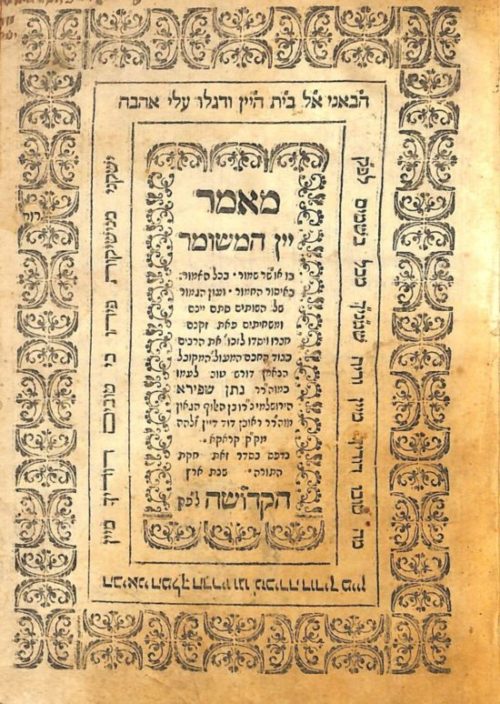
All of this is reflected in Hannover’s itinerant life and, as the chronicler of these events, in his Yeven Mezulah. Nevertheless Hannover’s first published work, Ta’amei Sukkah, is quite different. Based on a sermon delivered in Cracow in 1646 it was published in Amsterdam in 1652 at the press of Samuel bar Moses and Reuben bar Eliakim. In format it is a medium quarto (40: 12 ff.).[12] Samuel bar Moses ha-Levi was, together with Judah [Leib] ben Mordecai ben Mordecai [Gimpel] of Posen, the first Ashkenazi printers in Amsterdam. After their partnership ended in 1651, Samuel ben Moses continued to publish for a brief period in partnership with Reuben ben Eliakim of Mainz. Among their publications is Ta’amei Sukkah.
 
As the title-page makes clear, Ta’amei Sukkah is a discourse on the festival of Sukkot, explaining Talmudic statements by way of esoteric allusions. The title-page states that in the discourse,
are explained all of the hard-to-understand sayings and Talmudic adages, and the accounts in the Zohar related to Sukkot. In it are revealed deep esoterica, explained and made intelligible according to and based on the Talmud, Rashi, and Tosafot and; “set upon sockets of fine gold” (Song of Songs 5:15). . . . to satisfy the soul’s yearning. In it the seeker will find “good judgment and knowledge” (cf. Psalms 119:66), “the honeycomb” and “pleasant words” (Psalms 19:11, Proverbs 15:26, 16:24), for this is a treasured and desirable discourse. . . .
The title page is dated “to life and to peace ולשלום” (412 = 1652″; the colophon dates completion of the work to the month Menahem (Av) Zion and Israel “And this is the Torah וזאת התורה אשר (412 = July/August 1652) which Moses set before the people of Israel” (Deuteronomy 4:44). Hannover’s introduction (1b) follows. He emphasizes his youth and informs that he has written discourses on the entire Torah and festivals, entitled Neta Sha’ashu’im because it contains his name.
Lack of funds have prevented Hannover from publishing the entire work; therefore, at this time he is printing this discourse only, delivered in Cracow in 1646. Hannover’s plaint that due to a lack of funds he has been unable to publish the entire book and at this time is printing one discourse only, really just a pamphlet, that is, Ta’amei Sukkah, is not unique. Indeed, what makes Hannover different from other authors with like difficulties is that in contrast to the other authors, who are printing medium excerpts of their works in hopes of finding a patron to support publication of the larger tome, those authors are today unknown except for their medium works. Hannover, in contrast is relatively well known, if only because of his other published titles.[13]
Hannover entitles this discourse Ta’amei Sukkah because it is on Sukkah and the arba’ah minim; it explains wondrous midrashim and sayings in the Zohar and Talmud relating to Sukkot; and furthermore, the numerical value of Ta’amei טעמי (129) equals his name Nata נטע (129). The text follows, set in two columns in rabbinic type with leaders in square letters. Ta’amei Sukkah is a multi-faceted work with kabbalistic and midrashic content. Within the text are several headings in which Hannover notes that, based on the prior section, he will now explain a Midrash RabbahZohar, or other work, such as the Alshekh. At the end of Ta’amei Sukkah, after the colophon is a tail-piece, the bear pressmark.[14] Ta’amei Sukkah has been reprinted once, in Podgorze (1902).
III
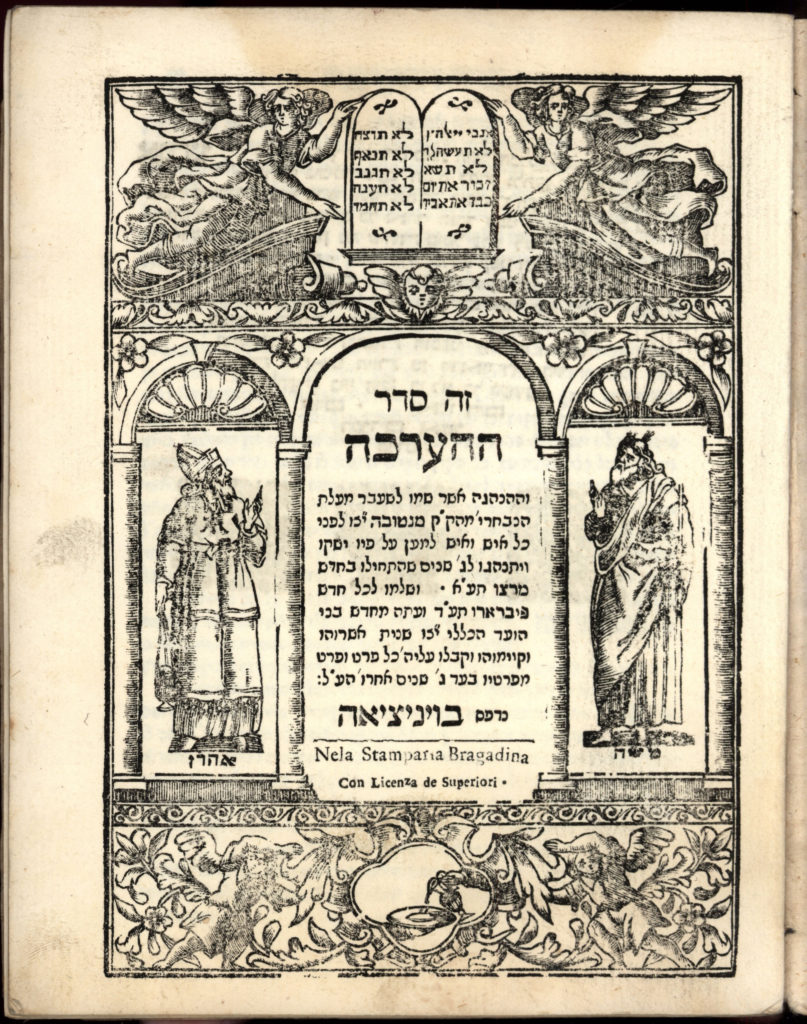
The following year, continuing his peripatetic movements, Hannover was in Venice where he published Yeven Mezulah, his detailed chronicle of the horrific experiences of Polish Jewry during the Chmielnicki massacres of 1648-49 (tah ve-tat) in which, according to contemporary sources, as many as several hundred thousand Jews were murdered and hundreds of communities destroyed.[15] This, the first edition of Yeven Mezulah, is based on first person accounts taken from oral testimony and other contemporary works. It was printed at the Vendramin press in 1653, also in quarto format (40: 24 ff.). Founded in 1630 by Giovanni Vendramin this press, broke the monopoly enjoyed until then by Bragadin. For the first ten years the press operated under the name of its founder, but after his death it became known by the names Commissaria Vendramina and Stamparia Vendramina. The press eventually joined with that of Bragadin and the combined presses continued to operate well into the eighteenth century.[16]
The title is from, “[I sink in] deep mire (yeven mezulah), [where there is no standing; I have come into deep waters, and the flood sweeps over me]” (Psalms 69:3). The title page, which has an architectural frame and is dated “coming ביאת (413 = 1653) of the Messiah,” states that it comes to relate the decrees and wars in the lands of Russia, Lithuania, and Poland. There is an introduction from Hannover, which begins,
I am the man who has seen affliction by the rod of his wrath” (Lamentations 3:1), when the Lord smote His people Israel, His first born. He cast down from Heaven to Earth His glory, the land of Poland, His delight. “Beautiful for situation, the joy of the whole earth” (Psalms 48:3) “The Lord has swallowed all the habitations of Jacob without pity” (Lamentations 2:2) “the lot of his inheritance” (Deuteronomy 3 2:9) “and remembered not his footstool in the day of his anger!” (Lamentations 2:1). All of this was foreseen by King David )may he rest in peace( when he prophesied the joining of the Kadarim (Tartars) and the Greeks to destroy Israel His chosen people in the year זאת (408 = 1648).
Hannover has entitled the work Yeven Mezulah because the events that transpired it are alluded to in Psalms. Also, yeven (yavanim – Greeks) refers to the Ukrainians, who belonged to the Greek Orthodox Church. Hannover writes that he has recorded both major and minor occurrences, all the decrees and persecutions, and their dates, so that families can calculate when their relatives perished. He also describes the customs of Polish Jewry, their religious devotion, based upon the pillars that support the world (ref. Avot 1:2, 18), and notes the high level of Torah scholarship, unmatched elsewhere. Yeven Mezulah has been described as “a complex work that recounts not only the cruel fate of Ukrainian Jewry, but also the socioeconomic and political factors that led up to the rebellion. . . . it is noteworthy that he is able to give details of various political and military developments within the Polish camp.”[17]
The introduction concludes with a request that the book be purchased to enable him to publish Neta Sha’ashu’im, a work that, as noted above, was never published. It then records in detail the tribulations that befell Eastern European Jewry, concluding with a description of the inner life of the Jews, how they lived in accordance with the pillars of Torah, Divine Service, charity, truth, justice, and peace, set forth in AvotYeven Mezulah is organized by community, describing what befell them, excepting an intermediate section on Chmielnicki. Two examples, the first a description of what occurred in 1Nemirow, relating how Chmielnicki and his followers gained entry by the ruse of flying Polish flags and thus passing themselves off as a relief force.
The people of the city were fully aware of this trickery, and nevertheless called to the Jews in the fortress: “Open the gate. This is a Polish army which has come to save you from the hands of your enemies . . . No sooner had the gates been opened than the Cossacks entered with drawn swords, and the townspeople too, armed with spears and scythes, and some only with clubs, and they killed the Jews in large numbers. Women and young girls were ravished, but some of the women and maidens jumped into the moat surrounding the fortress in order that the uncircumcised should not defile them. . . . but the Ukrainians swam after them with their swords and their scythes, and killed them in the water. Some of the enemy shot with their guns into the water, and killed them till the water became red with the blood of the slain. . . . The number of the slain and drowned in the holy community of Nemirow was about six thousand. They perished by all sorts of terrible deaths. . . . May God avenge their blood.
The second example, concerns R. Samson Ostropoler of Polonnoye (Volhynia), and his community,
Among them was a wise and understanding divinely inspired Kabbalist whose name was, Our Teacher and Master Rabbi Samson of the holy community of Ostropole. An angel would appear to him every day to teach him the mysteries of the Torah. . . . He preached frequently in the synagogue and exhorted the people to repent so that the evil would not come to pass. Accordingly all the communities repented sincerely but it did not avail, for the evil decree had already been sealed.
When the enemies and oppressors invaded the city, the above mentioned mystic and three hundred of the most prominent citizens, all dressed in shrouds, with prayer shawls over their heads, entered the synagogue and engaged in fervent prayer. When the enemies arrived they killed all of them upon the sacred ground of the synagogue, may God avenge their blood. Many hundreds who managed to survive were forced to change their faith and many hundreds were taken captive by the Tartars.[18]
A critical view of Yeven Mezulah is expressed by Edward Fram who writes that Hannover, in describing the massacre of Jews in Tulczyn, copied from other works, particularly Zok ha-Ittim, at times paraphrased those works, and “in some instances he took events said to have happened elsewhere and wove them into his own tale of Tulczyn,” without acknowledging his debt, melding them into his own tale of the massacre in Tulczyn. Fram suggests that Hannover did so because Zok ha-Ittim was not compelling enough to emphasize Jewish martyrdom and “place 1648 in the tradition of past tragedies, [therefore] a more resolute image of martyrdom would be necessary.”[19]
Nevertheless, Yeven Mezulah is regarded as the classic and most important work on tah ve-tat and has been frequently reprinted as well as having been translated into Yiddish, French, German, Russian, Polish, and English.
IV
We next, in terms of Hannover’s publications, find him in Prague, where he published Safah Berurah, a popular four language, Hebrew-German-Latin-Italian, glossary for conversation and as a guidebook for travelers. Printed at the renowned press of the Benei Jacob Bak, opened as early as 1605. Safah Berurah is a medium format book (80: [44] ff.). The title is from, “For then I will convert the peoples to a clear language (safah berurah)” (Zephaniah 3:9). The title page states,
Behold, and see” (Lamentations 1:12) this new thing that was not before. The holy tongue (Hebrew), Ashkenaz, Italian, and Latin spread out flawlessly. It is good for women and men, the aged and elderly, adolescents and young, teacher and businessmen and also before the uneducated, who travel through all lands, “And you shall teach them to your children, speaking of them, so that your days may be multiplied” (cf. Deuteronomy 11:19,-21), and in this merit may He send to our Messiah speedily in our day. Amen Selah.
The Lord grant us the merit to come soon to the holy land הקדושה (420 = 1660).
 
The introduction follows, in which Hannover repeats the description of the book from the title-page and adds that it is based on the words in the Torah, the twenty-four books of the Bible, and some words from the six Sedorim (Mishnayot). He follows “after the reapers” (Ruth 2:7), gleaning every strange word in the sheaf: from concordances, Mirkevet ha-Mishneh, and commentaries.[20] Safah Berurah is so entitled because from this straightforward work all four languages will be pure and clear. In the second paragraph, in a mediumer font, Hannover explains the structure of the work, and that the Ashkenaz is not, with rare exception, that of the gentiles but of the Jews (Yiddish), but that the Latin is of the highest order, in order to be able to speak before kings and nobles.
This is followed by a list of the twenty she’arim that make up Safah Berurah, that is, the divisions of the book, which is not alphabetic but by subject. This arrangement was apparently followed because Hannover believed that it would be more convenient for conversation to be able to locate words related by subject. The first two she’arim include terms dealing with the Divine and Torah; the next three with earthly objects; six through nine, fish, birds, animals and humans; continuing with material objects; such as clothing, jewelry, metal, arms, tools, nations, including proper forms of address, business, arithmetic, calendar, and grammar.
The approximately 2,000 words comprising the text follow, in four columns, from right to left, of Hebrew, Ashkenaz, Italian, and Latin, all in square vocalized Hebrew letters. At the end of the book are errata by language and a colophon in which Hannover thanks Gabriel Blanis and Jacob Szebrsziner for their assistance with the Italian and Latin, and notes that it was necessary to reduce the size of the glossary due to conditions in Poland, where there are no buyers.[21]
Safah Berurah has also been republished several times, beginning with an edition prepared by Jacob Koppel ben Wolf that included French at the press of Moses ben Abraham Mendes Coitinho (Amsterdam, 1701), and even an edition with Greek and Turkish (lacking place and date.[22]
Sha’arei Ziyyon, Hannover’s, last published title, is a collection of Lurianic kabbalistic prayers, particularly for Tikkun Hazot (midnight prayers). First printed in Prague in the year “The trees of the Lord have their fill; the cedars of Lebanon, which he has planted ישבעו עצי י’י ארזי לבנון אשר נטע (422= 1662)” (Psalms 104:16), also at the press of Benei Jacob Bak. Sha’arei Ziyyon is a medium work set in octavo format (80: [38] ff.). The title is from “The Lord loves the gates of Zion (sha’arei Ziyyon) more than all the dwellings of Jacob” (Psalms 87:2).
The following text and images are from the Amsterdam 1671 edition, published by Uri Phoebus ben Aaron ha-Levi in quarto in format (40: 54 ff.). Similar but not identical to the earlier Prague printing this edition is dated Rosh Hodesh Sivan 431 (Sunday, May 10, 1671). The title-page has an architectural frame with an eagle at the apex surrounds the text.[23] The text states,
These are the words of Kabbalah according to the scribes and according to the texts, Sefer Etz Hayyim, those who taste it merit life, written by the foremost student of the Godly rav, R. Isaac Luria, that is, R. Hayyim Vital. After him rose up students of his students and wrote this work (Sha’arei Ziyyon) . . .
The author sent his brother R. Mordecai Gumpricht ben Moses with many additional prayers and supplications, as can be seen . . .
The title-page is followed by the approbations reprinted from the first Prague edition, from R. Nahman ben Meir Kohen of Keremenec, R. Samuel ben Meir of Ostrow, and R. Israel ben Aaron Benzion of Satanow. They are followed by Hannover’s introduction, which concludes with a description of the seven sha’arim comprising Sha’arei ZiyyonTikkun Hazot based on R. Hayyim Vital’s Etz ha-HayyimTikkun ha-Nefesh, to be said after Tikkun Hazot with Yedid NefeshTikkun ha-Tefillah according to Kabbalah; Tikkun Kriat ha-TorahTikkun Kriat Shema with the appropriate kavvanotTikkun shel Erev Rosh Hodesh; and Tikkun Malkhut on Rosh Ha-Shanah and Yom ha-Kippurim.
Text is in a single column in rabbinic type, with headers, initial phrases, and some limited text in square letters. The volume concludes with an epilogue dating the conclusion of the work to “half of (15) Kislev, ‘And he shall judge the world תבל (Tuesday, November 17, 1671) in righteousness’ (Psalms 9:9) and compassion.” Printing was supervised by Mordecai Gumpricht ben Moses, Hannover’s brother.[24]
Sha’arei Ziyyon is primarily a compilation of existing prayers assembled into one work. Prayers such as Ribbono shel Olam, recited today prior to the removal of the Torah from the Ark by R. Jeremiah of Wertheim and the Yehi Ratzon after the priestly blessing are taken from Sha’arei Ziyyon. This edition, as stated on the title-page, is much expanded from the first edition (80 38 ff.). It contains additional prayers, piyyutim, and supplications, some of considerable length, among them prayers for someone incarcerated, for those who are ill, and has verse for the dedication of a new Torah scroll in the synagogue.[25]
Gershom Scholem, in describing the influence of Kabbalah on Jewish life writes that one of the areas in which it had the greatest influence was prayer. Among the most influential books in this sphere was Sha’arei Ziyyon in which Lurianic doctrines “of man’s mission on earth, his connections with the power of the upper worlds, the transmigrations of his soul, and his striving to achieve tikkun were woven into prayers that could be appreciated and understood by everyone, or that at least could arouse everyone’s imagination and emotion.”[26]
The popularity of Sha’arei Ziyyon is such that it has been described by Sylvie-Anne Goldberg as “one of the most widely read books in the Jewish world.”[27] Indeed, Sha’arei Ziyyon was reprinted in Prague three times in the seventeenth century (1682, 1688, 1692), and three additional times within a decade, in Dyhernfurth ([1689]), Wilhermsdorf (1690) and Dessau (1698). The Bet Eked Sefarim enumerates fifty-four editions through 1917.[28]
Hannover’s life reflects the times in which he lived, both in the adversity and travail he faced but also in how he overcame them. Just as the Jews of mid-seventeenth century Europe had their lives uprooted but survived to rebuild thriving communities so too Hannover’s accomplishments stand out. Not only did he both live and survive to chronicle the struggles and turmoil of gezerot tah ve-tat in Yeven Metzulah but he also wrote such varied books as Safah Berurah, a lexicography, and Sha’arei Ziyyon, a liturgical work, all three important and much reprinted titles. In addition, Hannover was the author of Neta Sha’ashu’im, noted above; Neṭa Ne’eman, a Kabbalistic work; a discourse on Purim, extant in manuscript, and a commentary on Otiyyot de-Rabbi Akiva, no longer extant. In addition to the printed editions of his books Hannover’s works were sufficiently popular that they were often copied by hand and numerous manuscripts of his works are extant. KTIV, the International Collection of Digitized Hebrew Manuscripts records twenty-six entries under Nathan Hannover, the most popular being by far being Sha’arei Ziyyon.[29]
Despite experiencing suffering and tragedy, Nathan Nata Hannover survived to live a life of meaning and leave us a legacy of value. Yeven Metzulah concludes that the Jews who escaped from the swords of their enemies were treated with kindness in Moravia, Austria, Bohemia, Italy, and especially Germany, given food, drink, lodging, garments, and gifts “each according to his importance,”
May their justice appear before God to shield them and all Israel wherever they are congregated, so that Israel may dwell in peace and tranquility in their habitations. May their merit be counted for us and for our children, that the Lord should hearken to our cries and gather our dispersed from the four corners of the earth, and send us our righteous Messiah, speedily in our day. Amen, Selah..
 
Seforim Blog Editors’ note:
 
For more sources on the significance of the work Sha’arei Ziyyon see Eliezer Brodt’s post on the Seforim Blog here specifically the section headed שערי ציון. Footnote 33 has some more current Hebrew literature on the sefer, and also of interest is the appendix where Brodt has a whole new look at  the relationship between this work and the Magen Avraham.
 
In addition, it’s worth noting that a beautiful new edition of the Sha’arei Ziyyon was printed in 2012 based on the first edition, and the volume includes his Ta’amei Sukkah. The Yeven Mezulah also has also been reprinted a few times in recent years.
[1] I would like to express my appreciation to Eli Genauer for reading the article and his comments. Images are courtesy of the Library of Congress, the Jewish National and University Library, the Valmadonna Trust Library, Ozar ha-Hochmah, and of Virtual Judaica.
[2] Ḥananel Nepi, Mordecai Samuel Ghirondi, Toledot Gedolei Yisrael (Trieste, 1853), p. 270 [Hebrew]; Moritz Steinschneider, Catalogus Liborium Hebraeorum in Bibliotheca Bodleiana (CB, Berlin, 1852-60), col. 2044; and William B. Helmreich, forward to Nathan Nata Hannover, Abyss of Despair (Yeven Metzulah), translator Abraham J. Mesch, (New York, 1950; reprint, New Brunswick, London, 1983), pp. 13-15; Israel Zinberg, A History of Jewish Literature IV (New York, 1975), translated by Bernard Martin, pp. 122-23.
[3] Hersh Goldwurm, ed. The Early Acharonim (Brooklyn, 1989), p. 194; Mordechai Margalioth, ed., Encyclopedia of Great Men in Israel IV (Tel Aviv, 1986), cols. 1181-82 [Hebrew].
[4] David B. Ruderman, Early Modern Jewry: A New Cultural History (Princeton, N. J., 2011), pp. 41, 51.
[5] Bernard D. Weinryb, The Jews of Poland; a Social and Economic History of the Jewish Community in Poland from 1100 to 1800 (Philadelphia, 1972), p. 166.
[6] Salo Wittmayer Baron, A social and religious history of the Jews XVI (Philadelphia, 1976), p. 98.
[7] Shmuel Ettinger, “Chmielnicki (Khmelnitski), Bogdan,” Encyclopaedia Judaica, edited by Michael Berenbaum and Fred Skolnik, vol. 4 (2007), pp. 654-656.
[8] Zinberg, p. 122.
[9] Shaul Stampfer, “What Actually Happened to the Jews of Ukraine in 1648?” Jewish History, 17:2 (2003), pp. 221-222.
[10] Jonathon Israel, European Jewry in the Age of Mercantilism 1550-1750 (London ; Portland, Or, 1998) p. 99.
[11] Simha Assaf, “The Inner Life of Polish Jewry (Prior to the Period of the Haskalah” Be-Ohole Yaʻaḳov: Peraḳim me-hHaye ha-Tarbut shel ha-Yehudim bi-Yeme ha-Benayim (Jerusalem, 1943), p. 80 [Hebrew].
[12] L. Fuks and R. G. Fuks Mansfeld, Hebrew Typography in the Northern Netherlands 1585 – 1815 (Leiden, 1984-87), I p. 197 no. 275.
[13]  Concerning such medium books published as a prospectus see my “Books not Printed, Dreams not Realized,” in Further Studies in the Making of the Early Hebrew Book (Brill, Leiden/Boston, 2013), pp. 285-303.
[14] Concerning the varied usage of the bear pressmark see my “The Bear Motif on Eighteenth Century Hebrew Books” The Papers of the Bibliographical Society of America 102:3 (New York, N. Y., 2008), pp. 341-61, reprinted in Further Studies, pp. 57-76.
[15] Other contemporary works describing the horrors of tah ve-tat are R. Samuel Feivush ben Nathan Feitel’s Tit ha-Yaven (Venice, c. 1650), R. Meir ben Samuel of Shcherbreshin’s Zok ha-Ittim (Cracow, 1650), and R. Jacob ben ha-kodesh (the holy, suggesting that he was among the murdered) Simeon of Tomashov’s Ohel Ya’akov (Venice, 1662). The latter writing ““Light became darkness” (Job 18:6) for me, for they killed my wife and three sons, “and I lived in the land of Nod” (cf. Genesis 4:16) until 1656. In that year arose grievous troubles, old and also new, and I came uponmidat ha-din (strict justice) and “Disaster upon disaster” (Ezekiel 7:26), plunder after plunder, until finally I encountered pestilence, sword, famine, and captivity and every day was worse than before. Also to be noted are selihot commemorating tah ve-tat (1648-19) such as R. Gabriel ben Joshua Heschel Schlussburg’s Petah Teshuvah ([1651], Amsterdam) selihot and lamentation on the Jews massacred in tah ve-tat (written as a commentary on the book of Lamentations and R. Shabbetai ben Meir ha-Kohen (Shah)’s Selihot ve-Kinnot (Megillat Eifah, 1651, Amsterdam).
[16] David Amram, The Makers of Hebrew Books in Italy (Philadelphia, 1909, reprint London, 1963), p. 372; Joshua Bloch, “Venetian Printers of Hebrew Books,” in Hebrew Printing and Bibliography (New York, 1976), p. 86.

[17] Adam Teller, “Hannover, Natan Note,” YIVO Encyclopedia of Jews in Eastern Europe 1 (New Haven & London, 2008), p. 656.

[18] Both translations are from Mesch, pp. 51, 63-64 respectively.
[19] Edward Fram, “Creating a Tale of Martyrdom in Tulczyn, 1648,” Jewish History and Jewish MemoryEssays in Honor of Yosef Hayim Yerushalmi, ed. Elisheva Carlebach, John M. Efron, David N. Myers (Hanover, 1998), pp. 90-91.
[20] Mirkevet ha-Mishneh (Cracow, 1534), by Asher Anshel of Cracow, is a concordance and glossary of the Bible. Published by Samuel, Asher, and Elyakim, sons of Hayyim Halicz, it was the first Yiddish book printed in Poland. Concerning Mirkevet ha-Mishneh see Marvin J. Heller, The Sixteenth Century Hebrew Book: An Abridged Thesaurus I (Brill, Leiden, 2004), pp. 216-17.
[21] Shimeon Brisman, History and Guide to Judaic Dictionaries and Concordances (Hoboken, 2000), pp. 44-46.
[22] Ch. B. Friedberg, Bet Eked Sepharim, (Israel, n.d.), shin 2223 [Hebrew].
[23] “The Eagle Motif on 16th and 17th Century Hebrew Books,” Printing History, NS 17 (Syracuse, 2015), pp. 16-40.
[24] Fuks and R. G. Fuks Mansfeld, II pp. 263-64 no. 32.
[25] A. Z. Idelsohn, Jewish Liturgy and Its Development (1932, reprint New York, 1995), pp. 55, 80, 259.
[26] Gershom Scholem, Kabbalah (NewYork, 1973), p. 193.
[27] Sylvie-Anne Goldberg, Crossing the JabbokIllness and death in Ashkenazi Judaism in Sixteenth through Ninteenth-Century Prague (Berkeley, 1996), p. 88.
[28] Friedberg, Bet Eked Sepharimshin 2148.
[29] I would like to thank Eli Genauer for bringing this to my attention. The address for KTIV is http://web.nli.org.il/sites/nlis/en/manuscript.


Writing is simple when lorem quis bibendum

Blog Image 03

Mauris ut orci dapibus, sollicitudin metus id, facilisis magna. Praesent pellentesque consequat nibh. Ut egestas velit quis ante tincidunt, eget luctus orci tincidunt. Cras massa augue, facilisis sit amet mattis vel, mollis vel neque. Nam maximus laoreet erat, a sagittis risus auctor non. Interdum et malesuada fames ac ante ipsum primis in faucibus. Praesent at interdum felis. Pellentesque facilisis vulputate justo, in euismod turpis aliquet id. Nam ut nibh eros. Vivamus lacus orci, rhoncus quis sodales et.

Ut enim ad minim veniam, quis nostrud exercitation ullamco.

Mauris ut orci dapibus, sollicitudin metus id, facilisis magna. Praesent pellentesque consequat nibh. Ut egestas velit quis ante tincidunt, eget luctus orci tincidunt. Cras massa augue, facilisis sit amet mattis vel, mollis vel neque. Nam maximus laoreet erat, a sagittis risus auctor non. Interdum et malesuada fames ac ante ipsum primis in faucibus. Praesent at interdum felis. Pellentesque facilisis vulputate justo, in euismod turpis aliquet id. Nam ut nibh eros. Vivamus lacus orci, rhoncus quis sodales et.

Donec interdum felis fringilla posuere pellentesque. Duis elementum blandit justo, eget tincidunt diam sollicitudin sed. Nulla hendrerit tempor nisi non feugiat. Curabitur a auctor nisl. Sed sagittis purus ac felis venenatis, at sagittis ante suscipit. Nulla lacinia eros odio, sit amet fringilla nisl porttitor sit amet. Nunc tempus, nunc a rutrum ullamcorper, lacus purus porttitor lacus, vitae ullamcorper erat erat quis nibh. Sed vitae diam sed quam malesuada gravida sed ac nisl. Fusce sed accumsan purus.


Book Sale: Bar Ilan University Press

Book Sale: Bar Ilan University Press
Eliezer Brodt
The following list is a special sale of books from Bar Ilan University Press. The offer is for the next 3 days [until 12.27.18] for the readers of the Seforim Blog. The prices are as listed below, but do not include shipping costs. For more information contact me at EliezerBrodt@gmail.com Payment is with Pay Pal, but other arrangements can be made. Shipping is not included in the price; that depends on the order and size of the book. All books will be air mailed out after I receive payment. There are other shipping possibilities.
For more details about specific works, or recommendations contact me at the above email.
Part of the proceeds of this sale will be going to help support the efforts of the Seforim Blog.
שם
הספר
מחיר
ספרים
1
אבדן
אוריינטציה ריגושית
/
ר.
צור
$18
2
אבן
אל
ערבי
מסביליה
מסע
בא
י
/
י.
דרורי
$10
3
אברהם
בכבשן האש
/
ו.
טוהר
$13
4
אגודות
חשאיות ותנועות מרד בסהר הפורה
/
א.
טאובר
$10
5
אוצר
הלשון הערבית בתפסיר ר

סעדיה
גאון
/
י.
רצהבי
$18
6
אוצר
המנהגים והמסורות לקהילות תאפילאלת
/
סגלמאסא
/
מ.
נזרי
$24
7
אוריינות
היסטורית וטיפוח הביקורתיות
/
ע.
שרמר
$10
8
אזן
מלין תבחן
(מהד
שנייה)
/
א.
סימון
$24
9
אי
וסוריה
/
ז.
עמר
$10
10
אי
קרוב
רחוק
/
י.
בןארצי
$13
11
אלא
משל היה
/
ח.
מאק
$10
12
אלברט
איינשטיין והמפעל הציוני
/
נ.
גולדשטיין
$24
13
אמונה
רדיקלית
/
ר.
בר
לב
$18
14
אנציקלופדיה
של הסיפור היהודי ב

/
א.
ליפסקר
(ע)
$10
15
אנציקלופדיה
של הסיפור היהודי ג

/
א.
ליפסקר
(ע)
$18
16
אנציקלופדיה
של הסיפור היהודי ד

/
א.
ליפסקר
(ע)
$24
17
אסטרולוגיה
ומגיה בהגות היהודית
/
ד.
שוורץ
$24
18
אצות
החוף של ישראל
/
ר.
עינב
$18
19
אשה
במזרח
אשה
ממזרח
/
ט.
כהן,
ש.
רגב
(ע)
$18
20
אתגרים
בטחוניים ומדיניים במבחן המציאות
/
מ.
לסקר,
ר.
יצחק
(ע)
$18
21
באור
חדש
/
נ.
זהר
$10
22
בארצות
המקרא
/
ש.
ורגון
$13
23
בואו
לתקון
הספרות
החסידית
/
י.
אלשטיין
(ע)
$8
24
בין
אורתודוקסיה לציונות
/
י.
צור
$10
25
בין
הלכה להשכלה
/
י.
פרידלנדר
$10
26
בין
מסורת לחידוש
/
א.דוןיחיא
(ע)
$10
27
בין
ניצוץ לשלהבת
/
ד.
לוין
$10
28
בין
קנאות לחסד
/
ד.
ברזיס
$24
29
בין
שיוויון למצויינות
/
מ.
שמידע
$10
30
בין
שפה לפילוסופיה
/
נ.
בסמןמור
$18
31
בכבשונו
של פולמוס
/
י.
פרידלנדר
$24
32
במסתרי
הסאטירה
/
י.
פרידלנדר
*
כרכים
א

ג
*
כל
כרך
$10
33
בסוד
יחיד ועדה
/
י.
הלוי
$10
34
בסימן
טראומה
/
מ.
אלברשטין,
נ.
דוידוביץ
(ע)
$10
35
בעקבות
הפסיכואנליזה
/
ל.
פרידמן
$18
36
ברוך
קורצווייל כפרשן תרבות
/
מ.
גולצין
$10
37
בשבילי
העבר
/
א.
גראוויס
קובלסקי
$18
38
בשבילי
התחיה
/
מ.
אליאב
*
כרכים
ב
‘,
ג
*
כל
כרך
$10
39
בת
המזרח החדשה
/
י.
הלוי
$10
40
בתי
הדין בימי התלמוד
/
ש.
אלבק
$10
41
גאולה
תימנית ועבריות חדשה
/
א.
דרורי
$10
42
גווילין
נשרפין ואותיות פורחות
/
ש.
ז.
כהנא
(
ז.
מאורע)
$24
43
גלגמש

גיבור
מיתולוגי
/
נ.
אברבנאל
$10
44
גם
הם קרויים אדם
/
מ.
קלנר
$18
45
גם
יהודי גם פולני
/
פ.
מיזליש
$10
46
דרכי
דניאל
/
א.
פרזיגר
(ע)
$24
47
דרכי
קניין ומנהגי מסחר
/
ר.
קליינמן
$18
48
דרכים
במקרא ובהוראתו
/
מ.
ארנד,
ש.
פויר
$8
49
דרכים
בפרשנות החדשה
/
ה.
ברזל
$10
50
דרשות
ר

יצחק
קארו
/
ש.
רגב
$10
51
האביר
והרעיה השבויה
/
ש.
רפאל
$10
52
האנשים
מכאן
/
י.
זלטנרייך
$18
53
האפיפיור
היהודי
/
י.
במברגר
$13
54
האקסטאזה
והסיפור החסידי
/
י.
אלשטיין
$10
55
הארבה
במסורת ישראל
/
ז.
עמר
$13
56
האשכנזים
/
י.
שוורץ
$10
57
הבדחן
/
א.
קרסני
$10
58
הגותו
של הרב סולובייצ
יק
ב
/
ד.
שוורץ
$18
59
הגותו
של הרב סולובייצ
יק
ג
/
ד.
שוורץ
$24
60
הגותו
של ר

יוסף
אלבו
/
ד.
ארליך
$13
61
הגרא
ובית מדרשו
/
חלמישריבליןשוחט
(ע)
$13
62
ההתיישבות
היהודית בהרי חברון
/
י.
כץ
$10
63
הוועידה
השביעית של הפועל המזרחי בא
י
/
י.
אבנרי
(ע)
$8
64
הוריות
/
צ.
א.
שטיינפלד
$13
65
החורבן
והחשבון
/
י.
טובי
$13
66
החינוך
הממלכתי דתי
/
י.
שורצולד
$10
67
הטרגדיה
בחיים האתיים
/
פ.
איפרגן
$18
68
היה
היה פעם
/
א.
אזולאי
$10
69
היהדות
על פרשת דרכים
(מרדכי
מקס יוסף
)
/
י.
קולר
(ע)
$24
70
היזמה
הפרטית בבנין א
י
/
י.
כץ
$10
71
היחידות
הדתיות בהגנה ובפלמ
ח
/
מ.
פרידמן
$10
72
הכיתה
ההטרוגנית
/
י.
ריץ
$10
73
הלכה
בתמורות הזמן
/
א.
משיח
$18
74
הלל
לביאליק
/
ה.
ויס,
י.
יצחקי
(ע)
$10
75
המאה
של המונאדות
/
ר.
אלבקגדרון
$10
76
המילים
המתבקשות
/
מ.
אפרת
$24
77
המסה
בספרות העברית
/
ר.
לפידוס
$10
78
המסורת
הפוליטית היהודית
/
מ.
הלינגר
(ע)
$10
79
המסע
האנושי למשמעות
/
א.
שגיא
$13
80
המקרא
בפרשנות חז
ל
:
הושע
*
יואל

עמוס
*
כל
כרך
$24
81
המשפט
בישראל
מבט
לעתיד
/
י.
זילברשץ,
י.
שטרן
(ע)
$10
82
המתכונת
והדמות
/
ה.
ויס
(ע)
$10
83
הספרות
כמעבדה מוסרית
/
ע.
מעוזמנדלסון
$18
84
העת
הזאת
/
א.
שגיא
$24
85
הפואמה
המודרניסטית ביצירת אלתרמן
/
ז.
שמיר,
צ.
לוז
(ע)
$10
86
הפסוקים
הסמויים מן העין
/
י.
יצחקי
$10
87
הפסיכולוגיה
של ההתנגדות לשינוי
/
ש.
פוקס
$18
88
הפסיכולוגיה
של השליטה על התודעה
/
ש.
קניאל
$18
89
הפסיכולוגיה
של השקר
/
א.
אלעד
$18
90
הפרטת
חברות בישראל ובעולם
/
אקשטיין,
זילבר
(ע)
$10
91
הפשטות
המתחדשים בכל יום
/
א.
טויטו
$13
92
הקבלה
ביצירת שי עגנון
/
א.
שילה
$24
93
הקבלה
בתפילה בהלכה ובמנהג
/
מ.
חלמיש
$24
94
הרעיון
המשיחי בהגות היהודית
/
ד.
שוורץ
$24
95
הרשויות
האישיות
/
ע.
עינתנוב
$10
96
השפה
העברית בראי חכמת ההיגיון
/
מ.
קהן
$24
97
התמימות
השנייה
/
א.
שגיא,
ד.
שוורץ
$24
98
ואלה
שמות

מחקרים
באוצר השמות
/
א.
דמסקי
,
כרכים
א
ה
*
כל
כרך
$10
99
ובלכתך
בדרך
/
ל.
וינר
דאו
$24
100
זהות
כפולה
/
א.
בלפר
$13
101
חולף
עם הרוח
/
נ.
רונאל
(ע)
$18
102
חומרי
מרפא בספרות היהודית
/
א.
שמש
$24
103
חוסיין
עושה שלום
/
מ.
זק
$10
104
חוקה
אחת ומשפט אחד לאיש ולאישה
/
כתבן,
שילה,
הלפריןקדרי
(ע)
$24
105
פנחס
חורגין

חזון
ומורשת
/
ברנשטיין,
ינקלביץ
(ע)
$10
106
חינוך
יהודי בחברה פתוחה
פרקי
עיון
/
מ.
ארנד
$10
107
חינוך
יהודי בחברה פתוחה
ציוני
דרך
/
מ.
ארנד
$10
108
חקרי
עגנון
עיונים
ומחקרים
/
ה.
ויס
$10
109
טרור
בשירות המהפכה
/
מ.
לסקר,
ח.
באזוב
$13
110
יהדות
צרפת
/
א.
כהן
(ע)
$13
111
יהודי
איראן
/
ש.
רגב
(ע)
$18
112
יהודי
סוריה
/
י.
הראל
$24
113
יהודי
עיראק בישראל
/
בנסקי
,
דון
,
קראוס
(ע)
$13
114
יהודי
עיראק בכלכלה
/
ת.
דרויש
$10
115
יהודים
על פרשת דרכים
/
ג.
מירון
(ע)
$10
116
יומן
יצחק למדן
/
א.
ליפסקר
$13
117
יומרה
ומעש
/
א.
קניאל
$10
118
יופי
של צריכה
/
א.
ברודרמן
$10
119
ייעודה
של אוניברסיטה דתית
/
עירם,
פרידלנדר,
אוחיון
(ע)
$10
120
יסודות
בדיני ממונות
/
ש.
אלבק
$18
121
יסודות
בהוראת המקרא
/
מ.
ארנד
$10
122
יסודות
דיני הנישואין בתלמוד
/
ש.
אלבק
$10
123
יסודות
העבירה בדיני התלמוד
/
ש.
אלבק
$10
124
יצחק
ברויאר

עיונים
במשנתו
/
ר.
הורביץ
$10
125
יצירת
דקר האימפריאלית
/
ל.
ביגון
$10
126
יש
סדר למקרא
/
י.
גוטליב
$18
127
ישראל
והמקרא
/
י.
אליצור
$24
128
כינור
נשמתי
/
ד.
שוורץ
$13
129
כיצד
לקרוא את ספרות חבד
/
א.
רוט
$18
130
כיריעה
ביד הרוקמת
/
נ.
קרן
$10
131
כנישתא
/
י.
תבורי
*
כרכים
2
-4 *
כל
כרך
$10
132
כתב
ידו של דוד פוגל
/
ל.
נתנאל
$10
133
לא
ידענו מה היה לו
/
א.
מרינברגמיליקובסקי
$24
134
לאות
זיכרון
מחקרים
בשירה העברית
/
א.
חזן
$10
135
לבוש
ותוך

המוסיקה
בחוויית היהדות
/
אביצור,
ריצרב,
סרוסי
(ע)
$10
136
להיפגש
עם הצלילים
תרפיה
במוסיקה
/
ד.
אמיר
$18
137
לעצור
את הדחפור
/
י.
כץ
$10
138
לפניך
דרכיים
/
ה.
שייט
$10
139
לשון
הקודש
גרסת
הקומדיה
/י.
ליפשיץ
$10
140
לשון
חכמים
/
א
חזן
$13
141
לשמש
/
צ.
לוז
$10
142
מאה
שנות ציונות
/
א.שגיא,
ד.שוורץ
(ע)
*
כרכים
א
,
ג
*
כל
כרך
$13
143
מאמר
מטפיסי

ג.ו.
לייבניץ
/
א.
יקירה
$18
144
מאסר
על תנאי
/
א.
אנקר
$10
145
מבוא
למשפט העברי בימי התלמוד
/
ש.
אלבק
$13
146
מבוא
לספרי שיבת ציון במקרא
/
ש.
הכהן
$10
147
מדרשי
הלכה של האמוראים בתלמוד הבבלי
/
עצ
מלמד
$18
148
מדרשי
הלכה של האמוראים בתלמוד ירושלמי
/
עצ
מלמד
$10
149
מודיעין
וריגול בסוריה לבנון וארץ ישראל
/
א.
טאובר
$10
150
מוטיבים
שאולים בספרות ישראל
/
י.
רצהבי
$13
151
מוריס
מרלו
פונטי
והחינוך הסביבתי
/
ש.
תמרי
$10
152
מחאה
ציבורית בישראל
1992-1949
/
ש.
ליימןוילציג
$10
153
מחברות
ליהודית
/
א.
חזן
ש
.
רפאל
(ע)
$10
154
מחלום
למציאות
/
ט.
כהן
$10
155
מחקרים
בהלכה ובמחשבת ישראל
/
מ.
בר
$10
156
מחקרים
בהלכה ובתולדותיה
/
ש.
אלבק
$10
157
מחקרים
בלשון העברית העתיקה והחדשה
/
ש.
שרביט
(ע)
$10
158
מחקרים
במדרשי ההלכה
/
ח.י.
לוין
$10
159
מחקרים
במשפט העברי
/
ז.
ורהפטיג
$10
160
מחקרים
בספרות עם ישראל ובתרבות תימן
/
חזן

דישון
(ע)
$10
161
מחשבות
על עגנון
/
א.
ליפסקר
$18
162
מחשבות
על עגנון ב

/
א.
ליפסקר
$24
163
מחשבת
חבד
/
ד.
שוורץ
$13
164
מחתרת
הצלה
בני
עקיבא בהונגריה
/
נ.
בלנק,
ח.
גניזי
(ע)
$10
165
מטמון
משלים
/
ר.
רפאלויוונטה
$24
166
מי
ישמור על שומרי המשפט
/
נ.
זיו
$10
167
מלאכת
מחשבת
/
א.
עמית
א
.
שמש
(ע)
$10
168
מליצת
ישרון

לשלמה
לויזון
/
ט.
כהן
$10
169
ממזרח
וממערב
*
כרכים
ד

ח
*
כל
כרך
$10
170
ממשל
המנדט בא
י
/
י.
ראובני
$10
171
מן
החדר אל המחשב
/
מ.
גיליס
$10
172
מסורת
הפיוט
/
ב.ברתקוה,
א.חזן,
*
כרכים
א

ד
*
כל
כרך
$10
173
מסורת
הפיוט ה
ו:
דבר
תקווה
/
א.
חזן
א
.
שמידמן
(ע)
$13
174
מסורת
ושינוי
/
י.
בלאו,
ד.
דורון
(ע)
$10
175
מעשה
סיפור
/
ר.קושלבסקי,
א.ליפסקר
(ע)
*
כרכים
א
ג
*
כל
כרך
$10
176
מעשה
סיפור ד

/
א.
ליפסקר
(ע)
$13
177
מפתחות
לשו
ת
רשד
ם
/
ל.
בורנשטיין
$10
178
מקוה
ישראל ר

ישראל
נאג
רה
/
ש.
רגב
$18
179
מקצבים
משתנים
/
ו.
קרתי
שם
טוב
$10
180
מראות
סדוקות
/
י.
אשכנזי
$10
181
מרד
ויצירה בהגות הציונית הדתית
/
מ.
בן
אדמון
$13
182
מרדכי
רוכב על סוס
/
ח.
שוהם
$13
183
מרעיון
למעש
/
דב
שוורץ
(ע)
*
כרכים
א

ב
*
כל
כרך
$10
184
משנת
ארץ
ישראל
מועד קטן וחגיגה
/
ז
.ספראי
$13
185
משנת
ארץ
ישראל
מסכת חלה
/
ז.ספראי
$18
186
משנתו
של הרב עובדיה יוסף
/
א.
פיקאר
$13
187
משפט
ותרבות
/
מ.
מאוטנר
$13
188
נאמנות
הלכתית
/
א.
שגיא
$18
189
נבואה
קטנה
/
ר.
כצמן
$10
190
נשים
יהודיות במרוקו
/
א.
בשן
$13
191
סארטראקסיזטנציאליזם
ורומנטיקה
/
ר.
קלי
$10
192
סדר
תעניות
כיצד?/
נ.
בארי
$18
193
סוגיות
בחקר הציונות הדתית
/
ארנון,
פרידלנדר,
שוורץ
(ע)
$10
194
סימנים
של התענגות
/
ע.
רזברקין
$10
195
סיפורי
בדים
נרטיב
ומבט בציור
/
א.
ביברמן
$18
196
סיפורי
יבנה
/
ע.
בייטנר
$10
197
ספר
יצחק אנגלרד

ד.ברקארז,
ג.ספיר
$18
198
עבריינות
וסטייה חברתית
/
מ.אדד,
י.וולף
(ע)
$13
199
עיוני
מקרא ופרשנות
*
כרכים
ג

ז,
ט
י
*
כל
כרך
$10
200
עיונים
במשפט עברי
דיין
ודיון
/
י.
חבה
(ע)
$10
201
עיונים
במשפט עברי ובהלכה
/
אנקר
דויטש
(ע)
$10
202
על
והיה
העקוב למישור

/
י.
פרידלנדר
$10
203
על
גבול האור
/
ח.
שחם
$24
204
על
גילוי וכיסוי בלשון
/
צ.
לוז
,
ז.שמיר
(ע)
$10
205
על
הנסים ועל הטבע
/
ע.
גולד
$18
206
על
התשובה ועל הגאולה
/
א.גרוס,
ד.שוורץ
(ע)
$10
207
על
מתי מדבר
/
צ.
לוז
$10
208
על
ספיח לביאליק
/
צ.לוז
,ז.שמיר
(ע)
$10
209
על
פי רש
י
/
א.סולטמן,
ש.קמין
$10
210
עם
לבדד
/
צא
שטיינפלד
$13
211
ערבות
יהודית במבחן
/
ח.
אשכולי
וגמן
$10
212
עשרים
וארבע קריאות לאפלפלד
/
א.
ליפסקר,
א.שגיא
(ע)
$10
213
פאס
וערים אחרות במרוקו
/
בראשר,
עמאר,
שרביט
(ע)
$24
214
פיוטי
ר

יצחק
השנירי
/
ב.
ברתקוה
$18
215
פירוש
אברהם בן שלמה התימני
/
א.
שלוסברג
$18
216
פירוש
יפת בן עלי להושע
/
מ.פוליאק,
א.
שלוסברג
$13
217
פירוש
לשיר השירים

רלבג
/
מ.
קלנר
$10
218
פירוש
קדמון על מורה נבוכים
/
ד.שוורץ,
א.
אייזנמן
$24
219
פירוש
קדמון על ספר הכוזרי
/
ד.שוורץ
$24
220
פירוש
קדמון על ספר יסוד מורא
/
ד.שוורץ
$10
221
פירוש
ר

יהודה
אבן בלעם
/
פ.
מערבי
*
יחזקאל,
ישעיהו,
ירמיהו
*
כל
כרך
$10
222
פצועי
תפילה
/
א.
שגיא
$13
223
פרקי
שירה
/
א.
חזן,
י.דישון
(ע)
*
כרכים
ב

ד
*
כל
כרך
$10
224
פרקמטיא
/
י.
מנירב
$13
225
צדיק
יסוד עולם
/
ס.
שרלו
$24
226
ציונות
דתית כרך א
/
ד.
שוורץ
(ע)
$13
227
ציונות
דתית כרך ב
/
ד.
שוורץ
(ע)
$18
228
צעדים
ראשונים למורה
/
א.
פרידלנדר
$8
229
קהילות
תפילאלת ב
/
מ.
נזרי
$24
230
קול
הנשמה

חקר
הדום
וכסא

/
ה.
ויס
$10
231
קולנוע
אופציונלי
/
ג.
ברזל
$10
232
קורצווייל
עגנון אצ
ג:
חילופי
אגרות
/
ל.
דביגורי
$10
233
קריאה
ספרותית במקרא
/
א.
סימון
$13
234
קרל
יאספרס
מהעצמיות
אל ההוויה
/
ר.
מירון
$13
235
ר
יוסף
בן אברהם חיון
/
א.
גרוס
$10
236
ראש
אמנה לדון יצחק אברבנאל
/
מ.קלנר
$13
237
רוח
חדשה בארמון התורה
/
ר.
עירשי,
ד.
שוורץ
(ע)
$18
238
רחובות
הנהר
/
א.
ליפסקר,
ת.
וולף
(ע)
$10
239
רטורנו
/
נ.
רונאל,
ג.
חן,
א.
תימור
(ע)
$10
240
ריהוט
הבית במשנה
/
ק.
קירשנבום
$13
241
ריח
גן עדן
/
א.
שמש
$24
242
רצון
חירות והכרח
/
א.
מלכיאל
$13
243
שטרי
קהילת אליסאנה
/
י.
ריבלין
$10
244
שי
עגנון

רב
סגנון
/
מצ
קדרי
$10
245
שיר
אדום שיר כחול
/
א.
ליפסקר
$10
246
שירה
ומסתורין
/
י.
אלשטיין,
ח.
שוהם
$8
247
שירי
עם יהודים ברוסיה
/
ד.
נוי
$10
248
שירת
ההגות
/
ד.
שוורץ,
א.
חזן
(ע)
$13
249
שירת
ההלכה
/
א.חזן,
ב.
ברתקוה
$10
250
שירת
מקרא
/
ה.
פיש
$10
251
שיתוף
בצל עימות
/
ת.
גורן
$13
252
שכלתנות
בלבוש חסידי
/
י.
גוטליב
$24
253
שני
חיבורים על תחיית המתים
/
א.
גורפינקל
$24
254
שקיעים
מתרגומי המקרא
/
גושןגוטשטיין
*
כרכים
א

ב
*
כל
כרך
$10
255
שרידי
תשובות רבני האמפריה העות
מאנית
/
י.
גליק
*
כרכים
א
ב
*
כל
כרך
$24
256
תולדות
הצורות של השירה העברית
/
ב.
הרשב
$10
257
תוספתא
עתיקתא
מסכת
פסח ראשון
/
ש.
פרידמן
$10
258
תורה
ועבודה בבניין הארץ
/
י.
כץ
$10
259
תורה
לשמה
/
ד.גולינקין,
מ.
פרידמן,
ד.שפרבר
(ע)
$18
260
תחביר
וסמאנטיקה בעברית שלאחר המקרא
/
מצ
קדרי
*
כרכים
א
ב
*
כל
כרך
$10
261
תלמוד
ירושלמי מסכת מעשרות
/
י.
פליקס
$10
262
תרבות
וביקורת התרבות
/
ד.
שוורץ
(ע)
$18
263
תרבות
חומרית בא
י
ב

/
ד.
שפרבר
$10
264
תרשיש
/
א.
חזן,
ח.
סעדון
(ע)
$13
כתבי
עת
265
אוריינות
ושפה
*
כל
כרך
$8
 266
בדד
*
כל
כרך
(במלאי)
$8
267
בלשנות
עברית
*
כל
כרך
(במלאי)
$8
268
בלשנות
עברית כרכים מיוחדים
*
כל
כרך
(במלאי)
$10
269
בקורת
ופרשנות
*
כל
כרך
(במלאי)
$8
270
בראילןספר
השנה
*
כל
כרך
(במלאי)
$10
271
דעת
*
כל
כרך
(במלאי)
$8
272
דעת
כרכים
74-75,
83, 84, 85 *
כל
כרך
$24
273
מחקרי
משפט
*
כל
כרך
(במלאי)
$8
274
מחקרי
משפט יח

1-2 /
ליפשיץ
איתי
(ע)
$10
275
סידרא
*
כל
כרך
(במלאי)
$8
276
סידרא
/
ד.
הנשקה
*
כרכים
כד
כה,
כוכז
*
כל
כרך
$10
277
עבודה
סוציאלית ומדיניות
*
כל
כרך
(במלאי)
$8
278
עבריינות
וסטיה חברתית
*
כל
כרך
(במלאי)
$8
279
עלי
ספר
*
כל
כרך
(במלאי)
$8
280
עלי
ספר
*
כרכים
כד
כה,
כוכז
,
כח
*
כל
כרך
$10
281
תרבות
דמוקרטית
*
כל
כרך
(במלאי)
$8
282
תרבות
דמוקרטית
10-
מגדר
בישראל
/
א.שגיא,
י.שטרן
(ע)
$10
ספרים
בלועזית
283
A
Commentary on Derech Erez Zuta / D. Sperber
$10
 284
Addenda
et corrigenda – Jewish Life Cycle / D. Sperber
$8
285
Addenda
– Dictionary of Jewish Palestinian Aramaic / M. Sokoloff
$8
286
Aesthetic
Experience in Creative Process / M. Alexenberg
$10
287
Agnon
& Germany / H.-J. Becker & H. Weiss (eds.)
$13
288
American
Apathy / H. Genizi
$10
289
Bar-Ilan
Studies in History –
כרכים
1-5
*
כל
כרך
$10
290
Between
Jerusalem & Hebron / Y. Katz
$13
291
Biblical
Names / M. Garsiel
$13
292
Classical
Studies / R. Katzoff (ed.)
$13
293
Common
Pottery /D. Bayewitz
$18
294
Conflict
and Consensus / E. Don-Yehiya & S. Cohen (eds.)
$10
295
Contemporary
Israeli Music / Z. Keren
$10
296
Conversion
– Halakhah and Practice M. Finkelstein
$24
297
Enhancing
Education / R. Ben-Ari, Y. Rich (eds.)
$10
298
Greek
in Talmudic Palestine / D. Sperber
$24
299
Iconotextual
Studies Vol. 2 S. Tamari
$24
300
Introduction
to Jewish Law in Talmudic Times / S. Albeck
$24
301
Israel
and Diaspora Jewry / E. Don-Yehiya (ed.)
$10
302
Jewish
Society & Culture / N. Kahana, T. Lecker-Darvish, C. Chiswick
(eds.)
$10
303
Jews
and Other Minorities in Byzantium / E. Sharf
$18
304
Love
Songs in Sumerian Literature / Y. Sefati
$13
305
Military
Resistance in Late Mandatory Palestine / E. Tauber
$13
306
On
Ethnic and Religious Diversity in Israel / E. Krausz (ed.)
$10
307
Philosophic
Mysticism / D. Blumenthal
$13
308
Public
Life in Israel and the Diaspora / B. Zisser & S. Lehman-Wilzig
(eds.)
$10
309
R.Eliezer
ben Hyrcanus / Y. Gilat
$18
310
Roman
Palestine $100-400: Money and Prices / D. Sperber
$18
311
Scripturally
Enslaved / S. Rudoff
$10
312
Stephen
Langton:Commentary on the Book of Chronicles / A. Saltman
$10
313
Studies
in Arabic and Islamic Culture Vol. 2 / B. Abrahamov
$10
314
Studies
in Judaica, Karaitica and Islamica / S. Brunswick, J. Greenfield,
W. Braude (eds.)
$10
315
Studies
in Socio-Musical Sciences / Y. Braun & U. Sharvit (eds.)
$10
316
The
“Business” of Settlement / Y. Katz
$10
317
The
Eichmann Trial in the Eyes of Israeli Youngsters / A. Deutsch
$8
318
The
Failure of British Military Strategy within Palestine (1939-1947)
/ B. Hoffman
$10
319
The
Historical Prologue of the Hittite Vassal-Treaties / A. Altman
$13
320
The
Jewish Question in 1655 / A. Saltman
$13
321
The
Mediterranean and the Jews Vol. 2 / M. Orfali & E. Horowitz
(eds.)
$13
322
The
Old Babylonian Loan Contract / A. Skaist
$13
323
The
Religious Kibbutz Movement in the Land of Israel: 1930-1948 / Y.
Katz
$13
324
The
Writing was on the Wall / G. Cromer
$10
325
Three
Sulgi Hymns / J. Klein
$13
326
Tsarfat
: mutations de l’identité juive à l’époque modern et
contemporaine / Erik Cohen (ed.)
$13
327
Who
Knows One? / H. Fisch
$10
328
329


Seforim Blog 2.0: How You Can Help

The Seforim Blog is now in its bar-mitzvah year and over the past thirteen years has grown exponentially.  There are currently over 2,000 email subscribers and an estimated 16,000+ hits a month from all over the world and nearly 7 million hits over the lifetime of the site.  The site has published nearly 950 articles from over 100 different authors.  Articles from the site have been cited in traditional Torah works, academic journals and books and have even formed the basis of entire works.


This period of growth, however, has come with some costs – both monetary and for the readers.  The site is currently very unwieldy lacking a unified homepage with articles listed chronologically, making it difficult to quickly locate relevant articles.  Additionally, the site hosts numerous related articles, for example, customs relating to Chanukah or haggadot, yet those are not easily located or displayed.  Similarly, articles by author are difficult to find and require going through pages of single articles to locate the specific article of interest. Furthermore, for the past few years, we have hired someone to prepare and post articles. We have eschewed commercializing the site and that cost has been borne by the editors and a handful of generous donors.


To assist us in making significant improvements in the site we are for the first-time asking readers and those who benefit from the site to donate to help defray the costs of the upgrade and ongoing expenses. The site is incorporated as a 501(c)(3) charity and all donations are tax deductible and we will provide documentation of any donations. Please donate generously. Remember, donating=loving.


To donate to the Seforim Blog simply click the paypal link below.