No, Achashverosh Never Served a Stable-Boy

No, Achashverosh Never Served a Stable-Boy

Yaakov Jaffe

Writings about Purim from virtually every stripe make reference to a well-known myth that Achashverosh, King of Persia, rose to power from being a former stable-boy. A simple google search yields dozens of online results for this myth, some in passing and others expanded,[1] some academic[2] and others some more traditional;[3] some on blogs and others in books.[4] Yet, it seems that these references to Achashverosh the stable-boy are all rooted in a common mistranslation of the Talmud in Megilah.

This essay will investigate the myth that Achashverosh was a stable-boy from a bibliographical, traditional, and textual perspective, and not from a Biblical, historical, or archeological perspective. Our goal is not to prove – based on historical or archeological evidenced – that a king of Persia did or did not rise to power from the stables; it is to analyze whether Jewish tradition has such a view about one specific king of Persia.

Before looking at the key texts, we should note two important factors in this midrash about Achashverosh and reasons to be skeptical about it:

  1. Most Midrashim are grounded in some Biblical textual evidence. Haman comes from Amaleik as he is “Agagi” the name of the prior king of Amaleik; the king’s party recalls the exile from Jerusalem as Mordechai’s exile from Jerusalem and the subsequent dispersal of all Jews is a leitmotif across the megillah. But there is no textual evidence anywhere in Tanach connecting Achashverosh with stables or horses.

  2. Many of the Midrashim related to Megilat Esther, find numerous echoes across the many Midrashic texts about Esther – the Midrashim in the Talmud (Megilah 11-17), Esther Rabba, and the two Targumim to Esther. Indeed, the idea that Haman came from Amaleik or that the king’s party and garments related to the temple appear numerous times across the many Midrashim. Yet, outside of the gloss of one line in the Megilah found in Talmud Megilah, the other extended Midrashic tradition never develops the idea of the king who was once a stable boy.

We should already therefore be skeptical whether the Jewish Midrashic tradition treats Achashverosh as a former stable-boy or stable-mater. Closer inspection of the Talmud reveals that the Talmud, itself, seems also to not consider him a former stable master, either.

Megilah 12b

The Talmud reads as follows (Megilah 12b):

“ויקצף המלך מאד” אמאי דלקה ביה כולי האי? אמר רבא, שלחה ליה “בר אהורייריה דאבא אבא ‘לקבל אלפא חמרא שתי‘ ולא רוי; וההוא גברא אשתטי בחמריה.” מיד “וחמתו בערה בו

This Talmudic quote begins and end with the same verse in Megilat Esther (1:12), that the king became very angry, and his anger burned hot within him. In between the quotes from the Megillah, the Talmud wonders why the king became so angry, and answers that it was because his first wife Vashsti had sent a particularly egregious insult in his direction. The thrust of the insult is that Achashverosh had gotten drunk, intoxicated after a little bit of wine, but that a greater figure from Vashti’s own family had the capacity to drink wine in the presence of 1000 other people[5] and not become drunk. Essentially, the king’s virility is insulted through his inability to consume large quantities of alcohol. The queen has successfully insulted her husband the king, but without invoking stables or horses.

But is there a second insult here as well? The insult includes an unusual Talmudic word “בר[6] אהורייריה” that appears to be part of the criticism. The word is used in only one other occasion in the Talmud (Bava Metziah 85a and its verbatim parallel in Shabbat 113b), and its meaning is not clear in that context either. The traditional translation of the word is that the אהורייריה runs the stables of a king or another wealthy individual, and so explain Rashi (to Megilah,[7] Bava Metziah, and Shabbat[8]) and Aruch (אהורייר).[9]

As a result, Soncino and most Talmudic translations take the reference to stables to be a second insult:

She sent him back answer: Thou son of my father’s steward![10] My father drank wine in the presence of a thousand, and did not get drunk, and that man [=Achashverosh] has become senseless with his wine. Straightway, his wrath burnt within him.

Clearly, this translation is the basis of the view that Achashverosh served as a stable-master prior to becoming king. Yet, the translation should give us pause for grammatical reasons. At the start of Vashti’s answer, Achashverosh is addressed directly “Thou son of my father’s steward!” But at the end, he is referenced coldly in the third person as “that man.” The shift from the second to the third person renders the sentence clunky and difficult to read. We have already been skeptical of this view to begin with, and the feel of the translation seems to be lacking somehow.

Comparatives and Stable-Masters

The wider context of the Talmud in Bava Metzia is a conversation about the great wealth of Rebbi Yehudah Ha-Nasi. His wealth is demonstrated using a comparative sentence, contrasting Rebbe’s great wealth, with the wealth of the Persian King Shapur. The comparative sentence follows the structure that the stable masters of Rebbi were wealthier than King Shapur. The stable master is not an actual person who exists in the story, the stable master provides an even more extreme basis of comparison: not only was Rebbi great, even his stable-masters were great! We can diagram as follows:

“a”

Were more “Y”

Than “b”

אהורייריה דבי רבי

הוה עתיר

משבור מלכא

The stable master of Rebbe

were wealthier

than King Shapur

This suggests that referring to a wealthy individuals stable masters is a turn of phrase to indicate how great the wealthy person’s attendants were, and not an actual fact or reference about his stables, horses, or mules. Indeed, a similar quip appears also in Hebrew regarding the comparison between the mules of Yitzchak and king Avimelech (Bereishis Rabba 64:7 cited by Rashi 26:13), “the dung of the mules of Yitzchak, and not the gold and silver of Avimelech (see Ritva Bava Metziah).

Having deduced this special אהורייריה sentence form, which is a special comparative for a very wealthier or powerful individual, suggests a different punctuation of the Gemara in Megillah, consisting of one insult not two:

“a”

Were more “Y”

Than “b”

אהורייריה דאבא אבא

חמרא שתי ולא רוי לקבל אלפא

וההוא גברא אשתטי בחמריה

The stable master of grandfather

Drank more and did not become intoxicated

Compared to that man who has become intoxicated

Punctuated not בר אהורייריה דאבא! אבא ‘לקבל אלפא חמרא שתי‘ ולא רוי, וההוא גברא אשתטי בחמריה

But בר אהורייריה דאבא אבא ‘לקבל אלפא חמרא שתי‘ ולא רוי, וההוא גברא אשתטי בחמריה

In this view, the only insult was that the stable master of Vahsti’s grandfather could hold his alcohol better than Achashverosh could. The virility of her grandfather’s lowly stablemaster demonstrates how greater her grandfather was. This translates fits the grammar of the sentence in Megilah better, and has the added benefit of not inventing a new Midrash that Achashverosh served as a stable master. Indeed, one version of the Talmud in megillah reads: בר אהורייריה דאבא ‘לקבל אלפא חמרא שתי‘ ולא רוי וההוא גברא אשתטי בחמריה, and in this version the deletion of the second word “aba” necessitates our reading as well: my parents stable master drunk before 1000..

Which ancestor of Vashti’s was worthy of a boast?

Our reading of the Talmud confers yet another benefit, besides its consistency with the rest of Midrashic literature and its conformity to the grammar and sentence structure of the Talmud. It shifts the queen’s boast from her father Belshatzar, to her grandfather Nevuchadnetzar. The Talmud and Midrash often present Vashti as the granddaughter of Nevuchadnetzar; see Megilah 10b where as part of two separate drashot, one from Isaiah 14 and one from Isaiah 55, she is called the granddaughter of Nevuchadnetzar. Targum Esther 1:11 also refers to “Nevuchadnetzar Avuy de-aba,” her grandfather.[11] Associating her more with her grandfather than her father is sensible, because Nevuchadnetzar is a heroic, conquering figure throughout Tanach – expanding territory, exiling the Jews, “even the beasts of the field I have given to him” (Jeremiah 28:14). Nevuchadnetzar’s sons were not heroic figures, and Belshatzar the second son (see Daniel 5:2, 11, 13, 18, 22[12]) was stricken by fear and then defeated by the Persians in the famous story of the handwriting on the wall (Daniel 5). Thus, when boasting of Vashti’s lineage, it would make more sense that she would boast of the virility of her grandfather more than of her father. Our reading correctly connects her with the great Nevuchadnetzar, and not with his less impressive sons.

The common mistranslation of the Talmud, in contrast, connects the boast to her father, ostensibly Belshatzar.[13] Was Belshatzar known for holding his alcohol? Daniel 5:1 does indicate that Belshatzar was able to drink large quantities of wine, but the balance of the chapter suggests the exact opposite of Vashti’s boast – that he was indeed affected by his drinking, weakened by it, and not that he was strong and able to overcome it. As the last Babylonian king, defeated by the Persians, Belshatzar would be a curious choice to be included in any boast about the strength of the Babylonians.[14]

Vashti’s boast speaks about having the capacity to drink in the presence of 1000 men, a turn of phrase which recalls the party of Belshatzar in Daniel 5. But does the Talmud intend to quote and reference the party and drinking of Belshatzar directly? Or does it just use the turn of phrase that appears in that context? The Torah Ohr Commentary of Yehoshua Boaz to the standard Vilna Shas does not source the quote – implying the Talmud uses the language of the phrase but does not intend to reference Belshatzar’s party. In contrast, Rashi does explicitly connect the words to Daniel 5, implying Vashti boasted of her father Belshatzar’s own virility, and not of the fortitude of the stable-masters of her grandfather Nevuchadnetzar.[15]

Was Achashverosh born into royalty?

One final topic related to the stable-boy myth is the question whether Achashverosh was born into royalty or not. Clearly, had the Talmud referenced humble, stable boy origins, then we would see him as a warlord or ruthless strongman who rose to power from outside. Yet, the Midrashim give no account of him exterminating the previous royal family or rebelling and usurping power from the previous king.

In contrast, Targum Sheni argues that Achashverosh was the son of Darius the Mede;[16] thus even if Beltshatzar was Vashti’s father, Achashverosh would still not be considered a stable master. Midrash Aba Gurion shares this view as well. Yalkut Esther (1049) is also of the view that Achashverosh was born into royalty, and was not her father’s stablemaster – but yet still quotes the boast of the king being unable to hold his alcohol compared to the stablemasters of Nevuchadnetzar. The primary boast stands, whether or not Achashverosh was a stable master.

The story of the stable-boy who rose to become king is an imaginative one that grips the mind and inspires the imagination. Yet, it seems to be a particularly late addition to Rabbinic literature, and one based in its core on a mistranslation of the Talmud.

[1] See https://www.ou.org/holidays/a-literary-analysis-of-the-book-of-esther-based-on-midrashic-comments-and-psychological-profiling/
[2] See Geoffrey Herman “Ahasuerus, the former Stable-Master of Belshazzar, and the Wicked Alexander of Macedon: Two Parallels between the Babylonian Talmud and Persian Sources” AJS Review 29(02):283 – 297 (November 2005), or https://www.thetorah.com/article/ahasuerus-the-son-of-a-stable-master
[3] See Yosef Deutsch, Let My Nation Live (Artscroll, 2002), 23. See also multiple times in the 16th century Bible commentary to Esther of Alshich, the early 19th century commentary on the Talmud “Iyey Hayam” commentary to Megilah 11a, the mid 18th century commentary Rosh Yosef to Megilah 12b, and Vilna Gaon to Esther 1:12-18.
[4] J.T. Waldman, Megillat Esther (Jewish Publication Society, 2010), 16.
[5] It remains unclear both within the Talmud and in the verses in Daniel (5:1) why drinking in the presence of others is a greater feat than drinking in private. Perhaps one drinking in public requires greater fortitude not to be carried away by full intoxication than one drinking in private. Tosafot Ha-Rosh to Megilah explain that the verse means he was the best drinker found among 1000 individuals, not that he drunk wine before 1000.
[6] In some versions of the text in Megilah, this word “son of” is absent. Its presence or absence is largely immaterial for the discussion that follows.
[7] See Rashash and Ein Yaakov. Rashi should read שומר סוסים and not שומרי סוסים in the plural. This is also the text of Rashi in the 1714 Amsterdam printing.
[8] Adding horses or mules.
[9] As a proof, he cites Targum to Yeshayahu 1:3.
[10] Whether we refer to a steward or stable-master, the position is similar. Jastrow’s dictionary also reads “thou, son of my father’s steward.” Jastrow believes the word derives from horrearius (a storehouse), and not from horse. Yet, the proof from Targum Yeshyahau suggests that the position involves care of animals and not just general storage.
[11] Targum Esther believes her father was Nevuchadnetzar’s first son Avel-Merodach, who also appears at the end of the book of Melachim.
[13] The sheer number of times he is called Nevuchadnetzar’s son suggest that he was actually his son, and not his grandson, and this is the view of Megilah 10b. Some versions of Seder Olam (28) say Belshatzar was Avel Merodach’s son. There is considerable confusion on this point. Contrast for example Rashi to Daniel 5:1 and Yeshayahu 14:22 with Rashi Yirmiyahu 27:7 and Chabakuk 2:5. For our purposes, we recall that we are less interested in factually determining the relationships based on the historical record, than we are in establishing how the Talmud would have understood the Belshatzar-Vashti-Nevuchadnetzar relationship.
[13] Many midrashim consider her the daughter of Belshatzar, and this is the sense one gets from Megilah 10b, but not from Targum 1:1 (who says she is the daughter of Avel-Merodach). Targum Sheini also appears to connect her to Avel Merodach and not Nevuchadnetzar.
[14]
 Targum Sheini does connect the boast to Belshatzar, however. Yet, see previous note.
[15] One cannot tell definitively how Rashi read the Gemara. A number of earlier Midrashim, both seemingly working off of the Gemara and glossing it offer the translation later associated with Soncino (Midrash Aba Gurion [see also] and Midrash Lekach Tov). The exact date and provenance of those Midrashim is not fully known, but they appear to be post-Talmudic.
[16] There is much controversy about the identity of Darius the Mede, who is featured in Daniel 6:1, and my be a different person entirely form the more famous Darius the Persian who gave the final permission to rebuild the second temple (Chagai 1:1, Zecharyah 1:1, Daniel 9:1, Ezra 6:1). See Megilah 11b and D. J. Wiseman, “Some Historical Problems in the Book of Daniel,” D. J. Wiseman, ed., Notes on Some Problems in the Book of Daniel. London: The Tyndale Press, 1965. pp. 9-18. Who Darius the Mede was, and whether he actually existed isn’t the focal point, however; our interest is in demonstrating that for the Midrashic tradition, he was born inro royalty.


The Physicians of the Rome Plague of 1656, Yaakov Zahalon and Hananiah Modigliano

The Physicians of the Rome Plague of 1656, Yaakov Zahalon and Hananiah Modigliano
Reclaiming a Long-Lost Role and the
Only Known Example of Father and Son Diplomas

By Edward Reichman

Ellen Wells of the Smithsonian Libraries wrote,[1] “The plague of Rome of 1656 was one of the best recorded medical events of the 17th century. It was referred to in most major political and ecclesiastical histories, in diplomatic correspondence and in personal memoirs. Books and pamphlets were issued in profusion. Commemorative prints were published …” The Jewish physician Yaakov Zahalon[2] contributed to this documentary phenomenon from the Jewish perspective.[3] Zahalon is one of the most famous physicians in Jewish history, and his book Otzar HaHayyim, published in Venice 1683, is one of only few original Hebrew medical treatises written in the premodern era. Therein, Zahalon added to the personal memoir genre of the plague.[4]

In the context of his discussion of pestilential fevers and plague, Zahalon records his recollections, both medical and non-medical, of the Bubonic Plague in Rome of 1656.[5] This passage is well-known and has been partially translated by Friedenwald.[6] It is in this passage that we read of Zahalon preaching from the balconies of the Rome Ghetto due to the closure of synagogues during the plague, an account recalled frequently over this past year.[7]

Zahalon was clearly present and practicing medicine in Rome during the epidemic, as he mentions a first-hand encounter with a patient, Shabtai Kohen, who died with fever and groin swelling, typical of bubonic plague. Zahalon diagnosed an intestinal hernia, despite the insistence of the non-Jewish physician that the patient had succumbed to plague. A diagnosis of plague would have necessitated quarantine of Kohen’s entire household. A postmortem exam confirmed Zahalon’s diagnosis. Yet, Zahalon’s exact role during the plague has remained elusive.

Regarding the administration of medical care in the Ghetto during the plague, Zahalon identifies a number of medical roles. An isolation house, called a Lazaretto, was set up in the Ghetto to accommodate those afflicted with plague.[8] The medical care in the Lazaretto was provided by Samuel Gabai, and his father, Ciroccio (Mordechai), who succumbed to the plague.[9]

Zahalon discusses the division of the ghetto into three sections, each with its appointed physician.[10]

The three physicians who equally divided the medical care of the city were Hananiah Modigliano, Gavriel Lariccia, and Yitzhak Zahalon. Who were these three physicians?

On Lariccia, I have found no additional information, and it is possible that this mention by Zahalon may be the only historical record of his existence. As recorded by Zahalon, Lariccia died during the plague.

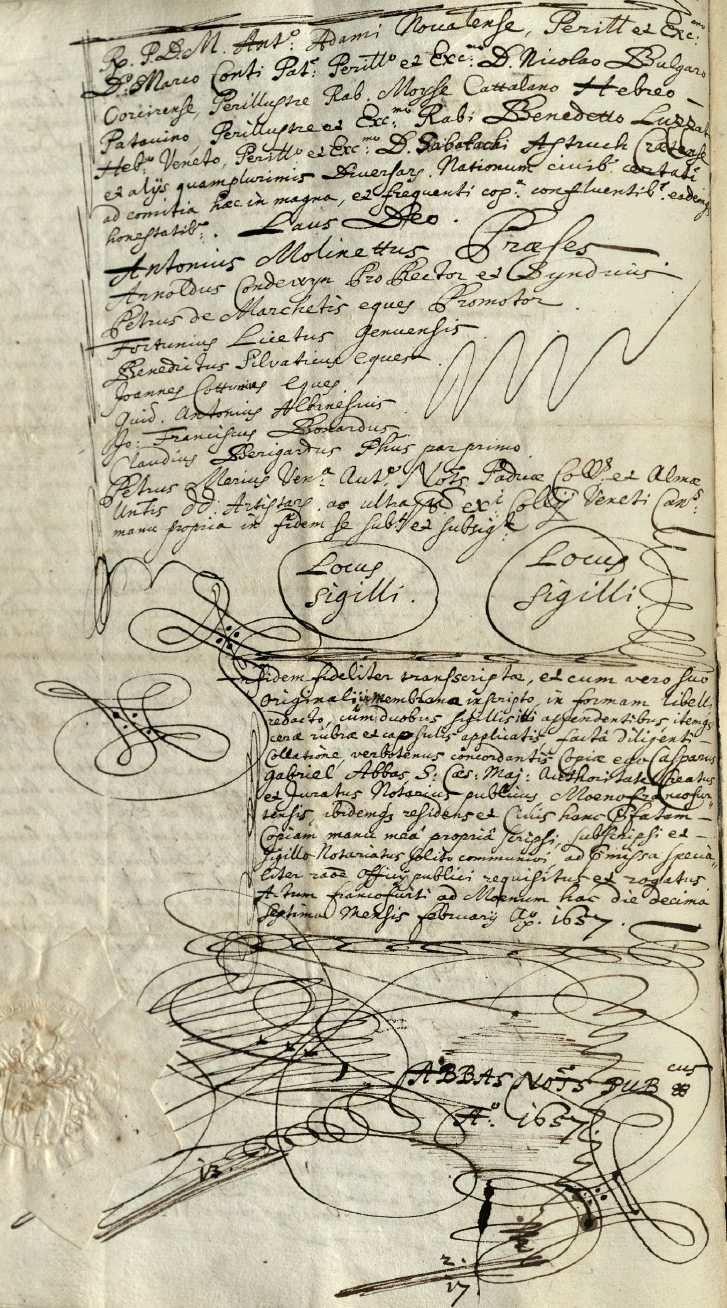
On Modigliano, we are fortunate to have archival material. Hananiah Modigliano was a graduate of the University of Siena in 1628 and was one of a mere eleven Jewish graduates from this university from the years 1543 to 1695.[11] His medical diploma is extant and housed in the Jewish Theological Seminary Library.[12]

The invocation reads “In Dei Nomine Amen” (in the Name of God, Amen). While I have not seen any other diplomas of this period from the University of Siena,[13] there are a number of extant medical diplomas from this period issued by the University of Padua. The typical Padua diploma invocation reads “In Christi Nomine, Amen” (in the Name of Christ, Amen). The only diplomas that deviated from this norm were those of non-Christian students, in particular diplomas of Jewish graduates. Virtually every Jewish graduate’s diploma begins with the invocation, “In Dei Aeterni Nomine.” It is possible that the University of Siena made the same accommodations for its Jewish graduates as did Padua, few as they may have been.[14] Modigliano was also identified as a Jew in his diploma, with the word “Hebreo” appearing after his name:

This was also commonly found in the diplomas of the Jewish graduates of Padua, where the word “Hebreus” or “Iudeus” would typically, though not always, follow the name of the Jewish graduates.

We next hear of Modigliano on August 14, 1650, when upon the departure of Rafael Corcos,[15] the Roman Jewish community appointed three new worthy teachers, one of whom was the doctor Hananiah b. Rafael Modigliano.[16] As reported by Zahalon, Hananiah tragically died while serving as a physician for the Jewish community in Rome during the Bubonic Plague of 1656.

Modigliano’s son Raphael was also a physician, as well as a rabbi.[17] Extant medical diplomas of Jewish students are exceedingly rare, yet in this case, we are fortunate not only to possess a copy of Hananiah’s diploma, but we also possess the diploma of his son Raphael as well.[18] This is the only known case of extant father and son diplomas. A copy of his medical diploma from the University of Ferrara in 1662 is below:[19]

The invocation, similar to his father’s diploma, reads, “In Dei Nomine, Amen,” and he is likewise identified as “Hebreus.”

Of note, the document explicitly restricts his medical practice to Jewish patients.

We also have record of Raphael delivering weekly Shabbat sermons in the synagogue in Siena. Moses ben Samuel ben Bassa of Blanes records in his manual for preachers, Tena’ei ha-Darshan,[20] that both he and Raphael Modigliano would deliver weekly sermons, after which they would each provide constructive criticism of the other’s sermon.

What of our third and final physician, Yitzhak Zahalon? Regarding the third of the Jewish plague physicians for Rome in 1656, the author does not reveal additional details about him, despite their sharing the same last name. A few sentences later, however, Yaakov Zahalon enumerates the fatalities of the plague at around eight hundred deaths and mentions his cousin, the young skilled surgeon, Yitzhak Zahalon, amongst the casualties.

This has led at least one scholar to identify the physician in charge of one third of the city as the same Yitzhak Zahalon, the surgeon and cousin of Yaakov, the author. Sosland writes, “Three Jewish doctors are mentioned by Zahalon as having charge over the patients. One of them was a first cousin of our author, a certain Isaac Zahalon, a “skilled surgeon” who died toward the end of the epidemic.”[21]

With the physicians in charge of the medical care of the Lazaretto, as well as the different sections of the Ghetto, accounted for by name, we are left to wonder about the role, if any, the author, Yaakov Zahalon, played during the plague. As Sosland notes, “as to the exact role Jacob filled, we have no direct knowledge.”[22]

Zahalon’s medical work was published in Venice in 1683, and unlike the work of his rough contemporary, Tuviya Cohen, whose Ma’aseh Tuviya has been reprinted numerous times, has not yet merited even a second printing.[23] There is however one extant manuscript of Zahalon’s Otzar HaHayyim housed in the Vatican,[24] dated from no later than 1675, and it is in this manuscript that we find the solution to the riddle of Zahalon’s role in the administration of medical care to the Jews in the Rome Ghetto during the plague.

The manuscript appears to reflect that Otzar HaHayyim was initially part of a larger multi-section work entitled Ohalei Yaakov Otzar HaHokhmot. Zahalon’s medical work is labelled as section two, Hokhmat HaRefuah, the only section in the Vatican manuscript.

Below is the section describing the division of the city into three sections, each with its respective physician.

There is one key difference in this passage between the printed edition and the manuscript version. The physician in charge of the third section of the city is not Yitzhak Zahalon, whose identity is ambiguous, but rather, Yaakov ben Yitzhak Zahalon, none other than the author himself! A part of the name was accidentally omitted in the printed work. Zahalon refers to himself here in third person. This correction now facilitates a better understanding of the next sentence in the text, in which Zahalon continues to refer to himself, expressing gratitude to God for having rescued him from the ravages of the plague.

In this vein, I conclude with a comment on Zahalon’s conclusion to his plague passage. Despite the unspeakable tragedies experienced by the Jewish community, Zahalon ends his plague discussion by sharing a positive, though bittersweet, thought reflecting the continuity of the Jewish community:

As a good sign for the people of Israel, a pregnant woman named Zivia, the wife Yitzhak Mondolfo, contracted the plague, and though confined to the Lazaretto, was able to deliver a healthy child, whom she was able to nurse for a period before her demise. In the final line of this section in the printed work, we read that the child was still alive “until today,” and that his name was Efraim Levi. Though Zahalon’s book was published in 1683, this line appears in the manuscript, thus “until today” would be some twenty years after the plague.

While this indeed is some form of consolation, the manuscript adds an additional sentence which yields a far more powerful conclusion.

“And the circumcision was performed there (in the Lazaretto), and I say to you by your blood you shall live, and I say to you by your blood you shall live.” Zahalon concludes with the phrase from Yechezkel 16:6 which is traditionally recited as part of the circumcision ceremony. The allusion here to the plague is obvious.

Omitting this last sentence denies us not only the additional factual information about the performance of the circumcision in the Lazaretto, itself a remarkable event, but also Zahalon’s homiletic flourish which marked the community’s (re)birth after the tragedies of the plague. As I write these words, we are still in this midst of the Covid 19 pandemic, though the dissemination of the vaccines portends, God willing, for its cessation in the near future. These final intended words of Zahalon resonate deeply with us today, perhaps even more so than they would have when Otzar HaHayyim was published, some three decades after the plague.

[1] Ellen B. Wells, “Prints Commemorating the Rome 1656 Plague Epidemic,” Annali dell’Istituto e Museo di Storia della Scienza di Firenze 10 (1985), 15-21.
[2] On Zahalon, see Harry A. Savitz, “Jacob Zahalon, and His Book, ‘The Treasure of Life,’” New England Journal of Medicine 213:4 (July, 1935), 167-176; Harry Friedenwald, “Jacob Zahalon of Rome: Rabbi, Physician, Author and Moralist,” in his The Jews and Medicine 1 (Ktav Publishing House: New York, 1967), 268-279; J. Ph. Hes, “Jacob Zahalon on Hypochondriasis,” (Hebrew) Koroth 4:5-7 (December, 1967), 444-447; A. Danon, A. Kadar and D. V. Zaitchek, “Physiology and Pathology of Lactation in Zahalon’s Work,” (Hebrew) Koroth 4:11-12 (December, 1968), 667-678; D. Margalit, “Shmirath Habriuth by Maimonides and Comment by R. Jacob Zahalon,” (Hebrew) Koroth 5:1-2 (September, 1969), 96-98; Yehoshua Leibowitz, “R’ Yaakov Zahalon Ish Roma uPizmono liShabbat Hannukah 1687,” Sefer Zikaron liHayyim Enzo Sereni: Ketavim al Yehudei Roma (Shlomo Mayer Institute: Jerusalem, 5731), 166-181; Jonathan Jarashow, “Yakov Zahalon and the Jewish Attitude Towards Medicine,” Koroth 9:9-10 (1989), 725-736; Zohar Amar, Maimonides’ Regimen Sanitatis: Commentary of R. Jacob Zahalon on “Hilchot Deot” – Chapter Four, With an Added Brief Preface to the Treatise Ozar ha-Hayyim (Hebrew) (Neve-Tzuf, 2002); Samuel Kottek, “Pediatrics in the work Otzar HaHayyim of Jacob Zahalon,” (French), in Gad Freudenthal and Samuel Kottek, eds., Melanges d’Histoire de la Medicine Hebraique: Etudes Choisies de la Revue d’Histoir de la Medicine Hebraique (1948-1985) (Brill: Leiden, 2003), 183-207; Eliezer Brodt, Bein Keseh Le’Asor (Jerusalem, 5768), 184-185; Eliezer Brodt, “Segulot leZikaron uPetihat haLev,” Yerushateinu 5 (5771), 337-360, esp. 352; Michal Altbauer-Rudnik, “Love For All: The Medical Discussion of Lovesickness in Jacob Zahalon’s The Treasure of Life (Otzar Ha-Hayyim),” in Asaph Ben-Tov, Yaakov Deutsch and Tamar Herzig (eds.) Knowledge and Religion in Early Modern Europe: Studies in Honor of Michael Heyd (Brill: Leiden, 2013), 87-106. For discussion of the sources of Zahalon’s medical work, see Iris Idelson-Shein, “Rabbis of the (Scientific) Revolution: Revealing the Hidden Corpus of Early Modern Translations Produced by Jewish Religious Thinkers.” American Historical Review 126, no. 1. Forthcoming, March 2021.
[3] For the response of the Italian Jewish community to plagues in this period, including the plague in Rome of 1656, see Yaffa Kohen, The Development of Organizational Structures by the Italian Jewish Communities to Cope with the Plagues of the Sixteenth and Seventeenth Centuries (Hebrew) (Doctoral Dissertation: Bar Ilan University, submitted Tishrei, 5740). I thank Naomi Abraham, librarian at Bar Ilan University, for her truly exceptional efforts in making this dissertation available to me in the midst of the Covid pandemic.
[4] For more on this passage and on the plague in the Jewish Ghetto of Rome, see Yehoshua Leibowitz, “Bubonic Plague in the Ghetto of Rome (1656): Descriptions by Zahalon and by Gastaldi,” (Hebrew) Koroth 4: 3-4 (June, 1967), 155-169; Kohen, op. cit., 72-95.
[5] Y. Zahalon, Otzar HaHayyim (Venice, 1683), 21a-21b. Elsewhere we have discussed the Jewish physicians of the 1631 plague in Padua. See E. Reichman, “From Graduation to Contagion: Jewish Physicians Facing Plague in Padua, 1631” Lehrhaus (thelehrhaus.com), September 8, 2020.
[6] See H. Friedenwald, “Jacob Zahalon of Rome,” in his The Jews and Medicine (Johns Hopkins Press: Baltimore, 1944), 268-279.
[7] On Zahalon’s abilities and reputation as an orator, see Henry A. Sosland, A Guide for Preachers: The Or HaDarshan of Jacob Zahalon—A Seventeenth Century Italian Preacher’s Manual (Jewish Theological Seminary: New York, 1987). On the plague sermons, see pgs. 23-28.
[8]  See, for example, Guenter Risse, “Seventeenth-century Pest Houses or Lazarettos: Rome 1656,” in his Mending Bodies, Saving Souls: A History of Hospitals (Oxford University Press, 1999), 190-214.
[9] On the medical members of the Gabai (and Zahalon) families, see S. Plashkes, “Two Jewish Medical Families in 17th Century Italy: Gabai and Zahalon,” (Hebrew) Koroth 3:1-2 (October, 1962), 97-99.
[10] Otzar HaHayyim 21b.
[11] Israele Zoller, “I Medici Ebrei Laureati a Siena negli Anni 1543-1695,” Revista Israelitica 10 (1913), 60-70 and 100-110. In contrast, the University of Padua counts 127 Jewish medical graduates from 1617 to 1695. See A. Modena and E. Morpurgo, Medici E Chirurghi Ebrei Dottorati E Licenziati Nell’Universita di Padova dal 1617 al 1816 (Italian) (Forni Editore, 1967). For Jewish graduates of Padua earlier than this period, see D. Carpi, “Jews who received medical degrees from the University of Padua in the 16th and early 17th centuries,” (Hebrew) in Scritti in Memoria di Nathan Cassuto (Ben Tzvi Publishers: Jerusalem, 1986), 62-91.
[12] JTS, MS 8519. I thank Sharon Liberman Mintz for bringing this diploma to my attention. As part of my research interest in Jewish medical history, I have sought out copies of medical diplomas of Jewish students from previous centuries. Sharon, aware of this interest, notified me of a medical diploma in the JTS collection. The record does not identify the graduate but lists the University of Siena as the granting institution. I had never seen a diploma of a Jewish medical student from this institution; the majority of extant medical diplomas of Jewish students are from the University of Padua. However, due to the Covid 19 pandemic, access to the original diploma, stored in the remote site of the library, has been impossible. Fortunately, the National Library of Israel had taken black and white photographs of this document some years ago, and I was able to acquire copies. Since the onset of the pandemic, I have been focusing of the history of pandemics in Jewish medical history. When I received the copies of the diploma, and read the name, Hananiah Modigliano, it sounded familiar to me. It was a short while until I realized that I had seen the name mentioned in Zahalon’s passage on the plague.
[13] As per the librarian for the University of Siena Archives, the university does not possess any diplomas of this period.
[14] On the differences in the diplomas of Jewish medical graduates of the University of Padua, see E. Reichman, “Confessions of a Would-be Forger: The Medical Diploma of Tobias Cohn (Tuviya Ha-Rofeh) and Other Jewish Medical Graduates of the University of Padua,” in Kenneth Collins and Samuel Kottek, eds., Ma’ase Tuviya (Venice, 1708): Tuviya Cohen on Medicine and Science (Muriel and Philip Berman Medical Library of the Hebrew University of Jerusalem: Jerusalem, 2019), in press; E. Reichman, “The ‘Doctored’ Medical Diploma of Samuel, the Son of Menasseh ben Israel: Forgery or ‘For Jewry’?” Seforim Blog (https://seforimblog.com) (forthcoming).
[15] The Corcos family was a prominent Jewish Italian family. Another Jewish graduate of the University of Siena was Isaac Corcos, who graduated in 1654. See Zoller, op. cit. He may have been a relative and possibly a brother of Raphael Corcos.
[16] See H. Volgstein and P. Reiger, Geschichte der Juden in Rom, 2 vol (Berlin, 1895-1896), 267.
[17] On Raphael Modigliano, see Asher Salah, La Republique des Lettres: Rabbins, ecrivains et medecins juifs en Italie au XVIIIe Siecle (Brill: Leiden, 2007), 428-429.
[18] What makes this even more exceptional is that Hananiah’s diploma is the only known Jewish diploma from the University of Siena, and Raphael’s diploma is one of only two known Jewish diplomas from the University of Ferrara, the other being from 1802 (Samuel Vita Della Volta).
[19] The diploma was originally part of the Valmadonna Trust Library, Ms. 292, and is now incorporated into the National Library of Israel, system n. 990000822160205171. See Benjamin Richler, The Hebrew Manuscripts in the Valmadonna Trust Library (Valmadonna Trust: London, 1998), n. 269.
[20] Columbia University Library, Ms. X 893 T 15, p. 15a. See Sosland, op. cit., 82-83.
[21] Sosland, op. cit., 25. Others just listed the name as Isaac Zahalon without comment. See H. Volgstein and P. Reiger, Geschichte der Juden in Rom, 2 vol (Berlin, 1895-1896), 212-213.
[22] Sosland, op. cit., 25.
[23] Some years ago, Chaim Reich, ah, of Renaissance Hebraica, produced a high-quality reproduction of Otzar HaHayyim. I thank Rabbi Eliezer Brodt, who owns one of these copies, for this information.
[24] The manuscript is available online at https://digi.vatlib.it/mss/detail/Vat.ebr.466. On this manuscript see, Malachi Beit-Arié and Nurit Pasternak, Hebrew Manuscripts in the Vatican Library (Vatican City, 2008), 405. I have only compared the manuscript to the printed edition for this brief passage. A comprehensive comparison remains to be done.


Depression Angles

Depression Angles
By William Gewirtz

Introduction:

Depression angles measure the level of darkness or illumination prior to sunrise and, in a parallel fashion, after sunset.

There are two halakhic disagreements that might appear to relate to the use of depression angles. First, there is a long-standing argument about what defines the transition from one day to the next and what is (merely) an indicator that the transition has occurred. Some consider the appearance of three stars as the basis of a definition, while others assume that darkness is defining, with the appearance of three stars merely being an indicator that a specific level of darkness has already occurred. However, this dispute is not consequential to the use of depression angles. Even though depression angles relate directly to (the level of) darkness, since darkness levels and the appearance of stars occur approximately simultaneous, the argument is primarily of theoretical interest. As a result, the disagreement does not influence the use or the operation of depression angles.[1]

Second, a present disagreement is particularly consequential. Do we adopt fixed zemanim, e.g. 42 or 72 minutes after sunset or one hour before sunrise, or variable zemanim that change based both on location and day of the year? In Talmudic literature, physical events like the first appearance of light across the eastern sky, the ability to differentiate between blue and white, the sky’s apex and the eastern horizon appearing equally dark, the appearance of 3 medium stars, etc. all describe events whose occurrence vary at different locations and during different days of the year; they cannot be specified by a single fixed interval. As a result, I have a strong preference for variable versus fixed zemanim.[2] In spite of this being a still active dispute, I will assume that the argument is settled, and will not address the issue further in this paper. Clearly, depression angles are (largely) irrelevant to those who determine zemanim using fixed intervals. Therefore, this paper provides an explanation focused on depression angles themselves, as a methodology to formalize the use of variable zemanim. In what follows, I will explain the use of depression angles, the scientific method that has emerged over the last 150 years that makes use primarily[3] of both latitude and season / date to calculate various zemanim.

How this disagreement between using fixed versus variable zemanim developed would require its own detailed historical study, which I believe has not yet been attempted. Absent such a study, three factors appear to have had some bearing on the issue.

First, from the 12th through the 18th century, most observant Jews followed what is referred to as the opinion of Rabbeinu Tam, which equated the length of the intervals

  • between sunset and the end of Shabbat and
  • between alot hashaḥar and sunrise.

Because the length of the interval between sunset and the end of Shabbat was never lengthened, logic dictated that the (assumedly) equal interval between alot hashaḥar and sunrise be left invariant as well.[4]

Second, Pesaḥim 94a was (surprisingly)[5] read as implying that the time to walk a four milin interval applied year-round.

Third, in his forceful rejection of the opinion of Rabbeinu Tam, the Vilna Gaon proposed both seasonal and latitude-based variation with respect to both the intervals between sunset and the end of Shabbat and between alot hashaḥar and sunrise. While his view gained broad acceptance with respect to the end of Shabbat, its implications for variation based on both latitude and the time of the year with respect to alot hashaḥar, were (and still are) often ignored.

Without further attention to detailed halakhic issues, we will concentrate on the functional aspects of depression angles, (without requiring familiarity with spherical trigonometry on which they are formally based.) But first, we begin with a brief summary of some fundamental elements in the area of zemanim, which will help anchor the discussion.

Zemanim:

Two areas dominate the study of zemanim:

  • First, how is the length of the 12 halakhic hours of every daytime period, which begins at alot hashaḥar, to be calculated given variation in the length of the daytime period during the different times of the year? Do we calculate from the daytime period’s halakhic beginning at alot hashaḥar or from the point of sunrise?
  • Second, how do we determine the precise delimiters of a day of the week,[6] which almost all agree concludes approximately at the end of the of the bein ha-shemashot period in the evening?[7]

Avoiding the many disagreements in the halakhot of zemanim, we will assume without loss of generality that:

  • The amount of time by which alot hashaḥar precedes sunrise, in the Middle East and around the spring and fall equinox when both the daytime and nighttime periods are equal, is 72 minutes.[8]
  • The transition point between the days of the week and most critically, the end of Shabbat follows the opinion of the geonim (as opposed to Rabbeinu Tam.)[9]

Addressing primarily only alot hashaḥar and the end of Shabbat is sufficient to illustrate how depression angles can be used in halakha. In many communities, the methods used to determine the end of Shabbat versus alot hashaḥar are different and demonstrate concretely the issue that we will address. In those communities, alot hashaḥar is always a fixed 72 minutes before sunrise and the calculation of alot hashaḥar in those communities does not involve use of depression angles. On the other hand, the number of minutes after sunset at which 3 stars appear or a requisite level of darkness has been achieved varies considerably depending on where you are and the time of the year as well. As a result, very often the end of Shabbat is (either explicitly or implicitly) calculated using depression angles or a near equivalent.

Clocks:

Before addressing depression angles some background on the introduction of clocks into the halakhic literature is required. Beginning at the turn of the 16th century, about two centuries after the first introduction of mechanical clocks in Europe, clocks were first mentioned in the halakhic literature; at that time, knowledge of the impacts of latitude and season was still non-existent. Throughout the entire period of the rishonim, time intervals were typically referred to not by the number of minutes on a clock, but primarily as estimated intervals. Clocks added a mechanism that allowed various opinions previously specified in terms like the time required to do X, to be translated into a precise, easily specified interval of time.

Clocks began to proliferate almost 200 years before the first recorded reference to either the impacts of latitude or season appear in the halakhic literature. Those impacts were included by R. Avraham Pimential in his comprehensive sefer on zemanim, Minhat Kohen, written during the 17th century.[10]

The first mention of a clock in the halakhic literature was by R. Yosef ben Moshe, a student of R. Yisroel Isserlein, in Leket Yosher appearing around the turn of the 16th century;[11] it appeared more than a century earlier than Minhat Kohen. During the 14th through 16th century clock making accelerated, well before the nature of variances between zemanim at different locations and during different times of the year were appreciated.

Unfortunately, the precision that clocks provided may have resulted in their increased prominence at the expense of observation. Precision and accuracy are often confused. Clocks provide precision for measurements that may or may not be accurate halakhically. If someone tells you that Shabbat ends at a specific time, that assertion may be very precise but totally inaccurate. Clocks also provided a level of precision that may have been overly seductive. What is yet more disconcerting, clocks allowed pesak to be rendered independent of observation. With an assumed reduced reliance on observation, it is likely that critical halakhic definitions became more subject to disagreement. Examples abound in the halakhic literature:

  1. distinguishing between levels of darkness,
  2. differentiating between medium and small stars, or
  3. establishing the amount of illumination necessary to recognize a friend after dawn

are three clear examples. In each of those three cases, posekim’s opinions often varied significantly and/or recommended caution based on a level of acknowledged doubt.

In the 19th century, as personal timepieces proliferated and greater uniformity between clocks in different locations became necessary with the growth of the railroads, time took on a yet greater role, something we note but do not address further.

Variation by the time of the year and location/latitude:

In the entire period of the rishonim, instead of time-based measures, most mitzvot dependent on zemanim were performed based on the observation of natural events. The effects of latitude and the time of the year were incorporated implicitly by the use of observation. The occurrence of darkness or the appearance of stars varied naturally between locations regulated by a yet unknown science. How zemanim differed at different locations was largely immaterial; as far as I know, prior to the 17th century there is no discussion in the halakhic literature comparing zemanim at different locations.

After a significant interval where clocks proliferated, depression angles first appeared in the halakhic literature at the end of the 19th century. A depression angle[12] measures how far below the horizon the sun appears at a specific moment, providing an accurate measurement of the level of illumination; a larger angle indicates that the sun is further below the horizon with less discernable light coming from the sun. If a depression angle of X degrees occurs at 4:40AM in London and 5:10AM in New York on the same or different days, then one can be certain that the amount of light from the sun is the same at those two times.

If alot ha-shaḥar is defined by the degree of illumination from the sun, to determine alot ha-shaḥar across different latitudes and times of the year, one can[13] utilize depression angles. The first step is to establish the number of degrees below the horizon the sun is located 72 minutes before sunrise in the Middle East around the spring / fall equinox. The second step is to use that same number of degrees to determine alot ha-shaḥar elsewhere and during other times of the year. The 72-minute interval commonly accepted for alot ha-shaḥar corresponds to the sun being approximately 16 degrees below the horizon.

In Israel around the spring / fall equinox, scientists consider the sun to provide no measurable light until approximately 80 minutes before sunrise corresponding to a depression angle of approximately 18 degrees.[14] As the halakhah often disregards miniscule, non-visible quantities, this provides observational support for the standard pesak tacitly assumed that alot ha-shaḥar precedes sunrise by 72 minutes.

From everything I can determine, depression angles capture the halakhic notion of the degree of darkness and light accurately; no alternative for “measuring” ḥashekhah or alot ha-shaḥar has ever been formulated, nor has anyone ever proposed any problem that depression angles might create. Depression angles naturally adjust zemanim based on latitude and the time of the year. Clearly, we may not need such precision; observation was adequate for generations. Nonetheless, a depression angle is to darkness / illumination what a watch is to time.

A small depression angle corresponds to a significant amount of illumination coming from the sun even though the sun is below the horizon. After sunset the level of illumination decreases in a mirror image to the way the level of illumination increases as we approach sunrise. At a depression angle of around 5 – 6 degrees, the halakhic end of a day as specified in the Talmud occurs;[15] at a depression angle of around 11 – 12 degrees we arrive at the point of misheyakir. In between, at a depression angle of 8.5 degrees, Shabbat, as typically practiced currently, concludes. Translating a zeman into a depression angle is neither always straightforward nor undisputed. For certain zemanim, alot hashaḥar for example, the basis is clear: the level of illumination at the beginning of the daytime period, in the Middle East around the spring or fall equinox corresponding to an average time to walk 4 milim. To determine the transition point between days of the week and the end of Shabbat according to the geonim, both biblically and in practice incorporating various ḥumrot, is more complex. Fortunately, following R. Yeḥial Miḥal Tukatzinsky’s calendar for Jerusalem, the practiced end of Shabbat is almost universally accepted by those who rely on depression angles to equate to an angle of 8.5 degrees. Very few posekim following the geonim are more stringent; the practice of the overwhelming majority of 19th century posekim for whom we have calendars (from which depression angle equivalents can be inferred) were more lenient. However, the earlier point of ḥashekha or 3 medium stars, absent any ḥumrot, is still disputed.[16]

Given the earth’s circular shape, tilt, and rotation, computing depression angles involves spherical trigonometry, which is fortunately not needed for purposes of this paper. Similarly, albeit without the precision, Ḥazal used terms like mi-she-yakkir, hikhsif ha-elyon, the appearance of small/medium stars, etc. all of which relate to the degree of darkness or equivalently the amount of residual illumination from the sun. As noted in the introduction, there is a long-standing halakhic dispute pitting the primacy of darkness against the appearance of stars; which is defining, and which is just a useful indicator? I am strongly biased in the direction of darkness as defining; darkness was already recognized as causing the visibility of stars in geonic times. Since the level of darkness and the appearance of stars are strongly correlated, the dispute, as noted in the introduction, is not consequential to this short paper.[17]

Latitude, the time of the year and depression angles:

For any halakhik zeman, besides the level of darkness specified by a depression angle by which it is defined, two additional variables – the location’s latitude and the date of the year – must also be provided to calculate the time at which that halakhik zeman occurs. The intuition is important. To determine the time (after sunset or before sunrise) at which a level of darkness is achieved, we must know

  1. where you are, defined only by your distance from the equator,
  2. where the sun is, which can be calculated knowing the exact time of the year, and
  3. the level of darkness required.

The former two inputs are just unarguable facts; the latter requires a halakhic determination.

Those mathematically inclined, should think of this as a function of three variables: 1) latitude, 2) date, and 3) darkness level, where those inputs generate a number, the value of the function. That number equals the length of time before or after sunrise or sunset, respectively, at that latitude, on that day, when the degree of illumination expressed by that depression angle is achieved.

Both the latitude and the date play a critical role. However, until latitudes exceed 40 degrees, the seasonal variation for alot hashaḥar is less than about 20 minutes. For ease of explanation, the impact of the date, i.e. the seasonal variation, will be covered separately in the next section. To better understand the impact of latitude, the following discussion focuses on an arbitrary but specific day. The critical inputs in addition to that one day selected are 1) the latitude of the location and 3) the desired level of darkness, specified by a depression angle. I can input, for example, 1) latitude: 30 degrees and 3) the degree of darkness associated with a depression angle of 10 degrees.

For that specific day, given the latitude and a specified depression angle, the function calculates how many minutes before sunrise or after sunset the degree of darkness associated with that depression angle is achieved.[18] If you go further away from the equator, getting dark takes longer. What takes 42 minutes in Jerusalem takes approximately 50 minutes in New York. But things are a bit harder. Mathematicians will describe the result as non-linear, something that equates to “it is not simple.” For a depression angle of 8.5 degrees, it takes 8 minutes longer to reach that level of darkness in New York, situated about 9 degrees further from the equator than Jerusalem. If things were simple, i.e. linear, you might guess that it takes about 8 minutes more for every 9 degrees further from the equator that you are located. If you go 18 degrees further north of Jerusalem, you might expect having to wait (only) another 8 minutes, 16 minutes longer after sunset than the time it took to reach that level of darkness in Jerusalem. However, when we go 18 degrees further north of Jerusalem to Prague, an equivalent level of darkness is achieved 26, and not (a linear) 16 minutes, later.

Prague is further south than the locations of most European Jews who lived in Poland and Russia, about 48 to 56 degrees north latitude where change based on latitude accelerated. Additionally, depression angles have a second complicating factor. Instead of varying latitude, let us hold latitude fixed at say 50 degrees, the latitude again of Prague. Compare, for example, the number of minutes after sunset that it takes to reach a depression angle of 8.5 versus 16 degrees, the latter number being less than twice the former. On a day in early May those times for Prague are 58 and 130 minutes respectively, the latter being more than twice the former; a second non-linearity.

As both latitudes and desired level of darkness change, either very careful observation or scientific knowledge is required. It is not all that surprising that such precision was not always exhibited in the halakhic literature. Note that at latitudes further from the equator and at greater levels of darkness, the degree of seasonal variation increases as well, as we will see in the next section.

Dealing with seasonality

Posekim deal appropriately with seasonality in one of two fundamentally different ways:

  1. Some use a simple upper bound for a zeman where use of a such a number does not create significant inconvenience. Some treat R. Moshe Feinstein’s 50-minute zeman for the conclusion of Shabbat in the New York area that way.
  2. Alternatively, a posek can use depression angles; R. Yisroel Belsky adjusted R. Feinstein’s 50-minute zeman using depression angles to vary the conclusion of Shabbat between 40 and 50 minutes after sunset during different times of the year.[19]

To begin with, it is important to recognize that the magnitude of seasonal variation increases (non-linearly) both for:

  1. Locations further from the equator (thus greater variation in Montreal than Miami.)
  2. Greater degrees of darkness (thus greater variation in misheyakir than in the end of Shabbat.) (The average depression angle for misheyakir is approximately 3 degrees greater than the currently prevalent depression angle used to compute the end-time for Shabbat.)

For example, the seasonal variation for the end of Shabbat in Jerusalem is only 6 minutes, from about 36 minutes after sunset near the spring or fall equinox to about 42 minutes after sunset near the summer solstice. On the other hand, the variation in alot hashaḥar in Lithuania is “infinite.” Alot hashaḥar is 102 minutes before sunrise at the spring equinox, 120 minutes before sunrise at the winter solstice, and set to halakhic midnight during periods of the summer. In periods during the summer, the requisite level of darkness equating to a depression angle of 16 degrees does not occur; it never gets that dark during the night, something the Gaon observed.[20] Said differently, illumination from the sun never diminishes to that level either in the evening or equivalently in the morning. The extent to which this was neither recognized by posekim prior to the Gaon nor followed even after the times of the Gaon would require its own (lengthy) essay to illustrate.

The impact on the point of misheyakir provides another interesting topic for study. Pesakim from the Middle East tend to have an earlier point of misheyakir, often equating to a depression angle of between 13 and 11.5 degrees; pesakim from European posekim tend to use 11.5 degrees or less.[21] It suffices to say, posekim from northern Europe need to be read with care in discussions of this issue. Their views on alot hashaḥar and misheyakir are obviously linked; a delayed point of alot hashaḥar would likely delay the point of misheyakir as well.

Those following the 72-minute approach of Rabbeinu Tam should behave equivalently with respect to the end of Shabbat and alot hashaḥar, a practice rarely observed. It is alleged that R. Chaim of Brisk made havdalah Sunday morning, recognizing that Shabbat ends at (halakhic) midnight, coincident with alot hashaḥar and after the time he had already gone to bed. Such practice was rare. Interestingly, in Vilna, using a depression angle of 8.5 degrees to compute the end of Shabbat, a prevalent practice today, even the approach of the Gaon requires waiting 95 minutes after sunset to end Shabbat during the weeks around the summer solstice.

Unfortunately, many incorrect alternatives remain prevalent. Depression angles confirm that the shortest intervals occur in the spring or fall close to either equinox. The longest intervals occur around the summer solstice. Surprisingly to many, the interval around the winter solstice is longer than the interval in the spring or fall, but shorter than the interval in the summer. Because this was not properly understood, an error, going back to R. Pimential[22] persists until today.

While acknowledging that intervals vary by the time of year, in place of depression angles the error links variation in the interval with variation in the length of the period between sunrise and sunset. With this mistaken approach the summer interval is lengthened as it should be, but the variation is calculated imprecisely. In the winter the interval is shortened as opposed to lengthened, a very consequential error.

Interestingly and for reasons I can only suspect, posekim advised against using the implied wintertime reduction in time when it creates a leniency; perhaps the observed result did not conform to expectations or, as some might suggest, their counsel is another example of siyattah di-Shemayah.

A large and well entrenched group chooses not to make any seasonal adjustment. If done to promote simplification, as noted, that is a reasonable approach where implemented with care, (particularly for the end-time for days of the week at latitudes under 45 degrees.)

Often the implementation is entirely indefensible (most often for alot hashaḥar,) very often in combination with an equally poor approach to latitude, and often challenged by careful) observation. The clearest and most prevalent example is given by those who insist that alot hashaḥar is always 72 minutes before sunrise. Using this approach, one can easily end up with misheyakir visibly occurring before alot hashaḥar, a halakhic absurdity of the first order.

Conclusions:

The use of depression angles allows the determination of various zemanim without the need for observation. Given that the observation of various zemanim has become less widely understood and potentionally subject as well to various human frailties, it is likely that depression angles should become (yet more) widely accepted.[23]

[1]
In fact, on some calendars that clearly use depression angles to determine various zemanim, to avoid controversy the time given is stated in terms of the appearance of stars.

[2] A defense of fixed intervals practiced by a considerable number of posekim is provided by Rabbi Yisroel Reisman in his lecture (available on CD) “A Dawn’s Early Light, October 13, 2007.

[3] Other factors like elevation, temperature, humidity level, etc. have relatively minor impact and are not addressed. The halakhic significance of elevation is widely disputed.

[4] To the contrary, in the 17th century, R. Avraham Pimential, in the 19th century both R. Yaacov Loberbaum and R. Moshe Sofer and R. Moshe Feinstein in the 20th century reduced Rabbeinu Tam’s interval between sunset and the end of Shabbat to approximately 50 minutes, a complex topic not pursued further.

[5] This is rather ironic given that many rishonim remarked that the 12-hour day assumed by the gemara occurs only around the spring and fall equinox.

[6] Ironically, in both Hebrew and English, the words yom and day denote both the daytime period and the day of the week.

[7] According to the vast majority of rishonim, the day ends when bein ha-shemashot ends or at most 2 minutes later.

[8] 90 and on rare occasions 120 minutes are two alternatives to 72 minutes.

[9] As is often practiced in the New York area, it is approximately 45 versus 72 minutes after sunset.

[10] R. Pimential was acknowledged as an expert in zemanim by R. Avraham Gombiner, the author of Magen Avraham. Minḥat Kohen was carefully organized and argued; unfortunately, including two significant errors, which haunt us to this very day. Given his halakhic mastery and his unique role in introducing the important notions of latitude and season, his errors are inconsequential compared to his brilliantly organized analysis. In an odd but regrettable way, the persistence of his errors is testament to his monumental impact.

[11] Attempts to understand the use of a clock in those centuries is complex; unlike current clocks, many had astronomical significance linking clock time and real events like sunset, dusk, or midday.

[12] Depression angles were first discussed by R. Dovid Tzvi Hoffman; they were prominently used and advocated by R. Yechial Michel Tukitzinsky. Depression angles were popularized by R. Tukitzinsky in his work Bein HaShemashot and by Prof. Leo Levi in his book Halakhic Times (Jerusalem, 1967). In recent times, most online internet sites that provide zemanim (as well as many printed calendars) use this methodology extensively, albeit disguised on occasion. Among contemporaries, many posekim including R. Belsky and R. Willig and most seforim on zemanim use depression angles extensively.

[13] Even before one reaches the Arctic and Antarctic circles, particularly as one moves more than 60 degrees from the equator, many halakhot must be carefully examined.

[14] There is an interesting comment by R. Hoffman, Melamaid Le-hoil 30, like that of R. Pimential, relating the comment of R. Yehudah that oveyo shel rakiya are 1/10th of the day to 18 degrees being 1/10th of the 180-degree daytime movement of the sun.

[15] That point is relevant according to many posekim to determine the time at which to terminate a rabbinic fast.

[16] Remember that we benefit from a significant amount of artificial illumination at night, something that grew at various rates in many places. In areas where artificial illumination is entirely absent, the above depression angles will appear more reasonable.

[17] In my mind, the following represent the strongest arguments in favor of darkness:

  1. Early tannaic literature speaks almost exclusively of darkness.
  2. Darkness causes the appearance of stars that are present but not visible during the daytime period.
  3. The sugyah about Teveryah and Tzipporri (Shabbat 117a) strongly implies darkness as defining. (I found a visit to Tzipporri extremely helpful in understanding why the sugyah did not choose an elevated location closer than Tzipporri, over thirty miles from Teveryah.)

One side benefit of relying on darkness is that unlike counting the number of stars, measuring the darkness of the eastern horizon versus the top of the sky is less subject to light pollution.

Nonetheless, absent light pollution, by about 30 minutes after sunset in Israel there is little practical difference. Given the larger number of posekim promoting stars as defining, including the Gaon of Vilna, it is hard to be obstinate in maintaining an unrestrained bias for darkness as defining.

[18] With respect to depression angles one will often hear / read the sun appears, as opposed to is, X degrees below the horizon to incorporate accurately the critical importance of the position, i.e. latitude, of the observer. An observer at different latitudes will perceive the sun differently based on both 1) their distance from the equator and 2) whether they and the sun on the same or opposite sides of the equator.

[19] This is strongly implied in his approbation for the website www.myzemanim.com.

[20] See the Gaon’s lengthy comment on O.H. 459.

[21] See the various pesakim quoted in R. Benish, HaZemanim BeHalakha chapter 23.

[22] Without a wintertime observation R. Pimentel (incorrectly) assumed the period was 1/15th of the daytime (sunrise to sunset) period assuming a linear relationship that conformed to his two points of observation at the spring equinox and summer solstice.

[23] This paper is meant to explain the use of depression angles; even for those who completely follow what was presented, halakhic conclusions can be drawn only at the reader’s peril.


New volume of Mekhilta Journal Announcement

New volume of Mekhilta Journal Announcement

By Eliezer Brodt

מכילתא, כתב עת לתורה ולחכמה, רעדיאל ברויאר, יעקב ישראל סטל ומשה דוד צציק (עורכים), גליון ב, כסלו תשפא, 323 עמודים

Volume two of the new Journal Mekhilta just came out. Similar to the first issue it has an all-star lineup of writers on great topics.

Copies of this volume are available for purchase through me (while the limited edition lasts) and will help support the efforts of the Seforim Blog. Contact me at Eliezerbrodt@gmail.com

For sample pages contact me at the above email.

Copies of the first issue are still available.

Here is the Table of contents of the new volume.


What if the Maharal of Prague Had Access to Leipzig 1 and Other Manuscripts?

“What if the Maharal of Prague Had Access to Leipzig 1 and Other Manuscripts?”

On Shemos 23:19 – Rashi on ראשית בכורי אדמתך

By Eli Genauer

Summary: There is a statement in Rashi which appears in the overwhelming majority of early Rashi manuscripts, and in early printed editions. But because Gur Aryeh and others did not have access to these manuscripts, and because they felt that what Rashi said was incorrect, they ascribed the statement to a טעות סופר. Knowing that Rashi really did write these words might have changed their approach to this Pasuk.

שמות כג

(יט) רֵאשִׁ֗ית בִּכּוּרֵי֙ אַדְמָ֣תְךָ֔ תָּבִ֕יא בֵּ֖ית ה’ אֱלֹקיךָ לֹֽא־תְבַשֵּׁ֥ל גְּדִ֖י בַּחֲלֵ֥ב אִמּֽוֹ

Rashi in Al HaTorah based on Leipzig 1:

ראשית בכורי אדמתך – אף השביעית חייבת בביכורים, לכך נאמרה אף כאן

Sefaria records it the same except it adds בִּכּוּרֵי אַדְמָתְךָ at the end.

ראשית בכורי אדמתך. אַף הַשְּׁבִיעִית חַיֶּבֶת בְּבִכּוּרִים, לְכָךְ נֶאֱמַר אַף כָּאן בִּכּוּרֵי אַדְמָתְךָ.

Oz VeHadar Rashi HaMevuar records it as above without parentheses but comments that there are some who do not include this comment because one is not Chayav in Bikurim during Shemittah.

The discussion in their Miluim section records many opinions on this matter. It concludes by saying that this statement of Rashi contradicts a statement of his in Yevamot, thereby leaving the impression that the statement in Shemot 23:19 is questionable.

Artscroll Rashi Sapirstein Edition (1994) records these words in parentheses to indicate that there is a true doubt whether Rashi wrote them.[1]

Artscroll notes that “Mizrachi and Gur Aryeh argue that it cannot be Rashi’s work”, but that Nachalat Yaakov defends this version of Rashi.[2]

Chumash Ateret Rashi (Jerusalem 1998) records the words without parentheses but only cites Gur Aryeh who say that Rashi did not write them and Mizrachi who says that there are Seforim which don’t have them.

The position of Mizrachi and Gur Aryeh is based on the fact that they feel that the Halacha is that during the Shemitah year one is not obligated to bring Bikurim. Mizrachi cites some “Nuschaot” which do not have this comment and Gur Aryeh writes that this comment is בודאי טעות סופר

Mizrachi:

ראשית בכורי אדמתך אף השביעית חייבת בבכורים לכך נאמר אף כאן בכורי אדמתך. ברוב הספרים כתיב אף השביעית חייבת בבכורים. ונראה לי שאשר הביאם לזה הוא מפני שראו של גבי וביום השביעי תשבות פירש אף בשנה שביעית לא תעקר שבת ממקומה שלא תאמר כוּ ולגבי שלשה פעמים בשנה פירש גכ לפי שהעניין מדבר בשביעית הוצרך ללמד שלא יסתרסו ג’ רגלים ממקומן חשבו שלגבי בכורים נמי שלא יהיו הבכורים נדחין ממקומן ולכך אמרו אף השביעית חייבת בבכורים ואין הדבר כן שהרי במכילתא שנו גבי וביום השביעי תשבות נאמר כאן שבת בראשית לעניין שביעית שלא תסתרס עניין שבת בראשית ממקומה ולגבי ג’ פעמים בשנה שנו נאמר שלשה רגלים בשביעית שלא יסתרסו ג’ רגלים ממקומן ואלו לגבי ראשית בכורי אדמתך שנו למה נאמרה פרשה זו לפי שנאמר ולקחת מראשית כל פרי האדמה אין לי אלא פירות משקין מניין תל תביא בית ייּ אלהיך

ממ אבל בקצת נוסחאוּ אינו כתוב אלא בכורי אדמחך אדם נכנס לתוך שדהו כוּ

Gur Aryeh:

אף השביעית חייב בבכורים. בודאי טעות סופר הוא, דאיך שייך דיהיה השביעית חייב בביכורים, שאיך קורא אני כאן ועתה הבאתי ראשית פרי האדמה אשר נתת לי” (דברים כו, י), דהא לא לו נתן, ואיך שייך שחייב בביכורים:

Yosef Da’at writes that these words are in some sefarim and not in other sefarim, (בספרים אחרים אינו ), and that “מהר״ל(גור אריה) מוחק ורא״ם(ר׳ אליהו מזרחי) מיישב״

Berliner in Zechor L’Avraham (Berlin 1867) lists only Erfurt #2 (which is now known as Berlin 1222) as a manuscript which doesn’t have these words (“ליתא בכתב יד ערפערט ב׳“). He also cites Mizrachi, Divrei Dovid and Gur Aryeh as saying these words are a ta’us sofer.[3]

Here is Berlin 1222 (13th-14th century) which doesn’t have the comment:

Berliner cites[4] Divrei Dovid דיהרנפורט 1689:

What needs to be determined is whether Rashi wrote these words or not. If he in fact did, one would then need to understand the background to Rashi’s comment but one would not be able to argue that it is a טעות סופר or put forth arguments against this Girsa “MiSevara”.

Gur Aryeh does not cite any books or manuscripts without these words, only that it was בודאי טעות סופר . Berliner cites only one manuscript without this Nusach. Divrei Dovid cites קצת ספרים which do not have it as does Yosef Da’at. Mizrachi says that ברוב הספרים כתיב אף השביעית חייבת בבכורים …… אבל בקצת נוסחאות אינו כתוב אלא בכורי…. Mizrachi does not say if those נוסחאות were books or manuscripts.

We started by citing Leipzig 1 which has this statement in Rashi. To claim that it was a טעות סופר would mean that this mistake ended up involving either Rav Shemayah or Rabbeinu Makhir. v These words are in 13 manuscripts from the 13th century I checked aside from Berlin 1222.[6] I feel it is easier to explain why these words were not included in one manuscript, (possibly for the reasons cited by Gur Aryeh and Mizrachi) than to argue that the words were not written by Rashi and were added by Sofrim later on.

[1] This comment is in parentheses in all Artscroll Chumashim, including the Stone Chumash. While the Artscroll series on Chumash is one of the only modern editions which has this comment in parentheses, it has enjoyed unparalleled distribution. According to its website, the Stone Chumash alone has been printed over a million times. “The Stone Edition of the Chumash, — with 1.5 million copies in print, is the Chumash of choice in the English-speaking world. Its flowing, inspiring translation and commentary speak to today’s Jews.”
[2] This is how it is presented in Yosef Hallel.
[3] It is unclear to me whether Mizrachi says that it is a טעות סופר. Yosef Da’at writes that ורא״ם(ר׳ אליהו מזרחי) מיישב while Berliner lists Mizrachi as one who says that the words are a טעות סופר. Artscroll seems to put Gur Aryeh and Mizrachi together in opinion.
[4] This is how it appears in Berliner 1905 (Frankfurt am Main).
[5] This manuscript was written in the 13th century by R. Makhir b. Karshavyah, who states that he produced it from a copy of the commentary transcribed and annotated by Rashi’s own secretary, R. Shemayah. R. Makhir not only copied Rashi’s base commentary from R. Shemayah’s manuscript, but he also reproduced many of the marginal glosses contained in R. Shemayah’s text, a good number of which R. Shemayah explicitly attributes to Rashi himself. (From Al HaTorah)
[6] Here is a group of manuscripts, aside from Leipzig 1 shown above, available through Al HaTorah “Selected Online Rashi Manuscripts-13th Century:”

https://alhatorah.org/Commentators:Online_Rashi_Manuscripts

Oxford CCC165 (Neubauer 2440) (This one is from the 12th century):

Munich 5:


Hamburg 32 ( Steinschneider 37):

 Hamburg 13 adds שלא תאמר הואל ופטורה מן המעשר תהא פטורה אף מבכורים״:

Berlin 1221:


Parma 3081:


Oxford Bodley Opp. 34 (Neubauer 186):

London 26917 (Neubauer 168) – same as Hamburg 13 with “שלא תאמר”:

Berlin Qu 514:

Florence Plut III 03:

Vatican Urbanati 1:

Paris 155:

Parma 2708:

Parma 2868 is the only manuscript in this group which doesn’t have these words of Rashi embedded in the text, but rather has them written on the side:


Tzevi Hirsch of Nadworna’s Sefer Alpha Beta

Tzevi Hirsch of Nadworna’s Sefer Alpha Beta

by Marvin J. Heller[1]

By the riches of the sea they will be nourished, and by the treasures concealed in the sand. (Deuteronomy 33:19).

Sefer Alpha Beta (1799) Nowy Dwor
Courtesy of the National Library of Israel

A primary component of the corpus of Hebrew literature is ethical works. The Torah is replete with examples of virtuous deeds, such as the patriarch Abraham’s numerous acts of kindness, and moral principles and commandments are a primary component of the taryag (613) mitzvot. Subsequent ethical works are innumerable, among the earliest and undisputedly the most popular being Pirkei Avot

Pirkei Avot, the last tractate of Mishnayot in Seder Nezikin, was redacted in the third century C. E. It has since been copied, studied regularly, and been the frequent subject of commentaries. First printed in the incunabular period, it continues to be reprinted to the present-day. The popularity of Avot is attested to by the number of editions, both independently and together with either Mishnayot or prayer books. Dr. Steven Weiss records, in his authoritative bibliography on Avot, from the first printing through 2015, 1,503 such editions.[2]

Among the many other frequently reprinted ethical works are such classics as R. Bahya ben Joseph ibn Paquda’s (second half of 11th century) Ḥovot ha-Levavot; R. Jonah ben Abraham Gerondi’s (Rabbeinu Yonah, c. 1200–1263) multiple ethical works, Iggeret ha-Teshuvah, Sha’arei Teshuvah, and Sefer ha-Yir’ah; R. Hayyim ben Bezalel’s (c.1520-1588) Sefer ha-Ḥayyim; the anonymous Orhot Zaddikim (Prague, 1581), written in Germany in the 15th century, preceded by an abbreviated Yiddish edition as Sefer ha-Middot (Isny, 1542); R. Moses Hayyim Luzzatto’s (Ramhal, 1707–1746) Mesillat Yesharim; and more recently and most notably R. Israel Meir ha-Kohen’s (Kagan, 1838-1933) Hafetz Hayyim, who is referred to today by that title.

Among the many other ethical works of value but less well known, is a small book, booklet really, by R. Tzevi Hirsch ben Shalom Zelig of Nadworna (d. 1801), entitled Sefer Alpha Beta, aphorisms based on hassidic works arranged alphabetically. Zevi Hirsch was a student (disciple) of R. Dov Baer, the Maggid of Mezhirech (d. 1772) but his primary influence was R. Jehiel Michal of Zloczow (c. 1731–1786), both among the early and foremost proponents of the Hassidic movement. Zevi Hirsch was a preacher in Dolina and afterwards was av bet din in Nadworna (Nadvornaya), in the Ivano-Frankovski section of Galicia, his name being associated with the latter community. According to R. Efraim Zalman Margulies of Brody, Zevi Hirsch “turned many sinners to repentance.” He had several illustrious talmidim (students) among them R. Menahem Mendel of Kosov, R. Tzevi Hirsch of Zydaczov, R. Abraham David of Buczacz, R. Tzevi Hirsch of Dilatin, and R. Isaac Landman of Visnitz.[3]

1818, Sefer Tsemah ha-Shem la-Tzevi, Berdichev
Courtesy of the National Library of Israel

Tzevi Hirsch was the author of several other titles in addition to Alpha Beta, well received and reprinted several times. Yitzhak Alfasi writes that Tzevi Hirsch was unusual for Hassidic rabbis, for, in contrast to other Hassidic leaders whose words were written by others, Tzevi Hirsch wrote his own books. That his father was a prolific author is attested to by R. David Aryeh Leib, Tzevi Hirsch’s son, in the introduction to Sefer Tsemah ha-Shem la-Tzevi (above), hassidic homilies on the weekly Torah readings (Berdichev, 1818), printed between two pages of approbations.[4]

1910, Haggadah shel Pesah, Saigat
Courtesy of Hebrewbooks.org

“This is the blessing which” (Deuteronomy 33:1) I found in his treasured files, a detailed listing of his holy writings, in his actual script, on the Torah, on the Prophets, and on many of the sayings of our sages on the Talmud and Aggadah, “founded on the holy mountains” (cf. Psalms 87:1) according to pardes (literal, allusive, discursive, and esoteric interpretations of Torah), mussar, and insight. All written by the hand of the Lord that guided him. If I brought them as they were to a press, hundreds of pages would be insufficient. . . .

Another of Tzevi Hirsch’s works is Sifte Kedoshim (Lemberg, 1873) also homilies on the weekly Torah readings and Psalms, and Haggadah shel Pesah, described on the title-page as having been concealed from the light for more than a hundred years.

We turn now to our subject book, Alpha Beta. That work, according to Ze’ev Gries, reflects the influence of the Maggid of Mezhirech.5 Initially printed as Otiyyot Mahkimot (Instructive Letters) Alpha Beta consists, as noted above, of ethical maxims arranged according to the letters of the alphabet based on Hassidic works. The date of printing is unclear, bibliographic sources giving conflicting dates and places of publication. The Bet Eked Sefarim dates the first edition to Breznitz (1796), followed soon after by Nowy Dwor (1799) and Berdichev (1817) editions. The Thesaurus of the Hebrew Book records a Russia-Poland (1790) edition followed by Ostrog (1793), Zolkiew (1794), Podberezce (1796), Nowy Dwor (1799), Lemberg (1800), Russia-Poland ([1800]), and then the Berdichev (1818) edition.[6] Among the early imprints of Alpha Beta in The National Library of Israel, which has a large collection of that work, are Ostrog (1794), Nowy Dwor (1799), Poland (c. 1800), and Berdichev (1810).

Among the earliest printings of Alpha Beta is the c. 1794/1800 edition, published in octavo (80: [12] ff.) format. The title-page of that edition does not record the date or the place of printing, thus accounting for the dating variances in the bibliographic records. The Library of Agudas Chassidei Chabad Ohel Yosef Yitzhak records it as a 1794 imprint and the press as Zolkiew. In contrast the National Library of Israel records the same edition as c. 1800, place of publication Poland. The title-pages states that it is,

1794/ 1800, Alpha Beta
Courtesy of The Library of Agudas Chassidei Chabad Ohel Yosef Yitzhak

Alpha Beta
This is the book Otiyyot Mahkimot

“A valiant man of many achievements from Kabzeel” (II Samuel 23:20, I Chronicles 11:22). In it are the order of all the middot tovot (good virtues) and the manner in which one should conduct himself as your eyes can see, “for they are life to him who finds them” (Proverbs 4:22). For the public good we have brought this booklet to press. Certainly, it will be pleasing to our brothers the children of Israel for it is “sweeter than honey” (Judges 14:18; cf. Psalms 19:11). All of your days you will taste of it and say for me it “was acquired at the full price (Genesis 23:9, I Chronicles 21:22, 24)” for it is “a ladder set earthward and its reaching heavenward] (Genesis 28:12).” Small in size but of great value.

Furthermore, we have added to this the sefer Torat ha-Adam.

Written by the rav, ha-Maggid R. Aaron ha-Levi, who is the moreh zedek (righteous teacher) in the [holy community] of Zaksanin and author of the sefer Hasdei Avot,

Tzevi Hirsch’s name does not appear on the title-page. The text follows immediately after the title-page, beginning with the phrase “‘these are the words’ (Deuteronomy 1:1) which a man shall carry out and live by them’ (Leviticus 18:5, Ezekiel 20:11, 13, 21), everlasting life, and whomever fulfills these words will assuredly be a great zaddik.” Below this opening phrase is the text, comprised of entries in alphabetic order.

Examples of the subject matter are אות א (letter alef) emet (truth); א ahavah (love): letter ב bet; bracha (blessing): ג gimmel; gemilat hesed (acts of loving kindness): ד daled, no entry; ה heh; hihor (thoughts); ו vav; ve-tikvah (and hope), ז zayin; zahiros, (caution); and concluding with ר resh ratzon (will); ש shin shtikah (silence); and ת tav: teshuvah (repentance). Entries vary in length. Examples of brief entries are:

חבר ח (friend). It is good for a person to have a friend to speak with concerning serving the Lord and to maintain distance from a bad companion, fulfilling “my sin is before me constantly” (Psalms 51:5) and seek from the Holy One, blessed be He, with a broken heart that I should not repeat these sinful deeds nor anything that is not according to the will of the Holy One, blessed be He. It is a mitzvah to very much strengthen oneself with great zeal to arise at chaztot lilah (middle of the night).7

טהרה ט (purity) A person should be pure at all times by immersing his body [in a mikvah, ritual bath) and be careful to wash his hands immediately afterwards so that there should absolutely not be any defilement on them and if possible so as to not go even daled amos. All the more when washing one’s hands in the morning one is responsible for his life (literally subject to death). Purity of his garments, as it is written “cleanse yourself and change your garments” (Genesis 35:2)and all your utensils , cups and plates shall be [ritually] clean for this arouses purity of the soul.

קדושה ק (holiness). A person should sanctify himself in all the ways that hazal (rabbinic sages) has cautioned him and as what is written, one should be very careful to sanctify all his limbs and senses.

The text of Alpha Beta is followed by Torat ha-Adam written by R. Aaron ben Judah ha-Leṿi (18th cent.), also author of Hasdei Avot.8 Torat ha-Adam is also a collection of moral maxims, concluding with a brief alphabetical list of dictums, a few a bit strange, such as כ “all your companions and your brothers will betray you: and even those who lie in your bosom will forsake you”9 and, more customary, ת “give thanks to the Lord your God and then you may go in safety on your way.”


Sefer Alpha Beta (c. 1799) Nowy Dwor
Courtesy of the National Library of Israel

Shortly after the first printing of Alpha Beta several other editions of Alpha Beta were published. Among them is a clearly dated תקנט (559 = 1799) Nowy Dwor edition (title-page above). Nowy Dwor, located in east-central Poland, thirty-one kilometers from Warsaw, was published at the press of Anton Krieger (Krüger), a Christian German cloth merchant.10 The title-page has a brief text, simply stating that it is Alpha Beta, Sefer Otiyyot Mahkimot and giving the place of printing. Here too Tzevi Hirsch’s name is omitted. The volume begins with a brief preface praising the work and then an introduction by Tzevi Hirsch’s son stating that it was previously printed as Otiyyot Maḥkimot, undated and without the place of publication. This edition, more complete, has added material, among it the following entry,

דיבור ד speech. Speech is very precious and should not be used in vain, and all the more to anger or for dispute, G-d forbid, derogatory speech, talebearing, disparaging speech, mockery, or falsehood . . .

Some letters are amplified, that is they are enlarged subheadings within entries, such as א ahavah (love) has been expanded to highlight אמת (truth), followed by ahavah (love), and then אכילה (eating), but this is infrequent. The text of Alpha Beta is followed by Be-Ezer ha-Zur, an alphabetical listing of concise aphorisms, for example,

ו One should be careful to not go daled amos (approximately 6 feet) without netilat yadaim (washing one’s hands).

ז One should be careful to join day and night times with Torah or tefillah (prayers).

יג One should not look at any animal, wild beast, or bird at the time they are occupied one with the other.

יד One should not look at any idol or graven image for his prayers will not be accepted for forty days, G-d forbid.

כד One should be careful not to embarrass anybody.

Sefer Alpha Beta (1799) Nowy Dwor
Courtesy of the National Library of Israel

There is yet another edition late eighteenth-century edition (below) this with the location unknown but clearly dated “He guards the steps of His devout ones ורעלי חסידיו ישמר (550 = 1790)” (Samuel 2:9). If the date is correct this would be the earliest of our printings of Alpha Beta. It was noted above that the Thesaurus records a 1790 Russia-Poland edition, likely referring to this printing, presumably the first printing, prior to the Nowy Dwor edition, which may have been the second edition and the first complete printing of Alpha Beta, excepting the recorded Breznitz Alpha Beta (1796), which was not seen. However, this 1790 Alpha Beta mentions Otiyyot Mahkimot but otherwise makes no reference to earlier printings.

It stands out, however, for within the entries portions of the text are highlighted so that they now appear as several entries. For example, within the above entry on ד דיבור speech there are now two additional entries, that is, the words are highlighted in the text, for example ד דיבור speech, דין judgement, and דרך ארץ respectfulness.

1818, Alpha Beta, Russia-Poland
Courtesy of the National Library of Israel

Two distinct editions of Alpha Beta are recorded as 1818 imprints. One clearly dated as 1818, lacking the place of publication, is recorded as a Russia-Poland imprint and omits Zevi Hirsch’s name. The second edition, tentatively dated 1818, the place of publication also lacking, is frequently recorded as a Berdichev imprint. It clearly identifies Zevi Hirsch as the author. These are the eighth and ninth editions of Alpha Beta.

The Russia-Poland edition is dated אלך באלפא ביתא (578 = 1818) but no printer is given. It is described as 19 cm. (8 ff.). The title-page states,

Alpha Beta
Sefer
Otiyyot Mahkimot

This brochure Otiyyot Mahkimot was prepared and created by “a valiant man of many achievements from Kabzeel” (II Samuel 23:20; I Chronicles 11:22). In it he arranged all the good middot (traits) and conduct with which a person should conduct himself as “your eyes can behold righteousness” (cf. Psalms 17:2) “for they are life to he who finds them” (Proverbs 4:22).

Selected from all the works of Kabbalah and by God fearing men. For the public good we have brought this brochure to press, and it will certainly be pleasing to our brothers the children of Israel for it is “sweeter than honey” (Judges 14:18) and all your life you should taste of it and say for full silver he acquired it for it is “a ladder set earthward its top reaching heavenward” (Genesis 28:13), of small size.

Tzevi Hirsch of Nadworna’s name does not appear on the title-page nor in the brief introductory paragraph that precedes the text, set in rabbinic letters.

The second 1818 edition is generally recorded as a Berdichev imprint, 16 cm. [28] ff. However, a word of caution. Isaac Yudlov notes that Avraham Yaari, in his article on Hebrew printing in Berdichev, in which Yaari records Bedichev imprints, omits this edition of Alpha Beta, suggesting that Yaari, who recorded fifty-six Berdichev titles, either did not believe it was a Berdichev imprint or omitted items that were questionable.11 Nevertheless, most bibliographies do record this edition as a Berdichev imprint.

The most active printer in Berdichev at this time was Israel Bak, who published Tzevi Hirsch’s Tsemh ha-Shem la-Tsevi, also in 1818 (above), also lacking the date of publication. Tzevi Hirsch’s name is clearly given, in enlarged bold letters, on the title-page of this edition of Alpha Beta. The title-page states,

Sefer
Alpha Beta

Otiyyot Mahkimot. Illuminating as saphires, shining as lightening, standing at the top of the peak of the world, who reflects on them at all times will find in it “good reasoning” (Psalms 119:66), a healing for the soul (cf. Proverbs 16:24) and a tonic for your bones (Proverbs 3:8), arousing hearts, and bringing souls closer to their Father in heaven. That came from the mouth of the righteous, the pious, and humble, holy one of the Lord, the esteemed , the rav, the gaon, illustrious in Torah, the godly man Tzevi Hirsch the light of whose Torah shined in Nadworna and other communities.

A second paragraph states that references in the Talmud to idol worshippers and various terms used to describe them do not apply to contemporary nations who are not idol worshippers but give honor to the Torah and its followers and rule with justice and kindness. Such proforma statements are often found in contemporary Hebrew works and editions of the Talmud. The title-page is followed by the introduction of Tzevi Hirsch’s son, David Aryeh. He writes,

Behold, the above holy words that were already published by one who exited and entered in the tent of the Torah of the Rav [Tzevi Hirsch], placing it in his bag, the identity of the one who took this awesome work[12] הכר”ך הנורא הזה completely unknown (lit. obscured from sight) and there is no reason as to why in places it was abbreviated and others lengthened from the author. Now time has turned, thanks to the will of the Creator, to merit my father . . . and to bring the book to press . . .

1818, Alpha Beta, Berdichev
Courtesy of the National Library of Israel Courtesy of Steven Weiss

Ze’ev Gries and Ya’akov Shemu’el Shpiegel both note, referencing the introduction, that the reason for the omission of Tzevi Hirsch’s name in the previous printings was that, beginning with the 1790 Poland or Russia edition, Alpha Beta was frequently printed without the author’s name as the book was plagiarized or printed with changes unbeknownst to the author. The situation was corrected when Tzevi Hirsch’s son, David Aryeh, issued the Berdichev, 1818 edition.[13]

Gries, after comparing the Berdichev and the previous editions, finds that the errors are insignificant, the differences minor, the texts generally alike. He concludes that David Aryeh’s complaints are primarily based on the unauthorized use of his father’s work and the omission of the aphorisms included at the end of the Nowy Dwor edition, which may have been omitted intentionally or because the manuscript in question lacked them.[14]

Printed with this edition of Alpha Beta is Mille d’Avot, a commentary on Pirke Avot. The latter work frequently printed together with Alpha Beta. In Pirke Avot: A Thesaurus Steven Weiss records eleven editions of Alpha Beta beginning with the 1818 Berdichev edition through a 2011 Benei Brak edition.[15] In the introduction David Aryeh informs that the work of “many pearls” (Proverbs 20:15) Mille d’Avot is printed from a manuscript of his father’s, the author of that work, and also notes the publication of Tsemah ha-Shem la-Tzevi.

1848, Alpha Beta, Zolkiew
Courtesy of Otzar Hahochma

Subsequent editions of Alpha Beta clearly mention Zevi Hirsch’s name, for example the 1848 Zhitomir (Zhytomyr), edition (above). That edition was printed by Ḥanina Lipa, Aryeh Leib and Joshua Heschel Shapira, sons of Samuel Abba and Phinehas Shapira, grandsons of R. Moses Shapira. The original family press, in Slavuta, highly regarded, was forced to close after charges were brought by central authorities, but denied by the local Russian authorities, concerning the alleged murder by the Shapira family of a non-Jewish worker who had denounced the press to the authorities for printing Hebrew books without the approval of the censor. The press was reestablished by the Shapira sons in Zhitomir in 1847.

There is at least one recent edition that not only recognizes Zevi Hirsch as the author of Mille d’Avot but even emphasizes Mille d’Avot over Alpha Beta, the Lodz 1930 edition (below).

1930, Alpha Beta/ Mille d’Avot, Lodz
Courtesy of Steven Weiss

Tzevi Hirsch ben Shalom Zelig of Nadworna’s Alpha Beta has been a moderately popular work. The Thesaurus of the Hebrew Book records thirteen editions, the last being a questionable Zolkiew 1850 printing; The Bet Eked Sefarim records an equal number, the latest being a Lublin 1934 printing. While Alpha Beta is highly regarded this number of printings is not, in comparison to the ethical works noted at the beginning of this work, an impressive number of editions. Alpha Beta is a small brochure, portable and more easily learned than the other books mentioned, which are large and, in some instances, multi-volume works. One would have thought that this would have resulted in many more printings of Alpha Beta rather than the relatively small number noted. Given these considerations and the value (importance) of the ethical teachings in Alpha Beta the verse quoted at the beginning would appear to be appropriate for Alpha Beta.

By the riches of the sea they will be nourished, and by the treasures concealed in the sand. (Deuteronomy 33:19).

[1] I would like to express my appreciation to Eli Genauer for reading this article and for his suggestions, Dr. Steven Weiss and R. Yitzhak Wilhelm, Library of Agudas Chassidei Chabad Ohel Yosef Yitzhak Lubavitch, for their assistance.
[2] Steven J. Weiss, Pirke Avot: A Thesaurus: An Annotated bibliography of Printed Hebrew Commentaries, 1485- 2015 [Hebrew with English introduction]. A reason for the custom of saying Pirkei Avot between Pesah and Atzeret is that in these days each and every member of the people of Israel is obligated to purify himself during the days of Sefirah as the children of Israel purified themselves from the defilement of Egypt as is known from the holy Zohar. Seven weeks comparable to the seven days of niddah. (Ohev Yisrael for the Shabbat after Pesah 3:1).
[3] Yitzhak Alfasi, Entsiklopedyah la-Hasidut: Ishim כ-ת (Jerusalem, 2004), cols 603-07 [Hebrew]; Tzvi M. Rabinowicz, The Encyclopedia of Hasidism (Northvale, London, 1996), p. 335.
[4] Alfasi.
[5] Ze’ev G,ries, Sifrut ha-Hanhagot: Toldoteha u-Mekomah be-haye Haside R. Yisrael Ba’al Shem Tov (Jerusalem, 1989), p. 119 [Hebrew].
[6] Ch. B. Friedberg, Bet Eked Sefarim (Israel n.d.), alef 1422 [Hebrew]; Yeshayahu Vinograd, Thesaurus of the Hebrew Book. Listing of Books Printed in Hebrew Letters Since the Beginning of Printing circa 1469 through 1863. I (Jerusalem, 1993-95), p. 11 [Hebrew].
[7] Arising at chaztot lilah (middle of the night) refers to the kabbalistic custom of arising at the middle of the night to recite prayers and lamentations over the destruction of the Temple. (Aaron Wertheim (Author), Shmuel Himelstein (Translator), Law and Custom in Hasidism (Hoboken, 1992), p. 99.
[8] Torat ha-Adam has been printed independently several times, beginning with an Oleksinetz edition (c.1769) entitled Zot Torah ha-Adam. It is refeered to by that title in the Sudilikov (1819) and Munkatch (1904) printings.
[9] Cf. “Trust no friend, rely on no intimate; be guarded in speech with her who lies in your bosom” (Micah 7:5).
[10] Concerning the Nowy Dwor press see Marvin J. Heller, Printing the Talmud: Complete Editions, Tractates, and Other Works and the Associated Presses from the Mid-17th Century through the 18th Century (Leiden/Boston, 2019), pp. 211-18.
[11] Avraham Yaari, “Hebrew Printing at Berdichev,” Kiryat Sepher (1944), p. 100-24 [Hebrew]; Isaac Yudlov, The Israel Mehlman Collection in the Jewish National and University Library: An Annotated Catalogue of the Hebrew Books, Booklets and Pamphlets. Jerusalem 1984, pp. 190-91 no. 1171 [Hebrew].
[12] Concerning this phrase Gries references Ezekiel 1:22 the letters of הכר”ך reversed, the verse stateing “There was a likeness of an expanse above the heads of the Chayah החיה רקיע כעין הקרח, like the color of the awesome ice, spread out over their heads from above.” Also see TB Bava Mezia 24b and Hullin 95a where the phrase “obscured from sight” appears, albeit in a very different context.
[13] Gries, pp. 120-21; Ya’akov Shemu’el Shpiegel, Amudim be-Toldot ha-Sefer ha-Iṿri: hadar ha-meḥaber: be-Sha’ari ha-Defus (Jerusalem, 2014), pp. 25-26 [Hebrew].
[14] Gries, p. 21.
[15] In a private correspondence, dated May 27, 2020, Dr. Weiss writes that, concerning Alpha Beta, he “only listed the editions with Avot.”