1

Tracing the “Footsteps of the Messiah”: From Li-Nevukhei ha-Dor to Maamrei ha-Rayah

Tracing the “Footsteps of the Messiah”: From Li-Nevukhei ha-Dor to Maamrei ha-Rayah

Aryeh Sklar

Longtime readers of Seforim Blog probably remember the leak in 2010 of Rav Kook’s Li-Nevukhei ha-Dor (“For the Perplexed of the Generation”) onto the internet,[1] and the publication of a censored version by Makhon ha-Rav Zvi Yehuda shortly thereafter.[2] This was a previously unseen work of Rav Kook, written during his time as a communal rabbi in Boisk, Latvia, around 1903-1904. It contains a fairly clear and thorough philosophical presentation of a pre-aliyah Rav Kook attempting to respond to the major issues of his day. Professor Marc Shapiro has spent considerable time in various posts on Seforim Blog examining the innovative and sometimes radical nature of this text, subsequently expanding upon these posts in his recently published book, Renewing the Old, Sanctifying the New: The Unique Vision of Rav Kook (2025).[3]

Now that my own English translation and annotation of Li-Nevukhei ha-Dor has been published,[4] I have started to research some of the issues and oddities that I discovered in the course of translating the work. In this essay, I wish to present the facts as I know them – with perhaps more questions than answers – regarding a strange bibliographical question about Li-Nevukhei ha-Dor:

Somehow, despite the fact that very few people had seen the contents of this work,[5] portions of it appeared in publication, both during Rav Kook’s life and after his death. None of these publications inform us that the origin is the notebook we know today as Li-Nevukhei ha-Dor.[6] So how did this come to be?

Many experts in Rav Kook have offered their opinion as to why neither Rav Kook nor his son Rav Zvi Yehuda ever published Li-Nevukhei ha-Dor. One position, that seems to be favored by certain “mainstream” students of Rav Zvi Yehuda, is that Rav Kook didn’t publish the book because he actually rejected some or many ideas therein, whether in terms of presentation or in terms of content, and thus, he had decided to put it in geniza, so to speak. But if it turns out that Rav Kook himself was preparing essays based on chapters of the book, that might change some perspectives.

The Bibliographical Problem

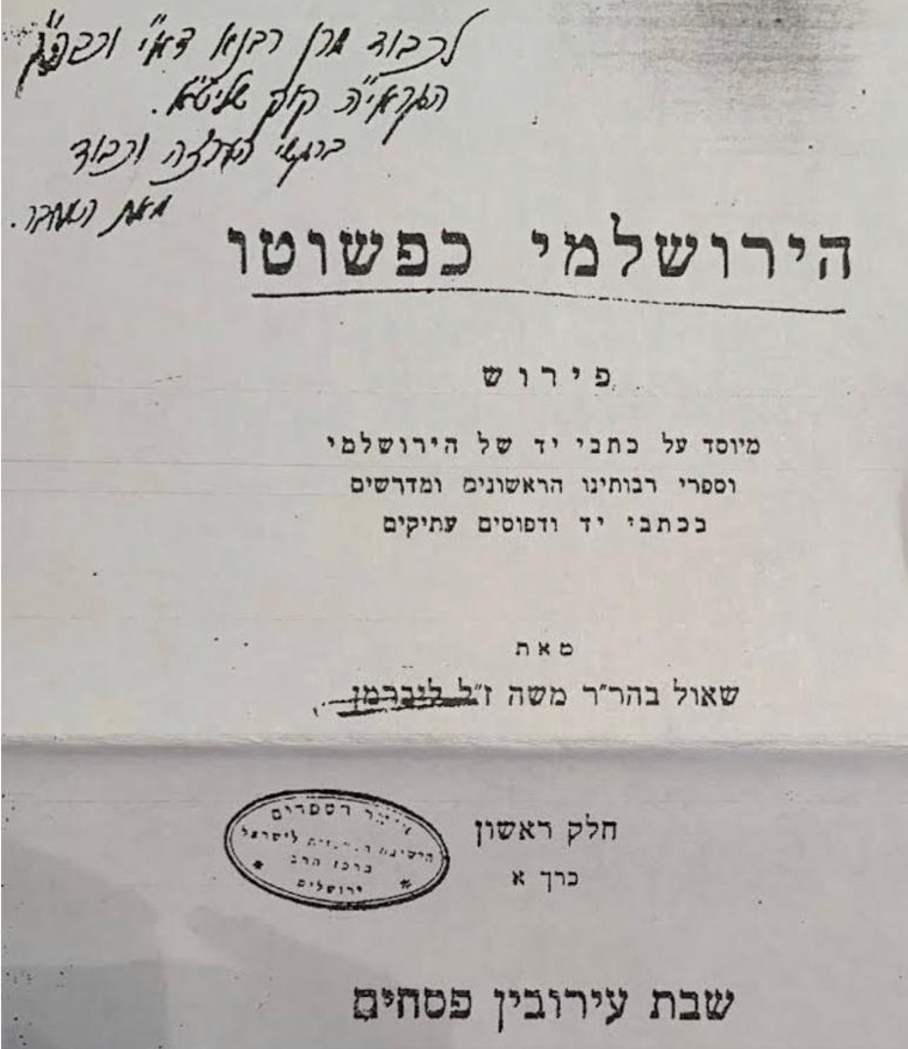
The earliest known appearance of material from Li-Nevukhei ha-Dor (from parts of chapters 45 and 46, to be exact) can be found in Rabbi Aryeh Leib Frumkin’s 1912 commentary on the Siddur, Ma’arkhei Lev, vol. 1, p. 156.[7] Frumkin quotes from Li-Nevukhei ha-Dor with minor modifications, introducing the material with “as written by our friend, the crown of our time, Rabbi Abraham Isaac Kook, in his writings.” In his edition of Li-Nevukhei ha-Dor, Rabbi Shachar Rachmani suggests that Rav Kook must have shared at least portions of the manuscript with Rabbi Frumkin at some point in 1911, when Frumkin returned to the Land of Israel after being away for several decades.[8]

As an aside, Rachmani traces evidence of their close relationship in his edition but doesn’t mention that Rav Kook also provided an approbation to the book. Interestingly, this approbation was seemingly removed from the edition on Hebrewbooks.org (along with an acknowledgment of supporters and a beautiful blessing to his parents that appear on the same page).[9] The approbation appears like this:[10]


This is the only known publication of parts of Li-Nevukhei ha-Dor in Rav Kook’s lifetime. However, about half a century later, in 1960, an essay purported to be written by Rav Kook, entitled “Be-Ikveta de-Meshicha” (“In the Footsteps of the Messiah”), appeared in the Hebrew journal Gevilin (nos. 12-13), on the twenty-fifth anniversary of Rav Kook’s passing, with a note that the material was “given by Rabbi Moshe Zvi Neriah.”

The essay contains various paragraphs from three different notebooks. The first half combines excerpts from two notebooks that would later be called “Rishon le-Yafo,” and “Acharon be-Boisk,” now published in Kevatzim mi-Ketav Yad Kodsho, vol. 1.[11] The second half derives from the notebook of Li-Nevukhei ha-Dor, specifically material from chapter 35 and 21 combined together (in that order). Eventually, this material was published in Maamrei ha-Rayah (to be discussed below).

Fascinatingly, we can now see that there are many discrepancies between what was originally written in Li-Nevukhei ha-Dor and what was published from those chapters in this essay called “Be-Ikveta de-Meshicha.” (Even more interesting is how the material from the other notebooks has almost no changes.) How did Rabbi Neriah come to obtain and publish this material? And who made the many changes to the essay?

Many of these edits seem to tone out more controversial statements, but others seem to add clarity and even new details. Below is representative of the discrepancies to be found between both sources. In my translation of Li-Nevukhei ha-Dor, I added to the footnotes an extensive comparison between the two sources, naming the contrasting source “the Maamrei ha-Rayah version”:

Returning to the topic at hand, the question is, would Rabbi Neriah have been the one to take these notebooks and create a new essay, not only combining disparate topics together, but also changing the text itself in this manner?

Rabbi Shachar Rachmani suggests that Rabbi Neriah never had access to the notebook of Li-Nevukhei ha-Dor.[12] Professor Dov Schwartz had written that Rabbi Neriah told him that the essay Daat Elohim, published in Ikvei ha-Tzon in 1907, was originally included in Li-Nevukhei ha-Dor.[13] Rachmani contends that “this proposition demonstrates Rabbi Neriah never actually saw the work.” Since the notebook is extremely organized (a rarity for Rav Kook’s writings), with chapter numbers for each section and a clear ending chapter, there is no way for Rabbi Neriah to have erroneously believed that a separate essay was also included in the notebook unless he was speculating about a work he had not actually seen.[14]

Second, Rabbi Rachmani asserts (in a personal correspondence with me) that Rav Zvi Yehuda was careful regarding publishing his father’s writings at this time. Indeed, Rabbi Rachmani would know – he was one of the people who worked on Maamrei ha-Rayah. To Rachmani, Rabbi Neriah would never have been allowed by Rav Zvi Yehuda to create essays from various notebooks of Rav Kook and edit them according to his own sensitivities.

However, questions abound. When this material was eventually incorporated into Maamrei ha-Rayah, the editors divided Rabbi Neriah’s single essay into two separate pieces. The first one, the only part that actually contains references to “the footsteps of the Messiah,” and which comes from the notebook Rishon le-Yafo and Acharon be-Boisk, was seemingly re-titled Gargarim Hegyoniyim (“Kernels of Thoughts”). The second part – the material from Li-Nevukhei ha-Dor which lacks any reference to “the footsteps of the Messiah” – kept the title Be-Ikveta de-Meshicha. At the end of this second essay, the editors cite the source as “Gevilin, 1960,” without further information. Someone split these essays, and someone renamed them. Who could have done this?

The first question, of the split, is more easily answered. It appears that even when it was published in 1960, the editors of Gevilin as well as Rabbi Neriah understood that the two parts of the essay were really two separate essays, because after a few months, they published a standalone booklet of “Be-Ikveta de-Meshicha” with the subtitle: “Two essays”:[15]

In 1975, a collection of essays from Rav Kook was published without notation of authorship.[16] It includes the two essays of “Be-Ikveta de-Meshicha” as well:

In 1980, Rabbi Neriah published it as an appendix to his Mishnat ha-Rav, which was also a collection of articles by and about Rav Kook. It looks like this in the Table of Contents.

Later editions of Mishnat ha-Rav do not feature these essays, presumably because they had already been incorporated into Maamrei ha-Rayah.

The 1942 HaYesod Publication

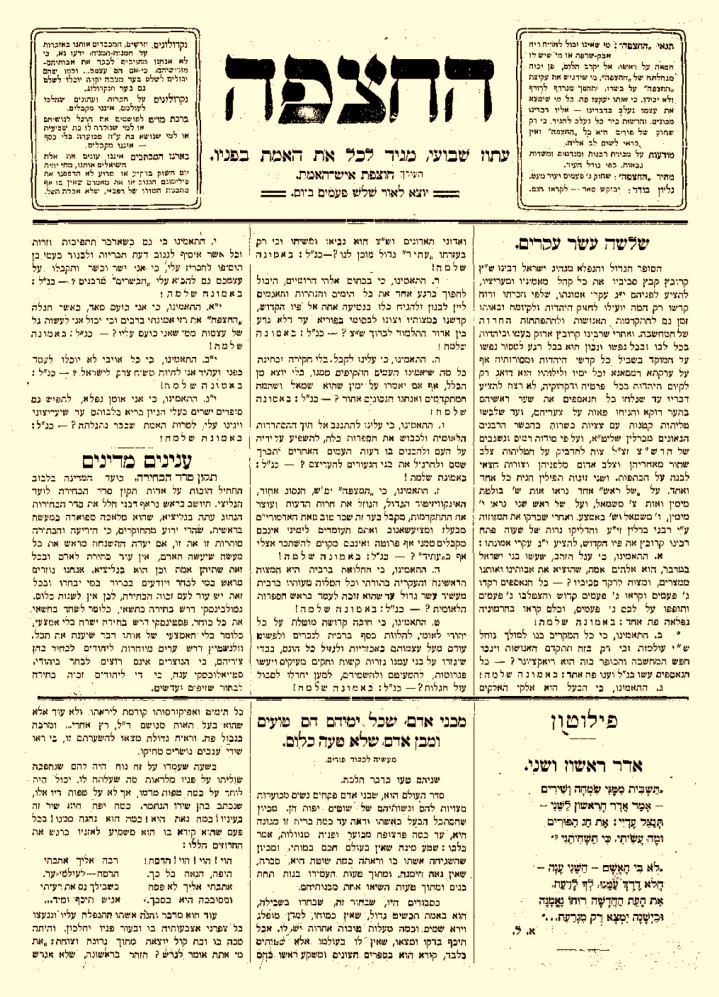
It seems likely that either Rav Kook or his son created and divided these essays. But where? Otzar HaChochma has archives of the weekly newspaper HaYesod, which, as it turns out, features an essay from Rav Kook called “Be-Ikveta de-Meshicha”![17] Indeed, it contained one half of the essay, only the material from “Rishon le-Yafo” and “Acharon be-Boisk.” The newspaper had added the following informative note before the essay: “In honor of the seventh anniversary of the passing of the great genius of Israel and his holiness, the genius Rabbi Abraham Isaac ha-Kohen Kook, may the memory of the righteous be for a blessing, we are printing here sections from his essay that was published in the year 5666 (1906), and ‘their words are their remembrance.’”

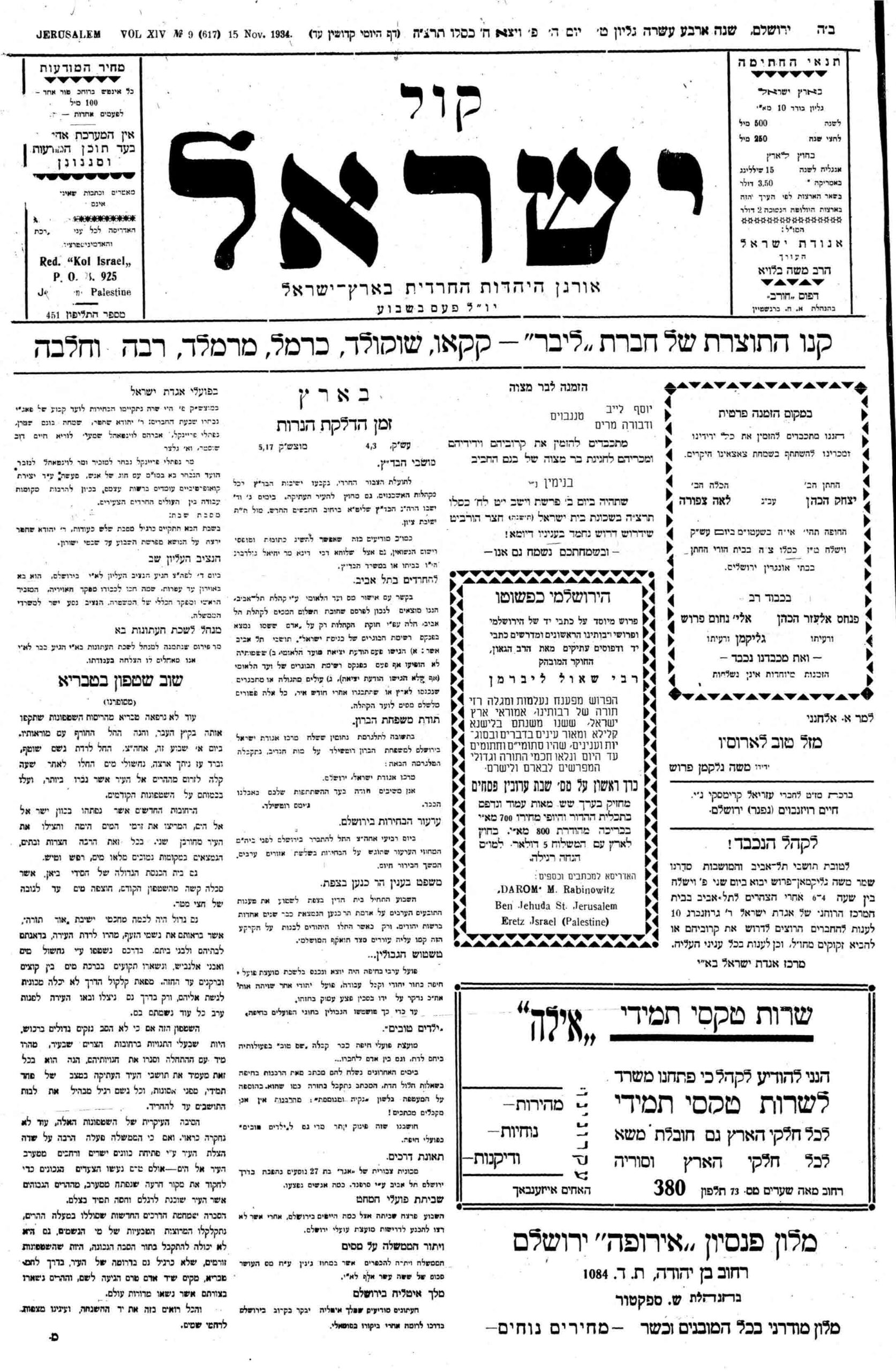
Where did Rav Kook publish this essay in 1906? Rav Kook published very few essays that year (and Maamrei ha-Rayah misdates certain essays to 1906 when they were printed later).[18] Could they have meant that Rav Kook wrote it in 1906, not that he published it then? How would the editors have received the essay, then? And what does it mean that they were printing “sections” (keta’im) from his essay? Was there a fuller essay out there? Further searching found a very strange essay, published in HaBazeleth in March 1, 1906 (Adar 4, 5666):

The article, titled, “Diary of a Young Jerusalemite,” describes the anonymous author’s discovery of Rav Kook’s essay “Teudat Yisrael u-le-Umiyuto” (“The Mission of Israel and its Nationalism”), published in HaPeles in 1901, and his subsequent fascination (perhaps obsession is the right word) with all things Rav Kook. As part of his survey of Rav Kook’s philosophical writings until this point of 1906, he writes:

I have read his open letters, the first and the second, as well as his “Gargarim Hegyoniyim,” which was printed in the calendar for the Shaarei Torah religious school in Jaffa. These small gargarim (kernels) I am sure most readers did not notice, for to them they are small, yet the truth is that these thoughts are so great, vast, all encompassing, containing within these kernels ideas with material for many great books, yet his excellent style is so brief, understood by those who are used to an academic style. At the end of these gargarim is such a wonderful announcement – soon, his book Eder ha-Yekar would be forthcoming. This made me so happy. I said, “How do I have such great merit to see it, given that I have only read his essays, and I have never merited to see a full book of his.” Now I have received the book Eder ha-Yekar, which contains his glory both inside and out, and I have started to read it carefully (as such books ought to be read), and it has breathed in me a spirit of life and love…

Putting aside the interesting overly flattering article (and the question of who might have written it), the important information here is that Rav Kook had apparently published an essay called “Gargarim Hegyoniyim” around 1906 in a calendar published through “Shaarei Torah of Jaffa.” What is this calendar?

The Luach Eretz ha-Tzvi

Rav Kook arrived in May of 1904 already set to become the Chief Rabbi of Jaffa and the surrounding agricultural settlements. One of his major responsibilities was to head the “Shaarei Torah” of Jaffa, a fairly large religious school for children of the area. For years, as part of the school’s fundraising, the school had been sending out a yearly calendar called “Luach Eretz ha-Tzvi” which included a calendar (obviously), a picture of the teachers and the students of the school, information about the state of the institute, and letters of encouragement to donors to give toward the school in various languages and from various important individuals.

The name Luach Eretz ha-Tzvi may ring a bell for some knowledgeable readers of Rav Kook. When Rav Zvi Yehuda published what would become his father’s most famous work, Orot, in 1920, he appended an essay entitled, “The Great Call,” that first appeared, we are told there, in “Luach Eretz ha-Tzvi” in 1908:

(The original 1920 printing of Orot, https://www.nli.org.il/he/books/NNL_ALEPH990012593690205171/NLI?)

Secondly, some people know of this calendar from the famous poems for each Jewish month that Rav Kook created for these calendars, from 1911 until 1914, titled Meged Yerachim (these were reprinted in Maamrei ha-Rayah, 499-501).

Lastly, those who have read Maamrei ha-Rayah might have seen that reprinted in Maamrei ha-Rayah (pages 295-301) are several essays of Rav Kook’s, and which we are informed (p. 272) were originally printed in the Luach Eretz ha-Tzvi of 1911-1914. Interestingly, these essays also have the title “Gargarim Hegyoniyim.” These essays, we have since found out with the printing of Kevatzim mi-Ketav Yad Kadsho, vol. 2, derive from a notebook called “Pinkas ha-Dappim 1,” written some time between 1904-1910. Thus, it turns out that Rav Kook had been publishing essays in these calendars from his notebooks, generally titling them “Gargarim Hegyoniyim.”

But what about the 1905-1906 calendar? It was not available in any library I could find. A Google search found, coincidentally, that the 1905-1906 Luach Eretz ha-Tzvi was available in an auction starting in a few short weeks from then, in October 2025. I reached out to the National Library of Israel in case they were interested in purchasing it. Through the helpful research of Shimon Kummer at the National Library, the library not only already had a copy of the 1905-1906 calendar, but also the 1904-1905 calendar. Unfortunately, they had no others for that decade. I had also reached out to the archivists at the Beit ha-Rav Kook, and with the help of Nechama Freedman at Beit ha-Rav Kook, I was able to locate another facsimile of the 1906 calendar, as well as the 1909-1910 calendar. Lastly, the auction ended in late October of this year, and my friend and cousin, Binny Lewis, purchased the calendar.[19] So I had a wealth of sources for the 1905-1906 calendar.

Let’s begin with the 1904-1905 calendar, the first to be printed after the arrival of Rav Kook to Jaffa. In this calendar, Rav Kook’s role is relegated to a short poem wishing readers a good new year, and merely being listed as the addressee for letters and donations regarding the school:[20]

Interestingly, Rav Kook is described in this calendar (as well as the 1905-1906 calendar) as “agreeing to become” the rabbi of Jaffa and the surrounding settlements:

(This particular image is from the 1905-1906 calendar)

Evidently, this had not yet been properly updated to Rav Kook’s present position. That said, in the 1905-1906 calendar, Rav Kook asserted more influence on the calendar, and published an essay called “Gargarim Hegyoniyim,” featuring the first half of what would be printed in Gevilin fifty-five years later under the title “Be-Ikveta de-Meshicha,” and eventually its own essay in Maamrei ha-Rayah a few decades after that, under its original title, “Gargarim Hegyoniyim.”

Someone must have known what the right title should have been for Maamrei ha-Rayah (presumably Rabbi Zvi Yehuda). But who named it “Be-Ikveta de-Meshicha” for HaYesod in 1942? And what happened to the second half, the part that comes from Le-Nevukhei ha-Dor? How did Rabbi Moshe Zvi Neriah come to publish it together with this other, separate essay, in 1960, under the one title of “Be-Ikveta de-Meshicha”?

I suspect that the calendars for 1906-1907 and 1908-1909 might hold more clues. If anyone is able to provide access to these calendars, we may be able to get to the bottom of this mystery. Nevertheless, we might speculate at this point how Rabbi Neriah obtained the material without ever seeing the original notebook. Perhaps, he received a copy of an already published or prepared essay from Rav Zvi Yehuda Kook, as Rabbi Rachmani suggested to me. Rabbi Neriah himself probably gave the full essay the name “Be-Ikveta de-Meshicha,” perhaps based on the printing in HaYesod in 1942, even though only the first half was printed there. It may be that he was unaware of the printing in the Luach Eretz ha-Tzvi of 1905-1906. Eventually, when it came to being printed in Maamrei ha-Rayah, Rav Zvi Yehuda or others with the knowledge of the true origin of these essays split them in two, with “Gargarim Hegyoniyim” returning to the essay as printed in Luach Eretz ha-Tzvi, while the essay with no name from the notebook of Le-Nevukhei ha-Dor took on the name from Rabbi Neriah’s printing in Gevilin.

Conclusions

Several significant points were made in the course of this article.

First, the many textual differences between Be-Ikveta de-Meshicha as published and the corresponding passages in Li-Nevukhei ha-Dor – sometimes involving entire added or removed sentences – seem to represent Rav Kook’s own revisions rather than editorial interventions by later hands. Rav Kook clearly saw the need to modify and clarify Li-Nevukhei ha-Dor after it had already been written, at least for a different, more Israel-oriented audience, than he had originally written for.

Second, this evidence should give pause to those who have assumed that any deviation from the Li-Nevukhei ha-Dor text in later publications necessarily represents censorship or editorial tampering. While such concerns are not unfounded given the documented history of editorial intervention in Rav Kook’s published works, the case of Be-Ikveta de-Meshicha demonstrates that Rav Kook himself may have been responsible for some of these changes.

Lastly, and most importantly, this discussion opens new questions about Rav Kook’s relationship to Li-Nevukhei ha-Dor. It is possible that Rav Kook himself was actively drawing upon and reworking material from Li-Nevukhei ha-Dor during his lifetime, even after apparently setting aside the complete work. This suggests that while he may have had reservations about publishing the book as a whole, whether because of financial reasons or due to concerns about its more controversial ideas, he saw value in extracting and adapting individual sections for other purposes. If so, there may be additional essays awaiting discovery that similarly derive from this work. The location of the other years of Luach Eretz ha-Tzvi remains a desideratum for future research, as it may contain the key to fully reconstructing this textual history.

[1] This had been prepared as part of Rabbi Shachar Rachmani’s dissertation at Bar-Ilan University. Several years later, in 2014, Rabbi Rachmani published Li-Nevukhei ha-Dor through Yediot Achronot, with annotations, an index, and an extensively researched report (mostly reworked from his dissertation) in which he discussed the background of work, its place in Rav Kook’s writings, and why Rav Kook did not publish it, among other topics. Last year (2025), it was republished with a new cover, and as far as I can tell, the content itself has not been changed. The original leaked copy can still be accessed here: https://kavvanah.files.wordpress.com/2010/05/kook-nevuchai.pdf, and available on Sefaria here: https://www.sefaria.org/For_the_Perplexed_of_the_Generation. I contributed an early translation of the first 14 chapters or so to Sefaria, before focusing on turning it into a book.
[2] Printed as part of Pinkasei ha-Rayah (Makhon ha-Rav Zvi Yehuda), vol. 2 (2010).
[3] See, for example, https://seforimblog.com/2010/10/marc-b-shapiro-new-writings-from-r-kook/, https://seforimblog.com/2011/02/new-writings-from-r-kook-and-assorted-3/, https://seforimblog.com/2011/02/new-writings-from-r-kook-and-assorted_22/, https://seforimblog.com/2011/04/new-writings-from-r-kook-and-assorted-2/, https://seforimblog.com/2011/08/new-writings-from-r-kook-and-assorted/.
[4] Available for purchase at https://kodeshpress.com/product/rav-kooks-guide-for-todays-perplexed/.
[5] Some knew of its general existence, and its purpose, but it is not clear to what extent they knew of its contents. I am copying from a footnote in Rav Eitam Henkin’s introductory essay to Li-Nevukhei ha-Dor, which I translated and included in my own translation of the work:

“Although unpublished, its existence was publicly known at the very latest upon Rav Kook’s passing, when the “Association for Publishing the Manuscripts of the Late Chief Rabbi A. I. Kook” prepared a detailed plan for the publication of Rav Kook’s writings, including the present work (see R. Neria Gutel, “Protocol of the Association for Publishing the Manuscripts of the Late Chief Rabbi A. I. Kook,” Sinai, 126-127 [2001], pp. 720-721). The association’s program never took off, but the work continued to be mentioned from time to time by many of those who deal with the writings of Rav Kook, from his student R. David Cohen, the “Nazir” (Ha-Kuzari ha-Mevoar, vol. 1 [Jerusalem, 2002], p. 73), and his relative R. Yehoshua Hutner (Chazon ha-Geulah, Jerusalem [1941], p. 14), to R. Moshe Tzvi Neriah and other writers (see, for example, Yehoshua Be’eri, Ohev Yisrael bi-Kedushah, Tel Aviv [1989], vol. 1, p. 31).”

[6] See the previous footnote. It was not called Li-Nevukhei ha-Dor until Rabbi Shachar Rachmani created the title in preparation for his dissertation in 2009. The Association for Publishing Rav Kook’s Manuscripts, formed by Rav Kook’s close students soon after his death, gave the manuscript the name “Moreh Nevukhim he-Chadash,” a “New Guide for the Perplexed.” Rachmani believed that Rav Kook’s humility would not have allowed him to give a name to the book as if it in some way replaced Maimonides’ great work.
[7] See: https://hebrewbooks.org/pdfpager.aspx?req=7283&st=&pgnum=169.
[8] Rachmani, Li-Nevukhei ha-Dor (Yediot Achronot, 2014), 263 n. 1.
[9] Available at: https://hebrewbooks.org/14438.
[10]Available at: https://tablet.otzar.org/#/b/15892/p/27/t/82790.22842981754897718/fs/0/start/0/end/0/c (see page 25) and https://archive.org/details/seder-rav-amram-hashalem-jerusalem-1912-images/page/n9/mode/2up

[11] The article combines three sections, beginning with Rishon le-Yafo, 6, then Acharon be-Boisk, 13, then back to Rishon le-Yafo, 85.
[12] Rachmani, Le-Nevukhei ha-Dor, 265.
[13] See Schwartz, Faith at the Crossroads: A Theological Profile of Religious Zionism, trans. Batya Stein (Brill, 2002), 98 n. 16.
[14] Professor Schwartz suggested to me that it was possible Rabbi Neriah meant that the pages of “Daat Elohim” were removed by Rav Kook at some point to include in Ikvei ha-Tzon.
[15] https://il.bidspirit.com/ui/lotPage/refaeli/source/catalog/auction/15177/lot/132631/canonical?lang=en
[16] https://www.nli.org.il/he/books/NNL_ALEPH002091210/NLI
[17] Ha-Yesod, August 14th, 1942 (Elul 1, 5702)
[18] For example: the first essay in Maamrei ha-Rayah is “Derekh ha-Techiya” (“The Way of Renascence”), and at the end, the editors added the source and date of the essay: “Ha-Nir, 1906.” However, while the source is correct, Rav Kook contributed this essay to Ha-Nir in 1909. The newspaper only began that year. See bibliographical information at the National Library of Israel here: https://www.nli.org.il/he/journals/NNL-Journals990020183190205171/NLI
[19] https://il.bidspirit.com/ui/lotPage/baruch/source/search/auction/64815/lot/46964/%D7%A0%D7%93%D7%99%D7%A8-%D7%9E%D7%90%D7%95%D7%93-%D7%9C%D7%95%D7%97-%D7%90%D7%A8%D7%A5-%D7%94%D7%A6%D7%91%D7%99-%D7%9C%D7%A9%D7%A0%D7%AA-%D7%AA%D7%A8%D7%A1-%D7%95?lang=en
[20] Images from here: https://winners-auctions.com/items/%D7%9C%D7%95%D7%97-%D7%90%D7%A8%D7%A5-%D7%94%D7%A6%D7%91%D7%99-%D7%94%D7%A7%D7%93%D7%A9%D7%94-%D7%91%D7%9B%D7%AA%D7%91-%D7%99%D7%93-%D7%94%D7%A8%D7%90%D7%99%D7%94-%D7%A7%D7%95%D7%A7-%D7%9C%D7%93/


A New Halakhic Compendium of Jewish Belief

A New Halakhic Compendium of Jewish Belief

Y. Tzvi Langermann

Professor Y. Tzvi Langermann is Professor Emeritus of Arabic at Bar Ilan University in Ramat Gan, Israel. He has published widely on science, religion, and philosophy in medieval Jewish and Islamic cultures.

Over the past thirty-plus years Rabbi Eliezer Melammed (b. 1961) has been issuing volumes of up-to-date rulings on halakhah. The series, called Peninei Halakha (“Pearls of Halakhah”) is very popular; on sale in most Israeli bookstores, it is also now freely available online, translated (in part at least) into English, French, Spanish and Russian. There is also a children’s version in comic book form. The series covers the usual topics, such as laws pertaining to the Sabbath or the kosher kitchen, but also complete volumes on topics that were little studied, such as conversion, or that have come to prominence only recently, such as women’s prayer gatherings.

The volume I am speaking of is not a philosophy of Judaism but a halakhic (legal, normative) compendium, following the example (but in a very different format, not to mention content) of the first section of Maimonides’ great legal code Mishneh Torah. In this connection, perhaps the most striking observation is the following. Rabbi Melammed’s approach is non-dogmatic. It is usual in formulations of normative religious belief for the author to present his personal opinion as the one and only correct one. (Maimonides mollified this attitude in the presentation of his famous set of thirteen foundational doctrines…) In his preface Rabbi Melammed relates that he consulted with the staff at his yeshiva and, on occasion, modified his position in response to feedback which he received.

He also is willing to acknowledge that his position differs from what he and/or his staff understands to be the current consensus, and to make some effort to accommodate opposing views. For example, in the chapters on magic, clairvoyance, augury and “practical kabbalah,” the Rabbi explicates the “spiritual roots” that enable such practices, both from the features of holiness and the features of impurity that may be involved. However, his draft was strongly criticized for two main reasons: his staff alerted him to the fact (if only this were true!) that the current consensus concurs with Maimonides’ denial of occult powers. Moreover, those who believe in occult powers have a tendency to fall into serious error “in the fundamentals of belief and morality.”

The rabbi was not convinced by their arguments. However, he decided to present the position of Maimonides and the Maimonideans “respectfully” for a number of reasons, most notably “so that anyone who tends toward their position may feel comfortable even though they patently reject the position of Nahmanides and the kabbalists” – the latter, needless to say, accept occult powers as true features of our world, and Rabbi Melammed relies upon their authority. Dogmatic theology, intentionally or not, alienates those who cannot accept its precepts. Rabbi Melammed is aware of this danger and does his best to avoid doing so.

Just as his series includes volumes on new or neglected topics, so do the two volumes on belief extend their range beyond what one finds in the earlier (in fact, it is much earlier) literature. For example, there are sections on how Judaism looks upon Christianity and Islam; Jewish thinkers have engaged with those two religions since their inception. However, there is also an independent section on “eastern religions,” most of it devoted to Hinduism. Though Jews have visited India, and lived there, for quite some time, it is only in the twentieth century that Jews in significant numbers (and some influential individuals) began to take a serious, personal and spiritual interest in eastern religions – mostly Buddhism, which receives less attention. It should not come as a surprise that Rabbi Melammed is not all that well informed about these religions, but that is not the point. His engagement is far removed from religious polemic following that is a section on “The Future of Religions” which is strongly influenced by the views of Rabbi Avraham Kook (1865-1935). Rabbi Melammed acknowledges that his book is based by and large on the teachings of Rav Kook, which he absorbed from his youth from his father, who was a devoted disciple of Rav’s Kook son, Tzvi Yehudah Kook, who published his father’s writings, interpreting or rather re-interpreting them – some would say misinterpreting them. However, in “The Future of Religions” he re-emphasizes that what he writes is based on the writings of Rabbi Avraham Yitzhak Hacohen Kook –perhaps because they do not square with views held by “Kookists” of various sorts, students of students of the great rabbi? Rav Kook was of the opinion that there is an innate sense of, and quest, for God in all humans. (This reminds me of the Islamic notion of fiṭra; but that is a story for another day.) However, some humans are unable to refine their quest so as to divest their conception of God of any and all materiality. Hence, the proliferation of idol worship in ancient times, and the continual employment of icons and other images into our own day. Significantly, this perspective detects a positive element in idol worship – the idolaters are trying to worship the one and true God, but they don’t know how to do it. (Shades of the Khazar king in Halevi’s seminal Kuzari – but this point too cannot detain us here.) One of the main tasks of the people of Israel is to guide all nations towards the “light” of the true conception.

This section accordingly carries many footnotes, some quite lengthy, with liberal quotations from Rabbi Avraham Kook. Rabbi Melammed masses additional support for this approach to religion from a range of earlier Jewish thinkers: passages from the medieval philosopher Joseph Albo (c. 1380 – c. 1444), the nineteenth-century Italian rabbis Marco Mortara (1815-1894) and Elia Benamozegh (1823-1900), as well as short, surprising (for me at least) quotations from the Vilna Gaon (1720-1797) and Jacob Emden (1697-1776).

This post is nothing more than a small Vorspeise. It will be interesting to see what if any interest this volume stimulates.


Sixty Years Since Rabbi Dr. Yechiel Yacov Weinberg, the Seridei Eish: A Fire the World Still Needs

Sixty Years Since Rabbi Dr. Yechiel Yacov Weinberg, the Seridei Eish:
A Fire the World Still Needs

By Jacques (Yacov) R. Rothschild

This week marks sixty years since the passing of Rabbi Dr. Yechiel Yacov Weinberg, the Seridei Eish. He left this world on the 4th of Shevat in 1966, well before I was born, yet his presence has never felt distant to me – because it lived, vividly and lovingly, in my mother’s voice. “Shema b’ni musar avicha, v’al titosh Torat imecha” – “Hear, my child, the instruction of your father, and do not forsake the Torah of your mother.” For me, Rav Weinberg’s Torah was transmitted precisely this way: not first through books or institutions, but through a mother who spoke of him with reverence, warmth, and quiet awe.

The following brief sketch cannot do justice to the full arc of his life. Readers seeking a comprehensive biographical and intellectual account may consult Professor Marc B. Shapiro’s authoritative study, Between the Yeshiva World and Modern Orthodoxy: The Life and Works of Rabbi Jehiel Jacob Weinberg, 1884-1966 (London: Littman Library, 1999), as well as subsequent scholarly and popular essays. What follows outlines only the essential contours.

From a young age, Rav Weinberg displayed extraordinary promise. Born in Ciechanowiec in 1884, he rose from an unassuming background to become known as the Illuy of Czechanowic. As a teenager he was already delivering public shiurim, and at seventeen he entered the Slabodka Yeshivah, studying under the Alter, Rav Nosson Tzvi Finkel, and becoming a chavrusa of Rav Naftali Amsterdam, the foremost disciple of Rav Yisrael Salanter. There he absorbed a worldview that would shape him for life: uncompromising halakhic rigor joined to the Mussar movement’s insistence on human dignity, ethical seriousness, and disciplined moral self-formation. He forged close ties with leading figures of the Mussar world. Already then, he embodied a rare synthesis – intellectual rigor, spiritual sensitivity, and moral seriousness.

In the years that followed, Rav Weinberg served as Rav of Pilwischki and spent formative time in Warsaw, moving within the orbit of leading rabbinic, intellectual, and communal figures. In 1936 he published Lifrakim, a collection of essays in Hebrew, German, and Yiddish that already displayed the breadth of his mind: halakhic sensitivity, historical consciousness, literary power, and a refusal to simplify Judaism for ideological convenience. His path then led westward to Germany, where he became Rosh Yeshiva and effectively rector of Rav Esriel Hildesheimer’s Rabbinerseminar in Berlin, shaping a generation of rabbanim who carried Torah with courage, thoughtfulness, and depth, as he was confronted with unprecedented historical and theological upheavals. Unlike many of his contemporaries, he neither viewed engagement with general culture and academic scholarship as a betrayal of Torah nor mistook accommodation for capitulation. His posture was one of disciplined openness, with Torah sovereign yet resilient rather than brittle.

During the war, he served as president of the Agudas HaRabbanim of Warsaw and was also a lecturer at the University of Giessen. Universally recognized as a master of Shas and poskim, his knowledge extended far beyond Torah, encompassing history, philosophy, and Judaic studies.

He survived the destruction of European Jewry, but survival came at a severe cost. Rav Weinberg lost his entire immediate family in the Holocaust. His health was permanently damaged, and the world in which he had lived was gone. When the war ended, he emerged alone. He eventually found refuge in Montreux, Switzerland, carrying with him a loss that did not recede with distance or time. And yet it was there, after all of this, that the most consequential part of his written legacy still lay ahead.

Montreux was a quiet, picturesque town overlooking Lake Geneva and home to Yeshivat Eitz Chaim, a small and demanding institution that drew refugees, scholars, and young men who would later assume positions of leadership. Giants passed through its modest halls, carrying only fragments of the world that had been destroyed, unsure whether those fragments could be assembled into anything lasting. Torah life there was serious and inward, marked by uncertainty and strain. It was not sustained by institutions or prestige, but by individuals who lived with loss as a daily fact and understood responsibility as something that could not be deferred.

It was no accident that Rav Weinberg felt at home in Montreux. The town’s quiet dignity mirrored his own. Removed from ideological battles and institutional power, he could think clearly and write honestly. From this tranquil place, Torah once again flowed outward. Letters and visitors arrived from across the Jewish world: rabbanim, authors, medical researchers, historians, and even leaders of the young State of Israel, including David Ben-Gurion (a meeting my mother attended). Though physically distant from centers of authority, his voice remained indispensable. He was offered the position of Chief Rabbi of Israel, which he declined, choosing instead an obscurity that enabled him to remain faithful both to halakha and to the damaged human reality it was now required to address.

“From Montreux,” writes Professor Marc B. Shapiro, Rav Weinberg “resumed his correspondence with students, friends, and colleagues, writing many hundreds of letters a year, most of which have been lost to posterity.” Yet Montreux also imposed real constraints. Far from the great libraries and scholarly settings that had once sustained his academic work, serious research was difficult. More significantly, the shift from public authority to private existence carried a personal cost. For a man who had stood at the center of a major rabbinic institution, life in a small town brought with it a sense of narrowing that no material stability could fully counterbalance.

It was in Montreux, despite his broken health, that Rav Weinberg published three volumes of Seridei Eish – in 1961, 1962, and 1966 – with a fourth appearing posthumously. Seridei Eish, “Remnants of Fire,” was both literal and symbolic: much of his Torah had been lost in the Holocaust, yet what remained burned with clarity, depth, and moral courage.

It was also to Montreux that my mother arrived after the war as a young girl. She had lost the overwhelming majority of her family in Nazi Germany, surviving only through her mother’s courage in escaping clandestinely to Italy. Upon entering Italy illegally, her mother was suspected of being a spy, arrested and imprisoned, and the two young girls – my mother and her sister, both under five – were sent to a monastery. By miracle, they were reunited after the war and eventually reached Switzerland, settling in Montreux.

There, while my mother was entertained in school by Charlie Chaplin’s daughter, she also encountered Rav Weinberg, beginning a relationship that would quietly shape her life.

Starting as a teenager, my mother assisted him by typing his correspondence and helping with administrative work. She knew how to type, spoke several languages, and worked at a local Swiss bank. None of these skills was remarkable on its own; in combination, they answered a very specific need. For several years she assisted Rav Weinberg on a daily basis. She typed his responsa as he dictated them, organized and mailed his correspondence, and attended to the practical details that made sustained scholarly work possible. She sat with him for hours as he formulated replies to inquiries arriving from across the Jewish world, one after another, without interruption.

Jews in Montreux and neighboring towns knew she had daily access to Rav Weinberg, so they entrusted her with questions that structured postwar Jewish life. They would leave chickens – with kashrut questions – for her to bring to him. Kosher shechita was forbidden in Switzerland then, as it remains today, and Jews relied on mail-order poultry from France, salting their chickens at home. Observance was fragile, complicated, and deeply human.

These chickens carried more than halakhic questions; they carried hope. For Jews in post-war Europe, having a kosher chicken – literally examined and approved by a Gadol – was a way to sanctify Shabbat, to reclaim dignity and spiritual normalcy after devastation. Rav Weinberg approached each case with extraordinary care, ensuring that his rulings remained halakhically rigorous while never shattering the fragile dreams of Jews striving to observe Shabbat properly. This was not halakha in theory. This was Torah meeting kitchens, trauma, and lives slowly rebuilding.

Despite his circumstances, Rav Weinberg never sought popularity or easy acceptance. Some of his rulings were difficult and, at times, controversial – precisely because his deliberations reached beyond the present moment. He anticipated developments in science, technology, medicine, and society before they became unavoidable crises. Yet throughout, his loyalty to halakha and to Sinai was absolute, insisting that halakha be applied with foresight rather than reaction. For him, innovation did not mean rupture or accommodation. It meant responsibility, assumed fully and without evasion. His Torah moved deliberately, listened deeply, and spoke only after accounting for the full weight of human reality.

The questions that reached him were often complex and carried real consequences for those who asked them. At times Rav Weinberg did not respond immediately. My mother later recalled that he insisted on thinking matters through, and would occasionally ask her to walk with him along the shore of the lake while he worked through the questions before him. Only afterward would he commit his rulings to paper.

His involvement in my family’s life extended beyond advice and correspondence. He personally guided the shidduch of my mother’s older and only sister, and later that of my parents. These actions reflect the same moral world in which he lived and worked – a Torah attentive not only to texts and communal questions, but to the concrete ordering of individual lives from what remained after destruction.

Very recently, I learned something that cast this inheritance in an even deeper light. My sister discovered, quite by chance, a copy of Rav Weinberg’s German book Das Volk der Religion in my parents’ archives. Inside was a handwritten dedication by Rav Weinberg himself, addressed not to my maternal grandmother, whom he knew well from Montreux, but to my paternal grandmother – my mother’s future mother-in-law – Flora Rothschild. The inscription, written in German, is dated 4 Nissan 5709 (April 4, 1949), almost twenty years before my parents would marry, at a time when they were still in their early teens:

“In fond memory and in friendship of your visit to me in Montreux this past 4th of Nissan 1949.

Mrs. Flora Rothschild, the tireless one.

In admiration of our continued mutual cooperation for the fight to preserve Torah, the Jewish people and spirit, and the Land of Israel.

Best wishes and continued success.

Montreux, 4th of Nissan 5709.”

Only now does the deeper resonance of this moment emerge. Long before my mother could have imagined her future – and entirely unbeknownst to her – Rav Weinberg had already met the woman who would one day become her mother-in-law and formed a bond of respect and friendship with her.

Flora Rothschild, my paternal grandmother, was herself a remarkable woman, selflessly involved in the rebuilding of Jewish life after World War II. After surviving the camps, she settled back in Antwerp, having lost her husband, daughter, parents, and siblings to the Nazis. Read against this background, the dedication takes on added weight.

My grandfather, Tzvi Hersh Lerner HY”D – my mother’s father – whose yahrzeit falls on the 2nd of Shevat, was murdered in Sachsenhausen in 1939 after intervening on behalf of a young Jewish boy who had been caught stealing a piece of bread in the camp. His death left my mother without a father and forced my grandmother to flee Berlin with two small children. She moved first into hiding in Italy and, after the war, on to Switzerland, where they eventually settled in Montreux. And yet, even then – long before anyone could have named an outcome – quietly and almost imperceptibly, the threads of the next generation were already being woven.

This discovery opens a vivid window into the deeply human side of Rav Weinberg: his attentiveness to individual lives, his capacity for enduring relationships, and his role as a bridge between shattered pasts and rebuilding futures.

I never met the Seridei Eish, though I have studied his responsa. My mother knew him. She typed those responsa as he dictated them. She walked with him through Montreux. She carried chickens to his door so that he could examine them. Because of that, his presence never belonged to the past for me. It was part of the daily texture of my childhood. His Torah reached me not through institutions or ceremonies, but through work done repeatedly, quietly, and without display. In that way, what survived was not only his Torah, but the way it was lived.

Studying the Seridei Eish is for me a Torat imecha, grounded in my mother’s experience and in her years assisting Rav Weinberg in Montreux. To honor his memory is not only to study his writings, but to reckon with what his absence has cost, and with the kind of Torah leadership his life continues to require.

When Rav Yechiel Yacov Weinberg passed away at the age of eighty-eight, the Jewish world lost not only a great rabbinic scholar, but a model of Torah leadership grounded in judgment, humility, and moral seriousness. He combined intellectual breadth with personal restraint, and independence of thought with unwavering fidelity to halakha. Such a voice is acutely lacking today, especially in moments of internal crisis, when slogans replace deliberation and affiliation eclipses responsibility.

Even in death, Rav Weinberg did not fit neatly into any one world. Having no surviving children, his burial in Jerusalem became the subject of controversy. The two worlds that claimed him were the Chareidi and the Mizrachi. Though Rav Weinberg had requested to be buried beside his friend Rav Yitzhak Isaac Halevi Herzog, Chareidi leaders diverted the funeral to another cemetery, claiming him as their own. The tension itself was revealing: a man too broad for easy categories, too principled to be fully absorbed by any camp.

And perhaps the truest way to honor his memory is not only to study his writings – but to recognize how deeply the world still misses him, and how desperately it still needs leaders formed in his image.

Yehi zichro baruch, and may Rav Yechiel Yacov Weinberg’s purified soul be a melitz yosher for Am Yisrael.


Book Review: ‘After Revelation: The Rabbinic Past in the Medieval Islamic World’, by Marc D. Herman

Review of ‘After Revelation: The Rabbinic Past in the Medieval Islamic World’, by Marc D. Herman

Reviewed by Eliyahu Krakowski


Dr. Marc Herman’s After Revelation: The Rabbinic Past in the Medieval Islamic World (University of Pennsylvania Press, 2025) examines shifting conceptions of Torah she-beʿal peh within the Judeo-Islamic world from the geonic period through the time of Maimonides.[1] Beginning with Rav Saadya Gaon and concluding with the Rambam, Herman traces a gradual reorientation away from the geonic understanding of Torah she-beʿal peh as wholly revealed toward the Maimonidean position, in which human interpretation plays a constitutive role in the formation of rabbinic law. Alongside his analysis of Jewish legal sources, Herman situates these developments within their broader intellectual environment, drawing careful parallels to contemporaneous trends in Islamic jurisprudence and legal theory. In tracing this shift, the book clarifies how medieval Jewish thinkers conceptualized the authority of Torah she-beʿal peh, and how those conceptions correspond to broader jurisprudential models current in the Islamic world.

But beyond its central thesis, the book assembles a substantial body of sources bearing on a range of foundational questions, including rabbinic authority, legal innovation, and the historical development of Torah she-beʿal peh. Many of the texts Herman discusses are drawn from recently published fragments or from manuscripts that remain unpublished, and several appear to have received little or no attention in prior scholarship. Rather than offering a comprehensive or conventional review, I will focus here on a selection of sources that I found particularly significant and that contribute to a more precise understanding of several of the issues under discussion. Because Herman’s treatment of these materials is often brief, expanding upon certain sources and arguments in greater detail is worthwhile.

  1. Adding to Torah Prohibitions and the Tree of Knowledge 

The story of Adam and Eve contains an interesting example of what, depending on one’s perspective, can either be seen as a (very early) model of rabbinic legislation or as a problematic example of proto-bal tosif, the prohibition of adding to the Torah. When repeating God’s command not to eat from the Tree of Knowledge, Eve apparently adds to the prohibition (Gen. 3:3): “But from the fruit of the tree which is in the middle of the garden, God has said, ‘You may not eat from it and you may not touch it, lest you die.’” Every yeshiva student is familiar with Rashi’s interpretation:

“‘And you shall not touch it’ – she added to the command; therefore she came to detraction, as it is said: “Do not add to His words” (Proverbs 30:6).”

This, in turn, is based on the Gemara (Sanhedrin 29a):

“Hizkiyah said: From where is it derived that whoever adds, detracts? As it is stated: ‘God said: You shall not eat from it and you shall not touch it.’”

However, according to Avot de-Rabbi Natan (version 1, 1:5), it appears that the added prohibition was in fact a prototypical seyag, a protective fence of the sort we are instructed to erect in order to safeguard the Torah:

“And make a fence for your words, just as the Holy One, blessed be He, made a fence for His words; and Adam the First made a fence for his words … What was the fence that Adam the First made for his words? As it says: ‘And the Lord God commanded … for on the day that you eat of it you shall surely die’ (Genesis 2:17). Adam the First did not wish to say to Eve exactly as the Holy One, blessed be He, had said to him; rather, he said to her thus, and he made a fence for his words beyond what the Holy One, blessed be He, had said to him: ‘But from the fruit of the tree that is in the midst of the garden God said: You shall not eat from it and you shall not touch it, lest you die,’ for he wished to guard himself and Eve from the tree even through mere touching.”

In the context of Karaite critiques of rabbinic authority, this question took on heightened urgency. Herman (39-40) refers to Rav Saadya Gaon’s commentary on Genesis 3:1, which elaborates the positive reading found in Avot de-Rabbi Natan:

“The fifth question: On what basis did Eve say, ‘and you shall not touch it,’ when God did not say this to Adam?

The answer: After God said to Adam not to eat from the Tree of Knowledge, he instituted a safeguard for the matter and refrained even from touching it, so that if some mishap should occur in this regard, it would fall upon what he himself had added and not upon the essence of the prohibition. This is like an expert physician who wishes to distance a patient from eating meat and therefore also warns him against poultry, so that if he should treat the command lightly he will stumble with poultry and not with actual meat. On this basis our predecessors instructed us: ‘Make a fence for the Torah’ … and in all these cases, and others like them, we rely upon what the Torah itself prohibited as a matter of protection and fencing, as it is written: ‘He shall not multiply wives for himself, lest his heart turn astray’; and ‘silver and gold he shall not multiply for himself exceedingly, lest his heart grow haughty,’ and the like.”

Rav Saadya likens Adam’s added prohibition to the case of a patient who is forbidden to eat meat and whose physician therefore also prohibits poultry. As Herman observes, the analogy closely recalls the rabbinic prohibition of poultry with milk. Notably, in this instance Rav Saadya is prepared to treat the added restriction as Adam’s own enactment, a position that sits uneasily with his more general tendency to ground even rabbinic legislation in divine authority.

Elsewhere (80), Herman cites the eleventh century Andalusian commentator R. Yehuda Ibn Balaam who went a step further and “described the addition of a prohibition against touching the forbidden tree in the Garden of Eden (Genesis 3:3) as the sound exertion of legal thinking (ijtihād).”[2] It seems that according to Ibn Balaam, in contrast to Rav Saadya, this is not merely a discretionary seyag but a logical extension of the law. In other words, according to Rav Saadya, the prohibition of touching the Tree of Knowledge would have been classified under the Rambam’s first shoresh in Sefer ha-Mitzvot, namely rabbinic enactments, whereas according to Ibn Balaam it would fall under the second shoresh, that of rabbinic derashot or derivations.[3]

  1. Rabbinic Legislation and Adding to the Torah

Another obscure yet significant source cited by Herman bears on a question raised forcefully in Karaite polemics, namely, why rabbinic legislation does not itself constitute a violation of the biblical prohibition against adding to the Torah. Herman (27) points to Rav Saadya Gaon’s discussion in his work on the calendar, the Kitāb al-Tamyīz (Book of Distinction), where Saadya emphasizes that the prohibition of adding to revelation applies to “all that I have commanded you” (Deut. 4:2; 13:1), and not to “all that I have written for you.” On this view, rabbinic enactments cannot be considered impermissible additions, since they themselves form part of the revealed command structure. The relevant text survives only in an Arabic fragment published by Hartwig Hirschfeld in 1903.[4]

Herman (90) also cites R. Yehudah ha-Levi’s response to this challenge in the Kuzari (3:41). Ha-Levi explains that the biblical prohibition was directed at the masses, in order to prevent them from conjecturing, theorizing, and legislating on the basis of their own reasoning, as the Karaites did. Laws instituted by the Sanhedrin or by prophets, according to ha-Levi, are categorically excluded from the scope of this prohibition. Notably, Maimonides appears to adopt the opposite position. In his view, it is precisely authoritative figures such as prophets or the Sanhedrin who are capable of violating the prohibition of bal tosif.[5] But Maimonides’ formulation in Hilkhot Mamrim 2:9 (cited above, note 3) represents an even sharper rejection of Rav Saadya’s approach. According to the Rambam, bal tosif is violated precisely by collapsing the distinction between rabbinic legislation and divine command, thereby presenting the former as if it were itself part of the Torah. This could serve as a description of Rav Saadya’s enterprise. 

It is also noteworthy that figures operating within the Karaite orbit accepted the premise underlying the question, namely, that there exists a general prohibition against adding new laws to the Torah. By contrast, rabbinic authorities more distant from anti-Karaite polemics, such as Rashi, R. Yosef Albo, and the Maharal, rejected this premise altogether. On their account, bal tosif does not prohibit the introduction of new mitzvot, but rather the alteration of an existing mitzvah’s internal structure, such as adding a fifth passage to the tefillin. From this perspective, rabbinic legislation bears no relation to the prohibition of bal tosif at all.[6]

  1. Hanukkah from Where in the Torah?

Rav Saadya Gaon’s discussion of Hanukkah provides a clear illustration of a broader geonic tendency: to anchor what might otherwise appear to be rabbinic innovations or postbiblical developments in biblical revelation itself. As Herman (29) notes:

“Saadia was anxious to uphold divine authority for Hanukkah, the formulations and structures of many prayers, court oaths, communal bans, the second day of festivals observed in the diaspora, and even one passage in a lament by Eliezer Qillir… Saadia adopted a variety of strategies to depict these practices as supported by divine revelation. Written revelation, he claimed, actually refers indirectly to legal institutions that might be considered postbiblical, such as the festival of Hanukkah, the observance of two days to mark some new lunar months, or the rules of the Jewish calendar.”

One of the sources Herman adduces in this context is a passage from the the recently recovered complete Sefer ha-Mitzvot of Rav Saadya, in which Rav Saadya seeks to ground the festival of Hanukkah in biblical prophecy:

“The tradition has established that there will be a day on which He will deliver us from the descendant of Amalek … and that when the Lord grants victory to the sons of Levi in their war against those who rise against them, that time shall be honored, as it is said: “Bless, O Lord, his valor, and accept the work of his hands; crush the loins of those who rise against him, and of those who hate him, that they rise no more” (Deut. 33:11). And we do not find that they fought anyone other than the Greeks.”[7]

This passage is particularly illuminating when read alongside Maimonides’ remarks in the first shoresh of his own Sefer ha-Mitzvot, where he sharply criticizes those who would count Hanukkah among the 613 commandments:

“I do not suppose that anyone would imagine, or that it would even occur to anyone’s mind, that it was said to Moses at Sinai that he should command us that, if at the end of our kingdom such-and-such should occur with the Greeks, we would then be obligated to light the Hanukkah lamp.”[8]

The position that Maimonides declares inconceivable is, in fact, precisely the one advanced by Rav Saadya. Because Maimonides elsewhere explicitly objects to the Behag’s enumeration, and because the Behag does count ner Hanukkah as a mitzvah, it has generally been assumed that Maimonides’ polemic here is directed against the Behag. The discovery of this passage, however, together with another like it in Rav Saadya’s writings, reveals that Maimonides’ criticism is not aimed at a merely theoretical justification for counting Hanukkah, but at Rav Saadya’s concrete attempt to ground the obligation in biblical revelation.[9] Herman (104) himself emphasizes this point, noting that:

“This was something of a pattern for Maimonides, who was reluctant to name Saadia even when strongly disagreeing with him. But it is hard, in fact, not to read Maimonides’s presentations of the Oral Torah as a pointed rebuttal of the views of the Egyptian-born gaon.”[10]

The same geonic impulse to locate Hanukkah within the orbit of biblical revelation appears elsewhere as well. In his discussion of the Torah center of Kairouan, Herman (67) observes that R. Nissim Gaon likewise adopted Rav Saadya’s position regarding the divine authority of Hanukkah, repeating a midrash according to which the festival had already been foretold to the biblical Aaron. This refers to the well-known passage cited by Nahmanides in his commentary on Behaʿalotekha (Num. 8:2):

“Why is the section of the Menorah juxtaposed with the dedication of the princes? When Aaron saw the dedication of the princes, his spirit sank, for neither he nor his tribe had participated in the dedication. The Holy One, blessed be He, said to him: ‘By your life, yours is greater than theirs, for you kindle and prepare the lamps morning and evening’this is the language of Rashi, citing an aggadic midrash… The intent of this aggadah is to expound a hint from the passage concerning the dedication of the lamps that would take place in the Second Temple through Aaron and his sonsthat is, the Hasmonean High Priest and his sons. I found it stated in this very language in the Megillat Setarim of Rabbeinu Nissim, who cites this aggadah and says: ‘I saw in a midrash: once the twelve tribes had brought offerings and the tribe of Levi had not brought [any]… the Holy One, blessed be He, said to Moses: ‘Speak to Aaron and say to him’there will be another dedication [hanukkah] involving the lighting of lamps in which I will perform miracles and deliverance for Israel, through your descendants. [This] dedication will be named for them, namely the Hanukkah of the sons of the Hasmoneans. Therefore this section was juxtaposed to the section of the dedication of the altar’.”

This is a celebrated passage in Nahmanides’ commentary, but when read against the background of geonic polemics and the geonic impulse to locate later rabbinic enactments within biblical revelation, it takes on a new significance. Herman draws attention in this connection to the landmark work of Yosef Ofer and Jonathan Jacobs on Nahmanides, which reconstructs the layered development of Nahmanides’ Torah commentary on the basis of authorial update lists and a comprehensive comparison of manuscript traditions. Ofer and Jacobs demonstrate that the passage attributing Hanukkah to Aaron through R. Nissim Gaon’s Megillat Setarim belongs to Nahmanides’ later additions, composed after his arrival in Eretz Yisrael, and that in earlier recensions of his commentary Nahmanides struggled to resolve the difficulties posed by this midrash.[11]

  1. A Sage is Superior to a Prophet

Interpretations of the talmudic dictum hakham adif mi-navi, “a sage is superior to a prophet” (Bava Batra 12a), offer a revealing lens through which to assess medieval attitudes toward the relative status of divine revelation and human juridical creativity. In a substantial study published two decades ago, Alon Goshen-Gottstein traces the reception history of this dictum and concludes that it was largely ignored prior to the emergence of the Book of the Zohar.[12] Herman (81-82), however, draws attention to a significant pre-Zohar interpretation that appears to have gone largely unnoticed in this discussion, preserved in the commentary of R. Isaac Ibn Ghiyath, commonly known by his acronym רי״ץ גיאת, to Kohelet:

“Upon proper reflection, I have found that the sages of the Torah possess a superiority over the prophets. For the former draw forth [insights] from their intellectual inquiry and the illuminations of their intellect: they innovate new teachings from foundational principles and derive consequences from root concepts. The latter, by contrast, are guided only by prophecy and directed by prophetic vision alone. You already know what occurred with respect to what the prophet Nathan said to David, ‘Do all that is in your heart, for the Lord is with you’ (II Sam. 7:3) – and he was mistaken; whereas Solomon’s ruling in the case of the two women was successful. It is to this distinction that the saying refers: ‘A sage is superior to a prophet.’”[13]

As Herman observes, Ibn Ghiyath’s interpretation is “closer to that of the Qaraite Qirqisaniwho had cited it to show that the ancient rabbis themselves admitted to ‘extracting’ new lawthan to geonic-era apologetics.” In other words, this interpretation stands in contrast to the geonic claim that Torah she-beʿal peh is all revealed law, instead seeing the active process of building upon revelation by means of human wisdom as a higher achievement than the passive process of receiving prophetic instruction. This helps explain why this dictum received little attention in certain eras. In the context of anti-Karaite polemics, openly conceding the primacy of human legal creativity over prophecy was potentially destabilizing. Yet Herman does not emphasize the significance of Ibn Ghiyath’s comment in the history of the interpretation of this saying, noteworthy in its own right.[14]

  1. Increasing Andalusian Independence

A recurring theme throughout Herman’s work is the growing independence of non-Iraqi scholars, such as R. Hananel, R. Shmuel ha-Nagid, the Rif, and R. Joseph Ibn Migash, from the authority of the Babylonian geonim. This is the intellectual world into which Maimonides was born. Herman (104-105) highlights one particularly telling instance in which Maimonides explicitly defends his Andalusian tradition against claims of Babylonian hegemony:

“[I]n a polemic against against Samuel ben ‘Eli…who claimed the title gaon, Maimonides provided a list of Andalusi “geonim” to support his view: Ibn Ghiyath, al-Baliya, al-Fasi, and Maimonides’s own father’s teacher, Ibn Migash. Maimonides asked: ‘Should one not heed the words of our geonim because they are not Babylonian [i.e., Iraqi]? Is it possible that locale is determinative [she-maqom gorem]?’ While these examples show a sense of continuity with the Andalusi tradition, Maimonidean innovations nevertheless abounded…”

Herman offers a nuanced account of the gradual emergence of Andalusian scholarly independence from geonic authority, culminating in Maimonides’ own complex stance toward the inherited geonic tradition.[15]

These few examples from this densely referenced work should suffice to illustrate the wealth of material contained within. Dr. Marc Herman’s After Revelation: The Rabbinic Past in the Medieval Islamic World is distinguished by its meticulous research and careful presentation of sources, a quality that is especially welcome in the current scholarly landscape. In addition, by focusing on a specific historical era which has received relatively little scrutiny, Herman has brought to light a rich array of material which deserves the attention of anyone interested in the development of the concept of Torah sheb’eal peh.

[1] Full disclosure: the author of the book under review, Dr. Marc Herman, is a longtime friend to whom I often turn with questions regarding Maimonides’ Sefer ha-Mitzvot. References to his pages are given parenthetically in the text. Readers of The Seforim Blog may already be familiar with his work through his review in Marc Herman,  “Review of ‘Ha-Sefer ha-Kollel (Kitāb al-Hāwī)’, by Rabbi David ben Saʿadya al-Ger,” The Seforim Blog (4 September 2024), available here. My thanks to Seforim Blog editor Menachem Butler for his editorial review and comments.
[2]
Herman cites Ibn Balaam’s comment from Maaravi Perez, “Another fragment from Kitāb al-Tarjīḥ by R. Yehuda Ibn Balaam: Genesis 2:11-4:9; 8:10-20,” Proceedings of the American Academy for Jewish Research, vol. 57 (1990-1991): 8 (Hebrew), available here; the fragment is also available via the remarkable alhatorah.org.
[3]
 For a discussion of the tension between seyag and bal tosif as it arises from the narrative of Adam and Eve, see R. Bezalel Naor, “Mitzvat Hashem Barah,” printed at the conclusion of his edition of the Rashba’s Maʾamar ʿal Yishmael, ed. Bezalel Naor (Spring Valley, NY: Orot, 2008), 87-91 (Hebrew). His discussion displays his characteristic breadth of learning, though he does not cite the sources later adduced by Herman; conversely, Herman does not refer to Naor’s treatment. Notably, the Hida (Ahavat David, derush 13) explicitly confronts the apparent contradiction between the position of the Gemara with that of Avot de-Rabbi Natan and proposes a reconciliation:

“The matter is straightforward: Adam the First certainly acted properly in making a fence. However, he should have said, “This is the command of the Lord, and I am making a fence with respect to touching,’ and in that case Eve would not have erred. It was from this aspect that the mishap emerged, and this is what is meant by the conclusion, ‘A person should not add to the words he hears’; that is, one should not attribute the addition to the original speaker.”

See also R. David Zvi Hoffmann’s commentary to Genesis 3:1, and R. Yaakov Kamenetsky, Emet le-Yaʿakov, Genesis 3:3, who develop the same distinction—between legitimate protective legislation and its improper attribution to divine command. R. Yaakov Kamenetsky articulates this concept pointedly in his commentary to Avot 2:5:

“The essential point is that one know that he is keeping this only as a fence, and not as an essential matter in its own right … for if this is not known, one may come to great stumbling blocks. It appears that Adam the First himself stumbled precisely in this matter in the sin of the Tree of Knowledge, and from this grew and developed the entire notion of sin and iniquity in the world, with the resulting consequence death.”

Against this backdrop, R. Bezalel Naor draws attention to a difficult comment of the Moshav Zekenim. The Moshav Zekenim cites the following question of the tosafist R. Isaac [presumably Riʾ of Dampierre]:

“You shall not eat and you shall not touch”—from here [we learn that] whoever adds, detracts, for the Holy One, blessed be He, commanded only with respect to eating. And R. Isaac finds this difficult: perhaps she acted by way of distancing, as we find with respect to the nazirite… and this requires further investigation.”

Why, R. Naor asks, did the Moshav Zekenim not explain that the difficulty with this seyag lay specifically in its attribution to God Himself, as is made explicit in the aforementioned sources? One possible answer emerges from the Maharil’s account of asmakhta. See Maharil, Likkutim, no. 70 (quoted by R. Asher Weiss, Minhat Asher, Devarim, p. 37):

“Wherever it is stated [that something is] rabbinic and the verse is merely an asmakhta, this is its meaning: it is certainly a rabbinic enactment, and they went and examined and found for themselves a scriptural support, and they anchored their words to it in order to strengthen them—so that people would think it is of Torah origin and be stringent with it, and not come to treat the words of the Sages lightly and leniently. (In the Mekhon Yerushalayim edition there is another version: ‘in order to mislead them.’)”

According to the Maharil, the purpose of an asmakhta is precisely to cause people to attribute divine authority to a rabbinic enactment. This would also appear to be the most straightforward explanation of the Raʾavad’s gloss to Hilkhot Mamrim 2:9. Maimonides explains that the difference between prescribed rabbinic enactments and proscribed bal tosif lies in their attribution: 

“Since a court has authority to decree and prohibit something permitted, and its prohibition may stand for generations … what, then, is the meaning of the Torah’s warning ‘You shall not add to it nor detract from it’? That one should not add to the words of the Torah nor detract from them, and establish the matter permanently as Torah law.”

On this, Raʾavad comments: 

“All of this is mere wind, for anything they decreed and prohibited as a fence and safeguard for the Torah does not constitute adding, even if they established it for generations, treated it as Torah law, and anchored it to Scripture, as we find in many places where something is rabbinic and the verse is merely an asmakhta.”

Raʾavad apparently sees the existence of asmakhta as a refutation of Maimonides’ position. Cf. the Vilna Gaon’s comment in Aderet Eliyahu, Genesis 3:3, which offers another defense of Eve’s “fence.”
[4]
Hartwig Hirschfeld, “The Arabic Portion of the Cairo Genizah at Cambridge (Third Article): Saadyah Fragments,” Jewish Quarterly Review, vol. 16, no. 1 [old series] (October 1903): 103, available here.
[5]
See my article in Eliyahu Krakowski, “Is a Prophet Authorized to Institute a Rabbinic Commandment? A Halakhic Clarification and Its Implications for Maimonidean Thought,” Hakirah: The Flatbush Journal of Jewish Law and Thought, vol. 12 (Fall 2011): 26-28 (Hebrew), available here, for a detailed analysis of Rambam’s position that the prohibition of bal tosif applies precisely to prophetic or judicial claims of divine authority. R. Asher Weiss formulates this point as a matter of halakhah le-maʿaseh in response to a question posed by his teacher, the Divrei Yatziv:

“My teacher and master, the holy rabbi, our master [Rabbi Yekusiel Yehudah Halberstam], wrote in Responsa Divrei Yatziv (Orah Hayyim §214) to comment on the formula le-shem yihud customarily recited by Hasidim prior to the counting of the ʿomer, in which it is said: “to fulfill the positive commandment of the counting of the ʿomer, as written in the Torah, etc.” This formulation implies that the obligation in question is a de-oraita commandment, and thus constitutes an addition to the commandments and a violation of bal tosif according to the view of Maimonides. For this reason, he adopted the practice of saying instead: “to fulfill the commandment of the counting of the ʿomer, and it is written in the Torah, etc.,” so that it should not be understood as a de-oraita commandment, but rather in a formulation that is also compatible with a rabbinic commandment… In my view, however, even though this observation has merit, as a matter of strict law there is no objection here, for several reasons. First, there is no prohibition involved except in the context of formal legal instruction issued by a court or by a sage rendering authoritative rulings to others; this has no application to a devotional prayer recited informally by each individual person…”

This represents the distinctively Maimonidean understanding of bal tosif, in marked contrast to the approach articulated by R. Yehuda ha-Levi.
[6]
 See Rashi to Deut. 4:2 and 13:1; Sefer ha-Ikkarim 3:14; Maharal, Beʾer ha-Golah, beʾer 1; cf. Nahmanides to Deut. 4:2. Notably, both sides in the Karaite-rabbinic controversy presupposed that bal tosif prohibits the introduction of new laws as such, even though this assumption was rejected by a number of rabbinic authorities operating at some remove from the immediate polemical context. A structurally analogous phenomenon, in which opposing camps converge upon a shared but historically secondary interpretation of a source, can be observed in the medieval debates over hokhmat yevanit. See Eliyahu Krakowski, “How Much Greek in ‘Greek Wisdom’? On the Meaning of Hokhmat Yevanit,” The Seforim Blog (27 December 2011), available here, where I argue that the identification of hokhmat yevanit with Greek philosophy represents a thirteenth-century polemical development rather than the original talmudic meaning, even though both sides in the controversy itself accepted this understanding.
[7]
 Rav Saadya Gaon, Sefer ha-Mitzvot (Kitāb al-Sharāʾiʿ), ed. and trans. Nissim Sabato (Jerusalem: The Ben-Zvi Institute, 2019), 199 (Hebrew). My thanks to Rabbi Dr. Eliezer Brodt for obtaining a copy of this important work for me. The text is also available on alhatorah.org, and should not be confused with R. Yeruham Fishel Perla’s monumental commentary on Rav Saadya’s poetic Azharot.
[8]
 See, now, the newly-published edition of Maimonides, Sefer ha-Mitzvot, ed. R. Yitzhak Sheilat (Jerusalem, 2025), 39-40 (Hebrew). It is surprising that R. Sheilat, who serves as rosh yeshiva of Yeshivat Birkat Moshe alongside R. Sabato, does not reference in this context Rav Saadya’s Sefer ha-Mitzvot.
[9]
 For an otherwise insightful discussion of this passage, see Moshe Halbertal, Maimonides: Life and Thought (Princeton: Princeton University Press, 2014), 111-116, who perceptively analyzes Maimonides’ objection to the enumeration of rabbinic enactments but does not identify Rav Saadya Gaon as the concrete target of the critique.
[10]
In his notes to this passage in Rav Saadya Gaon’s Sefer ha-Mitzvot, R. Haim Sabato expresses caution as to whether Maimonides had Rav Saadya specifically in mind. However, Herman’s view is compelling. For a fuller treatment of whether Maimonides’ critique in Sefer ha-Mitzvot is aimed specifically at Rav Saadya Gaon, see R. Haim Sabato, “Did Maimonides Know Rav Saadya Gaon’s Complete Sefer ha-Mitzvot?” in Zvi Heber and Carmiel Cohen, eds., MiBirkat Moshe: Maimonidean Studies in Honor of Rabbi Nahum Eliezer Rabinovitch, vol. 2 (Maʿale-Adumim: Maʿaliyot, 2012), 757-763 (Hebrew), available here, and Marc D. Herman, “Systematizing God’s Law: Rabbanite Jurisprudence in the Islamic World from the Tenth to the Thirteenth Centuries,” (PhD Dissertation, University of Pennsylvania, 2016), 167-168, 301, available here.
[11]
 See Nahmanides’ Torah Commentary Addenda Written in the Land of Israel, eds. Yosef Ofer and Jonathan Jacobs (Jerusalem: Herzog Academic College and the World Union of Jewish Studies, 2013), 430-432 (Hebrew).
[12]
 See Alon Goshen-Gottstein, “The Sage is Superior to the Prophet: The Conception of Torah through the Prism of this Proverb through the Ages,” in Howard Kreisel, ed., Study and Knowledge in Jewish Thought (Beer Sheva: Ben Gurion University of the Negev, 2006), 37-78 (Hebrew), available here, who identifies two citations of this dictum in sources that predate the Sefer ha-Zohar, one in Hovot ha-Levavot and one in a work attributed to R. Avraham b. ha-Rambam, possibly by R. Nissim Gaon. The interpretations of R. Isaac Ibn Ghiyath and R. Joseph Ibn Migash discussed here, however, suggest that the paucity of earlier citations reflects not simple neglect but a reluctance to highlight texts that openly privilege human juridical creativity over prophetic transmission.
[13]
 This commentary is printed in R. Yosef Qafih, Hamesh Megillot, ed. Shimon Najar (Israel, 1970), 162-163 (Hebrew), where it is attributed to Rav Saadya Gaon; it is now also available online at alhatorah.org in R. Qafih’s translation. Another text overlooked by Goshen-Gottstein and cited by Herman (87) is the commentary of R. Joseph Ibn Migash (Riʾ Migash) preserved in Shitah Mekubetzet to Bava Batra 12a:

“‘Amemar said: A sage is superior to a prophet. Rav Ashi said: You may know this from the fact that a great scholar states a matter and it is then said that the law accords with [a tradition] given to Moses at Sinai’— and even though this scholar never heard this matter at all. Thus, [we see that] ‘the sage is superior to the prophet’: for the prophet says only what he has heard and what is placed in his mouth to say, whereas the sage can articulate what was said to Moses at Sinai even though he never heard it.”

[14] Elsewhere, however, Herman does highlight the significance of Ibn Ghiyath’s comment more explicitly. See Marc Herman, “Situating Maimonides’s Approach to the Oral Torah in Its Andalusian Context,” Jewish History, vol. 31, no. 1 (December 2017): 31-46, available here.
[15]
 This analysis bears indirectly on a debate I conducted in the pages of Hakirah: The Flatbush Journal of Jewish Law and Thought with R. Shmuel Phillips concerning whether Maimonides adhered to a rigid, geonically derived methodology of talmudic interpretation that would have sharply limited the scope for post-talmudic harmonization or innovation. My contention in that exchange was that Maimonides engages in implicit synthesis and interpretive reconciliation of talmudic sources, even when such activity is not explicitly signaled in his formulations. The historical picture reconstructed by Herman strengthens the view of Maimonides as an independent thinker who was not constrained by geonic precedent, nor, in fact, by the precedent of his immediate Andalusian predecessors, making it difficult to sustain an account of Maimonides as merely transmitting talmudic conclusions through the mechanical application of geonic rules. See my article in Eliyahu Krakowski, “Talmud Oversimplified? A Partial Review of Talmud Reclaimed: An Ancient Text in the Modern Era by Shmuel Phillips,” Hakirah: The Flatbush Journal of Jewish Law and Thought, vol. 35 (Summer 2024): 129-145, available here, as well as the continued exchange in Shmuel Phillips, “Talmud Reclaimed and a Battle Over Methodologies of the Rishonim,” Hakirah: The Flatbush Journal of Jewish Law and Thought, vol. 36 (Winter 2025): 193-216, available here, and Eliyahu Krakowski, “Rejoinder: Reclaiming Talmudic Complexity,” Hakirah: The Flatbush Journal of Jewish Law and Thought, vol. 36 (Winter 2025): 217-229, available here.


A Conversation with Professor Benjamin Brown on the Publication of ‘Hasidic Leadership in Israel: Past and Present, Spirit and Matter’

A Conversation with Professor Benjamin Brown on the Publication of ‘Hasidic Leadership in Israel: Past and Present, Spirit and Matter’

This article presents an English translation of an insightful interview with Professor Benjamin Brown, conducted by Moshe Shochat for his blog, Sefarim ve-Kitvei Yad. Published online on July 26, 2025, and available here), the interview marks the occasion of Professor Brown’s newly published book, Hasidic Leadership in Israel: Past and Present, Spirit and Matter (Jerusalem: The Israel Democracy Institute and Magnes Press, 2025; Hebrew). This translation appears at the Seforim Blog with the kind permission of both Moshe Shochat and Professor Benjamin Brown.

Professor Benjamin Brown is a full professor in the Department of Jewish Thought at the Hebrew University of Jerusalem. His scholarly output is astonishing, and he stands out particularly for his extensive research on Haredi society and the Hasidic movement. I would not exaggerate to say that he is currently the foremost scholar of Haredi society, just as Professor Menachem Friedman (1936-2020) was in his time. His new book – Hasidic Leadership in Israel: Past and Present, Spirit and Matter – is an exceptionally impressive study of the social and leadership structure of the Hasidic movement. In his book, he examines the Doctrine of the Tzaddik as it was formulated at the inception of the Hasidic movement in the generation of the Baal Shem Tov’s disciples, the transformations this doctrine underwent in subsequent generations, and especially during the movement’s rehabilitation in the Land of Israel from the time of World War II to the present day. I read the book carefully and enjoyed it immensely, but I was left with some open questions. Given my friendship with the author, I chose this time to deviate from the usual review format and sit down for an open conversation with the book’s creator. To my delight, Professor Brown accepted my proposal and dedicated his valuable time to my questions about the book.

Moshe Shochat: Professor Brown, hello. First, I’d like to extend my heartfelt congratulations on the publication of your remarkable new book. Would you like to introduce the book in a few words?

Professor Brown: Hello Moshe. Thank you for the congratulations! The book is called Hasidic Leadership in Israel, and it is precisely that. It deals with the status and perception of the Admorim (Rebbes) in late Hasidism, meaning Hasidism as it exists up to our present day. The book concludes with the COVID-19 crisis. This point does not symbolize an “end of an era,” but rather the time when the book was finalized and went to print. In the book, I seek to examine a changing and evolving perception of the “Tzaddik” and the Admorut (Rebbisteve, Rebbeship) in its very process of formation, or at least within its very recent history of formation. We are accustomed to tracing the doctrine of the Tzaddik from the inception of Hasidism or in the nineteenth and early twentieth centuries. Indeed, there were interesting developments during these periods, and the book surveys at least some of them. But it becomes clear that even here in Israel, the perception of the Tzaddik continues to develop before our eyes in various forms and directions. To examine these developments, one must first and foremost follow the texts of the movement, as to a large extent we are dealing with a doctrine that Hasidism has always championed and given textual expression to throughout the generations. But in addition, one must follow the realization of the idea on the ground, following events that come and complement additional and more vivid angles of the conceptual perception. Therefore, at least the last part of the book contains a lot of politics and many events in Israeli public life and within the Hasidic communities themselves, which, although not conceptual, enrich the insights regarding the Admorim’s and Hasidim’s understanding of the essence of the Tzaddik’s role and the nature of the activity and content included in that role. In this direction, the book contributes its part to the long discussion on the development of the Tzaddik’s doctrine within the Hasidic movement throughout its generations.

Moshe Shochat: So, are all the dramas, conflicts, intrigues, and politics described in the book directly related to the question of the Tzaddik’s status? It seems that every issue in Hasidic society could be connected to the Tzaddik at its apex. What were the boundaries that guided you in choosing your topics?

Professor Brown: The first part of the book deals directly with the doctrine of the Tzaddik. Regarding the later parts of the book, which discuss the State of Israel in recent generations, I felt that all the topics were interconnected, and it was impossible to cut the story short. Therefore, I narrated the story in its full progression, hoping I ultimately succeeded in tying all the threads together. To this end, I included both summary paragraphs in each chapter and a general concluding chapter at the end of the book, aiming to demonstrate the internal connection among all these sections.

Ultimately, all the internal politics within Hasidic communities, the external politics between different Hasidic groups, and even the politics between Hasidic groups and state institutions, are all connected to the very essence of Hasidism. Therefore, when a Hasid ultimately looks at his Rebbe with reverence, today they view him differently than they did fifty years ago, and certainly before the Holocaust. Today, a Hasid reveres their Rebbe not just as a spiritual personality, a dispenser of abundance, a miracle worker, an educator, or one possessing divine inspiration, but also as a competent manager and a strong leader. Part of this strength is his ability to operate at a level that, in any other context, we would term political. The intention isn’t that all Admorim have become politicians or that their traditional roles have been marginalized. These roles are certainly present, but in a certain sense, politics has also become part of their spiritual function. In the Hasid’s consciousness, the figure of the “Tzaddik” has become imbued with a significantly higher proportion of political activity.

From these three levels – the internal, the external Hasidic or Haredi, and the external towards general society and national politics – everything ultimately converges to what I summarized in the final pages: what is perceived in the Hasid’s consciousness, and even in the consciousness of the Admorim themselves, when they contemplate Tzaddikism (or, in Hasidic parlance: Rebbisteve).

This aligns with the method of “indeliberate theology” that I’ve believed in for many years. This refers to a theological understanding that isn’t necessarily explicitly formulated as theology. I wouldn’t be overly presumptuous to extract theology from things that are not textual at all, such as the behavior of Admorim, concrete instructions, or things that don’t reflect profound conceptual depth. However, when I take the texts and construct new concepts from them, and concurrently substantiate this with descriptions of concrete actions, it helps us understand how, even without formulating the Tzaddik’s doctrine in new theological terms, a kind of new theology emerges before us. This is true even when its adherents don’t perceive it as new, and instead emphasize continuity over change.

I will later address “indeliberate theology” and the political connection, but first, I wish to conclude the discussion on the book’s boundaries. I chatted with a friend about your book and jokingly told him that in certain parts of the book, I felt like I was scrolling through the Twitter feed of Moshe Weisberg (a tweeter who extensively covers the courts of Rabbis and Admorim, often in a manner that appears grotesque and embarrassing). It seems to me that this feeling arose because, unlike your other books, the focus here is not on doctrines or the sociology of some obscure European history, but on the near present and the most beleaguered politics of Admorim’s courts that almost no one has heard of. What was the experience like to write “history” about last week’s gossip, and were there any fresh anecdotes you omitted because you felt they were “too much”?

I’ll start from the end. Well, the book certainly delves into small, even petty details, in a comprehensive and highly detailed manner. Since I present these matters as an illustration of the Tzaddik’s doctrine, I also require events that enrich the texts. The use of the word “gossip” is interesting. Perhaps I’ll share something in this context: The first conference where I participated as a lecturer was the Orthodoxy Research Conference at Givat Ram. By its nature, Orthodoxy research convenes scholars from various disciplines, and both historians and scholars of Jewish thought were present. In one of the open discussions, an interesting debate arose, where historians primarily stood against Jewish thought scholars. In summarizing the event, Professor Avi Ravitzky, one of the conference organizers, concluded that historians accuse Jewish thought scholars of dealing with “things in the air,” while Jewish thought scholars accuse historians of dealing with “gossip.” Indeed, we may sometimes feel that historical engagement is gossipy, but the engagement with that gossip has a purpose. Hasidism is not a philosophical system that one formulates at a writing desk or through abstract theoretical thought. In fact, no profound thought is like that, but certainly not thought that does not claim to be systematic, such as that of Hasidism. To forgo the “earthly” material is essentially to turn the discussion into a detached context, “things in the air.” On the other hand, I did not settle for gossip, and I endeavored to complete the picture with the help of texts that seek to formulate the concepts more consciously. It is possible that the balance was sometimes disturbed, but for my part, I aspired to achieve such a balance. The seemingly “low” engagement with “amnion and placenta” is akin to “cooks and confiture-makers for Torah,” meaning for the doctrine that I ultimately wish to reach and understand.

Fortunately, in dealing with the recent history of Haredi Judaism, there is an immense abundance of journalistic material that delves into minute details. This contrasts with the distant past, from which there is little journalism, especially non-Hasidic, and even when there is Hasidic journalism, it deals with specific and narrow aspects of the Admorim’s functions. In contrast, we have quite a bit of internal Hasidic literature, which deals with both stories and teachings. As a researcher, you utilize what is available to you, not what is not. Hasidic scholars of previous centuries would have been delighted to receive such an abundance of journalistic materials and field testimonies, but from those periods, such materials are scarce. Today the situation is different, and in my opinion, it should be leveraged effectively. Therefore, the first part of the book differs from the second, which deals with contemporary Hasidism.

Moshe Shochat: You mentioned at the beginning of the book a debate between Martin Buber and Gershom Scholem. Buber argued that the fundamental sources for understanding the Hasidic movement are the stories, whereas Scholem contended that the most fundamental source is the Admorim’s (Rebbes’) teachings. In the case of the Tzaddik doctrine, do you state that everyone would agree the stories are primary?

Professor Brown: Certainly, there’s no basis to suggest that the Tzaddik’s doctrine hasn’t been discussed in Hasidic literature. It’s been a continuous topic. His spiritual role includes elevating and bringing down from the supernal worlds, bestowing abundance and blessing, education, study, ruach hakodesh, miracles, and more. All these aspects are exhaustively discussed in Hasidic philosophical literature as well. What wasn’t discussed, and this needs qualification by saying it wasn’t extensively discussed until roughly the mid-19th-century, is the “political theology” of the Tzaddik doctrine. That is, the political dimensions of the Tzaddik as a communal leader, an individual with authority, one entrusted with communal public affairs, beyond the spiritual roles I outlined. We glean these aspects more from story literature and from additional complementary sources.

Moshe Shochat: The absence of explicit sources led you to employ a term you coined previously – “indeliberate theology.” Recently, a philosophical book on the Haredi movement, written “from within,” briefly argued that your formulation is presumptuous, as it performs a theological psychologization of individuals who haven’t experienced the language of theology. Would you like to address this critique and perhaps, at this juncture, clarify something regarding the judgmental dimension present in or absent from this term?

Professor Brown: Yes. I believe the method of “indeliberate theology” isn’t my innovation; at most, I formulated it and gave it its name. This method has been applied by scholars of Jewish studies for many years, across generations, concerning numerous non-systematic thought systems, and particularly in the study of Hasidism. No one believes that the Baal Shem Tov created theology in the conventional, institutional sense of the word, not in the Christian sense, nor even in the medieval Jewish sense. When we discuss the Baal Shem Tov’s thought, we collect his sayings and attempt to construct from them ideas that cohere into a slightly more systematic theology. This is “indeliberate theology” in its solid and moderate approach. One could extend “indeliberate theology” to more extreme degrees, creating theology not just from isolated, scattered, and eclectic texts, but even from behaviors, actions, or practical directives. However, here we are treading on far less stable ground, much more perilous, and significantly further from the word “theology,” which principally refers to a conceptual framework. Therefore, I personally refrain from engaging with “indeliberate theology” using these latter tools, treating them at most as a complement to texts. Where texts are absent, we risk descending into psychologization or similar approaches that do not qualify as theology and generally open up significant avenues for speculation.

The book you are referring to is Menachem Nabet’s work, Haredim El Devaro (2025). His comment in the context of the book puzzles me, and I’ve already discussed it with him. In his book, he seeks to counter the excessive focus on the sociology of Haredi society and to engage more with theology, whose fundamental principle, in his view, is total devotion for Torah and the observance of mitzvot. He derives this conceptual framework from behaviors, life patterns, and emotions. In fact, it turns out that he himself applies the method of “indeliberate theology” in the extreme manner I mentioned. I emphasize that he does so correctly and convincingly, in my opinion; his arguments have significant value in scholarly thought. However, precisely in light of his own use of this method, his critique of the softer version of the method I employ strikes me as puzzling.

Moshe Shochat: Let me be a bit more direct. On the surface, you strive to remain “clean” of judgmentalism and personal opinions. Yet, in several places, you chose to include humorous anecdotes from Hasidim or their opponents that cast the institution of Hasidic leadership in a somewhat ludicrous light. For example, the jest that Esau was a rebbe, given that four hundred men followed him, he wore a “peltz” (a thick fur coat), and even wished to kill his brother… Similarly, you have often highlighted behavioral paradoxes, such as the contradiction between the principled and surprising statement of the Divrei Chaim that Admorut is not inherited like rabbinate but rather derives from the Tzaddik’s inherent stature, and his personal practice of bequeathing his position to all his sons, thereby fostering a dynasty where every male child became an Admor. As an author, you can choose what to present and how to guide the reader to the desired conclusions. Is a researcher capable of presenting research without personal opinion, or will their personal opinion inevitably influence the ordering of things and the selection of sources? Or, to rephrase, does your avoidance of direct judgmentalism stem from research considerations, or is it a personal choice, perhaps out of deference?

Professor Brown: That’s a good question. First, one must distinguish between research work in its essence and an ideological or polemical work. As far as research is concerned, I adhere to the conservative, solid view, which I believe most of my colleagues in the field of Jewish studies share. This view holds that a researcher inherently possesses a personal stance, and it is impossible for this stance not to influence their research, whether consciously or unconsciously. However, as a researcher, one must strive for their personal views to influence the work as minimally as possible. Even if complete separation between research and personal stance proves challenging, at least at the foundation of the conclusions, the researcher must be transparent and explicitly state that he is presenting his personal perspective. To the extent that this personal stance is expressed in a manner that does not distort the research or mislead the reader, it is legitimate, and even then, it is advisable for it to appear only in the margins. This is how I have endeavored to conduct myself in my research over the years, and the current study is no different in this regard.

Introducing humorous and even biting anecdotes about the institution of Admorut or the functioning of specific Admorim is not pertinent to this issue. Here, I return to the earlier questions. We are blessed that the Haredi public, in my view, possesses the best sense of humor among the various sectors in Israel, a sense of humor with deep historical roots. The ability to approach the institution of Admorut itself with humor, but even more so the way it is perceived by people – both by Hasidim and Admorim themselves, and by opponents – is an integral part of enriching the content and the feeling accompanying it. That is to say, truly understanding something involves not only grasping its literal text but also comprehending the emotional and experiential depth embedded within that text. Just as we quote fervent expressions of admiration that convey positive emotion, so too irony, sarcasm, and satire are part of understanding the phenomenon. We could not fully grasp the phenomenon of Admorut if we did not read the exaggerated expressions of admiration by Hasidim, but similarly, we would not understand it correctly if we refrained from reading the critiques and irony of the opponents, or even the satires of the Maskilim. If we were to draw only from one side, or disproportionately from one at the expense of the other, then we could indeed argue that there is a bias, and a bias is usually judgmental, leading the reader in the direction the author desires. To the extent that sources from all sides are utilized, including the irony expressed by each side, it becomes an integral part of a richer understanding of the subject text.

Moshe Shochat: A fascinating answer. I also want to note that in at least one place, you explicitly voiced an opinion against absolute judgmentalism and eloquently explained how one’s personal stance influences interpretation. In the book’s summary, you discussed the decentralized nature of the Hasidic movement, for better or worse, concluding: “If you ask a person their opinion on a particular society with many groups and streams, it is likely that their answer will be determined by their normative and emotional attitude towards it: if they love it, they will say there is pluralism, and if they hate it, they will say there is factionalism” (p. 357). I felt it was important to quote these words due to their significance in my eyes.

Professor Brown: Thank you! And there are many more examples of such nuanced phrasing. It’s always worthwhile to be sensitive to them…

Moshe Shochat: Well, we’ve discussed the framework and the question of personal stance in research so far. Now, I’d like to delve a bit into a more substantive point. In several places in your book, you wrote about unique turning points related to Hasidic leadership that occurred in twentieth-century Israel. However, I often felt that these changes weren’t fundamental but rather underwent rephrasing or sharpening in light of external developments – whether “from without,” confronting secular Jewish rule, or “from within,” confronting other Haredi groups that necessitated distinguishing clarification. I’ll start with an example where you did specifically clarify what you meant by “turning point.” You mentioned three Hasidic groups where the value of holiness (in the sense of sexual abstinence in married life) became a “trademark” only in twentieth-century Israel: Gur, Slonim, and Toldos Aharon. You noted that in all three, the foundations of holiness were already rooted in previous generations in Eastern Europe, yet a unique turning point occurred here in the Land. You cited three reasons for this transformation: the need for spiritual revival and the creation of renewed values as a substitute for the mysticism of the first generations; the modern and permissive challenge that elicited a reaction; and the need for these groups to rebuild themselves after the Holocaust and adopt distinctive group features by sharpening existing values. Can one even speak of an ideological turning point based on manifestations and expressions that suddenly appear in Israel against a backdrop of new circumstances?

Professor Brown: The answer is: Yes. Absolutely yes. Traditional societies, characterized by stability and deep commitment to tradition, do not tend to innovate ex nihilo. Every innovation within them is, in fact, “ex materia” (“yesh mi-yesh”) – a return to existing values from their broad cultural and religious reservoir. Even when they present the innovation as novel, it’s typically a revival of past ideas, adapted to current needs. Historically, we know that restoration is almost never an authentic return to the past, but rather a re-processing of it. When Ben-Gurion called for a return to the Bible, he wasn’t asking to live the Bible, but to use it as a foundation for building a modern identity. The same applies to Hasidism: the call to return to the Baal Shem Tov, heard at times, is not a demand for precise replication – no one believes that’s possible – but for the adoption of suitable elements from his legacy, within the context and adaptation to society in the modern era and its needs. In a traditionalist society, where a rich repository of texts, ideas, and norms exists, there’s no need to invent anything new. Innovation occurs through selection, emphasis, or the elevation of a particular value over another, or even just alongside another value that dominates that society. Such a change, even if minor, may be considered revolutionary in the society’s internal consciousness or from the perspective of the examining researcher.

The book does not argue for a comprehensive revolution in the Tzaddik doctrine, but rather points to movements of expansion to new extremes not seen in recent generations. We are witnessing the development of a more individualistic Admorut, both on the part of the spiritual leader (for instance, in the phenomenon of the mashpi’im) and on the part of the Hasid, who gains broader scope and freedom, alongside more authoritarian, centralized, and forceful tendencies. Some Admorim display independence in relation to tradition; some revert the doctrine to spiritual-heavenly patterns, as exemplified by the Amshinover Rebbe, or conversely, to political-earthly patterns, as seen in Gur and similar movements. These changes, even if not dramatic, are significant. They delineate the boundaries of possible renewal within a conservative society and indicate how the institution of the Tzaddik is stretched and reshaped in accordance with the spirit of the times.

Moshe Shochat: I generally accept your points, and yet I’ll clarify my intention with another example. In the summary of the chapter on “The Growth and Development Phase (1966–1994),” you wrote about a change that occurred in the Tzaddik’s doctrine during this period. Although the doctrine itself didn’t show change – meaning, Hasidic texts still discussed Tzaddikim and faith in Tzaddikim in formulations similar to those in Europe – in practice, the Admor’s role underwent a transformation. This included, among other things, the integration of Admorim into politics, both national/municipal and internal Haredi/Hasidic politics. As you rightly noted, this change is hardly reflected in the rebbes’ verter (Torah homilies). Let me put it this way: While an external observer might perceive the entry into politics as a fundamental change, as you know, you place great emphasis on self-consciousness. Is there not a case to give greater weight to the self-consciousness that views this change as circumstantial and “external,” merely an adapted lobbying channel, and therefore doesn’t address it on the ideological level? After all, there’s no doubt that in Haredi eyes, “politics for heavenly purpose” (politika tzorekh gavoha) is a fundamental concept, meaning that all worldly avenues are solely for the purpose of aiding a life of Torah and fear of Heaven.

Professor Brown: Your question essentially presupposes the well-known and familiar distinction between the core and the periphery, between goals and means, between content and framework, or any similar distinction one might choose. According to your argument, at the core level, Hasidism remained in the form it had before the Holocaust or before the establishment of the State of Israel, and only the periphery changed because the means needed to adapt to changing circumstances.

I am quite suspicious of this distinction. We’re dealing with human beings. People are living creatures. The need to change the means almost necessarily, both psychologically and socially, mandates a different perspective on the core, on the content. The lack of expression of this in the philosophical discourse stems, in part, from the fact that this discourse truly reflects consciousness less. It largely continues a current of thought that is, I would almost say, inert – a continuity that is pushed to remain the same, and doesn’t adequately reflect, at least in the discourse of the Admorim themselves, the changes that others, even those in their immediate surroundings, observe. It’s very difficult to dispute that, ultimately, more and more changes in the framework eventually permeate the content as well. Therefore, even if its verbal expression, the official theological expression, remains continuous, it doesn’t mean that no changes have occurred.

Moreover, ultimately, we do see the expression of changes in certain Torah teachings, for example, in those of the Klausenberger Rebbe, or in the writings of certain Hasidim who certainly give expression to things in a way that their forefathers did not. Not to mention what is discussed in the media or other means of expression. Ultimately, there is a change in the doctrine here, even if the formulations often, at least during the transition periods themselves, don’t reflect it.

Moshe Shochat: In the same vein, I want to press you from another angle, and here I connect to another important point you mentioned in your book. In the chapter on “The Doctrine of the Tzaddik” you outlined several circles of identity for the Hasidic Jew: the circle of Halakhah, to which you also connected the encompassing circle of Ashkenazi custom; the circle of Hasidic custom in the narrow sense (various practices related to the performance of mitzvot); the circle of Hasidic custom in the broad sense (practices not related to halakhic life but to the Hasidim’s relationship with the Rebbe and the community); and others. My understanding is that in the reality of our lives in Israeli politics, it would have been appropriate to add another circle – the circle of Haredism, within which Hasidim share common ground with the Litvish and Sephardic publics. The question of involvement in politics while maintaining a conscious distinction from the national idea is, in my view, the prominent expression of this circle (with varying degrees of distinction between Ashkenazim and Sephardim). Involvement in politics is a derivative of the Haredi circle, and according to this, it has no bearing on the Hasidic circle, and it certainly does not influence or is influenced by the doctrine of the Hasidic Tzaddik.

Professor Brown: You raise a very strong point here, and the truth is, I’m somewhat conflicted about it. First, I concede that I should have considered your argument and given it due thought. According to you, and I believe you’re correct, Haredism as a social circle, which encompasses Hasidim, Litvish Jews, and Sephardic Haredim, is undoubtedly a circle with existential identity significance for every Hasid. There are norms that can be defined as general Haredi norms, and it would have been appropriate to address this in the book.

The doubt that still arises for me regarding this matter is whether it truly constitutes a normative religious circle. When I speak of normative circles of a Hasid’s life, I’m referring to religious normative circles. In the context of this circle, we must ask: what would we define as fulfilling a religious ethos in the life of Haredi Judaism that isn’t specific to being a Hasid, Litvish, or Sephardic Jew? Perhaps certain stringencies in choosing kosher certifications, perhaps certain modesty norms, but even these vary from sector to sector. I find it difficult at this moment to pinpoint particular norms that would uniformly unite the entire Haredi public as such. While such norms do exist, generally, even these norms will be carried out in different ways across sectors. I would summarize: it’s challenging to find a universal Haredi ethos that is observed identically across all of Haredi society, without shades of difference between the particular ethoi of individual sectors within the broader Haredi society. Therefore, it is certainly a less sharply defined circle than the circles I delineated in the book.

Moshe Shochat: In the book’s conclusion, you presented the phenomenon of the “Mashpi’im” as a counterpoint to Hasidic involvement in politics, and as a more primordial, purer representation of the Baal Shem Tov’s Hasidism, devoid of politics and worldliness. In my view, every Hasidism begins as a “pure” movement; its expansion in the next stage inevitably leads to institutionalization, and institutionalization brings about economic and political necessities. An example you mentioned in the book but didn’t fully elaborate on is the Mashpia Rabbi Tzvi Meir Zilberberg. For approximately two decades, he operated as a completely “pure” Mashpia, even functioning within a Beis Midrash that wasn’t his own. However, in recent years, he began establishing institutions, building a community, and more. Naturally, he also became involved in fundraising and the institutionalization of a group with solidified rules. To the best of my knowledge, his political outlook tends towards zealotry (kanaut) and an avoidance of entering the political arena (if I recall correctly, he doesn’t have Israeli citizenship and is therefore “exempt” from concerning himself with setting an example regarding electoral participation). But this is merely a coincidental value choice, and I have no doubt that if he weren’t a zealot, he would also operate on the political level to secure state funding. If so, the phenomenon of the Mashpi’im isn’t a phenomenon fundamentally opposed to institutionalized Hasidism, but rather represents Hasidic groups in developmental stages that will also eventually undergo institutionalization.

Professor Brown: The institutionalization of Mashpi’im figures in Hasidism is a fascinating question. There’s a well-known dynamic: any young, fresh, and uninstitutionalized force that seeks to establish itself in reality and ensure its continuity eventually tends to become institutionalized. Even if formal institutions aren’t established in the current generation, the desire for inheritance and continuity in future generations will lead, almost inevitably, to some process of institutionalization.

Rabbi Tzvi Meir Zilberberg is an example of a figure who established institutions, yet there are other Mashpi’im who have not done so. Nevertheless, the very emergence of individuals who operate on the non-institutionalized spiritual plane, while being very careful to avoid involvement in internal-Hasidic and external-Hasidic politics, is a unique phenomenon. Their drawing power largely stems from this very distance. Even if they themselves ultimately become institutionalized, the mere existence of a mechanism that bypasses the traditional Admorut, allowing for the growth of new Mashpi’im, is a significant innovation. This mechanism provides the Hasid or spiritual seeker with a spiritual experience that is personal and non-institutionalized, suited to the needs of their generation. The very possibility of experiencing the spiritual in an unmediated way is of great value. There are also Mashpi’im who choose to avoid institutionalization almost entirely. They don’t aim to accumulate institutional baggage or to create formal continuity, maintaining a modest, non-institutional, and even non-regal character. This, too, represents an important innovation. Once the mechanism for producing leaders of this type exists, their eventual institutionalization doesn’t really matter, because if one becomes institutionalized, two or three who haven’t yet done so will emerge in their place, able to fulfill the spiritual yearning of the less institutionally inclined Hasid.

In my opinion, the phenomenon of the Mashpi’im warrants more in-depth research. Such research should examine the personalities of the prominent Mashpi’im in our generation, but also descend to the field level – to the Mashpi’im who are emerging, or those who operate with a lower profile. There is also scope to examine the dynamics among them, perhaps even internal connections between Mashpi’im. This is a phenomenon that could justify an entire book, perhaps not too extensive, but certainly an interesting one. It’s important for me to emphasize that I didn’t see myself as the one to complete this work. This is a broad phenomenon, which is still on the fringes of the Hasidic camp – important and interesting fringes, but still fringes. Therefore, I chose to grant it a relatively modest place, understanding that it would be incorrect to give it proportions that exceed its current status and thus present a misleading picture of its power. Nevertheless, I definitely commend anyone who chooses to delve into this topic and research it thoroughly and in detail.

Moshe Shochat: In the seventh chapter, you impressively analyzed five Hasidic texts from recent years. Alongside surprising texts that seek to take a step back and express reservations about the extremist Tzaddik doctrine, such as those by Rabbi Shaul Alter or “Kehal Hasidei Yerushalayim,” you also discussed some challenging texts. One of these is the text by the Rebbe of Vizhnitz–Merkaz, which speaks of the “holy method” – “shvantzunes” – that pushes the Tzaddik doctrine to an extreme and even dangerous peak. The second text is by one of the Mashgichim in Gur, offering a principled justification for the use of violence against deviants within the group as part of enforcing the Admor’s authority. These matters seem to speak for themselves. The current public discourse on these two dangerous manifestations views them as a kind of “sect,” even though it’s debatable whether these Hasidic groups meet the clear criteria for defining sects. Sociological research offers several possible definitions for a sect, and as is well known, The Israeli Center for Victims of Sects deals extensively with these questions. First, at the level of the book itself, was there a reason you refrained from mentioning this topic, even implicitly? And moving forward, should we expect to wake up one morning and find that more Hasidic groups have reached an extreme expression that resembles a sect? We know that concerning the examples I mentioned, outsiders, not just from Haredi society, are afraid to intervene, probably mainly for political reasons. In contrast, we are familiar with extreme cases of clear sects that law enforcement agencies have dealt with (for example, Berland Hasidim or the “Lev Tahor” sect, which you didn’t mention, likely because it doesn’t operate in Israel). Do you foresee any external intervention that will put an end to these phenomena?

Professor Brown: This is a difficult question. The question of the boundaries of a “sect” is a complex and volatile issue, not only politically but also at the purely analytical research level. There’s the well-known saying, “religion is a sect that succeeded” – a militant secularist statement, yet it contains a kernel of truth. Even non-religious groups, when they succeed, can evolve into a movement, and sometimes even a full-fledged society. Prior to that, they’re often perceived as marginal, semi-underground, bizarre groups, almost “sects” in a secular sense of the word. In the 18th-century, the Illuminati and the Freemasons were largely perceived as secular “sects.”

The term “sect” carries judgmental connotations, especially in Hebrew, and sometimes it also reflects criteria of success or failure. This complicates the discourse, as it intermingles value judgment with analytical description. In English, for instance, the common phrase used in the media, and sometimes in academia, to describe Hasidic groups is “Hasidic sect.” When I was a member of an international research group that authored the book Hasidism: A New History (2018), we discussed this issue and decided to avoid the use of “sect” as much as possible, preferring terms like “Hasidic groups” due to the negative connotations of the former. Ostensibly, any Hasidic group could be considered a sect, but we don’t wish to define it that way – both because of the judgmental aspect and due to questions of size and influence. Therefore, classifying groups as “sect or not sect” strikes me as an unproductive discussion, and at times, it even diverts the focus from the essential to the trivial. For this reason, I refrained from such a definition in my research.

Nevertheless, there is room for an internal discussion within the Hasidic discourse itself: What are the limits of legitimacy for the Tzaddik doctrine? When does it begin to undermine the internal logic of the Hasidic idiom itself? Berland, for example, was condemned even within the Hasidic camp, albeit with muted language. In contrast, Rabbi Mendele of Vizhnitz-Center is perceived as a legitimate phenomenon within that camp, and some seek to adopt certain aspects of his approach. It’s truly difficult to say when Hasidic society itself begins to worry that certain perceptions of Admorut cross the line. Beyond this, as part of Israeli society, one must also examine the impact of these phenomena on fundamental norms that society is willing to tolerate, and the point at which it chooses to confront them. When the phenomenon infringes upon social norms, as in the cases of Rabbi Berland or Lev Tahor, the state knew how to act, perhaps also because these were groups with limited political power. It took steps, sometimes risking confrontation. In other cases, it refrained from doing so. Therefore, the central question is twofold: what is the degree of dangerousness of the phenomenon, and what is the society’s willingness and capacity to confront it? These questions extend beyond the book’s objectives. They are more suited for position papers by social and political research institutes. While the book provides information that can enrich a discussion on the subject, the practical aspects and public policy are not part of the current research and do not align with its character.

Moshe Shochat: We cannot avoid mentioning current events, and I’ll do so briefly, focusing narrowly on the Tzaddik doctrine. These days, the Haredi parties have stirred a political uproar with their withdrawal from the government. Do you read the news differently in light of your research on Hasidic leadership? Does every political step taken by the Haredi parties, including, of course, the Hasidim, influence or is influenced by the Tzaddik doctrine?

Professor Brown: The short answer is: no. I do not read the news differently, because the political dynamics are familiar and well-known, and the book itself points them out. Politics is politics – a system of internal and external pressures. Admorim, being leaders, are also subject to such pressures. The Tzaddik doctrine is the foundation from which these processes emanate, and it develops through its application, but not every event directly affects it. Current events are mostly an expression of the power structures and dynamics that the Tzaddik doctrine itself has created. When observing them, there is no sense of dramatic novelty, but rather an identification of familiar processes that have already been analyzed in research. My writing aims to describe these dynamics, to view them as everyday political occurrences, a sequence of actions, but not every action is the direct realization of a specific doctrine. At certain points, sometimes even arbitrary ones, there is room to pause and examine the broader picture. It’s important to experience reality “in the small,” but also to know when to observe “in the large,” as the “large” does not change frequently. It accumulates gradually from the small events. Only after a period, a decade or two, does it become clear that a substantive change has occurred, one that warrants analysis, conceptualization, and the naming of a new phenomenon. It is then necessary to rise above the current daily reality and view it with a broader perspective.

The book aims to do this at a contemporary juncture, understanding that the process will continue into the future. In a few decades, perhaps even less, there will be a need for new analyses and further conceptualizations. These too will require a descent into the field, a deep observation of details, but without getting bogged down in them. There is a need to combine particular observation with a comprehensive outlook – to ascend to the “hilltop” and survey the broad picture, while creating general conceptualizations that will allow for a profound understanding of the processes.

Moshe Shochat: Having discussed your new book, it only remains to ask, with your permission, where you are headed after this book? Does your workbench hold another surprising book for us?

Professor Brown: Thank you for the question. My workbench is laden with future plans and research, and I hope, with God’s help, that I will succeed in realizing as many of them as possible. As of now, two central projects occupy me, both very different from each other and also different from the current book. I’ll just mention that the book you read is, in all likelihood, my last research for the foreseeable future in the field of Israeli Haredi Judaism. I have dealt with this topic over the years, mainly within the framework of the Israel Democracy Institute, and I am now setting it aside.

The first project I am engaged in belongs to the field of general philosophy; a field less known to the broader public as an area of my work, yet one that has accompanied me throughout my years. Alongside my work in Jewish studies, I have also extensively engaged with philosophy: I have read, taught, written, and even published two books in English. The first, Thoughts and Ways of Thinking: Source Theory and Its Applications, was published in London in 2017, and the second, The Foundations of Rational Metaphysics, was recently published in Munich. Both deal with complex and professional philosophical topics that are not related to Jewish studies. Many, even those who know me well, are unaware of their existence, as I am generally identified with Jewish studies research. But these fields are very central in my life, and no less important to me than Jewish studies research, even if I built my professional career in this area. The last book particularly excited me, as I worked on it for 16 years. It includes, in my opinion, important innovations in the field, even if they are technical and not popular topics. I am very happy with it, and I intend to continue to engage in general philosophy. However, the book I am currently working on is in a completely different direction.

The next book in philosophy will address more accessible topics, ones that may interest a broader readership than the previous two. It focuses on the historical and intellectual roots of critical theories in the social sciences and humanities in the Western world. Critical theories represent a broad family – ranging from the Frankfurt School, through post-structuralism, feminism, critical race theories, intersectionality, and more. These theories are the intellectual, academic, and theoretical engine of progressive movements and “woke” movements today. The book does not deal with them per se, but with their roots, from the 18th century until their maturation in the 20th century: how they emerged, what were their historical, social, and political circumstances, and what granted them the immense cultural and social power they possess today. I apply a critical method to them – not their own, but a different method – with the aim of understanding their ascent and the power they have accumulated. This is a topic that fascinates me greatly, and I am in the midst of working on it, hoping to complete it in the foreseeable future.

The second project is indeed related to the field of Jewish studies, and it focuses on the circle of the Baal Shem Tov. This deals with 18th-century Hasidism, not that of the 19th and 20th centuries, which I have addressed until now. I have already written two articles on the subject that were published in the journal Zion, and their expanded versions will form part of the book, alongside additional expansions. My goal is not only to research the figure of the Baal Shem Tov, who has already been the subject of rich scholarly inquiry, but also the members of his circle who have often remained underexamined in existing scholarship. I seek to illuminate their figures and examine the politics of early Hasidism. This politics includes spiritual disagreements over paths of divine service, but also personal tensions, diverse temperaments, and group power dynamics. It’s difficult to determine which precedes what – personal relationships or ideological differences – but it doesn’t really matter, as there are almost always correlations between them. I examine this phenomenon also through new sources that have not been recognized or have been somewhat neglected in existing research.

These are the two books on my desk. I move between them according to time and capacity, alongside the routine demands of academic work. Both occupy me, excite me, and with God’s help, I hope to make progress on them in the near future.

Moshe Shochat: Professor Brown, I thank you very much for the considerable time you dedicated to me. I wish you – and us, your readership – that you continue to produce more important and fascinating works as we have been privileged to receive so far.

Professor Brown: With pleasure. Thank you too for your profound reading and insightful discussion.


Jewish Communal Workers, Preacher’s Kid Syndrome, and Sefer Shmuel

Jewish Communal Workers, Preacher’s Kid Syndrome, and Sefer Shmuel [1]

This article is dedicated to the memory of HaRav Gedalia Dov Schwartz, zt”l, – whose 5th Yahrtzeit was on Erev Chanukah, the 24th of Kislev 5786 (2025). Rav Schwartz was an overflowing spring of Halachic guidance, wisdom, and practical rabbinic advice. I will always feel indebted to Rav Schwartz for the numerous times he graciously shared his vast knowledge — as well as his compassionate heart — with me.

______________________

. . . וכל מי שעוסקים בצרכי צבור באמונה, הקדוש ברוך הוא ישלם שכרם . . .

. . . and all those who faithfully occupy themselves with the community’s needs, may the Holy One, Blessed is He pay their reward . . . [2]

Yichus [pedigree] is a lot like potatoes – often times, the best part is underground.” [3]

While great ancestry may sometimes provide a person with a head start in life, pedigree offers no guarantee of achieving greatness. We have observed this reality in the world around us, we know this fact from our study of Jewish history, and we certainly know this to be true from countless episodes in Tanach.

It is important to remember, however, that while a child may not have emulated the lofty character traits and/or achievements of his/her parents, those parents and their child-raising efforts are not necessarily at fault. After all, numerous factors (i.e. inborn nature, environment, etc.) play a role in shaping a child’s development. Unless there are clear indications of bad parenting, it would be foolish speculation (at best) or outright cruelty (at worst) to accuse parents of failing to properly raise their children.

If we agree not to automatically label friends and neighbors as bad parents based on how their child(ren) turned out, do our great ancestors — our role models found in Tanach — deserve any less? Of course, we ought to extend them the same courtesy. Hence, we should not assert that any of the great figures of Tanach were guilty of poor parenting without clear indications from the texts themselves, the teachings of our Mishnaic / Talmudic Sages, or the early Biblical commentaries that this was in fact the unfortunate case.

In the Book of Shmuel I, we sadly find two tragic cases where the sons of great Jewish leaders — Eli and Shmuel — did not live up to the hopes of their fathers or their people[4]. While our Sages and the classic commentaries suggest interpretations which minimize the guilt of each leader’s sons[5], it is clear nonetheless that the sons of Eli (the High Priest of the Tabernacle at Shiloh) as well as the sons of Shmuel (the great selfless prophet) abused the power of their respective offices and were therefore unworthy of leading the Jewish people.

Do Eli’s and Shmuel’s sons’ failures to live up to their fathers’ examples indicate poor parenting on the part of their fathers? Fortunately, there is at least one of our classical commentaries to offer us some direction.

Among the early Biblical commentaries, the explanations of Ralbag[6] to Tanach are most unique. Aside from authoring a running commentary, Ralbag also provides us at regular intervals with what he refers to as the To’eliyos — the practical lessons to be learned from many Biblical episodes. Ralbag’s takeaway lessons offer a treasure trove of insights into human nature, the character traits which we aspire to attain, and a better understanding of the Mitzvos. Finally, Ralbag often utilizes his To’eliyos as a vehicle for explaining the Torah’s worldviews.

In two places in his To’eliyos to Shmuel I, Ralbag provides us with a great deal of insight into the sons of Eli and Shmuel — as well as their fathers’ roles in their unfortunate outcomes.

Ralbag #1

רלב”ג שמואל א פרק ז

העשרים ושלשה[7] הוא להודיע כי לא היתה הסבה בחטא בני עלי הוא היות עלי בלתי משגיח בענינם ובלתי מיישיר אותם אל הטוב. וזה כי את פני עלי ובהשגחתו נתיסר שמואל לשרת את ה’. ועם כל זה לא הועילה הנהגת עלי להישיר בניו אל השלמות מצד רוע תכונתם.

To paraphrase Ralbag, the sins of Eli’s sons were not due to a lack parental oversight and/or an effort to steer them in the proper direction. After all, it was Eli’s oversight and guidance which brought Shmuel to properly serve G-d. Unfortunately, Eli’s efforts did not succeed in steering his own sons towards wholesomeness, for they were born with a propensity for wrongdoing.

In this To’eles, Ralbag relates several details about Eli and his sons:

A) Eli was an involved parent. He was משגיח בענינם — he looked after the affairs of his sons and tried to be מיישיר אותם אל הטוב — steer them in the right direction.

B) Eli’s parenting skills were successful in ensuring that Shmuel — his young charge and student — developed into the consummate servant of G-d we know him as.

C) Despite Eli’s valiant efforts as a parent, unfortunately, he was unsuccessful with his own sons. Why were Eli’s parenting skills effective with Shmuel but not with his own biological children?

רוע תכונתם — unlike Shmuel, Eli’s sons naturally possessed a propensity for wrongdoing.

The picture of Eli which emerges from this To’eles / lesson of Ralbag is that of an involved parent. Though he was successful in raising Shmuel, Eli saw no such success with his own sons. Why not? The fault was not Eli’s. With a natural disposition for wrongdoing, Eli’s sons had a handicap working against them which they failed to overcome.

On the surface, this To’eles of Ralbag, wherein Eli seems blameless for the failures of his sons, stands in sharp contrast to a second To’eles of Ralbag found just a bit later in Shmuel I.

Ralbag #2

Following Chapter 12 of Shmuel I, Ralbag records another To’eles which assesses Eli’s parenting efforts.[8]

רלב”ג שמואל א פרק יב

הראשון הוא להודיע שראוי לשלם שידקדק בהנהגת בניו שתהיה באופן הראוי, ולא יקל מזה מפני רוב טרדותו בהנהגת העם. הלא תראה מה שקרה לשמואל בעבור שלא דקדק בהנהגת בניו שתהיה לפי הראוי. וזה, שזה היה סבה שסרה הממשלה מזרעו. ונמשך מזה ששאלו להם ישראל מלך, שהיה סבה בסוף לגלות ישראל מעל אדמתם, כמו שזכרנו. וכזה בעצמו קרה לעלי, מפני שלא דקדק בהנהגת בניו לפי הראוי. כי זה היה סבה שמתו בניו, וסרה מבי’ עלי בסוף הענין הכהונה הגדולה ונתנה לזרע פנחס בן אלעזר.

To paraphrase Ralbag, a wholesome person ought to be exacting in regard to his children’s conduct. One must not let communal responsibilities get in the way of his familial obligations. As an example, see what resulted from Shmuel’s not having been as exacting with his sons as he should have been. As a result, his children were not worthy of being leaders of the Jewish people. This led the people to request a King, which was the eventual cause of their exile from Israel. This is exactly what befell Eli — and it was all a result of his not having been as exacting with his sons as he should have been. This is why Eli’s sons died and the office of the High Priesthood was transferred to the offspring of Pinchas the son of Elazar.

In this To’eles / lesson, Ralbag teaches us that:

A) A truly good parent is one who is מדקדק בהנהגת בניו — exacting regarding his/her children’s conduct — despite the many communal responsibilities he/she may be tasked with.

B)  Unfortunately, Shmuel could have done better in this regard. As he was so occupied in his selfless work on behalf of the Jewish people, he neglected to be as exacting as he should have been with his own sons. Regrettably, Shmuel’s neglecting to properly involve himself in his sons’ lives eventually resulted in tragedy for the Jewish people. This sounds very much like what is referred to nowadays as “preacher’s kid syndrome” – which is “a situation in which the parents of a preacher’s kid are attuned to everyone’s problems but those of the kid.” [9]

C) Sadly, Eli preceded Shmuel in this very regard. He too was not as exacting with his sons as he should have been. Eli’s deficiency in this parental role had grave consequences for his immediate family.

The second To’eles of Ralbag clearly ascribes the failure of the sons of both Eli and Shmuel to some lack of parental involvement. On the surface, this second To’eles of Ralbag seems to contradict what he wrote about the diligent parenting efforts of Eli in the previously quoted To’eles. In that first comment, Ralbag had written that Eli’s sons failed in life as a result of their own deficiencies — not because of any lack in Eli’s parenting.

Can these two seemingly contradictory comments of Ralbag be reconciled?

I believe the following approach best resolves the apparent contradiction between Ralbag’s two Toeliyos involving the parenting efforts of Eli:

According to Ralbag, there are two different levels of parental involvement one can exercise when raising children:

  1. Ralbag’s lower level of parental involvement is described as being – משגיח בענינם. Such a parent is by no means oblivious of what the child is up to. On the contrary, that parent keeps tabs on the child, monitors the child’s affairs, and maintains a certain level of involvement in the child’s life.[10]
  2. Ralbag’s higher level of parental involvement is described as being – מדקדק בהנהגת בניו. That parent is exacting and even more involved, taking a hands-on interest in the life of the child. Such a parent is not just a משגיח / observer looking in on the child’s life. This level of parental involvement connotes one who is actively involved in every aspect of the child’s conduct.

From Ralbag’s perspective, neither Eli nor Shmuel was an uninvolved father who gave no time to their sons and left their kids alone to raise themselves. They were fathers who were definitely involved in their sons’ lives. Their commitment in raising their sons, however, was simply limited to משגיח בענינם — general oversight, that is the lower level of parental involvement. Neither Eli nor Shmuel could claim to have been a father who was מדקדק בהנהגת בניהם. According to Ralbag, they just were not exacting with, or extremely involved in every aspect of their sons’ lives.

Thus, there is no contradiction between the two To’eliyos of Ralbag. In his first To’eles, Ralbag noted that Eli fulfilled the first level of his parental responsibilities vis-à-vis his sons — that of being משגיח בענינם. While that level of parental involvement may suffice when raising a child with a propensity for goodness — i.e. Shmuel — it is not the level of involvement needed when raising children with an inclination for wrongdoing — i.e. Eli’s own sons.

In his second To’eles, Ralbag stated that while one would be wrong to claim that both Eli and Shmuel completely ignored their parental responsibilities, neither of them was as fully involved of a father he should have been. Both Eli and Shmuel should have realized that in order to successfully raise their sons, each would need to be a father who was מדקדק בהנהגת בניו. Their sons’ inborn dispositions demanded a greater level of parental involvement from their fathers.[11]

Why did Shmuel fail to be as exacting with his sons as he should have been? Ralbag clearly states that Shmuel erred due to his pre-occupation with being the consummate Jewish communal leader.[12] While Shmuel never fully ignored his parental responsibilities, Ralbag learns that in his passion to selflessly address the very real needs and concerns of his people, unfortunately, Shmuel neglected to give his sons the full measure of parental involvement which — due to their dispositions — they so desperately required.[13]


Conclusion

Having presented a working approach to reconcile two seemingly conflicting תועליות of Ralbag, it behooves us to conclude by emphasizing Ralbag’s crucial message.

In Koheles (2:14) we read: . . . הֶחָכָם עֵינָיו בְּרֹאשׁוֹ, וְהַכְּסִיל בַּחֹשֶׁךְ הוֹלֵךְ — The wise man’s eyes are in his head, but the fool walks in darkness . . . Long before the Boy Scouts of America coined their motto, King Solomon taught how important it is to “Be Prepared”. In a similar vein, during World War II, Winston Churchill is credited as having stated: “He who fails to plan is planning to fail”.

In his To’eliyos cited above, Ralbag reminds us how crucial it is that every Jewish communal worker adopt a strategy for juggling his/her many responsibilities. Jewish communal workers must struggle with allocating their limited amounts of time, attention, and energies. Anyone involved in such work must be ever alert to ensure that the needs of his/her family are not overlooked in the process of nobly serving the needs of their community.

Is there any one proven formula to help a Jewish communal worker properly balance the very real and competing needs of one’s spouse, family, and community? Absolutely not — after all, the characteristics and circumstances of no two spouses, families, communities, or Jewish communal workers are perfectly alike.

There are, however, three crucial steps which I believe each Jewish communal worker should take when allocating his/her time, attention, and energies:

  1. Communicate — One must truly know and understand their spouse, family, and community in order to correctly allocate the time and attention each requires. The only way to accomplish this is through frequent and meaningful communication.
  2. Re-evaluate — As good a balance one may have achieved in the past, the needs of one’s spouse, family, and community constantly change. As such, it is wise for every Jewish communal worker to periodically reassess the formula he/she has created to meet the needs of those requiring his/her time, attention, and energies.
  3. Pray — Ultimately, each and every Jewish communal worker is only human. As such, even one’s most thought-out plans to allocate his/her limited resources may have been made in error. Without G-d’s help, no Jewish communal worker can possibly hope to succeed in the balancing act he/she must perform. Once one has done his/her part in this process, the Jewish communal worker should sincerely ask G-d for His assistance as he/she strives to work on behalf of His people.

May the lives of Eli HaKohoen and Shmuel Hanavi serve as an inspiration — as well as a lesson — to all Jewish communal workers.[14]

  1. I am greatly indebted to my Rabbeim who introduced me to Ralbag’s commentary to Tanach during my years in Yeshiva; Rabbi Avrohom Semmel (Queens, NY) and Rabbi Yitzchok Shapiro (Boca Raton, FL) for their assistance (several years ago) with the sources cited in this article; and my father, Mr. U. Harold Males for his editorial assistance.
  2. From the pre-Mussaf prayer recited each Shabbos in synagogues around the world.
  3. A number of years ago, I heard that sharp remark from Rabbi Berel Wein, zt”l, during a Jewish history lecture. In a personal communication with Rabbi Wein regarding the origins of this adage, he told me that while he was not aware of a specific source, he believes it to be one of our people’s great Yiddish folk sayings.
  4. See Shmuel I, 2:12-22 and Shmuel I, 8:1-5.
  5. See for example the ideas mentioned in Rashi to Shmuel I, 2:22 and Radak to Shmuel I, 8:2.
  6. Ralbag (רלב”ג) is the acronym for Rabbi Levi ben Gershom — sometimes referred to by his Latinized name — Gersonides. Ralbag (1288-1344) lived in the region of Southern France known as Provence. In recent years, Ralbag’s commentaries on much of Tanach have been masterfully annotated and republished by Mossad Harav Kook in Jerusalem, Israel.
  7. In the standard Mikra’os Gedolos editions of Nach, this To’eles is listed as number 23 and can be found after Chapter 7 of Shmuel I. In the newer Mossad Harav Kook edition, however, it is listed as תועלת number 24.
  8. In all editions of Ralbag’s commentary this lesson is listed as number 1 in this group of To’eliyos.
  9. From: http://en.wikipedia.org/wiki/Preacher’s_kid
  10. According to Ralbag, this parent also makes efforts to be מיישיר אותם אל הטוב — to steer his/her children in the proper direction.
  11. Although he did not state so overtly, it seems clear that Ralbag understood Shmuel’s sons as having propensities for wrongdoing just like Eli’s sons did. Otherwise, the lower level of parental involvement, which Ralbag described as משגיח בענינם in his first To’eles would have sufficed for Shmuel’s sons.
  12. See Shmuel I 7:15-16 and Ralbag’s accompanying comments for an example of Shmuel’s devotion to serving his people in such a time-consuming and selfless fashion.
  13. Why did Eli fail to be as involved of a parent as he should have been? Ralbag does not address that question. Was Eli overly occupied with the needs of his people — like Shmuel — so that his sons’ needs were neglected? Or, perhaps Eli was not as busy with the needs of the Jewish people, but he just did not realize his sons had propensities for wrongdoing, and therefore required a higher level of parental involvement on his part? While one could certainly speculate, Ralbag does not seem to clearly address this point.
  14. Two additional comments of Ralbag concerning Dovid HaMelech are very relevant to this discussion. See Ralbag’s comments to Shmuel II 8:18 as well as To’eles #3 to Melachim I chapter 2. In both of those places, Ralbag introduces an even greater level of parental involvement which he called משגיח במוסר בניו – ensuring that one’s child is reprimanded and/or punished for his/her wrongdoings. This highest level of parenting goes beyond mere oversight, and is necessary when one’s child has stepped beyond the lines of acceptable behavior. According to Ralbag, had Dovid achieved that level of parental involvement, several of his sons might have turned out better. (It is important to note that unlike his treatment of Shmuel, Ralbag did not overtly attribute Dovid’s parental failings to his untiring efforts on behalf of the Jewish people.)