1

Racy Title Pages Update II

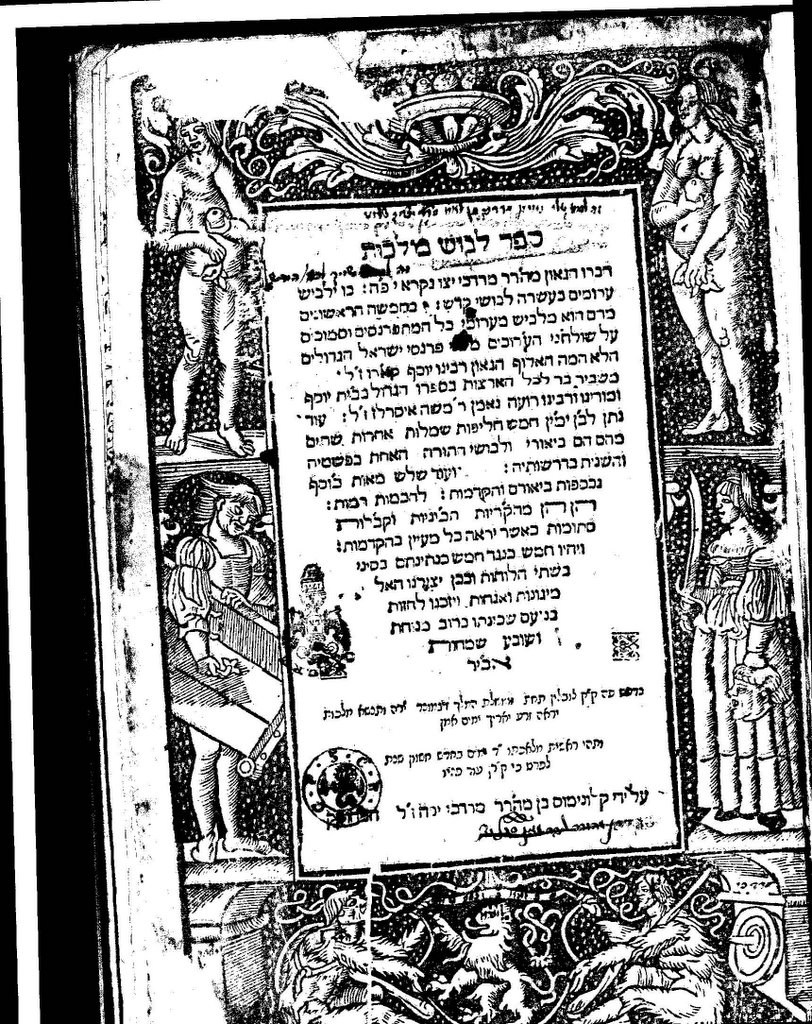
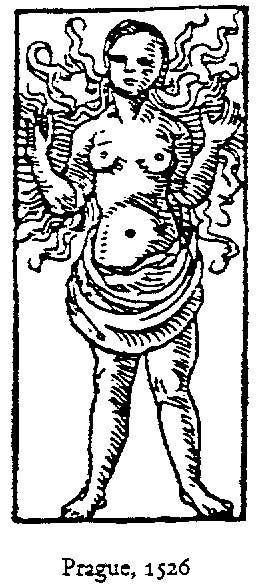
While I do not intend to focus solely on racy title pages, I do have a futher update to my previous posts I, II. It appears that the title page used in the Levush (Prauge, 1590) was actually a recycled page. It was first used in the Prague 1526 Haggada.

Now aside from this page, which we have seen is objectionable to some today, there were other objectionable illustrations in this edition. Yerushalmi in his Haggadah and History, notes that there was an illustration accompaning the verse found in haggadah from Exekiel 16:7. That verse reads “I cause you to increase, even as the growth of the field. And you did increase and grow up, and you became beautiful: you breasts grew, and your hair has grown; yet you were naked and bare” Accompaning this verse the following illustration appeared, which as you can see, really just shows just what the verse describes.

Now in the Venice 1603 they wanted to illustrate this verse, however, they did not want to use a nude, so they replaced it with a picture of a man, which of course, has little to do with the verse. In fact, they felt the need to place a legend on the picture so the reader would not be too confused the legend reads “A Picture of a Man!” (on the right)


Magnes Press Sale

For a limited time, Magnes Press is having a sale, buy one book get the second at 70% off. They have some great new titles including Censorship, Editing and the text Catholic Censorship and Hebrew Literature in the Sixteenth Century; two books from the Italia series one devoted to Shmuel David Luzzato (Shadal) and other about R. Yehuda Areyah of Modena and many others including some other noteworthy ones that Manuscriptboy has recently blogged about.


Racy Title Pages Updated

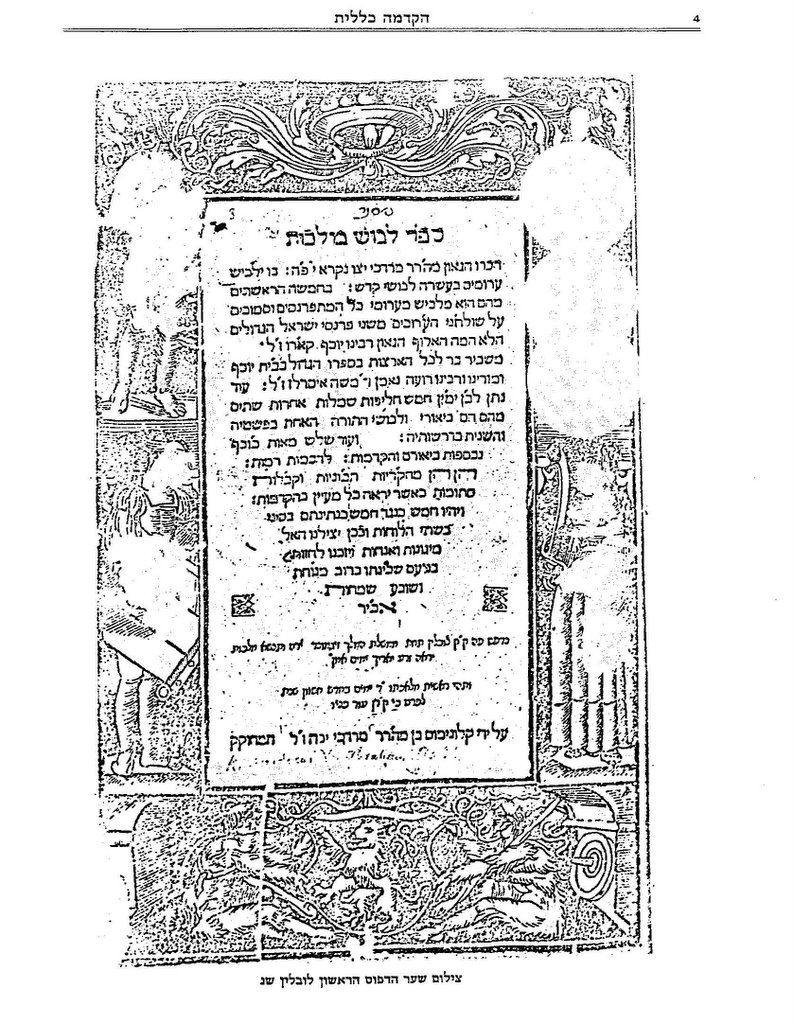
As I had previously noted, many older seforim include what may be deemed objectionable by today’s standards. I had mentioned how one book had attempted to rectify this, the new edition of the Levush. In this edition the title pages from some early editions of the Levush are included in the introdoction, however the title pages has been “touched up.” Now that I have learned how to include images, I present both the original and the touched up version.

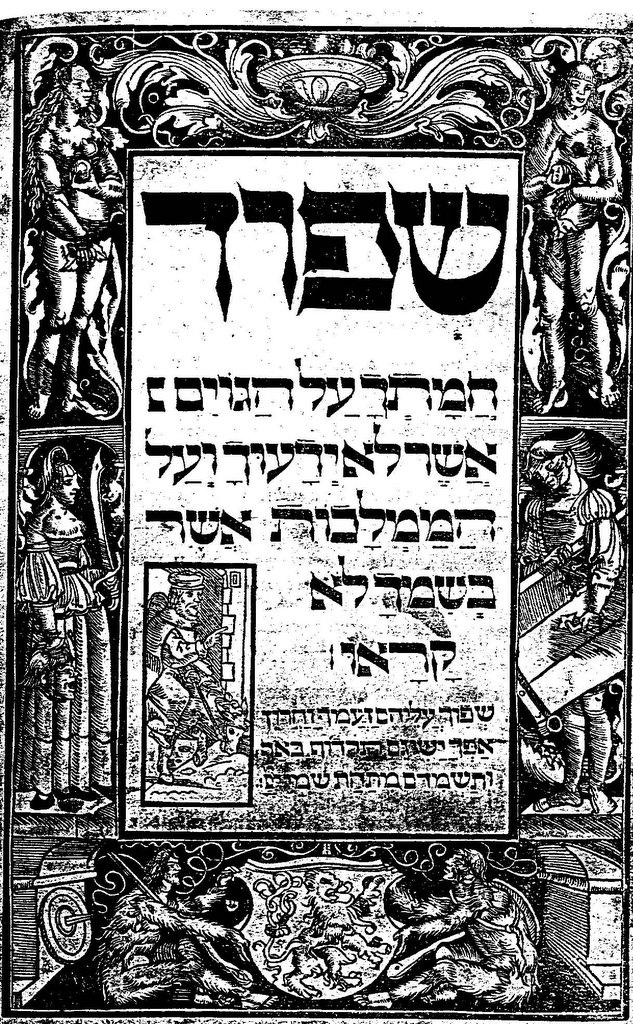
Although, the publishers of the Levush decided to alter the original, the new edition of the Tashbatz Koton did include a reprint of the first edition (1556) with the original title page unaltered. However, as is apparent, there are images on this title page that some might find objectionable.

[Unfortunately, I can’t get the pictures to layout nicely, if someone knows how to fix that please let me know]


Anonymous Sefarim

Although, taken for granted today, there is a rather interesting discussion regarding putting ones name on one’s sefer. The early Jewish books we have- Tanak, Mishna and Talmud, the authors or compliers did use their names. It appears that this practice started in the times of the patanim. R. Yehuda haHasid says

In the early days, the patanyim – the ones that appear in Tanakh – did not use acrostics. Further, early blessings that were fashioned by the Great Assembly do not either have such attributions. However, when wicked people began creating songs of nothing . . .and people could not discern what the righteous people had written and what these wicked people wrote, the righteous people began putting their names in the acrostic . . . and with this the wicked could no longer take credit for poems that were not theirs.

Sefer Hasidim (ed. Wistinetzki), Frankfort 1924, no. 470, p. 133.

Thus, the practice of taking credit for one’s written came in order to allow the reader to know the provenance of the work. Others claim the use of the acrostic was just borrowed from non-Jewish sources. Be it as it may, these claims only date the usage of the writing the authors name to the time after the Talmud.

Some, however, go to some length to show that even in the books of Tanakh and the Mishna the authors or compliers did, at the very least, hint to their name. The Midrash Tanchuma explains why the letter Hey in the verse in Hazenu (Devarim 32:6) H-l’shem tigmilu zot (ה-לה’)is separate from the name of God. The Midrash explains that this unusual separation is to “tell the reader to take the first letters of the verses up until this verse. The Hey (ה) from האזינו, the Yud (י) from יערף, the Kuf (כ) from כי שם, the Hey (ה) from הצור, the Shin (ש) from שחת לו, and finally the Hey (ה) from ה-לה’. Those letters numerical value equal the name of Moshe as this is Moshe signing his name just as a person who finishes his book signs his name to it.” (Tanchum Hazenu 5). Though some note that this quote may have actually been inserted later, it does demonstrate that at a fairly early time people felt it was important to claim authorship to their own work.

At times, however, there were some even long after the Talmud who wrote works in an anonymous fashion. One book provoked a discussion that sheds some light on the above discussion. R. Shmuel Aboab (1610-1694), wrote the ethical work Sefer HaZikronot, first published in 1631 in Prague, recently reprinted in 2001. However, the book was published anonymously. R. Hayyim Yosef David Azulai (Hida) in his bibliographical work, Shem HaGedolim, has an extensive discussion on the entry for the Sefer HaZikronot whether one should or should not note that one is acatully the author of a book. Hida quotes another passage in the Sefer Hasdim that offers an explanation why some do not note they are the author. “The early ones did not write their names on their works for example who wrote Torat Kohanim, Mehilta etc. so that they would not derive benefit from this world and lose any reward they will have in the world to come.” Sefer Hasidim, ed. R. R. Margolis no. 367. However, Hida notes that although for the “early ones” such as the those before the time of the Geonim, they did not reveal their authorship, from the times of the Geonim this has become common practice and thus in today there is no longer a reason to hide who the author is. Hida explains that the nature of R. Aboab’s book was the reason he did not reveal his authorship. The Sefer HaZikronot is a book of exhortations, a mussar book, as R. Aboab did not want to appear as more righteous in giving ethical direction he decided to remain anonymous.

Interestingly, the Hida nor anyone else, ever mention any prohibition in revealing the name of an anonymous work.

Sources: Yakov Shmuel Speigel, Amudim b’Toldot HaSefer HaIvri – Kitiva V’Hatakato, Ramat-Gan 2005, pp. 307-317; R. Hayyim Yosef David Azuali, Shem HaGedolim, Jerusalem 1997, vol. 2 Sefarim, 46-49.

ADDITIONAL NOTE: for further on the pronunciation of the word ה-לה’ see David Yishaki, in R. Jacob Emden, Luah Eres, 2000, appendix.


Minhagim Books No. 1

I hope to present a couple of post on various Minhagim books. Some will focus on communal Minhagim books, and others on the minhagim of specific people.

The Tashbetz, also known as the Tashbetz Koton to distinguish between this the teshuvot haTashbetz, are the customs of R. Meir of Rothenburg as recorded by his disciple. The disciple’s name formed the title, however, it is unclear what exactly was his name. Obviously, it is linked to the title, Tashbetz. Some explain the title as Talmid Shimon ben Tzodok others say he was Talmid Shmuel ben Tzodok, or Tosefot Shimon ben Tzodok, Tosefot Shimon ben Yoitz, orTikkun instead. The book was supposedly written when R. Meir was imprisoned.

The book collects all the customs of R. Meir dealing with the holidays, prayers and everything in between. As R. Meir is one of the gedoli Ashkenaz many of his customs were followed by subsequent generations. Of course, his customs were generally highly influential also due to his students, R. Mordechi ben Hillel haKohen, author of the Mordechai code on the Talmud, R. Asher b. Yehiel (Rosh) as well as his son R. Jacob (Tur) as well as many others.

There are many fascinating customs, whose sources are from the Tashbetz. , standing during the recitation of the Torah, washing ones hands after the kiddush, eating head of a ram on Rosh haShana, saying Zikhron Terura when Rosh haShana is on Shabbat, reciting both Eloki ‘ad shelo netzarti and aloki netzor on Yom Kipppur and the list goes on. There are also some key passages, which explain other unclear customs. For instance, Naftali Wieder explains a rather cryptic passage in the Tashbetz as offering a totally new rational for why some people switch the word b’Fie (Bet-Peh-Yud) in Barukh She’amar to b’Feh (Bet-Peh-Hey). According to Wieder, Fie, is a curse in numerous languages, [think fie fi fo fum] and thus, the Tashbetz is saying for that reason one must alter the word.

There is actually a new edition of this book, however, it has some rather glaring flaws. The editor of this edition, [Sefer Tashbetz haKoton, Israel, 2005 Machon Torah S’beketav] states that he used a specific manuscript for this version, namely the one that he matched up with R. Yosef Karo. From the fact that this manuscript conformed with R. Karo’s readings, this was the manuscript of the Tashbatz. Why the manuscript R. Karo, who lived some 300 years after the time of the transcription of the book, is left wholly unanswered. Further, aside from matching up a couple of passages from the Tashbetz with that of R. Karo, nothing further is offered about this manuscript. The editor never dates the manuscript, talks about where it was written and by whom. In fact, the reader is left to guess whether this manuscript was written after the Shulhan Orakh and Bet Yosef and was done with the specific purpose of conforming with the readings of R. Karo. The editor never says which of the “hundreds” of manuscripts there are of the Tashbetz is actually the oldest. Only that if R. Karo may have used one then that one is dispositive of R. Meir of Rotenberg’s statements. Obviously, this is absurd.

This fundamental flaw aside, there are some positive points of this reprint. The first is that they have reproduced the first edition of the Tashbetz, Cremona 1556. This is reproduced fully, including a interesting title page which can be added to a previous post of mine. The editor has also added some notes, which at times are helpful. He generally uses abbreviation in referencing other books, he includes a key to explain these abbreviations. However, he cites to R. Daniel Goldsmit’s Machzor as well as Weider (cited above) but for those abbreviations, the reader is left on there on. I assume he did not want to “taint” anyone with citations to scholars that although he saw fit to use, did not wish to fully reveal to his readers.

For further reading on both R. Meir and the Tashbetz, see Arbach Ba’alei haTosefot, 552-564; Yode’a Sefer (in vol. 2 of the Roest Catalog) no. 2525; Encyclopedia Judaica 11:1247-53; N. Wieder, Hisgabsut Nusakh haTeffila b’Mizrak u’Ma’ariv (The Formation of Jewish Liturgy in the East and the West) Jerusalem 1998 469-491.


Simchat Torah Book

I was going to post about the most comprehensive book on Simchat Torah, Avraham Ya’ari’s Toldot Hag Simchat Torah, however, Miriam has already posted a very nice summary of it.